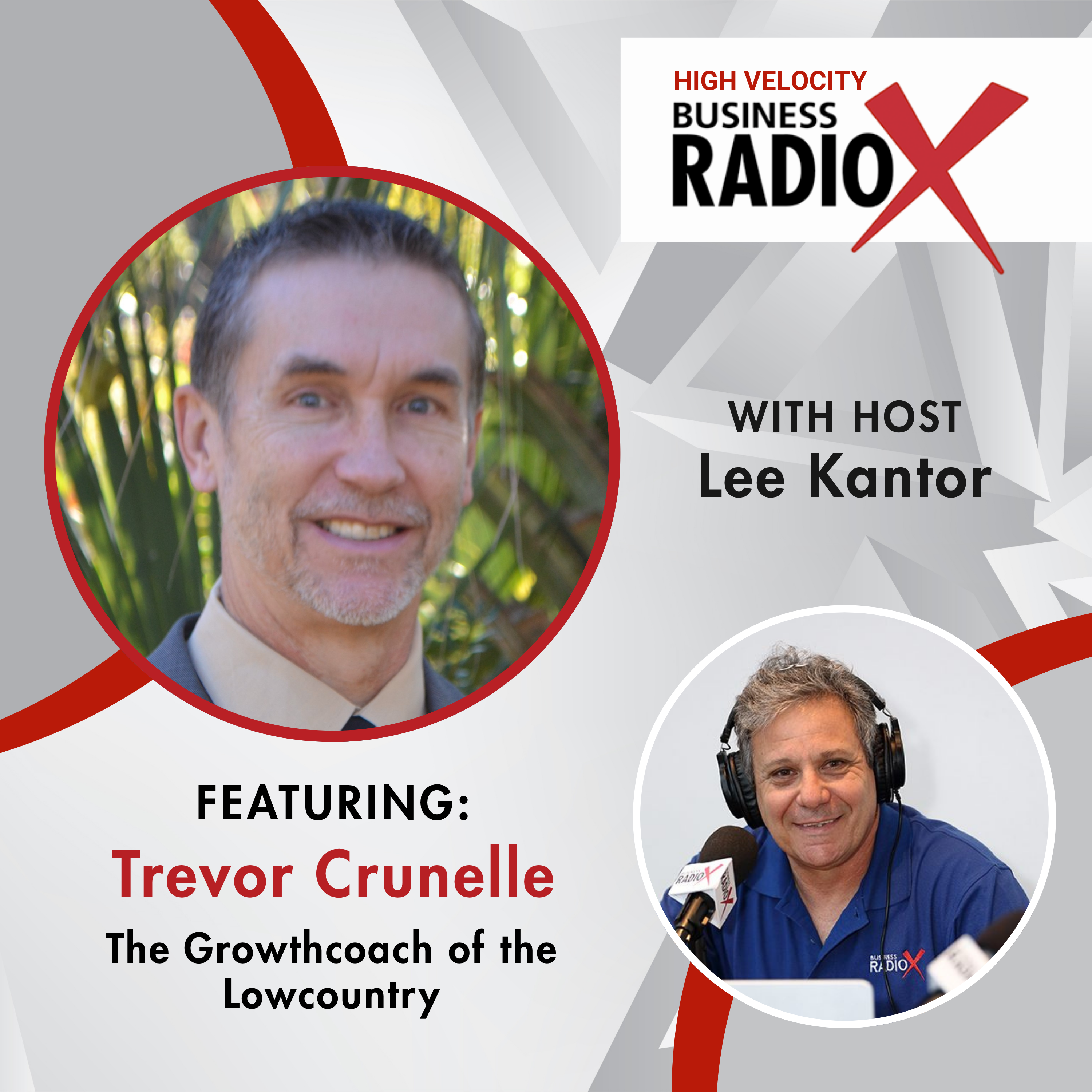

In this episode of High Velocity Radio, Lee Kantor interviews Trevor T. Crunelle, a certified Growth Coach and U.S. Navy veteran dedicated to helping business owners and leaders achieve sustainable growth while maintaining balance. With over 30 years of experience in entrepreneurship, sales, and management within the medical device industry, he combines an engineer’s problem-solving mindset with proven coaching strategies. Certified in The Strategic Mindset© process and DISC assessments, Trevor partners with clients to strengthen leadership, teamwork, and performance. He is also an active community mentor, triathlete, and family man based in Mt. Pleasant, South Carolina.

 When running a business or leading a team, it can be tough to balance everyday operations with a “long game” mindset for next-level growth.
Trevor Crunelle, as a Growth Coach, helps leaders do just that. He collaborates with clients to achieve the goals they set for their teams.Together, he works with them to evaluate their strengths and weaknesses, map a strategy for growth, and monitor progress until all goals are met. He is dedicated to facilitating success by providing the tools, support, and expertise leaders need to take their teams to the next level.
He is certified in The Strategic Mindset© coaching process, which adheres to the ethics standards outlined by the International Coaching Federation. Internationally, The Growth Coach has established a reputation as the largest provider of affordable group coaching, one-on-one coaching, training, and workshops. Through his coaching relationships, he works closely with clients to set and achieve their goals.
Along the way, he also helps shape the performance of sales professionals, managers, management teams, and other key people within companies. To meet specific needs, he adapts The Growth Coach’s signature three-series approach: the Foundation Series, the Fundamental Series, and the Fast Forward Series. To support plan implementation, he is certified in administering and interpreting DISC assessments, a behavioral analysis tool that helps unlock human potential to create stronger teams, leaders, salespeople, and companies.
Having served the country as a U.S. Naval Officer, He understands what it takes to operate with efficiency and precision. He holds a bachelor’s degree in Biomedical Engineering from Northwestern University and a master’s degree in Business and Management from Webster University—training that enables him to apply an engineer’s problem-solving mindset to the business world.
For the past 32 years, he has been an entrepreneur and, since 1991, has worked in sales and management in the medical device industry. When he realized he was ready to combine his professional experience with his passion for coaching and mentoring, he partnered with The Growth Coach. Their approach resonated with him because it helps business owners drive success while prioritizing balance in their lives.
In addition to his professional work, Trevor is a volunteer mentor with Big Brothers/Big Sisters, a certified SCORE Mentor, a member of the Mt. Pleasant Chamber of Commerce membership committee, a Northwestern University Global Ambassador, an Eagle Scout, a triathlete, and a former Boy Scout leader.
He and his wife, Beth, have two college-aged children, Tanner and Jolie. As a family, they have hosted an international student through Rotary International Student Exchange, traveled across the U.S. and in Europe and Central America, and hosted multiple church youth groups.
Connect with Trevor on LinkedIn and Facebook.
What You’ll Learn In This Episode
- How the Strategic Business Mindset program helps business owners become more productive
- DISC assessments
- Common blind spot he see in business owners and how he help them overcome it
 This transcript is machine transcribed by Sonix.
TRANSCRIPT
Intro: Broadcasting live from the Business RadioX studios in Atlanta, Georgia. It’s time for High Velocity Radio.
Lee Kantor: Lee Kantor here. Another episode of High Velocity Radio, and this is going to be a good one. Today on the show, we have the head coach, the owner of the Growth Coach of the Lowcountry, Trevor Crunelle. Welcome.
Trevor Crunelle: Thank you Lee, I’m privileged to be here.
Lee Kantor: Well, I’m excited to learn what you’re up to. Tell us about your practice. How are you serving folks?
Trevor Crunelle: I am serving folks by helping them build a strategic business mindset, and that’s a framework that I use that is part of the Growth Coach Coaching network that we use to help clients become more strategic in the way they run their teams and their business.
Lee Kantor: So what’s your backstory? How’d you get involved in coaching?
Trevor Crunelle: Well, I retired from my corporate career about five years ago and still wanted to do something. Be active, help people. I determined then that my why is to help individuals reach their fullest potential, and business coaching was an outlet I found to do that. I have a master’s degree in Business and Management. I worked for three different fortune 500 companies over my 30 year corporate career, and when I combined that experience, my training and just love to help helping people reach their full potential, it all fit together.
Lee Kantor: So how did you kind of land on the growth coach, instead of just going on it on your own, based on your own expertise and knowledge?
Trevor Crunelle: Right. Yeah. I had no desire to develop my own curriculum or framework, and that’s what the growth coach provides for me. Again, this framework that we use, they’ve been using for over 20 years now, and we know that when business owners, team leaders follow this framework, they become more strategic in running their teams and And businesses, and that makes them more productive.
Lee Kantor: Now, were you vetting other coaching organizations, or did you just kind of become enamored with the growth coach?
Trevor Crunelle: No, I looked at all different options of kind of doing on my own of getting other certifications of other franchises for coaching. And the framework of the strategic business mindset really just resonated with me.
Lee Kantor: So do you mind sharing a little bit about what that program looks like for our listeners?
Trevor Crunelle: Sure.
Trevor Crunelle: So it’s based on a 90 day focusing cycle. So every 90 days we go through an exercise where we look at our 90 day goals. We look at the, um, what we’re doing to reach those goals. Now, the path we’re taking now and, and making sure that that path is still leading us to those goals. And by to evaluate that, we look at relationships, we’re building partnerships, uh, how we’re managing our people, how we’re managing our money. All those things tie into it. And the key. One of the keys to it is that it’s a continuous improvement. Every 90 days, we’re reevaluating and making sure that we’re on track and doing the right thing. Staying on the right path to get to the end goal.
Lee Kantor: Now, what is the profile of your clients? Are they also fortune 500 companies like the ones you left?
Trevor Crunelle: No, no. I’m working with small business owners. Most of my clients have somewhere between 5 and 25 employees. And that’s where I think some of my expertise. Having a fortune 500 background lends well, because I can help them run their small business using some of the things I learned at the bigger companies and helping them apply those and see how they those principles, ways of doing things can work in a small business also.
Lee Kantor: Now, what are um, do you have a niche within kind of the frame of small business? Because that could be everything from a hair salon to a law firm.
Trevor Crunelle: You’re right, and I don’t, because this framework works for all types of businesses. It’s really just the size or the frame, the really the stage that they’re in where they are growing. They’re doing well, but they need to really tie things together to take it to the next level. So it’s really and helps them, um, continue on that growth path in a efficient manner and grow.
Lee Kantor: Now, what is kind of their pain point that they’re having when they realize, hey, maybe I should get a coach here and maybe I should talk to Trevor and his team. What? Is there something that’s happening? Is there a trigger or some point that’s like, hey, things aren’t going as I’d like them to?
Trevor Crunelle: Yes.
Trevor Crunelle: Most of the time it’s that they’re overwhelmed. They’re trying to do too much themselves. You know, they’re spending way too much time working in the business and not enough time on the business. And this framework is really suited for helping them make that transition to working on the business, which means they have to be strategic, and that means putting the processes in place around them, putting a team in place around them so that they are running their small business like they’re a CEO of a larger business.
Lee Kantor: Now, is that kind of a common growth challenge for entrepreneurs, especially at that stage where they probably start by doing everything right, like they’re the ones that, you know, they get the business, they work on, the business they sell the business, they’re doing every aspect of it. But as they grow, they need help or they realize, I can’t do these. You know, maybe I’m spending time on these kind of low, maybe value tasks and maybe I should bring more people in. Is that do people typically go that way, or do they are they pretty good about delegating?
Trevor Crunelle: No, that’s. You hit the nail on the head there, Lee. Um, that’s the problem that most owners, particularly if they were founders run into, is, you know, it’s their baby and they’re used to being the CEO, being the chief everything officer. But they need to become the chief executive officer. And delegation is a big part of it. And just letting go of those tasks that they’re doing one of the most, um, beneficial tasks or, or, um, exercises I often have clients do is I’ll have them for two days, write down everything that they’re doing that day, and then we go back and look at that, and we can start picking things off that list that they need to either delegate, they need to find a better way to do it. Maybe they need to hire someone to do it. Maybe they need to outsource it. But taking things off their plate is a big step in that, and they need a lot of them just need the permission to do that. They need to be told that it’s okay, you don’t have to do that. And another way to look at it or help helps, I think them understand that is I had them put a number down for what their time is worth, and we look at those tasks and say, is it worth your time to do that task when you can find someone else and pay them less to do that and free you up to work on the more important tasks that return more revenue for you.
Lee Kantor: Now is that I mean, it sounds intellectually, it sounds easy, but emotionally it might sound difficult. Like, say, you’re a mechanic and you’re proud that that’s your identity. I’m a mechanic. And then now someone’s coming in and saying, you know what, maybe you shouldn’t be doing the mechanic part. You should be getting more clients in here and let somebody else do the mechanic part. Uh, is do you is that hard to work through that as part of your coaching to get a person to maybe see themselves in a different light?
Trevor Crunelle: It definitely is. And the question I often ask them is, why did you start this business? Did you start the business to create a job for yourself, or did you create the business to start something that will produce money for you when you don’t have to be in there working at it all the time yourself, you know, and that a lot of times helps them kind of think through the process is that, yeah, you know, I just don’t want to be another employee. I want to be running the business. And that means me stepping back from doing a lot of the daily operational stuff.
Lee Kantor: Now, how do you help your clients put kind of the right people in the right roles? Is there a way to do that? Because I would think that a lot of owners especially feel like, look, the skills that I have are unique and that I only I can do this the right way. Like how do you kind of, um, show them that there is a path for them to let go of some of the things that they’re, they’re proud of and they’re good at, but maybe have another person do it. Is there a way to do that handoff? And that makes them feel confident?
Trevor Crunelle: There is. And it really varies from client to client. But one of the big things is, um, learning the art of delegation, because delegation is an art, you know, and and finding what you can delegate. Determining who you can delegate it to and then helping them through the process of understanding how you want it done and then setting them free to do it and giving them some leeway so that they can create their own ways. Also, doing that, or maybe come back and say, you know, can we do it like this? But, um, that process of finding out, figuring out how to delegate and who to delegate to is the first step.
Lee Kantor: And when you’re doing that process, do you use any assessments to help them kind of have a picture in their head of who the right person is for the given role?
Trevor Crunelle: I do. I use disc assessments and disc assessments. Uh, tell us what our predictive, predictable behavior and communication traits are. And the most important part of that is the communication. Um, when you understand through a Disc assessment what your inherent and predictable ways of communicating are, and you understand what that is for the the person, the team that you’re talking to. When you understand that, then it helps really eliminate a lot of conflict. Um, a lot of ambiguity because you know how to communicate better with them.
Lee Kantor: Now, when you begin your, uh, first 90 day kind of, uh, activity as part of the Strategic Business Mindset program, what are some of the questions you’re asking your client, and what are some of the maybe the pre-work they have to do in order to get ready to get the most out of that first 90 days?
Trevor Crunelle: Yeah, we have a, um, there’s a series of questions that we go through and is divided up into six different sections. And they all, they all have a different focus. And we look at each of those areas separately, like one of the areas is relationships. You know, we evaluate what relationships they have, what how they’re putting time into those relationships and if that is worth it to them, um, to, to either further work on that relationship or maybe to back off of it, or do they need to find a new relationship in that area? Now one of the other areas is the people management. How are they managing their people? Are they getting the most out of them? What are they doing to build the culture of their company? So we go through those six different areas, um, and look at them individually.
Lee Kantor: Now. Is there any advice you could share for, um, the listeners here when it comes to maybe some of the blind spots that you’ve discovered just by working with so many business owners Is there a common blind spot? And then if you have any advice to help them overcome, it would be great.
Trevor Crunelle: I think a common, um, kind of a blind spot. It’s kind of a common theme. And you alluded to it earlier in that they think that they have to be the one doing that particular task or that work, because they think they’re the only ones that can do it the way they want it done the right way. Um, and that’s often a blind spot because that’s not the truth. Many other people can do that as well as you or better sometimes. And even if it’s not, if someone is doing something, uh, close to how you want it done, then that may be good enough. And accepting that things don’t have to be done exactly the way you want them, but they can be done well in reaching that point of good enough is, um, is often a blind spot or something that’s hard for them to overcome. Often.
Lee Kantor: Yeah, I would think that a lot of people good enough is a tough one because that’s they take so much pride in, in whatever that activity is. And they feel like that, that it’s really tied to their identity. I think a lot of this work seems to be shifting their mindset of what, like you said earlier, what is that big? Why why did you get this business going to begin with? Did you get it to turn a ranch, or did you do it to help your community?
Trevor Crunelle: Right.
Lee Kantor: Right now, is there a story you can share that maybe illustrates how working with you can take a business to a new level? Obviously don’t name the name of the person, but maybe share the challenge they came to you with and how you were able to help them overcome it.
Trevor Crunelle: Yeah. So one of my favorite stories is, um, in relation to what you said earlier, that it’s a lot of mindset that I was at a conference and met one of the one of my clients. I met his wife and we were talking and she said, Trevor, I just want to thank you. And I said, you’re welcome, but what are you thanking me for? And she said, well, she said, since Ricky’s been working with you, I’ve noticed a change in him. And I know when he comes home at night, if he’s had a session with you that day because he’s happier, he feels like his business is going in the right direction, and he knows that he’s on the right track and he’s just overall much happier and pleasant to be with. And I thank you for that.
Lee Kantor: And that’s something that, um, probably going in that wasn’t something that was important to your client, but it had a ripple effect to his family. Right.
Trevor Crunelle: Right, right. Yeah. And just and oh, and she mentioned also just that he would say that, you know, I have so much more clarity now in how I’m doing things and where my team, my company is going.
Lee Kantor: Now, when you were, uh, in your career, did you actually were you ever coached? Like, was this something that you saw that coaching could really have a big impact if it’s deployed properly?
Trevor Crunelle: I did not. Um, I wish I had. You know, it’s one of those things I didn’t know. I didn’t know at that point, um, and never really, I think, sought after or or, um, was approached or given the opportunity to have a coach like this. But I see now the benefits are are amazing. Um, and I wish I had taken been more involved or had those opportunities at that point. Now, I had some good mentors, uh, through, you know, managers, but not someone that was focusing really just on helping me become better.
Lee Kantor: Yeah. Can you share, maybe for folks who aren’t familiar, what is the difference between a mentor and a coach?
Trevor Crunelle: Yeah. So a mentor is someone who they, um, you build a good relationship with them and you respect them for what they’ve done, their knowledge base and where they’ve been, and they just help you, uh, work through things, provide guidance based on their own experience, where a coach is more structured and a coach has like a framework that we use and we have, um, set point, set things that we measure and goals we’re going to reach, and it’s much more structured and uses. Um, I mean, it also draws from the coach’s experience, but there’s more of a framework to it and it’s more outcome oriented.
Lee Kantor: Now in your work, in your market, in the low country. Is it, um, do you have kind of a network that you rely on, of strategic partnerships that help you kind of deliver on what you’re trying to deliver on?
Trevor Crunelle: I do there are I have several, uh, good strategic partnerships where, you know, they in particular some CPAs, um, some insurance agents, um, some marketing agencies where they are also working with companies are in the same size. Um, and they’re helping them. And we all kind of are part become part of that company’s team because we’re helping them with different aspects of their business.
Lee Kantor: Now, is that something that the growth coach recommends you do, or is this something you figured out on your own?
Trevor Crunelle: No, it’s something the growth coach, um, highly recommends that we do. Um, yes.
Lee Kantor: So as part of their playbook to help you, uh, become successful is to invest in strategic partnerships in your community.
Trevor Crunelle: Absolutely. Yep. And that’s one thing I really help my clients do also, and encourage them to do, because those strategic partnerships can can go a long way.
Lee Kantor: Now, um, is there a client that when you’re delivering your service, do you deliver it one on one with the client, or do you do group coaching or do you have cohorts? Like how do you deliver your coaching?
Trevor Crunelle: Uh, all of the above. It depends on what the client’s looking for. The what I have found to be the best, um, give us the best outcomes is I have several clients that are kind of in the same. They’re completely different industries, but they’re in the same stages. Uh, and they. I meet with them as a group once a month and then meet with each of them individually once a month. So we’re meeting basically every two weeks, but they get the benefit of that group coaching, where you get the mastermind effect. You’re learning from everyone in the room from their experiences. Um, and that also helps hold them more accountable. And then when we meet 1 to 1, we work more individually on, you know, what their, um, individual goals are, how they’re staying on track. They’re holding them accountable for the plan they’ve created there. So that’s where I see the best outcomes. A combination of the group and 1 to 1 coaching. But I have a couple people that are just in groups. I have a couple that are just doing 1 to 1 coaching.
Lee Kantor: Now, do you ever kind of go into a company and coach kind of the leadership of the company and some of their teams?
Trevor Crunelle: Yes. Um, and typically those are those usually start off with like doing a disc workshop. So I’ll go in for either the leadership team or, or one team within the company and do like a half day workshop on disc, which helps them, you know, work on their communication skills. Uh, and then from that, a lot of times that that helps them understand some of their blind spots and see the value of working with a coach, of being intentional about how you work on your communication skills or how you do things, and then will come in and, um, work more with that team or that company.
Lee Kantor: Now, does this, uh, modality work best in certain areas of a company? Like does it work better in operations versus sales or, um, you know, is it better at culture than it is at, um, you know, maybe more of the strategic thing. So is there a better place or can work pretty much anywhere throughout an organization?
Trevor Crunelle: Uh, it can work pretty much anywhere throughout an organization. I think the strongest, um, areas are in building culture and in building open communication lines, which that that crosses over, you know, to all areas. But those are the kind of the, the backdrop or the, the, um, what I would say, the area where we kind of get our foot in the door and start from that groundwork.
Lee Kantor: So has this, um, experience been what you hoped it would be?
Trevor Crunelle: It has been, yes. I, I thoroughly enjoy it. Um, and it’s been very rewarding.
Lee Kantor: Now, what about from a standpoint of coming from large organizations to this entrepreneurial thing on your own, is there? Can you share some of the challenges when it came to making that shift? Because that’s a that’s not for the faint of heart.
Trevor Crunelle: It’s not. Unfortunately, I was in a good position where I had retired from my corporate career. So starting up as an entrepreneur, um, here I was not under any pressure that, you know, I’ve got to get X number of clients within a couple of months or I can’t, you know, pay my bills. So I feel very fortunate that I was in that position, that I was able to take my time and build this the way I wanted to without feeling a lot of outside undue pressure.
Lee Kantor: And that allowed you to select kind of those best fit clients rather than just take anybody, because I have, you know, mouths to feed.
Trevor Crunelle: Right, exactly. And to take the time to get trained well and disc trained in cohesion culture, you know, get some other trainings and put things together, go out and build some good relationships. Um, because it does take time. Take time to build those relationships, to build some credibility.
Lee Kantor: So if somebody wants to learn more, have a more substantive conversation with you. What is the website? What’s the best way to connect?
Trevor Crunelle: Uh, probably the easiest way is just connect on LinkedIn. I’m the only Trevor Crunelle on LinkedIn. Um, or my website is the growth coach. Um, growth coach.
Lee Kantor: Right. I’m sure if they go to growth comm and then just type in low country, you’re probably the only one that shows up. Good stuff. Trevor. Well, congratulations on all the success. You’re doing such important work and we appreciate you.
Trevor Crunelle: Thank you. Lee, I appreciate you having me on your podcast.
Lee Kantor: All right. This is Lee Kantor. We’ll see you all next time on High Velocity Radio.