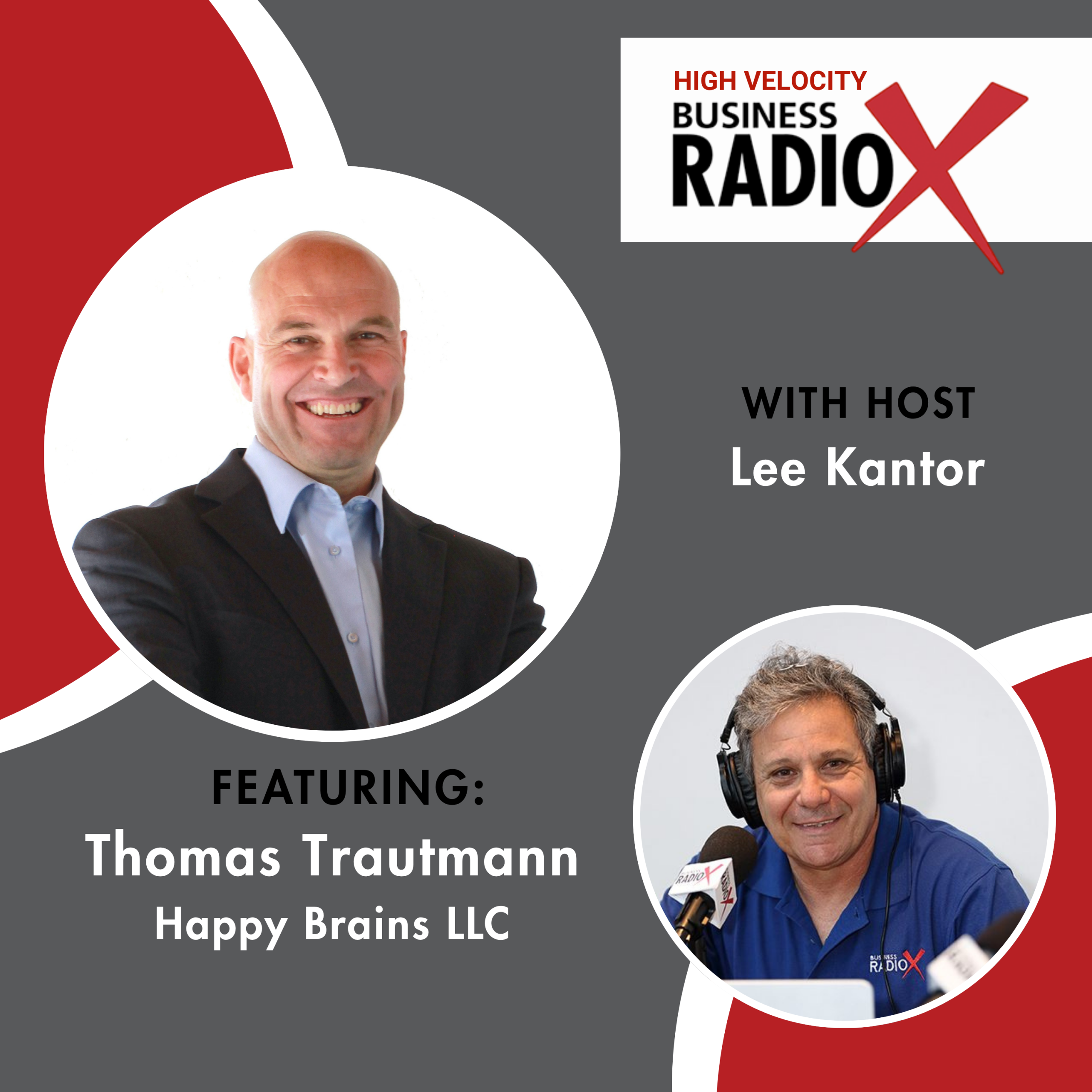

In this episode of High Velocity Radio, Lee Kantor interviews Thomas Trautmann, the “Brain Guy” behind Happy Brains, about using neuroscience and ethical persuasion to help business owners and executives become unforgettable to their ideal clients. Thomas explains how understanding the brain, focusing communication on the other person, using “you language,” practicing silent listening, and telling compelling stories can build trust and create stronger business connections.

 Dr. Thomas Trautmann is a neuroscientist, executive coach, author and speaker dedicated to making business owners unforgettable. As the founder of Happy Brains, he deploys the Science of Ethical Persuasion to transform lives and businesses, building communities that thrive on mutual growth and success.
With a Ph.D. in artificial intelligence and an engineering degree in computer science, he built his early career inside some of the world’s most demanding organisations: IBM, HP, AOL, Bosch and Steelcase. He did not learn business from a classroom. He learned it from inside revenue targets, product launches and enterprise sales cycles that forgave nothing.
As a former Certified Neuromarketing Instructor, he spent years deploying cutting-edge brain science in service of corporate marketing machines. He was good at it. He was also uncomfortable with it. NeuroMarketing optimises for the company’s result at the expense of the individual in the room. That discomfort became the Ethical Persuader System: the only framework designed to get the decision you want from someone while ensuring they experience it as entirely their own.
Central to Thomas’s work is the conviction that you cannot make yourself great by trying to make yourself great. You make yourself great by making your clients great. This is not a philosophy. It is neuroscience. The brain responds to contribution before it responds to acquisition. The Make Me Great! system is built on that sequence.
As a 10X Certified Business Coach with Grant Cardone, he combines the neuroscience of decision-making with Cardone’s expertise in money mindset, marketing and sales. The combination produces something neither alone could: clients who understand why they buy, how to make others want to buy from them, and how relentlessly to pursue the growth they deserve.
He lives in the south of France with his wife and three children. He has two marriages, one divorce, and a career built on understanding the exact same pressures his clients face. He is not advising from a distance. He is the client. That makes him the only coach in this space who can say so honestly.
Connect with Thomas on LinkedIn and follow Happy Brains on Facebook.
What You’ll Learn In This Episode
- Making a memorable first impression in seconds
- Understanding how the brain influences business decisions
- Using ethical persuasion to create genuine connections
- Shifting communication from “me” language to “you” language
- Practicing silent listening to better understand clients
- Connecting with clients through relevant stories and questions
- Identifying subconscious frustrations that influence decisions
- Building a communication toolbox tailored to different audiences
- Using neuroscience principles to strengthen sales and marketing
 This transcript is machine transcribed by Sonix.
TRANSCRIPT
Intro: Broadcasting live from the Business RadioX Studios in Atlanta, Georgia. It’s time for High Velocity Radio.
Lee Kantor: Lee Kantor here another episode of High Velocity Radio and this is gonna be a good one. But before we get started, it’s important to recognize our sponsor, Business RadioX. If you’re a business coach or consultant who’s tired of being a best kept secret, set up a call with Stone Payton at brookstone.com to unlock your perpetual prospect pipeline. Today on the show, we have the brain guy with Happy Brains, Thomas Trautmann. Welcome.
Thomas Trautmann: Thank you, thank you. Happy to be here.
Lee Kantor: Well, I am happy that you are. Please tell us about Happy Brains. How are you serving folks?
Thomas Trautmann: So what we do at Happy Brains is that we make business owners and high level executives Unforgettable in 11 seconds by speaking to the decision makers.
Lee Kantor: Brain 11 seconds you time this. How did you figure out 11 seconds? Not 10 or 12 or five.
Thomas Trautmann: It’s. It’s some brain stuff. It’s. I’m not the guy who made this up, okay? I’m the guy who buys it and makes it usable for users. But there are different steps where the first the brain is going to assess if it’s going to like you or not define your status and if it wants to listen to you.
Lee Kantor: So how do you manage those 11 seconds in order to become unforgettable?
Thomas Trautmann: That’s exactly what we explain our clients. So you start by, yeah, five steps in the system, which is called Make Me great. So the first one is to know who you are. If I ask you who you are, if you tell me, well, I’m Lee, I’m sorry. There are many guys who are called Lee, their family name, same thing, etc. etc.. What makes you unique? Who are you? So people can listeners can start thinking about that. Who are you? What makes you unique? So that’s going to be to, to show through how you behave. That brain in front of you is going to assess how you smile. If you’re smiling, not smiling, what are the microexpressions you have on your face before you open your mouth? And then when you speak? Is it all about you or is it about me, the brain listening to you? Because that brain shouts and screams at you make me great.
Lee Kantor: Now what do you do? Like I’ve interviewed in the past, there’s a company in America called chick fil A. Are you familiar with that? No. Okay. It’s a it’s a restaurant. Fast food, quick service restaurant chain that sells primarily chicken sandwiches. Okay. And there’s they’re usually rated in America as one of the top, if not the top fast food restaurant in America. And they’re based here in Atlanta where I am. And I’ve had the opportunity to interview some of the leadership there. And one of the things that they told me that struck me, and it kind of aligns with what you’re saying is they only hire people who are natural smilers. So when they’re interviewing people in a fast food restaurant to work there, if you’re a natural smiler, you’re you got a big edge because they feel that they can’t train smiling effectively. What’s your take on that? Because you mentioned, uh, that’s one of the things that people are assessing in that first 11 seconds.
Thomas Trautmann: Well, you know that there are a lot of steps, but it takes the brain in front of you when you are face to face, okay, in a, in a face to face situation. 0.3 seconds to decide if it’s going to like you or not. So as you said, it’s very difficult to fake to, to sorry to have a real smile when you try to fake it. Politicians are very good at faking smiles and you can see it. I mean, if you see any of their of their of their, the pictures they are showing, etc., they’re sharing when they do some advertising. And so You see, it’s a fake smile, you know? But when you do, the real smile with the little wrinkles on the side of the eyes, which are called the Duchenne wrinkles, when you do that nice smile, genuine smile, you give your brain a shot of endorphin. It makes your brain happy, and the brain’s in front of you are going to get the same shot because of based on the mirror neuron theory, the same brains that are active in my brains are activated in your brain, even if you don’t do the same thing. So you also get a good shot of endorphins. So people who are smiling definitely win the race because they make the brain in front of them feel great. So I mean, that chicken feed, I think they are absolutely right on that one.
Lee Kantor: Now when you’re working with your clients, how do you help them be authentically and ethically? Themselves in order for them to get the outcome they desire and not use kind of some of these neuro. Um, I don’t know what you call them, uh, neuroscience tactics. Uh, you know, you want them to use it as a force for good and not to kind of, uh, unethically manipulate people to, for, for a bad outcome.
Thomas Trautmann: Yeah, yeah. That’s why the, the core element of the make me great system of everything I do is called the ethical persuasion system or the ethical persuasion formula. And it’s called ethical because it’s based on how the human brain makes decisions. The, the one thing that triggers a decision. There are many other ones, but the primal one is called a subconscious frustration. We have many subconscious frustrations, okay? We make decisions with something called the primal brain. The lower the lower part of our brain, which stopped evolving around 50,000, 100,000 years ago. So it’s a pure survival tool and it takes care of only 1 in 1 person on earth itself. So when you show to that brain that in relation with the decision you want from that person, that you know, the subconscious frustration and that you may be the one who is going to remove that subconscious frustration. That’s why you are ethical, because you get a decision you want and they make the decision they need. So that’s why you are ethical. You can of course use manipulation, influence techniques. And I mean, there are many out there. Many websites do use them, you know, uh, air travel, uh, companies are very good at it’s the last seat at 20 bucks. Then the next one is at 200 bucks. When you come two hours later, the the seat is still there. So stuff like that is manipulation and the brain goes for it because it loves to to win something. But if you do it properly, then you’re ethical. And that’s how you become unforgettable because then you’re going to stick inside that brain because you have showed the brain that in fact, you care to make it great.
Lee Kantor: Now, um, when you’re doing your work, what is kind of the challenge your clients are having right before they hire you? What is, how does this show up on somebody that they may need some help and counsel in this area? What are their signals or their things that are happening in their life or in their business that says, you know what, I should probably call Thomas and his team?
Thomas Trautmann: Yeah, it’s definitely when you are the best offer in the room, for example, and it’s always someone else who gets the deal or you are working your whatever off, you know, like crazy. And it’s always that guy who does nothing, who gets the promotion or, uh, the, the person you would like to spend your life with is leaving you and so on because something is wrong. So all those things are signals, you know, or your team is listening to you, but they are Speak, talking in your back and they are leaving the company, so something is off. And each time you want to win a deal, the client asks you for a rebate for a longer test, time for more samples and so on. That typically shows that you are trying to be rational, when in fact the brain in front of you makes primal decisions. We rationalize afterwards that has been scientifically demonstrated. There is even a guy who got a Nobel Prize for that. Unfortunately, 97% of people on earth still think that we make rational decisions when in fact we make private decisions that we rationalize afterwards. And everyone who wants to get more decisions made and become unforgettable should call me.
Lee Kantor: So what are some of the ways, like you mentioned, that, um, I guess intellectually people think that, oh, I just have to have all this proof and evidence and facts and that, and then I will, um, be successful. But I hear you saying that that is not that’s secondary. That first you have to kind of become unforgettable and trustworthy and believable and likable, and then the other stuff will come later just to justify their decision.
Thomas Trautmann: Absolutely. You’re absolutely right on that one. Yes. People will anyway be rational at one stage, but the rationalization process is there to justify the decision that has been made at the primal level. And what’s very funny, if I may say so, is that that primal brain has a a selling proposition if you want, which is it’s better to be stupid and alive than smart and dead because it’s a survival tool. So every decision is going to make is based on is it going to help me survive? And it’s not a smart decision. Okay, definitely not. But that is that’s the way it works. And because it hasn’t evolved, I mean, it’s 500 million years old. It stopped evolving 100,000 years ago. It still runs the processes we were using in the cave age. So that’s can be summarized in something like the 180 plus cognitive biases that have been identified. So things that make us make decisions like, I mean, you know, that what I’m going to sell you now, for example, is a prototype. If you wait, okay, you will get the final product for cheaper in one year. Your brain prefers to have the prototype now, even if it’s not working properly. Now, for example.
Lee Kantor: When you’re using the word survival, um, you know, I guess 100,000 years ago, survival meant one thing and survival today means another thing. I don’t think many of our lives are really at stake in some of these decisions that we’re talking about.
Thomas Trautmann: Absolutely.
Lee Kantor: What, um, how are you defining survival now? Is that could that be just not being embarrassed? Like, like what are some of the, the kind of, uh, fight or flight, uh, feelings that a primal brain is dealing with in today’s world where it isn’t literally life or death?
Thomas Trautmann: Yeah. It’s still, I mean, uh, you use a very good example. And, and that illustrates definitely that all those primal decisions are made for the human being in which the brain is okay. It’s my survival, it’s not yours, it’s not the survival of my children, etc. it’s my survival. So my brain wants you to make me great. That’s very important. And, um, those subconscious frustrations. So before it was, am I going to survive? Am I going to be eaten or am I going to eat something? And you mentioned fight flight, which is a very good example. Nowadays it can be as a business owner, I’m, am I going to show that that I can make it, you know, that he can be proud of me or am I going to provide for my family, or are they going to leave for someone else? Those are the type of things that that drive a lot of decisions and fight flight is still active. We still have fight flight running in our brains and nowadays a few words can start it. If you’re in a corporate relationship, you know, when um, she comes and says, we need to talk. It triggers the fight flight process in the male brain. Uh, and when he says later, it triggers her fight flight process. Just a few words nowadays trigger that process. Look at when you have an argument at work or something like that, the stress you are feeling, that’s the fight flight process.
Thomas Trautmann: It’s a it’s a crazy one because when it starts, it triggers the amygdala, which is releasing, releasing adrenaline in your body. You have cortisone that sent so that you feel less pain. Blood is removed from your limbs so that you bleed less in case you get hurt. You you’re breathing rhythm accelerates, your heart rate accelerates. I mean, all those crazy things happen with just a few words because that process hasn’t changed. So and that drives absolutely crazy situations. So we may not be dying at every street corner, but that’s still driving all the things. They were experiments in a supermarket. I think it was in Germany. You know, the the aisle where you buy your your bread or stuff like that. At the end, there are always very sharp angles. Okay. So when you arrive at the end of an aisle as a normal rational Homo sapiens sapiens, okay, you are conscious to be conscious. It’s just the end of the aisle. I’m going to turn left or right with my trolley and go buy some coke, for example. But your brain, your primal brain is in overdrive. Because first of all, there are those sharp angles which, oh, that’s aggressive and maybe someone is going to kill me when I’m going at the end of the aisle. That’s the primal brain reacting. Okay. And they rounded the corners in one supermarket and the sales went up by, I think it was 13 or 16% just because of that.
Lee Kantor: Now, do you have any advice for a lot of our listeners are business coaches and business consultants. Is there any advice on how they should be communicating with their clients and with their prospective clients? When it comes to kind of leveraging some of the things that you talk about? Is there some do’s and don’ts in your communication when it comes to being an effective communicator, in terms of leveraging all of this kind of neuroscience to your benefit?
Thomas Trautmann: Yeah. Well, if you just want to communicate is when you start a relationship with a client or with a lead, don’t talk about yourself. I mean, their brain doesn’t care about your brand, your services, yourself, your products, your company. They don’t care. Their brain shouts at you, screams at you make me great. Talk about them. Pay attention to them, listen to them. I mean, I did coach once, uh, a team of a company and one sales guy was really excited about using all the tools that he learned. It took him four weeks, but after four weeks, he because it’s a 180 degree shift to use the ethical persuasion. But he did it. And he said, Thomas, it’s absolutely crazy. I went to a client I never saw who never heard of us and so on. And for once, I didn’t speak about who we are, what we do, etc. the meeting took one hour, he said, and at the end I. He told I didn’t, I didn’t really not speak. But they said, we’re going to work with you because we trust you. So it’s just get used to stop talking about yourself when you write an email, when you go on the phone, do something that I call the you language. Every sentence should be you, you, you, meaning you are talking to that person and not. For example. Hello Lee, I am sending you a brochure where I want you to discover Dadada, which is about myself. In fact, it should be. Hey Lee, you are receiving this brochure which is going to show you how you could get this and that. I’m still saying the same thing, but just in the you language.
Lee Kantor: And then so does that require you to, um, be better at asking questions and being an active listener?
Thomas Trautmann: Yeah. Well, you should, you should know what question to ask that connect with the primal brain. That’s one thing. And you should not be an active listener. I’m calling that very differently. I’m calling that silent listening, which means that your brain shuts up. Active listening is you’re listening and you are thinking about what they are going to say or what you’re going to say that’s active listening, but at least you are listening. But your brain is still running, saying, okay, he just said that. So I’m going to talk about this. I’m going to talk about that and I’m not listening to you. Silent listening is working on that, practicing so that your brain goes silent inside. Okay. It doesn’t say, I need to talk about this. I need to talk about it. It’s really listening. So use a pencil, take notes. Okay. Explain that you’re going to take notes because that’s a conscious effort to listen.
Lee Kantor: And then when you listen, um, how do you then take what you’re the notes you’re taking? How do you move the conversation in the direction you’d like? Or is it something that you don’t really worry about you and you’re just focusing in on the other person.
Thomas Trautmann: But if you know how you answer their subconscious frustrations and how you can solve that, um, you just need to listen that that requires, of course, that you have all the tools before because then you may want to. There is one mandatory tool, which is a story. You need stories, but very specific stories built in a very specific way so that they connect with you, because stories are very strong on the brain, because they drive trust if they are well told and something. And one other factor. So you have to put all that together, which means that again, you know who you are talking to. If I’m talking to a CEO, I will not use the same subconscious frustrations. If I’m talking to the head of, of, of, uh, of the computer department, I’m not going to use the same subconscious frustrations as the marketing guy. Uh, if it’s a woman, it may be a very different subconscious frustration from a man. So I have to know who I am talking with. That’s the first step. I’m now really paying attention to who I am talking with.
Lee Kantor: Now, when you’re working with clients, is this something that you help them kind of build out this toolbox with the assets they need in order to be successful.
Thomas Trautmann: Yes, we we definitely work on the toolbox. It’s a workshop takes minimum one day if they want to rework their marketing, their sales pitch and so on, it can last from 2 to 3 days. But we definitely dive deep into the brain of their clients. So they have to understand who their clients are, what are their subconscious frustrations? How do you trigger these, what type of questions you can ask, what type of story you can ask, the tools, the objects, how you move your body, even if you have a presentation to do, there is a way to do that, to be ethically persuasive.
Lee Kantor: Now, is there anything that a person, a listener right now could do? Is there anything actionable you can share that is low hanging fruit that would give them a kind of a good bang for their buck in terms of, uh, something they can do right now.
Thomas Trautmann: And something they can do right now is really use the you language practice that it’s a tough one because your own brain wants to talk about itself, right? It it wants to show to itself. It made the right decision to sell what you are selling or do what you are doing. So you work on the you language. And I can tell you it’s a tough one. It’s a tough one.
Lee Kantor: And then what are some examples of how to use the you language?
Thomas Trautmann: Again, if I give you one, if you write an email, don’t send the email, read the email again and see if you’re talking about you or if you’re talking about them. And rewrite rewrite sorry, every sentence so that it’s about them. There should be only you, you, you, you, you in, in your email, for example. Same thing if you make a script for call for a call or something like that, make sure it’s about you, you, you practice when you get home, you know, instead of, hey, I had a great day. So how was your day? You know, same thing.
Lee Kantor: So just, uh, just try to emphasize you instead of me or I, um, more often, uh, in your conversations or your communications.
Thomas Trautmann: Yeah. You will see that brain in front of you is going to love you.
Lee Kantor: Now, is there an example you can share of what it’s like to work with you? Uh, do you have, um, maybe a story that you can share? Don’t name the name of the person or the organization, but maybe share the challenge they came to you with and how you were able to help them get to a new level.
Thomas Trautmann: Yeah, it’s a, it’s a manufacturing company. They produce a very specific plastic parts. And they were the leader in the, in the market worldwide. And they got slowly, uh, yeah, not killed, but eaten by the competition. And in fact, they lost their, their mojo. If you want, uh, some sites were in Germany, you know, in Germany, uh, we have very, very clean manufacturing sites you could eat on the floor and theirs was a bloody mess. So they lost. They lost their employees. They were losing their clients. So we worked with the CMO on the on how to focus on the brain of their clients. And we came out with a message that was, it all starts with you because the whole company could start because their clients were there. So it was again, it was not about the brand. It was it all starts with you. They went on a trade show, uh, and the booth we created, the booth that was fully white with mirrors on it. So when the client came to visit them, the first thing they saw were themselves in that mirror.
Thomas Trautmann: And inside each mirror, there was a picture of the clients of the client of that company. So they could see themselves and their clients using their products. That’s all that was on the booth. And the booth was white, was light from the back. I mean, it was it was a very beautiful booth, but it worked like crazy. Once the people wanted to start the conversation, then they could take them in the back room where there were the tables and so on, and they could show the products. That was the second stage. That was rationalizing the whole thing. So and that whole campaign went into the press, the press, the professional press wrote him a letter saying they’ve never seen something like that. It was incredible. And they saw a 70% increase in in demands, in leads and stuff like that just after that. But they had the courage to go all in. And the message, it all starts with you was also valid for the employees because without the employees, that company could not survive. So it also helped in that direction.
Lee Kantor: Now, you mentioned this was a manufacturing firm. Is there is that your niche or is what you do your work you do? Is that kind of industry agnostic?
Thomas Trautmann: I am completely industry agnostic because I’m focusing on the human brain. And aside politicians, everyone has a brain.
Lee Kantor: So you don’t do much political consulting?
Thomas Trautmann: I absolutely refuse to do it.
Lee Kantor: There’s a line. You have a line?
Thomas Trautmann: Absolutely. I have an ethical line.
Lee Kantor: So if somebody wants to learn more about Happy Brains, what’s the website? What’s the best way to connect?
Thomas Trautmann: It’s on the website, which is happybrains.com, or they can find me on LinkedIn also mostly everywhere else, but LinkedIn is the easiest one.
Lee Kantor: Well, Thomas, thank you so much for sharing your story today. You’re doing such important work and we appreciate you.
Thomas Trautmann: Thank you. Thank you for having me on the talk. I appreciate it.
Lee Kantor: All right. This is Lee Kantor. We’ll see you all next time on High Velocity Radio.















