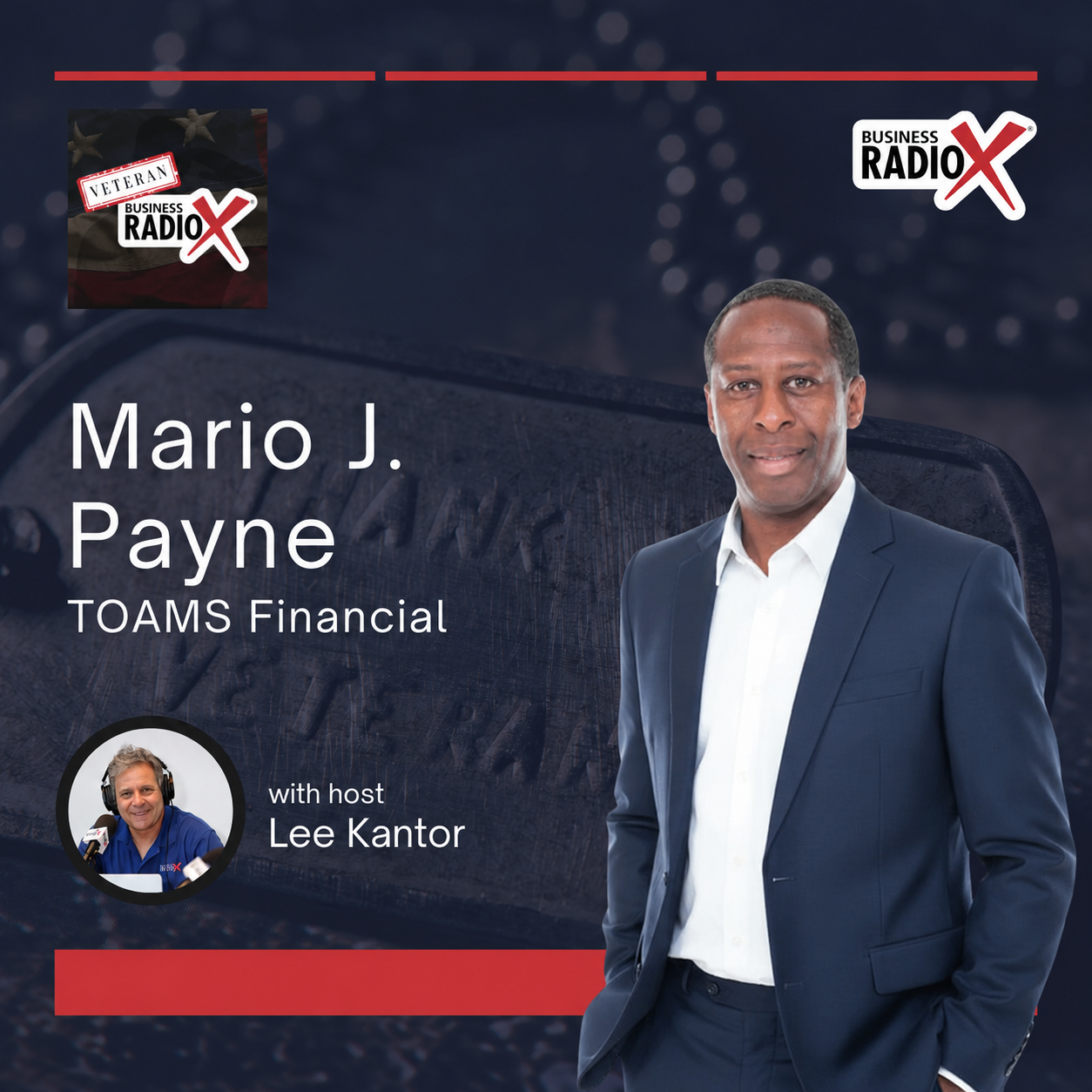

In this episode of Veterans Business Radio, Lee Kantor interviews Mario Payne, Founder and CEO of TOAMS Financial. Mario shares his unique approach to wealth building through investing, tax strategy, and estate planning. Drawing on his experience as a veteran, certified financial planner, and entrepreneur, he explains how individuals and business owners can create passive income streams, reduce tax burdens, protect their assets, and build long-term financial security. The conversation also highlights the importance of financial literacy, disciplined investing, and leveraging military leadership principles in business and wealth creation.

 Mario Payne is a nationally recognized financial strategist, entrepreneur, and wealth-building expert dedicated to helping individuals, families, and business owners create lasting financial freedom.
As the Founder and Chief Executive Officer of TOAMS Financial, an SEC-registered investment advisory firm, he has spent nearly two decades empowering clients to build wealth, preserve assets, and develop financial strategies that create generational impact.
A Certified Financial Planner™ (CFP®), fiduciary, bestselling author, Army veteran, and respected financial educator, he has built a reputation for translating complex financial concepts into practical strategies that help everyday people make informed decisions about their money and future. Born and raised in Cincinnati, Ohio, he attended Tennessee State University, where he earned a degree in Business Administration and graduated Magna Cum Laude.
Shortly after graduation, he launched his career with Edward Jones, where he spent six years mastering investment management, financial planning, and wealth advisory services while developing the foundation that would ultimately lead to the creation of his own firm. In 2013, he founded TOAMS Financial—an acronym for “Tithe, Offering, Alms Means Stewardship.”
What began as a vision to help underserved communities gain access to quality financial advice has evolved into one of the nation’s most respected African American-owned SEC-registered investment advisory firms. Through his leadership, the firm has helped thousands of families and business owners pursue financial independence and long-term wealth creation.
Known for his forward-thinking approach to finance and technology, he continues to push the boundaries of innovation within the wealth management industry. He is the co-founder of LETB, the first Black-owned Artificial Intelligence Exchange-Traded Fund (LETB), and creator of Let Bob, an AI-powered investment platform designed to help retail investors make smarter, data-driven financial decisions.
Furthering his mission to democratize access to financial planning, he also developed The Relax Estate, an innovative AI-powered estate planning platform that simplifies the creation of wills, trusts, powers of attorney, and legacy planning documents—making estate planning more accessible for families across America.
He is also the bestselling author of The RELAX Investor, a practical guide to building wealth with confidence and discipline in today’s evolving financial landscape. His accomplishments have earned him numerous accolades, including recognition as one of Florida’s fastest-growing Black-owned investment firms, Entrepreneur of the Year, the prestigious Myron Golden $100K in a Day Award, and the distinguished 40 Acres Entrepreneur of the Year honor.
Beyond his work as a financial advisor and entrepreneur, he has become a trusted voice in financial literacy and wealth education. A devoted husband to his wife Sara and proud father to their daughter Miranda, he considers his greatest honor to be serving his country during Operation Iraqi Freedom—a commitment to service that continues to guide both his personal and professional life today.
Follow TOAMS Financial on LinkedIn, Facebook and X.
Episode Highlights
- Wealth building extends beyond traditional stock market investing.
- Passive income strategies can create multiple paths to financial freedom.
- Tax planning plays a critical role in preserving and growing wealth.
- Estate planning protects assets and creates long-term family security.
- Financial literacy empowers individuals to make better money decisions.
- Consistent investing and compound growth drive long-term wealth creation.
- Veterans can leverage military leadership skills to succeed in business and entrepreneurship.
- Client relationships thrive through personalized service and intentional engagement.
- Strategic business structures can significantly improve tax efficiency.
- Investing offers a sustainable path to wealth creation compared to speculative gambling and prediction markets.
 This transcript is machine transcribed by Sonix.
TRANSCRIPT
Intro: Broadcasting live from the Business RadioX Studios in Atlanta, Georgia. It’s time for Veterans Business Radio, brought to you by ATL vets, providing the tools and support that help veteran owned businesses thrive. For more information, go to ATLvets.org. Now here’s your host.
Lee Kantor: Lee Kantor here another episode of Veterans Business Radio. But before we get started, it’s important to recognize our sponsor, ATL vets, inspiring veterans to build their foundation of success and empowering them to become the backbone of society after the uniform. For more information, go to ATLvets.org. Today on the show, we have the founder and CEO of TOAMS Financial, Mario Payne. Welcome.
Mario J Payne: How are we doing today?
Lee Kantor: We are doing well. I am so excited to learn what you’re up to. Tell us about TOAMS Financial. How are you serving folks?
Mario J Payne: Oh yeah. Now we help. Help people. So TOAMS financial stands for tithe. Offering alms means stewardship. So if I’m being a good steward of your money, then prayerfully being a tithe more. This is the T offer more, which is the oh, give glory to God financial, which is alms means stewardship. So we help people three different ways. It’s like three pillars to wealth, right? We first invest your money. Now when you think about investing, though, what sets us apart from other investors and financial firms is that as a certified financial planner, we talk more about passive income than stock market investing. We love the stock market. All of our clients are in the stock market. But Lee, can I tell you something? Can I tell you a secret? Lee?
Lee Kantor: Tell me a secret.
Mario J Payne: A lot of people don’t like to invest in the stock market. A lot of people like making money, though, but not the stock market. So we actually go over how can they make money passively? You see, most financial advisors, they just kind of they want you to do stocks because that’s how they get compensated. But we kind of lean into do you want to do real estate? And so we help them structure real estate deals and find lenders to get the best deals possible. Right. And then we save them money to make sure that they don’t pay taxes on those real estate deals. They either do a 1031 exchange or cash out refi and kind of grow their wealth that way. We have people that, you know, are having transportation companies with either semi trucks or cargo vans or get cars. So that’s the first pillar you and where you’re at currently, how do you want your money to grow investment wise? We help that. And then the second pillar is all about saving money. Because we all know Lee, we make money. We gotta pay taxes. Now as veterans, you know, sometimes depending on our disability, we don’t pay a lot of taxes. But still, we do have to pay taxes. So how can we, from a tax standpoint, Strategize. We don’t pay taxes. We have CPAs that work for us. As a certified financial planner, I am a tax strategist. So we help there. And then that last pillar is protection. And that’s through creating a trust. So we do estate planning. We have attorneys in-house, we create a trust, and we own a power of attorney for our clients as well. So those three pillars of wealth is what sets Tom’s Financial different than most other financial firms.
Lee Kantor: So can you share a little bit about the backstory of why you chose to start your own firm, rather than do what you know, a lot of financial folks do is just work for somebody else.
Mario J Payne: Oh, ownership and not ownership. So Lee, so I started this business in 2007, and I worked for a company called Edward Jones. So no shade against Edward Jones. Edward Jones trained me. They didn’t have to hire me coming out of college. And in 2007, we know what happened in 2008, right? Market went kablooey. We had the Great Recession, and a lot of companies laid off their new financial advisors. I have friends who worked for A.G. Edwards, laid off friends who worked for Merrill Lynch, but Edward Jones said that if you are producing, we are going to not lay you off. So I’m ever grateful that they stuck around with me during the Great Recession in 2008 2009. But in 2013, six years after being based an employee and kind of running my own office with Edward Jones, I did the numbers and the numbers were okay, do I you know, for every $100 I make, you know, give them $60 of revenue when I’m doing all the work? Or should I start my own firm and pocket the revenue and really serve clients because now we have more money, we can do more premium things for clients. So that’s why in 2013, I said, you know what? I want to do what’s best for my clients. And if I have my own firm, I can add more premium services. I can actually decrease their fees because I’m making more money. And that’s why when I made the switch to start my own investment firm in 2013.
Lee Kantor: So now, and as part of your model that you have other financial advisors working with you and for you.
Mario J Payne: Yeah. So we did have financial advisors work with us at one time. Uh, that’s just a hassle. It’s just, just a hassle. So what we do from referral standpoint is, however, a person wants to grow their money. We have partnerships, uh, and people talk about ROI is return on investments. Believe you me, Lee, the real ROI is relationships over independence. And so because of an investment standpoint, we have things that’s automated. You know, we have models that are automated through automation. We have our staff that’s able to change depending on what I want to have happen. It’s very easy to kind of manage clients money with automation standpoint. So we don’t need, you know, a lot of financial advisors like we did in the past because automation does that. It’s more kind of headaches. And now I’m a babysitter. I don’t want to be a babysitter. I want to be a certified financial planner. I want to manage your money properly. I want to manage our relationship. I want to make sure you get into the right deals that you want to. I want to manage people. So I made a decision a few years ago as other financial advisors were starting their own firms not to hire anybody. So we do have a staff. We have a staff of over 15 individuals. So we’re fully staffed, of course. Um, but, you know, we are helping clients from a service standpoint, we’re not trying to babysit and bring in other financial advisors.
Lee Kantor: So when you decided to go this route, which is kind of a contrarian route in this field, which I’m sure you know, how did you build the business? Because now you’re doing things, you’re building a business that isn’t exactly doing the same work you were doing when you were, um, you know, just working for somebody else.
Mario J Payne: Yeah, yeah. So, well, business principles are the same, right? Business runs the same. It’s, it’s all about helping clients, knowing the market, providing a service and being better than the competition. Right? If I am a dog groomer, right, or I or I’m grooming dogs all day, right. If I’m providing a service, if I’m grooming my dogs better, if my prices are lower or if equal value and I’m marketing myself correctly, I could be the best groomer as possible. So business is business. Um, I like it though because we are a niche. Again, most financial advisors, you know, most certified financial planners, you know, they’re only working with clients to invest their money in the stock market because that’s how they get compensated and nothing’s wrong with that. We love stocks. I built my wealth, whatever wealth is for people. Right. Through stocks, um, 80% of what we do with stocks. So I’m not anti stock market but I’m not 100% stock market either because people want to have a financial planner or financial advisor that gives them advice for them. And a lot of times if a person wants to diversify and get out the stock market and do you know, real estate or do a transportation company or do something around that nature. The financial advisor doesn’t really give them the tools and resources to do that.
Mario J Payne: We do. We have lenders that we work with. The client wants to do a real estate deal. We either get them hooked up with a lender that does a loan where they can do with no credit check, with no hard or soft pull on your credit. Uh, with no tax returns, you can buy that income producing property and only put 20% down. We have lenders that actually do asset based lending, right? Or after repair value loans where you can literally buy a property with no money out your pocket and also then get money to help repair the house and then just refinance it within a matter of, of 6 to 18 months. Right? Financial advisors are helping you through the process. You know, for clients that want to do developments, we find opportunity zones and we help them structure their LLC where it’s in the opportunity zone to make sure that because the new law is passed by the current administration. If you hold it for ten years, you can then sell it and not pay taxes and have that growth being tax deferred over ten years. Financial advisors aren’t doing that. So that’s a nice. That sets us apart. I think that’s why we have so many clients. And that’s why we’re blessed to have so much of a large firm.
Lee Kantor: So, um, is the activities you’re doing as the leader of this organization similar to the activities you were doing when you were working for somebody else in terms of trying to generate clients? Or did you have to do something differently when it came to getting new clients?
Mario J Payne: Well, uh, my days at Edward Jones was totally different. So Edward Jones it things like things like a crazy business model, but it works. Edward Jones business model was you knock on doors, you knock on doors, you have an office in the community and you knock on doors. In 2007, 2008, early 2009, half of my day I knocked on doors and just introduced myself to the community. And that’s how I built my business. Now, I don’t know how many people were knocking on doors. Now, in 2007, 2008, when I first started, is totally different to 2026. Now you have social media, right? So we’re big on marketing. We do a lot of content. Uh, as you can see, uh, where people can or cannot see, uh, above me on my right hand side, we just hit 100,000 subscribers on our YouTube channel because we do a lot of long form content about stocks, about real estate, about growing your net worth, about decreasing your taxes. So from a marketing standpoint, a large amount of our marketing, uh, is on social media and we see a lot of our businesses on social media. However, the fastest way, in my opinion, to receive clients is a referral. So everybody that we meet with, that’s a client, we always ask the same question before we stop talking to them. Who do you know that I can help? Like I just helped you because prayerfully we have helped them. We gave them that warm and fuzzy feeling about their money growing, about their assets growing. So if we’re doing a good job for them providing a great service, then prayerfully they’re going to tell me who they know that I can help. Like we just helped them. Then that helps us grow our business as well.
Lee Kantor: And that’s great advice for our listeners in any business, right? To have a system and process in place that helps you get your next client from your current client.
Mario J Payne: Yeah. And automation too. So to take it a step further, our business, when I say automated, it’s automated one on their birthday, they get a happy birthday video that we create, right? Um, once a year out of the blue, we send them a playlist of their favorite singers, 20 best songs. So think about this. Lea is your doctor, is your lawyer, is your tax professional out of the blue, sending you a playlist of the 20 best songs by your favorite, favorite musician?
Lee Kantor: No, they never asked.
Mario J Payne: Yeah. That sets us apart. We also, when a person comes on, we have an onboarding form. We ask them, what is your go to meal? Whatever the go to meal is, we actually create a recipe video recipe and we ask them when they make the food to post a picture. And when they post that picture, we put that on our social media saying, look at our client, look what we do for our clients. It’s more about investing money. It’s about building a long term relationship, right? So so we have the go to meal. What’s your favorite cuisine? And then we send them another, another video, how to of how to make their cuisine and ask them to do it. So our social media has a lot of pictures of, of clients food. And so when people go to our social media to kind of, you know, vet us and like, wow, I thought he’s managing money. What’s he doing food? So then as I kind of had that conversation with people, they’re like, oh, my doctor’s not doing that. My lawyer’s not doing that. My current financial advisor is not doing that. My tax professionals not doing that and things like that sets us apart. So when I made the statement earlier, business is business. It doesn’t matter what industry you’re in. If you treat your clients properly, if your prices are up or, you know, average or below average, or even if they’re premium, if you’re providing a premium service. But if your product is good, you make your clients have that warm and fuzzy feeling you’re going to succeed.
Lee Kantor: Now, you mentioned, um, you invest a lot of time in, uh, sharing educational content. Can you talk about, uh, financial literacy, maybe just in a general way and then maybe share some insights on your opinion on how financially literate, uh, you know, kind of most people are.
Mario J Payne: Yeah. So unfortunately in our country, um, you know, we’re definitely not as financially literate as other countries. I mean, we see the reading levels that we’re at, uh, we see the math levels that we’re at. It’s actually it’s actually appalling. Uh, so we like to post content about financial literacy. Uh, now sometimes that content is low level, like I did, I did a post only two days ago. Uh, we have over 25000 views and it was about a business owner why business owners should have three bank accounts per LLC, something that you would think a business owner would know because you’re in business. But a lot of business owners, you know, back say thank thank you. I didn’t know this. I just have one bank account. I got five bank accounts. So so breaking that down is important. Uh, I went viral last year. I had a conversation with my niece, who’s a senior in high school, and she asked me like, what stocks should I buy? And I kind of broke it down, what stocks she should buy and why per her age. So financial literacy is so important. But when we look at social media, it’s so much other kind of stuff out there that gets our attention that we don’t think about finances. And that’s why I think that 84% of Americans are two paychecks away from having to go into debt to pay bills because we’re doing the wrong thing.
Mario J Payne: We receive money. Lee. You probably have people that you know, right? End of the year, they pay their taxes or on April they get their taxes. And then June, July, August, the money’s gone because you count the money before you actually spend the money. That’s why us, when we help our clients from a tax standpoint, we don’t want them to get a refund like we look at a refund. That’s the worst thing because you’ve been overpaying the IRS all year. So if I overpay the IRS all year, I get this big refund. My mindset says I’m getting this big refund, so I’m actually counting my money before I actually spend it. So once it comes in my pocket, it’s spent. What we do, we say is we want to have you where you get more money in your check, not less money. And that. So that means your withholdings are you change your withholdings. But once we do that with that extra money, let’s put that extra money into our 401 K. So now same money got more, but that extra amount, let’s say we get an extra hundred dollars because we changed our withholding per pay period.
Mario J Payne: The next $100, let’s put that into our four one K. Now over a year we have, you know, another three, four, $5,000 in our four one K over ten years. That’s another 50, 60, $70,000. By doing that alone. Or let’s do an HSA account where you could put money into an account. It’s a tax deduction, so it doesn’t count towards taxes. But when we take the money out, if it’s for something medical, it’s tax free. Right? So let’s say I put my money into an HSA for four years and then I get into an accident or I sprained my ankle and you know, I don’t got the VA and I got to spend that $10,000 in doctor’s bills. Well, that pays it. So the whole time I got a tax deduction for putting money in that account, I take out that money out that account tax free, and it pays for that medical surgery or that cash or the case may be right. So things of that nature we don’t know about, we’re not literate financially. And that’s what our content’s about. Just showcasing ways that you can do the same thing you’re doing now with the same money that you have now, and pay less taxes and build more wealth.
Lee Kantor: When you’re talking to a person that maybe isn’t as financially savvy as you, how do you kind of explain the power of compounding and how important that is to start young and to grow your wealth over time without them feeling like, oh, you know, because it takes so long for that to happen. They feel like it’s kind of a, it’s a waste or it doesn’t work.
Mario J Payne: Yeah, yeah, I always.
Mario J Payne: And I like to be visual, right? Because having a In a conversation is words and words go over your head. So I like to be visual when I talk to a younger person or a person in their 30s or 40s that hasn’t started yet. I always like to bring up a house because see with stocks now, historically, now past performance does not guarantee future results, but historically stocks or the stock market has made more over time than real estate. Okay. But I like to use houses as example because houses are tangible, like with a stock is like, what does a stock? Is this thing floating in the air? Like, you know, like, but a house, you know, like you walked into the house, I put foot in my house, I played in the backyard. So I go to Zillow and I say, look, let’s look at the value of, of your house 20 years ago. Let’s say the value of that house was 120,000. And we pull up today, and now that house is worth 300,000, right? That’s compounding interest. Over time, my money grows and as the money grows, I’m making more money on top of it because it’s making money. On top of itself.
Mario J Payne: Year after year. So I always like to use that example. I whip out the phone. Zillow. What’s your old address? How much was it worth? How much it is today that’s compounding interest. So now we have a long term view. You see a lot of times, especially with investing, especially today, because of course, because of the prediction markets, because of day trading, so many people are short term, right? If I invest my money today, how much I’m gonna make tomorrow? No one builds wealth in one day. Wealth is built in days, weeks and years. Elon Musk just became the first trillionaire. Elon Musk had four businesses that failed, and he’d been working in space for almost 20 plus years. Tesla for 20 plus years, PayPal 20 plus years ago. It took him almost 30 years to get to that point. Now it looks like it happened overnight, but wealth is accumulated overnight. So if we show people long term something that they know, which is the house that they lived in, that goes a long way to show them how important compounding interest is and why investing or dollar cost averaging, just putting a little bit here and there over time goes a long way.
Lee Kantor: Now, what is your you mentioned it a little bit, but like, what’s your feeling about these prediction markets or even these, um, gambling, DraftKings, all these things that were the, a lot of young people are thinking they’re investing when they’re gambling. Uh, can you talk a little bit about the dangers of that? Because I see that as almost an epidemic at this point.
Mario J Payne: It is, it is.
Mario J Payne: And I just want to say you have two types of way to quote unquote, grow your money, gamble and investing. But when you gamble, you’re not growing your money, you’re throwing your money, okay, the casino wins all the time. These prediction markets more than half the time you fail. I think it was like an 83% failure rate with these prediction markets, right? So when people say, well, I’m making my money, well, let’s put it here. If I invest $100 or if I gamble $100 and I lose my $100 is gone, I will never get it back. So then my next $100 just to break even, because usually you make about 10% on those things just to break even. You got to get it right the next eight times. So the first time I lose eight times, I got to get it right, but mathematically impossible. Compare that to the stock market. If I invest in the S&P 500 right. Again, not a recommendation because I’m a fiduciary and past performance does not guarantee future results. If I invest in the S&P 500, let’s say I invested to it during the worst of worst times, the Great Recession, where it went down by 40% by $100, went down to $60. Since it’s an investment, not a gamble. If I held it two years later, I made my money back. Today I quadrupled my money. My friends gambling. You will lose your money investing. It might go down for a few days or a few months or a year. But over time, it always goes up historically. So I don’t want anybody to gamble those prediction markets going to the casino. You are going to lose your money. Gambling is totally different than investing gambling. Again, just remember when you gamble, it doesn’t grow it thrown away. When you invest slowly but surely, it’s taking those steps up.
Lee Kantor: Yeah. It always, um, I really, it blows my mind when you go into one of those casinos. What, what do people think? Who paid for those casinos? Who paid for those ginormous hotels and casinos? Who do? Who do you think the winners. If everybody was winning, do you think they’d be that big and nice?
Mario J Payne: Yeah, yeah. You know, you know, you know the reason why. You know the reason why. So we call it FOMO, the fear of missing out, right? So when a person goes on online or they see, you know, the casino, like the winners and like they’re like, you know what? I want to be like them and they’re fearful of missing out on that opportunity. So they’re going to put their money in and lose, but then say, you know what? It’s the next time. If they can do it, so can I. The prediction markets, man, I just I just knew that that box was going to win that fight and I didn’t do it. So next time I’m going to put more in because I’ve already missed out. So it’s like, it’s like they’re chasing something that already happened. And that’s the worst thing you can do, right? It’s like a hamster. It’s like that wheel, right? You’re chasing something already happened. When you chase things, that’s when you lose. Just like with the stock market, when you chase stocks at an all time high, that’s when you lose. You want to buy low. You want to buy something. When it’s a discount, you don’t want to have that FOMO and chase it when it’s already up because you’re buying it at a wrong price. So I think a lot of times that FOMO or fear of missing out is what keeps people continue to gambling because they’re going to get it that one time, and they’re fearful that the one time that they miss out is the one time that they lose all that money, and it’s just going to keep on doing it and doing it and doing it. And that’s when it becomes addictive.
Lee Kantor: Now, can you share a little bit about how your military background impacted, um, your, your career and your path, your entrepreneurial path so far? Like, what did you get out of it? Did you, did you find that, that prepared you to be an entrepreneur?
Mario J Payne: Oh yeah. And my, my MOS was a 75 hotel and then a 71 Lima. So hey, you guys, I was a certified paper pusher. So thank you for everybody for the service. Even I was in an Operation Enduring Freedom in 2022 and 2023. I mean, 2002 and 2003, I was in Kuwait at Camp Doha. I saw no action. Everybody’s job, every job. But yeah, I saw I was a certified paper pusher. But from an organizational standpoint, you being organized, you have regimen, right? You being able to take orders, listen and execute it goes a long way. Uh, I have friends in business now that don’t have the military background. They’re all over the place. From an organizational standpoint, I think I was able to grow this investment firm so quick. We’re able to help so many people because of the organizational skills that we have, because of me being able to lead and at the same time take orders, right? Knowing when to be the chief and knowing when to be the Indian, right? Knowing how to cultivate relationships, having your quote unquote battle buddies, we all know, right now, being able to find common ground with people that maybe demographically I don’t agree with, or maybe demographically are not like me, but having that common ground and getting to the mission for the betterment of, in my case, my clients goes a long way. So the military teach me that structure, uh, concert on a mission. Uh, the leadership that I talked about, it goes, uh, an organization, uh, it goes a long way in my business today.
Lee Kantor: Now, who is the ideal client for you? Do you have the kind of a prototype client that you like to work with?
Mario J Payne: Yeah. So we have ideal clients. So, so typically because from a business standpoint, when you think about taxes, right, you really can’t take advantage of the tax code unless you make more than $60,000 or more revenue. I’m sorry, not revenue, but profit, right. So profit is where I might make $100,000. I got $40,000 in bills, so I pocketed 6000 compared to revenue is how much I make minus bills. Because when you hit that 6000 mark of profit, you’re able to be taxed as a business from a sole proprietorship to a S corp. And then that allows you to have now a salary and distribution. You see, if I’m a sole proprietor and I make $100,000, I’m being taxed an extra 15% for, you know, Fico, payroll, payroll, payroll taxes, Medicare, taxes, nothing I can do about it. But if I make 100,000 as a sole, as a S corp, I’m able to pay myself a salary. So I have distribution and salary. So let’s say hypothetically, I pay myself a salary of 4000. Even though the business made $100,000, I’m only taxed 15% on that salary. I pay myself for $40,000. So that’s a $60,000 that’s not taxed at 15%. That means each year my business is saving $9,000 a year. Because of that strategy alone. So for a business, then you got to be profitable in at least $60,000 for a W-2 employee. Then you got to be making at least $180,000. The reason why is because it’s only so much that we can do tax code wise, right? And then if you’re still working for your company, you know, you’re putting money in your four one K. But when it comes to like having passive income and having more money to invest outside of your four one K outside of paying bills, usually at $180,000 or more revenue markets there.
Lee Kantor: So what do you need more of? How can we help you?
Mario J Payne: Um, well, I just appreciate you having me here. Right. So I happen to be here to share my story. I didn’t even share my story about me being a disabled veteran. Uh, which is kind of a wild story. Uh, but, uh, but yeah, I’m just happy just to help my fellow veterans, you know, uh, our fellow veterans, you know, I see in business, they’re the most successful business owners because of that strategy and structure that I talked about. But unfortunately, it’s not on all of us because we’re so used to kind of being regimented. You know, we don’t want to kind of take that extra step. Um, so we love to help veterans. We love to help them with their passive income journey. If it’s either getting them, starting a real estate journey, then buying, having a transportation company, them starting a business, how can we structure the LLC? How can we reduce their taxes, how to make sure when they’re making money, we’re having investments where the IRS rewards them for their investments inside and outside their business and not being taxed. So we love working with veterans. Uh, I’m a fellow veteran myself, so I better love that. Uh, but yeah, just me being here, um, is there, but of course, if anybody has questions, uh, they can definitely follow me on my YouTube. Again, I have over 100,000 on YouTube. It’s at painful profits. Uh, that’s PAYNEFUL profits PROFITS. Uh, that’s on all social medias. Or if you want to, you know, give us a text because we have a text message with our automation. Or you can text message our office. Our office number is (267) 551-5572. And, uh, and text the word vet VET and we’ll know that it came from the show. We’ll make sure that you get your answer question, your question answered quickly to make sure that we add value.
Lee Kantor: And the website.
Mario J Payne: Yeah, our website is Tom’s financial. So www.toamsfinancial.com. But can I give some advice about websites though?
Lee Kantor: Sure.
Mario J Payne: Websites are so 2005, right? Anybody here that’s a business owner? Instead of having a website, you should have a funnel. Okay, a funnel FUNNEL because a website now is just more kind of information and validation. But typically with a website, it gives information and validation, but it stops if a person spends time going to your website, we have to have some type of call of action, some type of giveaway, something that they could take away from where they continue to engage with you. So, you know, so our website is more of a funnel where you see our information, but we give you things, we give you advice. We actually have a, a stock picker where depending on your risk tolerance, depending on your age, depending on how you want your money to grow, you know, what are the top five stocks that might be best for you? Not a recommendation, but information. We also have you can go to our website www.ppp.com. It’s on our website, but it’s a separate website again, www.ppp.com. And it actually shows you based on the questions that you answer. What type of investor are you? If you’re a person that likes things fast, you make fast decisions, then you might be a person who does day trading. From a stock standpoint, it might be a person that’s a that that that’s a flipper. You’re a house flipper, right? But what if you’re a person that kind of takes their time. You do research, you like to hold on to things. Well, from a stock standpoint, you’re probably a buy and hold investor. You know, from a real estate standpoint, you’re probably a buy and hold where you’re collecting rental income on a month to month basis. But depending on your answers and the psychology and how long it takes you to make those answers, then we have that p p p dna.com. We show you step by step, what kind of investor are you? And then action items to execute as that investor.
Lee Kantor: Well, Mario, thank you so much for sharing your story today. You’re doing such important work and we appreciate you.
Mario J Payne: Yeah, thank you so much. I appreciate you for having me.
Lee Kantor: All right. This is Lee Kantor. We’ll see you all next time on Veterans Business Radio.















