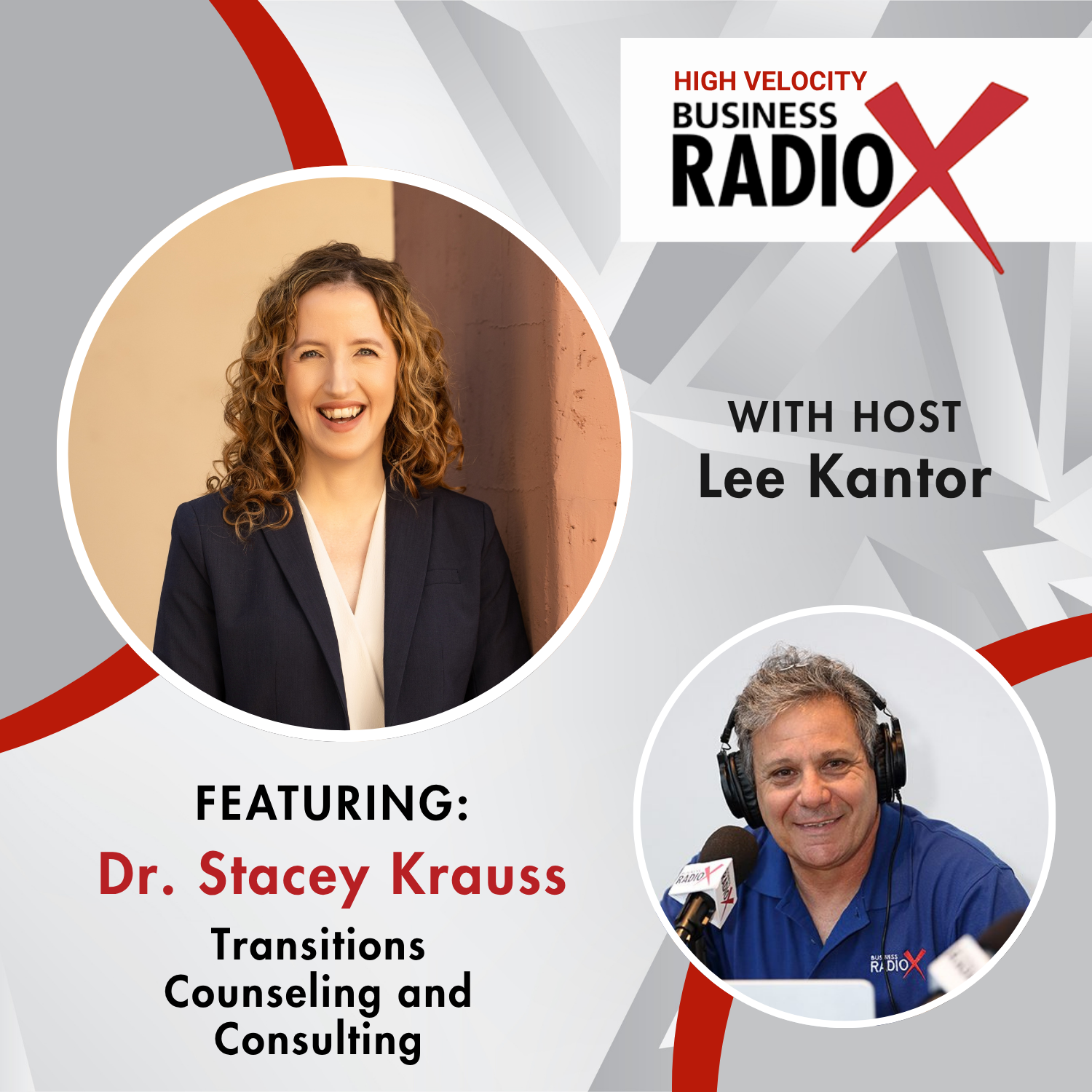

In this episode of High Velocity Radio, Lee Kantor interviews Dr. Stacey Krauss, CEO of Transitions Counseling and Consulting, about building accessible mental health services, developing effective leadership, and creating a culture of coachability and continuous improvement. Dr. Krauss shares how her experience as an Army psychologist shaped her approach to organizational leadership, overcoming imposter syndrome, and empowering teams to learn through action. She also discusses using data-driven decision-making, small-scale experiments, and employee feedback to improve healthcare delivery, strengthen company culture, and enhance patient experiences.

 Dr. Stacey Krauss is the Chief Executive Officer of Transitions Counseling and Consulting, a leading provider of specialty behavioral health services in Arizona and Texas. She joined the Transitions Counseling and Consulting family after 10 years of active-duty service as a psychologist in the U.S. Army.
She is the recipient of a Bronze Star Medal, a Combat Action Badge, and multiple Meritorious Service Medals. She is also a double diplomate of the American Board of Professional Psychology with certifications in both Clinical and Organizational Psychology.
Dr. Krauss’ professional experience has included executive-level management roles leading diverse behavioral health teams as well as designing and directing an APA-accredited doctoral internship program. She also holds an MBA from the University of North Carolina at Chapel Hill.
Connect with Dr. Krauss on LinkedIn, Facebook, and X.
What You’ll Learn In This Episode
 This transcript is machine transcribed by
TRANSCRIPT
Intro: Broadcasting live from the Business RadioX Studios in Atlanta, Georgia. It’s time for High Velocity Radio.
Lee Kantor: Lee Kantor here another episode of High Velocity Radio and this is gonna be a good one. But before we get started, it’s important to recognize our sponsor, Business RadioX. If you’re a business coach or a consultant who’s tired of being a best kept secret, set up a call with Stone Payton at bookstonephone.com to unlock your perpetual prospect pipeline. Today on the show, we have the CEO with Transitions Counseling and Consulting, Dr. Stacey Krauss. Welcome.
Dr. Stacey Krauss: Thank you so much for having me. It’s a pleasure to be here.
Lee Kantor: Well, I am so excited to learn what you’re up to. Tell us about transitions. How are you serving folks?
Dr. Stacey Krauss: Well, we provide outpatient mental health care for the whole family. So kids, teens and adults all around Arizona and also now in Houston, Texas. And our goal is to be a one stop shop for all the family’s mental health needs so that you don’t have to drive all over town working with different providers. So we take your insurance and you can see every kind of outpatient mental health care that you might need for everybody who lives under your roof.
Lee Kantor: So what’s your back story? How did you get involved in this line of work?
Dr. Stacey Krauss: Yes, I have a nontraditional path to leading a mental health company, and that I spent the first ten years of my career as an active duty Army psychologist. And that’s a fascinating way to serve on active duty. And I just learned a huge amount about what it takes to set up a health care organization that’s really thinking about what makes it practical and realistic for people to actually access mental health care. So, uh, it was a little bit of a transition from me going from one community to another, but it’s been such a pleasure to bring everything I learned from the US Army over to the transitions team these days.
Lee Kantor: So were you a psychologist and then enlisted, or were you in the Army and then got into psychology?
Dr. Stacey Krauss: So I actually went to college on an Army ROTC scholarship, and my plan was just to be a traditional Army officer. And I was lucky enough one day to meet a person who was a psychologist serving on active duty. And I felt like I was struck by lightning because I didn’t know that you could do that. And so I applied to graduate school and the army. Uh, they both gave me a delay of active service so I could complete that education. And I also received a health care scholarship from the US Army so that when I returned to active duty in 2010, I served the whole time as a psychologist.
Lee Kantor: That. Isn’t it amazing that when one person, you meet one person and then all of a sudden the world opens like that happens, you know, so often, and people don’t kind of take advantage of it when it happens. But you were able to kind of take that information and leverage it, and it really changed the trajectory of your career.
Dr. Stacey Krauss: Oh gosh, it would be hard to, uh, to over describe how much that changed my professional pathway. And it was one of those, when I think back on it, it just seems like, I don’t know, a, a magic twist of fate because there are so few military psychologists in any one given time. There’s only about 150. So the fact that I happen to meet one of them in that moment when I could make a decision like that was just the perfect alignment of timing. And I’m so grateful that that person took the time to talk to me about it because, um, it’s, I think one of the best kept secrets of the army is that you could bring your skill set and build your skill set that way.
Lee Kantor: So when you kind of leaned into that and went down that path, um, what did you learn? Like, like obviously that, you know, changed the trajectory, but like, how did that action kind of, um.
Dr. Stacey Krauss: So I, I think that part of becoming a psychologist is repeatedly refining not only your professional skills, but also getting more clear on what you’re really good at doing professionally because it’s a pretty broad field, so you can specialize in a lot of directions there. And for me, I would never have guessed this going into it, but like I originally thought I was going to focus on family therapy, but it turned out that through my Army service that I learned I was the happiest at work when I was getting to build and develop, uh, the organizations where people were going to get health care. And don’t get me wrong, there’s so, so much value in taking care of one person’s life one hour at a time. But I think that I do my best work when I’m thinking about what kind of organization helps to support many, many therapists in doing that. Plus, that comes with a lot of work that many therapists don’t like to do. Like someone’s gotta, you know, write the compliance policy and do our taxes, things like that. Where most clinicians aren’t terribly enthusiastic about that. So the Army really helped me to refine and understand that there was a career path for me that was focusing more on developing and managing and leading the organization where healthcare is delivered, as opposed to being a direct provider.
Lee Kantor: So now, so that leadership, uh, element of what you were good at and what you’re able to kind of leverage in your business world, you attribute a lot of that to the army, the military.
Dr. Stacey Krauss: Oh, definitely. And I, I feel like I’m the I have the classic Army story in that I got so many opportunities probably before I deserved them, and definitely before somebody would have given them to me in the civilian world. So, uh, for example, I remember, um, I did my, you have to do a one year full time internship before you’re allowed to apply for licensure as a psychologist, which I did at Joint Base San Antonio in Texas. And I was an intern on Friday. And on Monday, I was the chief of psychology at Fort Drum, New York.
Lee Kantor: So congratulations. That’s that’s that’s good. And I guess identifying high potentials, that’s a pretty instant.
Dr. Stacey Krauss: I’d say I was a ever so slightly underprepared for that job transition at the time, but, uh, but gosh, it just, it set me on this pathway of. I think, learning by necessity, the skills of leading health care providers about understanding just copious amounts of rules and regulations and how do you combine all of that? So the experience for the people we serve still remains very empathic and human, while it’s also safe from a legal or or ethical perspective. So I had so many experiences like that where they were like, okay, Krauss, you’re it.
Lee Kantor: And then you’re in. So what advice would you give? Because a lot of people have, I mean, maybe not to that degree, but sometimes they’re placed in situations where maybe they have some imposter syndrome or they don’t feel perfectly 100% equipped to handle whatever was given to them. Any advice for that person that has that opportunity thrust upon them like you did?
Dr. Stacey Krauss: Absolutely. And nobody ever likes this advice when I give it to them. But it’s I would say that, um, you know, you can’t wait around until you feel like you belong in a job or an industry or an organization. Action comes first and then the feeling comes second. So it’s kind of like going to the gym. If you wait around until you feel like it, you’re probably not going to go. But a lot of times when you do make yourself go afterwards, you feel really good that you did. And I think imposter syndrome works very similarly where the action comes first and the feeling follows that later. So I’d say you have to just keep moving your arms and legs in the direction of the job and trust that the feeling will follow after you have committed to taking some action that way.
Lee Kantor: Now, do you find that a lot of people, whether it be fear or rationalizations, that they think that they have to be perfectly prepared before they can take the action, rather than take the action and learn and adapt to what you’ve learned.
Dr. Stacey Krauss: Oh, definitely. And I think that one of the best gifts you can give yourself is to treat yourself kindly. And if you can try to give up any perfectionism you have because you there’s only one way to really become a leader. And that’s with a live audience. So you can’t spend forever just reading about it in a book or listening to podcasts. At some point, you have to actually get out there and, and do things, and that means people are going to see you, they’re going to see you make mistakes. And one thing you can do is to hold those lightly because that’s part of the job. It’s part of becoming better at it is to just allow that to be true, that it’s okay for you to be an imperfect person publicly, uh, and still be good enough to be a leader of an organization, a team, even just of yourself. Um, that those two things are not mutually exclusive.
Lee Kantor: Now when you’re working with teams or, you know, maybe, um, leaders on the rise, how do you help them? Kind of like you said, give themselves grace, kind of keeping that beginner’s mindset where we’re all trainees here, we’re all learning and, and nothing’s going to be perfect, but also holding them accountable for some sort of result at the end of the day.
Dr. Stacey Krauss: I think that what I do is pretty straightforward. So I think a lot of times people’s natural tendency is to focus almost, almost exclusively on the things that they did wrong or that they would do better next time. And that’s how you get into that frame of mind, I think, where you become very inhibited. So we just have a really simple framework that we use where we examine what went well, What didn’t go so well, and what will we do differently next time? So this gives space for the entire picture that maybe things weren’t perfect. Perhaps things do need to change. And also there are some things of value in this experience all at the same time. So I think just acknowledging that it’s possible for that to be true in almost every situation, and then having a repeatable process where you as a team are going to look together at what those are. And the team part is helpful on this in terms of accountability, because a lot of times I’ll ask people, okay, so what went well in this situation? And they immediately tell me everything that went bad. But, um, uh, part of the team’s job is to help keep the balance in place so that people, uh, still have the confidence to continue to try to lead and to learn to let themselves evolve in front of their, in front of their team.
Lee Kantor: Now, what’s your philosophy when it comes to leadership or identifying future leaders. Do you believe that everybody can be a leader with the right kind of support and training and education, or is it? Do you think some people are just born leaders and that they have to be kind of nurtured and then kind of optimized?
Dr. Stacey Krauss: I think that most people have innate leadership potential. I think very few people come onto this earth who are naturally going to embody all the characteristics of leadership. But I do think that there are a rare few who are like that. But I think most of us have to learn this over and over again with coaching, with help and support. That being said, I think that there’s nothing on this earth that could replace motivation to learn. So if a person is receiving lots of coaching and support, their coach can’t be more motivated than they are when it comes to learning how to be a good leader. So I think that’s really the quintessential ingredient an individual person has to bring to this is that they have to be motivated to learn and to let themselves be coached, to receive coaching and to and to apply it in the world.
Lee Kantor: Now, how do you, um, maybe this share, maybe share a little bit from the military background. I recently interviewed a leader that was, uh, former military and his style of coaching and leading was very like you’re describing collaborative team. And in the military, sometimes you have leaders that are my way or the highway and there’s, you know, jump how high that kind of very directive, um, approach that I don’t know, it’s maybe that was an older way, an older model that worked at a time. Um, and maybe it still works for in some cases, uh, today, but how do you kind of help the leader that is feels incongruent with the environment that they’re in, based on the way that they would like to coach or like to lead? And maybe the culture isn’t of the of a similar kind of mindset.
Dr. Stacey Krauss: I think that this is a great opportunity for, you know, you oftentimes you have to lead within larger organizations that have a perspective on things. And I think that one of the easiest ways for people who are coping with that reality is to acknowledge that they all have to survive in this organization. But when they’re working together in their own team, or perhaps even just for how you’re going to lead yourself, that you might choose a way that you’re going to do this. And just saying out loud that, you know, this is the world we live in. This is our reality right now. And here’s what we’re going to do when we’re working together actually helps to reduce a lot of the tension around that. So it’s not as confusing for the other people to have two different styles. So I think part of this is just, um, transparently communicating, this is what we’re going to do. And I also think that, um, when you think about onboarding someone or having a new person join your team, it can be such a gift to them and to you as a leader to have thought out really concretely what it is about your team that they should know in terms of the leadership approach. So instead of letting someone naturally absorb this over some period of time, 6 or 12 months, um, try just to spell it out for them in words to say, hey, these are the things that we really value here. When we’re going to solve problems, we’re going to talk to each other this way and not that way.
Lee Kantor: And then so, I mean, I would imagine that happens at the vetting them before they’re even part of the team to understand kind of the this is our core values.
Dr. Stacey Krauss: Yeah. Like for us at transitions, our number one characteristic that when you have this trait, you tend to do incredibly well in our team. And when you don’t, you find our team incredibly frustrating. And that is coachability. So we’re people who we love to coach. We love to to be coached. And if you are someone who doesn’t love to teach other people or isn’t open to receiving coaching fairly often yourself, it tends to be a frustrating fit. So we interview specifically for that trait.
Lee Kantor: So when you’re if you were giving advice to another leader of an organization, how would you help them kind of craft that type of, um, approach when it comes to vetting people that are the right fit for their organization? Like, was that something you did individually or is that a team effort? Like, how did you kind of translate, you know, your core values into a way to kind of vet every future employee?
Dr. Stacey Krauss: So we did this maybe a little bit backwards, but we as a team, we took a step back and we decided we were going to check. Did our core values truly represent how we came to work every day and how we wanted to? So we took a look at over the years of this company, uh, what was a shared feature of people who were not successful on our team? And we removed from this analysis anybody who left the team for something that would have caused their departure to any organization. So, for example, someone doesn’t come to work for multiple days in a row anywhere you work, that’s going to be an issue. So that’s not a specific value of the company. That’s kind of just general, you know, standard practice. So we went back and we looked at what was it that was a commonality across instances where someone was not successful with us. And that’s how we started to get very specific around the coaching elements of our culture, and that helped us to very clearly articulate how that value is brought to work every day in action. And from there, we designed some interview questions that would help people to talk about their comfort level or experience with either coaching or being coached or both. And so I think that that’s a good way to start is to ask yourself, when we look at our actual behavior, not the things that we say, but what we do. Um, what was it that stood out to us as a feature of people who could not be successful here?
Lee Kantor: So you mentioned data. How important is data in just kind of your culture of your company? Is that something that you use a lot when it comes to making decisions or, or, you know, kind of choosing the direction?
Dr. Stacey Krauss: Yes. We are highly a highly data driven organization. And in fact, one of our other company values is, measure what matters. And I think that this is particularly important when you have the incredible responsibility for someone’s health care, that we should be brave enough to look formally at the outcomes of what we do, and we should be guided by them so that we’re always working towards improvement because people are counting on us to provide them excellent care. So we need to be accountable to ourselves for our performance in that way. So we use data all the time. It also really helps us to have a workplace where things like promotion raises merit based increase is completely transparent because it doesn’t matter if your manager likes you or doesn’t like you. We’ve got this shared data that we have available that is going to speak to your performance. So it helps to make this a lot more fair.
Lee Kantor: So how do you use data when it comes to um a patient’s outcome, especially in mental health. That seems so like if someone’s depressed, like how do you measure progress?
Dr. Stacey Krauss: Yeah. Yeah. So we use professional tools that, uh, are, are kind of industry, industry standards for measuring symptom severity over time. And we’ll also measure things that support outcomes to like how satisfied is the patient with their health care, with their provider. But we specifically will use these measures, their self-report measures where at the beginning, middle and at various checkpoints during healthcare will ask the person to assess, um, how many symptoms they’re having and how much they get in the way of their life. And we have the ability to share that data with our patient so that they can also see it visually and then they can track it over time. And this helps us to, to tell if what we’re doing is really helping or not. That way. If we’re not on a productive track together, we can change the approach quickly as opposed to the person continuing to suffer. You know, for many weeks while we figure it out slowly. So it helps to cue you in quickly when you need to adjust treatment for them.
Lee Kantor: Now, does the data support that that self-reporting is accurate?
Dr. Stacey Krauss: Yes. So there’s always some outliers with self-report. But for the most part, uh, this is would be considered a gold standard way of, of, uh, measuring response to care. It’s actually the thing you see in most professional research on the topic.
Lee Kantor: And then, but it’s used the most, but they’ve tracked the actual, okay, they’re self-reporting that they’re saying there’s progress. And then we have kind of behavioral, uh, evidence that that is accurate.
Dr. Stacey Krauss: Yeah, exactly. So you might combine this with, so they’re going to respond to this, these questions. They’re also going to give you Information and the clinician is going to observe as well. So together, the combination of those things are considered for recovery. And if the the patient in this case is somebody who is under 18, we also would include information from important adults in their life, like their parents or teachers.
Lee Kantor: Right. And then for if they’re over 18, you don’t include kind of a 360 around them.
Dr. Stacey Krauss: Uh, you would, if you have the patient’s permission to do and many patients choose to include a friend or a family member in their healthcare. And we’d love to do that because it helps, uh, the person to be the most successful when they have somebody else in their life who’s involved.
Lee Kantor: And then it probably gives you kind of a marker to see if they’re everything is accurate in terms of people telling the truth about what they’re saying and what they’re actually doing.
Dr. Stacey Krauss: That’s true because the other person’s perspective is, you know, oftentimes people in the service of trying to take care of somebody who’s important to them, will give you really important information about how it’s really going.
Lee Kantor: Now, when you were building the organization, um, how did you kind of decide which systems to, um, to put in and which ones to maybe get rid of?
Dr. Stacey Krauss: I think that this is in some ways you can, you can do as much research as, as you can tolerate, but, um, in some ways you have to set up what I would describe as a series of small experiments for the company and then observe what happens after you try it out. So we’re huge fans of doing short term experiments with different systems, different processes, different configurations of how we’re going to offer healthcare today. And then we’ll simply get some feedback from everybody who’s involved about how well it met their needs. So we like to think about it this way, as opposed to 1 or 2 gigantic decisions. We will test out a number of different hypotheses. Like good scientists, and see what we think is really going to solve a problem.
Lee Kantor: So what’s an example of maybe one of those small experiments that went well, and maybe one that didn’t go well?
Dr. Stacey Krauss: Sure. So we I think we did a, we did a trial license of one of the data visualization tools. And we decided we were going to make a single slide dashboard for the key metrics of how the company was doing. And I think we had four weeks to, to use this trial license. And, um, after that, I think we now have, I think we have 5 or 6 completely custom dashboards that we have created for all kinds of different users around the company because it was so helpful to people to be able to visually see what was going well, what wasn’t, as opposed to having to look at, um, non-visualized data like on an Excel spreadsheet. So our team did so well when we were able to put those numbers into graphs and images that we decided that at that point we would invest in spreading that technology more widely through the organization. So that one went great. And on the failure side of the House, at one point a couple years ago, we decided that for four weeks, this is the magic number for us that we were going to experiment with using an outsourced call center to help us manage some of our phone call volume. And this was just not a good fit for our team, for our clinicians. And it was definitely was not a good fit for our clients. It was just the people on the other side of the phone. They were incredibly polite, but they just did not know enough about our organization to answer questions for people meaningfully. And it ended up creating like ten times as much work as As it solved anything. So we actually abandoned that fairly quickly.
Lee Kantor: Now, in the first example, um, did the, the, um, service that you kind of landed on or were playing around with, did that happen through the team? Somebody found it and go, hey, this seems interesting. Um, and then just the culture of your organization is such that there’s like, okay, let’s run an experiment and see if that’s really something good.
Dr. Stacey Krauss: Yes. Yeah. Somebody was, uh, thinking about how else could we communicate as our team was getting bigger? And they’re like, oh, I was looking around and I saw this product. I think this could be really interesting. Like, why don’t we try it? So somebody just found it on the team.
Lee Kantor: But that, that, um, is evidence that your culture is such that there is that people feel comfortable and safe to share ideas. They’re not going to be shot down or embarrassed or anything like that, that, hey, well, that sounds like something worthy of an experiment.
Dr. Stacey Krauss: Yes. And I think this is one feature of this company that I guard very carefully and I hope never changes, which is the flexibility to receive feedback and respond accordingly. And I love that if someone has a good idea this morning, we can put it in place this afternoon. And I think that that’s maybe the opposite of working for a really large health system, like the Department of Defense, where the decision making process is much, much slower. So to me, the flexibility and the encouragement of ideas and creativity, I think really has helped us quite a bit.
Lee Kantor: And then that person, like, even if the thing didn’t go well, they’re going to be okay with having another suggestion. You want them to feel okay, like the call center person. You want them to be okay with throwing another idea in the hat, like you don’t want it to be their last idea.
Dr. Stacey Krauss: Oh, you know what’s funny about this? I actually didn’t even realize this until you just said that, but both of those ideas came from the same person.
Lee Kantor: That’s I mean, that makes it that much more powerful. I mean, that that’s really important. And it goes to show that you’re building the culture, I’m sure, in a way that you’re super proud of.
Dr. Stacey Krauss: Yes. And some of our best ideas, honestly, have come from, you know, the four corners of the organization. And it’s something that when people first join us, we really try to say directly to them, which is, I know when you’re at a new place, it can seem unsafe to make some suggestions that things could be different or better. And we want to encourage you to do the opposite and tell us. And the more painful the feedback seems, the more we’re interested in it. Because lots of times people are going to come to our team having seen how other people solve problems in health care, and it’s such a boon to the people we serve when they’re willing to contribute that to the way we deliver health care.
Lee Kantor: I think it’s a superpower. I mean, I think I’d be keep doubling down on that. I mean, that is that separates you from so many other organizations.
Dr. Stacey Krauss: Yes. It’s incredible. Uh, how much? I think just goodwill around the team is generated from the willingness to ask for and embrace feedback and ideas from each other, because we have a real opportunity here to deliver mental health care the way we always wanted to. And my hope is that everybody who comes through our doors is going to think about this in the same way that this isn’t a big machine where you have to just follow what the guidelines say. This is an opportunity to build the kind of place you always wanted to work.
Lee Kantor: Now, are you finding that the patients are the patients you want to have? Like, is this translating, trickling down all the way to the patients?
Dr. Stacey Krauss: Yes. And I’d say that one measure I’m. I’m always keeping an eye on is how many referrals. What percent of our referrals come from friends and family of people who we’ve cared for in the organization because to me, that’s the most valuable referral, which is one you can only earn, you can’t buy. So around our team, oh, just north of 30% of our new clients find us each month because somebody who’s gotten care with us has recommended us specifically. And we also use a more formal NPS score measure, as well as is common in most health care organizations. And I’m so proud of our team because in outpatient mental health care, I think the average score is around 50. And really high performing teams will be around 70. And our team for the last two years has been right around 93.
Lee Kantor: Wow. That’s dramatically better.
Dr. Stacey Krauss: Yes. And it’s because our team, they just do such a wonderful job of creating a healthcare experience where people, they get great care and they take great care of our patients. So our team, they are people who honestly care about the lives, the livelihood, the well-being of the people who we serve. And I think that that’s what you really see behind that number, is how much they really are going to go out of their way to make sure that people feel cared for.
Lee Kantor: Now, is that something you attribute to? You just chose wisely when it came to onboarding the people, or is it something that the training has elevated your people?
Dr. Stacey Krauss: I think it’s something that our really our team reinforces for each other. So I think that they, we spend a lot of time, um, trying to really focus on positive reinforcement for each other and for the people who we serve. So, um, I think that when your leaders model this for you, when your peers model this for you, it becomes part of the way that we talk to each other through the entire organization, including the way we are going to speak to and treat our, our clients and their families. So I think that’s part of it is just that everybody role models this together.
Lee Kantor: Okay. So I interviewed one of the, the leaders of the chick fil A family that runs chick fil A and something that they said to me that really struck me is that when they hire, um, people on the front line people, they look for people who naturally smile.
Dr. Stacey Krauss: That makes sense.
Lee Kantor: And so they don’t have to train them to smile and be friendly. They already come, they’re prepared. Um, and that would just kind of an eye opening thing for me. I didn’t, I didn’t kind of look at that that way. But that’s why their scores are so much higher than other, um, fast food kind of companies because they are looking for people on the front lines that are smiling and happy. So then right there they have a leg up.
Dr. Stacey Krauss: Absolutely. And I love the simplicity of that too, as a as a strategy that you can communicate across a large organization, which is, you know, this is a natural trait that does well with us.
Lee Kantor: Right? And then it makes it a lot easier to hire.
Dr. Stacey Krauss: Yes, yes. Plus it’s not, you know, there’s nothing I’m sure there’s plenty of talented people out there of all kinds of traits. It’s just about, I think, being realistic about who does well with your group of people.
Lee Kantor: Right. And for that specific role, I mean, they may not, you know, a non smiler might be perfect for the accounting team. I mean, it just they shouldn’t be the one that the first person that the person interacts with.
Dr. Stacey Krauss: Yes. Not the sales call.
Lee Kantor: Right. So what do you need more of? How can we help you?
Dr. Stacey Krauss: Well, you know, I think that the transitions team is where we’re going through such a fantastic opportunity right now where we were originally a Phoenix based company, and then we became an Arizona statewide company. And now for the first time, we’re learning how to be a regional team. And we’ve got our first clinics open in the Houston metropolitan area, and we are just learning how to be Texans. And part of our goal right now is we’d love to connect with and meet more people all around Houston, Texas. So we’d love to connect with people who are looking for great mental health resources, perhaps healthcare providers, um, people who work at, uh, the school systems, religious organizations, people who connect with others who might be in need of mental health care. And of course, we want to introduce ourselves to our neighbors, friends, family all around Houston to introduce our team where, you know, we’re pretty well known in Arizona since we’ve been there for 12 years, but we’re still in our first year of being Houston Texans. And so, um, the one thing that we really need is to introduce ourselves to more of Houston.
Lee Kantor: And more of kind of the referral partner side, as well as the patient side.
Dr. Stacey Krauss: Yeah, I think so because, um, they tend to come in contact with lots of people and can benefit from, I think, a precise recommendation about where to go to start feeling a little bit better that things could be better and different. So for example, a really large percentage of people see their primary care provider or their pediatrician for something that’s either directly due to a mental health reason or is being made worse by a mental health condition. And we want to be a partner to organizations who they meet, um, folks who have challenges in this domain right now, but maybe they don’t take care of that themselves that way. It’s a smooth experience for a patient too. So they don’t feel like they’re getting the run around, having to go all over town or calling millions of places, trying to find an appointment that we would simply, um, be a place that’s a smooth introduction for them to go from one office to the other.
Lee Kantor: So if somebody wants to learn more, have a more substantive conversation with you or somebody on the team, what’s the best way to connect?
Dr. Stacey Krauss: Oh gosh. Stop by our website at transitionscounselingandconsult.com. Uh, we actually have a great contact form right there. And of course, um, people are welcome to call us directly too. But, uh, we want to be found. So we tend to be very responsive when people leave us notes over at our website.
Lee Kantor: Well, thank you so much for sharing your story today. You’re doing such important work and we appreciate you.
Dr. Stacey Krauss: Oh thank you. It’s been a pleasure to speak to you about it today, and I really appreciate it.
Lee Kantor: All right. This is Lee Kantor. We’ll see you all next time on High Velocity Radio.















