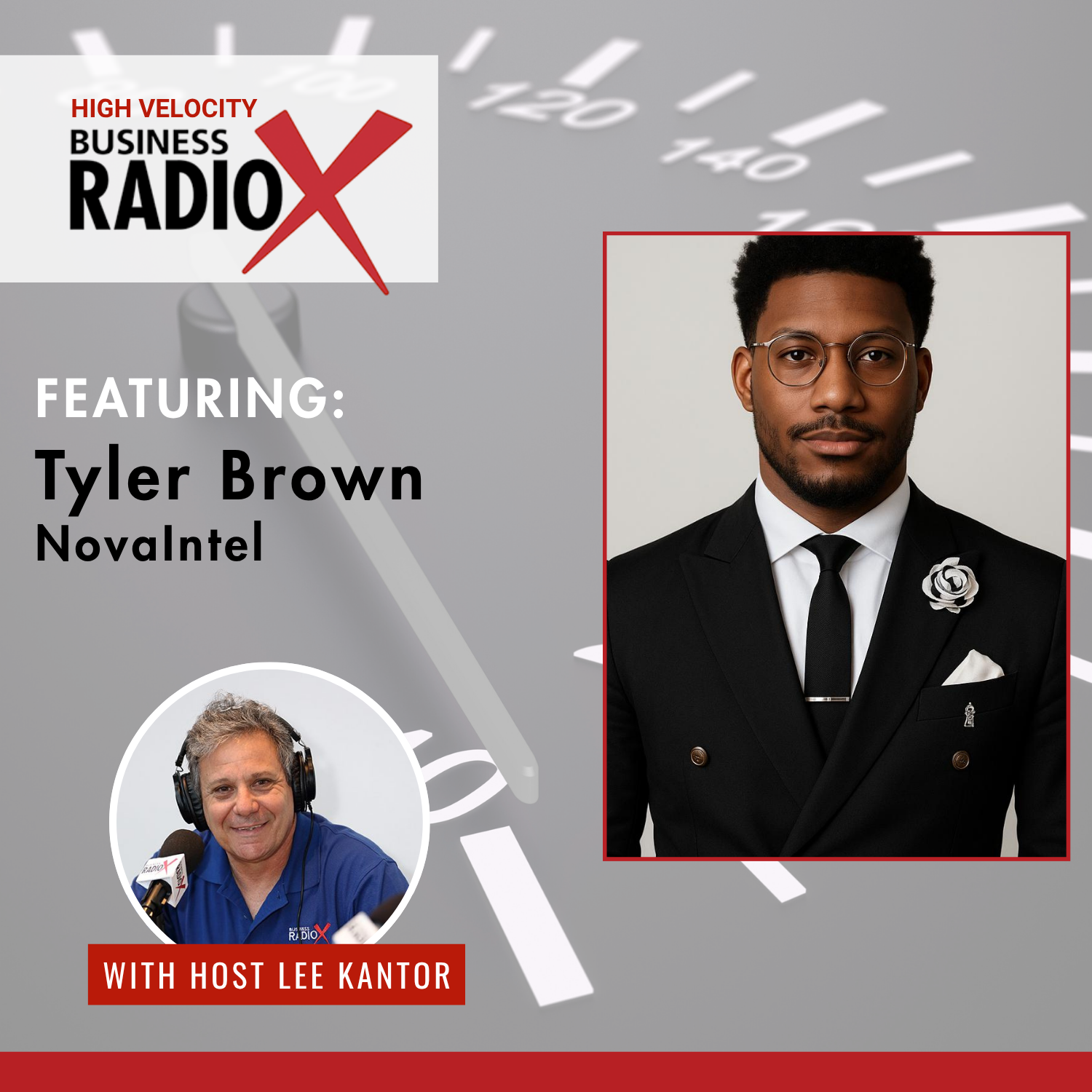

In this episode of High Velocity Radio, Lee Kantor interviews Tyler Brown, founder of NovaIntel, an AI-powered sales coaching tool. Tyler shares his journey from computer engineering to B2C sales, where mentorship and curiosity transformed his close rate to 84%. Inspired by gaps in sales training support, he built NovaIntel to provide real-time, context-aware coaching. The tool analyzes sales calls, offers live guidance, and tracks progress for individuals and managers. Already delivering impressive results for clients, NovaIntel is available free at novaintel.com, currently focusing on B2C industries like life insurance, roofing, solar, and pest control.

 Tyler Brown is the founder of NovaIntel.io, an AI sales-coaching platform built for regulated, methodology-driven sales — starting with life insurance. A 2x sales world record holder (including the Globe Life record for referrals sold in a year), he is a self-taught engineer who pivoted from selling life insurance to shipping production-grade AI systems for sales organizations across insurance and fintech.
NovaIntel currently serves a growing roster of producers and is in conversations around acquisition. Based in Atlanta, GA.
Connect with Tyler on LinkedIn.
What You’ll Learn In This Episode
- The development and inspiration behind NovaIntel, an AI-powered sales coaching tool.
- The role of mentorship and networking in improving sales skills.
- Features of NovaIntel, including real-time coaching and sales call analysis.
- The importance of asking questions in sales and how it can improve closing rates.
- The process of training the AI to provide context-aware sales coaching.
- The application of NovaIntel across various B2C industries, such as life insurance, roofing, and solar.
- Success stories and improvements experienced by users of NovaIntel.
- The tool’s capabilities for live coaching during sales calls.
- Strategies for increasing awareness and user adoption of NovaIntel.
 This transcript is machine transcribed by Sonix.
TRANSCRIPT
Intro: Broadcasting live from the Business RadioX Studios in Atlanta, Georgia. It’s time for High Velocity Radio.
Lee Kantor: Lee Kantor here. Another episode of High Velocity Radio and this is going to be a good one. Today on the show, we have the founder of NovaIntel, Tyler Brown. Welcome.
Tyler Brown: Hey, I’m happy to be here, Lee.
Lee Kantor: Well, I am excited to learn what you’re up to. Tell us about NovaIntel.
Tyler Brown: Yeah. So I guess the quickest way to do a backstory is I found out a lot of salespeople didn’t have all the help they needed. And man, I felt like that was something that AI could fix. So we went into the lab and worked something out. So where we can hopefully help people who need the help, they they can actually get it on their own time. It’s awesome.
Lee Kantor: So what was your background in sales like? Why’d you have an affinity for helping those folks?
Tyler Brown: Same basic story. Went to college for computer engineering, got out, couldn’t get a job and went into sales. Started in, uh. Started in telecommunications. Graduated to life insurance. Became a consultant for a while and, uh, kind of just bridged them all together with the skills I learned back in the day at college.
Lee Kantor: So what was your sales experience like? Did you enjoy it?
Tyler Brown: Oh, yeah. Yeah, man, I had, I had the best time ever, I think for a kid who was a little bit stuck in his shell growing up. It was a nice experience to kind of be forced to talk to people. I learned how to smile when having a conversation, how to actually ask about people, all that fun stuff. Yeah.
Lee Kantor: Did you learn by trial and error? Did you have a coach helping you? Like, how did what was kind of your path in sales were. Was it very structured or was it kind of. You just had better figure. It’s like kind of a sink or swim situation.
Tyler Brown: I think a little bit of both. Right at the beginning there it was just a YouTube University play. Just watching. I ended up getting a job that was like an hour and a half from my house. So me, you know, I spent that time listening to podcasts, sales, coaching, all that fun stuff. And eventually I was good enough to where the gurus took me under their wing. Got a chance to spend some time with them in the head offices, different people, seventh level, um, you know, Grant Cardone, all that fun stuff and just kind of learn from the best right in front of them and went from there mostly.
Lee Kantor: So what was it like? What were your peer group like? Were you friends with other people in sales? Was that kind of were the people you were hanging out with, or you were kind of a lone wolf in this endeavor?
Tyler Brown: That’s the cool part. So I think in the two industries, I was in AT&T telecommunications, a lot of the SDR, S and Bdrs, and they’re all new. It’s their first time in sales. Right. And so you’ll have obviously the sales manager who has experience and then you’re coming in with a class of guys who don’t know what they’re doing. Kind of the same with life insurance. It’s just people who maybe wanted a little bit of extra income and decided that was their path. And so as far as peers go, looking sideways, it was kind of like everybody here is brand new and doesn’t know what’s going on. As the years went by, there was a couple people, maybe 4 or 5, that kind of stuck it out over the one year mark, and those kind of just started shuffling in and out after that. But I think the only way to really look up was, was to find and network with those big names in sales, and then they kind of introduce you to other big names, and you end up with a pretty cool network of talented individuals that way.
Lee Kantor: So is that was your path? So you were kind of seeing a lot of people coming and going at the level you were in and you started going, hey, let me get a little farther upstream here with my network and let me start meeting these folks and see what they’re doing that maybe I could stick around a little longer.
Tyler Brown: Exactly. See, see, see what the people who are actually succeeding were doing different. And if you can corner them into a conversation a few times, they have some wisdom to drop on you.
Lee Kantor: So what are some of those kind of key pieces of advice for up and coming salespeople that you learned?
Tyler Brown: I think if I were to just say the number one that changed my entire life is to. And it sounds obvious, but it’s you’re allowed to ask questions, right? And the reason that was so important is because everybody tells you to ask more questions. They tell you to go in deep to understand people’s pain. But man, when you get into that room with the mother of three and you start asking her what her kids future is gonna look like when she’s gone, it’s a tough question that a lot of times you don’t want to ask, and a lot of times you’re kind of scared that, hey, the client is not going to want to answer that. And so it’s just going to ruin the whole sale if I don’t ask. And so my, um, one of my mentors, he kind of took me to the side and said, hey, dude, how many of your sales calls are you closing? And I was at the time, maybe like five, 10%. He was like, okay, so if you’re not selling anyways, you might as well get some practice in and actually ask these questions because you’re allowed to ask them like the client is need something from you. And then, um, Mia that’s give gave it a couple months from there. My close rates somewhere around 84% and I’m allowed to ask questions and I feel comfortable doing it.
Lee Kantor: So that was a big unlock for you. That was kind of an aha moment.
Tyler Brown: Oh my goodness. Changed my life. I think it changed everything about my life. A sales, you know, relationships, uh, you know, uh, business. You’re allowed to ask questions and be curious. And just as long as you’re coming at it from the right angle, you don’t have like a, uh, you know, a secretive goal on the back end that you’re wanting to lead them towards. But if you just if you’re genuine, you’ll you’ll get farther in life.
Lee Kantor: So you had this experience in sales. You were obviously getting really good at it. Um, then what was kind of the moment where you’re like, hey, let me invent an AI tool. I guess it started as a side hustle. It was this like your own project on the side, or did someone ask you to build this? Like what was kind of the how’d that move get made?
Tyler Brown: I was called in to do some go to market work, uh, setting them up, setting up a company called Beagle, um, like a Y Combinator insurance startup. Right. And so they had a whole bunch of SDRs Bdrs coming in brand new to sales, but I wasn’t new to sales this time. So it’s like a different, different viewpoint that I had to take. I’m having conversations with these new sales guys. They’re asking me questions like a property manager said their dog got off a leash and started chasing somebody. How do I overcome that objection? I’m sitting there like you don’t, but those people need to have those questions answered so they can improve. And, um, we also as sales managers or go to market or whoever is kind of in charge has important things they need to do. Stopping for every single question is nearly impossible. I said there has to be a way to have AI give the right answer here. If you just plug that into ChatGPT, they’re going to actually give you an objection handle for the dog off the leash. The right answer is you hang up and you call them back another time. So I set out to make an actually context aware, like smart sales AI chatbot. And once I saw what was capable of being created from there, I just kind of spurred me into action to keep on going and make something that’s genuinely consistently usable across the board.
Lee Kantor: So how did you kind of fill up the database with the knowledge it needed, uh, to be smart enough for that niche?
Tyler Brown: It’s a good question. Um, if we get into the technical talk, there’s actually a pretty cool thing you can do inside of any cloud code or a genetic AI where you can kind of force it to be able to transcript YouTube videos, and then you have to force it to actually, you know, implement those things into different databases so that it genuinely has to read and understand those things. So the first thing I did was fed it, I don’t know, maybe 100 different YouTube videos on sales. And then it’s not very context aware. So it would understand things, but do it at the really wrong times and just do it in a, in like wrong. And so for about two weeks straight, um, probably somewhere in the vein of 18 hours a day, I wish I recorded all of this because I had to do one on one sales training with Clyde until it truly understood how these things work and why you do certain things when you do them so that it could properly, properly train a salesperson. And from there it was. It was pretty easy. Um, because it had the right ideas. It would just need me to sit there and, and, you know, yap for about ten minutes about why it just implemented them incorrectly. And once we got through all the bugginess, it, it was pretty, it was probably a little bit better than me at training people on how to sell.
Lee Kantor: So first you had to kind of build in a sales foundation based on, I guess, people that you believe were good salespeople or had good sales, um, kind of, uh, good sales knowledge and know how that was first move. And then the second was you just peppered it with a bunch of questions that were specific to certain niches so that it understood the context and words and, and challenges for that specific niche.
Tyler Brown: Yeah, pretty much. I mean, these are people that are well renowned in the sales community. Um, guys like Jeremy Miner, Alex Hormozi. Matt rider, Caden Sanchez, you know, the famous people who everybody kind of goes to for their, uh, B to C, uh, acumen, um, and foundation. And then I think one of the things that makes this product a little bit more unique is the biggest issue when training an AI, how to sell is that it kind of gets lost in a conversation. It doesn’t know if you’re just starting the conversation or if you’re near the end of a sales call. And because of that, you could be four minutes in and somebody says something and it thinks that it needs to handle an objection when it really just needs to build rapport. And so you end up having to train. I have eight different sales professional coaches that run in parallel, but they know where they are in a conversation. And so that’s kind of the most important thing is that it’s probably the best salesperson ever for the first three minutes of a call and then it doesn’t know what to do next. Hands it off to the next one so that it can actually be contextually aware throughout a call.
Lee Kantor: So it knows when it’s time to shut up and, you know, ask for the sale and be done. And it knows when that we have to kind of schmooze a little longer.
Tyler Brown: Yeah. I have a feature in there where it actually like kind of, I call it a teleprompter. It teleprompter you exactly what to say next on a phone call. And I think my biggest win of all time is one time I was just, you know, testing it on a call. I gave the client the price and the client said something. And in response, the AI teleprompter said, shut up and listen. I said, give it a couple seconds, don’t say anything. And that’s just genuine sales coaching that a lot of these eyes just aren’t capable of even thinking about that being the right response. But as humans, we know that sometimes you just need to be present and give it some time for a person to think things through.
Lee Kantor: So when you develop this, did you you developed it for that organization and then you thought, hey, this can work for other organizations. Is that where we’re at now?
Tyler Brown: Yeah, pretty much. I developed it specifically for that organization. I said to myself, I’m not going to be here. And honestly, I, I’m just here to kind of get things moving and then I’m going on to my next venture, but I’m always going to be in life insurance. And I have a team of people who need this. So that became the first vertical. And the coaching got to a point where it actually works in every industry. I mean, we have people who are roofing salespeople who use it. We have people who are solar salespeople, door to door pest control, a lot of different industries who find specifically the sales call autopsy, where it just takes your previous call and tells you exactly what you did wrong and what you can do better. I mean, that one gets used hundreds of times a day at this point. Just people wanting to be the best version of themselves.
Lee Kantor: And is it primarily at this stage for B to C only, or is it work in B2B as well?
Tyler Brown: I’ll go B to C on that one. Not of the hardest thing to port over. A lot of the same concepts work, but you look at other competitors, other sales training platforms and their B2B focused, which leaves out the great majority of people who are not millionaires and don’t want to sign $50,000 enterprise contracts. They just have 20 bucks in their pocket and want to hopefully turn it into 40 and 60 and 80 and 100 over a course of a couple days and just need to get better in order to do it. And since that’s who I am, like I was just a selling to customers, selling to consumers. And so I said, there’s a lot of people who are stuck where I was stuck, and that’s who I want to focus on helping.
Lee Kantor: And then, um, so right now you have is it out there in the world? Is it available?
Tyler Brown: Everybody can go to novaintel.io, novaintel.io. And go ahead and get started. It’s free to start.
Lee Kantor: It’s free to start so you can go in there and then. So how do you start for free? Do you like you said that autopsy thing. I just put a recording in of my last sales call and it’ll give me advice.
Tyler Brown: Exactly. Um, you set up an account and you go in the autopsy. It’ll give you advice on your last sales call or whichever ones you put in, whether it be transcripted or just the audio file. And then another big feature for people is the coach, where it just genuinely tells you exactly what you could. Like if you have a specific question and that can be broad, right? You could be like, hey, I lost my last call because I got distracted. How do I focus during sales calls? Or you can say something like, I don’t feel like sales is for me because I’m too nice to people. Should I work on that or should I give up? And it’s pretty interesting because Most kind of like chat bots. Large language models just kind of give you advice. This one is pretty inquisitive. It’ll start by asking you why you feel that way, what the scenario was that caused that feeling. And then when it has a little bit more context, it can actually help you with the core issue instead of going off of what it was told.
Lee Kantor: So now how are you getting the word out about this great new product? How are you kind of identifying that ideal customer profile for yourself and, and getting in front of them?
Tyler Brown: Well, my main concern is that the thing works perfectly. I’m a bit of a perfectionist. Um, I didn’t intend to actually have it in production yet. I thought I would just still be building it, but I posted it on LinkedIn and some people found it and started buying the thing. So from there I was like, I don’t need to be doing outreach. I need to be hearing feedback from my current customers and making sure that it works great. And that’s kind of handling taking up most of my days at this point. Um, just people who found found the product. And once we get it to a point where we feel like it’s 100% on go, ready and perfect, we’ll start the whole marketing campaign and things. But at this point, it’s just that I need people who are wanting to grow alongside and, you know, be a part of something that’s going to be huge and, uh, and take their careers to the next level. And I’m happy to help them do that.
Lee Kantor: So now, is there a story you can share about maybe one of those customers? Any big success stories or small successes or interesting success stories that you’ve heard back from your customers at this point?
Tyler Brown: Yeah, absolutely. I think and I won’t say the company name because.
Lee Kantor: I’m yeah, don’t say the company, but just maybe share why they thought this was good for them and then what they got out of it, or maybe were surprised by.
Tyler Brown: I’ll tell you exactly what he told me because it kind of blew my mind. It’s a person who he’s not just a sit there and let life happen to me. He kind of takes life by the reins. And so he’s been doing these sales trainings, YouTube videos and things like that. And he said, you hear things done a million times and you start to copy them, and it never works because you don’t understand the why behind your actions. So that’s a big thing about NovaIntel. We don’t just tell you how to do better. We tell you why what you did didn’t work and why what you’re about to do will work helps you remember it. It helps you to utilize it, and it helps you to do things right. This is the biggest part of communication is tonality, pitch, power, pace, all those fun things. And you can’t really do them correctly unless you understand the thought behind what you’re trying to communicate. And so I think that kind of made that a new priority for me in my own life of training. You know, one on one or, uh, especially in Nova, Intel is making sure people understand the why. Um, to give you exact numbers, he was a closer doing somewhere around 10,000 a LP a month, which is really good. Last month he’s been on closer. He’s been on NovaIntel for about a month and a half now. Last month he did $26,000 in ALP, which is obviously like more than double. Um, we have another client who was doing 22, I believe. Uh, but he just showed me a screenshot. He $38,000 in ALP over the last 30 days. So, um, it’s, it’s, it’s, it helps in a couple different ways because you practice something and then you’re just excited to actually try it in real life. So now you’re making more phone calls, you’re getting more repetitions, you’re actually understanding why you’re doing things. I mean, everybody who I’ve talked to loves it so far.
Lee Kantor: And then some of it is kind of looking backwards. But you mentioned something in real time. I could have it by my side as I’m having a call.
Tyler Brown: Yeah, absolutely. Most people use the closer coach for that. Um, it actually just, you know, you can pull it up on your phone. You pull it up on your computer and just ask it a quick question. Like if you sense an objection coming or they throw one out, you can’t.
Lee Kantor: So it’s not listening to the like, I can’t have it on a Zoom call. And then it’s in its own little area and it’s just analyzing it as I’m going with.
Tyler Brown: Yeah. Oh, you’re talking about the script feature.
Lee Kantor: No, I don’t know. Is that I’m asking I don’t, I, you know.
Tyler Brown: Yeah. Of course. Yes. Absolutely. So there’s a script feature. It’s about uh, it’s called an 8020 split 80% static, which is like an actual, just how a conversation normally goes in life insurance tells you what to say next and based on what the prospect said. But then the cool thing about the AI, it’s called a whisper feature. If the client says something that the script does not natively handle, it will teleprompt you on exactly what to say next. So let’s just say, for instance, you are on that call and somebody says something like, ever since my grandfather’s funeral, it’s been a big point to look into how we can get coverage. Let’s say you’re selling life insurance. The average agent will say, I’m sorry to hear about your dad. Um, how long ago was that? Maybe. You know, like, basic human things. And then they’ll be like, okay, well, it makes sense why you want insurance, and we’ll keep going on that conversation. Whereas the whisper feature will come in, it’ll say, the next thing you should say is, I’m sorry about your dad. How long ago was that? And then it’ll listen to the client’s answer and then maybe prompt you to say next with a teleprompter. Oh my goodness. How did it affect the family financially when not only his income was gone, but you also had to take care of expenses for his passing? And it tells you exactly how many levels to go deep and tells you exactly what question to ask next, and then kind of helps you tell it prompts you right back into the script feature so that you can go back to those static scripts and continue on the conversation how it was supposed to play out without actually, you know, while you get a chance to genuinely connect with the prospect and, you know, have the conversation that needs to be had.
Lee Kantor: So is it right now geared exclusively for life insurance, or is it that.
Tyler Brown: Feature is 100% life insurance? Yeah. So it’s not that difficult to tailor. I just I wanted it to be right and that’s right.
Lee Kantor: And that’s your sweet spot. Like you’ve got, you know, you lived in there or live in there right now. So, but right now that type of thing is only in the life insurance kind of add on or plugin.
Tyler Brown: Precisely. Yeah. That’s that, that one’s for my, my fellow life insurance agents out there. I love you all.
Lee Kantor: But there are some, most of it is for any B2C, like any insurance or anything like that.
Tyler Brown: Yeah, exactly. And then, um, so if you need like the coaching or the direct one on one with a coach. That’s going to be for any industry post call. Autopsy is going to be for any industry, right?
Lee Kantor: That’s industry agnostic. If you’re selling to a consumer. This is going to solve that problem. If you’re specific in life insurance, then you have certain features that are just tailor made for that group.
Tyler Brown: Exactly. And the cool thing about it is when you do have a team, it also tracks your progress tracks when you’re getting better at things so that if you are like a sales manager or something, you can see who’s really taking their career seriously and what maybe the problem areas are for some of your team so that you can maybe give them your own personal one on one help if you need to, to make sure they get where they need to be.
Lee Kantor: Right. So it has a way for the sales manager to kind of see where they need to triage something or where they need to, you know, just give people more. You can tell who’s who with this pretty quickly.
Tyler Brown: Exactly. It’s perfect.
Lee Kantor: So if somebody wants to learn more, get their hands on it or give it a test drive. What is the website? What’s the best way to connect with you?
Tyler Brown: Perfect. So if somebody wants to learn more, they go to the website novaintel.io. Super happy to help anybody who needs any help. If you scroll all the way down, there are contact features where you can shoot an email to our team so that they can make sure that you’re helped if you have any questions or concerns. And then you can also find me on LinkedIn. Tyler Brown. I should be the first one that pops up. I haven’t, uh, I haven’t seen anybody not be able to find me. Um, and I’d love to connect with anybody and respond to as many people as I can.
Lee Kantor: So what do you need more of? How can we help you? Do you need more clients? You need funding. Are you looking to get investors? Where are you at right now? It sounds like you, uh, are bootstrapping this.
Tyler Brown: Yeah, I think right now the coolest thing to me is that people have a way out and people know about it. And so, I mean, considering that a lot of the features are free, I just want people to the user base to grow, people to know about it, people to tell their friends and people to get better at sales. And, and hopefully we can grow this together and everything else that you mentioned, you know, whether it comes with funding or clients or maybe, you know, employees, those all come with time. I’m, I’m just making sure that people know about it first.
Lee Kantor: Good stuff. Well, Tyler, congratulations on all the success. You’re doing important work and we appreciate you.
Tyler Brown: Yeah, I’m glad to be here. Thanks so much for having me on, Lee. And hopefully next time we can go deep into how this came to be. I’m super excited to learn more.
Lee Kantor: All right, this is Lee Kantor. We’ll see you all next time on High Velocity Radio.















