Business RadioX ®

  • Home
  • Business RadioX ® Communities
    • Southeast
      • Alabama
        • Birmingham
      • Florida
        • Orlando
        • Pensacola
        • South Florida
        • Tampa
        • Tallahassee
      • Georgia
        • Atlanta
        • Cherokee
        • Forsyth
        • Greater Perimeter
        • Gwinnett
        • North Fulton
        • North Georgia
        • Northeast Georgia
        • Rome
        • Savannah
      • Louisiana
        • New Orleans
      • North Carolina
        • Charlotte
        • Raleigh
      • Tennessee
        • Chattanooga
        • Nashville
      • Virginia
        • Richmond
    • South Central
      • Arkansas
        • Northwest Arkansas
    • Midwest
      • Illinois
        • Chicago
      • Michigan
        • Detroit
      • Minnesota
        • Minneapolis St. Paul
      • Missouri
        • St. Louis
      • Ohio
        • Cleveland
        • Columbus
        • Dayton
    • Southwest
      • Arizona
        • Phoenix
        • Tucson
        • Valley
      • Texas
        • Austin
        • Dallas
        • Houston
    • West
      • California
        • Bay Area
        • LA
        • Pasadena
      • Colorado
        • Denver
      • Hawaii
        • Oahu
  • FAQs
  • About Us
    • Our Mission
    • Our Audience
    • Why It Works
    • What People Are Saying
    • BRX in the News
  • Resources
    • BRX Pro Tips
    • B2B Marketing: The 4Rs
    • High Velocity Selling Habits
    • Why Most B2B Media Strategies Fail
    • 9 Reasons To Sponsor A Business RadioX ® Show
  • Partner With Us
  • Veteran Business RadioX ®

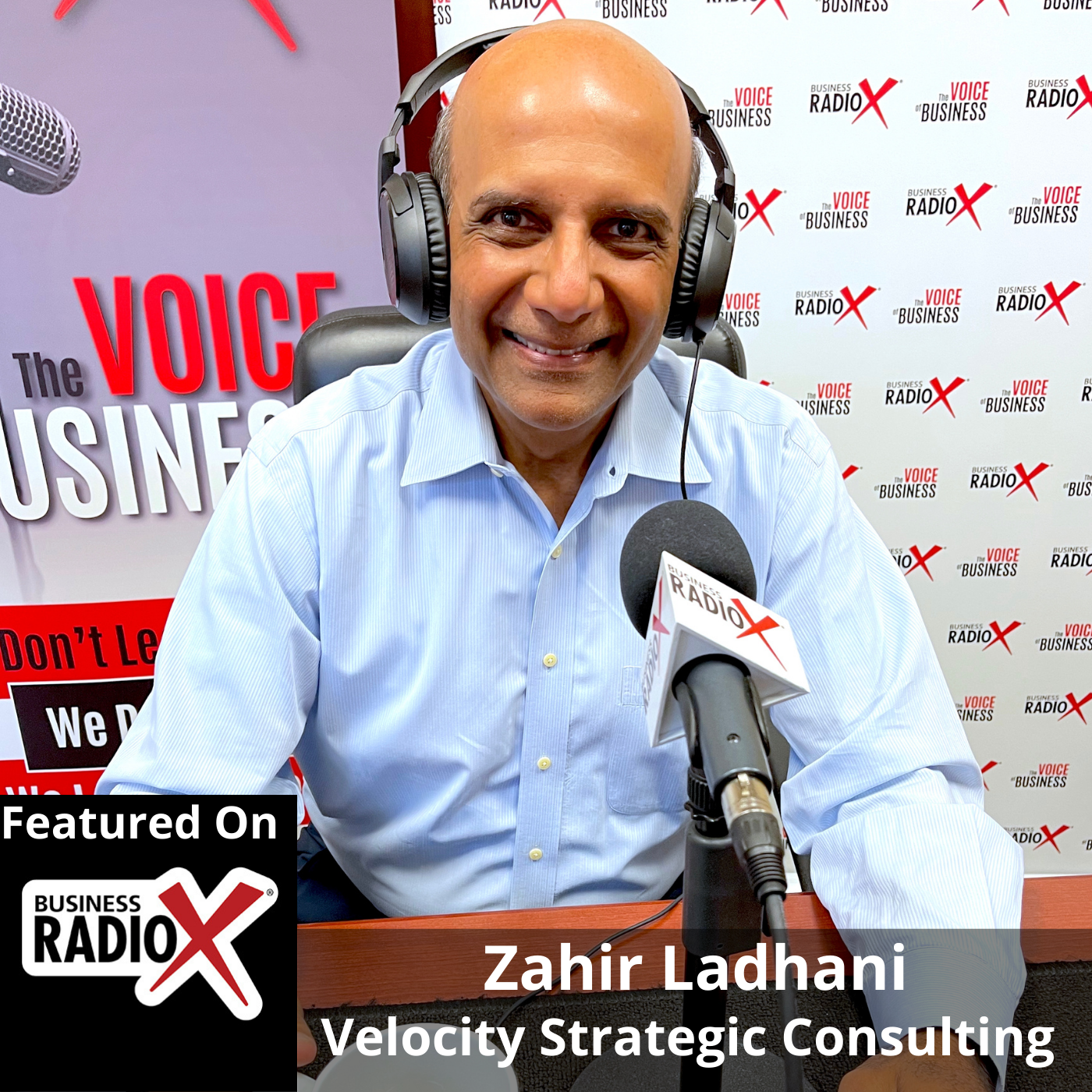
Zahir Ladhani, Velocity Strategic Consulting

July 6, 2022 by John Ray

Velocity Strategic Consulting
North Fulton Business Radio
Zahir Ladhani, Velocity Strategic Consulting
Loading
00:00 /
RSS Feed
Share
Link
Embed

Download file

Velocity Strategic Consulting

Zahir Ladhani, Velocity Strategic Consulting (North Fulton Business Radio, Episode 468)

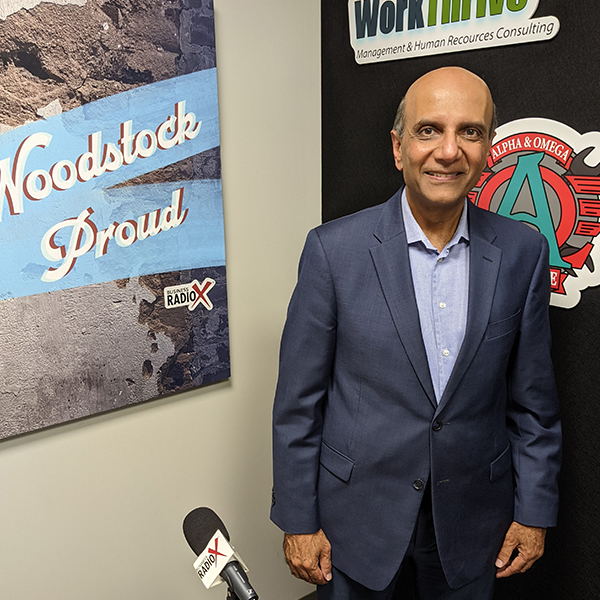
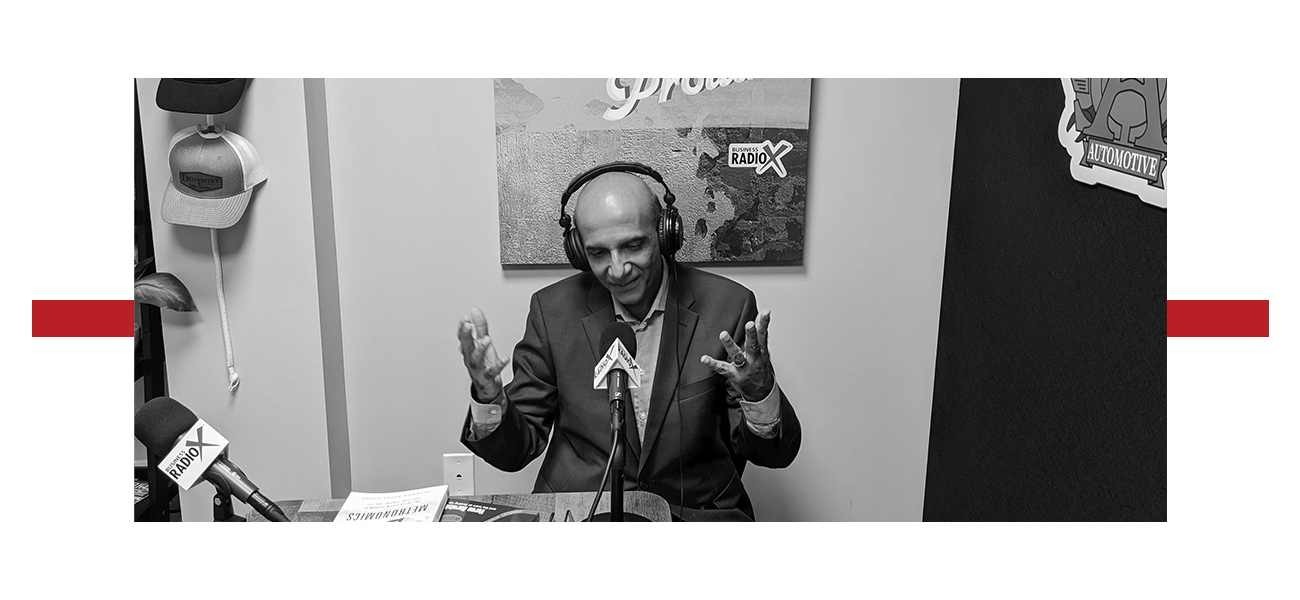
Zahir Ladhani is the founder of Velocity Strategic Consulting and teaches strategy at Kennesaw State University.  Zahir visited host John Ray in the North Fulton Business Radio studio to discuss how his firm coaches businesses on scaling up, what’s required of leadership to take that path, the vital role of cash, leading vs. lagging metrics, a company’s core values, their best fit clients, and much more.

North Fulton Business Radio is broadcast from the North Fulton studio of Business RadioX® inside Renasant Bank in Alpharetta.

Velocity Strategic Consulting

Velocity Strategic Consulting works with leaders who have the willingness and desire to move their companies from where they are now to where they think they can be.

We help teams create and execute on a vision of what it looks like to win so they can:

+ Manage and accelerate their growth

+ Grow faster and more profitably

+ Generate more cash flow

+ Build high-performance teams and drive accountability

+ Spend less time in the business and more time on the business

Velocity Strategic Consulting’s proven formula of 4 Decisions, 3 Habits, and 1 Catalyst provides their clients with measurable results.

Four Decisions: People, Strategy, Execution, and Cash.

Three Habits: Priorities, Metrics, and Meeting Rhythms.

One Catalyst: Coach.

Company Website | LinkedIn

Zahir Ladhani, Managing Director, Velocity Strategic Consulting

Velocity Strategic Consulting
Zahir Ladhani, Managing Director, Velocity Strategic Consulting

Zahir Ladhani brings more than 30 years of ‘in the trenches’ experience with SaaS, Consumer, Human Capital, Pharmaceutical, and Management Consulting industries. A talented communicator and proven leader who has grown businesses and product lines and was a key member of the executive leadership team in the sale of a company to a Fortune 100 company. Zahir works with senior executives and leadership teams to scale up businesses by improving their discipline around people, strategy, execution, and accountability for sustainable growth. He has worked with numerous clients in easing the complexity that growth often brings, allowing leaders to focus more time on building their businesses, by leveraging transformative tools, processes and principles.

He holds a Bachelor’s degree in Mathematics and Accounting from the University of Waterloo in Canada and a Master of Arts in International Relations from Fletcher School of Law and Diplomacy at Tufts University in Boston.

LinkedIn

Questions and Topics in this Interview:

  • Why do so many companies stall in their growth?
  • How do you define growth for a company?
  • Tell me more about what you mean by having the Right People in the Right seats?
  • Why is being the best not a good strategy?
  • What is more important – Strategy or Execution?
  • What do you mean by Revenue is vanity?

North Fulton Business Radio is hosted by John Ray and broadcast and produced from the North Fulton studio of Business RadioX® inside Renasant Bank in Alpharetta. You can find the full archive of shows by following this link. The show is available on all the major podcast apps, including Apple Podcasts, Spotify, Google, Amazon, iHeart Radio, Stitcher, TuneIn, and others.

RenasantBank


Renasant Bank has humble roots, starting in 1904 as a $100,000 bank in a Lee County, Mississippi, bakery. Since then, Renasant has grown to become one of the Southeast’s strongest financial institutions with over $13 billion in assets and more than 190 banking, lending, wealth management and financial services offices in Mississippi, Alabama, Tennessee, Georgia and Florida. All of Renasant’s success stems from each of their banker’s commitment to investing in their communities as a way of better understanding the people they serve. At Renasant Bank, they understand you because they work and live alongside you every day.
 

Special thanks to A&S Culinary Concepts for their support of this edition of North Fulton Business Radio. A&S Culinary Concepts, based in Johns Creek, is an award-winning culinary studio, celebrated for corporate catering, corporate team building, Big Green Egg Boot Camps, and private group events. They also provide oven-ready, cooked from scratch meals to go they call “Let Us Cook for You.” To see their menus and events, go to their website or call 678-336-9196.
Tagged With: A&S Culinary Concepts, cash, growth, North Fulton Business Radio, renasant bank, scaling, strategy, Velocity Strategic Consulting, Zahir Ladhani

Zahir Ladhani from Velocity Strategic Consulting

September 13, 2021 by Kelly Payton

Zahir Ladhani
Cherokee Business Radio
Zahir Ladhani from Velocity Strategic Consulting
Loading
00:00 /
RSS Feed
Share
Link
Embed

Download file

Zahir Ladhani

This Episode was brought to you by

The Innovation SpotAlma Coffee


Zahir LadhaniZahir Ladhani, Managing Partner of Velocity Strategic Consulting

Zahir Ladhani brings more than 30 years of ‘in the trenches’ experience with SaaS, Consumer, Human Capital, Pharmaceutical and Management Consulting industries. A talented communicator and proven leader who has grown businesses and product lines, and was a key member of the executive leadership team in the sale of a company to a Fortune 100 company.

Zahir works with senior executives and leadership teams to scale up businesses by improving their discipline around people, strategy, execution, and accountability for sustainable growth. He has worked with numerous clients in easing the complexity that growth often brings, allowing leaders to focus more time on building their businesses, by leveraging transformative tools, processes and principles.

He holds a Bachelor’s degree in Mathematics and Accounting from University of Waterloo in Canada and Masters of Arts in International Relations from Fletcher School of Law and Diplomacy at Tufts University in Boston, Massachusetts.

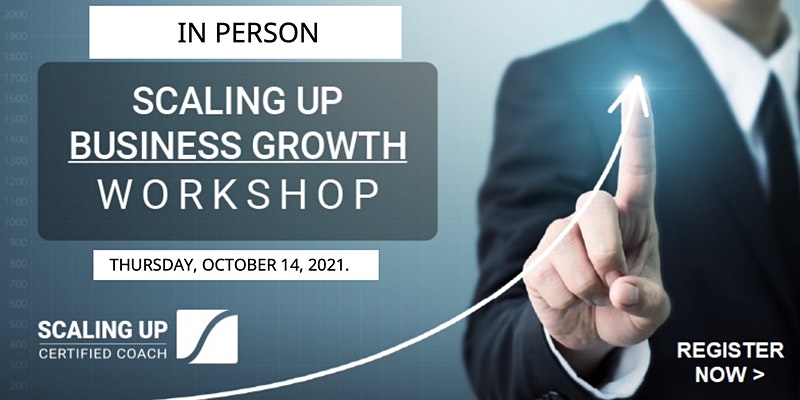
Velocity Strategic ConsultingConnect with Zahir on LinkedIn and Sign up for Scaling Up Business Growth Workshop


This transcript is machine transcribed by Sonix


TRANSCRIPT

Speaker1: [00:00:07] Broadcasting live from the Business RadioX Studios in Woodstock, Georgia. It’s time for Cherokee Business Radio. Now here’s your host.

Speaker2: [00:00:23] Welcome to this very special Friday edition of Cherokee Business RadioX Stone Payton here with you this afternoon and today’s episode is brought to you, in part by Alma Coffey, sustainably grown, veteran owned and direct trade, which of course means from seed to cup, there are no middlemen. Please go check them out at my alma coffee and go visit their Roastery Cafe at thirty four point forty eight Holly Springs Parkway in Canton. As for Harry or the brains of the outfit Letitia and tell them that stone, since you, you guys are in for a real treat this afternoon, please join me in welcoming to the broadcast managing partner, author, speaker all around. Great guy. He is with Velocity Strategic Consulting Mr. Zahir Ladhani. Good afternoon,

Speaker3: [00:01:14] Sir. Good afternoon, Stone. How are you?

Speaker2: [00:01:16] I am marvelous man. And you know, most of my listeners are well aware that I will typically invest a Friday afternoon in beer and barbecue and not usually on air. But what a delight to have you come in the studio today to talk about your work and some upcoming events to help share some of this work with other folks? Let’s start there, if we could. Mission purpose What are you really out there trying to do for folks?

Speaker3: [00:01:44] So stone, you know, here in the United States, there are over 28 million companies.

Speaker2: [00:01:52] And that’s a big number I didn’t realize. Yes. And no.

Speaker3: [00:01:55] Yeah, and wouldn’t you know it? Ninety six percent of those 28 million companies are less than a million dollars. Wow. So lots of companies start, but very few scale. And of those 28 million companies, only 17000 of them make it over $50 million, so companies go through valleys of death. And so what I do in my partner does is we help companies scale, we help them through those valleys of debts or not going to those valleys of death and figure out how they can scale and meet the purpose of what their organization is there for. So it’s a lot of young entrepreneurs or entrepreneurs who are trying to make a go of it. And how do we grow their businesses? That’s what we do.

Speaker2: [00:02:39] So is there a timing aspect of this? Are there signals that that we get as entrepreneurs that tell us it’s time to scale, or at least consider the decision of whether we’re going to pull the trigger on some scaling activities or hit the brakes for a little while?

Speaker3: [00:02:54] So look through. That’s a great question. If you think about what a company goes through when an entrepreneur starts off its friends and family or they’re trying to make a go of it. And in the end, the entrepreneur, he or she does everything, and then they hire the first person and then they hire the second person. As soon as they get to three or four, the stuff in his or her head has to now be transmitted to four or five people. And then you get to about seven hundred thousand a million dollars and now you’re doing everything. And what got you there to a million or two won’t get you to five or 10. Because the way you do, things have to change. You or you or I as as a CEO of that organization, can’t do everything, and we’ve got to start to bring in people to do the right things. And so my view in the companies I work with are if they’ve hit the million and got to $2 million. It’s time to think. But then it doesn’t mean if you’re at 15. It’s not time to think about scaling because at every stage you need to go continuing. We’ve got clients who’ve been with us for three, four or five years into the coaching organizations because it’s always a matter of moving. And so that’s what it is all about.

Speaker2: [00:04:08] Well, that certainly speaks well to your work. Do you ever find someone seeks you out and they think that it’s time and they think that they’re interested in scaling? And you talk to him for a little bit and you think, Yeah, but not yet. Do you ever do you ever consult some to just hit the brakes a little bit and maybe swing back around next year or next quarter or anything like that? Of course,

Speaker3: [00:04:29] Yeah. Happens all the time, and more often than not, it’s because. The CEO, she or he is not ready, they’re not ready to learn, and it’s not a matter of they do what I say because my job is not to be a consultant and tell them what to do. My job is to coach them and teach them how to fish and teach them how to grow so they can do this on their own. And if we see that the CEO is not a learner, then we quickly run away. And so that’s the biggest thing we look for is are they willing to learn because there’s two things not only learn from a coach, but are they willing to learn from the people that are around them? Have they brought in the right people? So invariably people will bring me in to say, help me with my strategy and we’ll go. Of course, absolutely. But when we go in, we start to ask the questions. And invariably it’s another two things that are the issue before strategy comes into place. One is do they have the right people in the right places in their organization? And second, do they execute well? Does the organization do what they say they will do? Or do they just all run around and go after the shiny new toy all the time?

Speaker2: [00:05:41] So that sounds awfully familiar. You striking some chords over here say here. No, I think many of us can fall into that trap, right? Doesn’t mean we can’t recover, but it’s good to have someone with your perspective and your objectivity to lean in and say, Hey, Stone, are you chasing a shiny object? Is this really where you want to go?

Speaker3: [00:06:00] Exactly. And we all do this as human beings, right? Right, right? And when when we grow up in life, we’re always running after the next big thing. And invariably that’s what CEOs do, and they run after the next big thing versus they have an amazing business. How do they clamp down and evolve that business to the amazing big thing while watching the environment they’re working under?

Speaker2: [00:06:21] Well, you clearly have insight, perspective, specialized knowledge around these topic areas, but I’m getting the distinct sense that you also have. I don’t know if that’s the right word methodology, discipline, structure, rigor. You’ve got framework around this process that that makes it replicable as well. Yes, you have. You have a methodology, I guess, for this.

Speaker3: [00:06:42] Yes, absolutely. So, OK, we use methodologies from authors like Verne Harnish, who’s written the book Scaling Up,

Speaker2: [00:06:49] And it’s made a little bit of money in his

Speaker3: [00:06:51] Time. He’s done as I understand it, exactly.

Speaker2: [00:06:54] He has more than Tom,

Speaker3: [00:06:56] And Byrne is the one who actually started entrepreneurial organization around the world with berthing of the Giants at MIT. And so he’s built this organization, who I’m part of, and Vern was one of our coaches when my company was scaling or the company I was with was scaling. And then there is strategy books or systems that bring everything together, called metagenomics from Shannon Sasko. And so we bring in different methodologies to help the company. So it’s not a cookie cutter, it’s a matter of coaching. It’s if you think of a of of any sport, be it baseball or football or tennis, you’ve got the coach who’s watching from the outside who’s inspiring and giving thoughts and ideas for the players to wear to move so we don’t go in the field and play with them. We’re different from the consultants. We will help them get to their level in their peak performance, which is telling them what to do. We’ll coach them through to be there. So we use tools. We’ll start. First of all, when we start, we will start and develop a three year plan, what we call a gutted out plan. We’ll gut out an 80 percent right three year plan for the organization. We’ll spend two days with the leadership team, get them into a room and we’ll come out with this three year plan that is not only three years, but the next year. So one year and the next quarter, aha. So now everybody leaving that room will have specific priorities for the quarter. The metrics for the quarter and a we’ll embed some communications with them. We will then run through that quarter while they start to iterate that three year plan. And within that time frame, we’ll start to work on their people. We’ll start to see. Do we have the right people in the organization doing the right things, doing them right? Invariably, the question if I were to ask the CEO and we ask this question, would you enthusiastically rehire everyone has the leadership team? And guess what? The answer

Speaker2: [00:08:54] Is? No, exactly right.

Speaker3: [00:08:57] And so let’s go to work and we don’t mean let’s fire the person, right? It’s OK. So how do we coach them? What do we need from them? And how do we coach them? And if they’re coachable, if not, then we’ll work on it. But the biggest thing is who you have, not what you’re doing. If you get the right people around you, then magic happens because then even if COVID happens, you’ve got people who are thinking and iterating, and a well gelled leadership team is the best thing one person can have in front of them, right? And so that’s what we start to do, and that’s how we work. So we’ll work through processes of having the the what we. While the Functional Accountability Charter, or so we go away from the traditional org structures to what are the functional function chart and what are their accountabilities, what is marketing’s key metric for the quarter? What is sales key metric? What is operations key metric for the quarter? Then everybody’s humming and we’re watching that scoreboard. You know, you never play a sport without a scoreboard, right? Most companies don’t have a scoreboard. You go in and say, what are your metrics for the quarter and everybody will give you four different metrics? Well, how can you play the U.S. Open’s going on these days, right? And last night were some fantastic matchups. How can you play a game without a scoreboard? It’s in business, is a game. So, so those are the types of things we will start working with in an organization and putting a scoreboard develop their functional matrix. Then what are the processes they need to put into place? And then we start to develop a strategy.

Speaker2: [00:10:28] So do you find yourself in your practice, gravitating to certain industries, certain types of businesses, certain types of business owners? Or are you in a lot of a lot of different sectors

Speaker3: [00:10:40] In terms of business sectors where a wide variety? So we’ve got clients who are in the technology business, software business, HPC business. We have an amazing business here in the northwest of Atlanta, who was doubled their business since we started working with them. We have a glass where or drink, where business. We have a fast food franchise, a film company. Those are all different types of clients. Okay, but where it goes to stone is what you were saying is the type of CEO is key. If the CEO wants to learn, have the right people around them is what we’re looking for. We’re looking for a learner. That’s the biggest thing we’ve actually walked away from clients after working with them and said, Don’t pay us. We’re leaving because you’re just not willing to learn from your people around you or us. And so those are the things we’ll run away fast from.

Speaker2: [00:11:32] Well, good for you, and I commend you for that because that’s tough to do. It is for small business small businesses to walk away from from money like that, an opportunity like that. But in the long haul, it almost always serves your past, doesn’t it?

Speaker3: [00:11:45] Exactly. And then it depends on what your purpose is as a business, right? And that’s one of the key things we teach business is. You need to have a purpose of why you are in business. Yes, money is one thing, but most entrepreneurs are in business for something more than money. Oh yeah. Right. And we have to take that out and then use that to inspire the rest of the organization. Money doesn’t inspire people. It does for a few days, but not longer than that. We can see the big talent need right now in the country we’re facing, right? And everybody’s raising their wages. You can raise wages, but that’s not going to inspire people as much. Yes, people will come for money. We all want more money. But there’s something more that has to inspire. So you’ve got to have a purpose if you look at Disney. Like what’s Disney’s purpose? It’s happiness, right? Right? If you look at Starbucks before the pandemic, they were creating a third place away from home, away from work. There was this place we could go, we could sit, we could use our laptop and we be in a different place to do whatever we wanted, right? And that’s a different purpose. With with Google wanted a computer or Atari, Microsoft wanted a computer in every desk when they first started. So what is our purpose? Why do we exist in the company we work with? Their purpose is to give comfort. Isn’t that a beautiful purpose that has? You’re a technician. Yes, you’re waking up every day saying, I’m giving comfort to my clients. But more than that, I’m also getting comfort from my family because I’m working in a business that’s a family owned business who doesn’t want to be a $100 million business. They’re comfortable being in a mid-sized, small to medium sized business that we’re going to have a place where it’s not only numbers, it’s doing do it for our clients and we’re doing good for our employees. That’s the type of mentality we hope try and bring into the organization. So culture becomes a big thing.

Speaker2: [00:13:36] So I got to know what’s the back story here? How did did you arrive? How did you land in doing what is clearly what you are on this planet to do? I can see it in your eyes. I know our listeners can hear it in your voice, but tell us a little bit about the path that got you here.

Speaker3: [00:13:53] Well, Stone, I’ve been very fortunate. I’ve been very, very fortunate that people have come into my life who have guided me. Tom knows this, but I came to North America as a refugee out of Uganda, o mine in East Africa and at the age of 10, went through middle school high school and was fortunate enough. My parents and my brothers, everybody worked hard to put me through school and then got into a pharmaceutical company and I was lucky to have leaders I worked with. Is Clark, Chris Seton, Rudy and Mark Mallon, Dr. IBU, Dr. Faisal. Many, many other people who came into my life, who led me and whose coattails I hung onto through whom I learned right. And they they led me to a place I’ve been through from a finance career to head of marketing, launching the largest pharmaceutical product in the U.S. to a head of sales for AstraZeneca in the U.S.. To then going to a technology company and being fortunate to be one of the leaders being on the stock exchange to ring the bell. And so as all of these experiences came through and I finished my career at and I don’t want to say finished because I want to say, what’s the next career? Yeah.

Speaker3: [00:15:10] And I only had an undergrad degree and someone said to me, it’s necessary to have a masters these days. So at the age of 54, I went and got a Masters degree from Tufts University. Fifty four and I graduated with a master’s in international relations. I have a degree in mathematics and then I went a degree in international relations and I said, I’ve got all of this. And through these experiences, I was fortunate enough to be to learn how to talk, how to give a speech, how to how to teach. And I thought I can use and how do I impact as many people as I can. And so my mission is to inspire me to impact as many people as I can to be able to get the journey and be as fortunate that I have not that I’ve made millions. But I think the Lord has been very, very kind to me and I think there is enough in this world for this.

Speaker2: [00:16:02] Well, I do too, and I think it’s clearly reflected and you are you are living into that mission, no doubt. So one expression of this work, and there are many, apparently, but one expression of this work is a book and it’s entitled Scaling up. Is that

Speaker3: [00:16:16] Right? Yes. So we’re in a Harnish, wrote the book called Scaling Up All Right, and his first book was called The Rockefeller Habits, and he comes from John D. Rockefeller. What were the habits John D. Rockefeller used to build his business and Vern has taken from that learnings from as many business books as possible to develop a book called Scaling Up, which looks at people strategy, execution and cash for key things businesses need to grow and raise. And Warren was one of our coaches when we grew our company and were at the stock exchange, etc. So he he was an inspiration through it and through that. We’ve been using the work on scaling up, and then we wanted more work on strategy, so we hooked up with Shannon Sasko, who’s written the book Three Hag Metagenomics, and she’s just come out with the book Metagenomics. And so I use that also into delving into people’s strategy. And the biggest thing about that book is strategy is not about competing to be the best. Strategy is about finding a unique value proposition that your customer is willing to pay for. So you’re not trying to just be the best radio station or the best innovation spot, you’re trying to be a unique value prop for your clients. That’s different than anybody else that people are willing to pay at a premium because at the end you’re in business to make money with the purpose. And so we bring those tools together, right? And that’s what we do.

Speaker2: [00:17:41] Well, one of the things that I was immediately enamored with and attracted to when I went and poked around a little bit on the on the website is that you did include in this and in these four things. One of them is cash. Yes. So to speak to that a little bit because as a small business person, I’m the number two guy in our network and I am the guy in this little studio the way we’re set up and I’m constantly watching cash flow. And I did have a mentor chair with me years ago. As a small business, you just want you don’t run out of cash, you can’t run out of cash. That’s true, right?

Speaker3: [00:18:15] Absolutely. So when businesses go initially, when you run a business, it’s all about revenue, revenue, revenue and we say revenue is vanity. Right. But cash is king. And you saw what happened during the pandemic. Right. People run out of cash. And it was great the government came through and has helped quite a bit of people, right? And we know no disrespect to the banks or the lending institutions, they’ll give you money when you don’t need it.

Speaker2: [00:18:44] Yeah, that’s the other thing that mentor taught me.

Speaker3: [00:18:49] And so your goal is, how do you stay ahead of cash and cash is what you need to look after? So we do this exercise in cash, which we call the power of one where we look at if you made a one percent difference in your price or in your cost of goods sold or in your operating expenses or in your accounts receivable or in your accounts payable, what could that difference be? And we do an exercise and we take their their their financials and we show the leadership team what a big difference and you can make in your cash and just to the power of one. And invariably it’s great for salespeople because when you give a one percent discount on anything, it goes straight to your bottom line. Right, right. In the amount of volume you need is more not one percent more volume, you probably need three acts of volume to make up the one percent down, right? I’m sitting with us. He knows this financials very well and I’m sure you teach that in the class.

Speaker2: [00:19:46] So for those of you listening to us, we have Tom Devaney in here, who is not only a very well-respected professor at Kennesaw State University, and he and Zaheer have had an opportunity to do some neat work together. He and his wife run the innovation spot here, where we broadcast live multiple times during the week, and we did not dictate this to here and I. Tom actually asked not to have a microphone, but he is in the room with us, so we keep looking to him for reassurance. And now we’re getting into math stuff. So everybody’s looking to Tom. I’m sorry, I interrupted you, but go ahead. Yeah.

Speaker3: [00:20:18] So we do these exercises on on power of one. And then so you find how in our leadership team can do small incremental changes. Yeah, but make magnificent, huge difference in their cash flow. And it’s it’s important to know on that. And I’ll give you an example if you look at Costco. Most of their profit. Is not from the prices they charge us on the goods they sell us. Most of Costco’s profit is from the membership fees.

Speaker2: [00:20:50] Really? Yeah. A Costco. I’m there three days a week. I love Costco. It’s a great place to send them an invoice. Sponsoring this episode? No, we we love Costco.

Speaker3: [00:20:59] Yeah, but let me give you another example of an ingenuous way of of making cash. You know, a lot of us have Starbucks on on our app. Yeah, yeah. And we have prepaid cards. Costco have over a billions of dollars of our money before they’ve given us any coffee. You add up those three, four, five, 10, 15 dollars gift cards or whatever. We prepaid on our apps and add them up across the world. It’s billions of dollars

Speaker2: [00:21:27] And they’re always ahead, right? The fulfillment never does exist. And I don’t I probably have some gift cards in my drawer that I have that I don’t ever spend to. There’s probably that.

Speaker3: [00:21:37] Exactly right. And so you’ve got to start. Businesses need to think about not the traditional pricing models. You’ve got to think of different types of pricing models. And I’m not saying you can go as far as that, but there’s different ways you need to think about it. I’ll give you another example. Look at recently, Panera Bread has started a coffee subscription, huh? They offer you an unlimited coffee for eight point ninety nine a month. And one would think, wow, well, if you look at a Panera Bread and you go sit in there, you’ll usually see business people having their meetings. They buy one cup of coffee and they get their free refills. But if they get that, they’ve got this recurring revenue and they build their recurring revenue model. And it’s a predictable business,

Speaker2: [00:22:18] And those people will have more meetings there and maybe buy a sandwich and a soup, right?

Speaker3: [00:22:22] There you go. There you

Speaker2: [00:22:23] Go. See there. I’m coachable, Tom.

Speaker3: [00:22:26] And so so if I were to just finish what we try and do with our methodologies, we want to do three things. We want to make the business be predictable. Number two, if you can predict and be ahead of your employees ahead of the market by a week, two weeks a year, six months, you can delegate and you delegate with intent. And if you can delegate with intent and you can predict you can make it repeatable. Now you’ve got the machinery running of a scaling business that’s predictable, deliverable and repeatable. Now you’re humming. That’s what we try and do.

Speaker2: [00:23:01] So my sense of this is that a book is a marvelous augmentation to the conversation. A marvelous resource, maybe a great catalyst to get someone like me and my business partner Lee to thinking about things. And or if we’re in a consulting relationship and or if we have attended some, some education in the form of a workshop or a series of of of interactions like that, that a book could be great supplemental material. But but maybe for most of us, not enough. Is that accurate? And so another very real and very practical expression of your work you’re doing, you’re doing the the consulting engagements as you described, but you have ongoing workshops and in fact, you’ve got one coming before too long right here at the innovation spot.

Speaker3: [00:23:50] Yes, exactly. Yes, yes. And so we’ve partnered with Tom and Laurie at the innovation spot here in Woodstock to say, let’s take four hours and have the businesses and the CEOs or their leadership teams come. And our goal is for them to walk away learning these tools so they can go self-employment. So we will give them each a book and we will spend four hours going through each of these four decisions that I talked about people strategy, execution and cash. And we will actually make it a workshop where we’ll talk about the tools, the theory and have them work through so that when they leave this workshop, they can go implement on their own. And we’ll also in addition to to that, give them an hour more when they go live on a one on one that they can get a free consulting one on one. And the goal is for us. I understand these tools. Read the book and then get somebody to speak with them so they can go implement and we’ve done this almost every quarter. We do that and it was fantastic that Tom and Laurie wanted to bring this to Woodstock, and we’re doing this with you here in Woodstock.

Speaker2: [00:24:55] It sounds marvelous and in my dad’s language pattern as I hear you’re doing the Lord’s work, man. No, you’re doing great work and it must. And I don’t mean to suggest for one minute that your work doesn’t have its own set of challenges, but it must be incredibly rewarding work.

Speaker3: [00:25:13] It’s fantastic. Like, I call my wife when I finish and she gets tired of it, but I’m like, Oh, like because so when you when I get a call and we embed tools in the client’s offices that I can see and what they’re doing, and I look through it, obviously every week and you see a business grow and you see they’re more important in the business growing if you see their employees are happy. Yeah. And the team is happy and it’s humming. That gives you fulfillment because, you know, it’s one thing to grow businesses. But if to have people happy and enjoying it, it makes this a great place and better world that we’re in. And like, we’re all have our problems, right? So you have the people on it go. Then they make themselves better husbands or better wives or better parents, etc. So it’s fantastic.

Speaker2: [00:25:58] Amen. Ok, so how do we get tied in to this, this upcoming workshop dates? Yes, all that kind of stuff. Let’s make sure our listeners know that.

Speaker3: [00:26:06] Yeah, yeah. So on October to 14 Thursday, OK, we’re holding this workshop here at the innovation spot in Woodstock. The best way to sign up is go on to Eventbrite, and Eventbrite has a scaling up workshop on there or call the innovation spot here in Woodstock or call me at six one zero four five three eight four six one and we’ll get you signed up. It’s a nominal fee to sign up. In fact, it’s cheaper to bring three people than bring one person. And because we want the leadership teams to show up, oh, that’s because one, it’s it’s OK for one person to learn. But if your leadership team three people learn it, the easier it is for you to go implement yourself. So we’ve made it not 3x. We’ve actually made it one and a half x of the individual ticket so you can go sign up for yourself in the leadership team’s fantastic.

Speaker2: [00:26:52] Ok, so in the event that someone is listening to this six months from now, a year from now, well beyond this specific workshop, I want to make sure that they have a way to reach out and talk with you or someone on your team, and I want to make sure that they know where they can go access some of the material, maybe by the book, so let’s leave them with those coordinates as well.

Speaker3: [00:27:12] Sure. So it’s Zahir Oladunni Velocity Strategic Consulting. Best way for me to get me there through the website or go on my LinkedIn at Zahir Oladunni and would be happy to help you. Or, you know, if you call the innovation spot, we’re good friends. They’ll be able to find me, but it’ll work out that way too.

Speaker2: [00:27:30] Well, I hear it has been an absolute delight having you in the studio this afternoon. I hope you’ll come back. I hope you’ll keep us updated on your work. We’d love to continue to follow this story. Congratulations on the momentum. Not just that you’ve created for you and your organization, but the what the ripple effect, the impact that you’ve clearly had on so many other businesses. Keep up the good work, and I’m quite sincere. We’d love to have you come back. Sometimes what might be fun? I’ll plant a seed with you. It might be interesting because I know you have local clients. I know I realize you probably have clients all over the world. It might be fun to have you and a delighted client join us and we’ll talk about their business, but maybe also talk about this process in the relationship. If you’re up for that, we’d love to do that soon.

Speaker3: [00:28:16] Sure. No, I’m happy to do that. I think they would love to do that. They’re in this area. They’re part of this year listening network. So I think they would enjoy that. Well, talk to them. And maybe after October’s workshop, we finish. We can do that.

Speaker2: [00:28:26] Oh, that’d be fun. Well, thanks again for joining us, man.

Speaker3: [00:28:29] My pleasure. It’s been an honor.

Speaker2: [00:28:31] All right. This is Stone Payton for everyone here at the Business RadioX family saying, we’ll see you next time on Cherokee Business Radio.

Tagged With: Velocity Strategic Consulting

Decision Vision Episode 71: What Decisions Do I Have to Make For My Business to Survive Covid-19? – An Interview with Zahir Ladhani, Velocity Strategic Consulting

June 25, 2020 by John Ray

Brady Ware
Decision Vision
Decision Vision Episode 71: What Decisions Do I Have to Make For My Business to Survive Covid-19? - An Interview with Zahir Ladhani, Velocity Strategic Consulting
Loading
00:00 /
RSS Feed
Share
Link
Embed

Download file

Decision Vision Episode 71: What Decisions Do I Have to Make For My Business to Survive Covid-19? – An Interview with Zahir Ladhani, Velocity Strategic Consulting

As the timing and shape of an economic recovery remains uncertain, many business owners are asking themselves what decisions they must make for their business to survive this Covid-19 environment. Host Mike Blake explores these issues with Zahir Ladhani, Velocity Strategic Consulting.  “Decision Vision” is presented by Brady Ware & Company.

Zahir Ladhani, Velocity Strategic Consulting

Zahir Ladhani

Zahir Ladhani is a seasoned executive with 30+ years of experience leading the growth of companies, products and teams. He played a crucial role on a senior executive team facilitating the $1.3 Billion sale of a company to a Fortune 50 Company. Additionally, he has overseen leadership teams in multiple publicly-traded organizations, in the capacity of President, Vice President of Sales, Vice President of Business Development, Marketing Director, and Director of Finance.

Zahir is a talented communicator and proven leader who understands corporate culture, the collaborative process, and how to assist organizations and their leadership teams optimize the balance between people, performance and profit.

Zahir Ladhani is currently the managing director of a business coaching firm, Velocity Strategic Consulting, and teaches Strategy at Kennesaw State University’s EMBA Program.

Michael Blake, Brady Ware & Company

Mike Blake, Host of the “Decision Vision” podcast series

Michael Blake is Host of the “Decision Vision” podcast series and a Director of Brady Ware & Company. Mike specializes in the valuation of intellectual property-driven firms, such as software firms, aerospace firms and professional services firms, most frequently in the capacity as a transaction advisor, helping clients obtain great outcomes from complex transaction opportunities. He is also a specialist in the appraisal of intellectual properties as stand-alone assets, such as software, trade secrets, and patents.

Mike has been a full-time business appraiser for 13 years with public accounting firms, boutique business appraisal firms, and an owner of his own firm. Prior to that, he spent 8 years in venture capital and investment banking, including transactions in the U.S., Israel, Russia, Ukraine, and Belarus.

Brady Ware & Company

Brady Ware & Company is a regional full-service accounting and advisory firm which helps businesses and entrepreneurs make visions a reality. Brady Ware services clients nationally from its offices in Alpharetta, GA; Columbus and Dayton, OH; and Richmond, IN. The firm is growth minded, committed to the regions in which they operate, and most importantly, they make significant investments in their people and service offerings to meet the changing financial needs of those they are privileged to serve. The firm is dedicated to providing results that make a difference for its clients.

Decision Vision Podcast Series

“Decision Vision” is a podcast covering topics and issues facing small business owners and connecting them with solutions from leading experts. This series is presented by Brady Ware & Company. If you are a decision maker for a small business, we’d love to hear from you. Contact us at decisionvision@bradyware.com and make sure to listen to every Thursday to the “Decision Vision” podcast.

Past episodes of “Decision Vision” can be found at decisionvisionpodcast.com. “Decision Vision” is produced and broadcast by the North Fulton studio of Business RadioX®.

Visit Brady Ware & Company on social media:

LinkedIn:  https://www.linkedin.com/company/brady-ware/

Facebook: https://www.facebook.com/bradywareCPAs/

Twitter: https://twitter.com/BradyWare

Instagram: https://www.instagram.com/bradywarecompany/

Show Transcript

Intro: [00:00:02] Welcome to Decision Vision, a podcast series focusing on critical business decisions. Brought to you by Brady Ware & Company. Brady Ware is a regional, full-service accounting and advisory firm that helps businesses and entrepreneurs make vision a reality.

Mike Blake: [00:00:21] And welcome to Decision Vision, a podcast giving you, the listener, clear vision to make great decisions. In each episode, we will discuss the process of decision making on a different topic from the business owner’s or executive’s perspective. We aren’t necessarily telling you what to do, but we can put you in a position to make an informed decision on your own and understand when you might need help along the way.

Mike Blake: [00:00:41] My name is Mike Blake, and I’m your host for today’s program. I’m a Director at Brady Ware & Company, a full-service accounting firm based in Dayton, Ohio, with offices in Dayton; Columbus, Ohio; Richmond, Indiana; and Alpharetta, Georgia. Brady Ware is sponsoring this podcast, which is being recorded in Atlanta per social distancing protocols. If you like this podcast, please subscribe on your favorite podcast aggregator, and please consider leaving a review of the podcast as well.

Mike Blake: [00:01:07] And so, today’s topic is another in our series of COVID survival topics. But this one is going to be a little bit different. And the question, really, is actually a number of questions all rolled up and mashed up into one. And so, the topic is, what are the decisions I have to make, so that my business survives COVID? And by now as we record this in early June and Happy Father’s Day in advance to everybody who is a father listening to this podcast, and as we record this, we are now, more or less, in something approximating recovery phase of this pandemic at a time, also, of tremendous social unrest and potentially change. We’re just in an environment now where there is no textbook, there is no wise man or woman to tell us exactly what to do based on experience. It’s all about kind of feeling our way through.

Mike Blake: [00:02:25] And so, whereas most of our topics do address a high-level strategic decision, the reality is that many businesses are not really in a strategic posture. As I was talking to our guest and our producer a little while ago as we were setting this thing up, and we talked about when you have a loaded gun pointed right to your head, your thought process at that point is not strategic. Your thought process at that point is not, “What is happening to my retirement plan and my 401(k)?” It’s, “How do I get out of this situation now? Get out of the building.” We’re going to figure everything else out at that point.

Mike Blake: [00:03:08] Now, I understand that’s a dramatic and it’s a graphic image, but I do think that there’s some truth and there is some relevance to that. But we are now, you know, after sort of huddling ourselves, at least certainly, I was, away from the pandemic to reaching a point where we are kind of have our hands wrapped around the bars and shaking them, being asked or asking to be let out of our mass house arrest, and now, all of a sudden, the doors open with differing speeds depending on what state you’re in. State, meaning geographic location.

Mike Blake: [00:03:58] And, you know, when that happens, I think to some extent, we’re sort of the dog that catches the car or what would happen if Wile E. Coyote actually captured the Road Runner? I’m not sure he’d know what to do with it. And so, now, this next phase is, okay, you know, what is this checklist? And you’ll read a lot of stuff that talk about, well, you know, let some of your employees continue to work from home and everybody’s going to walk around like they’ve got OCD and wash their hands all the time and creating distance between office and cubicles.

Mike Blake: [00:04:36] And that’s all well and good. It’s important. There’s plenty of information out there. There’s nothing that we’re going to do it. But then, you know, as a decision maker, you’re now going to be faced with many, many micro decisions if you are or even not so many micro decisions, but they’re all tactical decisions. And tactical decisions can take on equal or superior importance relative to a strategic decision.

Mike Blake: [00:05:07] And so, that’s a long preamble to saying that if this episode seems a little bit different, it is, and that’s by design. And the reason is because when you reopen your business and you expose yourself to the wide, weird world out there, it’s not about one decision anymore. It’s really about probably 92, at least. Well, we’re not going to go over 92 decisions, but we are going to go over probably about a dozen or so, and hopefully that this will be something that—or we hope is that, this will be something that you can you can take pieces from, and apply to your own situation as is, you know, what we try to do here are the Decision Vision podcast.

Mike Blake: [00:05:53] And helping us work through this is my friend, Zadhir Ladhani who is Managing Partner of Velocity Strategic Consulting. And Zadhir brings more than 30 years of, in the trenches, experience with software, the service companies, consumer companies, services and human capital companies, pharmaceutical companies, and management consulting. As you’ll hear, he’s a very talented communicator and he’s a proven leader whose drawn businesses and product lines and was a key member of an executive leadership team that led the sale of its company to a Fortune 100 acquirer.

Mike Blake: [00:06:34] Zadhir works with senior executives and leadership teams to scale up businesses by improving their discipline around people, strategy, execution, and accountability for sustainable growth. He has worked with numerous clients and using the complexity that growth often brings, allowing leaders to focus more time on building their businesses by leveraging transformative tools, processes, and principles. He holds a bachelor’s degree in mathematics and accounting from the University of Waterloo in Canada and a master of arts in international relations from the Fletcher School of Law and Diplomacy at Tufts University in Boston, Massachusetts. Zadhir, welcome to the program.

Zadhir Ladhani: [00:07:10] Thank you. Thanks, Mike.

Mike Blake: [00:07:12] So, I’m going to ask you the question that I have to ask or everybody has to ask, every guest ever who comes on any program in the world, which is, are we in a recovery now? If not, when do you think it’s going to happen? And are you on the V side recovery camp, or are you on the slow slogging recovery camp, or somewhere in between?

Zadhir Ladhani: [00:07:33] So, Mike, I appreciate the introduction, and I am on the slow recovery side. I’m not on the V recovery side and I actually don’t think we’re in the recovery phase yet. If you look through what we’ve gone through, and I look at this from a lens of three phases, we went through the lockdown phase where we were trying to flatten the curve. And some parts of the country never flattened the curve. We would continue to grow it. But we decided to get into the second phase, which is the recovery phase, as you called it, but I think I call it the fight phase, that we’re going to go fight this.

Zadhir Ladhani: [00:08:10] And then, when the vaccine or a therapeutic is available is when, potentially, the full final phase of this comes in. So, I think we’re in this middle phase, which I called the fight, where the infections and the number of people who interact with this disease will increase, decrease, increase, decrease. And we’re going to see spotty places in the country, spotty places around different states and different parts of the state in different phases.

Zadhir Ladhani: [00:08:45] So, they’re going to be brush fires we’re going to have to put up around the country. If you look at why I say that and why I think it’s a long U, until a vaccine is available, there is no surety of how we will fight this. There are so many unknowns about this COVID-19 that every other day, we’re hearing something new and we’re learning something new. And so, anything somebody is forecasting, it’s coming out to be different. And so, I would say, we plan for the worst, and then hope for a better one. And businesses work on that well. Look, people are saying there’s a vaccine coming up, right?

Zadhir Ladhani: [00:09:23] Normally, vaccines take 20 years, and now, we’ve got a prognosis that we’re going to have a vaccine by the end of this year. I really hope we do. And I know there were over 150 candidates in the work, and we’re taking every piece of red tape out, and we’re trying to shorten the cycle as much as possible, and we got the best scientists we’ve ever had around the world working on it. And globally, humanity has gained. But sometimes, things take time. And we hope we can get through this. But my view is it’s a long U with ups and downs as we go through it.

Mike Blake: [00:09:59] You know, I think your observation is very smart, that the fact of the matter is, we don’t understand everything there is about the coronavirus. And the knowledge is evolving. And, you know, it reminds me, I think coronavirus is sort of the eggs of the disease realm. What I mean by that is for years, I think it’s still going on, is that doctors are telling us eggs are terrible for us, but now, they have the right kind of cholesterol, so they’re great for us. But then, maybe that kind of cholesterol, it has a limit, so they’re bad for us again. And frankly, I don’t know. So, I just see the eggs now and I roll the dice, right? But I mean, COVID is kind of like that.

Zadhir Ladhani: [00:10:50] Yeah.

Mike Blake: [00:10:50] You know, there’s even some there’s even some real discussion as to whether or not, not just ideological, but medical as to, again, how necessary masks are.

Zadhir Ladhani: [00:11:04] Yeah.

Mike Blake: [00:11:04] And, you know, we just don’t know. And I’m not going to make a statement as to whether or not somebody should wear a mask or not, but the fact of the matter is that whichever position is out there, there’s plenty of information, and frankly, some good information that supports one way or the other, right?

Zadhir Ladhani: [00:11:22] Yeah.

Mike Blake: [00:11:22] So, I guess maybe I want to go right off the script here, and that is that maybe the first decision you have to make is, do I think it’s a V recovery or slow recovery, right? Because if I think it’s a V recovery, then the other things we’re going to talk about today may have a different answer or a different spin to them as opposed to if I think there’s going to be a two-year recovery, say, that, you know, the Fed thinks is out there. Is that fair too or am I making too much of it?

Zadhir Ladhani: [00:11:54] No, you’re not making too much of it, but my pushback would be, if you make a decision that it’s a V recovery, what are the decisions you’ll make in your business? And what if it’s a U recovery, what would happen to you? Plan that out and forecast. And then, do that if you work towards a U recovery, forecast out that, what if then it’s a V? Which one gives you the higher probability of survivability? And my supposition to you would be plan for a U, hope for a V, you have a better chance of success versus you plan and act on a V, And it becomes a U. You see where I’m going? And so-

Mike Blake: [00:12:35] I do. And then, to that end too, we’ll talk about this a bit later, we may very well have a W kind of recovery.

Zadhir Ladhani: [00:12:44] Yes. And if you look at the stock market in the day we’re recording this, the stock market was way up, and then yesterday, dropped. And this morning, it just started to go back up again. Like I think we’ve got to be cautious and not get carried away with the fad of people jumping up and down and most people starting to get out there and what you see in a very quick manner. Think of it a little bit of a longer term because of the unknowns. One of the biggest things of this is the unknowns that we have is the thing we need to keep in mind.

Mike Blake: [00:13:15] So, how to lie? And I am a business owner, I’m a shareholder in my company, so how do I assess my own company as to one that’s likely to recover as opposed to one maybe that isn’t likely to recover?

Zadhir Ladhani: [00:13:33] So, I think you’ve got to do the scenario planning around the U. And so, what I recommend to my clients is do a scenario planning that says you will have a 20%, a 50% or an 80% drop in revenue over the next year and a-year-and-a-half. And then, do your net income in a cash flow on those three scenarios. You put your expenses towards the 50 to 80 and run your business. And go forward with that planning phase, and that will give you as much opportunity to survive as possible.

Zadhir Ladhani: [00:14:15] The other thing you need to do is conserve cash as much as possible and reduce any frivolous expenses or even potentially some expenses that you just are nice to have versus need to have, and that will ensure. Now, the next key thing you need to do is what we’re seeing in COVID is a lot of trends that were happening pre-COVID have accelerated. And what you want to do is how do you evolve your business to get on those trends and make sure your business is essential in getting on those trends. And we can talk more, I’m sure, when you get to that level.

Mike Blake: [00:14:57] You know, that 80% drop in revenue, that’s a jarring number to me, right? I mean, I understand where you’re coming from, to me, that says an absolute catastrophic business scenario. I mean, realistically, how many businesses can survive an 80% drop in revenue for any period of time?

Zadhir Ladhani: [00:15:18] Depends on their cash reserves and depending on their things they have, right?

Mike Blake: [00:15:23] Okay.

Zadhir Ladhani: [00:15:23] So, I’m not suggesting that will happen, but would you rather do a premortem or a postmortem on your business? And so, we’re asking people to do a premortem which visualizes which it will be. So, therefore, before you get there, you can avoid that, right? If you know what will happen if you get to an 80%, then you start to think, what are some of the actions I do need to take today? And then, we start to talk about the customer. Who are our customers? How do we retain them? How do we become essential to them? How do we go after different other customers and go capture them? What is the evolution of our business we’re doing?

Zadhir Ladhani: [00:16:00] We have a client in Atlanta who has restaurants and they evolved from they were never a delivery, they were never a takeout service, and this is nothing new, but they figured out an interesting way of doing delivery and take out service because a lot of restaurants have done nothing shocking, but if they hadn’t been ahead of it, they could have been impacted by that thing. One—yeah.

Mike Blake: [00:16:25] So, we’ve talked about expense management and we talked about cash management. What are a couple of other specific things that businesses should be looking at to make sure that they’re in the survival group and not on the not survival group?

Zadhir Ladhani: [00:16:40] I think what you want to do is in your customers that you have today, you want to be close to your customers and understand what they are going through. And before they react to you, one, if you’re close to them, you will know where they’re going. So, because you’re starting to predict how your business is going to impact and you figure out how you become essential to them. As soon as you start to get hints and ideas that you may not be kept on, you need to start to see what businesses you need to evolve to. I’ve got a client who was in a particular business and they figured out there was an adjacent business that they could evolve to. They were never in that, but due to COVID, it was a revenue stream, and it was bringing in cash, and they added that onto it, and move that on. And it became a great revenue stream for them.

Mike Blake: [00:17:33] You know, that essential nature, I think, is a really important point. And a former guest on this program, Rod Burkert, has been preaching to people in my profession, business appraisal, to figure out how do they turn themselves from a vitamin into medicine, right? That nice to have, should have versus something that makes pain go away that is truly essential.

Zadhir Ladhani: [00:18:01] Right.

Mike Blake: [00:18:01] And, you know, candidly, that can be very painful thinking because what if what if you sort of look at your business in the cold-heart light of day, you’re just not medicine, right? Your business model has been built on selling vitamins, right? You’re GNC, for example, right? You cannot convert to a drugstore overnight. You are in the vitamin business, and that’s where you’re going to stay. And so, maybe one of the decision points then is not only, even before you get to, how do I make myself medicine, but is that even realistic, right? And maybe that gets to the premortem, the 80% drop in revenue.

Zadhir Ladhani: [00:18:46] Right.

Mike Blake: [00:18:47] I’ve yet to scale my business to a—you know, the world will still need vitamins. They still want some vitamins and vitamins don’t go away.

Zadhir Ladhani: [00:18:54] Right.

Mike Blake: [00:18:54] But clearly now, they’re taking a backseat to the medicine, I guess.

Zadhir Ladhani: [00:18:59] Exactly. And what you do also is look at the trends COVID is causing, do know that every time we’ve had a major event in the world, be it The Depression, be it the oil crisis in the ’70s, be it the 2008, we’ve never reverted back and there’s a new norm that happens. And what is the new norm that would happen post this? And we’re starting to see some trends of this. And can you evolve or pivot? I’m trying to resist using the word pivot, but can you pivot towards that addition to your business and move away from some of these businesses? Like I would say, look, if you’re a retailer, if you don’t have an e-commerce strategy or a digitization strategy, you’d better be thinking about this, right?

Zadhir Ladhani: [00:19:47] Because the demise of retail has been, and I’m not saying it’s going to go away, but I think it’s been precipitated. In every business, be it a doctor, or an accountant, or a lawyer should have and need strategy because whatever we’ve done in the last eight weeks or something, we’ve moved to telehealth in the fastest way possible when there was so much resistance from the hospitals and the doctors. And now, overnight, we’re speaking to our doctors and doing telehealth or teleappointments. Now, we’re going to be used to it as consumers. Now, my doctor better have that service available because I may not want to go and wait in the waiting room. I can get it done through my laptop.

Mike Blake: [00:20:25] And speaking of retail, you know, I got to tell you, I love the curbside service. You know, this microphone that I have now, that John, our producer, begged me to get because the other one made me sound so lousy, you know, I barely slowed my car down, and they just chucked the thing in the back, I lowered the window, and like in a football passing drill, they just sort of chucked it through, right?

Mike Blake: [00:20:53] I mean, that was great. I love that. I mean, even if we kill coronavirus tomorrow, I hope they don’t get rid of that because, you know, saving the time of even having to park, and get out of the car, walk in, yeah, I get it, I can walk in, I get it, I feel like I want to be treated like Cleopatra, and they sort of lift me up on one of those thrones that the servants carry around town and stuff, but I love that, right?

Mike Blake: [00:21:23] Frankly, I’d pay a premium for that. As somebody said, you know, if I bought us a 50-dollar item, we got to pay two more dollars to have the thing put in your car for you, yeah, I’m in. So, you’re right. I mean, I think there are some emerging business models and we’re not even close to being there yet. I cannot imagine what’s going to happen in education. You know, schools are not opening. And when they do, a lot of the students aren’t going back unless there’s no other choice, I think.

Zadhir Ladhani: [00:21:54] No, I hear you. I ask who is sending us information, saying, what will you do with your child? And my response back would be, you tell me what safety precautions you’re taking to make that decisions accordingly.

Mike Blake: [00:22:06] Yeah. So, you know, a fascinating thing has happened. A lot of this, I think, is now going away, but it could come back if we go into a W-shaped recovery, which I think there’s a good chance it will happen. I don’t think it’s drop dead, but I think there’s a good chance. How did businesses survive just not being able to operate for three months? And what lessons do you think businesses are taking from that so that if we do go into a second trough, that they can survive that second halt?

Zadhir Ladhani: [00:22:48] I think in the first instance, a lot of businesses were caught by thinking it’s going to be a short-term close. And I think the government acted very, very quickly in all the incentives and money that came through, and the speed that it came through helped the companies. I think businesses are learning to conserve their cash now even more than they were before. And even consumers are learning that. What we’re hearing in some reports that consumers are really not spending as much money as we were. Our bank account seems a little bit inflated because we’ve been sitting at home.

Zadhir Ladhani: [00:23:23] And so, we seem to have some extra dollars in our bank balances. And businesses are that. I think businesses have learned to conserve cash. Some businesses moved a little slow in cutting expenses. Now, I think they’re being cautious in increasing them back. So, I think businesses are learning from this and will not revert back to the old days. I’ve heard companies and CEOs tell me, I’m not bringing my travel budget back to the norm it was. I’m not bringing my people back yet to the offices, right? And so, I’m going to keep my nonessential expenses down.

Zadhir Ladhani: [00:23:58] Now, you go to how long can they survive? I think that’s a predicament on the business and in the amount of money. We’ve got rent abatement going on. That leaves in July. We’ve got many things that are issues about to drop in July, August, September, and we’ll have to watch what happens to those businesses then, and how effectively they work. We’ve seen very large chains send letters to their landlords, and saying, we need rent abatements and we need you to work with us, right?

Zadhir Ladhani: [00:24:31] One of the largest chains out there in the world has sent that letter and they’re asking for those for a long period of time, not just until now. And I think businesses need to do that. The other aspect is I love using this, is the old military strategist, Colonel John Boyd used the OODA, meaning is O-O-D-A, right? You observe what’s the situation around you, orient yourself, and then decide, and then act quickly. And when you act, you start observing again. You orient, decide, and act.

Zadhir Ladhani: [00:25:07] And it’s similar to Jim Collins’ view around, and I hate to use this, but Jim Collins, he wrote, before you act, throw some bullets before you fire your cannons. Meaning, find your target with a few bullets. And I would ask businesses as they’re evolving and trying to survive this, you need to evolve. You can’t just stand still. And as you evolve, you want to test and fail fast, to learn fast, and keep testing, and be a testing organization because this is an evolution, and we’re going to have to evolve. You can’t stay the same and you can’t stay stagnant.

Mike Blake: [00:25:42] You know, I need to ask another question. This is not one that we’ve really talked about. But I know you can catch up with a fastball here. And again, our producer, John, is going to love this question, and that is, how do you navigate pricing in this environment? And what I mean by that, you know, a friend of mine who also happens to be my dentist was talking to me about what it’s going to take to reopen his practice and start filling cavities, drilling, and doing whatever it is a dentist do, right?

Mike Blake: [00:26:24] You cannot deliver those services for the same price today that you could 90 days ago, right? My wife just went to the dentist, and then face shields and two masks on at the same time. And I’m sure they were also sterilizing the thing, like they’re using some sort of disinfectant like those old sorts of pump-operated DDT and insecticide things they used to have in the old-time cartoons, right? But at the same time, there are other businesses that are desperate—actually, let me go back.

Mike Blake: [00:27:03] You know, restaurants. You know, I ventured into a restaurant last week for some takeout and, you know, half the tables are gone. You know, so now, they’ve got half of their serving capacity, but they’ve got the exact same overhead they had 90 days ago, right? The way the math works is that their prices must go up, you would think, right? Maybe not. So, on the same token, you know, if you’re an attorney right now and a lot of some legal services are considered medicine, others are considered vitamins, right?

Mike Blake: [00:27:39] Maybe you considered lowering your prices for a minute because you just want to get work in the door, right? And I can’t even imagine what airlines must be doing. Their pricing mechanisms have been so Byzantine anyway, what they’re doing now has got to be some form of calculus. And I’m talking too long, but I’m thinking about this question kind of real time, I mean, how do you think about pricing in this kind of environment? And do you agree, that’s a really critical micro decision or decision that a business has to make as they reopen here?

Zadhir Ladhani: [00:28:14] It’s a very, very, very important decision. And I would first want to take something off the table when you talk about pricing. Most companies have very good core values of their business. And some of them call for integrity. Some of them call for, we’ll take care of our customers. Some of them call for, we do what’s right, et cetera, et cetera. So, number one thing I want to take off the table is this is not the time to price cap, right? And then, if you’re a leader who’s thinking, I’m going to take advantage of this, look, this is a time for your values to be in action. We, as human beings, are naturally good people, live those values, and be good human beings. So, take that part out of the question.

Mike Blake: [00:29:00] So, you’re saying, I should cancel that hundred-dollar for Lysol can auction off of eBay?

Zadhir Ladhani: [00:29:05] Absolutely.

Mike Blake: [00:29:05] Okay. I’ll do that as soon as we’re done.

Zadhir Ladhani: [00:29:09] Yeah. And so, next one I would come is at any time, how do you develop your price? You develop your costs, you look at your competitor, and you look at your market dynamics, right? And what the market’s willing to bear. However, if you just do it like the old way, and yes, you bring your costs in trying to make it, you need to decide in this world, will the consumer come? And is a competitor going to figure out a different way? As you rightly said, will a competitor figure out a very cheap way?

Zadhir Ladhani: [00:29:41] And this is the time for businesses to be disrupted. And especially if you’re an accountant or a lawyer, there’s an e-business. I’m sure there’s an e-business out there that’s about to disrupt all the accountants and lawyers out there and other service providers. And so, you increase your prices. You’ve got to figure out your strategy, how you manage the costs. If we go down to the dentist line, you’ve got to look at how you cut your other overheads and stuff, because sometimes, people may just say, I want to not do my cleaning in six months, I’m going to delay for 12 months, right?

Zadhir Ladhani: [00:30:13] And then, go down that way unless it’s hurting and I need really my filling done and it’s killing me, it becomes essential. Then, if you gouge me, you know I’m not coming back, right? I’m going to find somebody else because that trust will be broken forever. So, it’s a very dicey situation. And this may not be the time to increase your margins. It may be the time for your survivability to continue the revenue while not losing money, yet, not increasing the margin business is where I would be today.

Mike Blake: [00:30:45] So, when we talk about pricing, and we’re touching upon this now, this is a good segue to the next question, which is, you know, we’ve talked about expense management, let’s talk a little bit about the sales side. And I want to talk about observing what your competitors are doing. And one of the things that really interests me about this period of times, is I’m trained as an economist, and economists have a favorite term called revealed preferences, which means that people say whatever they want, but if you want to find out what people actually care about, look at how they act and look at how they spend their money, right? And the fascinating thing about this time from an economist’s perspective is the revealed preferences and people’s tolerance for risk, right? At the end of the day, you know, I think the decision of whether you wear a mask or not, I think, boils down to a revealed preference of risk, right?

Zadhir Ladhani: [00:31:56] Yeah.

Mike Blake: [00:31:56] And so, why does this relate to competitors? Because, you know, talking about pricing and talking about how you become more efficient, I think there’s another lever to that, which is, what if my competitors are comfortable taking more risk than I am, right? Maybe the restaurant down the street is going to cram people maybe six inches closer and get a couple more tables or they’re going to—I don’t know the business wound up, but I think you get my point, is that out of out of desperation or they think they’re being clever, but they’re not or that, you know, they just simply have a higher risk tolerance.

Mike Blake: [00:32:40] You know, competitors are going to do things. Some competitors will do things that other businesses wouldn’t necessarily feel comfortable with. But then, they’re going to have to make the decision, do I mimic the risk profile of my competitor because I don’t know or do I use that as an opportunity to differentiate myself somehow? And how do I do that in a way that is, you know, civil and appropriate?

Zadhir Ladhani: [00:33:12] So, I would answer it with a nuanced way, is one, it depends on the market you’re in and the risk tolerance of your consumer. And you let your consumer’s risk tolerance also help you make that decision because if you’re in a risk-tolerance level where the consumer is looking for the safety at the highest level, then you want to be careful, because then, you won’t get those. But if you’re in a market where the consumer is willing, now, do you go there and take that risk tolerance because of your competitor?

Zadhir Ladhani: [00:33:43] I would say also depends on what you’re looking for. Is it a short-term gain or a long-term gain? And I go back to your values. And as an organization’s values that, would you be willing—when big companies develop their core values, one of the questions I ask them is, are you willing to take a financial hit to live your core values? Then, only are you sure about your core values. Otherwise, they’re just words, right?

Mike Blake: [00:34:10] That’s revealed preferences right there.

Zadhir Ladhani: [00:34:12] There you go, right? And this is the time that that core value is being tested. If it is your core values to go with that risk tolerance, yes, go, but if you stated to your employees that this is how we’ll behave and this is who we are, and all of a sudden, at a time of crisis, you evolve, you think your employees are going to believe you as life goes on, right? And trust is broken. So, I would think be living true to who you are and don’t change is a very key thing. Now, do you evolve with the market? Absolutely. But you’ve got to decide on that mechanism in that.

Mike Blake: [00:34:51] So, we touched on this a little bit, but I want to come back and hit it explicitly, is that, let’s assume that this is, in fact, going to be some sort of W-shaped recovery. In fact, there is a possibility that COVID is just with us for a long time. There’s no guarantee that we’ll find a silver-bullet vaccine. It could be partially effective, like the flu. It could be completely effective against the or it could be something entirely different, right? How do you think a typical business or how are you advising your clients to prepare for a world that may very well be sort of on again, off again, on again, off again?

Zadhir Ladhani: [00:35:38] So, we’re continuing—you know, I initially said the postmortem, that idea, we’re continuing to do that. So, in the past, before COVID, we would develop a three-year strategy, and then develop a quarterly annual plan and the quarterly plan, and reassess it every quarter. Now, we’re actually going in and assessing our strategy every month because things are changing so fast. And sometimes, we do it more often or because there’s a necessity to do that and there’s a crisis coming.

Zadhir Ladhani: [00:36:08] So, we recommend to our clients have a monthly review of your strategy, monthly review of your forecasts, not just your profit and loss, but then, take it to a cash flow level. And actually, weekly or biweekly, let’s look at our cash levels. And we continue to evolve that. We don’t get exuberant when sales go up or revenues come up as this V, or W, or a squiggly line continues, we stay cautious. And you can see people start to say, okay, we’re back. Let’s bring these things back. And we always become the naysayers to the organization, said, let’s put the, what if we’re going to go down?

Zadhir Ladhani: [00:36:49] Until you see a major long-term trend, let’s keep to this level and continue to evolve because do know, we’re not going back. It will be a different world that we’re living in and it will continue. And especially, Mike, as you said, if this is going to be a long-term fight level, we’re going to be a whole different type of people in how we live. You know, it’s acceptable for me and you to meet and talk with masks on now, which, you know, eight weeks ago, we would have never done that, you know. We would have sat-

Mike Blake: [00:37:20] They wouldn’t let you into most places of business with a mask.

Zadhir Ladhani: [00:37:24] True.

Mike Blake: [00:37:24] I mean, can you imagine going into a bank right now? Right? I mean, really, 90 days ago, right? Now, it’s expected to go in with a mask, right? But if you do that 90 days ago, you would have been stopped at the door.

Zadhir Ladhani: [00:37:39] Exactly.

Mike Blake: [00:37:40] So, it would be interesting to see if there’s some sort of facial recognition technology that somehow accounts for masking.

Zadhir Ladhani: [00:37:49] Yeah.

Mike Blake: [00:37:49] So, we’ve talked mostly tactical, but I do want to draw back a little bit and get into a little bit of a strategic discussion.

Zadhir Ladhani: [00:37:58] Yeah.

Mike Blake: [00:37:58] And that is, you know, it could be tempting, I think, should be tempting to use the current environment as an opportunity to expand, right? Money is as close to free as it’s ever going to get. The government, by hook or by crook, and I’m not going to comment on what I think the soundness of the policy is, but the fact of the matter is that they’re knocking us over the head and stuffing our pockets full of cash, right?

Mike Blake: [00:38:33] They want us to have cash. And it would be tempting then to sort of take that cash or go after free or very close to free money and borrow maybe with the goal of expanding or maybe renewing your technology or production capabilities. What do you think about that? Is that a temptation that a lot of companies should give into or do you think most companies are going to resist that?

Zadhir Ladhani: [00:39:02] My gut says no. It’s counter-intuitive.

Mike Blake: [00:39:05] No, they’re going to resist it?

Zadhir Ladhani: [00:39:07] I’m telling my companies, don’t do CapEx right now. This is not the time to invest money in your business. Meaning, don’t take on more debt. Conserve cash, conserve your expenses. I may be an anomaly, but this is like no other time we’ve seen in recent history of businesses. The thing it is, we just don’t know what’s going to happen. You know, normal certain crisis, the short-term is known, the long-term is not known.

Zadhir Ladhani: [00:39:37] In this crisis, the short-term is not known, right? And so, it’s such anomaly time that, what will you do with that CapEx? So now, let me then nuance it for you. If your CapEx is for normal expansion, and you do your normal IRR, and all that, I would say no. If your CapEx is going to reduce your short-term expenses, which I know there’s a couple of business out there that are reinstalling their telephone systems from the copper wire telephone systems and their monthly system costs are much lower, now, that’s a different discussion, right?

Zadhir Ladhani: [00:40:13] So, it’s a nuanced answer. I had a very good friend last night called me, and said, I want to upgrade my software in my retail business. And we went through this analysis with him, actually. And the end decision was, yes, because now, this new software was enabling him to go do delivery, which his old system was not. And his staff was having to do manual work to do delivery. That cost benefit made sense. So, it really depends. It’s not the cheap money, it’s what the efficiency, and the new business opportunity you’re able to do, and the revenue increase you’re expecting from it, then it’s a big difference. Yeah?

Zadhir Ladhani: [00:40:50] So, it’s not, money is cheap, let’s invest because we have it. I would be very, very resistant. I’ll give you an answer, when COVID started, I had a luxury car. I actually took it back on the beginning of March just before the lock down happened. And as a personal business, I said, do I need to conserve cash? I had my cash reserves, but I felt that I need to even conserve more in case this is longer than I’m anticipating, right? And so, even a small business like myself, I kind of drank my own Kool-Aid.

Mike Blake: [00:41:23] Now, let me come back to you. One of the things that I think is going to increase that temptation is the capital equipment sellers, for the most part, computers are different. But I think just out in that machine or because they just need to get inventory out the door are going to make me coming back and saying, hey, look, we’re going to offer you a once-in-a-lifetime 40% discount or I’ll let you finance the thing over 19-and-a-half years. You know, you’re going to see some pricing, and I’ll bet you, when you return that car, they probably tried to entice you to keep it with some special financing one-time deal, right?

Zadhir Ladhani: [00:42:07] Right.

Mike Blake: [00:42:07] So, is there any point at which you might be talked into the CapEx of that commitment because that price is so attractive, and you think two years from now, you are going to have to make that expenditure anyway, so why not take advantage of it now?

Zadhir Ladhani: [00:42:27] If it’s for the same business I’m doing, I would resist it again. If you’re adding more services and opportunity of business that I don’t do now and it helps me add to the trends that I’m seeing and it gives me a new revenue opportunity, then I’m looking at it. But I would be very resistant on, if it’s the same business, it’s just a good deal right now. I’m very, very cautious and maybe I’m too conservative in that way, but I’m still very cautious on the short-term.

Mike Blake: [00:42:58] So, we don’t have much more time, unfortunately, but there’s a lot more we could talk about. But a question I want to work in here is about talent. And given what you said, I think I can anticipate your answer, but I don’t want to assume, you know, I’m guessing that probably goes the same for hiring talent, too. I’ll give you an example. A resumé was sent to me by a friend of mine for an individual in my industry that’s looking for a job, has fantastic qualifications.

Mike Blake: [00:43:33] You know, that person probably would not be available, but for this recession that’s going on. And it would be very tempting to try to hire somebody opportunistically, but the business case would be very thin, would be a very speculative hire. So, I don’t think that we’re going to proceed with that. But, you know, what do you think about that? Because I think a lot of companies are going to see opportunistic hiring opportunities where they may feel like they’re getting access to talent they would not ordinarily have. Do you think about that the same way as you think Cap Ex as well or is there a different thought process that goes on there?

Zadhir Ladhani: [00:44:16] This one is slightly different.

Mike Blake: [00:44:18] Okay.

Zadhir Ladhani: [00:44:18] When you’re doing your 80% and 50% scenario planning, one of the aspects I missed saying was your own talent. Identify your own key A players. And once you identify them, let them know you know they’re your A players. Even though they don’t have a place to go today, but the better the player, the more love they need. Give him the love, show them the love because they’re the ones who are going to come up with good ideas for you. So, that’s point one. Now, in your rest of your organization, if you have B, C players, and there’s A player talent available, I would swap it.

Mike Blake: [00:45:02] Okay. So, instead of adding, you’d upgrade.

Zadhir Ladhani: [00:45:05] I would upgrade. And I would say this is the time companies can upgrade because there’s going to be amazing A players available unfortunately for them. But as more and more companies have difficulty, as I think our fourth quarter is going to see many, many companies. And so, A players will be available, I would say upgrade. And when I say upgrade, I say your B, C players, when you swap them, do it with the most dignity and let them move on with dignity, living your core values. That’s also very important. But this is the time to upgrade. Absolutely.

Mike Blake: [00:45:42] Zadhir, this has been a great conversation. We’ve covered some really good nuggets and really specific nuggets too. It’s something I’m trying to do a better job of as I do the interviews of this podcast. I’ll bet you, listeners are writing down a lot of questions. How can people contact you for more information or if there’s a question we did not cover they’d like your insight on?

Zadhir Ladhani: [00:46:06] Sure. So, they can call me on my cellphone. And my contact number is 610-453-8461. Identify that they’ve heard, you’re in my podcast, and go from there, or look me up on LinkedIn, or email me, and we’ll put that on the podcast. Catch up and they can email me. And if they reference that they heard this and from our podcast, we’ll go from there. Happy to do that.

Mike Blake: [00:46:31] Well, why don’t you give us your email because somebody may not go to the show notes necessarily if they’re driving in their car, jogging, then they want to just hear it.

Zadhir Ladhani: [00:46:38] Sure. It’s zladhani, so Z-L-A-D-H-A-N-I, @velocitystrategicconsulting.com.

Mike Blake: [00:46:46] Very good. Well, that’s going to wrap it up for today’s program. I’d like to thank Zadhir Ladhani of the Velocity Strategic Consulting so much for joining us and sharing his expertise with us today. We’ll be exploring a new topic each week, so please tune in so that when you’re facing the next executive decision, you have clear vision when making it. If you enjoy this podcast, please consider leaving a review with your favorite podcast aggregator. That helps people find us so that we can help them. Once again, this is Mike Blake, our sponsor is Brady Ware & Company, and this has been the Decision Vision podcast.


Tagged With: Brady Ware, Brady Ware & Company, Business Development, business strategy, consulting, COVID-19, Decision Vision, Mike Blake, Velocity Strategic Consulting

Business RadioX ® Network


Our Most Recent Episode

CONNECT WITH US

  • Email
  • Facebook
  • LinkedIn
  • Twitter
  • YouTube

Our Mission

We help local business leaders get the word out about the important work they’re doing to serve their market, their community, and their profession.

We support and celebrate business by sharing positive business stories that traditional media ignores. Some media leans left. Some media leans right. We lean business.

Sponsor a Show

Build Relationships and Grow Your Business. Click here for more details.

Partner With Us

Discover More Here

Terms and Conditions
Privacy Policy

Connect with us

Want to keep up with the latest in pro-business news across the network? Follow us on social media for the latest stories!
  • Email
  • Facebook
  • Google+
  • LinkedIn
  • Twitter
  • YouTube

Business RadioX® Headquarters
1000 Abernathy Rd. NE
Building 400, Suite L-10
Sandy Springs, GA 30328

© 2025 Business RadioX ® · Rainmaker Platform

BRXStudioCoversLA

Wait! Don’t Miss an Episode of LA Business Radio

BRXStudioCoversDENVER

Wait! Don’t Miss an Episode of Denver Business Radio

BRXStudioCoversPENSACOLA

Wait! Don’t Miss an Episode of Pensacola Business Radio

BRXStudioCoversBIRMINGHAM

Wait! Don’t Miss an Episode of Birmingham Business Radio

BRXStudioCoversTALLAHASSEE

Wait! Don’t Miss an Episode of Tallahassee Business Radio

BRXStudioCoversRALEIGH

Wait! Don’t Miss an Episode of Raleigh Business Radio

BRXStudioCoversRICHMONDNoWhite

Wait! Don’t Miss an Episode of Richmond Business Radio

BRXStudioCoversNASHVILLENoWhite

Wait! Don’t Miss an Episode of Nashville Business Radio

BRXStudioCoversDETROIT

Wait! Don’t Miss an Episode of Detroit Business Radio

BRXStudioCoversSTLOUIS

Wait! Don’t Miss an Episode of St. Louis Business Radio

BRXStudioCoversCOLUMBUS-small

Wait! Don’t Miss an Episode of Columbus Business Radio

Coachthecoach-08-08

Wait! Don’t Miss an Episode of Coach the Coach

BRXStudioCoversBAYAREA

Wait! Don’t Miss an Episode of Bay Area Business Radio

BRXStudioCoversCHICAGO

Wait! Don’t Miss an Episode of Chicago Business Radio

Wait! Don’t Miss an Episode of Atlanta Business Radio