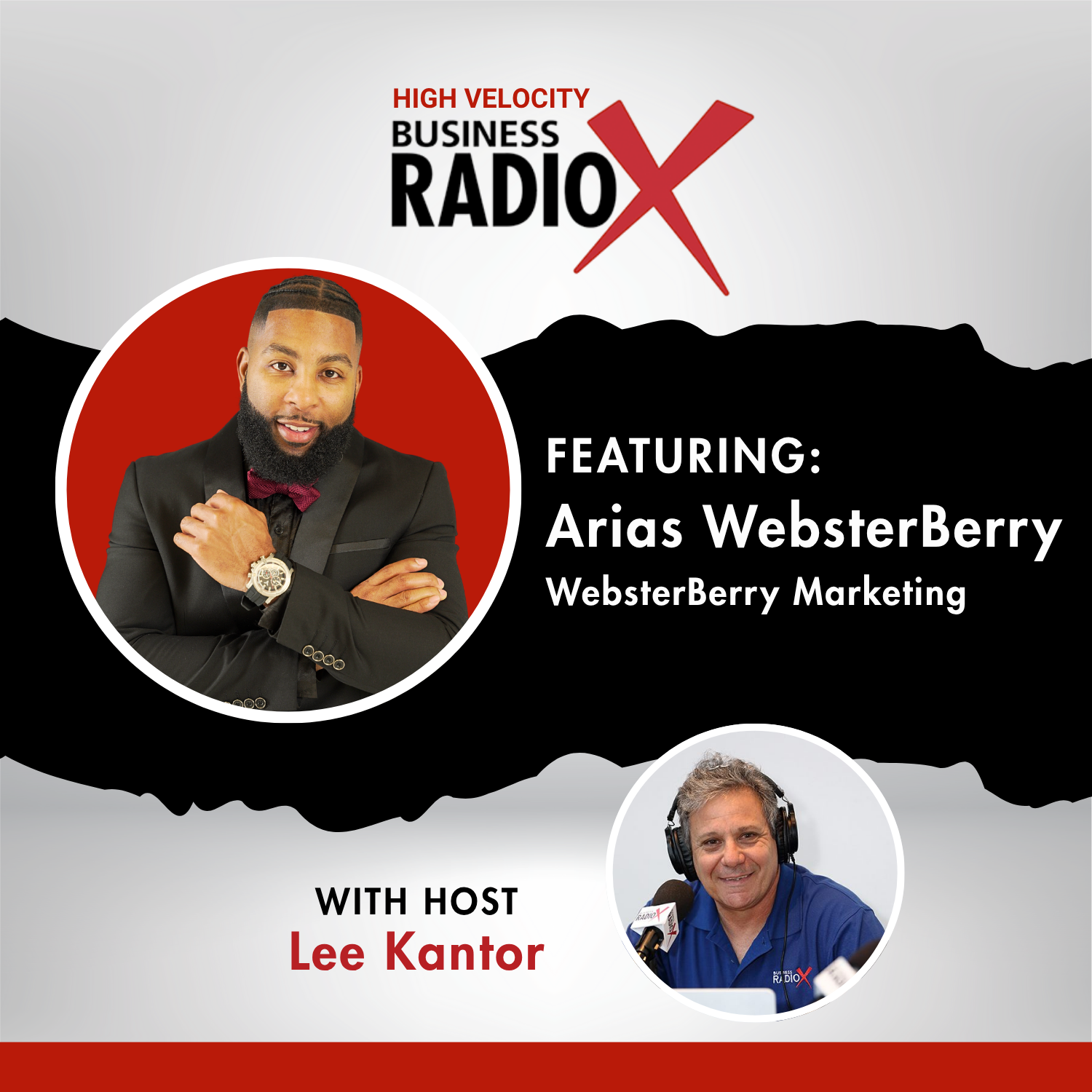

In this episode of High Velocity Radio, Lee Kantor interviews Arias WebsterBerry, CEO of WebsterBerry Marketing, about effective marketing strategies for small to mid-sized businesses. Arias shares his journey from entertainment promotion to digital marketing, emphasizing the power of authentic storytelling, content creation, and leveraging AI. He discusses the importance of having a dedicated marketing budget, offers practical budgeting guidelines, and illustrates success through client case studies.

 Arias WebsterBerry is a seasoned entrepreneur and digital marketing expert with over a decade of experience building revenue-generating brands. As Founder and CEO of WebsterBerry Marketing, he has led hundreds of clients to measurable success through tailored services in web design, sales funnels, social media, CRM, email marketing, and branding.
He is also the creator of Launch Ignition AI, an innovative business accelerator that automates website, funnel, and campaign creation in minutes, helping clients achieve up to 312% lead growth and 5× revenue increases. He’s launched multiple ventures, including Ignite Funnels, and authored Content Cannon, which guides entrepreneurs in generating a month’s worth of content in a single day.
As a certified Scrum Master and Master Sales Coach, Arias has personally mentored over 400 professionals, driving more than $112 million in cumulative client revenue. His leadership extends beyond marketing, he served as Executive Producer of the acclaimed Hip Hop 101 Music & Art Festival, earning a commendation from the Los Angeles City Council for its cultural impact.
With a global perspective shaped by travel through 25 countries and 35 U.S. states , Arias combines strategic vision, agile frameworks, and creative storytelling to build human-centered, scalable growth systems. His work empowers entrepreneurs to elevate their brand visibility, implement culture-driven marketing, and realize meaningful business results.
Connect with Arias on LinkedIn.
What You’ll Learn in This Episode
- Scaling through AI powered marketing
- Authentic content that converts
- Purpose driven leadership in business
- Building culture & systems that scale
 This transcript is machine transcribed by Sonix.
TRANSCRIPT
Intro: Broadcasting live from the Business RadioX studios in Atlanta, Georgia. It’s time for High Velocity Radio.
Lee Kantor: Lee Kantor hear another episode of High Velocity Radio and this is going to be a good one. Today on the show, we have Arias WebsterBerry and he is the CEO of WebsterBerry Marketing. Welcome.
Arias WebsterBerry: Hey, Lee. Thank you for having me.
Lee Kantor: Well, I’m excited to learn what you’re up to. Tell us about your firm. How are you serving folks?
Arias WebsterBerry: We are helping people generate leads and turn those leads into dollars to keep it short.
Lee Kantor: So what’s your backstory? How’d you get involved in this line of work?
Arias WebsterBerry: Actually, I hail from the the land of entertainment. I started out as a promoter, starting with, you know, nightclubs and parties and in San Diego and in Los Angeles. And then I actually ended up getting into large scale concerts and executive producing festivals.
Lee Kantor: And then so from those learnings, you were able to kind of develop some marketing strategies for small to mid-sized businesses.
Arias WebsterBerry: Yeah. You know, in doing all of these things, I learned quite a bit about the various components and disciplines and marketing, you know, whether that be, uh, social media, you know, outdoor. So, you know, billboards, print, radio, TV and, you know, content creation and, you know, all the various things that that it takes. And eventually we got into websites and funnels and automation and now I but all those things and kind of all those things that I had to learn in order to throw concerts, I was able to translate into marketing. I went to work for a really large digital marketing agency, and that’s where I kind of got my formal training. And then I struck out on my own and and I created this company.
Lee Kantor: So now in marketing in today’s world, is it do you need to have just boatloads of money in order to effectively kind of rise above the noise, or is it something that you can kind of grind and scale on your own without kind of big mega marketing budgets?
Arias WebsterBerry: Well, I mean, boatloads of cash definitely helps, but it is not a prerequisite to to define success. These days, I think one of the great equalizers in kind of a gray box when it comes to leveling the playing field between the haves and have nots, or those that, you know, may have very large marketing budgets and those that are just getting started and have very small or no marketing budget is the ability to create things that people are interested in, i.e. content. So, you know, in everybody’s pocket is a cell phone, and most of those phones shoot pretty good. You know, quality, as long as you got some decent lighting and a microphone, it really comes down to your your creativity, your ability to tell. You know you or your brand’s story in a way that resonates with your audience and more importantly, explains that you understand their pains, their struggles, and that you have a solution and you’ve got some proof of concept and that you get people results.
Lee Kantor: So how does it differ when you started in a kind of event in entertainment? How does kind of that B2C environment where I want you to listen to my music or if I’m a comedian, you know, listen to my jokes versus I’m a business, you know, I’m a plumber. Uh, you know, how do I how do I kind of get the same attention, if that’s even possible in kind of a B2B world versus a B2C world?
Arias WebsterBerry: Great question actually. Um, you know, I think that that a lot of businesses, um, go wrong in thinking that they’re different, you know, the same way a, um, country artist or a actor. To, um, entertains and draws their audience in is the same. It’s the same thing that you should be doing with your business, you know? Um, you know, an actor plays a character in a movie, and there’s a lot of, you know, things that are set up in, in, um, money and people around in order to cultivate a specific scene that elicits an emotion. Uh, and as a business owner, you need to be doing the same thing. What you notice is that more and more consumers are looking into the personal lives of these these entertainers, right. They want to know what happens once the camera and the lights go off. And that is true for business, right? People want to know who the people are behind the brand. They want to know about the the pains, the struggles. You know, the the, as we say, the behind the scenes. Um, they they want to know how the sausage is made. And, you know, they, they want that so that they feel confident and comfortable doing business with you. But then on the front end, they also want to be entertained, right? They want to root for you. They want to know about your business. And, um. Gary Vee said it best. If you haven’t realized that every single business is a publishing company first that happens to do a thing, well, then you are behind and you’re looking through the prism, uh, at the wrong end.
Lee Kantor: So if you were a business coach, how would you kind of market yourself? Um, you know, to to get the eyeballs, you need to eventually move some of those people from kind of just, uh, lookers to buyers.
Arias WebsterBerry: Yeah. I would start with my my story. Right. Um, you know, every every great story, every hero’s journey has a beginning, right? What’s your beginning? Where did you come from? Right. Even in this this, um, podcast, this episode, right? You started by asking me, where did I start, right? Because nobody wants to know what you know until they know that you care. So I would start by telling people where I come from and how I came up on the skills and the knowledge that I have that can help them. Right. Tell that story as to how I came to this aha moment that that gives me the right and the validity to advise them, to coach them, to to guide them.
Lee Kantor: So in your business, how do you, um, kind of deliver the value? Is it consulting? Is it coaching? Is it. Do you actually kind of do work on behalf of your clients? Like what is the deliverable from your end?
Arias WebsterBerry: All of the above. I have three separate companies that do all of those things. So, um, you know, kind of at the beginning of the the process is what we have, uh, one of my businesses is called Launch Ignition I and it is a system that is designed to help people build businesses, how to structure them, sequence them, and get them ready to scale to six figures and beyond. And then we have Ignite Funnels, which is a all in one business management and marketing system. So you know, your website, your payment processing, email, text marketing, all the different things. And we help people build those, set them up, customize them. And then once you have that machine built, well then my agency Webster Marketing, we help to drive traffic and convert that traffic into leads. So, you know, whether you, um, have a business idea and you need help fleshing it out and turning it into an actual business. If you have a business set up and maybe it’s got a lot of manual processes and not a lot of, uh, customization or automation, then, you know, Ignite Funnels is great for that. And if you’ve got those two pieces in place, but you still are not seeing the results that you want in your business, well, Webster marketing can help you generate traffic and turn that traffic into revenue.
Lee Kantor: So now let’s talk a little bit about AI. You mentioned it earlier. How would you go about kind of leveraging AI right now? Is it primarily on the creating content side, or can you use it in all kind of the pillars that you had described of your organization? Could you. Could you use AI to, um, you know, create eyeballs to your content or is it just for creating the content?
Arias WebsterBerry: Uh, we utilize AI and basically every part of our business. Um, you know, uh, logic has an AI component at its center and it’s core. Uh, with ignite funnels, we utilize it to, um, automate messages and analyze data and respond to people. We also use it to help create, uh, funnels and websites. Uh, and then on the agency side, we build very complex, um, chat bots and um, uh, AI enabled chat bots and in omnichannel, uh, conversations. Um, and then we also use it for engagement. Right? We use AI to analyze data. When we’re running ads. We use AI to, um, elicit responses from people. So, um, the great thing about AI is, you know, it’s about precision, personalization and performance. You know, it allows us to move from guesswork to, uh, data driven decisions, and it ensures that every one of our marketing moves is purposeful and precise.
Lee Kantor: Now, is it possible to kind of grow and scale a business in today’s world without using paid? Can you just rely solely on organic?
Arias WebsterBerry: Uh, absolutely. There are lots of people that do it. Um, you know, it’s just and this is this is the part that that nobody really wants to talk about. Are you actually that That’s interesting. You know, if you’re if you’re not going to pay to play, if you’re not going to pay for a certain number of people to see your message and you want people to find it organically, is your content good enough to to make people want to opt in? You know, do you create things that are valuable enough, entertaining enough, informative enough that it makes people of their own free will decide to watch you instead of, you know, uh, Paris Hilton or Beyoncé, right? Uh, do they see that in Scroll Pass and look at yours? Click engage in want uh, to come back for more? And if it’s not, well then you probably need to go with that.
Lee Kantor: So how would you go about if you were um, say that business coach out there and you were creating this authentic content, which I’m sure you’re a believer, right? The content has to be authentic. It can’t be just some make believe thing that doesn’t connect with you or your business, so it has to be somewhat personal and authentic. How do you like what’s the low hanging fruit for that individual? What like where would you begin a content journey?
Arias WebsterBerry: Uh, like I said, just your origin story, right? Uh, whether it’s, I mean, whatever approach you decide to take, whether it’s comedy or drama or, you know, somewhere in between, I think it’s very important for you to get your story out there. Um, you know, are you telling me that you are, uh, the greatest coach in the world? Um. That’s great. There’s a million of you on YouTube, TikTok, Facebook, Instagram, uh, in your local networking event that are saying the exact same thing. Uh, what separates you from them in that the the the that separator is your story, right? What did you go through that qualifies you to be the person that can tell me anything. Literally anything. Um, you know my story. Uh, I came from nothing. I, I have been homeless. I’ve been bankrupt. I, um, you know, come from a single parent home. Uh, I lost my father when I was, like, 14 to police violence. You know, I had nothing. I had no support system. But somehow I’ve been able to build three, you know, seven figure businesses. Uh, I’ve been able to teach myself coding in websites. And now I have 27 employees on three different continents. Uh, if somebody asks me how or why I feel I’m qualified to teach you about entrepreneurship or why they should listen to me when it comes to scaling a business, well, you can just look at my track record and everything I just said is is valid.
Arias WebsterBerry: You know, you can validate it. There’s proof online, right, that everything that I’m saying is true. You know, we’ve helped generate over $112 $12 million in revenue for our clients. Those are the things that’s that’s my story. That’s where I come from. Those are the things that I’ve done. That’s where rubber meets the road. And I think that a lot of times when people are creating content, uh, they don’t want to get into that. Right? They want the fluff. They just. Oh, hey, look at me. And my kids were out for, um, a walk with our dogs. And, uh, hey, here’s a flier of my business and my products and my services you should buy from me. Nobody cares. Right? They don’t want to know what you know until they know that you care. Uh, and they know that you care. If you can level with them and be honest about where you come from. Good. Better and different.
Lee Kantor: Now. I mean, now that you’ve established yourself and have a track record of success, it’s easier to kind of lean on on that. How would you have done it at the beginning, or how did you do it at the beginning, when you didn’t have that, when you were homeless, when you were bankrupt, when you didn’t have maybe the industry connections you have now. Um, how do you build before you have established yourself as an expert like you obviously have?
Arias WebsterBerry: That’s a great question. And honestly, if I could go back, I would do what I’m about to tell you now. I would document the process. I, I fell prey to thinking this, this antiquated mode of thinking that I need to have it all figured out. And I have to have the fancy car and the big house and, you know, the celebrity friends and, you know, the seven figure, uh, bank account before I can advise people. And the reality is, nothing could be further from the truth. You going through the process and documenting it and publishing it as you go is your track record. It’s the way you bond yourself and bond your audience to you by giving them a peek and a window into the process as its, you know, showing the building of the thing, whether it’s a product or a service. You know, and showing the winds along with the losses, telling people, hey, I’m going for this really big opportunity. We got a big meeting with these guys and we’re about to go in. Hey, wish me luck. Let’s see what happens. And then, you know, maybe you film, uh, maybe not the whole thing, but, you know, kind of the camera outside and you sit and waiting and going in, and then you coming back and telling your audience we didn’t get it.
Arias WebsterBerry: They decided to go in a different direction. Man, that sucks, right? Most people are living in that space of loss and failure, right? The reality is, if you’re a business owner, you’re a salesperson. Most salespeople strike out, you know, 8 or 9 times out of ten, but no one’s documenting that. And when you can show people that they believe you. They see the progress. They see the progression. If they’ve been following you for a couple of years, they remember that first big loss. They remember your first big win. And when it comes around, time for them to actually want and need your services, you don’t have to convince them that you know your stuff. They’ve been watching. They’ve seen you build the thing. They’ve seen your ups, downs, highs, lows, and they know that you are in this to win it right. You actually have a passion. You have a, a a real purpose driven, um, reason to do what you do. And because they’ve been watching it, there’s no doubt that you will give them your all because they’ve seen you do it for others.
Lee Kantor: Now, um, you mentioned the sharing behind the scenes. Now you’ve shared a little bit about building in public. Um, what is the platform you would recommend to a business coach? Is it, um, some video centric thing? Would it like. Is it possible to do this, uh, with text? Is it possible to do with images? Does it have to be, uh, video content? And if it is video. Does it have to be, like on a TikTok or a YouTube? Where would you, um, kind of build if you were this business coach and you were willing to be vulnerable enough and humble enough to build in public, like you’re recommending?
Arias WebsterBerry: Yeah. I mean, I would say, um, I’m going to, uh, not not give you a binary answer. I’m going to give you two things. The first thing I would say is go where you naturally gravitate to. Um, because if you’re not good with the platform, then you’re most likely not going to do it consistent enough to see any results. So, um, go somewhere that you actually plan to spend some time right in somewhere where you feel you can be consistent. So that’s the first thing. The second thing I would say is, you know, try to be, you know, a little intelligent with it. Uh, you know, if you are a, say, a coach and you’re targeting, um, retirees that are, that are going after their second hobby business, right? They’ve already retired once, and now they’re creating a hobby business. And, you know, Snapchat probably isn’t the best place for you. I don’t know any 50, 60, 70 year olds that are spending a whole lot of time on Snapchat, right? So a little bit of common sense helps. But, um, if I had to give you a place, I would say YouTube is a really good place. Um, because, you know, YouTube is the second largest search engine in the world. Uh, and the way the algorithm is set up on YouTube, it is amazing at finding people that are interested in your particular topic. Right. And most people that get on YouTube, um, once they start liking things, the the algorithm pulls, brings people back to you. Right. Youtube is is one of those things that it definitely works as a search engine, very much like, you know, Google Ads or Google in that people go searching for things and then the platform just shows them more of what they’ve searched and liked. Um, so if you publish there and you know, you do a good job with your descriptions and the captions, you can, uh, not only educate people in, you know, show them your process and, uh, your origin story and a little window into your world. But you can actually, you know, actually get people to click out and generate leads out of it.
Lee Kantor: So if I was this business coach and wanted to grow and scale and maybe I’m frustrated where I’m at, where is the entry point in your world? What is the first thing I should be, um, looking to if I want your help.
Arias WebsterBerry: Um, the first thing I would say is, is, you know, put together a budget. I can’t tell you how many conversations I have with businesses and those that are even, you know, well established. I’ve told this story before, but I met with the homebuilder, um, here in Dallas. They’ve been around for close to two decades, and I, they make, uh, I don’t know, 20 million a year. And I remember sitting down with the, with their team and finding out that they don’t have a marketing budget. I was floored. It’s like you guys have been around for how long you’re making how much money, and you guys don’t have a marketing budget. That’s wild. Um, so I would say that the first thing is just sit down and earmark some money. Right. And most people don’t really know, uh, how to do that, but if you’re in business to business, you should be spending about ten. Or earmark 10% of projected revenue towards marketing. So you plan on making $1 million this year? Uh, you need to plan on spending around 100,000 this year on on marketing. So that’d be, you know, somewhere around eight, $9,000 a year.
Arias WebsterBerry: If you’re in business consumer, you should be spending anywhere from 15 to 20% on marketing. So same scenario. You’re trying to make $1 million. You need to put 150 to $200,000 aside, or that’s what you need to plan and budget for, uh, over the course of a year. So if your goals aren’t as ambitious, you’re just trying to do maybe 120 K, uh, this year you’re trying to make 10,000 a year. Well, great. Um, you know, put 10 to $15,000 aside or roughly around $1,000 a month. And that should be your your budget. That’s, you know, graphics, social media, video creation ads, you know, all those different things. See how much you can fit into that budget. And, um, you know, very much watch the return on that and see, you know, how much business you’re able to generate with that money. But I think the biggest thing is most people won’t take the time to sit down and actually put, you know, some money aside, uh, to, to give themselves a decent shot of success.
Lee Kantor: So what is a story you can share, maybe with a client that you were working with, maybe share what the challenge was they had before they started working with you. And then when they work with you and how you were able to help them get to a new level, obviously don’t name the name unless it’s okay, but just the problem and how you were able to help them grow.
Arias WebsterBerry: Yeah, I’ve got a few. Um, uh, we actually just, uh, we had a luxury travel company, uh, that had been around for a few years, but again, they had never really put together a marketing budget. Uh, they were getting a good amount of traffic, uh, as far as, you know, views and stuff on Instagram. But they were having a really hard time translating that into revenue, So they looked great online. Right. Amazing content. You know, lots of people engaging, but it wasn’t really transferring into actual revenue. Um, and what we found is that they did not have any lead magnets, right? They didn’t have anything that they could give away to their audience in order to get them to move from, hey, you’ve got a really cool reel on Instagram to now your name, phone number and email in my system that I can reach out to in and, you know, have a conversation with about coming on a trip. So first thing we did is build out some lead magnets. We built out a whole, um, um, program that allow people to get early access to trips. So they got, um, access to purchasing trips early. They got discounts on on trips, and they also got a couple other perks. And that was the first lead magnet. We built out a funnel for it, a landing page, in order to collect the information, uh, that helped us generate. So they in their five year period. I think they want. I think they had maybe, uh, 500, maybe 600 leads, um, in, in their database over like a five year period. We generated that much in the first two months of working with them. Five, 600 leads. Uh, and then from there we went into ads. So we started running ads, and we generated over 167 leads inside of three weeks for them on the ad side, um, which, you know, had a profound impact on the amount of people that they had a chance to pitch and ultimately the amount of people that that, um, ended up booking.
Lee Kantor: Now, um, when you’re working with a client like that and you’re helping them kind of put together these systems, is it something that you’re explaining to them, you should do this, and here’s how. Or is it like they’re just paying you and then you’re building this all out on their behalf?
Arias WebsterBerry: Um, the latter. So. Well, I mean, we have to explain it to them, right? We’re it’s costing a lot of money. They’ve got to understand exactly what we’re doing and what the inputs and outputs are. Um, but for them, we just built it. All right? We built the. We rebuilt the website, we rebuilt funnels. Uh, we came up with programs, the branding for it, uh, the graphics, the, uh, reels, the, the, um, ad campaign, you know, we we truly built out the entire thing, uh, based off of what we knew they needed.
Lee Kantor: So was it done for you? Service?
Arias WebsterBerry: Absolutely.
Lee Kantor: And is that how all of your services are, or do you have some do it yourself. Do you have some? Do it with you do or is it only do it for you.
Arias WebsterBerry: On the agency side, it’s all done for you. Um, you know, for those that go through our launch ignition system, um, we do have the ability to do some of the things with with you. Uh, which is great, because what we, um, done for you and done with you. Because I think a lot of times, Um, marketing doesn’t work even with agencies, the people that go to agencies because they don’t have enough information. They’re not educated enough. So, you know, assuming you have a good actor right in the in the space and they’re they’re a reputable company. They know what they’re doing. They get results. Um, a lot of times clients won’t give it enough time to work or they’ll insist on certain things because of, you know, some random video they saw on TikTok or Instagram. So they’re constantly switching the strategy or the, um, channel or the budget. You know, they’re moving things around without giving it enough time to actually work. So when you kind of work with someone or do it with them or allow them to do some of the things themselves, it it gives them the benefit of that education so that they have enough information to make good decisions.
Lee Kantor: So who is that ideal client for you? Um, are they enterprise level companies or do you work with smaller startups or is it only the big guys?
Arias WebsterBerry: Yeah. When it comes to launch ignition, we typically work with businesses that are at the beginning of their journey, right. They’re building a business or they’re in their first three years. So, uh, we we typically like them to go through launch ignition first so we can, you know, take them through the full lifecycle to truly building a scalable business and all the back end digital infrastructure that they need. Um, you know, for those that have been in business a few years or maybe have already hit their first, you know, six figures and they’re doing that regularly. Um, Webster marketing works really well. And even if you’re kind of getting started, some of our social media packages, you know, that started a few hundred bucks or are a good fit, you know, even if you’re just getting started. So, um, you know, we we serve we have, um, you know, $100 million clients, right? Large hotel chains, uh, down to individual, um, you know, beauticians, uh, and makeup artists. So, uh, we have packages and, uh, services that that, you know, can basically fit any budget.
Lee Kantor: So, uh, if somebody wants to learn more, have a more substantive conversation with you or somebody on the team, what’s a website?
Arias WebsterBerry: Uh, they can go to Webster Barre marketing. Com so Webster, Barre, Webster like the dictionary, and then b e r r y marketing. Com or you can just Google Webster Barre marketing.
Lee Kantor: All right. Well thank you so much for sharing your story today. You’re doing such important work and we appreciate you.
Arias WebsterBerry: Lee, thank you for having me. And, um, I appreciate it. It was fun.
Lee Kantor: All right. This is Lee Kantor. We’ll see you all next time on High Velocity Radio.