Breaking the Stigma: Uniting for Mental Health in the Workplace

/
RSS Feed
In this episode of Association Leadership Radio, Lee Kantor talks with Kristen Petillo and Rob McKinney about their collaborative efforts in the Georgia Mental Health Alliance. Kristen, from the American Foundation for Suicide Prevention, discusses the mission to save lives and bring hope to those affected by suicide, while Rob, of AGC Georgia, talks about addressing mental health in the construction industry. They explore the underreported issue of suicide, the importance of prevention resources, and how associations can unite to provide a broader range of support, emphasizing the need for a workplace culture that encourages seeking help.
 Kristen Petillo, Area Director with American Foundation for Suicide Prevention.
AFSP (American Foundation for SuicidePrevention) is a national non-profit with chapters in every state across the nation.
Our mission is to save lives and bring hope to those affected by suicide.
 Rob McKinney joined Associated General Contractors of Georgia in October 2022 and has been involved with the organization since 2001, including serving as chair of both its Safety Committee and Technology Shared Interest Group.
The Decatur-native grew up in Augusta, went to high school in Snellville and now calls Clarkesville home. Rob earned his Construction Risk and Insurance Specialist designation in 2015.
He is a proud founding member of the “ConTechCrew Podcast” featuring interviews with many fascinating construction technology experts, thought leaders and industry partners, such as Mike Rowe and Diamond Dallas Page.
 This transcript is machine transcribed by Sonix
TRANSCRIPT
Intro: [00:00:02] Broadcasting live from the Business RadioX studios in Atlanta, Georgia, it’s time for Association Leadership Radio. Now, here’s your host.
Lee Kantor: [00:00:20] Lee Kantor here another episode of Association Leadership Radio and this is going to be a good one. Today on the show we have Kristen Petillo and Rob McKinney. Kristen is with the American Foundation for Suicide Prevention and Rob is with AGC Georgia. Welcome, both of you.
Kristen Petillo: [00:00:39] Thanks so much.
Lee Kantor: [00:00:41] Well, before we get too far into things, why don’t you lead off Kristen and tell us a little bit about yourself and your association?
Kristen Petillo: [00:00:47] Yes, sure. So I am the area director with American Foundation for Suicide Prevention, and I have the privilege of serving the state of Georgia in that capacity. And our focus while in a national nonprofit, we have chapters in every state. So I am, as I said, leading things off for Georgia with a mission to save lives and bring hope to those that are affected by suicide.
Lee Kantor: [00:01:11] And, Rob.
Rob McKinney: [00:01:13] It’s good to be here. Lee. My name is Rob McKinney and I am the Director of Safety Services for the AGC Georgia, which is also referred to as the Associated General Contractors. So we’re a local trade organization that represents general contractors, trade contractors. And my role is to help lead our safety efforts for improving the workplace on safety. And as we’ll talk about a little today, trying to bring a little bit of light to the mental health issues in our industry.
Lee Kantor: [00:01:40] And speaking of those mental health issues together, I guess you’re working on the Georgia mental Health Alliance and a specific initiative of nurturing the mental health of Georgia workers. Can you talk a little bit about that, Rob?
Rob McKinney: [00:01:56] Absolutely. It’s an honor for the AGC Georgia, to participate in this alliance. My understanding is the alliance was originally created between the local OSHA offices and the Georgia Department of Public Health. They started this back in the pandemic days, believe it or not, and it’s grown quite a bit since then, where organizations such as Dillon Christian is coming from. At the American Foundation for Suicide Prevention, we added four new signatories, I believe, on Friday, along with the AGC, to try and bring different parts of the industry together. It’s hard to talk about what’s sometimes considered a dark subject, but we’re trying to bring positivity and light to that so people can kind of look at the issues in a new way, but more importantly, provide resources and tools that hopefully can help people that might be in need, if that makes sense.
Lee Kantor: [00:02:49] And is this an example of a way or ways that associations that have obviously different kind of objectives, but they can come together when there are kind of issues or circumstances that can benefit both. I’d like to get Kristen’s kind of thoughts on how maybe she plugs in with other associations because her association is so specific in its mission.
Kristen Petillo: [00:03:14] Yes. So interchangeable alliance association in this conversation, if you will. And so the idea here is if, uh, other entities or businesses are, uh, have complementary programs or services, resources that they can offer to kind of lock arms and address an issue that there is there’s strength in numbers and more power behind that. Um, and maybe, um. Sometimes there’s not crossover within those offerings. So together we have a much more broad offering to be able to address and reach and affect change as a group.
Lee Kantor: [00:03:54] Now, Kristin, what are some of the resources that maybe other associations aren’t aware of that the Afsp has and that other that you’d be kind of willing to share, or to at least collaborate with other groups?
Kristen Petillo: [00:04:07] Sure. So from the vantage point of American Foundation for Suicide Prevention and a number of the other alliance partners as well, uh, leading with prevention related resources, um, that we can deliver on site and in a workspace to help, uh, those that are, whether they’re employees or employees, uh, to realize these programs and operate with a vantage point where we all understand to a degree what the signs or symptoms of suicide might present as the behaviors to speak, uh, compounding factors around risk and how to have that lens so that we’re keeping everyone safe. And so we want to lead with those programs and work to normalize the conversation around mental health being a part of the broader overall health of of a human being.
Lee Kantor: [00:05:01] And, Rob, how did suicide prevention, uh, come up as a priority, that this is something that your association should be kind of getting involved with?
Rob McKinney: [00:05:12] So our national art, the AGC of America, they have a safety and health committee that’s been looking at this topic for several years. And as they were researching the numbers and really understanding the magnitude that we were talking about, they started creating an effort and an initiative that has been spread out to the different association, the local association. So here in Georgia, for example, and the numbers that I’m referring to, if people haven’t seen these numbers in the construction industry every year, unfortunately there’s generally around a thousand accidental deaths. That is where there’s something that wasn’t meant to happen. It didn’t have the right training or PPE. It was a complete accident. As they look at the numbers and they’re getting the data from the Department of Bureau of Labor Statistics, the BLS, they’re realizing that the suicide overdose rate is around 5000 per year. So nearly 5 to 1, as our industry is coming to terms with that and realizing, you know, that severity is where, again, the national organization has started to create resources, training materials, videos. They are sharing those with the chapters. So in our case, the chapters picking up those resources, and we’re trying to share those with our members also working with other associations locally and trying to help provide knowledge and training where we can, if that makes sense.
Lee Kantor: [00:06:36] Now, Kristen, is this, um, is suicide one of those issues that, um, I don’t want to say this in a crass way, but people aren’t aware of the magnitude of the problem here because people aren’t, you know, talking about it like there’s not as many headlines from a suicide as a murder or something dramatic like that. Is that something that that some people don’t see it, so they don’t think it’s a big deal. And then but it is a big deal and it affects lots of people way, probably way more than the average person understands.
Kristen Petillo: [00:07:11] Yes, I would say, um, across the nation, uh, suicide numbers are underreported or misreported, uh, sometimes reported. And, uh, a cause of death is may be named an overdose or something else. And then also, there’s a lot of shame and stigma around losing someone by suicide. Thoughts of what did we miss or we should have known or, uh, a lot of shame in that. And so sometimes the response is that we are going to tell everybody, because now we’ve had to we’re, we’re dealing with this very dark time and we maybe never saw it coming. And now we’ve got to tell others with the idea that we want to reach out to save someone else. But the other side of that is sometimes when someone is lost by suicide. Maybe a family is dealing with it, or maybe an employer is dealing with it. A university is dealing with it, and sometimes they don’t want to be associated with it. And so it’s again normalizing that this does happen sometimes. And um, to see yourself in it in the way of operating from a prevention lens. And, and really it’s every employer’s responsibility to be leading with these resources and making sure that they’re opening and having an inviting environment where people can reach out if they are struggling, and having those resources on hand and making it safe for people to raise their hand if they’re having a struggle.
Lee Kantor: [00:08:43] Now, Rob, you mentioned that, uh, suicide was five times the amount of deaths, uh, than just kind of workplace injuries and accidents. When you saw that number, were you like, that can’t be right. Like, that seemed like we spent so much time on safety. And how are we just not spending the same or five times the amount of time on this other area? Was that something that you were surprised by?
Rob McKinney: [00:09:09] I was definitely surprised to see that number. It’s it is a stark contrast in the numbers, and it’s hard to really think through that amount of people are in that much pain and not seeing the world the way other people do, you know? Well, we talk about OSHA compliance. We talk about normal occupational health and safety. We’re very focused on process procedures, equipment. We work through engineering controls and best practices and all the way down to the last line of defense of PPE, such as boots and hard hats, where we’re very focused on the body. But by them. The mind side of this, the mental side of this, that is definitely where it is. You know, it’s a gray area and it’s it’s a struggle for the industry to kind of look and think, how can we approach this in a new way? As the numbers are kind of showing, it’s not exactly going the way we would like to see it. So yeah, there was definitely some sticker shock of seeing those numbers and starting to talk to more professionals and really understanding the magnitude of of that number, without a doubt.
Lee Kantor: [00:10:12] And then how do you kind of turn that shock into action? Like what were some of the the ways you were looking at kind of triaging this and get that number lower? Was that where these alliances and these kind of partnerships came in?
Rob McKinney: [00:10:31] From the agency Georgia. Absolutely. It was trying to understand who were professionals that study this and practice in this area, because it is definitely, you know, for most safety professionals, they learn OSHA regulations and worker compensation laws. They’re studying something totally different. And so in the last couple of years, we’ve had to really look around our community, at least, let’s say in Georgia. And we’re lucky we’ve got one tremendous member, uh, a gentleman named Mike luster, who has a business. He has been a clinician for a couple of decades. And so he is a resource that’s been helping us understand the nature of what we’re talking about, how to talk about it because we’ve had to back up a little bit and kind of look first of, well, how do we talk to companies about this at the management executive level and really help them understand what their culture looks like for this? And one of the things that Mr. Luster helped us try to understand better is how to create a culture that it is okay to seek help. And not be such a stigma. So we’re working with companies at the the highest level, the leadership, the management, but also at the same time of putting materials in place that are out on job sites, that any worker on a job site or an office trailer, how can they access things a little more freely and easily? So, you know, some technology like QR codes is a great thing that we can make posters, we can put QR codes, people can send emails, they can do things where we kind of put the information and easy to find places. So there’s there’s the cultural side of this at the company as much as at the worker level, that we’re trying to really approach it hand in hand and distribute that knowledge. Both both directions.
Lee Kantor: [00:12:15] Now, are your members, um, kind of grasping, grasping the severity of this and saying, oh, thank you. You know, where have you been? This is great? Or are they kind of reluctant to apply some of these things?
Rob McKinney: [00:12:30] I’ll be candid. It is. It’s a tough subject. We have some members that are leading the way tremendously, that have put a lot of effort into their programs. Uh, one one that I can give a shout out to is Holder Construction. Last week at our signing ceremony, they had donated some funds for creating the image and the logo for the poster for the campaign. You know, that’s a company that’s been leading in a lot of a lot of ways, and it’s tremendous to see it. We’ve got a few other members that are doing a lot of amazing things, and it’s kind of like a lot of topics. I would say that there’s a little bit of an arc, you know, you’ve got those on the one side that see it, they’re understanding it. They’re trying to help make the situation better. We’ve got members that are still kind of scratching their head of coming to terms with it. Uh, because when you really look at the fabric of our industry, we’ve got people working in this industry from their 20s to their 60s. We’ve got men, we’ve got ladies. It’s. It’s an interesting topic to ask any individual construction and see how it’s going to land with them. And, uh. We are doing the best we can to make a positive effort forward, shall we say.
Lee Kantor: [00:13:42] And then, Kristen, is there any, um, advice that you can give to organizations that want to, um, you know, first just bring the awareness to, uh, to the fore and then also some specific, uh, things that they can be doing to improve the situation.
Kristen Petillo: [00:14:04] Yes, I, I I’ll reiterate that suicide prevention is everyone’s job. And, uh, to make the resources plenty and available in public and private places where people can seek them, uh, confidentially, if need be. Um, also to keep in mind that someone who is a risk for a suicide. There’s no face for what it looks like to be at risk. Um. Suicide. Someone who is struggling may walk around in the day to day with a smile. And so, um, to get informed about what those subtle other things may be that might indicate that a conversation is warranted, and to make sure that everyone is researching and accessing these resources, that all of these organizations that are members of the alliance have these programs, and they’re all free. And so make it part of the wellness offering. Um, if there are CEUs that are required or internal, uh, in-service hours that are required to to fold it in so that people are taking these trainings and getting refreshers and normalizing that it’s part of consistent conversation. We’ve gotta all show up in this and it’s got to be a top down. Conversation and acknowledgment.
Lee Kantor: [00:15:30] So it has to be just like you keep using the word normalization in the sense that if we talk about it freely, there’s less shame and stigma. So then it’s more okay for someone to go and get help or ask for help.
Kristen Petillo: [00:15:46] 100% and the way we speak about it. American Foundation for Suicide Prevention, and likely a lot of these other alliance partners do too, is that, um, just as if you’re having an issue with your back, you might need to go have a tune up with your chiropractor. Sometimes in your mind, when when you might have a physical condition or you’re having a relationship strain or you’re not getting enough hours at work, and then there’s a there’s financial strain, your mind can go places. It gets dark. And so when all those factors are converging, that is when someone gets into a place where they might not be able to see beyond that dark period. And so it’s allowing them to have permission to raise their hand and say, I’m struggling. And to be seen in that and and be met with resources so we can help them through that dark time. Um, knowing that there’s hope and help available.
Lee Kantor: [00:16:41] And so it doesn’t spiral and they don’t feel like this is their problem only to solve.
Kristen Petillo: [00:16:49] 100%.
Lee Kantor: [00:16:51] Now, Rob, are you seeing now that this has, I guess, been started and is now, uh, going? Are you seeing the impact of it yet, or is this too early?
Rob McKinney: [00:17:03] I don’t think we’ve seen the impact yet. Uh, honestly, I think we’re in the awareness stage that as Kristen was talking about, we’re able to talk about this openly now. We’re not whispering about it. You know, in our safety committee meetings, we’ve spent a good year actually addressing it and talking about it. We’ve scheduled classes for education. We’re sharing resources. I still think we’re really in the awareness phase again, to be able to talk about it, to be able to see impact, I think will take a couple of years to see if that number trend, does it continue to rise for our industry? Ideally, it’s going to slow down and reverse. That’s going to be the real tale of the tape because we can put. Posters everywhere, and we can talk and we can do a lot of action. The tale of the tape is going to be the results of what? What does this number continue to do? Does it continue to rise at an alarming rate? Does it slow down? Ideally it flattens or it drops. That’s Christian. You may have a better insight on what those numbers look like of when do we think that we would see a significant impact on the numbers from all of our collective effort?
Kristen Petillo: [00:18:23] It’s a good question. You know, I think as I said, as we lock arms and try to infiltrate, if you will, and lead with these programs. And, um, I think my hope is we’ll see a change. Right. And so some conversation rather than no conversation is a start. Right. And so, uh, at Afsp, we lead with the idea that talk saves lives. That’s the name of one of our programs. Having that conversation, reaching out to somebody you are worried about. The research literally shows that talk, that very conversation, can quite literally save a life. And so as we look at a calendar year and what transpires in May will have Mental Health Month, right. And so you’ll see, uh, an increased program delivery at that time of year. And then in September, it’s suicide prevention month. So I’ll imagine in May and September we’ll see a ramp up of specific program delivery. And then the rest of the year, the idea is the resources are around, and then maybe we can look at some other programing to give to parents that are in those spaces that might have children. And there are there’s further work outside of the workspace. So who are these individuals as holistic people, and how do we inform and educate all of them? So as they’re walking into their daily lives to that they can be soldiers in this safety effort, if you will.
Lee Kantor: [00:19:53] So how do companies participate in this?
Kristen Petillo: [00:20:01] Regarding the involvement in the alliance. Yeah. I would say there there is further room at the table. And so, uh, I think we would lead through. Um, either myself or Marilyn Velez or through Rob, uh, for some next conversations around, uh, what organizations or businesses would be interested? What do they bring to the table? I, I see the alliance as continuing to grow as we have complementary offerings to, um, reinforce and further our reach as we try to save more lives.
Lee Kantor: [00:20:38] Well, I’m just glad mental health is on the agenda. I think that’s a big step.
Kristen Petillo: [00:20:44] We’re all grateful.
Lee Kantor: [00:20:46] Now, uh, if somebody wants to learn more about either of your associations, what are the coordinates? We’ll start with you, Rob.
Rob McKinney: [00:20:54] Though our website if you want to look us up is agc ga.org.
Lee Kantor: [00:21:01] And then Kristen.
Kristen Petillo: [00:21:03] Our website is afsp. Org and then if you’re looking for Georgia specific it will be Afsp. Org forward slash Georgia.
Lee Kantor: [00:21:14] Well I applaud you both for the effort in trying to solve this important problem. And thank you so much for doing what you’re doing. It’s important and we appreciate you.
Kristen Petillo: [00:21:27] Thanks so much.
Lee Kantor: [00:21:28] All right. This is Lee Kantor. We’ll see you all next time on Association Leadership Radio.
Marcus Aurelius Tip for Better Productivity
BRX Pro Tip: Donald Miller’s Take on Lead Generation
/
RSS Feed

BRX Pro Tip: Donald Miller’s Take on Lead Generation
Stone Payton : [00:00:00] And we are back with Business RadioX Pro Tips. Lee Kantor and Stone Payton here with you. Lee, what’s your perspective? What are you learning about lead generators?
Lee Kantor: [00:00:10] That they’re very important. You should invest some time into, you know, developing them and kind of thinking about them. One of my favorite authors, Donald Miller, he’s the author of the book Storybrand. He says that you should spend as much time testing and developing lead generators as you do creating products to sell.
Lee Kantor: [00:00:28] Once you have a good product, then spend your time testing and developing a variety of lead generators for your business. Optimize those lead generators. If you do this right, and you can correctly have a stable of lead generators that work in a variety of ways, that’s going to take your business to a new level.
Lee Kantor: [00:00:48] And not every lead generator works in every platform. So make sure you’re optimizing your lead generators to the platform you’re deploying them on. You know what works well on LinkedIn may not work as well on Facebook, and that may not work as well on your website or on your podcast.
Lee Kantor: [00:01:07] I know we’ve tried a variety of lead generators. We have some go-to ones that work for us reliably and we lean on those, but we should always be testing new ones to make sure that we are keeping a good flow of leads coming in because we know we have a good product and we got to get it in front of more people.
Stephanie Fischer on the Future of the Georgia Restaurant Industry
/
RSS Feed
In this episode of Association Leadership Radio, host Lee Kantor is joined by Stephanie Fischer from the Georgia Restaurant Association. Stephanie discusses the association’s advocacy for local restaurants, addressing challenges such as rising costs and the need for culinary education. She emphasizes the industry’s diverse career opportunities, from finance to HR, and encourages support for local eateries. The episode underscores the importance of community involvement in sustaining the restaurant industry and highlights the optimism and commitment of the association to its members.

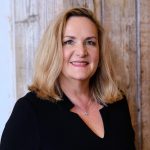 Stephanie Fischer has spent her entire career in the hospitality industry, beginning at KFC during high school and culminating in her most recent role as the vice president of corporate operations of Paradies Lagardère Travel Retail Dining Division, where she led strategic planning and support of dining operations with a focus on new store openings, food safety, back-office systems, and the guest experience for more than 80 brands across 170 locations in 43 airports.
Fischer was an employee engagement champion who also introduced nationwide strategic food safety initiatives and spearheaded the launch and growth of an internal DEI council. Before the Paradies Lagardère acquired Hojeij Branded Foods, Fischer was HBF’s executive vice president. She led the successful opening of 87 new airport locations, enabling total growth to $250 million in annual revenue between 2011 and 2018.
During this time, she also served as a member of the CEO’s executive steering committee, and her expertise was critical in growing the company and providing an exceptional guest experience. Fischer’s career experience also includes time with Dunkin’ Brands, leading its training center in Orlando, FL, where she trained new franchisees on store operations. Previously, she spent 13 years with the Walt Disney World Company, where she led learning and development for food and beverage and retail at Epcot, including the Epcot International Food & Wine Festival.
In 2020, The Griffin Report named Fischer a Woman of Influence in the Food Industry. Fischer is also a member of Les Dames d’Escoffier’s Atlanta Chapter. She obtained her Bachelor of Arts degree from the University of Hawaii and an MBA from Stetson University. Fischer took the lead at the Georgia Restaurant Association in January 2024.
Connect with Stephanie on LinkedIn.
This transcript is machine transcribed by Sonix
TRANSCRIPT
Intro: [00:00:02] Broadcasting live from the Business RadioX studios in Atlanta, Georgia, it’s time for Association Leadership Radio. Now, here’s your host.
Lee Kantor: [00:00:19] Lee Kantor here another episode of Association Leadership Radio and this is going to be a good one. Today on the show we have Stephanie Fischer with the Georgia Restaurant Association. Welcome, Stephanie.
Stephanie Fischer: [00:00:32] Thank you, Lee.
Lee Kantor: [00:00:32] I am so excited to learn what you’re up to. Can you share a little bit about Georgia Restaurant Association? How you serving folks?
Stephanie Fischer: [00:00:39] Sure. Thank you so much. Well, the Georgia Restaurant Association is the voice of Georgia restaurants and advocacy, education and awareness. And 2023, we represented approximately, $34.4 billion in sales. And with almost 23,000 locations here in the state of Georgia, we employ almost 5000 employees in the state, only second to agriculture. And 93% of our restaurants here in the state of Georgia have fewer than 50 employees, which makes up for a lot of small, small businesses here. If we talk about an industry as a whole, the National Restaurant Association just came out with some projected numbers. And in America, we are projected to hit $1 trillion in sales this year, which is pretty amazing. And just like Georgia, the restaurant industry in America is the second largest private sector employer in the US. And so, of course, when it comes to advocacy, our main goal is to advocate and educate at the local and state level for all restaurants in the state of Georgia. And we interact with government at every level. Any decisions they make that impacts Georgia restaurants. We will be monitoring if it adversely affects restaurants. We are going to work to stop that legislation. If it’s good policy, we’ll work to get it passed. So that’s pretty much what we do here.
Lee Kantor: [00:02:07] So your members are primarily restaurant owners or kind of the does that include like franchisors like because there’s a lot of franchisees in Georgia like the you know, Jimmy John’s the franchisor. Is that a member or is a Jimmy John’s kind of location a member or both?
Stephanie Fischer: [00:02:28] It’s a little bit of both. Right. So we have some very large national brands here and they are members. And then we have small independents that are members. And depending on if it’s a large franchise, depending on how that agreement is written, they may be members or they may sign up as members, um, for themselves.
Lee Kantor: [00:02:47] And then is our members also kind of the suppliers to the restaurant industry, or are those, have a separate way of, kind of working with you?
Stephanie Fischer: [00:02:55] We we call them Allied members. And so they’re here to support our members. So, yes, they are also members.
Lee Kantor: [00:03:02] Right. Because you mentioned that agriculture is a big part of Georgia. So I would imagine that you’re working with them in some level.
Stephanie Fischer: [00:03:09] We do, we do. We have a great relationship with Georgia Grown, which is part of the Department of Agriculture. And so it’s working with those local farmers and working with the chefs to, you know, to make sure that we we get those local products into our restaurants.
Lee Kantor: [00:03:26] Now, what is your background in association work?
Stephanie Fischer: [00:03:31] Well, um, honestly, most of my background is in the restaurant industry. Um, but I have been a part of the Georgia Restaurant Association since 2017. I joined the board 2022. I was chairman of the board. And when my predecessor, decided to retire after 13 years, um, I thought I would throw my hat in the ring. And here I am.
Lee Kantor: [00:03:56] So, as a leader of the association, kind of. What, is your vision?
Stephanie Fischer: [00:04:03] Yeah. We, you know, my immediate focus, um, this year, we’re kind of calling it the year of transition. Um, but I really want to focus on, um, our members and what kind of value we can bring to our members, you know, so, including offerings, you know, like networking opportunities, access to industry experts, um, exclusive discounts on products and services. Um, you know, our members are are the life and breath of our organization. So, you know, we are constantly exploring ways to help them succeed as a business owner and employers as employers. Um, and then looking to at, um, um, our culinary education, um, the Georgia Restaurant Association also has a foundation, um, and that foundation has what we call the Prostart program. And we’ve nearly tripled the growth over the past two years. Um, and it’s a two year program that’s in high schools around the state, but it’s a national program also, um, through the National Restaurant Association Educational Foundation. So right now we have 44 schools participating in the, in the program. Um, and, um, we are, you know, really excited about growing that because that’s our future workforce.
Lee Kantor: [00:05:21] Now, how do you work with, kind of the universities you mentioned this type of education, um, at the, I guess, secondary school level. But are you working with, so much of the technology startup scenes also to, um, kind of leverage technology to help make these restaurants more, effective and also more efficient in terms of execution?
Stephanie Fischer: [00:05:47] I mean, technology is a is a big piece of, I think, our future and where that goes from a university perspective, that is something it’s kind of still new to me. And, um, we are definitely looking at making sure that we’re working with the universities not only to grow our hospitality programs, but also really from a high school perspective, like how can we get, you know, our kids coming out of the Prostart program, interested in the hospitality programs in our universities here in the state and how to keep them here?
Lee Kantor: [00:06:22] Yeah, I think that, um, and I’m glad you used the word hospitality, because I think that’s an important distinction, because the restaurant industry is the hospitality industry and the skills learned in the hospitality industry, I would think are transferable to, you know, pretty much every single, career path that this person would want to go in. So giving them hospitality experience young, I think really could shape how they, you know, deal with people, how they, you know, present themselves moving forward.
Stephanie Fischer: [00:06:52] Yeah. I, I have met since being in this role um it’s amazing. I, I’ve met a handful of people not in the industry any longer but have said that, oh my gosh, I was a server, you know, in college. And that really helped me with, you know, my people skills and, and talking to people. So yeah, there’s a there’s a lot of benefits.
Lee Kantor: [00:07:14] So now, um, and before the show, you mentioned that you, took on this role at the beginning of the year and, moving forward. And any advice for other kind of people that are new to the leadership role in an association on how to kind of get acclimated? I know that you worked, in the association prior to this, so it’s not brand new, but how do you kind of get your sea legs in terms of, okay, this is now my role. This is I’m going to have to put my stamp on this and to, um, you know, first listen to your constituents, but also to put your stamp on things moving forward. Any advice in that area?
Stephanie Fischer: [00:07:55] You know, for me, Lee, it was more so this year is about establishing relationships. Um, new to me on this side is the advocacy piece. So, you know, we just in the state of Georgia ended our legislative session. And so spending time down at the Gold Dome and meeting, um, our um, association, um, counterparts, but also spending time getting to know, you know, the legislators and understanding first so they know who I am. But to just just establishing those relationships. The other piece, you know, when we talk about kind of what I want to do this year is, you know, um, now that the, um, now that session is over, you know, getting out into the state, so, you know, traveling to the different parts of the state and meeting our members and meeting state local officials is really, really important. And then to, you know, just watch and learn and really understand how the association works. I’m not you know, my my plan is to make no major changes this year. I mean, I really even. You know, I’ve been a part of the association as a board member, but really, to understand the ins and outs, to make sure that any future decisions I make are right for the association and looking at growth and how we can grow the association.
Lee Kantor: [00:09:17] Now, what are, as you’re learning, what are some of the challenges that your members are expressing to you is, you know, you we’re hearing and seeing obviously like inflation with food and, and things like that. But I would imagine also staffing is also an issue. Um, what are some of the concerns that are presenting to you?
Stephanie Fischer: [00:09:39] Um, you know, you just mentioned both of them. Um, you know, the food cost and and labor costs have definitely, um, um, been affecting our restaurants. Um, not only in the state, but, you know, throughout the country. And, you know, I don’t know if, you know, a lot of people really understand that, you know, the typical small business restaurant runs on a 3 to 5% tax margin, um, and where food and labor costs are the two most significant line items, you know, for a restaurant. Um, before this interview, you know, I reached out to the National Restaurant Association, and, you know, they track, of course, the top challenges of restaurants as of March 2024 were recruiting and, um, looking at food and labor costs, you know, top out the top five. Um, of course, wholesale food prices are edging up again. Um, in March they were up 1.3%. And that comes on the heels of a 1.5% gain in February. So these creases, these increases, you know, follow a eight month, um, of basically no changes. So you know, we’re looking at some commodities going back up. Chicken is up 22% over last year.
Stephanie Fischer: [00:10:53] Pork is up 17% over last year. And beef is up 12% over last year. So again this, you know, really um, affects, you know, restaurants that have, you know, these commodities on their menu. And then um, when we look at labor cost, of course they continue to grow, but they are at a slower pace. Um, year to date through February, labor costs have risen about 5% this year. And, you know, they definitely haven’t grown as quickly as when we were coming out of the pandemic. Um, but, looking at to restaurants, you know, our restaurants are very labor intensive. Um, and if, if we look at it, um, an average restaurant needs an average of 12 employees to generate $1 million in sales, whereas maybe a grocery store, it only takes three employees, and maybe a hardware store, for instance, would take two employees, almost three employees to to generate $1 million in sales. So, you know, when it comes to when it comes to our restaurants, it’s it is a very labor intensive business. And, you know, you need staff to run those businesses to generate those sales.
Lee Kantor: [00:12:07] Now, what is the association’s role in terms of attracting maybe new chefs or a thriving food environment for entrepreneurs to open up restaurants?
Stephanie Fischer: [00:12:24] From an association. Um. You know, it’s it’s just making sure that, you know, we try to continue to make this state a great state to operate in. Um, we’re very fortunate to have a very small business, friendly state. So for chefs to come in or, you know, who are here, who want to open their, their restaurants. Um, I think we provide a very good ground for that. Um, and I would say that, you know, having Michelin here now, you know, Michelin came in last year, um, has really also, you know, helped, create a, a competitive food scene here in Atlanta throughout our chefs. Um, and it will be interesting to see, you know, what what comes next out of Michelin. But, you know, we do have a very, very lively, um, food scene here in Atlanta but also throughout the state. So we’re very fortunate now.
Lee Kantor: [00:13:25] Is that, um, and maybe I don’t understand how this all plays together, but like from a economic development standpoint, like Chamber of Commerce, things like that are trying to attract new things into the area. Is is that not a role of the association? Is the association more for folks that are already here and that you’re working with primarily lawmakers, just to make sure that the laws are going in the direction of your members? Or is it also to kind of just, um, increase the amount of restaurant activity in the state?
Stephanie Fischer: [00:13:59] Um, I would say for us, it’s more so working with our lawmakers to ensure that we keep this state, friendly for small businesses, like our, our local restaurateurs to, um, make sure that they are able to operate with without, um, you know, harmful, mandates that come down.
Lee Kantor: [00:14:22] So then that’s what they’re kind of leaning on you for, because I would imagine most restaurants that’s, you know, that’s important. But they got people to serve, you know, at the next, you know, lunch or dinner. So I would imagine.
Stephanie Fischer: [00:14:36] We work with other, you know, organizations. Um. Um, with regards to different legislation that might affect us all from a small business perspective. but we also get support from other associations where we need it. Um, so we all do work together when it comes to legislation that is, um, affecting, you know, businesses here in the state of Georgia. But we primarily advocate on, on the, on, for restaurants here in the state of Georgia. That is, that is our, our mission.
Lee Kantor: [00:15:08] And then do you work with the National Restaurant Association to, like, maybe learn best practices? So these, you know, this state here is doing this kind of innovative thing or.
Stephanie Fischer: [00:15:18] Yeah, most definitely. So we have a, um, all the CEOs throughout the country. Um, we also, you know, talk, on a monthly basis, sharing best practices, understanding what’s happening in other states. Um, and do we need to preemptive, you know, look at something here in the state of Georgia that maybe might be happening somewhere else. So, you know, um, the National Restaurant Association deals with, um, issues on a federal level. Um, and so, you know, they, we are in constant contact. So when something is coming up, do we need member support? Um, to, you know, send to, um, send to our legislators here in the state of Georgia. So, yeah, we we have a great relationship with the National Restaurant Association, a partnership with them, actually. Um, and we all work very, very closely to see what’s happening throughout the country.
Lee Kantor: [00:16:12] Now, are you bullish about the Georgia restaurant industry, you know, looking forward?
Stephanie Fischer: [00:16:19] I am. I mean, yeah, yes. Most definitely. It’s, um, I’m very excited to see what’s going to happen, you know, in the, the next couple of years, I think, you know, as technology advances, you know, will definitely play a significant role in shaping our industry. Um, you know, QR codes became so popular during the pandemic and they’re not going to go away. Third party delivery became very, very popular during the pandemic. They’re not going to go away. And, you know, looking to see how what else is out there that can, you know, help our our restaurateurs, you know, invest in technology that can, you know, help them run their business more, um, more efficiently and help with the guest experience. Um, so we’re we’re really excited to see where this takes us.
Lee Kantor: [00:17:15] Yeah, I think that and with the ongoing growth of Georgia, just as the state is, more and more people are moving here, um, the sky’s the limit when it comes to the restaurant, kind of community, because I think that Atlanta or Georgia is a food, you know, food, town Atlanta is I know for sure. And, and Savannah. So the more the better, I think.
Stephanie Fischer: [00:17:41] Yes. Most definitely. And and that’s one of my goals I, you know, I’m looking forward to, like I said, you know, going to Augusta, going to Columbus, you know, going down to Valdosta, to Macon, to, you know, meet our members there and and really get to know what’s going on in their, you know, their area. Um, because Atlanta is, you know, a big city. Um, but these, you know, these, these outlying cities throughout the state, it will be interesting to see what, what they’re dealing with and how can we help them?
Lee Kantor: [00:18:13] Right. And I would imagine that’s probably one of the biggest challenges is to make sure that it isn’t kind of an Atlanta centric association, even though that’s probably where a lot of the activity happens. But to really kind of spread the wealth throughout the state.
Stephanie Fischer: [00:18:26] Correct. No, that is that is my goal. I’m going to be hitting the road soon.
Lee Kantor: [00:18:31] Yeah. And that’s where the opportunities are. I mean, it’s amazing. The state does has have a lot of talented people spread throughout it. And it’s just a matter of kind of getting the word out about all the great work they’re doing.
Stephanie Fischer: [00:18:44] Very true. Most definitely. And like you said, you mentioned Savannah. I mean, Savannah is a great food town. Um, and we’re going to we’re going to spend some time there too.
Lee Kantor: [00:18:55] Right? And it’s one of those things that I’m sure in every town there’s a great restaurant that people may not be aware of that they would travel to if they were aware of it.
Stephanie Fischer: [00:19:06] Exactly. Exactly.
Lee Kantor: [00:19:08] Yeah. So. Well, congratulations on the momentum. And it must be exciting time for you to be able to serve the association in this manner. And, um, thank you for doing it. Because, you know, the Georgia needs more people like you that are willing to put in the work to help kind of rise the tide for everybody.
Stephanie Fischer: [00:19:30] Well, I’m definitely looking forward to it. This is, you know, um, this is a great time to be in the restaurant industry and to really understand that this is a career. Um, and I am I’m really excited to really try to get the word out that this is a this is a fabulous industry to be in. Um, and it’s not just, you know, owning a restaurant. there are so many different like we were talking about earlier, you know, these, these national brands that are here, you know, you can go into finance, you can go into business development, you can go into construction, you can go into HR. I mean, there’s so many facets of our business that people just don’t understand that this is a fabulous, fabulous industry to get into.
Lee Kantor: [00:20:14] Right. And I commend you for doing the work kind of at the for the younger people to just open their eyes that like you said, it isn’t just all going to be a waiter. Like there’s a lot of different career paths within this industry. And to just open your mind to just, to that as a career option.
Stephanie Fischer: [00:20:33] No, very, very true. And, you know, if I can say to all of our listeners out there, you know, I encourage you to go out and try a new restaurant in your neighborhood this summer. You know, it’s going to be patio weather and supporting businesses takes a community effort. And we are so grateful for the restaurant patrons that sustain our members year after year.
Lee Kantor: [00:20:55] And if somebody wants to connect with you and the association, what is the coordinates?
Stephanie Fischer: [00:21:01] yes. Our website is GA restaurants.
Lee Kantor: [00:21:05] Org good stuff. Well, thank you again for sharing your story. You’re doing such important work and we appreciate you.
Stephanie Fischer: [00:21:12] Great. Well, thank you very much, Lee.
Lee Kantor: [00:21:14] All right. This Lee Kantor. We’ll see y’all next time on the Association Leadership Radio.
BRX Pro Tip: How To Do Barter Right
/
RSS Feed
BRX Pro Tip: How To Do Barter Right
Stone Payton : [00:00:00] Welcome back to Business RadioX Pro Tips. Lee Kantor and Stone Payton here with you. Lee, I know there’s a lot of talks, and I’ve seen some activity here in my area with small business people, in particular, entering into barter arrangements and bartering services. What are your thoughts on barter?
Lee Kantor: [00:00:19] Well, a lot of folks, especially when they’re just starting out, when you have more time than money, barter seems like a good plan. It kind of creates a win-win that everybody’s working together. But in order to do it right, in order to create that really win-win, you got to have some ground rules and really hold each other accountable to it.
Lee Kantor: [00:00:39] So when you decide to partner with another business person as a barter, rather than each of you financially buying each other’s services, it’s super important to do this one thing at the beginning, or else you’re going to have trouble down the road. And that one thing is to set clear expectations about how each of you will benefit from each other’s services.
Lee Kantor: [00:00:57] For example, at Business RadioX, you know, when we were starting out, sometimes we would let partners leverage our platform to build their network. In exchange for that, we ask that as they are building their network, they use their network to help us grow the number of sponsors we have. And we would create regular check-ins to make sure that each of our efforts is bearing fruit. And if they’re not, we either adjust it or we discontinue the barter.
Lee Kantor: [00:01:22] I mean, it has to work for both people. It’s important to create the expectations and the guidelines and what is required from each of you. And if it gets out of whack, then don’t be afraid to end it and then move on. You know, it doesn’t have to be some big confrontation or big – or somebody’s doing something evil. It’s just not working out. And you can still be friends. But it’s important to have those clear expectations, have some accountability check-ins, and then adjust accordingly.
BRX Pro Tip: If You Want to Sell Your Business
/
RSS Feed
BRX Pro Tip: If You Want to Sell Your Business
Stone Payton: [00:00:00] And we are back with Business Radio X Pro Tips. Lee Kantor and Stone Payton here with you. Lee, we’ve got an upcoming season of Buy A Business Near Me. But let’s talk a little bit about, you know, if you want to sell your business.
Lee Kantor: [00:00:14] Yeah. We’ve learned a lot of things on that show and through the interviews over time. Most entrepreneurs at some point are going to exit their business one way or another. So if you want to sell your business, you better be doing these two things well.
Lee Kantor: [00:00:27] The first thing you have to do is get your processes written down. You have to have standard operating procedures or playbooks for every aspect of your business. This gives the buyer confidence that they can continue to operate your business in your absence.
Lee Kantor: [00:00:44] A second tip is if you can automate some of those standard operating procedures, that’s even better. Anything that operates your business with less people and more processes is going to be more attractive.
Lee Kantor: [00:00:57] Another thing to do is to know your numbers. What are the metrics that matter and can you show a pattern of growth?
Lee Kantor: [00:01:04] Get your processes right, get your numbers right, and you can successfully sell your business.
WBE Feature – Women‘s Month & Stress Awareness: Stress Management
/
RSS Feed
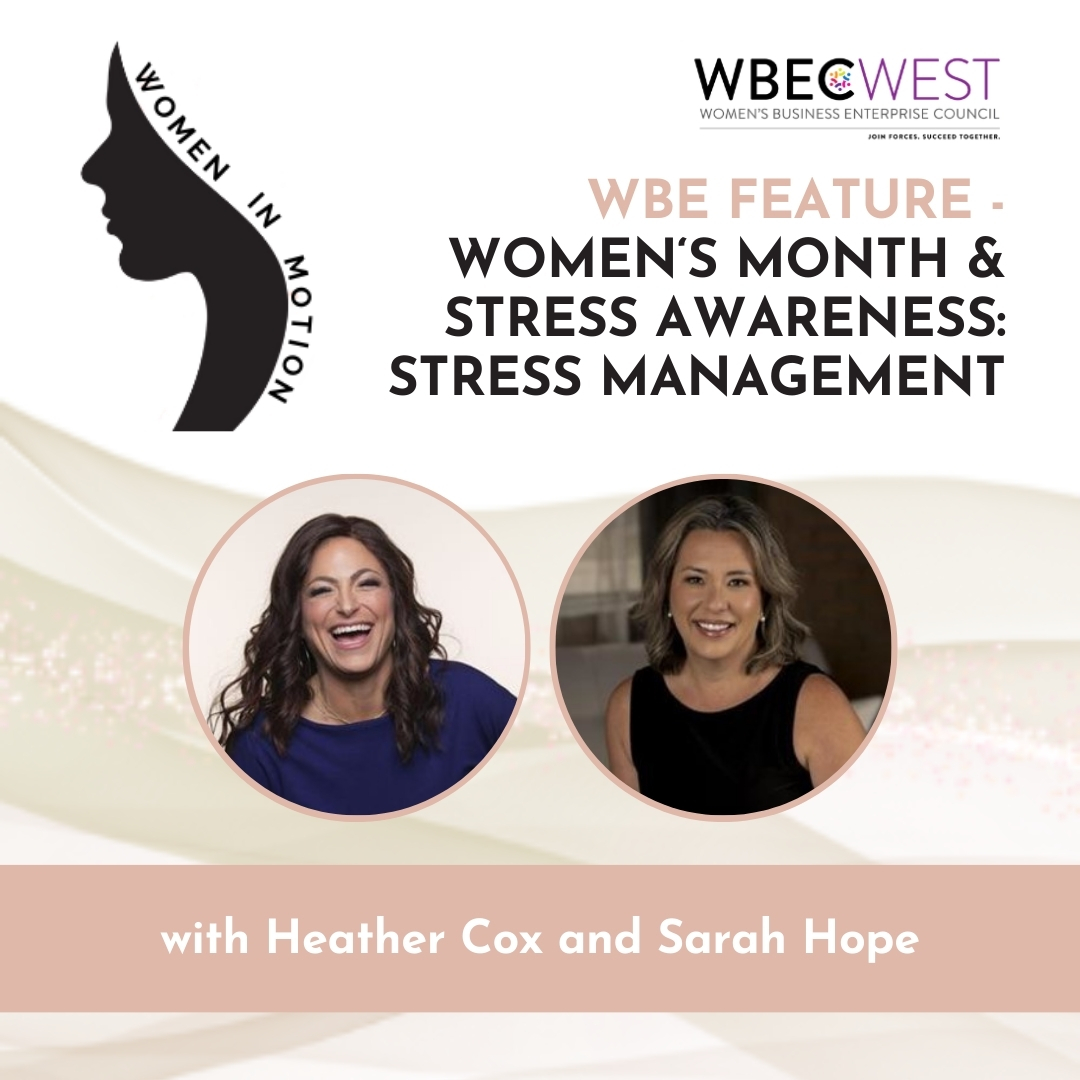
In this episode of Women in Motion, Lee Kantor and Dr. Pamela Williamson discuss stress awareness with guests Heather Cox and Sarah Hope, both CEOs managing their businesses and personal lives. Heather shares how she balances running Certify My Company and raising five children, emphasizing independence, scheduling, and exercise. Sarah talks about juggling three businesses through extensive lists, calendar management, and delegation. The conversation also touches on leveraging certifications for business growth, the value of organizational systems, and the significance of thorough hiring processes to protect company interests.
 Heather Cox is a champion and a cheerleader for underestimated women entrepreneurs!
As president of CMC, Heather works with both diverse businesses and corporations to increase visibility in supplier markets, and connects certified businesses with the corporations eager to do business with them.
Heather educates corporations about diversity practices and collaborates with managers of supplier diversity programs to help them reach their diversity goals, including a coveted seat at the Billion Dollar Roundtable.
She sits on the board of the national and regional forums for Women’s Business Enterprise Council – West, and has held past posts with the Women Presidents’ Educational Organization (WPEO-NY), WBENC National Council, the National Association of Women Business Owners (NAWBO) and the Advisory Board for Super Bowl XLVIII.
Away from her many professional pursuits, Heather enjoys not relaxing with her husband and five small children.
Follow Certify My Company on LinkedIn, Facebook and Twitter.
 Sarah Hope, a dynamic and visionary serial entrepreneur, leads several thriving ventures including Vertical Identity, 911OccMed, The Mission Wedding Chapel, and Easy Trim Weight Loss Clinic.
Her exceptional ability to envision future pathways and assemble formidable teams has been pivotal in scaling her businesses. With her husband Jason—a steadfast partner and the executor of her visions—by her side, Sarah navigates both her professional and personal life with a blend of determination and strategic foresight.
Recently, Sarah has embraced Alaska as her newfound haven, where she is embarking on an exciting journey to establish a general contracting business in 2024. Amidst evolving her enterprises, Sarah is keenly focused on steering her businesses towards the future by integrating Artificial Intelligence, ensuring they remain at the forefront of innovation and efficiency.
About Our Co-Host
 Dr. Pamela Williamson, President & CEO of WBEC-West, is an exemplary, dedicated individual, and has extensive experience as a senior leader for over twenty years.
She has served as the CEO of SABA 7 a consulting firm, overseen quality control at a Psychiatric urgent care facility of a National Behavioral Health Care Organization where she served as Vice President and Deputy Director,and has served as the CEO of WBEC-West, since 2008.
Her extensive experience in developing and implementing innovative alliances with key stakeholders has enabled the organizations to reach new levels of growth and stability. Her ability to lead and empower staff members creates a strong team environment which filters throughout the entire organization.
She takes an active role in facilitating connections between corporations and women business enterprises and sees a promising future for WBENC Certified women-owned businesses.
Dr. Williamson holds a Doctorate in Healthcare Administration, a Master’s degrees in Business Administration, and bachelor degrees in both Psychology and Sociology.
Connect with Dr. Williamson on LinkedIn.
Music Provided by M PATH MUSIC
This transcript is machine transcribed by Sonix
TRANSCRIPT
Transcript
Intro: [00:00:07] Broadcasting live from the Business RadioX Studios, it’s time for Women In Motion. Brought to you by WBEC-West. Join forces. Succeed together. Now here’s your host.
Lee Kantor: [00:00:27] Lee Kantor here with Dr. Pamela Williamson. Another episode of Women In Motion, brought to you by WBEC-West. Dr. Pamela, have you fully recovered from the big weekend in Colorado?
Dr. Pamela Williamson: [00:00:42] You know, Lee, I am not going to lie, I have not. I think I need another three or four days of rest. The conference was fantastic. Almost a little shy of 5,000 attendees, 300 corporate members, and just a gigantic trade show floor to get through, so it was a pretty exhausting experience.
Lee Kantor: [00:01:06] And it’s so important that the conference happens like that in person, having 5,000 people like that, the energy must have been off the charts.
Dr. Pamela Williamson: [00:01:18] I would say that it was beyond any chart that has ever been measured. It was absolutely crazy connections happening everywhere.
Lee Kantor: [00:01:29] Well, it’s great to be back with you here in the studio and so excited to be talking to our guests. The theme this month is Stress Awareness Month, and we have Sarah Hope and Heather Cox with us. Anything you’d like to share or talk to them about before we get going?
Dr. Pamela Williamson: [00:01:47] Yeah, I would love to. So, I have known both of these ladies for a very long time. I have watched them go through the trials and tribulation of growth and expansion and I have seen them both handle stress amazingly.
Dr. Pamela Williamson: [00:02:04] So, I’m going to start with you, Heather, and have you introduce yourself. Heather Cox is the CEO and President of Certify My Company. And I don’t want to say this wrong, Heather, I am counting on my fingers, but I think you have five kids while you are also trying to run a very successful business that is expanding. Can you tell me a little bit about your business?
Heather Cox: [00:02:28] So, Certify My Company, we work with diverse entrepreneurs and corporations to make sure that (A) they get matched up, but also to make sure that everybody in the supply chain that should be certified is certified with the right certifications for them and their business. Otherwise, you know, like really use it for what they want to use it for.
Heather Cox: [00:02:48] And, yes, I do have five children. I started the company right after I had baby number one, which is when you start a business, right, like right when you have a new baby? And so, there have been plenty of conferences that I was pregnant at.
Dr. Pamela Williamson: [00:03:02] So, I want to bring in Sarah Hope into this conversation. Sarah Hope, I’ve also known for a very long time. Sarah, I think when I first met you, you only had one company and your kids were at home. Now, if my recollection is correct, you have three companies. You you separate your time between here and Alaska, here being Arizona. But can you tell us a little bit about your company?
Sarah Hope: [00:03:31] Yes. It’s been ten years. Can you believe it? Next year is our ten year anniversary for Vertical Identity, which I’m the CEO and Founder and ultimate visionary. My biggest issue with Vertical Identity or any other business that I start is I love starting, and then I get absolutely bored whenever running it. So, I definitely need an implementer to help me just to run the companies and execute the vision for sure. That’s one of the biggest takeaways that I’ve taken from the last ten years, my love is just starting the company.
Sarah Hope: [00:04:12] So, I have Vertical Identity, which is a background screening and employment screening company. We do a lot of compliance also for trucking companies. We also recently started a easy trim weight loss clinic. So, after I lost 30 pounds, mind you, that I had gained because I was working 24/7 for the first seven years or so of my business journey, and gained some weight and then realized an amazing new technology that has basically come out, a medicine that’s really helping women all over the world at this point. It is a game changer for obesity in America.
Sarah Hope: [00:04:54] So, we switched over. We had drug testing facilities, four of them. We were also frontline in COVID and frontline with mass COVID vaccinations and testing. Got through that and then I just pivoted and did the weight loss clinics. And we also own a little wedding chapel. So, I have my hands in a bunch of different stuff. But, yes, my kids are gone, so now I can just work 24/7, right?
Dr. Pamela Williamson: [00:05:19] Thank you, Sarah. Hey, Heather, I do have a question for you, which I think is on all of our listeners mind, is, what is the secret of running a successful business and raising five kids? And none of your children are teenagers, right?
Heather Cox: [00:05:37] No. My big two are 15 and 13 so, yes, we have a lot of attitude also in the house now. I don’t think there’s a secret. I mean, people say to me all the time, “I only have two and I can’t do it.” I don’t know if it’s two or five, but I don’t think it matters. Kids are kids. They all need your attention in different ways, different times.
Heather Cox: [00:06:02] I will say that my kids are very independent from a very young age. They make their own lunches for school. My big two do their own laundry. Some people do allowances and they can earn money in the house, but there’s citizens of the household chores because we all live here, we all have to take responsibility. So, I think that independence is huge when it comes to having to run a business.
Heather Cox: [00:06:30] I started a second one and I have a JV as well, so I think it’s just a matter of keeping things going. Schedules are very important. During COVID actually, I was interviewed by GoDaddy. They asked me, you know, How are you doing it? I was like, schedule, schedule, schedule. Schedule is so important because everybody knows what’s expected of them at that point.
Heather Cox: [00:06:51] Same for me. I live by my calendar. If it’s not on the calendar, it’s probably not going to happen because this brain can only hold so much information and it’s already reached its limit. So, we do a lot of scheduling, and I think that’s really the only way. And then, as far as like the stress part goes, the gym is the reason that I don’t lose it quite often because I get that stress out at the gym.
Dr. Pamela Williamson: [00:07:13] Well, I also see you, because we both were joined together on Peloton, so I see your name sometimes and I check out your workout.
Heather Cox: [00:07:21] I am in the Peloton cults. I do love it. It’s easy. It’s in my room. I run upstairs if I need to. But I just think that was such a great shift. Of all the technology, I think, that’s happened over the years, that one, because you still get the camaraderie of being in a class but you can roll out of bed and jump right on the bike.
Dr. Pamela Williamson: [00:07:41] Yeah. Hey, Sarah, with your juggling your three businesses, how do you handle stress?
Sarah Hope: [00:07:51] Well, like Heather, the calendar is basically my Bible. So, if it is not on my calendar, it is out of sight, out of mind. A trick that I learned some time ago is that our internal mindset is really important. So, for a while, all I would do is continue to remind myself of the things that I had to do. So, in order to stop that, I keep extensive lists. So, I’m super old fashioned, if something comes up, either comes up in my email or someone asks me to do something, I give myself permission to not continuously think about it all the time.
Sarah Hope: [00:08:37] So, I have different lists for different things. I have a business list for each business, and then I have a personal list – and then I’m in a pretty big legal battle right now with an ex-employee that’s costing me a lot of stress – and I have a legal list. So that way, I don’t miss anything because I think, for me, there’s so much stuff going on all the time that I cannot miss anything as a result between my calendar and then keeping my list.
Sarah Hope: [00:09:11] But then the other thing too is – I hate this word, but it’s so important – compartmentalizing tasks, so I shut things off. If I’m going to do something, all of my notifications on my phone go off, I don’t look at my email. I focus on that one thing and get it done for an hour or two, which is really hard, but there’s no way that I can be as productive as I am without having major organization.
Heather Cox: [00:09:43] Do you delegate well to, Sarah? Are you a good delegater?
Sarah Hope: [00:09:45] Yes. At this point, absolutely, you have to delegate. We run on EOS, so it’s based on the book called Traction, so it’s the Entrepreneurial Organizational System. And we have our Level 10s at our meetings and how we’ve set up the company to where – you know, I’m famous for interrupting everybody’s day when I want to know a number or something – the promise of everybody is that on our Level 10, each company communicates to me where we’re at. So that way, I’m not having to blow up people’s day or hour or I want that because I know that I’m going to get all the numbers that I need on the Level 10. But, yeah, delegation is certainly key when you’re managing a lot of different projects.
Lee Kantor: [00:10:33] Now, were you always this way or was this something that you started having a bunch of kids or you started having a bunch of companies and you were like, “I better change some behaviors or else I’m going to have to manage this.”
Sarah Hope: [00:10:45] This was so much fun in the beginning, because my husband is in the business with me too. And we say we’ve been married now for ten years, but it’s more like 20 or 30 because we’re together all the time. But I remember when we first started the business, we were like, “There’s nothing going on, let’s go see a movie.” Those days are long gone. And we did. When we started the business, we had four teenagers at home and managing their schedules.
Sarah Hope: [00:11:15] What we did at that time, forget it. Our office, we had a tiny little office. We paid $350 a month. It was the best thing ever, like, ten years ago when it was simple. We would drive to that collection site. It was a drug testing collection site. We got a contract with Valley Metro at the time, and we started off that way. And then, we were only open, like, 9:00 to 3:00. Now, looking back, it was so cute, right? Like we were so cute. So, we would leave so we didn’t have to drive traffic. It was 30 miles there, 30 miles back. We would be like, “Okay. There’s no one coming, let’s go catch a movie.”
Sarah Hope: [00:11:50] Those days are long gone because you get so busy. You have to have so much grit to get through the last ten years. I mean, it’s literally flown and we’ve grown so much. I think the first year we did, like, 18,000 in revenue. The next year, we did, like, 50, we got up to 100. And then, we were like whew. whew. Well, two years ago – well, it’s been a few years now, we had a million. And then, last year we hit 4 million in revenue.
Sarah Hope: [00:12:20] I mean, the difference of the journey of what actually goes on and the multiple different levels of things that you have to handle, things that you don’t even realize that you had to learn because, as Allison Maslan says from Pinnacle, what got us here isn’t going to get us there. And so many things changed along the way and we have to adapt. As the leadership of the company, you don’t have a choice because everybody’s staring at you like, What’s next? So, yeah, stress management is really important.
Lee Kantor: [00:13:02] Now, Heather, let’s go back in time with you a little bit. What was the impetus of your business idea? Like what was the pain that you were going through that you were like, “Hey, I might be able to solve this.”
Heather Cox: [00:13:14] This wasn’t even my own pain. When I was pregnant with that first baby way back, you know, 16 years ago or 15 years ago – she’s 15 so nine months before that – I was asking, I knew I had to work. I didn’t know exactly what that looked like, but I knew I would have to work. And I’d always done sales and operations. And I was asking a lot of women about their experience as working moms, whether they were executives or part-time or worked for themselves, whatever it was, I’m asking a lot of questions.
Heather Cox: [00:13:43] And the business owners, I just really, like, gravitated toward. I thought they were amazing. I loved their energy, their passion. And when I started talking to the ones, especially the ones that were doing business-to-business sales, I really was like, “Wow. This is fascinating” and I just kept asking them more questions. And at some point a couple of them said to me, “Oh. There’s this certification that I need, they want me to get, but I just can’t get it done.” I’m like, “Hold on. You run a $2 million business, whatever, a $250,000 business, $2 million business, or $2 billion business, what do you mean you can’t get it done? I don’t understand.”
Heather Cox: [00:14:20] So, I went home and did a little research, and my husband’s an attorney, and he’s never worked in my business because I would like to stay married. Unlike Sarah, she’s much braver than I am. But I asked him, like, What’s an operating agreement or what’s a certificate of organization? He’s like, “Well, in some states -” I’m like, “Wait. Some states?” So, that’s when I realized that documents are called different names in different places.
Heather Cox: [00:14:41] So, if you’re a busy business owner and your time is – this is even before I was a busy business owner or a mom of five, I’m like, “Well, how do you know what it is?” And he said not everybody knows what they don’t know, and so they’ll be spending hours and hours trying to find their certificate of organization, only to find out their state doesn’t do that.
Heather Cox: [00:14:58] So, I said I could do it for you. I had no idea what I was getting myself into. I never really thought about running a business before. And then, this one told that one, that one told that one. And then, someone said Can you do minority? Can you do this one? Can you do that one? And then, about five years later, we had our first corporate contract and they started calling me a certification expert. And I’m like, “Yeah. I sure am.” I went with it.
Heather Cox: [00:15:23] So, that’s really how it started, was just somebody had the need and I have always said one of my biggest attributes is I’m a very resourceful person. And so, I just figured it out, and now I have five people who work on my team with me to figure it out for them.
Lee Kantor: [00:15:40] Now, how did you kind of figure out pricing? You know, you figured out, I’m sure the first time you were doing it as it was as if they were doing it. So, you had to learn like they would have learned. But you’re just doing it now so many times, you now probably no shortcuts and you know where all the landmines are, where the regular person doesn’t know that. So, how did you kind of build it into a business that you could delegate and you could teach other people how to do it?
Heather Cox: [00:16:11] Yeah. I mean, until probably eight, nine years ago, it was just me doing everything. And, yeah, first the pricing is just kind of were like, “Yeah. This sounds good and no one said no,” the first few times we did it. And then, now, obviously there’s metrics behind it and there’s information statistics. We know how long it takes us. We know what payroll is. We have a lot more actual data behind what we’re doing. But we just kind of, “So, this is the price.” And then, I realized everyone’s saying yes, it probably means it’s too low. Everyone’s saying yes. So, we raised it and then slowly just kind of changed a little bit here and there until we really found our sweet spot.
Lee Kantor: [00:16:55] And, Sarah, what about you, what was kind of your back story on beginning your adventure in business?
Sarah Hope: [00:17:03] So, I have a huge risk. I have a huge fear of failure, so it dominates in everything that I do in my life. So, as a result, I have chosen businesses all the way up through the weight loss business that are required by law. Why? Because I felt like if it’s required by law that you get a DOT drug test, or that you have to have compliance for your trucking company, or that you have to do a pre-employment background screening because you have a federal contract, then that’s safe for me because then it’s more about not trying to convince someone that they need something, but they’re coming to you because it’s required.
Sarah Hope: [00:17:55] And so, as a result for me, it was easier because then I can go shop the competition. So, understanding your market and what you have to offer. And then, at first it was more about price. But now that I understand more about the values that we have and what we bring to the table, especially, for example, with our background screening process, we have really, really great turnaround times.
Sarah Hope: [00:18:23] I was talking to a friend that they were getting hired at a retail store, I’m not going to say who it is. But it took them, like, a month. They’re like, “I couldn’t get the job. It took a month to get my background check back.” And I just started giggling because we do a lot of school districts in Arizona and their turnaround time, we got them down to, like, three days. And that’s really important for whenever you’re trying to hire a teacher with a teacher shortages and they’re competing. They’re competing with another school to get the teacher. So, it’s not even so much about price. It’s more of how can you get us what we need in the timeframe that we need.
Sarah Hope: [00:19:02] Cooperative contracts have been really huge with the state, especially because the State of Arizona, they do have a DBE program, but it’s not very friendly as far as I’m concerned. So, getting in front of cooperative contracts – and I don’t know if everybody’s familiar with what a cooperative contract is. So, just imagine Costco or Sam’s Club. If you belong to Costco or Sam’s Club, then you can buy there at a certain rate. With cooperative contracts, every state has them and it’s like cooperative association.
Sarah Hope: [00:19:47] So, one of ours for the State of Arizona – actually, they cover a lot more – it’s Mohave Cooperative. And under Mohave Cooperative is they have, for example, electricians and plumbers and background training companies and people who build the outside yard toys for the kids and office supplies. And they bid them out every, you know, three to five years.
Sarah Hope: [00:20:09] So, this contract that I finally won, this my third try and it was actually another WBE that helped me, The RFP Success.
Heather Cox: [00:20:24] Love her.
Sarah Hope: [00:20:25] Yes. So, I had her check out my RFP because our lives revolve around responding to RFPs. And sometimes we’re too close to the tree or too close to – what do they say? – you’re too much in the woods to see the trees or whatever, so anyway, I had her check it and helped me with it. And we won the contract and now people are just lining up. So, it’s not necessarily price all the time. It’s you have to look at the market, really understand what people need.
Sarah Hope: [00:20:53] And, Heather, one of my biggest things is I became an ADA certified. Oh, my gosh. Do you do that?
Heather Cox: [00:21:01] No.
Lee Kantor: [00:21:02] She means she will do it shortly, right?
Sarah Hope: [00:21:07] I cried. I remember the process was so painful. It’s a federal certification. I remember getting back something that I didn’t do something right. And I remember being in Thailand on vacation, because I thought it was all the way on the other end of it, and I was in tears because I was like, “Oh. They’re asking us for something else that I don’t even know.” And it took me, like, two years to get the certification. It was the worst thing.
Heather Cox: [00:21:35] We have a partner that does it, and I have my own thoughts on it, but that’s not what this conversation is about.
Sarah Hope: [00:21:40] What about stress?
Heather Cox: [00:21:41] I will say, though, that your point was right, Sarah, you talked about changing over the years and it becomes less about price and more about value. So, now that we are the leaders in what we do, there are other people who say they do what we do. There is nobody who does it to the extent that we do it to the level that we do it. So much so that we’ve had a good number of our corporate clients who are like, “You know what? We want to divide your contract into two because this other company is less expensive.” And every single time, they’ve come back and given us the entire contract, every time, because they just don’t have the process. They don’t have the expertise that we have the way we do it.
Heather Cox: [00:22:21] And we’ve had other people who’ve tried to compete with us, but they’re just not in the same level. I mean, there are some people who are more expensive than us, people who are less expensive than us, but I always tell entrepreneurs, especially, I say after polling a bunch of our customers, we found out we saved a lot of our clients approximately 22 hours of work. That’s about the time that we’ve saved them by outsourcing the process to us. So, I tell them, you take what your hour is worth to you, whether it’s your billable hour, whatever it is, multiply it by 22. If it’s more than our fee, you’re saving money. If it’s less than our fee, then you might want to try to do it yourself. It just depends on how valuable your time is.
Heather Cox: [00:23:03] I outsource everything I possibly can. I remember one time all five of my kids got lice at the same time. All five. I was like, “Where’s that lice lady?” I called up a lice lady. I was like, I’m not doing this. There’s no way I was going to spend all that time and get it wrong. Because you know what? If you don’t have a time or money to do something once, you don’t have the time or money to do it twice. So, I did not need to do that again. So, I outsource everything I can, taxes, marketing. People are like, “Do your website?” It’ll look like I did my website and it’s going to cost me more in the end.
Sarah Hope: [00:23:34] I wish I had my card because when I first started my business in 2015, I was a lice picker on the side because I got paid $35 an hour.
Heather Cox: [00:23:41] Oh, that’s so funny. A lice lady.
Sarah Hope: [00:23:42] Yeah. And I was just like, whatever I could do to get a little bit of income. I mean, I would have stood in the corner of the road and sold water like they do in Hialeah when it’s hot. I would have been like, “Here’s some lemons. Here’s some water.” Whatever it is that you need to get your business going because you’ve got to make it and you’re so great in time. But, yeah, I just saw my card recently from the lice doctors.
Heather Cox: [00:24:15] And I think we used lice happens or whatever.
Sarah Hope: [00:24:17] Yeah. It was awesome.
Heather Cox: [00:24:19] See, outsource and delegate, that’s how you make it happen.
Lee Kantor: [00:24:23] Now, you both mentioned the importance of systems, processes, these kinds of delegation, can we talk a little bit about AI. Are either one of you kind of leaning into AI or leveraging AI at this point in your business? And if you’re not, are you seeing that as part of the future that you’re going to have to at some point kind of lean into that?
Heather Cox: [00:24:45] I mean, we are in some respects, obviously, a lot more automation than we’ve ever had. Through our CRM, we’ve included a lot of automation and sort of take away some of the manual tasks that are just time consuming for the team. So, we’ve definitely done a lot of AI with that.
Lee Kantor: [00:25:02] Sarah?
Sarah Hope: [00:25:03] I am really deep into AI. So, not only am I investing in every single AI stock that I can get my hands on, Nvidia was at 400 recently, up to over 900. I bought some AMD. So, I’m researching everything. But more importantly is I’m embracing it to the extent. So, I have just replaced my outbound sales team with outbound AI callers. So, I have basically two fulltime AI caller – I don’t even know what to call them – agents that are making outbound calls to trucking companies.
Heather Cox: [00:25:50] They’re like robocalls, Sarah?
Sarah Hope: [00:25:51] Yeah. But they sound exactly like a human. You listen to the call and you listen to the conversation that our potential customers are having with them and they’re like, “Yeah. do you want to get transferred?” And then, we initiate a transfer to the live team. But they don’t know. They don’t know the difference at all.
Sarah Hope: [00:26:13] And the most beautiful thing about AI is that you can upload your knowledge base, so you can upload the questions and answers. Like for us, it would be DOT Part 40 of the regulations of what a trucking company has to do to be compliant with the drug and alcohol testing policies, and the randoms and all the things that they have to do. Again, back to my fear of failure, this is not something an optional. Nobody wants someone in an 18 wheeler getting into an accident being on drugs, so we manage those processes for trucking companies. And as a result, every new trucker, we reach out to them. We were having live agents do that.
Sarah Hope: [00:26:53] And the AI, the AI doesn’t have any feelings. The AI is going to ask every single question that you tell it to ask and it’s going to have a conversation. So, it is completely fascinating. Our sales, since we launched that, have gone up drastically. So, we were getting about five new signups a week, and we’re getting three a day now. So, yes, it’s been huge AI.
Sarah Hope: [00:27:24] Then, the other changes that we’re making is that I know where this is going, so while I’m not [inaudible] yet, but I’m on it. Like everyday, I get up in the morning and I watch YouTube about whatever new came out. Because my goal is to transition a lot of the administrative duties that we have internally to an AI process, to where, literally, the AI can record your screen, follow whatever admin tasks that you’re doing.
Sarah Hope: [00:28:05] For us, a lot of times it’s like, What collection site for drug test do you have in zip code 85086? Now, it’s a human that has to go in and enter the stuff. The AI, you can train it to go log in here, check here, answer here. Imagine not only being able to service our customers 24/7 to be able to automate that process, make them feel like – well, it’s not just make them feel. Honestly, a lot of this, let’s face it, our employees don’t always do what we ask them to do. Our team skips questions because of whatever it is that they think is happening. The AI doesn’t have that emotional response. They’re just going to ask the question, and it’s so polite. And you can pick male voice, female voice. I mean, I can’t even tell you how much fun we’re having with it. It is absolutely amazing.
Lee Kantor: [00:29:03] Did you have someone kind of Sherpa-ing you through this? Like, how did you kind of find the service you’re using for this? Or is this just you kind of just dove into a ChatGPT and just started doing it yourself?
Sarah Hope: [00:29:19] Oh, I’m a ChatGPT queen, too. Let me tell you, I want to write a book about ChatGPT because it’s handling my entire legal case. By the way, I didn’t even hire an attorney. It is my attorney. It’s writing all of my motions. It’s writing everything for me. It’s handling my entire legal case with this ex-employee issue that I have, so I’m using ChatGPT for that.
Sarah Hope: [00:29:41] But I ended up going to Traffic & Conversion. And at Traffic & Conversion, there is one called AIRAI, and they kind of kicked it off. But at Traffic & Conversion, there was a company called Acquisition AI and that’s who I use. So, I liked their setup fee, it was pretty reasonable. Don’t quote me, I want to say it was about $1,000. It’s about, I want to say, $800 a month for two fulltime AI. So, I gave them the script, everything that we wanted, and then they set it all up, and then we launched. And I want to say, it probably took about ten days to get it all set up and for them to set it up on there, and test it, and run it, and run with it.
Sarah Hope: [00:30:28] But I did a lot of research. Again, YouTube is my best friend because how I use YouTube in the morning is I’ll sit and have my coffee, and then I’m like, What’s new in AI? And AI is going to revolutionize the entire world. And I know that there’s a lot of people that are like, “Oh. I’m afraid. I’m afraid.” Don’t be afraid. Open AI is the main source of the large language model, but it is written in an open language. So, there’s a lot of large language models that are being built under that.
Sarah Hope: [00:31:04] So, it’s not like one big brain. It’s kind of like the gremlins. You have one and then there’s a ton of large language models under it. So, I don’t feel like they’re going to take over and the robots are going to kill us all and all of that stuff. It’s more of, how can we use a large language model that can really understand our business, that can really help our customers, that can facilitate the changes that we need, improve processes, better customer service. I love it. I’m completely obsessed.
Lee Kantor: [00:31:38] Well, Sarah, I mean, you could tell how passionate you are about this. Is there a fourth business kind of lurking there? An AI business?
Sarah Hope: [00:31:46] I wish I had the time. That’s something I’ve been playing with. I actually named it and everything. I named it Denali Sky. But we’ve recently started purchasing a lot of property up in Alaska, so I’m starting a general contracting business up there. So, it’s called Denali Sky Builders and Contractors. So, I’m kind of involved in remodeling and flipping some houses up there while we’re there for the summer and just learning Alaska. But part of that is also subcontracting and using the technologies that are coming with AI and being able to facilitate a lot of these smaller businesses and being able to get their marketing out.
Sarah Hope: [00:32:24] But AI, guys, this is bigger than the internet. I don’t think that people are realizing the effect that this is going to have in all of our lives daily and how amazing everything is going to be. I am so excited to be alive to be part of this.
Heather Cox: [00:32:45] I also love it. I just need to make sure my children know how to actually write an essay also and not just use ChatGPT, so there’s that part that I need them to use their brains. But we use it a lot also for those type of things, marketing documents, things like that. That’s my only downside to it, is that I still have little ones who I’m trying to raise to use their intelligence and intellect.
Sarah Hope: [00:33:06] I don’t know if you’re going to be able to stop it though. So, that’s the biggest thing, is that unless we start taking things away —
Heather Cox: [00:33:15] Well, so far they don’t have smartphones. I’m a very mean mommy.
Sarah Hope: [00:33:18] Oh, well that’s good. But there’s a lot going on with AI. The thing is that people like jobs, right? So, I do think that a lot of analytical jobs that are going to be – I’m using it as an attorney. I don’t have no else to go. I’m not suggesting anybody go replace your attorney with this. But if I need a case law or whatever, I’m researching it, or what the rules are for Maricopa County, or what I have to respond to this motion or whatever, it’s a matter of prompting ChatGPT and asking the questions so you don’t have to be sitting out there waiting or going through tons of Google questions and answers, because it’s a conversation that you have back and forth.
Sarah Hope: [00:34:00] And there’s software out there that is doing automatic training, like day traning for you because it’s learn. And it can look at the stocks analytically in a way that our brain can’t do it. So, I think that the human touch is still going to be really important, that the relationships are going to be really important, but how we use AI to help our processes and our business, it’s going to help us be more profitable, keep our costs down in this very expensive world we live in. And it’s amazing. I’m so excited.
Lee Kantor: [00:34:44] Now, Heather, do you mind sharing a little advice for folks out there that have maybe joined some associations, got some certifications, but they aren’t leveraging it and they’re not kind of maximizing their investment into that. Because there are so many people that go, “Oh. I have to be certified or I have to join this group,” and they check the box and they think they’re done. And then, they go back to work and they’re like, “Well, where’s the ROI on this? I don’t see it. It’s not working for me.” So, can you give some advice to kind of maximizing your certification or leveraging your association?
Heather Cox: [00:35:22] Absolutely. I mean, we tell people all the time, it’s a tool and not a magic wand. It is not if you certify it, they will come. You really have to leverage it and use it, as you said.
Heather Cox: [00:35:32] So much so we created a whole program called Diversity Masterminds, because after hearing so many of our clients say like, “I’m not renewing my certification. I didn’t get anything out of it.” And I would say, “Did you do this? Did you go here? Did you talk to these people?” “No. I didn’t know I could. I didn’t know I should.” And so, we really wanted them to understand how to leverage the certification to maximize growth. And so, we created a whole program both on demand and in person to do that.
Heather Cox: [00:35:59] But it’s really about being part of the organization. I would say that’s probably one of my biggest pieces of advice is that, you know, when I moved from New Jersey to Nevada, I immediately reached out to Dr. Pamela Williamson and just said, “Hey. Now I’m one of your WBEs out here in Nevada,” and then I was all in. I was like, I want to be part of however I can support the organization because I think that – what’s that expression? – rising tides bring all the boats to the top, whatever that is. You know that expression?
Lee Kantor: [00:36:31] Yes.
Heather Cox: [00:36:31] So, I really believe in that. I believe in elevating each other elevates ourselves as well. And so, just any way that I can meet more of the WBEs, be part of it, show up, and you have to really let go of any kind of entitlement that like, “Well, I’m certified. Where’s my contract?” Because that will get you nowhere. It’ll actually get you less than nowhere, whenever that’s possible.
Heather Cox: [00:36:55] But that’s what I think what it is, is kind of wherever you can, sharing your expertise with those around you, and they’ll share with you, obviously you’re not going to give things away for free, but just having conversations with your other WBEs and the network, everybody knows someone or something that you don’t. And so, by being part of this organization and the network, you have so much exposure to resources you never even knew you needed and never knew you had.
Heather Cox: [00:37:26] And so, that’s what I think at the WBENC conference last week during the WBEC-West RPO breakout, both Dr. Williamson and myself mentioned that elevating the other people that were there at the conference was a game changer for your conference. Not just their conference, but your conference. And I think that’s what people underestimate.
Heather Cox: [00:37:45] And, also, the business development part of the certification, people get. They understand that’s the logical part. What people often forget, what entrepreneurs often forget is the company development and the leadership development opportunities that are out there. [Inaudible] scholarship to go to the talk education business, the executive MBA program, or being a part of mentorship opportunities, these are all parts of the organization, parts of your certification that are underutilized and under recognized, in my opinion, by the entrepreneurs out there.
Heather Cox: [00:38:21] I think there’s so much that they can take advantage of, even WBEC-West has the – oh, my gosh. Dr. Williamson, I’m blanking on the name of it.
Dr. Pamela Williamson: [00:38:31] I’m going to take a guess, Platinum Supplier Program.
Heather Cox: [00:38:35] Platinum Supplier Program. Thank you. Platinum Supplier Program that really teaches you how to elevate the use of your certification. And so, I think people forget about those and they get so caught up in just filling out RFPs or just buy for me, buy for me, buy for me. They forget about the relationship part of it and, really, the other aspects of the certification.
Lee Kantor: [00:38:56] Now, who is the ideal client for you? What’s your ideal client profile?
Heather Cox: [00:39:01] Well, we really have two sets of clients. We have our corporate clients who utilize us to make sure that everybody in their supply chain understands the value of diversity certification, and what it is, and how to use it, so we do a lot of webinars and trainings. And, also, they’ll engage us to work with the suppliers in their supply chain that should be certified but are not, that they have relationships with.
Heather Cox: [00:39:21] And then, our the entrepreneurs that hire us are people who understand their time and worth of their time. But also companies who are already doing business-to-business sales or either have already started doing business with the Fortune 1000 or the government entities or are just about to, who maybe have been a tier 2 supplier previously and they maybe seen the opportunity cost. So, really anybody who understands the value of outsourcing and also the people who are business-to-business and are ready to take that next step.
Lee Kantor: [00:39:52] And if somebody wants to learn more, what’s the website?
Heather Cox: [00:39:55] It is certifymycompany.com.
Lee Kantor: [00:39:59] And, Sarah, who is your ideal client?
Sarah Hope: [00:40:04] My ideal client is a company that needs help with compliance and screening their employees, basically. Making sure that they have the right team. One thing is the interview, but another thing is their history. You know, California Act, California recently just passed a law – before it was seven years. If you had any felonies before seven years, they didn’t show up. Now it’s after four years, they’re completely expunged. And now California has decided to not verify dates of birth.
Sarah Hope: [00:40:57] So, let us just take Heather Cox. I don’t know if there’s more than one Heather Cox in California. But if there is, it makes it very difficult for us to run a background check and then to actually verify who you are. And if you have an employee that has felonies – one of my ex-employees, the one that I’m in a legal battle with right now, had eight felonies and we did not know. We ran a background check, but California kept the information because they were not allowed to release it.
Sarah Hope: [00:41:42] And so, understanding that, we put everything into our business. Our business is everything. It’s like our children. And then, you allow someone like this. People can change. It just so happens that this person didn’t. And I found out about it after the fact in the investigation. I’m horrified. I’m horrified for myself and my company. I’m horrified for possible new companies that come in. But this is happening everywhere.
Sarah Hope: [00:42:16] You know, California isn’t the only one, but the ramifications that come from not having the right hire, which you’re not completely, I guess, immune to, I mean we are a background screening company and it didn’t come up. The background check was completely clear, so we didn’t do anything wrong because we didn’t have any idea. But then, what goes through my mind is, “Oh, my gosh. What if a teacher comes over from California and we’re hiring a teacher for a school district, and we can’t release this information or we don’t see?” There’s so much. There’s so much stress that goes along with it.
Sarah Hope: [00:42:58] So, I just think it’s really important to screen and to do the reference checks for as painful as it is to talk to their personal references, to talk to their prior business references. It’s not just about the criminal background check. You guys, check. Check who you’re hiring. Protect your company. So, that’s my ideal hire, someone that really wants to protect what they’re doing and have a background check and compliance. And let us be human with you and help you navigate this journey.
Lee Kantor: [00:43:33] Now, what’s a website for Vertical Identity?
Sarah Hope: [00:43:36] Vertical Identity, so vertical, like horizontal and vertical, and identity, like in stolen identity, .com.
Lee Kantor: [00:43:42] Well, thank you so much for sharing your story. Dr. Pam, what an episode. A lot of smart people in this room.
Dr. Pamela Williamson: [00:43:50] There are a lot of smart people and a lot of great information. We discussed AI. We discussed health and stress. We discussed positive energy. I think we discussed everything possible under this topic. So, I really want to thank Sarah and Heather for joining us and sharing all the nuggets that they did. I appreciate you both.
Sarah Hope: [00:44:15] Yes. Thank you for having me. It was nice to see you both, all of you.
Heather Cox: [00:44:20] Thank you.
Lee Kantor: [00:44:21] All right. Well, that’s a wrap for this episode of Women In Motion. This is Lee Kantor for Dr. Pamela Williamson. We’ll see you all next time.
How PrivOps Can Revolutionize Data Integration and Governance
/
RSS Feed
In this episode of Sandy Springs Business Radio, Erik Boemanns is joined by Tyler Johnson from PrivOps, who shares his expertise on DevOps for data, emphasizing its role in optimizing data integration and governance. Tyler discusses the challenges of cybersecurity, privacy regulations, and the necessity of incorporating security from the beginning of the data integration process. He advocates for control through automation and the use of low code to enhance data engineering productivity. Tyler also addresses the concept of data fabric, urging a cautious approach to industry buzzwords and stressing the importance of understanding their specific definitions.

 With over two dozen US patents, Tyler Johnson is a proven innovator, change leader and senior technology executive. Tyler invented the concept of the data fabric over 8 years ago with the 1st data fabric patent.
Early in his career, Tyler invented an automated testing platform that transformed how Hewlett Packard tests their most advanced server designs, which is still in use after more than two decades. Later, Tyler managed strategic technology alliances with over $500 million in joint revenue and grew Rackspace’s $300 Million VMware based private cloud services line to over $600 Million while serving as product leader, lead architect and strategic alliance leader.
Currently, Tyler is the co-founder of PrivOps, a Georgia Tech ATDC Accelerate startup and inventor of the PrivOps Matrix, a highly scalable system for building data fabrics that safely share data via standardized, interchangeable building blocks.
Tyler holds a B.S. in Electrical Engineering from Florida Atlantic University and an MBA from Southern Methodist University and resides in Alpharetta, GA, with his wife and two sets of twins.
Connect with Tyler on LinkedIn.
This transcript is machine transcribed by Sonix
TRANSCRIPT
Intro: [00:00:07] Broadcasting live from the Business RadioX studios in Sandy Springs, Georgia. It’s time for Sandy Springs Business Radio. Now, here’s your host.
Lee Kantor: [00:00:24] This episode of Sandy Springs Business Radio is brought to you by Mirability, providing unique ID solutions, leveraging cloud, AI and more to solve business problems. Here’s your host, Erik Boemanns.
Erik Boemanns: [00:00:38] Good morning. Yeah, this is Erik Boemanns with Mirability. And today we’ve got a great guest. His name is Tyler Johnson and he’s with the company PrivOps. So, let’s get started Tyler, maybe introduce yourself.
Tyler Johnson: [00:00:47] Hi, Eric. Thanks for having me on. I’m. You know, I know we’ve known each other for a couple of years, and I’m really excited about what you’re doing with Mirability. All right. So as far as as me, I’m an entrepreneur, an older entrepreneur that spent two decades in industry and then decided to take the plunge. And I’ve got a little bit of a history of innovation. For example, 20 years ago, I invented all the test automation that Hewlett Packard uses to test their Unix supercomputers. So really bringing lean agile techniques into software and test and it. So that’s kind of my specialty. I’ve also worked with a lot of the big players in the world, Rackspace and Microsoft and Google and so forth and so on.
Erik Boemanns: [00:01:34] Right, right. No, that’s a great background. And so, you decided to take the plunge. PriVops is the plunge. I assume that you took. And so tell us a little bit about what PrivOps does.
Tyler Johnson: [00:01:44] The the simple answer, the three word answer is DevOps for data. And you may not know what DevOps is. Think of it as as an assembly line, right? 125 years ago, we were using assembly lines to geometrically increase the rate of building physical goods like cars. Ten years ago they came up with DevOps. So Jean Kim and John Willis and Patrick Du Bois and a bunch of leaders in that space, and what they did was they applied assembly line type techniques to building software, and that’s called DevOps. So what we’ve done is we’ve extended that concept into data, which is why we call it DevOps for data. So think about what we do is enabling companies to build assembly lines for building integrations. So this isn’t speeds and feeds for data. This is how quickly can we add connections, change connections, remove connections so that we can get the best use of our data. In this world where we’re hampered by cybersecurity constraints, where we’re hampered by data privacy regulations. And just from the the scale problem, like how much data from how many sources do we need to be able to feed into artificial intelligence and other tooling to make those tools as useful as possible?
Erik Boemanns: [00:03:06] Got it. Yeah. And so you talk about data and you talk about all the sources. I’m curious. So maybe if there’s some examples of what those data sources could be, what kind of data are we talking about.
Tyler Johnson: [00:03:15] Well, it’s it’s everything. Data is a lifeblood of an organization. So you’ve got you know, obviously you’ve got customer data. So the interactions that you’ve had with your customers, who they are, um. You’ve got employee data. So your your your employees, your contractors, you’ve got contract data. Uh, things like expiration of contracts and terms and, uh, the actual storage of the contracts themselves. Uh, you’ve got product data. There’s there’s just a whole and one, one type of data people don’t think about is identity data. So, so, uh, so one of the things that we do that’s unique in this space is, is we use identity along with, uh, the provenance of the data. So where it was created, where it came from, uh, when it was created, those kinds of things. And we, we combine all that together, uh, to enable access to data based on both data provenance and identity.
Erik Boemanns: [00:04:19] Got it. And so hit go to take a step back to you talked about cybersecurity. You talked about some of the privacy. Obviously those are two things that are only increasing every single week at this point. Right? Between breaches between new cybersecurity laws getting passed. What is that connection that you see? We’ve got all this data. We’ve got to protect it. You talked about DevOps for data. Where’s the convergence point? How does this all come together in a way?
Tyler Johnson: [00:04:45] Well, it’s. I’ll give you an analogy, like building your house. Right. You have a contractor and you really want your general contractor that’s building your house to think about all of the plumbing and all the electrical as they build the house, knowing that the inspector is going to come and make sure everything was built right. So you don’t want plumbing or electrical to be an afterthought when you’re building your house. And it’s the same thing with data integration you don’t want. Security or data privacy or data governance to be an afterthought, that you’ve got to slap a band aid solution on right now. And that’s that’s really how most people think about things like data governance. We think about it as by design. We build it in from the ground floor. So. So as you extend your capability to move data from point A to point B, you’re able to have that security built in by design, have that data privacy built in by design, and that takes friction out of the process and makes you move faster.
Erik Boemanns: [00:05:54] Yeah, absolutely. And I think that’s a key thing. If you’re working with data, you’re working with some of the regulations that by design is almost required just for the sake of those listening. What would you what’s your definition of data governance? What does that term mean to you? And DevOps?
Tyler Johnson: [00:06:08] Well, data governance traditionally refers to the controls you put in place, making sure that data gets, uh, tracked and audited so that you’re not passing customer data where it shouldn’t go, for example. So that’s really more of an audit, uh, like a after the fact, you know, so that and then we build, uh, controls in place. And those are and what’s different about what we’re doing is since we’re automating everything end to end, uh, we already have all of that tracking, and we can demonstrate that that data was not, uh, wrongfully accessed for something that wasn’t a legitimate use of that consumer’s data. So from my perspective, data governance is about. Control through automation, whereas the traditional term for definition of data governance is having controls in the place to minimize the chances of things going wrong.
Erik Boemanns: [00:07:07] Right. That makes sense. And I think the automation is a key point. I’m curious if you have an example or a story of where that automation helped a business process or helped help somebody manage their data better.
Tyler Johnson: [00:07:17] Yeah, absolutely. So we we have a customer that’s a mortgage bank. And they wanted to their regional and they wanted to expand into California. And California passed a data privacy law called the CcpA, the California Consumer Privacy Act. And then there was a follow on Cpra. Whatever its legal stuff, Eric, that’s that’s your bailiwick, not mine. But, uh, but yeah, so we wanted to be able to make sure that we could still allow our salespeople to have access to their customers data and to be able to use that data to create a better experience for their customers. But then we now have this new regulation to contend with. And so what we did was we replaced all of the company’s data integrations for reporting and analytics, uh, using our automated data fabric solution. And what that gave them was, uh, first of all, it it dramatically improved their ability to get data to where they could analyze it. But what it also did was because we had the data privacy built in by design, uh, we could open a branch in California without having to worry about going through a bunch of current state assessment of, uh, you know, our data governance maturity and rationalize that that to the regulations in California. We don’t have to do any of that. That all went away because we knew that if California comes back to us, to the bank and says, you know, hey, prove to me that if a California residents asked to or opts out of having their data processed or used for sales and marketing purposes, prove to me you do that. And that’s with the automation that becomes a no brainer and it takes friction out of the system.
Erik Boemanns: [00:09:19] Got it. And I think that makes sense. So I’ve done data development. I’ve done data integration work for decades now, going all the way back to having to handwrite these things in scripts. And data integration to me is moving data from system A right, which could be the sales system or the customer system, that people are storing all their customer data in into whatever system B, C, D, whatever other systems there are reporting analytics today. An AI system. Right. Um. And so in all those years, I had to do. Um, software development to move the data. Right? It was first it was scripts, then it was later using packaged software that that I could drag and drop shapes and then I could start to move the data. But it was still always software development. Where does DevOps fit into that model? How does it what does it replace that those traditional data developers are doing?
Tyler Johnson: [00:10:10] Well, I’ll go back to my first comments about bringing Lean and Agile into data. Uh, the idea is to look at this holistically, start with the process first, and then think about how the technology could be used to do that. And when I think about process, if you if, uh, those of you that are familiar with Lean and Six Sigma, uh, know that that lean is all about eliminating waste and processes, it’s all about efficiency. So if you can take a step of the process and building a data integration where you have, uh, a data engineer or someone, uh, with, with Eric’s skill set, for example, going in and, and building this stuff manually, uh, writing code that’s, that’s time intensive. Uh, Eric’s expensive. Uh, you know, it takes a lot to be able to do that. So one element of what we do in eliminating waste in the overall process is, is to incorporate low code into building data interfaces. And so what that does is that, uh, dramatically increases the productivity of your data engineering capability. Because you can you can take your most talented engineers and put them on value add work, uh, and then use the low code interface to take care of all the plumbing on the back end. Uh, and so you can do a task switching, uh, bringing in other folks that might not be as, as, as senior in terms of skills and talent.
Erik Boemanns: [00:11:44] Yeah. Well, that’s interesting because even though some of the products I was using were marketed as low code, right, because they had drag and drop kind of interfaces, they still weren’t. They were still you still had to code or you still had to understand what was happening. So it sounds like we’re shifting, that you still had to be a very senior data engineer to use these products, even though they were visual.
Tyler Johnson: [00:12:06] Yeah, and that’s why I said that it’s low code and not no code. Yeah. Uh, it’s all about the most critical metric with data integration is the rate at which you can build and maintain data pipelines. And that is, uh, that’s it’s unfortunate that that is not seen as a critical metric with a lot of organizations today. Uh, because there’s an implicit assumption underneath that, uh, that we’ve got to work with the processes that we have. And that’s why I’m going to always go back to starting with process and then thinking about your technology architecture, not the other way around.
Erik Boemanns: [00:12:45] Right. Well, I think the other thing as we’re thinking. Layer back in privacy layer back in security. None of those products I was talking about even worried about that. Right. That was not their problem. Right? They moved data. That’s all they think about. I, as the engineer, maybe thought about security, but even so, it’s another level up before that even gets talked about. If we’re thinking about that old way I think previous approaches that differently. Right. If we’re talking about privacy by design, security by design.
Tyler Johnson: [00:13:12] Yeah, exactly. So if, you know, for those of us that are familiar with DevOps, it’s it’s DevSecOps, right? It’s being able to shift left. And I don’t want to use too much of the jargon from the DevOps world. Sure. But but basically it’s building these things out from the get go. And, you know, I’ll go back to the the the house construction analogy. Um, you know, you want to put the, the wiring in before you lay the drywall and paint. Yep.
Erik Boemanns: [00:13:41] Exactly. Yeah. Are there other? Um, stories are examples where where you’ve seen that really work well, where taking that approach of. Privacy by design. Applying it to your data governance, the way we think about it today. Um, just some examples of where that has made life easier, better, faster.
Tyler Johnson: [00:14:03] Well, yeah. So I’ve come up with a list of 19 different, um, process requirements for employing. Uh, basically eliminating waste in the process of getting data safely from A to B and managing all of that mess. Right. And low code is one. We’ve already talked about that. Um, the other thing is, is another one is modularity. So being able to write code or have our UI, uh, do it where we’re able to automatically switch up data pipelines and move things around rapidly. And what that does is, is, is like, okay, well, yeah, that makes that makes your engineers more efficient, of course. But there’s another thing that it does that’s actually even more important from more of a business or a program perspective, which is that by having that type of approach, you have separated your different projects. It’s separated your work streams. You’ve you’ve minimized or eliminated dependencies. So I’ll give you an example. So on a Thursday afternoon we were talking with a VP of applications. So she had all the application developers and managers under underneath her. And we were the the meeting was to kick off a migration of CRM. So moving to a different customer relationship management platform. And one of the things that just came out was that, uh, she told me that, hey, you know, the next week or so is going to be hard for us because over the weekend, we’re going to release the updated version of the accounting application across the company. And so I mentioned to her that, um, well, that new version has a different database technology on the back end.
Tyler Johnson: [00:16:02] So Monday morning when the CEO comes into the office, his dashboards aren’t going to have the sales data from over the weekend. And that’s going to be a problem, because all of those integrations with the accounting data and the dashboards all will break because, you know, there’s you know, we just went from Oracle to MySQL on the back end and none of that’s going to work. Uh, so because we have these things like low code and, and, and modular architectures and data integration as code where we can move rapidly, we were able to complete that migration of those of, of pulling that accounting data, um, over the weekend. Uh, so, so the result is, is that the VP of applications doesn’t have to go to the CIO, or the CIO doesn’t have to go to the CEO and say, hey, by the way, that big accounting, uh, upgrade that we’ve been working for the last six months on, that we’re supposed to release this this weekend? Well, we can’t do it because there was a dependency we hadn’t accounted for. And, you know, you don’t usually think about data governance or data privacy by design as a way to save face with a CEO. But it absolutely does that because of that fact that it’s able to isolate those different work streams. So yeah, there was a dependency there we forgot about, but we’re so agile that we’re able to account for that and, and continue to make progress unabated.
Erik Boemanns: [00:17:38] So it sounds like basically there is a technology problem that the CEO never found out about because it never actually became a problem.
Tyler Johnson: [00:17:45] Yes. Now. You got to be careful with that. Because if you’re if you’re so good, nobody sees the problems. Exactly. Then then they’re like, well, why am I paying for this thing? So, you know, so that that becomes an issue as well. But if, if as a leader, your focus is on. The competitiveness of your organization as a whole, like you’re in it together, then that’s the approach you’re going to take every time.
Erik Boemanns: [00:18:16] Yeah. Yeah, exactly. We we want to not have problems, but at the same time, we want to make sure people know that we’re solving problems. Right. That could happen.
Tyler Johnson: [00:18:25] Yeah. And the good news is there are by by. Going down this pathway and thinking about efficiency and eliminating waste and and getting data from A to B. Um, you’re able to show a whole lot of business results that you wouldn’t have otherwise been able to show. So less, uh, less bad results. More good results. So that’s where you want to be?
Erik Boemanns: [00:18:53] Exactly. I think that’s great. The, um, a couple of questions just to get some quick, um, quick thoughts on buzzwords in the industry for folks that are that are seeing these buzzwords. Right. Um, Microsoft had a huge marketing push on the term fabric, right? They said, look at all of our fabric that we have. And I don’t know if you actually, I think you had to go three paragraphs down before you realized they were talking about data. Right? In those marketing messages. What is what’s your take on fabric data, fabric, Microsoft using that term?
Tyler Johnson: [00:19:23] Well, I don’t want to pick on Microsoft specifically. I think that’s more of a general vendor marketing. Um. Attributes of what the big vendors do. Over time, they will rebrand their technology stacks and having come from the big vendor space as as a sales person, as a engineer and as a product manager, I understand that that’s important from the vendor perspective because it gives you an opportunity to go back to your customers and say, we’ve we’ve got this new capabilities, and sometimes those new capabilities get lost in the messaging when, uh, when you’ve got the same branding for, for all of your technology. So if you look at Microsoft and their fabric branding, the fact is they, you know, they’ve got Synapse and Data Factory and Logic Apps and all these different things that they’ve been working on for all these years. So now the data fabric has become kind of a term. Um, they want to they, they want to message that they’re making progress out to the marketplace and changing that. Branding is is is a way. So like moving from Azure Active Directory to enter ID, right. Exactly. Uh, that kind of thing. And, and I can pick on any vendor out there and tell the tell the same story. Uh, what I would what I would say is that in this space, because it’s so rapidly evolving that you should avoid using jargon whenever possible. Period. Full stop. Right. Uh, here’s an exception, though, that as a customer, you want to look at, if somebody says data fabric, uh, there’s lots of different definitions.
Tyler Johnson: [00:21:07] Right. So, uh, Gartner calls it a, an emerging architecture and data management strategy. Um, you know, last week I presented at the Air Force’s chief data office, put, put a I data analytics forum together, and I presented there and we were talking about the Department of the Air Force data fabric. And so they they’ve got what they call the big six data platforms in the Air Force. And their data fabric was uh, basically they built some point to point integrations between six different big data warehouses. Uh, so their definition, you could say, well, it’s it’s a, um, you know, integration of multiple, uh, integration on top of integration. Right. Uh, and then, okay, I’ll give you another one. So NetApp. So I spent a couple of years working for NetApp. I love the company. I love the technology. Um, lots of great stories from from those days. Uh, they have what they call the NetApp data fabric and what NetApp definition of a data fabric is. Um, I think it’s it’s something along the lines of software defined hybrid cloud management for storage. So being able to use software defined methods to manage your storage, whether it’s on premise or in the cloud. And that’s great. That’s here’s that’s a third definition. Um, in fact, you can go look at what IBM Red hat is saying about data fabrics. Uh, you know, snowflake, uh, you know, Accenture, Deloitte. Everybody’s got their own little take on that. So here’s my take on what a data fabric is. Uh, it’s an assembly line for building data pipelines.
Erik Boemanns: [00:22:56] Got it. Okay.
Tyler Johnson: [00:22:57] And what that means is the focus is on process, right? Is is how how do we build and manage data pipelines at a scale that’s exponentially greater than where we are today? Because that’s what we’re going to need for I, by the way. Yes. And and you think about all those different definitions of data fabric. There’s there’s something you can glean from that. And the common thread through all of that is that each. Definers definition of data. Fabric says something about what they’re trying to accomplish, what their agenda is. Uh, you know, with Microsoft, it’s, you know, hey, we’re. Were the leaders. So data fabric. Right? Exactly. Gardner. Emerging where the thought leaders. We want you to come to us for thinking about what the future is going to be for the Air Force. It’s we want to show to Congress the American people that we’re making progress. Right. And then NetApp, of course, NetApp wants to sell storage. Right. So software. So for me, when I say data, fabric is the actual the actual fabric, not the methodology or architecture, because I’ve already built it, it’s already in place. But my agenda is that assembly line idea, which is we want to get to where we’re 1,000% faster than we are today, ten x. And the only way we’re going to do that is eliminating waste in process. And then the technology choices we make are ones that support those changes.
Erik Boemanns: [00:24:29] Makes complete sense as as we get to this point. I’m curious. What about DevOps? Do we did we miss what? What do you want to make sure we talk about today?
Tyler Johnson: [00:24:41] Well, there’s. This is an emerging space. Data fabric is, you know, beyond the. We talked at length about how overused and confusing the term is, but conceptually, the idea of having to transform the way we’ve moved data as a lifeblood of the organization from different points to maximize things like customer experience that’s new. So, you know, in the last year, I’ve met dozens of CIOs and VP’s and directors and individual contributors in this space. And and what I found is that the the enemy isn’t necessarily, um. For? For Prevost, by the way, the enemy isn’t the competition. The enemy is a status quo that we’ve already got. Uh, we’ve we’ve already got some stuff in here. And, um, you know, it’s it’s we’re kind of like where DevOps was with software development a decade ago. Uh, where, you know, ten years ago, your software teams, you know, they don’t want to hear about operations. They want to just write code and kick it over the fence and let the operations people deal with it. Right. So, and the idea that we’re going to create more automation and people are afraid of automation because they think that they’re going to lose their jobs, which isn’t true, by the way.
Tyler Johnson: [00:26:09] Right. Um, they’re afraid of that. Uh, so what you’ve got to think about is, well, what is the effects that transforming the way that you’re managing data in your environment? What are the cultural effects? How to how does that affect, you know, do you have the like the the right leaders in in in place, right. Yeah. Uh, do you have the right partners in place? And I think one of the things that kind of gets lost in the message with DevOps is that even though we’re a technology platform and, you know, I built this whole methodology around, you know, eliminating waste and, and data management. Uh, what’s really the most important thing is, is, is mapping out that strategy and that roadmap and thinking about, uh, what kind of waves that could potentially make in the organization. Yes. Because, you know, it takes a while to change. It takes much longer to change culture than it does to swap out a tool.
Erik Boemanns: [00:27:13] Great point. Yeah.
Tyler Johnson: [00:27:14] And and it’s unfortunate, but my prediction is that, um, that since since data is the lifeblood of any AI strategy, uh. You know, people are not paying attention to getting the data into AI as part of their strategy. If you look at the if you look at the some of the research today and look at, you know what? What are the most important elements of your AI strategy? Data governance is like at the forgotten, forgotten. But it’s like if if AI is like a light bulb. Um, you really should take care to make sure that your switch works and your wiring works and all your electrical works, because otherwise you’re not going to be able to turn the light on. Yes. So that’s really where I think that, uh, DevOps can help and, and Eric can help, uh, with, with thinking about how that affects things holistically. And then, of course, tying all of that at the end of the day to the bottom line. So revenue and profits.
Erik Boemanns: [00:28:23] Good, good idea to tie that back to the actual revenue, right?
Tyler Johnson: [00:28:27] Well, yeah, you have to do that constantly. Exactly. And that’s that’s one of the things people don’t understand about agile is that and a lot of times we’re agile fails is because they don’t do that. They take a big waterfall project and put it in chunks and say, okay, we’re agile. It’s like, no, at the end of two weeks, you need to be able to show your customers and your other stakeholders and improvement in their life and an improvement, and that improvement needs to happen every two weeks.
Erik Boemanns: [00:28:54] Exactly. Yeah. Strongly related to continuous improvement. Right.
Tyler Johnson: [00:28:58] So absolutely. Yeah, CI is a big part of lean.
Erik Boemanns: [00:29:01] Exactly. So how can people get in touch with you if they want to learn more about DevOps?
Tyler Johnson: [00:29:07] Uh, well, fortunately for us, we trademarked the name a while back. So if you just type DevOps, it takes you right to the website.
Erik Boemanns: [00:29:15] That’s easy.
Tyler Johnson: [00:29:16] That’s first entry for DevOps Priv ops. Uh, I’m also on LinkedIn. I post every now and then. Um, and, you know, I’m also a blogger, so I’ve got a lot of if you’re interested in more in depth information around this, I’ve got several blog posts I can point you to. So, you know, and then also, I’m always happy to have a conversation so free. Feel free to reach out to me directly. You can reach out through the website or through LinkedIn. My email is Tyler Johnson at devops.com. Uh, so yeah.
Erik Boemanns: [00:29:53] Okay. Great. Any parting thoughts?
Tyler Johnson: [00:29:56] Uh, no. Just that it’s great to see you, my friend.
Erik Boemanns: [00:30:00] Yeah. Good. Good talk. I enjoyed having you here today.
Tyler Johnson: [00:30:02] Yeah, it’s been fun.
Erik Boemanns: [00:30:03] Yeah. All right. Thank you, thank you.
About Your Host
 Erik Boemanns is a technology executive and lawyer. His background covers many aspects of technology, from infrastructure to software development.
He combines this with a “second career” as a lawyer into a world of cybersecurity, governance, risk, compliance, and privacy (GRC-P).
His time in a variety of companies, industries, and careers brings a unique perspective on leadership, helping, technology problem solving and implementing compliance.














