Don’t Forget the Nonprofits
Maia Samb with Puttogo Global, Fitness Trainer Sloan and Linda Vu with BDL Advisors

/
RSS Feed
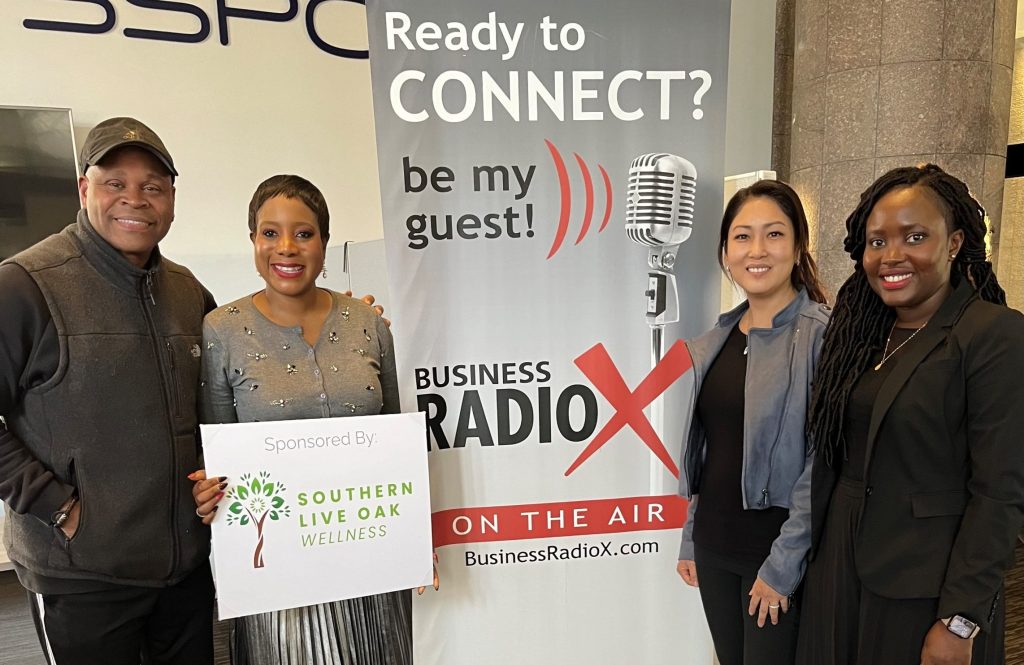
In this episode of the Chamber Spotlight, host Lola Okunola interviews Maia Samb, with Puttogo Global Group, Sloan, owner of Get Fit with Sloan, and Linda Vu, with BDL Advisors. They share their experiences and insights on their respective fields, emphasizing the importance of community involvement and collaboration.
 Maia Samb is the founder of the Puttogo Global Group, a real estate firm based in Dunwoody, GA under Keller Williams Atlanta Perimeter. Puttogo offers full-service, creative real estate solutions to clients in the metro-Atlanta area, while offering a global perspective when working with real estate clients from all over the world. The team services clients in English, French and Spanish.
Maia considers herself a multilingual global citizen having lived in 3 continents. Because of her background, Maia has a keen understanding of how to mitigate stress when it comes to relocation, and her clients greatly benefit from her unique global perspective in real estate.
Maia has 15 years’ experience in corporate marketing and communications, a Master’s in Strategic Public Relations and two undergraduate degrees. Before launching Puttogo Global Group in 2021, she was a top producing single agent in the North Metro Atlanta office, under Keller Williams Atlanta Perimeter.
Maia moved from France to Atlanta in 2008, where she has lived ever since with her husband and her two daughters. When she is not working, you will find Maia reading, traveling or enjoying exotic food somewhere around the globe.
Connect with Maia on LinkedIn and Facebook.
 Sloan’s journey from a promising football career to becoming a renowned personal fitness trainer is both inspiring and indicative of his resilience. His background in sports, coupled with his academic achievements, particularly a Bachelor of Science degree with a minor in applied nutrition from the University of Oklahoma, showcases his dedication to both physical fitness and a holistic approach to well-being.
Despite facing setbacks due to injuries that curtailed his professional football aspirations, Sloan’s story takes a positive turn through extensive rehabilitation and the support of his physical therapist. This experience likely fueled his passion for helping others on their fitness journeys.
In 1997, Sloan took a significant step by obtaining his fitness instruction certificate from the School of Fitness and Nutrition, signaling the beginning of his career as a personal fitness trainer. Over the years, he has established himself as one of Atlanta’s top trainers, earning a solid reputation for his expertise and commitment to his clients’ success.
Sloan’s professional achievements include being the exclusive trainer for the 11Alive Wellstar weight loss challenge from 2011 to 2013 and for the Northside Weight Smart challenge. His involvement as the trainer for all 12 contestants on the Personal Weight Loss Journey further highlights his effectiveness and dedication to making a positive impact on the lives of those he works with.
Sloan’s journey reflects not only his personal resilience, but also his ability to channel his passion into a fulfilling and successful career. His story serves as an inspiration for individuals seeking transformation in their fitness and well-being, demonstrating that setbacks can lead to new and rewarding paths.
 Linda Vu joined BDL Advisors in 2020 with over 20 years of experience in the financial industry, including more than a decade of Field Supervision, where she ensured that financial advisors stay compliant and act in their clients’ best interests.
Linda’s passion for trustworthy financial planning ultimately showed her that she has a calling to work with clients directly. Linda will be serving clients in the greater Atlanta area and managing our Dunwoody location. Linda is a CERTIFIED FINANCIAL PLANNER™.
Connect with Linda on LinkedIn.
This transcript is machine transcribed by Sonix
TRANSCRIPT
Intro: [00:00:07] Broadcasting live from the Business RadioX studios in Sandy Springs, Georgia. It’s time for Chamber Spotlight, brought to you by Southern Live Oak Wellness, providing quality mental health treatment to a population in dire need of being treated as equal. For more information, go to Southern Live Oak wellness.com. Now here’s your host.
Lola Okunola: [00:00:42] Welcome, everyone, to another enlightening episode of the Chamber Spotlight podcast, proudly sponsored by Southern Life Oak Wellness. I’m your host, Lola Okunola, and today we have an incredible line up of guests representing real estate, fitness and financial planning. A big thank you to Southern Live Oak Wellness for supporting our community. Now let’s dive into today’s conversation. Our first guest today is Maia Samb, founder of Puttogo Real Estate. It’s a pleasure to have you on the show today.
Maia Samb: [00:01:22] It’s a pleasure to be here, Lola.
Lola Okunola: [00:01:24] Thank you. So, Maia, real estate is well regarded in our community, particularly in the perimeter area and especially right now. There’s so much buzz going on about real estate, to.
Maia Samb: [00:01:37] Say the least.
Lola Okunola: [00:01:38] Tell us, tell us some exciting things that are happening in real estate.
Maia Samb: [00:01:42] Yes, I am excited to be here and talk about it because I am number one, very passionate about real estate. And obviously we’ve all seen the headlines. They’re everywhere. Oh, market is tough. Market is challenging. Interest rates are too high. Well I want everybody to calm down because at the same goes like real estate is really stable. It’s one of those things that as human beings, we cannot yet manufacture until we find a way to occupy Mars. It is not expendable. So it is one of the best ways for people to build generational wealth and just be comfortable. Finding a place to call home is really important. So the market is interesting to say the least, because of obviously recent events in the global economic market, interest rates higher than the last three years. And yet historically, they’re actually below what we will say the average interest rates for the last 50 years. Right now, they’re right at 7%. So we do have a seller’s market still despite what buyers may think. And it is creating some very interesting dynamics between buyers and sellers right now.
Lola Okunola: [00:03:00] Yeah, I know I’ve been reading a lot about it. I think the interest rates dropped slightly. And so everyone’s running to refinance again.
Maia Samb: [00:03:09] Well, I wouldn’t say that the people who bought over the last three years or refinanced over the last three years are going to refinance out of 2 or 3% rates. Those rates are too good to be true right now. If I saw anybody offering that much, I would run and buy every piece of real estate I could buy. However, the buyers that were on the fence that were waiting for the rates to calm down a little bit are a little more enthusiastic now because the cost of ownership has gone down as the rates have stabilized a little bit and went under 7%. So that’s a good news for anybody who has been in the on the fence, I agree.
Lola Okunola: [00:03:48] So let’s dive quickly into what Parago does. What is your specialty? I know you do real estate in a different kind of way.
Maia Samb: [00:03:56] Yes I do. So I would like to say that, um, our actual full name is Parago Global Group. Okay. We want to make sure that people know we are the local experts with a global reach. And what that means. Obviously, you can hear my accent. I am not from here. I tend to joke that I am from the south, south, south, which is Africa, born and raised in West Africa, uh, grew up in France, where I studied until undergrad, moved here in 2008. The rest is history. Um, and really, one of the biggest things in my life has been moving around all the time. And every time that you move, it is brutal. Uh, moving is brutal, even when you are a local resident of an area, let alone when you come from another country. So I try to help the expatriates that are, um, calling Atlanta now home to feel like home and people who are moving out of Atlanta to not feel overwhelmed. Now, that doesn’t say that I’m our team doesn’t serve local because we really do understand the stressors that are involved with purchasing and moving from a home to another one. So we try to make the whole the whole experience stress free and give a very concierge service to people. And we operate under Keller Williams. I will have to say, okay. Yes.
Lola Okunola: [00:05:14] That’s great. That sounds fantastic. All right. Now joining us is Sloan, fitness consultant and owner of Get Fit with Sloan. Welcome to the show, Sloan.
Sloan: [00:05:28] Hey, thank you for having me. It’s a it’s a pleasure being here with you guys.
Lola Okunola: [00:05:32] So Sloan plays a crucial role in our overall well-being, right? Physically. And. You know, nutritionally. Tell us about your background, about your business. Any anything special that you want our listeners to hear about? Well, my background started.
Sloan: [00:05:50] I started off as a kid that was basically hyperactive, so to speak, and then my mom decided to put me in sports to calm me down. And from there I started playing football, running track, and then I specialized in football. And then I went on from there to, uh, play at the University of Oklahoma. And then I went from there to out with the Arizona Cardinals at the time. Uh, they call them Phenix now, but it was Arizona in the beginning, in the, in the early 80s. Stayed out there for about four years and, uh, didn’t make a full roster. But I did have an experience in, in athletics at that high level. And from there, due to a lot of injuries, uh, the guy that I was working with doing my rehab, he introduced me into really basically talked me into doing personal training because I was in the corporate. I was going to go into corporate world once my football career died out, but I didn’t really like that as much. So once I got into that, I went back to school reeducated myself in nutrition. A lot of mental work too, because it works in three phases your body, soul, you know, in your mind because a lot of times most people that have issues with their physical body is more mental, because sometimes what you feel on the inside shows up on the outside. And so I had to learn those dynamics. And working especially with, um, older people, uh, women, men, different stresses in life causes you to react differently. Some people eat more emotionally, some people work out excessively then they cause injuries. So you have to give yourself a complete balance. And when you’re working with yourself. And so all I am to do, I’m just a person that makes a person accountable. So that’s pretty much what I do.
Lola Okunola: [00:07:33] Hi. It sounds like your training approach is definitely different. Um, so tell us, like where are you located? Who is your target market? Like who who do you who is your like clientele?
Sloan: [00:07:46] Everyone okay. Everyone is my clientele. But the ideal client is someone who really wants to make a change from a health point of view. More so than esthetically. Because esthetics will come if you do the right thing. I tell people every day, if you you can eat the same diet, but if you cut it in half, you would actually lose the weight accidentally. But then when you want to go into the real truly at stake, that’s when you have to make your diet a little bit more detailed, count your macros and those kind of things. That’s where my expertise come in. But just everyday staying walking, staying active because I always tell people all the time working out is half of it, but the whole gist of it is 60% of it. You got to get moving. Yeah. And so what I do with a lot of individuals, I base a lot of things on functional training and what I mean by functional training, bending over, reaching over those things. Most people always hurt themselves, especially women trying to grab their purse. Men try to lift too heavy. They don’t use their legs. So each each group has their own drawbacks. And so, believe it or not, now you have this new trend out with all the dietary drugs people are using. Yeah, those things do work.
Sloan: [00:09:01] And it has put a lot of guys in my business out of business. Wow. Because what happened is because a person said, I’m taking these particular drugs, I don’t need to work out. I don’t need a trainer. But what they fail to realize over time, your body eats itself and uses up all your muscle. And so if you’re not. So what I’ve done with clients, they come in and say, so what do you think about me taking this particular drug? I say, sure, let’s do it. And I said, now this is what you need to do. Outside of that, they say, what do you mean? I said, you normally you need to learn how to eat, right? Do the proper thing, increase your protein intake, because that’s when you start losing a lot of muscle. And they say, I never thought of that because I have a friend. She takes this stuff and she’s very thin, but she’s not firm. I said, so this is what you need to do. Bring her over. So she comes over. Then she starts getting the muscle and then she starts looking better. And basically a person that I like to work with, or someone who’s willing to be open about different trends and not all the new fads. Um, that’s the ideal client.
Lola Okunola: [00:10:09] Yeah. Wow. Well, thank you. Thank you for sharing that. Thanks a lot. Uh, all right, now we are moving on to our next guest, Linda Vu, uh, financial advisor with BDL advisors here locally in perimeter area in Dunwoody. Um, tell us, Linda, tell us about BDL advisors. What you do. It’s nice to have you.
Linda Vu: [00:10:37] Thank you. Thank you for having me. Well.
Linda Vu: [00:10:40] Bdo advisors were a group of financial advisors. We we basically do holistic financial planning and also money management. And our clients are mostly business owners, retirees and also professionals. And so, um, as far as independent financial planning or holistic financial planning, we actually help our clients, um, with their various life events. It’s not about selling a product and walking away, but it’s about guiding and helping, helping our clients through their life and also helping their beneficiaries. And then to clarify on the independent side, what, um, you know, we don’t sell proprietary products. So, um, our models are based upon the client’s risk tolerance, time horizon and financial goals. So it’s based upon what makes sense for that particular client.
Lola Okunola: [00:11:33] Okay, that sounds great. So tell me who I mean. Financial planning. It sounds like something everybody needs to be doing, but I’m not sure that you work with everyone. What is your niche market like? Who who is your target? Do you do you have a minimum amount that someone has to come in before you start working with them? You know, what’s the criteria for you?
Linda Vu: [00:11:56] You know, our niche are really you know, most of our clients are business owners, okay? They’re mostly business owners, retirees and, um, professionals. And we don’t really have, you know, a specific amount. But we’re looking for someone who really wants leadership, who wants someone to help them with creating a strategy, and who’s going to take it serious and, and wants us to manage their assets.
Lola Okunola: [00:12:22] Okay. Wow. Well, that that sounds great. What are the, um, are there any, like, special. Programs or special areas that you? Is it real estate? Is it like particular investments? You know, education, college funds, any you know, are all of these part of what you help people with?
Linda Vu: [00:12:47] Yes. So we help our clients through various life events. And so what that basically means is, you know, a client might come to me and say, Linda, I’m about to get married. Okay. You know, help me make the good decisions on this. Or a client might be, you know, selling a business or purchasing a business or about to retire. So those are various life events or welcoming a newborn child, right. So we don’t have a specific, specific promotion or anything. But when we do holistic financial planning, we do put into consideration the client’s specific needs. And we help and we guide them that way.
Lola Okunola: [00:13:22] Okay. That’s great. Thank you for sharing that. Now, while, um, all of you are in different industries, one thing is common amongst all of you life changing events and life in general. You know, that’s what we all have in common, Sloan. Your life, your health. Maya, are you moving? Are you staying? What are you doing? You’re involved. And, Linda, like you said, divorce, marriage, college. So that’s great to see that even though we’re in a in you’re in different industries. You have this one thing in common. And since this is a chamber podcast and we’re all about community, can does anyone have anything to share about any special things that you’re doing in this community?
Maia Samb: [00:14:07] Um. I’ll start. Well, I, um, I’m in the class of leadership perimeter 2024, which has been, uh, yes, it is a big deal. It’s a big deal. It’s a big deal because I did want to entrench myself more in the community. Um, my background has been in marketing. I did 15 years of marketing before I switched to real estate, and I overmarketed the fact that our team works with expatriates to the point that people don’t realize how much of a local service providers we are. So I decided that I was going to be embedded more in the community, and I needed to do my part, quite frankly, in giving back, um, and understanding how government works at the local level, um, how different cities in the perimeter can collaborate, how I can make this area vibrant and, um, welcoming. Um, uh, one of the things like, you know, coming from Africa than Europe to here that was really shocking for me was like, how self-segregated it can be, especially in the South, it is self-segregated not even something maybe institutionalized too, but also self. Um, it’s it’s self inflicted a lot and I do not like that at all. And I think I’m going to play my part. I know I’m going to play my part in making that a more level playing field.
Maia Samb: [00:15:29] I do service quite a high, you know, high level of mass affluent people. And every time that, um, I close those transactions, it’s exciting. Yes, but it doesn’t get me going. Right. It is a much more exciting, uh, thing to do when I can help somebody who thought that they will never achieve it. And there is a banker in this, uh, Chamber of Commerce, I think a member with Ameris Bank. They offer some programs that people don’t know about that actually equalize the level, the level, the playing field for those people offer grants and people don’t know about it. And I’m really passionate about that. Every time I meet somebody like Linda who can, you know, I know as a financial advisor, you probably have to do some pro bono work also to maintain your certification. Or I see somebody who’s like, you know, health care bills are preventing them from from being, um, you know, achieving home ownership, people like that. If I can lean on the resources you have to help them get home ownership and build wealth and achieve the American dream, that’s all I’m about, really, quite frankly. So I think having this platform where we can talk, exchange expertise, see how we can help each other, help the community is one of the best thing we can do.
Lola Okunola: [00:16:51] I agree. And that actually brings me to my next topic or next question is, you know, even if we can’t talk about how we can all collaborate here at this table, I want us to be thinking about that. Right? Right. How can I who can I connect to? Linda, who needs a personal trainer, who needs real estate, who needs financial planning? You know, we should always be thinking about that because we can’t do everything, but we all have access to people, right? Right, right. And that’s what business is about. That’s what community is about. That’s what the chamber is about. So unless anyone else has anything to share about what they’re doing in the community, do you? Sloan?
Sloan: [00:17:35] Yes, I do. What I do, I work with a group of kids over at Holy Innocents in the area. Fantastic. How it all started. Started about ten years ago, where I had a couple of kids that were getting bullied. Oh, my. Actually, a young man that was over at the Mount Vernon private school. Over here, down the street from here. Okay. And, uh, what happened? Because I boxed when I was a kid, when I was about 12 years old. So I boxed up into college. And so I started teaching boxing classes. And the number one rule I had with the young men, I would talk girls to actually, believe it or not, I had some young ladies come in and start learning how to box. I said, it’s not for you to go in, uh, rough someone up, right? It’s to let you know that he who controls the power controls how it should be implemented. That’s always been my stance. Just because you know how to box, you can throw a nice punch, does not mean that you have to go and start an incident. So you have to keep. It’s basically was there to teach a lot of discipline. And so now I find more and more little kids coming through doing that, and then the influence is even greater. I shared with the parent, I said, do you realize it does not matter how much money you give me to do this? You give me me your most precious thing that is your child, to spend that time with me. So I always have to honor that.
Lola Okunola: [00:18:57] Yeah, that’s a great, great gift. I mean, for self-defense, for discipline, like you said. And even, I mean confidence, confidence, confidence, right? Yeah. Yeah. Self-confidence.
Sloan: [00:19:09] Because you see a lot of that now, you know, they call it cyberbullying and yeah, physical bullying and kids getting picked on because of their, their, their their race, their, their religion. And, and I get a lot of these kids that come to see me. And so I said let that go. I use other words, but I won’t do that on this podcast.
Lola Okunola: [00:19:28] But that’s good to know, because I’m sure a lot of our listeners have children or relatives that, you know, need to hear that, right? I mean, a lot of people are going through a lot of people go through a lot of stuff, and they don’t have anyone.
Sloan: [00:19:41] They don’t have an outlet. So I’m basically the the go between. And like I tell the parent, I say. Let me talk to him. You know, like they say, people will always lie to their therapist, but they tell their lawyers the truth.
Lola Okunola: [00:19:59] Or people they don’t know. Right. Like, have you ever been on the plane and someone tells you everything about their lives, and then the plane lands and they’re like, okay, goodbye. You’re like, wow.
Speaker6: [00:20:08] Uh, yeah. But anyway, so another subject. Yeah.
Lola Okunola: [00:20:13] But I mean, it’s true. People feel more comfortable talking to their therapist or someone that they just don’t know about things. So it’s good that you’re available.
Speaker6: [00:20:21] To do that. I do my.
Sloan: [00:20:22] Best. Yeah.
Lola Okunola: [00:20:23] That’s great. Linda, do you have any anything special, anything that you guys are doing at BDL advisors?
Linda Vu: [00:20:31] I know for us, we do collaborate with real estate agents, with attorneys and CPAs, and we work with them, work very closely with them. We’re a direct resource for them. And also, not only that, but we’re part of the team to help our clients. So being part of the Sandy Springs perimeter chamber has been nice, because I’ve been able to meet a lot of attorneys and CPAs and bankers and real estate agents. So I do appreciate being part of the being part of Sandy Springs Chamber.
Lola Okunola: [00:20:58] We love having you. I forgot to mention that Linda Vu is actually an ambassador of the chamber. Thank you. We really appreciate you being our ambassador. Thank you, thank you, thank you. Well, that concludes another episode of the Chamber Spotlight Podcast, sponsored by Southern Live Oak Wellness. A big thank you to our guest, Maya, Sam Sloan and Linda Vu. Thank you for joining us today. And to our listeners, thank you for tuning in. Don’t forget to subscribe for more engaging conversations and the and with the community leaders. Until next time, stay well.
Speaker7: [00:21:39] Securities and investment advisory services offered through Mosaic Wealth, Inc. member Finra, SIPC. Mosaic wealth, Inc. is a separately owned in other entities and or marketing names. Products or services referenced here are independent of Mosaic Wealth, Inc.. Bdl advisors is not affiliated with Mosaic Wealth, Inc. or registered as a broker dealer or investment advisor. Insurance services offered through BDL advisors.
Mark Griffith with Higher Logic
/
RSS Feed
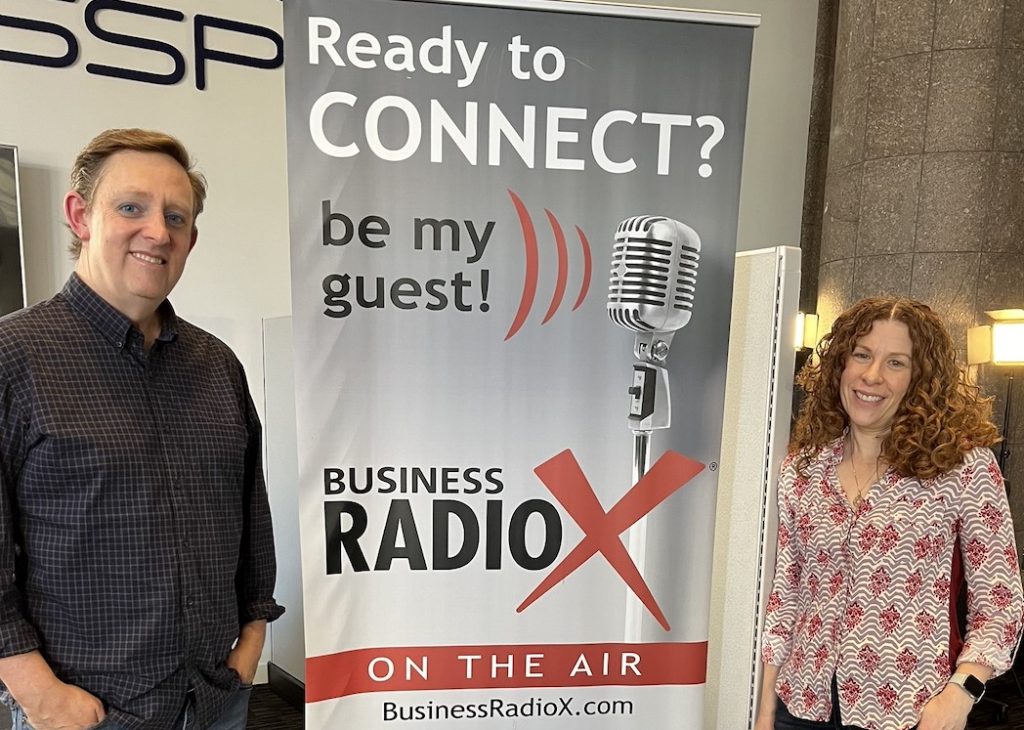
In this episode of Sandy Springs Business Radio, Lee Kantor and Rachel Simon talk with Mark Griffith, the Vice President of Marketing at Higher Logic. They discuss how Higher Logic, a B2B SaaS company, helps associations engage their members through daily value delivery, community building, and effective onboarding.
The use of AI and automation in association management is also discussed, with Higher Logic investing in AI tools for content generation and marketing communication. The conversation also touches on the importance of first impressions, member retention, and the challenges of organizing in-person events.
 Mark Griffith is the Vice President of Marketing at Higher Logic. A veteran marketing leader, Mark works with Higher Logic leadership to oversee the marketing team’s activity as it relates to driving lead and pipeline generation for sales.
His expertise also lends itself to serve as a mentor and coach for other marketers that may be in the beginning or middles stages of their careers.
Prior to joining Higher Logic in 2021, Mark led product teams and initiatives mostly in the online B2C space for organizations such as CNN, Turner Sports, and Equifax.
Outside of work, Mark is involved with the Children’s Tumor Foundation, an organization dedicated to driving research, expanding knowledge, and advancing care for those living with the genetic neurological disorder Neurofibromatosis.
Mark earned his undergraduate degree from Bucknell University and his MBA from Duke University. He is married to his wife Kathryn who teaches at Spalding Drive Elementary. They are parents to two children – Reece who is a freshman at North Springs Charter Higher School and Shea who is a senior at Mount Vernon School.
Connect with Mark on LinkedIn.
This transcript is machine transcribed by Sonix
TRANSCRIPT
Intro: [00:00:07] Broadcasting live from the Business RadioX studios in Sandy Springs, Georgia. It’s time for Sandy Springs Business Radio. Now, here’s your host.
Lee Kantor: [00:00:24] Lee Kantor here with Rachel Simon, another episode of Sandy Springs Business Radio, and this is going to be a good one. But before we get started, it’s important to recognize our sponsor. Connect the dots. Connect the dots. Digital is the place to go when you’re ready to leverage LinkedIn to meet your business goals, go to Connect the Dots Digital to learn more. Rachel, this is going to be a great show. Who do we have today?
Rachel Simon: [00:00:49] Hey Lee, so good to be back here. I’m really excited to welcome Mark Griffith from Higher Logic. He is the vice President of marketing and we’re going to have an awesome conversation. Hi Mark, how are you today?
Mark Griffith: [00:01:02] Hey Rachel, how are you doing?
Rachel Simon: [00:01:04] Great. Can’t believe the holidays are upon us. You know, Mark, thank you so much for taking the time to join us today. Why don’t you tell us a little bit about you and higher logic?
Mark Griffith: [00:01:14] Sure. So I am the vice president of marketing at Higher Logic. As you mentioned, higher logic is a really unique B2B SaaS company is that we are really purpose driven in a lot of what we do to help, specifically associations. That’s how the company was founded 17 years ago. And the idea is about how can we help associations engage their members.
Rachel Simon: [00:01:39] So that’s so interesting because as I’ve learned over the last couple of years, there’s an association for everything, including an association of associations.
Mark Griffith: [00:01:49] Absolutely. And in fact, the association of associations here in the US, the American Society of Association Executives is probably our biggest partner.
Rachel Simon: [00:01:57] Oh, so interesting. So talk a little bit about sort of why associations need to kind of really have this opportunity to connect with their members and how your how your company helps make that happen.
Mark Griffith: [00:02:11] Sure. So like a lot of companies out there, associations are not unique in that they have to deliver value on a day to day basis. A lot of their revenue is based on dues, and those dues are due annually or monthly. If you’re not delivering value, there’s an easy decision for somebody to make to say, I can cut this expense, I can cut this subscription, I don’t need it anymore. I’m not getting my value. So the idea between what higher logic is, is we really try to help associations derive value on a daily basis, whether that be through, how can somebody in an association member advance their career? How can we provide resources for those members to what are events that are coming up that a member can learn from really understanding their member benefits? That’s why it’s so important.
Rachel Simon: [00:02:58] Yeah, I spent some time on the Higher Logic website, and one of the things that jumped out at me was community. So it seems like building community is a real value proposition for the company. You know, what is the how is that unique and different when it comes to associations like the need to build community or the value of building that community?
Mark Griffith: [00:03:20] Sure. And yeah, there’s a lot of great resources on that higher logic. Com website about, you know, what is the path to renewal and how do you engage members and drive members through, almost like an engagement ladder from when they first come in to being a consumer of information, to then start giving back and be a provider of information. A really great example of that is when you come in, do you have a good onboarding process to really understand what your member benefits are? How do you learn about all the great content that’s within that community? Um, how do I learn about people that may be able to help me in career advancement? Become a mentor? How do I learn about volunteer opportunities and then being able to give back, as you, you know, go up that engagement ladder to be possibly becoming a mentor yourself or even contributing into that dialog and that conversation that occurs within the community.
Rachel Simon: [00:04:17] So for associations that are utilizing the platform, like what are some of the tools internally that they get to leverage, are there like. Is it like a slack channel or like how how do how do members communicate with each other to build those connections?
Mark Griffith: [00:04:34] So probably the easiest way is through discussion posts. Um, you see a conversation that’s that’s going on within the community. How can I, you know, engage within that conversation. But, you know, our our platform also has libraries where documents can be, you know, you know, posted and learned about, you know, topics that are really important within that association. Uh, gamification and badges. The more you participate, the more you, you know, the more badges that you can earn. Uh, maybe your, um, your level of contribution increases as you do those things. Um, and there’s other things as well. I mean, we have job boards where, you know, jobs can be posted within that industry that somebody within, you know, that association or that industry may be interested in. Um, so there’s all sorts of ways to, to do that.
Rachel Simon: [00:05:21] So interesting.
Lee Kantor: [00:05:22] Now, um, can you share some maybe advice for the member, like you’re a member of an association? A lot of people, especially in business, they think I got to join all these associations, but some of them think I just pay and then, oh, I’m a member, I’ll get business from that or that’s going to benefit me. How how would you, um, um, advise a member to get the most value out of their association?
Mark Griffith: [00:05:47] Well, I think it really starts with the association having a really solid onboarding process when a new member joins, um, somebody that can help walk through what those member benefits are and understanding how the different, um, engagement opportunities within that community platform exist. Um, so if it starts, if that’s done really well, um, at that point, then the member can start finding what are the areas of this community that are really relevant and important for them, right?
Lee Kantor: [00:06:15] Because you keep talking about the word engagement. And engagement means different things to different people. Some people, some members think I joined, so I’m engaged. Uh, the, the community leader or the association might think engage means they’re volunteering. They’re taking leadership roles, they’re mentoring, they’re being an ambassador for the association. How do you kind of help that process kind of go smoothly so that the member feels like, okay, this is a place I want to be part of, and this is a place that I want to invest my time and energy into helping everybody in the group.
Mark Griffith: [00:06:53] So part of that is measuring and monitoring what that level of engagement is. So somebody that’s relatively new to the organization or new to the association probably can’t expect them to do all those things that you just mentioned. But are they participating in conversations or they’re adding comments? Are they coming back to the community on a regular basis?
Lee Kantor: [00:07:13] And that’s where technology can help, right. Absolutely. And then what are some of the ways like are you leveraging AI? Like how are you kind of helping kind of, um, the member slowly get more and more involved.
Mark Griffith: [00:07:26] So AI is a really, really great topic right now. It’s obviously top of mind for probably every business that’s out there. Um, we’re no different. So our CEO, Rob Wenger has been doing community town halls. He’s been doing, um, presentations at various events that we have all focused on the concept of AI and automation and why it’s so relevant for associations to be. Open to these.
Lee Kantor: [00:07:52] Tools, right? Leaning into them a little, experimenting at the minimum. And, you.
Mark Griffith: [00:07:56] Know, I would imagine that if you saw our product roadmap today, you’d be like, yeah, these folks are really invested 100% on bringing these AI tools to market for the association market.
Rachel Simon: [00:08:06] Specifically, what are some of the, uh, the tools that are looking to kind of utilize in that space? Because, you know, I now we say it and I think we forget that it’s like a spectrum, right? We’re we’re kind of gotten really deep into the generative content AI, but there’s tons of tools that are technically AI that are right.
Lee Kantor: [00:08:26] You’re you’re Alexa, is AI correct? I mean, when you ask them what the weather is and Alexa responds, is artificial intelligence. So.
Mark Griffith: [00:08:35] A lot to come on that I would say the the lowest hanging fruit really is about content generation. Like how can you, you know, put a piece of content out there, seed it in multiple ways, whether it’s social, whether it’s email and really help out your content creators and creating this kind of engagement and these type of marketing tools quickly. Um, there’s more to come on this. We do have a whole suite of marketing communication tools. And how can you incorporate AI into that is probably some low hanging fruit. Um, we had a really interesting exercise company wide, uh, two months ago where we said small groups of people come together, spend X amount of hours on AI in the month of October, and then come together and give a three minute presentation on what you found. And we did it on Halloween, three hours. And it was from marketing to sales to finance to engineers. Everyone coming up with, hey, this is what I did and this is how I used it, and this is what I learned from it. Um, so that got at least everybody in the company saying, I’m going to invest my time and resources into understanding what this technology is and how I can apply it.
Lee Kantor: [00:09:38] So what were some of the the surprising takeaways?
Mark Griffith: [00:09:41] So one interesting one, at least on the marketing side, was. You can’t use necessarily AI for all things, for all purposes. There’s still a need for human interaction and empathy in astro writing and creating content. It definitely has its value. If you’re doing, you know, large scale items and you need thought starters or, hey, I need to get some way to get this idea started, but you just can’t replace verbatim a content writer that knows that business, that knows that customer and that can empathize.
Rachel Simon: [00:10:15] I would concur with that. As I see on LinkedIn, too often, people using AI just to write comments, you can spot them like from a mile away, right?
Lee Kantor: [00:10:26] It’s a blunt instrument. It’s.
Rachel Simon: [00:10:28] Yes, exactly. I actually really like to use it to generate subjects for my email newsletter, so I’ll ask it to give me ten ideas, like ten email subject lines, and then they’re usually boring. And then I say, you know, right.
Lee Kantor: [00:10:44] It’s a first draft or them fun.
Rachel Simon: [00:10:45] Starter or the last one. I was like, give it a holiday theme. And they come. It comes up with some pretty good stuff.
Mark Griffith: [00:10:52] Yeah I agree, um, we have a massive customer conference every year and we were all like heads down writing topic discussions and session descriptions. And I found it really helpful for that. Again, not verbatim, but okay. Yeah, this this makes sense. And I can change this to make it more association specific. But it really helped. It saved a ton of time.
Rachel Simon: [00:11:13] Yeah. It’s interesting how you the skill is in the prompting, um, and understanding what its function and purpose is as opposed to just using it as the end product. Yeah.
Mark Griffith: [00:11:25] It’s like that old adage, right? Like the more you put into it, the better you’re going to get out of it. Exactly.
Lee Kantor: [00:11:29] Well, it’s getting smarter based on all the stuff you’re putting into it, rather than starting fresh each time.
Rachel Simon: [00:11:36] That that too. Yeah, I think it’s great. Also to like generate outlines is so helpful for, you know, especially if you have to write a long piece of content. Just give me a starting roadmap of how I’m writing that content.
Lee Kantor: [00:11:49] Um, now, Mark, I higher logic. Is there a sweet spot for the type of associations you serve, or is it kind of industry agnostic?
Mark Griffith: [00:11:59] I. There are sweet spots and it tends to be around organization size. Um, you know, the greater the need, probably the more that our platform can help out. It’s not to say that we don’t have, you know, organizations on the low end of the spectrum and organizations on the high end.
Lee Kantor: [00:12:14] But so what size is ideal?
Mark Griffith: [00:12:17] You know, I would say, you know, 1 million to 10 million annual revenue is probably a pretty good spot for us.
Lee Kantor: [00:12:22] So it’s not members, the amount of members.
Mark Griffith: [00:12:25] Um, no, because you can have some organizations that have high amounts of revenue with really low staff.
Lee Kantor: [00:12:30] And then when you’re working with an organization, do they need to have a lot of kind of paid, um, association leadership as opposed to more volunteers? Like, is there a sweet spot in that regard?
Mark Griffith: [00:12:44] Not necessarily. No.
Lee Kantor: [00:12:46] So then the association could have a robust, invested, uh, volunteer kind of leadership that can benefit from utilizing your. That certainly.
Mark Griffith: [00:12:55] Helps. Right. Because we do have modules specifically based on volunteers. Um, but not necessarily every organization that we have as a customer utilizes that or has a need for it.
Lee Kantor: [00:13:06] Right?
Rachel Simon: [00:13:07] Yeah. It’s, um, it seems like. Well, probably it makes sense to have that community manager. Right. Who kind of is running is is point center for, for your members. But it seems like even beyond associations, like there’s so many membership organizations out there that are always just working so hard to engage people that, you know, these technology tools are just getting better and better to. Build this digital version of where we can meet in the real world.
Mark Griffith: [00:13:37] If you think about who our target persona is, it really is going to involve either the membership person in charge of membership or the person in charge of marketing. That tends to be the two biggest personas we have. We have other personas as well. Maybe it has an influence, but they’re not necessarily the target buyer.
Lee Kantor: [00:13:54] Now, are you finding that more and more organizations are looking at their clients kind of as members rather than clients, so that that just the concept of an association or an organization that has this common good, that kind of mentality is evolving into just regular businesses, like a retail store can look at their clients as kind of members, like an Rei looks at their clients as members where they’re not an association, but they may be trying to create that environment where the relationship is tighter.
Mark Griffith: [00:14:26] So higher. Logic does have a product that’s geared towards the B2B SaaS marketplace, and it’s called higher logic vanilla, um, that tends to be business for profit. You know, the stuff that I work on is really association based, right? And the events that we go to are association based.
Lee Kantor: [00:14:45] But is there anything that we can all learn from how an association treats its members that a retailer could treat its clients?
Mark Griffith: [00:14:53] So the the corollary that I like to make on this, because a lot of this was my background before coming to higher logic, is the online subscription business, right. Because the the decision that the consumer in an online subscription business, whether it’s Netflix or, you know, I worked at Turner Sports and ran their product organization there for a number of years, and we had a subscription based product. Are you adding value for somebody to then yearly re-up that subscription? Um, a member makes that same determination within an association. So I always thought that that B2C experience lend itself really well in empathizing and thinking about the same challenges that an association has with their members.
Lee Kantor: [00:15:34] So it’s kind of a mindset shift, right? You’re kind of looking at it in a slightly different way, your relationship with your your clients.
Mark Griffith: [00:15:41] Well, at least understanding what their pain points are, right? Yeah.
Rachel Simon: [00:15:45] Right. Because they don’t have to I don’t have to renew my Netflix subscription, right.
Lee Kantor: [00:15:49] Each month. They have to keep putting more content or whatever. The thing I’m, I want in order to.
Rachel Simon: [00:15:55] And even this year, like from with my business, I was a member of a couple or paid communities and I. Realize, like with one great community, great community leader. But I just wasn’t using it enough. So it’s not it doesn’t make sense to keep paying the annual fee where I can try something different and see if and it’s on me because I wasn’t using it, wasn’t anything about the community.
Mark Griffith: [00:16:21] And look like in 2023. Whether you’re a consumer, you’re a business. You’re all looking at costs like probably, you know, with more attention than in years past, right? So, you know, you have to deliver that value on a consistent basis.
Rachel Simon: [00:16:34] Yeah. And it seems like based on the way you’ve described the product from higher logic, if it can keep people coming back to the platform seeing the value, then they’re going to renew their membership when the membership comes up. Right. Whenever that, you know, whatever time of year that might be.
Mark Griffith: [00:16:51] We had this great content piece that our content marketing manager, Kelly Whalen, put together a series called Path to Renewal. And, you know, one of the key takeaways on that was, you know, members may be making that decision of when do I, you know, do I renew or do I not much earlier like the first impressions mean, you know, they know. What’s the expression about first impressions, right. Um.
Rachel Simon: [00:17:14] You only get one chance.
Mark Griffith: [00:17:15] You only get one chance to make a first impression. So if your first impression when you’re going through the onboarding process is I’m not going to use any of this stuff, you know, have you already lost that customer or that member.
Rachel Simon: [00:17:24] Yeah. That’s interesting.
Lee Kantor: [00:17:26] I just read a great book called, uh, Unreasonable Hospitality. I don’t know if either of you have heard of that. It’s, um, the guy who started, uh, 11 Madison Park. It’s a super high end restaurant in New York, and it’s how they’re always pushing that level of service and how they’re constantly thinking of new and better ways to serve that that patron. And I think that every business really has to invest time in that, or else you are going to kind of the status quo isn’t good enough for most consumers. They’re always kind, you know, their eyes are out there. They’re always experimenting with new things. You have to constantly be pushing that value line.
Rachel Simon: [00:18:05] Yeah, absolutely. And I think, um. While keeping kind of to the core of what you’re all about and who you are. Right.
Lee Kantor: [00:18:14] But there’s a real high level of benefit from the surprise and delight moments, these moments where you’ve like, wow, that I, you’re giving your your member or your client something to talk about and a reason to talk about you and and remind them of how great you are.
Rachel Simon: [00:18:33] We love surprise and delight.
Mark Griffith: [00:18:35] Absolutely.
Lee Kantor: [00:18:36] So do you as part of your platform, is this something that when you’re selling this in the association, are they do they already have a platform and they’re switching to yours, or is this the first time that they’re getting this kind of holistic kind of solution?
Mark Griffith: [00:18:51] It can be either in some cases, yes, we have competitors out there and they may have had, you know, the experience that maybe you just referenced that it wasn’t the greatest experience they make that, hey, are we getting ROI out of this? Is there a better solution? I don’t think there’s probably anybody better positioned than us, because we can put together that community, tie in the insights from that community, create really robust marketing campaigns from that, tie the data together in all one integrated platform. I don’t know anyone who can do that as well as we can. Um, so that’s, you know, a distinct advantage that we have. Um, but there are some that have just sort of put together a community on, you know, very, you know, sort of low budgets. And they’re ready to make that next move. Right.
Lee Kantor: [00:19:35] So then they are they’ve tried something kind of in a rudimentary level. And then yours is kind of just upping the value. They’re getting more uh.
Mark Griffith: [00:19:43] And they’re ready for that for that.
Rachel Simon: [00:19:45] Move. Let’s talk about because I’m curious about what you just mentioned, utilizing the insights and the data. So how does that help these associations, again, to continue to build those relationships and to, to Lee’s point, to build those surprise and delight moments like what is the data? How how are how are we leveraging that information, that data.
Mark Griffith: [00:20:08] So it’s all about sending the right message to the right person at the right time. So you’re just not blanketing, you know, generic messages out that, you know, appeals to 10% of your answer, but you’re sending out to 100%. So how can we take insights from the community discussions that people were involved in, things that they are engaged in, in the community and send a really targeted message through the marketing communications platform?
Rachel Simon: [00:20:29] So I’ve been I’ve been spending a lot of time on this discussion board on, you know, let’s say I’m a new in my career and I’m, you know, just starting things off. So I’m looking for a lot of mentorship. So I would be getting email communication that’s speaking to these issues, challenges, interests.
Mark Griffith: [00:20:50] So you can definitely take that sort of audience, um, engagement metrics that you have within that community and send those targeted, send those targeted messages.
Lee Kantor: [00:21:00] Very cool. Now you’ve mentioned onboarding several times. Is there some do’s and don’ts when it comes to onboarding that you can share?
Mark Griffith: [00:21:09] There’s definitely tips on how to do onboarding well. So somebody comes in make sure you’re sending them a welcome communication. Hey, welcome to our organization. Did you know that these are different things you can do within the community? Um, we always think that, you know, a webinar for new members would be something that would be very valuable. And one of the benefits of that is you can create cohorts within that organization. Hey, Rachel and I joined this association at the same time. We went through the same onboarding process or the same webinar together, same onboarding process together. Now Rachel and I are connected, and that is another way to help with with that engagement level.
Lee Kantor: [00:21:48] Now, is there a story you can share about maybe an organization that you started working with, that you were able to take them to a new level? You don’t have to name the name of the organization, but maybe share what their challenge was and how higher logic was able to kind of help them grow.
Mark Griffith: [00:22:04] There’s definitely those stories. Um, again, I don’t have the, you know, the specific names or organization names, but we do customer stories all the time, or we bring people in and say, you know, let’s do a case study on what your challenge was, how higher logic came together to to help address that. And those are great pieces of content to get the more of those kind of customer stories that we can tell and get that out there, then it’s not only great content for our website, but it’s also really good referral information to give to sales for, you know, prospective conversations that they’re having as well.
Lee Kantor: [00:22:34] Now, is that an exercise you think that association should be doing for themselves to get the members to share that type of information? Oh, it’s.
Mark Griffith: [00:22:41] A really great question. Um, you know, I always thought that that sort of that mentoring buddy, somebody that can sort of bring a new prospective member along would be a really great opportunity. Some organizations do this, um.
Lee Kantor: [00:22:54] So is like helping build a mentoring program if they’re not doing that or kind of a buddy program. Is that a best practice? Yes.
Mark Griffith: [00:23:03] And we have mentoring modules that exist within our platform.
Rachel Simon: [00:23:07] It seems like even just, you know, like you mentioned earlier, Gamifying like Gamifying the onboarding process, like, okay, here’s all the things you have to do and you’ve completed. You know, you everyone loves checking things off, right? Like, you’ve done this, you’ve created your profile, you’ve made your blah, blah, blah. You’ve watched the webinar like you get whatever number of points like making making it fun to go through the onboarding process as opposed to feeling like a drag.
Mark Griffith: [00:23:33] Yeah. And I would definitely recommend for anyone in the association space listening here wants to learn more about this stuff. Um, we have on higher, higher Logic comm, a series of path to renewal where we talk about onboarding, we talk about events, we talk about volunteers. Um, there’s four different, um, uh, editions of that that are out there that can be consumed today.
Rachel Simon: [00:23:54] What happens when these associations have their annual conferences? So we’re taking from these digital relationships, and then we’re meeting in the real world. Like is there anything that higher logic does to help sort of with that opportunity to meet and face to face.
Mark Griffith: [00:24:11] So there’s there’s two ways I can answer that question. One is events modules within the higher logic platform is a really key part for getting people to show up at an association’s event. Um, you mentioned the beginning of the conversation, these associations of associations, and there are quite a few of them, um, either at the national level or at the state level, and we try to get to some of the higher profile state level, um, conventions as well. Yeah.
Lee Kantor: [00:24:35] So when you’re, um, moving from digital to a real life, um, is there any best practices you can share? Is there something that you’ve seen, maybe from a tent, attending a conference that you were like, oh, that was a great idea.
Mark Griffith: [00:24:50] Um, you know, live in person events is, I think, still a challenge in 2023. I mean, I hear all, all the time people say, I just want to get back together again, get back in person. But, um, I’m not sure that when it really comes down to it, oh, I’ve got to get on the train. I’ve got to, you know, sit in traffic. I’ve got to get to this place. Um, can we get people to show up? I think for larger events, that’s it’s probably back. But on these micro events, that’s harder. And I don’t know if we’ve solved that problem yet.
Rachel Simon: [00:25:23] Yeah, I think the conferences are seems like conferences are kind of back to, uh, maybe not to quite where they were pre-pandemic times. But I’ve found even just anecdotally, that with some in-person events, like people are just waiting until the last minute to make a decision. And then to your point, oh, it’s raining. I don’t think I’m going to drive down there right at.
Lee Kantor: [00:25:45] The last second they bail. Yeah, that’s one of the challenges. But in the events that I’ve gone to lately, it seems like there’s a hunger of people once a human to human interaction again. Um, so hopefully it’s I would agree with that.
Rachel Simon: [00:25:58] Yeah. I think we’re going to I’m hoping we’re going to see it more and more and more, um, as we just get back into the swing of things. And also more people are, you know, more companies want their people back in offices. So that might kind of get people to be willing to get on the train or fight traffic to go downtown.
Mark Griffith: [00:26:19] Yeah. So maybe higher logic. We’re 100% remote. Yeah. We used to be based out of DC. That’s where we were formed. Um, but since 2000, 20, 20, um, you know, we’re remote. First, we don’t have an office to go to. Yeah. Um, so, you know, our situation is a little different, probably, um, you know, associations from what I’ve seen, some of them are two days, three days a week, um, in the office. But, like, we try to do something in DC, uh, last fall, um, and DC has got traffic issues, understandably. Um, but, you know, try to get folks to come from, you know, the Virginia suburbs into DC, um, for a 530 event challenge. That was a big ask.
Lee Kantor: [00:26:58] Yes. Now, um, if somebody wants to learn more about higher logic, what are kind of the ways they can ease into a relationship with your firm? Um, what type of content that’s out there for them to learn more about your offering and to kind of get on their radar.
Mark Griffith: [00:27:14] So the first step is to go to higher Logic Comm, where you have a ton of resources online that are posted. Um, case studies. Great. You know, ungated pieces of content. And we made the move to do a lot of ungated content over the last two years. So there’s a lot.
Lee Kantor: [00:27:27] So that was a strategic move that you. Yeah, that.
Mark Griffith: [00:27:29] Was a strategic move.
Lee Kantor: [00:27:30] And what was kind of the the cost benefit for going that way.
Mark Griffith: [00:27:35] So one is I think we create just absolutely terrific content. So I want to get that content into as many people’s hands as possible. Um, number two is, you know, we’ve heard all these stories about the number of touches it takes to close a B2B sale. Right? 2530 right. And we do these attribution exercises, which to me seems a little futile because you’re not going to find 25 things to attribute to. But if it’s that many times that you have to interact with someone and get in front of somebody, all of it has an impact. All of it has some kind of influence on making a buying decision. Um, so holding that just to get a lead didn’t seem like that was the right way to go. Let’s get as much of this stuff in front of people as we can, create really good conversations. And when somebody is ready to make a buying decision or somebody is ready to have a conversation, we’ve already got them hooked in because.
Lee Kantor: [00:28:29] You’ve overwhelmed them with generous, valuable content.
Mark Griffith: [00:28:32] Yeah, yeah. And we’re talking about things that matter to them. Um hum. Um, now we still do some gated content. I’m not going to say that we’ve, you know, ungated everything, but to the most part, I think we probably do in terms of content creation, probably 3 to 4 tentpole content pieces that we gate and everything else we create is Ungated.
Lee Kantor: [00:28:50] Well, that’s I mean, the listener should really hear that because a lot of times people think their content is so precious, they don’t want to share it. But you’re you’re saying this culture of generosity, which I’m sure is part of the DNA of the organization, is that you think sharing it and informing and educating your clientele is important? Obviously. Yeah.
Mark Griffith: [00:29:11] You know, as as the leader in the space, we feel that, you know, providing thought leadership is our responsibility as well. Right?
Rachel Simon: [00:29:18] Yeah. I think it builds goodwill generally like versus every there’s some companies where they just gate everything. Right. How many times am I going to have to pay me?
Lee Kantor: [00:29:27] Right. You got to pay me if you want that.
Mark Griffith: [00:29:29] As soon as you put that form in front of somebody, you’ve created a barrier, right?
Lee Kantor: [00:29:33] Created a friction.
Rachel Simon: [00:29:35] Yeah. It’s like save it for something that is a super high value that they cannot resist. And I need this.
Mark Griffith: [00:29:44] So proprietary research is where we still do that. Um, but there’s, there’s. Reasons for that, but for thought leadership. Now we we want to, you know, we want to have that, you know, that position in the marketplace as being thought leaders. Right.
Lee Kantor: [00:29:57] And your role modeling a culture of generosity.
Mark Griffith: [00:30:01] Yeah, absolutely.
Rachel Simon: [00:30:02] I would agree with that.
Lee Kantor: [00:30:04] Now higher is higher logic. Com that’s a website that’s the best place to go.
Mark Griffith: [00:30:08] That’s the best place to go. You can always click the learn more. And we will have somebody talk about your specific needs if you want to learn more. But it’s also a great resource for information.
Lee Kantor: [00:30:17] Good stuff. Well, thank you so much for sharing your story. You’re doing important work. We appreciate you.
Mark Griffith: [00:30:21] Thank you for having me on.
Lee Kantor: [00:30:22] All right. This is Lee Kantor for Rachel Simon. We’ll see you all next time on Sandy Springs Business Radio.
About Your Host
 Rachel Simon is the CEO & Founder of Connect the Dots Digital. She helps companies ensure that LinkedIn is working for them as an asset, not a liability.
Rachel works with teams and individuals to position their brand narrative on LinkedIn so they can connect organically with ideal clients, attract the best talent, and stand out as a leader in their industry.
Rachel co-hosted LinkedIn Local Atlanta this week along with Phil Davis & Adam Marx – a networking event focused on bringing your online connections into the real world.
Connect with Rachel on LinkedIn.
GWBC LACE Awards 2023: Chef Maria Kemp with Beyond Decadence
/
RSS Feed
 Chef Maria Kemp
TRANSCRIPT
Intro: [00:00:04] Broadcasting live from the Business RadioX studios in Atlanta, Georgia, it’s time for ABC Radio’s Open for business. Now here’s your host.
Lee Kantor: [00:00:18] Lee Kantor here, broadcasting live from the Georgia Aquarium Oceans Ballroom for the 2023 GWBC Lace Awards Gala, Ladies Achieving Continuous Excellence. And one of those ladies here right now, Chef Maria Kemp. Welcome.
Chef Maria Kemp: [00:00:34] Thank you so much, Lee. Hey, it’s finally great to meet you in person.
Lee Kantor: [00:00:38] I know we did an interview virtually, and now we’re meeting in person. For those who don’t know, tell us a little bit about your business.
Chef Maria Kemp: [00:00:43] Well, I own Beyond Decadence, and I am the D and B pastry chef, which stands for diversity, equity, Inclusion and belonging. And I create a fusion between desserts and diversity, equity, inclusion and belonging training.
Lee Kantor: [00:00:59] There you go. And then backstory how you got into this line of work.
Chef Maria Kemp: [00:01:02] Oh goodness, I went to pastry school. Let’s just round up and say a million years ago, after spending, you know, 1,000,000.5 years in the IT world, went to the prestigious French pastry school in Chicago and became professionally trained and had a brick and mortar business, a couple pop up bakeries through the years in Illinois and now North Carolina, and then during the pandemic, ended up morphing. I like that word instead of pivot, because pivot was the most overused word of the pandemic.
Lee Kantor: [00:01:30] It’s an evolution.
Chef Maria Kemp: [00:01:31] It is, it is. But I like the word morphed. So I ended up morphing. And, you know, combining two of my passions, you know, to be an advocate and an ally in the diversity space and baking, because I had done production, baking and catering for a long time and needed a change and something that was more impactful.
Lee Kantor: [00:01:49] Now, what’s your number one tip for that home? Baker?
Chef Maria Kemp: [00:01:53] Um, probably similar to some of the trades where they say, what is it? Measure twice, cut once.
Lee Kantor: [00:02:01] Because baking is like chemistry, right? It’s not like yeah, just throw a little bit in. It’s not like cooking where you can just sprinkle stuff in or eyeball things.
Chef Maria Kemp: [00:02:08] Yeah. The whole bam thing, you know that that doesn’t work in baking. No. You definitely need to make sure that you measure accurately, whether you’re using a scale or whether you’re using a liquid measuring cup or regular traditional dry measuring cups. Accuracy is key.
Lee Kantor: [00:02:23] Now, what about when it came to developing your programs involving baking and Di? How did that come about?
Chef Maria Kemp: [00:02:31] It came about through a request from a client who said, you know, we really want to work with you, but we’ve been watching you and we work with the safe of Savory Chef last year, and we’d love to do something with you. And so that started and developed something for Juneteenth that paired together a bourbon sweet potato pie with marshmallow meringue and the messaging. But then it kept evolving through another client, Flagstar Bank and Amerihealth Caritas. Then there was Kimberly-Clark, and there was probably one other one in there I’ve missed too, but it really came together full scale when I got asked to or approved to be a speaker, a breakout session speaker at the 11th annual BMW Supplier Diversity Exchange and Conference, which is held every year for 11 years, ten, 11 years down in Greenville. And I led a breakout session, 100 people in each session two times, about 45 minutes, and just knocked it out of the park because people didn’t understand. They’re like, how are you going to merge together? Baking and pastry. Are you a pastry chef or your trainer? Are we going to cook something? Then other people are like, well, I heard you mention desserts from the podium. And is it bad that I came because I knew I’d get dessert? I said, no, it’s all part of my evil plan. That’s right. I just need to get you in here, and then I can explain it to you and help educate you.
Lee Kantor: [00:03:47] And then when you do your talk, they also. There is a dessert involved.
Chef Maria Kemp: [00:03:51] No, I just tell them. No. I do know after I do the demonstration and walk through the experience of how desserts can be used to show diversity, equity versus inclusion, inclusion. Excuse me. Equity versus equality, inclusion versus exclusion, belonging versus not belonging. After we walk through that and they experience firsthand and say, you know, I didn’t like the way that felt or I felt bad for them because they didn’t get anything, I was going to give them mine. When you experience it firsthand, then it resonates. It becomes real. It becomes real. Then you can go out and be an ally, and then you can say, I remember how that felt and I didn’t like it. So after all of that, then they do get to eat their dessert. And that’s the best part.
Lee Kantor: [00:04:35] And that’s the beauty of this is they get to learn something, but they also get a sweet treat. Right?
Chef Maria Kemp: [00:04:40] And food resonates. I mean, don’t we all wake up or fall asleep to Food Network every night or, or the Greatest British Baking Show? So when people, you know hear that they’re going to get dessert, but then they experience and get the lesson out of it, then get to, you know, enjoy the dessert as well, then that makes it stick. And it’s powerful. I mean, food is power.
Lee Kantor: [00:05:00] Now for folks who maybe aren’t certified yet, how has being certified helped you kind of have these conversations with those kind of folks?
Chef Maria Kemp: [00:05:09] It’s opened me up to an audience that I would not have had access to otherwise. It’s easy to open any periodical and see who the major companies, the major players are in any city or any state that you live in. But to have events that take place where you have an opportunity to meet them and interact with them, but most importantly, build a relationship. Just being certified and saying, I’m certified, hire me now.
Lee Kantor: [00:05:35] Doesn’t work.
Chef Maria Kemp: [00:05:35] That doesn’t work. That doesn’t work.
Lee Kantor: [00:05:37] Paying your dues and just waiting by the phone is not a good strategy, right?
Chef Maria Kemp: [00:05:40] That’s that’s that’s that’s being hopeful. But building the relationships and them getting to know you, you getting to know them, understanding the problem they’re trying to solve and the solution that you can bring to it, but them also watching you. I know there’s people who watch me on LinkedIn. They’re watching me, what I’m doing, how my career is growing, what I’m getting involved in, the people I’m meeting, the exposure, the response, the reaction from the crowd reading the facial expressions like, wow, they were really enjoying what she was doing. So being certified has done nothing but catapult that and the people, if I started naming them. But I’m not going to name drop that I’ve had access to and exposure to and discussions with and discussions that are coming is mind blowing.
Lee Kantor: [00:06:27] So what do you look forward most to this evening? How are you going to get the most out of this evening?
Chef Maria Kemp: [00:06:33] I don’t know, I’m so shy. I’m going to hide in the corner. I don’t think so. No, I’m a greeter. So you can’t hide. No, no, there’s no hiding. No, I don’t want to hide. Just interacting with people. I’ve met a lot of them, but there’s a lot that I have not met and just, you know, enjoying the experience and just expanding my network and building new relationships and furthering ones that are already established.
Lee Kantor: [00:06:57] Yeah, GWB does a great job of connecting people together and matchmaking and really putting names to faces that maybe you’ve met virtually, but now you can meet them in person, right?
Chef Maria Kemp: [00:07:08] And we’ve a lot of us were just down at National in DC, but then we were in Greenville together, and I think there was something else in the middle. No, it was just those two. So I recognized some of the names. Right. Yeah. They’re going to be here tonight and they’re all friends tonight. They’re old friends. I’ve already emailed them. Absolutely.
Lee Kantor: [00:07:26] So if somebody wants to get a hold of you, what’s the website?
Chef Maria Kemp: [00:07:29] Website is WW beyond decadence.com. That’s w-w-w beyond decadence.com. Or you can find me on LinkedIn. Very active on LinkedIn under Chef Maria Kemp.
Lee Kantor: [00:07:41] Good stuff. Well Chef Maria, thank you so much for sharing your story, doing such important work. And we appreciate.
Chef Maria Kemp: [00:07:45] It. Thank you. Thank you for having me. It’s good to meet you in person.
Lee Kantor: [00:07:48] All right. This is Lee Kantor back in a few at the 2023 GW Black Lace Awards Gala.
About GWBC
The Greater Women’s Business Council (GWBC®) is at the forefront of redefining women business enterprises (WBEs). An increasing focus on supplier diversity means major corporations are viewing our WBEs as innovative, flexible and competitive solutions. The number of women-owned businesses is rising to reflect an increasingly diverse consumer base of women making a majority of buying decision for herself, her family and her business. 
GWBC® has partnered with dozens of major companies who are committed to providing a sustainable foundation through our guiding principles to bring education, training and the standardization of national certification to women businesses in Georgia, North Carolina and South Carolina.
BRX Pro Tip: 5 High Value Upsells
/
RSS Feed

BRX Pro Tip: 5 High Value Upsells
Stone Payton: [00:00:00] Welcome back to BRX Pro Tips. Lee Kantor and Stone Payton here with you. Lee, let’s talk about some high value upsells in our world.
Lee Kantor: [00:00:11] Yeah. As we all know, getting clients is something we’re always doing and we’re always working toward. And it’s hard work and it’s important work. And selling them is just the beginning of the relationship. Something to think about once you have a client is find opportunities to sell them other things that could benefit them and help them grow their business. So we thought we’d kind of list five or so things to upsell once you have a sponsor.
Lee Kantor: [00:00:39] So, one of the things you might think about selling them is a thought leadership podcast, like these BRX Pro Tips. Offer that as a way. They’re already coming in the studio. Give them kind of a path to record their own kind of thought leadership stuff and produce it for them. And then add it to their kind of work with you. Another thing you can do is offer to interview their clients. Getting their clients interviewed just for the sake of them in their marketing can help them. They can get insight into the clients. They can learn a lot. And it’s a a really important benefit for them to get that kind of information. And it helps their clients get the word out more. And it shows that they’re being served.
Lee Kantor: [00:01:23] Another thing to do is transcripts. A lot of us do transcripts in a variety of ways. We include paid transcripts in most of our shows. And that’s great for SEO purposes on behalf of the client. Or if they don’t want to it put on their website, we’ll gladly put it on our website because more words and original content only helps.
Lee Kantor: [00:01:41] Another thing to offer is social media boosting of their content. That’s pretty easy to execute on our behalf because, again, we create so much content for them. Now, it’s just a matter of getting it out into the different platforms in a variety of ways. People use those audiograms. They use blog posts. Pullout, you know, kind of quotes, and tips, and stuff. That’s an easy thing for us to execute.
Lee Kantor: [00:02:08] Another thing that, maybe, is next level is once you have the transcripts, you can make a book based on those transcripts of past shows. You can do it annually for some clients. A lot of clients aspire, especially in the professional service realm, they want to be a writer. They want to be an author. This gives them an easy way to author a book and get that credential extremely valuable. And it’s pretty easy for us to execute that on their behalf.
Lee Kantor: [00:02:35] Another thing is remote broadcast. We can be doing a remote broadcast from their office at an event that they’re hosting. We could do it at a conference or trade show they’re attending. There’s lots of things from bringing the show on the road that we can offer to clients.
Lee Kantor: [00:02:50] So, those are some things that we can do to upsell. Stone, you got any you want throw in the mix here? But those are some that came to me about upselling existing clients.
Stone Payton: [00:02:59] Well, everything you just rattled off, I learned from you. And I have found that, A, people are very open minded to exploring those ideas. And many people will take advantage of those additional services. One more that just fits me, and I guess the lesson is, find something that fits you a way you can personally add more value. In my case, a very natural upsell is coaching, consulting, mentoring with specific respect to selling itself.
Stone Payton: [00:03:28] I have some experience in that regard. And I have some mechanics that are really helpful to a lot of people, particularly in the professional services arena, who may or may not have actually been trained how to sell professional services. They may be really good at practicing their craft. So, for me, for Stone, a very natural upsell is coaching and consulting.
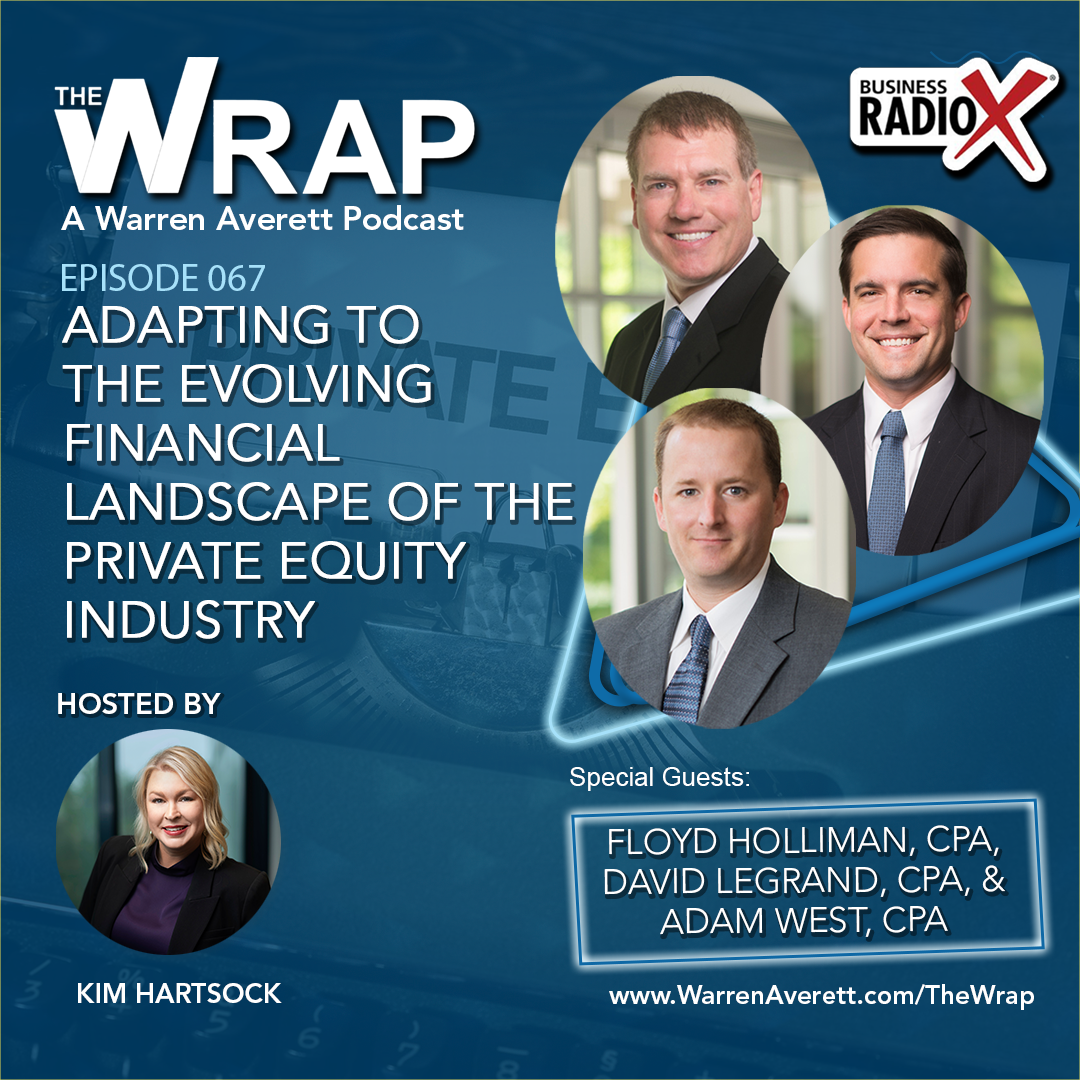
The Wrap Podcast | Episode 067 | Adapting to the Evolving Financial Landscape of the Private Equity Industry | Warren Averett
/
RSS Feed
In this episode, join our experts as they unravel the dynamic landscape of the private equity industry and offer insights into the latest tax strategies.
Kim Hartsock, CPA is joined by three of the firm’s private equity industry experts, Floyd Holliman, CPA, David LeGrand, CPA, and Adam West, CPA, to concisely explore topics that impact returns and portfolio holdings, from navigating regulatory changes to planning techniques for businesses.
In this episode, you’ll hear:
- Discussion regarding the Tax Cuts and Jobs Act and how it will affect businesses in the upcoming tax season
- Planning strategies to help businesses with inventory mitigate the loss of depreciation and amortization
- Details regarding Section 174 of the Tax Code and how it affects R&D expenses
- Advice about the Employee Retention Tax Credit and how to make sure your business has proper documentation
This episode reflects our views at the time it was recorded.
Resources for additional information:
- Blog: 8 Private Equity Trends To Expect in 2023 (And How To Respond to Them)
- Blog: A Business’s Guide to R&D Expense Capitalization and Amortization Changes
- Blog: 6 Tax Planning Items Every Business Should Consider in Year-End Tax Planning
- Blog: Significant Changes to How Your Company Accounts for R&D Costs
- Blog: 5 Ways a Company Can Use the R&D Tax Credit
TRANSCRIPT
Commentators (0:02): You’re listening to The Wrap, a Warren Averett podcast for businesses designed to help you access vital business information and trends when you need it. So, you can listen, learn and then get on with your day. Now, let’s get down to business.
Kim Hartsock (0:19): Hey, everyone, and welcome to another episode of The Wrap. I’m Kim Hartsock, and I’m excited to be with you today. We are continuing with our series on industries, and today, we’re going to be talking about private equity groups. We have our experts with us. Today, we have Adam, David and Floyd. So welcome, guys, and some of you welcome back to the podcast. We’re excited to have you today.
Adam West (0:41): Hey, I’m Adam West. I’ve been with the firm for about 12 or 13 years now, and I spend a large part of my practice in the private equity space.
Floyd Holliman (0:50): I’m Floyd Holliman, and I’ve been with the firm for about 16 years. I also spend a large part of my time in the private equity space.
David LeGrand (0:57): I’m David LeGrand, I’m a Member in the Tax Division of our firm, and I specialize in merger and acquisition tax work.
Kim Hartsock (1:03): We’re really excited to have you guys here today. I know you are the experts, and I know you have a lot of information to share with our listeners. So, we’re going to jump right in. David, I’m going to start with you. What are the challenges or opportunities for private equity groups that you’re seeing that other industries are not? How common are the challenges that they’re facing with all the other industries?
David LeGrand (1:27): Thanks, Kim. A lot of what we’ve seen in the last 12 or 24 months is that a lot of these tax issues aren’t necessarily unique to PE, but they’re impacting businesses across multiple industries and are also significantly impacting private equity in their portfolio companies. A lot of these that we’re going to talk about come from the Tax Cuts and Jobs Act of 2017. When a big tax package is rolling through Congress and rolling through the legislative branch, they like to score it with CBO—the Congressional Budget Office. They have a 10-year period that they look at it. So, to make the math work for what they were negotiating, they took the last five years, and they have some pseudo-hidden revenue raisers backed into it. That’s coming into play starting in tax year 2022, kind of a 10-year mark from 2017 to 2026.
Starting in 2022, there are some of these revenue raisers in there that are impacting a lot of the timing of these deductions that business clients are used to having when they make tax distributions out of their portfolio companies or up to their investors to make tax payments.
These couple of issues that we’re going to talk about today are the issues that we’re seeing most often in the last, like I said, 12 to 24 months. Okay, so the first issue that we wanted to look at today was with respect to business interest and the way that the tax law used to work up to tax year 2022. Through 2021, your business interest was capped at effectively 30% of taxable EBITDA—which is earnings before interest, taxes, depreciation and amortization. Starting in tax year 2022, you were no longer allowed to add back depreciation and tax amortization to the formula.
If you have a lot of tax depreciation and tax amortization, which is usually a really large number for private equity investments, because of the way they structured their acquisitions, they get this taxable goodwill that’s amortizable and deductible, so that becomes a big number. It alters the formula to where business interest deductions are delayed in greater amounts than they were prior to this 2022 change. So, the change of the formula in business interest is a particularly big issue for private equity.
The other piece of this is that we see this hitting private equity a lot because they have a propensity to leverage up their portfolio investments with debt to increase their rate of return when they have an exit. So, interest rates being off, there’s a lot of debt and they have a lot of goodwill amortization.
With just the way the tax law works and this change in 2022 where you can no longer add back depreciation and amortization to the formula, it is becoming a big issue for private equity portfolio companies with respect to the timing of business interest deductions.
Adam West (4:01): David, just to piggyback off that, I think there is a planning opportunity out there for businesses that have inventory, to look at potentially capitalizing some of their interest and deducting it as their inventory is sold. So that’s a planning opportunity to help mitigate that penal provision of not being able to add back your depreciation and amortization.
David LeGrand (4:27): That’s a great point, Adam.
Kim Hartsock (4:30): Floyd, I know where you sit in the firm, you do a lot of specialty tax projects. So, what are you seeing as it relates to private equity?
Floyd Holliman (4:38): Kim, one of the things we’re seeing is starting in 2022, companies that incur research and development cost—also known as Section 174 cost—must capitalize those over five years for R&D cost incurred in the U.S. and 15 years for R&D costs incurred outside the U.S. I do want to point out that this is not an elective, and this is something that you have to implement starting in 2022 if you do have R&D costs. Prior to 2022, companies with R&D costs could expense those costs in the year they incurred them. So, this is a big change.
Just to go over in general what these costs include: all costs incidental to the development or improvement of a product or activities intended to discover information that would eliminate uncertainty—these are the types of costs that are pulled into this new tax law. These are pretty broad, as you can see. Some specifics related to these are the salaries of people doing R&D in your organization—or outside contractors that may be doing R&D for your company—as well as supplies used up in the R&D process and any overhead that may be related to R&D activities also have to be pulled in and capitalized starting in 2022.
Kim Hartsock (6:02): So, companies that are in the business of doing those things, which could be a pretty significant number that they’re having to add back.
Floyd Holliman (6:11): Very large negative tax impact on companies with high levels of R&D activity. Kim, it is worth noting that it’s a timing difference. The company does still get the deduction, it’s just over five years, typically, or 15 years for non-U.S. R&D. So, in general, it’s a timing difference. But there’s a very negative part of this law for companies that may be prepared to sell. If you’re selling a company, this becomes a permanent item, because if you’ve got any unamortized expense sitting there when you sell, you lose that and that goes over to the buyer. Not only do you lose that expense, but you also do not get to take the unamortized expenditures as basis against your gain or loss. It’s really a double whammy, and it’s a permanent change. This is really having a negative impact on companies that are getting ready to sell that have some unamortized R&D expenditures.
But along those same lines, another opportunity that exists with these R&D costs is the R&D tax credit, which has been in existence since 1981. It provides a valuable credit for taxpayers with R&D costs. Now, while these R&D costs related to the R&D credit are very similar to the R&D costs that must be capitalized under this new tax law that we were just talking about, the tax law has no effect on the R&D credit. So, the R&D credit still exists as it did in the past and will help mitigate some of the negative impact of the law requiring the capitalization of these R&D costs. If you have costs that must be capitalized, it just makes sense to take the R&D credit to go ahead and mitigate some of the negative impact of that new law.
Kim Hartsock (8:11): That’s good to know. For companies that haven’t taken advantage of the R&D tax credit in the past, they need to consider that, knowing now that they’ve had this change with the way that they can expense those expenditures.
David LeGrand (8:26): Exactly, yeah. Kim, along with Section 174 that Floyd’s talking about and the business interest and bonus depreciation, the ability to let taxpayers effectively expense capital expenditures one hundred percent is being phased out starting in tax year 2023. So, this year, it’s going to eighty percent. The next year sixty percent, then forty percent, then twenty percent, then gone, assuming nobody changes the tax law between now and 2026.
But at any rate, if you’re capital intensive, if you’re buying a lot of equipment, if you’re a manufacturer or distributor, if you’re in construction or if you’re doing something where you’re buying a lot of capital equipment, and you’ve been counting on that bonus depreciation to accelerate that deduction—that’s going to be getting phased down. It’s also going to be another one of those revenue raisers that’s on the back end of that 10-year period that we talked about. So, I think bonus depreciation is another one to really watch and see if that law changes.
There’s some momentum, hopefully, that people are looking at changing the 174 capitalization that Floyd was talking about. Looking at this business interest deduction formula, then also bonus depreciation. These were very popular tax provisions in the tax law prior to the implementation of these changes.
Floyd Holliman (9:36): Good point, David. We are seeing a lot of legislative activity around overturning some of these laws. We just don’t know. As of today, it’s still the law and that’s what we need to plan for, but hopefully we’ll see some relief in the future.
Kim Hartsock (9:52): Adam, I know you’ve done a lot of work with the employee retention tax credits. What are you seeing that specifically relates to private equity groups?
Adam West (10:03): Yeah, there’s been a lot going on when it comes to the employee retention tax credit (ERTC). I think one of the biggest things over the last few months has been the moratorium that the IRS put in place. It’s basically where the IRS said, “Hey, we’re not going to process any additional claims until early 2024.”
They’ve introduced a withdrawal process to where taxpayers that have filed claims that have not been paid, the taxpayers can withdraw those claims penalty free. I think as it relates to private equity, we’re seeing ERTC become a deal item; it’s simply because of all the scrutiny around it. When a portfolio company has claimed ERTC, I think they need to look at their documentation for it.
Did they apply it to the gross receipts test—which is more black and white—or are they applying under the partial shutdown test—which can be very subjective? Now would be a great time, if you did apply under that partial shutdown test—and even if you’re not being audited by the IRS—to really go back and look through your documentation and beef it up, because we do think it will be something that a potential buyer down the road is going to look at very closely.
Kim Hartsock (11:16): So, these are all pretty significant changes that business owners and leaders are having to face. What would you tell leaders that are listening on this podcast today? What should they do to position their organizations for success in the future? Floyd, we’ll start with you.
Floyd Holliman (11:33): Kim, I would say if you had R&D activities, talk to your tax advisor to identify the research expenses that must be capitalized so that you can properly budget for the upcoming tax liability for 2022, 2023 and 2024. Also, if you have R&D activities that must be capitalized, I will say strongly consider taking the R&D tax credit to mitigate some of the additional tax burden created by this new law.
Kim Hartsock (12:05): David, how about you?
David LeGrand (12:07): I would just say—like Floyd was saying—that planning for these things is key. I would look at your business interest. Look at that formula. Make sure you’re modeling it out, so you don’t have a big cash tax outlay surprise when you do your tax distributions. I’d look at bonus depreciation, if you’re capital intensive, but definitely look at the business interest.
Adam West (12:24): I think for the ERTC, the biggest thing is to make sure that you have your documentation in order. We’ve seen a lot of situations where a company has applied for millions of dollars of tax credits with only a few pages of support for the government orders or the support showing why they qualified. So, I think maintaining contemporaneous documentation that outlines your position is important, because even if you’re not audited by the IRS, we’re seeing it become a deal point. I think it’s just something you’ve got to be ready for. If you do have a claim that you’ve filed and you’re unsure of your position, now would be a good time to address it.
Kim Hartsock (13:09): So here on The Wrap, we always like to wrap it up in 60 seconds or less. So, David, what would you want to leave the listeners with today?
David LeGrand (13:17): I would just encourage everybody to do a lot of planning and a lot of forecasting to look at these specific areas of the tax law. We’re just seeing it hit clients over and repeatedly the last year or two. So, I would just try to get with your advisors and model out the business interests, the R&D credit and the capitalized expenses. I would look at any ERTC claims you have. Then, if you’re capital intensive, I would look at bonus depreciation and just try to model this out, so you don’t have any surprises. Just please reach out to us. We’d love to help.
Kim Hartsock (13:46): Thank you guys for being with us today. And thanks for listening. We’ll see you next time.
Floyd Holliman (13:50): Thanks for having us.
David LeGrand (13:52): Thanks, Kim. We appreciate it.
Adam West (13:53): Always enjoy coming on, Kim. Thank you.
Commentators (13:55): And that’s a wrap. If you’re enjoying the podcast, please leave a review on your streaming platform. To check out more episodes, subscribe to the podcast series or make a suggestion of other topics you want to hear, visit us at https://warrenaverett.com/thewrap
BRX Pro Tip: Turning Good Customers Into Great Customers
/
RSS Feed
BRX Pro Tip: Turning Good Customers Into Great Customers
Stone Payton: [00:00:00] And we are back with BRX Pro Tips. Stone Payton and Lee Kantor here with you. Lee, today’s topic, turning good customers into great customers.
Lee Kantor: [00:00:10] Yeah. I think this is where most businesses can steal a page from the airlines. I think they do a good job in this area, and it’s their frequent flier program. When you kind of create a mechanism that you’re able to elevate the level of service for the folks that already like doing business with you, that’s a great resource that inspires loyalty, and consistency, and keeping you there, sticky, longer.
Lee Kantor: [00:00:41] So, is there anything you can be doing to create a higher tier of service for your best customers to reward them for being such great customers? Are there any unique services? Are there rewards? Is there access? Is there some higher level of membership? Is there any type of experience you can be delivering that can elevate the relationship with your super fans to make them feel more special and valued?
Lee Kantor: [00:01:06] So, my recommendation, think about your services, see if you can kind of jazz hands up one of them or a couple of those services to inspire your good customers to become great customers.














