
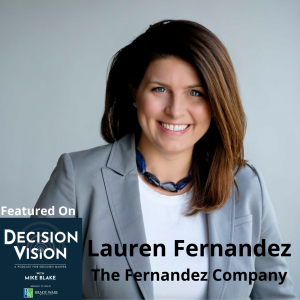
Decision Vision Episode 90: Should I Franchise my Business? – An Interview With Lauren Fernandez, The Fernandez Company
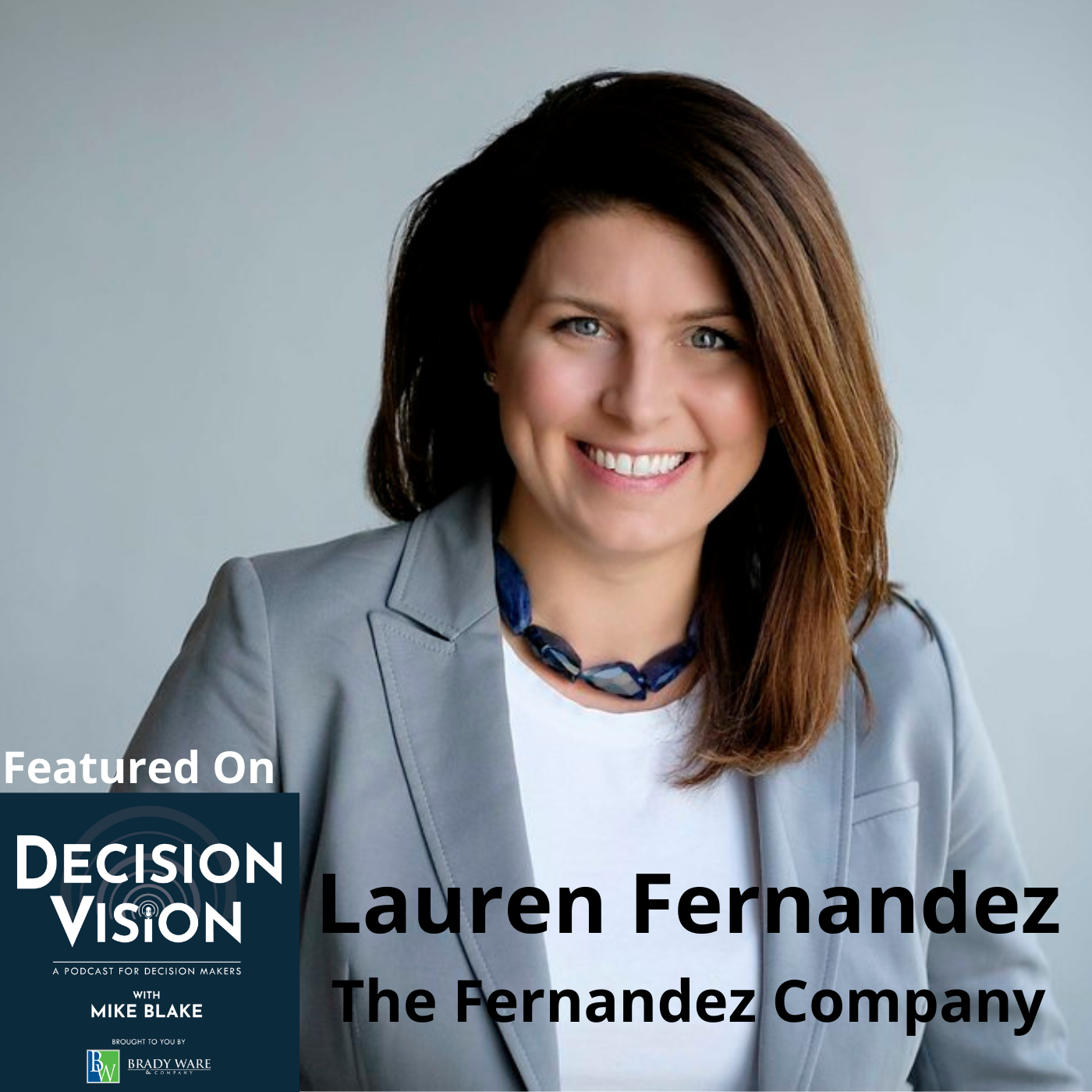
Lauren Fernandez of The Fernandez Company joins host Mike Blake to discuss what considerations business owners should weigh before becoming a franchisor, the legal foundations a franchise organization must establish, the success factors in running a franchise organization, and much more. “Decision Vision” is presented by Brady Ware & Company.
Lauren Fernandez, The Fernandez Company
The Fernandez Company specializes in helping restaurant brands grow from 2 units to 20 and beyond. Lauren Fernandez is fully immersed in the restaurant industry as an operator, developer and executive with deep business and industry understanding. The Fernandez Company generates new revenue streams for companies, particularly in the food & hospitality industries. They diversify revenue streams outside the four walls of a restaurant by creating new channels of revenue in the areas of organic expansion, franchising, product development and licensing. They create this growth for their clients through their process of strategic consulting, management support and investment.
Learn more at their website.
Mike Blake, Brady Ware & Company

Michael Blake is Host of the “Decision Vision” podcast series and a Director of Brady Ware & Company. Mike specializes in the valuation of intellectual property-driven firms, such as software firms, aerospace firms and professional services firms, most frequently in the capacity as a transaction advisor, helping clients obtain great outcomes from complex transaction opportunities. He is also a specialist in the appraisal of intellectual properties as stand-alone assets, such as software, trade secrets, and patents.
Mike has been a full-time business appraiser for 13 years with public accounting firms, boutique business appraisal firms, and an owner of his own firm. Prior to that, he spent 8 years in venture capital and investment banking, including transactions in the U.S., Israel, Russia, Ukraine, and Belarus.
Brady Ware & Company
Brady Ware & Company is a regional full-service accounting and advisory firm which helps businesses and entrepreneurs make visions a reality. Brady Ware services clients nationally from its offices in Alpharetta, GA; Columbus and Dayton, OH; and Richmond, IN. The firm is growth minded, committed to the regions in which they operate, and most importantly, they make significant investments in their people and service offerings to meet the changing financial needs of those they are privileged to serve. The firm is dedicated to providing results that make a difference for its clients.
Decision Vision Podcast Series
“Decision Vision” is a podcast covering topics and issues facing small business owners and connecting them with solutions from leading experts. This series is presented by Brady Ware & Company. If you are a decision maker for a small business, we’d love to hear from you. Contact us at decisionvision@bradyware.com and make sure to listen to every Thursday to the “Decision Vision” podcast.
Past episodes of “Decision Vision” can be found at decisionvisionpodcast.com. “Decision Vision” is produced and broadcast by the North Fulton studio of Business RadioX®.
Visit Brady Ware & Company on social media:
LinkedIn: https://www.linkedin.com/company/brady-ware/
Facebook: https://www.facebook.com/bradywareCPAs/
Twitter: https://twitter.com/BradyWare
Instagram: https://www.instagram.com/bradywarecompany/
Show Transcript
Intro: [00:00:01] Welcome to Decision Vision, a podcast series focusing on critical business decisions. Brought to you by Brady Ware & Company. Brady Ware is a regional, full-service accounting and advisory firm that helps businesses and entrepreneurs make visions a reality.
Mike Blake: [00:00:21] And welcome to Decision Vision, a podcast giving you, the listener, clear vision to make great decisions. In each episode, we discuss the process of decision making on a different topic from the business owners’ or executives’ respective. We aren’t necessarily telling you what to do, but we can put you in a position to make an informed decision on your own and understand when you might need help along the way.
Mike Blake: [00:00:40] My name is Mike Blake, and I’m your host for today’s program. I’m a Director at Brady Ware & Company, a full-service accounting firm based in Dayton, Ohio, with offices in Dayton; Columbus, Ohio; Richmond, Indiana; and Alpharetta, Georgia. Brady Ware is sponsoring this podcast, which is being recorded in Atlanta per social distancing protocols. If you like this podcast, please subscribe in your favorite podcast aggregator, and please consider leaving a review of the podcast as well.
Mike Blake: [00:01:05] Today’s topic is, Should I Franchise My Business? So, we’ve had conversations about franchising before. Mainly, the one that I’m thinking of is with Anita Best. It was very early on in the podcast series. I think she’s in the single digits. And she’s a person that is an expert in helping people find a franchise to buy into. So, if you want to become a franchisee, how do you figure out the right one? And if that interests you, please go back and listen to it. It’s a good, informative show.
Mike Blake: [00:01:41] But being a franchisee is only one-half of the equation. The other half is, should I become a franchisor? Which means that you’re going to make your business and your business model available to other people that would like to participate in it in a hybrid sort of operational and ownership way.
Mike Blake: [00:02:08] And franchising is actually kind of interesting. I did a little bit of background research. Uncharacteristically of me, I did some background research prior to this interview. And it turns out that franchising actually dates back to the medieval Catholic Church. It turns out that the initial territories, if you will, or dioceses, as we call them in Catholicism, were apportioned in Europe in a way that were set up effectively as franchises, including a certain portion of revenue generated by that church would be sent back to, for the most part, the Vatican. The seat of Catholic Catholicism was in Southern France for a brief period of time, but mostly to the Vatican. And of course, in exchange, the Vatican lent the brand name of Catholicism, and the rights, and rituals, and so forth, and all the other things that Catholicism brings to the table.
Mike Blake: [00:03:07] So, I had no idea that franchising goes back that far. And that’s a far cry now from starting a McDonald’s franchise, or a car wash franchise, or a dry cleaning franchise, but it just goes to show you that that business model has been around for a very, very, very long time. And anything that lasts that long probably has something going for it, despite all the change that’s occurred.
Mike Blake: [00:03:38] So, clearly, it’s a topic that’s worthy of discussion. And I have a feeling that there are some folks that are in businesses right now, either as an owner or as a key decision maker, that are thinking about the issue or the question, should I franchise my business? So, I have leant with you the sum total of my expertise on this topic, and that means we have more time to fill in the podcast.
Mike Blake: [00:04:01] And today, joining us to fill that time with expertise is Lauren Fernandez of the Fernandez Company. They are simple, effective and elegant, providing growth solutions for food and hospitality. At the Fernandez Company, they generate new revenue streams for companies, particularly in the food and hospitality industries. They diversify revenue streams outside the four walls of a restaurant by creating new channels of revenue – and we’re going to talk a lot about this – in the areas of organic expansion, franchising, product development, and licensing. They create this growth for their clients through their process of strategic consulting, management support, and investment.
Mike Blake: [00:04:38] Lauren is the founder of The Fernandez Company. The culmination of over a decade of practice as a trusted brand consultant and legal adviser with all kinds of clients from startups to multinational companies. Lauren started the Fernandez Company after starting funding with private equity and selling an eight location restaurant chain at a substantial return. She consults with companies on all aspects of restaurant and franchise development, brand licensing, product development, and market implementation. She focuses her practice on regulated industries, particularly in the food and drug space.
Mike Blake: [00:05:10] Before forming the Fernandez Company, Lauren served as the general counsel for Focus Brands, where she was instrumental in the rapid growth of the licensing program. Prior to joining Focus Brands, she was part of an elite team at Novartis CIBA Vision that successfully launched the company’s first new product in over a decade. She started her career in one of Atlanta’s most respected intellectual property boutiques, Gardner Groff. Lauren holds an undergraduate degree from Stetson University, as well as a juris doctorate and MBA from Emory University. She serves on the advisory board for the Atlanta Community Food Bank. She’s also a dedicated fundraiser for the Leukemia and Lymphoma Society and was named the 2015 Woman of the Year for raising $95,000 in less than three months for cancer research. She’s a native of the Tampa Bay area but has lived in the Atlanta area for over 15 years. So, she’s almost accepted as a near native. But she’s native to our hearts and native to the podcast. Lauren Fernandez, welcome to the program.
Lauren Fernandez: [00:06:06] Thanks for having me. That was quite an intro there.
Mike Blake: [00:06:09] So, before we jump in, I want to ask you this, $95,000 for cancer research. First of all, thank you for doing that. My mother is a two time cancer survivor. What motivated you to do that?
Lauren Fernandez: [00:06:27] Well, it’s actually a very personal cause for me as well. In the early years of my law school education, my mom actually passed away from an extremely rare lymphoma. And for years I wanted to do something to help fund research. And as you know, there are hundreds of different types of blood disorders that are classified as leukemias or lymphomas. And the research, because there are so many differentiated different blood cancers, it is very difficult to tailor research to actual treatment plans. And one of the things I love about Leukemia and Lymphoma Society is they put those dollars that we raise almost dollar for dollar directly into tailoring research to effective solutions to target cures for these cancers.
Lauren Fernandez: [00:07:13] And I’m so pleased that we were able to fund not one, but two separate research studies that directly targeted T-cell lymphoma, which had affected my mother. And the survival rate for that cancer in the last 15 years has shot up from nearly four percent, which is abysmal to the double digits, which is fantastic. So, I was very blessed to be a part of that and to use my network and my friends and family to help us all fundraise, to fund those two research studies. It was very important.
Mike Blake: [00:07:46] Yeah. It’s remarkable. And I’ve noticed, I don’t know anybody who’s suffered with that particular cancer. But there’s been a lot of progress there. And that’s one area of cancer where there’s a lot of movement, too. So, again, thank you for contributing to that success.
Lauren Fernandez: [00:08:02] It’s my pleasure.
Mike Blake: [00:08:02] So, getting into your area of expertise, let’s help people understand that may not necessarily be expert. What does it mean to move into a franchise model? And how does a franchise model differ from other, maybe, more conventional business models?
Lauren Fernandez: [00:08:21] Right. So, franchising is actually a little bit of an American invention in terms of its legal structure and recognition and regulation. The United States is pretty much the leader in the law defining a franchise. We have the FTC in the United States who helps regulate the disclosures attached to franchising. But it might surprise most people to know that on a state by state basis, that’s where we look to for the governance regarding business relationships and specifically franchises. So, there’s about 15 to 16 states that have specific franchise rules and disclosures that are tailored to that type of business model.
Lauren Fernandez: [00:09:07] So, what is it exactly? Well, the true answer is it varies a little bit from state to state. But in reality, we can talk about it generally in the common denominators of what forms of franchise. So, a franchise is generally defined as three key elements. One, you have the brand. You have the trademark. And that trademark is licensed to an individual who, two, wants to use a proprietary system to run a business. And three, that person who has the system, i.e. the franchisor, is the person who’s controlling the quality and the execution of that system. So, there are some quality controls and guidance that are provided along with the ability to and the license to use the brand and the System.
Lauren Fernandez: [00:09:54] Now, when we say the System, we use that term kind of capital S, System. What does that really mean? Well, it could be anything, like if you’re in a restaurant, it could be methods, it could be floor plans and designs for the restaurant, it could be recipes, menus, interior decor, operational training, et cetera. Often you will also see franchisors manage things like marketing through a marketing fund. So, the idea here is that you are taking a workable, ostensibly profitable business model and licensing it for your use as an entrepreneur. So, it’s kind of like being an entrepreneur, but with guide rails, if you will.
Mike Blake: [00:10:37] And that’s interesting because I think that’s a very important point that I want to highlight, because I think when most people start to explore franchising, they think about the brand. Because the brand for us, as consumers, is a front facing part. But the part that strikes me that is actually the harder part to really nail down is that that system that you’re going to sell and then put people in a position to execute with their own dollars. So, I’m glad you mentioned that, because I think that’s a very important kind of learning point for our audience. So, if I have a business now and I start to think about franchising, I’ve heard about it from someplace. In your experience, what motivates people to start to consider franchising? Why are people asking you about it? Why are your clients asking you about franchising?
Lauren Fernandez: [00:11:30] This is a great question. And this is just my instincts and from many years of talking to people who are interested, I believe it’s because they are genuinely interested in growing their revenue and growing their business, whether it’s a restaurant or a service industry, et cetera. And that just is the most common way that they know of or have heard about, whether it be through television or movies or they’ve seen other success stories on Shark Tank, et cetera. And so, they think that that is the natural way to necessarily grow their business.
Lauren Fernandez: [00:12:10] However, I like to ask the why question. Why are you looking to grow? What’s really behind that? Do you need an exit strategy? Are you not making enough money? Do you need to fund two kids going to college? I think when you really spend time – and in our case with our clients, this is at least a two hour interview where we spend a lot of time getting to know them and their goals. And then, I think the question is, is franchising the appropriate fit for growth if that’s what we’re going for? I would say about 90 percent of the time you hear two things when we ask that why question. They want to grow their business and they want to make more money. But it doesn’t necessarily always follow that franchising is the right answer. Because with franchising, there’s a lot of other things that you have to consider, including supporting a franchise system, operational costs, loss of control to some extent, et cetera, that I think lots of people don’t necessarily think of when they consider franchising.
Mike Blake: [00:13:14] And I suspect – and you tell me if I’m wrong – at the end of the day, a lot of this boils down to the prospective franchisor is trying to figure out how to achieve scale and probably try to do it relatively rapidly, right? At the end of the day, to me, that’s what that sounds like. Am I off base or is that close to being right?
Lauren Fernandez: [00:13:33] I think sometimes that’s one of the reasons. But, ultimately, I think, again, that why question, yes, there is always ways to grow your business and to create scale in your own business without necessarily engaging in franchising as the appropriate model. And so, for us, even especially having been a franchisee myself and an owner-operator, I think really understanding their pains and their day to day operations, like what’s really going on? Why do you feel like you can’t scale it yourself? Why do you feel like you need other people to partner with you as franchisees in order to achieve scale? I think really driving down in those deeper questions gets us really to the problems they’re facing so we can solve them better. Because I will say this, while, franchising, I very deeply believe in it. I think it’s a wonderful way to kind of harness the American entrepreneurial spirit. It provides viable growth for a lot of different people, both the franchisor and the franchisee. It is not always the answer for growth. There are many different ways you can grow your business.
Mike Blake: [00:14:40] So, I want to dive into that here. I haven’t ripped off the script in a long time, but I’m going to rip it up a little bit today, because what you’re describing to me is that that process or the thought process, at least, when you consider franchising, it sounds like maybe a symptom of potential issues in the company that franchising is not going to solve the problem, in fact, it may make it worse. It sounds like that probing that you do helps identify whether or not the problem they’re solving is even franchise appropriate. And by definition, I guess, can be solved externally as opposed to something that really is an internal problem. Is that fair?
Lauren Fernandez: [00:15:22] No. I think you absolutely nailed it. And it’s not to say that there are people out there who are ready to franchise and who are good to go the minute they walk in the door. But in my practice, one of the things we do is our initial consulting in the first three to six months is, what I would call, tidying up. We go into the business, we really start to understand it, and we solve for what we know will be problems later. Because you cannot copy, paste, repeat and rapidly grow, whether it’s through your own organic growth or through franchising or any other channel, unless you really clean up the house and the foundation is strong.
Lauren Fernandez: [00:16:01] And so, in my experience, we see three things almost every single time when we go into a business that need correction or need tightening, if you will. One is, you’ve got to clean up the books. You have to have really daily available, accurate accounting. You’ve got to be able to show very key metrics. And I’ll use restaurants as an example, since that’s my wheelhouse. You’ve got to be able to, obviously, show the daily sales. You’ve got to be able to show your daily food costs, your daily labor costs. And you need to be running on what you think a target profit margin should be and show those numbers over time. Because if we don’t know those numbers, we can’t diagnose and show room for improvement. And we need to be able to show profit margin over time or else who’s going to want to buy your business as a franchisee if it’s not making significant amounts of money.
Lauren Fernandez: [00:16:55] The second thing is we tighten up operations. And sometimes that’s the people piece and making sure that the H.R. is all buttoned up and the risk is managed. That, from an operator’s point of view, if you can’t easily teach somebody else how to do it with a manual, with SOPs, with charts, and basic instructions, you’re not ready to franchise yet. And that’s usually not a huge hurdle. We just need to document, document, document. The third thing is you’ve got to define the brand. Sometimes there’s a little work to be done on making sure the brand messaging is clear, the design is clear. It’s really consistent and it’s differentiated so that when you move to market, that value proposition to a prospective franchisee is there. So, there is some work to be done, yes. When people come and do actually decide the franchise, we still spend a significant amount of time on, what I would call, that sort of tidying up period before we even really get to the growth plan and whether or not that involves franchising.
Mike Blake: [00:18:03] All right. So, let’s fast forward a little bit and say that somebody has made it through those three gates, if you will. And so, “Okay. I agree. Let’s go ahead and launch this franchising model.” At a high level, what do the steps look like to get from I’m not a franchise yet into now we’re a franchise?
Lauren Fernandez: [00:18:29] Right. So, there’s a significant amount of the cleanup, as we just discussed. But then, you really need to make sure we’ve got the legal foundation there. And I think there’s a misconception that this costs hundreds of thousands of dollars or that it costs, you know, even $50,000. It’s just not the case. So, you need to check some legal boxes. So, typically, that involves a federal trademark filing to make sure that the trademark is secure and available for use. And that you can protect those rights and the rights of others to use the system. Because, inherently, a franchise is a trademark license, first and foremost. So, buttoning up that kind of brand itself with the legal function of the trademark is very important.
Lauren Fernandez: [00:19:12] You know, there are franchise agreements that are required and also franchise disclosure documents, which, as I mentioned earlier, are regulated by the FTC and also 15 or so states. So, those legal documents provide the foundation of the relationship between the franchisor and the franchisee. And it starts from the minute that you engage them in a sales discussion. So, really, I think the foundation there is necessary.
Lauren Fernandez: [00:19:40] And then, as a secondary step, we like to educate our clients on what it means to be a franchisor. What it’s going to look like in a year, in two years, in five years as the company grows. And that includes, in the very early stages, making sure that they get their mission as a franchisor to become a good partner for franchisees. And they understand what transparency looks like and what it really means in a legal and practical context to be a franchisor and try to sell to a prospect. I think that those are really key initial first steps for anyone who’s building a franchise system.
Mike Blake: [00:20:22] And that disclosure document sounds to me like it looks fairly similar to a placement memorandum or an information memorandum for companies that are going to go out and raise capital. I don’t know if you’re familiar with those.
Lauren Fernandez: [00:20:36] Yes.
Mike Blake: [00:20:36] So, is that fair they’re fairly similar? They have some similarities.
Lauren Fernandez: [00:20:40] Yes. There’s a defined structure that’s outlined by the FTC that governs the shape and form of what’s called an FDD, a Franchise Disclosure Document. And, again, there are states out there that have additional disclosure requirements. So, you will often see one universal or nationwide FDD with several writers for each individual state. So, it is a checkmark, if you will. But it is essentially the four walls of your ability to sell the franchise. Because, ostensibly, you should not be discussing anything about the system or making any claims or forward looking statements about the franchise system other than what’s fully disclosed in that FDD.
Lauren Fernandez: [00:21:26] So, for sales people, including the original owners and the franchisor and their team, it’s very important that they understand the legal requirements behind that. And that, also, that they work with you and the legal team in producing an FDD that’s meaningful and substantial so they can talk about the brand and that there is decent substance in the disclosure. Because we like to operate in the light, I think that’s just the best way to roll. So, we try and make the FDD, not just to legal check the box, but more so a legitimate living sales document that helps the team not only sell into prospects, but helps prospects really genuinely understand the opportunity.
Mike Blake: [00:22:09] So, can you give an estimated timeline, and it can be from maybe the idea of having a franchise or maybe after they go through your cleanup process – maybe that’s better but I’ll let you decide – what does the time timeframe look like between, you know, deciding that you’re going to launch a franchise to actually having it out there and be available for potential franchisees to buy into?
Lauren Fernandez: [00:22:37] That’s a great question. So, our process involves that initial tidying up or cleanup period, which is somewhere between three and six months. A lot of that time is usually spent either in operations or buttoning up the accounting, cleaning up the finances, et cetera. And then, as a secondary stage, we go through what’s called a growth planning process. So, it’s a little bit more strategic. We sit down and we talk about goals, visions, planning, et cetera, and talk about the end game. And assuming that franchising is a part of that growth plan, then we go ahead and start the legal process of forming those documents. That’s about a two month process. The documents that need to be registered with various states in which you plan to sell the franchise. So, I would say all said and done that that whole process usually is somewhere between ten months to a year before it can be offered to the general consuming public.
Mike Blake: [00:23:33] And do you typically kind of have a suggested budget in mind? How much should a company plan to set aside to kind of go through that process?
Lauren Fernandez: [00:23:46] That is a wonderful question. So, a really good benchmark that we give to people is we assume that they’re making a certain number, a certain amount of profit margin. Because as I discussed earlier, in my opinion, if you’re not making a decent amount or profit out of your business, you probably have no business franchising it in the first place. But assuming they got –
Mike Blake: [00:24:06] Yeah. It’s like trying to solve a bad marriage with having a baby, right? I mean, it sounds like a really bad idea.
Lauren Fernandez: [00:24:14] Right. So, anywhere in the first year alone, we like to reserve about 20 to 25 percent of their annual profit margin in reserve for funding not only the legal documents that come of that, which is an initial upfront expense, but other expenses like state registration, sales, people, commissions, et cetera. So, there’s a decent amount of that, I would say, usually, north of $10,000 that’s legal in nature, whether that’s the sales disclosure documents, the FDD, the registration, the trademark registration, as we discussed earlier. Those costs are up front. But then, there’s some ongoing concern. There’s the people that it takes, the time that it takes to actually coach and manage and lead these franchisees to success. So, we also have to be thoughtful and considerate about who on the team and how much time it’s going to take to, for example, help a franchisee open a location, to train a franchisee at your headquarters, et cetera. So, there’s a decent amount of expense and I would say even more so than probably the legal expense and just the human capital and the time investment it takes to help franchisees.
Mike Blake: [00:25:27] So, I want to switch gears a little bit here. You know, you do everything you can to help. But then, a franchise, you know, at some point, it has to either execute or not or it has to thrive or not. And, of course, not all franchises, you know, succeed. I’m sure the ones you launch all do. But not every franchise succeeds. So, in your mind kind of post-launch, what are some of the differentiating factors that make a franchise launch successful versus not successful?
Lauren Fernandez: [00:26:06] This is a great question. So, I always say it’s not just about the horse that you pick, but it’s about putting it in the right race. So, there might be phenomenal prospective franchisees out there but they’re just not a good fit for your brand because, for example, your brand requires a very hands-on owner-operator. And the person that you’re talking to has a day job that they don’t want to leave and wants to treat the business more like it’s a check in the mailbox. And there’s nothing wrong with that. There are brands and systems for which that is the norm and it works. An example would be like a coin operated car wash. That’s a very different type of franchise system than, for example, owning a restaurant, which might be a lot more hands-on where you need to be the face of the restaurant. You need to be involved and engaged and be the mayor of your local community, et cetera.
Lauren Fernandez: [00:27:06] So, I would say when we see individual franchisee failures, largely, it is because it’s a mismatch between the system and the abilities or willingness of the franchisee to kind of buy into that, literally and figuratively. So, I do often think sometimes that you have to put the responsibility on both parties. So, while a franchisee may fail because it’s a mismatch or not a good alignment with the franchisee, there are instances of franchisors also not providing appropriate support in all of the areas where a franchisee would need it. It happens.
Lauren Fernandez: [00:27:48] I do think that there are some brands out there that franchise a little bit too early and it puts a lot of stress on a company to support rapidly growing franchise units who need that field business consultant. They need the marketing support. They need the customer service. They need the supply chain support. So, suddenly, the overhead for a franchise system to a franchisor can shoot up exponentially. I’ve seen numbers north of a million to $2 million a year in operating costs for 30 to 40, 50 units. And I think for a lot of franchisors, that kind of can take you by surprise if you do not have a properly laid out growth plan. So, unfortunately, it happens. I do not think that it’s the norm. I do think franchising as a system is a wonderful entrepreneurial spirit. Again, it gives people a chance to own their own business with the guide rails of someone else’s experience and expertise helping you along the way.
Mike Blake: [00:28:56] Good. So, this segues nice in a question I want to address with you, because it’s, in my experience, a very controversial topic. I think you have a lot to contribute to that. And that is, that I suspect that you’re aware that the the Small Business Administration website has a list of failure rates for SBA loans by franchise. And I didn’t look. I should have. But I think they kind of list their lowest 50 failure rates and their highest 50 failure rates. And, you know, some of the failure rates are quite striking. I remember the last time I looked at it, the highest failure rate was something in the 70 percent. And I think it was one of those ice cream places where they dump a bunch of ice cream on a cold table and mix some M&Ms or something inside a $10 ice cream cone. But my question is this, are you familiar with that list? And do you think there’s any validity to it at all in terms of the metric of the relative strength or business viability of one franchise system versus another?
Lauren Fernandez: [00:30:10] This is a phenomenal question. And it is controversial, right? I will just start with a general comment. So, in franchising. I think that there is a tendency to have what we will call fad franchises. So, there was a hot moment where, like, you could not open a pizza joint fast enough, then it was froyo, then it was mix-ins, like you just used the mix-in yoghurt example. Then, it was burgers. You remember there was, like, designer burgers on every corner. So, it’s driven by people. And so, when there are food demands or trends in the marketplace, you often see quick to act and sometimes well-positioned brands out there to benefit from those food trends in the marketplace. So, one of the current trends is poke bowl everywhere. Everywhere is a poke bowl, fresh tuna, rice, avocado, and a bowl. And it’s moved from the West Coast to the East Coast. Another trend right now, huge one, is ramen. There’s ramen everywhere.
Lauren Fernandez: [00:31:16] And so, occasionally, what you will see is there’s a glut in the marketplace where there are some initial first movers that are usually established brands who know what they’re doing. And they’re out there to kind of ride the first wave of that trend in the marketplace with consumer taste and diet. And then, you see the second movers, right? You see, like, these brands that just want to jump on that wagon very quickly and sell as many as possible as quickly as possible. So, when we’re looking at failure rates, I think sometimes what I quickly spot are those fads or those trends falling out of favor with the American public. You just see things not being as popular anymore as they once were or the fad is over. It’s just done. And so, there’s so much saturation in the marketplace with competing brands to serve that hunger in the marketplace, for lack of a better word, that eventually not everyone’s going to survive. And the brands that do survive are usually the ones that are more nimble, but also more mature and can respond to the changing diet in the marketplace or the changing tastes.
Lauren Fernandez: [00:32:23] The other thing that we see sometimes is, again, not a proper filtering or selection for prospective franchisees. So, that mismatch is happening and that’s why you have to have very specific guidelines for your sales team and a clear understanding of what a good franchisee looks like for your brand. And I think sometimes that means that the growth rate isn’t quite as exponential as what you might see in some of these other brands. But for the long term relationship, it’s the right thing to do. And I firmly believe in that. I think most people don’t catch this. But just like commercial real estate leases that are north of 10, 15, or 20 years, franchise agreements often run in similar length terms. So, you are signing up for a long term relationship with these prospective franchisees. And so, getting that match right is extremely important.
Lauren Fernandez: [00:33:24] You know, I think the third thing I will leave with is, part of that screening process is proper capitalization. Making sure that your franchisees have the amount of liquidity and proper balance of liquidity to leverage the debt to open these units. Because it’s not just about getting the doors open. You have to have available cash in reserve to maintain good inventory levels, to fix things that break, to hire the right managers, et cetera. So, there are estimates and FDDs that will give a prospective franchisee an idea of the low and the high. But I think screening to make sure that that available capital is really there and it’s a mix of capital and debt, if necessary, is really important. Because you’re going to cut off a lot of these issues before they even start when you do that.
Mike Blake: [00:34:21] You know, you said something in that answer that I just I think is so smart that I want to extract that because it has application, not just to this particular topic, but I think business decision making in general. And that is, that sometimes the best deal is the one you don’t make. And defining your business, not in terms of what you do, but what you won’t do or whom you’re going to exclude because they’re not a good fit or they’re not ready. As opposed to, you know, “Hey, can I come.” Sort of being the online ministry of franchisors or anybody who signs up is now ordained. So, I think that’s so smart and that the selectivity of the franchise – and any business, I think – means so much.
Mike Blake: [00:35:17] In my own business, one of most liberating and best decisions I made was I decided there’s certain kinds of assignments I don’t take on. I’m not good at them. I don’t enjoy them. They operate in a way that is immensely disruptive to my natural workflow. And there are people that do them way better than I do and will refer me work back, so I just refer them out. And I think encouraging anybody to decline customers that just aren’t a good fit. You know, listen to that inner voice saying, “Yeah. I’m not sure they’re the right one.” In my own experience, I’ve never turned down a client and then regretted that and wanted them back. And I’m not turning this into Mike Blake interview, but I wanted to raise point because I think that’s so important that it comes out of the franchise model because as general application. What do you think about that?
Lauren Fernandez: [00:36:14] You know, I have seen it across multiple brands. And some of the most successful growth stories that I’ve seen with brands that I’ve worked with come from exceptional leadership at the top. A vision to treat franchisees as partners and long term partners. And franchisors who are constantly asking the question, is what we’re doing today good for the franchisee? Is it good for the System – capital S? And, also, who invest in really high quality sales people who understand this about their brand.
Lauren Fernandez: [00:36:51] And I’ve worked with some phenomenal sales professionals at my time at Focus and since then. And I think that that sometimes makes all the difference because when they’re interviewing prospects, they know what to look for and they have a long term vested interest in not just selling a quick deal. They’ll sell the right deal to the right person. And those are the people that I keep going back to for continued sales growth. I trust them. I trust them to bring me the right qualified prospects. Because I don’t want to put the wrong people in front of my clients either.
Lauren Fernandez: [00:37:28] It’s the same with investors, even as a franchise or if you take investors, we do the same level of screening. Is it the right person to be a partner with us long term in the growth of this brand? I think that the same applies there too. You want to bring quality investors who understand the mission, who understand the trajectory of the growth plan, who are going to push a different agenda, and who are in the boat rowing in the same direction. And I can’t highlight that enough. I think when you’re in a system, franchising by definition, again, it’s a long term, mutually beneficial relationship. So, you got to know who you’re getting into bed with, right? You got to know and you got to choose wisely.
Mike Blake: [00:38:18] Yeah. A question I want to make sure that we get to is, you know, it strikes me with a franchise is that once you move from, presumably, a single location – or maybe not a single location – but a self-contained business model to franchise, you probably have to develop new skill sets. The things that made you successful as a self-contained business may need to expand or may need to change for the ones that are going to make you a successful franchisor. Do you agree with that? And if so, what do some of those new skills look like?
Lauren Fernandez: [00:38:59] So, wonderful segue. I think, here, one of the things I would highlight is the best franchise brands that I’ve seen, you see an owner-operator really become a leader of a community. So, they go from being the mayor of their one or two restaurants, for example, to being the leader of their entire brand. And there’s a level of camaraderie, inclusiveness, and transparency in that leadership that inspires everyone to do better.
Lauren Fernandez: [00:39:36] And I think that there is an element to this of – again, I’m using the restaurant terminology here of the owner-operator, where you’ve walked the walk and you talked the talk. So, you know what it is when the fryer goes down and what that means at lunch rush. And so, when the franchisee complains that the equipment keeps breaking, you don’t say, “Well, tough, it’s the equipment package.” You know that you’ve got to find a solution and your solution is based in your own practical experience. And I think those kinds of simple, and elegant, and down to earth solutions are really what define the best franchises because the leadership is in the trenches with the franchisees. So, I think if I could identify one type of skill set that is a must have, it’s that type of leadership. It’s the servant base with you all the way kind of leadership.
Mike Blake: [00:40:35] You know, that’s interesting. I’m not a franchise expert, as I’ve said, but I’ve observed that some franchises, in a way, have a multilevel market. I’m sure you’re going to cringe as soon as I bring that in, but let me finish. Is that some franchises do develop almost a cult of personality around the founder and a cult around the brand. And that they have huge – did, anyway, before the virus wrecked everything. But they had huge annual conferences, and trips, and contests, and internal recognition, and who’s the best franchisee in this region for whatever characteristic. And, you know, I hadn’t really thought about that but you’re right that, you know, there are a lot of franchises that really do place a high premium on strong leadership.
Lauren Fernandez: [00:41:36] Yeah. So, Mike, to that, I will say, I think that’s a little bit of a double edged sword, too. Because if you build the cult of personality around any leader, whether it’s the founder or the hired and gone CEO, what have you, you run the risk of that not being fully scalable. And, you know, you’re putting all your eggs in one basket. But the best leaders I’ve seen create this community with an entire executive team. They are experts that recruiting in talent and making sure everyone’s compass is pointed north and is going in the same direction.
Lauren Fernandez: [00:42:18] And so, there’s a level of redundancy to the messaging, the community, and the reinforcement of it is in the daily actions. And I cannot stress this enough. You want to make sure that the leadership for the brand is divested across an entire group of people who all have the integrity to do the right thing even when nobody is looking. And I think that it’s more than just one person. And it needs to be more than just one person.
Mike Blake: [00:42:53] Who, in your mind, does franchising really well? If you’re going to highlight somebody out there, they’re just a great franchisor, they really know what they’re doing, and their best practices a lot of franchisors can learn from. Is there a name or two you can throw out there that you think are just great kind of examples or exemplars of franchising?
Lauren Fernandez: [00:43:17] You know, I am extremely biased because I actually came out of a career in food and product development. And, as an attorney, I was working at Novartis and doing pharmaceutical development. And was recruited over to Focus Brands by Russ Umphenour, who, to me, is still one of the industry’s legends. And much of what I learned, I learned from him and from the team that he put around him, who brought me in with open arms into the industry, taught me about restaurants, taught me about franchising. And I think that my time at Focus there when I was working with Ross and the team was just one of the best examples of what a class act franchiser looks like.
Lauren Fernandez: [00:44:07] That said, there are plenty of others in the industry, you know, under David Novak’s leadership, Yum! Brands was a phenomenal example of this. And working hand in hand with them on a number of deals with some of their brands, I was just so impressed with the consistency within their organization, even though they were massively so much bigger than us as Focus Brands at the time. Just really impressed with the way that they handled themselves across multiple different departments. And I think that’s, again, the test of really good leadership is, everybody on the team doing the same things even when you’re not looking. It’s that integrity diversified across the entire talent pool, which is really hard to do as a leader to inspire people to really be at their best and have the right kinds of folks on your team, not only in recruitment, but in retention and the training of those folks.
Lauren Fernandez: [00:45:02] And I think the common denominator, if I can just say this, is all of these brands or franchisors, if you will, have a heavy investment in people, in talent, and in continued training. I’ve never seen anything like it in my life. I mean, I must have been at a conference at least once a month as an executive. I spent months in brand training individually in all of our brands before I ever touched a contract when they hired me at Focus, which I thought was insane. But I understand it now as an operator. I totally get it. How can you assist any of these brands unless you really know what it is to operate one? And I have insane amounts of respect for the people who operate these businesses as franchisees and owners. So, I think, to me, that’s a major common denominator behind the best franchisors.
Mike Blake: [00:46:01] You know, thinking of Yum! Brands because I have a personal observation that before the Pizza Huts, Taco Bells, and KFC, I think, were consolidated under Yum! Brands, my perception is I don’t think those franchisors were particularly successful. I think they’re floundering. I think they had that operational consistency and branding problems. And, you know, you’re right. I think ever since they were consolidated – and you know the inside out, I don’t. But ever since they were consolidated and, I think, probably recapitalized with that consolidation, they have turned those all into very powerful competitive brands. And, you know, the same core food. You know, Pizza Hut food has not changed. KFC has not changed. Taco Bell a little bit. But they’ve elevated their game. I think they’re a good example of how great management and leadership makes an impact.
Lauren Fernandez: [00:47:02] Well, right. And if you’re making the system innovative, forward thinking, exciting, and profitable for your franchisees, you’re going to energize the heck out of them and they’re going to want to carry that flag up the hill. And I think the other thing that these brands tend to do really well is they’re nimble. And so, when they take the brand to other countries or into markets that are, maybe, a little bit different, they are not so rigid that they can’t figure out a way to make it happen. And I think that that’s also something they treat the brand with a level of respect. The brand is invested, not only by the people who are operating the brand on a daily basis by it, but by its customer base. So, they’re respectful and reverent with how they develop, evolve, and mature these brands. And I think that that’s really key.
Mike Blake: [00:48:01] We’re speaking with Lauren Fernandez of the Fernandez Company about the decision to franchise your business. We’re running up against the clock so we only have time for a couple more questions before we let you get out of here and help some more people. But one question I’d like to ask is, I think most people associate franchising with restaurants, first and foremost. Is there something about restaurants that makes them more franchiseable or more tempting to franchise than other lines of business?
Lauren Fernandez: [00:48:38] I don’t necessarily think so. I think that’s just what’s front of mind. There are so many service industries out there. There are a million brands, batteries plus, pet supplies plus. There’s a number of different brands out there that you may not even realize are franchised. I think because we, in this country, grew up with franchising, we sort of developed it or evolved it, if you will. And we have McDonald’s to sort of think as sort of our industry titan and leader in the channel of franchising to thank for that. So, I think it’s what’s front of mind, but I don’t think that it’s a universal truth that obviously all franchises are not restaurants.
Lauren Fernandez: [00:49:22] Restaurants, themselves, are actually fairly complicated. Whereas, there are other models that are fairly straightforward. You purchase the inventory, you open the doors, and it’s a lot simpler. There are service industry models, I believe Glass Doctor would be a good example of that, where you’re an owner-operator, but you’re servicing an actual need in the community. So, it’s a more service driven franchise. And those are very successful, too. They’re just a different model. Again, I think it’s just that restaurants are front of mind. Obviously, I have a huge bias towards them because that’s what I specialize in. So, it’s an interesting question, though. But no, I don’t know that I’ve seen any statistics on proportionately, like, what percent of franchises are restaurants. But it seems to me like it can’t be more than 50 percent of the total number of franchises in the US.
Mike Blake: [00:50:16] Lauren, we’ve learned a lot and we can learn a lot more, but we are running out of time and I want to be respectful of yours. If people want to contact you to learn more about this topic, can they do so? And what is the best way to do so?
Lauren Fernandez: [00:50:32] Yeah. Hit us up on our website, so we’re at the fernandezcompany.com. There’s a way to reach me with a form on there. Also, we have our contact information with our phone number and our email address. And we do provide consultations. And we are here to consult and help you figure out what the right growth strategy is for you and your brand. It may be franchising, but it may be some of the other tricks we have up our sleeve. And so, we’re here to help if you are interested in growing.
Mike Blake: [00:51:02] Well, thank you. And that’s going to wrap it up for today’s program. I’d like to thank Lauren Fernandez so much for joining us and sharing her expertise with us. We’ll be exploring a new topic each week, so please tune in so that when you’re faced with your next executive decision, you have clear vision when making it. If you enjoy these podcasts, please consider leaving a review with your favorite podcast aggregator. It helps people find us that we can help them. Once again, this is Mike Blake. Our sponsor is Brady Ware & Company. And this has been the Decision Vision podcast.