Business RadioX ®

  • Home
  • Business RadioX ® Communities
    • Northeast
      • Butler PA Business Radio
    • Southeast
      • Alabama
        • Birmingham
      • Florida
        • Orlando
        • Pensacola
        • South Florida
        • Tampa
        • Tallahassee
      • Georgia
        • Atlanta
        • Cherokee
        • Forsyth
        • Gwinnett
        • North Fulton
        • North Georgia
        • Northeast Georgia
        • Rome
        • Sandy Springs
        • Savannah
      • Louisiana
        • New Orleans
      • North Carolina
        • Charlotte
        • Raleigh
      • Tennessee
        • Chattanooga
        • Nashville
      • Virginia
        • Richmond
    • Midwest
      • Illinois
        • Chicago
      • Michigan
        • Detroit
      • Minnesota
        • Minneapolis St. Paul
      • Missouri
        • St. Louis
      • Ohio
        • Cleveland
        • Columbus
        • Dayton
    • Southwest
      • Arizona
        • Phoenix
        • Tucson
        • Valley
      • Texas
        • Austin
        • Dallas
        • Houston
    • West
      • California
        • Bay Area
        • LA
      • Colorado
        • Denver
      • Hawaii
        • Oahu
  • FAQs
  • About Us
    • Our Mission
    • Our Audience
    • Why It Works
    • BRX in the News
  • Resources
    • BRX Pro Tips
    • B2B Marketing: The 4Rs
    • High Velocity Selling Habits
    • Why Most B2B Media Strategies Fail
    • ROI Calculator
    • 9 Reasons To Sponsor A Business RadioX ® Show
  • Business Opportunity

Search Results for: marketing matters

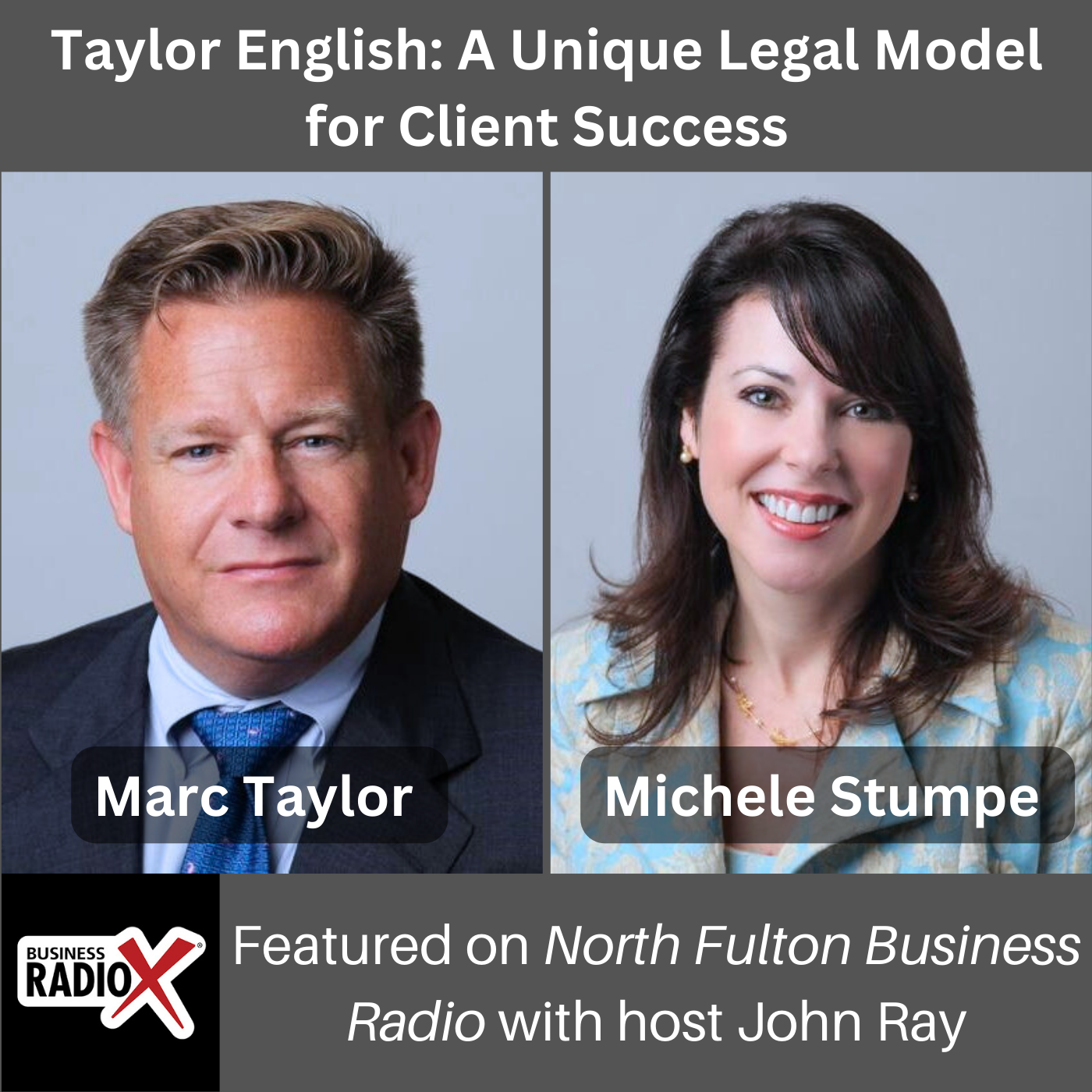
The Business Side of Name, Image, and Likeness Rights in College Sports, with Bruce Siegal, Taylor English

March 30, 2021 by John Ray

Taylor English

The Business Side of Name, Image, and Likeness Rights in College Sports, with Bruce Siegal, Taylor English (North Fulton Business Radio, Episode 346)

Pending state and federal legislation will allow collegiate athletes the ability to hire agents and monetize their name, image, likeness (NIL). Sports trademark and IP veteran Bruce Siegal of Taylor English joined host John Ray to discuss the business issues involved with NIL. “North Fulton Business Radio” is produced virtually from the North Fulton studio of Business RadioX® in Alpharetta.

Taylor English

Taylor English Duma LLP is a full-service law firm composed of experienced, results-driven lawyers. Their model is purpose-built around their clients and designed to seek new opportunities for them.

They deliver superior service through…

1. Efficiency. They focus our resources more on client work and less on corporate overhead. As a result, their clients think of them as a business-building investment, not a corporate expense.

2. Partnerships. Their clients’ businesses are as important to them as their own. Taylor English’s belief in long-term relationships is more than talk; it is the basis of everything they do.

3. Results. They are creative problem solvers. That’s why their infrastructure is built to deliver as much value as possible, as they achieve the results that will best support their clients.

Taylor English works each day to provide timely, creative, and cost-effective counsel to help clients solve problems and achieve goals. They represent all types of clients—from Fortune 500 companies to start-ups to individuals. A majority of their lawyers carry vast experience from years of front-line work with top firms and leading businesses, including many who served as in-house and general counsels. In addition, a number of their members have worked outside of the practice of law, including in the start-up and management of businesses. Combining diverse talents in an environment that promotes efficiency and eliminates big-firm trappings, they provide a full array of legal services at a fraction of the cost.

Company Website | LinkedIn

Bruce B. Siegal, Senior Counsel, Taylor English

Taylor English
Bruce Siegal, Senior Counsel, Taylor English

Bruce B. Siegal is a member of Taylor English’s Intellectual Property and Entertainment, Sports and Media Departments. Mr. Siegal has more than 30 years of experience as Senior Vice President and General Counsel for the Collegiate Licensing Company (CLC) and its related sports licensing entities. He focuses on sports brand protection and enforcement, licensing, contract negotiation, marketing and business operations, helping brand owners maximize IP value thru licensing, sponsorship and endorsement agreements, and assisting licensees navigate the licensing marketplace through utilizing a vast network of industry contacts.

As the SVP and General Counsel of CLC, Mr. Siegal oversaw all litigation matters, trademark enforcement actions, and anti-counterfeiting efforts. He established CLC as a founding member of CAPS, a trademark protection and enforcement alliance among CLC and the professional sports leagues such as the NFL, MLB, NBA, and NHL. He played an essential role in establishing and managing the CLC legal department, implementing company-wide systems, policies and risk management procedures. Mr. Siegal advised on issues related to contests, social media initiatives and promotions. Additionally, he negotiated and drafted contracts, including agency, license, and sponsorship agreements with clients, licensees, and sponsors in the collegiate business, and for related sports and entertainment clients.

Mr. Siegal played an integral part devising programs to protect the trademark rights of numerous sports clients, including organizing systems to protect the NCAA Final Four and College Football Playoff marks by clearing the marketplace of counterfeit and unlicensed merchandise in coordination with the event organizers, investigators, and law enforcement officials.

In addition, Siegal developed and guided the implementation of CLC’s labor code of conduct and monitoring program, and worked with collegiate institutions and licensees to implement Corporate Social Responsibility programs designed to ensure that licensed product bearing collegiate trademarks are produced under safe and fair working conditions.

During his career, Mr. Siegal has written numerous publications on trademark and licensing protection, as well as anti-counterfeiting best practices, especially surrounding sports branding and special events.

He earned his law degree and BA from the University of Alabama.

LinkedIn

Questions and Topics in this Interview:

  • Background including being a founding member of CLC
  • collegiate institutions protecting and licensing their marks
  • Trademark protection and enforcement, including NCAA
  • Why is NCAA reforming its rules regarding name, image, likeness (NIL)
  • What is NIL
  • State legislation
  • Federal legislation
  • Legal cases (including upcoming Supreme Court review of NCAA v. Alson; arguments 3/31)
  • What does this mean for student athletes?
  • What does this mean for college athletic departments?
  • Ongoing educational efforts
  • Future of college sports

“North Fulton Business Radio” is hosted by John Ray and produced virtually from the North Fulton studio of Business RadioX® in Alpharetta. You can find the full archive of shows by following this link. The show is available on all the major podcast apps, including Apple Podcasts, Spotify, Google, Amazon, iHeart Radio, Stitcher, TuneIn, and others.

Renasant Bank has humble roots, starting in 1904 as a $100,000 bank in a Lee County, Mississippi, bakery. Since then, Renasant has grown to become one of the Southeast’s strongest financial institutions with over $13 billion in assets and more than 190 banking, lending, wealth management and financial services offices in Mississippi, Alabama, Tennessee, Georgia and Florida. All of Renasant’s success stems from each of their banker’s commitment to investing in their communities as a way of better understanding the people they serve. At Renasant Bank, they understand you because they work and live alongside you every day.

Celebrating Women In Agile with Maria Matarelli, Patty Aluskewicz E7

February 25, 2021 by Karen

Celebrating-Women-In-Agile-with-Maria-Matarelli-Patty-Aluskewicz-E7

Celebrating Women In Agile with Maria Matarelli, Patty Aluskewicz E7

Don’t know how to start or where to get the resources from? Look no further, these ladies have the answers you need. Their journeys are so unique, this is worth the listen! In this episode you can grasp some valuable insight from them and learn how to overcome those challenges you’re facing now!

Alway wanted to be involved in the Agile community, but don’t know where to start? Well, these ladies have the answers you need. Their journeys are so unique, this is worth the listen! In this episode you can grasp some valuable insight from them and learn how to overcome those challenges you’re facing now!

FILogoNamewithlink.

At Formula Ink we inspire people to push past limiting beliefs, leverage their strengths and reach unparalleled individual and business results.

Our market differentiator is in bridging the gap; helping corporations think like entrepreneurs and helping entrepreneurs get what they need to develop their companies.

“We show entrepreneurs how to implement and leverage the same systems and processes used by large corporations.”

“We show corporations how to tap into that raw passion and excitement that’s so common in the start-up culture.”

With more than ten years of experience consulting organizations on business strategy, planning, process improvements, and organizational change, our consultants have the industry knowledge and experience to help take your organization to the next level.

Through organization consulting, training classes, and workshops, Formula Ink helps organizations enhance their effectiveness, reduce conflict, and increase communications to achieve better results.

Maria-Matarelli-Formula-InkMaria Matarelli is an international business consultant, experienced Agile Coach, and Certified Scrum Trainer (CST) who consults and trains companies on reaching true agility. Maria travels to consult Fortune 100 companies and speak at industry conferences with locations from Shanghai to Singapore and Thailand to Nova Scotia.

While looking for ways to continue to expand Agile outside IT, Maria and her team have been applying Agile to the Marketing realm with incredible results, which led to Maria co-founding the Agile Marketing Academy. Maria also co-founded the Personal Agility Institute, helping people use Agile to do more of what matters in their lives and shift the culture of organizations.

Maria is also the Founder and President of Formula Ink, an international consulting company and is passionate about working with people and organizations to increase speed to market, increase efficiency, and get greater results in business.

Connect with Maria on LinkedIn.

Agile-Mindset-ConsultingLogoRGB

Patty-Aluskewicz-Agile-Mindset-ConsultingPatty Aluskewicz, Founder of Agile Mindset Consulting, is a Scrum Master, Agile Coach and Consultant, and Professional Educator.

With over 14 years of experience, she assists businesses and their employees in building Agile skills and successfully implementing them into their daily operations.

She is passionate about helping those new to Agile learn the fundamentals for accelerated career development and progress. ​

Connect with Patty on LinkedIn.

About The Lurnist – Celebrating Women in Agile

We highlight fantastic women who are doing great things in the Agile field, all the while creating role models to inspire young women in high school and college to want to have a career in Agile.TheLurnistShowPromotingWomeninAgileDebraandLauryn

Who do you know that leads scrum teams? Builds great products as a product owner or product manager? Coaches leading agile transformations? Or, is an agile teacher or trainer? We’d love to get to know her with the hope to feature her story and journey to success on The Lurnist Radio Show & Podcast.

About Your Co-hosts

Debra-Hildebrand-on-Phoenix-Business-RadioXDebra Hildebrand is the Founder and CEO of LurnAgile and has over 20 years’ experience in project management; including consulting and training in the public and private sector and teaching in higher education.

She is one of the architects for the Project Management Certification program at the University of Washington, where she received the Team-Teaching Excellence Award and currently instructs in the online portion of the program. Additionally, she developed and currently teaches traditional and agile project management courses at Stanford University.

Her passion projects include Celebrating Women in Agile through her Business RadioX Show, The Lurnist Show, and helping veterans transition into meaningful careers in project management after service disconnection through her work on the board of Veteran Project Manager Mentor Alliance (VPMMA).

She is a certified SAFe Program Consultant (SPC 5.0), Project Management Professional (PMP) from the Project Management Institute and has an MBA from Columbia Business School in New York, NY.

Co-hostLaurynJenneHeadshotLauryn Jenne is a senior student at University of Washington Bothell (UWB), majoring in Management Information Systems with a minor in Computer Science IT. Lauryn currently works for UWB School of Business and is also the Digital Marketing Manager at Veteran Project Manager Mentor Alliance (VPMMA), a non-profit that assists veterans and military spouses in gaining careers in project management.

Additionally, she is the Vice President of Fundraising for Delta Sigma Pi, a professional business fraternity at the University.

Lauryn aspires to work for an organization as  a project manager and eventually create her own brand and startup company.

Lauryn currently lives in Seattle, WA

About Our Sponsor LurnAgile

LurnAgile is a Boutique, Woman Owned Small Business that delivers top quality Agile Certification courses and Agile Coaching.  We are a Scaled Agile Silver SponsorLurnAgileLogoTransformation Partner, which shows our clients that we have invested in and are committed to the Scaled Agile training standards and coach offerings.

Each of our team of Elite coaches/instructors have over 10 years of leading and coaching Agile Transformations in some of the largest Fortune 100 and 500 companies in the world. This means that your organization is learning from someone who has “been there and done that”.

Zach Miller-Frankel and Neil Dunne with Andrson

February 24, 2021 by angishields

Welcome to Daring To, a podcast that finds out how CEOs and entrepreneurs navigate today’s business world – the conventions they’re breaking, the challenges they’ve faced and the decisions that they’ve made, and lastly, just what makes them different.

A sound-driven A&R platform, Andrson is a brand new A.I.-powered tool which connects emerging artists to the right industry professionals, helping them to become discovered.

Zach Miller-Frankel is Co-Founder and CEO of Andrson. A manager himself, he and partner Neil Dunne built Andrson to solve their own A&R challenges. He is also the founder & co-director of ThinkTank Music Management, a boutique firm based in New York City and Dublin.

For his artists, Zach has secured multi-million dollar contracts, global tours, mainstage festival performances, and talent agency representation. He has nearly a decade of experience in the music industry and artist management, and has worked with artists such as Philip Glass, The National, and The Antlers.

A frequent conference speaker, his dynamic keynotes on innovative methods for Digital A&R and the use of AI and Machine Learning in Music Tech, have been heard by audiences around the world. He sits on the Young Leadership Board of a cancer research fund, from which he received the “Founder’s Award” for the production of their inaugural music festival.

He holds an MBA from Trinity College Dublin and undergraduate degrees in Opera Performance & French.

Neil-Dunne-AndrsonNeil Dunne is the Co-Founder and COO of Andrson. At age 25 he has already been named in the 30 Under 30 list for both the Sunday Business Post and The Sunday Independent in 2020.

In 2019, Neil was awarded a spot as one of Ireland’s Best Young Entrepreneurs and has represented Andrson in print, broadcast, and digital media. Neil is also the co-director of ThinkTank Music Management, a boutique firm based in New York City and Dublin.

Alongside founder Zach, they have now grown their Irish roster to 7 artists, for whom Neil has secured agency representation, sync deals, and international touring opportunities. He studied engineering at Trinity College Dublin and also holds an undergraduate degree in Marketing from IADT.

A musician himself, Neil grew up in the south of Ireland singing and performing with orchestras, bands and singing groups. He has featured in podcasts and hosted panels on the application of AI in music and on the broader A&R landscape.

Connect with Zach and Neil on LinkedIn and follow Andrson on Facebook and Twitter.

TRANSCRIPT

Intro: [00:00:02] Welcome to Daring To, a podcast that finds out how CEOs and entrepreneurs navigate today’s business world – the conventions they’re breaking, the challenges they faced, and the decisions that they’ve made, and lastly, just what makes them different.

Rita Trehan: [00:00:19] Well, welcome. And today on today’s podcast, Starting Back, what better way to start back my podcast than to have two unconventional breaking boundaries, really showing what Daring To is all about, I have with me Zach Miller-Frankel, who is the co-founder and CEO of Andrson, and Neil Dunne, who is the co-founder and COO of this.

Rita Trehan: [00:00:44] Now, guys, I have to say, I’m a lover of music. I’m a bit older than the two of you, right? You two are youngsters, but are doing some amazing things around music. And interestingly, it started because you both have an interest in music. You kind of have different upbringings. Now, Zach, I understand that you’re a New York guy, from the States maybe and living in Dublin. Is that right?

Zach Miller-Frankel: [00:01:07] I am. Yeah. I am a statesman who – don’t worry – was brought up on music far older than I. So, I was brought up on opera and doo-wop and Woodstock soundtrack and all that. And hopped across the pond four years ago to expand my management company, which is where I met Neil, and we decided to go into business together.

Rita Trehan: [00:01:36] Well, you know, number one, quite say, talent come across the pond, if you like, and sort of show how collaboration can happen when you bring talent together. But most importantly, I think, is what you’re actually doing in the music industry. And I know you could not have found a better sort of example of how the crisis that we’ve experienced, the pandemic, about how big things can come from that. Although, your business actually didn’t start on the basis of COVID. It was really founded on the basis of discovery. And if I think about that concept of discovery and how it’s played out with what you’re actually doing with music, it kind of says it all really. It’s discovery, right? Because you’re about trying to link really talented musicians with people that are responsible for the music industry and bringing that talent together.

Rita Trehan: [00:02:34] And it’s been talked about for decades, artists having struggles with music companies, and who owns rights, and who owns that. And, like, every wannabe singer we’ve seen more on the reality TV shows. Like, I sing in the shower thinking maybe one day I’ll be a star. I’m never going to be that. But tell me a little bit about that passion. This idea – like, how can you describe it and say – that you are about the discovery of talent, that you have a passion for music and music discovery. What does that mean, guys, the passion for music and music discovery? And that your role is to serve artists and the music industry. Wow.

Neil Dunne: [00:03:22] Thanks. It’s a big introduction for us to try and live up to. But I think you hit the nail on the head, we came across Andrson, the technology we’ve built from our own pain point. As Zach said, we’re managers and we were sitting in front of our laptops day in, day out years ago, and going to gigs, and reading blogs, and relying on word of mouth to try and discover artists to manage and to work with. And it was, like, 2:00 a.m. in the morning one day – back in the day when we could be sitting in a library together working – and Zach turned to me, he’s like, “Why can’t we automate this? And why can’t we bring it back to what matters most, which is the music?” And I think that’s where the passion sort of comes into play, because myself and Zach wake up every morning, the first thing we think about is music. We go to bed, the reason we can’t sleep is because of music.

Neil Dunne: [00:04:17] And it’s that passion of (1) musicians have the odds stacked up against them, which is why we work in management to try the system. And technology, for better or for worse, can be an aid or a hindrance. And we want to build something that aided both musicians and industry folks. And, again, we have this saying that we just beat on the whole time, it’s, the most powerful tool in the music industry is the human ear. And sure, technology can aid people. But ultimately it should just be aiding people to listen and make the right decisions.

Zach Miller-Frankel: [00:04:57] Right. I think the –

Rita Trehan: [00:04:59] Sorry, Zach.

Zach Miller-Frankel: [00:05:00] No. Sorry. Just to add a little bit on to that, because you mentioned it as well, that it’s been happening for decades. I think it’s pretty safe to say – and I don’t think it’s pessimistic to say – that this idea of democratizing the music industry is a very lofty goal. I think musicians will always have the odds stacked against them. But it’s our passion, our job, almost an obligation to help them along with that. And the tools that the industry is currently using, as Neil was saying, don’t focus on the music. They focus on aspects of the artist, so velocity metrics, streaming numbers, things like that. And they don’t necessarily speak to the quality of the act or the potential tenure or longevity of it either.

Rita Trehan: [00:06:07] I mean, it’s fascinating to think of using AI. We see a lot of technology being used everywhere. But it’s the first time that I’ve ever heard of it being used in a very different way to help people discover artists. Like sound, and particularly in these kind of COVID restricted world, I mean, you’re making it digital. People would go and listen to a live concert, go and sit in a pub and listen to somebody playing the guitar. Some of the best musicians have been discovered playing in their local pubs, clubs, whatever. But you often find, as you say, they’re listening to this and they’re not necessarily listening to the sound of the music, they’re watching the audience around them and seeing how they react to it, but not necessarily taking into account what is it about that sound, that uniqueness that the artist has.

Rita Trehan: [00:07:06] Now, you’ve kind of made that possible, because in COVID, nobody can go see anything, right? You can’t see anything. Never mind about hearing things. So, tell me a little bit about this concept of sound. Because, you know, everyone thinks it could have, like, a persona or a brand, but actually you kind of strip away from that. You’re actually getting to the core of, like, what’s really good music and how can you help the music industry focus on that in a way that narrows that focus down, so that they can actually spend their time doing what the music industry should be, which is like making that music and talent available.

Neil Dunne: [00:07:43] Exactly.

Zach Miller-Frankel: [00:07:43] They are part and parcel, I will say. So, I think in order to truly succeed in the industry, artists do have to have that brand, have that point of view, you know, sort of have a purpose that drives them. But we’re also all about prioritizing the right data at the right time. And for a fledgling artist who mightn’t have the image already but definitely has the sound, it’s more important that they have that first. Because then, anybody can help them craft a persona, can help them craft that image. And in fact, by getting involved with artists sooner, not only do things like drive down hiring or contract prices and things like that, deal prices, but you’re able to aid in that sort of construction and ensure that they’re reaching the demographic that they want to be and that you want them to be as well.

Rita Trehan: [00:08:50] And you guys managed to run this business up very quickly. You started it what? Less than two years ago, I think? About that? And have got to raise lots of money for it, which means that people kind of see this as a really good business out there. How did you manage to get, like, over 8,000 artists to come aboard and go like, “Yeah. We like this idea. Like, this is different.” Why you? Like, what was it? What was your value proposition that you were going to them to help them and they’re like, “Hey, we want to change how you can make yourself come alive, how you get discovered.” How do you kind of take that idea forward? Lots of entrepreneurs would love to know that.

Neil Dunne: [00:09:34] I think you sort of touched on it a few times, and it’s tough using positive language around a global pandemic, but we’ve been incredibly fortunate that people are now focusing on digital discovery. So, you’re right, we’ve been working on this for a long time because the technology itself is state of the art, and it’s brand new, and it’s never been done before. But when we launched initially, we did it as a beta launch back in 2019 at the end of the year, and we wanted to make some changes before we went to market. And I’m so glad we did make those changes. I think one of the fear factors and best pieces of advice combined from other CEOs and other tech founders is, don’t be afraid of releasing your product. Get it out there as soon as possible and start getting feedback.

Neil Dunne: [00:10:30] Because based off that, we have products that could succeed and could withstand initial scrutiny. It’s not perfect. We’re constantly adapting and building it. And I think that, combined with the fact those opportunities have been decimated in the live industry for both discovery and for artists, and combining that with the opportunity of our platform. Like, we’ve had almost a hundred artists connect and start collaborating with each other online, thanks to Andrson. Which is just like we’ve built it for discovery, but to see that we’re also fostering this community of new music. Like, one of our artists on the platform, one half is based in Denmark, the other half is in Chicago. And another, we’ve got a few collaborations happening and we’re going to have our first few releases. So, I think the fact that we’re all locked up, the fact that we have to focus on screens all the time allows people to look for better forms of technology, better forms of discovery.

Rita Trehan: [00:11:40] I think, I mean, you can hear it in your voice as you talk about it, the passion that clearly comes from what you have brought to market, which is much more than a product, right? It’s a special kind of collaboration. It’s a kind of way of bringing not just music together, but people together, I can sense from this. I mean, it really is doing that.

Rita Trehan: [00:12:06] What I find really interesting – which if listeners go back and rewind just a bit – that you say about the advice that you got was like, “Launch it, even if it’s not perfect, because you’ll get feedback.” Because so often we’re finding – and as a true nugget of, like, really valuable leadership learning that you’ve given – that a lot of companies and a lot of organizations where they’re struggling is that they’re producing products that nobody wants. They’re not actually asking if this would be it. But what you guys, it seems, have done is actually going off. Is that right?

Neil Dunne: [00:12:44] Exactly. And I think the other element of it is that, you can have an idea. Anyone can have an idea. What makes an entrepreneur, what makes you a founder, what makes you successful, is making that idea a reality. And that is scary. I think I was talking to some young founders recently and they were saying they’ve got their idea, but they’re not ready to share it yet. I’m like, “Start sharing it. We are all so busy doing our own thing.” Like, Rita, if I told you our next project, you’re not going to go off and do it. You’re too busy running the most amazing podcast out there.

Rita Trehan: [00:13:20] Well, thank you very much. Like, I don’t know that it is, but thank you anyway.

Neil Dunne: [00:13:23] But you know what I mean, we’re all busy running our own careers, pursuing our own goals. If you allow someone else to hear your idea and what you’re going to work on, realistically, they’re just going to try and give you advice and give you some feedback rather than –

Rita Trehan: [00:13:42] Why do you think people are fighting about that? What is it that stops people from doing that?

Zach Miller-Frankel: [00:13:47] I think there’s a lot that goes into it. I think we’re still not quite out of the echo of business leaders, or mentors, or parents, or whoever saying, “Don’t share your ideas, someone’s going to come and steal it.” Or, “You better patent that before you do it,” or something like that. And I think there’s this sort of like – it’s not even really old school business mentality, it’s just this older –

Rita Trehan: [00:14:17] It’s old school mentality.

Zach Miller-Frankel: [00:14:19] But I think it still lingers a little bit. I think, although on a personal level for me anyway, I know I had to work really, really hard at separating the personal aspect of the business from the actual business. And removing myself and knowing that a misstep or a wrong feature or something wasn’t a slight on my idea or on me. It was just a piece of feedback that I needed to adapt to make my product better or our product better. And I think a lot of people are afraid of hearing that because you’re so fueled by this passion that –

Neil Dunne: [00:15:04] It’s a part of you.

Zach Miller-Frankel: [00:15:05] Yeah. It is.

Neil Dunne: [00:15:07] The other element is the fact that the social network was one of the most successful movies of its time, and it centers around people feeling like their idea was stolen. I think that’s going to come between –

Rita Trehan: [00:15:21] I’ve got an interesting insight – and, again, I think it’s a really important nugget of leadership advice – that the world today isn’t about trying to beat competition or to hold on to an idea. It’s about – I’ll keep using the word discovery because I think it’s a very powerful word – discovery to share, to learn, to engage, to collaborate. They say music is a way of bringing people together, ideas together. I mean, what better pattern to do it than what you’re doing? And by using technology, that just brings – I mean, like, you put the cherry on the cake. Like, the icing is already there, you put the final decadent piece to make this come together.

Zach Miller-Frankel: [00:16:12] Thank you.

Rita Trehan: [00:16:12] I mean, it’s exciting. Where do you see it going, guys? You know, how do you feel with this passion so that takes it to another level?

Zach Miller-Frankel: [00:16:21] I do think it’s important to say – though we both really appreciate it and no Sunday is complete without a cherry on top – I think our competitors, some of our competitors and some of our forbearers, might think that they were the cherry. But, certainly, I think it’s not about beating the competition, but it is about the differentiation. And I do think that the way we differentiate is why we might be the cherry at the moment.

Neil Dunne: [00:16:55] Yeah. And I think it’s also important if you’re asking where we see this going, we’re trying to redefine music discovery. It’s currently operating on some really great systems of user behavior. So, if you like Rihanna and you always like-

Rita Trehan: [00:17:13] I love Rihanna.

Neil Dunne: [00:17:13] There you y go. But what we’re trying to do is trying to broaden that scope so that you can discover musicians that nobody’s ever heard of. They haven’t been signed yet. As a fan, you have the opportunity to be a first fan. You have the opportunity to recommend it to a friend when they’re only playing a hundred cap venues rather than only really getting to engage with an artist when they’re already supported by major labels, which we all know is a real sort of time in the world of opportunity. And so, we’re trying to, I think as an end goal, is being synonymous with music discovery and people understanding the power of audio driven and sound driven search.

Rita Trehan: [00:18:02] I guess, let’s talk about it. Like, you’ve done a great job of bringing kind of artists to the forefront to say, like, “Let’s help you be discovered.” But the music industry must be clamoring over you guys surely. Like, the guys that are watching the figures must be going, “This is great because they’re spending less money. And because they’re being much more targeted and focusing and looking at some of the artist.” But, also, you invented a way, which means they can actually discover more. They can actually gain more and bring more to the world in terms of music. So, the music industry must be excited by what you do. Are they or are they threatened by it?

Neil Dunne: [00:18:45] I definitely don’t think they’re threatened. Certainly, so far, the response has been overwhelming. And, again, I think in a pre-COVID world, it would have made myself and Zach’s job a lot tougher having to fly over to London rather than being able to hop on a Zoom call and being able to get someone’s 15 minutes time and show them something, rather than having to go over and schmooze them for a couple hours and a couple of meetings. It has made things quicker and has made opening doors a lot simpler. And I think it’s also worthwhile knowing, again, when you’ve built something new, it takes a long time for it to be adopted. So, I think we’ve had a really good six months from June to Christmas establishing ourselves, establishing a new user base.

Neil Dunne: [00:19:38] And now, this year, is really about scaling our company and leveraging the partnerships we already have, and growing upon that to try and get real enterprise wide solutions on boards and integrating with other larger platforms, which we’re beginning conversations at the moment. And I think that’ll be the real icing on the cake this year/cherry on top].

Rita Trehan: [00:20:06] And we’ll talk a little bit about that, like, that aspiration that you have and some of the work that you just launched. But let’s get personal for a minute if that’s all right. You two, you kind of just meet and decide to go into business together. So, what’s it been like? You know, let’s talk about how the CEO, the COO, two different personalities, a very common passion that brings you together, different backgrounds. You’re going to be not wanting to be, like, coming across as overconfident. But, you know, Neil, you get named in the 30 Under 30 list of entrepreneurs. Zach, you bought multimillion dollar contracts. Like, musicians and industry has really come together. I mean, you two bring, like, a package together, but tell me, do you guys clash?

Neil Dunne: [00:21:12] Yes.

Zach Miller-Frankel: [00:21:12] Never. Never, never, never.

Neil Dunne: [00:21:14] And it’s her personality type showing. I know 100 percent. I think one of our strengths is the fact that we definitely have that sort of yin-yang leadership style. We took each other’s boxes when we kind of took them ourselves. And we both have very different skill sets. I think that’s sometimes one of the hardest things when, again, I’m really young. I’m still learning on the job. You’ll always learn on the job. And as soon as you stop learning on the job, you need to change jobs. And I think that’s one of the biggest learning, is, understanding that you can’t do everything yourself. But also learning how to work very closely with someone. And that balance can be really challenging, especially when you’re under pressure.

Neil Dunne: [00:22:05] And I think when you’re a founder and you’re running a company, it really highlights your weaknesses and being able to own up to them and not take things personally, own up to your mistakes, try and fix them, ask for help, move on. That’s how you grow as a person. And I think that’s also really important in partnerships because you are relying on more than just yourself.

Zach Miller-Frankel: [00:22:38] Yeah. Absolutely.

Rita Trehan: [00:22:38] So, have you been giving each other feedback?

Neil Dunne: [00:22:42] What’s that?

Rita Trehan: [00:22:42] Have you been good at giving each other feedback?

Neil Dunne: [00:22:46] To good maybe.

Zach Miller-Frankel: [00:22:51] Not quite daily, but we do check in. I mean, we were on the phone to each other pretty much all day, every day, in constant contact, especially now. And there is always this aspect of, as Neil said, yin and yang, sort of the give and take, the picking up where we might have a blind spot, or where we need a pinch hitter, or something like that. And then, it always inevitably comes back to sort of the end of the day, debrief conversation, where you might say, “Please don’t ever make me do that ever again.” Or, “Thanks for taking that, but please don’t ever do that ever again because you really mucked it up.”

Rita Trehan: [00:23:46] It sounds like a very healthy way of, like, being able to be authentic with each other and sort of share and recognize that I’m being honest. Yeah, of course, there’s pressures, which I think is helpful for people that are thinking of working together, that’s kind of natural that it will happen, but it’s how you kind of deal with it.

Rita Trehan: [00:24:06] Let’s talk a little bit about your mentors. Have you had, like, any great mentors in this business? Because, like, it’s an industry that will have loads of advice, people wanting to give you advice in what to do. And how did you decide whether to have mentors, the mentors that you chose? Talk a little bit about that.

Neil Dunne: [00:24:27] They sort of picked themselves. And, certainly, I found that anyway. Like, you’re 100 percent right, we’ve had hundreds of people give us advice. But the ones that are really valuable pick themselves because their advice shines through. And it’s the one that resonates best with us or it’s the one that they’re willing to be so blunt and open and honest rather than just compliments. They’re not there to compliment. They’re there to advice us strategically.

Rita Trehan: [00:24:59] Your tough love mentors. I call them the tough love mentors.

Neil Dunne: [00:25:04] Sometimes.

Zach Miller-Frankel: [00:25:06] Yeah. It’s a combination.

Neil Dunne: [00:25:07] And we do. I don’t know, Zach, if you want to talk about someone specifically, but Miguel is a very successful CEO in our world has been an amazing adviser to us almost since the very beginning. And has been constantly able to give us feedback from small things like new pictures, tech feedback, but everything all the way to, like, strategic conversations around new clients. And then, I guess, the growing pains that every startup goes through as well. And I think he also hit the nail on the head like everyone offers advice and it’s about understanding what advice is valuable.

Zach Miller-Frankel: [00:25:56] Absolutely. And I think it’s nice that we sort of straddle the two industries because you have the opportunity to learn them from both sides of the coin. So, Colin absolutely has been an incredible mentor to us. He’s also a musician in his own right. I don’t know that he’ll willingly tell people this right off the bat, but he was in a band at one point.

Rita Trehan: [00:26:27] We have to look that up. We’ll have to look that up and check it out.

Zach Miller-Frankel: [00:26:33] But on the industry side, I think it’s really important to have – on the music industry side, I think it’s really important that we have mentors there because we’re not techies coming to the industry with what we believe is a solution, which is so often the case with music technology. We come at it having grown up with great mentors in the music industry that have made the venture into technology possible because we understand the landscape so well, and I think that’s a huge asset.

Rita Trehan: [00:27:15] And place here, I think your purpose or your values, whatever you wish to call them, are pretty unique, right? We talked about a couple of them. But there’s one that I love that we haven’t talked about, which I’m really intrigued by as well. A commitment to accuracy, rarely do I see people talk about commitment to accuracy. And I go, “That’s intriguing. That’s interesting.” Where does that come from? And then, I think back to what we’re trying to do, to show that we’re about that, because that’s a unique viewpoint to have, and why you chose that for its importance.

Zach Miller-Frankel: [00:27:58] I think it comes down to time. I hate this phrase so much, but it is true, time is money. Accuracy cuts down on wasted time, right? So, for music discovery, basically what that means is, more relevant results faster. And I think that was really key to us because, as Neil was saying, in those 2:00 a.m. library sessions, the databases we were using were completely inaccurate because they relied on user tagging and things like that.

Zach Miller-Frankel: [00:28:04] So, for instance, when I moved to Ireland, I thought, “Oh, sure. I’ll just find the next Hozier and will be happy out.” And what we were finding was that girl groups were tagging themselves like Hozier because it’s Hozier, and they were expecting people to search for him. But that doesn’t do anybody any good. That wastes my time. It puts sort of a bit of a negative image in my head about that band. And I might really, really like them in the end. But I’m not looking for them and I’ve just wasted my time. So, for us, it was all about the accuracy that music analysis can bring rather than the analog ways of user feedback or sort of the ancillary statistics that current systems sort of rely on.

Rita Trehan: [00:29:38] So, it’s getting to the heart of what’s really important, I guess, is what you’re trying to say. It’s like that it’s really trying to get to, like, what’s important. By the way, I like the term time core.

Zach Miller-Frankel: [00:29:50] I like that.

Rita Trehan: [00:29:50] The time core, because you don’t have all the time that you would like. So, the time that you have, you got to use it to the best advantage that you can. And there is another piece, that commitment to accuracy, I think, is so applicable, like, beyond the music industry. So, what you actually are posing and have done is so applicable across so many different industries and different ways in which that could be used. That kind of thought process of how do you kind of connect what’s important to a passion and to bring real insights into whether it’s running a business, or your music, to listeners, to solving more problems. I mean, really, it’s the intricate thought process that you guys have used to put that together that seems to hold true.

Rita Trehan: [00:30:43] And, of course, you don’t just stop at that, do you? Like, one of the last thing that you talked about that’s been really important to you is around this constant strive for intelligent and relevant technology, but continuously learning. So, this whole concept of continuously learning, unlike earlier when everybody says that, “I’ve said that”. I wonder if it’s true or not. But then, I go and read a couple of your blogs and I go, “Yeah. Crap. It is true.” And I’m sitting there and I’m writing notes of the things that I’m going to do, the habits that I need to do every day to kind of think about. And I’m taking away learnings from that and going like, “Wow. That’s what I need today that I need to focus on.”

Rita Trehan: [00:31:25] And just recently this year, you kind of gave this fresh, inspirational insight about 2021 and how to look at that. So, for you guys, this learning actually goes beyond the business itself. It seems like you are committed to sort of sharing personal knowledge, experience, and helping your musicians grow as individuals. Is that a fair comment? Is that intentional?

Neil Dunne: [00:31:52] I think we’ve both been really lucky in the community that we’ve, not grown up in, but grown up in as entrepreneurs. And, again, it’s sort of like coming back to the fear factor. But most people are very willing to help. And I think when you’re on the receiving end of this, it’s also a duty of yours to try and further share that knowledge that you’ve learned, and normalize some of the stresses and anxieties that come with setting up a business. Because business is smoke and mirrors far too often that it needs to be.

Neil Dunne: [00:32:35] And I think one of the great things from COVID has been, like, we’ve been on Zoom calls and it gets interrupted by a screaming baby or a pass. And it’s making people realize what matters most, and why we’re all here, why we’re doing what we’re doing. And I think if we can shed a small bit of light on our experiences, if we can offer up advice to musicians and industry folk and new entrepreneurs, then why not? And in terms of how we’re learning, we’re constantly – like, again, we’ve got a platform out there. It’s pretty cool. It’s doing a lot of great stuff, but we now have an obligation. It’s not even what it is or want, but it’s an obligation. We’ve got 8,000 musicians on our platform, we are obliged to make our platform better for them. And so, I think it turns into an obligation once you start really sort of gaining some traction.

Rita Trehan: [00:33:40] They say leadership is a choice that you make and it’s an obligation once you make it. So, it sounds like that’s exactly what you guys are doing. Now, let’s talk about something exciting, because you’ve also just launched something new, right? Or about to launch something new.

Neil Dunne: [00:33:56] Yeah. last week.

Rita Trehan: [00:33:56] So, let’s talk a little bit about that, because I can’t like to hear a bit about that, ReWrapped.

Neil Dunne: [00:34:01] Yeah. ReWrapped, basically we have our platform which allows industry musicians connect. And then, we have our engine underneath it that runs all of our audio analysis. And the great thing about our engine is it can plug into any machine that other industry professionals use. And we want to demonstrate that because, again, we’re in a world right now that it’s easy to connect, but we want to make people understand how our technology works.

Neil Dunne: [00:34:33] So, we decided to run a public test where you login with your Spotify and we analyze your top songs that you listen to, and then we generate a playlist of new music that you’ve never heard. Because I think a lot of people sometimes get a little bit bored of some suggestions they get given on music platforms and we want to shake things up and so we did. And we launched it last week and the response was amazing. We’ve had thousands of playlists created from people all over the world. And it’s been really, really rewarding to see people interact with our technology that way.

Rita Trehan: [00:35:13] So, anybody can go do that? Like, they can log onto it and just like check it out and try it and get a whole list of new artists to go listen to?

Neil Dunne: [00:35:23] Exactly.

Rita Trehan: [00:35:23] My husband is going to be so happy when I do that. He’s going to be so excited.

Neil Dunne: [00:35:27] Amazing. Yeah. So, it’s at rewrapped.andrson.com. And it’s currently only using artists in the Andrson database, so a lot of them are unsigned. But I think what we really want to highlight is the potential there. Because, again, if we plug that engine into another system, we got a streaming service like Spotify or Apple Music or in with a major label and use their database. The opportunities are endless.

Rita Trehan: [00:35:56] That’s brilliant. Honestly, guys, it’s been brilliant to talk with you and to learn more about what you’re doing. Your passion, like, it oozes out. I always ask guests on the show to share with our listeners what their Daring To moment is. So, what they’ve dared to do, or daring to do, or all the Daring To learning moment that they’ve had. So, each of you, what’s your Daring To that you would share?

Zach Miller-Frankel: [00:36:22] Neil, you first.

Neil Dunne: [00:36:25] My Daring To moment is actually quite simple, it’s we’ve built this audio search tool and we’re daring to be the new form of music discovery in the industry. The odds are always stacked up against new tech companies and new startups. And I think it’s been really encouraging the last few months the progress we have made. So, we’re daring to be the number one in sound based discovery.

Zach Miller-Frankel: [00:36:55] And mine is similar and sort of opposite, its dare to fail. The worst thing that happens is you fail – it sucks if you’re skydiving. But if you’re running a business and if you’re a leader, you’ve committed to being sort of the keeper or the captain of your audience’s imagination, you know, your user base is imagination. There’s a lot of trust that comes with that. And the worst thing that happens is that you don’t hit the nail on the head, but you get up and start going again. So, yeah, dare to fail.

Rita Trehan: [00:37:43] Wow, what a fantastic sort of ending to the podcast, like, the brilliant advice for anybody that’s listening. So, if listeners want to get in touch, they want to know more about what you’re doing, they want to access some of the technology that you’ve got, or they’re an artist or a big music industry mogul that wants to say, like, “Why did I not know about these guys?” How do they get in touch with you? What’s the best way, Skype, Twitter?

Neil Dunne: [00:38:15] Yeah. Everything. I think I was telling you earlier, we’re one of those really annoying startups that decides to remove a letter from a word that everyone already knows. So, we’re called Andrson, but there’s no E, so it’s anderson.com. And you can get us at Andrson Music on all social media. And so, yeah, absolutely reach out. We’re always willing to have a conversation. We’re always willing for people to tell us that they don’t like what we did because that helps us learn. But, yeah, hit us up. We love to chat.

Rita Trehan: [00:38:45] That’s great. And if you want to find out more about the Daring To podcast and you liked it, make sure that you click and say, yes, you liked it and share it. And you can find out more about Dare Worldwide on www.dareworldwide.com. And you can follow me on Twitter @rita_trehan. And if you really want to, you can find me on LinkedIn, Rita Trehan. It’s been great having you guys. Thank you so much. I look forward to seeing your success. Your rise to success continues.

Zach Miller-Frankel: [00:39:17] Thank you so much.

Outro: [00:39:18] Thanks for listening. Enjoyed the conversation? Make sure you subscribe so you don’t miss out on future episodes of Daring To. Also, check out our website, dareworldwide.com for some great resources around business in general, leadership, and how to bring about change. See you next time.

Amol Nirgudkar, Patient Prism

February 22, 2021 by John Ray

Amol-Nirgudkar-Patient-Prism

Amol Nirgudkar, Patient Prism (“Dental Business Radio,” Episode 14)

Amol Nirgudkar, CEO of Patient Prism, joins host Patrick O’Rourke to discuss how his firm uses AI to train and inspire patient-facing practice personnel, reengage lost sales opportunities for their dental practice clients, increase their revenue and bottom lines, and much more. “Dental Business Radio” is underwritten and presented by Practice Quotient: PPO Negotiations & Analysis and produced by the North Fulton studio of Business RadioX®.

Patient Prism

Patient Prism’s software shows which marketing investments generate the highest-value phone calls from potential new patients. The use of AI technology enables busy practices to convert more of these callers into patients. Dental offices can increase their revenue growth without necessarily spending more on marketing. Dentists and practice managers can do so without spending hours listening to recordings of entire phone calls.

Patient Prism holds five utility patents issued by the USPTO and is the only call tracking company that leverages artificial intelligence and human call coaching validation to deliver patients directly to dental practices.

Follow Patient Prism on LinkedIn and Facebook.

Amol Nirgudkar, CEO, Patient Prism

Amol-NirdudkarAmol Nirgudkar helps dentists grow their practices and reach their goals.

He is in an unusual position to offer practical insights. As a certified public accountant, business consultant, author, entrepreneur, and former owner of several dental practices, he has 20 years of experience working with dental practices, both large and small.

Through the three companies he founded, Amol has served more than 1,000 dentists across the United States. Through his work, Amol saw firsthand a growth challenge that all dental practices face. No matter how successfully they may market their practice, almost 50% of new patient calls don’t end in a booked appointment.

To help solve that problem, he founded Patient Prism in 2015. The Patient Prism service uses both A.I. and American call coaches to evaluate the way dental offices handle phone calls, identify the callers that didn’t schedule, and teach the team how to win them back – all within 30 minutes of the failed call.

Amol co-invented the patented technologies used in Patient Prism. One eliminates the need to listen to recorded phone calls by providing the information visually. The other technology details specific words spoken by the patient during the call so dentists and managers know which services callers are requesting and the revenue opportunity associated with each call. Amol continues to PatandAmolonDBRwork with artificial intelligence and machine learning to empower dental teams to deliver a better patient experience and build even more successful practices.

Amol has also written several articles and e-books, and published a paperback book called Profitable Niches in General Dentistry (2014).

Connect with Amol on LinkedIn.

Questions/Topics Discussed Include:

  • How is AI affecting our life and why it matters
  • How Patient Prism uses AI to deliver new patients to dental offices
  • Why speed matters
  • What an average practice should expect when signing up with Patient Prism
  • Additional insights Patient Prism provides to dental offices besides scheduling percentage
  • The best way to learn more and sign up for Patient Prism
TRANSCRIPT

Intro: [00:00:03] Live from the Business RadioX Studio in Atlanta, it’s time for Dental Business Radio. Brought to you by Practice Quotient. Practice Quotient bridges the gap between the provider and payer communities. Now, here’s your host, Patrick O’Rourke.

Patrick O’Rourke: [00:00:20] Hi there, friends of Dental Business Radio. This is your host, Patrick O’Rourke, on a sunny day with my friend, Amol. Amol Nirgudkar.

Amol Nirgudkar: [00:00:32] You got it almost.

Patrick O’Rourke: [00:00:34] Well, we’ll try again later.

Amol Nirgudkar: [00:00:35] Yes, sir.

Patrick O’Rourke: [00:00:36] So, Amol, my friend that I met originally down in Tampa on Harbor Island one day for lunch, who is a generous and smart individual, a numbers guy with a CPA background. He’s also an author and the founder of Patient Prism. Patient Prism holds many different patents that we may or may not get into, I don’t know. But when somebody asks you on an elevator and they say, “What is Patient Prism?” What do you tell them?

Amol Nirgudkar: [00:01:07] Well, if it’s a short elevator ride then I’ll tell them, we taught a machine how to understand the nuance of dental conversations, so that we could understand what prevents a new patient from moving forward to schedule an appointment on the phone. And we help dental practices basically improve their sales ability to convert more of those leads into scheduled appointments. That’s a short elevator ride, depending what floor I’m coming from.

Patrick O’Rourke: [00:01:37] All right. So, now, we’re stuck on an elevator, our metaphorical elevator, and I go, “That is interesting. Tell me a little bit more.”

Amol Nirgudkar: [00:01:44] Yeah. I mean, what’s happening in dentistry is this, right? Over the last 10 to 15 years, dentistry has shifted from how dentists acquire new patients. In the past, in the 70s and 80s, even early 90s, patients used to show up from some referral source. There’s not a lot of advertising and marketing going on. In clear choice. dental implant centers came about in the early 2000s and they really changed the game, where, now, you are starting to advertise actively or became a B2C model where you’re actually actively advertising to get new patients.

Amol Nirgudkar: [00:02:20] Now, when you’re actively advertising to get new patients, one of the fundamental things that needs to happen, you get the phone to ring. You have to make sure that every time a phone rings, number one, you answer it – super important. You’re open for business.

Patrick O’Rourke: [00:02:37] Answering phone is important.

Amol Nirgudkar: [00:02:40] Answering the phone is important.

Patrick O’Rourke: [00:02:41] Okay. Hold on. I’m writing this down.

Amol Nirgudkar: [00:02:42] That’s right. Answer the damn phone. Number two, you’ve spent money driving that lead in, spending Google, Facebook, whatever, what not. You want to make sure that lead, that new patient – we call it prospect. They’re not a customer yet. They are prospect.

Patrick O’Rourke: [00:02:57] Sure. They’re thinking about it.

Amol Nirgudkar: [00:02:58] And they’re a pretty hot lead because they’ve called you. They’re not a warm lead or a cold lead. They’re a hot lead, because they called you. You want to make sure that patient feels comfortable booking that appointment on that first attempt. What was happening across dentistry since the 70s is that, that booking rate was around 60, 65 percent. So, we were missing so much of the opportunities right there on the phone because what happened in dentistry – we’re still in the elevator, probably in the 15th floor – was that, we hired people to work in dentistry, especially at the front office who are answering phones, to be order takers. We didn’t tell them to be salespeople. And sales, somehow, is considered a bad word. But it’s not as long as you’re moving people from a bad spot to a good spot. In most instances in dentistry, what we’re doing in dentistry is we’re taking patients with bad health, a suboptimal health and moving them to good health.

Amol Nirgudkar: [00:03:57] So, we have to really train our people to be salespeople at the front. And that is why Patient Prism was developed, is to enable better sales conversations between prospects that are coming from marketing – I mean, from all these different sources – and getting them scheduled by leveraging AI. AI, you know, is a buzzword these days.

Patrick O’Rourke: [00:04:20] Artificial intelligence is what that stands for, right?

Amol Nirgudkar: [00:04:24] It is. And so, we use this subset of our AI called Natural Language Processing, where we took spoken words and we analyze them really quickly. And if the patient decided not to move forward in that journey, on that phone call to schedule an appointment with you, we analyze that conversation really quickly and notify the office within 20 minutes now or 20 or 25 minutes saying that, “Hey, this is what went wrong.” You didn’t have to actually listen to the whole conversation. “This is what went wrong, you didn’t offer them financing.” Or, “You didn’t discuss the insurance options properly.” Or, “You diagnosed what the patient needed when you couldn’t have diagnosed it in the first place.” And so, here’s the information 20 minutes after a patient decides to hang up with you.

Amol Nirgudkar: [00:05:07] And, now, you have that second chance to make that first impression. You call the patient back and saying, “Sir, you called us earlier, you need a dental implant. You know what? I understand you had no insurance and we figured out to give you some important information about financing options we have available. So, come on back in. We’ll get you on our schedule. We have an appointment available for 9:30 tomorrow and we’ll get you free examine X-rays. Come on in. We love new patients. Our doctor is one of the best in the country, has placed over 5,000 implants.” Now, you’ve turned the conversation around. You’ve given that patient the ability to come back in your office. And what we’ve seen with Patient Prism is 25 percent of those patients actually come back on the second try.

Amol Nirgudkar: [00:05:53] So, Patient Prism basically leverages AI to understand the problem that occurred on the phone that prevented the patient from moving forward. Once you understand the problem, we communicate that problem within 20 minutes to the dental office. So, they can actually have that second chance of getting the patient back. And sometimes, you know, it’s one or two patients extra per month could make or break your office. Or it could make your office, right? I mean, you know after a certain point, you can make a big impact.

Patrick O’Rourke: [00:06:23] And it’s about the right kind of patients too. You know, anybody who’s a student of sales – which I think, you know, I would consider myself to be a student – follow up in sales is key. So, you have to follow up, follow up, follow up. One of the things that, frankly, my organization, I don’t have any sales people so we don’t do any follow up and we probably missed out on a lot of stuff. But we’re a little bit different type of business, we’re referral based. It’s 100 percent referral based. So, you’re only calling us if somebody said certain nice things.

Patrick O’Rourke: [00:07:02] And when you state, “Hey, this is sales and prospects,” I get that. But, to me, what you just described is an education process. And it’s a training process of helping the front lines or the face of these dental practices be more welcoming, use active listening techniques, and clearing the pathway making people comfortable and educating them, assuming that they are the best solution or they have the best solution, kind of like the implants we just described for that specific patient. Versus, being, “We don’t take Blue Cross.”

Patrick O’Rourke: [00:07:45] And then, you’re doing it – and I’m going to try to get into the numbers because I was kind of doing them in my head – in a way that’s quantifiable. And the dentist/ owners are not having to listen to phone calls or train people. It’s all done. It’s proven. And so, if, let’s say, we’re converting on a 65 percent ratio, that means we’re not converting on 35 percent. And so, you’re then able to get one quarter of that 35 percent back. I think that that’s really important to track, because in my conversations, still to this day, it seems to me that what’s tracked is how many new patients am I getting a month. Does that make sense?

Amol Nirgudkar: [00:08:36] And, you know, it’s easy to say, “I need to spend more money on marketing to drive new patients.” But sometimes, let’s understand, we might be getting enough leads in our offices. We just need to convert them. So, why spend more? The easy button to press is, let’s spend more money on marketing.

Patrick O’Rourke: [00:08:57] Well, I can tell you that outside of the larger groups, spending money on marketing is not something that’s high on the priority list of most dental practices and specialty practices. Let’s include in that category, you know, sometimes you talk to folks and you’re like, “Well, how much money do you spend on marketing?” They’re like, “Marketing? Nah. We did some mailers, like, back in 1994. It didn’t work.”

Amol Nirgudkar: [00:09:22] You know, as professional management comes into dental practices and private equity comes into DSOs, one of the things – and they’re super analytical, right? – that we talk about in our business, as well as any business you talk about, is, what does it cost to acquire a customer? It’s called a CAC, acquisition cost.

Patrick O’Rourke: [00:09:47] Client acquisition cost.

Amol Nirgudkar: [00:09:47] So, client acquisition cost or customer acquisition cost, whatever that is. And we have to really understand that concept really well if you want to run the practice of dentistry as a business – as we’re in Business Radio right now – we want to understand what does it cost to acquire a customer.

Amol Nirgudkar: [00:10:04] Now, you’re spending, let’s say, $2,000 in a Google Adwords campaign, let’s say, to attract Invisalign patients, and you want to do Invisalign. And, let’s say, from that Google AdWords, ten people actually call us. Now, if ten people call us and we only schedule five, that’s $400 cost of acquisition. But if we schedule all ten, that’s only $200 cost of acquisition. And that’s what Patient Prism really helps you understand and then compress that cost. Because if your $2,000 can get you, you know, five patients worth $4,000 a piece, that’s $20,000. Or if we can get you eight patients, that’s $32,000. That’s what we see the lift happen, right? Because we’re already spending the money to drive the leads in. We’re spending money upwards of a $100 a lead sometimes, some of them are $200 a lead – Google is expensive, Adwords are expensive – to drive those type of high value customers into your office.

Amol Nirgudkar: [00:11:07] And somehow our receptionist says, “By the way, we have nothing available for the next three weeks,” and the patient goes away. Or the receptionist says, “You know, it’s really going to cost you $5,000. But you might need a root canal before that, it’s going to cost you six grand.” And we’re driving people away from the offices to come in. Because at the end of the day – Patrick, you’ve been in dentistry for a very long time. And we’re not dentists. Both of us are not – but one thing we know for sure, nobody knows what you need inside your mouth unless you open your mouth and the dentist looks at it with their loops or whatever it is and examines the teeth. You can’t really diagnose that over the phone and tell the patient, “Oh, you might need this, that’s going to cost you a $1,000.” There’s two barriers – main barriers –

Patrick O’Rourke: [00:11:52] Does that happen a lot?

Amol Nirgudkar: [00:11:53] It happens a lot. It happens a lot. People start talking about, “Hey, what’s it going to cost me?” “Oh, well, the crown is $1,200 but the build up is going to be another $300. And then, we don’t know whether you might need a root canal, that can be another $1,000.” So, the patients here are looking at some special thinking that, you know, it’s maybe about a $1,000 and the insurance is going to cover whatever percentages is. And, now, they have this idea that, “Oh, my God. I have to spend another $1,500 on this?” You have no idea. How do you know the patient might need a build up or a root canal? But, somehow, our folks, they create all these barriers. Barriers for patients to make an appointment.

Patrick O’Rourke: [00:12:32] Right. And they think they’re trying to be helpful, probably, right? So, it’s sort of like you just said, we’re business folks. I’m from the insurance business, but I know more about – you know, I started in dental and the Lord knows this is where I’m still making my hay. So, I know more about it than I care to brag about. I know what an apicoectomy is and I know how to spell it. But can I do it? Now, sometimes, because people know that I do something in dentistry but they don’t know exactly what, then, they’re like, “Hey, Pat. Blah, blah, blah.” I’m like, “Look, I’m not a dentist. I don’t know. Don’t open your mouth over your dragon breath.”

Patrick O’Rourke: [00:13:13] And even though I probably do know more than, you know, most folks, well, I would never try to get out of my [indiscernible] much to diagnose. And it’s the same thing for the front desk, they know a lot about it. But you’re still not licensed to diagnose, right?

Amol Nirgudkar: [00:13:30] And it’s not physically possible to diagnose unless somebody opened their mouth and you’ve looked inside. Because somebody thinks they need a crown. How do you know they need a crown? And then, you’re quoting prices on that. And then, you’re not even – then on top of that, so there’s two barriers that patients face when they call a dental office. And nobody likes to call the dental office, we know that, right? There’s 40 percent of people actually only go to the dentist, 60 percent of America doesn’t even go to a dentist.

Patrick O’Rourke: [00:13:59] I like going to the dentist.

Amol Nirgudkar: [00:14:00] So, somebody who calls a dentist, they have overcome significant inertia to actually call the dental office. And they have called us. Now, they have two concerns, “How much is it going to hurt me physically?” Because there’s fear of dentistry, how much pain and all that stuff. And, “How much is it going to cost me?” So, fear and cost are two big barriers. And then, the third barrier also is that, “Have I called the right place? Are these the good people? Are they competent?”

Amol Nirgudkar: [00:14:30] And all we’ve got to do on the phone is, make them feel safe, make them feel that they have called the right place, make them feel that this is going to be an affordable treatment for them, and make them feel that it’s going to improve their life. And if we can communicate that, we don’t need to communicate a lot more. We have to actively listen, empathy. That’s just a couple of things we do at Patient Prism, we analyze things like active listening. Did you ask about discomfort? Did you mention financing? Did you discuss insurance options correctly? What if somebody was out of network? We look at that. How do you have the conversations around that?

Patrick O’Rourke: [00:15:05] So, have you ever seen the study? There’s multiple of them, actually, that said the number one reason why people don’t go to the dentist is because they don’t have dental insurance. Number two reason is, because they don’t know how much it’s going to cost, whether they have dental insurance or not. Because dental insurance is kind of a funky financial instrument, if you will.

Amol Nirgudkar: [00:15:26] Right. It is.

Patrick O’Rourke: [00:15:26] Right. Funky is a nice word.

Amol Nirgudkar: [00:15:28] But you’re right. Absolutely. And that all derives from the idea, how much is it going to cost? Can I afford it? And how much is it going to hurt me? And it’s simple things. It’s the soft skills. People do business with people, especially with doctors. And, obviously, we’re in health care. First and foremost, you’ve got to feel safe, that you’ve called the right play.

Patrick O’Rourke: [00:15:51] Especially these days.

Amol Nirgudkar: [00:15:52] Obviously. More so in COVID environment than ever before. But all of us desire safety. Any place we are in, we’re always looking for safety. And safety is a big part of what we need to impart to a prospective patient that, “Yes, you’re safe. You’ve called the right place. We care. We have empathy. We can make this affordable. It can change your life. We have an appointment available. You’re special.” So, those are some of the things.

Amol Nirgudkar: [00:16:24] Right now we’re so busy, right? Most dental offices you’ve been to, the front is super busy. They’re doing all sorts of things. They’re checking out patients. They’re doing insurance verifications. And sometimes they’re cleaning things. They’re doing all sorts of things. And sometimes what happens in that busy environment, we forget to talk. We forget to have time for the most important function, talking to our customer or our client, our patient. And if we forget that, no matter whether it’s an existing patient or new patient, you know, people don’t want to do business with you if you appear to be too busy and not caring about their concerns. Because people care what they care about. And you’ve got to care about what the patient’s care about. Your stuff can wait. Right. You’ve got to do stuff. I understand you got to do paperwork, you got to call the companies, all that stuff. That’s great. But the most important person in that dental office is the patient. And we’ve got to respect that, whether it’s on the phone, whether it’s in person, whether it’s anywhere else. Because that is what drives revenue, it’s the patient.

Patrick O’Rourke: [00:17:26] Right. It’s in my head. I like analogies and to use other things, it’s like walking into Macy’s or Nordstrom’s and you’re like, “I’m trying to buy a suit and, you know, I like to have help.” But when I buy a suit, I like to wear nice stuff. And then, somebody is like, “I’m too busy. I’m too busy folding the clothes over here. I can’t help you.” And I’m like, “Well, fine. I’ll find somebody who can help me then.”

Amol Nirgudkar: [00:17:50] That’s a great analogy. Actually, I’ve had situations, just two weeks ago, a patient called one of her clients – and sometimes we get these crazy alerts because if things go crazy wrong – and the patient called at 4:55 p.m. Eastern Time and said, “You know, I’ve been thinking about this for a long time. I really need a full mouth extraction and get those implants aborted dentures.” Pretty penny, $30,000 to 50,000 depending on where you go to. And at 4:55, the person at the front sounded very hurried and like, “Sir, we’re about to close in five minutes. Could you call back tomorrow?”

Amol Nirgudkar: [00:18:37] So, how do you do that? Like, how do you do that? And that call got elevated to my attention because, you know, it’s so egregious, right? You’re literally telling a patient who could potentially spend $40,000 in your office telling them, “Could you call me tomorrow because it’s 4:55?”

Patrick O’Rourke: [00:18:55] So, that brings an alarm on your phone?

Amol Nirgudkar: [00:18:59] It does brings the alarm on our side, we call it escalation call. Or somebody is really rude or racist or something like that, it escalates that because our AI listens too. Because we don’t think every human being needs to be treated with the utmost kindness and respect and compassion, regardless of what they sound like, regardless of how much money you think they have, or whatever their circumstance might be. But this was egregious because, obviously, $40,000 opportunity, 4:55, it’s not even 5:00. Even if it was 5:00 –

Patrick O’Rourke: [00:19:28] Is this almost like a drowning kid – though metaphorically, you know, not that serious – but this is where you go and save this drowning prospect that’s lost. It’s about to wash away with the tide. And you’re going to go in there and pull it right out. And this makes Patient Prism the hero that Patient Prism is.

Amol Nirgudkar: [00:19:49] And we got back. We sent that to the CEO of this group. They called the patient the next morning, offered them a free set of a CT scan and a free whitening kit. They just come in. And, you know, I’ve had situations where we have recommended to our DSO customers and dental customers that, “You know, if you have a case like that, send a Uber. Let them in. Let them in.” You know, there’s Uber Corporate, as long as you can figure out the insurance stuff.

Amol Nirgudkar: [00:20:21] We’ve got to figure out – and telling them, “We’re closed. Call tomorrow,” that’s not acceptable. And we had to have a conversation with the receptionist. I’m like, your number one job in dentistry is to improve people’s health. This procedure, yes, it would make us a lot of money. But at the end of the day, you’ve got to think about that patient has finally taken the step to call a dental office to get all their teeth removed and put nice shiny pearly whites in them. So, not only they will have a great smile, but they will have great health. And you’ve got to remember that’s a responsibility that we have in dentistry to improve, not only people’s oral health, but overall health, as we know that the connections obviously are established very well now.

Patrick O’Rourke: [00:21:09] Did you listen to the show with Marc Cooper, the dental business rating?

Amol Nirgudkar: [00:21:13] Marc’s amazing. It’s on my list to listen to. But the oral systemic connection is absolutely established. And so, one of the things we educate, as part of Patient Prism – and we’re a software company and people think, “Oh, my God. They just do AI and everything else.” But at the end of the day, we’re in the people business. We want to inspire our teams to be better. We want to inspire our teams in the front office to feel that they are making an impact on health care in America. We’re changing the lives of people by getting them in the office. It’s not about revenues. Revenues are a side effect of us treating people right. And so, our values are going to create value in our organization. Our value are, we care for patients. We know dentistry is going to change their life. We know dentistry, giving them the right teeth or whatever, fixing their stuff, a regular cleaning.

Amol Nirgudkar: [00:22:05] Today, there was a study done that I read that periodontal cleaning, periodontal disease, obviously, has a direct impact. But it has a direct impact, apparently, on people who got sick with COVID. People with high amounts of periodontal disease had a higher chance of dying from COVID-19.

Patrick O’Rourke: [00:22:27] Yeah. That’s true.

Amol Nirgudkar: [00:22:28] And so, we are in the business of changing and saving lives. And I think once we get that into the minds of the team members, whether they’re at the front or the middle of the back, it doesn’t matter, and once they believe that it’s a calling, dentistry as a calling. It’s a business, great. We’re in Business Radio, that’s great. At the end of the day –

Patrick O’Rourke: [00:22:47] Right. You serve their purpose. You know, I have to roll out of bed every day thinking I’m helping people. If I don’t think I’m actually helping people, I’m going to go fishing.

Amol Nirgudkar: [00:22:56] Correct. Correct. Or, you know, I’m going to do something else that I love to do. But I get up every morning and think about why I’m here working like a maniac and talking to people in dentistry. Because this is such a beautiful profession. It literally changes people’s lives in so many ways. And if we can improve access to care using this AI technology by allowing more patients to book an appointment, then we are getting America healthier. We’re getting more people to have this function and the aesthetics. It changes relationships too.

Patrick O’Rourke: [00:23:39] More confidence. At least, were more aesthetically pleasing. Please don’t tell me you’re trying to bring smiles to the universe though. That’s an insurance cover. They already got the trade. They already got that slogan, like, trademarked. And then, they told me that one time with a straight face. And I was like, “Really?”

Amol Nirgudkar: [00:23:57] Smiles to the universe.

Patrick O’Rourke: [00:23:57] “So, you want to bring golden small smiles to the entire country, is what you’re doing?” “Okay. Well, how about this? How about instead of dental insurance, here’s what we’ll do. We’ll have all the docs. We’ll work for free.” They’ll just go out there and they’ll do all the work and they’ll handle it and they’ll bring smiles to the whole country and the whole universe for free. And so, guess what we don’t need if that’s the case? A financial vehicle to pay for it. So, we don’t need insurance, so then you don’t have a job buddy. Is that going to make you happy? It’s not going to make you smile, is it? True story.

Amol Nirgudkar: [00:24:31] That comment sounds like one of those social media memes. They sound interesting, they sound funny, but they’re so simplistic. They don’t reflect reality. It sounds funny. You laugh at them, right?

Patrick O’Rourke: [00:24:46] Oh, yeah. You must never even ever worked in an insurance company before.

Amol Nirgudkar: [00:24:50] Yeah. I have not. I have not. I have not.

Patrick O’Rourke: [00:24:53] Yeah. The marketing department is very creative. They come up with all kinds of stuff and I’m like, “Listen guys, you can call it apple or bicycle all day long, but it’s still apple, you know.” You know, with all due respect to you guys, you have to get creative with the products that are not so creative. But, anyway, I digress into the insurance. But trust me, I bet you somebody has the copyright on, “We’re bringing smiles to the universe.”

Amol Nirgudkar: [00:25:18] Right. Bring smiles to the universe. Right.

Patrick O’Rourke: [00:25:20] If not trademarked.

Amol Nirgudkar: [00:25:22] We’re bringing smiles to Baby Yoda over there on – I don’t know what island he’s on right now. Tatooine? I don’t know. I’m not sure what planet is on. But Mandalorian, Star Wars –

Patrick O’Rourke: [00:25:34] I haven’t started that yet.

Amol Nirgudkar: [00:25:35] Mandalorian is good.

Patrick O’Rourke: [00:25:36] Yes?

Amol Nirgudkar: [00:25:36] You got to watch both.

Patrick O’Rourke: [00:25:38] So, are you Star Trek or Star Wars guy?

Patrick O’Rourke: [00:25:40] I’m a Star Wars guy. Star Wars guy. But Mandalorian is great. My son, who’s ten, got me into it.

Patrick O’Rourke: [00:25:47] My son’s ten.

Amol Nirgudkar: [00:25:48] And I’ve learned a lot about all the different galaxies and systems.

Patrick O’Rourke: [00:25:54] It seems like it’s gotten a lot more complicated than the first three.

Amol Nirgudkar: [00:25:59] Yeah. Absolutely, the side stories are interesting. This is right in between when Yoda is dead and, you know, it’s right in between before the other episodes that come out. But, anyway, that’s the –

Patrick O’Rourke: [00:26:13] Yeah. My son’s in Florida where it’s warm.

Amol Nirgudkar: [00:26:18] Mandalorian is excellent. But they’re bringing smiles to the –

Patrick O’Rourke: [00:26:23] So, Mandalorian, they’re not bringing smiles to the universe. But Amol and Patient Prism are bringing smiles to the universe. I’m not going to mention any names, I know you guys are listening to the show, so you know who you are. Hugs and kisses.

Patrick O’Rourke: [00:26:40] So, now, artificial intelligence, my wife says I have artificial intelligence because I think I’m smart, but I’m not. That’s what she says. But AI is a real thing that Patient Prism is moving. Now, how easy is it to plug this thing? The first time I met you, by the way, you were telling me about this, I’m like, “I’ve never heard of that. That sound pretty awesome. This sounds like it’s going to be hard to do. You got to do a bunch of stuff and plug in computers and, you know -” Walk me through the process.

Amol Nirgudkar: [00:27:11] It’s a simple thing. The process is, you’re a patient, you’re driving on I85.

Patrick O’Rourke: [00:27:17] No, no, I’m a doc. Let’s say, I’m a doc, you know, and I’m like, “Oh, that sounds interesting. All right. Go. Put that stuff in my system.”

Amol Nirgudkar: [00:27:27] Right. So, the process is simple. We insert ourselves directly in your phone system so that we are monitoring your phone calls. We record the phone calls, so what the AI does, it really understands who this person is. Is this a new patient?

Patrick O’Rourke: [00:27:46] So, like, if John Ray over here calls, it’s going to be like, John Ray, North Fulton. And it’s going to say everything about John. It’s going to have his age, his background. The fact that he likes purple Corvettes.

Amol Nirgudkar: [00:28:03] No. Not really. It’s not that creepy. It’s not that creepy. But John Ray, if John Ray calls and says, “You know, I’ve been thinking about getting some veneers and I’ve not been to a dentist in a long time, do you guys do veneers?” And they say, “Yes. We do the veneers and stuff.” So, the AI will actually listen to a transcript of John Ray’s recording and says, “You know, I think John Ray, the probability of him being a new patient in this office is about 95 percent.” Because John Ray said that, you know, I’m looking to get some veneers. He didn’t say I’m a brand new patient.

Amol Nirgudkar: [00:28:38] So, what AI does, really, is, it takes the audio conversation, transcribes it into text, and it looks at patterns in text. Not just in John Ray’s conversation, but it looks at millions of patterns and puts them together to understand, first, who John Ray is. John Ray worked for Henry Shine and says, “Hey, when can I deliver the cotton gauze or cotton balls?” And the AI is going to say, “You know what? John Ray, it looks like this is just a general call. This is not a patient.” And to be able to figure that out quickly, AI can do because it recognizes patterns. And it takes unstructured data, makes it structured data, and analyzes it. The first step is figuring out who John Ray is. And now we’ve determined he’s a new patient. Now, the conversation goes on and everything else. And if John reaches the end of the conversation, “I’m going to think about it. I’ll call you guys back.”

Amol Nirgudkar: [00:29:36] Based on those patterns, the AI has figured out that John Ray did not book that appointment. Now, we have identified very quickly, within ten minutes of him hanging up the phone, we’ve identified that John Ray wanted some veeners worth. $5,000, has decided not to schedule an appointment, and here’s what happens. That piece, AI sends it back to our Tampa call center, which they look, they confirm, where a human in the loop AI, which means the humans are there. And then, that information gets curated. Our human being sitting in Tampa says, “Okay. Let’s put some of the things in perspective of all the things that didn’t happen in that conversation.” And that information is packaged in a bow that, “Hey, maybe our receptionist did not give John Ray financing options to clear credit that could have made it cheaper for him. And they didn’t discuss that.”

Amol Nirgudkar: [00:30:32] And all that information goes to somebody’s phone and email within 20, 25 minutes to say that, “We just lost John Ray worth $5,000 of veneers or $10,000 of veneers. And let’s hear some training videos around it. Here’s how you talk when somebody calls and thinks it’s very expensive, and when somebody is really price shopping,” let’s say he was price shopping. So, AI has figured out that John Ray was a price shopper and he was concerned about cost. And there is a training video around that. So, all that goes back to the office, you look at it like, “Okay. Well, I should call John Ray back.” Now, the doctor’s office manager says, “All right. Well, let’s do this. So, we’ve understood Patient Prism has told us we’ve lost a $9,000 opportunity with John Ray. Let’s call them back and tell him, ‘John Ray, you called us earlier but we forgot to give you some important information. One, that we have an appointment available to see you tomorrow or the day after. We’ve got really creative financing available that can make this into, like, a couple hundred dollars a month.'”

Patrick O’Rourke: [00:31:40] You got to get creative with his finances, that’s for sure.

Amol Nirgudkar: [00:31:42] Exactly. “And why don’t you come in? We would love new patients. And, you know, we want to make sure that we’re treating this correctly and we want you to get the smile you deserve. Because our doctor is amazing at smile makeovers.”

Patrick O’Rourke: [00:31:59] At veneers.

Amol Nirgudkar: [00:32:00] Smile makeovers.

Patrick O’Rourke: [00:32:00] He is the Picasso of veneers. And so, if you want to veneer, you need to get in here.

Amol Nirgudkar: [00:32:07] Correct. Correct. And John Ray is like, “You know what? I am really pleasantly surprised that a health care practitioner provider cares enough to call me back.” And then, he’s like, “All right. I’m going to come in.” And that’s the process.

Patrick O’Rourke: [00:32:23] That’s it. That’s what I love about this. For the first time you explain it, because this is Dental Business Radio, I’m a numbers guy and you’re a numbers guy.

Amol Nirgudkar: [00:32:31] I’m a numbers guy.

Patrick O’Rourke: [00:32:32] I like numbers guys and girls. I like numbers people, data people. Because I’m always like, “All right. Well, how do you quantify that? Like, what does that mean and how much money?” And so, this seems like it’s very easy for you to go to any client and go, “Here’s what we just did. We just found you these – what? – ten, I don’t know, 20 different opportunities and they can easily run a report. Well, it’s $100,000 a year.”

Amol Nirgudkar: [00:33:01] At the minimum. At the minimum.

Patrick O’Rourke: [00:33:03] So, this is why you’re very popular.

Amol Nirgudkar: [00:33:06] We’re popular because we care, I think. We really believe that –

Patrick O’Rourke: [00:33:11] You can care all day, but if you don’t make me money –

Amol Nirgudkar: [00:33:14] Correct. Correct. Absolutely. Yeah. I mean, you don’t have to wait. That’s another reason, right? You don’t have to wait to find out. Within 30 days, you’re going to find out. We saved two patients and three patients, and those patients ended up spending 20 grand with us directly as a result of what Patient Prism did. If we had not found out, this patient, John Ray called and he needed $9,000 veneers, we had not known by the time – imagine we had to call a recording service and we had deployed people to listen to calls. Number one, who’s got the time? Number two, how do you figure out which calls to listen to? Let’s say you figured this out, it would take you hours and hours and hours of listening to find out. By that time, John Ray, his nimble fingers on the keyboard have already found five other doctors that he can call upon, so he’s already gone. The prospect is gone to one of your competitors who is going to, basically, treat them –

Patrick O’Rourke: [00:34:13] Right. Roll out the red carpet, right.

Amol Nirgudkar: [00:34:15] Correct. And that’s what we want to prevent, right? We want to prevent – you, you’ve driven that lead in. We want to make sure that that prospect, that patient, comes into your office and spends money with you guys and you get to impact his health.

Patrick O’Rourke: [00:34:29] Right. And you want to welcome them. You want to make them feel warm. And you want to give them the path of least resistance into the treatment that they are looking for and need. That’s pretty easy.

Amol Nirgudkar: [00:34:40] Correct. Absolutely.

Patrick O’Rourke: [00:34:42] The other cool thing about the platform is the education component. The education component in which, you know, as somebody who’s talked to – I don’t know – thousands of different owner doctors across this country, they don’t have the time and, certainly, they’ve never trained on a high level like Nordstrom training on how to answer calls appropriately. Maybe they took a weekend course or something, but maybe you know how to do it even. Maybe you know how to do it but how are you going to train it? I know I do a lot of stuff, but, you know, training, like, do I have time to train, I mean, personally? The answer is no.

Amol Nirgudkar: [00:35:24] It’s tough, right? It’s tough.

Patrick O’Rourke: [00:35:25] And so, the cool thing about it is that, you have this whole library of things that then pinpoint and go, “You need to do X.” And then, it’s like, what’s the average video?

Amol Nirgudkar: [00:35:37] Submitted? Two minutes long. It’s quick.

Patrick O’Rourke: [00:35:38] Right. Boom. Here you go. And so, it’s on the spot training. So, it’s like having a training team. And that’s how I got started my career in operations management, I’ve trained a lot of people in my time. It’s hard.

Amol Nirgudkar: [00:35:52] It is very hard. And you know what? Sometimes we’ve seen people learn better in chunks. You tell somebody who calls in – and let’s take an insurance example – and they’re like, “Well, we don’t take Blue Cross.” Well, you’re out of network. What kind of conversation do you need to have with the patient who’s out of network? We’ve got a video on that. And what happens to a patient who’s a price shopper? We have a video on that. What happens to somebody who is anxious, afraid, somebody who is really wanting all the details, somebody who wants all the information about what dental implants are like?

Amol Nirgudkar: [00:36:36] There’s all sorts of videos. We have almost 350 of them that relate to what questions patients may have in the phone that you can answer. And those are a minute or two minutes long recorded by some of the industry experts in the industry that we know of. And then, they get attached specifically to every problem that occurs. If a patient calls and doesn’t schedule an appointment because he was a price shopper, that alert that goes out will have the price shopper video right there, which is beautiful, right? Because now you’ve not only told these guys what they did wrong, but you’ve given them the tools to listen to that video before they called the patient back. And that’s powerful.

Amol Nirgudkar: [00:37:15] Now, You do that enough times over a period of 42 days – Charles Duhigg wrote the book The Power of Habit – what we’re doing is we’re changing habits one call at a time. And when you encounter these things and when you’re nudged in the right direction, we’re not Big Brother watching here. We’re not Big Brother watching. What we call ourselves are we’re coaches. Front office is a position. Hygienist is a position. Doctor is a position. The doctor is, let’s say, the quarterback. But there’s a position if you have the sports analogy. For an office position, every position has a coach. We are the front office coach, we want to make sure that we are going to facilitate your greatness by allowing you to understand the things that you’re doing that could make the patient experience better or the things that you’re doing that are making the patient experience worse. And we’re optimizing that journey for you.

Patrick O’Rourke: [00:38:08] I love that, actually. So, the front office coach –

Amol Nirgudkar: [00:38:12] It is a front office coach.

Patrick O’Rourke: [00:38:14] And as that they are the face of the franchise, so to speak. It’s pretty important. But I think that going back to our elevator thing, that’s what you guys do. You’re the front office coach, you know, if it’s a dental conference radio, right?

Amol Nirgudkar: [00:38:31] Although, we are accelerating your new patient acquisition rate. We’re accelerating your new patient growth. It’s important, right? It’s important. We’re accelerating a new patient growth without spending more money on marketing. It’s not about spending more money. It’s about really understanding, making sure that everybody who calls can get scheduled now after that happens. Sorry.

Patrick O’Rourke: [00:38:50] Yeah. You’re preserving your marketing investment.

Amol Nirgudkar: [00:38:54] Absolutely. We’re reducing your cost of customer acquisition. Your cost of customer acquisition and reducing that. And, obviously, by providing exceptional customer service on the phone. You know what happens, Patrick? It translates into the entire journey of the patient. If you feel good about somebody, when you go in, and that optimal Ritz-Carlton experience continues throughout the process. The front office gives you coffee, like John Ray offered me today. And then, the hygienist comes in, the system comes in, and everybody is delivering this exceptional care and compassionate service through communication. That, eventually, leads to higher case acceptance rates and then leads to higher referrals.

Amol Nirgudkar: [00:39:46] That’s what we want in dentistry to happen. We want that entire customer journey from the time they find you – when they have the need, they find you, they Google you, they find you on Google Maps, ads, whatever it is. The entire experience, we want to map that and make sure that every handoff that happens, every time a patient encounters your website or your people, the communication is so optimal that they feel that this is the right place. This is where I want to get my treatment done. This is who I want to refer my friends and family to. And we are just one of the pieces, which is on the phone, which is the first interaction with the doctor’s office is the phone.

Amol Nirgudkar: [00:40:28] And, now, people do it through chat and everything else, but on the phone. And if you can make them feel welcome, if you can make them feel safe, if you can empathize with them, you can alleviate their concerns about cost and fear, they are going to come in and you’re going to do, obviously –

Patrick O’Rourke: [00:40:48] So, it’s kind of a no brainer to me. So, you know, just frankly, I’m puzzled when people would say, “Why would somebody not do this?”

Amol Nirgudkar: [00:40:57] Well, for a variety of reasons. And I’ll tell you, I’m very open and candid about our failures as much as our successes.

Patrick O’Rourke: [00:41:05] I like candor.

Amol Nirgudkar: [00:41:06] And who does it fail with? If you’ve got a small office that just doesn’t receive any phone calls from new patients, it’s not going to work for you because you ain’t got nothing to analyze. Number two, if you have a reluctant team that, “Son, I have been doing dentistry since you’re wearing diapers. I don’t need any training.” Well, if you’ve got those kind of people, well, that’s not going to work for them. But, now more and more so, if you are a growth minded dentist who is actively looking for new patients, advertising, marketing through whatever means you’re doing, digital, non-digital, you’re driving leads in, it’s going to work for you. Or unless you have like Dale Carnegie’s at your front office that know exactly how to say everything perfectly, they never have a bad day, and every time they’re booking 100 percent, I haven’t seen yet. There are people who are great. So, it does work for those type of practices.

Patrick O’Rourke: [00:42:01] I don’t know if you remember what I told you the first time you told me about this, I was like, “Can I get that for my company?”

Amol Nirgudkar: [00:42:06] I wish we could.

Patrick O’Rourke: [00:42:07] Why would I not do that? That doesn’t make any sense. Because even me, even myself, I guess I’m the face of the franchise. I don’t know. I certainly talk to a lot of people. But, yeah, could I use coaching? Probably. My staff certainly won’t tell me anything. John Ray is over there chuckling. What are you chuckling about, Chucklehead?

Amol Nirgudkar: [00:42:29] You know, the new industry in Silicon Valley today is sales enablement. And sales enablement is, are we having the right conversation with our customers? And there’s lots of companies out there in other verticals that look at conversational intelligence. It’s what we’re talking about, conversational intelligence, right? At the end of the day, people don’t care about what you’re selling. People don’t care about how you’re selling it. People care about why you’re doing what you’re doing, as Simon Sinek says. People will buy stuff from you as long as they can trust you. And trust can be only established with optimal communication.

Patrick O’Rourke: [00:43:10] Right. You have to build rapport and you have to do so in a very short amount of time.

Amol Nirgudkar: [00:43:14] A very short amount of time. And you have, like, on the website, Google says you’ve got – what? – eight seconds to sometimes 12 seconds to impress somebody to make the next step, which is call you. And on the phone, a patient can tell if you’re having a bad day when you answer the phone. A patient can tell if you don’t care. One of the things, you know, a lot of these coaches advice, like, keep a mirror in front of you when you’re talking on the phone and make sure you’re smiling, because somebody can tell you’re smiling.

Patrick O’Rourke: [00:43:49] This is true actually. This is not just dentistry. This is corporate America. I tell my staff that and they’re like, “Why are you so corny?” And I’m like, “Look, I’m telling you, you can say, ‘Listen, you’re an effing a-hole.’ As long as you’re smiling, you know, then people are like, ‘Ah.'”

Amol Nirgudkar: [00:44:10] As human beings, we have an inherent tendency to relate. And you’ve got to be able to relate to the patient. Relating to the patient means you are putting yourself in their shoes. That’s the beautiful word in the English language, empathy. You’re putting yourself in their shoes and asking about, “Hey, did you watch the Super Bowl?” I don’t know if you’re in Tampa.

Patrick O’Rourke: [00:44:30] I did watch the Super Bowl, Tampa won. And you know what? Tampa, where your call center is, where they are doing the curating, Tampa, I’ve heard is a tiny little town, the championship city. Shoutout to everybody in Tampa.

Amol Nirgudkar: [00:44:43] That is correct. I mean, it’s been a wonderful year, a wonderful season, football, baseball, hockey. And even soccer, they went to the finals, the Rowdies. So, go, Tampa Bay.

Patrick O’Rourke: [00:44:55] That’s right. I recognized I might have to go down there, it’s a lot warmer right now. But I couldn’t walk out of this episode without giving a shoutout there. Now, going back, maybe I need more empathy. Maybe I need an empathy coach, because as you’re describing this and I’m like, well, if we have this filter, if we’re understanding that John Ray is a price shopper, and if we’re understanding that John Ray is maybe very fearful, he’s an anxious guy, he’s not comfortable with people putting fingers in his mouth, or John Ray wants to follow his insurance. We have all of this stuff. Is there something that can tell us that John Ray is an a-hole and we don’t want him in our office?

Amol Nirgudkar: [00:45:38] Well, in our view, every customer, regardless if they’re a-holes, you can unbook every single one of them. But 90 percent of people or 95 percent of people, you can absolutely. Even if they’re a-holes, it’s because it’s something going on in their life that’s making them be that way. You can absolutely get John Ray to calm down a little bit by talking about what’s important to John Ray.

Patrick O’Rourke: [00:46:04] I’ll just slap the bejesus out of them. That’s what I do.

Amol Nirgudkar: [00:46:07] Well, you cannot do that over the phone. You cannot do that over the phone. But you can. I mean, the thing is, there is situations where we have seen that very angry patient. We’ve seen the discourses that are really, really provocative. And you want to make sure that at the end of the day, we are a dental office, we’re a health care provider, we are doing everything in our power to make that patient feel welcome. If they disrespect us, obviously, it’s on them, it’s not on us. But to tell you the truth –

Patrick O’Rourke: [00:46:44] I’m only half kidding here, by the way.

Amol Nirgudkar: [00:46:47] I know you are. I know are.

Patrick O’Rourke: [00:46:49] Because the thing is, is that, my business a little bit different, but if you’re going to be difficult and challenging for me to deal with, and if I think you’re rude to me – and I think I’m fairly polite. You know, I’m a nice guy most of the time – then I know you’re going to be rude to my staff. And that’s not something I’m going to tolerate. And so, I’m half kidding. But because you probably don’t have something on there, because that’s really not what it’s geared to do. And then, internally, like, everybody has their own a-hole filter or they’re like, “Yeah. We don’t need that person in our office very likely.”

Amol Nirgudkar: [00:47:34] Absolutely not. I mean, but you know what? For the most part, people are nice. For the most part, people just are anxious. In our job, our job is to make sure that the patient who calls in is able to just come in. Come into the office and see the beautiful staff, and the hygienist, and assistants, and the doctor, and get the treatment they deserve. That’s it. We’re not trying to be anybody else.

Patrick O’Rourke: [00:48:02] Right. No, I get it. Why does speed matter?

Amol Nirgudkar: [00:48:06] Yeah.

Patrick O’Rourke: [00:48:07] Ricky Bobby.

Amol Nirgudkar: [00:48:08] Speed matters because, imagine knowing in real time what you did wrong and to be able to fix it, it’s like having the ability. And the quicker you know what you did wrong – and nobody wants to suck at anything. Nobody wants to suck at their job.

Patrick O’Rourke: [00:48:25] I agree with that. Right.

Amol Nirgudkar: [00:48:27] And imagine, like, you had a coach. Imagine some guy hovering over your head and watching everything you do, and kind of letting you know quickly that, “Hey, Patrick. That little proposal that you gave earlier, that presentation, I think you forgot to mention, like, two or three things that could have really sealed the deal.” And knowing that in 15 minutes, before you’ve even left that building, going back to the customer and saying, “By the way, I did forget to mention three other things that make me better than everybody else in the planet in the world of dental insurance. I forgot to give you about this. We’ve got a special deal with this. And we can negotiate this.” Imagine having that. Imagine how many deals could you close if you knew immediately. And somebody was actually looking at the stuff and figuring out what the best practices are.

Amol Nirgudkar: [00:49:19] So, speed matters, because now you have a second chance to make a first impression. You have a second chance. AI is giving you a second chance to revisit the customer, fix your mistakes, and try to get the deal back before it’s dead, before somebody else gets it who is less competent than you are. And you know what? You are one of the best and maybe the best in this business. So, that’s what it is. Speed matters because it allows us to fix what we just broke and do it again.

Patrick O’Rourke: [00:49:48] That’s critical.

Amol Nirgudkar: [00:49:49] And that’s what AI allows you to do. That’s why Patient Prism is the most innovative and powerful tool in dentistry, because the speed at which we get the information in an accurate way to the dental office, to be able to fix that problem that occurred 20 minutes ago or 25 minutes ago, allows us to bring back that customer and revive somebody that leave. They’ve already gone. And 25 percent of those people come back because of speed. All my competitors, I love them. I would never say anything bad about any of them. But they haven’t approached this as a sales problem. They’ve approached this as a marketing attribution problem. They just want where did their customer came from and let’s record the calls.

Amol Nirgudkar: [00:50:33] But at the end of the day, we have to know quickly why that patient didn’t move forward. And if we can know it and say, “Oh, my God. We forgot to offer them the financing option or we didn’t offer them the discount plan that we have.” And just quickly knowing that, “Yes, we should have offered that.” And that allows us to really, really optimize everything that we’re doing. That’s why speed matters. Speed matters. And the only thing, if AI didn’t exist, the way you would do this is, you would have a group of people listening to all these phone calls, it would take forever.

Patrick O’Rourke: [00:51:07] And they have to become subject matter experts and then they would have to do training sessions at least once a week over and over and over and over again with these folks.

Amol Nirgudkar: [00:51:17] By the time they get to it, they have listened to the calls, it’s too late.

Patrick O’Rourke: [00:51:21] Right. John Ray is in his purple Corvette, getting veneers in Mexico.

Amol Nirgudkar: [00:51:26] And gotten a speeding ticket already. He got a speeding ticket. He’s already driven past and he’s gone to San Diego and he’s gone into a Baha. And he’s getting the veneers right there on the corner – on the corner strip right there.

Patrick O’Rourke: [00:51:42] He just puts the top down or maybe his T-top. So, I like that. I think that it’s one of the coolest things I’ve heard about. And, you know, I get around. I know you get around too. You get around more than I do, actually. And I admire that about you. And you’re a numbers guy and you’re genuine. You know, I think people should use speed and call you guys up and, you know, access Patient Prism, assuming that you are open, to having your front office get new patients.

Patrick O’Rourke: [00:52:20] So, if somebody who’s listening to the show wanted to get a hold of Patient Prism and ask some questions, I’m sure that your front office is warm and welcoming and will guide them along the path that they need should this solution be in their interests. How would our listeners do that?

Amol Nirgudkar: [00:52:38] Well, all they would have to do is visit our website, www.patientprism.com. Go there and schedule a demo. There’s an orange button on the top right hand corner, it says Schedule a Demo. And somebody will call you that will give you a demo. And the one thing that I can guarantee you that they will do for you is, they will do an honest assessment whether you actually need us or not. If you don’t need us, we will tell you that maybe you need to fix something else. For example, “So, I get only three new patients a month.” “Well, Patient Prism is not the right solution for you. And we will be honest enough. One of the things I talk about is “people before profits”. I mean, you’ve seen my shirts everywhere. You’ve seen my hats and jacket.

Patrick O’Rourke: [00:53:15] Yeah. That’s why I like you.

Amol Nirgudkar: [00:53:17] We do believe that we’re not going to force the solution down your throat, but we can help most dental practices. Contact us, follow us on Facebook, LinkedIn, follow us on YouTube. We have lots of amazing content we’ve created with some of the best minds in dentistry. And schedule a demo. Our sales team will connect with you, schedule a demo. And diagnose, do you really need this? If you need it, then we can get you in and give you really immediate results within the first 30 days, sometimes within the first day.

Amol Nirgudkar: [00:53:53] We had a pediatric group last week came on board, first day on Patient Prism ,booked a family of four. First day, we recovered four patients day number one.

Patrick O’Rourke: [00:54:03] It feels good, doesn’t it?

Amol Nirgudkar: [00:54:05] It feels amazing. Amazing. And that guy sent us a video testimonial like, “Oh, my God. I got Patient Prism starting Monday, a family of four called. They couldn’t in the first time. We got the RELO alert.” We call it RELO, Reengage Lost Opportunity alerts. “We got the letter from Patient Prism. We called them back and got the whole family booked.”

Patrick O’Rourke: [00:54:22] That’s awesome.

Amol Nirgudkar: [00:54:23] And that was beautiful. And we have these stories, Patrick, every single day of the week. Every single day we found out, “Oh, this practice got this patient back. This practice got this all four case back. These practice got a whole family coming into this office because what of we did.” And it’s tremendously fulfilling to know that we’re adding patients to all our clients offices. New patients every single day by just by training people in how to become better communicators, and AI is helping us in that process.

Patrick O’Rourke: [00:54:57] That’s awesome. That’s fantastic. Amol, I want to thank you for being on the show. It’s always a pleasure to see you. I’m glad you came up here. We are broadcasting live out of Atlanta, more specifically, Innovation in downtown Woodstock, where all the cool kids are. With the producer, the unofficial mayor of North Fulton, John Ray, who I’d also like to thank. And I want to give a special thank you to the show’s sponsor, Practice Quotient, PPO analysis and negotiation. It’s a top tier compensation, top tier representation for top tier providers. And so, if you are a top tier provider and are not being compensated as such, you may want to speak with Practice Quotient. And you can reach them at www.practicequotient.com. Not to be confused with Patient Prism. It’s Patient Prism and Practice Quotient. It’s not Practice Prism and Patient Quotient. That would be wrong.

Amol Nirgudkar, Patient Prism: [00:55:56] That is correct.

Patrick O’Rourke: [00:55:58] Practice Quotient. You know, everybody calls it PQ. I thought the name was very clever. My wife thinks it’s silly. But whatever.

Amol Nirgudkar, Patient Prism: [00:56:07] I like the name a lot. And you’re doing great work in this business. You’re super analytical. And, you know, people are leaving money on the table. And just like we are in the business of like, “Oh, my God. Don’t leave all this money on the table.” And you’re doing the same exact thing, you’re not leaving money on the table.

Patrick O’Rourke: [00:56:23] I have to say I’m a little jealous, because you’re able to do it in 30 days. Ours takes a little longer. But thank you to Practice Quotient and all the people at Practice Quotient who makes the organization as stellar as it is. So, from Florida all the way to Georgia, thanks to Practice Quotient. Thank you to Amol. Thank you to John Ray. And thank you to you, dear listener. If you like the show, please be sure to give it a five star rating and thumbs up, nice Google review, all of that stuff. I promise you good karma will come from it. All right. That’s a guarantee from your friend and host, Patrick O’Rourke. Until next time.


About Dental Business Radio

“Dental Business Radio” covers the business side of dentistry. Host Patrick O’Rourke and his guests cover industry trends, insights, success stories, and more in this wide-ranging show. The show’s guests will include successful doctors across the spectrum of dental practice providers, as well as trusted advisors and noted industry participants. “Dental Business Radio” is underwritten and presented by Practice Quotient and produced by John Ray and the North Fulton studio of Business RadioX®.

Practice Quotient

“Dental Business Radio” is sponsored by Practice Quotient. Practice Quotient, Inc. serves as a bridge between the payor and provider communities. Their clients include general dentist and dental specialty practices across the nation of all sizes, from completely fee-for-service-only to active network participation with every dental plan possible. They work with independent practices, emerging multi-practice entities, and various large ownership entities in the dental space. Their PPO negotiations and analysis projects evaluate the merits of the various in-network participation contract options specific to your Practice’s patient acquisition strategy. There is no one-size-fits-all solution.

Connect with Practice Quotient:

Website

LinkedIn

Facebook

Twitter

Anita Reed with mySupplier, Jim Berryhill with DecisionLink and James Garrett with Sourcelink Capital Partners

February 12, 2021 by angishields

Tech-Talk-Group

This episode is brought to you in part by our Co-Sponsor Trevelino/Keller

TKNewLogosv002-02

Anita Reed is the Chief Operating Officer for mySupplier, Anita is a driven professional with over 20 years of demonstrated success in developing and optimizing business efficiency. She is highly adept at designing and implementing business operations, establishing policies that has promoted mySupplier’s company culture and vision, in addition to overseeing the day-to-day operations of the company. She has spent the past 6 years working with mySupplier to innovate and position themselves as a women-owned global technology company transforming facilities into smarter, safer, and sustainable workplaces that help businesses realize sustainable development.

The mySupplier team is continually pushing the limits to turn the cogs of IoT, digitization, and renewable energy among other technologies to deliver high-end solutions that make infrastructures scalable, robust, and equipped for the future. Our journey as an energy efficiency company is to enabling businesses to achieve their energy consumption goals and improve their bottom line. Technological prowess and innovation space enabled us to establish our very own Smart Buildings, Sustainable Solutions, and Health and Safety divisions to channel our efforts in making facilities better and the world a better place.

Jim Berryhill spent over 30 years in enterprise software sales and sales management, leading high-performance teams at ADR, CA, Siebel Systems, and HP Software with a focus on value selling. He founded DecisionLink with a vision to make Customer Value a strategic, competitive asset in the Digital Economy by delivering the first enterprise-class platform for Value Management.

“It’s been hard, if it were easy, somebody would have done it already. We’ve solved some tremendously difficult problems and have great customer-partners like ServiceNow, DocuSign, VMware, Marketo, Crowdstrike, and Caterpillar participate in the journey. We’re not done, but DecisionLink ValueCloud® is the first-ever enterprise-class business application for value selling. And we’re just getting warmed up.”

Chris Dowse, Global Senior Director of Value Insights for ServiceNow shares, “As CEO of DecisionLink, Jim has been a great partner to ServiceNow. He’s built a transformative technology for value management and an incredible team that has been instrumental in shaping the Value Management Program into a digital weapon at ServiceNow. Jim’s knowledge of the Value space is unparalleled. When the industry invented the term ‘trusted advisor’ they were talking about Jim.”

Jim is a graduate of the University of Georgia, resides in Atlanta with his wife Elise, and has 2 children and 3 grand-children.

James Garrett is the CEO of Sourcelink Capital Partners and Sr. Partner of Accelerated Growth Partners; both firms specializing in early-stage venture funding and strategic consulting, focusing on innovation and disruptive application technology. As a successful serial entrepreneur, Mr. Garrett currently serves on the boards of Trilith Studios, Sutikki, Icon Source and Hirewire; providing valuable strategic insight and access to growth capital having raised over $1B from more than a dozen of the nation’s top VC firms. Mr. Garrett holds several e-commerce related patents and is recognized as the chief architect and industry pioneer for electronic banking industry as well as mobile and web e-commerce applications for the $600B restaurant industry.

Mr. Garrett is most notably recognized for his innovations and contributions to bringing the restaurant industry into the digital age holding patents mobile and online ordering, POS integration, call center ordering integration, rapid re-ordering, group-ordering, pay-at-the-table, and geo-fencing order release to the POS. He is a frequent speaker on digital customer engagement.

In 2014 Mr. Garrett launched his latest venture, Hirewire, with $4M of capital from private investors. Today Hirewire is the leading mobile hiring application targeting hourly and part-time workers for the restaurant, hospitality and retail industry.

In 2013 Mr. Garrett sold his industry leading mobile technology company Snapfinger, to the private equity firm of Sid R. Bass and Associates for $40M. Mr. Garrett has been recognized by Forbes, The Wall Street Journal, Red Herring, and Fast Company as one of the world’s top 100 most successful mobile technology entrepreneurs and is a five-time nominee for entrepreneur of the year.

Prior to starting Snapfinger, Mr. Garrett was responsible for engineering successful investor exits for direct marketing giant Response Marketing Group, which sold to Snyder Communications for $88M in 1998, and online banking pioneer Servantis, which sold to Checkfree for $200M in 1993.

Between 1980 and 1992, Mr. Garrett worked for Scientific Atlanta and Harris Corporation in an executive marketing capacity creating commercial applications for high-speed video and data satellite communications networks. Applications included the launch of CNN, ESPN, CBN, TWC and several other major entertainment and news networks; including serving on the board of “The Family Channel.”

Mr. Garrett earned his MBA from Georgia State University and his BAJ from the University of Georgia. Mr. Garrett lives with his wife of 36 years, Debbie, in North Atlanta. They have three grown children and three grandchildren. They both serve in leadership at North Point Community Church and they are both involved in and support a number of Christian ministries.

About Your Host

JoeyKlineJoey Kline is a Vice President at JLL, specializing in office brokerage and tenant representation. As an Atlanta native, he has a deep passion for promoting the economic growth and continued competitiveness of communities in and around Atlanta, as well as the Southeast as a whole.

He has completed transactions in every major submarket of metro Atlanta, and works primarily with start-ups, advertising/marketing agencies, and publicly-traded companies. With a healthy mix of tenacious drive and analytical insights, Joey is a skilled negotiator who advises clients on a myriad of complex real estate matters.

With a strategy and business development background, Joey is first and foremost a pragmatic advisor to his clients. Most recently, he was the Director of Business Development for American Fueling Systems, an Atlanta-based alternative energy company. Tech-Talk

While at JLL, he has become a member of the Million Dollar Club, and has built a reputation as an expert on the intersection of transit-accessibility and urban real estate. With intimate involvement in site selection and planning/zoning concerns, Joey approaches real estate from the perspective of the end user, and thus possesses a unique lens through which to serve his clients.

Joey holds a Master of Business Administration from Emory University, and a Bachelor of Arts from Washington University in St. Louis. He is a founder, board member, and the treasurer of Advance Atlanta, and also sits on the Selection Committee for the Association for Corporate Growth’s Fast 40 event. In addition, he is a member of CoreNet and the Urban Land Institute. Finally, he is part of LEAD Atlanta’s Class of 2019.

Connect with Joey on LinkedIn.

Decision Vision Episode 102: Should I Hire a Virtual Assistant? – An Interview with Essie Escobedo, Office Angels

February 4, 2021 by John Ray

Decision Vision Episode 102:  Should I Hire a Virtual Assistant? – An Interview with Essie Escobedo, Office Angels

Essie Escobedo, Founder and “Chief Executive Angel” of Office Angels, joins host Mike Blake to discuss the ins and outs of hiring a virtual assistant and how to manage a virtual assistant to create scale in your business. “Decision Vision” is presented by Brady Ware & Company.

Essie Escobedo, Chief Executive Angel, Office Angels

When Essie Escobedo majored in physics, she had no idea that she would apply her knowledge about how the universe works to the world of business. Essie launched Office Angels® in 2000 after a 25-year career as a successful small business owner. During that time, she honed her gifts of exceptional interpersonal skills and a sharp intellect, while gaining hands-on knowledge about successful business management.

Essie EscobedoTwenty years ago, Essie presciently observed that a large and growing number of credentialed, seasoned individuals with outstanding skills and proven track records had left corporate America and saw a stellar opportunity. These professionals may have left the full-time workforce, but they wanted to continue working — on their schedules. Essie realized these professionals could bring expertise and a level of professionalism to assist small businesses at rates they could not otherwise afford.

Compelled by her strong entrepreneurial character and drive to help people succeed, she developed a unique business model that addresses two needs: Office Angels helps small business owners focus on business priorities, while Angels perform a range of essential but often-neglected “back office” operations in areas such as administrative support, bookkeeping, and marketing. At the same time, Office Angels provides meaningful work to highly experienced and trained business professionals who wish to work on a flexible, part-time, freelance, or project basis.

A supreme networker, Essie is a well-known and highly respected member of the greater Atlanta business community. She has served on the Boards of the Atlanta Chapter of the National Association of Women Business Owners (NAWBO), the Atlanta Women’s Network (AWN), and the Professional Women’s Information Network (ProWIN). She currently serves on the Advisory Boards for ProWIN and Access for Capital Entrepreneurs (ACE), is an active member of the Georgia Consortium for Personal Financial Literacy, and mentors on starting and running a successful business with The Edge Connection.

The North Fulton Chamber of Commerce named Essie as a Business Person of Excellence for 2018. She was a finalist for the Chamber’s 2018 Small Business Person of the Year award, was honored by ProWIN with a Business Builder Award, and was nominated for a Turknett Leadership Character Award.

Essie has been featured in various business media, including the Atlanta Business Chronicle, VoyageATL, “Atlanta Business Radio,” “North Fulton Business Radio,” and Newstalk 1160.

Essie holds a Bachelor of Science degree in Physics from The American University and served as Adjunct Professor of Business at Lanier Technical College. In addition to her business acumen, Essie has been a beloved mentor, coach, and trainer to her Angels, clients, and friends. Her calm, proactive, practical, and gracious style brings out the best in people and creates winning outcomes.

Website

LinkedIn

Mike Blake, Brady Ware & Company

Mike Blake, Host of the “Decision Vision” podcast series

Michael Blake is the host of the “Decision Vision” podcast series and a Director of Brady Ware & Company. Mike specializes in the valuation of intellectual property-driven firms, such as software firms, aerospace firms, and professional services firms, most frequently in the capacity as a transaction advisor, helping clients obtain great outcomes from complex transaction opportunities. He is also a specialist in the appraisal of intellectual properties as stand-alone assets, such as software, trade secrets, and patents.

Mike has been a full-time business appraiser for 13 years with public accounting firms, boutique business appraisal firms, and an owner of his own firm. Prior to that, he spent 8 years in venture capital and investment banking, including transactions in the U.S., Israel, Russia, Ukraine, and Belarus.

Brady Ware & Company

Brady Ware & Company is a regional full-service accounting and advisory firm which helps businesses and entrepreneurs make visions a reality. Brady Ware services clients nationally from its offices in Alpharetta, GA; Columbus and Dayton, OH; and Richmond, IN. The firm is growth-minded, committed to the regions in which they operate, and most importantly, they make significant investments in their people and service offerings to meet the changing financial needs of those they are privileged to serve. The firm is dedicated to providing results that make a difference for its clients.

Decision Vision Podcast Series

“Decision Vision” is a podcast covering topics and issues facing small business owners and connecting them with solutions from leading experts. This series is presented by Brady Ware & Company. If you are a decision-maker for a small business, we’d love to hear from you. Contact us at decisionvision@bradyware.com and make sure to listen to every Thursday to the “Decision Vision” podcast.

Past episodes of “Decision Vision” can be found at decisionvisionpodcast.com. “Decision Vision” is produced and broadcast by the North Fulton studio of Business RadioX®.

Visit Brady Ware & Company on social media:

LinkedIn:  https://www.linkedin.com/company/brady-ware/

Facebook: https://www.facebook.com/bradywareCPAs/

Twitter: https://twitter.com/BradyWare

Instagram: https://www.instagram.com/bradywarecompany/

TRANSCRIPT

Intro: [00:00:01] Welcome to Decision Vision, a podcast series focusing on critical business decisions. Brought to you by Brady Ware & Company. Brady Ware is a regional, full service accounting and advisory firm that helps businesses and entrepreneurs make visions a reality.

Mike Blake: [00:00:21] And welcome to Decision Vision, a podcast giving you, the listener, clear vision to make great decisions. In each episode, we discuss the process of decision making on a different topic from the business owners’ or executives’ perspective. We aren’t necessarily telling you what to do, but we can put you in a position to make an informed decision on your own and understand when you might need help along the way.

Mike Blake: [00:00:41] My name is Mike Blake, and I’m your host for today’s program. I’m a director at Brady Ware & Company, a full service accounting firm based in Dayton, Ohio, with offices in Dayton; Columbus, Ohio; Richmond, Indiana; and Alpharetta, Georgia. Brady Ware is sponsoring this podcast, which is being recorded in Atlanta per social distancing protocols. If you like this podcast, please subscribe on your favorite podcast aggregator and please consider leaving our view of the podcast as well.

Mike Blake: [00:01:07] So, today’s topic is, Should I hire a virtual assistant? And this has been a topic that I’ve wanted to do for quite some time. And the reason for it is this, is that – you know, there are actually a lot of reasons for it. The first reason is, you know, for a while I was a sole practitioner before I joined Brady Ware. And that practice, frankly, was successful. You know, I didn’t join Brady Ware because I wasn’t having success. It’s just that they offered me opportunities I knew that I could not really find and exploit on my own. But one of the big reason that that practice worked was because early on I hired a virtual assistant. And I actually hired multiple virtual assistants along the way. And we’ll kind of talk about that model.

Mike Blake: [00:02:04] But, you know, I think the single best decision I made for my own company was hiring a virtual assistant because it provided so much leverage, and it took things off my plate, and out of my mental bandwidth that, frankly, just didn’t need to be there. And this virtual assistant was fantastic. She’s since retired. But, you know, it was an individual that there are certain things I can hand off to, scheduling meetings in particular. And I just knew I didn’t have to worry about them. And, you know, frankly, one of the things I miss about being a sole practitioner is having that.

Mike Blake: [00:02:41] And this gets to the second point I wanted to raise, one of the things that our economy has done in the last 35 years is, we have decided to desynthesize our economy. You know, when my father was, frankly, my age – and he just turned 77, so happy birthday, Dad – he had his own personal assistant for a long time, probably about 20 years, actually. And, you know, it wasn’t uncommon for partners in Big Four accounting firms to have their own assistant, or at most they might share that assistant with one or two people. And then, our economy decided that we were going to get efficient. And the way we were going to get efficient as an economy is, we are going to take people that bill that $500 an hour and we are going to have them do $50 an hour work. And that’s the way that we decided that we were going to streamline and really cut the fat out. And as you can tell, I think, frankly, it’s a failed mechanism.

Mike Blake: [00:03:49] You know, I think that kind of change probably looks great on the piano for about a year or so. But, frankly, I think it’s been a mistake. And even though I think the administrative assistants we have at Brady Ware are fantastic and, you know, they do what they do. But for them to get the same level of service, and they’re having to take care of 40 of us garbanzos in our office as opposed to one garbanzo like me, you know, it’s just a different level of service. I cannot expect that same level of service. And, frankly, I will not burden them with it because it’s simply an unfair ask.

Mike Blake: [00:04:30] And so, one of the ways that the market has responded now is with the virtual assistant. In particular, because so many of us have gone solo. We started small businesses and, you know, hiring an assistant add up – I’m just going to throw a number out there – you know, a salary of $40,000 maybe at the lower end, over $100,000 for the really high end ones that rise to levels of chiefs of staff and so forth. You know, that’s tough to add that startup cost, especially if you’re just starting your business. You really don’t know exactly what that assistant is going to do on a day to day basis. And, you know, hiring an assistant is one of those things that it’s like avoiding going to the dentist, you don’t really feel the impact day to day. But, man, when you finally get back in that dentist chair, you sure wish you’d gone back three months earlier. I think assistants are kind of that way as well.

Mike Blake: [00:05:28] And so, I want to visit this topic because I think, you know, now with coronavirus, lots of people are starting their own businesses for a number of reasons. And, frankly, I think the virtual assistant is still a relatively unknown quantity in our economy. And if you don’t know about virtual assistants, I believe that you should because, again, it was so helpful to me. And, frankly, there may be a role yet even in my role working within a company to have one that does some things that I cannot realistically expect, you know, our administrative staff to do. So, I hope you’re going to find this interesting. I think you will.

Mike Blake: [00:06:07] So, joining us for today’s program is Essie Escobedo, who is Chief Executive Angel of Office Angels, which provides meaningful work to highly experienced and trained business professionals who wish to work on a flexible, part-time, freelance ,or profit project basis. A supreme networker, Essie is well known and a highly respected member of the Greater Atlanta Business Community. She has served on the boards of the Atlanta Chapter of the National Association of Women Business Owners, the Atlanta Women’s Network, and the Professional Women’s Information Network, ProWIN. She currently serves on the advisory boards for ProWIN and Access for Capital Entrepreneurs, is an active member of the Georgia Consortium for Personal Financial Literacy, and mentors on starting and running a successful business with The Edge Connection – I didn’t know that. I’m a big fan of The Edge Connection.

Mike Blake: [00:06:57] The North Fulton Chamber of Commerce named Essie as a business person of excellence for 2018. She was a finalist for the Chamber’s 2018 Small Business Person of the Year award and was honored by ProWIN with a Business Builder Award and was nominated for Turknett Leadership Character Award – I was too. Essie has been featured in various business media, including the Atlanta Business Chronicle, Voyage ATL, Atlanta Business Radio, Business RadioX, and NewsTalk 1160. Essie holds a Bachelor of Science Degree in Physics from the American University. And served as adjunct professor of Business at Lanier Technical College.

Mike Blake: [00:07:32] In addition to her business acumen, Essie has been a beloved mentor, coach, and trainer to her angels, clients, and friends. Her calm, proactive, practical, and gracious style brings out the best in people and creates winning outcomes. It sounds like she’s going to class up the joint. Essie, welcome to the program.

Essie Escobedo: [00:07:50] Thank you so much for having me. It’s a pleasure.

Mike Blake: [00:07:53] So, you know, Essie, it’s funny, when I bring people on, I find things that I have in common with them that I didn’t necessarily know. But, you know, we have a number of common touch points, which I’m just going to go out on a limb and say, that’s good, because I think you’re lifting me up rather than my bringing you down. But I have to ask this question, what was the path that took you from physics to doing this?

Essie Escobedo: [00:08:24] Mike, I don’t think we have enough time.

Mike Blake: [00:08:28] Is there a 30 second version or should I just move on?

Essie Escobedo: [00:08:30] Let’s just say it was circuitous.

Mike Blake: [00:08:32] Okay. Fair enough. Well, look, I was a French major in college, and I don’t think I’ve been to France in about 30 years. So, when we talk about a virtual assistant, what is that?

Essie Escobedo: [00:08:49] You know, that can mean so many things to so many different people. So, obviously, it’s someone who assists virtually and not in person. Today, people use that term to mean they want somebody to help them with their marketing. They want someone to do executive admin type work. It could even mean that they want someone to help with bookkeeping. So, you really have to clearly define what the role would be for someone you would like to have as your virtual assistant. Obviously, one person cannot do both your bookkeeping and your marketing.

Mike Blake: [00:09:44] Right. Probably not.

Essie Escobedo: [00:09:46] I don’t think so. I don’t think that they would probably do either one well, but people ask. So, to me, when you decide that you’re looking for a virtual assistant, the first thing you need to do is put a job description together.

Mike Blake: [00:10:05] So, I’m kind of curious now. I mean, as I was putting the show together, I was thinking about virtual assistants in the pandemic environment. I mean, at some point, I kind of wonder – I like you to react to this – if so many assistants are virtual that we now just call them assistants, right? I wonder how much the virtual distinction even matters.

Essie Escobedo: [00:10:34] Well, probably not in the final analysis, because some of the people who work “virtually” are also meeting face to face, before COVID, that is. And it can be a combination of both. The technology enables so much of the work to be done without physically having to go somewhere. So, yeah, I think you’re right. We can call it an assistant and then define where the work is going to take place.

Mike Blake: [00:11:12] Yeah. I think that’s right. And I think, you know, the nature of the assistant’s role is changing so much now because, I mean, just by virtue of the virtualization of the workplace merely overnight, just what we’re asking people to do is different.

Essie Escobedo: [00:11:35] Exactly. And especially now, you know, so many people are looking for work from home because of COVID. And if you haven’t had experience working in a virtual environment, it is different. There’s the communication aspect. You have to be very, very clear in your communication and in being very specific about what your expectations are, what your turnaround times are. You’re not in close proximity so you have to trust that the person is going to execute and deliver according to your expectation.

Mike Blake: [00:12:29] Yeah. And I want to get back to that, because I do think the management element is a very important part of this conversation. But I don’t want to jump ahead because there are a couple of topics I want to cover first. And one of them is, what are the kinds of things you could ask a virtual assistant to do?

Essie Escobedo: [00:12:48] I would say that it would be limited to anything, you know, administrative tasks, setting appointments, keeping the calendar, formatting documents, reviewing, proofreading, copy editing. You know, it’s a broad range of what we would typically know of being administrative. But then, on top of that, there are some people who are asking for, what I call, a marketing support services, which are very different than what we have known to be the role of an executive admin, for example.

Mike Blake: [00:13:34] Yeah. And, you know, interestingly enough, too, I think one area where I’ve noticed the name virtual assistant pop up more frequently now is with social media. You know, I maintain my own social media account and I’m pretty aggressive with it, but I’m tapped out. I probably need a virtual assistant realistically to do more. But, you know, so much effort is required to maintain a social media presence and actually get something out of it that – I’m seeing and I’m curious if you’re going to say you see the same thing – I think there’s going to develop or maybe there’s already developing a subspecialty just of people that can manage affirms or an individual’s social media presence, particularly across a number of platforms.

Essie Escobedo: [00:14:24] Absolutely. I don’t call them virtual assistants. I call them marketing assistants.

Mike Blake: [00:14:32] And is there a reason for that? I mean, is it because marketing assistants, they prefer that term or it’s just easier branding? Or why is it that you choose to use a different term for that?

Essie Escobedo: [00:14:45] Because their focus and their expertise is in marketing. It’s not in proofreading documents and doing, you know, traditional administrative support services. And it’s not something they necessarily like to do or want to do either.

Mike Blake: [00:15:03] Yeah. And I agree with that, you know, those things are entirely different. And social media, you know, it just doesn’t work anymore if you address it on an amateur level. It really has to be addressed professionally or you’re just wasting your time. And so, having a specialist that understands that, that likes that, and also, frankly, can keep up with the cadence of work. Because it’s not just post one thing and done. To really do it right, you have to post things on multiple platforms multiple times a day. And, you know, when I talk social media with my colleagues and my clients, you know, they complain that it’s effectively a full-time job. And they’re not wrong. It sounds like that’s another great use for a virtual assistant or a marketing assistant, to use your words.

Essie Escobedo: [00:15:58] Right. Absolutely. Well, in my company, we put teams together. I typically do not have an administrative person who says she knows how to use HootSuite, for example, do marketing. They don’t know marketing. So, I would put a team together and have an admin, and a marketing person, and then a bookkeeper.

Mike Blake: [00:16:28] So, you know what? That’s an interesting model. I’d like to kind of drill down on that. So, you see scenarios or, actually, help clients with scenarios where they in fact need more than one virtual assistant to get done what they need done, and you actually put a team together.

Essie Escobedo: [00:16:46] Absolutely. You have to bring in the people who have the expertise in the different areas. I mean, it doesn’t work to have – you can’t have an admin doing bookkeeping if they don’t know bookkeeping, if they don’t know accounting. It doesn’t work.

Mike Blake: [00:17:12] And when you put teams together, are they often people that have worked together before? Or are they more often people that are working together for the first time?

Essie Escobedo: [00:17:26] They’re working together for the first time, but they’re working virtually. And as long as we have a very clearly defined job description and everybody knows what their job is, it works like a dream.

Mike Blake: [00:17:44] So, that segues nicely into what I think is going to be a big chunk of this conversation, which is, managing virtual assistants. I think one of the things that I think has been underrated a little bit – not terribly, but I think it focuses on some very narrow things – but the fact that we have to approach management differently. You know, the days of managing by walking around and sort of looking over people’s shoulders and correcting them on the fly, I mean, they’re just gone. And, frankly, I never manage that way anyway because I’m too lazy. But, to me, that’s a good thing, you know, managing by walking around, which basically means that you’re sort of shooting first and asking questions later. I’m not convinced that was a great management style to begin with.

Mike Blake: [00:18:41] So, it sounds like, to me, when I worked with virtual assistants, it required a great deal of discipline on my part to communicate thoroughly, to anticipate potential questions. Particularly in the beginning, things aren’t going to get done as quickly as you would like because there’s a training period. And even from my perspective, what I did is, I made training videos. So, I had little stupid videos I made with my Mac and QuickTime – or, actually Zoom, and recorded like a five minute training video. Here’s how you do X, Y, or Z. And I do think that that’s a big part of why my virtual assistant experience worked very well. Do you think things like that represent best practices? And if so, what other best practices have I missed?

Essie Escobedo: [00:19:34] Yeah. I think the more you can document your processes and procedures, the better, be it video or however you want to get that done. To me, in my world, I work with people who don’t need to be managed. And I think selecting the right person, who can work independently, who is proactive, who can anticipate, who is seasoned, basically, and knows pretty much what the role entails, that should be the people that you should select to work with.

Essie Escobedo: [00:20:19] So, the question is, who is not a good fit for a virtual assistant? And I say it’s a person who’s a micromanager. If you have the right person, if you have a clearly defined job description with detailed SOP, Standard Operating Procedures, you just work through what your expectations are, what your turnaround time is, how best to communicate with one another, and then let it rip.

Mike Blake: [00:21:01] And, you know, it goes back to kind of a core theme that, you know, these are things that I think good managers should have been doing all along. It’s well-documented that micromanagers are not very effective. Teams generally hate working for micromanagers, particularly teams that are high powered, that are intelligent, ones that aren’t so or maybe are less motivated. Maybe they like working for a micromanager because it takes the thought process out. But if you really want high performing people, being able to let go is so critical.

Mike Blake: [00:21:41] And, you know, like it or not, for a lot of us in this pandemic, you’re having to let go. And, you know, for a while what we were hearing – I wonder, did you hear about these apps that were starting to gain traction where companies are trying to make their employees load apps on their computers to track just how much time they actually were working versus not? And I mean, that just drove me crazy. I’m like, “If my firm ever did that, I’m out. I’m not going to subject my employees to that.”

Essie Escobedo: [00:22:13] Well, the thing about it is, when you hire someone, you have to go into the relationship based on trust. Otherwise, you don’t have anything going on.

Mike Blake: [00:22:25] So, you bring up an interesting point right there, and you touched upon this earlier and I want to come back to it. So, I mean, in your world, you must interview lots of prospective virtual assistants, correct?

Essie Escobedo: [00:22:41] I do. However, I do have some – I’ve recruited some of my H.R. angels to do a prescreening screening for me.

Mike Blake: [00:22:51] Okay. Good. So, when you are considering a virtual assistant, in your mind, what are the most important things to find out about them? And what’s the best way to go about doing that?

Essie Escobedo: [00:23:09] Well, of course, I want to see their resume. I want to see their work history. We do a thorough vetting process. I developed an Angel questionnaire where they have to write an essay, basically speaking, and they have to tell me in their own words why they want to do this and what do they bring to the table, how can they improve the life of a small business owner with the work that they would provide. So, it gives me a lot of good input as to where they’re coming from in terms of their personality.

Essie Escobedo: [00:24:01] And then, of course, I always interview them in person, or now through Zoom, to get a really better sense for their personality. Because skill set being equal, for me, what really makes or breaks a relationship is the chemistry. Can these two people work effectively together? Can they communicate well? For example, I was talking – and I interview the clients as well because I have to know from both ends if it’s going to be a good fit. So, I talked to one client and he’s from up north, and he talks real fast, and he’s very intense. And he says, “Essie, I can’t handle somebody who talks real slow.” I said, “Got it.”

Mike Blake: [00:25:00] Well, that’s fair. And I know exactly what you’re talking about. I used to work on Wall Street for a few years, and there’s a different cadence, right? They used to have those old FedEx fast talker commercials. And I guess in Nashville, that was considered fast talking. But up in New York and Boston, that’s just how we talk. We were kind of wondering what the gag was, frankly.

Mike Blake: [00:25:28] So, you talked about personality, and the thing that strikes me as we get into this conversation – and maybe I should have realized it before, but it’s only really hitting me now is – you know, you are a recruiter in effect.

Essie Escobedo: [00:25:45] I’m a matchmaker.

Mike Blake: [00:25:45] A matchmaker. And, I mean, is it fair to say that the hiring practices that are good for hiring a full-time employee, a lot of those do kind of translate over into hiring somebody or some people as virtual assistants?

Essie Escobedo: [00:26:06] Oh, I would say so. Absolutely. But, you know, I have a question, why is there so much dysfunction in corporate America if everybody does smart hiring?

Mike Blake: [00:26:17] Yeah. Well, there’s definitely a lot of bad hiring out there, and sort of puzzling. But, unfortunately, I think it’s because there’s a lot of cynicism out there. There are just a number of managers that treat people as commodities and the way they get to a good person is they feel like they just have to go through eight others, like it’s cold calling, basically.

Essie Escobedo: [00:26:48] I always say that you have to really learn how to be a good boss.

Mike Blake: [00:26:56] So, how do you be a good boss to a virtual assistant? And do they have needs that are maybe different from, you know, a more conventional employee?

Essie Escobedo: [00:27:08] Well, again, from my own experience, I worked with what I have dubbed the at home work force. And these are seasoned professionals who have chosen to permanently leave the full-time workforce for various and sundry reasons. So, they’re not temping. They’re not interested in anything full-time. So, you have to be mindful that they do have other things going on in their lives. They may have other clients. They may be caring for a special needs child or their aging parents. So, I think that it’s very, very important to understand, you know, if you’re hiring someone full-time, then, of course, they’re going to be on call, say, 40 hours a week from 9:00 to 5:00.

Essie Escobedo: [00:28:11] But most of the people that I know that are using virtual assistants are not in need of a full-time person. And so then, it becomes, you know, you need to have a person who has extremely good time management skills. And who is accustomed to working – say, if they’re working with multiple clients, managing all of them. So, therefore, it becomes very important on vetting the person that you’re going to bring in, making sure that they already have experience in doing this. You know, you can give somebody a first chance, but understand that it’s going to take a while to get into a good rhythm to make sure that it’s working and that you’re getting the value out of what you’re buying in terms of their time and expertise.

Mike Blake: [00:29:24] So, there are two points that I want to follow up on, because I think they’re so important. One is, you know, another kind of profile of somebody who probably is not a good fit for a virtual assistant, at least as their primary one, is someone who just needs to own their time. So, if you need to have somebody on call, 9:00 to 5:00, 8:00 to 6:00, whatever the job description is, that whenever you call, they’re more or less going to drop whatever they’re doing and address your issue. That’s not necessarily an appropriate role for a virtual assistant, because you are maybe one of a number of clients. And they’re a virtual assistant for a particular reason, because they have a family obligation, health obligation, whatnot. And so, that’s a way to decide not to go that route that you need to have somebody that really is on your staff.

Essie Escobedo: [00:30:19] Absolutely. Because most virtual assistants are working as independent contractors, which means that you’re not controlling them. They are controlling their own time and methods of delivery of the service. To me, I draw the line at 20 hours a week. If you need someone more than 20 hours a week, then you really just need to hire a bona fide employee.

Mike Blake: [00:30:51] Yeah. And, frankly, I guess not I’m an accountant, but, I mean, after a certain number of hours, the IRS takes over and says they have to be an employee. If you dominate enough of their income, then the IRS doesn’t care what your contract says. They will come in and say this person is an employee.

Essie Escobedo: [00:31:11] And I think they’re getting – it’s going to become much more stringent.

Mike Blake: [00:31:16] You do? Why is that?

Essie Escobedo: [00:31:18] There’s a new administration.

Mike Blake: [00:31:20] Yeah. That’s true. So, the other question I wanted to follow up with you, a comment I want to make, too, is that, I think, unfortunately, there’s a temptation for some people to treat a virtual relationship different from a physical – not intimate, but physical – just analog relationship, for lack of a better term. Right? And something you touched upon that I want to kind of toss out here or suss out here is, you know, just as you would give an employee sort of a breaking in period, you need to do that with virtual assistants, maybe even more so just because of the limitations of technology in terms of communication. You know, it’s a bad mistake just because somebody has their relationship with you online, that doesn’t make them interchangeable and disposable.

Essie Escobedo: [00:32:23] Absolutely. I think, you know, you have to go into the relationship with mutual respect and trust. And if you’ve done a good job at putting together a job description that your assistant is signing off on and agreeing with, then that becomes the way that you can hold that person responsible for their job performance. And you do have to trust that they’re going to get the work done. That’s why it’s so important to set the time frame, the expectation, and the communication. When do I need this finished by? Let’s schedule a touch base every Monday morning at 9:00. And then, sketch out the task to be done during the week. And what’s the best way to communicate? And you can’t expect – and some people send emails to their assistants at 2:00 in the morning.

Mike Blake: [00:33:38] Right. Which is okay. I mean, which is okay on a surface. I confess, I’m a night owl just because of the way our own daily routine is set up. I’m helping with the house and home schooling during the day and I get a lot of my work done at night. But I don’t expect a response at 2:00 a.m..

Essie Escobedo: [00:33:58] Right. So, if you were to expect that response, it wouldn’t work out too well.

Mike Blake: [00:34:05] Yeah. Although, that brings up another question I wanted to ask. Because, I have he’s more than a virtual assistant. He is a part-time financial analyst. But the framework is the same, who’s in India. And there’s a significant time difference, I think it’s 11 hours, if I remember – it’s a lot. And my understanding is, in fact, a lot of virtual assistants do work overseas. Philippines is a big source for them, I think, in particular because a lot of them have good command of English.

Mike Blake: [00:34:44] And my question is, do you have experience and do you have in your relationships people who are abroad that work as virtual assistants? And can you talk about, maybe, the disadvantages and some of the advantages of having somebody as your virtual assistant who works halfway around the world?

Essie Escobedo: [00:35:03] Well, I think one of the advantages, depending on the time zone, is that, you can really leverage that time difference. Well, first of all, I want to provide jobs to people right here in the good old U.S. of A. I have many clients who have worked with overseas virtual assistants end up coming around. You know, we can’t compete price- wise, clearly. But they find that the culture is different. And even though they are English speaking, it’s not the same.

Mike Blake: [00:35:47] It’s different.

Essie Escobedo: [00:35:49] It’s different, And so, it turns out, depending on the nature of the work at hand, it’s just really not giving them the results that they need, so they come over to me.

Mike Blake: [00:36:07] Okay. Well, I like to talk about something you said because I sense in your voice it’s really important to you. You clearly have decided you’re going to focus on sourcing talent here in the United States. So, why is that so important to you?

Essie Escobedo: [00:36:26] Well, because I am very proud to be an American and I think that there are plenty of people right here at home that need good work. I started my company 21 years ago just to support women in particular who needed to work with on their own terms, basically speaking, because they needed to be at home to raise their kids and care for their special needs kids. And it was an all or nothing proposition. If you wanted to have a corporate job, you had to really put your family on the back burner, and your own health, not to mention that. So, I said, “Well, there are so many small businesses and nonprofits and associations that need help but don’t need a full-time employee.” Why shouldn’t these people be able to work? So, that’s my mission. That’s my focus.

Mike Blake: [00:37:34] I’m curious. I’m kind of going off script, but I’m just asking out of curiosity, how many virtual assistants do you currently have that are active that you connected with clients?

Essie Escobedo: [00:37:47] Around 50.

Mike Blake: [00:37:48] Okay. That’s a lot. That’s a lot. It sounds like a lot of air traffic control and a lot of jobs.

Essie Escobedo: [00:37:56] There’s not a lot of air traffic control. All of these people basically fly on autopilot because they don’t need to be managed. If I do a good job at matching up the clients and my angels, as I call them, I have very little need to interfere.

Mike Blake: [00:38:18] Okay. So, how does the payment model work for – I guess, you can’t talk about everything in the world, of course – but your virtual assistants, is the payment model simply an hourly rate? Is that a flat monthly retainer? Is it a minimum number of hour commitment to kind of keep them on the roster? Is it project based? Is it all over the board? Something I’m not thinking of? How does the economics work?

Essie Escobedo: [00:38:49] Well, there are virtual assistant agencies out there, who, you have to buy a block of time, user or lose. You may or may not have the same person supporting you from week to week, month to month. For my business, we don’t do that. We have no minimums. I basically make a match and most of the work that we do, we do on an hourly fee basis. We do projects. We will put a scope of work together and do a project, but for the most part, it’s on an hourly basis. Because we need to go with the ebb and flow of the small business owner. And why should you be paying for something when you don’t have the work to be done? That doesn’t sit well with me.

Essie Escobedo: [00:39:56] And because I’m working with people who are at home, they understand that this is not a full-time permanent job with a steady, steady stream of revenue. It’s going to be as needed in my business model, which is, I have to say, it’s out of the ordinary. I don’t know anybody else who’s doing it this way, but it works.

Mike Blake: [00:40:23] Well, I mean, it seems to work. I mean, you’re right. I think one of the barriers – one question that might cause someone to hesitate about retaining a virtual assistant or any assistant is, you know, I’m not sure I have enough work for them. Now, I think in my experience – and correct me if I’m wrong – I think once you have a relationship with a virtual assistant that works, pretty quickly you’re going to find out you’re going to want to offload more and more things. You’re going to keep them more busy, not less.

Essie Escobedo: [00:40:52] Okay. You’re absolutely right. And one of the things that I do when I’m talking to a prospective client, they will come to me with one or two or three pain points. And I’ll give them a homework assignment. And I’ll say, “As you go about your routine, I want you to jot down tasks. And jot down tasks that we’ll go over the list, we’ll prioritize it, we’ll figure out your tasks that only you can do.” But for the most part, most of the tasks you can outsource. And so, that helps me in the matchmaking process, because I’ll find a person who can do a good number of the tasks on the list. And then, I’ll say, “Hey, we can start off with baby steps. And as we grow into the relationship and have a good workflow and have good communication -” and I always say, “- number one, we have to earn your trust. Number two, we have to demonstrate that our services more than pay for themselves.” And that happens very quickly. And sure enough, you start offloading more tasks to that one person.

Mike Blake: [00:42:10] So, let’s say that, you know, there’s a listener and they’re thinking to themselves, “Great. I want to try out this virtual assistant model.” How would they get started?

Essie Escobedo: [00:42:27] Like I said, the first thing they need to do is decide. You know, look around and, typically, what are the things that you’re going to need help with? You can ask yourself the question, what am I procrastinating about? Usually, we procrastinate when it’s something that we don’t like to do, want to do, know how to do, or have time to do. So, it’s a procrastination problem.

Mike Blake: [00:42:56] I’m sorry, I didn’t phrase that question as well as I would like. How do you go about finding one? Once you’ve gone through that task of setting up what you like that individual or maybe team to do, how do you find that team?

Essie Escobedo: [00:43:14] Okay. Well, that’s a good question. I guess you can ask around, you can go out to the Internet, or you can give me a call.

Mike Blake: [00:43:24] Okay. Well, hopefully, they’ll call you first before they go out to the wild west of the Internet. So, we’re talking to Essie Escobedo of Office Angels, and we’re talking about retaining virtual assistants. We’re running out of time and I want to be respectful of your time, but a couple more questions I do want to get in. And one is, we’ve spoken, I think, largely from the perspective of a small business owner that needs virtual assistant help. Is it only small business owners that might be hiring a virtual assistant? Or can somebody like me that that doesn’t have a dedicated assistant resource within a larger firm? Are there people like me who hire a virtual assistant in order to kind of have their own resource? Or are there other scenarios, maybe family-office scenario or something else, where somebody else might find it useful and reasonable to consider a virtual assistant?

Essie Escobedo: [00:44:29] Yes. We’ve worked with real estate agents, financial advisors, some attorneys, even some CPAs that have brought in outsourced help, so to speak, without having to hire an employee. Sometimes the company will pay for that. Oftentimes, it comes out of the individual’s own pocket.

Mike Blake: [00:45:01] Now, another question I want to ask is, one way one could find a virtual assistant is through one of these online matchmaking sites, the Fiverrs of the world, the Elance of the world, and so forth. What are the benefits of working through an organization like yours relative to one of those online kind of marketplaces, if you will?

Essie Escobedo: [00:45:27] I think it’s in our vetting process. We’re highly selective and go through a rigorous interview process. We also have a very stable workforce. And we also put in place a backup mechanism. You know, if you’re hiring somebody, you really don’t know who they are out there in the world. Everyone who comes to work for us has to be referred. So, I think that you have a much higher quality. And in working in a virtual situation, you really have to place a lot of trust in the person that’s supporting you. They’re going to be privy to a lot of confidential information and passwords and so forth.

Mike Blake: [00:46:26] That’s really interesting, the fact that they have to be referred. So, you’re kind of like the Freemasons of the virtual assisting world. To get in, you have to be referred in as a member. That’s really interesting. And I think that’s important because, you know, Fiverr and Elance and the others, they have their rating systems. But, you know, there are services, there are bots that will artificially create those rating services. And, you know, I consider myself fairly technologically advanced, but I’m still enough of a curmudgeonly Gen Xer, where, you know, I think one referral is worth 100 rating stars any day of the week. It’s better than 100 rating stars.

Essie Escobedo: [00:47:08] Well, the bottom line is, it makes my life so much easier because I know who these people are and where they came from. And so, the people in my network are not going to send me someone who’s going to cause trouble, bottom line.

Mike Blake: [00:47:29] Yeah. I can imagine. And I would not want to cause trouble for you, that’s for sure. So, Essie, this has been a great conversation. We’re running out of time. I got to wrap things up. But if people want to learn more about this topic or want to ask you maybe a follow up about virtual assistants, can they contact you? And if so, what’s the best way to do so?

Essie Escobedo: [00:47:51] I like to talk to people, so they can call me, 770-442-9246. We could set up a Zoom call. Of course, they can email me. I’ll take a text if I have to.

Mike Blake: [00:48:13] So, the telephone, that’s very quaintly retro. I have to go back, I think you’re probably only the second person that’s giving out their phone number on the program, so good for you.

Mike Blake: [00:48:29] That’s going to wrap it up for today’s program. I’d like to thank Essie Escobedo so much for joining us and sharing her expertise with us. We’ll be exploring a new topic each week, so please tune in so that when you’re faced with your next business decision, you have clear vision when making it. If you enjoy these podcasts, please consider leaving a review with your favorite podcast aggregator. It helps people find us that we can help them. Once again, this is Mike Blake. Our sponsor is Brady Ware & Company. And this has been the Decision Vision podcast.


Larry Hipp with Brightwell Payments and Tapan Patel with Trextel

January 25, 2021 by angishields

Larry-Hipp-Brightwell-PaymentsLarry Hipp is an accomplished executive who brings more than 20 years of experience in the technology and product development field. Currently, he is the CEO of Brightwell Payments, a FinTech company that helps global workers get paid, as well as send and spend money safely and easily worldwide.

Larry has a proven track record of creating expertly crafted digital products that deliver comprehensive value to the business and end-user. Unlike many technologists, however, Larry is uniquely able to connect all the critical elements of digital strategy and performance expertise to develop a product that excels in user experience, functional software, and digital marketing combined.

Tapan-Patel-TrextelTapan Patel joined the Trextel leadership team in 2020 as CTO, bringing over 10 years of technology experience developing a wide range of business software from complex financial systems to distributed databases, and everything in between.

Most recently, Tapan led and built a 60 person global engineering team at Revel Systems, a POS provider primarily serving the hospitality industry. In 2016 he launched his first startup in Atlanta, growing it to $5M in ARR in just two years, and was sold in late 2018. In recent years Tapan has primarily focused on product and venture capital strategy exclusively.

When not working, Tapan enjoys running on trails in Suburban Atlanta where he lives with his wife and newborn baby.

About Your Host

JoeyKlineJoey Kline is a Vice President at JLL, specializing in office brokerage and tenant representation. As an Atlanta native, he has a deep passion for promoting the economic growth and continued competitiveness of communities in and around Atlanta, as well as the Southeast as a whole.

He has completed transactions in every major submarket of metro Atlanta, and works primarily with start-ups, advertising/marketing agencies, and publicly-traded companies. With a healthy mix of tenacious drive and analytical insights, Joey is a skilled negotiator who advises clients on a myriad of complex real estate matters.

With a strategy and business development background, Joey is first and foremost a pragmatic advisor to his clients. Most recently, he was the Director of Business Development for American Fueling Systems, an Atlanta-based alternative energy company. Tech-Talk

While at JLL, he has become a member of the Million Dollar Club, and has built a reputation as an expert on the intersection of transit-accessibility and urban real estate. With intimate involvement in site selection and planning/zoning concerns, Joey approaches real estate from the perspective of the end user, and thus possesses a unique lens through which to serve his clients.

Joey holds a Master of Business Administration from Emory University, and a Bachelor of Arts from Washington University in St. Louis. He is a founder, board member, and the treasurer of Advance Atlanta, and also sits on the Selection Committee for the Association for Corporate Growth’s Fast 40 event. In addition, he is a member of CoreNet and the Urban Land Institute. Finally, he is part of LEAD Atlanta’s Class of 2019.

Connect with Joey on LinkedIn.

Trudy Sullivan with Health Catalyst

January 17, 2021 by angishields

Trudy-Sullivan-Health-CatalystTrudy Sullivan leads Communications and Diversity & Inclusion efforts as a Health Catalyst leadership team member. She holds a Masters in Business Administration from Kellogg School of Management at Northwestern University, and a BA in History from the University of Portland, Oregon.

Sullivan brings experience in B2B, B2C + B2G environments, from innovative high tech companies, including biomedical, semiconductor and aerospace & defense. She spent more than a decade in healthcare, including serving more than one hundred Pacific Northwest hospital customers, as CEO of an American Red Cross blood services region.

Sullivan’s functional experience includes Operations Management; Human Resources; Marketing; Business Development; Strategy; M & A; Investor, Government + Community Relations; and Brand Development.

Connect with Trudy on LinkedIn.

TRANSCRIPT

Intro: [00:00:04] Broadcasting live from the Business RadioX Studios in Atlanta, Georgia, it’s time for Learning Insights. Brought to you by TrainingPros. When you have more projects than people, TrainingPros can provide you with the right L&D consultant to start your project with confidence. Now, here’s your host.

Lee Kantor: [00:00:27] Lee Kantor here. Another episode of Learning Insights, and this is going to be a good one. But before we get into it, it’s important to recognize our sponsor, TrainingPros. Without them, we could not be sharing these stories. Today on Learning Insights, we have Trudy Sullivan with Health Catalyst. Welcome, Trudy.

Trudy Sullivan: [00:00:43] Hi, Lee. Thank you for having me.

Lee Kantor: [00:00:45] Well, I’m excited to learn, first of all, what Health Catalyst is up to. How are you serving, folks?

Trudy Sullivan: [00:00:51] Well, we are a leading provider of data and analytics technology and services to health care organizations. We’re committed to being the catalyst for massive measurable data informed health care improvement. So, we work in partnership with our clients to produce improvements in the clinical, financial, and operational realms. And our vision is really to transform care for every single patient on the planet.

Lee Kantor: [00:01:17] And then, you’re a global company?

Trudy Sullivan: [00:01:19] We are a global company, yes. We’ve expanded over the last couple of years. And most recently added folks in the Middle East to those that we are serving.

Lee Kantor: [00:01:30] And what’s your role with the company?

Trudy Sullivan: [00:01:32] I am the Chief Communications and Diversity, Equity, and Inclusion Officer. And I love both parts of my job. I have been spending a lot of time, as you might imagine, in 2020 and the early parts of ’21 on equity.

Lee Kantor: [00:01:47] And as the chief diversity, equity, and inclusion officer, how are you kind of handling that? Because those are some difficult conversations.

Trudy Sullivan: [00:01:57] Yeah. We have been working to ensure that our team members, our clients, and all stakeholders understand that diversity and inclusion is an expansive, not a restrictive proposition. And while embracing it, it’s definitely the right thing to do morally and ethically. We love sharing the business outcomes that are really represented and clear with data. Definitely greater diversity of thought drives greater innovation and competitiveness. So, we try to show up every day aware of our own biases with a commitment and a plan to listen to others whose experiences and perspectives are different from ours. And we get comfortable being uncomfortable, if you will, because we know that its importance, and humility, self-awareness, and a recognition that we don’t understand everything, especially in the context of diversity, will make us better.

Lee Kantor: [00:02:56] Now, from an organizational standpoint, when you kind of go on this journey that you’re on, how do you kind of create that safe space where people can be vulnerable? And the people that are, maybe, in the majority are able to kind of share what they’re experiencing and, maybe, open them up to some empathy that, maybe, they didn’t have previously and to really understand how the minority is feeling about certain issues. It seems like there’s a lot of landmines. How do you navigate that in kind of a safe way that lets everybody be heard?

Trudy Sullivan: [00:03:37] I think it’s a great question, Lee. And this is difficult, but very important work. And we like to start first by giving ourselves and others grace. Grace to learn, to relearn, to unlearn, to forgive, to accept differences. And we have some timeless principles and values and cultural attributes that make some of this work a little bit easier. One thing that we value greatly is humility. And that is, I think, a significant game changer for us if we can humbly approach a conversation with the perspective and the self-awareness that we don’t understand everything. Then, that allows those in the majority and those in underrepresented groups to come together and support one another in meaningful ways.

Trudy Sullivan: [00:04:28] And most importantly, to learn from one another. And it’s that learning that we try to harness to be able to continue to build, and to grow, and to change, and to get folks to a place where, again, that being comfortable with being uncomfortable comes a little bit more naturally. So, we actually work to counter bias with love and kindness. And it’s a four step process, if you will, of respectfully interrupting, questioning, kind of educating, and then having others around you begin to echo. And it’s a wonderful approach because it begins to drive behavioral change and set sort of the tone for people to do, like you said, kind of navigate in somewhat choppy waters.

Lee Kantor: [00:05:15] Now, has this been something that’s part of Health Catalyst’s DNA since the beginning? Or is this an initiative that kind of bubbled up organically during all this recent kind of chaos?

Trudy Sullivan: [00:05:26] Actually, the wonderful thing about Health Catalyst – and I’ve just been there a little more than a-year-and-a-half – is the fact that the whole time the company has been working together – so think about more than a dozen years – this work has been front and center and these timeless principles have been honored. So, when I arrived, we already had four affinity groups. We had an affinity group called Women Empowered or WE. We have an affinity group called Queers and Allies, Q&A for short. We have an affinity group for Veterans and Champions. And then, this year, we did create Shade’s, an affinity group for our team members of color. And those organizations, over the course of many years, have been doing tremendous work. And the company had worked, really, in a diligent and focused way on driving gender improvement. So, while there have been opportunities this year to shift our work from an internal to an external perspective, we’ve made a lot of progress prior to facing the challenges of 2020.

Trudy Sullivan: [00:06:26] Externally, we now have a fantastic tool and capability – we call it a Health Equity Guidance Assessment and Solution – that we’re piloting, where we can, with the use of data, help folks zero in on the greatest opportunities for improvement inside hospital and health care systems to drive disparity out of care. And we’re really excited about that. So, we’ve been doing a bit more of that work this year. And I think there’s a greater understanding because of the spotlight that COVID shined for us all on the social and economic indicators of health and the impact that that has had for communities of color from an infection morbidity rate with regard to the pandemic. So, we’ve got our affinity groups working to help us do this important and meaningful work inside and outside the company. And I’m really excited about that.

Lee Kantor: [00:07:19] So, now, this initiative to kind of help others, you know, helping them with their diversity challenges they might be having in their health care organization, is that like you kind of productize something that you were doing internally for yourselves that now you’re offering as a service to your clients? Or that was just part of the offerings that you were offering?

Trudy Sullivan: [00:07:45] Well, we have the capability before. And we all came together differently this year to make sure that more people were aware of the capabilities. And we’ve refined to a degree and productize, if you will, the assessment and the guidance solution. So, the the data and the capability was there. But to your point, we did fine tune it a bit to help in these areas that we see where there’s growing need. And so, we’ve got this cross-functional task team that’s supported by our Shade’s affinity group members, and we’re thinking differently about the way in which we connect and carry out this mission driven work more quickly and more meaningfully. So, that’s been a bigger push for us in the second half of the year, for sure. And we envision the pilot coming to life over the first and second quarter and drawing more people in to continue to transform care for everyone.

Lee Kantor: [00:08:40] Now, do you have any advice for leaders that are thinking about, maybe, starting some sort of affinity group? I know they’re called different things in different organizations, but those kind of groups that are four certain groups of people within your organization. How did you decide on those initial four? Was that just kind of polling and getting a feel for who we have here and then just trying to serve them? Like, how did you decide four, not five or six instead of two? Like, how did that kind of come about? And maybe you can share some tactics for others who want to implement something along those lines.

Trudy Sullivan: [00:09:16] Sure. The affinity groups or some people call them ERG, Employee Resource Groups – to your point, I’ve heard them called a variety of things – have come together organically. And I think that’s where the greatest power lies when folks seeking belonging or affinity come together and gather, get to know one another, and then decide what kind of change or work that they want to do collectively together inside a company. And so, our groups really formed very organically. And this year, there was just a greater impetus on the heels of George Floyd’s murder to push more quickly on the Shades affinity group work. And so, there’s a really beautiful framework that you can use that takes you through the process of supporting the evolution of an affinity group. And I think one of the most important elements of success for those organically grown groups is to have the championship support and visibility that comes from having a leader help them in whatever way they decide will be most useful.

Trudy Sullivan: [00:10:26] So, we’ve applied some best practice techniques there in terms of providing support, providing those champions, providing training to our champions so that they’re helping in the right way. And then, just creating space for voices to be heard and to recognize, and showcase, and shine the spotlight on the work that’s being done so that more people can get involved. Another best practice that we love is ensuring that when the group forms, there’s an opportunity for champions and allies to join, too. And this year, we’ve gotten a little bit more deliberate and intentional around ensuring that our champions understand well it’s beautiful that they show up to help. There may be times when they need to be invited to attend. And there may be times where the group wants to work on things in their own way. And, again, being able to give folks that space, and support, and offer an infrastructure and budget as needed has helped our groups be successful.

Trudy Sullivan: [00:11:27] Supporting initiatives, for example like this year, Shade’s launched a diversity dialogue series. And so, as the champion for the Shades organization, I worked really hard to make sure we would have some budget to support outside speakers. And we’ve had phenomenal folks come in to help us learn and to think about things differently. And the group was really excited about doing it and sponsoring it, but they needed the resources, so I was able to provide that. And thinking about how you approach that, again, with intentionality in mind is really important when you put the affinity groups together.

Trudy Sullivan: [00:12:02] The other thing that we think is important, and we’ll be embarking on this in our journey this year, is finding a way for the affinity groups to come together to create even greater inclusion. And so, we’re creating a Diversity, Equity, and Inclusion Council, and the leader from each one of our affinity groups will join us to help us better understand where we can come together around important topics. So, as an example, this year we’re embracing intersectionality and we want to learn as much as possible there. So, each one of the affinity groups is participating in a panel, and each one is participating in the development of a training curriculum, and has participated in our screening of outside speakers to come in. And so, we’re getting greater, I think, benefit from us coming together than just having groups meet separately. And I think that’s another good best practice to consider as you build your groups.

Lee Kantor: [00:12:57] Now, does it ever kind of leave the four walls of the organization? Is this something that the group can then say, “Okay. I want to affect my community and I want to take the work we’re doing here. And then, I want to help others outside of Health Catalyst.”

Trudy Sullivan: [00:13:15] Yeah. And that’s another really fantastic best practice for affinity groups and those supporting them to think about. It’s wonderful to come together and to celebrate. Like, we’ve got a big celebration on Monday, obviously, with Martin Luther King Day. But it’s even more important if our affinity groups can sink their teeth into being meaningful brand ambassadors and representatives in the community and driving strategic outcomes where the company needs help.

Trudy Sullivan: [00:13:42] And so, I’ll give you a couple of examples. We love the partnership we have with CCG. So, they host Women of Color STEM, an amazing conference. And then, the Black Engineer of the Year Award Conference, BEYA, which will be held in February. So, our affinity group members have come together to help us from a planning perspective show up and be visible in those settings. So, again, providing the funding, but then a platform for folks from the affinity groups to really strategically impact the outcomes of those efforts is something we’re really focused on. We just had a meeting today about BEYA, and I’m really excited to see what will come out of that job fair experience.

Trudy Sullivan: [00:14:22] And as an example, some of our Shades affinity group members will adjust their schedules so that they can be in the hiring booth talking to potential candidates about opportunities that help Catalyst, which is a great example of the way they’re helping us in 2021. So, I love it when you see the evolution beyond just the gatherings inside the walls to the contributions outside the walls and doors of the company and our affinity groups doing a great job of that.

Lee Kantor: [00:14:52] Now, talk a little bit about how initiatives like yours and this in general can impact hiring. How does this change, maybe, who you look for and giving those folks the opportunity, maybe, casting a wider net and looking in places that, you know, you historically didn’t look for talent?

Trudy Sullivan: [00:15:15] That’s a good question. The reality is, when you start with the data, you’ve just got this beautiful platform of truth. And we believe in looking at the data because it really doesn’t even have an opinion. Beginning to measure what matters using our affinity groups to do that. And make sure you remember that if it matters, you’re always measuring it. It’s the only way we will improve. So, when we look at data, if we see an area where we have imbalance, we work really hard to overcome that imbalance. And if it’s hiring and developing pipeline, there are opportunities for your affinity group members to influence your internship programs, to identify places and spaces where they look to see opportunities, identifying spaces and places where it might be super important to be visible and to be present, like, the two conferences that I mentioned and there are many, many more.

Trudy Sullivan: [00:16:13] But then, actually, being present there and being able to talk to folks about what it means to work for Catalyst, we’re really proud of the fact that we have high levels of engagement. And we’ve won several best place to work awards, I think more than 50 actually. And we most recently were recognized by Glassdoor for those efforts and modern health care, too. And all of our team members help us create those perceptions and build that brand, so having them involved. I had two meetings last week with folks who said, “Hey, have you thought about this platform -” I think it was Jobwell “- for connecting to a more diverse pool of interns?” And we hadn’t thought about it. So, we were really eager to learn more. And then, develop a task team of those folks who brought the idea forward to help us get better in that space.

Trudy Sullivan: [00:17:07] So, through diversity of thought and the participation of the affinity group members, we just become increasingly collaborative, more competitive, and more present in places we wouldn’t know mattered to distinct demographics if we didn’t have the chance to listen and learn from those folks. So, there’s a lot of beautiful synergy that comes from collaborating in that way and getting out of the way and letting folks volunteer and be present in meaningful fashions.

Trudy Sullivan: [00:17:35] And we’re excited about what will come at BEYA. So, for example, they’ve got really cool award categories, and we can’t wait to get there because we’ve got two team members who, for the first time ever, will be recognized at that setting and in that setting. And our team members from the affinity group are helping us think about how we want to show up and celebrate them, too. They’re working on a communication planning. They’re working on pulling leadership in. They’re interviewing and talking to our award winners. So, it’s a really great thing to have the additional support, but more importantly, the additional innovative thinking that comes from the diversity of thought.

Lee Kantor: [00:18:12] And it sounds like those affinity groups really are an engine that really helps in a lot of different areas in the regard of diversity.

Trudy Sullivan: [00:18:21] Yeah. You know, they are the additional arms, legs, brain power that you always wish you had. And they come with just an incredible gift of passion or driving change. And passion around whatever it takes, even if it’s outside work hours, to make a meaningful difference. So, you see the passion, the persistence, really, the patience, even, as we work through the process of realigning resources or supporting one another.

Trudy Sullivan: [00:18:52] For example, our Women Empowered group, in 2020, had to really quickly pivot to make the women’s conference that they hosted, called Reaching New Heights, virtual. You know, that was early on in the pandemic while we were also figuring out what does that look like, what tools are available. And there was such optimism around doing that in such passion around getting it right. It was probably one of the best women’s conferences I’ve ever attended.

Trudy Sullivan: [00:19:18] And we all learned from that. Like, we all thought differently about Zoom breakout rooms. And how do you present and still get engagement, and how much time should we spend presenting versus actually allowing people to talk, and is chat functionality better than open mics. But we learned through that affinity group’s efforts and their successes. And it was a beautiful sight to behold and I can’t wait for their next one. But, again, I think we probably wouldn’t have done as great of a job if we hadn’t had those volunteers and all the extra energy and the dedication of time that they committed to that effort. We wouldn’t have been nearly as successful without them. And they own it. It’s really their celebration and their conference.

Lee Kantor: [00:20:02] Now, has that kind of leadership within those affinity groups translated to, maybe, career advancement opportunities, because these folks are getting seen by people higher up that, maybe, they’re getting exposure to folks that they hadn’t seen before and they’re getting to see them achieve things and make things happen? And so, they’re seen in a different way, maybe, than they are in their normal job. So, has that translated to any kind of job advancement because of their leadership in these affinity groups?

Trudy Sullivan: [00:20:31] Yeah. I think that happens relatively often in affinity group environments. And as you look at the pipeline and developing your high potential pool of talent, your high potential pool of diverse talent, and you look at succession planning, your spot on in thinking that these leadership opportunities that present themselves, that maybe the day jobs wouldn’t provide or the stretch assignments the affinity group activities create, do translate into greater visibility for those folks doing the work. And greater opportunities because they expand the network of who they know and who knows them in unique and meaningful ways built specifically on the contributions they’ve delivered in certain areas.

Trudy Sullivan: [00:21:18] And, definitely, we’ve got this incredible egalitarian cohort of leaders for women leading us in our Shade’s activities. And the work that they’re doing definitely transcends what’s happening in our meetings. So, for example, one of our leaders was relatively new to us via acquisition. And had great ideas about how to showcase the health equity assessment tool to our new clients that we gained via the acquisition. And she organized several different meetings with several different leaders inside the company that she guaranteed would have taken her longer to meet and would have taken them longer to get a chance to see how phenomenal she is if she hadn’t embraced the role as a contributing member on the leadership team side of the affinity group. And then, just found the space for her voice to be heard around these innovative ideas. So, there’s definitely a path there for promotion for folks and just a great opportunity to build new skills that your day job doesn’t allow you to do. So, I love the diversity ecosystem for that reason as well.

Lee Kantor: [00:22:26] Now, this must be really rewarding work for you, and the passion in your voice kind of gives it away how important it is to you. What’s the hard part? What are some of the challenges when you’re implementing one of these programs?

Trudy Sullivan: [00:22:39] Oh, you know, I am super passionate about this work. And it can be challenging. And I am grateful that I have a really good leader, who’s our CEO, is such a servant oriented leader and so mission driven. That, you know, every day he helps all of us, I think, be mindful that if we can ground ourself and our timeless principles and remember to openly listen to others, and to be respectful, and to just cherish the value of what each one of us bring each day, it gets easier. And, again, that grace and discernment that we talked about earlier is so important.

Trudy Sullivan: [00:23:22] But I try to back up and look at how much you can achieve before you see, maybe, the measurable outcomes you’re looking for. So, there’s a lot of tactical activity that can distract you. But, again, if you go back to the data and look at where you’re making improvements, that’s what really inspires me and keeps me positive. And when I see that there are more people who understand why diversity thought matters and understand that inclusion is beneficial to everybody, that is really inspiring and it gives me a lot of hope.

Trudy Sullivan: [00:24:03] And the change that we’re making, I think, at the corporate level, and so many companies have done really great work on an accelerated basis this year. That’s just a wonderful foundation for us to think about, because the companies that we’re all part of make up the foundation of our economy and what our nation thinks about. And so, I get pretty inspired because I believe that our best practices and our results can help us drive change at that broader level, too.

Trudy Sullivan: [00:24:33] And everyday just role modeling why you might have a different opinion. I mean, look at all the things that there are to be polarized and divisive about today. If you can shift that and think of it as a challenge, like how can I come together with somebody and learn from them in a way that will be useful. Whether it’s, should my 82 year old father get a vaccination and my discussion with my two sisters all varying opinions, right? If you apply these practices and principles, it’s really beautiful to see what comes from it.

Trudy Sullivan: [00:25:04] And so, I try to stay positive and focused on all that we’re achieving because it wasn’t that long ago for me in my career where I really felt isolated as the only woman in most settings. And oftentimes was left out and sometimes excluded or talked over. And when I see how far we’ve come, just in most companies and in most settings, I just get really excited about what’s around that next corner. So, I’m glad to see more and more people learning.

Trudy Sullivan: [00:25:34] And I think you’ve probably seen the data point, too, around hiring for chief diversity, equity, and inclusion officers. It’s from C-suite growth, 84 percent higher than any other position being filled at the C-suite level is the chief diversity and equity officer position. Like, how exciting is that, right? When you talk about learning and growing together and driving change, there’s so many of us investing because we know there’s an opportunity to get better. And that alone gives me such optimism and hope.

Lee Kantor: [00:26:02] So, before we wrap, any last piece of advice for that CEO out there that hasn’t pulled the trigger and hired their diversity, equity, and inclusion lead yet? What should they be thinking and why should they do it right away?

Trudy Sullivan: [00:26:17] I think, again, if CEOs remember how incredibly expansive diversity, and equity, and inclusion is and embrace that it’s the right thing to do on so many levels. If they find a wonderful partner and achieve diversity, equity, and inclusion officer, and they show up every day just with an awareness of their own bias and a desire to learn and to grow, to relearn, to unlearn, and to do better, the outcomes that they’ll achieve from a business perspective, culturally and operationally and from a financial perspective, will be so motivational that I’m confident they’ll continue to invest not just in that leaderships or that leaders capability, but in the function of diversity, equity, and inclusion, too. I just think, you know, again, just taking that first step, looking at the data and seeing where it’s best to start, finding a good partner, moving out, it’s one step at a time. And, you know, you can walk or as some folks say – what is it? – crawl, walk, run, and really actually move pretty quickly in today’s environment to drive meaningful change.

Lee Kantor: [00:27:31] Well, thank you so much for sharing your story today. What do you need more of? How can we help you? Are you looking for more talent? What do you need? How can we help?

Trudy Sullivan: [00:27:42] Yeah. We’d love to have folks take a look at our website. We do have some open positions and we’re looking for diverse slates of candidates. We love to be able to continue to learn what best practices are helping others. And we’d love to learn more about the ways people are overcoming disparity and care just because I think that that’s going to be an issue of importance for all of us as we continue to learn and and move through the second wave of COVID. So, any thoughts and ideas in that space or different ways to look at what we might be doing from an equity assessment and partnership perspective would be really meaningful.

Trudy Sullivan: [00:28:25] And, again, we love to learn, that’s one of our other commitments. We’re dedicated to continuous learning. So, you know, any areas that will make us more innovative and supportive as we try to drive the transformation of health care for every patient on the planet, we definitely want to learn, and want to partner, and want to continue to embrace what will make us better.

Lee Kantor: [00:28:49] And that website is healthcatalyst.com, right?

Trudy Sullivan: [00:28:52] Yes, correct. Thank you.

Lee Kantor: [00:28:54] And then, if somebody wants to connect with you directly, LinkedIn under your name, Trudy Sullivan, is probably an easy way to get a hold of you?

Trudy Sullivan: [00:29:02] Yeah. That’s a great way to get a hold of me. And I do try to respond. And I’ve learned so much from connections over the last year. There’s a lot of incredible work going on in this practice. And I’ve been doing this for a long time, a couple of decades, actually. And like I said, we’ve seen so many gains. But the technology, and the thinking, and the innovation that’s out there now, every day, I probably get a new note from somebody and I think, “Wow. I had no idea.” Like, you know, the gender decoding of job descriptions, just all kinds of things that are hot and evolving, I love to learn more and really embrace and welcome when people reach out to me.

Lee Kantor: [00:29:39] Well, thank you again, Trudy, for sharing your story today. You’re doing important work and we appreciate you.

Trudy Sullivan: [00:29:44] Thank you, Lee. And I appreciate being a part of the discussion and of the show.

Lee Kantor: [00:29:48] All right. This is Lee Kantor. We will see you all next time on Learning Insights. And remember, this work could not be done without our friends at TrainingPros. Please support them so we can continue to share these important stories.

Outro: [00:30:01] Thank you for listening. For more information about TrainingPros, visit their website at training-pros.com.


About Training Pros

Since TrainingPros was founded in 1997, they have been dedicated to helping their clients find the right consultant for their projects.

23 years later, they are proud to have helped hundreds of clients complete their projects and thousands of consultants find great assignments. Training Pros continues to focus on helping their clients and consultants as well as their community.

Follow Training Pros on LinkedIn, Facebook and Twitter.

Legal Needs Are Not Something to DIY E33

December 16, 2020 by Karen

Legal-Needs-Are-Not-Something-to-DIY-E33
Legal Needs Are Not Something to DIY E33

Leah Martin Law is a fast-growing business law firm that currently serves businesses in the Southern Nevada community. The firm offers a full range of business law services, including formation, licensing, registered agent, drafting and reviewing contracts, collections, and litigation.

In 1999, Leah graduated summa cum laude from UNLV with a Bachelor of Arts degree in Environmental Studies and Political Science. In law school, she was Editor-in-Chief of the Nevada Law Journal and a judicial extern to United States District Court Judge Phillip Pro. She graduated summa cum laude from UNLV’s law school in 2002. At graduation, she was recognized as the William S. Boyd Outstanding Graduate.

Tune in to hear Leah give some great advice on success and failure and lessons she’s learned along the way.

Leah Martin Law, founded in 2011, is a fast growing business law firm which currently serves businesses in the Southern Nevada community. The firm offers a full range of business law services, including formation, licensing, registered agent, drafting and reviewing contracts, collections, and litigation. They are a proud team of committed, positive, and successful people who are always striving to be balanced, innovative, and honest. They work to ensure that each client of Leah Martin Law will benefit greatly and achieve their personal or legal goals. Leah-Martin-Logo1

Leah Martin Law strives to make every client feel like their most important client. They do this by promptly responding to client inquiries, providing complete and accurate information (even when it is not what the client wants to hear), and treating every client with the respect that they deserve.

They actively monitor each case to ensure that the optimum result is achieved in the most efficient manner possible. Leah Martin Law clients can also rest assured that the firm will keep them apprised of any important developments every step of the way.

Leah-Martin-Legal-Needs-Are-Not-Something-to-DIYIn 1999, Leah Martin graduated summa cum laude from UNLV with a Bachelor of Arts degree in Environmental Studies and Political Science. In law school, she was Editor-in-Chief of the Nevada Law Journal and judicial extern to United States District Court Judge Phillip Pro. She graduated summa cum laude from UNLV’s law school in 2002. At graduation, she was recognized as the William S. Boyd Outstanding Graduate.

Following her graduation from law school, she immediately began employment at Lionel Sawyer & Collins, at the time the largest law firm in the state, which specializes in a variety of business matters. While at that firm, and subsequently at Bailey Kennedy, she gained experience on complex matters while being mentored by a variety of top professionals in Nevada.

In 2011, she made the choice to establish her own firm. She brings to her firm many years of experience in all areas of business law, including preparing formation documents; drafting operating and shareholder agreements, partnership agreements, purchase and finance agreements, leases, surrender agreements, non-compete and non-disclosure agreements, and employment agreements; contract litigation; shareholder derivative suits; business dissolutions; and appellate matters.

Follow Leah Martin Law on LinkedIn and Facebook.

Any information provided in this segment is general legal information, not legal advice directed to a particular situation. It is recommended that you seek legal counsel prior to taking legal action.

About Your Hosts

Autsin-Peterson-on-Phoenix-Business-RadioXAustin Peterson is a Comprehensive Financial Planner and owner of Backbone Financial in Scottsdale, AZ. Austin is a registered rep and investment advisor representative with Lincoln Financial Advisors. Prior to joining Lincoln Financial Advisors, Austin worked in a variety of roles in the financial services industry.

He began his career in financial services in the year 2000 as a personal financial advisor with Independent Capital Management in Santa Ana, CA. Austin then joined Pacific Life Insurance Company as an internal wholesaler for their variable annuity and mutual fund products. After Pacific Life, Austin formed his own financial planning company in Southern California that he built and ran for 6 years and eventually sold when he moved his family to Salt Lake City to pursue his MBA.

After he completed his MBA, Austin joined Crump Life Insurance where he filled a couple of different sales roles and eventually a management role throughout the five years he was with Crump. Most recently before joining Lincoln Financial Advisors in February 2015, Austin spent 2 years as a life insurance field wholesaler with Symetra Life Insurance Company. Austin is a Certified Financial Planner Professional and Chartered Life Underwriter.

Austin and his wife of 21 years, Robin, have two children, AJ (19) and Ella (16) and they reside in Gilbert, Arizona. He is a graduate of California State University, Fullerton with a Bachelor of Arts in French and of Brigham Young University’s Marriott School of Management with a Master of Business Administration with an emphasis in sales and entrepreneurship.

Connect with Austin on LinkedIn, Facebook, Twitter, and Instagram.

LandonHeadshot01Landon Mance is a Financial Planner and founder of YourFuture Planning Partners out of Las Vegas, Nevada. His firm came to life in 2020 after operating as Mance Wealth Management since 2015 when Landon broke off from a major bank and started his own “shop.”

Landon comes from a family of successful entrepreneurs and has a passion and excitement for serving the business community. This passion is what brought about the growth of YourFuture Planning Partners to help business owners and their families. At YourFuture, we believe small business owners’ personal and business goals are intertwined, so we work with our clients to design a financial plan to support all aspects of their lives.

In 2019, Landon obtained the Certified Exit Planning Advisor (CEPA) designation through the Exit Planning Institute. With this certification, YourFuture Planning Partners assists business owners through an ownership transition while focusing on a positive outcome for their employees and meeting the business owner’s goals. Landon is also a member of the Business Intelligence Institute (BII) which is a collaborative group that shares tools, resources and personnel, and offers advanced level training and technical support to specifically serve business owners. Your-Future-Planning-Partners-logo

Landon enjoys spending time with his beautiful wife, stepson, and new baby twins. He grew up in sunny San Diego and loves visiting his family, playing a round of golf with friends, and many other outdoor activities. Landon tries make a difference in the lives of children in Las Vegas as a part of the leadership team for a local non-profit. He regularly visits the children that we work with to remind himself of why it’s so important to, “be the change that you wish to see in the world.”

Landon received his B.S. from California State University Long Beach in business marketing and gets the rest of his education through the school of hard knocks via his business owner clients.

Connect with Landon on LinkedIn.

About The Tycoons of Small Biz Sponsor

Whether you’re an established local company, or a brand new start-up, you can count on GBS to be a part of your family.

We’re not just any benefits consulting firm, we’re GBS. We have nearly 30 years of experience in group benefits, a strong sense of purpose and it shows.

Austin Peterson and Landon Mance are registered representatives of Lincoln Financial Advisors Corp. Securities and investment advisory services offered through Lincoln Financial Advisors Corp., a broker/dealer (member SIPC) and registered investment advisor. Insurance offered through Lincoln affiliates and other fine companies. Backbone Financial and Your Future Planning Partners are marketing names for registered representatives of Lincoln Financial Advisors Corp. CRN-3363518-120920

Lincoln Financial Advisors Corp. and its representatives do not provide legal or tax advice. You may want to consult a legal or tax advisor regarding any legal or tax information as it relates to your personal circumstances.

The content presented is for informational and educational purposes. The information covered and posted are views and opinions of the guests and not necessarily those of Lincoln Financial Advisors Corp.

Business RadioX® is a separate entity not affiliated with Lincoln Financial Advisors Corp.

  • « Previous Page
  • 1
  • …
  • 23
  • 24
  • 25
  • 26
  • 27
  • …
  • 45
  • Next Page »

Business RadioX ® Network


Our Most Recent Episode

WHAT PEOPLE ARE SAYING

“It was a real pleasure participating on your show.  You guys do a great job interviewing and making it fun for your guests.  I look forward to hopefully doing more shows with you in the future.”

M. Lawson

“I really appreciated you guys having me on.  I have been on other radio shows and just wanted to say you guys did the best job of making me less nervous and more comfortable throughout the program.”

M. Avady

“Thank you so much for inviting me to join you on Atlanta Business Radio. Wow, you two are such pros at both interviewing and making your guests feel comfortable. I’ve gotten a lot of compliments on my interview so thank you for making me look good!”  

K. Tunison

"Hosting a radio show and podcast on Business RadioX® has allowed us to meet with and create warm relationships with more top executives and decision-makers faster than we could on our own. It's been good for business!"

N. Toptas CDI Managed Services

Great webinar today with the UGA SBDC. Love the SERVE concepts and details behind executing this strategy. Thank you for sharing.

J. Haller

"They do a great job in focusing business conversations on the listener."

Weiss Associates

"Thank you so much for the wonderful opportunity Phoenix Business RadioX gave us. What a terrific interview!  It can be a challenge for smaller businesses to get exposure, and we really appreciate it very much."

Moose Exhibits

"As a studio partner, Business RadioX® does these things extremely well - increases visibility and credibility, accelerates relationships with the right people and creates quality content. I cannot think of any business that this would not be a great fit for." 

Karen Nowicki, Phoenix Business RadioX®

"Our weekly show offers useful information and helpful hints to small business owners, which is the market we serve. I've received positive feedback from our clients while also opening doors to prospective new clients."

J. Moss Embassy National Bank

"Thanks to our weekly radio show we have been exposed to businesses from all over the country, and even in other parts of the world. We now have clients in South America and the Philippines as well as across the U.S.. This would not have been possible without Business RadioX®."

Sterling Rose Consulting Corp.

“Our partnership with Business RadioX has given Subaru of Gwinnett great awareness within the business community and we are excited about our continued partnership.”

Steve Kendrick Executive General Manager, Subaru of Gwinnett

“If you have a concept for a show or a message you want to convey, you can count on Business RadioX® to be your creative and steadfast partner, with unparalleled professionalism and attention to detail.”

Dan Miller Wealth Horizon

"Thank you, Lee Kantor and Business RadioX® for giving small businesses a platform to share our stories!"

Maryellen Stockton Work Well Wherever

“Our show on Business RadioX® has not only provided a positive and memorable way to engage with our current and potential clients, but our return on investment has fast tracked our growth. Our initial 90 days of the show netted >$500,000 in new business agreements, and we were able connect with many higher level clients than previously. Thanks Lee, Stone, Kevin and crew!”

Tanya Mack, President of HealthGate

"Our own local zoo crew right here in Gainesville, Georgia! Love this bunch of loyal North Georgia business advocates! They love what they do and shine as they do it, all while promoting business leaders and our lovely community! Listen in to their podcasts, give their page a and share with your friends!"

Kat Reinacher Wofford

"Great people and a terrific local business here in N Georgia"

Bernadette Johnson

" Thank you for inviting Level Up Haircuts to your show. We had a fun and great time"

Angelica Tabor Fells, Owner Level-Up Haircuts

"Love what North GA Business RadioX does for the business community"

James Barber

"Thank you so kindly for allowing me to be on GWBC Radio! You really put me at ease and this was an amazing experience."

Bianca Thrasher-Starobin CEO, 23 Consulting

"Gary and Stone are an incredible duo on Business RadioX's Good Morning Cherokee. They made us feel so comfortable and at ease about being on air.  Conversation was organic and natural.  These two guys are true professionals and focus on helping lift and support local businesses.  We are looking forward to connecting with them again soon!" 

Maggie Clifford & Cindy Austin Allee and Main

"Thanks again for being a part of the "Podcasting for Beginners" class. The feedback from the participants was clear that they got a lot out of the session. We would love to have you be a part of the more advanced class "Podcasting for Profits"

Alicia Johnson Program Coordinator, Georgia SBDC

<< Prev
Next >>

CONNECT WITH US

  • Email
  • Facebook
  • LinkedIn
  • Twitter
  • YouTube

Our Mission

We help local business leaders get the word out about the important work they’re doing to serve their market, their community, and their profession.

We support and celebrate business by sharing positive business stories that traditional media ignores. Some media leans left. Some media leans right. We lean business.

Sponsor a Show

Build Relationships and Grow Your Business. Click here for more details.

Terms and Conditions
Privacy Policy

Connect with us

Want to keep up with the latest in pro-business news across the network? Follow us on social media for the latest stories!
  • Email
  • Facebook
  • Google+
  • LinkedIn
  • Twitter
  • YouTube

1000 Abernathy Rd. NE
Building 400, Suite L-10
Sandy Springs, GA 30328

© 2023 Business RadioX ® · Rainmaker Platform

BRXStudioCoversLA

Wait! Don’t Miss an Episode of LA Business Radio

BRXStudioCoversDENVER

Wait! Don’t Miss an Episode of Denver Business Radio

BRXStudioCoversPENSACOLA

Wait! Don’t Miss an Episode of Pensacola Business Radio

BRXStudioCoversBIRMINGHAM

Wait! Don’t Miss an Episode of Birmingham Business Radio

BRXStudioCoversTALLAHASSEE

Wait! Don’t Miss an Episode of Tallahassee Business Radio

BRXStudioCoversRALEIGH

Wait! Don’t Miss an Episode of Raleigh Business Radio

BRXStudioCoversRICHMONDNoWhite

Wait! Don’t Miss an Episode of Richmond Business Radio

BRXStudioCoversNASHVILLENoWhite

Wait! Don’t Miss an Episode of Nashville Business Radio

BRXStudioCoversDETROIT

Wait! Don’t Miss an Episode of Detroit Business Radio

BRXStudioCoversSTLOUIS

Wait! Don’t Miss an Episode of St. Louis Business Radio

BRXStudioCoversCOLUMBUS-small

Wait! Don’t Miss an Episode of Columbus Business Radio

Coachthecoach-08-08

Wait! Don’t Miss an Episode of Coach the Coach

BRXStudioCoversBAYAREA

Wait! Don’t Miss an Episode of Bay Area Business Radio

BRXStudioCoversCHICAGO

Wait! Don’t Miss an Episode of Chicago Business Radio

Wait! Don’t Miss an Episode of Atlanta Business Radio