Business RadioX ®

  • Home
  • Business RadioX ® Communities
    • Southeast
      • Alabama
        • Birmingham
      • Florida
        • Orlando
        • Pensacola
        • South Florida
        • Tampa
        • Tallahassee
      • Georgia
        • Atlanta
        • Cherokee
        • Forsyth
        • Greater Perimeter
        • Gwinnett
        • North Fulton
        • North Georgia
        • Northeast Georgia
        • Rome
        • Savannah
      • Louisiana
        • New Orleans
      • North Carolina
        • Charlotte
        • Raleigh
      • Tennessee
        • Chattanooga
        • Nashville
      • Virginia
        • Richmond
    • South Central
      • Arkansas
        • Northwest Arkansas
    • Midwest
      • Illinois
        • Chicago
      • Michigan
        • Detroit
      • Minnesota
        • Minneapolis St. Paul
      • Missouri
        • St. Louis
      • Ohio
        • Cleveland
        • Columbus
        • Dayton
    • Southwest
      • Arizona
        • Phoenix
        • Tucson
        • Valley
      • Texas
        • Austin
        • Dallas
        • Houston
    • West
      • California
        • Bay Area
        • LA
        • Pasadena
      • Colorado
        • Denver
      • Hawaii
        • Oahu
  • FAQs
  • About Us
    • Our Mission
    • Our Audience
    • Why It Works
    • What People Are Saying
    • BRX in the News
  • Resources
    • BRX Pro Tips
    • B2B Marketing: The 4Rs
    • High Velocity Selling Habits
    • Why Most B2B Media Strategies Fail
    • 9 Reasons To Sponsor A Business RadioX ® Show
  • Partner With Us
  • Veteran Business RadioX ®

HBS Legal Trends: Legal Implications of Using AI in Your Business, with Richard Sheinis and Jade Davis, Hall Booth Smith, P.C.

September 21, 2023 by John Ray

Hall Booth Smith Podcast Network
HBS Legal Trends: Legal Implications of Using AI in Your Business, with Richard Sheinis and Jade Davis, Hall Booth Smith, P.C.
Loading
00:00 /
RSS Feed
Share
Link
Embed

Download file

HBS Legal Trends: Legal Implications of Using AI in Your Business, with Richard Sheinis and Jade Davis, Hall Booth Smith, P.C.

Richard Sheinis and Jade Davis lead the Data Privacy & Cyber Security practice group at Hall Booth Smith. On this episode of HBS Legal Trends, Richard and Jade discussed the legal implications of using AI in your organization, including how AI can be used, the implementation of AI, developing internal AI policies and procedures, best practices, and much more.

HBS Legal Trends is sponsored by Hall, Booth, Smith, PC and is produced by the North Fulton Studio of Business RadioX®.


Hall Booth Smith, P.C.

Established in 1989, Hall Booth Smith, P.C. (HBS) is a full-service law firm with six regional offices strategically located throughout Georgia, as well as offices in Birmingham, AL; Little Rock and Rogers, AR; Denver, CO; Jacksonville, Miami, St. Petersburg, Tallahassee, Tampa, and West Palm Beach, FL; Missoula, MT; Asheville and Charlotte, NC; Saddle Brook, NJ; New York, NY; Oklahoma City, OK; Charleston, SC; and Memphis and Nashville, TN.

Experienced across a wide range of legal disciplines, HBS prides itself on providing knowledgeable, proactive, client-specific counsel to individuals, domestic and international corporations, state and federal agencies, and nonprofit organizations.

At HBS they possess the legal knowledge, skill, and experience to meet our clients’ needs wherever they do business. HBS maintains the highest commitment to serve clients ethically and professionally by providing the highest quality legal representation.

Company Website | LinkedIn | Facebook

Richard Sheinis, Partner, Hall Booth Smith, P.C.

Richard Sheinis, Partner, Hall Booth Smith, P.C.

Richard Sheinis has litigated in federal and state courts for 37 years and has been the first chair for approximately 175 jury trials. His clients have included health care professionals and institutions, technology companies, and global business entities.

Rich takes advantage of his litigation background to work with businesses in the areas of data privacy and cyber security, employment, and technology. He works with a wide variety of companies from small technology businesses to publicly traded companies with a global footprint.

LinkedIn

Jade Davis, Of Counsel Attorney, Hall Booth Smith, P.C.

Jade Davis, Of Counsel Attorney, Hall Booth Smith, P.C.

Jade Davis is an Of Counsel Attorney in the Tampa office of Hall Booth Smith, P.C. who focuses her practice on data privacy, cyber security, and construction.

Jade provides strategic privacy and cyber-preparedness compliance advice, and defends, counsels, and represents companies on privacy, global data security compliance, data breaches, and investigations. She advises companies on best practices in privacy, cybersecurity, data, mobile, cloud storage, Ad Tech privacy, Internet of Things, and other areas of regulatory compliance.

LinkedIn

Tagged With: AI, AI Law, artificial intelligence, Benefits of AI, corporate law, Hall Booth Smith, Hall Booth Smith P.C., Jade Davis, Machine Learning, Richard Sheinis, Risk of AI

Achieving Culture Excellence: Harnessing AI and Empowering Teams E34

September 8, 2023 by Karen

Achieving-Culture-Excellence-Harnessing-AI-and-Empowering-Teams-feature
Phoenix Business Radio
Achieving Culture Excellence: Harnessing AI and Empowering Teams E34
Loading
00:00 /
RSS Feed
Share
Link
Embed

Download file

Achieving-Culture-Excellence-Harnessing-AI-and-Empowering-Teams

Achieving Culture Excellence: Harnessing AI and Empowering Teams E34

This was a unique episode for the Culture Crush Business Podcast. We are always talking about ways to improve company culture so companies can thrive, and this episode was no different in that aspect. The topic was one that is often left out from the conversation of thriving company cultures, the focus on process improvement and the technology for improving the operations and culture of the company.

We discuss the need to focus on technology and resources that will help with the strategic side of the company in order to treat employees as humans rather than machines, which is essential for preventing burnout and maintaining a motivated team.

Effective leadership involves identifying and leveraging employees’ strengths and interests. This allows them to excel in their roles and contribute to the company’s growth. Offloading repetitive tasks to AI or outsourcing can free up employees to concentrate on their core competencies.

AI can be a game-changer for businesses, especially when handling data-intensive tasks. It can optimize scheduling, automate processes, and even enhance customer experiences, as demonstrated by the example of creating a Taylor Swift-inspired AI bot.

The conversation highlights the need to adapt to rapidly evolving technology. The emergence of new career paths, such as prompt engineering, underscores the importance of staying current and embracing technological advancements.
Many companies use numerous software tools, often without realizing the extent of their tech stack. Lauri Erickson emphasizes the importance of integrating these tools to streamline operations and data management, ultimately saving time and resources.

This episode focuses on a few key takeaways for our listeners:

  • Empower the employees to focus on the true strengths
  • The power of AI in enhancing efficiencies
  • Continuous adaptation to evolving technology
  • Integration of software and tools

Overall, the episode emphasizes the value of fostering a positive company culture, empowering employees, and leveraging outsourcing, technology, and AI to enhance efficiency and employee satisfaction. It also underscores the importance of staying open to new possibilities in the ever-changing business landscape.

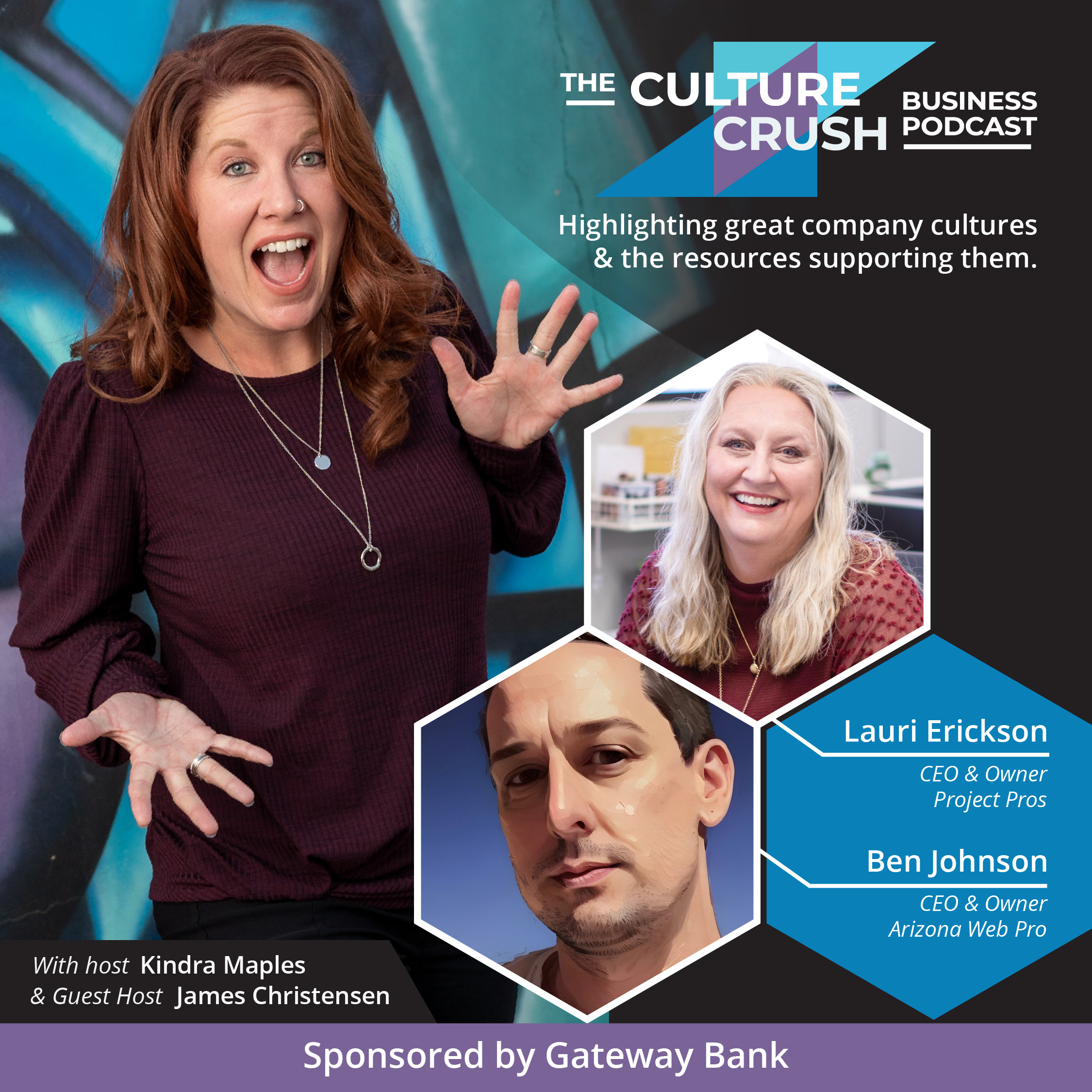
Thank you to James Christensen, the President of Gateway Bank, for joining in this conversation and adding his additional insight and stories as the co- host for this episode with Lauri and Ben.

Located in Tempe, Arizona, Project Pros is a family-owned business that’s dedicated to alleviating the administrative burdens faced by small business owners. Their comprehensive support services are designed to give business owners more time, spanning areas like bookkeeping, HR, social media management, phone answering, and virtual administrative assistance.

Project Pros emerged from CEO Lauri Erickson’s understanding of the need to shift small business owners from working ‘in’ their business to working ‘on’ it. The team at Project Pros fosters a synergetic environment, collaborating to find solutions for each client’s unique needs.

Their approach emphasizes collaborative problem-solving, ensuring that every team member’s skills contribute to the clients’ success. Project Pros goes beyond traditional outsourcing, streamlining processes to save their clients both time and money. They serve as an extension of their clients’ businesses, partnering at every stage to facilitate the growth and success of those businesses.

Lauri-Erickson-Culture-CrushLauri Erickson’s professional journey is highlighted by her executive-level expertise gained through diverse experiences in various companies and positions. With a background in human resources, bookkeeping, customer service, and sales, she possesses invaluable insights into the unique needs of small businesses.

Lauri’s driving force lies in helping small businesses thrive and flourish. To achieve this, she surrounds herself with a team of like-minded, highly talented, forward-thinking, and energetic individuals who share her passion for making a difference. Their unwavering dedication and support leave a powerful and positive impact on their customers’ success.

Connect with Lauri on LinkedIn and follow Project Pros on Facebook and Instagram.

AI automation agency. We act as the automation department for your business removing redundant work and helping you scale with ease.

Ben-Johnson-Culture-CrushBen Johnson is a seasoned data engineer and software developer with 20 years of experience.

He takes complex problems and solves them with simple and elegant solutions.

Connect with Ben on LinkedIn.

About Our Guest Co-Host

James-ChristensenJames Christensen is the President of Gateway Bank, the only community bank in Mesa, Arizona. Under his leadership, Gateway has thrived through multiple economic downturns and grown to consistently be one of the strongest performing financial institutions in its peer group.

James is also very active in the local community and was named Mesa Citizen of the Year in 2023. He is a fierce advocate for small businesses, marginalized groups, and people in need. From one-on-one meetings to presentations and podcasts like this, James enjoys educating and inspiring diverse audiences to improve their financial health and overall well-being.

Connect with James on LinkedIn.

About Culture Crush

At Culture Crush, culture isn’t just a corporate buzzword. It’s a key factor that can either boost your company or lead to its failure. 

We’re culture consultants, with a focus on leadership, appreciation, communication, processes, accessibility, mental health, diversity, inclusion, and creating a dynamic workplace.

CultaureCrushKindraBanner2

As a growing company:

Culture Crush Business is your hub for company culture resources. With deep cultural insights and years of expertise, we evaluate your company’s needs and connect you with the precise resources to cultivate a thriving culture.

We work with CEOs, founders, HR Directors, or Culture Leaders of companies or teams, who value company culture and understand its impact on their business success.With Culture Crush you’ll learn how to transform your workplace into a place of unity, efficiency, and growth. Don’t just fix your company culture – transform it with Culture Crush Business.

On this podcast:  We focus on everything surrounding businesses with good company culture. We will talk with company leaders to learn about real-life experiences, tips, and best practices for creating a healthy work environment where employees are finding joy and satisfaction in their work while also striving and growing within the company. We share the resources to help improve company culture and showcase them on the podcast with their tips and tricks for growing culture.

About the Host

ABHOUTHOSTHEADSHOT

Kindra Maples  is spartan racer, past animal trainer, previous magician’s assistant, and has a weakness for Oreo cookie shakes. Her journey working with people actually started working with animals as a teenager (don’t worry we won’t go that far back for her bio).

She worked for over 15 years in the zoo industry working with animals and the public. Her passion of working with animals shifted into working with people in education, operations and leadership roles. From there her passion of leadership and helping people develop has continued to grow.

Then came the opportunity for leading  the Culture Crush Business Podcast and she jumped on it. Leadership, growth, and strong company cultures are all areas that Kindra is interested in diving into further.

Thank you for our Sponsor!

This episode is sponsored by Gateway Bank, a community bank in Arizona that specializes in serving small businesses across the Valley and the country.

When you work with Gateway, you don’t have to call an 800 number for support, or submit your loan application and wait weeks or months for an answer. You get fast, personal service from a team who knows you and cares about you.

When Gateway was founded in 2007, the team had a vision of building a hometown bank that prioritizes people over profits. Over 15 years later, they’re proud to still be one of the highest-performing AND highest-rated community banks around.

Whether you need a loan or banking services for your business, Gateway is here to help. Visit gcbaz.com/culturecrush for details and a free consultation with bank President James Christensen.

All loans subject to approval. Member FDIC.

gateway-logo-color

Tagged With: AI, arizona back office support, arizona bookkeeping service, automation, back office support, business processes, business support services, Data Pipelines, small business support, web design

Jonathan Strack and Eric Cooley, Strack, Inc., and Chris Smith, CB Smith & Associates

July 14, 2023 by John Ray

Strack Inc.
North Fulton Studio
Jonathan Strack and Eric Cooley, Strack, Inc., and Chris Smith, CB Smith & Associates
Loading
00:00 /
RSS Feed
Share
Link
Embed

Download file

Strack Inc.

Jonathan Strack and Eric Cooley, Strack, Inc., and Chris Smith, CB Smith & Associates (ProfitSense with Bill McDermott, Episode 47)

On this edition of ProfitSense with Bill McDermott, Jonathan Strack and Eric Cooley from Strack, Inc., and Chris Smith, CB Smith & Associates, joined host Bill McDermott for a discussion on building their respective businesses and adapting to the digital age. Jonathan and Eric talked about cultivating a company culture, getting outside their comfort zone to recruit talent and market their business, growing the skills of their people, and more. Chris discussed the ways his firm is leveraging technology and AI, how they support their clients through tax planning, new tax laws, and more.

Bill concluded the episode with comments on the one liquidity rule every business owner should know.

ProfitSense with Bill McDermott is produced and broadcast by the North Fulton Studio of Business RadioX® in Alpharetta.

Jonathan Strack and Eric Cooley, Strack, Inc. 

Eric Cooley and Jonathan Strack, Strack, Inc.

Founded in 1948, Strack, Inc. is a heavy civil contractor focused on delivering value-driven project solutions, advanced industry training, and workforce development in the Southeast. Strack provides grading & excavation, pipeline construction, trenchless boring, design build, railroad construction and drilling and blasting services.

With a focus on the residential, municipal, industrial, and commercial markets, Strack is committed to delivering quality infrastructure built by an equipped and empowered team of nearly 600 employees. At Strack, they foster a relationship-driven culture and are driven by living out their core values of Better Every Day, Mindful in Everything, Humble Hearts Open Hands, and Everyone Matters in everything they do.

Jonathan Strack is CEO and President of Strack, Inc. He is a  3rd generation Strack, who has led the way for growth and provided vision for the future of Strack Inc., unlike anyone else. Under his leadership, Strack has more than quintupled in revenue all while expanding into new market segments and construction disciplines. Jonathan was awarded Construction Equipment’s ‘Under 40 in Construction Equipment Award’ for 2020.

Eric Cooley joined Strack as Chief Financial Officer in June 2019. Eric has more than two decades of experience serving in construction financial management roles. Over his career, Eric has had the privilege of building and developing many successful teams in the areas of finance, accounting, HR, IT, project management, training, and recruiting.

He holds a BS in Business Administration from Longwood University and an MBA from Campbell University. He is also a Certified Construction Industry Financial Professional (CCIFP) and IMA Certified Management Accountant (CMA). During his career, Eric has gained a mix of public, private, and private equity experience with company revenues from $100 million to $4 billion. Eric enjoys working collaboratively across the organization to strategically solve business problems, create structure, and develop systems.

Website | Facebook| Instagram

CB Smith & Associates

CB Smith & Associates is a Georgia-based business advisory and CPA firm that delivers big-firm expertise and acumen with small-town thoughtfulness and warmth. We help bring to light the stories that numbers tell — about the health of your business, the soundness of your financial or tax plan, and the options that can lead you to a path of success. We believe that awareness makes opportunity visible.

Website | Facebook | LinkedIn

Chris Smith, President, CB Smith & Associates

Chris Smith, President, CB Smith & Associates

With over 30 years of financial experience, Chris Smith is passionate about his work. Since founding the accounting firm in 2003, he has led the firm’s growth from one to three office locations in Georgia to include 35 employees with a solid team of certified public accountants and other tax professionals.

CB Smith & Associates is a business advisory and full-service accounting firm that works in tandem with its sister company, Reliance Payroll LLC, a full-service payroll and human resources outsourcing firm.

Prior to starting his own firm, Chris was a corporate controller. He earned a degree in accounting from Georgia State University’s J. Mack Robinson College of Business, is active in local community groups such as the Rotary Club and numerous CPA groups.

LinkedIn

About ProfitSense and Your Host, Bill McDermott

Bill McDermott
Bill McDermott

ProfitSense with Bill McDermott dives into the stories behind some of Atlanta’s successful businesses and business owners and the professionals that advise them. This show helps local business leaders get the word out about the important work they’re doing to serve their market, their community, and their profession. The show is presented by McDermott Financial Solutions. McDermott Financial helps business owners improve cash flow and profitability, find financing, break through barriers to expansion, and financially prepare to exit their business. The show archive can be found at profitsenseradio.com.

Bill McDermott is the Founder and CEO of McDermott Financial Solutions. When business owners want to increase their profitability, they don’t have the expertise to know where to start or what to do. Bill leverages his knowledge and relationships from 32 years as a banker to identify the hurdles getting in the way and create a plan to deliver profitability they never thought possible.

Bill currently serves as Treasurer for the Atlanta Executive Forum and has held previous positions as a board member for the Kennesaw State University Entrepreneurship Center and Gwinnett Habitat for Humanity and Treasurer for CEO NetWeavers. Bill is a graduate of Wake Forest University and he and his wife, Martha have called Atlanta home for over 40 years. Outside of work, Bill enjoys golf, traveling, and gardening.

Connect with Bill on LinkedIn and Twitter and follow McDermott Financial Solutions on LinkedIn.

TRANSCRIPT

Intro: [00:00:03] Broadcasting from the Business RadioX Studio in Alpharetta, it’s Time for ProfitSense with Bill McDermott.

Bill McDermott: [00:00:16] Good morning. Welcome to ProfitSense. This podcast dives into the stories behind some of Atlanta’s successful businesses, and business owners, and the professionals that advise them. We help local business leaders get the word out about the important work they’re doing to serve their market, their community, and their profession, as well as discuss current issues that business owners are facing today across a wide variety of industries.

Bill McDermott: [00:00:43] I’m your host, Bill McDermott. And this show is presented by The Profitability Coach. When business owners want to increase their profitability, they often don’t have the expertise to know where to start or what to do. I leverage my knowledge and relationships from 32 years in banking to identify the hurdles getting in the way and create a plan to deliver profitability they never thought possible.

Bill McDermott: [00:01:07] We have three great guests on the show today and I just want to welcome each one of them. Jonathan Strack with Strack, Inc. Jonathan, welcome to ProfitSense.

Jonathan Strack: [00:01:17] Thank you very much.

Bill McDermott: [00:01:18] And Eric Cooley also with Strack. Eric, welcome to ProfitSense today.

Eric Cooley: [00:01:23] Thank you, Bill.

Bill McDermott: [00:01:24] And then, Chris Smith. Chris, welcome to ProfitSense. So glad you’re here.

Chris Smith: [00:01:28] Yeah. Thank you, Bill. Thanks for having me.

Bill McDermott: [00:01:30] So, Jonathan and Eric, I’m going to start with you. You know, we all know there’s a war for talent out there in the industry, especially in the construction industry. But I think across the board, it’s really hard to find great people. But you and your management team have done a fabulous job of building the business over a period of time. So, you know, I don’t want you to reveal any trade secrets here, but you’ve been in business for 75 years, how do you use that to attract top talent to the company? Jonathan?

Jonathan Strack: [00:02:08] Yeah. Just being in business for 75 years, you’ve got great relationships, you’ve got stability. We’ve got a really good long running reputation for quality, treating people well, doing a good job, and being fair. So, from that regard, it helps us sell ourselves.

Jonathan Strack: [00:02:27] But, you know, trying to find talent, you’re competing against everybody in a really saturated market. So, we really had to rethink how we went about attracting and retaining folks. We had to get used to being on social media and hire some additional staff we’ve never had before. So, that’s just part of an evolution of 75 years of business and changing times.

Bill McDermott: [00:02:53] Sure. And, Eric, I know there was a time, I want to say, maybe five or six years ago when you joined Strack, and I’m sure with your background and experience, you could probably go just about anywhere. What attracted you to Strack to become CFO there?

Eric Cooley: [00:03:10] For me, it was the longevity of the company, the reputation, and the marketplace. It’s the family feel. It really has a strong family culture. Again, we’ve doubled in size over the last three years. We’re nearly 600 employees at this point. But it’s just this feeling that you’re not just a number there. You mean something to the team no matter where you sit in the organization. So, just that culture, it’s hard to find that. I have a background in the corporate side. I’ve done some private equity. And so, just having this feeling of like a belonging there was important to me.

Bill McDermott: [00:03:44] Yeah. Yeah. I could understand why. And so, I know certainly there is a huge benefit of working for a privately held company. Core values typically come into play there. And so, I know, Jonathan, many employers do focus on their core values to be sure they find and retain the right people. So, how does Strack use that in their hiring process?

Jonathan Strack: [00:04:19] Well, we had to really sit down and define who we were as we grew. We had a set of well-known core values that were known by everybody that had been in the business, because that flowed from the family, we had long running employees. We were not typically a fast growing company, so it learned through osmosis or tribally, and it got handed down effectively well.

Jonathan Strack: [00:04:47] One of the things we figured out as we started to grow is how do you replicate you into all these folks that you’re bringing on board and make sure you’re still a special place to be. So, we sat down to find our core values so we’re better every day, mindful in everything, humble hearts, open hands, and everyone matters. Those are our core values. And trying to really teach the team right now to make every decision around that framework of those core values.

Jonathan Strack: [00:05:22] So, you know, it kind of went hand-in-hand with attraction or attracting and retaining talent and recruitment. And what we came up with was we decided we wanted to do our own management training, our own leadership training. We came up with our own leadership training program. We call it Frontline Leadership Training. It’s six days of training with cohorts of 20 to 30 people. And we’re going to put everybody in the business from pretty much a lead man up through a CEO. We’re all going to go through the training together.

Jonathan Strack: [00:06:03] And what it’s about is really two halves of the coin. It’s teaching what’s our standard professionally. We take a job from acquisition, we schedule it, we track it, we close it out. So, everybody in the business gets some appreciation for every other position in the company.

Jonathan Strack: [00:06:23] Like, our first one we did, we did a bid wedding. So, we had guys that they may run a Finnish crew, they may run a skid steer and a dozer and a couple of guys, and they’re having to bid on a job all of a sudden. So, they get a lot of appreciation for what the guys in the office have to do and disseminate a whole lot in a hurry.

Jonathan Strack: [00:06:45] But the other half of the coin is the personal side, the soft skill side. We want to relate to some household budget. You know, if your household finances at home are in disarray, how do we expect you to take care of our dollars? We want to do some career coaching, some goal setting, teach folks about how to properly communicate on the job, written, spoken, how to do an interview. Definitely, we’ve got a culture that is not typical. And we want to make sure that gets reflected by all our leadership. So, it’s really six days of teaching who we are and what’s our standard from professional standard attitude and ethics.

Bill McDermott: [00:07:33] Eric, from your perspective, similar question, how do you find that you, as CFO, are embodying those core values that Jonathan mentioned in your hiring process?

Eric Cooley: [00:07:48] Yeah. I mean, a lot of this obviously, as Jonathan said, we use that as a filter as we’re looking to hire folks. I think there’s always some of the professional stuff you can teach, but finding the right person with that character that shares those values with you is really important. And so, you know, if I evaluate talent on my team, that’s something we look at and try to coach around. And I try to embody those things to the best of my ability on an every day. And it’s just about being intentional about it and trying to recognize it.

Eric Cooley: [00:08:17] One thing I do talk to my team about is that we’re not an accounting company that also does construction. We’re really here to serve the construction business. So, we’re a construction company. We happen to be a piece of the wheel. And I think just recognizing where you fit in the organization is important. You know, looking at mindful and everything, that’s talking about, not just worrying about what’s going on in accounting, but think about these folks have other responsibilities they have to look at and serve, and so just working through that.

Bill McDermott: [00:08:46] And I think I’ve found, Eric, once you start sharing those core values in the interviewing process, a lot of times you find people that just don’t feel a fit and they’ll self-select out as well. Has that been your experience as well?

Eric Cooley: [00:09:01] That has been some, historically, yes. So, I think it’s important if you kind of talk about, “Hey. These are the things we’re doing,” then you get someone else talking about, “Hey. I really want to advance quickly or I really want money,” then it pretty much doesn’t line up. We’re not just about making money at Strack. It’s about the culture, about the fit.

Bill McDermott: [00:09:19] Sure. Sure. Excellent points. Jonathan, as you have built the organization, are there any particular hiring methods that seem to work well at Strack, Inc.?

Jonathan Strack: [00:09:33] Well, as we started growing six or seven years ago, pretty heavily, one of the things I had to get used to was social media. Typically, in our industry, my view was stay off social media because you don’t want to attract any needless attention to what you’re doing. It’s already a risky business. But, really, anything that’s on a social media platform, that’s your best attraction and retention tool. And that really legitimizes what you’re doing now.

Jonathan Strack: [00:10:05] We’ve gotten business based off our social media presence, you know, especially when we started grading. We’d been primarily a pipe contractor most of my life. And as we started doing earthwork, that was a definite change in perception for the industry.

Jonathan Strack: [00:10:22] And as we were trying to win some work, I’d have conversations with really large clients that said, “Hey, we see what you’re doing on social media. You look like you know what you’re doing. We trust you. You’ve been in business 70 something years and we’ve worked with you before in other places. So, hey, come on, we’re willing to give you a shot.” And that really perked me up and surprised me. So, I’ve become a lot more open to exposing ourselves to what we do.

Jonathan Strack: [00:10:51] And I mean, the other piece is you’ve got to be willing to accept some failure and learn from it. We’ve definitely had some of that along the way.

Bill McDermott: [00:11:00] Growing up in an era where there were no mobile phones, no internet, let alone no social media, like you, I have my own stories about social media. And thank goodness I’ve got one or two people that are in their 30s and can guide me in those processes. But like you, I struggled with Instagram and all the things that have to do with social media.

Jonathan Strack: [00:11:34] Yeah. And I think, you know, for construction, just changing our perception of who we are and what we are is a big deal. I mean, we’re not well-thought of by the public. I mean, when you think of construction, a lot of people think about the home remodeling guy that ran off with the work half done with all their money. And that’s not us.

Jonathan Strack: [00:11:55] And trying to really expose ourselves to high school students, college students, even middle and elementary school students and explain, “Hey. You know, we’ve got marketing folks, we’ve got accounting folks, we’ve got surveying folks. Any other legitimate business that has all these positions, we have them, too.”

Jonathan Strack: [00:12:17] I mean, I had a young man, he runs our lube truck and he’s 22 or 23, and he just was not feeling it. He says, “Look, you know, I don’t know where my path is.” But he has this passion for photography. I said, “Well, we spend a lot of money every year paying for a photographer to come out and document our stuff, make social media content for us, you obviously know what you’re doing. What do you want? Make me a wish list. I’ll buy the equipment and let’s work you into a full time position. I already paid for it anyway. You’re here. You love it. You know us. You represent us well. You and your brother work for us. Come on, let’s do it.”

Bill McDermott: [00:13:02] Wow. Wow. That’s a great story. I do know construction has a reputation. I can so relate because I come from a banking background, and bankers are challenged. There are some great bankers out there, but also banking in general is just kind of a hard process to go through.

Bill McDermott: [00:13:28] Eric, it’s one thing to attract top talent, but how, in your view, does Strack retain that talent in the company?

Eric Cooley: [00:13:37] Yeah. So, retention has been tough just in this market, particularly in the field. I think a lot of construction has high turnover and we’re not that different as it comes to that. And that’s one thing we really focused on, as we’ve tried to grow, we’ve also had to replace. But I think the key things we look at is, you know, we start training from day one.

Eric Cooley: [00:13:58] So, a lot of folks from an orientation perspective, they may come in, have you just sign some papers. We’re running a four day orientation program right now. You come in. You learn the standard operating procedures for the company. You get safety training. You have an opportunity to go through. We’ve got equipment simulators to get familiarization with the equipment. And so, you know, really making that investment starting in day one.

Eric Cooley: [00:14:21] And I think living out our core values, that’s something that’s key to trying to retain them. If we’ve sold them on something, it’s important that we live that out and they’re able to see that demonstrated to hold on to them.

Eric Cooley: [00:14:33] I think Jonathan touched a little bit on the training. So, we’ve got this frontline leadership training program we’ve built. We’re also building an Operator Training Program, where we’ve promoted four guys from inside the business and they’re going to go out and help on the job sites to help train and really bring up the level of experience and understanding to some of the newer employees. Because part of this, you know, attracting new talent means we might be looking at folks from other industries. And so, part of that’s just trying to help increase the knowledge base out there.

Eric Cooley: [00:15:06] And then, you know, some other things we’ve done is we’ve got Marketplace Chaplains. So, we have a chaplain service to really demonstrate the care. And at this point, Jonathan’s not able to talk to every employer. Historically, he could take calls consistently. But at this point, it’s making sure that that message is out there, we care and how can we help you there.

Bill McDermott: [00:15:25] We had that at a bank that I worked at, too, and that made a world of difference because there was a point in time when I had lost my father and was going through a grieving process. And so, that is wonderful.

Eric Cooley: [00:15:37] And I think something else that is kind of unique here is we have a charitable gift matching. So, any employee, any charitable gift giving they make, the company will match that. And there is a limit set for just normal charities. As it comes to tithing, it’s unlimited. So, just really pushing further on the values and demonstrating from our actions that we’re going to live those out.

Bill McDermott: [00:15:58] Yeah, that’s awesome. We’re talking today with Jonathan Strack and Eric Cooley with Strack Inc. Founded in 1948, Strack Inc. is a heavy civil contractor focused on delivering value driven project solutions, advanced industry training and workforce development in the southeast. They provide grading and excavation, pipeline construction, trenchless boring, and many other things. They’re committed to delivering quality infrastructure built by and equipped and empowered team of nearly 600 employees.

Bill McDermott: [00:16:31] And, Jonathan, what a great legacy that you’re continuing to leave and will do into future generations. But I’m curious, how, in your view, have your hiring and retention processes evolved through the years?

Jonathan Strack: [00:16:49] Well, most of your hiring in years past was either referral, and you still have a fair bit of that. But it used to be you’d have guys walk in your front door, want to fill out an application. It was a very organic process. You might put an ad out in the local newspaper or in the Atlanta Journal Constitution.

Jonathan Strack: [00:17:10] But, now, you get very few people that way. And if they’re coming in the front door, those are probably not the guys you want to hire, honestly, in today’s environment. I’m not saying that doesn’t ever happen, but by and large like I talked about earlier, you’ve got social media platforms, you do paid ads. We actually have a human resources software now that helps us post some of our jobs. We’ve gotten a lot of traction that way. We have a full time recruiter on staff, full time that calls and vets folks before we really ever get into an interview.

Jonathan Strack: [00:17:53] And the team itself, they pretty well supply the needs to the recruiter. And between HR and recruitment, they disseminate the needs back out to the guys as they do interviews. We’ve got paid billboard advertisements right now. I mean, we’re trying things we’ve never tried before just to get some attention to us. I mean, we’ve got three or four billboards at the I-85 Corridor right now.

Eric Cooley: [00:18:22] We do. Yes.

Jonathan Strack: [00:18:22] I’ve never, never thought I would do that. I never liked talking about us. You know, we’re pretty humble as a whole. And that always used to appear arrogant to me. But now, it’s out of necessity. I’ve got to try whatever I can, regardless of what I may or may not be comfortable with, because we don’t know what works right now. We’re having to learn.

Bill McDermott: [00:18:46] So, Eric, I think if you say it, sometimes it can be taken as bragging. But I’m sure if your employees are saying it, that’s testimony. And so, I’m wondering from your perspective, how do you maybe engage your workforce in looking for people just like them to send your way as well?

Eric Cooley: [00:19:13] Right. Yeah. A lot of that is giving our employee that experience so they do want to do the referrals. And then, we do have an Employee Referral Program to where the employees are rewarded for bringing new employees onboard.

Eric Cooley: [00:19:26] We’re working on an internal communications app. It’ll actually be an application on your phone. And I think given that connectivity, you know, the consistent message all the way throughout the organization will help the employees that may not get to see everything or be aware of everything to really make them more aware of what’s going on in the company, and then want to invite their friends or other other folks to join them. So, I think that communication is big. And, really, the encouragement to bring folks, more like yourself, to come to the company is how I see that.

Bill McDermott: [00:19:55] Sure. Sure. Absolutely. So, just in case we have any potential great employees who might be out there, let’s use the ProfitSense Podcast too. Jonathan, Eric, what’s the best way if there’s someone interested in coming to work for a great company like Strack, Inc., how should they get in touch with you?

Jonathan Strack: [00:20:14] I’ll take it. Yeah. I mean, the best way, you can get on the website and put an app in. You can always message us on any social media platform. That’s monitored full time by folks we have on staff. So, really, any public facing portal we have, whether it’s LinkedIn, Facebook, website, shoot us a message, put in an application, and we’ll call you back pretty promptly.

Bill McDermott: [00:20:42] And, Eric, what’s the website address for the company?

Eric Cooley: [00:20:45] It’s www.strackinc.com.

Bill McDermott: [00:20:49] Great. Jonathan and Eric, thanks so much for coming on ProfitSense today and sharing your experience and your expertise. And congratulations on building a company with an employee base of 600 people. That’s quite an accomplishment. Congratulations.

Eric Cooley: [00:21:05] Thank you for inviting us.

Jonathan Strack: [00:21:06] Thank you.

Bill McDermott: [00:21:09] And so, Chris Smith, Chris is with CB Smith & Associates. Chris, so glad to have you. For our listeners, tell us a little bit about CB Smith & Associates. You’ve got a headquarters in Alpharetta, but also Macon and the Lake Oconee area. As an accounting and business advisory firm, what do you do for businesses and individuals?

Jonathan Strack: [00:21:34] Yes. Thanks, Bill.

Chris Smith: [00:21:36] So, CB Smith is celebrating their 20th year being in business. I started CB Smith in the Cumming area back in 2003. And we’ve slowly grown over the years. Today, we’re a full service firm. I have a partner at the firm, his name is Tim Whittemore. And as you mentioned, we have offices in Macon and here in Alpharetta, and we have a satellite office in the Lake Oconee area. Today, we’re a full service firm. We do audit work. We do reviews. We do tax planning, business advisory services, and, of course, tax compliance work for our clients.
Chris Smith: [00:22:19] But one of the areas that we’ve really focused in – gosh – since 2007 timeframe is moving accounting into a paperless environment. And once accounting gets into a paperless environment, it’s all X’s and O’s. And then, you can do things like process automation, really automate processes, and improve collaboration amongst team members. And, hopefully, help to make a business more scalable.

Chris Smith: [00:22:51] From a philosophical standpoint, I’m a big believer in the things that got you out of Egypt are not the same things that will get you to the Promised Land.

Bill McDermott: [00:23:00] Well said.

Chris Smith: [00:23:03] We love working with businesses that are at that stage. They’ve hit a ceiling of complexity and they’re trying to figure out what are those things that will get us to the Promised Land. And so, we help them by implementing and retooling the accounting function. We’re a big believer that the accounting function shouldn’t be an anchor on the business. It should be a driver of growth. And so, we try to work with our clients from that standpoint.

Chris Smith: [00:23:29] So, we’ve got some young folks at the firm that are taking advantage of these no code, low code solutions that are out there, power apps, mostly for the Microsoft platform that takes those X’s and O’s or those ones and zeros, and, really, starts to build a better process for our clients and their business processes, improves internal controls in the business. And, hopefully, that leads to growth and that’s where we come in and help them from a tax planning standpoint.

Bill McDermott: [00:24:09] Now, you’re preaching to the choir here when you start talking about processes. One of the things that I found in working with my clients is rarely do I see processes in writing. And if they’re in writing, are they being followed? And so, when you started talking about business process automation, that’s like documented processes on steroids. But tell us a little bit more about that, because I think you’ve really carved a niche in the marketplace with business process automation, haven’t you?

Eric Cooley: [00:24:41] Yeah. Yes. Certainly, we really love working with our clients from that standpoint and putting everything on its side. You know, the documents as an example, having an SOP document and all the binders and everything to that effect, we integrate it into the process. That documentation is the process. So, if someone gets to a form and how do I fill this out or what am I doing with this, you can have a Help Menu item that just shows up. And it is, “Here’s our policy. This is how this works.” So, we integrate it into the tools that are in place.

Chris Smith: [00:25:18] You know, historically speaking, you have your software and then you have your policy document. And so, now the software and the policy document become one. And with the low code and no code development that can be done just by accountants, you’re able to now integrate those things together. And it’s flexible. It’s agile. As the business changes, the environment for the business changes. You can change your policies and integrate it right into the app right at the same time.

Chris Smith: [00:25:49] It also eliminates so much human error that may be in place, especially if you do have a document. A lot of times they come in electronically as it is. But even if they’re scanned in, you can OCR. Artificial intelligence sometimes can be scary for folks but it’s here and leverage it.

Chris Smith: [00:26:07] And so, if you have an AI that can sit there and read a document and know it’s an invoice from a particular vendor, and knows where to go look on that invoice for the amount, when it’s due, so on and so forth, use the AI. And then, your people, instead of becoming data entry clerks, they’re reviewing what the AI does, make sure it’s good.

Chris Smith: [00:26:26] And once that’s in there and, again, ones and zeros, you don’t have any room for human error later on down the road. The integrity of your data really improves. And there’s a lot of benefits in terms of efficiency so the business can focus in on what it does and reduce its administrative costs accordingly.

Bill McDermott: [00:26:48] Yeah. I can really see the benefit of not only improving efficiency, but also improving effectiveness. I can’t talk to a CPA without talking about taxes. Taxes come up. And so, I’m going to insert a little personal bias here. So, businesses that have a tax strategy that minimizes taxable income make them very difficult to bank lending customers, coming from a banking background. So, that’s my bias there I have to get over.

Bill McDermott: [00:27:26] But I do know tax planning is a big part of your business. What do you see as tax planning? How do you do it? And then, why is it important for small businesses to do tax planning?

Chris Smith: [00:27:41] Our first philosophy is, first off, we’re going to be your advocate for our clients. Tax planning is important, but tax planning isn’t the end all, be all. Improving your wealth is the end all, be all. And so, we’re not going to implement or suggest a tax solution that isn’t necessarily in line with improving our client’s overall financial well-being. And so, that’s always secondary to financial well-being. But it’s a very important piece.
Chris Smith: [00:28:15] We’re in a segment. We’re not a large national firm, so we don’t have a lot of clients that are publicly traded or anything like that. Our clients don’t have investors to impress. They’ve got to impress the bank every once in a while. You know, so our focus is going to be on tax planning. It’s a heavy part of our relationships with our clients. And, you know, that is the business we’re in, by the way, is the relationship business. We may be accountants, but that’s what it is.



Chris Smith: [00:28:43] And so, we’re going to work with our clients to ensure their financial well-being is in place. And they’re doing it as a tax efficient manner as possible. And if they need a source of funding because of some sort of, you know, new business plan, new venture that they’re going to move into, then we’ll work with our clients and we’ll work with the bankers. And make sure the bankers understand these are things that we’re doing from a tax perspective, so let’s make some adjustments accordingly so you can get a better picture of what the cash flow would be for the organization, so you can make better lending decisions from that standpoint.

Bill McDermott: [00:29:25] Yeah, it makes perfect sense. So, the baby boomer generation business owners are retiring in droves. They’ve been successful. They’re wanting to exit. So, talk a little bit about how CB Smith & Associates helps business owners with succession planning.

Chris Smith: [00:29:45] Yeah, certainly. There is a time frame. Each business sits at a different life cycle and all businesses are different. We’re dealing with clients that are startups, that are on that front end stage, cash is really tight, they’re in a high growth environment. We’re trying to help them with business process automation to leverage the tools that are out there.

Chris Smith: [00:30:07] And then, we have clients that maybe are at that little more mature stage, but they’re ready to go another 10, 15 years. And so, that’s where tax planning comes into play. That’s where we’re thinking about, “Okay. How can we minimize your tax as much as possible?” So, that’s available cash to reinvest in the business or harvest from the business.

Chris Smith: [00:30:29] And then, we have clients that are very mature, you know, multi-generational businesses and they’re dealing with other issues where they’ve just got more pieces of the pie that they have to spread out, and so how do they manage growth from that standpoint.

Chris Smith: [00:30:46] But then, we have folks that they’re not ready to pass it on to the next generation. They’re looking for some sort of a succession plan. And the key to them is planning ahead of schedule. It’s a five year look. That’s where we change our strategy. We’re not necessarily interested in maximizing the tax benefits that they may be receiving, but we’re interested in making sure that business looks like a nice rose on the bush and it’s ready to be plucked off.

Chris Smith: [00:31:16] So, we’re going to help our clients from that standpoint. We’re going to make sure that maybe we don’t take those deductions as benefits that you have been taking in the past. Let’s see what we can do to improve the cash flow from the business to the owners. We often refer to it as EBITDA.

Chris Smith: [00:31:35] And sometimes it’s different. It depends on the business. It could be a heavy asset business, got a lot of assets to it, or it could be a business that doesn’t have much of a balance sheet at all and it’s more of a service business. So, we’re going to look at those aspects and make sure that that business is in a good position so they can maximize value out of it.

Chris Smith: [00:31:53] What are they doing from a management standpoint? Bill, you know this really well. What are they doing from a management standpoint so the business is not defined by the owner. It’s defined by the team. And so, that really enhances value of that business from that standpoint. And that’s a philosophy you should have even if you’re not looking to sell the business. Make the business work for you. You not work for the business. But we’re going to work with them and make sure that they have the right mindset in terms of what they’re doing.

Chris Smith: [00:32:27] And then, we’ll have conversations with them, they are going to cash it. How do you handle that? What’s the estate going to look like? What are we looking at in terms of the value of the estate and how is that going to go? How are those assets going to get passed on? How is it going to get taxed when you die? Having some conversations on that.

Chris Smith: [00:32:49] Also, having conversations of do you want to sell it to a competitor or do you want to sell it to your employees. We’re working with a company right now. It’s a civil engineering firm. And we’re working with them to potentially have a tax free sale through an ESOP. And so, we’re going to have those conversations with the clients, here are the benefits, this is how much of a squeeze you need to make to get the juice out of the fruit, per se. This is what’s going to be involved administratively to be able to get those benefits.

Chris Smith: [00:33:22] We had another client that was in the chemical business that they’re getting ready to be bought out by a competitor right now. And there was a big discussion as to whether it was going to be a stock sale or an asset sale. And an asset sale was going to cost them about an additional $800,000 in tax. And so, that’s an important conversation to have with your client in saying, “Hey, we need to have an understanding of this.” And that may be a renegotiation that you have with the buyer that says, not only do we have $800,000 in tax associated with an asset sale, but we also have capital gains on that $800,000. So, we probably need to have close to $1 million of additional compensation from the sale of the business. And, fortunately, it was a nice business, so the buyer agreed to that.

Bill McDermott: [00:34:12] Yeah. That’s great. We’re talking today with Chris Smith, who’s president of CB Smith & Associates. Chris has over 30 years of financial experience, passionate about his work since founding the accounting firm in 2003. He’s led the firm’s growth from one to three offices in Georgia to include 35 employees with a solid team. CB Smith & Associates is a business advisory and full service accounting firm that works in tandem with its sister company, Reliance Payroll, which is a full service payroll and human resources outsourcing firm.

Bill McDermott: [00:34:48] Chris, last question. Today, what are some tax law changes in Georgia that individuals or businesses need to know this year?

Chris Smith: [00:35:00] Certainly. Thanks for asking that question. There have been some recent tax law changes here in Georgia. And, you know, we just had a little internal, we have a First Friday Program with all of our staff. The first Friday of every month, everyone gets together and we talk about recent changes.

Chris Smith: [00:35:19] So, we, literally, just last Friday had a conversation about some tax law changes here in Georgia. So, it’s kind of still somewhat fresh in my head. The big piece that we have – there’s a couple pieces – one is, last year, Georgia passed what was called a Pass-Through Entity Election Law that allowed for S-corporations, in particular, and some partnerships to elect to be treated as a C-corporation for Georgia tax purposes.

Chris Smith: [00:35:51] And the benefit to that has to do with the S-corporation and partnership owners’ personal tax returns, because state taxes, when you itemize your deductions on the federal return, state taxes are limited to $10,000. And so, if you have a business of any worthiness that you can quickly exceed that, especially if you own a house and you’ve got property taxes of $5,000, $6,000, before you know it, you’ve hit that $10,000 threshold.

Chris Smith: [00:36:20] So, what this election does is it allows the Georgia income to be taxed at the entity level and it becomes a deduction for trade and business purposes purposes. And it eliminates it from your itemized deductions. And, of course, the income on your personal Georgia return that was taxed at the entity level is excluded from your income on your personal return. So, there’s a lot of benefits to that.

Chris Smith: [00:36:46] One problem we had with this is that it was limited. The partnerships that could participate in that was limited. You had to have certain qualifications in order to be able to do that. And so, Georgia has amended that law, I think it’s House Bill 415 that did that. So, they have amended House Bill 415 to allow all partnerships to participate in that election beginning in 2023, the 2023 tax year. So, that’s a big benefit for some of those businesses that were out there that there was a partnership arrangement they couldn’t do it. We had a couple of clients that just couldn’t do it from that standpoint, just due to the nature of the partners or in their partnership.

Chris Smith: [00:37:29] The other change that was been made and, of course, this is good news if you are one that likes paying less tax to the state of Georgia. House Bill 454 was just passed. And with that, the individual rate is going down. In prior years, the Georgia tax rate for both corporations and individuals was 5.75 percent. And Georgia’s individual rate is going to go down to 5.49 percent in 2024. And then, every year after that, it will go down another 10th of a point and it will rest in 2029 at 4.99 percent. So, that’s a good benefit for a lot of individuals.

Chris Smith: [00:38:16] The other things that changed for individuals is the Georgia Standard Deduction for filing married, filing jointly individuals has gone to $24,000. And the standard deduction for all others filing single, married, single head of household has moved over to $12,000. So, those are some of the changes that, just in the last legislative session, have been passed. And so, we’re going to see some benefits from that going forward.

Bill McDermott: [00:38:47] Yeah. Wow. Tax rates actually going down a little bit. What a concept. Chris, if someone has accounting questions or needs to get in touch with you for some accounting advice, what’s the best way for them to get in touch with you?

Chris Smith: [00:39:01] Yeah. So, website is a great place to go to. You can be a very small business just getting started, you’re trying to conserve every dollar you can, go to our website, sign up for a newsletter. We send out articles. We do blog posts monthly on various topics. A lot of great articles on our website about starting a business.

Chris Smith: [00:39:26] If you’re at a different stage in your business and tax is becoming a problem, business is growing, you know, feel free to reach out to us. There’s a couple links on the website to inquire with us and one of our senior level tax managers will call you up and have a conversation about how we can help you and how we can build a relationship with you from that standpoint.

Bill McDermott: [00:39:50] That’s great. And that web address is?

Chris Smith: [00:39:52] Yes. It’s CB Smith and Associates, so it is www.cbsmithcpa.com. That’s our website. And, of course, as your previous guests here had mentioned, we are also looking for talent in the area. And we work with a lot of the universities and schools, but we’re also looking for senior level talent as well that would help fuel our growth.

Chris Smith: [00:40:19] We’re a big believer that the players bring the fans. And so, the quality of our employees bringing clients and help us with growth. And so, we encourage anyone that may be interested in joining the team to go out to our website as well. You can go to About Us, and there’s a link there for joining the team, and we’d love to have an opportunity to speak with you.

Bill McDermott: [00:40:38] That’s great. Chris, thanks so much for coming on ProfitSense today.

Chris Smith: [00:40:42] Thank you.

Bill McDermott: [00:40:45] I want to take a minute to talk a little bit about liquidity. You’ve heard the idea that cash is king, and there is one liquidity rule that I think every business owner should know. Every business owner understands that cash is critical to running a business. But knowing how much cash is needed leaves many business owners confused and frustrated.

Bill McDermott: [00:41:08] I worked with a professional services firm that has a practice with three locations. Their revenue came from professional services that were reimbursed by insurance – insurance companies, as we all know, are notoriously slow in this practice – found themselves with at least half of their receivables over 90 days. No one was accountable for collections and they were forced to borrow from very expensive lending sources just to fund payroll.

Bill McDermott: [00:41:34] Quickly, we put the internal accountant in charge of collections. She blocked time on her calendar daily to make collection calls. In the next six weeks, the amount of over 90 day receivables was reduced to about 10 percent of the total, that was $100,000 cash impact to that firm. And the firm’s cash balance doubled because of it. They no longer had to borrow and saved a significant amount of interest expense.

Bill McDermott: [00:41:59] Now, the firm who works in the manufacturing space was able to increase their cash balance simply by requiring a 50 percent deposit for their product upfront. That way, they weren’t fronting all of their costs.

Bill McDermott: [00:42:14] No matter how you achieve it, my recommendation is that 15 to 20 days sales is a good number. Take your annual sales, divide it by 360, then divide that number into your cash balance. So, if you have $5 million in revenue, that’s about $14,000 a day to have 15 days sales and cash, your cash balance would need to average about $210,000. If you’re struggling with liquidity, work with your finance person to find out how to improve your cash balance and take action.

Bill McDermott: [00:42:49] If you want to keep up with the latest in pro business news, follow us on LinkedIn and Instagram at The Profitability Coach. If you want to listen to past or future ProfitSense episodes, you can find us on profitsenseradio.com. This is ProfitSense with Bill McDermott signing off. Make it a great day.


Tagged With: Accounting, AI, Bill McDermott, CB Smith & Associates, Chris Smith, Eric Cooley, Jonathan Strack, ProfitSense with Bill McDermott, retaining talent, Social Media, Strack Inc., talent aquisition, tax law, The Profitability Coach

Fractional Consulting for Small Businesses, with Robert Burke, Sobo

June 26, 2023 by John Ray

Sobo
North Fulton Business Radio
Fractional Consulting for Small Businesses, with Robert Burke, Sobo
Loading
00:00 /
RSS Feed
Share
Link
Embed

Download file

Sobo

Fractional Consulting for Small Businesses, with Robert Burke, Sobo (North Fulton Business Radio, Episode 674)

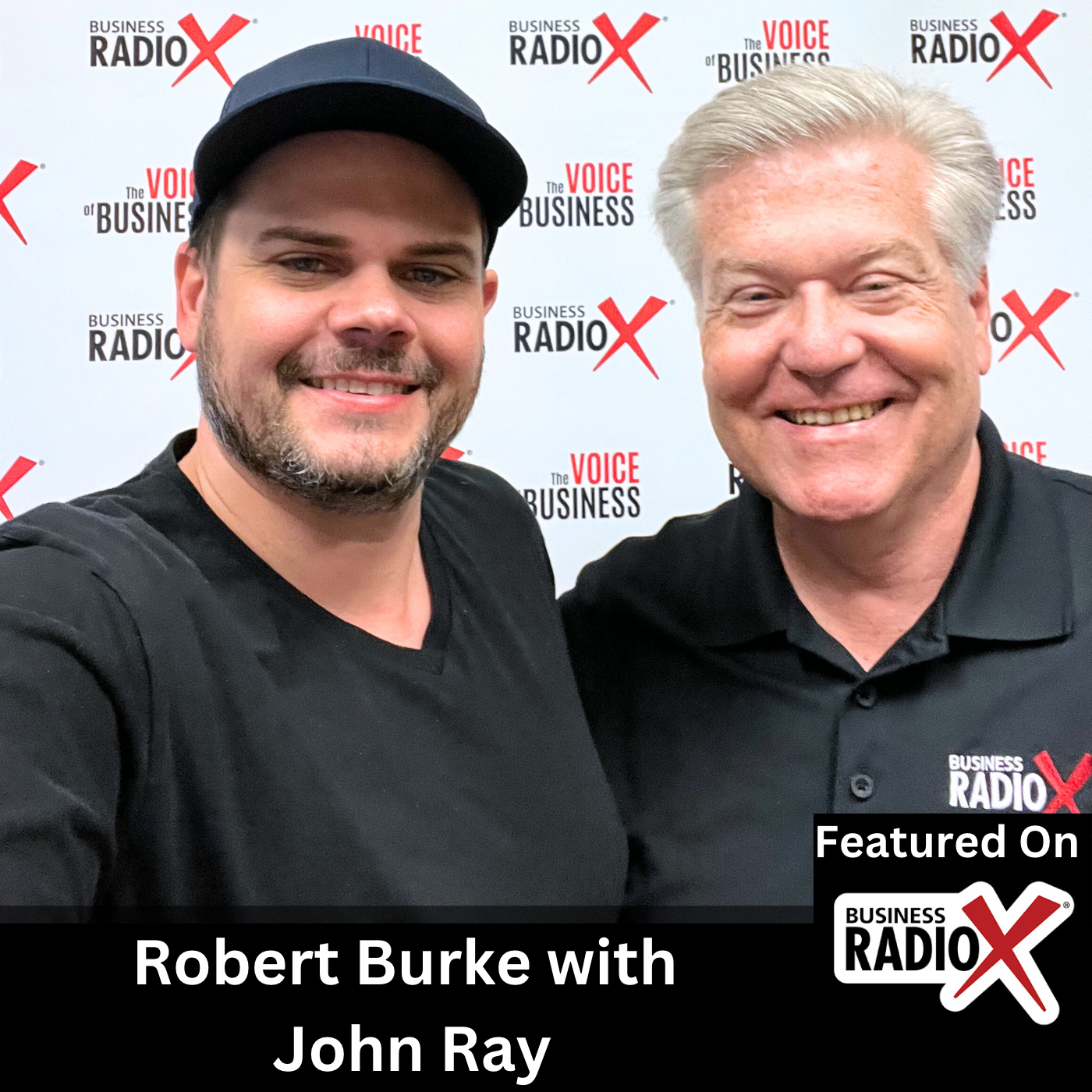
Robert Burke, Founder and CEO of Sobo, was the guest on this edition of North Fulton Business Radio. He and host John Ray discussed Sobo’s new product platform which facilitates the ability of small and medium sized businesses to access quality consultants. They talked about challenges business owners are experiencing, how Sobo got started, how the company is leveraging AI to democratize the consulting industry, how fractional consulting can serve these businesses, and much more.

North Fulton Business Radio is broadcast from the North Fulton studio of Business RadioX® inside Renasant Bank in Alpharetta.

Sobo

The team at Sobo knows what it’s like to spend countless hours on advisors who ultimately ghost you, or to burn resources on consultants who are not aligned with your company’s culture.

They built something to change consulting for business leaders. No more guesswork. No more DIY-ing. Just results.

Sobo connects companies with the top 1% of fractional advisors so that you can level up and move your business forward.

Sobo was born in 2009 when Robert Burke launched Sobo Networks, an IT Managed Services Provider, in Atlanta. He imagined Sobo becoming a “Deloitte for Small Business.”

In 2015, the name was changed to Sobo, and became a multifaceted management consulting firm for small and mid-size business. In 2023 they will launch the Sobo Platform to realize Robert’s goal.

Website| LinkedIn | Facebook | Twitter

Robert Burke, Founder & CEO, Sobo

Robert Burke, Founder & CEO, Sobo

Robert Burke is the Founder & CEO of Sobo, an AI-powered fractional consultant platform built for small to mid-sized companies.

Robert has over fifteen years of experience building and leading an IT and management consulting firm, having founded the precursor to Sobo in 2008.

A Florida native, he currently lives in Atlanta, Georgia with his wife and two children.

LinkedIn

Questions and Topics in this Interview:

  • How fractional consulting saves time and money for businesses looking to improve
  • How fractional consulting can help small business owners compete with larger corporations
  • Leveraging AI to accelerate the consulting process from months to virtually instantly
  • How they’re democratizing the consulting industry by using AI and people-first approach
  • The importance of working on rather than in the business
  • The areas that small businesses struggle with the most when starting out and scaling

North Fulton Business Radio is hosted by John Ray and broadcast and produced from the North Fulton studio of Business RadioX® inside Renasant Bank in Alpharetta. You can find the full archive of shows by following this link. The show is available on all the major podcast apps, including Apple Podcasts, Spotify, Google, Amazon, iHeart Radio, Stitcher, TuneIn, and others.

RenasantBank


Renasant Bank has humble roots, starting in 1904 as a $100,000 bank in a Lee County, Mississippi, bakery. Since then, Renasant has become one of the Southeast’s strongest financial institutions with over $13 billion in assets and more than 190 banking, lending, wealth management, and financial services offices in Mississippi, Alabama, Tennessee, Georgia, and Florida. All of Renasant’s success stems from each of their banker’s commitment to investing in their communities as a way of better understanding the people they serve. At Renasant Bank, they understand you because they work and live alongside you every day.

Since 2000, Office Angels® has been restoring joy to the life of small business owners, enabling them to focus on what they do best. At the same time, we honor and support at-home experts who wish to continue working on an as-needed basis. Not a temp firm or a placement service, Office Angels matches a business owner’s support needs with Angels who have the talent and experience necessary to handle work that is essential to creating and maintaining a successful small business. Need help with administrative tasks, bookkeeping, marketing, presentations, workshops, speaking engagements, and more? Visit us at https://officeangels.us/.

Tagged With: AI, business consulting, fractional consulting, IT, management consulting firm, medium size business, Office Angels, renasant bank, Robert Burke, scaling, small business, Sobo

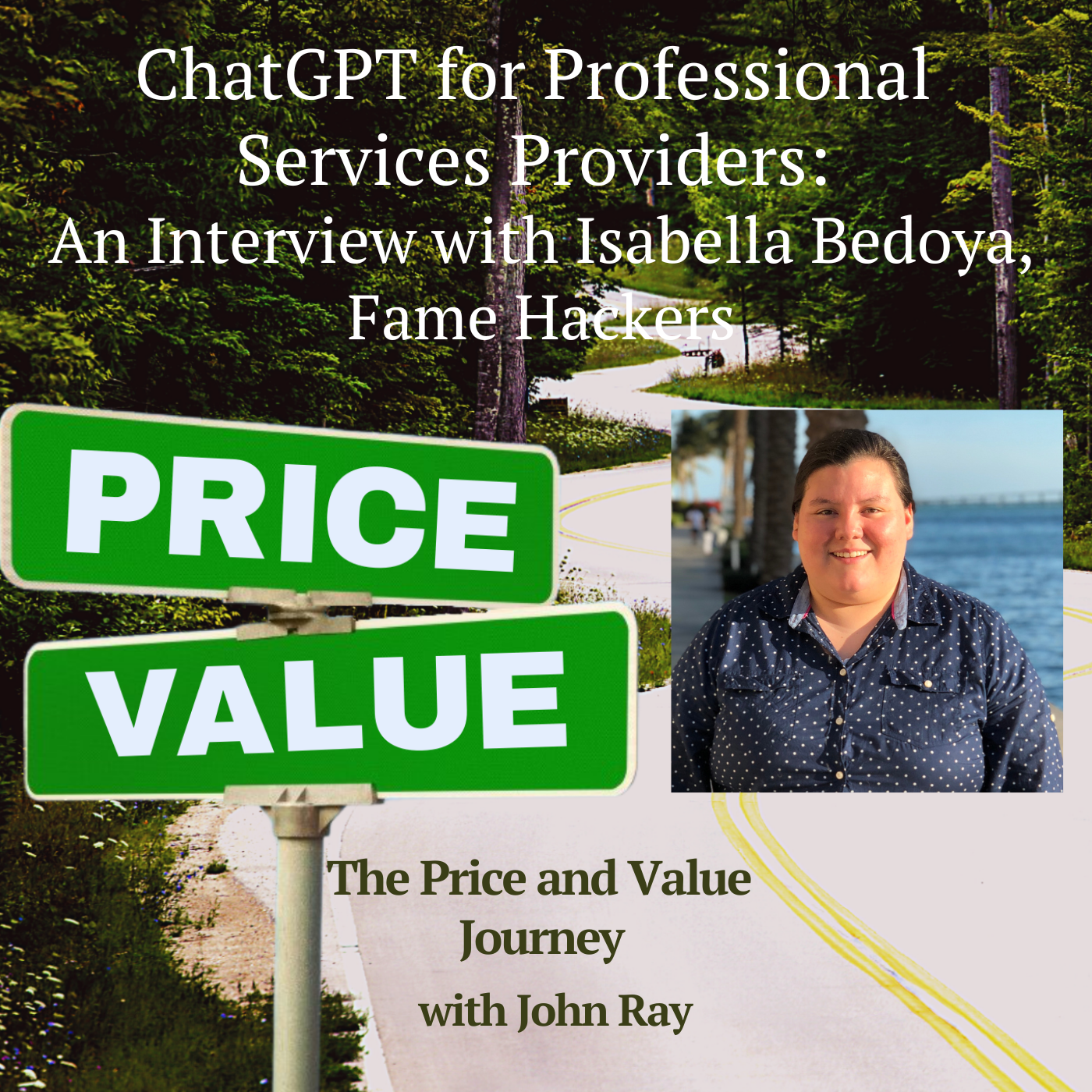
ChatGPT for Professional Services Providers: An Interview with Isabella Bedoya, Fame Hackers

April 5, 2023 by John Ray

Fame Hackers
North Fulton Studio
ChatGPT for Professional Services Providers: An Interview with Isabella Bedoya, Fame Hackers
Loading
00:00 /
RSS Feed
Share
Link
Embed

Download file

Fame Hackers

ChatGPT for Professional Services Providers: An Interview with Isabella Bedoya, Fame Hackers

Fame Hackers Founder Isabella Bedoya joined host John Ray on The Price and Value Journey for an overview of ChatGPT and other AI Tools. Isabella shared the insights she had as she learned ChatGPT, results she has experienced on behalf of clients, making the best use of this tool in a professional services business, how it serves marketing and content creation needs, and much more.

Find Isabella’s AI Tools and ChatGPT prompts database mentioned in the interview here. Also mentioned in the interview:  a live workshop, “Master AI and ChatGPT For Your Business,” on April 12, 2023. More information and registration here.

The Price and Value Journey is presented by John Ray and produced by the North Fulton studio of Business RadioX®.

Fame Hackers

Fame Hackers is an AI-powered marketing agency which helps grow and monetize personal brands leveraging LinkedIn and YouTube. In addition, they assist in AI deployment for organizations who want to integrate AI into their operational workflows in order to make their teams more efficient, while saving on labor costs.

Find Isabella’s AI Tools and ChatGPT prompts database mentioned in the interview here. Also mentioned in the interview:  a live workshop, “Master AI and ChatGPT For Your Business,” on April 12, 2023. More information and registration here.

Company website | LinkedIn

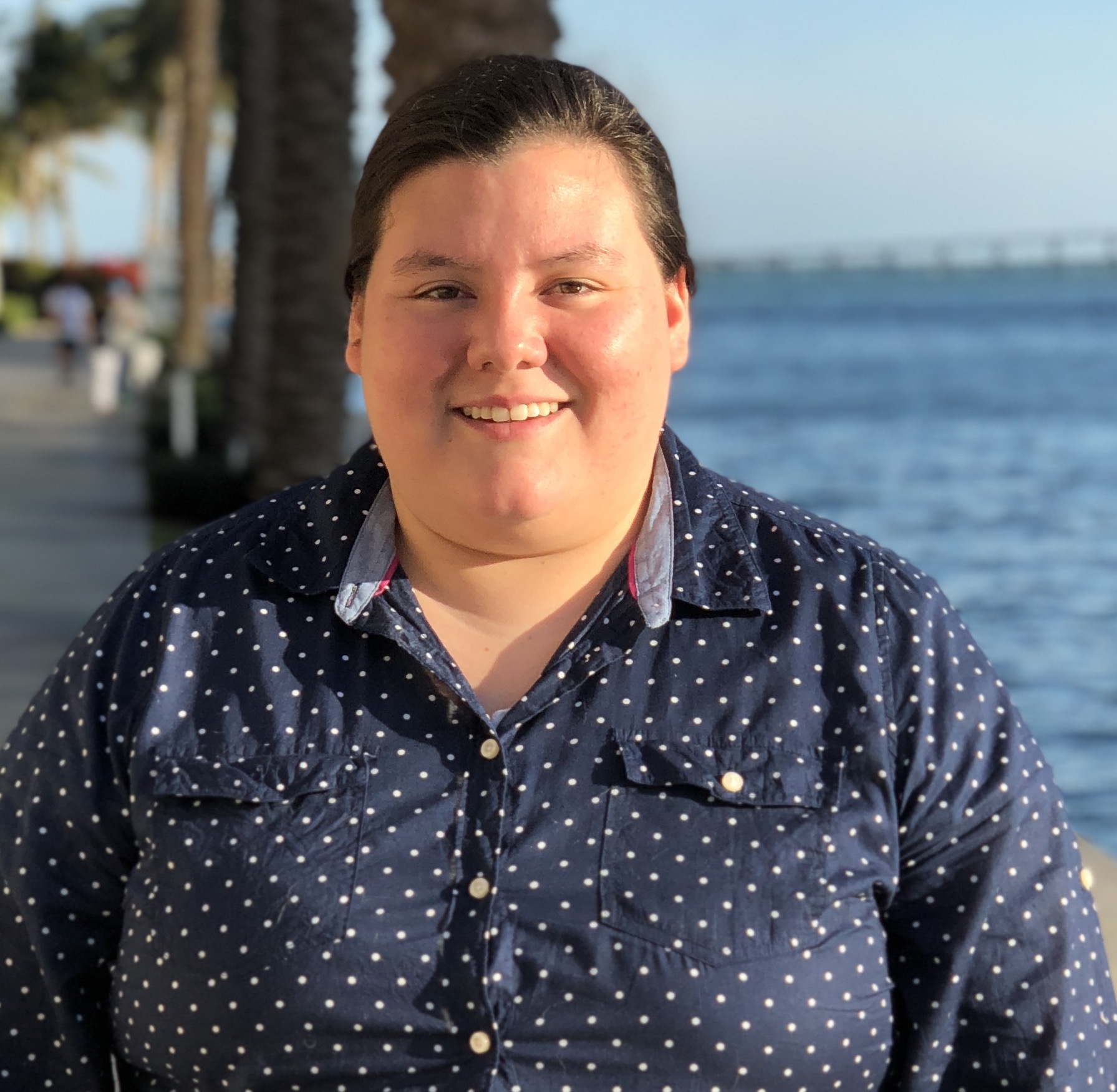
Isabella Bedoya, Founder, Fame Hackers

Isabella Bedoya, Founder, Fame Hackers

Isabella Bedoya is founder of Fame Hackers, an AI-powered marketing agency. She has generated over 98M views on TikTok, Youtube, and Instagram leveraging short-form videos, UGC, and influencer marketing for Fortune 500 including Fortune Top 10 – Google & United HealthCare. Now she is building in public exploring the AI space and its advanced use cases to make our lives easier in business.

Fame Hackers is an artist accelerator that helps independent artists establish profitable and sustainable music careers so they can get paid doing what they love.

After working as an A&R for a label under Sony Music, Isabella now uses industry experience coupled with cutting-edge strategies to help musicians monetize their music careers, attract their loyal fan base, and reach the levels of success they desire.

During her time as an A&R she discovered that as long as an artist knows social media marketing and e-commerce strategies, they can create wildly profitable careers without signing record deals.

Shortly after, Isabella set off to learn digital marketing and invested close to six-figures in coaches and consultants to accelerate her knowledge and her growth.

In the meantime, she worked for an award-winning influencer marketing agency where she had the opportunity to work with multiple Fortune 500 brands including but not limited to Snap, Google, Bud Light, United Healthcare, and more. She also managed two TikTok accounts for Sony Music LATAM, and so much more!

Isabella has worked with many celebrities, influencers, and award-winning industry professionals over the past 6+ years, and has also helped independent artists become viral sensations.

Isabella has been invited to speak at the Musicians Institute, BoldTV, Ticker News, iHeartRadio, NBC, KCAA Radio, Beat The Clock Podcast, and published on Medium, Thrive Global, and many more.

LinkedIn

TRANSCRIPT

John Ray: [00:00:00] And hello again, everyone. I’m John Ray on the Price and Value Journey. Welcome. I’m delighted to welcome Isabella Bedoya. She is the founder of Fame Hackers. And Fame Hackers is an AI powered marketing agency that helps grow and monetize personal brands, leveraging both LinkedIn and YouTube. They assist in AI deployment for organizations who want to integrate AI into their operational workflows in order to make their teams more efficient and saving on labor costs. And I think part of that involves getting some clients along the way too, because I see that in your work as well. Isabella, thank you so much for joining us on the Price and Value Journey.

Isabella Bedoya: [00:00:47] Thank you so much for having me, John.

John Ray: [00:00:49] Yeah, It’s a pleasure. So let’s talk a little bit about you and your background first and how you got your journey and what’s taken your work in this direction.

Isabella Bedoya: [00:01:01] Sure. So I started in the marketing realm. I used to do influencer marketing campaigns, digital marketing. And in the process, you know, I started a coaching business, and I was helping other people do this for themselves. And earlier this year, even like towards the end of last year, I came across ChatGPT as the whole world, right, I think got released in November.

And that kind of made the big shift because at first, I kind of like dismissed it. I had used tools like, you know, Jasper and whatever. And so at first, I was like, okay, that’s cool. But then when I actually tested it to work on a client project, that just changed my life completely. Ever since then, I’ve been like obsessed with ChatGPT, with AI. It’s just one of those things I can’t stop talking about.

John Ray: [00:01:53] Well, I love that. I love that that’s the case because we need to talk to you. And folks need to hear from you about that work. So I’m curious about that project. You don’t have to mention names, of course, but just the nature of that project, the insights that came out of that for you and that gave you a sense of the power of ChatGPT and AI generally.

Isabella Bedoya: [00:02:21] Yes. I think for everyone, from what I’ve been understanding as I talk to people, everybody has that kind of like aha moment that it just clicks and all of a sudden, they become obsessed with it. And in my case, I was working on a digital marketing campaign for one of our clients who’s doing like a Taylor Swift giveaway. He’s giving like tickets away for a Taylor Swift concert.

So I had to come up with like the whole entire marketing plan. You know, how are we going to do this? How are we going to target what the videos are going to be about? Like all of the things that normally would have taken us about a week and like at least three people involved, I did the whole thing in like two hours from start to finish, sent in an email. Here’s what we’re going to do.

John Ray: [00:03:10] Wow. And so, but how did that happen, though? I mean, because you — I mean, you developed the insights along the way while you were working on this to be able to do all that?

Isabella Bedoya: [00:03:27] Yeah. So it’s basically like what it comes down to with ChatGPT, it’s about how good of a prompt you can write, the more precise. So prior to this, you know, using it for this client application in particular, I had already been playing around with it for like single use cases, like, you know, write that line of a book. Or every time I thought of like a possible use case, I would run to ChatGPT and try it and see what came out.

So when I did this whole marketing strategy for this particular project, like it was just basically a lot of just tweaking the prompt until I got the output that I wanted. And once I got that output, I was like, okay, I need to replicate that. I probably also Googled a little bit like, you know, what kind of, how to type the prompt. That’s very important. Also, like what to include in the prompt. But yeah, just kind of, you know, in the beginning I was just kind of like everything that was in my head, I was just putting it as a prompt. No real strategy and just seeing what came out.

John Ray: [00:04:33] Yeah. Yeah, that makes sense. So what’s been the — or maybe it’s too early to know, but what’s been the outcome of this marketing strategy outline that you put together?

Isabella Bedoya: [00:04:45] Yeah. So far, we’re just in the midst of it. Just started actually putting this maybe about two or three weeks ago, like actually putting the videos out. From what I saw, we still have to put the month one campaign report together still. But from what I did see, some of the videos did get some traction. I think there was one video that got like over 11,000 views.

And it was really interesting because it was the headlines generated from maybe little tweaks to make sure it’s not like super robotic, but the headlines that were generated from ChatGPT that we turned into TikTok videos.

John Ray: [00:05:23] Wow, that’s impressive. So you talked about the prompt being the key. That really knowing the instructions to give and how to give those are the key. This sounds a lot like the garbage in, garbage out thing. Right?

Isabella Bedoya: [00:05:46] Exactly.

John Ray: [00:05:46] Yeah. Yeah. So say more on that.

Isabella Bedoya: [00:05:50] Sure. So when you write a prompt, normally, like the first thing that you should start your prompt with is what do you actually want it to act as? So when you want like better outputs, for example instead of saying like write 10 hooks for a TikTok video, you would start by saying like, act as a social media strategist. We’re going to create a TikTok marketing plan, right? And then you just give it like direct, very precise, what you want it to come up with. And you could even tell the format, the output of how you want the information presented. Bullet points, in a table format, you can get really precise.

John Ray: [00:06:36] So the key is learning the prompts.

Isabella Bedoya: [00:06:41] Yeah. Well, not necessarily having to memorize them, but more so like at least being familiar with the structure, right? So it’s like, what role does it take or it has to like act into? What is the question? Or like, what is it that you actually want it to do for you? Creating some sort of format, giving it context, giving it guidelines of specifically what you want the AI to do.

And you could even add in like things like tone of voice or how many words you wanted to put out. You could give it like examples to say like, you know, this is an example, I want you to create something like this. So you can definitely like train it and guide it in your direction. But it should always be a little bit more of a, I want to say like more of a bulky prompt, because that way you can include a lot of information for the AI to be more specific.

John Ray: [00:07:44] So all this goes into that one search bar. I don’t know if that’s the term we’re talking, using here for ChatGPT, but that that bar, right, that you put it all in there and cut and paste it, whatever you want to do, you put it right in there.

Isabella Bedoya: [00:08:01] Yep.

John Ray: [00:08:01] And yeah. So what — a lot of the criticism, and I think it comes from a lot of people that have probably never been on it. But they read what other people criticize and they want to glom on to that, right, is they talk about AI being artificial. That’s an original thought. That it’s plain vanilla. And it has no tone of voice. So address those criticisms.

Isabella Bedoya: [00:08:40] Sure. Yes. I think what’s important, especially when you’re dealing with AI for content in this case, like as an example, it’s too generic. It’s very shallow. It lacks the human emotion, perspective, insights, all of that. So I think the first step is that people have to understand that just because they gave you a content idea, doesn’t mean that you have to copy and paste it into LinkedIn or whatever the case is.

You should still do your due diligence and like make sure that you’re optimizing the content to still sound like you. If anything, for content use case specifically, it’s more so just using it as an inspiration or a guideline of what’s something that you could talk about. But what would make your perspective refreshing for people to read is your unique experiences tied to that subject? So in content sense, I would use it more of a inspirational rather than just copy pasting.

John Ray: [00:09:41] Yeah. And that seems like pretty elementary to me. But I mean, you actually have to say that, you know, it’s just like plagiarism, right? I mean maybe it’s not the same kind of plagiarism, but copying and pasting never works, turns out real well, right? So are there some use cases that are better than others in your experience?

Isabella Bedoya: [00:10:14] So I mean it’s really mind blowing because even, for example, I had just last year, I did a sales training where I actually invested in coaching for sales training. And it was interesting because I tried it with ChatGPT and I was like let me see if ChaGPT can act as my sales coach. So I gave it a prompt, I told her to act as a sales coach, that we’re going to role play, we’re going to go through a discovery call, and then at the end provide me feedback. And I thought this was really interesting because I gave it like all the context, like, you’re the buyer, this is what you do.

So from a training perspective for companies, it’s mind blowing because if you can give specific instructions on how you want to be trained, this is saving so much time for companies of having to train their staff on whatever task they need to do because they can just be trained to AI. ChatGPT can pick up on the prompt and run through the exercise with you, and I thought that was very powerful. But I’m sorry, go ahead.

John Ray: [00:11:26] No. No, I didn’t say anything. But since you stopped, let me ask you a question about that specifically. Give an example out of that sales training where you had that live individual, I guess it was, that helped you. Give an example of maybe a specific part of that training that you got out of ChatGPT that you felt was just as robust as what you got from the human being.

Isabella Bedoya: [00:11:57] Sure. Well, what it was, was the one-on-one roleplay. Even though in the live course, there was a group thing and there was a lot of roleplay calls, and it was very efficient and effective. The cool thing about ChatGPT is that I didn’t have to wait for that call. I didn’t have to wait in line to raise my hand in the Zoom and say, can I go next? Right. It was in that sense, it was very effective.

In addition to that, it was like instant. It was like on my own time, and I got the feedback. I also was very precise with the prompts, so I told it like what style of sales conversation I wanted to have. And but now this is where it’s kind of like with a grain of salt because I knew what the correct process, I knew that the flow that was happening with ChatGPT was correct. Had I not known, I was just kind of leaving that to chance.

So I still think like this is where it’s important where AI is still very new to the whole world, that we’re still in that stage where it still relies on humans. And eventually, it’s going to be even more powerful. But as of right now, it still requires a human interaction with it.

John Ray: [00:13:12] Yeah. And that’s where I was going. I was going to ask you, like what — you obviously had the live sales training, and you must have found value in tha at that time, right? So but you knew, because of that training, you knew exactly kind of how, how to craft the prompt that you used in ChatGPT or the prompts that you used in ChaGPT.

Isabella Bedoya: [00:13:40] Yes.

John Ray: [00:13:40] Okay. So that’s really where the magic is, I suppose, in terms is really knowing what instructions to give. So what you put in doesn’t result in garbage out.

Isabella Bedoya: [00:13:56] Yeah. And it’s crazy because I saw an article on Bloomberg earlier this week that some companies are paying up to over 300,000 a year to be able to put in the right prompts into AI.

John Ray: [00:14:09] I saw that. And it suddenly made me think, Isabella may cancel my interview because she desn’t need to talk to me. But that was my first thought. Isabella. But let’s talk about you have developed an entire library of tools and use cases for ChatGPT. So let’s give everyone a sense of the breadth of that.

Isabella Bedoya: [00:14:46] Sure. Yeah. So this is something that just for like my own, it became like, for my own sake. And then it was like, wait, this is very helpful for everyone else because I had been using ChatGPT and all these like different creative ways. I started keeping track of the prompts that I was using, how I was getting like certain things. And then I said, you know what, let me actually compile a database. Let me just give it away to, initially it was to the LinkedIn community and it just kind of took off. So I was like, all right, well, everyone can have it. That’s not a problem.

It has a ton of prompts and I’m continuously adding. Every time I go in and create new prompts, I add them into the library so that you don’t have to memorize. You can just copy and paste it into ChatGPT. And in addition to that, there’s a lot of AI tools because it’s not just ChatGPT. There’s also, Google has Bard.

So in terms of like the ChatGPT sense, those are like the prompts. But there’s over I think in there we’ve compiled I think over 120 AI tools already, depending on, it’s crazy. You can even use it for like DEI, you can use it for HR, you can use it for sending emails. Like it’s really wild how fast the AI space is moving, and the products are coming out to make everyone’s lives easier.

John Ray: [00:16:12] Yeah, that’s what’s struck me about your library. That’s what it is, because it’s that robust. I mean, you’ve got all this library of all these prompts in all these different categories. Let’s talk about, well, let’s talk about HR. I mean, since you brought that up. So like you’ve got, for example, and I’m sitting here looking at it, folks, so you’ve got leadership and employee development, communication and collaboration, recognition and rewards, just to name three of them.

So and one of them talks about — let’s take recognition and rewards. So one of them talks about what steps you would take to provide employees with meaningful incentives and rewards. So how did you come up with that? Why did you come up with that? And how did you assess the quality of the results you got out of that particular prompt?

Isabella Bedoya: [00:17:19] Sure. So a lot of the building as of lately has been talking to professionals and asking them like what are the things that you normally think about or what are things that you normally have to like type up when you’re working or things like that. So it was a mixture of that. It was also a mixture of Googling what kind of questions HR professionals in this case would be asking themselves.

And that prompt in particular, that one is to just get the conversation flowing. But then as the conversation starts evolving with ChatGPT, you can then give it more commands. Like my company does this or we have this in place. What about, you know, so those prompts and in that case are more for like to interact back with ChatGPT until you get the customized answer for your organization.

John Ray: [00:18:14] It’s really a conversational funnel, it sounds like. I mean, you continue to funnel down the results until you get what you’re looking for.

Isabella Bedoya: [00:18:25] Yeah, exactly.

John Ray: [00:18:26] Yeah. Yeah. So one of the — well, again, I mean, and we’ll put the link in the show notes, but you’ve got Facebook related like ads and posts and whatnot. Same for LinkedIn graphic design. That one stood out to me because a lot of people don’t think, haven’t gotten turned on to that quite yet. In terms of, well, the Canva, for example. Why don’t you describe what’s going on there?

Isabella Bedoya: [00:19:13] Yes. When it comes to the graphic design side of things, it’s more of image to text. I mean, text to image. So crafting a prompt to get the image that you like. In addition to that, though, there’s also one thing that I use just for like for own purposes. And I was like, that’s actually very helpful. I asked it to help me with color psychology for branding and to provide the hex codes because obviously it’s a text, right? You’re going to get a text, you’re not going to get an image from ChatGPT.

And yeah, and it provided me the hex codes. And then I went on Canva and I put in all that information and I was just like that’s pretty cool. It also tells you kind of like how your branding should look like the elements, and all of that. So in that use case, it was really interesting. And again, it just speeds up the process that you would normally have to go in and do that research of the color psychology in that case, for example.

John Ray: [00:20:14] What about infographics? And this is another one, or your section is infographics or visuals. So that’s a situation where you’re putting in text and creating some sort of image out of that, right?

Isabella Bedoya: [00:20:32] Sure. You can ask for the text in that case. Like it’s just the — what ChatGPT will provide is the context, the content. So same with like Instagram, LinkedIn, Carousels, it will provide the content for you, but then you still have to do that manual piece of fitting it into the infographic.

John Ray: [00:20:49] Right, right. And it sounds like though that that step may not be far away from being eliminated at some point. All this is going to get stitched together, right? That —

Isabella Bedoya: [00:21:07] That will be amazing.

John Ray: [00:21:07] Yeah, that will be.

Isabella Bedoya: [00:21:09] Infographics in particular.

John Ray: [00:21:10] Yeah. That will move the cheese for a lot of people, that’s for sure. So let’s — I want to talk about how you’ve developed, how this works for you. I mean, you talked about how you’ve developed all these prompts. You’re pretty jazzed up about it, obviously, and really been going after it with intention. I love the way you describe how you’ve talked to various people in various industries to do that. Yeah, that’s, I would think an essential part of this. But talk about how you’re monetizing this work on your behalf. And at the end, folks, I want to give some shout outs to some opportunities that Isabella has for you to learn, but go ahead, Isabella.

Isabella Bedoya: [00:22:04] For sure. So it’s really interesting because it kind of in a sense, the idea behind it was we’re going to create this whole community around AI, ChatGPT, specifically for like business use cases. Just because I was so excited about how much impact it had on my own marketing agency. And it’s interesting because it’s kind of like a dual thing. The more attention that we get on LinkedIn, the more people want to learn more about the marketing agency. But there’s also a new side of things that people are asking more about specific prompt engineering for their companies, SOP developments and stuff like that.

So it’s really interesting. If anything, it’s just continuing to help us grow our business and adding this new leg. And also, in terms of like the monetization, it’s also brands. We’re starting to have some AI brands approach us and say like, hey, can we, you know, pay you to put this on the database?

And that’s kind of how I pictured — that was kind of like the strategy behind why I was giving the database for free to help the community as a whole, but then monetize it through brand partnerships and UGC. And just because I come from that background, I thought that was like the most beneficial. So that way it can be super valuable to the community as well.

John Ray: [00:23:33] Yeah. So let’s let’s talk directly to services providers. So our consultants, our attorneys, our accountants, what have you out there that they’ve got a practice to run, they’ve got their own discipline, whatever that is. And of course they’ve got all that goes into that, whether it’s marketing or running their back office or whatever. So where do you suggest someone that fits that category start with the capabilities of ChatGPT because it’s so overwhelming. It’s like a fire hose.

Isabella Bedoya: [00:24:15] Yes, the best suggestion is to start with one department at a time. So if you have like your marketing team. Or just the other day, I was helping one of my cousins who does work with like a finance company and they’re starting this whole like in-house underwriting department. So we were just creating like underwriting SOPs for the underwriters.

So it really just depends on like what your, I would say like the most, maybe like the most challenging in terms of time. Start there because if you can optimize that to be easier with AI, not just ChatGPT but any AI tool, if you can make that deployment easier for the flow of things, then that’s going to be like, first of all, a huge pain point that’s been lifted in your company and then start working towards the other departments.

John Ray: [00:25:13] And so you’re talking about what part of your company you’re spending way too much time on in terms of a process flow? Is that what you’re saying?

Isabella Bedoya: [00:25:26] Yeah. Like, for example, like for us, a lot of the time that we were spending on was on the actual research of like market research, SEO, audience persona. That was like the biggest thing that took us forever to do all the research and create ideal audiences. And not just from our point of view, but also from like our clients. That’s always like such a challenging question Who’s your target audience? What are the pain points?

And with ChatGPT, just asking it like I want to create an audience persona for someone that would buy something like this. Include pain points, include desires, include buying behaviors, include specific brand names that they buy from you. Get all of that in like a minute.

Speaker3: [00:26:16] All I can do is laugh at that. I mean, that’s amazing to me. But again, see, what happens is people hear that and immediately their trust factor goes like way down. Right? I mean, they think, how can you trust results that you get in a minute.

Isabella Bedoya: [00:26:35] Yeah. And not just the trust factor, but also like I’ve seen people kind of go through like an existential crisis of like, why am I even here? Like everything I’ve worked for, I no longer –I’m being replaced by a machine. But this is one of those things that I really believe that humans are still very essential in the process. I think it’s just going to be a matter of — I kind of have this perspective on it where, sorry about that.

John Ray: [00:27:07] That’s okay.

Isabella Bedoya: [00:27:08] I have this perspective of how, when we used to do, you know, Microsoft Word, we had to learn Microsoft Word. Especially I was in school, so I didn’t really have to like go through that. But I remember like my grandparents, my parents, they all had to learn this new technology if they wanted to be either more effective at their job or get a raise or stuff like that. And I think that’s kind of what’s happening with AI, where if you don’t adapt, it’s going to be one of those things that you’re going to be replaced by someone that has adapted.

It’s just a skill. It’s an added skill to add to your resume and it makes you super powerful and super, you know, it gives you a lot of leverage within your company. The way that I see it is if you alone as a marketing, let’s say as a marketer, right? You alone as a marketer, you have to then hire a copywriter, a funnel builder, a web designer, a graphic designer. But with AI, you have your own team of experts. So now the company can have, like you become a powerhouse for the company, and that allows you to also ask for raises and be way more valuable.

And the same for like the actual owners of these organizations, the owners of service firms. If you have AI in your processes, you get results for clients a lot faster or you get client service delivery faster, which means that your clients are going to be super happy and they’re going to see results faster, they’re going to stick with you versus the person that’s still doing market research for three weeks. It’s just one of those things that it makes you more competitive.

John Ray: [00:28:44] Yeah, that makes sense. Do you worry about or have you confronted this, the fact that you can get results so quickly that the client across the table looks at you and says, well, I don’t know that I ought to pay a tremendous price for this because it’s so “easy”, right?

Isabella Bedoya: [00:29:09] So that’s where you price in the value. Right. In the positioning.

John Ray: [00:29:13] Thank you for that.

Isabella Bedoya: [00:29:13] It’s the same thing as like, do you remember that graphic of a carpenter that there’s like a nail on the wall and then the carpenter’s like, yeah, I’ll charge you like $100 for that. And the other person’s like, I’ll charge you hourly. And the person is just like, why would I pay you $100 for that? And it’s because I have the specialized skill to be able to know where to put the nail on the wall to not cause any issues.

And that’s exactly the positioning and the branding that service firms, attorneys, that’s kind of like what you need to align yourself with. I’ve had some people on LinkedIn comment on my post saying specifically for attorneys that they’re doing like cross-examination questions within minutes. And it’s really wild. It’s really wild.

John Ray: [00:30:09] Well, yeah. And again, it gets back to prompts, right? So I mean, you can get very specific about the prompts. And I mean, in that case, you can put some sort of like profile of that individual. You may, if that individual is a public figure, you may actually put their name in there, right?

Isabella Bedoya: [00:30:32] Yeah, yeah. If they’re celebrities, I know that you can do like write it in the tone of voice of Kevin Hart, for example. It will be a humorous output. So yeah, you can definitely insert celebrities. And if they’re not that well known, ChatGPT will just say, like, you know as a language model, I don’t really know who that is. And it’s okay. You just can keep trying and it’s not going to explode or anything that.

John Ray: [00:31:03] Yeah. And again, it’s, I guess the visual that comes to my mind is the funnel. I mean, you keep funneling down until you get through prompts, until you get the results that you’re looking for.

Isabella Bedoya: [00:31:19] Yeah, even for funnel. Like speaking of funnels. Even for funnels, we had a client that we helped do a virtual event like a boot camp. And the same thing, normally the boot camp set up would have taken me about two or three weeks to put the emails together, to put the funnel together, the promotion materials, everything. And in like two or three days, we had the whole thing up and running, launched.

It’s really, speed is what it does. Of course, I still have to go through the answers and like modify it to actually make sense and sound like a human. But that’s why it’s not 100 percent replacing you, it’s just making your life a whole lot easier. And then you just have to go in and do the tweaks.

John Ray: [00:32:03] So let’s talk about the results that I think some have commented on, where there’s inherent bias, where there’s ethical issues, that kind of thing. Talk about filtering the results to filter that kind of stuff out.

Isabella Bedoya: [00:32:23] Yeah. So that’s one of those things that we kind of have to like keep in mind that it’s all learning from somewhere. So it will naturally tend to sway one way or the other. But for like things in particular, like business use cases, it’s not necessarily — I mean, maybe if you’re in like legal where it can get a little political. But for like traditional use cases like customer service, marketing, sales, that kind of thing, it’s not really like that impactful in that sense. If you do want it to be a little bit more inclusive, you can say like act as a DEI, act as a head of DEI and make this paragraph more inclusive or whatever the case is.

But I think for like the typical business case, at least so far, I haven’t encountered too much of how it could be biased. But again, it depends on the prompts. It depends on the prompts. Like if you’re coming from like a certain angle, you just have to say that. You could also tell it to be like a devil’s advocate. Like using that word, that’s a command. Be a devil’s advocate about this. You can say, what was the other one? Analogous. Like to give you an analogous response. So you can kind of like get it to — when you get a response, you can kind of tweak it so that it actually shows you both sides. But it just comes down to the prompts not taking the first, you know, the word for it.

John Ray: [00:34:08] So let’s talk about ChatGPT versus Google and Google’s Bard. Talk about if you’ve dived in to both and what kind of conclusions do you have about both?

Isabella Bedoya: [00:34:28] Sure. Yes. I did start using Bard. I think you still have to be on a wait list. But yeah, I did start using Bard and it’s just very new that so far I think ChatGPT has been giving better answers. From what I understand, though, Bard has access to the internet like it actually has access to like, real time data, whereas ChatGPT 3.5 is all the way through the end of 2021 and ChatGPT 4 which just released, that, from my understanding it was as a random number, but just kind of paint the picture.

I think it’s like 100 billion data points, whereas in ChatGPT 4, it’s like this massive, like in the trillions of the amount of data that it actually is pulling from. So ChatGPT 4 is massive. The prompts and the output that you can get from ChatGPT 4 is also a lot better than ChatGPT 3.

But Bard, when I tried it, it was still too generic. Like I asked it to do the same market audience prompt and it was just very generic, like pick a target audience, pick your social channels. And it’s like, that’s not what I was asking, you know?

John Ray: [00:35:50] Right. Yeah, it was very high level results.

Isabella Bedoya: [00:35:56] Yeah.

John Ray: [00:35:56] Got it.

Isabella Bedoya: [00:35:57] Yeah, exactly.

John Ray: [00:35:58] And do you recommend at this point, and I mean, look, we’re in March 31st as we do this interview and who knows what’s going to happen just two months from now. But you’ve got to be a paid subscriber to ChatGPT to get version four, right?

Isabella Bedoya: [00:36:18] Yes.

John Ray: [00:36:19] So do you recommend that the average person out there be a paid subscriber or the results that they get from version 4 that much better than 3.5?

Isabella Bedoya: [00:36:31] Yeah, this is a really good question. I have the paid version, but I have the paid version because I started just using it every day in my daily activities that around noon, it would just start crashing because everybody — it would just be an influx of people. So it would be really slow and start crashing. So when you upgrade, it’s like $20 a month, it’s not anything crazy. And that meant that I didn’t have that lag time.

In the process, of course, then I got access to ChatGPT 4. For the average person though, I think ChatGPT 3.5 is fine. It’s something that the downside right now with ChatGPT 4 is that you can only use 25 prompts in three hours. So they have a limit because it’s new. They’re rolling it out. It’s probably a lot more technology on the back end.

So whereas on ChatGPT 3, you don’t have that limit. And also ChatGPT 4 is slower, so you can just see it like type and it takes forever. Whereas version 3.5, it’s very fast. Like you just see it like sip through. So if you do decide to upgrade, I would upgrade based more on like the speed of the usage and not having that limit. But it doesn’t hurt to try ChatGPT 4. It’s way more powerful.

John Ray: [00:38:01] Yeah. Yeah, that makes sense to me. Well, I mean, I’m a paid subscriber, just for that very reason. So for $20 a month, why not? So let’s — I want to, as we kind of wrap up here, I want to make sure we talk about you and kind of the services that you offer, Isabella. And you’ve got a workshop coming up that I noticed. So you’ve given us a lot of great information. Let’s give you a chance to talk about how folks can connect with you and learn more from you.

Isabella Bedoya: [00:38:47] Thank you. Yes. Best way to connect right now is on LinkedIn. Like my name on there is Isabella Bedoya. And other ways to connect with me, I also have the AI database library and a Slack channel inside of that database, which we’ll probably link it at the end of the video, right, in the show notes. And yes, I do have the workshop coming up. It’s on April 12th at noon Eastern. So 12 to 2 p.m. it’s a two-hour workshop.

And the purpose of that workshop is to actually go through business use cases, you know, how to actually monetize it, discover a little bit more on like the different roles and the different operational workflows that you could create with it. So it will be very interactive. And also since it’s live, it’s not necessarily like this it’ll be live in the sense also of we get to interact with it. So if anyone has any like prompts that they want to see or any things that they actually want to talk through, we can, there’s time for that.

John Ray: [00:39:56] That’s terrific. Isabella Bedoya. Folks, she is with Fame Hackers. That’s her firm. And just in general, ChatGPT aside, talk about your work at Fame Hackers. Let’s get that out there as well, Isabella.

Isabella Bedoya: [00:40:17] Sure. Yes. Our Fame Hackers, we help with building personal brands. And a lot of the things that we do is short film video marketing, creating monetization strategies like virtual events or whatever the case is. And in addition, excuse me, in addition, this is where AI is amazing because we have figured out ways to integrate AI into like the video editing. So the videos are super fast and super high quality too, and very engaging following all the engagement tactics that short film video creators use.

So that’s essentially what we help with. I have worked with organizations as well with like just their marketing strategies. But right now, like I mentioned, we’re having this whole influx of people asking us to help them with their AI SOPs internally. So that’s in a nutshell essentially like what we do.

John Ray: [00:41:15] Yeah. I am sure you have been busy. And congratulations on that. I love stories like this where someone with your ingenuity is taking advantage of an opportunity in the market, which you obviously have done. So congratulations on that and your success.

Isabella Bedoya: [00:41:34] Thank you.

John Ray: [00:41:35] Yeah. And thanks for sharing your time with us. But one more time just to make sure people have the information on how they can connect with you.

Isabella Bedoya: [00:41:46] Yeah. On LinkedIn. My name is Isabella Bedoya. And I think the handle is Izzword, I-Z-Z-W-O-R-D.

Speaker3: [00:41:57] Terrific. Isabella Bedoya with Fame Hackers. Isabella, this has been enlightening, fun, and I’m sure for some scary. But I think it all adds up to something good. And I really appreciate you taking the time to come on.

Isabella Bedoya: [00:42:15] Of course. No, thank you. And if anyone has any questions or want to chat further, feel free to reach out. And thank you so much, John, for having me here.

John Ray: [00:42:24] Absolutely. Thank you. I appreciate you. And folks, just a quick reminder, if you want more information on this series, this podcast series, go to PriceValueJourney.com. You can find the show page or the show archive there. And of course, you can also find that on your favorite podcast app pretty easily. If you want to find it there, you can also sign up to receive updates on my book that’s coming out later this year called The Price and Value Journey Raising Your Confidence, Your value, and Your Prices using the Generosity Mindset method. And if you’d like to send me a note directly, please do so. John@John+Ray.ceo, thank you again for joining us. Thanks again to Isabella Bedoya for joining us on this episode of The Price and Value Journey.


About The Price and Value Journey

The title of this show describes the journey all professional services providers are on:  building a services practice by seeking to convince the world of the value we offer, helping clients achieve the outcomes they desire, and trying to do all that at pricing which reflects the value we deliver.

If you feel like you’re working too hard for too little money in your solo or small firm practice, this show is for you. Even if you’re reasonably happy with your practice, you’ll hear ways to improve both your bottom line as well as the mindset you bring to your business.

The show is produced by the North Fulton studio of Business RadioX® and can be found on all the major podcast apps. The complete show archive is here.

John Ray, Host of The Price and Value Journey

John Ray The Price and Value Journey
John Ray, Host of “The Price and Value Journey”

John Ray is the host of The Price and Value Journey.

John owns Ray Business Advisors, a business advisory practice. John’s services include advising solopreneur and small professional services firms on their pricing. John is passionate about the power of pricing for business owners, as changing pricing is the fastest way to change the profitability of a business. His clients are professionals who are selling their “grey matter,” such as attorneys, CPAs, accountants and bookkeepers, consultants, marketing professionals, and other professional services practitioners.

In his other business, John is a Studio Owner, Producer, and Show Host with Business RadioX®, and works with business owners who want to do their own podcast. As a veteran B2B services provider, John’s special sauce is coaching B2B professionals to use a podcast to build relationships in a non-salesy way which translate into revenue.

John is the host of North Fulton Business Radio, Minneapolis-St. Paul Business Radio, Alpharetta Tech Talk, and Business Leaders Radio. house shows which feature a wide range of business leaders and companies. John has hosted and/or produced over 1,700 podcast episodes.

Coming in 2023:  A New Book!

John’s working on a book that will be released in 2023:  The Price and Value Journey: Raise Your Confidence, Your Value, and Your Prices Using The Generosity Mindset. The book covers topics like value and adopting a mindset of value, pricing your services more effectively, proposals, and essential elements of growing your business. For more information or to sign up to receive updates on the book release, go to pricevaluejourney.com.

Connect with John Ray:

Website | LinkedIn | Twitter

Business RadioX®:  LinkedIn | Twitter | Facebook | Instagram

Tagged With: AI, artificial intelligence, ChatGPT, Fame Hackers, Human Resources, Isabella Bedoya, John Ray, Price and Value Journey, pricing, professional services, professional services providers, solopreneurs, value, value pricing

Effective Copywriting for Professional Services: An Interview with Gloria Russell, Russell Resources, LLC

March 29, 2023 by John Ray

Effective Copywriting
North Fulton Studio
Effective Copywriting for Professional Services: An Interview with Gloria Russell, Russell Resources, LLC
Loading
00:00 /
RSS Feed
Share
Link
Embed

Download file

Effective Copywriting

Effective Copywriting for Professional Services: An Interview with Gloria Russell, Russell Resources, LLC

Copywriter Gloria Russell joined host John Ray to discuss the elements of effective copywriting for professional services providers. Gloria talked about the problem of services providers talking too much about themselves, uncovering their unique brilliance, the rise of AI and what it means for copywriting, why reading makes for better copywriting, and much more.

The Price and Value Journey is presented by John Ray and produced by the North Fulton studio of Business RadioX®.

Russell Resources

How you show up and serve your clients is more important now than ever.

At Russell Resources and writer.mn, they help U.S. business owners who are bogged down with ineffective website content and unclear marketing messages.

They know that you would like to finally feel confident that you are sending the right message to the right audience. They understand that successful messaging must authentically resonate with your ideal clients. With their marketing and writing expertise, they would love to talk with you about helping you attract more of your ideal clients to increase revenue and profit.

Russell Resources can help you extend your reach, so it delivers value to you and your clients. They provide the strategic, client-focused, written content that sends your unique message to those you most love to serve.

Website | LinkedIn | Instagram

Gloria Russell, Founder and Lead Copywriter, Russell Resources LLC

Gloria Russell, Founder and Lead Copywriter, Russell Resources LLC

Nine years ago, Gloria Russell launched Russell Resources LLC to help entrepreneurs upgrade their marketing strategy and copywriting. She works with service-based businesses to gain clarity on their preferred markets, ideal clients, and services that provide in-demand solutions. Her compelling content enhances visibility, credibility, and marketability by reaching the right audience through engaging topics on websites, blogs, and LinkedIn posts.

After a lengthy corporate career, Gloria now enjoys working with clients across the country from her office in west central Minnesota. She treasures all the special times with her children and grandchildren who live out of state. Her son, Ryan, and family live in Virginia, and Michigan is home to her daughter, Odessa, and family.

Gloria enjoys travel, music, adventure or mystery books and movies, home improvement projects, and the cheery sound of birds chirping.

LinkedIn

TRANSCRIPT

John Ray: [00:00:00] And hello again, folks. I’m John Ray on The Price and Value Journey. And I’m delighted to welcome my friend Gloria Russell. Gloria is based in Minnesota, but she works all over the country and she works with a number of different verticals, you might say, performing copywriting services, giving them copywriting that they need for their website. It might be for brochures or social media posts or maybe LinkedIn or what have you.

But I’ve known Gloria for a while now and I really love her work. I love her perspective. And I thought she would be a great person to talk to about effective copywriting for professional services firms. Gloria, thank you so much for joining me.

Gloria Russell: [00:00:50] Thank you so much. It’s a pleasure. Thank you for the invitation.

John Ray: [00:00:54] Absolutely. So I didn’t do your background justice because you’ve done so much great work. But I’m going to turn it over to you and tell the listeners a little bit more about your background and how you became a copywriter.

Gloria Russell: [00:01:15] Well, I think, John, it actually started kind of a young age, at least for the writing part of it. When I was a young girl, I used to actually rip pictures out of a magazine and then I’d write my own story. I had quite the imagination. And I’m a reader and I think readers make good writers a lot of time. And it’s probably just because you have that exposure to the written word and the spelling and word usage, just all of that. And of course, you love the impact and the adventure. But I do feel like readers oftentimes make good writers.

And so that’s kind of how I began. I used to like to write. I always been a reader. But if you fast forward to my corporate career, there I had a variety of responsibilities. But part of it was I wrote internal and external communications. And for some of them I was the author, but for others I was writing for other people. It might have been the owner of the company, the VPs, the CEO, the C-suite, whomever.

And so I learned, and I feel like some of it might have been a little bit of a natural tendency. But I learned through years of practice how to write in the voice of many different people. And it was really fun for me. So I enjoyed that a lot.

John Ray: [00:02:49] You said something there I want to follow up on. You talk about the connection between reading and writing. Talk about how important it is to read in order to develop your writing skills.

Gloria Russell: [00:03:06] I think it is, most definitely, because and I think that’s one of those things that really helps. When you read, and I’ve got the whole bookshelf, when you read, you really see how stories develop. You see different styles of writing, but you can also recognize the good patterns and even just the words and the spelling and all of that. I’m one that finds the mistakes in books. And I’m always thrilled when I read a book and there are no mistakes, but I think it is important.

It’s kind of funny, John, because in my corporate days when I did a lot of writing, I didn’t call myself a copywriter. Even though I certainly was, but that was just one of my many duties. And I didn’t call myself a copywriter. It wasn’t until I decided to leave the corporate campus and start my own business that I realized, oh, now I’m a copywriter.

Because what I was trying to do, I wanted to help business owners with their copywriting, with their content, with how they projected themselves. And that’s what they told me they needed the most. So the things I love to do, that’s what I decided. And I do love it because it offers me a lot of freedom and flexibility at this stage of my career. But now I indeed do call myself a copywriter because that’s what I do all the time. So I’ve owned up to it now.

John Ray: [00:04:45] Okay. Well, I want to talk about that term for just a second, because the term itself, I understand why you use it because that’s what people are looking for. So you have to call yourself that, right? But the writing itself is the task, and you do so much more than that. And really, and this is true for any good copywriter, right? I mean, it does not start with the writing. It starts with something bigger than that. Talk more about that.

Gloria Russell: [00:05:20] Yeah, absolutely. Well, so there is the writing thing, and that’s the part where I say I kind of came by that early and came by that honestly. But when I talk about the content, really, it’s the marketing. And sometimes people don’t know that’s what they need and they’re asking for the writing, which is definitely the product. But a lot of times, it’s the marketing and they don’t quite understand that.

So when clients come to me, typically what they’ll say is they need the content, they need the writing, but they don’t have time, they don’t know how to write, they can’t write. Some of them just say it would be torture. So they want something professional, something that’s really going to serve them well, represent them well, but they’re not sure how to provide that for themselves.

So a lot of times, even I do use the word copywriting because you need to, but a lot of times I use the term marketing content. So I’ll say I write marketing content, or I create marketing content. And I think sometimes people understand that a little bit better.

John Ray: [00:06:33] You know, I think I’m qualified to judge a bad copywriter from a good one because I’ve had bad ones and I’ve had good ones, and that means you. And I think the difference is the copywriters that play into people’s point of view, right? I mean, and I think your talent, it seems to me, is giving professional services providers and other companies you work with a point of view makeover that it’s not about them and what they do per se.

Gloria Russell: [00:07:14] This is so true. I think what you need to do and what people want, sometimes they’re just not really able to express it. But really, we need to uncover their unique brilliance and how they’re different and how they relate to the client. Because in the writing and in the copy that people are going to read, it needs to be all about the client.

There are many different types of copywriters. There are some and they are professionals as well. But there are some that will write for a particular industry, and they will maybe create companies that will create a website and the copy that goes with it, and they sell that same thing to everyone in that niche or all the same.

So there’s really no way to differentiate when you see that. And if that’s something that works for you and that’s what you need, that’s great. You have to know what your objectives are and what your goals are. For me, I like to provide original content. And so that means I really need to get to know the business and who their ideal clients are.

John Ray: [00:08:22] Yeah. And I guess this also comes around to a lot of professional services providers have, they’ve gotten trained too. Right? I mean, they’ve done a lot of writing along the way, particularly attorney’s verticals like that. Right? They’ve done a lot of that. So. If you’re a good writer, why do you need to hire a copywriter?

Gloria Russell: [00:08:55] Well, there’s usually two reasons. People will come to me, and they’ll say, I am a good writer. And they are, but they don’t have time. They absolutely do not have the time. And that’s not where they want to focus their energy. But most of them are good, they’re good writers, but they don’t really understand the marketing side of it. And you need to really love the outcome.

So once you have new content, say for your website, your blogs, your LinkedIn profile, bios, whatever it is, you want to feel really good about that and proud of it because I feel really bad when people say, yeah, I wrote it but it doesn’t really do the company justice. It doesn’t really help me. People aren’t attracted to it.

And the whole thing is you need to speak to the clients. You need to show what’s in it for them and you need to do it pretty quickly. So I think a lot of times the real reason is it’s just a matter of the marketing side of it. People have trouble talking about their own, talking about themselves or their own business a lot of times.

John Ray: [00:10:06] Well, my sense of it is they talk too much about themselves. So maybe they’re too good at talking about themselves as opposed to talking about what’s going on in the heads of the potential client that they have, right?

Gloria Russell: [00:10:20] Right. Well, that’s absolutely true. And that’s one of the things that I see as probably the biggest, well, I would say undoubtedly the biggest mistake that people make when they write their own content. And a lot of people will do that, especially when they’re starting out. But they talk too much about themselves and too much about the company and we do this and we do that.

But the truth is, when someone comes to your website or looks at some marketing materials, whatever it is, they want to know what’s in it for them. And people don’t have a very long attention span anymore. I don’t either. So they want to see it and they want to see it quickly. So you really need to talk about the client and what’s in it for them. That’s what gains you the outcome that you’re really looking for.

John Ray: [00:11:11] Well, let’s talk about the, I guess, the piece of this that involves how you work with a client and how you get to that point. So dig into that for us. Take us through what that looks like for you as you unpack all that with a client.

Gloria Russell: [00:11:33] Well, when there’s a new client, the first thing always is to get to know them. So I will spend time with them to really understand what drives them their why, why are they in it? I’d like to know about their business, the mission, the vision, what they’re hoping to achieve. And so we have some discussions on that. Some of them will go pretty deep to see what’s it all about. I want to know what’s important to them.

But the second thing we’ll talk about is who is their ideal client? Who are they really looking for? Who do they want to serve? And those are the people that we want to attract because we want them to fall in love with you so that you can serve more of those type of people. So we discuss all of that with an understanding of what their goals are and who they’re really going to be basically a hero to. And then we decide what needs attention and where we can show the client some love. So it might be their website, it might be their LinkedIn, it might be blogs. Sometimes it’s video, video scripting, case studies, whatever they need. But you need to start with those elements first.

John Ray: [00:12:49] Do you find that you discover more about the clients of a service provider than maybe they knew themselves?

Gloria Russell: [00:12:59] It happens sometimes. Yeah. The interesting thing is when I talk with business owners, most of them know a lot about their business and what their goals are and what they’re trying to achieve, who they want to serve. Some of them are very clear on who their preferred clients are and who they can really make a difference for. But some of them are not so clear, especially if they’re a little earlier on in their business.

Or during the pandemic, a lot of people change their focus or do a little bit of a switch and they might have added services or just they’re doing their work differently. They might even be looking for a different set of clients. So we would talk about that. And sometimes we need to have a little bit more discussion on that to really understand who it is they’re looking for. Because until I know who those clients are that they really want to serve, I can’t write for them. I need to know who they are so that I can write directly to them, and it will speak to them and resonate with them.

John Ray: [00:14:11] Yeah, that makes sense, Gloria. Now, so you go through — and I know this from working with you. You go through a pretty extensive interview process, right? And you record that interview, so you have access to that later, right?

So I guess what are the big — are there surprises that come out of that? I’m just curious if your clients sometimes have epiphanies about their own business that maybe they didn’t fully appreciate? And just because you’re an independent third party and looking for their special sauce that you find things they didn’t know they had.

Gloria Russell: [00:15:01] This is true. It does happen sometimes. And it turns out to be a delightful journey for the business owner, I feel. And they’ll say, oh my gosh. And sometimes I think they’re a little bit worried about it, like, well, it will be too overwhelming, depending on where they are at. It depends really on how deep we go into that and how much we have to do.

But typically, at the end, they’ll just say, oh my gosh, I learned so much and I’ve narrowed things down and I have much more clarity now. And they realize that actually the exercise was fun. And so, I really love that because I don’t want anybody feeling nervous about it or like it’s going to be too much work. But you do have to ask the right questions so that you can uncover the essence of their business goals and what they’re really trying to accomplish.

John Ray: [00:15:57] Yeah, that makes sense. So what are the services businesses that you find maybe the most challenging to write for and why?

Gloria Russell: [00:16:13] That one’s pretty easy for me. And every copywriter might have a different answer. But for me, the most challenging are legal and financial. And it doesn’t mean that I don’t write for them. I do. I will write things like ads. I’ll do their LinkedIn profiles to make sure it really represents them well. I will do some website content, or it could be blogs or posts.

What I won’t do is I won’t do white papers or something that really gets deep into the topic. And the reason is I’m not the expert on the legal and the financial. That’s not my main focus. And there are a lot of things in those industries that you can’t say or certain ways you can’t say it. There are certain words you can’t use. And so, I just avoid that. And if there is someone who needs that type and that depth of copy for legal or financial, I refer them to someone who only works with that group.

John Ray: [00:17:23] Okay, cool. So let’s say we’ve got some someone listening to this, and they’ve decided, okay, I give up, I’m going to hire my own copywriter. So one question that I get a lot from people is I don’t know how to judge. I don’t know how to judge who’s a good fit for me and who’s not, because it all kind of sounds the same to me when I go to their website or what have you. So how do you counsel someone on how to make a good selection of a copywriter for their business?

Gloria Russell: [00:18:03] Well, I think there are ways that you can go about that. And first thing I would do is you have to have an idea of what you need. But you can go to the copywriters, look for their LinkedIn. And when you look at their LinkedIn profile, you can gain a little bit of an idea of who they are, what they do, what it might be like to work with them. And you can see a little bit about their style.

The other thing you can do is you can look at their recommendations and that will tell you something I think that’s valuable. And the LinkedIn recommendations are awesome. You can see who said what. You can even see the date that it was posted. So I think that’s really good. You can also go to their website and just see how they wrote their own website and who they seem to be speaking to, that kind of thing.

So I think those two. And then if it seems like something that speaks to you, you can ask for a conversation. I’m sure that any copywriter would be very happy to have a chat and you can decide if it’s a good fit.

John Ray: [00:19:22] Yeah. Okay. So I want to get to the topic of the day, which is AI and ChatGPT and Google has Bard coming out. Well, it’s already out right now, but talk about just how you view AI and copywriting and your ability to do what you do.

Gloria Russell: [00:19:52] Yes. It certainly is the topic of the day, isn’t it?

John Ray: [00:19:55] Oh, yeah.

Gloria Russell: [00:19:57] For me, I love technology, so I don’t think of AI or any kind of techno innovative happenings as any kind of a threat. If you think about over the years, all the technology changes we’ve had, it’s exciting and we have capabilities now that we never had before. And this is another thing. I mean, it’s ever-evolving and it will continue to evolve.

I know there are people who aren’t as fond of technology. Probably they think, oh, now we have to learn another thing. Or some people just don’t like change. And so that impacts how people feel about things. I’m one of those that really embraces change and technology. I mean, as long as it can do something for me that might be productive, it’s great. So change doesn’t bother me.

I mean, even in my personal life, John, I, like a lot of people don’t like to move and I have moved many times. For me, that’s just an adventure. I don’t have to clean my closets. I can just move. And I kind of take that same perspective with technology. And I think AI can really help a lot of business owners and it can help a lot of career professionals in many ways that might not have been available to them before. And it will keep getting better.

I’ve seen a lot of my clients use AI effectively for writing emails. Some of them, especially if they’re a little concerned about how to structure the sentence or which words to use, they find it very valuable. I’ve seen others use AI as they start projects, maybe to outline something or to gain some other ideas. That is another benefit.

And then of course, there are some people who are using AI to write their posts in their blogs and their eBooks and all of that. And it’s amazing if you just watch it unfold, it’s just like, oh my gosh, look at this, it’s amazing to just see it happen so quickly.

But here’s the caution. And this is my view, but here’s the caution. This is like anything, I believe the output is only as good as the input. And so to use it well, you really need to spend some time with it and improve the questions you ask, and you need to know when to use it and basically create a strategy.

John Ray: [00:22:35] Yeah. There’s something beguiling about getting the results as quickly as you get them. And what I mean by that is it’s kind of like if you, well, I’m dating myself. Probably not you, but I’m dating me. So, I mean, when, I guess it was VisiCalc, came out and the old spreadsheet software and because everything was so well organized and so forth, I mean, you maybe took a little bit of a, had more confidence in the results than you should. Right. Just because of the way the output looked. Right. And it strikes me that something like ChatGPT is very similar.

Gloria Russell: [00:23:28] Yes. Yes, I think so. I don’t believe for a minute that it would replace humans for exceptional copywriting, but it can help speed up the process a little bit if really learn how to use it to your benefit. And on the other hand, I’ve had clients come to me in the last weeks saying they don’t want to use AI for their content because they don’t feel that it gives the personality, or it doesn’t add to their branding, and it just doesn’t pull it all together. So that’s why they would like for me to do it so that they know that that’s they’ll get the outcome that they want.

But the whole thing is fascinating. And I think the other caution that I would have is it’s like anything else, it’s not perfect. And so when you use ChatGPT or the others, it will create content that can sometimes be inaccurate and there can be mistakes. It’s like any software actually even if — well, it’s because I know I guess. But if I use the grammar software, I can see it make mistakes or I can see it use a word that changes the meaning basically of what I want to say. And it’s not going to be a good thing for me.

So you have to be aware that all the information might not necessarily be accurate and some of it might be a little bit biased. So you have to, when you’re using it, I feel like you need to, in the end, really make it your own and edit it. Make sure that it has the proper content, grammar, tone and flow that you’re looking for. In other words, what you really want is something original, not strictly machine generated.

John Ray: [00:25:21] Right. Yeah. And so do you use ChatGPT or its equivalents? Do you use AI yourself?

Gloria Russell: [00:25:33] I do to a point. I do to a point. But I certainly don’t write my clients content with ChatGPT. No.

John Ray: [00:25:45] Okay.

Gloria Russell: [00:25:46] N-O.

John Ray: [00:25:47] So I got it. So are you using it for like research, outlining, prompts, or that kind of thing? Is that the extent of your usage?

Gloria Russell: [00:25:57] Pretty much. I would say, honestly, I’m using it just to see what it can do.

John Ray: [00:26:02] Okay. Okay.

Gloria Russell: [00:26:03] Really, I feel like we’re really at the beginning stages of this. And so I use it to see what it can do, but it does not replace the original content for me at all. So, but it’s very interesting. It’s fascinating.

John Ray: [00:26:20] Yeah, for sure. So let’s talk about tone and getting someone’s voice because I can hear someone saying it’s a valid point. That may be a problem with ChatGPT, but how do I get a copywriter that gets my tone and my voice, right, that makes it sound like me? So how do you accomplish that?

Gloria Russell: [00:26:50] Well, I don’t know that there’s really a class I could teach on that one. But again, I feel a little bit like I had maybe a little bit of a natural tendency there, but also probably just because I’ve done it for so long. That was part of my corporate work. And again, you need to really know your client and you need to know who you’re speaking to. So that’s the key to it right there, I think.

And it’s very important to have those conversations with the client, to understand their personality and their brand, what they’re trying to accomplish, their focus. And in working with them over time, if that changes, then you have those discussions again. But if you’re working with someone for the first time, like I will look at what has been created before and I’ll ask them how they feel about it. Sometimes they’re really happy with it, sometimes they’re not. They understand that that did not represent them the way they wanted. And so we talk about those kinds of things. But I think if you ask the right questions, you can really understand better who they are and how they would speak to their client.

The other part is knowing the client and how would they speak to those marvelous clients that they love to serve, and how do those clients want to be spoken to, what do they want to know? And again, you don’t want to use too much technical jargon or acronyms. You don’t want to get too technical. So there’s a lot to it, but it’s really fun. And I just am thrilled when I hear the comments that people say, oh, I don’t know how you can write so that it sounds like I wrote it, but you do a great job. And that really makes me feel good.

John Ray: [00:28:46] Yeah. And that really gets over the objection I think a lot of people have toward hiring a copywriter in general, right. And they put this in a category. They kick the can down the road because that’s what they’re afraid of and they’re waiting for a time they’ll be able to do it themselves. And they never get to that point, right?

Gloria Russell: [00:29:07] Yeah, it’s true. I have had a few, not many, but a few say, well, I don’t know that you could write my content because you don’t totally understand my business. Well, we have conversations so that I can understand enough. And I think what helps me too is that I have that corporate background and I was involved always from the strategy all the way through to the implementation.

So I do understand business and that probably helps me too. But sometimes it’s maybe better not to know all the details because you can write then in a way that more people will understand rather than when you’re really in the thick of it and you’re getting a little bit too detailed or too technical. It’s interesting.

John Ray: [00:29:54] Yeah. Sometimes knowing too much makes you a captive of all that, right?

Gloria Russell: [00:29:58] Yeah.

John Ray: [00:29:59] Yeah, yeah. Yeah, that makes perfect sense to me. Gloria, this has been great. And I can’t imagine that there aren’t some folks that would like to know more about you and your services. So can we give them your contact information and allow them to get in touch with you?

Gloria Russell: [00:30:18] Absolutely. Thank you so much. So they could Google Gloria Russell copywriter and they would find my LinkedIn and my website for Russell Resources. That’s one way. But I have a shortcut. The shortcut is you can just Google writer.mn. I’m based in Minnesota, so the MN is easy to remember. So writer.mn goes directly to my Russell Resources website.

John Ray: [00:30:44] Terrific. And you were again, work with clients really all over the place. You may be in Minnesota, but in terms of your clients, you’re all over the place.

Gloria Russell: [00:30:54] All over the country. I don’t do international anymore, but all over the country.

John Ray: [00:30:59] There you go. Gloria Russell. Gloria, this has been great. Thank you so much for joining me and our listeners and talking about your work and the copywriting profession. Thank you so much.

Gloria Russell: [00:31:14] Thank you so much. I appreciate it. It’s a pleasure.

John Ray: [00:31:18] Hey, folks, just a quick reminder that you can find the show archive for this series at pricevaluejourney.com, as well as your favorite podcast app. So whichever makes the most sense to you, just search pricevalujourney.com or go to pricevaluejourney.com or search Price Value Journey and you’ll find it.

Also, if you go to pricevaluejourney.com, you can find updates on my upcoming book. It’s called The Price and Value Journey, Raising Your Confidence, Your Value and Your Prices Using the Generosity Mindset Method. Be out later this year in 2023. So for my guest, Gloria Russell, I’m John Ray. Join me next time on The Price and Value Journey.


About The Price and Value Journey

The title of this show describes the journey all professional services providers are on:  building a services practice by seeking to convince the world of the value we offer, helping clients achieve the outcomes they desire, and trying to do all that at pricing which reflects the value we deliver.

If you feel like you’re working too hard for too little money in your solo or small firm practice, this show is for you. Even if you’re reasonably happy with your practice, you’ll hear ways to improve both your bottom line as well as the mindset you bring to your business.

The show is produced by the North Fulton studio of Business RadioX® and can be found on all the major podcast apps. The complete show archive is here.

John Ray, Host of The Price and Value Journey

John Ray The Price and Value Journey
John Ray, Host of “The Price and Value Journey”

John Ray is the host of The Price and Value Journey.

John owns Ray Business Advisors, a business advisory practice. John’s services include advising solopreneur and small professional services firms on their pricing. John is passionate about the power of pricing for business owners, as changing pricing is the fastest way to change the profitability of a business. His clients are professionals who are selling their “grey matter,” such as attorneys, CPAs, accountants and bookkeepers, consultants, marketing professionals, and other professional services practitioners.

In his other business, John is a Studio Owner, Producer, and Show Host with Business RadioX®, and works with business owners who want to do their own podcast. As a veteran B2B services provider, John’s special sauce is coaching B2B professionals to use a podcast to build relationships in a non-salesy way which translate into revenue.

John is the host of North Fulton Business Radio, Minneapolis-St. Paul Business Radio, Alpharetta Tech Talk, and Business Leaders Radio. house shows which feature a wide range of business leaders and companies. John has hosted and/or produced over 1,700 podcast episodes.

Coming in 2023:  A New Book!

John’s working on a book that will be released in 2023:  The Price and Value Journey: Raise Your Confidence, Your Value, and Your Prices Using The Generosity Mindset. The book covers topics like value and adopting a mindset of value, pricing your services more effectively, proposals, and essential elements of growing your business. For more information or to sign up to receive updates on the book release, go to pricevaluejourney.com.

Connect with John Ray:

Website | LinkedIn | Twitter

Business RadioX®:  LinkedIn | Twitter | Facebook | Instagram

Tagged With: AI, artificial intelligence, business writing, ChatGPT, copywriting, Entrepreneurs, Gloria Russell, John Ray, Price and Value Journey, Price Value Journey, pricing, professional services, professional services providers, Russell Resources, solopreneurs, value, value pricing, Write.mn

Pedram Afshar, Amaka

June 8, 2022 by John Ray

Amaka
North Fulton Business Radio
Pedram Afshar, Amaka
Loading
00:00 /
RSS Feed
Share
Link
Embed

Download file

Amaka

Pedram Afshar, Amaka (North Fulton Business Radio, Episode 464)

Pedram Afshar joined host John Ray to discuss the automation and artificial intelligence technology Amaka employs to serve small business owners and their advisors. Pedram discussed how automation and AI can be used to improve customer service for a business, the tools Amaka offers to give businesses a better, faster look at their financial picture, why their tools enable advisors to better serve their small business clients, and much more.

North Fulton Business Radio is broadcast from the North Fulton studio of Business RadioX® inside Renasant Bank in Alpharetta.

Amaka

Amaka is a business automation platform, that leverages APIs to bring business and accounting automation for small and medium-sized businesses.

It is for accountants, bookkeepers, and business owners with the need to automate their data entry. You can save tens of hours by automating the data aggregation process between POS, online stores, and accounting softwares.

Company Website |LinkedIn | Facebook | Twitter

Pedram Afshar, Co-Founder and CEO, Amaka

Pedram Afshar, Co-Founder and CEO, Amaka
Pedram is a serial tech entrepreneur from Australia. He has built global technology solutions, mainly focused on the B2B market. He is currently the CEO of Amaka and is focused on business and accounting automation, leveraging APIs. He has a passion for small and medium-sized businesses, which he regards as the engine room for any economy.
Pedram is from Australia and moved to Atlanta in 2021.

LinkedIn

Questions and Topics in this Interview:

  • Automation and the future of SMBs
  • Automation and Artificial Intelligence (AI) and the impact on employment more generally
  • Process improvement in SMBs, and how to improve profit margins
  • What is your tech stack, and how do you leverage technology, to provide the most amount of value to customers
  • Startup journey and what skills founders need to succeed
  • Customer service as a differentiation

North Fulton Business Radio is hosted by John Ray and broadcast and produced from the North Fulton studio of Business RadioX® inside Renasant Bank in Alpharetta. You can find the full archive of shows by following this link. The show is available on all the major podcast apps, including Apple Podcasts, Spotify, Google, Amazon, iHeart Radio, Stitcher, TuneIn, and others.

RenasantBank


Renasant Bank has humble roots, starting in 1904 as a $100,000 bank in a Lee County, Mississippi, bakery. Since then, Renasant has grown to become one of the Southeast’s strongest financial institutions with over $13 billion in assets and more than 190 banking, lending, wealth management and financial services offices in Mississippi, Alabama, Tennessee, Georgia and Florida. All of Renasant’s success stems from each of their banker’s commitment to investing in their communities as a way of better understanding the people they serve. At Renasant Bank, they understand you because they work and live alongside you every day.


Special thanks to A&S Culinary Concepts for their support of this edition of North Fulton Business Radio. A&S Culinary Concepts, based in Johns Creek, is an award-winning culinary studio, celebrated for corporate catering, corporate team building, Big Green Egg Boot Camps, and private group events. They also provide oven-ready, cooked from scratch meals to go they call “Let Us Cook for You.” To see their menus and events, go to their website or call 678-336-9196.

Tagged With: A&S Culinary Concepts, accounting app, AI, AI technology, Amaka, artificial intelligence, automation, bookkeepers, North Fulton Business Radio, Pedram Afshar, pos, QBO, renasant bank, SMBs

Amol Nirgudkar, Patient Prism

February 22, 2021 by John Ray

Patient Prism
Dental Business Radio
Amol Nirgudkar, Patient Prism
Loading
00:00 /
RSS Feed
Share
Link
Embed

Download file

Amol-Nirgudkar-Patient-Prism

Amol Nirgudkar, Patient Prism (“Dental Business Radio,” Episode 14)

Amol Nirgudkar, CEO of Patient Prism, joins host Patrick O’Rourke to discuss how his firm uses AI to train and inspire patient-facing practice personnel, reengage lost sales opportunities for their dental practice clients, increase their revenue and bottom lines, and much more. “Dental Business Radio” is underwritten and presented by Practice Quotient: PPO Negotiations & Analysis and produced by the North Fulton studio of Business RadioX®.

Patient Prism

Patient Prism’s software shows which marketing investments generate the highest-value phone calls from potential new patients. The use of AI technology enables busy practices to convert more of these callers into patients. Dental offices can increase their revenue growth without necessarily spending more on marketing. Dentists and practice managers can do so without spending hours listening to recordings of entire phone calls.

Patient Prism holds five utility patents issued by the USPTO and is the only call tracking company that leverages artificial intelligence and human call coaching validation to deliver patients directly to dental practices.

Follow Patient Prism on LinkedIn and Facebook.

Amol Nirgudkar, CEO, Patient Prism

Amol-NirdudkarAmol Nirgudkar helps dentists grow their practices and reach their goals.

He is in an unusual position to offer practical insights. As a certified public accountant, business consultant, author, entrepreneur, and former owner of several dental practices, he has 20 years of experience working with dental practices, both large and small.

Through the three companies he founded, Amol has served more than 1,000 dentists across the United States. Through his work, Amol saw firsthand a growth challenge that all dental practices face. No matter how successfully they may market their practice, almost 50% of new patient calls don’t end in a booked appointment.

To help solve that problem, he founded Patient Prism in 2015. The Patient Prism service uses both A.I. and American call coaches to evaluate the way dental offices handle phone calls, identify the callers that didn’t schedule, and teach the team how to win them back – all within 30 minutes of the failed call.

Amol co-invented the patented technologies used in Patient Prism. One eliminates the need to listen to recorded phone calls by providing the information visually. The other technology details specific words spoken by the patient during the call so dentists and managers know which services callers are requesting and the revenue opportunity associated with each call. Amol continues to PatandAmolonDBRwork with artificial intelligence and machine learning to empower dental teams to deliver a better patient experience and build even more successful practices.

Amol has also written several articles and e-books, and published a paperback book called Profitable Niches in General Dentistry (2014).

Connect with Amol on LinkedIn.

Questions/Topics Discussed Include:

  • How is AI affecting our life and why it matters
  • How Patient Prism uses AI to deliver new patients to dental offices
  • Why speed matters
  • What an average practice should expect when signing up with Patient Prism
  • Additional insights Patient Prism provides to dental offices besides scheduling percentage
  • The best way to learn more and sign up for Patient Prism
TRANSCRIPT

Intro: [00:00:03] Live from the Business RadioX Studio in Atlanta, it’s time for Dental Business Radio. Brought to you by Practice Quotient. Practice Quotient bridges the gap between the provider and payer communities. Now, here’s your host, Patrick O’Rourke.

Patrick O’Rourke: [00:00:20] Hi there, friends of Dental Business Radio. This is your host, Patrick O’Rourke, on a sunny day with my friend, Amol. Amol Nirgudkar.

Amol Nirgudkar: [00:00:32] You got it almost.

Patrick O’Rourke: [00:00:34] Well, we’ll try again later.

Amol Nirgudkar: [00:00:35] Yes, sir.

Patrick O’Rourke: [00:00:36] So, Amol, my friend that I met originally down in Tampa on Harbor Island one day for lunch, who is a generous and smart individual, a numbers guy with a CPA background. He’s also an author and the founder of Patient Prism. Patient Prism holds many different patents that we may or may not get into, I don’t know. But when somebody asks you on an elevator and they say, “What is Patient Prism?” What do you tell them?

Amol Nirgudkar: [00:01:07] Well, if it’s a short elevator ride then I’ll tell them, we taught a machine how to understand the nuance of dental conversations, so that we could understand what prevents a new patient from moving forward to schedule an appointment on the phone. And we help dental practices basically improve their sales ability to convert more of those leads into scheduled appointments. That’s a short elevator ride, depending what floor I’m coming from.

Patrick O’Rourke: [00:01:37] All right. So, now, we’re stuck on an elevator, our metaphorical elevator, and I go, “That is interesting. Tell me a little bit more.”

Amol Nirgudkar: [00:01:44] Yeah. I mean, what’s happening in dentistry is this, right? Over the last 10 to 15 years, dentistry has shifted from how dentists acquire new patients. In the past, in the 70s and 80s, even early 90s, patients used to show up from some referral source. There’s not a lot of advertising and marketing going on. In clear choice. dental implant centers came about in the early 2000s and they really changed the game, where, now, you are starting to advertise actively or became a B2C model where you’re actually actively advertising to get new patients.

Amol Nirgudkar: [00:02:20] Now, when you’re actively advertising to get new patients, one of the fundamental things that needs to happen, you get the phone to ring. You have to make sure that every time a phone rings, number one, you answer it – super important. You’re open for business.

Patrick O’Rourke: [00:02:37] Answering phone is important.

Amol Nirgudkar: [00:02:40] Answering the phone is important.

Patrick O’Rourke: [00:02:41] Okay. Hold on. I’m writing this down.

Amol Nirgudkar: [00:02:42] That’s right. Answer the damn phone. Number two, you’ve spent money driving that lead in, spending Google, Facebook, whatever, what not. You want to make sure that lead, that new patient – we call it prospect. They’re not a customer yet. They are prospect.

Patrick O’Rourke: [00:02:57] Sure. They’re thinking about it.

Amol Nirgudkar: [00:02:58] And they’re a pretty hot lead because they’ve called you. They’re not a warm lead or a cold lead. They’re a hot lead, because they called you. You want to make sure that patient feels comfortable booking that appointment on that first attempt. What was happening across dentistry since the 70s is that, that booking rate was around 60, 65 percent. So, we were missing so much of the opportunities right there on the phone because what happened in dentistry – we’re still in the elevator, probably in the 15th floor – was that, we hired people to work in dentistry, especially at the front office who are answering phones, to be order takers. We didn’t tell them to be salespeople. And sales, somehow, is considered a bad word. But it’s not as long as you’re moving people from a bad spot to a good spot. In most instances in dentistry, what we’re doing in dentistry is we’re taking patients with bad health, a suboptimal health and moving them to good health.

Amol Nirgudkar: [00:03:57] So, we have to really train our people to be salespeople at the front. And that is why Patient Prism was developed, is to enable better sales conversations between prospects that are coming from marketing – I mean, from all these different sources – and getting them scheduled by leveraging AI. AI, you know, is a buzzword these days.

Patrick O’Rourke: [00:04:20] Artificial intelligence is what that stands for, right?

Amol Nirgudkar: [00:04:24] It is. And so, we use this subset of our AI called Natural Language Processing, where we took spoken words and we analyze them really quickly. And if the patient decided not to move forward in that journey, on that phone call to schedule an appointment with you, we analyze that conversation really quickly and notify the office within 20 minutes now or 20 or 25 minutes saying that, “Hey, this is what went wrong.” You didn’t have to actually listen to the whole conversation. “This is what went wrong, you didn’t offer them financing.” Or, “You didn’t discuss the insurance options properly.” Or, “You diagnosed what the patient needed when you couldn’t have diagnosed it in the first place.” And so, here’s the information 20 minutes after a patient decides to hang up with you.

Amol Nirgudkar: [00:05:07] And, now, you have that second chance to make that first impression. You call the patient back and saying, “Sir, you called us earlier, you need a dental implant. You know what? I understand you had no insurance and we figured out to give you some important information about financing options we have available. So, come on back in. We’ll get you on our schedule. We have an appointment available for 9:30 tomorrow and we’ll get you free examine X-rays. Come on in. We love new patients. Our doctor is one of the best in the country, has placed over 5,000 implants.” Now, you’ve turned the conversation around. You’ve given that patient the ability to come back in your office. And what we’ve seen with Patient Prism is 25 percent of those patients actually come back on the second try.

Amol Nirgudkar: [00:05:53] So, Patient Prism basically leverages AI to understand the problem that occurred on the phone that prevented the patient from moving forward. Once you understand the problem, we communicate that problem within 20 minutes to the dental office. So, they can actually have that second chance of getting the patient back. And sometimes, you know, it’s one or two patients extra per month could make or break your office. Or it could make your office, right? I mean, you know after a certain point, you can make a big impact.

Patrick O’Rourke: [00:06:23] And it’s about the right kind of patients too. You know, anybody who’s a student of sales – which I think, you know, I would consider myself to be a student – follow up in sales is key. So, you have to follow up, follow up, follow up. One of the things that, frankly, my organization, I don’t have any sales people so we don’t do any follow up and we probably missed out on a lot of stuff. But we’re a little bit different type of business, we’re referral based. It’s 100 percent referral based. So, you’re only calling us if somebody said certain nice things.

Patrick O’Rourke: [00:07:02] And when you state, “Hey, this is sales and prospects,” I get that. But, to me, what you just described is an education process. And it’s a training process of helping the front lines or the face of these dental practices be more welcoming, use active listening techniques, and clearing the pathway making people comfortable and educating them, assuming that they are the best solution or they have the best solution, kind of like the implants we just described for that specific patient. Versus, being, “We don’t take Blue Cross.”

Patrick O’Rourke: [00:07:45] And then, you’re doing it – and I’m going to try to get into the numbers because I was kind of doing them in my head – in a way that’s quantifiable. And the dentist/ owners are not having to listen to phone calls or train people. It’s all done. It’s proven. And so, if, let’s say, we’re converting on a 65 percent ratio, that means we’re not converting on 35 percent. And so, you’re then able to get one quarter of that 35 percent back. I think that that’s really important to track, because in my conversations, still to this day, it seems to me that what’s tracked is how many new patients am I getting a month. Does that make sense?

Amol Nirgudkar: [00:08:36] And, you know, it’s easy to say, “I need to spend more money on marketing to drive new patients.” But sometimes, let’s understand, we might be getting enough leads in our offices. We just need to convert them. So, why spend more? The easy button to press is, let’s spend more money on marketing.

Patrick O’Rourke: [00:08:57] Well, I can tell you that outside of the larger groups, spending money on marketing is not something that’s high on the priority list of most dental practices and specialty practices. Let’s include in that category, you know, sometimes you talk to folks and you’re like, “Well, how much money do you spend on marketing?” They’re like, “Marketing? Nah. We did some mailers, like, back in 1994. It didn’t work.”

Amol Nirgudkar: [00:09:22] You know, as professional management comes into dental practices and private equity comes into DSOs, one of the things – and they’re super analytical, right? – that we talk about in our business, as well as any business you talk about, is, what does it cost to acquire a customer? It’s called a CAC, acquisition cost.

Patrick O’Rourke: [00:09:47] Client acquisition cost.

Amol Nirgudkar: [00:09:47] So, client acquisition cost or customer acquisition cost, whatever that is. And we have to really understand that concept really well if you want to run the practice of dentistry as a business – as we’re in Business Radio right now – we want to understand what does it cost to acquire a customer.

Amol Nirgudkar: [00:10:04] Now, you’re spending, let’s say, $2,000 in a Google Adwords campaign, let’s say, to attract Invisalign patients, and you want to do Invisalign. And, let’s say, from that Google AdWords, ten people actually call us. Now, if ten people call us and we only schedule five, that’s $400 cost of acquisition. But if we schedule all ten, that’s only $200 cost of acquisition. And that’s what Patient Prism really helps you understand and then compress that cost. Because if your $2,000 can get you, you know, five patients worth $4,000 a piece, that’s $20,000. Or if we can get you eight patients, that’s $32,000. That’s what we see the lift happen, right? Because we’re already spending the money to drive the leads in. We’re spending money upwards of a $100 a lead sometimes, some of them are $200 a lead – Google is expensive, Adwords are expensive – to drive those type of high value customers into your office.

Amol Nirgudkar: [00:11:07] And somehow our receptionist says, “By the way, we have nothing available for the next three weeks,” and the patient goes away. Or the receptionist says, “You know, it’s really going to cost you $5,000. But you might need a root canal before that, it’s going to cost you six grand.” And we’re driving people away from the offices to come in. Because at the end of the day – Patrick, you’ve been in dentistry for a very long time. And we’re not dentists. Both of us are not – but one thing we know for sure, nobody knows what you need inside your mouth unless you open your mouth and the dentist looks at it with their loops or whatever it is and examines the teeth. You can’t really diagnose that over the phone and tell the patient, “Oh, you might need this, that’s going to cost you a $1,000.” There’s two barriers – main barriers –

Patrick O’Rourke: [00:11:52] Does that happen a lot?

Amol Nirgudkar: [00:11:53] It happens a lot. It happens a lot. People start talking about, “Hey, what’s it going to cost me?” “Oh, well, the crown is $1,200 but the build up is going to be another $300. And then, we don’t know whether you might need a root canal, that can be another $1,000.” So, the patients here are looking at some special thinking that, you know, it’s maybe about a $1,000 and the insurance is going to cover whatever percentages is. And, now, they have this idea that, “Oh, my God. I have to spend another $1,500 on this?” You have no idea. How do you know the patient might need a build up or a root canal? But, somehow, our folks, they create all these barriers. Barriers for patients to make an appointment.

Patrick O’Rourke: [00:12:32] Right. And they think they’re trying to be helpful, probably, right? So, it’s sort of like you just said, we’re business folks. I’m from the insurance business, but I know more about – you know, I started in dental and the Lord knows this is where I’m still making my hay. So, I know more about it than I care to brag about. I know what an apicoectomy is and I know how to spell it. But can I do it? Now, sometimes, because people know that I do something in dentistry but they don’t know exactly what, then, they’re like, “Hey, Pat. Blah, blah, blah.” I’m like, “Look, I’m not a dentist. I don’t know. Don’t open your mouth over your dragon breath.”

Patrick O’Rourke: [00:13:13] And even though I probably do know more than, you know, most folks, well, I would never try to get out of my [indiscernible] much to diagnose. And it’s the same thing for the front desk, they know a lot about it. But you’re still not licensed to diagnose, right?

Amol Nirgudkar: [00:13:30] And it’s not physically possible to diagnose unless somebody opened their mouth and you’ve looked inside. Because somebody thinks they need a crown. How do you know they need a crown? And then, you’re quoting prices on that. And then, you’re not even – then on top of that, so there’s two barriers that patients face when they call a dental office. And nobody likes to call the dental office, we know that, right? There’s 40 percent of people actually only go to the dentist, 60 percent of America doesn’t even go to a dentist.

Patrick O’Rourke: [00:13:59] I like going to the dentist.

Amol Nirgudkar: [00:14:00] So, somebody who calls a dentist, they have overcome significant inertia to actually call the dental office. And they have called us. Now, they have two concerns, “How much is it going to hurt me physically?” Because there’s fear of dentistry, how much pain and all that stuff. And, “How much is it going to cost me?” So, fear and cost are two big barriers. And then, the third barrier also is that, “Have I called the right place? Are these the good people? Are they competent?”

Amol Nirgudkar: [00:14:30] And all we’ve got to do on the phone is, make them feel safe, make them feel that they have called the right place, make them feel that this is going to be an affordable treatment for them, and make them feel that it’s going to improve their life. And if we can communicate that, we don’t need to communicate a lot more. We have to actively listen, empathy. That’s just a couple of things we do at Patient Prism, we analyze things like active listening. Did you ask about discomfort? Did you mention financing? Did you discuss insurance options correctly? What if somebody was out of network? We look at that. How do you have the conversations around that?

Patrick O’Rourke: [00:15:05] So, have you ever seen the study? There’s multiple of them, actually, that said the number one reason why people don’t go to the dentist is because they don’t have dental insurance. Number two reason is, because they don’t know how much it’s going to cost, whether they have dental insurance or not. Because dental insurance is kind of a funky financial instrument, if you will.

Amol Nirgudkar: [00:15:26] Right. It is.

Patrick O’Rourke: [00:15:26] Right. Funky is a nice word.

Amol Nirgudkar: [00:15:28] But you’re right. Absolutely. And that all derives from the idea, how much is it going to cost? Can I afford it? And how much is it going to hurt me? And it’s simple things. It’s the soft skills. People do business with people, especially with doctors. And, obviously, we’re in health care. First and foremost, you’ve got to feel safe, that you’ve called the right play.

Patrick O’Rourke: [00:15:51] Especially these days.

Amol Nirgudkar: [00:15:52] Obviously. More so in COVID environment than ever before. But all of us desire safety. Any place we are in, we’re always looking for safety. And safety is a big part of what we need to impart to a prospective patient that, “Yes, you’re safe. You’ve called the right place. We care. We have empathy. We can make this affordable. It can change your life. We have an appointment available. You’re special.” So, those are some of the things.

Amol Nirgudkar: [00:16:24] Right now we’re so busy, right? Most dental offices you’ve been to, the front is super busy. They’re doing all sorts of things. They’re checking out patients. They’re doing insurance verifications. And sometimes they’re cleaning things. They’re doing all sorts of things. And sometimes what happens in that busy environment, we forget to talk. We forget to have time for the most important function, talking to our customer or our client, our patient. And if we forget that, no matter whether it’s an existing patient or new patient, you know, people don’t want to do business with you if you appear to be too busy and not caring about their concerns. Because people care what they care about. And you’ve got to care about what the patient’s care about. Your stuff can wait. Right. You’ve got to do stuff. I understand you got to do paperwork, you got to call the companies, all that stuff. That’s great. But the most important person in that dental office is the patient. And we’ve got to respect that, whether it’s on the phone, whether it’s in person, whether it’s anywhere else. Because that is what drives revenue, it’s the patient.

Patrick O’Rourke: [00:17:26] Right. It’s in my head. I like analogies and to use other things, it’s like walking into Macy’s or Nordstrom’s and you’re like, “I’m trying to buy a suit and, you know, I like to have help.” But when I buy a suit, I like to wear nice stuff. And then, somebody is like, “I’m too busy. I’m too busy folding the clothes over here. I can’t help you.” And I’m like, “Well, fine. I’ll find somebody who can help me then.”

Amol Nirgudkar: [00:17:50] That’s a great analogy. Actually, I’ve had situations, just two weeks ago, a patient called one of her clients – and sometimes we get these crazy alerts because if things go crazy wrong – and the patient called at 4:55 p.m. Eastern Time and said, “You know, I’ve been thinking about this for a long time. I really need a full mouth extraction and get those implants aborted dentures.” Pretty penny, $30,000 to 50,000 depending on where you go to. And at 4:55, the person at the front sounded very hurried and like, “Sir, we’re about to close in five minutes. Could you call back tomorrow?”

Amol Nirgudkar: [00:18:37] So, how do you do that? Like, how do you do that? And that call got elevated to my attention because, you know, it’s so egregious, right? You’re literally telling a patient who could potentially spend $40,000 in your office telling them, “Could you call me tomorrow because it’s 4:55?”

Patrick O’Rourke: [00:18:55] So, that brings an alarm on your phone?

Amol Nirgudkar: [00:18:59] It does brings the alarm on our side, we call it escalation call. Or somebody is really rude or racist or something like that, it escalates that because our AI listens too. Because we don’t think every human being needs to be treated with the utmost kindness and respect and compassion, regardless of what they sound like, regardless of how much money you think they have, or whatever their circumstance might be. But this was egregious because, obviously, $40,000 opportunity, 4:55, it’s not even 5:00. Even if it was 5:00 –

Patrick O’Rourke: [00:19:28] Is this almost like a drowning kid – though metaphorically, you know, not that serious – but this is where you go and save this drowning prospect that’s lost. It’s about to wash away with the tide. And you’re going to go in there and pull it right out. And this makes Patient Prism the hero that Patient Prism is.

Amol Nirgudkar: [00:19:49] And we got back. We sent that to the CEO of this group. They called the patient the next morning, offered them a free set of a CT scan and a free whitening kit. They just come in. And, you know, I’ve had situations where we have recommended to our DSO customers and dental customers that, “You know, if you have a case like that, send a Uber. Let them in. Let them in.” You know, there’s Uber Corporate, as long as you can figure out the insurance stuff.

Amol Nirgudkar: [00:20:21] We’ve got to figure out – and telling them, “We’re closed. Call tomorrow,” that’s not acceptable. And we had to have a conversation with the receptionist. I’m like, your number one job in dentistry is to improve people’s health. This procedure, yes, it would make us a lot of money. But at the end of the day, you’ve got to think about that patient has finally taken the step to call a dental office to get all their teeth removed and put nice shiny pearly whites in them. So, not only they will have a great smile, but they will have great health. And you’ve got to remember that’s a responsibility that we have in dentistry to improve, not only people’s oral health, but overall health, as we know that the connections obviously are established very well now.

Patrick O’Rourke: [00:21:09] Did you listen to the show with Marc Cooper, the dental business rating?

Amol Nirgudkar: [00:21:13] Marc’s amazing. It’s on my list to listen to. But the oral systemic connection is absolutely established. And so, one of the things we educate, as part of Patient Prism – and we’re a software company and people think, “Oh, my God. They just do AI and everything else.” But at the end of the day, we’re in the people business. We want to inspire our teams to be better. We want to inspire our teams in the front office to feel that they are making an impact on health care in America. We’re changing the lives of people by getting them in the office. It’s not about revenues. Revenues are a side effect of us treating people right. And so, our values are going to create value in our organization. Our value are, we care for patients. We know dentistry is going to change their life. We know dentistry, giving them the right teeth or whatever, fixing their stuff, a regular cleaning.

Amol Nirgudkar: [00:22:05] Today, there was a study done that I read that periodontal cleaning, periodontal disease, obviously, has a direct impact. But it has a direct impact, apparently, on people who got sick with COVID. People with high amounts of periodontal disease had a higher chance of dying from COVID-19.

Patrick O’Rourke: [00:22:27] Yeah. That’s true.

Amol Nirgudkar: [00:22:28] And so, we are in the business of changing and saving lives. And I think once we get that into the minds of the team members, whether they’re at the front or the middle of the back, it doesn’t matter, and once they believe that it’s a calling, dentistry as a calling. It’s a business, great. We’re in Business Radio, that’s great. At the end of the day –

Patrick O’Rourke: [00:22:47] Right. You serve their purpose. You know, I have to roll out of bed every day thinking I’m helping people. If I don’t think I’m actually helping people, I’m going to go fishing.

Amol Nirgudkar: [00:22:56] Correct. Correct. Or, you know, I’m going to do something else that I love to do. But I get up every morning and think about why I’m here working like a maniac and talking to people in dentistry. Because this is such a beautiful profession. It literally changes people’s lives in so many ways. And if we can improve access to care using this AI technology by allowing more patients to book an appointment, then we are getting America healthier. We’re getting more people to have this function and the aesthetics. It changes relationships too.

Patrick O’Rourke: [00:23:39] More confidence. At least, were more aesthetically pleasing. Please don’t tell me you’re trying to bring smiles to the universe though. That’s an insurance cover. They already got the trade. They already got that slogan, like, trademarked. And then, they told me that one time with a straight face. And I was like, “Really?”

Amol Nirgudkar: [00:23:57] Smiles to the universe.

Patrick O’Rourke: [00:23:57] “So, you want to bring golden small smiles to the entire country, is what you’re doing?” “Okay. Well, how about this? How about instead of dental insurance, here’s what we’ll do. We’ll have all the docs. We’ll work for free.” They’ll just go out there and they’ll do all the work and they’ll handle it and they’ll bring smiles to the whole country and the whole universe for free. And so, guess what we don’t need if that’s the case? A financial vehicle to pay for it. So, we don’t need insurance, so then you don’t have a job buddy. Is that going to make you happy? It’s not going to make you smile, is it? True story.

Amol Nirgudkar: [00:24:31] That comment sounds like one of those social media memes. They sound interesting, they sound funny, but they’re so simplistic. They don’t reflect reality. It sounds funny. You laugh at them, right?

Patrick O’Rourke: [00:24:46] Oh, yeah. You must never even ever worked in an insurance company before.

Amol Nirgudkar: [00:24:50] Yeah. I have not. I have not. I have not.

Patrick O’Rourke: [00:24:53] Yeah. The marketing department is very creative. They come up with all kinds of stuff and I’m like, “Listen guys, you can call it apple or bicycle all day long, but it’s still apple, you know.” You know, with all due respect to you guys, you have to get creative with the products that are not so creative. But, anyway, I digress into the insurance. But trust me, I bet you somebody has the copyright on, “We’re bringing smiles to the universe.”

Amol Nirgudkar: [00:25:18] Right. Bring smiles to the universe. Right.

Patrick O’Rourke: [00:25:20] If not trademarked.

Amol Nirgudkar: [00:25:22] We’re bringing smiles to Baby Yoda over there on – I don’t know what island he’s on right now. Tatooine? I don’t know. I’m not sure what planet is on. But Mandalorian, Star Wars –

Patrick O’Rourke: [00:25:34] I haven’t started that yet.

Amol Nirgudkar: [00:25:35] Mandalorian is good.

Patrick O’Rourke: [00:25:36] Yes?

Amol Nirgudkar: [00:25:36] You got to watch both.

Patrick O’Rourke: [00:25:38] So, are you Star Trek or Star Wars guy?

Patrick O’Rourke: [00:25:40] I’m a Star Wars guy. Star Wars guy. But Mandalorian is great. My son, who’s ten, got me into it.

Patrick O’Rourke: [00:25:47] My son’s ten.

Amol Nirgudkar: [00:25:48] And I’ve learned a lot about all the different galaxies and systems.

Patrick O’Rourke: [00:25:54] It seems like it’s gotten a lot more complicated than the first three.

Amol Nirgudkar: [00:25:59] Yeah. Absolutely, the side stories are interesting. This is right in between when Yoda is dead and, you know, it’s right in between before the other episodes that come out. But, anyway, that’s the –

Patrick O’Rourke: [00:26:13] Yeah. My son’s in Florida where it’s warm.

Amol Nirgudkar: [00:26:18] Mandalorian is excellent. But they’re bringing smiles to the –

Patrick O’Rourke: [00:26:23] So, Mandalorian, they’re not bringing smiles to the universe. But Amol and Patient Prism are bringing smiles to the universe. I’m not going to mention any names, I know you guys are listening to the show, so you know who you are. Hugs and kisses.

Patrick O’Rourke: [00:26:40] So, now, artificial intelligence, my wife says I have artificial intelligence because I think I’m smart, but I’m not. That’s what she says. But AI is a real thing that Patient Prism is moving. Now, how easy is it to plug this thing? The first time I met you, by the way, you were telling me about this, I’m like, “I’ve never heard of that. That sound pretty awesome. This sounds like it’s going to be hard to do. You got to do a bunch of stuff and plug in computers and, you know -” Walk me through the process.

Amol Nirgudkar: [00:27:11] It’s a simple thing. The process is, you’re a patient, you’re driving on I85.

Patrick O’Rourke: [00:27:17] No, no, I’m a doc. Let’s say, I’m a doc, you know, and I’m like, “Oh, that sounds interesting. All right. Go. Put that stuff in my system.”

Amol Nirgudkar: [00:27:27] Right. So, the process is simple. We insert ourselves directly in your phone system so that we are monitoring your phone calls. We record the phone calls, so what the AI does, it really understands who this person is. Is this a new patient?

Patrick O’Rourke: [00:27:46] So, like, if John Ray over here calls, it’s going to be like, John Ray, North Fulton. And it’s going to say everything about John. It’s going to have his age, his background. The fact that he likes purple Corvettes.

Amol Nirgudkar: [00:28:03] No. Not really. It’s not that creepy. It’s not that creepy. But John Ray, if John Ray calls and says, “You know, I’ve been thinking about getting some veneers and I’ve not been to a dentist in a long time, do you guys do veneers?” And they say, “Yes. We do the veneers and stuff.” So, the AI will actually listen to a transcript of John Ray’s recording and says, “You know, I think John Ray, the probability of him being a new patient in this office is about 95 percent.” Because John Ray said that, you know, I’m looking to get some veneers. He didn’t say I’m a brand new patient.

Amol Nirgudkar: [00:28:38] So, what AI does, really, is, it takes the audio conversation, transcribes it into text, and it looks at patterns in text. Not just in John Ray’s conversation, but it looks at millions of patterns and puts them together to understand, first, who John Ray is. John Ray worked for Henry Shine and says, “Hey, when can I deliver the cotton gauze or cotton balls?” And the AI is going to say, “You know what? John Ray, it looks like this is just a general call. This is not a patient.” And to be able to figure that out quickly, AI can do because it recognizes patterns. And it takes unstructured data, makes it structured data, and analyzes it. The first step is figuring out who John Ray is. And now we’ve determined he’s a new patient. Now, the conversation goes on and everything else. And if John reaches the end of the conversation, “I’m going to think about it. I’ll call you guys back.”

Amol Nirgudkar: [00:29:36] Based on those patterns, the AI has figured out that John Ray did not book that appointment. Now, we have identified very quickly, within ten minutes of him hanging up the phone, we’ve identified that John Ray wanted some veeners worth. $5,000, has decided not to schedule an appointment, and here’s what happens. That piece, AI sends it back to our Tampa call center, which they look, they confirm, where a human in the loop AI, which means the humans are there. And then, that information gets curated. Our human being sitting in Tampa says, “Okay. Let’s put some of the things in perspective of all the things that didn’t happen in that conversation.” And that information is packaged in a bow that, “Hey, maybe our receptionist did not give John Ray financing options to clear credit that could have made it cheaper for him. And they didn’t discuss that.”

Amol Nirgudkar: [00:30:32] And all that information goes to somebody’s phone and email within 20, 25 minutes to say that, “We just lost John Ray worth $5,000 of veneers or $10,000 of veneers. And let’s hear some training videos around it. Here’s how you talk when somebody calls and thinks it’s very expensive, and when somebody is really price shopping,” let’s say he was price shopping. So, AI has figured out that John Ray was a price shopper and he was concerned about cost. And there is a training video around that. So, all that goes back to the office, you look at it like, “Okay. Well, I should call John Ray back.” Now, the doctor’s office manager says, “All right. Well, let’s do this. So, we’ve understood Patient Prism has told us we’ve lost a $9,000 opportunity with John Ray. Let’s call them back and tell him, ‘John Ray, you called us earlier but we forgot to give you some important information. One, that we have an appointment available to see you tomorrow or the day after. We’ve got really creative financing available that can make this into, like, a couple hundred dollars a month.'”

Patrick O’Rourke: [00:31:40] You got to get creative with his finances, that’s for sure.

Amol Nirgudkar: [00:31:42] Exactly. “And why don’t you come in? We would love new patients. And, you know, we want to make sure that we’re treating this correctly and we want you to get the smile you deserve. Because our doctor is amazing at smile makeovers.”

Patrick O’Rourke: [00:31:59] At veneers.

Amol Nirgudkar: [00:32:00] Smile makeovers.

Patrick O’Rourke: [00:32:00] He is the Picasso of veneers. And so, if you want to veneer, you need to get in here.

Amol Nirgudkar: [00:32:07] Correct. Correct. And John Ray is like, “You know what? I am really pleasantly surprised that a health care practitioner provider cares enough to call me back.” And then, he’s like, “All right. I’m going to come in.” And that’s the process.

Patrick O’Rourke: [00:32:23] That’s it. That’s what I love about this. For the first time you explain it, because this is Dental Business Radio, I’m a numbers guy and you’re a numbers guy.

Amol Nirgudkar: [00:32:31] I’m a numbers guy.

Patrick O’Rourke: [00:32:32] I like numbers guys and girls. I like numbers people, data people. Because I’m always like, “All right. Well, how do you quantify that? Like, what does that mean and how much money?” And so, this seems like it’s very easy for you to go to any client and go, “Here’s what we just did. We just found you these – what? – ten, I don’t know, 20 different opportunities and they can easily run a report. Well, it’s $100,000 a year.”

Amol Nirgudkar: [00:33:01] At the minimum. At the minimum.

Patrick O’Rourke: [00:33:03] So, this is why you’re very popular.

Amol Nirgudkar: [00:33:06] We’re popular because we care, I think. We really believe that –

Patrick O’Rourke: [00:33:11] You can care all day, but if you don’t make me money –

Amol Nirgudkar: [00:33:14] Correct. Correct. Absolutely. Yeah. I mean, you don’t have to wait. That’s another reason, right? You don’t have to wait to find out. Within 30 days, you’re going to find out. We saved two patients and three patients, and those patients ended up spending 20 grand with us directly as a result of what Patient Prism did. If we had not found out, this patient, John Ray called and he needed $9,000 veneers, we had not known by the time – imagine we had to call a recording service and we had deployed people to listen to calls. Number one, who’s got the time? Number two, how do you figure out which calls to listen to? Let’s say you figured this out, it would take you hours and hours and hours of listening to find out. By that time, John Ray, his nimble fingers on the keyboard have already found five other doctors that he can call upon, so he’s already gone. The prospect is gone to one of your competitors who is going to, basically, treat them –

Patrick O’Rourke: [00:34:13] Right. Roll out the red carpet, right.

Amol Nirgudkar: [00:34:15] Correct. And that’s what we want to prevent, right? We want to prevent – you, you’ve driven that lead in. We want to make sure that that prospect, that patient, comes into your office and spends money with you guys and you get to impact his health.

Patrick O’Rourke: [00:34:29] Right. And you want to welcome them. You want to make them feel warm. And you want to give them the path of least resistance into the treatment that they are looking for and need. That’s pretty easy.

Amol Nirgudkar: [00:34:40] Correct. Absolutely.

Patrick O’Rourke: [00:34:42] The other cool thing about the platform is the education component. The education component in which, you know, as somebody who’s talked to – I don’t know – thousands of different owner doctors across this country, they don’t have the time and, certainly, they’ve never trained on a high level like Nordstrom training on how to answer calls appropriately. Maybe they took a weekend course or something, but maybe you know how to do it even. Maybe you know how to do it but how are you going to train it? I know I do a lot of stuff, but, you know, training, like, do I have time to train, I mean, personally? The answer is no.

Amol Nirgudkar: [00:35:24] It’s tough, right? It’s tough.

Patrick O’Rourke: [00:35:25] And so, the cool thing about it is that, you have this whole library of things that then pinpoint and go, “You need to do X.” And then, it’s like, what’s the average video?

Amol Nirgudkar: [00:35:37] Submitted? Two minutes long. It’s quick.

Patrick O’Rourke: [00:35:38] Right. Boom. Here you go. And so, it’s on the spot training. So, it’s like having a training team. And that’s how I got started my career in operations management, I’ve trained a lot of people in my time. It’s hard.

Amol Nirgudkar: [00:35:52] It is very hard. And you know what? Sometimes we’ve seen people learn better in chunks. You tell somebody who calls in – and let’s take an insurance example – and they’re like, “Well, we don’t take Blue Cross.” Well, you’re out of network. What kind of conversation do you need to have with the patient who’s out of network? We’ve got a video on that. And what happens to a patient who’s a price shopper? We have a video on that. What happens to somebody who is anxious, afraid, somebody who is really wanting all the details, somebody who wants all the information about what dental implants are like?

Amol Nirgudkar: [00:36:36] There’s all sorts of videos. We have almost 350 of them that relate to what questions patients may have in the phone that you can answer. And those are a minute or two minutes long recorded by some of the industry experts in the industry that we know of. And then, they get attached specifically to every problem that occurs. If a patient calls and doesn’t schedule an appointment because he was a price shopper, that alert that goes out will have the price shopper video right there, which is beautiful, right? Because now you’ve not only told these guys what they did wrong, but you’ve given them the tools to listen to that video before they called the patient back. And that’s powerful.

Amol Nirgudkar: [00:37:15] Now, You do that enough times over a period of 42 days – Charles Duhigg wrote the book The Power of Habit – what we’re doing is we’re changing habits one call at a time. And when you encounter these things and when you’re nudged in the right direction, we’re not Big Brother watching here. We’re not Big Brother watching. What we call ourselves are we’re coaches. Front office is a position. Hygienist is a position. Doctor is a position. The doctor is, let’s say, the quarterback. But there’s a position if you have the sports analogy. For an office position, every position has a coach. We are the front office coach, we want to make sure that we are going to facilitate your greatness by allowing you to understand the things that you’re doing that could make the patient experience better or the things that you’re doing that are making the patient experience worse. And we’re optimizing that journey for you.

Patrick O’Rourke: [00:38:08] I love that, actually. So, the front office coach –

Amol Nirgudkar: [00:38:12] It is a front office coach.

Patrick O’Rourke: [00:38:14] And as that they are the face of the franchise, so to speak. It’s pretty important. But I think that going back to our elevator thing, that’s what you guys do. You’re the front office coach, you know, if it’s a dental conference radio, right?

Amol Nirgudkar: [00:38:31] Although, we are accelerating your new patient acquisition rate. We’re accelerating your new patient growth. It’s important, right? It’s important. We’re accelerating a new patient growth without spending more money on marketing. It’s not about spending more money. It’s about really understanding, making sure that everybody who calls can get scheduled now after that happens. Sorry.

Patrick O’Rourke: [00:38:50] Yeah. You’re preserving your marketing investment.

Amol Nirgudkar: [00:38:54] Absolutely. We’re reducing your cost of customer acquisition. Your cost of customer acquisition and reducing that. And, obviously, by providing exceptional customer service on the phone. You know what happens, Patrick? It translates into the entire journey of the patient. If you feel good about somebody, when you go in, and that optimal Ritz-Carlton experience continues throughout the process. The front office gives you coffee, like John Ray offered me today. And then, the hygienist comes in, the system comes in, and everybody is delivering this exceptional care and compassionate service through communication. That, eventually, leads to higher case acceptance rates and then leads to higher referrals.

Amol Nirgudkar: [00:39:46] That’s what we want in dentistry to happen. We want that entire customer journey from the time they find you – when they have the need, they find you, they Google you, they find you on Google Maps, ads, whatever it is. The entire experience, we want to map that and make sure that every handoff that happens, every time a patient encounters your website or your people, the communication is so optimal that they feel that this is the right place. This is where I want to get my treatment done. This is who I want to refer my friends and family to. And we are just one of the pieces, which is on the phone, which is the first interaction with the doctor’s office is the phone.

Amol Nirgudkar: [00:40:28] And, now, people do it through chat and everything else, but on the phone. And if you can make them feel welcome, if you can make them feel safe, if you can empathize with them, you can alleviate their concerns about cost and fear, they are going to come in and you’re going to do, obviously –

Patrick O’Rourke: [00:40:48] So, it’s kind of a no brainer to me. So, you know, just frankly, I’m puzzled when people would say, “Why would somebody not do this?”

Amol Nirgudkar: [00:40:57] Well, for a variety of reasons. And I’ll tell you, I’m very open and candid about our failures as much as our successes.

Patrick O’Rourke: [00:41:05] I like candor.

Amol Nirgudkar: [00:41:06] And who does it fail with? If you’ve got a small office that just doesn’t receive any phone calls from new patients, it’s not going to work for you because you ain’t got nothing to analyze. Number two, if you have a reluctant team that, “Son, I have been doing dentistry since you’re wearing diapers. I don’t need any training.” Well, if you’ve got those kind of people, well, that’s not going to work for them. But, now more and more so, if you are a growth minded dentist who is actively looking for new patients, advertising, marketing through whatever means you’re doing, digital, non-digital, you’re driving leads in, it’s going to work for you. Or unless you have like Dale Carnegie’s at your front office that know exactly how to say everything perfectly, they never have a bad day, and every time they’re booking 100 percent, I haven’t seen yet. There are people who are great. So, it does work for those type of practices.

Patrick O’Rourke: [00:42:01] I don’t know if you remember what I told you the first time you told me about this, I was like, “Can I get that for my company?”

Amol Nirgudkar: [00:42:06] I wish we could.

Patrick O’Rourke: [00:42:07] Why would I not do that? That doesn’t make any sense. Because even me, even myself, I guess I’m the face of the franchise. I don’t know. I certainly talk to a lot of people. But, yeah, could I use coaching? Probably. My staff certainly won’t tell me anything. John Ray is over there chuckling. What are you chuckling about, Chucklehead?

Amol Nirgudkar: [00:42:29] You know, the new industry in Silicon Valley today is sales enablement. And sales enablement is, are we having the right conversation with our customers? And there’s lots of companies out there in other verticals that look at conversational intelligence. It’s what we’re talking about, conversational intelligence, right? At the end of the day, people don’t care about what you’re selling. People don’t care about how you’re selling it. People care about why you’re doing what you’re doing, as Simon Sinek says. People will buy stuff from you as long as they can trust you. And trust can be only established with optimal communication.

Patrick O’Rourke: [00:43:10] Right. You have to build rapport and you have to do so in a very short amount of time.

Amol Nirgudkar: [00:43:14] A very short amount of time. And you have, like, on the website, Google says you’ve got – what? – eight seconds to sometimes 12 seconds to impress somebody to make the next step, which is call you. And on the phone, a patient can tell if you’re having a bad day when you answer the phone. A patient can tell if you don’t care. One of the things, you know, a lot of these coaches advice, like, keep a mirror in front of you when you’re talking on the phone and make sure you’re smiling, because somebody can tell you’re smiling.

Patrick O’Rourke: [00:43:49] This is true actually. This is not just dentistry. This is corporate America. I tell my staff that and they’re like, “Why are you so corny?” And I’m like, “Look, I’m telling you, you can say, ‘Listen, you’re an effing a-hole.’ As long as you’re smiling, you know, then people are like, ‘Ah.'”

Amol Nirgudkar: [00:44:10] As human beings, we have an inherent tendency to relate. And you’ve got to be able to relate to the patient. Relating to the patient means you are putting yourself in their shoes. That’s the beautiful word in the English language, empathy. You’re putting yourself in their shoes and asking about, “Hey, did you watch the Super Bowl?” I don’t know if you’re in Tampa.

Patrick O’Rourke: [00:44:30] I did watch the Super Bowl, Tampa won. And you know what? Tampa, where your call center is, where they are doing the curating, Tampa, I’ve heard is a tiny little town, the championship city. Shoutout to everybody in Tampa.

Amol Nirgudkar: [00:44:43] That is correct. I mean, it’s been a wonderful year, a wonderful season, football, baseball, hockey. And even soccer, they went to the finals, the Rowdies. So, go, Tampa Bay.

Patrick O’Rourke: [00:44:55] That’s right. I recognized I might have to go down there, it’s a lot warmer right now. But I couldn’t walk out of this episode without giving a shoutout there. Now, going back, maybe I need more empathy. Maybe I need an empathy coach, because as you’re describing this and I’m like, well, if we have this filter, if we’re understanding that John Ray is a price shopper, and if we’re understanding that John Ray is maybe very fearful, he’s an anxious guy, he’s not comfortable with people putting fingers in his mouth, or John Ray wants to follow his insurance. We have all of this stuff. Is there something that can tell us that John Ray is an a-hole and we don’t want him in our office?

Amol Nirgudkar: [00:45:38] Well, in our view, every customer, regardless if they’re a-holes, you can unbook every single one of them. But 90 percent of people or 95 percent of people, you can absolutely. Even if they’re a-holes, it’s because it’s something going on in their life that’s making them be that way. You can absolutely get John Ray to calm down a little bit by talking about what’s important to John Ray.

Patrick O’Rourke: [00:46:04] I’ll just slap the bejesus out of them. That’s what I do.

Amol Nirgudkar: [00:46:07] Well, you cannot do that over the phone. You cannot do that over the phone. But you can. I mean, the thing is, there is situations where we have seen that very angry patient. We’ve seen the discourses that are really, really provocative. And you want to make sure that at the end of the day, we are a dental office, we’re a health care provider, we are doing everything in our power to make that patient feel welcome. If they disrespect us, obviously, it’s on them, it’s not on us. But to tell you the truth –

Patrick O’Rourke: [00:46:44] I’m only half kidding here, by the way.

Amol Nirgudkar: [00:46:47] I know you are. I know are.

Patrick O’Rourke: [00:46:49] Because the thing is, is that, my business a little bit different, but if you’re going to be difficult and challenging for me to deal with, and if I think you’re rude to me – and I think I’m fairly polite. You know, I’m a nice guy most of the time – then I know you’re going to be rude to my staff. And that’s not something I’m going to tolerate. And so, I’m half kidding. But because you probably don’t have something on there, because that’s really not what it’s geared to do. And then, internally, like, everybody has their own a-hole filter or they’re like, “Yeah. We don’t need that person in our office very likely.”

Amol Nirgudkar: [00:47:34] Absolutely not. I mean, but you know what? For the most part, people are nice. For the most part, people just are anxious. In our job, our job is to make sure that the patient who calls in is able to just come in. Come into the office and see the beautiful staff, and the hygienist, and assistants, and the doctor, and get the treatment they deserve. That’s it. We’re not trying to be anybody else.

Patrick O’Rourke: [00:48:02] Right. No, I get it. Why does speed matter?

Amol Nirgudkar: [00:48:06] Yeah.

Patrick O’Rourke: [00:48:07] Ricky Bobby.

Amol Nirgudkar: [00:48:08] Speed matters because, imagine knowing in real time what you did wrong and to be able to fix it, it’s like having the ability. And the quicker you know what you did wrong – and nobody wants to suck at anything. Nobody wants to suck at their job.

Patrick O’Rourke: [00:48:25] I agree with that. Right.

Amol Nirgudkar: [00:48:27] And imagine, like, you had a coach. Imagine some guy hovering over your head and watching everything you do, and kind of letting you know quickly that, “Hey, Patrick. That little proposal that you gave earlier, that presentation, I think you forgot to mention, like, two or three things that could have really sealed the deal.” And knowing that in 15 minutes, before you’ve even left that building, going back to the customer and saying, “By the way, I did forget to mention three other things that make me better than everybody else in the planet in the world of dental insurance. I forgot to give you about this. We’ve got a special deal with this. And we can negotiate this.” Imagine having that. Imagine how many deals could you close if you knew immediately. And somebody was actually looking at the stuff and figuring out what the best practices are.

Amol Nirgudkar: [00:49:19] So, speed matters, because now you have a second chance to make a first impression. You have a second chance. AI is giving you a second chance to revisit the customer, fix your mistakes, and try to get the deal back before it’s dead, before somebody else gets it who is less competent than you are. And you know what? You are one of the best and maybe the best in this business. So, that’s what it is. Speed matters because it allows us to fix what we just broke and do it again.

Patrick O’Rourke: [00:49:48] That’s critical.

Amol Nirgudkar: [00:49:49] And that’s what AI allows you to do. That’s why Patient Prism is the most innovative and powerful tool in dentistry, because the speed at which we get the information in an accurate way to the dental office, to be able to fix that problem that occurred 20 minutes ago or 25 minutes ago, allows us to bring back that customer and revive somebody that leave. They’ve already gone. And 25 percent of those people come back because of speed. All my competitors, I love them. I would never say anything bad about any of them. But they haven’t approached this as a sales problem. They’ve approached this as a marketing attribution problem. They just want where did their customer came from and let’s record the calls.

Amol Nirgudkar: [00:50:33] But at the end of the day, we have to know quickly why that patient didn’t move forward. And if we can know it and say, “Oh, my God. We forgot to offer them the financing option or we didn’t offer them the discount plan that we have.” And just quickly knowing that, “Yes, we should have offered that.” And that allows us to really, really optimize everything that we’re doing. That’s why speed matters. Speed matters. And the only thing, if AI didn’t exist, the way you would do this is, you would have a group of people listening to all these phone calls, it would take forever.

Patrick O’Rourke: [00:51:07] And they have to become subject matter experts and then they would have to do training sessions at least once a week over and over and over and over again with these folks.

Amol Nirgudkar: [00:51:17] By the time they get to it, they have listened to the calls, it’s too late.

Patrick O’Rourke: [00:51:21] Right. John Ray is in his purple Corvette, getting veneers in Mexico.

Amol Nirgudkar: [00:51:26] And gotten a speeding ticket already. He got a speeding ticket. He’s already driven past and he’s gone to San Diego and he’s gone into a Baha. And he’s getting the veneers right there on the corner – on the corner strip right there.

Patrick O’Rourke: [00:51:42] He just puts the top down or maybe his T-top. So, I like that. I think that it’s one of the coolest things I’ve heard about. And, you know, I get around. I know you get around too. You get around more than I do, actually. And I admire that about you. And you’re a numbers guy and you’re genuine. You know, I think people should use speed and call you guys up and, you know, access Patient Prism, assuming that you are open, to having your front office get new patients.

Patrick O’Rourke: [00:52:20] So, if somebody who’s listening to the show wanted to get a hold of Patient Prism and ask some questions, I’m sure that your front office is warm and welcoming and will guide them along the path that they need should this solution be in their interests. How would our listeners do that?

Amol Nirgudkar: [00:52:38] Well, all they would have to do is visit our website, www.patientprism.com. Go there and schedule a demo. There’s an orange button on the top right hand corner, it says Schedule a Demo. And somebody will call you that will give you a demo. And the one thing that I can guarantee you that they will do for you is, they will do an honest assessment whether you actually need us or not. If you don’t need us, we will tell you that maybe you need to fix something else. For example, “So, I get only three new patients a month.” “Well, Patient Prism is not the right solution for you. And we will be honest enough. One of the things I talk about is “people before profits”. I mean, you’ve seen my shirts everywhere. You’ve seen my hats and jacket.

Patrick O’Rourke: [00:53:15] Yeah. That’s why I like you.

Amol Nirgudkar: [00:53:17] We do believe that we’re not going to force the solution down your throat, but we can help most dental practices. Contact us, follow us on Facebook, LinkedIn, follow us on YouTube. We have lots of amazing content we’ve created with some of the best minds in dentistry. And schedule a demo. Our sales team will connect with you, schedule a demo. And diagnose, do you really need this? If you need it, then we can get you in and give you really immediate results within the first 30 days, sometimes within the first day.

Amol Nirgudkar: [00:53:53] We had a pediatric group last week came on board, first day on Patient Prism ,booked a family of four. First day, we recovered four patients day number one.

Patrick O’Rourke: [00:54:03] It feels good, doesn’t it?

Amol Nirgudkar: [00:54:05] It feels amazing. Amazing. And that guy sent us a video testimonial like, “Oh, my God. I got Patient Prism starting Monday, a family of four called. They couldn’t in the first time. We got the RELO alert.” We call it RELO, Reengage Lost Opportunity alerts. “We got the letter from Patient Prism. We called them back and got the whole family booked.”

Patrick O’Rourke: [00:54:22] That’s awesome.

Amol Nirgudkar: [00:54:23] And that was beautiful. And we have these stories, Patrick, every single day of the week. Every single day we found out, “Oh, this practice got this patient back. This practice got this all four case back. These practice got a whole family coming into this office because what of we did.” And it’s tremendously fulfilling to know that we’re adding patients to all our clients offices. New patients every single day by just by training people in how to become better communicators, and AI is helping us in that process.

Patrick O’Rourke: [00:54:57] That’s awesome. That’s fantastic. Amol, I want to thank you for being on the show. It’s always a pleasure to see you. I’m glad you came up here. We are broadcasting live out of Atlanta, more specifically, Innovation in downtown Woodstock, where all the cool kids are. With the producer, the unofficial mayor of North Fulton, John Ray, who I’d also like to thank. And I want to give a special thank you to the show’s sponsor, Practice Quotient, PPO analysis and negotiation. It’s a top tier compensation, top tier representation for top tier providers. And so, if you are a top tier provider and are not being compensated as such, you may want to speak with Practice Quotient. And you can reach them at www.practicequotient.com. Not to be confused with Patient Prism. It’s Patient Prism and Practice Quotient. It’s not Practice Prism and Patient Quotient. That would be wrong.

Amol Nirgudkar, Patient Prism: [00:55:56] That is correct.

Patrick O’Rourke: [00:55:58] Practice Quotient. You know, everybody calls it PQ. I thought the name was very clever. My wife thinks it’s silly. But whatever.

Amol Nirgudkar, Patient Prism: [00:56:07] I like the name a lot. And you’re doing great work in this business. You’re super analytical. And, you know, people are leaving money on the table. And just like we are in the business of like, “Oh, my God. Don’t leave all this money on the table.” And you’re doing the same exact thing, you’re not leaving money on the table.

Patrick O’Rourke: [00:56:23] I have to say I’m a little jealous, because you’re able to do it in 30 days. Ours takes a little longer. But thank you to Practice Quotient and all the people at Practice Quotient who makes the organization as stellar as it is. So, from Florida all the way to Georgia, thanks to Practice Quotient. Thank you to Amol. Thank you to John Ray. And thank you to you, dear listener. If you like the show, please be sure to give it a five star rating and thumbs up, nice Google review, all of that stuff. I promise you good karma will come from it. All right. That’s a guarantee from your friend and host, Patrick O’Rourke. Until next time.


About Dental Business Radio

“Dental Business Radio” covers the business side of dentistry. Host Patrick O’Rourke and his guests cover industry trends, insights, success stories, and more in this wide-ranging show. The show’s guests will include successful doctors across the spectrum of dental practice providers, as well as trusted advisors and noted industry participants. “Dental Business Radio” is underwritten and presented by Practice Quotient and produced by John Ray and the North Fulton studio of Business RadioX®.

Practice Quotient

“Dental Business Radio” is sponsored by Practice Quotient. Practice Quotient, Inc. serves as a bridge between the payor and provider communities. Their clients include general dentist and dental specialty practices across the nation of all sizes, from completely fee-for-service-only to active network participation with every dental plan possible. They work with independent practices, emerging multi-practice entities, and various large ownership entities in the dental space. Their PPO negotiations and analysis projects evaluate the merits of the various in-network participation contract options specific to your Practice’s patient acquisition strategy. There is no one-size-fits-all solution.

Connect with Practice Quotient:

Website

LinkedIn

Facebook

Twitter

Tagged With: AI, Amol Nirgudkar, dental offices, dental practices, Pat O'Rourke, Patient Prism, Patrick O'Rourke, PPO Negotiations & Analysis, Practice Quotient, Sales, sales enablement, sales opportunities

Exploring Computer Science E9

December 10, 2020 by Karen

Exploring-Computer-Science-E9
Phoenix Business Radio
Exploring Computer Science E9
Loading
00:00 /
RSS Feed
Share
Link
Embed

Download file

Exploring-Computer-Science-E9
Exploring Computer Science E9

Exploring-Computer-Science-E9-image

In this episode of STEM Unplugged, we explore Computer Science to celebrate community partners and CSEd Week. Computer Science Education Week (CSEdWeek) is an annual call to action to inspire K-12 students to learn computer science, advocate for equity in computer science education, and celebrate the contributions of students, teachers, and partners to the field.

Our guests, Dr. Dave Bolman, Provost of the University of Advancing Technology (UAT) and Chuck Vermillion, CEO of AccountabilIT share insights regarding Computer Science, the current state of Cyber Security and ways to support each other in the community.

CSO Valentina, an 8th grader, leads the discussion on AI and a shift in styles of education through the use of technology. Dave and Chuck share why a career in Computer Science, especially Cyber Security is growing across the state. Tune in to learn about why being an accountant has also helped Chuck be a better CEO and how much of a tech geek Dr. Bolman really is on this episode.

Arizona Technology Council – Tech Connect and the partnership with the members has led to incredible opportunities for CSOs and SciTech Insitute as a growing STEM Ecosystem.

UAT is an elite, intimate, private technology University focused on educating students in advancing technology who desire to innovate for our future. Our technology infused, urban campus in Tempe, Ariz., is a technology nexus; a collection of technophiles, tech geeks and mavens of the digital world that evolve into top technology executives, master programmers, cyber warriors, forensic sleuths, robotic engineers, interactive filmmakers, and game innovators for entertainment and government animation applications. UAT-LOGO

UAT’s academic majors focus on expanding, new and rising technology such as the Advancing Computer Science degree, Cyber Security degree, Emerging Technology degree and Robotics and Embedded Systems degree. This technology College has the elite status of being among a select few 100 percent STEM-based universities in the nation.

Our unrivaled computer science degree programs are a benchmark of success within academia. UAT is an ideal environment for technology degree students who value uniqueness and the power of advancing technology as well as the rigors of a traditional education.

Dave-Bolman-Exploring-Computer-Science-E9Provost Bolman has focused his career upon the profound need for a substantial and diverse workforce within Arizona and the nation. As its long-standing provost, Dr. Bolman has built the University of Advancing Technology (UAT) into a unique, all-STEM institution that marries the best of a traditional, small, private college with the genetics of innovation that come with agile technology organizations. As an educator, he has focused on cultivating a base of technology students and future inventors.

As a technologist, he has worked to create a University where the culture of innovation and creation is so regular and celebrated that the goal for each student is to graduate having worked on numerous teams and built complete solutions again and again.

Dr. Bolman has researched, written and spoken on the nature of technology and how to successfully lead innovation. He is an alumnus of Valley Leadership and currently serves as its Past Board Chair. He serves on the Board of Directors for the Arizona Technology Council and the AZPBS community board.

Connect with Dr. Bolman on LinkedIn and follow UAT on Facebook and Twitter.

AITVerticalHighRes

AccountabilIT (pronounced as Accountability) is a Scottsdale based provider of Managed Information Technology and Managed Security Services. They focus on providing services leveraging mature and repeatable processes to ensure the highest levels of quality and customer satisfaction.

AccountabilIT is ranked number 88 in MSSP’s magazine’s top 200 Managed Security Services Providers in the World!

Chuck-Vermillion-Exploring-Computer-Science-E9Chuck Vermillion is an industry pioneer in the Information Technology Managed Services space, as a CEO in the industry for over 23 years. In 2016 Chuck founded AccountabilIT as a MSP and MSSP focused in the Phoenix market. Since that time, AccountabilIT has grown by adding 2 offices in Arkansas and an office in San Diego.

Prior to AccountabilIT, Chuck was the CEO and Founder of OneNeck IT Services, a Managed Services Provider managing Enterprise Applications for large enterprises across the United States. In 2011, Chuck sold OneNeck to TDS Telecom, a Fortune 500 Telecommunications Company.

Follow AccountabilIT on LinkedIn and Twitter.

About Our Sponsor

SciTech Institute™ was established as the Arizona Technology Council Foundation as the conduit for collaboration among STEM industry, academia, civic, and non-profit organizations in Arizona. Now, rebranded and named the SciTech Institute™ the goal centers around aligning assets and resources to motivate individuals to pursue STEM-related educational and career paths or find a passion while engaged in community events during the SciTech Festival.Exploring Opportunities for Students EP 5

The Chief Science Officer program highlights the 6th-12th graders that have been selected as leaders in their schools and communities to receive training to build a world-class community of diverse STEM-literate workers and knowledgeable, engaged citizens. Science For All allows for tax credit donations to provide engaging experiences for students while RAIN (Rural Activation Innovation Network) focuses on resources for the rural areas of Arizona.

As a STEM Learning Ecosystem, SciTech Institute™ focuses on collaboration and connecting individuals with opportunities! STEM Professionals are encouraged to engage with the future workforce by serving as a mentor, leadership coach, panelist, keynote and session trainer during a variety of conferences hosted or sponsored by SciTech Institute™ and The Arizona Technology Council.

Teachers and Administrators are invited to connect with the resources available while activating a large network of STEM champions for student projects, judges at events, volunteers, exhibitors and more. SciTech Festival Event Coordinators are supported during the planning and execution of community STEM events around the state by the SciTech STREET Team Members and the growing network of volunteers. The possibilities are endless! SciTech Institute™ looks forward to connecting with you today. Visit SciTechInstitute.org today for more information.

Follow SciTech Institute on LinkedIn, Facebook, Twitter and Instagram.

About Your STEM Unplugged Host

Kelly-Greene-on-Phoenix-Business-RadioXAfter graduating from Bolivar-Richburg High School in rural western New York and joining the United States Army, Kelly Greene learned quickly to adapt to her surroundings to be successful. She attended Wittenberg University in Springfield, Ohio and played shortstop on the Tiger softball team while earning her Bachelor’s Degree in Elementary Education.

After graduating from Basic Training and Advanced Individual Training, she traveled the world with the military. While stationed in Misawa, Japan, Kelly fell in love with learning about cultures around the world. Even as a deployed Soldier during Operation Iraqi Freedom for two tours, she found opportunities to connect with the local children to form the Victory Base Council Girl Scouts with her fellow servicemen.

In 2013, she was deployed to Afghanistan in support of Operation Enduring Freedom and traveled the country by air and had the opportunity to utilize the most advanced technologies available to the tactical HUMINT operations in theater. Upon return from combat, she retired with 21 years of service and began teaching 6th grade Math.

After being selected as a Westside Impact Teacher of the Year and having her Fiesta Bowl Charities Wish Granted for a morning news studio, she was asked to begin a new class on campus – 7th grade STEM! Using her enthusiastic nature and combined with her strong classroom management she was able to design curriculum based on the Engineering Design Process to have her 7th graders complete a new project every 2 weeks!

She is excited to serve as the Director of Student Success for the rapidly expanding Chief Science Officers Program. Her goal is to push students just a bit outside of their comfort zone so they can see for themselves the power of their own ideas.

Valentina-Lopez-on-Phoenix-Business-RadioXValentina Lopez is a 3rd year Chief Science Officer currently attending Basis Goodyear.

She is passionate about STEM, as well as advocating for her peers and positively impacting her community.

Tagged With: AI, data science degree, STEM education, tech innovation, tech university

  • « Previous Page
  • 1
  • …
  • 3
  • 4
  • 5
  • 6
  • Next Page »

Business RadioX ® Network


Our Most Recent Episode

CONNECT WITH US

  • Email
  • Facebook
  • LinkedIn
  • Twitter
  • YouTube

Our Mission

We help local business leaders get the word out about the important work they’re doing to serve their market, their community, and their profession.

We support and celebrate business by sharing positive business stories that traditional media ignores. Some media leans left. Some media leans right. We lean business.

Sponsor a Show

Build Relationships and Grow Your Business. Click here for more details.

Partner With Us

Discover More Here

Terms and Conditions
Privacy Policy

Connect with us

Want to keep up with the latest in pro-business news across the network? Follow us on social media for the latest stories!
  • Email
  • Facebook
  • Google+
  • LinkedIn
  • Twitter
  • YouTube

Business RadioX® Headquarters
1000 Abernathy Rd. NE
Building 400, Suite L-10
Sandy Springs, GA 30328

© 2025 Business RadioX ® · Rainmaker Platform

BRXStudioCoversLA

Wait! Don’t Miss an Episode of LA Business Radio

BRXStudioCoversDENVER

Wait! Don’t Miss an Episode of Denver Business Radio

BRXStudioCoversPENSACOLA

Wait! Don’t Miss an Episode of Pensacola Business Radio

BRXStudioCoversBIRMINGHAM

Wait! Don’t Miss an Episode of Birmingham Business Radio

BRXStudioCoversTALLAHASSEE

Wait! Don’t Miss an Episode of Tallahassee Business Radio

BRXStudioCoversRALEIGH

Wait! Don’t Miss an Episode of Raleigh Business Radio

BRXStudioCoversRICHMONDNoWhite

Wait! Don’t Miss an Episode of Richmond Business Radio

BRXStudioCoversNASHVILLENoWhite

Wait! Don’t Miss an Episode of Nashville Business Radio

BRXStudioCoversDETROIT

Wait! Don’t Miss an Episode of Detroit Business Radio

BRXStudioCoversSTLOUIS

Wait! Don’t Miss an Episode of St. Louis Business Radio

BRXStudioCoversCOLUMBUS-small

Wait! Don’t Miss an Episode of Columbus Business Radio

Coachthecoach-08-08

Wait! Don’t Miss an Episode of Coach the Coach

BRXStudioCoversBAYAREA

Wait! Don’t Miss an Episode of Bay Area Business Radio

BRXStudioCoversCHICAGO

Wait! Don’t Miss an Episode of Chicago Business Radio

Wait! Don’t Miss an Episode of Atlanta Business Radio