Business RadioX ®

  • Home
  • Business RadioX ® Communities
    • Southeast
      • Alabama
        • Birmingham
      • Florida
        • Orlando
        • Pensacola
        • South Florida
        • Tampa
        • Tallahassee
      • Georgia
        • Atlanta
        • Cherokee
        • Forsyth
        • Greater Perimeter
        • Gwinnett
        • North Fulton
        • North Georgia
        • Northeast Georgia
        • Rome
        • Savannah
      • Louisiana
        • New Orleans
      • North Carolina
        • Charlotte
        • Raleigh
      • Tennessee
        • Chattanooga
        • Nashville
      • Virginia
        • Richmond
    • South Central
      • Arkansas
        • Northwest Arkansas
    • Midwest
      • Illinois
        • Chicago
      • Michigan
        • Detroit
      • Minnesota
        • Minneapolis St. Paul
      • Missouri
        • St. Louis
      • Ohio
        • Cleveland
        • Columbus
        • Dayton
    • Southwest
      • Arizona
        • Phoenix
        • Tucson
        • Valley
      • Texas
        • Austin
        • Dallas
        • Houston
    • West
      • California
        • Bay Area
        • LA
        • Pasadena
      • Colorado
        • Denver
      • Hawaii
        • Oahu
  • FAQs
  • About Us
    • Our Mission
    • Our Audience
    • Why It Works
    • What People Are Saying
    • BRX in the News
  • Resources
    • BRX Pro Tips
    • B2B Marketing: The 4Rs
    • High Velocity Selling Habits
    • Why Most B2B Media Strategies Fail
    • 9 Reasons To Sponsor A Business RadioX ® Show
  • Partner With Us
  • Veteran Business RadioX ®

Decision Vision Episode 94: Should I Change My Corporate Culture? – An Interview with Christian Höferle, The Culture Mastery

December 3, 2020 by John Ray

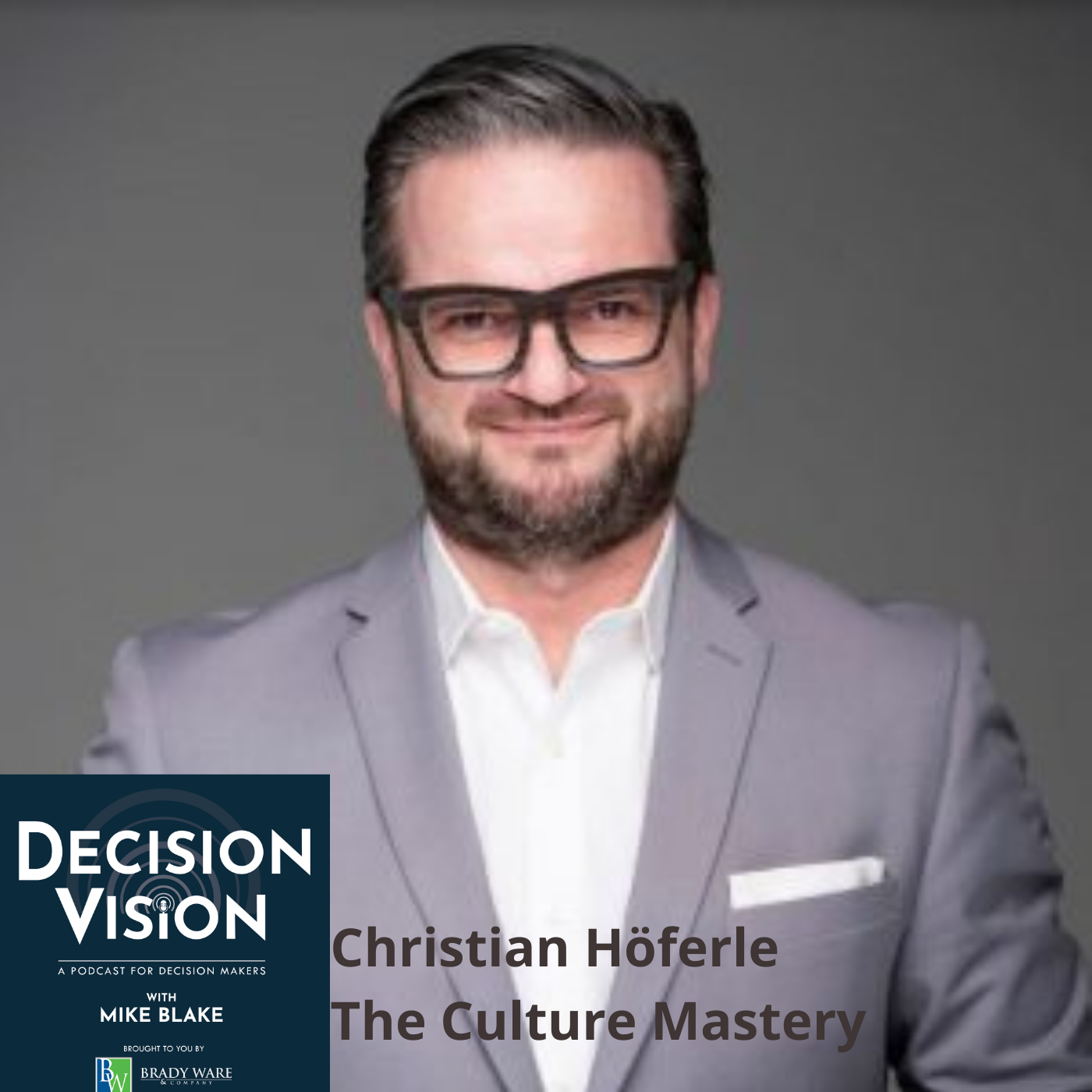
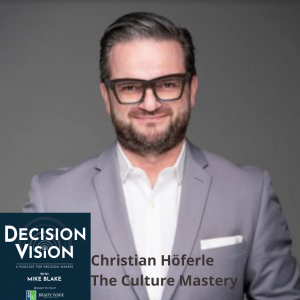
Christian Höferle
Decision Vision
Decision Vision Episode 94: Should I Change My Corporate Culture? - An Interview with Christian Höferle, The Culture Mastery
Loading
00:00 /
RSS Feed
Share
Link
Embed

Download file

Decision Vision Episode 94: Should I Change my Corporate Culture? – An Interview with Christian Höferle, The Culture Mastery

Christian Höferle of The Culture Mastery asserts that if you’re asking yourself this question, the answer is probably yes. Christian joins host Mike Blake to discuss assessing corporate culture, creating cohesion with employees scattered globally, and much more. “Decision Vision” is presented by Brady Ware & Company.

Christian Höferle, Founder, The Culture Mastery

Christian Höferle is a cultural coach, trainer, and mentor for multinational organizations – or rather: for people who work globally. Based in Atlanta, he is German by passport, American by choice, Bavarian at heart, and people call him The Culture Guy. His passion is to help people discover commonality when they are overwhelmed by difference. His mission is to create peace by facilitating understanding, relating, and connecting. At the core of this purpose is culture. And as he helps people figure out this “thing” called culture, they’ll work at their peak and in peace with others.

Throughout his career, Christian has had the privilege of working with people from all over the world. With his company, The Culture Mastery, Christian and his team serve multinational organizations to achieve their goals in global markets.TCM does this via tailored coaching and training programs for expatriates as well as multicultural teams.

The Culture Mastery

The Culture Mastery assists clients with a variety of professional services targeted at improving international business success. They develop global leaders. They consult, train, and coach diverse management and leadership functions,  provide destination services, support expatriates on foreign assignment, and deliver tailored cultural training programs.

The Culture Mastery provides leadership development programs for the global business community. When companies struggle to adapt to the unique work cultures in foreign markets and when their managers fail to adjust to the norms and behaviors of these cultures, their global success is at risk and the companies stand to lose out on international growth opportunities.

Mike Blake, Brady Ware & Company

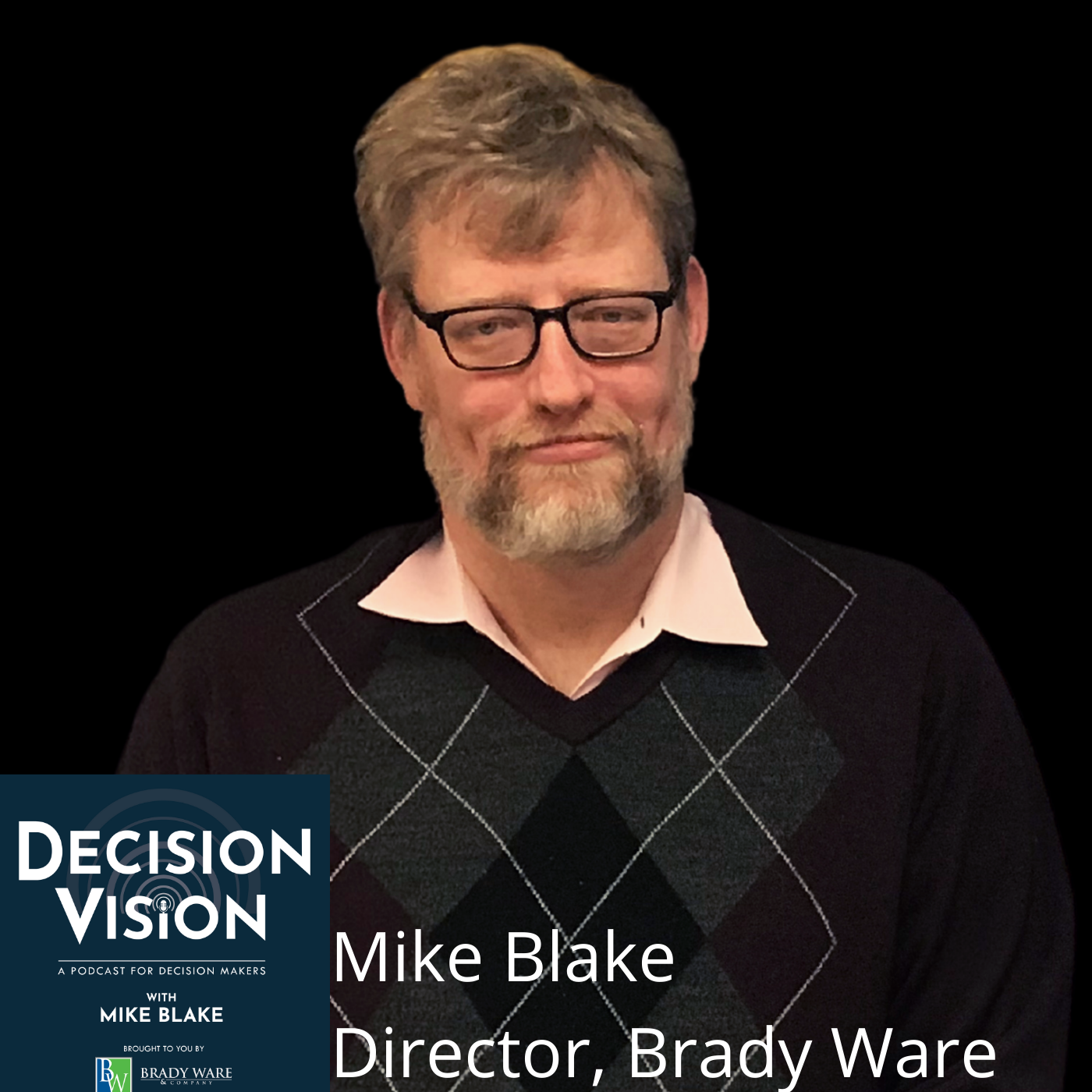
Mike Blake, Host of the “Decision Vision” podcast series

Michael Blake is the host of the “Decision Vision” podcast series and a Director of Brady Ware & Company. Mike specializes in the valuation of intellectual property-driven firms, such as software firms, aerospace firms, and professional services firms, most frequently in the capacity as a transaction advisor, helping clients obtain great outcomes from complex transaction opportunities. He is also a specialist in the appraisal of intellectual properties as stand-alone assets, such as software, trade secrets, and patents.

Mike has been a full-time business appraiser for 13 years with public accounting firms, boutique business appraisal firms, and an owner of his own firm. Prior to that, he spent 8 years in venture capital and investment banking, including transactions in the U.S., Israel, Russia, Ukraine, and Belarus.

Brady Ware & Company

Brady Ware & Company is a regional full-service accounting and advisory firm which helps businesses and entrepreneurs make visions a reality. Brady Ware services clients nationally from its offices in Alpharetta, GA; Columbus and Dayton, OH; and Richmond, IN. The firm is growth-minded, committed to the regions in which they operate, and most importantly, they make significant investments in their people and service offerings to meet the changing financial needs of those they are privileged to serve. The firm is dedicated to providing results that make a difference for its clients.

Decision Vision Podcast Series

“Decision Vision” is a podcast covering topics and issues facing small business owners and connecting them with solutions from leading experts. This series is presented by Brady Ware & Company. If you are a decision-maker for a small business, we’d love to hear from you. Contact us at decisionvision@bradyware.com and make sure to listen to every Thursday to the “Decision Vision” podcast.

Past episodes of “Decision Vision” can be found at decisionvisionpodcast.com. “Decision Vision” is produced and broadcast by the North Fulton studio of Business RadioX®.

Visit Brady Ware & Company on social media:

LinkedIn:  https://www.linkedin.com/company/brady-ware/

Facebook: https://www.facebook.com/bradywareCPAs/

Twitter: https://twitter.com/BradyWare

Instagram: https://www.instagram.com/bradywarecompany/

Show Transcript

Intro: [00:00:01] Welcome to Decision Vision, a podcast series focusing on critical business decisions. Brought to you by Brady Ware & Company. Brady Ware is a regional full service accounting and advisory firm that helps businesses and entrepreneurs make visions a reality.

Mike Blake: [00:00:21] Welcome to Decision Vision, a podcast giving you, the listener, clear vision to make great decisions. In each episode, we discuss the process of decision making on a different topic from the business owners’ or executives’ perspective. We aren’t necessarily telling you what to do, but we can put you in a position to make an informed decision on your own and understand when you might need help along the way.

Mike Blake: [00:00:41] My name is Mike Blake, and I’m your host for today’s program. I’m a director at Brady Ware & Company, a full service accounting firm based in Dayton, Ohio, with offices in Dayton; Columbus, Ohio; Richmond, Indiana; and Alpharetta, Georgia. Brady Ware is sponsoring this podcast, which is being recorded in Atlanta per social distancing protocols. If you like this podcast, please subscribe on your favorite podcast aggregator and please consider leaving a review of the podcast as well.

Mike Blake: [00:01:08] So, today’s topic is, Should I change my corporate culture? And culture, it’s certainly something that people have talked about and continue to talk about. But I do think corporate cultures tend to become more important and are more tested in times like this. And as we’re recording this on November 19, 2020, just before Thanksgiving, but I think it will be published after Thanksgiving. But times like this stress a corporate culture.

Mike Blake: [00:01:48] And we’re in a time of extraordinary extreme crisis, not just from a company perspective, but almost everybody in the planet has something going on in their lives that they would rather not have going on. You know, maybe, I guess, if you’re in New Zealand, that’s different because they’ve successfully kind of eradicated and contained the virus. That’s the benefit of being a three hour flight to the nearest large mass of land. But for the rest of us, we are all in a persistent state of crisis on some level or another. And that persistent state of crisis varies in intensity depending on the week, the day, and the hour, frankly. And so, I think that, you know, people are looking to companies where Americans spend so much of their time to kind of make our lives easier. Not easier in an economic sense, not even easier in a spiritual sense, but are companies doing their part to enable their employees to thrive to the extent possible.

Mike Blake: [00:03:04] And there are limits, of course, to what companies can do and some people may or may not have realistic expectations. But a lot of this really boils down to culture. Now, the other fun part of this is that, a lot of companies – most companies, frankly – were humming along minding their own business when, all of a sudden, this virus appears on our shores. And within a couple of months, we’re all told to go home. And many of us are told, frankly, don’t come back or, at least, don’t hurry back. That’s certainly what, at least, our firm in Atlanta is doing. Our office is open but we’re not necessarily encouraging people to come back. Other offices are doing different things. Because different states have different scenarios and, frankly, different offices have different cultures. And we may talk a little bit about that today with our guest.

Mike Blake: [00:03:50] But, I think, that how companies react and how companies support their employees or don’t during this time of crisis can, at least, be partially drawn to corporate culture. And like it or not, this is just another thing that is on the to-do list of the business leader. And so, I hope you’ll find this topic as relevant and as engaging as I do, because I think you’re going to find some nuggets that you can implement right away. And I think you’re going to find some nuggets that, maybe, are long term but are going to make your company a stronger organization, a stronger organism, if you will, in the short term and the long term.

Mike Blake: [00:04:37] And joining us today is Christian Höferle, who is founder of The Culture Mastery. The Culture Mastery provides leadership development programs for the global business community. When companies struggle to adapt to the unique work cultures and foreign markets, and when their managers fail to adjust to the norms and behaviors of these cultures, their global success is at risk and the companies stand to lose out on international growth opportunities.

Mike Blake: [00:05:04] Christian Höferle is a cultural coach, trainer, and mentor for multinational organizations, or, rather, for people who work globally. Based in Atlanta, he is German by passport, American by choice, Bavarian at heart, and people call him The Culture Guy. His passion is to help people discover commonality when they’re overwhelmed by difference. His mission is to create peace by facilitating, understanding, relating, and connecting. At the core of this purpose is culture. And as he helps people figure out this thing called culture, they’ll work at their peak and in peace with others. Throughout his career, Christian has had the privilege of working with people from all over the world. With his company, The Culture Mastery, Christian and his team serve multinational organizations to achieve their goals in global markets. The Culture Mastery does this via tailored coaching and training programs for expatriates as well as multinational and multicultural teams. Christian, welcome to the program.

Christian Höferle : [00:06:01] Well, Mike, thank you for that beautiful introduction. Checks on the way. That was beautiful how you introduced me. I almost didn’t recognize myself. And thank you for having me on your program. I’m honored to be here.

Mike Blake: [00:06:18] So, you know, let’s dive right into it. And when we talk about a company culture, what is that? And you’re, I think, unusually qualified to answer this question from an interesting perspective, because most of us understand what an ethnic culture, what a national culture is. But, maybe, a company culture may be somewhat elusive. So, how do you define that?

Christian Höferle : [00:06:45] Well, it’s an excellent question. It’s also a tough question. And I also want to include the question you asked at the very beginning, do I need to change my culture? If you’re asking yourself that question, then the answer is probably yes. If that question comes up, then that might be an indicator. What is company culture? Well, let’s start with what is culture in general. Culture is the norms and appropriate behaviors that a group of people agree on. That’s one definition. There’s many other definitions. I think when you and I talked in our discovery call, Mike, you said, culture is the the worst behavior leadership is willing to tolerate. That might be a great definition for a corporate culture.

Christian Höferle : [00:07:41] And I like the way that you used the word organism for a group of people or for a group that works along a common goal or towards a common purpose. So, if we make that analogy that a company with a group of people, with employees who work in that company as an organism, then culture is the operating system of that organism. The organism itself, the bodies, the building, the structure, that’s the hardware. The culture is the operating system. And on that operating system, we run different applications. We run the application of language. Right now, the application is English. My operating system happens to be German. So, English is not a native app. It was installed after the fact then I had to do some adjustment to get the glitches out. Sometimes it still glitches. So, if I switch back into a German accent, that’s when that happen.

Mike Blake: [00:08:44] I really love that and you nailed it. As, you know, for somebody who is, himself, a technology geek and a hardware geek, I love that. I love that definition of a culture kind of being the operating system. And that can almost be a podcast in it of itself. I don’t want to get into it too deeply here because we can really put the togas on and go philosophical. Maybe that’ll be a different podcast.

Mike Blake: [00:09:17] But that operating system, let me seize upon that. Who writes the operating system, right? Is it like Linux, which is kind of crowdsource? Or, is it an Apple that has their own very captive people and they write their own operating system? Is it open source? Is it proprietary? Is it something entirely different?

Christian Höferle : [00:09:38] That is a beautiful spinning of that yarn. I never thought of that. But you’re perfectly right. I think, that’s what sets different cultures apart. So, let me preface this with a little bit of a sidebar. We all, whether we are American, German, from Mars or Venus, it doesn’t really matter, we all are part of more than one culture. Most people would think of culture as being part of their ethnic or passport culture. That is one level of culture. There are many layers to that onion, and corporate culture is one of them. The organization which you work the organism that you’re part of, that is also one of the cultural baskets you belong to. And I would argue that ethnic cultures, or national cultures, or maybe cultures around a common language, they tend to be probably more Linux style crowdsource because they evolve over time via the input of every single individual or subgroups within the larger group.

Christian Höferle : [00:10:44] And corporate culture, the way we view it in corporate America or in, let’s say, the “Western World or Corporate Western World” is something, nowadays, that we see as intentional culture or by design. If a company approaches organizational culture that way, then they give it an attention, they create something. And that then, probably, fit more with the Microsoft or Apple version of an operating system. That is not created by the crowd, but created by some higher power by leadership who says these are the parameters that we want.

Mike Blake: [00:11:24] So, you know, within this conversation or this topic of a corporate culture, are cultures like snowflakes and that there are no two cultures that are exactly alike? Or, can there be a helpful construct to categorize cultures that, you know, almost like personalities, right? If individuals can have personalities that are classified, whether it’s Myers-Briggs or something else, can cultures be classified that way, too, to make it easier to get a handle on what they look like, how they differentiate, what their relative strengths and weaknesses are? Or, do you truly have to treat each and every one of them ad hoc and evaluate and analyze them purely in a vacuum on their standalone characteristics?

Christian Höferle : [00:12:18] I think the answer is somewhere in between. And I want to address the choice of words. Snowflake in American English has somehow gotten a bad rep over the last couple of years, so I’m not sure.

Mike Blake: [00:12:31] Yeah. I understand what you’re saying, but I’m going to reject that because I come from the north and, although, I moved to the south, I do not miss snow at all. I do like a good snowflake.

Christian Höferle : [00:12:43] Oh, yeah.

Mike Blake: [00:12:44] I’m going to defend the snowflake here.

Christian Höferle : [00:12:46] Oh, thank you for doing that because I actually miss the snowflakes. I, too, live in the southeastern part of the United States and I grew up close to the mountains in Germany, so I miss the mountains and the snow covered slopes to go skiing. So, yeah, I agree. I just want to, tongue in cheek, make sure that we don’t put culture and the popular culture interpretation of the word in the same basket.

Mike Blake: [00:13:11] Fair enough.

Christian Höferle : [00:13:11] So, the answer – how do we categorize cultures – yes, it can be or often, ideally, there should be a portion of analysis happening in a vacuum without preconceived notions. However, there are certain measurement units that we use in our work. So, we use, as you already said, personality profiling tools, whether it be Myers-Briggs or some use DISC. In our organization, we’re pretty fond of the B.A.N.K Codebreaker system. They typically break down into four prototypes of personalities. And most people are a certain mix of these different prototypes to certain degrees. And there’s many overlaps in these personality profiling tools and some serve different purposes. So, I don’t want to give preference to any.

Christian Höferle : [00:14:03] And on the other hand, human behavior can be explained by their cultural disposition or by their cultural wiring. And the tools that we use in our company, we use two tools. One is called GlobeSmart Profile and the other one is called Country Navigator, which the name is, I think, a bit inelegant because it refers to culture by country, which is often a misleading concept. But these tools and there’s many others out there, so I don’t want to ignore the others out there. They’re probably really good too. So, this is not a marketing program about which tool to use. What these tools have in common is, they compare cultures along, what we call in the field, cultural dimensions. And these are polar opposites of human behavior. So, you would have one dimension is the status dimension. Is a culture more hierarchically structured or is it more egalitarian? So, those would be the two opposite poles. And an individual may fall somewhere in between those two poles from one to ten, as well as a whole group of people.

Christian Höferle : [00:15:14] So, if you look at an organization, is an organization more hierarchically structured? Let’s say, military, armed forces, any type of law enforcement, tends to be quite hierarchical. And then, you look at – I don’t know – Airbnb, Zappos, or a lot of startups that are often fairly egalitarian and status is only rewarded on merit, if at all. So, we can measure along those dimensions. So, there’s the hierarchy. Status dimension is a culture more relationship or task focused. Do they communicate more directly or indirectly? Are they focused more on the individual or more in the group? So, there’s a variety of tools that we use.

Mike Blake: [00:16:04] Now, I think we have a handle on kind of how culture is defined. I’m going to ask this question on behalf of old Gen Xers, like me, and even boomers. Why should we care about company culture? Why are people talking about this? And what happened to just keep your head down, work hard, and let the chips fall where they may? You know, what is company culture and why has there been a movement now to, frankly, care about it?

Christian Höferle : [00:16:30] Well, aren’t there still enough companies out there who operate that way in a more authoritarian or more instructive way? That means also with hierarchies, there is a clear defined leadership structure. There is a clearly defined cascade of power, influence, authority, and we operate along those lines. I think there’s still plenty of companies who work that way, and they may be very successful in doing so. And I’m not going to say this is right or wrong, the keep your head down and plow through it. For some organizations, this works really well. Others chose a different path and they were successful in a different way.

Christian Höferle : [00:16:30] So, I really would refrain from judging cultures. I don’t think a culture per se is wrong. A culture simply is. And as an organization, you can ask yourself, are we getting the results that we want? And if not, is it possible that our organizational culture has something to do with it? Then, let’s talk about that. If your results are within your goal setting, if you’re happy with them, then I would argue your culture might be healthy.

Mike Blake: [00:17:55] I think that’s a really fascinating point. I did not expect to hear that answer from you. And, again, I’m not judging the answer, but I did not expect an answer that suggests that a culture in it of itself is not necessarily good or bad. Again, going back to your example, it doesn’t necessarily mean that an operating system is good or bad. It just means that one operating system, Windows versus Linux versus Symbian versus Mac OS or iOS, just happens to fit your workflows better.

Christian Höferle : [00:18:31] Well, here’s the thing where the good and bad becomes an issue for an organization. As I said earlier, we are humans. And as humans, we are not only part of one culture. Since we are members of many different groups, these groups evolve over time and over the generations. So, I’m a fellow Xer and I’ve seen millennials and Zs come up in the workplace and they’re influenced by different things, by different other groups than I was. My subgroups that I belonged to outside of work or before I even entered the work space was my friends at school, there was my family. Maybe if I was religious, then there was the faith group to which I belonged. Then, I played in a sports club, so there was soccer and there was volleyball. Then, there were the extended friends and family and their offspring and their friends. And I could go on and on. There are many different circles of people, many different subcultures to which I belonged.

Christian Höferle : [00:19:34] And I see that my kids or that millennials that I’ve met over the course of the years, their subgroups, their subcultures, to which they belong are often significantly different from mine. So, the influences that we get from these different cultural groups to which we belong, they also affect how we want to work, how we want to treat others at work, how we want to be treated, and how we want to have our work organized, or organize it for ourselves. Macroeconomic changes affect that. We’re now living in this year, 2020, that, in hindsight, will be marvelous, I hope. That is changing the way we work. That’s outside influence that affects the culture. So, every organization has to respond to that because a company does not work in a vacuum. A company is the sum total of its employees, and these employees have different cultural imprints and they change. They change from decade to decade or maybe even quicker. So, how do I respond then as an organization to the cultural changes my employees are undergoing? That’s the critical question.

Mike Blake: [00:20:52] Okay. That’s interesting. I’m going to have to think on my field a little bit here because I need to reframe this conversation from a good or bad culture. And, instead, let’s talk about this, what are common symptoms that might lead one to examine whether or not the company has a culture of sustaining or promoting a culture that is consistent with their objectives? So, what are the symptoms that something may need to be changed sort of in the cultural kernel of the operating system?

Christian Höferle : [00:21:33] I think some symptoms are high churn rate. So, if you’re losing a lot of employees, if you’re continuing to rehire for positions because you cannot hold onto your employees, that is, I think, a red flag. Also, disengagement. However you want to measure it, I think, engagement levels in an organization are critical indicators. Do my employees engage with each other, and with leadership, and across departments in a way that leadership would like to see? Again, that depends on what the leadership wants. But some cultures, national cultures, ethnic cultures, do not want any engagement beyond the silos in which the people work. In other national cultures, it is highly encouraged. And it also depends on the industry. But engagement defined by the KPIs that the company wants. So, if engagement is low, if you can measure that or if it’s only anecdotal, then that is something you want to look into as, are we really being with each other the way is most productive for us?

Mike Blake: [00:22:49] You know, a thing that strikes me about culture – and maybe this gets back to the personality analytical tools that we’ve discussed – is there something akin to a Myers-Briggs or a DISC that helps somebody like you, maybe, analyze a corporate culture so you can understand kind of what it is and and what it is not? Are there frameworks out there that help you do that diagnostic? Or, is it still you just sort of have to kind of be an expert and you go in and just sort of caught like you see it?

Christian Höferle : [00:23:23] No. The tools that I mentioned earlier, they can be used for that. Especially, GlobeSmart is a tool that we use with groups quite a bit. So, we use it with the individuals and then we create departmental cultural profiles, let’s say, here’s R&D, here sales, here’s H.R. These tools exist. And I’m only naming the ones that we use frequently because those are the ones that I have best experience with. But there’s a handful of them out there. Global Competency Inventory, GCI, is also quite good for that when we talk about international cultural connects or disconnects. And there is a variety, like ICI, IDI, the whole aesthetic concept is still around, which has its pros and cons. There’s a bunch of them out there that are being used for that very purpose.

Mike Blake: [00:24:17] So, let’s then kind of take a hypothetical situation that we diagnose a company culture somehow. And we’ve been prompted to do that because we have discovered that, you know, our churn of employees, particularly the ones who you most value, is higher than we think it ought to be. And our employee engagement is not in the place where we like it to be, but we’d like to have them get engaged with employees. What are most often the root causes of that disconnect taking place?

Christian Höferle : [00:24:58] In my experience, and that is really a limited view that I’m taking because I haven’t worked with every situation yet in the corporate world, but in my experience, it is often a trust question. How much trust is there within the team? How much do leadership trust their people? Do they follow this Apple, Steve Jobs ideal of I hire the best people and let them go to work because they’re smarter than me? Or, do I, as a leader, want to be the smartest person in the organization to surround myself with yes people? That can affect trust. So, is there enough trust is one question.

Christian Höferle : [00:25:46] The other one is, how do we handle feedback within the team? That is something that is affected by these cultural dimensions that I mentioned earlier. Is there a criticizing down approach? Is there, “Hey, you did this wrong, we need to do it again”? Or, is there a coaching up approach, where leadership encourages their people to grow and to get better? So, that is an aspect that can lead to higher churn if that’s not done well. I think compensation is always a question.

Christian Höferle : [00:26:26] In a COVID year, safety protocols and how they are enforced and implemented is a question. I had one client – actually, two clients this year. One client left their employer, even though it was uncertain for him to find immediate new position. But he left the employer because he felt that they were not treating the health threat properly. And he was tested positive several times and they asked him to come back to the office, which was really interesting to hear that. And this first example was more of a midsize organization here in Georgia, in the U.S.

Christian Höferle : [00:27:04] The other one is a global organization with their U.S. base in Texas. And they’re head of their financing group did not want his team to come back to the office after the first lockdown. And headquarters said, “No. You’re bringing people back.” And he said, “Well, we’ve proven that we work remotely from home or from wherever and work gets done, so why put people at risk?” And the company didn’t budge. And he, despite his better judgment, had to bring his people back into the building. So, these things can affect longevity of a team or cohesion on a team. I don’t know, we could go on and on. There’s multiple factors that play into this.

Mike Blake: [00:27:53] So, I infer from your examples here that leadership – and maybe I’ll put the target or the bullseye or the the crosshairs right on the CEO – it sounds like that if there are problematic – boy, it’s so hard not to talk about culture in terms of good or bad. You really messed me up here. If there are problematic elements to a corporate culture that are producing unintended and undesired business outcomes, I infer from what you’re saying that it, more often than not, starts with the top leadership because they’re making decisions that then contribute to these things. Am I on base there or is there something else going on that we need to know about?

Christian Höferle : [00:28:47] I would not challenge your statement. However, I also believe that, depending on the size of a company and the maturity of an organization, culture can change from the grassroots up. Because in certain departments, they begin practicing behaviors that go unnoticed or go unchecked or unedited, so to say, and they go on and on for years. One of my clients, they have this happen in one department that they found out years later that this was what this group or this department have been doing, and nobody ever noticed it or nobody ever cared to look deeper into it. And at some point, it did not align with corporate values anymore. So, it’s both top-down and bottom-up. I think it goes into both directions.

Christian Höferle : [00:29:37] And as you assess culture from the outside, it’s important to look at how does leadership define culture and how do the foot soldiers define it and how does it get created. So, yes, you can be an organization with a top-down cultural footprint that is designed with intention. Does it get lived in the day to day? I don’t know. It depends on how you enforce it.

Christian Höferle : [00:30:05] There is a book by Blair Singer, it’s called Team Code of Honor, that I really like. And code of honor may sound a little bit like Navy SEALs and military. However, code of honor means this is the constitution that we give ourselves as an organization. These are the rules to which we all agree. This is the work contract that you sign when you come in here. These are the behaviors that are rewarded. These are the behaviors that are sanctioned. So, if you agree to this code of honor, then you’re going to be a good fit here. Or if you don’t agree with it, you may have good reasons to help us modify the code of honor. And if a majority is on board with that, let’s do that. However, once a group agrees to common behaviors, if they’re not enforced, then your culture is wobbly. It’s not lived. It’s a wall tattoo with motivational quotes that we do this here. If the picture on the wall says that, but the people don’t do it, then you don’t have a culture. You have a phantom of that.

Mike Blake: [00:31:13] Yeah. I’m a bad person with those pictures on the walls. You’re probably familiar with Successories, and there’s an antithesis to that called despair.com. And they’re the ones that basically take the Successories type of pictures and instead put something entirely cynical on them. In fact, I have one on my desk called Tradition. It shows a picture of the running of the bulls. And it says, “Just because it’s always been done this way it doesn’t mean it’s not incredibly stupid.” I thought they were [inaudible] who like to run away from bulls. But I am really bad with those pictures on the walls.

Christian Höferle : [00:31:59] We had this issue this year with a client and we’re still working with them. It started in February, right before COVID really hit. It’s a medical device manufacturer with the global presence. They make big machines. Like, their cheapest product is, like, $8 million. And they make these radiation guns to kill cancer cells. Quite fascinating company. And they decided to in-house or insource their I.T. support team in India. And they’ve been outsourcing that for years with mixed results. And the corporate decision was made, “We’re going to hire people. We’re going to give them the t-shirt with our logo on it. And they’re going to be on our payroll. And we’re going to have a building and it’s going to be ours. Because we’re done with this here and there supplier taking care of our I.T. support, which may kill people if you don’t get that system to work. And the laser gun or the radiation gun doesn’t kill the cancer cell, but the brain cell next to it, then we’re in trouble.”

Christian Höferle : [00:32:58] So, what they found was that we have a corporate culture and these are our corporate ideals and values. And it turned out that the brothers and sisters in India, and in Hungary, and in Switzerland, and Australia, and in Singapore didn’t quite gel with what Silicon Valley had to say. So, during this year with I don’t know how many live in-classroom trainings before COVID hit and then a bunch of virtual sessions, they came to the agreement that it would be best to bottoms up crowdsource a common code of excellence for their organization. And leadership took a sidestep and said, “Okay. Let them develop this, because this is what we can do better. This is how we’ve hired people because we wanted this change. We wanted to bring them the India people. And so, now, we need to find a common ground between people in the US, Europe, and India.” Those were the three big poles or big baskets of their workforce. And, so far, it’s been working great. To see that happening, how such a diverse group of people of more than 200 I.T. support staff are pulling together to create something that wasn’t in place before and is, to a certain degree, in contradiction to what the corporate values originally were. They’re doing away with these wall tattoos.

Mike Blake: [00:34:23] I’m going to branch off a little bit because I’m curious if you have ever seen a movie called Gung Ho.

Christian Höferle : [00:34:31] I don’t think I have.

Mike Blake: [00:34:33] It is a fascinating movie. And I don’t watch a lot of movies. And the ones I watch are not particularly intellectual. I’m just going to put this out there right now. I’m not a European film guy that watches a Finnish love story with subtitles or something. But there is this one film or movie I remember seeing. The movie is called Gung Ho and it starred Michael Keaton. I think it’s before he was in Batman or right about the same time. And it was done in the ’80s, and back in the ’80s in the United States, we were afraid of two things. We were afraid of communists and we were afraid of the Japanese that they were going to literally take over everything in America. They were killing us in electronics. They were destroying us in automobiles. And they are proceeding to buy up lots of iconic American real estate. I think they bought Rockefeller Center that became Nissan Plaza for a while, if I’m not mistaken.

Mike Blake: [00:35:34] So, anyway, the story is about a Japanese or an American car factory in Detroit that is taken over by a Japanese company. And walks through some really interesting scenes about how the Japanese adapt to the American culture that they’ve acquired and how the Americans adapt to the Japanese culture. And given what you do for a living, I think, one, since you’re such an expert, you’ll probably find 19 things wrong with it. But, nevertheless, I think you may find some nuggets you’d find stimulating.

Christian Höferle : [00:36:09] I will have to watch that because it reminds me of this documentary that was released on Netflix, I believe, last year called American Factory, which looks at a similar plot from a documentary angle. A Chinese company coming into rural Ohio, I believe, and buying a dormant factory and rebuilding it. And the culture clashes between the Chinese and the workforce there in Ohio. It’s flabbergasting. I think the fear of the Japanese in the ’80s has morphed to the fear of the Chinese in the 2000s, right?

Mike Blake: [00:36:42] Not a doubt.

Christian Höferle : [00:36:43] And I remember, because when you said this in the 80s, I totally remember that, because the first time I came to the United States was in 1988. I was a foreign exchange student from Germany. I was 17 years old. So, now you can all do the math and date me. And I came to northwestern Minnesota. So, for those of you who watched another movie called Fargo, then you know exactly where I spent the year 1988. And, by the way, that movie had 19 things correct and maybe one thing off. So, it was spot on as to how people in northwestern Minnesota or the Dakotas behave.

Christian Höferle : [00:37:22] So, I was there with a host family who claimed or rightfully claimed German descent. I guess that’s why they picked me as their foreign exchange student. And the old guy, the grandpa in that family – rural farming family right out there in the flat land of the Great Plains – Lawrence, I remember him. Lawrence, he was in his late 70s when I arrived there and and he was yanking my chain constantly. He was really trying to push my buttons. Instead of to include me into the family, he wanted to see how far he can push the young kraut. And he would say things like, “Well, back in the ’40s, our people kicked your people’s butts and we really kicked the Nazis out of here.” So, he was trying to do all that. And, for me as a child of the ’70s and ’80s, I was like, “Okay. Old man, just bring it. This is your land and I’m okay with that.” And, by the way, I told him, “Our country is really happy that you came kick the Nazi’s ass because we probably still will live under their rules. So, thanks for doing that. And, also, how do you like our cars?” And that typically shut him up. So, the fear of Japanese cars and, maybe, the respect of German cars was palpable in the ’80s.

Mike Blake: [00:38:42] I think that’s right. So, now, I want to hearken back to something you touched upon before that little sidecar, because I think this is really important. It sounds like you have a belief that, you know, if here is a belief or a diagnosis that a company culture is not, for lack of a better term, just sort of working. You know, I’m really struggling with saying good versus bad, but it’s just not working the way that it ought to. You don’t necessarily have to be the CEO to change it. That it is indeed possible to have sort of a bottom up change. If you’re listening to this right now and you’re not the CEO, maybe you’re not even that close to being the CEO, maybe you’re a vice-president or you’re a controller or you’re a director some place, there potentially is hope that you can, in fact, change the culture from below or from the side, not necessarily from the top. Am I reading you correctly?

Christian Höferle : [00:39:40] Well, there is a chance to do it from the side. You simply have to have agency in the organization. If you have a position of influence – I’m not saying authority, but influence – that can help do that.

Mike Blake: [00:39:54] You know, and I wonder, too, sometimes leading by example can be helpful. And I think I’d like you to comment on this. I think that companies even can have sort of mini- enclaves, if you will, where, if a culture throughout a company may be somewhat dysfunctional or not productive, there may very well be business units or squads or teams that are, in fact, quite effective and quite positive. And in that respect, maybe they can then serve as an example. Enough people kind of see and say, “Hey, why aren’t we like that?” And maybe change comes that way. Is that a possibility or am I being my typical idealistic self?

Christian Höferle : [00:40:46] Well, I think idealism is a great start, because unless we have a vision that we want to have, then what are we doing it for? Maybe this is not the answer to your question, but I think if an organization allows culture to happen then you’re in trouble. I think culture will happen in it by itself just by letting people be with each other, and the chips will fall as they may. And they may not fall the way that serves the organizations. So, I think there needs to be some type of intentionality in an organization.

Christian Höferle : [00:41:28] And if it’s true what we both think, apparently, that having some ideals around this is helpful, then leadership needs to be involved to a certain degree. Either they do it themselves. They steer that culture change or that culture design, it doesn’t have to be change. Or they give agency an authority to different players in the group and say, “Hey, you guys take this. Make this your project and you have our backing.” I think, in any type of change needs to have backup. It has to have – I can’t think of a better word than agency.

Mike Blake: [00:42:10] We’re speaking with Christian Höferle of The Culture Mastery. And the question is, Should I change my company culture? We don’t have a whole lot of time, but there’s still some more ground I want to make sure that we can cover here. And one is, you know, is there a way kind of to track company culture, to keep tabs on us so that you have sort of, I guess, early warning systems, if you will, that maybe culture is starting to go in a direction that you don’t want it to so that, you know, just as they say, an ounce of prevention is worth a pound of cure. You can be more in maintenance and preventative mode as opposed to crisis reaction mode.

Christian Höferle : [00:42:55] That’s a good question. I’m not sure I have the answer. Maybe there is an answer to that. I would argue, too much maintenance or culture control in an organization can backfire because it can be viewed by the employees, by the teams, as micromanagement and supervision. This year brought out a term that I truly not like. This term of cancel culture, where we question every behavior that has been okay for a long time, whether it was good or bad, but it has been in place. The group accepted it. And, now, we have some flags going up and we throw the baby out with the bathwater. If that behavior happens in an organization, I would suspect that’s not a good thing.

Christian Höferle : [00:43:52] However, there are certain behavioral traits of an organization that do not stand the test of time. Maybe overly authoritarian leadership. Or in the United States, we’ve seen a lot of conversations around race, ethnicity, and equality in an organization, how race and ethnicity and identity can be brought into the workspace without repercussions or without being a detriment to the team member. If those structures of systemic racism is being thrown out, then I would argue that will make the company better. It will make it more productive and you will have more cohesion.

Christian Höferle : [00:44:39] However, if you’re going to keep tabs on corporate culture as a continuous practice, to me, that sounds almost like 1984 policing. Like a police state, Big Brother is watching you complete control. Maybe I misunderstood your question, but that’s how it feels to me. If we’re going to talk about cultural maintenance in an organization as an ongoing thing, I would be a bit wary of that.

Mike Blake: [00:45:10] Well, I’m sure that you did understand that. And what that says to me is it highlights the challenges then of maintaining this corporate culture. And, in fact, thinking of the firm in the terms of an organism. And I think I see where you’re headed, there are still companies that want to sort of be everything. You know, I did some projects years ago for Coca-Cola here in Atlanta. And, you know, this wasn’t that long ago. I strongly suspect it’s still the same way. You know, everybody’s office is full of red and white and swag that carries the polar bears with Coca-Cola on it and Santa Claus and everything else. And I remember I had dared to go out and I came back with Taco Bell, which at that time, I think, was owned by Pepsi Cola. And you would have thought that I had streets naked across the compound. I mean, I basically was sent back to my car to eat it. So, I learned that I was not going to do that again.

Christian Höferle : [00:46:31] Well, and if the majority of the people at Coke want that to be the behavior, then that’s what they agree on. You may have not liked it because you came in as an outsider. If they agree to it, then that’s their culture, right? I might not feel happy there. You might not feel happy there. Because it’s drowning out everything else that’s not red and white and Coke. But if it works for them, why would I be the judge?

Mike Blake: [00:46:55] Well, I think – go ahead.

Christian Höferle : [00:46:57] I think a company is only a company, a business is only a business, if it solves somebody else’s problems. So, that is always the main purpose of a business. Somebody has an issue that they need resolved with a product, a widget, a service, an idea. and a business will solve that. And as long as everybody in the business works towards that goal, I think that is what every company should think about first, are we solving our customers problems? This is the how outside. This is the what outside. How we do it internally is something that the internal people need to decide how they want to do that, how they stay competitive. And then, I’m going to go full Simon Sinek on you, everybody in the organization needs to know why they’re doing that, why they’re here, why is that important to them to solve the customer’s problem?

Christian Höferle : [00:47:52] If you’re there because you love Coca-Cola and red and white are your colors and you can’t get enough of Santa with the sticky, brown, effervescent liquid, then awesome. You’re there for the right purpose. If that’s not who you are, maybe you’re in the wrong culture. You won’t be able to change Coke with a mindset that doesn’t apply to the problem solving, so to say.

Mike Blake: [00:48:15] Well, now you ended it. Now, you went and mentioned the name of the informal spiritual leader of the Decision Vision podcast, which is Simon Sinek. He does not know this, by the way.

Christian Höferle : [00:48:27] We should tell him.

Mike Blake: [00:48:28] You know, if I could, I would. It is on my bucket list to get him on this podcast someway, somehow. And, really, again, the side conversation goes back and drives home what you said earlier, it’s not about having a bad or a good corporate culture. If that culture works to them, you know, you’re right, I’m not going to judge. Just like when I lived in Russia, they have certain customs. One of them, for example, you don’t give an even number of flowers to somebody unless it’s at a funeral.

Christian Höferle : [00:49:03] The same in Germany.

Mike Blake: [00:49:03] A dozen roses there is a different discussion than it is here. And I don’t judge that. It just means if I buy a dozen roses, but my intent is to greet somebody because they’re having me over for dinner, I’ll take one of the roses and throw it away or give it to somebody so that it’s an odd number. But, you know, whatever culture works for them. That’s a nice way to kind of circle back to that in a practical way.

Mike Blake: [00:49:30] All right. We’re running over time, but I hope you have a couple more minutes because, one, it’s not just an elephant in the room. It is the room that I’ve got to get here on digital recording tape here. So, the question is so big, you want to have it written down. I don’t think I have it written down correctly. How is addressing the coronavirus pandemic forcing companies to re-evaluate or reassess or morph their culture? Or, is it morphing culture, whether companies like it or not? Is this going to cause a mutation? How is culture now kind of interacting with this global pandemic that has upended the way we work for millions, if not billions, of people?

Christian Höferle : [00:50:32] Well, I don’t have the crystal ball. However, what I see so far is a metric that I mentioned earlier, trust. Organizations are learning to trust their people more than they used to before. Because there is not the permanent control over what the employee is doing as their warm body moves around or sits at the desk in the building. For a lot of business models, it is not necessary for companies to have their people in the same building. So, for those companies that recognize that now this work from home or work from — extending more trust. And as they are producing results that are similar to the ones before COVID, they’re recognizing that our people can be trusted. So, I think this will actually enhance the cohesion. This will increase or lower the churn rate. This will make employees stay longer because they feel trusted, that they feel seen, heard, and acknowledged.

Christian Höferle : [00:51:34] Now, there are other businesses, other organizational types, or business models where we do need the people in the field or in the building or we need to have them leave their house. And that also comes with trust because any organization and their clients need to be able to trust the employees that they take the virus seriously, that they are being tested, that they are taking the precautions not only at work, that they’re wearing their PPEs at work, but that they are also reducing their social contacts outside of work.

Christian Höferle : [00:52:07] It’s easy to to ask somebody to come to work with the hazmat gear on if they’re having corona parties with 25 of their friends at home. So, that also means I need to trust my people. And I’m not sure if we, as a society, – when I say we, I mean here in the U.S. – if we have succeeded yet in maintaining our trust levels in the public space or in the corporate space, because the jury is still out, I think. I don’t know often can I trust this person at that office to be safe or am I trustworthy enough to them as somebody entering their space? I think trust will be one of the major critical factors in how we are with each other, whether it’s at work or outside of work.

Mike Blake: [00:53:01] Fantastic answer, because I think there’s so much you can build off of that. And maybe if there’s even one takeaway, if you’re thinking about coronavirus, you’re thinking about how it’s impacting culture. You’re right, the big pressure point at the end of the day is trust. And companies, like it or not, are having to trust their employees and employees having to trust bosses on a level they just have not before and it’s exposed some vulnerabilities. And, as a sidebar, you know, there are companies now that are trying to install spyware just to monitor their employee’s activity, basically.

Mike Blake: [00:53:46] I’m just going to put this out on the public record, if Brady Ware ever does that, I’m out. I would not subject myself to that. And, look, it’s never been a conversation as far as I know. But I feel that strongly that I would not be subject to it and I would not enforce, I would not lead employees to be in that. Boy, I’m trying so hard not to be judgmental, you know.

Christian Höferle : [00:54:14] But it’s funny that you’re saying it –

Mike Blake: [00:54:15] It’s not the culture I’d be in.

Christian Höferle : [00:54:15] It’s funny that you say this, because outside of work, we’ve long accepted to be monitored that way. We all use Google. We all have smartphones. And the NSA is tracking it anyway. I’m being super fatalistic here.

Mike Blake: [00:54:28] But we’re not being monitored in a way where there’s a direct consequence. Let’s take a very extreme example, if I decide on my tablet, I’m going to go to a pornography website. Google knows that and Apple knows that through Safari or whoever. They know that, right? But that’s still an exercise that the next day – you know, unless my wife finds out or somebody else finds out – there isn’t going to be some police that’s going to show up at my door and expose that and shame me publicly or somehow deprive me of my way of making a living. As opposed to, at the workplace where, you know, presumably somebody is going to say, “Hey, you know, according to our records, you only worked seven hours and 48 minutes yesterday. What’s the deal?”

Mike Blake: [00:55:32] I think your point is well taken. We have made our peace of being tracked and I don’t care. Look, if you want to track my daily stuff – and I’ve been tracked by the KGB when I was in Belarus – you’re just going to be really bored. And that’s fine. But, you know, when it gets into that sort of Big Brother, where you have to be accountable for how you spend every minute of your time in a workday, that, to me, borders on evil.

Christian Höferle : [00:56:05] And I know we’re going over time here. But I agree with you that would be evil. However, let’s compare cultural regions in the world and how they address corona. In our Western world, where our individual rights and our civilian rights are so important to each and every member of U.S. society and other Western societies, there was a lot of pushback to any type of government authority trying to regulate allies in order to stop spread the virus. In other more collectivist societies, two examples that I could think of were South Korea and Taiwan, where a group interest trumps individual interest. The society overall was quite comfortable being tracked with the personality tracker on their phone. I think they force downloaded it through the carrier on people’s phones. And if you left the house during lockdown, somebody came to your door and checked on you. So, this is quite Big Brother and George-Orwellian and quite intrusive. However, in those societies, the acceptance for these measures goes higher than it would be in Western societies. And I don’t want to root for that. I don’t want to endorse that. However, I think the results of containing the virus in Korea and Taiwan are a bit better than they are in Europe and North America.

Mike Blake: [00:57:35] Well, that’s true. I mean, you can’t argue with the results. And I guess, yeah, you’re talking about the track and trace kind of programs. You know, and they do seem to be effective. And I don’t use this platform to make any kind of political or social statements, but I will say this, that, I recognize that there is a trade off. Most likely there’s a trade off between what level of individual freedom that we are willing to pay, if you will, in exchange for, at least, a promised level of health security. And each society is deciding the price that there’s a different utility function. Now, I get my economist geek hat on. There’s a different utility function for each society. And what we’ve discovered in the United States, I think, more than any other industrialized democracy, is that, we have two different utility functions. And those are proving very difficult, if not nearly impossible to reconcile.

Christian Höferle : [00:58:48] I would agree.

Mike Blake: [00:58:51] Christian, this has been great. And I so appreciate you being willing to come on and be here a lot. I think this is the longest podcast I’ve ever done. I don’t think we’ve ever gone over the hour mark. So, we must be doing something right or, at least, we’re entertaining ourselves. But thank you so much.

Christian Höferle : [00:59:05] Thanks for having me.

Mike Blake: [00:59:06] And how could people contact you if they have questions about this, or maybe they want to know more about Bavaria, or they want to know more about corporate culture, or international culture and trying to match them, what’s the best way for them to contact you?

Christian Höferle : [00:59:23] I like email. I like the socials. I think you have all my information that will be shared in, I guess, the show notes or so. But as you listen, I think the easiest way is to find us online, theculturemastery.com. That’s one word, theculturemastery. There you’ll find all the links to the socials. I prefer LinkedIn of all the social media tools. But, obviously, I have my shingle out on many others, so it should be easy to find. There’s only one culture guy, so you could also Google The Culture Guy. That will work.

Mike Blake: [00:59:56] Very nice. I need to set myself up as the value guy.

Christian Höferle : [01:00:01] I didn’t set myself up that way. That was my mastermind group. They gave me that name. I would have never chosen that. I found it corny at the start, but they said, “Hey, that’s who you are.”

Mike Blake: [01:00:12] The best nicknames are the ones that other people give you. Mine, actually, has been The Mad Scientist, so I decided I’m going to go with that.

Christian Höferle : [01:00:21] I love it.

Mike Blake: [01:00:24] So, that’s going to wrap it up for today’s program. And I’d like to thank Christian Höferle so much for joining us and sharing his expertise with us. We’ll be exploring a new topic each week, so please tune in so that when you’re faced with your next business decision, you have clear vision when making it. If you enjoy these podcasts, please consider leaving a review with your favorite podcast aggregator. That helps people find us that we can help them. Once again, this is Mike Blake. Our sponsor is Brady Ware & Company. And this has been the Decision Vision podcast.
Tagged With: Brady Ware, Brady Ware & Company, Christian Höferle, company culture, corporate culture, healthy corporate culture, Michael Blake, Mike Blake, The Culture Mastery

Decision Vision Episode 93: Should I Be Thankful?, with Mike Blake, Brady Ware & Company

November 26, 2020 by John Ray

Should I Be Thankful
Decision Vision
Decision Vision Episode 93: Should I Be Thankful?, with Mike Blake, Brady Ware & Company
Loading
00:00 /
RSS Feed
Share
Link
Embed

Download file

Decision Vision Episode 93:  Should I Be Thankful?, with Mike Blake, Brady Ware & Company

It’s been a long, tough, pandemic-affected year, and host Mike Blake takes a moment to reflect on the question of “should I be thankful?” “Decision Vision” is presented by Brady Ware & Company.

Mike Blake, Brady Ware & Company

Mike Blake, Host of the “Decision Vision” podcast series

Michael Blake is the host of the “Decision Vision” podcast series and a Director of Brady Ware & Company. Mike specializes in the valuation of intellectual property-driven firms, such as software firms, aerospace firms, and professional services firms, most frequently in the capacity as a transaction advisor, helping clients obtain great outcomes from complex transaction opportunities. He is also a specialist in the appraisal of intellectual properties as stand-alone assets, such as software, trade secrets, and patents.

Mike has been a full-time business appraiser for 13 years with public accounting firms, boutique business appraisal firms, and an owner of his own firm. Prior to that, he spent 8 years in venture capital and investment banking, including transactions in the U.S., Israel, Russia, Ukraine, and Belarus.

Brady Ware & Company

Brady Ware & Company is a regional full-service accounting and advisory firm which helps businesses and entrepreneurs make visions a reality. Brady Ware services clients nationally from its offices in Alpharetta, GA; Columbus and Dayton, OH; and Richmond, IN. The firm is growth-minded, committed to the regions in which they operate, and most importantly, they make significant investments in their people and service offerings to meet the changing financial needs of those they are privileged to serve. The firm is dedicated to providing results that make a difference for its clients.

Decision Vision Podcast Series

“Decision Vision” is a podcast covering topics and issues facing small business owners and connecting them with solutions from leading experts. This series is presented by Brady Ware & Company. If you are a decision-maker for a small business, we’d love to hear from you. Contact us at decisionvision@bradyware.com and make sure to listen to every Thursday to the “Decision Vision” podcast.

Past episodes of “Decision Vision” can be found at decisionvisionpodcast.com. “Decision Vision” is produced and broadcast by the North Fulton studio of Business RadioX®.

Visit Brady Ware & Company on social media:

LinkedIn:  https://www.linkedin.com/company/brady-ware/

Facebook: https://www.facebook.com/bradywareCPAs/

Twitter: https://twitter.com/BradyWare

Instagram: https://www.instagram.com/bradywarecompany/

Show Transcript

Intro: [00:00:01] Welcome to Decision Vision, a podcast series focusing on critical business decisions. Brought to you by Brady Ware & Company. Brady Ware is a regional full-service accounting and advisory firm that helps businesses and entrepreneurs make visions a reality.

Mike Blake: [00:00:21] And welcome back to Decision Vision, the podcast giving you, the listener, clear visions to make great decisions. I’m going to record a slightly different podcast today. We have a different format because the guest today is me. And the subject we’re covering today is, Should I be thankful? And I think this is a poignant question this year, because I think for many of us, we can’t see 2020 leave fast enough. You know, people ask me who I am -they definitely ask me who I am – but how I am. And, you know, I tell them tongue in cheek – but also hoping to get a laugh out of people because I think that’s important is to laugh as well – you know, if you put aside a global pandemic, massive social upheaval, a constitutional crisis, and murder hornets, I’m actually doing pretty well. But, unfortunately, a lot of us can’t put these things aside. Some of us are much more impacted than others. And I hope that most of us can find things to be thankful for.

Mike Blake: [00:01:35] We’re seeing, of course, present at the time that nobody listening to this podcast doesn’t know already. But I want to acknowledge everybody for their courage and their will in trying to combat this pandemic and everything else that’s going on. We’re now wrestling also with massive social questions that we have not wrestled with for 50 years. I’ve never wrestled with them. I’m only 50. I was born shortly after the heat of the civil rights movement. And, you know, you read a lot now about how to cope with stress because we can’t do the things that we used to do. We can’t just go out to eat, generally. Some people are doing that, and that’s fine. It’s not a choice I would make, but others are making that choice.

Mike Blake: [00:02:22] When we’re not in our state, we may not have that choice to make as, you know, lockdowns seem increasingly likely as we have this second or third wave of COVID. But I hope that in the midst of having unprecedented burdens, whether it’s homeschooling for us. You know, for example, we’re homeschooling our nine-year-old, and that is tough. And, you know, structures that we’re used to having child care has either become prohibitively expensive or shut down entirely. The ability to freely and ad hoc socialize with friends is more challenging. And we’re homebound in many cases. And when we’re not homebound, the statistics are fairly clear that the consequences of that tend to be swift. They tend to be severe. And they tend to be fairly pervasive.

Mike Blake: [00:03:13] So, I’d like to encourage everybody to think about things that you can be thankful for. And I’d like to take this opportunity to use my platform to be thankful, to express my thanks for a lot of things. I’d like to express thanks for, you know, my family. I’m now spending a lot more time with them than I ever have. And it wasn’t necessarily by choice, but I’m glad that I have had the opportunity to do that because I’ve learned things about my family that I did not know. Some good, some things that needed improvement, some things that I needed to improve in terms of interacting with my family.

Mike Blake: [00:03:48] I would like to thank my terrific team at Brady Ware. I’m an introvert and I’ve worked from home, basically, for the last 12 years or so, often whether my employer really liked it or not. But for other people who are more social animals, this is very difficult. And, you know, not everybody has the luxury of living in, you know, a sizeable home and having a standalone separate home office the way that I do. And working under conditions of having life go around you can be extremely challenging. And so, I’d like to thank my staff that works directly for me and with me at Brady Ware for their resilience, their ability to adapt. And I’d like to express gratitude to the whole of Brady Ware for, you know, putting, at some point, our employees first and making some hard decisions.

Mike Blake: [00:04:42] But I’m proud of one thing. We have not had to lay anybody off during the entire pandemic. So, people’s jobs for the moment have been secure. I’m not going to get here and gone here to commit to the future, but I’m very proud of the fact that we’ve kept everybody. It hasn’t meant that our profits have been the best in the world, but we’ve kept our staff and I’m thankful for that. And I’m thankful to Brady Ware for sponsoring this podcast. This requires a lot of my time, which is expensive. And requires a lot of cash outlay because of the work that business radio action genre put into this. This ain’t cheap. And while it is a labor of love, it’s an expensive labor of love. And I’m thankful that I have this platform to do it.

Mike Blake: [00:05:29] And I will say this, too, and you probably guessed this because you’ve guessed I’m not a mouthpiece for Brady Ware. Brady Ware has never come on and told me not to do a topic. It has never told me to edit something. They’ve given me complete freedom to produce in terms of the content of this podcast the way that I see fit. And I hope that you, as the listeners, have enjoyed that, continue to enjoy that and benefit from it.

Mike Blake: [00:06:01] And I want to thank our guests. Our guests, particularly the ones that came on. I, basically, said, “Hey, look. I’m starting this podcast. Nobody’s listening. Do you want to spend an hour of your time and put yourself out there on the internet?” And every single one of them said yes. And, you know, since now we’ve gotten a little bit of a listener base and it’s easier for me to convince people to come on, because I can say that we’ve got 12 million or so downloads since February, which I’m told is a big number. I don’t know that, but I’m told that. I don’t know how to measure podcasts. But, you know, each host has brought something different to the table, a different knowledge, a different experience, a different tone. And each podcast a little bit different. That’s because the guests that have come on and have been willing themselves to be vulnerable. You know, for the most part, they have not come on and try to just sort of sell what they do, but rather just get inside their head and share their expertise freely. Sometimes that expertise, frankly, is valued thousands of dollars per hour. And, you know, I’m not going to sit here and be like Rush Limbaugh where I do a three-hour show by myself every day. I’ll be hoarse and I’ll be boring. So, thank you very much for the guests that have come on and done this.

Mike Blake: [00:07:08] And then, thank you to you guys, the listeners. I can speak into a microphone any time I want. It’s much more fun when it’s turned on, it’s being recorded, and people are listening to it. And the emails that I get and the engagement that we get on social media is fun. It’s nice to hear that when you do something like this that you’re making an impact. And many of you have written to me or called me, tweeted me, @Unblakeable, and told me that what we do makes an impact. This helps you make some tough decisions, helped you avoid some, what might have been, terrible mistakes. And that’s really awesome.

Mike Blake: [00:07:47] And I’m thankful for, knock on wood, my health. I have not been stricken with coronavirus. Nobody, as far as I know, in our family has. That has not been the case for everybody. And this is a scary disease. I believe that it’s real. I believe that it is scary. And we still don’t know what the long term effects are. Some people get better, some people don’t. And that is terrifying to me. So, whatever your ideology is, whatever your chosen path is, you know, I want you to be safe. And I hope you’ll be safe. Because, frankly, I mean, you can’t listen to the podcast if you’re not around. So, I need all the listeners I can get. I can’t have you guys dying off on me because you got the coronavirus.

Mike Blake: [00:08:33] And I’m thankful to the pharmaceutical companies, that a great expense, are developing new vaccines. And we seem to have three or four now that appear to be likely to be available first quarter of next year. And they’ve poured unprecedented resources into this. And they are not all going to make their money back, right? There are something, like, 20 candidate vaccines out there, if even half of them come to market, are they all going to make their money back? I’m not certain that they are. I think a lot of them are doing this from a sense of an obligation to humanity that this is kind of their time to step up and help out. And, you know, I’m thankful to all the individuals and companies that have worked tirelessly and have given up time from their families in order to develop these vaccines that can finally, maybe, put this pandemic away.

Mike Blake: [00:09:26] And, of course, we have to be thankful to the health care workers, and doctors, nurses, orderlies, everybody who is part of our health care architecture. You know, you are right now the folks that are running towards danger rather than running away from it. I’m a running away from it kind of guy, which is why I don’t do those sorts of things. And we’re grateful that you guys, under very difficult conditions, under dangerous conditions, stand there in the face of those conditions, sometimes without a whole lot of gratitude from the public, which is frustrating to see. But for what it’s worth on this one particular podcast that you’ve probably never met, you have my gratitude and appreciation for what you do.

Mike Blake: [00:10:14] And then, finally, I would like to thank our society. You know, our society has been put under immense pressure defining who we are over the last couple of years. Some of it political, some of it environmental, some of it from other places. And our society has had a lot of opportunities to breakdown. I’m not sure they’re out of the woods yet, but I’m very grateful that it hasn’t. And not every society would survive the pressures that this one has. And I’m grateful every day that we do have a society that, it seems no matter what sort of burden we place upon it, we survive. And it’s ugly sometimes. It’s often frustrating. There are winners and losers from it. But it does endure.

Mike Blake: [00:11:08] And I also want to thank my friends out there in the marketplace and the clients of mine who, for 20 years, have entrusted their businesses, their livelihoods to me and to my team. And I thank God. I thank the universe. I thank whatever you think I should be thanking every day for you to be out there. That you do entrust us with this work. And, you know, it does sustain my livelihood but also gives me a life purpose. I don’t have any other skills to feed, clothe, shelter, or heal anybody. I’m a danger to myself and others when I try. But the opportunity to help you, whether you’re a client or whether you’re somebody that simply comes to my office hours at Tech, Alpharetta, or at the Downwind. And we’re going to crank those up as soon as it’s safe to do so. You know, I’d like to thank you for the opportunity to serve you and then for the option to serve you over, in many cases, a long period of time.

Mike Blake: [00:12:17] So, I don’t want to make too big a deal of this. I’ve probably went on longer than I had intended. But it turns out that when I really started thinking about being grateful, there is a lot to be grateful for. So, again, I can’t tell you if you should be grateful or not. You may be in a really tough spot. And I’m not going to sit here and tell you that you have to be grateful to everything that happens to you. And I’m not a motivational speaker. I’m not the guy that’s going to get up on the stage like Tony Robbins and have you do jumping jacks or walk on coals or whatever it is that he does to tell people they can change their lives. Only you can determine to the extent to which that is possible.

Mike Blake: [00:12:56] But I can, again, express my gratitude. And if you’re feeling low, if you’re feeling isolated, if you’re feeling like the cards are kind of stacked against you right now, I hope you can find something positive in your life to be thankful for. I certainly can. I hope all of us can. And if you can’t find that in your heart today, then I wish you all the best in terms of getting to a place where you can do that.

Mike Blake: [00:13:24] So, I wish you a very happy Thanksgiving, if you choose to celebrate it. And, you know, all the best. And here’s looking forward to an upswing in the last part of 2020 and better times ahead in 2021. Thank you.

Tagged With: Brady Ware, Brady Ware & Company, gratitude, Michael Blake, Mike Blake, thankful

Decision Vision Episode 92: Should I Pivot? – An Interview with Brandon Cooper, Aphid

November 19, 2020 by John Ray

should I pivot
Decision Vision
Decision Vision Episode 92: Should I Pivot? - An Interview with Brandon Cooper, Aphid
Loading
00:00 /
RSS Feed
Share
Link
Embed

Download file

Decision Vision Episode 92:  Should I Pivot? – An Interview with Brandon Cooper, Aphid

The question of “should I pivot?” is not just a question for a pandemic, but one businesses are often confronted by as markets grow, target customers change, and competition arises. In this edition of “Decision Vision,” Aphid Founder & CEO Brandon Cooper tells host Mike Blake the engaging story of his company’s pivots and what he’s learned along the way. “Decision Vision” is presented by Brady Ware & Company.

Brandon Cooper, CEO, Aphid

Aphid is a financial technology company and ecosystem that specializes in Internet-related services and products utilizing Artificial Intelligence and Blockchain technologies.

Brandon has over 15 years of experience in Information Technology, graphic design, and over 6 years of chat support. His specialty is in machine learning, and blockchain technology. Cooper has been featured on Steve, NBC, MTV, FOX, and more.

He holds a degree from Michigan State University in Marketing and Merchandising Management.

LinkedIn

Company Website

Company LinkedIn

Mike Blake, Brady Ware & Company

Mike Blake, Host of the “Decision Vision” podcast series

Michael Blake is the host of the “Decision Vision” podcast series and a Director of Brady Ware & Company. Mike specializes in the valuation of intellectual property-driven firms, such as software firms, aerospace firms, and professional services firms, most frequently in the capacity as a transaction advisor, helping clients obtain great outcomes from complex transaction opportunities. He is also a specialist in the appraisal of intellectual properties as stand-alone assets, such as software, trade secrets, and patents.

Mike has been a full-time business appraiser for 13 years with public accounting firms, boutique business appraisal firms, and an owner of his own firm. Prior to that, he spent 8 years in venture capital and investment banking, including transactions in the U.S., Israel, Russia, Ukraine, and Belarus.

Brady Ware & Company

Brady Ware & Company is a regional full-service accounting and advisory firm which helps businesses and entrepreneurs make visions a reality. Brady Ware services clients nationally from its offices in Alpharetta, GA; Columbus and Dayton, OH; and Richmond, IN. The firm is growth-minded, committed to the regions in which they operate, and most importantly, they make significant investments in their people and service offerings to meet the changing financial needs of those they are privileged to serve. The firm is dedicated to providing results that make a difference for its clients.

Decision Vision Podcast Series

“Decision Vision” is a podcast covering topics and issues facing small business owners and connecting them with solutions from leading experts. This series is presented by Brady Ware & Company. If you are a decision-maker for a small business, we’d love to hear from you. Contact us at decisionvision@bradyware.com and make sure to listen to every Thursday to the “Decision Vision” podcast.

Past episodes of “Decision Vision” can be found at decisionvisionpodcast.com. “Decision Vision” is produced and broadcast by the North Fulton studio of Business RadioX®.

Visit Brady Ware & Company on social media:

LinkedIn:  https://www.linkedin.com/company/brady-ware/

Facebook: https://www.facebook.com/bradywareCPAs/

Twitter: https://twitter.com/BradyWare

Instagram: https://www.instagram.com/bradywarecompany/

Show Transcript

Intro: [00:00:01] Welcome to Decision Vision, a podcast series focusing on critical business decisions. Brought to you by Brady Ware & Company. Brady Ware is a regional, full-service accounting and advisory firm that helps businesses and entrepreneurs make vision a reality.

Mike Blake: [00:00:20] Welcome to Decision Vision, a podcast giving you, the listener, clear vision to make great decisions. In each episode, we discuss the process of decision making on a different topic from the business owners’ or executives’ perspective. We aren’t necessarily telling you what to do, but we can put you in a position to make an informed decision on your own and understand when you might need help along the way.

Mike Blake: [00:00:42] My name is Mike Blake, and I’m your host for today’s program. I’m a Director at Brady Ware & Company, a full-service accounting firm based in Dayton, Ohio, with offices in Dayton; Columbus, Ohio; Richmond, Indiana; and Alpharetta, Georgia. Brady Ware is sponsoring this podcast, which is being recorded in Atlanta per social distancing protocols. If you like this podcast, please subscribe on your favorite podcast aggregator and please consider leaving a review of the podcast as well.

Mike Blake: [00:01:10] So, the topic today is Should I Pivot My Business? And in one sense, you might look at this topic and think, “Well, doesn’t everybody pivot my business?” Our producer, John, and I were talking a little bit before we started the program and, well, doesn’t everybody’s business pivot? Because there are not many businesses that are static throughout their existence, right? Maybe if you’re an electrical utility, maybe if you’re in some kinds of real estate, maybe if you’re in some kinds of mineral industries, maybe that’s true. But for the most part, most businesses do find themselves in what they would think is a pivot every day.

Mike Blake: [00:01:55] But I’m not talking about that. I’m putting my startup hat back on today. And I don’t put it on often because I want the show to be more of a generalized business show and not just focused on startups, but this is something that I think is more applicable to startups. And in the coronavirus environment, I think that this topic should be, at least, thought about or on the radar screen of even established companies.

Mike Blake: [00:02:25] And so, what I mean by a pivot, to not put too fine a point on it, is you’re in one business one day, and then the next day, you come to the realization that the business you’re in is no good. And it’s most likely no good because the need that you thought was in the market just isn’t there or, at least, not in the manner that you can effectively address it. Or if you’re in the coronavirus timeframe, your business Feb. 1 looked great. And then, by June, your business doesn’t look great, right?

Mike Blake: [00:03:06] If you’re a restaurant, and I know restaurants are places that we will never do takeout, right? Well, that restaurant did one of two things. They either pivoted to take out or they weren’t a restaurant anymore unless they had a big pile of cash they’re sitting on. Hotels are are pivoting. They’re renting out their rooms now, not to people who are traveling, but they’re renting them out to people like me who are working from home, and then come to the realization that if they stay at home one more day, they’re going to get either fired or they’re going to go crazy because of their family. And people are sort of taking these refugees and that’s what hotels are catering to.

Mike Blake: [00:03:51] So, even in a conventional industry, companies are are pivoting, for sure. I would even argue, Apple Computer back in 2007 pivoted from being a computer company to a mobile device, and software, and media service and sales company. They started that pivot. And now, they’re well along the road. General Motors is very much pivoting towards becoming an electric vehicle company because they see the handwriting on the wall, like it or not, gas-powered cars are going away sometime in our lifetimes. At least, new ones will be. And the list goes on and on.

Mike Blake: [00:04:33] Well, if you’re in a startup, the necessity to pivot, at least, the potential is a way of life. And some startups have to pivot multiple times, and we’ll talk about that. But what you find is nobody really talks about pivoting because pivoting is not really sexy. Pivoting is necessary. It’s often ugly. It’s a survival mode. And you find out who your friends really are in the pivot. And then, after you successfully emerge from the pivot, everybody’s your friend again. Everybody wants to interview you again, and you’re the darling of the startup world.

Mike Blake: [00:05:08] So, it’s a topic I really want to sink my teeth into. And you know what? It’s hard to find a guest that wants to talk about a pivot because it is tough. You have had to admit a setback to your business. And so, it takes somebody that has a willingness to be vulnerable, that has a lot of emotional intelligence that is willing to come out and publicly talk about the pivot. And fortunately, found somebody great who’s going to talk about that with us. And that person is Brandon Cooper, who is joining us from California. And he is the CEO of Aphid.

Mike Blake: [00:05:43] Aphid is a financial technology company and ecosystem disrupting the 9:00 to 5:00 workforce, using artificial intelligence and blockchain technology. And they’re preventing what’s called the singularity, meaning that robots take human jobs, and robots basically think independently and become sentient artificial life forms. From Detroit, Michigan, Brandon is a serial entrepreneur and inventor. He’s an expert in blockchain and machine learning, has over 15 years of experience in information technology and graphic design, and over six years in client support. He specializes in machine learning and blockchain technology. Brandon’s been featured on Steve, NBC, MTV, Fox and more. He owns a Degree from Michigan State University in Marketing and Merchandising Management. Brandon Cooper, thanks for coming on the program.

Brandon Cooper: [00:06:36] Thank you for having me. Glad to be here, Mike.

Mike Blake: [00:06:39] So, Brandon, did I get it right when I described what a pivot is? Do you think I got that description right? Is there something you want to add or change?

Brandon Cooper: [00:06:47] No, you’ve hit the nail right on the head. That’s exactly what it is. Basically looking at businesses and deciding to take a turn down a different street.

Mike Blake: [00:06:59] So, let’s go to pre-pivot days. How long ago did you do your pivot?

Brandon Cooper: [00:06:59] I’ll completely unveil everything, and these are things that I don’t talk about. But as you know, a lot of people don’t like to talk about pivot. As you said, it isn’t sexy. But we had the company a long time ago. This is when I was just really just trying to conceptualize something. It was AphidByte, and we were trying to prevent the piracy protection. So, we would put these Easter eggs hidden encryption into music songs and, also, into video files, so when people were streaming it, midway, we’ll cut them off and say, “Hey, go to iTunes.” Hey, go to whatever outlet it is to actually buy it, right? And these big companies were going to pay us money. We just flood the internet with all of these things.

Brandon Cooper: [00:07:54] I mean, I’m tired running into these aphids. And then, I said, “Yeah, that’s a great business for large enterprises and movie companies like Universal and Warner Brothers, but people are going to hate us.” So, that was short-lived, and we dropped it. And then, I saw that streaming was coming into effect. I knew that Spotify was going to change that. That’s what Sean Parker really wanted to do with Napster anyway, but just did not formulated him and Shawn Fanning. But I saw the streaming was coming, so I knew that there was no business there. So, I really just shelved the company and didn’t do anything with AphidByte any more at the time.

Brandon Cooper: [00:08:34] And in the midst of that time, I did different ventures, just trying to find my way, just looking for different projects to try to work on them. And I’m naturally an inventor. I worked on a project called Proximity that, basically, can show anyone in a room nearby, and you can get all that information with one button as long as they allow it to be seen. So, it destroys business cards. So, different projects like that I worked on. And then, I resurrected AphidByte in about 2017-2018. We were looking at the creative economy, seeing there are a lot of media people who aren’t making much money in the industry. These companies take a big chunk out of the record companies that take a lot of money. So, I was just looking at how to use blockchain technology and things like that with AphidByte.

Brandon Cooper: [00:09:23] So, we made two pivots. And as you’ve mentioned, we’ve changed everything over to AI and that’s the final pivot. This is what we are. I wanted to make sure when we went to market that we established our identity with automation and artificial intelligence. So, I pull back on the marketing and made a tough decision. There are people in the company at that time who didn’t really like the pivot, and they wanted to kind of stick with what we had, and I made a decision, and people left the company, and they’re great people. I’m sure that they didn’t leave because they didn’t believe in the pivot. They probably just got a little exhausted on the change, but I did what was best for the company. So, now, we have Aphid. No Byte, just Aphid.

Mike Blake: [00:10:08] So, I want to talk a little bit about the times leading up to those pivots, either one or both, however you want to answer this. But you tell me if I’m wrong, but I imagine that there was some sort of struggle, if you will, for lack of a better term, to kind of make that business work, right? I would imagine you would have thought that if you tweak X and Y, or change A and B a little better, then the core business is still potentially viable. So, if that’s true, what were the kinds of things that you tried and, I guess, ultimately, didn’t work that, then, led you to the conclusion that that business just was not going to be viable?

Brandon Cooper: [00:10:54] For the initial business premise, streaming was coming into effect. So, I knew that it was going to be dead in the water, where piracy is not going to matter as long as people are paying $10 a month to use Apple Music and TIDAL, or whatever to use. So, that’s when I knew that business model was dead in the water. And then, in terms of the creative economy, it definitely works, it’s just more expensive.

Brandon Cooper: [00:11:18] So, just leading into to that, it’s great to have it as a feature in the future as a future phase, but having that as a business is very expensive. Music industry, streaming, data, I mean SoundCloud is still trying to raise money just to stay profitable. They might make $100 million, but their expenses are $100 million because they ultimately become the YouTube of audio. So, things like that I did a lot of R&D on and realized that artificial intelligence was the future anyway. So, that’s when I knew.

Mike Blake: [00:11:54] So, I think it’s really interesting that you saw … I mean, it sounds like that you saw soon streaming came on, it came on the scene, that things like iPods were just not going to matter anymore, things like stored music were not going to matter anymore, that everything is just going to go online to this virtualized streaming model where there’s not even a transfer of ownership of media anymore for the most part. It’s really just everybody rents them, which is interesting.

Brandon Cooper: [00:12:24] Yeah.

Mike Blake: [00:12:25] I think, frankly, that’s extraordinary because a lot of founders would have denied it, but they would have gone through sort of the stages of grief, and they would have hung on to denial, and said, “No, streaming is not going to be all that. Maybe it’ll have our role alongside it,” right? Netflix was doing streaming and DVDs, parallel for a long time. There’s still going to be a role. We can still make a go of it. What was it that you saw or is it something about you and your makeup that you said, “No, there’s no reason pulling with it. Let’s just look at this with ice-cold clarity. Call it for what it is and get out in front of it before we get run over by it.”

Brandon Cooper: [00:13:10] It’s a tough decision to make because of all the work that’s put into it. And I said I stayed up, I mean, ultimately, you know, at least a year and a half to two years into it and worked just to say everything has been done, just throw it in the trash, or just throw it on the shelf for later or someone else, right? A lot of founders cannot make that decision because of prior issues, because of the amount that they put in opposed to just making the right decision that’s best for the team members and the company.

Brandon Cooper: [00:13:47] So, I saw that piece. I definitely don’t want to get in my own way. A lot of founders can get in their own way, get in their own head, and get emotional, and there’s no room for emotion in business unless you’re like your Steve Jobs putting the spirit into the company and everything. But you can’t be too emotional of something that doesn’t make business sense. It doesn’t make sense to be the SoundCloud in the SoundCloud predicament. We’re not profitable, right?

Mike Blake: [00:14:21] Now, when you’ve had either those two incarnations of your company, have you taken outside money for them?

Brandon Cooper: [00:14:30] Yes, very small. Very, very minute. Small thousands. So, no big angel or venture money. It’s really, really small. And most of that was just for legal information, just structuring LLC, things like that.

Mike Blake: [00:14:48] And do you think that made the pivot easier because you didn’t? Or maybe I’m assuming something. I mean, did that make the pivot easier that you didn’t have large institutional capital in it? Or did you still have to say a lot of uncomfortable conversations where you’re based upon time of death on the investment and saying, “Look, this is what’s happening. I don’t know. We’ll see what will happen next. You may or may not get your money then.” How hard was that?

Brandon Cooper: [00:15:18] It’s a lot easier when it is not big money and you know who the investor is. If it is VC level, they try to control a lot of it. I’m a bigger fan of angel investment because of that reason, unless you have a really, really good VC. But yes, it definitely made it a lot easier to make a pivot. And one of the investors understood the pivot and was supportive of it. And because of the results, they feel better about the pivot even now because there was no worry in their mind. They trust me as a leader to make the best decision. And because of the results that we’ve merited, they’re happy that that has occurred. If there’s no results, then, of course, there’s blame. You made a bad decision. That’s all people care about is results. So, they put money in behind me or into the company. Then, I have to make the best decision for their money and not get emotional myself.

Mike Blake: [00:16:21] You brought something up a couple of times, and I think it’s worth kind of spending a beat on. And that is the emotions of pivoting and being able to look at a company almost like an assassin, if you will, that whatever you spend today, you can’t get it back. It’s gone. And the only thing you can change is from this moment on, what is the future going to look like? And I guess how do I take whatever resources I have left, and then redirect them towards something that has a chance of being successful?

Mike Blake: [00:17:00] But, boy, that’s so hard, especially with that first venture because you really think you’re on to something, you’re getting traction, and then boom, the market just changes. In that case, there  was no bad decision there. It was just bad luck that somebody came out with streaming, and that wasn’t necessarily visible. That emotional mind set to be able to cut the loss, and be decisive, and absorb uncomfortable conversations, if nothing else, with your employees, that is such an important leadership quality in order to execute a pivot and do it in time to actually save the company.

Brandon Cooper: [00:17:43] Yes. I talk about that emotional piece. If you think in terms of relationships, how many people do we know that are in mediocre relationships, but they stay in them just because they’ve been dating them for so long but it’s no longer serving them, right? Look, we’ve been together. I’ve known him since high school, or we’re eight years in, and all the time we put in but it’s no longer serving them. Or even a close friend who is supportive of your business or they want to see you do good, but not better than them, but they’ve been your friends your whole life, and you keep them in your circle even though you know they’re toxic and they’re cancerous to your vibration and your energy. So, if you think in terms of that, that should be applied to business too. And especially when you have people believing you, in the team, and investors.

Brandon Cooper: [00:18:30] And also, an added point for me is with Aphid, we didn’t actually go live. So, that did make the pivot easier as well. These were things that we were just working on. It’s one thing to launch as McDonald’s and you say, “Hey, we’re selling tacos.” That’s not going to work. It doesn’t matter what McDonald’s tries to do. If they start delivering pizzas, I mean that they’re not going to have much success. It’ll probably tank. I have this where they did a joke or whatever, and they called it International House of Burgers.

Mike Blake: [00:19:04] Yeah, I remember that.

Brandon Cooper: [00:19:05] And people went crazy on Twitter about it because they’ve set an identity. So, that was a key piece in my decision of looking at what is your identity. Once you get out here and really start getting the mass press, what is going to be your identity when they see that Aphid? Is it going to be automation or is it going to be this over here? And luckily, we were able to pivot before we actually “got out here.”

Mike Blake: [00:19:31] You said something that, again, I want to latch on to because it is so true that a failing business itself can be very toxic. I’ve been in a failing business before, and it was so toxic and so demoralizing on so many levels that the business itself can almost become a bully. And being able to pivot, this is really interesting, I’m learning something really interesting is that being able to pivot is so much dependent on the emotional state of mind that I’d be willing to bet you that every reason you think of not to pivot is probably, really, just an emotional facet to yourself trying to put up a barrier to making the hard decision.

Brandon Cooper: [00:20:25] Yeah, no question because it’s the work that you put in to it. If you build a house halfway up, no one wants to knock it down and start from the first brick again. And they would rather just continue to build a mediocre house and get mediocre results, but that’s never been me. I’d rather knock it down and start from scratch if that’s what it takes.

Mike Blake: [00:20:48] When you decide to pivot either one or both times, I mean, you talk about what were you able to salvage from the previous businesses or reuse from the previous businesses to help the next incarnation of the business be more successful? It could be anything. It could be physical assets. It could be lesson learned. It could be labor, skills that you could transfer over. Whatever it is, but were you able to salvage from the first incarnation to try to make the likelihood of the next incarnation would be more successful that much more likely?

Brandon Cooper: [00:21:25] It’s definitely putting time into people and understanding delegation. And the terms of order of importance is the idea itself. How scalable is it? Is this something that’s going to be here five years, 10 years, 20 years? And I try to do my best to anticipate the next 15 to 20 years. General Electric, it’s here for how long, right? Ford has been here for how long? And even though they make strides in there, but they’ve created businesses that don’t necessarily shift based upon fads or flip of a switch that can change things. So, that was important for me to say, “Okay. Well, ideas first.”

Brandon Cooper: [00:22:11] And then, the next one of things that I’ve salvaged and I’ve learned to answer your question is bringing in people that had the strengths that I didn’t have. So, whatever my weaknesses were, I brought with me and got out of the way. With this current team with Aphid, there are people on the team who have domain expertise in their particular department. I tell everyone on our team, you’re the CEO of your own position. I don’t micromanage them. They go in and they handle their own thing on their own on autopilot. And the previous team, there were people in a team, there was a lot of retention. People were always managing people in terms of babysitting, not just general managing, but babysitting them.

Brandon Cooper: [00:22:56] And if I have to tell you to do something, then it’s taking away time for me that’s stressing me out. So, I learned that to have people on your team that don’t require you every waking hour is a very, if not the most vital thing to the success of a company because Steve Jobs and all these people got a lot of credit, but there are so many people in the back end that helped these people. Even in sports, everyone gives praise to Aaron Rodgers and these kind of players in the NFL, but they have ball boys, coaches, nutritionists. These are all people who make LeBron James who he is and Tom Brady who he is, right? It is no different in business, whether that’d be a performance coach or your colleagues. I learn from my team. Even though they work with me and look up to me, it works both ways.

Mike Blake: [00:23:49] So, in your mind … I mean, we’ve talked about pivoting. Now, at any point, an option could have been to simply shut down and build something entirely new. Did that thought ever occur to you? And if so, why did you choose to go the way that you did as opposed to just blowing everything up, shutting it down and starting entirely new?

Brandon Cooper: [00:24:15] What occurred? It really was something universal and divine, to be honest with you, because an aphid is an insect that can clone itself. As I mentioned, the original premise was to just flood the internet full of these encrypted files, right?

Mike Blake: [00:24:33] Yeah.

Brandon Cooper: [00:24:33] And then, it would just reproduce at a really high rate. But it just so happened that when I was thinking about artificial intelligence and the reason for creating Aphid was because I was so tired of working for the company I was working for, I said, “Man, I wish I could just clone myself.” I’m so exhausted. I was stressed out. I had a therapist. I took a lot of leave of absence just because. And I worked from home. And I was in my pajamas, and still, just, it wasn’t for me. I just felt there was something pulling me, some energy field pulling me.

Brandon Cooper: [00:25:08] And because I said I wish I could just clone myself, I looked at AphidByte at the time, and I said, “Man, how can I have artificial intelligence work for me?” And I looked at it and I saw AphidByte. And I said, “Let’s just drop the Byte and make it Aphid.” Like there’s Apple, let’s just do Aphid. And it ended up working. Otherwise, it would have just been a different company name, but it fits so perfectly divine that I kept the name.

Mike Blake: [00:25:38] So, talk about your thought process, how you came across the current incarnation of artificial intelligence, and maybe tell the audience too because I did a very high level and probably bad job of describing the company. What’s Aphid doing now and how did you come across that idea that that’s what you’re going to put the new direction?

Brandon Cooper: [00:26:02] Yeah, I was looking to see how can something be at work for me, and make money for me, and I don’t have to be there, where I could spend more time with my family. Typically, we go to work and we get a paycheck every two weeks or some people get paid every week, but typically, it’s biweekly, right? So, I said, “Well, how can we make this go from horse and buggy to the electric car overnight?” And that’s basically creating a digital version of ourselves.

Brandon Cooper: [00:26:28] So, what we’ve created is a mechanism that allows people to earn from the efforts of bots. And what that means is we create a network of chatbot solutions for websites, and we basically take the digital version of yourself, put them on those sites as sales agents. And when it makes sales, you get a commission. So, now the Michael Bot or the John Bot goes on to those websites. If it sells an iPad or refrigerator, you as the controller of your bot, we call aClones, you get a commission. So, now, you’re in your sleep, you wake up, Michael Bot has sold five items. You’ve installed a plug-in for the Michael Bot to trade artificial intelligence, stock trading, or cryptocurrency trading. You can install those plug-ins to your bot, you can train it up to sell different things to people who want to license out your decision trees in terms of the artificial intelligence mechanism in our ID, which is our development system environment.

Brandon Cooper: [00:27:28] But yeah, it’s creating time leverage, right? Time is our biggest asset and we’re losing it every day. If you were to go into a job, and you started a job at 20, or let’s just say 23 out of college, and you’re working at Pfizer or whoever, just pick any company name, and they say, “All right. Well, here’s your 40-year plan,” and then they put how many hours you’re going to work and they time the hour and say, “Here’s your 63,000 hours that you have to work.” Walk to the company, saw on the wall every day, you will lose your brain looking up seeing 61,000. It will feel like you’re in prison. But we don’t look at it that way because the time is diced up and it’s hidden under the table.

Brandon Cooper: [00:28:11] But I know that. We know that it doesn’t work because we see the older people at Walmart, no disrespect, greeting people and everything. They say they’re tired, but the truth is they ran out of money because the system is technically a joke. So, we’re preventing the singularity, saying, “Hey, don’t be afraid about robots taking your jobs.” A robot taking our job is the only way we’re going to be able to spend more time with our family. We just need to pick those machines to a human. And when they work, you get paid. So, we’re going to start off on the internet with the chat bots, the digital agents, and then we’re eventually going to go into IoT and smart cities.

Mike Blake: [00:28:51] So, what’s been the timeline of this whole thing? How long is it taken you to get from starting AphidBytes to this current incarnation of Aphid?

Brandon Cooper: [00:29:03] We’ve done this in about a year and a half.

Mike Blake: [00:29:07] Okay. So-

Brandon Cooper: [00:29:07] Just like about on paper and everything that we’ve accomplished, it looks like about five years of work. We have a large team. Since the pivot, we’re now at almost 30 people in the company without funding.

Mike Blake: [00:29:22] So, without funding. So, just as an aside, I’m curious, how has that happened? Do you have your own funds to bankroll this thing or are you generating revenue now that’s able to support it? How is that working?

Brandon Cooper: [00:29:35] It’s all bootstrapped. And we’re working on our pilots now. So, everyone that’s in the company, believe it or not, has joined the company, they’re equity holders, and then they’re contracting people out as well. But they all believe in the project and glad to be on board. So, I can’t really explain to you how these many crazies have believed in the vision but they see it, and going to be a part of it, and have a piece of that pie. Yeah.

Mike Blake: [00:30:04] I have a feeling we may be coming back to ask you for another podcast because of what you’re describing sounds remarkable. That’s a major accomplishment in and of itself.

Brandon Cooper: [00:30:15] Thank you.

Mike Blake: [00:30:15] How quickly have you seen validation in your decision to pivot?

Brandon Cooper: [00:30:24] I think it only took, I would say, roughly about eight months is what it took for everything to really because we had to formulate the technology behind it, how it’s feasible economically, the tokenomics and the cryptocurrency, the digital asset that we’re creating takes a lot of work. So, I would definitely say at least 18 months.

Mike Blake: [00:30:50] And when you started this thing, you were originally in Atlanta. That’s how we know each other. And you moved out to California. Was the move part of that pivot process?

Brandon Cooper: [00:31:03] Yeah, a big part of the move was I felt like I exercised as much as I could for raising funds and the opportunity of what’s going to be best for the company. Silicon Valley is great, but I didn’t want to go there. I wanted a little bit of a nightlife too just in between. So, I came to LA and like second to third in terms of raising funds for technology with kind of back and forth between here and Austin, Texas beyond Silicon Valley. So, I saw that and said, “All right. Well, that’s a better opportunity for us.” I think the innovation in Atlanta is really stifled because there are people who don’t invest into real innovation. They play it safe. And to me-too companies, nice B2B companies and things like that, but there’s no real innovation. I love Atlanta. There’s no disrespect Atlanta and everything that Atlanta did for me, but the resources just weren’t there. And I honestly felt my presence wasn’t felt in Atlanta in terms of what I was doing with proximity and things like that. So, the pivot towards AI was made once I came to California.

Mike Blake: [00:32:21] Now, along the way, were there other people or resources that you withdrew upon that made the pivots easier than they otherwise might have been? Were their advisers? Were there sources of information? Networks? Anything like that that you kind of leaned on to help make this happen?

Brandon Cooper: [00:32:43] Not at all. It really was just the instinct and the gut. The advisers, at the time, wanted me to stay.

Mike Blake: [00:32:49] Really?

Brandon Cooper: [00:32:50] Yeah, they actually wanted me to stay, and I went against it. And I listened very well to the team and to the advisers, but I looked at the past, I just didn’t want to recreate that past into our future. And I saw the desert, and I had to go to uncharted waters to see what was out there and see what’s here. So, we’ve made great connections. And since I’ve moved out here, the press is night and day.

Mike Blake: [00:33:22] So, what do you attribute what appears to be a great calmness, at least, externally anyway? Where do you get this sort of calmness to pursue a pivot and the way you pursued your venture, the way that you have, frankly, without panicking because I think a lot of people in your position would panic? Where does that come from in your mind?

Brandon Cooper: [00:33:51] Knowing that one day, we’re all going to die and everything, in my opinion, is an illusion, some type of a test to see how bad you want it. But even though the failures occur and things don’t go your way, it’s just a test. It’s a grand test. And I want to be here to make history and just choose a business model that’s going to allow to, not from egotistical point, but just as a company, as the camaraderie of our culture and our company, that’s the most important.

Mike Blake: [00:34:33] So, a lot of businesses right now – just have time for a couple more questions here, but one I want to get to is a lot of businesses are pivoting in a certain extent the way AphidByte pivoted and that there’s an external event that was not foreseeable, that is just overnight rendering certain business models not just obsolete but, in some cases, physically dangerous. And their businesses are very much in jeopardy. Regardless of industry, if somebody were to ask you, “Brandon, I’ve got this business, but I just don’t think in the post-COVID, it’s going to be relevant anymore,” what would be the first couple of pieces of advice or maybe the questions you’d ask them, either one or both, about helping them think through that pivot and giving it a chance to be successful?

Brandon Cooper: [00:35:32] I would always say definitely get what’s changed before change gets with you because at that point, you become [bored with first books]. You become a blockbuster. And if you don’t know how to predict or try to forecast these changes in business or your industry, you probably don’t know your industry, and you have to look in the mirror, ask yourself, do you really know your industry or is this something that you just want to make some money, and you want to make an exit and sell it off because you know it’s a fad, it’s it’s a snuggy, or is this something that you want to pass down to your kids? And I think that’s the first question to ask.

Brandon Cooper: [00:36:12] And then, for the people who don’t know how to forecast or what that looks like in the near future or long-term future is to get a mentor, someone who sees it and knows the business. And you have mentors from afar. You can go on YouTube and see people, Gary V that these people will talk about. You have resources that are free. You don’t have to go to a conference and pay $2000 to get this information. We have the internet.

Mike Blake: [00:36:38] For sure.

Brandon Cooper: [00:36:39] You can piece it together and save yourself a lot of money and learn this information. But the wrong thing to do is to act as if you are a master of your business and you’re not. You have to be learning at all times and always be a student. If you’re not a student at all times, then you’re egotistical. And then, when you’re egotistical, the door’s going to smack you right in the face when you least expect it. You start in yourself. So, that’s really, really important. That would be my advice to that person.

Mike Blake: [00:37:14] Brandon, this has been a very helpful conversation. And I love how vulnerable you’re willing to be. I love how raw you are here. If there’s a question we haven’t covered that one of our listeners would like to ask, can they contact you? And if so, what’s the best way to do that?

Brandon Cooper: [00:37:33] Certainly. The company’s website is aphid.io. That is A-P-H-I-D-dot-I-O. And our social media is @aphidfs. FS is for free society. That’s our slogan, our motto. A-P-H-I-D-F-S, that’s on Instagram and Twitter, and as well as Facebook. And then, me personally is @brandonc00per, the Os in Cooper are zeroes. And that’s on Instagram and Twitter. I’m also on Facebook as well. Yeah.

Mike Blake: [00:38:08] Okay. Well, thank you for that. That’s going to wrap it up for today’s program. I’d like to thank Brandon Cooper so much for joining us and sharing his expertise with us today. We’ll be exploring a new topic each week, so please tune in, so that when you’re faced with your next executive decision, you have clear vision when making it. If you enjoy this podcast, please consider leaving review with your favorite podcast aggregator. It helps people find us, so that we can help them. Once again, this is Mike Blake. Our sponsor is Brady Ware & Company. And this has been the Decision Vision Podcast.

Tagged With: Aphid, artificial intelligence, blockchain, Brady Ware, Brady Ware & Company, Brandon Cooper, Machine Learning, Michael Blake, Mike Blake, pivoting your business

Decision Vision Episode 91: Should I Become an Adjunct Professor? – An Interview with Gary Clement, Clement Asset Management

November 12, 2020 by John Ray

Clement Asset Management
Decision Vision
Decision Vision Episode 91: Should I Become an Adjunct Professor? - An Interview with Gary Clement, Clement Asset Management
Loading
00:00 /
RSS Feed
Share
Link
Embed

Download file

Decision Vision Episode 91: Should I Become an Adjunct Professor? – An Interview with Gary Clement, Clement Asset Management

Gary Clement, Clement Asset Management, joins host Mike Blake to discuss his experience as a financial services professional who also teaches as an adjunct professor. “Decision Vision” is presented by Brady Ware & Company.

Gary Clement, President, Clement Asset Management

Clement Asset Management LLC is an advisory firm that offers financial planning services and recommends investment management strategies. They have been providing services and financial expertise to assist clients since 2006.

Gary O. Clement, CFP®, CRPS®, CRPC®, MPAS® is President of Clement Asset Management, LLC and a lead instructor in the Kaplan Schweser Certified Financial Planning Program. He has been educating clients and helping them reach their financial goals since 1998. Even before 1998, and steadfastly since then, Gary has been an ardent student of the financial services and investment world and considers himself both a lifelong student and teacher of personal finance. He enjoys educating groups, large and small, about money, personal finance, and the myriad financial products, vehicles, and strategies available to them.

Over the past 19 years, Gary has worked with various discount brokers, independent broker-dealers, and wirehouses. Today, Gary, as President of Clement Asset Management, LLC, focuses on providing comprehensive financial planning and investment management services to help clients achieve their financial goals.

Gary has held FINRA Series 7, 63, 65, 3, 31, and 24 licenses, and has been a Certified Financial Planner since 2006. Gary also holds the Chartered Retirement Planning Specialist, Chartered Retirement Planning Counselor, and Master Planner Advanced Studies designations. He’s also taught Financial Planning, Investment Management, Retirement Planning, and Estate Planning courses for the Certified Financial Planning programs at Oglethorpe University, the Terry College of Business at the University of  Georgia, and now teaches for Kaplan Schweser.

Gary is a proud graduate of Cheyney University of Pennsylvania, a graduate of the Oglethorpe University Financial Planner Program, and holds an M.S.F.S. degree from the College for Financial Planning. He is also currently pursuing a Ph.D. in financial planning at the University of Georgia.

Mike Blake, Brady Ware & Company

Mike Blake, Host of the “Decision Vision” podcast series

Michael Blake is the host of the “Decision Vision” podcast series and a Director of Brady Ware & Company. Mike specializes in the valuation of intellectual property-driven firms, such as software firms, aerospace firms, and professional services firms, most frequently in the capacity as a transaction advisor, helping clients obtain great outcomes from complex transaction opportunities. He is also a specialist in the appraisal of intellectual properties as stand-alone assets, such as software, trade secrets, and patents.

Mike has been a full-time business appraiser for 13 years with public accounting firms, boutique business appraisal firms, and an owner of his own firm. Prior to that, he spent 8 years in venture capital and investment banking, including transactions in the U.S., Israel, Russia, Ukraine, and Belarus.

Brady Ware & Company

Brady Ware & Company is a regional full-service accounting and advisory firm which helps businesses and entrepreneurs make visions a reality. Brady Ware services clients nationally from its offices in Alpharetta, GA; Columbus and Dayton, OH; and Richmond, IN. The firm is growth-minded, committed to the regions in which they operate, and most importantly, they make significant investments in their people and service offerings to meet the changing financial needs of those they are privileged to serve. The firm is dedicated to providing results that make a difference for its clients.

Decision Vision Podcast Series

“Decision Vision” is a podcast covering topics and issues facing small business owners and connecting them with solutions from leading experts. This series is presented by Brady Ware & Company. If you are a decision-maker for a small business, we’d love to hear from you. Contact us at decisionvision@bradyware.com and make sure to listen to every Thursday to the “Decision Vision” podcast.

Past episodes of “Decision Vision” can be found at decisionvisionpodcast.com. “Decision Vision” is produced and broadcast by the North Fulton studio of Business RadioX®.

Visit Brady Ware & Company on social media:

LinkedIn:  https://www.linkedin.com/company/brady-ware/

Facebook: https://www.facebook.com/bradywareCPAs/

Twitter: https://twitter.com/BradyWare

Instagram: https://www.instagram.com/bradywarecompany/

Show Transcript

Intro: [00:00:01] Welcome to Decision Vision, a podcast series focusing on critical business decisions. Brought to you by Brady Ware & Company. Brady Ware is a regional, full-service accounting and advisory firm that helps businesses and entrepreneurs make visions a reality.

Mike Blake: [00:00:20] Welcome to Decision Vision, a podcast giving you, the listener, clear vision to make great decisions. In each episode, we discuss the process of decision making on a different topic from the business owners’ or executives’ perspective. We aren’t necessarily telling you what to do, but we can put you in a position to make an informed decision on your own and understand where you might need help along the way.

Mike Blake: [00:00:40] My name is Mike Blake, and I’m your host for today’s program. I’m a director at Brady Ware and Company, a full-service accounting firm based in Dayton, Ohio, with offices in Dayton; Columbus, Ohio; Richmond, Indiana; and Alpharetta, Georgia. Brady Ware is sponsoring this podcast, which is being recorded in Atlanta per social distancing protocols. If you like this podcast, please subscribe on your favorite podcast aggregator, and please consider leaving a review of the podcast as well.

Mike Blake: [00:01:07] So, the topic for this episode is, Should I Become an Adjunct Professor? And I want to cover this topic because I think almost every accomplished professional at some point or another gives thought to this particular path, whether independently you start thinking about what would it like to be a professor or maybe you’re recruited, maybe somebody sees you out in the wild, so to speak, and they think you’d be a great professor and they try to recruit you in. But whatever the path is, I think most people are confronted with it.

Mike Blake: [00:01:49] And, you know, I’ve been a guest speaker for more classes than I can count, but I haven’t been an adjunct professor formally, necessarily. But it is rewarding. It is fun to get in there into a classroom and teach people who want to learn. And to lead an audience through an education experience of some kind. And I imagine being able to do that over the course of a semester where there’s a long narrative, a long instructional narrative that you’re leading your students through, I think, has the potential to be immensely rewarding as well.

Mike Blake: [00:02:31] And I think some people look at becoming an adjunct professor relatively early in their careers. It might be something they do to help build their personal brand. It might be something they do to build a resume. It might be something that they do to, frankly, get extra income while they’re getting their main career or their business off the ground. I’ve even seen the case where you might want to be an adjunct professor because it’s a great way to source young talent for your business. But, you know, whatever the reason, you see a lot of people who are, you know, early to mid part of their career, they decide on that path.

Mike Blake: [00:03:12] And then, there’s the other category where it’s somebody who’s kind of in give back mode. It might be somebody who’s already retired or somebody who’s contemplating retirement. They’ve more or less made their dollars. They’ve made whatever brand they’re going to make. And now, you know, they see being a professor as a second act or, at least, part of a second act and which is a side gig. And unless you know an adjunct professor, it’s hard to kind of understand exactly what you’re in for. And there isn’t actually a ton of material on the Internet. There’s some, but not necessarily a lot. So, I think I know I’m going to enjoy this interview. And I think you, the listeners, are going to as well because if you’re thinking about this at all or at some point you will be, I think, getting inside the head and getting inside the life experience of somebody who’s walked this path is something that you’re going to find very helpful.

Mike Blake: [00:04:08] So, to that end, joining us is my friend, Gary Clement, who is president of Clement Asset Management. And is a newly retained assistant professor at the University of Alabama. And he is speaking with us from Tuscaloosa today. Gary is a financial services professional with 20 years of experience in the financial services industry with discount brokers, independent broker dealers, and wire houses. He has extensive knowledge of financial service business models and delivery channels, investment strategies and approaches, and investment products and vehicles. He’s a passionate instructor and financial coach, both to individuals and large groups. Gary is an accomplished communicator with proven leadership qualities and holds just about every license that FINRA makes you hold if you’re going to be in that industry or can offer for you to be in that industry. It’s more than you need to.

Mike Blake: [00:04:59] Gary has been an adjunct professor at the College for Financial Planning and adjunct professor at Clark Atlanta University and an instructor with a CFP certification program. Gary, himself, is a graduate of – Gary, you have to help me pronounce this. It’s Cheyney University?

Gary Clement: [00:05:17] Cheyney.

Mike Blake: [00:05:17] Okay. Cheyney University of Pennsylvania with a Degree in Mathematics, summa cum laude. I did not know that. That explains why he kicks my ass in chess all the time. And has passed Level 1 of the CFA Institute’s Chartered Financial Analyst program. And is a doctoral student at the University of Georgia’s Financial Planning Study. All around good guy, phenomenal chess player, Gary Clement, welcome to the program.

Gary Clement: [00:05:41] Thanks for having me, Mike. Thanks for having me.

Mike Blake: [00:05:43] So, what does it mean to you, just sort of definitionally, to be an adjunct professor? What is it?

Gary Clement: [00:05:52] Well, I think, a lot of the things that you talked about in the intro are really important in terms of thinking about being an adjunct instructor. But, you know, one of the things that I think is important is, you got to have a vision for why you want to do it, what do you want to accomplish in doing it, and who do you want to impact by doing it. So, when I think of the idea of adjuncting, one of the things that comes to mind is, do you have a love for teaching? Do you enjoy teaching? Do you enjoy being around people that are learning? And that, I think, fuels a lot of it. When I look at it, I look at it as something that should be fun because, although, it’s rewarding in a lot of different ways, it’s not really rewarding financially.

Mike Blake: [00:06:39] So, nobody is thinking they’re getting rich by being an adjunct professor?

Gary Clement: [00:06:45] No. And I don’t think that that should be the purpose for doing it. One of the things that I found in doing it immediately after I got my CFP was I wanted to have some adjunct as I was building my business. I want to have some adjunct means of earning some money. But I found that I enjoyed it so much. But I also found something really important. I found that it was really synergistic with what I do. So, as I got better as an instructor, I got better as an advisor. As I got better as an advisor, I got better as an instructor. So, I think that if you’re looking at doing something that will build your skills, keep you engaged in a way that you wouldn’t normally be engaged as a professional to get better continually, incrementally, adjuncting is a great way to do that.

Gary Clement: [00:07:34] And part of the reason is, you really never know what the limitations of your knowledge really are because you don’t necessarily have to confront that. But when you have to study hard enough to present a class and when you have to respond to questions that you may not have anticipated, it gives you a great opportunity to continue to learn on a much deeper level. And, of course, just the repetition of doing it over and over and over again, you know, you get to be really fluent in your subject matter. And there’s no other way to do that other than by teaching. And then, it gets down to how we learn as people. And they say that, you only learn a small percentage or retain a small percentage if you read it. You only retain a small percentage if you attend a presentation. But you really retain a whole lot more if you teach that subject matter. And I think that all of that is really true.

Mike Blake: [00:08:35] You know, one of my mentors – I have not had many in my career, but one who I did have – told me that, if you want to ever learn something, teach it. And I found that to be invaluable advice because I found – I’m curious if you found this as well – when I am called upon to teach something, and sometimes it will be a very advanced subject matter, sometimes it will be very basic, but in either case, when I think about presenting it and I think about how I’m going to explain it, I realize that there are some things that I’ve sort of taken for granted and never really fully explored the why. There are some things where, maybe, my knowledge isn’t state of the art. There are some places where I’ve gotten to bad habits. There are places where I thought I learned something and I didn’t. And it was only because I was forced to look something up and nobody ever caught it. And I think that happens a lot or nobody ever called me on it. But there’s something about knowing that you’re going to present to an audience that just makes your focus that much more and sort of take care of the rigor. Have you found that as well?

Gary Clement: [00:09:55] Absolutely. I mean, I think you really encapsulated that. You know, you really do have to study much, much harder. You have to anticipate some questions, particularly around subject matter that’s a little bit more challenging. But then, there’s going to be those questions that you could never anticipate, you just never thought about. And that’s where the real learning opportunity comes from. Aside from the work that you have to put in to prepare, it’s those questions that just come out of the left field that cause you to really stretch. And you may not have an answer for them, but it’s just another opportunity to go look something else up and figure out an answer. So, all of those things happen when you’re teaching and, especially, if you’re teaching on a regular basis.

Gary Clement: [00:10:40] Now, for me, lucky enough, when I started out, I was teaching adults. So, these were folks that were industry professionals for the most part or career changers. So, people within the range of 30 to 40, sometimes a little bit younger, sometimes a little bit older. So, it was great to get questions from people that were actively engaged in the field and get an opportunity to pursue some areas of inquiry that were really within their wheelhouse, but not yet in mine. So, that really was a good way to do that. So, that’s absolutely true.

Mike Blake: [00:11:18] And you know, that highlight something that I’d like to share an observation. As long as I’ve known you, you’re a low ego guy. That doesn’t mean that you’re not aggressive, it doesn’t mean you’re not driven. But you are a low ego guy. And I think that a low ego personality both is more effective as an instructor and I think benefits most from being an instructor. Because when somebody asks you a question to which you don’t know the answer, you don’t try to tap dance your way around it. You don’t get defensive. I’m betting that when you’re asked that question – and you have. You’ve been around too long not to – your answer is, “You know what? That’s a great question. Let me figure it out and get back to you.” And then, you both learn, right?

Gary Clement: [00:12:09] Yeah. I think that that’s a whole lot safer than trying to fudge an answer that’s completely wrong. And you’re right, I mean, a lot of times teachers want to be right. They want to have the answers. But sometimes you just don’t have the answers. And it’s not only safer to say, “I don’t have the answer at this time. But I can find the answer and get back to you.” But it also gives you a certain amount of cachet as an instructor, because we don’t have all the answers and we shouldn’t fake it if we don’t have the answer. And at the same time, it really leads to being a teacher with integrity because you’re not trying to fake it. And I think that that really helps students understand that this is all a process. It’s a process for students and it’s a process for instructor.

Mike Blake: [00:12:58] So, what was your first position? I know it wasn’t Clark Atlanta. Was it College for Financial Planning? Was that your first?

Gary Clement: [00:13:09] No. No. It was actually Oglethorpe.

Mike Blake: [00:13:14] Oglethorpe. Okay.

Gary Clement: [00:13:14] Yeah. And to be honest with you, a lot of that ties into what we just said. You know, one of the things that I think is important about being an instructor, especially a new instructor, is what I mentioned just a second ago, it’s a learning experience. So, when you’re coming in and you’re teaching for the first time, you can’t expect to be great the first time. You know, but what I think is, you’ve got to really make peace with in order to be good, sometimes you have to be bad. And I’m going to rephrase that a different way, if it’s worth being good at something, it’s also worth being bad at it until you can get good, as long as you learn from the lessons that you take day after day after day.

Gary Clement: [00:13:56] So, you know, the first class that you might teach might be kind of rough. You know, maybe you’re asked to teach something that you haven’t taught before. I always looked at that as an opportunity to learn something better that I didn’t know as well, even though, I had to take my lumps in the classroom by not understanding things well enough to explain it well, not being able to answer their questions really well, and really having to rely on coming back to folks to answer questions. But if you can make it through those times – and relatively short if you put the time into really learning the subject matter – it’s a really great, great thing to go through that and be good enough to teach that with confidence as time goes by. But it’s a process.

Mike Blake: [00:14:42] And for those of you who are not in the Atlanta area, Oglethorpe University is a private institution that is here in Atlanta. And, actually, it’s about three miles south of where I live so I’m very familiar with it. So, you’re so right about if you want to be good at something, you have to be willing to be bad. Not that I’m a great cook at all, but I’ve always thought and told people that, every great chef got to that point by making a ton of lousy food. And I like to think in my profession, you know, the best appraisal that I ever do or the best strategic advisory engager I ever do is the last one that I do. I’m not going to get better. I just walk off the floor and off we go. That may or may not be realistic. But you’re right, I mean, it is a skill and it may be rough. So, I want to dig deeper into that. So, your first teaching gig was at Oglethorpe. How did you get it?

Gary Clement: [00:15:45] It was just pure luck, to be honest with you. It was a situation where I knew that I wanted to teach. I didn’t know how to go about getting the job. I inquired. I didn’t really get too much of an answer on inquiring. And, basically, I just fell into the position at the right time. Oglethorpe had a program director in a CFP program that defected and went to University of Georgia and started their certification program at their location at Lennox in Atlanta. And it just so happened, I sent a huge package over to Oglethorpe right after that happened. So, they had a new program director. A program director that was there before it took almost all the instructors. So, they had a need for somebody and I stepped into that void. So, it is that easy for me, but it was just something that was just luck at the time.

Gary Clement: [00:16:46] I think, though, that colleges have a pretty consistent need for adjuncts. So, I think that it’s important to continue to really pursue those opportunities, make relationships, or establish relationships with people in departments. Because when they do have a need, you know, they’re going to think of you and calling you to take advantage of that opportunity. And that’s what happened at Clark Atlanta. I wasn’t pursuing that. It’s just that I knew somebody who was the program director there and they had a need. They called me up with that need. I was able to do it and it worked out fine.

Gary Clement: [00:17:26] So, those are the things that can make the road a little bit easier for you. But I think that even if you just really just pursued it on a regular basis, colleges do have those opportunities that come up all the time. And one of the things that makes that something that you can really latch on to is the fact that when we talked about it, there’s not a lot of money in adjuncting. So, you know, you’re doing it for lunch money for the most part – maybe a little more than lunch money. But it’s not a lot of money. So, there are times when people that are adjuncting, [inaudible] a lot of those jobs because they have other opportunities. So, those opportunities are continually coming up.

Mike Blake: [00:18:11] So, while, perhaps, there was some luck involved just because of the timing, they knew to call you because you said you sent a package to the program director. When you say you sent a package, what does that mean?

Gary Clement: [00:18:25] I sent my resume. I sent some articles that I had written. I really put it together with color and all kinds of things. And I put it together in somewhat of a portfolio. So, it was more than just a resume. You know, it really was a well-rounded idea of what I could bring as an instructor to the university. So, it was more extensive than a resume. But I think a resume might have done just as well, to be honest with you.

Mike Blake: [00:18:57] Well, you’ll never know. But I think the approach is interesting, right? Because, to me, it makes perfect sense. If you’re going to pursue an academic position than demonstrating that you have an academic mindset, meaning that you research, that you communicate, and you have an interest in making an intellectual contribution to your field, I think that that’s helpful. Just putting myself in the hiring position, if I had somebody that not only sent me a resume and not a CV, but here’s, also, you have to go looking for it, here are my three favorite articles or four, whatever you did. Here are the three favorite things that I’ve done and that I’m passionate about and I think I’m an expert on, I mean, it just makes it easier to hire you if nothing else, right?

Gary Clement: [00:19:54] I would like to think so. But like you said, I’ll never know. I think it was a combination of that and being in the right place at the right time.

Mike Blake: [00:20:03] So, I do want to explore this and I think a lot of people they think about being an adjunct professor. I think they’re in your shoes. They’re, “I’d like to do this. I have a passion for teaching.” And the things that we talked about, how do you get started? And what you described to me is it’s really no different than landing any other position. It’s about networking and building a brand and building relationships. And the more that you do, the more likely it is that you’re going to “get lucky” because you’re going to get more opportunities.

Gary Clement: [00:20:40] Absolutely. Absolutely. I think that puts it together in a nutshell.

Mike Blake: [00:20:46] Now, when you got started – now, you hold a master’s degree, if I’m not mistaken, correct?

Gary Clement: [00:20:52] Yes.

Mike Blake: [00:20:52] And is that kind of the table stakes to get into an adjunct position? Do you have to have a master’s degree or are there people that hold less advanced degrees than that that are able to find adjunct positions?

Gary Clement: [00:21:07] You can. You can get an adjunct position without a master’s degree. However, it’s easier if you have a master’s degree. And part of the reason I went forward and got the master’s degree is this, when I went to Oglethorpe, I went into the CFP program as an adjunct, which didn’t require that I had a master’s degree. But what I noticed was that a lot of the certification programs were being pulled into degree granting programs and colleges. So, knowing that I wanted to continue teaching, I knew then that I would have had to at least get a master’s degree, to at least make sure that I was going to continually have those opportunities. So, I went forward and got the master’s degree and it just made it easier, because many schools do require it, some do not. And if I had to say, I’d have to say that most of them do require master’s degree. So, it just made it easier for me to step in and teach in programs.

Gary Clement: [00:22:03] And then, of course, going through the master’s program, I got attracted to the idea of doing a doctorate, which makes it even far easier. And if you wanted to go further with teaching and be a full time teacher or even a part time teacher in a regular program, this is really a great way to do many of the things that you talked about a second ago, find new talent and provide opportunities for them. You can also find a way to ease into retirement because teaching is great. And as you teach the same subjects over and over again, it gets a lot easier. And being an academic in that regard is a really good way to, not only ease into retirement, but if you’re doing it full time with a big university, you’re talking about a whole lot more money that you’re making as well. So, these are all things that you can do while you’re running another business. And if you find that it’s time to transition out of the business, you’ve got a soft landing space that you know is almost hard to beat.

Mike Blake: [00:23:07] Now, how is the subject matter chosen? I suspect that many people considering an adjunct role think about, “Okay. I’ve got this great class that I want to teach. I really want to teach somebody on option theory. I want to teach medieval Russian history. I’ve got a specific subject that I want to teach.” How does the subject to be taught get chosen or assigned and/or match with the instructor? Do you have any say? Or is it decided, “Hey, we need somebody to teach this class, do you want to teach it?”

Gary Clement: [00:23:52] Initially, you don’t have any say. You really have to go based on what the needs of the college actually are. And they’ll let you know what they need you to teach. But one of the great things is, after you teach at an institution for a while, when they get to know you, if they have a need, or if they’re thinking about bringing on a new program, you’re now in that institution. And if you’re one of the people that can actually teach that class, you’ve got an opportunity to create something new. But generally coming in, you know, they have their needs, they know what they want. And you’ve got to teach what they have available for you to teach. But beyond that, you can create some new opportunities.

Mike Blake: [00:24:36] So, in your mind, looking back at how you started and how you’ve developed, you’ve probably observed other adjuncts as well, you know, if I’m taking a skills inventory for myself, I’m thinking about becoming an adjunct professor, what skill set do you think sets a person up for the greatest success?

Gary Clement: [00:24:56] Well, a couple of things. I mean, of course, being able to communicate is important. But not just that. You really have to be somewhat of a performer. You know, you’re presenting in front of a class, it could be 12 students, it could be 100 students, we don’t know. But you’re in front of the class and you’re no different than any other person who’s on stage doing something. So, I always think that being a teacher and being a presenter is not just about the information. You have to present the information in a way that people can grab onto that information. You have to make it somewhat enjoyable. That’s one of the reasons why I say you’re somewhat of an entertainer or a presenter because you want to make it come alive for people. And at the same time, you want to be able to develop relationships because it’s not just about presenting to students. You have to make a connection. And that connection is a personal connection. So, all of those things are important.

Gary Clement: [00:25:53] And then, the most important thing is just to have a great deal of inquisitiveness yourself, because you’re going to be dealing with the subject matter. You’re probably going to go forward and do more study around the fringes of the core of the class. So, those types of things are all very, very important. But the most important thing goes back to what we said before, you know, you can’t be afraid to fail. You have to have that muscle. You have to be able to say, “I’m going to go in here and give it my best shot” knowing that, you know, it may not be great, but the next time a bit better, the next time will be better. And each time after that, you’re going to be better. And you have to be able to do that. And the bottom line is that, if you do that enough, you’re going to gain the kind of skill and confidence to go anywhere after that and then teach in any kind of environment.

Mike Blake: [00:26:48] Now, in order to be sort of an adjunct type instructor, do you necessarily have to teach at a college or there are other outlets that are available for that kind of energy or that kind of design?

Gary Clement: [00:27:02] Oh, yeah. Absolutely. Absolutely. Now, you know, I teach for Kaplan as well. So, Kaplan is a business, not a college. Although they merged with College for Financial Planning, at least the division that I’ve been in. And there’s all sorts of classes that can be taught. There are classes that help people prepare for exams, standardized tests. There’s classes that are designed to help people get a little bit more knowledge in a specific area. So, all of those are opportunities and those are actually opportunities that don’t require an advanced degree. But you do have to have a lot of experience and have the ability to present the material well and bring something to the table.

Mike Blake: [00:27:49] You know, and I think that’s an important area to be mindful of if you’re thinking about getting into teaching, is that, although, your obvious target might be universities or colleges, there are lots of adult education outlets that need and want teachers, particularly ones with experience. But, you know, they need people that can do that content. And, you know, frankly, it’s not everybody that wants to do this. You know, a lot of people still have stage fright. And it’s like the person that’s simply willing to get on the ladder to get the job to fix the gutter, basically. And I think, you know, instructing can sometimes be that way, if you’ve sort of overcome the inherent fear of performing that many of us have, you know, there are lots of outlets. And I would imagine it can be that gig at Kaplan, for example, can help set you up for that university gig later because they see you have that teaching experience.

Gary Clement: [00:28:57] No question about it. I’m at University of Alabama today because of Kaplan, because of Oglethorpe, because of University of Georgia. So, it takes that first opportunity to gain not only the skill and confidence to take on the next opportunity, but these things snowball. So, Oglethorpe was my first opportunity. I taught there for five years. I left there and went to the certification program at University of Georgia, and was there for a year. Then, got the opportunity with Kaplan. And then, got the opportunity with College for Financial Planning. And, ultimately, here. So, this can be something that you build incrementally. And each step builds on the next step. So, absolutely, that is true.

Mike Blake: [00:29:44] So, you’ve talked about building the muscle and becoming better over time. Can you say, specifically, where do you feel like your skills have improved or, at least, your confidence in them has improved over time throughout your teaching career?

Gary Clement: [00:30:00] Well, it’s really just a matter of being around and going through this over and over again. And I happen to be a glutton for punishment with regards to studying this stuff. So, you know, it really is repetition, study, really taking note of things that happened in the real world, things that happen in practice, things that went well in class, things that didn’t go well in class. You know, I’m like you in this regard. What really drives me continually is to be better. And what drives me to continue teaching is I’m always looking for the perfect class, knowing that there’s not going to be a perfect class. There are going to be things that come up. There are going to be things that I can’t answer right off the bat. There are going to be things that I say I could have explained better. And it just drives me forward to get better and better and better at it. And that’s the type of thing that’s exciting and never ends. And I think that as you do that, you’re going to get better, and it’s just a desire to keep doing that.

Mike Blake: [00:31:06] Now, you mentioned before that also being an adjunct professor has helped your business, which is in the investment and wealth advisory space. Talk a little bit about that. Talk about how your time in the classroom has made you more effective in that side of your professional life.

Gary Clement: [00:31:23] Yeah. It’s really been very synergistic in that regard. When you’re used to going over concepts over and over and over again, it makes it easy when clients have questions. And I always look at myself as an educator, whether I’m in the classroom or dealing with clients. So, the ability to explain things and break it down to a level that anybody should be able to understand is a skill that really cuts across either type of endeavor. So, that really is the basic thing that has really been helpful.

Gary Clement: [00:31:57] The other thing is, you know, when you have a wider base of knowledge, then you’ve got a lot of different tools that you can use to help a client meet a specific objective. So, those things are really helpful in practice. But the major thing is just being fluent, being fluent in all the things that you need to explain to someone. Even though, again, you may not have all the answers for your client, but if you’ve got a lot of the answers, they roll off your tongue like you’ve talked about them a lot and you have it if you’re a teacher, it’s going to be easy for you.

Mike Blake: [00:32:29] Now, what about the time commitment outside of the classroom? I liken teaching to what John Elway said when he retired from football. He retired after having won two Super Bowls, finally, at the end of his career. And when asked about why would you retire on top of the game and he said that, “If all I had to do was play on Sunday, I’d still play. But it’s the other six days that I can’t do anymore.” And I think teaching is like that too. The glory part is that performance time, the hour, the two hours, or three hours in the classroom. But talk about the investment time that’s required away from the classroom so that you can do that effectively.

Gary Clement: [00:33:12] Yeah. Initially, it’s a lot. So, you could probably count on doing two, maybe three hours for every hour that you’re in class just to prepare, make sure that you’re ready, make sure that you’ve got an idea of where the questions may come from. And then, be practiced enough to go in there and really do a good job during that particular hour of teaching. Over time, however, if you do it over and over again and you’re teaching the same class, that prep time goes down dramatically. And if you’ve done it for years, then that prep time might be close to zero, which is great when you get to that point. But it does take time. Initially, you’ve got to put in a lot of time just to be relatively good at it. And I say relatively good, again, because, you know, you’re not going to have everything in place in terms of your knowledge and your ability when you step in the door to teach something for the first time.

Mike Blake: [00:34:09] So, let’s change gears here for something, this is a question, I think, is very broad application. And that is, you know, have you been put in a position since the pandemic, or maybe you’ve done it otherwise, where you’ve had to teach remotely?

Gary Clement: [00:34:25] Yes.

Mike Blake: [00:34:28] And I have a view on this, but I don’t want to skew it. How do you find that as a teacher? Does it make it easier? Does it make it harder? How do you have to adapt to be in that environment?

Gary Clement: [00:34:41] Well, you know, lucky for me, I’ve been doing it for a while. Because when I went with Kaplan, which is eight years ago now, that was all virtual. And even though it was set up in a situation where the students can see me, I can’t see them. And it was a little weird at first. What I found was, it’s not that different than being in a regular class. The major difference is you don’t have spontaneous conversations. So, that’s a little bit of a missing. But for the most part, you know, you can really approach it like you’d approach any other class.

Gary Clement: [00:35:14] Now, last year was different, because at Clark Atlanta, we went virtual when things hit in March. So, we went to Zoom and we’re doing a lot of that here at Alabama. And that’s a little different. But, again, I pursue it just like I pursue any regular class. The students are there. And in that scenario with Zoom, you can see everyone and they can see you. So, it’s even more like a regular class. Where it’s different is, if you’ve got an asynchronous class, which I do with College for Financial Planning. So, there, you don’t really have that connection. And you’re really interacting with people who are posting things and discussion checks and sending in assignments. So, you don’t have that same kind of connection.

Gary Clement: [00:36:00] And the only thing I would say about that is, you want to try to create that kind of connection in other ways, whether that means meeting with students outside of class, on Zoom, or FaceTime, or emailing them back and forth. That kind of gets you that kind of connection. It’s tough, but it is a good transition to anybody or for anybody that can do it, because those are the opportunities that are going to be coming up more and more and more.

Gary Clement: [00:36:34] We see now a lot of people have to do that. A lot of people that didn’t expect to do that have to do that in this particular timeframe. But I think colleges are going to really note that there’s a lot of opportunity there. Because so many more people in the classroom, they’re not bound by any geographic location. And it just makes sense because the technology can support it.

Gary Clement: [00:36:57] Here’s the other thing I would say too – and this even gets beyond adjuncting. You know, it is the opportunity to create the class that you want to create and market and sell it yourself. So, I think that that’s something that people should think about as well as they’re going through the process of considering being an adjunct.

Mike Blake: [00:37:16] Well, that certainly is an option. YouTube makes it easy and you might even be able to put on Udemy or something like that. So, you’re right, we haven’t even talked about the virtual delivery platform in that way. I have taught some classes virtually. I did one that was asynchronous. Asynchronous was rough for me. And that was also very long and it was right after COVID hit, so I was not prepared for what to expect. And, quite frankly, it’s probably one of the worst classes I ever taught. But the thing that hit me was, you realize how much energy you receive from your audience when it’s not there. When you have to produce every amount of energy yourself, that is mentally and physically a massive toll that I think you have to be prepared for if you’re going to teach virtually. And I was not prepared for it. It stunned me how hard it is.

Gary Clement: [00:38:23] Yes. I can underscore that a thousand percent. If you are teaching a class asynchronously where you’re recording yourself doing a lecture and there’s no audience, not having an audience makes it really incumbent on you to build the enthusiasm, to present as though there’s somebody there, and to create the kind of excitement around the subject matter that is easy to do when you’ve got an audience, but very difficult to do if you don’t have an audience. You have to generate that all yourself. And sometimes it’s a pale second to actually doing it live with somebody in class.

Mike Blake: [00:39:09] And that’s probably the new skill that is going to be in demand, as people are going to develop remote presentation skills and techniques and such. And somebody that I follow on the Internet told me that what he’s doing, he started using a standing desk for delivering virtual presentations because he just finds he has more energy when he does that. I think that’s an interesting idea. And that that in itself, I think, is going to evolve into a separate skill set, virtual instruction versus physical analog instruction.

Gary Clement: [00:39:45] I think you’re right. I think you’re right. Because when you’re sitting down doing it, it’s not the same. It is not the same at all.

Mike Blake: [00:39:53] So, as an adjunct, I’m curious if you ever had a chance to interact with full time faculty. I know there are full-time faculty at Clark Atlanta, for example. So, maybe that’s going to be the case study. Have you ever had a chance to interact? And what I’m getting at is, you know, there’s all kinds of data suggests that the market for full time captive instructors, professors, is drying up and tenure is really hard to come by. And those positions are being replaced, frankly, with adjuncts. And no industry is happy when they see their jobs being taken by another group. We live in a country where that is an ongoing discussion front and center, whether we like it or not. How do you find your interaction with full time faculty? Are they willing to be accepting of you? Do they put you in a distance? Are they, in some cases, hostile?

Gary Clement: [00:40:55] Honestly, my experiences have all been pretty good. But I will say this, it depends on when you’re teaching. Like, if you’re teaching and your classes are evening classes, you’re not going to have that much interaction with other professors. But if you’re teaching during a normal college day, yeah, you’re going to have interaction with them. And luckily for me, you know, I’ve always felt like I was part of the team. But one of the things you have to recognize also as an adjunct is, those people that are there that have tenure, you know, they’re safe. They’re not really feeling threatened by your presence. And a lot of times they know that you’re needed.

Gary Clement: [00:41:29] On the other hand, the great thing is, if there is an opening that comes up, and in the rare times that there are, you know, that person who is adjuncting has a leg up because of those relationships they have. So, if they wanted to transition to a position like that, they could easily do that. So, no, I have not felt any other way other than part of a team. And it’s always been a good experience.

Mike Blake: [00:41:59] We’re talking with Assistant Professor Gary Clement of the University of Alabama, and should you become an adjunct professor. We’re coming up on our hour time limit here but I do have a couple more questions that I want to get through. And, one, I think really resonates, I think, with your personal life experience. So, you’ve done something kind of interesting, I would like to get your input on this. Is that you’ve moved from kind of gig professor, to adjunct, and now you’ve gotten a full-time position as an assistant professor. In the university world, assistant professor means that you’re a professor, just not tenured, basically. And, first of all, congratulations. And second is, how hard is that to do? I mean, when you start off as an adjunct, is that a realistic path? Or, frankly, are you kind of a unicorn in that regard?

Gary Clement: [00:43:05] I don’t know that I’ve considered myself a unicorn in that regard. And I should be where I am now to having gone through the process at University of Georgia in the graduate doctorate program. I think that if you’re willing to do the work that it takes to get a doctorate, then that’s certainly a possibility. As far as having a master’s degree and going on as a full-time professor, that’s a little bit more difficult. Not to say that it’s impossible. But it’s certainly more difficult. And having a doctorate makes it far easier to transition into a position like that.

Mike Blake: [00:43:44] Gary, this has been a great conversation. I think people that are interested in pursuing this path will have learned a lot by listening to this podcast. If somebody has more questions that we weren’t able to cover today, can they contact you? And if so, what’s the best way to do that?

Gary Clement: [00:43:58] LinkedIn is probably the best. It comes straight to my phone. And I like having that connection, so I can see who’s actually reaching out. So, that’s always helpful as well.

Mike Blake: [00:44:11] All right. Well, thank you so much. And that’s going to wrap it up for today’s program. I would like to thank Professor Gary Clement so much for joining us and sharing his expertise with us. We’ll be exploring a new topic each week, so please tune in so that when you’re faced with your next executive decision, you have clear vision when making it. If you enjoy these podcasts, please consider leaving a review with your favorite podcast aggregator. It helps people find us that we can help them. Once again, this is Mike Blake. Our sponsor is Brady Ware & Company. And this has been the Decision Vision Podcast.

Tagged With: adjunct professor, Brady Ware, Brady Ware & Company, Clement Asset Management, Gary Clement, Michael Blake, Mike Blake, teaching, teaching in college, University of Alabama

Decision Vision Episode 90: Should I Franchise my Business? – An Interview With Lauren Fernandez, The Fernandez Company

November 5, 2020 by John Ray

The Fernandez Company
Decision Vision
Decision Vision Episode 90: Should I Franchise my Business? - An Interview With Lauren Fernandez, The Fernandez Company
Loading
00:00 /
RSS Feed
Share
Link
Embed

Download file

Decision Vision Episode 90:  Should I Franchise my Business? – An Interview With Lauren Fernandez, The Fernandez Company

Lauren Fernandez of The Fernandez Company joins host Mike Blake to discuss what considerations business owners should weigh before becoming a franchisor, the legal foundations a franchise organization must establish, the success factors in running a franchise organization, and much more. “Decision Vision” is presented by Brady Ware & Company.

Lauren Fernandez, The Fernandez Company

The Fernandez Company specializes in helping restaurant brands grow from 2 units to 20 and beyond. Lauren Fernandez is fully immersed in the restaurant industry as an operator, developer and executive with deep business and industry understanding. The Fernandez Company generates new revenue streams for companies, particularly in the food & hospitality industries. They diversify revenue streams outside the four walls of a restaurant by creating new channels of revenue in the areas of organic expansion, franchising, product development and licensing. They create this growth for their clients through  their process of strategic consulting, management support and investment.

Learn more at their website.

Mike Blake, Brady Ware & Company

Mike Blake, Host of the “Decision Vision” podcast series

Michael Blake is Host of the “Decision Vision” podcast series and a Director of Brady Ware & Company. Mike specializes in the valuation of intellectual property-driven firms, such as software firms, aerospace firms and professional services firms, most frequently in the capacity as a transaction advisor, helping clients obtain great outcomes from complex transaction opportunities. He is also a specialist in the appraisal of intellectual properties as stand-alone assets, such as software, trade secrets, and patents.

Mike has been a full-time business appraiser for 13 years with public accounting firms, boutique business appraisal firms, and an owner of his own firm. Prior to that, he spent 8 years in venture capital and investment banking, including transactions in the U.S., Israel, Russia, Ukraine, and Belarus.

Brady Ware & Company

Brady Ware & Company is a regional full-service accounting and advisory firm which helps businesses and entrepreneurs make visions a reality. Brady Ware services clients nationally from its offices in Alpharetta, GA; Columbus and Dayton, OH; and Richmond, IN. The firm is growth minded, committed to the regions in which they operate, and most importantly, they make significant investments in their people and service offerings to meet the changing financial needs of those they are privileged to serve. The firm is dedicated to providing results that make a difference for its clients.

Decision Vision Podcast Series

“Decision Vision” is a podcast covering topics and issues facing small business owners and connecting them with solutions from leading experts. This series is presented by Brady Ware & Company. If you are a decision maker for a small business, we’d love to hear from you. Contact us at decisionvision@bradyware.com and make sure to listen to every Thursday to the “Decision Vision” podcast.

Past episodes of “Decision Vision” can be found at decisionvisionpodcast.com. “Decision Vision” is produced and broadcast by the North Fulton studio of Business RadioX®.

Visit Brady Ware & Company on social media:

LinkedIn:  https://www.linkedin.com/company/brady-ware/

Facebook: https://www.facebook.com/bradywareCPAs/

Twitter: https://twitter.com/BradyWare

Instagram: https://www.instagram.com/bradywarecompany/

Show Transcript

Intro: [00:00:01] Welcome to Decision Vision, a podcast series focusing on critical business decisions. Brought to you by Brady Ware & Company. Brady Ware is a regional, full-service accounting and advisory firm that helps businesses and entrepreneurs make visions a reality.

Mike Blake: [00:00:21] And welcome to Decision Vision, a podcast giving you, the listener, clear vision to make great decisions. In each episode, we discuss the process of decision making on a different topic from the business owners’ or executives’ respective. We aren’t necessarily telling you what to do, but we can put you in a position to make an informed decision on your own and understand when you might need help along the way.

Mike Blake: [00:00:40] My name is Mike Blake, and I’m your host for today’s program. I’m a Director at Brady Ware & Company, a full-service accounting firm based in Dayton, Ohio, with offices in Dayton; Columbus, Ohio; Richmond, Indiana; and Alpharetta, Georgia. Brady Ware is sponsoring this podcast, which is being recorded in Atlanta per social distancing protocols. If you like this podcast, please subscribe in your favorite podcast aggregator, and please consider leaving a review of the podcast as well.

Mike Blake: [00:01:05] Today’s topic is, Should I Franchise My Business? So, we’ve had conversations about franchising before. Mainly, the one that I’m thinking of is with Anita Best. It was very early on in the podcast series. I think she’s in the single digits. And she’s a person that is an expert in helping people find a franchise to buy into. So, if you want to become a franchisee, how do you figure out the right one? And if that interests you, please go back and listen to it. It’s a good, informative show.

Mike Blake: [00:01:41] But being a franchisee is only one-half of the equation. The other half is, should I become a franchisor? Which means that you’re going to make your business and your business model available to other people that would like to participate in it in a hybrid sort of operational and ownership way.

Mike Blake: [00:02:08] And franchising is actually kind of interesting. I did a little bit of background research. Uncharacteristically of me, I did some background research prior to this interview. And it turns out that franchising actually dates back to the medieval Catholic Church. It turns out that the initial territories, if you will, or dioceses, as we call them in Catholicism, were apportioned in Europe in a way that were set up effectively as franchises, including a certain portion of revenue generated by that church would be sent back to, for the most part, the Vatican. The seat of Catholic Catholicism was in Southern France for a brief period of time, but mostly to the Vatican. And of course, in exchange, the Vatican lent the brand name of Catholicism, and the rights, and rituals, and so forth, and all the other things that Catholicism brings to the table.

Mike Blake: [00:03:07] So, I had no idea that franchising goes back that far. And that’s a far cry now from starting a McDonald’s franchise, or a car wash franchise, or a dry cleaning franchise, but it just goes to show you that that business model has been around for a very, very, very long time. And anything that lasts that long probably has something going for it, despite all the change that’s occurred.

Mike Blake: [00:03:38] So, clearly, it’s a topic that’s worthy of discussion. And I have a feeling that there are some folks that are in businesses right now, either as an owner or as a key decision maker, that are thinking about the issue or the question, should I franchise my business? So, I have leant with you the sum total of my expertise on this topic, and that means we have more time to fill in the podcast.

Mike Blake: [00:04:01] And today, joining us to fill that time with expertise is Lauren Fernandez of the Fernandez Company. They are simple, effective and elegant, providing growth solutions for food and hospitality. At the Fernandez Company, they generate new revenue streams for companies, particularly in the food and hospitality industries. They diversify revenue streams outside the four walls of a restaurant by creating new channels of revenue – and we’re going to talk a lot about this – in the areas of organic expansion, franchising, product development, and licensing. They create this growth for their clients through their process of strategic consulting, management support, and investment.

Mike Blake: [00:04:38] Lauren is the founder of The Fernandez Company. The culmination of over a decade of practice as a trusted brand consultant and legal adviser with all kinds of clients from startups to multinational companies. Lauren started the Fernandez Company after starting funding with private equity and selling an eight location restaurant chain at a substantial return. She consults with companies on all aspects of restaurant and franchise development, brand licensing, product development, and market implementation. She focuses her practice on regulated industries, particularly in the food and drug space.

Mike Blake: [00:05:10] Before forming the Fernandez Company, Lauren served as the general counsel for Focus Brands, where she was instrumental in the rapid growth of the licensing program. Prior to joining Focus Brands, she was part of an elite team at Novartis CIBA Vision that successfully launched the company’s first new product in over a decade. She started her career in one of Atlanta’s most respected intellectual property boutiques, Gardner Groff. Lauren holds an undergraduate degree from Stetson University, as well as a juris doctorate and MBA from Emory University. She serves on the advisory board for the Atlanta Community Food Bank. She’s also a dedicated fundraiser for the Leukemia and Lymphoma Society and was named the 2015 Woman of the Year for raising $95,000 in less than three months for cancer research. She’s a native of the Tampa Bay area but has lived in the Atlanta area for over 15 years. So, she’s almost accepted as a near native. But she’s native to our hearts and native to the podcast. Lauren Fernandez, welcome to the program.

Lauren Fernandez: [00:06:06] Thanks for having me. That was quite an intro there.

Mike Blake: [00:06:09] So, before we jump in, I want to ask you this, $95,000 for cancer research. First of all, thank you for doing that. My mother is a two time cancer survivor. What motivated you to do that?

Lauren Fernandez: [00:06:27] Well, it’s actually a very personal cause for me as well. In the early years of my law school education, my mom actually passed away from an extremely rare lymphoma. And for years I wanted to do something to help fund research. And as you know, there are hundreds of different types of blood disorders that are classified as leukemias or lymphomas. And the research, because there are so many differentiated different blood cancers, it is very difficult to tailor research to actual treatment plans. And one of the things I love about Leukemia and Lymphoma Society is they put those dollars that we raise almost dollar for dollar directly into tailoring research to effective solutions to target cures for these cancers.

Lauren Fernandez: [00:07:13] And I’m so pleased that we were able to fund not one, but two separate research studies that directly targeted T-cell lymphoma, which had affected my mother. And the survival rate for that cancer in the last 15 years has shot up from nearly four percent, which is abysmal to the double digits, which is fantastic. So, I was very blessed to be a part of that and to use my network and my friends and family to help us all fundraise, to fund those two research studies. It was very important.

Mike Blake: [00:07:46] Yeah. It’s remarkable. And I’ve noticed, I don’t know anybody who’s suffered with that particular cancer. But there’s been a lot of progress there. And that’s one area of cancer where there’s a lot of movement, too. So, again, thank you for contributing to that success.

Lauren Fernandez: [00:08:02] It’s my pleasure.

Mike Blake: [00:08:02] So, getting into your area of expertise, let’s help people understand that may not necessarily be expert. What does it mean to move into a franchise model? And how does a franchise model differ from other, maybe, more conventional business models?

Lauren Fernandez: [00:08:21] Right. So, franchising is actually a little bit of an American invention in terms of its legal structure and recognition and regulation. The United States is pretty much the leader in the law defining a franchise. We have the FTC in the United States who helps regulate the disclosures attached to franchising. But it might surprise most people to know that on a state by state basis, that’s where we look to for the governance regarding business relationships and specifically franchises. So, there’s about 15 to 16 states that have specific franchise rules and disclosures that are tailored to that type of business model.

Lauren Fernandez: [00:09:07] So, what is it exactly? Well, the true answer is it varies a little bit from state to state. But in reality, we can talk about it generally in the common denominators of what forms of franchise. So, a franchise is generally defined as three key elements. One, you have the brand. You have the trademark. And that trademark is licensed to an individual who, two, wants to use a proprietary system to run a business. And three, that person who has the system, i.e. the franchisor, is the person who’s controlling the quality and the execution of that system. So, there are some quality controls and guidance that are provided along with the ability to and the license to use the brand and the System.

Lauren Fernandez: [00:09:54] Now, when we say the System, we use that term kind of capital S, System. What does that really mean? Well, it could be anything, like if you’re in a restaurant, it could be methods, it could be floor plans and designs for the restaurant, it could be recipes, menus, interior decor, operational training, et cetera. Often you will also see franchisors manage things like marketing through a marketing fund. So, the idea here is that you are taking a workable, ostensibly profitable business model and licensing it for your use as an entrepreneur. So, it’s kind of like being an entrepreneur, but with guide rails, if you will.

Mike Blake: [00:10:37] And that’s interesting because I think that’s a very important point that I want to highlight, because I think when most people start to explore franchising, they think about the brand. Because the brand for us, as consumers, is a front facing part. But the part that strikes me that is actually the harder part to really nail down is that that system that you’re going to sell and then put people in a position to execute with their own dollars. So, I’m glad you mentioned that, because I think that’s a very important kind of learning point for our audience. So, if I have a business now and I start to think about franchising, I’ve heard about it from someplace. In your experience, what motivates people to start to consider franchising? Why are people asking you about it? Why are your clients asking you about franchising?

Lauren Fernandez: [00:11:30] This is a great question. And this is just my instincts and from many years of talking to people who are interested, I believe it’s because they are genuinely interested in growing their revenue and growing their business, whether it’s a restaurant or a service industry, et cetera. And that just is the most common way that they know of or have heard about, whether it be through television or movies or they’ve seen other success stories on Shark Tank, et cetera. And so, they think that that is the natural way to necessarily grow their business.

Lauren Fernandez: [00:12:10] However, I like to ask the why question. Why are you looking to grow? What’s really behind that? Do you need an exit strategy? Are you not making enough money? Do you need to fund two kids going to college? I think when you really spend time – and in our case with our clients, this is at least a two hour interview where we spend a lot of time getting to know them and their goals. And then, I think the question is, is franchising the appropriate fit for growth if that’s what we’re going for? I would say about 90 percent of the time you hear two things when we ask that why question. They want to grow their business and they want to make more money. But it doesn’t necessarily always follow that franchising is the right answer. Because with franchising, there’s a lot of other things that you have to consider, including supporting a franchise system, operational costs, loss of control to some extent, et cetera, that I think lots of people don’t necessarily think of when they consider franchising.

Mike Blake: [00:13:14] And I suspect – and you tell me if I’m wrong – at the end of the day, a lot of this boils down to the prospective franchisor is trying to figure out how to achieve scale and probably try to do it relatively rapidly, right? At the end of the day, to me, that’s what that sounds like. Am I off base or is that close to being right?

Lauren Fernandez: [00:13:33] I think sometimes that’s one of the reasons. But, ultimately, I think, again, that why question, yes, there is always ways to grow your business and to create scale in your own business without necessarily engaging in franchising as the appropriate model. And so, for us, even especially having been a franchisee myself and an owner-operator, I think really understanding their pains and their day to day operations, like what’s really going on? Why do you feel like you can’t scale it yourself? Why do you feel like you need other people to partner with you as franchisees in order to achieve scale? I think really driving down in those deeper questions gets us really to the problems they’re facing so we can solve them better. Because I will say this, while, franchising, I very deeply believe in it. I think it’s a wonderful way to kind of harness the American entrepreneurial spirit. It provides viable growth for a lot of different people, both the franchisor and the franchisee. It is not always the answer for growth. There are many different ways you can grow your business.

Mike Blake: [00:14:40] So, I want to dive into that here. I haven’t ripped off the script in a long time, but I’m going to rip it up a little bit today, because what you’re describing to me is that that process or the thought process, at least, when you consider franchising, it sounds like maybe a symptom of potential issues in the company that franchising is not going to solve the problem, in fact, it may make it worse. It sounds like that probing that you do helps identify whether or not the problem they’re solving is even franchise appropriate. And by definition, I guess, can be solved externally as opposed to something that really is an internal problem. Is that fair?

Lauren Fernandez: [00:15:22] No. I think you absolutely nailed it. And it’s not to say that there are people out there who are ready to franchise and who are good to go the minute they walk in the door. But in my practice, one of the things we do is our initial consulting in the first three to six months is, what I would call, tidying up. We go into the business, we really start to understand it, and we solve for what we know will be problems later. Because you cannot copy, paste, repeat and rapidly grow, whether it’s through your own organic growth or through franchising or any other channel, unless you really clean up the house and the foundation is strong.

Lauren Fernandez: [00:16:01] And so, in my experience, we see three things almost every single time when we go into a business that need correction or need tightening, if you will. One is, you’ve got to clean up the books. You have to have really daily available, accurate accounting. You’ve got to be able to show very key metrics. And I’ll use restaurants as an example, since that’s my wheelhouse. You’ve got to be able to, obviously, show the daily sales. You’ve got to be able to show your daily food costs, your daily labor costs. And you need to be running on what you think a target profit margin should be and show those numbers over time. Because if we don’t know those numbers, we can’t diagnose and show room for improvement. And we need to be able to show profit margin over time or else who’s going to want to buy your business as a franchisee if it’s not making significant amounts of money.

Lauren Fernandez: [00:16:55] The second thing is we tighten up operations. And sometimes that’s the people piece and making sure that the H.R. is all buttoned up and the risk is managed. That, from an operator’s point of view, if you can’t easily teach somebody else how to do it with a manual, with SOPs, with charts, and basic instructions, you’re not ready to franchise yet. And that’s usually not a huge hurdle. We just need to document, document, document. The third thing is you’ve got to define the brand. Sometimes there’s a little work to be done on making sure the brand messaging is clear, the design is clear. It’s really consistent and it’s differentiated so that when you move to market, that value proposition to a prospective franchisee is there. So, there is some work to be done, yes. When people come and do actually decide the franchise, we still spend a significant amount of time on, what I would call, that sort of tidying up period before we even really get to the growth plan and whether or not that involves franchising.

Mike Blake: [00:18:03] All right. So, let’s fast forward a little bit and say that somebody has made it through those three gates, if you will. And so, “Okay. I agree. Let’s go ahead and launch this franchising model.” At a high level, what do the steps look like to get from I’m not a franchise yet into now we’re a franchise?

Lauren Fernandez: [00:18:29] Right. So, there’s a significant amount of the cleanup, as we just discussed. But then, you really need to make sure we’ve got the legal foundation there. And I think there’s a misconception that this costs hundreds of thousands of dollars or that it costs, you know, even $50,000. It’s just not the case. So, you need to check some legal boxes. So, typically, that involves a federal trademark filing to make sure that the trademark is secure and available for use. And that you can protect those rights and the rights of others to use the system. Because, inherently, a franchise is a trademark license, first and foremost. So, buttoning up that kind of brand itself with the legal function of the trademark is very important.

Lauren Fernandez: [00:19:12] You know, there are franchise agreements that are required and also franchise disclosure documents, which, as I mentioned earlier, are regulated by the FTC and also 15 or so states. So, those legal documents provide the foundation of the relationship between the franchisor and the franchisee. And it starts from the minute that you engage them in a sales discussion. So, really, I think the foundation there is necessary.

Lauren Fernandez: [00:19:40] And then, as a secondary step, we like to educate our clients on what it means to be a franchisor. What it’s going to look like in a year, in two years, in five years as the company grows. And that includes, in the very early stages, making sure that they get their mission as a franchisor to become a good partner for franchisees. And they understand what transparency looks like and what it really means in a legal and practical context to be a franchisor and try to sell to a prospect. I think that those are really key initial first steps for anyone who’s building a franchise system.

Mike Blake: [00:20:22] And that disclosure document sounds to me like it looks fairly similar to a placement memorandum or an information memorandum for companies that are going to go out and raise capital. I don’t know if you’re familiar with those.

Lauren Fernandez: [00:20:36] Yes.

Mike Blake: [00:20:36] So, is that fair they’re fairly similar? They have some similarities.

Lauren Fernandez: [00:20:40] Yes. There’s a defined structure that’s outlined by the FTC that governs the shape and form of what’s called an FDD, a Franchise Disclosure Document. And, again, there are states out there that have additional disclosure requirements. So, you will often see one universal or nationwide FDD with several writers for each individual state. So, it is a checkmark, if you will. But it is essentially the four walls of your ability to sell the franchise. Because, ostensibly, you should not be discussing anything about the system or making any claims or forward looking statements about the franchise system other than what’s fully disclosed in that FDD.

Lauren Fernandez: [00:21:26] So, for sales people, including the original owners and the franchisor and their team, it’s very important that they understand the legal requirements behind that. And that, also, that they work with you and the legal team in producing an FDD that’s meaningful and substantial so they can talk about the brand and that there is decent substance in the disclosure. Because we like to operate in the light, I think that’s just the best way to roll. So, we try and make the FDD, not just to legal check the box, but more so a legitimate living sales document that helps the team not only sell into prospects, but helps prospects really genuinely understand the opportunity.

Mike Blake: [00:22:09] So, can you give an estimated timeline, and it can be from maybe the idea of having a franchise or maybe after they go through your cleanup process – maybe that’s better but I’ll let you decide – what does the time timeframe look like between, you know, deciding that you’re going to launch a franchise to actually having it out there and be available for potential franchisees to buy into?

Lauren Fernandez: [00:22:37] That’s a great question. So, our process involves that initial tidying up or cleanup period, which is somewhere between three and six months. A lot of that time is usually spent either in operations or buttoning up the accounting, cleaning up the finances, et cetera. And then, as a secondary stage, we go through what’s called a growth planning process. So, it’s a little bit more strategic. We sit down and we talk about goals, visions, planning, et cetera, and talk about the end game. And assuming that franchising is a part of that growth plan, then we go ahead and start the legal process of forming those documents. That’s about a two month process. The documents that need to be registered with various states in which you plan to sell the franchise. So, I would say all said and done that that whole process usually is somewhere between ten months to a year before it can be offered to the general consuming public.

Mike Blake: [00:23:33] And do you typically kind of have a suggested budget in mind? How much should a company plan to set aside to kind of go through that process?

Lauren Fernandez: [00:23:46] That is a wonderful question. So, a really good benchmark that we give to people is we assume that they’re making a certain number, a certain amount of profit margin. Because as I discussed earlier, in my opinion, if you’re not making a decent amount or profit out of your business, you probably have no business franchising it in the first place. But assuming they got –

Mike Blake: [00:24:06] Yeah. It’s like trying to solve a bad marriage with having a baby, right? I mean, it sounds like a really bad idea.

Lauren Fernandez: [00:24:14] Right. So, anywhere in the first year alone, we like to reserve about 20 to 25 percent of their annual profit margin in reserve for funding not only the legal documents that come of that, which is an initial upfront expense, but other expenses like state registration, sales, people, commissions, et cetera. So, there’s a decent amount of that, I would say, usually, north of $10,000 that’s legal in nature, whether that’s the sales disclosure documents, the FDD, the registration, the trademark registration, as we discussed earlier. Those costs are up front. But then, there’s some ongoing concern. There’s the people that it takes, the time that it takes to actually coach and manage and lead these franchisees to success. So, we also have to be thoughtful and considerate about who on the team and how much time it’s going to take to, for example, help a franchisee open a location, to train a franchisee at your headquarters, et cetera. So, there’s a decent amount of expense and I would say even more so than probably the legal expense and just the human capital and the time investment it takes to help franchisees.

Mike Blake: [00:25:27] So, I want to switch gears a little bit here. You know, you do everything you can to help. But then, a franchise, you know, at some point, it has to either execute or not or it has to thrive or not. And, of course, not all franchises, you know, succeed. I’m sure the ones you launch all do. But not every franchise succeeds. So, in your mind kind of post-launch, what are some of the differentiating factors that make a franchise launch successful versus not successful?

Lauren Fernandez: [00:26:06] This is a great question. So, I always say it’s not just about the horse that you pick, but it’s about putting it in the right race. So, there might be phenomenal prospective franchisees out there but they’re just not a good fit for your brand because, for example, your brand requires a very hands-on owner-operator. And the person that you’re talking to has a day job that they don’t want to leave and wants to treat the business more like it’s a check in the mailbox. And there’s nothing wrong with that. There are brands and systems for which that is the norm and it works. An example would be like a coin operated car wash. That’s a very different type of franchise system than, for example, owning a restaurant, which might be a lot more hands-on where you need to be the face of the restaurant. You need to be involved and engaged and be the mayor of your local community, et cetera.

Lauren Fernandez: [00:27:06] So, I would say when we see individual franchisee failures, largely, it is because it’s a mismatch between the system and the abilities or willingness of the franchisee to kind of buy into that, literally and figuratively. So, I do often think sometimes that you have to put the responsibility on both parties. So, while a franchisee may fail because it’s a mismatch or not a good alignment with the franchisee, there are instances of franchisors also not providing appropriate support in all of the areas where a franchisee would need it. It happens.

Lauren Fernandez: [00:27:48] I do think that there are some brands out there that franchise a little bit too early and it puts a lot of stress on a company to support rapidly growing franchise units who need that field business consultant. They need the marketing support. They need the customer service. They need the supply chain support. So, suddenly, the overhead for a franchise system to a franchisor can shoot up exponentially. I’ve seen numbers north of a million to $2 million a year in operating costs for 30 to 40, 50 units. And I think for a lot of franchisors, that kind of can take you by surprise if you do not have a properly laid out growth plan. So, unfortunately, it happens. I do not think that it’s the norm. I do think franchising as a system is a wonderful entrepreneurial spirit. Again, it gives people a chance to own their own business with the guide rails of someone else’s experience and expertise helping you along the way.

Mike Blake: [00:28:56] Good. So, this segues nice in a question I want to address with you, because it’s, in my experience, a very controversial topic. I think you have a lot to contribute to that. And that is, that I suspect that you’re aware that the the Small Business Administration website has a list of failure rates for SBA loans by franchise. And I didn’t look. I should have. But I think they kind of list their lowest 50 failure rates and their highest 50 failure rates. And, you know, some of the failure rates are quite striking. I remember the last time I looked at it, the highest failure rate was something in the 70 percent. And I think it was one of those ice cream places where they dump a bunch of ice cream on a cold table and mix some M&Ms or something inside a $10 ice cream cone. But my question is this, are you familiar with that list? And do you think there’s any validity to it at all in terms of the metric of the relative strength or business viability of one franchise system versus another?

Lauren Fernandez: [00:30:10] This is a phenomenal question. And it is controversial, right? I will just start with a general comment. So, in franchising. I think that there is a tendency to have what we will call fad franchises. So, there was a hot moment where, like, you could not open a pizza joint fast enough, then it was froyo, then it was mix-ins, like you just used the mix-in yoghurt example. Then, it was burgers. You remember there was, like, designer burgers on every corner. So, it’s driven by people. And so, when there are food demands or trends in the marketplace, you often see quick to act and sometimes well-positioned brands out there to benefit from those food trends in the marketplace. So, one of the current trends is poke bowl everywhere. Everywhere is a poke bowl, fresh tuna, rice, avocado, and a bowl. And it’s moved from the West Coast to the East Coast. Another trend right now, huge one, is ramen. There’s ramen everywhere.

Lauren Fernandez: [00:31:16] And so, occasionally, what you will see is there’s a glut in the marketplace where there are some initial first movers that are usually established brands who know what they’re doing. And they’re out there to kind of ride the first wave of that trend in the marketplace with consumer taste and diet. And then, you see the second movers, right? You see, like, these brands that just want to jump on that wagon very quickly and sell as many as possible as quickly as possible. So, when we’re looking at failure rates, I think sometimes what I quickly spot are those fads or those trends falling out of favor with the American public. You just see things not being as popular anymore as they once were or the fad is over. It’s just done. And so, there’s so much saturation in the marketplace with competing brands to serve that hunger in the marketplace, for lack of a better word, that eventually not everyone’s going to survive. And the brands that do survive are usually the ones that are more nimble, but also more mature and can respond to the changing diet in the marketplace or the changing tastes.

Lauren Fernandez: [00:32:23] The other thing that we see sometimes is, again, not a proper filtering or selection for prospective franchisees. So, that mismatch is happening and that’s why you have to have very specific guidelines for your sales team and a clear understanding of what a good franchisee looks like for your brand. And I think sometimes that means that the growth rate isn’t quite as exponential as what you might see in some of these other brands. But for the long term relationship, it’s the right thing to do. And I firmly believe in that. I think most people don’t catch this. But just like commercial real estate leases that are north of 10, 15, or 20 years, franchise agreements often run in similar length terms. So, you are signing up for a long term relationship with these prospective franchisees. And so, getting that match right is extremely important.

Lauren Fernandez: [00:33:24] You know, I think the third thing I will leave with is, part of that screening process is proper capitalization. Making sure that your franchisees have the amount of liquidity and proper balance of liquidity to leverage the debt to open these units. Because it’s not just about getting the doors open. You have to have available cash in reserve to maintain good inventory levels, to fix things that break, to hire the right managers, et cetera. So, there are estimates and FDDs that will give a prospective franchisee an idea of the low and the high. But I think screening to make sure that that available capital is really there and it’s a mix of capital and debt, if necessary, is really important. Because you’re going to cut off a lot of these issues before they even start when you do that.

Mike Blake: [00:34:21] You know, you said something in that answer that I just I think is so smart that I want to extract that because it has application, not just to this particular topic, but I think business decision making in general. And that is, that sometimes the best deal is the one you don’t make. And defining your business, not in terms of what you do, but what you won’t do or whom you’re going to exclude because they’re not a good fit or they’re not ready. As opposed to, you know, “Hey, can I come.” Sort of being the online ministry of franchisors or anybody who signs up is now ordained. So, I think that’s so smart and that the selectivity of the franchise – and any business, I think – means so much.

Mike Blake: [00:35:17] In my own business, one of most liberating and best decisions I made was I decided there’s certain kinds of assignments I don’t take on. I’m not good at them. I don’t enjoy them. They operate in a way that is immensely disruptive to my natural workflow. And there are people that do them way better than I do and will refer me work back, so I just refer them out. And I think encouraging anybody to decline customers that just aren’t a good fit. You know, listen to that inner voice saying, “Yeah. I’m not sure they’re the right one.” In my own experience, I’ve never turned down a client and then regretted that and wanted them back. And I’m not turning this into Mike Blake interview, but I wanted to raise point because I think that’s so important that it comes out of the franchise model because as general application. What do you think about that?

Lauren Fernandez: [00:36:14] You know, I have seen it across multiple brands. And some of the most successful growth stories that I’ve seen with brands that I’ve worked with come from exceptional leadership at the top. A vision to treat franchisees as partners and long term partners. And franchisors who are constantly asking the question, is what we’re doing today good for the franchisee? Is it good for the System – capital S? And, also, who invest in really high quality sales people who understand this about their brand.

Lauren Fernandez: [00:36:51] And I’ve worked with some phenomenal sales professionals at my time at Focus and since then. And I think that that sometimes makes all the difference because when they’re interviewing prospects, they know what to look for and they have a long term vested interest in not just selling a quick deal. They’ll sell the right deal to the right person. And those are the people that I keep going back to for continued sales growth. I trust them. I trust them to bring me the right qualified prospects. Because I don’t want to put the wrong people in front of my clients either.

Lauren Fernandez: [00:37:28] It’s the same with investors, even as a franchise or if you take investors, we do the same level of screening. Is it the right person to be a partner with us long term in the growth of this brand? I think that the same applies there too. You want to bring quality investors who understand the mission, who understand the trajectory of the growth plan, who are going to push a different agenda, and who are in the boat rowing in the same direction. And I can’t highlight that enough. I think when you’re in a system, franchising by definition, again, it’s a long term, mutually beneficial relationship. So, you got to know who you’re getting into bed with, right? You got to know and you got to choose wisely.

Mike Blake: [00:38:18] Yeah. A question I want to make sure that we get to is, you know, it strikes me with a franchise is that once you move from, presumably, a single location – or maybe not a single location – but a self-contained business model to franchise, you probably have to develop new skill sets. The things that made you successful as a self-contained business may need to expand or may need to change for the ones that are going to make you a successful franchisor. Do you agree with that? And if so, what do some of those new skills look like?

Lauren Fernandez: [00:38:59] So, wonderful segue. I think, here, one of the things I would highlight is the best franchise brands that I’ve seen, you see an owner-operator really become a leader of a community. So, they go from being the mayor of their one or two restaurants, for example, to being the leader of their entire brand. And there’s a level of camaraderie, inclusiveness, and transparency in that leadership that inspires everyone to do better.

Lauren Fernandez: [00:39:36] And I think that there is an element to this of – again, I’m using the restaurant terminology here of the owner-operator, where you’ve walked the walk and you talked the talk. So, you know what it is when the fryer goes down and what that means at lunch rush. And so, when the franchisee complains that the equipment keeps breaking, you don’t say, “Well, tough, it’s the equipment package.” You know that you’ve got to find a solution and your solution is based in your own practical experience. And I think those kinds of simple, and elegant, and down to earth solutions are really what define the best franchises because the leadership is in the trenches with the franchisees. So, I think if I could identify one type of skill set that is a must have, it’s that type of leadership. It’s the servant base with you all the way kind of leadership.

Mike Blake: [00:40:35] You know, that’s interesting. I’m not a franchise expert, as I’ve said, but I’ve observed that some franchises, in a way, have a multilevel market. I’m sure you’re going to cringe as soon as I bring that in, but let me finish. Is that some franchises do develop almost a cult of personality around the founder and a cult around the brand. And that they have huge – did, anyway, before the virus wrecked everything. But they had huge annual conferences, and trips, and contests, and internal recognition, and who’s the best franchisee in this region for whatever characteristic. And, you know, I hadn’t really thought about that but you’re right that, you know, there are a lot of franchises that really do place a high premium on strong leadership.

Lauren Fernandez: [00:41:36] Yeah. So, Mike, to that, I will say, I think that’s a little bit of a double edged sword, too. Because if you build the cult of personality around any leader, whether it’s the founder or the hired and gone CEO, what have you, you run the risk of that not being fully scalable. And, you know, you’re putting all your eggs in one basket. But the best leaders I’ve seen create this community with an entire executive team. They are experts that recruiting in talent and making sure everyone’s compass is pointed north and is going in the same direction.

Lauren Fernandez: [00:42:18] And so, there’s a level of redundancy to the messaging, the community, and the reinforcement of it is in the daily actions. And I cannot stress this enough. You want to make sure that the leadership for the brand is divested across an entire group of people who all have the integrity to do the right thing even when nobody is looking. And I think that it’s more than just one person. And it needs to be more than just one person.

Mike Blake: [00:42:53] Who, in your mind, does franchising really well? If you’re going to highlight somebody out there, they’re just a great franchisor, they really know what they’re doing, and their best practices a lot of franchisors can learn from. Is there a name or two you can throw out there that you think are just great kind of examples or exemplars of franchising?

Lauren Fernandez: [00:43:17] You know, I am extremely biased because I actually came out of a career in food and product development. And, as an attorney, I was working at Novartis and doing pharmaceutical development. And was recruited over to Focus Brands by Russ Umphenour, who, to me, is still one of the industry’s legends. And much of what I learned, I learned from him and from the team that he put around him, who brought me in with open arms into the industry, taught me about restaurants, taught me about franchising. And I think that my time at Focus there when I was working with Ross and the team was just one of the best examples of what a class act franchiser looks like.

Lauren Fernandez: [00:44:07] That said, there are plenty of others in the industry, you know, under David Novak’s leadership, Yum! Brands was a phenomenal example of this. And working hand in hand with them on a number of deals with some of their brands, I was just so impressed with the consistency within their organization, even though they were massively so much bigger than us as Focus Brands at the time. Just really impressed with the way that they handled themselves across multiple different departments. And I think that’s, again, the test of really good leadership is, everybody on the team doing the same things even when you’re not looking. It’s that integrity diversified across the entire talent pool, which is really hard to do as a leader to inspire people to really be at their best and have the right kinds of folks on your team, not only in recruitment, but in retention and the training of those folks.

Lauren Fernandez: [00:45:02] And I think the common denominator, if I can just say this, is all of these brands or franchisors, if you will, have a heavy investment in people, in talent, and in continued training. I’ve never seen anything like it in my life. I mean, I must have been at a conference at least once a month as an executive. I spent months in brand training individually in all of our brands before I ever touched a contract when they hired me at Focus, which I thought was insane. But I understand it now as an operator. I totally get it. How can you assist any of these brands unless you really know what it is to operate one? And I have insane amounts of respect for the people who operate these businesses as franchisees and owners. So, I think, to me, that’s a major common denominator behind the best franchisors.

Mike Blake: [00:46:01] You know, thinking of Yum! Brands because I have a personal observation that before the Pizza Huts, Taco Bells, and KFC, I think, were consolidated under Yum! Brands, my perception is I don’t think those franchisors were particularly successful. I think they’re floundering. I think they had that operational consistency and branding problems. And, you know, you’re right. I think ever since they were consolidated – and you know the inside out, I don’t. But ever since they were consolidated and, I think, probably recapitalized with that consolidation, they have turned those all into very powerful competitive brands. And, you know, the same core food. You know, Pizza Hut food has not changed. KFC has not changed. Taco Bell a little bit. But they’ve elevated their game. I think they’re a good example of how great management and leadership makes an impact.

Lauren Fernandez: [00:47:02] Well, right. And if you’re making the system innovative, forward thinking, exciting, and profitable for your franchisees, you’re going to energize the heck out of them and they’re going to want to carry that flag up the hill. And I think the other thing that these brands tend to do really well is they’re nimble. And so, when they take the brand to other countries or into markets that are, maybe, a little bit different, they are not so rigid that they can’t figure out a way to make it happen. And I think that that’s also something they treat the brand with a level of respect. The brand is invested, not only by the people who are operating the brand on a daily basis by it, but by its customer base. So, they’re respectful and reverent with how they develop, evolve, and mature these brands. And I think that that’s really key.

Mike Blake: [00:48:01] We’re speaking with Lauren Fernandez of the Fernandez Company about the decision to franchise your business. We’re running up against the clock so we only have time for a couple more questions before we let you get out of here and help some more people. But one question I’d like to ask is, I think most people associate franchising with restaurants, first and foremost. Is there something about restaurants that makes them more franchiseable or more tempting to franchise than other lines of business?

Lauren Fernandez: [00:48:38] I don’t necessarily think so. I think that’s just what’s front of mind. There are so many service industries out there. There are a million brands, batteries plus, pet supplies plus. There’s a number of different brands out there that you may not even realize are franchised. I think because we, in this country, grew up with franchising, we sort of developed it or evolved it, if you will. And we have McDonald’s to sort of think as sort of our industry titan and leader in the channel of franchising to thank for that. So, I think it’s what’s front of mind, but I don’t think that it’s a universal truth that obviously all franchises are not restaurants.

Lauren Fernandez: [00:49:22] Restaurants, themselves, are actually fairly complicated. Whereas, there are other models that are fairly straightforward. You purchase the inventory, you open the doors, and it’s a lot simpler. There are service industry models, I believe Glass Doctor would be a good example of that, where you’re an owner-operator, but you’re servicing an actual need in the community. So, it’s a more service driven franchise. And those are very successful, too. They’re just a different model. Again, I think it’s just that restaurants are front of mind. Obviously, I have a huge bias towards them because that’s what I specialize in. So, it’s an interesting question, though. But no, I don’t know that I’ve seen any statistics on proportionately, like, what percent of franchises are restaurants. But it seems to me like it can’t be more than 50 percent of the total number of franchises in the US.

Mike Blake: [00:50:16] Lauren, we’ve learned a lot and we can learn a lot more, but we are running out of time and I want to be respectful of yours. If people want to contact you to learn more about this topic, can they do so? And what is the best way to do so?

Lauren Fernandez: [00:50:32] Yeah. Hit us up on our website, so we’re at the fernandezcompany.com. There’s a way to reach me with a form on there. Also, we have our contact information with our phone number and our email address. And we do provide consultations. And we are here to consult and help you figure out what the right growth strategy is for you and your brand. It may be franchising, but it may be some of the other tricks we have up our sleeve. And so, we’re here to help if you are interested in growing.

Mike Blake: [00:51:02] Well, thank you. And that’s going to wrap it up for today’s program. I’d like to thank Lauren Fernandez so much for joining us and sharing her expertise with us. We’ll be exploring a new topic each week, so please tune in so that when you’re faced with your next executive decision, you have clear vision when making it. If you enjoy these podcasts, please consider leaving a review with your favorite podcast aggregator. It helps people find us that we can help them. Once again, this is Mike Blake. Our sponsor is Brady Ware & Company. And this has been the Decision Vision podcast.

Tagged With: Brady Ware, Brady Ware & Company, franchise, Franchising, Franchisor, Lauren Fernandez, Michael Blake, Mike Blake, The Fernandez Company

Decision Vision Episode 89: Should I Allow or Require my Employees to Work From Home? – An Interview with Jason Jones, Cresa

October 29, 2020 by John Ray

Jason Jones Cresa
Decision Vision
Decision Vision Episode 89: Should I Allow or Require my Employees to Work From Home? - An Interview with Jason Jones, Cresa
Loading
00:00 /
RSS Feed
Share
Link
Embed

Download file

Decision Vision Episode 89: Should I Allow or Require Employees to Work From Home? – An Interview with Jason Jones, Cresa

Jason Jones, Cresa, joins host Mike Blake to discuss the issues raised by a work from home workforce, including managing people, workforce productivity, talent recruitment, and, of course commercial real estate lease and ownership implications.  “Decision Vision” is presented by Brady Ware & Company.

Jason Jones, Principal, Cresa

Raised in Atlanta, GA, Jason Jones attended Duke University in Durham, NC on a Navy ROTC scholarship. After graduating from Duke in 1991 with a degree in political science, he traveled to Pensacola, FL and enrolled in naval flight school. In 1993 upon moving to Virginia Beach, VA, he learned to fly the A-6E Intruder as a Bombardier/Navigator and was subsequently assigned to a fleet squadron, deploying on the USS Enterprise.

In 1997 Jason left Virginia Beach to begin a tour of duty as a navy medical recruiter in Phoenix, AZ while attending Arizona State University’s Evening M.B.A. program. After leaving the Navy in 1999 he worked for one and a half years as a civilian headhunter recruiting senior executives for health insurance companies.

Upon finishing his M.B.A. in August of 2000 and before entering the business world full-time, Jason departed on a 15-month world trip on September 18th, 2000, returning to the United States on December 18th, 2001. He later documented his travels in the book Nomad:  Letters From a Westward Lap of the World.

After returning from his trip, Jason entered the commercial real estate industry, ultimately landing at Cresa.

Jason Jones leads two service lines at Cresa: Technology Advisory Services and Remote Advisory Services. Technology Advisory Services helps clients select and implement Communications (voice, video), Connectivity (Internet) and Cloud computing strategies – especially during a relocation.  Jason and his team help clients filter the confusion of evolving technologies and ensure coordination between the real estate and IT departments. Cresa Remote Advisory Services helps companies evaluate all the critical requirements of a remote work strategy. This leads to sustainable workforce strategies that balance working remotely with working in the office. Both services leverage human resources, technology, and real estate to maximize operations, improve talent attraction/retention and accelerate financial performance.

To contact Jason, follow this link.

Michael Blake, Brady Ware & Company

Mike Blake, Host of the “Decision Vision” podcast series

Michael Blake is Host of the “Decision Vision” podcast series and a Director of Brady Ware & Company. Mike specializes in the valuation of intellectual property-driven firms, such as software firms, aerospace firms and professional services firms, most frequently in the capacity as a transaction advisor, helping clients obtain great outcomes from complex transaction opportunities. He is also a specialist in the appraisal of intellectual properties as stand-alone assets, such as software, trade secrets, and patents.

Mike has been a full-time business appraiser for 13 years with public accounting firms, boutique business appraisal firms, and an owner of his own firm. Prior to that, he spent 8 years in venture capital and investment banking, including transactions in the U.S., Israel, Russia, Ukraine, and Belarus.

Brady Ware & Company

Brady Ware & Company is a regional full-service accounting and advisory firm which helps businesses and entrepreneurs make visions a reality. Brady Ware services clients nationally from its offices in Alpharetta, GA; Columbus and Dayton, OH; and Richmond, IN. The firm is growth minded, committed to the regions in which they operate, and most importantly, they make significant investments in their people and service offerings to meet the changing financial needs of those they are privileged to serve. The firm is dedicated to providing results that make a difference for its clients.

Decision Vision Podcast Series

“Decision Vision” is a podcast covering topics and issues facing small business owners and connecting them with solutions from leading experts. This series is presented by Brady Ware & Company. If you are a decision maker for a small business, we’d love to hear from you. Contact us at decisionvision@bradyware.com and make sure to listen to every Thursday to the “Decision Vision” podcast.

Past episodes of “Decision Vision” can be found at decisionvisionpodcast.com. “Decision Vision” is produced and broadcast by the North Fulton studio of Business RadioX®.

Visit Brady Ware & Company on social media:

LinkedIn:  https://www.linkedin.com/company/brady-ware/

Facebook: https://www.facebook.com/bradywareCPAs/

Twitter: https://twitter.com/BradyWare

Instagram: https://www.instagram.com/bradywarecompany/

Show Transcript

Intro: [00:00:01] Welcome to Decision Vision, a podcast series focusing on critical business decisions. Brought to you by Brady Ware & Company. Brady Ware is a regional full service accounting and advisory firm that helps businesses and entrepreneurs make visions a reality.

Mike Blake: [00:00:21] Welcome to Decision Vision, a podcast giving you, the listener, clear vision to make great decisions. In each episode, we discuss the process of decision making on a different topic from the business owners’ or executives’ perspective. We aren’t necessarily telling you what to do, but we can put you in a position to make an informed decision on your own and understand when you might need help along the way.

Mike Blake: [00:00:41] My name is Mike Blake and I’m your host for today’s program. I’m a director at Brady Ware & Company, a full service accounting firm based in Dayton, Ohio, with offices in Dayton; Columbus, Ohio; Richmond, Indiana; and Alpharetta, Georgia, which is where we are recording today. Brady Ware is sponsoring this podcast. If you like this podcast, please subscribe on your favorite podcast aggregator, and please consider leaving a review of the podcast as well.

Mike Blake: [00:01:04] So, today, we’re going to talk about, I think, a very timely decision. It’s certainly all over the place. The decision to allow or perhaps even require employees to work from home. So, just as a recap and spoiler alert, we started off 2020 – what sounds like 298 years ago – minding your own business when, all of a sudden, we have been cold clocked by a global pandemic known as the novel coronavirus-19. And as a result, extraordinary things have occurred in the day-to-day lives of most people and have impacted businesses in some fashion. Some businesses have been very positively impacted. If you’re in the mask business, I think you’re probably doing pretty well. And some have been very negatively impacted. You know, examples of that are going to be in hospitality and travel.

Mike Blake: [00:02:16] But for a lot of companies, you know, maybe you haven’t necessarily been all that financially impacted directly. But because of the way that experts have recommended -and I’m trying to keep this as nonpolitical as possible. I don’t understand why a virus has become political, but it has. But experts have recommended that we, basically, keep our distance from one another. The best thing that we can do to prevent ourselves from getting sick and being a carrier to others is to simply keep our distance, and to create barriers, and to limit our contact with strangers. And the more we can do that, the better.

Mike Blake: [00:02:58] And as a response to that, many companies have either created an option for their employees to work from home, where they previously hadn’t done. There are companies, like ours, that have kept the offices open but are not necessarily encouraging employees to come back. I think in our Dayton office, it’s probably a little bit more populated than our Atlanta office. I think, again, the doors are open, but we’re not exactly sending engraved invitations for people to come back in. And then, there are companies that has simply sent all their employees home, lock, stock, and barrel. Whether you want to come in or not, too bad. We don’t feel like we can make it safe. We don’t think it’s a responsible thing for our employees, for our customers, and for our community.

Mike Blake: [00:03:53] And this is created overnight. Massive challenges in terms of leadership, in terms of management, in terms of personnel development, in terms of a lot of the ways that we have been taught to lead and manage have suddenly been rendered inert and moved to the sideline. And we’ve talked a little bit about this in some of the other podcasts. We have talked to people about managing remote teams, and how do you support somebody working from home, and how do you support the work from home person. But those are very early in COVID. Those are very early in this experience in March and April in the heavy days where, I think, a lot of us thought that by now, as we record this in mid-October of 2020, if we hadn’t put this behind us, we would at least have seen a bright light at the end of the tunnel. And to that end, this is proving elusive.

Mike Blake: [00:04:58] And so, you know, we have to think now and companies are thinking in longer term. This isn’t a short term thing. And we’re finding also that some companies are doing very well with work from home. Some companies are contemplating making this permanent. And one of the upshots on this is it creates a cloudy outlook for the commercial real estate space. We don’t know if we’re going to need real estate as much as we did. Or if we did, it may be configured differently. It may be a different kind of real estate altogether. For example, I just read an article yesterday, it was on LinkedIn. I want to say it’s on The Wall Street Journal, but I’m not entirely certain. That skyscrapers are now very much out of vogue because you don’t want to stick people in elevators. And if the elevators are going 100 floors, that’s tough to do two people at a time. You’re going to have a lot of people getting sick in a lobby instead of the elevator. So, it’s opening up all kinds of unanticipated and strange kind of gyrations about decision making in this regard.

Mike Blake: [00:06:06] And so, I think, every business decision maker does have a decision in front of them, whether they’re actively pursuing it or whether they’re deferring it. At some point, you are going to have to decide whether or not you’re going to send your team, your workforce home, whether intentionally or comprehensively or whether by some sort of option. Most employees seem like to work from home, although some do not. And there’s increasing information available that suggests that working from home is, on the whole, a boon to productivity. So, that’s a long preamble, but a long preamble because this is a complicated and a very important topic.

Mike Blake: [00:06:53] And joining us today is our first repeat guest. And he was on earlier this year to talk about hiring veterans. Also, a very important topic. I’m fortunate I have a veteran working on my team now. A Marine who is extremely effective. We’re happy to have him. We’re very lucky to have him. But he came on really not to talk about his professional capacity, but Jason Jones, you know, he’s done something very, very interesting. I think very courageous. I think it’s going to be a case study someday. I really do. And that is, that he is a tenant representative, and he’ll talk about what exactly that means. But, in effect, he helps companies find commercial real estate. And he’s taken a step where he’s decided that he sees the world roughly the way that I’ve described and he’ll speak for himself in a minute. But he’s done something really interesting where, you know, the temptation would be to find all kinds of arguments why you should still come back into the office, because that’s how he makes his living.

Mike Blake: [00:08:09] But, instead, he’s taken the extraordinary step of risking cannibalizing his own business and making himself an expert on working from home, and remote management, and remote work services. And, frankly, I don’t know of anybody who has made themselves the expert on this. There are people who have written about it, but Jason has really made himself a student of it. So, we’re taking the extraordinary step. We normally like to have about a couple of years between appearances by guests. But I decided to break this rule because it’s depriving you, the listener, of the opportunity to benefit from his specialized expertise, where, frankly, there isn’t a lot of it out there.

Mike Blake: [00:08:53] So, I’m going to reintroduce my friend, and now holds the world record for appearances on the Decision Vision podcast, who is Jason Jones, who is now head of technology and remote advisory services at Cresa. And just as a reminder, Cresa is an international commercial real estate firm headquartered in the City of Washington. They represent tenants and provide real estate services, including corporate services, strategic planning, transaction management, project management, facilities management, workforce and location planning, portfolio lease administration, capital markets, supply chain management, sustainability and subleasing distribution. Formed in 1993, Cresta now has more than 60 offices and 90 employees.

Mike Blake: [00:09:39] Jason graduated from Duke University before serving in the United States Navy as an A-6 Intruder aviator. After departing the Navy, Jason got an MBA from Arizona State University and completed a 15 month solo trip around the world about what he wrote and published a book, Nomad: Letters from a Western Lap of the World. In response to the coronavirus pandemic and its impact on how businesses are thinking about real estate, Jason founded the Remote Advisory Service Practice. The Remote Advisory Service Practice helps clients leverage advances in technology in a new culture of acceptance for work from anywhere to attract and retain talent, reduce expenses, and reimagine the workplace. Jason, welcome back to the program.

Jason Jones: [00:10:24] Thank you. It’s great to be here, Mike. And I am thrilled to hold a new world record. That is amazing.

Mike Blake: [00:10:31] Yeah. We’ll send it to Guinness.

Jason Jones: [00:10:34] That’s what I was hoping. Wonderful. It’s great to be here and it’s always good to see you. I just enjoy being with you. And I really have a high regard for what you’ve done with Decision Vision.

Mike Blake: [00:10:45] Well, thank you. I do appreciate that. As I said, it’s nice to hear there’s at least one listener out there. So, we didn’t really get into this in the last program because that wasn’t the topic. So, we’re going to get into it now. And the first question is, describe your day job and, maybe, from a perspective pre-coronavirus in particular, what was your day job then? And kind of what did your service profile typically look like?

Jason Jones: [00:11:12] Sure. And I will tell you that I, personally, I’m a bit of an odd duck in the commercial real estate industry. But what I’ll do, I think, is most relevant is describe the business model of my company and then how I fit in. But the business model of Cresa, as you so well described, is, we are advocates for the occupier of space. Cresa is an acronym, Corporate Real Estate Service Advisors. So, we serve and advise our clients who are the occupiers of corporate real estate. And that’s 99 percent, for us, means office space and warehouse space.

Jason Jones: [00:11:51] And our job is to act as an advisor helping companies and nonprofit organizations develop their strategy for where they should have an office or a warehouse. How much space should they have? How should it be designed? And then, once we figure those things out, we go to the market. We help find the best fit, maybe three to five options, allow them to compete for our client’s business in an ethical manner that drives prices down, that drives concessions up. And then, ultimately, we help them implement moving into that space by managing the relocation project or the construction project. And then, once that’s done, or perhaps even at the very beginning of the process, if they’re already in space, we help them go through that process and renew their office or warehouse at better terms than they would be able to otherwise. So, it’s a real estate strategy and implementation business.

Mike Blake: [00:12:53] So, all the years I’ve known you and as long as I’ve known you’ve been with Cresa – I think I’ve known you since you started – but I don’t think I ever knew what it stood for. And I should have known it was an acronym, but I never asked. That’s a bucket list item that’s been ticked off.

Jason Jones: [00:13:10] Yeah. Perfect.

Mike Blake: [00:13:13] So, we’re going to get sort of a second piece of value out of you here, because this story intersects with something that I think a lot of people are facing in the coronavirus environment, which is, your business has clearly been – or at least it seems to me – has been disrupted. So, March, April rolls around, the world changes rapidly, and it’s unclear where it’s going to change to. People start being sent home en masse. What starts going through your mind as a real estate adviser and as somebody who, frankly, makes a living on helping people find the right space and getting square footage settled?

Jason Jones: [00:13:53] Yeah. Well, immediately, the very first thing that went through my mind was business continuity, which is how are my clients, our firm’s clients, and just other companies and nonprofits going to be able to maintain business continuity? How well set up or how well prepared are they for sending everyone home? And it was, practically, overnight and it was, as you recall, mandates, government mandates, which really kind of mercifully took the decision away from leaders as to whether or not to send people home and they had to. So, that very first thought in my mind was how are companies and nonprofit organizations going to be able to continue to operate with everyone working in a totally different environment than they normally did. Do they have the technology that’s available? Because this is going to now require technology that perhaps they have and perhaps they don’t. So, that was thought number one.

Jason Jones: [00:14:53] But thought number two, very soon thereafter, Mike, just a light bulb went off in my mind right away was, “Wow.” I think that this is going to be long lasting. I certainly didn’t think it was going to be a year or more, but I did think it was going to be several months. And I thought to myself, companies are going to need help understanding how to get this balance right between working from home and then one day returning to the office when that happens. And I thought maybe it would be six months. That was my personal thought at the time. But the idea of companies now experiencing a remote workforce – and by remote, in this case, remote at home. Although, remote can mean also another office location or a coffee shop. It could mean any number of locations. But remote at home, in this case, how are they going to balance that with their central office, which they still have, they’re still paying for, and now has in a large way become a nonperforming asset. So, how can we help them balance those two things and get the right blend when the day comes that they will have no restrictions, no health care restrictions on returning to the office.

Mike Blake: [00:16:22] So, you started thinking in advance about the needs. At one point, did you start to come to a realization that this is not just a service imperative for your clients, but also probably the right business move for you personally and for the firm?

Jason Jones: [00:16:42] And, again, that was very, very early on, because I recognized – and you have to understand, if you go to the landing page for Cresa’s website in big, bold letters, it says, “Think beyond space.” So, that’s our mantra. And the reason that we can do that is because we only represent or advocate for the occupier of space, never landlords. So, we’re not solely focused on how do we fill buildings? Which a landlord, that would be their interest. The owner of property wants to fill that building. That’s their business model. Our business model is advisory services for the occupant, which includes leasing space or owning space, warehouse space, office space. But it also includes helping companies with their bigger picture business strategy that leads downstream to the support infrastructure of corporate real estate.

Jason Jones: [00:17:37] Real estate is simply support for the larger business model. So, we help companies understand how are they going to manage multiple leases? How should that space be designed to maximize the benefits of culture and help to enhance their culture? How can they use space to maximize the retention and recruitment of talent, bringing in the best and the brightest? How can they use technology to enhance the workforce experience so that they can have higher productivity and greater engagement with their employees? So, there’s a bigger picture that our company takes. And it’s not just focused on space, it’s focused on the holistic approach to a company’s business. And then, we solve a lot of these business problems by leveraging real estate and beyond, which gets into how I’m a bit of an odd duck in the corporate real estate industry, which is through technology, where I have a specialization. And, now, through workforce strategy, which includes remote work as one component of a larger workforce strategy.

Mike Blake: [00:18:58] So, if I’m understanding this correctly, I want to make sure this is really clear because it is an instructive piece of the conversation. It sounds like to some extent, you’ve always seen yourself, and it sounds like you believe your firm sees itself, as a consultant on optimizing real estate as an asset – well, as an operating asset and not just trying to put bodies in square footage.

Jason Jones: [00:19:27] Absolutely.

Mike Blake: [00:19:27] And that made this – I don’t want to say transition – maybe this evolution, if I can use that term. It sounds like it made that evolution more natural than it might seem on the outside.

Jason Jones: [00:19:41] Absolutely. Because, Mike, when you think about it, and every company listening, everyone making a decision out there about their workforce, my question that I pose is, how can you possibly design your office space and commit to a certain footprint, a certain amount of office space, if you don’t first know where your employees are going to be working and how they’re going to be communicating, collaborating, and ultimately using that space. You’ve got to do the work upfront on the workforce strategy, which includes remote work and includes a central office. There’s tremendous benefits to both and there are challenges to both. But you’ve got to figure that out before then you go downstream and say, “Okay. Now, that we understand and have confidence in our workforce strategy, where people are going to be working, how they’re going to be communicating, collaborating. We’ve got the right technology in place. We have the right policies. We have compliance in place.” Then, we can design the space to fit that need and commit to a certain expense, a certain amount of space.

Jason Jones: [00:20:54] And, by the way, that commitment in real estate and understanding the nature of real estate is very important. It’s inflexible. You’re going to commit for a minimum of three years, but, typically, five to ten years to a certain amount of space. And while there’s some flexibility with sublease rights and expansion rights and rights of first refusal, it’s cumbersome to make changes. So, you want to get it right upfront and you want to have confidence that your plan for real estate fits the precursor conversation of what is your workforce strategy, where are people going to be working, and what is most advantageous for higher productivity, better recruiting and retention of talent, and better financial returns.

Mike Blake: [00:21:41] So, you’re typically talking to your clients at the sea level, whether it’s the CFO, COO, or CEO. What concerns are they most expressing to you about work from home/work from anywhere?

Jason Jones: [00:21:59] I think one of the biggest things that we hear is, I want to protect the culture of my organization. And there is a concern that extended work from home will have a deleterious effect on their culture. Because culture is best established within personal relationships where you’re face-to-face, you can see each other. And there’s just something that’s intangible about how that relationship is developed in-person versus remotely. But my counsel to them, and I think the real concern is, 100 percent work from home, which is basically what we’re still experiencing right now. I would say on average and this is anecdotal and we see a few statistics here and there that it’s approximately 10 to 20 percent of people are occupying their office space generally across the U.S. and Canada.

Mike Blake: [00:22:57] That’s true for us in Alpharetta.

Jason Jones: [00:23:00] Yeah. So, that’s about right. I think that’s a fair number right now. So, that’s a very large percentage that are not coming into the central shared office. And the concern is that that’s going to have an effect on their culture long term. How can they be creative? You’re missing serendipitous moments. Tim Cook of Apple was just interviewed by The Atlantic a couple of weeks ago. And he said that’s one of his great concerns. And that they have designed their office space at their headquarters to have common areas where people hangout and interact and mingle so that you can have serendipitous moments, you can have creative moments, share creative thoughts. And you can’t schedule those things.

Jason Jones: [00:23:43] But I think what’s going to happen is, as we cross the hurdle, eventually, of a post-COVID environment, now you’re going to have an opportunity for what I call purposeful collaboration. And that is a leader or a manager making a purposeful decision about when and where that person’s team collaborates, either works together or works independently. And that collaboration can occur in person or that collaboration can occur virtually with someone at home and someone at the office, or two people at home, or whatever the case may be. And I think that when you can blend those two things and find the right balance – this is back to culture – you’re going to be able to really make sure you’re getting all the benefits of the central office as well as leveraging this newfound cultural acceptance for working from home.

Mike Blake: [00:24:45] So, I think implicit in that is the glue that holds that culture theses together is communication. Without communication, there’s no community. There’s no culture. What are you seeing emerging in terms of best practices that allow easy communication among workers and across different platforms of the organization or different segments of the organization versus being overly intrusive and, you know, getting into nearly spying on your employees, basically? What are some best practices you’re seeing there?

Jason Jones: [00:25:33] Well, again, this comes back to leadership, leadership and thoughtful planning. There are many tools, software tools, telecommunication tools, to allow for communication between remote employees. We’re using one right now. This is a communication tool. And there are collaboration tools as well, software. But it’s how you choose to use them that’s most important. And I think one of my pieces of advice for organizations out there is to come up with cultural norms for how you, as a team or as an organization, communicate with each other. And examples of this would be, what are our hours when we are expected to respond to either voicemails and email and text messages so that we keep some structure and boundaries on our personal life and our home life? So, it could be, “Hey, from 7:00 a.m. to 7:00 p.m., it’s fair game.” Or 7:00 p.m. to 6:00 p.m., whatever the case may be. But after that, we have no expectation that you will reply to communication.

Jason Jones: [00:26:47] It could mean we, as an organization or as a team, are going to agree that we’re going to have our cameras on when we have a Zoom call or a RingCentral call. But on certain calls, perhaps just phone ones at the end of the week, you don’t have to have your camera on. So, we’re going to side culturally how we’re going to communicate. Visually, where we can see each other. Or where it’s okay to be walking your dog around the neighborhood while you’re on your conference call. You can do that now. Why shouldn’t you? Let’s have a cultural understanding of what’s acceptable and what’s not.

Jason Jones: [00:27:23] So, there’s a number of things that I think people can agree to. But the other key piece for communication is, making sure that you’re giving appropriate and consistent feedback to the remote employee. That’s very important. Because, otherwise, someone who is working remotely can feel they’re on an island. They can feel isolated. And they’re just not sure, “Am I meeting standards? Am I doing my job the way people want? Give me some feedback.” So, consistent, frequent, informal feedback – and everyone has to define what frequent means for them and their team. But I think that’s a key part of communication is making sure – and it goes both ways. The manager needs feedback also on how they’re doing sort of in a 360 view. But that’s what I would advise, is to really focus on good feedback, consistent informal communication, and then planned formal communication that perhaps is a little bit more often business reviews, for instance, than they may have been when everyone was in the office together.

Mike Blake: [00:28:37] You know, your comments here strike me as something that I’ve observed. Personally, I’m curious how you’d react to this. A lot of what you’re talking about, I would argue, are best practices even as of January 1st, 2020. You know, providing consistent feedback, providing protocols for communication, setting realistic boundaries. It’s interesting to me how coronavirus and the pandemic are, in a lot of ways, it’s what’s old is what’s new. It’s forcing us to revisit the fundamentals, I think, of leadership and management and be much more intentional. I guess, because being in person, maybe, sometimes gives us some margin for error that we wouldn’t ordinarily have. I’m not sure what it is, but I hope you get my meaning is that, a lot of these things you’re suggesting – I’m not denigrating them at all – but merely pointing out that these have been best practices before. But I think one of the lessons is that if they’re important before, they’re ten times as important now.

Jason Jones: [00:29:55] Yes. They’re accentuated for sure. Because if you’re in the office together, there’s a feeling you can manage by walking around, just kind of you feel it. Whereas, here, you have to be purposeful about the communication and the feedback. And, frankly, it can sharpen a leader, it can sharpen a manager to be more effective than they may have been otherwise.

Mike Blake: [00:30:22] I think that’s a great point and it gets into my next question beautifully, which is, how managers had to adapt to work from home or work from anywhere? And I think you just nailed it. And I’ll ask you to add to it if you would like to. But that ability to manage by walking around is not there. And, you know what? It reminds me, as you know I’m a big baseball fan. There used to be a player for the Yankees, Bernie Williams. He played centerfield for them. And he was not the greatest center fielder in terms of anticipating where the ball is going to hit. But he’s such a great athlete. He could basically outrun his mistakes. And with work from home/work from anywhere, you can’t sort of outwork your mistakes by managing by walking around, because that tool is not available. You must be more intentional because one of the tools for kind of making up for that just simply has been removed.

Jason Jones: [00:31:25] Yes. It’s interesting. I’ve done a lot of reading – as you mentioned, I really have become a student of this over the past several months. And there was a very interesting article about different qualities are now being rewarded and are more advantageous in a leader than there were when everyone was in the office together. So, previously a charismatic, gregarious leader had a lot of sway, had a lot of pull. But maybe, perhaps, they weren’t the most effective at actually getting things done and staying on course and staying on schedule. Now, getting things done, staying on course, staying on schedule is so important. And those interpersonal, gregarious, charismatic qualities are not as effective virtually as they are in person. So, it’s requiring different aspects of a leader to be successful. And what’s going to be really interesting is, when you get into a place where we can find the right balance between the two locations, remote and in office, and allowing both of those personalities to be successful.

Mike Blake: [00:32:40] That’s a really interesting point. So, I’m going to go off script here because I think that’s such a smart point. At least, I think so. I haven’t thought of it, but I think you’re dead right. And that is, that coronavirus really does play into the hands of the technical manager, not the technician per se, but the technical manager that understands, embraces, likes, is good at the nuts and bolts of managing, which is coordinating resources to produce the desired result within the desired constraints, whether there’s a time budget, whatever they are. And there’s value to that, the charismatic leader for sure. But the charismatic leader – I think I agree with you – because of how communication is, has to work a lot harder for those charismatic qualities to be effective. And even in the short term, they’re not even as valuable. They’ll eventually come back. But there is a point in a crisis where it’s not about charisma, it’s about execution.

Jason Jones: [00:33:49] That is correct. And so, what’s interesting and what can be helpful for organizations who are out there listening is, there are personnel assessments. So, in our consulting, we have partnerships with multiple organizations. And there’s a few that leverage personnel assessments that they’re, basically, psychological tests. Kind of like a Myers-Briggs, I mean, think about that. Although, it’s different because it’s geared towards the remote work environment. And these are important because they help organizations understand. They help people understand themselves. And they also help managers understand those who are reporting to them, those who they are leading, so they can best manage them based on their aptitude for remote work. How well they tend to focus? Are they an introvert? Do they like to work alone? Do they really need or thrive on interpersonal communication? So, you change your management a little bit depending on the employee and their personnel assessment.

Mike Blake: [00:35:03] So, we’ve talked about how managers are having to change. What changes are you seeing in how employees operate, carry themselves, seek to add value to the organizations with which they work?

Jason Jones: [00:35:17] Well, I think that really goes back to just making sure that they are having expectations set. So, asking for feedback from their managers, understanding what the expectations are so that they can meet or exceed them, and making sure that they are getting those things done. I think that’s really important. And, you know, it’s also really important –

Jason Jones: [00:35:47] I want to go back to the manager just for a second. It’s important for leadership at the top of the organization to do a good job of communicating larger mission and larger goals. And this goes back to my time in the military. This is very much of a military concept. So that the remote worker who is operating unsupervised throughout the day can make independent decisions that are congruous with, they’re in alignment with, the larger goals of the organization. So, there’s a leadership challenge here. There’s a leadership requirement to do a good job of communicating big picture goals and mission, so, again, that the unsupervised independent worker can make those decisions real time on their own that supports the larger mission. And that’s the same thing as, you know, you want your fire team out in the field understanding the big picture strategy that the battalion commander has back at headquarters so they can make decisions at the tip of the spear.

Mike Blake: [00:36:53] Right. So, let’s shift gears a little bit. You know, the office is changing, but it’s not going away. We’re still going to need and want, I think, office space. I’m going to ask you to put your futurist hat on a little bit, think a year or two from now, how do we think about office space differently? How do office spaces look and function differently a couple of years from now?

Jason Jones: [00:37:23] Sure. Well, a lot of this will depend on the organization and how they use the space, because a law firm is very different than a software development firm. So, probably, it really needs to be customized to the organization. But I think what you’re going to find is, as work from home or remote work becomes more deeply ingrained in the everyday fabric of the corporate America, nonprofit organizations, et cetera, you’re going to find the design of space to be different than before and the technology to be different than before. And so, specifically, I think you’re going to find a lot more flexibility in the way the work space is designed. You’re going to want to be able to move things around as organizations grow. And they have some people that now, maybe, they need to be in the office more often during a certain project. And then, they want to be remote during another project. So, you’re going to want some flexibility in how the furniture can be arranged.

Jason Jones: [00:38:36] So, actually, I think furniture is going to be a very important part of this. Creating environments not just through hard walls, but through the way furniture is arranged. And creating different environments for more casual, I’m going to say, coffee shop type environments. Because people are working in real coffee shops right now and they want to have that feeling and environment at the office as well. That’s what will woo them to come into the office. So, I think space will need to be designed to woo employees to want to come there, as opposed to preferring to be at home where they have their set up, and they’re very comfortable, and they feel very productive there.

Mike Blake: [00:39:23] So, that is interesting to me, because I did not anticipate you would say that. Only because before this whole thing started, I’ve read so much about how open workspaces have generally been considered to be a management experiment that has failed. They’ve been enormously disruptive. While they’ve perhaps facilitated collaboration on the margin, they’ve completely destroyed the potential for so-called deep work and deep thought.

Mike Blake: [00:39:59] But on the other hand, I mean, you’re right. Even, now, I imagine people are still working at Starbucks and people love to go out. I think people miss being able to go out to a place where they can just hangout for a couple of hours in an open space by themselves with a pair of noise canceling headphones. And that just occurred to me kind of what kind of a paradox that is. And that really sounds like you’re dancing on the head of a pin there of how do you create a space that is both open and welcoming, but also not chaotic.

Jason Jones: [00:40:33] Yes. And this is all about culture and leadership, which I go back to every time, is, it’s kind of like when I go to Starbucks or an independent coffee shop that I particularly like that’s not a Starbucks, people don’t come up and interrupt me and ask me questions. And when I go to the library, there’s a culture that it’s, “Shh. We’re in a library.” It’s quiet. And I think you can create those areas in office space. And then, there’s going to be other areas that the culture is, “Hey, you’re in the Romper Room over here.” You know, you’re going to get interrupted or this is where we’re playing games. And then, there’s going to be other places that are dedicated to heads down work.

Jason Jones: [00:41:16] And I think there’s going to be a lot of – I’ll go ahead and use the corporate name – Zoom room, which could be any type of technology. But, basically, they will be smaller rooms where people can gather together, teams, to have a video conference call and a collaboration working session with another office. And people who were doing that before COVID, it’s just going to become more prevalent now that there’s a greater, broader, cultural acceptance for using this type of technology and working remotely.

Mike Blake: [00:41:56] A management challenge has started to come to light, which is work from home/work from anywhere dress codes, where you see a lot of of jokes. I certainly use the tortured stereotype enough. You know, you see me in a three piece suit above the line. Below the line, you just don’t know what is there. And, frankly, you don’t want to even imagine or go there, right? And as people have slipped into a work from home, their personal morning routines have changed because they don’t feel like there’s a certain level of preparation. I think some companies are worried that’s gone kind of too far. Are you aware of that trend and that concern as well? And what do you see evolving in that regard in terms of work from home/work from anywhere dress codes?

Jason Jones: [00:42:53] Well, I think this goes back to two things. Again, it’s culture and leadership. So, what is the culture of our organization? What do we wear when we go into the office? That’s different for every company. But we have a culture that we all agree this is what we wear. And that same culture should apply or should be set for video conference calls. And that’s just leadership deciding either you can mandate or you can come to a collective consensus. And that’s a leadership decision as to which path you want to take. But that’s what that comes down to.

Jason Jones: [00:43:29] And that’s why I think people need to be thoughtful and purposeful. This is why we guide companies through a road map where there is a step-by-step process through which they cover all of these decisions. Everything that we’re talking about are so important to creating a thoughtful, balanced, and sustainable workforce strategy that includes remote work. So, I think people should go through that roadmap and ask these different questions of themselves and be a leader and take initiative to set those standards.

Mike Blake: [00:44:02] We are speaking with Jason Jones from Cresa on the Decision Vision podcast and talking about work from home/work from anywhere arrangements for a workforce. Jason, we’re running up against our time here. But I do have a couple of questions I want to get in here and one is, you know, as you have self-described or you described yourself as a student of this work from home/work from anywhere phenomenon, is there a company out there you think is really getting it right? Is there somebody that you say, “You know what? As a good kind of role model, this is a company that is kind of setting the standard for best practices.”

Jason Jones: [00:44:43] Well, what’s challenging about that question is it’s hard to know who is getting it right from a balanced perspective. Because most companies aren’t able to have the balance yet because there’s still a health care restriction. And, by the way, that is where the rubber is going to hit the road from a leadership perspective is, once that is removed, leaders are going to be challenged with what’s the right balance. What’s the right decision? How can I be purposeful in my collaboration? And I think that forward thinking organizations are looking at that now. They’re looking over the horizon. And there’s other leaders that are going to get caught flat footed.

Jason Jones: [00:45:29] But one company that I will tell you that is of interest and you can Google them and read, they’ve got a lot of information about work from home. It’s a 100 percent remote company, so that’s a little bit different, a little bit of an outlier. But they’ve got some good information about working remotely and they’ve done it very well, very successfully. It’s a company called Zapier, Z-A-P-I-E-R. They’re 100 percent remote. They’ve been around since 2011. So, they’re successful. They have over 300 employees in 28 countries. Now, they have a business model. It’s software development that lends itself to that. But if you want to read some interesting information about how they do it, I think you could pick some nuggets out of there for your organization that very, very likely will need a balanced strategy to be sustainable.

Mike Blake: [00:46:26] Jason, it’s been a great conversation. We could make this an all day seminar. But, of course, we don’t have the ability to do that. If somebody has questions about this work from home/work from anywhere phenomenon, either as an employer or employee, can they contact you with a question? And if so, how best can they do that?

Jason Jones: [00:46:45] Absolutely. And I want to say two things. You can always Google my name, Jason Jones, Atlanta, and I’ll pop right up. So, that’s probably the easiest to remember. My email address is jjones@cresa.com. And I do a webinar every second and fourth Tuesday of the month at 2:00 p.m., Eastern. We’ve been doing it for three-and-a-half months now, where we talk about the challenges and the benefits of remote work and the road map to navigate your way to a successful strategy. So, if that is of interest, it’s free. There’s no charge. We have people come on all the time. And, again, it’s very easy to schedule, it’s every second and fourth Tuesday of the month.

Mike Blake: [00:47:32] Well, thank you, I have a feeling you’ll get some takers on that. That’s going to wrap it up for today’s program. I’d like to thank Jason Jones so much for joining us and sharing his expertise with us. We’ll be exploring a new topic each week, so please tune in so that when you’re faced with your next executive decision, you have clear vision when making it. If you enjoy these podcasts, please consider leaving a review with your favorite podcast aggregator. It helps people find us that we can help them. Once again, this is Mike Blake. Our sponsor is Brady Ware & Company. And this has been the Decision Vision podcast.

Tagged With: Brady Ware & Company, commercial real estate, corporate office tenant representation, CRESA, Jason Jones, Michael Blake, Mike Blake, Productive Workforce, productivity, tenant representation

Decision Vision Episode 88: Should I Mix My Faith With Business? (Part Two) – An Interview with Soumaya Khalifa, Khalifa Consulting, Inc.

October 22, 2020 by John Ray

Khalifa Consulting
Decision Vision
Decision Vision Episode 88: Should I Mix My Faith With Business? (Part Two) - An Interview with Soumaya Khalifa, Khalifa Consulting, Inc.
Loading
00:00 /
RSS Feed
Share
Link
Embed

Download file

Decision Vision Episode 88: Should I Mix My Faith With Business? (Part Two) – An Interview with Soumaya Khalifa, Khalifa Consulting, Inc.

Khalifa Consulting CEO Soumaya Khalifa joins host Mike Blake to discuss how she integrates her Islamic faith with her work and business, as well as her community-building work with the Islamic Speakers Bureau. “Decision Vision” is  presented by Brady Ware & Company.

Soumaya Khalifa, Khalifa Consulting, Inc.

Soumaya Khalifa founded Khalifa Consulting, a strategic intercultural and leadership consulting firm, in 2007. Her career spans more than 25 years in human resources, management, business management and ownership, non-profit and entrepreneurship. Khalifa Consulting specializes in helping executives and organizations succeed when doing business across cultures by providing them the most relevant, practical and up to date cross cultural coaching and training. In addition, Khalifa Consulting offers training and coaching on global virtual teams. Soumaya and team apply this work to a broad range of clients, from large established national and global organizations to startups.

Prior to founding Khalifa Consulting, Soumaya served in several leadership roles in U.S.-based Fortune 100 companies in human resources, leadership development and diversity and inclusion. An alumnus of the University of Houston and Georgia State University, Soumaya is a board member of the Society of Intercultural Education, Training and Research (SIETAR) and the Atlanta Interfaith Broadcasters (AIB). She is also an adjunct professor at Emory University Center for Continuing Education and at the Federal Executive Institute. Soumaya is the author of Diversophy Egypt and has contributed to several publications.

Along with a group of Atlantans, Soumaya launched the Islamic Speakers Bureau (ISB) of Atlanta in August 2001. As the current Executive Director of ISB, she serves the Muslim and wider community by building bridges of understanding, creating interfaith partnerships, developing community leaders, and creating spaces for mutual understating and respect. Under Soumaya’s leadership, the ISB has developed its core programming and launched other key initiatives, including ISB Leadership Institute (ISBLI), 100 Influential Georgia Muslims, and 40 Under 40 Georgia Muslims.  In 2017, Soumaya created a partnership with the Atlanta Mayor’s Office to host the ISB’s first ever Ramadan Iftar hosted at Atlanta’s City Hall and in 2018, the second Atlanta Mayor’s Iftar was attended by over 250 people.

Soumaya has received many awards and recognitions for her work with the ISB, including:

  • 2019 Academy of Women Achievers, YWCA
  • 2018 Arab American High Achiever Award, Alif Institute
  • 2017 City of Atlanta Phoenix Award, presented by Mayor Kasim Reed
  • 2012 FBI’s Community Leadership Award
  • Citizen Diplomat for the U.S. State Department
  • 2012 Invited to the annual White House Iftar hosted by President Barak Obama
  • 2015 Inducted into the College of Ministers and Laity

To learn more on Khalifa Consulting, follow this link.

Michael Blake, Brady Ware & Company

Mike Blake, Host of the “Decision Vision” podcast series

Michael Blake is Host of the “Decision Vision” podcast series and a Director of Brady Ware & Company. Mike specializes in the valuation of intellectual property-driven firms, such as software firms, aerospace firms and professional services firms, most frequently in the capacity as a transaction advisor, helping clients obtain great outcomes from complex transaction opportunities. He is also a specialist in the appraisal of intellectual properties as stand-alone assets, such as software, trade secrets, and patents.

Mike has been a full-time business appraiser for 13 years with public accounting firms, boutique business appraisal firms, and an owner of his own firm. Prior to that, he spent 8 years in venture capital and investment banking, including transactions in the U.S., Israel, Russia, Ukraine, and Belarus.

Brady Ware & Company

Brady Ware & Company is a regional full-service accounting and advisory firm which helps businesses and entrepreneurs make visions a reality. Brady Ware services clients nationally from its offices in Alpharetta, GA; Columbus and Dayton, OH; and Richmond, IN. The firm is growth minded, committed to the regions in which they operate, and most importantly, they make significant investments in their people and service offerings to meet the changing financial needs of those they are privileged to serve. The firm is dedicated to providing results that make a difference for its clients.

Decision Vision Podcast Series

“Decision Vision” is a podcast covering topics and issues facing small business owners and connecting them with solutions from leading experts. This series is presented by Brady Ware & Company. If you are a decision maker for a small business, we’d love to hear from you. Contact us at decisionvision@bradyware.com and make sure to listen to every Thursday to the “Decision Vision” podcast.

Past episodes of “Decision Vision” can be found at decisionvisionpodcast.com. “Decision Vision” is produced and broadcast by the North Fulton studio of Business RadioX®.

Visit Brady Ware & Company on social media:

LinkedIn:  https://www.linkedin.com/company/brady-ware/

Facebook: https://www.facebook.com/bradywareCPAs/

Twitter: https://twitter.com/BradyWare

Instagram: https://www.instagram.com/bradywarecompany/

Show Transcript

Intro: [00:00:01] Welcome to Decision Vision, a podcast series focusing on critical business decisions. Brought to you by Brady Ware & Company. Brady Ware is a regional, full-service accounting and advisory firm that helps businesses and entrepreneurs make visions a reality.

Mike Blake: [00:00:20] And welcome to Decision Vision, a podcast giving you, the listener, clear vision to make great decisions. In each episode, we discuss the process of decision making on a different topic from the business owners’ or executives’ perspective. We aren’t necessarily telling you what to do, but we can put you in a position to make an informed decision on your own and understand when you might need help along the way.

Mike Blake: [00:00:39] My name is Mike Blake, and I’m your host for today’s program. I’m a Director at Brady Ware & Company, a full-service accounting firm based in Dayton, Ohio, with offices in Dayton; Columbus, Ohio; Richmond, Indiana; and Alpharetta, Georgia. Brady Ware are sponsoring this podcast, which is being recorded in Atlanta per social distancing protocols. If you like this podcast, please subscribe on your favorite podcast aggregator and please consider leaving our view of the podcast as well.

Mike Blake: [00:01:04] So, today’s topic is actually a continuation of a prior topic or a previously recorded topic, which is, should I mix my faith with my business? And this will be part two. In part one, we had, I thought, a tremendous discussion with Bill Leonard and Jonathan Minnen, who are from the Christian and Jewish faiths, respectively. And really, I really appreciate it, and I hope you, as listeners, appreciated the fact that they were very open about how they came to approach mixing their faith with their business, how it impacts their business, what that decision process looks like. And I think that we learned a lot.

Mike Blake: [00:01:53] But to be candid, in an ideal world, I wanted to have this be a little bit broader than that because there’s another faith. I mean, you could say there are many faiths that are missing, but I think a faith that was obviously missing – and that was due simply to scheduling constraints – is Islam. And Islam, I think … I’m not going to claim to be particularly knowledgeable about it. I know what I’ve read, I know what I studied in college five million years ago, but that’s about it. But Islam has a different or, certainly, a very identifiable place in American society.

Mike Blake: [00:02:39] And it’s different. I think it’s much more prominent now in the United States than it was, say, 50 years ago or even 30 years ago. And I think that people who practice Islam face different challenges and maybe even different rewards. We’ll find out from our guests. But I think there’s a different relationship with business, in general. I think there’s a different relationship with Islam and mainstream American society than the Jewish and Christian faith have.

Mike Blake: [00:03:08] So, to be perfectly candid, I just felt like this conversation was not complete without getting a view from the Muslim perspective. And I hope you’ll agree that it’s worthwhile. So, we’ve never done a two-parter before. We didn’t necessarily have a cliffhanger or anything, but I do think that this is necessary to have a more comprehensive and complete discussion.

Mike Blake: [00:03:33] So, joining us today is Soumaya Khalifa, who founded Khalifa Consulting, a strategic intercultural and leadership consulting firm back in 2007. Her career spans more than 25 years in human resources management, business management and ownership, nonprofit and entrepreneurship. Khalifa Consulting specializes in helping executives and organizations succeed when doing business across cultures by providing them with the most relevant, practical and up-to-date cross-cultural coaching and training.

Mike Blake: [00:04:07] Along with a group of Atlantans, Soumaya launched the Islamic Speakers Bureau of Atlanta back in August 2001. We’ll talk about that. That’s an interesting date. As the current executive director of ISB, she serves the Muslim and wider community by building bridges of understanding, creating interfaith partnerships, developing community leaders, and creating spaces for mutual understanding and respect. Under Soumaya’s leadership, the ISB has developed its core programming and launched other key initiatives, including ISB Leadership Institute, 100 Influential Georgia Muslims, and 40 under 40 Georgia Muslims.

Mike Blake: [00:04:44] In 2017, Soumaya created a partnership with the Atlanta Mayor’s Office to host ISB’s first ever Ramadan Iftar hosted at Atlanta City Hall. And in 2018, the second Atlanta mayor Iftar was attended by over 250 people. Soumaya has received many awards and recognitions for her work with the ISP, including Academy of Women Achievers of the YWCA, the Arab-American High Achiever Award of the Alif Institute, City of Atlanta Phoenix Award, the FBI’s Community Leadership Award. That’s interesting. We’ll have to get back to that. She’s a citizen diplomat for the US State Department and numerous other recognitions, but you get the idea. She’s highly accomplished and highly recognized for those accomplishments. And we are fortunate. And I am so glad she agreed to come on the podcast. Soumaya, thank you for coming on the program.

Soumaya Khalifa: [00:05:36] Mike, it’s my pleasure and honor. Thank you so much for having me.

Mike Blake: [00:05:40] So, before we get into this, I want to ask because I think this is really important, the FBI’s Community Leadership Award. Tell us about what led to being recognized. I assume it’s the FBI, like what I recognized, Federal Bureau of Investigation, or some other acronym. What led to that?

Soumaya Khalifa: [00:06:03] Yeah. So, that was quite an experience. I got to actually travel to their headquarters and receive the award by then FBI Director Mueller. And it was quite an experience being there, and touring their facility and just seeing what’s there. I was part of their outreach, diversity and inclusion outreach team that we had for several years many years ago. And they recognized the work that the ISB does here in Atlanta in terms of building bridges, and they felt like that was something that is much needed, and they recognized me for the work. So, I was, again, very fortunate and gotten a lot of awards and recognitions that I wouldn’t have dreamt of many years ago. So, again, very lucky and very fortunate.

Mike Blake: [00:06:57] Well, congratulations and thank you for your service to our society. So, I’ve studied Islam about as much as I needed to to graduate from college with a Liberal Arts degree. I know it’s a highly complex religion, but how would you describe your faith? I think you can do a much better job than I ever could.

Soumaya Khalifa: [00:07:22] Yeah. So, it’s not any more complicated than Christianity or Judaism. The three faith traditions are monotheistic religions and they’re Abrahamic traditions. So, there are a lot of similarities between the three. In terms of the essence of Islam in the word itself, it means peace, submission to the will of God, and creating peace in the world. And the person, even Muslims, when they greet each other, they have a covenant that they say to each other, and that is, “May peace be upon you,” which means that you will not get anything from me but peace, whether it’s in interactions, or talking about you, or anything at all, it’s peace.

Soumaya Khalifa: [00:08:09] So, it is a misunderstood religion. It is a religion, unfortunately, that a lot of people associate terrorism with. And I love talking to groups and asking them, “You know what comes to mind when you hear the word “Islam” and “Muslims?” And sometimes, people don’t want to say, and I say, “Hey, how about the T word, does that come to mind? Do you hear it?” And yeah, they do.

Soumaya Khalifa: [00:08:33] So, the two misconceptions about Islam that I hear all the time is that Islam is associated with terrorism, all Muslims are terrorists, and the other one is that all women are oppressed. And I have a lot of fun with the second one because I ask audiences and people, do you think I’m oppressed? And they look at me and they say, “Well.” “So, you should ask my husband.” And we have a little fun with that.

Soumaya Khalifa: [00:08:58] But absolutely, it is. It’s a religion that people don’t know about. And a lot of times, when they hear about it, it is in a very negative sense. There isn’t a face of Islam that is carried throughout our country and our communities that portrays the good that Muslims do. And Muslims, like any other group of people, Christians included, Jews and Hindus and others, there is the good, the bad and the ugly.

Mike Blake: [00:09:28] So, you made an interesting decision and a conscious one, not just to really connect your faith with your business but to build a business, if you will, around your faith. A lot of it is around educating individuals, companies, organizations about Islam, about inclusiveness with people who practice that faith and others. I know it’s not just limited to that, but certainly it is sort of the headline. So, what drew you to that? I mean, you’re a very capable person. You could have done, I’m sure, anything that you wanted. What drew you to make that your mission?

Soumaya Khalifa: [00:10:11] Sure. I just want to make a distinction here. I wear a couple of scarves, if you will. So, I have a nonprofit (versus hats). There’s the nonprofit that I started in 2000 right along with a group of people who wanted to do something about building bridges of understanding because what we saw then, and it’s still happening right now, is that people speak about Islam and Muslims, and they have not a good idea and not a correct idea about Islam and Muslims. They don’t know about our community. So, we wanted to train people within the First Amendment guidelines of teaching and not preaching to be able to speak about Islam and Muslims to have embody they’re my neighbor, they’re my coworker, et cetera, and really building that connection between people.

Soumaya Khalifa: [00:10:57] And so, that is one thing that was started in 2001. And at the time, I was in corporate America doing human resources. So, thinking back about that journey and what I did then, I just can’t even comprehend how I did that while having a full-time job in corporate America. So, that’s one thing that I felt like was necessary to build bridges of understanding. And it wasn’t about promoting the religion. It was just to understand each other and build a stronger community where people don’t fear others. So, that’s one of the things that I do.

Soumaya Khalifa: [00:11:29] The other one is a business, and that is Khalifa consulting. And as you mentioned in the introduction, it’s to help people understand the business they’re getting into, to understand the culture for them to be successful. Khalifa Consulting has many consultants that cover the whole wide world. So, if we have a client that’s going to Germany, we have somebody who can do Germany. China, Russia, what have you, there’s that network of consultants who cover the whole wide world.

Soumaya Khalifa: [00:12:00] Because of my own background, my own cultural background, my own upbringing, I offer the training, and the consulting and the coaching on the Arab world. And as you know, the majority of the Arab world is Muslim. And so, we talk about Islam, and how it impacts their business, and what do they need to be aware. Of anything from gift giving, don’t do pork or alcohol, to the holidays, to how people communicate. And that’s not religion; it’s more culture.

Soumaya Khalifa: [00:12:31] So, those are the two distinctions in terms of the business piece and the nonprofit work. But it’s like you said, both of them are about helping people understand in different circumstances. With the ISB, it’s more about community and community building. And Khalifa Consulting is about the business world and helping individuals, leaders and organizations be successful as they interact with different cultures.

Mike Blake: [00:13:00] So, yeah and understood. There’s a cultural component, religious component. And while they are certainly separate, they frequently are quite closely linked. And so, what I’d be curious to understand from you is this, is that, are there ways in which the way you conduct business is maybe different from what kind of a garden variety, if this can even be said, but a garden variety American business is conducted because of your desire and the importance to you of being true to your faith? Does it manifest itself in the business? Does Islam manifest itself in the business itself? I hope I have asked that question in a way that you understand

Soumaya Khalifa: [00:13:49] Yeah. I think each and every one of us has a moral compass. And the moral compass is the faith tradition that we adhere to. And whether we realize it or not, it kind of helps us navigate through things. For instance, holding true to your word, keeping the individual, valuing the customer, valuing yourself, telling the truth. And I don’t think this is just to Islam, but I think it’s due to many faith tradition, treating people with dignity and respect, not cheating people, et cetera, et cetera.

Soumaya Khalifa: [00:14:30] And again, this is in Islam ,as well, I’m sure, as Christianity, and Judaism, and other faith traditions as well. So, it is my moral compass. It’s probably unconscious, but it’s there. It’s how I’m kind of wired. And again, I believe that that’s not just particular to me, but it’s to everyone else.

Mike Blake: [00:14:54] So, you chose to name your firm Khalifa Consulting. And I think to most people that they may understand that that’s your last name or your family name or not. But it clearly sounds like a name that comes from a region that practices a lot of Islam, at least fairly widely. Was that a conscious decision in the branding? And whether it was or not, have you found that it evokes any kind of maybe preconceptions or stereotypes? Does it help you within the Islamic community? Does it create barriers elsewhere? Talk about kind of how that’s impacted the business. If it has at all?

Soumaya Khalifa: [00:15:43] I love the question. So, I’m going to tell you a story. There was an event in Atlanta and a high-up person in the Gulf State was here to speak about their country and how opportunities are there, et cetera. And I attended, and I walked in, and people saw my name who are not part of that country’s entourage, if you will. And they saw my name, and I was like given the royal treatment. And I was just saying, “What in the world is that?” I was just like not really comprehending what was going on. But they saw my name and they thought I was part of the royal clan for that country. And they just took care of me. And after a while, I realized what happened.

Soumaya Khalifa: [00:16:30] But, yeah, I think the reason that I chose Khalifa Consulting is because when I started out, I was not sure how it was going to go in terms of what my business is going to focus on because I have a wide variety of things that I provide and do, all the way from consulting, coaching, executive coaching, and human resources, and the intercultural world diversity and inclusion. So, I wanted something that kind of was an umbrella name that brought all those things under it. So, that’s the reason. I don’t know whether it was a smart way of doing it or not, but that’s how I started. And because I started that way and I’ve been known in the marketplace as that, I’m just continuing with it. Is there a better name? Maybe, but moving forward with Khalifa Consulting.

Mike Blake: [00:17:23] So, I’m going to ask you a completely off-the-wall question because I’m a language junkie and probably a lot of our listeners will roll their eyes, but that’s okay, it’s my show. And that is, I’m curious-

Soumaya Khalifa: [00:17:35] Go for it.

Mike Blake: [00:17:35] I’m curious if the name Khalifa, is at all related to the term chalice, which implies some sort of of Ducci, or county, or something of that nature.

Soumaya Khalifa: [00:17:47] Yeah. Khalifa means Vice Gerente or the ruler. And so, within the Islamic tradition, the Khalifa is the leader of the group, or the family, or  I’m just really lucky to have that name. I feel like, “Hey, all right, I need to live up to it,” but yeah. Khalifa means a responsible person, right? So, it’s a godsend human beings to be His vice gerente on earth, so human beings could take care of the earth, et cetera. So, it has like a title of of leadership, but it also has a title of true responsibility.

Mike Blake: [00:18:31] Well, good. Thank you for that. So, that’ll be our duo-lingo diversion for the day. So, do you ever run into any kind of conflict? Do you ever have to make any conscious decisions of where your faith starts and ends, where your business starts and ends? Do you find yourself having to make decisions that maybe today, I want to be less obvious or open about my faith, or another day in another situation, I want to be more open about my faith? So, do you ever have to make those kinds of decisions? And if so, what goes into that?

Soumaya Khalifa: [00:19:06] Yeah. I really don’t think about it that way at all. I am who I am. And I struggle with that for a long time, and it was a journey. I was born in Egypt, came to Texas as a teenager. I went to middle school and high school. And throughout my early years, I really struggled with my identity, and I struggled with my Egyptianness, if you will, my Muslimness and my Americanness. And it was like three people in one. And those three people in one did not come out as three people in one told people. I would reveal parts of me that I thought people were comfortable with.

Soumaya Khalifa: [00:19:47] So, until I took that journey of being comfortable with who I was that I said, “Hey, world, here I am,” and this is when I started covering my hair. It was shortly thereafter that I started the Islamic Speakers Bureau. This is when I really embraced who I was. It was not an easy journey. It was much, much easier not to wear a headscarf and to just kind of try to build in and assimilate, but I felt like part of me was being lost. That, besides the nagging of my mom. When are you going to cover your hair, right? When are you going to cover your hair?

Mike Blake: [00:20:24] Parents. Well, parents will always have a big influence on that.

Soumaya Khalifa: [00:20:27] They sure do.

Mike Blake: [00:20:28] So, I’m curious, and if this question is out of bounds, weigh it out, but was there one particular incident that pushed you over and said, “You know what? Yeah, I want to embrace this identity. I’m going to wear the headscarf and let strangers know that I’m a practitioner of Islam”?

Soumaya Khalifa: [00:20:51] Yeah. I think it was more than a journey versus a one incident that happened that kind of got me to do that. I was listening to religious tapes about how women are supposed to do that. And by the way, women who do not cover their hair, who are Muslim, it does not mean they are less religious. It’s just they choose not to. So, it was just that, plus my mom, plus I just felt like, “Hey, I’m not getting any younger, I need to do something about it.” And I did.

Soumaya Khalifa: [00:21:18] And I have to tell you, that was just like the most uncomfortable decision I ever made in my life. I did not know how to put the headscarf on. I remember, at the time I was working, I just finished my MBA, and I was working as an intern for a major company, and one day, I went with my hair. And then, the following Monday, I went in with the head covered, and people did not know what to make of me, and I had to do a lot of explanation. And as that was going on, my scarf fell off because I did not know how to put it on. And it was just like a real ordeal.

Soumaya Khalifa: [00:21:55] And even though it’s a piece of cloth, it’s a lot of psychological getting used to and being able to be comfortable with it. And I wasn’t comfortable with it for a long time. And I felt like people were staring at me and the whole nine yards until I embraced it myself and started shopping for different headscarves. And there was something more to shop for. I got very excited about that. And that’s when I became okay with it.

Mike Blake: [00:22:23] Now, we had a previous conversation. You said something that I think is fascinating and I just did not know is that not all scarves are alike. And the way that one wears it, you can identify somebody’s origin from the Muslim world or how they practice Islam by virtue of how their scarf is is worn, correct?

Soumaya Khalifa: [00:22:46] Yes, yes, yes, absolutely. And even what age category they might be from. It’s fascinating. It’s a fascinating observation just to sit there and kind of look at women’s scarfs, and how they tie them, and what color, what’s the material, et cetera. Now, I’ve discovered something since we talked. I discovered there’s a COVID scarf. And the COVID scarf is a scarf where people could put their masks on while having a scarf on. So, the regular scarf that I used to wear would not allow me to put this really easily. And so, this is now my COVID scarf because it allows us to put on the mask and take it off easily.

Mike Blake: [00:23:26] Well, one adapts, right? So, Islam has been around a long time. So, it’s gone through many adaptations. This is another one of those adaptations, I guess. So, you led off by kind of pointing out the elephant in the room.

Mike Blake: [00:23:44] So, I want to put a bright light on it. And that is it strikes me that having a business that is associated with Islam is different from one that’s associated with Christianity or Judaism, not only because it’s less common and also more concentrated, I think, in certain regions of the country but, of course, America itself has had a troubled, and frankly – and I’m not going to get into the reasons why, but you cannot deny there’s a violent relationship with, say, certain elements of Islam, I guess, for lack of a better term or, at least, conflict with individuals who have decided to brand themselves under the name of Islam in order to accomplish whatever social and political goals that they’re accomplishing. And that’s a little bit different, right? You’re operating in a country that in some cases, recently, has been in a state of war with Islamic countries.

Mike Blake: [00:24:54] And I will say this. I thought George Bush the first did a really good job of trying to make clear that we were at war with states that happen to have governments that claim to espouse Islam, and we are not pursuing war against the Muslim people. It’s a very sort of dancing on the head of a pin there. But I do think he made a good faith effort to try to communicate that. But I mean, it’s got to be different, right?

Mike Blake: [00:25:21] I mean, America right now does not have a military conflict with a Christian-dominated or a Jewish-dominated nation, but America has had that. I think it necessarily creates, I think, certain tensions, certain preconceptions. I think even, unfortunately, among certain people, a starting point of suspicion and hostility. One, I guess, do you agree with that observation? And two, if so, how do you work within that? How do you survive mentally in that kind of environment, because I can only imagine how difficult that must be?

Soumaya Khalifa: [00:26:16] Yeah. In terms of the conflict between the US and Muslim majority countries, that is a debate that people can have. Is it really a conflict, or we talked about weapons of mass destruction in Iraq, and after so many years, we found that there were no weapons of mass destruction? And so, there are a lot of debate going on about about the validity of the conflicts that we are part of and claimed for it to be because of whatever. So, let’s put that aside.

Soumaya Khalifa: [00:26:50] But what I want to say, what’s really here and now that is a very troublesome is the Muslim ban. When we have a Muslim ban, and I walked down the street with the headscarf on, that puts me and my fellow 12 million Muslims, American Muslims, in jeopardy because people are getting a message from the highest office in this land saying Muslims are a danger to our country and our society. So, that is truly something that hits very close to home, and I can talk for a long time about that.

Soumaya Khalifa: [00:27:25] But in terms of the business itself, it’s not about just Islam and Muslims. Khalifa Consulting, it’s about cultural understanding for the whole wide world. And it’s not just me. I have about 10 or 12 colleagues who cover, again, the entire world. But when it comes to the part of the world that I handle, which is the Arab world and the US, people want to come to us because we know how to help them to navigate in that part of the world, in the business world, so they could be successful.

Soumaya Khalifa: [00:27:58] I have worked with so many different organizations, US organizations, that their market in the US is basically shrinking, and the only way for them to expand is to go to emerging markets, what they call emerging markets. And the Arab world with over 300-400 million people, it’s a very opportune place for many of the businesses, whether it is in the car business, or the automotive business, or defense, or food. So, it’s a business decision. It’s not about the faith. It’s not about anything.

Soumaya Khalifa: [00:28:39] We talk about the faith that’s part of them understanding what they’re getting into because you don’t want them to schedule meetings for Friday. Why weren’t the Saudis, or the Egyptians, or, or, or coming to our meetings on Fridays? Because it’s their holidays. It’s their weekly weekend. And so, you don’t do that. And this is just a very simplistic example of seeing people who don’t understand the different ways of communication.

Soumaya Khalifa: [00:29:07] Americans tend to be more direct communicators. When you go to the Arab world, it’s about saving face. It’s to not put anybody in an embarrassment position. So, how do we understand indirect communicators, and how do we bridge that gap between the two cultures to run the business, to get to the bottom line, to add to the bottom line and be successful? So, it’s not all about religion. It’s about being successful in a different culture that is very different for many people to navigate through.

Mike Blake: [00:29:43] Before we recorded our show, I got dressed because we’re doing video. I had originally put on a T-shirt that said “Got bacon,” and my wife said, “Aren’t you doing that interview about Islam today?” I go, “Yeah.” She says, “Are you really sure you want to wear that for this video?” “No. Maybe you’re right. Maybe I’ll do a quick change here.” So-

Soumaya Khalifa: [00:30:10] But there is turkey bacon too. So, there are always options. It’s not all pork. There’s turkey bacon.

Mike Blake: [00:30:16] Oh! I haven’t thought of that. I had a chance to win an argument with my wife and I blew it. Ugh! Okay. Well, at any rate, but-

Soumaya Khalifa: [00:30:16] You should have called me, Mike.

Mike Blake: [00:30:28] Sure, I should have. I should have. So, let me ask this. The thing about … actually, this actually segues to one of the questions I really wanted to make sure I got to. So, bearing what you just described in mind, and to me, it reminds me of maybe a little bit of what it might have been like to be a Russian immigrate here during the height of the Cold War, right? You’re here, but you’re obviously from “the other side.” And I have to imagine that that also had its own challenges. Now, the timeline for Khalifa Consulting was you started it in August of 2001, correct?

Soumaya Khalifa: [00:31:15] That’s the ISB.

Mike Blake: [00:31:16] ISB, sorry. The ISB in 2001.

Soumaya Khalifa: [00:31:18] Yeah, yeah.

Mike Blake: [00:31:18] That’s right. Khalifa was 2007. So, you started that. And then, a month later, the attacks of September 11th, 2001.

Soumaya Khalifa: [00:31:30] Three weeks.

Mike Blake: [00:31:30] And so, I mean, walk through as as somebody who just launched an Islamic commercial venture, and feel free if you want to just comment on being a practitioner of Islam at that time, what’s going through your head? How does your life experience change? What are you thinking about your business?

Soumaya Khalifa: [00:31:57] When you were talking about that, my whole body felt like I was there in September 11th, 2001. It was a nonprofit that I launched. It was into businesses, and non-profit, educational outreach. We had our training on August the 18th, which was approximately three weeks before 9/11 happened. We had just trained people to speak about Islam and Muslims within the First Amendment guidelines. They took their test, and we were getting ready to launch.

Soumaya Khalifa: [00:32:30] When the morning of 9/11, I went to my job, and I was in downtown Atlanta in the high-rise up on a very high floor. I heard the news about what happened in New York and in Washington. And I was scared. I was very scared. I was sad. I was angry. I had no idea what was going on. I was just thinking the people who were killed. Are people like me who went to their work in the morning, and they were waiting to get home to their kids and their family? And guess what? They did not make. And what was the reason for that? And it was a very, very tough day, I had three children at the time. I still have them, Thank God. They were in daycare and what have you. I was very worried about them. I was very worried about my husband.

Soumaya Khalifa: [00:33:28] They were talking about the terrorists were going to hit Atlanta because of CNN. We were very close to CNN. They pulled us all into a conference room to watch what’s going on. And I mean, I’m talking about right now, and just my whole body feels the same way. It was just very, very, very angry, very scared, very just in despair. Why did that happen? How can anybody do this?

Soumaya Khalifa: [00:34:02] And then a few days later, we find out who did it. And I got even angrier because the people not only killed 3000 people for no reason at all, innocent people, but they also hijacked a whole religion at 1.5 billion people. And so, anger. It got even worse because what they did to a religion in people. And we’re still paying the price of the horrendous, stupid act that they did. I can’t tell you how angry I am still. And I hope they get what they deserve in the hereafter because human life is very sacred in Islam, and taking innocent life is just one of the worst ever transgressions in the religion. Nobody could call themselves a Muslim and do that.

Mike Blake: [00:35:10] Yeah. As an observer, you try to put yourself, and as an interviewer, you try to put yourself in the shoes of the person that you’re interviewing. And I can hear in your voice how tremendously upsetting that must have been and continues to be. And like the rest of us as a country, we’ve had to move on, and the Islamic community has had to move on and attempt to build bridges. And in our society, some people have moved on, I would characterize, more successfully than others.

Mike Blake: [00:35:55] And let’s move on beyond that. In spite of that, I’m curious kind of in the wake of that attack, there must have been – I would hope that there was – maybe even a rise of interest in the Islamic Speakers Bureau because I think a lot of us … I grew up in the ’80s and the ’70s. So, when I was a child, I remember the conflict with Iran, the Iranian hostage crisis. I remember that there was a spate of hijacks of American aircraft, but the September 11th attack was, of course, an entirely different animal.

Soumaya Khalifa: [00:36:43] It was in our land.

Mike Blake: [00:36:44] Yeah. And in our land against one of the most important symbols, I think, of American economic strength in many ways, you could say, and at the heart of the country, short of an attack on the White House or Congress or something. I don’t want to belabor, but the point is that I think a lot of us were kind of left why. And some of us seek answers in the why. We want to know who’s responsible, right? Who overlooked opportunities to stop this? And there are many reports, and conspiracy theories and whatnot. I’m not going to discuss those today.

Mike Blake: [00:37:22] But I wonder and I hope that maybe you saw a surge of interest in speakers after the attack as people kind of want to understand, okay, this is horrible, and it’s probably going to lead to worse things down the road because you know the United States is not going to just not respond. You know there’s going to be a significant response. Did you see an increase in interest in people wanting to get your take in some expert opinion as to kind of what’s going on here?

Mike Blake: [00:37:55] Yeah. So, absolutely. When we realized who did it, et cetera, the board of the newly found Islamic Speakers Bureau or ISB, we kind of talked about what do we do? Do we kind of backtrack like we didn’t exist or do we move forward? And the decision was made, fortunately, that we needed to move forward. And we started receiving calls, and emails, and a lot of interest in people wanting to meet a Muslim, wanting to understand better, and wanting to understand their neighbors, et cetera.

Soumaya Khalifa: [00:38:34] And one of the stories that happened right after 9/11 is when an Episcopal pastor in Fayetteville – we used to live in Fayetteville – who reached out. He called. He called the number for the ISB and said, “This is so and so. And I’m driving up to the mountains, but I want to invite a speaker to come on.” And he gave his numbers, but it was so mumbly towards the end, it was a bad connection that the last three numbers didn’t come through. And I remember trying all possible three number combinations until I was finally able to get through to him.

Soumaya Khalifa: [00:39:17] And that friendship has lasted all through the years. He has moved on to different parts of the country, but we still stay in touch and communicate very often. So, there are a lot of silver linings from 9/11, as well as the tragedy, and the heartache, and the sadness that also came out of it. So, absolutely, there was and still is a silver lining from that.

Mike Blake: [00:39:47] So, I’m going to switch gears here. Sometimes, you can see in some face that people can use faith opportunistically in business. And I’ve certainly seen it. I speculate that you’ve seen it, but I don’t know. But I’m curious, so I’m going to ask you that question. Have you seen – and it doesn’t even have to be related to Islam, I guess, but since that was where your expertise lies, I imagine that’s going to be your perspective. Is there a temptation or have you encountered where people have tried to somehow capitalize kind of overtly on presenting a faith because they think it’s going to ingratiate themselves to a particular community, and therefore allow them to address what they think is an attractive market?

Soumaya Khalifa: [00:40:48] Yeah. I don’t believe in that. I don’t.

Mike Blake: [00:40:55] Right, I’m sure you don’t, but I’m sure, but have you seen it.

Soumaya Khalifa: [00:40:59] I’m sure I’ve seen it. I just can’t think of an example right now. But I am of the opinion and of the practice that everybody’s free to believe in whatever they want to believe. All that matters to me is how you treat me and you treat others around you. And pushing anybody’s faith on anybody else, I think that is so disrespectful. I really do. I believe that people are smart enough to think through what’s important to them and how they want to believe or not believe.

Soumaya Khalifa: [00:41:31] In the business that I’m in, whether it’s the non-profit or the consulting, it’s whoever feels that I’m a good fit for them and could provide the services that they need, then let’s let’s talk about it. But I don’t feel like it’s the right thing to use the business or the faith to be opportunistic.

Mike Blake: [00:41:56] Are there-

Soumaya Khalifa: [00:41:56] Did I answer your question?

Mike Blake: [00:41:58] Yeah. No, you did. You did.

Soumaya Khalifa: [00:42:00] Okay.

Mike Blake: [00:42:00] You did because I have seen it. I guess I bring it up because I have overtly seen people, for example, that they’ll go to a Bible study circle. And I know for a fact they do that because they think that that’s a way to generate prospects. And that strikes me as, frankly, repugnant, and repulsive, and immensely disrespectful to the religion.

Mike Blake: [00:42:36] And really, what I’m trying to get at is my hope is that that would be a unique case, but I’m not quite certain that it is. And in some religions and some religious communities, I think that there is a temptation to present a certain faith because they think that’s going to drive the business, but they aren’t necessarily themselves people of faith. And it bothers me. I’ve only seen that really in certain communities. I’m just curious because I have somebody here who’s embedded very much in the Muslim community, if that’s a phenomenon that you’ve ever witnessed.

Soumaya Khalifa, Khalifa Consulting: [00:43:23] Yeah.

Mike Blake: [00:43:24] Basically, it’s a universal temptation.

Soumaya Khalifa, Khalifa Consulting: [00:43:27] Got it. So, for instance, do real estate agents who happened to be Muslim go to a mosque, so they could pass out their card, et cetera? I’m sure that happens all the time. But for my own business, actually, my clients are not within the Muslim community itself, whether it’s the nonprofit or for my consulting. It’s people who are doing business outside the United States or talking about diversity and inclusion, and having Muslims in the workplace, and what are the reasonable accommodations, and how do we do that, and how do we understand them? How do we make sure everyone under our roof as an organization feels comfortable, valued and they belong? So, those are the clients that I’m looking for, people who need my help and find me to be the most competent person to help them get to where they want to go.

Mike Blake: [00:44:20] So, we’re talking to Soumaya Khalifa today of Khalifa Consulting and the Islamic Speakers Bureau. And we’re doing a part two of our podcast on Should I Mix My Faith With My Business? And we’re running out of time, but I do have a couple more questions that I’d like to to squeeze in here. And one is, is there a company that you admire that is Islamic facing – it doesn’t even have to be an American company. But is there a company that you admire that you think really gets it right, that maintains its commitment to its faith, but at the same time, doesn’t shy away from its faith, and at the same time, it’s commercially successful?

Soumaya Khalifa, Khalifa Consulting: [00:45:08] That is a really good question. Locally, here we have Chick-fil-A. And I haven’t been really associated with them on a professional level but their food is great, right? And people love their food. And for me, lemonade, their lemonade is really awesome. But I think diversity and inclusion – and I believe that faith comes under that – is a journey. It’s not that, “Hey, I’ve done this, and this, and this. Now, we are there.” There was never there, right? It’s always trying to get to being better, and better, and better.

Soumaya Khalifa, Khalifa Consulting: [00:45:46] And so, I know there are many, many, many organizations throughout the country that are striving to be the best that they can be, but they will never get there because it’s always changing. The environment is always changing. With the recent Black Lives Matter and many other things that are going on, companies had to pivot. They had to understand where they’re at, where they’re going, and what does the market need, and what do the employees need. And so, it’s a constant, constant journey. I don’t think anybody would say, “I made it and I’m there.”

Mike Blake: [00:46:22] So, this has been a great discussion. I want to thank you so much for being willing to come on and discuss some tough topics and answer, I think, some challenging questions. I’m sure people would like to learn more about you, your business, and maybe even want to ask more about this. I have a feeling we have listeners that practice Islam and are wrestling with this question. Can people contact you for more information? And if so, what’s the best way to do that?

Soumaya Khalifa, Khalifa Consulting: [00:46:52] Absolutely. Would love to hear from the listeners. My email address, soumaya@khalifa.consulting. There is no dot com. So, soumaya@khalifa.consulting. And the phone number is 678-523-5080. And our website is khalifa.consulting. For the Islamic Speakers Bureau, its isbatlanta.org. Again, isbatlanta.org. And again, looking forward to staying connected. Mostly in LinkedIn and Facebook. So, find me whichever way that makes sense to you.

Mike Blake: [00:47:38] Thank you so much. That’s going to wrap it up for today’s program. And I’d like to thank Soumaya Khalifa so much for joining us and sharing her expertise with us. We’ll be exploring a new topic each week. So, please tune in, so that when you’re faced with your next executive decision, you have clear vision when making it. If you enjoy this podcast, please consider leaving a review of your favorite podcast aggregator. It helps people find us that we can help them. Once again, this is Mike Blake. Our sponsor’s Brady Ware & Company. And this has been the Decision Vision Podcast.

Tagged With: Brady Ware, Brady Ware & Company, cross cultural coaching, faith and business, faith in business, Human Resources, Islamic Speakers Bureau, Khalifa Consulting, Mike Blake, Soumaya Khalifa

Decision Vision Episode 87: Should I Mix My Faith With Business? (Part One) – An Interview with Bill Leonard and Jonathan Minnen

October 15, 2020 by John Ray

mix faith with business
Decision Vision
Decision Vision Episode 87: Should I Mix My Faith With Business? (Part One) - An Interview with Bill Leonard and Jonathan Minnen
Loading
00:00 /
RSS Feed
Share
Link
Embed

Download file

Decision Vision Episode 87: Should I Mix My Faith With Business? (Part One) – An Interview with Bill Leonard and Jonathan Minnen

“Mix my faith with business?” Many won’t even touch the question, and others struggle with it. Christian business owner Bill Leonard and Jewish attorney Jonathan Minnen join host Mike Blake to discuss how they integrate their faith with their business work. “Decision Vision” is  presented by Brady Ware & Company.

Bill Leonard, Founder and President of Wm. Leonard & Co

Wm. Leonard & Co is a commercial real estate advisory firm providing services primarily to high growth technology companies in locating office space, negotiating the lease and advising them in the design of their facility to best reflect the culture of the company and align their real estate objectives with their business plan.

Bill Leonard is a native of Atlanta and a Life Member of the Atlanta Commercial Board of Realtor’s Million Dollar Club. In 1975, Bill founded Wm. Leonard & Co. which provides commercial real estate advisory services primarily to tenants in negotiating office leases. He is a former member of the Board of Directors of the Atlanta Commercial Board of Realtors, recipient of the Board’s Exclusive Phoenix Award and the Silver Phoenix Award. He has been active in commercial real estate since 1971 and is dedicated to the development of value-added services and lasting client relationships. A large percentage of his clients are high-growth technology companies.

Bill is actively involved in the Atlanta technology community and has served on the boards of the Technology Executives Roundtable, the Southeastern Software Association and the Tech CEO Forum. In 2000, the Technology Association of Georgia honored Bill by making him the recipient of the Leader of Influence Award for his outstanding service to the area’s technology community. He was selected by the Atlanta Business Chronicle’s “Who’s Who in Technology” in 2002.

In addition, Bill takes a leadership role in the Christian business community. He is the founder of the High Tech Prayer Breakfast; co-founder of the Commercial Real Estate Prayer Breakfast; co-founder of the Fellowship of Companies for Christ International and has served on a number of boards including Ambassadors for Christ International, The Fellowship of Companies for Christ International, Crown Financial Ministries, High Tech Ministries, Camp Highland and Teach Every Nation.

Bill received his B.A. degree in Economics & Business Administration from Furman University. Bill and his wife, Sandy, have been married for 47 years and have two grown children and five grandchildren.

Jonathan Minnen, Partner, Smith, Gambrell & Russell, LLP

Smith, Gambrell & Russell, LLP is a full service, International law firm that advises regional, national, and global businesses on a wide range of legal matters. The firm’s 250 attorneys provide legal counsel in more than 45 specialized practice areas, including corporate transactions, litigation, intellectual property, aviation, banking, real estate, construction, employment law, and employee benefits and executive compensation. Founded in 1893, SGR has offices in Atlanta, Austin, Jacksonville, London, Los Angeles, Miami, Munich, New York, Southampton, and Washington, D.C.

Jonathan Minnen, partner,  has extensive experience in a wide range of U.S. and overseas business transactions, including mergers and acquisitions and ongoing transactional matters across many business sectors. He practices from both the New York City and Atlanta offices of SGR. His client experience includes businesses which range in size from emerging companies to large publicly traded enterprises; both domestic and overseas. These clients have been involved in a variety of industries including both traditional and high-tech manufacturing, healthcare and financial information systems, robotics, medical devices, biomedical polymers, and technologies involving the telecommunications industry. For some of his clients, Mr. Minnen functions as de facto outside general counsel and is responsible for managing those clients’ entire legal portfolio, which involves routinely teaming with other practice groups of the Firm to achieve the client’s objectives.

Michael Blake, Brady Ware & Company

Mike Blake, Host of the “Decision Vision” podcast series

Michael Blake is Host of the “Decision Vision” podcast series and a Director of Brady Ware & Company. Mike specializes in the valuation of intellectual property-driven firms, such as software firms, aerospace firms and professional services firms, most frequently in the capacity as a transaction advisor, helping clients obtain great outcomes from complex transaction opportunities. He is also a specialist in the appraisal of intellectual properties as stand-alone assets, such as software, trade secrets, and patents.

Mike has been a full-time business appraiser for 13 years with public accounting firms, boutique business appraisal firms, and an owner of his own firm. Prior to that, he spent 8 years in venture capital and investment banking, including transactions in the U.S., Israel, Russia, Ukraine, and Belarus.

Brady Ware & Company

Brady Ware & Company is a regional full-service accounting and advisory firm which helps businesses and entrepreneurs make visions a reality. Brady Ware services clients nationally from its offices in Alpharetta, GA; Columbus and Dayton, OH; and Richmond, IN. The firm is growth minded, committed to the regions in which they operate, and most importantly, they make significant investments in their people and service offerings to meet the changing financial needs of those they are privileged to serve. The firm is dedicated to providing results that make a difference for its clients.

Decision Vision Podcast Series

“Decision Vision” is a podcast covering topics and issues facing small business owners and connecting them with solutions from leading experts. This series is presented by Brady Ware & Company. If you are a decision maker for a small business, we’d love to hear from you. Contact us at decisionvision@bradyware.com and make sure to listen to every Thursday to the “Decision Vision” podcast.

Past episodes of “Decision Vision” can be found at decisionvisionpodcast.com. “Decision Vision” is produced and broadcast by the North Fulton studio of Business RadioX®.

Visit Brady Ware & Company on social media:

LinkedIn:  https://www.linkedin.com/company/brady-ware/

Facebook: https://www.facebook.com/bradywareCPAs/

Twitter: https://twitter.com/BradyWare

Instagram: https://www.instagram.com/bradywarecompany/

Show Transcript

Intro: [00:00:00] Welcome to Decision Vision, a podcast series focusing on critical business decisions. Brought to you by Brady Ware & Company. Brady Ware is a regional, full-service accounting and advisory firm that helps businesses and entrepreneurs make vision a reality.

Mike Blake: [00:00:20] And welcome to Decision Vision, a podcast giving you, the listener, clear vision to make great decisions. In each episode, we discuss the process of decision making on a different topic from the business owner’s or executive’s perspective. We aren’t necessarily telling you what to do, but we can put you in a position to make an informed decision on your own and understand when you might need help along the way.

Mike Blake: [00:00:40] My name is Mike Blake, and I’m your host for today’s program. I’m a Director at Brady Ware & Company, a full-service accounting firm based in Dayton, Ohio, with offices in Dayton; Columbus, Ohio; Richmond, Indiana; and Alpharetta, Georgia. Brady Ware is sponsoring this podcast, which is being recorded in Atlanta per social distancing protocols. If you like this podcast, please subscribe and your favorite podcast aggregator and please consider leaving a review of the podcast as well.

Mike Blake: [00:01:07] So, today’s topic is, should I mix my faith with my business? And this can be a very broad topic, to be sure, but I think it is a very relevant topic, and it is a deeply personal and impactful decision that somebody decides to make, whether you decide in the affirmative or the negative to mix faith with business. One of the first things they taught me, at least, as I went out into the marketplace, is you don’t talk politics, you don’t talk religion, and you don’t talk something else. I forget what the third thing is. Knowing me, I probably talk about it all the time.

Mike Blake: [00:01:54] And as a young professional, I made sure to sort of stay away from those things; although, frankly, my best relationships are with people where I can have conversations about those things and we frequently disagree, but we don’t have to declare war over it, but that’s a separate discussion.

Mike Blake: [00:02:12] But there are potentially risks. It is not a decision to be taken lightly because any time that you decide that you’re going to put a stake out there and define yourself in a way that not everybody necessarily agrees with, you are taking a risk, and you’re investing something of yourself and of your business out there. And there can be some very positive results that come from that, but they aren’t necessarily always positive.

Mike Blake: [00:02:46] And the thing that I find of particular interest about this topic is if you do a search for this topic on Google, should I mix my faith with my business, number one, what’s enticing to me is nobody really authoritative touches it. The economist hasn’t covered it, to my knowledge. Harvard Business Review, Wall Street Journal, the big what I consider kind of intellectual journals really haven’t covered this at all, which tells me then that that’s an interesting topic to cover because other places just don’t know how to treat it. And I’m not afraid to take risks on the program.

Mike Blake: [00:03:25] And second, when you do find that information, nine times out of ten – this is not a statistical study, this is all my own personal observation – is they tell you exactly what I just said, “Don’t do it. There’s just not enough upside to justify the downside.” But, you as you go on in life and I’ve accumulated experience in exchange for gray hair and two arthritic ankles, you learn that there are people of faith who are very open about their faith. They’re not shove it down your throat about their faith, but they’re certainly very open about it. That is their identity. They’re their identity and they make that part of the business. And there are people that are happy with the results that have occurred.

Mike Blake: [00:04:18] And so, I think this is an opportunity to kind of present a couple of case studies where I think that has been successful. People have made that decision, taking the plunge, and have accepted both the good and the bad of having made that decision. So, I hope you, as listeners, are going to enjoy the topic as much as I anticipate that we are going to. And again, I think this is the kind of thing you can’t just sort of get everywhere, which makes it a more exciting topic to do.

Mike Blake: [00:04:48] So, to address this topic – and as an aside, this may wind up being a two-part topic. We have a panel of two guests. There’s a third I’ve been working on trying to get, but I wasn’t able to make the schedule work for today, so we may revisit this in a second session, but I’m not going to commit to that because I can’t force the guest to come on. I’m hopeful that we will. So, this may be standalone, maybe second part. you’ll just have to stay tuned and keep downloading these things to find out.

Mike Blake: [00:05:18] So, we do have a panel of sources today. And my first introduction will be of Bill Leonard, who is the founder of WM Leonard & Company. And they are commercial real estate advisory firm providing services to high-growth technology companies and locating office space, negotiating the lease and advising them on the design of their facility to best reflect the culture of the company and align their real estate objectives with their business plan.

Mike Blake: [00:05:42] I’d be remiss also if I didn’t acknowledge that they’re the stalwart supporters of the old Startup Lounge. And you have to sort of be of a certain age to remember Startup Lounge now. And that’s okay. We’re happy to fade into history. But Bill was there when not a lot of other people were. And I can’t express that gratitude frequently enough.

Mike Blake: [00:06:03] Bill is a native of Atlanta and is a life member of the Atlanta Commercial Board of Realtors Million Dollar Club. In 1975, Bill founded WM Leonard & Co., which provides those real estate advisory services primarily to tenants in negotiating office leases. In other words, it’s a tenant representation firm. He’s a former member of the Board of Directors of the Atlanta Commercial Board of Realtors, recipient of the board’s Exclusive Phoenix Award and the Silver Phoenix Award. He has been active in commercial real estate since 1971 and is dedicated to the development of value added services and lasting client relationships. A large percentage of his clients are high-growth technology companies.

Mike Blake: [00:06:40] In addition, Bill takes a leadership role in the Christian business community. He is the founder of the High Tech Prayer Breakfast, which is a big deal. If you don’t know Atlanta, High Tech Prayer Breakfast, I would say, is one of the maybe one of the top three events on the technology professional calendar. And the way that I know that is because they routinely clear 1500 attendees. I’ve been to many of these as guests of Bill and others. And the thing starts at 5:59 a.m. And that is not an easy commitment for people to make, especially for a night owl like myself.

Mike Blake: [00:07:15] Bill is co-founder of the Commercial Real Estate Prayer Breakfast, co-founder of the Fellowship of Companies for Christ International, and has served on a number of boards, including Ambassadors for Christ International, The Fellowship of Companies for Christ International, Crown Financial Ministries, High Tech Ministries, Camp Highland and Teach Every Nation. Bill earned his Bachelor’s Degree in Economics and Business Administration from Furman University. He and his wife Sandy had been married for 47 years and two grown children and five grandchildren.

Mike Blake: [00:07:42] And also on our panel and certainly not least is Jonathan Minnen, a dear friend of mine for, at least, a decade – and I think he’d actually admit to that – who is a partner with Smith, Gambrell & Russell and works out of the Atlanta office. Smith, Gambrell & Russell is a full-service international law firm that advises regional, national and global businesses on a wide range of legal matters. The firm’s 250 attorneys provide legal counsel to more than 45 specialized practice areas, including corporate transactions, litigation, intellectual property, aviation, banking, real estate, construction, employment law, and employee benefits and executive compensation.

Mike Blake: [00:08:19] Jonathan Minnen is a partner with Smith Gambrell and has extensive experience in a wide range of United States and overseas business transactions, including mergers and acquisitions and ongoing transactional matters across many business sectors. He has the bar from both New York and Georgia, and works from both the New York City and Atlanta offices.

Mike Blake: [00:08:43] Jonathan’s client experience includes businesses which range in size from emerging companies to large publicly traded enterprises, both domestic and overseas. These clients have been involved in a variety of industries, including both traditional high-tech manufacturing, healthcare and financial information systems, robotics, medical devices, biomedical polymers and technology involved in the telecommunications industry. For some of his clients, Jonathan functions as de facto outside general counsel and is responsible for managing those clients’ entire legal portfolio, which involves routinely teaming with other practice groups of the firm to achieve the client’s objectives.

Mike Blake: [00:09:18] Jonathan is also on the American Israel Chamber of Commerce, Board of Directors and Executive Committee. And as an aside, the American Israel Chamber of Commerce, Israel, last I checked, is a country of somewhere around seven million people. So, the whole country is roughly the population of the greater Atlanta Metro area. That is an incredible chamber. They punch well above their weight. In fact, I would say, among … And I’m involved with other binational chambers. They are the most effective bar non-binational chamber in the Atlanta area. And we have a lot of competition. There are 28 of them. They’re just a fantastic organization.

Mike Blake: [00:09:54] And Jonathan is also a member of the Attorneys for Family Held Enterprises and the Family Firm Institute, and holds a law degree from Emory University. Bill and Jonathan, thank you so much for coming on the program.

Bill Leonard: [00:10:06] A pleasure.

Jonathan Minnen: [00:10:08] My pleasure. Thank you.

Mike Blake: [00:10:11] So, I want to set some groundwork here because I’d like people to understand their perspectives. This is one question I’m not going to define for you that I think you need to answer it however you think is best answered because I want our listeners to understand that we’re trying to create kind of multiple perspectives because I do think that different faiths experience this decision and I think must approach this decision, have a different environment. So, they must approach that decision in a different way.

Mike Blake: [00:10:42] So, Jonathan, let me start with you. How would you describe your faith? If somebody asked you to describe your faith as I’m doing now, how would you do so?

Jonathan Minnen: [00:10:54] That’s a great question, Mike. And thanks again for having me on the podcast, Judaism is, of course, an ancient faith dating back many thousands of years. It is one of the three main Abrahamic faiths – Judaism, Christianity and all its various forms, as well as Islam. So, all three of these faith systems come from a common root core and have as a central tenet of their faith, monotheism, essentially one supreme being.

Jonathan Minnen: [00:11:30] The way I would differentiate Judaism from some other religions is that Judaism is much more focused on, I would say, personal, that you’re really responsible for your your personal conduct. And I’ll give you a great example. At the time this podcast is being recorded, we are about to approach the holiday season, which are the dual holidays of Rosh Hashanah, which is the Jewish New Year, and 10 days later, Yom Kippur, which is the Jewish day of Atonement.

Jonathan Minnen: [00:12:09] And one of the things that I find so striking, so meaningful during the Yom Kippur service is a passage that roughly translates this way. For the sense that you make against God, the day of atonement atones. However, sins or wrongdoings against your fellow person, the day of atonement is not atone until you make peace – you personally make peace with that person. And I think that passage speaks volumes as to kind of one of the course of Judaism.

Mike Blake: [00:12:53] Thank you for that, Jonathan. So, Bill, let me turn that to you. How would you describe your faith? You’re talking to somebody and that subject comes up, how would you describe it?

Bill Leonard: [00:13:10] Yeah. Mike, again, thank you for allowing me to participate today. I think I would best describe it as John 3:16, “For God so loved the world that He gave his only begotten Son. And whoever believes in him should not perish, but have everlasting life.” God created man to have fellowship with God, but that was broken. That fellowship was broken when man sinned in Genesis 3. And so, since then, man and God has looked for ways to restore and reconcile, I should say, that relationship.

Bill Leonard: [00:13:48] And as a believer, as a Christian, we believe that God sent His Son, Jesus Christ, to pay the ultimate penalty, the ultimate sacrifice for our sins. And it’s up to, not just ours, for anyone to receive that gift of salvation. We believe Jesus died on the cross. He was raised again the third day. He had victory over death. So, the key to us is forgiveness of sins, a different way, and the resurrection.

Mike Blake: [00:14:23] So, Bill and Jonathan, one thing that strikes me, I both certainly recognize and respect you both immensely for being people of faith. And as I said, not everybody is willing to kind of express it as openly as you do and even link it to your professional lives in a meaningful way.

Mike Blake: [00:14:52] And what I like – Bill, let me start with you – is talk about your decision to link your faith to your business. You’re very open about it. It’s not hard to find your connection to your faith, obviously, with the High Tech Prayer Breakfast, High Tech ministries, and all the other things that you’ve done. I have a feeling I’ve only read a fraction of the things you do. The same thing with Jonathan. But come back to the decision to say, “I’ve got this business, and I like it. I think it’s doing pretty well. I like it also to somehow be an expression of my faith.” Talk about that decision, please.

Bill Leonard: [00:15:33] We got to go back a long ways. I grew up in the church, but I rejected the church in early teen years and was away from the church. I was in rebellion. When I surrendered my life to Christ, I was 30 years old, and it was a very radical change in my life. And I think you find people who accept Christ as an adult, and have a contrast in their life, and recognize that particularly time when it happened. Actually you’re maybe a little bit more outspoken about it. I think it’s because you just recognize that forgiveness for the sins committed in the past and the future.

Bill Leonard: [00:16:13] But when I came to Christ, I was very fortunate. The guy that was most instrumental in that decision, was struggling with an issue. He was running a business, I had my business, and he was relatively new Christian himself, but he was trying to find out what the Bible had said anything about running a business. And he kind of pulled me by the collar, and the seven of us began to meet twice a month to see what the Bible had to say about running a business, hiring, firing, paying your bills, how you treat your employees.

Bill Leonard: [00:16:45] And we did this for a couple of years, and we started this organization called the Fellowship Companies for Christ International, whose purpose is to encourage and equip Christian CEOs and business owners to operate their business, to conduct their personal lives in accordance with Christ’s internal objectives.

Bill Leonard: [00:16:59] So, what that did for me is it gave me an opportunity as a new Christian to see that the Bible was relevant to what I was doing on a daily basis. And I really felt like God was calling me 24/7 to live out my faith, not on Sunday, and then go to work on Monday and live a totally different life. So, basically, it allowed me to integrate my faith with my work and my whole life, really.

Bill Leonard: [00:17:26] And so, as far as being a conscious decision, it’s really what gave me purpose in business and purpose in life, for that matter, is integrating my life and my business or my faith in my business. And so, then, it was just a matter of how do you do that? And that was a long process.

Mike Blake: [00:17:47] Right. And we’ll get to those specifics shortly. So, Jonathan, let me turn it over to you. Talk about the decision that you made – whether it was conscious or unconscious, you’ll tell us – that you’re going to to make your faith somehow a part of your business.

Jonathan Minnen: [00:18:10] For me, it was really, I think, somewhat automatic in that it’s just who I am and always have been. I mean, I’ve always identified as a Jewish person. I’m not an Orthodox Jewish person. I would be part of what would be called the Modern Reform Movement in the United States. But it’s just always been part of my identity. I believe that, when I was in business before law, and I grew up in a small town in Kentucky, and then also when I became a lawyer, I’m very much aware that Judaism has been subject to a variety of forms of anti-Semitism for most of our history. And a lot of very anti-Semitic tropes have evolved from that, from the ancient to the modern.

Jonathan Minnen: [00:19:12] And so, I’ve always felt, because it’s pretty obvious if anybody looks at my website or LinkedIn bio, it’s pretty obvious I’m Jewish. I don’t need a beard, and I don’t have to look like the character of a Jewish person with a hat and beard, neither of which I wear to figure out I’m Jewish. And I have always felt that I’m not only speaking for me, I’m also a representative of all of my coreligionists. And so, therefore, I’ve always felt that it was incumbent on me in all of my dealings to act in a very above board and ethical manner as a way to confront these anti-Semitic stereotypes that have been around forever.

Jonathan Minnen: [00:20:07] And to some degree, obviously, they’re still around. But I remember this story from my parents, remember that years ago at Sea Island, the place here, the rule was no blacks, no dogs and no Jews. When they went for their honeymoon in 1951, they went down to St. Petersburg, Florida, and many of the hotels on the beaches had signs that said restricted clientele. It was a code phrase – no blacks and no Jews. So, I felt that the way I conduct myself professionally and personally, I’m not just speaking for myself, I’m also essentially a representative for every other Jewish person out there. So, it kind of just happened and evolved.

Mike Blake: [00:20:56] So, one thing that strikes – and I like both of you to respond to this – about how you describe your respective faiths, and your decisions and how you integrate that into your business life is Bill’s approach – and I’m just going to extrapolate here. Please do correct me if I’m full of it – is it’s an approach to religion that is high profile, if you will, and that glorifying God is a very important and central feature of that practice of faith; whereas Judaism, at least the way you, Jonathan, described it, it’s somewhat more introspective.

Mike Blake: [00:21:46] And neither one is right or wrong, but I think that does inform that when I think of Christian-owned businesses, I think that, frankly, they’re easier to identify because of that tenet; whereas, Jewish-owned businesses, aside from the stereotypical deli and that kind of thing right, they’re not quite as easy to identify. Jonathan, I wouldn’t necessarily identify you as linking your faith to your business, except for the fact you do wear the flag of the State of Israel on your suit lapel. But there are two very different approaches that I think also inform the ways in which you link your faith to your business. Is that a fair observation or am I full of it?

Jonathan Minnen: [00:22:36] Bill, you want to go first?

Bill Leonard: [00:22:36] Yeah, I think, first of all, Christ commanded us to go into all the world and make disciples. So, I’m an evangelical Christian. Someone cared enough about me to reach out to me when I really had a lot of challenges going on in my life and literally changed my life. So, I’m evangelistic. I don’t know many Jewish people who, in a sense, are evangelistic to try to convert somebody to Judaism. And I can’t convert anybody, but I feel compelled to tell everybody about my faith in Christ.

Bill Leonard: [00:23:24] And so, I think maybe that’s part of the reason that you would see Jonathan and myself different in our approach to integrating our faith into our practice because ours, clearly, is evangelistic and that’s the whole purpose of the High Tech Prayer Breakfast, and the Commercial Real Estate Prayer Breakfast in the other prayer breakfast that we have started. And that’s just a part of it. But I mean, that is, on my mind, literally all the time. The people I meet is praying for them and sharing my faith with them at the appropriate time. So, I think that would be very different for me as I see a Jewish person versus an evangelical Christian.

Mike Blake: [00:24:09] Jonathan?

Jonathan Minnen: [00:24:11] Yeah, I would agree with Bill’s assessment because there’s really … I mean, you can always find exceptions, okay. There are always exceptions. There’s a general rule. I would completely agree with Bill, because there’s really not an evangelical component as part of Judaism. And it’s just not really part of the faith system. There is a process if somebody chose to become Jewish by choice, but it’s not an easy process because there’s a lot you take on by being Jewish. And so, it’s not something that should be done lightly if somebody chooses to be Jewish by choice, but we really don’t do much in the way of being evangelical.

Jonathan Minnen: [00:25:07] I do want to point out one thing you said because I think it merits pointing it out. There are a very large number of probably Christians but probably evangelical Christians who are extremely supportive of the State of Israel, the modern State of Israel, and probably would be very happy to wear the same kind of pin that I wear, which is one of these dual flag pins with the American flag and the Israeli flag side by side. And I will speak strictly my own opinion here. Israel would be in a lot of difficulty if she did not have the loving support of the evangelical Christian community. And I think people who think about it a little bit, they have two words in response, which is thank you. And so, I didn’t want that opportunity pass by.

Bill Leonard: [00:26:02] I just want to speak and say that next to the Jewish people, the evangelical Christians are Israel’s best friend because we believe in the Scripture. And the scripture, I mean, Jews are God’s chosen people, no doubt about that. He chose the Jewish people. Why He chose the Jewish people? Why He chose me? We don’t know. But we are big supporters of Israel.

Mike Blake: [00:26:30] So-

Jonathan Minnen: [00:26:31] And this may be.

Mike Blake: [00:26:34] Please go ahead.

Jonathan Minnen: [00:26:36] No. I’d say, Bill – and some time, maybe you and I will have a chance to have a cup of coffee together – something, and this is just again, my own feeling is when some Christians and Jews get together, and they have this rift about Jesus is what I developed in my own feeling is in both Christianity and Judaism, there is the concept of the Messiah. And if we are so blessed in our lifetimes where the Messiah should come before us, Christians would say, essentially, “Welcome back;” Jews might say, “What took you so long?” but at that point, does it really matter anymore? And so, when you get down to the fundamentals, there’s so much more similarity than there is a difference.

Bill Leonard: [00:27:32] I agree. We share the same path.

Jonathan Minnen: [00:27:33] And similarities, yes, to embrace. And even though there’s a little difference in in methodology, at its core, there’s really not much daylight between the two faiths.

Bill Leonard: [00:27:49] I read through the Bible, the Old Testament and the New Testament, every year. And it’s nine months in the Old Testament, and only three months in the New Testament. So, I’ve just graduated from the Old Testament, Jonathan.

Jonathan Minnen: [00:28:05] All right, Mike, back to you.

Mike Blake: [00:28:07] Yeah, thank you. But this is really good stuff and this is fun to listen to. So, question I’d like both of you to answer. Bill, I’ll just toss this to you is, can you talk about … There are probably lots of ways, but we want to limit our time here a little bit. What are the sort of two or three ways, most important ways that you find that your faith manifests itself in your day-to-day business?

Bill Leonard: [00:28:36] Well, I believe that God gave me my business as a platform for ministry, as a tool or a vehicle to reach people for Christ. So, I would hope that … I mean, I have a quiet time every morning and I read through the Bible every year now, and I pray for a lot of people. I try to pray for the people that I am going to see that day or I’m going to talk to that day, and asking God to use me in whatever way He chooses to use me.

Bill Leonard: [00:29:08] So, that would manifest itself in a lot of ways. It might manage to manifest itself in serving. It may manifest itself in sharing my faith. Again, hopefully, it is totally integrated in everything I do. And I think that begins with loving people and how you treat people. It’s followed by doing things with excellence. And I think, Jonathan, I would certainly agree on that that, hey, listen, if you don’t treat people right, if you don’t do your work with excellence, you can forget about the rest of it because you don’t have any basis, you don’t have any foundation to talk to anybody about what you believe.

Mike Blake: [00:29:48] Jonathan, how about you?

Jonathan Minnen: [00:29:52] I would absolutely agree with Bill with your last comment, and that’s what really kind of guides me is that I’m a business lawyer, obviously, as I was introduced so graciously by Mike, but it’s fine to attend to your business. And as a lawyer, my ethical responsibility is to advocate forcefully for my client, but I have always felt it is absolutely a rock solid foundation to do that in an ethical manner, and ethics and all of its manifestations – truth, reliability, honesty. If you make a mistake, you admit it. You don’t try to hide anything. And that’s a big part.

Jonathan Minnen: [00:30:49] The other thing – and this is one of the the differences between faith systems – is that Judaism does not have the same concept of of life after death as Christianity does. And I can tell you from personal experience, having lost my mother last April, it would be very comforting for me right now if Judaism had such a concept, but it does not. It doesn’t deny it; it just doesn’t get into it very much. But what Judaism does focus on is that you are remembered by your deeds. You’re remembered how you acted to fellow people.

Jonathan Minnen: [00:31:31] And so, one of the things is I ask myself, how do I want to be remembered by the people who I touched in my life and in my profession? And I always, whether I carry the day to negotiate or did not, I always want to be remembered as somebody who was honest and ethical in everything I did. I hope that answers the question.

Bill Leonard: [00:32:00] Yeah, there’s a New Testament verse that I think that Jonathan agree with, and that is in Colossians 3:23. It says, “Whatever you do, do your work hardly as for the Lord, rather than for men, knowing that from the Lord, you will receive the reward of your inheritance.” That’s one of the foundational verses that I try to live my life by.

Bill Leonard: [00:32:23] Another one’s an Old Testament verse. It’s Proverbs 231:1 that says, “A good name is to be more desired than great riches.” We all want to make a deal, we all want to make money, et cetera, but it’s it’s hard to develop a good reputation. It’s very easy to lose it.

Mike Blake: [00:32:42] Yeah, boy, it sure is. I mean, I posted a quote of the day on my LinkedIn profile a couple of weeks ago that, “It takes a lifetime to build a reputation and five minutes to destroy it.”

Bill Leonard: [00:32:53] Right. Absolutely.

Mike Blake: [00:33:00] When I thought of the next question, I write these questions, I think and I kinda anticipate what the answers may look like, and I love it when I’m surprised. I almost thought about not asking this question, but I’m going to ask it anyway because I think it’s important to make the answer very clear. And that is, do you draw a line between promoting your faith versus promoting your business? And if so, how do you decide where that line should be? Jonathan, let me start with you on that.

Jonathan Minnen: [00:33:36] Sure. Well, because Judaism doesn’t really have an evangelical component, I don’t promote my faith to others. I try rather, as I mentioned earlier, to be an honorable representative of my faith in all the dealings that I do. And again, this also goes back to the fact that there’s been so much anti-Semitism over the millennia that it offends me deeply when I see a Jewish person not acting in an ethical manner. And people are people. And there are plenty of Jews who don’t act in an ethical manner. It’s not because they’re Jews. It’s because they’re unethical people. But what people remember is that they were Jews. And that really upsets me.

Jonathan Minnen: [00:34:33] And I had a situation, and I can’t get into the details, but it was somebody that I had an association with who was part of the Orthodox community and acted in an unethical manner, and I was absolutely livid because I said, “You have just confirmed all the anti-Semitic tropes that I worked so hard to show are nothing but anti-Semitic tropes. And here you’ve manifested them.” And I was livid. And he didn’t do that because he was Jewish. He did it because he’s an unethical guy. But what do people remember? They remember he was Jewish. So, there’s a responsibility. You’re not just dealing with yourself.

Jonathan Minnen: [00:35:31] And when I first started working with Israeli companies in the United States, I gave a lecture in Israel to a bunch of early-stage companies. And I remember this very well. I said, “When you are conducting business with the US company, you go ahead and negotiate as hard as you want. But when you strike a deal, that is the deal. Your word is the bond.” And I said, “Because if you break that, let me tell you, nobody is going to remember that Solomon broke his word. It’s going to be the Israeli broke his word. And you have now tarnished the reputation of everybody.” So, when you go out in the business world, you’re not just out there yourself, you’re out there as representative.

Mike Blake: [00:36:19] Let me comment on that. I think that’s a really interesting point, and it’s something I’ve never given any thought to. But one of the things that makes the Jewish religion unusual and maybe unique, but at a minimum, unusual is that being Jewish is both a religion, and for the most part, ethnicity. Of course, there are conversions and so forth, but for good or ill, there is an ethnic component and association with it.

Mike Blake: [00:36:51] And I think about that person, and I imagine that as you are, frankly, upgrading him, he’s maybe thinking, “I didn’t ask for this,” right? “I’m just a guy who happened to be Jewish.” He may not may or may not be practicing. “Why am I sort of tasked with representing an entire people?”

Mike Blake: [00:37:18] And I’m not defending the behavior necessarily, but but because of the history, and I think because of the unique sort of ethnic religious silo that occurs, there is sort of whether you like it or not, I guess, you can say there, you are sort of out there, no pun intended, waving a bar representing that people. And what you do does reflect on others who are associated with you in a way to say same myself as a Catholic. If I’m a jerk to somebody, people will say, “Well, Catholics are jerks,” and say, “Blake’s a jerk.” I don’t have that burden that I think, Jonathan, you do.

Jonathan Minnen: [00:38:04] That’s correct. At least, I feel that I do. And you talked about both a religion and ethnicity. You are correct. And I’ll give you an example of that. Mike, I know you’re a science fiction fan. I certainly am. And if we all ran across a wormhole or a temporal rift, to borrow from Star Trek, and I was suddenly transported a thousand years into the past and deposited in Europe. So, we’re now looking at the year … what would that be? 2000 or 1020 at a common area, the A.D. And I walked into a synagogue, okay. I don’t know their street language. They don’t know mine. And I’m now a thousand years into the past. But I can tell you that I know which direction to stand when we pray, and I’m going to be able to pray in a common language with them. I mean, where else can you say that?

Mike Blake: [00:39:19] Yeah, I mean-

Jonathan Minnen: [00:39:19] And I could go through the whole service with them. From beginning to end, we can pray as if there is no difference between this at, all in the same language, doing the same things at the same time.

Mike Blake: [00:39:34] So, Bill, let me get to you on the same question. I think I already know the answer to this, but I don’t want to assume. Is there a line, in your mind, between promoting your faith and promoting your business? And if so, what in your mind does that line look like?

Bill Leonard: [00:39:53] Yeah, there definitely has to be since, again, I’m  evangelical. And I’ll tell you, it was harder, Mike, in the early days as a Christian because there’s a verse in Roman that said, “I’m not ashamed of the Gospel.” And I felt I need it. In other words, I needed to share my faith. I need to tell people who I was. I needed to pray over the food. I didn’t need to be embarrassed about praying over the food, regardless of who I was having lunch with, et cetera. I saw it as an opportunity for evangelism.

Bill Leonard: [00:40:36] It took a while, but I learned. And sometimes, I will ask, “Can I bless the food?” And if I do, it’s a very short prayer because I know the guy on the other side is probably embarrassed to bow his head even for five seconds. But it is a way to bring up my faith. Sometimes, somebody asked you then, “Where do you go to church?” And so, it gives you an opportunity to just talk.

Bill Leonard: [00:41:01] But yeah, clearly, you’ve got to draw a line. You got to draw a line. God didn’t put me here just to irritate people because I want to share my faith, but I’d be sensitive to where they are because it’s not going to do any good anyway. Again, I cannot convert anybody. Only God can do that. And then, really, I just need to be sensitive to where people are, and meet them where they are, and hopefully take them from where they are to one step closer to Christ. Or if they’re not interested, to shut up. It’s not my responsibility. But definitely, there should be a line. Let’s put it that way. I haven’t always gotten it right. I’m not sure I get it right now, but recognize that that’s definitely a challenge.

Mike Blake: [00:41:45] So, if you’re not all about sort of converting people, clearly, you’re not a big Facebook user.

Bill Leonard: [00:41:51] No, I don’t use Facebook. I try to stay away from that, do a little bit of LinkedIn, but I have got five friends on Facebook, and I’d like to really get rid of them just because I don’t want to be on Facebook.

Mike Blake: [00:42:02] Yeah. I don’t blame you. Probably should be renamed Judgebook, but at any rate. So, we walked through some of the decision making processes here. And I’d like to spend the next couple of minutes talking about, first, I want to talk about has there been a noticeable positive effect on your respective businesses? And what I mean is, do you seem to attract more and better clients or maybe better fit is a better word, employees or something else?

Mike Blake: [00:42:45] In other words, can you point to good things that have happened to you commercially because of your choice to align your business with your faith that otherwise might not have happened had you chosen a more secular path? And, Bill, let me let you continue talking about that, if you can.

Bill Leonard: [00:43:06] Well, there’s no [indiscernible]. No doubt about that. You know I’m Charlie Paparelli. Charlie Capparelli came to Christ through High-Tech Ministries. Matt McConnell. Some really radical life change has taken place. And that’s the bottom line for us or for me. That is life change.

Bill Leonard: [00:43:26] And the real value … I mean, I’ll be 74 years old this month. Looking back, do I remember the deals? Yeah, I remember the deals. Do you remember the money? Absolutely. Money’s important. But what’s really important is seeing lives radically changed, not just like Charlie, but his wife, his family, and the impact he’s had throughout the technology community, far more than I’ve had. And so, that’s that’s the real value.

Bill Leonard: [00:43:55] Yeah, I think it does bring people together. I admire Jewish people. I think they’re very loyal to each other. Christians aren’t nearly as loyal, but a lot of my clients are Christians. And I have to be careful that I don’t get stuck in the holy huddle because I really want to get out and build relationships with people who are not believers. But as far as our company goes, everyone here is a believer because we’re a small company. And we’re only four people, Jonathan. We’ve been in business for 45 years. We’ve gone up to seven, back down to four.

Bill Leonard: [00:44:26] So, I mean, it’s important because it’s integral to who we are. And as a company being small, yeah, we’re all believers, and that’s just part of the way we live it. So, if I was larger, if I had 20-40 people, it wouldn’t be that way. But that’s just the way God’s led me in the way I’m wired, so.

Mike Blake: [00:44:47] Jonathan, well, same question to you. Can you identify ways in which your decision to to connect your faith with your business activities has brought some positive impact that you otherwise may not have had had that connection not been made?

Jonathan Minnen: [00:45:07] In my case, because we need to separate being Jewish and building US work for Israeli companies because those are not the same things, okay. In terms of the Jewish aspect, no, I can’t really point to anything that has directly benefited my practice where I only got work because I’m known as Jewish. It would not surprise me, although I don’t know, but it would not surprise me if I have been rejected for that same reason by certain people. I wouldn’t know that because if you’re rejected, you don’t really know. You just don’t get the business. You don’t get the representation.

Jonathan Minnen: [00:46:00] On the Israeli side, because I started 20 years ago to say, “Hey, I’d like to kind of develop a practice niche in doing US work for Israeli companies,” being Jewish, I think, that certainly helped that because the normal model is that you have a company that develops in Israel, so you hire hte Israeli parent company, and as you correctly pointed out, Israel is real tiny in a difficult neighborhood, although I thank the good Lord, it’s gotten a little less difficult recently.

Jonathan Minnen: [00:46:42] Yeah.

Jonathan Minnen: [00:46:42] But I mean, you talk about the population of Israel being like the population of Metro Atlanta, the land area of Israel, the square mile land area of Israel and the land area of San Bernardino County, California is about the same. That’s how tiny it is. So, Israeli companies, when they want to get bigger, look to the United States for expansion. Som they open up subsidiaries here. I am quite sure that the fact that I am Jewish was a point of comfort to Israeli business owners who were looking for US representation because they felt there was some common ground affinity.

Jonathan Minnen: [00:47:27] But I will also tell you that that only gets you in the door. After that, it’s back to what I said before, do you perform and conduct your business in an ethical and proper manner? Because if you don’t, it doesn’t matter whether you’re Jewish or not, you’re going to get fired. So, all that does is maybe help you get yourself in the door. And after that, you have to prove yourself as a competent and ethical individual.

Mike Blake: [00:47:56] We are speaking with Jonathan Minnen and Bill Leonard on the Decision Vision Podcast, talking about linking or mixing business with one’s faith. And we’re coming to the end of our time here, but I want to squeeze in a couple of questions. Jonathan, you touched upon this a little bit already, so I’m going to throw this to Bill instead, and then let you add to it if you want. And, Bill, my question is this. It’s that, have you found that linking your business to your faith has been limiting in any way? Have people, in any way, been turned off, have been intimidated, have been made uneasy that you can discern?

Bill Leonard: [00:48:40] Yeah, absolutely. There are times. Again, we’re visible about our faith. And so, I think that attracts that rejection, yeah. But I’ve been fired because of my faith because they don’t do business with me. That’s fine. But ultimately, I believe it all comes from God. I believe there’s not one deal that we’ve done in 45 years that wasn’t from Him.

Bill Leonard: [00:49:06] There’s a verse that I love that’s actually King David’s prayer after raising the money to build a temple. It says, “Riches and honor come from you alone. You’re the ruler of all mankind. Your hand controls power and might.” And it says, “Your discretion that men are made great and given strength.” That’s the way I look at it, is first of all, I’m to be obedient to Him. And I believe He provides. I believe He’s a very active God. And so, yeah, there have been times, but you know what? The blessings have so far outweighed any negative. I’m not worried about that. Just trying to be more discerning at times when I should keep my mouth shut as far as sharing my faith.

Mike Blake: [00:49:52] Jonathan, you talked about that a little bit. Is there anything you want to add to it?

Jonathan Minnen: [00:49:59] I really like what Bill said. I mean, I’m really right with you. I mean, I am who I am and if somebody has a problem with that, guess what? The sun will rise in the east tomorrow, and they’re welcome to find a different lawyer if my faith bothers them. So, I’m right there with Bill that we’re not going to change who we are at our core just to get the next piece of business. I fully agree with Bill.

Mike Blake: [00:50:28] So, gentlemen, this has been a great conversation. And absent of any kind of constraints, we could easily go on for another hour or so, and I would continue to be on the edge of my seat. But unfortunately, time is limited. I suspect, at least, somebody in our audience is going to have questions about this topic and maybe learning more about your experiences. Can they contact you? And if so, what is the best way for somebody to contact you if they want to pursue this topic further with you?

Bill Leonard: [00:51:02] I’ll go first, it’s WM Leonard & Co. Phone number is 404-252-9700. And my email address is Bill@wmleonard.com. I’m happy to talk about it.

Jonathan Minnen: [00:51:19] And people are welcome to contact. Probably the easiest way is by email, which you can find on the on our website. Our website is sgrlaw.com or you can email me at first initial and last name, jminnen@sgrlaw.com.

Mike Blake: [00:51:39] All right. So, that’s going to wrap it up for today’s program. I’d like to thank Jonathan Minnen and Bill Leonard so much for joining us and sharing their experience, their expertise with us today.

Mike Blake: [00:51:49] And we’ll be exploring a new topic each week. So, please tune in, so that when you’re faced with your next executive decision, you have clear vision when making it. If you enjoy this podcast, please consider leaving a review of your favorite podcast aggregator. That helps people find us, so that we can help them. Once again, this is Mike Blake. Our sponsor is Brady Ware & Company. And this has been the Decision Vision Podcast.

Tagged With: Bill Leonard, Brady Ware, Brady Ware & Company, faith and business, faith in business, Jonathan Minnen, Michael Blake, Mike Blake, Smith Gambrell Russell, Wm. Leonard & Co

Decision Vision Episode 86: Should I Sell my Business During the Covid-19 Pandemic? – An Interview with Cliff Bishop, Brady Ware Capital

October 8, 2020 by John Ray

Brady Ware Capital
Decision Vision
Decision Vision Episode 86: Should I Sell my Business During the Covid-19 Pandemic? - An Interview with Cliff Bishop, Brady Ware Capital
Loading
00:00 /
RSS Feed
Share
Link
Embed

Download file

Brady Ware Capital

Decision Vision Episode 86: Should I Sell my Business During the Covid-19 Pandemic? – An Interview with Cliff Bishop, Brady Ware Capital

Cliff Bishop of Brady Ware Capital joins host Mike Blake to discuss the pros and cons of selling a company in today’s business climate, how attractive targets for buyers have changed, due diligence issues sellers should be aware of, and much more. “Decision Vision” is  presented by Brady Ware & Company.

Cliff Bishop, President, Brady Ware Capital

Cliff Bishop joined Brady Ware’s Mergers & Acquisition’s team in 2004 and is President of Brady Ware Capital. Cliff has more than 20 years of experience working with middle-market companies. Formerly a Senior Vice President in commercial banking with a large regional bank, Cliff provides creative solutions relating to mergers, acquisitions, and capital raising projects. Cliff’s creativity combined with his extensive experience in structuring, negotiating, and executing transactions equates to exceptional results for Brady Ware clients.

Cliff earned his undergraduate degree in finance from Indiana University and his MBA from the University of Dayton. He also holds the Series 7 and 24 securities registrations. Cliff was chosen as one of Dayton’s “Forty Under 40” business leader award recipients and is a graduate of Leadership Dayton.

Cliff is an active volunteer/board member with the YMCA of Metropolitan Dayton and currently serves as the Chair of its Board of Directors. He has also been a volunteer for Big Brothers/Big Sisters of the Miami Valley and Junior Achievement in the Dayton Public Schools.

For more on Brady Ware Capital, visit their website.

Michael Blake, Brady Ware & Company

Mike Blake, Host of the “Decision Vision” podcast series

Michael Blake is Host of the “Decision Vision” podcast series and a Director of Brady Ware & Company. Mike specializes in the valuation of intellectual property-driven firms, such as software firms, aerospace firms and professional services firms, most frequently in the capacity as a transaction advisor, helping clients obtain great outcomes from complex transaction opportunities. He is also a specialist in the appraisal of intellectual properties as stand-alone assets, such as software, trade secrets, and patents.

Mike has been a full-time business appraiser for 13 years with public accounting firms, boutique business appraisal firms, and an owner of his own firm. Prior to that, he spent 8 years in venture capital and investment banking, including transactions in the U.S., Israel, Russia, Ukraine, and Belarus.

Brady Ware & Company

Brady Ware & Company is a regional full-service accounting and advisory firm which helps businesses and entrepreneurs make visions a reality. Brady Ware services clients nationally from its offices in Alpharetta, GA; Columbus and Dayton, OH; and Richmond, IN. The firm is growth minded, committed to the regions in which they operate, and most importantly, they make significant investments in their people and service offerings to meet the changing financial needs of those they are privileged to serve. The firm is dedicated to providing results that make a difference for its clients.

Decision Vision Podcast Series

“Decision Vision” is a podcast covering topics and issues facing small business owners and connecting them with solutions from leading experts. This series is presented by Brady Ware & Company. If you are a decision maker for a small business, we’d love to hear from you. Contact us at decisionvision@bradyware.com and make sure to listen to every Thursday to the “Decision Vision” podcast.

Past episodes of “Decision Vision” can be found at decisionvisionpodcast.com. “Decision Vision” is produced and broadcast by the North Fulton studio of Business RadioX®.

Visit Brady Ware & Company on social media:

LinkedIn:  https://www.linkedin.com/company/brady-ware/

Facebook: https://www.facebook.com/bradywareCPAs/

Twitter: https://twitter.com/BradyWare

Instagram: https://www.instagram.com/bradywarecompany/

Show Transcript

Intro: [00:00:04] Welcome to Decision Vision, a podcast series focusing on critical business decisions. Brought to you by Brady Ware & Company. Brady Ware is a regional full service accounting and advisory firm that helps businesses and entrepreneurs make visions a reality.

Mike Blake: [00:00:24] Welcome to Decision Vision, a podcast giving you, the listener, clear vision to make great decisions. In each episode, we discuss the process of decision making on a different topic from the business owner’s or executive’s perspective. We aren’t necessarily telling you what to do, but we can put you in a position to make an informed decision on your own and understand when you might need help along the way.

Mike Blake: [00:00:43] My name is Mike Blake and I’m your host for today’s program. I’m a director at Brady Ware & Company, a full service accounting firm based in Dayton, Ohio, with offices in Dayton, Columbus, Ohio, Richmond, Indiana, and Alpharetta, Georgia. Brady Ware is sponsoring this podcast, which is being recorded in Atlanta for social distancing protocols. If you like this podcast, please subscribe on your favorite podcast aggregator and please consider leaving a review of the podcast as well.

Mike Blake: [00:01:08] So, today’s topic is, should I try to sell my business during the COVID epidemic? And we did a show fairly early on in the series, probably back in April of — year, which would be 2019, relatively speaking, with Roger Furrer of Brady Ware Capital. And we talked about, you know, should I hire somebody to help me sell my business? And I thought that was a useful conversation. Given the download metrics, it seems like a lot of you felt that that was a useful conversation as well.

Mike Blake: [00:01:45] And I wanted to return to the topic of of selling your business in a more specific way. And as most of you know, who have been longtime listeners or consistent listeners, we’ve done a series of COVID specific tactical podcasts. And they’re a little bit different than the normal fare we have in the Decision Vision podcast. But we felt that it was necessary to acknowledge that the world was changing, continues to change, and will have changed in many material ways that will necessitate a different decision making process and offer different decision making inputs into some very important decisions that have to be made.

Mike Blake: [00:02:34] And there are fewer decisions that are more important than selling your business. For most people who are business owners, the business is their primary, perhaps, even their sole source of wealth. And so, clearly, you have to get that right because it has an impact on your financial future and, perhaps, even the financial future of ongoing generations. And it’s also, frankly, a decision that is very hard to reverse. Once you sell a business, generally speaking, it’s no givesies backsies. And if you don’t like the deal that you’ve got a year after the fact, generally speaking, that’s kind of tough. I guess there are some ways you can kind of clause something back. But those are very hard. They’re very expensive. And those have very uncertain outcomes.

Mike Blake: [00:03:29] And as somebody who is in the business of appraising businesses and also does transaction advisory, but not in the way Brady Ware Capital does, because I don’t actually go out and market a business. I just advise people on kind of how to position a business for sale and advise them on how to select representation and so forth. But I used to do what they do, but I hated it, so I stopped doing it. I like the role that I’m in much better as a referee more than an advocate.

Mike Blake: [00:04:04] But the question comes up now that, is it worthwhile to try to sell my business? It’s a reasonable position to take to think that with all this uncertainty, perhaps, are cautious that they’re much more choosy or that prices are depressed because, maybe, everybody wants to sell their business, right? You may want to sell your business because you’re planning to sell — whatever age was your target age. And then, this virus had the audacity to show up and mess up your plans. It could be that, you know, you just don’t see kind of what the path forward is and the way that you want to pursue it.

Mike Blake: [00:04:51] I think it’s perfectly reasonable to kind of look at this environment and say, “Look, man, I didn’t sign up for this. I like running a business but when I did so, I really didn’t count on having to manage through a period of global once in a century pandemic, massive social upheaval, and murder hornets. Really, it’s not what I signed up for.” But maybe somebody else wants to sign up for it and you’re going to sell the business. Or maybe, you know, you just don’t know what to do and you’re not sure you’re the person to kind of lead your business through that and have the resources to absorb what may be very slow revenues coming in, particularly, if you’re in the hospitality industry and you kind of want to get what you can and get out. Or there may be other reasons as well.

Mike Blake: [00:05:43] But the point is that, I think there’s likely an assumption out there that you just can’t sell a business. But I think we’re going to learn that life is going on. It’s adapting for sure. But, you know, commerce does go on in this country. You know, even with lockdowns, commerce does go on. Capital needs to be deployed, wants to generate a return. But you may have to temper your expectations and you may have to approach this differently.

Mike Blake: [00:06:15] So, anyway, I hope I’ve convinced you that this is a worthwhile topic and you’ll keep listening through the end. Because I do think this is going to be a very interesting conversation and it’s going to give you a lot of great information as you think about whether trying to sell your business at this particular point in time is a worthwhile exercise to pursue.

Mike Blake: [00:06:34] And joining us to help talk us through this is my colleague and friend, Cliff Bishop, who is president of Brady Ware Capital, the boutique investment banking arm of Brady Ware & Company. Brady Ware Capital’s mergers and acquisitions specialists help business owners and entrepreneurs understand, increase, and unlock the value of their businesses. Business owners often find that managing the complexities of transactions and overwhelming experience. You need an advocate who has your best interests in mind to evaluate the opportunity to find the right partner, structure, and close the deal. Brady Ware’s business brokers are here to ease the challenges and allow you to continue running your business — throughout the transaction. And as we learned with Roger, selling your business on your own, you can do it but it’s hard. There’s a reason investment bankers make the fees they do. It’s not because we’re all just nice guys.

Mike Blake: [00:07:28] Cliff has more than 20 years of experience working with middle market companies. Formerly a senior vice-president in commercial banking with a large regional bank, Cliff provides creative solutions relating to mergers, acquisitions, and capital raising projects. Cliff’s creativity combined with his extensive experience in structuring, negotiating, and executing transactions equates to exceptional results for Brady Ware clients.

Mike Blake: [00:07:50] Cliff earned his undergraduate degree in finance from Indiana University. His MBA from the University of Dayton – go Flyers. He holds the Series 7 and 24 securities registrations. Cliff was chosen as one of Dayton’s 40 under 40 Business Leader Award recipients and is a graduate of Leadership Dayton. Cliff is an active volunteer board member with the YMCA of Metropolitan Dayton and currently serves as a chair of its board of directors. I did not know that. He has also been a volunteer for Big Brothers Big Sisters of the Miami Valley. And junior achievement in the Dayton Public Schools. Cliff, welcome to the program.

Cliff Bishop: [00:08:26] — Mike. Thank you for having me. I look forward to our conversation.

Mike Blake: [00:08:30] So, you heard the intro and we’ve talked about this online. But let’s sort of dive right in. Talk about, you know, from where you sit as somebody who does transactions day to day is really sort of in it. You know, how are valuations for business acquisitions – maybe generally, how are conditions for business acquisitions changed or have they changed due to the pandemic?

Cliff Bishop: [00:08:57] Well, Mike, it’s a question that we get all the time recently. And we spent a lot of time talking to people about it. I would say, big picture, it depends. But more specifically, I think surprisingly, valuations have held up very, very well. And I think there’s a couple of things driving that. There’s actually more capital out there than there is good deals. So, simple supply and demand. There’s a trillion dollars of private equity money out there looking to find a home to find good businesses. Public companies have record amounts of capital cash on their balance sheet. And it’s just not as many good companies now out there going to market.

Cliff Bishop: [00:09:36] So, we’re pleasantly surprised on valuations. We closed one transaction in the middle of the onset of the pandemic in March, early April at a strong multiple. And we just attended virtually a private equity conference earlier this week. We talked to 40 different private equity groups who all confirmed, “We’re ready and open for business. We want to find good fundamentally sound companies.” So, deal flow is good and we’re very optimistic about valuations.

Mike Blake: [00:10:11] I’m seeing something similar. We’ve been doing research to kind of just track multiples because we thought that multiples might be coming down a bit. And so far, estate and gifting clients, this is a great time to make transfers to trust. And you can burn less of your lifetime exemption. Or if you’re already above that, to incur less gift tax. But we’re actually finding out that valuations are holding up as well.

Mike Blake: [00:10:38] And I think I agree with you that, you know, there’s just capital out there and the capital is sitting on the sidelines. And the the weird thing about capital, the way the way that works – I know you know this, but for the benefit of our audience – is that, you know, a lot of that capital is sort of earmarked for acquisitions. Because the way mandates work for private equity firms and so forth, you can’t easily say, “Well, we’re just going to switch and dump it into tech stocks or real estate or alpaca farms or something like that.” It’s having to chase acquisitions, isn’t it?

Cliff Bishop: [00:11:21] Absolutely. And its organic growth is even more challenging now than it was before. So, growth is what drives all values of businesses. So, if you’re going to pursue that strategy, you probably need to be in the acquisition mode.

Mike Blake: [00:11:37] A question that, I think, must come up a lot is certainly one that I think about a lot and I do encounter sometimes is, if you’re going to sell a business in this environment, do you have to be nearly perfect in order to be saleable? Do you have to be basically work free in order to stand a chance of being sold?

Cliff Bishop: [00:11:58] No. Absolutely not. And if there was a near perfect company that we sold, it would be the first one. Every company, without exception, has some issues that need to be addressed or could be addressed or less than perfect. That’s the nature of business and buyers understand that. So, we think the key is to be self-reflective and understand what those are going into the process. And if we can work with a business owner, you know, three, six months, a year before they go to market, we can address most of those issues. And we’re used to working with them. Buyers understand that there’s going to be issues. But we can always find a way to get over those hurdles.

Cliff Bishop: [00:12:41] One thing that’s very dangerous, though, is to ignore them and wait until the end of a transaction. And a couple of weeks before a potential closing, a buyer uncovers something that they weren’t aware of. And that’s going to do one of two things. Either end the transaction because of a lack of trust or it’s going to have a very detrimental effect on the valuation.

Cliff Bishop: [00:13:02] But we enjoy working with companies that have some challenges. We think that we can be creative and help them address those and have had some very successful transactions with companies who, quite frankly, when they talk to us, said, “Well, we’re nowhere close to being ready.”

Mike Blake: [00:13:19] You know, one thing I’ve observed over the years is, investors will and buyers can accept bad news if you’re transparent about it. But they really don’t like bad news that is surprising and late. That makes it ten times more damaging to the transaction than the bad news otherwise normally would be, right?

Cliff Bishop: [00:13:42] Yeah. Absolutely. I guess it’s a little bit like buying a house. If you tell someone there’s a small leak in the roof that needs to be fixed or you go and fix it beforehand, that’s okay. If you tell them everything is okay and they walk through the day after a rain and there’s puddles in the house, they’re probably going to move on to the next house.

Mike Blake: [00:14:00] So, let’s settle here on this topic for a minute, because I think there’s a lot of valuable stuff to get into. And that is, you know, I know you like to and are good at helping businesses kind of take a self-inventory and figure out, you know, what are those leaky holes in the roof, so to speak, and how do you patch them up? So, you know, what are the most common things that businesses ought to be looking at doing in terms of sprucing up their own business for acquisition that can reasonably address in a short term timeframe?

Cliff Bishop: [00:14:40] Great question. I wish more people would ask that – more business owners. But a couple of things. I think number one is the accounting records. And it doesn’t just mean you have good audited statements or tax returns or something like that. I would say it’s more of the management information reporting. So, for example, most buyers are going to ask a company, “Can you break down your gross profit by customer? Can you break down your gross profit by line of business or product?” And things like that. Things that may not relate directly to the bottom line income or being correct or incorrect, but it’s how you get to that bottom line income.

Cliff Bishop: [00:15:20] So, for example, if somebody has a customer that’s a 30 percent concentration of their total revenue, the buyer wants to know what does that result in 50 percent of the total profit. Or, is it a low margin business that even if they went away, it won’t have much effect? I would say over 50 percent of the companies that we deal with can’t answer that kind of bellwether question, gross profit by customer product. But it’s something that can be, maybe not easily, but it can certainly be addressed.

Mike Blake: [00:15:52] You know, interestingly, in my world, one of the questions I always ask is, what are your key performance indicators? And, you know, a lot of companies don’t really have one. At least they don’t have them explicitly. The business owner, I think, internalizes them. But they don’t really have a process for recording and tracking them over time. And along those lines, that is something in terms of management information, that’s something that’s a hanging fruit that you ought to be able to adapt or update yourself or with relatively little cost, bring in outsourced CFO control or something, and have — kind of track that.

Mike Blake: [00:16:35] And I agree with you, that’s the kind of thing that can really generate a high ROI. Because it also helps the buyer understand the gears and cogs of how the business works, too, doesn’t it?

Cliff Bishop: [00:16:49] Absolutely. And it helps them identify risk. So, buyers are looking for two things, the growth opportunities, they want to understand that, and they also want to understand the risk, you know, what could go wrong with the deal. So, that’s one way to help them understand it. And it’s really revealing sometimes to the business owner when we dig into that. And even if we don’t get the perfect number, we can, at least, directionally help them understand where it is. And they’ll say, “Wow. I had no idea that I was doing all that work for that one customer and not making any money.” It changes the way they view their own business. To be clear, not everyone we work with ends up selling the business right now. They may be looking a year or two years out. And in the interim, they say, “Well, gosh, I can do these couple of things to really make a much better result.”

Cliff Bishop: [00:17:40] And, Mike, the second topic you asked, where are the things that can be addressed? The one thing that we really see sometimes being ignored is the second level management team. So, if you’re the owner and selling the business and you want to exit the business, then it’s really imperative that we have a good second level team. Because if you’re going to leave the business and you have all the customer relationships, all the supplier relationships, you handle HR and everything else. But yet we tell a seller this person is going to walk away 90 days after closing. That doesn’t make people very confident. But if we can present a solid management team where there’s three, or four, or five people who handle all the day to day operations, and know the business, and know the customers, and almost make the selling shareholder irrelevant, that’s a much better story to tell than the former.

Mike Blake: [00:18:40] So, I’d like to drill down with that if I can, because I think that’s a very important observation. How do you set it up so that you can ensure or, at least, strongly encourage the continuity of that management level, that second tier, or the bench part of the management? And assume for the moment maybe nothing’s been done yet in terms of noncompete agreements or anything like that. As a business owner, what would the to-do list look like to kind of tick off that risk item?

Cliff Bishop: [00:19:18] Yeah. I think it’s basically bringing the rest of the management team under the tent, so to speak. You know, one of the challenges we have is a lot of owners say at the beginning, “I want to keep this quiet. I don’t want anyone to know.” So, at that point, we make it an economic exercise, Mike. It’s like, “Okay. We can do that.” But if you take that approach, we think, for instance, your business is going to be worth $8 million. I’m picking a number, obviously. If we can bring in that second level management team and show the continuity and the growth, your business might be worth $12 million. So, you can do some things. You can have your employees sign nondisclosure agreements, put some incentives out there for them to get the transaction closed.

Cliff Bishop: [00:20:02] Surprisingly, most business owners think as soon as employees find out there’s going to be a transaction, that they’re going to put their resumes out and leave. Surprisingly, it sometimes energizes that second level management because they’re saying, “Wow. This is my opportunity to shine. I can step up. I can be the main person. I’m going to have more resources.” So, it can really be empowering to them. And just by including them in conversations, we see a lot of energy injected into the process most of the time.

Mike Blake: [00:20:34] Now, what about more concrete steps? Putting things in like noncompete agreements and/or stay bonuses or change of control bonus programs or something? Have you seen those? Are those also tools that you can do to manage that risk on behalf of the buyer?

Cliff Bishop: [00:20:54] Absolutely. And it’s very important because almost every business we deal with is heavily dependent on a handful of people or even less, whether that be the [inaudible] owner or the day to day manager, minority shareholder. So, to be able to tie those people up and know that the continuity is going to be there is extremely important. The noncompete, as you mentioned, Mike, I think that’s something that is not addressed very often by business owners. In my opinion, that should be in place whether you’re selling the business or not, because there’s such a heavy, heavy reliance on key people on a privately owned business.

Mike Blake: [00:21:30] Yeah. And the problem is, once you reveal that you’re going to sell, the employee then, all of a sudden, has a lot of leverage. So, you know, the longer you wait to do that, the more expensive getting somebody to sign those agreements is going to be. So, getting out in front of that today or yesterday is most likely going to be the easiest path for you as opposed to, “Hey, I want to sell my business. Would you please sign this agreement that’s going to commit you to work for the business so that I can get rich?” You know, they’re going to want their piece of that as well.

Cliff Bishop: [00:22:06] No question. And sometimes that can be done, as you said earlier, in conjunction with year-end bonus, maybe some incentive plans that get put in place, the stay bonuses that you talked about. All very good tools. Are good, quite frankly, though, for the owner and the employee. It’s not a one way street if you do it right. And we’ve also seen, you know, there’s a big reluctance for an owner to bring other people under the tent, as I said. But if they present it to employees, “Hey. Not that I’m selling the business and leaving, but we’ve grown this business together as far as we can. I’ve decided that to take it to the next level, we need to bring in outside capital. And I’m going to go explore options to bring in partners who could provide money and expertise to help us grow this business quicker and farther than I could do it on my own.” That’s a heck of a lot better story than saying I just put the business up for sale and who knows what’s going to happen.

Cliff Bishop: [00:23:02] So, that message is really important. And quite honestly, it’s a true story. I mean, the buyer coming in is typically going to put more resources than they’re going to hire more people. It’s probably – in this concert, it’s not probably. It is a misconception that buyers are going to come in and cut cost. And the vast majority of situations are coming in and adding employees. They’re adding equipment, they’re adding infrastructure, I.T. capabilities. It’s a net-net positive for the employees that stay most of the time. Not always, but most of the time.

Mike Blake: [00:23:37] So, let’s switch gears here. What kind of businesses are relatively attractive, generally? And when I say type of business, I guess, maybe I’m thinking about both a minimum size profile as well as the nature of the industry or the nature of the business itself. And is that profile at all changing because of the impact of the pandemic?

Cliff Bishop: [00:24:02] Another great question. And, again, I’m going to start by saying it depends. I’m going to get into a little bit more detail. I think what we’ve learned and it hasn’t changed with the pandemic is the biggest thing that drives value – well, two things, growth and repeatability. So, I think most business owners are probably trained to look at their financials by their banker who is always looking in the rearview mirror. What did you do last year? Did you meet your covenants? All the banker cares about, did you make the minimum amount of money possible and to pay the debt back?

Cliff Bishop: [00:24:36] A buyer is taking a totally different approach. They’re going to look at the history as kind of a starting point, but they care about what the business is going to be worth three, five, seven years out. So, if it’s doing 20 million in revenue, their question is, what can we do to make this a $50 million revenue business over time, even if they have to invest more money. So, that’s by far the most important thing that’s going to get a higher multiple.

Cliff Bishop: [00:25:00] Mike, the second is the predictability and repeatability. So, if a company has consistent earnings and grows 5, 10, 15 percent a year every year, that’s easier to put a value on than if they make $4 million dollars one year, two the next, and six, and then five, and three. And it’s project related and bumps all around. Consistent earnings, consistent customers. For instance, a security type company where clients are sending in a check every month, month after month after month. And you can go back five years and see it’s the same customer base. That company is going to be worth a lot more than a construction company who builds a hospital this year and has to go find a big school to build next year. And it’s not a repeat customer. So, again, I can’t stress enough, growth and repeatability and consistency is what people are looking for.

Mike Blake: [00:25:59] So, you touched on something of the start of this conversation. I want to go back and address it explicitly. And that’s about liquidity in the markets. Most of us remember the last big recession, it wasn’t that long ago. It’s about a little bit over a decade ago. You know, the banks and financing sources really just sort of seized up. Like, throwing sand inside of a machine, basically. I think it’s tempting to make an assumption that that’s the case this time around. But you tell me, is it the same where it’s hard to find liquidity, find acquisitions? Or, are capital sources or liquidity providers, are they still on the hunt for deals?

Cliff Bishop: [00:26:42] Yeah. It’s totally different from 2008 and other situations before that. The capital is abundant. We’re, as I said at the beginning, pleasantly surprised. Very surprised in some cases. The liquidity in the market, both from the private sector and what the government has put in, the PPP loans, things like that, it causes the market not [inaudible]. We have seen senior banks, the commercial banks have become a little bit more conservative. They’ve been busy with PPP loans. They’re always going to be more cautious. So, they’re not being quite as aggressive on acquisition related loans. But others are stepping up to fill the gaps. The mezzanine lenders, which without getting in a lot of details, are the private groups that will put money in that’s kind of between the senior data and the equity. That capital is flowing very strong. We talked to five or six of those just last week that confirmed that’s the case.

Cliff Bishop: [00:27:41] And then, buyers are willing to put more equity in that deal, Mike, than they used to. Because they have all the liquidity, the funds that have been raised, they need to put that money to work. If they think they can double the size of the business, it doesn’t bother them to put in an extra 10 or 15 percent of equity to fill that gap that the senior debt used to have. So, you know, very strong driver of the market. And I know I’m not a stock market guy, but I think that’s what we’ve seen in the stock market, too. People don’t have anywhere else to put their money.

Mike Blake: [00:28:15] So, I’m sure a question you get asked all the time, and certainly I do very frequently, is, say, somebody does make a decision that, “Yeah. I’d like to sell my business. Let’s go.” How long does that process take? And are you finding that that time frame is different from what it was pre-pandemic?

Cliff Bishop: [00:28:36] Yeah. It depends on how organized a company is, to start with. I mean, we’ve been involved in situations where, maybe, one company has approached a client and said, “We want to put a deal together.” That can be done in 90 days or less. I would say, typically, from the time that we start talking to somebody to get a transaction done, it’s six months to a year. But it’s driven by how prepared they are, those items I talked about earlier. If their accounting and everything is in good shape and they’re ready to go, we can move pretty quickly. I would say the timing for a deal has maybe extended 30 days from what it was before the pandemic. But not a lot.

Cliff Bishop: [00:29:20] I think we’ve talked – and I’m sure Roger did in your conversation earlier – due diligence is stringent. It’s brutal. There’s a lot of buyers, valuations are good, but you better be ready because the due diligence is unrelenting. They’re going to bring in outside accounting firms, outside I.T. firms, environmental. It’s not unusual for private equity to bring in a firm to do psychological profiles on the management team. I mean, it is a tough process. And part of that is a game where, one, they want to make sure that they’re buying the company they think they’re buying. But, two, they’re trying to drive down the price. And if they can come in and find those those holes in the roof, they’ll do it. Again, we’re going to prepare and make sure that’s not the case. But it is a tough process. And I’m coming from a biased position that I’d hate to navigate that without some help.

Mike Blake: [00:30:20] You know, you mentioned the types of due diligence action. That brings actually brings up a question I’d like to kind of run by you. I’m seeing more buyers now also retain cyber due diligence specialists, because data security, it’s become important, it’s become expensive. And, you know, not a lot of companies have probably paid as much attention to it as they need to. Are you seeing the same thing? Is that also a big deal, especially if you’re selling a company where people are working from home?

Cliff Bishop: [00:30:56] You know, Mike, we haven’t seen that a lot in the lower or middle market. Some people touch on it. I’m surprised that it hasn’t become more prevalent because – I agree with you – it’s really important. I think people are starting to ask the question more and more, though, with people working from home and the safety and security of the data.

Mike Blake: [00:31:16] So, let me ask this just sort of generally, I think there’s a psychology that, at least, some potential seller where they say, “You know what? One of the reasons I’m selling is because there’s this pandemic, I don’t want to deal with it.” So, if I don’t want the business, why would anybody else, right? Why would anybody want to buy in a pandemic? And I appreciate this is a little bit repetitive of what we’ve talked about, but I think it’s worth kind of driving that point home. Can you explain kind of the mentality of how buyers are generally looking at the pandemic, maybe because they feel like it’s a temporary phenomenon or a risk that can be managed or some other perspective. But when you get inside the head of the typical buyer that you work with, how do they view the pandemic generally in the context of acquisitions?

Cliff Bishop: [00:32:12] Yeah. Okay. And if I can, I’m going to touch on something else that you mentioned as a lead in there, the mentality of the seller as well. We are seeing a lot of sellers that kind of say, “I’m tired of this now.” Or maybe the opposite. Maybe they’ve been away from the office a little bit, working remotely, and say, “You know, I like this. It’s time for me to move on if I can get the value for my business.” And I think it’s so important as a seller – I think there’s a lot of business owners listening to this – it’s not all about dollars and cents. There’s a lot of emotion and personal preference in this.

Cliff Bishop: [00:32:48] So, you might ask Mike and I, “When should I sell my business?” We can’t answer that. We can educate you on some of the facts, but it’s a very personal decision. When is it time to walk away? We have some owners that are 80 years old that it’s their life. They’re never going to sell and I would tell them they shouldn’t, because they come in every day. It keeps them vibrant. It’s what they like to do. There’s others that are 45 that say, “I view this as just like buying a stock. If you can give me the right number, I’m going to sell it.”

Cliff Bishop: [00:33:15] I have a passion about that though. As a seller, you need to think about your life after selling. But, honestly, most people when they sell are going to have enough money to live happily ever after if we do our jobs right, which we will. But from a lifestyle and day to day “what am I going to do?” That’s really important.

Cliff Bishop: [00:33:36] Sorry to take a detour there. But the buyers are looking for what platform is there? What are the fundamentals of the business? And is there a good platform there that we can take and we can grow it? So, they’re looking at that second level management team. They’re looking at customers. They’re looking at what’s there when the owner leaves. So, I don’t think the pandemic itself hasn’t affected the mentality of buyers. It makes them a little bit more critical. I’m looking and digging into the business and saying, what’s the long term effect of the pandemic going to be on this business? If they’re looking to buy a hotel, they may look at that differently than they did six months ago because the question is, “Is business travel ever going to come back to where it did?” But somebody that’s manufacturing parts for cars, you know, cars are going to be manufactured next year and the year after and ten years after. They’re going to dig in a little bit deeper to see what those levels may be. But still, the mentality is that there’s pretty critical businesses out there that are going to be steady.

Mike Blake: [00:34:46] So, let’s switch gears here to something else. You know, in my world, of course, I’m a business appraiser, so I’m in the business of trying to help clients understand the value of either what they’ve got or what they’d like to acquire. And, you know, an often overlooked and, I think, frequently underappreciated element of any transaction is the terms of that transaction. And in fact, a dear friend of mine years ago taught me that you can sell at almost any valuation you want as long as you’re willing to completely roll over on the terms. The terms are important. They’re not as sexy as the headline number but they can offset or outweigh any value advantage you may think that you’re getting. And one of the most important terms that you see, particularly in the sale of a small closely held business, is that earnout provision.

Mike Blake: [00:35:42] And so, that’s a long winded preamble to the short question, which is this, how prevalent are earnouts generally and how have earnouts changed, if at all, due to the pandemic conditions out there?

Cliff Bishop: [00:36:00] That’s a great question, because earnouts usually get discussed in those deals that we’re involved in. I’ll tell you, we’re pushed back very hard against that. We want to make sure that the cash upfront is sufficient to meet all the goals of our seller. Earnouts are tough. We’ve certainly seen some that work well, but it’s tough. It’s slanted to the buyer because they’re going to be the one keeping score. So, we really work hard to minimize that. That being said, they’re inevitable on some deals.

Cliff Bishop: [00:36:29] And, Mike, the thing that’s going to almost always result in an earnout are a couple of things. One, being a high customer concentration. So, if a company has 70 percent of their revenue to one customer, the buyer, and probably rightly so, is going to say, “Hey, if I come in there and that relationship goes away completely or starts to decline, I can’t make that up quick enough to get the value out of the business.” So, what we’re going to do in that situation now is try and structure that on an earnout based on revenue. As we say, we like to have earnouts based on the numbers higher up in the income statement versus the EBITDA down at the bottom of the income statement, because a lot of funny things can go into that to calculate it once the transaction happens.

Cliff Bishop: [00:37:20] The second thing would be back to the topic we talked about earlier, Mike, would be the predictability. If a buyer is looking at a business that seems to jump around year after year, they’re going to want to put more into the earnout.

Mike Blake: [00:37:38] You know, and you mentioned the customer concentration. I think that when our team performs business appraisals – putting startups aside because start ups are different animals – if it’s an established operating business, I think that the biggest source or the biggest driver behind a risk adjustment to value is customer concentration. And, unfortunately, customer concentration is not something that’s easy to change in the short term. The best you can do maybe is to convince the buyer that wants – if it’s an existing buyer that’s synergistic, then maybe the customer concentration issue isn’t as big a deal because it’s in a larger portfolio. But, yeah, that customer concentration issue is big.

Mike Blake: [00:38:27] There are several takeaways that people should be taking out of this conversation. But one, generally, even if you’re not going to sell your business today, is, if you have a customer concentration issue – and I’m curious, Cliff, I’ll ask you to define that if you can. I define that as, I think, customer concentration starts to become an issue when you have one customer that accounts for at least ten percent of annual revenue or more. And then, it goes up from there. You need to be thinking a lot about how do you reduce your reliance on that one customer? Because, you know, over time, that can de-risk the business significantly and get you a lot of value.

Mike Blake: [00:39:10] So, Cliff, actually, I’d love to get your perspective, if you can. I didn’t prepare you for this question and it may be entirely unfair. But sort of gut feeling, at what point in your mind does customer concentration start to become an issue? Do you generally agree with me or do you have a different sort of trigger point?

Cliff Bishop: [00:39:31] Yeah. I think it depends on the whole makeup of the customers. But I’d say, probably, 15, 20 percent really gets on somebody’s radar. That depends. You know, if there’s a 30 percent concentration, but the other 70 percent is from 20 customers, then that’s not as big of a deal. If there’s 30 percent and the remaining is only another seven or eight, that’s going to be a bigger issue. But I’ll say, it’s very typical. Most businesses started out supporting one customer and you’re not going to say no to a customer. So, we would never recommend, “Hey, turn business away from this customer to reduce reliance on them.” Hopefully, you can go grow the rest of the business to make it a lower number. But it’s a tough issue.

Cliff Bishop: [00:40:17] I will say and, I guess, follow up the last question I think you’d ask about specifically the pandemic and if that’s changed things, I think earnouts are a little bit more prevalent now just because earnings are a little bit less predictable. It goes back to that issue of predictability. If the company has performed consistently throughout the pandemic, then our position would be it doesn’t warrant an earnout and we’re going to push pretty hard to structure a deal that doesn’t have an earnout or minimizes it, certainly.

Cliff Bishop: [00:40:49] And, again, I think this is really important from my perspective and experience and seeing how earnouts work out. If an earnout can be structured as icing on the cake, then we can usually accept that, and we can move ahead, and we can protect it, and do a pretty good job of getting most of the earnouts. If you’re relying on that earnout, as I say, live happily ever after and that if I don’t get this earnout, I don’t have enough money to live the way I want to live. Then, I won’t do the deal. Because you’re going to bring in more stress to yourself. You’re not going to be able to control it. And you’re really in a position of weakness at that point.

Cliff Bishop: [00:41:23] Now, most of the time, we can stretch [inaudible] that there’s enough cash up front and protections going forward. But, Mike, as an advisor and I’ve advised people to walk away from deals, even though it means the deal not happening and the fee not happening. You know, if the earnout is too much and you know you’re relying on it, you got to take a hard look at it.

Mike Blake: [00:41:48] That’s a good point, because, you know, there is a certain point after which if there’s so much of a backend earnout, then you’re not really selling a business so much as you are taking a job with a heavy bonus component. And if that’s your goal, fine. But it’s important to understand what you’re actually doing. Some earnout can be so heavy that it’s really taking a job disguised as a business sale. And that may not necessarily be what you —

Cliff Bishop: [00:42:26] We’re talking with Cliff Bishop of Brady Ware Capital on the Decision Vision podcast about, should I try to sell my business during the COVID epidemic? And we just have time for a couple more questions before we got to let you get out of here and help some more clients. But one question I want to make sure we get to before we get out of here – it’s a technical question – is, have you seen any change on behalf of buyers in terms of their preference of asset purchases versus stock purchases? Has the pandemic changed kind of how they view their preferences in that regard? Or is that still purely tax driven?

Cliff Bishop: [00:43:12] I would say it’s very tax and risks driven. We haven’t seen a change specific to the pandemic. I would say, informally, you know, over the last three or four years, it’s probably about 50 percent stock and 50 percent asset. That our sellers, typically, want to do stock and it can be for tax reasons. But I’ll be honest, if it’s structured the right way, there’s not always as much difference between stock and asset as a seller may think.

Cliff Bishop: [00:43:43] Back to your point about structure, we can do an asset sale and still get them a lot of the tax treatments by purchase price allocation and things like that. So, again, that’s why it’s really important to understand those things going into a transaction. Because if we’re proactive on telling potential buyers, “This is how we expect it to be structured and this is how you need to make your offer,” then we’re more likely to get that result than if we just throw it out there and hope for the best.

Mike Blake: [00:44:15] So, Cliff, we are — time, but, as usual, I haven’t gotten close through all the questions that I’d like to ask and probably that our listeners have. If somebody wants to follow up with you and ask questions about potentially selling their business during the pandemic, what’s the best way for them to contact you?

Cliff Bishop: [00:44:33] Yeah. Thanks, Mike. I love to talk to people. I really enjoy talking to business owners on this topic, whether they’re ready to sell tomorrow or next year or five years from now. It’s a conversation that can really set the stage for a successful transaction. But I enjoy doing it. So, I encourage any of you listening, I’m happy to talk to you formally or informally. I would say we’re pretty good at being able to tell you what’s going to happen before it happens. And some of these topics we’ve had valuations, what earnouts might be, what some of the challenges you might have in your business, how we can do those things. But feel free to reach out to us, either be me or some of our other team who have expertise in different industries. You can reach me by email, it’s on our website. It’s cbishop, C-B-I-S-H-O-P, @bradyware.com. And my direct phone number is 937-913-2538. But sincerely, feel free to reach out to us and I’d love to talk to you.

Mike Blake: [00:45:39] Great. Thank you, Cliff. That’s going to wrap it up for today’s program. I’d like to thank Cliff Bishop so much for joining us and sharing his expertise with us. We’ll be exploring a new topic each week, so please tune in so that when you’re faced with your next executive decision, you have clear vision when making it. If you enjoy these podcasts — aggregator. It helps people find us that we can help them. Once again, this is Mike Blake. Our sponsor is Brady Ware & Company. And this has been the Decision Vision podcast.
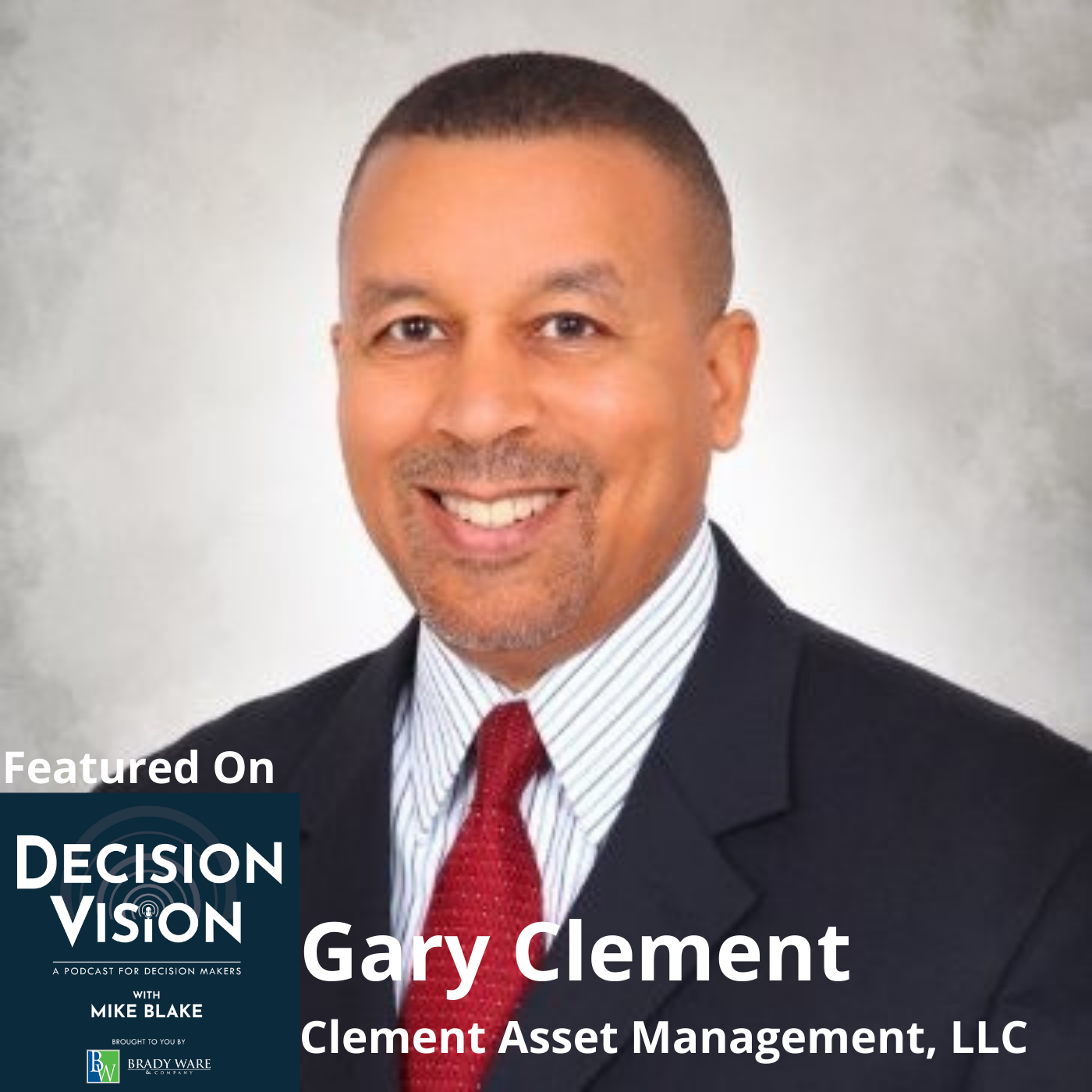
Tagged With: Brady Ware & Company, Brady Ware Capital, Cliff Bishop, Mike Blake, selling a business

  • « Previous Page
  • 1
  • …
  • 9
  • 10
  • 11
  • 12
  • 13
  • …
  • 15
  • Next Page »

Business RadioX ® Network


Our Most Recent Episode

CONNECT WITH US

  • Email
  • Facebook
  • LinkedIn
  • Twitter
  • YouTube

Our Mission

We help local business leaders get the word out about the important work they’re doing to serve their market, their community, and their profession.

We support and celebrate business by sharing positive business stories that traditional media ignores. Some media leans left. Some media leans right. We lean business.

Sponsor a Show

Build Relationships and Grow Your Business. Click here for more details.

Partner With Us

Discover More Here

Terms and Conditions
Privacy Policy

Connect with us

Want to keep up with the latest in pro-business news across the network? Follow us on social media for the latest stories!
  • Email
  • Facebook
  • Google+
  • LinkedIn
  • Twitter
  • YouTube

Business RadioX® Headquarters
1000 Abernathy Rd. NE
Building 400, Suite L-10
Sandy Springs, GA 30328

© 2025 Business RadioX ® · Rainmaker Platform

BRXStudioCoversLA

Wait! Don’t Miss an Episode of LA Business Radio

BRXStudioCoversDENVER

Wait! Don’t Miss an Episode of Denver Business Radio

BRXStudioCoversPENSACOLA

Wait! Don’t Miss an Episode of Pensacola Business Radio

BRXStudioCoversBIRMINGHAM

Wait! Don’t Miss an Episode of Birmingham Business Radio

BRXStudioCoversTALLAHASSEE

Wait! Don’t Miss an Episode of Tallahassee Business Radio

BRXStudioCoversRALEIGH

Wait! Don’t Miss an Episode of Raleigh Business Radio

BRXStudioCoversRICHMONDNoWhite

Wait! Don’t Miss an Episode of Richmond Business Radio

BRXStudioCoversNASHVILLENoWhite

Wait! Don’t Miss an Episode of Nashville Business Radio

BRXStudioCoversDETROIT

Wait! Don’t Miss an Episode of Detroit Business Radio

BRXStudioCoversSTLOUIS

Wait! Don’t Miss an Episode of St. Louis Business Radio

BRXStudioCoversCOLUMBUS-small

Wait! Don’t Miss an Episode of Columbus Business Radio

Coachthecoach-08-08

Wait! Don’t Miss an Episode of Coach the Coach

BRXStudioCoversBAYAREA

Wait! Don’t Miss an Episode of Bay Area Business Radio

BRXStudioCoversCHICAGO

Wait! Don’t Miss an Episode of Chicago Business Radio

Wait! Don’t Miss an Episode of Atlanta Business Radio