Business RadioX ®

  • Home
  • Business RadioX ® Communities
    • Southeast
      • Alabama
        • Birmingham
      • Florida
        • Orlando
        • Pensacola
        • South Florida
        • Tampa
        • Tallahassee
      • Georgia
        • Atlanta
        • Cherokee
        • Forsyth
        • Greater Perimeter
        • Gwinnett
        • North Fulton
        • North Georgia
        • Northeast Georgia
        • Rome
        • Savannah
      • Louisiana
        • New Orleans
      • North Carolina
        • Charlotte
        • Raleigh
      • Tennessee
        • Chattanooga
        • Nashville
      • Virginia
        • Richmond
    • South Central
      • Arkansas
        • Northwest Arkansas
    • Midwest
      • Illinois
        • Chicago
      • Michigan
        • Detroit
      • Minnesota
        • Minneapolis St. Paul
      • Missouri
        • St. Louis
      • Ohio
        • Cleveland
        • Columbus
        • Dayton
    • Southwest
      • Arizona
        • Phoenix
        • Tucson
        • Valley
      • Texas
        • Austin
        • Dallas
        • Houston
    • West
      • California
        • Bay Area
        • LA
        • Pasadena
      • Colorado
        • Denver
      • Hawaii
        • Oahu
  • FAQs
  • About Us
    • Our Mission
    • Our Audience
    • Why It Works
    • What People Are Saying
    • BRX in the News
  • Resources
    • BRX Pro Tips
    • B2B Marketing: The 4Rs
    • High Velocity Selling Habits
    • Why Most B2B Media Strategies Fail
    • 9 Reasons To Sponsor A Business RadioX ® Show
  • Partner With Us
  • Veteran Business RadioX ®

LIVE from RISKWORLD 2022: Oscar Villanueva, Managing Director of Security Services, R3 Continuum

May 26, 2022 by John Ray

Security Services
Minneapolis St. Paul Studio
LIVE from RISKWORLD 2022: Oscar Villanueva, Managing Director of Security Services, R3 Continuum
Loading
00:00 /
RSS Feed
Share
Link
Embed

Download file

Security Services

LIVE from RISKWORLD 2022: Oscar Villanueva, Managing Director of Security Services, R3 Continuum

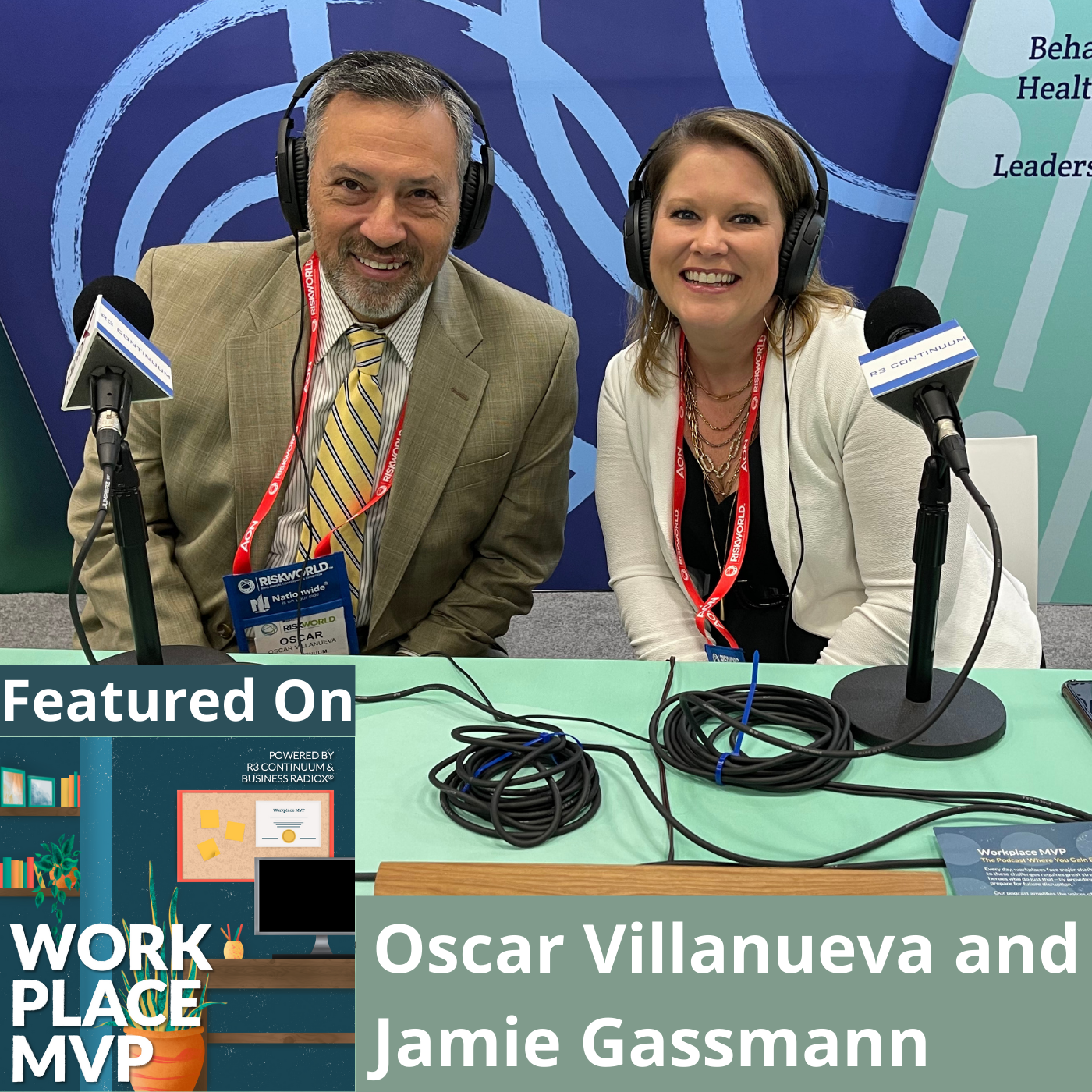
Oscar Villanueva, Managing Director of Security Services for R3 Continuum, joined host Jamie Gassmann at the R3 Continuum booth. Oscar explained the role of security services when clients reach out to R3 Continuum for help, the impact of an event that goes beyond the victim, the ultimate cost of not being prepared, and much more.

Workplace MVP is underwritten and presented by R3 Continuum and produced by the Minneapolis-St.Paul Studio of Business RadioX®.

This show was originally broadcast from the RIMS 2022 RISKWORLD Conference held at the Moscone Center in San Francisco, California.

Oscar Villanueva, Managing Director of Security Services, R3 Continuum
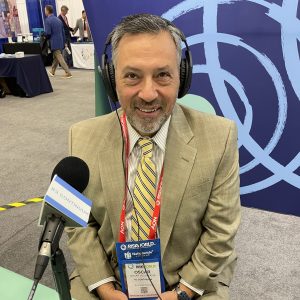
Oscar Villanueva, Managing Director of Security Services, R3 Continuum

Oscar Villanueva, a well-known international security expert, and former federal law enforcement senior executive brings many years of risk assessment and management, investigative, emergency preparedness, training, and critical infrastructure security experience, worldwide. He oversaw the security-based initiatives in over 180 locations throughout the world and has worked directly with the United Nations, Interpol, Europol, and during multiple Olympic Games.

He has over 30 years in federal law enforcement and corporate security consulting domestically and internationally. One of his areas of focus was workplace violence during his time with federal law enforcement and for the last decade in corporate security venues.

He now helps individuals and organizations navigate the difficulties of overall security and risk issues.

Mr. Villanueva lives in San Francisco.

LinkedIn

About Workplace MVP

Every day, around the world, organizations of all sizes face disruptive events and situations. Within those workplaces are everyday heroes in human resources, risk management, security, business continuity, and the C-suite. They don’t call themselves heroes though. On the contrary, they simply show up every day, laboring for the well-being of employees in their care, readying the workplace for and planning responses to disruption. This show, Workplace MVP, confers on these heroes the designation they deserve, Workplace MVP (Most Valuable Professionals), and gives them the forum to tell their story. As you hear their experiences, you will learn first-hand, real-life approaches to readying the workplace, responses to crisis situations, and overcoming challenges of disruption. Visit our show archive here.

Workplace MVP Host Jamie Gassmann
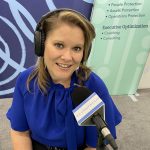
Jamie Gassmann, Host, “Workplace MVP”

In addition to serving as the host to the Workplace MVP podcast, Jamie Gassmann is the Director of Marketing at R3 Continuum (R3c). Collectively, she has more than fourteen years of marketing experience. Across her tenure, she has experience working in and with various industries including banking, real estate, retail, crisis management, insurance, business continuity, and more. She holds a Bachelor of Science Degree in Mass Communications with special interest in Advertising and Public Relations and a Master of Business Administration from Paseka School of Business, Minnesota State University.

R3 Continuum

R3 Continuum is a global leader in workplace behavioral health and security solutions. R3c helps ensure the psychological and physical safety of organizations and their people in today’s ever-changing and often unpredictable world. Through their continuum of tailored solutions, including evaluations, crisis response, executive optimization, protective services, and more, they help organizations maintain and cultivate a workplace of wellbeing so that their people can thrive. Learn more about R3c at www.r3c.com.

Company website | LinkedIn | Facebook | Twitter


TRANSCRIPT

Intro: [00:00:03] Broadcasting Live from RISKWORLD 2022 at the Moscone Center in San Francisco, it’s time for Workplace MVP. Brought to you by R3 Continuum, a global leader in helping workplaces thrive during disruptive times. Now, here’s your host.

Jamie Gassmann: [00:00:23] Hi, everyone. Your host, Jamie Gassmann here at the RISKWORLD 2022 Expo Hall in R3 Continuum Booth. And joining me is Oscar Villanueva, who is with R3 Continuum. Welcome to the show.

Oscar Villanueva: [00:00:38] Hello, Jamie. Good talking with you today.

Jamie Gassmann: [00:00:40] So, talk to me a little bit about the role you play at R3 Continuum.

Oscar Villanueva: [00:00:44] Well, my role is as Managing Director of Security Services for R3 Continuum. And, basically, what I do is I support the organization and clients when it comes to security services. And that could be anything from investigations, protective services, threat assessments, facility security assessments. Anything that has to do with physical security, I am available for clients to to use and to take advantage of our services.

Jamie Gassmann: [00:01:13] Yeah. You know, and from conversations I’ve had with you, you know, the uniqueness of the services that R3 provides is that behavioral health component to the solution. So, talk to me a little bit about that and how that’s a differentiator or unique in the marketplace.

Oscar Villanueva: [00:01:28] Well, you know, R3 continuum is a leader in behavioral health support and solutions with disruptive event management and crisis response, all of those kinds of services. And R3 has been doing it for many, many years and doing it very, very well as a leader in the industry. What makes my contribution to R3 significant is that every time you have a crisis situation, every time you have a workplace violence issue, every time you have a call that you’re making to R3 Continuum for services, there’s usually a security component that comes along with that. And, you know, having those two services – security and crisis response – along with behavioral health really does a unique and best-in-class response service from R3 Continuum for our clients. So, I think it’s an important component.

Jamie Gassmann: [00:02:26] Yes, it’s almost like they have the holistic response basically. It’s like you can look at it from a physical, you know, what caused the particular, you know, situation or incident, but then also from the behavioral side of it as well. They’re kind of almost getting a comprehensive kind of support from the company, correct?

Oscar Villanueva: [00:02:44] Yes. And I think part of what that type of service means is that R3 Continuum uses a team of experts approach. So, if you come to R3 Continuum, and you’re getting behavioral health, and there’s some security question that comes up, I’m brought into the case, the situation, and I provide an assessment from a security perspective. And if I’m working a security issue, you know, the same thing occurs because, you know, R3 Continuum has experts in behavioral health. So, the combination of the two and a team-of-experts approach is really what makes it a powerful service for our clients.

Jamie Gassmann: [00:03:26] And from a risk insurance perspective, you know, taking and looking at it through that lens, you know, how does that help them from like a litigation perspective or kind of a risk mitigation perspective?

Oscar Villanueva: [00:03:40] Well, for insurance providers, I think the most important thing is to mitigate crisis and even to prevent it, if you can. And contacting R3 Continuum, for example, I can think of a number of cases where, perhaps, you had a workplace violence issue that started as a threat, and then, through our services and doing a threat assessment, we are able to discover what the cause of the threat is, what’s behind the the potential violence, and we can provide an assessment as to what the best way is to move forward. And when you do this, you’re really either preventing or mitigating risk, which in the insurance world, I’m fairly certain that it’s extremely important. The less claims you have, the better off you are, or if you can minimize the claim to the lowest possible level, so that the loss is contained, then it becomes very desirable for an insurance company to use those services.

Jamie Gassmann: [00:04:44] Absolutely. And it also helps holistically for that organization to recover, you know, financially and not only that, but with their people as well.

Oscar Villanueva: [00:04:53] Right. Yeah. So, clients that — excuse me. Clients that use us, generally, are able to get the situations resolved quicker and people back to work sooner. And in the long run, that results in some, you know, significant results that really can save not only financial resources but also minimizes the human effects of this type of crisis when it happens to someone at work.

Jamie Gassmann: [00:05:25] Absolutely. And so, you are presenting on Wednesday on the human impact or the human cost, the true cost to human impact of workplace violence. Can you talk a little bit about that presentation that you’re giving here at RIMS?

Oscar Villanueva: [00:05:41] Yes, it’s on Wednesday at noon at the Thought Leader Theater on the exhibit hall. And what I want to talk about is the true impact of workplace violence on individuals at the workplace, and how it’s not just the individuals that are affected at the workplace but their families, coworkers that maybe were not there at the time. There’s a range of individuals, a number of people that get affected beyond the victim.

And when you hear about this workplace violence issues on the news or in the media, typically you think about the victim, right? The victim was, you know, threatened, assaulted or even killed, unfortunately. But there’s a range of other — there’s other victims that go along with that particular one that are almost unnoticed or unmentioned that also suffer. So, I think there’s a bit of a discussion to be had there, along with also talking about how to mitigate it, how to plan for it and how to prepare for it because the better an organization prepares for it, obviously, the less likely it is that it will happen. And if it does happen, then the impact can be minimized significantly.

Jamie Gassmann: [00:07:04] Yeah, it’s almost like a ripple effect, right?

Oscar Villanueva: [00:07:06] Correct.

Jamie Gassmann: [00:07:06] You got your kind of point of impact where you have your most concentrated, impacted employees. But there’s always more people that are involved that have to be taken into consideration. And then, not only that, how do you support them to make sure that they get the help that they need, you know, being that they might be in more of like a tertiary kind of layer of of impact and could get forgotten.

Oscar Villanueva: [00:07:28] That’s very true. Very true.

Jamie Gassmann: [00:07:29] Yeah.

Oscar Villanueva: [00:07:30] And, you know, it all starts with behavioral health, because when somebody goes to trauma and crisis, it’s really important to get them back to some level of normalcy. You never-

Jamie Gassmann: [00:07:39] Yeah.

Oscar Villanueva: [00:07:39] You know, it never goes away. You know, the thoughts of being in a workplace violence issue or witnessing a workplace violence homicide or something like that, it really never leaves you. But with behavioral health and psychological support, you can really have people come back to some level of normal and continue their daily lives without it affecting them to a large extent.

Jamie Gassmann: [00:08:01] Yeah. And what I’ve heard, and I don’t know if you can kind of comment on that, I know that there might be others within R3 that can as well, that there’s a different type of — you need somebody specialized in these types of incidents that it’s a different type of coaching or consulting that they’re giving to individuals impacted as opposed to someone that maybe just has like a depression or anxiety. It’s a different type of support, correct?

Oscar Villanueva: [00:08:29] Well, yes, that has been my experience. And I think R3 Continuum does it very, very well with the staff of counselors that are available and how quickly you can get there to provide the services. Because after you have a crisis, it’s really critical to have someone get to those individuals as quickly as possible. The sooner they can talk about how they feel and what happened, the faster they can recover. And so, it’s really critical that that happens. Yes.

Jamie Gassmann: [00:08:56] Yeah, absolutely. So, if there are three takeaways or takeaways that you want your audience to be left with after attending your session, what would those be?

Oscar Villanueva: [00:09:06] Well, one is that it’s important to prepare. And in order to prepare, you really need to do a few things, mainly to put together a workplace violence program with threat assessment teams, and just be ready for anything that comes because through that process, you can prevent or you can mitigate workplace violence going forward. So, that would be number one.

The second is that the impact of workplace violence on individuals goes far beyond that initial victim, and it really affects their families, or communities or workers. So, that would be the second takeaway. So, when you’re thinking about a workplace violence issue, it’s really important to consider who else is being affected by this. So, that would be the second takeaway.

And the third takeaway that I would like to share is that oftentimes, you know, there’s a saying that when you’re a hammer, everything looks like a nail. And so, many of our clients tend to think about their world on the basis of what they do for a living. For example, they could be in manufacturing, they could be in services, they could be a medical office. And so, their worldview always focuses on that type of service or that type of product that they’re manufacturing. But in reality, when it comes to workplace violence, it kind of goes outside of that. So, you have to shift your paradigm, your thinking to consider, “Okay, I am a manufacturing company primarily, but if I have a workplace violence issue, that could be a problem. So, I’m going to think about that. I’m going to prepare for that. And I’m just going to go back and do my business because now I’m prepared,” right?

And the result of that is that, oftentimes, companies, organizations that have workplace violence issues fail to prepare for it. But when something happens, there’s no end to how much money they have to spend on it and they’re gladly spending it. So, in the long run, it’s easier, cheaper and better to prepare ahead of time than to have an issue later and make it very costly in terms of human capital and also financial capital.

So, prepare early and often, have a plan, and be ready because there’s only really two kinds of companies in this world, one that has had a workplace violence issue and that one that will have a workplace violence issue because as long as you employ people, as long as you have employees, you’re going to have those kinds of concerns. So, those would be my three recommendations.

Jamie Gassmann: [00:11:42] Wonderful. And that sounds like a great presentation. I hope the audience picks up on all those great takeaways that you’re providing to them. If somebody wanted to get a hold of you to learn a little bit more about what R3 Continuum does or a little bit more about what your role is there and the services that we provide, how can they do that?

Oscar Villanueva: [00:12:02] Well, they can get a hold of me through R3 Continuum by going to the website, and there’s a contact information in there. The other way is to just email me the Oscar,Villanueva@r3c.com.

Jamie Gassmann: [00:12:19] Wonderful. And that website’s r3c.com, correct?

Oscar Villanueva: [00:12:22] That’s correct.

Jamie Gassmann: [00:12:23] Awesome. Well, thank you so much for joining us, Oscar. It’s been great to have you on the show.

Oscar Villanueva: [00:12:26] Thank you, Jamie.

Outro: [00:12:32] Thank you for joining us on Workplace MVP. R3 Continuum is a proud sponsor of this show and is delighted to celebrate most valuable professionals who work diligently to secure safe workplaces where employees can thrive.
 

Tagged With: behavioral health, Crisis Response, Jamie Gassmann, Oscar Villanueva, preventing workplace violence, R3 Continuum, RISKWORLD 2022, Security Services, Workplace MVP, workplace violence

Workplace MVP: Jeff Gorter, R3 Continuum

September 9, 2021 by John Ray

Jeff Gorter
Minneapolis St. Paul Studio
Workplace MVP: Jeff Gorter, R3 Continuum
Loading
00:00 /
RSS Feed
Share
Link
Embed

Download file

Jeff Gorter

Workplace MVP:  Jeff Gorter, R3 Continuum

Critical incident response veteran Jeff Gorter contends that business and human responses to crisis events are not separate but interwoven. On the twentieth anniversary of the September 11th terrorist attacks, Jeff and host Jamie Gassman discussed the parallels of that event and the COVID-19 pandemic, and the importance of acknowledging 9/11 for your employees.  Workplace MVP is underwritten and presented by R3 Continuum and produced by the Minneapolis-St.Paul Studio of Business RadioX®.

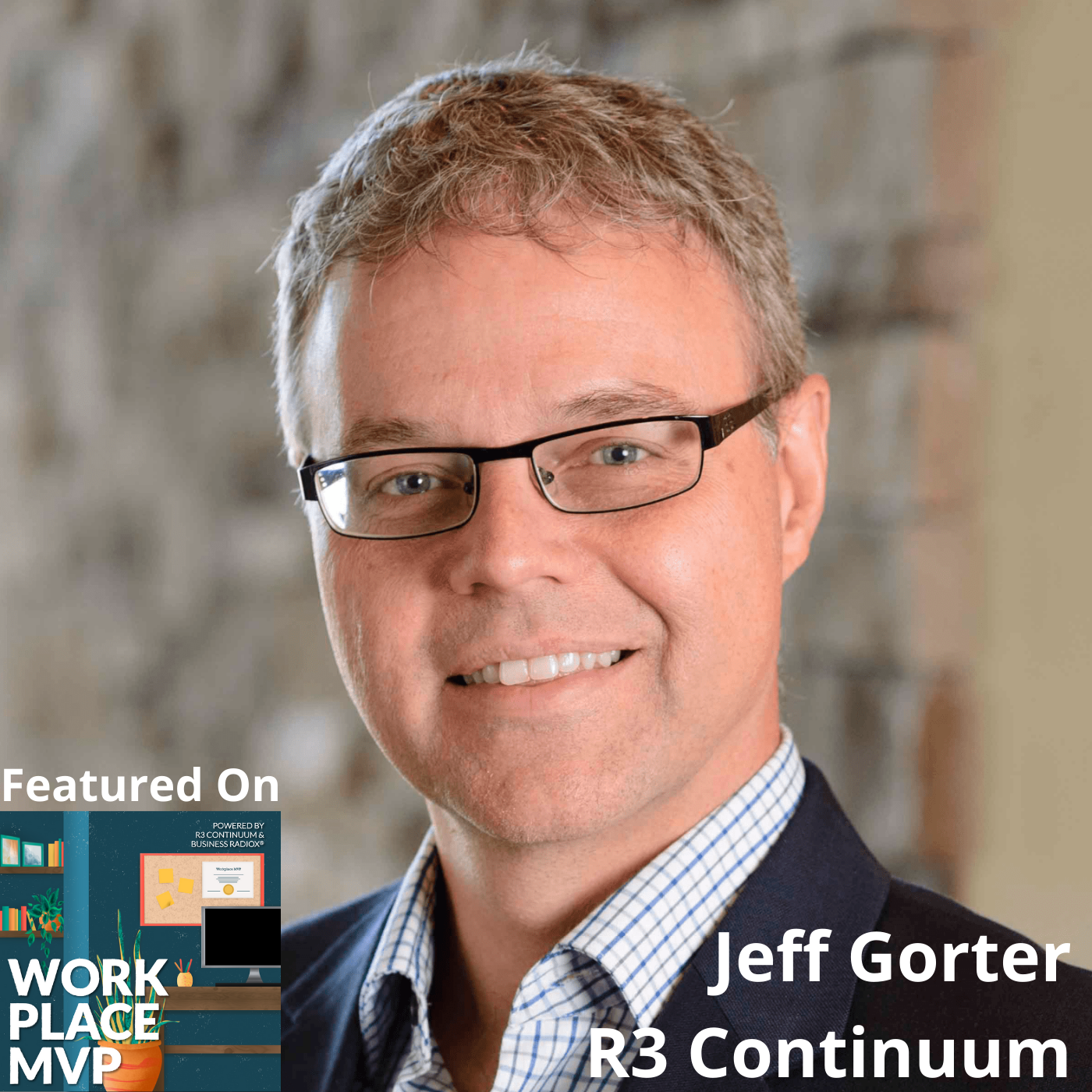
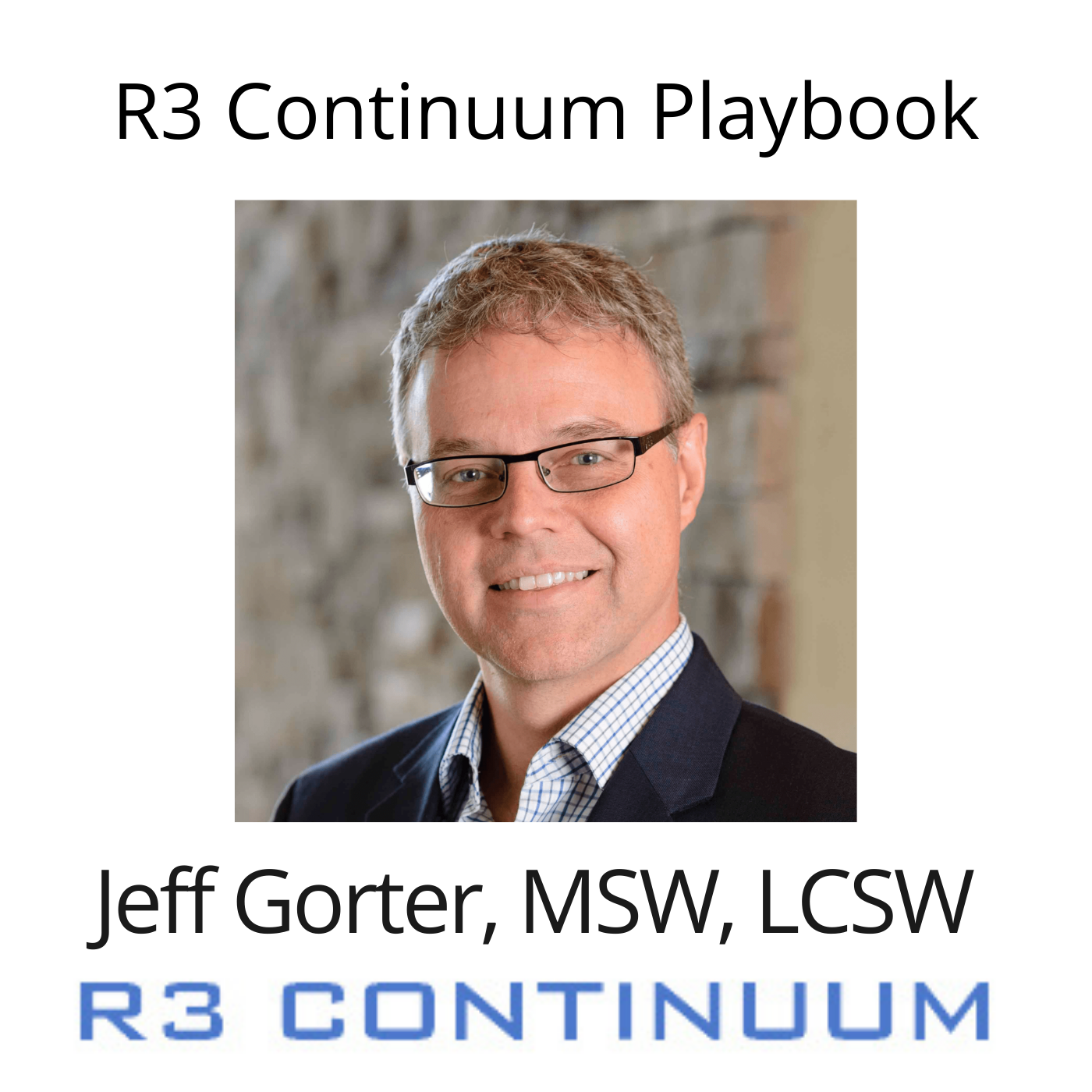
Jeff Gorter, Vice President of Crisis Response Services, R3 Continuum

Jeff Gorter, Vice President of Crisis Response Services, R3 Continuum

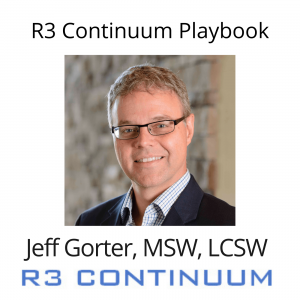
Jeff Gorter, MSW, LCSW, is VP of Clinical Crisis Response at R3 Continuum. Mr. Gorter brings over 30 years of clinical experience including consultation and extensive on-site critical incident response to businesses and communities. He has responded directly to the Sept. 11 terrorist attacks, Hurricane Katrina, the Virginia Tech shootings, the Deepwater Horizon Oil spill, the 2011 earthquake/tsunami in Japan, the Newtown Tragedy, the Orlando Pulse Nightclub Shooting, the Las Vegas Shooting, and the breaching of the US Capitol on 1/6/21. He has conducted trainings and presented at the Employee Assistance Professionals Association Annual Conference, the American Psychological Association Annual Conference, the World Conference on Disaster Management, the International Society for Traumatic Stress Studies Annual Meeting, and at other state, national and international venues on a variety of topics.

LinkedIn

R3 Continuum

R3 Continuum is a global leader in workplace behavioral health and security solutions. R3c helps ensure the psychological and physical safety of organizations and their people in today’s ever-changing and often unpredictable world. Through their continuum of tailored solutions, including evaluations, crisis response, executive optimization, protective services, and more, they help organizations maintain and cultivate a workplace of wellbeing so that their people can thrive. Learn more about R3c at www.r3c.com.

Company website | LinkedIn | Facebook | Twitter

About Workplace MVP

Every day, around the world, organizations of all sizes face disruptive events and situations. Within those workplaces are everyday heroes in human resources, risk management, security, business continuity, and the C-suite. They don’t call themselves heroes though. On the contrary, they simply show up every day, laboring for the well-being of employees in their care, readying the workplace for and planning responses to disruption. This show, Workplace MVP, confers on these heroes the designation they deserve, Workplace MVP (Most Valuable Professionals), and gives them the forum to tell their story. As you hear their experiences, you will learn first-hand, real life approaches to readying the workplace, responses to crisis situations, and overcoming challenges of disruption. Visit our show archive here.

Workplace MVP Host Jamie Gassmann

In addition to serving as the host to the Workplace MVP podcast, Jamie Gassmann is the Director of Marketing at R3 Continuum (R3c). Collectively, she has more than fourteen years of marketing experience. Across her tenure, she has experience working in and with various industries including banking, real estate, retail, crisis management, insurance, business continuity, and more. She holds a Bachelor of Science Degree in Mass Communications with special interest in Advertising and Public Relations and a Master of Business Administration from Paseka School of Business, Minnesota State University.
TRANSCRIPT

Intro: [00:00:03] Broadcasting from the Business RadioX Studios, it’s time for Workplace MVP. Workplace MVP is brought to you by R3 Continuum, a global leader in workplace behavioral health and security solutions. Now, here’s your host, Jamie Gassmann.

Jamie Gassmann: [00:00:24] Hi, everyone. Your host, Jamie Gassmann, here. And welcome to this episode of Workplace MVP. This year marks the 20th anniversary for the 9/11 terrorist attacks. We are also halfway through the second year of the COVID-19 pandemic. Some are calling these two tragic bookends to the last two decades. Interestingly, though, while these two events are different in nature, the impact they made on businesses and employees are very similar.

Jamie Gassmann: [00:00:53] Is this a coincidence? Or is there something to be learned about the impact disruption can have on an organization and its people? What should an employer be focused on when an event like 9/11 or COVID-19 happens? Are there solutions or support options that can be leveraged to help them successfully navigate the troubled aftermath of the events?

Jamie Gassmann: [00:01:15] With us today to share his expertise and firsthand knowledge from responding to the psychological first aid needs of employers for both 9/11 and COVID-19, among other major events across our history, is Workplace MVP Jeff Gorter, Vice President of Crisis Response Services for our show sponsor, R3 Continuum. Welcome to the show, Jeff.

Jeff Gorter: [00:01:37] Thank you, Jamie. I appreciate the opportunity.

Jamie Gassmann: [00:01:40] So, we’re glad to have you here and really interested in hearing a little bit about yourself and your career journey that’s led you to R3 Continuum and to where you’re at today.

Jeff Gorter: [00:01:53] No. Thanks. And just by way of background, I am a clinical social worker, master’s level social worker. And so, I come from a clinical background and have been in the field providing services either in private practice or in a public setting for 35 years. But the last 20 years of that have been specifically focused on providing disaster response.

Jamie Gassmann: [00:02:20] And so, can you share with our audience the disaster response work that you did post-9/11? And how does that compare to the work that you’re doing today in response to the COVID-19 pandemic?

Jeff Gorter: [00:02:33] And if you caught the 20 year reference, I really look at 9/11 as sort of that was certainly my first experience in responding to a large scale event. Part of the backstory of that is that the former president of Crisis Care Network, which is now known as R3 Continuum, Bob VandePol and I were in private practice together. And he had left the practice I’d say six months before 9/11.

Jeff Gorter: [00:03:03] And when the attacks occurred on that day, I called Bob and I said, “Bob, from what I understand, based on the new position that you’re in, I guess your company is going to be involved in this. I just want to let you know I am trained in this, if there’s anything I can do to help.” To which he said, “Can you be on a plane in four hours?” And I was in New York City that evening able to provide and to begin providing response.

Jamie Gassmann: [00:03:34] And how does that compare to some of the response works? I know you’ve done some response work with the COVID-19 pandemic, a lot of that’s been done virtually. But are some of the sessions or some of the work that you’re doing with that, can you tell us a little bit about, you know, how they work and kind of what your role is that you play within that?

Jeff Gorter: [00:03:56] It’s an excellent question. Because I’ve really been wrestling with the fact that, you know, this being the 20th anniversary of 9/11, that was very much in the forefront of my mind, and yet COVID has such a dominating factor. And, as you said in your intro, it’s kind of no surprise that these two things are, you know, juxtaposed here at this moment.

Jeff Gorter: [00:04:19] So, specifically, when I went to New York City, I was deployed to assist businesses as employees were returning to work for the first time following the attacks. And that’s a key element in that, you know, businesses played a major role in helping employees feel like they were getting back to some sense of normalcy or something that they could control. And so, many of the things that they talked about were more tangible, if you will, in the sense that they talked about things like the smells, things like the grittiness of the dust that was everywhere, how a siren going off for a police or fire would create a startle response the first time. And many of us can remember that the first time we saw a plane flying again after all flights had been grounded.

Jeff Gorter: [00:05:19] And so, for many of them these were much more visceral kind of descriptions of what they were going through. And, yet, for many of them, their stories were also about how resilience, how going back to work was not just getting back to work, but was in for many of them, a patriotic act. A small but very tangible stand against the darkness, if you will. And their getting back to work meant this is something I can do in this national crisis.

Jeff Gorter: [00:05:52] Now, in juxtaposing it to COVID-19 that the swift recovery of business operations is and has been continues to be a central component to our nation’s recovery. But it’s different because 9/11 was confined to a day and we didn’t know that at the time. But it’s confined to 9/11. It was a specific point in our calendar that we can look back. And it was a moment of sharp human initiated attack.

Jeff Gorter: [00:06:24] Now, COVID has a different perspective in that it is a prolonged, ongoing, unfolding, still not done crisis, driven primarily by biology. And so, in that sense, you know, the fear and the emotions elicited are, in many ways, just as powerful. Whereas, you could point to it, you could feel it between your fingers in New York City what the attack was like. Here, it’s kind of a vague, shadowy fear creeping outside your door. It’s everywhere, and yet I can’t point to it. And so, the fear is the common factor, but it’s also different kind of fear. And so, I think that’s important to recognize.

Jamie Gassmann: [00:07:16] Absolutely. And, obviously, from a business perspective, there’s some similarities in some of the thinking. And so, looking at your perspective of business leaders – and I know we’ve talked about this and I know you’ve got an opinion and kind of some thoughts – around that balancing act between human and business and how employers need to be looking at that following a disruption in the workplace, can you share your perspective on that with us?

Jeff Gorter: [00:07:42] Yeah. Well, I begin with the assumption that many business makers or business leaders have that the human response and the business aspects are two different things. And I contend that they are not. That they are, in fact, inextricably woven. And that, typically, when a large scale disaster hits, business leaders will go to their business continuity plan. They’ll pull that three ring binder off the shelf or they’ll go to their files and they’ll look at that plan, as they should. And they’ll review that crisis plan, the policies, procedures, what the strategies were to contain the crisis and mitigate the impact. That’s a sound thinking.

Jeff Gorter: [00:08:25] The trouble is, most of those plans focused on issues like I.T. security, facilities management, supply chain integrity, things that undoubtedly are important elements in a business recovery. But these plans often forget the most essential aspect, the human element. It doesn’t matter how secure your firewalls are or how quickly you get the power restored and the computers working again, if the people aren’t reassured and ready to go back to work. So, taking care of your people is taking care of your business. And I know I think it’s a mistake when a business owner says, “Well, I’m going to do one over the other.” They have to be done simultaneously.

Jamie Gassmann: [00:09:10] And, you know, so focusing on that people side of it, when a major incident occurs such as 9/11, or when you’ve got a pandemic like COVID-19, or other types of disruptions that impact a workplace, typically, if you were going to provide recommendation, what’s that first thing that an employer should be focusing on when it comes to their people?

Jeff Gorter: [00:09:33] So, I look at it as two parts. The first part, first and foremost always is safety. I need to ensure the safety of the employees. And that means physical safety and emotional safety. I have to prepare or provide for both aspects of that. So, I need to make sure when a large-scale event happens, have all the appropriate authorities been called? Have the right people been notified? Is the site secure? Are all the employees accounted for? Have immediate steps been taken, even simple steps like providing food, water, or blankets? Have immediate steps been taken for the care and comfort of my team? And has leadership physically directly checked on the team? Have they been visible? Have they gone around? Have they checked on and ensured the safety of everybody, both physically and emotionally? So, safety is first, job one.

Jeff Gorter: [00:10:32] But then, followed up by that, there are three simple things that I would say that the leader needs to do, and that is communicate, communicate, communicate. That one safety is restored, it’s imperative that leadership starts communicating early and often. This establishes them as a credible source of verifiable information, and that is in short supply following a crisis.

Jeff Gorter: [00:11:01] And it’s a common mistake among leaders to say, “Well, you know what? I’ll send a message out.” Or, “I’ll do some communication once I know all the facts. Once I have a complete idea of what’s going on, once I know the whole ball of wax, then I’ll be able to send out a message that encompasses everything.” And then, as one hour goes by and two hours go by and four hours go by, employees in that absence are going to become increasingly anxious. And it’s human nature in the absence of real information to plug in our worst possible fears.

Jeff Gorter: [00:11:40] And so, you know, maybe they’re going to ask themselves, “Maybe leadership was hurt. I thought we would have heard by now. Maybe they’re part of the injured. Maybe they don’t know that this is going on. Maybe they’re unaware of this. Maybe they don’t care.” And you can see that in the absence of real information. By that point, a negative narrative has already begun to take root.

Jeff Gorter: [00:12:04] And it is so hard to play catch up after that and try and establish. Especially in the age of instantaneous communication through social media and other sources like that, it is absolutely essential that a leader is out there early with frequent brief updates sharing what you know, what is verifiable, and share what you don’t know, but promising to confirm it as soon as you can. Which is to say, “I’m going to be open about I don’t know. I don’t, as a leader, have to have all the answers right now.”

Jeff Gorter: [00:12:42] And doing that, sharing what you know, admitting what you don’t but saying I’ll get it as soon as I can, has an incredibly calming and reassuring effect. It will enhance a leader’s standing with their employees and lets them know, “Okay. The leaders have a plan. They know what they’re doing. They are on top of this. I can take a deep breath at this moment.”

Jeff Gorter: [00:13:08] So, again, as an example, saying something like, “Following this event, we can confirm that three employees were injured and have been transported to the hospital,” that’s verifiable. “We don’t know their status at this point, but we will share that info as soon as we get it.” That’s all you need, something as brief as that. So often, again, leaders will, “Well, until we know more, I’m not going to say anything.” Or they’ll make, “I’m sure everybody’s going to be okay.” Are you sure? Can you guarantee that? No? Don’t say it if you can’t.

Jeff Gorter: [00:13:45] Just simply say what you know, admit what you don’t know. But assure them that as soon as we can have verifiable information, we’ll get back to you. It’s amazing how comforting and calming that is for an employee group that is looking to you for leadership in the midst of this.

Jamie Gassmann: [00:14:06] Great. And, you know, as you continue to go through kind of that recovery process after these types of events, when an organization is starting to regain a sense of new normalcy, how, at that point, can business leaders help to support employees and, really, the organization as a whole in that recovery effort?

Jeff Gorter: [00:14:27] Yeah. Kind of building on what I was saying before, that the employee and organizational interplay is inextricably interwoven. The employee recovery depends on organizational recovery and vice versa. Employees are going to look to the workplace for stability, financial stability, as well as just something that I know is there, predictability, structure. They crave a return to something that feels normal, and where they feel in control, and where they know what they’re supposed to do.

Jeff Gorter: [00:15:03] When the crisis happened, I had no idea what I was supposed to do. I’d like to get back to something where I feel I am trained and where I have a sense of influence and agency. Likewise, organizations are only as strong as their employees. And they need engaged, motivated, healthy workers to weather the storm. There’s an old quote from Kipling in which he said, “The strength of the pack is the wolf. And the strength of the wolf is the pack.” Meaning, the interplay between the organization and the individual they support each other.

Jeff Gorter: [00:15:41] And so, business leaders set the tone of positive resilience and an expectation of recovery for everybody. And part of that is ensuring access to the resources that are supportive to their employees, like onsite or virtual behavioral health specialists who are able to provide immediate support, psychological first aid, and encouragement. Being able to offer 24-7 phone or text access, perhaps via their employee assistance program or through other strategic vendors who can provide that. Offering and making sure there is access to print or electronic resources for education, coping, guidance. Things like that are immediate steps that the employer can do to support the employee. And as the employees come back, they support the organization and it is a common effort.

Jamie Gassmann: [00:16:48] And so, for disruptions like with the COVID-19 pandemic where we’re kind of on this ever changing kind of evolution, if you will, for the last year-and-a-half, do some of those same initiatives apply in the context of a disruption that maybe continues to evolve as opposed to a one day event?

Jeff Gorter: [00:17:11] I think you’re absolutely right. And even more so, I think that because what we have come to realize, even though we’re 18 months into this – the words almost stick in my throat in saying that, but that’s where we are right now at this taping – almost every day, it is a changing, fluid, dynamic circumstance. Where we are now and where we were back in February 2020 are vastly different places. And we know so much more and yet we are incredibly aware of how much we don’t know.

Jeff Gorter: [00:17:48] And so, that same central concept that in the absence of real information – I’m going to plug in my fears – just highlights the need for leadership to have a constant, steady, reliable drumbeat of information, even if it’s little bits. Even if my update today is to say no new changes today, that’s worth doing. That is something that reassures them that leadership is on top of it.

Jeff Gorter: [00:18:20] Because, again, that’s one of the things that clearly has typified this prolonged, slow moving disaster is that, you know, almost no two days are the same. And yet there’s still this emotional sense of Groundhog Day of, “What? It’s still here? We’re still talking about this.” And so, yeah, for leadership to not fall into the trap of thinking, “Oh. They don’t want to hear any more updates.” No, keep doing it. It’s essential.

Jamie Gassmann: [00:18:52] Great. And, obviously, for 9/11 this is a milestone anniversary, so looking at milestone anniversaries, you know, some employees may have or may experience kind of a reaction or, like, a triggering effect to that. And just how an employee handles the disruption when it’s happening, it’s all different in terms of the different levels of resilience and how people kind of process trauma. From your experience, you know, what should an employer be looking at so that they can show support and care knowing that with an anniversary like the 20 year anniversary everyone’s going to kind of approach it differently?

Jeff Gorter: [00:19:37] Yeah. No, that’s a great question. I mean, there were some organizations, obviously those in the New York area or Pennsylvania or in D.C. that were directly impacted. But I think it would be a mistake for a business leader to assume that, “Well, I don’t think any of my people were involved. I don’t need to pay attention to that. I don’t need to mention that.” In the 20 years people have moved, people have relocated, people have taken different jobs. People who were children at that point, who may have lost a loved one at that time, have grown up, moved, taken on new jobs. Again, it would be a mistake to think, “Oh, it’s so far back, we don’t really need to worry about it.” This is a significant day.

Jeff Gorter: [00:20:21] And so, for an employer, I think it’s important for them to acknowledge the solemnity of this day, the power of this day itself, and to recognize that employees may have some challenges with it. Not everybody. Not that they have to. But some may. And so, as a leader, getting out ahead of that and simply recognizing and acknowledging that lets them know that you get it, that you understand that this day is different from other days. It has significance, which helps those employees to feel understood and validated, not isolated and alone as if something is broken or wrong with them.

Jeff Gorter: [00:21:02] And so, it’s important, too, one of the ways that an employer can do that is to remind their employee of the wide range of resources that they have. Again, the behavioral health support, either onsite or virtually, as we’ve talked about before, should they choose to use it. So, for them, again, highlighting what their EAP can do or other groups. In most cases, people just want to be able to share their experiences. And anniversaries are times where we talk about it, because that helps us when we talk about it. It helps us feel less alone. It feels connected. We feel like we’re part of something. They may or may not want to talk about it, but it’s important for a leader to create this safe space for people to do that, to be able to talk about it.

Jeff Gorter: [00:21:54] Because I think one of the things that I am sure once we get past COVID, we’re going to do this. But one of the things that happened during 9/11, if we look back on it, all of us constructed a narrative. A story of where we were when it happened. What happened next? How did it impact us? Where are we now? We developed a story. That’s human nature. It’s how we make peace with it. It’s how we wrap our minds around it. This narrative is where we begin to constrain it as a chapter in our lives. An important chapter, a significant chapter, but not the only chapter in our lives. Things happen to be for that. Things have happened since that.

Jeff Gorter: [00:22:39] And so, being able to talk about it in that narrative sense, as if it’s a chapter helps to, again, feel a sense of control. And I begin to view myself, not as a victim, as if it’s still going on today, but more as a survivor or perhaps even a thriver. Here’s how I grew from this. Here’s how I’m different because of that. Here’s where I learned some things that are important.

Jeff Gorter: [00:23:07] So, being at work on the day of an anniversary, I think is beneficial to employees impacted by any major disruptive event because, again, there’s surprising power in the mundane, comfort in the normal. I want to be around something that feels supportive and and constrained. And going about their everyday lives helps a sense of control, helps them get through that day, and it helps them to have a balanced perspective on the significance of the past. The reality of this present. And the hope for the future. We will move to the next chapter as it were.

Jamie Gassmann: [00:23:49] Great. So, if a leader were starting a conversation like that with their employees – you know, because I love that concept of creating kind of this, like, open area. This comforting, you know, feeling that it’s okay to be transparent in how you feel about that – if you were going to provide a conversation starter for how a leader could set that tone and set that stage for that conversation, how would you advise them to speak to kind of get that conversation moving?

Jeff Gorter: [00:24:25] So, I think, you know, a generalized statement to begin with saying, “As we approach this anniversary, we recognize the power it has for us as a nation, for many of us as individuals. We want to acknowledge that and here’s the things we’re going to do.” And maybe that, again, if they are aware of folks who were survivors or who had a closer context, or it is part of our organizational history that our company was impacted by that day, then I think it would be a very wise idea to have onsite or virtual counselors available to be able to provide immediate, tangible, I could point down the hall and I can see that person if I want to go talk to them, I know they’re there. That’s an immediate thing that they can do.

Jeff Gorter: [00:25:14] The other is to remind them of other resources that they may have. Their employee assistance program, 24-7 hotline that is offered. To simply say at the point of the towers collapsing, many organizations I’m aware of will have a moment of silence at the moment, perhaps, when the first plane struck the building. They will do that, and that is, again, a way of honoring the solemnity of it, a way of acknowledging the reality of it, and just simply let your employees know, “Okay. We get this. We’re taking it seriously. This means something to us. And we’re doing some things to acknowledge that.”

Jeff Gorter: [00:26:01] Other organizations may say, “You know what? Given this day -” maybe even something simple like saying “- we’re having lunch brought in as just a way to acknowledge and provide a communal opportunity for us to get together and share that experience.” You know, depending on the the structure of your work site, that is a pretty low cost way to affirm to your employee group because they will talk about that afterwards. “Wow. Our company got it and they did something substantial to help us.”

Jamie Gassmann: [00:26:44] Great advice. So, we’re going to take a quick break and hear a word from our sponsor. Workplace MVP is sponsored by R3 Continuum. R3 Continuum is a global leader in providing expert, reliable, responsive, and tailored behavioral health, crisis, and security solutions to promote workplace wellbeing and performance in the face of an ever changing and often unpredictable world. Learn more about how R3 Continuum can tailor a solution for your organization’s unique challenges by visiting r3c.com today.

Jamie Gassmann: [00:27:19] So, some feel, Jeff – and we kind of mentioned it in the introduction too – that 9/11 and COVID-19 pandemic are tragic bookend events and have various similarities in their impact on employees, you know, with mental health concerns, substance abuse, sleeping concerns. Can you share your perspective on this? You know, are there similarities? And if so, what would you say are the similarities? And do you have any context to why that might be the case?

Jeff Gorter: [00:27:56] I think that’s a great observation, because I think on the surface, it would be easy to say, “Well, my goodness. I can hardly think of two completely disparate type of events.” I mean, they are radically different and they’re separated by 20 years. But if we did that, we lose tapping into the accumulated wisdom and knowledge that we gained from how we adapted to 9/11, and how that has sustained us through so many other crises that have happened in between, and how that can inform and shape what we’re doing now in response to the current crisis.

Jeff Gorter: [00:28:35] So, some areas of similarities that occurred to me is that, you know, both 9/11 and COVID changed everything about how business is conducted. I mean, if we think back on it, I think one when cheap and easy example is – for those of us of a certain age – can you remember when you didn’t have to take your shoes off at the airport to get on a plane? You know, it changed how we travel. It changed what we define as safety. It changed what security protocols with baggage. It changed even the work environment itself, where we work, who we work with, how we work has been changed.

Jeff Gorter: [00:29:18] There was radical change after 9/11 and the same thing has been happening after COVID, that it’s created changes that are going to be likely permanent as a way of adaptations to that. And so, that’s one area of similarity in that everything’s changed.

Jeff Gorter: [00:29:38] Another is that both 9/11 and COVID-19 have required a massive expenditure of time, money, resources by companies to respond to it, to adapt to it, to restore some sense of functional operations and confidence. That happened after 9/11. The same thing happened after COVID-19. I defy you to find a company that says, “You know what? We are pretty much operating exactly the same way with exactly the same plans, policies, and procedures as we did before those events. You know, it really didn’t touch us. It didn’t change us.”

Jeff Gorter: [00:30:19] I mean, to the contrary and particularly in the midst of the pandemic, we had to initiate almost immediate changes. As I said earlier, things like we’re operating from home now where many of us who never envisioned ourselves as remote workers now find themselves with their library kingdom. And other things in which we’ve changed. We’ve made so many initiatives in response to this to try to enhance the safety while returning to operations. And we don’t know the effectiveness of many of these until later. You know, we have to make the change. We’re going to do it.

Jeff Gorter: [00:31:07] But many leaders and workers alike are saying, “Well, did we do the right thing? Did we make the right decision? Are we doing enough? Or did we do too much?” So, I mean, these questions were the same that’s an echo of 9/11. We said the same kinds of things. We wrestled with the same sort of initiatives then as we do now in determining what was the right calibration. It’s only in hindsight that we’ll know. But it did require massive amounts of time and energy.

Jeff Gorter: [00:31:41] And then, the third thing, and I think this is probably the one that is most pertinent to me as a behavioral health professional, is that, both of these events had a global emotional impact unlike any other event. And if we think back over the last 20 years, there have been many major events. We are only a few days away from the 16th anniversary of Hurricane Katrina. There have been multiple large scale mass shootings at schools or in other public locations. There has been a breach of the U.S. Capitol.

Jeff Gorter: [00:32:21] All of these things are major defining events, yet none of them had the emotional charge on a global scale. There’s almost no person on the planet that has not been aware of those events that was not emotionally moved by those events. There was a universal sense of shock, vulnerability, fear that defined 9/11 and was very similar to the pandemic. And I think, you know, those other tragedies that I said were huge and highly visible, but they were constrained to areas, regions, cities, location. Whereas, 9/11 led the whole world to know things are different and the same has happened with COVID-19.

Jamie Gassmann: [00:33:18] Interesting. And you you mentioned in a previous conversation with us and you may have have kind of touched on it a little bit here that events like 9/11 and COVID-19 pandemic are described as seminal moments that impact an individual’s view on life, which can lead to them re-evaluating what’s important. So, can you elaborate a little bit more on that?

Jeff Gorter: [00:33:45] Yeah. I think, the easiest way to understand, seminal moments are those milestones, those tragic milestones in the story of your life. As I talked about, they are unavoidable reference points in the story of our lives. You know, we will say, “Was that pre-COVID or post-COVID?” It’s the kind of thing that you immediately will recognize and you reference events as almost, you know, magnetically rotating around that.

Jeff Gorter: [00:34:19] But what I think is so important about that is that the events are the events. The events themselves are only the beginning. I think the way we responded to them is much more compelling and is much more reflective of that personal agency, that personal story that we construct, that narrative that we build following these events. So, the event happened, but the story of how we endured, what we had to let go of, where we grew, how we changed, how we adapted, how we found moments of happiness or lightness even in the midst, those kinds of things are lived experiences that I think hold tremendous value.

Jeff Gorter: [00:35:09] You know, I think that in older days that might have been called wisdom. That’s the kind of thing that you look back on and you say, “You know, I would never want to go through that again. But I learned some things about myself, about my company, about my community, or about my country.” And that is important knowledge to be able to have and to incorporate. I know that we all want to hurry by. We all want to get to the happy ending. Can I just flip through the book? Can I fast forward to the end of the show here and see the happy ending?

Jeff Gorter: [00:35:44] But the reality is, if we let this moment pass by without intentionally purposely reflecting on what this means to me as a person, what this means to me as a leader, what this means to my company, what it means to my team, I think we lose something of incredible value.

Jeff Gorter: [00:36:05] And so, again, especially with something that has been as prolonged as the pandemic, we’re just like, “Well, I just need to get through it. I just need to get through another day. I just need to keep rolling.” But I think savvy leaders have found that stepping back, intentionally reflecting on this, and what lessons I learned from it, it positions them for better success in the future when they get past this.

Jamie Gassmann: [00:36:38] Right. So, almost like attributing meaning to the event and how that is having an impact on your life, because it could be both in positive ways and negative ways. So, there could be a couple of different things that are learned from that, both professionally and personally when you’re looking at it, would you agree?

Jeff Gorter: [00:36:57] Exactly. I think, again, attributing meaning to it as part of that narrative making. It’s human nature that when we go through an event that has that kind of power that impacts us like a physical blow, we try and make sense of it. We try and reassert a sense of control. And we typically go – sorry. I’m going to go a little Psych 101 here for a moment – in one of two directions. Meaning, attribution means we either determine internal disposition, what does this say about me? About how I handle it? What does this reveal about me? Or external situation, what does this say about my context, my company, my community, my country? So, we’re going to assign a meaning to this.

Jeff Gorter: [00:37:51] And, again, the event is the event. So, the pain has occurred, the trauma has occurred, the tragedy has occurred. That doesn’t change. But my meaning will greatly influence my trajectory afterwards. And so, by that, there is a critical inflection point. There is a moment. A moment where almost all of us, whether we’re conscious of it or not, where we look at this and we say, “Wow. What I just went through, what does this say about me?”

Jeff Gorter: [00:38:24] Do I look at this and do I say, “You know what? I was in the wrong place at the wrong time. But, man, I’m just glad I got through that.” Or do I say, “You know what? This just proves once again that I am the unluckiest guy on the face of the Earth. You know, I am a soccer ball on the field of life. I just get kicked around all the time.” Do I view this as, “Wow. I am so happy to be alive following this. I am going to go home and kiss my partner and hug the kids. And I’m going to enjoy life in a different way. I’m going to value life.” Do I say that? Or do I say, “What’s the point? Why even try? Stuff like this happens. I told you it’s just one bad thing after another.”

Jeff Gorter: [00:39:13] And you know why? The event is the event. My interpretation is going to determine whether I move ahead with resilience and in a positive way. Or that I add on to the sense of negativity, the sense of pathology, something must be broken. And, you know, do I view this as, “Okay. These powerful emotions I’m experiencing are normal, understandable reactions to this really powerful event.” That makes sense. Or do I say, “I’m not handling it right. I must be doing it poorly. I think I’m not smart enough or strong enough. Maybe I’m broken. Maybe I’m losing it.” You know, the event is the event, but my interpretation is going to determine where I go from. And so, I think that how we attribute meaning is going to help us move forward.

Jamie Gassmann: [00:40:09] Interesting. And so, you know, looking at kind of moving forward and looking at leaders that might be listening in on this conversation, if you are going to give them a take away from this show, something that you wanted to leave them with that can help them to effectively support their employees when disruption occurs, what would you share with them? What would you want them to take with them?

Jeff Gorter: [00:40:35] So, I’m going to share not something that originates from me, but I want to share a quote from one of my favorite poets, Maya Angelou. She had a quote that I think I have reflected on and it has helped me in so many situations when responding to a large scale event. And the quote is, “They will never remember what you said. They will never remember what you did. But they will always remember how you made them feel.” And I find that so incredible.

Jeff Gorter: [00:41:09] Because as a leader, I urge you, I encourage you to help your team feel cared for, help them feel supported, help them feel valued. And when you do that, they will surprise you. They will inspire you. They will lift up your company in ways you can’t do alone. So, it’s not about having the magic words. It’s not about following exactly the ten point plan. It’s about keeping in mind that my goal is they will remember how I made them feel. Make them feel cared for and valued, and they will take care of the rest.

Jamie Gassmann: [00:41:49] Fantastic. So, looking out over your career, I’m always curious to ask my guests, what are you most proud of when you look out over your career?

Jeff Gorter: [00:42:01] Well, that is a challenging question. The things that are obvious particularly in the context of our conversation, being able to have responded directly to 9/11, having had an influence here during COVID, or responding to the Vegas shootings, or going to D.C., all of those events that I have done. But I don’t want to be distracted by, let’s say, the bright, shiny, big is the only thing that matters.

Jeff Gorter: [00:42:40] I think probably what I’m most proud of is that I consider it a humbling honor to be able to walk alongside somebody in what might have been one of the worst days of their lives. And it doesn’t matter whether it was a mass event that rocks the globe or whether it was the loss of a friend and co-worker who they had really come to depend on. Being able to be there and help take a little bit off their shoulders, it’s a day well spent. And so, it’s each one of those times that I’ve had an opportunity to speak into somebody’s life.

Jamie Gassmann: [00:43:20] Wonderful. So, with our listeners, if they wanted to get a hold of you, Jeff, how would they be able to do that?

Jeff Gorter: [00:43:28] Well, as I mentioned, I am with R3 Continuum, and so, certainly, being able to access that through our website. But also being able to respond to me directly, if you’d like to send an email to jeff.gorter@r3c.com, jeff.gorter@r3c.com. And I’d certainly be willing to respond to any questions.

Jamie Gassmann: [00:44:00] Fantastic. Well, thank you so much, Jeff. It was very moving, great information shared, very powerful stories, and advice. And we really do appreciate you. And thank you for letting us celebrate you on the show today. And hearing the experiences you had, the work you did in supporting workplaces at 9/11, and even with COVID, and other events within our history. So, thank you so much for being a part of our show.

Jeff Gorter: [00:44:31] Thank you so much, Jamie. And I urge all your listeners, be well, be safe.

Jamie Gassmann: [00:44:38] Great. And we also want to thank our show sponsor, R3 Continuum, for supporting the Workplace MVP podcast. And to our listeners, thank you for tuning in. If you’ve not already done so, make sure to subscribe so you get our most recent episodes and other resources. You can also follow our show on LinkedIn, Facebook, and Twitter at Workplace MVP. If you are a workplace MVP or know someone who is, we want to know. Email us at info@workplace-mvp.com. Thank you all for joining us. And have a great rest of your day.


Tagged With: COVID-19, covid-19 crisis management, Crisis Response, critical incident, Jamie Gassmann, Jeff Gorter, R3 Continuum, September 11th, workplace, Workplace MVP

The R3 Continuum Playbook: The Ripple Effect of Disruption

September 2, 2021 by John Ray

Jeff Gorter
Minneapolis St. Paul Studio
The R3 Continuum Playbook: The Ripple Effect of Disruption
Loading
00:00 /
RSS Feed
Share
Link
Embed

Download file

Disruption

The R3 Continuum Playbook: The Ripple Effect of Disruption

Marking twenty years since the tragic September 11th terrorist attacks, Jeff Gorder, Vice President of Clinical Crisis Response at R3 Continuum, discusses the ripple effects disruptive events have on individuals. Jeff recommends five essential elements as best practices to follow immediately following a disruptive or potentially traumatic event.  The R3 Continuum Playbook is presented by R3 Continuum and is produced by the Minneapolis-St.Paul Studio of Business RadioX®. R3 Continuum is the underwriter of Workplace MVP, the show which celebrates heroes in the workplace.

TRANSCRIPT

Intro: [00:00:00] Broadcasting from the Business RadioX studios, here is your R3 Continuum Playbook. Brought to you by Workplace MVP sponsor, R3 Continuum, a global leader in workplace behavioral health, crisis and security solutions.

Jeff Gorter: [00:00:14] Hello, my name is Jeff Gorter, Vice President of Clinical Crisis Response at R3 Continuum. Today, I would like to discuss the ripple effect of disruption and how employers can support employees, both immediately following a disruptive or traumatic event, as well as during the anniversary of the event later on in time. This information is particularly pertinent in relation to the 20th anniversary of the 9/11 terrorist attacks, which is upcoming this month in September 2021.

Jeff Gorter: [00:00:49] It’s common for employees to feel emotions such as grief, sadness, loneliness, fear and anger immediately following a disruptive event and, possibly, even for years to come. This can impact their ability to remain productive and thrive at work as there are certain triggers – some obvious, some unexpected – that may remind them of the trauma. The healing process for trauma is not necessarily linear, not a straight direct line. Meaning that the impact can be more of a ripple effect that comes in waves, a waxing-and-waning effect that can resurface in the future for some employees.

Jeff Gorter: [00:01:30] Let’s begin at the beginning. Immediately following an event, the trauma impact depends on the person’s proximity to the event itself. For example, did they see the event? Were they in direct danger themselves? Were they exposed to graphic visual scenes? Were they involved in efforts to take care of the victims perhaps? This kind of exposure is intuitively obvious, but it is only one determinant of their ultimate trajectory.

Jeff Gorter: [00:02:02] Something that’s interesting to note is that PTSD is not necessarily based on how powerful the event was, as if there’s an automatic threshold of trauma, and PTSD is somehow inevitable. This condition is often actually based more upon how well the person was doing emotionally before the event. So, if the impacted individual was not doing well prior to the event, if they were already stressed or wrestling with challenging dynamics unrelated to the event, they are more likely to develop PTSD or other related conditions.

Jeff Gorter: [00:02:40] It may also surprise some to discover, particularly when we’re thinking about the impact of 9/11, that PTSD was not the dominant trajectory for most New York residents following the terrorist attacks of 9/11. In a landmark study conducted by researchers at Columbia University specific to New York recipients, it was found that resilience was actually the dominant trajectory for the majority of people at six months and, again, at one year out, despite having experienced an unthinkable, horrible tragedy. Again, the vast majority did not meet the criteria for a PTSD diagnosis despite their exposure, contrary to what many people feared and even what some experts expected.

Jeff Gorter: [00:03:32] Now, to be clear, this is not to say that it was easy or that the journey wasn’t difficult; far from it, but it is worth noting that we are stronger than we give ourselves credit for. Now, while this is certainly encouraging, it’s still crucial that employees are adequately supported and supplied with targeted resources to process the difficult emotions following the disruption, particularly after a mass event like 9/11. Otherwise, the event can impact the employees’ behavioral health and impair their ability to do their job, or it may simply prolong the struggle needlessly.

Jeff Gorter: [00:04:15] So, let’s look at this a little more closely. International researchers and current best practice recommend focusing on five essential elements immediately following a disruptive or potentially traumatic event. These elements are critical to early intervention and to the overall resilience of the person as they cope with the event. First, the impacted individual needs to feel safe, both physically and emotionally. During a disruptive event, this feeling of safety was likely reduced or challenged in some way. So, in order to begin the recovery process, safety must be restored. Until safety has been assured and reasserted, it’s human nature to remain on high alert with a heightened sense of fear, anxiety and reactivity. Safety is job one from a physical and mental health perspective.

Jeff Gorter: [00:05:15] Once safety is being reasserted, the second element is that an individual must feel connected. It’s important to help an employee realize that they are part of a community, a group, a company of people who went through the same experience and are walking the same journey. Often, trauma can make someone feel isolated and that they are alone in the way they’re feeling as if they’re the only ones in the world who feel like this. It can help them to know even just the simple fact that they’re not alone, that their reactions are common and shared by other co-workers, and that they can draw and contribute to the strength of their collective work group. We are stronger together.

Jeff Gorter: [00:06:02] Third, an individual needs to feel a sense of calm, of being able to reassert control over their own body. With the adrenaline rush that usually comes with experiencing a survival threat or a disruptive event, it’s critical that the person is able to regain control over their body and be able to focus their thoughts, control their breathing again, to relax their muscles, and to come off the adrenaline-fueled high alert that I mentioned earlier. Regaining a sense of calm and control over their own body opens the door to making the next right decision, to taking the next right step, and the one after that, and the one after that and so on.

Jeff Gorter: [00:06:46] The fourth essential element is self-efficacy, a sense of confidence. It’s common to feel helpless or hopeless following a crisis event, a situation where I couldn’t control the outcome. It can help when the person is able to feel as if they can make good choices on their own behalf again or on behalf of their loved ones or their co-workers once again. If the person could not prevent the event, realizing where it goes from here is up to me is a powerful step forward. This taking back of control over their own power and their own decisions can help them to know they are not helpless in determining their future, and it restores their sense of personal agency following this event.

Jeff Gorter: [00:07:33] The fifth and final essential element that a person needs is hope. They need to feel hopeful for their future, able to envision this for themselves to know that this crisis is not how it’s always going to be, or that they’re not always going to feel like this and that a more positive future is possible. Without hope, there’s no moving forward. Workplaces have a tremendous power to help employees feel this kind of hope by providing predictability, purpose, stability, and by offering them skilled behavioral health support immediately following the event.

Jeff Gorter: [00:08:13] Now that we’ve covered some of the ways that employers can support employees immediately following disruption, it’s important to discuss how employees might feel on the anniversary of an event. Anniversaries can make employees feel anxious or jittery, in addition to making them feel less safe and less connected. And this makes sense as it’s part of our primitive built-in survival mechanism. See, that survival mechanism remembers the past threat, remembers this time, remembers the event, and it’s seeking to prepare you should a threat arise again. This may lead some employees to have an exaggerated response to certain triggers, certain memories, certain discussions around the event, and that can bring up complex emotions.

Jeff Gorter: [00:09:03] From an employer perspective, particularly one who has employees that may be struggling on an anniversary, it’s important to acknowledge the solemnity, the power of this day itself, and to recognize the difficult feelings employees may have on that day, letting them know that you get it, that you understand that this day is different from other days, and that it has significance to you helps them feel understood and validated.

Jeff Gorter: [00:09:33] It is also important to make sure employees know that they have access to a wide range of resources and behavioral health support should they choose it. In most cases, people want to be able to share their experiences about this anniversary because it helps them feel less alone, more connected, as we discussed earlier. They may or may not want to talk about it, but it’s important to give them the space to do so if they choose.

Jeff Gorter: [00:10:01] In the case of 9/11, many of us have constructed a narrative, a story of where we were, what happened next, where we are now. Many individuals have made some level of peace with their stories now that it’s 20 years following the event, but not all of us. It can be helpful for them to share their narratives, the ongoing story, because they’re able to see the event as an event that occurred in the past, as something in which they are able to exercise some control over. This helps the person to see themselves as a survivor, even perhaps a thriver, and no longer a victim, as if that tragedy is continuing to happen today in the present.

Jeff Gorter: [00:10:49] Being at work on the day of anniversaries can be beneficial to employees impacted by a disruptive event, as there is surprising power in the mundane and the ordinary, even some comfort in the normal, the predictable day-to-day that we look forward to and that structures our lives. Going about their everyday lives can provide them with a sense of control and helps them to get through the day, keeping a balanced perspective on the significance of the past, the reality of the present and the hope for the future.

Jeff Gorter: [00:11:26] Now, while the ripple effect of disruption can impact employees and their daily lives, employers have the power to support their employees through these feelings that may arise as impacted individuals continue their journey of healing from the trauma, both immediately after an event and in the years following. As the 20th anniversary of 9/11 approaches, R3 Continuum can help organizations to do this with consultation, educational resources, and with onsite and virtual behavioral health support. On our website at r3c.com, we provide resources under the Our Resources tab to learn more about how we can support your organization. Contact us today.


Show Underwriter

R3 Continuum (R3c) is a global leader in workplace behavioral health and security solutions. R3c helps ensure the psychological and physical safety of organizations and their people in today’s ever-changing and often unpredictable world. Through their continuum of tailored solutions, including evaluations, crisis response, executive optimization, protective services, and more, they help organizations maintain and cultivate a workplace of wellbeing so that their people can thrive. Learn more about R3c at www.r3c.com.

R3 Continuum is the underwriter of Workplace MVP, a show which celebrates the everyday heroes–Workplace Most Valuable Professionals–in human resources, risk management, security, business continuity, and the C-suite who resolutely labor for the well-being of employees in their care, readying the workplace for and planning responses to disruption.

Connect with R3 Continuum:  Website | LinkedIn | Facebook | Twitter

Tagged With: Crisis Response, Disruption, disruptive events, Jeff Gorter, post-traumatic stress disorder, R3 Continuum, trauma, Workplace MVP

Business RadioX ® Network


Our Most Recent Episode

CONNECT WITH US

  • Email
  • Facebook
  • LinkedIn
  • Twitter
  • YouTube

Our Mission

We help local business leaders get the word out about the important work they’re doing to serve their market, their community, and their profession.

We support and celebrate business by sharing positive business stories that traditional media ignores. Some media leans left. Some media leans right. We lean business.

Sponsor a Show

Build Relationships and Grow Your Business. Click here for more details.

Partner With Us

Discover More Here

Terms and Conditions
Privacy Policy

Connect with us

Want to keep up with the latest in pro-business news across the network? Follow us on social media for the latest stories!
  • Email
  • Facebook
  • Google+
  • LinkedIn
  • Twitter
  • YouTube

Business RadioX® Headquarters
1000 Abernathy Rd. NE
Building 400, Suite L-10
Sandy Springs, GA 30328

© 2025 Business RadioX ® · Rainmaker Platform

BRXStudioCoversLA

Wait! Don’t Miss an Episode of LA Business Radio

BRXStudioCoversDENVER

Wait! Don’t Miss an Episode of Denver Business Radio

BRXStudioCoversPENSACOLA

Wait! Don’t Miss an Episode of Pensacola Business Radio

BRXStudioCoversBIRMINGHAM

Wait! Don’t Miss an Episode of Birmingham Business Radio

BRXStudioCoversTALLAHASSEE

Wait! Don’t Miss an Episode of Tallahassee Business Radio

BRXStudioCoversRALEIGH

Wait! Don’t Miss an Episode of Raleigh Business Radio

BRXStudioCoversRICHMONDNoWhite

Wait! Don’t Miss an Episode of Richmond Business Radio

BRXStudioCoversNASHVILLENoWhite

Wait! Don’t Miss an Episode of Nashville Business Radio

BRXStudioCoversDETROIT

Wait! Don’t Miss an Episode of Detroit Business Radio

BRXStudioCoversSTLOUIS

Wait! Don’t Miss an Episode of St. Louis Business Radio

BRXStudioCoversCOLUMBUS-small

Wait! Don’t Miss an Episode of Columbus Business Radio

Coachthecoach-08-08

Wait! Don’t Miss an Episode of Coach the Coach

BRXStudioCoversBAYAREA

Wait! Don’t Miss an Episode of Bay Area Business Radio

BRXStudioCoversCHICAGO

Wait! Don’t Miss an Episode of Chicago Business Radio

Wait! Don’t Miss an Episode of Atlanta Business Radio