
Growing Your Practice Through Effective Leadership, with Eric Morin, Tower Leadership (Dental Law Radio, Episode 19)
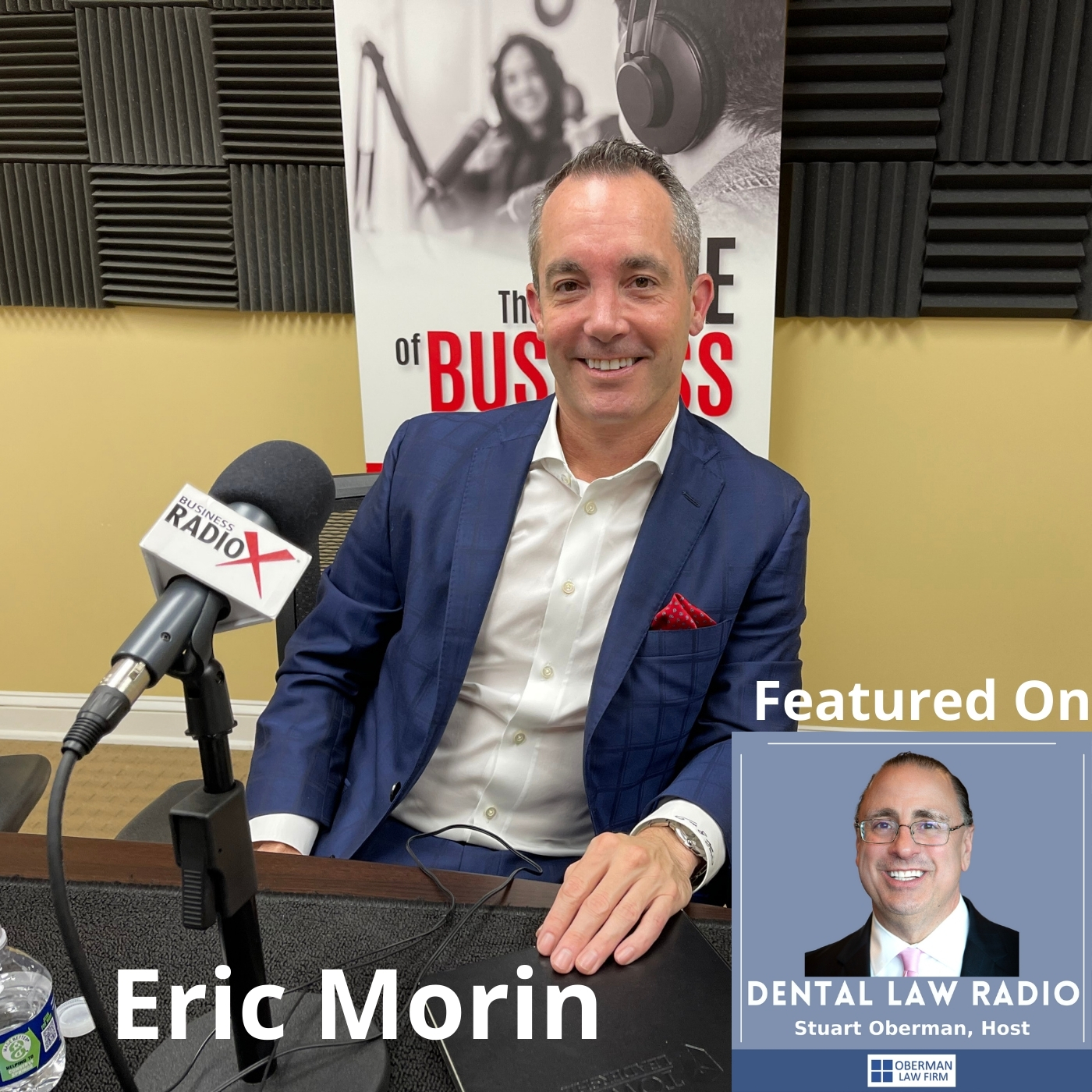
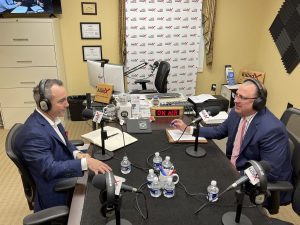
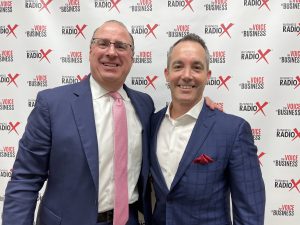
In a few years, Eric Morin argues, few dental practices will have less than $1 million in revenues. In this era of consolidation, what enables a practice to acquire other practices and scale effectively? In this conversation with host Stuart Oberman, Eric argues that the answer gets down to great employees, and he discusses the management and leadership fundamentals needed to attract those people. Dental Law Radio is underwritten and presented by Oberman Law Firm and produced by the North Fulton studio of Business RadioX®.
Eric Morin, Founder and CEO, Tower Leadership
Eric J. Morin, Founder and CEO of Tower Leadership, is an MBA and an experienced successful financial and business consultant, Eric truly is an innovative thought leader and powerful dynamic speaker. His words compel you to grow your business, live optimally, and make a transformative impact on this world.
For over a decade, Eric J. Morin has left a successful track record in the dental consulting industry. Hundreds of Dental Practices are now thriving in wealth, work environment, and community impact.
Eric founded Tower Leadership with the sole purpose of keeping dentistry in the hands of dentists by equipping them with the knowledge and tools they need to run a flourishing practice where everyone on the team benefits.
Connect with Eric on LinkedIn.
TRANSCRIPT
Transcript
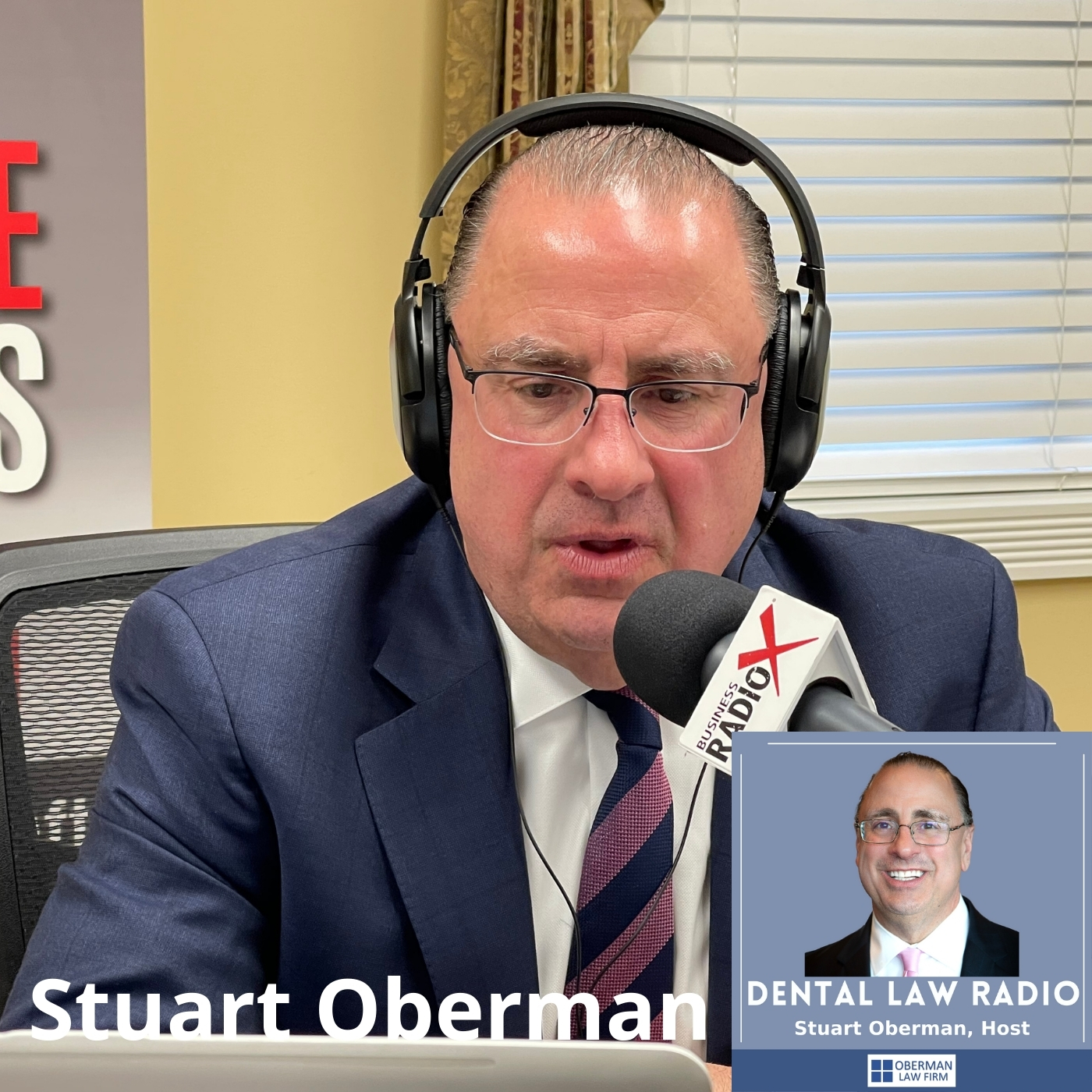
Intro: [00:00:02] Broadcasting from the Business RadioX Studios in Atlanta, it’s time for Dental Law Radio. Dental Law Radio is brought to you by Oberman Law Firm, a leading dental-centric law firm serving dental clients on a local, regional, and national basis. Now, here’s your host, Stuart Oberman.
Stuart Oberman: [00:00:26] Welcome, everyone, to Dental Law Radio. Usually, I’m given a couple items on a podcast, but today we’ve got an extraordinary special guest in the studio, Eric Morin, Tower Leadership. And the reason why I wanted to talk to Eric – and he and I have done some projects and clients along the way for many years now. And I know Eric has clients all the way from Washington to probably Maine, probably to Florida, and probably some internationals. Who knows? – I wanted to really get Eric’s sort of feedback, if you will, what’s going on in the industry, where things are at. I know he’s got the the pulse of the industry and what’s going on at the practices, whether you have one practice or, I think, we’re working on a project now that we’re probably going to get him to about 30 practices at some point, if we can keep him on track, keep him on track.
Eric Morin: [00:01:23] It’s a big one.
Stuart Oberman: [00:01:23] But I think, really, Eric, you did a great job getting your guys through COVID-19. I know that was a very difficult spot. And I know that you and I did a seminar together that we had to go to a very remote location in a winery because no one else with houses. And you were on the forefront of a lot of areas, and I know that if your doctors listened to you when you were giving advice in March and April, they were well on the way to succeed. But I wanted to get, you know, your conversational sauce.
Stuart Oberman: [00:01:58] We’re going to cover a couple of things today, because you’re right on the front on this. You’re way out in front of this. Everyone’s scaling, scaling, scaling. You know, the questions we have are, how do you keep associates without giving up equity? One other area we want to take a look at is where are we at on the change of the business environment as we sort of revisit COVID, if you will, and all this coming with that. We’re seeing things that are already going into the first quarter of 2022.
Stuart Oberman: [00:02:33] So then, we want to take a look at, you know, leadership. And I’ve heard you talk and I take notes when you talk and implement when you say things. And God forgive me, but you introduced me to the sigmoid curve. I couldn’t even spell sigmoid curve until I actually listened to you talk when we were giving a little seminar.
Stuart Oberman: [00:02:57] But great to be here. Thank you, my friend. You are amazing in what you do. And I will tell you and I’ll tell listeners, every time you speak and every time I hear you, I learn something. Whether it’s one thing or a handful, I learn something. So, I want to talk about, really, what Tower Leadership is doing. Then, I want to get into some very specific industry topics that I know you’re out in front of. But tell us a little about Tower Leadership and what you guys do.
Eric Morin: [00:03:24] Well, first, thank you for having me. I’m glad to be here today. This is a lot of fun. I’ve been looking forward to it. As you said, you and I have worked on a lot of projects together, a lot of conversations. We’ve dealt with a lot of clients. You know, we really experienced a lot of issues together. This is a great time to have this conversation. There are so many changes. And then, all this thing called the Delta variant comes out.
Eric Morin: [00:03:48] So, just when we think that everything is settled and we can get back to business as usual, winter comes again. We don’t know. There’s uncertainty. And I think that’s business as a whole is there’s always uncertainty in the marketplace, and I think preparing for that. And then, what do you do when that happens?
Eric Morin: [00:04:04] And I think that’s one of the conversations you had brought up, which is when COVID happens. I think in the show we’ll talk through that is what were the differences during that time? Because one of the things I’m seeing now is, when we go back and we look at the time period, some people say we won’t count 2020 and some people say 2020 was a great launching point.
Stuart Oberman: [00:04:26] Best year they ever had.
Eric Morin: [00:04:27] That’s right. So, what was the difference? I think it’s really important in this podcast to identify those things. As a company, Tower Leadership, I’ve been in the consulting dental space for approximately 20 years. I’m married to a dentist. And I was consulting for companies outside of dental. And then, she said, “Will you help me start a dental practice?” I always tell people that my best asset was that I didn’t know anything about dental. And so, I just started growing and scaling this dental practice and hiring doctors. And I thought that was normal until someone told me it wasn’t.
Eric Morin: [00:05:01] But then, my career, I ended up getting investment licenses so that I could see also the investments that doctors were making. Tower Leadership came from this idea of, after all my years of experience, you can have great management systems, you can have great training, you can have all these things in place. But if you don’t have great leadership within the business, and leadership encompasses a lot of things, and there’s certainly some great things you need in management and leadership.
Eric Morin: [00:05:31] But the idea of Tower Leadership was, let’s create a business that shows doctors that if you invest, if you grow and you scale, yes, you can have all the financial rewards, but you can also impact a lot of people, too. And as idealist as that sounds, we’ve been able to do that. And it’s a fun pursuit of passion. And we get to see the changes in our clients lives, which is a lot of fun.
Stuart Oberman: [00:05:54] So, one of the big things now is, our doctors are sort of in a quandary where they really don’t want to give up leadership or ownership, but they don’t want to work 80 hours a week. So, the question is, in today’s tight market, tight, tight associate market – and we get this question all the time. And I know you get the question. You had a big conference on this recently – how do you keep associates in today’s world where you’re only as good as your last paycheck and your last patient without giving up equity? That’s probably a 17 day topic in a four year span. But, you know, how do our doctors do that? And what are you seeing on that side? You know, how do you keep these associates without giving up equity? That’s a loaded question.
Eric Morin: [00:06:50] You’re right. I mean, we could sit here and talk about this for a long time. I think it’s very important for people to know that a lot of times that associates feel that that’s being successful. But let’s unwind it a little bit more. The idea of ownership – and a lot of it actually, believe it or not, and all the conversations, I mean, I’ve had conversations with thousands of associates – it’s always that, “I want to be able to have a say in the practice. I want to be able to have leadership.” That’s the hard part to get over, right? Because you could give somebody equity.
Eric Morin: [00:07:19] Let’s just say that you gave up 30 percent or even 40 percent or 50 percent of your practice. But if someone’s whole goal is to be able to have a leadership conversation, to be able to contribute, and they’re not able to do that, of course, then they still won’t be happy. So, I think the first thing it goes down to is, what does the person ultimately want?
Eric Morin: [00:07:38] Because I think the marketplace in the past had said to this person, let’s take an associate, highly educated, highly competitive. Dentists tend to be competitive people by nature. And we say, “Here’s what I want you to do. I want you to come in. I’m going to figure out how to pay you as little as possible. I’m going to give no say on my dental practice.” And I love it if you just stay a really, really long time and no equity. I mean, none of us would go into that conversation to go, “This sounds like a win-win long term.””
Stuart Oberman: [00:08:04] It happens every day.
Eric Morin: [00:08:05] And so, I think that if you look, this is not what happens in other industries, by the way. This is kind of a way, a paradigm, that was in the dental market space for so long. And so, I will tell you that before we even get to a financial model or talk through those types of models, I think it’s more important to say, can this person contribute to the practice? Are they allowed to contribute? Because these are intelligent people.
Eric Morin: [00:08:30] And by the way, if doctors want to pull back, I might want to pull on that part of their skill set and have them be part of the practice as far as the ability to contribute to a leadership team or contribute to the management of the practice. So, it’s really important that we talk about that first in that component because they want to be part. They want to feel like they’re part of something. Don’t we all, though? I mean, don’t we all want to feel like we’re part of something? And I think the way we’ve treated associates in the past is wrong, I’ll say that first.
Eric Morin: [00:09:04] The other part is, what does it mean to get ownership? I think we have to unwind that. What does that actually even mean? Equity. What is equity? Equity, first of all, until you sell it, it’s just something filed with the state. I mean, it doesn’t really mean anything. You can say, “Well, it means distributional equity. So, I get some distributions.” But I think what do those distribute – distributions?
Stuart Oberman: [00:09:30] You’re the financial guy. You’re asking a lawyer?
Eric Morin: [00:09:30] I know, right. I think one of those distributions will be long term. So, I think it’s one of those mean long term. And I think it’s creating an asset. You know, what we have found is, by allowing someone to be part of a leadership team, to have some say in what’s happening in the practice, and then by giving them an asset, showing them that they could have a multimillion dollar asset without having equity, then they say, “Okay. Hold on. Let me get this right. So, I could work four days a week, not deal with H.R., not have to do with marketing, not deal with all the headaches and complexities, and I could have a multimillion dollar asset?” The answer is yes.
Eric Morin: [00:10:16] And so, actually, believe it or not, I’ve had partnership agreements that the partners have unwound the agreement to do a deferred compensation or some type of other program, because they see clearly financially. I’ve had people take that type of an arrangement and put it in front of their lawyers, their accountants, their financial advisers, and they have come back and said, “Wow, this is pretty amazing. And it’s actually better financially.”
Eric Morin: [00:10:44] So, what happens is, when the associates end up in dental school, they tell them the natural progression is you’re going to get out, you’re going to work for a few years. Oftentimes and nowadays, it’s for corporate for years. And then, they’re going to go buy a dental practice. But even that market’s changing, isn’t it? I mean, we’re starting to see the complexities. And I’m shifting a little bit here, but as the marketplace changes, the complexity around owning a dental practice is getting much harder.
Stuart Oberman: [00:11:11] It’s getting harder. Individual, not when you got numbers on DSOs.
Eric Morin: [00:11:15] It is. Even in the last ten years, Stuart, I mean, we got to think about –
Stuart Oberman: [00:11:21] And days.
Eric Morin: [00:11:21] Right. So, we think about this and say, even five years ago. I argue that five years from now, there’ll be very few practices that are operating under a million dollars in revenue. Independent dentists that are thriving outside of, maybe, a small boutique type cosmetic firm. And if you look at the medical space, you’ll see the same thing. I mean, in the medical space, you’ve got dermatologists and you’ve got plastic surgeons. And for the most part, they stayed out of groups. But the vast majority of medicine, you know, MDs are now all part of groups.
Eric Morin: [00:12:00] So, when we look at the marketplace and the way it’s shifting, we say even the people who might have bought a practice, it’s going to cost you a lot more to get into them because – and we’re seeing this and you’re seeing this, too – it might cost you $2 or $3 million now to get into a practice where it would have cost you 400. And then, you’ve got to have the business acumen to be able to compete in that space.
Eric Morin: [00:12:19] So, when we’re retaining associates, what we have to think about first is the environment. Are we providing a world class environment? Are we providing a place where they can thrive? Can their career grow? Can they be excited? All those traditional things in any other industry we will look at. Let’s say you and I started to create another firm, we would want to take care of our C-suite, our top players.
Stuart Oberman: [00:12:44] We don’t sleep as it is.
Eric Morin: [00:12:47] [Inaudible]. What a side note. So, I think that we can keep unwinding this. The truth is that, no matter where you are, this marketplace is changing. And I actually think there’s a lot of it that’s good news. And the marketplace is changing and we can kick and scream, but it is. And I think that the more we adapt to that marketplace, the more we can thrive. I think if you look at large corporations, or private equity, or DSOs, or however you want to call it in this space, they are not handing over equity to these practices. And I think that people have been telling people for a long time that you need to hand over equity.
Eric Morin: [00:13:29] But in the case that you had mentioned from coast to coast, I was working with a doctor recently. And if he had given up half his practice, he would have taken a 50 percent pay cut. But that pay cut literally would have made it so he could not pay his bills, literally. And so, I sat down with the associate. I said, “Do you care about this doctor?” And the associate said, “Yeah. I’m just trying to take care of my family, but I also want him to be taken care of.” I said, “Well, if we do this deal long term, this is going to fall apart.”
Eric Morin: [00:14:03] And so, we would do the math with the associate. And we were able to put a really good agreement in place where the associate had a long term asset. Also, had some leadership say in the practice, was able to thrive. And this was a few years back, actually. And, now, I mean, they are just just doing so well together. So, I love to see that you do not have to just hand over equity. That is a paradigm that is changing. It will continue to change. And I think it’s really important in this marketplace.
Eric Morin: [00:14:37] Maybe you do want to sell back. Maybe you want a partner. I’m not saying you never should. I’m just saying that if that is not your game plan, you should not be forced into that game plan, or strategic direction maybe is a better way to say that. I think you have to think through why you’re doing this, and who it benefits, and what your long term vision is.
Stuart Oberman: [00:14:55] Does this go hand in hand when a doctor says to you, “I want to get out of the chair.” Does that go hand in hand on or is that a before conversation that would get to the associates? Is it, “I want to get out of the chair, how do you figure it out? Then, what do I need to do with an associate?” Is that a first conversation when when a doctor says that to you? How do we get out of the chair?
Eric Morin: [00:15:19] I have to tell you, this is like my happy place. Can we make this show five hours? We got to like [inaudible]. We can do this for a long time.
Stuart Oberman: [00:15:27] How do I get out of the chair? How do I get out of the chair? How many times have you heard that, how do I get out of the chair?
Eric Morin: [00:15:33] So, here’s a thought, so what happens is, is just like any other position. Sometimes we put a square peg in a round hole. Look, we oftentimes will bring in this associate that does not meet the business model. It does not meet the vision. For instance, the person who says this doctor does not want to give up equity long term, wants to build a team, wants to do some type of other business or economic model to provide an asset for the associate. And this associate walks in, stomps their feet and says, “No. I will not do anything but take ownership.” So, the doctor says, “Okay. Fine. I’ll hire many. How many?” They’ll change their mind.
Eric Morin: [00:16:16] That’s your hiring process. There’s a thought process between selection and recruitment. Selection is that you’ve sort so many candidates coming into the position that you can pick the right person and select them. We always want to select people. So, if you have multiple candidates, you get to select. Recruiting is almost that last minute thing where you’re like, we really need a body or we really need an associate right now, so we just put whoever comes into that position, we just say, “We’re going to hire you. We’ve seen this with front desk.”
Stuart Oberman: [00:16:49] Is that more prevalent in today’s market because they can’t find good associates or they’re just filling bodies?
Eric Morin: [00:16:55] See, I would push back against can’t find good associates. It’s interesting, the reason I say that is because the doctors who have built an amazing environment to work in, doctors hang out with doctors. I don’t know how many times someone has said to me, I’ve recruited two or three people from my class to come work for this doctor, because if you create an amazing environment to work where somebody can do well, can take care of their family, and have an asset, it’s going to attract other people.
Stuart Oberman: [00:17:27] Build it and they will come.
Eric Morin: [00:17:28] Yeah. Sometimes I say to people, it’s like the harsh truth. But sometimes when someone says, “I can’t find anyone.” I say, “It’s you.” And that’s kind of a harsh truth. And let me kind of back that up.
Stuart Oberman: [00:17:42] It’s true, though.
Eric Morin: [00:17:43] Sometimes it’s like I have not built the environment to attract people. Someone said to me this one time, Stuart, this person said to me, “You can’t find any good people in Atlanta.” I was like, “Wow. An entire city. I’m sure it’s the entire city.”
Stuart Oberman: [00:18:00] You can’t find one person out of six million.
Eric Morin: [00:18:02] That’s right. So, I pushed back and and said, “Well, let’s talk about the environment.” We’ve always had this idea that dental is different, but it’s not different. The business acumen, the business principles always apply is you’ve got to create an environment. No matter who you are, every study shows, people still don’t come to work for money. We say, “Well, yes, they do.” Somebody can always pay them more. There’s still all these other intangibles that you have to make it a place that’s great to work.
Eric Morin: [00:18:32] Now, obviously, somebody wants to get paid their value. They want to have the ability to increase their income. All those things are true. And I’ll give you an example of what I mean by that. There is a young doctor. She is one of the most amazing doctors that I’ve ever had the pleasure to spend time with. She took a job out of GPR residency. And what she did was she went up to Indiana. She gets up there. She gets a practice who’s going to pay her more money. And it ends up being a really bad environment for her to work in. And we’ve had a business relationship.
Eric Morin: [00:19:10] And she says, “Hey, Eric. I need some help. I’m in this practice. They pay me a lot of money, but I’m so miserable.” And here’s here’s the thing, going back to my earlier point, “They will not let me have any say. They will not let me contribute. They tell me just to shut up and see patients.”
Eric Morin: [00:19:24] And what happened was she quit there, is now working for one of my clients. She is running the entire location. This entire location she runs. She’s learning advanced procedures. And the doctor there, he goes, “She’s a unicorn. I don’t know if I’d ever find another one of her.” And yet this other doctor had her. Now, the other doctor that lost her is probably saying, “It was her. You know, you can’t find good people.”
Stuart Oberman: [00:19:49] Has an attitude. Lack clinical skills.
Eric Morin: [00:19:50] Right. All these things. It was like, “No. It was you.” And so, I do think it’s important that we all look at our business and say, “Do we have the environment to attract top talent?” All businesses have to do that. Can we attract top talent? Would they want to stay here? Do they have a say? And by the way, that’s not just doctors, it’s your entire team. Hygiene is no different, right? We are in a tough, tough market to find hygienists. Hygienists talk to hygienists. If you had a great place to work, other hygienists will say, “You got to come work for here.” So, that’s just something to consider.
Eric Morin: [00:20:26] So, yes, at Tower Leadership, we’re a financial firm in many ways and we do plans around retaining associates. But I would still argue that if you don’t have the foundations of strong business management, then it’s not going to work anyhow.
Stuart Oberman: [00:20:47] That’s why there’s one practice or 20. It’s all the same.
Eric Morin: [00:20:49] That’s right. And I say management leadership, one thing I’ll say on the show that I think it’s important. Sometimes you scroll through LinkedIn and I see some amazing post by Stuart Oberman, so I’m scrolling through.
Stuart Oberman: [00:21:04] I got good people. I got good people. I got much smarter people than me, I could tell you that.
Eric Morin: [00:21:09] Well, they’re doing great. It’s looking good. So, as I’m scrolling through, I always see these posts that pop up. And they’ll say something to the idea of, “Leadership is when you care. Management is just a number.” And it’s silly because it’s not true. Look, all great businesses need leadership and management. Management doesn’t mean that you don’t care? You have to have strong management because you can be a great leader. But if you have bad management, then the company is going to fall apart. You can train people, but if you don’t have a way to have standard operating procedures, you cannot continue to manage the business to grow. So, you do need both.
Eric Morin: [00:21:54] By the way, if you just have management but no leadership, that’s not good either. So, I think it’s important to understand, you have to have strong leadership within a business, the visionaries, the the visionary leader, the people that are driving the show and looking at direction and inspiring people. But I think there’s another side that says, “Do I have strong management?” And by the way, I think associates play a crucial role in both of those.
Stuart Oberman: [00:22:19] So, you know, it’s amazing what’s changed in the last three years, maybe 36 hours, we got scaling, we got corporate coming in, and we’ve got DSOs, we’ve got growth, we got no growth, we got COVID. I would say with COVID, it’s got to be something else. If it’s COVID today, it’s Delta tomorrow, and it’s something else down the road.
Eric Morin: [00:22:42] The Foxtrot variant.
Stuart Oberman: [00:22:44] Yeah. It just keeps going. So, from a practice standpoint, how do our doctors adapt to the change in this new business environment? And it changes, like, everyday it seems like.
Eric Morin: [00:23:02] Three words, access to capital. I’m serious. Let me tell you what I mean by that, you can look at business over business over business outside of dental as well. And you and I talked about this actually during COVID. I said, you got to have access to capital. One of the things that the federal government provided was access to capital. Had that not happened, then what would have happened? Have we not have PPP and EIDL, what would have happened to the dental market space?
Eric Morin: [00:23:32] And so, I think when we look at the future, first of all, one of the ways we insulate ourselves from those types of things is access to capital.
Stuart Oberman: [00:23:40] And what does that mean? Access to capital, what does that mean?
Eric Morin: [00:23:42] It means that either you have credit lines you can pull from. It means that you might be able to have money in the bank. You have access to be able to borrow money.
Stuart Oberman: [00:23:54] Is that what they call good debt?
Eric Morin: [00:23:56] Here’s what I always tell people, there’s two things you cannot get when you need them, credit lines and insurance. Okay? So, those things are really cheap and you could get it really easy when you don’t need them. The second you need them, they’re gone. Also, you’re about to go to bankruptcy and you’re like, “Can we get a lot of credit?” NO. It’s not happening. You get diagnosed with something, you can’t get insurance.
Eric Morin: [00:24:15] So, I think it’s important for us to know that, as businesses, we have to start projecting. We have business winters. One of the things I said before – COVID now – I certainly did not know it was going to be COVID, but I was telling people, “Listen, this is a great economic time.” Take 2021, we would argue that 2021 – I think everybody can see – it’s a great business year. We can talk about all the reasons why, and that’s maybe for another show. But it’s a great economic year for most businesses. So then, are you taking that money and are you making sure that you have capital?
Eric Morin: [00:24:45] Let’s play this Delta variant, or something changes, or the economy changes. We saw the dental marketplace change in 2008, 2009, 2010. People are doing procedures now that they weren’t doing before. They’re getting checks from the government. So, what happens if you had a 20 percent drop in revenue, I’m just saying, play that scenario out. In business, we call that pessimistic modeling. Hey, what if we weren’t to grow at this rate? Well, what if something was to happen? Do we have the ability to pay our bills for some period of time? Do we have the ability to get capital? And maybe that’s capital for expansion. It doesn’t have to be a negative thing. It doesn’t necessarily need to be something that’s going down.
Eric Morin: [00:25:22] But you always have to have access to capital. Businesses go under because they don’t have access to capital, which is the whole saying cash is king. And so, I would argue that businesses have to have that. So, the first primary thing I would say is – by the way, this is like a business school 101 – profitability doesn’t keep the lights on. Cash flow does. Do you have enough cash flow to get through or the ability to get capital to get through a difficult time? I think it’s very important that any business owner assess that at any given time.
Stuart Oberman: [00:25:54] Wow. So, the practices that want to scale, how do they get access to capital?
Eric Morin: [00:26:04] Wow. This is just so exciting. So, we can, first of all, say, right now for a dentist to get leverage – otherwise known as debt – it’s not that hard, right? I mean, as long as your financials are in pretty good order, you can go to a bank and get a loan and buy another practice, as long as the financials make sense. They’ll look at your personal, obviously, financial statement and see if you are a good, qualified buyer. But that’s only to a certain point, right?
Eric Morin: [00:26:35] There’s going to be at some point where the banks go, “We have taken enough of risk here.” And then, we start to get to the point where we go into getting capital that’s outside of a bank, which that could be bringing another partner, it could be mergers and acquisitions, it could be pulling in private equity. And that’s a good thing for you to look at in your long term vision.
Eric Morin: [00:27:00] If you have a dental practice, and let’s just play the scenario that you’re two locations and you say, “I really love to go to 30 million.” You and I were talking about this process of moving drastically. And so, we’ve seen that. But what happens is, is you have to say, what is my plan for getting capital in the future? When the banks cut me off – and they will at some point –
Stuart Oberman: [00:27:22] They will.
Eric Morin: [00:27:23] .. you have to say, “What is my plan -” you can’t wait and then start making phone calls. You have to think now – “at the point at which the banks cut me off?” So, let’s just say it was a certain revenue, or four locations, or whatever that is in your head. And by the way, your banker can help you with that. And you can –
Stuart Oberman: [00:27:41] I’m going to allow you to purchase one practice a year.
Eric Morin: [00:27:44] See. So, that’s something I wasn’t aware of. And so, I think it’s important to get that information. And then, if that’s the case, then, what is my – going back to number one thing – access to capital? What is my next step to get capital? If I can no longer get any more capital, how else will I get it? Do I want to bring in an equity partner?
Eric Morin: [00:28:07] Because there isn’t an old saying and I love this saying. When I heard it, I thought it was brilliant. Some people will say partnerships don’t work. It’s just not true. They just have to be running in the same direction. And so, do I want to own 20 percent of a watermelon or 100 percent of a grape? Depending on what your long term strategy is, it might make sense to earn 20 percent of a watermelon. You know, everyone’s situation is different.
Eric Morin: [00:28:32] But if you’re trying to become a large dental group, I think you have to understand, in business, the number one thing is, what’s my vision? Where am I going? What do I want long term? How does this impact my family? What does this do to my legacy? I think you have to write all those things out first.
Eric Morin: [00:28:48] I’ll tell you a story. Years ago – I want to say about seven years ago – I had a group come to me.
Stuart Oberman: [00:28:55] When we were young.
Eric Morin: [00:28:59] I had a group come to me, they had nine locations, has four partners. And they had flown up to see me and I sat down with them and I asked them that same question. I said, “Where are we going? What are we trying to get accomplished?” And they said, “We want to be a $100 million dental practice. And we heard you were the guy to get us there.” And I looked at them and I just said, “Why? Why do you want to be $100 million? What does that do? Why do you want that?” And their answer was, “I don’t know. It sounded good.” It sounds like a good round number.
Stuart Oberman: [00:29:33] I heard it at a seminar.
Eric Morin: [00:29:33] That’s right. I heard it at a seminar. It’s not like we couldn’t do that. So, I said, “Let’s talk through that more.” And it’s interesting, because I told them, “If I was a bank -” sometimes when I’m speaking to a doctor or any business, I would say, “Let’s play that I’m your investor. Explain to me why I should give you money.” “-if you came to me and said you were trying to grow, but you don’t know why, you just had no reason, and you didn’t have an economic model, I probably won’t give you the money.” So, believe it or not, it took about four hours to finally get to their why.
Stuart Oberman: [00:30:08] I believe it.
Eric Morin: [00:30:08] And then, when we got there, here’s what they said, “We want one location with 24 hours.” I thought, “We should have figured that out eight locations ago.” So, we just wasted time and money and energy.
Stuart Oberman: [00:30:18] Or four hours ago.
Eric Morin: [00:30:19] And interestingly enough, you know, part of the story is one of the partners was actually diagnosed with a heavy disease at the time. And I thought, “Gosh. You guys have spent so much time in the wrong direction. So, I think that the first part is always, where are we going and why?” And one of the reasons why I try to get people at the dental chair is, I think that some people love dentistry. Stay in the chair if you want to. But have the ability to pull back. Have the ability to spend time with your family and do the things you want to, which is one of the reasons why we start a business.
Stuart Oberman: [00:30:54] So, you talk about this a lot and this could probably interject into every scenario you just mentioned, leadership. You guys talk about that a lot. You groom it. You touch base on it. You figure out how to get better at it. How much of a role does leadership play in a successful practice, whether it’s one or 20 practices? And you talked about this a lot during COVID. How leadership, really, will take you through the storm and put you on top of the mountain. So, tell me about leadership and doctors and what you see what they don’t do. I know that’s a whole day’s conversation.
Eric Morin: [00:31:37] No. There’s this old saying, you find out who your friends are during the difficult times. And I think that we also saw what people were made up from a leadership standpoint during the difficult times.
Stuart Oberman: [00:31:54] And we’re not out of there yet.
Eric Morin: [00:31:56] Right. But I think what I was saying during that time is – and we have doctors that send everybody home. And when I say we, I mean the industry. Doctors not even communicate with their team for 45 days. And I said, “These people are scared.” By the way, they’re going to start looking for a job because if you don’t take care of them now – and by the way, that’s what’s happened for a lot of people, because it was a great time for people to reflect and say, “Is this where I want to work long term? Does this person actually care about me?” During that time, people were scared. Everybody was scared.
Eric Morin: [00:32:26] And I said doctors play a huge role in this. It doesn’t matter whether you’re a medical doctor or not. Not just within your own team. But what do you look like in your community? Are you communicating with your community? Are you communicating with your team? Are you talking them through it? I mean, our team started working, you know, 20 hour days just to support teams. We had team members on the phone and started having financial conversations with them. We worked through each doctor. I think we spent so much time working through that time. But so many people in that time were attracted. And that was the worst thing they could have done. I said, you know, “This is a time when they need you.”
Stuart Oberman: [00:32:58] I remember you talking about that.
Eric Morin: [00:32:59] They need you. They need their leader at this point to look at them and say, “We’re going to be okay. We’re going to make it through. I’m going to make sure we’re all taken care of.” And sometimes that didn’t happen. And we see in a lot of practices what the consequences of that, you know, ended up being. As the marketplace, by the way, let’s look at hygienists again, as it becomes more competitive, they’re like, “Do I want to work here long term?” And so, I think leadership, this is one of those ones where we have to get outside of dental marketplace and just look at business. Great business leaders attract great people, and it is difficult.
Eric Morin: [00:33:40] I want to give some knowledge-ment to the fact that, being in a chair all day long, and seeing patients all day long, and trying to lead, and trying to manage is very, very difficult. Which is why you need to lead and build an amazing team. Because you can’t do it all. But building a leadership team and building a team around you, but to get them there – one of the things I was just saying to you before we went on air was one of the reasons we do this large leadership retreat every year. And one of the reasons I do it is when they say, “Well, Eric, I don’t communicate like you communicate. So, would you tell my team what you just said.”
Stuart Oberman: [00:34:13] You send them an email.
Eric Morin: [00:34:16] That’s right. And the other thing is, “But I want to get the team inspired on my why.” When I say my why, I mean your why as a doctor, why are you there? What’s the purpose? What are you trying to get accomplished? How do you impact their lives? I think that you have to get the team to understand why they should care. Because if it’s like, I think, we get to this place where we’re always like, “Well, I’ll just pay them more money. I’ll just pay them more money.” Somebody can always pay them more. So, why should they follow you? We see it all the time.
Eric Morin: [00:34:41] One of the things I’ve done at Tower is, I’ve brought people on and I’ve asked them to come on for like, literally, a 30, 40 percent pay cut from what they were getting paid. And I’ll tell you why. That wasn’t to cut anyone out of money, by the way. It was to say, “Are you willing to commit to the vision that’s here? And if you are, actually, you’re income will increase. But I want you to buy into the vision of what Tower is trying to do.” So, the same thing I would say, is, if people aren’t inspired by you as a leader and they don’t see you as a leader or somebody they want to follow, people will take a pay cut just to be with a great leader, to be with a great organization.
Eric Morin: [00:35:14] You might say, “Well, Eric. I don’t have time to do all that.” “Okay. Then, bring in somebody who can.” If we’re trying to go to 5 locations, 10 locations, 20, you can’t do that without great leadership. You can’t do that without great management. And so, why I think it’s so crucial is, business is littered with stories of great leaders and poor leaders. And we work on leadership, and we inspire, and motivate, and drive people towards a direction. And that sounds idealistic. I know it’s like, “That sounds idealism,” but it’s just true.
Stuart Oberman: [00:35:48] It’s true though.
Eric Morin: [00:35:48] And it’s like, how much time in the last 12 months have you spent on growing your leadership skills and leadership teams, inspiring people? And I think that’s got to be a focus if you’re going to, especially if you’re going to grow and you’re going to compete in this market. Because what I am seeing is a lot of DSOs that are private equity. They’re not focused on leadership. And it gives you a competitive place in this market. I mean, it really does. It allows you to differentiate yourself. I’m not saying DSOs don’t care. That’s not what I said. But I’m saying that, if it’s all about money, you get what you measure. And if they’re focused just on money, well, then I’m telling you, they’re going to take their eye off of leadership. And that’s a place where you can dominate and attract top talent.
Stuart Oberman: [00:36:29] Amazing. Amazing. You know, again, I don’t even know where to start. I think we’ve been just about 45 minutes. I’m trying to think how much I could take back myself and say, “Okay. Here’s my office.” But as usual, it’s amazing conversation. I was looking over and trying to figure out what do we even call this. I mean, we’ve touched on so many things, but we’ll come up with a great name. So, tell me what you got going on. Do you got some events coming up? Where are you going to be at? When you sell out Phillips is what I want to know.
Eric Morin: [00:37:06] Well, we haven’t sold out our September and October foundation.
Stuart Oberman: [00:37:09] [Inaudible] Phillips.
Eric Morin: [00:37:12] We’re blessed to have some amazing doctors. We get to work with some of the best in the industry. And work with some of the best people to team up with, like yourself.
Stuart Oberman: [00:37:21] You know, you do work with the best. I mean, I could tell. We’ll also hear the guys that we work with together are at a different level. You know, the clients [inaudible]. They’re at a different level. They got a whole separate different vision where they’re going. And at times, they’re a little bit hard to corral in. Sometimes I just wanted to get to Marietta, not necessarily Nebraska.
Eric Morin: [00:37:47] I just give you the difficult stuff, Stuart. You know, you and I worked on some really complex stuff together and some great things. And that’s why it’s such an honor to work with you as well, because I know that the clients that have these sophisticated issues, the clients that need help, and need great guidance. I know you take care of them, which is why you and I have worked together on so many of these cases.
Stuart Oberman: [00:38:09] It’s like, “Why is Eric calling me at 8:30? I’m taking that call. There’s got to be a reason.”
Eric Morin: [00:38:13] I think I called you on Sunday once a week. Don’t call Stuart on Sunday.
Stuart Oberman: [00:38:18] It’s not to watch cable TV, I could tell you that. So, tell us what next event is coming up. What is it? Tell us about it?
Eric Morin: [00:38:24] What we do is an introductory – two days initially – as to what we do. And what we do is, we talk about the financial. So, it’s financial and its leadership and its management. Which is, what do I need to do if I want to build an organization that grows and scales? If I want to pull back from the chair, how do I have a business that runs without me? What does this mean financially? How do I make investments? One of the things that’s missing in this industry is people don’t know where to invest the practice. We talk about where to invest, what’s the ROI, where’s the best place to put money, how does that pay off debt. All those two days worth of concept.
Eric Morin: [00:39:00] So, we do those once a quarter. We’ve actually sold out September so we’ve added some more. And we get this leadership retreat we’re doing in November. And it’s a large, large event. We have practices from all over the country. And it’s really about that message, which is, how do we get our teams inspired? If we’re going to build scalable businesses, how do we get our teams inspired, motivated, and ready to tackle head on 2022?
Stuart Oberman: [00:39:28] If anyone got any questions, how do you get hold of you?
Eric Morin: [00:39:31] Towerleadership.com. I think it’s the best place. We’ve got a lot of information. And then, right there who wants to send email, info@towerleadership.com. And our team is ready and waiting. We’ll be more than happy to help you. They are excited to talk to you and excited to help. And, really, you know, we see the spectrum, as you know, and so it doesn’t matter where you are, it doesn’t matter if you’re just beginning this journey and you’re questioning what do I need a buyer or investor do.
Eric Morin: [00:40:00] I mean, a doctor years ago had said to me, they gave me their pro forma going into a practice. And I said, “Who gave this to you? It’s wrong. Trust me. We’re going to move all this around.” He had seven options, these seven options are going to be gone in 12 months. He said, “No way.” They were.
Eric Morin: [00:40:17] Even on the frontend or the person who’s trying to go, “We’re working with a lot of organizations that are going to 3, 4, 5, 10, 20, 30 locations.” So, no matter where someone’s at, no matter what the complexity is, we can coach you through how, where, and why.
Stuart Oberman: [00:40:36] Get there. Fantastic. Fantastic. Fantastic. I can’t even begin to write down any information. I’m going to have to listen to this myself and figure out where I’m at.
Eric Morin: [00:40:45] I appreciate the honor to be your guest, sir. This has been a great time. I literally think we could go for 18 hours nonstop. And this has been such a pleasure to be here. I really do. It means a lot. I’m glad to be part of it.
Stuart Oberman: [00:40:58] My pleasure. My pleasure. Thank you. I sure appreciate it. Eric Morin, Tower Leadership. It’s always a pleasure.
Eric Morin: [00:41:03] Thank you, sir.
Stuart Oberman: [00:41:05] For those that want to reach out Dental Law Radio, my name is Stuart Oberman. Reach us at stuart@obermanlaw.com. Thank you for listening. Please listen to this podcast multiple times because you will pick up multiple bits of information every time you do. Have a great day and we’ll talk to you soon.
About Dental Law Radio
Hosted by Stuart Oberman, a nationally recognized authority in dental law, Dental Law Radio covers legal, business, and other operating issues and topics of vital concern to dentists and dental practice owners. The show is produced by the North Fulton studio of Business RadioX® and can be found on all the major podcast apps. The complete show archive is here.
Stuart Oberman, Oberman Law Firm

Stuart Oberman is the founder and President of Oberman Law Firm. Mr. Oberman graduated from Urbana University and received his law degree from John Marshall Law School. Mr. Oberman has been practicing law for over 25 years, and before going into private practice, Mr. Oberman was in-house counsel for a Fortune 500 Company. Mr. Oberman is widely regarded as the go-to attorney in the area of Dental Law, which includes DSO formation, corporate business structures, mergers and acquisitions, regulatory compliance, advertising regulations, HIPAA, Compliance, and employment law regulations that affect dental practices.
In addition, Mr. Oberman’s expertise in the health care industry includes advising clients in the complex regulatory landscape as it relates to telehealth and telemedicine, including compliance of corporate structures, third-party reimbursement, contract negotiations, technology, health care fraud and abuse law (Anti-Kickback Statute and the State Law), professional liability risk management, federal and state regulations.
As the long-term care industry evolves, Mr. Oberman has the knowledge and experience to guide clients in the long-term care sector with respect to corporate and regulatory matters, assisted living facilities, continuing care retirement communities (CCRCs). In addition, Mr. Oberman’s practice also focuses on health care facility acquisitions and other changes of ownership, as well as related licensure and Medicare/Medicaid certification matters, CCRC registrations, long-term care/skilled nursing facility management, operating agreements, assisted living licensure matters, and health care joint ventures.
In addition to his expertise in the health care industry, Mr. Oberman has a nationwide practice that focuses on all facets of contractual disputes, including corporate governance, fiduciary duty, trade secrets, unfair competition, covenants not to compete, trademark and copyright infringement, fraud, and deceptive trade practices, and other business-related matters. Mr. Oberman also represents clients throughout the United States in a wide range of practice areas, including mergers & acquisitions, partnership agreements, commercial real estate, entity formation, employment law, commercial leasing, intellectual property, and HIPAA/OSHA compliance.
Mr. Oberman is a national lecturer and has published articles in the U.S. and Canada.
Oberman Law Firm
Oberman Law Firm has a long history of civic service, noted national, regional, and local clients, and stands among the Southeast’s eminent and fast-growing full-service law firms. Oberman Law Firm’s areas of practice include Business Planning, Commercial & Technology Transactions, Corporate, Employment & Labor, Estate Planning, Health Care, Intellectual Property, Litigation, Privacy & Data Security, and Real Estate.
By meeting their client’s goals and becoming a trusted partner and advocate for our clients, their attorneys are recognized as legal go-getters who provide value-added service. Their attorneys understand that in a rapidly changing legal market, clients have new expectations, constantly evolving choices, and operate in an environment of heightened reputational and commercial risk.
Oberman Law Firm’s strength is its ability to solve complex legal problems by collaborating across borders and practice areas.
Connect with Oberman Law Firm:
Company website | LinkedIn | Twitter