
What to Know about EEOC Investigations (Advisory Insights Podcast, Episode 13)
On this episode of Advisory Insights, Grace Tillman of Oberman Law Firm talked with Stuart Oberman about what to know about EEOC investigations. Grace’s single most important tip: if you receive a letter of investigation from the EEOC, NEVER ignore it and hope the whole matter will go away. Grace also discussed how these letters may be delivered electronically, what you do immediately when you receive one, what you should never do (which includes talking to the complainant), and much more.
Advisory Insights is presented by Oberman Law Firm and produced by the North Fulton studio of Business RadioX®. The series can be found on all the major podcast apps. You can find the complete show archive here.
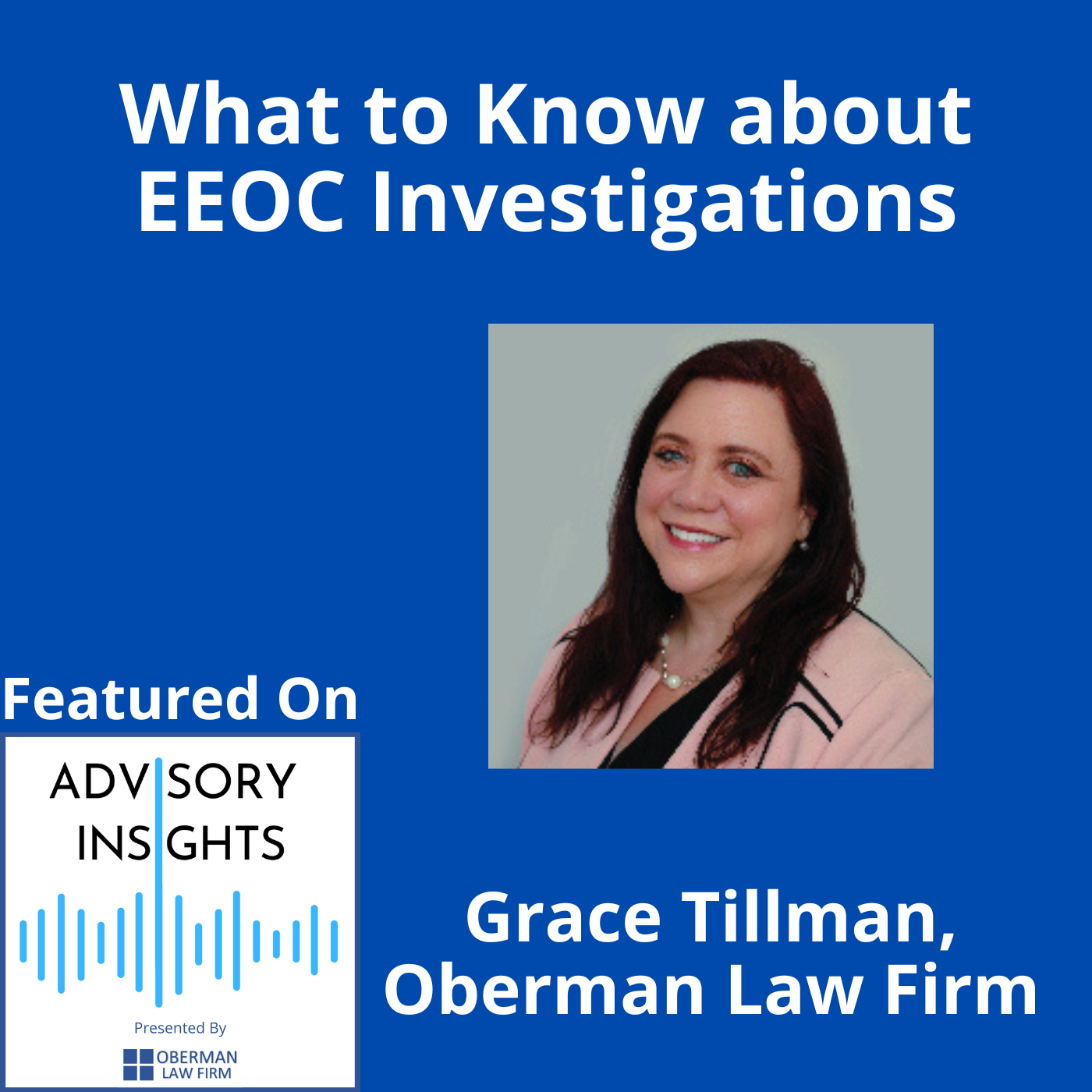
Grace M. Tillman, Senior Corporate and Litigation Counsel, Oberman Law Firm

Grace M. Tillman is Senior Corporate Counsel with Oberman Law Firm. For nearly 25 years, Ms. Tillman has represented small to large corporate clients in a wide variety of practice areas such as commercial litigation, real estate, health care, mergers & acquisitions, governmental compliance, and employment law.
Ms. Tillman provides guidance to clients regarding simple to complex labor and employment law matters, including the complexities of non-compete and non-solicitation agreements. In addition, Ms. Tillman also provides expert guidance on complex HR (Human Resources) issues, including specific employment matters involving the Americans with Disabilities Act (ADA); Family and Medical Leave Act (FMLA); the Age Discrimination in Employment Act (ADEA); and, the National Labor Relations Board (NLRB).
In the area of health care, which continues to evolve at the speed of light, Ms. Tillman’s experience includes oversight of hospital regulations, HIPAA Compliance, fraud and abuse, Medicare and/or Medicaid regulations, Anti-Kickback Statute, Stark Law, Telemedicine, state and federal insurance audits, and licensing board requirements.
Ms. Tillman has extensive litigation experience in federal, state, and appellate courts, as well as before administrative boards.
Ms. Tillman received her undergraduate degree in Business Management from Kennesaw State University, and Doctor of Jurisprudence from the University of Georgia School of Law. In addition, Ms. Tillman is licensed to practice law in Georgia and Tennessee.
TRANSCRIPT
Intro: [00:00:02] Broadcasting from the studios of Business RadioX, it’s time for Advisory Insights, brought to you by Oberman Law Firm serving clients nationwide with tailored service and exceptional results. Now, here’s your host.
Stuart Oberman: [00:00:20] Welcome everyone to Advisory Insights. Stuart Oberman here, Oberman Law Firm. Well, we have got a bombshell of a topic today, folks. It is precisely EEOC, Equal Opportunity or Equal Employment Opportunity Commission. And that is a nasty, nasty organization you do not want to get a notice from or be involved in.
We have a very distinguished guest speaker today, Miss Grace Tillman, who is with Oberman Law Firm. And she is our guidance as far as federal investigations go, litigation, partnerships, buy ins, buyouts, mergers, acquisitions. I don’t know if there’s anything that Grace really does not do and do it well, but it is a very, very exciting topic.
Grace, great to have you on today. I know at the firm, you do an enormous amount of problematic areas. EEOC is one of them. So, welcome to this topic.
Grace Tillman: [00:01:22] Why, thank you. I appreciate it. Thanks for having me.
Stuart Oberman: [00:01:25] This is such an explosive topic. You know, I don’t think a lot of people know what the EEOC does. So, I want you to maybe, you know, again, just something that you’re well within your wheelhouse. You know, let’s tell the listeners what they investigate and what happens before litigation and what happens if you get a nasty letter and how to deal with it.
And also, look, let’s maybe mention a minute or two of how you prevent these things where I know you do an awful lot of preventive maintenance for our clients who are local, regional, and national, and global. So again, let’s hear the topic. I would take us through what’s going on with the EEOC and some bombshells we have there. So, without further ado, have at it Miss Tillman.
Grace Tillman: [00:02:12] Thank you. Thank you. Stuart explain the Equal Employment Opportunity Commission is a federal agency that is charged with investigation — investigating any and all claims or charges of discrimination which may be based on race, color, religion, sex, which would include pregnancy, gender identity, sexual orientation, also national origin, age for any employees who are over the age of 40, claims based discrimination on disability, any of your genetic information, or a retaliatory claim for discrimination or reporting discrimination for any of those reasons.
Stuart Oberman: [00:02:56] Now, I’m going to interrupt you there one second.
Grace Tillman: [00:03:00] Sure.
Stuart Oberman: [00:03:00] That last definition you gave is such an important thing, retaliation. Now, you’ve just touched on, I believe, the whistleblower statute.
Grace Tillman: [00:03:09] It is — that is it. That is what it is. If you have an employee who comes to you and makes allegations of discrimination and then you retaliate, doesn’t have to be terminating them, but you elect not to promote them. You don’t give them the same benefits that you give to someone else. Any way that they are treated less than or alternatively to other employees who have not made such complaints, you can have a charge of retaliation brought against you by an employee.
Stuart Oberman: [00:03:36] Yeah, that was such a great word that I did — I just — I didn’t know if you were going to speak about it later, but I wanted you to touch on that. That was such an important word, but good. I’m sorry. Sorry to interrupt.
Grace Tillman: [00:03:47] Absolutely. Absolutely. Well, some people may not know this, but before you can actually sue and you being an employee, before an employee can actually sue their employer for any charges of discrimination, with limited exception, and we’ll talk about those, you would have to file a charge of discrimination with the Equal Employment Opportunity Commission. The EEOC would receive in your complaint, and they open an investigation.
Now, I did say almost all, if you are making an allegation that is based on a violation of the Equal Pay Act, you do not actually have to file a claim with EEOC first. You can actually move right ahead, and I’ll touch on that a little bit later on how you do that. But what happens is a disgruntled employee who either genuinely believes they have been discriminated against or believes that they have been discriminated against for any reason would contact the EEOC. It’s almost all done electronically now. They don’t actually have to show up in an office. They can do it all online. You file the complaint online.
And I know you mentioned to the listeners about waiting to get that letter. It’s now often sent electronically. The EEOC doesn’t mail you anything. They send you an email if they’ve got your email. So, as a warning to our listeners, if you receive an email from an entity that identifies itself as the EEOC, don’t delete it. Don’t think it’s, “Oh, that’s spam. Oh, that’s trash”. No, that’s actually the way they communicate with you.
So, be very careful and cautious if you receive something that says notice of the — notice of charge of discrimination, because that’s what it’s going to be titled, notice of charge of discrimination. It may come through the mail if your employee did not provide a good or didn’t know your email address. But more often than not, like I said, it’s sent via email because the EEOC uses what’s called the digital charge system. That’s their electronic, I don’t want to say like message board, but really that’s what it is. It’s like a document retention. They communicate with you about your case on this electronic system that they have.
Stuart Oberman: [00:06:04] I got one question for you. One, I’m probably going to have a lot of this topic. But how important is it — if these notices are being sent by mail, how important is it to have a process in place where if you get a complaint, you have a process to handle this? Or what happens if your employee is complaining checking your mail?
Grace Tillman: [00:06:30] Well.
Stuart Oberman: [00:06:32] I just threw that one out there, didn’t I?
Grace Tillman: [00:06:35] Yeah. Well, here’s the thing.
Stuart Oberman: [00:06:36] That one’s such a softball.
Grace Tillman: [00:06:39] Yeah. They’re going to give you — it’s actually not a long window to respond. I mean, it’s not like, oh, you have 60 days to file a response. You may only get 10 to 15 days to file your initial response from the date that the charges filed. So, if it’s coming by snail mail, you can chew up seven, ten days of that time for your response just by waiting for the mail to get delivered.
So, not only is it important, but it can be fatal if you do not have a process in place for official mail to be dealt with officially at your place of business. Because if you’re having a lower-level employee pick up the mail and they don’t recognize the significance of getting this document, you could shoot yourself in the foot because you will not be given an opportunity to respond. And EEOC can think, well, you haven’t responded because what the other person saying is true.
Stuart Oberman: [00:07:29] Right?
Grace Tillman: [00:07:29] And you don’t want that. So — but I’m going to start off with a list of do nots when you receive that notice of charge of discrimination. Do not contact the complaining party. Do not call them up and say, “Well, what are you talking about? Why did you do this? You know, we like you.” Don’t do that. Don’t call anybody. Do not discuss the notice of charge of discrimination with anyone in your office before you talk to your attorney, because, again, you can find yourself in hot water if you launch an investigation on your own. Don’t do it right.
Stuart Oberman: [00:08:08] Right, right.
Grace Tillman: [00:08:09] Do not retaliate against anyone who has filed a complaint or against anyone who is named in the complaint as a potential violator. You don’t know if they really did what’s in the complaint until you and your attorney have launched the investigation to actually review these things. So, the next is a — make sure you have this. If you don’t have it, you need to get it now. And what that is, is a process in place to preserve relevant documents.
So, if a charge of discrimination has been made, you need to make sure nobody’s going through your computer system and deleting files, whether intentionally or as routine practice. That can backfire on you in so many ways. Make sure that any documents that you have, employee files, statistical information, customer information, all of that is preserved as it may apply to the charge that’s been file, because you do not want to, in addition to a charge of discrimination being made against you, have a charge that says you have intentionally destroyed or created false documents that are related to the investigation. You don’t want to do that.
So again, I say relevant documents. Maybe the complaining part is employment file. It could be other complaints or allegations that have been made against the company. It could be your employee manual, it could be your payroll records, could be your customer records. It could be things that would contain any information which would support or refute the charge of discrimination.
And I mentioned that you may get your charge of discrimination electronically through the digital charge system. If that happens and you access it, one of the things EEOC is going to do is make you create a new password. Make sure you remember what that password is, write it down, because you’re going to have to give your attorney that new password versus the old. And it’s human nature somebody says you’ve got a charge against you, you’re going to want to look at it and you want to do that right away.
And so, you’re going and you’re looking and it says, well, give me a password. And you create this fantastically secure password and now you don’t remember it. And now we can’t, as your attorney, access those records either. So, it’s going to delay. It’s going to cause time that could otherwise be used responding to the complaint or investigating the complaint. We’re going to be hunting down passwords. So, if you change the password, write it down.
Next thing. And this maybe should have been at the top of the list. But after you get the complaint, you all of a sudden can catch your breath again, your next phone call really should be to your attorney. You need to call your attorney because as again, as I explained, you have a very short window to respond to EEOC.
And so oftentimes, if you say, oh, I’m going to call my attorney, oh, I’ll deal with this next week, you may be out of time or your attorney may not be able to address it as quickly, or it may require more investigation than you think. So, what your attorney does in this case, because the attorneys like our firm, we’ve dealt with these for years, they’re going to request that you provide them with copies of all the relevant documents.
They may conduct interviews of any witnesses. They may ask you to provide them with statistical data so that they can review these charges in a more abstract way, like from a statistical standpoint. Your attorney will also then respond to the EEOC. They’re going to advise them of their representation. And again, this now is all done through their digital charge system. So, you log in, you say, oh, I’m the attorney. And all of a sudden, that communications will start coming to the attorney.
Another very, very important decision that gets made very early on is do you want to participate in mediation? Almost every EEOC charge now comes with an option. If both parties agree to participate in an early intervention mediation proceeding. Your attorney will review the specific charges because not all cases are geared towards resolution through mediation. But if it is, they’ll let you know, and they’ll advise you of the pros and cons.
If you agree to proceed with mediation, you are assigned an EEOC mediator, and you will coordinate a date for mediation to take place. And until mediation is complete, you won’t have any other documents that are required to be filed through the EEOC until mediation is complete. You will participate in that first.
If you elect not to participate in mediation or both parties don’t agree, if the complaining charging party doesn’t agree, then you are then going to have to file a response to the EEOC charges. And again, this is where your attorney is key because your attorney is going to know what should be included exactly in that response.
And it’s known as a position statement. And that position statement is filed by deadline that’s imposed by the EEOC that then gets filed by that date. And then the investigation part begins by EEOC. And if it wasn’t clear, but if in mediation, you did not — if you elected to go through mediation, the EEOC doesn’t do an investigation until it’s done, because they’re not going to waste their resources if the parties are going to agree to resolution.
So, there is no investigation unless mediation either is not done or mediation is unsuccessful. And like I said, the investigation starts with reviewing the charging statement and then your position statement in response as the employer.
Stuart Oberman: [00:13:51] Well, you know, you mentioned two really important points that I think that as we come to a close, that one, if you’re an employer, you better have your act together as far as policies and procedures, employee manuals. If not, you’re in a world of hurt. Two, you’ve — it’s no longer an option. You better have a procedure in place to avoid sexual harassment. I mean — and that can be across gender lines no matter what it is.
Grace Tillman: [00:14:28] It’s not just sexual harassment. There’s a host of forms of harassment. You have to have an anti-harassment policy.
Stuart Oberman: [00:14:35] Yeah. It’s just amazing. And I think that in this world we live in today, I think would be amiss if we didn’t advise the listeners and our clients. You know, they need to have a gender identity policy and procedures in place. It doesn’t matter what your belief is. It doesn’t — it’s irrelevant. But you better know what the law is. You better have it in place. And that’s a huge topic. And I don’t think that a lot of our employers who we represent and then who are listening, they don’t have a plan for that which is sort of the death kill of problems as we go.
So, but anyway, Grace, amazing topics. I just — I mean, I’m taking notes here. And again, it’s a four-day topic in a seminar. But no, it’s amazing, amazing stuff. In closing, is there anything that you would add that our clients listening or businesspeople listening or even employees who are listening, what are some things that, you know, they need to know in brief summary?
Grace Tillman: [00:15:43] Well, in brief, you need to take these charges seriously. Even if you think they were without merit, you need to take the charges seriously. You need to respond seriously. And like I said, you need to be prepared on the front end as far as how you’re going to address it. And you need to have a plan in place.
A lot of employers don’t even know what’s going on sometimes at their place of employment. If it’s another employee who’s harassing another. Like, sometimes it doesn’t come up. You need to have those in place, policies to deal with all of that. And then when these charges are made, take it serious. And I could go on and on.
Unfortunately, I think I would like to about what you do next, what happens and how these cases are resolved, because it’s not cheap when these causes — I think the average EEOC complaint is settled in the neighborhood of $40,000. I think that’s statistically what I read online. That’s the average settlement on an EEOC complaint.
Stuart Oberman: [00:16:38] That’s a lot. Well –.
Grace Tillman: [00:16:40] A lot of money.
Stuart Oberman: [00:16:41] Amazing, amazing information. Amazing information. Grace, thank you for your time today. I know you’ve got a lot of things lined up today and giving a lot, lot of good advice for sure to our listeners.
Well, ladies and gentlemen, thanks for joining us. If you want to reach Grace Tillman at the firm, it is Grace,G-R-A-C-E,@Obermanlaw.com. Office number, 7708862400. That is the EEOC wrap up.
Ladies and gentlemen, thank you very much for joining us. And we look forward to having Grace back on the podcast and share some other lights into what employers need to know. Ladies and gentleman, thanks a lot. Have a great day.
Outro: [00:17:28] Thank you for joining us on Advisory Insights. This show is brought to you by Oberman Law Firm, a business centric law firm representing local, regional, and national clients in a wide range of practice areas, including healthcare, mergers and acquisitions, corporate transactions, and regulatory compliance.
About Advisory Insights Podcast
Presented by Oberman Law Firm, Advisory Insights Podcast covers legal, business, HR, and other topics of vital concern to healthcare practices and other business owners. This show series can be found here as well as on all the major podcast apps.
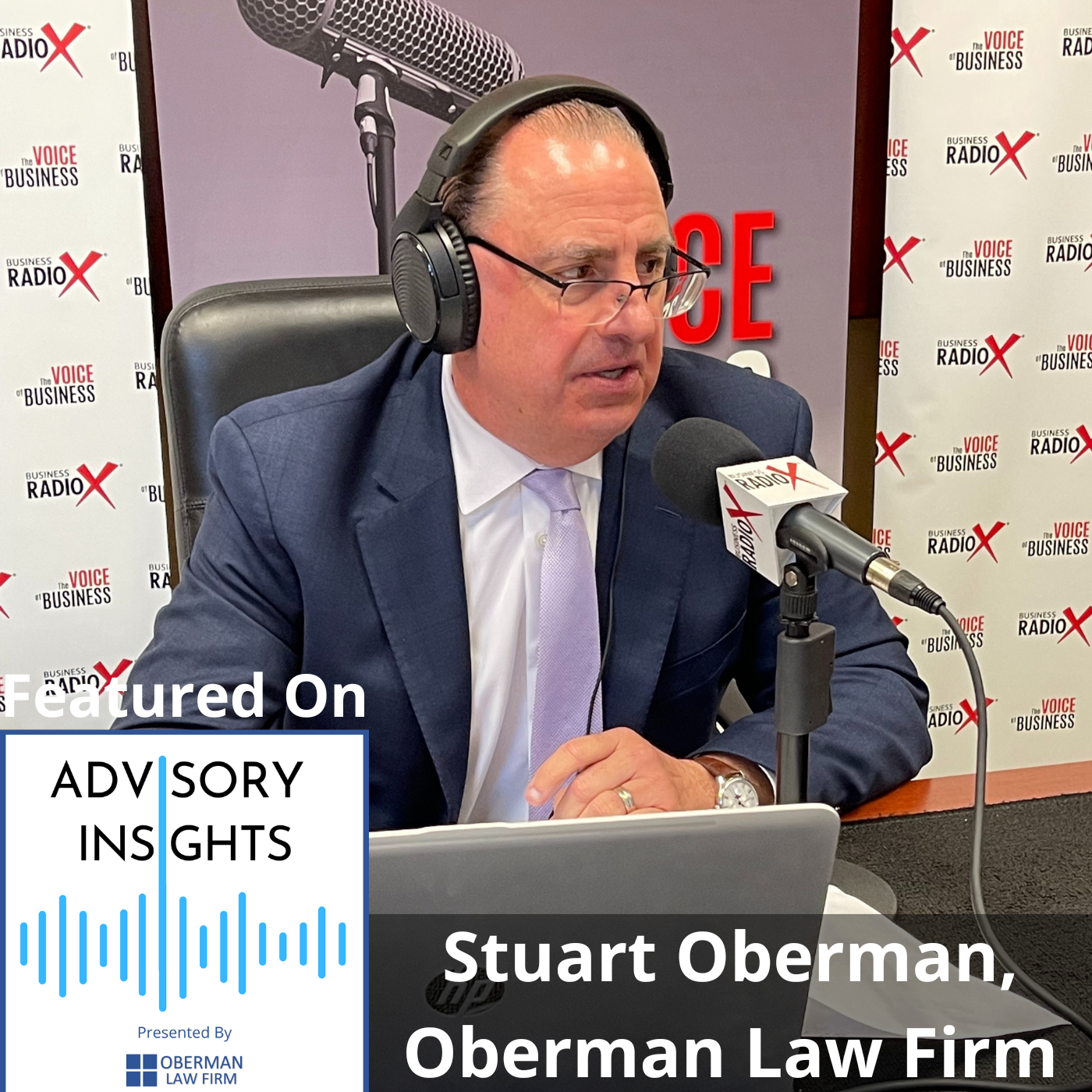
Stuart Oberman, Oberman Law Firm

Stuart Oberman is the founder and President of Oberman Law Firm. Mr. Oberman graduated from Urbana University and received his law degree from John Marshall Law School. Mr. Oberman has been practicing law for over 25 years, and before going into private practice, Mr. Oberman was in-house counsel for a Fortune 500 Company. Mr. Oberman is widely regarded as the go-to attorney in the area of Dental Law, which includes DSO formation, corporate business structures, mergers and acquisitions, regulatory compliance, advertising regulations, HIPAA, Compliance, and employment law regulations that affect dental practices.
In addition, Mr. Oberman’s expertise in the healthcare industry includes advising clients in the complex regulatory landscape as it relates to telehealth and telemedicine, including compliance of corporate structures, third-party reimbursement, contract negotiations, technology, health care fraud, and abuse law (Anti-Kickback Statute and the State Law), professional liability risk management, federal and state regulations.
As the long-term care industry evolves, Mr. Oberman has the knowledge and experience to guide clients in the long-term care sector with respect to corporate and regulatory matters, assisted living facilities, continuing care retirement communities (CCRCs). In addition, Mr. Oberman’s practice also focuses on health care facility acquisitions and other changes of ownership, as well as related licensure and Medicare/Medicaid certification matters, CCRC registrations, long-term care/skilled nursing facility management, operating agreements, assisted living licensure matters, and health care joint ventures.
In addition to his expertise in the health care industry, Mr. Oberman has a nationwide practice that focuses on all facets of contractual disputes, including corporate governance, fiduciary duty, trade secrets, unfair competition, covenants not to compete, trademark and copyright infringement, fraud, and deceptive trade practices, and other business-related matters. Mr. Oberman also represents clients throughout the United States in a wide range of practice areas, including mergers & acquisitions, partnership agreements, commercial real estate, entity formation, employment law, commercial leasing, intellectual property, and HIPAA/OSHA compliance.
Mr. Oberman is a national lecturer and has published articles in the U.S. and Canada.
Oberman Law Firm
Oberman Law Firm has a long history of civic service, noted national, regional, and local clients, and stands among the Southeast’s eminent and fast-growing full-service law firms. Oberman Law Firm’s areas of practice include Business Planning, Commercial & Technology Transactions, Corporate, Employment & Labor, Estate Planning, Health Care, Intellectual Property, Litigation, Privacy & Data Security, and Real Estate.
By meeting their client’s goals and becoming a trusted partner and advocate for our clients, their attorneys are recognized as legal go-getters who provide value-added service. Their attorneys understand that in a rapidly changing legal market, clients have new expectations, constantly evolving choices, and operate in an environment of heightened reputational and commercial risk.
Oberman Law Firm’s strength is its ability to solve complex legal problems by collaborating across borders and practice areas.
Connect with Oberman Law Firm:
Company website | LinkedIn | Twitter