Business RadioX ®

  • Home
  • Business RadioX ® Communities
    • Southeast
      • Alabama
        • Birmingham
      • Florida
        • Orlando
        • Pensacola
        • South Florida
        • Tampa
        • Tallahassee
      • Georgia
        • Atlanta
        • Cherokee
        • Forsyth
        • Greater Perimeter
        • Gwinnett
        • North Fulton
        • North Georgia
        • Northeast Georgia
        • Rome
        • Savannah
      • Louisiana
        • New Orleans
      • North Carolina
        • Charlotte
        • Raleigh
      • Tennessee
        • Chattanooga
        • Nashville
      • Virginia
        • Richmond
    • South Central
      • Arkansas
        • Northwest Arkansas
    • Midwest
      • Illinois
        • Chicago
      • Michigan
        • Detroit
      • Minnesota
        • Minneapolis St. Paul
      • Missouri
        • St. Louis
      • Ohio
        • Cleveland
        • Columbus
        • Dayton
    • Southwest
      • Arizona
        • Phoenix
        • Tucson
        • Valley
      • Texas
        • Austin
        • Dallas
        • Houston
    • West
      • California
        • Bay Area
        • LA
        • Pasadena
      • Colorado
        • Denver
      • Hawaii
        • Oahu
  • FAQs
  • About Us
    • Our Mission
    • Our Audience
    • Why It Works
    • What People Are Saying
    • BRX in the News
  • Resources
    • BRX Pro Tips
    • B2B Marketing: The 4Rs
    • High Velocity Selling Habits
    • Why Most B2B Media Strategies Fail
    • 9 Reasons To Sponsor A Business RadioX ® Show
  • Partner With Us
  • Veteran Business RadioX ®

The Wrap Podcast | Episode 054: An Intro to Environmental, Social and Governance (ESG) Reporting for Savvy Businesses | Warren Averett

June 29, 2022 by angishields

Birmingham Business Radio
The Wrap Podcast | Episode 054: An Intro to Environmental, Social and Governance (ESG) Reporting for Savvy Businesses | Warren Averett
Loading
00:00 /
RSS Feed
Share
Link
Embed

Download file

Customers increasingly value (and support) businesses that share their own personal values regarding social and environmental issues. In turn, businesses that are transparent and accountable in their policies are often well rewarded. Enter: environmental, social and governance (ESG) reporting—sometimes also known as sustainability reporting.

What should businesses know about ESG reporting in order to set themselves up for success?

In this episode of The Wrap, Barry Melancon (President & CEO of the American Institute of CPAs and CEO of the Association of International Certified Professional Accountants) joins our hosts to explain the ins and outs of ESG.

After listening to this episode, you’ll:

  • Know what ESG is and why it should matter to businesses
  • Understand why ESG is at peak popularity for both customers and businesses
  • Know what to expect when it comes to the future of ESG
  • Know how to determine what your company may need to be reporting on in this area based on frameworks

Resources for additional learning:

  • Article: Understanding the Accounting and Tax Implications of Adopting ESG Strategies
  • Article: Sustainability Risks to the Reputation of a Business [ESG Reporting Explained]
TRANSCRIPT

(00:00:00) Commentators: Hey, I’m Paul Perry. I’m Kim Hartsock and you are listening to The Wrap, a Warren Averett podcast for business leaders, designed to help you access vital business information and trends when you need it. So, you can listen, learn and then get on with your day. Now, let’s get down to business.

(00:00:17) Kim Hartsock: Hi, everyone, and welcome to The Wrap!

(00:00:23) Paul Perry: Today, we are talking about ESG and sustainability for businesses. What that means and what is to come in the future and what do people need to be thinking about?

Today, we have a very special guest with us, Barry Melancon, who is the CEO of the AICPA. That’s both the American Institute of CPAs, as well as the Association of International Certified Professional Accountants. I think I got that right. So welcome, Barry. We’re glad to have you with us.

(00:00:49) Barry Melancon: Paul and Kim, it’s great to be with both of you. And it’s a very timely topic. And over the years, I’ve worked very closely with the firm, and I’m just really happy to be with you today.

(00:01:03) Kim Hartsock: Thank you, Barry, for being with us. We’ll let our listeners know that you’re actually joining us from London today, and we really appreciate you taking time to be with us.

(00:01:11) Barry Melancon: Yeah. I was in a series of meetings in London this week. And you may not find it surprising given our topic, but a lot of the meetings had a pretty strong ESG topic associated with.

(00:01:23) Kim Hartsock: So, Barry, you know we have a variety of listeners on our podcast, and some have probably a differing level of understanding of what ESG is.

So, can you just start by giving us some basics of ESG and what that means to business owners and leaders?

(00:01:41) Barry Melancon: Yeah, Kim, glad to do that. So, Environmental, Social and Governance is the ESG. That’s the watch word of the era that has come together, but it’s really broader than those three words in a lot of ways. The reality is, I think we start with the basics. The basics are that entities and corporations around the world are given permission to operate from governments. So, you’re organized in a state, or you’re organized under the laws of the United States in this case, but it’s the same everywhere.

Basically, entities are given permission and there’s a quid pro quo that comes with that. There’s a certain way you have to act, right? You have to pay taxes and you have to file financial information. There’s a certain way that you have to act. And for hundreds of years, it’s been a pretty simple relationship and that relationship is changing pretty dramatically with a lot of external forces today.

Some of the social issues that we’re facing in the world are a lot of concern about the environment, diversity in governance, how you treat employees and how you look at your business models. There are different levels of expectations from what we call a multi-stakeholder group. So, you know, traditionally the stakeholder group of a company was primarily the people who owned it, right?

Either shareholders as a public company or the entrepreneurs in a privately-held company, but in a world of everything social media and communications and travel on a global connected world; that is changing. And the expectations that businesses have to be responsible to is a multi-stakeholder class.

So, it’s investors, but it’s also regulators. It’s employees. It’s other players in your supply chain, either providers or your customer base, it’s the community that you operate in. It’s the expectation of people who work, who are spouses and children of people who work for a company.

So, this notion of multi-stakeholder has expanded. And with that what you’re expected to and how you’re supposed to act is set by three different things. It’s set by market expectations. It’s set in some cases by regulation or legislation. It’s set by standards or standard operating procedures and expectations in this space.

That’s really what’s happening in the world. And what I like to say, and I know, Kim, you and Paul both have heard me say this when we focus on the environmental part, it’s very emotional in this country, right? And there are people listening to this podcast who I can guarantee you believe the most important thing in their lifetimes that’s being addressed is the environmental issue.

There are people totally on the other end of the spectrum that believe it is a made-up issue. The science doesn’t support it. It’s being overblown, whatever words and adjectives you want to put into that environment, I would say is looking at it from a business perspective and the role of really how it is accounted for that doesn’t matter.

The expectations are up. People are expecting things. We’ll talk about this, but measurement, reporting and actually understanding what I would say is: the truth can prove either side, right? Frankly, that’s the beauty of, I think, what’s gelling in society today.

(00:05:31) Paul Perry: I think that’s a really good way to look at it, Barry. We appreciate that idea and that concept from a business perspective, but let’s go a little bit: this really is not a new idea. This is not a new concept of the idea of sustainability. ESG has been around for some time.

You can go back to the series of principles that were created by Exxon after their spill. You can go back to any investment policy that any corporation has, right? If a nonprofit said, “I don’t want to invest in these types of companies, I’m not going to.” They were in essence following the idea or the concept of ESG.

Our daily actions need to coincide with what our values and our cultures are. So, why the hype now? Why are we seeing people either buying into this or really jumping on the bandwagon? But there’s really not a bandwagon because it’s something that is here to stay for a while probably in looking at companies and how they’re valued. Why the hype now?

(00:06:36) Barry Melancon: Actually, in your history points there, I would say the real substantive change actually goes all the way back to 1995. And when it was sort of a general consensus that the information flow of businesses is much broader than just what’s in financial statement or tax returns.

So, that was really the genesis, and it didn’t pick up very quickly, but you’re right. It is picking up. Why now? I think there’s a lot of parts to this. I mean, clearly environment. There’s been a lot of activity that people are concerned about and there’s certainty we’re living in an era in which the environment is changing.

Now we could debate the causes of it, but it’s clearly changing. I think I would say the world is a much more transparent place and so the expectations are really driving it in this multistakeholder notion, right? I mean, you know, social media is a big driver of how much people know.

Employees. You’ve got a new generation of employees who have a different expectation of: what is a company that I’m going to work for? How are they going to act? What’s going to be their role in society? Clearly, you know, we’ve had major social issues in the diversity, equity and inclusion area that has driven a lot of this.

I would say the world has become a much smaller place as a bigger driver of it as well. What a company may be required to do, you know. Almost any size company has some attributes to their business that’s global today.

I mean, you can think about, the impact of channels of distribution or supply chains and how it’s affecting us or how it affects our phones. You know, all of these technological and geographic issues of reliability are just changing the population of people who are watching and asking questions.

That’s a major change. Clearly, then that moves onto the government or regulatory environment that people who get elected have policies that they wish to see and enacted along these lines. And frankly, they’re leading companies that are embracing and improving that decision-making. More diversity and being more attuned to some of these issues actually produces better returns and longer-term value.

That’s that cause and effect that plays out in that.

(00:09:03) Commentators: Want to receive a monthly newsletter with Wrap topics? Head on over to warrenaverett.com/the-wrap and subscribe to our email list to have it delivered right to your inbox. Now, back to the show.

(00:09:13) Kim Hartsock: So, we just talked a little bit about the history of where this started, how it’s grown and some significant things that have happened in our world recently that have shifted people’s thinking. But where do you see this going in three, five and 10 years? What do you think the short-term impact will be?

Where do you see this going long term? Talk about this will be integrated within the United States. Even how that interacts slowly with what you just talked about: how every business now has some aspect of their business that is global. You can’t really get away from that even if you consider yourself a small business, right?

(00:10:00) Barry Melancon: Yeah. So, I think where it’s going to go. So, if you want to think about the quid pro quo point that I made, you know, you can think about the government, the public or stakeholders expecting certain things. How does that manifest? That’s really your question, Kim, how does that play out? One way to think about it is just a whole bunch of broad rules that people have to apply or regulations or laws that come about.

There’ll be a lot of rhetoric around that. But that’s really, really hard to execute because what is the trigger to doing that? If we think about it (and this is where our profession comes into play), if you really think about what the most common thing is globally about business information, it’s financial reporting.

Essentially, the standards for financial reporting are the same. They’re not exactly the same globally, but essentially the same standardization has occurred over 60 or 70 years in the accounting space. And it is just commonly accepted that businesses provide financial information as a cost of doing business or a way that they they’re allowed to do business.

So, I actually think it’ll be one step below these sorts of broad-based sematic type of things. It will be delivered through requirements about information flow.

That information flow will be much more about the integrated components, not just financial components. We actually have a term that we call integrated thinking and reporting.

What it means is that there’s six elements to how you run a business. I don’t care if it’s a big business or tiny business. Two of those we’ve traditionally complied with around the world, which are what’s called financial capital and manufacturing capital. It’s the financial resources of the business, but the other four are not things that have been traditionally measured and reported on and they are what we would call natural capital, which the environment that we’re talking about falls into.

Human capital, which you could bring in any CEO and you say, “What’s your most important asset?” They would say, “My people.” Which is a great thing for them to say, but we don’t do a lot to measure and look at that.

Yeah, we have employment laws, but it doesn’t fit into that scope. Human capital is one. Actually, relationship capital; the whole notion of how you function in a supply chain, how you function with customers, how you function with third parties and how you function in your community is a third thing that is a resource of companies today.

That’s a very important element. And the sixth is the notion of intangibles, right? Intangible capitals, which is such a big part of what businesses manage today. So, what I think will happen is actually first in the environment, because I think the environment is leading the charge today. But ultimately in all of those areas over the next decade plus, you’ll see mechanisms in which businesses will report in an integrated thing how they’re managing their businesses along those capitals. For public companies, because public company information is very transparent because you have wide base shareholders, that will be very transparent information like an audited financial statement that’s public today except in all of those areas.

For private companies in which that information is more private. It may be only shared in a more limited scope, maybe to your suppliers who may require that or maybe to employees who want to know who they are working for in that particular space.

Some of the forces that are going to impact that might be… If you are a distributor of someone else’s product, a retailer or you’re a wholesaler or something along those lines, they may be a public company and they may have this notion. (These are called level three type of calculations.)

They may have a need to talk about their entire footprint, which means your footprint is part of their footprint. So that the forces in the channel will drive some of that as well. I think the world is gravitating to the way to get to all of this is through an already situated and effective information flow around finance information that gets added onto because that’s the most effective way to do it.

Instead of us seeing a new infrastructure being built around the globe.

(00:14:57) Kim Hartsock: So, I just want to say that this reiterates, why accounting is such an integral part of our economy. So, young people as they’re going into college and trying to figure out what their career path is… Obviously, I’m a huge fan of being an accountant and having an accounting degree, but I just think it shows that the world will continue to change. And accounting will adapt to that, right?

You’ve got behind your head adapt and thrive, which are two keywords for our industry, but it just shows you that even as you’re talking about environmental, sustainability, social and all these things. The world still revolves around accounting. That continues to be kind of a common language that unites us.

We have a challenge of trying to grow our industry in terms of getting people to follow into this career and see the future in this career, I think this just goes to show how important it is.

(00:15:59) Barry Melancon: You’re absolutely right. And let me define why that’s really even at a more granular level that what you said is absolutely right.

All of the things that we just talked about are: How do you gather information? What’s the right information? What’s the necessary information? How’s this reported on? There are five elements to how all of this is going to develop. It starts with controls in an organization. How do you obtain this information?

How financial information starts is with controls. The second is how do you measure it? How do you measure it against standards? Is there a process now to establish standards on a global basis for this? Well, just like accounting standards, you have to measure it against the standards.

Then, the third thing is what does that information tell you for decision-making? That again is a sweet spot of the financial profession, because we know how to do that. We look at financial information to investment decisions or business decisions.

The fourth thing is where you have an external reporting responsibility. How do you gather that information and put it in a cogent way to report externally? So, that’s what financial statements have done for hundreds of years. Then, the final thing is: How do you have assurance associated with that?

That the people who see the information know that it’s consistent and reliable, and that’s what the attest function over financial information is all about. So, Kim, your point is 100 percent accurate and the components of where this is moving basically go to the core competency of our profession.

Now, it’ll be supplemented for instance in carbon areas. You’re probably going to have engineers that are going to be part of that process to help measure it. But the control and consistency aspect are around those five points.

(00:17:46) Paul Perry: I think that that is, you know, a lot of people talk about the AICPA being there for CPA firms and for auditors.

But this to me proves even further that AICPA is there for the betterment, the advocacy of business and how business is done and run. For the business owners that are listening, they’re probably sitting there and thinking, “Well, what are those frameworks Barry’s talking about?”

I think the globe is coming up with a lot of different types of frameworks. You can follow the SASB, which has been picked up by the value reporting foundation, which I know you’re also a part of. There’s lots of groups, foundations and nonprofits coming together to say, “What is that global standard for this?”

That is what companies need to be looking at. You could go out there and there’s probably 47 areas that somebody could report on, but are those material for your type of business and for your type of service? The SASB is the Sustainability Accounting Standards Board.

Their framework really breaks it down in 77 different industries and says, “If this is your industry, these are the four or five things that are material and important, and that’s how we’re going to apply it across the board.” I think that the business leaders are thinking about: “What is my takeaway from this discussion?” It’s that there are frameworks out there and there are ways you can get into what do I need to be reporting on and how do I need to function?

(00:19:13) Barry Melancon: The key component is you use frameworks with the plural. We need to narrow those down. About two years ago, there were 200 different frameworks. And as a CEO of a company, there’s an awful lot of people, public companies and private companies that say I want to comply with this but tell me what to comply with.

That’s really what’s happening right now. You referenced SASB, the Sustainability Accounting Standards Board. So, I co-chaired a group that has merged SASB, effective June 30th, into the formation of the International Sustainability Standards Board that’s independently going to set these compliance standards in a way that does what you said.

Which looks at it on an industry basis and looks at it on a sematic basis in some cases. And the hope is that we don’t have this alphabet soup of hundreds of different frameworks that we can rationalize in some ways and simplify these measures in these standards.

Businesses that are going to be required to comply have a set of answers as to what they need to comply with instead of being second-guessed on what they’re complying with. That is really the goal. That really has to be global because the environment doesn’t stop at the Atlantic Ocean, the Pacific Ocean, the Gulf of Mexico or the Canadian border.

Companies and subsidiaries around the world have supply chain components around the world as we talked about with Kim just now. And so, it is a notion of: Can’t we get in this environment to something that is measurable and consistently done so that it has a better rationale of doing it on a global basis?

That doesn’t mean global drives because this new board that’s being set up is going to have a U.S. component, offices in Canada, offices in continental Europe, offices in London and offices in Asia. The really important part is that businesses will have an opportunity to feed into proposals that come about.

So, if something is crazy or whatever, they have an opportunity to deliver that feedback. It’s going to be done in an independent way. Not by the government, but by an independent standard-setting board that really is designed to interact with the market and to be doing that on a global basis.

Now, that’s a hopeful sort of great outcome. We may see some governments add more requirements on top. But at least if they do it from a building block approach, then we can have a core that is the starting point, which reduces the cost to implement and creates consistency.

I would make one more point. Paul, you used this industry point as the reality. If you write just generic standards in all these areas, particularly in the environmental areas, then if I’m in financial services, how do I apply that? Versus extraction industries, manufacturing or retail, et cetera.

One of the things in putting this together… an imperative that we brought forward was there has to be a notion of industry-based types of approaches. With the people implementing it, you want them to be able to go into one place and say, “I’m in financial services or I’m in oil and gas. These are the measures that I need to be looking at.”

(00:22:39) Kim Hartsock: Barry, here on The Wrap, we always try to wrap it up in 60 seconds or less. So, what is the main thing you want our listeners to leave with today after hearing this discussion?

(00:22:51) Barry Melancon: Well, you know, what I would say is the U.S. has probably got more naysayers to all of this than any other place in the globe.

I have a global role and I get to see that. I would say it this way and I’ll tell you a really good story. I was in a meeting that had a person from the UN., an organization that you would think you would label as a liberal organization. That person made a strong case that an electric automobile is actually a net negative cost to the environment. He made that point.

The general consensus would be a net positive to the environment. Right? Well, the truth is that I don’t think anybody really knows what’s the right answer to that. I certainly don’t know the right answer, whether it’s the net positive or a net negative.

But the building of a set of standards and consistent measurements, whether you believe either side of that equation standards produces the information that will let us in a transparent and consistent way answer those types of questions.

If you’re in the camp that it’s the most important thing we can do. It may prove that, but it might prove the other side of the camp. Our country has been a leader in this notion of transparency proves that in finances, in business models and businesses throughout decades and decades. This is a good evolution in that space.

You can embrace it from whatever side of the political spectrum you might actually subscribe to. That’s what I would leave for people.

(00:24:29) Paul Perry: Barry, this was a wonderful discussion. It’s been a pleasure to follow you for so many years. I do want to say thank you for all that you do for this profession, but also for business advocacy as a whole from the accounting perspective.

We appreciate what you’ve done, and we appreciate what you’re going to do going forward. And thank you very much for being a part of The Wrap with Kim and I.

(00:24:51) Barry Melancon: Glad to be here. It’s always great to be with both of you and thanks for the great comments. I hope the listeners get something out of this as well. Thank you all. See you soon. Bye.

(00:25:02) Commentators: And that’s a Wrap. If you’re enjoying the podcast, please leave a review on your streaming platform. To check out more episodes, subscribe to the podcast series or make a suggestion of other topics you want to hear, visit us at warrenaverett.com/the-wrap.
Tagged With: ESG, The Wrap

Hylke Faber with Growth Leaders Network and George Basile with School of Sustainability, ASU

March 7, 2022 by Karen

Hylke-Faber-with-Growth-Leaders-Network-and-George-Basile-with-School-of-Sustainability-ASU-feature
Phoenix Business Radio
Hylke Faber with Growth Leaders Network and George Basile with School of Sustainability, ASU
Loading
00:00 /
RSS Feed
Share
Link
Embed

Download file

Hylke-Faber-with-Growth-Leaders-Network-and-George-Basile-with-School-of-Sustainability-ASU

Hylke Faber with Growth Leaders Network and George Basile with School of Sustainability, ASU

Growth Leaders Network (GLN) is a boutique culture and team coaching company which helps leaders realize their potential.

Hylke-Faber-Phoenix-Business-RadioXHylke Faber’s mission is to realize his essence and help others do the same. He has been serving as a consultant, coach and facilitator for the last 25 years, working with large and small organizations across the globe.

He is CEO of Growth Leaders Network and Constancee, the leadership and culture development consultancies and has taught the Leader as Coach programs at Columbia Business School.

He also is the author of the award-winning book Taming Your Crocodiles: Unlearn Fear and Become a True Leader and the sequel Taming Your Crocodiles Practices: Daily Practices for Leadership Depth.

He received his Master of International Relations degree from the Johns Hopkins University and is originally from the Netherlands.

He now lives in Phoenix, Arizona and loves his work and the outdoors, reading, meditation, yoga, cooking and making music.

Connect with Hylke on LinkedIn.

ASU-Logo-01

Arizona State University’s School of Sustainability is the first and largest comprehensive degree-granting program of its kind in the United States, with a focus on finding real-world solutions to environmental, economic, and social challenges.

Established in 2006, the School is part of the College of Global Futures. The School of Sustainability offers educational programs from undergraduate to PhDs and sustainability leadership for mid-career professionals to executives.

The School is addressing the most critical challenges of our time, and the demand for graduates is exploding. The School’s emphasizes experiential learning, use-inspired research with faculty, corporate leadership, and community service.

The knowledge and solutions that are created today will shape our quality of life as well as future generations–we have an opportunity and an obligation to deliver pathways to sustainable global futures for all.

George-Basile-Phoenix-Business-RadioXGeorge Basile is an internationally recognized leader and creative thinker in strategic planning for sustainability leadership and sustainable enterprise. He has led pioneering sustainability efforts in four sectors: for and non-profit enterprises, academia and communities.

His work reframes sustainability as a “decision challenge,” focusing on how to plan and act strategically for sustainability opportunities by developing novel insights, methods and tools for effective and sustainable practices. He holds a B.S. in Physics from the University of California Irvine and a Ph.D. in Biophysics from UC Berkeley.

Dr. Basile is a Professor of Sustainability and Enterprise in the School of Sustainability at Arizona State University (ASU) and a Senior Global Futures Scientist in ASU’s Wrigley Global Futures Laboratory. He also serves as Associate Director of The Global KAITEKI Center (TGKC). Working with global industry partners, TGKC (https://sustainability.asu.edu/kaiteki/) focuses on transitioning from fossil-carbon based materials to a Sustainable Circular Economy (SCE).

Basile additionally works with Fortune 500 companies as well as small, medium and start-up enterprises that are pushing the boundaries on sustainable enterprise business-model innovation. Dr. Basile also served as Executive Director of the ASU Decision Theater, a unique systems exploration, research and application center and as a founding faculty affiliate and advisor to The Sustainability Consortium.

Dr. Basile engages extensively with business, government, academia and communities and has co-developed educational programs in sustainability, business and leadership in both the US and EU, including the Masters in Sustainability Leadership at ASU. He served as the Swedish Knowledge Foundation International Guest Professor in leadership toward sustainable innovation.

Prior to joining ASU, Dr. Basile served as Executive Vice-President and Chief Scientist for the strategic think-tank the Natural Step International, which was awarded the Blue Planet Prize and Gorbachev’s Green Cross Award for Global Leadership. Dr. Basile led efforts on sustainability and business strategy at Fortune 100 businesses and start-ups, including the Home Depot, McDonalds, Nike and others.

He co-founded a cleantech & greentech communication strategy group at Bite International and has served on the board of the National Environmental Education Foundation (NEEF). He currently serves on various boards and the editorial board of Sustainability, the Journal of Record.

Dr. Basile presents and publishes widely, including three-volume The Business of Sustainability (Praeger Press, 2011).

Connect with Dr. Basile on LinkedIn and Twitter.

Tagged With: climate leadership, Coaching, Culture, enterprise, ESG, Leadership, strategic, sustainability, team development

Decision Vision Episode 154: Should I Pursue Impact Investing? – An Interview with Mark Hubbard, Renew Venture Capital

February 3, 2022 by John Ray

Mark Hubbard
Decision Vision
Decision Vision Episode 154: Should I Pursue Impact Investing? - An Interview with Mark Hubbard, Renew Venture Capital
Loading
00:00 /
RSS Feed
Share
Link
Embed

Download file

Mark Hubbard

Decision Vision Episode 154:  Should I Pursue Impact Investing? – An Interview with Mark Hubbard, Renew Venture Capital

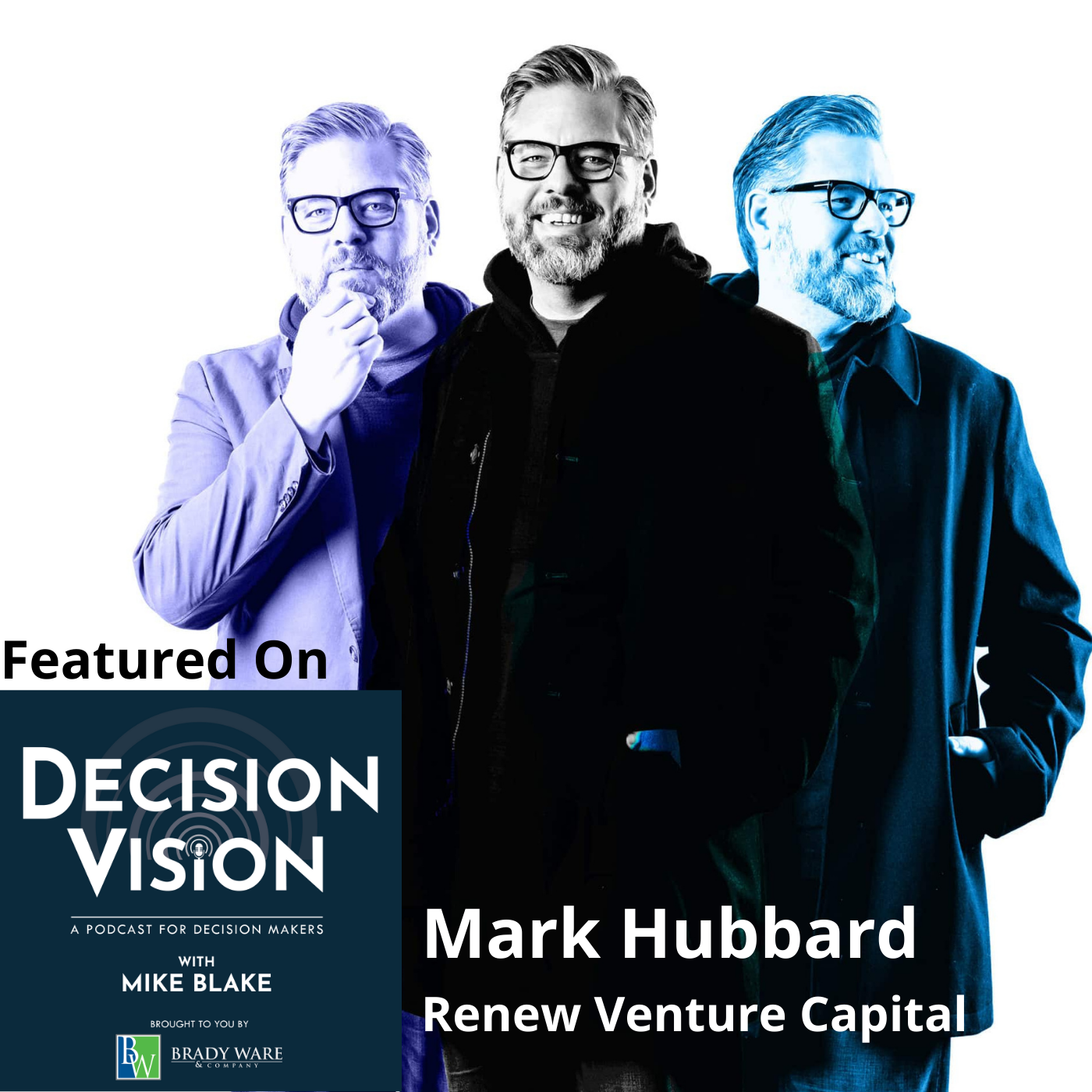
Does Environmental, Social, and Governance (ESG) investing sacrifice financial return? Mark Hubbard, General Partner of Renew Venture Capital, answers that question and others with host Mike Blake. Mark defines impact investing, its advantages, how his firm looks for investment opportunities, and much more. Decision Vision is presented by Brady Ware & Company.

Renew Venture Capital

Renew partners with amazing Impact founders leveraging technology at scale to address some of society’s biggest challenges. They partner with amazing underrepresented founders building scalable businesses committed to diversity and equity.

Company website | LinkedIn

Mark Hubbard, CEO, Pixel Recess and General Partner, Renew Venture Capital

Mark Hubbard
Mark Hubbard, CEO, Pixel Recess and General Partner, Renew Venture Capital

Mark is General Partner of Renew Venture Capital and CEO of Pixel Recess, a Design and Venture Studio.

Mark has founded, invested in, or mentored thousands of enterprises from startups to global corporations in my almost 30 years in venture capital, global private equity, and institutional asset management. I have directed billions of dollars of capital, launched one of China’s most successful asset management JVs, founded a global private equity firm, and built innovation centers for cities and states. He has spent decades deeply immersed in the Impact space (since long before it was called that!) on both the founding and funding sides of the table and has led on the forefront of the integration of faith, theology, philosophy, and investing.

Mark is an operator and a strategist with particular expertise in scalable go-to-market and funding cycle strategy and serves as a CEO and Board Whisperer for portfolio companies.

Mark’s father was a theater professor (everyone in his family is or has been a professor), and he grew up as an actor and musician. He started college as a Chemistry and Classical Guitar major and graduated with a Finance and Environmental Science degree (along with all his Wall Street licenses). Art and science, math and beauty, service, and commerce – for him, all are inextricably intertwined.

LinkedIn

Mike Blake, Brady Ware & Company

Mike Blake, Host of the “Decision Vision” podcast series

Michael Blake is the host of the Decision Vision podcast series and a Director of Brady Ware & Company. Mike specializes in the valuation of intellectual property-driven firms, such as software firms, aerospace firms, and professional services firms, most frequently in the capacity as a transaction advisor, helping clients obtain great outcomes from complex transaction opportunities. He is also a specialist in the appraisal of intellectual properties as stand-alone assets, such as software, trade secrets, and patents.

Mike has been a full-time business appraiser for 13 years with public accounting firms, boutique business appraisal firms, and an owner of his own firm. Prior to that, he spent 8 years in venture capital and investment banking, including transactions in the U.S., Israel, Russia, Ukraine, and Belarus.

LinkedIn | Facebook | Twitter | Instagram

Brady Ware & Company

Brady Ware & Company is a regional full-service accounting and advisory firm which helps businesses and entrepreneurs make visions a reality. Brady Ware services clients nationally from its offices in Alpharetta, GA; Columbus and Dayton, OH; and Richmond, IN. The firm is growth-minded, committed to the regions in which they operate, and most importantly, they make significant investments in their people and service offerings to meet the changing financial needs of those they are privileged to serve. The firm is dedicated to providing results that make a difference for its clients.

Decision Vision Podcast Series

Decision Vision is a podcast covering topics and issues facing small business owners and connecting them with solutions from leading experts. This series is presented by Brady Ware & Company. If you are a decision-maker for a small business, we’d love to hear from you. Contact us at decisionvision@bradyware.com and make sure to listen to every Thursday to the Decision Vision podcast.

Past episodes of Decision Vision can be found at decisionvisionpodcast.com. Decision Vision is produced and broadcast by the North Fulton studio of Business RadioX®.

Connect with Brady Ware & Company:

Website | LinkedIn | Facebook | Twitter | Instagram

TRANSCRIPT

Intro: [00:00:02] Welcome to Decision Vision, a podcast series focusing on critical business decisions. Brought to you by Brady Ware & Company. Brady Ware is a regional, full-service, accounting and advisory firm that helps businesses and entrepreneurs make visions a reality.

Mike Blake: [00:00:22] Welcome to Decision Vision, a podcast giving you, the listener, clear vision to make great decisions. In each episode, we discuss the process of decision making on a different topic from the business owners’ or executives’ perspective. We aren’t necessarily telling you what to do, but we can put you in a position to make an informed decision on your own and understand when you might need help along the way.

Mike Blake: [00:00:44] My name is Mike Blake, and I’m your host for today’s program. I’m a director at Brady Ware & Company, a full-service accounting firm based in Dayton, Ohio, with offices in Dayton; Columbus, Ohio; Richmond, Indiana; and Alpharetta, Georgia. My practice specializes in providing fact-based strategic and risk management advice to clients that are buying, selling, or growing the value of their companies and intellectual property. Brady Ware is sponsoring this podcast, which is being recorded in Atlanta per social distancing protocols.

Mike Blake: [00:01:15] If you would like to engage with me on social media, with my Chart of the Day and other content, I’m on LinkedIn as myself and @unblakeable on Facebook, Twitter, Clubhouse, and Instagram. I also recently launched a new LinkedIn group called Unblakeable’s Group That Doesn’t Suck, so please join that as well if you would like to engage. If you like this podcast, please subscribe on your favorite podcast aggregator and please consider leaving a review of the podcast as well.

Mike Blake: [00:01:42] Today’s topic is, Should I pursue impact investing? And according to SG Analytics, the impact investing market as of late last year with $715 billion. And you can question what is impact investing, and, in fact, we will. And those of you who are veterans of listening to this podcast know that we try to set our definitions early so that we know exactly what it is that we’re talking about.

Mike Blake: [00:02:10] But I think with a number of forces that are converging as we record this podcast on January 27, 2022, there’s renewed interest – and indeed, I think we’d find those data that demonstrates there’s a lot of renewed interest in so-called impact investing – between a renewed social reckoning in the United States on race or considering the sharp polarization of our political system. And people say that it’s been this bad before. I don’t think that I agree. I think it is worse and I think it’s being made worse because social media gives everybody a voice and not everybody should have one. But that’s a different philosophical topic.

Mike Blake: [00:03:07] And in addition to the pandemic itself has forced us en masse and has led us as individuals to reevaluate our lives and our relationships, whether they’re personal relationships, whether they’re work relationships, or something else, many of us are now prompted to and perhaps given the courage to abandon relationships or sources of energy in our lives that, frankly, have become or maybe had long since been toxic. But we’re now realizing just how toxic they were.

Mike Blake: [00:03:43] And behind this whole backdrop, there’s this whole thing called climate change. And I’m not going to debate whether or not climate change is real or not. Cards on the table, I do believe that it’s real. And I believe that it’s real, in large part, not because of what I observe, not even because supposedly 97 percent of scientists, “four out of five dentists,” whatever it is, say that climate change is real. It’s really because I understand the math.

Mike Blake: [00:04:17] And I’m fortunate that a dear friend of mine who’s a tenured professor of Environmental Policy at Emory showed me the math, and I understand how the math works. I understand not everybody else does. If you haven’t taken advanced calculus and statistics, you’re not going to understand the math. You just don’t. But to me, I understand it as a matter of math, but I’m not going to try to convince anybody. And, frankly, if you think that climate change is bunk, you probably aren’t listening to this episode and you won’t be for very long. So, I don’t think this is a debate that we need to carry here. And you know where to find me on social media if you think that I’m a tree hugging communist.

Mike Blake: [00:04:54] But for the rest of us who are still here, impact investing is a thing and there’s renewed interest in it. And the thing that I find so compelling about impact investing is, capitalism is an economic system that is capable of accomplishing tremendous things, but it is also not perfect. We have not found a perfect economic system. I’m not advocating for either one or another. But, man, when capitalism gets behind solving a problem, it freaking gets fixed. And there’s ample evidence that I can point to. But, also, when capitalism gets behind creating a problem, that problem is also amplified, magnified, and scaled up very quickly.

Mike Blake: [00:05:41] So, it’s like a power tool. A chainsaw is great to cut wood, but I wouldn’t recommend it to use on your own kneecaps. So, to help us understand and think about impact investing and whether or not impact investing is a model that you should consider, whether it’s in a portfolio, whether it’s making corporate investments, venture investments, I’m going to introduce a friend of mine, a really cool cat, Mark Hubbard, who we’ve known for longer than I think either of us would care to admit. Neither of us had gray hair, that’s how long ago we’ve known each other.

Mike Blake: [00:06:17] And before I get into this, I want to offer a very important disclaimer, is that, we are going to talk about investing today. But in doing so, we are not making any kind of investment recommendation, whether or not you should or should not make an investment of any kind, stuff it under your mattress, Bitcoin, NFT, Russian rubles, I don’t care.

Mike Blake: [00:06:37] So, before you make any kind of investment decision, consult somebody who knows what they’re doing. Preferably somebody that you’re paying for their advice so that if they screw up, you can sue them. But get an adult to actually give you that advice. You’re just listening to a couple of old white dudes talking, and if you’re going to make an investment based on a couple of dudes you don’t know on the internet, that’s on you. So, by listening further, that is a disclaimer that you are now accepting. Somewhere some lawyer just had a heart attack, but it’s all right.

Mike Blake: [00:07:11] Mark Hubbard is joining us for today’s program, and he’s General Partner of Renew Venture Capital and CEO of Pixel Recess, a design and venture studio. Mark has founded, invested in, or mentored thousands of enterprises from startups to global corporations. And is almost 30 years in venture capital, global private equity, and institutional asset management.

Mike Blake: [00:07:32] He has directed billions of dollars of capital, launched one of China’s most successful asset management, JV – I forgot about that. I remembered when you did that – founded a global private equity firm, and built innovation centers for cities and states. He has spent decades deeply immersed in the impact space since long before it was called that, long before it’s a thing – back then, it was called tree hugging, I think – on both the founding and funding sides of the table and has led on the forefront of the integration of faith, theology, philosophy, and investing.

Mike Blake: [00:08:03] Mark’s father was a theater professor, everyone in his family is or has been a teacher. And he grew up as an actor and musician. And, in fact, Mark having a guitar in his office led me to have a keyboard in mine, so he’s had that influence. He started college as a chemistry and classical guitar major and graduate of the Finance and Environmental Science degree – along with all his Wall Street licenses. Art, science, math, and beauty service in commerce, for him, all are inextricably intertwined. Buckle your seatbelts, everybody. This is going to be an interesting one. Mark Hubbard, welcome to the Decision Vision podcast.

Mark Hubbard: [00:08:38] Thank you so much. So, I have guitars in the background of my picture that you all can’t see. And you’ve got keyboards in the back of yours. So, I say we scrap all this and let’s just play some music.

Mike Blake: [00:08:47] You know what? That’s true. Fire it up. In fact, I was just talking to a friend of mine, we were in a band BC, before COVID, and neither of us are playing out right now, especially during the cold weather. And we’re kind of, you know, when do we get back to it? And, you know, performing as a semi-professional musician, you just have somebody perform for it, you let things lapse. I don’t even know if I can turn the damn thing on right now, let alone actually play and not hurt myself.

Mark Hubbard: [00:09:13] Yeah. Me, too. I hadn’t played in a while. Well, first of all, just let me say that we have known each other for a long time, and I think you just proved this through your introduction. But you’re maybe the smartest person I know, but you’re also kind and curious and thoughtful. And so, it’s an honor to be here and and talk about this topic in particular with you.

Mike Blake: [00:09:36] Well, thanks everybody for coming on the Decision Vision podcast. I think that’s all we need out of them.

Mark Hubbard: [00:09:41] Did I do that the way you wanted me to?

Mike Blake: [00:09:43] Yes, you did. Yes, you did. Yes. You’ll find the token in your crypto account at the end of the day, in your e-wallet at the end of the day.

Mark Hubbard: [00:09:50] Okay. Good.

Mike Blake: [00:09:52] All right. So, you know, I let off with a topic with a notion that I’d like you to help us out with, and that is impact investing. I don’t start off with the stupid Oxford Dictionary defines impact investing as blah, blah, blah. How uncreative is that? But I would like to know how somebody like you who actually puts capital to work in impact investing, how do you define it?

Mark Hubbard: [00:10:21] All right. I mean, I think it makes sense to go first back to the trend that you mentioned. Certainly, “coming out” of the pandemic, we have had people make this reassessment about their lives, and relationships, and their work. And I’ve heard you say things about it, like you’d to be able to talk about basketball without feeling like you’re on the clock as an accountant.

Mark Hubbard: [00:10:43] And yet that’s really part of a larger trend that’s been going on for probably 20 or 30 years or maybe even more, where – when I, as an old man – when I was growing up what I was told just sort of in general by society is that you sort of try to live a two pocket life. The first time I heard this was really from, maybe, Kevin Doyle Jones.

Mark Hubbard: [00:11:06] Or if you went to see a really successful rich person and you wanted to talk to them about something like impact investing, they would say, “I don’t invest in companies that are trying to do good.” What in the world does that even mean? I have two pockets. I have one pocket that I put all the money in the world into. And then, I have a pocket that I give to my taxes and I give to nonprofits, and they can do the good in the world. And those two things don’t cross over. It’s like relationship is origin department. Those two things don’t meet each other.

Mike Blake: [00:11:35] And that’s very much from the Chicago school, right? That’s a very free minion –

Mark Hubbard: [00:11:39] All the bad stuff goes back to Friedman.

Mike Blake: [00:11:42] Yeah. Yeah. That’s right.

Mark Hubbard: [00:11:44] In general. And so, you know, people just don’t want to live that way anymore. They want more integrated lives than that. They don’t think that’s necessary. I mean, that’s a value system that was sort of foisted on them, and they don’t feel like they need to live that way anymore. And if you’re not going to live that way, then part of the way that you express who you are is through your work and where you spend your time. And part of the way you express who you are is with your money.

Mark Hubbard: [00:12:10] And so, that’s been a big driver over the last 10 to 15 years in the impact investing space is that larger trend of folks saying, “I’m not interested in bifurcating things anymore.” The old mantra is, do do well and do good. I want to figure out how I can live my life as integrated as possible so that everything expresses what I say I believe.

Mike Blake: [00:12:30] Is impact investing synonymous with the ESG environment, ability, sustainability, and governance? Is one a subset of the other? Are those two interchangeable? How do those two concepts fit or not fit?

Mark Hubbard: [00:12:46] Yeah. Here’s the problem, is that, impact investing sort of isn’t a thing in a way. None of the things that you’ll hear said commonly in any parts of the market have all that great of a definition in it of themselves, and they all really fit on a spectrum. So, if you want me to, I can sort of lay out what the spectrum looks like, if you think that would be helpful.

Mike Blake: [00:13:07] Yeah. I actually do. Yes.

Mark Hubbard: [00:13:09] Okay. So, on one end, you sort of have Milton Friedman land, where the business of business is business. All that matters is money. All that matters is shareholder return. A business is really just there to do business and make money. That causes you to push off all kinds of externalities, environment being one of them. But all kinds of things, because what matters the most is yield. And that still exists. There are still people who run businesses that way. We think that way. We think that’s the way things should be. That’s sort of on one end of the spectrum.

Mark Hubbard: [00:13:43] The next step up, sort of, is CSR. That’s what a lot of people talked about for a long time, Corporate Social Responsibility. Really, the idea of CSR was, how do I look at the business we’re running and limit the damage we do? So, not so much proactive good, but how do I make sure we limit damage.

Mark Hubbard: [00:14:01] Right above that, I’d say is ESG – which you mentioned. So, ESG is Environmental, Social, and Governance which is sort of a mix of those two, of limit damage and do good. Like, you find proactive ways in those three categories to adjust your business, the governance of your business, the policies of your business, the way you engage with suppliers, the way you engage with employees so that you can address those three big categories.

Mark Hubbard: [00:14:26] That ESG piece is the biggest part of what you’d think of as the impact investing world right now. Because that’s really the only kind of thing you can do to apply to public markets, which are so much bigger. And so, when you apply that lens to public market, that’s where most impact investing “money” comes from. And if you include that, it’s something like a $40 trillion market right now, so it’s massive.

Mike Blake: [00:14:51] And what I find fascinating about ESG is how the G isn’t something that people think about as much. You know, governance is a lot like an umpire. You know governance is doing its job when you barely notice it’s even there. It’s when it really screws up and blows that call at home plate that you notice that it’s there and it’s doing a bad thing. And I think that’s probably why I find it fascinating, because it’s so subtle, I think, you can make an argument that it has as pervasive an impact – going back to that term – as the E and the S part of it. Because without the right governance, it just undermines so much of the other things that you’re trying to do.

Mark Hubbard: [00:15:42] Yeah. I mean, if you just think in sort of two categories of that governance, or let’s say three, board composition, executive compensation, and corporate policies, that determines all of the rest of everything in those things and those are all governance issues. And so, that’s really the biggest part of the market.

Mark Hubbard: [00:16:01] There’s sort of a step above that which they call stakeholder capitalism, which is trying to say, workers, customers, communities, environment, and shareholders, that there’s those five stakeholders. And that when you run the business, you sort of have to balance the interests of those stakeholders as you do it. You don’t just always defer to the shareholders.

Mark Hubbard: [00:16:23] And then, above that is what I call impact investment, which is companies that are intentionally and actively doing good built into the business model. I mean, really, there’s two kinds of sort of bolt ons like the TOMS shoes of the world, where you can sell one and get one, and that’s fine and all. And you know, those businesses made some progress in the marketplace. But the interesting ones are the ones where it’s baked into the business model. So, the bigger the company gets, the more profitable the company gets, the more impact it does in the world. Those are certainly the ones we’re looking for and the ones that I think are the most interesting.

Mike Blake: [00:16:56] So, I’m going to ask the question now I’m sure you’ve been asked many times, and it may be the one question most of our listeners care about so I’m going to get it out of the way. So, if people want to stop listening, they can do something else. And that is, the most common perception about impact investing is that, by definition, you therefore must be sacrificing financial return. Is that true?

Mark Hubbard: [00:17:20] So, I’ll be controversial, I think.

Mike Blake: [00:17:22] Please do. It’s only the internet.

Mark Hubbard: [00:17:25] Well, number one, no, that’s not true. I mean, there’s no data to support that, really, whatsoever. All of the data you can look, and there’s tons and tons and tons of it now. Just go through McKinsey’s website alone. Well, if you look at ESG, that ESG performers they grow faster and they have higher valuations. They have lower costs. There’s data about women-run companies outperform, women investors outperform, immigrant-run companies outperform. No, it’s just not true.

Mark Hubbard: [00:18:02] In fact, what the generalized data will tell you is that you get better risk adjusted rates of return if you are sensitive to these issues, if you use this as a lens. Now, the challenge for me is, the controversial part is, look, everything I’m about is generating those returns. So, it’s not like I don’t care in that way. But in the same time, I sort of don’t care. Like, for me, there’s also a right thing to do and that’s part of this.

Mark Hubbard: [00:18:30] I mean, we have this idea sort of in culture right now that nobody should make exclusive claims to truth. You know, if you make an unprovable exclusive claim to truth, that’s what’s wrong with society.

Mike Blake: [00:18:45] That’s your philosophy background right there, man. I love that.

Mark Hubbard: [00:18:49] Which I don’t know, it’s fine and sometimes that’s true. We make that claim. The challenge is that’s an exclusive, unprovable claim to truth. And you just said nobody else could do it, but you can. And so, there’s this idea that risk adjusted return is the only thing that matters. And that even I have to put the good parts into a risk adjusted return model that that’s the only thing that matters. But that’s an unprovable assertion of values, that making more money is what makes you happy and is the only thing that matters. And so, I just don’t know that that value system doesn’t match with mine necessarily, even though all of the numbers will say, yes, you’ll actually do better if you impact invest.

Mike Blake: [00:19:32] Right. And so, let me run a hypothesis by you, and I like you to tell me if you think there’s a validity to it or if you think it’s full of crap, and that is that, I think there’s a particular differentiator now with impact investing, in that I wonder if impact investing is going to provide companies with two advantages. Number one, I think it will enable them to attract the best talent, particularly young talent. We’re both Generation X. We’re still in that puritanical, for the most part, as a generation. We’re still the keep your mouth shut, do your job. We’re kind of the last of that generation.

Mike Blake: [00:20:19] But the generations behind us are like, “No, man. You shut up. Because I’ll go independent. I’ll work for somebody else,” or whatever. So, if you’re going to attract the best talent, once people like you and me start to age out, that’s going to be a problem if you don’t kind of adapt to that. And the second – this is a concept that was posited to me by another friend who was on the podcast, actually. And he suggested if you want to build resiliency in your company, take away one of the resources for a while. Make them play left handed. With the notion being that it forces you to become better if you have restraints, and bumpers, and guardrails.

Mike Blake: [00:21:11] And so, I wonder now can the restraints, and bumpers, and guardrails of impact investing actually force you to become a better company because you can’t be, frankly, as intellectually lazy.

Mark Hubbard: [00:21:25] So, I’ll answer, I guess, in the context of what I’m doing with my my life. So, we have a venture capital firm, we’re raising and deploying capital, and we really do it under two themes. The first thesis is, what you just mentioned, that low impact companies that want to be big companies. That some of the best founders in this generation coming up are going to be founders, who want good for the world deeply integrated into what they do. And they’re going to need to be able to attract the best talent. And they’re going to need to run through walls, like all founders do.

Mark Hubbard: [00:22:01] And when you look at all of the things that make a founder successful, you get more of them out of an impact focused founder than you get out of anybody else. Yes, 70 percent of people say they want sort of mission related in their work, and 15 percent of them say they feel like they have it. And so, an impact founder will run through walls because they’re committed to mission in a way that people who are only committed to money won’t. And by the way, since it’s a relatively underserved market, there’ll be opportunity there that other people don’t run after.

Mark Hubbard: [00:22:31] The other theme we follow, the other thesis, is that investing in women founders and historically excluded founders is really the biggest mistake that VCs made, the lack of investment in that world and that it continues now.

Mark Hubbard: [00:22:48] Look, success of venture capital is all about TAMs. It’s all about, Can I see a total addressable market that other people can’t see? And when you look at all the big successes of the last couple of decades, when you look at Uber and you look at Airbnb, the real magic in those is that there were TAMs there that nobody saw. Nobody knew where possible.

Mark Hubbard: [00:23:08] And so, if you have a whole class of people, these giant groups of people, arguably geniuses is equally distributed among, they’re going to be able to see all kinds of markets that the rest of us won’t. And that’s where you produce success is by finding those kinds of opportunities. So, yeah, I mean, I think all of it makes sense.

Mark Hubbard: [00:23:29] Now, the nice thing for us is I don’t have to play in the big ESG complicated public markets world. I can just say, “I’m just going to select the best companies we can find that happen to fit this opportunity set.”

Mike Blake: [00:23:42] And I think the best exemplar of that – not that I think he’s flawless. I think he’s highly flawed – Elon Musk, I think, is exemplary of that with electric vehicles. You know, the electric vehicle was considered very much a fringe product, a compliance product. I was an early adopter, but most people weren’t and I get it. Now, everybody is bringing electric cars to the market. They’ve gone to being from ten years ago, less than a half percent of the fleet. Now, they’re about three to four percent.

Mike Blake: [00:24:16] And I would guess, I think, in about 10, 15 years, you’ll not be able to buy an internal combustion engine car in the United States because nobody, except for big time gearheads are going to want them. But Elon Musk, for all his flaws – and, boy, he has a lot of them – he’s an example of a guy who saw that market a long time before anybody else did.

Mark Hubbard: [00:24:37] Well, it’s also an example of what you said earlier that, you know, business and markets are much larger than government action. And they’re several orders of magnitude larger than philanthropy. And so, if we’re going to address some of these big societal challenges, we have to do it through business and markets. It’s the only way you can achieve the scale. And by the way, businesses also have a way of sort of webbing their way throughout all of the life and all of activity in a way that those other two issues can’t, good and bad. And that’s how you actually end up changing systems at scale.

Mike Blake: [00:25:13] And I want to expand upon that because that’s segues into the next question that I think is so important. You know, conscious capitalism, if you will, is a model for accomplishing this. But it’s not the only model for accomplishing this. Somebody would argue, a Marxist would argue, that government should be in charge of making this happen. Because you effectively have streamlined decision making, you collect taxes from people, and then they can decide they’re going to have all the data, and then they can decide in whatever wisdom they have that they’re going to make five or six things happen with all that capital because they have that leverage.

Mike Blake: [00:25:59] And then, maybe it might be a quasi-libertarian model, where let nonprofits deal with this. Let the market for nonprofits evolve from this. Let social capital find those nonprofits and let the market settle that way. So, you’ve chosen this particular model, you’ve chosen capitalism as the engine for this, why do you believe that it’s a better tool than the other two that I mentioned?

Mark Hubbard: [00:26:32] All right. So, why do I believe it’s better than Marxism? Let’s see, let’s start with that. And the funny thing is actually the other side, the libertarian version of that is the Bill & Melinda Gates Foundation. And they’re amazing and nothing against any of that. But the other idea is that idea that you concentrate as much wealth in the hands of the “smartest people” and then they decide. Like, the Aspen Institute decides. And the most powerful people, basically, judged by how much money they have together.

Mark Hubbard: [00:27:05] And it’s another version of that same thing. It’s the capitalistic version of, this is the group of people that will know best, and they’re the ones with the resources anyway, and let them make the decisions about what happens next for everybody. The [inaudible] Indian model.

Mark Hubbard: [00:27:22] Look, anything that ends up producing good is a good thing – like I’m a fan of and I’d love to make that happen – in all parts of the marketplace as within the ecosystem. Those players serve different pieces of the marketplace. None of them can meet the level of need that we have without involving business. It’s just not possible. It’s not going to happen. Even just in the terms of climate change, we’re not going only out regulate ourselves right to it. So, none of them can accomplish what we need to have happen.

Mark Hubbard: [00:28:04] And, frankly, people are going to be founding businesses and running them anyway. And those businesses are going to be having an impact anyway. And your money is going to be invested in having an impact anyway. And so, I can be unconscious about that and unstrategic about it or I can decide that this is my lane and this is where I’m going to direct all of that activity, and power, and leverage action into something that reflects what I think I care about and the direction I think the world should head.

Mike Blake: [00:28:32] So, you’re in a position where you’re committing, you know, grown up levels of capital to these kinds of opportunities. And I’m kind of putting myself in your seat for a second – and by the way, awesome seat. It must make due diligence a bit more complicated because it must add at least one more dimension to what you’re analyzing. And then, also complicates your own governance, if you will, monitoring your investment, because it’s not just now about about financials, but also impact, however we define that. I want to come back to that in a minute. But I would imagine it’s got to be true.

Mark Hubbard: [00:29:19] Yeah. And really, frankly, more true than you could possibly even know. Because a value – I set off Siri, I think. Evaluating financial metrics, it seems like it’s a super easy, straightforward thing to do. You know, sometimes I’ll argue whether that’s the case in things like business valuation, for instance. But a lot of what we’re talking about are some of the things that are absolutely quantitative. And you can figure out quantitative things, like carbon output and those kinds of issues. But a lot of it is qualitative, not quantitative.

Mark Hubbard: [00:29:55] And the qualitative stuff is hard to define, number one. That’s a rough start. Then, it’s hard to measure. And it’s hard to measure what the impact of the measurement is anyway. That’s a complicated thing.

Mark Hubbard: [00:30:09] I pulled this one quote in case you asked this question. At the end of last year some GPs got together, so some fund managers who are running money doing the kind of thing I do, trying to figure out how they also report to LPs on impact. They decided to start making their own. So, they’re going to start reporting on metrics in Scope 1 and 2, greenhouse gas emissions, renewable energy, board diversity, work related injuries, new hires, and employee engagement. So, they’re going to make up a metric.

Mark Hubbard: [00:30:38] But here’s what the next sentences say, “These metrics borrow from existing ESG measurement frameworks created by CDP, CDSB, GRI, SASB, TCFD, and others, and broadly align with stakeholder capitalism metrics introduced in September by the World Economic Forum.”

Mike Blake: [00:30:56] I totally get it now.

Mark Hubbard: [00:30:58] So, there is no language. There is no common language. There is no common metric. It’s not like you just decide we’re going to do it in dollars. It’s across the board. And by default, what people tend to do often, they say, “Well, we’ll make up our own rubric. We’ll come up with our own way to approach all of this.” And so, yes, there’s a level of complexity sort of beyond just deciding whether the financials look good in the market is big enough that we have to evaluate and believe in because we’re committed to that mission, too.

Mark Hubbard: [00:31:26] But when it comes to reporting, yeah, it’s a nightmare. And it’s a nightmare for everybody. And I don’t think it probably will ever be solved. There’s too many people in positions of power who make money off of it being complicated.

Mike Blake: [00:31:37] Yeah. My field of accounting is discussing – you know, there’s a need and, frankly, I think a great market opportunity – for audit firms to figure out how to measure and independently report impact. And, eventually, we’re going to solve that as is often the case in accounting, we don’t address these issues nearly as quickly and as robustly as, I think, we need to or could. But it’s definitely on the radar screen there. And then, you know, it’s funny – go ahead.

Mark Hubbard: [00:32:11] Even in business valuation – you’re the king of all things business valuation – how do you decide the value of a business? So, you tell me the quick and dirty.

Mike Blake: [00:32:25] Boy. So, you’re interviewing me, that’s fine. So, I have to start with a definition of what I think a business value is. And it’s a little bit different than what most people will tell you it is. To me, a business valuation is a prediction of the most frequently occurring price that would occur if an asset were traded back and forth a thousand times within five seconds. So, it’s a point estimate that tries to mimic what would happen in a random distribution, which would probably be a bell curve or a log normal distribution.

Mike Blake: [00:33:02] How do I do that? I input. I take a bunch of information. I triangulate it with one another. At the end of the day, I sprinkle it with what’s called my informed professional judgment, and I produce an appraisal, which is my personal conclusion of value.

Mark Hubbard: [00:33:18] So, the point is that there is an art in there that isn’t science. There are some layer of that that, fundamentally, affects the equation. It goes back to the old, you can value a business, you look at all the numbers you come up with, and then you ask, “Well, what’s it worth?” It’s worth whatever anybody will pay. And so, as you said, you try to figure out what somebody would pay piece. But there’s art in that. That’s not a science.

Mike Blake: [00:33:46] Oh, yeah. That’s why I’m not a website. If we’re all equations, there would be no job for me. It would be, you pay 50 bucks and get your valuation off a website.

Mark Hubbard: [00:33:57] So, the same thing is true, frankly, in the investment world. Like, those same kinds of rules apply. We like to pretend like it’s all easy to evaluate just based on the numbers. And the truth is, all of it is art. What makes the difference? What creates alpha? I mean, you can index everything, and that’s fine. But what creates alpha is inside the art that doesn’t just exist in the numbers.

Mike Blake: [00:34:21] Right. And it has to, again, because if it did exist in the numbers, everybody would know it. The program traders would have already figured out and the alpha goes away, so it’s self-defeating.

Mark Hubbard: [00:34:30] Which is going to be true in impact metrics. There’ll be some irreducible aspect of that across the board, no matter how much you’ve tried to figure out how to standardize it. And, frankly, although there’s tons of energy around the idea that we want to standardize, all of the energy is associated with how do I create my own group to standardize it.

Mike Blake: [00:34:46] So, let me ask a very cynical but, I think, fair question, and that is, as you as a decision maker on behalf of capital, how do you tell or how do you make a determination? And admitting that this is going to be, of course, and, again, you’re informed professional judgment. But what do you consider when making a determination as to whether or not an advertised impact is legitimate as opposed to simply pro forma? And liken it to the old term greenwashing. What does your bullshit detector for that look like?

Mark Hubbard: [00:35:22] Yeah. Well, I get to punt a little bit in that. That’s particularly applicable to nonprofits, which we don’t really play in. And it’s particularly applicable to the public markets, where things are ridiculously complex. Where an impact report that a company puts out itself without even any audit is 200 pages. And so, trying to figure out in the context of a giant multibillion dollar public corporation what’s real and what’s not real, what’s washing and what’s not washing is incredibly complex. And, yes, there are consulting firms that do very, very well beyond any particular side of that, helping them prove, evaluating whether or not that’s true, all of that stuff.

Mark Hubbard: [00:36:12] I don’t have to do that because I’m just picking companies to invest in early stage. And in the early stage, things are a whole lot less complicated. And so, on the impact side – we’re really on both sides – we’re really just making what would be traditional venture capital investment decisions. What we’re picking are companies where the impact is webbed into what they do so thoroughly, that, as that market gets achieved, as they continue to grow, it can’t help but have an impact.

Mark Hubbard: [00:36:43] So, I can give you an example. So, we have an Ag tech company that does these containerized farming systems. And so, all he’s trying to do is build a giant company of distributed farms right across the country. Within that, because of that, a natural byproduct of operating that business are things that address food deserts, are things that address climate change, economic mobility.

Mike Blake: [00:37:07] Water conservation.

Mark Hubbard: [00:37:08] And so, the bigger that company gets, the more of those impacts happen. That’s pretty cut and dried, right? That’s not particularly complicated. Not measuring it is and figuring out how you talk about it is. But making the decision about whether or not you invest in that is an investment decision around the business. Not so much around that provable impact piece because it’s part of what they do.

Mike Blake: [00:37:33] Do you find that it’s harder, easier, or about the same to source viable investment opportunities when you have the impact filter as opposed to being unfiltered? Where you can invest in tobacco and toxic sludge and everything else, right?

Mark Hubbard: [00:37:54] I don’t say that’s a really interesting question where the answer is it depends on what you mean by filter. Look, my job is to look for opportunity where others don’t see it. And that’s aided if you have some limitations, like you talked about before.

Mike Blake: [00:38:12] Yeah. Well, and that’s the thing, I can see the argument both ways. On the one hand, if you open the door and say, “You know what? I’m I’m open to investing in any reasonable business opportunity.” That means a lot of stuff comes to the door, but you also are going to have a lot of competitors who want that same stuff walking through the door, and there’s much less to differentiate you.

Mike Blake: [00:38:35] On the other hand, you say, “I’m Mark Hubbard and I’m an impact investor.” “Okay. Well, I sell tobacco to children,” so I guess he’s not going to be in my my bailiwick, right? Or I make coal dirty, that’s probably not going to be a good fit. So, I’m not going to do that. But on the other hand, the solar panel guy, the aquaponics woman, whatever, “Oh, Mark really likes this stuff so I’m going to go to him first because I know he’s not going to laugh me out of the conference room or off the Zoom call. And by the way, you know, not as many people are into this yet.”

Mark Hubbard: [00:39:09] Yeah. Well, I mean, look, the selling tobacco to children I’d be up for. But the other stuff, I think you’re right. Look, when you’re raising money as an early stage founder, you have to find investors who get what you are trying to accomplish, understand it, and can add value. And I know we keep talking a bunch about me, and that’s great because I love talking about me, he says sarcastically.

Mark Hubbard: [00:39:36] But, Mike, Renew Venture Capital is 70 percent women. Like, we’re white and black and brown and immigrant. This isn’t done by me. I can’t do it. I mean, what you just mentioned, do all those people – well, great. I don’t see opportunity the way the black women on my team would or the way the Colombian immigrant on my team would. And I also can’t connect to those founders in the way that they can. The more lived experience you have, the more empathy you have, the more successful business is going to be, the more successful a product is going to be. And so, another very important piece of it is that it’s not just me, white dude, as important as that is to have the white dude.

Mike Blake: [00:40:26] Yeah. He says he’s not talking about himself. It was more plausible for me to get the Kremlin’s battle plans for Ukraine than it was for me to get a bio out of you. But thank you for coming through at the last second.

Mark Hubbard: [00:40:41] Thank you.

Mike Blake: [00:40:41] So, does impact investing either compel or lead you to think about risk differently than if you didn’t have that filter?

Mark Hubbard: [00:40:55] So, another complicated answer. What the market place would say, what the ESG, and what Goldman Sachs and their impact group would say, is that, that’s what it’s all about. That’s how it works. I mean, in 2010, JPMorgan did this research report and they said, “We think in the next decade, impact investing could be a trillion dollar asset class.” And so, as asset class, that means you buy your small cap stocks, and your large cap stocks, and you buy some impact stuff. Now, it’s a $40 trillion market, and so they were really wrong.

Mark Hubbard: [00:41:34] But how they were wrong was that it’s not an asset class. It’s a lens. And so, it’s how you evaluate all the asset classes now. Impact metrics are a part of how Goldman Sachs evaluates every asset class it invests in. Goldman Sachs can’t run around talking about values. The only context you can have to make a justifiable decision about it then becomes risk adjusted return. And so, all of it is about if they ran the risk adjusted return numbers and said it doesn’t play, you’ll do worse, then they wouldn’t make those decisions. So, yes, it should lower risk.

Mark Hubbard: [00:42:15] Now, the challenging part for me is, risk adjusted return, number one, makes you again only care about return, which is complicated. Like, how do we get our kids to not lie? We tell them that you’ll be found out and I’ll punish you and no one will like you. So, essentially fear and pride. And, now, I’m a grown up, and pretty much the only reason I ever lie is fear and pride. And so, if you just reinforce the bad thing in a different way, that’s not for a better outcome, it’s not necessarily productive.

Mike Blake: [00:42:49] So, when we talk about risk, I guess what I’m trying to get at is – I’m going to put on my economist hat – one of the things about impact investing that, I think, can differentiate it and maybe necessitates a mindset change is if you’re kind of outside the impact investing tribe, for lack of a better term – and there probably are nine better ones, the only one I can think of – you think about impact and financial returns in separate buckets.

Mike Blake: [00:43:30] But I think an enlightened economist would say their total return. You just don’t know how to measure the impact return yet. Now, you’re a real economist. There’s some sort of utility function that’s going to match up with an isoquant that they’re going to overlap that’s going to match my desire for overall return versus the availability of risk adjusted investment opportunities.

Mike Blake: [00:44:03] And so, the follow up question is, if you assume that premise that, in fact, almost by strict math, impact investing must generate a higher total return, even if only a subsegment of that or segment of that is pure financial return. And we know that the law of gravity and finance says that higher return only comes with higher risk. Otherwise, you have an arbitrage opportunity, assuming efficient markets.

Mike Blake: [00:44:37] Ergo, it must mean that you think about risk differently in order to pursue impact investing. And, in fact, you must be willing to accept a somewhat higher or adopt a higher risk posture in order to make yourself or in order to lead yourself to make those investments. Otherwise, it doesn’t mean that it’s wrong, but it means you almost have to re-reinvent an economic language.

Mark Hubbard: [00:45:06] Yeah. So, you’re really talking about two things. One is, there has been an effort in the impact investing world to figure out how you monetize – not monetize, but how you quantify the qualitative piece of it. And that’s blended value, and that’s what folks have talked about. And, really, Jed Emerson was probably the lead on that, who helped create that. And that was a way to try to say, “So, we can report to you. Here’s your financial returns. Here’s the social returns. And so, then here’s a blended profile.” I don’t know how much the marketplace has liked that.

Mark Hubbard: [00:45:43] Honestly, I’ve been in plenty of financial investor return meetings where they’re really engaged in the financial return part of that discussion. And then, they glaze a little on the social part. So, number one, that’s been a complicated part of the marketplace. Number two is, the research says that that’s not true. Like, the research says that your risk is lower by doing things like ESG. Because what you’ve been doing in the past is not correctly evaluating the risks you were exposed to.

Mark Hubbard: [00:46:16] And so, you miss this environmental risk, which is going to cause you a whole bunch of brand damage, which is going to change your marketplace, then you’re going to get overregulated, and you’re going to have to – And so, if we start including that risk into the model, now I can make decisions that are less risky. And the whole reason you make a decision that’s less risky in that framework is that it will redound to performance. That lower risk will also give me some better performance. It’s not an asset class discussion. So, you took more risk in venture capital, so it should get you higher returns. It’s a management of business question, which is a little bit different.

Mark Hubbard: [00:47:03] To bail on my other answer, the challenge for me is that risk adjusted return is really 100 percent about time horizon. And that’s part of what makes it so complicated, too, is that if you really feel like you know that you can destroy the environment like crazy for the next five years, and then make a pivot at that time, and have it not hurt you all that much, and especially not hurt you – and, look, if your time horizon is only four years and all you care about is money – then awesome.

Mark Hubbard: [00:47:36] So, again, as a motivating factor for me, that’s awfully complicated. And so, I have to have some other driver of why I should do it. And I do have sort of values-based drivers for why you should do it. But all the data will say that it’s actually less risky to adopt this kind of exposure.

Mike Blake: [00:47:54] Good. I’m glad you brought that up. And there is actually a logic to the narrative, because you characterize the ESG as being social. I characterize it as sustainability. And I think I’ve heard it used both ways. But because my way helps make my argument makes me sound smarter, I’m going to embrace that. But sustainability, by definition, is linked with risk. By definition, something that is unsustainable is going to be higher risk. And to your point, with long term investing, one of the dirty secrets about economics is that economics is great when you’re talking about timeframes that are measured in generations.

Mike Blake: [00:48:43] When you’re talking in terms of calendar months, it really falls down quite a bit. And we’ve actually found that, really, since 2008, a lot of the things we knew were true in economics just aren’t. And it’s really put the entire field into crisis. But that long term play, this gets back into the filter or the constraints causing you to be better, too, because the data I’ve seen indicates that even if you don’t have the impact angle – that impact in itself makes you a better business – simply adopting a long term posture of 10 to 20 years versus a typical VC time horizon of five to seven years. And it turns out the five to seven years is, for most companies, when they’re just getting started to be interesting.

Mike Blake: [00:49:38] Again, being forced into that longer term time horizon forces you where the market wants you to go. It’s like playing a game of chess and your opponent plays a move, he thinks he’s got you but he’s forcing you to doing something you wanted to do anyway. And I find that so elegant.

Mark Hubbard: [00:49:57] Yeah. No. I mean, I think that’s right, that the more you can integrate sort of the future, well, it’s more data. The more data you put into your model, essentially. I can put in data for the next three years or I can put in data for the next 20 years, then probably the better decisions I’ll make, because I have more better data in the data set. And so, if I address – like we talked about, the environment is always the easiest one because people can wrap their heads around it – those concerns now with a long term view, I should be positioned better as we go through the changes we’re going to go through.

Mark Hubbard: [00:50:37] And if my time horizon is only five years, I should exploit while I still have an opportunity for the next five years and just yield as much as possible. I just have to have a larger framework for why I think it should happen, because that will help you make this. It’s sort of like seeing the Matrix, it helps you make those decisions anyway.

Mike Blake: [00:51:00] We’re talking with Mark Hubbard. And the topic is, Should I pursue impact investing? How does regulation play into the calculus of making an impact investment? Is it helpful? Does it stand in the way? Is it kind of just sort of there but you don’t care? How does that fit into your thinking?

Mark Hubbard: [00:51:26] Well, regulation and, really, future regulation – is how most people in this world would think about it – absolutely plays into it. I mean, it’s part of the determining factor for all of it, is that, when you look at larger trends and you say these are things that are going to need to be handled and, by nature, some portion of that handling will happen through governments, then there will be future regulation of one kind or another. And the better I position for that now, then the better my business will probably be able to run.

Mark Hubbard: [00:52:03] And so, regardless of whether or not you like the regulation or not, the idea that you can prepare ahead of time by operating under the idea that those regulations are coming has paid off. And that’s part of the ESG framework that they argue for. It’s part of why they say they tend to do better is because, as you lower the risk, as you adjust for the future of what you’re going to have to face from a regulatory environment. And so, I mean, it actually presents sort of an opportunity for us. And we’re only investing in things that would probably fit those regulatory frameworks well anyway. And so, it’s a plus for us, regardless of whether you think that’s the way to solve problems or not.

Mike Blake: [00:52:47] Now, a question I want to make sure I get in – we’re running out of time here but I do want to give you a chance to comment on – is, many of our listeners, most of them they’re not fun managers like you are. They may have their own portfolios. But many of them are also business owners, they have their business thing that they do. And as you and I both know, when you’re a small business, most of your investable wealth is the business where you’re actually working everyday. What advice could you give to them to think about how they might make impact investing work for their own businesses?

Mark Hubbard: [00:53:31] Yeah. So, I think there’s sort of two levels for them. One level is the investable assets they have. And there’s lots of resources for that now. You can go anywhere. There’s lots of places to learn. There’s lots of nonprofits and industry associations. And every asset manager now has ESG portfolios, at least. There’s indexes. There’s low cost ways to do it. There’s alpha ways to do it. There’s venture capital funds you can invest in. So, that is one piece.

Mark Hubbard: [00:53:59] And, really, that’s just an argument just say to yourself, what are my personal values, what are the kinds of things I like to see happen in the world. And if I’d like to see more of that, then I’m going to start voting with my dollars to make that happen. And by the way, you can be reassured by the fact that the research says you’re going to do just fine. In fact, you’ll probably do better.

Mark Hubbard: [00:54:25] The next part is the business. If you’re running a business or an employee in a business, then you’re inside one of the machines. And so, there’s an opportunity to do the same thing. Essentially, go to your bosses or look at your company that you founded and own and say, “Does this thing reflect what I say I believe about the world? And does it reflect what my employees say they believe about the world? And if not, how do I go about arranging things so that it’s more integrated than it has been in the past?”

Mark Hubbard: [00:54:59] And, again, lots of frameworks that are possible. I mean, B Corp, B Labs, they have a great little great framework and so you can go through that framework and address all kinds of different categories. But I think we’re at a moment when that’s what people want to do, feel like they have to do, and I think it’s going to be a good thing for all of us.

Mike Blake: [00:55:21] Mark, this has been a great conversation, but I have to let you go back to making the impact that you always do. But I know that we didn’t get to all the questions I had prepared, which I anticipated, but there are probably questions that the listeners would have wished that I had asked or wish that we would have stayed longer on. If somebody wants to continue this conversation with you offline, can they do that? And if so, what’s the best way to contact you?

Mark Hubbard: [00:55:46] Yeah. Sure. I mean, I’m on LinkedIn, you can find me there. Renewvc.com is the website. There’s just about to be a full site launch, but at the moment there’s a form up there, so you could contact me there. On Twitter, mwhubby. And my argument is that, the future of founders, the future of funders is all community. It’s all going to be community from now on. And so, yeah, we want to talk to, and engage, and work with anybody that has an interest in this.

Mike Blake: [00:56:20] That’s going to wrap it up for today’s program. I’d like to thank Mark Hubbard so much for sharing his expertise with us.

Mike Blake: [00:56:26] We’ll be exploring a new topic each week, so please tune in so that when you’re faced with your next business decision, you have clear vision when making it. If you enjoy these podcasts, please consider leaving a review with your favorite podcast aggregator. It helps people find us that we can help them.

Mike Blake: [00:56:42] If you would like to engage with me on social media with my Chart of the Day and other content, I’m on LinkedIn as myself and @unblakeable on Facebook, Twitter, Clubhouse, and Instagram. Also, check out my new LinkedIn Group, Unblakeable’s Group That Doesn’t Suck. Once again, this is Mike Blake. Our sponsor is Brady Ware & Company. And this has been the Decision Vision podcast.


Tagged With: Brady Ware & Company, Decision Vision podcast, Environmental, ESG, Impact Investing, Mark Hubbard, Mike Blake, Pixel Recess, Renew Venture Capital, Social and Governance

Business RadioX ® Network


Our Most Recent Episode

CONNECT WITH US

  • Email
  • Facebook
  • LinkedIn
  • Twitter
  • YouTube

Our Mission

We help local business leaders get the word out about the important work they’re doing to serve their market, their community, and their profession.

We support and celebrate business by sharing positive business stories that traditional media ignores. Some media leans left. Some media leans right. We lean business.

Sponsor a Show

Build Relationships and Grow Your Business. Click here for more details.

Partner With Us

Discover More Here

Terms and Conditions
Privacy Policy

Connect with us

Want to keep up with the latest in pro-business news across the network? Follow us on social media for the latest stories!
  • Email
  • Facebook
  • Google+
  • LinkedIn
  • Twitter
  • YouTube

Business RadioX® Headquarters
1000 Abernathy Rd. NE
Building 400, Suite L-10
Sandy Springs, GA 30328

© 2025 Business RadioX ® · Rainmaker Platform

BRXStudioCoversLA

Wait! Don’t Miss an Episode of LA Business Radio

BRXStudioCoversDENVER

Wait! Don’t Miss an Episode of Denver Business Radio

BRXStudioCoversPENSACOLA

Wait! Don’t Miss an Episode of Pensacola Business Radio

BRXStudioCoversBIRMINGHAM

Wait! Don’t Miss an Episode of Birmingham Business Radio

BRXStudioCoversTALLAHASSEE

Wait! Don’t Miss an Episode of Tallahassee Business Radio

BRXStudioCoversRALEIGH

Wait! Don’t Miss an Episode of Raleigh Business Radio

BRXStudioCoversRICHMONDNoWhite

Wait! Don’t Miss an Episode of Richmond Business Radio

BRXStudioCoversNASHVILLENoWhite

Wait! Don’t Miss an Episode of Nashville Business Radio

BRXStudioCoversDETROIT

Wait! Don’t Miss an Episode of Detroit Business Radio

BRXStudioCoversSTLOUIS

Wait! Don’t Miss an Episode of St. Louis Business Radio

BRXStudioCoversCOLUMBUS-small

Wait! Don’t Miss an Episode of Columbus Business Radio

Coachthecoach-08-08

Wait! Don’t Miss an Episode of Coach the Coach

BRXStudioCoversBAYAREA

Wait! Don’t Miss an Episode of Bay Area Business Radio

BRXStudioCoversCHICAGO

Wait! Don’t Miss an Episode of Chicago Business Radio

Wait! Don’t Miss an Episode of Atlanta Business Radio