Business RadioX ®

  • Home
  • Business RadioX ® Communities
    • Southeast
      • Alabama
        • Birmingham
      • Florida
        • Orlando
        • Pensacola
        • South Florida
        • Tampa
        • Tallahassee
      • Georgia
        • Atlanta
        • Cherokee
        • Forsyth
        • Greater Perimeter
        • Gwinnett
        • North Fulton
        • North Georgia
        • Northeast Georgia
        • Rome
        • Savannah
      • Louisiana
        • New Orleans
      • North Carolina
        • Charlotte
        • Raleigh
      • Tennessee
        • Chattanooga
        • Nashville
      • Virginia
        • Richmond
    • South Central
      • Arkansas
        • Northwest Arkansas
    • Midwest
      • Illinois
        • Chicago
      • Michigan
        • Detroit
      • Minnesota
        • Minneapolis St. Paul
      • Missouri
        • St. Louis
      • Ohio
        • Cleveland
        • Columbus
        • Dayton
    • Southwest
      • Arizona
        • Phoenix
        • Tucson
        • Valley
      • Texas
        • Austin
        • Dallas
        • Houston
    • West
      • California
        • Bay Area
        • LA
        • Pasadena
      • Colorado
        • Denver
      • Hawaii
        • Oahu
  • FAQs
  • About Us
    • Our Mission
    • Our Audience
    • Why It Works
    • What People Are Saying
    • BRX in the News
  • Resources
    • BRX Pro Tips
    • B2B Marketing: The 4Rs
    • High Velocity Selling Habits
    • Why Most B2B Media Strategies Fail
    • 9 Reasons To Sponsor A Business RadioX ® Show
  • Partner With Us
  • Veteran Business RadioX ®

The R3 Continuum Playbook: Coordinating Compassionate Care After Disruption – Not Your Typical Counseling

September 8, 2022 by John Ray

disruption
Minneapolis St. Paul Studio
The R3 Continuum Playbook: Coordinating Compassionate Care After Disruption - Not Your Typical Counseling
Loading
00:00 /
RSS Feed
Share
Link
Embed

Download file

disruption

The R3 Continuum Playbook: Coordinating Compassionate Care After Disruption – Not Your Typical Counseling

In this excerpt from a recent R3 Continuum webinar, Jeff Gorter, MSW, LCSW, Vice President of Crisis Response Clinical Service, answers questions about the behavioral health impact on employees following a disruption. He provides steps employers can take to address the disruptions their employees experience and how such adversity impacts job performance.

The full webinar from which this excerpt was taken can be found here.

The R3 Continuum Playbook is presented by R3 Continuum and is produced by the Minneapolis-St.Paul Studio of Business RadioX®. R3 Continuum is the underwriter of Workplace MVP, the show which celebrates heroes in the workplace.

TRANSCRIPT

Shane McNally: [00:00:00] Broadcasting from the Business RadioX Studios, here is your R3 Continuum Playbook brought to you by Workplace MVP’s sponsor, R3 Continuum, a global leader in workplace behavioral health crisis and security solutions.

Hi there. My name is Shane McNally, Digital Marketing Project Lead at R3 Continuum. On this episode of the R3 Continuum Playbook, we’ll be featuring a segment from a recent webinar presented by R3 Continuum’s Vice President of Crisis Response Clinical Services, Jeff Gorter. This recent webinar is titled Coordinating Compassionate Care After Disruption, Not Your Typical Counseling.

Jeff brings more than 30 years of clinical experience, including consultation and extensive onsite critical incident response to businesses and communities. In this segment from our recent webinar, Jeff was answering questions that were asked by some of our attendees during registration to the webinar about disruption in the workplace and what leaders can do to respond to some of those events. What steps can employers take to respond to a disruption?

Jeff Gorter: [00:01:00] Yeah. I think that’s again, that’s kind of getting to the heart of the matter. And I really appreciate that because that flows pretty naturally from our first one.

So if we start with the assumption that crises will occur, how can I, as a responsible business leader, take some steps. And it begins with the concept of engagement. Engagement at the workforce is a very prominent concept and one that is frequently looked at and analyzed that particularly from large scale employers, you know, mammoth ones to a mom and pop shop with a few that being able to understand influence promotes encourage worker engagement is a hot button issue right now.

And part of that is for two reasons. Because an engaged workforce is protective in the concept or in the context of what we’ve been talking about with disruptions and crises, that it’s important to recognize that an engaged workforce and there’s typically two metrics that researchers use to gauge how well a person is doing.

They look at engagement, which is how well they’re doing at the workplace and well-being is how well are you doing outside of the workplace. Things like health, relationships, financial stability, all those kinds of things are reflections of well-being. Whereas engagement is how invested I am at work. How energetic am I? How much am I pouring realistic time, energy and effort into doing well at work?

And the key thing is, and what’s so fascinating about this research is that we tend to think of engagement as the workplace well-being as at home. The research is absolutely clear that they are mutually influential, that what happens at the workplace affects what happens at home. And what happens at home obviously is brought to the workplace. I bring myself to work.

And so concerns I have with other issues are going to have an impact. And so both of them influence each other. And we have to look at the both to understand the whole person, the whole individual.

Now, what is so cool about that is that I think the research showed and this is more recent research showed that engagement influences aspects of wellbeing beyond what we think. So you might think, well, if I’m happy at work, I’m going to be happy at home. True. But it’s also true that if I’m happy at work, I tend to be more healthy at home. My relationships are stronger at home. Obviously, my financial stability can be better at home because I’m engaged in meaningful work.

It’s a fascinating thing that I think most employers are unaware of the outsized impact that they can have in both spheres. The more I promote engagement, the more it spills over and enhances the well-being of that individual and also makes it easier when they are having trouble to be able to focus at work.

So if they’re having difficulty at home, they can focus at work as well. And so employees that identify as thriving, the characteristic of not just muddling through, not just enduring, but actually thriving, growing, vibrant. And that is, again, research tracks that employees who identify as thriving, who have both high engagement and high well-being, report greater confidence in managing the unexpected.

It gives them greater buoyancy, greater ability to take the hit when the hit comes and I bounce back quicker, more effectively. I.E., resilience. I have greater resilience the more my engagement is fostered at the workplace. But not only is it protective, but an engaged workforce is profitable.

I think the research, this was somewhat surprising, that the research found that business units with high engagement, employees who report high engagement, are 23% more profitable overall. And so they quite frankly, they make more money, they are more profitable.

And also some of the things that are cost dreams, they experience lower turnover, experience lower absenteeism, lower accidents at the workplace, and they experience higher customer loyalty. So not just their employees, but engagement is an investment in customer loyalty.

Because it turns out customers like shopping and doing business and procuring services from places where the employees are engaged, where there is a positive workplace culture. Customers want to go to a place where I think those who are meeting my needs, whatever it is, they pick it up, they pick it up. And they say, that’s a place I want to do business with. I want to go back there. And so engagement is both protective and profitable at the same time.

Shane McNally: [00:06:37] And before we move on, I just kind of wanted to talk a little bit about that first point about the engagement and well-being. And I think that you mentioned it a little bit, but it could be anything that outside that it affects you inside. It could be a family pet is sick or it’s a loved one is is you know, they’re sick or they just passed or something like that, that can totally impact how somebody does at work.

And then when they go to work, if there’s no support, no engagement, nothing, you know, it’s just like they’re clearly not going to feel, you know, appreciated or supported by that company. And then it’s not going to reflect, right?

Jeff Gorter: [00:07:20] I think that’s a great observation and really, again, makes it very, very real to so many of us. That OK, those issues that I am not holding my employer responsible for the death of my pet or for an ill loved one or for a situation that occurs in my, you know, among my friends or in my neighborhood.

But what you highlight, what is implied and it’s nuanced but it’s powerful, is that the engagement I have at work is sustaining. It gives me more energy. It gives me more bandwidth to be able to manage those things in my outside of work life, because the workplace is providing an engaged, energizing environment for me.

So it’s not that the manager directly impacts what I do with my pet, but it he provides that opportunity. Workplace is functionally resilient, which is to say when I have success at work, it breeds success in other areas of my life.

When I’m able to confidently do something at work and feel that my efforts were worthwhile and engaging, that spills over. That gives me confidence. Well, maybe I can also manage these other things in my life. And so it is a core bedrock element that is so often overlooked. And it’s why I want to highlight that leadership really plays an unexpected and outsized role in promoting not just engagement at work, but well being at home.

Shane McNally: [00:09:13] And I think that’s perfect into the next slide. You know, talking about leadership and really getting into the nitty gritty of things.

Jeff Gorter: [00:09:23] Exactly. And so leadership really is the key, as you’ve sure picked up already, as I’ve been talking about. And one of the, again, I’m looking at research. I want this all to be grounded in research. And one of the largest surveys recently on burnout, which I think we can we can disengagement is certainly an aspect of burnout. They identified that of all the reasons that people say, here’s what fuels my burnout, here’s what fuels my disengagement, far and away, the number one contributor was feeling unfairly treated at work, unfair treatment at work, closely followed by lack of manager support.

So again, feeling unfair and feeling lack of support, putting that again in the context of a crisis. So when a crisis occurs and if I feel that I am misunderstood, mistreated, unfairly asked to do things or unfairly blamed for things, if I feel that the manager’s only response is, well, get back to work- time is money following the crisis – that just highlights that sense of disengagement. And those are things that leaders have a direct influence over.

And conversely, looking at the positive, those who report my manager truly cares indicates the highest levels of thriving. Recall, the highest levels of engagement at work and well being at home, both in and out of work, those who feel that their manager cares have the highest levels of of engagement.

And crisis again, think about the judgments that fall on leaders following their crisis. Judgements of were they fair, did they get it, were they supportive, were they caring, were they reasonable in their expectations and did they have a plan? All of those things, think again, in a workplace crisis that brings all these issues to sharp focus that how a leader communicates is going to directly influence the sense of feeling fairly treated at work and supported.

Shane McNally: [00:11:50] And just to kind of a follow up question on that, Jeff, you know, with leadership and now we’re talking maybe it is something in work, maybe a, you know, I feel like disruption can come in so many different forms. They can be the bigger things. Like we mentioned earlier, maybe it’s a workplace shooting.

But it could also be something as simple as, you know, coworkers are out to lunch and one of them drops and has a heart attack or something like that. And they could be totally fine. But those that are around the person and saw this person drop and have a heart attack, that’s a pretty daunting thing. And they may not be able to just go straight to work. So is it always important for leadership to be active and supportive and provide resources even with the smaller things that kind of disrupt those coworkers?

Jeff Gorter: [00:12:39] Well, you ask a very poignant question because one can say, you know, let’s say it’s a small work group and one of the members has a heart attack or dies in a automobile accident. Let’s say it’s a small bank branch and there was a note passing robbery, no weapons brandish, no threats made but somebody passed a note and the teller was robbed. You might say, well, you know, how significant was that? How important was that? It was pretty doggone important to that one individual, to that one employee, the one who works next to the person who’s no longer going to come back to work, the one who was in that queue and had to receive it and had to give the money because they understood there’s an implied threat.

It’s not the — it’s not as if there’s an objective criteria that one can say, ah, well, this crisis clearly meets some arbitrary metrics of crisisness and that it is worthy of response. No, it’s not the crisis that drives it. It’s the impact on the individuals that drives it.

And so you are absolutely correct. It’s not a numbers game. It’s not about, well, did it make the local news and therefore we can now treat it as a crisis? No. Most savvy leaders know what a crisis is for their folks. And it might be something as mundane, if that’s a correct term to use with crisis.

If it’s something as coarse of life events as the kinds that we’re talking about, it doesn’t always have to be a big, giant issue. It can be something that impacts perhaps only a handful of people. But how the leader responds to it shapes their culture and begins to foster that engagement. Those are opportunities.

Shane McNally: [00:14:58] Disruptions in the workplace are inevitable. Following a disruption being reactive will typically be much more impactful on your employees and organization. Having a proactive plan and resources available following a disruption is key as a leader.

R3 Continuum can help. Our disruptive event management services offer the best in practice and tailored solutions to help your organization following a disruption. Learn more about our services and connect with us at www.r3c.com or email us directly at info@r3c.com.


Show Underwriter

R3 Continuum (R3c) is a global leader in workplace behavioral health and security solutions. R3c helps ensure the psychological and physical safety of organizations and their people in today’s ever-changing and often unpredictable world. Through their continuum of tailored solutions, including evaluations, crisis response, executive optimization, protective services, and more, they help organizations maintain and cultivate a workplace of wellbeing so that their people can thrive. Learn more about R3c at www.r3c.com.

R3 Continuum is the underwriter of Workplace MVP, a show which celebrates the everyday heroes–Workplace Most Valuable Professionals–in human resources, risk management, security, business continuity, and the C-suite who resolutely labor for the well-being of employees in their care, readying the workplace for and planning responses to disruption.

Connect with R3 Continuum:  Website | LinkedIn | Facebook | Twitter
Tagged With: behavioral health, Compassionate Care, Disruption, Jeff Gorter, R3 Continuum Playbook, R3C, Workplace MVP

The R3 Continuum Playbook: Tension with Colleagues — How to Disagree and Handle Discussions Professionally

August 18, 2022 by John Ray

Tension
Minneapolis St. Paul Studio
The R3 Continuum Playbook: Tension with Colleagues -- How to Disagree and Handle Discussions Professionally
Loading
00:00 /
RSS Feed
Share
Link
Embed

Download file

Tension

The R3 Continuum Playbook: Tension with Colleagues — How to Disagree and Handle Discussions Professionally

In this excerpt from a recent R3 Continuum webinar, Jeff Gorter, MSW, LCSW, Vice President of Crisis Response Clinical Service, spoke about how to professionally handle tension with a colleague caused by disagreement, techniques to calm the nervous system, when to connect with your leader about an issue, what options are available for external help, and more.

The full webinar from which this excerpt was taken can be found here.

The R3 Continuum Playbook is presented by R3 Continuum and is produced by the Minneapolis-St.Paul Studio of Business RadioX®. R3 Continuum is the underwriter of Workplace MVP, the show which celebrates heroes in the workplace.


Show Underwriter

R3 Continuum (R3c) is a global leader in workplace behavioral health and security solutions. R3c helps ensure the psychological and physical safety of organizations and their people in today’s ever-changing and often unpredictable world. Through their continuum of tailored solutions, including evaluations, crisis response, executive optimization, protective services, and more, they help organizations maintain and cultivate a workplace of wellbeing so that their people can thrive. Learn more about R3c at www.r3c.com.

R3 Continuum is the underwriter of Workplace MVP, a show which celebrates the everyday heroes–Workplace Most Valuable Professionals–in human resources, risk management, security, business continuity, and the C-suite who resolutely labor for the well-being of employees in their care, readying the workplace for and planning responses to disruption.

Connect with R3 Continuum:  Website | LinkedIn | Facebook | Twitter
TRANSCRIPT

Shane McNally: [00:00:00] Broadcasting from the Business RadioX studios, here is your R3 Continuum Playbook. Brought to you by Workplace MVP sponsor, R3 Continuum, a global leader in workplace behavioral health, crisis, and security solutions.

Shane McNally: [00:00:14] Hi there. My name is Shane McNally, Digital Marketing Project Lead at R3 Continuum. On this episode of the R3 Continuum Playbook, we’ll be featuring a segment from a recent webinar presented by R3 Continuum’s Vice President of Crisis Response, Clinical Services, Jeff Gorter. This recent webinar is titled Tension with Colleagues: How to Disagree and Handle Discussions Professionally?

Shane McNally: [00:00:35] Jeff brings more than 30 years of clinical experience, including consultation and extensive onsite critical incident response to businesses and communities. In this short segment from his webinar, Jeff discusses the three steps it takes to achieve understanding in the workplace, especially after a few employees in the workplace have differing views on something, work-related or otherwise.

Jeff Gorter: [00:00:59] So, first, separate the person from the problem. It’s kind of a truism, but to say the problem is the problem, the person isn’t the problem. That’s a subtle form of otherwising. If there is a conflict in the workplace, if there is an issue that is being wrestled with either in our workplace, or in our community, or in our country, the intellectually lazy thing is to say, well, I’ll tell you what the problem is, that person is the problem, they are the problem, you are the problem.

Jeff Gorter: [00:01:30] Well, first thing we have to do is separate the person from the problem. The problem is the problem, the person isn’t the problem. And so, that helps us to recognize that we don’t want to let anger, either yours, your anger, or their anger, drive the interaction. Anger is momentarily satisfying. I can understand it. It may be understandable, it may be warranted, it may be a completely recognizable emotion to have given whatever issue we might be wrestling with.

Jeff Gorter: [00:02:04] I’m not saying that we should never have anger, but if I allow that anger to drive the interaction, as I said, it’s momentarily satisfying, but rarely leads to a positive outcome, I have yet to ever hear anybody, and, Shane, you can correct me if you’re the one exception that proves the rule, but I’ve never heard anybody who said, you’re shouting and pounding on the table has made me realize I need to rethink my position, and maybe I think you’re right, I think you’ve got a good point there.

Shane McNally: [00:02:40] I’m not correcting you on that one.

Jeff Gorter: [00:02:43] I don’t know if anybody has ever reacted with that. So, it’s important to recognize, while the anger may very well be justified, understandable, letting the anger drive the interaction is not likely to resolve anything. It’s not likely to come to a positive conclusion. It’s more likely to foster that sense of blame and otherwising, as we’ve talked about before. And so, we want to start, one of the best ways of separating the person from the problem is to assume positive intent.

Jeff Gorter: [00:03:16] I wonder why they feel so strongly about this. I wonder what their story is. I wonder what’s gone on in their life or what their lived experiences were that lead them to feel so passionately about this. Just simply having that sort of curiosity, that sort of openness to a possible positive intent immediately puts you in a much more effective problem-solving position than if I simply let my emotions run wild in half the day. So, we begin by separating the person from the problem. I’m not saying it’s easy, I’m just saying if you are looking to move forward at all, that’s the first step.

Jeff Gorter: [00:03:57] The second is being able to articulate the other’s concern, being able to put it in your own words, because at the end of the day, and I think this is human nature, universally. Human nature, universally, is that we all have a strong desire to be understood, to be heard, to know that somebody else gets it. And until that happens, until I think the other person understands me, understands what’s going on or my position, until that happens, I’m going to say it again, I’m going to say it louder, I’m going to say it with gestures, I’m going to say it in such a way as I’m trying to get it, I’m just going to repeat it until I think they get it.

Jeff Gorter: [00:04:35] And so, again, until they feel understood, the fight continues. And I know this is challenging, but if you are able to put into your own words what you hear them saying to say, wait a second, I just want to break here right now, so what I hear you saying is this. You’re saying you feel so passionate about this because of this, because of why—this is why you feel the way you feel or that this is your stance on this, do I have that right?

Jeff Gorter: [00:05:10] Being able to put it—you could simply parrot it or you could put it in your own words, but you say What I hear you saying is this, do I have that right? Understand, by doing that, you’re not again endorsing, you’re not agreeing, you’re not saying that’s a better position than mine, you’re not in any way doing anything other than saying, message received, got it. As was—if anybody has seen the most recent Top Gun movie, it’s kind of a military term, when a message is sent, you say, Roger that. Roger, got that.

Jeff Gorter: [00:05:53] That’s a way to indicate message received. I heard it. I understand it. We’re ready to move forward. So, being able to articulate the other concern lets them know the message has been received and you got it. It indicates respect. It helps them feel that they have been heard, and therefore, they’re able to move to the next step. When somebody feels heard or understood, when they feel they’ve been given the respect and dignity of having their position simply acknowledged, yeah, got it, doesn’t mean I agree, doesn’t mean I endorse it, it just means I got it, that opens the door to a wide range of possibilities.

Jeff Gorter: [00:06:34] Once somebody feels understood, they’re willing to compromise. They’re willing to talk about alternative solutions. They’re willing to perhaps even give up their position, because they feel respected and understood. But until that happens, it ain’t going nowhere. And as the quote says, a lot of people, again, that fear that some people have that prevents us from understanding, it’s better—a better understanding of somebody else’s thinking will lead you to revise your own views about a situation.

Jeff Gorter: [00:07:07] Maybe or maybe not, but that’s not a cost. That doesn’t come at any detriment to you. It doesn’t cost you anything to understand their point of view. It is a benefit. It actually allows you to reduce the conflict and advance your own self-interest. It allows a solution that is mutually agreeable to potentially happen. And so, understanding doesn’t cost you anything, but it does move the ball forward.

Shane McNally: [00:07:36] I know we’ve got like five or six minutes left, but I just wanted to point out, that was a great point of like, if you have no respect, if you don’t respect the other person, you don’t respect the opinion, there can be zero compromise. Neither of you would ever reach that point where you’re solid and can say like, okay, I understand that or anything like that. It just won’t work. It just won’t happen. So, I think that was an awesome point to bring up.

Jeff Gorter: [00:08:02] Thank you. No, you’re absolutely right. And then, the final point is to let go of the zero sum game. Game theory is sort of an approach that has gained a lot of traction lately, but game theory suggests that if one person wins, then another must lose. It’s transactional. It’s an if-then scenario. If somehow you win, then it must mean that I gave something up. And the reality is, outside of casinos, that just simply doesn’t work well in most human interactions.

Jeff Gorter: [00:08:32] Very few situations are win-lose in that sort of exclusive way. Most leadership, and by leadership, I mean personal leadership as well as perhaps organizational leadership, because certainly, executives have found this to be true as well, that leadership calls for respect and compromise. To be able to hear and be heard is the key to being able to move forward. And so, letting go of that idea that somehow, something was lost if we achieved a level of understanding. It just simply isn’t that transaction.

Shane McNally: [00:09:10] Having tension in the workplace between employees can have a significant impact on the well-being of those employees and the teams around them. Knowing how to reduce that tension as a leader or an employee is important, but sometimes, still may not be the best answer. R3 Continuum can help. We can provide additional resources and help create facilitated discussions to help mitigate that tension. Learn more about our services and connect with us at r3c.com or email us directly at info@r3c.com.


Tagged With: Disagree, disagreement, Jeff Gorter, R3 Continuum Playbook, R3C webinar, tension, Tension with Colleagues, workplace behavioral health, Workplace MVP

The R3 Continuum Playbook: The Good, the Bad, and the Cumulative: Is All Stress Equal?

June 16, 2022 by John Ray

Minneapolis St. Paul Studio
The R3 Continuum Playbook: The Good, the Bad, and the Cumulative: Is All Stress Equal?
Loading
00:00 /
RSS Feed
Share
Link
Embed

Download file

The R3 Continuum Playbook: The Good, the Bad, and the Cumulative: Is All Stress Equal?

R3 Continuum’s Vice President of Crisis Response Clinical Service, Jeff Gorter, MSW, LCSW, examined the different kinds of stress, how to recognize and manage stress within yourself, and how to seek help when you need it.

The full webinar can be found here.

The R3 Continuum Playbook is presented by R3 Continuum and is produced by the Minneapolis-St.Paul Studio of Business RadioX®. R3 Continuum is the underwriter of Workplace MVP, the show which celebrates heroes in the workplace.

TRANSCRIPT

Intro: [00:00:01] Broadcasting from the Business RadioX studios, here is your R3 Continuum Playbook. Brought to you by Workplace MVP sponsor, R3 Continuum, a global leader in workplace behavioral health, crisis, and security solutions.

Shane McNally: [00:00:15] Hi everyone. My name is Shane McNally, Digital Marketing Project Lead at R3 Continuum. On this episode of the R3 Continuum Playbook, we’ll be listening to a segment from a recent webinar that was presented by R3 Continuum’s Vice President of Crisis Response Clinical Services, Jeff Gorter. This webinar was titled The Good, The Bad, and the Cumulative: Is All Stress Equal? Jeff discussed what makes some stress good versus bad, and the important differentiators between the two, and what you can do in your day-to-day life to help mitigate all those stressors from becoming negative.

Jeff Gorter: [00:00:49] So if there are four different types of stress, if there are different types of stress, what is fascinating? And what I really want you to take away from this is that, interestingly enough, the body doesn’t differentiate between these different variations. The body doesn’t know—the reaction the body has between distress and new stress is pretty much the same, that adrenaline flush, the increased heart rate, the increased blood flow to the large muscle groups, all of that is the same whether it’s good stress or bad stress.

Jeff Gorter: [00:01:20] The body’s doing what the body does to face this challenge. The key here, research has shown that the mind does, the mind differentiates. And by that, I mean, their research has shown there is physiological cognitive changes that occur in the brain based on what’s called locus of control. And locus of control means, how much agency do I perceive myself to have in this situation? How much ability to influence it, to make choices, to take steps to affect this situation?

Jeff Gorter: [00:02:00] And so, if I have a high-level locus of control, if I believe that I can do something, that leads to literal physiological changes in your body and in your mind. So, it comes down to this, the event is the event, the stress is the stress. That’s not changing. The event is the event, but the interpretation I bring to it, what meaning I attribute to it makes all the difference. So, again, the event happens, and if I say to myself, okay, this was a difficult situation, but where it goes from here is up to me.

Jeff Gorter: [00:02:42] I believe I can make—this is something that is worth the fight and I think I can make a difference in this, or do I say, here it is, yet another horrible thing following a whole bunch of other horrible things, there’s no point in this, I can’t make any difference? What are my efforts going to amount to? There’s a point, an inflection point, it’s called, an inflection point, where we have to make a decision about what meaning we put on this.

Jeff Gorter: [00:03:12] Do we say, okay, yes, this was painful, but I am filled with hope that we can get through this, or do I say, this was painful, and I bet more is coming? And I have a sense of despair, a sense that it’s never going to get better. Do I have a sense of satisfaction that, okay, my efforts can make a difference and the choices I make right now are worth making, or do I say, I throw up my hands, I’m just a soccer ball on the field of life, and I just get kicked around, and it doesn’t really matter what I do or don’t do?

Jeff Gorter: [00:03:49] And again, you see, the meaning is what makes the difference. It’s not that the event is somehow different. It’s the event is the event, but that moment where I make a decision about, how do I interpret this, what does this mean about myself, or my family, or my company, or my country, that when I attribute a more positive meaning, the sense that I believe I can make a difference, it takes me in one direction.

Jeff Gorter: [00:04:20] If I feel there’s no point, I can never get through this, it’ll never get better, that takes me in a different direction. And neither one is a foregone conclusion. It all comes down to the interpretation that we have on it. And what is so fascinating, I think, is that it comes down to the power of belief, because research has shown it’s not as if—see, I didn’t want this to be a stress management presentation that says, here are the top 10 things you need to do to manage your stress.

Jeff Gorter: [00:04:57] We’ve all seen those. There’s lots of those out there. And I am going to give you some ways, some suggestions on how to manage the stress, so I’m not being pejorative in that, but what research has shown is that it’s not the coping skills that individuals have or don’t have that’s important. What counts are the coping skills they believe they have or not. There are 1,000 different ways to manage stress to the degree that you believe you can. It’s not as if there are some 10 FDA-approved stress management things, and these are the only ones you should do. No.

Jeff Gorter: [00:05:39] Each of us has our own unique set of life experiences, of resources, of talents, and ways that we can respond to stress if we believe we can. As simple as that sounds, that is incredibly profound, and that’s what makes the difference. So, there are some things that we can do that can help enhance that. So, it begins with, I can’t change what I don’t know, I need to be mindful, I need to pay attention to what my body is saying.

Jeff Gorter: [00:06:19] So, again, that physical reaction, am I tightening up? Am I walking around with my fists unconsciously clenched, because I’m ready for that fight response, or am I feeling like I could jump out of my skin and run out of the room every moment, because I’m in that flight mode? What is my body telling me? I need to pay attention to that in order to regain some control. And what is my mind saying? What’s my internal dialogue, as it were? What am I saying? Am I saying, okay, this is rough, but I think we can do it, or am I saying this is overwhelming and there’s no way I can make a difference, and why even try? Again, that internal dialogue, the meaning, what meaning am I applying to this?

Jeff Gorter: [00:07:07] Because that will influence my trajectory either up or down from here. So, I need to pay attention to what my body is saying, I need to pay attention to what my mind is saying, and I need to pay attention to what’s going on around me. Again, we are talking about this in a workplace setting, and so rarely are we alone. I am part of a work group. I am part of a team. I am part of a company or I’m part of a community.

Jeff Gorter: [00:07:36] And so, I don’t have to view it as if I’m doing it alone. I can begin to tap into the resources and the common strength that we have as a team, as a work team, a work group, or as a company. And I can begin to look at, how are we pulling together? I can notice those small moments when we’re rising above it and I can celebrate the victories step by step. Not that we make it all go away in one fell swoop, but that we take it step by step, and I am part of a group that is moving towards that. That can reduce the sense that it’s all up to me all the time. It isn’t.

Jeff Gorter: [00:08:20] And then, finally, getting back to the basics. Again, stress management techniques are not rocket science. It’s things that we can do if we stop and take care of the basics, like making sure that we are getting regular food, staying hydrated, trying to maintain sleep schedules as best we can, because stress is physically exhausting. It drains you of energy. And if I don’t take care of the basics, managing those kinds of things, including exercise, I’m going to become exhausted, and that just hampers my ability to manage it or to make better decisions about it.

Jeff Gorter: [00:09:05] And for a lot of people, we’ve all said this, well, I tried this, I tried exercising, it didn’t work, I tried meditation, it didn’t help, I tried prayer, for those who follow a faith perspective, I tried it and it just didn’t work. Well, what we typically mean by that is I tried it once and it didn’t work, so I moved on to something else, which means that I put myself on a constantly rotating trial and error process as if there is one big magic answer.

Jeff Gorter: [00:09:40] There is no one specific answer. What I need to do, it’s what’s called The Rule of &, which is to say, researchers have again found that if I want to make something effective, if I want to have it be a true part of my stress management system, the Rule of & says that if I do something seven times, I have gained familiarity. So, let’s say I’m talking about, let’s say, exercise. I want to go for a walk. I commit to say I want to go for a walk several times a week.

Jeff Gorter: [00:10:23] Now, I need to go for a walk seven times to gain familiarity with how that feels and how that fits into my life and my schedule. I need to do it another seven times to have mastery, where I’m beginning to get into a groove, and I feel like this is beginning to—I feel like I have a greater understanding of how to incorporate this into my stress management. I need to do it another seven times for it to become part of my routine, to become something that I go to reflexively without thinking, as opposed to it being something that I have to make a conscious effort to do.

Jeff Gorter: [00:11:06] And so, whatever the stress management activity that you’re going to do, mindfulness, prayer, journaling, walking, doing a craft, engaging in something else, whatever it is, I have to get past the idea that, well, I tried it once and it didn’t work. What you have to do is commit to doing it basically 21 times. The Rule of 7 says that I need to do it seven to get familiar, another seven to get mastery, another seven to incorporate it as part of my routine, but if I can commit to doing that, I’m going to have much more benefit from those activities.

Jeff Gorter: [00:11:48] And they can be small activities, little things, but if I commit to doing it 21 times, it becomes part of my repertoire and how I handle it. So, again, whatever it is, whether it’s exercise, meditation, prayer, journaling, whatever, I need to do it in a regular basis to really have any benefit. And then, finally, something that is, again, part of COVID is for those of us who are working remotely, for those of us who perhaps didn’t work remotely before, but now find myself in a long range plan, where that’s going to be the case, controlling what you can control, minimizing the disruptions.

Jeff Gorter: [00:12:32] We’ve all kind of become accustomed to, and we all sort of laugh and have a knowing nod and a knowing grin when a dog starts barking in the background or a cute toddler wanders through in the back. And so, that’s become a regular part, but I don’t think we realize that those are also things that add to our stress. So, being able to control what you can control to try and minimize those disruptions, because that just adds to that sense of cumulative stress, and doing those things we can to exert a level of control. Now that we are two years into it, we know we can do that in a way that doesn’t make it distracting and frustrating, and add more to my stress pile.

Shane McNally: [00:13:23] The past few years, I think we’ve seen a shift in how stress has impacted each other. Whether you’re working fully remote, fully in office or with a hybrid situation. Stress can affect us all in different ways. If you or your employees are feeling significant impacts with stress, you’re not alone. R3 Continuum can help. Connect with us and learn about our services at www.r3c.com or email us directly at info@r3c.com.


Show Underwriter

R3 Continuum (R3c) is a global leader in workplace behavioral health and security solutions. R3c helps ensure the psychological and physical safety of organizations and their people in today’s ever-changing and often unpredictable world. Through their continuum of tailored solutions, including evaluations, crisis response, executive optimization, protective services, and more, they help organizations maintain and cultivate a workplace of wellbeing so that their people can thrive. Learn more about R3c at www.r3c.com.

R3 Continuum is the underwriter of Workplace MVP, a show which celebrates the everyday heroes–Workplace Most Valuable Professionals–in human resources, risk management, security, business continuity, and the C-suite who resolutely labor for the well-being of employees in their care, readying the workplace for and planning responses to disruption.

Connect with R3 Continuum:  Website | LinkedIn | Facebook | Twitter
Tagged With: burnout, good stress, Jeff Gorter, R3 Continuum, R3 Continuum Playbook, stress, types of stress, Workplace MVP

The R3 Continuum Playbook: The Aftermath of Disruption: How to Create an Emotionally Healthy Workplace

March 31, 2022 by John Ray

Emotionally Healthy Workplace
Minneapolis St. Paul Studio
The R3 Continuum Playbook: The Aftermath of Disruption: How to Create an Emotionally Healthy Workplace
Loading
00:00 /
RSS Feed
Share
Link
Embed

Download file

Emotionally Healthy Workplace

The R3 Continuum Playbook: The Aftermath of Disruption: How to Create an Emotionally Healthy Workplace

How can you maintain an emotionally healthy workplace which promotes positivity, hardiness, and healing? At the same time, how can you do so without diminishing productivity? In a recent webinar, Jeff Gorter, VP of Clinical Crisis Response at R3 Continuum, answered these questions and much more, including the best long-term strategies to support employees after a disruption.

The full webinar, Ask the Expert: The Aftermath of Disruption: How to Create an Emotionally Healthy Workplace, can be found here. The R3 Continuum Playbook is presented by R3 Continuum and is produced by the Minneapolis-St.Paul Studio of Business RadioX®. R3 Continuum is the underwriter of Workplace MVP, the show which celebrates heroes in the workplace.

TRANSCRIPT

Intro: [00:00:00] Broadcasting from the Business RadioX Studios, here is your R3 Continuum Playbook. Brought to you by Workplace MVP sponsor, R3 Continuum, a global leader in workplace behavioral health, crisis, and security solutions.

Shane McNally: [00:00:14] Hi there. My name is Shane McNally, Marketing Specialist for R3 Continuum. On this episode of the R3 Continuum Playbook, we’re featuring a segment from a recent webinar that was done with R3 Continuum’s Vice-President of Crisis Response Clinical Services, Jeff Gorter.

Shane McNally: [00:00:29] The webinar was titled The Aftermath of Disruption: How to Create an Emotionally Healthy Workplace. This was an ask the expert webinar, where Jeff was answering questions that the attendees submitted when they registered for the webinar. We discussed how to provide support to employees in the aftermath of a workplace disruption, how asset framing can change a company’s narrative, how to avoid negative group thinking, and how to create emotionally healthy support system within your workplace.

Shane McNally: [00:00:56] In this segment from the webinar, Jeff discusses long term strategies that organizations and leaders can implement into their work environment to help create an emotionally healthy workplace.

Jeff Gorter: [00:01:07] Some further best practices, some further long term strategies that organizations are incorporating is recognizing that safety concerns right now are paramount in this current phase, in this transition phase. And by safety, I mean both psychological and physical safety. Again, we may feel quite confident about where we stand, not only in our traditional safety operations, but also our safety measures we’ve taken to address COVID.

Jeff Gorter: [00:01:38] But that doesn’t necessarily mean automatically that people feel psychologically safe about that. They may still have questions. They may still wonder. And particularly if we are not communicating transparently to the workforce about what steps we’ve taken to address their safety needs, their safety concerns, you’re going to be constantly playing catch up.

Jeff Gorter: [00:02:02] And so, organizations communicating transparently about here’s what we are doing to address your safety concerns in a larger picture, all of that builds in the culture of health, all of that influences and facilitates that culture of health. That also engenders the trust and engagement of the organization. That reinforces the sense of strength, of hardiness, of perseverance before the next crisis occurs.

Jeff Gorter: [00:02:34] Knowing that we learned some things from the last crisis that we are stronger because of that. Remember that post-traumatic growth and post-traumatic depreciation, and those who recovered the quickest from the depreciation were those who grew the strongest because of that. The struggles we went through directly influences our growth.

Jeff Gorter: [00:02:57] And so, those organizations that are able to highlight here’s what we learned, here’s how we grew, here’s how we are taking additional steps for your psychological and physical safety, builds a culture of health that can withstand the next crisis that’s going to come. And we know there will be. We know there will be other crises. And so, that helps build the hardiness.

Jeff Gorter: [00:03:23] Prioritizing that culture of well-being by incorporating that asset framing approach and that appreciative inquiry, make that part of our standard business operations, make that part of our standard operating procedures. Being able to approach things from that asset perspective, that positive perspective, and asking questions that continue to build on influences that care.

Jeff Gorter: [00:03:53] And continually assessing, opening a regular dialogue with your employees regarding their needs and involving them in those improvement efforts, that kind of engagement gives them a voice. And having a voice is empowering. Think about it, having a voice, being able to have a sense of agency, of influence following two years in which I felt completely out of control, in which I felt like I had no agency, in which I wasn’t able to effectively change or influence things. It was kind of just getting by.

Jeff Gorter: [00:04:29] And so, being able to engage them in what are your needs, and how can we help them, and what suggestions do you have, that kind of improvement dialogue back and forth reinforces a sense of agency and a sense of control, which leads to an empowered and engaged workforce.

Shane McNally: [00:04:51] Creating and maintaining an emotionally healthy workplace can be difficult, but it’s incredibly important. Looking for more information on how to provide psychological and physical well-being to your employees? R3 Continuum can help. Learn more about our R3 Continuum services and contact us at www.r3c.com or email us directly at info@r3c.com.


Show Underwriter

R3 Continuum (R3c) is a global leader in workplace behavioral health and security solutions. R3c helps ensure the psychological and physical safety of organizations and their people in today’s ever-changing and often unpredictable world. Through their continuum of tailored solutions, including evaluations, crisis response, executive optimization, protective services, and more, they help organizations maintain and cultivate a workplace of wellbeing so that their people can thrive. Learn more about R3c at www.r3c.com.

R3 Continuum is the underwriter of Workplace MVP, a show which celebrates the everyday heroes–Workplace Most Valuable Professionals–in human resources, risk management, security, business continuity, and the C-suite who resolutely labor for the well-being of employees in their care, readying the workplace for and planning responses to disruption.

Connect with R3 Continuum:  Website | LinkedIn | Facebook | Twitter
Tagged With: Disruption, emotionally healthy workplace, Jeff Gorter, R3 Continuum, R3 Continuum Playbook, Workplace MVP

The R3 Continuum Playbook: Reclaiming the Magic: Managing Holiday-Related Stress

December 16, 2021 by John Ray

Holiday Stress
Minneapolis St. Paul Studio
The R3 Continuum Playbook: Reclaiming the Magic: Managing Holiday-Related Stress
Loading
00:00 /
RSS Feed
Share
Link
Embed

Download file

Holiday Stress

The R3 Continuum Playbook: Reclaiming the Magic:  Managing Holiday-Related Stress

Holiday stress can keep us from enjoying the holiday season. Jeff Gorter, Vice President of Crisis Response Clinical Services for R3 Continuum, addresses some of the issues that arise this time of year, such as assessing risk, grief, and decision fatigue. He offers strategies like gratitude and giving back to help manage the holiday-related stress team members and loved ones may face. The R3 Continuum Playbook is presented by R3 Continuum and is produced by the Minneapolis-St.Paul Studio of Business RadioX®. R3 Continuum is the underwriter of Workplace MVP, the show which celebrates heroes in the workplace.

TRANSCRIPT

Jeff Gorter: [00:00:00] Broadcasting from the Business RadioX Studios, here is your R3 Continuum Playbook. Brought to you by workplace MVP sponsor, R3 Continuum, a global leader in workplace behavioral health, crisis and security solutions.

Jeff Gorter: [00:00:15] Hello, this is Jeff Gorter. Vice President of Crisis Response Clinical Services at R3 Continuum. The holiday season is traditionally a time for everyone to celebrate the past year, to reflect and to enjoy time with family and friends. This year, similar to last year, things may seem a bit more different compared to the years before the COVID-19 pandemic. But that’s not to say that the holidays can’t still be a meaningful celebration despite our current challenges.

Jeff Gorter: [00:00:47] Let’s begin by simply acknowledging that the holidays often bring added stress for many of us, even in the best of times, whether it’s stress from personal lives and family issues, or if it’s end-of-year stress as you’re trying to accomplish work deadlines or perhaps a combination of both. With all of that stress compiled on top of yet another not-so-traditional holiday season this year, it’s important to take a step back and realize that the holiday season can still be celebrated, albeit in a different style. It’s important to understand what’s causing the stress to affirm that the stress is understandable, and to learn how to adapt, manage and overcome those stressors, so it doesn’t impact your well-being during a season of celebration. This holiday season provides a great opportunity to honor the past, celebrate the present and look forward to the future with a sense of hope.

Jeff Gorter: [00:01:51] As I’ve said earlier, stress during the holidays is almost as common, almost as traditional as the holidays themselves. But this year, there are a few COVID-related challenges that stand out and aren’t typically your traditional stress factors. For example, having to take a moment to think about safety parameters to assess the risk in gathering with family members may be one of those disconcerting factors for many of us. Along with that, think about your friends and consider, are they in your safe bubble, if you will? With the emergence of the new Omicron variant, should you stay at home or feel free to go out and about and socialize again? Again, I didn’t spend much time measuring the risk of a holiday party back in 2019 or before that.

Jeff Gorter: [00:02:43] Another important note to reflect on is accepting and understanding that grief is an unavoidable part of the 2021 holiday season. Many of you know it was announced this week that the US has topped over 800,000 deaths related to COVID during this pandemic, touching so many of us in deeply personal ways. In addition, some of us may have a kind of grief over ongoing health struggles from long-haul COVID or not being able to spend time with loved ones. These kind of grieves can be subtle and often unrecognizable type of loss, along with other types of grief, like potential changes that this pandemic has brought to my financial security, my sense of safety, and simply not being able to celebrate normal traditions as I define normal.

Jeff Gorter: [00:03:36] On a previous episode, we discussed different types of fatigue that has occurred and become much more normal, much more common over the past two years. And again, we see the impact of one of those, decision fatigue, which is having to, once again, creatively problem solve and answer these questions for ourselves while maintaining a safe celebration with family and friends can bring additional impact, additional stress on an already overburdened person.

Jeff Gorter: [00:04:10] So, what are some strategies that can be used to enhance holiday cheer this year? To start, let’s try and maintain a realistic perspective and avoid catastrophizing the inevitable changes to this year’s celebration. For example, will it really ruin my holiday if I don’t get Aunt Edith’s cranberry dressing this year? Perhaps not. Are there other ways that you can still connect with your aunt and make a substitution for the dressing? Along that same line, perhaps another great way to enhance holiday cheer is to create new traditions, keeping in mind the heart of what you most value, what you most look forward to about the holiday celebrations. Can I still communicate how much I love and cherish those family and friend relationships, even if I have to gather on yet another Zoom meeting or in a smaller but safer face-to-face group this year? I think we can.

Jeff Gorter: [00:05:10] It’s also important to initiate boundaries and set aside time, protect time for self-care. Making yourself a priority. That’s often a challenge during normal times, but even more so after having spent the last 21 months coping with a global pandemic. Many people have found, especially in the context of COVID, that intentionally giving back or supporting individuals or groups that serve our communities will enhance your holiday cheer. Helping others reminds us that we’re not alone, and it isn’t all about us. A healthy perspective at any time, but certainly in the face of this pandemic.

Jeff Gorter: [00:05:55] Through it all, one of the single most valuable things we can do for ourselves and those around us is to cultivate an attitude of gratitude. Research strongly supports that gratitude can have significant healing and sustaining power, especially at the year end and around the holidays. Like I’ve mentioned throughout this Playbook, taking time to reflect on all the good that’s happened this year, believe it or not, is good for you. Some simple strategies to increase your gratitude are to take time and write down even minor points of gratitude throughout each day.

Jeff Gorter: [00:06:33] Studies have shown that doing this small thing, no more than five minutes each day, but intentionally recording the things that went well that you’re grateful about this day can increase your well-being by 10 percent or more. It helps expand your perspective and enhances your self-esteem throughout the day.

Jeff Gorter: [00:06:55] It’s also been found that the more grateful a person is, the wider their social network is. They’re viewed more positively by others, and people want to spend more time with them. Your friends like you better when you’re grateful. By that same token, increased gratitude can improve romantic relationships. Your significant other appreciates you more when you are grateful. And then, finally, gratitude serves as a protective buffer against anxiety and depression. It not only enhances, but it protects. Lastly, from a work point of view, gratitude in the workplace leads to improved decision making and higher levels of engagement from employees. Research supports that it directly correlates with increased meaning and purpose, which can lower stress for employees and ultimately leads to less burnout among the work group.

Jeff Gorter: [00:07:54] After all that we’ve been through over these last two years, be kind to yourself. Be sure to give yourself a break and be grateful this holiday season. While it may be another year where traditions are different, had to be altered than they were before, it’s still another year where we can celebrate the holidays. And that, too, is something we can be grateful for.

Jeff Gorter: [00:08:18] Dealing with psychological well-being and mental health is often a lot easier said than done. R3 Continuum can help. R3C’s tailored solutions fit the unique challenges of the workplace and our best practices in enhancing behavioral health and performance for leaders and employees alike. Learn more about our R3 Continuum services and contact us at www.r3c.com or email us directly at info@r3c.com. Thank you and have a wonderful holiday.


Show Underwriter

R3 Continuum (R3c) is a global leader in workplace behavioral health and security solutions. R3c helps ensure the psychological and physical safety of organizations and their people in today’s ever-changing and often unpredictable world. Through their continuum of tailored solutions, including evaluations, crisis response, executive optimization, protective services, and more, they help organizations maintain and cultivate a workplace of wellbeing so that their people can thrive. Learn more about R3c at www.r3c.com.

R3 Continuum is the underwriter of Workplace MVP, a show which celebrates the everyday heroes–Workplace Most Valuable Professionals–in human resources, risk management, security, business continuity, and the C-suite who resolutely labor for the well-being of employees in their care, readying the workplace for and planning responses to disruption.

Connect with R3 Continuum:  Website | LinkedIn | Facebook | Twitter
Tagged With: holiday stress, Jeff Gorter, R3 Continuum, Workplace MVP

The R3 Continuum Playbook: Compassion Fatigue in the Healthcare Industry

October 14, 2021 by John Ray

Compassion Fatigue
Minneapolis St. Paul Studio
The R3 Continuum Playbook: Compassion Fatigue in the Healthcare Industry
Loading
00:00 /
RSS Feed
Share
Link
Embed

Download file

Compassion Fatigue

The R3 Continuum Playbook:  Compassion Fatigue in the Healthcare Industry

As we approach two years into a pandemic, compassion fatigue–prioritizing the needs of others over self-care–is a particular difficulty with workers in healthcare.  Jeff Gorter, Vice President of Clinical Crisis Response at R3 Continuum, helps distinguish compassion fatigue from burnout, the unique impact on healthcare workers, and how to instead nurture “compassion satisfaction.” The R3 Continuum Playbook is presented by R3 Continuum and is produced by the Minneapolis-St.Paul Studio of Business RadioX®. R3 Continuum is the underwriter of Workplace MVP, the show which celebrates heroes in the workplace.


TRANSCRIPT

Intro: [00:00:01] Broadcasting from the Business RadioX Studios, here is your R3 Continuum Playbook. Brought to you by Workplace MVP sponsor, R3 Continuum, a global leader in workplace behavioral health, crisis, and security solutions.

Jeff Gorter: [00:00:16] Hi, my name is Jeff Gorter, Vice President of Crisis Response Clinical Services at R3 Continuum. Today, I’d like to discuss compassion fatigue, specifically within the healthcare industry. As healthcare workers have dealt with an excessive exponential amount of trauma, suffering, and stress throughout the COVID-19 pandemic, it’s no surprise that many are experiencing what is known as compassion fatigue. Caring for the caregivers has never been more important.

Jeff Gorter: [00:00:49] Now, compassion fatigue has been characterized as an extreme state of tension and preoccupation with the suffering of those being helped, this, as defined by Charles Figley, one of the pioneers in the field. It’s often a result of prioritizing the needs of others over self-care.

Jeff Gorter: [00:01:10] For doctors, nurses, surgeons, and other healthcare workers, compassion is essential to their occupation. Without compassion, how can these workers be expected to properly care for their patients if they can’t empathize with them? But this same empathy, the ability to connect and identify with our patients, can also create an unexpected vulnerability in the healthcare worker if we are not intentionally mindful about our own self-care.

Jeff Gorter: [00:01:44] Now, while burnout is often equated or confused with compassion fatigue, they are actually two different conditions. Burnout is more severe and comes from living in prolonged periods of unrelenting stress that’s gone unaddressed or unattended. But compassion fatigue is almost always the precursor to burnout, the thing that presages it.

Jeff Gorter: [00:02:11] So, compassion fatigue can be defined as the physical, emotional, and spiritual result of chronic self-sacrifice and/or of prolonged exposure to difficult, painful situations that render a person unable to nurture, care for, or to empathize with another’s suffering. This is from Dr. Chelsia Harris, the Executive Director at Lipscomb University’s School of Nursing.

Jeff Gorter: [00:02:41] So, healthcare workers are not only operating on elevated levels of stress for long periods of time, they are also being continuously exposed to death, end-of-life situations, trauma, suffering. While this is no surprise, in fact, many healthcare workers entered the profession to impact exactly those issues, this characteristic occupational hazard, if you will, has become exponentially exacerbated by the COVID-19 pandemic. This is extremely problematic, as compassion fatigue that’s left unaddressed can be detrimental to healthcare workers and healthcare systems impeding their effectiveness. If workers are trying to care for others while operating on empty, it’s unlikely that they can perform at the needed capacity necessary for successful completion of their occupation, their duties.

Jeff Gorter: [00:03:44] Compassion fatigue, the cost of caring, can lead to inadequate performance, severe behavioral health consequences for the healthcare worker, and perhaps even attrition and loss of the workforce, if healthcare workers choose to leave their professions because of it. Whether you’re a COVID-19 unit nurse who was working 12-hour shifts or a surgical tech who’s struggling to make ends meet, you are apt to be experiencing distress right now and are potentially at risk for developing behavioral health concerns. You are vital to the operation of hospitals and healthcare settings, patient care, or other systems.

Jeff Gorter: [00:04:32] But I want to be clear. Compassion fatigue is not inevitable, nor is it the only path. I’m going to repeat that. Compassion fatigue is not inevitable, nor is it the only path. Experienced and savvy healthcare workers have long realized that purposefully maintaining their compassion satisfaction is the best defense against compassion fatigue.

Jeff Gorter: [00:04:56] Compassion satisfaction is the pleasure, the emotional reward, and the sense of fulfillment that comes from helping others. Most healthcare workers were drawn to the field because of a natural empathy to those in distress and a strong desire to alleviate that distress as best they can. Veteran healthcare workers who have sustained themselves over a full career report that compassion satisfaction is often related to several factors, and [inaudible] review them right now.

Jeff Gorter: [00:05:28] First, the simple act of providing care and alleviating distress as we talked earlier is in and of itself rewarding. Next, they also find being part of a larger system, a healthcare system designed for care. A system that serves the greater community is a positive experience itself and is also affirming.

Jeff Gorter: [00:05:58] Next, working with like-minded colleagues who are committed to care, who are mission-driven, and know what it’s like to be in frontline healthcare situations, is also sustaining. Many healthcare workers report the opportunity to express their core beliefs about themselves, the things that they feel are essential values that they live their lives by to do that in a healthcare setting. Things like, for example, purpose and faith and service to others, these core beliefs are also positive and fulfilling.

Jeff Gorter: [00:06:38] And, finally, altruism, that belief and satisfaction that comes from doing something worthwhile, something that makes a difference in the lives of others or their community is again empowering and sustaining. These factors help us to think about the challenge of compassion satisfaction in a healthy way.

Jeff Gorter: [00:06:38] Now, I’d also like to suggest some things we can do, some actions we can take that have been proven to be helpful in maintaining compassion satisfaction as other healthcare workers have reported. First, let’s start with the basics. Make sure you are attending to food, fluid, sleep as best you can, making sure you’re eating in a healthy, balanced way, making sure you’re staying hydrated during the course of a shift, and maintaining a regular sleep pattern as best as possible.

Jeff Gorter: [00:07:36] Now, while this may seem simplistic, it’s almost a badge of honor in helping professions to skip lunch yet again, to drink nothing but coffee during my shift, or to go without rest because, you know, I’m helping people. The truth is, all that that does is exhaust me physically and makes me less able to actually help. Taking care of yourself is taking care of others.

Jeff Gorter: [00:08:04] Next, closely related to this is doing something physical, some form of moderate exercise on a regular basis. The research is abundantly clear that even small efforts, small movements, for example, a brisk walk around the block or simply standing up and stretching periodically throughout the day, intentionally building that into my schedule, can have a surprisingly big impact on one’s mental and physical health.

Jeff Gorter: [00:08:34] Movement of any kind helps the body begin to rebalance the chemicals released by the stressful situation, and it reminds the mind that I’m not stuck. I’m not physically stuck. I’m not emotionally stuck. I can take action even if it starts with something small, like standing up and stretching or walking around.

Jeff Gorter: [00:08:56] Finally, cultivate a support system outside of work. While your co-workers, what’s come to be called your work family, can be an undeniable source of support and encouragement, it’s essential to have friends outside of the healthcare industry as well. The intensity, the camaraderie of health care tends to form strong, equally intense connections among the co-workers. But if co-workers become my only social connection, it can be stifling. Having a wide network of people is grounding. And, it reminds us that there is life outside of the hospital as well.

Jeff Gorter: [00:09:40] Now, healthcare workers have without a doubt been on the frontlines of managing the global pandemic for the last 18 months. But it’s not as if their jobs were stress-free before COVID-19 struck. Maintaining compassion satisfaction has never been more essential than right now in the current crisis, but also as a continuing practice, even when the pandemic no longer dominates our horizon.

Jeff Gorter: [00:09:40] R3 Continuum can help healthcare organizations to do this with consultation, educational resources, behavioral health support, and direct onsite support delivered by trained crisis consultants. On our website at r3c.com, we provide resources under the Our Resources tab. To learn more about how we can support your organization, contact us today.


Show Underwriter

R3 Continuum (R3c) is a global leader in workplace behavioral health and security solutions. R3c helps ensure the psychological and physical safety of organizations and their people in today’s ever-changing and often unpredictable world. Through their continuum of tailored solutions, including evaluations, crisis response, executive optimization, protective services, and more, they help organizations maintain and cultivate a workplace of wellbeing so that their people can thrive. Learn more about R3c at www.r3c.com.

R3 Continuum is the underwriter of Workplace MVP, a show which celebrates the everyday heroes–Workplace Most Valuable Professionals–in human resources, risk management, security, business continuity, and the C-suite who resolutely labor for the well-being of employees in their care, readying the workplace for and planning responses to disruption.

Connect with R3 Continuum:  Website | LinkedIn | Facebook | Twitter
Tagged With: compassion fatigue, compassion satisfaction, Healthcare, healthcare industry, Healthcare workers, Jeff Gorter, R3 Continuum, Workplace MVP

Workplace MVP: Jeff Gorter, R3 Continuum

September 9, 2021 by John Ray

Jeff Gorter
Minneapolis St. Paul Studio
Workplace MVP: Jeff Gorter, R3 Continuum
Loading
00:00 /
RSS Feed
Share
Link
Embed

Download file

Jeff Gorter

Workplace MVP:  Jeff Gorter, R3 Continuum

Critical incident response veteran Jeff Gorter contends that business and human responses to crisis events are not separate but interwoven. On the twentieth anniversary of the September 11th terrorist attacks, Jeff and host Jamie Gassman discussed the parallels of that event and the COVID-19 pandemic, and the importance of acknowledging 9/11 for your employees.  Workplace MVP is underwritten and presented by R3 Continuum and produced by the Minneapolis-St.Paul Studio of Business RadioX®.

Jeff Gorter, Vice President of Crisis Response Services, R3 Continuum

Jeff Gorter, Vice President of Crisis Response Services, R3 Continuum

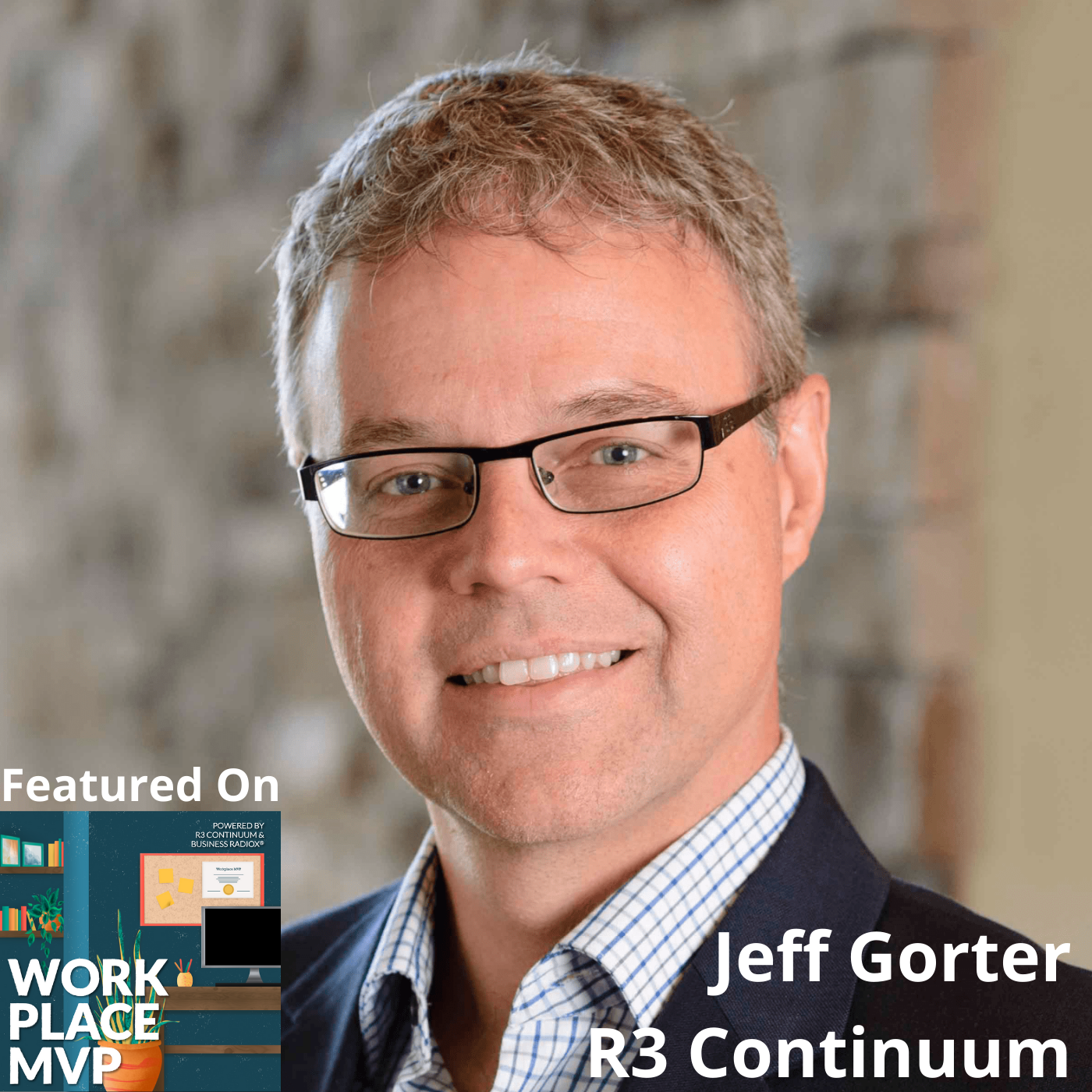
Jeff Gorter, MSW, LCSW, is VP of Clinical Crisis Response at R3 Continuum. Mr. Gorter brings over 30 years of clinical experience including consultation and extensive on-site critical incident response to businesses and communities. He has responded directly to the Sept. 11 terrorist attacks, Hurricane Katrina, the Virginia Tech shootings, the Deepwater Horizon Oil spill, the 2011 earthquake/tsunami in Japan, the Newtown Tragedy, the Orlando Pulse Nightclub Shooting, the Las Vegas Shooting, and the breaching of the US Capitol on 1/6/21. He has conducted trainings and presented at the Employee Assistance Professionals Association Annual Conference, the American Psychological Association Annual Conference, the World Conference on Disaster Management, the International Society for Traumatic Stress Studies Annual Meeting, and at other state, national and international venues on a variety of topics.

LinkedIn

R3 Continuum

R3 Continuum is a global leader in workplace behavioral health and security solutions. R3c helps ensure the psychological and physical safety of organizations and their people in today’s ever-changing and often unpredictable world. Through their continuum of tailored solutions, including evaluations, crisis response, executive optimization, protective services, and more, they help organizations maintain and cultivate a workplace of wellbeing so that their people can thrive. Learn more about R3c at www.r3c.com.

Company website | LinkedIn | Facebook | Twitter

About Workplace MVP

Every day, around the world, organizations of all sizes face disruptive events and situations. Within those workplaces are everyday heroes in human resources, risk management, security, business continuity, and the C-suite. They don’t call themselves heroes though. On the contrary, they simply show up every day, laboring for the well-being of employees in their care, readying the workplace for and planning responses to disruption. This show, Workplace MVP, confers on these heroes the designation they deserve, Workplace MVP (Most Valuable Professionals), and gives them the forum to tell their story. As you hear their experiences, you will learn first-hand, real life approaches to readying the workplace, responses to crisis situations, and overcoming challenges of disruption. Visit our show archive here.

Workplace MVP Host Jamie Gassmann

In addition to serving as the host to the Workplace MVP podcast, Jamie Gassmann is the Director of Marketing at R3 Continuum (R3c). Collectively, she has more than fourteen years of marketing experience. Across her tenure, she has experience working in and with various industries including banking, real estate, retail, crisis management, insurance, business continuity, and more. She holds a Bachelor of Science Degree in Mass Communications with special interest in Advertising and Public Relations and a Master of Business Administration from Paseka School of Business, Minnesota State University.

TRANSCRIPT

Intro: [00:00:03] Broadcasting from the Business RadioX Studios, it’s time for Workplace MVP. Workplace MVP is brought to you by R3 Continuum, a global leader in workplace behavioral health and security solutions. Now, here’s your host, Jamie Gassmann.

Jamie Gassmann: [00:00:24] Hi, everyone. Your host, Jamie Gassmann, here. And welcome to this episode of Workplace MVP. This year marks the 20th anniversary for the 9/11 terrorist attacks. We are also halfway through the second year of the COVID-19 pandemic. Some are calling these two tragic bookends to the last two decades. Interestingly, though, while these two events are different in nature, the impact they made on businesses and employees are very similar.

Jamie Gassmann: [00:00:53] Is this a coincidence? Or is there something to be learned about the impact disruption can have on an organization and its people? What should an employer be focused on when an event like 9/11 or COVID-19 happens? Are there solutions or support options that can be leveraged to help them successfully navigate the troubled aftermath of the events?

Jamie Gassmann: [00:01:15] With us today to share his expertise and firsthand knowledge from responding to the psychological first aid needs of employers for both 9/11 and COVID-19, among other major events across our history, is Workplace MVP Jeff Gorter, Vice President of Crisis Response Services for our show sponsor, R3 Continuum. Welcome to the show, Jeff.

Jeff Gorter: [00:01:37] Thank you, Jamie. I appreciate the opportunity.

Jamie Gassmann: [00:01:40] So, we’re glad to have you here and really interested in hearing a little bit about yourself and your career journey that’s led you to R3 Continuum and to where you’re at today.

Jeff Gorter: [00:01:53] No. Thanks. And just by way of background, I am a clinical social worker, master’s level social worker. And so, I come from a clinical background and have been in the field providing services either in private practice or in a public setting for 35 years. But the last 20 years of that have been specifically focused on providing disaster response.

Jamie Gassmann: [00:02:20] And so, can you share with our audience the disaster response work that you did post-9/11? And how does that compare to the work that you’re doing today in response to the COVID-19 pandemic?

Jeff Gorter: [00:02:33] And if you caught the 20 year reference, I really look at 9/11 as sort of that was certainly my first experience in responding to a large scale event. Part of the backstory of that is that the former president of Crisis Care Network, which is now known as R3 Continuum, Bob VandePol and I were in private practice together. And he had left the practice I’d say six months before 9/11.

Jeff Gorter: [00:03:03] And when the attacks occurred on that day, I called Bob and I said, “Bob, from what I understand, based on the new position that you’re in, I guess your company is going to be involved in this. I just want to let you know I am trained in this, if there’s anything I can do to help.” To which he said, “Can you be on a plane in four hours?” And I was in New York City that evening able to provide and to begin providing response.

Jamie Gassmann: [00:03:34] And how does that compare to some of the response works? I know you’ve done some response work with the COVID-19 pandemic, a lot of that’s been done virtually. But are some of the sessions or some of the work that you’re doing with that, can you tell us a little bit about, you know, how they work and kind of what your role is that you play within that?

Jeff Gorter: [00:03:56] It’s an excellent question. Because I’ve really been wrestling with the fact that, you know, this being the 20th anniversary of 9/11, that was very much in the forefront of my mind, and yet COVID has such a dominating factor. And, as you said in your intro, it’s kind of no surprise that these two things are, you know, juxtaposed here at this moment.

Jeff Gorter: [00:04:19] So, specifically, when I went to New York City, I was deployed to assist businesses as employees were returning to work for the first time following the attacks. And that’s a key element in that, you know, businesses played a major role in helping employees feel like they were getting back to some sense of normalcy or something that they could control. And so, many of the things that they talked about were more tangible, if you will, in the sense that they talked about things like the smells, things like the grittiness of the dust that was everywhere, how a siren going off for a police or fire would create a startle response the first time. And many of us can remember that the first time we saw a plane flying again after all flights had been grounded.

Jeff Gorter: [00:05:19] And so, for many of them these were much more visceral kind of descriptions of what they were going through. And, yet, for many of them, their stories were also about how resilience, how going back to work was not just getting back to work, but was in for many of them, a patriotic act. A small but very tangible stand against the darkness, if you will. And their getting back to work meant this is something I can do in this national crisis.

Jeff Gorter: [00:05:52] Now, in juxtaposing it to COVID-19 that the swift recovery of business operations is and has been continues to be a central component to our nation’s recovery. But it’s different because 9/11 was confined to a day and we didn’t know that at the time. But it’s confined to 9/11. It was a specific point in our calendar that we can look back. And it was a moment of sharp human initiated attack.

Jeff Gorter: [00:06:24] Now, COVID has a different perspective in that it is a prolonged, ongoing, unfolding, still not done crisis, driven primarily by biology. And so, in that sense, you know, the fear and the emotions elicited are, in many ways, just as powerful. Whereas, you could point to it, you could feel it between your fingers in New York City what the attack was like. Here, it’s kind of a vague, shadowy fear creeping outside your door. It’s everywhere, and yet I can’t point to it. And so, the fear is the common factor, but it’s also different kind of fear. And so, I think that’s important to recognize.

Jamie Gassmann: [00:07:16] Absolutely. And, obviously, from a business perspective, there’s some similarities in some of the thinking. And so, looking at your perspective of business leaders – and I know we’ve talked about this and I know you’ve got an opinion and kind of some thoughts – around that balancing act between human and business and how employers need to be looking at that following a disruption in the workplace, can you share your perspective on that with us?

Jeff Gorter: [00:07:42] Yeah. Well, I begin with the assumption that many business makers or business leaders have that the human response and the business aspects are two different things. And I contend that they are not. That they are, in fact, inextricably woven. And that, typically, when a large scale disaster hits, business leaders will go to their business continuity plan. They’ll pull that three ring binder off the shelf or they’ll go to their files and they’ll look at that plan, as they should. And they’ll review that crisis plan, the policies, procedures, what the strategies were to contain the crisis and mitigate the impact. That’s a sound thinking.

Jeff Gorter: [00:08:25] The trouble is, most of those plans focused on issues like I.T. security, facilities management, supply chain integrity, things that undoubtedly are important elements in a business recovery. But these plans often forget the most essential aspect, the human element. It doesn’t matter how secure your firewalls are or how quickly you get the power restored and the computers working again, if the people aren’t reassured and ready to go back to work. So, taking care of your people is taking care of your business. And I know I think it’s a mistake when a business owner says, “Well, I’m going to do one over the other.” They have to be done simultaneously.

Jamie Gassmann: [00:09:10] And, you know, so focusing on that people side of it, when a major incident occurs such as 9/11, or when you’ve got a pandemic like COVID-19, or other types of disruptions that impact a workplace, typically, if you were going to provide recommendation, what’s that first thing that an employer should be focusing on when it comes to their people?

Jeff Gorter: [00:09:33] So, I look at it as two parts. The first part, first and foremost always is safety. I need to ensure the safety of the employees. And that means physical safety and emotional safety. I have to prepare or provide for both aspects of that. So, I need to make sure when a large-scale event happens, have all the appropriate authorities been called? Have the right people been notified? Is the site secure? Are all the employees accounted for? Have immediate steps been taken, even simple steps like providing food, water, or blankets? Have immediate steps been taken for the care and comfort of my team? And has leadership physically directly checked on the team? Have they been visible? Have they gone around? Have they checked on and ensured the safety of everybody, both physically and emotionally? So, safety is first, job one.

Jeff Gorter: [00:10:32] But then, followed up by that, there are three simple things that I would say that the leader needs to do, and that is communicate, communicate, communicate. That one safety is restored, it’s imperative that leadership starts communicating early and often. This establishes them as a credible source of verifiable information, and that is in short supply following a crisis.

Jeff Gorter: [00:11:01] And it’s a common mistake among leaders to say, “Well, you know what? I’ll send a message out.” Or, “I’ll do some communication once I know all the facts. Once I have a complete idea of what’s going on, once I know the whole ball of wax, then I’ll be able to send out a message that encompasses everything.” And then, as one hour goes by and two hours go by and four hours go by, employees in that absence are going to become increasingly anxious. And it’s human nature in the absence of real information to plug in our worst possible fears.

Jeff Gorter: [00:11:40] And so, you know, maybe they’re going to ask themselves, “Maybe leadership was hurt. I thought we would have heard by now. Maybe they’re part of the injured. Maybe they don’t know that this is going on. Maybe they’re unaware of this. Maybe they don’t care.” And you can see that in the absence of real information. By that point, a negative narrative has already begun to take root.

Jeff Gorter: [00:12:04] And it is so hard to play catch up after that and try and establish. Especially in the age of instantaneous communication through social media and other sources like that, it is absolutely essential that a leader is out there early with frequent brief updates sharing what you know, what is verifiable, and share what you don’t know, but promising to confirm it as soon as you can. Which is to say, “I’m going to be open about I don’t know. I don’t, as a leader, have to have all the answers right now.”

Jeff Gorter: [00:12:42] And doing that, sharing what you know, admitting what you don’t but saying I’ll get it as soon as I can, has an incredibly calming and reassuring effect. It will enhance a leader’s standing with their employees and lets them know, “Okay. The leaders have a plan. They know what they’re doing. They are on top of this. I can take a deep breath at this moment.”

Jeff Gorter: [00:13:08] So, again, as an example, saying something like, “Following this event, we can confirm that three employees were injured and have been transported to the hospital,” that’s verifiable. “We don’t know their status at this point, but we will share that info as soon as we get it.” That’s all you need, something as brief as that. So often, again, leaders will, “Well, until we know more, I’m not going to say anything.” Or they’ll make, “I’m sure everybody’s going to be okay.” Are you sure? Can you guarantee that? No? Don’t say it if you can’t.

Jeff Gorter: [00:13:45] Just simply say what you know, admit what you don’t know. But assure them that as soon as we can have verifiable information, we’ll get back to you. It’s amazing how comforting and calming that is for an employee group that is looking to you for leadership in the midst of this.

Jamie Gassmann: [00:14:06] Great. And, you know, as you continue to go through kind of that recovery process after these types of events, when an organization is starting to regain a sense of new normalcy, how, at that point, can business leaders help to support employees and, really, the organization as a whole in that recovery effort?

Jeff Gorter: [00:14:27] Yeah. Kind of building on what I was saying before, that the employee and organizational interplay is inextricably interwoven. The employee recovery depends on organizational recovery and vice versa. Employees are going to look to the workplace for stability, financial stability, as well as just something that I know is there, predictability, structure. They crave a return to something that feels normal, and where they feel in control, and where they know what they’re supposed to do.

Jeff Gorter: [00:15:03] When the crisis happened, I had no idea what I was supposed to do. I’d like to get back to something where I feel I am trained and where I have a sense of influence and agency. Likewise, organizations are only as strong as their employees. And they need engaged, motivated, healthy workers to weather the storm. There’s an old quote from Kipling in which he said, “The strength of the pack is the wolf. And the strength of the wolf is the pack.” Meaning, the interplay between the organization and the individual they support each other.

Jeff Gorter: [00:15:41] And so, business leaders set the tone of positive resilience and an expectation of recovery for everybody. And part of that is ensuring access to the resources that are supportive to their employees, like onsite or virtual behavioral health specialists who are able to provide immediate support, psychological first aid, and encouragement. Being able to offer 24-7 phone or text access, perhaps via their employee assistance program or through other strategic vendors who can provide that. Offering and making sure there is access to print or electronic resources for education, coping, guidance. Things like that are immediate steps that the employer can do to support the employee. And as the employees come back, they support the organization and it is a common effort.

Jamie Gassmann: [00:16:48] And so, for disruptions like with the COVID-19 pandemic where we’re kind of on this ever changing kind of evolution, if you will, for the last year-and-a-half, do some of those same initiatives apply in the context of a disruption that maybe continues to evolve as opposed to a one day event?

Jeff Gorter: [00:17:11] I think you’re absolutely right. And even more so, I think that because what we have come to realize, even though we’re 18 months into this – the words almost stick in my throat in saying that, but that’s where we are right now at this taping – almost every day, it is a changing, fluid, dynamic circumstance. Where we are now and where we were back in February 2020 are vastly different places. And we know so much more and yet we are incredibly aware of how much we don’t know.

Jeff Gorter: [00:17:48] And so, that same central concept that in the absence of real information – I’m going to plug in my fears – just highlights the need for leadership to have a constant, steady, reliable drumbeat of information, even if it’s little bits. Even if my update today is to say no new changes today, that’s worth doing. That is something that reassures them that leadership is on top of it.

Jeff Gorter: [00:18:20] Because, again, that’s one of the things that clearly has typified this prolonged, slow moving disaster is that, you know, almost no two days are the same. And yet there’s still this emotional sense of Groundhog Day of, “What? It’s still here? We’re still talking about this.” And so, yeah, for leadership to not fall into the trap of thinking, “Oh. They don’t want to hear any more updates.” No, keep doing it. It’s essential.

Jamie Gassmann: [00:18:52] Great. And, obviously, for 9/11 this is a milestone anniversary, so looking at milestone anniversaries, you know, some employees may have or may experience kind of a reaction or, like, a triggering effect to that. And just how an employee handles the disruption when it’s happening, it’s all different in terms of the different levels of resilience and how people kind of process trauma. From your experience, you know, what should an employer be looking at so that they can show support and care knowing that with an anniversary like the 20 year anniversary everyone’s going to kind of approach it differently?

Jeff Gorter: [00:19:37] Yeah. No, that’s a great question. I mean, there were some organizations, obviously those in the New York area or Pennsylvania or in D.C. that were directly impacted. But I think it would be a mistake for a business leader to assume that, “Well, I don’t think any of my people were involved. I don’t need to pay attention to that. I don’t need to mention that.” In the 20 years people have moved, people have relocated, people have taken different jobs. People who were children at that point, who may have lost a loved one at that time, have grown up, moved, taken on new jobs. Again, it would be a mistake to think, “Oh, it’s so far back, we don’t really need to worry about it.” This is a significant day.

Jeff Gorter: [00:20:21] And so, for an employer, I think it’s important for them to acknowledge the solemnity of this day, the power of this day itself, and to recognize that employees may have some challenges with it. Not everybody. Not that they have to. But some may. And so, as a leader, getting out ahead of that and simply recognizing and acknowledging that lets them know that you get it, that you understand that this day is different from other days. It has significance, which helps those employees to feel understood and validated, not isolated and alone as if something is broken or wrong with them.

Jeff Gorter: [00:21:02] And so, it’s important, too, one of the ways that an employer can do that is to remind their employee of the wide range of resources that they have. Again, the behavioral health support, either onsite or virtually, as we’ve talked about before, should they choose to use it. So, for them, again, highlighting what their EAP can do or other groups. In most cases, people just want to be able to share their experiences. And anniversaries are times where we talk about it, because that helps us when we talk about it. It helps us feel less alone. It feels connected. We feel like we’re part of something. They may or may not want to talk about it, but it’s important for a leader to create this safe space for people to do that, to be able to talk about it.

Jeff Gorter: [00:21:54] Because I think one of the things that I am sure once we get past COVID, we’re going to do this. But one of the things that happened during 9/11, if we look back on it, all of us constructed a narrative. A story of where we were when it happened. What happened next? How did it impact us? Where are we now? We developed a story. That’s human nature. It’s how we make peace with it. It’s how we wrap our minds around it. This narrative is where we begin to constrain it as a chapter in our lives. An important chapter, a significant chapter, but not the only chapter in our lives. Things happen to be for that. Things have happened since that.

Jeff Gorter: [00:22:39] And so, being able to talk about it in that narrative sense, as if it’s a chapter helps to, again, feel a sense of control. And I begin to view myself, not as a victim, as if it’s still going on today, but more as a survivor or perhaps even a thriver. Here’s how I grew from this. Here’s how I’m different because of that. Here’s where I learned some things that are important.

Jeff Gorter: [00:23:07] So, being at work on the day of an anniversary, I think is beneficial to employees impacted by any major disruptive event because, again, there’s surprising power in the mundane, comfort in the normal. I want to be around something that feels supportive and and constrained. And going about their everyday lives helps a sense of control, helps them get through that day, and it helps them to have a balanced perspective on the significance of the past. The reality of this present. And the hope for the future. We will move to the next chapter as it were.

Jamie Gassmann: [00:23:49] Great. So, if a leader were starting a conversation like that with their employees – you know, because I love that concept of creating kind of this, like, open area. This comforting, you know, feeling that it’s okay to be transparent in how you feel about that – if you were going to provide a conversation starter for how a leader could set that tone and set that stage for that conversation, how would you advise them to speak to kind of get that conversation moving?

Jeff Gorter: [00:24:25] So, I think, you know, a generalized statement to begin with saying, “As we approach this anniversary, we recognize the power it has for us as a nation, for many of us as individuals. We want to acknowledge that and here’s the things we’re going to do.” And maybe that, again, if they are aware of folks who were survivors or who had a closer context, or it is part of our organizational history that our company was impacted by that day, then I think it would be a very wise idea to have onsite or virtual counselors available to be able to provide immediate, tangible, I could point down the hall and I can see that person if I want to go talk to them, I know they’re there. That’s an immediate thing that they can do.

Jeff Gorter: [00:25:14] The other is to remind them of other resources that they may have. Their employee assistance program, 24-7 hotline that is offered. To simply say at the point of the towers collapsing, many organizations I’m aware of will have a moment of silence at the moment, perhaps, when the first plane struck the building. They will do that, and that is, again, a way of honoring the solemnity of it, a way of acknowledging the reality of it, and just simply let your employees know, “Okay. We get this. We’re taking it seriously. This means something to us. And we’re doing some things to acknowledge that.”

Jeff Gorter: [00:26:01] Other organizations may say, “You know what? Given this day -” maybe even something simple like saying “- we’re having lunch brought in as just a way to acknowledge and provide a communal opportunity for us to get together and share that experience.” You know, depending on the the structure of your work site, that is a pretty low cost way to affirm to your employee group because they will talk about that afterwards. “Wow. Our company got it and they did something substantial to help us.”

Jamie Gassmann: [00:26:44] Great advice. So, we’re going to take a quick break and hear a word from our sponsor. Workplace MVP is sponsored by R3 Continuum. R3 Continuum is a global leader in providing expert, reliable, responsive, and tailored behavioral health, crisis, and security solutions to promote workplace wellbeing and performance in the face of an ever changing and often unpredictable world. Learn more about how R3 Continuum can tailor a solution for your organization’s unique challenges by visiting r3c.com today.

Jamie Gassmann: [00:27:19] So, some feel, Jeff – and we kind of mentioned it in the introduction too – that 9/11 and COVID-19 pandemic are tragic bookend events and have various similarities in their impact on employees, you know, with mental health concerns, substance abuse, sleeping concerns. Can you share your perspective on this? You know, are there similarities? And if so, what would you say are the similarities? And do you have any context to why that might be the case?

Jeff Gorter: [00:27:56] I think that’s a great observation, because I think on the surface, it would be easy to say, “Well, my goodness. I can hardly think of two completely disparate type of events.” I mean, they are radically different and they’re separated by 20 years. But if we did that, we lose tapping into the accumulated wisdom and knowledge that we gained from how we adapted to 9/11, and how that has sustained us through so many other crises that have happened in between, and how that can inform and shape what we’re doing now in response to the current crisis.

Jeff Gorter: [00:28:35] So, some areas of similarities that occurred to me is that, you know, both 9/11 and COVID changed everything about how business is conducted. I mean, if we think back on it, I think one when cheap and easy example is – for those of us of a certain age – can you remember when you didn’t have to take your shoes off at the airport to get on a plane? You know, it changed how we travel. It changed what we define as safety. It changed what security protocols with baggage. It changed even the work environment itself, where we work, who we work with, how we work has been changed.

Jeff Gorter: [00:29:18] There was radical change after 9/11 and the same thing has been happening after COVID, that it’s created changes that are going to be likely permanent as a way of adaptations to that. And so, that’s one area of similarity in that everything’s changed.

Jeff Gorter: [00:29:38] Another is that both 9/11 and COVID-19 have required a massive expenditure of time, money, resources by companies to respond to it, to adapt to it, to restore some sense of functional operations and confidence. That happened after 9/11. The same thing happened after COVID-19. I defy you to find a company that says, “You know what? We are pretty much operating exactly the same way with exactly the same plans, policies, and procedures as we did before those events. You know, it really didn’t touch us. It didn’t change us.”

Jeff Gorter: [00:30:19] I mean, to the contrary and particularly in the midst of the pandemic, we had to initiate almost immediate changes. As I said earlier, things like we’re operating from home now where many of us who never envisioned ourselves as remote workers now find themselves with their library kingdom. And other things in which we’ve changed. We’ve made so many initiatives in response to this to try to enhance the safety while returning to operations. And we don’t know the effectiveness of many of these until later. You know, we have to make the change. We’re going to do it.

Jeff Gorter: [00:31:07] But many leaders and workers alike are saying, “Well, did we do the right thing? Did we make the right decision? Are we doing enough? Or did we do too much?” So, I mean, these questions were the same that’s an echo of 9/11. We said the same kinds of things. We wrestled with the same sort of initiatives then as we do now in determining what was the right calibration. It’s only in hindsight that we’ll know. But it did require massive amounts of time and energy.

Jeff Gorter: [00:31:41] And then, the third thing, and I think this is probably the one that is most pertinent to me as a behavioral health professional, is that, both of these events had a global emotional impact unlike any other event. And if we think back over the last 20 years, there have been many major events. We are only a few days away from the 16th anniversary of Hurricane Katrina. There have been multiple large scale mass shootings at schools or in other public locations. There has been a breach of the U.S. Capitol.

Jeff Gorter: [00:32:21] All of these things are major defining events, yet none of them had the emotional charge on a global scale. There’s almost no person on the planet that has not been aware of those events that was not emotionally moved by those events. There was a universal sense of shock, vulnerability, fear that defined 9/11 and was very similar to the pandemic. And I think, you know, those other tragedies that I said were huge and highly visible, but they were constrained to areas, regions, cities, location. Whereas, 9/11 led the whole world to know things are different and the same has happened with COVID-19.

Jamie Gassmann: [00:33:18] Interesting. And you you mentioned in a previous conversation with us and you may have have kind of touched on it a little bit here that events like 9/11 and COVID-19 pandemic are described as seminal moments that impact an individual’s view on life, which can lead to them re-evaluating what’s important. So, can you elaborate a little bit more on that?

Jeff Gorter: [00:33:45] Yeah. I think, the easiest way to understand, seminal moments are those milestones, those tragic milestones in the story of your life. As I talked about, they are unavoidable reference points in the story of our lives. You know, we will say, “Was that pre-COVID or post-COVID?” It’s the kind of thing that you immediately will recognize and you reference events as almost, you know, magnetically rotating around that.

Jeff Gorter: [00:34:19] But what I think is so important about that is that the events are the events. The events themselves are only the beginning. I think the way we responded to them is much more compelling and is much more reflective of that personal agency, that personal story that we construct, that narrative that we build following these events. So, the event happened, but the story of how we endured, what we had to let go of, where we grew, how we changed, how we adapted, how we found moments of happiness or lightness even in the midst, those kinds of things are lived experiences that I think hold tremendous value.

Jeff Gorter: [00:35:09] You know, I think that in older days that might have been called wisdom. That’s the kind of thing that you look back on and you say, “You know, I would never want to go through that again. But I learned some things about myself, about my company, about my community, or about my country.” And that is important knowledge to be able to have and to incorporate. I know that we all want to hurry by. We all want to get to the happy ending. Can I just flip through the book? Can I fast forward to the end of the show here and see the happy ending?

Jeff Gorter: [00:35:44] But the reality is, if we let this moment pass by without intentionally purposely reflecting on what this means to me as a person, what this means to me as a leader, what this means to my company, what it means to my team, I think we lose something of incredible value.

Jeff Gorter: [00:36:05] And so, again, especially with something that has been as prolonged as the pandemic, we’re just like, “Well, I just need to get through it. I just need to get through another day. I just need to keep rolling.” But I think savvy leaders have found that stepping back, intentionally reflecting on this, and what lessons I learned from it, it positions them for better success in the future when they get past this.

Jamie Gassmann: [00:36:38] Right. So, almost like attributing meaning to the event and how that is having an impact on your life, because it could be both in positive ways and negative ways. So, there could be a couple of different things that are learned from that, both professionally and personally when you’re looking at it, would you agree?

Jeff Gorter: [00:36:57] Exactly. I think, again, attributing meaning to it as part of that narrative making. It’s human nature that when we go through an event that has that kind of power that impacts us like a physical blow, we try and make sense of it. We try and reassert a sense of control. And we typically go – sorry. I’m going to go a little Psych 101 here for a moment – in one of two directions. Meaning, attribution means we either determine internal disposition, what does this say about me? About how I handle it? What does this reveal about me? Or external situation, what does this say about my context, my company, my community, my country? So, we’re going to assign a meaning to this.

Jeff Gorter: [00:37:51] And, again, the event is the event. So, the pain has occurred, the trauma has occurred, the tragedy has occurred. That doesn’t change. But my meaning will greatly influence my trajectory afterwards. And so, by that, there is a critical inflection point. There is a moment. A moment where almost all of us, whether we’re conscious of it or not, where we look at this and we say, “Wow. What I just went through, what does this say about me?”

Jeff Gorter: [00:38:24] Do I look at this and do I say, “You know what? I was in the wrong place at the wrong time. But, man, I’m just glad I got through that.” Or do I say, “You know what? This just proves once again that I am the unluckiest guy on the face of the Earth. You know, I am a soccer ball on the field of life. I just get kicked around all the time.” Do I view this as, “Wow. I am so happy to be alive following this. I am going to go home and kiss my partner and hug the kids. And I’m going to enjoy life in a different way. I’m going to value life.” Do I say that? Or do I say, “What’s the point? Why even try? Stuff like this happens. I told you it’s just one bad thing after another.”

Jeff Gorter: [00:39:13] And you know why? The event is the event. My interpretation is going to determine whether I move ahead with resilience and in a positive way. Or that I add on to the sense of negativity, the sense of pathology, something must be broken. And, you know, do I view this as, “Okay. These powerful emotions I’m experiencing are normal, understandable reactions to this really powerful event.” That makes sense. Or do I say, “I’m not handling it right. I must be doing it poorly. I think I’m not smart enough or strong enough. Maybe I’m broken. Maybe I’m losing it.” You know, the event is the event, but my interpretation is going to determine where I go from. And so, I think that how we attribute meaning is going to help us move forward.

Jamie Gassmann: [00:40:09] Interesting. And so, you know, looking at kind of moving forward and looking at leaders that might be listening in on this conversation, if you are going to give them a take away from this show, something that you wanted to leave them with that can help them to effectively support their employees when disruption occurs, what would you share with them? What would you want them to take with them?

Jeff Gorter: [00:40:35] So, I’m going to share not something that originates from me, but I want to share a quote from one of my favorite poets, Maya Angelou. She had a quote that I think I have reflected on and it has helped me in so many situations when responding to a large scale event. And the quote is, “They will never remember what you said. They will never remember what you did. But they will always remember how you made them feel.” And I find that so incredible.

Jeff Gorter: [00:41:09] Because as a leader, I urge you, I encourage you to help your team feel cared for, help them feel supported, help them feel valued. And when you do that, they will surprise you. They will inspire you. They will lift up your company in ways you can’t do alone. So, it’s not about having the magic words. It’s not about following exactly the ten point plan. It’s about keeping in mind that my goal is they will remember how I made them feel. Make them feel cared for and valued, and they will take care of the rest.

Jamie Gassmann: [00:41:49] Fantastic. So, looking out over your career, I’m always curious to ask my guests, what are you most proud of when you look out over your career?

Jeff Gorter: [00:42:01] Well, that is a challenging question. The things that are obvious particularly in the context of our conversation, being able to have responded directly to 9/11, having had an influence here during COVID, or responding to the Vegas shootings, or going to D.C., all of those events that I have done. But I don’t want to be distracted by, let’s say, the bright, shiny, big is the only thing that matters.

Jeff Gorter: [00:42:40] I think probably what I’m most proud of is that I consider it a humbling honor to be able to walk alongside somebody in what might have been one of the worst days of their lives. And it doesn’t matter whether it was a mass event that rocks the globe or whether it was the loss of a friend and co-worker who they had really come to depend on. Being able to be there and help take a little bit off their shoulders, it’s a day well spent. And so, it’s each one of those times that I’ve had an opportunity to speak into somebody’s life.

Jamie Gassmann: [00:43:20] Wonderful. So, with our listeners, if they wanted to get a hold of you, Jeff, how would they be able to do that?

Jeff Gorter: [00:43:28] Well, as I mentioned, I am with R3 Continuum, and so, certainly, being able to access that through our website. But also being able to respond to me directly, if you’d like to send an email to jeff.gorter@r3c.com, jeff.gorter@r3c.com. And I’d certainly be willing to respond to any questions.

Jamie Gassmann: [00:44:00] Fantastic. Well, thank you so much, Jeff. It was very moving, great information shared, very powerful stories, and advice. And we really do appreciate you. And thank you for letting us celebrate you on the show today. And hearing the experiences you had, the work you did in supporting workplaces at 9/11, and even with COVID, and other events within our history. So, thank you so much for being a part of our show.

Jeff Gorter: [00:44:31] Thank you so much, Jamie. And I urge all your listeners, be well, be safe.

Jamie Gassmann: [00:44:38] Great. And we also want to thank our show sponsor, R3 Continuum, for supporting the Workplace MVP podcast. And to our listeners, thank you for tuning in. If you’ve not already done so, make sure to subscribe so you get our most recent episodes and other resources. You can also follow our show on LinkedIn, Facebook, and Twitter at Workplace MVP. If you are a workplace MVP or know someone who is, we want to know. Email us at info@workplace-mvp.com. Thank you all for joining us. And have a great rest of your day.


Tagged With: COVID-19, covid-19 crisis management, Crisis Response, critical incident, Jamie Gassmann, Jeff Gorter, R3 Continuum, September 11th, workplace, Workplace MVP

The R3 Continuum Playbook: The Ripple Effect of Disruption

September 2, 2021 by John Ray

Jeff Gorter
Minneapolis St. Paul Studio
The R3 Continuum Playbook: The Ripple Effect of Disruption
Loading
00:00 /
RSS Feed
Share
Link
Embed

Download file

Disruption

The R3 Continuum Playbook: The Ripple Effect of Disruption

Marking twenty years since the tragic September 11th terrorist attacks, Jeff Gorder, Vice President of Clinical Crisis Response at R3 Continuum, discusses the ripple effects disruptive events have on individuals. Jeff recommends five essential elements as best practices to follow immediately following a disruptive or potentially traumatic event.  The R3 Continuum Playbook is presented by R3 Continuum and is produced by the Minneapolis-St.Paul Studio of Business RadioX®. R3 Continuum is the underwriter of Workplace MVP, the show which celebrates heroes in the workplace.

TRANSCRIPT

Intro: [00:00:00] Broadcasting from the Business RadioX studios, here is your R3 Continuum Playbook. Brought to you by Workplace MVP sponsor, R3 Continuum, a global leader in workplace behavioral health, crisis and security solutions.

Jeff Gorter: [00:00:14] Hello, my name is Jeff Gorter, Vice President of Clinical Crisis Response at R3 Continuum. Today, I would like to discuss the ripple effect of disruption and how employers can support employees, both immediately following a disruptive or traumatic event, as well as during the anniversary of the event later on in time. This information is particularly pertinent in relation to the 20th anniversary of the 9/11 terrorist attacks, which is upcoming this month in September 2021.

Jeff Gorter: [00:00:49] It’s common for employees to feel emotions such as grief, sadness, loneliness, fear and anger immediately following a disruptive event and, possibly, even for years to come. This can impact their ability to remain productive and thrive at work as there are certain triggers – some obvious, some unexpected – that may remind them of the trauma. The healing process for trauma is not necessarily linear, not a straight direct line. Meaning that the impact can be more of a ripple effect that comes in waves, a waxing-and-waning effect that can resurface in the future for some employees.

Jeff Gorter: [00:01:30] Let’s begin at the beginning. Immediately following an event, the trauma impact depends on the person’s proximity to the event itself. For example, did they see the event? Were they in direct danger themselves? Were they exposed to graphic visual scenes? Were they involved in efforts to take care of the victims perhaps? This kind of exposure is intuitively obvious, but it is only one determinant of their ultimate trajectory.

Jeff Gorter: [00:02:02] Something that’s interesting to note is that PTSD is not necessarily based on how powerful the event was, as if there’s an automatic threshold of trauma, and PTSD is somehow inevitable. This condition is often actually based more upon how well the person was doing emotionally before the event. So, if the impacted individual was not doing well prior to the event, if they were already stressed or wrestling with challenging dynamics unrelated to the event, they are more likely to develop PTSD or other related conditions.

Jeff Gorter: [00:02:40] It may also surprise some to discover, particularly when we’re thinking about the impact of 9/11, that PTSD was not the dominant trajectory for most New York residents following the terrorist attacks of 9/11. In a landmark study conducted by researchers at Columbia University specific to New York recipients, it was found that resilience was actually the dominant trajectory for the majority of people at six months and, again, at one year out, despite having experienced an unthinkable, horrible tragedy. Again, the vast majority did not meet the criteria for a PTSD diagnosis despite their exposure, contrary to what many people feared and even what some experts expected.

Jeff Gorter: [00:03:32] Now, to be clear, this is not to say that it was easy or that the journey wasn’t difficult; far from it, but it is worth noting that we are stronger than we give ourselves credit for. Now, while this is certainly encouraging, it’s still crucial that employees are adequately supported and supplied with targeted resources to process the difficult emotions following the disruption, particularly after a mass event like 9/11. Otherwise, the event can impact the employees’ behavioral health and impair their ability to do their job, or it may simply prolong the struggle needlessly.

Jeff Gorter: [00:04:15] So, let’s look at this a little more closely. International researchers and current best practice recommend focusing on five essential elements immediately following a disruptive or potentially traumatic event. These elements are critical to early intervention and to the overall resilience of the person as they cope with the event. First, the impacted individual needs to feel safe, both physically and emotionally. During a disruptive event, this feeling of safety was likely reduced or challenged in some way. So, in order to begin the recovery process, safety must be restored. Until safety has been assured and reasserted, it’s human nature to remain on high alert with a heightened sense of fear, anxiety and reactivity. Safety is job one from a physical and mental health perspective.

Jeff Gorter: [00:05:15] Once safety is being reasserted, the second element is that an individual must feel connected. It’s important to help an employee realize that they are part of a community, a group, a company of people who went through the same experience and are walking the same journey. Often, trauma can make someone feel isolated and that they are alone in the way they’re feeling as if they’re the only ones in the world who feel like this. It can help them to know even just the simple fact that they’re not alone, that their reactions are common and shared by other co-workers, and that they can draw and contribute to the strength of their collective work group. We are stronger together.

Jeff Gorter: [00:06:02] Third, an individual needs to feel a sense of calm, of being able to reassert control over their own body. With the adrenaline rush that usually comes with experiencing a survival threat or a disruptive event, it’s critical that the person is able to regain control over their body and be able to focus their thoughts, control their breathing again, to relax their muscles, and to come off the adrenaline-fueled high alert that I mentioned earlier. Regaining a sense of calm and control over their own body opens the door to making the next right decision, to taking the next right step, and the one after that, and the one after that and so on.

Jeff Gorter: [00:06:46] The fourth essential element is self-efficacy, a sense of confidence. It’s common to feel helpless or hopeless following a crisis event, a situation where I couldn’t control the outcome. It can help when the person is able to feel as if they can make good choices on their own behalf again or on behalf of their loved ones or their co-workers once again. If the person could not prevent the event, realizing where it goes from here is up to me is a powerful step forward. This taking back of control over their own power and their own decisions can help them to know they are not helpless in determining their future, and it restores their sense of personal agency following this event.

Jeff Gorter: [00:07:33] The fifth and final essential element that a person needs is hope. They need to feel hopeful for their future, able to envision this for themselves to know that this crisis is not how it’s always going to be, or that they’re not always going to feel like this and that a more positive future is possible. Without hope, there’s no moving forward. Workplaces have a tremendous power to help employees feel this kind of hope by providing predictability, purpose, stability, and by offering them skilled behavioral health support immediately following the event.

Jeff Gorter: [00:08:13] Now that we’ve covered some of the ways that employers can support employees immediately following disruption, it’s important to discuss how employees might feel on the anniversary of an event. Anniversaries can make employees feel anxious or jittery, in addition to making them feel less safe and less connected. And this makes sense as it’s part of our primitive built-in survival mechanism. See, that survival mechanism remembers the past threat, remembers this time, remembers the event, and it’s seeking to prepare you should a threat arise again. This may lead some employees to have an exaggerated response to certain triggers, certain memories, certain discussions around the event, and that can bring up complex emotions.

Jeff Gorter: [00:09:03] From an employer perspective, particularly one who has employees that may be struggling on an anniversary, it’s important to acknowledge the solemnity, the power of this day itself, and to recognize the difficult feelings employees may have on that day, letting them know that you get it, that you understand that this day is different from other days, and that it has significance to you helps them feel understood and validated.

Jeff Gorter: [00:09:33] It is also important to make sure employees know that they have access to a wide range of resources and behavioral health support should they choose it. In most cases, people want to be able to share their experiences about this anniversary because it helps them feel less alone, more connected, as we discussed earlier. They may or may not want to talk about it, but it’s important to give them the space to do so if they choose.

Jeff Gorter: [00:10:01] In the case of 9/11, many of us have constructed a narrative, a story of where we were, what happened next, where we are now. Many individuals have made some level of peace with their stories now that it’s 20 years following the event, but not all of us. It can be helpful for them to share their narratives, the ongoing story, because they’re able to see the event as an event that occurred in the past, as something in which they are able to exercise some control over. This helps the person to see themselves as a survivor, even perhaps a thriver, and no longer a victim, as if that tragedy is continuing to happen today in the present.

Jeff Gorter: [00:10:49] Being at work on the day of anniversaries can be beneficial to employees impacted by a disruptive event, as there is surprising power in the mundane and the ordinary, even some comfort in the normal, the predictable day-to-day that we look forward to and that structures our lives. Going about their everyday lives can provide them with a sense of control and helps them to get through the day, keeping a balanced perspective on the significance of the past, the reality of the present and the hope for the future.

Jeff Gorter: [00:11:26] Now, while the ripple effect of disruption can impact employees and their daily lives, employers have the power to support their employees through these feelings that may arise as impacted individuals continue their journey of healing from the trauma, both immediately after an event and in the years following. As the 20th anniversary of 9/11 approaches, R3 Continuum can help organizations to do this with consultation, educational resources, and with onsite and virtual behavioral health support. On our website at r3c.com, we provide resources under the Our Resources tab to learn more about how we can support your organization. Contact us today.


Show Underwriter

R3 Continuum (R3c) is a global leader in workplace behavioral health and security solutions. R3c helps ensure the psychological and physical safety of organizations and their people in today’s ever-changing and often unpredictable world. Through their continuum of tailored solutions, including evaluations, crisis response, executive optimization, protective services, and more, they help organizations maintain and cultivate a workplace of wellbeing so that their people can thrive. Learn more about R3c at www.r3c.com.

R3 Continuum is the underwriter of Workplace MVP, a show which celebrates the everyday heroes–Workplace Most Valuable Professionals–in human resources, risk management, security, business continuity, and the C-suite who resolutely labor for the well-being of employees in their care, readying the workplace for and planning responses to disruption.

Connect with R3 Continuum:  Website | LinkedIn | Facebook | Twitter
Tagged With: Crisis Response, Disruption, disruptive events, Jeff Gorter, post-traumatic stress disorder, R3 Continuum, trauma, Workplace MVP

R3 Continuum Playbook: Managing Emotional Reactions to Reintegration

May 27, 2021 by John Ray

Reintegration
Minneapolis St. Paul Studio
R3 Continuum Playbook: Managing Emotional Reactions to Reintegration
Loading
00:00 /
RSS Feed
Share
Link
Embed

Download file

Reintegration

R3 Continuum Playbook:  Managing Emotional Reactions to Reintegration

The reintegration process to the workplace will be welcomed by many employees but could be full of emotional reactions. Jeff Gorter, R3 Continuum’s Vice President of Clinical Crisis Response, addressed the emotional challenges that may arise and offers helpful strategies for leaders.  The R3 Continuum Playbook is presented by R3 Continuum and is produced by the Minneapolis-St.Paul Studio of Business RadioX®. R3 Continuum is the underwriter of Workplace MVP, the show which celebrates heroes in the workplace.

TRANSCRIPT

Intro: [00:00:00] Broadcasting from the Business RadioX Studios, here is your R3 Continuum Playbook. Brought to you by Workplace MVP sponsor, R3 Continuum, a global leader in workplace behavioral health, crisis, and security solutions.

Jeff Gorter: [00:00:15] Hello. I’m Jeff Gorter, Vice President of Clinical Crisis Response at R3 Continuum. As the nation moves ever so slowly toward getting COVID-19 under control, many business leaders are looking ahead to the next stage of reintegration and return to work.

Jeff Gorter: [00:00:42] But as exciting as a return to some sense of normalcy is, it represents yet another change following a period of unprecedented and unexpected change. And change, as we all know, even positive change, can be stressful and presents with its own unique set of challenges. Here are three emotional reactions that business leaders should anticipate with their staff as well as themselves.

Jeff Gorter: [00:01:11] The first reaction is fatigue. So many of us have experienced a level of fatigue or weariness that is decidedly different from the type of fatigue we’ve experienced in the past following a full day of exertion at work. Zoom fatigue, which has become a common term, has been described by so many. But while virtual meetings have been literally a godsend and have allowed us to continue operations in ways we couldn’t have even imagined just a few years ago before this technology. But we all know it takes a different level of energy to make those kinds of meetings work.

Jeff Gorter: [00:01:51] In addition, many business leaders describe a type of decision fatigue. Feeling that their creative energies have been tapped out as they’ve had to make major business and personal challenges with very little reference and very little surety as to how they’ll work out in the future. Other leaders described compassion fatigue, knowing that their employees have experienced significant pain and loss over the course of this last year-and-a-half. And yet, as leaders, feeling ill-equipped to handle later how to respond to those particular needs.

Jeff Gorter: [00:02:29] The second expected emotional reaction is grief, not surprisingly. And grief tends to show up in two distinctly different ways. Tangible grief, which involves the direct loss of a family member, a friend, a co-worker, even a customer. This type of grief is the one most adults associate with a death or the end of a relationship. And in that regard, it’s completely understandable in the midst of a pandemic. The second variation, intangible grief is much more subtle, but in some ways is no less powerful for those who are experiencing it. Intangible grief involves the loss not of a person, but of a foundational concept, the sort of bedrock principles that held us up and made us feel secure.

Jeff Gorter: [00:03:22] For example, many of us have experienced a loss of the sense of safety that we had come to rely on and even take for granted prior to the advent of COVID-19. Many of us are grieving the familiar work patterns that used to structure our day and are now conducted virtually or in isolation. Many of us have experienced a grief surrounding increased financial challenges and pressures. A loss of connection to the community or to faith-based activities that formerly fed and sustained us. Many of us are grieving simply the way it was. And grief, whether tangible or intangible, takes time and emotional energy to heal and process.

Jeff Gorter: [00:04:11] Finally, the last emotional reaction business leaders can expect is anxiety, or to put it more precisely, anticipatory anxiety. Anxiety about what reintegration even looks like as that remains unclear and undefined at this point. Many experts expect a post-COVID ennui, that French term that describes a sense of listlessness, a lack of energy, and a proverbial asking, “Well, now what?” It stands to reason that as COVID has dominated our horizon for the last 16 months, it will not simply be a turning off of the switch and an immediate adjustment back to planning and motivating employees without COVID as the inescapable backdrop for everything we did.

Jeff Gorter: [00:05:02] Many employees are already reporting confusion along with the anxiety as to how unclear it is, what’s expected of me, what are the new roles, the new roles, the new interactions in my professional, my personal, and the social spheres in this brave new world that’s emerging.

Jeff Gorter: [00:05:25] Well, this is by no means an exhaustive list. These three emotional reactions, fatigue, grief, and anxiety can be expected during the reintegration and return to work period post-COVID-19. So, let’s look at some strategies that savvy business leaders have found helpful as they prepare themselves, their leadership teams, and their workforce for the next normal.

Jeff Gorter: [00:05:54] First, leaders need to entrench or foster connection once again. Encouraging work groups to re-establish some of the social and cultural norms, the little things which used to mark the workplace as best they can with reasonable adjustments. For example, is it safe to have a team lunch once again, face-to-face, all in a room? While we may not quite be there yet, it’s helpful to think about some adaptations we can do in the future to make that possible.

Jeff Gorter: [00:06:25] Such as, perhaps, having the lunch catered in rather than relying on the potluck that used to be a part of it. A catered in lunch is a safer alternative and it may enhance the comfort of those around. Now, while this example may sound simplistic or trivial, the little things can have an outsized power as your people are readjusting to this. Think about how much you’ve missed your work family over the last 16 months and how often you’ve longed for something, anything that involved other people and felt normal once again.

Jeff Gorter: [00:07:02] Second, it’s important for leaders to demonstrate and exercise patience as reintegration is a process, not a singular event. For many leaders, the phrase “Progress, not perfection” has become a guiding mantra. As in most things of life, your employees will return to work with a wide variety of attitudes and aptitudes with emotions and skills. And so, a leader wants to strike a balance between supportive understanding of where they are and what they’ve gone through and what they’re facing now. And performance expectations, because returning to work is an expression of functional resilience. Something that they want as well as the leader wants. So, we need to allow some time to readjust successfully.

Jeff Gorter: [00:07:54] Finally, effective leaders create space for the narrative to develop. That is, the story that will inevitably describe how we, as a company or as a work group, were impacted by COVID, how we managed through it, perhaps in spite of it, and where we are heading now as a group, as a collective. This sense of a story, a narrative with a beginning, middle, and end, is a natural and healthy way that all of us make sense of crisis events in our lives. The narrative allows us to begin to see this as an event in the past as a chapter in our lives that we’re able to close the book on as we once again look forward to the future.

Jeff Gorter: [00:08:42] Although this past year-and-a-half has been exhausting and painful, and while looking ahead may seem daunting to many business leaders, there are resources and consultation available to you. Our website, r3c.com, contains a number of articles that can be helpful in this process. And one particular service, our Telephonic Wellness Outreach, is an effective method to reconnect with your remote workforce ahead of time. Allowing you to gain an understanding of where they’re at and what their needs are, which allows you to provide resources in a strategic way that facilitates a return to work.

Jeff Gorter: [00:09:25] If you’d like to contact us, check out our website at www.r3c.com or email us at info@r3c.com. We’d be happy to have a discussion with you regarding any challenges that you may be facing. Thank you.


Show Underwriter

R3 Continuum (R3c) is a global leader in workplace behavioral health and security solutions. R3c helps ensure the psychological and physical safety of organizations and their people in today’s ever-changing and often unpredictable world. Through their continuum of tailored solutions, including evaluations, crisis response, executive optimization, protective services, and more, they help organizations maintain and cultivate a workplace of wellbeing so that their people can thrive. Learn more about R3c at www.r3c.com.

R3 Continuum is the underwriter of Workplace MVP, a show which celebrates the everyday heroes–Workplace Most Valuable Professionals–in human resources, risk management, security, business continuity, and the C-suite who resolutely labor for the well-being of employees in their care, readying the workplace for and planning responses to disruption.

Connect with R3 Continuum:  Website | LinkedIn | Facebook | Twitter
Tagged With: Jeff Gorter, R3 Continuum, return to office, Return to Work, workplace reintegration

Business RadioX ® Network


Our Most Recent Episode

CONNECT WITH US

  • Email
  • Facebook
  • LinkedIn
  • Twitter
  • YouTube

Our Mission

We help local business leaders get the word out about the important work they’re doing to serve their market, their community, and their profession.

We support and celebrate business by sharing positive business stories that traditional media ignores. Some media leans left. Some media leans right. We lean business.

Sponsor a Show

Build Relationships and Grow Your Business. Click here for more details.

Partner With Us

Discover More Here

Terms and Conditions
Privacy Policy

Connect with us

Want to keep up with the latest in pro-business news across the network? Follow us on social media for the latest stories!
  • Email
  • Facebook
  • Google+
  • LinkedIn
  • Twitter
  • YouTube

Business RadioX® Headquarters
1000 Abernathy Rd. NE
Building 400, Suite L-10
Sandy Springs, GA 30328

© 2025 Business RadioX ® · Rainmaker Platform

BRXStudioCoversLA

Wait! Don’t Miss an Episode of LA Business Radio

BRXStudioCoversDENVER

Wait! Don’t Miss an Episode of Denver Business Radio

BRXStudioCoversPENSACOLA

Wait! Don’t Miss an Episode of Pensacola Business Radio

BRXStudioCoversBIRMINGHAM

Wait! Don’t Miss an Episode of Birmingham Business Radio

BRXStudioCoversTALLAHASSEE

Wait! Don’t Miss an Episode of Tallahassee Business Radio

BRXStudioCoversRALEIGH

Wait! Don’t Miss an Episode of Raleigh Business Radio

BRXStudioCoversRICHMONDNoWhite

Wait! Don’t Miss an Episode of Richmond Business Radio

BRXStudioCoversNASHVILLENoWhite

Wait! Don’t Miss an Episode of Nashville Business Radio

BRXStudioCoversDETROIT

Wait! Don’t Miss an Episode of Detroit Business Radio

BRXStudioCoversSTLOUIS

Wait! Don’t Miss an Episode of St. Louis Business Radio

BRXStudioCoversCOLUMBUS-small

Wait! Don’t Miss an Episode of Columbus Business Radio

Coachthecoach-08-08

Wait! Don’t Miss an Episode of Coach the Coach

BRXStudioCoversBAYAREA

Wait! Don’t Miss an Episode of Bay Area Business Radio

BRXStudioCoversCHICAGO

Wait! Don’t Miss an Episode of Chicago Business Radio

Wait! Don’t Miss an Episode of Atlanta Business Radio