Business RadioX ®

  • Home
  • Business RadioX ® Communities
    • Southeast
      • Alabama
        • Birmingham
      • Florida
        • Orlando
        • Pensacola
        • South Florida
        • Tampa
        • Tallahassee
      • Georgia
        • Atlanta
        • Cherokee
        • Forsyth
        • Greater Perimeter
        • Gwinnett
        • North Fulton
        • North Georgia
        • Northeast Georgia
        • Rome
        • Savannah
      • Louisiana
        • New Orleans
      • North Carolina
        • Charlotte
        • Raleigh
      • Tennessee
        • Chattanooga
        • Nashville
      • Virginia
        • Richmond
    • South Central
      • Arkansas
        • Northwest Arkansas
    • Midwest
      • Illinois
        • Chicago
      • Michigan
        • Detroit
      • Minnesota
        • Minneapolis St. Paul
      • Missouri
        • St. Louis
      • Ohio
        • Cleveland
        • Columbus
        • Dayton
    • Southwest
      • Arizona
        • Phoenix
        • Tucson
        • Valley
      • Texas
        • Austin
        • Dallas
        • Houston
    • West
      • California
        • Bay Area
        • LA
        • Pasadena
      • Colorado
        • Denver
      • Hawaii
        • Oahu
  • FAQs
  • About Us
    • Our Mission
    • Our Audience
    • Why It Works
    • What People Are Saying
    • BRX in the News
  • Resources
    • BRX Pro Tips
    • B2B Marketing: The 4Rs
    • High Velocity Selling Habits
    • Why Most B2B Media Strategies Fail
    • 9 Reasons To Sponsor A Business RadioX ® Show
  • Partner With Us
  • Veteran Business RadioX ®

Decision Vision Episode 75: Should I Form a Benefit Corporation? – An Interview with Juliana Neelbauer, Drew Eckl Farnham

July 23, 2020 by John Ray

benefit corporation
Decision Vision
Decision Vision Episode 75: Should I Form a Benefit Corporation? - An Interview with Juliana Neelbauer, Drew Eckl Farnham
Loading
00:00 /
RSS Feed
Share
Link
Embed

Download file

benefit corporation

Decision Vision Episode 75:  Should I Form a Benefit Corporation? – An Interview with Juliana Neelbauer, Drew Eckl & Farnham

What is a benefit corporation, or B Corp, and why would I want to form one? What are the legal obligations of such an entity? Juliana Neelbauer of Drew Eckl & Farnham discusses these questions and much more with host Mike Blake. “Decision Vision” is presented by Brady Ware & Company.

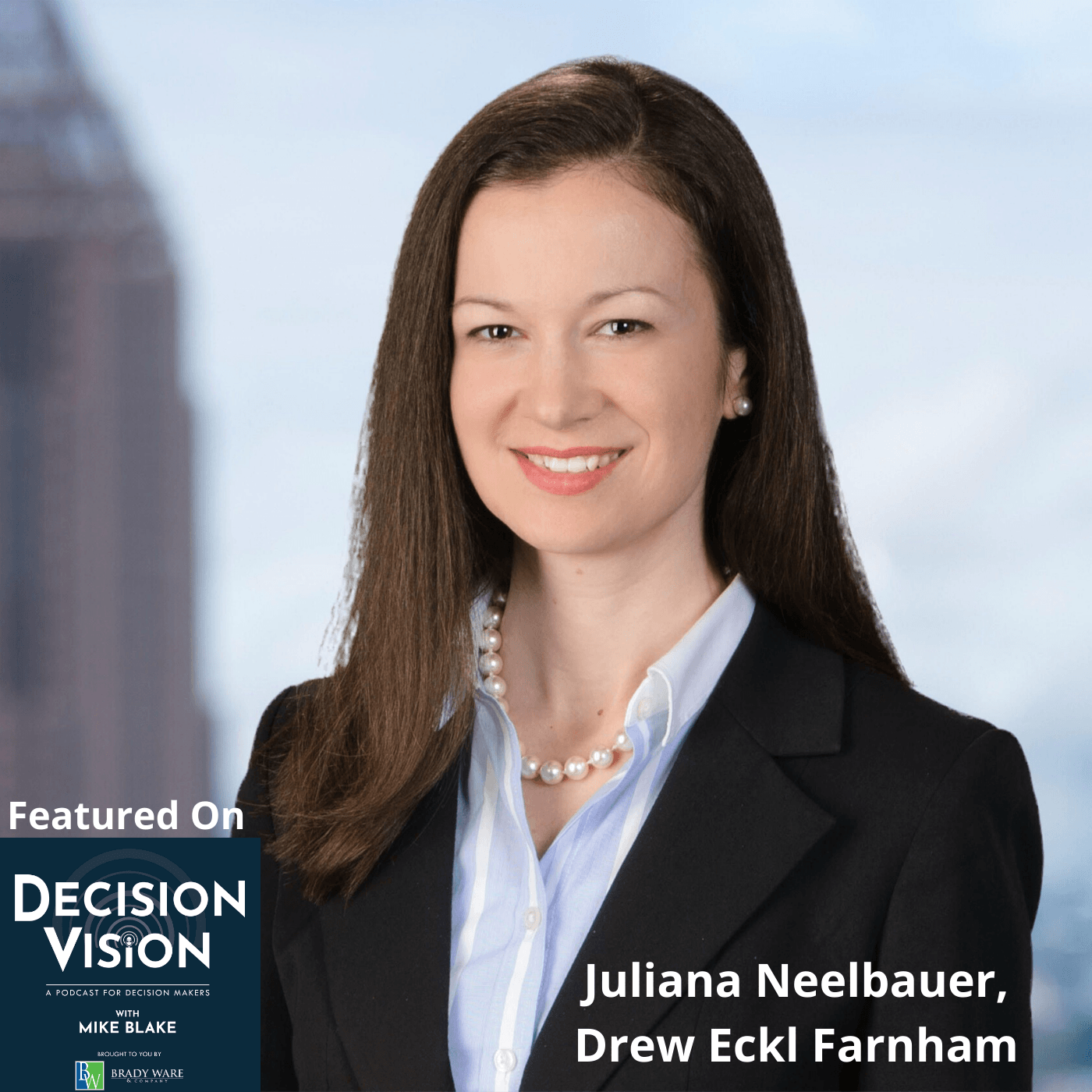
Juliana Neelbauer

Juliana Neelbauer is a senior attorney who is the outside general counsel for companies that are product- or SaaS-centered, or IP-driven and that work with data and sensitive information in highly regulated industries. Her practice leverages her insights in cybersecurity, data management and analytics, government contracting, fintech, consumer-web, enterprise-software, health care delivery, medical products, supply chain, film, and political action sectors. She handles the full lifecycle of her clients’ needs including venture capital or private equity rounds, subsidiary formation, contract or governmental compliance, licensing, international transaction, and mergers and acquisitions. She is known as an attorney who brings an operator’s mindset, a technologist’s know-how, and an executive’s strategy to her clients’ legal concerns.

Prior to joining Drew Eckl & Farnham’s Atlanta office, Juliana was the chief operating officer of Ad Hoc LLC. Ad Hoc is a Maryland-based mid-market federal contracting company that builds custom web portals that deliver government services to millions of Americans. Juliana oversaw the scaling of Ad Hoc from a 2-person small business to a 90-employee mid-market prime contractor with a 10x increase in revenues within a 14-month period.

Juliana started her career in software and business operations, founded two high-growth companies, and has overseen the scaling of many startups and mid-market companies in the tech industry before building a technology-focused law firm in the DC-metro area. She was born in Decatur and after more than 18 years away from the State, she was happy to return with her husband and daughter in 2017 to build the Drew Eckl & Farnham technology law practice in Georgia.

You can connect with Julia by email, on LinkedIn, or on Twitter.

Drew Eckl & Farnham

Drew Eckl & Farnham is a full-service law firm that offers deep litigation experience, strategic corporate and transactional counsel, and practical legal advice to companies, individuals and families. Their approach to practicing law is to resolve each new legal matter as expeditiously and efficiently as possible. They strive to propose a legal strategy that directly correlates with the risks involved.

Powered by their diversity, innovation and commitment to the communities in which they work, Drew Eckl & Farnham has grown to more than 100 attorneys in Atlanta, Albany and Brunswick, Georgia and serves local and national clients throughout the Southeast.

Michael Blake, Brady Ware & Company

Mike Blake, Host of the “Decision Vision” podcast series

Michael Blake is Host of the “Decision Vision” podcast series and a Director of Brady Ware & Company. Mike specializes in the valuation of intellectual property-driven firms, such as software firms, aerospace firms and professional services firms, most frequently in the capacity as a transaction advisor, helping clients obtain great outcomes from complex transaction opportunities. He is also a specialist in the appraisal of intellectual properties as stand-alone assets, such as software, trade secrets, and patents.

Mike has been a full-time business appraiser for 13 years with public accounting firms, boutique business appraisal firms, and an owner of his own firm. Prior to that, he spent 8 years in venture capital and investment banking, including transactions in the U.S., Israel, Russia, Ukraine, and Belarus.

Brady Ware & Company

Brady Ware & Company is a regional full-service accounting and advisory firm which helps businesses and entrepreneurs make visions a reality. Brady Ware services clients nationally from its offices in Alpharetta, GA; Columbus and Dayton, OH; and Richmond, IN. The firm is growth minded, committed to the regions in which they operate, and most importantly, they make significant investments in their people and service offerings to meet the changing financial needs of those they are privileged to serve. The firm is dedicated to providing results that make a difference for its clients.

Decision Vision Podcast Series

“Decision Vision” is a podcast covering topics and issues facing small business owners and connecting them with solutions from leading experts. This series is presented by Brady Ware & Company. If you are a decision maker for a small business, we’d love to hear from you. Contact us at decisionvision@bradyware.com and make sure to listen to every Thursday to the “Decision Vision” podcast.

Past episodes of “Decision Vision” can be found at decisionvisionpodcast.com. “Decision Vision” is produced and broadcast by the North Fulton studio of Business RadioX®.

Visit Brady Ware & Company on social media:

LinkedIn:  https://www.linkedin.com/company/brady-ware/

Facebook: https://www.facebook.com/bradywareCPAs/

Twitter: https://twitter.com/BradyWare

Instagram: https://www.instagram.com/bradywarecompany/

Show Transcript

Intro: [00:00:02] Welcome to Decision Vision, a podcast series focusing on critical business decisions. Brought to you by Brady Ware & Company. Brady Ware is a regional full-service accounting and advisory firm that helps businesses and entrepreneurs make visions a reality.

Mike Blake: [00:00:22] And welcome to Decision Vision, a podcast giving you, the listener, a clear vision to make great decisions. In each episode, we discuss the process of decision making on a different topic from the business owner’s or executive’s perspective. We aren’t necessarily telling you what to do, but we can put you in a position to make an informed decision on your own and understand when you might need help along the way.

Mike Blake: [00:00:42] My name is Mike Blake and I’m your host for today’s program. I’m a director at Brady Ware & Company, a full-service accounting firm based in Dayton, Ohio. With offices in Dayton; Columbus, Ohio; Richmond, Indiana; and Alpharetta, Georgia. Brady Ware is sponsoring this podcast, which is being recorded in Atlanta for social distancing protocols. If you like this podcast, please subscribe on your favorite podcast aggregator. And please consider leaving a review of the podcast as well.

Mike Blake: [00:01:09] So today’s topic is, should I form a B Corporation? Sometimes also known or maybe more often known as a benefit corporation. And this topic has triggered, I think, simply because I find myself hearing about B Corps or benefit corps with increasing frequency. To be perfectly candid, I had never heard of one until about, I’m going to say, four or five years ago when I was retained to perform an appraisal of one that was a startup software company. And that’s the first time that I had encountered it.

Mike Blake: [00:01:52] And, you know, it was novel. It was interesting. And it gave me a chance to do an assignment where you learn something new as the provider. You know that’s always a good thing. And, you know, I sort of filed it away. And, you know, in the last few years, I hear B Corporations being mentioned more frequently. They’re talked about more often, I think, frankly, as more of the younger generation, whether it’s millennials or Generation Y or Z or, I guess AA comes after that if you’re thinking Excel spreadsheets.

Mike Blake: [00:02:28] But, you know, as more companies and company founders, I think, kind of reject the Friedman kind of notion where building shareholder value holds primacy above all other objectives. And we’re seeing the pendulum kind of swing back to a stakeholder point of view that B Corporations have become increasingly important. And I paused on my brain now because I’m trying to remember if they have been authorized in Georgia very recently or they’re on the verge of being authorized. And our guests will correct me there. I’m sort of spacing out on it. But we’re about to be one of the states that allow this. The majority of U.S. states allow them now, but not every single one.

Mike Blake: [00:03:19] And, you know, they’re kind of neat. And depending on what your desire is for a company you already have or company you’re going to found, you know, this may be the first time you’re hearing about a B Corp or maybe you’ve heard about it before but you never really took the time to sit and research it. So, this is your opportunity while you’re driving, or jogging, or cooking, or building bird houses out of wood, or tinkering with your car, or replacing a graphics card in your computer, whatever it is you’re doing while you’re listening to a podcast. Here’s an opportunity to kind of learn something more about it.

Mike Blake: [00:03:59] And, you know, it’s kind of interesting because – and this is the accounting geek in me. Although, I’ve repeatedly protested many times I’m not actually an accountant. And it’s instantly malpractice for me to call myself one. But you really don’t hear of, like, a new kind of company of – sorry – corporation or corporate form being created, right? You just assume that there’s S Corps, there are C Corps, there are limited liability companies, partnerships, sole proprietorships, et cetera. And they’ve been around forever. And that number kind of is a static. It’s something like talking about adding a new state. It’s like, “That’s kind of cool. Where are they going to put the extra star?” Fifty one is a hard number to divide well because it’s a prime number – not a prime number. But it’s a weird number.

Mike Blake: [00:04:48] And so, when a new kind of corporate form comes along, you kind of perk your ears up and say, “Okay. Well, here’s something that’s gonna be a little bit different, a little bit out of the ordinary, a little bit novel.” So, I have told you now the sum total of my knowledge. I have literally spewed it out onto the internet and podcast form in terms of my sum knowledge of a B corporation.

Mike Blake: [00:05:13] So as we do on the Decision Vision podcast, I’m inviting an expert on it. And joining us today is my friend, Juliana Neelbauer, who is a senior associate at Drew Eckl Farnham, a law firm here in Atlanta. Drew Eckl and Farnham is a full service law firm that offers deep litigation experience, strategic, corporate, and transactional counsel, and practical legal advice to companies, individuals, and families.

Mike Blake: [00:05:39] Juliana focuses her practice on virtual general counsel for for-profit, nonprofit, charitable, trade organizations, high net worth individuals, and families which hail from the consumer technology, commercial technology, healthcare, industrial/supply chain, finance government contracting, charitable, and political action industries.

Mike Blake: [00:05:58] Prior to joining Drew Eckl. Juliana was the chief operating officer of Ad Hoc LLC, a fast growth federal prime contracting company that builds custom web portals to deliver government services more efficiently to millions of Americans by using agile software development and other modern web development methods. Juliana oversaw the scaling of Ad Hoc from a nine-person small business to a 90 employee mid-market prime contractor, with a ten times increase in revenue within a 14 month period.

Mike Blake: [00:06:26] And the cool thing I like getting to do these podcasts, I’ve known Juliana for a couple of years. I did not know that about her. I knew about Ad Hoc. I did not know that she led that kind of growth. So that’s awesome.

Mike Blake: [00:06:36] In the academic realm, Juliana has organized a legal clinic program for hacker participants of the University of Maryland’s Bitcamp, Georgia Tech’s HackGT, and University of Maryland’s all female technical hackathon events. She served for half-of-a-decade as the attorney advisor to the executive board and entrepreneurs of the Student Governance Startup Shell Incubator of the University of Maryland campus. And as a business mentor and lecturer for the Mtech Program at the Clark School of Engineering. And for Fearless Founders classes at the Dingman Center for Entrepreneurship in the Smith School of Business at the University of Maryland. Juliana is a pen undergraduate interviewer for the North Atlantic region and a past board member of the Pen Club of District of Columbia.

Mike Blake: [00:07:20] Juliana, welcome to the program.

Juliana Neelbauer: [00:07:23] Thanks for having me, Mike. It is good to have you. It’s weird that we’re not eating biscuits this time. I think that’s when we first met, we got biscuits. And so, that felt like the right thing to do when we were outside of Atlanta at the time.

Mike Blake: [00:07:36] Well, it was. And one of the reasons that I took an instant liking to you as well. So, thank you for that. I don’t say that about many people. I normally take an instant dislike. So, they’re on the narrow side of the ledger there.

Juliana Neelbauer: [00:07:53] We’ll see if it — before the end of the podcast, Mike-

Mike Blake: [00:07:57] Right back at you. Well, we’ll see if we’re still Facebook friends at the end of this. But let’s start off very basic. What is a B Corporation?

Juliana Neelbauer: [00:08:09] Sure. So, a B Corporation, as you pointed out in the beginning, is a new corporate form or business entity, business organizational form. And what does that mean? Well, on the most basic level as a business owner, you have a choice of what kind of entity you want to form in its legal form. And then also what kind of tax treatment you want your entity to have. And the reason why you might form it is, just because you didn’t even mean to, but you just started engaging in business activity. And by doing so, in certain states, that automatically makes a business arise around you and with you, whether it be a sole proprietorship that you never register anywhere, or a general partnership, or a partnership with you and somebody else.

Juliana Neelbauer: [00:08:56] And then some of us choose to actually register those things. And when you do, you have, as you mentioned, all these choices. You have your corporations, which can be C Corporations or S Corporations for tax purposes. That’s a tax status, actually, more than a legal status. And then your LLCs, your limited liability corps, your various forms of limited partnerships, your general partnership, and then your nonprofit. And so, those are the most common forms.

Juliana Neelbauer: [00:09:21] Now, there’s a new kid on the block. And it’s these B Corps or BLLCs or KBCs. And we can talk a little bit more about the differences if it would be of interest to your listeners.

Mike Blake: [00:09:35] I’m sure it would be. So, we’ll put a pin on them and come back to it. So, can you sharpen my knowledge? I know there’s something going on with B Corporations in Georgia. Are they just about to be authorized? Have they been authorized? Where are we in our state for that?

Juliana Neelbauer: [00:09:52] Your instincts are right. We have passed both the House and the Senate in Georgia. And the General Assembly have passed a benefits corporation law, which is Georgia House Bill 230. You can look it up online, it’s available. And you can see the full text if you Google it for the General Assembly site. And then the governor is in a period of review. And until August 5th, he may veto this bill even though it was passed. And we don’t expect that to happen. But Governor Kemp has said some things that have surprised business in the past. And so, we’ll see what happens. But the outlook and the prognosis from all of the policy wonks here is that he’s either going to let it lie, which will make it automatically pass at the end of August 5th, or he will actively sign it in to put his signature on it and show that level of executive support politically for it.

Juliana Neelbauer: [00:10:45] And one thing to note is that Georgia’s law is not really controversial within the B Corp community. There is almost a trade or some folks call it the benefit economy of businesses that are already engaging in this type of business. And so, as each state decides whether it’s going to adopt one of these laws and is often being heavily lobbied to do so, they can add their own elements into each of these state laws. They can be a little bit different the way the corporate forms work. But Georgia’s is pretty vanilla. So, when we talk about what Georgia has passed in this podcast, it will apply to most of the other states that you would look at and sort of shop when you’re thinking about where you might want to form one of these.

Mike Blake: [00:11:35] So, how long have these B Corporations been around? Because we talked about not too long, but how long have they been around? And do you happen to know kind of what state authorized them first?

Juliana Neelbauer: [00:11:48] I knew you were going to ask me that. And then, I wasn’t 100 percent sure that I could tell you which state for sure. But I know that Delaware was one of the first. As normally the case, when you are trying to create something new in the corporate legal sphere, it’s smart as a trade group to target Delaware because the Delaware court system is older than our country when it comes to the corporate law that has been established there. And so, in fact, this is one of the primary reasons why shareholders, investors, and major businesses register in Delaware.

Juliana Neelbauer: [00:12:24] It’s not as many new folks getting into business believe because the taxes are better. In fact, the tax rates are often worse when you’re starting out in Delaware. There are tax advantages that you can capture once you’ve gotten bigger, and especially as you go public. But when you’re a private business starting out, it’s actually the corporate tax rates and some of the filing fees are much higher than other states. And so, that’s not why you pick Delaware. You pick Delaware because it’s an old court system. And when you’re in business, you like things that are old in the legals realm because then they’re predictable.

Juliana Neelbauer: [00:12:57] And uncertainty is your enemy, right? Uncertainty means you have to spend more money to prepare for more contingencies. And that’s expensive when you could instead know the future, know how the courts are going to rule, and either settle more disputes outside of having to go to court, or know exactly how much it’s going to cost you if you do. So, you want to target Delaware and that’s what we have here. So, the public benefit corp law in Delaware or PBC form has been established. And it’s been around, I think, for at least maybe over ten years for sure. And the real movement and the push to make this a nationwide opportunity, where there is active lobbying in all state legislatures and organized lobbying to make public benefit corps or, really, just B Corps, which is sort of a more common name for them now, to be pushed through.

Juliana Neelbauer: [00:13:59] It started in 2006 when one organization, a trade group called B-Lab, was formed by three founders. I’m just gonna go ahead and tell you that it’s Jay Coen Gilbert, Bart Houlahan, and Andrew Kassoy. And for those who are from the startup community, whether it be fashion or retail or traditional technology startups, you might recognize their names. They are the founders of AND1, which was a very popular retailer that sold athletic wear, including shoes. And they had a very successful growing fast growth company. That, unfortunately, for them, once they got some additional funding in one of their realms, they gave up control of their company.

Juliana Neelbauer: [00:14:43] And their director, who was then made chairman, had so much power that he had a differing opinion than they did as far as how they should operate their company. And made some decisions that they felt were not in the best interests of society at large and the environment. And that they felt would actually hurt marketing for their company. And therefore, hurt their bottom line. In putting all those three things together, once that company was sold at a price and at a stage that they felt was too early and too low, they were really passionate, even though they had – they had some capital, so they said, “Well, let’s actually fix this problem for the future. Let’s create a legal shelter under which founders can let investors know and also legally be allowed to make decisions that aren’t just to increase shareholder value, that don’t just go to Milton Friedman’s shareholder primacy philosophy and have the legal cover to do so.”

Mike Blake: [00:15:43] So, you know, there’s been some pretty good and some pretty significant uptake on this. I think one of the more famous early B Corporations was also Ben and Jerry’s, Ben and Jerry’s Ice Cream. And, you know, they would not consent to be acquired, unless they were acquired by some entity that was going to continue to pursue a social mission. Because that was always a big part of their culture. And I think that acquisition kind of led to kind of legitimizing, if you will, for lack of a better term, legitimizing the the B Corporation. And now, if I remember correctly, I read in a Forbes article recently, there’s over two thousand of these B Corporations around at least.

Juliana Neelbauer: [00:16:37] Correct. And those are just the one – well, there’s more than 50,000 that are certified by B-Labs. And they are, again, a trade group, but also a certifying organization. And so, you know what I should say? I believe that they have certified that more than 50,000 organizations are meeting the standards of what a B Corp would be required to do if they were a mission driven or a purpose driven organization. Now, I do not know if all of those are, in fact, registered as B Corps now that I think about it. That might have been a nuance in their marketing that I would want to see.

Juliana Neelbauer: [00:17:15] But to your point, there are thousands of these around the country now, more than 35 states. Once Georgia passes its law, which we expect to happen again on August 5th, have these laws on the books so that you can form these. And so, more and more of them are being formed every day.

Juliana Neelbauer: [00:17:31] In my practice, I would say about, maybe, 30 percent of the clients who contact me to form a new business in the last year have asked me about B Corps and benefit corps and public benefit corps. And asked me, “Is there a benefit to me doing this for my business?” And so, we’ve walked through that analysis quite a bit in the last –

Mike Blake: [00:17:55] Thirty percent? That’s a much bigger number than I would have expected.

Juliana Neelbauer: [00:17:59] Yeah. And that might be my target audience, which is a lot of technology companies. It’s a lot of second time entrepreneurs as well. So they’ve had a nice exit and now they really want to do the company – they want to operate it in the right way. You know, fix all the problems, you know, as a company even if it was successful. And then they also want to have the company be more purpose driven because now they can do what they really always wanted to do, not just what they thought they economically needed to do. Does that make sense?

Mike Blake: [00:18:27] Yeah. No. It sure does. As a give back mode that a lot of tech entrepreneurs kind of enter once they’ve had that big exit.

Juliana Neelbauer: [00:18:36] Right.

Mike Blake: [00:18:38] So, you know, there’s already a nonprofit corporate structure out there. Why is a B Corporation needed? Why is there room for the B Corporation to exist when a nonprofit organization exists or maybe a for-profit but has a specific mission why they take Newman’s zone? Where they’ve been very open, that, basically, their profits or most of them go to various charities, I think mostly for sustainability. Why was the development of a B Corporation needed or welcomed when you sort of have a nonprofit structure already available?

Juliana Neelbauer: [00:19:19] Yeah. That’s a great question. I think there’s actually two different answers. And so, I’m gonna try to wear both of my business side hat and my law hat. On the legal side, there’s a need for it because on the nonprofit side, you know, you have a mission. It is defined. It must be defined in your charter. It is also something that you calculate against when you file your quarterly and annual tax returns to the IRS and then also to your state. And so, it’s very important that you are working within your mission.

Juliana Neelbauer: [00:19:53] In fact, it can affect whether you maintain your nonprofit status or you don’t. If you are not meeting certain thresholds as far as how much of your activity is falling within the parameters of your mission activity versus activity that’s outside of your mission. And that can include both spending and also taking in of income. And so, that’s a very rigid structure.

Juliana Neelbauer: [00:20:16] And that can be hazardous if you are a new organization and you’re not sure what that balance between your activities that you have to engage in, in order to keep your lights on, to bring in income into the organization. Whether that is going to be sufficient on the mission side in order to keep your lights on. Whether you’re going to have enough donations. When you’re a new organization, you’re unknown. Versus activities that you know you can immediately generate revenue. But that might not qualify under the IRS tax – the IRC for being within a mission.

Juliana Neelbauer: [00:20:52] So, for instance, one of the quintessential trips of nonprofits is selling T-shirts or merchandise. Very often you can actually include merchandise sales for T-shirts or mugs within your mission, even if you just, you know, put your logo on there and you do it for a fundraiser. There’s very specific rules for how you can do that and get away with that and not be subject to having reclassifying of that income when you go through an audit. And so, that rigidity puts off a lot of organizations, a lot of founders, especially those who are maybe even sophisticated in business, but not sophisticated in law or taxes, tax law in particular. And they avoid the nonprofit form for that reason. Or it just doesn’t work for the scale phase of their organization.

Juliana Neelbauer: [00:21:40] And so, in that scale phase, they opt in for an LLC or a C Corp, which allows them to go after whatever revenue generation they can, help some scale organization. And then down the road, maybe they spin out. They form a separate nonprofit and fund that nonprofit with proceeds from their personal funds, from the business, their compensation or through marketing activities of the business or what have you.

Juliana Neelbauer: [00:22:05] And it’s imperfect. And there’s a friction there for those founders who have said I want to be more true to what this organization is really about. I want to be more honest with my shareholders and my investors. I want to be able to be as honest as I can without creating liability for myself by saying I want to spend 30 percent of the revenue that comes in the door. Or, at least, the net, you know, the profit that comes in the door on social good activities, environmental activities. Or I want to be able to opt overtly for the vendors that costs more in the supply chain, but that do better work, that don’t use sweatshop labor for, you know, the sewing of the garments that we produce or what have you.

Juliana Neelbauer: [00:22:51] And so, in those cases, there was actual legal liability that could arise not only if you mismanage your nonprofit and lose your standards because you’re not perfectly meeting these requirements while you’re trying to keep your organization alive.

Juliana Neelbauer: [00:23:05] But then on the business side, if you have a for-profit business, you know, there is a famous case where Henry Ford, after Ford Motor Company was wildly successful and he’s invested a lot in the City of Detroit and the State of Michigan. And while he was helping his organization, one point he started to give out double digit percent of the net profit to these really, truly charitable aims throughout the city. And his shareholders filed suit against him and said, you’re not following the Milton Friedman – you know, of course, that Milton Friedman was later. But you’re not increasing the value of the company with these actions.

Juliana Neelbauer: [00:23:46] You knowingly are spending money where dollar for dollar. There is no chance that this is going to increase the value of the shares of Ford Motor Company. And so, he said, “I’m a brilliant man who’s changed the face of the industrial economy in United States. I’ve created one of the most successful automotive companies in history. I get to do this. I am Ford Motor Company. Come on, courts, I’m going to win this case.” So, he fought back. He didn’t settle. He took it to the courts and he lost. And the court said, if you want to engage in charitable activity, form a nonprofit. And then we have the Ford Foundation as a result of that.

Juliana Neelbauer: [00:24:28] So, you know, cases like that are – and that’s probably the most famous one where we talk about the responsibility of shareholders to increase their shareholder value. But it’s a real risk. It’s a way to pierce the protection you, as a director or officer of a company, have when you create your business entity. And you register it and you get this corporate shield that protects you individually. And in your bylaws and in your operating agreement, if it’s written at all competently, it will say in one of the last clauses in there that the company agrees to protect you and indemnify you for the base. Effectively making a bad call or having bad judgment in business, which in hindsight is very clear.

Juliana Neelbauer: [00:25:14] But the problem is, if you do things that are overtly against creating additional shareholder value or that there’s really no justification you can make other than I just did this for the good of the community, not for the good of the company. That can pierce your protection within your organization. It can pierce those protections in the company. And so, if you look at those clauses, it will talk about willful and wanton negligence and willful and wanton activity, where you purposefully do something that is not in the best interest of increasing the value of your company. Boy, now you can be sued individually by your own company or by individual shareholders and have these derivative suits pop up.

Juliana Neelbauer: [00:25:57] And so, it’s a real risk on the legal side to take a significant portion of your business activity, of your time, of your team’s time and energy to engage in activities that don’t increase revenue, don’t increase profit.

Mike Blake: [00:26:14] So that’s good. That really lays out the case. I’m familiar somewhat with the Ford history. You know, ultimately, he was also deposed because he was declared insane. I have to wonder with that story that you just shared, I did not know that background. I wonder if part of the reason that his family tried to declare him insane is because he was spending money on that kind of stuff.

Mike Blake: [00:26:43] So I think you’ve done, frankly, a really good job of explaining kind of the gap that a B Corporation sells. Is it harder or easier to set up a B Corp versus other more conventional or more, I guess, this longstanding corporate forms

Juliana Neelbauer: [00:27:03] I would say on the spectrum between setting up an LLC, which is probably the easiest form to set up. I mean, there’s a website that will set this up for you for a couple hundred dollars. And you just click a few buttons and they’ll register it for you and they’ll create your corporate entity government documents as well as make the filings. All the way to the, I would say, nonprofits or certain kind of exotic holding companies that might be offshore, where you’re going to have an accountant and a lawyer and maybe multiple involved with setting up the initial company.

Juliana Neelbauer: [00:27:40] The B Corps would fall somewhere in the middle, but probably closer to the LLC. It’s really not that difficult to set them up. The reason why you will want to talk to an accountant or, better, a lawyer who’s done one of these before or are very familiar with the statute of your state in which you’re going to register it, is because they’re new, quite frankly. And there are a few clauses that you do need to put in your articles of incorporation or certificate of incorporation, which is the formal attestation that you’re going to file. The form that you’re going to file with the state you choose. And they’re not vanilla. They’re not the normal ones. It’s not the template that you’re going to find online.

Juliana Neelbauer: [00:28:26] Some states have automated registration now for business filings, which is amazing and wonderful, and democratizes the ability for people to create businesses, which I think is all a good thing. I would rather do less work myself as a lawyer on the front end of filling out throughout forms. And do more advising and have you spend your dollars and your time talking to lawyers to get real time and advice. And so, anything that makes that easier for you to do that, you know, it doesn’t require a kind of brainpower from a lawyer or an accountant is good.

Juliana Neelbauer: [00:28:57] But I don’t know if all of those forms are updated to include those extra clauses that you really do want to include when you register a benefit corp, a benefit LLC, a public benefit corporation, whatever the designation is for that state. I hope that they would. There’s also some, in addition to what the minimum you’d have to have in there, which is an extra clause talking about the mission. What is that social good, environmental good, public good mission that your organization is going to be evaluated against as whether or not it is on mission and it is acting within its requirements to be in the public benefit. You do need a clause for that for sure. And I would imagine that they would include that.

Juliana Neelbauer: [00:29:39] But in addition, you’re going to potentially want to add in your articles of incorporation a few extra statements to narrow the scope of responsibility of the directors and officers in this time where these are new. It is a little bit unclear how you’re going to balance shareholder value with the best interests of those materially affected by the corporation’s conduct. And then also kind of as a third category, the public benefit. Those are three different things. And so, you know, that is one of the risks legally and also on a business level for anyone who is going to form one of these or going to operate or govern one of these is, making sure that you have set in writing how you plan to balance these three things.

Juliana Neelbauer: [00:30:28] And in some cases, being more general could benefit you based on the type of business you’re engaged in. In some cases, being very specific is going to benefit you because you’re going to have a lot of professional investors who are going to absolutely hold your feet to the fire about this. And not be day to day involved in your business. And the understanding is at the end of the quarter of the year, you haven’t met what they consider success against that mission.

Mike Blake: [00:30:56] So, let’s talk about that, because I think that notion of the mission – I mean, it certainly sounds important. Intuitively, it’s important. I imagine you cannot simply write a clause or be hired to write a clause in your organizational documents and say, “Hey, we’re going to be a nice company and we’re going to do good social things full stop.” I imagine you probably have got some pretty specific language that defines kind of what that social or – maybe it’s not social, you know, that sounds kind of polarizing but what your non-business mission is.

Juliana Neelbauer: [00:31:35] Right. I think to answer your question – and we can actually look directly at the new Georgia statute, right? So, let’s use that as a template here. In Georgia, now, once August 5th passes and presuming Governor Kemp does nothing or signs this into law, either way, it becomes an effective form that you can file. You have to create a more objective standard for what your mission is and what success against that mission is than just generally saying we’re going to do good for the world or we’re going to do good for nature.

Juliana Neelbauer: [00:32:11] You have to no less than annually give to your shareholders and any other person who requested in writing a written report talking about your performance as a corporation, with respect to the public benefit or benefits that you included in your articles of incorporation. And by the way, your articles of incorporation are a publicly filed document. So, they can be audited by anybody.

Juliana Neelbauer: [00:32:38] And this sounds like – the statute sounds like truly anybody could have a standing to say, “I don’t think you’re meeting your mission. I don’t think you’re performing sufficiently.” Or, have you even created this report? Are you in violation of the law? And if you haven’t been creating these annually, then right there you have a ding. You could potentially lose the right to have your corporate form. And that creates, most importantly, liability for you with your shareholders so they could have derivative suits against you from mismanagement of the organization.

Juliana Neelbauer: [00:33:10] And then, within the report, well, what has to be in there? Georgia actually tells you, you have to create specific objectives for the board of directors in connection with that pursuit of the mission. There has to be standards that are defined, that are measurable, that the board has adopted, that show that the company is either progressing or not progressing positively in pursuit of those benefit or benefits. And then, you have to provide some factual information that can be used to flush out those standards. And so, it can’t just be a report with a spreadsheet with calculations that are not explained with effectively history of facts or specific events that have occurred that support that the numbers are, in fact, tied to activities that occurred in the real world and had real effect.

Juliana Neelbauer: [00:34:06] And so, that alone right there is a pretty heavy burden administratively compared to not having to do any of that.

Mike Blake: [00:34:16] Yeah. And I mean, that’s really interesting. So, I want to try to put the brakes here and really dive into that because I think that is so important. And I did not know that walking in. But, you know, on the finance side where I live, we have gap. We have generally accepted accounting principles that, you know, effectively is a common language that we pretty much all agree on in our society, at least in the financial world, where, you know, a dollar in revenue equals a dollar in revenue, profit equals profit, et cetera, et cetera.

Mike Blake: [00:35:00] And we have a set of professional standards, even licensing, for people that aren’t experts in presenting to an external audience what the financial position and results have been for our company at a given point of time and over a given point in time. And commenting basis to whether or not the financial statements can be can be relied upon. Now, we’re adding this new benefits statement, for lack of a better term. Maybe there’s a term to award which I’m unaware.

Mike Blake: [00:35:34] And as you say, anybody can kind of make an objection and say, “Hey, I don’t think that you’re doing this right.” And it sounds like the burden of proof is on the company to prove that it’s meeting its objective, which is, that’s extraordinary. There’s very few areas of law, crippling from law to put the burden of proof on the defendant effectively.

Juliana Neelbauer: [00:36:00] Well, let’s talk about that. So, I want to say kind of, right? I suggest that let’s say kind of. Because, you know, what does this burden of proof mean? Like, what I’ve described so far as these factors, these elements that you have to meet, that’s about as detailed as the statute gets. And those are general statements. And so, yes, you have a burden to show that you’ve, in fact, gone through these steps and have some activity that shows that you have created objectives that are – you created objective factors and metrics and standards of what you’re going to be graded against. And that they’re going to be something that numbers can be applied to.

Juliana Neelbauer: [00:36:45] And then that certain factual information responsive to those standards – now, I’m quoting the statute. “Factual information responsive to the standards regarding your success or failure in meeting those objectives has occurred.” But beyond that, that’s all the statute really says, right? I mean – well, I shouldn’t say that. I just said a little bit more. But it’s pretty general.

Juliana Neelbauer: [00:37:07] And so, there’s a lot of what’s maybe more interesting to you is not that the burden of proof is shifted. You have to show that you’ve taken these steps and that you’ve done these things. What’s actually interesting is that you suddenly have a new kind of accounting standard for this activity. In the sense that, I think, it’s very likely that until the accounting community kind of jumps in on this and says, “Here’s what meeting these requirements looks like from an accounting perspective and we’re going to standardize this.” It will be non-standard. There will be a lot of different ways that organizations define their standards, define their objectives, and then define success. And like, how are the numbers going to define success? And so, there will be a wide variance of what is “compliant.”

Juliana Neelbauer: [00:37:53] And so, I say kind of, because just by showing you made that attempt to comply and you have, you know, checked off these sort of general boxes, you may, in fact, be in compliance initially until the accounting committees kind of defines what a standard really is and says it isn’t a standard. Unless you’re meeting the standard. The kind of expanded gap for this.

Juliana Neelbauer: [00:38:16] And then the last part of this is, you have to self-assess in theory. In Georgia, you have to, as an organization, assess the benefit corp’s success or failure in meeting the objectives, in accomplishing the goals based upon the factual information. The standards applied to the standards and the objectives.

Juliana Neelbauer: [00:38:36] And so, the real swirl that I’m seeing is it says an assessment. It doesn’t say by whom. So, in theory, you can self-assess. But it’s risky legally to self-assess because we are in this gray area of what really is compliant. And until a court says you can’t do something, it sounds like you can. But who wants to go to court and be the first company to be told by a judge, “Well, actually, that’s the limit. You went too far.” You’re the one that’s now going to get your hand slapped – snapped in the cookie jar lid.

Mike Blake: [00:39:09] So that’s – having a case named after you is like having a disease named after you. You never want that to happen.

Juliana Neelbauer: [00:39:16] You know, it’s not a good look for anybody. And it’s certainly not great for marketing. I mean, there’s no way you can spin this as a good thing. Well, I guess, you know, somebody couldn’t say, “Well, we’ve now learned our lesson and we want to do it right. We want to lead the way for doing it right.” But the Georgia statute, you know, it’s clear and that there’s these four prongs, right? You have to have real objectives, not just as a namby-pamby statement of the mission. You have to have actual standards that can be quantified. And then you have to apply actual factual information to those standards. And then you have to assess at the end of the year whether you succeed or failed. Okay. Great. But what does that really mean? So to your point, it’s pretty squishy. It’s pretty squishy.

Mike Blake: [00:40:01] So, I mean, are there standards being built up? Is there something akin to a gap for B Corp so you can have some sort of objective or, at least, generally accepted measurement stick? Is there an industry of experts? Or CPA firms being asked to step into this role? How is that shaking out right now?

Juliana Neelbauer: [00:40:26] Yeah. So, yes is the short answer. And so, let’s flush that out. The power of a trade organization like B-Labs, which kind of is, I would say, like the leader out there right now. It’s the most popular one by far. And is really the one that’s put the dollars and the time in to lobby to get these state level B Corporation statute path. And to really make the movement happen within the business community. Their power is really great right now because they are defining what these terms are going to be, what these prongs are going to be for you to operate properly.

Juliana Neelbauer: [00:41:10] And then at the back end, they do certification. And so, when you hit the section that says you can do an assessment, and then, what does that mean? You go into a subsection of the statute and it says, “Well, it’s best if you make your report more frequently than annually, maybe quarterly. You really should be making it available to the public. You should use some kind of third-party standard in connection with measuring where are you going to get that.”

Juliana Neelbauer: [00:41:37] I mean, going to your question, how do I protect myself and make sure I’m doing this in a way that I can justify? Is there anybody else doing it? Can I analogize to something else? Well, they are providing all these templates to their members for how to do this. They’re assessing you. And then they’re also providing you templates for mission statements, for protocols, for creating standards. And so, you know, they have a lot of authority and control. And then, in addition, they’re getting either amendments to existing laws to make them in line with their standards that they provide. And then, also getting – in states like Georgia – they’re lobbying to get these new laws passed.

Mike Blake: [00:42:20] So this segues really very nicely then to this notion of B Corp certification. Because as I was preparing for this conversation, I learned that there are – it looks like there is a cottage industry of B Corp certification. I suppose B-Labs is kind of a leader and a vanguard for that. So, correct me if I’m wrong, it sounds like that’s what the role of a certification process is. I guess not. I understood that to kind of bless a B Corporation at the outset saying, “Okay. You’ve got the right things.” But do they also then perform trying to audit or investigation or some kind of gestation to the effect that the company is continuing to meet its B Corporation obligations?

Juliana Neelbauer: [00:43:15] Yeah. So every year, typically, you would have to – under, like the B-Lab model, you’re having to provide them effectively the same kind of information that you would be providing to a state entity, typically, or, like, the IRS if you’re a nonprofit. And so, you would provide them with those reports if you want to get re-certified. And then, they maintain your certification. And so, yeah, it’s almost as if they have privatized the regulator.

Juliana Neelbauer: [00:43:45] And the idea is that’s a good thing for you because they want you to get certified. Everyone’s incentive is to make sure that you get certified and that you’re doing this the right way. So that, as a whole, they’re creating this benefit economy and that you’re all going to be able to participate in it. And then, have on the back end the membership has its privileges. You get access to all of these other benefit organizations that ideally can make up a supply chain that is very efficient for you and potentially helps you remain compliant. Because you know your vendors are also compliant. And so, you don’t have to audit them yourself.

Mike Blake: [00:44:21] Now, let’s say that I’m listening to this so I’m thinking, “Wow.” You know, sort of hearing yourself in the head, saying, “You know, I sort of had a VA.” But instead of VA, you said you could have a B Corp. And are you familiar with or aware of scenarios where companies have converted from some other corporate form into a B Corporation? Or is that something that’s sort of exceedingly hard to get?

Juliana Neelbauer: [00:44:48] I have not personally converted an existing corporation into a benefit corporation. When that has been discussed in the past with a client or a potential client, typically, it was easier in those specific situations to just create a new entity. But there’s not – in most states that I have looked at, there’s nothing that would block you from doing that. Just like you could convert an LLC into a C Corporation in most states or even between states and maintain the same IRS EIN number.

Juliana Neelbauer: [00:45:23] So effectively, you don’t have to always close one entity. Pay the heck all of your investors their investments or, you know, pay out to your investors with the value the company is put everything up. Divide up the horses and the mules. And then, reform something which is to tax events. Right? No one ever really wants to do it if you don’t have to. There are ways to convert.

Juliana Neelbauer: [00:45:46] And there’s nothing in the Georgia statute that I’ve seen that would block that. In fact, they have a clause or two that talked about what the voting minimums would be amongst your shareholders if they were gonna take all of the existing stock and the existing organization, and have it purchased by a B Corp or convert into B Corp stock. And so, I think they’re planning for many organizations wanting to convert in Georgia from their LLC form or their corporate form.

Mike Blake: [00:46:26] Let me switch gears. And I think you’re really well qualified to answer this, because it sounds like you do a lot of advisory work on the front end of these things. What are some scenarios when, maybe, you talked somebody out of a B Corporation, right? What are some triggers or characteristics of a company or a founder or something else around the company structures who says, “You know. I appreciate you asking but a B Corporation probably isn’t the way that I would suggest that you go.” What does some of those things kind of look like?

Juliana Neelbauer: [00:47:01] Sure. I’d say any time that you’re in an industry that’s already heavily regulated, often by more than one body or by a state level and then a federal level body, that can turn your lights off with an injunction or an administrative action without you having your day in court. That type of entity, that kind of organization, and that kind of industry is one where often it’s not such a great idea. Because what you’re going to have is potentially a conflict between the responsibilities to your mission in some cases. And maybe a regulation that you didn’t even realize had been amended or were changed. Or an opinion that had come out from the regulating body that now makes your existing benefit corp mission activity in violation of your other industry regulation requirements.

Juliana Neelbauer: [00:47:54] And so, things where you’re – you know, a lot of entities that are in the health care sphere are interested in this. Because from a marketing perspective, it sounds great, right? We want to let everyone in the world know that we’re not a nonprofit. But we have a lot of the benefits of a nonprofit. And that we can act in accordance with a greater mission than just profit. But depending upon what part of the health care, or medical device, or medical services, medical research industries you’re in, it might not be a great idea. It might be better to, again, either create a separate nonprofit that can engage in the activities that you want to be able to then show the community, “Hey, we’re taking a percentage of revenue and we have approval through other means from our board to have that go towards a nonprofit that’s going to take care of those activities.” And so, that’s a typical one.

Juliana Neelbauer: [00:48:50] Another one is, if you are in a, let’s say, a business where, you know, you do very fast growth, you’re going to have to get outside capital. It’s going to have to come from an investor community that is either deeply unsophisticated but very conservative and not aware of these types of entities already. And not understanding how they function and how that can affect their investment – the value of their investment. You know, the multiples on their investment over time. Or if you’re going after investors who are professional investors and VC fund managers, who have a lot of LPs that they’re responsible to.

Juliana Neelbauer: [00:49:29] But again, it’s in a very conservative industry where there’s plentiful other investment targets that are in your same space that don’t have the same structure. Anything in that case where you’re not the vanilla option, you’re not the option that just fits their standard rubric of what they’re looking for. It might mean that you don’t get the meaning or that you do a pitch and you never get a callback or an email back.

Juliana Neelbauer: [00:49:57] And so, in those cases where it’s very competitive, you have a conservative investor pool that it’s so hard to get the meeting in the first place. To then spend half of your ten minute pitch time educating your investor community about what your form is. Boy, that can be really inefficient when you really just want to talk every second about how you’re going to change the world and make them tons of money while you do it through your business model.

Mike Blake: [00:50:25] I’m going to ask you an unfair question. And if it isn’t fair, just tell me. No reason to hold you accountable for. But I’m curious, have you ever looked into it? Have you ever heard of any studies that talk about whether or not B Corporations actually tend to perform relatively well compared to their counterparts? I read studies from time to time that talk about companies with double and triple bottom lines that seem to do pretty well. And I’m curious if you’re aware of kind of any learned information as to whether or not B Corporations tend to enjoy some kind of performance advantage or not.

Juliana Neelbauer: [00:51:06] Right. Well, Mike, you know, my undergraduate majors were science degrees. So, I’m a numbers person. I’m a research-oriented person. And so, this a question that doesn’t bother me at all. I, myself, am very interested to see what the trends are with real numbers behind them on these organizations. And whether this really is just a marketing opportunity as much as anything else. Or if there really are multiple players that can happen here as a result of choosing this specific form.

Juliana Neelbauer: [00:51:40] And I have not seen a study that I felt was statistically significant. I’ve seen white papers that replicate or try to appear like they are scientific studies. But they are, I would say, still in the marketing realm. And they’re anecdotal as far as the sample sizes that they’re looking at. And so, I think it’s early days. You know, this form has been around since 2006. We’ve had corporations in the United States that have been legally recognized since the 1600s. And of course, the corporate form goes back to the Merry Olde England, you know, even further. And LLCs have been around since mid-century of the 1900s. So, you know, these are the new kids on the block. They are so new that I don’t know that we’re going to have trend information that is really anything that you can rely upon for a while.

Juliana Neelbauer: [00:52:38] I would say we got to almost give it 40 years minimum before we know whether that’s just an overall economic trend versus some kind of benefit that this form has. That’s me. Maybe I’m a little bit too scientifically oriented in that way as far as wanting to have a big enough sample size. But I will tell you that I’m seeing objective shifts that could, in fact, create opportunities for these entities that other entities can’t capture. And anytime that you make a choice on a business level that gives you an advantage and puts you in a smaller competitive pool, that’s a good thing, right? That can only benefit you fiscally over time if you have your other fundamentals of your business operation in order.

Juliana Neelbauer: [00:53:24] And so, for example, there are grants that traditionally were only available to nonprofit organizations. That now, there is movement to open those up to benefit corps and to benefit LLCs. By definition, if you’re in a benefit LLC or benefit corp and everyone else in your industry is for-profit and they can’t access that capital. And it’s, you know, a low-cost type of capital to get a grant versus having to give out the very expensive over time, you know, buying capital with your equity or, you know, paying interest on capital that you get from other financial institutions. Boy, that’s a real advantage.

Juliana Neelbauer: [00:54:02] And I would expect that if that trend matures, where more grant organizations consider these almost like quasi nonprofits and allow them to compete for grant and major grants, then we will start to see that there’s an advantage in that realm for sure. And then, in addition, you know, B-Labs and others are not only trying to create a trade group to conglomerate and standardize what these organizations are, how they operate, how they evaluate success and performance. But they’re also trying to conglomerate investor pools that are only willing to invest in these entities. And so, if they are successful, then again, got a cartel. The moment you have a cartel, others can’t compete to get into that realm.

Juliana Neelbauer: [00:54:49] Now, there’s a whole tranche of capital out there that you can only access if you’re a benefit corp, if you’re a BLLC. Boy, that should give you some kind of advantage over time if, again, your fundamentals of your business are proper, if your market fit is proper, if your ability to execute is real.

Mike Blake: [00:55:12] Well, I’m planning on being around 40 years from now so we can check in on it, because I’m still waiting for my ticket to Mars. So, I’ll tell you what, we’ll circle back in 40 years. We’ll have another podcast. And assuming I have any more — left at all, we will come back and check and see how B Corps did.

Juliana Neelbauer: [00:55:31] That’s great. We’ll do it from Mars. How about that?

Mike Blake: [00:55:33] We’ll do it from Mars. Yeah. Well, we’ll have to be. There’ll be too much to land in the interview. So, Juliana, this has been great. And thank you for coming on. For those of you who are listening, we’re doing sort of a late-night recording here. This is late night with Decision Vision. And so, thanks for staying on and staying up so we could get you on here. This has been fantastic. I’ve learned a ton about B Corporations that I didn’t know and probably should have before I valued them. But that’s something here or there. If someone wants to ask you questions we didn’t cover, would you be willing to take a question? And how can they best contact you?

Juliana Neelbauer: [00:56:14] Sure. Yeah. So I’m happy to answer questions about these. And if I don’t know the answer already, I will track it down. I’m happy to do that. It’s education for your listeners. It’s education for me, too. I’ve heard a lot of mixed bag of questions, so hopefully I can answer most of them. The way to reach me is through my e-mail address, which I think is going to be made available through this podcast. But also, I’m online almost everywhere because with my website —

Mike Blake: [00:56:41] Yeah. It will be on the website for sure.

Juliana Neelbauer: [00:56:41] Yeah. I’m on Twitter @neelbauer and @neelbauerlaw. I think I have both of them on Twitter, two accounts. I’m on Facebook. I’m accessible via Messenger. I’m on every major messaging app, you know, that you can imagine because a lot of my clients are on all major apps. So, I’m on LinkedIn as well. And the law firm is in these places as well. So if you can’t remember my name, but you remember Drew Eckl and Farnham, either one is a great way to reach me.

Mike Blake: [00:57:12] Do you have a TikTok account?

Juliana Neelbauer: [00:57:14] I do have a TikTok account. Have I posted anything? Absolutely not. And I have removed the app from my mobile devices, even though I still have an account out either. Because the terms of service are ridiculous. And it is a backdoor for you have given up so much of your data rights when you join that thing. And then it’s extremely hackable, I think, by design. It’s almost as bad as Facebook Messenger as far as the data rights you give up. But I think they’re neck and neck for being the most atrocious online that I’ve seen.

Mike Blake: [00:57:50] All right. We will wrap that up there. A little bit of free information about TikTok. Although, I am disappointed I’m not going to get to see your post on it. But I would like to thank Juliana Neelbauer so much for joining us and sharing her expertise with us today.

Mike Blake: [00:58:03] We’ll be exploring a new topic each week. So, please tune in so that when you’re faced with your next executive decision, you have clear vision when making it. If you enjoy these podcasts, please consider leaving a review with your favorite podcast aggregator. That helps people find us that we can help them. Once again, this is Mike Blake. Our sponsor is Brady Ware & Company. And this has been the Decision Vision podcast.

Tagged With: b corp, b corporation, benefit corporation, Brady Ware, Brady Ware & Company, Drew Eckl & Farnham, Juliana Neelbauer, Michael Blake, Mike Blake

Decision Vision Episode 74: How Can I Improve My Business Decision Making Skills? – An Interview with Tyler Ludlow, Decision Skills Institute

July 16, 2020 by John Ray

decision making skills
Decision Vision
Decision Vision Episode 74: How Can I Improve My Business Decision Making Skills? - An Interview with Tyler Ludlow, Decision Skills Institute
Loading
00:00 /
RSS Feed
Share
Link
Embed

Download file

decision making skills

Decision Vision Episode 74:  How Can I Improve My Business Decision Making Skills? – An Interview with Tyler Ludlow, Decision Skills Institute

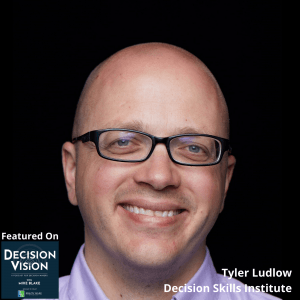
Decision making skills are vital for any successful business owner. In this edition of “Decision Vision,” decision scientist Tyler Ludlow joins host Mike Blake to discuss the process for making good decisions and much more. “Decision Vision” is presented by Brady Ware & Company.

Decision Skills Institute

The Institute helps people that might otherwise might be overwhelmed by complexity, stress, or worry, to overcome them and take action. We took 50 years of cutting-edge research, applied for decades at the world’s most successful companies, and created a framework that empowers individuals to consistently make better decisions, leading to better results, faster. We are the Robin Hoods of Decision Science!

Tyler Ludlow, Founder and Chief Decision Scientist, Decision Skills Institute

As a decision scientist, Tyler Ludlow helps people everywhere turn decision burdens into opportunities for growth.

He began his Decision Science career at Unilever, part of the team that won the 2008 DAS Practice Award for embedding DA into organizational decision making.  Two years later Chevron won the same award prior to receiving the first Raiffa-Howard Award for Organizational Decision Quality in 2014.  Meanwhile, Tyler joined Lilly in 2012 and was a part of the team that received the Raiffa-Howard Award in 2016.

At Lilly he facilitated large, complex, and strategic decisions, such as a $750M clinical trial investment and corporate change initiatives that structurally changed the business.  Tyler has trained over a thousand business leaders and managers in basic and advanced decision science applications, always with a practice-oriented, how-can-I-actually-use-this-stuff mindset.  He is now the owner at Decision Science Advisory, a company focused on establishing and strengthening decision expertise groups in the pharmaceutical industry.

After a decade of helping senior leaders and organizations make large, complex, and strategic decisions, he turned his focus to individual and personal contexts.  He established and led Lilly’s efforts to support and enable better decision making between patients and their healthcare providers, including creating the Shared Decision Making Summit, an event that brings together stakeholders from across healthcare (patients, caregivers, advocates, providers, researchers, pharma companies, regulators, etc) to identify practical ways to collectively change and improve healthcare decision making.  He founded the Decision Skills Institute to make cutting-edge decision science accessible to everyone.  It’s mission is to make the world more deciderate by impacting 10 million decisions in 10 years.

At home, he with his wife try to apply decision science in one of the most difficult contexts – in parenting their ten children.

Michael Blake, Brady Ware & Company

Mike Blake, Host of the “Decision Vision” podcast series

Michael Blake is Host of the “Decision Vision” podcast series and a Director of Brady Ware & Company. Mike specializes in the valuation of intellectual property-driven firms, such as software firms, aerospace firms and professional services firms, most frequently in the capacity as a transaction advisor, helping clients obtain great outcomes from complex transaction opportunities. He is also a specialist in the appraisal of intellectual properties as stand-alone assets, such as software, trade secrets, and patents.

Mike has been a full-time business appraiser for 13 years with public accounting firms, boutique business appraisal firms, and an owner of his own firm. Prior to that, he spent 8 years in venture capital and investment banking, including transactions in the U.S., Israel, Russia, Ukraine, and Belarus.

Brady Ware & Company

Brady Ware & Company is a regional full-service accounting and advisory firm which helps businesses and entrepreneurs make visions a reality. Brady Ware services clients nationally from its offices in Alpharetta, GA; Columbus and Dayton, OH; and Richmond, IN. The firm is growth minded, committed to the regions in which they operate, and most importantly, they make significant investments in their people and service offerings to meet the changing financial needs of those they are privileged to serve. The firm is dedicated to providing results that make a difference for its clients.

Decision Vision Podcast Series

“Decision Vision” is a podcast covering topics and issues facing small business owners and connecting them with solutions from leading experts. This series is presented by Brady Ware & Company. If you are a decision maker for a small business, we’d love to hear from you. Contact us at decisionvision@bradyware.com and make sure to listen to every Thursday to the “Decision Vision” podcast.

Past episodes of “Decision Vision” can be found at decisionvisionpodcast.com. “Decision Vision” is produced and broadcast by the North Fulton studio of Business RadioX®.

Visit Brady Ware & Company on social media:

LinkedIn:  https://www.linkedin.com/company/brady-ware/

Facebook: https://www.facebook.com/bradywareCPAs/

Twitter: https://twitter.com/BradyWare

Instagram: https://www.instagram.com/bradywarecompany/

Show Transcript

Intro: [00:00:01] Welcome to Decision Vision, a podcast series focusing on critical business decisions. Brought to you by Brady Ware & Company. Brady Ware is a regional full-service accounting and advisory firm that helps businesses and entrepreneurs make visions a reality.

Mike Blake: [00:00:21] And welcome to Decision Vision, a podcast giving you, the listener, clear vision to make great decisions. In each episode, we discuss the process of decision making on a different topic from the business owner’s or executive’s perspective. We aren’t necessarily telling you what to do, but we can put you in a position to make an informed decision on your own and understand when you might need help along the way.

Mike Blake: [00:00:41] My name is Mike Blake and I’m your host for today’s program. I’m a director at Brady Ware & Company, a full-service accounting firm based in Dayton, Ohio, with offices in Dayton, Columbus, Ohio, Richmond, Indiana, and Alpharetta, Georgia. Brady Ware is sponsoring this podcast, which is being recorded in Atlanta for social distancing protocols. If you like this podcast, please subscribe on your favorite podcast aggregator. And please consider leaving a review of the podcast as well.

Mike Blake: [00:01:09] So today’s topic is a little bit of a meta topic. And by meta, what I mean is that, this podcast is called Decision Vision. And for the most part, the topics have involved exploring the process of making a decision on a particular topic. We’ve gotten more granular and topical from time to time because events warranted it, or I just thought it was interesting, or, quite frankly, because the conversation needed to be more tactical, particularly during the onset of the coronavirus pandemic. But today we’re going to kind of go out in a different direction and explore the process of making good decisions.

Mike Blake: [00:01:58] And I think we’re going to do a series of these over time that explore different facets of making a good decision generally. And how to develop a good decision-making skill set. And I was kind of inspired by this, of all things a MasterClass video. And if you spend any time on YouTube, for some reason, your MasterClass will throw up a commercial on YouTube. And by the way, those things are fantastic. I watch the commercials – just the commercials. They are so good.

Mike Blake: [00:02:36] But anyway, they had this thing by Garry Kasparov, who is a world chess champion and a dominant player for a very long time. And he has a MasterClass on chess playing. And I used to play chess competitively. I don’t anymore. I’m too old and I do other things now. But one of the things that he said about the value of the game of chess, I thought it was so insightful. And for all the games I played and all that I’ve studied about the game, I never really understood this. It’s that the game of chess makes you a better decision maker. Because the game of chess is about making decisions. It is a process of making decisions and thinking ahead. And not just thinking ahead, but also having to decide, you know, “Do I move this piece here? This piece there? Do I capture this piece? Don’t I not capture this piece?” And every move is a decision. And I thought, “Wow. That’s really neat and profound.” I didn’t waste all that time in college and high school playing chess.

Mike Blake: [00:03:42] And so, a few weeks ago, I ran into this fellow – rather he was introduced to me by Brian Falony, who’s our marketing director here at Brady Ware. And he’s a specialist on making decisions. And a specialist on making a decision in one particular facet that I find excruciatingly interesting. And I know that’s a strange turn of phrase. But it really is that. And that is, the use of data in making decisions. And, you know, data is all now. It really has been for about ten years or so. Everybody is listening to this podcast or at least 98 percent of you, I’m sure, have heard the term big data. Most of you probably has a pretty good idea as to what it means, has a handle on it.

Mike Blake: [00:04:42] But what do you do with that? Right? And is big data for me? I happen to be a numbers geek. I do numbers for a living. So, I have some training in data analytics. But a lot of people don’t. And data analytics was really not taught in business school any meaningful way until about 10, 15 years ago, with the exception of some very specialized programs, for example, at Georgia Tech.

Mike Blake: [00:05:10] And on top of that – and this will probably be another topic that I’d do at some point – but for those who know me or listen to the podcast, you know, I do a lot of work with startups. And I can’t tell you how many times somebody pitches me a deal and they say, “Our business model is data. And we’re going to sell that data to folks that want to use that data.” But then you sort of get into it, “Well, how do you do that?” Or, “What’s the data worth?” Or, “What’s the business that even sell data?” And very quickly that conversation goes from smooth sailing to running a ground in about 19 icebergs and a rocky shore. Because data is so – oddly enough, data for something that is designed to be very specific. Once you really sort of get down to brass tacks, you try to convert the — into useful, actionable business strategy. It’s not all that easy to do.

Mike Blake: [00:06:10] And so, helping us with that is my new friend, Tyler Ludlow, who is Founder and Chief Decision Scientist of Decision Skills Institute. After earning a Degree in Applied Mathematics and an MBA, Tyler studied Decision Science at Stanford University. He then mastered its application at Global 500 companies leading decisions for $750 million investment, a global product launch, and more. Tyler has worked with top universities such as Stanford, Yale, and Dartmouth, as well as 18 of the top 20 pharmaceutical companies.

Mike Blake: [00:06:45] After a decade in those contexts, Tyler decided to pull a Robin Hood at decision science and founded the Decisions Skills Institute to bring it to people everywhere. He helps people like you turn your decision burdens into opportunities for growth. Tyler’s best decisions were marrying his wife and having their ten children. That’s not a typo. I may have to go into that as well. Talk about a recidivist. Together they enjoy the outdoors. I’ll bet you do this. No space for anybody. Hiking, backpacking, rafting, ice climbing, etc. Tyler, thanks so much for coming on the program and welcome.

Tyler Ludlow: [00:07:21] Hey, thank you. I’m glad to be here.

Mike Blake: [00:07:24] Ten children?

Tyler Ludlow: [00:07:27] Yes. And actually, I had to recently update that description. A couple months ago, it used to be nine but we have a little two-month-old.

Mike Blake: [00:07:34] Well, congratulations. Are you guys like The Partridge Family and you just drive around in an old school bus or what?

Tyler Ludlow: [00:07:42] We haven’t owned a regular vehicle in a long time, that’s for sure. Yeah. No. But we love it. We love it. They’re great kids. They’re awesome. It’s a lot of fun. It’s a party.

Mike Blake: [00:07:54] I mean, do all ten still live at home? I mean, some must be out of the house by now.

Tyler Ludlow: [00:07:59] Our oldest is 21 and he has an interesting life that kid. His senior year of high school, he did a computer full-time programming bootcamp, three=month program thing. So, he’s had a full=time professional career job as a developer at Geico for two years now. And is looking to buy his first house shortly. So, he’ll be moving out. And then our 19-year-old will be moving out shortly. But we go down every two years or so down to – well, down to our newest. So, we still have a full house at the moment.

Mike Blake: [00:08:39] Well, that’s neat. And you now hold the official Decision Vision podcast record for most children. The previous record holder was Tom Brooks, who came on, I think, somewhere in the thirties for this show. And he has eight. And I thought that record was a stand, frankly, for a lot longer than it did. So, congratulations. I know that this acknowledgement makes the whole thing worthwhile, I’m sure.

Tyler Ludlow: [00:09:05] Absolutely. Absolutely.

Mike Blake: [00:09:08] Wow. Okay. Well, that could be a separate podcast. But I did promise our audience we would talk about big data decisions, so we will transfer back to that. So, Tyler, let’s start off. What makes for a good decision? How do you know if a decision that you made is a good decision?

Tyler Ludlow: [00:09:33] That’s a great question. You know, actually, that exact question many times when I speak at an event or do a workshop, I will start with that question prompt. And use a Q&A response and then I can record everyone’s ideas. And what I find when most people answer that question, the most common theme is that I got what I wanted. They got good results. It’s something about the outcomes.

Tyler Ludlow: [00:10:02] I think it’s interesting in the corporate settings where a lot of decisions are made by committee or by group. The number two thing that I see come up is, everyone agrees on it. Everyone’s on board or something like that, which I think most of us could envision we can make a good decision. And sometimes the best decision, everyone doesn’t agree with. And as well as you can make a good decision and have bad results and have a bad outcome.

Tyler Ludlow: [00:10:33] I can also talk about kids and what not. I mean, I can’t remember the number of times where I didn’t study for a test. Which I think normally will be considered a bad decision. And still ended up getting a good or decent grade on. so that’s a good outcome. So, the key to me in answering this question is, first, being able to decouple or detangle decisions and their results or their outcomes. And to realize that we’re talking about what makes a good decision. It’s, we want to focus in on making good decisions regardless of the outcomes. Recognizing that better outcomes happen more frequently when we make good decisions.

Mike Blake: [00:11:18] And I want to spend a little bit of time on that point, because you can, in fact, have a good outcome from a bad decision, can’t you?

Tyler Ludlow: [00:11:30] Oh, yeah, yeah.

Mike Blake: [00:11:30] Right. Well, let’s-

Tyler Ludlow: [00:11:30] People notice all the time.

Mike Blake: [00:11:33] Well, they do. But take an extreme example. Let say that, a person decided that for whatever reason, they would start using drugs. And in the course of using drugs, they met another user that led to a fantastic professional opportunity. And it made them very wealthy. It made them very successful. And maybe that even led to a scenario in which they went into rehab and got off the drugs. But you’d never tell somebody to go start using drugs because that’s the path to success.

Tyler Ludlow: [00:12:12] Right. Right.

Mike Blake: [00:12:12] And I think one of the things that makes the – one of the things that makes a decision good versus bad is separating kind of process from luck. When you make a decision, the goal, I think, is to control as much of the outcome as possible. Because you control how much you just sort of stacked the deck in your favor as opposed to whether or not there is actually a good outcome.

Tyler Ludlow: [00:12:42] Yeah. There’s a lot about – I love the way you kind of separate out process. There’s the process that you use to make the decision. And then there’s sort of the moment that you decide. And then there’s all the other implementations, so to speak, putting it into action that happens down the road. And we can do all sorts of things to influence the outcome or mitigate certain risks or whatnot that help better results to show it more frequently. Usually we can’t guarantee it. That’s what makes life so interesting and exciting and fun. I mean, that’s what makes it all that variety. It also is what brings us all the stress and the worry so much about these things in the future.

Tyler Ludlow: [00:13:21] But, yeah, we do what we can at the moment that we make the decision. Then, we do our best, again, to stick to it, implement, adjust all those things afterwards. But it’s not the actual outcome itself that should be our measuring stick for whether we made a good choice or not.

Mike Blake: [00:13:37] Now, could the definition be modified, maybe if you have a process that’s leading to lots of good outcomes? Maybe that’s a way to kind of think about it, is if you have a good decision process, over time you should have better outcomes than the person that has the poorer decision process. And then that gets into basic statistical analysis that, over time as your sample size gets greater, your expected outcomes should start to match your actual outcomes from your sample size.

Tyler Ludlow: [00:14:15] Yes. Absolutely. On the nose. I tend to use the phrasing of better outcomes more frequently. You’re never guaranteed on one to be better off. But you’re right, as you make more overtime, you should be better off. Yes, absolutely.

Mike Blake: [00:14:28] So, you’re approaching decision making from a data perspective, which I love. I wish people that did what I do for a living would approach things from a more rigorous data perspective as well. But again, that’s another podcast. You know, everything is about big data and artificial intelligence now. And we sort of have this healthy sprinkling of block chain as well somewhere in there. Why aren’t we just turning everything over to robots, some websites, at this point to make our decisions?

Tyler Ludlow: [00:15:05] That’s a good question, because we probably should be turning more – we’re learning that we can be turning more and more over. So, why do we not just turn it all over? I think there’s a few reasons. One, for example, just last week, I attended a virtual conference. And it was on decision making. And at that conference, there was a session on the merging or the integration of data science and decision science.

Tyler Ludlow: [00:15:34] And one of the presenters was this gentleman who was a data scientist. And he had sort of a framework, a model, slides, some pictures, graphics that he was showing. And it was really intriguing because he showed how, from a data science perspective, one of the features that big data provides is identifying problems or opportunities. I mean, it’s seeing the patterns that we, as humans, don’t. Our brains can’t handle all that.

Tyler Ludlow: [00:16:07] And those are, I think, potential opportunities. Because I think the key – we talked about decision making process in general. I think the place that most of us go wrong is that most folks will see decision making as, “I go collect some data. I analyze it. And make a decision.” And where that cynically can go wrong is that you get the right answer to the wrong problem. That you’re not really tackling. That you’re not framing. Taking some time to sort of frame that decision. You know, what is this? What’s my main objective? What’s most important to me? Just kind of early insight and all that kind of stuff.

Tyler Ludlow: [00:16:43] And I think that is one of the opportunities to blend data – what you call it data science or big data or whatever. But data with decision making is, one, identifying the opportunities. Sometimes we don’t see those. I think big machine learning AI can bring up opportunities. So, I think that’s one way that it can help in that mix to make classic definition of being able to decide.

Tyler Ludlow: [00:17:11] Even the root of the word to decide comes from decision. You can hear it in sort of the root of the word scissors. I think they both come from the same root in Greek or Latin. And so, it’s about cutting off all options except one that then you move forward with. And that’s what a decision is. To select that best alternative, the measuring stick is what we care about. It’s the value criteria that are important to us. And AI can’t tell us that. We have to get clear on what we want. And that’s part of – I mean, AI can do it. Machinery can do a lot to learn how to find that in the data and get better at spotting a cat in the picture or other more important things. But to be clear about what’s important in the beginning and what we’re driving after, let alone to take these opportunities and then say, “Yes. This is one that we want to move after and frame that decision.” I think that’s where the humans are needed.

Mike Blake: [00:18:16] Now, I think there’s a misconception that all of a sudden data matters as if nobody used any data before to rely on making important decisions. Right?

Tyler Ludlow: [00:18:27] Right.

Mike Blake: [00:18:27] And so, it’s a misconception to say that data hasn’t been around or hasn’t been driving decisions for a long time. But what’s different now? What has changed where data is now sort of a top of mind, very much kind of vote set, if you will, a decision tool that’s available.

Tyler Ludlow: [00:18:54] Well, I think it’s just the last word that you used, availability. Something being available. I think that’s one of the biggest keys. I mean, you could layer onto that computing power, right? The ability to be able to do something with it, to make sense of it, especially to be able to make sense of it in a timely fashion. Often we don’t control the time bounds of the decisions in which we need to – that we need to make. I can think, you know, we’ve done a lot over the years with stochastic simulation or Monte Carlo simulation, being able to use a computer to do that. The theory and the thought of how that would be valuable existed before the computing power. And even in the early days, it could be done on big behemoth processors.

Tyler Ludlow: [00:19:37] But to be able to put that at people’s fingertips, I mean, I’ve worked on projects where it was, you know, all of that rocket science, so to speak, gets embedded under the hood. And the decision makers, they’re not even going to an expert anymore to work with it. It’s just happening at their fingertips. They’re getting almost instantaneous looks at distributions of potential future outcomes and then being able to make their decision about whether to go forward or not

Tyler Ludlow: [00:20:01] So, I think the availability of the data, like as you asked your question, I was thinking how a company that I used to work at, a pharma company. Every drug that we had, every molecule that we had for every potential disease that it might be efficacious in, we would do an assessment of the likelihood of it being able to clear each of its clinical study hurdles on its way to potentially being approved. And so, it’s an assessment about the future.

Tyler Ludlow: [00:20:33] And historical data in the past might be informative, but there’s a lot of subjective information about current science, regulatory stuff, and all sorts of things that we’re looking towards the future. One reason why we relied so much on subjective assessment in that process is because there wasn’t available data to be able to aggregate. That’s happening. That’s changing in more and more places where you get the data available. And then you have the computational power to make sense of it in a timeframe that’s useful for the decision maker. I think those are some of the big keys.

Mike Blake: [00:21:09] You know the Monte Carlo tools are now so powerful. And I found out with my clients to be so eye opening. I’m fortunate, I kind of made a commitment to learn that kind of modeling a long time ago. And in addition to having it sort of generate referrals for my competitors who aren’t really very comfortable doing that. When you are able to show a client not a static outcome, like a forecast, for example, or three or four forecasts based on best case scenario, worst case, middle case, scenario. That stuff drives me crazy. But instead, with Monte Carlo, you’re able to show people a full range of potential outcomes. And literally show an image that paints a picture of the distribution to show kind of the relative trade=off between likelihood of outcome and extreme amount of outcome, basically.

Mike Blake: [00:22:12] And at first my client thought it was witchcraft. But once I sort of explained to them that, “No. It’s not witchcraft. But it is different.” There’s just so much there. And I don’t think Monte Carlo simulation and the tools that enable it, they don’t get enough credit in terms of how much that can and is starting to revolutionize decision making.

Tyler Ludlow: [00:22:36] Yeah. Yeah. Dead on. And as you were talking, I was just thinking, “This is just timely.” Just last night three of my boys were playing Risk together, 19-year-old, my 14-year-old, and my nine year old. And a week or so – it may have been during this conference that I mentioned that was attending. You know, we were looking all this at remodeling stuff. And I had this idea that I should teach my kids just the concepts of Monte Carlo simulation. And I thought, it’s been a little while since we played a game of Risk. I’ll teach them to use it in Risk. And I’ll show, “Hey, you can look at these different strategies. Should I attack one country to the other? There’s a best case. There’s the worst case. There’s an average.” But it’s really the distribution of potential outcomes that you want to make your strategy based off of.

Tyler Ludlow: [00:23:23] And so, it just so happened they started their own game last night. And so, they’re partway through when I walked in. And I said, “Hey, guys. I’m going to interrupt your game a little bit. I’m going to teach you this thing called Monte Carlo simulation.” We homeschool our kids so they’re okay with a little bit of mom and dad interrupting life to do some teaching. So, we did that. And we talked, like, 15, 20 minutes. I just gave them the concepts. I showed them the loop sheets engine. That was a very light Monte Carlo engine. And they all got it. In fact, my nine-year-old was the most excited about it because he usually gets pounced on by his older brothers when he plays. But he was like, “I can have this little magic crystal ball type spreadsheet that can give me an idea of how successful I might be. That’s really cool, dad.

Tyler Ludlow: [00:24:11] So, it went better than I thought it would. But it made me think kind of like your last comments, you know, as we keep moving forward and people become more fluent in these sorts of techniques and data and in the use of it, even if they’re not a data scientist, just the usage of it, I think it will dramatically inform and increase the quality of our decision making.

Mike Blake: [00:24:35] So, what is it that makes data big? How did data go from being data to big data?

Tyler Ludlow: [00:24:42] Good question. Well, certainly back to maybe a little bit of this availability piece and the ubiquitousness of that availability. A lot of it having to do with databases becoming more proliferated in all different areas of our business. Things being more trackable so that they leave behind a database trail. And then the ability to share that data between systems. I mean, even just the analysis that we’re talking about doing, even if that analysis was possible processor-wise, and the data existed to do it with, you still have to then get the data into the system that’s going to do the analysis.

Tyler Ludlow: [00:25:27] And whether that’s an engine like Excel or add-ons into it or it’s a bespoke piece of software, the interoperability – so the availability, the ubiquitousness of that, and the interoperability of that, sharing of that data – to get it to the points where it’s gets closer to that point in time where the decision is being made or being looked into. To me, those are some of the key things that had it go from data to big data.

Tyler Ludlow: [00:25:58] I think one of the big challenges is how do you make big sense from big data? Now, we’re swimming in it. We’re swimming in this stuff. And how do you then use that in a timely fashion to actually make sense of it where it’s not a block box. Where you understand the story that’s being told. And you could communicate to somebody else this is why we’re doing it this way. As opposed to just, “Hey, this machine told me I don’t know that type things.

Mike Blake: [00:26:27] Can every business benefit from using data to drive decisions or maybe using it more than they already do?

Tyler Ludlow: [00:26:39] So, I think the answer is yes. But that’s kind of the answer that most people would expect. But then I think the cynics are rightly so in thinking, “Really? Like, everyone? All of us? Even some of these small entrepreneurs, small business folks?” Which, I think, that sort of pushback is good. So, I think the answer is yes in the right way.

Tyler Ludlow: [00:27:04] One of the biggest challenges, I think, we have in smaller organizations down to our personal lives – I think that’s the smallest organization, me and my individual life. One of the biggest challenges, I think, we have is learning how to press the pause button and reflect a little bit before we make a decision. And not just be in the flow of everything else that’s going on. And creating an opportunity like almost creating that fork in the road. And then saying, “Hey, I’m going to do something about it.” Sometimes in the moment when we’re going down the river, we don’t have the ability to necessarily make – take much time and make a decision about which fork in the river we’re going to go down just because of how fast the current is.

Tyler Ludlow: [00:27:54] So, in the moment, I think, there’s one answer about when is it appropriate to use big data and when do you just not have the time or the resources to make it makes sense. But the frequency with which it is useful goes up if we learn how to press the pause button. If we learn to sort of pre-think some of our decisions in a more strategic fashion. Rather than being so reactionary when they actually come up. And so I think in times like this, we get have a little bit of time to reflective. It provides more of an opportunity to go out and get your hands on and do something with that big data. And then once you’ve kind of pre-made that strategic decision, it might pop up here there, here there as you’re running down the river, so to speak.

Mike Blake: [00:28:38] You know, I think that last point is really smart. And I know we didn’t bring you on here to talk about the psychology of decision making. And I’m going to make a topic out of that at some point. But that pressing the pause button before you make a decision, I think I found to be so helpful. If there’s one thing that I’ve learned over my career that has made me a better decision maker, is to push pause and realize that most decisions I need to make in business are not snap decisions. Nobody expects me to make a snap decision. And there is something to taking a morning, or an afternoon, or sleeping on something, or even a weekend to make a decision that just leads to much better – just better outcomes.

Tyler Ludlow: [00:29:26] Yeah. I remember I was approached to help develop a training for, like, 3,000 thousand employees at large companies to work at. And the whole point of that training, it wasn’t around how do you make really big strategic decisions. Which was the normal place that my day job was. It was within the organization. It was about how to help employees think about just taking 15 or 20 minutes to stop and just jot down a few notes. Think through or a little bit of reflection before making that next sort of day to day – thoughtful day to day decision. So you’re absolutely right, learning to be able to do that is one of the biggest challenges. Having a great decision process is fantastic. But if you never take the time to actually deploy it, you’re missing out on it’s value.

Mike Blake: [00:30:19] Yeah. I mean, it’s rare in business that you really have to make wady snap decisions like that. We’re not in the military, so we don’t have to start moving troops around, otherwise people die. It’s like, “Okay. Well, this problem is going to be here.” As long as not using it to avoid the problem, right? There’s something to be said for sort of taking your time and perspective and adding some intellectual capital.

Mike Blake: [00:30:46] One of the things I hear about data and I hear people offer a lot of misgivings – I’m somewhat sympathetic to this argument – is that complete data is almost never reality. And can you fall into a trap of striving to collect that last bit of information that you just never actually make a decision? And then what’s that inflection point? Can you talk through what that inflection point kind of looks like or even feels like? Or you just need to say, “Okay. I’ve got enough. I’m never going to get a sure thing.” But in terms of kind of cost benefit, this is as much as I’m going to get. How do you figure that out?

Tyler Ludlow: [00:31:35] So, yeah. Great question. And I think my answer to it all come from, essentially, just building on the previous little discussion point that we had about pressing the pause button. Or the language that we use is to declare a decision. So, when you declare that decision, there’s some time that you take to say, “What’s my overall objective here? What am I trying to achieve? What are the alternatives I have on the table?” One of the biggest mistakes that people make is that they’ll frame up decisions as being, “Do I do this? Yes or no. Should I do X or Y?” Rather than being able to go sort of a step above that and say, “You know what? How do I frame these questions so I can look at a myriad of alternatives?

Tyler Ludlow: [00:32:24] One of the other mistakes that folks make is that there’s sort of some descriptive titles here. People tend to be alternative focused in their decision making rather than value focused. And what that means is, if you’re going to buy a car or something, you show up at the lot and you start looking at the alternatives, the vehicles that are available to you. And you start looking at the differences between them, horsepower, miles per gallon, leathers, whatever, the trim packages, whatever they have.

Tyler Ludlow: [00:32:56] Rather than being clear about what it is that you’re looking for, what’s important to you. Going in and only starting to look at the value focused side of it. And only going in and saying, “Okay. This is what we’re looking for. How do the options compare?” Even to the point where you’re saying, “I only want to look at options that meet these criteria.”

Tyler Ludlow: [00:33:17] So, when it comes to the data, I think the connection there is that – I’ll give an example aside from car buying. One is apropos. We work with all these kids. We’ve got a bunch of teenagers. And we were looking at another vehicle for the kids, primarily, to drive. So, I’m looking at getting a used vehicle. And I’m trying to think, “Well, what is it that we’re looking at?” If I open the Auto Trader app, there’s a couple hundred thousand vehicles. So, I specify and it needs to be under 150,000 miles. It needs to be $7,000 or less. It needs to have four or five criteria. And from that, we ended up with 14 cars that were nearby. And so, that was really easy then to start sifting through.

Tyler Ludlow: [00:33:58] And I’m not distracted by all of the other pieces of information about this vehicle. I’ve been thoughtful and say, for us, it’s the kids driving. So, it’s miles per gallon because we want them to get to good places. We might use it on long tripe, so we’re looking for leather seats for comfort. And I didn’t want it to break. I wanted it to be cheaper, but not start breaking down the next month, so some limit on the number of miles. And everything else beyond that was not all that important.

Tyler Ludlow: [00:34:28] So, I think that the first key to not being overwhelmed with data and decision making and the wrong one and getting too much is being really clear about what’s important to us. What are the criteria that we’re going to use to make the decision? And those are the only things I needed to go and gather data about or the unknowns that affect that data. I might go, can do some market research to forecast my revenue, which is going to impact my profit. And that’s what I’m basing my decision on or something.

Tyler Ludlow: [00:35:00] So, I think one is gaining clarity of those value criteria ahead of time. So, people that market stuff, like back to the car buying example, the sales guy on the lot is going to want to tell me up and down about these cars. I really only care about the information that matters to me helping to distinguish between my preferred alternative. I don’t really need all the other information. I just need my stuff. So, I think the biggest key is to be clear about our value criteria ahead of time, so that we don’t get distracted with all of the possible data that’s out there. We zero in on what’s really important to us.

Tyler Ludlow: [00:35:40] And then we get clear about saying, “Hey, is the cost of going out and getting that extra data, is that worth the additional insight that it might provide?” And the answer is not always yes. We tend to sometimes take comfort in saying, “Oh, I’ll just go get more data and more data and more data.” Even if it is data that informs my value criteria. It might not be worth it in the time or the cost that it takes to get it relative to the benefit of the additional insight that it might provide.

Mike Blake: [00:36:09] So, on the flip side of this question, I want to ask, is there value to even having a relatively small amount of data? Let’s say that you’re – I don’t know – a food truck. And you may have a very limited amount of data. Perhaps no more than simply your receipts in your inventory. And maybe you have a little bit more. But can good decisions be made on a small amount of data? Or maybe better put, on a fairly incomplete data set.

Tyler Ludlow: [00:36:46] Yes. Yes, they can. And as you’ve kind of alluded to, sometimes that’s all you have. There are some times that that’s all you could reasonably get your hands on or might be affordable to get your hands on, so to speak. And I think this is where coming back to, again, sort of framing up that decision. One of the next pieces of that is saying, “Well, what are the key unknowns that could really drive my outcome scenarios to be really good or really bad?” Like, we talked about this Monte Carlo simulations that range with its potential outcomes. So, what are the factors that really are key to that?

Tyler Ludlow: [00:37:25] So, I’ll give you an example. Years ago, I used to work for a company that did a lot of home, personal care, and food products. And so, some of those would be manufactured in big warehouses. So, we might have a huge product launch. I mean, we’re working on a product launch of a new laundry crystal. So, it was something. It wasn’t sort of a laundry powder nor was it the liquid. It was these crystal things. They were new. They were looking onto this. And it required a new manufacturing line. So, that huge capital expenditure was in the hundreds of millions of dollars. And as you looked at the overall revenue for the project, that was impactful. But it actually had a very – because that was very controlled, we knew a lot about it, it had a very small range of uncertainty around it. Whereas, the range of uncertainty around our market share was much more uncertain.

Tyler Ludlow: [00:38:17] And so, for us to go out and get that data was even a small bit would be super helpful. Whereas, the data on the CAPEX side didn’t provide sort of the benefit or as much benefit. So, having a clear idea of what are the key factors that could really swing my outcomes in one direction or the other. Again, that’s important to know beforehand. And then if you have one of those key factors that you have, even just a little insight on, a little data can go a long way. I mean, if you know nothing about something happening or not, you essentially have a 50-50 chance. But if you just get a little data that helps you to know, hey, it’s more 60-40 than 50-50. The relative value of that uncertainty, you’ve just shrunk that uncertainty by 20 percent. So, that relative value of that little piece of information can be super valuable.

Mike Blake: [00:39:18] So, one of the things I’m sure our listeners are concerned about and I’ve asked before is, “Look, this sounds great. But I don’t have Tyler’s massive education and data analytics. I don’t even have Blake’s sort of back of the envelope iPhone calculator level of data analytics.” Do you need to be a statistician or have one on your staff sort of full time in order to use big data?

Tyler Ludlow: [00:39:49] No. No – I mean, yes. This goes back to the question of should every company use it, right? If you can pick and deploy, there will be times where you want to invest more heavily in it. And times, where you invest less, I believe. And this goes back a little bit to being able to press the pause button and insert, maybe, some strategic decisions. When the time is right, you might buy into it a little bit more than not. But the basic process of being able to be recognizing how to plug data in, how it can create value, give you insight, in particular about unknowns into the future, that sort of process and principle can always be applied.

Tyler Ludlow: [00:40:30] One of the things that we teach in our workshops is how to use something that we call decision archetypes, which is a way to say there’s these simple patterns that show up over and over again in decision making that hinge on these uncertainties. And if you can just start to get a read on the ballpark, sometimes all you really need to know to make the decision is which side of the fence you’re on. You don’t necessarily know how far away from the fence you are to an exact team. At times, it’s nice to know that exact distance from the fence. But as long as I know which side of the fence I’m sitting on, then I know how to decide and how to move forward.

Tyler Ludlow: [00:41:11] And so, sometimes, just like you’re talking just a little bit of data or a little bit of – if you’re going back to your question was about, “Hey, do I need all of the analytical chops?” No. Having a process that allows you to do a little bit quickly could take and just – you know, got to take a little bit of learning. But it’s not overly complex, no.

Mike Blake: [00:41:31] We’re talking with Tyler Ludlow of Decision Skills Institute. And we’re sort of running out of time here. But a couple of questions I want to make sure we get to. One is, if I’m a small company, you know, I have limited resources. What are some tips to, maybe, at least amp up my data access or collecting game? Are there some easy things maybe a lot of companies could be doing that are not in order just to, maybe, capture more data they already have or access data, maybe, they don’t know exists? It doesn’t completely upend their entire cost structure.

Tyler Ludlow: [00:42:11] That’s a good question. I’m going to answer it in a slightly – I hope it isn’t in a field to dodging the question to your listeners. I want to say, first, I think the key is to be thoughtful about the decisions that you currently make. The bigger ones, the ones that you’re already taking some time and thought for. And to take the time to say what bits of data or information, if we knew better, might really impact our ability to make that decision in a more quality manner.

Tyler Ludlow: [00:42:48] This goes back to maybe sort of the alternative focus versus value focus bit. Before you start just collecting data, because that’s the style and the fad, I think having clarity about what data would be most meaningful is probably the first thing. And then you can set some very simple strategies to start with of being able to either collect or get your hands on that specific data at the right time. Especially if you’re a small business, and we think about collecting data off of your own processes, that can be an expensive sort of thing to put in a program, a collection program like that. Let alone in the moment. Sometimes it takes longer to do a process in a way that it’s completely trackable afterwards. So, those are investments that you’re making.

Tyler Ludlow: [00:43:39] You want to make sure you’re not doing those just because of fad. And because, “Hey, I know that if we start collecting this data, it will give us insight about this unknown.” And that can really drive our insight into potential outcomes in the future in which way we might go or things going forward. So, that would be my sort of – it’s a bit dodging the answer, but I would start with the bits of information that would be most useful.

Mike Blake: [00:44:03] I don’t think it dodges the answer. I mean, at the end of the day, kind of restating the answer back to you, I think, the answer is you may have to spend some money. Make an investment to extract the data that you already have. But it doesn’t sound like it’s a binary discussion where you either spend no money on it or you spend millions and millions of dollars on it. You can sort of snipe this and decide what data is the most important. And it could be, for some companies – you tell me if I’m wrong – some companies, just one data point or one data set makes all the difference.

Tyler Ludlow: [00:44:41] Yeah. Yeah.

Mike Blake: [00:44:42] Right? And that’s the leverage part you talked about.

Tyler Ludlow: [00:44:44] Absolutely. Absolutely. And I would say that – maybe building onto this – one of the most common themes that I tried to drive home to people when we do teaching and training and workshops and whatnot is that, we know more typically than we think we know about how things might be in the future. So, often, whether it’s scientists or whoever, I start working with someone to help make a decision, it will be clear that it kind of hinges on this one unknown. I’ll start asking about it and the response is, “Well, we don’t know, it could be anything.” Well, that’s true. What would be the height of the next person to walk through the door? Well, it could be anywhere.

Tyler Ludlow: [00:45:19] But you know what? I know it’s probably less than seven feet tall and more than four feet tall. And I could probably still go in narrower and narrower down there. And we tend to know more than we allow ourselves in first pass to think we know about something. And oftentimes just starting to put some reasonable boundaries on things, we realize we can get it into a space where we can then start deriving some insights about what we do. Rather than just saying, “Well, it could be anything. We don’t know until we bought some market research,” or whatever it might be. So, a lot of times you’ve got some of that insight just in our minds – in our heads because of our expertise and our experience.

Mike Blake: [00:45:56] Tyler, we are running out of time. And I have to let you go and do your many things. But I’m sure there are questions that our listeners have out of this discussion where they like to, maybe, ask you and get some expertise on it. Would you be willing to share your contact information if anybody wants to ask your question?

Tyler Ludlow: [00:46:13] Absolutely. If you want to follow up with me directly, my email is just Tyler@decisionskillsinstitute.com.

Mike Blake: [00:46:24] Well, great. That’s going to wrap it up for today’s program. I like to thank Tyler Ludlow, Decision Skills Institute, so much for joining us and sharing his expertise with us. We’ll be exploring a new topic each week, so please tune into so that when you’re faced with your next decision, you have clear vision when making it. If you enjoy this podcast, please consider leaving a review with your favorite podcast aggregator. It helps people find us, so that we can help them. Once again, this is Mike Blake. Our sponsor is Brady Ware & Company. And this has been the Decision Vision Podcast.

Tagged With: Brady Ware, Brady Ware & Company, business decisions, data, Decision Skills Institute, Decision Vision, decision-making, decisions, making decisions, Michael Blake, Mike Blake, Tyler Ludlow

Decision Vision Episode 73: Should I Sell to the Government? – An Interview with Sean Mahoney, Maston Space Systems

July 9, 2020 by John Ray

sell to the government
Decision Vision
Decision Vision Episode 73: Should I Sell to the Government? - An Interview with Sean Mahoney, Maston Space Systems
Loading
00:00 /
RSS Feed
Share
Link
Embed

Download file

sell to the government

Decision Vision Episode 73:  Should I Sell to the Government? – An Interview with Sean Mahoney, Maston Space Systems

If I decide to sell to the government, what are the challenges my business will face? Sean Mahoney of Maston Space Systems offers an experienced perspective on this question in this interview with host Mike Blake. “Decision Vision” is presented by Brady Ware & Company.

Masten Space Systems

Masten Space Systems is a private company founded in 2004 by CTO David Masten and has its headquarters in Mojave, CA.

Masten’s focus on reusable rocket technology is driven by the goal of enabling space transportation and reliable planetary landers for the Earth, Moon, Mars, and beyond. They are a passionate company of inventors, creators and builders with goals that include landing our own vehicle on the moon.

Masten competed in the NASA and Northrop Grumman Lunar Lander Challenge X Prize in 2009 with Xombie (model XA-0.1B). Xombie came away from the lunar lander challenge with an average landing accuracy of 6.3 inches qualifying it for Level One second prize of $150,000 on October 7th, 2009. The Xoie VTVL won the $1,000,000 Level Two prize of the Lunar Lander Challenge on October 30th, 2009 with an average landing accuracy of about 7.5 inches.  Masten’s future vehicles have improved this performance and landing accuracy to provide EDL and testbed flight services to customers through NASA’s Flight Opportunities program.

Sean Mahoney, CEO

Sean Mahoney is the CEO of Masten Space Systems, an aerospace R&D and flight services company that creates and deploys reliable, reusable rocket vehicles and components. Since joining Masten in 2010 as Director of Business Operations, Sean has focused on building a sustainable, customer-funded business. He has been instrumental in establishing Masten as one of the rising stars in the New Space movement. He served as COO during 2011-2012 and was named CEO in 2013.

Sean has over 15 years of corporate and technology industry experience, having founded and led a number of technology start-up ventures, and raised multiple rounds of private funding. Sean began his career overseeing technical sales and building internal organizations as a manager at AT&T’s Enterprise hosting division.

Sean received his MBA from Emory University’s Goizueta Business School and serves in a leadership capacity for a number of entrepreneurship and environmental non-profit organizations.

Michael Blake, Brady Ware & Company

Mike Blake, Host of the “Decision Vision” podcast series

Michael Blake is Host of the “Decision Vision” podcast series and a Director of Brady Ware & Company. Mike specializes in the valuation of intellectual property-driven firms, such as software firms, aerospace firms and professional services firms, most frequently in the capacity as a transaction advisor, helping clients obtain great outcomes from complex transaction opportunities. He is also a specialist in the appraisal of intellectual properties as stand-alone assets, such as software, trade secrets, and patents.

Mike has been a full-time business appraiser for 13 years with public accounting firms, boutique business appraisal firms, and an owner of his own firm. Prior to that, he spent 8 years in venture capital and investment banking, including transactions in the U.S., Israel, Russia, Ukraine, and Belarus.

Brady Ware & Company

Brady Ware & Company is a regional full-service accounting and advisory firm which helps businesses and entrepreneurs make visions a reality. Brady Ware services clients nationally from its offices in Alpharetta, GA; Columbus and Dayton, OH; and Richmond, IN. The firm is growth minded, committed to the regions in which they operate, and most importantly, they make significant investments in their people and service offerings to meet the changing financial needs of those they are privileged to serve. The firm is dedicated to providing results that make a difference for its clients.

Decision Vision Podcast Series

“Decision Vision” is a podcast covering topics and issues facing small business owners and connecting them with solutions from leading experts. This series is presented by Brady Ware & Company. If you are a decision maker for a small business, we’d love to hear from you. Contact us at decisionvision@bradyware.com and make sure to listen to every Thursday to the “Decision Vision” podcast.

Past episodes of “Decision Vision” can be found at decisionvisionpodcast.com. “Decision Vision” is produced and broadcast by the North Fulton studio of Business RadioX®.

Visit Brady Ware & Company on social media:

LinkedIn:  https://www.linkedin.com/company/brady-ware/

Facebook: https://www.facebook.com/bradywareCPAs/

Twitter: https://twitter.com/BradyWare

Instagram: https://www.instagram.com/bradywarecompany/

Show Transcript

Intro: [00:00:02] Welcome to Decision Vision, a podcast series focusing on critical business decisions. Brought to you by Brady Ware & Company. Brady Ware is a regional full-service accounting and advisory firm that helps businesses and entrepreneurs make visions a reality.

Mike Blake: [00:00:23] Welcome to Decision Vision, a podcast giving you, the listener, a clear vision to make great decisions. In each episode, we will discuss the process of decision making on a different topic from the business owner’s or executive’s perspective. We aren’t necessarily telling you what to do, but we can put you in a position to make an informed decision on your own and understand when you might need help along the way.

Mike Blake: [00:00:42] My name is Mike Blake and I’m your host for today’s program. I’m a director at Brady Ware & Company, a full-service accounting firm based in Dayton, Ohio, with offices in Dayton; Columbus, Ohio; Richmond, Indiana; and Alpharetta, Georgia. Brady Ware is sponsoring this podcast, which is being recorded in Atlanta for social distancing protocols. If you like this podcast, please subscribe on your favorite podcast aggregator. And please consider leaving a review of the podcast as well.

Mike Blake: [00:01:08] So, today’s topic is, should I sell to the government? And, you know, this is a topic I’ve wanted to do for a while. And I think it’s even more important now given the state of our economy. And again, the slow-moving horror movie continues that we hope we’re kind of reaching at least the final act of this thing. And, you know, I think that most companies, most business owners have thought about, you know, can I sell to the government? Should I sell to the government? And it’s certainly worth thinking about because I read somewhere that, in fact, the government does buy about 20 billion dollars of stuff every day. And that $20 billion of stuff includes things from pencils to laptops, to cars to airplanes. And as it also happens, spacecraft. More on that in a minute.

Mike Blake: [00:02:10] But I think many owners then don’t pursue the notion or the idea of selling to the government because they have some concept, or some preconceived notion, or some misapprehension of what it’s like to sell to the government and do business with the government. And maybe some of those things are true. Maybe some of those things are not. So, I think we’re going to do, maybe, today is do a little bit of myth busting. Because if you could afford to not try to sell to the government before, I think most companies now are in a position where you can’t afford to walk away from clients, even if they force you, maybe, to leave your comfort zone a bit in order to conclude a sale.

Mike Blake: [00:02:57] And to help us with that, I am bringing on a guest that I wanted to bring on for a while. He’s been harder to catch without a Taser and a butterfly net because he’s been busy building his company. But he’s a guy that I’m so excited to bring on. And I’m excited to really talk to him any opportunity I get because I’ve known him for a long time. I’ve known him since he’s been with his company. And, you know, I can tell you that right now – knock on wood. I don’t want to jinx him – but his company is enjoying some success. Believe me that the road to that success has been paid with broken glass. And he has crawled it both ways up and down the hill, however you want to express it.

Mike Blake: [00:03:45] And throughout that, I know that it’s been mentally, emotionally, physically challenging as an entrepreneur to do what he has done. And quite candidly, I think lesser men would have been broke and they would have given up. And he deserves all the credit. And he’s just – you know, through all that, he’s been authentic, he’s been nice, he’s been humble, and continues to be that way. And he’s just one of the most awesome dudes you’re ever gonna deal with. And just such an easy guy to root for. And when you listen to this, you’re going to hear that in his voice. So, you know, plan to take notes. If you’re listening to this while you’re driving, jogging, whatever, don’t take notes while you’re doing that. But plan to listen to this later. Or plan to go download the transcript, which is going to be on our website, bradyware.com. But this is going to be a good one.

Mike Blake: [00:04:46] And so, it is my absolute pleasure to introduce my friend, Sean Mahoney, who is the CEO of Masten Space Systems. It’s an aerospace research and development and flight service company that creates and deploys reliable, reusable rocket vehicles and components. Since joining Masten in 2010 as director of business operations, Sean is focused on building a sustainable, customer funded business. He has been instrumental in establishing Masten as one of the rising stars in the new space movement. He served as chief operating officer during 2011 and 2012. And was named chief executive officer in 2013. Sean has over 15 years of corporate and technology industry experience, having founded and led a number of technology startup ventures and raised multiple rounds of private funding.

Mike Blake: [00:05:33] Sean began his career overseeing technical sales and building internal organizations as a manager at AT&T’s Enterprise Hosting Division. Sean received his MBA from Emory University’s Goizueta Business School. And serves in a leadership capacity for a number of entrepreneurship and environmental non-profit organizations. Sean, thank you so much for coming on the program.

Sean Mahoney: [00:05:54] Mike, a real pleasure. Thanks to you for all of your support over the years. And thanks to folks there at Brady Ware for sponsoring this podcast and giving us a platform to talk about all this cool stuff, a little bit of space, a little bit of government, and a lot of sales. So, this is really cool. And I really appreciate the introduction. I hope to live up to the hype.

Mike Blake: [00:06:18] I think you will. This is not going to be a Batman movie for sure. But, you know, I would like – I don’t do it justice. And, in fact, I probably only know 30 percent of what you’ve gone through. But can you take a couple of minutes and sort of tell the Masten story? And I’ve hinted at your success. But, A, I want to do it justice. And B, I want to give you the opportunity to kind of express it. What is the Masten story and where are you guys now?

Sean Mahoney: [00:06:51] Yes. I will endeavor to give you a version of that that’s shorter than the 16-year history of the company. Let me just do one thing. I will tell you all about Masten, but I want to make sure just in case someone only listens this far. The one key takeaway for this whole government sales thing is, unlike perhaps other things where you just need to have someone who wants to buy a thing and they have the money to pay you, government sales requires having a third thing, which is the contract vehicle. There need to be a way to pay you that thing they want to buy. And if nothing else, maybe folks can take that away. But now, we’ll come back and explain what all that means. I just want to get that plugged in upfront.

Sean Mahoney: [00:07:46] So, I first encountered Masten hanging out down around Georgia Tech, the Technology Square. And honestly, it was a true networking breakfast that I attended on a fairly regular basis hosted by Stephen Fleming, who used to run ATDC and a bunch of stuff there in Tech Square. And the conversations in this open breakfast were really just about anything. It was about different startups and what they were doing. And there was usually some football talk and usually some Georgia Tech rivalry stuff, some politics.

Sean Mahoney: [00:08:28] And then every Monday morning, this conversation would eventually turn to the topic of discussing space. And there would be a 15-minute conversation about space policy. Because there were some space, not only enthusiasts, but people who were active in the space world. Stephen Fleming, Mike Mealing, Colin Ake, and others that we’re interested in working in space. And I used to believe it was the funniest thing. I would tell people the weirdest part of my week is the 15 minutes every Monday morning where I get to have a real conversation about space policy. And it’s not a joke. Like, it’s a real conversation. At that time, I had no idea that I would wind up working in the space industry for Masten or even running it. But for years I would tell that stories. Like, “Oh, my God. You should come to this breakfast. It’s the coolest thing.” And we have this odd conversation.

Sean Mahoney: [00:09:25] So, at that time, Masten was competing for an XPRIZE. It was the Northrop Grumman NASA Centennial Challenge Lunar Lander Challenge sponsored by XPRIZE. I think I got all of them in there. And this was phenomenal, I sat in another one of those cafe down there near Tech Square and watched on a friend’s laptop as the company competed for this big XPRIZE. And what the company was doing with the prize was, was demonstrating the ability to take off and land like you would do from a lunar orbit to the surface, refuel, then do it again.

Sean Mahoney: [00:10:07] That team with Masten Space Systems at the time was a dark horse. No one expected for them to win. There was an anointed big-name company that was going to win. And Masten Space Systems won that contest. And there’s phenomenal stories about the vehicle burning up on the pad the day before it flew and won first place. All this stuff, it’s phenomenal.

Sean Mahoney: [00:10:36] And my story with the company starts to come in after that win. Six months after they won a million dollars, the folks that I knew were like, “Hey, we need to raise the money because a million dollars doesn’t get you that far.” Which is true in space. But it’s also true – for any aspiring entrepreneurs, you think a million dollars, if you think about it in your bank account, it sounds like a lot of money. If you think about it in the operating account for paying for salaries and everything else, it’s really not that much money.

Mike Blake: [00:11:15] Payroll really changes that equation.

Sean Mahoney: [00:11:17] It turns out it does. And so, that was how I kind of started getting involved to help bring some of the – it was the decision science background and kind of structuring some of the payload opportunities and the sales opportunities and helping structure things. And that was how I first got involved with the company. And the challenge at that point was we had won an XPRIZE. The other company that had won an XPRIZE before us had turned into this company called Virgin Galactic. So, SpaceShipOne and the $10 million Ansari XPRIZE had turned into Virgin Galactic. Masten wins a $1 million XPRIZE, we’re trying to figure out what do we turn it into. And so, I honestly came in to figure that out – to help figure that out. And it was one of those things that we really didn’t know what it was going to be. And to state it bluntly, we didn’t have a big runway. We didn’t have a billionaire.

Sean Mahoney: [00:12:30] My first day on payroll, there were 42 days of cash in the bank. And some of my advisers that I still respect to this day had said, “This is a terrible idea, Sean. You’ve gone through enough of these different startups.” And they’re just, you know,” You got to find something that’s going to stick. This one is the craziest one yet.” And when I present this period of time of different crazy business ideas, it absolutely is the craziest. Hands down. But Masten had three things that I was personally looking for. I was looking for an emerging market that was transitioning from the domain of deep experts to a broader audience. Kind of, like, think internet business, internet video, green tech. They were moving from deep expertise to a broader application.

Sean Mahoney: [00:13:34] I was looking for working technology because I know how hard it is. It seems so easy to take that idea and get a prototype. But getting the prototype is really important. So, I went looking for companies that were working technology and has got a good team. Like, a good place to work. A good team to work with. And Masten fit that bill and has throughout these ten – even when there were some challenges, it has fit that screen. And so, I keep working at it.

Sean Mahoney: [00:14:10] So, what the heck do we do? So, we have this vehicle that can land, a rocket powered lander. Yes, there are other big rockets that lands now. But back then, it had been done by large government programs in this competition, of which there were only two that actually made it all the way to the final competition.

Sean Mahoney: [00:14:34] And so, “Okay, Well, how do we take this and turn this into a business?” And the big idea – and I’m going to fit in this kind of government sales thing – is that the large vision of space was that this is going to move from being government to being commercial. And people are going to buy their ticket and they’re going to go to space. Or they’re going to buy cargo and things are going to go and everyone is going to be using space. And we’re going to open use of space to everyone because it’s going to be commercial. And that is a great vision of the future. It was not the reality of the customer in 2010. It is not the reality of the customer in 2020.

Sean Mahoney: [00:15:24] And so, understanding the difference between “I’m going to solve this problem for this industry by getting away from government” might be the right answer. But be careful about confusing this ideal future state with the states you have to be to get from here to there. So, what we focused then on is the thing that we had that worked. I had a rocket powered lander. Who needs a rocket powered lander? It’s a very small market. But the thing that we found that resonated was, we had a rocket powered lander that you could come fly on. And I can offer rocket flights as a service instead of selling vehicles or selling programs that can cost, you know, 30 million or 50 million. And for less than a million dollars, we can test your thing out.

Sean Mahoney: [00:16:33] And so, we’ve figured out that there was a market for doing these terrestrial test flights. And it wasn’t because of a business case analysis. And it wasn’t because I spent a bunch of time studying market reports. The reason we are successful today is because there were people working for NASA, government employees, that saw the value we could provide. And the need that they saw existing within the agency. And they brought them together. And so, first up, the idea that it’s industry versus NASA for space or any of these things, that it’s industry versus the government, is far too great a simplification. And probably, absolutely incorrect.

Sean Mahoney: [00:17:38] So, what we did then is we took a service, a rocket powered landing test bed, which – and I’ve described it from a business perspective, I’ll say, “It does precisely what nobody needs.” Like, “Wait. What?” It does not. Our service to this day does not meet the desires of the testing community. It doesn’t meet their high-level objectives. What it does is exist. So, because I have a thing that I can do, the people are willing to use it and build up until some point we will have that higher capability. And it’s weird because if you ask – if you did a market survey, and said, “Okay. Well, what does the industry wants?” You would say, “Okay. Well, it wants all these things and we can’t do that, so therefore we need to invest. We need to build the next thing, yadda, yadda, yadda.” But that’s not a business plan that would close.

Sean Mahoney: [00:19:04] So, using the thing we have, working with the customers to meet needs they have right now is kind of the thing that we did for years. Now, along with that, we were trying to take – and we were taking the technology and spreading it out into other applications. So, we are working on technology development. Working with government agencies to develop some technologies. And then taking what we had for that low-level vehicle and applying it to other markets. And there were two that we had identified.

Sean Mahoney: [00:19:42] And Dave Masten, the founder and now CTO, had from the get go the idea of reusable launch vehicle. He, along with a couple other people that you’re probably familiar with, had the same idea. And were similarly mocked for that idea. So, what you can do with the reusable rocket is I can reduce my costs of operation if I reuse the vehicle. And then to a certain degree, the payload doesn’t care, right? If I’m buying delivery to orbit, I just need to get to orbit. I don’t care how you get me there. I just want to get there.

Sean Mahoney: [00:20:34] So, one angle to the business was launch and using reusability and launch. The other one is, where is a rocket powered lander uniquely suited to meet a need? And there are places where planes and helicopters can’t go. Places where you don’t have runways. Places where you don’t have air. Places where the air is too thin. Places that are too dangerous. So, you have a whole series of things there. But the moon is one of those places. You’re not going to land with a parachute. You’re not going to land with – you have pretty much two options to land on the moon. You either crash into it or you do some sort of propulsive landing. So, we knew those were the things. But much like the adage of, you know, can you stay liquid longer than the market can stay irrational?

Mike Blake: [00:21:38] John Keynes.

Sean Mahoney: [00:21:42] So, we had big correct ideas but the timing wasn’t right. So, part of the through broken glass has been stringing together customers creating value as some of these large trends turnover in time. And so, it’s – and I don’t know if this version of the story speaks to the decision makers that are potentially listening in. But it’s hard to know what’s the difference between grit and perseverance versus being stubborn. They are largely indistinguishable except through the lens of history. And maybe there’s – I don’t know – maybe you’ve got another guest who can speak to discerning those ones. But we have been able to persist focused largely on revenue. And I can talk about the trend to raise money in the space world and all of that stuff. But this is more about the customer side of things.

Sean Mahoney: [00:23:01] And in order to support ourselves off of revenue, realized revenue, actually getting a thing done, giving someone the value that they’re paying for, that customer or the pair for us has largely been government. And even those deals and projects and things that we have worked that are not a government entity that are commercial customer, a lot of their business is for the government. And so, either directly or indirectly, I came finally to realize, “I should stop thinking about the market in terms of what could be. And focus on what is.” And so, we’ve been able to be successful building and flying rockets. We’ve had a big DARPA program a couple of years ago. Three companies were selected to design a reusable booster, Masten Space Systems and then two other companies no one has heard of, Boeing and Northrop Grumman.

Mike Blake: [00:24:12] Oh, yeah. Those has-beens.

Sean Mahoney: [00:24:15] Yes. Yeah. And you’ll also note there’s a bunch of other companies that did not win that way. So, we had that contract that was phenomenal. I learned a lot. We grew a lot. But the market for that had turned a little crazy. And I had to make the – this was a decision point. I decided to put our launch – applying our technology to a launch solution and put it on ice. Because everyone of our brother had started a launch company. And I can’t. I was burdened with the reality of understanding how hard some of this stuff is. And I could not lie and just say, “Oh, yeah. We can do this. This will be easy.” I know it’s not going to be easy. And so, some people had the benefit of idealism and enthusiasm. Or maybe they were ten times smarter than us. But I know enough to know some of the bold proclamations of what you’re gonna do aren’t going to pan out.

Sean Mahoney: [00:25:27] So, fortunately, by the time that happened, the other piece of what we’re expecting to come around was growing. And we had been quietly working for that last decade on the lunar lander side of things. But what I didn’t do was bother talking about it. Why? Well, there was a Google Lunar XPRIZE competition going on that we had supported companies, but we were not directly competing in. And I felt that the market wasn’t real yet. I did not see the ability to actually get dollars committed and flowing. That was anticipated to change. It did change.

Sean Mahoney: [00:26:14] And now, as of today, not only do we have government buying delivery of payloads to the moon, similar to they buy payload delivery to the National Space Station. Masten has not only the broad general contract, but a specific task order. And so, we’ve been selected to deliver a series of instruments for NASA. And now, it’s time to put all of this decade in my case, a-decade-and-a-half in Dave’s case, to work delivering payloads to the moon for the government, for NASA, for other government agencies, and for commercial markets as well. So, I get to serve all of them.

Mike Blake: [00:27:03] I want to interject a little bit because hat one decision point you talked about where you had to decide if you’re going to be on a launch business or the landing business, I think was really important. And tell me if I’m wrong, but I suspect there are kind of two big factors at work. Number one is that, I don’t think you have the resources really to pursue both. You kind of have to make a decision and just put all your chips in the one square. And then second, it occurs to me – not that I want to understate the difficulty – but let’s face it, there have been a lot more spacecraft that have been launched than have been landed. So, isn’t a trick of a soft landing –

Sean Mahoney: [00:27:52] Oh, God. Yeah.

Mike Blake: [00:27:54] … isn’t that kind of a more rare thing?

Sean Mahoney: [00:27:59] Yes. Yeah. So, let me address the technology piece of it. First, absolutely going up is easy. We’ve kind of known how to do that for a long time. Coming down is even easier. Even longer amount of time we figured out how gravity works. It’s that controlled landing that is the really hard part. And so, yes. Absolutely. Now, what I can tell you is that, with that understanding, Dave started out focused on the hardest part first. And that’s why the company has – we have more flight operations. We have done more rocket landings than anyone.

Sean Mahoney: [00:28:47] But we’re not bringing it back from space. We had focused on – think of it as doing more diverse stuff rather than altitude. And there was a decision point earlier on where I was like, “Okay. Do we focus on going higher and faster or do we focus on doing more and refining more of the landing?” So, the landing stuff, I feel pretty good about. I feel like we have decent enough understanding. I know there’s things that we know. I know there’s things that we don’t know. Because we actually thought we had the whole thing figured out. And then we found out we didn’t.

Sean Mahoney: [00:29:25] And so, you know, we’ve gone through that iteration. That was the landing part is the thing that has really been a core assets of ours. And it’s not just – and this is in a lot of industries and especially in space. We really like the superlatives of saying first. But first is nice for a press release. Repeatable, reliable is what you need for the business. And so, just because you did something first doesn’t mean squat if it never goes anywhere, right? If it never gets you anywhere.

Sean Mahoney: [00:30:05] And a lot of times, because of the long timelines, people are grasping – they’re seeking something to differentiate themselves and say, “Aha. Look, I did this.” And that’s great. But I am less interested – personally, as to the business side of things, I don’t care about your feet of rocketry of technical performance. What I care about is, are you creating value for your partner? Are you helping make them rock stars inside their organization? Are you helping find ways to make someone else’s life better today? And so, yes, the landings part is hard. That was not actually the problem.

Sean Mahoney: [00:30:50] I have spent a lot of time obsessing over this question of diversification versus focus, diversification versus focus. The best practice for entrepreneurship is laser like focus. Pick a thing and do that. I understand and I agree. However, that’s not exactly what we’ve done. And we were keeping multiple things open at the same time. And here’s the reason why. For space, there are a few – it’s a small N on statistics. A few big events that happen infrequently. So, I could choose, “We’re gonna be all in on the moon. Great.” And if that had been the decision in 2011, that had been fine. But we would have run out of money and gone out of business. I could’ve said we’re all in on launch. And then when launch dried up and we weren’t selected for the next DARPA phase, we could have been them out of business there.

Sean Mahoney: [00:32:11] And so, it is a difficult thing that I’ve grappled with because I understand the best practice and yet have chosen a different approach. And so, right now, the way I frame it is, delivery to the moon is our flagship. That is the thing that is very clear. That is the big thing that gains people attention. And I can show you how the other work that we’re doing aligns with providing value to the people who want to get access to the surface of the moon. And so, our terrestrial flights.

Mike Blake: [00:32:54] Sorry about that.

Sean Mahoney: [00:32:54] No. No. It’s okay.

Mike Blake: [00:32:54] But what I take out of that is, I think, a couple of very important points. Is that one misconception is that selling to the government is fundamentally different from selling to private sector clients. But what you’re telling me is, at the end of the day, it’s still about providing value even if value might be defined somewhat differently. And it’s about making your customer somehow better. And along the way, while you talked a little bit in your story about, you know, there are some strong advocates from Masten because they know they got a technically, and I presume, decided to become advocates. And that tells me that somehow you were able to develop a relationship with the government or something in the government.

Mike Blake: [00:33:54] And I think a lot of people wouldn’t expect that that’s something you could do, at least not in a typical way. When we think about relations with the government, frankly, we think about lobbyists and we think about having your senator make a well-placed phone call to somebody. But we don’t think of it necessarily in terms of just good old-fashioned garden variety, people to people relationships. But it sounds like that that actually does – that actually is present.

Sean Mahoney: [00:34:27] Yeah. And by the way, working in space has this problem is that it oftentimes is so cool that it distracts us from whatever other conversation we’re having. So, here we’ve talked all this stuff about Masten and haven’t really addressed some of the government part.

Sean Mahoney: [00:34:44] So, yeah, first of all, the government, you do not sell to the government. No organization is actually monolithic. And that’s a mindset. Like, you’re not selling into a faceless blob. No matter what, whether you’re selling to a small company or a big company, the government. You are selling to individuals. And that is a key thing I think some people don’t quite understand. It’s not like you’re just throwing in a proposal and then someone throws money at you. There’s someone on the other side of that. That is a person that has things that they’re trying to accomplish.

Sean Mahoney: [00:35:37] And just like if you’re selling to a local mom and pop shop and you’re selling them something. The same thing applies if you’re selling something to the government. You’ve got to understand as best you can what they’re trying to do. And it’s not maybe as easy as going in. But it’s also not impossible. And it’s not necessarily as hard. So, the perception that it’s only for the bigs is not accurate. And it’s demonstrably not accurate, like, there are some specific things that are clear that our federal government has interests in working with small business.

Sean Mahoney: [00:36:23] I will tell you that there is this thing called industry capture, where any industry that is selling to the government often has a lot of influence in what the government asks for and wants to buy. It is not necessarily these whole arms, like the ideal maybe that the government chooses to acquire things and companies have to propose against it. But oftentimes the thing the government asked for is influenced and shouldn’t be influenced by what the market can provide.

Sean Mahoney: [00:37:04] And so, it is an interesting challenge. Because from the government standpoint, their risk posture is different. It’s sometimes very similar to a large organization. It used to be – and every industry has the saying, no one gets fired for buying blank industry leader. No one gets fired for buying from IBM. It doesn’t matter if it’s a good deal or a bad deal, or whatever. It doesn’t matter. They’re the industry leader. So, you’re not going to get in trouble if you buy from them.

Mike Blake: [00:37:38] Well, right now, I’d imagine in your world, nobody gets fired for buying from Grumman or Raytheon or –

Sean Mahoney: [00:37:44] Correct.

Mike Blake: [00:37:45] … Boeing, right? And I have to imagine that at least crossed your mind –

Sean Mahoney: [00:37:50] Oh, yeah.

Mike Blake: [00:37:51] … as pertaining to these things, right?

Sean Mahoney: [00:37:54] Absolutely.

Mike Blake: [00:37:54] Did it turn out that that was a legitimate fear?

Sean Mahoney: [00:38:01] Yes.

Mike Blake: [00:38:01] Or once you got in, did you find out that maybe they even kind of root for the little guy?

Sean Mahoney: [00:38:07] There are –

Mike Blake: [00:38:10] It’s not monolithic, right? It depends.

Sean Mahoney: [00:38:12] It’s not. Right. Yeah. It’s not. Yeah. So, I don’t know if it makes sense to do the negatives. Let me start with the negatives because it’s better to start there. There is an awful lot of process that is designed to prevent government fraud, waste, and abuse. There is a lot of things that exist to prevent the government from doing bad, stupid, fraudulent things. And you know what? On principle, everyone says, “Yeah, of course. We want the government to reduce fraud.”

Sean Mahoney: [00:38:53] There is a point, however, where you get diminishing returns. And so, there is an information asymmetry for you to this particular industry. And the incumbents who have mature processes and systems. And that becomes right there is the kind of the key difference. That information asymmetry means that you don’t know about the federal acquisition requirements. And if you don’t know how to quote them chapter and verse, you may wind up getting yourself into some difficulty because you have this extra burden, this extra cost of compliance. So, that favors larger companies.

Sean Mahoney: [00:39:41] Now, I will flip to the opposite side and say, “Yes.” And the government aware of that. And there are specific initiatives that have been around for a long time. And new ones where people on the government side are trying to find ways to reduce or circumnavigate those burdens of doing business with the government. And the first one is to point out the SBIR program, Small Business Innovation and Research. And then there’s an STTR, which is – oh, I don’t know. I forgot the acronym.

Mike Blake: [00:40:13] Science and Technology Transfer –

Sean Mahoney: [00:40:13] Yeah. R –

Mike Blake: [00:40:20] … Research, something like that. Yeah.

Sean Mahoney: [00:40:20] The idea there is that this is federally mandated to be a percentage of federal agency budget across, I think, 11 different agencies. And it is money that they have to spend on small businesses. Small businesses is defined as less than 500 people. So, this is obligated money that they have to push this away. The question is, how do you go about tapping into it. And how do you make sure that this is something that’s not going to just bog you down?

Mike Blake: [00:40:59] Let’s dive into that. So, how do you – I mean, what’s the first step, right? When you’ve figured out that NASA ought to be an important customer, I mean, do you just do you just call NASA up and say, “Hey, I’ve got this landing system. And, hey, you might want to use it to land on Mars, the moon, or whatever?” How do you start?

Sean Mahoney: [00:41:22] Yeah. “Dear NASA, please buy my rocket stuff.”

Mike Blake: [00:41:27] Door to door? I mean, “Hey, bud. Do you want to buy my landing system?”

Sean Mahoney: [00:41:31] The first thing to do is not to build a rocket. The first thing to do is go talk to people and understand their pain points. And so, I will refer you to the customer discovery model, and the iCore, and Steve Blank. And understand the pain in the market first. And then build a solution to it. How do you understand a pain in the market? Well, there are a lot of things that are available.

Sean Mahoney: [00:42:18] Number one, go look at the previous SBIR solicitations and the topics that are there. And you can read through what has been selected. And you can call those companies, you can call those sponsors. Most government officials probably have phone numbers and contact information available publicly that you don’t have to pay for because it’s probably required one way or another. So, you can actually pick up the phone and call people and say, “Hey, I saw the solicitation was out last year. Do you guys get what you need? Or are you looking for something different? What’s coming up in the future?” Ask the questions.

Sean Mahoney: [00:43:02] Reading industry papers. The scientists and the engineers that write industry trade papers, whatever that is, look them up, call them up. I can tell you they love talking about those papers that they wrote. And I will also tell you most people don’t read those papers and don’t refer to them. And you will immediately – if you have a topic and you actually, like, pick up and read their thing, they’ll be thrilled to talk about the thing that they spent their time writing the paper on. And can help guide you into, “Okay. Well, here’s a pain point that I know somebody has.”

Sean Mahoney: [00:43:40] And then the other one is just show up and be useful. Go to conferences, volunteer. If you’re trying to get into an industry, find an industry group. Volunteer to serve on a panel, to do a thing, to take tickets, and whatever. Become part of the community. Become a known entity. And that way you can help work your way in.

Sean Mahoney: [00:44:11] So, I know I had just kind of networked your way into the government. It sounds kind of odd. But again, it’s not the government. It is, probably, an agency. And more particularly a director. And more particularly a group. And more particularly a set of, you know, 50 to 100 people that work in and around whatever domain you have interest in. So, how to get in, that’s my recommendation for that. It is kind of pick up the phone, but start with the questions.

Mike Blake: [00:44:49] Now, let me ask you this, how did you find the government or NASA? I guess, they are not monolithic. So, I’ll ask you to talk about what you’ve actually done. How you found NASA or whatever specific office you are dealing with in NASA in terms of their responsiveness? You know, I think many of us – I don’t want to be ideological here – but many of us, when we think of the government, we basically think of the DMV. And everybody’s a DMV. And not everybody is a DMV. I don’t think the DMV could launch vehicles into orbit. But the perception is that they’re slow as molasses. And it’s going to be a nightmare in terms of length of sales cycle. And they can’t make a decision. How has your experience been relative to that perception?

Sean Mahoney: [00:45:42] Spot on.

Mike Blake: [00:45:45] Really?

Sean Mahoney: [00:45:45] In some cases, spot on. And it’s important to realize the different objectives and the different world that your government partner lives in. And it’s one thing to say, “Well, it’s crazy that this thing takes 18 months.” They might know that it’s crazy. But it also might be the way things are. And to a certain degree, some of this is a gravity problem. And this is not a space thing. A gravity problem is one of those ones that is not worth getting upset about because it’s just there. And government bureaucracy, like, if you want to skip the bureaucracy and want to just take straight payments from someone, feel free. However, you’re likely to have then have to pay the price when someone says, “Hey, how come you didn’t follow procedures and yadda, yadda, yadda.” Right?

Sean Mahoney: [00:46:52] So, yes, there are some things that are absolutely infuriating. A sales cycle for some of these things, even small amounts of money, can be 18 months easily. And if you want to go all the way back to the beginning and having the conversation with a person you want to sponsor a topic that you then apply to, that you then get selected for, then you negotiate a contract for them, and start executing on, you know, two years for a small business? I don’t know about you, but my lifestyle, like, were fruit flies. I live week to week, day to day, month to month.

Mike Blake: [00:47:37] Now, the sales cycle requires – go ahead. Sorry.

Sean Mahoney: [00:47:40] No. It’s an entirely different thing. And it’s not worth railing against it to say, “Oh, it’s not fair. It’s not right.” You know what? It’s not fair and it’s not right and it doesn’t matter. It is. And so, play the game. Play the field. Understand that it’s going to take that long. And figure out, maybe, the choice is you don’t wanna do it.

Sean Mahoney: [00:48:05] Let me also flip around the other side and say, doing a project with the Air Force – and I’m not kidding you on this – we submitted a proposal. We were contacted nine days later on a Saturday telling us we’d been selected. And we had a contract a week after that. That is unheard of. That was only 50K, but it doesn’t matter. That is the speed and why are they moving that fast? Because DOD realized that they had made it so difficult to work with. That the best and brightest are busy building, you know, the next Uber app and are not even engaging with the government. I don’t need to bother with your process and your BS and all the rest of it. I am just going to sell my stuff to someone who can pay me. And I don’t have to deal with the FAR and they don’t have to deal with all this other crap.

Sean Mahoney: [00:49:07] So, there are pieces that are in effect. Sometimes they’re referred to as Other Transaction Authority, OTA. And this can be a program if it’s set up that way. Whether the government can have reduced amount of certification, all of this other stuff that goes on. But you’ve got to have someone that’s willing to find and exercise those things.

Sean Mahoney: [00:49:38] And let me just real quick, because I talked about SBIR and I talked about the long sales cycle and how much of a pain on the butt it is. And for $125,000, it just doesn’t make sense. But this is the thing. And you have to add even more time to get to this point. Phase one might be 50, might be 150K. Not a whole lot. Phase twos might be half-a-million to a-million-and-a-half. That’s better, right? You do successful. But yield on an SBIR, depending upon the agency, 15 percent, sometimes less. Phase one to phase two, maybe 50 percent. But once you have completed an SBIR successfully, phase one, now you have a contract vehicle that will allow someone in the government to sole source a contract to you as long as it relates to that topic.

Sean Mahoney: [00:50:51] And so, I’m going to bring it back to what I said at the very beginning, someone wanting to buy the thing you’re selling, the service or product, having the budget and the money to pay for it. And you need a way for them to be able to get that to you. If you think about your business and you set it up so that you are building customers, and building budgets to support, and building a portfolio of contracts that can be used to send business to you, it can open this whole world up. So, it is a big wall in the front, but can be very beneficial once you get through it.

Mike Blake: [00:51:39] So, we’re talking with Sean Mahoney of Masten Space Systems. I think a takeaway from that is that if you are personally or institutionally impatient, selling to the government is probably not for you.

Sean Mahoney: [00:51:54] It does require – yeah.

Mike Blake: [00:51:59] I mean, again, there is a nine-day contract and so forth. But let’s face it, if you’re just the impatient type –

Sean Mahoney: [00:52:04] Yeah. Or find someone to partner with who will take half the value of the contract or more and handle all that stuff for you. Right?

Mike Blake: [00:52:17] Okay. Yeah.

Sean Mahoney: [00:52:17] If you’re really impatient, but you’ve got something that’s really valuable, don’t complain about giving up a whole – “Oh, well. I did all this work.” Yep. But you can’t sell to anybody so it doesn’t matter. Right? But yeah, it is not for the impatient. But then again, I would say entrepreneurship is not for the impatient. It takes time. You need to move extraordinarily quick every day. But then, also, it’s a marathon. So, you got to do both. You got to sprint every day in a marathon and keep your wits about you. Then it’s phenomenal, but it’s not easy, to say the least.

Mike Blake: [00:53:06] So, we’re running out of time and there are a couple more questions I want to try to sneak in here if I can. One question is about cost sensitivity. On the one hand, you hear about the government that they always go to the lowest bidder. On the other hand, you hear about $500 toilet seats. So, in your experience, what’s the reality there?

Sean Mahoney: [00:53:31] Different types of contract. So, you have a cost plus contract where the government will choose a vendor. And then, basically, you do change orders to keep adding things on. Or you then have firm fixed price contracts, which is this is the thing, you deliver it regardless. Now, in an ideal world, things that are mature would be that firm fixed price because you know your cost of production. You know, you’re selling pencils to the government. Fine.

Sean Mahoney: [00:54:06] In reality, things have kind of become inverted. And so, Masten, as a small research company, is doing from fixed price contracting for highly uncertain projects because of our R&D. I’m willing to take that risk. I have to build my pricing to the government sufficiently to cover my risk. They would be willing to allow a given contract to put me under. Does the government care about price? Yes and no. I wish I could say it’s one single answer. It’s not.

Sean Mahoney: [00:54:54] I will say to the entrepreneurs, selling on price is very difficult. And it can kill you. If you think I will cut my rate to the government in order to win this contract but you can’t pay yourself, then you will die because you’re not hitting enough. And the same in symmetry as I talked about earlier can bite you here. I am a strong advocate for the idea of SBIR programs. Basically, just coming up with a standard deduction on your tax form. They should have a standard rate and say, “We’re going to pay 200 bucks an hour on an SBIR,” or whatever it is.

Sean Mahoney: [00:55:50] In reality, you have to submit your pricing even on a firm fixed. Then you have to go through negotiations. My recommendation is use Bureau of Labor Statistics numbers. Use those industry numbers that you can. And do not allow the fact that you are taking less than market salary. And then passing that direct benefit on into an SBIR program. Because then you’ll never get yourself out of it. Right?

Sean Mahoney: [00:56:30] And so, that’s one of the things, I did not agree to price our services at the obscenely lower rate that we pay ourselves divided by 2,000 hours and say, “Okay. You can buy one hour at one/2,000ths of our salary.” No. That is not a sustainable business. So, I’m not saying government is going to buy gold plated stuff. But I am saying don’t sell on price. Because regardless if you’re selling to the government or anything else, selling on price is a bad idea.

Mike Blake: [00:57:16] Sean, there’s a lot of stuff we could still cover, but I also know you’re really busy. But if somebody wants to ask you more about selling to the government, you’re experience with it, how can people contact you? Can people contact you? And if so, how could they do it?

Sean Mahoney: [00:57:32] Yes. You can absolutely contact me, smahoney@masten.aero, A-E-R-O. That’s my email. I can not guarantee you that I’m going to be able to catch every single one. But what I’d be happy to do, if there are folks that are interested from this conversation, I’m happy to pull folks together and do another kind of seminar, Q&A sort of thing. We’re a little bit busy. I am trying to get us on our way to the moon. But I absolutely believe in making sure we’re taking others with us.

Sean Mahoney: [00:58:17] I have benefited from your advice and guidance and from others in the Atlanta area, throughout the space industry, and honoring the support they have given us. I’m doing the same. It doesn’t have to be space related. We’re absolutely trying to make sure that we don’t pull at the ladder behind us. And share some of the things that we’ve learned to help others. So, drop me an email and we’ll make sure we set something up. If you get hammered with questions about this stuff, I’m happy to do a second round less about the space stuff and more about some of these crazy contracting stories which I’m happy to share as well.

Mike Blake: [00:59:01] Very good. Well, that’s going to wrap it up for today’s program. And I’d like to thank Sean Mahoney of Masten Space System so much for joining us and sharing his expertise. We’ll be exploring any topic each week. So, please tune in so that when you’re faced with your next decision, you have a clear vision when making them. If you enjoyed these podcasts, please consider leaving a review with your favorite podcast aggregator. That helps people find us that we can help them. Once again, this is Mike Blake. Our sponsors, Brady Ware & Company. And this has been the Decision Vision podcast.

Tagged With: Brady Ware, Brady Ware & Company, government contracting, Government Contracts, Masten Space Systems, Michael Blake, Mike Blake, sales cycle, Sean Mahoney, sell to the goverment, technology transfer

Decision Vision Episode 72: Should I Leverage Blockchain in my Business? – An Interview with Linda Goetze, Blockchain Chamber of Commerce

July 2, 2020 by John Ray

blockchain in my business
Decision Vision
Decision Vision Episode 72: Should I Leverage Blockchain in my Business? - An Interview with Linda Goetze, Blockchain Chamber of Commerce
Loading
00:00 /
RSS Feed
Share
Link
Embed

Download file

blockchain in my business

Decision Vision Episode 72: Should I Leverage Blockchain in my Business? – An Interview with Linda Goetze, Blockchain Chamber of Commerce

How can blockchain lower my costs? What’s the risk? On the other hand, how does blockchain lower my risk? Linda Goetze, President of the Blockchain Chamber of Commerce, answers these questions and much more with “Decision Vision” host Mike Blake. “Decision Vision” is presented by Brady Ware & Company.

The Blockchain Chamber of Commerce

The Blockchain Chamber of Commerce, Inc. (BCC) is an international association supporting the emerging blockchain, distributed ledger technologies, and crypto currency industries. BCC is a membership-based organization comprised of professionals, individuals, corporations, blockchain companies, vendors, partners, non-profits and government agencies.

MISSION: “Awareness – Adoption – Advocacy” Their mission is to raise awareness, facilitate adoption, and insipire advocacy in 3 core areas: a) blockchain for commerce b) blockchain for consumers c) blockchain for careers

CHALLENGES (SOLUTIONS):

1) AWARENESS: Blockchain technology and crypto currencies are new and are cumbersome to understand. The mainstream community is entering into this market and needs to be aware of the risks, challenges, and rewards. (EDUCATION, EVENTS, COACHING, NEW CHAPTERS)

2) ADOPTION: Millions of individuals and new companies will join the blockchain ecosystem; new startups, new careers, or investors. Standards and best practices are needed.

3) ADVOCACY: a) Blockchain industry needs a proper balance of regulations for technological advancements, prevention of market scams, and protecting individual and corporate privacy/rights. (SMART REGULATIONS, INDUSTRY ORGANIZATION, DECENTRALIZED SOLUTIONS)

The https://blockchainecosystem.io/ platform is an initiative of the Chamber and a place for the community to organize, be seen, and collaborate.

Linda Goetze

Linda Goetze, M.Ed., is the President and CEO of the Blockchain Chamber of Commerce and has served on the Blockchain Association Board of Directors. An educator and connector, Linda has been engaged with blockchain technology since 2012. A member of Mensa and CEO of Balancing Health, Linda helped establish the Atlanta Neurotherapy Institute after spending 13 years as an award-winning educator. An advocate for the safe mass adoption of blockchain and cryptocurrencies, she led the team that launched the BlockchainECOsystem.io platform to give the community a place to get rewarded for their contributions in a synergistic environment (where privacy is respected.) Proud mother of twins birthed as the Bitcoin whitepaper was completed, she is passionate about cutting edge technologies, her family and her favorite charity, BloomintheDark.org.

Michael Blake, Brady Ware & Company

Mike Blake, Host of the “Decision Vision” podcast series

Michael Blake is Host of the “Decision Vision” podcast series and a Director of Brady Ware & Company. Mike specializes in the valuation of intellectual property-driven firms, such as software firms, aerospace firms and professional services firms, most frequently in the capacity as a transaction advisor, helping clients obtain great outcomes from complex transaction opportunities. He is also a specialist in the appraisal of intellectual properties as stand-alone assets, such as software, trade secrets, and patents.

Mike has been a full-time business appraiser for 13 years with public accounting firms, boutique business appraisal firms, and an owner of his own firm. Prior to that, he spent 8 years in venture capital and investment banking, including transactions in the U.S., Israel, Russia, Ukraine, and Belarus.

Brady Ware & Company

Brady Ware & Company is a regional full-service accounting and advisory firm which helps businesses and entrepreneurs make visions a reality. Brady Ware services clients nationally from its offices in Alpharetta, GA; Columbus and Dayton, OH; and Richmond, IN. The firm is growth minded, committed to the regions in which they operate, and most importantly, they make significant investments in their people and service offerings to meet the changing financial needs of those they are privileged to serve. The firm is dedicated to providing results that make a difference for its clients.

Decision Vision Podcast Series

“Decision Vision” is a podcast covering topics and issues facing small business owners and connecting them with solutions from leading experts. This series is presented by Brady Ware & Company. If you are a decision maker for a small business, we’d love to hear from you. Contact us at decisionvision@bradyware.com and make sure to listen to every Thursday to the “Decision Vision” podcast.

Past episodes of “Decision Vision” can be found at decisionvisionpodcast.com. “Decision Vision” is produced and broadcast by the North Fulton studio of Business RadioX®.

Visit Brady Ware & Company on social media:

LinkedIn:  https://www.linkedin.com/company/brady-ware/

Facebook: https://www.facebook.com/bradywareCPAs/

Twitter: https://twitter.com/BradyWare

Instagram: https://www.instagram.com/bradywarecompany/

Show Transcript

Intro: [00:00:02] Welcome to Decision Vision, a podcast series focusing on critical business decisions brought to you by Brady Ware & Company. Brady Ware is a regional full-service accounting and advisory firm that helps businesses and entrepreneurs make visions a reality.

Mike Blake: [00:00:22] And welcome to Decision Vision, a podcast giving you, the listener, clear vision to make great decisions. In each episode, we discuss the process of decision making on a different topic from the business owner’s or executive’s perspective. We aren’t necessarily telling you what to do, but we can put you in a position to make an informed decision on your own and understand when you might need help along the way.

Mike Blake: [00:00:42] My name is Mike Blake and I’m your host for today’s program. I’m a director at Brady Ware & Company, a full service accounting firm based in Dayton, Ohio. With offices in Dayton, Columbus, Ohio, Richmond, Indiana, and Alpharetta, Georgia. Brady Ware is sponsoring this podcast, which is being recorded in Atlanta for social distancing protocols. If you like this podcast, please subscribe on your favorite podcast aggregator. And please consider leaving a review of the podcast as well.

Mike Blake: [00:01:09] So today’s topic is showing leverage blockchain in my small business. And blockchain, I think, has been on everybody’s radar screen to some extent for, I’m going to say, at least the last five years or so, maybe a little bit longer, depending on how much the bleeding as you are in terms of technology. And blockchain so far seems to be one of these things that’s always on the horizon. We haven’t really hit that inflection point where a blockchain appears to be everywhere. Although, I’ll bet you, it is more prevalent than we realize. It’s just not one of those things that you drive by somebody’s office building and say, “Hey, they’ve got a blockchain.” So it’s not necessarily all that visible, right?

Mike Blake: [00:01:55] And the media’s attention only lasts for so long, right? They’re only going to really get behind and publicize something for so long. And they don’t really like gradual improvements or gradual incarnations or intrusions upon the status quo. They like to report the Big Bang because that’s kind of what grabs headlines and click-throughs and so forth. But it’s a mistake to think that blockchain, I think, has gone away. It’s not going away. It is, I believe, much more prevalent in Europe and Asia. And in fact, there’s increasing regulation that is requiring blockchain to accomplish certain things in Europe that we do not have in the United States yet.

Mike Blake: [00:02:47] But I promise you, all of the big four accounting firms, all the major consulting firms, continue to have blockchain on their radar screen and continue to train their people on not just the tactical implementation of blockchain, but also that the strategic implications and opportunities that blockchain provides. Because it is coming. But this is one of these things that’s gonna be, I think, top down because the level of knowledge is so specialized. And also because, I think, frankly, blockchain has the biggest monetary impact on large businesses. When you think about one of the applications, say, smart contracts of blockchain, blockchain becomes a lot more interesting if you have 10,000 contracts than if you’re a small business that has four of them. So the fact that you have something that makes four contracts more efficient, “Nuh,” right? That’s not going to get your attention. At least not yet, especially, if it’s a five or ten percent increase of efficiency.

Mike Blake: [00:03:53] But eventually that’s going to become – it’s either going to become law. You’re either going to see either legal ramifications or, in certain cases, large suppliers and customers saying, “I want to do this in blockchain and we just can’t do business together.” Or the cost benefit relationship is going to change. And maybe the cost savings instead of ten percent or 90 percent. And that’s going to have an impact on small businesses wanting to flip over to blockchain.

Mike Blake: [00:04:31] So now, of course, I understand we’re recording this on May 21st, 2020. This likely is not going to be published, I think, until a month later. So mid to late June, if everything kind of holds up. And I understand that everybody here is still, in some way or another, responding to coronavirus. And we’ve published a number of podcasts. I think we’ll do one or two more that talk about specific tactical responses to blockchain. And if you haven’t listened to these, I’d encourage you to do so. We’ve done about five or six of this special episode. And you may find that even now they give you some helpful tips.

Mike Blake: [00:05:16] But a lot of people, whether you agree with it or not – and I know there’s a lot of disagreement out there – are ready, frankly, to put coronavirus behind them and get back to some semblance of normalcy. And I’m not going to comment on whether that’s the right thing or not. I’m not an expert. I can’t tell you whether that’s the right thing or not.

Mike Blake: [00:05:39] But what I do know or, at least, I strongly believe, is that there are a lot of companies that are chomping at the bit to get back to business as usual. To not think about masks, and infection vectors, and vaccine, clinical trials, and constant sanitation, which turns everybody into an OCD patient. But get back to kind of the strategic elements that that make business interesting and stimulating and in some cases fun. And, really, COVID has been fun for, I think, exactly zero people. And so, with respect to this topic, this is sort of a small step in that direction as well.

Mike Blake: [00:06:25] So, I’m well read on blockchain, but I’m hardly expert. And if you’re a listener to this program with any regularity, you know that what we do is we bring in experts. And boy, we’ve got a good one. So, today, joining us is Linda Goetze. Linda is President of the Blockchain Chamber of Commerce. The Blockchain Chamber of Commerce is leading the grassroots effort to bring collaborative connectivity throughout the blockchain ecosystem in order to raise awareness, facilitate adoption, and inspire advocacy for commerce, consumers, and professionals building careers in blockchain technology. Linda, thanks for joining us on the program.

Linda Goetze: [00:07:03] My pleasure, Mike. Happy to be here.

Mike Blake: [00:07:06] So, before I get to the first question, we’re going to have question zero instead of question one because I just thought of something. How long has the  Blockchain Chamber of Commerce been around?

Linda Goetze: [00:07:15] We were established the end of 2017. And if you know your blockchain history, that was right at the peak of the hype cycle. And Abraham Xiong actually was the ideator of the Chamber. And he was actually educating about blockchain technology and cryptocurrencies to people who are coming to classes that he was doing through the Government Contractors Association. And he found that there was a real dearth of good information.

Linda Goetze: [00:07:43] And if you know anything about hype cycles, you know that that’s a lot of people putting out as much noise as they can to get you to look at them and invest in their token, their coin. That was happening in spades in 2017. And because Abe saw that and he was trying to provide quality education to the community that was connecting with him through the Government Contractors Association, he’s like, “Something needs to change. We need to have some trust in source. Some resource base to be able to come to a place for the community to gather.” And that’s how the the Blockchain Chamber of Commerce was born.

Mike Blake: [00:08:20] So, I’m glad you used that term. I didn’t want to use the hype cycle because I didn’t want to, frankly, be pejorative. But I think –

Linda Goetze: [00:08:30] Were very open about it. No worries.

Mike Blake: [00:08:32] But I certainly give – that’s fair. And I think in some ways I wonder if the hype cycle maybe hurt blockchain a little bit because it raised expectations well ahead of where blockchain could reasonably be expected to penetrate industry.

Linda Goetze: [00:08:49] Yeah. The hype cycle is just a natural sequence of events that’s happened in the adoption of just about every new technology. So, it is really part of the adoption cycle. And when you have things hyped up that aren’t true value ads, then, yes, it’s detrimental. Absolutely. But it’s just part of the process. And one of the good things of having a hype cycle and then having, I guess, they called it crypto winter after the 2017, 2018 timeframe it roots out the bad actors. And it shows them for what they are. And then the people that are really doing good things with the technology that continue moving forward and continue building are able to showcase the end result of their work.

Linda Goetze: [00:09:35] And so, the hype cycle is just part of the process of mass adoption. And we’ll have another one, basically, run by the increasing price of Bitcoin that will fundamentally bring a greater adoption. And the goal is to have mass adoption through education. Not through the fear of missing out. Just to share my perspective, we’ve had an issue where fear has been the major driver. And at first, it’s fear of the unknown. People experience that with every new technology. They don’t understand  it. They don’t know it.

Linda Goetze: [00:10:16] Remember when people first used credit cards on the internet? Like, “Wow.” You can just read all the commentaries around that, right? But as people got comfortable with it, then you had mass adoption occur. The same thing, we have fear of the unknown with blockchain. And the only thing that has pushed people past the fear of the unknown is the fear of missing out. So, we actually have two fears at play here. And that’s what drives the hype cycle. People see their buddy 10x-ing in their money and they’re like, “I don’t want to miss out on that.” They don’t have a clue about the technology but they jump in. They’re like, “I’m just gonna get my piece of this action.” And that’s been what we’ve seen.

Linda Goetze: [00:10:55] But I believe that education is truly the key to help us go into mass adoption. Not necessarily having to have the fear of missing out being the motivator. Actually, having people educated about what blockchain is, what value-add it can bring to their business, what level of diversification it can help them bring to their portfolio. There’s so many different value-adds and potential pain points that people need to be educated around, so that they can make informed decisions. And we can have a smoother mass adoption cycle.

Mike Blake: [00:11:32] Yeah, in fact, I would speculate – and you tell me if I’m wrong, but I would speculate that when a FOMO or fear of missing out person jumps into blockchain and then it doesn’t work out, as it probably won’t because they don’t really know why they’re doing it or how to maximize the value once they’re in there. That’s even more damaging to the reputation. Because then you have one person and is, “Ah. You know what? I put X number of thousand dollars into blockchain or a cryptocurrency.” We’ll get into that distinction in a second. “And it didn’t work out, the whole thing is vaporware,” which is grossly unfair, right?

Mike Blake: [00:12:08] That’s like saying, “Well, I got into a plane. I sat in the cockpit. And it didn’t go anywhere.” Well, because you don’t know how to fly. But Bombardier is going to take the hit. So, let’s dive in and sort of level set here. Because blockchain, I’m sure to you it’s second nature. But it is a little bit of a complex concept to somebody, especially if they’re not kind of really into technology, if you know what I mean. I’m sure you know there’s nobody better to define this. So, what’s sort of the simplest, kind of easiest layman’s way to convey blockchain and its value to somebody listening to this podcast?

Linda Goetze: [00:12:50] Well, that’s a great question. And I’m going to assume that the majority of people on this call will have heard or participated in, let’s say, a group text. So, you think about you get a group text. And you can look at it. You can see it. You can forward it. But you can’t pretend that something was sent in that group text that wasn’t actually sent. You can’t make one person think that that was – say, you send – like, you take the text and you switch it around and then you send it to someone who was in the group text previously. And say, “Hey, this is really what happened.” They can look back  at their previous text and go, “You’re totally spinning this. And that’s not what happened.” Anyone in that group text can validate the actual sequence of messages that were sent in that group text. And you can’t pretend it was any different.

Linda Goetze: [00:13:58] So, that’s a little bit what the value of blockchain is, is you have data and it can be transactions, it can be hashes of songs, or evidence that you are the creator of a piece of content. And once it is put into one of these blocks – and I am going to use a kind of a generalized blockchain because there are literally thousands of different blockchains. And they all have variances in how they function. So, I don’t want anyone to hear what I’m saying and be like, “No. That’s not how the theory of blockchain works.” Because they very well may be right. It may not be how the Bitcoin blockchain works.

Linda Goetze: [00:14:42] But the overarching aspect of what makes blockchain blockchain is that there are a series of blocks where each one has the hash of the previous block in it. And there’s a lot of nuances that can go into that. But if you try to change something in any of the previous transactions, everybody who’s in that group text, everyone that’s a node or a validator on that blockchain can say, “Nuh-uh. That’s not correct. That didn’t really happen.” And your attempt to change the past is invalidated and the blocks continue forward.

Linda Goetze: [00:15:25] One of the things that’s a potential pain point is you can put faulty data in to a block when it is originally formed. Okay? So, when I say faulty data, I’m saying, for instance, with the Bitcoin blockchain, one of the first things that was put on it was an article that was talking about the 2008 meltdown. And you could have had someone, instead of putting something that was real news, put in a piece of fake news. And that fake news would have been held immutably in the Bitcoin blockchain for the last 11 plus years. So, it’s an immutable record.

Linda Goetze: [00:16:06] It is a way for multiple parties to interact with each other without having to know or trust each other. They trust the code and how it works. And they work within the rules of that blockchain. So, I don’t know if that was a good explanation or not. But if you understand a group text and you know that, “Hey, everybody knows what really happened and can look back to see it,” that’s kind of how it is with blockchain.

Mike Blake: [00:16:32] I think the group text is a great analogy, right? Because you can’t erase all the records of history. And that’s really the key is that, there’s no one single point of failure that would enable you to call and to question the veracity of the reliability – yeah – the reliability of the information. It’s just there.

Linda Goetze: [00:16:57] The reliability of the information that it’s there. Not necessarily the reliability of the information.

Mike Blake: [00:17:02] Yes. That is there.

Linda Goetze: [00:17:04] The cool thing about that, though, is it gives a really high level of accountability. Because if you are the one that put that information there and it gets proven out as being false, then you can’t pretend you didn’t put it there. It’s on you. So, it does create a level of trust, and accountability, and responsibility within the ecosystem.

Mike Blake: [00:17:32] So, we talked about cryptocurrencies a little bit, what is the difference between blockchain and cryptocurrency such as Bitcoin? I hear those terms often used interchangeably. And I’m not sure that’s right.

Linda Goetze: [00:17:45] Yeah. One of the first things I learned was that blockchain was not spelled B-I-T-C-O-I-N. And that’s a very important distinction to draw. But the Bitcoin blockchain was the first iteration of something built on blockchain that the majority of people have heard about.

Linda Goetze: [00:18:07] There may be some deep devs that might have heard of blockchain previous to that. But that was the first instance that the majority have been exposed to. So cryptocurrencies need blockchain to function. Like, they function on blockchains. But blockchain as a technology does not require cryptocurrencies to exist or to do its job of having an immutable record.

Mike Blake: [00:18:40] If a dollar is a currency, and then we have the Fed and we have the U.S. Mint, is blockchain more like the Fed or is it like the Mint? Just pick one.

Linda Goetze: [00:18:50] I really don’t want to get political on this answer.

Mike Blake: [00:18:54] Well, no. It’s not political. It’s not a question of what they should do. But a question of what their current function is. Right? I mean, they’re not regulating it. But the blockchain effect really issues it and just sort of keeps track of who has what, right?

Linda Goetze: [00:19:10] Right. The blockchain is just the record. Right? So, you can have a blockchain that one person can take. And issue a billion coins on that blockchain. You can have a blockchain like the Bitcoin blockchain that its design enables a deflationary aspect. So, with the Fed, we have an institution that can print dollars at will. With the Bitcoin blockchain, that’s impossible. The code just mandates that only 21 Bitcoin will ever exist.

Linda Goetze: [00:20:03] And we just had the happening that occurred where the block reward that’s given to minors for supporting the Bitcoin blockchain went from 12.5 Bitcoin every ten or so minutes to 6.25. So, it’s actually a deflationary supply that is being provided over time. And that’s something that is just inversely – I mean, it’s so, I guess, polar opposite is the best way to describe it compared to how we’ve seen the U.S. dollar function and the inflation that has occurred with that. It’s a staggering difference.

Mike Blake: [00:20:53] Okay. So, I think when most people think of blockchain, of course, they think of cryptocurrency as the application. Let’s set that aside for the moment. What are some of the more common applications of blockchain aside from a cryptocurrency?

Linda Goetze: [00:21:12] Yeah. That’s a great question, because we have loads of them. There is, in FinTech, a lot of implementations. And to a certain extent you might say that still includes cryptocurrencies because you’re transferring value digitally, quickly using cryptocurrencies. But those can be stable coins. There’s a lot that’s been done in the financial services sector. So, that’s a huge vertical that has been impacted just by the use of the technology, but also using the cryptocurrency side of things.

Linda Goetze: [00:21:48] In agriculture. we actually just did an event the Chamber hosted where AgriLedger was one of the guests. Gen Leveille, I believe, is the CEO’s name, a beautiful lady. That has just worked with Haitian’s to bring their mangoes to market using blockchain technology. And it doesn’t use cryptocurrency at all. But what it effectively did is took farmers that we’re getting about two percent of the value of their mangoes back to them, to getting 20 percent of the final value of the mangoes back to them. Huge positive impacts. Supply chain is a really huge vertical that we’ve seen fantastic impact through blockchain implementation.

Linda Goetze: [00:22:43] And just going digital with the bills of lading is a really key reducer in cost. And really raises transparency and allows for a lot more seamless interaction between parties that may not know each other well or trust each other. You can have smart contracts in place that just put rules around the transaction that if you don’t meet them, then you don’t get paid. And it’s just built into the code. It’s not something that you have to go chase somebody across the world and try to get your money back or force them to pay you. It’s just executed automatically through a blockchain. So, yeah, those are just a couple of avenues. But there’s a lot that I can talk about.

Mike Blake: [00:23:40] So, what was the mechanism? I’m curious about this Haitian mango trade. What’s the mechanism by which blockchain enable the farmers to capture more of their value? Is it because it took the need away for intermediaries? Is that what happened?

Linda Goetze: [00:23:55] The intermediary aspect of it was huge. Yes, they were able to disintermediate the intermediaries. But yeah, it allowed for the payment to everybody in the supply chain at the time of the final purchase. So, if you can imagine how that is a value add. It also was set up in the smart contract to penalize different parts of the supply chain that didn’t meet the requirements that they were supposed to. And there’s certain, like, temperature and timeframes that are mandated by the FDA in regards to food that can be sold in the U.S.

Linda Goetze: [00:24:36] So, any piece in the supply chain that did not manage the temperature effectively or deliver in a timely manner had a penalty that actually gave back to the farmer directly. So, even if their mangoes couldn’t go to market, they at least got that two percent that they would have made in the traditional flow of supply chains. So, to be able to guarantee that you’re going to get at least your two percent, but then have the potential to get 20 plus percent over, it’s going to change a lot of farmer’s lives.

Mike Blake: [00:25:19] So, where are you seeing blockchain? Again, putting cryptocurrency aside. So, I think this is just sort of a different animal. Where are you seeing blockchain have the most impact in the U.S. or, if you prefer, maybe among your Chamber of Commerce members?

Linda Goetze: [00:25:37] I would point to supply chain. Right now, we have – and this is gonna be showcased probably three weeks before this show comes out. The last Thursday of this month, which is May. We are going to be showcasing DFM Data Corp., which is a member of the Chamber.

Linda Goetze: [00:25:55] And a fun story there, you have Michael Darden, who is the president and CEO of that organization. He’s been a member of the Chamber for about a year. But the story starts back in 2004 when he wrote a patent. And that patent defined digital freight matching. It’s been cited over 100 times and it has – I mean, the Walmart’s, the Uber freight’s, the big boys that are doing digital freight matching now all reference back into that patent. And he wrote it after he actually managed the logistics for Coca-Cola during the 1996 Olympics. So, he has an interesting background in supply chain starting with his work with Coke.

Linda Goetze: [00:26:42] And that coming forward, interestingly, he wrote the patent while working for another company. And because he did, the company held that patent. But right at the time, I was initially meeting him a little over a year ago, that patent was reacquired by Michael. And so, it’s one of those things that at the time that he wrote it, there weren’t even cell phones in people’s cars. And he envisioned a time where every driver would have a digital device that could showcase where they were that could allow them to get information about where they should go to pick up their load.

Linda Goetze: [00:27:23] And blockchain really wasn’t a thing that he was aware of. But what he’s come to recognize – and it was neat being part of the process with him – is that he can use blockchain technology to really bring together a brand new marketplace and facilitate the most efficient digital freight matching. And the numbers that we’ve seen, I think we’re going to be able to see a reduction of about 30 percent of carbon emissions by empty trucks on the roads. So, that’s carbon that shouldn’t be being burned. And having efficient matching of those loads to the available drivers that have the certifications for that specific type of load and have the license for the different states and all of that. Those complexities can be managed by the code. And you can have consistent matching of the most efficient combination of driver, tractor, trailer, load. And, yeah, blockchain enables that.

Linda Goetze: [00:28:23] So, it’s definitely one of those if you want to say, “Where have you seen this potential?” I think that’s one of the biggest areas that you’re going to really see a lot of benefit and value add, both for the drivers, for the companies, and for the environment.

Mike Blake: [00:28:45] So, this is probably an unfair question, but I’m in the unfair questions business. And that is, can you think of an application of blockchain that has surprised you? Maybe somebody has done something with blockchain who said, “You know what? Huh. I don’t think that would be something you’d use blockchain for.” But there they are and they’re kind of making a go of it. Is there anything like that out there that you can think of?

Linda Goetze: [00:29:14] Your listeners can look up SpankChain and have an idea of some of the things that have shocked me.

Mike Blake: [00:29:19] Okay. It sounds like we’ll just leave it at that.

Linda Goetze: [00:29:22] I would. Yes, sir.

Mike Blake: [00:29:25] Maybe not do it from your work computer it sounds like. In your observation, what industries are being disrupted the most by blockchain?  I guess supply chain logistics. And if that would be your answer, is there a particular part of supply chain? Is it freight management? Is it something else? What industry is really having to undergo or is undergoing a sharp change because blockchain has come on the scene?

Linda Goetze: [00:29:57] As much as I’d love to point back to the supply chain side of things, because that’s our focus this month at the Chamber. I really have to point to financial services and banks. And the good thing is they have been disrupting themselves. They have recognized what this implementation of blockchain through cryptocurrencies, through almost instant value transfer for not even pennies. Like hundreds of pennies per transaction. They realized that that was going to just what it does, shake up their model of charging.

Linda Goetze: [00:30:40] I’ve heard ridiculous numbers. But you send a hundred bucks, it ends up costing you 30 dollars to get it to where you want it. That just is untenable. When I can take my digital wallet and send it to the digital wallet of anybody in the world in seconds for almost nothing. So, the banks saw that they would be disrupted. And they are also established institutions. They have relationships, they have reputations, some positive, some not. And they realized that they would have to shift.

Linda Goetze: [00:31:18] The majority – it’s very interesting. I think Bank of America probably has the most blockchain patents of any organization I’m currently aware of. And that may have changed since I saw those numbers. But we have a lot of banks that have put a lot of effort into figuring out how they could use blockchain technology for their benefit and for the benefit of their customers. And really try to stay ahead of this adoption cycle, so that they weren’t the ones disintermediated.

Mike Blake: [00:32:00] Is there an emerging application? I’m going to go back, I just want to react  It’s interesting how banks – the thing you said how banks have really taken a lead in blockchain adoption. Because they are not known for being the most forward thinking, an industry that’s willing to self-disrupt. So, that’s interesting that they have embraced this. To me, that means that they see that the economics are quite compelling. That has to be it, right?

Linda Goetze: [00:32:28] Well, absolutely. And I mean, the JP story, Jamie Dimon, basically, threatened that he would fire anybody who bought Bitcoin that was on his staff. And then next thing you know, JP Morgan is leading the charge. And the story that I heard was that it was an internal – I think it was a VP that showcased the power of blockchain in some transactions. I believe it was with the Royal Bank of Scotland. And when they saw the reduction in fees that was possible based on making it a blockchain transaction, I think that won over the administration. So, it was a very interesting transition. And now, obviously, they’re leading in a lot of different aspects there and building network.

Linda Goetze: [00:33:17] And yeah, I mean, they saw the writing on the wall against their will in many cases. But you can’t deny that it’s a disruptor. And then, you either just say, “Hey, like Polaroid. We’re just going to keep making this film.” Or you go, “Hey, we’re going to bring out a better digital camera.” So, anyway, I think it’s a good thing. But it hasn’t been an easy road necessarily during this transition time.

Mike Blake: [00:33:53] How important is regulation for a blockchain adoption? And how important do you think it’s going to be?  Is widespread – I mean, aside and fair, is increased blockchain adoption going to continue to be led by the private sector in the U.S. just simply seeing the value of adopting it and maybe some customers forcing their providers to adopt it? Or do you think regulation has a significant role to play here?

Linda Goetze: [00:34:23] I think we’re in a really, really interesting time in history. And COVID-19 is playing part of the role of making this even more interesting. But we’ve seen a lot of RFPs coming from government, both on the national and state level. And not just here in the U.S. India, Australia. There’s been a lot of outreach from government into the private sector looking for blockchain based solutions to help deal with the current issues.

Linda Goetze: [00:34:52] That said, there needs to be kind of a catch up done with the regulatory and legislative side of things to make sure that the things that are in place are not going to – I mean, just think about when being able to have a digital signature was a big deal. And was it valid? Would it stand up in court? We’re getting that same stage now with blockchain-based technologies. Is you signing with your private key tantamount to you validating personally and then you’re legally responsible for that? Those are the questions that need to be answered.

Linda Goetze: [00:35:33] And there’s standards bodies. GS1 has been working towards bringing standards to bear our global standards. I think they’re right around now completing the blockchain and supply chain standards. And it’s a process. And because the technology is so nascent and because there’s so many iterations of it, building a standard that actually speaks to all of the possibilities is challenging. And we’re moving in to the graph of things timeframe. And that’s a whole another way of the world working that’s almost going past blockchain and enabling digital agency.

Linda Goetze: [00:36:24] And digital agency is something that another one of the members of the Chamber is bringing to the table. And they have a phenomenal technology stack. Just to give you a quick awareness point, Charlie Northrup is the gentleman that owns the technology stack. And he’s the guy that saw an instance of the internet when it was just in between universities. And his buddy was a professor. Charlie sees this and he said, “That’s gonna be commercialized.” And his buddy is like, “No. Man, this is just how we share research.” Charlie went home and wrote ten patents that defined e-commerce.

Linda Goetze: [00:37:01] And I got to sit at lunch with him a couple of months ago when he was hanging out with the guys who had helped broker the sale of his first patent stack. And one of them said, “Hey, Charlie. Did we tell you about that email we got from the winning broker after the bids got wrapped up?” And Charlie is like, “No. What did it say?” And it was in response to the broker’s request for how much more he could bid. And the email said, “Whatever it takes.” And it was signed Bill Gates. And so, that’s the start point. And the winning bid basically has been what has funded the development of this new technology stack.

Linda Goetze: [00:37:43] And at that same lunch table, Charlie said, “You know what? My current patent stack will dwarf my first one.” And I believe it will. He has a way of approaching digital identity and provisioning people into the digital space, into the digital world, into digital ecospheres and ecosystems that is unique and is empowered by digital agents that are a brand new form of A.I..

Linda Goetze: [00:38:16] So, I mean, it can be spun up on a raspberry pie. This isn’t, like, super complex tech, but it’s 500,000 lines of code that empower his digital agent. And that agent can learn. And it can learn nouns, verbs, and modifiers. And it is going to, I believe, usher in the fourth industrial revolution and empower us, as humans, to actually have agency in the web, in the digital world. And right now, what do we do? We provision ourselves into someone else’s website using a username and password. We get tracked all our activities by cookies while we’re on that site. And then that information that’s gleaned from our activities is then sold to sell us more. And we don’t benefit from that.

Linda Goetze: [00:39:12] I’m really happy that because my daughter searched up something on my phone, I start getting advertising for slime or whatever the little 10, 11 year old thing is that she’s looking at. That’s not the way we should have our data managed, for us as human beings, to be able to take control of our data and be able to provision it at our own benefit to whoever we think it’s most appropriately provisioned to, I think, should be part of our digital rights.

Mike Blake: [00:39:51] We’re talking with Linda Goetze, who is President of the Blockchain Chamber of Commerce. And one thing I want to make sure we get to for this interview is, there’s a concept of a private blockchain and a public blockchain. What are the differences between the two?

Linda Goetze: [00:40:10] Yeah. Private blockchain is nodes are spun up by, say, an institution. It could be – I don’t want to name names – but you guys know the big boys. They can spin up 20 nodes. And they can provision them to other companies that are in their trusted network. And it’s distributed. But it’s not decentralized. So, DLT stands for Distributed Ledger Technology. And that’s blockchain and DLT get thrown back and forth, usually as synonymous but there are variances. So, you have this distributed ledger that is shared by multiple trusted parties. That’s a private blockchain.

Linda Goetze: [00:41:00] And one central entity is responsible for determining the governance of the blockchain. And sometimes that central entity can actually be a consortia. So, there’s a group of companies that are in the decision making process, but it’s centralized. Nobody from anywhere can just tap into it and interact on it.

Linda Goetze: [00:41:25] But a public blockchain does have the capacity for anybody, like for instance, the Bitcoin blockchain. You could spin up a Bitcoin node today if you wanted to participate in the blockchain. You can go purchase Bitcoin on public exchanges. It’s not only reserved for an elite group of people to transact on their specific business implementation blockchain instance.

Linda Goetze: [00:41:59] So, the main difference is, one is publicly accessible and is distributed to the public. And anybody can go and look at the blockchain. So, you can use a block explorer and go see all of the different wallets and how much they hold. And have an awareness of what’s happening on a public blockchain in a way that you can’t unless you’re provisioned into a private blockchain. So, it’s the provisioning into it, who is able to do that provisioning, who has the right to see the data. That’s very different in a public and private blockchain.

Mike Blake: [00:42:38] Are there used cases in small businesses today? And we’ve talked about supply chain a little bit  We’ve talked about banks, I don’t think are necessarily small businesses. But the main street kind of businesses that we think of in terms of retail, restaurants, bars, things of that nature, is there a use case or creative firms, consulting firms? Is there a use case for blockchain for firms like that?

Linda Goetze: [00:43:11] There are multiple use cases. And one of the things that we’re seeing in the ecosystem at large is the building out of platforms that are low code or no code. And they’re basically taking the business functions that a blockchain could make better, faster, cheaper. And allowing a small business to take advantage of those functions without having to create their own blockchain, spin up all their own nodes to participate. So, that’s happening more and more.

Linda Goetze: [00:43:44] So, it’s going to be how creative do you want to get. And which of your business processes do you think would benefit from the automation of a blockchain implementation. But for businesses in general, anybody can benefit from starting to engage with cryptocurrencies. Taking payment in cryptocurrencies, paying their suppliers. You reduce costs across the board. You’re not having to pay, possibly, a MasterCard or a Visa one to three percent on every transaction.

Linda Goetze: [00:44:23] It can reduce costs for anybody who’s willing to say, “Hey, I’m interested in starting to explore this. I’m interested in a deflationary currency rather than an inflationary currency. I’d like to diversify.” There’s a lot of ways to approach it. But I believe every business and any human being gets value from diversification. And that’s what I see both the cryptocurrency side of things and the blockchain implementation. It’s diversifying. It’s saying, “All my eggs aren’t in the same basket. I’m not dependent on just one way of doing business. I am making the choice to diversify.” And I think diversification is going to determine our destiny. And that’s as individuals and as companies.

Mike Blake: [00:45:18] So, we’re running out of time. But I have a couple more questions I do want to get to. And one is, in your view – and I’ll bet you see this a lot – how is blockchain most frequently misunderstood?

Linda Goetze: [00:45:38] How is it most frequently misunderstood?

Mike Blake: [00:45:43] Yeah. Is there a common misconception around what blockchain can do or can’t do that you find yourself having to or needing to educate people about?

Linda Goetze: [00:45:54] I think probably saying that it is a trustless way of doing business is something that’s just saying that it’s confusing. But the way that some people take that and say, “Hey, if it’s on the blockchain, it’s immutable and it’s correct.” And it’s like, “No. No. That doesn’t necessarily mean it’s correct.” Going back to the example I gave near the beginning around the fake news. If you put fake news on any blockchain, it’s still fake news. And it doesn’t engender trust. And the fact that it is immutable does give a responsibility point to whoever posted it. But it doesn’t make it truth and it doesn’t make it trustworthy. So, that’s something that has been a kind of scratch your head when you hear people talking about that aspect of blockchain.

Mike Blake: [00:47:01] Okay. I think that’s a great point. And I would agree with that. I think that is the most widely misunderstood other than blockchain and Bitcoin being the same thing. I think the other misunderstood part is that because it’s blockchain, therefore it’s true. When, in fact, it’s only as true as the veracity of the data when it was first entered into the blockchain ledger. It was false to begin with. It’s false all the way through.

Linda Goetze: [00:47:27] Yeah. And it’s provable that somebody put it in false.

Mike Blake: [00:47:30] Yeah. That’s right.

Linda Goetze: [00:47:30] And that’s a value add for sure.

Mike Blake: [00:47:32] There is that accountability that you’re talking about, right?

Linda Goetze: [00:47:36] Absolutely.

Mike Blake: [00:47:36] So, there’s no dilution there. Linda, this has been great. There’s more to this topic than we can possibly cover in an hour. How can people contact you for more information?

Linda Goetze: [00:47:47] Yeah. Blockchainchamber.org is our website. The blockchainecosystem.io platform is another one I’d like to welcome all of your listeners to come to. It’s a great place to connect with people. I don’t like calling people experts, but experienced contributors to blockchain technology can be found there. And I would be happy to have anyone reach out to me. I’m on LinkedIn. My name is spelled G-O-E-T-Z-E. So, Linda Goetze. I’m one of the few on there. I don’t think you’ll have any trouble finding me. So, I would be happy to connect with your audience and the community that’s listening to this podcast today.

Mike Blake: [00:48:30] Well, thanks very much. That’s going to wrap it up for today’s program. I would like to thank Linda Goetze of Blockchain Chamber of Commerce so much for joining us and sharing her expertise with us. We’ll be exploring a new topic each week. So, please tune in, so that when you’re faced with your next executive decision, you have clear vision when making it. If you enjoy this podcast, please consider leaving a review with your favorite podcast aggregator. It helps people find us that we can help them. Once again, this is Mike Blake. Our sponsor is Brady Ware & Company. And this has been the Decision Vision podcast.
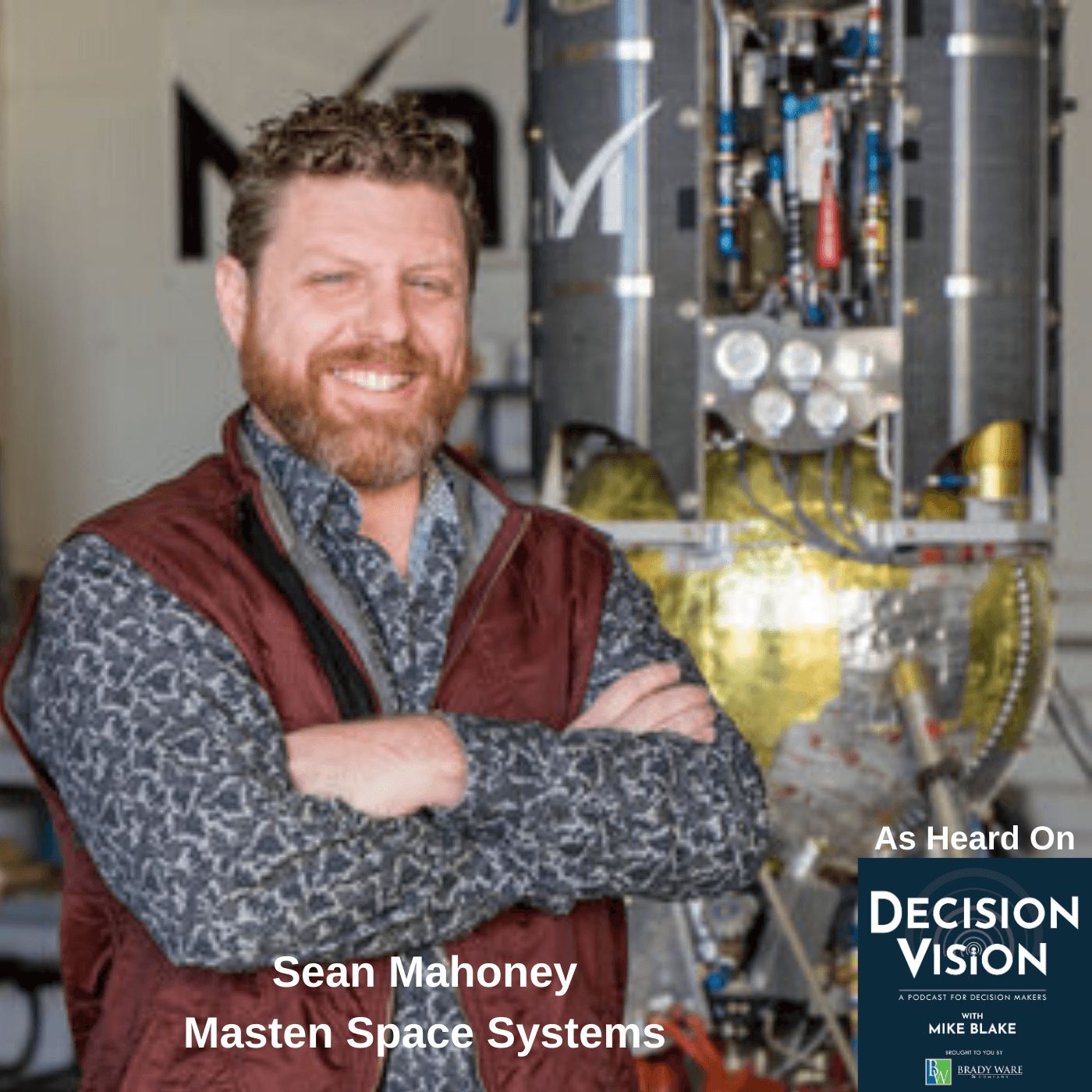
Tagged With: Bitcoin, blockchain, Blockchain Chamber of Commerce, Brady Ware, Brady Ware & Company, cryptocurrencies, cryptocurrency, Linda Goetze, Michael Blake, Mike Blake, Supply Chain

Decision Vision Episode 70: How Do I Build My Personal Brand? – An Interview with Jared Kleinert, Meeting of the Minds

June 18, 2020 by John Ray

How do I build my personal brand?
Decision Vision
Decision Vision Episode 70: How Do I Build My Personal Brand? - An Interview with Jared Kleinert, Meeting of the Minds
Loading
00:00 /
RSS Feed
Share
Link
Embed

Download file

How do I build my personal brand?

Decision Vision Episode 70: How Do I Build My Personal Brand? – An Interview with Jared Kleinert, Meeting of the Minds

“How do I build my personal brand?” is a question many are struggling with right now. If you’ve been successful at building relationships face to face, how do you pivot in an environment where relationships must be developed digitally? USA Today‘s “Most Connected Millennial,” Jared Kleinert of Meeting of the Minds, joins “Decision Vision” to discuss this issue with host Mike Blake. “Decision Vision” is presented by Brady Ware & Company.

Jared Kleinert, Meeting of the Minds

Jared Kleinert is the founder of Meeting of the Minds, as well as a TED speaker, 2x award-winning author, and USA Today‘s “Most Connected Millennial”.

His invite-only mastermind community, Meeting of the Minds, curates top entrepreneurs, CEOs, and business owners for quarterly summits in places like Napa Valley, Atlanta, Los Angeles, New York, and Bermuda. Members of this network, typically operating 7-figure businesses with no outside investors) enjoy more predictable revenue, increased profitability, and sustainable growth for their companies in addition to new life-long friendships and long-term business partnerships.

In the last two years, Jared has invited over 100 diverse “super-connectors” and subject matter experts into Meeting of the Minds, including CEOs of 7, 8, and 9-figure businesses, creators of globally-recognized brands and social movements, New York Times bestselling authors, founders of pre-IPO tech unicorns, former Fortune 500 c-suite execs, and others.

Jared’s career began at 15 years old when he started his first company, and took off at 16 while working as the first intern, and then one of the first 10 employees, for an enterprise SaaS company called 15Five, which today has raised over $40M and has almost 2000 forward-thinking companies as monthly recurring clients. 15Five is the market leader for software powering continuous employee feedback, high-performing cultures, objectives (OKR) tracking, etc.

Later, Jared would become a delegate to President Obama’s 2013 Global Entrepreneurship Summit in Malaysia, write multiple books including the #1 Entrepreneurship Book of 2015, 2 Billion Under 20: How Millennials are Breaking Down Age Barriers and Changing The World, and speak at TED@IBM the day before he turned 20.

As a highly-sought after keynote speaker and consultant on engaging Millennials in the workplace, Jared’s clients range from organizations like Facebook, Samsung, Bacardi, Estee Lauder, IBM, Cornell, Berkeley, AdAge, and the National Speakers Association. His insights on entrepreneurship and networking have been featured in major media such as Forbes, TIME, Harvard Business Review, Fortune, NPR, Entrepreneur, Mashable, Fox Business and more.

Join Jared’s private email newsletter group at motm.co/newsletter.

Michael Blake, Brady Ware & Company

Mike Blake, Host of the “Decision Vision” podcast series

Michael Blake is Host of the “Decision Vision” podcast series and a Director of Brady Ware & Company. Mike specializes in the valuation of intellectual property-driven firms, such as software firms, aerospace firms and professional services firms, most frequently in the capacity as a transaction advisor, helping clients obtain great outcomes from complex transaction opportunities. He is also a specialist in the appraisal of intellectual properties as stand-alone assets, such as software, trade secrets, and patents.

Mike has been a full-time business appraiser for 13 years with public accounting firms, boutique business appraisal firms, and an owner of his own firm. Prior to that, he spent 8 years in venture capital and investment banking, including transactions in the U.S., Israel, Russia, Ukraine, and Belarus.

Brady Ware & Company

Brady Ware & Company is a regional full-service accounting and advisory firm which helps businesses and entrepreneurs make visions a reality. Brady Ware services clients nationally from its offices in Alpharetta, GA; Columbus and Dayton, OH; and Richmond, IN. The firm is growth minded, committed to the regions in which they operate, and most importantly, they make significant investments in their people and service offerings to meet the changing financial needs of those they are privileged to serve. The firm is dedicated to providing results that make a difference for its clients.

Decision Vision Podcast Series

“Decision Vision” is a podcast covering topics and issues facing small business owners and connecting them with solutions from leading experts. This series is presented by Brady Ware & Company. If you are a decision maker for a small business, we’d love to hear from you. Contact us at decisionvision@bradyware.com and make sure to listen to every Thursday to the “Decision Vision” podcast. Past episodes of “Decision Vision” can be found here. “Decision Vision” is produced and broadcast by the North Fulton studio of Business RadioX®.

Visit Brady Ware & Company on social media:

LinkedIn:  https://www.linkedin.com/company/brady-ware/

Facebook: https://www.facebook.com/bradywareCPAs/

Twitter: https://twitter.com/BradyWare

Instagram: https://www.instagram.com/bradywarecompany/

Show Transcript

Intro: [00:00:02] Welcome to Decision Vision, a podcast series focusing on critical business decisions. Brought to you by Brady Ware & Company. Brady Ware is a regional, full-service accounting and advisory firm that helps businesses and entrepreneurs make visions a reality.

Mike Blake: [00:00:22] And welcome to Decision Vision, a podcast giving you, the listener, clear vision to make great decisions. In each episode, we discuss the process of decision making on a different topic for the business owner’s or executive’s perspective. We aren’t necessarily telling you what to do, but we can put you in a position to make informed decision on your own and understand we might need help along the way.

Mike Blake: [00:00:40] My name is Mike Blake, and I’m your host for today’s program. I’m a Director at Brady Ware & Company, a full=service accounting firm based in Dayton, Ohio, with offices in Dayton; Columbus, Ohio; Richmond, Indiana; and Alpharetta, Georgia. Brady Ware is sponsoring this podcast, which is being recorded in Atlanta per social distancing protocols. If you like this podcast, please subscribe on your favorite podcast aggregator, and please consider leaving a review of the podcast as well.

Mike Blake: [00:01:06] Today, we’re going to discuss the topic, do I need to go all in on building a personal brand? And ever since this coronavirus thing really hit home, and we’ve all been sent scattering to our homes and hastily building work-from-home workstations, complexes, turning dining room tables into corporate headquarters and so forth, I’ve been thinking a lot about this topic because I’m in very much an old-industry firm. Well, let’s face it. I think that some of our firms and us included are actively thinking about how to best adopt and adapt to modern business techniques, practices, methodologies.

Mike Blake: [00:02:00] But the fact of the matter is the world is and has changed. And I don’t think that it’s at all a guarantee that it’s going to go back to the way it was, say, February 1st of January 15th. And as I think about that, I think about my business partners, I think about my colleagues, I think about my clients, I think about people that are in my ecosystem whom I care about, and I wonder what is to become of them if their primary method for building a brand or buildings, not even a brand, but just sort of a circle of people that are helpful to them. I don’t know what the word for that would be, so I’m going to just use that very awkward terminology. But what’s going to become of them, right? What what becomes of you if your primary vehicle for initiating and developing relationships is networking, and exchanging physical business cards and shaking hands with people, or God forbid, hugging them? It’s just what becomes of you if that’s your world? And frankly, that’s how you have been successful for the last 35 years of your career.

Mike Blake: [00:03:23] And the honest, no-sugar-coating answer as I try to do on this podcast is an asteroid has hit. Now, it’s hit on the other side of the planet. So, the shockwave hasn’t really hit. It’s hit in Mexico, but we’re in Eastern Europe. And so, the shockwave hasn’t hit. The fragments of molten lava or volcanic rock haven’t rained down on us yet. So, there’s a little bit of time. But the fact of the matter is an asteroid has hit. And these conferences, these seminars, these professional meetings, trade associations, happy hours and so forth, at a minimum, I don’t know anybody that thinks they’re going to come back tomorrow. And I’m of the camp that I’m not sure they’re going to come back maybe ever, certainly not in the medium term.

Mike Blake: [00:04:21] And so, what do you do? As a company, I don’t care how many costs you cut, there’s not a single company out there that is viable long term if you don’t generate revenue. And I don’t care what ever sort of other things you do in terms of building infrastructure and trying to be else helpful to your company that you work for or that your own. And I’m on record of saying this, if you’re not a profit center, you are expendable. And as I’m recording this on May 8th, 2020, the most recent unemployment figure shows 14.5% unemployment, which is better than I thought it would be. I think we’ll see 20%. And you do not want to be in a position where somebody looks at you as a cost, and you’ve got to be a profit center. A profit center is somebody who, generally, there are exceptions to this, but somebody who is going to bring in revenue.

Mike Blake: [00:05:22] And because the world we’re in now, because that’s sort of active ping that we’re used to is just off the table, what do you do? And I think the answer is about building a personal brand where you don’t have to meet people directly. And I think I’ll say with as much modesty as I can muster, I’ve had some success doing that. And Exhibit A is that I have never met over half of my clients in person. And I think that’s a help. Showing them my face is not going to close deals, I promise. But the fact that my clients really don’t care if they ever meet me in person I think shows that there’s a personal brand out there that’s had some effectiveness. And it’s not because I’m great at it. It’s just because of something that I chose to do.

Mike Blake: [00:06:15] And so, I’m picking this topic and I’m picking this topic now because I think it’s something that everybody out there has to be thinking about, even if you’re not an executive. I received a LinkedIn message from a friend of mine yesterday who has a son that wants a business internship. I know very few people are handing out internships right now. They’re trying to figure out how to keep their 30-year or 20-year employees busy and paid. So, where’s that internship going to come from? And my answer was, if you want to stand out, start building that personal brand. I only came to this party 15 years ago. I wish I would have had the opportunity and the foresight at age 20 to start doing this. I’d be miles ahead. And that’s the way I think you’re going to stand out, even as somebody who’s looking for an internship, have a personal brand, have a reason for people to know you, to remember you, to identify you as a special individual that’s bringing something that’s unique and special to the table.

Mike Blake: [00:07:22] And happily, my thinking on this topic coincides with something that, for me, has been very fortunate. About a year ago, I made a new friend name named Jared Kleinert. And to be candid, I had never heard of him before, but he reached out to me and was introduced to me because at the time, he was planning to move to the ATL, which he has since done and we’re delighted for that, but it turns out that even in his teens, he has understood organically about the importance about building a personal brand. Literally, it’s not hyperbole to say that he’s a genius and a prodigy of doing that. And when I read off his bio, you’re going to see why.

Mike Blake: [00:08:12] He’s a guy that sort of has this in his DNA. And I’m delighted that he’s agreed to come on to talk about this because I cannot think of anybody better. You can have your Gary Vaynerchuks, you can have your Tim Ferris’s, and they’re all great. You can give me Jerry Kleinert every day of the week. So, I want to introduce Jared, whose current deal is he’s founder of Meeting of the Minds, as well as a TED speaker, as a multi-award winning author, and has been named as USA Today’s Most Connected Millennial. Okay. So, maybe maybe you’re kind of getting this now.

Mike Blake: [00:08:53] His invite-only mastermind community, Meeting of the Minds, curates top entrepreneurs, chief executive officers and business owners for quarterly summits. Members of this network, typically, operating seven-figure businesses with no outside investors enjoy more predictable revenue, increased profitability, and sustainable growth for their companies, in addition to new lifelong friendships and long term business partnerships. And we talked a little bit about this topic with Marc Borrelli in a previous episode, where he talked about professional and business peer groups such as Vistage and talked about the value of those sorts of things. What Jared does is the same thing, but I think it’s more exclusive and a little bit more amped up on steroids.

Mike Blake: [00:09:36] Jared’s career began at 15 years old when he started his first company and took off at 16 while working as the first intern, and then one of the first employees for an enterprise SaaS company called 15Five. And we had one of their founders, Shane Metcalf, come on to talk about how to be an effective remote worker. And I hope you enjoyed that podcast because it was terrific, and I’m still begging him to introduce me to Simon Sinek who, as everybody knows, I have a disturbingly high man crush on. And today, 15Five has raised over $40 million and has almost 2000 forward thinking companies as monthly recurring clients.

Mike Blake: [00:10:13] Jared is the author of multiple books, including the number one entrepreneurship book of 2015, 2 Billion Under 20, which I have read,  How Millennials Are Breaking Down Age Barriers and Changing the World. And he spoke at TED at IBM the day he turned before 20. Jared, thank you so much for for coming on.

Jared Kleinert: [00:10:34] Yeah, thanks for having me. And I appreciate the flattery. I’m going to have to take the quote of, “You can have your Gary Vaynerchucks, you can have your Tim Ferris, but I’ll take Jared any day.” I appreciate that.

Mike Blake: [00:10:48] Well, it’s open source. I mean, I’ve already gotten the podcasts. I have no incentive to suck up to you. What you’ve accomplished is remarkable. And you’ve done so in a way where I presume it’s basically self-taught, where there are people my age with gray hair and arthritic ankles and all that we would love to accomplish that in a lifetime. And now, you realize, boy, we really need to accomplish stuff like that in a lifetime. So, having you with your talents and your story here, it’s really, I think, a terrific resource for our listeners. And frankly, I’m going to nag all the partners in my firm to listen to this.

Jared Kleinert: [00:11:33] Yeah. And none of us are completely self-taught. I mean, I’ve benefited from meeting hundreds of the world’s smartest and most talented millennials, and consulting for people who have New York Times bestselling books, and who are Rhodes scholars, and who are really world class of what they do. So, I’ve been very fortunate over time to download as much as I can from the people around me, but I think that’s part of why we’re talking about this topic today is that you are know the average of the people you meet and how high of a quality time you spend with them.

Mike Blake: [00:12:11] So, let’s start at the very beginning. Who needs a personal brand? Why do you need one?

Jared Kleinert: [00:12:18] Yeah. I mean, I think everyone. I started my first business at 15 and didn’t know anyone and didn’t know anything. I really began my career with a series of cold e-mails that I was doing to individuals on the West Coast of the United States when I was living in South Florida where I was born and raised. And so, in a way, I’ve been practicing some of the reach-out methods to influential people in the hustle and the relationship-building efforts that we can all apply during this time of social distancing. And so, started my first business at 15, failed miserably. I didn’t know anything about the industry I was playing in. I didn’t know anything about my competitors. I didn’t have enough capital.

Jared Kleinert: [00:13:10] Biggest mistake I made was poor mentor selection. And I was spending six months hanging out with a guy who I later found out had served time in prison for securities fraud on Wall Street, which is definitely not who you want to associate with if you want a long, prosperous career as an entrepreneur.

Mike Blake: [00:13:29] Yeah, nowhere to go but up.

Jared Kleinert: [00:13:30] Yeah. So, at 16, I had negative connections and negative experience, but I realized that I needed to do a 180 and surround myself with not just high integrity individuals because I think you have to be around great people first and foremost, but also people that were real subject matter experts at what they’re working on. I think that part is really important as well. And so, that’s when I sent a cold email to David Hassell, the CEO and founder of 15Five, Shane’s co-founder. And I reached out because I read about him. He was called the most connected man you don’t know in Silicon Valley, according to Forbes. And when I was thinking about reaching out, I had to think about what I could offer him, why would he give me his time of day. He was a serial entrepreneur, he had a successful business going, and he had a great network and a great brand, or another word we could use for brand is maybe reputation in this conversation. And I was just a 16-year-old kid in Florida who had spent six months learning under a former white collar convict and had a failed startup.

Jared Kleinert: [00:14:45] So, nevertheless, I sent him an email, basically offered to work for free in exchange for his mentorship. And that led to an internship in his company, which led to me being one of the first 10 employees at his company. And from there, that single super connector in David snowballed into a whole network of people that I’m still in touch with today, Advisors of 15Five, some of their clients. In fact, one of their former clients is now speaking at a camp or at an event I’m hosting in about a week at time of recording. And you also build the skillset of reaching out to more people like David.

Jared Kleinert: [00:15:30] You also pick up social proof along the way. Like I reached out to David. I’ve now established some experience in working for 15Five. I can leverage that in a tasteful manner, of course, but I can leverage the fact that he took a chance on me. I can leverage the trust that he’s built with other people in his network when I’m starting to build a relationship with those people off of his introduction or recommendation. When I called and emailed other people, I can leverage the work that I did at 15Five and anything else that I accomplished in the two years I was there, which I’ve done a TEDx talk, I got a book deal for my first book when I was 17.

Jared Kleinert: [00:16:12] And so, I replicated this model. I reached out to Keith Ferrazzi, who’s the author of Never Eat Alone, when I was 18. I sent another cold email. This time, I was able to better leverage some social proof I’d built up, which I think opened the conversation much more easily, but I still was looking to provide value to him as the first matter of business. And that effort turned into him becoming my first ever client of a marketing consulting firm that I ran. Again, I got to meet a ton of new people through him and with that case study.

Jared Kleinert: [00:16:46] So, I think what I’ve been able to do, which is definitely needed now more than ever, is find ways to meet influential people, build deep, meaningful relationships, and do so without relying necessarily on an in-person interaction at first; although, of course, that’s an important part of deepening relationships whenever you can do that. And I think at some point, we’ll go back to normal and we’ll have events. In my company, Meeting the Minds, it is driven by these three-day in-person experiences; although we’re figuring out how we do things virtual in the time being. So, I hope we go back to normal at some point. Yeah, even just the origin story of who I am and who I’ve been able to learn from and work with, it was all through a connections made virtually.

Mike Blake: [00:17:37] So, I want to ask you about the cold emails because I think that’s fascinating. Many people are reluctant to send cold e-mails. And I’m not sure why. The worst that could happen realistically is they’re just not going to respond. Unless you just say something completely just bad, they’re not going to bother to denigrate you with a response and they’ll just say … you might get an autoresponder, whatever it is. But what got you to start sending out cold e-mails because you’re too young to be scared of doing that, or did somebody advise you to doing out, or how did you get to that?

Jared Kleinert: [00:18:22] I think part of it was the pain that I had in having a really terrible mentor at first. So, I hope that you don’t need to have pain before you start cold e-mailing or sending more cold e-mails. And of course, the best cold e-mail is not having to send one at all. It’s to have a mutual connection where there is trust between you and that mutual connection, and then that mutual connection and whoever you’re trying to reach out to, be it a potential client, or mentor, or joint venture partner, vendor, et cetera, potential podcast guests. But if you are resorting to sending a cold e-mail, then how do we do that in the best fashion possible? Because even if you send the perfect cold e-mail, you may not get a response, as you were saying. It may take two, three follow-ups. Maybe they just are awful at e-mail or, perhaps, other things are going on like global pandemics that they have to deal with.

Mike Blake: [00:19:20] Oh, yeah, that.

Jared Kleinert: [00:19:21] Yeah. So, if you are going to send a cold e-mail, I think it’s a great strategy for potentially meeting some new people. And I don’t think there’s a huge barrier to doing it. It’s finding their e-mail address and sending a worthy message. And so, for me, I always start with the social proof that I have to offer. So, nowadays, it’s easy. I met Ted and TEDx speaker, award-winning author. I got this USA Today’s Most Connected Millennial thing. I have a lot of social proof that I can leverage. And then, specifically, for certain industries or individuals I’m reaching out to, I can reference a mutual friend in my subject line or I can reference something that we have in common.

Jared Kleinert: [00:20:07] But if you’re just starting out, then think about in the subject line of an email … before we even write the email, we’re just talking about the subject line. Think about social proof that you can offer, whether it’s awards that your company has won, or that you’ve won, or it’s a mutual connection that you see on LinkedIn. And if you can’t find some social proof, then, at least, try and spark intrigue, so that the other person opens your email. And you could do that by having something mysterious. Like one of my favorite subject lines is, “Quick question …” Or you can find a way to offer your value in the subject line of your email. “Hey, Mike, I have three podcast recommendations for you or three guests that I’d like to introduce you to.” You’re probably going to open up that email even if you had no idea who I was because it’s personal and it’s related to how I might be able to offer you value.

Jared Kleinert: [00:21:04] And so, then in the subject line or in the body of the email, quickly introduce yourself, but do it in a sentence or two. “Hi, I’m Jerry Kleinert,” and insert that social proof that you have or insert what you do. Then, the bulk of that e-mail should really be how you can help someone. And so, to send a proper cold email, you should be doing your research in advance. And that’s where the power of the internet comes into play and where you could actually start better initial conversations potentially than if you met someone randomly at a conference because you have the luxury of stepping back, doing a lot of research on what that person may want or need, what they care about.

Jared Kleinert: [00:21:50] And then, you can craft the perfect pitch or the perfect email to them to show them how you can be valuable, how you can be valuable right now, and what the next step should be, which is, “Hey, let’s …” You should end your email with a call to action like, “Let’s get on a call,” or “When are you available?” or “Let’s hop on Zoom,” something like that. So, I do think the cold email or the art of reaching out to new people digitally does pose some benefits from being able to think about what you can offer as valuable, what the other party is going to find as a trustworthy source of credibility, your social proof, and then the value you can offer them, which is why they’re going to pay attention to you and your message right now when there may be other competing priorities or other people reaching out, other salespeople trying to get money from them, et cetera.

Mike Blake: [00:22:51] So, you’ve built, obviously, a personal brand. I think, for good or ill, I hope this is accurate, but I do think of your personal brand as the millennial who really gets it and has figured out a lot of the secret sauce, secret formula to digital media, to digital relationship building, and so forth. And my question is this, is that at what point did you go from trying to find a mentor that was better than the train wreck that you initially had to becoming a cohesive plan around building a personal brand where you going to be known for X? How did that evolve?

Jared Kleinert: [00:23:39] Yeah. I think the biggest strength of my brand, as you call it, is the quality of my network. And I’ve certainly taken steps to not just build a great network, but then to amass social proof, to let it be known to the world that I am a quality person to connect with. And so, in terms of thinking about that social proof curation process, as we can call it, I would start with what your ideal customers, or what your ideal friends, or mentors would find to be trustworthy. So, things like Ted and TEDx are trustworthy.

Jared Kleinert: [00:24:20] I’m really clear about saying I’m an award-winning author as opposed to a bestselling author because I know that there is a lot of people that can write a book post on Amazon and be a bestselling author with three book buys and an esoteric category in an hour from their friends for 99 cents. I’m really salty about that. So, I say award-winning because it’s a lot harder to win awards. And if I was a New York Times bestselling author, I’d put on I’m a New York Times bestselling author, but I’m not. So, I’ve found different ways to leverage the assets I have and to go acquire those as quickly as possible.

Jared Kleinert: [00:24:57] If you’re part of my business as I’m a keynote speaker and I’m a consultant for major companies occasionally. And so, you have a potential speaking client is looking at me and my body of work, what are going to be the other companies that they’re gonna look at and sort of deem trustworthy? What are the news sources they’re going to look at and deemed trustworthy, the podcasts they’re going to look at, et cetera. So, I even if it’s working for free or taking a reduced fee, I went and tried to get Facebook, Samsung, Bacardi, Estée Lauder, IBM, you know, National Speakers Association, you could you can go to associations as well, those are all groups that I worked with because, in part, I wanted to shine a light on the quality of my work for other people who were interested in connecting with me.

Jared Kleinert: [00:25:48] So, there’s that aspect to it in terms of building my network because I think the quality of my network and the diversity of my network is where my brand and reputation really shine and why people connect with me. I think, again, there was a snowball effect at first with building my network. So, being a good person, looking to provide value up front, and then focusing my efforts on connecting with one super connector in David or in Keith Ferrazzi a couple years later.

Jared Kleinert: [00:26:21] And then, from there, it’s leveraging that connection to connect with more super connectors. And the dirty secret is someone like Keith Ferrazzi or someone like David has dozens, if not hundreds, of friends who are also very well connected, very well regarded in their fields. And so, I, in turn, can meet those people. And when I’m connecting with those individuals, we’re starting at a much deeper level of our relationship because we’re both leveraging the trust of David or whoever that connector is in that situation.

Jared Kleinert: [00:26:56] And so, it’s important to keep your quality of work high. And when I say be a good person, it’s not just Mother Teresa type doing good deeds, but it’s also having high quality products and services, and showing up on time, and working hard, and some of those basic statements. But as long as you’re continually a good person, and you’re continually looking to provide value, then your network is going to grow exponentially when you focus on these super connectors. And you can focus on super connectors in your industry. I’ve made it a particular point of interest to focus on super connectors from diverse industries and fields because that is my leverage in the marketplace as I have perspective across hundreds of industries and access to hundreds of other communities if and when I need it.

Jared Kleinert: [00:27:48] So, hopefully, that’s answering your question, but I think it’s being mindful about who you’re connecting with. And then, it’s also thinking about what’s it going to take for that other person to trust me. And so, that’s going to be a mutual connection. Or if you don’t have the luxury of a mutual connection and/or you want to bolster that mutual connection’s introduction, then you can go and amass social proof in the form of press, and podcast interviews, and all this stuff that you might say is your brand online. And then, make sure you put it in places where people are going to see it, your LinkedIn bio, your email signature, going on different shows that have a decent audience. So, I’ve been interviewed by Larry King and and New York Times bestselling authors like Neil Strauss with a big following in the entrepreneurial community, or have been referenced on James Altucher Show, even though I haven’t done a full interview with him. So, then it’s thinking about from a distribution standpoint, like where are my ideal clients, partners, friends going to hear about me in a one to many fashion, if it’s not through a mutual intro or it’s not through a cold email.

Mike Blake: [00:29:02] So, let me ask you this. So, you’ve done, I mean, the TED talks. And I realize I gotta go back and actually watch. I’m embarrassed I’ve not, but I will. Did did those come before you are in the process of building a personal brand, or did you look back to say, “Hey, I did these TED talks and I wrote this book. That’s pretty cool. I, now, have a personal brand that’s kind of evolving, and I’ve got to figure out a way to be a good steward of it or be a good caretaker”? What was the order of operations there?

Jared Kleinert: [00:29:41] For me, I think it was pretty the personal brand building exercises were centric around book launches and around sort of getting a certain mission out into the world. I think it’s cyclical too. I’m now thinking about how we grow Meeting of the Minds and what are the new assets in my brand that I need to build to better reach more of our ideal clients. And so, I can look back at what I’ve done, and comb through what I have, and maybe pick some of the top interviews, or pick some of the top places I’ve spoken at, or individuals that I’ve worked with, and then reference those.

Jared Kleinert: [00:30:29] I would recommend, if you’re listening to this and you don’t have a lot of social proof built up, I would build that as quickly as possible, so that you can go back to revenue-generating activities and some of the other stuff. I think that the main thing here is you want to spend as much time as possible leveraging your social proof and building your network and your business instead of what some of my peers do, and they spend a lot of time chasing press opportunities and chasing “fame,” for lack of a better word. I’m not really interested in doing too many paid or doing too many speaking gigs right now unless they’re paid. I don’t need more social proof in terms of stages I’ve been on. But at the beginning, when I was looking to build out part of my business or leverage stages I’ve spoken on for Meeting of the Minds or for book launches, it was very important for me to get as many high quality speaking gigs as possible, and get as many names or logos I could reference on my speaking pager or wherever.

Jared Kleinert: [00:31:33] So, it depends on where you’re at. If you’re starting out with a new business, or new industry, or you’re earlier in your career, then I would build that social proof as quickly as possible, so you could spend more time leveraging it. But it also makes sense to view it or look back at it cyclically and make sure that the assets that you’ve had reflects how you can be helpful in the marketplace right now because, a lot of times, even today, I get a lot of references to my books. And while it’s great that people are reading, I want more people to know more about Meeting of the Minds. And so, I need to adjust for that. I need to make sure that what I’m putting out in the world accurately reflects how it would help our ideal member there. So, that’s a good way to think about it.

Mike Blake: [00:32:24] So, I’m going to tear up the script up a little bit here. And I want to focus on-

Jared Kleinert: [00:32:30] Oh no!

Mike Blake: [00:32:32] Such as the script is, but I want to drill down into building social proof, right?

Jared Kleinert: [00:32:37] Sure.

Mike Blake: [00:32:37] That’s dominated this conversation so far. And I get it, it’s important. I’m [indiscernible], but, now, I’m somebody that I know I need to become intentional about building this personal brand, and digital is going to be likely a big part of that. What are the things I should be thinking about now if I feel like I don’t really have a lot of social proof? What can I do that’s intentional to try to build credible social proof relatively quickly?

Jared Kleinert: [00:33:09] Yes. So, for you, we can use you as the guinea pig, you’re-

Mike Blake: [00:33:14] Good.

Jared Kleinert: [00:33:15] You’re at Brady Ware, and you have to think about how to generate new clients, especially now more than ever. But in general, part of your work is is revenue generation. It’s upselling clients that the lifetime value of those clients is higher and higher. And that once you have clients, they need to trust you to do work with them. And then, they should also be excited about referring you and so on and so forth. So, for you, it’s looking at who is your ideal clients, and then thinking about where do those people get their ongoing education. What industry news sources would they regularly read; and therefore, they may trust those sources. It’s thinking about associations that your ideal client might be part of. It can be credentials. I never went to college, so I don’t have the college credential that many people use. But I found other credentials in terms of things I’ve done that showcase. That is hard to do that; and therefore, I had to get skills, and connections, and whatnot. But it’s thinking about your ideal client and all the different things around that person that are important to know.

Jared Kleinert: [00:34:46] And so, you can probably write this down if you took half an hour or an hour to think about it. You can also ask your ideal clients and be like, “Hey, where do you go to get your ongoing education?” or “What podcast you listen to other than mine?” or “Where are you hanging out virtually right now because you can’t go to conferences.” And so, then, it’s how do you … that gives you some of the information that you’re gonna need. And yes, social proof could be being featured in Forbes, New York Times. Those are sort of the wide ranging ones. But then, it’s also getting really specific as to what are the exact places that your ideal audience needs to to hear you and see you in order to trust you and know that you’re like the perfect person for them. If you’re focusing on some sort of book launch or product launch, then you could go even crazier with this and try and book 20-30 podcast episodes. And then, wherever your ideal client is turning, they’re hearing, and seeing you, and you’re sort of a surround sound influencer for them, I think that’s a great strategy as well for a launch of sorts.

Jared Kleinert: [00:34:46] And then, you become just a trusted source. And so, when you finally do reach out with a cold email or get that mutual or get that introduction, you’re going to start your relationship on a much better footing. And then, it’s also reference material. So, it’s when you are reaching out, someone’s gonna Google you, or look on LinkedIn, or see the email signature that you have. And at first, they’re going to be like, “Who the heck is this?” And then, they’re gonna be like, “Oh, they’re actually pretty cool,” or “I could really use their product or services,” or “They’re worth chatting with,” at minimum. So, there’s benefits there from a reference standpoint, but also sort of a marketing standpoint. And I would start with, you know, who you’re trying to influence, which is probably your ideal clients as one of the main buckets of people. And then, thinking what matters to them, where are they going to get their education, and try and be in those places.

Mike Blake: [00:37:02] So interesting. So, to sum up with your advice is to get connected with wherever your target audience gets their education, gets their information because that’s all they’ll be looking and you’ll happen to be there. Interestingly, you did not say go out and write a book. You did not say go out and become a TED speaker. And you didn’t say go get an award from a national publication. So, I’m curious why that is.

Jared Kleinert: [00:37:43] I think those could be indicators of social proof, and they could also be ways that you can offer value to people. But I think the best bang for your buck is is starting with any sort of blog posts, or guest blog posts, or being interviewed on a podcast, or getting featured in some press because those are also quick and easy. And that’s more of a marketing and positioning challenge or exercise; whereas, writing a book is two years minimum of absolute torture before you get something out into the world. And most books are not good. And I think you could use that two years in other ways. So, by all means, go write a book if you are going to dedicate the time and resources to it to make it fantastic and to really serve the needs of your ideal listener. By all means, start a podcast if you think you can put the necessary investment of time, and money, and effort into it, and you’re gonna be able to get interesting guests on a regular basis that are going to serve your ideal listeners’ needs.

Jared Kleinert: [00:38:55] But you also have a business to run for most people listening to this, or you’re running a business within a business, and sort of you’re an intrapreneur. And so, again, I think if this is a conversation about networking, then it’s how do I acquire the social group as quickly as possible, so that I can go on with my life and leverage that social proof. Most of my time is not spent talking to the Ted organization, or it’s not spent talking to Forbes where I used to have a column. It’s talking to potential clients. It’s serving their needs. It’s networking with other peers, and learning from them, and discovering how I’m going to pivot my primarily in-person events business to a virtual format for the next six to nine months and how I can do my pivot in a way that maybe integrates with our long-term strategies that we can do a virtual part of our Meeting of the Minds and also an in-person part.

Jared Kleinert: [00:39:59] I think there’s a lot going on, and your network is is one big part of that, and your social proof for how you find other people in your network should become an increasingly smaller part of that. The ultimate goal is when you reach out to people, they listen. When you get introduced from someone, you immediately get a response. So, over time, you should need less and less social proof or need less to get that connection going and get to the fun stuff.

Mike Blake: [00:40:33] So, anybody who sits down on Google’s personal branding online influencer is going to run into the term “authenticity” early and often. Can you explain to our audience what authenticity means, and why is it important, and how do you project or make sure that your brand does come from a place of authenticity?

Jared Kleinert: [00:41:01] I can share what it means to me. So, it goes back to that being a good person aspect. It’s doing the work required to both have good intentions, and then to reflect that in your work. So, it always starts with the quality of your product, the quality of your service. Being authentic also means if I’m going to then start marketing or broadcasting who I am and what I do, I’m doing it in a way that reflects my values. And sure, occasionally, you may say something that is risque, or unique, or different, but it’s not to put anyone else down. It’s only to reflect who you are and what you’re working on. It’s apologizing when you mess up and providing even more value to deepen that relationship or mend that relationship.

Jared Kleinert: [00:42:04] So, for me, it starts with the work that you’re doing before you ever talk to anyone, and building great products, services, and then getting that out into the world. When you talk about networking, or marketing, or sales, I fully believe that if you have the best solution in the marketplace, then it’s a disservice if your ideal clients aren’t using your or your product or service. But if you’re selling snake oil, and then you’re trying to run a bunch of ads or leverage these social proof tactics that we’ve been talking about, I don’t think that’s authentic. I think that’s when you risk influencing people in a way that’s not in their best needs. Can you really sleep with yourself a night selling a low-quality or detrimental product or service to someone?

Jared Kleinert: [00:43:03] So, I think that’s where authenticity comes in. And I’ve never personally been too afraid of wearing what I want when I’m speaking or talking how I’d like to talk. I mean, those parts can be authentic too if you’re in a more corporate environment, being able to just be you. There’s no difference, really, in how I am sharing with you now versus how I am at home. I’m an open book. So, I guess there’s a version of authenticity there that could be debated or could be implemented or not. I mean, I respect privacy as well. I do have parts of my life that are private, but I’m pretty much the same person 9:00 to 5:00 that I am 6:00 to 9:00 or whenever.

Mike Blake: [00:43:52] So, one thing you’ve done now or you’re doing now as well, I would consider, the advanced classes that you’re evolving from Jared kind of the personal brand of the network building wonder kid into building now online communities. And so, why is that desirable to you? And how do you go about doing that?

Jared Kleinert: [00:44:21] Yes. As I was building what some have called a world-class network in record time, you have a limited amount of time. And so, you have to think about how to help as many influential people as possible with the limited time that you have. You also have to think about how you can offer value to people. And many times, I’ve found that one of the best ways to offer value to other people is by connecting them to other great people. And so, pretty early on, maybe 17 or so, I was actively creating Facebook groups and creating spaces where I was curating, which I think is a really important word and exercise. I was curating great groups of people and giving them an opportunity to meet each other and provide value to one another. And then, that becomes one-to-many networking.

Jared Kleinert: [00:45:20] And you’re also creating an environment where it’s sort of like a neural network of a brain. When two people in your online community connect with each other, they’re going to sort of think back to you as the person who connected them, even if you did nothing other than create the setting for them to connect and maybe put some guardrails in place for who’s in there, how they’re supposed to interact with one another and things like that. So, I’ve been building, I guess, online communities since 17. Nothing massive, like not tens of thousands of people, but hundreds of the perfect people.

Jared Kleinert: [00:45:55] When we were writing Two Billion Under 20 and Three Billion Under 30, we were building online communities of some of the world’s smartest and most talented millennials, so that the same people that were contributing to our book could meet each other. And that was one of the ways that we convinced these book contributors to partake as we said, “Hey, we’re asking you to contribute three to five pages of your formative life experiences to our book. And we’re going to give you access to this entire community of other world-class millennials. And then, of course, we’re going to give you exposure via the book sales and people reading your story. And I, personally, will connect you to as many people as possible or be your cheerleader. However, I can help you, I’m there. And that’s how you convince, like the founder of WordPress, or the co-founder of Duolingo, or champion athletes, or social media influencers to all partake in that work of yours.

Jared Kleinert: [00:46:51] And so, there’s all my communities. I saw it in different lenses when I was, I guess, 22 or so. So, after a few years of writing these books, building a readership, getting to speak at some great places, also building that consulting firm, which started with that connection with Keith Ferrazzi. And then, I had a marketing consulting firm where I worked with other top thought leaders. There’s only so far. You can only scale a consulting business to such capacity. And while the work I was doing with my clients I thought was very valuable, I realized that the most valuable thing I could offer was to take my clients, and to take my book contributors and readers, and bring them together, so they could meet each other because, then, they’re working with me and they’re also working with each other to grow their businesses.

Jared Kleinert: [00:47:43] And so, that’s where we started Meeting of the Minds. I do truly believe in the power of online or the power of in-person connections, even though most this conversation has been about virtual connections. So, the Meeting of the Minds, our core businesses running three-day summits where these people are flying from all over the country, sometimes, even internationally, to hang out in Napa for three days, or Bermuda for three days, or Upstate New York, or Atlanta, and they’re building deep, meaningful relationships with one another where they’re not talking about work. They’re talking about personal hobbies and things that they’re doing to better themselves. Then, they’re talking about pressing problems in their business, or exciting opportunities and projects, and helping one another, and masterminding. But that can be done digitally as well. And we’re doing that now as a way to sort of deal with the pandemic.

Jared Kleinert: [00:48:41] But ultimately, that is one of the best ways I can offer people value is by creating these spaces where someone can get a connection with me and value from me, and they can also meet all these other people that I’ve deemed trustworthy and awesome. And so, I’m now taking the social proof that I’ve built over time and extending it to my clients and extending it to my friends, and creating the space where two new strangers who I’ve curated can leverage my social proof and my relationship with each of them individually, and start a relationship with each other, and do all the things that we’ve talked about, whether it’s work together, partner, support each other, mastermind, things like that.

Jared Kleinert: [00:49:26] So, if you’re listening to this, I think you have to start with how you can best influence your ideal clients or your ideal boss if you’re looking for a dream job. Start with that like first set of connections. Then, you might think about what are all these diverse advisors, mentors, peers I’m going to need to educate me along the way and hold me accountable, make sure I don’t go off the beaten path. And then, after you’ve accomplished that, and you’ve built a great network for yourself, then it’s how do I offer this network and how do I offer what I know to others in a way that will allow my network to grow exponentially but it’ll also provide exponential value. And so, that’s where the online communities come into play. That’s where the in-person event series come into play. And anything where it’s a one-to-many communication channel. Even a podcast, I have an email newsletter that I’ve been pouring a lot of effort and energy into. That’s where the groups come into play and could be extremely valuable.

Mike Blake: [00:50:37] So, you touched upon one issue I want to make sure that we cover. I think a lot of people, even people who are experienced, frankly, can be easily discouraged because you go on YouTube, you see something that’s got 250,000 followers. If somebody’s got a LinkedIn, and they’ve got thousands of followers and so forth. You know what I’m talking about. I’m starting up, I turn on my laptop, I’ve got eight followers. And so, the question is, am I so far behind that I just can’t catch up. Is number of followers even the right metric to be looking at your opinion in most cases?

Jared Kleinert: [00:51:23] I don’t think so, no. I also struggle with the same feelings sometimes. I think it’s all about your goals. I mean, for me, I would rather have a network and a following of very influential people. So, if I have a thousand email list subscribers but they’re all serial entrepreneurs, they’re all community leaders, podcasters, authors and can influence millions of people collectively or tens of millions of people, to me, that’s success. And that’s what I was trying to accomplish with our book series. And we had 75 book contributors to both books. And so, I had a network or a community of 150 of the world’s smartest, most talented millennials. And through them, if I had something that was very compelling and worthy of the masses, we could reach 50 million plus social media followers and we could reach half a million to a million people on their various email lists.

Jared Kleinert: [00:52:21] Such as my personal goal is to be an influencer of influencers in the humblest way possible, I want to work with the the entrepreneurs, business owners, the CEOs who have a vision for how the world should work or how their industry should evolve. And I want to help them get that vision out into the world, grow their company, reach more people. Some other people have business models that are predicated on total amount of viewers or total amount of listeners. And so, then, it should be your goal to get as many people as possible to listen to your stuff. So, it’s all depending on your goals, but I’ve personally focused on the quality of my connections.

Jared Kleinert: [00:53:05] It’s also a lot of people that will take in content that may not sort of raise their hand and tell you that they’re raised or listening to the content. You may have 1000 or 5000 regular podcast listeners, and maybe five of them have told you that your show’s awesome in a review or maybe they’ve reached out on social media, but they’re still influenced by you, and they’re still coming to you every single week. And so, I’ve had countless stories of friends who have seen a Facebook post that I had about like my weight loss journey; and yet, they never liked it, they never commented, they never told me about him. Then, six months later, they’re like, “Oh, yeah. By the way, you made a post on Facebook about how you lost 20 pounds, and I started doing that. And now, I’ve lost 20 pounds.”

Jared Kleinert: [00:53:55] And so, I think it’s important to keep in mind who’s absorbing your content and information, who’s watching you from afar, and just how you’re building your career, and how you’re working who will never raise their hand and tell you that they’re doing that. And that, I guess, is truly your reputation. It precedes you before you ever meet someone. It will allow you to start new conversations with sales prospects much more easily or more difficultly depending on how you’ve built your reputation. So, I wouldn’t be fooled by subscriber counts or lack thereof. I’d really focus on just the quality of your work and the quality of the people taking in your work as you define who is an ideal customer, listener, friend for you.

Mike Blake: [00:54:51] Jared, you were very generous with your time. And I know you’ve got to go because you have a packed schedule today. I want to scratch the surface of what I had hoped to ask. How can people contact you for more information about this? If they have something we haven’t gotten to today, can they reach out to you?

Jared Kleinert: [00:55:08] Yeah.

Mike Blake: [00:55:09] How do they do that?

Jared Kleinert: [00:55:09] Jaredkleinert@gmail.com. You can find me on on social media. I have a private e-mail newsletter that I keep, which for the last 18 months I have not had an opt-in page for, and I’ve added everyone one by one because I want to keep in touch. But now, you can go to MOTM.co/newsletter and join that. I’m not going to tempt you with a free e-book or anything like that but you can see some of the past newsletter updates I’ve sent out before you subscribe. So, that’s that’s the place I’d love people to go to, reach out to me just directly through email. And seriously, I’d love to chat with you. I’ve been on a ton of podcasts, and you’d be surprised even the shows like 250,000, there’ll be two people that would reach out. So, don’t be afraid to reach out to me. You could send me a cold email, “Quick Question …” or “Mike’s podcast,” and let’s start a conversation.

Mike Blake: [00:56:12] So, I actually talked over you. Can you repeat the email address, please?

Jared Kleinert: [00:56:16] Yes. Jaredkleinert@gmail.com. So, just my name.

Mike Blake: [00:56:20] So, K-L-E-I-N-E-R-T.

Jared Kleinert: [00:56:20] Yes, sir.

Mike Blake: [00:56:24] Good. Well, Jared, thanks so much for joining us. I learned a lot, and I know our listeners have too. That’s going to wrap it up for today’s program. I’d like to thank Jared Kleinert of Meeting of the Minds so much for joining us and sharing his expertise with us today. We’ll be exploring a new topic each week, so please tune in, so that when you’re facing your next executive decision, you have clear vision when making it. If you enjoy this podcast, please consider leaving a review with your favorite podcast aggregator. It helps people find us, so that we can help them. Once again, this is Mike Blake. Our sponsor is Brady Ware & Company. And this has been the Decision Vision Podcast.

Tagged With: authenticity, Brady Ware, Brady Ware & Company, build a personal brand, building online communities, email newsletter, influencer, Jared Kleinert, Meeting of the Minds, Michael Blake, Mike Blake, millennials, personal brand, social proof

Decision Vision Episode 69: How Should I Choose a Second Act Career? – An Interview with Jim Deupree, ChapterTwo®

June 11, 2020 by John Ray

how should I choose a second act
Decision Vision
Decision Vision Episode 69: How Should I Choose a Second Act Career? - An Interview with Jim Deupree, ChapterTwo®
Loading
00:00 /
RSS Feed
Share
Link
Embed

Download file

how should I choose a second act

Decision Vision Episode 69: How Should I Choose a Second Act Career? – An Interview with Jim Deupree, ChapterTwo®

What’s involved in a career pivot? How do I distinguish a mid-life crisis from the legitimate need to pursue a second act? Jim Deupree of ChapterTwo® joins “Decision Vision” to discuss these questions and much more with host Mike Blake. “Decision Vision” is presented by Brady Ware & Company.

Jim Deupree, ChapterTwo®

Jim Deupree is the Founder and CEO of ChapterTwo®.

Jim began his career as an automotive engineer, then pivoted to IBM when he discovered the role and power of computers. Two years in, he asked IBM to switch his career from development to sales, and three years later he was at IBM HQ. Soon he did something he now realizes was pretty unique:  he decided that he would only accept roles he knew he would enjoy. So he turned down promotions at numerous stages until roles he wanted became available, and it served him well. He truly enjoyed his entire career there, and it led him to a diversity of experiences most of his peers did not achieve.

His IBM career featured a number of intrepreneurial leadership roles and concluded voluntarily when he wanted to gain experience with smaller companies and after authoring two strategy books for banks. First he became SVP of a local management consulting firm, then an entrepreneur. He founded a company with a new business model, taking it through all of the steps including raising equity under SEC regulations. Launching a second company followed. While running that company he volunteered to help C-Suite executives in transition sort out defining and getting their next role – as part of a major outplacement company with a center dedicated to CXO executives. After 18 months they asked him to stop his other activities and run the Center.

Beginning in his twenties he have served on non-profit boards helping the community every place he has lived, ranging from the arts to homeless to protecting homeowner rights to leadership and governance. He has also served on five for-profit boards, and been active in the National Association of Corporate Directors, where I served as President of the Atlanta Chapter and as a Founding Director of the Carolinas Chapter. Current roles include the local and national boards of CEO Netweavers and Board Chair – Strategic Leadership Forum, Carolinas.

Six years ago, Jim founded ChapterTwo as his third start-up, based on realizing the shortcomings of the outplacement model for senior executives and their advice about how much they would have valued charting their career before ending up in transition.

For more information on ChapterTwo, go to their website.

Michael Blake, Brady Ware & Company

Mike Blake, Host of the “Decision Vision” podcast series

Michael Blake is Host of the “Decision Vision” podcast series and a Director of Brady Ware & Company. Mike specializes in the valuation of intellectual property-driven firms, such as software firms, aerospace firms and professional services firms, most frequently in the capacity as a transaction advisor, helping clients obtain great outcomes from complex transaction opportunities. He is also a specialist in the appraisal of intellectual properties as stand-alone assets, such as software, trade secrets, and patents.

Mike has been a full-time business appraiser for 13 years with public accounting firms, boutique business appraisal firms, and an owner of his own firm. Prior to that, he spent 8 years in venture capital and investment banking, including transactions in the U.S., Israel, Russia, Ukraine, and Belarus.

Brady Ware & Company

Brady Ware & Company is a regional full-service accounting and advisory firm which helps businesses and entrepreneurs make visions a reality. Brady Ware services clients nationally from its offices in Alpharetta, GA; Columbus and Dayton, OH; and Richmond, IN. The firm is growth minded, committed to the regions in which they operate, and most importantly, they make significant investments in their people and service offerings to meet the changing financial needs of those they are privileged to serve. The firm is dedicated to providing results that make a difference for its clients.

Decision Vision Podcast Series

“Decision Vision” is a podcast covering topics and issues facing small business owners and connecting them with solutions from leading experts. This series is presented by Brady Ware & Company. If you are a decision maker for a small business, we’d love to hear from you. Contact us at decisionvision@bradyware.com and make sure to listen to every Thursday to the “Decision Vision” podcast. Past episodes of “Decision Vision” can be found here. “Decision Vision” is produced and broadcast by the North Fulton studio of Business RadioX®.

Visit Brady Ware & Company on social media:

LinkedIn:  https://www.linkedin.com/company/brady-ware/

Facebook: https://www.facebook.com/bradywareCPAs/

Twitter: https://twitter.com/BradyWare

Instagram: https://www.instagram.com/bradywarecompany/

Show Transcript

Intro: Welcome to Decision Vision, a podcast series focusing on critical business decisions. Brought to you by Brady Ware & Company. Brady Ware is a regional service accounting advisory that helps businesses and entrepreneurs make vision a reality.

Mike Blake: And welcome to Decision Vision, a podcast giving you, the listener, clear vision to make great decisions. In each episode, we discuss the process of decision making on a different topic from the business owner’s or executive’s respective. We aren’t necessarily telling you what to do, but we can put you in a position to make an informed decision on your own and understand when you might need help along the way.

Mike Blake: My name is Mike Blake, and I’m your host for today’s program. I’m a Director at Brady Ware & Company, a full service accounting firm based in Dayton, Ohio, with offices in Dayton; Columbus, Ohio; Richmond, Indiana, and Alpharetta, Georgia. Brady Ware is sponsoring this podcast, which is being recorded in Atlanta, per social distancing protocols. If you like this podcast, please subscribe and your favorite podcast aggregator, and please consider leaving a review of the podcast as well.

Mike Blake: So, today, we’re going to discuss, should I be thinking about my second act? And I think about this question a lot, maybe more often than I have been. Last Saturday, I’m recording this on May 8th, but last Saturday, I had the audacity to record my 50th trip around the sun. And so, I’m sort of in second act thinking territory as well, perhaps, because I planned to live for a very, very, very long time. I’m sort of greedy that way.

Mike Blake: But I’m also heavily involved in business transitions, whether it’s somebody who’s selling a business, or somebody is buying a business as their so-called second act, or whether it’s a succession planning. And we’ve had discussions about most or all of those topics. We’ve had a discussion on succession planning and how you hand the business after the next generation. We’ve had a discussion on how you go about selling your business, and how you figure out the timing, and what are some of the mechanics in doing that.

Mike Blake: But before you get to any of those phases, the business owner or the executive has to reach a point where they decide that some kind of change is desirable and necessary. And the funny thing about this is 10, 12, 15 years ago, we just knew that everybody by now, maybe before now, was going to have to sell their businesses. They’re just going to be too damn old. They weren’t going to want to be in the businesses anymore. They’re going to want to play golf, spend time with their grandchildren, do anything other than businesses. So, people like me, we were rubbing our hands and licking our chops because we thought they’re just a bunch of businesses that we’re going gonna come on the market.

Mike Blake: And then, a funny thing happened. A lot of people decided to hang on to their businesses, started to hang on to their careers. And I think there are a lot of reasons for that. One, I think that the ’08-’09 recession raised enough wealth and, frankly, just put the fear of God into enough people that they decided they’re going to hang around and generate some more value, some more income for a few years before they move on to that second thing or even entertain the risk of moving on to something different, even if that was going to be income producing.

Mike Blake: And also, what we’ve figured out – and, again, haven’t just turned 50. I appreciate this more than I ever did – is that 65 ain’t all that old anymore, especially if you’ve not been working a manual labor job. If you’ve taken care of yourself and if you’re blessed with reasonably good genes, you can be viable and vibrant well into your 70s. And there are business owners who would hang onto their business even into their 80s. And so, this demographic brick wall that we thought was going to happen really has not. Sure, there’s been an uptick in sales and transfers but has not been this rush to the door of millions of people feeling like they had to sell their businesses because there was a countdown that was going on.

Mike Blake: Well, here we are, a decade after the Great Recession, and we now find ourselves in the COVID whatever the heck this thing is. I don’t know. I speak eight languages. I don’t know a word in any of them that properly describes this. But at any rate, we’re in this thing. And I think this is now prompting people to think more about that second that. We’re seeing such dislocation. My own personal view is that we are not going to go back to what the world was like in February. I think that’s gone. I think people are increasingly realizing that, and they’re expressing various stages of grief in doing so. And that means a certain jobs are going away, certain industries are going away, certain needs are going away. And in their wake, jobs, industries, and needs are being created, and they’re being defined in real time.

Mike Blake: And if there’s ever a time when thinking about your second act because maybe that job is going away, maybe that company is going away, or maybe you just sort of see the writing on the wall, maybe it’s not going away today but you see in 10 years, it’s just not going to be the same thing, and it’s just not going to be as rewarding for you to do it anymore. You may be thinking about about some sort of second act or second career, as it’s often referred to.

Mike Blake: And as it happens, in my network, I know one of the best in the business at helping people figure out this the second act thesis. I have friends who have worked with him and have gone through the program. I’ve been honored to have, at times, been a mentor in the program, which is really interesting because at the time, I was half the age of a lot of the people that he was serving. But he’s really the expert on this. And we’re gonna have a great conversation with my friend Jim Deupree, who is founder of ChapterTwo.

Mike Blake: He founded ChapterTwo 12 years ago to help senior executives proactively set their compass for a career path going forward that is both significant and satisfying. All of his clients are selected in part for commitment to the pay-it-forward approach. And that’s really important. His clientele is somebody that is is not just sort of, “I got mine,” but it’s somebody that is, “I got to give back.” And Jim, he just brings this breadth of experience. You look at his resume, it’s like he’s lived three lifetimes. He’s been an entrepreneur, has raised millions of dollars of capital. He’s been an angel investor, which I did not know. So, a lot to talk about that at some point offline.

Mike Blake: He’s been a blue chip company executive holding executive positions in companies you may have heard of, such as IBM, Ford Motor Company, Coca-Cola Company, and across a range of industries and functions, including manufacturing, financial services, consulting and so forth. He served as President of the Atlanta chapter of the National Association of Corporate Directors, which is a very exclusive group, and was a founding board member of the New Carolina Chapter, and he was recognized as a board.

Mike Blake: And this is where I know Jim primarily, he co-founded and served as president of an organization called CEO Net Weavers and continues to serve on their operating committee. And CEO Net Weavers, I can’t believe they let me in, but it is a fantastic organization where it’s a group of service-minded current and former executives who want to take their knowledge, their networks, and give back to the next generation of professionals, business owners, entrepreneurs to help them be successful and help position them to turn around and give back to the next generation that is coming back behind them.

Mike Blake: He’s adjunct faculty at Kennesaw State University, which is a a fantastic school on the outskirts of Atlanta and teaches their executive MBA classes. And I did not know this last point, which was he is the author of two strategy books for banks regarding effective use of the internet. And I actually do bank valuation on occasion. So, I need to read those books. So, I’m going to ask him for autograph copies. But, Jim, thanks so much for coming on the program.

Jim Deupree: You’re welcome. It’s a delight to be here. And I’m a big fan of Mike Blake for all he does to help people too, by the way.

Mike Blake: So, thank you for that. So, let’s jump into it. A lot of people know what a second act is, may understand instinctively what a chapter two is, but not everybody does. So, in your mind, what is it and why do people need help figuring it out?

Jim Deupree: Okay. Well, to me, it’s a pivot. So, going up to the next level in an organization, moving from director to vice president or whatever it is, is not a second act, or moving to another position, similar or maybe higher position in the same industry. The second act is really deciding that for whatever reason, I want to move on from what I’ve been doing and go to something that’s substantially different industry, major different kind of a role. Maybe it’s leaving corporate America, buying a business, becoming an entrepreneur, or moving from an operating role in a consulting or moving to join the board of directors.

Mike Blake: So, what are some signs that act one either is ending or should be ended? How do you know or what should start your thinking that maybe that’s the kind of transition you need to really start thinking about?

Jim Deupree: I think it’s a couple of things, Mike. 70% of people in corporate America say that they are not fully engaged in their job. That’s a stunning number; yet, it’s been repeated in many different surveys. And a third of those are meaningfully disengaged. So, to them, either they don’t like their leaders, and they’re turned off by their leaders, or the role has become mechanical or rote. It’s, “I can do it in my sleep. It’s not inspiring. I’m not really building anything. I’m just maintaining status quo.” So, when that happens, it’s not fun. You don’t skip into the building to go to work. You just kind of drag yourself in.

Jim Deupree: The other one is industries are changing, as you mentioned, in your opening. I mean, a lot is going on, and every industry is changing in many ways. But sometimes, the industry is not as appealing as it was when you started. Or, sometimes, the mission is not as appealing. So, those two things are really the keys. And I call it the voice in your head. The people I work with will admit that they had a voice in their head a year or two before they really acted on that voice that was telling them it’s time to start thinking differently.

Mike Blake: So, there’s a question I want to sneak in here and sort of go off the script because I think it’s important. When I think about second act, I tend to vision somebody that looks like me or maybe is a little bit older than I am, somebody that’s had a longish chapter one. And then, they’re ready to sort of cast aside. But then, it occurred to me that that may not necessarily be true. In fact, I know for a fact that one of your clients is a dear friend of mine is about five years younger than I am. And I know somebody who I think effectively did a chapter two right out of college or right out of, as it turned out, law school. You can have a chapter two pretty early, can’t you?

Jim Deupree: You sure can. It’s interesting. So, the biggest single group by age group of our clients are people in their 50s. And they are generally saying, “I really want to lay the pathway to say that I can continue to be relevant and enjoy the things I’m doing. Not necessarily trying to reach higher levels at that point, but I just want to make sure that this plays out in a way that’s enjoyable to me and to the degree possible that I have control over how long I do it, how long I’m in this role versus I find myself being ejected or as the British say, made redundant.”

Jim Deupree: The 40s are saying, “I really want to decide if I want to go for the brass ring. The tremendous sacrifices that are required to go for the top jobs. And so, I want an independent view of what my probability of success is based on getting to know me really well, and then that journey looks like versus not going for the top rating, maybe giving up some calm, but having a better balance of life.”

Jim Deupree: And people I work with in their 30s are saying, “What I’d really like to do is define this, so that I can have a time with my family now, and then I can accelerate my career in five years. So, how do I lay that out?”

Jim Deupree: And you mentioned the ones out of college, Mike. And it’s interesting because in my mind, everybody who go into a top tier MBA school should go through a process like this because, in general, they either leave to go to investment banking, or consulting, or in rare occasion, to some corporation. They don’t fully understand the hundred-hour weeks that those things involve and the travel. And they haven’t thought through what they would like to be doing in 10 years. So, if they did think through and say, “Well, I may want to still do that at the start because it’s a great foundation, but in 10 years, I want to own my own business, or in eight years, I want to own my own business.” They would probably develop a different network even in MBA school, and they would probably take some different courses.

Jim Deupree: So, in the last group are the people in their 60s, and they’re really saying, “I want to lay this out in a way that says that I’m shifting from the title, and then I come to things that are more significant to me personally and to my family.”

Mike Blake: Yeah. And sort of a corollary to that too, I think … well, let me ask you this. I suspect that one of the psychological hurdles that you have to overcome is the notion of sunk cost, right? I suspect that one area of resistance to taking on the second chapter is while I have a lot invested in chapter one, how do I just sort of let that go? Now, the accountant training in me, I’m not an accountant, but the accountant training and he says, while rationally, I ought to think of that as a sunk cost.

Mike Blake: And I have a friend, I mentioned, who did an early chapter two. He actually happened with my RA in college. And now, we’re back together here in Atlanta. He went to law school, worked in law school for a year, and then decided that he hated it and went into technology, right? And that was kind of tough. But the same time, he’d already spent that money. So, it wasn’t like he was going to get it back necessarily by going back and being a miserable attorney. Does that ever enter into the mindset of some of your clients? And if so, how do you kind of break that down?

Jim Deupree: It really doesn’t. I mean, personally, I’m a big believer in, “We are where we are. Now, how do we move ahead.” And people, what they’re looking for is more significance and more satisfaction. And if they weren’t getting it, then you got to walk away from that cause. I mean, one of the questions, I think, Mike, is, there a need for a second-act period? And I looked at a couple of numbers. So, 50% of college students changed their major during college. And whatever they thought they were going to do, then they go change it. Maybe a funny analogy, but the divorce rate, the odds of staying married to the same person are probably 40%. And as you pointed out, we’re all going to work for 50 years or more in today’s world. So, it would be very natural to say, “I don’t want to spend 50 years of my life doing the same thing, particularly if it’s not making me happy.”

Mike Blake: Now, let me take the flip side. Are there signs where … and it sounds like it is a rarity, but the natural question is for some people, maybe one act actually isn’t enough, right? Are there signs where maybe your state … let me ask the question differently. How do we distinguish the need for a second act from a garden variety mid-life crisis?

Jim Deupree: That’s a good question. So, to me, there are two reasons why you don’t need a second act. The first is you’re just really enjoying what you’re doing. Yeah. So, if you’re really enjoying it, then why go to something else? And the second is you’re building a business for your family, you’re building a legacy, and you feel really good about that, and you feel good, and it’s relevant, and it’s substantial to you. So, if those two things are present, then there’s no reason to think about a second act. A third thing that keeps people thinking about one is being risk averse. That’s not the right reason, but it certainly happens a lot.

Mike Blake: And in fact, I imagine, perversely, the riskier thing is staying in the thing that you don’t find fulfilling.

Jim Deupree: Correct. And it’s riskier for your health, as well as your finances.

Mike Blake: So, you deal with people that are considering and implementing the second act that come from a variety of backgrounds, that are entrepreneurs, business owners, family business owners, executives in large companies, small companies. Are there common threads to all of them, or does the background of the individual tend to shape what the trajectory of the second act looks like, or do people just sort of come to you and help them and say, “Hey, here’s my life. It’s a whiteboard,” and then you’re going to help erase it, so they get a fresh mental start?

Jim Deupree: It’s more the latter. I mean, what’s common across all of those is people, in their own minds, people that would appear enormously successful on their resume do not necessarily share that personal view. And even more frequently is it’s been great to be the CEO of a company that makes catalytic mufflers, but that’s not exactly the legacy that I’d like to leave. I’d like to take my resources and my talent and do something before I step down that I feel is really good for poor people and for humanity, and not necessarily for free. There are a lot of ways to contribute, but I want to pivot to where, to me, it’s more meaningful. So, that’s the biggest driver.

Mike Blake: So, implicit in a second act means you’re not already retired. Let’s put the financial piece aside for a minute because I think that’s a different kind of conversation. But assuming the financial wherewithal is there, and people sort of make a choice between a second act versus retirement, what do you think are sort of the markers that suggests that a person is going to be more happy having an active second act versus going off and playing golf, or fishing, or playing bridge, or painting, or whatever it is you’re doing as a retired person, or is that even a choice? Maybe I’m even positing a false choice.

Jim Deupree: No, it is a choice, and it’s interesting. It’s a conversation I have frequently. I haven’t met many people that want to go play golf five days a week, by the way, because, again, I’m blessed with working with people that are very intelligent and very accomplished. But the real marker would be two things. One is people who are good leaders. People who are good leaders still want to go build things or help things. They they can’t get enough satisfaction out of just being active. And obviously, people that still are healthy and have high energy. And you also have to think about the impact on your spouse. If you’re going to suddenly be at home all the time, and you haven’t been for the whole first years of your marriage, what’s that going to do to things at home? So, from that point of view, I think that’s the big driver, the people that just say, “I want to keep doing something.”

Jim Deupree: Now, what they don’t necessarily want to do is another job, and they don’t want to get sucked into a lot of travel or those pieces. So, for those folks, we talk about what we call a portfolio approach. It’s do two or three things that you enjoy and that are meaningful. And then, as time marches on, then you drop one of those. And now, you’re down to two. You’re shifting your balance. And then, ultimately, you may drop the second one. And so, it’s a way of saying, “I know I can still stay relevant as long as I want and be engaged; and yet, we can still have time to travel.

Jim Deupree: We have a thing, Mike. We talk about the 85/85/85 plan for people who are in that space. So, the first 85 is work. There’s 240 days in a year. So, it’s probably actually 245 days. So, the first 85 is work. So, you’re doing stuff that you would call work just at a diminished rate of intensity. The second 85 is intellectual stimulation. So, it’s going to conferences, it’s reading things, it’s learning things, it’s participating in discussions, so that you’re still keeping your intellectual juices flowing. And then, the third one is recreation and travel. So, more time with your spouse. And people really respond well to that notion. And most the people I work with have a lot of trouble containing the first part to 85. They want to keep expanding that to where it’s almost back to where it had been before.

Mike Blake: And so, in your role, I’m giving all of that extra self-promotion, but that’s okay because I think it’s important, because it sounds like you have that scope creep, if you will, in your chapter two. Do you or do people sort of have somebody else that tries to help keep tabs on them and say, “Hey, look, I thought you wanted a chapter two but you’re starting to look chapter one as of late”? Do you sort of help them manage that and help them develop the habits of being a chapter-two person?

Jim Deupree: Yes. And our business model is pretty unique. I think Mike mentioned that all of our clients are pay-it-forward. They’re wired to help other people. It’s part of our screening. So, we just have it, when you come chapter-two client, you become part of our family. And I look forward to and reach out to engage on both the personal and career basis and stay in touch. And no one has ever abused that. If anything, people are too careful about wanting to take advantage of that. But it’s been a wonderful part of what we do.

Mike Blake: So, we talked about second chapters but is that necessarily the upper bound? A lot of us are going to live to being 90 to 100. And particularly, if we have some medical advances, we’ll so mostly have our marbles when that happens. Are third and fourth chapters potentially on the table, in your view?

Jim Deupree: Well, this is either my sixth or seventh.

Mike Blake: Okay.

Jim Deupree: So, they definitely are. And I think I would say three would be a norm. I mean, the idea of a lifetime job has kind of gone away. The tenure in roles is reducing constantly. The time we spend in roles and the opportunities to make a change. So, if the average isn’t three or four already or within five years, I’ll be surprised.

Mike Blake: And what are the first steps of that transition look like? Is it just simply you to tell whoever you’re working for or with that I quit, you throw in the towel, or is there something that kind of happens that leads up to that, that begins that transition?

Jim Deupree: It’s definitely the latter. And so, before I started chapter two, I spent five years leading an outplacement center for C-Suite executives. And most of them had been completely surprised that all of a sudden, they’re no longer there. I mean, this wasn’t a client, but I knew one guy who foresee a six-month severance. So, for six months, he went out, and got all dressed up, and drove to a Starbucks, and just spent the day there, so he didn’t have to tell his wife he lost his job. It’s very-.

Mike Blake: Really?

Jim Deupree: Yeah.

Mike Blake: I always see that on TV. I never knew people actually did that in real life.

Jim Deupree: Well, in this case, he did. And it’s very traumatic to end up in an unplanned transition. Your family is upset. We’re gonna have to move. What’s going to happen to our country club status? And then, again, I get to work with people that it’s not about keeping the roof over their head, at least, short term, but it’s so disruptive. So, all of our work is now focused on planning ahead. It’s the voice in your head is speaking. And the time to start thinking about that is while you’re still in the role. And you start by saying you want to set your compass for what would you really love to do, what would what would give you joy. And it’s not just the job, the title. It’s the culture, it’s the nature of the business, it’s the meaningfulness of it, all of those points. So, you go through and define a handful of options. And typically, there are options a person hasn’t thought of.

Jim Deupree: The next step is, then, to say, “Let’s go talk to been-there-done-that people, other pay-it-forward people,” and they will have a completely candid conversation, “This is what we like, this is what we didn’t like, this is what surprised us.” So, then, you take those options off the table one at a time until you’re down to one or two. And the third step is, then, you say, “Now, I’m going to adjust my link, and I’m going to think about the kind of network I want to lead to that next role. So, I’m going to build a campaign. And then, I’m going to wait. I’m going to wait till the right opportunity comes along. And that may either mean the right job or it could mean I get a chance to exit in a financially profitable way for my company.” But all that time, you can actually enjoy the job you’re in more because, now, you know it’s not forever, and you have a plan B in your pocket, and you’re just ready to activate it whenever the right time comes.

Mike Blake: So, in case of transition, break glass kind of thing.

Jim Deupree: Right.

Mike Blake: And that scenario you bring up, I think, is so poignant because … and again, myself having just turned 50, one of the things I thought to myself is, “Well, I better kind of like the job I have because once you once you hit that 5O, getting that next job becomes a lot harder, and requires a lot more thought and a lot more preparation.” I mean, age discrimination is real, right? And so, I think, if you’re going to make a transition, obviously you can do it, you help your clients do it, but part of the reason also they need you is because it is, I think, all the more challenging, and you have to be more creative and, in a way, kind of create your own role rather than wait for somebody to give it to you. Is that fair?

Jim Deupree: A couple points on that, Mike. I think the age discrimination is not as real as many people feel.

Mike Blake: Okay.

Jim Deupree: I will tell you, if you’re a CMO or chief marketing officer, it’s real because there is a perception that you just are out of touch with the way that the 20 and 30-year-olds are communicating and acting. But we have a big glut of middle management in our country because of the past recession, and there is a lot of places where I called the silver savvy group is really needed and respected. But sometimes, it’s entrepreneurial companies. I’ve got a client who is a CFO for two or three startups, and she played a role not only of CFO but, pardon the expression, kind of a den mother role, and it was very much appreciated.

Jim Deupree: So, the second point is that people busy in careers did not understand how to play the game in finding a new role. It changes all the time. It’s changed dramatically. And even in the last three years, the role of search firms has dramatically changed and pivoting. And so, if people try to do this on their own, they end up saying, “Well, I think I should try this, but I’m not sure. So, I’ll wait till tomorrow. Then, I’ll wait till tomorrow.” And they keep procrastinating on taking the necessary steps. If somebody that they trust and has done it a hundred times says, “This is what you ought to do next,” then they go do it.

Mike Blake: So, when I think and I just reflect on the mentoring that I’ve had the privilege to do with some of your clients, I tend to think of people that are, at least, walking into chapter two, they’re thinking of a new career or sitting on a nonprofit board. Are those the most common options or what are some other alternatives if maybe those two things don’t necessarily appeal to you? What are some of the other items on the chapter two menu?

Jim Deupree: The most common one is probably advisory work. So, I’ll give you one example. One of my clients had had three chapters already. So, first chapter was in medical device field. Absolutely loved it. He was actually in the heart area. He loved being in the operating room. Then, didn’t want to move the family. So, second chapter was in financial services and wealth management. And the third chapter was in a big real estate investment trust. And now, it’s time. And so, as we went through this work, the first chapter was really the one that they loved the most of all the things they done. Going back at a lower level wasn’t gonna make a lot of sense. So, first of all, we had to build a bridge for 15-20 years later, how do you reenter? What are your credentials? And it led to finding the right people as sponsors and a series of advisory sort of board roles that have been really rewarding, lucrative hard work but a lot of fun as well. So, that’s the most common.

Jim Deupree: Nonprofit organizations, because most of our people are very active leaders, the pace is too slow. So, they like it for the giving back. They don’t like it for the pace. And actually, board seats are not a real common outcome, part, because they’re very hard to come by. And also, though, people who are used to making decisions are not always good on a board because, now, you need to voice your opinion, you need to respect the opinion of others, and you need to be ready for a collective judgment, not the one you feel is right.

Mike Blake: Yeah. I mean, that’s a great point. And we need to have an episode on boards too, but you’re right. Having having to share and share a lot, if you’re used to and frankly have been successful being in the driver’s seat, that’s gonna be a very difficult mental transition for some.

Jim Deupree: It is.

Mike Blake: Give me … well, I’m not really a war story, I guess a success story. What is one of the more creative second acts you can recall, or third, or fourth acts you can recall somebody creating?

Jim Deupree: Yeah, I love that question. So, I had a client who had been a serial CEO, been CEO two or three times, happened to end up with a very nice payday and said, “I just love hot air balloons. So, I’m going to become a hot air balloon pilot.” So, he bought a hot air balloon. He went out to Phoenix to go through the FAA school, got certified to fly himself and his family, really enjoyed that, decided he was going to take it the next step and get certified as a commercial pilot. And so, he did that. He was based in Florida. And he did that for a couple of years.

Jim Deupree: And then, ultimately, discovered that the life of a commercial hot air balloon pilot is you wake up at 3:00 in the morning, you collaborate with the other pilots, and decide where the right takeoff spots and landing spots are, so you can arrange all the equipment. You call your clients at 4:00 to tell them where to meet you at 5:00. And you go up in the balloon, and you serve them some champagne at sunrise, and then you can pack up the balloon, and you do the same thing the next day. Maybe you do it again at sunset. So, he had a blast doing it. And then, ultimately, after three years returned to a CEO role.

Jim Deupree: I’d like to make that point. I would love to see in our society people just at your age, people in their 50s, take a gap year. We take it as college students, but way too many people end up work, work, work, work until they’re too frail to travel the way they would like, and you don’t have as much energy around all the pieces. So, we could ever figure out in society how to say it’s perfectly okay to take a gap year in your 50s for one or two years, and then return highly energized. I think it’d be wonderful.

Mike Blake: Interesting you bring that up. So, that balloon story, first of all, it hadn’t occurred to me there’s a commercial pilot rating for hot air balloons. But it makes sense, right? You’re not getting me in a hot air balloon anyway, but if you were, I’d rather it not be the second flight that person ever has taken. So, I learned something there. But interestingly, that did wind up in effectively being, I guess, a three-year sabbatical before he returned to his conventional career. And hours aside, odd hours aside, I’m sure is very rejuvenating for him.

Jim Deupree: Absolutely.

Mike Blake: And he probably has about the best photo album you can imagine.

Jim Deupree: I’m sure that’s true too and lots of [indiscernible].

Mike Blake: So, what is the process? I know you go through a pretty detailed and lengthy process on how you figure out what that next act – I’m going to call it next act from now – on should look like? Can you tell me a little bit about that and why those steps of that process are so important?

Jim Deupree: Sure. It’s really three steps. So, step one is discernment. It’s what would you really like to do, what culture would you enjoy, are you better suited to a small company or a large company, all of those kind of factors. And we do that through a series of assessments that we put together. I use a term that … again, I get to work with very bright people. They know things about themselves, but if I use the television vernacular, they don’t have the dots connected as high definition pixels. So, the picture is not clear. They’re just data points.

Jim Deupree: And so, through that process … and we end up spending three hours with an industrial psychologist that I’ve used and we’ve done this hundreds of times together now, and it’s very revealing process. And now, we typically say, “These are the three or five options that you should focus on.” Usually, half of those are ones they’ve never thought of or never occurred to them. We also say, “These are the things you should avoid,” because when people start thinking about a transition, they want to look at everything. It’s like a big market, and I want to go down every aisle. And it’s a mistake to chase rainbows, and you confuse your friends and you say, “Well, I was talking about with this. But now, I’m talking about this.” So, it’s important to say, what should you avoid and what should you focus on? So, that’s the step one.

Jim Deupree: And ,then once we get that defined, it’s these conversations I mentioned earlier with been-there-done-that people. And you say, “I know I could do that, but that’s not exciting to me as the second one on the list. So, I’m going to drop that went off the list.”

Jim Deupree: The third part is how do you get yourself in the market? And that means that the opportunities, the ones you want are going to find you and they’re gonna find you through the way you represent yourself on LinkedIn, they’re gonna find you through the leadership story that goes to your friends and colleagues. they’re going to find you through what you say when you get a chance to talk to people face to face. And one of the things we’ve learned is the more crisp you are, the faster things happen.

Jim Deupree: People that say, “This is what I want,” don’t get very far. It has to be, “This is how I can help this organization grow and succeed.” And then, people that say, “I can do anything,” are not credible. So, it’s a whole process to say, “This is your message and this is where you play it and how to play it.” And then, it’s just working with them. We end up with some amazing stories with people about once they get in that stage, and sometimes things happen, they need to stay for a while longer or all kinds of things, but we end up being an advisor through the process of exploring and even negotiating roles as well.

Mike Blake: So, we’re talking with Jim Deupree of ChapterTwo. So, I’m going to sneak in. I’m going to sneak in some free consulting for myself or asking for a friend because I have you on the podcast. Have any of your clients ever gone into academia as a next chapter?

Jim Deupree: Yes.

Mike Blake: That’s something I’ve thought about because, one, I look the part, but I wonder how many people kind of think, “I really wish I could have studied X when I was in college,” and you sort of go back. And sometimes, going to college too, when you just don’t give an F what anybody thinks about you, that can also be very liberating, I would imagine.

Jim Deupree: Yeah, Mike. And so, a few years ago, more than a few, probably 15-20 years ago now, I actually explored pivoting from when I was at IBM into teaching business school. And I met with the dean of a business school, a noted business school, and he said, “You’re not going to be happy.” He said, “First of all, the best executives are not necessarily the best teachers. So, we would need to figure out if you are really a good teacher. But secondly, you’re not going to be happy because in academia, there is a pecking order. And if you don’t have a PhD, you don’t have a voice at the table. You may sit there and listen, but you don’t get to say, ‘This is how I think we should do it.’ And then you get no vote. And so, unless you’re willing to take the time out to go do that, just keep that in mind.”

Jim Deupree: Now, since then, as you mentioned, I teach MBA students at Kennesaw, and I teach ethics. And I have complete freedom for how I construct that course and teach it. But many of the courses now are highly scripted. 80% of what you teach has to be from the book, basically. And so, you don’t have the degree or freedom to go build something that you think. So, it’s a good gig. It pays best for people that have a CPA because there is a real shortage. Pay’s worst for people that want to be an English teacher. It’s nice summer vacations. It can be a platform for consulting, but it’s the driven people that are most of my clients, a very few of my selected that. A couple have but very few.

Mike Blake: So, we’re running out of time, and we want to be respectful of your time. I know you got to get back to doing what you’re doing. But the last thing I want to ask specifically is why is an outside perspective so helpful? I mean, everybody that you’re dealing with – I know because I’ve met them – they’re intelligent, they’re focused, I would even say largely self-aware people. Why do they need help figuring out something like this? Why do they need an outside party, a third person, an advisor to help figure this out?

Jim Deupree: So, everybody needs somebody to bounce their thoughts off of. And what I’ve learned is friends don’t work for this discussion. They won’t tell you what you need to hear because they’re afraid of hurting your feelings. And sometimes, they have their own bias about, “Well, if you got into this, then there’s a way that that would actually help me too.”

Jim Deupree: The second thing that happens, if you talk to three lawyers, you’re gonna get three different opinions. And if you talk to three friends, you’re going to get three different opinions. So, you say, ‘All right, I’m going to have a hundred cups of coffee over the next year. And with my friends, I’m going to figure this out.” At the end of the year, you have 50 different opinions, and they don’t jibe together. And generally friends don’t … this is not your specialty, it’s not their specialty. So, how this whole process works has a big impact on the really realism of the things you may consider.

Jim Deupree: So, I just have learned that people waste a lot of time and got nowhere without this kind of help. Now, obviously, some people figured it out, and some have done it brilliantly on their own. Some have been lucky. It’s not for everybody, but for those that sincerely want to say, “I really want to get the best next act in my career,” I believe that that this kind of advice and process is immensely helpful and makes things work faster.

Mike Blake: And that sounds a lot like what I advise people when they’re trying to get advice in their startup. Your friends will cheer you on because frankly, they don’t have any skin in the game. The skin in the game is to spare your feelings, basically. And that’s often where the worst advice comes from. And I’ll bet you, there are a lot of similarities there. So, I think I understand that. Jim, this has been a great conversation. We’re running out of time, but I’m sure there’s lots of other questions we could have covered and should have covered. If somebody is going to want to contact you and learn more, how can they do that?

Jim Deupree: The best way is through our website, which is www.chaptertwo.net. And it’s T-W-O, not the number two, and there’s no hyphens or anything. There is the “contact us.” You can get directed to me through that. Also, there’s some pretty useful information there. So, chaptertwo.net.

Mike Blake: Well, thanks again. That’s going to wrap it up for today’s program. I’d like to thank Jim Deupree of ChapterTwo so much for joining us and sharing his expertise with us. We’ll be exploring a new topic each week, so please to announce that when you’re faced with their next executive decision, you have clear vision when making it. If you enjoy this podcast, please consider leaving a review with your favorite podcasts aggregator. It helps people find us, so we can help them. Once again, this is Mike Blake. Our sponsor is Brady Ware & Company. And this has been the Decision Vision Podcast.

Tagged With: Brady Ware, Brady Ware & Company, career pivot, chapter two career, ChapterTwo, Jim Deupree, Michael Blake, mid-life crisis, Mike Blake, second act career

Decision Vision Episode 68: Should I Invest in Real Estate? – An Interview with Tara Winslow, Keller Williams

June 4, 2020 by John Ray

Decision Vision
Decision Vision
Decision Vision Episode 68: Should I Invest in Real Estate? - An Interview with Tara Winslow, Keller Williams
Loading
00:00 /
RSS Feed
Share
Link
Embed

Download file

should I invest in real estate
Host Mike Blake and Tara Winslow, Keller Williams Realty

Decision Vision Episode 68:  Should I Invest in Real Estate? – An Interview with Tara Winslow, Keller Williams

As an individual, should I invest in real estate? How does the Covid-19 environment change anythign? Real estate authority Tara Winslow joins “Decision Vision” to discuss these questions and much more with your host, Mike Blake. “Decision Vision” is presented by Brady Ware & Company. (Listener note:  “Decision Vision” normally covers questions related to the business itself. This episode covers personal real estate investment. If you’re interested in the question of whether your business should purchase real estate, go to Decision Vision Episode 43.)

Tara Winslow, Keller Williams

should I invest in real estate
Tara Winslow, Keller Williams Realty

Tara Winslow is a real estate agent with Keller Williams Realty. As a native Atlantan, she has vast insight into the Atlanta real estate market. Tara works from the Keller Williams Realty Peachtree Road office in Brookhaven. Her office has sold over $1 Billion every year since 2015 and is ranked as the top realty company in Atlanta. She loves being a business owner, which allows her to help make decisions important to her clients.  Tara is committed to her clients, values long-term relationships and strives to exceed expectations. She has a deep understanding of the real estate process and knows what it takes to get her clients into the home of their dreams. Tara takes pride in her business and earns the trust of her clients who call on her for advice.

For more information on Tara, go to https://www.tarawinslowhomes.com/, or you can email her directly.

Michael Blake, Brady Ware & Company

Mike Blake, Host of the “Decision Vision” podcast series

Michael Blake is Host of the “Decision Vision” podcast series and a Director of Brady Ware & Company. Mike specializes in the valuation of intellectual property-driven firms, such as software firms, aerospace firms and professional services firms, most frequently in the capacity as a transaction advisor, helping clients obtain great outcomes from complex transaction opportunities. He is also a specialist in the appraisal of intellectual properties as stand-alone assets, such as software, trade secrets, and patents.

Mike has been a full-time business appraiser for 13 years with public accounting firms, boutique business appraisal firms, and an owner of his own firm. Prior to that, he spent 8 years in venture capital and investment banking, including transactions in the U.S., Israel, Russia, Ukraine, and Belarus.

Brady Ware & Company

Brady Ware & Company is a regional full-service accounting and advisory firm which helps businesses and entrepreneurs make visions a reality. Brady Ware services clients nationally from its offices in Alpharetta, GA; Columbus and Dayton, OH; and Richmond, IN. The firm is growth minded, committed to the regions in which they operate, and most importantly, they make significant investments in their people and service offerings to meet the changing financial needs of those they are privileged to serve. The firm is dedicated to providing results that make a difference for its clients.

Decision Vision Podcast Series

“Decision Vision” is a podcast covering topics and issues facing small business owners and connecting them with solutions from leading experts. This series is presented by Brady Ware & Company. If you are a decision maker for a small business, we’d love to hear from you. Contact us at decisionvision@bradyware.com and make sure to listen to every Thursday to the “Decision Vision” podcast. Past episodes of “Decision Vision” can be found here. “Decision Vision” is produced and broadcast by the North Fulton studio of Business RadioX®.

Visit Brady Ware & Company on social media:

LinkedIn:  https://www.linkedin.com/company/brady-ware/

Facebook: https://www.facebook.com/bradywareCPAs/

Twitter: https://twitter.com/BradyWare

Instagram: https://www.instagram.com/bradywarecompany/

Show Transcript

Intro: Welcome to Decision Vision, a podcast series focusing on critical business decisions brought to you by Brady Ware & Company. Brady Ware is a regional, full-service accounting and advisory firm that helps businesses and entrepreneurs make visions a reality?

Mike Blake: And welcome to Decision Vision, a podcast giving you, the listener, clear vision to make great decisions. In each episode, we discuss the process of decision making on a different topic from the business owners’ or executives’ perspective. We aren’t necessarily telling you what to do, but we can put you in a position to make an informed decision on your own and understand when you might need help along the way.

Mike Blake: My name is Mike Blake and I’m your host for today’s program. I’m a director at Brady Ware & Company, a full-service accounting firm based in Dayton, Ohio, with offices in Dayton; Columbus, Ohio; Richmond, Indiana; and Alpharetta, Georgia. Brady Ware is sponsoring this podcast, which is being recorded in Atlanta per social distancing protocols. If you like this podcast, please subscribe on your favorite podcast aggregator and please consider leaving a review of the podcast as well.

Mike Blake: So, the topic we’re discussing today, the decision we’re discussing today is, should I invest in real estate? And full disclosure, but I’m not a real estate guy. You know, I do business appraisals for a living. And, you know, we know our cousins who do real estate appraisals for a living, but the two really don’t meet. They’re separate. They’re related, but very much separate disciplines. And all candor, I’m not even a very good monopoly player.

Mike Blake: My kids kicked my ass all the time, and really, are not very good winners about it either. I did not know my 18-year-old could dance so much as to when I land on his hotel on Boardwalk, which I think is a bad neighborhood, by the way, but whatever. So, real estate to me has always had something of a mystique to it. And you almost can’t get away from real estate in a certain perspective. You know, I think particularly in America, a lot of people are enamored of real estate.

Mike Blake: Of course, our president made his fortune in real estate before he became a reality TV star, and then 45th president of the United States. And, you know, I do hear from time to time from people that have either invested in real estate or they’re thinking of investing in real estate. A lot of the work that I do involves the appraisal, what’s called a real estate limited partnership, which is a vehicle where usually, a family, but often as well, multiple individuals invest in a particular vehicle. That vehicle is a holding entity for a real estate.

Mike Blake: And then, sometimes, that shares or that entity are then gifted or left via a state to future generations. And there are certain tax advantages to doing it that way. As I’ve said many times in this podcast, I’m not a CPA. I’m not going to opine on what’s a good tax thing to do or not, except I think you should pay them if you owe them. But beyond that, I’m not comfortable offering any advice. And we’ve talked about real estate on this program before.

Mike Blake: We’ve had people come on and talk about, you know, what does commercial real estate from an operational perspective look like in a coronavirus world, right? I think a lot of us are starting to come to the realization that real estate is going to be different. I really don’t know if we’re going to need more real estate because we now need to have about 50 feet in between people inside the office, or if it’s going to be less because nobody is going to come into the office at all because we think it’s basically a virus-driven kill box, or if it’s going to be somewhere in between. I truly don’t know.

Mike Blake: And if you do know, you know, feel free to send us an email and and give us your view on that. And then, we’ve also had another podcast, which I really enjoyed, where we had an expert come on and talk about whether a business should buy its own real estate. And that’s a question I am asked frequently. You know, I’ve got a business, and in some cases, I’m going to raise money to buy my own real estate because, you know, even if the business sort of goes completely, at least the real estate asset is there that may appreciate sort of as a form on value.

Mike Blake: And, you know, one of the things we talked about there is and the conclusions that we drew is, you know, unless you want real estate management to become a core part of your business, you know, just keep renting. It isn’t necessarily all that and a bag of chips. And I imagine right now, if you did pull the trigger and bought real estate for your own business and, you know, you may be wondering about that decision, especially if you’ve had to lay people off, as many companies have to do.

Mike Blake: And as we record this today, the most recent unemployment report shows that we’re at 14.5%, which frankly is better than I thought it would be. So, I guess I’m the eternal pessimist. But we’re going to look at real estate from a different angle, which is from more of a personal investment perspective. And this is breaking a little bit from tradition in terms of what we normally do on Decision Vision because we typically look at a flat-out hardcore business decision.

Mike Blake: But, you know, at the same token, owners and executives do have their own portfolios. They are looking at investing in real estate. And quite frankly, you know, as we record this on May the 8th, and happy VE Day, by the way, you know, I think everybody is at least thinking about their portfolio. They’re thinking about risk. They’re thinking about diversification. You know, just as we went through the roller coaster ride back in ’08 and ’09 with our 401(k)s and our investment portfolios, you know, we’re doing that now as well.

Mike Blake: Maybe the barf bag is even bigger for this ride. It really kind of remains to be seen where we’re going to end up. And I think it’s natural to kind of think about where does real estate factor into this, right? You know, worst comes to worst, at least, you know, I own something. And, you know, unless you own beachfront property somewhere in Florida, you know, that land is never going away. So, I hope you’ll find that it’s an interesting topic, even though I’m being a little bit indulgent on the topic.

Mike Blake: But, you know, if you’re an executive, if you’re a business owner, you have a portfolio, I think a lot of you are already thinking about this. So, as I said, it was not really through any false modesty, as a reporting of fact, I am not a real estate guy. I don’t know anything about it. And as you know, as is the format for our show, we bring on somebody who actually does know what they’re talking about. And joining us today is my friend Tara Winslow, who is a realtor with Keller Williams. As a native Atlantan, and believe it or not, they actually do exist, they are not urban legends, she has vast insight into Atlanta real estate market.

Mike Blake: She has her practice at Keller Williams Realty piece. She wrote office in Brookhaven, which is about two-and-a-half miles down the street from where I’m recording today. Her office has sold over one billion dollars every year since 2015 and holds the number one realty company standing in Atlanta. She loves being a business owner, which allows her to help make decisions important to her clients. There’s that decision connection again. Tara is committed to her clients, values long-term relationships, and strives to exceed expectations.

Mike Blake: She has a deep understanding of the real estate process and knows what it takes to get her clients into the home of their dreams. Tara takes pride in her business, and there is a trust of her clients who are calling her for advice. And she and I met originally about two years ago. And I’m normally a very hard person to get along with, but I have to tell you, I took an instant liking to Tara, which is rare. I normally take an instant disliking to most people. So, it is a delight and a privilege to have her on the program. Tara, thanks for joining us today.

Tara Winslow: Thank you so much, Mike. I appreciate it and thankful that you invited me as a guest.

Mike Blake: So, I guess, you know, before we get started, I mean, how are you holding up sort of living in a slow-moving B horror show?

Tara Winslow: Well, you know, real estate is still moving pretty quickly. So, contrary to what you might see in the news, we are still doing business. Buyers, and sellers, and investors are out there every day seeing properties. So, things are going really great. And, you know, we’re just balancing working from home like everybody else, and having kids at home, and doing the best that we can in both areas.

Mike Blake: You know, it’s interesting, you mentioned that real estate is still moving. Just about the time when my community of Chamblee, Georgia decided to go on lockdown, pretty much following the rest of DeKalb County, you know, our neighbors put their house up for sale. And my wife and I kind of looked at each other, said, “Really? I’m not sure this is the time when people are necessarily buying.” And true to my preamble here that I know nothing about real estate, the darn thing is sold within three days, and had sold for a price that I was jumping for joy because our house is much larger than theirs, so we’re doing all right.

Mike Blake: But if you’re a tax assessor for DeKalb County, I didn’t mean any of that. So, clearly, you know, there’s still a market out there. And, you know, now that you mention it, let’s get into—I’m just going to go off script right away because I know you can catch up to a curve ball. So, why is it? Why is a lot of the rest of the world, sort of freeze thing in place, the day the world’s stood still, and real estate is chugging along? Why did that house next to us sell for a pretty good sum, and quickly?

Tara Winslow: Yeah, that’s a great question. And just to let you know, I’ve been tracking the statistics, which I’m a very fact-based realtor. And I’ve been tracking the statistics since March 22nd. So, looking at the new listings that went on the market in Metro Atlanta yesterday, within a 24-hour period, you’re looking at 525 or sellers deciding to put their house on the market yesterday. And for some reason, people are still continuing to transition.

Tara Winslow: You know, those transitions in life continue. You’re still getting married, some now virtually online. Many people are doing that. Divorces, children, you’re having more children. And while we’re sitting at home quarantining, I mean, how many Facebook posts have you seen about people wishing they had a pool, or wishing they had that office, or wishing they had a basement to send their kids down there, you know. So, people’s minds are really turning over real estate and it continues.

Mike Blake: Yeah. And I’m curious, too, because one of the things that I’ve observed in the real estate market, in particular, on residential, is historically, there’s been a lack of properties for sale, right? That’s been a big issue holding up the market and particularly starter properties.

Tara Winslow: Yes.

Mike Blake: Now, I kind of wonder if, and maybe this is this is partially profiting off of the misfortune of others, but you have to talk about the elephant in the room. Is there, is there more inventory now coming into the system because people are having to rethink their own housing because their income situation has changed or is it largely driven by what you just said, is that man, if I spend another day in this 2,200 square foot or this 1,500 square foot house with my kids, it’s going to be this deal, where four go out and two come back kind of thing?

Tara Winslow: Yeah. And I think there isn’t really a hard black or white answer on this one. There’s still a shortage of inventory. We have a plethora of buyers on the sidelines right now waiting to pull the trigger. And it’s happening every day. I have three buyers that went under contract just this week alone. So, I don’t know if there’s like one specific end-all-be-all answer, but we do still have a shortage of inventory, at least speaking from the Atlanta market and the millions of people that are moving into Atlanta over the next couple of years. You know, the home affordability is a whole different topic you may want to consider down the road because people are having to move further out on the outskirts of Atlanta to afford a house.

Mike Blake: Yeah. And again, I promise we’ll eventually get to the questions that I have to ask, but we’ve jumped into such an interesting topic. I can’t let go of it, you know. And that whole dynamic of distance sounds like it’s going to change, right? Fewer people are going to need to commute. Fewer people are going to want to commute, right? I don’t know what Atlanta has decided or is deciding, but I have read that other large cities are effectively shutting down their mass transit systems, right? Because every bus is going to basically be a COVID incubator on wheels, right? And the same thing for subway, right? So, commuting is not going to be realistic, which means that people can perhaps explore moving farther away from the city center than they might have done four months ago. And I can see you nodding, nobody else can, but it sounds like there may be something to that.

Tara Winslow: Yeah. I mean, you know, look up north in Forsyth County. People are moving in droves in Forsyth County. I had a listing there. We had over 11 showings in two days and multiple contracts. So, you get a great big house there for a regular-sized family, finished basement for a great price. And you have some space in the backyard. I mean, it’s booming there and they continue to build. New construction continues all over around Atlanta. So, I think that’s-

Mike Blake: Eleven showings in two days.

Tara Winslow: Yeah.

Mike Blake: And then, how long did it take to get a contract in that house or is it still pending?

Tara Winslow: Well, you know, I was the listing agent, I was stalling a little bit because I was waiting to see what kind of offers were going to come in to best represent my seller. We would go contract within 24 hours, but we let it go a little bit longer to maximize my seller’s return.

Mike Blake: Good for you and good for your client.

Tara Winslow: Yeah.

Mike Blake: Okay. So, let’s then jump in. I think that’s a really good, helpful background.

Tara Winslow: And you mentioned the commercial market.

Mike Blake: Yeah.

Tara Winslow: You know, I have friends in commercial real estate. And when you talk about commercial real estate and residential, there are really two different entities going on. And what the effects that are happening to both of those are very different. And I think you mentioned when you began speaking about commercial real estate, is really seen—I mean, they’re taking a hit right now. So, I just wanted to kind of confirm also what you are saying about that.

Mike Blake: Yeah. Let’s come back to that because of my understanding that that is an important distinction. But before we get there, let’s talk about what makes real estate special. You know, I’ve been fortunate. I’ve traveled abroad. I’ve lived abroad. I’ve never been any place in the world where real estate sort of has this romance to it, as in the United States. And, you know, it still seems to be a notion that you’ve “made it” if you’re a real estate owner. And do you agree with that observation? If you do, why do you think that is?

Tara Winslow: Goodness. Great question. You know, I think it allows people to think and dream about the life that they want. And I was just talking to a potential client yesterday, and he’s looking in a specific area up to 1.6, and you know what he says to me yesterday? He’s like, I’m not even going to go up to 1.6. I’m at 1.2, but I’m just looking at these beautiful homes, and thinking about my lifestyle, and how that would work. And I think it’s really therapeutic.

Tara Winslow: And particularly right now in the world that we live in, when you’re dealing with challenges, people want to look online, and envision their life in a new city or a new country, and doing something different. And I think that that’s part of the mystique and the edge that pulls you in. And I also think it releases dopamine in your head when you’re doing that, you know, and it stimulates the habit of wanting to go back and get that good feeling.

Mike Blake: So, you know, I’m thinking about looking at real estate as an investment perspective and, you know, owning a physical property as an investor. How does somebody like you help me get started? And is that process a little different from the process of trying to find a piece of real estate that I actually plan to live in?

Tara Winslow: Yeah. You know, from an investing standpoint, the end-all, be-all is what you want to achieve. So, what is your goal when you’re investing? And that’s really the big question that needs to be answered upfront. And during our consultation together, we really need to ferret out what your end game is. And that’s going to take us down different avenues of where you want to go in terms of, do you want to buy, fix, sell? Do you want to buy, fix, hold? Do you want to buy, fix, rent? So, what and how long are you going to be doing this? What are you going to be using the funds for down the road? Is it going to be for your kid’s college tuition in 15 years, if you have a three-year-old? So, it’s really important to kind of nail down and get clarity around what the end game is.

Mike Blake: And, you know, is all real estate alike? I mean, there is real estate that’s residential, there’s real estate that’s commercial, there’s real estate that’s industrial. You know, can you lump that all in or do each of those have like a different market, a different model, and maybe a different suitability from an investment standpoint?

Tara Winslow: Yeah, I mean, for me, you specialize in something, they come to you because you specialize in what you do and you’re great at it. And someone who specializes in residential real estate, like myself, I don’t specialize in commercial real estate. And I have plenty of commercial partners to refer my clients and friends to, which I do, because, you know, I don’t think that you can represent someone to the best of your ability if you don’t specialize in it and commercial gets broken out into so many different areas.

Tara Winslow: Are you wanting to purchase land? Are you wanting to purchase a physical entity? Are you wanting to lease office space? So, even within commercial, when I talk to my partners, they all specialize in certain areas of commercial. And I think it’s important for the person considering one or the other, commercial or residential, to really make sure you have a specialist in that field.

Mike Blake: Now, even in residential real estate, there are certain distinctions, right? I understand there’s a distinction, for example, from single-family to multifamily residential as well. Is that distinction important? By multifamily, I think that means you’re buying an apartment building, basically, or condo building with multiple families in it, maybe something else, too. Is that an important distinction?

Tara Winslow: I think it is because if you’re buying an apartment building, you’re going to be renting it to tenants. And you need to have that experience and look at the different rates of return, what your investment is, what are you going to be getting from a rental standpoint? So, I do think that they’re very different. And then, you know, single family, then you have condos and townhouses.

Tara Winslow: So, you have attached living and you have detached living. And then, you have HOA, you know, fees, Homeowners Association fees in some, and not at all. So, there’s a lot of different distinctions going on. And you do learn about all these things in your career, you know, over time. So, it just depends, again, what person, what your client’s wanting to do, and what their expectations are.

Mike Blake: So, I think there’s a perception that investing in real estate is for big shots, right? You’ve already got to be sitting on a pile of cash. If I’m going to make a real estate investment again, not my home, we’ll get to the home as investment in a little while, but I think there’s a perception, well, I bet I need to be sitting on a pile of cash, 100, 200 million dollars before I even think about undertaking a real estate investment. Is that true? And if so, is there a minimum threshold? And if not, then what is kind of the financial threshold where somebody can realistically start thinking about becoming a real estate investor?

Tara Winslow: Yeah. I mean, I think that many people make themselves wealthy and they have financial wealth when they invest in real estate. And if you look at some of the big people, for instance, Gary Keller, who is the CEO and founder of my company, Keller Williams, he wasn’t where he was today when he first invested. And typically, it’s a lot of people who want to follow a process, and a system, and make money. And they know that right now, they need to be doing a little bit at a time to have this really big portion of real estate and wealth.

Tara Winslow: So, do I think that you can invest and you have to be wealthy and have a ton of cash? I think that that’s maybe more of a myth understanding than being able to really sit down, again, and line up—where are your avenues to get different things? And maybe you have a private lender or you have someone you can get a loan from. There are a lot of different methods. Maybe you can put something on a credit card temporarily until you get a tenant in there.

Tara Winslow: So, you don’t need a big down payment right now. In lending, Mike, who you choose as a lender is also very critical. There are a lot of lenders that specifically work with investors that can help you tremendously and offer different packages to you. So, again, it’s really using a resource and finding that specialist who can open, you know, their contacts to where you want to go and you help them get there. And it can absolutely happen.

Mike Blake: Well, let’s talk about that because I think the lending part, I mean, I don’t think you can talk about real estate without talking about the lending environment, right? Because that’s typically how these things are capitalized. And it’s such a multidimensional question, we’ll spend some time on this. I guess, first, are banks typically real estate investment lenders or is it going to be somebody that’s in the non-traditional, non-depository market that typically is going to provide the capital for a real estate investment?

Tara Winslow: Well, when I hear banks, I think of Bank of America, Wells Fargo, Chase. When you use that word, is that what you’re thinking?

Mike Blake: Well, I mean, it could be. But, you know, you and I are both aware there are smaller banks as well and community banks can be a little bit more cuddly, a little bit more user-friendly. I think we’ve certainly found that through the whole PPP exercise. You know, you’re much more likely to successfully secure a loan through a smaller community bank than you are, a larger bank. So, I’m going to deliberately leave that open-ended. And maybe your question has two answers depending on the kind of bank.

Tara Winslow: I agree. Definitely. There are a lot of local lenders here. I have several to suggest to my clients who, all they do is mortgage lending. So, they have different programs and each lender has a different program or specializes in different programs. And again, it may be that you need to talk to two or three to kind of tell them what your plan is and see if their program fits best for you.

Tara Winslow: But they are lending. And I get updates. We are on calls every week with our lender that is in our office and they are updating us weekly on the different trends, what they’re hearing, what they can still offer. And right now, they are offering all of their packages and offerings, are still the same. They have not changed like the traditional bigger banks. They have tightened up their belts.

Mike Blake: Now, I think that’s worth underscoring. And that’s a big difference. For those of us who are old enough to remember the ’08 and ’09 recession, that was a balance sheet recession. And the banks basically just slammed on the brakes and some of them didn’t slam on the brakes quickly enough, and they fell over the cliff, right? And so, for a while, you just could not get a loan, frankly, unless you didn’t need one, right?

Mike Blake: And even then, it was difficult. It seems to me like that part of it at least is a little bit different. My own analysis, the banks are in much better shape now than they were 10, 12 years ago. They have just turned a lot of fees by processing this PPP program. So, that has helped them capitalize as well. So, it does seem like that the banks are more open for business than we might expect. Sounds like you think the same, you see the same thing?

Tara Winslow: Yeah, I think so. Yeah. I totally agree with what you just said. I think that they’re ready to do business and they’re moving as business as usual.

Mike Blake: And how are they reacting? And we’re recording this on May 8th. And we are in a very strange economic environment, where, frankly, the Federal Reserve is doing things that when I was getting my economics degree, said that we were basically to blow up the planet. And the planet has not blown up yet, but we do have interest rates that in some cases are at double-take loans, like, really, it’s that low, right? I did not think I’d ever refinance my mortgage again because I thought I had such a great rate, and yet, here I am. But also, I’m hearing that that’s not necessarily kind of uniform and it’s kind of bumpy. How is the interest rate environment being reflected in bank’s willingness in terms of lending right now?

Tara Winslow: Well, from a high-level, because I always lean on my lending partners to really get into the guts of the lending piece of it, but from a high level, historically low interest rates is what is continuing to keep people, buyers, in the game and ready to go. And the forecasting that I’ve been hearing is that they will continue to stay fairly low, at least through the end of the year, is what I’m hearing from a forecast standpoint, which is great for people to continue to take advantage of these rates. Just think how much equity you already have when you purchase something five, 10 years down the road with this interest rate that you’re going to get today.

Mike Blake: Well, that’s right. And that’s the attractive, anytime you can borrow money, right? By simply surviving another month, you add value, basically.

Tara Winslow: Yeah.

Mike Blake: And I haven’t exactly done—and of course, depends on the length of the mortgage, too. But, you know, if it’s a 15-year mortgage, you’re hitting that inflection point pretty quickly where you’re paying more principal rather than interest, right? And then, every month, that’s just survive and advance. Every month you make a payment, you’re adding—regardless of what the markets or almost regardless, you’re adding more value.

Tara Winslow: Yeah. And if you rent out your home-

Mike Blake: Like a savings account with somebody else’s money.

Tara Winslow: Yeah. Right. And if you’re renting your investment, then someone’s paying your mortgage. So, it’s kind of a double—you’re getting like a two-things-for-one here.

Mike Blake: So, we hear a lot about the notion that somebody’s home is their investment, right? And I’m curious, I’ve been reading a lot, and I know if you’ve seen the same thing, but I’ve read more than I’ve ever recalled reading in my lifetime, where the notion of the home being an investment is now being challenged, where commentators, I don’t know if they’re experts or not, they’re published in places, their position is kind of experts, but I’m just calling them commentators because I can say that safely and factually, where they’re saying, well, you know, you might actually be better off continuing to rent.

Mike Blake: And then, you know, whatever you’re saving in terms of home taxes, and maintenance, and so forth, you know, just invest that in the stock market or invest that in publicly-traded real estate holding companies, something like that. I imagine you have a viewpoint on that. I’m sure you’ve heard that argument before. So, let me open the microphone here, and step back, and let you kind of respond to that.

Tara Winslow: There are so many responses in your loaded question. From our renting perspective, I don’t see any benefit to a person continuing to rent if you can buy a home. Rental rates in Atlanta continue to increase. So, if you want to live in Midtown and you’re paying $2,500 a month in rent for to pay off someone else’s investment, it just seems crazy to me to do that. Why not build your own wealth? You have an opportunity to build your own wealth for you and your family and whoever you want to leave your investments to. So, that’s one thing that comes to my mind. And you mentioned there was kind of a second piece of what you are asking.

Mike Blake: It’s about whether or not you’re simply better off. There are sort of, I guess, not hidden, but there are ancillary costs of homeownership, right? There are taxes. There is, you know, maintenance and upkeep. Things break, you got to fix, you got to maintain, so forth. And maybe in some cases, you know, instead of taking on the called burden of homeownership, you’re better off taking some of that money and simply generating return by investing in the S&P 500.

Tara Winslow: Yeah. And I’m an investor in the S&P 500, okay? And I believe in what I’ve learned throughout my life, is to be diversified in my portfolio. So, I’m doing multiple things. And that includes real estate as well. And I think that’s one of the best ways you go, because, you know, look, let’s look back 30 days, right? We’re in the month of March. People are losing, whatever money that you have invested, that’s a lot of money to you, if it’s 10,000, hundreds of thousands, millions of dollars that you’re losing.

Tara Winslow: Now, when you think about real estate, you’re in a house, and the only way that you really lose this investment is if it burns down, and then you have insurance, right? So, when you look at something stable and sturdy like that versus kind of the roller coaster of the market that many of us are dealing with, including myself, I just don’t see how real estate wouldn’t be an option for you to add into your portfolio. The benefits outweigh the maintenance of buying a HVAC every 20 years for yourself.

Mike Blake: So, what do you think? I mean, have you worked with home flippers? And if so, what do you think of flipping is an investment strategy?

Tara Winslow: Well, I think that flipping is a solid investment strategy. I think that the Atlanta market, to find flipping opportunities for my investors, it’s a really tight market, meaning that they want to make a certain amount of money and there’s only a certain amount of properties. And we’ve already talked about shortage, right? The shortage of inventory. So, between the shortage of inventory, then all of their cost, their holding costs, the margins are really getting tight for flippers in the marketplace. Can you find them? Yes, you can.

Tara Winslow: And there is a great opportunity. I’d also suggest that instead of maybe flipping, that you are investing and turning it into a rental because rentals are still hugely needed. There is so much demand for a rental home, an Airbnb home. And again, with a lot of people, there are a lot of people in distress right now with job changes, and losses, and job reduction, hours and reduction, that people are going to be making some changes and it may be, a rental property is more comfortable for them right now. So, I would have someone think about it from a little bit different from a longer-term strategy than maybe from a flipping perspective in today’s market.

Mike Blake: So you brought something up, and we’ve kind of touched upon this, but I want to hit it hard because I think it’s a very important point, which is, you know, is there an environment now where maybe bargain hunting is more feasible today than it might have been four to six months ago, right? You brought up Airbnb and something I’ve been reading a lot is that market is in a lot of trouble, right?

Mike Blake: Because nobody’s traveling, right? Who in their right mind wants to stay in a stranger’s house for a lot of reasons, right? And I think Airbnb just laid off a whole bunch of their staff as well. So, if you bought a property as an investor, and you’re banking on Airbnb income, that’s not there anymore. And that may lead to an opportunity where somebody just wants to pull the ripcord, and get out, and reshuffle the deck. Well, what do you think about that?

Tara Winslow: Well, I have a couple of comments. You know, the Airbnb community is pivoting and how they’re pivoting, and it’s in the works right now, they’re pivoting from a cleanliness standpoint and they’re following the guidelines of the CDC to get certified cleanliness for their houses. So, that’s going on right now, okay?

Mike Blake: Yeah.

Tara Winslow: That’s about all that I have in terms of information on that piece. But in terms of rentals, I mean, I think that they’re continuing to go up in price. And, you know, that’s a tricky question, Mike. Overall, prices are stable, okay? Overall, we’re getting multiple offers. And the strategy has not changed. If a house is in great condition and it’s priced correctly, it’s going to have multiple offers. So, in terms of that buyer looking to steal that house, it’s really still not going to happen. If you’re looking for a house to do work on, that is probably your best investment. You put equity into the home, and then either sell it, live in it, or rent it. And that’s where you might find a better deal. But it’s really a needle in a haystack still.

Mike Blake: So, if I’m going to do that, you know, do I need to be a DIY home builder, Bob The Builder kind of junkie, where I just know how to fix everything, and I’m like my grandfather who can go in, and take apart my water boiler, so he can replace a six-dollar part with nine hours of effort. I mean, do you need to have that kind of building acumen to do that?

Tara Winslow: You know, buyers are so smart these days, okay? And to put junkie work into a house, they see it. So, I would hire a professional and I would also hire a professional property management company, will eat into some of your profit, yes, but you’re going to get the clientele that you want renting your house, you know, if that’s the route that we’re talking about going. So, do a great job, hire someone professionally, and get the money. That way, you’re going to net more money when the work is done professionally than someone sees, do it yourself, an inspector goes in there and there’s tape around the plumbing, you know.

Mike Blake: Yeah. Now, as a realtor and I’m going to come back to that term in a second because there’s a question I’m dying to ask. But as a realtor, can you sit down and help somebody kind of work through and crunch the numbers as to whether or not that investment property makes sense, right? Because again, no, there’s no false modesty here, I’m not a real estate guy, but if I’m, myself, thinking about, hey, you know, I think I could probably sustain a piece of real estate, the investment thesis makes sense, but, you know, I’m not even allowed to have power tools.

Mike Blake: My insurance writer will not allow it because that’s how incompetent I am. You know, can somebody like you help me work through the numbers of, you know, what is it going to cost to bring a property up to code or make it rentable basically, and work through the numbers to see if it’s, you know, more likely than not going to be profitable, or do I need to hire another specialist, or a CPA, or, you know, something like that?

Tara Winslow: Yeah. I mean, we can do a Zoom call. I was going to say sit down for a cup of coffee, but yeah, let’s break out the Excel spreadsheet down and dirty, put in all the cost, let’s see what you’re looking at. And are you okay with the outcome in the return on investment? This would be my discussion I’m having with my client. And if that’s what they’re looking for, their rate of return, then great. There aren’t going to be surprises because we’re going to pad in a little of potential surprise or maybe extra holding costs, but that piece of it’s pretty black and white when you’re looking at the numbers. So, I say that piece is pretty easy to do.

Mike Blake: Sitting there for coffee sounds so February. So, I have to ask you this, totally off script.

Tara Winslow: Yeah.

Mike Blake: As a realtor and people who do what you do, are you like told off the TV show Modern Family, where the main character, Phil Dunphy, is a realtor?

Tara Winslow: I don’t watch that show, so I’m not-

Mike Blake: You don’t?

Tara Winslow: I don’t. I don’t watch a lot of TV.

Mike Blake: Oh, wow. Yeah, that explains why you’re smart. So, if you do, watch Modern Family, I got to think that one of the main characters is a realtor, and really spends a lot of time talking about sort of the real estate industry, and he’s really into it. So, I had to take a shot in the dark and see if you’re familiar with the show. But now, on the other side, you know, what are some common mistakes that are made by investors in real estate? I mean, this is not a slam dunk. There are some risks to it.

Tara Winslow: Yes.

Mike Blake: Where is it most likely you can make a mistake, where you really step in it.

Tara Winslow: Yeah. From an investing standpoint, this is the best way I can say it. Don’t put lipstick on a pig, okay? The buyers are too smart. Don’t think you can go in there and put a new carpet, new paint, and expect to get top dollar, and it’s not going to come out in the inspection that you, you know, hit a leak. Just go in there, do the work, get a great reputation because realtors like me are going to come back to you and say, hey, what do you got coming down the pike?

Tara Winslow: I got a buyer ready to go. And you build your reputation like that. You know, I had an interesting thing happen this week. One of my buyers went with an investor property and we had an inspection. And small world, this inspection company, it’s a small inspection company, about five inspectors, one of their teammates had just inspected this same house, three days before, and also gave it a bad inspection.

Tara Winslow: So, what’s the likelihood of the same inspection company going to the same house with all, the thousands of houses in Atlanta, right? And the inspector said, “And they still didn’t fix anything that we had recommended from the first inspection. And so, we terminated it.” And, you know, am I going to go back to that investor? I know how they work now. So, do a good job, and you’re going to get a great reputation, and you’re going to sell more of your properties. That would be my advice.

Mike Blake: That’s a really interesting answer. I pause because it’s totally not what I expected that you would say, which is great. Again, reveals my ignorance.

Tara Winslow: It’s a real-life example, right?

Mike Blake: Yeah. No, sure. I mean, you know, when I sat down, I wrote that question from the perspective of, I don’t know, you buy the wrong property, you talk yourself into buying something, yes, pretty generic stuff. It hadn’t occurred to me that your behavior as an investor on the exit side is so important, right? And developing a reputation because, you know, at least Atlanta, we all call it a big, small town. And it really is, right? We have seven million people here, but everybody knows everybody who’s worth knowing. Let’s face it.

Tara Winslow: That’s right.

Mike Blake: And a bad reputation is very tough to shake in this town, right?

Tara Winslow: Agreed.

Mike Blake: But I have not thought of the risk of becoming known as basically, a purveyor of damaged goods, and that most sellers would want to avoid that reputation, basically, unless you’re planning on fleeing the country the next week, right? That’s pretty much-

Tara Winslow: And that’s not a good business model, right?

Mike Blake: Especially now, where are you going to go?

Tara Winslow: Right.

Mike Blake: Mozambique, I think, has many people, and that’s about it. So, we’re running out of time. We’re going to wrap this up, but there’s one last question, is, you know, I think we would both agree real estate investing is not necessarily for everybody. Who should not be investing in real estate, right? Is there an economic profile or a psychological profile of some of those, just, you know, this really is not the kind of vehicle that’s right for you, you ought to think about doing something else?

Tara Winslow: Well, you know, Gary Keller says, when’s the best time to buy real estate? Yesterday, right?

Mike Blake: Yeah.

Tara Winslow: So, I’m of the same mindset. I think everyone should invest in real estate. But to answer your question, you know, I do come across certain clients who, on a scale of one to 10, their risk taking may be a one which is a low side, and that’s fine. And if that’s where it is, I would recommend investing, there may be other ways we can handle real estate and not necessarily invest and rent, or flip, or one of those options, you know, that maybe you purchase a duplex and you live in one side of the duplex, and then you rent out the other side, you know. Taking baby steps, sometimes, with a little bit more risk-adverse personalities, I think is probably the best way to go.

Mike Blake: Okay.

Tara Winslow: Yeah.

Mike Blake: And I’ll highlight here, just so everybody understands, neither of us is offering investing advice, we’re just covering a particular asset class. But everybody’s risk profile, everybody’s return needs, liquidity needs are different. You know, evaluate your own investments, whether it’s real estate, or taking your own circumstances into account. And, you know, if you don’t work with an investment adviser, you know, you probably ought to consider using one. I’m a big fan of investment advisers, because if you don’t do this stuff for a living, it can be gobbledygook. And even if you do, do it for a living, having somebody that’s going to help you will be useful. Tara, this has been a great interview and you’ve shared a lot of great information for our listeners. How can people contact you for more information?

Tara Winslow: Sure. They can contact me via email at tara.winslow@kw.com. My website is tarawinslowhomes.com. I’m on Instagram as, Tara Winslow Homes, LinkedIn, Facebook, any way. My phone number is all on those sites. Happy to provide a consultation if you just want to pick my brain about real estate.

Mike Blake: Well, great. That’s going to wrap it up for today’s program. I’d like to thank Tara Winslow of Keller Williams so much for joining us and sharing your expertise with us. We’ll be exploring a new topic each week, so please tune in so that when you’re faced with your next executive decision, you have clear vision when making it. If you enjoy these podcasts, please consider leaving a review with your favorite podcast aggregator. That helps people find us so that we can help them. Once again, this is Mike Blake. Our sponsor is Brady Ware & Company. And this has been the Decision Vision podcast.
Tagged With: Brady Ware, Brady Ware & Company, buying real estate, Decision Vision, Keller Williams, Keller Williams Realty, Michael Blake, Mike Blake, real estate investing, residential real estate, Tara Winslow

Decision Vision Episode 67: How Do I Pivot My Marketing in a Covid-19 World? – An Interview with Branden Lisi, Object 9

May 28, 2020 by John Ray

pivot marketing covid-19
Decision Vision
Decision Vision Episode 67: How Do I Pivot My Marketing in a Covid-19 World? - An Interview with Branden Lisi, Object 9
Loading
00:00 /
RSS Feed
Share
Link
Embed

Download file

pivot marketing Covid-19
Branden Lisi, Object 9

Decision Vision Episode 67:  How Do I Pivot My Marketing in a Covid-19 World? – An Interview with Branden Lisi, Object 9

What are the marketing challenges presented by a Covid-19 world? What hasn’t changed? Brand strategist Branden Lisi joins “Decision Vision” to discuss these questions and much more with your host, Mike Blake. “Decision Vision” is presented by Brady Ware & Company.

Branden Lisi, Object 9

Branden Lisi is a Partner and Brand Strategist with Object 9. Object 9 was founded in 1992, at the dawn of the internet age. Over time, they’ve developed a unique set of experiences which enable them to balance the demands of traditional marketing and sales channels while staying ahead of the ever-changing digital landscape.

Their primary customers are manufacturers and franchise brands—both of which require a steady flow of new customers to be successful.

For more on Object 9 and their work, go to their website.

Michael Blake, Brady Ware & Company

Mike Blake, Host of the “Decision Vision” podcast series

Michael Blake is Host of the “Decision Vision” podcast series and a Director of Brady Ware & Company. Mike specializes in the valuation of intellectual property-driven firms, such as software firms, aerospace firms and professional services firms, most frequently in the capacity as a transaction advisor, helping clients obtain great outcomes from complex transaction opportunities. He is also a specialist in the appraisal of intellectual properties as stand-alone assets, such as software, trade secrets, and patents.

Mike has been a full-time business appraiser for 13 years with public accounting firms, boutique business appraisal firms, and an owner of his own firm. Prior to that, he spent 8 years in venture capital and investment banking, including transactions in the U.S., Israel, Russia, Ukraine, and Belarus.

Brady Ware & Company

Brady Ware & Company is a regional full-service accounting and advisory firm which helps businesses and entrepreneurs make visions a reality. Brady Ware services clients nationally from its offices in Alpharetta, GA; Columbus and Dayton, OH; and Richmond, IN. The firm is growth minded, committed to the regions in which they operate, and most importantly, they make significant investments in their people and service offerings to meet the changing financial needs of those they are privileged to serve. The firm is dedicated to providing results that make a difference for its clients.

Decision Vision Podcast Series

“Decision Vision” is a podcast covering topics and issues facing small business owners and connecting them with solutions from leading experts. This series is presented by Brady Ware & Company. If you are a decision maker for a small business, we’d love to hear from you. Contact us at decisionvision@bradyware.com and make sure to listen to every Thursday to the “Decision Vision” podcast. Past episodes of “Decision Vision” can be found here. “Decision Vision” is produced and broadcast by the North Fulton studio of Business RadioX®.

Visit Brady Ware & Company on social media:

LinkedIn:  https://www.linkedin.com/company/brady-ware/

Facebook: https://www.facebook.com/bradywareCPAs/

Twitter: https://twitter.com/BradyWare

Instagram: https://www.instagram.com/bradywarecompany/

Show Transcript

Intro: Welcome to Decision Vision, a podcast series focusing on critical business decision, brought to you by Brady Ware & Company. Brady Ware is a regional, full-service, accounting and advisory firm that helps businesses and entrepreneurs make visions a reality.

Mike Blake: And welcome to Decision Vision, a podcast giving you, the listener, clear vision to make great decisions. In each episode, we discuss the process of decision making on a different topic from the business owner’s or executive’s perspective. We aren’t necessarily telling you what to do, but we can put you in a position to make an informed decision on your own and understand when you might need help along the way.

Mike Blake: My name is Mike Blake, and I’m your host for today’s program. I’m a director at Brady Ware & Company, a full-service accounting firm in Dayton, Ohio, with offices in Dayton; Columbus, Ohio; Richmond, Indiana; and Alpharetta, Georgia. Brady Ware is sponsoring this podcast, which is being recorded in Atlanta per social distancing protocols. If you like this podcast, please subscribe on your favorite podcast aggregator, and please consider leaving a review of the podcast as well.

Mike Blake: So, today, we’re discussing the topic of should I change my my marketing approach or maybe should I pivot my marketing? Maybe that’s a better way to describe this. But as we’re recording this, it is now May 12th. And we are, depending on where you live, I guess maybe zero weeks to six or seven weeks and to this mass house arrest that we are quasi-voluntarily imposing upon ourselves, thanks to the slow moving horror movie, that is the coronavirus. And as we all know, in an effort to save society that, frankly, to some extent, we’ve sacrificed parts of the economy in order to do that but, thankfully, more and more thought is now turning to how do we then help the economy get off the floor after the stroke punch that we’ve given it?

Mike Blake: And we’re thinking about that on a micro level as well. I think I think more and more people, especially by the time you wind up listening to this, are going to be thinking about, “Okay, we’ve done the sheltering in place. We’ve flattened the curve. It’s time to go back to work in whatever format work looks like going forward.” And that’s, of course, like the virus itself, going to be evolving and is going to differ based on what you do for a living and where you do it.

Mike Blake: And I think kind of at the top of that hierarchy is marketing and sales because in my view, and we’ll see if our guest agrees, marketing and sales are going to have to change. They have to change for a couple of reasons. They’ve got to change because, to some extent, ways in which we are used to marketing simply are not on the table anymore. If you’re the kind of person that is used to going to a corporate function or conference and collecting 50 business cards, then following up on with lunches, and cocktails, and golf outings, and baseball games and so forth, that’s just not on the table. You got to do something else.

Mike Blake: And second, I think, almost every customer is thinking about how they buy in in a different way, right? And we’re going to have a later podcast to talk about that. and the working title is Meet Your New Customer, which is your old customer but under COVID. And this is an evolving topic, and it’s going to evolve every day, and people are having to learn new ways of doing things, new philosophies, new approaches. And I’m actually doing a webinar tomorrow. It will have been several weeks ago by the time you listen to this, but I’m about to do a webinar that talks about restarting that marketing mojo in a COVID/post-COVID/COVID-adaptive world. I really don’t know what the vocabulary is anymore. I give up.

Mike Blake: And so, I hope you are of like mind that you’re now starting to think of the future and how do we get this thing going again because regardless of your ideology, it’s inarguable that remaining dormant for years is economically and financially unsustainable. So, how do we jumpstart this thing? And so, I’ve I’ve invited, and I’m very grateful he has accepted, a longtime friend of mine that, frankly, I do not talk to enough and it’s my loss. But his name is Branden Lisi, who’s founder of Object 9. He’s run and owned Object 9 for 28 years and has really paralleled the world’s migration towards a digital economy, starting with more of an old school marketing bent to, then, evolving along with the rest the economy to developing and implementing expertise in the 21st Century digital side.

Mike Blake: His work with consumer brands, specialty manufacturers and franchises offers insights into the many challenges and opportunities facing today’s corporate leaders. In addition to Object 9, Branden also owns a candy store located in Columbus, Georgia. And I’m going to pause there for a second. And that’s really cool, not only because I like candy, and I do but if you’ve listened to this podcast for any amount of time, you know that I’ve had a lot of friends come on, longtime friends, and I’m very blessed and fortunate to have the kind of network that I have people that are interesting enough to interview and actually want to come on this thing. But I would say one out of three, I read the bio, and I learn something that I did not know about them. And that ranges from people who’ve written books and didn’t bother to tell me. And I think one of them, at some point, was Prime Minister of Tasmania. But there’s always some sort of secret life that comes out of these things, which is really cool. So, maybe we’ll have time to ask Branden about that.

Mike Blake: But anyway, when Branden is not solving some marketing problem, he can usually be found serving his community while wearing a scout leader’s uniform. Just like my wife, she’s a troop leader. And finally, on a personal level, he’s been happily married for over 23 years to a talented artist, Margaret, who is lovely. I’ve had the privilege of meeting her. And together, they’re busy raising two good sons. And Branden is also an accomplished musician in his own right. And someday, when this whole thing breaks down, we can get back together and jam again. Branden, thanks for coming on the program.

Branden Lisi: Thanks for having me, Mike.

Mike Blake: So, Branden, I want to get a very banal question out of the way first because I think there’s a lot of misconception about the nature of marketing. And I think, in particular, it frustrates marketing people that the question is still out there. But I think it’s extremely important because I see the mistake being made all the time. And that is, what is the difference between a marketing function and a sales function?

Branden Lisi: Well, I think the simplest answer is the job of marketing is to figure out what the customer wants or needs, and then help that company deliberate. Sales is a way of promoting the fact that you have it. It’s just one channel, just like social media is a channel, just like public relations or traditional ads or whatever it might be. Or a marketing speak level, the job of the marketing team is to figure out what differentiates or adds value to the customers’ lives in some meaningful and relevant way. It’s the job of the salespeople to go tell people about it. So, one function, marketing is more strategic in nature, and the other function is more tactical in nature. Now, salespeople will argue with you that what they do is very strategic, but the reality is their job is to communicate that value proposition through their channel.

Mike Blake: Well, it doesn’t have to be an either or, right? I mean, you can sort of have a slider, if you will, that’s a combination of the two.

Branden Lisi: Yeah.

Mike Blake: Go ahead.

Branden Lisi: Most people, I mean, Marketing 101, man, is find a need and fill it. It’s that way for thousands of years and it’s not going to change because of COVID-19. The channels will change, the customer behavior will change, the tools will change, the talent level of the people around you, whether it’s in-house or external, will change. But the simple premise that I’ve got to figure out what people need, and I’ve got to figure out a way to get it to them is not going to change. It’s been that way for a long, long, long time, and it’s going to be that way of a long, long time before.

Branden Lisi: The challenge, I think, for a lot of people and a lot of entrepreneurs, business leaders, corporate leaders is people come into a job, come into a role with a set of skills, and it’s very, very difficult to maintain current skills or evolve your skill sets while you’re trying to do your job at the same time. And most people that are productive and successful stay quite busy doing the job for which they were hired. The challenge is, whether you’re in marketing, or you’re in sales, or public relations, or advertising, or accounting, or whatever it might be is the tools keep changing, the channels keep changing, the customer mindsets keep changing it. If you’ve got to spend time thinking about all those changes and incorporating that change into your team, to your team skills, your team actions, then it’s just easy for people to fall behind.

Branden Lisi: You saw that back in 2008-2009. Everybody started cutting expenses and cutting headcount, just like they’re doing now. Things still had to be done. The machine keeps rolling on. If you’re into digital marketing, you have to produce content, and you have to distribute it, and you have to manage it, and you have to track it, and you have to process it. And that just gets spread out across a smaller group of people who have even less time to evolve their skill sets. So, it’s part of the challenge, I think, with marketing and the challenge with sales is just keeping up with that rate of change.

Mike Blake: So, you referenced the ’08-’09 recession. That’s a good segue because I want to talk about that. And maybe if you can remember back that far, the dot com bubble of 2000, two big recessions we had before this. Can you remember kind of how did marketing change then and other parallels or important contrast between how marketing changed in the wake of those recessions versus this one? This one truly is different an animal has a lot of us maybe think it is.

Branden Lisi: Well, 2000, I was still in Louisiana. I started my business in ’92. We’re founded in Baton Rouge. We had a lot of industrial manufacturing clients down there. And that section of the world is very much tied to the oil patch. And so, financial metrics around the dot com didn’t impact Louisiana and East Texas quite as much as they did, I think, here in Atlanta. Living through 2008-2009 though, the parallels between those two things is both cases, I would say there was a massive acceleration of the migration of digital. And the digital tools, the digital technologies, and the digital channels as people were trying to figure out how to get technology to generate more leads, create more opportunities or make more connections, or automate those connections with customers because they didn’t have the headcount, because in both cases, you just lost a lot of people that were doing things.

Branden Lisi: And that’s what’s happening today. We have many clients in the world of manufacturing or franchising because of kind of where we’ve built our client base that are using this opportunity to grow. Though they cut headcount, they still have to achieve the same goals or try to achieve the same goals, which means doing the same things, if not more of the things that need to be done. And whether it’s 2000 or 2008-2009, the same kind of dynamics have played out as the expectations have come down a little bit, but not necessarily in line with reality. So, people are just trying to figure out how to get it all done and trying to figure out how to cobble these tools together on top of everything else they’re doing.

Mike Blake: That’s really interesting. I hadn’t thought of that, but that observation makes a lot of sense to me that, at least, in the last recession, you did see an accelerated migration of technology, and you’re doing it here, and you may see it even more widespread because, now, as our food supply chain is being impacted, there’s going to be even more of a clamor to automate because machines don’t get sick and they don’t contaminate food. But that’s really interesting. And are you seeing that now too? And I guess we are, right? We work from home, maybe additional automation by the marketing side. Are you seeing that, too, where there’s now another push to see what can be automated or what can be leveraged in terms of marketing activities and technology?

Branden Lisi: Well, and the core function of marketing, it’s digital marketing, lead generation, which is generally how we get out. If someone says, “I want to get more business and I’m not happy with my sales team’s results, I need to augment that. I want to feed those beast some leads. And I need to figure out how to use digital technology, paid search, paid social, display, whatever it might be to try to get more eyeballs on my brand, start more conversations.” All that’s been done remotely for years and continues to be done remotely.

Branden Lisi: I think in the short term, what some of our manufacturing clients and franchise clients are dealing with is their salespeople can’t go out and do their job. I mean, I think you’re dealing with this as a salesperson or business development guy. I deal with that. You can’t get someone on the phone. You can’t get kneecap to kneecap with people anymore. So, you really are forced to use some technologies that right now, for the most part, is replacing face-to-face, which is the Zoom stuff that we’re using or GoTo Meeting or whatever the platform is. But the underlying marketing technologies behind paid search, paid social display, or if you’re into the long-term game of SEO content marketing or whatever, that’s not really changed.

Branden Lisi: I think where I see this particular crisis affecting the marketing piece is actually on the product development front. And people can’t pivot within six weeks or whatever, but I think where you see innovation is in the product portfolio around touchless, right? It’s not just the marketing stack that we’re talking about. It’s how do we deliver experiences where people don’t necessarily have to touch physically each other or touch things? And those businesses that are so dependent upon a group experience, a restaurant, or amusement park, or a live concert, or a sporting event are really struggling to figure out how to do this and involve the customer experience in a way that keeps people safe because in the past, the crisis was financial. People were going to lose their jobs. People lost their jobs. People-

Mike Blake: They lost wealth.

Branden Lisi: The financial hit, right?

Mike Blake: Yeah.

Branden Lisi: This is a hit where they’re still trying to figure out like who’s going to get sick and how many people are going to die? And six weeks ago, I told my entrepreneur group, I’m part of the EO network, which I know you’re familiar with, I predicted that there would be 20,000 to 50,000 people dying in the next couple of months, and I missed my mark. I predicted that, I think, on March 22nd. And I undershot that. We were over at 80,000 today, right? So, I think the challenge for, not just the marketers, but the companies that the marketers represent or work for is, how do we evolve our product mix to meet the needs of the customer?

Branden Lisi: Because a lot of times marketing gets kind of pigeonholed as – going back to our discussion with your marketing sales – as a marketer, my job is to figure out what we can deliver that people want. And how I communicate that are the tools that everybody assumes marketing. That’s what marketing is. It’s advertising, or sales, or whatever. But really, the job is, as I said, find a need and fill it in. The need now is to be able to create products and experiences where people don’t have to touch stuff. Or products or services that demonstrate or deliver real value.

Mike Blake: Well, let’s touch upon that too. I’m going to kind of rip up the script a little bit because I think that’s a really important point is the word, the term essential business came into the lexicon six weeks ago, right? And I can only imagine if, all of a sudden, the government, and by extension, I guess society, I’m going to keep the ideology out of it, just said you’re a non-essential business, right? And we’re seeing that Elon Musk is already pretty pissed off about this. He’s threatened to move out of California. And as of this podcast, he’s basically given the middle finger to the California government and opened his factory anyway. So, we’ll see what happens there.

Mike Blake: But the notion of what’s essential, right? I think that’s something that now requires a lot of thought. I think it requires a lot of thought not just in what are you offering to the market. And as you’re saying, let me kind of paraphrase back to you, you tell me if I’m crazy, but at the end of the day, you can only market well something that does, at least, some fundamental demand for the market, right? If nobody wants or needs it, the best market in the world, and I don’t know who is in the marketing hall of fame, maybe you or I don’t know, right? But even then, they’re not going be able to do that much with it.

Mike Blake: And I was thinking about this yesterday because I’m starting to write a paper on working capital and. And one of the things that I’m thinking about and I think you’re seeing is companies are also simplifying their product lines. You can’t afford to keep the marginal products going just because, now, you feel like that’s what creates … or at least I think this way, that creates a complete product line. I think, now, in terms of preserving working capital, in some cases, sort of cutting off the limb in order to save the body, it’s not just about staff reductions, but it’s also got to be about product reductions that that product that generates one percent of your process but consumes 10 percent of your time of working capital, that’s part of the equation too, isn’t it?

Branden Lisi: It is. I think so much of that though varies from company to company and culture to culture. In smaller companies, where there is a lot of emotional attachment to the product, for example, it’s your baby, it’s hard to let it go, it’s hard to pivot. Sometimes, it’s hard to see the forest for the trees. In larger companies, sometimes, there’s just momentum that you’re fighting. And also, fear. And I would say that’s kind of, I think, the biggest driver right now that I look at and see that paralyzes people is the fear of uncertainty and doubt about if they make the wrong decision about pivoting. And so, they just don’t do anything. And so, if they kill that product, and then someone else become successful with that product line, it makes them look bad, right? It’s a little sort of fallacy of sunk cost. I think this plays into it, use a gambling analogy.

Branden Lisi: But really, it varies so much from client to client to client in terms of what drives that. But I would agree with you and say companies have to take a hard look at what they’re manufacturing, are they actually making stuff that people want. I used to use this analogy of kind of trying to explain differentiations. You can make the best green grams on the planet, but if everybody wants to draw fire engines, someone’s going to buy your green gram, right? People want to buy what they want to buy. And the types of wealth and luxury and excess, they’ll buy more things than they would when times get lean.

Branden Lisi: And regardless of what’s going to happen in the next year or two, I think you’ve been around long enough to know and lived long enough life to know that this is really unparalleled, right? I don’t think that this is even close to being a 2008-2009 kind of thing or certainly a 2000 dot.com kind of thing because it’s hitting everything, right? It’s not one or two sectors. It’s literally every aspect of your life is being changed and it’s introducing not just product discussion issues, but risk discussion issues.

Mike Blake: Yeah. It’s World War II, the Great Depression, and the Spanish Flu Pandemic all rolled into one nice little burrito.

Branden Lisi: Yeah. And he other part of it too, and I mean, I’m old enough to live through the early stages of AIDS because I graduated high school in 1984. And back then, I mean, nobody really knew what caused it, how you get it. It had some pretty horrible ramifications. It turns out being sexually transmitted or through blood transfusions, it wasn’t this very virulent. But there is the fear that I’m going to get this thing, the fear that my children, as a parent, that’s my big fear, my kids are going to get this and get sick.

Branden Lisi: And then, balancing that with the fear of, “Okay, I have a business. I have multiple businesses to run. And what’s the risk that I want to take on? Do I want to have my businesses open and take on the risk of health? Or do I want to keep my businesses closed and take on the risk of going out of business, which means everybody’s out on the street looking for a job, and has no health care, or whatever it might be? So, I mean, I made my decision a long time ago on all of this stuff because I’m not going to live my life in fear. But I think a lot of people are still grappling with those two very challenging things. I know I’ve gone off on a little bit of a tangent there, Mike. Sorry about that.

Mike Blake: Well, but I think it’s wrong. And it actually does segue into next question, which is I think what I’m wondering as a business owner and as an advisor is as I look at what’s going on today, how much of this is temporary? And there is a rubber banding. And how much of this, whatever this is, I’m being deliberately vague, is permanent, right?. And talking, now, back about marketing, pivoting, how do you tell or how do you make … You don’t tell. How do you make an educated guess that you can kind of live with that that says, “Okay, here are the three things that we’re probably just never going to do again. And let’s let’s kind of just move forward. Burn the ships and move forward. And here are the three things that we’re just gonna kind of put on ice or gonna put in the freezer for a year or two, but it’s gonna come back. So, we’re not going to completely forget about it. We’re just gonna move in the background because we don’t need it right now”? Does that make any sense?

Branden Lisi: Yeah, yeah. Off the top of my head, I think the uncertainty timeline is gonna be tied to, when can I go in and get a shot or take a pill and take away the threat of death, right? When does the fear go away?

Mike Blake: Right.

Branden Lisi: The thing that … and I have always been a student of history. Had I made a different choice in my life, I probably would have been a history professor. I mean, I still read a lot of history. One of the truths about all of this stuff that nobody really talks about is that the threat has always been there. This isn’t a new threat. In fact, millions and millions and millions of people are still dealing with the threat of malaria, and cholera, and dysentery, and dengue fever, and all of these other diseases. We’ve just been sort of this intellectually safe, financially safe health care bubble in the US for a long time thinking that we were invulnerable to all of this stuff. And Mother Nature reminded us that we’re not.

Branden Lisi: So, from the very beginning of all of this stuff, which I should say the first week as I thought through this, I always believed that if I lived hundreds of years ago, I would have been on one of those guys on one of those ships that would have been sailing to try to find the new world. And that had a hell of a lot more risk associated with it than this. I think, what people are going to realize the next … and people are already doing this. People have made the decision that they’re going to agree with Aristotle in philosophy that luck is when the arrow hits the guy next to you, and that they’re all immortal, and they’re going to go out, and they’re going to live their life, and that they’re not going to get sick, and they’re going to take their chances.

Branden Lisi: And that’s not driven … for some people, it’s gonna be driven by some political ideology. But I think for most people, it just comes with a rational, fundamental decision that it’s like, “I got to go live my life. I got to provide for my family,” just like every other generation of humanity has had to do going back to cavemen, right? It wasn’t a rational decision to go out with a spear and try to kill something. It was a risk. So, we’re still doing that.

Branden Lisi: I think in the short term, people who are afraid, going back to the fear issue, I think they’re going to stay away. They’re going to make different decisions. I think the people who’ve lost their jobs, 30 million people, ain’t that what it is right now, that’s a massive chunk. It’s 10 percent of the population of the US just lost their jobs.

Mike Blake: Right. 20 percent of the working population.

Branden Lisi: Lumping all the kids in, right?

Mike Blake: Yeah, well. And so-

Branden Lisi: How many more are not productive right now?

Mike Blake: Yeah. Well, yeah.

Branden Lisi: But going back to try to answer your question about the timeline and what’s going to be put on the shelves, I think, eventually, people are going to want to get back together again and do things together because we’re social animals. We always have. And we’re eventually going to feel more comfortable over time. There’s a lot of fear that’s being pushed out through the channels that people watch. There’s a lot of misinformation being pushed out through the channels that people read, which is also an interesting marketing case study in its own right now.

Mike Blake: Yeah.

Branden Lisi: And eventually people are going to have to make a decision based on what’s right for them. And I think people are going to go back to restaurants. I think people are going to go back to rock concerts. And I think people are going to go back and do the things they always used to do. But I don’t think, personally, it’s going to happen for the next couple of years to a regular degree until there is a magic pill because that’s kind of how Americans operate, at least. I can’t speak for the rest of the world. Americans will take a magic pill.

Mike Blake: So, it sounds like that you’re in the camp that we’ve got what we’ve got now, but this notion that we’re kind of never going back to that doesn’t sound like something you agree with. So, don’t completely cut off those marketing tools because at some point, you are going to want to go back into the attic, open up the chest, dust them off them, and come out again.

Branden Lisi: Yeah, I do. I think companies are going to want to go back, want to present their products in the most efficient way. And some of those people are going to go to trade shows to present their products to buyers. I think people are going to want to go back and live their life to a certain degree the way they’ve always lived their lives because it was a pretty good life. And if you believe the math, which math is all over the place but it’s somewhere around the neighborhood of 97 percent, maybe 95, maybe 98.3, I don’t know, bit the vast majority of people are not going to be substantially impacted by this if you believe the models. The reality, going back to your comment about flattening the curve, is for a percentage of people, they are going to be susceptible to this, and it’s going to be a bell curve within that group of people who go from being really sick to dying.

Mike Blake: Now, let’s say that, and I imagine you probably have clients that are facing this, if you have historically had success with a high, physical touch marketing approach, right, maybe it’s been through conferences and trade shows, maybe it’s not-.

Branden Lisi: Product sampling.

Mike Blake: What’s that?

Branden Lisi: Product sampling.

Mike Blake: With product sampling, right?

Branden Lisi: A lot of food and beverage in my day, right?

Mike Blake: Yeah. And now, that’s off the table.

Branden Lisi: Yeah.

Mike Blake: What are you telling your clients about transitioning? What are you telling your clients to do now?

Branden Lisi: Well, so, most of the clients that we work with right now are manufacturing companies. some sell direct B2B. Others go through distribution outlets or retail outlets and whatnot.

Mike Blake: Yeah.

Branden Lisi: Because you can’t go to a trade show, you have resources, you have budget, you have allocations. You can go online where people are, go find the eyeballs where they are, and start driving more traffic to your website, and investing more in a digital strategy. That’s not just because we do digital marketing. That’s where the eyeballs are. That’s where the customers are today. That’s one of the things I always advise clients is they want to spend their money where it makes the most sense.

Branden Lisi: So, for clients, the challenge when clients need to touch it or feel it, some equipment companies, these guys are engineers or construction people, they want to feel it, they want to touch it. . Right now, all you can do is create virtual experiences, and that’s not always going to be as easy. But it doesn’t mean that you can’t begin to build the pipeline and start working towards that. And that’s what a number of our clients have been doing is using this time to build the pipeline and establish relationships with people who may not be able to close everybody, but you can build the relationships, generate the lead, so to speak. The pipeline might be a little bit longer, but you could sure as heck make the top of the funnel fat right now, especially if you do some digital marketing because there are a lot of people out there trying to figure things out.

Branden Lisi: We have one client whose primary value proposition right now is that they can save you money on IT maintenance. Every company out there that’s got a massive IT spend is looking to save money. So, the value proposition of that particular company is excellent right now. We have another client that sells so much …  it is very dependent, historically dependent upon their retail distribution outlets. They’re using this opportunity to pivot more to a direct to consumer strategy.

Branden Lisi: And one of the things that they’ve balanced, I see this a lot, especially with manufacturers that sell through retailers, they’re afraid … or distributors, they’re afraid of upsetting that revenue cart and angering the money, and they don’t want to put their revenue at risk. But now, because that revenue has been inherently put at risk because people aren’t going into those retail stores, it’s given them an opportunity to go direct. And they’re not a client, but there’s been an interesting development recently. I don’t know if you pay attention to the movie industry, but some of the movies have been able to go direct to consumer now in terms of launching their movies through0.

Mike Blake: I saw that. AMC in particular, was really not happy about that. They went out of their way to attack one of the movie studios.

Branden Lisi: Right. And so, I’m a movie studio or I’m this person that manufactures a product, it’s like, “Well, you can’t sell this for me. I’ve got to take care of my core business. There are people out there that want my product. They’re not going to find it through you. So, I got to go find another way, right. Find a need and fill it. I can’t fill it that same way. I got to fill it a different way.” And that’s going to disrupt a lot of industries. I think the unsettling of established traditional distribution channels, retail and some of those experiential channels are going to take a big hit.

Branden Lisi: And I’m not going to say I’m predicting this exactly this way but while I like going to a movie theater and seeing certain movies, there is only a handful of movies that I really go, “I’m glad I went to the theater and saw that.” There’s a whole bunch of other movies out there that I’m perfectly happy to sit at home in my lovely home theater, and watch it, and pause it when I need to pause it or whatever I need to do. And I could see five years from now, movie theaters, being a little bit like the record stores in the late ’80s and early ’90s, one of those things that is just sort of a relic of a bygone day.

Branden Lisi: It’d be sad for somebody who enjoys going to movies occasionally, but for a movie theater or a movie company to be able to bypass that middleman, and save all that money, and go direct to consumers, and market directly to the consumer, and hit all those desktops and devices, or sell through Netflix or HBO or whatever might be is probably a heck of a lot more profitable. And so, I think, for a lot of customers right now in our space, both … well, let’s just stick with manufacturing, how to go directly to their customers and look at valuating the middleman is a big discussion point. And I see that happening not just in our business, but other businesses where people are beginning to question the middleman because in the margins that they really add value.

Mike Blake: We’re talking with Branden Lisi of Object 9 about changing marketing in a COVID environment. We’ve only got time for a few more questions. So, I want to pick the ones I think are of highest value at this point. And one I want to throw out there is that I think there’s a temptation on the part of many companies to pare back their marketing strategies because there’s a sense of, “Well, nobody’s buying. So, why should we bother selling?” Can you make an argument that this is a time that you could actually go, you could kind of go against the grain or go against the trend, and maybe spend more on marketing while your competitors are retrenching, and maybe strengthen your brand, relatively speaking, and gain some market share? What do you think about that thought?

Branden Lisi: I think you could spend more or you could just spend differently. It’s not a binary choice. Going back to what I said earlier about building the pipeline, you may not always be able to close every deal, but you could set yourself up so that when the economy does start moving again and people start making decisions, you’re in the catbird seat, so to speak, in terms of being the one with the relationship with the people ready to spend.

Branden Lisi: So, for those companies that really haven’t figured out how to do digital, instead of spending the money on some of their traditional venues, i.e. trade shows or whatever it might be, that are going to really bear fruit right now, reallocating that same amount of money towards building out the digital stack that you need or maybe adjusting the staffing resources and skill sets that you have or the mix of internal and external resources, the answer might not be you need to spend more money, though that certainly could be the case. But you certainly should be spending your money differently. And that’s where I think a lot of people struggle because they may not always know how to make those decisions. And that’s where people like us come into play.

Mike Blake: Now, social media, obviously, by necessity/default, is now dominating a lot of the marketing landscape necessarily. There are a set of best practices that were widely accepted and followed, say, prior to February 15th? In your mind, have any of those best practices changed or evolved now in the COVID world? Social marketing, is the best way to use it and leverage it any different now than it was?

Branden Lisi: Well, one of the things I’ve seen, which is … and I feel like maybe it’s just me because it’s getting a little overdone is the whole communicate with empathy strategy. So many people are focusing this message around compassion, and empathy, and whatnot that they’re not even communicating their value proposition of why people should care and buy. So, one one thing I would say is if you are engaged in social media, don’t forget the reason that you’re doing it, if you’re doing it for marketing purposes, is to drive traffic to your website to engage people. So, give them something to engage with and have a call to action, not just tell them that you can sympathize with the fact that they’re stuck at home taking care of their kids. So, that’s one best practice that I would say people need to get back to because I see a lot of marketing material that will not work, man. . It’s just it’s like there’s no way that this is actually going to be effective. But it might be making people feel good to put those messages out.

Branden Lisi: I think one thing that I would also say about social media, the best practice that I want everybody to take from all of this is if you can’t answer the question of who is on the other end of the communication very, very specifically, then you need to stop spending money on your social media. In fact, really, on all your marketing. And really figure out who your primary and secondary customers are. All the marketing, going back to finding a need and filling it, is understanding who that customer is. And I see way too many people, especially in the franchising space, throwing away money trying to attract franchisees, and prospects, and customers without really even understanding who the primary audiences are. And the more nichey, your business is in terms of B2B or whatever, the more specific and more targeted you need to be.

Branden Lisi: So, again, the answer, going back to your comment about should you be spending more, you should be spending more wisely and maybe you need to be spending differently. But absolutely, you need be doing it in a more targeted way.

Mike Blake: Branden, we’re running out of time, but I’m sure there are folks that are listening that had a question that we weren’t able to get to today. Assuming you’re willing to make yourself available, how can people contact you if they want to ask your question directly?

Branden Lisi: They can always reach me through LinkedIn. It’s spelled B-R-A-N-D-E-N L-I-S-I. It’s a good way to get me. You can get me via email that branden@object9.com, or you can go to object9.com and reach me that way. We have a contact form. Those are three really good ways to get all of.

Mike Blake: All right. Well, thanks so much for the conversation, I think there’s a lot of information our listeners are going to find helpful. That’s going to wrap it up for today’s program. I’d like to thank Branden Lisi of Object 9 so much for joining us and sharing his expertise with us. We’ll be exploring a new topic each week, so please tune in, so that when you’re facing your next executive decision, you have clear vision when making it. If you enjoy this podcast, please consider leaving a review with your favorite podcast aggregator. It helps people find us, so that we can help them. Once again, this is Mike Blake. Our sponsor is Brady Ware & Company. And this has been the Decision Vision Podcast.

Tagged With: Brady Ware, Brady Ware & Company, brand strategy, branden lisi, Covid-190, Decison Vision, marketing strategy, Michael Blake, Mike Blake, Object 9, pivot marketing strategy

Decision Vision Episode 66: Should I Fire My Underperforming Employee? – An Interview with Peter Rosen, HR Strategies & Solutions

May 21, 2020 by John Ray

fire underperforming employee
Decision Vision
Decision Vision Episode 66: Should I Fire My Underperforming Employee? - An Interview with Peter Rosen, HR Strategies & Solutions
Loading
00:00 /
RSS Feed
Share
Link
Embed

Download file

fire underperforming employee

Decision Vision Episode 66: Should I Fire My Underperforming Employee? – An Interview with Peter Rosen, HR Strategies & Solutions

If I decide to fire my underperforming employee, how should I go about it? How do I mitigate the risks? Experienced HR professional Peter Rosen joins “Decision Vision” to discuss these questions and much more with Host Mike Blake. “Decision Vision” is presented by Brady Ware & Company.

Peter Rosen, HR Strategies & Solutions

fire underperforming employee
Peter Rosen

Peter Rosen is the Founder and President of HR Strategies & Solutions. Known for his ability to quickly build trust and credibility with his clients and colleagues, Peter Rosen, a thoughtful and practical human resources executive and consultant, has a unique capacity to understand and assimilate into a variety of corporate cultures at different stages of the corporate lifecycle. With over 25 years of experience in both domestic and international companies, he is able to tailor his approach to specific HR situations and translate his larger corporate experience into start-up and growing environments. His contagious enthusiasm and optimism make working with him a pleasurable experience. Peter’s easy-going manner and hands-on approach helps him connect with people, understand their needs, and gain buy in for strategies that strengthen both organizations and individuals.

Peter uses a practical, business-focused approach to HR issues based on both theory and experience. He has built human resources capability and the infrastructure to support it in a variety of environments, from start-ups to Fortune 500 companies in the financial services, consumer products, technology, healthcare, and staffing industries. He has held strategic roles in established companies like The Coca-Cola Company, SmithKline Beecham Clinical Laboratories, Norrell Corporation, Alexander and Alexander, Capital One Financial Services and TeamStaff. As the founder and owner of a boutique human resources consulting firm, he now focuses on helping growing companies establish and implement HR infrastructure and works with their senior executives on strategic HR issues.

An expert in strategic planning, employee relations, independent investigations of employee complaints, executive coaching, business development, culture building, and team building, Peter has made significant contributions to companies throughout his career and has enhanced both individual and team effectiveness. He has developed and executed strategic human resources action plans, improved executive teams’ communication and performance, led the successful integration of acquisitions, worked collaboratively with dozens of labor unions, designed and gained acceptance for new departmental organizational structures, created and implemented new benefits programs, and successfully led change initiatives.

Peter’s reputation is one of integrity, trust, innovation, and common sense, backed up by solid experience, a strong educational background, sound business judgment, and self-awareness. He possesses a Bachelor of Science in Industrial and Labor Relations from Cornell University and a J.D. from St. John’s University School of Law with an emphasis on employment law. Peter is a member of the New York and Georgia Bars and is certified in the Marshall Goldsmith Executive Coaching Process, the Prosci Change Management Process and Tools, and the Myers-Briggs Type Indicator.

Michael Blake, Brady Ware & Company

Mike Blake, Host of the “Decision Vision” podcast series

Michael Blake is Host of the “Decision Vision” podcast series and a Director of Brady Ware & Company. Mike specializes in the valuation of intellectual property-driven firms, such as software firms, aerospace firms and professional services firms, most frequently in the capacity as a transaction advisor, helping clients obtain great outcomes from complex transaction opportunities. He is also a specialist in the appraisal of intellectual properties as stand-alone assets, such as software, trade secrets, and patents.

Mike has been a full-time business appraiser for 13 years with public accounting firms, boutique business appraisal firms, and an owner of his own firm. Prior to that, he spent 8 years in venture capital and investment banking, including transactions in the U.S., Israel, Russia, Ukraine, and Belarus.

Brady Ware & Company

Brady Ware & Company is a regional full-service accounting and advisory firm which helps businesses and entrepreneurs make visions a reality. Brady Ware services clients nationally from its offices in Alpharetta, GA; Columbus and Dayton, OH; and Richmond, IN. The firm is growth minded, committed to the regions in which they operate, and most importantly, they make significant investments in their people and service offerings to meet the changing financial needs of those they are privileged to serve. The firm is dedicated to providing results that make a difference for its clients.

Decision Vision Podcast Series

supplier diversity program“Decision Vision” is a podcast covering topics and issues facing small business owners and connecting them with solutions from leading experts. This series is presented by Brady Ware & Company. If you are a decision maker for a small business, we’d love to hear from you. Contact us at decisionvision@bradyware.com and make sure to listen to every Thursday to the “Decision Vision” podcast. Past episodes of “Decision Vision” can be found here. “Decision Vision” is produced and broadcast by the North Fulton studio of Business RadioX®.

Visit Brady Ware & Company on social media:

LinkedIn:  https://www.linkedin.com/company/brady-ware/

Facebook: https://www.facebook.com/bradywareCPAs/

Twitter: https://twitter.com/BradyWare

Instagram: https://www.instagram.com/bradywarecompany/

Show Transcript

Intro: Welcome to Decision Vision, a podcast series focusing on critical business decisions. Brought to you by Brady Ware & Company. Brady Ware is a regional, full-service accounting and advisory firm that helps businesses and entrepreneurs make vision a reality.

Mike Blake: And welcome to Decision Vision, the podcast giving you, the listener, clear vision to make great decisions. In each episode, we discuss the process of decision making on a different topic from the business owner’s or executive’s perspective. We aren’t necessarily telling you what to do, but we can put you in a position to make an informed decision on your own and understand when you might need help along the way.

Mike Blake: My name is Mike Blake and I’m your host for today’s program. I’m a Director at Brady Ware & Company, a full-service accounting firm based in Dayton, Ohio, with offices in Dayton; Columbus, Ohio; Richmond, Indiana; and Alpharetta, Georgia. Brady Ware is sponsoring this podcast, which is being recorded in Atlanta per social distancing protocols. If you like this podcast, please subscribe on your favorite podcast aggregator, and please consider leaving a review of the podcast as well.

Mike Blake: So, today’s topic is, Should I fire my Underperforming Employee? And we’re getting back to a little bit to normal topics. We still do have a couple of COVID-related business topics that are along the way. But every once in a while, it is nice to, at least, sort of pretend that we’re back to normal. And at some point, this whole thing is going to end. We are going to return to work. We are going to reopen restaurants, and cafes, and bars, and hotels. And God help us, so to actually get back on cruise ships as well.

Mike Blake: But we do have businesses to run. And although something like a quarter of the economy, maybe almost a third has an effect and had the pause button put on on it, that still means that two-thirds or three-quarters of the economy is still running in some fashion. And my hope is that most of you that are listening are in that two-thirds to three-quarters that are still functioning. But if you’re not, we certainly wish you a speedy transition to whatever positive outcome awaits you over the horizon.

Mike Blake: And speaking of positive outcomes, today’s topic is, Should I Fire My Underperforming Employee? And why do I say that that’s a positive outcome? Well, we’re going to learn just how important it is to make a decision as to whether or not an employee is going to make it because one of the things you learn as you as you hire and manage people is that certain underperforming employees represent a disproportionate draw of management, time and energy, employee morale, and overall organizational effectiveness.

Mike Blake: And it actually reminds me of a verse from an Elton John song called Empty Garden, which was put out in 1982 as a song about the assassination of John Lennon. And one of the lyrics that song written by Bernie Taupin is “It’s funny how one insect can damage so much grain.” And an underperforming employee can indeed damage a ton of grain. If you have a hundred employees, and one person is just not making it, it’s more than a 1% in overall effectiveness of the organization.

Mike Blake: And this topic is is particularly poignant today because as I sit here recording this, or we sit here recording this on April 10th, we have seen something on the order of 12 million people in the last four weeks declare themselves unemployed. And that’s probably undercounting because the phone lines are jammed up like a talk show host basically, and you can’t get in. So, all of a sudden, the music stopped, and we found out there are a lot fewer chairs than there are people that want to fill them.

Mike Blake: And then, it’s hard to ignore the reality that almost four years ago, we elected a president, whether you love him or not love him, the fact of the matter is his claim to fame in the last 20 years has been the catchphrase, “You’re fired,” right? And I think that has created a lot of mystique around him and really shows just how important it is to fire people, the right people at the right time because I think a lot of the appeal of that catch phrase and the show, The Apprentice, is that everybody has worked with somebody in their career that just is desperately begging to be fired.

Mike Blake: And when they’re not, and when it takes a long time for that person to be fired, if they ever are, I mean, the Peter Principle would say that they’re promoted, but that person can be so toxic to the organization. And people who’ve had to live with, work around accommodates somebody who just is not a constructive part of the team, whether it’s due to personality, temperament, professional competence, or some cocktail of the three, that makes life miserable for people who come to a job every day that they otherwise like.

Mike Blake: And I think it’s that visceral connection with having to put up with somebody who doesn’t belong in the organization, but the people who are running the organization may not necessarily be as be close to that situation. And so, that scenario is allowed to fester. And therefore, when you see that play out on TV, I think there are a lot of people that sort of stand up and cheer. Now, I’ve never actually seen the show. I’m sort of going on on what I’ve heard about it, but I do think there’s something to that mindset and, we’ll see how it goes.

Mike Blake: Joining us today to help us kind of work through this is is Peter Rosen. And I’m so glad we have him on. And now I’ll introduce him formally in a second. But firing an employee is a traumatic experience, right? Even though it’s necessary. I think any cancer patient – and I have not been one, thank God – will tell you that that exercising and removing a tumor, particularly if it’s of any size, is a traumatic experience. It is painful. It can take a long time to recover from that. And even though it is necessary for the ongoing health of the body, it is still a difficult thing to do.

Mike Blake: And it probably should be a difficult thing to do. I don’t think it’s a good idea for businesses or employers to take a cavalier attitude to firing people. That’s not a good idea either because it creates a highly politicized environment in the organization. It leads to mistrust. It leads to management by fear. And management by fear can work for a small amount of time, but it generally does not work well in the long run. And I’m highly suspicious of anybody who claims that they’re very comfortable firing people. It usually means they’ve done that a lot. And if people find they have to fire employees a lot, the problem may not lie with the employees. But we’ll get to that in a second.

Mike Blake: So, joining us today is my friend, Peter Rosen, who is President of HR Strategies and Solutions, a boutique consultancy firm addressing the unmet human resource and organizational needs of companies from startups to large organizations. Human Resources Strategies and Solutions provides human resources, leadership and expertise. They enable growth, improve efficiency, and prevent problems. From human resource strategy development to human resource recruitment, they do it all. Their clients recognize the importance of having a strong culture resulting in an aligned, motivated and engaged workforce. They’re committed from the very top to doing the right thing and to doing doing things right.

Mike Blake: Known for his ability to quickly build trust and credibility with his clients and colleagues, Peter Rosen, a thoughtful and practical human resource executive and consultant, has a unique capacity to understand and assimilate into a variety of corporate cultures at different stages of the corporate lifecycle. With over 25 years of experience in both domestic and international companies, he’s able to tailor his approach to specific HR situations and translate his larger corporate experience into startup and growing environments. His contagious enthusiasm and optimism make working with him a pleasurable experience. Peter’s easygoing manner and hands-on approach helps them connect with people, understand their needs, and gain buy-in for strategies that strengthen both organizations and individuals. But he’s going to bring the goods today. Peter, thanks so much for coming on the program.

Peter Rosen: Oh, you’re very welcome. Thanks for mentioning that. I wasn’t going to miss this for for anything.

Mike Blake: So, before we get started, I noticed something today as I was preparing for the show. You and I have something in common, and that we are both big east guys. You actually hold a Law Degree from St. John’s University, do you not?

Peter Rosen: I do.

Mike Blake: So, you and I harken back to the days of big east basketball actually meant something. I’m a Hoya myself. So, we go back to the days of Chris Mullin and Patrick Ewing battling it out in the Big East. Later, Alonzo Mourning and so forth. But that was a different time. So, do you find that your law degree comes into play at all anymore with what you do in human resources?

Peter Rosen: Yes, absolutely. It was interesting because when my career got started, I was actually a trial attorney down here with the federal government, with the Equal Employment Opportunity Commission.

Mike Blake: Oh.

Peter Rosen: And I was a litigator. In a sense, litigating charges of discrimination brought by employees of companies like Georgia Power Company, a lot of the big organizations back at the time. And unbeknownst to me, there was another large corporation here called the Coca-Cola Company who was beginning to experience some of the strains of discrimination, affirmative action, and they were looking to start, at at the time, it was called an EO department. And somebody reached out to me, and I interviewed, and I got hired in the position, ended up being in the HR department, not the legal department. So, over the years, I have always kept up my legal knowledge. And I was a member – I’m, now, I’m inactive member of the bar because I get a lot of referrals from employment lawyers. And so, I don’t compete with them whatsoever. But I think my last five years at Coca-Cola, I was the head of HR for Europe and Africa. So, that’s how I got into the human resource piece of things.

Mike Blake: Well, I’ll say I did not know that. So, I’m glad you brought some color to that. So, you’re a bigger expert than I thought. So, again, thanks for coming on the program. The first question, I want establish kind of a foundation here for the rest of our conversation. And so, let’s start off with this. Why do companies find or managers find that they have to fire people?

Peter Rosen: You have about two hours for me to list the reasons why companies could decide to fire somebody.

Mike Blake: I’ve got the time if you do. It’s not like there’s a restaurant we can go get lunch at.

Peter Rosen: That’s why I have my coffee right here next to me. It could be anything from performance, a bad hire. The company made a mistake in hiring. It could be the person is a total jerk, which, by the way, is very often, the reason why companies would fire somebody. They could be toxic. They could be a bully. They are violating company policy. They could be sexually harassing. So, there are just so many reasons why a company would want to or choose to fire somebody.

Mike Blake: And the common thread among all those things is that they pose an effective, clear and present danger to the ongoing viability of the companies. Is that a fair way to wrap that up?

Peter Rosen: Yes. And the smaller the company, the bigger the impact. With larger companies, a lot of these toxic employees or poor performers may be in a particular department, the accounting department, marketing department. So, that’s the group that typically would be impacted, but it’s not the whole corporation.

Mike Blake: So, most the people that I interface with, work with, worked for, to a person, thankfully, I think they find it very difficult to fire people. We’ll come back to why that isn’t necessarily the best thing in the world. But does anybody find firing easy?

Peter Rosen: I would hope not, first of all. I would hope nobody finds firing-

Mike Blake: I am going to guess it’s the odd psychopath out there that just sort of just likes firing people, I guess. But I think people approach firing from a place of a lot of consternation, right?

Peter Rosen: A very insecure boss or ego-driven person, actually, would probably enjoy it. but it’s their only way to avoid conflict or avoid challenge because they’re insecure. That’s when they may like doing it.

Mike Blake: So, for those of us who are maybe – I don’t want to say those of us. It gets misinterpreted. What are the dangers or risks of firing somebody? I want to ask this sort of a two-dimensional perspective. One is, what do most people think the dangers and risk of firing someone is or are? And then, what are they in actuality?  Are the risks and dynamics of firing somebody, in actuality, do they meet up with kind of the anxiety that somebody feels before they’re going to pull the trigger on that?

Peter Rosen: It really depends on how the firing occurs. And there are risks to firing somebody. There are probably greater risks to not firing somebody if, in fact, it’s appropriate. And we can get into it later, the different ways you can accommodate somebody that you want to fire. But given our legal environment and the risks of that, there are ways to address it to minimize but not eliminate the risks.

Mike Blake: So, there’s a widely used expression of hiring slowly and firing quickly. I think I heard it coined out in Silicon Valley, but that may not necessarily be the origin. But can you describe kind of what that means? I’m sure you’re familiar with the expression. And do you agree with that philosophy?

Peter Rosen: I am familiar with the expression. I generally do agree with it. The most important thing is the hiring process. And I work with a lot of my clients on developing a more robust hiring process to really better assess candidates, to really understand what you are looking for for a person to bring to the organization. And we don’t slow it down, but we make it very robust. And I’m actually involved in the final interviews with a lot of my clients. And I also make it very clear that the CEOs and business owners agree that the hiring manager is the one that’s actually responsible for the decision to hire. What the process is doing is giving them more information and more data on which to make their decision. And they’re not doing it based on they just like the person or they’re referred by somebody. So, it’s a very thorough process.

Peter Rosen: So, that’s where the term comes, “Hire slow, fire quick.” Now, fire quick seems a little – I’m not sure I agree with that terminology, but I have been a student of terminations and firings pretty much my whole career. And there are studies out there too where when any time there’s a big change in an organization, or you ask a business owner or a CEO, “Okay, you’ve had a great career. What would you have done differently in your career? What would be one of the biggest mistakes or things you would have done differently?” And inevitably, it’s, “I should have gotten rid of certain people a lot quicker.”

Mike Blake: Now, interesting. On the hiring practice, I thoroughly agree with that practice. Even when I bring in somebody that is as junior, very junior in our organization, I still do like to have them meet a lot of people. And so, my colleagues do look at me like I’m an escaped mental patient when I’m using partner time to have them interview and spend a day for what is in effect an entry level position. But I agree with your observation. Just having different perspectives, different information, lots of information, I think makes the likelihood of a successful hire so much greater.

Mike Blake: And you also you also learn something about an applicant to when you take a slow hiring process, I think. And maybe this will be a different topic in a program, but I think you learn a little bit about how committed the employee is to pursuing the process, your learn about their patience, you learn about their mental toughness and their mental stamina, you learn about their emotional stability. And I think you correctly point it out, it’s not about hiring slowly but it’s about hiring thoroughly. But hiring thoroughly necessitates slowing things down just a little bit, I guess.

Peter Rosen: Yes. And again, it becomes very logistical. You can move fairly quickly because I have found, again, for the hiring manager, the debriefing sessions because, also, I am a big advocate of what I call group interviews – more than two, or three, or four people from the company interviewing the candidate at the same time. [1], that’s more efficient. [2], it avoids a candidate going from person to person being asked the same questions by people that are not really very good at interviewing. And that could turn off a good candidate to the company.

Peter Rosen: The other thing too is that there’s an exercise we can get in to later that I work with my business owners and executives. It’s called the ABC Exercise. But let’s just, for now, an A player is your top player, he person that represents the culture, they’re performing, everybody loves working with them. The only people you want in interviews are your A players because the B and C players are going to end up being threatened by good – and it comes across. It’s amazing how it comes across in an interview where they start challenging the person, and it becomes very uncomfortable. So, setting up the hiring process is the key to reducing the need to fire people.

Mike Blake: So, I think in most cases, and we’ll talk about the other scenario in a second, but in most cases, the decision to fire, usually, comes. And, again, we’re talking about firing somebody for underperformance, not because of economic necessity that just creates a mass layoff scenario but for performance. Most companies do try to give an employee an opportunity to make corrections before firing them. Part of that, I think, is a legal consideration. Part of that, I think, is a good business practice. In your experience, how much time or, for lack of a better term, how much rope should you give an employee to make those corrections before you decide, “Well, this just isn’t going to work out. We got to make a change here”?

Peter Rosen: It really depends on the performance issue. Let’s use an example of somebody that is just has a history of getting things, projects, or whatever part of a project they’re working on late. They’re late in getting things done. They don’t meet deadlines. That is worth confronting directly saying, “From now on, if you’re not going to meet a deadline, you need to let us know,” because they hadn’t been letting them know, and you’re basically on final warning ’cause we can’t afford. It’s not fair to anybody else. You give them the chance. You give them whatever meager, 30 days. And the first time during that 30 days, if they’re late, you say, “Listen, we already warned you. It’s time to move on.”

Mike Blake: So, that brings to mind, the depends, I think, brings to mind different scenarios. One scenario, it seems like, is there’s an issue of performance in terms of how you go about your business. That’s sort of behavioral, right, whether it’s time management, whether it’s communication, as you point out here. And then, there can be underlying issues where maybe the person has good “work habits,” but maybe they don’t have quite the skill set that you thought they did when you interviewed them and they walked through the door, right? Maybe there’s a flaw in interviewing, or bad job description, or something happened, right? And maybe the issue is … or maybe it is a behavioral issue but training is required. Does that timeline get altered perhaps if it’s an issue that you think might be remediated with training versus, “Hey, this is not going well. Fix it”?

Peter Rosen: If it is a particular process or skill set that training could lend itself to, as long as the person has a good attitude, it’s worth trying it. But if the company made a mistake in hiring the person, they thought the … and this happens a lot in smaller companies. They thought they were really looking for this when, in fact, they really needed that. And if they made a mistake, what you do is you sit down with the employees and, “Listen, this is not working out. We want to be fair to you. We’ll give you 30 days of severance to help you look for another role, but we do need to part ways.”

Mike Blake: So, let’s go back to the first issue where there’s a fundamental issue. It’s not necessarily a hiring mistake, but it’s something that is fundamental to the way the employee approaches their job. And if you’ve done things right, you’ve issued some kind of warning. There’s been some kind of review process that makes it known to the employee that there’s, I guess, for lack of a better term, an effect on notice. I’m curious, in that scenario, how often is it that employees actually then take that and are able to make the meaningful corrections that stick versus once you get to that point, do a lot or most employees really kind of never make it? Does that question make any sense?

Peter Rosen: Yeah. Well, I think statistically, and I will not swear to this, but statistically, for my experience, I would say more employees don’t make it than make it. And again, I work with-

Mike Blake: That’s my belief too.

Peter Rosen: And I think, probably, if there’s data out there, and there probably is, it’s going to support that. With performance reviews, and I work with a lot of my companies too, and there are a lot of good performance reviews systems out there or HR systems that have performance reviews built into them. And one in particular, which I really like, but it includes quarterly peer feedback, and it is so eye opening to hear the peers talk about it. You sit down, you’d be subtle and be discreet. You can say, “Hey, Bob said this about you,” but it gives the manager, “Hey, wait a second. This person has really not been working well with the graphics department,” or this and that. And then, you have to deal with that. And if it’s not addressed, then, again, I think most times, it’s not. I mean, it’s addressed but not corrected, then you have the documentation and the reason to make the move.

Mike Blake: And I want to touch upon something that you mentioned because I think this is very important. When it becomes necessary to fire an employee, and if he can’t look back and do a postmortem, if you will, or after-action analysis, how often is it that the employee may well have been fine, but the employer just simply made the wrong hire? Maybe they made a poor evaluation, they didn’t ask the right interview questions, or maybe they just tried to take shortcuts. Talking again about hiring too quickly. Maybe they didn’t do the diligence, such as checking references. How often is it the company’s fault that they’ve got a square peg in the round hole?

Peter Rosen: I would say it happens frequently.

Mike Blake: And do you agree that that happens frequently because … is it because … I mean, a few reasons. And sometimes, I see this, there’s a danger of, even in my own firm. I’m not going to tell you that it’s actually true, but I know there’s a danger here.  Does it happen because when you feel like you’re understaffed that people think about just sort of the warm body, and we’ll figure it out, or do employers have underdeveloped talent acquisition  skills or some other systemic issue within the firm that leads to these outcomes?

Peter Rosen: I would say that there is a lacking of recognizing the importance of doing it right. I mean, a lot of the type, especially in professional service firms like you, like your firm, there are a lot of people, a lot of consultants, and I worked for Capital One for a number of years, and they were made up of all these McKinsey and Boston Consulting Group people that got paid to be right. And when the hiring decision, when somebody in a professional services firm, they just trust their own judgment rightfully or wrongfully. “I’m right. I made my assessment,” and that value, the input that they would get from so many other sources. They just want to get it done. And then, when it’s on the back end, that’s when the problems occur. And another benefit of having a little more robust hiring process is you give the candidate more time to really see the culture in the organization. So, they ultimately can make a better decision for themselves.

Mike Blake: I think there’s a lot too. I think there’s there’s a lot to that self-selection. I think it comes in two places. One, if you’d like a candidate to kind of withdraw if they see that there is not a good fit in advance. And I also think, going back to the negative review,  I would like an employee, particularly if the employee thinks are doing a good job, right, and then you tell them that they’re not, I would like to see an employee then kind of put their resumé out on the street at that point because it’s one thing. And the people who can’t be self-aware and you say, “Hey, look. You’re not doing things one, two and three. You need to fix them.” And there are people that will deny and say, “No, I’m doing a great job.” No, you’re out of order. But on the other hand, there are people that say, “I think I’m okay. But this, really, is a warning shot. And maybe I’m just going to make everybody’s job easier and find a better fit for myself.” Do you think there’s something to that?

Peter Rosen: Yes, it happens very often. And I have a couple of clients, those owners or the CEO will work with somebody and say, “Listen, you’re a good person. This is just not working out,” they’ll start looking for a job. Maybe we’ll limit their function a little bit because we don’t want them to continue where they’re not performing and do the right thing. And especially when other employees in that organization really know that this person has been trying hard, they’re a decent person because every time you fire or don’t fire a person, there are a lot of repercussions within the organization.

Mike Blake: Yeah. And in our industry in accounting, we have a term called counseling out. For the most part, we try to avoid the Dr. Evil scenario where you push a button and the person just adheres through a trapdoor on the floor, and there’s fire that sort of burns them on the way out, but we try to have that conversation and say, “Look, for whatever reason, it’s not working out, but let’s do this discreetly and give you some time to find something new,” ’cause it’s easier to find a job when when you already have one. And it doesn’t mean the person’s a bad person.

Mike Blake: In our industry, public accounting is hard. And public accounting, particularly for a busy season, the mental and physical rigors of 55 plus billable hours from January 1st to April 15th, that is not for everyone. And for some reason, entry level, you may think you’re ready for it, but you don’t know if you’re ready for it until it actually happens. And for other people, maybe you’re ready for it when you’re aged 23. But then, you’re aged 27, you’re married, and you have a kid, life changes, right? And maybe you have decided that accounting is not going to be your thing. You don’t want to take part. It doesn’t make you a bad person. It doesn’t make you incompetent. It just means that a mismatch has developed from the demands of the job versus what you’re able and willing to provide to it. And so, I think that model of counseling people out, I think, is one that works well for us.

Peter Rosen: There is so many different ways to have a person leave. And that’s why it becomes so situational and so dependent on the organization, the culture, the person. And you remember, I know you remember Jack Welch.

Mike Blake: Yeah.

Peter Rosen: And Jack Welch had this matrix. Yeah, I think it was called the Culture Performance Matrix. And like if you have an employee that was performing really well, and they were really a great guy that they lived the culture, that’s a no-brainer, that person, you need to figure out a way to keep them. Then, you have, on the other hand, the person that’s totally underperforming and they’re a jerk, that also becomes very simply, you get rid of them. The questions, the difficulty becomes the person that is – and this happens very often in sales, they’re a rainmaker, performing like gangbusters, but they are abusive, they’re toxic, they have high turnover. I mean, I don’t find it that difficult, by the way, to make that decision, but a lot of business owners who’s dependent on the revenue would have some difficulty making that decision. And then, there is the person that is really, again, lives the culture, accepts the values, everybody loves working with them, but they’re just in the wrong job. That’s the person you give another shot to to try to find another role for them.

Mike Blake: Yeah, essentially, you’re bringing up the sales role because it’s so hard to walk away from revenue, right? The key worry, I think, in every business leader’s mind is, “Am I going to be generating enough revenue?” The thing that I wake up every morning worried about is, do I have enough projects to keep my people busy, and engaged, and to generate ROI of our department? The thing worry about when I wake up in the morning, the thing I worry about before I go to sleep at night. And in addition, because it’s so hard to hire a competent salesperson, I do think that employees probably wind up giving salespeople a lot more leeway than, perhaps, they should because of the perceived scarcity of that skill set of someone who can actually sell and wants to do it.

Mike Blake: But that other part of the matrix brings a question up that I want to ask anyway. So, it’s a great segue, which is what about the employee that isn’t an obvious fire, right? That’s in the lower-left hand quadrant, but it seems like a worthwhile person has sort of the right attitude, is smart, are there realistic alternatives to firing that person? Maybe it’s finding him a new job. Maybe it’s additional training. Maybe it’s something else, right? Are there other alternatives that can be looked at, so that you can salvage that asset?

Peter Rosen: The answer is yes and no. On my website in one of my articles, and I didn’t write the article, but I’ve contributed towards it, it was called the Transfer Trap. And back in the old day, and I think it’s still occurring now, if somebody was an issue, they just moved him to a different department and let that other department deal with it. That’s usually in larger corporations. That’s the transfer trap. And that person, because they didn’t want to fire him because they were uncomfortable, conflict-avoidant, or fearful of legal risks, whatever the reason may be, all you’re doing is taking a toxic particle and exposing it to more parts of the organization.

Mike Blake: Yeah. So, just shifting a problem from one person to another, basically. And maybe because you don’t have the guts to pull the trigger yourself.

Peter Rosen: And back in the day, and I hope it’s not done as much anymore, but the receptacle for problem employees was HR.

Mike Blake: Yeah.

Peter Rosen: And if you remember, during the FBI issue, I don’t know, three years ago, it was struck or something, one of them was taken out of his role and was assigned to the human resources department.

Mike Blake: Really?

Peter Rosen: Yes. So, I guess it still occurs.

Mike Blake: Interesting. So, one of the things that I think most business owners and executives are familiar with, at least, is the need for some kind of documentation prior to firing an employee, right? Because there is some legal exposure that we have to be aware of. You’ve been on the prosecuting end of some of that as I just learned at the start of this interview. How much documentation do you need to protect yourself prior to firing an employee?

Peter Rosen: The most documentation that you need is consistent for every employee that gets terminated. The amount of documentation also decreases the higher up you are in the organization. If somebody is performing more day-to-day tasks that can be measured, then you need to document not getting things in on time and things like that. But as long as you end up letting the person know, and you’re consistent in how you apply it through all your organizations with all your people, you should be fine. That doesn’t mean you’re not going to get a charge or a lawsuit against you, but the point is you’re just doing it the right way. And the higher you are, usually, it’s a personality issue, it’s a bullying issue, it’s communications issue, it’s more interpersonal the higher you go, typically.

Mike Blake: So, now, in an ideal world, you want to kind of have some sort of documentation that presumably describe … again, you’re talking about having a consistent firing process. I imagine, also, there’s some documentation to document that you have communicated concerns about performance prior to firing somebody, right?

Peter Rosen: Yes.

Mike Blake: And it’s important to point out that a lawsuit is always … I think a lawsuit is always a risk, right? Because at the end of the day, all you need to levy a lawsuit is a lawyer and a judge is willing to take the case. And if you get those two things, it can be a lawsuit regardless of the merits of the case. It’s rare to get them dismissed. But what if you don’t have the documentation? And that may arise for a number of reasons, and I want to get to one in a minute, but maybe you’re just a small organization or maybe you just, frankly, are not that great at HR, or you’ve expanded very rapidly and, again, you just don’t have the documentation, does that mean that the problem employee gets a free pass because you don’t have the documentation to back it up, or you have to wait until documentation can catch up? And if you’re in that position, what is that decision process look like now?

Peter Rosen: Okay. Well, since the company put themselves in that position, you have to adapt. And one way to adapt is saying, “Okay, do I want a lawsuit or an EEOC charge, whatever it may be – age, race, sex, whatever it may be, or do I want to pay some severance pay and offering this person knowing that, ‘Hey, I screwed up as a company, therefore it’s going to cost me, but it’s going to cost me a lot less than if I have to deal with a lawsuit?'” So, you just have to pay for it in a different way.

Mike Blake: So, I want to ask a question about a so-called zero tolerance policy. And I think we’ve heard that term a lot in the in the Me Too Movement, but you hear that you hear the term pop up a lot elsewhere. And the question I want to ask is this is, is a zero tolerance policy truly sustainable or more than anything, is that just sort of a buzzword that, in reality, gets nuanced somewhat?

Peter Rosen: Probably. Now, there is a niche of my business that I had not mentioned, which is I do a third-party, independent investigations of employee complaints.

Mike Blake: Oh.

Peter Rosen: Because of my background and whatever, I’m brought either by the employment lawyer themselves or by the company. So, as you mentioned, zero tolerance. If there is an allegation, zero tolerance can go as far as an allegation of can you get rid of them. But that, to me, is a horrible culture of the organization. What you do is you take an allegation seriously. You have it investigated either internally or through somebody like me. And then, I would end up making a recommendation, a third-party recommendation, because very often you’re going to find out that this was an isolated incident or there’s a pattern of it. So, you’re really not dealing with zero tolerance. Actually, the investigation is enabling you to dig deeper into the pattern or lack of pattern. So, I don’t agree. I don’t support in any way zero tolerance. But if somebody is found to have done something egregious after you’ve investigated it, then I would definitely support termination.

Mike Blake: Peter, so, what you’re talking about is interesting because I hadn’t I really thought about it this way, but I think it makes sense. When companies use the term zero tolerance policy, what they really mean is presumption of guilt on the part of the person that’s accused. And that’s not the same thing necessarily. I mean, I guess it is a zero tolerance policy but it’s a hyper zero tolerance policy as opposed to a much more more constructive application of zero tolerance policy in which there’s an actual fact-finding process and trying to ascertain whether or not there actually is merit to the accusations rather than just simply assuming they’re true and firing somebody, creating exposure that you don’t necessarily need to do.

Peter Rosen: It’s a company that is committed to taking employee complaints or allegations very seriously, but yet, at the same time, will bring in an independent investigator to dig deeper and provide the company with the facts that they need to know the weather on how they’re going to respond.

Mike Blake: So, we’re going to wrap up here. We’re running out of time. I want to be respectful. I know you have a lot of other things you got to do today. But a question I want to make sure that I sneak in here is, should you fire an employee for one mistake? We’ve seen the TV shows, somebody makes one mess up, and they wind up getting let go. Does that happen? Is there a case for that to happen in the real world? Or is that just something that makes good TV theater?

Peter Rosen: It’s like anything else, it depends. But generally, my answer would be we all make mistakes. Now, if somebody makes a mistake, and it’s an obvious mistake, and they don’t have the emotional intelligence, or the self-awareness to accept the fact that they made a mistake and learned from it, that’s a whole other issue. So, I would generally say no, firing for one mistake. Again, it’s an outburst where somebody punches somebody in the workplace, that is probably a determination for one mistake is appropriate.

Mike Blake: Yeah. So, as we have this interview on on April 10th, 2020, we’re in an unprecedented economy and unprecedented labor market, and one that there’s a lot of imbalance. As I mentioned at the outset, we have a lot of people that suddenly found themselves jobless through no fault of their own or even their businesses. And on the other hand, if you’re in the right industry, you cannot hire people fast enough and there’s a perception that maybe you do need just sort of warm bodies. In that kind of environment, does that change the firing dynamics in any way? Does an underperforming employee perversely have unusual leverage because you just sort of have to have a pair of hands doing things? So, what’s your view on that?

Peter Rosen: I would be consistent to the culture that you’ve been wanting to have in your organization. And again, it varies. The answer to that question really varies on the level of the employee. Now, if you were talking about a customer service rep that is maybe not as fast or as efficient as you would like because it’s so difficult to find people, then maybe you put up with it for a while. But if you have a manager of a call center or a manager of customer service reps that is not a very good manager and causing turnover, I would still you act and you address that situation.

Mike Blake: Peter, it has been a great conversation. I think our listeners are going to get a lot out of it. Everybody wrestles with this problem from from time to time. The only people who doesn’t is somebody who’s never managed, or fired or hired somebody. If somebody was to learn more about this topic, maybe get some advice from you, how can they contact you?

Peter Rosen: Well, there are two ways. The two best ways would be my email address, which is peter.rosen@hrsas.com. And my website is hrsas.com.

Mike Blake: So, that’s going to wrap it up for today’s program. I like to thank Peter Rosen of HR Strategies and Resources so much for joining us and sharing his expertise with us. We’ll be exploring a new topic each week. So, please tune in, so that when you’re making your next executive decision, you have clear vision when making it. If you enjoy this podcast, please consider leaving a review with your favorite podcast aggregator. It helps people find us, so that we can help them. Once again, this is Mike Blake. Our sponsor is Brady Ware & Company. And this has been the Decision Vision Podcast.

Tagged With: Brady Ware, Brady Ware & Company, firing, firing employees, HR, HR Strategies & Solutions, hr strategy, Human Resources, Michael Blake, Mike Blake, Peter Rosen, terminating an employee

  • « Previous Page
  • 1
  • …
  • 3
  • 4
  • 5
  • 6
  • 7
  • …
  • 12
  • Next Page »

Business RadioX ® Network


Our Most Recent Episode

CONNECT WITH US

  • Email
  • Facebook
  • LinkedIn
  • Twitter
  • YouTube

Our Mission

We help local business leaders get the word out about the important work they’re doing to serve their market, their community, and their profession.

We support and celebrate business by sharing positive business stories that traditional media ignores. Some media leans left. Some media leans right. We lean business.

Sponsor a Show

Build Relationships and Grow Your Business. Click here for more details.

Partner With Us

Discover More Here

Terms and Conditions
Privacy Policy

Connect with us

Want to keep up with the latest in pro-business news across the network? Follow us on social media for the latest stories!
  • Email
  • Facebook
  • Google+
  • LinkedIn
  • Twitter
  • YouTube

Business RadioX® Headquarters
1000 Abernathy Rd. NE
Building 400, Suite L-10
Sandy Springs, GA 30328

© 2025 Business RadioX ® · Rainmaker Platform

BRXStudioCoversLA

Wait! Don’t Miss an Episode of LA Business Radio

BRXStudioCoversDENVER

Wait! Don’t Miss an Episode of Denver Business Radio

BRXStudioCoversPENSACOLA

Wait! Don’t Miss an Episode of Pensacola Business Radio

BRXStudioCoversBIRMINGHAM

Wait! Don’t Miss an Episode of Birmingham Business Radio

BRXStudioCoversTALLAHASSEE

Wait! Don’t Miss an Episode of Tallahassee Business Radio

BRXStudioCoversRALEIGH

Wait! Don’t Miss an Episode of Raleigh Business Radio

BRXStudioCoversRICHMONDNoWhite

Wait! Don’t Miss an Episode of Richmond Business Radio

BRXStudioCoversNASHVILLENoWhite

Wait! Don’t Miss an Episode of Nashville Business Radio

BRXStudioCoversDETROIT

Wait! Don’t Miss an Episode of Detroit Business Radio

BRXStudioCoversSTLOUIS

Wait! Don’t Miss an Episode of St. Louis Business Radio

BRXStudioCoversCOLUMBUS-small

Wait! Don’t Miss an Episode of Columbus Business Radio

Coachthecoach-08-08

Wait! Don’t Miss an Episode of Coach the Coach

BRXStudioCoversBAYAREA

Wait! Don’t Miss an Episode of Bay Area Business Radio

BRXStudioCoversCHICAGO

Wait! Don’t Miss an Episode of Chicago Business Radio

Wait! Don’t Miss an Episode of Atlanta Business Radio