Business RadioX ®

  • Home
  • Business RadioX ® Communities
    • Southeast
      • Alabama
        • Birmingham
      • Florida
        • Orlando
        • Pensacola
        • South Florida
        • Tampa
        • Tallahassee
      • Georgia
        • Atlanta
        • Cherokee
        • Forsyth
        • Greater Perimeter
        • Gwinnett
        • North Fulton
        • North Georgia
        • Northeast Georgia
        • Rome
        • Savannah
      • Louisiana
        • New Orleans
      • North Carolina
        • Charlotte
        • Raleigh
      • Tennessee
        • Chattanooga
        • Nashville
      • Virginia
        • Richmond
    • South Central
      • Arkansas
        • Northwest Arkansas
    • Midwest
      • Illinois
        • Chicago
      • Michigan
        • Detroit
      • Minnesota
        • Minneapolis St. Paul
      • Missouri
        • St. Louis
      • Ohio
        • Cleveland
        • Columbus
        • Dayton
    • Southwest
      • Arizona
        • Phoenix
        • Tucson
        • Valley
      • Texas
        • Austin
        • Dallas
        • Houston
    • West
      • California
        • Bay Area
        • LA
        • Pasadena
      • Colorado
        • Denver
      • Hawaii
        • Oahu
  • FAQs
  • About Us
    • Our Mission
    • Our Audience
    • Why It Works
    • What People Are Saying
    • BRX in the News
  • Resources
    • BRX Pro Tips
    • B2B Marketing: The 4Rs
    • High Velocity Selling Habits
    • Why Most B2B Media Strategies Fail
    • 9 Reasons To Sponsor A Business RadioX ® Show
  • Partner With Us
  • Veteran Business RadioX ®

How to Talk to Your Kids About Gun Violence

May 26, 2022 by John Ray

How To Talk to Your Kids About Gun Violence
Minneapolis St. Paul Studio
How to Talk to Your Kids About Gun Violence
Loading
00:00 /
RSS Feed
Share
Link
Embed

Download file

How To Talk to Your Kids About Gun Violence

How to Talk to Your Kids About Gun Violence

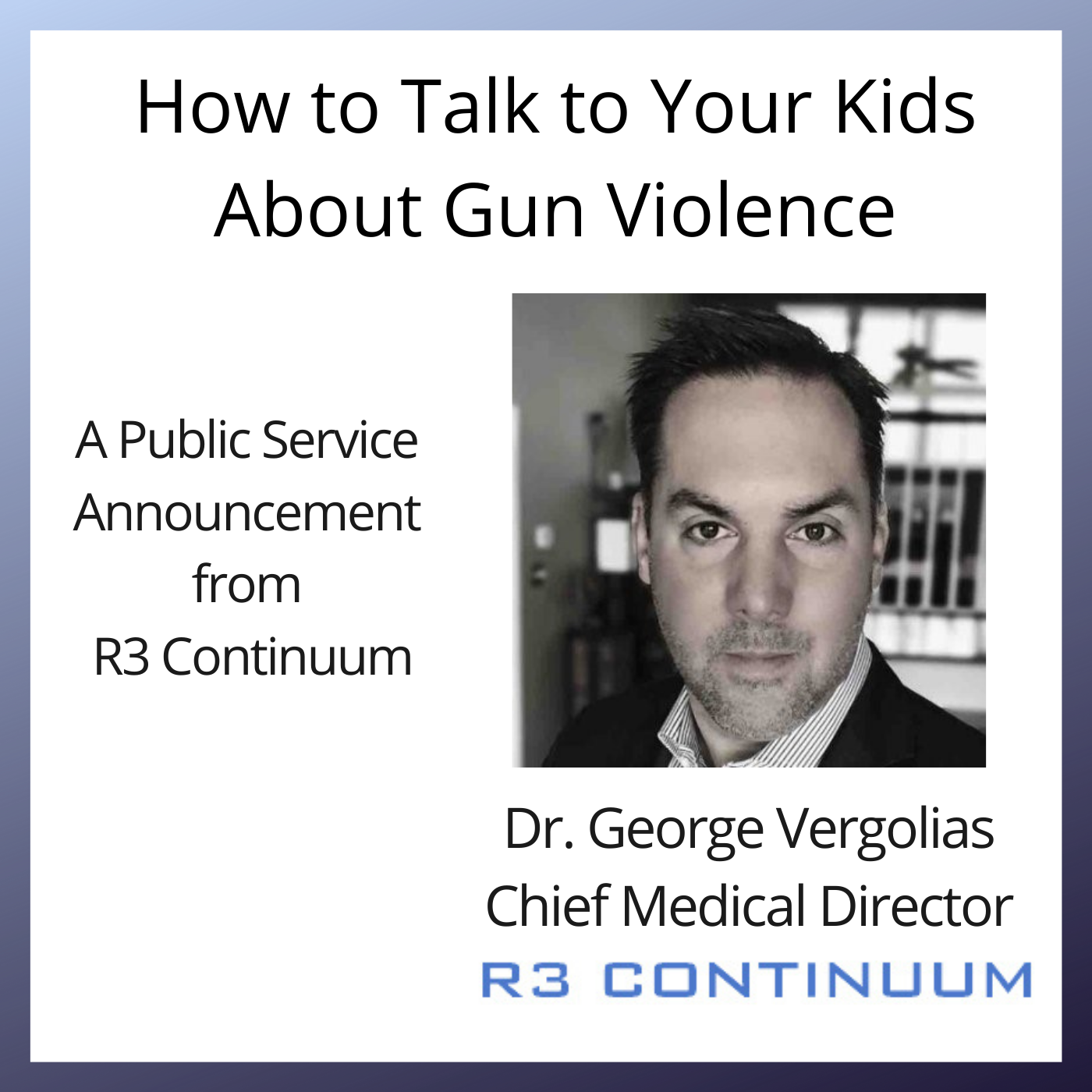
In this public service announcement, Dr. George Vergolias, Chief Medical Director of R3 Continuum, offers guidance on how to talk about gun violence with your kids.

TRANSCRIPT

George Vergolias: [00:00:00] Hello. My name is George Vergolias. I’m the Medical Director for R3 Continuum. I am a forensic psychologist and a certified threat manager with 20 years of experience, specializing in workplace violence and school violence. Most importantly, I’m also a father of a 14-year-old daughter and a 12-year-old son.

At R3 Continuum, our primary and passionate mission is to help organizations adjust to, manage and navigate through difficult disruptive events, including violent incidents. Last week, we collectively witnessed the heinous hate crime in Buffalo, New York, with the killing of 10 black community members at the Tops grocery store, most of them elderly. And we barely absorbed that event, until yesterday, once again, we woke up and bore witness to the attack at an elementary school in Texas, resulting in the deaths of two adult teachers and 19 children – second, third and fourth graders.

There are few words that can capture the outrage, the emotional reaction, the despair that comes with these events. Although we, at R3, can’t change these events having occurred, we can offer tools to make a positive impact. And towards that goal, I want to offer five tips for speaking with children about gun-related violence.

The first tip is that you should talk to them about their worries and concerns openly. Ask open-ended questions to understand what do they know, what are some misconceptions they have, what do they understand about the event. Express feelings about the event. Get them to open up about that, and express their feelings and thoughts. And then, you should also share your feelings as well. And you want to adjust that to their developmental age.

Secondly, adjust your dialogue to what you think they can handle emotionally. Kids at different age ranges and even kids at the same age range with different maturity levels will react differently to these events. Kids that have been previously traumatized may have a more difficult reaction, and you need to adjust that dialogue and that discussion accordingly.

Number three, reassure them about safety. These attacks are high impact, but they are low probability events. They’re unlikely to occur in any given school or any given school district. It’s also important to remind children about all the wonderful and exceptional measures that schools have taken to develop threat management teams, threat assessment, and reaction protocols and security protocols. In total, schools are a pretty safe place to be for kids and one of the most safe environments for them to be in the aggregate. And it’s important to remind them of that.

Four, reduced exposure to media and social media. This is not the time for information overload, particularly information that may not be accurate or may have been created simply for sensationalistic purposes in order to get clicks or additional views. We want to be cautious of exposing them too much to that. Ideally, you would want to titrate their exposure to those situations and that media over time, so they’re not overwhelmed.

Many of our kids, including my 14-year-old and 12-year-old, have their phones. It may be very difficult to get their phones back from them at this age with how much they’re involved in activity and social media. So, rather than trying to completely take the phone away, what you may want to do is some of the older teens where that might be more difficult, you want to at least check in with them periodically – once a day, twice a day – about what they’re hearing about these events, what they’re seeing online, what they’re being exposed to. And the goal there is to be able to correct any misinformation and give them an avenue to digest the information and talk it through. It’s really important to give them that opportunity.

Five, maintain regular routines and model healthy behavior. This is really important. Our kids will look to us for normalcy, as well as when something is not normal or off. And by maintaining regular habits, that becomes critical because these habits are are behavioral anchors to what is normal, and routine and comfortable in our life. And we want to model that and continue to show that in our daily interactions with them. To the extent possible, we want to continue those as much as we can. We can be sad, we can express outrage, we can express anger. Those are human emotions and they’re very normal in response to these events, but we also want to model a proper and productive way of managing those emotions and coping well through those events. And we want to be able to show our kids how to do that effectively.

This list is not exhaustive, but these are very easy take-and-used tips that you can utilize talking with children, and preteens and teenagers about gun violence, about the recent events in the last few weeks that hopefully can get them to express and open up a dialogue and be productive. Thank you for listening. Take care of yourself and take care of those you love.


About R3 Continuum

R3 Continuum (R3c) is a global leader in workplace behavioral health and security solutions. R3c helps ensure the psychological and physical safety of organizations and their people in today’s ever-changing and often unpredictable world. Through their continuum of tailored solutions, including evaluations, crisis response, executive optimization, protective services, and more, they help organizations maintain and cultivate a workplace of wellbeing so that their people can thrive. Learn more about R3c at www.r3c.com.

R3 Continuum is the underwriter of Workplace MVP, a show which celebrates the everyday heroes–Workplace Most Valuable Professionals–in human resources, risk management, security, business continuity, and the C-suite who resolutely labor for the well-being of employees in their care, readying the workplace for and planning responses to disruption.

Connect with R3 Continuum:  Website | LinkedIn | Facebook | Twitter
Tagged With: children, Dr. George Vergolias, George Vergolias, gun violence, kids, preventing workplace violence, public service announcement, R3 Continuum, school violence, teens, workplace violence

LIVE from RISKWORLD 2022: Oscar Villanueva, Managing Director of Security Services, R3 Continuum

May 26, 2022 by John Ray

Security Services
Minneapolis St. Paul Studio
LIVE from RISKWORLD 2022: Oscar Villanueva, Managing Director of Security Services, R3 Continuum
Loading
00:00 /
RSS Feed
Share
Link
Embed

Download file

Security Services

LIVE from RISKWORLD 2022: Oscar Villanueva, Managing Director of Security Services, R3 Continuum

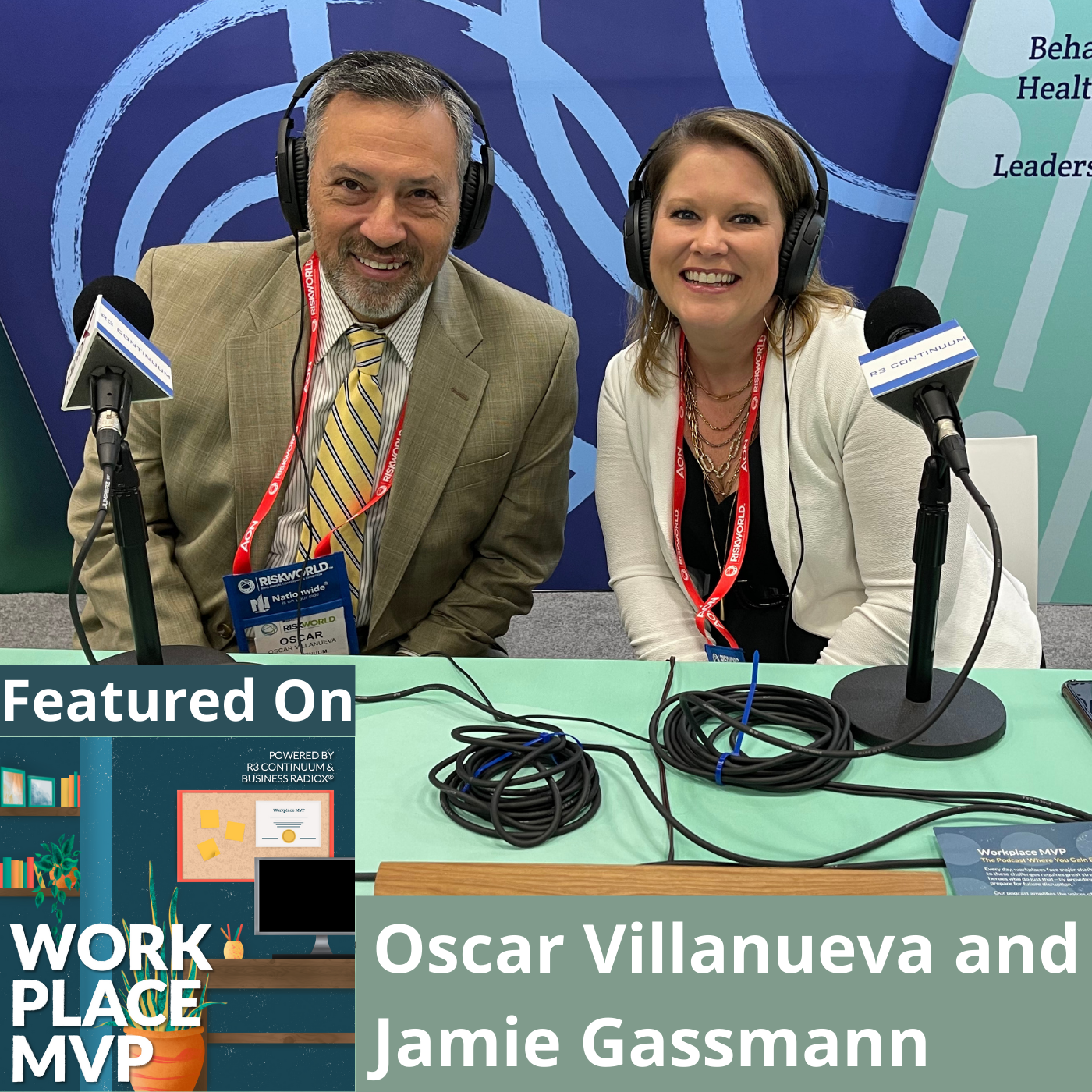
Oscar Villanueva, Managing Director of Security Services for R3 Continuum, joined host Jamie Gassmann at the R3 Continuum booth. Oscar explained the role of security services when clients reach out to R3 Continuum for help, the impact of an event that goes beyond the victim, the ultimate cost of not being prepared, and much more.

Workplace MVP is underwritten and presented by R3 Continuum and produced by the Minneapolis-St.Paul Studio of Business RadioX®.

This show was originally broadcast from the RIMS 2022 RISKWORLD Conference held at the Moscone Center in San Francisco, California.

Oscar Villanueva, Managing Director of Security Services, R3 Continuum

Oscar Villanueva, Managing Director of Security Services, R3 Continuum

Oscar Villanueva, a well-known international security expert, and former federal law enforcement senior executive brings many years of risk assessment and management, investigative, emergency preparedness, training, and critical infrastructure security experience, worldwide. He oversaw the security-based initiatives in over 180 locations throughout the world and has worked directly with the United Nations, Interpol, Europol, and during multiple Olympic Games.

He has over 30 years in federal law enforcement and corporate security consulting domestically and internationally. One of his areas of focus was workplace violence during his time with federal law enforcement and for the last decade in corporate security venues.

He now helps individuals and organizations navigate the difficulties of overall security and risk issues.

Mr. Villanueva lives in San Francisco.

LinkedIn

About Workplace MVP

Every day, around the world, organizations of all sizes face disruptive events and situations. Within those workplaces are everyday heroes in human resources, risk management, security, business continuity, and the C-suite. They don’t call themselves heroes though. On the contrary, they simply show up every day, laboring for the well-being of employees in their care, readying the workplace for and planning responses to disruption. This show, Workplace MVP, confers on these heroes the designation they deserve, Workplace MVP (Most Valuable Professionals), and gives them the forum to tell their story. As you hear their experiences, you will learn first-hand, real-life approaches to readying the workplace, responses to crisis situations, and overcoming challenges of disruption. Visit our show archive here.

Workplace MVP Host Jamie Gassmann

Jamie Gassmann, Host, “Workplace MVP”

In addition to serving as the host to the Workplace MVP podcast, Jamie Gassmann is the Director of Marketing at R3 Continuum (R3c). Collectively, she has more than fourteen years of marketing experience. Across her tenure, she has experience working in and with various industries including banking, real estate, retail, crisis management, insurance, business continuity, and more. She holds a Bachelor of Science Degree in Mass Communications with special interest in Advertising and Public Relations and a Master of Business Administration from Paseka School of Business, Minnesota State University.

R3 Continuum

R3 Continuum is a global leader in workplace behavioral health and security solutions. R3c helps ensure the psychological and physical safety of organizations and their people in today’s ever-changing and often unpredictable world. Through their continuum of tailored solutions, including evaluations, crisis response, executive optimization, protective services, and more, they help organizations maintain and cultivate a workplace of wellbeing so that their people can thrive. Learn more about R3c at www.r3c.com.

Company website | LinkedIn | Facebook | Twitter


TRANSCRIPT

Intro: [00:00:03] Broadcasting Live from RISKWORLD 2022 at the Moscone Center in San Francisco, it’s time for Workplace MVP. Brought to you by R3 Continuum, a global leader in helping workplaces thrive during disruptive times. Now, here’s your host.

Jamie Gassmann: [00:00:23] Hi, everyone. Your host, Jamie Gassmann here at the RISKWORLD 2022 Expo Hall in R3 Continuum Booth. And joining me is Oscar Villanueva, who is with R3 Continuum. Welcome to the show.

Oscar Villanueva: [00:00:38] Hello, Jamie. Good talking with you today.

Jamie Gassmann: [00:00:40] So, talk to me a little bit about the role you play at R3 Continuum.

Oscar Villanueva: [00:00:44] Well, my role is as Managing Director of Security Services for R3 Continuum. And, basically, what I do is I support the organization and clients when it comes to security services. And that could be anything from investigations, protective services, threat assessments, facility security assessments. Anything that has to do with physical security, I am available for clients to to use and to take advantage of our services.

Jamie Gassmann: [00:01:13] Yeah. You know, and from conversations I’ve had with you, you know, the uniqueness of the services that R3 provides is that behavioral health component to the solution. So, talk to me a little bit about that and how that’s a differentiator or unique in the marketplace.

Oscar Villanueva: [00:01:28] Well, you know, R3 continuum is a leader in behavioral health support and solutions with disruptive event management and crisis response, all of those kinds of services. And R3 has been doing it for many, many years and doing it very, very well as a leader in the industry. What makes my contribution to R3 significant is that every time you have a crisis situation, every time you have a workplace violence issue, every time you have a call that you’re making to R3 Continuum for services, there’s usually a security component that comes along with that. And, you know, having those two services – security and crisis response – along with behavioral health really does a unique and best-in-class response service from R3 Continuum for our clients. So, I think it’s an important component.

Jamie Gassmann: [00:02:26] Yes, it’s almost like they have the holistic response basically. It’s like you can look at it from a physical, you know, what caused the particular, you know, situation or incident, but then also from the behavioral side of it as well. They’re kind of almost getting a comprehensive kind of support from the company, correct?

Oscar Villanueva: [00:02:44] Yes. And I think part of what that type of service means is that R3 Continuum uses a team of experts approach. So, if you come to R3 Continuum, and you’re getting behavioral health, and there’s some security question that comes up, I’m brought into the case, the situation, and I provide an assessment from a security perspective. And if I’m working a security issue, you know, the same thing occurs because, you know, R3 Continuum has experts in behavioral health. So, the combination of the two and a team-of-experts approach is really what makes it a powerful service for our clients.

Jamie Gassmann: [00:03:26] And from a risk insurance perspective, you know, taking and looking at it through that lens, you know, how does that help them from like a litigation perspective or kind of a risk mitigation perspective?

Oscar Villanueva: [00:03:40] Well, for insurance providers, I think the most important thing is to mitigate crisis and even to prevent it, if you can. And contacting R3 Continuum, for example, I can think of a number of cases where, perhaps, you had a workplace violence issue that started as a threat, and then, through our services and doing a threat assessment, we are able to discover what the cause of the threat is, what’s behind the the potential violence, and we can provide an assessment as to what the best way is to move forward. And when you do this, you’re really either preventing or mitigating risk, which in the insurance world, I’m fairly certain that it’s extremely important. The less claims you have, the better off you are, or if you can minimize the claim to the lowest possible level, so that the loss is contained, then it becomes very desirable for an insurance company to use those services.

Jamie Gassmann: [00:04:44] Absolutely. And it also helps holistically for that organization to recover, you know, financially and not only that, but with their people as well.

Oscar Villanueva: [00:04:53] Right. Yeah. So, clients that — excuse me. Clients that use us, generally, are able to get the situations resolved quicker and people back to work sooner. And in the long run, that results in some, you know, significant results that really can save not only financial resources but also minimizes the human effects of this type of crisis when it happens to someone at work.

Jamie Gassmann: [00:05:25] Absolutely. And so, you are presenting on Wednesday on the human impact or the human cost, the true cost to human impact of workplace violence. Can you talk a little bit about that presentation that you’re giving here at RIMS?

Oscar Villanueva: [00:05:41] Yes, it’s on Wednesday at noon at the Thought Leader Theater on the exhibit hall. And what I want to talk about is the true impact of workplace violence on individuals at the workplace, and how it’s not just the individuals that are affected at the workplace but their families, coworkers that maybe were not there at the time. There’s a range of individuals, a number of people that get affected beyond the victim.

And when you hear about this workplace violence issues on the news or in the media, typically you think about the victim, right? The victim was, you know, threatened, assaulted or even killed, unfortunately. But there’s a range of other — there’s other victims that go along with that particular one that are almost unnoticed or unmentioned that also suffer. So, I think there’s a bit of a discussion to be had there, along with also talking about how to mitigate it, how to plan for it and how to prepare for it because the better an organization prepares for it, obviously, the less likely it is that it will happen. And if it does happen, then the impact can be minimized significantly.

Jamie Gassmann: [00:07:04] Yeah, it’s almost like a ripple effect, right?

Oscar Villanueva: [00:07:06] Correct.

Jamie Gassmann: [00:07:06] You got your kind of point of impact where you have your most concentrated, impacted employees. But there’s always more people that are involved that have to be taken into consideration. And then, not only that, how do you support them to make sure that they get the help that they need, you know, being that they might be in more of like a tertiary kind of layer of of impact and could get forgotten.

Oscar Villanueva: [00:07:28] That’s very true. Very true.

Jamie Gassmann: [00:07:29] Yeah.

Oscar Villanueva: [00:07:30] And, you know, it all starts with behavioral health, because when somebody goes to trauma and crisis, it’s really important to get them back to some level of normalcy. You never-

Jamie Gassmann: [00:07:39] Yeah.

Oscar Villanueva: [00:07:39] You know, it never goes away. You know, the thoughts of being in a workplace violence issue or witnessing a workplace violence homicide or something like that, it really never leaves you. But with behavioral health and psychological support, you can really have people come back to some level of normal and continue their daily lives without it affecting them to a large extent.

Jamie Gassmann: [00:08:01] Yeah. And what I’ve heard, and I don’t know if you can kind of comment on that, I know that there might be others within R3 that can as well, that there’s a different type of — you need somebody specialized in these types of incidents that it’s a different type of coaching or consulting that they’re giving to individuals impacted as opposed to someone that maybe just has like a depression or anxiety. It’s a different type of support, correct?

Oscar Villanueva: [00:08:29] Well, yes, that has been my experience. And I think R3 Continuum does it very, very well with the staff of counselors that are available and how quickly you can get there to provide the services. Because after you have a crisis, it’s really critical to have someone get to those individuals as quickly as possible. The sooner they can talk about how they feel and what happened, the faster they can recover. And so, it’s really critical that that happens. Yes.

Jamie Gassmann: [00:08:56] Yeah, absolutely. So, if there are three takeaways or takeaways that you want your audience to be left with after attending your session, what would those be?

Oscar Villanueva: [00:09:06] Well, one is that it’s important to prepare. And in order to prepare, you really need to do a few things, mainly to put together a workplace violence program with threat assessment teams, and just be ready for anything that comes because through that process, you can prevent or you can mitigate workplace violence going forward. So, that would be number one.

The second is that the impact of workplace violence on individuals goes far beyond that initial victim, and it really affects their families, or communities or workers. So, that would be the second takeaway. So, when you’re thinking about a workplace violence issue, it’s really important to consider who else is being affected by this. So, that would be the second takeaway.

And the third takeaway that I would like to share is that oftentimes, you know, there’s a saying that when you’re a hammer, everything looks like a nail. And so, many of our clients tend to think about their world on the basis of what they do for a living. For example, they could be in manufacturing, they could be in services, they could be a medical office. And so, their worldview always focuses on that type of service or that type of product that they’re manufacturing. But in reality, when it comes to workplace violence, it kind of goes outside of that. So, you have to shift your paradigm, your thinking to consider, “Okay, I am a manufacturing company primarily, but if I have a workplace violence issue, that could be a problem. So, I’m going to think about that. I’m going to prepare for that. And I’m just going to go back and do my business because now I’m prepared,” right?

And the result of that is that, oftentimes, companies, organizations that have workplace violence issues fail to prepare for it. But when something happens, there’s no end to how much money they have to spend on it and they’re gladly spending it. So, in the long run, it’s easier, cheaper and better to prepare ahead of time than to have an issue later and make it very costly in terms of human capital and also financial capital.

So, prepare early and often, have a plan, and be ready because there’s only really two kinds of companies in this world, one that has had a workplace violence issue and that one that will have a workplace violence issue because as long as you employ people, as long as you have employees, you’re going to have those kinds of concerns. So, those would be my three recommendations.

Jamie Gassmann: [00:11:42] Wonderful. And that sounds like a great presentation. I hope the audience picks up on all those great takeaways that you’re providing to them. If somebody wanted to get a hold of you to learn a little bit more about what R3 Continuum does or a little bit more about what your role is there and the services that we provide, how can they do that?

Oscar Villanueva: [00:12:02] Well, they can get a hold of me through R3 Continuum by going to the website, and there’s a contact information in there. The other way is to just email me the Oscar,Villanueva@r3c.com.

Jamie Gassmann: [00:12:19] Wonderful. And that website’s r3c.com, correct?

Oscar Villanueva: [00:12:22] That’s correct.

Jamie Gassmann: [00:12:23] Awesome. Well, thank you so much for joining us, Oscar. It’s been great to have you on the show.

Oscar Villanueva: [00:12:26] Thank you, Jamie.

Outro: [00:12:32] Thank you for joining us on Workplace MVP. R3 Continuum is a proud sponsor of this show and is delighted to celebrate most valuable professionals who work diligently to secure safe workplaces where employees can thrive.


Tagged With: behavioral health, Crisis Response, Jamie Gassmann, Oscar Villanueva, preventing workplace violence, R3 Continuum, RISKWORLD 2022, Security Services, Workplace MVP, workplace violence

The R3 Continuum Playbook SPECIAL: A Behavioral Threat Assessment of the Buffalo Mass Shooting

May 24, 2022 by John Ray

Buffalo mass shooting
Minneapolis St. Paul Studio
The R3 Continuum Playbook SPECIAL: A Behavioral Threat Assessment of the Buffalo Mass Shooting
Loading
00:00 /
RSS Feed
Share
Link
Embed

Download file

Buffalo

The R3 Continuum Playbook SPECIAL: A Behavioral Threat Assessment of the Buffalo Mass Shooting

On this special episode of the R3 Continuum Playbook, Dr. George Vergolias, Medical Director at R3 Continuum, looks at the Buffalo mass shooting from a behavioral threat assessment perspective. Dr. Vergolias joined host Shane McNally to review the personality of the assailant, the difference between affective and predatory violence, its similarities to other violent events, the potential impact on employees, how companies can support them, and much more.

The R3 Continuum Playbook is presented by R3 Continuum and is produced by the Minneapolis-St.Paul Studio of Business RadioX®. R3 Continuum is the underwriter of Workplace MVP, the show which celebrates heroes in the workplace.

TRANSCRIPT

Intro: [00:00:00] Broadcasting from the Business RadioX studios, here is your R3 Continuum Playbook. Brought to you by Workplace MVP sponsor, R3 Continuum, a global leader in workplace behavioral health crisis and security solutions.

Shane McNally: [00:00:15] Hi, everyone, and welcome to this special live episode of the R3 Continuum Playbook. My name is Shane McNally, Digital Marketing Lead with R3 Continuum. And on today’s episode, we’ll be talking with R3 Continuum Medical Director, Dr. George Vergolias, about the recent mass shooting that occurred in Buffalo, New York. We’ll also be discussing the impact and trauma that this event caused throughout the country, what employers can do to mitigate potential violence in the workplace, what employers can do to support their employees and community after a traumatic event like this takes place, and more.

Shane McNally: [00:00:46] Dr. Vergolias oversees and leads the R3 Continuum’s clinical risk, threat of violence, and workplace violence programs, and has directly assessed over 1,000 cases related to threat of violence, or self-harm, sexual assault, stalking, and communicated threats. He brings over 20 years of experience as a forensic psychologist and certified threat manager to help leaders, organizations, employees, and communities heal and thrive before, during, and after a disruption. Dr. Vergolias, thank you for being with us today.

Dr. George Vergolias: [00:01:19] My pleasure. It’s certainly not my pleasure to talk about what we’re going to talk about, but certainly, it’s nice to be able to leverage my expertise in a way that hopefully will be helpful.

Shane McNally: [00:01:30] Absolutely. And so, I think with that, we just kind of jump right into it. And can you kind of give us a brief talk through of the Buffalo shooting, the style of violence, and what occurred?

Dr. George Vergolias: [00:01:44] Yes, certainly. And I will preface this with a disclaimer and say that, now, what’s interesting in this case is we’re a week out and we know a lot, and we know a lot, because one, the assailant, Payton Gendron, has been apprehended. He had a 180 or so-page manifesto. He was posting online. This is an assailant that, really, he was secretive in terms of the general public, but in select audiences, he really wanted his voice to be heard.

Dr. George Vergolias: [00:02:21] And eventually, at the end of a gun, he wanted to be heard, his message. So, we know a lot about him, and sometimes, we don’t know a lot about the assailants this soon after, so we can make some assumptions and we can say some things that are informed at this point. So, what happened is on May 14th, just about a week ago, Payton Gendron, an 18-year-old White male from Conklin, New York, walked into a Tops grocery store roughly about 200 miles from where he lived, and he opened fire.

Dr. George Vergolias: [00:02:58] He actually began firing in the parking lot, and he proceeded then to walk into the grocery store and continued shooting people. It’s clear from the evidence that this was a racially motivated attack. I’m comfortable saying it was a hate crime, although to say that affirmatively is a legal process, but he’s being brought up certainly on charges of it being a hate crime.

Dr. George Vergolias: [00:03:25] So, what’s interesting here is there’s evidence that going all the way back to late 2021, he was already planning this attack. He was going on websites like 4chan, and more recently, on Discord, and not only engaging in rhetoric that kind of met his ideological view of the great replacement or the major replacement theory of the White race being slowly wiped out, which is one of a number of theories that White nationalists and White nationalism subscribes to in believing that Whites, in general, are being somehow edged out or weeded out of the population, not just in the US, but globally.

Dr. George Vergolias: [00:04:15] So, he was doing this online. He was engaging in online threats. He was engaging in planning. He, for a number of months, was selling off belongings, so he can have the money to buy tactical gear, and weapons, and ammunition, and so on. On March 8th, he went to—he drove the 200 or so miles to the Tops grocery store, and he basically cased the joint. He walked through up and down the aisles.

Dr. George Vergolias: [00:04:44] He walked in and out a number of times. Eventually, he was confronted by a security guard that had basically said to him, “I’ve seen you go in and out a few times. What are you doing?” And basically, Payton said that he was collecting consensus—or rather census data, which could have been reasonable, right? And it was taken at face value. And then, he went home, and later that night, he chatted, and he basically said it was a close call, he almost got caught.

Dr. George Vergolias: [00:05:16] What he was doing, it was, he’s looking at the patterns of people coming in and out. He was looking at the areas of the store that were busier and at what time of the day. He was no doubt looking at the security people and their movements, as well as looking at how they might respond. This is all very planned, what we call pre-attack planned behavior, and it is a pattern that we see a lot with predatory individuals. What he also did is he came in with several firearms in his person, certainly, in his car.

Dr. George Vergolias: [00:05:56] He was suited up in tactical armor, including a tactical helmet. At one point, what they call Army-style or assault-style tactical gear. Several weapons he had, a Mossberg 500 shotgun. He had a hunting rifle that was given to him by his father when he was 16. And he had recently bought a Bushmaster XM-15 rifle in January from a local gun distributor. That weapon was purchased legally, and in between December 8th and January 19th, he actually visited roughly about 15 different gun stores in the greater, larger northern New York state area.

Dr. George Vergolias: [00:06:42] He hid those weapons in his bedroom, and he wrote online that he was worried that his parents would find him, and he would get found out, and his plans would fall apart. That didn’t happen. Unfortunately, that did not happen. When he came on site and started shooting, there was a security guard and ex-law enforcement officer named Aaron Salter, who returned fire, shot Payton, and run, but due to the tactical armor he had on, he wasn’t able to subdue him or bring him down. Payton returned fire and killed Mr. Salter. I could go on about the details, but then he proceeded to work his way through.

Dr. George Vergolias: [00:07:22] His plan, at least as written online, was to then go to other locations that day and continue his killing spree. Fortunately, police responded very quickly. I believe at one point, he turned the gun on himself, he didn’t fire, but he kind of pointed it in his own neck, and the law enforcement officers talked him out of self-harm, and they took him into custody. So, there’s a lot of details I didn’t cover. I wanted to give a little more flavor. And what I was highlighting with those facts are things that are very pertinent to the kind of violence that we’re seeing here. Would it be good for me to describe that now, Shane? I know you had several aspects to your question.

Shane McNally: [00:08:09] Yeah, if you would like. I think one question that we could go off of right now that just popped up from what you were saying is when he was going in and out of that store, now, correct me if I’m wrong, he was actually full-on planning and mapping out everything that he was going to do, right?

Dr. George Vergolias: [00:08:25] Absolutely. Absolutely. So, one thing that we see with this type of violence, and there are two types—well, before I go into that, because that’s an explanation, but to answer your question, absolutely. This wasn’t a random, hey, let me just go check out this grocery store. He drove 200 miles in early March to specifically case and do surveillance on this store, partly to solidify it as a target.

Dr. George Vergolias: [00:08:53] Sometimes, psychologically, we call this a hardening of targets. Another way we describe hardening of targets is if you are a target and you put certain security measures in place that toughens them or hardens them. After 9/11, even going as far back as after the Oklahoma City bombing by McVeigh, many federal buildings put large cement pylons in front, so you couldn’t get a truck right up to the door.

Dr. George Vergolias: [00:09:20] That is a security hardening of target. But there’s a psychological principle where you also do something that I refer to as a hardening of the targets. You are no longer thinking of the targets as humans, as subjects, with lives, and goals, and dreams, and loved ones. You’re hardening them in your mind. You’re objectifying them. And when you walk through a site as an attacker, and you’re committed to the plan at this stage, you’re starting to just think of this almost like a cognitive exercise.

Dr. George Vergolias: [00:09:52] You’re not thinking of these people as people. You’re thinking of them just as objects, as targets. And so, that’s part of the process of casing. It is partly, how do I get away with it? How do I inflict maximum damage? But it’s also that process, in your head kind, of steeling yourself, not steal, as in the metal, steel. You’re hardening yourself and hardening your mind psychologically to commit the act.

Shane McNally: [00:10:19] Wow. Yeah, it’s just crazy to think that somebody could do that and even go so far as to, like you said, harden themselves to do that in the planning.

Dr. George Vergolias: [00:10:29] Let me just piggyback on that real quick. What’s interesting is assailants that are in this predatory mode, and I’ll talk about that just next, but they will go to other lengths. Like if you look at Dylan Klebold and Eric Harris. Eric Harris, these are the Columbine assailants, in the weeks leading up to the Columbine attack, Eric Harris specifically went off his antidepressant medication for two reasons. He didn’t want to feel emotionally subdued or mellowed. He wanted to feel the full rage that he was feeling as he went into that attack. He wanted the full, you almost can say it, he wanted to be emotionally amped, right? He wanted to be jacked up emotionally. He purposely did it. That wasn’t accidental.

Dr. George Vergolias: [00:11:16] When you see these guys, and almost all guys, by the way, I think last data that I looked at from a couple of years ago, pre-pandemic, something like 3 or 4% of mass shootings have been committed by women, so this is almost predominantly a male game right now. And people will say, why do they get all this tactical armor? Well, one is maybe self-protection. But let’s be honest, in most of these attacks, I mean, if you look at the synagogue attack from two years ago, if you look at the Christchurch mosque attack from a few years back, none of these people had weapons.

Dr. George Vergolias: [00:11:53] Why do they wear black? Why do they wear camouflage in the middle of the day? That doesn’t obscure you, that doesn’t hide you, it makes you stand out. They are psychologically gearing up. They’re psychologically putting on the uniform to be a commando, to be a soldier of their cause. That’s another aspect of them psychologically getting geared up and almost building up momentum to go out. The closest normative example for any of us that ever played football, and you’re in the locker room, you got your pads on, you got your helmet on, and you’re smashing helmets with your buddy, and you’re smashing their shoulder pads, what are you doing?

Dr. George Vergolias: [00:12:31] You’re getting amped up for the game before you go out of the locker room and take the field. That’s fairly normative, right? We all see that. We all understand that. These attackers have similar individual rituals that they do to amp themselves up in preparation to go out out of the field of play, as they say it. So, yeah, so these are really good questions, but that’s what we see. It’s a very interesting psychological phenomenon.

Shane McNally: [00:12:56] Wow. And I know you mentioned you want to talk a little bit about the kind of act of violence that this really looked into, but kind of maybe wrap it in with this, my next question of like, does this shooting remind you of other events in history?

Dr. George Vergolias: [00:13:10] Yeah, it absolutely does. So, before I go there, though, let me talk about affective versus predatory violence, and then I’ll talk about the reminders—or what it reminds me of, and then the linkage is between them, if that’s useful.

Shane McNally: [00:13:24] Yeah, absolutely. That sounds great.

Dr. George Vergolias: [00:13:25] So, a little bit of history lesson here, but psychological history lesson that hopefully is interesting. We know now that there are basically two biological or biophysiological modes of violence in the brain. They have different anatomical aspects of the brain that are in operation. They have different neurotransmitters. They operate with different neuronal pathways. And the way this was found out is about 70 years ago or so.

Dr. George Vergolias: [00:13:55] I believe it was German or Austrian scientists, were doing research on cats, and they open their brains while they were obviously alive, and in case we have cat lovers out there, once you anesthetize the skull, the brain doesn’t have sensors, pain sensors, and they would put electrodes on the brain. And what they found out—and then they expose them to different environment stimuli to see how they reacted.

Dr. George Vergolias: [00:14:22] And they weren’t necessarily trying to study violence, per se, but what they found out is that there were two kind of violent reactions that had two different patterns in the brain. One, they deemed affective violence or emotional violence, and the other, they called predatory violence. Sometimes, it’s also referred to as targeted. I don’t like that term. I like predatory, because it kind of shows you the mode. Affective violence is violence that most of us have seen, or if we’re ever going to be a victim of violence, most of us are going to be a victim of affective, reactive violence.

Dr. George Vergolias: [00:14:57] It’s emotional. It has to do with hyperarousal, meaning you’re jacked up, you’re excited, you’re scared, you’re fearful, you’re shamed, you’re annoyed, you’re rageful, but there’s an emotion going on. It tends to be reactive and immediate. It tends to be in response to a perceived threat, somebody is threatening you or you feel threatened and you feel you need to react back at them. It is a fight or flight reaction. I need to fight the threat away, or I need to run away, or better yet, I need to posture in order to drive the threat away.

Dr. George Vergolias: [00:15:32] How is posturing? Well, a quick example of affective posturing, we’ve all seen this. Certainly, boys have all seen this. Growing up in grade school, two kids get in a fight at recess, what often happens is they’re cracking their knuckles, right? They’re puffing their chest. They’re swaying side to side. They’re putting their chin out. And they’re taunting the other person to hit them. “Come on, hit me, man. No, you hit me. No, you hit me. No, you hit me. Do you want to fight? Let’s go.”

Dr. George Vergolias: [00:15:58] And this may go on for minutes before a fight even breaks out. And sometimes, the fight doesn’t even break out. Looking at those two, the untrained eye would say, “Oh, well, those two kids really want to fight”, and the truth is, no, they don’t. They don’t want to fight. What they want is they want the other person to walk away, and they save face. They save kind of ego. If you look at prison attacks and you could pull up the Discovery Channel or A&E, and watch prison documentaries, you will see true predatory attacks.

Dr. George Vergolias: [00:16:29] There’s no warning, there’s no posturing, there’s no verbal threats. Two inmates are sitting there looking like they’re best friends, and the next thing you know, one inmate explosively just starts attacking the other with no warning. It’s a very—and it’s almost unemotional. It’s almost cognitive in the way it’s done. So, affective on the one side. It’s also time-limited, meaning if you think of a fight or flight reaction, our bodies can’t stay in that mode for very long.

Dr. George Vergolias: [00:17:00] Adrenaline is pumping to your major muscles. You have cortisol pumping. You have different things going on that is all designed to get away from an attack or subdue an attacker. And this has evolutionary value, right? If you needed 10 minutes to figure out how to get away from a lion, you didn’t live, right? It was an immediate reaction. You had to mobilize to deal with that. So, it’s time-limited. I’m going to add one more thing that’s kind of interesting.

Dr. George Vergolias: [00:17:30] With affective violence, you will have a displacement of the target. Now, what does that mean? That means that if I’m in an affectively violent mode and someone attacks me, I’m going to attack anyone that comes into my circle. So, imagine, for example, that I have a cat tied to a corner of a room on maybe a six-foot leash, and I slowly walk a Rottweiler or a Doberman Pinscher up to that cat, what’s that cat going to be doing? Right?

Dr. George Vergolias: [00:18:00] Obviously, hissing. Its back’s arched. Its claws are extended. It’s showing its teeth. Even if that cat is looking at the dog, would any of us be willing to walk over and pick the cat up? And the answer should be no, right? Why? Because that cat’s attacking anything that comes into its circle, anything that comes into its sphere. One of the reasons that police officers, their most dangerous response in the field is domestic violence, not just because the abuser is in an amped-up state, which is almost not always, but usually, a man, but often, the victim is in a violent state, because she is defending herself.

Dr. George Vergolias: [00:18:40] She is in a fight or flight arousal herself. And so, the whole environment is supercharged with emotion. And with that emotion comes fight or flight reactivity. Okay. That’s affective violence. Bar fights, fights at the Thanksgiving table, hopefully, we don’t have many of those, but some of us have seen that, right? Tailgate fights, fights at school, all that kind of thing. That’s usually affective violence.

Dr. George Vergolias: [00:19:06] Now, let’s juxtapose that with predatory. Predatory violence is you have minimal arousal. First, let me give you an example. Let’s take that cat, and now, put that cat two days later in the backyard, and there’s a bird feeder maybe 30 feet away, and a bird lands on that bird feeder, and now, the cat sees the bird. Now, the cat isn’t on top of the bird yet. The cat’s 30 feet away. Now, what’s the cat doing? It’s super focused, right?

Dr. George Vergolias: [00:19:31] It’s staring at the cat. It’s got a laser focus to its eyes. Its claws are pulled back, because it’s not ready to attack. It wants to move very stealthily, very quietly, and only at the last minute, when it gets close, might it then attack and get aggressive, but it’s in a very cognitive focused mode. The human correlate of that is an Army sniper. I remember seeing an interview of a sniper from the Serbian-Croatian war, obviously, a number of years ago. And this sniper, every night, would crawl, and he was sniping across what they called Sniper Alley.

Dr. George Vergolias: [00:20:08] It was a division line of literally, roughly about one street that divided the forces, and he would crawl up a rubble-strewn staircase, and he would have to crawl across the room with rocks and rubble on it, and get into position, and then he would look throughout the night for people, frankly, to snipe. And they asked him, “When you get to the top of that staircase, how long does it take you to crawl into position, that 20 feet or so? And people would say an hour, 2 hours. It took him often 5 to 6 hours to crawl 20 feet. That’s how careful, and slow, and methodical he was.

Dr. George Vergolias: [00:20:49] Think of that, though, for a minute. Think how cognitive you have to be to do that. There’s no emotion. There’s no reactivity, right? That is an example. Your Army sniper is a more socially sanctioned example of predatory attacks. So, when we see shooters like Payton Gendron, and everything I opened the podcast with and all his behaviors, this is a predatory attack, right? Minimal arousal, meaning he’s not emotional, he’s not jacked up at the time.

Dr. George Vergolias: [00:21:21] It doesn’t mean that he’s not yelling things. There’s a certain bravado that they will show, but he’s not really feeling fear, anger, rage, panic. It’s purposeful and planned, violent. There’s no imminent perceived threat. What we mean by that is nobody in the Tops grocery store posed an existential threat to Payton Gendron. Nobody did. Now, in his mind, they did, because they represented a minority, a Black community that was taking over the White population by the proliferation of birth rates and all that, if you read his manifesto.

Dr. George Vergolias: [00:21:59] But they didn’t actually pose a threat to him. There was also no displacement of the target. And what we mean by that is if you ever look at closed cam footage of these shooters, and there’s a little bit of this circulating with the Pulse nightclub shooting with Omar Mateen, you could see a little bit of this online with the Columbine shooters, you will notice that they’re not frantic as they walk through and shoot people. They’re very cold, and methodical, and calculated.

Dr. George Vergolias: [00:22:34] Often, I talked about rituals of affective violence, you puff your chest up, because the signal is if it’s in you and me, Shane, it’s Shane, you don’t want any piece of me. I’m going to puff my chest. I’m going to crack my knuckles. I’m going to sway back and forth. I’m going to look tough. I’m going to look like a peacock, right? I’m going to extend my physical prowess, because I want you to walk away.

Dr. George Vergolias: [00:22:55] I don’t really want to fight you, but I can’t admit that, because I’m a man, so I need you to walk away. The problem is you’re doing the same thing, and often, one of us crosses a line and it gets physical. In the predatory style, you don’t see the public displays, because it would give up your intention, right? If every mass shooter showed massive public displays of their intent, we would catch all of these guys.

Dr. George Vergolias: [00:23:18] What they tend to do is they tend to show these displays in very focused communities or groups that they think mirror their ideology. That’s why he went on 4chan. That’s why he went on Discord. That’s why moments or hours before he went on the shooting, he invited a very select group of 15 people that we’re still investigating to visit him on the Discord Channel and look at his postings, and I think there were even links to the live feed that he showed when he went and committed the shooting.

Dr. George Vergolias: [00:23:53] So, all of these are private rituals, and the goal is to fuel their own narcissism, and reduce their paranoia, and kind of gear them up psychologically for the attack. In Columbine, Harris and Klebold, they made basement tapes for weeks and months ahead of time, where they talked about the attacks and their intentions, and what they hope to get out of it, and what their intended outcome is going to be.

Dr. George Vergolias: [00:24:18] So, why do I go into all this? It’s really important to understand these features, so you can understand what kind of violence are you trying to prevent? I can’t tell you after this shooting and after every shooting how many, and we’re going to hear this over the next few weeks, people that knew Payton Gendron come out and say, “Oh, I never saw this coming. He was such a quiet, mild-mannered kid.

Dr. George Vergolias: [00:24:46] Now, he had some problems, no doubt, but I never saw him get all erratic. I never saw him explode in rage. I never saw him show high levels of emotion.” Well, of course, you didn’t. He’s a predatory attacker. It’s a very different kind of MO than what we would see. If you’re a psychopath, you’re going out to the bars every night and getting in bar fights. It’s a very different kind of psychology that goes behind this. I know that was long-winded, but I wanted to do that question justice.

Shane McNally: [00:25:15] Yeah, absolutely, and thank you for that. And I think that leads into the next one really well when you just mentioned kind of the psychology of it, but there’s a lot of talk, obviously, there’s a lot of media, and we’ll get into that in a second, around this shooting and everything, but there’s also a lot of talk about the attacker himself and being evaluated by mental health professionals the year prior to the attack. So, there’s this like idea out there that mental health treatment can or should play a role in preventing these types of attacks. And events like this, obviously, like the idea is that they show a crack in the system. Can you kind of like expand and speak a little bit more on that?

Dr. George Vergolias: [00:25:52] Yeah, I can. So, we don’t know everything about that. What we know is roughly about a year, maybe a year-and-a-half, I don’t have the exact time frame, I believe he wrote a paper or he wrote something down, where he talked about or he made statements about committing a murder suicide at school. The school did what they needed to do. They flagged it and they sent him for a mental health evaluation. I don’t know where that occurred. I actually work locally here in North Carolina in hospitals, and I do these evaluations. Typically, when the school flags it, they’re like, we think this kid might be dangerous to themselves or others. They send them into the emergency department. They’re evaluated.

Dr. George Vergolias: [00:26:34] And at that moment, it’s important to know that the evaluating clinician, typically, a doctor, could be a social worker, but typically, it’s a doctor of psychology or a psychiatrist, they have to adhere to an imminent risk standard, which means, are you imminently at risk of killing yourself or others? Not, are you kind of a bad person or might you do something a week from now, a month from now, a year from now? But are you so dangerous in the next 24 to 48, to 72 hours that I need to take away your rights and commit you to the hospital? There’s a few avenues to make that happen, but that’s the ultimate, is I’m literally going to commit you against your will.

Dr. George Vergolias: [00:27:14] In order for that statute, that bar to be met in most jurisdictions across the country, there has to be a lot of data that shows that you’re thinking of hurting yourself, you have strong ideation of doing it, you have a plan, you have intent, and you lack certain impulse control to hold yourself back, and you lack certain protective factors. That’s a lot of checkboxes. What happened, as best we know, from what I can gather from second party sources, is that he went in. Again, by the way, most of these guys are fairly manipulative.

Dr. George Vergolias: [00:27:52] Payton was bright. He actually, I think, won first prize in middle school at a chemistry contest. I think he was on the honor roll for most of his high school career until he dropped out. This was not a stupid kid. He went in basically, and said, “Oh, I was just trying to get out of school. I was bored and I knew that would get me out of school.” And the other checkboxes just weren’t there, and they released him. And that was a year ago, right? You can’t lock a kid up for a year, so—you can in some cases, but you have to be very severely mentally ill, which he wasn’t.

Dr. George Vergolias: [00:28:26] So, I think there’s this misconception that a mental health evaluation is going to solve all these problems. There was a really wonderful op-ed piece by Mark Follman, F-O-L-L-M-A-N, who’s written for The New York Times. He’s written for Mother Jones. And most of his writing as a journalist has focused in the last five or so years on understanding mass shooting and mass attacks. And he’s worked with a lot of very well-known researchers on threat assessment and forensic psychologists.

Dr. George Vergolias: [00:28:58] I’ve seen him talk. I’ve met him at conferences. Really great journalist. He just published an op-ed piece. I believe it was in The New York Times or The Washington Post. I can’t remember immediately off the top of my head. I’ve been digesting so much information on this. But he talks about how these individuals do have mental health issues, no doubt, but this is not a mental health problem at its core.

Dr. George Vergolias: [00:29:22] The overwhelming majority of people with mental illness are not violent. Mental illness doesn’t, otherwise, take a nonviolent person, and suddenly, make them violent. There are rare, and I mean very rare exceptions, where you might have somebody with severe mental illness, paranoid delusions, psychosis, where they believe people are after them and they feel they need to defend themselves.

Dr. George Vergolias: [00:29:47] There’s almost no cases in which those individuals go on a shooting spree. There’s a few. There’s a few. I think it represents something like 3 to 4% of all mass shooting seem to be motivated by the nature of the psychotic, paranoid delusions that the person was having. The overwhelming majority of these cases, these people, they didn’t have a great sense of right and wrong, meaning their morality was a little bit skewed like a psychopath’s is, but they knew right and wrong.

Dr. George Vergolias: [00:30:19] They knew what they were doing and they were making decisions to do these based on an ideology that they were subscribing to. So, that’s one of the factors, I think, that’s important to realize, is that mental health, we do need to improve our mental health system, no doubt. And I think we need to rethink some of the laws we have in order to try to keep people safe, but a lot of these shootings would not necessarily be prevented simply because somebody was hospitalized against their will. And in this case, that was well over a year ago. That probably wouldn’t have had a massive impact here.

Shane McNally: [00:30:55] Yeah, those are some excellent points to bring up around that, so I appreciate you taking that question there, too. And so, like I mentioned at the beginning of that question, of going back to it a little bit here, you did mention earlier that there was a massive amount of media presence around this shooting, and understandably so, with news outlets and everything like that, and can you tell us about the impact that having so much media presence has with this level of violence?

Dr. George Vergolias: [00:31:25] Yeah, absolutely. So, there’s this thing in the field that we call the contagion effect. There’s also the copycat effect. The copycat effect is simply—and actually, we saw this, and I’m actually going to dovetail this with an answer to a question you asked earlier that I got away from, where you ask simply, does the shooting remind me of other things? And it absolutely does, and just in recent memory, right?

Dr. George Vergolias: [00:31:50] So, we know, for example, on, I think it was October 27, 2018, in Pittsburgh, the Tree of Life synagogue, Robert Gregory Bowers, 46-year-old male, went in and shot 11 people in the synagogue. And his thing was very similar to the whole White replacement theory, and he was blaming Jewish people for being responsible for—being the immigrant invaders and being responsible for promulgating the immigrant invaders. We all have heard of March 2019, the Christchurch New Zealand shooting.

Dr. George Vergolias: [00:32:30] 51 people shot by Brenton Harrison Tarrant, 28-year-old White male from Australia, and he clearly was responding in a very similar way to what he perceived was the great replacement. He actually called his manifesto The Great Replacement, and it was the same ideation that Payton Gendron was replying to. In fact, in August of 2019, Patrick Wood Crusius at the Walmart shooting in El Paso shot 20 people. Same thing. His manifesto, he called The Inconvenient Truth, but it was the same thing he was railing against, is that this attack is the responsible for Hispanics, in this case, invading Texas, and he felt like people needed to come after or he needed to go after that contingent of society to defend the White race.

Dr. George Vergolias: [00:33:26] So, there’s clearly a plan here, and what’s interesting is Patrick Crusius, the shooting at the Walmart, he got his inspiration from Harrison Tarrant of the Christchurch shooting. And we know there are indications from the manifesto that Payton Gendron also got his influence, or motivation, or inspiration from prior shootings as well. So, what we see is there’s a certain copycat effect of people see earlier shootings, where people have similar or closely aligned ideologies, and they use that to fuel their own ideation, and they almost see it as their hero, and they further commit an act. What we also know that—that’s the copycat effect.

Dr. George Vergolias: [00:34:12] What we also know is there is something called the contagion effect. And what we’ve known, and we’ve known this for 30 years, and that is when there is a mass televised or massively publicized shooting of a mass shooting or a widely publicized story of a mass shooting, there is a significant increase, usually, it’s been measured at 10 to 13X increase of another unrelated mass attack occurring within about two weeks of that publicized event. Now, that used to be regional if you go back 30 years ago, basically, if you go back before social media and mobile phones.

Dr. George Vergolias: [00:34:57] It used to be—I live in Raleigh, North Carolina. Shane, I know you’re in Minneapolis. If there was widely publicized in the newspaper, there would be a certain geographic barrier to the publication of that where that risk would increase. Now that we are truly a globalized news kind of feeder source, that regional barrier just doesn’t exist. It doesn’t really matter, right? You could have a shooting in New Zealand, and it’s covered all over the news globally, and it’s on CNN and Fox News every night, and it motivates some guy in Albuquerque, right? But what’s behind this psychologically?

Dr. George Vergolias: [00:35:40] In a weird way, it’s a really understandable dynamic, aside from the heinousness of the violence. What’s behind it is someone sitting at home right now as we’re talking, and they got a lot of hate, a lot of anger, whatever their ideology is, it could be right wing, which a lot of it right now is right wing, it could be left wing, right? It could be radical, violent Islamist. A lot of directions, but they’re thinking somebody should do something, somebody should do something.

Dr. George Vergolias: [00:36:13] And then, they watch a shooting like this, and maybe they start saying in their head, God, this Payton guy was kind of a loser, if he could carry this out, certainly, I can, right? I could pull this off if he can. Why wouldn’t I? Maybe I should step up and take arms for the cause, fill in the blank of whatever the cause is, right? Because it could be on different levels of the political spectrum.

Dr. George Vergolias: [00:36:36] And then, it emboldens them to start—it’s almost like the light bulb goes off and it emboldens them to move forward with a plan. The other thing is there’s people that have already been incubating in that for months or years, and what they needed in a way psychologically is that model, that last inspirational push over the edge to move into planning or to take things to the next level and go into planning mode. Now, when I said earlier, this is normative psychologically, you’re like, what?

Dr. George Vergolias: [00:37:07] Well, here’s my explanation, and I’m going to give you my personal story, almost every year, I sit down sometimes with my wife, she’ll watch it, other times, she doesn’t, but almost every year, when the Iron Man, the Kona Iron Man is on TV, I watch it from beginning to end. And I love watching the athletes that finish in X number of hours, but I also love watching the people that are doing it all day long and they make it in with 5 minutes to go before they shut the race down, right? And there’s also that one guy, I forget his name, whose son has cerebral palsy, and he finishes the whole race every year, or used to. I don’t know how old he is now, but it’s very inspirational, and he does it with his son.

Dr. George Vergolias: [00:37:48] He like pulls the son on a small raft, and then he rides the son on the bike, and then he pushes the son on a stroller through the marathon, and it’s the most inspirational thing in the world. And what do I do in the next morning? I wake up early, and I go and buy groceries, and I buy spinach, and I buy protein drinks, and I buy all kinds of stuff, and for about two days, I work out, and then I go back to eating nachos, right?

Dr. George Vergolias: [00:38:11] But for a short period of time, I’m looking at these images, and saying, damn, I can do that, I should do that. It’s the same psychological principle with the contagion effect, we’re just seeing it directed in a really heinous, violent avenue. So, yes, these events do have precursors and they do piggyback off one another in the mindset of certain numbers of assailants. But let me say one more thing, because it’s important to know.

Dr. George Vergolias: [00:38:42] Positive interactions could have the opposite effect as well. I remember listening to a famous security expert threat manager, Joel Dvoskin. He was doing a post-mortem autopsy, a psychological autopsy, as we call it, on the Columbine assailants. And Eric Harris was set, he applied to the Marines, and about three weeks before the shooting, he got his rejection letter. And he got rejected, I think he had an ear or a foot issue.

Dr. George Vergolias: [00:39:13] I don’t remember the exact issue, but there was some issue medically, and they just said, we can’t accept you. And somebody asked him, if Eric Harris would have gotten into the Marines, do you think he would have backed away from the shooting? And Joel Dvoskin said, and I agree with him, absolutely. Absolutely. That gave him something to look forward to. That was his whole life. It gave him motivation towards something better and more prosocial. There’s no way he would have gone through that shooting, and I’m inclined to agree.

Dr. George Vergolias: [00:39:40] So, what’s interesting is there are people on this trajectory that haven’t committed yet but are inching towards committing, and something positive happens. They find a girlfriend. They get that job that they didn’t think they’d get. An old mentor calls them. I mean, a million little things, and it just turns them off a trajectory, and it’s just enough to nudge them off the pathway. Now, some kid get nudged back on the pathway, but sometimes, it’s just enough to nudge them off the pathway. So, there are some really interesting dynamics that play as people are navigating through this process of trying to decide, do I take this to the next step and continue on that path?

Shane McNally: [00:40:24] Well, yeah, and like you said, we’ve seen this everywhere in the news and everything like that, and additionally, this one was a little, I think, different, because it was also live-streamed. He had a live stream up as well. And I think kind of going into how this can actually impact people that were there, but also, people across the country that have seen some of these videos or are just upset and traumatized, honestly, about the whole thing, and understandably so. How did live-streaming this online really have an effect on people that may have seen it? Is it likely to increase fear and trauma to people that weren’t there, but did see this shooting play out?

Dr. George Vergolias: [00:41:07] Yeah, I think there’s a few ways in which it could significantly impact people. By no means am I going to say that it’s going to cause trauma. That’s prescriptive and different people react differently to that. What I will say is for those people that have been subjected to violence, those people that have been involved in a shooting, lived through a shooting, have had loved ones involved in a shooting, it almost brings a—can, I should say, bring back the experience very viscerally.

Dr. George Vergolias: [00:41:39] So, there’s that subgroup. That’s still a pretty small subgroup of the population. But even those people that may have not been subjected to it, but saw it, it’s disturbing. These are disturbing things. I have been allowed, given my background as a threat manager and a forensic psychologist, I have had aspects—or I’m sorry, access to seeing aspects of closed cam footage shooting or even direct shooter footage when they had a body cam or they had a GoPro, and it’s disturbing. These are disturbing things to see without a doubt. So, certainly, there’s the risk of it being traumatizing.

Dr. George Vergolias: [00:42:16] There’s a flip side to it, and that is for those individuals that are on a trajectory and maybe just a little more upstream from where Payton was at the process, it could also be emboldening to them, right? It could be an image for them of almost reinforcing their own sense of belief of going through something like this. Fortunately, and this is where social media has come a long way, this thing was taken down, I think, within minutes, and scrubbed, which is good.

Dr. George Vergolias: [00:42:50] But yeah, I mean, these are traumatic things. I think if I recall right, the first, there actually were other captured shootings that occurred. There was a shooting from the late ’80s where there was a gentleman whose son had been molested, and the molester had fled the state and was being extradited back into the state, flown in to a certain airport, I forget the name off the top of my head here, and the assailant was at a payphone. I mean, you’re nodding. I guess you’re nodding, right?

Shane McNally: [00:43:31] Yeah, I know exactly what you’re talking about.

Dr. George Vergolias: [00:43:32] And he just said, “Why? Why did you do this to my son?”, and opened fire. That was on TV, right? Ruby shooting Lee Harvey Oswald was on TV. The difference here is that was passively captured. The first time, I think, we saw it by the assailant, to my knowledge, was I think it was Vester Flanagan, the Virginia news anchor, who shot a cameraman and he shot a female anchor, because he lost his job at OWN-something or other in Virginia.

Dr. George Vergolias: [00:44:10] Again, usually, I know these off the top of my head. And he live-streamed and videotaped approaching them during an external video shoot, and he shot the cameraman, and he shot the female anchor. We saw this a few other times. I fear that we’re going to continue to see this a little more often. It is, if you get out of the moral aspect of this, and this is part of a podcast that where if someone takes this next statement out of context, I’m going to look like a monster, so I’ll preface it, if you get out of the moral overlay, and you approach this from a perspective of, boy, how do you really want your message to be heard? How do you want to get out your message to the world?

Dr. George Vergolias: [00:44:55] If you really think you’re a soldier of X cause, X, Y, Z cause, boy, taking a gun, and strapping a camera to you, and shooting a bunch of people in service of a cause, being a martyr, being a soldier of the cause, great way to get your message out, right? In other words, that’s the problem, is it can have real important meaning—not important, visceral impact from the perspective of getting your voice out. Now, it’s a voice of hate. It’s a voice of violence. It’s not a voice—I think anyone in a pro-social democratic society wants to support, but it is a way to get your voice out, yeah.

Shane McNally: [00:45:39] Yeah, absolutely. And like you mentioned, I mean, this can impact people all over the place, and I think that it’s important to kind of take it into like the workplace context. So, say, if you’re an employer and you have employees that have seen this or maybe this hate crime has really—they’re scared now to go kind of out and about. They weren’t there, they weren’t at this Tops, they just feel they weren’t directly impacted, but they do feel some major emotional connection to this. What should employers be doing to kind of help out their employees after this?

Dr. George Vergolias: [00:46:17] There’s a few things that I would keep in mind. One is be careful not to prescribe trauma. In other words, just because people are upset doesn’t mean they’re traumatized, right? There’s an old saying that every time you said you couldn’t go on, you did, right? What’s interesting about the research on trauma is the overwhelming majority of people that have been traumatized don’t actually experience ongoing traumatic symptoms.

Dr. George Vergolias: [00:46:42] In other words, they absorb it. They absorb the punch, is how I describe it, psychologically. It may take a few weeks, but they settle back into their life. They pull up their natural resilience. They pull up their loved ones, their friends, their hobbies, their coworkers, their faith-based groups, whatever it is, and they basically just kind of get back to their life. It doesn’t mean it didn’t impact them. Some walk away with a deep sense of meaning as a result of what they went through, but they kind of get back.

Dr. George Vergolias: [00:47:10] There are other people that for any number of reasons, and no judgment and it’s not a sign of weakness, they can’t quite get over it, and they might need treatment. They might need medications. They might need therapy. All good. We want to get them that if we can. So, as employers, I think it’s really important to not necessarily assume, oh, everyone is fine, or assume everyone’s totally traumatized. It’s important to have resources for that whole gamut and allow people to tap into their natural resources and their natural resilience.

Dr. George Vergolias: [00:47:41] So, that’s the first step. The other thing is to be mindful of these are high-impact events, but they’re extremely low risk in terms of statistical likelihood, right? So, they’re low-frequency, high-impact, no doubt, right? Most of us, many of us have been involved in very bad severe weather, maybe even some of us in a tornado, but every time it rains or thunders, we don’t immediately freak out about a tornado occurring, right?

Dr. George Vergolias: [00:48:14] So, it’s important to educate ourselves on the likelihood of any one of us being involved in a mass shooting as a victim is really, really, really low. What you can do, though, is be mindful of where you are, have awareness. To this day—well, it’s funny. After Sandy Hook, one of the biggest fights my wife and I ever had, but she agreed with me, to her benefit, so I’ll give her props, my kids must have been—boy, there must have been like seven and nine, maybe even six and eight.

Dr. George Vergolias: [00:48:51] And after Sandy Hook, I sat them down and I had a talk with them about mass shooting. I explained how predators think in these attacks. I explained how they look for a kill zone. I explained run, hide, fight. I literally explained, if you have to run away, run away holding your book bag in front of you, reverse it on your chest. And now, some people are going to be laughing at this. None of that’s going to stop an AR-15.

Dr. George Vergolias: [00:49:20] And my wife was mad at first until I convinced her, we’re either going to have a hard discussion now—by the way, I’m also a forensic psychologist. I’m also a child psychologist. I kind of know how to have these discussions. I’m not saying this is for every parent and I’m not saying everyone has a tolerance for this, so I’m not prescribing it, right? But I said, we’re either going to have this hard discussion now, and it’s a low risk, a very low risk, but we might have to have a hard discussion over a funeral casket, and I’m not having that discussion.

Dr. George Vergolias: [00:49:51] And if I do have that discussion, I’m going to have it knowing I tried everything I can to educate my kids on resilience and being aware. Really interesting, fast-forward two years, my daughter had a school shooting, a significant scare. Turned out it was a false claim, but they locked everything down. And there was allegedly somebody on site that might have had a gun. What was interesting is they were barricaded in her room, and it’s hard to visualize on a podcast, but imagine that there’s the door to the classroom, and as soon as you open the door, she was directly in line of that doorway.

Dr. George Vergolias: [00:50:30] And there was a kid in the totally adjacent corner that got up to go get his book bag, now, whether you agree with my daughter’s morality, you could you could debate, but when he did that, she knew, based on what I taught her, that as soon as that gunman comes in, he’s likely to start firing, and he’s likely to spray to one side or the other, and usually, they spray, and they pull out, and they go to the next room, because that’s what they’re doing.

Dr. George Vergolias: [00:50:54] They’re moving on. They’re moving on. Almost like an urban assault. You clear a room, you move on. You clear a room, you move on. And I know that in large classrooms, like Columbine, and this is tough to talk about, but it’s rare that everyone in the classroom is shot unless the assailants come back and they look for victims to pick off. I won’t go way down into that detail. But she knew all this.

Dr. George Vergolias: [00:51:19] So, when that kid got up, she scurried across the room and she took his spot knowing that she was in a better position based on what I taught her. Now, I’m not saying anyone listening to this go out and teach their kids this, what I’m saying, though, is as employers, decide, what do you want to impart to your employees just about physical security awareness, awareness of your space? Right?

Dr. George Vergolias: [00:51:44] If somebody does come in with a gun, where are you going to hide? What can you use as a barricade? If it does come down to a last ditch effort, what can you use as a weapon to fight? Right? Understand the concepts of run, hide, fight, and understand that it’s not a sequence. You don’t always have the luxury of going from running to hiding, to fighting. There are moments where it’s like you turn a corner, and it’s like, damn, there’s a gunman and he’s two feet from me, right?

Dr. George Vergolias: [00:52:11] If you psychologically try to, at least, at least, to some degree, get in the mental space for this, you’re going to be just a little more prepared than somebody that is completely ignorant of understanding these concepts. Now, I’m not saying all employers just start a dialogue. I really believe it’s important to get experts that know how to do this, and whether they coach you on having that dialogue, whether they do the dialogue with you or maybe they do the dialogue themselves as the experts, it’s important to have dialogues and discussions around these things so that people are forewarned with information, and that way, they can be somewhat forearmed to be ready if and when these things start to occur.

Shane McNally: [00:52:56] That’s a great point. And I want to ask, too, as a follow-up, whether you are an employer or a leader in a corporate setting, where you’re going into the office every day or you manage like, for example, a grocery store, is it equally important for both sides to teach their employees and provide resources to be proactive and understand that ahead of time?

Dr. George Vergolias: [00:53:21] I think it is. I think what we see from the data, and unfortunately, we’ve got a lot of it, is from an industry perspective or a location perspective, these are equal opportunity attacks. We see them in manufacturing plants. We see them in churches. We see them in grade schools. We see them in daycares. We see them in grocery stores. We see them in a number of different types of environments.

Dr. George Vergolias: [00:53:48] And whether it is an unassociated attacker, Gendron was not associated with Topps. He picked it, there was a racial profiling, was what he did, and he chose it for that reason, just like the mosque attack in New Zealand, just like the Walmart attack, or it’s an ex-employee that’s disgruntled, and that is an associated, that’s a more personal attack, the company aggrieved me in some way, even if you feel like, well, we’re super low risk, we’re not a minority group, right wing groups aren’t going to attack us, right?

Dr. George Vergolias: [00:54:22] Okay. You’re some White church in the South, right? I’m being cliche here on purpose. Yeah. My guess is maybe White nationalist groups may not want to target you, if we’re using the right wing extremism, jihadist groups might. The point is, you can always have that disgruntled ex-parishioner, that disgruntled ex-worker that, for a number of reasons, decides at some point that they need to be heard and they’re going to be heard at the end of a gun. So, I think, yes, to your point, all employers need to be thinking, not panicking. Again, I want to give voice of caution and voice of cool heads here, but at least being forewarned and forearmed with information is really important in this day and age.

Shane McNally: [00:55:15] Yeah. And you mentioned, too, that experts are able to help out. Can you kind of just give a little bit of some insight into like what you mean by experts or what resources people should be utilizing?

Dr. George Vergolias: [00:55:26] Yeah. So, I’m going to talk, specifically, I’m a certified threat manager, I’m a forensic psychologist, so I have consulted with companies where I have trained the trainer, or I have trained HR or managers to have these discussions or to train their people on situational awareness. Other times, I’ve co-presented with them, and other times, we’ve just come in as experts and we’ve done the training ourselves.

Dr. George Vergolias: [00:55:50] There are other times we’ve facilitated roundtables, where people might get a training, and then they could come in for several weeks, and just have open discussion about their worries, or concerns, or even scenarios, right? Just have an open dialogue about these things. There are different ways that you can manage this in different organizations. Many organizations have their own security departments, and they might have their own trained people that understand threat management and threat assessment, and they don’t need outside experts, but a lot of them don’t have that, right? A lot of employers don’t have that access. And so, they do need that available.

Shane McNally: [00:56:25] Yeah, absolutely.

Dr. George Vergolias: [00:56:26] And by the way, Shane, let me just add real quick, I also do this at the individual level, right? This doesn’t have to be at the employer level. To this day, every time—my kids hate it, to this day, every time I go to a movie theater, and before the lights go down and before the previews start, I will say to them, “Alright. Where are the exits? If a guy comes in from-” and again, I always say a guy, because it tends to always be. “If a guy comes in from here, where are you going? If a guy comes in from there, where are you going?”

Dr. George Vergolias: [00:56:54] And it’s to the point that as soon as they start their sentence, “Yeah, Dad, we know. If a guy comes in from the left, we’re going over this seat and we’re going down to the exit down there. We’re going to keep a low profile and we’re going to duck behind the-“, and it’s almost a game now, but again, it’s ingrained in their head now. It’s ingrained in their head, and I just try to do that at the individual level as well.

Shane McNally: [00:57:14] I will also say, I can attest to that. Since working at R3, I have actually started to do that same thing, and I am not a certified threat manager or anything like that, but just kind of hearing those stories and and ways to do that, I will literally, like especially going to a movie theater or things like that, I do the exact same thing. So, yeah, it’s come to me, too. So, looking at like—we’ve talked about kind of preparing, and before, how you can help mitigate this as an employer. Looking at after the fact, if an event occurs, so say this shooting happens at your organization, what resources or what should leaders be doing to help this recovery process after the fact?

Dr. George Vergolias: [00:58:02] Few things off the top of my head that come to mind. One is, I think it’s important to give them access to counseling support resources. Now, what I mean by counseling is not necessarily formal therapy, right? Some people may need that, right? But if you remember what I said earlier, the majority of people adjust to trauma. They’re affected for a few weeks, but then they kind of get their life back, right?

Dr. George Vergolias: [00:58:27] They adjust, just like we adjust to grief, the loss of a loved one. Most of us, we absorb the blow and we get our life back slowly. We still are impacted, but we get our life back at a relatively functional level. Make resources available. One of the best resources is disruptive event management consulting and counseling, where clinical professionals come in, and they help people, totally voluntary for the individuals receiving it, but they help them process, talk through, make sense of, digest, if you will, the events and the impact on them.

Dr. George Vergolias: [00:59:04] A subset of those people, of those recipients, of those employees, they might need referral for more ongoing therapy. Nothing wrong there. That happens. But a lot of them, that initial impact or the impact of that intervention, I should say, can be very, very powerful, and you usually want to impact that within 24 to 48 hours. You don’t want to wait 10 days, two weeks, because what happens is what we know, even from a traumatic angle of the impact on the brain and your body, things start seeping in, and you start developing fear patterns and thought patterns, usually, already within 6 hours after an event, you can short-circuit those and reverse them if you have certain types of interventions within 12, 24, 36 hours.

Dr. George Vergolias: [00:59:49] You start going further out, there’s a risk that we start developing maladaptive habits and patterns. So, that’s why that kind of intervention, you want it very quickly and the goal is to build up their resilience, right? So, that’s one level. The other level and part of that service should also be management consulting. How does management handle the messaging? Right? If certain people are killed, do you share that openly in a message? Do you not share that? Do you give bereavement time to everybody to attend funerals? Do you not?

Dr. George Vergolias: [01:00:28] We literally have had questions where there’s blood at the work site. Do you clean it up before people come back and risk people feeling like you’re whitewashing over the event, or do you leave it and risk retraumatizing people when they come back? These are delicate questions—and these are delicate questions. Sorry about that, guys. There was a tornado warning, of all things, we were joking about on my phone.

Dr. George Vergolias: [01:00:57] And these are delicate questions that managers have to think about, and they have no experience, right? Because very rarely have you been through this before. Most employment locations, happens one time if—well, not most. Most, it never happens to. If it happens to any of them, the overwhelming majority of them have not had these large scale traumatic events occur at all. So, managers, it’s new to them, whereas folks like us, like R3, folks like threat managers like myself, this is what we do. This is the kind of crisis management, threat management work that we do.

Shane McNally: [01:01:35] Yeah, absolutely. And I think we’ve gone through, we’ve discussed the shooting in Buffalo. We’ve kind of gone through what employers and organizations should be doing beforehand, and following that event, and what resources are available out there, so thank you, Dr. Vergolias, for going from A to B on that. If the guests would like to hear more from you, or to get a hold of you, or anything like that, how would they be able to do that?

Dr. George Vergolias: [01:02:03] So, probably, the two best ways is my email at R3 is george.vergolias, V as in Victor-E-R-G-O-L-I-A-S as in Sam, @R-the number 3-the letter C as in Charlie-.com, or you can go to LinkedIn, and I won’t give you my whole actual address. If you type in George Vergolias, I’m the only one that pops up. Fortunately, I have a very uncommon name, so you should be able—a medical director at R3 and you should see me pretty readily.

Shane McNally: [01:02:38] Fantastic. Well, thank you very much for being with us today, Dr. Vergolias, and thank you, everybody, for listening.

Shane McNally: [01:02:45] R3 Continuum offers a plethora of services that can help organizations with disruptive event management, violence mitigation, disruption response and recovery, threats of violence, and behavioral health solutions that can help ensure the psychological and physical well-being of organizations and their employees. We make tomorrow better than today by helping people thrive. Connect with us and learn about our services at wwww.r3c.com or email us directly at info@r3c.com.


Show Underwriter

R3 Continuum (R3c) is a global leader in workplace behavioral health and security solutions. R3c helps ensure the psychological and physical safety of organizations and their people in today’s ever-changing and often unpredictable world. Through their continuum of tailored solutions, including evaluations, crisis response, executive optimization, protective services, and more, they help organizations maintain and cultivate a workplace of wellbeing so that their people can thrive. Learn more about R3c at www.r3c.com.

R3 Continuum is the underwriter of Workplace MVP, a show which celebrates the everyday heroes–Workplace Most Valuable Professionals–in human resources, risk management, security, business continuity, and the C-suite who resolutely labor for the well-being of employees in their care, readying the workplace for and planning responses to disruption.

Connect with R3 Continuum:  Website | LinkedIn | Facebook | Twitter
Tagged With: affective violence, behavioral threat assessment, Buffalo, Dr. George Vergolias, mass shooting, NY, predatory violence, preventing workplace violence, R3 Continuum Playbook, workplace violence

Workplace MVP: Oscar Villanueva, Managing Director of Security Services, R3 Continuum

February 10, 2022 by John Ray

Oscar Villanueva
Minneapolis St. Paul Studio
Workplace MVP: Oscar Villanueva, Managing Director of Security Services, R3 Continuum
Loading
00:00 /
RSS Feed
Share
Link
Embed

Download file

Oscar Villanueva

Workplace MVP:  Oscar Villanueva, Managing Director of Security Services, R3 Continuum

What can an employer do to prevent or mitigate the risk of workplace violence?  Workplace security authority Oscar Villanueva addressed this vital question in this conversation with Workplace MVP host Jamie Gassmann. Oscar was part of the response team to the tragic shooting at the Santa Barbara Distribution Center of the US Postal Service on January 30th, 2006. From that event and his decades of work in security, Oscar shared his experience of dealing with workplace violence, the impact on employees and the organization, steps employers can take to be prepared, and much more. Workplace MVP is underwritten and presented by R3 Continuum and produced by the Minneapolis-St.Paul Studio of Business RadioX®.

Oscar Villanueva, Managing Director of Security Services, R3 Continuum

Oscar Villanueva, Managing Director of Security Services, R3 Continuum

Oscar Villanueva, a well-known international security expert, and former federal law enforcement senior executive brings many years of risk assessment and management, investigative, emergency preparedness, training, and critical infrastructure security experience, worldwide. He oversaw the security-based initiatives in over 180 locations throughout the world and has worked directly with the United Nations, Interpol, Europol, and during multiple Olympic Games.

He has over 30 years in federal law enforcement and corporate security consulting domestically and internationally. One of his areas of focus was workplace violence during his time with federal law enforcement and for the last decade in corporate security venues.

He now helps individuals and organizations navigate the difficulties of overall security and risk issues.

Mr. Villanueva lives in San Francisco.

LinkedIn

R3 Continuum

R3 Continuum is a global leader in workplace behavioral health and security solutions. R3c helps ensure the psychological and physical safety of organizations and their people in today’s ever-changing and often unpredictable world. Through their continuum of tailored solutions, including evaluations, crisis response, executive optimization, protective services, and more, they help organizations maintain and cultivate a workplace of wellbeing so that their people can thrive. Learn more about R3c at www.r3c.com.

Company website | LinkedIn | Facebook | Twitter
About Workplace MVP

Every day, around the world, organizations of all sizes face disruptive events and situations. Within those workplaces are everyday heroes in human resources, risk management, security, business continuity, and the C-suite. They don’t call themselves heroes though. On the contrary, they simply show up every day, laboring for the well-being of employees in their care, readying the workplace for and planning responses to disruption. This show, Workplace MVP, confers on these heroes the designation they deserve, Workplace MVP (Most Valuable Professionals), and gives them the forum to tell their story. As you hear their experiences, you will learn first-hand, real-life approaches to readying the workplace, responses to crisis situations, and overcoming challenges of disruption. Visit our show archive here.

Workplace MVP Host Jamie Gassmann

Jamie Gassmann, Host, “Workplace MVP”

In addition to serving as the host to the Workplace MVP podcast, Jamie Gassmann is the Director of Marketing at R3 Continuum (R3c). Collectively, she has more than fourteen years of marketing experience. Across her tenure, she has experience working in and with various industries including banking, real estate, retail, crisis management, insurance, business continuity, and more. She holds a Bachelor of Science Degree in Mass Communications with special interest in Advertising and Public Relations and a Master of Business Administration from Paseka School of Business, Minnesota State University.

TRANSCRIPT

Intro: [00:00:03] Broadcasting from the Business RadioX Studios, it’s time for Workplace MVP. Workplace MVP is brought to you by R3 Continuum, a global leader in workplace behavioral health and security solutions. Now here’s your host, Jamie Gassman.

Jamie Gassmann: [00:00:25] Hi, everyone. Your host, Jamie Gassmann, here, and welcome to this episode of Workplace MVP. On January 30th, 2006 at 7:15 p.m., Jennifer San Marco, a former U.S. Postal Service employee, returned to the Santa Barbara Distribution Center, where she once worked. Now, this return was not to reconnect with coworkers and catch up on what’s been going on in their lives because she happened to be in the neighborhood. Now, she was returning with violent intentions. And on that evening, she shot and killed her previous neighbor and six of her former coworkers at a postal facility before taking her own life.

Jamie Gassmann: [00:01:09] The agents who investigated this case are unsure or just unclear a little bit of what her true motives or intentions were by committing this act of violence. Was it out of revenge? Was it due to racism or related to her mental health condition that she had? There was certainly evidence of all of those reasonings in her background that led up to this event, but how could the employer have known she would come back and commit harm? And the reality is in this case, that they had no indication that it would occur. You know, in looking out over history, this is not the first time that a situation like this has happened in a work environment. And, as we can see in the daily news, it wasn’t and won’t be the last time.

Jamie Gassmann: [00:01:57] Unfortunately, situations like this happen way too often putting any work environment and organization at risk regardless of their size, industry, or location. So, what can an employer do to prevent or mitigate this risk? And if unfortunately they do experience an event like this, what can they do to lessen the impact it might have on their organization and its people?

Intro: [00:02:24] Well, with us today is Workplace MVP Oscar Villanueva, Managing Director of Security Services at R3 Continuum. Villanueva was an agent and executive for the U.S. Postal Inspection Service, the law enforcement arm of the Postal Service, where he oversaw the Los Angeles division and his agency response and investigation into the Santa Barbara Distribution Center shooting. He is with us today to share his experience managing this investigation and from the work that he has done in consulting organizations and how to help prevent and mitigate workplace violence and security risk. So, welcome to the show, Oscar.

Oscar Villanueva: [00:03:06] Thank you, Jamie. It’s a pleasure to be here today and to have this conversation with you about this important topic. I’m looking forward to it.

Jamie Gassmann: [00:03:13] And, I’m looking forward to hearing your great thoughts and sharing some insights with our audience. So, let’s start out getting kind of an understanding of your career journey and kind of talking a little bit about the work you’ve done in the U.S. Postal Inspection Service and where your career is at right now.

Oscar Villanueva: [00:03:31] Sure. So, I have over 30 years in federal law enforcement and corporate security consulting domestically and internationally as well. I’ve had an excellent and very enjoyable career in both. In all those years, one of my main focuses was workplace violence in my work in federal law enforcement and also for the past 10 years in corporate security. And, it has very interesting work and that along with many other areas that I have been involved with, you know, physical security investigations.

Oscar Villanueva: [00:04:08] And now, as I get more and more into corporate security consulting, I really appreciate the opportunity to help individuals and organizations navigate the difficulties of security overall and risk issues that come up and, now, especially as the topic of this podcast episode is workplace violence. It’s a very difficult topic to discuss because there are obviously some unsavory situations that happen out there almost every day. And I think anything that can come of this conversation and the work that I do and have been doing is welcome just helping people in organizations get passed through this type of very difficult situations that happens with workplace violence.

Jamie Gassmann: [00:04:57] Yeah. Absolutely. So, looking at the events of January 30th, 2006, I know you shared with me that you were part of that investigation. Talk me through, you know, those incidents and how it occurred and then also some of the things that you’re able to share in the aftermath.

Oscar Villanueva: [00:05:18] Well, that was a very difficult time in a number of ways. At the time, I was working in Los Angeles as the head of the Los Angeles Division of the U.S. Postal Inspection Service. And, of course, we were notified that evening that there had been a shooting at the Santa Barbara Processing and Distribution Center, which is located actually in Goleta, which is a city just north of Santa Barbara, a sort of suburb of Santa Barbara, north of the Santa Barbara City.

Oscar Villanueva: [00:05:51] And what had occurred that we didn’t know at the time but once we responded found out that this woman, a former employee at this facility, had been to the facility, had gained access into the parking area, and then into the facility and had shot six employees and then committed suicide right there in the middle of the workroom floor. And before going to the postal facility, she actually went and visited a former employee, a former neighbor that appears to have had some kind of disagreement with her over the years, and shot and killed that person first. And then, she went on to the facility and committed the horrific shooting where six employees lost their lives. This was a facility that had been evaluated for security. It had good security measures. But like anything else the possibility of someone who is focused on causing harm to somebody being able to perpetrate happens and sometimes it cannot be stopped.

Oscar Villanueva: [00:07:11] It was a horrific scene the day that this happened and those affected by the tragedy were very difficult to observe because, you know, if you can imagine, you have employees – this happen at the end of a shift. It happened around 7 to 9 p.m. in the evening at night and it was the end of a shift. And as people were thinking of leaving and going home and others coming into work, that’s when this happened. And we believe that she knew the shifts at this facility and use that information to get there at the right time.

Oscar Villanueva: [00:07:51] So, it was a horrific day, a terrible day. But as anything else, you know, this too shall pass, as they say. And there was an investigation. There was a lot of support for employees and family members. And, you know, if there is anything to be learned out of it, I hope that some of that comes out today in our conversation.

Jamie Gassmann: [00:08:15] Yeah. Absolutely. And so, one of the first questions I have for you is, you know, as a leader, leading that investigation, what was the first thing that went through your mind when you heard the news and then obviously had to respond. What was the first thing that went through your mind?

Oscar Villanueva: [00:08:37] Well, I think the first thing that went through my mind is how are we going to respond to this and mitigate it. These are very large events. They usually require the support of multiple law enforcement agencies. In this case, the first ones to get there was the Santa Barbara County Sheriffs, who did a tremendous job, and they were excellent at doing their work. We also had the California Highway Patrol come out because when you have fatalities, there’s specific expertise that you need to process a crime scene. And of course, we were there. The Postal Inspection Service was there in significant numbers as well to help with the investigation.

Jamie Gassmann: [00:09:21] So, just the victims of the families – the victims and their families actually were my first concern, aside from how to respond and how to do an excellent job on this, which is not easy, always easy. When you have family members who went to work at the regular time and they don’t make it back home, that’s a really, really difficult situation. So, you know, as you can imagine after this, individuals that were the victims did not show up, did not get home. Their family members started coming to the facility to find out what happened. So, seeing that anxiety and that, you know, desire to figure out what happened to their family members, whether they – maybe they had gone somewhere else and didn’t make it home or maybe they were victims of the shooting, was difficult to see.

Oscar Villanueva: [00:10:14] And so, my concern was really for the victims and their families and my desire to really support them and others affected by the tragic tragedy. There were maybe a thousand employees working at that time. And all of those individuals were affected by this as well. And again, they just came to work that day not knowing that something tragic was going to happen later. And seeing the devastation is really heartbreaking. And it really has been a catalyst for me to work on preventing and mitigating this type of incidents from occurring in the future.

Oscar Villanueva: [00:10:48] So I know that, you know, when I work with clients that are having difficulties with workplace violence or conducting a threat assessment, there’s something inside of me that wishes I can really prevent anything from happening because I know what it looks like when something terrible does occur. And I hope that in any way, if in any way, it can be prevented that it can be done so that they don’t have to go through this situation.

Jamie Gassmann: [00:11:14] Yeah. Because there’s definitely this ripple effect, right, when that incident happens. It’s not just those that are on that facility, it’s the family, it’s the community, it’s others in the organization that are, you know, maybe not at that particular location, but worked with somebody that was. So, there’s definitely this kind of spread kind of effect that occurs.

Jamie Gassmann: [00:11:34] So, in looking at, like, the aftermath of that situation, I know the family was probably one of the hardest things to navigate with that. But what are some of the other things that are particularly hard to navigate when a situation like that occurs?

Oscar Villanueva: [00:11:50] Well, as you mentioned, I think the victims’ families were the toughest, absolute toughest situation to handle, again, because they’re asking questions that you don’t have an answer for at the moment and they show up in great numbers. And, I think this is something that’s very interesting about this incident. There are so many factors that are going to play in responding to one of these things, and most companies and most organizations really have not thought of. For example, the families showing up, how do you handle them? In this particular case, the way it was done is a church two or three blocks away was asked if we could use their church. And so, whenever family members showed up at the site, they were routed to the church where they could wait until we were able to come over and give them an update.

Oscar Villanueva: [00:12:41] The other part that was really difficult to handle, and again this is something that a lot of organizations and individuals haven’t thought about, a lot of leaders haven’t thought about it, is the media. There were at least 25 media outlets that showed up. And they were all kinds from national networks to local TV stations, newspaper, radio. They were all there. And just managing that was difficult. How do you keep them away from the crime scene? How do you give them enough information for them to be satisfied? Because you know what happens with the media sometimes. If you don’t give them information, they’re going to go look for it somewhere else. And oftentimes that information is not going to be accurate. So, managing through the media part of this was also somewhat difficult.

Oscar Villanueva: [00:13:36] I would say that working with other law enforcement agencies was relatively straightforward in that this, unfortunately, you know, acts of criminal activity happen frequently and there’s always agencies working with each other so that worked okay. But I would say the victim families, dealing with the victims, not only the ones that were deceased but other employees at the site with postal management and also with the media, those three were probably the hardest areas to navigate right after this.

Jamie Gassmann: [00:14:08] Yeah. I guess, you know, controlling the scene but controlling the messaging too, the communications going out, it’s going to be very challenging. In looking at your staff and the work environments, because obviously if I’m understanding kind of the investigation role, you weren’t working inside this facility. You were in a different office somewhere else nearby. Correct? When that incident occurred?

Oscar Villanueva: [00:14:36] Well, the Los Angeles Division of the Postal Inspection Service has multiple offices all throughout L.A. County, down in Orange County, all the way down to San Diego. And so, if you can imagine when the call went out that this had occurred, inspectors, that’s what the agents are calling the inspection service, inspectors responded from all these different locations, and they all converged at the Goleta Processing and Distribution Center. And so, you know, everybody’s there. Everybody wants to help. Sometimes there is something to do. Sometimes there is not much to do until later. So, navigating through that was not easy. And the fact that it happened at 9 o’clock at night, around 9 o’clock at night, and most of us arrived an hour or two later because we were large distances away from there. Again, the Santa Barbara County Sheriffs are the ones that responded first, and they were the ones, they had the SWAT team inside looking for the shooter because at that time they didn’t know that the person had committed suicide. The shooter had committed suicide.

Oscar Villanueva: [00:15:45] So, I think the impact on my staff was psychological, for sure. You know, all of us as postal inspectors were federal law enforcement agents but we’re also postal employees, and many of us started in the Postal Service either working at a processing plant like this one or working in another area of the Postal Service. Sometimes you come into the Postal Inspection Service directly from another law enforcement agency, but many of these individuals that were responding were former operations workers at the Postal Service and now there were agents. And so, you can easily place yourself in the situation that these other employees were in at the plant.

Oscar Villanueva: [00:16:32] And then on top of that, of course, they have families that are wondering what’s happening because this is all over the news, and you have your coworkers. You know, we all know people in the Postal Service that work in other capacities, you know, executives, employees, carriers, clerks. And so, you start thinking about all these different people. So, it really – you know, even though it happened in one location, it really affects a broad range of employees and facilities within the Postal Service because, you know, it’s like one big family. And if it happened there, it could happen anywhere.

Oscar Villanueva: [00:17:05] So, I would say the impact on the employees that they were working with me was largely psychological. And I think it was just a difficult day. And the week after that was also hard because now you’re trying to figure out what happened here. And so, you have to really dig deep into the cause and why did this happen to begin with, which was not easy to determine in this case.

Jamie Gassmann: [00:17:34] Yeah. Absolutely. And, I mean, in your opinion looking at, because we talk a lot about, you know, you’re looking at workplace violence, there’s that prevention side of it and trying to prevent it from happening in that work environment. But in the event that it does, how do you mitigate that impact afterwards? And there’s so many different things that are impacted, you know, the family members, the other employees there, the culture within the work environment itself, you know. And so, it’s like how do you mitigate all of that?

Jamie Gassmann: [00:18:04] From your kind of experience and working in this field and maybe from this particular situation itself, what do you typically see in your opinion for how long it takes for an organization to recover and return to kind of a new normal? Because obviously there’s not going to be like what it was before the incident, but what typically is that time frame? I’m sure it varies. But what do you typically see for that kind of turnaround in terms of recovery?

Oscar Villanueva: [00:18:35] Well, I think that – I don’t think you ever fully recover from this, to be honest with you, because you’re seeing in the case of the postal facility, you’re seeing your coworkers shot dead, which is not a pleasant thing to see, and it’s difficult to recover from that. The Postal Service, I think, did an excellent job at dealing with the aftermath. There were EAP resources on site. There were a lot of mental health resources and other resources that were provided to all employees, and they were there for a long time, just allowing people to heal and to figure things out on their own and just being available whenever they were ready to talk about it.

Oscar Villanueva: [00:19:25] And it took a while. I can tell you that at the one-year mark after this occurred, there was a dedication on site that I was able to attend where they planted some trees in the memory of those that lost their lives. And so, I think they did an excellent job at sort of keeping it real, as they say these days, you know, making sure that people understood that they were valued and that there was care that they can seek and assistance they can get. On the side of our response team, when I think about the employees that I work with responding to this, all the agents and people that were involved in that, is the same. I don’t think it ever really goes away. There’s always something a little memory that’s in there that gets triggered whenever you see another shooting occur. And unfortunately, here in the U.S., we seem to have quite a few of those happening.

Oscar Villanueva: [00:20:27] And so, how long does it think is hard to tell. I think it really depends on the work that the leaders at the organization do to make people feel valued and supported because it takes time and it is very traumatic. So, I think the more work you do immediately right after the event, the better the outcome is in the long run. And, I think mental health is really the key to getting back to work and getting back to normal, which is really what everybody is looking for. You know, they don’t want to keep reliving this over and over again. They want to get past it. And that’s what I saw in this situation.

Jamie Gassmann: [00:21:07] Yeah. And we’re going to, later in the show, we’re going to talk a little bit about what leaders can do from a preventative and a recovery standpoint. But just a quick question in terms of the work you’ve done. Obviously, I know there was probably a lot of learning that you acquired from that day. But in kind of your career and just looking out over the work that you’ve done, what are some of the key learnings that you yourself have had that have helped you to be able to give sound advice to other workplaces?

Oscar Villanueva: [00:21:38] Well, I think at the end of the day, when you have a – as a leader, when you have a situation like this or anything else that’s traumatic for a team or a workplace, you really need to take care of your team, especially their mental health. And it’s really important that you take care of your own mental health. Because as a leader, if you – you know, that you’re only as good as the team around you and the team around need somebody to point them in the right direction so they can go and do what they do best. And, I think the ability to remain in the moment, to understand what your role is, to be able to work through difficulty is really important.

Oscar Villanueva: [00:22:30] So, mental health support for your team, for yourself, especially after something like this has occurred, really goes a long way, understanding your feelings, understanding what sort of responses you’re going to experience, and just, you know, making sure that people understand that you appreciate their support, you appreciate their work, and keeping that team mentality, the team atmosphere is really, really important in order for you to be able to perform and do well in the future.

Oscar Villanueva: [00:23:02] But, you know, this is – there are many types of activities that teams engage in. This happens to be one that can be difficult from a psychological perspective because you’re seeing people harmed, you’re seeing lives destroyed, you’re seeing a lot of different things that the average individual doesn’t have to deal with. I mean, you see it in the news, but you’re not directly involved in it. So, I would say mental health, the availability of mental health support before and after and just ongoing is really, really important.

Jamie Gassmann: [00:23:37] Yeah. Great. So, we’re going to talk a little bit more about some of the ways that leaders can protect their work environments and help their teams. We’re going to take a moment and hear from our sponsor. Workplace MVP is sponsored by R3 Continuum. R3 Continuum is a global leader in providing expert, reliable, responsive, and tailored behavioral health disruption and violence solutions to promote workplace well-being and performance in the face of an ever-changing and often unpredictable world. Learn more about how R3 Continuum can tailor a solution for your organization’s unique challenges by visiting r3c.com today.

Jamie Gassmann: [00:24:21] So, continuing to move into this, so we shared, you know, this particular active shooter situation and the events, how they unfolded, and the investigation. But that’s not the only type of workplace violence or criminal attack or risk that organizations face. Can you talk to me a little bit about what are some of the other types of security and risk issues that are common in work environments that sometimes employers aren’t really aware of? And, you know, because I know I’ve talked to a number of workplaces myself, and a lot of times they go to the active shooter scenario. But there are so many more ways that employers can be impacted. Can you talk through those for us?

Oscar Villanueva: [00:25:09] Yes. So, you know, active shooter situation and workplace violence is one that most companies face at one time or another. I have heard from a colleague one day that there’s only two kinds of companies, one that has had a workplace violence issue and one that will have a workplace violence issue. So, that’s kind of a given that at some point there will be some problem. And, most workplace violence is not an active shooter situation. Sometimes it’s a threat. Sometimes it’s a fight on the working floor. Sometimes it’s bullying. Sometimes it’s sexual harassment. So, it takes a lot of different – it manifests itself in a lot of different ways.

Oscar Villanueva: [00:25:49] And other types of threats or concerns that organizations and companies face and risk is to their physical security. For example, theft of property, theft of intellectual property rights. Sometimes you have issues with insider threats. For example, an employee that’s stealing or employee misconduct. You may also have issues with emergency preparedness situations where you have a natural disaster or a manmade disaster that you need to deal with and recover from. And then, the business continuity of the company or the facility or the organization after that. So, there is a number of different areas that can be a problem from a security and risk perspective for a company.

Oscar Villanueva: [00:26:47] And I think this is a good spot to mention that, you know, the average company is not in the business of security or risk mitigation. You know, the average company is either manufacturing something or selling a service or providing support or doing something, along those lines. And their main line of business is not security or risk mitigation, and sometimes companies tend to forget that, you know, your business is only going to operate properly if places are secure and you have a plan in place to deal with security and risk issues.

Oscar Villanueva: [00:27:25] And that’s what I do a lot of my work in, you know, just providing that advice and that consulting consultancy to help organizations get to that point. But there’s a variety of types and kinds of risks and potential security attacks that occur. And sometimes because they don’t happen often, companies and organizations tend to be complacent about it and don’t really put a lot of attention into it. But there’s a number of things to be concerned about and be prepared for.

Jamie Gassmann: [00:27:58] Yeah. I mean, looking at employers, you know, I think you and I have had a conversation before in the past where, you know, we discussed that how having, just even the – having a workplace violence plan in place and a program that you’re following and then being proactive and communicating that at the onboarding of employees can in and of itself be a preventative measure because the employees know what’s being tolerated or not tolerated. So, you know, with that example in mind that, you know, you and I have kind of talked about whatever, how can an employer, what can they do to help lessen the chances that there’s going to be a violent incident in their work environment?

Oscar Villanueva: [00:28:43] Well, I think, you know, if you think about overall risk and overall security concerns and threats, I think there are a few things that every company and facility should consider having, every company and organization. And these are very straightforward. They can be put together relatively quickly, and they often take into account the companies or the organization’s culture, which is really important when you put some of these things together that I’m going to talk about.

Oscar Villanueva: [00:29:11] But I would suggest that every facility should have a facility security plan. And by that, I mean some kind of document. You can have it online. You can have it written as a paper document. But something that says, if this happens this is what you do and this is your contact and here’s where the nearest hospital is and here’s a police department contact that you should get a hold of. And if anything happens in this facility, these are the leaders in the organization that you need to contact and notify. A facility security plan is important for every facility and is relatively straightforward to put together.

Oscar Villanueva: [00:29:51] The other thing that employers can do to sort of mitigate risk and security issues is to create a workplace violence program that deals with how the company is going to handle reports of workplace violence. And again, they fall in all kinds of different categories from threats, assaults, sexual harassment, all the way down to an active shooter situation. But putting together a workplace violence program is important, and in this program what you want to include is who has a responsibility for what. How is management going to handle reports of workplace violence? How will it work to mitigate bullying and other behavior, harassment, and sexual harassment that occurs in the workplace? And we know that it does occur almost everywhere. Just put together a program along with a plan and a policy that says this is how this company will handle workplace violence situations and here’s our policy where we don’t tolerate it, and this is what will happen if we find it at work. So that would be the second recommendation that I would have.

Oscar Villanueva: [00:31:03] The third recommendation is to put together and to have in place an executive emergency preparedness and business continuity plan. So if you happen to have a tornado happen someplace or a hurricane come or if you have an earthquake or if you have a fire or any kind of natural or manmade disaster that comes your way, how are you going to deal with that and how are you going to ensure that your organization and your company is going to get back to work as soon as possible in order to continue your business? And that can be accomplished ahead of time if you put together an emergency preparedness plan and a business continuity plan. Again, this can be done. It’s not – many companies have this, but many others don’t. And it can really help mitigate and prepare for the situation where you have an emergency preparedness or an emergency situation, a crisis situation that occurs.

Oscar Villanueva: [00:32:03] Then, I would suggest that along with these documents, the fourth recommendation would be to have an overall security plan which basically talks about the organization as a whole, not just the facility but the entire organization, and it would include policies, procedures, internal resources, external resources, who do contact, how to handle security issues when they do show up.

Oscar Villanueva: [00:32:30] And then, the final point that I want to share here, and this is just as important as all the others, is training, training and security awareness and training and situational awareness by socializing employees to the possibility that you may have a criminal attack or a workplace violence issue. You’re already halfway there when it comes to preventing and mitigating issues from occurring and being able to handle them when they do happen.

Oscar Villanueva: [00:33:03] And, situational awareness specifically is really important because it helps you be aware of your surroundings and is helpful in your work environment as well as in your personal life. You know, taking your kids to the movies or going shopping, you know something can happen there. You know, usually things are safe and nothing occurs. But if something was to happen, thinking ahead and being aware of what’s going on around you and how you will respond to that is really, really important. So, those would be my recommendations of what employers can do.

Jamie Gassmann: [00:33:35] Yeah. Those are some great recommendations and they sound pretty straightforward in terms of like kind of this checklist of things to do and knowing that, you know, violence can happen anywhere and it can happen to any size organization. From what you’ve seen, why do some organizational leaders not make this a top priority in securing their workplaces?

Oscar Villanueva: [00:34:00] Well, I think there’s a couple of reasons. One is that most organizations are not, again, they’re not in the security and risk management business. They’re into tech or manufacturing or whatever other business they’re in. And so, this becomes – this is almost like an afterthought. It’s not something that’s top of mind. And, I think it’s important. So, that’s one of the reasons.

Oscar Villanueva: [00:34:26] The other reason is that it does cost some money to put these plans together and to prepare. And oftentimes organizations don’t see it as an expense that needs to happen at that moment in time. But there are many organizations that have this reasoning, and what ends up happening is they’re penny-wise and pound-foolish or dollar-foolish in that, you know, when they have the opportunity to do these prevention efforts at a certain cost, they don’t do it. But when they do have an incident, there’s no limit as to how much money they will spend on attorneys and consultants and advisers and the rest. So, I would argue that if you don’t have these things in place, these prevention methods in place, you will end up paying a lot more in the future because of that lack of preparedness.

Jamie Gassmann: [00:35:22] Yeah. I can’t recall the dollar amount, but I think I read somewhere that it’s like a hundred times more after the fact than what you would have paid if you had just done that, you know, a plan upfront. It’s going to save you a lot in the long run because, especially in a litigation situation, you can show you had, you know, due diligence in protecting that work environment. And I’ve seen in some cases where the judges, you know, identify that the employer had done everything they could to prevent that it was completely out of their control is that something that you’ve also seen in the aftermath of some of these incidents.

Oscar Villanueva: [00:36:01] Yes. I think there is significant liability when it comes to some of these issues. Because there is the OSHA Act, I think it was of 1970, dictates that every workplace, every organization, every facility has the responsibility of maintaining a workplace free of hazards. That’s the language that OSHA uses in their language. And what that basically means is that you have the responsibility as an employer to keep a place that is safe for a work environment. If you have a workplace violence issue that you’re not addressing, if you have a bullying situation that you’re not addressing, if you don’t have proper physical security measures to keep intruders from coming in, all of those are instances that someone can gravitate towards and file a lawsuit because you did not do your duty as an employer to keep the place safe and secure. So, I would argue that one of the great motivators, if employers start thinking about this, is the fact that there is liability involved in a lot of these situations and that can be mitigated by putting in place programs and policies and practices that address these concerns. Again, it’s cheaper in the long run to do that than to wait for something to happen and then face liability lawsuits and loss of life, God forbid.

Jamie Gassmann: [00:37:37] Absolutely. So, looking out over the last two years, there’s been a great number of employees that have moved to a remote work environment where they were originally inside an office setting. You also have some employees who have been in roles where they work with the public, so they haven’t been able to have that ability from a remote environment but they’re dealing with more increased frustration and stress from general public. And you have employees now, employers, that I’ve started to see that are starting to, you know, where they were allowing this remote work or hybrid setting are now looking at it and going, “No. We really need you back in the office.”

Jamie Gassmann: [00:38:18] So, all of these shifts and changes and challenges that we’ve been experiencing, you know, navigating the pandemic has created a lot of, like, kind of I mentioned that frustration and stress, and you’re seeing more situations occurring on, like, planes. I know there’s a lot of plane stories with the mask mandates and you’ve seen a lot of, you know, incidents occurring in stores and restaurants. You know, so it feels like violence is more on the rise than what it maybe was prior to the pandemic. And so, I’d like to get your thoughts on that but then also from an employer’s perspective because I imagine that a lot of them have not been thinking about this over the last year that that protecting their people in their organization, particularly with this return to the office, I think a lot of it’s going to be focused around like that health aspect, you know, and how do I keep them safe from catching the pandemic or the COVID. What is some of your perspective on what employers should be thinking about if they are looking at bringing their employees back into the office or if they are still working in a frontline kind of role, what are some of the things that you would be recommending that these employers start thinking about if they haven’t already?

Oscar Villanueva: [00:39:35] Well, I think that there’s a couple of factors that come into play here. One is the people who have been working remotely seem to like it. And so, there is likely to be a backlash when somebody is told you’ve got to come back to the office and you have to get back on your car and you have to commute again and you have to pay for lunch and you’ve got to do all these things that we all have done working in an office someplace. So, there could be some resentment there once they’ve tasted working from home. And I would argue that productivity has not really suffered from what I can tell, at least from my experience, from working from home as opposed to working from a facility. I would expect that there would be some resentment from having to come back to work.

Oscar Villanueva: [00:40:26] The other area that appears to be a concern, and I would expect this to continue to be a concern, is the polarization of our beliefs when it comes to vaccine, no vaccine; mask, no mask; all of these really divided thoughts that we have when it comes to a lot of these different things. So, I would say that the main concern I would have, aside from the health issues and making sure that everyone is safe from that perspective, is the potential for workplace violence because you will see friction occur when people come back to work. You see it on planes, you know. You see people flying on planes that don’t want to wear a mask and they’re willing to foolishly put themselves in jail just to prove a point that they don’t want to wear a mask, something that’s so very simple. Even if you don’t 100 % agree with it is a requirement.

Oscar Villanueva: [00:41:29] So, I would expect that when people come back to work, they’re going to experience friction. There’s going to be anxiety and there’s likely to be resentment from having to come back to commuting and to working in a place when they were doing well working from home. Those are for the ones that are working at home. And of course, you know, when you have frustration and you’re coming back to work, that frustration is going to manifest itself in different ways. If you go to a restaurant and you’re not treated exactly the way you want to be treated but you’re already in a bad mood, so that may cause you to lash out at somebody.

Oscar Villanueva: [00:42:05] So, I would say my advice would be to employers to pay attention to that friction that’s likely to occur to consider the possibility that these people are not going to be 100% happy about having to come back to work, that there’s going to be some friction and to consider putting together or at least thinking about a workplace violence prevention program in order to mitigate the possibility of that occurring.

Jamie Gassmann: [00:42:36] Yeah. Great. And looking out over just in general this topic and what employers maybe some that have been kind of on the fence of adding a workplace violence program or, you know, maybe just haven’t thought about it, you know, what would be something that you would want to leave with them as kind of a takeaway or an action item that they need to do at least a minimum, where they can start kind of mitigating that workplace violence or workplace violence situation in their office?

Oscar Villanueva: [00:43:12] Yeah. So, it’s pretty straightforward, you know. There should be – to put together a workplace violence program I would recommend would be the top thing that employers should do in this situation. And, it is fairly straightforward. It takes a little bit of research within the company, the culture, the type of issues that they’ve encountered in the past, the potential problems that they will encounter going forward.

Oscar Villanueva: [00:43:36] And so, I would suggest, you know, this potentially could be done internally if you have the expertise. But I would say that more than anything, it’s important to bring somebody in that has that type of experience and expertise to help put something together. But I would say workplace violence again remains an important part of what the employers should be thinking about doing as people come back to work and just overall in this current situation that we have with the pandemic.

Jamie Gassmann: [00:44:07] Yeah. Are there any solutions that you would recommend for where they might be able to seek out expert support for that if they don’t have that expertise in-house? Are there places that they could go to get that expertise?

Oscar Villanueva: [00:44:23] Well, I think that there’s a number of professionals that do this kind of work, me being one of them through R3 Continuum. But, you know, it’s really important to find somebody. I think it’s important to make sure that they have the past experience in doing this type of work and they have a track record of success. I also believe that when it comes to workplace violence, for example, it’s important to combine security and behavioral health because that’s what’s going to give you the best result. There’s always a little bit of both components or a lot of both components in every single situation that I’ve ever encountered. But I think it’s important to find a professional that has done this before, knows what they’re talking about, and can really help to put something together that’s going to be meaningful and helpful.

Jamie Gassmann: [00:45:16] Great. It’s been really a great conversation and very insightful in hearing from you, from your experience. So, if our listeners wanted to get a hold of you and ask more questions or find out how they could vet a vendor, how can they get a hold of you to do that?

Oscar Villanueva: [00:45:33] Well, I would say the best way to get a hold of me is to contact me at oscar, O-S-C-A-R, .villanueva, V-I, V as in victory, I-L-L-A-N-U-E-V-A, @r3continuum or r3c.com. Let me do that again, oscar, O-S-C-A-R, .villanueva, V-I-L-L-A-N-U-A, @r3c.com. That would be the simplest. It’s just a quick email, and I’m happy to talk to anybody who’s interested in discussing this a little bit more.

Jamie Gassmann: [00:46:09] Wonderful. Well, thank you so much, Oscar, for being on our show and letting us celebrate you and the great work that you’ve done in your career. It was very insightful and I really appreciate you sharing. I’m sure that was a very difficult story to walk us through, but really appreciate you sharing your experiences with us and our listeners, and we really, truly appreciate you as a guest.

Oscar Villanueva: [00:46:30] Thank you, Jamie. It’s been a pleasure talking with you and I hope we can do this again sometime.

Jamie Gassmann: [00:46:34] Absolutely. We also want to thank our show sponsor, R3 Continuum, for supporting the Workplace MVP podcast, and to our listeners, thank you for tuning in. If you’ve not already done so, make sure to subscribe so you get our most recent episodes and other resources. You can also follow our show on LinkedIn, Facebook, and Twitter, @WorkplaceMVP. If you are a workplace MVP or know someone who is, we want to hear from you. Email us at info@workplace-mvp.com. Thank you all for joining us and have a great rest of your day.


Tagged With: Jamie Gassmann, Oscar Villanueva, preventing workplace violence, R3 Continuum, Workplace MVP

Introduction to “Workplace MVP,” with Host Jamie Gassmann

April 1, 2021 by John Ray

Workplace MVP
Minneapolis St. Paul Studio
Introduction to "Workplace MVP," with Host Jamie Gassmann
Loading
00:00 /
RSS Feed
Share
Link
Embed

Download file

Workplace MVP

Introduction to “Workplace MVP,” with Host Jamie Gassmann

Every day, around the world, organizations of all sizes face disruptive events and situations. Within those workplaces are everyday heroes in human resources, risk management, security, business continuity, and the C-suite. They don’t call themselves heroes though. On the contrary, they simply show up every day, laboring for the well-being of employees in their care, readying the workplace for and planning responses to disruption. This show, “Workplace MVP,” confers on these heroes the designation they deserve, Workplace MVP (Most Valuable Professionals), and gives them the forum to tell their story. As you hear their experiences, you will learn first-hand, real life approaches to readying the workplace, responses to crisis situations, and overcoming challenges of disruption. Join us as they share their stories of hope, courage, and tenacity:  www.workplace-mvp.com.

“Workplace MVP” is underwritten and presented by R3 Continuum and produced by the Minneapolis-St.Paul Studio of Business RadioX®.

TRANSCRIPT

Intro: [00:00:04] Broadcasting from the Business RadioX studios, it’s time for Workplace MVP. Workplace MVP is brought to you by R3 Continuum, a global leader in workplace behavioral health, crisis, and security solutions. Now, here’s your host, Jamie Gassmann.

Jamie Gassmann: [00:00:28] Hello, everyone. And welcome to episode zero of our new show, Workplace MVP. I am your host, Jamie Gassmann, and I’d like to share a story with you. Picture a large retailer in the midst of the COVID-19 pandemic, while other businesses have shut down, this retailer must remain open as it is considered an essential source of food and other household necessities in communities across the United States. Their employees are called upon to work amid rising COVID cases; thereby, increasing their exposure to and potential for catching the virus. Meanwhile, these same employees are dealing with mounting personal stressors, such as kids at home adjusting to distance learning, fear of losing loved ones to the virus, anxiety about bringing COVID home to family members, anxiety about not being able to care for and/or visit elderly relatives, familial job loss and much more.

Jamie Gassmann: [00:01:25] Now, in this case, the company’s HR leaders responded to the crisis and the many workplace challenges it created by intentionally and proactively putting the psychological and physical safety of their employees first. The result, employees felt heard, cared for, safer and appreciated. And in turn, those employees empowered by this support from their company stood on the front lines and served customers while stores remained open. A pandemic may have created extraordinary conditions, which received much more notice, but it’s work like this, which top HR leaders have always done, often in circumstances which don’t get much attention. These leaders hire, train, encourage, protect, advocate for and help create the conditions necessary for employees to succeed in serving customers, fellow employees and the overall company.

Jamie Gassmann: [00:02:24] Doug Conant, former President and CEO of the Campbell Soup Company, notes that the soft stuff, the essential people-focused work, which HR professionals engage in each day, is indeed the hard stuff. So, when in the marketplace, Conant once said, “You must first win in the workplace.” This podcast showcases the impact of those HR, security, risk, continuity and senior leadership professionals who propel their companies to wins in the workplace, so, in turn, their company can win in the marketplace. We call them workplace MVPs, most valuable professionals. Conscientious leaders, who put people first and work to innovatively support their employees in our complex and challenging world. It’s stories like the one I just told you, which we’ll be featuring on Workplace MVP. And they’ll be shared directly with you by the executives, HR professionals, risk managers, security directors, and other organizational leaders who’ve experienced them and had direct accountability and planning for, responding to and leading recovery efforts in the face of crisis and disruption.

Jamie Gassmann: [00:03:35] The reality is that every day, workplaces face disruption, be it the death of an employee or a leader, natural disasters, workplace violence, workplace accidents, robbery, layoffs, pandemic, civil unrest and more. And every day, there are heroic workplace MVPs who respond to those challenges by providing multilevel support and taking proactive steps to prepare for future disruption. Together, we’ll learn lessons, gain inspiration and hope exploring best practices and new approaches.

Jamie Gassmann: [00:04:09] Welcome to Workplace MVP, the source of inspiring stories and best practice approaches to preparing for, responding to and overcoming the challenges of disruption in the workplace. Thank you for joining us and make sure to subscribe, so you see our most recent episodes and supporting resources. If you’re an MVP with a story to share, please email us at workplacemvp@r3c.com. We would love to connect with you.

“Workplace MVP” Host Jamie Gassmann

In addition to serving as the host to the Workplace MVP podcast, Jamie is currently the Director of Marketing at R3 Continuum (R3c). Collectively, she has more than fourteen years of marketing experience. Across her tenure, she has experience working in and with various industries including banking, real estate, retail, crisis management, insurance, business continuity, and more. She holds a Bachelor of Science Degree in Mass Communications with special interest in Advertising and Public Relations and a Master of Business Administration from Paseka School of Business, Minnesota State University.

Show Underwriter

R3 Continuum (R3c) is a global leader in workplace behavioral health and security solutions. R3c helps ensure the psychological and physical safety of organizations and their people in today’s ever-changing and often unpredictable world. Through their continuum of tailored solutions, including evaluations, crisis response, executive optimization, protective services, and more, they help organizations maintain and cultivate a workplace of wellbeing so that their people can thrive. Learn more about R3c at www.r3c.com.

Connect with R3 Continuum:  Website | LinkedIn | Facebook | Twitter

Tagged With: business continuity, C-Suite, employee well-being, employee wellness, Human Resources, Jamie Gassmann, preventing workplace violence, R3 Continuum, Risk Management, stress in the workplace, workplace, workplace mental health, Workplace MVP

Decision Vision Episode 20: Am I Ready for Workplace Violence?, An Interview for Bruce Blythe, R3 Continuum

June 20, 2019 by John Ray

Decision Vision
Decision Vision
Decision Vision Episode 20: Am I Ready for Workplace Violence?, An Interview for Bruce Blythe, R3 Continuum
Loading
00:00 /
RSS Feed
Share
Link
Embed

Download file

Bruce Blythe, Chairman R3 Continuum

Am I Ready for Workplace Violence?

Workplace violence is a much more common phenomenon than some believe. What are the personality characteristics of someone who might initiate a workplace violence incident? How should you mitigate the risk of these incidents? Michael Blake, Host of the “Decision Vision” podcast, addresses these questions and more with workplace violence expert Bruce Blythe of R3 Continuum.

Bruce Blythe, R3 Continuum

Bruce Blythe is the Owner and Executive Chairman of R3 Continuum. R3 Continuum provides employers with integrated crisis readiness, crisis response, and employee return-to-work services. They have assisted hundreds of companies worldwide with crisis, workplace violence, and business continuity planning, training, and exercising. They also provide consultations worldwide for diffusing serious disputes, hostilities, and workplace violence threats. R3 also works with insurers and large employers in accelerating employee return-to-work for workers comp disability and nonoccupational injury claims through North America and Australia.

Bruce Blythe is recognized internationally as an crisis management expert. He has been personally involved in resolutions of crises such as such as the 1993 World Trade Center bombing, the September 11th terror attacks, mass murders at the US Postal Service, and the Oklahoma City and Boston Marathon bombings. He serves as a consultant to numerous Fortune 500 executives and managers in strategic crisis leadership preparedness and response. Widely regarded as a thought leader in the crisis management and business continuity industries, Bruce is author of Blindsided: A Manager’s Guide to Crisis Leadership. Bruce has served in the military police of the US Marine Corps, is a certified clinical psychologist, has been a consultant to the FBI in workplace violence and terrorism, and has appeared on numerous national media outlets.

Michael Blake, Brady Ware & Company

Mike Blake, Host of “Decision Vision”

Michael Blake is Host of the “Decision Vision” podcast series and a Director of Brady Ware & Company. Mike specializes in the valuation of intellectual property-driven firms, such as software firms, aerospace firms and professional services firms, most frequently in the capacity as a transaction advisor, helping clients obtain great outcomes from complex transaction opportunities. He is also a specialist in the appraisal of intellectual properties as stand-alone assets, such as software, trade secrets, and patents.

Mike has been a full-time business appraiser for 13 years with public accounting firms, boutique business appraisal firms, and an owner of his own firm. Prior to that, he spent 8 years in venture capital and investment banking, including transactions in the U.S., Israel, Russia, Ukraine, and Belarus.

Brady Ware & Company

Brady Ware & Company is a regional full-service accounting and advisory firm which helps businesses and entrepreneurs make visions a reality. Brady Ware services clients nationally from its offices in Alpharetta, GA; Columbus and Dayton, OH; and Richmond, IN. The firm is growth minded, committed to the regions in which they operate, and most importantly, they make significant investments in their people and service offerings to meet the changing financial needs of those they are privileged to serve. The firm is dedicated to providing results that make a difference for its clients.

Decision Vision Podcast Series

“Decision Vision” is a podcast covering topics and issues facing small business owners and connecting them with solutions from leading experts. This series is presented by Brady Ware & Company. If you are a decision maker for a small business, we’d love to hear from you. Contact us at decisionvision@bradyware.com and make sure to listen to every Thursday to the “Decision Vision” podcast. Past episodes of “Decision Vision” can be found here. “Decision Vision” is produced and broadcast by Business RadioX®.

Visit Brady Ware & Company on social media:

LinkedIn:  https://www.linkedin.com/company/brady-ware/

Facebook: https://www.facebook.com/bradywareCPAs/

Twitter: https://twitter.com/BradyWare

Instagram: https://www.instagram.com/bradywarecompany/

Show Transcript

Intro: [00:00:04] Welcome to Decision Vision, a podcast series focusing on critical business decisions. Brought to you by Brady Ware & Company. Brady Ware is a regional, full-service accounting and advisory firm that helps businesses and entrepreneurs make vision a reality.

Michael Blake: [00:00:23] And welcome back to another episode of Decision Vision, a podcast giving you, the listener, clear vision to make great decisions. In each episode, we discuss the process of decision making on a different topic. Rather than making recommendations because everyone’s circumstances are different, we talk to subject matter experts about how they would recommend thinking about that decision.

Michael Blake: [00:00:42] My name is Mike Blake, and I am your host for today’s program. I am a Director at Brady Ware & Company, a full-service accounting firm based in Dayton Ohio, with offices in Dayton; Columbus, Ohio; Richmond, Indiana; and Alpharetta, Georgia, which is where we are recording today. Brady Ware is sponsoring this podcast. If you like this podcast, please subscribe on your favorite podcast aggregator, and please also consider leaving a review of the podcast as well.

Michael Blake: [00:01:07] Today’s topic is violence in the workplace. And in preparing for this program, I did a little bit of research, and I was surprised to learn the statistics. According to the National Safety Council, assaults are the fourth leading cause of workplace deaths in the United States. In 2017, assaults resulted in 18,400 and 458 fatalities. And to me, that was a stunning number. And anybody listening to this podcast, we’ve heard of the catastrophic workplace incidents. Often, a disgruntled or terminated employee that comes back to the workplace with a gun and ends in tragedy.

Michael Blake: [00:01:58] But what I’ve learned in doing background research for the show and, also, thanks to my long and dear relationship with our guest whom I’ll introduced in a minute, this is a much more common phenomenon than I think most people realize. And maybe that’s good. Maybe if we realized how dangerous it can be to actually go to work, we wouldn’t want to go to work anymore. So, maybe that’s a good thing.

Michael Blake: [00:02:26] But thankfully there are people like our guest today that help people both prepare for these incidents, mitigate the risk of them happening, and the damage occurs that when they do, and also inevitably when somebody kind of falls through the cracks, picking up the pieces when it happens.

Michael Blake: [00:02:48] And so, to that end, it is my immense pleasure to introduce, again, might my dear friend and longtime client, Bruce Blythe, who is an internationally acclaimed crisis management expert. He is the Owner and Executive Chairman of R3 Continuum, that provides employers with integrated crisis readiness, crisis response, and employee return-to-work services.

Michael Blake: [00:03:12] They have assisted hundreds of companies worldwide with crisis, workplace violence, and business continuity planning, training, and exercising. They also provide consultations worldwide for diffusing serious disputes, hostilities, and workplace violence threats. On average, they respond onsite to 1300 international workplace crises of all sorts per month. Finally, they work with insurers and large employers in accelerating employee return-to-work for workers comp disability and nonoccupational injury claims through North America and Australia.

Michael Blake: [00:03:48] Mr. Blythe has been personally involved in crises such as — and by personally involved, meaning resolving them, such as the 1993 World Trade Center bombing, the September 11th terror attacks, mass murders at the US Postal Service, and the Oklahoma City and Boston Marathon bombings, commercial air crashes, rescue of kidnap-and-ransom hostages in Colombia and Ecuador, hurricanes, earthquakes, fires, floods, and reputational crises.

Michael Blake: [00:04:16] He serves as a consultant to numerous Fortune 500 executives and managers in strategic crisis leadership preparedness and response. Widely regarded as a thought leader in the crisis management and business continuity industries, Bruce is author of Blindsided: A Manager’s Guide to Crisis Leadership. A book, which I’ve read by the way, and I firmly recommend. He has served in the military police of the US Marine Corps is a certified clinical psychologist and has been a consultant to the FBI in workplace violence and terrorism.

Michael Blake: [00:04:48] Bruce appeared on NBC Today’s Show, CNN, ABC’s 20/20, CBS’ 48 Hours. Pretty much, if they ever talk about this subject, Bruce is the guy that they call. And I can tell you that when he speaks, he commands a pretty high fee for doing that. So, I appreciate him giving us a slight discount for coming on the program. I could go on and on, but I think you get the point. Bruce knows what he’s talking about. Bruce Blythe, thanks so much for coming on the program.

Bruce Blythe: [00:05:16] Well, you just made me nervous, Mike.

Michael Blake: [00:05:19] I doubt that. I know you too well. I very much doubt that. You and I have known each other since R1. It’s been a while since it got to R3 Continuum. But let’s start with a little bit of a vocabulary lesson for the audience. When we hear about workplace violence, what forms does that take? As I mentioned in the intro, we all have heard about the gunman coming to the workplace and shooting lots of people. Is that the most prevalent form or what other forms of workplace violence do you encounter and try to help mitigate or resolve?

Bruce Blythe: [00:06:04] Sure. Well, the shootings are the least prevalent actually. The most prevalent forms of workplace violence are things like verbal and nonverbal threats, threat of violence, intimidation, bullying. Some of the sexual harassment, or sexual assault, or sexual violation kind of issues where people feel threatened. Stalking is certainly one of those things. And sometimes, it’s with a vengeance. And other times, it’s what they call a [radamania] where somebody has an unrelenting attraction to — usually, it’s a male toward a female, and won’t let go, and they just keep stalking or whatever. And that could be both physically, as well as on social media, or e-mails, or whatever. Fights certainly play into that. Hostilities of all sorts.

Bruce Blythe: [00:06:59] Those are the things that are most likely to occur in the workplace. And many of those things, then, are precursors to more serious levels of violence. The good news is that most people make threats. Most people who are hostile do not come in with a gun. So, that’s the good news. The bad news is we don’t know which one of those people are going to be the ones that end up shooting. We have a hard time. There is no psychological test, or list in the newspaper, or whatever that tells us who’s going to be the shooter, if you will, in the workplace.

Michael Blake: [00:07:33] And to your point, it’s so much more common than I realized. I actually was in Salt Lake City last week for a conference. And as it turned out, I had a layover. Actually, the first time in my life, I had a flight canceled on me. I had to be shipped off to a hotel. And I was in the bar having a beverage. I happened to sit next down next to a lady who has a a company in California. And we got to talking a little bit. And she was on her way where she had just fired somebody at one of their offices, and that person shoved her, tried to choke her, and, ultimately, of course, had to be separate and escorted out of the building.

Michael Blake: [00:08:19] And she told me that’s something that’s happened to her multiple times. And my jaw just dropped. In spite of the conversations you and I have had, it’s happened to her so many times that she had almost a nonchalance about it, and I was stunned. How common is that where maybe there are some workplaces where things like events like this can be so common that you almost get numb to it?

Bruce Blythe: [00:08:47] Well, I don’t know that you’re actually numb to it. I would be surprised if she’s numb to it. She can be nonchalant all she wants, but the fact of the matter is that she’s been lucky enough that she survived these things and not been hurt. So, I think that, sometimes, when you just dodge a bullet enough times, you think, “From that, I won’t get it.” The good news is that most of the time, even people that are hostile, that have triggers, like being fired, or feeling unfairly treated, or whatever it may be, that they’ve got a grievance about. Most people don’t actually act out violently in a very severe manner.

Bruce Blythe: [00:09:22] So, there’s certainly some warning signs there. I would recommend to her that she take a look at what can she do to address those kinds of things to be ready. So, many times, it’s kind of, “Well, I hope they don’t get violent.” Then, they do, and it’s like, “Oh my gosh.” And they get out of it by the skin of their teeth. But there’s some things that you could do to set up the room and set up the entire thing about who’s there, and maybe even have security or a police officer that may be not visible or may be visible. It depends on how you want to do it. But to actually plan out the contingencies, I think, is a really good idea. And we hope people do that. And so, many times, we know, they don’t think about it. You don’t like to think about things like that being worse than what you’ve experienced before.

Michael Blake: [00:10:09] And to a point, I kind of want to finish off the vocabulary part because I know another part of the business that, at least, you’ve dealt with, this scenario that you’ve dealt with in the past, has been violence that occurs due to crime, like a convenience store robbery, something of that nature. That’s sort of a different animal, isn’t it?

Bruce Blythe: [00:10:31] Oh sure. And it’s really hard to stop those kinds of things. Now, retail, customer service jobs, certainly taxi drivers. Less the Uber and Lyft type drivers because the people are identified who go in. A taxi driver, it takes somebody that’s anonymous, and they don’t know who they’re picking up. Police, certainly, they’re in the line of fire a lot. And interestingly, a real hotbed for violence is in medical arenas. So, hospitals, certainly emergency rooms, that sort of thing. A lot of violence in those situations.

Michael Blake: [00:11:09] I read something about that. That, in fact, with health care facilities and even nursing home facilities, the violence tends to be fairly prevalent. What are the kind of the scenarios that kind of set people off to that degree in your experience?

Bruce Blythe: [00:11:25] Well, when we talk about somebody just coming from the public that’s anonymous that may or may not have anything to do with the workplace, then, certainly, there’s nothing you can do about that. If a workplace has a high percentage of women in the workplace, there is an increased likelihood of domestic violence coming into the workplace. It happens a lot that. It could happen to men with a strange female spouse, or girlfriend, or whatever, but that’s less likely. But in those situations where you know that the person — you know them, or you’ve got a relationship with them, typically, it helps to understand the violent mind.

Bruce Blythe: [00:12:09] I think this is a big piece of what’s missing because so many times, the naive organizations, when they have a threat, they think about, “All right. There are temporary restraining order. Let’s call the police and have them arrested. And let’s get some guards with guns or without guns, either way. Maybe some cameras as well.” And if you stop and think about it, a restraining order didn’t stop anybody that would likely create violence. You think of some show, the kid that shot all the people at the Virginia Tech. I mean, they talked about having a restraining order on him because there was a young coed that was feeling intimidated by him, but that wouldn’t stop him. I mean, to violate a restraining order is no big deal when, actually, what you’re doing out there is shooting people. So, those kinds of things aren’t really what’s going to stop them.

Bruce Blythe: [00:12:59] To understand the violent mind, there’s basically three things that we see a common mental pattern. It’s interesting how again, and again, and again, as we deal with threatening individuals, the same mental algorithm and the same mental patterns are there. What is it that sets them off?

Bruce Blythe: [00:13:16] Number one, they get ego problems, okay. And what I mean by that is they have extremely or profoundly low self-esteem. I’m not talking about the kind of insecurities we all have. I’m too short, or I way too much, or don’t like my hair. We all have that, okay. I’m talking about people that have profoundly low self-esteem. And then, they don’t get into self-acceptance, or they don’t deal with it. Instead, what they do is they try to feel superior to other people.

Bruce Blythe: [00:13:43] And then, it becomes very important that they must win. They must stay ahead of other people. And they have to keep blowing up that leaky balloon, that is their ego. And if anybody challenges them – that happens in traffic, when somebody gets cut off. I mean, just like you’re not going to do something that’s going to cause me any inconvenience. So, the ego is one piece of it. That ego, low self-esteem. So, one thing you’re going to do, of course, is build them up.

Bruce Blythe: [00:14:10] The second thing is they would need to feel heard and understood. So many times, and like with this woman that you met in Salt Lake, the issue here is that so many times, they don’t feel heard and understood. And because they feel cut off, what happens is, then, they resort to whatever they can, to even the score. And too many times, it’s hostility or violence. So, you want to let them feel heard and understood because they almost always feel like they need to be heard and understood. Even some show, this kid in Virginia Tech, had a mutism disorder, whatever. People said they never heard the guy talk. He was just painfully shy, apparently. But even he left a manifesto on a videotape in his room because he wanted to be heard even from the grave because he knew what he’s going to do.

Bruce Blythe: [00:14:58] The third thing. So, it’s ego, it’s feel heard and understood. And then, the third thing is they tend to feel unfairly treated. We all have a strong sense of right and wrong, and they tend to feel unfairly treated. So, what can we do to come up with a win/win? It doesn’t mean we’re going to give the person a job back when they got fired, but it maybe we’re not going to challenge their unemployment compensation, those kinds of things. We’re going to give you a neutral reference if you have somebody call us for when you’re looking for another job. Those are the kinds of things that can help you understand where they’re coming from, and it can help reduce the likelihood that they’re going to take that next step.

Michael Blake: [00:15:40] So, we talked about health care facilities, a little bit about taxicabs. Are there other kind of industries and types of workplaces that tend to be more prone to violence? For example, I work for a CPA firm. Do I need to be afraid walking in one day and get popped in the mouth, or what other kind of high-risk industries out there?

Bruce Blythe: [00:16:02] Well, it’s a little bit like swimming in the ocean. You hear about the shark attacks and go, “Oh my gosh. I’m not going in the ocean.” A lot of people are afraid to do that. The fact of the matter is, statistically, the odds are very, very low that you’re going to get attacked by a shark if you swim in the ocean. The same thing about going to work. The overwhelming odds are that you’re not going to have to worry, Mike, when you go into work, or anybody else, that the odds are that nothing’s going to happen to you from a from a shooting standpoint. There may be some hostilities, there maybe some uncomfortable situations, but the serious kinds of workplace violence are very unlikely.

Bruce Blythe: [00:16:39] But I think back of, what are the kinds of organizations that are most prone? Back in the ’90s, I was involved in helping the US Postal Service with their mass shooting, some multiple mass shootings. So, they had one after another in different locations.

Michael Blake: [00:16:55] I remember that one.

Bruce Blythe: [00:16:56] And while I, certainly, wasn’t the only architect of helping them come up with this solution, it was a multifaceted, one of the things that was most important that, actually, once they set up a workplace violence program, including a policy, training for supervisors’ procedures of threat, a notification system, all those different kinds of things, the US Postal Service went for eight years without another shooting. That was with 750,000 employees at the time. Huge employer.

Bruce Blythe: [00:17:26] So, what is it that increases the likelihood for like the Postal Service and other organizations? Usually, and probably the thing that helped the Postal Service the most, was the fact that the supervisors were promoted from being a letter carrier to supervisor with no training whatsoever on how to manage people, how to let them feel fairly treated, how to give them — feel cared for, that sort of thing, give them positive regard. So, in those toxic environments where a supervisor or management is hostile toward employees or the employees feel unfairly treated, there’s that word again, they don’t feel heard and understood, they feel disempowered, those are the kinds of places where you’re more likely to have somebody to well up, and here they come. So, I guess, I would stop right there with that.

Michael Blake: [00:18:22] Yeah. And let me ask you this because I can think of other — I’ll even say with my own industry. A lot of what you’re describing is frequent in the accounting industry. We tend to promote people based on the fact they’re really good at auditing financial statements, and writing out 1040 forms, but we don’t necessarily do a great job of training them to be managers, especially if we’re not in the national firms. And we have our busy season. So, people putting in 60-70 hours a week. And thank God, I’m hitting my head, which is made of wood, that to my knowledge in the history of our firm, we’ve never had a workplace violence incident or anything like that.

Michael Blake: [00:19:03] I wonder if another element is that maybe you also kind of feel trapped in your job that if you work for the Postal Service, we know the benefits they have. The skills may or may not transfer easily to a private organization. Seniority is just sort of everything that you don’t even necessarily have that as an escape valve necessarily that you can just say, “Take this job and shove it. I’m going to find another one.” Do you think that’s a factor as well?

Bruce Blythe: [00:19:29] Absolutely sure. And, again, if, in fact, the job is such that you feel like, “I just can’t get another job with this kind of benefits, or with the seniority I’ve got, And I got to start all over again, or I can’t make the kind of money I’m making here, so I’m stuck with it. But I’m really, really frustrated with the way I feel like I’m being treated.” Again, it goes into the ego issues that, “I feel like a marginalized. I feel like I’m not heard and understood,” or “I can talk to them, and there’s no action. I feel unfairly treated.” Those are the kinds of things where some people are going to well up.

Bruce Blythe: [00:20:06] Interestingly, the people that don’t say anything that’s well up many times are the ones who are going to come up with the serious finals versus the people who are verbal about it, and maybe make threats, or loud and boisterous. It doesn’t mean those kinds of people aren’t going to be violent someday, but it’s that cold calculating person that doesn’t say anything many times are the ones that may be the problem. So, you need to kind of draw them out.

Bruce Blythe: [00:20:35] One of the ways that we diffuse threatening situations, and we don’t get the easy ones. Somebody who’s got the guns, they showed the co-worker in the car, and in the trunk of the car, and this is what I’m going to use. I’m the supervisor, and that kind of thing. They maybe got a history of violence. They don’t call us on the easy ones. We get called on the hard ones. One of the approaches we take and dealing with these things is — there’s no psychological test, there’s no way to really know for sure who’s going to be violent and who’s not. So, one thing to try to do is get inside their head.

Bruce Blythe: [00:21:11] And the way to do that is to make contact with them. Mike, if you were a person that is making threats, you felt unfairly treated at work, maybe you got ,fired whatever, if I were to contact you maybe by phone or face-to-face, however we’d like to do it, as a neutral third party and say something to the effect of, “My name is Bruce Blythe. I’m a neutral third party that’s being called in by X, Y, Z management. And basically, they understand you may feel unfairly treated or have a concern with whatever’s going on. And so, what I’d like to do, my job is to hear and understand your side of this situation, knowing there’s two sides to every story. And my job will be to report that back to management to make sure that this situation is handled fairly.” Let me ask you a question now, like you’ve been asking me, how would you respond if if you had somebody contact you like that?

Michael Blake: [00:22:07] Oh. I mean, I you would like to think positively. And look, I’m a repressed Irish Catholic, and I’ll be the first to admit it. So, I don’t own a gun. They terrify me. But I do kind of have that personality of internalizing and sort of have the long fuse. And my teenager will tell you that when the long fuse sort of hits zero, it’s not something he wants to be around. So, I do think that that — I think that engagement makes a big difference. You just got to have that safety valve.

Bruce Blythe: [00:22:51] Well, what happens in real life, because we’ve done this just hundreds and hundreds of times with individuals as you think, well, here’s this guy calling, I don’t know who he is, or contacting me, and I don’t know who he is. And so, I wouldn’t talk to them. In reality, we can hardly get all that out, my little scenario I just gave you there, before they start talking. Sometimes, I say, “I don’t want to talk to you, but…” And then, they’re still talking 30 minutes later. We know they want to feel heard and understood. We know they want to feel fairly treated. We know that if we build them up and find some good things about him. I do everything I can to like these people when I’m dealing with them. People don’t like the anti-social, hostile person.

Bruce Blythe: [00:23:33] And so, here, we’re in a situation where we can actually let this person feel heard and understood, fairly treated. And they’re not going to get the job back if that’s what they’re after, but what we can do is maybe come up with a compromise. We can better assess where they’re coming from or what their intentions are. We can talk to them about alternatives. We can serve as a conduit of communication, so they feel empowered when we pass the word on to management. Of course, management has more information on how better to handle this situation. So, it’s just we understand what the violent mind; and therefore, we know how to deal with it and how to help companies deal with that as well.

Michael Blake: [00:24:14] So, I’d like to go back to the of the Postal Service example. I didn’t realize — I knew you’d worked on it. I didn’t realize you had that kind of impact. And it’s worth kind of refreshing that that — I mean the Postal Services issues were so bad that the American lexicon adopted the term going postal to describe somebody that had just flown off the handle basically. So, should every organization have a plan like that, or do large organizations need more in-detail plans, or smaller have maybe more sketchy ones or more kind of outline-oriented ones set that way? If I’m a business owner, and I’m listening to this conversation, how do I think about whether or not I needed to retain you or somebody like you to put something like that in place?

Bruce Blythe: [00:25:06] Well, okay. So, the Postal Service had what? Was it something like 15 mass shootings in different locations around their system? And once they came up with a comprehensive workplace violence program, the key component there was to train supervisors on how to manage people and how to do it in a caring, fair manner, and not quite so autocratic.

Bruce Blythe: [00:25:32] So, they went for eight years with 750,000 employees, and the one employee that broke the eight-year record was somebody that hadn’t been with the company for three years. She was living in another city, went back to Southern California three years later. She was known for howling at the moon, talking to the moon, filling up her car with gasoline naked. I could go down the list. This is a crazy lady, okay. So, it wasn’t really their fault that an ex-employee came in and did the shooting even eight years later. They had a very effective program. The proof’s in the pudding.

Bruce Blythe: [00:26:09] So, if I’m an employer, it’s like, “All right. Well, wait a minute. I got workplace violence, you know. It’s like, you know. All right. So, Bruce here is saying that just having a temporary restraining order, which isn’t necessarily going to work.” If I were to shoot somebody, a restraining order is not going to stop it. It may stop some people from getting together, which is going to cause fights, which may lead into other kinds of violence. So, I’m not saying they’re not effective, but they’re not an end all be all. Call the police. If I get arrested because I made a threat or because I am threatening, first of all, I may not have done enough that I’m going to get arrested. And police don’t like to even deal with these things. If somebody hadn’t done anything yet, then they’d want to go deal with things where somebody had done something. So, that’s not necessarily going to work.

Bruce Blythe: [00:26:55] And, of course, having guards there, most places don’t want to have guns there. So, a guard with a walkie talkie is not going to stop anybody nor is a camera that it really has an intent. So, what do you need to have as a healthy company that wants to address this issue? Basically, four things, I would recommend. Number one, you want to have a policy that is well-publicized about workplace violence. There’s a lot of really good workplace violence policies out there. And it’s pretty much down to an art and science now what ought to be included there. It’s different in different organizations but, certainly, getting access to a policy is something to be pretty easy if you want to just do it on the cheap.

Bruce Blythe: [00:27:38] The second thing then is threat notification system. A threat notification system is one where employees understand that if there is a threatening situation, what they can do — and it’s a gut level feeling. Many times, that gut level feeling is what tells you more than anything else. Yeah, they may make a threat. Yeah, they may act in intimidating. Yes, they may have a history of violence, which are all indicators, okay, that they may be violent, but it’s that gut level feeling that says, “This is a person, I think, could really do it.”

Bruce Blythe: [00:28:08] So, if you have a threat notification system that people will use where they feel comfortable doing it. I don’t want to report somebody if they’re going to say, “Well, Reese said you were making threats.” Now, I’m on the hit list. I don’t want to do that. So, a good policy threat notification system.

Bruce Blythe: [00:28:25] And, now, if they get notified, you better have a threat management team that’s trained, that has standardized guidelines, which is the fourth thing. But I guess we clump that all together – a well-trained threat management team that has standardized checklists on how to handle this thing beyond the restraining order and calling the police, but some guidelines on how do you diffuse these situations. What are best practices? Those are the things that you need to have at a bare minimum, I would say. A policy threat notification system, and then the threat management team with standardized guidelines.

Michael Blake: [00:29:01] Okay, good. So, we’ve talked a little bit about restraining orders. That’s come up a couple of times. And I agree with you, they don’t seem to be that effective. And I think one of the reasons that they’re not that effective is that a shooter seems intent on not coming out alive from that incident themselves. It seems, more often than not, they take their own lives, or they wind up not being apprehended alive. I’m guessing that’s also another reason the restraining order is not all that effective. You can’t enforce it when they’re dead. Is that a common pathology for the workplace shooter that they’re just planning on doing as much destruction as they can on the way out?

Bruce Blythe: [00:29:44] 40% of the time, according to the government statistics, yes. 40% of the time, people commit suicide to do this kind of thing. Half the time, the others that are still alive, police officers may kill them. So, the fact of the matter is, certainly, it’s a risky business. If you want to live for long, you don’t want to be a workplace shooter. But with that said, the fact of the matter is that it doesn’t really matter if they’re going to act out violently, and then decide to kill themselves or not. In any case, the fact of the matter is that they feel unfairly treated, they want to commit a vengeance or whatever, or, sometimes, they just want to feel significant. I think so many of these school shootings, these kids, they feel like a nobody, that they’re an outcast or whatever. In their minds, they would rather feel significant in a negative way, and even die out of it than to feel like a nobody. And, again, it’s related to ego, it’s related to feeling unfairly treated, it’s feeling like they’re not heard and understood, and here they come.

Michael Blake: [00:31:00] We’re talking to Bruce Blythe, who is the Chairman of R3 Continuum, one of the world’s leading experts on workplace violence. I want to be respectful of your time. I just have a couple more questions if you can hang in there.

Bruce Blythe: [00:31:14] Sure.

Michael Blake: [00:31:15] One is, of course, even with the best of intentions, workplace violence happens. How can you and how can a company help kind of pick up the pieces after a workplace violence incident? Where do you kind of — if that happens in my office, where do I kind of go from there?

Bruce Blythe: [00:31:36] Well, we respond, you mentioned, 1300 times. I think it’s up to 1600 times per month now to crisis situations of all sorts. One of the common entry points for us and the one of the common calls we get is for crisis counseling. And so, there’s a social expectation, I guess, in the workplace that if, in fact, something traumatic like this happens, employers are expected to respond with a caring response. And so many times, they don’t know what that is. An employer that doesn’t have a preparedness ready for this kind of thing, they’re going to say, “Our hearts go out to the families, blah, blah, blah.” It rings hollow at this point. So, instead, caring is not a feeling. It’s behavioral. And so, employees must feel like they’re cared for. And, certainly, bringing in crisis counselors who are specialists in this kind of arena is helpful.

Bruce Blythe: [00:32:40] One of the things that I remember, I keep going back to Virginia Tech. I guess, I’m stuck on that today. But there were so many counselors who were saying, “I can help. I can help. Here I am.” The biggest issue was keeping counselors away. So, you certainly want to have people that know what they’re doing, that are skilled at this. You don’t want a plastic surgeon doing your heart surgery. And the same kind of thing. Just because you’re a mental health professional, it doesn’t mean you know how to handle these situations. So, one thing is to address the needs of those people who have been victimized. And it’s not just of the employees that work. It might be the families, it might be the people that are in the hospitals that have been injured. Who knows what else?

Bruce Blythe: [00:33:21] The second thing is that management must be doing the right things as well. And so, a big piece of what we do is helping companies understand, the company management understand how do you show caring, how do you do the right things, how soon do you bring employees back, what you need to do before you bring them back to work, how do you show caring over time, and how do you assess people who may have delayed responses, that sort of thing. So, it really comes from preparedness. But at a minimum, if you’re not prepared, then to get somebody in there that has been there before that can help out.

Bruce Blythe: [00:34:04] Just one quick other point about this, and that is at Syracuse University, several years ago, did a study about what leaders and organizations are the best crisis managers. And one of the correlates they came up with was that those managers who had an outside neutral third party who could help out, that was trusted, okay, and that was not emotionally involved in this thing, that had an idea of how to handle this thing. It was most helpful because when you’re inside the crisis’ bubble, it’s really hard to see outside that bubble, and what’s going on, and what their perspectives are, and what you should be saying, and how you’re being perceived, and how to address this thing. It’s a whirlwind, and it’s unexpected, and it’s high consequence, and people are watching, go on down the list. It’s very difficult if you don’t have somebody on the outside just kind of help steer the direction for you to, at least, assist. Not to take over but to assist in good management and what to do.

Michael Blake: [00:35:08] Bruce, as often as a case, I could talk to three hours of this, and we still wouldn’t run out of material. But I know you got things to do, and you have one of 1600 incidents to respond to this month.

Bruce Blythe: [00:35:21] Not all. I can’t do them all. Thank you. I’ve got a good network, but thank you.

Michael Blake: [00:35:26] But how can people contact you for more information if they want to learn more about this topic or more about the kind of services you guys provide?

Bruce Blythe: [00:35:36] Well, R3 Continuum, I mean, just look them up online. A lot of times, people don’t know how to spell continuum, which is two Us in it. So, our web addresses are r3c.com, probably the best way to do it. Just contact us that way. All of our contact information is there at r3c.com.

Michael Blake: [00:35:57] Bruce, thank you so much. And the next time you’re in Atlanta, I owe you dinner.

Bruce Blythe: [00:36:01] Hey, that sounds good to me. I’m coming soon.

Michael Blake: [00:36:05] There, excellent. So, that’s going to wrap it up for today’s program. I’d like to thank Bruce Blythe so much for joining us and sharing his expertise with us. We’ll be exploring a new topic each week, so please tune in, so that when you’re faced with your next business decision, you have clear vision when making it. If you enjoy this podcast, please consider leaving a review with your favorite podcast aggregator. It helps people find us, so that we can help them. Once again, this is Mike Blake. Our sponsor’s Brady Ware & Company. And this has been the Decision Vision Podcast.

Tagged With: corporate finance, Dayton accounting, Dayton business advisory, Dayton CPA, Dayton CPA firm, domestic violence, employer violence, going postal, mezzanine debt, Michael Blake, Mike Blake, preventing workplace violence, R3 Continuum, restraining order, sexual harassment, temporary restraining order, threat management team, threat mitigation, threat notification system, violence in the workplace

Business RadioX ® Network


Our Most Recent Episode

CONNECT WITH US

  • Email
  • Facebook
  • LinkedIn
  • Twitter
  • YouTube

Our Mission

We help local business leaders get the word out about the important work they’re doing to serve their market, their community, and their profession.

We support and celebrate business by sharing positive business stories that traditional media ignores. Some media leans left. Some media leans right. We lean business.

Sponsor a Show

Build Relationships and Grow Your Business. Click here for more details.

Partner With Us

Discover More Here

Terms and Conditions
Privacy Policy

Connect with us

Want to keep up with the latest in pro-business news across the network? Follow us on social media for the latest stories!
  • Email
  • Facebook
  • Google+
  • LinkedIn
  • Twitter
  • YouTube

Business RadioX® Headquarters
1000 Abernathy Rd. NE
Building 400, Suite L-10
Sandy Springs, GA 30328

© 2025 Business RadioX ® · Rainmaker Platform

BRXStudioCoversLA

Wait! Don’t Miss an Episode of LA Business Radio

BRXStudioCoversDENVER

Wait! Don’t Miss an Episode of Denver Business Radio

BRXStudioCoversPENSACOLA

Wait! Don’t Miss an Episode of Pensacola Business Radio

BRXStudioCoversBIRMINGHAM

Wait! Don’t Miss an Episode of Birmingham Business Radio

BRXStudioCoversTALLAHASSEE

Wait! Don’t Miss an Episode of Tallahassee Business Radio

BRXStudioCoversRALEIGH

Wait! Don’t Miss an Episode of Raleigh Business Radio

BRXStudioCoversRICHMONDNoWhite

Wait! Don’t Miss an Episode of Richmond Business Radio

BRXStudioCoversNASHVILLENoWhite

Wait! Don’t Miss an Episode of Nashville Business Radio

BRXStudioCoversDETROIT

Wait! Don’t Miss an Episode of Detroit Business Radio

BRXStudioCoversSTLOUIS

Wait! Don’t Miss an Episode of St. Louis Business Radio

BRXStudioCoversCOLUMBUS-small

Wait! Don’t Miss an Episode of Columbus Business Radio

Coachthecoach-08-08

Wait! Don’t Miss an Episode of Coach the Coach

BRXStudioCoversBAYAREA

Wait! Don’t Miss an Episode of Bay Area Business Radio

BRXStudioCoversCHICAGO

Wait! Don’t Miss an Episode of Chicago Business Radio

Wait! Don’t Miss an Episode of Atlanta Business Radio