Business RadioX ®

  • Home
  • Business RadioX ® Communities
    • Southeast
      • Alabama
        • Birmingham
      • Florida
        • Orlando
        • Pensacola
        • South Florida
        • Tampa
        • Tallahassee
      • Georgia
        • Atlanta
        • Cherokee
        • Forsyth
        • Greater Perimeter
        • Gwinnett
        • North Fulton
        • North Georgia
        • Northeast Georgia
        • Rome
        • Savannah
      • Louisiana
        • New Orleans
      • North Carolina
        • Charlotte
        • Raleigh
      • Tennessee
        • Chattanooga
        • Nashville
      • Virginia
        • Richmond
    • South Central
      • Arkansas
        • Northwest Arkansas
    • Midwest
      • Illinois
        • Chicago
      • Michigan
        • Detroit
      • Minnesota
        • Minneapolis St. Paul
      • Missouri
        • St. Louis
      • Ohio
        • Cleveland
        • Columbus
        • Dayton
    • Southwest
      • Arizona
        • Phoenix
        • Tucson
        • Valley
      • Texas
        • Austin
        • Dallas
        • Houston
    • West
      • California
        • Bay Area
        • LA
        • Pasadena
      • Colorado
        • Denver
      • Hawaii
        • Oahu
  • FAQs
  • About Us
    • Our Mission
    • Our Audience
    • Why It Works
    • What People Are Saying
    • BRX in the News
  • Resources
    • BRX Pro Tips
    • B2B Marketing: The 4Rs
    • High Velocity Selling Habits
    • Why Most B2B Media Strategies Fail
    • 9 Reasons To Sponsor A Business RadioX ® Show
  • Partner With Us
  • Veteran Business RadioX ®

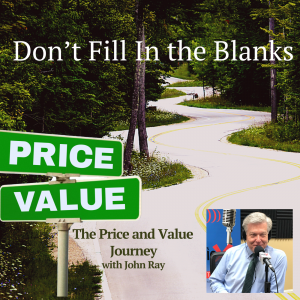
Don’t Fill In the Blanks

February 20, 2023 by John Ray

Don't Fill In the Blanks
North Fulton Studio
Don’t Fill In the Blanks
Loading
00:00 /
RSS Feed
Share
Link
Embed

Download file

Don't Fill In the BlanksDon’t Fill In the Blanks

Having a thorough value conversation helps you craft the right solutions for a potential client. Don’t fill in the blanks or make assumptions about what a client values. It’s in the best interest of the client (and, by extension, you) to exercise patience and ask questions.

The Price and Value Journey is presented by John Ray and produced by the North Fulton studio of Business RadioX®.

TRANSCRIPT

John Ray: [00:00:00] Hello, I’m John Ray on The Price and Value Journey. When I interview a guest on the podcast that I host, my last question is always the same. I ask guests for their best contact information, whether it’s a website, social media channel, maybe a phone number, so that listeners interested in their services or their products know the best way to connect. Normally, that’s not a problem for my guest, even the most nervous ones. And then, there’s the guest who surprises you.

John Ray: [00:00:33] On one show, I had a guest who was the development director for a national chain, opening a location in the Alpharetta area where I live. He was on the show to promote a new location opening in the area. The whole interview was a bit painful. I couldn’t tell whether this guy was nervous or just a man of few words. At certain points, I felt like I was in a verbal struggle to wrest answers out of his mouth.

John Ray: [00:01:03] When we mercifully got to the end of the interview, I breathed a sigh of relief and asked my usual last question. He gave the website followed by silence. The website was for the national chain, not the local location about to open. I waited for a moment. I expected him to at least give a local phone number or something, anything which might make it easy for customers in the area to connect with this one new outlet he was promoting out of a large national chain. But that’s not what happened. It was just the website then crickets.

John Ray: [00:01:44] Well, trying to help out and fill in what I thought was a significant void, I looked at my show notes and I said, “Oh, and I see the phone number for those that would like to call is,” and I gave the phone number. “That’s my cell phone number,” he monotoned. Well, we edited that little snippet out later.

John Ray: [00:02:06] As professional services providers in conversations with our clients, sometimes we get anxious when we’re attempting to conduct a good value conversation to diagnose their needs, and hopes, and desires. We’re striving to make sure the client is a great fit for our practice and price based on the value that we deliver.

John Ray: [00:02:27] And sometimes we have a client who is reticent or maybe they’re busy. They think they already know what they want. And they believe that some of the questions you ask aren’t relevant or you’re just making conversation. They react by shutting down or trying to pivot the conversation to your solutions.

John Ray: [00:02:47] Instead of exercising a bit more patience or engaging the client from another direction which might yield the answers we’re looking for, we end our value conversation and move on. That’s a mistake. Instead of assuming I had the correct phone number, I should have asked my guest, “Do you have a phone number that our listeners here in the area can call for more information?” Instead of doing that, I made an assumption. I filled in the blank and I was dead wrong.

John Ray: [00:03:19] If you haven’t had a deep enough value conversation with a client, later on, when you’re crafting options to put in a proposal, you’ll make conjectures, some of which may be half right, some of which may be just flat out dead wrong. You’ll end up proposing solutions which may not fit the needs of the client, and you might lose a great engagement. You also might end up with a client who’s a bad fit for your practice. You might end up mispricing the engagement. There are a lot of bad things that can happen.

John Ray: [00:03:54] So, slow down and be patient. Always conduct a thorough value conversation. Don’t fill in the blanks.

John Ray: [00:04:04] I’m John Ray on The Price and Value Journey. If you go to pricevaluejourney.com, you can sign up to receive updates on my upcoming book that will be released in the summer of 2023. It’s called The Price and Value Journey: Raising Your Confidence, Your Value and Your Prices Using the Generosity Mindset Method. You can also find a link to the show archive of this series and, of course, you can find the podcast on all the major podcast apps as well. If you’d like to connect with me directly, you can feel free to email me at john@johnray.co. Thank you for joining me.


About The Price and Value Journey

The title of this show describes the journey all professional services providers are on:  building a services practice by seeking to convince the world of the value we offer, helping clients achieve the outcomes they desire, and trying to do all that at pricing which reflects the value we deliver.

If you feel like you’re working too hard for too little money in your solo or small firm practice, this show is for you. Even if you’re reasonably happy with your practice, you’ll hear ways to improve both your bottom line as well as the mindset you bring to your business.

The show is produced by the North Fulton studio of Business RadioX® and can be found on all the major podcast apps. The complete show archive is here.

John Ray, Host of The Price and Value Journey

John Ray The Price and Value Journey
John Ray, Host of “The Price and Value Journey”

John Ray is the host of The Price and Value Journey.

John owns Ray Business Advisors, a business advisory practice. John’s services include advising solopreneur and small professional services firms on their pricing. John is passionate about the power of pricing for business owners, as changing pricing is the fastest way to change the profitability of a business. His clients are professionals who are selling their “grey matter,” such as attorneys, CPAs, accountants and bookkeepers, consultants, marketing professionals, and other professional services practitioners.

In his other business, John is a Studio Owner, Producer, and Show Host with Business RadioX®, and works with business owners who want to do their own podcast. As a veteran B2B services provider, John’s special sauce is coaching B2B professionals to use a podcast to build relationships in a non-salesy way which translates into revenue.

John is the host of North Fulton Business Radio, Minneapolis-St. Paul Business Radio, Alpharetta Tech Talk, and Business Leaders Radio. house shows which feature a wide range of business leaders and companies. John has hosted and/or produced over 1,700 podcast episodes.

Coming in 2023:  A New Book!

John’s working on a book that will be released in 2023:  The Price and Value Journey: Raise Your Confidence, Your Value, and Your Prices Using The Generosity Mindset. The book covers topics like value and adopting a mindset of value, pricing your services more effectively, proposals, and essential elements of growing your business. For more information or to sign up to receive updates on the book release, go to pricevaluejourney.com.


Connect with John Ray:

Website | LinkedIn | Twitter

Business RadioX®:  LinkedIn | Twitter | Facebook | Instagram

Tagged With: ask questions, client, fill in the blanks, John Ray, Price and Value Journey, pricing, professional services, professional services providers, solopreneurs, value, value pricing

Selfie

February 6, 2023 by John Ray

Selfie
North Fulton Studio
Selfie
Loading
00:00 /
RSS Feed
Share
Link
Embed

Download file

Selfie

Selfie

Complaining about getting “what you’re worth” is the pricing version of taking a selfie. When you focus on creating value for clients, and you value price your services relative to that value, you’ll get paid “what you’re worth.”

The Price and Value Journey is presented by John Ray and produced by the North Fulton studio of Business RadioX®.

TRANSCRIPT

John Ray: [00:00:00] Hello. I’m John Ray on The Price and Value Journey. James Clear, who’s the author of Atomic Habits, said, “The more time you spend complaining about what you deserve, the less time you have to focus on what you can create. Focus on what you can control.”

John Ray: [00:00:21] Well, I ran across this quote in Clear’s newsletter – which I highly recommend, by the way – and it made me think of a Price and Value version of the same quote. Try this on for size, “The more time you spend complaining about not getting paid what you’re worth, the less time you have to focus on the value you can create for others. Focus on the value you can create for your prospects and your clients.”

John Ray: [00:00:51] When someone tells me they want to get paid what they’re worth, it’s the pricing version of a selfie. They often miss the key point. It’s not about them and what they think they’re worth. Clients perceive their value on their own. Sure, you can influence client’s perception of the value that you offer, but clients alone have the ultimate decision on whether the value they perceive that they’re receiving exceeds the price you are asking. If so, they buy. If not, they don’t.

John Ray: [00:01:27] So, focus on what you can control. Identifying ways to deliver value and then dishing it out. Now, if you maintain that perspective, here’s the delicious irony I’ve found that you’ll get, if delivering value is your constant focus, you’ll have a lot less to worry about when it comes to getting paid what you think you’re worth.

John Ray: [00:01:54] I’m John Ray on The Price and Value Journey. If you go to pricevaluejourney.com, you can find a link to the show archive of this podcast series. You can also find this series on your favorite podcast app, and I’d be honored if you’d subscribe to the show, if you haven’t yet already done so.

John Ray: [00:02:14] You can also receive updates on my upcoming book. It’s called The Price and Value Journey: Raising Your Confidence, Your Value, and Your Prices Using the Generosity Mindset. The release date is September 2023. I’m looking forward to getting that out. You can again sign up for updates there at pricevaluejourney.com. You can also email me directly, john@johnray.co. Thank you for joining me.


About The Price and Value Journey

The title of this show describes the journey all professional services providers are on:  building a services practice by seeking to convince the world of the value we offer, helping clients achieve the outcomes they desire, and trying to do all that at pricing which reflects the value we deliver.

If you feel like you’re working too hard for too little money in your solo or small firm practice, this show is for you. Even if you’re reasonably happy with your practice, you’ll hear ways to improve both your bottom line as well as the mindset you bring to your business.

The show is produced by the North Fulton studio of Business RadioX® and can be found on all the major podcast apps. The complete show archive is here.

John Ray, Host of The Price and Value Journey

John Ray The Price and Value Journey
John Ray, Host of “The Price and Value Journey”

John Ray is the host of The Price and Value Journey.

John owns Ray Business Advisors, a business advisory practice. John’s services include advising solopreneur and small professional services firms on their pricing. John is passionate about the power of pricing for business owners, as changing pricing is the fastest way to change the profitability of a business. His clients are professionals who are selling their “grey matter,” such as attorneys, CPAs, accountants and bookkeepers, consultants, marketing professionals, and other professional services practitioners.

In his other business, John is a Studio Owner, Producer, and Show Host with Business RadioX®, and works with business owners who want to do their own podcast. As a veteran B2B services provider, John’s special sauce is coaching B2B professionals to use a podcast to build relationships in a non-salesy way which translates into revenue.

John is the host of North Fulton Business Radio, Minneapolis-St. Paul Business Radio, Alpharetta Tech Talk, and Business Leaders Radio. house shows which feature a wide range of business leaders and companies. John has hosted and/or produced over 1,700 podcast episodes.

Coming in 2023:  A New Book!

John’s working on a book that will be released in 2023:  The Price and Value Journey: Raise Your Confidence, Your Value, and Your Prices Using The Generosity Mindset. The book covers topics like value and adopting a mindset of value, pricing your services more effectively, proposals, and essential elements of growing your business. For more information or to sign up to receive updates on the book release, go to pricevaluejourney.com.
Connect with John Ray:

Website | LinkedIn | Twitter

Business RadioX®:  LinkedIn | Twitter | Facebook | Instagram

Tagged With: create value, John Ray, Price and Value Journey, pricing, professional services, professional services providers, selfie, solopreneurs, value, value pricing, what you're worth

A Simple Three Question Test on Whether Your Business Needs a Podcast

February 3, 2023 by John Ray

A Simple Three Question Test on Whether Your Business Needs a Podcast
North Fulton Studio
A Simple Three Question Test on Whether Your Business Needs a Podcast
Loading
00:00 /
RSS Feed
Share
Link
Embed

Download file

A Simple Three Question Test on Whether Your Business Needs a Podcast

A Simple Three Question Test on Whether Your Business Needs a Podcast

Does your professional services business need a podcast? In most cases, after you take this simple three question test, the answer will be “yes.”

The Price and Value Journey is presented by John Ray and produced by the North Fulton studio of Business RadioX®.

TRANSCRIPT

John Ray: [00:00:01] Hello. I’m John Ray on The Price and Value Journey. There’s a lot involved in not just starting, but maintaining a successful podcast. Before you take the leap, it’s important, as with any other marketing tactic, to do your homework and not make an impulsive decision.

John Ray: [00:00:20] Here are three questions to use as a guide. If you answer yes to all three of these questions, you probably need a podcast for your business. Question one, Do you answer yes to the question of your business being a high ticket B2B professional services practice?

John Ray: [00:00:41] The primary way of a high ticket B2B professional services provider builds their business is through relationships. There’s a direct correlation between the growth and high quality relationships that a solo or small professional services firm experiences in the overall growth in the business itself.

John Ray: [00:01:02] Properly executed, a podcast can deepen existing connections and open the door for brand new relationships in a low key and elegant manner. There’s a profound difference between using interruption marketing or social media to sell your service versus shining the light on someone else, allowing them to talk about themselves and their business, and giving them a piece of content they can point to with pride and use in their own marketing.

John Ray: [00:01:34] Question number two, Do you answer yes to the question of whether clients for your business or your vertical do a lot of research before they buy?

John Ray: [00:01:45] The more complex and higher priced the service or product, the more likely it is that a prospective client will do a lot of research to understand the source and depth of their issues, and develop an understanding of what to look for in the ideal services provider to solve those problems.

John Ray: [00:02:05] For example, a business owner with a complicated business or personal tax return who is also looking for business advisory services is highly likely to do extensive research on a services provider even if that professional has been referred by a trusted third party. A podcast builds authority and allows someone to get to know you in a way that a blog or a website simply cannot match.

John Ray: [00:02:35] Question three, Do you answer yes to the question of is your perceived authority an important aspect of your marketing?

John Ray: [00:02:46] A high quality, consistent podcast allows you to showcase your expertise in a direct and engaging way. The consistency of a podcast over time builds trust as well. Trust, which only deepens as the library of back episodes grows. Further, as a former local broadcast news anchor once said to me, Whoever is behind the mic in the middle of a city, in his case, or a particular group or industry is viewed as a figure of authority in that city or in that group or industry. If you own the mic, he said, then you’re at the center of it all.

John Ray: [00:03:31] So, if the answer to all three of these questions is yes, then I think you should give serious and thoughtful consideration to launching your own podcast.

John Ray: [00:03:44] I’m John Ray on the Price and Value Journey. If you go to pricevaluejourney.com, you can find a link to get updates on my upcoming book to be released in the summer of 2023. The name of the book is The Price and Value Journey: Raising Your Confidence, Your Value, and Your Prices Using The Generosity Mindset Method.

John Ray: [00:04:08] If you have not subscribed to the show on your favorite podcast app, I’d be honored if you would do so. And, obviously, you can find the show by searching Price Value Journey on your favorite podcast app. And you can find the show archives there as well. If you’d like to connect with me directly, feel free, john@johnray.co. Thank you for joining me.


About The Price and Value Journey

The title of this show describes the journey all professional services providers are on:  building a services practice by seeking to convince the world of the value we offer, helping clients achieve the outcomes they desire, and trying to do all that at pricing which reflects the value we deliver.

If you feel like you’re working too hard for too little money in your solo or small firm practice, this show is for you. Even if you’re reasonably happy with your practice, you’ll hear ways to improve both your bottom line as well as the mindset you bring to your business.

The show is produced by the North Fulton studio of Business RadioX® and can be found on all the major podcast apps. The complete show archive is here.

John Ray, Host of The Price and Value Journey

John Ray The Price and Value Journey
John Ray, Host of “The Price and Value Journey”

John Ray is the host of The Price and Value Journey.

John owns Ray Business Advisors, a business advisory practice. John’s services include advising solopreneur and small professional services firms on their pricing. John is passionate about the power of pricing for business owners, as changing pricing is the fastest way to change the profitability of a business. His clients are professionals who are selling their “grey matter,” such as attorneys, CPAs, accountants and bookkeepers, consultants, marketing professionals, and other professional services practitioners.

In his other business, John is a Studio Owner, Producer, and Show Host with Business RadioX®, and works with business owners who want to do their own podcast. As a veteran B2B services provider, John’s special sauce is coaching B2B professionals to use a podcast to build relationships in a non-salesy way which translates into revenue.

John is the host of North Fulton Business Radio, Minneapolis-St. Paul Business Radio, Alpharetta Tech Talk, and Business Leaders Radio. house shows which feature a wide range of business leaders and companies. John has hosted and/or produced over 1,700 podcast episodes.

Coming in 2023:  A New Book!

John’s working on a book that will be released in 2023:  The Price and Value Journey: Raise Your Confidence, Your Value, and Your Prices Using The Generosity Mindset. The book covers topics like value and adopting a mindset of value, pricing your services more effectively, proposals, and essential elements of growing your business. For more information or to sign up to receive updates on the book release, go to pricevaluejourney.com.
Connect with John Ray:

Website | LinkedIn | Twitter

Business RadioX®:  LinkedIn | Twitter | Facebook | Instagram

Tagged With: attorney podcast, b2b podcasting, John Ray, podcast, podcasting, podcasting for professional services, Price and Value Journey, pricing, professional services, professional services providers, solopreneurs, value, value pricing

Value Selling: An Interview with Mike Wilkinson, Axia Value Solutions

February 1, 2023 by John Ray

Mike Wilkinson
North Fulton Studio
Value Selling: An Interview with Mike Wilkinson, Axia Value Solutions
Loading
00:00 /
RSS Feed
Share
Link
Embed

Download file

Mike Wilkinson

Value Selling: An Interview with Mike Wilkinson, Axia Value Solutions

The two terms solo and small professional services providers may dislike the most are “sales” and “business development.” If that describes you, then yes, you’ll want to understand the concept of value selling by listening to this episode.

Mike Wilkinson, The Value Selling Expert and Founder of Axia Value Solutions, joined host John Ray to define value selling, why it isn’t more widely practiced, how value selling makes business development conversations easier and improves your ability to defend your pricing, why introverts may have an advantage in employing value selling, why not employing value selling might actually be unethical, and much more.

The Price and Value Journey is presented by John Ray and produced by the North Fulton studio of Business RadioX®.

Axia Value Solutions

At Axia Value Solutions they focus on value!

If you:

  • Tend to discount too much or struggle to defend your prices
  • Have product first rather than customer first sales conversations
  • Lose business even when you know you have the best solution
  • …or many other issues

…then understanding value and what it means to your customers is going to be a big part of addressing these.

Value is defined by your customer, not by you.  If you want to sell your value effectively – and get paid for it – you have to understand your customers, in detail.  The Value Sales Process will help ensure you approach the sale in a structured way and transform your approach.

Understanding customer value aspirations will help you differentiate, price and communicate your offer more powerfully and effectively.

Company website | LinkedIn

Mike Wilkinson, The Value Selling Expert, Founder, Axia Value Solutions

Mike Wilkinson, The Value Selling Expert, Founder, Axia Value Solutions

Mike has been an independent consultant since 1988. His passion revolves around value, especially Value-based selling. Mike is the “Price Getter”, working with sales teams and helping them discover new ways of learning and communicating value, so that money isn’t left on the table, and you are rewarded for the value you deliver.

He has worked with organizations of all sizes, helping them maximize the effectiveness of their sales efforts, both in terms of sales process and skills.

Mike has delivered training all over the world, speaking regularly at conferences, seminars and meetings with business audiences throughout the UK, Europe, UAE, Dubai, Saudi Arabia, USA, Singapore and Australia.

He has also published three bestselling books on value and is member of the Institute of Sales and Marketing Management, the Professional Speakers Association (PSA) and the Global Speakers Federation.

LinkedIn

TRANSCRIPT

John Ray: [00:00:00] And hello again, everyone. I’m John Ray on The Price and Value Journey. And I’m delighted today to welcome Mike Wilkinson with us. Mike is with Axia Value, and he’s been an independent consultant since 1988. And his passion revolves around something I happen to love, value and, especially, value based selling.

John Ray: [00:00:24] Mike is the “Price Getter” – I love that term. He works with sales teams and helps them discover new ways of learning and communicating value so that money isn’t left on the table and that you are rewarded for the value you deliver. He works with organizations of all sizes and trains all over the world. I think the only continent he hasn’t been on to do sales training must be Antarctica based on that bio, but we’ll ask Mike about that. And he’s also published three bestselling books on value. Mike Wilkinson, Axia Value, thank you so much for joining us.

Mike Wilkinson: [00:01:04] John, it’s a pleasure. It’s good to be with you.

John Ray: [00:01:06] It’s great to have you on. Let’s get straight to it. What is value selling? How do you describe that?

Mike Wilkinson: [00:01:17] I think at its simplest, value selling really is an approach that aims to quantify the value of your solution to a customer in economic terms, and really highlighting the advantages of what you do when compared with competing alternatives. That’s the way I look at it. So, it’s simply about economically demonstrating your value to the customer for your solution.

John Ray: [00:01:45] So, what was the light bulb moment for you and your journey when you realized that this was really the way to go when it comes to sales and business development?

Mike Wilkinson: [00:01:58] Well, I think there are a whole host of things that go around value selling. And I think perhaps the most important is that value selling, it has to be a collaborative effort between you and your customer. It’s not something you do at the customer. It’s something you do with them. And that, I think, was particularly important.

Mike Wilkinson: [00:02:17] Because I was going on that sales journey and I was doing some training, and the lightbulb really went off in a conference in Copenhagen. And I was talking at this conference with a group of about 120 salespeople. And the night before, we were all having dinner, and they’re all from the same company. And every single person I spoke to when I asked them what it was they sold, they told me they sold value, “We sell fantastic value.” And I thought this lot have all been brainwashed. And I thought that that’s just amazing.

Mike Wilkinson: [00:02:51] So, the next day, in the morning for my first session, I scrapped completely what I was going to do. This is a classic example of planning well, but scrap what it’s going to do. I said, “Guys, last night I was really surprised to hear everybody told me that value was what you were delivering. So, what I would like you to do for me is tell me what value is. So, what I want from you is an Oxford English Dictionary definition beginning with the words value is. So, value is what?”

Mike Wilkinson: [00:03:23] And there were about ten tables, and I charged each table with coming up with a definition of value written on a card that I could then read out to everybody, and we would determine which was the best or we’d amalgamate them all together.

Mike Wilkinson: [00:03:38] And the interesting thing was, I think to start with, given that they’d all tell me they sold value and that was what they did, was the difficulty they were having in articulating just what value was. It was extraordinary. It took probably between 20 minutes and a-half-an-hour to get all of the cards back. And I decided I just take the cards and I’d read them all out one after the other, and we’d see how it went. And that’s what I started to do.

Mike Wilkinson: [00:04:06] And the thing that struck me straight away was that they were all different. I mean, clearly there were similarities, but they were all different. And then, I got to a card, which is about fifth or six in this pack, and I turned it over and I looked at it, and I thought, “This is absolutely ridiculous. I can’t read this out.” But I thought, “Well, I’d better have a go.” And it had four words on it. This is 20 minutes to 30 minutes work, four words, and two of them were the ones I’d given them which is value is.

Mike Wilkinson: [00:04:38] So, I read it out and I said, “We’ve got this definition, and it is value is a mystery.” Wow. But the more I thought about it, the more I began to realize that that is absolutely exactly what value is. And our job as salespeople is to solve the value mystery. Because the reality is everybody defines value in a different way. So, until we understand how the customer we are talking to defines value, to all intents and purposes, it is a mystery.

Mike Wilkinson: [00:05:20] So, our absolutely number one task is to solve that value mystery, and that is how I got into value. I thought, I’ve cracked it. That’s it. So, the job is done. Solve the value mystery. But I very quickly realized that the job was anything but done. And it was very much the start of a fairly complicated but enjoyable journey. So, there you go, that’s how I got involved.

John Ray: [00:05:49] I love that. Because a lot of the folks that listen to this series are real left brained. They got what they want, left brained data-driven answers. And that’s not always the case with value. It can be part of it, but not always the case. Right?

Mike Wilkinson: [00:06:10] Well, I think for anybody who’s sort of data-driven, I say to the guys who come on the programs that I run, is, if you think about value selling as a problem solving exercise, the starting point is you have to understand the problem. You cannot wander around with a solution in search of a problem. What you need to do is to understand the problem and then tailor your solution to address it.

Mike Wilkinson: [00:06:36] And for the vast majority of people that I speak to and the vast majority of salespeople particularly, that is an absolutely extraordinary transformation. Intellectually, they buy into a recognition that they need to understand what the problem is first. But practically, they do exactly the opposite. And they lead with product first conversations with customers.

John Ray: [00:07:01] Now, related to what you just said, I want to tie that to what you and I talked about before we came on, which is that – unless we’ve lost them all, all the listeners that I have that are solo and small professional services firms. I’m not even sure they hit download when they saw the term selling because a lot of them don’t like that word. And as I mentioned to you, business development comes in a close second to the word they don’t like – what you’re suggesting is forget selling, forget business development. If you just think of it as value problem solving, maybe that’s the way that you ought to think about this, Mr. or Ms. Professional Services Person.

Mike Wilkinson: [00:07:52] I mean, I think it depends how you define selling. And even dealing with the corporate clients that I deal with, I still find a lot of people do not like to be called salespeople. I don’t understand it, because whether you’re a small business person or you’re a corporate, you stand or fail by your ability to generate leads and convert them. And that, in my book, is selling. But call it whatever you want.

Mike Wilkinson: [00:08:19] I think if you look at it as helping your customers make good buying decisions, that’s what you’re trying to help them to do. And to do that, you have to understand them. You can’t help anybody to improve what they’re doing if you don’t understand what it is they are trying to do. So, I think it is an important thing.

Mike Wilkinson: [00:08:38] And I think we also talked about this difference between that sort of slightly more introverted and that extroverted approach. And I actually think introverts have an advantage. I think particularly with value selling, they have an advantage, because introverts tend to listen. They tend to take things that a little bit more slowly. They tend to be, I think, a little bit more data-driven. They are better at problem solving. Whereas, us, extroverts, tend to go blundering in rather over excitedly and just want to get to the end. We’re just desperate to get to the end.

Mike Wilkinson: [00:09:14] The reality often is that it’s the old tortoise and the hare story, isn’t it? You know, the extroverts screaming off into the distance, whereas the tortoise is just gently coming along behind and gets to the finish line first. That’s likely anyone.

John Ray: [00:09:30] No, it makes perfect sense. And it’s not just patience, but I think in general – we’re making generalities here, folks. So, let’s acknowledge that – extroverts, a lot of them are people pleasers. So, maybe they don’t want to get to what some of the real problems are that they may think that person across the table from them really doesn’t want to talk about. Does that make sense?

Mike Wilkinson: [00:10:01] I think it does make sense. And I think as good value sellers, we have to be challenging as well. You have to make the customer think. If you actually dedicate yourself to helping your customer improve their business and making good business decisions for themselves, you have to challenge them and make sure that they’ve gone through that intellectual process themselves to get to a point where they recognize the problem, they recognize the scale of the problem, and the need to address it, and then you help them to actually come up with a solution that’s effective.

John Ray: [00:10:37] So, when I was referring to data-driven – I want to dive into that a little more for folks, and this gets back to value being a mystery – I think a lot of people understand that value has definable outcomes and that that can be captured with data. But value is also full of intangibles that can’t really necessarily immediately be captured as value – be captured in that, I mean.

Mike Wilkinson: [00:11:14] Yeah. Absolutely right.

John Ray: [00:11:15] Does that make sense?

Mike Wilkinson: [00:11:17] It makes perfect sense. It actually really picks up on the discovery that I made after I’d discovered that value is a mystery and our job was to solve the value mystery. That was my eureka moment. It didn’t take long to realize that actually you needed something else.

Mike Wilkinson: [00:11:34] And what you need is a framework to think about value, because it’s quite difficult to sort of put your finger on what the constituent elements of value are. So, we came up with this concept called the value triad. And the value triad identifies three key areas of value.

Mike Wilkinson: [00:11:57] And as I go through this, John, if your listeners want to think about how this applies in their business, it might well be quite helpful from their point of view, because I think there are some questions we have to ask ourselves.

Mike Wilkinson: [00:12:12] And let me just very quickly explain the value triad. The three elements of the value triad are revenue or performance gain, cost reduction, and emotional contributions. So, those are the three component elements of value.

Mike Wilkinson: [00:12:24] So, if we start with revenue gain or performance improvement, the question you need to ask yourself is how does what you do help your customers improve their revenue. And you should make a list of those things. You should clearly identify how you think what you do helps your customers improve their performance or improve their revenue. Because we need to know that in advance.

Mike Wilkinson: [00:12:53] Logically, the next bit, the cost reduction bit, the question is the same, how does what you do help your customer to reduce their costs. And to pick up on what you were saying, John, those two are objective. They’re measurable. You can put a number on them, and you should. Because it’s much more persuasive to say to somebody, “I can help you improve your revenue by $50,000 a year and reduce your cost,” by whatever it might be. Rather than just say, “Well, we can help you improve your revenue.” Because most customers want to know by how much and by when, because that’s a lot more persuasive. And anyway, anybody can make airy fairy promises.

Mike Wilkinson: [00:13:40] So, those are the two very tangible elements of value, revenue gain, and cost reduction. The bit that you you referred to is we had a real struggle coming up with a name for this, but we finally settled on emotional contribution. I’m still not entirely sure why, but it’s worked really well. And they are the intangible things, the subjective things. They are things like trust, credibility, the quality of the relationship, the removal of risk, your brand value, their desire to want to do business with you personally rather than somebody else.

Mike Wilkinson: [00:14:13] And I was thinking about this only the other day, and I’m thinking about what it is that people buy, the intangible element that people buy. I think, more than anything else is peace of mind. And I really think people buy peace of mind. They don’t want to buy hassle. They don’t want to buy risk, or difficulty, or things that are hard to use. They want peace of mind. When I make a decision to buy from you, I want it to be a great decision and I want to not have to worry about it now. Now, that the decision is made, I just want it to happen.

Mike Wilkinson: [00:14:50] So, that’s it. That was the value triad. Revenue gain, so how does what you do help you improve your customers revenue; cost reduction, how can you help them to reduce their costs; the emotional contribution, how can you just make them feel really good about doing business with you.

John Ray: [00:15:06] All that sounds great. I’m a solo, small professional services firm owner. I’ve never had sales training. I’m used to talking about what I do, but not necessarily digging into value. So, give me some tips on how I can start this journey.

Mike Wilkinson: [00:15:36] Right. It’s interesting. You and I also spoke well, I have to admit, guys, the vast majority of my client base are corporates. So, people say to me, “How can you actually relate to what solopreneurs have to do?” And I say, “Well, because I’m one of those more so. I am what my business. I have to do all of these things myself. I relate, absolutely.”

Mike Wilkinson: [00:16:03] And I think the thing that you said right at the outset is the heart of the problem. We’re really good at talking about what we do. But actually what we’re not really good at very often is talking about what the customer wants done. And that’s the starting point, you have to understand the problem before you deliver the solution. And you have to build value in the need to have that solution delivered. And I think for many of us, that’s the difficulty.

Mike Wilkinson: [00:16:33] I think the tips that I give to people really are, don’t get hung up on it. When you meet a customer for the first time, all you should be thinking about is, I’m going to have a chat. Even if it’s not physically happening, but metaphorically, I’m going to sit down with a cup of coffee over the table from somebody and we’re going to have a chat.

Mike Wilkinson: [00:16:53] And what you are going to do as the SME, the small business, is you are going to show genuine interest and curiosity in understanding your potential customer’s business. And you are not going to talk about you. The focus is entirely on the customer and their business. Because it won’t have happened to them very often, because most people will go in and just talk about their products. So, it would be refreshing for them to have somebody to talk to where they can actually share that sort of information.

Mike Wilkinson: [00:17:30] And as you take them on that conversation or journey, if you like, clearly, there’s a structured process that you can utilize to do that because we know where we’re trying to get them to. We’re trying to get them to a point where they recognize that they have a problem or an issue that is big enough to need to be addressed.

Mike Wilkinson: [00:17:53] Because I think one of the problems with lots of businesses is I don’t know any business that doesn’t have lots and lots of problems. I mean, every business has problems and issues. But the vast majority of them are simply not important enough to do anything about. You just learn to live with them. You find ways of working around them. Well, you want to make sure that the problems that you can solve are the ones that your customer considers to be important enough to actually take action on. So, part of our conversation when we’re taking on that journey is to get them to a point where they recognize that.

John Ray: [00:18:33] And that may not be immediate. I mean, we’ve got to be comfortable in the idea that if we’re really genuinely trying to problem solve and help that customer, do what’s right for that client sitting in front of us that we’ve had this chat with, that may involve saying I’m not the answer for your problem today.

Mike Wilkinson: [00:18:57] I think that’s absolutely right, the last thing. It’s tough, isn’t it, that we’re in a time where, frankly, any business looks reasonably attractive for a lot of people. And it’s quite hard turning stuff down. But I think the starting point for all of this is to recognize that not every opportunity is a good opportunity for you. Some opportunities can cause more trouble than they’re worth. So, I think it’s quite key.

Mike Wilkinson: [00:19:27] And, again, you don’t want to sell – I use the word sell advisedly in this context, John – you don’t want to be selling things to people where you know in your heart of hearts it’s not the right solution for them.

John Ray: [00:19:44] Or you’ve had to talk yourself into it that it’s the right solution and you’re reading from right to left when it comes to the revenue to your firm.

Mike Wilkinson: [00:19:56] Yeah. I think that’s right. I mean, I’ve got so many sort of stories of people turning down business opportunities. But then, over time, the right opportunity comes along. And this is about building business over the long term, I think, for most of us. We’re not in the business of one off sales. We’re in the business of selling today and, hopefully, building on that relationship and selling more in the future. You don’t do that by selling them things that don’t really address the issues that they’re facing.

John Ray: [00:20:30] There’s a difference, I think, Mike – and correct me if you think I’m wrong, because I’m often wrong, so correct me – it seems to me between that prospective client who maybe didn’t get referred to us with something in mind that they want versus that referral or however it came, however that client got to the point they’re sitting in front of us, where they’ve got something in mind of what they want. And what they want may not be what they need. But we’re so anxious as services providers to get to the sale, if I can still use that word, to get to the engagement agreement that maybe we short circuit the value conversation. Does that make sense?

Mike Wilkinson: [00:21:35] It makes perfect sense. And it’s a big mistake. Well, for two reasons. First of all, if you short circuit the value conversation, you’ve failed to take advantage of the opportunity to build value into your solution. And secondly, you are absolutely right, just because somebody comes to you and says “I need a,” it doesn’t mean that is actually what they need. They need it given their perception of the problem. But they are probably not experts in the particular area that your people or your audience is.

Mike Wilkinson: [00:22:11] So, whenever somebody comes to me and says I need sales training, for example, the first thing I want to know is, why do you think that? What is the problem that you think sales training is going to solve for you? So, I think it’s always very valuable to take a step back and just make sure that not only they understand what their motivation is behind thinking that this is the solution, but that we understand it as well.

John Ray: [00:22:41] And when we short circuit that conversation, it seems to me what gets short changed is the emotional side, right? Because that’s really what takes the longest part of the conversation to really dive in and get to.

Mike Wilkinson: [00:22:59] I think you’re right. And I think the interesting thing about value selling, and another reason why I find it a really useful way to go, is that, if you do not have, if you failed to build a relationship with the customer, they will not give you the information that you need to help to come up with the best solution for them and deliver the best value.

Mike Wilkinson: [00:23:22] Value selling is based upon a collaborative relationship. I think it is anyway. If they won’t collaborate with you, if they won’t share with you the challenges and the issues that they got, then it’s going to be very hard to really deliver the best possible value that we could.

John Ray: [00:23:41] So, how do you keep yourself from short circuiting, I guess, number one? And number two is, how do you keep a prospective client patient when you’re trying to get into the emotional responses they’re going to have to the solution you’re potentially going to give them? Because they call up wanting that thing, whatever that thing is, and they kind of want to get you to that, because they’re in a hurry and they want to get there. So, mentally, how do you keep yourself on task, I guess, is the question.

Mike Wilkinson: [00:24:24] It’s funny, actually, you should say that, because frequently salespeople will say to me, What’s the one piece of advice that you give me to really improve? And I say, over the years, I’ve come up with all sorts of things. But I’m now at a stage where the one piece of advice I give to sellers is slow down. Slow down. It is not a race. Your job is to come up with the best possible solution for your customer. Do not race to the end with your solution. Take the time to understand what it is.

Mike Wilkinson: [00:25:06] I mean, if you don’t slow down, you’re not listening. If you’re not listening, you’re not really understanding what is going on. One of the key skills is the ability to summarize back to your customer your understanding of their situation. So, you’ve had this conversation, so you can say to the customer at the end of it, or you should say, “If I understand you correctly, John, the main issues you’re facing at the moment are this and this. And the impact of failing to address them at the moment is this on the business. Have I got that right?” “Yeah.”

Mike Wilkinson: [00:25:41] So, we’ve agreed that if we could really solve that problem, there’d be some real value to you. So, are you committed now to doing something about it? Because the one thing I want more than anything else is commitment. Because what I don’t want is to be wasting my time.

Mike Wilkinson: [00:25:59] The other thing is send me a proposal. For people to say, “Well, send me a proposal.” Well, what for? No. No. Because very often, the send me a proposal is to get rid of you or to just get a benchmark price in place. You know, it’s too easy to be taken down rabbit holes by customers. So, I want to get a customer to a point where they’re committed to doing something. Because otherwise, I’m just wasting my time, money, and effort in pursuing lost causes. None of us can afford that time.

John Ray: [00:26:36] That’s for sure. We don’t have time for that. Mike Wilkinson is with us folks. His firm is Axia Value. And he’s an expert on value based selling. And we have to say that pricing is part of this. I mean, if you’re selling by value – or I’ll give a nod to my folks that don’t like to sell – if you’re talking about value, it’s easier to price, right?

Mike Wilkinson: [00:27:08] Yeah. It’s easier to price. It’s easier to defend your prices. I’m sure some of the people who are listening probably operate off a price list. And the problem that they have is that they are under constant downward pricing pressure so that they will go in and they’ll do the job, they’ll come up with the solution. The customer say, “Well, how much is that?” They’ll tell them. They say, “Flipping neck. I’m sure you can do something about that. You must be able to shave a few dollars off that.”

Mike Wilkinson: [00:27:38] And the problem is that most of us operate under what I call a discount default. And that is, the minute we get put under any price pressure, the first thing we do is to drop our prices. And our customers know that. They know. I talk to procurement and buyers all the time, and I’ve never come across one who will not say to a supplier, You’re too expensive. And the answer is not because you’re too expensive. It’s because – sorry about that, John. It’s not because you’re too expensive. It’s because they just know from experience that virtually every time they say that, they get a discount. So, they’re not going to not tell you you’re too expensive.

Mike Wilkinson: [00:28:25] But it takes a lot of confidence when somebody says to you, “How much is that?” And you say to them, “It’s $10.” And they say, “That’s too expensive,” for you to look them in the eye and say, “No, it isn’t.” If you actually look at the value that we deliver, as we’ve just discussed, what it is you are going to gain as a result of our solution, I go as far as to say that probably $10 is not quite expensive enough.

Mike Wilkinson: [00:28:51] Now, bizarrely – and I have tested this out with lots and lots of people. And there’s one guy in particular after we’d been doing this for some time, he said to me, “You know, I have learnt something quite extraordinary.” He said that you really do need to have real confidence in doing this. But for the first time, when customers have said to me I’m too expensive, I’ve looked them in the eye and said, No, I’m not. When you think about the value that we’ve just discussed that we are going to deliver for you, we are most positively not too expensive at $10. And he said, in probably 80 to 90 percent of cases, they’ve nodded and said, “Yeah. Okay.” Because they were trying it on.

Mike Wilkinson: [00:29:34] And I said to him, I said, “Well, have you ever lost any business by that?” He said, “Yes, I have. To be honest, I have lost some business. He said, “But I can almost guarantee that the business I have lost has been the lower quality business, the people who were always going to be a pain to deal with. And in 90 percent of those cases, within six months, they’ve come back to me.”

John Ray: [00:29:56] The ones that really wanted to come back, have come back.

Mike Wilkinson: [00:30:01] Guys, we underestimate our value. If you’ve done a really good job of understanding what it is that is valuable for your customers and you’ve demonstrated how you can deliver that value, then you should be rewarded for that value. But I speak to SMEs too often who say, “Well, we can’t put our prices up.” And I say, “Well, hang on a minute. Let’s just take a step back. Is your solution a good solution?” “Yes, it is.” “Is it every bit as good as or if not better than your competitors?” “Yes, it is.” “And is your price therefore higher than your competitors?” “No, it isn’t.” “Why isn’t it? If your solution is better than your competitor’s solution, why isn’t your price higher?” “Well, because if we charge more, we’d lose the business.” “How do you know?”

Mike Wilkinson: [00:30:51] It comes down to confidence. And I think we communicate confidence in a variety of ways. But your body language alone will tell the customer whether they’re in for a discount or not. Because for most of us, the one thing we don’t want to have to talk about is price. And the minute that price comes up as a subject of discussion, our body language changes. That confidence of talking about our product disappears now, because we’re now asked to talk about something that, frankly, is just a little distasteful. But it all starts to go wrong. I’ve sat in meetings with people and the customer has said, “What’s the price?” And the sales guy has actually started by apologizing.

John Ray: [00:31:33] Oh, dear.

Mike Wilkinson: [00:31:34] You have got to be proud of your prices. If you truly believe that your solution is a great solution, delivers loads of value for your customer, why on earth shouldn’t you be proud of the price that you charge? Because you should be rewarded for the things that you’re doing.

Mike Wilkinson: [00:31:58] I mean, my sort of strapline about the value challenge, the value challenge for me is about understanding, communicating, and delivering outstanding customer value and getting paid for it. And it’s the I’m getting paid for it bit at the end that is so important. And I just find that when I talk to SMEs, particularly small businesses, they underestimate the value that they deliver. And you will always underestimate the value that you deliver if you fail to understand the value that your customer is looking for.

John Ray: [00:32:35] Well, let’s talk specifically to this group here of professional services providers. They’re essentially pricing bullets between their ears. I mean, that’s their factory floor. They’re not pricing the product. And in their case, they’re working for themselves in their own business, they can’t point upward to the corporate suite and say, “Well, it’s those fools that set this price. I didn’t have anything to do with it.” They’re pricing themselves, essentially. And so, how do you have that confidence when that conversation turns toward pricing, how do you steal yourself for that point and how do you develop that over time?

Mike Wilkinson: [00:33:23] I think it goes back to what we’ve been saying before, John, if you go in with a product first approach, where you go in and you start to talk to your customer about your wonderful products and services, you’ve failed to build the value that you’re going to use in defending your prices.

Mike Wilkinson: [00:33:41] If you go in and you talk to your customer about the challenges, the issues, the opportunities that they’re facing, what the value of those is to them, and the conversation is absolutely customer first, then you build a foundation upon which you can put your price. But if you fail to do that, it’s a lot more difficult.

Mike Wilkinson: [00:34:04] So, for me, value pricing is dependent, as you said, on value selling. It’s the value bit at the front that’s really important. And you said earlier that I build myself as the price getter. And it’s when I had my partner before he retired, our business had two parts to it. It had the pricing bit and the selling bit. And we always said that the pricing bit is the price setting bit. And my bit was the price getting bit, because you set your prices, but you’ve got to get them. And that was pretty much it.

John Ray: [00:34:41] Yeah. No. And it’s all well and good to say “I want to get what I’m worth,” but you really cannot do that without some touchstone on how that gets measured that the client will understand. That’s the key point, right?

Mike Wilkinson: [00:35:00] Yes. Absolutely right. And we all know that we don’t operate in a vacuum. You do need to understand what the sort of general market place position is in terms of pricing for what you do. But that does not mean that you have to be at it. You know, if the market price is $10 and you’re delivering more value than the majority of the $10 suppliers, then you should be charging 11 or 12. And you can defend it by demonstrating you are delivering more value to the customer than the cheaper people are doing.

Mike Wilkinson: [00:35:38] We’re too easily dragged into price battles where we don’t need to be. And I don’t, in any way, want to undermine the difficulty or it isn’t an easy option. But to give away your hard earned time and cash simply because we fail to understand and communicate our value effectively is a shame.

John Ray: [00:36:04] I want to switch to a different objection that I hear, and it relates to pricing and professional services providers. And I hear the objection to value pricing. And by definition, extension value selling. That, I don’t want to charge different prices to my clients because I’m taking advantage of them when I do that.

Mike Wilkinson: [00:36:40] I mean, I have heard this a lot. But, actually, I don’t believe that to be the case. The whole concept behind value selling for me is to understand the value that the customer is looking for, deliver as much of that as I possibly can, and get rewarded appropriately for the value that I am delivering.

Mike Wilkinson: [00:37:02] And every customer is different. The reason value is a mystery is that what value means to each customer, and indeed to the people within the customer is different for all of them. And so, if you’re dealing with the finance director or the finance VP, his perception will be different to the ops people, to the sales folks, to the marketing folks. They all have a different perspective of value.

Mike Wilkinson: [00:37:28] So, as long as you are understanding and delivering outstanding value to them, you should be rewarded appropriately. Sometimes people say, “Well, yeah, we’d much rather operate off a straight price list because that way it’s fair to everybody.” It is fair to everybody. Everybody except you. And that is the point, you want to do a great job for your customers.

Mike Wilkinson: [00:37:54] A larger client in the telecoms business, we went and we were doing some work for them. And they were concerned about value. And when they explained to us what they did and the value that they delivered to their customers, which was absolutely huge, they were simply not getting rewarded for it at all.

Mike Wilkinson: [00:38:20] And it’s a mindset thing. I can understand why people think it is fairer to charge everybody exactly the same thing. First of all, everybody isn’t exactly the same. Their value aspirations are all different. And it’s fair to everybody except you. You’re the one person who is not being rewarded for the value that you’re delivering.

John Ray: [00:38:42] I want to ask you a third rail question. This is one that may get some folks fired up. Is it unethical – I use that word deliberately – not to sell based on value?

Mike Wilkinson: [00:39:00] It’s a very interesting thought. I think because the nature of value selling is that it is collaborative, I think it is a much more effective way of approaching the whole sales conversation. Now, realistically, depending upon the nature of your business and the nature of your clients, you won’t necessarily be able to sell on value to all of them.

Mike Wilkinson: [00:39:25] I mean, you may have some clients who are totally transactional. They don’t want a conversation. They want a bolt, a widget, or whatever it is. They just want to pick the phone up, place the order, done, finished with. They don’t want a conversation about it. But there are other customers who really would value a detailed conversation with you because you are the expert in your field, and I want your help and advice to make sure that the decisions that I make are good ones. And I think in that context, the value selling, it’s unethical not to do it. Because potentially you are going to allow your customer to make business decisions which are not as good as they could have been had you made them collaboratively.

John Ray: [00:40:09] I love that point. I want to throw in just a quick question here as our time goes down, because you deal with corporate clients – you know, our solo and small professional services folks don’t always get this situation, but sometimes they do – requests for proposals. How do you advise folks to deal with an RFP?

Mike Wilkinson: [00:40:45] All right. Yes. It’s a really interesting question. And first of all, I think if I’m a small business, is the RFP coming from a customer that is, if you like, in my target area. Is it somebody that I’ve spoken to already? If I’ve not ever had a conversation with them and an RFP arrives out of the blue, generally speaking, your best approach is to not ignore it, but to write back.

Mike Wilkinson: [00:41:15] I would always write back and I say, “Look, thank you very much indeed for the opportunity for this. But right now, I just don’t feel I understand enough about you and your business to be able to respond effectively. If you want to have a conversation with me, I’m happy to do that.” But other than that, I respectfully decline the opportunity to respond. Because otherwise, you’re just going to waste your time. You’ll be used for benchmarking. They’ll look at your price, compare it with the incumbent, smack them over the head a bit until they drop their price, and you’ve got nothing out of it at all. So, that’s my first bit of advice.

Mike Wilkinson: [00:41:51] If it’s one of those requests for proposals, which is templated, if you like, and you have to do each of the steps one by one. Again, if you know nothing more about the customer, I’d be very cautious. Somebody once said to me that an RFP is a brilliant opportunity for your customer to demonstrate a complete lack of understanding of the potential solutions that you can provide them with are a lot better than what they’re asking for.

Mike Wilkinson: [00:42:20] Often, RFP is a sort of built by committee and they reflect that. The other thing is, often, you’ll see in an RFP, you look at it and you can see your competitors fingerprints all over it. It’s quite obviously written for the benefit of somebody else, and you’re just being used as the benchmark.

Mike Wilkinson: [00:42:44] I had a time some time ago and he had huge numbers. It was a logistics business. Their business was driven by RFPs. And I said to him, “How many of the RFPs that you get do you respond to?” And he looked at me as if I’d gone mad. And he said, “Well, all of them, obviously.” And I said, “Goodness. That must take an incredible amount of time.” He said, “It does. It does.” And I said, “Well, how many of these are you winning? What percentage do you win?” He said, “Well, I don’t know, around 15 percent.”

Mike Wilkinson: [00:43:14] So, I said, “So, 85 percent of the proposals you do, which are taking you an awful lot of time to put together, you’re not winning.” “That’s right,” he said. I said, “Well, if we call that 85 percent your new 100 percent, what percentage of those did you know you had no chance of winning before you even began?” And without even batting an eyelid, he said, “Oh, at least half of them.” I said, “So, why on earth are you responding to them?” And the answer is a classic, he said, “Because if we don’t respond to them, we definitely won’t win them.”

John Ray: [00:43:50] That’s some circular reasoning there.

Mike Wilkinson: [00:43:52] It’s mental reasoning. And it’s mental because what it means is that for those pieces of business that you do want to win, you don’t have the resources available to invest in it because you’re spending so much time responding to opportunities you’re never going to win. Crazy.

John Ray: [00:44:12] Yeah. I’m going to have to take a cold drink of water after listening to that story. Wow. Speaking of stories, though, before we let you go, Mike – and thank you for your time today. This has been terrific – I’d like to give you a chance to talk about you and the value that you bring. If you could share maybe a success story or two that illustrates the great value that you provide, talk about yourself for just a second.

Mike Wilkinson: [00:44:43] You know, I think of all the things that you’ve asked me to talk about, I always find that’s the most difficult of all. I think, because over the years I’ve become so obsessed with talking customer first rather than product first, that I think I’ve trained myself to do what I try to encourage other people to do more than anything else. I think the biggest successes I have is when I’ve worked with people.

Mike Wilkinson: [00:45:09] And I think I mentioned to you before, intellectually, people buy into the fact that they should be talking customer first rather than product first. But as you take them on that journey and they start to practice it and they start to see what happens when they do, one of the biggest things that started I’ve had people ring me up and say, “I am amazed at the opportunities that have suddenly become available.” And I said, “Yeah. But they were always there. It was just that you’d never had the conversation with the customer to discover them.” And that is just fantastic.

Mike Wilkinson: [00:45:41] The telecoms business was a classic. I hate to imagine how much more money they are making as a result of just a couple of very simple conversations that we had. I should definitely have been paid on the basis of value delivered there, shouldn’t I? I didn’t value price that particularly.

John Ray: [00:46:04] Well, you know what? Actually, thank you for that. That’s actually a great point because we’re all on a journey, right? I mean, there’s no formula here that we’re trying mysteriously trying to find in some urn in a cave in Peru. I mean, this is a constant, you can call it battle, you can call it journey, you can call it whatever, to try to get to what value is and how to price relative to that value.

Mike Wilkinson: [00:46:32] I think it’s a journey, John. And I think there is a process. I mean, I have a value sales process that I teach and the training that I do. And it’s born out of a desire to simplify the complex, not complicate the simple so that the steps are really easy.

Mike Wilkinson: [00:46:49] So, the first step of the process is to quantify the opportunities, qualify the opportunities. So, the question is, where do you get your leads from because your business stands or falls through your ability to generate quality leads and convert them into business. You know, without that, nothing is going to happen. And it doesn’t matter how much we dislike talking about selling, at some point or another, somebody’s going to bring the business in. Maybe the dirty end of it, but that’s got to be done.

Mike Wilkinson: [00:47:21] So, qualify your opportunities. Because you only want to be working with opportunities that answer two questions for me. Number one, do we want it? In other words, is it attractive to us? Can we make money out of it? Are they going to be good folk to work with? That’s question one. And number two is, realistically, can we win it? So, that’s all you want to know? Do we want this business and can we win it? If the answer to that is yes, now we start to invest some time and effort in winning it.

Mike Wilkinson: [00:47:51] And the first bit is value discovery. It is having that conversation with the customer to solve the value mystery. What are the challenges that they’re facing? What’s the impact of those on their business? What will be the value to them of addressing those problems? And are they now permitted, as you’ve taken them on that conversational journey, to doing something about it?

Mike Wilkinson: [00:48:14] And the point, again, I would make is that, that part of the conversation is not about you. It’s about them. Once they said, “Yeah. I can really see that there’s something we should be doing about that,” then you move into value demonstration. And this is the point at which you begin to explain to them how you can address the issues that you’ve identified. But this is a conversation. It is not a presentation.

Mike Wilkinson: [00:48:39] You want to take them on a journey where you point out how you’re going to address the issues they’ve identified and you say to them, “Can you see how how this works? Can you see how that happens? How do you feel if you had this in your business right now?” Value demonstration.

Mike Wilkinson: [00:48:54] Then, once they’ve committed to it, the value demonstration, they said, “Yeah, let’s do it.” You’ve done that negotiation where you’ve been proud of your price and they’ve come on board. Now, you’re into value delivery. And value delivery really, especially for new business, is the point at which the relationship really begins because they’ve never had any experience of dealing with you up to now. Now, they’re going to learn about what it’s really like to do business with you. So, value delivery is important.

Mike Wilkinson: [00:49:22] And then, for me now, the next step, the final step, is value development, where you develop the relationship, you make the relationship deeper, you cross sell, you upsell, you build for the future. So, that’s it.

Mike Wilkinson: [00:49:35] So, qualify the opportunity, value discovery, value demonstration, value delivery, and value development. Five steps. Simple relatively.

John Ray: [00:49:46] Yeah. And, again, to bring back the journey theme, it’s practice, right? I mean, you keep after it and it yields results.

Mike Wilkinson: [00:49:59] I can absolutely guarantee, John, that the guys who come on the programs, we do practice this, we do role plays, we do all the things you’d expect us to do. And they then go away and I say to them, you know, meet up again in a week or so’s time. And they say, Yeah, we went straight back into doing what we’d always done. And now that we know better, we are really working on changing. It is a transformation for many of them, just moving away from talking about yourself and your products first.

John Ray: [00:50:33] Yeah. Wow. Mike Wilkinson, folks, Axia Value. Mike, I could go on, but I want to be respectful of your time, and you got some folks you need to go help sell better on value.

Mike Wilkinson: [00:50:47] In fairness, everybody, John knows exactly why I’ve got to go.

John Ray: [00:50:55] Speaking of value, there’s a lot of value coming after this show here. But we’ll just leave that between you to be back. But before I let you go, I want to have you give directions on how our listeners can find out more about you and the great work that you do.

Mike Wilkinson: [00:51:14] I think probably the easiest way is obviously my website, which is www.axia, A-X-I-A, axiavalue.com. I’ve got a whole host of stuff on YouTube, lots of videos on YouTube. If anybody wants to take a look at those, that will take you through the whole of the process. Anybody wants to link in with me on LinkedIn, again, a lot on my LinkedIn profile. I post every day something on value. So, yeah, there are loads of ways. And if anybody wants to go completely mad and drop me a line, you can get me at mw, Mike Wilkinson, mw@axiavalue.com.

John Ray: [00:51:54] Yeah. I’m endorsing the LinkedIn. That’s where I found you, Mike. And you always post great content, so thank you for that.

Mike Wilkinson: [00:52:03] Well, we connected there, didn’t we, John?

John Ray: [00:52:05] That’s exactly right.

Mike Wilkinson: [00:52:07] That just shows you there is some value in it.

John Ray: [00:52:11] There’s value in LinkedIn. Some days, I wonder. But in this case, there was. And I’m grateful to you, Mike, for coming on and thank you for the great work you do. Keep it up.

Mike Wilkinson: [00:52:23] Well, thank you for the opportunity, John. I’ve enjoyed it.

John Ray: [00:52:26] Yeah. it’s been fun. Thank you. And folks, again, I’m John Ray, and I’m on the Price and Value Journey just like you are. And if you’d like to check out our complete archive of episodes in this series, go to pricevaluejourney.com and you can find a show archive there. You can also find the show on your favorite podcast app, so just search for Price Value Journey and you’ll find the series there. And I’d be honored if you’d subscribe and share the show if you heard something here.

John Ray: [00:52:56] And I can’t imagine you haven’t gotten a lot of value out of hearing what Mike had to say. If you’ve heard something here that you think would make sense for a colleague, please send it on, share the show. I’d appreciate that. And, also, you’ll find at that link, pricevaluejourney.com, a place to sign up to get updates on the book I have coming out called The Price and Value Journey: How to Raise Your Confidence, Your Value, and Your Prices Using the Generosity Mindset. So, if that’s something you’re interested in, you can sign up there.

John Ray: [00:53:32] Once again, thank you to Mike Wilkinson from Axia Value. And I’m John Ray. Join us next time on The Price and Value Journey.

About The Price and Value Journey

The title of this show describes the journey all professional services providers are on:  building a services practice by seeking to convince the world of the value we offer, helping clients achieve the outcomes they desire, and trying to do all that at pricing which reflects the value we deliver.

If you feel like you’re working too hard for too little money in your solo or small firm practice, this show is for you. Even if you’re reasonably happy with your practice, you’ll hear ways to improve both your bottom line as well as the mindset you bring to your business.

The show is produced by the North Fulton studio of Business RadioX® and can be found on all the major podcast apps. The complete show archive is here.

John Ray, Host of The Price and Value Journey

John Ray The Price and Value Journey
John Ray, Host of “The Price and Value Journey”

John Ray is the host of The Price and Value Journey.

John owns Ray Business Advisors, a business advisory practice. John’s services include advising solopreneur and small professional services firms on their pricing. John is passionate about the power of pricing for business owners, as changing pricing is the fastest way to change the profitability of a business. His clients are professionals who are selling their “grey matter,” such as attorneys, CPAs, accountants and bookkeepers, consultants, marketing professionals, and other professional services practitioners.

In his other business, John is a Studio Owner, Producer, and Show Host with Business RadioX®, and works with business owners who want to do their own podcast. As a veteran B2B services provider, John’s special sauce is coaching B2B professionals to use a podcast to build relationships in a non-salesy way which translate into revenue.

John is the host of North Fulton Business Radio, Minneapolis-St. Paul Business Radio, Alpharetta Tech Talk, and Business Leaders Radio. house shows which feature a wide range of business leaders and companies. John has hosted and/or produced over 1,700 podcast episodes.

Coming in 2023:  A New Book!

John’s working on a book that will be released in 2023:  The Price and Value Journey: Raise Your Confidence, Your Value, and Your Prices Using The Generosity Mindset. The book covers topics like value and adopting a mindset of value, pricing your services more effectively, proposals, and essential elements of growing your business. For more information or to sign up to receive updates on the book release, go to pricevaluejourney.com.

Connect with John Ray:

Website | LinkedIn | Twitter

Business RadioX®:  LinkedIn | Twitter | Facebook | Instagram

Tagged With: Axia Value, customer value, introverts, John Ray, Mike Wilkinson, Price and Value Journey, pricing, professional services, professional services providers, Sales, selling for introverts, solopreneurs, The Value Selling Expert, unethical, value, value pricing, value selling

Please Don’t Look in the Closet

January 30, 2023 by John Ray

closet
North Fulton Studio
Please Don't Look in the Closet
Loading
00:00 /
RSS Feed
Share
Link
Embed

Download file

closet

Please Don’t Look in the Closet

To be effective in your professional services practice, it’s vital to understand what’s in the “closet” for each of your clients and prospects, and to offer a response free of judgment.

The Price and Value Journey is presented by John Ray and produced by the North Fulton studio of Business RadioX®.

TRANSCRIPT

John Ray: [00:00:00] I’m John Ray on The Price and Value Journey. Have you ever been a guest in someone’s home maybe for a holiday party and asked for the location of the bathroom? Has the response included not only the directions, but a “just don’t look in the closet” response with a chuckle? Well, what your host is thinking at that moment might be a bit more frantic. Please, please, whatever you do, please don’t open that closet door.

John Ray: [00:00:29] Professional services providers, prospects, and clients invariably have a messy closet, if you will. That’s my term for what’s underneath, what the world doesn’t see. That’s particularly true for do it yourselfers that are coming in from out of the cold. It could be they’ve been practicing law without a license, using Google to produce legal agreements, for example. Or that their accounting system of choice involves a Nike shoe box. For coaches, the problem is particularly acute, because getting into the closet, that mess of emotional and mindset baggage a client has been carrying around is the whole point of coaching.

John Ray: [00:01:14] To be effective in your practice, it’s vital to understand where the closets of your clients and prospects are located, and to know what those closets contain. As you engage with a prospect, their closets, if you will, are your competitors. That prospect sitting in front of you has deliberately put themselves in an emotionally vulnerable position. It might have taken them years, literally, to get over the embarrassment and shame they’re feeling such that they are willing to engage an outside provider. The only reason they’ve called you is that the pain emanating from the closet is so bad that they just can’t take it anymore.

John Ray: [00:01:59] Part of your trust equation with that prospect and even after that prospect becomes a client involves giving them comfort that you’re not going to judge. And that no matter how disordered the closet may be, you’ve seen it so many times that it’s not a big deal at all. And these closet exist for our clients, even after they become clients, because they don’t share everything the moment they hire us. There are some things that they just don’t want to get into.

John Ray: [00:02:29] It’s something like what my primary care doctor once told me during an examination. He said, “I’ve seen so many versions of what you’ve got everyday so don’t worry.” What he actually said was a bit more colorful and funny and, therefore, helped me relax. It was a marked contrast with some doctors I visited who acted like they were working on a cadaver. Further, it’s quite likely that the prospect became your client without all the closet doors being opened.

John Ray: [00:03:02] If that client feels safe to share and isn’t worried about judgement, then as the engagement proceeds, they’ll share. And you’ll have the ability to serve them much more effectively, which means deliver more value than you would have otherwise. Our jobs as services professionals is to allow our clients to breathe, relax, and not worry about judgment. If we’re successful in this regard, we’re delivering priceless value.

John Ray: [00:03:33] I’m John Ray on The Price and Value Journey. If you go to pricevaluejourney.com, you can find two things. One is the show archive of this series, as well as a link to get details on a book I have coming out in 2023, The Price Value Journey: Raise Your Confidence, Your Value, and Your Prices to Grow Your Business Using The Generosity Mindset. If you’d like to send me an email, please feel free to do so, john@johnray.co. Thank you for joining me.


About The Price and Value Journey

The title of this show describes the journey all professional services providers are on:  building a services practice by seeking to convince the world of the value we offer, helping clients achieve the outcomes they desire, and trying to do all that at pricing which reflects the value we deliver.

If you feel like you’re working too hard for too little money in your solo or small firm practice, this show is for you. Even if you’re reasonably happy with your practice, you’ll hear ways to improve both your bottom line as well as the mindset you bring to your business.

The show is produced by the North Fulton studio of Business RadioX® and can be found on all the major podcast apps. The complete show archive is here.

John Ray, Host of The Price and Value Journey

John Ray The Price and Value Journey
John Ray, Host of “The Price and Value Journey”

John Ray is the host of The Price and Value Journey.

John owns Ray Business Advisors, a business advisory practice. John’s services include advising solopreneur and small professional services firms on their pricing. John is passionate about the power of pricing for business owners, as changing pricing is the fastest way to change the profitability of a business. His clients are professionals who are selling their “grey matter,” such as attorneys, CPAs, accountants and bookkeepers, consultants, marketing professionals, and other professional services practitioners.

In his other business, John is a Studio Owner, Producer, and Show Host with Business RadioX®, and works with business owners who want to do their own podcast. As a veteran B2B services provider, John’s special sauce is coaching B2B professionals to use a podcast to build relationships in a non-salesy way which translate into revenue.

John is the host of North Fulton Business Radio, Minneapolis-St. Paul Business Radio, Alpharetta Tech Talk, and Business Leaders Radio. house shows which feature a wide range of business leaders and companies. John has hosted and/or produced over 1,700 podcast episodes.

Coming in 2023:  A New Book!

John’s working on a book that will be released in 2023:  The Price and Value Journey: Raise Your Confidence, Your Value, and Your Prices Using The Generosity Mindset. The book covers topics like value and adopting a mindset of value, pricing your services more effectively, proposals, and essential elements of growing your business. For more information or to sign up to receive updates on the book release, go to pricevaluejourney.com.
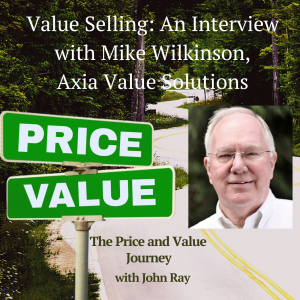
Connect with John Ray:

Website | LinkedIn | Twitter

Business RadioX®:  LinkedIn | Twitter | Facebook | Instagram

Tagged With: closet, John Ray, Price and Value Journey, pricing, professional services, professional services providers, solopreneurs, value, value pricing

Selling a Digital Kidney

January 27, 2023 by John Ray

Selling a Digital Kidney
North Fulton Studio
Selling a Digital Kidney
Loading
00:00 /
RSS Feed
Share
Link
Embed

Download file

Selling a Digital Kidney

Selling a Digital Kidney

Pricing an online coaching session–or anything else, for that matter–can turn into the equivalent of selling a digital kidney when that pricing exudes whiffs of desperation. Always remember that prices can act as marketing signals.

The Price and Value Journey is presented by John Ray and produced by the North Fulton studio of Business RadioX®.

TRANSCRIPT

John Ray: [00:00:00] Hello. I’m John Ray on The Price and Value Journey. Some time ago, I noticed a solopreneur services provider offering access to their expertise in a live online session. Given the value of what they claim to offer in this session, from my perspective anyway, I would have expected a three-figure price easily. The price, it was $99. It got worse, though. For a limited time, the offer claimed, seats were available for half that price. Well, my perception of the value they were offering collapsed completely.

John Ray: [00:00:40] Why is that? Well, price is an indicator of value in the minds of buyers, particularly in the absence of any other marketing signal. That price can signal quality or is, as in this case, mediocrity. We’ve all made some version of this mistake. I sure have, anyway, early on in my career. We think that cutting prices attracts buyers. When, in fact, it often repels them. When the gap between price and what’s promised is gapingly wide, it often screams too good to be true, or there’s a catch, or something’s not right here.

John Ray: [00:01:21] Most especially if you’re a solopreneur early on in your practice, one of those something is not right signals that you must be very careful to avoid is the whiff of desperation. Looking like you badly need revenue, any revenue, just to stay alive. Even if you didn’t intend it that way, you might be signaling that you’re selling a digital kidney.

John Ray: [00:01:47] Maybe this individual was trying to attract prospects into their funnel. If so, it’s illustrative of how solopreneurs and smaller firms get tripped up by digital marketing whiz bang. When, in fact, all they need to move the needle for their business is a handful of new or deepened relationships which turn into revenue.

John Ray: [00:02:09] This person might have been better off if they’d handled the limitation a little differently. One idea is limiting the number of seats available at that super low price and holding to that limit even after it’s met. Even with that change, though, the negative signals of poor pricing remain.

John Ray: [00:02:31] I’m John Ray on The Price and Value Journey. If you’d like more information on this podcast, a link to our show archive, or also information on a book I have coming out in 2023 – the book is called The Price and Value Journey: Raise Your Confidence, Your Value, and Your Prices to Grow Your Business Using the Generosity Mindset – if you’d like information on any of the above, you can go to pricevaluejourney.com, and you’re also welcome to email me directly, john@johnray.co. Thank you for joining me.


About The Price and Value Journey

The title of this show describes the journey all professional services providers are on:  building a services practice by seeking to convince the world of the value we offer, helping clients achieve the outcomes they desire, and trying to do all that at pricing which reflects the value we deliver.

If you feel like you’re working too hard for too little money in your solo or small firm practice, this show is for you. Even if you’re reasonably happy with your practice, you’ll hear ways to improve both your bottom line as well as the mindset you bring to your business.

The show is produced by the North Fulton studio of Business RadioX® and can be found on all the major podcast apps. The complete show archive is here.

John Ray, Host of The Price and Value Journey

John Ray The Price and Value Journey
John Ray, Host of “The Price and Value Journey”

John Ray is the host of The Price and Value Journey.

John owns Ray Business Advisors, a business advisory practice. John’s services include advising solopreneur and small professional services firms on their pricing. John is passionate about the power of pricing for business owners, as changing pricing is the fastest way to change the profitability of a business. His clients are professionals who are selling their “grey matter,” such as attorneys, CPAs, accountants and bookkeepers, consultants, marketing professionals, and other professional services practitioners.

In his other business, John is a Studio Owner, Producer, and Show Host with Business RadioX®, and works with business owners who want to do their own podcast. As a veteran B2B services provider, John’s special sauce is coaching B2B professionals to use a podcast to build relationships in a non-salesy way which translate into revenue.

John is the host of North Fulton Business Radio, Minneapolis-St. Paul Business Radio, Alpharetta Tech Talk, and Business Leaders Radio. house shows which feature a wide range of business leaders and companies. John has hosted and/or produced over 1,700 podcast episodes.

Coming in 2023:  A New Book!

John’s working on a book that will be released in 2023:  The Price and Value Journey: Raise Your Confidence, Your Value, and Your Prices to Grow Your Business Using The Generosity Mindset. The book covers topics like value and adopting a mindset of value, pricing your services more effectively, proposals, and essential elements of growing your business. For more information or to sign up to receive updates on the book release, go to pricevaluejourney.com.

Connect with John Ray:

Website | LinkedIn | Twitter

Business RadioX®:  LinkedIn | Twitter | Facebook | Instagram

Tagged With: digital, digital marketing course, John Ray, marketing signals, Price and Value Journey, pricing, professional services, professional services providers, Solopreneur, solopreneurs, value, value pricing

The Value of a Smile

January 25, 2023 by John Ray

The Value of a Smile
North Fulton Studio
The Value of a Smile
Loading
00:00 /
RSS Feed
Share
Link
Embed

Download file

The Value of a Smile

The Value of a Smile

The value of a smile is priceless, as revealed by a visit to the orthodontist. It’s a story which reminds us that focusing on client outcomes is what brings smiles to their faces.

The Price and Value Journey is presented by John Ray and produced by the North Fulton studio of Business RadioX®.

TRANSCRIPT

John Ray: [00:00:00] Hello. I’m John Ray on The Price and Value Journey. The value of a smile. The best thing that’s happened to orthodontics in the last several years, I think, is technology which allows the practitioner to give their patient a picture of what their own teeth will look like when the treatment is finished. This technology puts the patient focus not only on the tangible outcome, which is what clients are interested in, but what that outcome will feel like, which is entirely intangible.

John Ray: [00:00:35] I remember vividly when my son as a teenager was sitting in the chair at the orthodontist’s office absorbing the news of how long those braces would be on his teeth. But then, he saw a photo of what his teeth were going to look like once the braces came off. At that point, there was no turning back. He had no hesitation. Not only was the sale made, but if I had been asked, I would have probably been open to accepting a price increase right there on the spot because of the joy I saw in my son’s face.

John Ray: [00:01:13] Are you giving prospects a picture of what their life will look like as you implement their recommendations? Are you having conversations with your clients which remind them in a nice way what a mess they were in before you intervened? Or what junk they don’t have to deal with now because of their engagement with you? Visions of pleasing outcomes bring client smiles, and they also bring better pricing for your work.

John Ray: [00:01:43] I’m John Ray on The Price and Value Journey. News for 2023, I have a book coming out called The Price and Value Journey: Raise Your Confidence, Your Value, and Your Prices to Grow Your Business Using the Generosity Mindset. If you’d like to sign up to receive updates on when the book is released, you can go to pricevaluejourney.com. When you follow that link, you’ll also find information on this podcast, which is also available on all the major podcast apps. If you’d like to email me directly, feel free to do so, john@johnray.co. Thank you for joining me.


About The Price and Value Journey

The title of this show describes the journey all professional services providers are on:  building a services practice by seeking to convince the world of the value we offer, helping clients achieve the outcomes they desire, and trying to do all that at pricing which reflects the value we deliver.

If you feel like you’re working too hard for too little money in your solo or small firm practice, this show is for you. Even if you’re reasonably happy with your practice, you’ll hear ways to improve both your bottom line as well as the mindset you bring to your business.

The show is produced by the North Fulton studio of Business RadioX® and can be found on all the major podcast apps. The complete show archive is here.

John Ray, Host of The Price and Value Journey

John Ray The Price and Value Journey
John Ray, Host of “The Price and Value Journey”

John Ray is the host of The Price and Value Journey.

John owns Ray Business Advisors, a business advisory practice. John’s services include advising solopreneur and small professional services firms on their pricing. John is passionate about the power of pricing for business owners, as changing pricing is the fastest way to change the profitability of a business. His clients are professionals who are selling their “grey matter,” such as attorneys, CPAs, accountants and bookkeepers, consultants, marketing professionals, and other professional services practitioners.

In his other business, John is a Studio Owner, Producer, and Show Host with Business RadioX®, and works with business owners who want to do their own podcast. As a veteran B2B services provider, John’s special sauce is coaching B2B professionals to use a podcast to build relationships in a non-salesy way which translate into revenue.

John is the host of North Fulton Business Radio, Minneapolis-St. Paul Business Radio, Alpharetta Tech Talk, and Business Leaders Radio. house shows which feature a wide range of business leaders and companies. John has hosted and/or produced over 1,700 podcast episodes.

Coming in 2023:  A New Book!

John’s working on a book that will be released in 2023:  The Price and Value Journey: Raise Your Confidence, Your Value, and Your Prices to Grow Your Business Using The Generosity Mindset. The book covers topics like value and adopting a mindset of value, pricing your services more effectively, proposals, and essential elements of growing your business. For more information or to sign up to receive updates on the book release, go to pricevaluejourney.com.
Connect with John Ray:

Website | LinkedIn | Twitter

Business RadioX®:  LinkedIn | Twitter | Facebook | Instagram

Tagged With: client outcomes, John Ray, orthodontics, orthodontist, Price and Value Journey, pricing, professional services, professional services providers, smiles, solopreneurs, value, value pricing

Altruism and Business Ownership

January 23, 2023 by John Ray

Altruism and Business Ownership
North Fulton Studio
Altruism and Business Ownership
Loading
00:00 /
RSS Feed
Share
Link
Embed

Download file

Altruism and Business OwnershipAltruism and Business Ownership

Entrepreneurs today want a purpose in their business which goes beyond just making money. Reminding clients of that purpose is a vital way we are often called, as advisors, to deliver value to them.

The Price and Value Journey is presented by John Ray and produced by the North Fulton studio of Business RadioX®.

TRANSCRIPT

John Ray: [00:00:00] Hello. I’m John Ray on the Price and Value Journey. I recently ran across a quote from the Dalai Lama who said, “Idealistic as it may sound, altruism should be the driving force in business, not just competition and a desire for wealth”. Well, the Dalai Lama was in many ways kind and maybe even cute to some people. But what does he know about business? Quite a lot. I think if this quote attributed to him is accurate.

Let’s think about what altruism means. One definition I found calls altruistic behavior, a desire to benefit someone other than oneself for that person’s sake. Some will read that definition and claim that fulfilling such a desire is impossible in business. Those people would be flat out wrong. They’ve either never run a small business, not spent much time around business owners, or their experience in business is scarred by knowing the worst possible examples of business owners. In the latter case, the ones who are almost sociopathic in their disregard for others.

I work with and regularly talk with a wide variety of small and medium sized business owners. I have that privilege because of the pricing and other business advisory work that I do. And I also regularly interview a wide variety of guests as part of my work in the North Fulton Studio of Business RadioX. Between the guests I’ve interviewed myself and the guests of the shows we produce, we’ve had over 2000 business owners and leaders over the past almost seven years and counting.

So, my sample size is quite large, you might say. And I’m no wide eyed, idealistic novice either. These business owners span a wide variety of demographic categories. Some have always lived a life of entrepreneurship, and others started their businesses later in life after a career in corporate. One thing I have found over the years is that the overwhelming preponderance of business owners I’ve encountered have a purpose for their business, which goes well beyond the profit and loss statement.

There’s a bigger idea in mind. Maybe they’ve got a cause that’s important to them they want to contribute to. They’ve got some difference they want to make in their community. It could be rooted in their faith. Sometimes they want to establish a charitable legacy which lives on after they’re gone. For some, they’re simply motivated to be of service to everyone they meet, and that service just happens to be found in their business. They see themselves as servants to their employees, clients, vendors, and their community.

I was with a client recently and we were heads down together on several pressing issues. At one point, the conversation shifted toward purpose in his business. He restated that purpose. One I’d heard many times before and one that’s larger than himself. And he observed that if that purpose wasn’t the objective, then dealing with the problems we were talking about just wasn’t worth it. In a recent interview that I did with a personal injury attorney, he talked about the practice of law and his fundamental desire to help people. If it’s all about money, he said, you’ll never be satisfied with your business.

I see and hear altruism in small and medium sized business owners all the time. This theme is just part of the world that we live in today. People want purpose in their business or they don’t want to be in that enterprise. Here’s the thing, though. A business doesn’t have to get exceptionally large to start having a complex set of issues. If you’re a solo or small firm professional services provider, you work with a variety of small and medium sized business owners who are dragged down by the day-to-day problems and just the plain old crap that’s involved in running a business. All those issues can obscure the larger goals or make them seem far away.

Sometimes your job is simply to help your clients raise their vision, to remind them of why they’re dealing with all the junk they have on their plate. You don’t necessarily have to deliver brilliant insights or solve all their problems. You just need to bring back that vision of service they had when they got into business. When you reinvigorate their spirit by reminding them of what’s behind today’s clouds in their business, you are offering tremendous value. And that’s an honorable calling that you have as a professional services provider.

I’m John Ray on the Price and Value Journey. If you’d like to know about this series and some of the work that I do, you can go to pricevaluejourney.com. You’ll find there a link back to the show archive of this series. And if you’re not already subscriber on your favorite podcast app, I’d be honored if you would do that. You can find the series on all the major podcast apps. When you go to pricevaluejourney.com, you can find a link where you can sign up to receive more information on my upcoming book, which is called The Price and Value Journey, Raise Your Confidence, Your Value and Your Prices to Grow Your Business Using the Generosity Mindset. If you’d like to email me directly, you can do so at John@johnray.co. Thank you for joining me.


About The Price and Value Journey

The title of this show describes the journey all professional services providers are on:  building a services practice by seeking to convince the world of the value we offer, helping clients achieve the outcomes they desire, and trying to do all that at pricing which reflects the value we deliver.

If you feel like you’re working too hard for too little money in your solo or small firm practice, this show is for you. Even if you’re reasonably happy with your practice, you’ll hear ways to improve both your bottom line as well as the mindset you bring to your business.

The show is produced by the North Fulton studio of Business RadioX® and can be found on all the major podcast apps. The complete show archive is here.

John Ray, Host of The Price and Value Journey

John Ray The Price and Value Journey
John Ray, Host of “The Price and Value Journey”

John Ray is the host of The Price and Value Journey.

John owns Ray Business Advisors, a business advisory practice. John’s services include advising solopreneur and small professional services firms on their pricing. John is passionate about the power of pricing for business owners, as changing pricing is the fastest way to change the profitability of a business. His clients are professionals who are selling their “grey matter,” such as attorneys, CPAs, accountants and bookkeepers, consultants, marketing professionals, and other professional services practitioners.

In his other business, John is a Studio Owner, Producer, and Show Host with Business RadioX®, and works with business owners who want to do their own podcast. As a veteran B2B services provider, John’s special sauce is coaching B2B professionals to use a podcast to build relationships in a non-salesy way which translate into revenue.

John is the host of North Fulton Business Radio, Minneapolis-St. Paul Business Radio, Alpharetta Tech Talk, and Business Leaders Radio. house shows which feature a wide range of business leaders and companies. John has hosted and/or produced over 1,700 podcast episodes.

Coming in 2023:  A New Book!

John’s working on a book that will be released in 2023:  The Price and Value Journey: Raise Your Confidence, Your Value, and Your Prices to Grow Your Business Using The Generosity Mindset. The book covers topics like value and adopting a mindset of value, pricing your services more effectively, proposals, and essential elements of growing your business. For more information, contact John below.

Connect with John Ray:

Website | LinkedIn | Twitter

Business RadioX®:  LinkedIn | Twitter | Facebook | Instagram

Tagged With: altruism, business ownership, John Ray, Price and Value Journey, pricing, professional services, professional services providers, purpose, solopreneurs, value, value pricing

Plumber Pricing

January 20, 2023 by John Ray

Plumber Pricing
North Fulton Studio
Plumber Pricing
Loading
00:00 /
RSS Feed
Share
Link
Embed

Download file

Plumber PricingPlumber Pricing

Professional services providers, the speed with which you execute an engagement is a feature and should be priced as one. A recent experience I had with a plumber illustrates the point.

The Price and Value Journey is presented by John Ray and produced by the North Fulton studio of Business RadioX®.

TRANSCRIPT

John Ray: [00:00:00] Hello. I’m John Ray on the Price and Value Journey. In my last episode of this series, I talked about my recent superb experience with the plumber, using that story to make the point that how we show up is an intangible value to our clients. This plumber came to our house on a Friday night a few hours after I called him to diagnose the problem. After doing that, he said he could be back the next morning on a Saturday to perform the necessary repairs. Unfortunately for him, though, my experience with this plumber was further elevated by his pricing. What do I mean by that? Well, even though he delivered his service so quickly and efficiently, his price was well below the estimate I received from another plumber who I could never get to show up.

Even with offering the intangibles of both reliability and speed of service, this five-star plumber didn’t price his service to reflect the client perceived value of those intangibles. Professional services providers, the speed with which you execute an engagement is a feature and should be priced as one. Bookkeepers for example, when you’re producing financials by the 15th of every month, that should be priced at a premium relative to engagements which call for the end of the month. Yet so many bookkeepers I’ve run into price all their clients at their same hourly rate, which highlights just one of the many problems with hourly pricing but that’s another subject.

Here’s another example. At year end, some professionals like attorneys or business valuation experts will have clients who, with little or no warning, come walking in with a project which needs to be completed by December 31st. Price the needed velocity. When confronted with a premium price, such clients will make their own determination as to how important that year in closing is and therefore how much they value your project and the outcome you deliver. Speed is value, price it.

I’m John Ray on the Price and Value Journey. Go to pricevaluejourney.com to learn more about my work, including a link to the show archive of this series, which you can also subscribe to on your favorite podcast app. And I’d be honored if you would do that, if you’re not already a subscriber. When you go to pricevaluejourney.com, you can also sign up to receive updates on my new book coming out in 2023. The title of the book is The Price and Value Journey, Raise Your Confidence, Your Value and Your Prices to Grow Your Business Using the Generosity Mindset. If you’d like to email me directly, feel free, John@JohnRay.co. Thank you for joining me.


About The Price and Value Journey

The title of this show describes the journey all professional services providers are on:  building a services practice by seeking to convince the world of the value we offer, helping clients achieve the outcomes they desire, and trying to do all that at pricing which reflects the value we deliver.

If you feel like you’re working too hard for too little money in your solo or small firm practice, this show is for you. Even if you’re reasonably happy with your practice, you’ll hear ways to improve both your bottom line as well as the mindset you bring to your business.

The show is produced by the North Fulton studio of Business RadioX® and can be found on all the major podcast apps. The complete show archive is here.

John Ray, Host of The Price and Value Journey

John Ray The Price and Value Journey
John Ray, Host of “The Price and Value Journey”

John Ray is the host of The Price and Value Journey.

John owns Ray Business Advisors, a business advisory practice. John’s services include advising solopreneur and small professional services firms on their pricing. John is passionate about the power of pricing for business owners, as changing pricing is the fastest way to change the profitability of a business. His clients are professionals who are selling their “grey matter,” such as attorneys, CPAs, accountants and bookkeepers, consultants, marketing professionals, and other professional services practitioners.

In his other business, John is a Studio Owner, Producer, and Show Host with Business RadioX®, and works with business owners who want to do their own podcast. As a veteran B2B services provider, John’s special sauce is coaching B2B professionals to use a podcast to build relationships in a non-salesy way which translate into revenue.

John is the host of North Fulton Business Radio, Minneapolis-St. Paul Business Radio, Alpharetta Tech Talk, and Business Leaders Radio. house shows which feature a wide range of business leaders and companies. John has hosted and/or produced over 1,700 podcast episodes.

Coming in 2023:  A New Book!

John’s working on a book that will be released in 2023:  The Price and Value Journey: Raise Your Confidence, Your Value, and Your Prices to Grow Your Business Using The Generosity Mindset. The book covers topics like value and adopting a mindset of value, pricing your services more effectively, proposals, and essential elements of growing your business. For more information, contact John below.

Connect with John Ray:

Website | LinkedIn | Twitter

Business RadioX®:  LinkedIn | Twitter | Facebook | Instagram

Tagged With: intangibles, ohn Ray, plumber, Price and Value Journey, pricing, professional services, professional services providers, reliability, solopreneurs, SPEED, value, value pricing

  • « Previous Page
  • 1
  • 2
  • 3
  • 4
  • 5
  • …
  • 12
  • Next Page »

Business RadioX ® Network


Our Most Recent Episode

CONNECT WITH US

  • Email
  • Facebook
  • LinkedIn
  • Twitter
  • YouTube

Our Mission

We help local business leaders get the word out about the important work they’re doing to serve their market, their community, and their profession.

We support and celebrate business by sharing positive business stories that traditional media ignores. Some media leans left. Some media leans right. We lean business.

Sponsor a Show

Build Relationships and Grow Your Business. Click here for more details.

Partner With Us

Discover More Here

Terms and Conditions
Privacy Policy

Connect with us

Want to keep up with the latest in pro-business news across the network? Follow us on social media for the latest stories!
  • Email
  • Facebook
  • Google+
  • LinkedIn
  • Twitter
  • YouTube

Business RadioX® Headquarters
1000 Abernathy Rd. NE
Building 400, Suite L-10
Sandy Springs, GA 30328

© 2025 Business RadioX ® · Rainmaker Platform

BRXStudioCoversLA

Wait! Don’t Miss an Episode of LA Business Radio

BRXStudioCoversDENVER

Wait! Don’t Miss an Episode of Denver Business Radio

BRXStudioCoversPENSACOLA

Wait! Don’t Miss an Episode of Pensacola Business Radio

BRXStudioCoversBIRMINGHAM

Wait! Don’t Miss an Episode of Birmingham Business Radio

BRXStudioCoversTALLAHASSEE

Wait! Don’t Miss an Episode of Tallahassee Business Radio

BRXStudioCoversRALEIGH

Wait! Don’t Miss an Episode of Raleigh Business Radio

BRXStudioCoversRICHMONDNoWhite

Wait! Don’t Miss an Episode of Richmond Business Radio

BRXStudioCoversNASHVILLENoWhite

Wait! Don’t Miss an Episode of Nashville Business Radio

BRXStudioCoversDETROIT

Wait! Don’t Miss an Episode of Detroit Business Radio

BRXStudioCoversSTLOUIS

Wait! Don’t Miss an Episode of St. Louis Business Radio

BRXStudioCoversCOLUMBUS-small

Wait! Don’t Miss an Episode of Columbus Business Radio

Coachthecoach-08-08

Wait! Don’t Miss an Episode of Coach the Coach

BRXStudioCoversBAYAREA

Wait! Don’t Miss an Episode of Bay Area Business Radio

BRXStudioCoversCHICAGO

Wait! Don’t Miss an Episode of Chicago Business Radio

Wait! Don’t Miss an Episode of Atlanta Business Radio