Business RadioX ®

  • Home
  • Business RadioX ® Communities
    • Southeast
      • Alabama
        • Birmingham
      • Florida
        • Orlando
        • Pensacola
        • South Florida
        • Tampa
        • Tallahassee
      • Georgia
        • Atlanta
        • Cherokee
        • Forsyth
        • Greater Perimeter
        • Gwinnett
        • North Fulton
        • North Georgia
        • Northeast Georgia
        • Rome
        • Savannah
      • Louisiana
        • New Orleans
      • North Carolina
        • Charlotte
        • Raleigh
      • Tennessee
        • Chattanooga
        • Nashville
      • Virginia
        • Richmond
    • South Central
      • Arkansas
        • Northwest Arkansas
    • Midwest
      • Illinois
        • Chicago
      • Michigan
        • Detroit
      • Minnesota
        • Minneapolis St. Paul
      • Missouri
        • St. Louis
      • Ohio
        • Cleveland
        • Columbus
        • Dayton
    • Southwest
      • Arizona
        • Phoenix
        • Tucson
        • Valley
      • Texas
        • Austin
        • Dallas
        • Houston
    • West
      • California
        • Bay Area
        • LA
        • Pasadena
      • Colorado
        • Denver
      • Hawaii
        • Oahu
  • FAQs
  • About Us
    • Our Mission
    • Our Audience
    • Why It Works
    • What People Are Saying
    • BRX in the News
  • Resources
    • BRX Pro Tips
    • B2B Marketing: The 4Rs
    • High Velocity Selling Habits
    • Why Most B2B Media Strategies Fail
    • 9 Reasons To Sponsor A Business RadioX ® Show
  • Partner With Us
  • Veteran Business RadioX ®

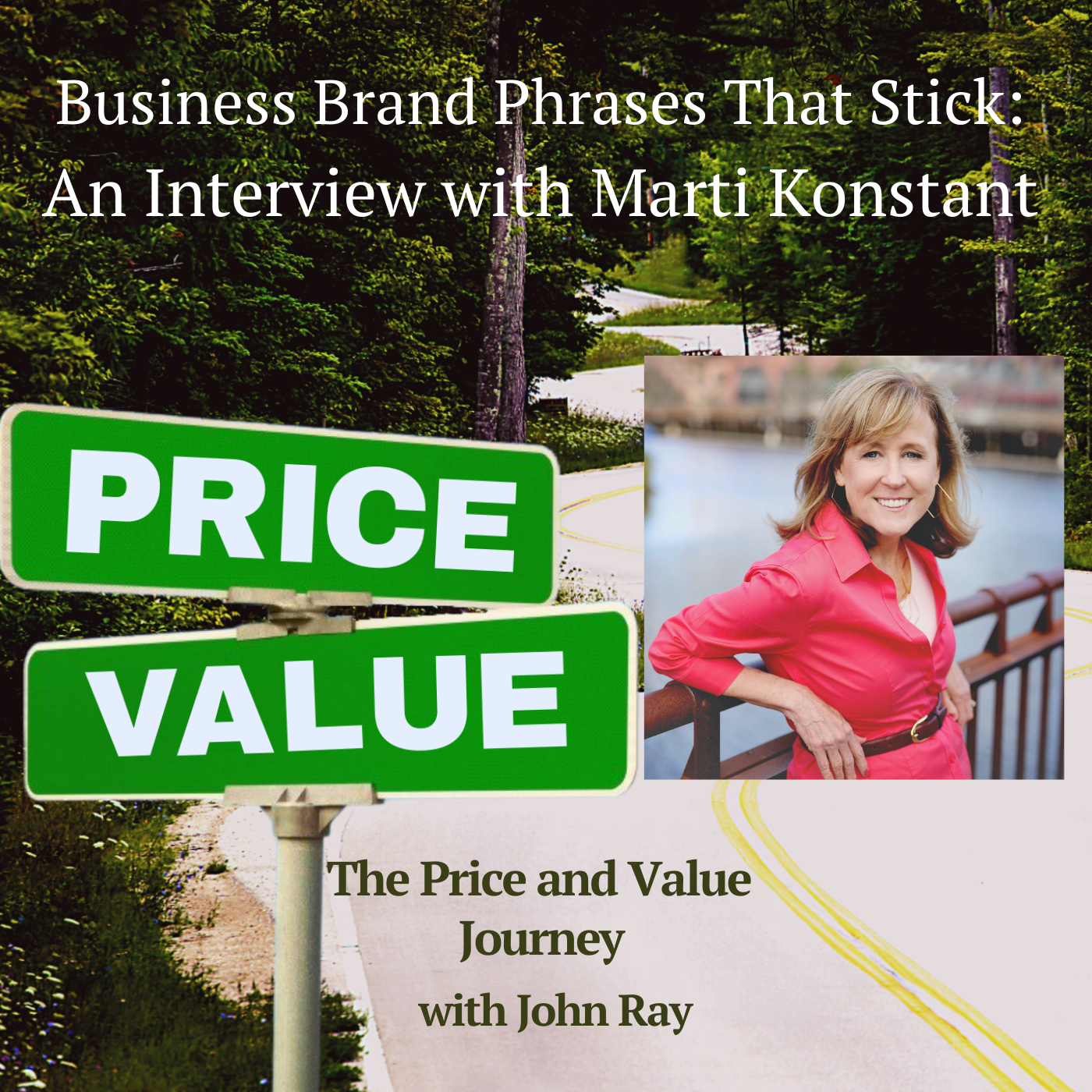
Business Brand Phrases That Stick: An Interview with Marti Konstant

March 16, 2022 by John Ray

Marti Konstant
North Fulton Studio
Business Brand Phrases That Stick: An Interview with Marti Konstant
Loading
00:00 /
RSS Feed
Share
Link
Embed

Download file

Marti Konstant

Business Brand Phrases That Stick: An Interview with Marti Konstant

How should we as professional services providers address our business branding? How can we develop branding which is memorable? Marti Konstant, noted speaker, coach, and best-selling author, joined John Ray to address these questions and much more. Marti recounted her own journey, from teenage years in a full body brace to Silicon Valley marketing executive, to running her own successful services practice, and how that career arc shaped her business branding. She spoke from her own experience on how to handle a branding process that can be overwhelming, examples of compelling brand phrases and the professionals who developed them, how effective branding affects pricing, and much more. The Price and Value Journey is presented by John Ray and produced by the North Fulton studio of Business RadioX®.

Marti Konstant, Workplace Futurist

Marti Konstant, Workplace Futurist

Marti Konstant is a workplace futurist with an agile mindset. She is a career growth analyst, author, speaker, and founder of the Happy Profitable Employee Project™.

An early adopter of workplace trends and technology change, her career path includes artist, designer, entrepreneur, technology marketing executive, business advisor, and investor. Starting her profession in the tech sector launched a style of deliberate career growth, guided by personal preferences.

As a marketing professional, Marti managed marketing programs for companies like Samsung Mobile, Apple, Tellabs, Platinum Technology, Clear Communications, and Open Kernel Labs (OK Labs). As a chief marketer in the mobile security space, her digital demand generation and market awareness strategies resulted in the acquisition of OK Labs by General Dynamics

What started out as a quest to fine-tune her evolving career sparked a research project, workshops, and book, where future of work and career agility are central themes. Her story-driven book, Activate Your Agile Career: How Responding to Change Will Inspire Your Life’s Work, is the result of 120 interviews and custom research.

She earned a Bachelor of Fine Arts in Graphic Design from the University of Illinois and holds a Master of Business Administration from the University of Chicago Booth School of Business. A persistent optimist and prolific photographer, she lives in Chicago with her husband.

Website | LinkedIn| Twitter

TRANSCRIPT

John Ray: [00:00:00] And hello again, everyone. I’m John Ray on the Price and Value Journey. Today, we’re going to chat with Marti Konstant, and Marti is a friend of mine who – we were having a conversation that resulted in this topic, and I’ll talk about the topic in a minute. But first, let me introduce Marti.

John Ray: [00:00:18] Marti is a workplace futurist. She’s the best-selling author of Activate Your Agile Career, which is a great book, by the way. She has an MBA from the University of Chicago Booth School of Business. She’s a former technology executive from Silicon Valley. I want to say more about that in just one second. She’s been featured in a variety of media outlets and has been named a top career influencer to watch. She’s worked with companies like Samsung, Dow Jones, and Apple. And her areas of expertise include the future of work, career development, the workplace, personal branding, workplace trends and ideas, agility, and I’m sure there’s some other things we could talk about. It makes me tired to read that list, Marti. You’re awesome. Congratulations on all that great work.

Mari Konstant: [00:01:12] Thanks so much for that, John. I am so psyched about this conversation because I’ve been following your work for quite some time now.

John Ray: [00:01:19] Well, thank you. I’m honored to have you on the show. Now, one of the things we just need to point out here is that Marti has tremendous experience that a former technology executive from Silicon Valley, all that experience really relates to branding and specifically B2B branding. And that’s where some of our recent chat, we were talking about business brand phrases for professional services firms. And that’s the whole notion here of this conversation is to talk about that as it relates to professional services providers. So, let’s start, Marti, by maybe talking about your own branding journey when you went out on your own and started your practice.

Mari Konstant: [00:02:08] Sure. It really starts long before that. When I was 12 years old, I was immobilized. I was in a full-body brace through my high school years and I was constricted. I couldn’t move and I couldn’t do sports and it was hard to get around. And what I learned from that experience is, well, first of all, I learned how to dream about mobility, agility, flexibility, all the things that I wanted to be doing. And I learned what it was like to go from constriction to unrestricted access to the world. And this was a very powerful backdrop for the type of work that I did. I started out in the creative field, got into branding, got my MBA, got into marketing management, and was managing growth-stage tech company brands as well as certain aspects of large company brands at that time. And right now, how has this affected my brand? Well, I invented the word career agility 10 years ago. It was a term that did not exist. So that is one way. And the phrase that I often used during that time and throughout the book is, if you don’t, it’s adapt or die. It’s flex or fade. It’s the contrast. It’s stagnation or it is growth. Why wouldn’t you want to grow?

John Ray: [00:03:47] For sure. So, this may seem like an obvious question, but I find that sometimes obvious questions give unexpected answers. So, I mean, how do you define a business brand phrase?

Mari Konstant: [00:04:05] I coined the business brand phrase terminology because people were getting stuck in making it a big, long initiative that a lot of small businesses can’t even fathom doing. They can’t fathom doing something for six to 12 months or even three to six months. And I noticed when I was managing brands in the tech space, and as I formed my own brand as a workplace futurist and as a career decoder, I noticed that things that I thought were really easy, coining phrases that didn’t exist, talking about yourself in a way that’s memorable. I just thought that everybody did that. And I realized that if you can just use a phrase and you don’t have to come up with the whole perfect elevator pitch, you can be memorable because that’s all branding is. It’s about being top of mind. It’s about being memorable when someone else wants to work with you for your services or your product.

John Ray: [00:05:22] So, I’m curious about – it just strikes me about the workplace agility phrase that you invented combines something about your life. You described your teenage years and the pain and development, I guess, that you went through because of that, right, and then, your expertise, the workplace. It combines those two things. Talk – say more about that. Is there something significant in that?

Mari Konstant: [00:05:59] Yeah. I think this idea of agility. I just thought, you know, as one who was prevented from moving for a few years, I just thought, you know, if you are agile and you are flexible, anything is possible. So, all of those self-help books like you can if you think you can are true. And you can’t do if you think you can’t, that’s also true. And I think the idea of agility has really resonated well in this area of pandemic and post-pandemic that if you are able to adapt and be agile in your thinking, you are going to future proof just about anything you’re doing because every business, every industry will be reinvented in the next 10 years. That is my futurist self stating this.

John Ray: [00:07:08] Got it. So, I can hear – so, you know, our audience here is solopreneurs, small professional services firms. You’ve got your own practice. I can hear folks saying, you know, look, I do wills and trusts or as an attorney or, you know, I do social media for other clients. I mean, what – you know, I’m a professional services provider here, Marti, not a can of green beans. So, I mean, how, how – why do I need to worry about a business brand phrase per se?

Mari Konstant: [00:07:44] Well, when you’re networking and you say something like I’m a trusted advisor, how many other businesses do you think have that as their tagline? I mean, let’s just guess. Let’s just guess, John.

John Ray: [00:07:59] Oh, 50 million. I don’t know.

Mari Konstant: [00:08:02] Yeah. It’s – I don’t even have the number. What I do know is, it starts to sound trite, and then I ask myself, well, what do people really mean when they say that? Well, sometimes they mean that they are an unapologetic truth-teller. Sometimes they mean that they have your back. Sometimes they mean that they have vision in a way that they can see through things that you can’t, and I think about taking these types of phrases. And if you’re at a networking event or at a dinner event and you make that tangible is what you do for people. People will remember that. They’ll remember things. Like, I’ll use the idea of my surgeon. He was working on my shoulder and I said, “You know, I got to know. Like, is this going to work?” And he could have said, “You know, I’m a surgeon. I’m a really good surgeon.” But what he told me, he told me something quantitative and exciting, and he said, “Marti, I have 100% confidence that you will have a full recovery. I have done 9000 shoulder surgeries.”

John Ray: [00:09:17] Oh, wow.

Mari Konstant: [00:09:18] Now I felt going into that surgery, I didn’t even have a doubt in my mind, and they tell you so much is about mindset. So, who wouldn’t want to have a doctor like that that exhibits such confidence gave me a metric. So, sometimes it’s a metric that you could put out there. That could be part of your branding phrase. It doesn’t have to be a tagline, and I’ve got lots and lots of examples. Like, a nonprofit executive that says that they do all these wonderful things. And, oh, by the way, they’re able to turn red into black. Everything is hemorrhaging right now in the nonprofit sector in, say, things like, you know, the creative arenas like orchestras and plays and things like that. Who wouldn’t want somebody that knows how to turn red into black? They could just say, “Well, I’m a CFO,” or, “I am a bean counter and I can keep things organized for you.” Well, that’s not selling me confidence.

John Ray: [00:10:20] And it’s not very memorable.

Mari Konstant: [00:10:23] No. And it’s – part of it is it’s just that confident piece of it that seems when you use something trite when you use a phrase that’s trite like the trusted advisor or there’s a number of them. I mean, maybe you can come up – maybe – what do you think people say that’s like – like they say, “Well, you know, on time, on target, on budget.” Those are good things, right?

John Ray: [00:10:52] Right.

Mari Konstant: [00:10:53] But it’s not memorable.

John Ray: [00:10:55] Yeah, for sure. You know, the interesting thing here is, I think for some people is how do I come up with something that’s memorable, but I’m not sure I’m as inventive as Marti, I mean, because workplace agility is something that – you Google workplace agility, folks, you find Marti. The question is if I’m a financial adviser, let’s say, and I’m one of a bazillion financial advisers, how do I come up with something that really is unique that makes me stand out?

Mari Konstant: [00:11:31] I think you work with a person that you know you trust that can help you do that. You could also create your own group and do some brainstorming exercises. You can learn how to do some of this. I think there’s so many consultants. And I think of things that can translate to others.

Mari Konstant: [00:11:49] Like, I often run into people in the IT space and they go, “Well, you know, I integrate this and that and it doesn’t sound all that interesting.” Yet, when they tell me, well, I’m able to translate and then they say, “Well, I translate.” And I go, “Well, tell me more about that.” And then, you come up with something like the digital fluency. Like, I am multilingual. I speak tech and I speak tech translation. That’s better than saying I translate text so that everyone can understand it. Now, you can say that other phrase I translate text so everyone can understand it after you’ve said the thing about I’m multilingual and I take digital fluency to another level. You could substitute words like financial fluency in there. You can take other words and other phrases.

Mari Konstant: [00:12:23] I thought about management consulting. There’s a lot of people that do small business management consulting, how to make your businesses more profitable and more effective. And if you said something in a networking program, you said, “You know, I’m like a master chess player.” I process if-then scenarios quickly helping you and your team to focus on a decision when every second counts, or something like that. Some sort of story –

John Ray: [00:13:14] Sure.

Mari Konstant: [00:13:14] That makes it interesting and tangible. Like, what happens when small businesses have an eruption of some sort? What do they do? What is that scenario? What does it feel like? How do they make a decision? And so, you go through a series of questions like this, figure out how that feels. And the way that you can make an effective branding phrase is to put your brain and your shoes and your feet in the shoes of your customer. You have to be an outsider looking in. You have to be a beginner. You can’t be the perfect practitioner that you already are. You have to go back to the beginning and say, “Why the heck did you start this business in the first place?” Something was broken, right? You wanted to make it better. That’s the kind of stuff that needs to come out.

John Ray: [00:14:06] I’m glad you went there because that’s where I wanted to go in terms of, again, I’m going to showcase you. I mean, your business brand that sticks is really about the client. I mean, workplace agility. It’s about the client. It’s not about your expertise. It’s about what you help affect on behalf of the client. And that’s what’s I think striking about, and the difference maybe, in the effective business brands versus the non-effective ones. Don’t you, don’t you – does that make sense?

Mari Konstant: [00:14:44] Exactly. Yeah. And I have a little acronym that I use for this. It’s called mode, M-O-D-E. And it is speaking like a media, a media professional, number one, speaking like a great PR professional, being able to talk, and then actually looking from the outside, and that’s the O. And D is being able to be different, and then E, being able to look at the world with an empathetic brain. So, that’s a little bit of part of the outside looking in.

Mari Konstant: [00:15:27] If you can do those things if you can apply mode to that, and I can go into why being like a media pro is so important, but it’s just as important as being different. I think Sally Hogshead has a book coming out, Why Different Is Better Than Better. And I’ve heard numerous branding executives say this. It’s such a smart phrase because the reason it’s better than better, you know, we all talk about in tech, smarter, faster, cheaper, that kind of thing, but really different is what makes you memorable.

John Ray: [00:16:06] I love it. Folks, we’re here chatting with Marti Konstant and we’re speaking about creating business brand phrases that stick. So, we talked about clients and our prospects and how coming up with our branding from their perspective is so crucial. How did you involve your clients’ prospects in your branding or did you? How did that work for you?

Mari Konstant: [00:16:38] Okay. So, how did I get some of the phrases that I got? I will offer you a phrase that I’m using now because I also work with job seekers and right now my phrase for them is I help mid-career job seekers, that’s the target audience, mid-career job seekers, translate their experience into a visible in-demand portfolio of skills so they can find that right fit role. And how you get to that, I think what you’re getting at, John, is understanding, looking from the outside in, wearing the shoes of who it is that you’re serving, and understanding their pain and being able to approach that with empathy.

Mari Konstant: [00:17:27] So, if for the job seeker, for instance, we all know what that’s like, and I’ve coached enough people to know how painful some of these feelings are. So, being – when people don’t know where to start, like portfolio, I’m not a creative person, why do I need a portfolio of skills? Doesn’t even make sense to them? Right? So, they don’t know where to start. They don’t even know – I was on a call this morning with some mid-career folks in between roles, and they didn’t really know how to look into the camera and to be themselves and be part of that confident brand. The lighting was poor. One-half of their face was dark. I mean, you can go on and on about how this impacts your brand.

John Ray: [00:18:24] So, let me ask you this, and, again, I’m getting back to the, I guess, the perspective and it’s – I guess the reason why we would bring in a third-party consultant or someone to help us with this is because they give us that outside view. But when you developed your branding around mid-career job seekers, did you talk to some of them about this is the branding I’m considering? Or, how did you – did you involve them?

Mari Konstant: [00:19:02] Well, I started a little bit further back than that.

John Ray: [00:19:06] Okay.

Mari Konstant: [00:19:06] So, even though I’ve studied branding, I’ve been a creative person my entire career, any time, even when I was a chief marketer, I hired outside help. So, I, as a solopreneur, have probably invested more in personal branding than most small businesses, and I do it gladly because they hold the mirror up to me so that I can see myself better. And absolutely as a marketing thinker or because I’ve done market research as well, I never want a product ever without knowing what the customer is thinking about it and whether or not they buy it.

Mari Konstant: [00:19:49] Too many entrepreneurs put products out that they think is really cool, but they don’t – they’ve not consulted with a marketer and they are not a marketer at heart, so they are not understanding the value proposition. They haven’t done the types of testing, market validation we call it. What – you know, are you doing the market validation testing for your products to say, “Gee, does this look like a problem you have?” And even better yet, what problems do you have? And we will create a product for that.

John Ray: [00:20:27] Yeah. And so – I guess the question is, how do I know if I’ve got it right? I mean, you know, if I do all this work, how do I know – beyond getting a third party to really help me soundcheck it, how do I know I’ve got it right?

Mari Konstant: [00:20:46] I will tell you. When you get it right, it feels right. Even if you have one word that describes what you do, you know it in your heart and your gut and you inhabit it like no other. And the other way that you notice when you are in front of a customer and when they are shaking their heads or smiling, now we get to see people not just online but in person at times, when you can see something land, it’s palpable. It is visible. If that is not – I mean, I’m a professional speaker, too. So if people aren’t nodding their heads, they’re not smiling, they’re not interested, they’re not even looking up from their devices, I know I have lost them. And so, it’s the same thing as a business person.

Mari Konstant: [00:21:37] And that’s why when I was working in tech, market validation was so important. We wanted to know that we were solving a problem that people wanted. And then if it was a positioning piece that was more marketing-centric, you could do the same thing. You could test that – you could do the market validation for the messaging as well. You don’t just have to do it for a product.

John Ray: [00:22:04] Does going through this exercise, does it help me – as a professional services provider, does it help me better clarify my niche, or is it the other way around? Do I have to have that segment identified and then do the branding?

Mari Konstant: [00:22:23] This is such a great question. It’s like probably the most favorite question I’ve ever gotten, and the answer is it is definitely a clarifying process. When you go through a branding process, as I have with other professionals, sometimes for like two or three days straight I’m working with an outside professional, you start to think about your business differently.

Mari Konstant: [00:22:52] I have a business that I work for corporations and I do this professional speaking, bringing the future to the present. So I have a couple of different channels of services that I deliver. One might say, “Oh, my gosh, that’s all over the place,” but many of us deliver a few services and I think a lot of entrepreneurs can relate to that.

Mari Konstant: [00:23:18] So, it absolutely is a – it’s a lightning rod, I think, for understanding who you are, what you do, why it’s important, and is this solving a problem. I mean, Sara Blakely solved the problem with Spanx. It wasn’t so much that she had these nylons, but she wanted to get rid of the lines that existed underneath skirts and pants for women. She wanted to erase those so that they weren’t so distracting. So, she knew her problem really well. And, of course, I’m sure the way that she named it and all of that, I mean, there’s we could talk a whole lot about names. I mean, right now, we’re – aren’t we in the middle of March Madness or – yeah.

John Ray: [00:24:06] Yeah.

Mari Konstant: [00:24:06] March. Isn’t that a great phrase?

John Ray: [00:24:09] For sure.

Mari Konstant: [00:24:10] I mean, isn’t that just the greatest phrase ever?

John Ray: [00:24:13] Yeah.

Mari Konstant: [00:24:13] Or just do it on Nike. But you can categorize something as simple as a theme and make it – you can generate a lot of enthusiasm around your brand, and it could just be over one of your offerings. It doesn’t even have to be the name of your company.

John Ray: [00:24:32] And I guess what you’re getting at, correct me if I’m wrong, but what I hear you saying is, is that it really doesn’t even have to cover everything I do. I mean, let’s use the March Madness, for example. The madness occurs really the first weekend of the tournament when all these Davids beat up on Goliaths, and that’s the fun part. But eventually, the Goliaths normally went out after three weeks. So, the madness only occurs, let’s say, in the first part of the tournament. So, if you want to productize that, that’s really only part of the tournament, right? The March Madness, if you will.

Mari Konstant: [00:25:10] You could say that. You could look at it that way or you can look at it in a bigger thing that this is the time period of the tournament, right? It’s something that has legs and it’s scalable beyond those few parts of the tournament. And I think I’d like to get back to what you said, you know, branding phrases. It could be a word, it could be a phrase, it could be your positioning, it could be your tagline. And the reason I’ve been expressing it this way is because a lot of people don’t get in the game and they don’t get their feet wet because they’re overwhelmed by this exhaustive branding process.

Mari Konstant: [00:25:52] I mean, I’ve gone through the branding process a few times. It’s definitely worthwhile. It’s definitely worth the investment. But if you don’t understand it and you want to dip your toes in, you can take the template of what is it that you do and what is it that is different about what you’re offering and what is that pain point that you’re getting at. Or, you could do two out of the three of those. You don’t have to do all of them, but the template is easy. Like, describing what you do in a creative way is really more memorable than not doing it that way.

John Ray: [00:26:37] How important is it that an effective business branding phrase brings up a visual? Because it’s hard for me – let’s just use workplace agility. It’s hard for me to visualize that. Yet, it’s such an effective – it makes me lean in and want to know more. Like, what do you mean by that, Marti? Which makes it for me effective. But it’s not really a visual. So, talk about that.

Mari Konstant: [00:27:07] Well, what’s interesting that you say, like five years ago, I invented this term 10 years ago, so I didn’t have a brand for it. But when I – before I launched the book and when I was – it took me five years to write this book. I did come up with a whole logo for Agile Career, and it’s got some movement to it. It’s chrome yellow and black. It’s really beautiful. I had business cards. And I knew just having been in branding for so long, I knew that that was going to be a placeholder that worked for my book at the time. But I knew that Agility Think was going to be much more expansive than that. And the name of my business is Konstant Change. It has been for 20 years. It was always my side business.

Mari Konstant: [00:27:59] So in a way, I considered the agility piece a subbrand. So, now I’m getting to my branding hierarchy. So, Konstant Change is also part of the brand. Marti Konstant is my brand for my speaking, for my keynote speaking, right? And then, the agility piece is a consulting and an offering.

Mari Konstant: [00:28:22] So you could brand it in – they call it House of Brands or a branded house. There’s all different ways of doing it. But to do it in a smart way that’s methodical makes sense. So, I actually thought that out. I thought that out, like seven years ago. So I do have business cards with Konstant Change on it. And I also have, if you go to my LinkedIn profile, Konstant Change is the logo that it pulls in to what it is that I’m doing now. It looks like I’ve been doing it for 20 years. I haven’t been doing it for 20 years. It’s just that I started my side gig of Konstant Change 20 years ago.

John Ray: [00:29:02] So, you don’t have to answer with numbers, but I’m just curious, I want to get back to the – you said you’ve spent, and I don’t remember the adjective, but I’ll just say enormous amount of time and resources on your own branding journey with third-party experts. What’s the ROI of that been for you?

Mari Konstant: [00:29:30] If I had to classify that, I could give you some anecdotal. I now am attracting five-figure speaking engagements. So, that’s 10,000 and above for keynote speaking engagements. I wasn’t eligible for that before. I’m a big believer in contact marketing and branding, so putting all of that out there contributes to the ROI. So can you say, Oh, because I had a logo or because I had these branding phrases. No, I am an integrated marketing thinker. It is your PR. It’s how you deliver on your services. It’s your personality. It’s everything about that that contributes to your brand. That’s why the investment is just a part of it.

Mari Konstant: [00:30:24] I mean, I’m even working with- for keynote speaking – I’m working with hiring a stylist, a clothing stylist. I mean, I’m sure a lot of women do this. I had never done it. But I’m just like I’m open to it because I know it’s important to package myself in a way that’s believable and credible. So, it’s just another thing that I am investing in besides the whole other part of the branding.

Mari Konstant: [00:30:51] And as I told you before, we said before we talked, I actually work with large companies and help their executives with personal branding so that they can talk to each other in a way that lets others know what their strong points are, what they’re good at, and what they’re better at than anyone else not so much what they’re really good at, but where the overlap is for what they really want to be doing because there’s a lot of people that are mismatched in organizations. And if they are better equipped to talk about what they do, it’s going to be better for the organization. It’s going to be better for the executives and better for employee retention and beyond.

John Ray: [00:31:36] For sure. So, in terms of, and maybe you can give some advice to folks, there’s a lot of branding experts out there, a lot of folks that they could hire that, you know, have got a lot of claims on what they can do for us and help transform us. Give some advice on how to find the right person.

Mari Konstant: [00:32:01] Well, it depends on what you want to do. I just mentioned I was working with a styling person. That’s her part of branding. Some people may just want to dip their toe in the water and work with somebody like Gregg Burkhalter. He’s called the LinkedIn guy.

John Ray: [00:32:17] I know that guy.

Mari Konstant: [00:32:18] Yeah. That’s his brand, right?

John Ray: [00:32:18] Yup.

Mari Konstant: [00:32:20] So, he helps individuals and businesses understand how they can better manage their content marketing program on LinkedIn, how they can better engage. I mean, he just -he came up with this idea. It’s not a new idea, but he reinforced it for me last week. I’m doing an article and he offered this, and he said, “You know, Marti, when you comment on a really popular topic on LinkedIn,” and he has a hashtag strategy. So, like, say, you know, you can go to the hashtag of your business or something and look at it. And when you can start commenting on the stream and interacting with people that have bigger businesses than you do, you are going to start to cultivate a network and an ecosystem of people that will help your business go bigger. I mean, if that’s not branding, I don’t know what it is, but it’s a different type of branding, right?

John Ray: [00:33:22] For sure.

Mari Konstant: [00:33:23] It’s not exactly phrases. But he’s got lots of ideas about how just to use – it’s the platform branding, right? So, he’s the LinkedIn guy.

John Ray: [00:33:32] Right.

Mari Konstant: [00:33:33] And then, there’s other people. I know other people that deal with small businesses. And, in fact, one of them – she’ll probably laugh when I say her name but her name is Michelle Heath. She’s out of Boston and she works with small businesses. And one of the things she did when she got hired as a marketer, she crafted one of these branding phrases about how she helps not just do the marketing stuff, but she actually brings the content to the customer at the point at which they’re willing to buy.

Mari Konstant: [00:34:13] So, you might not think, “Oh, well, that’s not that clever.” But it is. Like, how do you find how to get to that person? So, she did that. And then at the end of it, she said, and this isn’t an interview, she said, “You know, I bring the giddy-up.”

John Ray: [00:34:25] I love that.

Mari Konstant: [00:34:26] And this is a Kramer phrase, right, from Seinfeld.

John Ray: [00:34:28] Yeah.

Mari Konstant: [00:34:29] And she said I bring the giddy-up. And she was really animated. That guy hired her on the spot. Right? But she’s a person now that has her own business and works, and she’s all about branding.

Mari Konstant: [00:34:42] So there’s – you know, it’s about talking within your network and saying what type of business are you. There are specialists that only – you know, we all, you know Harry Beckwith wrote the book, Selling the Invisible, all about services about 25 years ago. A phenomenal little book.

John Ray: [00:35:00] Yup.

Mari Konstant: [00:35:01] That was the first book that really acknowledged that services were like – they’re not like – they’re not like products. And so, 25 years ago, that was an innovative thought, but it’s a timeless book. But, yeah, so there are people that specialize in services. You know, I’m working with a person right now in job search that works, you know, is an engineer and a product manager, and it’s like, I know all about this stuff. So, people like that gravitate to me because I’ve worked in tech my whole career. So, that’s my world. That and marketing. So, people like that gravitate towards me.

Mari Konstant: [00:35:40] So, yeah, there’s specialists for all different types. There’s people that do it across types of businesses. I’ve spoken at manufacturing firms. And manufacturing firms have a whole aura of their own as well.

John Ray: [00:35:55] Yeah, for sure. So, I’ve got to ask the money question, which you would expect me to ask. It’s about pricing. How does an effective business brand phrase improve your pricing? You already talked about speaker’s fees, but just address that question generally.

Mari Konstant: [00:36:15] Yeah. So, I would say the way that I would answer it is, is it enables you to close the deal? Because they remembered. So if you don’t have that deal, you’re at zero. And so, the way to quantify that is you go from zero to whatever it is that you charge for your services and you become more valuable the more people that know you and talk about you.

Mari Konstant: [00:36:44] So, I’ve got 30,000 subscribers to my Agility Think newsletter on LinkedIn. I am known in certain segments of the world, you know, as the agility person. I’ve spoken at three global agility conferences about mindset agility, and that’s worth something. And that all comes from the phrases and the positioning within LinkedIn and other places. I also use a couple of the channels, but mainly it’s, you know, you only have time for one depending on your business.

John Ray: [00:37:24] Yup.

Mari Konstant: [00:37:24] LinkedIn is probably the one for you.

John Ray: [00:37:26] Yup. I think for most of our listeners, that’s – you’ve got it. You’re right about that.

Mari Konstant: [00:37:32] But it’s worth more now. I mean, I used to do everything for free. And that’s when you know, our mutual friend Gregg said, you know, you got to talk to John. Like, you shouldn’t be doing things for free anymore.

Mari Konstant: [00:37:45] You know, it’s like it takes a while for us to get into the mindset of what our time is worth. You know, you can say a keynote that’s an hour time. No, it’s 40 hours. It’s customized.

John Ray: [00:38:00] Right.

Mari Konstant: [00:38:00] You know, it’s out of market for two days. It’s so much more than what you think it is. If you’re doing a one-hour webinar, you’ve spent 20 hours customizing it to that audience and you make certain that you deliver on the goods of the expectations. So, it’s worth more. So, it’s not, you know – I think to some – I think I had a mindset issue that probably wasn’t as healthy where I thought, “Well, I’ve got to do it for free. I’ve got to prove myself first.” And I don’t necessarily think that that’s accurate, but it’s the way that I was wired since I was a young person. You know, you got to go to college. You got to get your MBA. You got – like, you’ve got to be a manager, then you’ve got to be a director, then you’ve got to be a VP. You’ve got to prove yourself and you just have to keep on going. And in the end, I realized it was just a story I was telling myself.

John Ray: [00:38:59] Well and I think that’s a common experience most people have, right? I mean, it comes from their time in corporate. It comes from their childhood. What they’re maybe parents or whoever, you know, raised them might have put in their head or what have you. It comes from the competition, right? So, it comes from a variety of places. We get bombarded by it.

Mari Konstant: [00:39:20] Yeah. And, I mean, I know when, and this is your business, but I know that when you price things in a certain way, you have less customers, but you make more and –

John Ray: [00:39:34] Isn’t it that magic?

Mari Konstant: [00:39:36] And I honestly didn’t – I didn’t mind having a lot of clients and making less. I didn’t mind it. I mean, I was learning so much. It’s part of the game. I only want to call it a game. It’s part of learning. But I have to say when you get to a point where you know your value, it’s more fun. I wished I could have been here sooner. And I will say that getting your name out there and being the best media PR person you can for yourself.

Mari Konstant: [00:40:13] I’ll give you an example. Five years ago or six years ago, I was trying to get press opportunities for myself. I thought I’ve done this for organizations. How hard can it be for myself? I couldn’t get any traction. I hired somebody on the side to help pitch and, like, I couldn’t even get free. I mean, I got some free speeches and then I thought, “Well, you know, what the hell? I’m just going to do my own keynote speech and I’m going to film it. I’m going to pay people to put it out there, and I’m going to put it on YouTube, and I’m going to get it out there. I’m going to make my own speaker real. I’m not going to let this stop me.”

Mari Konstant: [00:40:48] But when you’re starting from zero or from a little bit above zero, it just takes a while to gain that traction. Now, I get inquiries every week. In the past, I would have just loved to have gotten an inquiry from a credible global conference. I would have loved that, but they were just – I couldn’t get in free because they didn’t know me. They didn’t know my name. They didn’t know what I stood for.

Mari Konstant: [00:41:21] I got a call from a university on the West Coast and they used my book for their curriculum. It’s called the LEAD Curriculum. It’s a very common curriculum within universities and part of it is to prepare students for the world of work. And I said, “How did you find me?” And they said, “Well, simple. I just looked up, you know, what is career agility. I knew that that was a thing.”

Mari Konstant: [00:41:52] So, any of the listeners that would type in what is career agility, you’re going to find me as the number one result. And that’s then – that’s another type of branding that exists for content. And I owe that to LinkedIn, and I owe that to people that have written articles about me in Forbes.

John Ray: [00:42:13] Wow! Great conversation with Marti Konstant. Marti, I could keep going with you, but we got to let you get on to some of the other work that you’re doing. And I want to give a proviso to listeners. Marti does not do branding work. We’re talking about her own practice and her own perspective. So, she doesn’t do branding work, but she said she’s willing to talk and give folks some general direction if they want to be in touch. Did I get that right, Marti?

Mari Konstant: [00:42:49] Yes, yes.

John Ray: [00:42:50] Awesome.

Mari Konstant: [00:42:51] And absolutely I can be a conduit to resources.

John Ray: [00:42:55] There you go.

Mari Konstant: [00:42:56] And I’ve definitely used resources myself. And the type of branding I do is on the speaking realm. You know, so there’s a speaking engagement that – or a workshop. I do three-hour workshops.

John Ray: [00:43:10] Got it. So, how can folks that would like to be in touch, how can they find you?

Mari Konstant: [00:43:15] There’s two ways. And if you go on to LinkedIn, I’m an open networker. I am the only Marti, with an I, Konstant, with a K, in the world. And so, I’m open networking. And then the other way is by subscribing to the Agility Think newsletter, which is expansive. It’s mindset agility. It’s beyond career agility. You can learn about what I’m publishing on a daily, not on a daily but on a weekly and monthly basis. And then, I guess there’s really three. It’s martikonstant.com and that’s M-A-R-T-I, the same thing, konstant.com, where the repository of my speaking engagements and speaker reels and other blog posts and things of that nature. I need to update – I need to update some of my positioning on it. I have to admit, so.

John Ray: [00:44:13] Well, I was going to say –

Mari Konstant: [00:44:15] Hopefully, you’ll understand that.

John Ray: [00:44:18] Hey, I understand that. You’re way ahead of me, Marti. In fact, I have to say, and just, folks, you really need to go to Marti’s website just to get an idea of what somebody that’s really got a tight personal brand. You say you need work on it. I think it looks fantastic. And it gives folks an idea of what they ought to do. And I told you this when Gregg first put the two of us together, you’re like the most tightly wrapped up personal brand that I’ve ever seen in a solopreneur and the work you do. So, congratulations on that.

Mari Konstant: [00:44:54] That’s so nice of you to say and I’ll – people can’t see this that I’m drinking out of a branded mug. Is this radio, you know, x? Like really wonderful. And it’s like the biggest mug I own that I have from John. And it’s like things like this, brands extend themselves in a variety of ways. It’s not just in one area. You know, we used to think, “Oh, handing out pens and mugs, is that going to be enough?” Well, yeah. I mean, it’s something that I’m going to remember. I got a T-shirt from somebody that I was on a podcast on in their manufacturing arena, and it was a really, really nice T-shirt about women in manufacturing with the woman with her fist up in the air like this.

John Ray: [00:45:42] Right.

Mari Konstant: [00:45:43] Really super fun. And I’m starting to work on that, too. So, you’re ahead of me on that, John.

John Ray: [00:45:50] Well, you know, you said a word and I’m going to let you go. But you said a great word there that we hadn’t used in this conversation. Fun. That’s – you know, fun is an important word here, folks, right? Right, Marti?

Mari Konstant: [00:46:04] Absolutely. To me, and, you know, John, you can see my face when I start talking about this topic I’ve been and this is fun. This is my world. And, you know, as a creative being and a business being, when things manifest themselves in a visual and contextual way, it’s just really thrilling and a lot of fun.

John Ray: [00:46:31] For sure. Marti Konstant has been our guest today, folks, on the Price and Value Journey. Marti, it’s been a delight. I’m so glad we were able to do this.

Mari Konstant: [00:46:40] Thank you.

John Ray: [00:46:41] Thank you. And just a quick reminder as we wrap up here, if you are listening to this show for the first time and you want to hear other episodes of the Price and Value Journey, go to pricevaluejourney.com or search Price Value Journey on your favorite podcast app. You can email me directly if you’d like, john@johnray.co. Thank you for joining us.


About The Price and Value Journey

The title of this show describes the journey all professional services providers are on:  building a services practice by seeking to convince the world of the value we offer, helping clients achieve the outcomes they desire, and trying to do all that at pricing which reflects the value we deliver.

If you feel like you’re working too hard for too little money in your solo or small firm practice, this show is for you. Even if you’re reasonably happy with your practice, you’ll hear ways to improve both your bottom line as well as the mindset you bring to your business.

The show is produced by the North Fulton studio of Business RadioX® and can be found on all the major podcast apps. The complete show archive is here.

John Ray, Host of The Price and Value Journey

John Ray The Price and Value Journey
John Ray, Host of “The Price and Value Journey”

John Ray is the host of The Price and Value Journey.

John owns Ray Business Advisors, a business advisory practice. John’s services include advising solopreneur and small professional services firms on their pricing. John is passionate about the power of pricing for business owners, as changing pricing is the fastest way to change the profitability of a business. His clients are professionals who are selling their “grey matter,” such as attorneys, CPAs, accountants and bookkeepers, consultants, marketing professionals, and other professional services practitioners.

In his other business, John a Studio Owner, Producer, and Show Host with Business RadioX®, and works with business owners who want to do their own podcast. As a veteran B2B services provider, John’s special sauce is coaching B2B professionals to use a podcast to build relationships in a non-salesy way which translate into revenue.

John is the host of North Fulton Business Radio, Minneapolis-St. Paul Business Radio, Nashville Business Radio, Alpharetta Tech Talk, and Business Leaders Radio. house shows that feature a wide range of business leaders and companies. John has hosted and/or produced over 1,100 podcast episodes.


Connect with John Ray:

Website | LinkedIn | Twitter

Business RadioX®:  LinkedIn | Twitter | Facebook | Instagram

Tagged With: Branding, branding professional services, Business Brand Phrases, futurist, Happy Profitable Employee Project, John Ray, marketing, Marti Konstant, pricing, professional services providers, solopreneurs, The Price and Value Journey, value

When Is It Time to Fire a Client?

March 14, 2022 by John Ray

When is it Time to Fire a Client?
North Fulton Studio
When Is It Time to Fire a Client?
Loading
00:00 /
RSS Feed
Share
Link
Embed

Download file

When is it Time to Fire a Client?

When Is It Time to Fire a Client?

When is it time to fire a client? There are several factors to consider, and not all of them have to do with the client or whatever problems we think they’re causing for us and our practice. We must be honest:  some of the considerations on such a decision have to do with us. The Price and Value Journey is presented by John Ray and produced by the North Fulton studio of Business RadioX®.

TRANSCRIPT

John Ray: [00:00:00] Hello again. I’m John Ray on The Price and Value Journey. When is it time to fire a client? If you think the answer is never or you don’t want to address the question, that’s a sign of a problem in your professional services practice. Clients change and so do you. You must address these changes or your practice will get unwieldy or even unprofitable.

John Ray: [00:00:23] Here are a few factors you can use to determine whether a client should be invited to explore other options. First, unreasonable and repeated boundary violations. My personal favorite on this one is the guy who always called me on Sunday mornings because, according to him, that was the only quiet time he could talk. I told him bye-bye.

John Ray: [00:00:48] Two, change in their business. Maybe their business is changed in a way which makes them less of a fit for your practice. Now, this situation may be a positive for both of you. Both of you have grown in different directions, for example.

John Ray: [00:01:05] Three, change in your business. Because you’ve developed a special expertise, maybe you’ve decided to focus on left handed house painters, for example, and right handed window washers just aren’t a fit anymore. You’re doing both yourself and the client a favor by recognizing that the fit just isn’t there anymore.

John Ray: [00:01:28] Late payers. This one is self-explanatory, but it also raises the question of why you’re not billing and collecting in advance.

John Ray: [00:01:39] Number five, the shoe doesn’t fit anymore. You’ve grown to a point where those smaller clients aren’t a great fit and they can get better attention from another provider. Admit it, it’s better for the client and it’s better for you.

John Ray: [00:01:56] And then, finally, number six, you’ve just lost that loving feeling. Maybe the client has, too. It’s when you know in your gut that you’re just not in sync with your client. If you’re sensing it, the client is too.

John Ray: [00:02:12] These are a few factors. But here’s what I hope you’ll take away, that not all the reasons why we would disengage from a client have to do with the client themselves. Some of them, if we’re honest, have to do with us and how we’ve changed, and how it’s better for the client if we give them an opportunity to move on. It’s not just about us.

John Ray: [00:02:39] I’m John Ray on The Price and Value Journey. I’m honored that you joined me. And if you’d like to hear more of this series, go to pricevaluejourney.com to find the complete show archive or subscribe using your favorite podcast app. You can also email me directly, john@johnray.co. Thank you for joining me.


About The Price and Value Journey

The title of this show describes the journey all professional services providers are on:  building a services practice by seeking to convince the world of the value we offer, helping clients achieve the outcomes they desire and trying to do all that at pricing which reflects the value we deliver.

If you feel like you’re working too hard for too little money in your solo or small firm practice, this show is for you. Even if you’re reasonably happy with your practice, you’ll hear ways to improve both your bottom line as well as the mindset you bring to your business.

The show is produced by the North Fulton studio of Business RadioX® and can be found on all the major podcast apps. The complete show archive is here.

John Ray, Host of The Price and Value Journey

John Ray The Price and Value Journey
John Ray, Host of “The Price and Value Journey”

John Ray is the host of The Price and Value Journey.

John owns Ray Business Advisors, a business advisory practice. John’s services include advising solopreneur and small professional services firms on their pricing. John is passionate about the power of pricing for business owners, as changing pricing is the fastest way to change the profitability of a business. His clients are professionals who are selling their “grey matter,” such as attorneys, CPAs, accountants and bookkeepers, consultants, marketing professionals, and other professional services practitioners.

In his other business, John is a Studio Owner, Producer, and Show Host with Business RadioX®, and works with business owners who want to do their own podcast. As a veteran B2B services provider, John’s special sauce is coaching B2B professionals to use a podcast to build relationships in a non-salesy way which translate into revenue.

John is the host of North Fulton Business Radio, Minneapolis-St. Paul Business Radio, Nashville Business Radio, Alpharetta Tech Talk, and Business Leaders Radio. house shows which feature a wide range of business leaders and companies. John has hosted and/or produced over 1,100 podcast episodes.

Connect with John Ray:

Website | LinkedIn | Twitter

Business RadioX®:  LinkedIn | Twitter | Facebook | Instagram

Tagged With: fire a client, firing a client, John Ray, Price and Value Journey, pricing, professional services firms, professional services providers, solopreneurs, The Price and Value Journey, value

A Business Lesson from an Epidural

March 11, 2022 by John Ray

A Business Lesson from an Epidural
North Fulton Studio
A Business Lesson from an Epidural
Loading
00:00 /
RSS Feed
Share
Link
Embed

Download file

A Business Lesson from an Epidural

A Business Lesson from an Epidural

Can you derive a business lesson from an epidural? Yes, says John Ray, and it involves small pinch points which cause dysfunction in an entirely different part of our business. The Price and Value Journey is presented by John Ray and produced by the North Fulton studio of Business RadioX®.

TRANSCRIPT

John Ray: [00:00:00] Hello again. I’m John Ray on The Price and Value Journey. Is there a business lesson from an epidural? Okay. Here’s fair warning. If my medical history is more than you want to hear, now’s the time to skip to another podcast episode.

John Ray: [00:00:19] I’d been having some numbness and pain in my arm from my shoulder all the way down to my fingertips. And it got to the point where it was fairly constant and I was losing sleep over it. I’ll spare you the whole story, but the medical experts decided that the problem wasn’t in my arm. It was in the cervical spine, specifically a nerve problem in the neck bones. They decided I needed an epidural, which would involve an injection of medication between the vertebrae into a very small area.

John Ray: [00:00:55] In other words, the source of a big problem was centered in a very small spot, and that spot was nowhere near where the symptoms were evident. What occurs to me is that this metaphor applies to our businesses as well. Often when we suffer from some sort of pain or dysfunction in our business, the source of that pain is not located anywhere near the dysfunction itself. So, we don’t really connect the two. We don’t connect the pinch point, if you will, with the dysfunction.

John Ray: [00:01:32] We’re focused on the pain and irritation in the arm or leg of our business, and we think that we need to focus there, fix the pain there. But all we’re really doing is playing around with symptoms instead of administering a cure.

John Ray: [00:01:49] So, let me give you an example. One of the changes I made some time ago was removing notifications from a lot of apps I have on my phone, particularly social media apps. You know, those little red dots that scream at you and say, “Open me. Open me.” So, you can satisfy that psychological curiosity you have of what do I need to see now?

John Ray: [00:02:16] So, now, instead of being lured into scrolling on social media, which is exactly what the social media companies want you to do, when I have a few extra minutes standing in line or what have you, I spend it in my Kindle app on a book I’m reading. It’s a much more edifying way to spend my time than on the scroll patrol.

John Ray: [00:02:44] Now, there are other examples of this as well that may apply for you in your practice. Maybe you’ve always been doing the bookkeeping for your practice because you know what you’re doing and you’re pretty good at it.

John Ray: [00:02:57] Maybe you handle the social media or some other marketing task. But that takes up time, even if you know those tasks quite well and you know how to do that work and it’s effective. The time that you’re taking up in those tasks takes away from something which is much more valuable to your clients and your practice. And that’s the use of what’s between your ears to create value for clients and solve their problems.

John Ray: [00:03:32] So, if you’re spending time on this back office business task because you’re saving money, what you’re really doing is creating a pinch point that may cause pain elsewhere in your business. So, where does your practice need an epidural? Where is that pain in your practice? And can you trace the source of that pain or at least some of the source of that pain back to something else?

John Ray: [00:04:03] I’m John Ray on the Price and Value Journey. Past episodes of this podcast series can be found at pricevaluejourney.com or on your favorite podcast app. And I’d be honored if you’d subscribe and share the show with those that you think would benefit from it. If you’d like to connect with me directly, just email me john@johnray.co. Thank you for joining me.


About The Price and Value Journey

The title of this show describes the journey all professional services providers are on:  building a services practice by seeking to convince the world of the value we offer, helping clients achieve the outcomes they desire and trying to do all that at pricing which reflects the value we deliver.

If you feel like you’re working too hard for too little money in your solo or small firm practice, this show is for you. Even if you’re reasonably happy with your practice, you’ll hear ways to improve both your bottom line as well as the mindset you bring to your business.

The show is produced by the North Fulton studio of Business RadioX® and can be found on all the major podcast apps. The complete show archive is here.

John Ray, Host of The Price and Value Journey

John Ray The Price and Value Journey
John Ray, Host of “The Price and Value Journey”

John Ray is the host of The Price and Value Journey.

John owns Ray Business Advisors, a business advisory practice. John’s services include advising solopreneur and small professional services firms on their pricing. John is passionate about the power of pricing for business owners, as changing pricing is the fastest way to change the profitability of a business. His clients are professionals who are selling their “grey matter,” such as attorneys, CPAs, accountants and bookkeepers, consultants, marketing professionals, and other professional services practitioners.

In his other business, John is a Studio Owner, Producer, and Show Host with Business RadioX®, and works with business owners who want to do their own podcast. As a veteran B2B services provider, John’s special sauce is coaching B2B professionals to use a podcast to build relationships in a non-salesy way which translate into revenue.

John is the host of North Fulton Business Radio, Minneapolis-St. Paul Business Radio, Nashville Business Radio, Alpharetta Tech Talk, and Business Leaders Radio. house shows which feature a wide range of business leaders and companies. John has hosted and/or produced over 1,100 podcast episodes.

Connect with John Ray:

Website | LinkedIn | Twitter

Business RadioX®:  LinkedIn | Twitter | Facebook | Instagram

Tagged With: business lesson, epidural, John Ray, Price and Value Journey, pricing, professional services, professional services providers, solopreneurs, The Price and Value Journey, value

A Real-Life Example of How Hourly Pricing Hurts Your Bottom Line

March 9, 2022 by John Ray

how hourly pricing hurts your bottom line
North Fulton Studio
A Real-Life Example of How Hourly Pricing Hurts Your Bottom Line
Loading
00:00 /
RSS Feed
Share
Link
Embed

Download file

how hourly pricing hurts your bottom line

A Real-Life Example of How Hourly Pricing Hurts Your Bottom Line

Hourly pricing or pricing by any increment of time is one of the red flags of inadequate pricing for professional services providers. Here’s a real-life example from a coaching call which illustrates how hourly pricing hurts your bottom line. The Price and Value Journey is presented by John Ray and produced by the North Fulton studio of Business RadioX®.

TRANSCRIPT

John Ray: [00:00:00] Hello. I’m John Ray on The Price and Value Journey. One of the red flags for me of inadequate pricing for professional services providers is pricing by the hour. Now, it’s not that hard once you dig into the details of a particular project or situation to prove it.

John Ray: [00:00:19] Here’s an example. Recently, I spoke with a professional about her pricing, and it was a service with significant value for the niche that she and her firm work in. They have comprehensive experience as both employees and consultants to several different organizations in this niche. They can cite case studies in which she has delivered demonstrable, hard dollar results. Their work delivered high six and low seven figure results for these organizations.

John Ray: [00:00:55] Now, one suggestion that she had received was to price her service at $150 per hour. Her first impulse was to wonder whether that was “too much”. So, let’s go through the math of this, I suggested to her, “Let’s take the example you mentioned of that $1 million result. How many hours did you spend on that project?” Well, after we chatted a bit, she decided it was about 25 hours.

John Ray: [00:01:24] I suggested we assume 50 hours for purposes of this exercise. So, double the number of hours and that we assume $150 per hour. The reason I suggested we double the number of hours is just to address the what if the project takes more hours objection that commonly occurs in these situations. So, in this exercise, which is hypothetical, but it’s based on actual results that she delivered, this provider’s total revenue would have been $7,500. So, that’s 50 hours of the project times $150 per hour.

John Ray: [00:02:04] So, let’s go back in time, I told her, to the point where you were proposing this project to the client. What would their reaction have been if you said you could deliver a $1 million result and that your fee for doing so would be $25,000? What would happen if you went on to ask them what they’d do if you only delivered $500,000? Wouldn’t they still believe the investment in you and your service was worth it? You’re still giving them a 20 times return on their investment, which is one indicator that that $25,000 might not be a high enough price, by the way.

John Ray: [00:02:48] Just in the side here, don’t ignore the fact that we’re just measuring hard dollar outcome that the client receives. We’re not measuring the intangible benefits to the organization and its leaders, which this outcome would also deliver. Those intangibles have value as well.

John Ray: [00:03:08] Further, I told her, by pricing your service in this way, you’re using your price to deliver a marketing signal to the client. A signal that indicates quality, your experience, you deliver results. Those results are demonstrable and you’re worth the investment on their part.

John Ray: [00:03:27] The question with getting off the hourly hamster wheel doesn’t even start with you. So, you start with the problems the client is experiencing that you solve. The friction in their business and their life that you can remove. And the consequent value, both tangible and intangible, you’re able to deliver back to your client. You think in those terms and you price to receive a slice of that value which still gives the client a substantial ROI. And there’s just one example of why when you price by the hour, your price is too low.

John Ray: [00:04:08] I’m John Ray on The Price and Value Journey. If you’d like to hear additional episodes of this podcast series, go to pricevaluejourney.com. And, of course, you can subscribe in your favorite podcast app. And if you’d like to connect with me directly, you can send an email to john@johnray.co. Thank you for joining me.


About The Price and Value Journey

The title of this show describes the journey all professional services providers are on:  building a services practice by seeking to convince the world of the value we offer, helping clients achieve the outcomes they desire and trying to do all that at pricing which reflects the value we deliver.

If you feel like you’re working too hard for too little money in your solo or small firm practice, this show is for you. Even if you’re reasonably happy with your practice, you’ll hear ways to improve both your bottom line as well as the mindset you bring to your business.

The show is produced by the North Fulton studio of Business RadioX® and can be found on all the major podcast apps. The complete show archive is here.

John Ray, Host of The Price and Value Journey

John Ray The Price and Value Journey
John Ray, Host of “The Price and Value Journey”

John Ray is the host of The Price and Value Journey.

John owns Ray Business Advisors, a business advisory practice. John’s services include advising solopreneur and small professional services firms on their pricing. John is passionate about the power of pricing for business owners, as changing pricing is the fastest way to change the profitability of a business. His clients are professionals who are selling their “grey matter,” such as attorneys, CPAs, accountants and bookkeepers, consultants, marketing professionals, and other professional services practitioners.

In his other business, John is a Studio Owner, Producer, and Show Host with Business RadioX®, and works with business owners who want to do their own podcast. As a veteran B2B services provider, John’s special sauce is coaching B2B professionals to use a podcast to build relationships in a non-salesy way which translate into revenue.

John is the host of North Fulton Business Radio, Minneapolis-St. Paul Business Radio, Nashville Business Radio, Alpharetta Tech Talk, and Business Leaders Radio. house shows which feature a wide range of business leaders and companies. John has hosted and/or produced over 1,100 podcast episodes.

Connect with John Ray:

Website | LinkedIn | Twitter

Business RadioX®:  LinkedIn | Twitter | Facebook | Instagram

Tagged With: Coaching, coaching call, hourly pricing, John Ray, Price and Value Journey, pricing, pricing by time, professional services firms, professional services providers, solopreneurs, The Price and Value Journey, value

Nice, Kind, and Offering Value

March 7, 2022 by John Ray

Nice, Kind, and Offering Value
North Fulton Studio
Nice, Kind, and Offering Value
Loading
00:00 /
RSS Feed
Share
Link
Embed

Download file

Nice, Kind, and Offering Value

Nice, Kind, and Offering Value

You can always be kind, but being nice can sometimes inhibit your capacity to deliver value. Yes, there’s a difference between being nice and kind. A story and some thoughts on nice, kind, and offering value to clients and prospects in your professional services practice. The Price and Value Journey is presented by John Ray and produced by the North Fulton studio of Business RadioX®.

TRANSCRIPT

John Ray: [00:00:00] And hello again. I’m John Ray on the Price and Value Journey. As you manage relationships with prospects and clients in your professional services practice, it’s important to understand the difference between nice and kind. Yes, there is a difference between being nice and being kind.

John Ray: [00:00:24] Several years ago, I was invited by a local economic development official, I’ll call her Ann, to sit in on a meeting with an entrepreneur who was opening a new business concept. This project required a significant investment on his part, and this entrepreneur, who I’ll call Bob, he wanted feedback from several business professionals on his concept. Well, Ann asked me to be one of those professionals, and I sit in on a presentation of Bob’s plans. And he talked about the market for his service, the amount of investment, et cetera. And he went on and he went on and he went on. And I began to feel like my sole purpose in the meeting, along with everyone else who had been asked to join, was to serve as basically a potted plant, making the scene look tranquil, but to stay quiet and acquiescent and nodding my head.

John Ray: [00:01:24] Well, finally, I had an opening to ask a question and then another one and more after that. And the questions that I asked were about what I thought were holes and inconsistencies that I saw in his business plan. For some of the questions, Bob had thoughtful answers. For others, he scratched his head, took some notes, and said he’d have to do further work.

John Ray: [00:01:49] Now, our exchanges were direct but friendly. Well, that’s what I thought anyway. But Ann didn’t think so. She pulled me aside after the meeting. “Is there something wrong with you?” she said. I could tell by the way she asked the question she wasn’t really interested in my health and welfare. “No. Why?” “You asked questions which bordered on rude.” “Well, I thought we were here because Bob wanted feedback on his plans.” She replied, “But all your questions were negative. You didn’t have to get into everything that was wrong.” Ann never invited me to any meetings like this again.

John Ray: [00:02:30] But several years later, Bob called me. “I want to thank you,” he said. “For what?” “Well, I remember you and you stood out in that meeting we had because you were the only person who asked me any tough questions. What you asked made us think and helped us sharpen our plan, and we’re better off because of it.”

John Ray: [00:02:53] It would have been enough if he just called to tell me that. But here’s the reason he called me. He wanted to hire me for some consulting related to his pricing. He said he knew I’d tell him what he needed to hear which was good for the project instead of just what he wanted to hear. This guy, I thought to myself, is going to be successful. He’s a mature entrepreneur who understands that asking for feedback sometimes means receiving constructive criticism, which would be vital to honing his plans.

John Ray: [00:03:30] As a professional services provider, your job is not to be nice. The best clients, in fact, don’t want nice. There’s not a lot of value in nice. Their primary concern is the outcomes that you can help them deliver. They want you to diagnose and fix their problems and, yes, be kind while you do it. But the best clients don’t have time for a shallow backslapping, and they are willing to pay you fees commensurate with the value that you deliver.

John Ray: [00:04:08] You see, nice is what golden retrievers are for. My golden retriever, Cooper, is always ready whenever I’d like the nice treatment. And the economic development official, she thought Bob wanted a room full of golden retrievers wagging their tails at everything he offered up. On the contrary, Bob wanted value, yes, value delivered in a kind way, but he wanted value. What he wanted most of all was help getting to his desired outcomes. And he was willing to pay for that value. And, yes, as a result, his business has been successful.

John Ray: [00:04:51] I’m John Ray on the Price and Value Journey. If you’d like to find our show archive, you can go to pricevaluejourney.com. And if you’d like to connect with me directly, you can email me, john@johnray.co. Thank you for joining me.


About The Price and Value Journey

The title of this show describes the journey all professional services providers are on:  building a services practice by seeking to convince the world of the value we offer, helping clients achieve the outcomes they desire and trying to do all that at pricing which reflects the value we deliver.

If you feel like you’re working too hard for too little money in your solo or small firm practice, this show is for you. Even if you’re reasonably happy with your practice, you’ll hear ways to improve both your bottom line as well as the mindset you bring to your business.

The show is produced by the North Fulton studio of Business RadioX® and can be found on all the major podcast apps. The complete show archive is here.

John Ray, Host of The Price and Value Journey

John Ray The Price and Value Journey
John Ray, Host of “The Price and Value Journey”

John Ray is the host of The Price and Value Journey.

John owns Ray Business Advisors, a business advisory practice. John’s services include advising solopreneur and small professional services firms on their pricing. John is passionate about the power of pricing for business owners, as changing pricing is the fastest way to change the profitability of a business. His clients are professionals who are selling their “grey matter,” such as attorneys, CPAs, accountants and bookkeepers, consultants, marketing professionals, and other professional services practitioners.

In his other business, John is a Studio Owner, Producer, and Show Host with Business RadioX®, and works with business owners who want to do their own podcast. As a veteran B2B services provider, John’s special sauce is coaching B2B professionals to use a podcast to build relationships in a non-salesy way which translate into revenue.

John is the host of North Fulton Business Radio, Minneapolis-St. Paul Business Radio, Nashville Business Radio, Alpharetta Tech Talk, and Business Leaders Radio. house shows which feature a wide range of business leaders and companies. John has hosted and/or produced over 1,100 podcast episodes.

Connect with John Ray:

Website | LinkedIn | Twitter

Business RadioX®:  LinkedIn | Twitter | Facebook | Instagram


Tagged With: deliver value, John Ray, kind, nice, offering value, Price and Value Journey, pricing, professional services provider, professional services providers, solopreneurs, value

How a Higher Price Makes You More Competitive

March 4, 2022 by John Ray

Higher Price Makes You More Competitive
North Fulton Studio
How a Higher Price Makes You More Competitive
Loading
00:00 /
RSS Feed
Share
Link
Embed

Download file

Higher Price Makes You More Competitive

How a Higher Price Makes You More Competitive

As a professional services provider, don’t you have to lower your price to be more attractive to the marketplace? How does a higher price make you more competitive? Answers to these questions in this episode. The Price and Value Journey is presented by John Ray and produced by the North Fulton studio of Business RadioX®.

TRANSCRIPT

John Ray: [00:00:00] And hello again. I’m John Ray on the Price and Value Journey. How does a higher price make you more competitive? I was with the services provider the other day who I’ve had multiple visits with to talk about his pricing. “I raise my prices again,” he said. He went on to talk about the benefits he’d received from that move, including weeding out clients who aren’t a great fit. He also said it’s made me more competitive. Well, that comment raised my eyebrows as most entrepreneurs think higher prices make you less competitive, not more.

John Ray: [00:00:42] “How is higher pricing made you more competitive?” I asked him. “Well, it’s gotten me into larger companies,” he said. “The larger corporate clients I want to do business with see me as a serious player. They look at me and see me as a real company, which is what I am.”

John Ray: [00:01:01] If you’re a small business or solopreneur trying to break into the corporate market, pricing as a marketing signal becomes very important. The rationale keeping your price low because it’s easier for a corporate buyer to hire you is flat out wrong. Buyers inside corporations are invariably risk-averse. They fear missing the deliverable date on the project they’re working on. They fear the project getting screwed up by the vendor they hire, thereby incurring the wrath of not only their boss but the boss’s boss who comes down on both of them. Beyond looking incompetent, a bad decision could cost them a promotion or even their job.

John Ray: [00:01:45] This is one place where consultants, speakers, and other professional services providers get mixed up on what constitutes value. You’re so used to getting beat up by nickel-squeezing small business buyers that by the time you break into the corporate space, you don’t understand what’s valued. For a corporate buyer, there’s value in reliability in knowing the project will not just get done but will be done as agreed upon and completed on time.

John Ray: [00:02:17] Value comes in knowing a vendor has the resources to get and keep the project on track. There’s value in experience and reputation and consistency, evidenced in other corporate engagements successfully completed. By the way, it’s true for your best-fit clients among small businesses, too. The best ones, the ones you want to do business with don’t have time to penny-pinch. They’ve got big goals and they need vendors who can deliver. I’m not suggesting that price is unimportant. Price is always a consideration. Price, though, is just one factor as a risk-averse corporate buyer also weighs reliability, resources, experience, consistency, and reputation. It’s all these characteristics which make you competitive in the corporate market.

John Ray: [00:03:12] I’m John Ray on the Price and Value Journey. If you’d like to connect with me, go to johnray.co, or email me, john@johnray.co. Thanks for joining me.


About The Price and Value Journey

The title of this show describes the journey all professional services providers are on:  building a services practice by seeking to convince the world of the value we offer, helping clients achieve the outcomes they desire and trying to do all that at pricing which reflects the value we deliver.

If you feel like you’re working too hard for too little money in your solo or small firm practice, this show is for you. Even if you’re reasonably happy with your practice, you’ll hear ways to improve both your bottom line as well as the mindset you bring to your business.

The show is produced by the North Fulton studio of Business RadioX® and can be found on all the major podcast apps. The complete show archive is here.

John Ray, Host of The Price and Value Journey

John Ray The Price and Value Journey
John Ray, Host of “The Price and Value Journey”

John Ray is the host of The Price and Value Journey.

John owns Ray Business Advisors, a business advisory practice. John’s services include advising solopreneur and small professional services firms on their pricing. John is passionate about the power of pricing for business owners, as changing pricing is the fastest way to change the profitability of a business. His clients are professionals who are selling their “grey matter,” such as attorneys, CPAs, accountants and bookkeepers, consultants, marketing professionals, and other professional services practitioners.

In his other business, John is a Studio Owner, Producer, and Show Host with Business RadioX®, and works with business owners who want to do their own podcast. As a veteran B2B services provider, John’s special sauce is coaching B2B professionals to use a podcast to build relationships in a non-salesy way which translate into revenue.

John is the host of North Fulton Business Radio, Minneapolis-St. Paul Business Radio, Nashville Business Radio, Alpharetta Tech Talk, and Business Leaders Radio. house shows which feature a wide range of business leaders and companies. John has hosted and/or produced over 1,100 podcast episodes.
Connect with John Ray:

Website | LinkedIn | Twitter

Business RadioX®:  LinkedIn | Twitter | Facebook | Instagram


Tagged With: competitive, corporate, corporate market, higher price, John Ray, Price and Value Journey, pricing, professional services firms, professional services providers, solopreneurs, value

Selling to Your Own Wallet

March 2, 2022 by John Ray

Selling to Your Own Wallet
North Fulton Studio
Selling to Your Own Wallet
Loading
00:00 /
RSS Feed
Share
Link
Embed

Download file

Selling to Your Own Wallet

Selling to Your Own Wallet

“They’ll never pay that much.” If you’ve had that thought as you think about how to price a client engagement or project, then you may be guilty of selling to your own wallet. John Ray discusses the phenomenon, why it happens, and how to address it. The Price and Value Journey is presented by John Ray and produced by the North Fulton studio of Business RadioX®.

TRANSCRIPT

John Ray: [00:00:00] And hello again. I’m John Ray on The Price and Value Journey. Once I was advising a professional services provider on engagement options that she was preparing to deliver to a prospect. We talked about the client’s needs, wants, and values, the three options that made sense in light of what it seemed the client valued, and the pricing of those options.

John Ray: [00:00:25] The pricing of all three of these options were significantly higher than what she had originally envisioned and well beyond what she’d ever received for any client engagement. “I’m not sure I would pay that much,” she said. “Who cares what you think?” I replied, “You’re not the one writing the check.”

John Ray: [00:00:48] The point I was making was that she was guilty of selling to her own wallet. As it turns out, she hadn’t had a deep enough value conversation with the prospect. Selling to your own wallet invariably occurs when you haven’t had that effective value conversation with the client. And as we went along, that’s what my client and I realized about her experience.

John Ray: [00:01:15] Your conversations have turned more on what the prospect has asked for, your service and how you do what you do. When it comes time to put together engagement options, then you find out that you don’t know that prospect as well as you’d like because you didn’t have the patience to ask friendly yet probing questions which reveal motivations, values, hopes, and fears of the client.

John Ray: [00:01:42] You haven’t discovered, for example, that if this guy doesn’t complete the project you’ve been discussing with him very soon, his wife may cause him to end up on a missing persons list. This situation actually happened with me, establishing value in the mind of that prospect and justifying my pricing was clear, but only because I’d had the patience enough to diagnose the domestic motivation, you might say, behind his desire for my services.

John Ray: [00:02:13] Selling to your own wallet often happens, as was also the case here, when you are proposing prices much higher than you’ve ever received for your services. It’s the professional services provider’s version of the high wire. And the higher the price points, the further off the ground that wire seems. You’re standing on the ledge about to walk out on the high wire and your legs are frozen. The wind is kicking up and your stomach is churning. You’re deathly afraid of that first step you’ll take when you slide those engagement options across the table to the prospect. You’re afraid the shock of their reaction to your pricing will blow you right off the wire.

John Ray: [00:03:00] Here’s the power of an effective value conversation. It arms you with confidence. That tight rope feels like it’s only a foot off the ground. A fruitful value conversation enables you to keep subsequent discussions around price aligned with the clearly perceived value that the client has already disclosed to you that you’ve diagnosed and the two of you have discussed. It takes away that queasy feeling in your stomach. It also taps down the notion that you’re gouging someone.

John Ray: [00:03:39] When you utilize value pricing, you’re establishing the value profit, if you will, the excess of value the client receives over the price paid that the client will receive from your involvement. It’s clear both to the client and in your own mind that there’s a rationale for your price, which is very clear. You feel confident in the value of the work you’re doing and the client profits as well. That’s what it’s all about, right?

John Ray: [00:04:11] I’m John Ray on The Price and Value Journey. You can find the episode archive of this series at pricevaluejourney.com You can connect with me by emailing john@johnray.co. Thank you for joining me.


About The Price and Value Journey

The title of this show describes the journey all professional services providers are on:  building a services practice by seeking to convince the world of the value we offer, helping clients achieve the outcomes they desire and trying to do all that at pricing which reflects the value we deliver.

If you feel like you’re working too hard for too little money in your solo or small firm practice, this show is for you. Even if you’re reasonably happy with your practice, you’ll hear ways to improve both your bottom line as well as the mindset you bring to your business.

The show is produced by the North Fulton studio of Business RadioX® and can be found on all the major podcast apps. The complete show archive is here.

John Ray, Host of The Price and Value Journey

John Ray The Price and Value Journey
John Ray, Host of “The Price and Value Journey”

John Ray is the host of The Price and Value Journey.

John owns Ray Business Advisors, a business advisory practice. John’s services include advising solopreneur and small professional services firms on their pricing. John is passionate about the power of pricing for business owners, as changing pricing is the fastest way to change the profitability of a business. His clients are professionals who are selling their “grey matter,” such as attorneys, CPAs, accountants and bookkeepers, consultants, marketing professionals, and other professional services practitioners.

In his other business, John is a Studio Owner, Producer, and Show Host with Business RadioX®, and works with business owners who want to do their own podcast. As a veteran B2B services provider, John’s special sauce is coaching B2B professionals to use a podcast to build relationships in a non-salesy way which translate into revenue.

John is the host of North Fulton Business Radio, Minneapolis-St. Paul Business Radio, Nashville Business Radio, Alpharetta Tech Talk, and Business Leaders Radio. house shows which feature a wide range of business leaders and companies. John has hosted and/or produced over 1,100 podcast episodes.
Connect with John Ray:

Website | LinkedIn | Twitter

Business RadioX®:  LinkedIn | Twitter | Facebook | Instagram


Tagged With: engagement options, John Ray, Price and Value Journey, pricing, professional services, professional services providers, proposals, selling to your own wallet, solopreneurs, value, value conversation

The Value of a Dime

February 28, 2022 by John Ray

The Value of a Dime
North Fulton Studio
The Value of a Dime
Loading
00:00 /
RSS Feed
Share
Link
Embed

Download file

The Value of a Dime

The Value of a Dime

The value of a dime is not ten cents. Depending on the circumstances, its value, like any “surprise and delight” gesture we extend to a client, prospect, or someone in our network, can be priceless, and cement your status as a person of value. The Price and Value Journey is presented by John Ray and produced by the North Fulton studio of Business RadioX®.

TRANSCRIPT

John Ray: [00:00:00] Hello. I’m John Ray on The Price and Value Journey. In 1987, psychologist Norbert Schwarz conducted a study in which he and his team of researchers repeatedly left a dime near a copy machine where it would be found by those that use the machine.

John Ray: [00:00:22] Those individuals who found the dime were surveyed shortly thereafter, and what the study showed was their overall satisfaction with life was found to be greater than those subjects who did not find the dime. What Swartz and his team documented was the value of a positive surprise, even when the cost of that gesture to the giver was negligible.

John Ray: [00:00:49] Recently, I had the opportunity to visit with an entrepreneur who had just started her services business. She needed help with her pricing and she really wasn’t in a position to hire me for a normal engagement. I spent an hour or so on the phone with her talking about some of her various issues and what she was up to with her business. I gave her some ideas that I thought would help her. And I thought we had a good conversation and I left it at that.

John Ray: [00:01:18] Now, normally, when I have these conversations, I’m not expecting to get anything back in return. I’m just giving to someone that I think could use my assistance and they’ve asked for it.

John Ray: [00:01:29] Well, several days later, this thoughtful entrepreneur sent me a $100 gift certificate for a top notch steakhouse in the area where I live. Now, this gesture was hardly a dime on a copying machine. She surprised and delighted me.

John Ray: [00:01:49] Needless to say, I sent her a thank you note to tell her how thoughtful she was about what she had done. And needless to say, any time she calls me in the future, I’ll gladly take her call and help her in whatever way I can, not because she gave me a card for a steakhouse, a dinner which I could buy on my own. That’s not the point.

John Ray: [00:02:09] The point is, she put herself at top of mind because she gave me a surprise and delight gesture. You see, the gift card was generous, but it wasn’t about the amount or even the card, it was the emotion that her gesture engendered in me. An emotion that I still hold for this individual. These nice touches don’t necessarily mean a lot to us when we do them, but they have high value to our clients, prospects, and just those in our network that we want to reward. They create an emotional value and reciprocity that lasts for a long time.

John Ray: [00:02:48] I happen to think these kind of surprise and delight gestures mean much more than what almost seems like a mandatory holiday gift. The gifts that get lost in the shuffle of everyone else’s gift that year end. I happen to subscribe to the notion that you’re better off slipping in the surprise and delight gestures through the year when you can, as opposed to making a big deal out of holiday gifting.

John Ray: [00:03:17] I know I’m going to be in trouble now with some of my friends who have gifting businesses, but remember them throughout the year, not just at the holidays. They’re not as busy then, and they can help much faster and much quicker throughout the year. But when you do that, it stands out more in the minds of those that you care about. And it goes a long way toward cementing your place in the minds of others as a person of value.

John Ray: [00:03:46] I’m John Ray on The Price and Value Journey. Our show archive is at pricevaluejourney.com. And you can email me, John@johnray.co to connect directly with me. Thank you for joining me.


About The Price and Value Journey

The title of this show describes the journey all professional services providers are on:  building a services practice by seeking to convince the world of the value we offer, helping clients achieve the outcomes they desire and trying to do all that at pricing which reflects the value we deliver.

If you feel like you’re working too hard for too little money in your solo or small firm practice, this show is for you. Even if you’re reasonably happy with your practice, you’ll hear ways to improve both your bottom line as well as the mindset you bring to your business.

The show is produced by the North Fulton studio of Business RadioX® and can be found on all the major podcast apps. The complete show archive is here.

John Ray, Host of The Price and Value Journey

John Ray The Price and Value Journey
John Ray, Host of “The Price and Value Journey”

John Ray is the host of The Price and Value Journey.

John owns Ray Business Advisors, a business advisory practice. John’s services include advising solopreneur and small professional services firms on their pricing. John is passionate about the power of pricing for business owners, as changing pricing is the fastest way to change the profitability of a business. His clients are professionals who are selling their “grey matter,” such as attorneys, CPAs, accountants and bookkeepers, consultants, marketing professionals, and other professional services practitioners.

In his other business, John is a Studio Owner, Producer, and Show Host with Business RadioX®, and works with business owners who want to do their own podcast. As a veteran B2B services provider, John’s special sauce is coaching B2B professionals to use a podcast to build relationships in a non-salesy way which translate into revenue.

John is the host of North Fulton Business Radio, Minneapolis-St. Paul Business Radio, Nashville Business Radio, Alpharetta Tech Talk, and Business Leaders Radio. house shows which feature a wide range of business leaders and companies. John has hosted and/or produced over 1,100 podcast episodes.

Connect with John Ray:

Website | LinkedIn | Twitter

Business RadioX®:  LinkedIn | Twitter | Facebook | Instagram


Tagged With: gifts, John Ray, person of value, Price and Value Journey, pricing, professional services providers, solopreneurs, surprise and delight, value

Psychological Dance Steps

February 25, 2022 by John Ray

Psychological Dance Steps
North Fulton Studio
Psychological Dance Steps
Loading
00:00 /
RSS Feed
Share
Link
Embed

Download file

Psychological Dance Steps

Psychological Dance Steps

To be successful in your solo or small firm professional services practice, there are a few “psychological dance steps” you must absorb. The Price and Value Journey is presented by John Ray and produced by the North Fulton studio of Business RadioX®.

TRANSCRIPT

John Ray: [00:00:00] Hello. I’m John Ray on The Price and Value Journey. To successfully build your professional services practice, you must learn a few psychological dance steps- I guess I would call them – with yourself.

John Ray: [00:00:15] You must understand the value of your intervention to the client. You must understand that it’s not about what I’m worth. The IT is the client’s perceived value of the outcomes you create for them.

John Ray: [00:00:32] You must not allow this realization to affect your confidence in yourself or the services you provide. Speaking of confidence, you must be told you’re too expensive on enough proposals to know your pricing is close to where it should be. You can’t be so needy for affirmation that you allow objections to cause you to discount to win business, and that move will fail anyway.

John Ray: [00:01:05] You must be bold enough to walk away from clients who you know are a bad fit for your practice, not just for you, but for them. You must be humble enough to acknowledge that you’re not the best provider for all clients. You must be grateful for the confidence clients place in you. Humble enough to recognize that you must always look for ways to deliver value, whether that benefits you or not.

John Ray: [00:01:40] You must realize that clients change, and you may not be the best fit for them indefinitely. And you must realize, of course, that you change as well.

John Ray: [00:01:51] And with all of this, you must give yourself a little grace and realize that you’ll never get it all exactly right. I know that’s true for me.

John Ray: [00:02:04] I’m John Ray on The Price and Value Journey. If you’d like to find our episode archive, go to pricevaluejourney.com. If you’d like to connect with me directly, email me at John@johnray.co. Thank you for joining me.


About The Price and Value Journey

The title of this show describes the journey all professional services providers are on:  building a services practice by seeking to convince the world of the value we offer, helping clients achieve the outcomes they desire, and trying to do all that at pricing which reflects the value we deliver.

If you feel like you’re working too hard for too little money in your solo or small firm practice, this show is for you. Even if you’re reasonably happy with your practice, you’ll hear ways to improve both your bottom line as well as the mindset you bring to your business.

The show is produced by the North Fulton studio of Business RadioX® and can be found on all the major podcast apps. The complete show archive is here.

John Ray, Host of The Price and Value Journey

John Ray The Price and Value Journey
John Ray, Host of “The Price and Value Journey”

John Ray is the host of The Price and Value Journey.

John owns Ray Business Advisors, a business advisory practice. John’s services include advising solopreneur and small professional services firms on their pricing. John is passionate about the power of pricing for business owners, as changing pricing is the fastest way to change the profitability of a business. His clients are professionals who are selling their “grey matter,” such as attorneys, CPAs, accountants and bookkeepers, consultants, marketing professionals, and other professional services practitioners.

In his other business, John a Studio Owner, Producer, and Show Host with Business RadioX®, and works with business owners who want to do their own podcast. As a veteran B2B services provider, John’s special sauce is coaching B2B professionals to use a podcast to build relationships in a non-salesy way which translate into revenue.

John is the host of North Fulton Business Radio, Minneapolis-St. Paul Business Radio, Nashville Business Radio, Alpharetta Tech Talk, and Business Leaders Radio. house shows which feature a wide range of business leaders and companies. John has hosted and/or produced over 1,100 podcast episodes.

Connect with John Ray:

Website | LinkedIn | Twitter

Business RadioX®:  LinkedIn | Twitter | Facebook | Instagram

Tagged With: dance, John Ray, Price and Value Journey, pricing, professional services firm, professional services providers, psychological dance steps, small firm, solo, solopreneurs, value

  • « Previous Page
  • 1
  • …
  • 8
  • 9
  • 10
  • 11
  • 12
  • Next Page »

Business RadioX ® Network


Our Most Recent Episode

CONNECT WITH US

  • Email
  • Facebook
  • LinkedIn
  • Twitter
  • YouTube

Our Mission

We help local business leaders get the word out about the important work they’re doing to serve their market, their community, and their profession.

We support and celebrate business by sharing positive business stories that traditional media ignores. Some media leans left. Some media leans right. We lean business.

Sponsor a Show

Build Relationships and Grow Your Business. Click here for more details.

Partner With Us

Discover More Here

Terms and Conditions
Privacy Policy

Connect with us

Want to keep up with the latest in pro-business news across the network? Follow us on social media for the latest stories!
  • Email
  • Facebook
  • Google+
  • LinkedIn
  • Twitter
  • YouTube

Business RadioX® Headquarters
1000 Abernathy Rd. NE
Building 400, Suite L-10
Sandy Springs, GA 30328

© 2025 Business RadioX ® · Rainmaker Platform

BRXStudioCoversLA

Wait! Don’t Miss an Episode of LA Business Radio

BRXStudioCoversDENVER

Wait! Don’t Miss an Episode of Denver Business Radio

BRXStudioCoversPENSACOLA

Wait! Don’t Miss an Episode of Pensacola Business Radio

BRXStudioCoversBIRMINGHAM

Wait! Don’t Miss an Episode of Birmingham Business Radio

BRXStudioCoversTALLAHASSEE

Wait! Don’t Miss an Episode of Tallahassee Business Radio

BRXStudioCoversRALEIGH

Wait! Don’t Miss an Episode of Raleigh Business Radio

BRXStudioCoversRICHMONDNoWhite

Wait! Don’t Miss an Episode of Richmond Business Radio

BRXStudioCoversNASHVILLENoWhite

Wait! Don’t Miss an Episode of Nashville Business Radio

BRXStudioCoversDETROIT

Wait! Don’t Miss an Episode of Detroit Business Radio

BRXStudioCoversSTLOUIS

Wait! Don’t Miss an Episode of St. Louis Business Radio

BRXStudioCoversCOLUMBUS-small

Wait! Don’t Miss an Episode of Columbus Business Radio

Coachthecoach-08-08

Wait! Don’t Miss an Episode of Coach the Coach

BRXStudioCoversBAYAREA

Wait! Don’t Miss an Episode of Bay Area Business Radio

BRXStudioCoversCHICAGO

Wait! Don’t Miss an Episode of Chicago Business Radio

Wait! Don’t Miss an Episode of Atlanta Business Radio