Business RadioX ®

  • Home
  • Business RadioX ® Communities
    • Southeast
      • Alabama
        • Birmingham
      • Florida
        • Orlando
        • Pensacola
        • South Florida
        • Tampa
        • Tallahassee
      • Georgia
        • Atlanta
        • Cherokee
        • Forsyth
        • Greater Perimeter
        • Gwinnett
        • North Fulton
        • North Georgia
        • Northeast Georgia
        • Rome
        • Savannah
      • Louisiana
        • New Orleans
      • North Carolina
        • Charlotte
        • Raleigh
      • Tennessee
        • Chattanooga
        • Nashville
      • Virginia
        • Richmond
    • South Central
      • Arkansas
        • Northwest Arkansas
    • Midwest
      • Illinois
        • Chicago
      • Michigan
        • Detroit
      • Minnesota
        • Minneapolis St. Paul
      • Missouri
        • St. Louis
      • Ohio
        • Cleveland
        • Columbus
        • Dayton
    • Southwest
      • Arizona
        • Phoenix
        • Tucson
        • Valley
      • Texas
        • Austin
        • Dallas
        • Houston
    • West
      • California
        • Bay Area
        • LA
        • Pasadena
      • Colorado
        • Denver
      • Hawaii
        • Oahu
  • FAQs
  • About Us
    • Our Mission
    • Our Audience
    • Why It Works
    • What People Are Saying
    • BRX in the News
  • Resources
    • BRX Pro Tips
    • B2B Marketing: The 4Rs
    • High Velocity Selling Habits
    • Why Most B2B Media Strategies Fail
    • 9 Reasons To Sponsor A Business RadioX ® Show
  • Partner With Us
  • Veteran Business RadioX ®

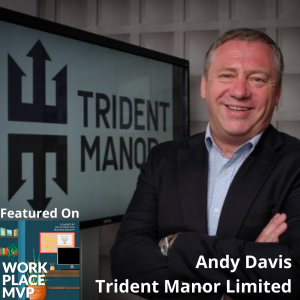
Workplace MVP: Andy Davis, Trident Manor Limited

May 20, 2021 by John Ray

Trident Manor Limited
Minneapolis St. Paul Studio
Workplace MVP: Andy Davis, Trident Manor Limited
Loading
00:00 /
RSS Feed
Share
Link
Embed

Download file

Trident Manor Limited

Workplace MVP: Andy Davis, Trident Manor Limited

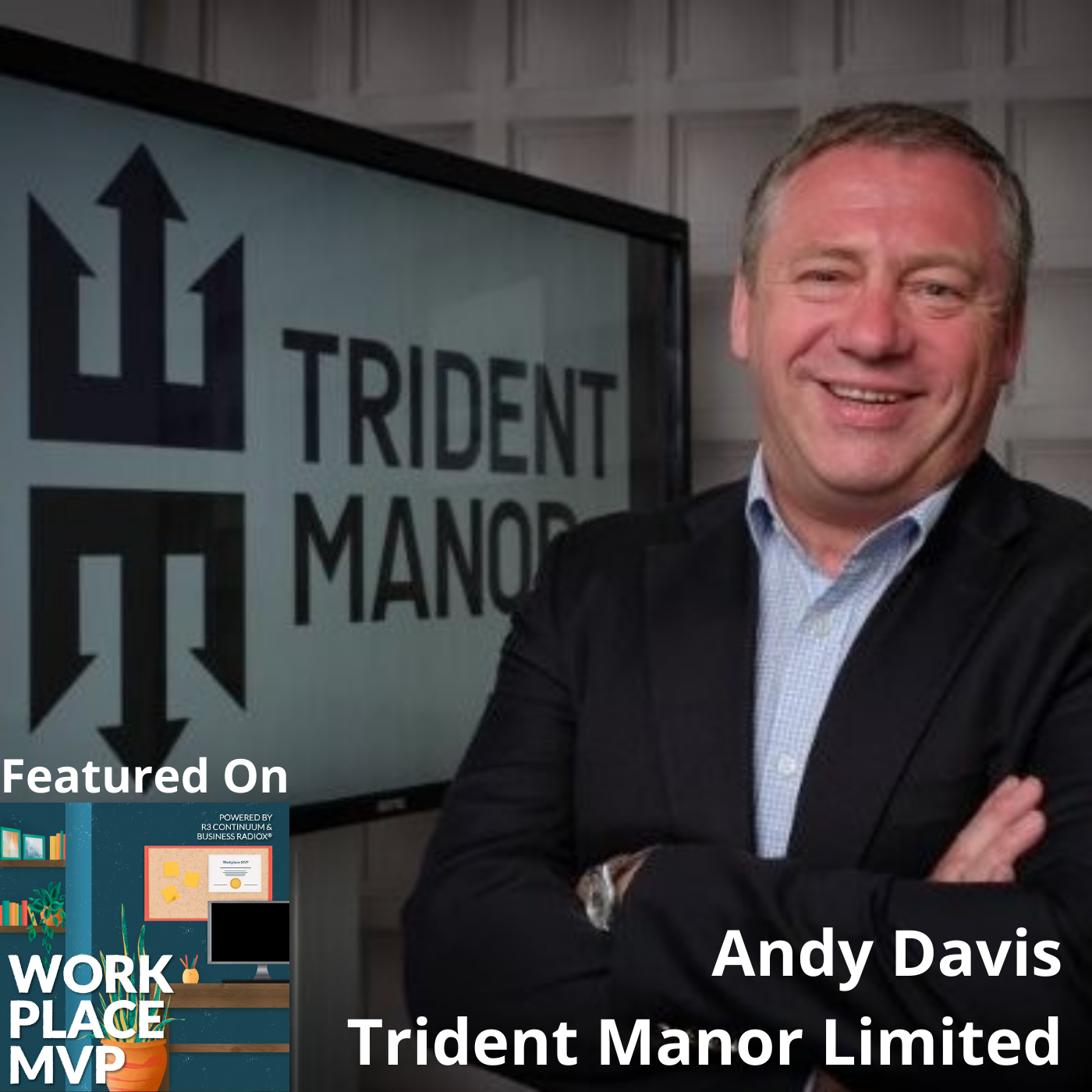
Andy Davis, Founder of Trident Manor Limited, brings extensive global experience to his work in risk management and security consulting for organizations.  He joined host Jamie Gassmann to offer perspective on the scope of cyber threats, share tips for mitigating workplace violence, address the particular personal safety concerns for women traveling, and much more. Workplace MVP” is underwritten and presented by R3 Continuum and produced by the Minneapolis-St.Paul Studio of Business RadioX®.

Andy Davis, CEO, Managing Director, Trident Manor Limited

Trident Manor Limited
Andy Davis, CEO, Trident Manor Limited

Andy Davis is an international security, risk, and crisis management expert based in the United Kingdom. Following time spent undertaking investigative and intelligence activities within British security organizations. Andy joined the UK foreign service as a security risk management specialist responsible for the protection of embassies, personnel, families, and information. This took him around the world and in charge of all security activities in countries such as Uganda, Colombia, Saudi Arabia, and Pakistan.

Following a commercial job offer he joined the corporate world as the Head of Security (Safety & Insurance) for a Middle Eastern organization with assets of over $40 billion. This involved strategic oversight of all security and safety activities, designing and implementation of protective policies and the development of collaborative emergency and crisis management plans requiring engagement with emergency services, the intelligence community, and government officials.

In 2013 Andy left the corporate world and established Trident Manor Limited as a specialist security, risk, and crisis management consultancy dedicated to supporting others from individuals through to global organizations in the protection of their assets. He has operated in over 30 countries delivering advice and guidance and has responded to crisis situations where deployments into crisis situations have taken place to protect client’s operations and assets.

In 2020 during the COVID crisis, he devoted time, effort, and energy to create Trident Manor Training Academy which provides specialist training programs that concentrate on the protection of individuals, the protection of staff, and the protection of organizational assets, including their reputation.

He holds a Master of Science degree in security and risk management, is board certified by ASIS International and CPP (Certified Protection Professional), he is a Chartered security professional, a Fellow of the Security institute and chairs a number of professional safety and security organizations.

Andy is passionate about supporting cultural and heritage organizations as well as those humanitarian organizations that operate in difficult or hostile environments. He lectures around the world and has written numerous articles for professional or trade magazines.

LinkedIn

Trident Manor Limited

Trident Manor Limited was established in 2013 to offer clients, irrespective of their size, professional security, risk, and crisis management services anywhere in the world.

As with the trident the company offers three distinctive service strands, the consultancy, the education and training, and protective services.

Consultancy

The consultancy services offered have included undertaking strategic and operational reviews for organizations to assess the threats, risks, and vulnerabilities they may be exposed to. Once identified solutions are provided to manage and mitigate the threats and the risks that exist. Where vulnerabilities are identified ways of mitigating them are introduced. These assessments have involved evaluations from a wide range of threat sources such as terrorism, organized crime, espionage, riots and open conflict, and the often-forgotten threat ‘the insider’.

Once threats have been identified Trident Manor has supported organizations in creating robust and resilient policies, practices and procedures that provide organizational direction, reduce risks and address duty of care responsibilities.
Within the consultancy services is a specialist team responsible for ‘Corporate Research’ activities. This is a term used to describe our business investigative and intelligence services that have been used by global clients to assess threats to staff in Venezuela, operational issues in Mexico, threats from organized crime in Hungary, and in January 2020 the threat from a pandemic that was spreading from Wuhan.
The consultancy services are bespoke for a client’s needs and driven by what is most beneficial for the client, not profit margins. The sensible and pragmatic approach, alongside their discretion is respected by many individuals and organizations alike.

Training

Trident Manor has provided training to organizations around the world. It has been responsible for the creation of many bespoke programs that are sector or organization specific. The primary focus has been on the protection of individuals through the creation of personal safety and security programs, workplace violence, travel risk management, and operating in difficult environment programs.

In addition, the professionalization of individuals engaged in the cultural, hospitality, and retail sectors has been delivered through the implementation of programs such as proactive risk reduction, conflict avoidance, situational awareness and surveillance detection. Specialist driving, first aid, surveillance/counter-surveillance, and intelligence have also been developed to support the individual and the organizations they work for.

Finally, training programs aimed at the senior management and organizational level have been created and include emergency response scenario-based exercise, tabletop crisis management activities, through to full-scale collaborative exercises designed to test integrated response.

Protective Services

The protective services offered by Trident Manor include concierge staff, executive protection officers, security drivers, embedded security managers, and high-value escort services. One of the more recent protective services offered by Trident Manor is the e=protection services. This is where analysts collect and collate data from electronic sources that relate to clients or client activities before it is processed into actionable intelligence that can proactively prevent threats from impacting a client. This service is ideal for C-Suite members, those in sensitive positions, or the organization itself.

Whatever services a client requires Trident Manor has the global resources to help with “Enabling the Protection of Assets” – their motto since 2013.

Company website | Facebook | Instagram

 About “Workplace MVP”

Every day, around the world, organizations of all sizes face disruptive events and situations. Within those workplaces are everyday heroes in human resources, risk management, security, business continuity, and the C-suite. They don’t call themselves heroes though. On the contrary, they simply show up every day, laboring for the well-being of employees in their care, readying the workplace for and planning responses to disruption. This show, “Workplace MVP,” confers on these heroes the designation they deserve, Workplace MVP (Most Valuable Professionals), and gives them the forum to tell their story. As you hear their experiences, you will learn first-hand, real life approaches to readying the workplace, responses to crisis situations, and overcoming challenges of disruption. Visit our show archive here.

“Workplace MVP” Host Jamie Gassmann

In addition to serving as the host to the Workplace MVP podcast, Jamie Gassmann is the Director of Marketing at R3 Continuum (R3c). Collectively, she has more than fourteen years of marketing experience. Across her tenure, she has experience working in and with various industries including banking, real estate, retail, crisis management, insurance, business continuity, and more. She holds a Bachelor of Science Degree in Mass Communications with special interest in Advertising and Public Relations and a Master of Business Administration from Paseka School of Business, Minnesota State University.


TRANSCRIPT

Intro: [00:00:04] Broadcasting from the Business RadioX Studios, it’s time for Workplace MVP. Workplace MVP is brought to you by R3 Continuum, a global leader in workplace behavioral health and security solutions. Now, here’s your host, Jamie Gassmann.

Jamie Gassmann: [00:00:26] Hi, everyone. Your host, Jamie Gassmann here. And welcome to this edition of Workplace MVP. The Workplace MVP we will be celebrating today brings expertise in an area that can be helpful, both personally and professionally. With us today to share his wisdom and knowledge regarding safety and security and crisis management is Owner and Managing Director at Trident Manor Limited, Andy Davis. Welcome to the show, Andy. And thank you for joining us today.

Andy Davis: [00:00:54] Thanks very much, Jamie. It’s a great pleasure.

Jamie Gassmann: [00:00:58] So, before we dive into today’s topic, can you tell me a little bit about yourself and your career journey?

Andy Davis: [00:01:05] Well, I suppose, as your listeners will identify, I’m from the UK. And I’ve been involved in security and risk management most of my adult career. That include the time in the British Military, where I was involved in intelligence activities and security management. In the police service in the UK, where I was a detective and led a team of investigators and, finally, undertaken intelligence activities. And then, ultimately, I joined the Foreign Service and I did roles equivalent to your RS or Regional Security officers, and that took me to Uganda, Colombia, working in Venezuela, Guyana, Panama, Saudi Arabia, throughout the Middle East and Pakistan.

Andy Davis: [00:02:01] Eventually, I entered the corporate world in the UAE, the United Arab Emirates, where I took a position as the corporate head of security. And then, in 2013, I established Trident Manor, which is my own security risk management consultancy.

Jamie Gassmann: [00:02:19] Great. Wow, what a journey you’ve had with your career. So, you recently held a free virtual event that was focused on personal safety and security for women. Can you tell us about that event and why it was important to you?

Andy Davis: [00:02:34] Well, throughout my career, personal safety and security has always been important, whether it’s my own personal safety and security or that’s looking after and caring for other third parties, whether it was diplomats, diplomatic wives, et cetera. And sometimes that was in difficult and hostile environments. This event that I held followed the kidnap and murder of a young female in London by a police officer who has been charged. And there was a lot of outcry, a lot of concern on social media, on mainstream media about the safety of women.

Andy Davis: [00:03:17] And so, what I volunteered to do as an individual, as opposed to Trident Manor, was to hold this event where some of the realities could be shared about, certainly in the UK, the levels of crime, but also victimization shown in identifying that lots of attacks on female was carried out by partners or people who they knew. And, actually, percentage wise, there was a small amount that was by strangers. But it’s primarily the strangers that caused the fear because they are the unknown.

Andy Davis: [00:03:54] Then, it went through a whole series of trying to give advice and guidance that would help everybody. And in this case, it was particularly aimed at females going about their daily lives, whether they’d be socializing, in the workplace, or actually travelling overseas. So, we give that presentation. It was well received. There was over 250, I think, on the call from around the world. And we’ve since actually uploaded that again, free of charge, so that anybody can see and share them.

Jamie Gassmann: [00:04:27] Great. That sounds like it was a well-attended event or a well-received event because I’m sure the information you shared was very helpful for that audience.

Andy Davis: [00:04:37] Yeah. I mean, it is important from the sense of the reality versus perception. But, also, the vulnerability of females. And the idea was, hopefully, to give them some confidence in actually ways of avoiding some of the dangers themselves. So, proactive prevention rather than reacting to an incident. Because then, if you can avoid an incident, there’s a great likelihood that you’re not going to be hurt.

Jamie Gassmann: [00:05:07] Right. So, now, looking at organizations, what are you seeing as main concerns for them and their security in this current work environment? You know, what are some of the things that you’re noticing in the work that you do?

Andy Davis: [00:05:24] Well, I think around the world, globally, cyber is the biggest threat. It’s impacting all organizations. I mean, there’s just been the attack on the pipeline that’s happened on the East Coast of the USA. Look at hundreds of millions of dollars worth of impact that must have had. But that happens to individuals. It happens to organizations. And it happens on a daily basis.

Andy Davis: [00:05:58] There were some statistics that came out and actually showed that, on average in the UK, every individual is attacked once every seven minutes. Which if you think about, that’s statistically looking at people. So, cyber is a constant and it’s there because it’s information that the companies need to operate and to function correctly. There are other threats. There has been an increase in protests, the protests of directly impacted retail, hospitality, museums, public services. But the primary threat that I see at the moment globally is from cyber.

Jamie Gassmann: [00:06:49] So, you shared with me in a previous conversation that protection is primarily about common sense. Can you elaborate on this and what that means to a workplace leader?

Andy Davis: [00:07:01] Well, I mean, you said to workplace leader, and really it’s to everybody. And one of the things that we really talk about as being a cornerstone of personal safety is situational awareness. And part of situational awareness is actually engaging with your brain, engaging with your senses. The common sense, when we look at security protection, if people just actually stopped and thought about what they’re doing, stopped and thought about what risks there are, and stopped and thought, “Why am I putting myself in danger? Why don’t I avoid it?”

Andy Davis: [00:07:41] It’s common sense from a security practitioner’s point of view. We look at things exactly the same. We look at things from a common sense approach. Good security, when we talk about good security, it’s not good cheap where you have the most expensive technical systems and the biggest barrier and the concrete walls. It’s where those of us need to continue with our lives, our business need to operate, and it’s adopting a common sense approach. Common sense approach is understand what risks exist for you and your business. And taking proportionate steps to actually manage those risks so you can continue to operate, to function, and create money or to make money. But at the same time, avoid unnecessary risks that exist.

Andy Davis: [00:08:29] Somebody asked me years ago, “Well, okay. What skillsets do you need for security?” And I said, “Ninety to 95 percent of it is common sense. Seven percent, you know, is that special skills.” And then, there’s always that element that’s still needed to avoid security situations. We can’t dictate what happens out there. But when you look at a new introduced security plans and measures, I still think that sounds and remain true to this day.

Jamie Gassmann: [00:09:14] Great. And I know you mentioned cyber attacks as being kind of a main concern right now and brought up some of the protests, which kind of lead a little bit more into this next question that I have for you. When looking at leaders, you know, when they’re asked about workplace violence, they often refer to, like, active shooter scenarios. Which, I know recently here in the States, we’ve had kind of a stream of them that have been occurring. But you indicated that there is a softer side of protection that workplace leaders need to be considering as well. So, in your opinion, what does that look like and why is it so important for business leaders to also stay aware and prepare for that softer side of violence in their organization?

Andy Davis: [00:10:06] Yeah. I mean, obviously, in the United States, the active shooter is a real concern and should always be a part of any active shooter program that the organization implements. But, equally, that’s the same wherever there is a prevalence of firearms or, as I said right at the start or what I said in your previous question, understanding the risks.

Andy Davis: [00:10:29] So, in your workplace, it’s important to understand the risks that exist. And this is part of the softer side. The softer side isn’t, don’t use a sledgehammer to smash a nut when you can have a nice delicate pair of nutcrackers there. Think about the cost as well, the nutcracker is far cheaper than the sledgehammer.

Andy Davis: [00:10:50] But when you look at a workplace, there are so many different parameters and so many different factors that can impact your work colleagues. Lots of violence occurs, violence, intimidation, harassment, whether it be sexual, whether it be through race. There are a lot of violence that many people don’t automatically identify as being workplace violence. But by fact, they are. Because violence is something that causes harm. Harm doesn’t have to be physical harm. It can also be that mental harm that somebody suffers. So, somebody being abusive, the constant name calling, these are softer sides, much softer than somebody pointing a gun.

Andy Davis: [00:11:37] But the impact of them could actually be equal. Because somebody through being bullied, somebody through intimidation, could suffer mental harm and anguish. Which, obviously, from a workplace perspective, could impact their effectiveness, their morale, the whole team’s morale. But, ultimately, it could cause somebody to commit suicide.

Andy Davis: [00:12:01] So, when we talk about softer skills, it’s things like what governors do you have in place to minimize harassment, to minimize bullying? What procedures do you have in place to have everybody take part in security? And by that, I mean, is everybody aware of how to open and close and make sure barriers exist if there’s a public/private interface? Softer sides include making sure that you have the necessary skills, training, and organizational resilience to deal with acts of violence that may come.

Andy Davis: [00:12:46] But we talk about workplace violence, here in the UK, lots of the drive that we do is towards that proactive prevention, that I mentioned earlier. So, it’s understandable situational awareness. Remember, your workplace isn’t necessarily a fixed location. Nowadays, with the smaller corporate world, your workplace could be here one day, in the U.S. one day, in the UK another day, across in Australia the next day. Technically, each of them becomes a workplace.

Andy Davis: [00:13:22] As an organization, what thoughts are being put in place to protect your staff while they’re travelling from location to location? Is the organization aware of what risks exist? Is there a terrorist threat? Is there a threat from protesters? What about environmental threats? Are you going into hurricane season, monsoon season, or is the risk of a tsunami? So, all of these sort of things, the naturally occurring incident threats don’t actually impact workplace violence because violence is arbitrarily enacted.

Andy Davis: [00:13:58] But if you think about it, it all revolves around the organization taking the time to assess and understand the risks. Making sure that they’ve got the good governance in place to manage the risk that they have. Provide training and resources that’s needed wherever their staff are working. I hope that answers.

Jamie Gassmann: [00:14:19] It does. And it kind of leads into my next question. So, in looking at protection, whether it’s for kind of that harder side of violence or softer side of violence, you indicated that one of the best weapons that an organization might have in helping to protect that in their workplace is communication. Can you talk a little bit around how communication can play a huge factor in being a protective agent within a workplace?

Andy Davis: [00:14:48] Yes. So, there’s a number of strands to this. So, if we take organizationally, communication, senior management really need to communicate. They need the organization to understand their approach to protection, to workplace violence, to threat, and risk management. That has to be communicated somehow. If it’s a 50 page document, nobody’s going to read it. If it’s either brief in a team talk in a town hall, that involves communicating. That might involve verbal communication or it might be through audio-visual communication, so creating of presentations. That’s important because it provides the direction and the parameters of acceptable behavior within an organization.

Andy Davis: [00:15:41] When we look at personal safety and security, communication is vital. And communication, again, isn’t just the spoken word, it’s the listening. And this doesn’t necessarily just apply in the workplace. This can apply in the streets, when you’re on holiday, when you’re socializing, or in the cinema. So, when we look at communication skills and the importance of them, our hearing, the vast majority of our communication should be through listening. I think my wife says I never listen – but I do lots of things and say lots of things.

Andy Davis: [00:16:17] But the listening aspect is important because it’s only through listening that you can either hear some complaints, you can hear if any problems occurred. You can hear from a personal point of view if somebody’s voice is increasing. Because if it’s increasing all of a sudden, you realize that isn’t normal. But you can only do that if you listen. And with listening, it’s also paying attention. So, listening is a vital communication skill because it helps you process the situation and it’s directly linked to situational awareness because you’re using your senses to assess and evaluate what the situation is presenting itself. So, the listening skill is important.

Andy Davis: [00:17:05] The verbal communication is important to an organization. You want that free flow of information. You want people to be able to share their concerns either in the direct workplace or if they’re traveling. Because it’s only through sharing that information that you’re going to increase the levels of knowledge and understanding by the organization. When you increase the levels of knowledge and understanding, you’re able to take steps to actually manage and mitigate those risks that exist.

Andy Davis: [00:17:37] But as an individual, verbal communication is really important because it’s a double edged sword. “How I see things” has a totally different meaning to “I’m ever so sorry. I didn’t understand what was being said there.” How you communicate can actually be a violence accelerator or it can be a calming, soothing activity.

Andy Davis: [00:18:09] The only new element of communication that I would like to say is nonverbal communications. They really, really are important because nonverbal communications help you read and interpret. It lets your brain function and identify potential triggers. So, if somebody is angry – and I always show a slide of the amazing Hulk turning green – wouldn’t it be wonderful if we knew somebody was going to be violent they turned green? We really could avoid them.

Andy Davis: [00:18:40] Life isn’t that simple, but there are still certain violence indicators that people can be aware of that they can see. So, the clenching of fists, the pinpointing of pupils, the stare, the heavy breathing, the stance. All of these things, little nonverbal communication skills. But if you can understand them, you can interpret that and say there is potential for harm. If you can identify a potential for harm, you can actually extract yourself and avoid the situation.

Jamie Gassmann: [00:19:12] Great. So, for business leaders and people in general, what are some things that maybe they’re not thinking about that, in your opinion, they should be, and should be thinking about probably even more so now, when it comes to personal security and safety that you would like to share?

Andy Davis: [00:19:34] Yeah. Well, I said it earlier, the cornerstone for me of personal safety and security is situational awareness. You know, if you can read and identify what’s happening around you. Is there an argument taking place? Can I smell burning? If you smell burning, what does that imply? Are you in a forest fire or is it a case of somebody has burned some food? But using your senses and actually being situationally aware is really, really a paramount importance in personal safety and security.

Andy Davis: [00:20:14] I mean, there are many other things where we talk about business leaders. The communication aspect, keeping that flowing and keeping it fluid, understanding, listening, making sure that their policies are such that people can reach out. Because what you want is, you want people to help support the protection of the business. The more they can protect the business, the greater the business is going to be.

Andy Davis: [00:20:39] So, why wouldn’t you go that extra mile to actually give the tools and help support them to help you protect your business? So, making sure that you have policies for – I don’t know what the term is in American – whistleblowing. You know, is there a whistleblowing policy? Is there a health and safety policy? Are there grievance procedures?

Andy Davis: [00:21:04] And these might seem, “Hold on. These are H.R. issues. What do they have to do with security?” Well, security is all about protecting assets. It’s about protecting people from loss, harm, or damage. It’s about protecting assets. And it’s also about protecting reputations. A business needs to protect its people, its assets, and its reputation to flourish. And so, therefore, everybody has a part to play in security. And, really, the organization got a great way to help.

Jamie Gassmann: [00:21:37] And I think your employees will thank you for it, too, in preparing them. Because I’m sure some of what you may teach in a corporate setting for protection of the organization and their employees can be things that are universal in helping them to protect themselves personally when they’re not maybe at work. So, there could be some underlying benefits for both professionally and personally for them.

Andy Davis: [00:22:00] Yeah. So, when it comes to personal safety and security, everything is transferable. All you’re doing is changing the setting that you’re in and the environment that you’re in. If, as an organization, you want to make sure that your staff were traveling to, let’s just say, East Africa, that they have the necessary skills and training. If they’re going to be driving in Saudi Arabia, where road traffic incidents and deaths, mortality rates are sky high, that you provide them with additional skills to drive safely and defensively.

Andy Davis: [00:22:38] So, there’s things that the organization can do that help them. But the transferable benefits pass on to their staff, who in turn pass it on to their children, their families. And I’ve seen it work. And it is a wonderful feeling when a young kid comes up to you and says, “You can’t do that because I’ve seen the little booklet that you wrote for my mommy and she says it’s marvelous.” Because what an organization should try to do is to build a security culture. It can’t be done overnight. It can’t be enforced. But it has to be driven by the actions of the top and the actions of the bottom and meeting together.

Jamie Gassmann: [00:23:25] Great. Great advice. I love that, security culture. So, with that, we’re just going to take a quick break and hear a word from our sponsors. So, Workplace MVP is sponsored by R3 Continuum. Ensuring the psychological and physical safety of your organization and your people is not only normal, but a necessity in today’s ever changing and often unpredictable world. R3 Continuum can help you do that and more with their continuum of behavioral health, crisis, and security solutions that are tailored to meet the unique challenges of your organization. Learn more at www.r3c.com.

Jamie Gassmann: [00:24:06] So, diving into some questions that kind of go in the direction of where you were, you’ve touched on it a little bit, but the domestic versus international security and crisis management. So, is there a difference between what organizations should be doing when looking at their domestic versus international crisis management or security plans?

Andy Davis: [00:24:29] Yes. I’m sure there’s going to be many people from organizations who say, “No. No. They’re all the same.” Unfortunately, they’re not the same. And the reason that they’re not the same, you can actually take it a step further. If you look at it domestically, if you have a single site, then it’s appropriate. Your corporation is based on a single site and you’re operating from there. Brilliant. Your crisis emergency response plans are built around that. And that’s because the scenarios that you can face, the social impacts that can happen, the environmental impacts. Are you in an earthquake zone? Are you in a tornado alley? You know, all of these things can impact your crisis management approach in that location.

Andy Davis: [00:25:17] If you have multiple sites across the USA, then there’s nothing to stop having an overarching corporate that provides the direction and strategy that the organization expects all of its different offices to take. But each office should actually have their own crisis management plan, because they will need to deal with the crisis. Unfortunately, I’ve seen it where people have thought, “Oh, let me telephone the USA and I’ll get advice about this crisis that’s happening.” By the time somebody is woken up because of the time difference, people have managed to break through the walls, have come into the building, they’ve started ransacking. You know, they have to be localized. They have to be specific to what the organization is going to face.

Andy Davis: [00:26:09] I’ve worked with organizations where they might have had ten offices around the world, two or three individual countries. And we then build the crisis management plan specific for that location. There might be an overarching country one. Ultimately, the threats and risks and vulnerabilities that you face, in many cases, it will be the trigger for the crisis.

Andy Davis: [00:26:35] So, one example was, there was a crisis in Armenia a few years ago where the government was overthrown by the people. Clients and American businesses would have operations there and they wanted to make sure that things were safe. Well, what might be okay in the USA isn’t okay in them sort of scenarios, because the social dynamics are different, the violence indicators might be different. So, you’ve got to take it from that particular perspective. So, it’s a lot more work for organizations. But when you get it right, the benefit is financial for the organization.

Andy Davis: [00:27:25] Because, again, I talk about proactive prevention. You’re trying to prevent an incident in the first place, but then you want an effective response and a timely recovery. Planning and having that individual locations is far more easy to achieve than having it from London or New York or wherever, and trying to dictate direct from that location.

Jamie Gassmann: [00:27:56] So, what should be considered when you have employees who are traveling? So, when you have those permanent locations, maybe you’ve got employees that are traveling from the U.S. to maybe another country or maybe even just traveling within the United States as well. But, you know, if they’re traveling internationally or maybe they’re relocating, what are some of the things that often get missed that employers should make themselves aware of when they’re considering those relocation or traveling scenarios?

Andy Davis: [00:28:30] Yeah. Well, one of the first things that I always ask clients or businesses, “Can I have a look at your travel risk management policy?” And, normally, I get a blank face, or a pause, or, “We have this document which has nothing to do with travel risk management,” or it might be a travel authorization that you go through a travel agent and they’ll do things for you. But, really, an organization should have a travel risk management policy.

Andy Davis: [00:29:05] If they have wide and diverse locations around the world, some of which might be in Africa, Central Asia, or wherever, what I always advice is, “Look. It’s quite simple.” The U.S. State Department, British Foreign Office, and many of the governments actually categorize each country. It’s quite simple to have a spreadsheet and you have a country category down the side of each. If it’s green, then that might be Category 1 to 3, then it’s standard procedure. Here’s the procedures. If it’s a difficult environment, then these are the actions. If it’s a dangerous, hostile environment, then these are the actions.

Andy Davis: [00:29:48] So, having that governance, it prevents subjectivity. And what happens is, those who are frequent travelers – and I apologize if any of your listeners fall on this category – who’ve been there, seen it, done it. There are no risks. I know it all. And, unfortunately, they’re the sort of people who me and my team get called in to rescue, recover, or to help identify what’s gone wrong post-incident. If you’ve got that governance, the parameters are clearly defined and the organization has an expectation.

Andy Davis: [00:30:26] The flip side of that is that, the individual understands that the organization is meeting its duty of care. It’s taking care of me. If, for example, you go into an orange country, an amber country, and there are significant road traffic incidents, then you provide training or you provide a trained driver in that country, you’re managing that risk. Which means that you’re minimizing disruption, you’re maximizing operational effectiveness, and you’re keeping your staff safe and secure. And you do that through all aspects of travel and risk. And, actually, it’s very, very beneficial.

Andy Davis: [00:31:07] So, when people are looking overseas, look at the individuals, look at your operations. Individuals have a responsibility as well. You know, it’s no good going to a country where there’s malaria or yellow fever, and say, “It’s not my fault. Nobody injected me.” Well, sorry. There’s the travel advice. And, again, as part of the travel advice, it might be that you give a package. It might be that the risks are so great that you provide them with hostile environment training or difficult environment training so that they know and understand the sort of threats and risk vulnerabilities that happen, carjackings that may occur.

Andy Davis: [00:31:45] But, also, the softer side, which is food poisoning, which are malarial diseases and how they can impact you, which are a lack of medical facilities. And by the way, we’re now going to give you first aid training. So, that sort of thing, it’s really, really beneficial for organizations to consider when they take things forward.

Jamie Gassmann: [00:32:13] Great. So, you shared the comparison of proactively preventing versus reactively responding. Can you elaborate a little bit more on the difference and what our listeners should be considering when they’re looking at that crisis management or business continuity programs and plans? And what should they be keeping in mind, you know, from your perspective so that they’re more on the proactive end of it versus the reactive?

Andy Davis: [00:32:42] Yeah. So, proactive preventing, what you’re trying to do is identify – again, the words that you’re going to hear me continually use are threats, risk, et cetera, because security is there to manage and minimize the impact from the threats, risks, and vulnerabilities that exist. Proactive prevention is either individuals or organizations identifying the potential for harm, or the potential for loss, or potential for any other adverse aspect. If you can proactively identify it, then you can take steps to manage and mitigate it before you have to then deal with it.

Andy Davis: [00:33:32] Reactive response or responding means that the incident has happened. You haven’t seen it. You weren’t aware of it. You didn’t identify it. And, now, you’re having to respond to it. But, actually, your response might be survival. Because you might be in a hospital bed in a third world country, whether poor medical facilities, and you’ve got to wait ten days for an emergency flight to come in and get you because there isn’t another way, there isn’t the transport, for whatever reason.

Andy Davis: [00:34:05] But, actually, from the organizational point of view, if you have to react to an incident, one, there’s massive disruption. Two, its resource intensive. And, three, there is a massive cost implication. So, the more you can prevent to minimize and mitigate the risks before they actually happen, the greater it is for an organization. But, equally, the greater it is for me as an individual, because I can go about my life and I can enjoy the safaris or I can enjoy ancient temples because I’m proactively helping myself and the organization stay safe.

Jamie Gassmann: [00:34:48] And looking at all of the advice you shared over the show so far, does it matter by the size of the organization when they’re considering to implement a crisis management program or plan or how much of it that they implement? I know sometimes I hear – you kind of mentioned it – like, “We have this sheet of paper. This is what we go off of.” Does it matter the size of the organization or should all organizations, if they’ve got employees, be looking at that?

Andy Davis: [00:35:16] It should be risk-based. So, I always say to every organization, the primary documentation you have before you look at crisis management and everything like that, is risk management strategy and your risk assessment. Everything should be risk-based. Because if you, by default, implement and design a certain process, so if it’s an organization, you said, every single sub-office will create an emergency crisis management response plan. Somebody has to write that. Time is money. It impacts operations. And the effectiveness of what’s been written may not be relevant because it could be sheets of paper that gathered dust. And when it happens, nobody knows where them sheets of paper are.

Andy Davis: [00:36:06] So, it has to be pragmatic. It has to be based on the pragmatic risks or looking at the realistic risks that can impact an organization. There’s two aspects, the risk and the size of the organization. Because the size can impact the severity of a crisis and the disruption that it’s caused.

Andy Davis: [00:36:33] For example, in our office at the moment, there’s five people. Is there a need for us to have a crisis management plan or do we go by our risk management strategy? Actually, we got our risk management strategy and we’ve got emergency response plans. But the response plans are if there’s fire, it it’s this or this.

Andy Davis: [00:36:56] However, our staff travel overseas. And when they travel overseas, sometimes it’s in difficult or hostile environments. So, therefore, we almost write a separate plan and strategy for that activity while they’re in that location. When they come back, that’s great. We can forget about that and return back to normal. But what it is, it’s that continued preparedness that’s relevant, proportionate, cost effective. But then, ultimately, if it was needed, it can be implemented.

Jamie Gassmann: [00:37:32] So, one last question for you that’s a little bit personal in terms of your career, but is there something across your career journey that you are most proud of that you want to share with our listeners?

Andy Davis: [00:37:47] There’s actually many things and, obviously, I’ll keep it from the professional side. I think the most rewarding thing that I’ve ever done was during 2010 or 2011, the monsoon floods in Pakistan devastated, I think, at one point over a third of the land was underwater. Some of the regions whole towns have been swept away and were left with rubble. And some of these regions were in the border areas of Pakistan with Afghanistan. So, there was lots of difficulties in getting support and aid to them.

Andy Davis: [00:38:34] And, you know, one of the proudest moments of my career was being able to manage the operations that got the team and got the UK government’s aid into these areas. And we were able to distribute tents, water, people actually had somewhere to sleep. And, actually, a year later, was still living in the same tents. But given something that actually meant something to humanity, that was really important. And I’ve still got photos of little kids just with glee swimming in a puddle because they just received the first drink of fresh water or they just received a sweet candy bar that, “What’s that? I’ve never seen it before.”

Andy Davis: [00:39:27] So, by being able to do that very close to the border where there was the threat from the Taliban, where it was real operational security management, looking at dynamic risk management because it was still raining. We had to divert on some roads, and then getting to a point where we could stop the cars on the motorway. I always remember the head of the mission and I, we pulled over. We would wave goodbye to our police escort. We looked at each other and we just hugged each other. And that was just so rewarding because we knew that at that time we’ve done something that made a difference to hundreds of people.

Jamie Gassmann: [00:40:09] So powerful. I’m sure that’ll be a memory you’ll carry with you forever, just that reward of being able to help those people. Amazing. So, if somebody listening wanted to connect with you, Andy, how would they go about doing that?

Andy Davis: [00:40:22] So, I’ve been told that I’m a social media dinosaur. That’s why the members of my team actually do all my social media. Apart from, apart from, I’m very big on LinkedIn. I think when it first started, I went, “Oh, I love to go on this.” And I’ve stayed with LinkedIn. And I like it because, you know, you can communicate with some great discussions on there. My email address, I think, has been provided, as my work address, and telephone number. If ever anybody has any questions, any concerns, if ever anybody is worried about staff safety, what people around the world have found out, just give me a call.

Jamie Gassmann: [00:41:09] Wonderful. Well, it’s been so great to listen to your advice and your knowledge. And thank you so much for letting us celebrate you and have you on the show to share all that great information with our listeners. We appreciate you. And I’m sure that your organization and your employees do as well.

Andy Davis: [00:41:30] We also want to thank our show sponsor, R3 Continuum, for supporting the Workplace MVP podcast. And to our listeners, thank you for tuning in. If you’ve not already done so, make sure to subscribe so that you get our most recent episodes and other resources. You can also follow our show on LinkedIn, Facebook, and Twitter at Workplace MVP. If you are a Workplace MVP or know someone who is, we want to know. Email us at info@workplace-mvp.com. Thank you all for joining us and have a great rest of your day.
 

Tagged With: Andy Davis, Crisis Management, Jamie Gassmann, R3 Continuum, Risk Management, security, security consulting, Trident Manor Limited, workplace violence

The R3 Continuum Playbook: Employee Burnout

May 13, 2021 by John Ray

Employee Burnour
Minneapolis St. Paul Studio
The R3 Continuum Playbook: Employee Burnout
Loading
00:00 /
RSS Feed
Share
Link
Embed

Download file

Employee Burnour

The R3 Continuum Playbook: Employee Burnout

Dr. Tyler Arvig reviewed conditions that create employee burnout and several tips for businesses to help curb burnout in their employees. The R3 Continuum Playbook is presented by R3 Continuum and is produced by the Minneapolis-St.Paul Studio of Business RadioX®. R3 Continuum is the underwriter of Workplace MVP, the show which celebrates heroes in the workplace.

TRANSCRIPT

Intro: [00:00:00] Broadcasting from the Business RadioX Studios, here is your R3 Continuum Playbook. Brought to you by Workplace MVP sponsor, R3 Continuum, a global leader in workplace behavioral health, crisis, and security solutions.

Tyler Arvig: [00:00:14] Hi. I’m Dr. Tyler Arvig, Associate Medical Director for R3 Continuum. And today, I want to talk about employee burnout. And, in particular, how to support your employees who might be struggling while managing life challenges and work demands.

Tyler Arvig: [00:00:32] Burnout has long been a topic of discussion in the workplace for obvious reasons. And although the term burnout isn’t my favorite, we all have a mental picture of what this might look like. Decreases in productivity and job satisfaction, lack of stamina, feeling as if you’re at a dead end. None of this is new. However, the current state of life poses new challenges and stressors that, for many, have increased the sense of feeling burned out.

Tyler Arvig: [00:01:02] Employees at every level are balancing work with more demands than ever before. There are increased family needs, social stressors, financial constraints, and lack of time to devote to recreational activities. This, combined with high levels of sustained anxiety, depression, and stress, can culminate in people reporting feeling burned out, having hit a wall, or just feeling stuck. With that, here are some helpful tips to keep in mind for your employees. This is not an exhaustive list, but we have seen these to be helpful in our extensive work around COVID-19 over the past year or so.

Tyler Arvig: [00:01:52] The first thing is to help others keep a sense of perspective. It’s easy to get drawn down into details or problems and to feel as if this represents someone’s life. The more we can do to keep perspective, including all of the things that are happening and how well we have done given the difficult situation that we’ve been in, the more likely we are to feel productive and satisfied in life. And the less likely we are to get that sense of feeling burned out.

Tyler Arvig: [00:02:25] The second thing is to learn to let things go. The old adage that you need to pick your battles certainly applies here. Being able to prioritize things that are truly important over things that are non-important will help us to make better decisions. Letting go of little things is one way to stave off a sense of burnout.

Tyler Arvig: [00:02:49] The third tip that I have is, first, to expect some hard days. This is not to say that we should assume every day is going to be hard. But it’s to say that some days are simply going to be a challenge. Yet every day is a new day. And just because today was hard doesn’t mean that tomorrow is going to follow suit.

Tyler Arvig: [00:03:12] The next tip is to keep a sense of humor. All too often as things get difficult, we forget to add levity in situations where it might be appropriate or helpful. Humor can help build relationships, relieve stress, and gain much needed perspective on a particular problem or situation. Appropriate humor can have an infectious positive effect on your work environment and can be a boon to productivity as well as employee satisfaction and devotion.

Tyler Arvig: [00:03:46] The next tip is for us to learn to accept good enough. Good enough will not suffice for every task that we do, but will suffice for most of the tasks that we do. Lowering the bar where it can be lowered into having the energy and drive to achieve the task that truly require the highest standard.

Tyler Arvig: [00:04:11] The next piece of advice would be, to avoid comparing ourselves to others and encourage your employees not to compare themselves to others. The sense of burnout or unhappiness is often amplified by comparing ourselves to others. Or more specifically, by comparing our internal emotional states to the outward appearances of others. As you can imagine, this is never a fair comparison and usually results in feeling as if other people are doing better than might actually be the case.

Tyler Arvig: [00:04:47] The next tip that I found to be particularly helpful, and it’s a bit of perhaps an unusual suggestion, but consider encouraging others to master something new. This could be something personally that we take on, but it could also be something new that we take on in the workplace, a new skill, learning a new task, or even taking on a new role. The sense of mastery, learning, and discovery is likely to help stave off feelings of burnout or frustration.

Tyler Arvig: [00:05:27] Encourage building and nurturing relationships. In the ever changing work environment, it is often about simply just getting things done. And while this is needed at times, it is often not sustaining. Encourage your people to actively build and engage in workplace relationships that will not only foster greater teamwork, but aid in more creativity, better problem solving, and improving the team’s overall productivity.

Tyler Arvig: [00:06:00] The next tip really can’t be overstated, and that is, to encourage your people to seek professional help if they need support. As a manager or leader, what resources are available for your employees who might need more formal help? R3 Continuum offers several options, as do your EAP and probably your private health insurance plan as well. Burnout in the workplace is often amplified or exacerbated by personal issues that we all may be experiencing. So, getting professional help is certainly appropriate for most of us at many times.

Tyler Arvig: [00:06:42] Finally, communicate. Frustration or burnout in the work environment is often a reflection of feeling undervalued, under informed, or out of the loop. Communicate often. Show appreciation for employee efforts. Address challenges and celebrate successes. Employees who are engaged and feel part of the organization are less likely to feel burned out.

Tyler Arvig: [00:07:10] I hope you have found these tips to be helpful as you go about supporting your people. Realizing that you might need additional help, please do feel free to reach out to us at www.r3c.com or email us at info@r3c.com. As experts in employee behavioral health, my colleagues and I would be happy to have discussions with you regarding any challenges that you may be facing in your work environment.


Show Underwriter

R3 Continuum (R3c) is a global leader in workplace behavioral health and security solutions. R3c helps ensure the psychological and physical safety of organizations and their people in today’s ever-changing and often unpredictable world. Through their continuum of tailored solutions, including evaluations, crisis response, executive optimization, protective services, and more, they help organizations maintain and cultivate a workplace of wellbeing so that their people can thrive. Learn more about R3c at www.r3c.com.

R3 Continuum is the underwriter of Workplace MVP, a show which celebrates the everyday heroes–Workplace Most Valuable Professionals–in human resources, risk management, security, business continuity, and the C-suite who resolutely labor for the well-being of employees in their care, readying the workplace for and planning responses to disruption.

Connect with R3 Continuum:  Website | LinkedIn | Facebook | Twitter

Tagged With: burnout, employee burnout, R3 Continuum, Tyler Arvig, workplace mental health

The R3 Continuum Playbook: Considerations for Returning to the Office After Remote Work

April 29, 2021 by John Ray

returning to the office
Minneapolis St. Paul Studio
The R3 Continuum Playbook: Considerations for Returning to the Office After Remote Work
Loading
00:00 /
RSS Feed
Share
Link
Embed

Download file

Return to Workplace

The R3 Continuum Playbook:  Considerations for Returning to the Office After Remote Work

Dr. Tyler Arvig of R3 Continuum detailed considerations involved in returning to the office after a long season of remote work, including adjusting to a commute again. He also addressed issues of physical safety, productivity, and how business leaders can support their employees. The R3 Continuum Playbook is presented by R3 Continuum and is produced by the Minneapolis-St.Paul Studio of Business RadioX®. R3 Continuum is the underwriter of Workplace MVP, the show which celebrates heroes in the workplace.

TRANSCRIPT

Intro: [00:00:00] Broadcasting from the Business RadioX Studios, here is your R3 Continuum Playbook. Brought to you by Workplace MVP sponsor, R3 Continuum, a global leader in workplace behavioral health crisis and security solutions.

Tyler Arvig: [00:00:13] Hello. I’m Dr. Tyler Arvig, the Associate Medical Director for R3 Continuum. And today, I’m going to discuss an issue we’re all thinking about, which is, bringing workers back to the office after an extended period of time working from home.

Tyler Arvig: [00:00:31] As the world has now normalized work-from-home, returning to the office actually might seem quite far and involves more challenges than we might have anticipated. As with near everything over the past several months, the simplest things can be the hardest to manage. This includes the seemingly uncomplex task of going back to the office. People have become accustomed to working from home with everything that that entails, including spending more time with family, not having to commute, having more flexible work hours, and being in a more casual environment. The routine act of going to the office now takes more time and mental energy.

Tyler Arvig: [00:01:19] As we see some employers opting to allow continued and potentially indefinite remote work for some or all of their workforce, other employers are making the decision to bring everyone back in-house while they’re related to financial considerations, concerns about productivity, outward appearances, or belief that team work is best done on an individual and in-person basis.

Tyler Arvig: [00:01:47] The decision to bring people back to the office was likely not an easy one and required much planning, both from human resources and executive leadership. The decision to bring people back into the office will cut both ways. It will be unpopular for employees who had thrived in a work-from-home environment. For others, however, they may relish the opportunity for human interaction, personal collaboration, and a return to routine.

Tyler Arvig: [00:02:20] There are some things you can expect in bringing people back to the office and advance knowledge of these things will help to make the transition more successful. Business leaders who take a more proactive approach to supporting their employees are going to be the most successful in the return to the office process. Let’s dive into some key areas that we need to be proactively addressed with your employees.

Tyler Arvig: [00:02:51] Perhaps the most obvious issue to be addressed is one of physical safety. We bring people back to the office at this point because the prevalence of COVID-19 has decreased in the population and vaccines are more widely available. With that said, COVID-19 is still present in relatively high numbers, and vaccine access, particularly for younger adults, continues to be a bit of a challenge. Furthermore, fears over variants of COVID-19 still exist. For these reasons, returning to the office will feel differently than it has in the past. The use of personal protective equipment, distancing measures, and other things are likely to be required, at least in the near term.

Tyler Arvig: [00:03:39] As a leader, part of this is going to mean providing extra measures of support as people navigate anxiety. Welcoming people back in a unique way is one way to make the transition a bit easier. It is not just another day at the office, acknowledge that. And provide something enjoyable or meaningful as people return. Frequent communication is another way to ease the transition. Communication is key in this process, so communicate often and in personal ways to help employees feel valued and safe as this process unfolds.

Tyler Arvig: [00:04:20] It is reasonable to anticipate some decreased productivity, at least at first. The same way you might have seen this when folks started working from home, you’re also likely to see this as they return to the office. Anxiety, as we just discussed, may contribute to that decrease in productivity. Working with the use of personal protective equipment and with physical distancing also might decrease productivity, at least temporarily. And personal relationships and conversations, which may have been limited over the past year, may also contribute to that decrease in productivity.

Tyler Arvig: [00:05:02] While it might seem counterintuitive to communicate to folks about the likely blip in their productivity, it also shows understanding of the unique circumstance they’re in. Being supportive in helping people to re-find their rhythm of productivity should be done as well. People will find their way back to their previous level of productivity in short order if we do the right things.

Tyler Arvig: [00:05:30] We also cannot discount further complicating factors for office work that have been silent over the past year, such as reintroduction of the commute, re-establishing child care, and re-establishing other routines that, frankly, we haven’t had to do over the past year. Adjusting to this will take some time. And to the extent that minor flexibilities are available to employees who are returning to the worksite, this could be incredibly helpful, both personally and from a work productivity standpoint. Returning to the office in a less rigid manner is likely to make the experience more successful.

Tyler Arvig: [00:06:12] Lastly, it is important to have resources available to employees who need additional support. One solution R3 Continuum offers is wellness outreach, which reaches out to employees proactively to provide support in the return to work transition process. It may also mean leaning on your EAP for additional support. Or implementing other programs that help your employees adapt to the changes in their work life.

Tyler Arvig: [00:06:41] As always, R3 Continuum is here to help you navigate the challenges of bringing people back into the office, whether consulting with your management team, providing direct employee support, or providing customized trainings. We have the tools and resources you need to be successful. You can find more information on our website, www.r3c.com. Or you can email us at info@r3c.com. My colleagues and I are always available to consult on this or a variety of other employee and organizational wellbeing initiatives. Thank you.


Show Underwriter

R3 Continuum (R3c) is the underwriter of Workplace MVP, a show which celebrates the everyday heroes–Workplace Most Valuable Professionals–in human resources, risk management, security, business continuity, and the C-suite who resolutely labor for the well-being of employees in their care, readying the workplace for and planning responses to disruption.

R3 Continuum is a global leader in workplace behavioral health and security solutions. R3c helps ensure the psychological and physical safety of organizations and their people in today’s ever-changing and often unpredictable world. Through their continuum of tailored solutions, including evaluations, crisis response, executive optimization, protective services, and more, they help organizations maintain and cultivate a workplace of wellbeing so that their people can thrive. Learn more about R3c at www.r3c.com.

Connect with R3 Continuum:  Website | LinkedIn | Facebook | Twitter

Tagged With: COVID-19, R3 Continuum, remote work, return to office, Return to Work, returning to the office, Tyler Arvig, workplace

Workplace MVP: Robyn Hussa Farrell, Sharpen, and Nancy O’Brien, Experience Happiness

April 22, 2021 by John Ray

Experience Happiness
Minneapolis St. Paul Studio
Workplace MVP: Robyn Hussa Farrell, Sharpen, and Nancy O'Brien, Experience Happiness
Loading
00:00 /
RSS Feed
Share
Link
Embed

Download file

Experience Happiness

Workplace MVP: Robyn Hussa Farrell, Sharpen and Nancy O’Brien, Experience Happiness

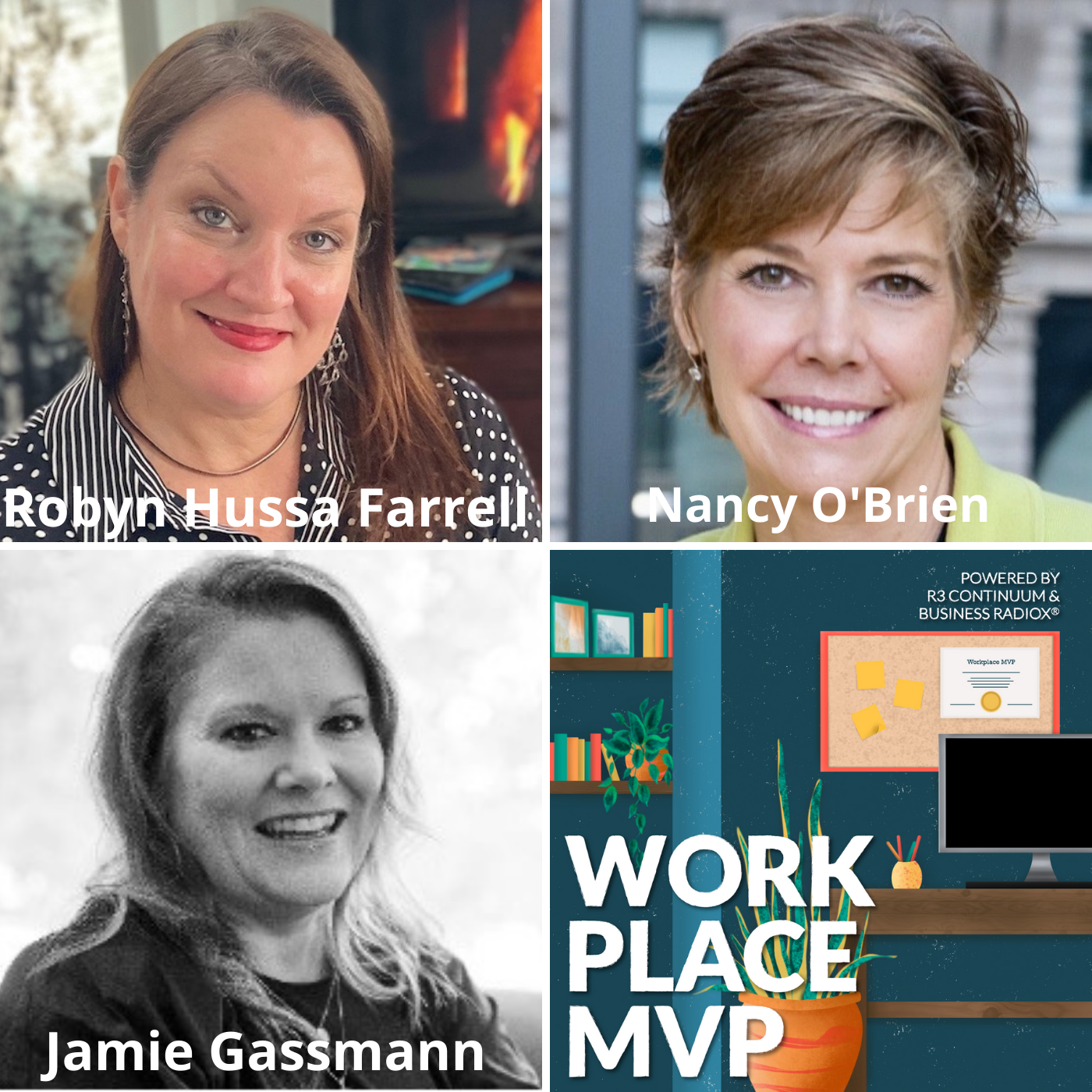
Host Jamie Gassmann welcomes Robyn Hussa Farrell of Sharpen and Nancy O’Brien with Experience Happiness, both of whom lead innovative companies working to improve mental health and wellness in the workplace. “Workplace MVP” is underwritten and presented by R3 Continuum and produced by the Minneapolis-St.Paul Studio of Business RadioX®.

Robyn Hussa Farrell, CEO, Sharpen

Robyn Hussa Farrell, Sharpen

Robyn Hussa Farrell, MFA, E-RYT, Founder and Chief Executive Officer for Sharpen, extends knowledge in building large-scale initiatives to listen closely to the stakeholders, individuals with lived experience and clinicians to ensure all voices have been incorporated into prevention of mental illness and substance use disorders. For nearly two decades, Robyn has been building collaborative relationships between state agencies, educational systems, public health, and researchers across the U.S. to increase connectedness and primary prevention for communities.

Hussa’s tiered model for teaching mental health, population health, and prevention in schools has been published in peer-reviewed medical journals. She has built mindfulness-based stress reduction initiatives that incorporate trauma-informed Resilient Schools frameworks in the state of South Carolina. Robyn served as an advisory committee member for Way to Wellville/Rethink Health Community Engagement and Listening Campaign and served as SC Youth Suicide Prevention Spartanburg County coordinator through the SC Department of Mental Health Office of Suicide Prevention. She founded four companies, first an award-winning NYC theatre company, Transport Group, which earned the prestigious Drama Desk award its first 7 years of operation and celebrates its 20th anniversary.  Robyn and her husband Tim met as award-winning artists in NYC almost 30 years ago and have directed over 3,000 films, live events and educational programs through Sharpen and their production company, White Elephant Enterprises.

Sharpen

Healthy communities are made up of healthy individuals. Sharpen provides a cost-effective and flexible platform that: Provides easy access to research-based, standards-aligned, and award-winning content for mental wellness, enhances, extends, and expands the reach of therapists or counselors. connects and coordinates local and regional community resources, provides data to improve resource utilization, and builds individual, family, and community capacity, competence, and confidence to navigate successfully in these uncertain times and in the future.

IMPACT:
– 15 years research
– Suicide prevention focus
– Trauma-informed
– Self-guided CBT available 24 hours a day
– Evidence-based
– Highly customizable
– 200+ experts in 450 modules

Company website| LinkedIn |Facebook | Twitter

Nancy O’Brien, Experience Happiness

Experience Happiness
Nancy O’Brien, Experience Happiness

Nancy is passionate about researching, developing and sharing innovative tools to enhance and measure well-being. Prior to co-creating The Happiness Practice, Nancy spent years on the leading edge of massive innovation and change, serving on the IBM change team to transition the global business from manufacturing to services. She has also shared her deep experience design and management expertise with many clients by helping them develop and implement bespoke strategies.

LinkedIn

Experience Happiness

Experience Happiness was born out of the recognition that unhealthy stress and burnout—a virtual epidemic in today’s fast-paced global marketplace—is impairing people’s ability to embrace change, cope with challenging situations, feel truly happy or even take on One. More. Thing. We help people and organizations thrive through happiness. They offer The Happiness Practice (THP) to empower leaders to proactively cultivate individual and organizational happiness while measuring Return On Happiness (ROH) at the individual, team, and organizational levels. THP is a transformative life practice proven to simultaneously reduce stress/burnout, increase happiness, and build engaged, high-performance cultures of wellbeing that are strategically empowered to attract, retain, and optimize talent.

Company website | LinkedIn

TRANSCRIPT

Intro: [00:00:04] Broadcasting from the Business RadioX Studios, it’s time for Workplace MVP. Workplace MVP is brought to you by R3 Continuum, a global leader in workplace behavioral health crisis and security solutions. Now, here’s your host, Jamie Gassmann.

Jamie Gassmann: [00:00:27] Hi, everyone. Your host, Jamie Gassmann, here. And welcome to this edition of Workplace MVP. In March of 2020, many workplaces faced a major disruption when they shifted from onsite to remote work. At the time, many likely felt this was going to be a short term change and they would be back to normal in no time. Little did we know, a year later, we would still have remote workers. And, now, looking at what our back to the workplace work environment will look like.

Jamie Gassmann: [00:00:56] Leaders are again faced with making unchartered challenging decisions that will inevitably have an impact on their organization and people. Do they stay remote, come back into office fully, or take a hybrid approach? And then, there is the behavioral impact of changing how we have interacted with coworkers over the last year, from being in isolation to now in-person. This shift that workplaces are facing creates yet another disruption for workplaces as they navigate these changes and the challenges within. In particular, the challenging of supporting employee wellbeing in this new work environment and what the impact will be on the role of the leader.

Jamie Gassmann: [00:01:37] Today, we have two wonderful MVPs to celebrate who are going to help provide some insight on this topic, Robyn Hussa Farrell, CEO and Co-Founder of Sharpened Minds, and Nancy O’Brien, Co-Founder of Experience Happiness. So, our first Workplace MVP is Robyn Hussa Farrell, CEO and Co-Founder of Sharpened Minds. Welcome to the show, Robyn.

Robyn Hussa Farrell: [00:02:01] Thanks so much for having me, Jamie.

Jamie Gassmann: [00:02:02] So, let’s start off with you telling me a little bit about yourself and your company, Sharpened Minds.

Robyn Hussa Farrell: [00:02:11] I am the Founder and CEO of Sharpened, which is an evidence-based platform that improves behavioral health outcomes for communities. We created this after working in the trenches for 15 years in research. And we’re just so excited to be here and grateful to you all.

Jamie Gassmann: [00:02:29] Wonderful. And you have a very interesting career journey. Can you share with us how you’ve moved from entertainment industry into the behavioral health industry?

Robyn Hussa Farrell: [00:02:38] Yeah, it’s quite a segue. My career began in New York City Entertainment in the theater, where I actually produced a rock musical about a family going through a really difficult mental health disorder. And that led into working in K-12 schools with an interest in primary prevention of mental health disorders. And I saw an alarming number of students and families revealing they were struggling with very little resources to manage it.

Robyn Hussa Farrell: [00:03:05] So, I started connecting with researchers in public health and prevention to use the craft of storytelling to connect more evidence-based programs to schools and families. And that ultimately led me to building a platform to connect the content to specific audiences and use data to inform the decisions we use in terms of behavioral for health in communities.

Jamie Gassmann: [00:03:29] Great. And, now, these programs that you built, I know you’ve mentioned K through 12, but there’s some other groups that you build those for, like within businesses and also certain kind of industry specific areas as well. Can you tell me a little bit more about those different programs and how they operate when somebody is utilizing them?

Robyn Hussa Farrell: [00:03:49] Yeah. So, there’s kind of two elements to the programmatic feature within Sharpened, they’re the tech component and then there’s modular content. So, I’ve been working with my husband, who’s also from the media world in New York City, to develop evidence-based modular content. And we do that with robust partnerships. So, it’s all about increasing access to the evidence-based best practices, but also featuring those documentary styles, race of resilience, that we know decrease [inaudible] stigmatization barriers that often prevent an individual from connecting to treatment.

Robyn Hussa Farrell: [00:04:27] So, the Modular Content Library, not only documentary style films, but all 15 different elements that we’ve published in peer reviewed medical journals has shown to increase engagement with appropriate treatment, but also community connection. So important to normalize that conversation and increase connectedness. And so, our system sort of does all of these different components using primary prevention best practices.

Jamie Gassmann: [00:04:58] Great. And in looking at those, you know, when you say the documentary – I know when you and I connected before – you mentioned that they have a very peer focused support. And I know we kind of shared specifically, like, veterans that might be dealing with like a PTSD or other mental health concerns, that they’re built to specifically kind of address that with individuals that have either gone through it or understands the world. So, in your opinion, how does that help to enhance the behavioral health support that they’re receiving? And that engagement part of it that you talked about, how does that make a difference in how people respond to it?

Robyn Hussa Farrell: [00:05:39] Well, Jamie, we’ve seen actually through research that, we have gathered over 80,000 response forms from both parents, from educators, from individuals with lived experience. So, we know through data that by sharing stories of resilience that decreases that shame. It helps an individual know that they’re not alone. It kind of normalizes the conversation around mental health. But it’s also a safe and appropriate way to connect that individual to care.

Robyn Hussa Farrell: [00:06:11] And so, with your example that you gave of the veteran focused content, we worked with a clinical psychologist from the VA who developed over the course of four years peer-to-peer veterans stories of resilience. And what we saw through our research with the veteran population was, not only that the veterans wanted to engage more with treatment after they saw another veteran, but more importantly, the spouses or the care providers. So, when we built out certain content streams that were spouses and veterans sharing in a safe and protected environment their stories, we saw an increase in connectedness. And those are best practices for not only building resilience and mental health, but also for suicide prevention.

Jamie Gassmann: [00:06:56] Yeah. Definitely. And looking at, obviously, over this last year and in any time frame, really, and looking at kind of trends and shifts, is there anything in particular that you’re seeing with your clients or within the industry that you serve that you’ve identified in your research that leaders should be aware of?

Robyn Hussa Farrell: [00:07:19] So, overall, of course, in the last year, we’ve seen an uptick in consuming best practice interventions on mindfulness, mindfulness-based stress reduction, anxiety, understanding the conversation around the neuroscience around anxiety, but also childhood trauma and maltreatment. We’re talking a great deal and seeing a great deal around adverse childhood experiences. So, naturally, those, on a broad brush stroke, have been what we’ve seen in terms of our data.

Robyn Hussa Farrell: [00:07:48] But we also know that individuals are not only interested in accessing care for themselves, but they need support for their family members. So, ensuring we have age appropriate and audience appropriate content for the family member has been something that we’ve seen, especially in the last year.

Robyn Hussa Farrell: [00:08:06] And then, in our medical student vertical, we actually saw really interesting data point where medical students were actually seeking out directed content on a more regular basis. So, we learned through medical students that, for example, you’re in the throes of a mental health disorder or a substance disorder, you may be less likely to be seeking than earlier on. So, the earlier we can screen and intervene, we’re seeing their success.

Jamie Gassmann: [00:08:37] Great. So, in looking at that earlier intervention, what can leaders be looking for? How would they be able to spot, is their proactive measures that they can take to be monitoring for that?

Robyn Hussa Farrell: [00:08:52] Yeah. So, leaders should know first and foremost that you’re not alone and you don’t have to do this alone. Right? The news has been highlighting — in the last year, especially with this mental health pandemic. But just know that there’s been research and best practices over the course of five decades, at least, in the world of neuroscience. And there are systems and frameworks in place that can support you. So, that’s number one, know that there are folks that can support you.

Robyn Hussa Farrell: [00:09:18] And to that end, we have collaborated with R3C and with Nview to offer consultation to leaders of larger corporations, so that they can actually understand the benefits of early identification screening, primary prevention work that can actually support their employees in the long term.

Jamie Gassmann: [00:09:40] And so, looking at that, in that preparation of the leaders, as they’re starting to look at this new work environment, you know, what are some things from your opinion that they should be considering and building into that preparation approach?

Robyn Hussa Farrell: [00:09:53] I think that it’s about increasing community connections as much as it is increasing access to treatment like mental health counseling. So, there are all kinds of ways that you can do that in following best practice. We can also start normalizing the conversation on a daily basis. So, driving content on a more scheduled – again, following best practice guidance, those are ways that increase resiliency, it decreases the stigma, it engages everyone kind of into a normalized conversation that mental health is as important, if not more important, than our physical health.

Jamie Gassmann: [00:10:36] Now, I’m sure there’s a lot with that career journey that you just explained to us and then also looking into the great work that you’re doing at Sharpen that you’re proud of. But what are you most proud of within your career when you look back?

Robyn Hussa Farrell: [00:10:50] When I look back, I think that it’s the partnerships. It’s the people doing the grass work, research and interventions for families. I’ve had the great honor of working greatly in a resilient schools community, working with foster families, working with experts and researchers in childhood maltreatment. And I am so grateful for those community partnerships and for the professional collaborations that we have. So, I mean, there’s so many things I’m grateful for, but those partnerships really mean the world to me.

Jamie Gassmann: [00:11:26] Wonderful. And if somebody wanted to get in contact with you, how could they go about doing that?

Robyn Hussa Farrell: [00:11:32] Sure. I’m on LinkedIn. I’m also sharpenedminds.com. You can access us there and please reach out, we would love to collaborate.

Jamie Gassmann: [00:11:41] Awesome. Thanks, Robyn. Our next Workplace MVP is Nancy O’Brien, Co-Founder of Experience Happiness. Welcome to the show, Nancy.

Nancy O’Brien: [00:11:51] Oh, thank you, Jamie. And thank you, Robyn. It’s a pleasure to be here with you both this morning.

Jamie Gassmann: [00:11:57] Great. And just like with Robyn, why don’t you start off with telling us a little bit about yourself and your company, Experience Happiness.

Nancy O’Brien: [00:12:04] Yeah. Like Robin, I didn’t plan on this to be part of my career. Unlike Robyn and other entrepreneurs, my dear friend and business partner at Experience Happiness literally set out to save our lives. My first job out of college was with IBM, and I was one of the two females that were hired in the Omaha, Nebraska office that were not secretaries. So, you could imagine. And then, I was also part of the change team at IBM when we were moving from manufacturing to services. And that was really interesting, that was an 11 year change plan, we got there at nine. And nobody but Dow Jones and Nasdaq can tell you when you get there.

Nancy O’Brien: [00:13:00] And then, when I was still at IBM, I got introduced to this idea of customer employee experience design and experience management. I’m like, “Oh, finally. That’s me.” And then, through the course of life, I ended up really becoming an expert in experience design and experience management. And what I learned was, you can’t have a really great customer experience unless you have a really great employee experience. So, that kind of shifted some things.

Nancy O’Brien: [00:13:33] And when my dear friend and I sat down for lunch one day, we could check all the boxes on wellbeing. I mean, at the Gallup Well-Being Index Work would have been out, we would have gotten an A-plus. We were doing purpose driven careers. We had flushed 401Ks, if anybody remembers those days. We were so healthy that, for me, my physician actually said, “I don’t want to see you for five years because this is a sick care system, not a well-care system. Like, stay out of here.” I was Volunteer of the Decade at my kid’s school. And I had plenty of friends and family.

Nancy O’Brien: [00:14:16] But the reality is, my friend and I looked across the table from each other and we realized that we were suffering from suicidal ideation. And we were doing everything right. We were going to yoga. We were meditating. We were healthy. We were happy. And what we know now that we didn’t know then is, we were suffering from the 16 signs and symptoms of burnout.

Nancy O’Brien: [00:14:45] And, really, I remember the day I got off the plane one evening, like, at midnight, there’s not that many people that are in the airport at midnight. But I was one of them. And I remember calling my boss at the time and I just said, “I’m done. I can’t do this anymore.” So, really, we needed to heal ourselves. We weren’t getting counseling. We were getting some therapy. And if anybody gave us another gratitude journal, there was going to be a situation.

Nancy O’Brien: [00:15:19] And I want to be clear because Robyn just spoke so eloquently about mental health. So, I just want to be clear, we’re talking about mental wellness. We are not in the mental health. Our solution called the Happiness Practice is an evidence-based behavioral health solution that helps people no matter kind of where they are on the spectrum. And I think we’re all on a spectrum of some sort. I don’t think any of us are exempt, and most of us will go undiagnosed. But we can always improve our behavioral health and our mental wellness. So, really, Jamie, we set out to save ourselves,

Jamie Gassmann: [00:16:00] And it took you on an incredible career journey and took you to creating the Experience Happiness, which is now you have that ability to help other organizations. So, can you tell me a little bit about how those programs work within an organization?

Nancy O’Brien: [00:16:17] Yeah. And I’ll give you just a little bit of context. So, you know, Lyn and I are kind of innovators, researchers, and strategists. So, the first thing we did is, we needed to redefine happiness because we had it out there. I’ll be happy when the kids get the grades, right? We get this next contract. I get this promotion. My husband remembers my birthday. I mean, whatever it is.

Nancy O’Brien: [00:16:43] And so, the first thing we did – and I’m going to invite your listeners to try this on – is we redefined happiness, which is this, happiness is our innate ability to locate and cultivate our serenity and our excitement about our life, regardless of outside forces. And there’s a lot of outside forces. So, we redefined happiness and then we kind of like, “Well, that’s happiness.” And it’s inside of each of us how do we cultivate it. And then, we came up with the five principles of happiness, and blah, blah, blah.

Nancy O’Brien: [00:17:24] And now, what we offer to people of all walks of life in education settings, in corporate settings, in community settings is the Happiness Practice. And it’s essentially called a practice. It’s not a program. It’s a practice. Just like brushing your teeth is a practice or yoga is a practice, what not. And you learn and practice each of the five principles for 30 days because that’s the time it takes to create new neuropathways. And simply put, by practicing this practice, you become more open minded and more open hearted. And you travel the longest journey we all take, the 18 inches from our head to our heart. And in doing so, we are physically, emotionally, mentally, and spiritually more optimized.

Jamie Gassmann: [00:18:19] And I can see in an organization having more of that openness as like a team probably builds collaboration, understanding probably a little bit more grace for each other. Is that typically what you see when you’re working with that?

Nancy O’Brien: [00:18:32] Like, we worked with the fabulous emergency department at Hennepin Health Care on the heels of a gang shooting. So, we not only had burnout, but we had trauma there. And it was really interesting because one of the nurse leaders said, “You know what? We used to be good at teaming, but now we have each other’s back.” Because like Robyn was saying about Sharpened Mind, you learn this life practice at community. Right? And so, you start to see that no one is exempt. Like, stuff has happened to everybody all the time, no one’s exempt.

Nancy O’Brien: [00:19:13] And what you learn in this community is that, we’re all students and teachers of life and you learn to apply the five principles of happiness to Thanksgiving dinner, your sixteen year old, your work colleagues. And having that sense of, “Oh, my God. We are all human beings doing the best we can.” And you start to walk this path of self-love and self-worth together.

Nancy O’Brien: [00:19:46] And as you know, Jamie, it was so great because we’re so thrilled to have R3 Continuum being one of our partners. When your leaders offered the Happiness Practice to all of your employees as a gift – really, it was a gift – 80 percent of you and your colleagues engaged in that. And we have the only evidence-based behavioral health system that has a measurement applied to it. So, we actually measure and track shifts at an individual level. But, two, also department and organizational KPIs. So, your leadership was able to see since the burnout went down and the happiness went up, revenue improved, operational expenses were reduced, and net income was improved. So, this is a business case, right? I mean, all of the businesses really, at the end of the day, are the humans in it.

Jamie Gassmann: [00:20:48] Absolutely. And we’ve connected earlier, so kind of piggybacking off of that point about people and businesses, you know, looking at the last year, some of the things that we talked about previously, you mentioned that within the last two months, you’ve seen a shift that you’ve noticed within organizations. Can you share with me that shift that you and the potential impact that organizations might have from that?

Nancy O’Brien: [00:21:19] Thank you. And, really, Jamie and Robyn, chime in here if you’d like to. But you mentioned something earlier, Jamie, about leaders. So, here’s what I’m feeling and seeing out there, is, there’s three major shifts happening that really are shifting leadership’s role in this new world. Because we have five simultaneous crises happen. So, this is a whole new world order for us.

Nancy O’Brien: [00:21:51] So, leaders have three new responsibilities that they need to really step into. One of that is really making employee wellbeing one of their top priorities, and it’s a shared responsibility. Unlike employee wellness, which is, “We’ll offer weight loss. We’ll offer smoking cessation. We’ll offer EAP.” That’s an individual, like, I have to choose if I want to quit smoking or lose weight or blah, blah, blah. Wellbeing is a shared responsibility. You’ve got to have the environment where people feel safe and belonging. And you also have to offer a variety of programs, if you will, because no two people are the same and no two people are in the same place on the journey.

Nancy O’Brien: [00:22:36] The other thing that leaders really have to do is, help people adjust to the accelerated rate of change. Like, what we were doing Monday is not what we’re doing on Thursday, and that’s the new reality. And, now, the nice thing about people who are authentically happy, they respond to change more quickly and more easily. So, again, we’ve got to optimize the human beings, so that we don’t have a major crash to our human system.

Nancy O’Brien: [00:23:16] And then, the third thing is, there’s going to be a lot of upskilling and reskilling that takes place. I mean, aren’t you ready for your robot? I mean, really, I think we’re all going to have our personal robot in the next year. And AI is going to come on and all these things. And it’s like, “We’re going to have to learn how to program our robots.” You know, that’s just one example of the type of new skills we’re all going to have to develop, no matter where we are in our career.

Nancy O’Brien: [00:23:49] And leaders aren’t used to doing those three things. They’re used to putting the burden on upskilling. “Well, you get the degree then apply for the job.” No. I mean, the degree and the education system, it’s not going to keep up with the new skills that an employee needs now to respond and react to a work situation. And I think the other thing leaders need to make over arching is, leaders don’t have to have the answers anymore. They have to keep leaning into the question, what works now, what’s the problem, but what’s the opportunity.

Nancy O’Brien: [00:24:28] And so, I think it’s a really exciting time. I think if leaders lead into these three shifts, they’re going to feel more fulfilled. Because aren’t leaders all about lifting people up anyway and helping people be their best? And aren’t organizations about creating wonderful opportunities for their employees? Everything else is just kind of like noise.

Jamie Gassmann: [00:24:56] Yeah. Definitely. And you can see that in organizations and some of the other, you know, news articles and media that you’re seeing in that area in terms of helping employees, empowering employees, supporting them. So, definitely you can see that with organizations in that new work environment. So, the same question that I asked Robyn as well, I mean, you’ve had, obviously, an incredible journey. In looking back over your career, what are you most proud of?

Nancy O’Brien: [00:25:30] Oh. That I made the shift from being a human doing to a human being. That has been everything. That has made me a better mother, a better friend, a better colleague. Like, when I ask you how are you, I want to know. And that, I’m most proud of that.

Jamie Gassmann: [00:26:06] Wonderful. And if somebody in our listener pool wants to connect with you, how can they go about doing that?

Nancy O’Brien: [00:26:12] Yes. So, it’s easy, nancy@experiencehappiness.biz. And you can also go to our website, experiencehappiness.biz And we have a free and confidential happiness and burnout assessment you can take. So, check in with you. Take a moment and see how you are.

Jamie Gassmann: [00:26:36] Great. Thanks so much, Nancy. So, we’re going to take a moment and just have a word from our sponsor. Workplace MVP is sponsored by R3 Continuum. R3 Continuum is a global leader in providing expert, reliable, responsive, and tailored behavioral health crisis and security solutions to promote workplace wellbeing and performance in the face of an ever changing and often unpredictable world. Learn more about how R3 Continuum can tailor a solution for your organization’s unique challenges by visiting www.r3c.com today.

Jamie Gassmann: [00:27:13] So, now, what I’d like to do is bring the two of you back together and I have some questions for the both of you. So, starting out with you, Nancy, you shared that employee wellbeing has to or is moving to a new territory of being a shared responsibility. So, from your perspective – and then, Robyn, I would like to get your thoughts on this as well – how might that look within an organization? So, what are some things that might need to change or be incorporated to allow for that to happen?

Nancy O’Brien: [00:27:46] So, I think one of the big shifts we’re experiencing right now is, we’re shifting from paying attention to employee engagement, how do employees feel about the company, to employee wellbeing and having the organization understand, really, how well are their people. And then, needing to sense and respond to that. Like, you can’t just do the one size fits all anymore. You’re going to have to dial-in individually. So many things are becoming personalized, we know this as consumers. Employee wellbeing for organizations is going personal as well. Like, my challenges and my opportunities for growth and expansion are different than the two of yours. And it’s changing, literally, daily.

Nancy O’Brien: [00:28:41] So, employee wellbeing, it’s tempting to put it in the H.R. bucket as an organization. But I really encourage it to be a C-suite driven initiative. Because at the end of the day, the most important asset an organization has is their people. And, now, that we’re in this hybrid, if you will, work environment, you’re going to have to have this be a shared responsibility. Because the organization can make sure that their spaces are physically safe, make sure everybody’s got the technology they have. But the humans have accountability to be able to check in with themselves, to say, “Should I go into the office today or should I stay home?”

Jamie Gassmann: [00:29:36] Yeah. Definitely. Robyn, how about from your perspective?

Robyn Hussa Farrell: [00:29:41] Now, we just did a couple of days ago this week, a focus group with some H.R. executives on global wellbeing and resilience in the workplace. And one piece of data that I think is relevant to this conversation – and to everything, Nancy, that you have said. Yes, I’m a huge fan. I’m so excited about this idea of really giving presence to our employees from the C-level all the way throughout – the challenge in the piece of data from the focus group this week was simply how can [inaudible] our executive, possibly, with 50,000 employees be there and be present and be able to do it on their own? And the answer is, of course, they can’t.

Robyn Hussa Farrell: [00:30:32] So, creating a community, not only from the C-level, but throughout the culture of these enterprise companies where we’re asking each other, how are we doing? Getting the conversation started around mental wellbeing, but just life wellbeing. What are you doing today to do an uptick on your self-care? What are you doing in our world? We measure all of this through a resiliency scale that’s validated against perceived stress outcomes. So, how are you doing with stress? How you do management? It doesn’t mean you need to go talk to a licensed clinician, per se. There are folks in between that can on a daily level, we can just actually have these conversations.

Robyn Hussa Farrell: [00:31:15] And I love Nancy’s point about making sure the leadership are modeling that, right? If we see it, we are going to be more likely to do it, not only at the workplace, but at home with our kids and with our loved ones.

Jamie Gassmann: [00:31:28] Great. And so, from the work that the two of you do, what are some of the changes that you feel employers should be readying themselves for? What that new workplace is going to be like post-COVID? And the employees, really, looking at it from like the employees that are coming back to that work environment, what are some things that they should be doing to ready themselves for that? And maybe we’ll start with you, Robyn.

Robyn Hussa Farrell: [00:31:53] I think, number one, first and foremost, we want to be mindful of risk mitigation and doing it in a way that actually gets this conversation going. So, employers can do the assessment and the screen that Nancy was referencing. Knowing the baseline of how your employees are when they come back to work, whether it’s in office or hybrid, checking in with them. And of course, there are evidence-based ways to do that.

Robyn Hussa Farrell: [00:32:23] We partner with the gold standard screening company Nview Health. They run over 17,000 clinical studies around this. So, there are ways to do it that are appropriate and safe that helps you get a baseline. And then, doing some type of daily or weekly intervention, meaning mindfulness-based stress reduction, all of the literature around improving happiness outcomes. We call it building protective factors. So, we focus on eight primary protective factors. Certainly, mindfulness and resiliency are within that. But there’s all kinds of ways that you can deploy safe and appropriate content as an intervention that supports all of the wellbeing of the employees that you’re working with. So, those are just two ideas right off the top of my head.

Jamie Gassmann: [00:33:12] And how about you, Nancy?

Nancy O’Brien: [00:33:13] Well, I love everything that Robyn is suggesting. And, now, I have to put my experience design hat on for just a moment. Because it’s really interesting for me to see a dozen articles a day on return to the office, return to work. And the thing is, we’re already in the shift. There’s no return happening. We are evolving to the new reality right now. And we are social-emotional creatures, and mental health is an epidemic and loneliness and a sense of belonging are the key symptoms that we’re seeing.

Nancy O’Brien: [00:33:59] And so, from an experience design perspective, I would say, if you’re scheduling an hour Zoom call, schedule 90 minutes. Because what we’re missing is when we see somebody walking to and from the lunchroom or the coffee nook, we’re missing that, “Oh, my God. What happened to you? You’ve got a cast on your arm.” And we’re missing the story of, “I fell down, you know, carrying a bag of groceries,” or whatever because we’re only getting above the heart. So, we’re missing most of the data we count on as human beings for only getting 10 percent of the data we need.

Nancy O’Brien: [00:34:49] So, what we need to do is spend that extra 30 minutes, if you will, 15 minutes before a call and 15 minutes later, “How are you doing? What’s going on?” Because that’s what we’re doing at Experience Happiness – we just had an all team call this morning. We got people in Finland and, you know, people in Oklahoma and California. We’re doing all the time zones – the first thing we do is, “How are you? And how is your practice?”

Nancy O’Brien: [00:35:17] And it really helps each other to say, “You know what? I’m working on principle number three, release control to be empowered.” It helps us understand where you are. And sometimes the agenda that we plan for the meeting changes based on what we’re learning about the humans that have come together in this time. And then, the other thing we’re missing on the back end is, you know, how if you have a meeting, you walk out with a couple of people and say, “Hey, let’s follow up on this. Let’s follow up on that.” We’re not doing that.

Nancy O’Brien: [00:35:48] So, what we need to do is bring back those human needs that we have and create the space for them in this wonderful reality that we actually know now that that myth of work life balance was always a myth. And no matter who we are, we’re bringing all of that to every aspect of our life. We bring our work to the situation with our kids. We bring our kid’s situation to work or community environment. And I think we have to acknowledge our humanness and how humans operate as social-emotional creatures. We’re the only species on the planet that has a conscious.

Jamie Gassmann: [00:36:49] Interesting. So, for the both of you, just one final question, for all the leaders that are listening out there today, if there was one takeaway action item that you wanted to leave them with that they should start doing now, if they haven’t already, for this new work environment or just even in general, what would that take away be? I’ll start with you, Robyn.

Robyn Hussa Farrell: [00:37:18] Okay. So, I’m going to bring this to a level of conversation that speaks very close to home. I direct the Suicide Prevention Task Force for three counties in the state of South Carolina. I’ve been doing that work for four years with researchers. I mentioned a focus group we had with H.R. executives from global companies. The conversation around suicide is a real thing and it’s a scary thing. And, now, executives are faced with, “My goodness. There’s a whole host of mental health and substance use challenges that are staring all of us in the face.”

Robyn Hussa Farrell: [00:37:55] I want to go back to the point I made earlier, which is, there are best practice ways of getting those conversations started. To Nancy’s really great point about encouraging your employees to share their stories, this resonates so much with me as both a storyteller and someone who thrives on helping individuals tell their stories. There is a model that’s evidence-based for suicide prevention and it is called Stories of Strength.

Robyn Hussa Farrell: [00:38:23] And one easy, quick, awesome way that you can actually engage your employees in the conversation is to ask them who are the sources of strength in your life? Let’s talk about them, call on them, perhaps even contribute a video of one way that they overcame adversity during COVID. And what were the sources of strength that pulled them through these crazy times that we’re in. So, leaning into it rather than letting fear be your guide and, again, following the best practices that exist because they’re out there.

Jamie Gassmann: [00:38:59] Beautiful. How about for you, Nancy?

Nancy O’Brien: [00:39:03] So, just like the flight attendants on the airlines would say, “Put your own mask on first so you can help each other,” I would invite you to really understand that as a leader. No matter if you’re an untitled leader, but you’re still a leader in your community or your home or whatnot, you cannot pour from an empty cup. Take care of you so you can take care of others well. There is data out there that says that 90 percent of leaders are suffering from burnout. And burnout unaddressed, unacknowledged, unmedicated can lead to suicidal ideation and suicide.

Nancy O’Brien: [00:39:55] So, I think the most important thing that leaders can do is model the desired behavior that we are all accountable and responsible for cultivating our mental wellness. And, you know, there’s about to be eight billion of us on the planet. Here is a nice thing, if we were supposed to do life alone, there wouldn’t probably be eight billion of us.

Nancy O’Brien: [00:40:23] So, you know, it was really interesting. I really spent the last year in Detroit with my son, who a year ago – and I won’t go into details – everything you read about is what he was experiencing. I thought, “Well, he doesn’t need to be alone. I could get in my car and I could go there.” And thank goodness I had my own practice. Thank goodness I was able to love and support him, but knowing it’s his own journey.

Nancy O’Brien: [00:40:57] And it was interesting because last week, I just happened to reconnect with, like, six people I didn’t talk to you for a while. And they said, “Well, what’s the last year been like?” And I, basically, shared with them what my year has been like in this wonderful journey with my son that I’m so privileged to be part of. And they’re like, “Me, too. Me, too. Me, too.” Every one of the six people I talked to had a 20 year old child who was going through something similar.

Nancy O’Brien: [00:41:29] And so, Robyn, to your point of sharing, an old version of me, the human doing, would probably not have shared that. But the human being, I shared here’s what’s going on in my life. You know, it might look like I’m put together because I happened to shower today, but I got this stuff going on. And it was so interesting to realize that my experience was really no different than these good friends and colleagues of mine.

Jamie Gassmann: [00:42:09] Yeah. Great.

Nancy O’Brien: [00:42:11] So, share your story. And it doesn’t have to be a pretty one.

Jamie Gassmann: [00:42:18] I love that advice. I think that’s a great one, because I think through those stories, we’re able to learn a little bit more about each other, which gives us the ability to have a little bit more understanding and grace for each other as well. So, thank you both for letting us celebrate you, and for sharing your stories, and your great advice, and your insights with our listeners. We appreciate you. And I’m sure your organizations and staff do as well, as well as your clients that you work with.

Jamie Gassmann: [00:42:48] And we also want to thank our show sponsor, R3 Continuum, for supporting the Workplace MVP podcast. And to our listeners, thank you for tuning in. If you’ve not already done so, make sure to subscribe so you get our most recent episodes and other resources. You can also follow our show on LinkedIn, Facebook, and Twitter @Workplace MVP. And if you are a Workplace MVP or know someone who is, we want to know about them. Email us at info@workplace-mvp.com. Thank you all for joining us and have a great rest of your day.


About “Workplace MVP”

Every day, around the world, organizations of all sizes face disruptive events and situations. Within those workplaces are everyday heroes in human resources, risk management, security, business continuity, and the C-suite. They don’t call themselves heroes though. On the contrary, they simply show up every day, laboring for the well-being of employees in their care, readying the workplace for and planning responses to disruption. This show, “Workplace MVP,” confers on these heroes the designation they deserve, Workplace MVP (Most Valuable Professionals), and gives them the forum to tell their story. As you hear their experiences, you will learn first-hand, real life approaches to readying the workplace, responses to crisis situations, and overcoming challenges of disruption. Visit our show archive here.

“Workplace MVP” Host Jamie Gassmann

In addition to serving as the host to the Workplace MVP podcast, Jamie Gassmann is the Director of Marketing at R3 Continuum (R3c). Collectively, she has more than fourteen years of marketing experience. Across her tenure, she has experience working in and with various industries including banking, real estate, retail, crisis management, insurance, business continuity, and more. She holds a Bachelor of Science Degree in Mass Communications with special interest in Advertising and Public Relations and a Master of Business Administration from Paseka School of Business, Minnesota State University.

Tagged With: Experience Happiness, Jamie Gassmann, mental health, mental wellness, Nancy O'Brien, R3 Continuum, Robyn Hussa Farrell, Sharpen

The R3 Continuum Playbook: Workplace Mental Health in a Pandemic

April 15, 2021 by John Ray

workplace mental health
Minneapolis St. Paul Studio
The R3 Continuum Playbook: Workplace Mental Health in a Pandemic
Loading
00:00 /
RSS Feed
Share
Link
Embed

Download file

workplace mental health

The R3 Continuum Playbook: Workplace Mental Health in a Pandemic

Dr. George Vergolias discusses how the pandemic has quite significantly affected workplace mental health, and he shares strategies employers can adopt to mitigate the effect of this pressing problem. The R3 Continuum Playbook is presented by R3 Continuum and is produced by the Minneapolis-St.Paul Studio of Business RadioX®. R3 Continuum is the underwriter of Workplace MVP, the show which celebrates heroes in the workplace.

TRANSCRIPT

Intro: [00:00:00] Broadcasting from the Business RadioX Studios, here is your R3 Continuum Playbook. Brought to you by Workplace MVP sponsor, R3 Continuum – a global leader in workplace behavioral health, crisis, and security solutions.

George Vergolias: [00:00:13] Greetings. I am Dr. George Vergolias, Medical Director at R3 Continuum. And today, I want to discuss the broadly known issue that behavioral health is being identified as the next pandemic. And with this increasing realization comes the challenge of figuring out how the pandemic is impacting the current state of wellbeing in our workplaces. This has had a significant impact on workplaces across the globe.

George Vergolias: [00:00:36] According to a recently published World Health Organization study, the pandemic has disrupted or halted critical mental health services in 93 percent of countries worldwide while the demand for mental health has been increasing. From the National Institute of Health, in the pre-COVID years leading up to 2019, roughly 10 percent of adults reported anxiety or depressive symptoms. However, in 2020, post-COVID, that incidence quadrupled to 40 percent. A survey in June of 2020 showed that 13 percent of adults reported new or increased substance abuse and 11 percent of adults reported onset of suicidal thoughts.

George Vergolias: [00:01:16] Fears of the virus created a significant stressor as well. But the response of governments to minimize spread, while understandable and needed, also created a host of other psychosocial stressors. Which, not only increased overall stress load, but simultaneously strained worker’s coping resources. These have had a profound impact on the workplace. Just some examples, unemployment or risk of such, reduced work productivity, increased absenteeism and presentism, increased irritability and hostility, reduction in team engagement, isolation and loneliness. And work from home with all of its attendant challenges such as home schooling and other issues. All of these have been present.

George Vergolias: [00:01:55] In my opinion, one of the most damaging aspects to business is when people are highly stressed, anxious, and depressed, they greatly struggle to bring innovation and creativity. And without innovation and creativity, businesses suffer. It’s kind of a classic Catch-22.

George Vergolias: [00:02:16] As a business leader, there are things that you can do to mitigate these issues within your organization. Proactively supporting your employees is a primary approach. And I want to highlight five key suggestions towards that aim that we continually find at R3 in the consulting work that we do with large and small organizations.

George Vergolias: [00:02:36] First, remember that even one year into the pandemic, this is still new to all of us. Even with very positive news of vaccines coming online, remember, this is a vaccine produced within a record-breaking timeframe for a disease that has not been known to us before in this particular manner or strain. Certainly, coronaviruses have been part of the human species journey for at least 10,000 years. But this particular version is a new wrinkle and we’re still sorting it out.

George Vergolias: [00:03:04] As leaders, it is critically important to place that in proper context. To explain that while science has made miraculous strides in combating this virus in such a short time, we still have more to learn and we still may have more adjustments. This helps level set expectations and tempers fears across your organization, and it’s an important first step.

George Vergolias: [00:03:26] Second, provide timely and accurate information to your employees. I like to say that fear loves a vacuum. In the absence of good intel, humans will tend to speculate. And when we do that without good information, we tend to do so in a negative direction. And in some cases, that can border on paranoid thinking and paralyzing fear. As leaders, it is important to provide our employees with information that is credible, believable, and based on the best available science at the time.

George Vergolias: [00:03:55] This doesn’t mean that what we share today will be accurate in a few months, as the science is evolving and the medical understanding is evolving over time. That is why the point above is critical to set the proper expectations so people can adjust to changes as we move forward. And then, provide your employees information so they can be informed based on best evidence science at the current time. And thus, make informed decisions pertinent to their safety concerns and in a manner that reduces anxiety and fearful isolation.

George Vergolias: [00:04:27] Third, we need to communicate clearly to our employees. Once you level set expectations and then find clear and credible information to disseminate, you must clearly communicate such to your company, employees, and, if appropriate, other stakeholders. Communication should be clear, concise, and placed into context of it being based on the best available evidence and information currently available.

George Vergolias: [00:04:52] This has several benefits. It allows you as a leader to convey a sense of accountability and competence at the highest level of your organization. And in doing so, you become a trusted voice and one that employees can rely on to find answers and provide needed resources. It also initiates a dialogue with your employees within the context of trust and candor, which can be vitally important at times of increased stress. And lastly, this allows you to later clarify any misunderstandings that might arise. And in the current context, if needed, reframe things later as the medical field learns more about the disease, about vaccinations, and even about new strains and their impact on people.

George Vergolias: [00:05:34] A key component of communication is communicating bidirectionally, in both ways, to your employees, but also listening. In a landscape of potential fear, communication must go in both directions. The best military generals seek input from and listen to their soldiers on the front lines because they have the most relevant up to date information of the battlefield. In many ways, as leaders, we could learn from this. Thus, communication must occur in both directions.

George Vergolias: [00:06:03] When people are fearful, they do want timely and clear information shared with them. But equally important is that they want their concerns to be heard and understood. Additionally, they may have suggestions for coping. They may have suggestions for accessing additional resources that leadership was not aware of. And they can offer support to others in ways that they have been dealing with things that leadership may not be aware, but which can be beneficial to others in your organization. Your employees are a resource for resilience, so do not let that resources go untapped. So, I recommend opening up a dialogue with your employees so that leadership can understand those concerns and then direct interventions and policies accordingly.

George Vergolias: [00:06:47] A fourth point is, set clear policy and act consistent with that policy over time, but make changes when needed. Let me explain that a little further. To be clear, I am not recommending any specific policy here as any policy must be anchored to your company, and culture, and your risk tolerance, as well as your particular organizational needs. Yet whatever policy you have about requiring vaccinations or not, returning to work or not, when to return or not, travel restrictions and so on, all of those should be outlined and explained as clearly as possible and as often as needed.

George Vergolias: [00:07:26] We often say that one has to repeat something up to seven times for a group to understand it and retain it. So, consistency is important here. As frequent shifts in policy can lead to increased confusion and frustration, as well as employees emotionally checking out if they keep hearing different variations of a policy. The only exception to this, of course, and something to be mindful of, is that, if medical experts make changes to best practice recommendations that directly impact your policy, that would require adjustments over time.

George Vergolias: [00:08:01] But, again, if you open up with my first bullet point saying that there clearly is kind of a new direction that we’re figuring out as we go and you set that level of expectation, people will adapt well to that. So, it is not the occasional change that is the problem here. It is rapid, seemingly irrational changes that can be problematic as your employees view leadership and their decisions. So, set a North Star by picking a course of action and follow that as long as it remains consistent with medical guidelines. As I said earlier here, consistency goes a long way. If you build in expectations properly, as noted above, your employees will be able to adjust accordingly and with minimal frustration.

George Vergolias: [00:08:45] Fifth, mobilize resources to build resilience and enhance coping. Employees will show individual responses to uncertainty and fear, and this will vary greatly. Some will seemingly show no noticeable response, and they’ll seem to be managing things very well. Others will evidently be struggling emotionally. And others may still be experiencing a silent struggle where they’re struggling internally, but they’re not showing it on the surface, and it may be much more difficult to detect.

George Vergolias: [00:09:14] And further, all of these different variations will occur on different trajectories as some people will improve in their functioning and coping with this, as others will continue to struggle. And when others are coming out of their struggle, different people that have been coping well might fall into a struggle. So, it is imperative to make available resources to help build resilience, tap into existing coping mechanisms, and in some cases, seek additional, more formal clinical treatments when needed.

George Vergolias: [00:09:45] Since the onset of this pandemic, we at R3 have seen a dramatic increase in request for these support services across the many organizations with whom we consult. These include the following, wellness outreach. Wellness outreach is timely and proactive outreach calls by trained resilience coaches with the goal of checking in on how people are coping, and assisting them to maximize their coping strategies, or tighten up existing strategies that may not be working as well as they’d like.

George Vergolias: [00:10:14] Another thing we’ve been doing is what we call facilitated discussions. These are group format discussions aimed at supporting employees and allowing them to address their fears, navigate cultural differences that might be existing in the organization, and share successful strategies for adapting and thriving to the pandemic and other social stressors that are occurring. In this role, we are really trying to help facilitate this discussion in a way that business leaders may not be comfortable with or may want an outside party as more of an objective support resource.

George Vergolias: [00:10:48] Another thing we’ve been doing quite extensively is what we call disruptive event management. When a negative event impacts a workplace, it could be the onset of a breakout of COVID. It could be an untimely death, in some cases of suicide. Any kind of event that really disrupts the flow and functioning and emotional stability of a workplace, we can respond providing onsite or virtual behavioral health coaching that supports and helps individuals adjust to that emotional impact after that specific disruptive event impacts the workforce. And the goal is maximizing a resilient adjustment. What we know is when these types of disruptive events occur, the sooner that we can get in and help people tap in to organic natural coping resources, the better people tend to do.

George Vergolias: [00:11:40] Then, another thing to consider is referring people to more formal clinical behavioral health options. In some cases, an individual is emotionally struggling at an intensity or for a long duration, such that linkage to a behavioral health provider and into clinical treatment is warranted. So, as you navigate forward as a leader, be aware of resources in your area. Be aware of resources through your employee assistance program, if appropriate, and others that might be covered through your available insurance options. So that if this need arises, you can mobilize those resources quickly and link employees to the proper resources if they need that level of treatment or support.

George Vergolias: [00:12:26] So, in summation here, employee behavioral health is suffering. And I expect and what we’re seeing from all the data is, we expect this to continue well into 2021 and likely into 2022. But here’s the good news, you can help change that and R3 Continuum can help. On our website, which is r3c.com, there are a number of resources that can be found in our Resources tab. Along with that, we have a number of tailored solutions to help support your unique challenges. Contact us today for a free consultation at info@r3c.com.

George Vergolias: [00:13:04] I want to thank you for giving me this time. And, hopefully, these tips and suggestions have been helpful so you can bring leadership to bear in a very proactive and positive manner as we navigate forward through the pandemic. Thank you again.

Show Underwriter

R3 Continuum (R3c) is the underwriter of Workplace MVP, a show which celebrates the everyday heroes–Workplace Most Valuable Professionals–in human resources, risk management, security, business continuity, and the C-suite who resolutely labor for the well-being of employees in their care, readying the workplace for and planning responses to disruption.

R3 Continuum is a global leader in workplace behavioral health and security solutions. R3c helps ensure the psychological and physical safety of organizations and their people in today’s ever-changing and often unpredictable world. Through their continuum of tailored solutions, including evaluations, crisis response, executive optimization, protective services, and more, they help organizations maintain and cultivate a workplace of wellbeing so that their people can thrive. Learn more about R3c at www.r3c.com.

Connect with R3 Continuum:  Website | LinkedIn | Facebook | Twitter

Tagged With: behavioral health, George Vergolias, mental health, pandemic, R3 Continuum, workplace mental health, Workplace MVP

Workplace MVP: Geoff Topping, Challenger Motor Freight, and Sara Rose, Hennepin Healthcare

April 8, 2021 by John Ray

Challenger Motor Frieght
Minneapolis St. Paul Studio
Workplace MVP: Geoff Topping, Challenger Motor Freight, and Sara Rose, Hennepin Healthcare
Loading
00:00 /
RSS Feed
Share
Link
Embed

Download file

Hennepin Healthcare

Workplace MVP: Geoff Topping, Challenger Motor Freight and Sara Rose, RN, MVN, Hennepin Healthcare

The pandemic created unique and acute workplace challenges for both trucking and healthcare enterprises. Geoff Topping, Challenger Motor Freight, and Sara Rose, Hennepin Healthcare, joined host Jamie Gassmann to reflect on their experiences of both difficulty and hope over the past year. “Workplace MVP” is underwritten and presented by R3 Continuum and produced by the Minneapolis-St.Paul Studio of Business RadioX®.

Geoff Topping, Vice President of People & Culture, Challenger Motor Freight Inc.

Geoff Topping, Challenger Motor Freight

Geoff Topping has been in the trucking industry for over 25 years and has held many roles in that time. Geoff started his career as a Driver and has since held positions in Operations, Sales, Recruiting and Human Resources. Currently, Geoff is Vice President of People & Culture including Safety, Recruiting and Risk Management for Challenger. Geoff has also served Industry associations such as the Truck Training Schools of Ontario where he acted as the Chair of the Carrier committee and is currently the co-chair of the Recruiting, Retention and HR committee at TCA as well as a Commissioner for the Niagara Bridge Commission. In 2018 Geoff was awarded the HR Leader of the year by Trucking HR Canada and is 2017 was also recognized as the HR Innovator.

Challenger Motor Freight Inc.

Challenger Motor Freight is a total supply chain provider to a large and diverse customer base in Canada, United States, and Mexico. Challenger employs more than 1,500 people with locations in Toronto, Montreal, Vancouver, Atlanta, Chicago, Dallas, and Long Beach.

Since its inception in 1975, Challenger Motor Freight Inc. has continually set new standards of quality and performance. Their unwavering commitment has earned us some of the highest accolades in the transportation industry and an impressive record of customer satisfaction.

From its earliest days, Challenger has made innovation a part of its corporate culture. The Challenger team has always been on the forefront of operational and technological advancements that have significantly changed the nature of the transportation industry. These innovations continue to take them in new directions by allowing the company to offer enhanced services to meet their customer’s increasingly diversified needs.

With a full range of transportation, warehousing, and logistics services, Challenger can meet client requirements and transport your goods between Canada and anywhere in North America.
Their modern fleet serves truckload, less-than-truckload, special commodities and expedited needs. A team of professionally trained drivers and state-of-the-art electronic monitoring and on-board tracking systems help ensure the highest quality standards and timely arrivals.

At Challenger, they are proud of our history and excited about their future, but their greatest pride lies in helping customers reach new heights.

Leading the Way. Challenger Motor Freight is a company that shares your drive to outperform the competition.

Company website | LinkedIn | Facebook

Sara Rose, RN, MSN, Hennepin Healthcare

Hennepin Healthcare
Sara Rose, RN, MVN, Hennepin Healthcare

Sara Rose is an energetic and visionary hospital leader with thirty-two years of healthcare experience including fourteen years in a nursing leadership role. Sara has experience in smaller critical access hospitals as well as urban, academic medical center environments. Sara is passionate about maintaining a strong focus to provide support and well-being resources for her teams. She sees staff as the most valuable resource in any healthcare organization.

LinkedIn

Hennepin Healthcare

Hennepin Healthcare is a network of inpatient and outpatient services across the Twin Cities in Minnesota.

Their flagship, Hennepin County Medical Center (HCMC), is a 400-bed Adult and Pediatric Trauma Center, Comprehensive Stroke Center, Verified Burn Center, and Verified Bariatric Center in the heart of Minneapolis.  As an academic medical center and safety net hospital, their mantra is “Every Life Matters.”  The Critical Care and Heart and Vascular divisions oversee adult intensive care and cardiology services.  HCMC is accredited by the Joint Commission.

Company website| LinkedIn |Facebook | Twitter

About “Workplace MVP”

Every day, around the world, organizations of all sizes face disruptive events and situations. Within those workplaces are everyday heroes in human resources, risk management, security, business continuity, and the C-suite. They don’t call themselves heroes though. On the contrary, they simply show up every day, laboring for the well-being of employees in their care, readying the workplace for and planning responses to disruption. This show, “Workplace MVP,” confers on these heroes the designation they deserve, Workplace MVP (Most Valuable Professionals), and gives them the forum to tell their story. As you hear their experiences, you will learn first-hand, real life approaches to readying the workplace, responses to crisis situations, and overcoming challenges of disruption. Visit our show archive here.

“Workplace MVP” Host Jamie Gassmann

In addition to serving as the host to the Workplace MVP podcast, Jamie Gassmann is the Director of Marketing at R3 Continuum (R3c). Collectively, she has more than fourteen years of marketing experience. Across her tenure, she has experience working in and with various industries including banking, real estate, retail, crisis management, insurance, business continuity, and more. She holds a Bachelor of Science Degree in Mass Communications with special interest in Advertising and Public Relations and a Master of Business Administration from Paseka School of Business, Minnesota State University.

TRANSCRIPT

Intro: [00:00:04] Broadcasting from the Business RadioX Studios, it’s time for Workplace MVP. Workplace MVP is brought to you by R3 Continuum, a global leader in workplace behavioral health, crisis, and security solutions. Now here’s your host, Jamie Gassmann.

Jamie Gassmann: [00:00:26] Hi, everyone. Your host, Jamie Gassmann, here. And welcome to this edition of Workplace MVP. Every day around the world, workplaces of all sizes face disruptions, such as loss of employees, business interruptions, natural disasters, workplace violence. And, yes, a pandemic. Within those workplaces are everyday heroes whose role calls for them to ready the workplace for and respond to those disruptions. This show features those heroes we call Workplace MVP’s, otherwise known as Most Valuable Professionals. While we celebrate their inspiring work, we also hope to learn from their experiences as well.

Jamie Gassmann: [00:01:09] Today, we have two wonderful MVP’s to celebrate. Geoff Topping, Vice President of People and Culture from Challenger Motor Freight, and Sara Rose, Senior Director, Critical Care from Hennepin County Medical Center, also known as HCMC. They will be sharing with us today the amazing work they have done for their organizations and their people as they navigated the twists and turns brought on by the various challenges of 2020.

Jamie Gassmann: [00:01:35] Our first workplace MVP is Geoff Topping, Vice President of People and Culture at Challenger Motor Freight. Hi there, Geoff.

Geoff Topping: [00:01:43] Good morning.

Jamie Gassmann: [00:01:45] So, you’ve been named the accidental H.R. Manager. Can you share with me how you got that title?

Geoff Topping: [00:01:51] Yeah. Absolutely. So, I am the Vice President of People and Culture here at Challenger. That kind of came about in a strange way. I started my career in the trucking industry at the age of 18 as a driver. I was a driver and owner-operator. I worked in operations and I worked in sales. And then, back in, I guess, it was about 2016 or 2015, somewhere in there, I was kind of tapped on the shoulder and asked to move in to the recruiting and retention side of the trucking business.

Geoff Topping: [00:02:26] And it was kind of an odd thing for me because I don’t have any postsecondary education in H.R. I had never worked in the H.R. field. In fact, I used to pick on the H.R. people, I called it the hug department, actually, lots of times. And so, it was kind of an odd thing for me to be put into the H.R. role. Yeah, it was a very unconventional way of getting here. But I think I’m pretty proud of the way things have turned out. It’s been an exciting time. And we’re going to talk a bit about that a little more as we go through things here today.

Geoff Topping: [00:02:58] But I’ve often said now, I wish it was what I’d done all my career was working the H.R. side of things. But it’s been pointed out to me by many people, a couple of mentors that I have that, you know, if I hadn’t done all the different roles I have within the industry and within the school of hard knocks, I guess we’ll call it, then I wouldn’t be able to fulfill the role the way I do. So, kind of a weird pattern or way to get here, but it’s been exciting.

Jamie Gassmann: [00:03:24] Definitely. So, tell me a little bit about, you know, the career journey you’ve had. You know, your mentors pointed out that it helped you in your current role. In your opinion, how has that helped you be more effective at what you do?

Geoff Topping: [00:03:37] Well, I think in our industry, because I’ve worked in basically all areas of our industry, I can really empathize with the drivers, with the mechanics, with the people in the operations floor, the people in the admin sections of the business. I’ve done a lot of the same roles they are currently doing. I’ve faced a lot of the same challenges, it gives me a good perspective of what they might be dealing with.

Geoff Topping: [00:04:03] It’s also really helped where I can relate and kind of tell the story, or I joke and call it translate. I can translate what the other departments might be dealing with. You know, when you put in an order, for example, you’re putting in an order for a load to pick up somewhere. That information that’s put in there is not only important to the driver, it can be important to the billing department. It can be important to the safety department. It can be important to the risk department. And because of all my different roles, I’m able to kind of share with everybody what you do and how it affects other people throughout the supply chain.

Jamie Gassmann: [00:04:36] Great. Now, over the last year, I’m sure it helped out a lot to have some of that background, but what were some of the hardest parts of your role over this last year?

Geoff Topping: [00:04:48] Since the pandemic started in March the 11th at about 1:15 in the afternoon – I’ll never forget it – in 2020, getting people answers has been the hardest part, I think. People were dealing with fear in a lot of ways. I mean, if we look at Maslow’s Hierarchy of Needs, you know, those basic needs were in question for a lot of people. They didn’t know if they were going to have a job. They didn’t know what this might mean for their health. They didn’t know what it might mean for their loved one’s health. And so, there was a lot of fear. And, you know, we still go through waves of that as the pandemic continues. And we’re in wave 3 of it here now in the Province of Ontario.

Geoff Topping: [00:05:33] But I think getting people answers was the hardest thing because people were scared. They were having emotions that they didn’t understand. I mean, none of us have been through a pandemic before. This is something new and unprecedented. So, coming up with answers fast enough for people and ones that weren’t going to change, I mean, this was a very fluid situation. The health care professionals, which we have one of them on the line here with us today, we’re learning about this virus. It was a changing virus and still changes to this day. So, how it was being handled, what the medical professionals, what the the boards of health or the Departments of Health were requiring was constantly changing. And I think just getting people the answers to make them feel safe and make them feel comfortable was the biggest challenge.

Jamie Gassmann: [00:06:25] Now, you’ve mentioned fear and we’re going to talk a little bit more about that in a little bit. But tell me a little bit about what was it like for your staff? What were you experiencing? You know, you’ve heard stories of every employee kind of responded differently. Some were really afraid. Some were not. Kind of like almost like a spectrum of fear. What was it like for your staff over this last year with all of the different twists and turns, cases rising, cases falling? What was it like for your team?

Geoff Topping: [00:06:59] It’s been a time of constant change, I’ll say that. I could not be more proud of the way our organization has handled it. I mean, from the frontline, the drivers out on the road, the mechanics, all the admin staff back here in the offices supporting everybody, people have handled it amazingly. I mean, the challenges they faced have been things we’ve never dealt with before.

Geoff Topping: [00:07:25] And, you know, I take the drivers, for example, out on the road. That’s a tough job to start with. You’re away from home. It’s a lot of hours. You’re dealing with different weather, different traffic, all those kind of things. But the drivers had a real interesting challenge. Again, I can’t be more proud of the way the organization handled it. But the drivers, you know, restaurants were closed for a long time. They didn’t have access to restaurants. So, they were having to pack extra food with them or eat fast food out of their truck. Getting into shippers and receivers was an issue. They weren’t allowed on the dock. They weren’t allowed in the office. They couldn’t use the washroom facilities due to COVID. I mean, for those drivers, it was a real tough situation.

Geoff Topping: [00:08:11] I mean, all of us back in our offices or working from home, sure, we had all those fears to deal with as well. But we had some comfort and we were going home at the end of every shift or we were at home. Well, the drivers were living on the road in a very fluid situation with, you know, again, lack of access to rest areas, to washrooms, to restaurants. It was a tough time for them.

Jamie Gassmann: [00:08:37] So, we kind of have talked about the fear of the employees and, obviously, the struggles that all the drivers went through. Talk to me about, in your role, how did you support the well-being and encouraged self-care? Because obviously those are some trying times. How did you help them to kind of keep their mental health as well as their physical health intact through this?

Geoff Topping: [00:09:04] Yeah. Sure. So, communication, I think, was the biggest thing. And we started right away. Back on March the 11th, 2020, we started a communication plan that still continues to this day. We’re actually working on COVID communication number 73, we started working on it this morning. Then, they were going out kind of every other day for a little while. Then, we switched it to weekly, then biweekly, and as needed. But very detailed communication that went out. We sent it out to all the drivers in the trucks. We have the satellite system. We sent it to every drivers’ email. We sent it to every employees’ email. We sent it to all of the mechanics. We posted it on our social media pages.

Geoff Topping: [00:09:47] But a very detailed communication that kind of explained what’s happening, what’s changed since last week, here’s what we’re hearing in dealing with the various levels of government, various industry associations. We really tried to keep people up to date on what we knew at the time with the caveat that, you know, this is a very fluid situation that changes and we’ll update you as we can.

Geoff Topping: [00:10:10] Mental health is something I’m concerned about, for sure, still to this day. I kind of refer to it as the mental health hangover, that could come from this pandemic. And we’ve tried to share a lot of resources with people, resources that our EAP providers gave us, resources that are available online for people, whether that be just websites with information or access to virtual counseling, virtual doctors, to get medical appointments, all those kind of things. For the drivers, that’s certainly something that’s helped them a lot because they can’t always get home to get to the doctor at a certain time.

Geoff Topping: [00:10:49] But every one of those communications, we not only shared what we’re doing, health and safety wise just to reiterate all the protocols and safety measures, but we tried to share as many resources as we could for people to access to help them or their family or their friends. We also sent out messages to the leadership team and the managers on a biweekly basis during the initial phases of the pandemic with how to help manage your team or how to help coach your team through this situation. We just tried to provide a lot of extra information.

Geoff Topping: [00:11:26] We also made a point of doing management by walking around, I’m a big fan of that. And I tried and still do try to take a lot of the the full building at least once a day and just kind of check in with the various departments, see how people are doing, and kind of keep my ear to the ground of what might be the pinch points so that we can address that in those communications as well. In a time like this, communication, I think, is the key. I’m sure we’ve over communicated in some ways, but I felt it was important to keep people up to date on what’s going on.

Jamie Gassmann: [00:12:01] So, what is something that you’re most proud of within your career? It could be something maybe over the last year that you’ve done or just in your career in general, you know, within your role at Challenger Motor Freight or other roles that you’re just most proud of, you know, of your accomplishment.

Geoff Topping: [00:12:23] I hate kind of talking about myself, but I think one of them would be when I first got into the recruiting and retention role of things on the H.R. side. I was asked to be the face or the voice of our culture change program. And we’d done a lot of work as a company on focusing on our culture. And we believe there’s three pillars to a business, and that’s people, customer, and profit. And if we take care of the people, they’ll take care of the customers, and that will ultimately take care of the profit.

Geoff Topping: [00:12:57] And we did a a good to great – we call it – a good to great journey, where we went out and did a discovery where we met with about 40 different people one-on-one, and did intense interviews with them on what they thought was going well with the company and what they thought needed improvement. We did about 25 sessions at all days, hours, and shifts where anybody could attend any role in the company and ask those same questions. Through the help of a consultant, we boiled all that down into the main themes that we needed to address. And then, we went back out and did another road show where we said, this is what we heard, this is what we can do about it today, this is what we’re going to work on next year, the year after, et cetera. I still think that’s one of my most proudest accomplishments was working on that.

Geoff Topping: [00:13:48] And I had a lot of support. It was by no means a one man effort. You know, it was a team of people. But I got to be the voice of it, which I felt pretty privileged of. And it’s been something that’s worked very well. I think that all put us in a great spot for what we had to deal with during the pandemic, because we had proven to people that we’ll go out and ask for your opinions. We might not be able to change everything exactly the way you want, but we will give you an answer on what we’re going to do, what we can do, or what we, unfortunately, might not be able to do to affect something. So, I think combine those two, the first one put us in a great spot to handle the pandemic and the situation that we’re in today.

Jamie Gassmann: [00:14:28] Wonderful. Well, thanks, Geoff, for all that great information. We’re going to come back to you after we talk with Sara Rose now. So, our next Workplace MVP is Sara Rose, Senior Director, Critical Care, Heart and Vascular at Hennepin County Medical Center. We’ll be referring to Hennepin County Medical Center throughout the rest of the show as HCMC. So, welcome, Sara.

Sara Rose: [00:14:53] Hi, Jamie. Thanks for having me.

Jamie Gassmann: [00:14:55] So, you oversee a number of areas at HCMC, can you walk us through what those areas are and your role within the hospital?

Sara Rose: [00:15:04] Sure. I’m a nurse and I’m a patient care director, so I have several departments that report up through me in, actually, two divisions. In the Critical Care Division, I have the Adult ICUs, and the Burn Unit, and Respiratory Therapy. We are a Level 1 Trauma Center, so those are very busy areas. In the Heart and Vascular Division, I have all the procedural areas that report up through cardiology. So, the cardiac cath lab, where you might go if you have a heart attack, the echocardiography lab, and those smaller departments.

Jamie Gassmann: [00:15:47] Great. So, looking at the last year, obviously health care has been hit pretty hard in terms of being the frontline responding to patients with COVID, what for you has been the hardest part of your role over this last year?

Sara Rose: [00:16:03] Yeah. Well, I can echo some of what Geoff said too. You know, I think the hardest part was asking staff to trust us and be flexible as we moved forward. It was a year where we didn’t have the answers. And in health care, we like to have those answers. Things were changing with our personal protective equipment every day. They were changing in the way we isolated patients with COVID, the medications we gave them, the protocols, and the treatments. And that was the hardest part, really. Health care is an environment where you’re asked to change all the time, but we are very protocolized. And that’s how we keep patients safe. We have standard work and we follow it. And so, turning on a dime is not our strong suit. But staff did, we all got through it together.

Jamie Gassmann: [00:17:05] Yeah. And so, talk to me a little bit about the staff. I know when we talked earlier, you know, you shared kind of some of the ups and downs and the changes. Talk to me a little bit of what was the last year like for your staff?

Sara Rose: [00:17:21] Well, it started out before the shutdown. We knew this was coming. I don’t think any of us knew the tsunami that we were headed for. But we started by looking at our elective procedures and we started shutting those down. And focusing on what was absolutely necessary to do. So, during that time, we had furloughs, we had a loss of business because we were shutting down those elective procedures and staff went home. And at the same time, the other half of the organization was really busy building up for what was to come, building out extra care spaces to take care of overflow patients. So, it was a real dichotomy. Nurses were asked to work in different areas. Maybe your area was shut down, but you’re a critical care nurse and you could be utilized in the ICU. So, again, we were asking staff to be very flexible.

Sara Rose: [00:18:27] Then, when we hit our first surge around the March or April timeframe, it was crazy. We did not have enough staff. We were out taking care of patients in areas we hadn’t cared for them before. And we were working with our local business partners, the other hospitals, to try to load level and make sure that none of us were overly burdened, while others were status quo. It was a crazy time.

Sara Rose: [00:19:00] And going into the summer, we saw the COVID numbers go down a little bit. People were outside. However, there was a lot of civil unrest in our community that took the violent injuries up quite a bit. And so, we saw, I think, about 300 percent increase in our penetrating trauma over the summer. And so, that was another stress on the staff.

Sara Rose: [00:19:34] Then, we had another surge in October where we were asked again to change our nursing ratios, do things differently to accommodate the influx of patients. So, it’s been a real roller coaster from feast or famine. And that creates a lot of emotional drag on staff, and I can still feel it today.

Jamie Gassmann: [00:20:01] Sure. So, you kind of touched on it a little bit with the unexpected patient increases, obviously, in the violent injuries. What other increases did you see as a result of people kind of changing how they live? A lot of people working remote, maybe being home all day. What were some of the other areas that also increased along with, obviously, COVID patients at your hospital?

Sara Rose: [00:20:30] You know, mental health resources in this country are really stretched. And we saw that there were an increase in demand for counseling. And we shut down a lot of our group therapies and had to do those on line. So, we saw people getting sicker with their mental health. But we also saw across the country and at HCMC an increase in the burns, especially in the pediatric population. Parents working from home, trying to homeschool their kids, young kids maybe not being as supervised, so coffee burns. And this was a country-wide phenomenon.

Jamie Gassmann: [00:21:18] Interesting. And those were the things that we weren’t really hearing about because there’s so many other things to report on. So, it’s interesting that both you and Geoff shared areas that we maybe hadn’t thought about as increases or challenges that each of your industries faced. So, you kind of touched on this a little bit, your hospital is located in downtown part of Minneapolis. So, how has the civil unrest impacted your team? I know you mentioned the increase in violent injuries, but what other impacts have you had to manage as a result of that civil unrest being so close to home?

Sara Rose: [00:21:57] Well, we’re a very multicultural and diverse organization. And so, you know, what goes on in our community is often brought inside our doors because we live and work in the community. There’s been a lot of anxiety. As a leader, my job is to make sure that people are safe and that patients are safe, that staff can get to and from their cars safely, and that the patients we’re taken care of inside our walls are safe. You know, there have been necessary conversations that have been sparked because of the civil unrest. And so, emotions are raw. But, again, these are things that we have to go through.

Sara Rose: [00:22:46] I’m really proud as an organization that from the top down, we’re really committed to equity in the care we deliver and how we treat each other. And so, we’re on the road on that journey actively pursuing it. But I would say in wrapping up this question, it’s an emotional time and we’re trying to understand each other. And I think we need to have these conversations, but they’re hard in the midst of a busy workday.

Jamie Gassmann: [00:23:20] Evidently. So, now, your team on a normal workday – and year – see a lot due to being a Level 1 Trauma Center. This last year, as you kind of mentioned, is a roller coaster, especially taxing, so what approaches have you used to support the well-being and encourage self-care within your team?

Sara Rose: [00:23:42] Much like Geoff, we have a portfolio of offerings for staff. We have employee assistance and we have online trainings. We also have a critical incident support team that we can call on to come and help our staff members get through a crisis or a critical time, something that’s really affecting them in the moment. I think we struggle a little more looking back and saying we realize people need help, but what do we do for them? And that’s really where we are today.

Sara Rose: [00:24:21] For me, it’s important for me to show up. I think a leader shows up for their team even on a day that they don’t want to be face-to-face with people. And Geoff alluded to it as well, getting out there and walking around. It’s so important to staff that they know that we know what they do. Right? And so, for me, being present, stepping up, having an open door policy. But I still feel like we have some room for improvement in really getting to our team members and making sure that they’re doing okay. And that’s a passion of mine and something I hope that we can continue to work on here at HCMC in my career time.

Jamie Gassmann: [00:25:13] Great. And so, what is something that you are most proud of within your career and your role at HCMC?

Sara Rose: [00:25:23] I’ve always been proud of the teams I’ve worked with. I can look back on every team, whether I was a staff member or a leader, and I’ve been proud to be part of those teams. But I would say, especially in this last year, everyone in this hospital, from environmental services, to nursing, to respiratory therapy, to facilities, we really pulled together. And I’m proud of the team we became. We became a different team. A team that had no bounds and no barriers. And we just worked to get the job done. No politics. No long conversations. We just did the work. And looking back, I wouldn’t want to go through it again. But looking back, I’m very proud of them and I would work with that team any day. And I’m fortunate to be here still working with them.

Jamie Gassmann: [00:26:22] Wonderful. So, real quick, we’re going to a little word from our Workplace MVP’s underwriter, R3 Continuum. R3 Continuum is a global leader in providing expert, reliable, responsive, and tailored behavioral health crisis and security solutions to promote workplace well-being and performance in the face of an ever changing and often unpredictable world. Learn more about how R3 Continuum can tailor a solution for your organization’s unique challenges by visiting www.r3c.com today.

Jamie Gassmann: [00:26:57] So, now, I’d like to open up a conversation with both of our MVP’s. So, first question I have for the two of you is, looking at your employees today, a year after the start of the pandemic, what would you say are some of the challenges that you might be still facing or are new challenges that you’re facing as a result of the last year or just as we continue to move forward into 2021, having started the year out with some of the same of what we went through in 2020? So, I’ll open up with whoever wants to kickoff that answer.

Geoff Topping: [00:27:32] I can go ahead first. I guess the first thing I wanted to say before we get into that was, a big thank you to Sara and her team and all the health care professionals across Canada, the U.S. and, really, everywhere. I know we’re all stressed in this time, but I think the health care professionals are doing an amazing job of keeping us all safe, keeping us all healthy, and helping everybody navigate through it. So, my hat is off to you and everyone that does the kind of work you do. So, thank you.

Sara Rose: [00:28:01] Thanks, Geoff.

Geoff Topping: [00:28:01] I think the biggest thing now that people are still dealing with is not work related issues as much as it is personal issues and home issues. There’s compound stress due to kids being at home from school, online learning. People haven’t been able to see their family. They haven’t been able to take vacations. All those things that we kind of take for granted on a normal level. So, I think the stress outside of work is probably the biggest thing, I think, that we still need to focus on and help people deal with. And that comes back to mental health for sure. But all of those things are compounding on people.

Geoff Topping: [00:28:39] In the climate where I live and where Sara is, there’s that whole thing called winter. That certainly doesn’t help the situation. You know, it’s hard for people to get outside. It’s hard for them to get fresh air and sunlight and those kind of things. So, it’s really helping people kind of live their whole life, I think is the important thing right now. Work is a part of it for sure. We all spend a lot of hours at work everyday. But there’s more to a person than just them being at work. We need to make sure that the people are getting the tools and resources they need to help them with the other parts of their life, which I think is where the bigger stresses are right now.

Sara Rose: [00:29:18] And I can say for me, my staff, they’re just starting to bounce back. Resilience is an issue. We felt a large lift when we started getting vaccinated. You could almost feel the tempo or the temperature. People were a little more relaxed just knowing that we were getting vaccinated. But, still, we have a lot of emotional baggage that we’re carrying around and a lot of emotional injury.

Sara Rose: [00:29:53] As an organization and across the Twin Cities, we’re really trying to judge when is the best time for us to open up to visitors. This has been hard. The caregivers at the bedside, really have had to be the family for patients because family hasn’t been able to come in. And so, when is it safe to open up? And there’s a whole bunch of emotions attached to that. We want families here, and yet we’re afraid, you know, to have possible COVID positive people walking through our doors. So, yeah, they’re struggling, but I see glimmers of hope. People supporting each other and high fives and elbow bumps and all the things, you know, that you can do when you walk into work that really start the day off well.

Jamie Gassmann: [00:30:44] So, over this last year, what do you feel has helped you to navigate the year successfully? You know, even though, obviously, there’s hardships with the various challenges, but what would be something that helped you to navigate it?

Geoff Topping: [00:31:00] I think the big thing for us was the communication, keeping people informed and sharing communication over and over and over. The other thing that really helped was, we did have a crisis management team in place prior to this. And I know many people thought I was being a little too serious and taking things a little too far by pushing having that crisis team in place. But we had put that in place a-year-and-a-half, two years ago with members of each department. And information on teams that people could access remotely, phone numbers, procedures, plans, all those kind of things. And I think having that in place really proved successful and proved that we could hit the ground running as soon as it started.

Geoff Topping: [00:31:47] And that was a huge team effort. I mean, there was people from every department, every office, every location we have that really jumped in and and did what needed to be done. And to serious point, there wasn’t long conversations. It was, “This is what we know right now. This is what we’re going to do.” What we know ten minutes from now might be totally different, but we have to act. We have to act swiftly and we need to get going right away. So, that was really helpful.

Jamie Gassmann: [00:32:13] How about you, Sara?

Sara Rose: [00:32:14] Yeah. I agree with a lot of what Geoff said, that resonates with me. Personally, you know, I had to remain grounded to show up for my team. So, the shelter in place was really a gift to me. It afforded me the time that I needed to recharge at the end of the day. And as an organization, you know, I think the biggest thing was having a psychology presence on each of our units. The psychologists went above and beyond. They have patients to see and they’re hired to see patients. But they actually took care of the staff, too. And we had them somewhat embedded in our units so that staff could talk at huddles or at any time of the day and reach out to this person. And I think that was a huge help going forward to keep us moving.

Jamie Gassmann: [00:33:16] Great. So, a question that I have for the both of you as well is, you know, we talk a lot about employee well-being and self-care, but we also know that it’s important for leaders themselves to be following some of those same guidelines. So, across the last year, what were some of the approaches you did for yourself as a leader so that you could, as you say, show up and be present for your staff? You know, what types of self-care and well-being did you do for yourself throughout the year or continue to do?

Geoff Topping: [00:33:47] So, one of the things I’ve tried to do is, I mean, obviously, it’s more difficult to get to gyms and fitness facilities. So, I’ve tried to make sure I, at least, get out and walk every day and try to get a half-hour in weekdays and maybe do a couple of those everyday on the weekend. And I think being out and some fresh air certainly helps. The exercise helps. I have a theory, you can’t walk and worry at the same time. So, it kind of takes your mind away from things. Try to eat as healthy as I can. And I really believe in taking some quiet time every morning to sit and read something, sit and meditate, sit and think, whatever you want to call that. And I believe everybody has their own version of what they like to do that.

Geoff Topping: [00:34:32] And one of the things I do and I know some people kind of think it’s kind of funny or hokey, but I think a gratitude journal has massively helped me. It’s something I did on and off prior to the pandemic. But as I was doing some research, you know, I was under a lot of pressure and still am, and by no means it isn’t just me. Everybody’s under a lot of pressure right now. And I was reading about doing a gratitude journal again and picked up the habit and really focused hard on it. And I believe that has really helped me. It’s helped me first thing in the morning put a positive spin on my life and on my day, and give me some good thoughts to get the day started.

Sara Rose: [00:35:13] I agree, Geoff. I mean, nature for me is very healing. So, I tried to be active, get out in the woods, get to the spots in my life that really fill my cup. I, too, do some meditation. I know not everyone can meditate and so I think it’s important for people to just do what fills them up. And quite frankly, there were nights that I came home and went to bed at 6:00 p.m. and slept until I got up the next day, and that was what was needed.

Jamie Gassmann: [00:35:47] Yes. I think we’ve all had those nights for sure.

Geoff Topping: [00:35:51] Well, it wasn’t just me.

Sara Rose: [00:35:52] No.

Jamie Gassmann: [00:35:52] Definitely. Wonderful. So, if you were going to give one piece of advice to our listeners, what would that piece of advice be?

Geoff Topping: [00:36:06] During the pandemic?

Jamie Gassmann: [00:36:08] During the pandemic or just in general leading through kind of a crisis situation or challenging situations, what would that be?

Geoff Topping: [00:36:16] Mine would be just be honest, be empathetic to people. Try and understand the things from their point of view and what they’re going through, because everybody is going through something a little different. And be honest with what you know. And I know sometimes people are disappointed that you can’t give them the answer they want or sometimes you can’t even give them an answer, but give them a time when you’re going to have them an answer. And say, “I’ll look into this and I’ll get back to you with something at X, Monday at noon, Tuesday at noon,” whatever that might be.

Geoff Topping: [00:36:47] Again, during this time, it was so fluid. Things were changing so fast that it was hard to give those answers. But I believe being honest like that lets people know that you will give them an answer when you can and that you’re not going to make something up. And to make something up in a situation like this, it could spiral out of control terribly. It just would not be the right thing to do.

Sara Rose: [00:37:12] I agree, Geoff. Authentic leadership is really important. For me, I guess, I wouldn’t be able to leave this podcast as a health care provider and not say my advice would be get vaccinated. It’s the way out of the pandemic. Get vaccinated and wear your mask.

Jamie Gassmann: [00:37:37] Great. Well, you both are amazing. And, you know, a big thank you for letting me celebrate you, letting us celebrate you, and for all of the hard work and tenacity that you guys went through over the last year in keeping things moving in both your respective industries. And for sharing your stories and giving great advice with our listeners. We appreciate you. And I’m sure your organizations and staff do as well.

Jamie Gassmann: [00:38:06] So, you can find Geoff Topping and Sara Rose on LinkedIn, if you would like to connect with them both. We also want to thank our show underwriter, R3 Continuum for supporting the Workplace MVP podcast. And to our listeners, thank you for tuning in. If you have not already done so, make sure to subscribe so you get our most recent episodes and our other resources. You can also follow our show on LinkedIn, Facebook, and Twitter, @Workplace MVP. If you are a Workplace MVP or know someone who is, we want to know. Email us at info@workplacemvp.com. Thank you all for joining us and have a great rest of your day.
 

Tagged With: Challenger Motor Freight, Geoff Topping, healthcare industry, Hennepin Healthcare, Human Resources, human resources support, Jamie Gassmann, R3 Continuum, Sara Rose, trucking industry, workplace culture

Introduction to “Workplace MVP,” with Host Jamie Gassmann

April 1, 2021 by John Ray

Workplace MVP
Minneapolis St. Paul Studio
Introduction to "Workplace MVP," with Host Jamie Gassmann
Loading
00:00 /
RSS Feed
Share
Link
Embed

Download file

Workplace MVP

Introduction to “Workplace MVP,” with Host Jamie Gassmann

Every day, around the world, organizations of all sizes face disruptive events and situations. Within those workplaces are everyday heroes in human resources, risk management, security, business continuity, and the C-suite. They don’t call themselves heroes though. On the contrary, they simply show up every day, laboring for the well-being of employees in their care, readying the workplace for and planning responses to disruption. This show, “Workplace MVP,” confers on these heroes the designation they deserve, Workplace MVP (Most Valuable Professionals), and gives them the forum to tell their story. As you hear their experiences, you will learn first-hand, real life approaches to readying the workplace, responses to crisis situations, and overcoming challenges of disruption. Join us as they share their stories of hope, courage, and tenacity:  www.workplace-mvp.com.

“Workplace MVP” is underwritten and presented by R3 Continuum and produced by the Minneapolis-St.Paul Studio of Business RadioX®.

TRANSCRIPT

Intro: [00:00:04] Broadcasting from the Business RadioX studios, it’s time for Workplace MVP. Workplace MVP is brought to you by R3 Continuum, a global leader in workplace behavioral health, crisis, and security solutions. Now, here’s your host, Jamie Gassmann.

Jamie Gassmann: [00:00:28] Hello, everyone. And welcome to episode zero of our new show, Workplace MVP. I am your host, Jamie Gassmann, and I’d like to share a story with you. Picture a large retailer in the midst of the COVID-19 pandemic, while other businesses have shut down, this retailer must remain open as it is considered an essential source of food and other household necessities in communities across the United States. Their employees are called upon to work amid rising COVID cases; thereby, increasing their exposure to and potential for catching the virus. Meanwhile, these same employees are dealing with mounting personal stressors, such as kids at home adjusting to distance learning, fear of losing loved ones to the virus, anxiety about bringing COVID home to family members, anxiety about not being able to care for and/or visit elderly relatives, familial job loss and much more.

Jamie Gassmann: [00:01:25] Now, in this case, the company’s HR leaders responded to the crisis and the many workplace challenges it created by intentionally and proactively putting the psychological and physical safety of their employees first. The result, employees felt heard, cared for, safer and appreciated. And in turn, those employees empowered by this support from their company stood on the front lines and served customers while stores remained open. A pandemic may have created extraordinary conditions, which received much more notice, but it’s work like this, which top HR leaders have always done, often in circumstances which don’t get much attention. These leaders hire, train, encourage, protect, advocate for and help create the conditions necessary for employees to succeed in serving customers, fellow employees and the overall company.

Jamie Gassmann: [00:02:24] Doug Conant, former President and CEO of the Campbell Soup Company, notes that the soft stuff, the essential people-focused work, which HR professionals engage in each day, is indeed the hard stuff. So, when in the marketplace, Conant once said, “You must first win in the workplace.” This podcast showcases the impact of those HR, security, risk, continuity and senior leadership professionals who propel their companies to wins in the workplace, so, in turn, their company can win in the marketplace. We call them workplace MVPs, most valuable professionals. Conscientious leaders, who put people first and work to innovatively support their employees in our complex and challenging world. It’s stories like the one I just told you, which we’ll be featuring on Workplace MVP. And they’ll be shared directly with you by the executives, HR professionals, risk managers, security directors, and other organizational leaders who’ve experienced them and had direct accountability and planning for, responding to and leading recovery efforts in the face of crisis and disruption.

Jamie Gassmann: [00:03:35] The reality is that every day, workplaces face disruption, be it the death of an employee or a leader, natural disasters, workplace violence, workplace accidents, robbery, layoffs, pandemic, civil unrest and more. And every day, there are heroic workplace MVPs who respond to those challenges by providing multilevel support and taking proactive steps to prepare for future disruption. Together, we’ll learn lessons, gain inspiration and hope exploring best practices and new approaches.

Jamie Gassmann: [00:04:09] Welcome to Workplace MVP, the source of inspiring stories and best practice approaches to preparing for, responding to and overcoming the challenges of disruption in the workplace. Thank you for joining us and make sure to subscribe, so you see our most recent episodes and supporting resources. If you’re an MVP with a story to share, please email us at workplacemvp@r3c.com. We would love to connect with you.

“Workplace MVP” Host Jamie Gassmann

In addition to serving as the host to the Workplace MVP podcast, Jamie is currently the Director of Marketing at R3 Continuum (R3c). Collectively, she has more than fourteen years of marketing experience. Across her tenure, she has experience working in and with various industries including banking, real estate, retail, crisis management, insurance, business continuity, and more. She holds a Bachelor of Science Degree in Mass Communications with special interest in Advertising and Public Relations and a Master of Business Administration from Paseka School of Business, Minnesota State University.

Show Underwriter

R3 Continuum (R3c) is a global leader in workplace behavioral health and security solutions. R3c helps ensure the psychological and physical safety of organizations and their people in today’s ever-changing and often unpredictable world. Through their continuum of tailored solutions, including evaluations, crisis response, executive optimization, protective services, and more, they help organizations maintain and cultivate a workplace of wellbeing so that their people can thrive. Learn more about R3c at www.r3c.com.

Connect with R3 Continuum:  Website | LinkedIn | Facebook | Twitter

Tagged With: business continuity, C-Suite, employee well-being, employee wellness, Human Resources, Jamie Gassmann, preventing workplace violence, R3 Continuum, Risk Management, stress in the workplace, workplace, workplace mental health, Workplace MVP

How Doxing Can Have a Ripple Effect on Organizations, with Hart Brown, R3 Continuum

January 19, 2021 by John Ray

doxing
North Fulton Business Radio
How Doxing Can Have a Ripple Effect on Organizations, with Hart Brown, R3 Continuum
Loading
00:00 /
RSS Feed
Share
Link
Embed

Download file

doxing

How Doxing Can Have a Ripple Effect on Organizations, with Hart Brown, R3 Continuum (North Fulton Business Radio, Episode 323)

Doxing is the malicious activity of researching and releasing personal information in an attempt to harass or intimidate individuals and organizations with whom a hacker disagrees with or dislikes. Hart Brown of R3 Continuum joins host John Ray to discuss how organizations can monitor this activity and address negative PR, the wider effect on employees, why even the smallest businesses are not immune from doxing, and much more.  “North Fulton Business Radio” is produced virtually from the North Fulton studio of Business RadioX® in Alpharetta.

R3 Continuum

R3 Continuum (R3c) is a global leader in behavioral health and security solutions for workplace well-being. Annually, R3c responds to more than 18,000 catastrophic events in the workplace, with an average of 1,500 per month. Some notable events that R3 Continuum has provided immediate and ongoing support in the wake of are: 9-11, the Las Vegas shooting; Hurricanes Katrina, Andrew, Harvey, Maria, Irma, Sandy and Florence; the Japan Tohoku earthquake and tsunami; the Boston Marathon bombing; the California wildfires and many other disruptions in the workplace (e.g., mass layoffs, rioting, death of an employee, catastrophic injury, etc.).

R3c has the ability to provide support at all levels of an organization, simultaneously and at scale to promote workplace well-being and performance in the face of an ever-changing and often unpredictable world.

Learn more at www.R3c.com.

Hart Brown, Senior Vice President

Hart Brown serves as Senior Vice President for R3 Continuum, a psychologically based crisis management firm that responds to 18,000 event each year. He brings over 20 years of experience in both the public and the private sectors. Hart has provided crisis and risk management services across 50 countries, to hundreds of events including the World Cup, one of the largest bankruptcies in US history and one of the largest mass shootings in US history.

Mr. Brown regularly responds to organizations involved in crisis events, security events, threats of violence and cyber incidents. Because of that, Hart works closely with insurance programs in commercial, personal, benefits and specialties markets supporting risk modeling and financial assessments as well as emerging risks, reputation protection, crisis management, active shooter and assault protection, and business interruption. He has an M.S. from Texas A&M University and holds certifications in organizational resilience, business continuity, loss prevention, as a commercial lines coverage specialist and as an ethical hacker.

Questions and Topics in this Interview:

  • What is doxing?
  • What should organizational leaders watch for to identify if doxing is taking place?
  • What do you do with negative PR that may occur as a result?
  • What risks does that present to the organization?
  • What kinds of things are necessary to return to productivity?
  • Why is this a concern now and hasn’t been before with political unrest incidents?
TRANSCRIPT

Intro: [00:00:05] Live from the Business RadioX studio inside Renasant Bank, the bank that specializes in understanding you, it’s time for North Fulton Business Radio.

John Ray: [00:00:19] And hello again, everyone. Welcome to another edition of North Fulton Business Radio. I’m John Ray. And we are not back in our normal haunt inside Renasant Bank in Alpharetta in North Fulton, but we look forward to that day soon. But the folks at Renasant are busy right now, and they’re working on a second-round PPP. And if they do what they did on the first round, they’re going to end up helping a lot of business owners, and a lot of them that weren’t even their clients.

John Ray: [00:00:50] So, that’s the philosophy they have at Renasant Bank. If you’ve got problems with your big bank that you’re tired of voices that are generated by computers, and phone trees, and all that kind of stuff, and it’s hard to get a live person to speak to, go to RenasantBank.com and find their local office, and give them a call, and you’ll talk to a real person, and they’ll set an appointment, and deal with you like face to face and the way these things work. So, I’ve worked with them for some time and delighted with the experience, and I think you will be too. Renasant Bank, understanding you. Member FDIC.

John Ray: [00:01:38] And now, I want to welcome Hart Brown. And Hart is a Senior Vice President with R3 Continuum. Hart, welcome.

Hart Brown: [00:01:46] Thank you very much. Thank you for having me.

John Ray: [00:01:48] Great to have you, Hart. Tell us a little bit about you and R3 Continuum. How you serving folks out there.

Hart Brown: [00:01:55] Sure, sure. So, as you mentioned, I’m Senior Vice President with R3 Continuum. I’m responsible for their crisis management services, but R3 more broadly service as a critical service for organizations as it relates to behavioral health, psychological services, as well as crisis response services. So, one of the key things I think is helpful for people to know and get a sense of, we’re responding to roughly 18,000 crisis events each year. So, roughly in that range of 75, up to 120 potentially every day. And those run the spectrum of anything from natural disasters to the types of things that we’re seeing right now related to unrest, and through cases of mergers and acquisitions that may be problematic for integration purposes and, ultimately, workplace violence as well.

John Ray: [00:02:55] Now, the topic at hand is fairly specific around doxing and the effect doxing can have on organizations. So, first of all, let’s set this up and explain what doxing is.

Hart Brown: [00:03:11] Sure. So, it’s a unique term that I think represents what many of us are seeing right now play out in real time. So, it’s just how we categorize what we’re seeing. So, one of the things that’s continuing to play out, and doxing has been around for some time, traditionally, it’s been housed within the hacking type of community. Now, it’s being used more broadly. And the way it’s being used now is if someone is identified in a protest or somebody is identified making a statement, somebody has done something to gain the attention of the individuals that may not agree with them, what they’ll do is they’ll go on a digital campaign for civil disturbance.

Hart Brown: [00:03:56] And that digital campaign is intended to get all of their personal information, their families’ information, anything that they can gather from those individuals. And it may start from just a picture, and then researching that picture on social media. And then, from picture, getting a name; and name, getting residence; and a residence, getting a vehicle. And then, they start to publish that information both within communities of interest that they have, as well as more broadly across the internet, trying to put a negative spotlight on that individual and, potentially, even the organizations they work with.

John Ray: [00:04:35] And presumably, that individual’s family, and loved ones, and all those close to them, and that kind of puts pressure on the individual themselves.

Hart Brown: [00:04:44] Absolutely. So, even though there is not necessarily a direct threat against that individual, or family members or others, there’s an implication. There’s something that’s implied that says, “If I’m releasing this information out on you, I have an expectation that other people may take that information and do something against you.” Maybe in the cyber domain, they may start a hacking campaign or something against you and your family, the organization you work for, or others or it may actually be physical, where someone makes an effort to approach you at your home or your family.

John Ray: [00:05:22] What you’re describing is something that strikes me. The word that comes to mind is a loose confederation of bad actors, one of which gets the ball rolling. And without any necessarily coordinated communication, they kind of feed on each other with this effort. Did I describe that correctly?

Hart Brown: [00:05:53] Yes. And what the term we assign to that is something called “cause stalking.” And many of us may remember, certainly, watching political figures or other high-profile individuals, they may gain negative attention by people that want to follow them, be close to them, be around them, stalk them, whatever it may be. And that includes issues related to relationships that may not have ever developed or where they may have developed and then ended. You have these stalking types of situations. Then, there’s a subset of stalking that’s related more to group stalking. And so, they’ll start to recruit their friends to start stalking a single individual.

Hart Brown: [00:06:39] And then, we have this issue of cause stalking. So, somebody does something that’s against, potentially, a cause that I believe in, and I’m going to recruit more and more people – it could be all around the country, it could be all around the world – to start doing things and following whatever they can to harass or cause problems for that person. So, the cause stalking is really where we see this increase right now.

John Ray: [00:07:07] Now, there are some obvious answers, I guess, to this question, but maybe some less obvious ones as well, which is why I ask it. How do leaders of organizations know that this is taking place? What do they need to watch for?

Hart Brown: [00:07:26] Yeah. So, this is where you start to play off both the physical space and the cyberspace at the same time. Somewhat difficult for many organizations. But one is just understanding and getting a sense for the sentiment of the individuals that you work around every day. Is there unrest? Are there things going on? Is the culture not at a point where you would want it to be, where people may be acting out in certain ways? You just want to be aware of that potential. Then, starting to look at what’s going on in the overall environment. Is there targeting coming out? And most of this does have a tendency to come out in the news. Is there targeting of companies like yours? All right. So, that would give you an indication that, potentially, that spotlight may start to turn around and hit you. So, that would be another one.

Hart Brown: [00:08:20] Then, you start to look for things related to social media. So, is your name, is somebody else’s name, is the organization’s name being put out in social media in a negative way? And there are many different tools – some quite easy, some very elaborate – to be able to do that social media monitoring and give you alerts that say, “Hey, something is going on in this space. You may want to look or read the actual post.” Things like consumer sentiment as well. What’s going on in the consumer space? Is there, potentially, any sort of backlash or something that may be going on there?

Hart Brown: [00:08:53] And then, issues related to hacking. So, are there increased number of hacking attempts on your site that you may get an alert on? Is there increased efforts to get your personal information, which, now, we all know the term phishing, but there’s also spearfishing, which is highly specific dedicated to certain individual to try and get them to click and hack; or wailing, which really is targeting more the leaders of an organization, the top of the organization, and focusing specifically on them. So, you’ll see all of these start to happen at the same time, potentially, if somebody in your organization is being singled out or doxed.

John Ray: [00:09:37] We are chatting with Hart Brown. And Hart is the Senior Vice President with R3 Continuum. Hart, I’m curious why now, why this has not been a feature. We’ve had political unrests before, maybe not quite like what we’re having now, but we’ve had it before. We’ve had protests before. Why now? Why is this so prevalent now versus before?

Hart Brown: [00:10:12] So, it’s a great question. And there’s a number of trends that are coming together all at the same time to generate the situation we’re in. One is from a traditional protest type of environment, a typical rally type of environment that you might see that goes on virtually every day at different parts of the country, different parts of the world. You’ll see throughout the day, it has been very common that in the afternoon time frame, people will start to gather and build up. They’ll do their marches, rallies, whatever it is, and the vast majority of them being peaceful in nature. As you go later on into the night, things have a tendency to potentially change. And so, the risks related to hostility and others begin to increase.

Hart Brown: [00:10:59] What we found over the last six months, and this is a relatively recent trend, and the trend comes more from Europe than it does from the US, is that these protests have a tendency to go on for months and months and months in that same fashion and have not really resulted in any major change. And then, we had a protest in Kyrgyzstan, and that protest built up very, very quickly during the day, and they immediately made an effort and were successful in making entry into government buildings. That day or the day after, the president, at that point in time, resigned. And so, in the protest community, what they saw was this idea of speed has a tendency to make a change, where the traditional approach didn’t. So, that was one indicator.

Hart Brown: [00:11:50] The next indicator is you see security apparatus start to build up, which is natural in this process. And so, now, you start to see more and more of a balance between those that may want to do something and the security apparatus, at least, as we see it today, is starting to balance out. That means that group of individuals that might want to do something are going to have a harder time. And the natural progression there is you’ll see more bomb threats, you’ll see more incendiary threats, you’ll see those kinds of things. Because I can’t get in, because I can’t get close, I’m going to try other ways to harass or be a problem.

Hart Brown: [00:12:32] The next one is we’ve seen an increase in personalization throughout this time frame. So, it’s not just an ideology that we’re talking about. We’re really starting to see more and more that there’s a focus on certain politicians, on certain CEOs, on the actions they take, on the votes that they put forward. All of that now is highly individualized, which is different from what we’ve seen before. And so, you put all of that together, those individuals that want to harass or do something, the inability to do so from a physical sense, from a security perspective, the highly engaged, personalized approach, and now, this idea of doxing, “Let’s just go after those individuals, their homes, their families,” is becoming more of an increased trend than we’ve seen before.

John Ray: [00:13:24] What you’re describing in some of the various examples you mentioned is something that goes beyond particular movements, or points of view, or strands of protest, however you want to term that. I mean, you’re describing something that comes from the left, comes from the right. It comes from a lot of different places, right. So, to identify this activity with one particular individual, party, movement sounds like a mistake.

Hart Brown: [00:14:02] Correct. And the reality is information is everywhere. And it’s very difficult once your information is out there to do much to try and bring it back. So, as these types … And all of the movements learn from each other. And so, those that are more inclined to become hostile or use harassment as a means to an end are more likely to use this kind of tactics. So, I think this is sort of going into not only the first half of this year but, really, at least, through 2021, we’ll see this continuing to occur.

John Ray: [00:14:41] So, negative PR is obviously the goal. So, what should company executives, board of directors, business owners, what should they do when that negative PR occurs?

Hart Brown: [00:14:59] So, great question. And a lot of organizations, unfortunately, going through this in real time right now and having to make decisions – what they do with certain employees that have been doxed, and do they make a statement, or do they not make a statement? The first thing to understand in this process is … and I sort of go back historically to the world of crisis PR. Historically, there was this move to say we have to get ahead of the message. We have to say something. We have to engage. And what you find in today’s social media and media environment, it’s incredibly difficult. You’re just not going to be able to get ahead. You’re certainly not going to be able to create the message going forward in the first few minutes or few hours. It is going to go the way it wants to go.

Hart Brown: [00:15:46] So, the first thing to realize is you don’t have to jump out and say something right up front. It is important to do a risk assessment. So, what is being said? How many people are saying it? Why they’re saying it? All of that becomes very important. That helps to gauge when and how to potentially make a statement. Organization may never make a statement if the risk assessment says, you know what, the risk is very low from this event overall, any push, anything we do to put a spotlight on this case is likely to bring more negative attention on us, not necessarily positive. So, that’s the first big step.

Hart Brown: [00:16:29] Then, understand how the case occurred. So, a quick after action, a quick investigation as much as you can. Is this a single individual and has his or her information was easy to get by somebody outside the company, and they’ve put it forward, or is this something that is incredibly difficult to get this person’s information and publish it? Important to know potentially who. And in our world, we refer to it as an adversary. Who is this adversary? Is this somebody that just did it on a Saturday to do it, or is this something that’s really likely to potentially become an extended or elongated process? Are they going to do more? It would be an important part of that that risk assessment.

Hart Brown: [00:17:13] And then, creating a bit of a response plan with triggers or we call them triggers, if-then statements. If we see this, then we’re going to put out this kind of a statement. If we see this, we’re going to put out this kind of a statement. And create three or four potential scenarios, so you know what to do in these cases. And then, ultimately, you have to monitor how those statements are going. If you’re going to make a statement, important to get that feedback to make sure it achieves what you wanted to achieve.

John Ray: [00:17:43] Hart Brown is with us, folks. And he is a Senior Vice President with R3 Continuum. Hart, clearly, the concern for companies and other organizations is that the effect within the organization, these attacks may be aimed toward one individual, maybe a CEO, but there’s got to be ripple effects within the organization to employees and other constituencies of that organization.

Hart Brown: [00:18:18] Absolutely. So, we generally break these up external and internal type of situations. External, if you’re a publicly traded company, we’re looking for if there’s negative publicity, is there a stock drop? Is there an activist investor potential issue that’s going to be raised by this? Other types of things, what’s happening to reputation? Is there a potential hit there? Is there a potential issue related to maybe a product boycott, depending on what type of organization you’re looking at? Defacement, whether it’s defacement of a website or something along those lines, or advertising that may be out in communities. We’re seeing that more and more. And ultimately, threats. So, as you said, what we see is while one individual may be singled out, the rest of the employee population, potentially, has a tendency to feel that and recognize the potential that they’re all now, on a broad basis, under some kind of threat.

Hart Brown: [00:19:18] So, internally, some of the things we see, obviously, fear, anxiety, those are natural reactions when these kinds of things occur and your employer’s name is now involved. And that’s the leaders, that’s employees, and that’s their families, right. You can envision the conversations at home. I don’t necessarily want you to go to work today because your employer’s name is all over the news. We see issues, potentially, with hostility within the organization itself. So, some employees may believe differently from other employees, and that may generate some hostility or customers against the employees if you’re in retail, or restaurant business, or something along those lines.

Hart Brown: [00:19:57] So, polarization is an issue. Now, individuals are recognized as to where they are on the potential list of issues. And you see that play out back and forth. Walkouts. If you have leadership that are involved for one reason or another, and the employees don’t necessarily believe in leadership any more, walkout, sickouts and others. So, a number of things playing out internally and a number of things, potentially, playing out external.

John Ray: [00:20:25] I’m interested in … because I know R3 does a lot of work not just in crisis, I guess, after the event, if you will, has occurred, but in trying to help your clients with the prevention side of things. And so, one of the issues around prevention here with this issue is you’ve got so many companies that want to be further engaged in various causes, right? I mean, that’s become a trend here in recent years. And what kind of counsel do you give your clients when it comes to how they weigh the risk of doxing, the effects that might come from the cause-related marketing and other activities that they want to engage in?

Hart Brown: [00:21:26] Yeah. So, it’s a great question. Obviously, looking through and thinking through both from a risk perspective, as well as a financial perspective, right. So, the risks may be incredibly high to focus only on one part or one part of your customer base, but the financial return on that might be high depending on the situation. So, there’s always that balancing act of, is there a financial return for doing that or not?

Hart Brown: [00:21:56] And then, the second is from a leadership perspective, how closely do they want to be aligned or are they already aligned with a specific cause? And, again, we see that on all sides of the spectrum and what that means for four organizations. So, it is a challenge. It’s something that has to be really well thought out, both from a financial and risk perspective. And there are a number of campaigns that have been highly successful that have made a statement that have been able to establish themselves with a cause and have been able to walk that line very successfully without alienating other parts of their business.

John Ray: [00:22:42] Folks, we’re here with Hart Brown, Senior Vice President with R3 Continuum. Hart, I’m curious, as we kind of wind down here, where is all this going? And what do you see ahead in terms of the kind of activity that companies need to be and organizations need to be watching out for going forward related to this?

Hart Brown: [00:23:11] So, yeah, again, a great question. So, here’s one of the things, we started off early last year when COVID-19 really started to have an impact, certainly, in the US. We took a look at all of the information we had available at the time, and what we realized was that most of the research that has been done on major crisis events, major disruptive events, major traumatic events are point in time. So, they’re geographically separated and time separated from other potential events. So, you can think of a hurricane or a situation like that, it occurs, it’s over, and we recover.

Hart Brown: [00:23:49] What we realized pretty early on was we’re in a very long duration crisis event. The question then becomes, what does that mean for individuals and how do organizations leverage the situation we’re in to make sure that individuals are getting the help they potentially need in reestablishing productivity? And so, we went on this study and we referred to it as the emotional comfortability index. What we realized during that time is there’s the stacking, there’s this compounding stressors on top of COVID-19, on top of isolation or lockdown, stay-at-home measures, on top of financial concerns, economic concerns, layoffs, terminations, furloughs. There’s lots of these types of things. Then, you can add the food insecurity and others. That compounding stress type of environment lends itself to a higher risk for civil unrest. It’s just one more thing that people have a tendency to take on and say, “You know what, enough is enough,” and they begin to voice their concerns.

Hart Brown: [00:24:52] The underlying conditions that we saw throughout last year for heightened unrest, and to give you a sense, unrest is really somewhere around three to five times baseline in 2020 over what we saw in 2019. The underlying conditions are still there, and they’re really not going to let up until, potentially, in the summer when the vaccine becomes a bit more available to us. So, as we start to peel away the compounding stressors, unrest or issues related to unrest will likely decrease as well, but not necessarily go to zero. So, for the first six months of this year, unrest, doxing, targeted harassment, those kinds of things are highly likely to be occurring on a daily basis. The second half of the year, we might see a slight reduction in those, but we do see that, at least, through 2021, these kinds of issues are going to be front and center, and will be a challenge for organizations.

John Ray: [00:25:51] We were chatting before we came on about the size of companies that are subject to this, and you made an interesting point that there’s really no company too small to be immune from this activity.

Hart Brown: [00:26:09] That’s right. While we may see large companies making very big decisions on who they’re going to do business with or not do business with, the reality of the situations that the targeting of individuals reaches all different types of organizations. So, we’ve seen everything from very, very large social media companies be in the spotlight, all the way down to real estate agents, small or regional insurance companies and others that just an individual made a decision, they were then put into the spotlight because people went and researched them. And now, they see these cascading events where they have issues potentially with customers and clients, they have issues potentially with banks wanting to do business with them, they have issues with payment processors that may not want to do business with them. And it becomes quite difficult for them. And that’s really all the way down to one and two and three people and family businesses. So, it’s tough for everyone.

John Ray: [00:27:14] Hart, this has been great and very timely and important information for businesses or their organizations. I would love it if we could get to the most important question, which is if someone has heard something that makes them want to be in touch with you and the other professionals at R3 Continuum, how can they do that?

Hart Brown: [00:27:38] I would love for anyone who has an interest to obviously go to the website. The website is www.r3c.com. That’s just the letter R, the number 3, the letter C, dot com. Or they can always reach out to me directly. And that’s Hart.Brown@R3C.com.

John Ray: [00:27:59] Hart Brown with R3 Continuum. Hart, thanks so much.

Hart Brown: [00:28:02] Thank you. Appreciate it.

John Ray: [00:28:05] Yeah. Folks, just a quick reminder that you can find this show on all the major podcast apps. North Fulton Business Radio is the search term. We’re coming up on show number 320 or 330. I’ve lost count. But the point is we’re out there, and I would love it if you would go find the show, and give us a five-star review. It’s not about me, it’s not about Business RadioX, it’s not about the show per se. It’s about the guest on our show. It enables folks to find the show, so that they can potentially plug in to folks like Hart, who offer the services they need. So, if you could do that for us, we’d greatly appreciate it. And connect with us on social media. We’re on LinkedIn, Facebook, and Twitter, North Fulton BRX. So, for my guest, Hart Brown, I’m John Ray. Join us next time here on North Fulton Business Radio.

 

North Fulton Business Radio” is produced virtually from the North Fulton studio of Business RadioX® in Alpharetta. You can find the full archive of shows by following this link. The show is available on all the major podcast apps, including Apple Podcasts, Spotify, Google, Amazon, iHeart Radio, Stitcher, TuneIn, and others.

Renasant Bank has humble roots, starting in 1904 as a $100,000 bank in a Lee County, Mississippi, bakery. Since then, Renasant has grown to become one of the Southeast’s strongest financial institutions with over $13 billion in assets and more than 190 banking, lending, wealth management and financial services offices in Mississippi, Alabama, Tennessee, Georgia and Florida. All of Renasant’s success stems from each of their banker’s commitment to investing in their communities as a way of better understanding the people they serve. At Renasant Bank, they understand you because they work and live alongside you every day.


Tagged With: Crisis Management, cyber incidents, doxing, ethical hacker, hackers, Hart Brown, negative PR, organizational resilience, R3 Continuum

Decision Vision Episode 20: Am I Ready for Workplace Violence?, An Interview for Bruce Blythe, R3 Continuum

June 20, 2019 by John Ray

Decision Vision
Decision Vision
Decision Vision Episode 20: Am I Ready for Workplace Violence?, An Interview for Bruce Blythe, R3 Continuum
Loading
00:00 /
RSS Feed
Share
Link
Embed

Download file

Bruce Blythe, Chairman R3 Continuum

Am I Ready for Workplace Violence?

Workplace violence is a much more common phenomenon than some believe. What are the personality characteristics of someone who might initiate a workplace violence incident? How should you mitigate the risk of these incidents? Michael Blake, Host of the “Decision Vision” podcast, addresses these questions and more with workplace violence expert Bruce Blythe of R3 Continuum.

Bruce Blythe, R3 Continuum

Bruce Blythe is the Owner and Executive Chairman of R3 Continuum. R3 Continuum provides employers with integrated crisis readiness, crisis response, and employee return-to-work services. They have assisted hundreds of companies worldwide with crisis, workplace violence, and business continuity planning, training, and exercising. They also provide consultations worldwide for diffusing serious disputes, hostilities, and workplace violence threats. R3 also works with insurers and large employers in accelerating employee return-to-work for workers comp disability and nonoccupational injury claims through North America and Australia.

Bruce Blythe is recognized internationally as an crisis management expert. He has been personally involved in resolutions of crises such as such as the 1993 World Trade Center bombing, the September 11th terror attacks, mass murders at the US Postal Service, and the Oklahoma City and Boston Marathon bombings. He serves as a consultant to numerous Fortune 500 executives and managers in strategic crisis leadership preparedness and response. Widely regarded as a thought leader in the crisis management and business continuity industries, Bruce is author of Blindsided: A Manager’s Guide to Crisis Leadership. Bruce has served in the military police of the US Marine Corps, is a certified clinical psychologist, has been a consultant to the FBI in workplace violence and terrorism, and has appeared on numerous national media outlets.

Michael Blake, Brady Ware & Company

Mike Blake, Host of “Decision Vision”

Michael Blake is Host of the “Decision Vision” podcast series and a Director of Brady Ware & Company. Mike specializes in the valuation of intellectual property-driven firms, such as software firms, aerospace firms and professional services firms, most frequently in the capacity as a transaction advisor, helping clients obtain great outcomes from complex transaction opportunities. He is also a specialist in the appraisal of intellectual properties as stand-alone assets, such as software, trade secrets, and patents.

Mike has been a full-time business appraiser for 13 years with public accounting firms, boutique business appraisal firms, and an owner of his own firm. Prior to that, he spent 8 years in venture capital and investment banking, including transactions in the U.S., Israel, Russia, Ukraine, and Belarus.

Brady Ware & Company

Brady Ware & Company is a regional full-service accounting and advisory firm which helps businesses and entrepreneurs make visions a reality. Brady Ware services clients nationally from its offices in Alpharetta, GA; Columbus and Dayton, OH; and Richmond, IN. The firm is growth minded, committed to the regions in which they operate, and most importantly, they make significant investments in their people and service offerings to meet the changing financial needs of those they are privileged to serve. The firm is dedicated to providing results that make a difference for its clients.

Decision Vision Podcast Series

“Decision Vision” is a podcast covering topics and issues facing small business owners and connecting them with solutions from leading experts. This series is presented by Brady Ware & Company. If you are a decision maker for a small business, we’d love to hear from you. Contact us at decisionvision@bradyware.com and make sure to listen to every Thursday to the “Decision Vision” podcast. Past episodes of “Decision Vision” can be found here. “Decision Vision” is produced and broadcast by Business RadioX®.

Visit Brady Ware & Company on social media:

LinkedIn:  https://www.linkedin.com/company/brady-ware/

Facebook: https://www.facebook.com/bradywareCPAs/

Twitter: https://twitter.com/BradyWare

Instagram: https://www.instagram.com/bradywarecompany/

Show Transcript

Intro: [00:00:04] Welcome to Decision Vision, a podcast series focusing on critical business decisions. Brought to you by Brady Ware & Company. Brady Ware is a regional, full-service accounting and advisory firm that helps businesses and entrepreneurs make vision a reality.

Michael Blake: [00:00:23] And welcome back to another episode of Decision Vision, a podcast giving you, the listener, clear vision to make great decisions. In each episode, we discuss the process of decision making on a different topic. Rather than making recommendations because everyone’s circumstances are different, we talk to subject matter experts about how they would recommend thinking about that decision.

Michael Blake: [00:00:42] My name is Mike Blake, and I am your host for today’s program. I am a Director at Brady Ware & Company, a full-service accounting firm based in Dayton Ohio, with offices in Dayton; Columbus, Ohio; Richmond, Indiana; and Alpharetta, Georgia, which is where we are recording today. Brady Ware is sponsoring this podcast. If you like this podcast, please subscribe on your favorite podcast aggregator, and please also consider leaving a review of the podcast as well.

Michael Blake: [00:01:07] Today’s topic is violence in the workplace. And in preparing for this program, I did a little bit of research, and I was surprised to learn the statistics. According to the National Safety Council, assaults are the fourth leading cause of workplace deaths in the United States. In 2017, assaults resulted in 18,400 and 458 fatalities. And to me, that was a stunning number. And anybody listening to this podcast, we’ve heard of the catastrophic workplace incidents. Often, a disgruntled or terminated employee that comes back to the workplace with a gun and ends in tragedy.

Michael Blake: [00:01:58] But what I’ve learned in doing background research for the show and, also, thanks to my long and dear relationship with our guest whom I’ll introduced in a minute, this is a much more common phenomenon than I think most people realize. And maybe that’s good. Maybe if we realized how dangerous it can be to actually go to work, we wouldn’t want to go to work anymore. So, maybe that’s a good thing.

Michael Blake: [00:02:26] But thankfully there are people like our guest today that help people both prepare for these incidents, mitigate the risk of them happening, and the damage occurs that when they do, and also inevitably when somebody kind of falls through the cracks, picking up the pieces when it happens.

Michael Blake: [00:02:48] And so, to that end, it is my immense pleasure to introduce, again, might my dear friend and longtime client, Bruce Blythe, who is an internationally acclaimed crisis management expert. He is the Owner and Executive Chairman of R3 Continuum, that provides employers with integrated crisis readiness, crisis response, and employee return-to-work services.

Michael Blake: [00:03:12] They have assisted hundreds of companies worldwide with crisis, workplace violence, and business continuity planning, training, and exercising. They also provide consultations worldwide for diffusing serious disputes, hostilities, and workplace violence threats. On average, they respond onsite to 1300 international workplace crises of all sorts per month. Finally, they work with insurers and large employers in accelerating employee return-to-work for workers comp disability and nonoccupational injury claims through North America and Australia.

Michael Blake: [00:03:48] Mr. Blythe has been personally involved in crises such as — and by personally involved, meaning resolving them, such as the 1993 World Trade Center bombing, the September 11th terror attacks, mass murders at the US Postal Service, and the Oklahoma City and Boston Marathon bombings, commercial air crashes, rescue of kidnap-and-ransom hostages in Colombia and Ecuador, hurricanes, earthquakes, fires, floods, and reputational crises.

Michael Blake: [00:04:16] He serves as a consultant to numerous Fortune 500 executives and managers in strategic crisis leadership preparedness and response. Widely regarded as a thought leader in the crisis management and business continuity industries, Bruce is author of Blindsided: A Manager’s Guide to Crisis Leadership. A book, which I’ve read by the way, and I firmly recommend. He has served in the military police of the US Marine Corps is a certified clinical psychologist and has been a consultant to the FBI in workplace violence and terrorism.

Michael Blake: [00:04:48] Bruce appeared on NBC Today’s Show, CNN, ABC’s 20/20, CBS’ 48 Hours. Pretty much, if they ever talk about this subject, Bruce is the guy that they call. And I can tell you that when he speaks, he commands a pretty high fee for doing that. So, I appreciate him giving us a slight discount for coming on the program. I could go on and on, but I think you get the point. Bruce knows what he’s talking about. Bruce Blythe, thanks so much for coming on the program.

Bruce Blythe: [00:05:16] Well, you just made me nervous, Mike.

Michael Blake: [00:05:19] I doubt that. I know you too well. I very much doubt that. You and I have known each other since R1. It’s been a while since it got to R3 Continuum. But let’s start with a little bit of a vocabulary lesson for the audience. When we hear about workplace violence, what forms does that take? As I mentioned in the intro, we all have heard about the gunman coming to the workplace and shooting lots of people. Is that the most prevalent form or what other forms of workplace violence do you encounter and try to help mitigate or resolve?

Bruce Blythe: [00:06:04] Sure. Well, the shootings are the least prevalent actually. The most prevalent forms of workplace violence are things like verbal and nonverbal threats, threat of violence, intimidation, bullying. Some of the sexual harassment, or sexual assault, or sexual violation kind of issues where people feel threatened. Stalking is certainly one of those things. And sometimes, it’s with a vengeance. And other times, it’s what they call a [radamania] where somebody has an unrelenting attraction to — usually, it’s a male toward a female, and won’t let go, and they just keep stalking or whatever. And that could be both physically, as well as on social media, or e-mails, or whatever. Fights certainly play into that. Hostilities of all sorts.

Bruce Blythe: [00:06:59] Those are the things that are most likely to occur in the workplace. And many of those things, then, are precursors to more serious levels of violence. The good news is that most people make threats. Most people who are hostile do not come in with a gun. So, that’s the good news. The bad news is we don’t know which one of those people are going to be the ones that end up shooting. We have a hard time. There is no psychological test, or list in the newspaper, or whatever that tells us who’s going to be the shooter, if you will, in the workplace.

Michael Blake: [00:07:33] And to your point, it’s so much more common than I realized. I actually was in Salt Lake City last week for a conference. And as it turned out, I had a layover. Actually, the first time in my life, I had a flight canceled on me. I had to be shipped off to a hotel. And I was in the bar having a beverage. I happened to sit next down next to a lady who has a a company in California. And we got to talking a little bit. And she was on her way where she had just fired somebody at one of their offices, and that person shoved her, tried to choke her, and, ultimately, of course, had to be separate and escorted out of the building.

Michael Blake: [00:08:19] And she told me that’s something that’s happened to her multiple times. And my jaw just dropped. In spite of the conversations you and I have had, it’s happened to her so many times that she had almost a nonchalance about it, and I was stunned. How common is that where maybe there are some workplaces where things like events like this can be so common that you almost get numb to it?

Bruce Blythe: [00:08:47] Well, I don’t know that you’re actually numb to it. I would be surprised if she’s numb to it. She can be nonchalant all she wants, but the fact of the matter is that she’s been lucky enough that she survived these things and not been hurt. So, I think that, sometimes, when you just dodge a bullet enough times, you think, “From that, I won’t get it.” The good news is that most of the time, even people that are hostile, that have triggers, like being fired, or feeling unfairly treated, or whatever it may be, that they’ve got a grievance about. Most people don’t actually act out violently in a very severe manner.

Bruce Blythe: [00:09:22] So, there’s certainly some warning signs there. I would recommend to her that she take a look at what can she do to address those kinds of things to be ready. So, many times, it’s kind of, “Well, I hope they don’t get violent.” Then, they do, and it’s like, “Oh my gosh.” And they get out of it by the skin of their teeth. But there’s some things that you could do to set up the room and set up the entire thing about who’s there, and maybe even have security or a police officer that may be not visible or may be visible. It depends on how you want to do it. But to actually plan out the contingencies, I think, is a really good idea. And we hope people do that. And so, many times, we know, they don’t think about it. You don’t like to think about things like that being worse than what you’ve experienced before.

Michael Blake: [00:10:09] And to a point, I kind of want to finish off the vocabulary part because I know another part of the business that, at least, you’ve dealt with, this scenario that you’ve dealt with in the past, has been violence that occurs due to crime, like a convenience store robbery, something of that nature. That’s sort of a different animal, isn’t it?

Bruce Blythe: [00:10:31] Oh sure. And it’s really hard to stop those kinds of things. Now, retail, customer service jobs, certainly taxi drivers. Less the Uber and Lyft type drivers because the people are identified who go in. A taxi driver, it takes somebody that’s anonymous, and they don’t know who they’re picking up. Police, certainly, they’re in the line of fire a lot. And interestingly, a real hotbed for violence is in medical arenas. So, hospitals, certainly emergency rooms, that sort of thing. A lot of violence in those situations.

Michael Blake: [00:11:09] I read something about that. That, in fact, with health care facilities and even nursing home facilities, the violence tends to be fairly prevalent. What are the kind of the scenarios that kind of set people off to that degree in your experience?

Bruce Blythe: [00:11:25] Well, when we talk about somebody just coming from the public that’s anonymous that may or may not have anything to do with the workplace, then, certainly, there’s nothing you can do about that. If a workplace has a high percentage of women in the workplace, there is an increased likelihood of domestic violence coming into the workplace. It happens a lot that. It could happen to men with a strange female spouse, or girlfriend, or whatever, but that’s less likely. But in those situations where you know that the person — you know them, or you’ve got a relationship with them, typically, it helps to understand the violent mind.

Bruce Blythe: [00:12:09] I think this is a big piece of what’s missing because so many times, the naive organizations, when they have a threat, they think about, “All right. There are temporary restraining order. Let’s call the police and have them arrested. And let’s get some guards with guns or without guns, either way. Maybe some cameras as well.” And if you stop and think about it, a restraining order didn’t stop anybody that would likely create violence. You think of some show, the kid that shot all the people at the Virginia Tech. I mean, they talked about having a restraining order on him because there was a young coed that was feeling intimidated by him, but that wouldn’t stop him. I mean, to violate a restraining order is no big deal when, actually, what you’re doing out there is shooting people. So, those kinds of things aren’t really what’s going to stop them.

Bruce Blythe: [00:12:59] To understand the violent mind, there’s basically three things that we see a common mental pattern. It’s interesting how again, and again, and again, as we deal with threatening individuals, the same mental algorithm and the same mental patterns are there. What is it that sets them off?

Bruce Blythe: [00:13:16] Number one, they get ego problems, okay. And what I mean by that is they have extremely or profoundly low self-esteem. I’m not talking about the kind of insecurities we all have. I’m too short, or I way too much, or don’t like my hair. We all have that, okay. I’m talking about people that have profoundly low self-esteem. And then, they don’t get into self-acceptance, or they don’t deal with it. Instead, what they do is they try to feel superior to other people.

Bruce Blythe: [00:13:43] And then, it becomes very important that they must win. They must stay ahead of other people. And they have to keep blowing up that leaky balloon, that is their ego. And if anybody challenges them – that happens in traffic, when somebody gets cut off. I mean, just like you’re not going to do something that’s going to cause me any inconvenience. So, the ego is one piece of it. That ego, low self-esteem. So, one thing you’re going to do, of course, is build them up.

Bruce Blythe: [00:14:10] The second thing is they would need to feel heard and understood. So many times, and like with this woman that you met in Salt Lake, the issue here is that so many times, they don’t feel heard and understood. And because they feel cut off, what happens is, then, they resort to whatever they can, to even the score. And too many times, it’s hostility or violence. So, you want to let them feel heard and understood because they almost always feel like they need to be heard and understood. Even some show, this kid in Virginia Tech, had a mutism disorder, whatever. People said they never heard the guy talk. He was just painfully shy, apparently. But even he left a manifesto on a videotape in his room because he wanted to be heard even from the grave because he knew what he’s going to do.

Bruce Blythe: [00:14:58] The third thing. So, it’s ego, it’s feel heard and understood. And then, the third thing is they tend to feel unfairly treated. We all have a strong sense of right and wrong, and they tend to feel unfairly treated. So, what can we do to come up with a win/win? It doesn’t mean we’re going to give the person a job back when they got fired, but it maybe we’re not going to challenge their unemployment compensation, those kinds of things. We’re going to give you a neutral reference if you have somebody call us for when you’re looking for another job. Those are the kinds of things that can help you understand where they’re coming from, and it can help reduce the likelihood that they’re going to take that next step.

Michael Blake: [00:15:40] So, we talked about health care facilities, a little bit about taxicabs. Are there other kind of industries and types of workplaces that tend to be more prone to violence? For example, I work for a CPA firm. Do I need to be afraid walking in one day and get popped in the mouth, or what other kind of high-risk industries out there?

Bruce Blythe: [00:16:02] Well, it’s a little bit like swimming in the ocean. You hear about the shark attacks and go, “Oh my gosh. I’m not going in the ocean.” A lot of people are afraid to do that. The fact of the matter is, statistically, the odds are very, very low that you’re going to get attacked by a shark if you swim in the ocean. The same thing about going to work. The overwhelming odds are that you’re not going to have to worry, Mike, when you go into work, or anybody else, that the odds are that nothing’s going to happen to you from a from a shooting standpoint. There may be some hostilities, there maybe some uncomfortable situations, but the serious kinds of workplace violence are very unlikely.

Bruce Blythe: [00:16:39] But I think back of, what are the kinds of organizations that are most prone? Back in the ’90s, I was involved in helping the US Postal Service with their mass shooting, some multiple mass shootings. So, they had one after another in different locations.

Michael Blake: [00:16:55] I remember that one.

Bruce Blythe: [00:16:56] And while I, certainly, wasn’t the only architect of helping them come up with this solution, it was a multifaceted, one of the things that was most important that, actually, once they set up a workplace violence program, including a policy, training for supervisors’ procedures of threat, a notification system, all those different kinds of things, the US Postal Service went for eight years without another shooting. That was with 750,000 employees at the time. Huge employer.

Bruce Blythe: [00:17:26] So, what is it that increases the likelihood for like the Postal Service and other organizations? Usually, and probably the thing that helped the Postal Service the most, was the fact that the supervisors were promoted from being a letter carrier to supervisor with no training whatsoever on how to manage people, how to let them feel fairly treated, how to give them — feel cared for, that sort of thing, give them positive regard. So, in those toxic environments where a supervisor or management is hostile toward employees or the employees feel unfairly treated, there’s that word again, they don’t feel heard and understood, they feel disempowered, those are the kinds of places where you’re more likely to have somebody to well up, and here they come. So, I guess, I would stop right there with that.

Michael Blake: [00:18:22] Yeah. And let me ask you this because I can think of other — I’ll even say with my own industry. A lot of what you’re describing is frequent in the accounting industry. We tend to promote people based on the fact they’re really good at auditing financial statements, and writing out 1040 forms, but we don’t necessarily do a great job of training them to be managers, especially if we’re not in the national firms. And we have our busy season. So, people putting in 60-70 hours a week. And thank God, I’m hitting my head, which is made of wood, that to my knowledge in the history of our firm, we’ve never had a workplace violence incident or anything like that.

Michael Blake: [00:19:03] I wonder if another element is that maybe you also kind of feel trapped in your job that if you work for the Postal Service, we know the benefits they have. The skills may or may not transfer easily to a private organization. Seniority is just sort of everything that you don’t even necessarily have that as an escape valve necessarily that you can just say, “Take this job and shove it. I’m going to find another one.” Do you think that’s a factor as well?

Bruce Blythe: [00:19:29] Absolutely sure. And, again, if, in fact, the job is such that you feel like, “I just can’t get another job with this kind of benefits, or with the seniority I’ve got, And I got to start all over again, or I can’t make the kind of money I’m making here, so I’m stuck with it. But I’m really, really frustrated with the way I feel like I’m being treated.” Again, it goes into the ego issues that, “I feel like a marginalized. I feel like I’m not heard and understood,” or “I can talk to them, and there’s no action. I feel unfairly treated.” Those are the kinds of things where some people are going to well up.

Bruce Blythe: [00:20:06] Interestingly, the people that don’t say anything that’s well up many times are the ones who are going to come up with the serious finals versus the people who are verbal about it, and maybe make threats, or loud and boisterous. It doesn’t mean those kinds of people aren’t going to be violent someday, but it’s that cold calculating person that doesn’t say anything many times are the ones that may be the problem. So, you need to kind of draw them out.

Bruce Blythe: [00:20:35] One of the ways that we diffuse threatening situations, and we don’t get the easy ones. Somebody who’s got the guns, they showed the co-worker in the car, and in the trunk of the car, and this is what I’m going to use. I’m the supervisor, and that kind of thing. They maybe got a history of violence. They don’t call us on the easy ones. We get called on the hard ones. One of the approaches we take and dealing with these things is — there’s no psychological test, there’s no way to really know for sure who’s going to be violent and who’s not. So, one thing to try to do is get inside their head.

Bruce Blythe: [00:21:11] And the way to do that is to make contact with them. Mike, if you were a person that is making threats, you felt unfairly treated at work, maybe you got ,fired whatever, if I were to contact you maybe by phone or face-to-face, however we’d like to do it, as a neutral third party and say something to the effect of, “My name is Bruce Blythe. I’m a neutral third party that’s being called in by X, Y, Z management. And basically, they understand you may feel unfairly treated or have a concern with whatever’s going on. And so, what I’d like to do, my job is to hear and understand your side of this situation, knowing there’s two sides to every story. And my job will be to report that back to management to make sure that this situation is handled fairly.” Let me ask you a question now, like you’ve been asking me, how would you respond if if you had somebody contact you like that?

Michael Blake: [00:22:07] Oh. I mean, I you would like to think positively. And look, I’m a repressed Irish Catholic, and I’ll be the first to admit it. So, I don’t own a gun. They terrify me. But I do kind of have that personality of internalizing and sort of have the long fuse. And my teenager will tell you that when the long fuse sort of hits zero, it’s not something he wants to be around. So, I do think that that — I think that engagement makes a big difference. You just got to have that safety valve.

Bruce Blythe: [00:22:51] Well, what happens in real life, because we’ve done this just hundreds and hundreds of times with individuals as you think, well, here’s this guy calling, I don’t know who he is, or contacting me, and I don’t know who he is. And so, I wouldn’t talk to them. In reality, we can hardly get all that out, my little scenario I just gave you there, before they start talking. Sometimes, I say, “I don’t want to talk to you, but…” And then, they’re still talking 30 minutes later. We know they want to feel heard and understood. We know they want to feel fairly treated. We know that if we build them up and find some good things about him. I do everything I can to like these people when I’m dealing with them. People don’t like the anti-social, hostile person.

Bruce Blythe: [00:23:33] And so, here, we’re in a situation where we can actually let this person feel heard and understood, fairly treated. And they’re not going to get the job back if that’s what they’re after, but what we can do is maybe come up with a compromise. We can better assess where they’re coming from or what their intentions are. We can talk to them about alternatives. We can serve as a conduit of communication, so they feel empowered when we pass the word on to management. Of course, management has more information on how better to handle this situation. So, it’s just we understand what the violent mind; and therefore, we know how to deal with it and how to help companies deal with that as well.

Michael Blake: [00:24:14] So, I’d like to go back to the of the Postal Service example. I didn’t realize — I knew you’d worked on it. I didn’t realize you had that kind of impact. And it’s worth kind of refreshing that that — I mean the Postal Services issues were so bad that the American lexicon adopted the term going postal to describe somebody that had just flown off the handle basically. So, should every organization have a plan like that, or do large organizations need more in-detail plans, or smaller have maybe more sketchy ones or more kind of outline-oriented ones set that way? If I’m a business owner, and I’m listening to this conversation, how do I think about whether or not I needed to retain you or somebody like you to put something like that in place?

Bruce Blythe: [00:25:06] Well, okay. So, the Postal Service had what? Was it something like 15 mass shootings in different locations around their system? And once they came up with a comprehensive workplace violence program, the key component there was to train supervisors on how to manage people and how to do it in a caring, fair manner, and not quite so autocratic.

Bruce Blythe: [00:25:32] So, they went for eight years with 750,000 employees, and the one employee that broke the eight-year record was somebody that hadn’t been with the company for three years. She was living in another city, went back to Southern California three years later. She was known for howling at the moon, talking to the moon, filling up her car with gasoline naked. I could go down the list. This is a crazy lady, okay. So, it wasn’t really their fault that an ex-employee came in and did the shooting even eight years later. They had a very effective program. The proof’s in the pudding.

Bruce Blythe: [00:26:09] So, if I’m an employer, it’s like, “All right. Well, wait a minute. I got workplace violence, you know. It’s like, you know. All right. So, Bruce here is saying that just having a temporary restraining order, which isn’t necessarily going to work.” If I were to shoot somebody, a restraining order is not going to stop it. It may stop some people from getting together, which is going to cause fights, which may lead into other kinds of violence. So, I’m not saying they’re not effective, but they’re not an end all be all. Call the police. If I get arrested because I made a threat or because I am threatening, first of all, I may not have done enough that I’m going to get arrested. And police don’t like to even deal with these things. If somebody hadn’t done anything yet, then they’d want to go deal with things where somebody had done something. So, that’s not necessarily going to work.

Bruce Blythe: [00:26:55] And, of course, having guards there, most places don’t want to have guns there. So, a guard with a walkie talkie is not going to stop anybody nor is a camera that it really has an intent. So, what do you need to have as a healthy company that wants to address this issue? Basically, four things, I would recommend. Number one, you want to have a policy that is well-publicized about workplace violence. There’s a lot of really good workplace violence policies out there. And it’s pretty much down to an art and science now what ought to be included there. It’s different in different organizations but, certainly, getting access to a policy is something to be pretty easy if you want to just do it on the cheap.

Bruce Blythe: [00:27:38] The second thing then is threat notification system. A threat notification system is one where employees understand that if there is a threatening situation, what they can do — and it’s a gut level feeling. Many times, that gut level feeling is what tells you more than anything else. Yeah, they may make a threat. Yeah, they may act in intimidating. Yes, they may have a history of violence, which are all indicators, okay, that they may be violent, but it’s that gut level feeling that says, “This is a person, I think, could really do it.”

Bruce Blythe: [00:28:08] So, if you have a threat notification system that people will use where they feel comfortable doing it. I don’t want to report somebody if they’re going to say, “Well, Reese said you were making threats.” Now, I’m on the hit list. I don’t want to do that. So, a good policy threat notification system.

Bruce Blythe: [00:28:25] And, now, if they get notified, you better have a threat management team that’s trained, that has standardized guidelines, which is the fourth thing. But I guess we clump that all together – a well-trained threat management team that has standardized checklists on how to handle this thing beyond the restraining order and calling the police, but some guidelines on how do you diffuse these situations. What are best practices? Those are the things that you need to have at a bare minimum, I would say. A policy threat notification system, and then the threat management team with standardized guidelines.

Michael Blake: [00:29:01] Okay, good. So, we’ve talked a little bit about restraining orders. That’s come up a couple of times. And I agree with you, they don’t seem to be that effective. And I think one of the reasons that they’re not that effective is that a shooter seems intent on not coming out alive from that incident themselves. It seems, more often than not, they take their own lives, or they wind up not being apprehended alive. I’m guessing that’s also another reason the restraining order is not all that effective. You can’t enforce it when they’re dead. Is that a common pathology for the workplace shooter that they’re just planning on doing as much destruction as they can on the way out?

Bruce Blythe: [00:29:44] 40% of the time, according to the government statistics, yes. 40% of the time, people commit suicide to do this kind of thing. Half the time, the others that are still alive, police officers may kill them. So, the fact of the matter is, certainly, it’s a risky business. If you want to live for long, you don’t want to be a workplace shooter. But with that said, the fact of the matter is that it doesn’t really matter if they’re going to act out violently, and then decide to kill themselves or not. In any case, the fact of the matter is that they feel unfairly treated, they want to commit a vengeance or whatever, or, sometimes, they just want to feel significant. I think so many of these school shootings, these kids, they feel like a nobody, that they’re an outcast or whatever. In their minds, they would rather feel significant in a negative way, and even die out of it than to feel like a nobody. And, again, it’s related to ego, it’s related to feeling unfairly treated, it’s feeling like they’re not heard and understood, and here they come.

Michael Blake: [00:31:00] We’re talking to Bruce Blythe, who is the Chairman of R3 Continuum, one of the world’s leading experts on workplace violence. I want to be respectful of your time. I just have a couple more questions if you can hang in there.

Bruce Blythe: [00:31:14] Sure.

Michael Blake: [00:31:15] One is, of course, even with the best of intentions, workplace violence happens. How can you and how can a company help kind of pick up the pieces after a workplace violence incident? Where do you kind of — if that happens in my office, where do I kind of go from there?

Bruce Blythe: [00:31:36] Well, we respond, you mentioned, 1300 times. I think it’s up to 1600 times per month now to crisis situations of all sorts. One of the common entry points for us and the one of the common calls we get is for crisis counseling. And so, there’s a social expectation, I guess, in the workplace that if, in fact, something traumatic like this happens, employers are expected to respond with a caring response. And so many times, they don’t know what that is. An employer that doesn’t have a preparedness ready for this kind of thing, they’re going to say, “Our hearts go out to the families, blah, blah, blah.” It rings hollow at this point. So, instead, caring is not a feeling. It’s behavioral. And so, employees must feel like they’re cared for. And, certainly, bringing in crisis counselors who are specialists in this kind of arena is helpful.

Bruce Blythe: [00:32:40] One of the things that I remember, I keep going back to Virginia Tech. I guess, I’m stuck on that today. But there were so many counselors who were saying, “I can help. I can help. Here I am.” The biggest issue was keeping counselors away. So, you certainly want to have people that know what they’re doing, that are skilled at this. You don’t want a plastic surgeon doing your heart surgery. And the same kind of thing. Just because you’re a mental health professional, it doesn’t mean you know how to handle these situations. So, one thing is to address the needs of those people who have been victimized. And it’s not just of the employees that work. It might be the families, it might be the people that are in the hospitals that have been injured. Who knows what else?

Bruce Blythe: [00:33:21] The second thing is that management must be doing the right things as well. And so, a big piece of what we do is helping companies understand, the company management understand how do you show caring, how do you do the right things, how soon do you bring employees back, what you need to do before you bring them back to work, how do you show caring over time, and how do you assess people who may have delayed responses, that sort of thing. So, it really comes from preparedness. But at a minimum, if you’re not prepared, then to get somebody in there that has been there before that can help out.

Bruce Blythe: [00:34:04] Just one quick other point about this, and that is at Syracuse University, several years ago, did a study about what leaders and organizations are the best crisis managers. And one of the correlates they came up with was that those managers who had an outside neutral third party who could help out, that was trusted, okay, and that was not emotionally involved in this thing, that had an idea of how to handle this thing. It was most helpful because when you’re inside the crisis’ bubble, it’s really hard to see outside that bubble, and what’s going on, and what their perspectives are, and what you should be saying, and how you’re being perceived, and how to address this thing. It’s a whirlwind, and it’s unexpected, and it’s high consequence, and people are watching, go on down the list. It’s very difficult if you don’t have somebody on the outside just kind of help steer the direction for you to, at least, assist. Not to take over but to assist in good management and what to do.

Michael Blake: [00:35:08] Bruce, as often as a case, I could talk to three hours of this, and we still wouldn’t run out of material. But I know you got things to do, and you have one of 1600 incidents to respond to this month.

Bruce Blythe: [00:35:21] Not all. I can’t do them all. Thank you. I’ve got a good network, but thank you.

Michael Blake: [00:35:26] But how can people contact you for more information if they want to learn more about this topic or more about the kind of services you guys provide?

Bruce Blythe: [00:35:36] Well, R3 Continuum, I mean, just look them up online. A lot of times, people don’t know how to spell continuum, which is two Us in it. So, our web addresses are r3c.com, probably the best way to do it. Just contact us that way. All of our contact information is there at r3c.com.

Michael Blake: [00:35:57] Bruce, thank you so much. And the next time you’re in Atlanta, I owe you dinner.

Bruce Blythe: [00:36:01] Hey, that sounds good to me. I’m coming soon.

Michael Blake: [00:36:05] There, excellent. So, that’s going to wrap it up for today’s program. I’d like to thank Bruce Blythe so much for joining us and sharing his expertise with us. We’ll be exploring a new topic each week, so please tune in, so that when you’re faced with your next business decision, you have clear vision when making it. If you enjoy this podcast, please consider leaving a review with your favorite podcast aggregator. It helps people find us, so that we can help them. Once again, this is Mike Blake. Our sponsor’s Brady Ware & Company. And this has been the Decision Vision Podcast.

Tagged With: corporate finance, Dayton accounting, Dayton business advisory, Dayton CPA, Dayton CPA firm, domestic violence, employer violence, going postal, mezzanine debt, Michael Blake, Mike Blake, preventing workplace violence, R3 Continuum, restraining order, sexual harassment, temporary restraining order, threat management team, threat mitigation, threat notification system, violence in the workplace

  • « Previous Page
  • 1
  • …
  • 10
  • 11
  • 12

Business RadioX ® Network


Our Most Recent Episode

CONNECT WITH US

  • Email
  • Facebook
  • LinkedIn
  • Twitter
  • YouTube

Our Mission

We help local business leaders get the word out about the important work they’re doing to serve their market, their community, and their profession.

We support and celebrate business by sharing positive business stories that traditional media ignores. Some media leans left. Some media leans right. We lean business.

Sponsor a Show

Build Relationships and Grow Your Business. Click here for more details.

Partner With Us

Discover More Here

Terms and Conditions
Privacy Policy

Connect with us

Want to keep up with the latest in pro-business news across the network? Follow us on social media for the latest stories!
  • Email
  • Facebook
  • Google+
  • LinkedIn
  • Twitter
  • YouTube

Business RadioX® Headquarters
1000 Abernathy Rd. NE
Building 400, Suite L-10
Sandy Springs, GA 30328

© 2025 Business RadioX ® · Rainmaker Platform

BRXStudioCoversLA

Wait! Don’t Miss an Episode of LA Business Radio

BRXStudioCoversDENVER

Wait! Don’t Miss an Episode of Denver Business Radio

BRXStudioCoversPENSACOLA

Wait! Don’t Miss an Episode of Pensacola Business Radio

BRXStudioCoversBIRMINGHAM

Wait! Don’t Miss an Episode of Birmingham Business Radio

BRXStudioCoversTALLAHASSEE

Wait! Don’t Miss an Episode of Tallahassee Business Radio

BRXStudioCoversRALEIGH

Wait! Don’t Miss an Episode of Raleigh Business Radio

BRXStudioCoversRICHMONDNoWhite

Wait! Don’t Miss an Episode of Richmond Business Radio

BRXStudioCoversNASHVILLENoWhite

Wait! Don’t Miss an Episode of Nashville Business Radio

BRXStudioCoversDETROIT

Wait! Don’t Miss an Episode of Detroit Business Radio

BRXStudioCoversSTLOUIS

Wait! Don’t Miss an Episode of St. Louis Business Radio

BRXStudioCoversCOLUMBUS-small

Wait! Don’t Miss an Episode of Columbus Business Radio

Coachthecoach-08-08

Wait! Don’t Miss an Episode of Coach the Coach

BRXStudioCoversBAYAREA

Wait! Don’t Miss an Episode of Bay Area Business Radio

BRXStudioCoversCHICAGO

Wait! Don’t Miss an Episode of Chicago Business Radio

Wait! Don’t Miss an Episode of Atlanta Business Radio