Business RadioX ®

  • Home
  • Business RadioX ® Communities
    • Southeast
      • Alabama
        • Birmingham
      • Florida
        • Orlando
        • Pensacola
        • South Florida
        • Tampa
        • Tallahassee
      • Georgia
        • Atlanta
        • Cherokee
        • Forsyth
        • Greater Perimeter
        • Gwinnett
        • North Fulton
        • North Georgia
        • Northeast Georgia
        • Rome
        • Savannah
      • Louisiana
        • New Orleans
      • North Carolina
        • Charlotte
        • Raleigh
      • Tennessee
        • Chattanooga
        • Nashville
      • Virginia
        • Richmond
    • South Central
      • Arkansas
        • Northwest Arkansas
    • Midwest
      • Illinois
        • Chicago
      • Michigan
        • Detroit
      • Minnesota
        • Minneapolis St. Paul
      • Missouri
        • St. Louis
      • Ohio
        • Cleveland
        • Columbus
        • Dayton
    • Southwest
      • Arizona
        • Phoenix
        • Tucson
        • Valley
      • Texas
        • Austin
        • Dallas
        • Houston
    • West
      • California
        • Bay Area
        • LA
        • Pasadena
      • Colorado
        • Denver
      • Hawaii
        • Oahu
  • FAQs
  • About Us
    • Our Mission
    • Our Audience
    • Why It Works
    • What People Are Saying
    • BRX in the News
  • Resources
    • BRX Pro Tips
    • B2B Marketing: The 4Rs
    • High Velocity Selling Habits
    • Why Most B2B Media Strategies Fail
    • 9 Reasons To Sponsor A Business RadioX ® Show
  • Partner With Us
  • Veteran Business RadioX ®

Hiring and Retention of Associate Dentists, with Bob Spiel and Bryton Nield, Dentist Partner Pros

November 18, 2024 by John Ray

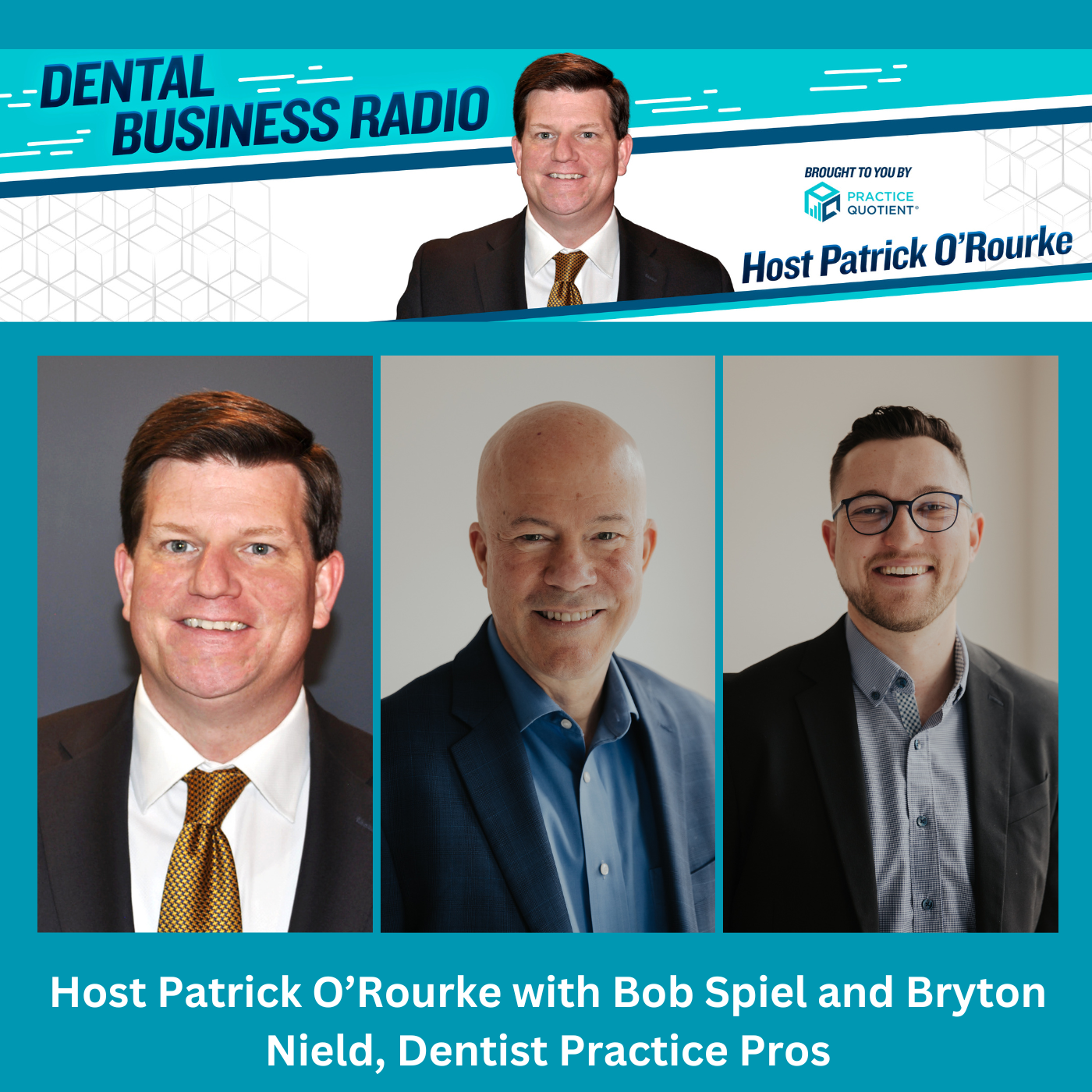
Hiring and Retention of Associate Dentists, with Bob Spiel and Bryton Nield, Dentist Partner Pros, on Dental Business Radio with host Patrick O'Rourke
Dental Business Radio
Hiring and Retention of Associate Dentists, with Bob Spiel and Bryton Nield, Dentist Partner Pros
Loading
00:00 /
RSS Feed
Share
Link
Embed

Download file

Hiring and Retention of Associate Dentists, with Bob Spiel and Bryton Nield, Dentist Partner Pros, on Dental Business Radio with host Patrick O'Rourke

Hiring and Retention of Associate Dentists, with Bob Spiel and Bryton Nield, Dentist Partner Pros (Dental Business Radio, Episode 54)

In this edition of Dental Business Radio, host Patrick O’Rourke discusses the high turnover rates of new associate dentists in dental practices with guests Bob Spiel and Bryton Nield from Dentist Partner Pros. Sponsored by Practice Quotient, the episode delves into the key challenges faced by dental practices, particularly the high 75% failure rate of new associates within the first year, and how Dentist Partner Pros have developed a systematic approach to increase the success rate to 85%. The conversation covers detailed hiring strategies, including creating an ideal candidate profile, extensive vetting processes, and ensuring a good cultural fit within the practice. The panel emphasizes the importance of investing time and resources in hiring the right people to improve overall business success. They also highlight the competitive nature of the current job market for dental associates and provide practical tips for both practice owners and potential associates.

Dental Business Radio is underwritten and presented by Practice Quotient: PPO Negotiations & Analysis and produced by John Ray and the North Fulton affiliate of Business RadioX®.

Dentist Partner Pros

Dentist Partner Pros is dedicated to empowering dental practice owners to reclaim their time and enhance their professional lives. Founded on the principle that dentists should not sacrifice their personal well-being for business success, the company specializes in addressing the common challenges faced by dental practices. By implementing innovative solutions such as their Associate Hiring System, Dentist Partner Pros has transformed the hiring process, achieving an impressive 85% success rate in associateships and saving clients approximately 150 hours per placement. Their comprehensive approach includes improving patient care, increasing revenue, and fostering self-sufficient teams, ultimately allowing dentists to focus on what they love while building a thriving practice.

Website | LinkedIn | Instagram | Facebook

Bob Spiel

Bob Spiel

Bob Spiel’s passion is building high-performance teams who deliver exceptional service while doing more, in less time with less stress. His firms, Spiel Consulting and Dentist Partner Pros, transform general and specialty dental practices by building leaders at all levels – with a special focus on building leaders among owners and associate dentists.

Bob had over twenty-five years of business experience before getting into dentistry including being a hospital and surgical center CEO, as well as an operations director for two mid-cap firms. This taught Bob to see each need in a dental practice with a “systems orientation.” Using this approach over the past 10 years, his firms have achieved a remarkable 85% success rate in searching for, hiring, and retaining associate dentists compared to the dismal 75% failure rate the dental industry has as a track record. He sees this as the number one threat to the continuation of private practice dentistry and aims to change that.

He is a faculty member for Dr. Gordon Christensen where he teaches a breakthrough course on leadership each fall called Igniting the Leader in You, as well as the author of: Flip Your Focus – Igniting People, Profits and Performance through Upside-down Leadership. 

LinkedIn

Bryton Nield

Bryton Nield

Bryton Nield is co-founder and CEO of Dentist Partner Pros, the industry-leading associate doctor and hygienist recruiting firm. Since forming Dentist Partner Pros three years ago with dental consulting veteran Bob Spiel, Bryton has been featured on some of your favorite dental podcasts, discussing building high-performing teams and partnerships, as well as strategies for ending the industry’s 75% associate hiring failure rate. Dentist Partner Pros’ innovative hiring and onboarding systems are changing the way dental practices hire, onboard, lead, and build their dream teams. Bryton is passionate about helping dentists build more successful and less stressful private practices.

Over the past seven years, Bryton has been instrumental in building two startups into thriving 7-figure businesses. His mission is now focused on transforming the dental industry’s approach to hiring, onboarding, leadership, and team development.

LinkedIn

Topics Discussed in this Episode

00:00 Introduction to Dental Business Radio
01:21 Meet the Guests: Bob Spiel and Bryton Nield
03:09 The Unique Challenges in Dentistry
03:44 High Turnover Rates in Dental Practices
07:14 Improving Retention Rates of Associate Dentists
11:47 Steps to Successfully Hire an Associate
14:42 Creating the Ideal Candidate Avatar
16:54 Recruiting Strategies and Market Realities
19:39 Advice for Dental Candidates
21:39 The Appeal of Big Cities vs. Small Towns
22:36 Strategies for Finding the Right Candidate
23:23 Benchmarking Candidates Against the Ideal Avatar
25:18 Creating a Competitive Offer
30:51 The Importance of Team Involvement
37:21 The Paradigm Shift in Hiring
39:14 Conclusion and Contact Information

About Dental Business Radio
Patrick O'Rourke
Patrick O’Rourke, Host of “Dental Business Radio”

Dental Business Radio covers the business side of dentistry. Host Patrick O’Rourke and his guests cover industry trends, insights, success stories, and more in this wide-ranging show. The show’s guests include successful doctors across the spectrum of dental practice providers, as well as trusted advisors and noted industry participants. Dental Business Radio is underwritten and presented by Practice Quotient and produced by the North Fulton studio of Business RadioX®. The show can be found on all the major podcast apps and a complete show archive is here.

Practice Quotient

Practice Quotient is the sponsor of Dental Business Radio. Practice Quotient, Inc. serves as a bridge between the payor and provider communities. Their clients include general dentist and dental specialty practices across the nation of all sizes, from completely fee-for-service-only to active network participation with every dental plan possible. They work with independent practices, emerging multi-practice entities, and various large ownership entities in the dental space. Their PPO negotiations and analysis projects evaluate the merits of the various in-network participation contract options specific to your Practice’s patient acquisition strategy. There is no one-size-fits-all solution.

Connect with Practice Quotient

Website | LinkedIn | Facebook | X (Twitter)
Tagged With: associate dentists, Bob Spiel, Bryton Nield, Dental Business Radio, Dentist Partner Pros, hiring, Patrick O'Rourke, PPO Negotiations & Analysis, Practice Quotient, retention

Episode 106: How Culture Drives Financial Performance

May 11, 2023 by Karen

Phoenix Business Radio
Episode 106: How Culture Drives Financial Performance
Loading
00:00 /
RSS Feed
Share
Link
Embed

Download file

Episode-106-How-Culture-Drives-Financial-Performance

Episode 106: How Culture Drives Financial Performance

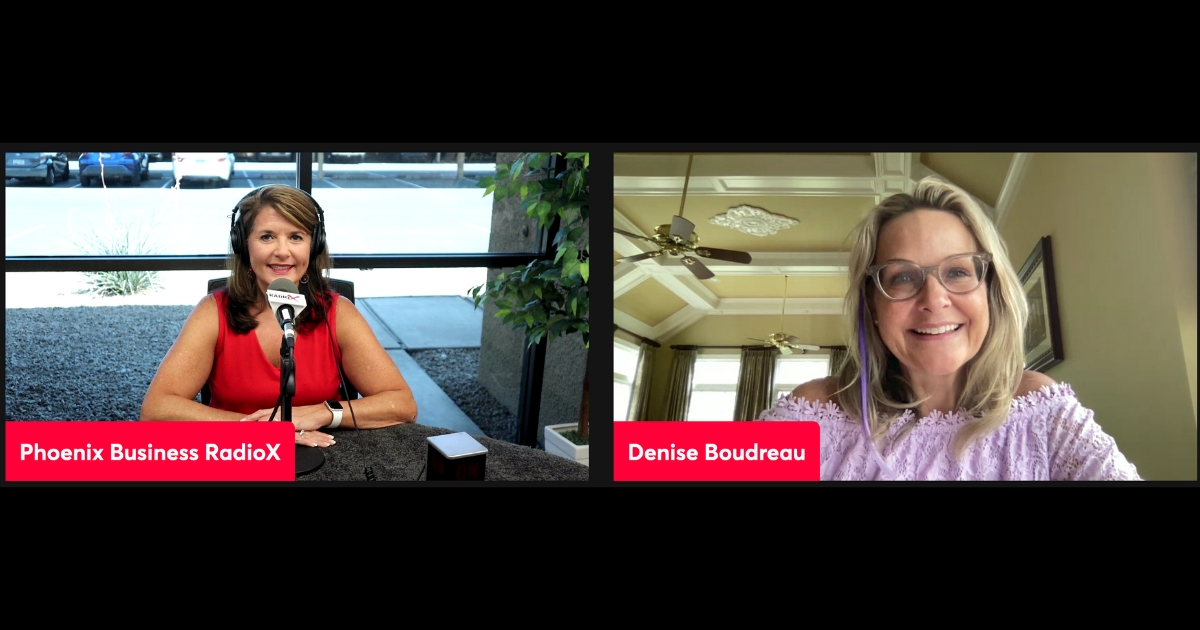
Join host Jennifer Drago as she interviews Denise Boudreau, president of Drive, and learn how organizations can measure and improve their culture to improve recruitment and retention of team members. Even more importantly, Denise shares the drivers of culture and what simple daily actions can have a dramatic impact on your organization’s culture.

Leaders in any industry will be intrigued by Denise’s takeaways on the importance of focusing on your organizational culture and how culture drives your organization’s performance on key metrics including employee engagement, client satisfaction, safety, productivity, and profitability.

Drive-logo

Drive helps senior living and healthcare organizations improve recruitment and retention through organizational culture. Drive will help you improve recruitment, staff retention, and employee engagement with a rock-solid company culture that staff love!

A toxic work culture rots organizations from the inside out… Every year, countless organizations lose millions of dollars due to bad culture. But it gets worse: poor culture also repels top-tier talent, kills workplace productivity and taints customer experience.

Our services: • Create a better work culture through our Culture Assessment. It takes a data-driven, strategic approach to transforming your culture into one that attracts happy, productive staff. And keeps them there. • Develop fundamental leadership skills that keep your staff engaged and you at your best as a leader through on-demand courses, Executive Coaching and Emotional Intelligence Coaching. • Inspire through presentations, speeches and keynotes at your meeting or conference that influence, motivate and connect deeply with your audience.

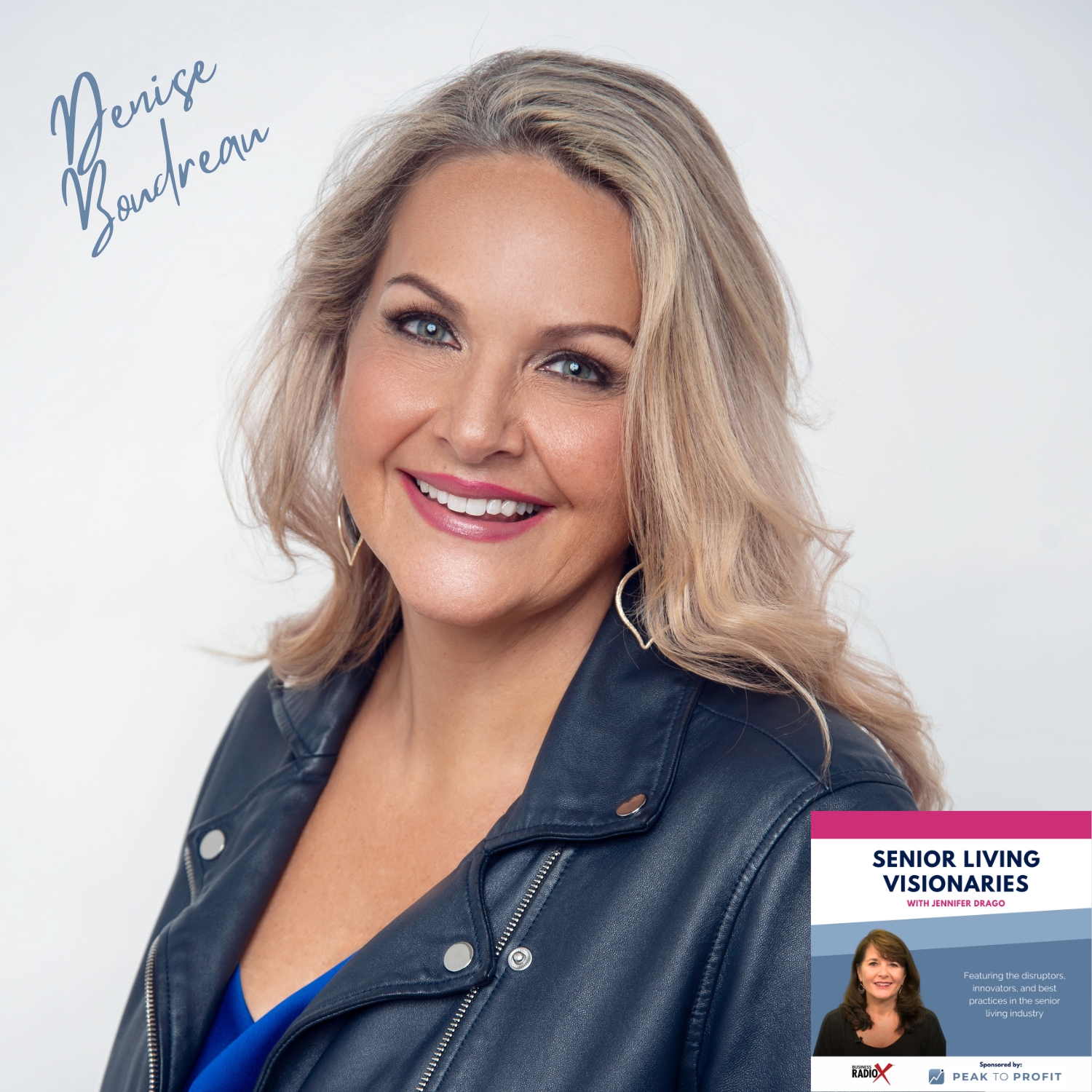
Denise-Boudreau-ScottDenise Boudreau, MHA, LNHA, is President of Drive, which helps healthcare and senior living organizations measure and improve their culture, resulting in improved recruitment and retention.

A former nursing home and assisted living administrator, she is a serial volunteer serving on numerous state and national boards. Denise received her Bachelor of Science in Gerontology from the University of Scranton and her Master in Health Administration from Cornell University where she currently works as a student mentor.

She is proud to share that she started off her career as a dietary aide and nursing assistant.

Follow Drive on LinkedIn and Facebook.

TRANSCRIPT

Intro: [00:00:05] Welcome to Senior Living Visionaries, a podcast for senior living leaders who are looking to stay ahead of the curve in the industry. On this show, we feature leaders and innovators in senior living who are pushing the boundaries and creating new effective services and solutions. And now, let’s settle in as host Jennifer Drago connects us with today’s guests.

Jennifer Drago: [00:00:30] Well, hello and welcome to Senior Living Visionaries broadcasting live from the Phoenix Business RadioX studio right here in Phoenix, Arizona. And we showcase the leaders in innovative, my goodness, innovators in the field who are shaping the future of senior living. And today is no exception.

I’m your host, Jennifer Drago, fresh off vacation. And apparently, I haven’t let my mouth know that it’s time to come back from vacation. I’m a strategy consultant and CEO of Peak To Profit Consulting, where we help senior living organizations with their strategic and business planning.

And today’s guest is Denise Boudreau. I’m so happy to welcome her here. She is the president of Drive. And Drive is an organization that helps health care and senior living organizations measure and improve their culture, resulting in improved recruitment and retention.

Denise is a former nursing home and assisted living administrator, as well as a volunteer serving on numerous state and national boards. She received her Bachelor’s in Gerontology from the University of Scranton and her Master’s in Health Administration from Cornell University, where she currently works as a student mentor. Important work. She is proud to share that she started off her career as a dietary aide and nursing assistant. So culture from the ground up, it sounds like. And I’m so excited to welcome you here. Welcome, Denise.

Denise Boudreau: [00:01:56] Thanks so much. I’m excited to be here.

Jennifer Drago: [00:01:58] Yeah. And tell us a little bit more about your organization and what you do.

Denise Boudreau: [00:02:02] Yeah. So we help take what is really this sort of, I call it woo woo, or this esoteric topic of culture and really bring data to it. So oftentimes people will say, I have a great culture, or my culture is not so good, it needs some help. And if you ask, how do you know that? People often say, I can feel it in my gut, or I just know it in my bones.

You think about how important culture is. It drives occupancy and turnover and revenue. Literally, every single outcome in an organization. And we’re using our gut to figure out if it’s working or not working. You’d never roll into owner’s meeting or a board meeting and say, we had a great financial quarter. I could feel it in my gut. I didn’t look at any numbers. I didn’t look at any data. I just know it. Right.

Jennifer Drago: [00:02:57] It feels great.

Denise Boudreau: [00:02:57] That would not fly.

Jennifer Drago: [00:02:59] That’s important. That’s important. So I love the idea that we can measure culture and we’re going to talk about that a little bit more, but explain your definition of culture as it pertains to senior living. And I know it’s really important from the recruitment and retention of employees, but I imagine it also affects our residents the way that we’re viewed in the community. So tell me more about how you define culture.

Denise Boudreau: [00:03:24] Yeah. So culture from the staff side is how we work around here. And from the resident side, it would be how we live. And there’s culture everywhere in your life. There’s a culture at your college that you went to. There’s a culture at the place of worship you might go to. In your neighborhood, right, there’s culture and micro cultures everywhere.

And the workplace or living place or a place where people are getting services is no different. And it’s basically just the attitudes, behaviors or the customs that are shaping the decisions. I was not in Tahiti and my mouth is still on vacation, but it shapes the decisions of everybody. So the people working in the organization and the people living there, how we interact with each other, what we do or don’t do is all being shaped by the culture.

Jennifer Drago: [00:04:25] Okay, perfect. That is a great definition. So knowing that senior living providers right now are experiencing significant staffing shortages, it seems like the perfect time to work on culture. However, when you’re short staffed, sometimes it’s hard to devote time to important things because you’re so strapped for time, right? So what would you say to a senior living CEO that says, I don’t have time to work on culture?

Denise Boudreau: [00:04:52] Yeah. You’re working on culture, so you’re working on it, you’re filling open positions, you’re dealing with customers. Maybe it’s residents, families, whatever, clients, whatever you call the people that you are serving and supporting and caring for. You’re dealing with their complaints. You’re probably dealing with financial issues because you’re spending so much money on turnover or an agency or maybe lack of occupancy because of the experience people are having there.

So you’re spending time on it. It’s whether it’s intentional or not. You can’t not have a culture. There’s a culture in your organization and you are intentionally shaping it or somebody else is shaping it. And that might be it’s in good hands and lots of times it’s not in good hands.

And people are creating cultures where it’s harder to recruit because people see what’s happening there and don’t want to be part of it. People might come to work for you and leave very quickly. I hear a lot of that lately, more so than ever. Or people might say this is not the place for me, I don’t want to work here. That’s all culture at work. So you intentionally shape it or you respond to the fact that you’re not intentionally shaping it.

Jennifer Drago: [00:06:07] So it’s always the right time to work on culture, it sounds like.

Denise Boudreau: [00:06:12] Yeah, Yeah. It’s like what’s the best time to plant a tree, right? That saying. Yesterday, last week, or if not today, right. You can start. People sometimes think about culture, and it feels like just so overwhelming. It’s boiling the ocean kind of. And it doesn’t have to be this huge and it shouldn’t be this huge pendulum shift. It can be small intentional changes, or it may be things that you’re doing that you just need to do a little bit more of each day.

And those behaviors are adding up to your overall culture. Culture is not that huge once a year party or if people say, we have a great culture, we raffle a car off to staff. That’s not culture, right? It’s not foosball table in the break room. It’s these small little behaviors that people are noticing and modeling themselves after that are adding up to the culture.

Jennifer Drago: [00:07:08] I’m glad you said that, because I do believe that for many executives and again, executives in a senior living organization or in health care, I know you work in health care, too. Those are really hard jobs and lots of things flying at you, especially when you’re trying to deal with a customer culture. And I shouldn’t have used your word. You’re trying to deal with your customers and their satisfaction, your employees and their satisfaction, regulatory issues. I mean, just they pile on.

And so, it can truly seem overwhelming when you say, oh my gosh, I want our culture to be better. Where do I start? So if you were to — you mentioned small behaviors or small actions can have a big impact. If you were to give our audience today just one takeaway, of one thing, they could do differently that could have a really positive impact on their culture, what would you say that might be?

Denise Boudreau: [00:08:02] Yeah. So when we measure culture, the number one value we’ve seen from our research and the number one value or behavior that we’ve seen from our research that makes a difference, starting foundational is respect. And so no organization could go wrong by focusing more on that value or behavior of respect. After that, it’s employee recognition. After that, it’s accountability. After that, it’s coaching and mentoring. But those things all build on a value of respect.

Employee recognition. A lot of times people focus on that and it’s fabulous. Usually organizations, you can’t give too much thanks or praise. But if you don’t feel respect, it’s like, Jennifer, you don’t think I respected you, and then I come over and tell you how fabulous you are, it seems pretty fake and it doesn’t really feel genuine. Right. And it doesn’t really mean much to you.

And respect, as that foundation, will always serve you and your organization. And we measure culture for a reason so we can see specifically what is needed in each organization and even each site. If you’re in a multisite organization, you know this. Every site has its own little microculture and even every department kind of has it and even shifts have it.

But overall, when we take all of our data and put it together, what we know is that respect is that number one thing. And so if I were you or your listeners, I would be thinking, well, what does that mean? I’m so glad you kind of asked. Right? It means that we, when we ask staff this, what does respect mean to you? It means to people knowing my name, saying hello to me, asking how I am.

Jennifer Drago: [00:09:51] That’s pretty simple.

Denise Boudreau: [00:09:53] Yeah. Like the bar is down here. They’re asking for, say hello, ask me how I’m doing. Show me that I actually matter to you is what people are asking for.

Jennifer Drago: [00:10:04] Wow. Wow. Really achievable. Really doable. That’s great. Yeah. And you’re right, it’s foundational that I was thinking about places where I’ve received recognition, but sometimes that day to day respect isn’t there. And you’re absolutely right, it feels disingenuous. Oh, okay, yeah, I get it. You’re checking a box now, but yeah, but you dismissed me yesterday when I was trying to tell you about a challenge that I’m having in my department. Yeah.

Denise Boudreau: [00:10:33] Exactly. And then the coaching and mentoring people create these incredible programs. Is coaching and mentoring bad? No, absolutely not, but people spend so much time creating these careers like all this other stuff. And if you don’t feel respected again and I come to you and say, hey, Jennifer, you know what, I think you’d be great in this role. You’d be like, oh, now you’re trying to push me out of my job, right?

As opposed to, we have a strong relationship and you’re going to know that I’ve got your back and support you and want you to be the best that you can absolutely be. That’s a very different answer if you want to be part of this program or whatever career ladder that we’ve created.

Jennifer Drago: [00:11:08] Sure, Sure. So I had a question set aside for you about what are the drivers of company culture? Are those the same things we just talked about and are they all truly individual in terms of how we individually treat each employee or? Yeah, tell me more.

Denise Boudreau: [00:11:26] Yeah, yeah, yeah. Great question. You can see I get excited about this. So people come with their personal values in them, what’s important to them. When they can show up true and authentically themselves, they do better, and your organization does better.

What does that mean? Humor and fun. Super important to me, right? So I want to be able to kind of have fun at work and joke around with people. Right? Do I have to be the class clown and get no work done? Nope. But it’s going to be important to me that that part of my personality can come out.

I’m creative, right? I want to bring that to work. Does that mean if I’m the CFO that I get to use creativity all the time in my job? Hopefully not, but maybe there’s something I could be doing outside of my normal role that might bring out that creative. Maybe it’s just some interactions with residents. Or maybe I want to do something for staff that helps be part of a committee that helps bring out that creative side. So certainly, everybody is wired. So knowing what’s important to people personally, credibly important.

Organization also has a culture which is shaped by values. So there’s what’s happening day to day. And I always like to think about it sort of the what’s happening at 3:00 in the morning when a nursing assistant is walking into a resident’s apartment or a resident’s room, when people are interacting with each other and there’s no supervisor or boss “around”. Right.

That’s what culture is. And so are those values and behaviors that are being lived, things that are supporting what we want for outcomes or the things that are working against us, blame and bullying and gossip. And sometimes those things show up when we measure culture. Lots of times we see blame and bullying on the list of current culture values.

People also tell us what they want, which is I always consider the magic question what they want out of their culture. And I love looking at that list. You know what the number one value that people want? And the question, by the way, is if we were performing at our best as an organization, what are the values that you’d want to see and people pick from this list, they pick ten things. You know, the number one answer is on that desired culture?

Jennifer Drago: [00:13:41] What is it?

Denise Boudreau: [00:13:42] Accountability. And I see it. All these reports we get back and every time it’s still amazes me though. Accountability. So when we think that people don’t want structure and that people kind of just want to do whatever they want to do, that is not true. People, when they think about the best organization, they think about a high accountable organization.

And that doesn’t mean, okay, go fire everybody now and go write everybody up. It means personal accountability. How can I own my job? How can I help you as my coworker be more accountable, and you help me because we’ve got each other’s backs. We’re not blaming and bullying. We’re helping each other be the best we can possibly be.

And because of that all, all of that support, that accountability, our organization is being the best that can possibly be. So there’s lots of sort of factors that come into culture, but there are themes that we see across the board for organizations in senior living and aging services and health care.

Jennifer Drago: [00:14:43] Yes. I love that you shared with us kind of the number one value that organizations aspire to be in your survey, or aspire to have, and that is accountability, because I talk a lot about accountability in some of the work that I do, too. When an employee works in an organization or a department where accountability isn’t important or isn’t enforced, and they’re working really hard to do their job and the person next to them isn’t, that is so demoralizing. And so it does not inspire people to want to stay and to continue to do a good job.

And that’s just one aspect of it, right? We need accountable leaders who walk the talk and do what we ask them to do to help clear, sometimes a leader’s job is clearing the obstacles out of the way. Right. And helping me manage this challenge that I’m dealing with. And if they don’t, if our leaders don’t follow through, same thing, just really challenging from an employee standpoint. So I love that theme. I think it’s so important.

Denise Boudreau: [00:15:51] And it goes back to the not having time piece. Right. So would you ever say our occupancy is at 50 percent? We just really don’t have time to talk to people to help them move in here. Right. That’s just, you know, oh, yeah, we’re 50 percent over budget this month. Yeah, we just don’t really have a time to look at those numbers and make sure we’re in budget.

But somehow culture, which both drives occupancy and revenue and expense, all of it, we get to say we don’t have time. So the organizations that we see do the best with culture are those organizations that have high accountability, where the leader has said the CEO or the owner, whomever has said, my expectation is that we — we actually ask people to commit 10 minutes a day. That’s literally it, 10 minutes a day. My expectation is that you are going to do these 10-minute a day tasks or assignment.

And sometimes they take no extra time. So when you’re walking around and talking to people, asking a certain question or whatever it might be, they take no extra time because you’re walking around anyway and talking to people, hopefully. But that accountability, to your point for leaders as well, to culture and what they find in the end is, my gosh, my life’s better as a leader because of this. I’m less putting out fires and more doing the work I’ve always wanted to do.

Jennifer Drago: [00:17:09] Right, Right.

Denise Boudreau: [00:17:10] So it’s a win-win overall, but it’s hard for people to see that, especially in the beginning. But it was true for me when I was an administrator, when I focused on culture, I lived this stuff. When I focused on culture, my job became so much more rewarding because I was doing what I got into the field to do which was support people and not running around like a chicken with my head cut off all the time.

And even though, my last role as an administrator was 12 years ago, so people said it was different. It was different, but turnover was still over 100 percent in that setting. We we didn’t lose a nursing assistant voluntarily in almost three years.

Jennifer Drago: [00:17:50] Wow.

Denise Boudreau: [00:17:51] Can you imagine?

Jennifer Drago: [00:17:52] Wow. That’s amazing.

Denise Boudreau: [00:17:54] Voluntarily for almost three years. And then therefore, you’re able to do so many things that you want to work on rather than that just kind of chugging along on the hamster wheel.

Jennifer Drago: [00:18:06] Right. If nothing else, right, retention is a time suck and a money suck. Right? We know that. So if we can improve retention alone, it’s worth the 10 minutes a day to focus on culture, right?

Denise Boudreau: [00:18:19] Yes, it is.

Jennifer Drago: [00:18:20] Yeah. I love that you’re breaking down for us how simple it can be to really improve our culture. And you’ve already shared with us that your company helps organizations measure their culture. Is that — I’m sure we’ve all been — I’ve never been in an organization that has tried to measure culture. So I want to learn more about that. But tell me how that is different also from measuring employee satisfaction.

Denise Boudreau: [00:18:47] Yeah, yeah, that’s a great question. So culture is driving satisfaction and driving, even employee engagement. So a lot of places are measuring employee engagement. Employee engagement is how we feel about how things work around here. Culture is actually how we work around here, or even we do it sometimes with residents to how we live, right?

And so it’s not just my boss seems to care about me as a person. No, they don’t seem to care about me as a person. There’s job insecurity here. There’s confusion. There’s blame. And now we have an insight into why I don’t think my supervisor seems to care about me as a person. So it’s driving employee engagement. It’s driving all those outcomes.

And like you, I had not heard about measuring culture. I guess it was probably, I don’t know, six, seven years ago now. You mentioned I do a lot of work with Cornell, and I was up there presenting and someone was presenting before me on measuring culture. And I thought, I’ve never heard of this. Like I want to attend this. And she works with high end hotels. Actually, she works with us now, but she works with high end hotels, Ritz, Four Seasons, so forth. And when they were struggling with occupancy at the hotels, the first thing she would do is measure the culture of the staff.

And so I thought, I have got to bring this to our field. And interestingly, three questions. What are your top ten personal values? And I shared a little bit about that. When you show up authentically, you at work, you do better, organization does better.

Thing that’s really neat about this, too, though, are people are changing their job ads. We have a woman that increased her — she’s a director of HR. She increased her applicant pool by over 1,200 percent. I did the math like ten different times, 1,200 percent.

Jennifer Drago: [00:20:30] Wow.

Denise Boudreau: [00:20:30] By taking her Indeed ad and writing it to how people were wired in her organization. So she looked at those personal values and wrote an ad to them and spoke. So people are reading this ad and saying, that’s me, I belong working there.

Jennifer Drago: [00:20:47] What a great idea. What a great strategy.

Denise Boudreau: [00:20:50] Ain’t that cool? I know. And I said like the perfect thing to kind of think about with that is I love everybody in our field, but sometimes I read these ads and I just want to cry because you can take one name out and put another organization’s name in and it’s the same ad.

But if you are selling a Ferrari and you’re selling a minivan, you could in essence, say they’re both vehicles, right? They’re both getting you from point A to point B, but a Ferrari ad is written very different from a minivan ad, and neither one is right or wrong. You’re just going after a different audience. And so it’s the same thing with our job ads, right? Are we writing in a way so if I read an ad that was kind of fun and I’d be like, oh, that’s the place for me, right, they get me.

And so there are things that are the same in every organization compassion and caring to the things we see in almost all the personal values in the organizations where we measure culture. But then there are a lot of things that are different. So humor and fun sometimes shows up. Positivity sometimes shows up. Person values, sometimes it doesn’t. So that’s the first question. What are the top ten personal values?

The second question are what are the top ten values or behaviors that you see in this organization? So what are you seeing today that’s the current culture? And then a list of words. And then, as I said before, the magic question, and I’ve done engagement surveys, I did engagement surveys for years. I usually sat on a shelf, but that’s because I didn’t ever had a destination.

And the destination is that desired culture question. If our organization was performing at its best, what are the top ten values or behaviors you would want to see? And now I’ve not only had everyone, because when we just measure engagement sometimes or do these surveys or whatever it might be, it’s kind of like people vomit on us, everything that we’ve done wrong or everything we’re doing now. And we have to guess what they want.

And so there’s no more guessing. There’s a destination which makes a difference because then we can create a roadmap. When you don’t have a destination, you ain’t getting anywhere, right? You’re going to be where you’re at and guessing where you should go. So those are the three questions, personal values, current culture values, and desired culture values.

Jennifer Drago: [00:22:54] And once you do desire culture and you know where you’re headed, and I’m sure you then work with the organization on, okay, what does this look like? What do we do to get there? Do you go back and measure a year later to say, are we better?

Denise Boudreau: [00:23:07] Yes, yes, yes, yes. Because you want to know the things you were doing are making a difference. And actually, the cool thing about this tool, too, is recently, a few years ago, they added a diversity, equity, and inclusion values in there. They’re just mixed in with all the other words.

You can see sometimes organizations unconscious bias shows up. Sometimes retaliation shows up. So you can get a measure on those diversity, equity, inclusion initiatives that so many organizations are working on right now. So we go back a year later and you’re able to see, okay, we brought down the confusion, we brought up the accountability. Right? So we know we’re going on the right track. And then we see what that current priority is.

The nice thing about this tool, too, is once again, culture feels like this boiling of the ocean. But when you have that data, you can clearly look at it and it becomes so apparent the three or four top things that you need to work on. So you could pick one of those from that.

So if we’re going to focus on accountability first, or maybe we’re going to focus on our leadership development around certain topics, it becomes very clear what we can focus on instead of taking on a lot of things and getting nothing done. And we see by measuring it a year later, are we making a difference? Are we moving a needle?

And the organizations that are actually committing to do this work, they are moving the needle. They’re saying, I’m better off committing a few minutes a day to something positive. And that’s usually fun and interesting and feels good than I am to just constantly putting out fires and being in this sort of rat race that people find themselves tied into.

Jennifer Drago: [00:24:47] Perfect. My final question for you is, and we’ve talked about it in kind of abstract terms so we know that culture drives retention, our ability to recruit and retain, I should say, it can drive occupancy, our resident satisfaction, our staff engagement, all the things we’ve talked about. I feel in my gut that culture increases financial performance of an organization. But is there any research that bears that out that shows that that’s true?

Denise Boudreau: [00:25:16] Yeah. So we actually have a white paper on our website that, this is fascinating, it is a multi site organization and we measured their culture at all their different sites. And the occupancy, the VP of Sales and Marketing was in the room when we were giving them the results, and we would say this site’s got a really strong culture. And she said, oh, they’re always full too. And these guys are kind of struggling a little bit more. Yeah, they struggle with their occupancy and census too.

And then sort of as we went along, it was like, wait a minute. And so we gave it to a researcher who looked at it. And what we found was this is the same organization. So when you think about intentionality around culture, this is why it’s so important that everyone’s not just doing their own thing, that we’re being intentional about it.
The occupancy in the struggling sites was 66 percent on average. The occupancy at the thriving cultures at those sites, the average was 94 percent.

Jennifer Drago: [00:26:15] Wow. Wow.

Denise Boudreau: [00:26:16] 66 and 94 percent. We know turnover, right, so labor is our biggest cost. We know turnover is 38 percent lower, strong cultures compared to weak cultures, 38 percent lower turnover. And I always tell people, if you have 38 percent lower turnover, guess what you get? You get 38 percent less positions to fill, too, right? So now you’ve improved your recruitment by 38 percent.

And that’s got real numbers to it. It’s certainly filling those open positions. I find there’s a huge cost. And sometimes people don’t think about this. Leaders running around to fill those open positions. Leaders that you’re paying a lot of money to doing jobs of people that make a very different salary. And is it great to pop in once in a while and help and assist? Absolutely. But to be paying somebody the salary that they should be making and not focusing on what they should be doing, right, is a complete waste of money. So it’s money out the window in so many different ways.

Productivity, we’ve tied through research the amount of, I call it energy in the organization, the limiting values and behaviors in the organization, whatever that percentage of limiting behavior. And the organization, whatever that percentage is, that has also been researched and studied to show that that is also the amount of unproductive time in an organization.

So if we have 20 percent limiting values in an organization, we have 20 percent unproductive time. Do you know what that means? That means if your labor budget is $10 million, 20 percent of that $2 million is unproductive time and add to it the turnover cost, right? That’s totally separate. And that’s because there’s confusion. I don’t know what I’m doing. And so I’m redoing work or I’m making mistakes or I’m not talking to you because I know you blame me for stuff. So I don’t tell you something that I should tell you that might help have a better outcome for someone, right? So it’s a lot of time wasted when we don’t have strong, thriving cultures.

Jennifer Drago: [00:28:15] And that accountability is missing too.

Denise Boudreau: [00:28:19] Which all adds up to dollars at the end. So you take occupancy, you take turnover, you take the ability to recruit. Even safety is related to this. Literally, every single outcome revenue has been for years, decades, they’ve shown revenue tied directly to culture. And all of these outcomes depending on am I being intentional or am I saying I don’t have time for that, right, I don’t have the time to invest in that.

Jennifer Drago: [00:28:44] So I’m a strategist. I’ve been chief strategy officer of organizations and in the strategy world for years. And there’s this saying out there that culture eats strategy for breakfast. And I believe it, but tell me how you think a good culture helps your strategy.

Denise Boudreau: [00:29:00] I think culture and strategy can sit down and have breakfast together.

Jennifer Drago: [00:29:04] Oh, that’s a nice way to say it. I’m going to start quoting you.

Denise Boudreau: [00:29:08] Don’t quote me. I read it in a book. But yes, right. But I read that and I was like, it’s so true because people kind of go back and forth, right, which is one important, more important. But if you look at your strategic plan, there is nothing on there. I can absolutely 100 percent guarantee it, there’s nothing on there that does not take a strong culture to accomplish. There’s nothing on there that won’t happen easier, faster, with less mistakes, with better outcomes, with a strong culture. Right.

Everything takes culture in order to happen. Whatever is on that plan, whether we’re opening up a new campus, we’re doing a new service line, whatever it takes culture to accomplish that, or it’s going to be culture that could kind of puts the nail in the coffin. We know from lots of research that acquisitions and mergers with so many places are going through right now, you probably see a lot of that in your work, the number one reason they don’t work, culture.

Jennifer Drago: [00:30:07] Culture. Yes. I was just —

Denise Boudreau: [00:30:08] And so we have a pool that compares them but people guess at it.

Jennifer Drago: [00:30:13] Yeah. They use their gut when they can actually measure it. So yes.

Denise Boudreau: [00:30:17] Yeah, yeah. We’ve got a really cool tool that actually shows you here’s where the cultures will match, here is going to be the problems, the red flags, so you can get ahead of it.

Jennifer Drago: [00:30:26] Yeah. So awesome. Yeah. I just came back from Leading Edge California. And we did a session on sustainability where folks were talking about affiliations, mergers, different things that they had gone through, and that came up again and again as the cultures have to match or they have to be at least close so that the organizations are compatible. So something else I didn’t know that you do that your organization does is help organizations that are considering that to figure out where they’re a match or whether they’re a match, perhaps. Is that correct?

Denise Boudreau: [00:30:58] Yeah. Yeah. And on either end, right, it might be we’ve gone down that road already. Okay. But now you can intentionally say, you know what, that change we’re going to make is going to be a little bigger of a deal than we’re anticipating. Or, you know what, we can say we’re making that change and link it to something that the team members wanted.

And we kind of say this is in your desired culture and guess what? We’re doing this thing to help with that, right? So it can be done for the positive, too. It doesn’t just have to be kind of playing defense. I should not be making sports analogies. I am not a sports person. We can — yeah, yeah. We can kind of get ahead of it a little bit.

Jennifer Drago: [00:31:37] Perfect. Well, Denise, I want to thank you so much for all the wisdom that you shared with us today. I’ve learned so much. And tell our audience, if you would, how they can get in touch with you, how they can learn more about your organization.

Denise Boudreau: [00:31:50] Yeah, absolutely. Our website is cultureoutcomes.com. So it’s culture and then outcomes, O-U-T-C-O-M-E-S.com. And you can click on there to connect with us and learn more about what we do. You can also send an email to info@cultureoutcomes.com. We’d be happy to tell you about measuring culture or send you any of the resources, that white paper I mentioned is on there, and lots of other resources that you can connect with.

Jennifer Drago: [00:32:21] Perfect. And we’ll put all the links in the show notes so everyone can have access. And I know you’re on LinkedIn and very active and your company Drive also has a company page that you can follow, so that’s awesome. Well, thank you so much for your time today, Denise, and for sharing all the wisdom around culture and why we should really pay attention to it.

Denise Boudreau: [00:32:42] Fabulous. Thanks for having me.

Jennifer Drago: [00:32:43] You bet. You bet. So this has been another episode of Senior Living Visionaries, where we honor and feature the innovators and executives and advisors who are really shaping our industry for the better. I hope you’ll join us for future episodes.

And you can also subscribe to be on the list to receive information about new episodes as they become available at seniorlivingvisionaries.com or subscribe on your favorite podcast platform. Thanks so much. I’m Jennifer Drago and I’ll see you next time.

Outro: [00:33:19] You’ve been listening to the Senior Living Visionaries podcast and radio show where we showcase the leaders and innovators in the industry who are pushing the boundaries and setting the stage for the future in senior living and services. Join us next time as we share the bold ideas and breakthroughs of the industry’s most forward thinking leaders here on Senior Living Visionaries.


About The Show

Senior-Living-Visionaries-Podcast-Cover

Senior Living Visionaries is a podcast and radio show curated specifically for leaders in the senior living industry. Our guests are among the best and brightest executives, advisors, and service providers in senior living.

These industry leaders have consistently implemented creative solutions, new customer services, and targeted financial strategies resulting in long-term brand impact and increased revenues.

About Your Host

0217JenniferDrago00654squareWith 30 years of experience working with mission-driven organizations in senior living and healthcare, Jennifer Drago is an executive leader who brings creative, out-of-the-box strategies to help organizations amplify their impact and skyrocket their revenues.

As an award-winning strategist, best-selling author, and certified business coach, Jennifer helps corporate leaders and small business owners develop and implement a laser-focused business vision and strategy so they can earn more and amplify their impact.

Jennifer holds a bachelor’s degree in Finance, a master’s degree in Health Services Administration and an MBA from Arizona State University. She is a Life Fellow of the American College of Healthcare Executives.

About Peak to Profit

Peak to Profit serves senior living, healthcare and nonprofit organizations, helping them identify and execute revenue and growth opportunities through strategic, financial and operational consulting. Our core purpose is to help mission-driven organizations amplify their impact by serving more clients and increasing their financial resiliency.

Our proprietary Peak Performance Assessment provides an objective evaluation of your organization on six key dimensions, identifying areas that need improvement and highlighting growth opportunities. With the assessment results, we help you implement an Impact Roadmap – a clear, measurable action plan to execute your strategy.

Learn more at PeaktoProfit.com.

Peak-to-Profit-logo

Tagged With: Coaching, Culture, Employee Engagement, fully staffed, Healthcare, recruitment, retention, senior living

Workplace MVP LIVE from SHRM 2022: Louis Lessig, Brown & Connery, LLP

July 26, 2022 by John Ray

Brown & Connery
Minneapolis St. Paul Studio
Workplace MVP LIVE from SHRM 2022: Louis Lessig, Brown & Connery, LLP
Loading
00:00 /
RSS Feed
Share
Link
Embed

Download file


Brown & Connery

Workplace MVP LIVE from SHRM 2022: Louis Lessig, Brown & Connery, LLP

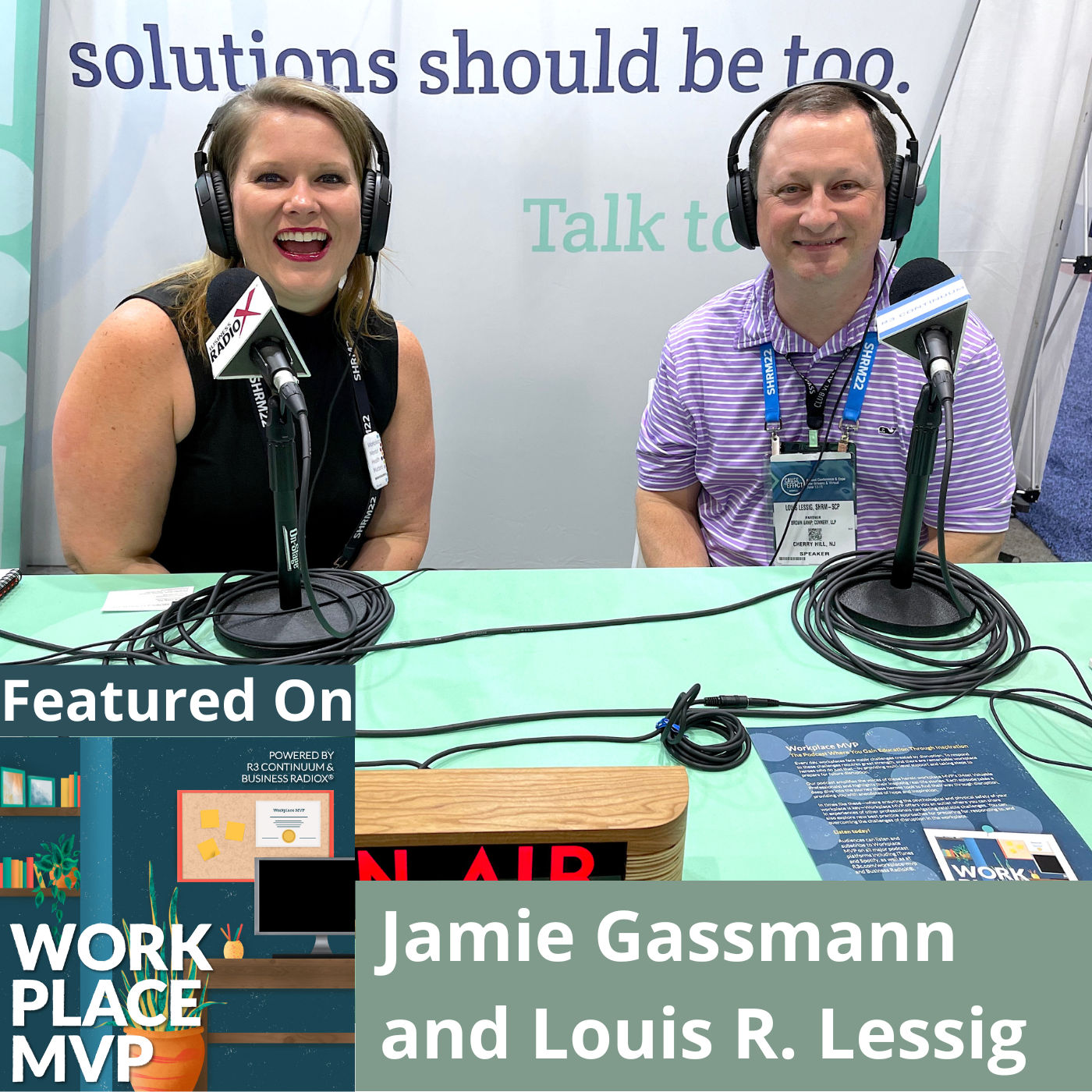
Louis Lessig, a partner with Brown & Connery, LLP, joined Jamie Gassmann on Workplace MVP LIVE from SHRM 2022. Louis is an employment attorney who got his start in HR. He and Jamie talked about his journey, his work, and hot topics in the HR space these days, including marijuana & ADA. He also shared highlights from his presentations on ADA and retention at SHRM and much more.

Workplace MVP is underwritten and presented by R3 Continuum and produced by the Minneapolis-St.Paul Studio of Business RadioX®.

This show was originally broadcast live from the 2022 SHRM Annual Conference held at the New Orleans Convention Center in New Orleans, Louisiana.

Louis Lessig, Partner, Brown & Connery, LLP

Louis Lessig, Partner, Brown & Connery, LLP

Louis Lessig is a partner with the firm of Brown & Connery, LLP.  His practice concentrates in labor and employment counseling, litigation, negotiations, and training.

Mr. Lessig represents clients in all types of employment matters, including but not limited to claims of discrimination, harassment, hostile work environment, wage and hour irregularities, and retaliation in state and federal courts as well as before administrative agencies including the Equal Employment Opportunity Commission, National Labor Relations Board, U.S. Department of Labor, American Arbitration Association, New Jersey Division on Civil Rights, New Jersey Office of Administrative Law, Pennsylvania Human Relations Commission, and Philadelphia Commission on Human Relations.

In 2018, he received the Delaware Valley HR Consultant of the Year Award. In 2016 he was an Honoree for the SmartCEO Centers of Influence Awards.  In 2015, he received the SmartCEO ESQ Industry Practice Award – recognizing the region’s most trusted advisors. Since 2012, Mr. Lessig has been selected each year as a “Super Lawyer” in Labor and Employment law.  In 2010, Mr. Lessig was selected by the New Jersey Law Journal as one of the “Top 40 Attorneys Under 40” in New Jersey.  Mr. Lessig was also selected in 2010 as a Delaware Valley Human Resources Consultant of the Year Nominee.  Mr. Lessig is a nationally recognized speaker and publishes articles that have appeared in periodicals including Westlaw Journal Employment, Westlaw Journal Computer and Internet, the Family and Medical Leave Handbook, Employment Litigation Reporter, Corporate Risk Spectrum, HR Professional, The Tri-State and Labor and Employment Law Quarterly.  He was an adjunct professor at the Comey Institute for Industrial Relations at St. Joseph’s University.  Mr. Lessig was also a principal in the Pinnacle Employment Law Institute (PELI), which conducted training sessions and provided developmental assistance in employment relations.

After graduating from law school, he served as judicial law clerk to the Honorable M. Allan Vogelson, Presiding Civil Judge of the Superior Court of New Jersey in Camden County.

In addition to his professional activities, Mr. Lessig currently serves on the Garden State Council – SHRM as the New Jersey State Director.  He is also immediate Past President of the Board for the National Speakers Association (NSA), Philadelphia chapter.  He is also a member of Tri-State HRMA where he is a Past President of the chapter and serves as Chair of the Legislative Committee. Mr. Lessig is past President of the Muhlenberg College Alumni Board.

Martindale-Hubbell “AV” Preeminent® Rating

LinkedIn 

Brown & Connery, LLP

Brown and Connery is one of South Jersey’s oldest and most well-regarded law firms.  In 1928, Horace G. Brown, a preeminent trial lawyer, and Thomas F. Connery, a distinguished litigator, founded the practice in Camden, New Jersey. The firm has continued to evolve to meet changing times, changing culture and changing client needs. Driven by the ideal of excellence, Brown and Connery is proud to have earned an “AV” rating by Martindale-Hubbell*, its highest rating.

We take our work and our client’s needs seriously, and have built a reputation for quality legal services grounded in our founder’s tradition of thoroughness, hard work and integrity. Our talented attorneys and support staff are committed to our high standards, which means those who turn to our firm can count on us to maintain the highest ethical and intellectual standards when representing their needs.

The firm practices all across New Jersey with offices conveniently located in Westmont, Woodbury and Camden. Our Philadelphia office supports our practice in Pennsylvania.

Brown and Connery provides a wide range of legal services to its clients. These services can be seen listed and more fully described on this website among our Key Practices.

Company website | LinkedIn | Facebook

About Workplace MVP

Every day, around the world, organizations of all sizes face disruptive events and situations. Within those workplaces are everyday heroes in human resources, risk management, security, business continuity, and the C-suite. They don’t call themselves heroes though. On the contrary, they simply show up every day, laboring for the well-being of employees in their care, readying the workplace for and planning responses to disruption. This show, Workplace MVP, confers on these heroes the designation they deserve, Workplace MVP (Most Valuable Professionals), and gives them the forum to tell their story. As you hear their experiences, you will learn first-hand, real-life approaches to readying the workplace, responses to crisis situations, and overcoming challenges of disruption. Visit our show archive here.

Workplace MVP Host Jamie Gassmann

Jamie Gassmann, Host, “Workplace MVP”

In addition to serving as the host to the Workplace MVP podcast, Jamie Gassmann is the Director of Marketing at R3 Continuum (R3c). Collectively, she has more than fourteen years of marketing experience. Across her tenure, she has experience working in and with various industries including banking, real estate, retail, crisis management, insurance, business continuity, and more. She holds a Bachelor of Science Degree in Mass Communications with special interest in Advertising and Public Relations and a Master of Business Administration from Paseka School of Business, Minnesota State University.

R3 Continuum

R3 Continuum is a global leader in workplace behavioral health and security solutions. R3c helps ensure the psychological and physical safety of organizations and their people in today’s ever-changing and often unpredictable world. Through their continuum of tailored solutions, including evaluations, crisis response, executive optimization, protective services, and more, they help organizations maintain and cultivate a workplace of wellbeing so that their people can thrive. Learn more about R3c at www.r3c.com.

Company website | LinkedIn | Facebook | Twitter

TRANSCRIPT

Intro: [00:00:02] Broadcasting live from SHRM 2022 at the New Orleans Convention Center, it’s time for Workplace MVP. Brought to you by R3 Continuum, a global leader in helping workplaces thrive during disruptive times. Now, here’s your host.

Jamie Gassmann: [00:00:19] Hey, everyone. You’re host, Jamie Gassmann here, and I’m coming to you from SHRM 2022 Exhibit Hall. And I’m in R3 Continuum, our sponsor’s booth. And joining me is Louis Lessig from Brown and Connery. Did I pronounce that all correctly?

Louis Lessig: [00:00:36] You absolutely did. Thank you.

Jamie Gassmann: [00:00:38] Awesome. Well, welcome to the show, Louis.

Louis Lessig: [00:00:40] I’m thrilled to be here. Thank you.

Jamie Gassmann: [00:00:41] Oh, we’re excited to have you on. I know we’ve been doing a lot of talking before getting on the actual microphone. So, give us a little background about your career journey into this space and coming into the kind of H.R. perspective. I know you’re not an H.R. person, but talk to me a little bit about how you got here.

Louis Lessig: [00:00:57] So, actually my undergrad is in H.R., and I was a student member of SHRM. We won’t say when, but when I got out –

Jamie Gassmann: [00:01:05] Ten years ago?

Louis Lessig: [00:01:05] Sure. Absolutely. But when I was in my major, I was doing an internship at a hospital and the generalist turned to me and said, “Do you want to do benefits your whole life?” I’m sure no one listening to this does benefits. I said, “Actually, I absolutely do not.” And he said, “Well, then you know what you should do? You should go to law school.” So that’s what I did.

Louis Lessig: [00:01:29] And then, while I was in law school, I gravitated towards the labor and employment kind of work, got out and started – I clerked for a judge and then went to one firm, spent 11 months there, and then went to the firm I’m with now, doing employment labor. Simultaneously, I was also doing a – I had a training company where we were doing harassment sort of stuff, all on the side. So, I was doing both till 9/11 and the training stuff went south and I’ve been doing the whole employment labor stuff since.

Jamie Gassmann: [00:02:01] Wow! And you’re in a great spot here, lots of H.R. leaders. So, what are some of the hot topics you’re seeing with your clients right now in the labor and employment law arena?

Louis Lessig: [00:02:12] Well, it depends on what state you’re in.

Jamie Gassmann: [00:02:14] Oh, okay.

Louis Lessig: [00:02:15] Because the whole medical versus recreational marijuana component is fascinating. The truth is, because of everything around COVID, there’s been a lot of the reasonable accommodation components around the ADA and, of course, how we deal with leave and the desire or shifting desires, if you will, in terms of the workforce and how much do they want to come back to the workplace, do they not want to come back to the workplace? How do we make that happen? Because the law is always trying to catch up. And so, it’s been a bit more of a challenge than one might think. And, of course, everybody dumps all the stuff at H.R.’s feet, which makes sure that the billable hours just keep on rolling.

Jamie Gassmann: [00:02:57] I bet. Yeah. And I got to imagine with a lot of this remote work, people working from home, that’s got to be a whole new kind of caveat with some of the different like Work Comp rules. Like, if I slip in my own kitchen, is that Work Comp because I was on the clock? I mean, like, I’m just so curious and fascinated about that. Like, what are you seeing from that perspective with some of the changes in the work environment that employers are facing?

Louis Lessig: [00:03:22] Well, you can start as early as taking a look at things like how much real estate do they really need anymore? And then, from there, you move into like to your question. You probably don’t know this, but if you own your own home, the comprehensive insurance you currently have in your home already includes part-time Workers’ Comp generally speaking. You can get a rider if you want full comp coverage on top of your homeowners. Most people don’t know this. But when my kids were really young, had like the nanny working full time and I inquired about this, it was a $60 rider a year for full Worker’s Comp coverage.

Jamie Gassmann: [00:04:03] Wow!

Louis Lessig: [00:04:04] That’s 60 bucks I cut every year.

Jamie Gassmann: [00:04:06] Yeah. And that covers you as the worker because you’re inside the home.

Louis Lessig: [00:04:11] Correct.

Jamie Gassmann: [00:04:11] Interesting. Okay. Well, that’s a great lesson for our listeners to be hearing about it. I might have to call my insurance company. So, now I know you’re speaking at this year’s conference and it sounds like you’ve got a couple of different presentations. So, let’s start with you giving kind of the titles of the two, and then let’s dive into each of them and talk a little bit about each one of them.

Louis Lessig: [00:04:30] Sure. So, tomorrow I’ll be talking on “ Adventures in ADA, the Good, the Bad, and the Oh My’.

Jamie Gassmann: [00:04:38] I love that, oh my.

Louis Lessig: [00:04:40] Any time I’m dealing with the ADA, it’s always a function of you cannot make this up.

Jamie Gassmann: [00:04:47] Yeah.

Louis Lessig: [00:04:47] And your jaw would either hit the floor or you’re just going to start dying laughing. The other, on Wednesday morning, the intro to the president speaking actually. I will be talking on “Positive Conversations Using Employment Laws as a Retention Tactic”.

Jamie Gassmann: [00:05:05] Interesting. And I suppose that’s going to be a hot topic with all the labor and the great resignation or the great reshuffle, depending on who you ask. So, let’s dive into your ADA and the oh my. So, looking at that presentation, what are you hoping your attendees come out of that with like a top three takeaways that you want them to get from your presentation?

Louis Lessig: [00:05:27] So both presentations are hybrid. So, the cool part is I’ve designed them to engage both the virtual audience as well as the live audience. When we talk about the ADA, it’s really about having folks understand two things, the lay of the land in terms of some of the court decisions that have come out over the last year but then it’s also what’s in those decisions that are the true takeaways. Because I can tell stories till the cows come home, but it’s really what’s in it for me, right? That’s why everybody’s coming to a session.

Jamie Gassmann: [00:05:58] Yeah.

Louis Lessig: [00:05:59] And a lot of what you see in the ADA is employers end up tripping up because they don’t legitimately go through the interactive process, or they have a manager that says, “Oh, I’m sort of fed up with this person. They’ve got too many issues. I don’t want to play ball”. And it’s as if they want to buy litigation. So, the hope is that you understand the good in terms of good for employers, the bad in terms of did you really want to do that? And the oh my in terms of, seriously, this fact pattern just makes my skin crawl.

Jamie Gassmann: [00:06:32] Yeah.

Louis Lessig: [00:06:33] And, hopefully, what they take away from that is a level of empathy for the people that they work with.

Jamie Gassmann: [00:06:42] Yeah. I love that. And now, let’s look at your Wednesday presentation because I think that that, you know, anything you can do to try to increase retention for some of these organizations, it’s got to be huge, so talk to me a little bit about that one. What are the takeaways of that presentation?

Louis Lessig: [00:06:56] So, that presentation I’m very passionate about. I sort of view the ADA, it’s very nuts and bolts. This other one that’s on Wednesday is really taking the way in which everyone presumes as an employment lawyer I would approach things and flip it on it’s head.

Jamie Gassmann: [00:07:14] Interesting.

Louis Lessig: [00:07:15] And what I mean by that is this, most folks look at employment laws, ADA, FMLA, FLSA, it’s a bunch of acronyms and it’s all about this crazy thought process of compliance, like the most overused word in the H.R. space. That’s not what it’s about. It is a road map to help us, help our employees get what they need, have them understand, look, we’re here for one another. The better we do, the better we do. And really taking a look at those employment laws, appreciating what the parameters are and how you can better your business by sort of following the proverbial path rather than, “Oh, my God. What did we do wrong? I think we got to go run or cut a check.”

Jamie Gassmann: [00:08:00] Oh, yeah. I love that. They’re going to be taking definitely some interesting points from that, something different hopefully than what they’ve probably thought of it before.

Louis Lessig: [00:08:09] Exactly.

Jamie Gassmann: [00:08:11] Amazing. So any other things you want to leave our audience with? You know, you got the microphone here, you know, your expertise in the employment law. What are your thoughts? What do you think that H.R. leaders need to be watching out for?

Louis Lessig: [00:08:25] I think they need to be very unique in their view of the world. We can’t look at -whether you have ten employees or 10,000 employees, we are truly at a point where the level of customization that we need to do in this space is in a way that no one has ever anticipated before. I’m not sure everybody’s really ready for. But that’s why the talk on the ADA makes so much sense right now because it is individualized and most organizations want to be able to say, “Here’s the cookie-cutter approach.” You know, you guys do some behavioral health stuff. And when you think about it, the challenge there is what each person needs is something different. And that’s where life gets hard. Because when you have issues, you try to figure out, well, how do I avoid it or how do I get past it? And if it’s individualized in nature, it can be more challenging. And I’m really here to tell everybody, take the time to figure it out. It’s better to spend a little bit up front to try and come up with those policies and the procedures that are going to allow you to engage with your employees rather than deal with them when they’re complaining and filing litigation.

Jamie Gassmann: [00:09:33] Yeah. It’s kind of like don’t take the one-size-fits-all approach.

Louis Lessig: [00:09:37] Exactly.

Jamie Gassmann: [00:09:38] Look for how you can tailor it. Great advice. Love that. Well, Louis, it’s been an absolute pleasure to have you on our show. Thank you so much for stopping by.

Louis Lessig: [00:09:46] It has been my honor. Thank you so much.

Outro: [00:09:53] Thank you for joining us on Workplace MVP. R3 Continuum is a proud sponsor of this show and is delighted to celebrate most valuable professionals who work diligently to secure safe workplaces where employees can thrive.


Tagged With: ada, Brown & Connery, employment law, Garden State Council – SHRM, Human Resources, Jamie Gassmann, LLP, Louis R. Lessig, New Orleans, R3 Continuum, retention, SHRM 2022, Workplace MVP

STRATEGIC INSIGHTS RADIO: How to Mitigate HR and Benefit Risks

July 14, 2016 by Mike

Gwinnett Studio
Gwinnett Studio
STRATEGIC INSIGHTS RADIO: How to Mitigate HR and Benefit Risks
Loading
00:00 /
RSS Feed
Share
Link
Embed

Download file

Peter Jundt and Dave Wilkins

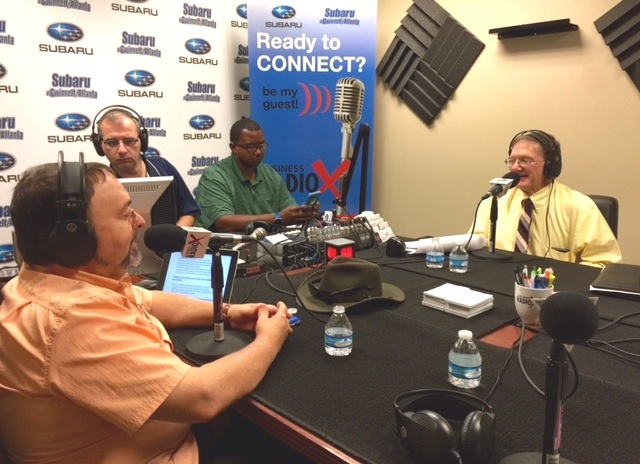
On this episode of Strategic Insights Radio, Dave Wilkins with Sterling Rose Consulting Corp. discusses Human Resources (HR) services and planned benefits programs with Peter Jundt of HR Value Partners.

Peter Jundt/HR Value Partners

After a long career as an executive in the construction industry, Peter Jundt  with HR Value Partners turned his focus towards people instead of the buildings that housed them, quickly becoming a leading insurance and benefits agent in the Atlanta area. A licensed insurance agent in Georgia, Wisconsin, Alabama, South Carolina and Minnesota, his mission has developed into helping businesses and individuals understand and prepare for the new paradigm of benefits and insurance that they are currently facing as a result of the Affordable Care Act (ObamaCare).

Representing HealthMarkets Insurance Agency, Peter has access to the leading providers, cutting edge technology, and superior training to provide his clients with the highest level of service and expertise. Two years ago, Peter joined forces with Brad Foley; long time friend and Chief Value Partner of HR Value Partners to broaden his portfolio of services. HR Value Partners helps businesses succeed by providing customized hands-on assistance on a project basis. Whether the need is recruiting, retention, succession planning, organizational development, HR strategy, tactical support or any other HR need, HR Value Partners stands ready to partner with you.

Phone: (262) 676-9633
Email: info@peterjundt.com

About “Strategic Insights Radio”:

“Strategic Insights Radio” is intended to be an interactive radio show hosted by Sterling Rose Consulting Corp. Listeners can Tweet their questions for a live response on the radio to @sterling_rose1 or via @strategicradio. Also, suggestions on business topics that listeners would like to learn more about are welcome. Please send suggestions to info@sterlingroseconsultingcorp.com.

Tagged With: consulting, dave wilkins, employee management, hr strategy, HR Value Partners, Human Resources, obamacare, Peter Jundt, Recruiting, retention, sterling rose consulting corp, strategic insights radio, Succession Planning, tactical support

Business RadioX ® Network


Our Most Recent Episode

CONNECT WITH US

  • Email
  • Facebook
  • LinkedIn
  • Twitter
  • YouTube

Our Mission

We help local business leaders get the word out about the important work they’re doing to serve their market, their community, and their profession.

We support and celebrate business by sharing positive business stories that traditional media ignores. Some media leans left. Some media leans right. We lean business.

Sponsor a Show

Build Relationships and Grow Your Business. Click here for more details.

Partner With Us

Discover More Here

Terms and Conditions
Privacy Policy

Connect with us

Want to keep up with the latest in pro-business news across the network? Follow us on social media for the latest stories!
  • Email
  • Facebook
  • Google+
  • LinkedIn
  • Twitter
  • YouTube

Business RadioX® Headquarters
1000 Abernathy Rd. NE
Building 400, Suite L-10
Sandy Springs, GA 30328

© 2025 Business RadioX ® · Rainmaker Platform

BRXStudioCoversLA

Wait! Don’t Miss an Episode of LA Business Radio

BRXStudioCoversDENVER

Wait! Don’t Miss an Episode of Denver Business Radio

BRXStudioCoversPENSACOLA

Wait! Don’t Miss an Episode of Pensacola Business Radio

BRXStudioCoversBIRMINGHAM

Wait! Don’t Miss an Episode of Birmingham Business Radio

BRXStudioCoversTALLAHASSEE

Wait! Don’t Miss an Episode of Tallahassee Business Radio

BRXStudioCoversRALEIGH

Wait! Don’t Miss an Episode of Raleigh Business Radio

BRXStudioCoversRICHMONDNoWhite

Wait! Don’t Miss an Episode of Richmond Business Radio

BRXStudioCoversNASHVILLENoWhite

Wait! Don’t Miss an Episode of Nashville Business Radio

BRXStudioCoversDETROIT

Wait! Don’t Miss an Episode of Detroit Business Radio

BRXStudioCoversSTLOUIS

Wait! Don’t Miss an Episode of St. Louis Business Radio

BRXStudioCoversCOLUMBUS-small

Wait! Don’t Miss an Episode of Columbus Business Radio

Coachthecoach-08-08

Wait! Don’t Miss an Episode of Coach the Coach

BRXStudioCoversBAYAREA

Wait! Don’t Miss an Episode of Bay Area Business Radio

BRXStudioCoversCHICAGO

Wait! Don’t Miss an Episode of Chicago Business Radio

Wait! Don’t Miss an Episode of Atlanta Business Radio