Business RadioX ®

  • Home
  • Business RadioX ® Communities
    • Southeast
      • Alabama
        • Birmingham
      • Florida
        • Orlando
        • Pensacola
        • South Florida
        • Tampa
        • Tallahassee
      • Georgia
        • Atlanta
        • Cherokee
        • Forsyth
        • Greater Perimeter
        • Gwinnett
        • North Fulton
        • North Georgia
        • Northeast Georgia
        • Rome
        • Savannah
      • Louisiana
        • New Orleans
      • North Carolina
        • Charlotte
        • Raleigh
      • Tennessee
        • Chattanooga
        • Nashville
      • Virginia
        • Richmond
    • South Central
      • Arkansas
        • Northwest Arkansas
    • Midwest
      • Illinois
        • Chicago
      • Michigan
        • Detroit
      • Minnesota
        • Minneapolis St. Paul
      • Missouri
        • St. Louis
      • Ohio
        • Cleveland
        • Columbus
        • Dayton
    • Southwest
      • Arizona
        • Phoenix
        • Tucson
        • Valley
      • Texas
        • Austin
        • Dallas
        • Houston
    • West
      • California
        • Bay Area
        • LA
        • Pasadena
      • Colorado
        • Denver
      • Hawaii
        • Oahu
  • FAQs
  • About Us
    • Our Mission
    • Our Audience
    • Why It Works
    • What People Are Saying
    • BRX in the News
  • Resources
    • BRX Pro Tips
    • B2B Marketing: The 4Rs
    • High Velocity Selling Habits
    • Why Most B2B Media Strategies Fail
    • 9 Reasons To Sponsor A Business RadioX ® Show
  • Partner With Us
  • Veteran Business RadioX ®

Scale Your Business Without Compromising Happiness, with Doc Dockery, The Resolve Firm

April 17, 2024 by John Ray

Scale Your Business Without Compromising Happiness, with Doc Dockery, The Resolve Firm, on The Price and Value Journey with John Ray
North Fulton Studio
Scale Your Business Without Compromising Happiness, with Doc Dockery, The Resolve Firm
Loading
00:00 /
RSS Feed
Share
Link
Embed

Download file

Scale Your Business Without Compromising Happiness, with Doc Dockery, The Resolve Firm, on The Price and Value Journey with John Ray

Scale Your Business Without Compromising Happiness, with Doc Dockery, The Resolve Firm (The Price and Value Journey, Episode 108)

Dr. Terry “Doc” Dockery, a renowned expert in business scalability and the author of the Amazon number one bestseller, Leadership, Happiness, and Profit: 12 Steps to a High Performance Business, was host John Ray’s guest on this edition of The Price and Value Journey. The discussion centers on the critical role of happiness and personal fulfillment as you scale your business. Doc discusses sustainable business growth, emphasizing leadership development, achieving a balance between professional achievements and personal life, and the impact of positive psychology in the workplace. The conversation also covers the challenges of recruiting and retaining top talent, debunking the myth of a talent shortage, and the essential elements of feedback and trust in effective leadership. Moreover, they address specific hurdles service firms encounter during scaling, the value of skill development, and how to synchronize individual team member advancement with organizational goals.

The Price and Value Journey is presented by John Ray and produced by the North Fulton studio of Business RadioX®.

Dr. Terry “Doc” Dockery, Founder, The Resolve Firm

Dr. Terry "Doc" Dockery, The Resolve Firm
Dr. Terry “Doc” Dockery, The Resolve Firm

Dr. Terry “Doc” Dockery, a true maestro in the realms of business scaling and leadership development. With a career that spans decades, Doc stands out not only as a licensed business psychologist and founder of The Resolve Firm but also as a beacon of guidance for businesses ranging from small enterprises to Fortune 500 giants across the country, particularly in the Atlanta region. His unparalleled expertise in doubling revenues without the baggage of stress or risk has not only propelled companies to new heights but has also cultivated environments recognized nationally as “Best Places to Work.”

Doc’s insights have been crystallized in his Amazon #1 Bestseller, Leadership, Happiness, and Profit: 12 Steps to a High-Performance Business, offering a roadmap to success that balances professional achievement with personal fulfillment. A fervent advocate for maintaining family harmony amidst business success, he often shares, “There are a hundred ways to make money, but you’ve only got one family. It’s a shame to ruin your family relationships over making a buck.”

Beyond his professional prowess, Doc’s soulful side emerges through music—whether he’s playing and singing in a band or charmingly putting the “harm” in harmonica. Receiving the Lucille Award from B.B. King himself is his proudest moment as a professional musician.

As a happily married father of three grown children, Doc embodies the very essence of leading a harmonious life, blending passion, purpose, and play. Join us as we delve into the journey of a man who helps leaders navigate the intricate dance of business growth, family values, and musical escapades.

Website | LinkedIn

Topics Discussed in this Interview

00:00 Welcome to The Price and Value Journey with guest Dr. Terry “Doc” Dockery
00:25 Unveiling Doc Dockery: From Business Scaling to Harmonica Playing
03:15 The Essence of Happiness in Business and Life
06:16 Scaling Your Business: Insights and Strategies
08:12 Leadership and Self-Discovery: Key to Scaling Success
14:53 Effective Leadership: Balancing Consideration and Process
23:56 Navigating Team Conflicts and Leadership Dynamics
24:19 Parenting as a Metaphor for Leadership
25:38 The Essence of Trust in Leadership
26:51 Conflict Resolution and Family Business Challenges
27:36 Identifying and Hiring A-Players
30:53 Addressing the Talent Shortage Myth
35:12 Feedback: The Breakfast of Champions
37:52 Aligning Individual and Organizational Growth
42:06 Deciding to Scale Down
43:42 Closing Remarks and Contact Information

About The Price and Value Journey

The title of this show describes the journey all professional service providers are on:  building a services practice by seeking to convince the world of the value we offer, helping clients achieve the outcomes they desire, and trying to do all that at pricing that reflects the value we deliver.

If you feel like you’re working too hard for too little money in your solo or small firm practice, this show is for you. Even if you’re reasonably happy with your practice, you’ll hear ways to improve both your bottom line and the mindset you bring to your business.

The show is hosted and produced by John Ray and the North Fulton studio of Business RadioX®. The show can also be found on all the major podcast apps. The complete show archive is here.

John Ray, Host of The Price and Value Journey

John Ray, Author of The Generosity Mindset and Host of "The Price and Value Journey"
John Ray, Author of The Generosity Mindset and Host of The Price and Value Journey

John Ray is the host of The Price and Value Journey.

John owns Ray Business Advisors, a business advisory practice. John’s services include business coaching and advisory work, as well as advising solopreneurs and small professional services firms on their pricing. John is passionate about the power of pricing for business owners, as changing pricing is the fastest way to change the profitability of a business. His clients are professionals who are selling their expertise, such as attorneys, CPAs, accountants and bookkeepers, consultants, coaches, marketing professionals, and other professional services practitioners.

In his other business, John is a Show Host and Producer and owns the North Fulton (Georgia) studio of Business RadioX®. John and his team work with B2B professionals to create and conduct their own podcast using The Generosity Mindset™ Method:  building and deepening relationships in a non-salesy way that translates into revenue for their business.

John is also the host of North Fulton Business Radio. With over 750 shows and having featured over 1,200 guests, North Fulton Business Radio is the longest-running podcast in the North Fulton area, covering business in its region like no one else.

John’s Book, The Generosity Mindset: A Journey to Business Success by Raising Your Confidence, Value, and Prices
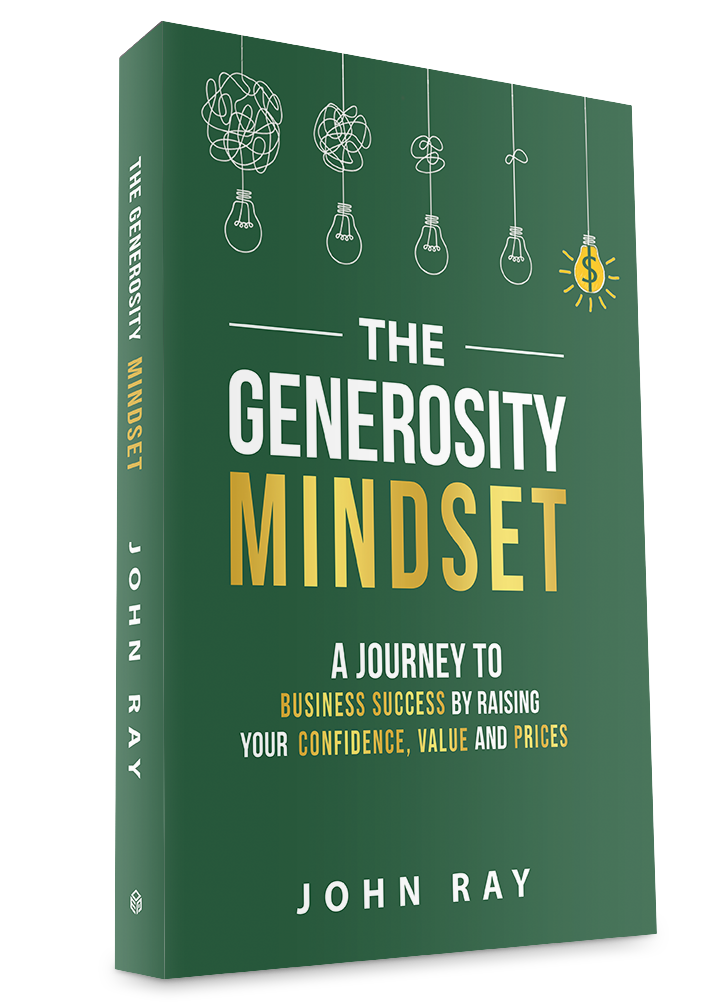
The Generosity Mindset, by John RayJohn is the #1 national best-selling author of The Generosity Mindset: A Journey to Business Success by Raising Your Confidence, Value, and Prices.

If you are a professional services provider, your goal is to do transformative work for clients you love working with and get paid commensurate with the value you deliver to those clients. While negative mindsets can inhibit your growth, adopting a different mindset, The Generosity Mindset™, can replace those self-limiting beliefs. The Generosity Mindset enables you to diagnose and communicate the value you deliver to clients and, in turn, more effectively price to receive a portion of that value.

Whether you’re a consultant, coach, marketing or branding professional, business advisor, attorney, CPA, or work in virtually any other professional services discipline, your content and technical expertise are not proprietary. What’s unique, though, is your experience and how you synthesize and deliver your knowledge. What’s special is your demeanor or the way you deal with your best-fit clients. What’s invaluable is how you deliver great value by guiding people through massive changes in their personal lives and in their businesses that bring them to a place they never thought possible.

The combination of all these elements is quite different for you compared to any other service provider in your industry. Therein lies your value, but it’s not the value you see. It’s the value your best-fit customers see in you.

If pricing your value feels uncomfortable or unfamiliar to you, this book will teach you why putting a price on the value your clients perceive and identify serves both them and you, and you’ll learn the factors involved in getting your price right.

The book is available at all major physical and online book retailers worldwide. Follow this link for further details.
Connect with John Ray:

Website | LinkedIn | Twitter

Business RadioX®:  LinkedIn | Twitter | Facebook | Instagram

Tagged With: Doc Dockery, happiness, John Ray, personal fulfillment, professional services, professional services firms, retaining talent, scale your business, scaling, talent shortage, Terry Doc Dockery, The Generosity Mindset, The Price and Value Journey

Positioning From the Client’s Perspective

April 1, 2024 by John Ray

Positioning from the Client's Perspective, John Ray Price and Value Journey
North Fulton Studio
Positioning From the Client's Perspective
Loading
00:00 /
RSS Feed
Share
Link
Embed

Download file

Positioning from the Client's Perspective, John Ray Price and Value Journey

Positioning From the Client’s Perspective

John Ray discusses a misconception held by some solopreneurs and small firm professional services providers: that their value and positioning start with their credentials. Through a storytelling approach involving a conversation with a leadership coach, Ray illustrates the importance of framing one’s value from the client’s perspective rather than merely showcasing certifications. He emphasizes that clients seek value based on their own perceptions and challenges. Effective positioning should thus focus on understanding and articulating how one’s services address specific client issues. Positioning in this manner leads to better pricing and client satisfaction.

This episode was adapted from the February 1, 2024 edition of John’s newsletter, The Price and Value Journey.

The Price and Value Journey is presented by John Ray and produced by the North Fulton studio of Business RadioX®.

Topics Discussed in this Episode

00:00 Welcome to The Price and Value Journey
00:05 The Misconception of Positioning in Professional Services
00:22 A Real-World Example: A Leadership Coach
01:41 The Importance of Value from the Client’s Perspective
02:24 Shifting the Conversation: From Certification to Solving Problems
03:05 The Power of Client-Centric Positioning
04:05 Closing Remarks and Contact Information

About The Price and Value Journey

The title of this show describes the journey all professional service providers are on:  building a services practice by seeking to convince the world of the value we offer, helping clients achieve the outcomes they desire, and trying to do all that at pricing that reflects the value we deliver.

If you feel like you’re working too hard for too little money in your solo or small firm practice, this show is for you. Even if you’re reasonably happy with your practice, you’ll hear ways to improve both your bottom line and the mindset you bring to your business.

The show is hosted and produced by John Ray and the North Fulton studio of Business RadioX®. The show can also be found on all the major podcast apps. The complete show archive is here.

John Ray, Host of The Price and Value Journey

John Ray, Author of The Generosity Mindset and Host of "The Price and Value Journey"
John Ray, Author of The Generosity Mindset and Host of The Price and Value Journey

John Ray is the host of The Price and Value Journey.

John owns Ray Business Advisors, a business advisory practice. John’s services include business coaching and advisory work, as well as advising solopreneurs and small professional services firms on their pricing. John is passionate about the power of pricing for business owners, as changing pricing is the fastest way to change the profitability of a business. His clients are professionals who are selling their expertise, such as attorneys, CPAs, accountants and bookkeepers, consultants, coaches, marketing professionals, and other professional services practitioners.

In his other business, John is a Show Host and Producer and owns the North Fulton (Georgia) studio of Business RadioX®. John and his team work with B2B professionals to create and conduct their own podcast using The Generosity Mindset™ Method:  building and deepening relationships in a non-salesy way that translates into revenue for their business.

John is also the host of North Fulton Business Radio. With over 750 shows and having featured over 1,200 guests, North Fulton Business Radio is the longest-running podcast in the North Fulton area, covering business in its region like no one else.

John’s Book, The Generosity Mindset: A Journey to Business Success by Raising Your Confidence, Value, and Prices

The Generosity Mindset, by John RayJohn is the #1 National Bestselling Author of The Generosity Mindset: A Journey to Business Success by Raising Your Confidence, Value, and Prices.

If you are a professional services provider, your goal is to do transformative work for clients you love working with and get paid commensurate with the value you deliver to those clients. While negative mindsets can inhibit your growth, adopting a different mindset, The Generosity Mindset™, can replace those self-limiting beliefs. The Generosity Mindset enables you to diagnose and communicate the value you deliver to clients and, in turn, more effectively price to receive a portion of that value.

Whether you’re a consultant, coach, marketing or branding professional, business advisor, attorney, CPA, or work in virtually any other professional services discipline, your content and technical expertise are not proprietary. What’s unique, though, is your experience and how you synthesize and deliver your knowledge. What’s special is your demeanor or the way you deal with your best-fit clients. What’s invaluable is how you deliver great value by guiding people through massive changes in their personal lives and in their businesses that bring them to a place they never thought possible.

The combination of all these elements is quite different for you compared to any other service provider in your industry. Therein lies your value, but it’s not the value you see. It’s the value your best-fit customers see in you.

If pricing your value feels uncomfortable or unfamiliar to you, this book will teach you why putting a price on the value your clients perceive and identify serves both them and you, and you’ll learn the factors involved in getting your price right.

The book is available at all major physical and online book retailers worldwide. Follow this link for further details.

Connect with John Ray:

Website | LinkedIn | Twitter

Business RadioX®:  LinkedIn | Twitter | Facebook | Instagram


Tagged With: brand positioning, John Ray, positioning, professional services providers, solopreneurs, The Price and Value Journey, value, value conversation, value pricing

Hiring a Ghostwriter to Write Your Book, with Hal Clifford, Hal Clifford Associates

March 27, 2024 by John Ray

Hal Clifford, Hal Clifford Associates
North Fulton Studio
Hiring a Ghostwriter to Write Your Book, with Hal Clifford, Hal Clifford Associates
Loading
00:00 /
RSS Feed
Share
Link
Embed

Download file

Hal Clifford, Hal Clifford Associates

Hiring a Ghostwriter to Write Your Book, with Hal Clifford, Hal Clifford Associates

On this episode of The Price and Value Journey, host John Ray welcomes Hal Clifford, a seasoned ghostwriter with four decades of experience, to discuss hiring a ghostwriter to write the book you’ve always dreamed about. Hal shared insights into the ghostwriting process, the importance of a good writer-client relationship, and the strategic benefits of publishing a book for business professionals. With a rich background in editing and developing bestsellers, Hal delves into his journey from magazine editing to ghostwriting, the distinctions between ghostwriting, editing, and coaching, and offers practical advice for selecting a ghostwriter. The discussion covers the emotional journey of book writing, the process from interviews to publication, and the business case for professionals to publish, emphasizing that the return on investment largely comes from enhanced credibility and client engagement rather than book sales themselves.

The Price and Value Journey is presented by John Ray and produced by the North Fulton studio of Business RadioX®.

Hal Clifford, Hall Clifford Associates

Hal Clifford
Hal Clifford, Hal Clifford Associates

Hal Clifford has dedicated over four decades to the craft of writing and editing, leaving a significant mark in the literary world. He has played a pivotal role in editing New York Times bestseller David Goggins’ books Can’t Hurt Me and Never Finished. His expertise also extends to developing multiple Wall Street Journal and USA Today bestsellers, such as Joe Mechlinski’s Shift the Work and Krister Ungerböck’s 22 Talk Shifts. Clifford’s editorial acumen has been recognized in book reviews by the New York Times, including works like Ginger Strand’s Killer on the Road and Inventing Niagara, as well as James Prosek’s Eels.

Clifford is also the author of the upcoming title Blackout Punch, highlighting the fastest-growing, most notorious beverage in America. Having written three published nonfiction books under his own name, he deeply understands the immersive process of living with a subject for extended periods of time. His career milestones include serving as the Editor in Chief at Scribe Media, an independent publishing company, up until early 2023. He left Scribe Media to establish his own venture, Hal Clifford Associates, focusing on ghostwriting, editing, and publishing.

His previous role as the Executive Editor at Orion magazine saw Clifford edit stories that were finalists for the National Magazine Award for Best Essay and pieces included in Best American Science and Nature Writing. The magazine’s receipt of the Utne General Excellence Award distinguished his tenure at Orion. Clifford’s collaborative efforts with renowned writers such as Wendell Berry, Barry Lopez, Rebecca Solnit, Terry Tempest Williams, Bill McKibben, and many other talented individuals, underscore his significant contributions to literature and the broader publishing industry.

Website | LinkedIn

Topics Discussed in this Episode

00:00 Welcome to The Price and Value Journey with John Ray
00:04 The Journey of Writing and Publishing a Book
01:01 Introducing Hal Clifford: A Master Ghostwriter
02:36 Hal Clifford’s Ghostwriting Journey and Philosophy
04:16 Understanding the Roles: Ghostwriter, Editor, and Book Coach
06:58 Choosing the Right Path for Your Book
08:27 Evaluating and Hiring the Right Ghostwriter
19:16 The Ghostwriting Process: From Interviews to Manuscript
23:14 The Ghostwriting Process: From Draft to Publication
24:24 Adapting to the Author’s Style and Utilizing Existing Content
25:27 Navigating the Emotional Journey of Writing a Book
27:36 The Challenges of Revisions and Editing
29:06 Personal Stories: The Power and Peril of Vulnerability
32:50 The Timeline and Accountability in Book Publishing
36:07 The True Value of Publishing a Business Book
42:29 Connecting with the Author and Final Thoughts

About The Price and Value Journey

The title of this show describes the journey all professional service providers are on:  building a services practice by seeking to convince the world of the value we offer, helping clients achieve the outcomes they desire, and trying to do all that at pricing that reflects the value we deliver.

If you feel like you’re working too hard for too little money in your solo or small firm practice, this show is for you. Even if you’re reasonably happy with your practice, you’ll hear ways to improve both your bottom line and the mindset you bring to your business.

The show is hosted and produced by John Ray and the North Fulton studio of Business RadioX®. The show can also be found on all the major podcast apps. The complete show archive is here.

John Ray, Host of The Price and Value Journey

John Ray, Author of The Generosity Mindset and Host of "The Price and Value Journey"
John Ray, Author of The Generosity Mindset and Host of The Price and Value Journey

John Ray is the host of The Price and Value Journey.

John owns Ray Business Advisors, a business advisory practice. John’s services include business coaching and advisory work, as well as advising solopreneurs and small professional services firms on their pricing. John is passionate about the power of pricing for business owners, as changing pricing is the fastest way to change the profitability of a business. His clients are professionals who are selling their expertise, such as attorneys, CPAs, accountants and bookkeepers, consultants, coaches, marketing professionals, and other professional services practitioners.

In his other business, John is a Show Host and Producer and owns the North Fulton (Georgia) studio of Business RadioX®. John and his team work with B2B professionals to create and conduct their own podcast using The Generosity Mindset™ Method:  building and deepening relationships in a non-salesy way that translates into revenue for their business.

John is also the host of North Fulton Business Radio. With over 750 shows and having featured over 1,200 guests, North Fulton Business Radio is the longest-running podcast in the North Fulton area, covering business in its region like no one else.

John’s Book, The Generosity Mindset: A Journey to Business Success by Raising Your Confidence, Value, and Prices

The Generosity Mindset, by John RayJohn is the #1 National Bestselling Author of The Generosity Mindset: A Journey to Business Success by Raising Your Confidence, Value, and Prices.

If you are a professional services provider, your goal is to do transformative work for clients you love working with and get paid commensurate with the value you deliver to those clients. While negative mindsets can inhibit your growth, adopting a different mindset, The Generosity Mindset™, can replace those self-limiting beliefs. The Generosity Mindset enables you to diagnose and communicate the value you deliver to clients and, in turn, more effectively price to receive a portion of that value.

Whether you’re a consultant, coach, marketing or branding professional, business advisor, attorney, CPA, or work in virtually any other professional services discipline, your content and technical expertise are not proprietary. What’s unique, though, is your experience and how you synthesize and deliver your knowledge. What’s special is your demeanor or the way you deal with your best-fit clients. What’s invaluable is how you deliver great value by guiding people through massive changes in their personal lives and in their businesses that bring them to a place they never thought possible.

The combination of all these elements is quite different for you compared to any other service provider in your industry. Therein lies your value, but it’s not the value you see. It’s the value your best-fit customers see in you.

If pricing your value feels uncomfortable or unfamiliar to you, this book will teach you why putting a price on the value your clients perceive and identify serves both them and you, and you’ll learn the factors involved in getting your price right.

The book is available at all major physical and online book retailers worldwide. Follow this link for further details.
Connect with John Ray:

Website | LinkedIn | Twitter

Business RadioX®:  LinkedIn | Twitter | Facebook | Instagram

Tagged With: Ghostwriter, ghostwriting, Hal Clifford, Hal Clifford Associates, hiring a ghostwriter, John Ray, pricing, professional services providers, The Price and Value Journey, value, writing a book

The Paradox of The Generosity Mindset™

March 25, 2024 by John Ray

The Paradox of The Generosity Mindset™, John Ray
North Fulton Studio
The Paradox of The Generosity Mindset™
Loading
00:00 /
RSS Feed
Share
Link
Embed

Download file

The Paradox of The Generosity Mindset™, John Ray

The Paradox of The Generosity Mindset™

John Ray discusses the seeming paradox of The Generosity Mindset™, noting that it’s easy to understand why some might think that achieving better pricing in your business and acting from a mindset of generosity might be at odds. Referencing ideas expressed in his book, The Generosity Mindset, John emphasizes how focusing on others’ needs leads to trust, goodwill, and building a reputation as a professional of value. He advocates for a business approach that balances generosity with financial health, enabling professionals to create sustainable businesses that contribute to their communities and to their own personal fulfillment.

This episode was adapted from the February 15, 2024 edition of John’s newsletter, The Price and Value Journey.

The Price and Value Journey is presented by John Ray and produced by the North Fulton studio of Business RadioX®.

Topics Discussed in this Episode

00:00 Welcome to the Price and Value Journey
00:07 The Counterintuitive Nature of Generosity in Pricing
00:34 The Paradox of Charging for Service
01:12 The Importance of Business Sustainability
02:16 Introducing the Generosity Mindset
03:11 The Power of Listening and Understanding
03:43 The Paradox and Power of Generosity
04:24 Creating a Virtuous Cycle of Trust and Prosperity
05:01 The Impact of Generosity on Professional Growth
05:31 Sustainability and Community Contribution
06:04 Conclusion and Invitation

About The Price and Value Journey

The title of this show describes the journey all professional services providers are on:  building a services practice by seeking to convince the world of the value we offer, helping clients achieve the outcomes they desire, and trying to do all that at pricing that reflects the value we deliver.

If you feel like you’re working too hard for too little money in your solo or small firm practice, this show is for you. Even if you’re reasonably happy with your practice, you’ll hear ways to improve both your bottom line and the mindset you bring to your business.

The show is hosted and produced by John Ray and the North Fulton studio of Business RadioX®. The show can also be found on all the major podcast apps. The complete show archive is here.

John Ray, Host of The Price and Value Journey

John Ray, Author of The Generosity Mindset and Host of "The Price and Value Journey"
John Ray, Author of The Generosity Mindset and Host of The Price and Value Journey

John Ray is the host of The Price and Value Journey.

John owns Ray Business Advisors, a business advisory practice. John’s services include business coaching and advisory work, as well as advising solopreneurs and small professional services firms on their pricing. John is passionate about the power of pricing for business owners, as changing pricing is the fastest way to change the profitability of a business. His clients are professionals who are selling their expertise, such as attorneys, CPAs, accountants and bookkeepers, consultants, coaches, marketing professionals, and other professional services practitioners.

In his other business, John is a Show Host and Producer and owns the North Fulton (Georgia) studio of Business RadioX®. John and his team work with B2B professionals to create and conduct their own podcast using The Generosity Mindset™ Method:  building and deepening relationships in a non-salesy way that translates into revenue for their business.

John is also the host of North Fulton Business Radio. With over 750 shows and having featured over 1,200 guests, North Fulton Business Radio is the longest-running podcast in the North Fulton area, covering business in its region like no one else.

John’s Book, The Generosity Mindset: A Journey to Business Success by Raising Your Confidence, Value, and Prices

The Generosity Mindset, by John RayJohn is the #1 National Bestselling Author of The Generosity Mindset: A Journey to Business Success by Raising Your Confidence, Value, and Prices.

If you are a professional services provider, your goal is to do transformative work for clients you love working with and get paid commensurate with the value you deliver to those clients. While negative mindsets can inhibit your growth, adopting a different mindset, The Generosity Mindset™, can replace those self-limiting beliefs. The Generosity Mindset enables you to diagnose and communicate the value you deliver to clients and, in turn, more effectively price to receive a portion of that value.

Whether you’re a consultant, coach, marketing or branding professional, business advisor, attorney, CPA, or work in virtually any other professional services discipline, your content and technical expertise are not proprietary. What’s unique, though, is your experience and how you synthesize and deliver your knowledge. What’s special is your demeanor or the way you deal with your best-fit clients. What’s invaluable is how you deliver great value by guiding people through massive changes in their personal lives and in their businesses that bring them to a place they never thought possible.

The combination of all these elements is quite different for you compared to any other service provider in your industry. Therein lies your value, but it’s not the value you see. It’s the value your best-fit customers see in you.

If pricing your value feels uncomfortable or unfamiliar to you, this book will teach you why putting a price on the value your clients perceive and identify serves both them and you, and you’ll learn the factors involved in getting your price right.

The book is available at all major physical and online book retailers worldwide. Follow this link for further details.
Connect with John Ray:

Website | LinkedIn | Twitter

Business RadioX®:  LinkedIn | Twitter | Facebook | Instagram

Tagged With: Author, John Ray, Price and Value Journey, pricing, professional services firms, professional services providers, The Generosity Mindset, The Price and Value Journey, value, value pricing

What is The Generosity Mindset™?

March 19, 2024 by John Ray

What is The Generosity Mindset™?
North Fulton Studio
What is The Generosity Mindset™?
Loading
00:00 /
RSS Feed
Share
Link
Embed

Download file

What is The Generosity Mindset™?

What is The Generosity Mindset™?

Host John Ray discusses how adopting what he calls The Generosity Mindset leads to better business development and pricing strategies and outcomes. This podcast episode revolves around his book The Generosity Mindset, which suggests that focusing on others’ needs and cultivating empathy, compassion, and collaboration leads to personal and business success. Ray critically examines negative self-defeating mindsets like imposter syndrome and scarcity mindset, proposing that success stems from a generous approach to client relationships and service. He argues that basing service pricing on the value that customers perceive rather than the service provider’s assessment of value improves client relationships, business growth, and pricing.

This episode was adapted from the November 16, 2023 edition of John’s newsletter, The Price and Value Journey.

The Price and Value Journey is presented by John Ray and produced by the North Fulton studio of Business RadioX®.

Topics Discussed in this Episode

00:00 Welcome to the Price and Value Journey
00:19 The Genesis of The Generosity Mindset
02:01 Exploring the Generosity Mindset
02:48 Applying the Generosity Mindset in Business
04:31 The Generosity Mindset: A Path to Better Pricing
06:45 The Irony and Impact of the Generosity Mindset
08:20 Introducing The Generosity Mindset Book
08:41 How to Connect and Learn More

About The Price and Value Journey

The title of this show describes the journey all professional services providers are on:  building a services practice by seeking to convince the world of the value we offer, helping clients achieve the outcomes they desire, and trying to do all that at pricing which reflects the value we deliver.

If you feel like you’re working too hard for too little money in your solo or small firm practice, this show is for you. Even if you’re reasonably happy with your practice, you’ll hear ways to improve both your bottom line as well as the mindset you bring to your business.

The show is hosted and produced by John Ray and the North Fulton studio of Business RadioX®. The show can also be found on all the major podcast apps. The complete show archive is here.

John Ray, Host of The Price and Value Journey

John Ray, Author of The Generosity Mindset and Host of "The Price and Value Journey"
John Ray, Author of The Generosity Mindset and Host of The Price and Value Journey

John Ray is the host of The Price and Value Journey.

John owns Ray Business Advisors, a business advisory practice. John’s services include business coaching and advisory work, as well as advising solopreneurs and small professional services firms on their pricing. John is passionate about the power of pricing for business owners, as changing pricing is the fastest way to change the profitability of a business. His clients are professionals who are selling their expertise, such as attorneys, CPAs, accountants and bookkeepers, consultants, coaches, marketing professionals, and other professional services practitioners.

In his other business, John is a Show Host and Producer and owns the North Fulton (Georgia) studio of Business RadioX®. John and his team work with B2B professionals to create and conduct their own podcast using The Generosity Mindset™ Method:  building and deepening relationships in a non-salesy way that translates into revenue for their business.

John is also the host of North Fulton Business Radio. With over 750 shows and having featured over 1,200 guests, North Fulton Business Radio is the longest-running podcast in the North Fulton area, covering business in its region like no one else.

John’s Book, The Generosity Mindset: A Journey to Business Success by Raising Your Confidence, Value, and Prices

The Generosity Mindset, by John RayJohn is the #1 National Bestselling Author of The Generosity Mindset: A Journey to Business Success by Raising Your Confidence, Value, and Prices.

If you are a professional services provider, your goal is to do transformative work for clients you love working with and get paid commensurate with the value you deliver to those clients. While negative mindsets can inhibit your growth, adopting a different mindset, The Generosity Mindset™, can replace those self-limiting beliefs. The Generosity Mindset enables you to diagnose and communicate the value you deliver to clients and, in turn, more effectively price to receive a portion of that value.

Whether you’re a consultant, coach, marketing or branding professional, business advisor, attorney, CPA, or work in virtually any other professional services discipline, your content and technical expertise are not proprietary. What’s unique, though, is your experience and how you synthesize and deliver your knowledge. What’s special is your demeanor or the way you deal with your best-fit clients. What’s invaluable is how you deliver great value by guiding people through massive changes in their personal lives and in their businesses that bring them to a place they never thought possible.

The combination of all these elements is quite different for you compared to any other service provider in your industry. Therein lies your value, but it’s not the value you see. It’s the value your best-fit customers see in you.

If pricing your value feels uncomfortable or unfamiliar to you, this book will teach you why putting a price on the value your clients perceive and identify serves both them and you, and you’ll learn the factors involved in getting your price right.

The book is available at all major physical and online book retailers worldwide. Follow this link for further details.
Connect with John Ray:

Website | LinkedIn | Twitter

Business RadioX®:  LinkedIn | Twitter | Facebook | Instagram

Tagged With: Author, John Ray, Price and Value Journey, professional services firms, professional services providers, The Generosity Mindset, The Price and Value Journey

Why You Should Do a LinkedIn Newsletter, with Adam Houlahan, Prominence Global

June 1, 2023 by John Ray

Adam Houlahan
North Fulton Studio
Why You Should Do a LinkedIn Newsletter, with Adam Houlahan, Prominence Global
Loading
00:00 /
RSS Feed
Share
Link
Embed

Download file

Why You Should Do a LinkedIn Newsletter

Why You Should Do a LinkedIn Newsletter, with Adam Houlahan, Prominence Global

Adam Houlahan, CEO of Prominence Global and best-selling author, was the guest on this edition of The Price and Value Journey, discussing why you should do a LinkedIn newsletter. He and host John Ray covered how to make them impactful, what makes a LinkedIn newsletter unique, how often to post a newsletter, repurposing content, aligning with LinkedIn’s current algorithm, and much more.

The Price and Value Journey is presented by John Ray and produced by the North Fulton studio of Business RadioX®.

Prominence Global

Prominence Global is, you’ll find, very different. They help their clients position themselves as industry leaders who are the envy of their peers.

Their mantra is authenticity They create intelligent strategies that cut through the noise that is social media. They do that by being authentic, courageous, and committed to make a difference in their world too. They value transparency More is learned from their mistakes than successes, sharing both is their commitment to honesty and truth. They operate with Integrity Ethics in marketing is in their DNA, they are not afraid to say ‘no’.

Prominence Global seeks continuous improvement through innovation They’re constantly curious in growing themselves, their team and the service they provide. They’re personal. They understand there is no cookie-cutter program that suits every business. They develop solutions that are as individual as their clients are.

They make a positive difference. They believe real and meaningful change comes through the world’s entrepreneurs. They create a powerful on-line presence for each client that grows & accelerates their global footprint, so that together they really can make a huge impact.

Through their Premium Partnership with the global giving movement www.B1G1.com they impact the lives of millions of people in need just by doing what they do every day.

They developed a range of support services to cater to every need. ☞ Free web events ☞ Free Community you can join ☞ Free Profile Optimisation Course ☞ Inner Circle Solo ☞ Inner Circle Academy ☞ Inner Circle Legends.

Their programs are an intensive ‘deep dive’ — a superb, results-producing methodology that creates a cutting-edge, lead generation sales funnel for almost any industry.

The difference is simply how much support you need from their team of dedicated professionals.

Company website | LinkedIn

Adam Houlahan, CEO, Prominence Global

Adam Houlahan, CEO, Prominence Global

Adam Houlahan is an International Keynote Speaker specializing in LinkedIn strategies for entrepreneurs, and CEO of the highly successful LinkedIn agency, Prominence Global.

He hosts arguably the world’s largest free on-line LinkedIn training event with thousands of people registering every 10-weeks and is considered to be one of Australia’s leading experts in harnessing the power of LinkedIn for business.

Adam is also the author of three Amazon best-selling books Social Media Secret Sauce, The LinkedIn Playbook, and Influencer. Adam co-authored a fourth international best-seller Better Business, Better Life, Better World. His purpose is to positively impact 12 million people in need and has surpassed 10 million on the way to that target.

LinkedIn

TRANSCRIPT

John Ray: [00:00:05] And hello again, everyone. I’m John Ray on the Price and Value Journey. Today, we’re going to talk about whether and why you should have a LinkedIn newsletter. It’s a rather narrow topic, but one that I got interested in, thanks to Adam Houlahan.

Adam is an international keynote speaker who specializes in LinkedIn strategies for entrepreneurs, and he’s the CEO of the highly successful LinkedIn agency Prominence Global. He hosts arguably the world’s largest free online training event, with thousands of people registering every ten weeks. And he’s considered to be one of Australia’s leading experts in harnessing the power of LinkedIn for business. I think it’s beyond Australia, but that’s just my opinion.

Adam is also the author of three Amazon bestselling books, Social Media Secret Sauce, which I have not read, but I have read the LinkedIn Playbook and Influencer, both of which I recommend. Adam co-authored a fourth international bestseller called Better Business, Better Life, Better World. And that comes from his belief that real and meaningful change comes through the world’s entrepreneurs. His purpose is to positively impact 12 million people in need, and he has surpassed 10 million on the way to that target. Wow. Adam, thank you for coming on the show.

Adam Houlahan: [00:01:36] John, it’s an absolute pleasure and really looking forward to today.

John Ray: [00:01:40] Yeah. Thank you so much. And thank you again for your work. And before we get into LinkedIn, though, I want to just give you a shout out for your work here on the positive impact you’re trying to make on a worldwide basis. So describe that for everyone so they know exactly what we’re talking about.

Adam Houlahan: [00:01:59] Yeah, sure. I think it’s one of those things, John, that all of us, small to medium sized business owners understand. Our governments aren’t really going to make a significant change in the world, and it’s up to us to do what we can to effect that change. And right from day one, when we started Prominence Global, we had an alignment with an organization called B1G1.

And through those guys, we make sure that everything we do, so every, like you mentioned, the events that we host, every time someone comes to one of those events, we make sure a child gets access to a day’s education. When people join some of our programs, we build wells for families, so they’ve got access to drinking water. All those types of things, lots of great things, environmental things, all aligned with the Sustainable Development Goals for 2030.

So we feel like we’re just doing our little bit to make a bit of an impact in achieving that Sustainable Development Goals on time in 2030.

John Ray: [00:02:57] Thank you for that. And I would encourage those of you listeners who are interested, go to the Prominence Global website. You can see it all detailed there and see it all counting almost live. So it’s pretty cool. So thank you for that work, Adam. Yeah.

So let’s get into talking about Prominence Global, specifically in terms of your LinkedIn expertise and how you’re serving entrepreneurs and executives that want to amp up their LinkedIn presence.

Adam Houlahan: [00:03:30] Sure. And like you mentioned at the start, John, yeah, today we’re mostly talking about a very niche topic of newsletters for LinkedIn, as LinkedIn is a multi-faceted platform, serves lots of different needs. Again, as far as us as an agency, we’re very niche. We don’t work with sales teams or people looking for new jobs or people recruiting for jobs, that type of thing.

We very much focus on how business owners or leaders can use LinkedIn to create a really highly engaged personal brand and how they use that personal brand to then generate new business and revenue for their businesses. Very, very niche within the big sphere of what LinkedIn can do.

John Ray: [00:04:13] Yeah. And you’re pretty tied in to LinkedIn in terms of the features that are coming and knowing a lot about kind of what the architecture of LinkedIn and what their overall business strategy is, which gives you an advantage, right?

Adam Houlahan: [00:04:32] It’s something we choose to make sure we keep on top of. Within our team, we have a team that that’s all they do. They just continually monitor all the changes. LinkedIn, you might be surprised, John, we’re like, what, halfway through 2023 and there’s been almost 90 updates to the platform already. The only thing is LinkedIn doesn’t come out and tell us all about them. They create these new tools and things and then leave us all to work it out for ourselves.

So yeah, we see it as a great, great way to just keep the LinkedIn community updated on those changes. And that’s what those events are about, is there’s enough changes every ten weeks to host an event that lots of people choose to come along to.

John Ray: [00:05:14] Yeah, for sure. So as you mentioned, this is a pretty niche topic. And here’s the irony of the topic. I got — I’m a subscriber to your newsletter. I got interested in the topic in part because of your newsletter. One of which was should I have a LinkedIn newsletter? So let’s talk.

And there were some interesting points in that made me think this would make a really good topic for this audience of solo and small professional services providers to hear about LinkedIn newsletters. but let’s do some definitions before we dive in further detail. So what’s the difference between a regular post and a LinkedIn newsletter?

Adam Houlahan: [00:06:02] Yeah. It’s a great question. Good place to start. So think of it like your normal status post, which is probably if you’re checking through your feed, that’s what you’re going to see the most of. And that will consist of might be a short bit of text-based content with maybe an image attached. It might be like a video, a bit of copy attached. It’s all fairly short form content.

A newsletter is different in two important ways. One, it’s actually long form content. So as far as your audience, there’s some of them that like just that short, punchy bite size content and then when they really buy into what you or your business is about, they will definitely be interested in a longer form of article and just you have a blog on your website. They’re going to be somewhere in that 800 to 1200 words, and your newsletter on LinkedIn can be exactly the same. It can be longer, John, but I wouldn’t go longer than that. That’s probably about the sweet spot for them.

Second really important part, as you just mentioned, you subscribe to my newsletter. So people can actually, apart from just being connected with you on LinkedIn, they can actually subscribe to that newsletter. And that means that whenever you upload a new article, they’re going to get notified in their notifications on LinkedIn, but also by email that you’ve released something new. And of course, the visibility of people engaging on that as a general rule is always higher.

John Ray: [00:07:34] Yeah. And so are there any particular individuals, professions that should have a LinkedIn newsletter? Are there some that shouldn’t even worry about it? Let’s qualify those that really ought to have one.

Adam Houlahan: [00:07:50] Yeah. Basically, if you’re going to share content on LinkedIn, and I should preface that by saying high value, highly niched content. So there’s a lot of people that — just to maybe give you some rough numbers, John. Current, we’re coming close to 950 million members on LinkedIn right now. Of that 950 million, only one percent share content on a regular basis. By regular, say, once a week.

But only one percent of that one percent create content that’s niched within a very narrow field of expertise and that’s the content LinkedIn really likes. They want you to create content that just stays in the narrow lane because it makes it really easy for them to know who in the link of those 950 million people likely to be interested in it.

And that’s what they’re trying to do. They’re trying to get our newsfeeds filled with the type of content we really like. Newsletters give a lot of signals to LinkedIn as to how engaged you are on that content, and that allows them to organically show that content under the right circumstances to a much wider audience than maybe just your first-degree connections or the subscribers to your newsletter.

John Ray: [00:09:07] Yeah. And before I started, in part because of the newsletter you wrote about LinkedIn newsletters before, I’ve had a newsletter now for, I guess, five or six editions. I went and looked at a lot of them and they vary widely in terms of quality, like anything else. So let’s talk about that. What makes for a high quality LinkedIn newsletter?

Adam Houlahan: [00:09:36] Yeah, it’s a good question. So the first part is it’s just copywriting 101. Good headline, good imagery, things that capture people’s attention. And then, as I said, probably something in that 800 to 1200 word count. If you make it too short, then of course, you’re not providing the value that a newsletter is able to provide, which is that deeper insight onto a topic. Go too long and, of course, people get a little turned off. Staying somewhere in that 800-to-1200-word character count, word count I should say, a few visual, exactly the same as you do on your own personal blog. You’re going to have a few images that highlight the points.

And the most important thing always, John, is a call to action at the end of it, give people a next step that they should take. And as on the end of those, we will say, look, here’s a few other ways we can help you and links off to other resources that just like these events that we run and other free resources that people can go and consume.

And of course people, if they’ve enjoyed or found value in the content that you’ve shared, then they’re very likely to want to know more and go deeper into what it is that you offer. And I’m sure we’ve all heard the old 711 principle of seven people need to have at least seven touch points and probably 11 hours of content sort of thing before they’re really invested in you and who you are. So the more you can get people engaging off one piece of content into another, the more you deepen that know like trust factor that people tend to have in you.

John Ray: [00:11:12] For sure. Now, Adam when you — the term high quality, I guess, is a term that everybody’s got their own opinion of what high quality is, right? So I think what — and this is a question. I think what you’re getting at is it’s not the place to put a press release. It’s not the place to put something that’s something less than generously helpful content, right? It’s not the promotional piece of it, if you want to call a call to action, promotional is at the very end where if people want to engage with that, they can, but you lead with what’s helpful.

Adam Houlahan: [00:11:54] Oh, exactly. And further to that, John, is probably more high value, probably a way we could, a better way we could say that is highly niched. And if I use my letter as an example and as I mentioned earlier, we don’t have solutions for people using LinkedIn for job search or recruitment or all those other things that the platform can do.

So none of our content is ever talking about those things. We serve the smallest small to medium business owners who use that platform for personal branding and lead generation. And so our content just always stays in that lane. So that’s probably a better way of saying high value is highly niched.

John Ray: [00:12:38] Yeah. It’s like in your case too, it’s not confusing. I mean, if you did a post on or a newsletter on Instagram influencers, that would throw everybody off, right? What’s Adam doing here?

Adam Houlahan: [00:12:50] Exactly. And we all probably are on multiple platforms, but I never profess to be an expert or know a lot about Instagram or Facebook or TikTok or any other platforms. I know how to leverage LinkedIn really well, and that’s why I just stay in that lane. And I never, newsletters or any other content for that matter, ever talk about anything other than how you can get as a small to medium business owner, how you can get value out of the LinkedIn platform.

John Ray: [00:13:18] So I’m sure there are a lot of folks that listen to this conversation and wonder, hey, I’ve got an existing newsletter. It seems like people are reading it. Why should I start a LinkedIn newsletter?

Adam Houlahan: [00:13:35] Yeah. So you most likely should and should have a newsletter or blog or whatever on your website. But your — and you can definitely have like one newsletter on your personal profile on LinkedIn and you can also have one on your company profile. If there’s a reason for you to ever need to talk about more than one thing, that’s how you can split that into two different topics.

But the reality is there’s a certain market that knows how to find and interact on your personal newsletter or your blog, and you’ve got a whole another LinkedIn community who most likely there will be some crossover, of course, but the high majority of them probably never go to your website or your blog for that matter. So you’re just exposing information, good information to a whole new audience.

John Ray: [00:14:25] And let’s say I decide I want to get started. Do I need a certain number of followers to make it work or a certain amount of reach? When should I start?

Adam Houlahan: [00:14:39] John, it’s a wonderful old saying is when was the best time to start? It’s probably like three years ago. When’s the next best time to start? Today. If we wait until all the ducks are aligned, we’ll never get started. So the point being, yes, obviously, if you had more followers or whatever, then it’s going to get more immediate impact. But it doesn’t mean to say if you don’t have a lot of followers, you shouldn’t start one today.

One little thing you should know, or your audience should know is that when the very first time you create your newsletter on LinkedIn, LinkedIn will send a notification to everybody you’re connected to on LinkedIn and say, “Hey, Adam. John’s just started a new newsletter about this. Would you like to subscribe to it?” So they give you this one off nice little boost of visibility. So you’ll pretty much guarantee that you’re going to get a few followers right out of the gate.

The second thing is, now, this wasn’t the case when they first started, but all new people that follow or connect with you from now on also get that, not a mass one like the very first one, but individual by individual. You get an invitation from LinkedIn to follow your newsletter if they’re following you or following you. So you will build a following.

Now, of course, what that really should be a red flag to everyone is make sure that very first newsletter that you put out is your best stuff because that’s the first one people are going to see and where you’ll get this influx of new people.

We’ve had some of our clients, John, and in fairness they probably have 10,000 connections or whatever on LinkedIn or maybe more. And when we help them first launch their new newsletter, got 1500 to 3000 followers to that newsletter within seven days. And that’s because of LinkedIn doing that initial big push for you.

John Ray: [00:16:34] Yeah, that’s fantastic. And by definition, they opt in, so everyone opts in. Unlike folks, your email newsletter, which may or may not have opt ins. Let’s be honest about this. You may be emailing folks that really didn’t ask to be put on your email list, but LinkedIn does not allow that.

Adam Houlahan: [00:17:01] No, they don’t. And so that’s the thing that people that opt in for your newsletter, they’ve made a willing decision to do that. As the author of your newsletter, you kind of have an obligation to serve those followers in a powerful way. I see it personally. I see it as an absolute privilege to be able to have people want to follow my newsletter and engage on that content. I’ll be honest, John, it just inspires me to give them my best stuff and that’s where they’ll always find it.

John Ray: [00:17:30] Yeah. And how often do you do your newsletters? Biweekly, is that correct?

Adam Houlahan: [00:17:35] Yeah, biweekly. Look, there’s no right or wrong. There is a wrong, it’s never. And I think to be honest, John, I feel once a week is actually too much for a long content. I think biweek — look, this is just my personal opinion. I think biweekly is the best cadence.

However, I’ll be fair, I’d say that’s one of those questions you could ask 10 different experts and get 11 different responses. But in my opinion about biweekly is a good cadence for that good long. And keep in mind that there’s a bit of work in putting together a good quality piece of information like that. So don’t put a noose around your neck of having to create that every single week.

John Ray: [00:18:12] Yeah, for sure. Now, in making that decision, does it make a difference in terms of how often you post? Would that play into how often you do a newsletter? In other words, you’re posting every day, right? Or every weekday? What’s your cadence on posting generally?

Adam Houlahan: [00:18:32] Yep. So again, our sort of recommendation and what all of our clients work to and we do as well is three times per week. So Monday, Wednesday, Friday. And on a calendar month, John, that’s 13 pieces of content. And so two of those are going to be newsletters. So we don’t add more. We just have that as part of our overall 13 pieces of content that we share every month.

John Ray: [00:18:57] Gotcha. Gotcha. And but the most important thing I take it is not the number, it’s the consistency.

Adam Houlahan: [00:19:07] A hundred percent. That’s it. Consistency wins every single time. I would rather see people start with once per month and then build that up to biweekly when it suits. Equally with the rest of their content. So when we say three times per week, we don’t necessarily say start, try and start there. Start at once per week. And then when you’ve got a bit of a rhythm around that, then you can move to twice a week and then eventually three.

But the key thing is, what a big mistake I often see made is people come out of the gate really hard, find it’s really hard to maintain that and then become inconsistent. And it’s very interesting. I wanna share a very quick story with you, John. I was in a meeting on the weekend just gone down in Melbourne, which is a couple of hours flight from where I live.

And one of the people that was there said, oh, by the way, I got a message from someone the other day because I normally post a video on a Friday and I was getting ready for this meeting and I forgot to post it and I got a message saying, oh, I was looking out for your video because I know you post every Friday.

So if you start creating really good content, people will know the cadence of where you post it. Now, some people will love your newsletter, some people will love your videos, some people will love your other content. Rarely will they love all of it. Sometimes they do, but they will know the cadence of your newsletter. And if you start getting inconsistent, then their desire to keep interacting on it will drop away.

John Ray: [00:20:39] Let’s talk about the interplay between if you have an email newsletter now, your blog, and your LinkedIn newsletter. So should you repurpose the content that you are already developing for your blog? Or even more importantly, your email newsletter? Can you put that both places?

Adam Houlahan: [00:21:01] Yeah, 100 percent. Again, remember, you probably have different audiences that consume that content in different places, so not all of your LinkedIn audience are going to see your newsletter. Not all of your email database are going to see all of your email newsletters or your blog. So a good way — you’re going to take a bit of effort to create a good quality newsletter. So by all means, repurpose it across a couple of channels.

Now the key thing there, John, is you probably say, for example, what we do is we’ll post it onto our company blog first. And then a month or so later, we will repurpose it onto our LinkedIn newsletters. So don’t post them at the same time. There’s a bit of a SEO play there as well, so it’s okay to repurpose it. Just give it a good four to six weeks in between different platforms.

John Ray: [00:21:53] Got it. And are LinkedIn newsletters indexed, speaking of SEO, indexed by Google? And are there any preferences that Google has toward LinkedIn newsletters versus post?

Adam Houlahan: [00:22:07] Yeah, 100 percent. They will index on Google and every piece of content that you create on LinkedIn now has its own unique URL. So part of that is the reason for indexation. So yeah, look, definitely because your newsletter is long form, it is going to index better than your standard posts because as hopefully your audience knows, Google has a preference for longer form content than really short punchy stuff.

So yeah, one, yes, it will index. And two, it will index better than your other content because of its longer form, which is again one of those reasons why you don’t want to go short. Don’t short your newsletter, so to speak. Give it enough algorithmic juice so that Google wants to index it.

John Ray: [00:22:56] Yeah. So how do I know that my newsletter is resonating with my target audience, this niche that I’ve put a flag in, if you will, for myself?

Adam Houlahan: [00:23:07] Yeah, it’s pretty reasonably easy. One, you’ll see that, month after month, your people subscribing to the newsletter will grow. And of course, part of that growth comes to promotion as well. So one, when you put out your newsletter, it is getting seen by not only your subscribers, but people will come across it in your feed. And you might want to, if you’re doing some email marketing, you certainly want to at times share about a link to your newsletter, that type of thing. But growth in subscribers is one way to tell that.

The second is, of course, LinkedIn will give you some analytics on that. It’ll show you how many impressions, how many people have liked it or comment on it or shared it. So just, you would gauge that by the growth in those things. To be honest, I don’t get too concerned about likes and shares. LinkedIn is not a big lover of shared content because it’s already on the platform.

Now, having said that, it’s no downside to us if people share our content, it’s great, but the real metrics you want to follow is the subscriber rate that that’s growing. And what I really follow is the number of people that are interacting on the newsletter and like commenting on it and leaving their opinions.

To me, that’s the biggest indicator of anything, is if people are starting to interact on your content by going out of their way to leave their views or thanking you for sharing it or whatever. That’s one of the best indicators for sure.

John Ray: [00:24:35] One of the things — I think I’m hearing a lot of things here, which is very helpful. Thank you. But one of the things that strikes me, Adam, is I think a lot of people have the notion because they get an invitation to a newsletter pretty frequently right now. Is that, hey, there are so many newsletters around, right, why should I start one? And the stats that you quoted right at the top of this episode would indicate there’s still a lot of folks that may never do a newsletter a lot more than or doing one.

Adam Houlahan: [00:25:12] Oh, 100 percent. That’s definitely right. LinkedIn’s own goals are to have about 3 billion members on the platform, so they’re only about A one-third of the way there themselves. So it’s like I said, when was the best time? A little while ago. When’s the next best time? Today. Yeah, just start.

John Ray: [00:25:29] Yeah, for sure. I would be remiss if I didn’t ask you to just talk in general about what you’re seeing on LinkedIn today, what some of the things that people need to pay particular attention to. I noticed you were talking about some enhancements to Sales Navigator that were pretty interesting. But talk about what’s on your mind these days and what you’re sharing with your clients about LinkedIn.

Adam Houlahan: [00:25:57] Yeah, look, it’s a never ending learning curve. There’s no doubt about that. Though, having said that, obviously those changes transcend all parts of LinkedIn. So you don’t need to be staying across all of those 90 changes that have happened in the last six months. But the things to really focus on is I think the most important thing is to start with an end goal.

Why are you on the platform? What is it you want to do? Who is it you want to be interacting with? And do you want to be seen as a marketer or as a, the term we like to use, John, is a sage. The term most people use is thought leader. I think that term is a little overdone these days. And but the reality is, I think the real value is to be seen as that real authority within your field of expertise.

You don’t have to dominate the whole LinkedIn platform. You don’t have to be Gary Vaynerchuk or Elon Musk or those people who transcend all audiences. You just need to be known and liked and trusted within your area of expertise. And if you can do that job done and LinkedIn wants to help you do that and how they help you, that is still LinkedIn probably gives better organic traction on content than any other platform as long as you understand the rules, so to speak. And if you stick by them.

In simple terms, what that rule is stay very, very niche. Don’t be trying to talk about all things to all people, and that helps LinkedIn to understand who’s your audience. Remember, they know a lot of information about all of us, so they know what you’re interested in. They want to give you content in your feed that is really interesting to you, where what might be in my feed would be completely different to yours.

And that’s okay, because if we’re all getting fed the information that we like and enjoy, we’re more likely to stay on the platform. So the end goal, in my opinion, is to align with LinkedIn’s goals. If you can align your goals with theirs, then it’s a win-win. And LinkedIn is very good at supporting those who support them, if that makes sense.

John Ray: [00:28:10] No, it makes perfect sense. And just to encourage those folks out there that really have not participated on LinkedIn, it occurs to me back to the newsletters that starting a newsletter may be a great way to put your toe in the water. If you’re already developing content for an email newsletter, why not get your toe in the water and start a newsletter on LinkedIn and see where it goes?

Adam Houlahan: [00:28:35] Absolutely, John. The other thing is that, and this is a reasonably new release from LinkedIn, is that you can actually schedule your newsletter. So around consistency, you don’t have to — there’s a little bit of work in formatting your email newsletter or your blog, and it’s the same on LinkedIn. But you can do that in advance, and you can schedule it so that — let’s say you’re doing it biweekly.

You can say, I want this to go out on exactly this time and this day in the future. And so that’s how you can keep that consistency and your audience knows, gets to know when you’re going to post. I think it literally has only been available — by the way, you can do that for all your other content types on LinkedIn as well, but only very new in the last month or so where you’ve been able to do it for newsletters.

John Ray: [00:29:22] We’re getting to the end of this interview, and I want to give you a chance for a call to action. So talk about what you’ve got going right now that our listeners might want to know about and might want to dive into and learn more about you and your work, how you can help them.

Adam Houlahan: [00:29:38] Sure. There’s two things, really easy. Either go to our website, which is prominence.global or just follow me on LinkedIn. That’s where we’re always going to let you know when we’ve put out, we have lots of free events and things where we just love to help the LinkedIn community. There’s literally probably almost one every month of different formats, but we’ll always let you know if you’re following us on there. And that’s the easiest way to make sure that you stay up to date with every, not every single change that’s happening on LinkedIn, but the important ones relative to small to medium business owners.

John Ray: [00:30:15] Terrific. Adam Houlahan from Prominence Global. Adam, thank you so much for taking the time to come on and share your expertise. We appreciate you. And again, I encourage everyone out there to follow you.

Adam Houlahan: [00:30:28] Thank you, John. As I said, it’s an absolute pleasure to be with you again today. And I look forward to doing it again sometime very soon.

John Ray: [00:30:36] Something tells me we’ll have a reason to — LinkedIn will give us a reason to, right?

Adam Houlahan: [00:30:41] For sure.

John Ray: [00:30:41] Yeah, for sure. Thank you again. And folks, just a quick reminder as we wrap up here, that if you want to know more information on this podcast, this series, go to pricevaluejourney.com. You can find our show archive there. You can also, of course, find it on your favorite podcast app.

And you can also sign up to receive updates on a book I have coming out this year. I’m trying to catch up with Adam, 2023, later in 2023. It’s called The Price and Value Journey, Raising Your Confidence, Your Value and Your Prices Using the Generosity Mindset Method. If you want to know more about that book that’s coming and I’m featuring some little pieces on that in my email newsletter, by the way, go check it out.

So for my guest, Adam Houlahan, I’m John Ray. Join us next time on the Price and Value Journey.


About The Price and Value Journey

The title of this show describes the journey all professional services providers are on:  building a services practice by seeking to convince the world of the value we offer, helping clients achieve the outcomes they desire, and trying to do all that at pricing which reflects the value we deliver.

If you feel like you’re working too hard for too little money in your solo or small firm practice, this show is for you. Even if you’re reasonably happy with your practice, you’ll hear ways to improve both your bottom line as well as the mindset you bring to your business.

The show is produced by the North Fulton studio of Business RadioX® and can be found on all the major podcast apps. The complete show archive is here.

John Ray, Host of The Price and Value Journey

John Ray The Price and Value Journey
John Ray, Host of “The Price and Value Journey”

John Ray is the host of The Price and Value Journey.

John owns Ray Business Advisors, a business advisory practice. John’s services include advising solopreneur and small professional services firms on their pricing. John is passionate about the power of pricing for business owners, as changing pricing is the fastest way to change the profitability of a business. His clients are professionals who are selling their “grey matter,” such as attorneys, CPAs, accountants and bookkeepers, consultants, marketing professionals, and other professional services practitioners.

In his other business, John is a Studio Owner, Producer, and Show Host with Business RadioX®, and works with business owners who want to do their own podcast. As a veteran B2B services provider, John’s special sauce is coaching B2B professionals to use a podcast to build relationships in a non-salesy way which translate into revenue.

John is the host of North Fulton Business Radio, Minneapolis-St. Paul Business Radio, Alpharetta Tech Talk, and Business Leaders Radio. house shows which feature a wide range of business leaders and companies. John has hosted and/or produced over 2,000 podcast episodes.

Coming in 2023:  A New Book!

John’s working on a book that will be released in 2023:  The Price and Value Journey: Raise Your Confidence, Your Value, and Your Prices Using The Generosity Mindset Method. The book covers topics like value and adopting a mindset of value, pricing your services more effectively, proposals, and essential elements of growing your business. For more information or to sign up to receive updates on the book release, go to pricevaluejourney.com.

Connect with John Ray:

Website | LinkedIn | Twitter

Business RadioX®:  LinkedIn | Twitter | Facebook | Instagram

Tagged With: Adam Houlahan, John Ray, LinkedIn, LinkedIn Newsletters, Price and Value Journey, pricing, professional services, professional services providers, Prominence Global, Social Media, solopreneurs, The Price and Value Journey, value, value pricing

The Tale of the Impatient Garage Door Repairman

December 12, 2022 by John Ray

The Tale of the Impatient Garage Door Repairman
North Fulton Studio
The Tale of the Impatient Garage Door Repairman
Loading
00:00 /
RSS Feed
Share
Link
Embed

Download file

The Tale of the Impatient Garage Door Repairman

The Tale of the Impatient Garage Door Repairman

As a professional services provider, your pricing depends on the conversations you’re willing to have with prospective clients. This cautionary tale of the impatient garage door repairman illustrates the cost of not having a value conversation.

The Price and Value Journey is presented by John Ray and produced by the North Fulton studio of Business RadioX®.

TRANSCRIPT

John Ray: [00:00:00] Hello. I’m John Ray on The Price and Value Journey. The Tail of the Impatient Garage Door Repairman.

John Ray: [00:00:09] One morning several years ago, I woke up, sleepily took care of our morning potty time for our dogs. And then, when I brought in the last one and lowered the garage door, disaster struck. As the garage door lowered, it crinkled. And my wife couldn’t get out of the garage. Fortunately, though, I was parked outside and can take her to the school where she teaches.

John Ray: [00:00:35] On the drive over, she asked who I was going to call about our problem. I have no idea, I told her, but I’ll work it all out. Well, after I dropped her off, I went straight to my desk and started my work. I could deal with that garage door stuff later, right? Well, a few hours went by and my wife called me during her lunchtime planning period to check on how that garage door repair was going. I’m working on it, I told her. Well, Dr. Ray has a keen nose for bull. You need to know, she said, that I’m not spending the night in that house if that garage door is not fixed.

John Ray: [00:01:19] Well, my priorities, you might say, had suddenly been realigned. I had to get on the stick and make something happen. I didn’t have a contact among garage door installers, so I did what most people do in such circumstances, I went online. I looked for a garage door expert with what seemed to be satisfactory and legitimately honest reviews. I found a nearby provider who seemed pretty good and I gave him a call. I described the problem, gave him my addres, and texted him pictures of the door along with measurements of the door panels.

John Ray: [00:01:59] After a few minutes, he called me back, I’ve got the panels we need to replace the door, he said, are you open for me to come out there this afternoon? Yes, I said. And I was trying to damper my excitement when he said that. Well, normally, he said, I would charge $1,100 or so. But if you’ll pay cash, I’ll charge you $800. I immediately responded, “Get over here, man. I’m headed to the ATM.” So, I get a sizable discount for paying in cash and I’m not going to be in trouble with my wife, I felt like I was at the casino and three cherries had just come up on the slot machine.

John Ray: [00:02:37] I had no idea when I made the call what a garage door replacement like this should cost. I had visions of four figures dancing in my head before this conversation, so that’s what I was braced for. In his impatience to get this job and seemingly, also, to avoid taxes by receiving cash, my garage door repairman screwed up.

John Ray: [00:03:01] He was focused only on the job at hand, not the why of the job. He didn’t have a value conversation with me, his client. He never asked me any questions that would have revealed my sense of urgency and what I valued. He could have asked questions such as, “Well, what happened and when? Do you know why it happened? Was there anything unusual happening prior to the problem? What do you have in mind to replace the door? Any upcoming outside house painting or remodeling projects you have? When was the house built? Any issues with the garage door motor itself? How many cars are parked in the garage?”

John Ray: [00:03:47] You see the point? He could have then said after all that questioning, “Hey, my crews are pretty busy right now and we’re more than halfway through the day today, when did you need to have the work completed?” At some point in this conversation, I would have revealed the big problem, which had little to do with the garage door itself. It was important to my wife that this job be completed that day and, therefore, it was important to me.

John Ray: [00:04:17] I would have understood that I’m calling him in the middle of the day hoping he could get my replacement done by day’s end, if he told me that he had a rush charge, but that he could get out there that afternoon, I would have paid – I don’t know – $1,500, $2,000. I don’t know what I would have paid. But I felt like I’d drawn the get out of jail free card to only pay $800.

John Ray: [00:04:42] In the services business, home professional or otherwise, the price you ultimately receive is based in part on your willingness to have a value conversation which taps into the hopes, fears, dreams, and other emotions which are bubbling up inside of your client. But you won’t know those unless you ask.

John Ray: [00:05:04] And your impatience can cost you a lot of money like it did my garage door repairman. And you might be, like I imagine he could be, wondering why you’re working so hard for so little on the bottom line.

John Ray: [00:05:19] Thanks for joining me on The Price and Value Journey. Past episodes of this series can be found at pricevaluejourney.com or on your favorite podcast app. I’d be honored if you’d subscribe to the show, if you’re not already. And feel free to send me an email, john@johnray.co.

John Ray: [00:05:40] And, hey, some big news, in 2023, I’ll be releasing a book, so if you want more information on that, feel free to connect with me. You can send an email or connect with me on LinkedIn. johnray1 is my handle on LinkedIn. Thanks for joining me.


About The Price and Value Journey

The title of this show describes the journey all professional services providers are on:  building a services practice by seeking to convince the world of the value we offer, helping clients achieve the outcomes they desire and trying to do all that at pricing which reflects the value we deliver.

If you feel like you’re working too hard for too little money in your solo or small firm practice, this show is for you. Even if you’re reasonably happy with your practice, you’ll hear ways to improve both your bottom line as well as the mindset you bring to your business.

The show is produced by the North Fulton studio of Business RadioX® and can be found on all the major podcast apps. The complete show archive is here.

John Ray, Host of The Price and Value Journey

John Ray The Price and Value Journey
John Ray, Host of “The Price and Value Journey”

John Ray is the host of The Price and Value Journey.

John owns Ray Business Advisors, a business advisory practice. John’s services include advising solopreneur and small professional services firms on their pricing. John is passionate about the power of pricing for business owners, as changing pricing is the fastest way to change the profitability of a business. His clients are professionals who are selling their “grey matter,” such as attorneys, CPAs, accountants and bookkeepers, consultants, marketing professionals, and other professional services practitioners.

In his other business, John is a Studio Owner, Producer, and Show Host with Business RadioX®, and works with business owners who want to do their own podcast. As a veteran B2B services provider, John’s special sauce is coaching B2B professionals to use a podcast to build relationships in a non-salesy way which translate into revenue.

John is the host of North Fulton Business Radio, Minneapolis-St. Paul Business Radio, Alpharetta Tech Talk, and Business Leaders Radio. house shows which feature a wide range of business leaders and companies. John has hosted and/or produced over 1,600 podcast episodes.

Coming in 2023:  A New Book!

John’s working on a book that will be released in 2023. The book covers topics like value and adopting a mindset of value, pricing your services more effectively, proposals, and essential elements of growing your business. For more information, connect with John below.

Connect with John Ray:

Website | LinkedIn | Twitter

Business RadioX®:  LinkedIn | Twitter | Facebook | Instagram

Tagged With: John Ray, professional services, professional services providers, solopreneurs, The Price and Value Journey, value, value conversation, value pricing

Marketing with Meaning: An Interview with Pete Steege, B2B Clarity, and Author of On Purpose

October 10, 2022 by John Ray

Pete Steege
North Fulton Studio
Marketing with Meaning: An Interview with Pete Steege, B2B Clarity, and Author of On Purpose
Loading
00:00 /
RSS Feed
Share
Link
Embed

Download file

Pete Steege

Marketing with Meaning: An Interview with Pete Steege, B2B Clarity, and Author of On Purpose

If you’re the CEO of a B2B company and feel like your marketing efforts are broken, you’re not alone. Many of your peers see marketing as an overwhelming and complex field with too many solutions to choose from. Pete Steege knows this to be the case after having interviewed about 400 B2B C-Suite executives.

In this interview with host John Ray, Pete Steege discussed his newly released book, On Purpose: The CEO’s Guide to Marketing with Meaning. Pete shared the three “superpowers” of marketing: authenticity, intention, and generosity, why less is more in successful marketing, why your most powerful message isn’t about you, and much more.

The Price and Value Journey is presented by John Ray and produced by the North Fulton studio of Business RadioX®.

TRANSCRIPT

John Ray: [00:00:00] Hello again, everyone. I’m John Ray on the Price and Value Journey. And folks, I’m here today with Pete Steege. Pete is with B2B Clarity and he is also the author of a newly released book called “On Purpose: The CEO’s Guide to Marketing with Meaning”.

Pete is a 30-year marketing veteran. He’s got a wide range of B2B technology and manufacturing business experience, working from Silicon Valley startups all the way to Fortune 500 firms. And he’s got global experience as well in North America, Europe and Asia. And all that experience gives him a wide breadth of perspective and experience he’s going to bring to this interview. But certainly, in his book, which I have read, folks, I have read so, and I’m delighted to say that because it was worth every minute of it. Pete Steege, welcome to The Price and Value Journey.

Pete Steege: [00:01:04] Thanks so much, John. Really happy to be here.

John Ray: [00:01:06] Hey, I’m delighted to have you. Talk about — let’s first of all, just give everyone a quick introduction to what I missed in your business. Tell everyone how you’re serving folks at B2B Clarity, then we’ll get to the book.

Pete Steege: [00:01:21] You know, John, I think you summed it up pretty good. As you said, I’ve been a marketer for a long career. And these last two years have been a big change for me and just a great change where I’m on my own helping B2B business owners and CEOs. And it’s been — it’s just been really, really exciting and satisfying change for me. But yeah, that’s what I do now is I just — I’m able to use some of that, you know, gray hair, I guess, and help people solve problems. I really enjoy it.

John Ray: [00:01:55] One of the aspects to this book that you state right up front is that you believe that most CEOs, B2B CEOs, look at their marketing function and their marketing efforts and they see that as broken. Why?

Pete Steege: [00:02:16] It’s absolutely true. More often than not, they are not satisfied with their marketing. And it’s usually not, oh yeah, it could be better. It’s usually a pain point for them. And I think there’s a couple of things at work there. One is, I think if you’re at all in the business world, you know what a overwhelming space marketing is. I like to call it the marketing industrial complex. There’s so many businesses and agencies and consultants and software applications all fighting for your mindshare and saying that they have the greatest thing since sliced bread to solve your marketing problems.

As a matter of fact, there’s this really interesting number factoid. There’s a guy that tracks it’s called Chief MarTec is the organization, and he’s been tracking since 2011 the number of marketing technology solutions available in the market. And he creates a landscape, right? 2011, the first one, 150. 2022, 9,938 of them.

John Ray: [00:03:32] Oh, wow.

Pete Steege: [00:03:32] So, there’s this overwhelming wealth of solutions, I’ll say, right. So, that’s a problem because no one can get anywhere near to choosing. All of them are even a collection of them. You’re going to have to choose what you’re going to do. And that coupled with the fact that there’s this idea that, oh, I’m just going to choose this thing to do. Some people call it random acts of marketing. You know, hey, we need a video,

John Ray: [00:04:07] Right.

Pete Steege: [00:04:07] Hey, let’s go to the big show this year. You know, this kind of arbitrary thoughts that are emotional sometimes or that feels good, it sounds good. Maybe it sounds fun even sometimes, or your competitor is doing it, right. There’s all these reasons to do them. But you take this wealth of options and couple it with this idea that you can choose one and that it would be just as good by itself versus part of a bigger plan or strategy. And that doesn’t work. It’s like throwing stuff at the wall and your customers are getting these blips of information from you and they’re not consistent when they do get them and you cancel yourself out.

So, basically, a lot of that effort, a lot of the money you are spending is almost — is often just a waste of time because it’s not helping you get closer to your customers.

John Ray: [00:05:09] I’m curious about — I mean, CEOs of larger B2B firms in general, they certainly are — they’re the chief strategy officer, right. And so, this is really a matter of getting their attention diverted toward a tactic, a video, or whatever that tactic, whatever form that tactic takes. Instead of focusing on the strategy and executing the strategy, kind of understand it from a smaller firm point of view, you know, an entrepreneur that’s kind of overwhelmed and can easily maybe get their attention distracted. But the CEO is a bigger firm. I mean, why does this happen? What’s your view on that? You’ve talked to a lot of them, by the way, that was –.

Pete Steege: [00:05:57] I know.

John Ray: [00:05:57] Yeah. So, cite more about that, maybe first.

Pete Steege: [00:06:01] So, I like the fact that I started — when I started my business, I kept track of my meeting. I went out and wanted to talk to CEOs, right. Obviously to find customers, but also to kind of validate as a corporate marketer versus being a solution provider for a CEO, it doesn’t translate, right. So, I had, I think I say in the book, 397 meetings, right. Not all CEOs, but all CEO related people, related to this challenge. And yeah, so a lot of data points and a lot of commonality in that.

And to answer your question, why do the larger companies, strategic CEOs let’s say, ones with a big budget and maybe even a marketing team, they wouldn’t have this problem, right? Guess what? A lot of the places I worked over 30 years were those organizations and I was in those marketing teams. And there is a core problem here that I talked about before that CEOs or their marketing leader or their sales leader tend to bite off more than they can chew with marketing. For the reasons we said, there’s a lot of things you could choose to do, and they tend to try to do more than they can get done, that they can be successful with.

So, even at the larger organizations, I remember one not too long ago where I worked over a hundred marketers on this company’s team and they had big plans and they were sophisticated plans, but they often didn’t finish these sophisticated projects because they were so busy with so many plates spinning. It just scales up, whoever you are. It’s a mindset issue. It’s a problem with thinking of marketing as the more the better. And activity is good versus there’s a less is more theme here and a strategy before tactics.

It’s less important how many things you do and it’s more important why you do them and that you finish, that you finish what you — you do it well, right. That’s really an important part that translates up to — I can’t speak for multibillion dollar companies. Probably a different issue. But certainly, you know, for a wide range of company sizes, this is a challenge for those organizations and the leaders of those organizations to get focus and to follow through and thoughtfully deliver on a purposeful marketing plan.

John Ray: [00:09:00] Pete, one of the things that you talk about in the book is not just, I guess, maybe marketing overload, taking on too many tactics, too many initiatives, but you talk about mindset a lot and that the problem is a mindset of meaning. Explain what you’re talking about there.

Pete Steege: [00:09:28] Yeah. That’s the core of the book, really. What my observation is, there’s a really important hierarchy in marketing. And most businesses, most CEOs know two of the three levels, and they don’t even know the third level exists. The first level, which we all know is tactics. It’s all the stuff you do in marketing. We all know what they are. There’s website, SEO, email, PR, all these things you do. So, these are the things that have a budget line item.

As I said, often, there’s some chaos around the activities, the tactics. And the more incoherent they are, the less valuable they are because they are all out there and your customers are picking them up and they’re busy. And if they don’t hear this common story, it’s a problem, right. So, tactics can be a real and it’s hard to deliver on them. The more you get, you get overloaded, right.

So, the next level is really important, and it really helps solve that problem and that strategy, marketing strategy. Bunch of books out there. You know, we all have our favorites probably if you’re a CEO or a executive. And that helps bring order and priority to these tactics and consistency can really help rein in the chaos. Absolutely. And for a lot of people, that’s where it starts. That’s marketing. You got your tactics, and you got your strategy.

John Ray: [00:11:02] Sure.

Pete Steege: [00:11:03] I strongly believe that there’s a really important element above that, which is mindset. Strategy without mindset, without purpose, without direction — there are almost as many strategies now as there are tactics, right? And there are often multiple strategies that you need to apply to your business marketing, your marketing approach. There are strategies that have to align with your sales strategies and your customer support strategies and your product development so you can — companies that think of strategy as a means to an end that are that — if I just come up with a really smart way to look at this, it’s going to solve all my problems.

They end up with a well, maybe more ordered group of tactics, but I would say in a way they’re almost lifeless, right. They’re mercenary. Their goal is to get, get. Their goal is to get, right, to win the order, maximize profit, change mind perception. All those things are a good outcome. But if those are the destination and there’s not a tie to why you created your business or why you are getting up every day to manage this thing, what’s the vision? What’s the value of your organization.

If your marketing is cut off from that, it doesn’t work. It’s a lot more visible in activity, but it doesn’t change the hearts and minds of your crazy busy clients that are hesitant to come on board with somebody new. And it’s that mindset of meaning that says my — first, I need to start with, okay, why are we in business?

This isn’t a marketing thing. This is why we come here every day. And who is it that we’re here to help? Because a business that gets — you may say, oh, my goal is to make a lot of money. Well, you can’t make a lot of money if you’re not solving a problem for somebody. And knowing that mission is the first step to marketing that works. Because if you know that mission and then you say marketing isn’t a by itself set aside tactic, it’s actually part of us creating the bond with our relationship with our customers that make it work. And so, a little bit of a side topic here.

John Ray: [00:13:57] Yeah.

Pete Steege: [00:13:57] My definition of marketing is optimizing the relationship between your business and your customers. So, it’s relationship. One word, marketing is relationship.

John Ray: [00:14:10] Oh, wow. I love that. And you talk a lot about that in the book too, to be clear. Because those sound like two separate things, mindset and relationship. But they’re not in your world, in your mind.

Pete Steege: [00:14:32] No. And the reason why is picture yourself and your customer, right? There’s these two — it’s a company, yourself as your company, right? But it’s people in your company and then you have your customers. And if your goal is a relationship, I believe that the only way — the way you make that relationship happen, the way you spark it, the way you turn it on and activate it, is meaning. Meaning for them and meaning for you. If you’re doing things at them without a purpose, for the bigger purpose, they can tell.

John Ray: [00:15:10] Right.

Pete Steege: [00:15:11] If they are listening to you or they are interrupted by you and there’s no good reason in their mind why they should talk to you, if there’s not a purpose to that. Meaning, they’re not going to take the time to do it. So meaning back to the word, right, mindset of meaning. Meaning is what makes marketing create that relationship.

John Ray: [00:15:36] So, Pete, let’s talk about — I want to dive into relationship just a little more. You know, for smaller firms, I think they think of that as one-to-one and very personal. They’ve got the capacity to handle one-to-one relationships. As firms get bigger, it gets a little trickier because suddenly you’ve got sales forces and you’ve got layers of folks in your organization. And how are you talking? How do you talk about in the book, you talk about how to create relationships and how those relationships start and how they deepen, cover that force, if you would.

Pete Steege: [00:16:27] Sure. First thing I’ll say is that I like to call them the three superpowers of marketing. So, there are three traits that you as a CEO need to have in your culture and in your organization, that if you do, if those are there, then those relationships happen, but it’s like the essential ingredients of relationship. And what they are is the first one is authenticity. Being transparent and truthful and real with your team and your clients, right, with your world. That’s one authenticity.

The second is intention. Being intentional. We already talked about that, right. That’s having a strategy before you choose your tactics. That’s doing less but doing it better. Choosing, being purposeful, being — doing things with the end in mind. That’s intention, right. That’s the second.

And then the third is generosity. The first two I’ve heard of in a marketing sense or really authenticity, you know, that makes sense.

Pete Steege: [00:17:45] Oh, yeah.

Pete Steege: [00:17:45] Intention, Absolutely, right. Being operationally good and all that. You don’t hear generosity mentioned very often when it comes to marketing, but I am convinced that it is a total — it is absolutely a superpower. And it’s one of the three ingredients. You need all three, but it’s often the missing one.

John Ray: [00:18:07] Well, I want to get to that in a minute, because when I read your book, I had a comment for you on that, that I want to get to. But I think it’s counterintuitive for folks when you talk about the intention piece and you’re talking about let’s do less. I mean, people don’t want to do less, right.

Pete Steege: [00:18:26] Right.

John Ray: [00:18:26] I mean they want to do more because they think pressing on the accelerator is going to what — is what’s going to get them to whatever their goal is for their company. And that’s just counterintuitive and hard for anybody to get their head around.

Pete Steege: [00:18:41] It is. Let me help a little bit with that. There’s a key dynamic in marketing. And I can’t speak to other functions, but it’s absolutely true in marketing that there is a critical mass that you need to reach with a marketing program often, that until you get there, you get kind of zero results from it.

So, let’s say you decide to start posting on LinkedIn and you dabble in it, or you do a poor job of it, or it’s confusing, whatever. You spend a lot of effort on posting on LinkedIn, but it never clicks. Nobody really — it does — it’s not like the more you do, it’s incrementally more result for you and more exposure to your clients. There’s a certain level you have to get to where you reach, escape velocity, and your campaign starts to make a difference and move the needle.

Marketing is that way. A lot of things, okay. So, what often people do is they’re so — they feel so much pressure to do all these things that everybody’s doing around marketing that they — none of them have the mindshare or enough effort available to them to get to that critical mass. So, there’s lots of activity going on, but very little of it is moving the needle. If you force yourself to first say what are — what is important, right. If I had to choose three things, that three programs, tactics, campaigns, that would move the needle for my marketing, I should start with the biggest pain points, right?

So, the first step is understanding that. But when you do and if you can resist the temptation to do the other dozen things now and say, we’re going to solve these three, we’re going to launch these three things, and move the needle in these three ways and check to see if we did, right. That’s part of that intention is be thoughtful and check your work and see if it worked. Your odds of success go way up because you’re able to spend the right amount of time, your team or you or your agency, whatever it might be. You have the time and money needed to do it well, right.

So, those two things. It moves the needle, but also now you’re a brand that does things well. You start to look like you’re good at what you do. And communicating and making relationships is part of what you do, right. So, that’s — I hope that helps with the less is more.

But it’s true in so many factors, it’s true with how much content you put on your website. B2B companies, especially tech B2B, they tend to try to explain everything on their website and put a lot of acronyms on there. So, that’s another example of less is more, right.

John Ray: [00:21:40] Right.

Pete Steege: [00:21:41] Don’t try to explain it all because they don’t have time to grasp it. Another example is your priorities with your team, right? Does your team on board with what’s important right now? Are they all rowing the same direction? Often, people have multiple priorities that confuse their team.

And here’s maybe the most important one, companies need one story. I like to call it the true story, their true story. But they need one story about who they are, whom they serve, how that target benefits from them. And you tell them a lot of different ways, but you got to have that one story. So, that’s another less is more example.

John Ray: [00:22:33] Okay. Now, I’m going to get myself in trouble here. I might get you in trouble here. Let’s see where this goes, but —

Pete Steege: [00:22:40] Let’s do it.

John Ray: [00:22:40] Yeah, okay. Let’s dive into this, because this, the less is more is not where the, I’ll say a lot of the outside marketing firms and really even the inside marketing folks end up, right. I mean because —

Pete Steege: [00:23:01] Right.

John Ray: [00:23:01] And so, there’s a lot of pressure on the CEO or the owner of a business from their own marketing people on this, right. And that’s what I think is so hard for them. I mean, let’s — am I — is it just the marketing people I run into? Or do you see that out there as well?

Pete Steege: [00:23:26] Well, I do see it out there and it’s totally understandable, John.

John Ray: [00:23:31] Yeah.

Pete Steege: [00:23:33] There — you know, it’s their job, right. And more is the shorter path to looking like your progress, right. Because you can quickly point to the activity.

John Ray: [00:23:48] Right.

John Ray: [00:23:50] It’s also more budget that comes with more sometimes.

John Ray: [00:23:53] Well, yeah, that’s where I was going, right. I mean —

Pete Steege: [00:23:56] Oh, it is?

John Ray: [00:23:56] Yeah.

Pete Steege: [00:23:58] And it’s not that people are, you know, their intent isn’t good but there’s a lot of just natural impulse situation here that it’s understandable why it happens so much, right. Because it is counterintuitive and it doesn’t always — sometimes the rewards are delayed, right. This delayed gratification.

Because there’s another connection here, which I’m sure you’ve heard, which I’ve heard from a lot of CEOs, is I just need leads. I need leads and I need them now and I need more. And what can you do to get me those leads next month? Sometimes, there’s a fun, surprising little tweak that does something like that. But most of the time I think you’ve picked up, from my view at least, marketing is an ecosystem.

Marketing is a relationship building engine and it doesn’t happen overnight. And there is — to set up that right environment with your team and your customers and your prospects, it takes time for it to play out. And those leads come more organically usually. Throwing money at a Google Ads, the more you put in, doesn’t mean the more good leads you get out and the more revenue you get out.

There are — like I said, sometimes you get lucky and there’s an opportunity in the market and you want to be ready for those opportunities. But that comes after you’ve understood this — the needs here, right, and the journey your customer is on. And that’s when you see the opportunity. It doesn’t happen, which I see so often where CEOs hire a vendor to do that one tactic, one off in a vacuum, and they say you’re going to mint money with this thing. Wow. This is going to be awesome. It doesn’t happen very often for all the reasons I just said.

John Ray: [00:25:56] Okay. So, Pete, we talked about authenticity. I think we’ve covered intention. So, let’s get to my favorite part in your book, Generous Marketing. And I have to tell folks when I read Pete’s book, I wrote him a note and said you need to name this book, Generous Marketing. And to his credit, he ignored my advice. So, because he knows what he’s doing.

Pete Steege: [00:26:22] Tell me in my next book.

John Ray: [00:26:24] Okay. There you go. And I’ll read that one as well. I loved that concept. And let’s define that in your words. What is generous marketing?

Pete Steege: [00:26:39] So, for me, I like to describe it as customer centricity on steroids, right. This is — we’ve all heard about customer first, and that’s a standard platitude and obvious reasons. Of course, we want to put our customers first. Generous marketing is taking that to another level where putting your customer first isn’t a means to an end. It’s not something you do so you can make more money. It’s the paradox of really believing and wanting what’s best for your customer and changing the behavior of your organization to maximize maximize that. And in a Zen way, magically, that’s where the most success comes, because customers can tell.

And it’s organic, right? It’s deep in their bones that they can tell that you are trying to help them. And that draws them to you more than any persuasive thing you can come up with saying, right. So that’s part — that’s the essence of it. And it shows itself often in a couple of things. One is it’s not about you, right. So, when people aren’t generous, they care about their customers. Of course, they do. But they’re just so excited about what they do to help their customer that that’s what they talk about. Look at how good we are. Look, we are so — we are the best provider for you. And they sincerely — they are, they’re sincere.

But your customer doesn’t want to hear about you. They want to hear about how you can help them. So, the story needs to start with their problem and relieving it. And it just so happens that it’s that thing you do so well that does that. And it’s a subtle difference, but they notice. They notice and they will be drawn to you with your solution for their problem more than they will with your skill and your expertise.

John Ray: [00:28:58] I think it’s so important what you just said about how there’s a subtle difference to this. And it’s so subtle that I’m not sure a lot of companies and marketing gurus, marketing executives, and CEOs get the difference. I think everybody thinks their marketing is helpful, right. We’re trying to help. I think most people think that. But there is a difference that the client can see. So, dive into that a little more.

Pete Steege: [00:29:36] Yeah. So, I think I totally agree with you. It’s subtle, right, and but powerful. And just maybe a couple of other insights along the way that may help people make sense of this. Let me paint a picture.

John Ray: [00:29:51] Yeah.

Pete Steege: [00:29:54] Some things that generous marketing is not. So, persuasion is one thing. Persuasion is an interesting topic for me. When I was early in my — actually, my favorite example is I used to say I’m a marketer. I used to say, oh my gosh, I hate sales. I would never be a salesperson. And my memory is going door to door as a junior high, a 12-year-old or whatever, selling raffle tickets and having to knock on somebody’s door and interrupt their life and say, would you buy these things for me knowing that they had no, I didn’t believe in this was going to help make their life better.

And I — since then I’m realizing what I didn’t like about that wasn’t selling. What I didn’t like about that was putting myself first, right. And trying to talk them — and that’s where persuasion comes in. The best marketing doesn’t have to convince a client of something that they don’t already know or already want. The best marketing finds the people that they truly can help the people that need them and shares the good news about the solution that they have for them.

John Ray: [00:31:08] Right.

Pete Steege: [00:31:09] It’s more of an awareness and an education opportunity. Three things, awareness, education and a gift, right. It’s — do the — start giving. This is another subtle difference here. You may say, we believe it, we want our customers to succeed. I will ask you a tough — a hard question. Ask yourself this. Is your motive — in your mind, is your motive how do I maximize my revenue from this client? Or is your motive how much can I give away before I have to charge them?

Now, those are extremes. But I believe that if you truly could find a way to have that second perspective, and an example of that in the B2B tech world is thought leadership and content, where you’re an expert at what you do. Again, you’re looking for people that need how you can help them because you want to help them, right?

John Ray: [00:32:08] Right.

Pete Steege: [00:32:09] And you say, you know what, I have this service for them that someday hopefully they’ll let me do for them and they’ll pay me. But in the meantime, I have these tips, or I have this framework, or I have this how to guide that will help — as they read this, their life’s going to be better today. They’re going to solve a problem that I know they have because I’m an expert on what they — what that problem is. I can give that to them for free. And they’re going to be — that helps me eventually because they, again, they got it for free.

And if I don’t do that, if I start with rather than giving them something for free, I start with, hey, I’m going to ask you to give me something for free, maybe your email address or have a meeting with me, and my only message is, yeah, I just want you to — do me a favor almost is what it almost ends up being like, right?

John Ray: [00:33:09] Right.

Pete Steege: [00:33:10] Step back from that for a minute. Is that right? Do you really want to ask your customer to pay you first? Generous marketing gives first. And then as long as you can, and again that’s where you look at, free demo. What is it? What is it we can give? Is it free trial? And of course, the math needs to work. You can do it in such a way that it pays for itself.

And I will use an example. I’ll use an extreme example. Apple. Obviously, everyone knows the Apple story. I’m a happy Apple user and no, they’re not perfect, but and I pay a lot for their hardware, and their services, and their subscriptions. I pay more than I could for other people because I feel like I’m getting more than I’m paying. It’s — yeah, I don’t feel like I’m getting skinflint at along the way, you know.

John Ray: [00:34:12] You’re getting value.

Pete Steege: [00:34:14] Getting value consistently.

John Ray: [00:34:17] Right.

Pete Steege: [00:34:17] And it’s not like I got — I looked for a deal and I got one over on them, right. Again, it’s a trusted relationship where I know what I — that’s back to brand, right? I have an expectation of value from my provider. You have the opportunity as a generous marketer to focus first on the relationship by giving in ways that will connect them with you because you know you can help them and that’s a profitable relationship long-term. Just trust it. Make — invest in the relationship and that’s how you build that expectation, that expected value brand over time.

John Ray: [00:34:58] So, Pete, you know, I think a lot of the response a lot of folks have to what you’re talking about is if I give everything away, because I think what they hear is it’s all or nothing when you —

Pete Steege: [00:35:16] Right.

John Ray: [00:35:17] Right. When I give everything away, then why are they going to hire me? Right. I mean, so respond to that thought that I think is going around in some heads out there.

Pete Steege: [00:35:30] If everything you have to offer them, everything they need, everything they value that you can offer them, they can get it from that content or email, you probably need to rethink your product offering. I believe that if you are not this — and this doesn’t work for commodities, I’ll say it right upfront. But if you’re in the business, where you — back to that beginning, you’ve identified that your company has a unique reason to exist, something you do, nobody else can offer them, and you know who it is that has that need that only you can offer, I have found that companies that give without limit within economic reality, right. Of course, at some point you charge. But if you don’t, don’t try to hold back because maybe they won’t need you. If you’ve truly found that product market fit, they absolutely will, the ones that are going to be profitable long-term customers, they want help, right?

You’re the expert. You’ve just made the case from your help that one, you’re trusted. Two, you know your stuff because I’m using your ideas.

John Ray: [00:36:56] Right.

Pete Steege: [00:36:57] And you’re really good at this. And this is important to my business. So, I’m going to get some more of that goodness from you. I need to sign up. Tell me about what you can — how else you can help me. And back to what I said. If your answer is well, it’s pretty much what I shared with you in that spreadsheet, you haven’t thought through your value proposition and your service offering or your product offering because you have more to give them than what you can give them in a quick piece of content.

John Ray: [00:37:29] Well, let me put it a way that I’m going to let you either agree or disagree and tell me where you disagree. You know, if — let’s take your book, for example. I mean, somebody thinks, well, I can get all Pete’s secrets by reading his book, right, because you’re a generous marketer, so you’re going to put it all in the book. The problem with that line of thinking and then being, let’s call it stingy or whatever you want to term you want to give it.

The problem with that line of thinking is what it discounts is the fact that if I read your book and I’m a CEO and I agree with what you’re saying, hiring you is going to help me get there much faster. I mean, I’m going to have to you know, I buy into everything you say. Okay, you’ve laid it all out for me, but I’m going to get there much faster by hiring you and my results are much more assured, right?

Pete Steege: [00:38:36] Right. Another way to say that. Agreed. Another way to say that is I’m a CEO of a business. If you’re — if my client is a CEO of a business, they have a lot more to think about than the marketing.

John Ray: [00:38:50] Right.

Pete Steege: [00:38:50] And they’re looking — as you said, they’re looking for help that starts with some ideas in the book. Give them that. I also do videos on LinkedIn, which again, it’s a way for me to give them three or four minutes of ideas and they can quickly just, oh, okay, that’s something to think about. Both the book and the videos share what’s possible. But to your point, I’m in the business of helping CEOs transform their marketing and create an ecosystem that runs, right, that it keeps going.

John Ray: [00:39:26] Right.

Pete Steege: [00:39:26] And there may be some out there. Just to be clear, there may be some small business owners, some founders, where DIY is their solution. And you know what? I’m good with that. I believe that there’s — my market is rich enough that I can give some stuff away and nobody is going to ever need and some of those people will never need any more for me. But there’s enough CEOs and businesses out there that, as you said, they see — the idea is just plant a seed for them, right, and they need help to implement it. And that’s my opportunity to really move the needle with them.

John Ray: [00:40:07] Yeah. And B2B services provider out there, I’m using Pete as an example here. You know, look at yourself the same way. I mean it — and what you’ve got to offer the same way. That DIY as you brought up, I think it’s a great point, Pete. They’re never going to hire you, anyway, right? So, it really doesn’t matter what the message is to that particular group of clients, they’re never going to hire you. So. So don’t worry about them.

Pete Steege: [00:40:39] Can I add to that?

John Ray: [00:40:40] Please.

Pete Steege: [00:40:41] Those DIYers that may not hire you, could be a lot of them. They’re not going to hire you. But what they might do is be at a dinner party, say, I just read the most interesting book colleague of mine that’s also a business owner. It was really interesting. I got something out of it, right. So that’s — to me, that’s better marketing than anything I could, right, to that person they know at the dinner party is that their friend that they trust, suggesting that there’s value for me. And that person might be the right one that I could help.

John Ray: [00:41:20] So, I have to come back to one point that you’ve made so many great points here that it’s hard for me to keep up with them all, Pete. Sorry about that. But one — you talked about always trying to persuade and that being a problem. So, I take it that all these lead pages I see and all these posts I see that are always trying to get me to sign up for the latest webinar or the, you know, the latest sales coaching, whatever. I mean, you know, you’re not really in favor of that kind of thing.

Pete Steege: [00:41:57] I’m going to disagree with that.

John Ray: [00:41:59] Okay. I’m glad I brought it up then.

Pete Steege: [00:42:02] Yeah. If I have done — if I’ve done the work to understand the strategy as I talked about and I know what my ideal customer journey is, there’s a point on that journey where that webinar — a webinar is another way to help, right?

John Ray: [00:42:23] Mm hmm.

Pete Steege: [00:42:23] So, if there’s a point on that journey where giving them some tools or some some perspective or a case study or something about their problem is helps, then that’s a great thing to do. Maybe what you’re saying and you mentioned the persuasion thing.

John Ray: [00:42:42] Yeah.

Pete Steege: [00:42:43] It’s not tricking them into going. Again, being authentic and generous and saying, hey, people out there, wherever you can find them, maybe it is email, maybe it’s a web ad, could be. But it’s got to be value. It’s a valuable offer. It’s not clickbait, right.

John Ray: [00:43:05] Right.

Pete Steege: [00:43:05] You’re not trying to deceive them into coming and deceive them into the value of your webinar. To me, best marketing is authentically sharing the good news of I have this thing that will be valuable for you, you can come for free. Come to my webinar. Here’s a way to do it. Make it as easy as — again, it’s about them, what’s easy, what’s valuable. And then yes, so there’s a role for that.

John Ray: [00:43:31] Terrific. Now, Pete, we could go on for a while, but I probably ought to let you get back to working with the clients. But when — lets some this up, you know. I definitely encourage folks read the book. But sum it up for us, Pete. I mean, in terms of just you talked about the takeaways. The takeaways that a B2B services or product company ought to think about.

Pete Steege: [00:44:05] So, if I had to summarize it, what I would encourage CEOs and other business owners out there to do is take the time. When it comes to marketing, take the time to set aside what you’re doing and do some do some soul searching. And think about these three things. Is my marketing authentic? My marketing and my team and my culture, is it authentic? Is it intentional? o we have a reason for everything we’re doing? Is it generous? All the things we talked about there?

And if it’s not, you know, I’d encourage you to consider it. Considering it is a different approach. And, you know, in marketing, any time you can do something different than everybody else is doing, something to think about because standing out is a good thing in this world, right. So, I hope CEOs out there, you know, go to a quiet place for a couple of hours and just maybe think through those ideas and see how they apply to you. And there might be some real gems of opportunity for your business with this kind of a mindset of meaning as a reason for what you’re doing in your marketing.

John Ray: [00:45:29] Yeah. And it sounds like folks ought to think about getting some different perspective on this, right? Because their own perspective may be a little jaded. They may think they’re more generous than they really are. They think they’re more intentional or authentic than they really are. So, maybe some third-party perspective, maybe asking their employees, right.

Pete Steege: [00:45:50] Yes.

John Ray: [00:45:51] I mean, so get more ideas on this than just what you come up with over a weekend.

Pete Steege: [00:46:00] I’m going to follow up with what you said.

John Ray: [00:46:02] Please.

[00:46:03] I love what you said. Here’s an even easier than taking that introspection time. Take a little time and do a poll of your employees, as you said, ask them some open-ended questions. Why do you think we’re in business? What’s the most important? What’s our most important message? What do we tell people? Something simple like that, you might be very surprised at the variety of answers you get. Two problems there. One is they’re not the answers you want.

John Ray: [00:46:37] Right.

Pete Steege: [00:46:38] And two is everybody’s got a different answer.

John Ray: [00:46:40] Mm hmm.

Pete Steege: [00:46:40] It’s a good starting place to say I think I need to put a little effort into this purpose thing.

John Ray: [00:46:47] Wow. Lots to think about, folks from Pete Steege. He is the author of On Purpose: The CEO’s Guide to Marketing with Meaning. And he’s also the founder and CEO of his own firm, B2B Clarity.

Pete, this has been great. And I would love it if you could share some coordinates with folks because I can’t imagine there aren’t some folks that would like to be in touch.

Pete Steege: [00:47:15] Sure. And John, thanks so much for the opportunity. It was a great chat today.

John Ray: [00:47:19] Thank you.

Pete Steege: [00:47:19] People can reach me. I find the easiest way is on LinkedIn. Pete Steege, S-T-E-E-G-E, or my website B2Bclaritymarketing.com.

John Ray: [00:47:30] Terrific. And you can find the book on all the usual outlets, folks. So, again, do check it out. I’ve read it and it’s terrific. And it’s a quick read, but dense with a lot of things to take away. So, check it out, On Purpose: The CEO’s Guide to Marketing with Meaning. Pete Steege. Pete, thanks again for coming on.

Pete Steege: [00:47:55] Thank you, John.

John Ray: [00:47:56] Hey, folks, I just want to remind you that you can find previous episodes of this show, The Price and Value Journey. Just go to pricevaluejourney.com. And if you’d like to connect with me directly, just you can email me, john@johnray.co. Thank you for joining us.

B2B Clarity

B2B businesses are drowning in marketing activities that aren’t proving their worth.

Marketing effectiveness is below 50% for most organizations. By rightsizing your marketing to fit your organization and your goals, you can:

  • Rise above the noise with fewer, more impactful marketing projects

  • Connect all your marketing investments to your business purpose

  • Avoid the “bright shiny objects” that dilute your limited marketing resources

  • Create highly efficient marketing programs, sized for your business

  • Measure every marketing effort – and learn from them all

B2B Clarity’s unique fractional approach gives you the savvy and experience of a CMO for a fraction of the price. Your marketing works without your constant attention, freeing you to spend more on your most critical priorities.

Company website | LinkedIn | Twitter | YouTube

On Purpose, by Pete Steege

Many B2B CEOs carry a dark secret: their marketing is broken—and they don’t know how to fix it.

Pete Steege’s groundbreaking book, On Purpose, offers an unexpected solution: focus first on why you are marketing, and the results will follow. He reframes B2B marketing around a purposeful mindset that helps business leaders right-size their campaigns, align their teams, and have more impact with less angst and effort.

Using this accessible and usable guide, you will learn:​

  • What marketing can and can’t do for your business.

  • How much you should spend on marketing—and where.

  • Which marketing tactics are right for your company.

  • How doing less can actually deliver more results.

  • Why your most powerful message isn’t about you.

Steege shares his experience from three decades as a global marketing leader for innovative companies, ranging from Silicon Valley startups to large corporations. On Purpose will change how you think about marketing—and help you and your business achieve your boldest goals.

Amazon

Pete Steege, President, B2B Clarity

Pete Steege, President, B2B Clarity

Pete Steege is a B2B marketing expert with more than 30 years of experience in a wide range of B2B technology and manufacturing businesses, from 50-person Silicon Valley startups to Fortune 100 firms. He has lived and worked extensively in North America, Europe, and Asia.

Pete holds an MBA degree in marketing and strategic management from the Carlson School at the University of Minnesota, and a bachelor’s degree in electrical engineering from Iowa State University.

He is the founder and president of B2B Clarity, helping CEOs of B2B businesses without a marketing leader, make their marketing work.

LinkedIn | Twitter

TRANSCRIPT

John Ray: [00:00:00] Hello again, everyone. I’m John Ray on the Price and Value Journey. And folks, I’m here today with Pete Steege. Pete is with B2B Clarity and he is also the author of a newly released book called “On Purpose: The CEO’s Guide to Marketing with Meaning”.

Pete is a 30-year marketing veteran. He’s got a wide range of B2B technology and manufacturing business experience, working from Silicon Valley startups all the way to Fortune 500 firms. And he’s got global experience as well in North America, Europe and Asia. And all that experience gives him a wide breadth of perspective and experience he’s going to bring to this interview. But certainly, in his book, which I have read, folks, I have read so, and I’m delighted to say that because it was worth every minute of it. Pete Steege, welcome to The Price and Value Journey.

Pete Steege: [00:01:04] Thanks so much, John. Really happy to be here.

John Ray: [00:01:06] Hey, I’m delighted to have you. Talk about — let’s first of all, just give everyone a quick introduction to what I missed in your business. Tell everyone how you’re serving folks at B2B Clarity, then we’ll get to the book.

Pete Steege: [00:01:21] You know, John, I think you summed it up pretty good. As you said, I’ve been a marketer for a long career. And these last two years have been a big change for me and just a great change where I’m on my own helping B2B business owners and CEOs. And it’s been — it’s just been really, really exciting and satisfying change for me. But yeah, that’s what I do now is I just — I’m able to use some of that, you know, gray hair, I guess, and help people solve problems. I really enjoy it.

John Ray: [00:01:55] One of the aspects to this book that you state right up front is that you believe that most CEOs, B2B CEOs, look at their marketing function and their marketing efforts and they see that as broken. Why?

Pete Steege: [00:02:16] It’s absolutely true. More often than not, they are not satisfied with their marketing. And it’s usually not, oh yeah, it could be better. It’s usually a pain point for them. And I think there’s a couple of things at work there. One is, I think if you’re at all in the business world, you know what a overwhelming space marketing is. I like to call it the marketing industrial complex. There’s so many businesses and agencies and consultants and software applications all fighting for your mindshare and saying that they have the greatest thing since sliced bread to solve your marketing problems.

As a matter of fact, there’s this really interesting number factoid. There’s a guy that tracks it’s called Chief MarTec is the organization, and he’s been tracking since 2011 the number of marketing technology solutions available in the market. And he creates a landscape, right? 2011, the first one, 150. 2022, 9,938 of them.

John Ray: [00:03:32] Oh, wow.

Pete Steege: [00:03:32] So, there’s this overwhelming wealth of solutions, I’ll say, right. So, that’s a problem because no one can get anywhere near to choosing. All of them are even a collection of them. You’re going to have to choose what you’re going to do. And that coupled with the fact that there’s this idea that, oh, I’m just going to choose this thing to do. Some people call it random acts of marketing. You know, hey, we need a video,

John Ray: [00:04:07] Right.

Pete Steege: [00:04:07] Hey, let’s go to the big show this year. You know, this kind of arbitrary thoughts that are emotional sometimes or that feels good, it sounds good. Maybe it sounds fun even sometimes, or your competitor is doing it, right. There’s all these reasons to do them. But you take this wealth of options and couple it with this idea that you can choose one and that it would be just as good by itself versus part of a bigger plan or strategy. And that doesn’t work. It’s like throwing stuff at the wall and your customers are getting these blips of information from you and they’re not consistent when they do get them and you cancel yourself out.

So, basically, a lot of that effort, a lot of the money you are spending is almost — is often just a waste of time because it’s not helping you get closer to your customers.

John Ray: [00:05:09] I’m curious about — I mean, CEOs of larger B2B firms in general, they certainly are — they’re the chief strategy officer, right. And so, this is really a matter of getting their attention diverted toward a tactic, a video, or whatever that tactic, whatever form that tactic takes. Instead of focusing on the strategy and executing the strategy, kind of understand it from a smaller firm point of view, you know, an entrepreneur that’s kind of overwhelmed and can easily maybe get their attention distracted. But the CEO is a bigger firm. I mean, why does this happen? What’s your view on that? You’ve talked to a lot of them, by the way, that was –.

Pete Steege: [00:05:57] I know.

John Ray: [00:05:57] Yeah. So, cite more about that, maybe first.

Pete Steege: [00:06:01] So, I like the fact that I started — when I started my business, I kept track of my meeting. I went out and wanted to talk to CEOs, right. Obviously to find customers, but also to kind of validate as a corporate marketer versus being a solution provider for a CEO, it doesn’t translate, right. So, I had, I think I say in the book, 397 meetings, right. Not all CEOs, but all CEO related people, related to this challenge. And yeah, so a lot of data points and a lot of commonality in that.

And to answer your question, why do the larger companies, strategic CEOs let’s say, ones with a big budget and maybe even a marketing team, they wouldn’t have this problem, right? Guess what? A lot of the places I worked over 30 years were those organizations and I was in those marketing teams. And there is a core problem here that I talked about before that CEOs or their marketing leader or their sales leader tend to bite off more than they can chew with marketing. For the reasons we said, there’s a lot of things you could choose to do, and they tend to try to do more than they can get done, that they can be successful with.

So, even at the larger organizations, I remember one not too long ago where I worked over a hundred marketers on this company’s team and they had big plans and they were sophisticated plans, but they often didn’t finish these sophisticated projects because they were so busy with so many plates spinning. It just scales up, whoever you are. It’s a mindset issue. It’s a problem with thinking of marketing as the more the better. And activity is good versus there’s a less is more theme here and a strategy before tactics.

It’s less important how many things you do and it’s more important why you do them and that you finish, that you finish what you — you do it well, right. That’s really an important part that translates up to — I can’t speak for multibillion dollar companies. Probably a different issue. But certainly, you know, for a wide range of company sizes, this is a challenge for those organizations and the leaders of those organizations to get focus and to follow through and thoughtfully deliver on a purposeful marketing plan.

John Ray: [00:09:00] Pete, one of the things that you talk about in the book is not just, I guess, maybe marketing overload, taking on too many tactics, too many initiatives, but you talk about mindset a lot and that the problem is a mindset of meaning. Explain what you’re talking about there.

Pete Steege: [00:09:28] Yeah. That’s the core of the book, really. What my observation is, there’s a really important hierarchy in marketing. And most businesses, most CEOs know two of the three levels, and they don’t even know the third level exists. The first level, which we all know is tactics. It’s all the stuff you do in marketing. We all know what they are. There’s website, SEO, email, PR, all these things you do. So, these are the things that have a budget line item.

As I said, often, there’s some chaos around the activities, the tactics. And the more incoherent they are, the less valuable they are because they are all out there and your customers are picking them up and they’re busy. And if they don’t hear this common story, it’s a problem, right. So, tactics can be a real and it’s hard to deliver on them. The more you get, you get overloaded, right.

So, the next level is really important, and it really helps solve that problem and that strategy, marketing strategy. Bunch of books out there. You know, we all have our favorites probably if you’re a CEO or a executive. And that helps bring order and priority to these tactics and consistency can really help rein in the chaos. Absolutely. And for a lot of people, that’s where it starts. That’s marketing. You got your tactics, and you got your strategy.

John Ray: [00:11:02] Sure.

Pete Steege: [00:11:03] I strongly believe that there’s a really important element above that, which is mindset. Strategy without mindset, without purpose, without direction — there are almost as many strategies now as there are tactics, right? And there are often multiple strategies that you need to apply to your business marketing, your marketing approach. There are strategies that have to align with your sales strategies and your customer support strategies and your product development so you can — companies that think of strategy as a means to an end that are that — if I just come up with a really smart way to look at this, it’s going to solve all my problems.

They end up with a well, maybe more ordered group of tactics, but I would say in a way they’re almost lifeless, right. They’re mercenary. Their goal is to get, get. Their goal is to get, right, to win the order, maximize profit, change mind perception. All those things are a good outcome. But if those are the destination and there’s not a tie to why you created your business or why you are getting up every day to manage this thing, what’s the vision? What’s the value of your organization.

If your marketing is cut off from that, it doesn’t work. It’s a lot more visible in activity, but it doesn’t change the hearts and minds of your crazy busy clients that are hesitant to come on board with somebody new. And it’s that mindset of meaning that says my — first, I need to start with, okay, why are we in business?

This isn’t a marketing thing. This is why we come here every day. And who is it that we’re here to help? Because a business that gets — you may say, oh, my goal is to make a lot of money. Well, you can’t make a lot of money if you’re not solving a problem for somebody. And knowing that mission is the first step to marketing that works. Because if you know that mission and then you say marketing isn’t a by itself set aside tactic, it’s actually part of us creating the bond with our relationship with our customers that make it work. And so, a little bit of a side topic here.

John Ray: [00:13:57] Yeah.

Pete Steege: [00:13:57] My definition of marketing is optimizing the relationship between your business and your customers. So, it’s relationship. One word, marketing is relationship.

John Ray: [00:14:10] Oh, wow. I love that. And you talk a lot about that in the book too, to be clear. Because those sound like two separate things, mindset and relationship. But they’re not in your world, in your mind.

Pete Steege: [00:14:32] No. And the reason why is picture yourself and your customer, right? There’s these two — it’s a company, yourself as your company, right? But it’s people in your company and then you have your customers. And if your goal is a relationship, I believe that the only way — the way you make that relationship happen, the way you spark it, the way you turn it on and activate it, is meaning. Meaning for them and meaning for you. If you’re doing things at them without a purpose, for the bigger purpose, they can tell.

John Ray: [00:15:10] Right.

Pete Steege: [00:15:11] If they are listening to you or they are interrupted by you and there’s no good reason in their mind why they should talk to you, if there’s not a purpose to that. Meaning, they’re not going to take the time to do it. So meaning back to the word, right, mindset of meaning. Meaning is what makes marketing create that relationship.

John Ray: [00:15:36] So, Pete, let’s talk about — I want to dive into relationship just a little more. You know, for smaller firms, I think they think of that as one-to-one and very personal. They’ve got the capacity to handle one-to-one relationships. As firms get bigger, it gets a little trickier because suddenly you’ve got sales forces and you’ve got layers of folks in your organization. And how are you talking? How do you talk about in the book, you talk about how to create relationships and how those relationships start and how they deepen, cover that force, if you would.

Pete Steege: [00:16:27] Sure. First thing I’ll say is that I like to call them the three superpowers of marketing. So, there are three traits that you as a CEO need to have in your culture and in your organization, that if you do, if those are there, then those relationships happen, but it’s like the essential ingredients of relationship. And what they are is the first one is authenticity. Being transparent and truthful and real with your team and your clients, right, with your world. That’s one authenticity.

The second is intention. Being intentional. We already talked about that, right. That’s having a strategy before you choose your tactics. That’s doing less but doing it better. Choosing, being purposeful, being — doing things with the end in mind. That’s intention, right. That’s the second.

And then the third is generosity. The first two I’ve heard of in a marketing sense or really authenticity, you know, that makes sense.

Pete Steege: [00:17:45] Oh, yeah.

Pete Steege: [00:17:45] Intention, Absolutely, right. Being operationally good and all that. You don’t hear generosity mentioned very often when it comes to marketing, but I am convinced that it is a total — it is absolutely a superpower. And it’s one of the three ingredients. You need all three, but it’s often the missing one.

John Ray: [00:18:07] Well, I want to get to that in a minute, because when I read your book, I had a comment for you on that, that I want to get to. But I think it’s counterintuitive for folks when you talk about the intention piece and you’re talking about let’s do less. I mean, people don’t want to do less, right.

Pete Steege: [00:18:26] Right.

John Ray: [00:18:26] I mean they want to do more because they think pressing on the accelerator is going to what — is what’s going to get them to whatever their goal is for their company. And that’s just counterintuitive and hard for anybody to get their head around.

Pete Steege: [00:18:41] It is. Let me help a little bit with that. There’s a key dynamic in marketing. And I can’t speak to other functions, but it’s absolutely true in marketing that there is a critical mass that you need to reach with a marketing program often, that until you get there, you get kind of zero results from it.

So, let’s say you decide to start posting on LinkedIn and you dabble in it, or you do a poor job of it, or it’s confusing, whatever. You spend a lot of effort on posting on LinkedIn, but it never clicks. Nobody really — it does — it’s not like the more you do, it’s incrementally more result for you and more exposure to your clients. There’s a certain level you have to get to where you reach, escape velocity, and your campaign starts to make a difference and move the needle.

Marketing is that way. A lot of things, okay. So, what often people do is they’re so — they feel so much pressure to do all these things that everybody’s doing around marketing that they — none of them have the mindshare or enough effort available to them to get to that critical mass. So, there’s lots of activity going on, but very little of it is moving the needle. If you force yourself to first say what are — what is important, right. If I had to choose three things, that three programs, tactics, campaigns, that would move the needle for my marketing, I should start with the biggest pain points, right?

So, the first step is understanding that. But when you do and if you can resist the temptation to do the other dozen things now and say, we’re going to solve these three, we’re going to launch these three things, and move the needle in these three ways and check to see if we did, right. That’s part of that intention is be thoughtful and check your work and see if it worked. Your odds of success go way up because you’re able to spend the right amount of time, your team or you or your agency, whatever it might be. You have the time and money needed to do it well, right.

So, those two things. It moves the needle, but also now you’re a brand that does things well. You start to look like you’re good at what you do. And communicating and making relationships is part of what you do, right. So, that’s — I hope that helps with the less is more.

But it’s true in so many factors, it’s true with how much content you put on your website. B2B companies, especially tech B2B, they tend to try to explain everything on their website and put a lot of acronyms on there. So, that’s another example of less is more, right.

John Ray: [00:21:40] Right.

Pete Steege: [00:21:41] Don’t try to explain it all because they don’t have time to grasp it. Another example is your priorities with your team, right? Does your team on board with what’s important right now? Are they all rowing the same direction? Often, people have multiple priorities that confuse their team.

And here’s maybe the most important one, companies need one story. I like to call it the true story, their true story. But they need one story about who they are, whom they serve, how that target benefits from them. And you tell them a lot of different ways, but you got to have that one story. So, that’s another less is more example.

John Ray: [00:22:33] Okay. Now, I’m going to get myself in trouble here. I might get you in trouble here. Let’s see where this goes, but —

Pete Steege: [00:22:40] Let’s do it.

John Ray: [00:22:40] Yeah, okay. Let’s dive into this, because this, the less is more is not where the, I’ll say a lot of the outside marketing firms and really even the inside marketing folks end up, right. I mean because —

Pete Steege: [00:23:01] Right.

John Ray: [00:23:01] And so, there’s a lot of pressure on the CEO or the owner of a business from their own marketing people on this, right. And that’s what I think is so hard for them. I mean, let’s — am I — is it just the marketing people I run into? Or do you see that out there as well?

Pete Steege: [00:23:26] Well, I do see it out there and it’s totally understandable, John.

John Ray: [00:23:31] Yeah.

Pete Steege: [00:23:33] There — you know, it’s their job, right. And more is the shorter path to looking like your progress, right. Because you can quickly point to the activity.

John Ray: [00:23:48] Right.

John Ray: [00:23:50] It’s also more budget that comes with more sometimes.

John Ray: [00:23:53] Well, yeah, that’s where I was going, right. I mean —

Pete Steege: [00:23:56] Oh, it is?

John Ray: [00:23:56] Yeah.

Pete Steege: [00:23:58] And it’s not that people are, you know, their intent isn’t good but there’s a lot of just natural impulse situation here that it’s understandable why it happens so much, right. Because it is counterintuitive and it doesn’t always — sometimes the rewards are delayed, right. This delayed gratification.

Because there’s another connection here, which I’m sure you’ve heard, which I’ve heard from a lot of CEOs, is I just need leads. I need leads and I need them now and I need more. And what can you do to get me those leads next month? Sometimes, there’s a fun, surprising little tweak that does something like that. But most of the time I think you’ve picked up, from my view at least, marketing is an ecosystem.

Marketing is a relationship building engine and it doesn’t happen overnight. And there is — to set up that right environment with your team and your customers and your prospects, it takes time for it to play out. And those leads come more organically usually. Throwing money at a Google Ads, the more you put in, doesn’t mean the more good leads you get out and the more revenue you get out.

There are — like I said, sometimes you get lucky and there’s an opportunity in the market and you want to be ready for those opportunities. But that comes after you’ve understood this — the needs here, right, and the journey your customer is on. And that’s when you see the opportunity. It doesn’t happen, which I see so often where CEOs hire a vendor to do that one tactic, one off in a vacuum, and they say you’re going to mint money with this thing. Wow. This is going to be awesome. It doesn’t happen very often for all the reasons I just said.

John Ray: [00:25:56] Okay. So, Pete, we talked about authenticity. I think we’ve covered intention. So, let’s get to my favorite part in your book, Generous Marketing. And I have to tell folks when I read Pete’s book, I wrote him a note and said you need to name this book, Generous Marketing. And to his credit, he ignored my advice. So, because he knows what he’s doing.

Pete Steege: [00:26:22] Tell me in my next book.

John Ray: [00:26:24] Okay. There you go. And I’ll read that one as well. I loved that concept. And let’s define that in your words. What is generous marketing?

Pete Steege: [00:26:39] So, for me, I like to describe it as customer centricity on steroids, right. This is — we’ve all heard about customer first, and that’s a standard platitude and obvious reasons. Of course, we want to put our customers first. Generous marketing is taking that to another level where putting your customer first isn’t a means to an end. It’s not something you do so you can make more money. It’s the paradox of really believing and wanting what’s best for your customer and changing the behavior of your organization to maximize maximize that. And in a Zen way, magically, that’s where the most success comes, because customers can tell.

And it’s organic, right? It’s deep in their bones that they can tell that you are trying to help them. And that draws them to you more than any persuasive thing you can come up with saying, right. So that’s part — that’s the essence of it. And it shows itself often in a couple of things. One is it’s not about you, right. So, when people aren’t generous, they care about their customers. Of course, they do. But they’re just so excited about what they do to help their customer that that’s what they talk about. Look at how good we are. Look, we are so — we are the best provider for you. And they sincerely — they are, they’re sincere.

But your customer doesn’t want to hear about you. They want to hear about how you can help them. So, the story needs to start with their problem and relieving it. And it just so happens that it’s that thing you do so well that does that. And it’s a subtle difference, but they notice. They notice and they will be drawn to you with your solution for their problem more than they will with your skill and your expertise.

John Ray: [00:28:58] I think it’s so important what you just said about how there’s a subtle difference to this. And it’s so subtle that I’m not sure a lot of companies and marketing gurus, marketing executives, and CEOs get the difference. I think everybody thinks their marketing is helpful, right. We’re trying to help. I think most people think that. But there is a difference that the client can see. So, dive into that a little more.

Pete Steege: [00:29:36] Yeah. So, I think I totally agree with you. It’s subtle, right, and but powerful. And just maybe a couple of other insights along the way that may help people make sense of this. Let me paint a picture.

John Ray: [00:29:51] Yeah.

Pete Steege: [00:29:54] Some things that generous marketing is not. So, persuasion is one thing. Persuasion is an interesting topic for me. When I was early in my — actually, my favorite example is I used to say I’m a marketer. I used to say, oh my gosh, I hate sales. I would never be a salesperson. And my memory is going door to door as a junior high, a 12-year-old or whatever, selling raffle tickets and having to knock on somebody’s door and interrupt their life and say, would you buy these things for me knowing that they had no, I didn’t believe in this was going to help make their life better.

And I — since then I’m realizing what I didn’t like about that wasn’t selling. What I didn’t like about that was putting myself first, right. And trying to talk them — and that’s where persuasion comes in. The best marketing doesn’t have to convince a client of something that they don’t already know or already want. The best marketing finds the people that they truly can help the people that need them and shares the good news about the solution that they have for them.

John Ray: [00:31:08] Right.

Pete Steege: [00:31:09] It’s more of an awareness and an education opportunity. Three things, awareness, education and a gift, right. It’s — do the — start giving. This is another subtle difference here. You may say, we believe it, we want our customers to succeed. I will ask you a tough — a hard question. Ask yourself this. Is your motive — in your mind, is your motive how do I maximize my revenue from this client? Or is your motive how much can I give away before I have to charge them?

Now, those are extremes. But I believe that if you truly could find a way to have that second perspective, and an example of that in the B2B tech world is thought leadership and content, where you’re an expert at what you do. Again, you’re looking for people that need how you can help them because you want to help them, right?

John Ray: [00:32:08] Right.

Pete Steege: [00:32:09] And you say, you know what, I have this service for them that someday hopefully they’ll let me do for them and they’ll pay me. But in the meantime, I have these tips, or I have this framework, or I have this how to guide that will help — as they read this, their life’s going to be better today. They’re going to solve a problem that I know they have because I’m an expert on what they — what that problem is. I can give that to them for free. And they’re going to be — that helps me eventually because they, again, they got it for free.

And if I don’t do that, if I start with rather than giving them something for free, I start with, hey, I’m going to ask you to give me something for free, maybe your email address or have a meeting with me, and my only message is, yeah, I just want you to — do me a favor almost is what it almost ends up being like, right?

John Ray: [00:33:09] Right.

Pete Steege: [00:33:10] Step back from that for a minute. Is that right? Do you really want to ask your customer to pay you first? Generous marketing gives first. And then as long as you can, and again that’s where you look at, free demo. What is it? What is it we can give? Is it free trial? And of course, the math needs to work. You can do it in such a way that it pays for itself.

And I will use an example. I’ll use an extreme example. Apple. Obviously, everyone knows the Apple story. I’m a happy Apple user and no, they’re not perfect, but and I pay a lot for their hardware, and their services, and their subscriptions. I pay more than I could for other people because I feel like I’m getting more than I’m paying. It’s — yeah, I don’t feel like I’m getting skinflint at along the way, you know.

John Ray: [00:34:12] You’re getting value.

Pete Steege: [00:34:14] Getting value consistently.

John Ray: [00:34:17] Right.

Pete Steege: [00:34:17] And it’s not like I got — I looked for a deal and I got one over on them, right. Again, it’s a trusted relationship where I know what I — that’s back to brand, right? I have an expectation of value from my provider. You have the opportunity as a generous marketer to focus first on the relationship by giving in ways that will connect them with you because you know you can help them and that’s a profitable relationship long-term. Just trust it. Make — invest in the relationship and that’s how you build that expectation, that expected value brand over time.

John Ray: [00:34:58] So, Pete, you know, I think a lot of the response a lot of folks have to what you’re talking about is if I give everything away, because I think what they hear is it’s all or nothing when you —

Pete Steege: [00:35:16] Right.

John Ray: [00:35:17] Right. When I give everything away, then why are they going to hire me? Right. I mean, so respond to that thought that I think is going around in some heads out there.

Pete Steege: [00:35:30] If everything you have to offer them, everything they need, everything they value that you can offer them, they can get it from that content or email, you probably need to rethink your product offering. I believe that if you are not this — and this doesn’t work for commodities, I’ll say it right upfront. But if you’re in the business, where you — back to that beginning, you’ve identified that your company has a unique reason to exist, something you do, nobody else can offer them, and you know who it is that has that need that only you can offer, I have found that companies that give without limit within economic reality, right. Of course, at some point you charge. But if you don’t, don’t try to hold back because maybe they won’t need you. If you’ve truly found that product market fit, they absolutely will, the ones that are going to be profitable long-term customers, they want help, right?

You’re the expert. You’ve just made the case from your help that one, you’re trusted. Two, you know your stuff because I’m using your ideas.

John Ray: [00:36:56] Right.

Pete Steege: [00:36:57] And you’re really good at this. And this is important to my business. So, I’m going to get some more of that goodness from you. I need to sign up. Tell me about what you can — how else you can help me. And back to what I said. If your answer is well, it’s pretty much what I shared with you in that spreadsheet, you haven’t thought through your value proposition and your service offering or your product offering because you have more to give them than what you can give them in a quick piece of content.

John Ray: [00:37:29] Well, let me put it a way that I’m going to let you either agree or disagree and tell me where you disagree. You know, if — let’s take your book, for example. I mean, somebody thinks, well, I can get all Pete’s secrets by reading his book, right, because you’re a generous marketer, so you’re going to put it all in the book. The problem with that line of thinking and then being, let’s call it stingy or whatever you want to term you want to give it.

The problem with that line of thinking is what it discounts is the fact that if I read your book and I’m a CEO and I agree with what you’re saying, hiring you is going to help me get there much faster. I mean, I’m going to have to you know, I buy into everything you say. Okay, you’ve laid it all out for me, but I’m going to get there much faster by hiring you and my results are much more assured, right?

Pete Steege: [00:38:36] Right. Another way to say that. Agreed. Another way to say that is I’m a CEO of a business. If you’re — if my client is a CEO of a business, they have a lot more to think about than the marketing.

John Ray: [00:38:50] Right.

Pete Steege: [00:38:50] And they’re looking — as you said, they’re looking for help that starts with some ideas in the book. Give them that. I also do videos on LinkedIn, which again, it’s a way for me to give them three or four minutes of ideas and they can quickly just, oh, okay, that’s something to think about. Both the book and the videos share what’s possible. But to your point, I’m in the business of helping CEOs transform their marketing and create an ecosystem that runs, right, that it keeps going.

John Ray: [00:39:26] Right.

Pete Steege: [00:39:26] And there may be some out there. Just to be clear, there may be some small business owners, some founders, where DIY is their solution. And you know what? I’m good with that. I believe that there’s — my market is rich enough that I can give some stuff away and nobody is going to ever need and some of those people will never need any more for me. But there’s enough CEOs and businesses out there that, as you said, they see — the idea is just plant a seed for them, right, and they need help to implement it. And that’s my opportunity to really move the needle with them.

John Ray: [00:40:07] Yeah. And B2B services provider out there, I’m using Pete as an example here. You know, look at yourself the same way. I mean it — and what you’ve got to offer the same way. That DIY as you brought up, I think it’s a great point, Pete. They’re never going to hire you, anyway, right? So, it really doesn’t matter what the message is to that particular group of clients, they’re never going to hire you. So. So don’t worry about them.

Pete Steege: [00:40:39] Can I add to that?

John Ray: [00:40:40] Please.

Pete Steege: [00:40:41] Those DIYers that may not hire you, could be a lot of them. They’re not going to hire you. But what they might do is be at a dinner party, say, I just read the most interesting book colleague of mine that’s also a business owner. It was really interesting. I got something out of it, right. So that’s — to me, that’s better marketing than anything I could, right, to that person they know at the dinner party is that their friend that they trust, suggesting that there’s value for me. And that person might be the right one that I could help.

John Ray: [00:41:20] So, I have to come back to one point that you’ve made so many great points here that it’s hard for me to keep up with them all, Pete. Sorry about that. But one — you talked about always trying to persuade and that being a problem. So, I take it that all these lead pages I see and all these posts I see that are always trying to get me to sign up for the latest webinar or the, you know, the latest sales coaching, whatever. I mean, you know, you’re not really in favor of that kind of thing.

Pete Steege: [00:41:57] I’m going to disagree with that.

John Ray: [00:41:59] Okay. I’m glad I brought it up then.

Pete Steege: [00:42:02] Yeah. If I have done — if I’ve done the work to understand the strategy as I talked about and I know what my ideal customer journey is, there’s a point on that journey where that webinar — a webinar is another way to help, right?

John Ray: [00:42:23] Mm hmm.

Pete Steege: [00:42:23] So, if there’s a point on that journey where giving them some tools or some some perspective or a case study or something about their problem is helps, then that’s a great thing to do. Maybe what you’re saying and you mentioned the persuasion thing.

John Ray: [00:42:42] Yeah.

Pete Steege: [00:42:43] It’s not tricking them into going. Again, being authentic and generous and saying, hey, people out there, wherever you can find them, maybe it is email, maybe it’s a web ad, could be. But it’s got to be value. It’s a valuable offer. It’s not clickbait, right.

John Ray: [00:43:05] Right.

Pete Steege: [00:43:05] You’re not trying to deceive them into coming and deceive them into the value of your webinar. To me, best marketing is authentically sharing the good news of I have this thing that will be valuable for you, you can come for free. Come to my webinar. Here’s a way to do it. Make it as easy as — again, it’s about them, what’s easy, what’s valuable. And then yes, so there’s a role for that.

John Ray: [00:43:31] Terrific. Now, Pete, we could go on for a while, but I probably ought to let you get back to working with the clients. But when — lets some this up, you know. I definitely encourage folks read the book. But sum it up for us, Pete. I mean, in terms of just you talked about the takeaways. The takeaways that a B2B services or product company ought to think about.

Pete Steege: [00:44:05] So, if I had to summarize it, what I would encourage CEOs and other business owners out there to do is take the time. When it comes to marketing, take the time to set aside what you’re doing and do some do some soul searching. And think about these three things. Is my marketing authentic? My marketing and my team and my culture, is it authentic? Is it intentional? o we have a reason for everything we’re doing? Is it generous? All the things we talked about there?

And if it’s not, you know, I’d encourage you to consider it. Considering it is a different approach. And, you know, in marketing, any time you can do something different than everybody else is doing, something to think about because standing out is a good thing in this world, right. So, I hope CEOs out there, you know, go to a quiet place for a couple of hours and just maybe think through those ideas and see how they apply to you. And there might be some real gems of opportunity for your business with this kind of a mindset of meaning as a reason for what you’re doing in your marketing.

John Ray: [00:45:29] Yeah. And it sounds like folks ought to think about getting some different perspective on this, right? Because their own perspective may be a little jaded. They may think they’re more generous than they really are. They think they’re more intentional or authentic than they really are. So, maybe some third-party perspective, maybe asking their employees, right.

Pete Steege: [00:45:50] Yes.

John Ray: [00:45:51] I mean, so get more ideas on this than just what you come up with over a weekend.

Pete Steege: [00:46:00] I’m going to follow up with what you said.

John Ray: [00:46:02] Please.

[00:46:03] I love what you said. Here’s an even easier than taking that introspection time. Take a little time and do a poll of your employees, as you said, ask them some open-ended questions. Why do you think we’re in business? What’s the most important? What’s our most important message? What do we tell people? Something simple like that, you might be very surprised at the variety of answers you get. Two problems there. One is they’re not the answers you want.

John Ray: [00:46:37] Right.

Pete Steege: [00:46:38] And two is everybody’s got a different answer.

John Ray: [00:46:40] Mm hmm.

Pete Steege: [00:46:40] It’s a good starting place to say I think I need to put a little effort into this purpose thing.

John Ray: [00:46:47] Wow. Lots to think about, folks from Pete Steege. He is the author of On Purpose: The CEO’s Guide to Marketing with Meaning. And he’s also the founder and CEO of his own firm, B2B Clarity.

Pete, this has been great. And I would love it if you could share some coordinates with folks because I can’t imagine there aren’t some folks that would like to be in touch.

Pete Steege: [00:47:15] Sure. And John, thanks so much for the opportunity. It was a great chat today.

John Ray: [00:47:19] Thank you.

Pete Steege: [00:47:19] People can reach me. I find the easiest way is on LinkedIn. Pete Steege, S-T-E-E-G-E, or my website B2Bclaritymarketing.com.

John Ray: [00:47:30] Terrific. And you can find the book on all the usual outlets, folks. So, again, do check it out. I’ve read it and it’s terrific. And it’s a quick read, but dense with a lot of things to take away. So, check it out, On Purpose: The CEO’s Guide to Marketing with Meaning. Pete Steege. Pete, thanks again for coming on.

Pete Steege: [00:47:55] Thank you, John.

John Ray: [00:47:56] Hey, folks, I just want to remind you that you can find previous episodes of this show, The Price and Value Journey. Just go to pricevaluejourney.com. And if you’d like to connect with me directly, just you can email me, john@johnray.co. Thank you for joining us.


About The Price and Value Journey

The title of this show describes the journey all professional services providers are on:  building a services practice by seeking to convince the world of the value we offer, helping clients achieve the outcomes they desire, and trying to do all that at pricing which reflects the value we deliver.

If you feel like you’re working too hard for too little money in your solo or small firm practice, this show is for you. Even if you’re reasonably happy with your practice, you’ll hear ways to improve both your bottom line as well as the mindset you bring to your business.

The show is produced by the North Fulton studio of Business RadioX® and can be found on all the major podcast apps. The complete show archive is here.

John Ray, Host of The Price and Value Journey

John Ray The Price and Value Journey
John Ray, Host of “The Price and Value Journey”

John Ray is the host of The Price and Value Journey.

John owns Ray Business Advisors, a business advisory practice. John’s services include advising solopreneur and small professional services firms on their pricing. John is passionate about the power of pricing for business owners, as changing pricing is the fastest way to change the profitability of a business. His clients are professionals who are selling their “grey matter,” such as attorneys, CPAs, accountants and bookkeepers, consultants, marketing professionals, and other professional services practitioners.

In his other business, John a Studio Owner, Producer, and Show Host with Business RadioX®, and works with business owners who want to do their own podcast. As a veteran B2B services provider, John’s special sauce is coaching B2B professionals to use a podcast to build relationships in a non-salesy way which translate into revenue.

John is the host of North Fulton Business Radio, Minneapolis-St. Paul Business Radio, Nashville Business Radio, Alpharetta Tech Talk, and Business Leaders Radio. house shows that feature a wide range of business leaders and companies. John has hosted and/or produced over 1,100 podcast episodes.

Connect with John Ray:

Website | LinkedIn | Twitter

Business RadioX®:  LinkedIn | Twitter | Facebook | Instagram

Tagged With: authenticity, B2B Clarity, generosity, intention, John Ray, marketing, marketing with meaning, On Purpose, Pete Steege, purpose, The Price and Value Journey

Celebrating 500 Episodes of North Fulton Business Radio: John Ray, Stone Payton, Bill McDermott, and Anthony Chen

August 18, 2022 by John Ray

North Fulton Business Radio
Celebrating 500 Episodes of North Fulton Business Radio: John Ray, Stone Payton, Bill McDermott, and Anthony Chen
Loading
00:00 /
RSS Feed
Share
Link
Embed

Download file

Celebrating 500 Episodes of North Fulton Business Radio: John Ray, Stone Payton, Bill McDermott, and Anthony Chen (North Fulton Business Radio, Episode 500)

Business RadioX® North Fulton Studio Partner John Ray, Stone Payton of Business RadioX, Bill McDermott, host of ProfitSense, and Anthony Chen, host of Family Business Radio, were in studio to celebrate 500 episodes of North Fulton Business Radio. Stone and John talked about the Business RadioX philosophy of serving first and the rewards which come from being a Studio Partner with the network. Anthony and Bill talked about their own shows, why they started a show with Business RadioX, and how their shows have moved the needle in their respective businesses. John offered thanks to his team, his Business RadioX colleagues, the show hosts he’s privileged to work with, and the North Fulton business community.

North Fulton Business Radio is broadcast from the North Fulton studio of Business RadioX® inside Renasant Bank in Alpharetta.

John Ray, Business RadioX® North Fulton Studio Partner and Ray Business Advisors

John Ray The Price and Value Journey
John Ray, Business RadioX North Fulton and Ray Business Advisors

John is a Studio Owner, Producer, and Show Host with Business RadioX®, and works with business owners who want to do their own podcast. As a veteran B2B services provider, John enjoys coaching B2B professionals to use a podcast to build relationships in a non-salesy way which translates into revenue.

John is the host of North Fulton Business Radio, Minneapolis-St. Paul Business Radio, Alpharetta Tech Talk, and Business Leaders Radio. house shows which feature a wide range of business leaders and companies. John has hosted and/or produced over 1,500 podcast episodes.

John also owns Ray Business Advisors, a business advisory practice. John’s services include advising solopreneur and small professional services firms on their pricing. John is passionate about the power of pricing for business owners, as changing pricing is the fastest way to change the profitability of a business. His clients are professionals who are selling their “grey matter,” such as attorneys, CPAs, accountants and bookkeepers, consultants, marketing professionals, and other professional services practitioners.

John Ray is the host of The Price and Value Journey, a podcast aimed at solo and small firm professional services providers. The show covers pricing, business development, and other key aspects of building a professional services practice, as well as interviews with industry leaders.

LinkedIn

Stone Payton, Business RadioX and Cherokee Business Radio

Stone Payton, Business RadioX and Cherokee Business Radio

For over 30 years, Stone Payton has been helping organizations and the people who lead them drive their business strategies more effectively.

Mr. Payton literally wrote the book on SPEED®: Never Fry Bacon in the Nude: And Other Lessons from the Quick & The Dead, and has dedicated his entire career to helping others produce better results in less time.

LinkedIn


Bill McDermott, Host of ProfitSense

Bill McDermott, Host of “ProfitSense”

Bill McDermott is The Profitability Coach and Founder and CEO of McDermott Financial Solutions. McDermott Financial helps business owners improve cash flow and profitability, find financing, break through barriers to expansion and financially prepare to exit their business. When business owners want to increase their profitability, they don’t have the expertise to know where to start or what to do. Bill leverages his knowledge and relationships from 32 years as a banker to identify the hurdles getting in the way and create a plan to deliver profitability they never thought possible.

Bill currently serves as Treasurer for the Atlanta Executive Forum and has held previous positions as a board member for the Kennesaw State University Entrepreneurship Center and Gwinnett Habitat for Humanity and Treasurer for CEO NetWeavers. Bill is a graduate of Wake Forest University and he and his wife Martha have called Atlanta home for over 40 years. Outside of work, Bill enjoys golf, traveling, and gardening.

The ProfitSense show archive can be found at profitsenseradio.com.

Company website | LinkedIn

Anthony Chen, Host of Family Business Radio

AAnthony Chen, Host of “Family Business Radio”

Anthony Chen is Investment Advisor Representative at Lighthouse Financial Network. Securities and advisory services are offered through Royal Alliance Associates, Inc. (RAA), member FINRA/SIPC. RAA is separately owned and other entities and/or marketing names, products, or services referenced here are independent of RAA.

Anthony Chen started his career in financial services with MetLife in Buffalo, NY in 2008. Born and raised in Elmhurst, Queens, he considers himself a full-blooded New Yorker while now enjoying his Atlanta, GA home. Specializing in family businesses and their owners, Anthony works to protect what is most important to them. From preserving to creating wealth, Anthony partners with CPAs and attorneys to help address all of the concerns and help clients achieve their goals. By using a combination of financial products ranging from life, disability, and long-term care insurance to many investment options through Royal Alliance. Anthony looks to be the eyes and ears for his client’s financial foundation. In his spare time, Anthony is an avid long-distance runner.

The complete show archive of Family Business Radio can be found at familybusinessradioshow.com.

Company website | LinkedIn

North Fulton Business Radio is hosted by John Ray and broadcast and produced from the North Fulton studio of Business RadioX® inside Renasant Bank in Alpharetta. You can find the full archive of shows by following this link. The show is available on all the major podcast apps, including Apple Podcasts, Spotify, Google, Amazon, iHeart Radio, Stitcher, TuneIn, and others.

RenasantBank


Renasant Bank has humble roots, starting in 1904 as a $100,000 bank in a Lee County, Mississippi, bakery. Since then, Renasant has grown to become one of the Southeast’s strongest financial institutions with over $13 billion in assets and more than 190 banking, lending, wealth management and financial services offices in Mississippi, Alabama, Tennessee, Georgia and Florida. All of Renasant’s success stems from each of their banker’s commitment to investing in their communities as a way of better understanding the people they serve. At Renasant Bank, they understand you because they work and live alongside you every day.


Special thanks to A&S Culinary Concepts for their support of this edition of North Fulton Business Radio. A&S Culinary Concepts, based in Johns Creek, is an award-winning culinary studio, celebrated for corporate catering, corporate team building, Big Green Egg Boot Camps, and private group events. They also provide oven-ready, cooked-from-scratch meals to go they call “Let Us Cook for You.” To see their menus and events, go to their website or call 678-336-9196.

TRANSCRIPT

Intro: Live from the Business RadioX Studio inside Renasant Bank, the bank that specializes in understanding you, it’s time for North Fulton Business Radio.

John Ray: And hello again, everyone. Welcome to another edition of North Fulton Business Radio. I’m John Ray. And, folks, we are broadcasting from inside Renasant Bank in beautiful Alpharetta. And if you’re looking for a bank that’s big enough to handle pretty much any need you can throw at them as a business, but small enough to deliver their service in a personal way, I recommend Renasant Bank. And I know of what I speak because I’ve used their services before and they do great work. So, go to renasantbank.com, and find their local office and give them a call. I think you’ll be glad you did. Renasant Bank. Understanding you. Member FDIC.

John Ray: And, folks, if you hear fireworks in the background, we’re celebrating a special episode today. This is episode number 500 of North Fulton Business Radio and we’re excited about that. And I’ve got three fantastic guests, I would say guests but they’re actually great colleagues of mine and associates of mine who I value their relationship immensely. And the first guy I want to introduce is Stone Payton, and Stone is with the Business RadioX Network and also Cherokee Business Radio. Stone.

Stone Payton: Well, good afternoon, sir. Thanks for having me. What a fantastic way to celebrate your – am I allowed to say? – 500th episode of North Fulton Business Radio. Fantastic.

John Ray: I know it. You knew I was old, but you didn’t know I was that old, right? So, yeah, this is pretty exciting. I was telling somebody this morning that if I hadn’t counted them, I wouldn’t think myself I had gotten to 500. But I surprised myself here on this one. So, it’s pretty cool. Pretty cool.

Stone Payton: So, what kind of folks have you interviewed? What kind of businesses have you had come through here over those 500 episodes? A little bit of everything I suspect.

John Ray: A little bit of everything. So, I’ve had a whole lot of attorneys, a whole lot of CPAs, a whole lot of the usual suspects, but I’ve had some unusual guest over time. I think the most interesting guest I had was a professional mermaid.

Stone Payton: Oh, my.

John Ray: Yeah. She didn’t come all mermaid it out, though. But a great business and she apparently does events and her thing is water safety. So, she uses her skills to holding her breath underwater to demonstrate water safety, and she does that as a mermaid. So, it was pretty – yeah. So, as you know because you have been involved in Business RadioX much longer than I have, we celebrate everybody. And it doesn’t matter how big they are or small they are, we celebrate them.

Stone Payton: And so many such interesting stories. And what I love about our format and the way you’ve chosen to conduct the shows that you do here, you really get to know the person behind the business, the why behind the business, where they’re trying to take it, what they feel like they’ve learned, and you get to know the person. That’s part of what makes it so special, I think.

John Ray: Absolutely. Absolutely. Yeah. I mean, people love the opportunity to talk about their own business because they don’t get that opportunity, and that’s what we provide. So, I mean, it’s pretty gratifying, but you know that better than I do, right?

Stone Payton: Well, I’ve been doing it. I was speaking with one of our guests earlier, Bill McDermott, who we’ll get a chance to visit with some more here in a few moments, when I started this, when I met Lee Kantor, I had black hair. So, I mean, this has been some minutes.

John Ray: It’s been a minute, yeah.

Stone Payton: It has. But Lee advised me early on, he said, “Cast a wide net.” We want to live into that mission of supporting and celebrating local business and community leaders. There will be people who come through the studio that do fit the profile or at least qualified to be potential clients for the Business RadioX system. And for those folks, we will be able to help them help others and grow their business and give them a very substantial return on their investment, whatever that might look like for them.

Stone Payton: So, I don’t know that I necessarily immediately believed that. Because I came from the world of sales and marketing, I was all about targeting your ideal profile client. It turns out, like on so many things, Lee was right. And doing that, I think, has given us what I feel like – I know I’m a little biased – a pretty well deserved reputation in all of the communities that we serve that we’re the real deal. We’re serious about living into that mission. And, oh, by the way, if you want to grow your business, particularly if you’re in the professional services B2B space and you want to own your backyard, you ought to at least sit down and talk to us.

John Ray: Yeah. Well, that’s the thing, we tell our show hosts that if you make it about others and you make it about the tribe you want to serve, the tribe will serve you back, right? Well, what you’re describing is we really do the same thing, but we eat our own cooking. And that’s how we build studios at the local level is we start by serving first and we just serve the market. And guess what? The market serves us back.

Stone Payton: I am so excited about and challenged by that part of our mission, because we’re in 37 markets now, we continue to grow. I feel great about that. I feel great about the work that we’re doing in all of those communities. And, boy, is it moving to slow for me. We can’t get to all the people we should be getting to. We can’t get to all the stories we should be sharing. There are so many communities. I mean, they’re not all going to have a John Ray, okay?

Stone Payton: But there’s going to be somebody there that can do a really good job with the benefit of these tools, these resources, the magic of this platform with that heart of service, that mindset, genuinely wanting to invest in their local community. There are so many other communities that we can and should be serving.

Stone Payton: So, that’s what gets me up every morning, is trying to figure out, you know, where can we place the next one? How can we help them get up and running? So, yeah, anybody out there that has a cousin in Dallas or Houston or San Diego or Pittsburgh, or some of these markets where we’re not, how about reaching out? We’d love to talk to them.

John Ray: Absolutely. Absolutely. And you’ve got a great support system with you, and Lee, and Abbe, and the other great folks that are in our network.

Stone Payton: Well, you had a good support system until about a-year-and-a-half, two years ago. Then, Lee’s wife, Abbe Kantor, retired from Coca-Cola – a little company some of you may have heard of.

John Ray: A small little out of the way beverage company. Yeah.

Stone Payton: Now, we’ve got some brains over there at HQ. So, we are really well-equipped to help you run your own studio and, certainly, to help you execute on your own show if you’re that kind of client. But, yeah, I think we get better and better. But, yes, you know what I think the secret sauce is? I think it is John Ray, Karen Nowitcki, Mike Sammond, Beau Henderson. We got Roger Manis up in Rome. We’ve got all these folks around the country that there’s a great deal of overlap in the value system, or they wouldn’t be part of the team anyway.

Stone Payton: And so, you have that consistent mindset value system approach, but then, also, we’ve given them the latitude – thank goodness – to sort of do things their own way and then they return the learning to the organization. And we all benefit when Karen discovers something or when you find something that’s really serving a client. So, yeah, I feel so blessed to be a part of it.

John Ray: Yeah. And that’s the pretty cool part of what we do because we’re not a franchise organization where, you know, there’s some wisdom from on high that comes down, right? I mean, everybody’s pretty collaborative on sharing what they know.

Stone Payton: Oh, very much so. We’ve gone to great lengths to date to avoid the F word, franchising. And there’s some reasons for that. Some of it’s just, you know, there’s expense and regulation and discipline and rigor that just doesn’t suit me and Lee.

Stone Payton: But, also, we wanted people to have that latitude, but we get a lot of the same benefits because there are so many repeatable processes, transferable tools, best practices. And our crowd, by definition, the folks that are attracted to us, are the kind of folks who, they’re not just willing, they’re compelled to share what we’re learning. So, I love this about our crowd.

Stone Payton: And I’ll tell you where else we learn so much, is from our clients. I mean, anything that you’ve seen at HQ share with the rest of the group, we learned it from either someone else in the group and/or a client. It wasn’t me or Lee, I’ll tell you that.

John Ray: Well, speaking of clients, we’ve got a couple in the studio.

Stone Payton: Well, let’s tee them up. We’ve got Anthony Chen here with us. Good afternoon, sir. How are you?

Anthony Chen: Hi. Good afternoon. I’m doing well. Thank you for having me. It’s an honor and privilege to be part of the 500th episode.

Stone Payton: Yeah. We’re delighted to have you. And we have Bill McDermott, who I mentioned a moment ago. Good to see you again, man.

Bill McDermott: Well, it’s great to see you as well. And excited about 500th episode of North Fulton Business RadioX.

Stone Payton: So, I’ll ask you first, Bill, and I’ll come back to you, Anthony, because I’d love to hear from you both on this. What was the genesis, the catalyst, how did you kind of come into our circle here at Business RadioX?

Bill McDermott: Well, there’s a saying that goes, “Luck is where opportunity and preparation intersect.” And so, my grandfather was an editor for The Chicago Daily News. He was a great storyteller, and I think I inherited that storyteller gene. At the same time, I had the opportunity to be a guest on John’s show and we talked, and I think he even invited me back after the first time, so that was encouraging.

Stone Payton: There’s a win.

Bill McDermott: Yeah, there you go. And so, he said, “You know, Bill, you really ought to consider your own show.” And I thought about it and I said, “Well, let’s talk more.” And so, three years ago, ProfitSense, profitsenseradio.com, was born out of the opportunity that John Ray presented me in my preparation and inheriting that storyteller gene from my grandfather.

Stone Payton: So, what kind of folks are you interviewing? Is there a guest profile, a certain kind of story that you try to share?

Bill McDermott: Yeah. So, ProfitSense is born out of I believe every business owner is a hero. And that hero has a story. And along the way, that hero meets several guides that advise them in their business journey. And so, ProfitSense is really about telling business owner’s stories and telling the stories of the professionals that advise them in order for them to successfully run the business. The idea is really to inspire those who are slugging it out in corporate America, there’s really a better way, and I’m proof of that.

Bill McDermott: And secondly, these business owners need a source of inspiration. Can we share information with them to inspire them to go above and beyond what they’re already doing? So, it’s very much a pay it forward idea, which I think is very consistent with the mission that Business RadioX has. And as a professional services advisor myself, the way it started and the way that it has turned out has really been interesting and incredibly beneficial.

Stone Payton: So, I got to ask you, because I feel like I am absolutely unqualified to do this properly, and it’s a skillset or a discipline that I need to cultivate because I certainly appreciate and admire and thirst for good quality counsel on a number of fronts, because there’s just so much I don’t know. That’s why all the questions come to me so easily. How do you go about interviewing, engaging, speaking with someone that you think you might want to bring on to give you counsel? And how do you know what advice to follow and what advice to leave alone?

Bill McDermott: Yeah. That’s a great question.

Stone Payton: You know, hey, it took me a minute to get it out, but I thought that was fantastic.

Bill McDermott: I did, too. So, my first two guests were actually existing clients of mine, people that I had worked with. They each had their own entrepreneurial story. One was a successful IT CEO who sold their business. The second one is a very successful entrepreneur in the manufacturing space who had built his business over time. And the idea really was to tell those stories of those business owners of how they were successful. And in promoting them and promoting their businesses, it was a great opportunity to pay it forward.

Bill McDermott: The inspiration then came to have a business owner, and a business owner that maybe I’d like to get to know better, and an advisor like a banker or a CPA or an attorney all in the room. And the dynamics of building those relationships have really morphed into them doing business with each other. And the byproduct, which was a pleasant surprise, is some of those business owners have actually engaged me in a meaningful dialogue and have become clients of mine.

Stone Payton: What a fantastic format for a show. And if and when you seek counsel, you’re talking to a group of people that it goes beyond know, like, and trust. I mean, we’ve heard that. But I mean, you’ve really gotten to know these people.

Bill McDermott: So, it’s really interesting, during COVID, I worked with a very successful architectural firm. When COVID hit, architectural business in some sectors really stopped. And, unfortunately, this owner had brought on a very successful professional, but all of a sudden was faced with having to lay that person off and wanted to do it right. And dealing with terminations, dealing with benefits issues can be very complex.

Bill McDermott: By the way, this architect was on the show and an ERISA benefits attorney was also on the show. So, this architect calls me and says, “Hey, Bill, do you know anybody, you know, an attorney?” I said, “Do you remember Nancy?” “Oh, yeah.” And so, Nancy and Bill got together, and Nancy was able to help Bill navigate those waters. And another professional relationship was built because they had originally met on the show. It’s all about relationships, and I know you know that.

Stone Payton: Well, I continue to learn and relearn that every day and have that reaffirmed. And I do find that at least in my business and personal life, it is about relationships. Anthony, I’m sorry you have to follow that act because that was incredibly articulately eloquent.

Anthony Chen: That’s going to be really hard, but I’m going to try.

Bill McDermott: Well, you save the best for last, I’m just saying right now.

Stone Payton: But I’d love to hear a little bit about your backstory. What compelled you to get involved with Business RadioX and some of what you’ve been experiencing in hosting your show, man?

Anthony Chen: Oh, similar story with Bill’s in terms of luck and chance. Having moved down to Georgia here from New York, we started all over, knowing absolutely nobody. And I figured, “All right. There’s got to be a way to really market myself, not just being an advisor, but a small business advocate.” And then, by chance, running into you and being a guest on John’s show, and all at the same time, the firm’s broker dealer were kind of opening their doors.

Anthony Chen: Well, to go back a little back in time, several years ago, we weren’t even allowed to have LinkedIn profiles. Talking about really being in a dinosaur age when it comes to social media. But then, when they started opening up a little bit more and realizing, “Hey, our advisors kind of need to market themselves, they need to be in the 21st century,” and they kind of loose – well, not fully loose, but allowed advisors to, “Hey, if you want to have kind of a YouTube channel or a podcast as a way to differentiate yourself in the market, we’re going to run a couple of tests with certain advisors.” And I thought, “All of this happening at the same time, someone’s dropping some hints for me, I should probably jump on that.”

Stone Payton: Yeah. So, the universe was conspiring to help you out a little.

Anthony Chen: In a way, yes.

John Ray: So, you’re clearly enjoying it. What are you finding the most rewarding? What are you enjoying the most about hosting your own Business RadioX show, you think?

Anthony Chen: Seconding with what Bill mentioned, it’s being that advocate for the business. Kind of the concept running the idea with John was giving the business owners an opportunity to kind of share their backstory. Because I’ve kind of got a little bit about my story, and my parents story, and how they got here and how they kind of achieved their American dream. But we don’t get to see much of that really highlighted in the news. It’s always negativity. And I want to be able to change that tune.

Anthony Chen: And if I’m going to be talking about being an advocate for a small business, I need to walk the walk and give them the opportunity to share how they started, whether it’s one major life event or after 10, 20 years of 9:00 to 5:00 of corporate. There’s got to be a better way of doing this and making that leap and giving them a voice as the first half of the program.

Anthony Chen: And the second half would be kind of sharing a highlight of what does it actually look like running a business behind the scenes. Because for those who haven’t made that leap yet, they see kind of a brick and mortar store or a shop and think, “Oh, they’re very successful. They’ve got bags of money raining from the skies.” And most people kind of heard this pitch before. And reality, any of us who have been in business for a while, we know the first three years is really more invoices than bags of money coming from the skies. But this is really building at that culture and a community of small business owners really coming together.

Anthony Chen: And, again, seconding what Bill mentioned, is, sometimes just after the show was done, someone would ask, “Hey, do you know someone who does this and that?” And just last show or last week, someone was having an issue in terms of getting a contractor specifically for concrete. And right away, Sam, the banker said, “Oh, I got like two or three people for you. And I think John might have already also made an introduction.” So, here’s really building a community of not just giving them a voice, but letting them know, “Hey, there’s resources out there and I’m not alone.”

Stone Payton: Don’t you just love being the guy who knows the guy? And I think being involved with Business RadioX helps you do that. So, John, so far we’ve established that your entire business model is built largely on luck.

John Ray: That’s right. That’s what I’m hearing.

Stone Payton: And it’s working beautifully anyway. So, you’re in the studio most of the time, much of the time when these folks are doing their show or you’re on some of these shows.

John Ray: Oh, yeah.

Stone Payton: So, from the cheap seats, talk about each of the shows and what you’ve seen and what you’ve observed in watching these guys do their thing in this context.

John Ray: Yeah. Well, again, Bill has ProfitSense – let’s shout it out here, profitsenseradio.com.

Bill McDermott: Thank you.

John Ray: Yeah. And then, Anthony has Family Business Radio, family businessradioshow.com, I think is it. So, we’ll have a link in the show page, folks. And I think what both of them do is they’ve selected the tribe they want to serve and they serve the tribe. And I mean, they make it about the guest, and that’s why they’ve been successful because everybody likes to tell their own story. It’s funny how that works. It’s a human thing. We all like telling our own story. And they make it about the guest and they make the guest comfortable to be able to do that.

John Ray: And both of them have a way of interviewing a guest where it’s non-threatening. They’re not coming at it like 60 Minutes or The New York Times. They’re about celebrating the great work that the business leaders they feature on their shows do.

Stone Payton: Well, let me ask you about that and, again, I’d like to hear from both of you. I’ll start with you, Anthony. Do you find that at least initially, sometimes guests, while they might be excited and really appreciative of the opportunity to come on and share their story and promote their work, do you find that maybe sometimes they’re a little bit nervous when they first come in? And if so, what kind of things do you do to mitigate that?

Anthony Chen: Oh, in the beginning, especially for those who are for the very first time putting the voice on air or even doing a podcast, “Oh, I’m not so sure about this all.” “Just come here experiencing it.” And after it’s all done, the whole, “Wow. Did I do okay?” I was like, “Well, you did perfectly fine. No one noticed.” And I kind of had my own trepidation as well when I was first on the podcast as a guest and then became on the other side doing the interview. It’s just the public can’t tell. I remember my first two, I was shaking in my boots. But everyone was, “Oh, no. You did great.” “Okay. Great. Don’t let them see me sweat.”

Stone Payton: So, Bill, do you think is it something about the mechanics that you employ? Is it more about heart and mindset, your ability to kind of set people at ease?

Bill McDermott: So, I think a lot of it, for me, my background was in banking prior to being a business guy.

Stone Payton: I’m sorry.

Bill McDermott: I know. But bankers develop the ability to ask questions because they’re constantly interviewing people for loans. And so, the power is in the question. I think it’s also important, to what Anthony was saying, those questions need to be rooted in curiosity. I also think if you can figure out a way to interject humor at the beginning of an interview, humor always has a way of disarming people, making them comfortable. If you can talk about some of their accomplishments, the things that they’ve done, their successes. Anybody that I’ve found that is maybe a little bit nervous to start once you get into the conversation after about 30 seconds, maybe a minute, it’s just two people talking back and forth.

Stone Payton: Yeah. Well, it just occurred to me – and maybe it’s been accentuated by hanging out with John Ray and using this platform – in your line of work, you guys are professional facilitators. You’re not necessarily radio personalities. I guess you could be if you wanted to be. I mean, this is your skillset as a financial advisor. Right, Anthony, you have to really be good at facilitating a conversation and uncovering what folks really need and want.

Anthony Chen: Yeah. Even before that, looking back at my childhood, even on a nerdier side of things, most people, when they listen in or learn a bit more about me, they are surprised that I’m a natural introvert.

Stone Payton: What?

Anthony Chen: Yeah. I just go, “Whoa, you got a voice for me?” Getting back to your original question, how I even got into even thinking about podcasting and kind of the skillset, believe it or not, for listeners just finding out about me now, is that, I used to be what they would call a DM or Dungeon Master for Dungeons and Dragons. Who would have thought a tabletop game would have prepared oneself for being a professional, I guess, podcaster and being a facilitator. So, from that, I became a financial advisor and now doing podcasting is a surprise. Or in this case, more luck on my end than John’s luck on being successful.

Stone Payton: That seems to be a theme here.

John Ray: Yeah, absolutely.

Bill McDermott: I will jump in and say, one of the things I remember starting is John was great at giving me a structure and a framework to work with, also guiding me to the pro business tips, which are on the North Fulton Business Radio website. I think the combination of the structure and the framework, how he went about asking his questions, I think, again, really helped me get started.

Bill McDermott: And so, for someone who might be thinking about doing a show, well, it’s got a great framework. John is a great radio show host to work with. Business RadioX has the Pro Tips, which you can listen to that are on the show page. And the rest of it is up, but I think there’s a lot of resources that can help someone who is interested in getting started.

Stone Payton: Yeah. Okay. John, 500 episodes, that’s just for that show, North Fulton Business Radio. You have other shows within North Fulton Business Radio. Sometimes you have multiple guests, is that accurate? But you don’t have 500 clients. So, I mean, this must be bigger than just about you going out and getting a handful of clients. Can you speak to that a little bit, the thinking behind that? Or you’re just not very good at selling your work or what’s the deal?

John Ray: I’m good at hitting a button. No. You know what? Here’s the deal. So, we were talking about this before we came on the air. My story is similar to yours. You talked about you liked the idea so much, you bought into the company, in this case, the network. It was the same deal for me.

John Ray: I mean, you know, Mike Sammond was the guy who started this studio. And I was his sidekick. And, you know, we were having fun doing great work. And he decided, “You know, I really can’t spend the time in North Fulton that I need to spend to develop the studio.” And he said, “John, you’re going to take it over or we’re going to have to shut it down.” Well, you know, I had a decision to make, so I did the same thing.

John Ray: I mean, it worked so well for me and my brand and gave me the opportunity to network and build my basic business, my business advisory practice, that I was like, “Why not? I’ll take it over.” And I made a business out of it, right? And I’m really a professional services business development guy. I found having a mic is the most elegant, nonthreatening, easiest way to build your business if you’re in the professional services world that I think there is. And so, I got a taste of that and decided, “Hey, I’m going to get in the business of doing that and helping other people.”

Stone Payton: But in all of these cases, I think you’re probably pretty hard pressed to hear John Ray on the mic talking a lot about John Ray or Bill. It’s a little different than just having the mic. Part of it is the approach –

John Ray: The mindset. Yeah. No question. So, I mean, people that come in as guests on this show, they don’t know that I have another business. Most of them, they think I just do this show and that’s what I do, and that’s fine. And then, some of them say – which is typical in the studio – “Well, this has been such a great experience, how can I help you?” “Well, you know, here’s what we do.” And so, you create reciprocity with people in the studio that’s pretty cool.

Stone Payton: Well, it’s back to what Bill was talking about. It’s all built on a foundation of real relationship, genuine trust. You’ve chosen, and it sounds like these two gentlemen have, too, to cast a net that’s a bit wider than just the folks you’re hoping to do business with necessarily. Because you genuinely – like I try to do over in Cherokee with my little studio in Woodstock – do want to support and celebrate the local business and community leaders. And you don’t need or want 500 clients.

John Ray: Correct.

Stone Payton: Well, I’m not going to tell you who you want to work with. Who do you want to work with? I mean, I know two of them are right here.

John Ray: Two of them are right here.

Stone Payton: But how would you describe the folks you really want to work with in this capacity?

John Ray: Well, I want to answer that question, but I want to underline what you said. If you are constantly about yourself, even if you’re trying not to make it look that way, people smell that. And that’s why I think it’s so important to have a studio where you’re serving everybody, the whole market. And even the folks that will never be able to pay you back, but all they can do is say good things about you, that’s worth it.

John Ray: And so, being the voice of business in North Fulton or in Sandy Springs or Gwinnett, where Mike is, or what have you, that’s priceless. So, it’s really important to be that.

John Ray: But I’m always happy to answer your second question, which is the kind of people I love to work with. The kind of people I love to work with, are professional services people that can’t figure out how to move the needle in their business. Maybe sometimes they’ve hit a lull. They built it as far as they can build it. And, you know, they want to build it further. Or sometimes they’re doing okay, but they’d like a little more elegant, nonthreatening way to build relationships as opposed to, you know, work in the networking floors or whatever.

John Ray: And, again, this is my background is a professional services. I’m not going to tell you how many years, but I could share that with you privately. You and I would have the similar number. So, you know, I love working with professional services people. I’ve done it a long time. And I’ve never found another way to build a business that’s so elegant and has clear ROI is this way of doing it.

Stone Payton: So, this halo that John wears around town, have you guys found that you also have a little bit of that reputation, that standing within the ecosystem you’re trying to serve?

Bill McDermott: Well, some of that runs downhill, but we still aspire a lot to be more like John Ray. You know, before we leave that point that you made about relationships, my experience, first is I’ve found people have to get to know each other and like each other before they try each other.

Bill McDermott: And so, my relationship with John is we kind of knew each other, and then we found we had a lot in common, and so we started liking each other. And then, he extended the invitation and I tried it. Now, I trust it. And actually gotten to the point of, you know, try, trust, then refer. I have referred him, you know, opportunities for other people that I think would be great show hosts.

Bill McDermott: And I think the other thing happens during the show with being the show host and the guest, I get to know these people. They like me, maybe I like them. And so, those opportunities to try, trust, and then refer are the natural evolution of those relationships. And those relationships all go at different speeds and at different ways in different times. But they do follow the progression in this show, and the interviewing opportunity really gives us an opportunity to know and like people, which then leads to try and trust.

Stone Payton: Yeah. Is that consistent with your experience, Anthony? I think I know the answer is yes, but say more.

Anthony Chen: Yeah, absolutely. It also gives us an opportunity to kind of showcase that we walk the walk. We don’t just talk about, “Oh, we’re here for small business. We’re here for small business.” But, no, we’re invested in building that culture around us.

Anthony Chen: And kind of seconding not just what Bill said, but I also observed and kind of why I lean towards John and really trusting him in helping me start this whole journey of doing podcasting, because I would observe what people’s actions are as opposed to what they say. And kind of what John impresses me most was by his actions on, I think it was my first evening event at the North Fulton Chamber that we met, and here is nobody, a new guy from New York, and he gave me, like, ten minutes of his time. And at the time, I didn’t even know how big John Ray was.

Anthony Chen: And then, on top of all, here’s a guy who was always showing up almost every single Wednesday morning at the Chamber’s pro meeting. When he’s so big, I think he doesn’t even need to show up anymore. But here he is always committing, giving back to the small business community, when at the time he’s grown to the point where he really doesn’t have to kind of hang with a small fry down here in the valley of the hill. And so, when you’re really looking at John and everyone on the show and the people that he works with, I’m thinking, “Yeah. This is my tribe. I belong here.”

Stone Payton: So, let’s talk about me some more since my mic is still on. So, my day job is I own 40 percent of the Business RadioX Network, and a big part of my job really is finding other – I don’t know that we can find a John Ray, but someone like a John Ray to run studios and other communities.

Stone Payton: But also, my wife, Holly and I, we moved to Woodstock a little over a year ago. And it was interesting to compare the two different experiences because I had quite a bit of experience executing at the studio, the Atlanta Business Radio Studio. And it is a great way to meet hard to reach people, to build those relationships, to capture and distribute really authentic, compelling, relevant content. I mean, it’s a content factory, so it really does grease the skids for all of those efforts.

Stone Payton: One of the things that I loved about being involved with Atlanta Business Radio was because of this platform and the framing, it really was pretty darn easy to meet hard to reach people and get a chance to build relationships with folks that, in other contexts, you know, it might be a really long, hard road.

Stone Payton: Then, when I went out to Woodstock, the dynamic is a little different, right? So, if you are a resident of Woodstock or just driving through Woodstock and you want to have a cup of coffee with the mayor or the president of the local bank, all you got to do is ask. You don’t need a radio show to do that. But in Woodstock – and I grew up in a small town as well – we have what I call the sweet tea barrier. Those of us who have been raised in a small town, we’re all very cordial and all that, you know, “You all come over and have some sweet tea sometime,” you say that when people walk by your front porch. But we’re pretty good at keeping people at arm’s length.

Stone Payton: Where, having this platform in little Woodstock, Georgia, it goes well beyond having a cup of coffee with someone or you get past the weather and the kids really quick, and you really do get to know the person. And without having to wag your own tail very much, they get to know you and you establish a great deal of credibility.

Stone Payton: I don’t know if surprised is the right word, but one of the things that feels very good about executing on this business model and capitalizing on this platform in a community like Woodstock is it’s a way to break through that sweet tea barrier in a small town and build substantive relationships with the folks that you really want to get to know better and want to serve.

John Ray: Yeah, absolutely. Absolutely. Yeah. I mean, I think people are polite. They’re very polite. And they’ll let you in at one level. But if you want to take it to another level where you’re wanting to maybe do business, but at least try to be helpful, it helps to get to a point where you have – again, I keep using the word nonthreatening – a nonthreatening place to get to know each other. And when you have somebody on a show, you’ve given them something of tremendous value, and they appreciate that and remember that.

Stone Payton: Well, I think both of you mentioned this a little while ago. I can’t tell you how many times it’s got to be an overwhelming percentage at a time when someone will come through to one of our studios where I’m involved, and almost the first question out of their mouth is, “This was great. Thank you so much. What can I do for you?” I mean, that’s human nature. And that should be the case because we have genuinely reached out and served those folks.

Stone Payton: Okay. So, there’s luck. It’s fun. It’s good. It’s right and just and true. It checks all those boxes. Is it producing meaningful business results? Are you getting some sort of return, whether it be financial or goodwill or market? I don’t know, I’ll ask you both. I’ll start with you, Anthony. Do you feel like it’s having a positive impact on your business?

Anthony Chen: For being the financial guy here, I wouldn’t keep doing it if it wasn’t. Right there, that’s the short answer of it all. But the longer answer, absolutely, this definitely shortens the length of time in terms of building that relationship. And being the new guy here on the block three years ago coming from New York, people don’t know me from anyone else. And if I’m going to find a way to differentiate myself as being the go-to guy when it comes to family business and understanding it, what better way other than using this platform to highlight and give service to other people.

Stone Payton: If I didn’t already own 40 percent of this company, I’d write you a check, John.

John Ray: You still can any time you want to, man.

Stone Payton: All right. Bill, impact on your business, man.

Bill McDermott: Yeah. Impact, certainly in terms of building relationships, the emotional currency, certainly financial as well. And in being a former banker, I’m interested in the ROI, too. So, I will tell you, the North Fulton Business RadioX show that I do has become the linchpin of my marketing plan. And the reason it’s still –

Stone Payton: Are you recording this?

John Ray: I hope I hit the button when we started this.

Bill McDermott: I can say it again. No. The reason it has is because, first, it’s building relationships. Those relationships for me have become clients. I would say my hit rate probably for every eight guests I may have on my show, I’ll usually get a client. So, do the math, that’s maybe 12 clients a year. And so, when I look at my ROI of the cumulative effect of that business, you know, it’s hugely rewarding. So, it is a great way to build relationships, but it’s also financially rewarding as well. And it’s financially rewarding for my guests because they have the opportunity to do business together, too.

Stone Payton: John’s chest is sticking so far out over the edge of this conference table right now. Well, congratulations, man.

John Ray: Well, that’s the whole point, right? I mean, because what we tell people is it’s about hard dollar ROI. I mean, at the end of the day, you start with service. And if you serve first, you’ll create hard dollar ROI. And I think that’s what we’ve done here. And these two guys have done a tremendous job at that.

John Ray: I remember Bill asking me – I don’t know if you remember this, Bill – because you asked me, “What’s my biggest risk?” And I said, “Your biggest risk is having too much fun, and you think you’re a radio star. And you start having people on the show that really don’t help you in your business. I mean, people that feel good and maybe give you a warm feeling sometimes that you had this famous book author on your show, but they really aren’t going to help you move the needle in your business.”

Bill McDermott: And that’s a great point. I don’t remember saying that, but I am a big believer in that concept. And I think the reason for that, John was very helpful in helping me be strategic about inviting specific people.

Bill McDermott: For example, I do a fair amount of business exit planning right now, because the baby boomer generation is retiring, they’re exiting their businesses. So, the opportunity to have a show that maybe has a CPA on it that talks about taxes and the taxable impact of a business sale, having an attorney on the show that can talk about the structure of the letter of intent, the asset purchase agreement, is it a stock sale, is it an asset sale. And then, also that business owner, they’re also listening and understanding, “Okay. I haven’t thought about these things because I’ve had my head down running my business.” And so, the power of that dynamic and what’s going on is incredibly valuable.

Stone Payton: So, John, what’s next, man? You’re going to Disney World? What’s on the horizon?

John Ray: Dr. Ray always wants to go to Disney World, my wife. She always wants to go to Disney World, that’s for sure. Well, you know what? We can’t look ahead. I can’t look ahead without looking back first and just saying thank you. So, we talked about Mike Sammond – Mike, I love you. You’re the guy that kind of got everything going here. And we got hooked up somehow, I don’t remember how, but we got hooked up and we had a great relationship. And then, you abandoned me, and so I had to do something. I’m just kidding.

John Ray: But he wanted to spend 100 percent of his time in Gwinnett, and he’s done fantastic job in Gwinnett. But he’s the one that planted the flag here, and so I just got to come along for the ride for a couple of years and then take it over from there.

John Ray: But then, to the network, Lee, you, Stone, Abbe, you all just been tremendous support. And, you know, we couldn’t have gotten this far without you, and that’s for sure. And then, I’ve got a great team behind me. See, everybody sees John Ray, but I’ve got a fantastic team. So, Arlia, Mildred, Angi, Heather, you all do fantastic work. John couldn’t do it without you. Thank you. I appreciate you. So, I have to say, I have to look back before we look forward.

Stone Payton: Fair enough. Well, it’s absolutely been our pleasure to be a part of this. And I hope it’ll just continue to grow. And I look forward to watching your stories unfold, Bill and Anthony. I can’t tell you how rewarding it is to watch what you guys are doing to flourish and help you build your own business, and we get to come along for the ride with the great work these guys are doing.

John Ray: That’s right. And that’s the other thing I have to say, is, without clients like Anthony, Bill, I could go on and on, Roger Lusby, Frazier & Deeter, Mike Blake, Brady Ware, Dr. Jim Morrow, Stuart Oberman, Patrick O’Rourke, Dental Business Radio. I mean, I could go –

Stone Payton: Maybe he does have 500. Wow. You just rattled those off.

John Ray: Yeah. And the great folks at R3 Continuum in Minneapolis, that are just delights to work with. They’re the ones that create opportunity for us to grow and expand because of the business they do with us and it’s just a delight to work with them. I’m blessed, man. I can’t complain. I wake up every morning and I’m excited.

Stone Payton: As you should be. Well, hey, I didn’t tell you everything I know, but I don’t want to wrap before we make sure that our listeners know how to reach out and have a conversation with you guys, if they’d like to speak with you or someone on your team. So, I’ll start with you, Anthony. Whatever you think is appropriate, LinkedIn, email, phone number, that kind of thing, what’s the best way for someone to reach out and connect with you, man?

Anthony Chen: Yeah. Definitely. Either my email or LinkedIn. It’s simply just my full name, Anthony Chen. The last name is spelled C-H-E-N. Or you can reach me at my email, which is also my full name, just anthonychen@lfnllc.com.

Stone Payton: Well, thanks so much for coming in and sharing your story, man. It’s a delight to see you in person again. And I’m already loving hearing your show, but it’s fun to catch up and have you join us and join us in celebrating John’s 500th. I just don’t have that work ethic, so it’s just a little bit beyond me, but maybe one of these days. All right. Bill, let’s leave them with some coordinates. What’s the best way to reach out to you, man?

Bill McDermott: Yeah. Call me at 770-597-3136. You can also hit me on my email, which is bill@theprofitabilitycoach.net. My website is theprofitabilitycoach.net. And LinkedIn, I’m Bill Jay McDermott. So, a bunch of ways.

John Ray: Terrific. Wow. And, Stone, for the folks over in Cherokee that might be listening, tell them how they can get in touch with you, buddy. We got to let you shout that out.

Stone Payton: All right. Well, you can have a peek at a little bit of our work at cherokeebusinessradio.com. We’re very excited about a new program that we have that’s enabling us to provide more programming for some of these underserved populations, veterans, minorities, nonprofits, and youth. It’s called Main Street Warriors program. And so, go check us out at mainstreetwarriors.org. And, yeah, text me, give me a call. Come and have a beer with me under the elm tree behind Reformation, my direct line is 770-335-2050. Or you can reach me at stone – that’s S-T-O-N-E – @businessradiox.com.

John Ray: Stone Payton with Business RadioX and Cherokee Business Radio, Anthony Chen with Lighthouse Financial and Family Business Radio, and Bill McDermott, the host of ProfitSense and The Profitability Coach, thanks to all of you for joining me today and honoring me with your presence to celebrate. This has been the best way I could think to celebrate.

Stone Payton: My pleasure, man.

Bill McDermott: Great, John. Thank you.

Anthony Chen: Thank you.

John Ray: Thanks to each of you. Hey, folks, just speaking of celebrating something, if you are looking for a great team building event – and, for me, that involves one that does not involve broken ankles and mosquito bites, okay? – I’m referring you to a&sculinaryconcepts.com. So, yeah, they’re an award winning culinary studio and they do corporate catering. But Executive Chef Andrew Traub has developed a team building activity in his culinary studio that is fantastic. So, if you’re looking for something unique for your team, go to a&sculinaryconcepts.com to learn more. Or just pick up the phone and call Andrew, 678-336-9196 and tell him that we sent you.

John Ray: And, folks, just a quick reminder that we are at show number 500, but we’re heading to 1,000, that’s our next stop. And we have only gotten this far because of your support. And if you would do me a favor and share the show, like you’ve always done. So, if you’ve heard something here on this show that makes you think, “Hey, I want to share that with somebody,” please do that. And do that for any of our shows. We are here to celebrate business, as you’ve heard. We’re the voice of business in North Fulton, and we want to celebrate the great work of business leaders like Bill, like Anthony, like Stone. That’s what we’re all about here on North Fulton Business Radio.

John Ray: So, for my guests, Stone Payton, Anthony Chen, and Bill McDermott, I’m John Ray. Join us next time here on North Fulton Business Radio.


Tagged With: Anthony Chen, b2b podcasting, Bill McDermott, Family Business Radio, John Ray, Lighthouse Financial Network, North Fulton Business Radio, podcasting, Price and Value Journey, ProfitSense with Bill McDermott, ray business advisors, Stone Payton, The Price and Value Journey, The Profitability Coach

  • « Previous Page
  • 1
  • …
  • 4
  • 5
  • 6
  • 7
  • 8
  • 9
  • Next Page »

Business RadioX ® Network


Our Most Recent Episode

CONNECT WITH US

  • Email
  • Facebook
  • LinkedIn
  • Twitter
  • YouTube

Our Mission

We help local business leaders get the word out about the important work they’re doing to serve their market, their community, and their profession.

We support and celebrate business by sharing positive business stories that traditional media ignores. Some media leans left. Some media leans right. We lean business.

Sponsor a Show

Build Relationships and Grow Your Business. Click here for more details.

Partner With Us

Discover More Here

Terms and Conditions
Privacy Policy

Connect with us

Want to keep up with the latest in pro-business news across the network? Follow us on social media for the latest stories!
  • Email
  • Facebook
  • Google+
  • LinkedIn
  • Twitter
  • YouTube

Business RadioX® Headquarters
1000 Abernathy Rd. NE

Building 400, Suite L-10
Sandy Springs, GA 30328

© 2025 Business RadioX ® · Rainmaker Platform

BRXStudioCoversLA

Wait! Don’t Miss an Episode of LA Business Radio

BRXStudioCoversDENVER

Wait! Don’t Miss an Episode of Denver Business Radio

BRXStudioCoversPENSACOLA

Wait! Don’t Miss an Episode of Pensacola Business Radio

BRXStudioCoversBIRMINGHAM

Wait! Don’t Miss an Episode of Birmingham Business Radio

BRXStudioCoversTALLAHASSEE

Wait! Don’t Miss an Episode of Tallahassee Business Radio

BRXStudioCoversRALEIGH

Wait! Don’t Miss an Episode of Raleigh Business Radio

BRXStudioCoversRICHMONDNoWhite

Wait! Don’t Miss an Episode of Richmond Business Radio

BRXStudioCoversNASHVILLENoWhite

Wait! Don’t Miss an Episode of Nashville Business Radio

BRXStudioCoversDETROIT

Wait! Don’t Miss an Episode of Detroit Business Radio

BRXStudioCoversSTLOUIS

Wait! Don’t Miss an Episode of St. Louis Business Radio

BRXStudioCoversCOLUMBUS-small

Wait! Don’t Miss an Episode of Columbus Business Radio

Coachthecoach-08-08

Wait! Don’t Miss an Episode of Coach the Coach

BRXStudioCoversBAYAREA

Wait! Don’t Miss an Episode of Bay Area Business Radio

BRXStudioCoversCHICAGO

Wait! Don’t Miss an Episode of Chicago Business Radio

Wait! Don’t Miss an Episode of Atlanta Business Radio