Business RadioX ®

  • Home
  • Business RadioX ® Communities
    • Southeast
      • Alabama
        • Birmingham
      • Florida
        • Orlando
        • Pensacola
        • South Florida
        • Tampa
        • Tallahassee
      • Georgia
        • Atlanta
        • Cherokee
        • Forsyth
        • Greater Perimeter
        • Gwinnett
        • North Fulton
        • North Georgia
        • Northeast Georgia
        • Rome
        • Savannah
      • Louisiana
        • New Orleans
      • North Carolina
        • Charlotte
        • Raleigh
      • Tennessee
        • Chattanooga
        • Nashville
      • Virginia
        • Richmond
    • South Central
      • Arkansas
        • Northwest Arkansas
    • Midwest
      • Illinois
        • Chicago
      • Michigan
        • Detroit
      • Minnesota
        • Minneapolis St. Paul
      • Missouri
        • St. Louis
      • Ohio
        • Cleveland
        • Columbus
        • Dayton
    • Southwest
      • Arizona
        • Phoenix
        • Tucson
        • Valley
      • Texas
        • Austin
        • Dallas
        • Houston
    • West
      • California
        • Bay Area
        • LA
        • Pasadena
      • Colorado
        • Denver
      • Hawaii
        • Oahu
  • FAQs
  • About Us
    • Our Mission
    • Our Audience
    • Why It Works
    • What People Are Saying
    • BRX in the News
  • Resources
    • BRX Pro Tips
    • B2B Marketing: The 4Rs
    • High Velocity Selling Habits
    • Why Most B2B Media Strategies Fail
    • 9 Reasons To Sponsor A Business RadioX ® Show
  • Partner With Us
  • Veteran Business RadioX ®

Revisiting Skin Cancer

May 12, 2021 by John Ray

Skin Cancer
North Fulton Studio
Revisiting Skin Cancer
Loading
00:00 /
RSS Feed
Share
Link
Embed

Download file

Skin Cancer

Revisiting Skin Cancer (Episode 56, To Your Health with Dr. Jim Morrow)

As the summer months approach, Dr. Jim Morrow revisited the topic of skin cancer, including visible signs in bumps and moles which should prompt a checkup by dermatologist, the dangers of tanning beds and sunlamps, and much more. He also answered listener-submitted questions. “To Your Health” is brought to you by Morrow Family Medicine, which brings the care back to healthcare.

About Morrow Family Medicine, A Member of Village Medical

Morrow Family Medicine, a Member of Village Medical, is an award-winning, state-of-the-art family practice with offices in Cumming and Milton, Georgia. The practice combines healthcare information technology with old-fashioned care to provide the type of care that many are in search of today. Two physicians, three physician assistants, and two nurse practitioners are supported by a knowledgeable and friendly staff to make your visit to Morrow Family Medicine, A Member of Village Medical one that will remind you of the way healthcare should be.  At Morrow Family Medicine, a Member of Village Medical, we like to say we are “bringing the care back to healthcare!”  The practice has been named the “Best of Forsyth” in Family Medicine in all five years of the award, is a three-time consecutive winner of the “Best of North Atlanta” by readers of Appen Media, and the 2019 winner of “Best of Life” in North Fulton County.

Village Medical offers a comprehensive suite of primary care services including preventative care, treatment for illness and injury, and management of chronic conditions such as diabetes, congestive heart failure, chronic obstructive pulmonary disease (COPD), and kidney disease. Atlanta-area patients can learn more about the practice here.

Dr. Jim Morrow, Morrow Family Medicine, and Host of “To Your Health with Dr. Jim Morrow”

Covid-19 misconceptionsDr. Jim Morrow is the founder and CEO of Morrow Family Medicine. He has been a trailblazer and evangelist in the area of healthcare information technology, was named Physician IT Leader of the Year by HIMSS, a HIMSS Davies Award Winner, the Cumming-Forsyth Chamber of Commerce Steve Bloom Award Winner as Entrepreneur of the Year and he received a Phoenix Award as Community Leader of the Year from the Metro Atlanta Chamber of Commerce.  He is married to Peggie Morrow and together they founded the Forsyth BYOT Benefit, a charity in Forsyth County to support students in need of technology and devices. They have two Goldendoodles, a gaggle of grandchildren and enjoy life on and around Lake Lanier.

Facebook: https://www.facebook.com/MorrowFamMed/

LinkedIn: https://www.linkedin.com/company/7788088/admin/

Twitter: https://twitter.com/toyourhealthMD

The complete show archive of “To Your Health with Dr. Jim Morrow” addresses a wide range of health and wellness topics, and can be found at www.toyourhealthradio.com.

Dr. Morrow’s Show Notes

What is skin cancer?

  • Skin cancer is the most common form of cancer in the United States.
    • Almost all skin cancers are the result of too much exposure to ultraviolet light.
      • This is found in sunlight,
      • tanning booths,
      • and sunlamps.
      • Skin cancer is usually one of the most curable types of cancer.
    • Basal cell carcinoma and squamous cell carcinoma are two of the most common forms of skin cancer.
      • They are very curable.
      • These cancers occur in the basal and squamous cell layers at the top of the skin.
      • They are almost always slow-growing.
        • If found early, they are easy to treat and do not spread.
      • Melanoma is a less common
        • but aggressive form of skin cancer.
        • It occurs in skin cells that make a skin color pigment called melanin.
          • If it is not found early, it will likely spread to other tissues.
            • It can spread through the whole body and may cause death.
            • Only 2% of skin cancer cases are melanoma.
            • But it causes the most deaths from skin cancer.

Symptoms of skin cancer

  • The main symptom of skin cancer is a new or changing
    • bump,
    • growth,
    • lesion,
    • mole,
    • or rough patch of skin.
      • Not all skin cancers look alike.
    • A normal mole is solid tan, brown, dark brown, or flesh-colored.
      • Its edges are well defined.
      • It’s usually smaller than 1/4 inch in diameter.
      • It has a round or oval shape.
      • It is flat or dome-like.
    • The ABCDE rule can help you remember what to look for when you’re checking for moles.
      • If you notice any of these signs, talk to your doctor right away.
    • A for asymmetry – Mole is not symmetrical.
      • This means it’s not the same on both sides.
        • If it was folded in half, the two halves wouldn’t match.
      • B for border –
        • Edges of the mole are blurry or jagged.
      • C for color –
        • Changes in the color of a mole.
          • This could be darkening, loss of color, spreading color, or multiple colors.
        • D for diameter –
          • A mole more than ¼ inch in diameter.
        • E for evolving –
          • Mole looks different from others or is changing in shape, size, or color.
  • Other signs of cancer could include:
  • A mole that itches or bleeds.
  • A fast-growing mole.
  • A scaly or crusted growth on the skin.
  • A sore that won’t heal.
  • A patch of skin that has changed color.
  • Most skin cancers occur on parts of the body that are repeatedly exposed to the sun.
  • For men, these areas include the
    • head,
    • neck,
    • face,
    • tips of the ears,
    • hands,
    • forearms,
    • shoulders,
    • back,
    • and chests.
  • For women, they occur most commonly on the back and the lower legs.
  • Melanomas can be anywhere on your body.
  • In men, they are most often on the chest, stomach, or back. In women, they are most often on the lower legs.
  • Moles also can grow in hidden areas of your body.
  • This include between toes, on your scalp, or under a nail.
    • If you notice a mole that has changed,
      • or if you have a new mole that doesn’t look like your other moles, see your family doctor right away.

What causes skin cancer?

Most cases of skin cancer are caused by too much exposure to ultraviolet (UV) radiation.

This comes from the sun, tanning beds, and sunlamps.

  • There are 2 types of UV rays:
  • UVA rays (long-wave) –UVA rays penetrate clouds and glass.
    • They penetrate the skin more deeply and damage the basal layer of the skin.
  • UVB rays (short-wave) –
    • UVB rays damage the upper layers of the skin. They are the main cause of tanning and sunburn.
  • Researchers used to believe that only UVB rays led to cancer.
    • But studies have shown that both UVA and UVB damage the skin and can cause cancer.
  • A tan is the body’s attempt to protect itself from the sun’s harmful rays.
    • Even if you don’t burn, being in the sun too often for too long can lead to skin cancer.
  • Tanning booths are just as dangerous as long periods of sunlight.


  • Some people are more at risk of developing skin cancer.
    • Things that could increase your risk include:
  • Having fair skin, blonde or red hair, and light-colored eyes.
  • Long-term sun exposure, such as working outside.
  • A history of bad sunburns, especially as a child or teenager.
  • Using indoor tanning beds.
  • Having a weakened immune system, including having an organ transplant.


  • Melanoma can occur anywhere on your body.
    • This includes places that aren’t exposed to the sun.
    • So there could be other factors that can cause it.
    • Risk factors for developing melanoma include:
      • Someone in your family has had cancerous moles or a melanoma.
      • You have many moles larger than a pencil eraser.
      • You have more than 50 moles of any size.
      • You got a bad sunburn that caused blisters when you were a child.
      • Your skin usually burns but doesn’t tan.

How is skin cancer diagnosed?

  • The first step to diagnosing skin cancer is usually through regular self-examination.
    • Use a full-length mirror and a handheld mirror to check every inch of your skin.
  1. Learn where your birthmarks, moles, and blemishes are and what they usually look like.
    1. Check for anything new, such as a change in the
      1. size,
      2. texture,
      3. or color of a mole,
      4. or a sore that doesn’t heal.
    2. Look at the front and back of your body in the mirror.
      1. Raise your arms and look at your left and right sides.
    3. Bend your elbows and look carefully at your palms and forearms,
      1. including the undersides, and your upper arms.
    4. Check the back and front of your legs.
    5. Look between your buttocks and around your genital area.
    6. Sit and closely examine your feet,
      1. including the bottoms of your feet and the spaces between your toes.
    7. Look at your face, neck, and scalp.
      1. You may want to use a comb or a blow dryer to move hair so you can see better.
  • By checking yourself regularly, you are familiar with what’s normal for your skin.
    • If you find anything unusual, see your family doctor.
      • The earlier skin cancer is found, the better.
    • Your doctor will examine your skin.
      • He or she will look at the size, shape, color, and texture of any concerning areas.
      • If you have skin changes that might be skin cancer, your doctor will do a biopsy.
      • During a biopsy, a small piece of your skin is removed and sent to the lab for testing.
        • If skin cancer is diagnosed, you may undergo more tests to see if the cancer cells have spread.
        • These tests could include a CT scan, MRI, or lymph node biopsy. 

Can skin cancer be prevented or avoided?

  • The key to preventing skin cancer is to avoid being in the sun or using sunlamps.
    • If you’re going to be in the sun for any length of time,
      • follow safe-sun guidelines.
      • These are ways to protect your skin and reduce your risk of skin cancer.
      • For the best protection, follow all of these guidelines every time you’re outside.
  1. Avoid the sun.
    • Avoid being in the sun in the middle of the day, between 10 a.m. and 4 p.m.
    • The sun is the strongest during these hours.
    • That’s when the most damage to your skin occurs.
    • Sunburns and suntans are signs that your skin is damaged.
    • The more damage, the more likely you are to have complications.
    • These include early wrinkles, skin cancer, or other skin problems.
  2. Use sunscreen.
    • Use a broad-spectrum sunscreen with an SPF of at least 15.
      • Use it on cloudy days, too.
      • Check the expiration date.
      • Some ingredients break down over time.
      • Use plenty of sunscreen.
        • Rub it in well.
        • Apply sunscreen at least 15 minutes before you go into the sun.
        • Apply the sunscreen everywhere your skin is exposed.
          • This includes your ears, the back of your neck, and any bald areas on the top of the head.
          • Apply more sunscreen at least every 2 hours and after swimming, sweating, or toweling off.
  • Remember, you’re not completely safe just because you’re wearing sunscreen.
    • Sunscreen cannot give you 100% protection against the sun’s harmful UV radiation.
  1. Wear a wide-brimmed hat, protective clothing, and sunglasses.
    • If you have to be out in the sun, cover up your skin.
      • A wide-brimmed hat will help protect your face, neck, and ears.
      • A hat with a 6-inch brim all around is the best.
      • Baseball caps don’t protect the back of your neck or the tops of your ears.
    • Wear protective clothing, such as long-sleeved shirts and long pants made of tightly woven fabric.
      • If the clothes fit loosely, you will feel cooler.
      • Special sun-protective clothes are available from several companies.
    • Wear sunglasses to protect your eyes.
    • Sun exposure increases your risk of getting cataracts.
      • Choose sunglasses that protect the sides of your eyes and block both UVA and UVB rays.
    • Remember that you are exposed to the sun while driving, especially your hands and arms.
      • Clouds and water don’t protect you.
      • UV rays can reach swimmers at least 1 foot below the surface of the water,
        • and 60% to 80% of the sun’s rays go through clouds.
        • The sun’s rays also can reflect off water, snow, white sand, and concrete.
  1. Don’t try to get a tan.
    • Don’t use tanning beds or sunlamps.
      • They damage your skin just like natural sunlight does.
  1. Protect your kids.
    • Sunburns in childhood are the most damaging.
      • Children younger than 6 months of age should never be outside in direct sunshine.
      • Children 6 months of age or older should wear sunscreen every day.
      • Getting numerous bad sunburns as a child increases your risk of developing skin cancer later in life.
    • The American Academy of Family Physicians (AAFP) advises talking to children, teens, and young adults, who are 10 to 24 years of age, about the dangers of too much sun exposure.
      • Teach them how to protect themselves and reduce their risk of skin cancer.

Skin cancer treatment

  • Treatment for skin cancer depends on several factors.
    • These include the
      • type of cancer,
      • where it is located,
      • how big it is,
      • how far it has spread,
      • and your general health.
      • Most cases of nonmelanoma cancers can be taken care of with surgical removal of the mole or lesion.
      • Other options include freezing, medicated creams, or laser therapy.
    • Treatment for melanoma is more complex.
      • When caught early, the cancerous tissue can be removed with surgery.
        • If it has spread beyond the skin, treatments could include:
          • Radiation – High-energy rays like X-rays shrink or kill the cancerous cells.
          • Chemotherapy – Powerful medicines, in pill form or injected into the veins, shrink or kill the cancer.
          • Biological therapy – Uses substances produced by living organisms. These can be made in the body or in a lab. They are used to boost your immune system to help your body fight the cancer. Some may suppress your immune system. This means you could more easily get sick.
          • Targeted therapy – Uses medicines that are designed to target specific weak spots in cancer cells.

Living with skin cancer

  • Skin cancer is treatable, especially when caught early.
    • Cancerous tissue can be removed with a minor surgical procedure.
      • In many cases, that is all the treatment needed.
      • Future lesions may occur.
      • You will need to continue checking your skin.
      • Call your doctor if you see changes.
    • For more advanced cases, living with cancer during treatment can be stressful.
      • Each treatment can have different side effects on your body.
      • Take good care of yourself.
      • Eat a healthy diet, get plenty of sleep, and try to keep your energy up by staying active.
    • Even after your cancer goes into remission, you are at higher risk of cancer returning to your body.
      • You will need to get regular follow-up care and check-ups for years after your treatment.


www.familydoctor.org

Tagged With: ABCDE Rule, Dr. Jim Morrow, Forsyth BYOT, melanoma, Morrow Family Medicine, skin cancer, sunburn, To Your Health, Village Medical

Better New Year’s Resolutions – Episode 48, To Your Health With Dr. Jim Morrow

January 14, 2021 by John Ray

Better New Year's Resolutions
North Fulton Studio
Better New Year's Resolutions - Episode 48, To Your Health With Dr. Jim Morrow
Loading
00:00 /
RSS Feed
Share
Link
Embed

Download file

Better New Year’s Resolutions – Episode 48, To Your Health With Dr. Jim Morrow

All of us make New Year’s resolutions, but what are the better New Year’s resolutions we should make for 2021 (or any year, for that matter).  The ideas Dr. Morrow shares in this episode of “To Your Health” for more healthy living can be started anytime! “To Your Health” is brought to you by Morrow Family Medicine, which brings the CARE back to healthcare.

About Morrow Family Medicine and Dr. Jim Morrow

Morrow Family Medicine is an award-winning, state-of-the-art family practice with offices in Cumming and Milton, Georgia. The practice combines healthcare information technology with old-fashioned care to provide the type of care that many are in search of today. Two physicians, three physician assistants and two nurse practitioners are supported by a knowledgeable and friendly staff to make your visit to Morrow Family Medicine one that will remind you of the way healthcare should be.  At Morrow Family Medicine, we like to say we are “bringing the care back to healthcare!”  Morrow Family Medicine has been named the “Best of Forsyth” in Family Medicine in all five years of the award, is a three-time consecutive winner of the “Best of North Atlanta” by readers of Appen Media, and the 2019 winner of “Best of Life” in North Fulton County.

Dr. Jim Morrow, Morrow Family Medicine, and Host of “To Your Health With Dr. Jim Morrow”

Covid-19 misconceptionsDr. Jim Morrow is the founder and CEO of Morrow Family Medicine. He has been a trailblazer and evangelist in the area of healthcare information technology, was named Physician IT Leader of the Year by HIMSS, a HIMSS Davies Award Winner, the Cumming-Forsyth Chamber of Commerce Steve Bloom Award Winner as Entrepreneur of the Year and he received a Phoenix Award as Community Leader of the Year from the Metro Atlanta Chamber of Commerce.  He is married to Peggie Morrow and together they founded the Forsyth BYOT Benefit, a charity in Forsyth County to support students in need of technology and devices. They have two Goldendoodles, a gaggle of grandchildren and enjoy life on and around Lake Lanier.

Facebook: https://www.facebook.com/MorrowFamMed/

LinkedIn: https://www.linkedin.com/company/7788088/admin/

Twitter: https://twitter.com/toyourhealthMD

The complete show archive of “To Your Health with Dr. Jim Morrow” addresses a wide range of health and wellness topics, and can be found at www.toyourhealthradio.com.

Dr. Morrow’s Show Notes

Better New Year’s Resolutions

  1. Eat more whole foods
  • One of the easiest and most sustainable ways to improve overall health is to eat more whole foods.
  • Whole foods, including vegetables, fruits, nuts, seeds, whole grains, and fish, contain a plethora of nutrients that your body needs to function at an optimal level.
  • Research shows that following a whole-foods-based diet may significantly reduce heart disease risk factors, body weight, and blood sugar levels, as well as decrease your risk of certain diseases, such as type 2 diabetes
  • What’s more, adding more whole foods to your diet can be done slowly and consistently.
    • For example, if you’re not used to eating vegetables, start by adding one serving of your favorite veggie to your diet every day.
  1. Sit less and move more
  • Whether it’s due to having a sedentary job or simply being inactive, many people sit more than they should. Sitting too much can have negative effects on health. In fact, it may be linked to an increased risk of overall mortality
  • Making a resolution to sit less is an easy and attainable resolution that can be tailored to fit your lifestyle.
  • For example, if you have a desk job that requires long periods of sitting, make a resolution to go for a 15-minute walk at lunch or to get up and walk for 5 minutes every hour.
  1. Cut back on sweetened beverages
  • Cutting back on sweetened beverages is a smart idea considering that sugary drinks are linked to an increased risk of obesity, fatty liver, heart disease, insulin resistance, and cavities in both children and adults
  • Though quitting sweetened beverages cold turkey is always an option, gradually minimizing your intake may help you kick your sugary drink habit for good.
  1. Get more quality sleep
  • Sleep is an essential part of overall health, and sleep deprivation can lead to serious consequences. For instance, lack of sleep may increase your risk of weight gain, heart disease, and depression
  • There are many reasons why people don’t get enough sleep, so it’s important to focus on your schedule and lifestyle to determine the best ways to improve sleep quantity and quality.
  • Decreasing screen time before bed, reducing light pollution in your bedroom, cutting back on caffeine, and getting to bed at a reasonable hour are some simple ways to improve sleep hygiene.
  1. Find a physical activity that you enjoy
  • Every New Year, people purchase expensive memberships to gyms, workout studios, and online fitness programs in hopes of shedding excess body fat in the year to come. Though most people start strong, the majority don’t make their new routine into a lasting habit.
  • Still, you can increase the chances of making your fitness resolutions stick. To get started, choose an activity  based on enjoyment and whether it fits into your schedule.
  • For example, taking a half-hour walk, jog, or bike ride before work, or swimming at a gym that’s on your way home, are simple and sustainable exercise resolutions.
  • Then, set an attainable goal, such as planning to walk a few specific days per week instead of aiming for every day.
  • Making a more realistic goal can enhance the chances of making your new routine last, especially if you’re new to working out.
  1. Take more ‘me time’ and practice self-care 
  • Taking time for yourself is not selfish. In fact, it’s imperative for optimal health and wellbeing. This is especially true for those in caretaker roles, such as parents and healthcare workers
  • For people with busy schedules and limited time, making a resolution to engage in self-care may take some planning. However, it’s well worth the time investment.
  • Self-care doesn’t have to be elaborate or time-consuming. It can simply mean taking a bath every week, attending your favorite weekly yoga class, preparing a healthy meal for yourself, going for a walk in nature, or getting an extra hour of sleep.
  1. Cook more meals at home
  • Research shows that people who cook more meals at  home have better diet quality and less body fat than people who eat more meals on the go
  • In fact, a study in 11,396 adults found that those who ate 5 or more home-cooked meals per week were 28% less likely to be overweight, compared with those who ate fewer than 3 home-cooked meals per week
  • Start by making one meal a day, then increase the frequency over time until you’re making the majority of your meals and snacks at home.
  1. Spend more time outside
  • Spending more time outdoors  can improve health by relieving stress, elevating mood, and even lowering blood pressure
  • Making a better New Year’s resolutions to spend more time outside every day is a sustainable and healthy goal that can benefit most everyone, no matter where you live.
  • Taking a walk outside during your lunch break, hiking on weekends, going camping with friends, or simply soaking in the beauty of your backyard or local park are all ways to incorporate nature into your daily routine.
  1. Limit screen time 
  • Many people depend on their phones and computers for work and entertainment. However, spending too much time on electronic devices — particularly on social media — has been linked to depression, anxiety, and loneliness in some studies
  • Setting a resolution to cut back on the time you spend scrolling through social media, watching TV, or playing computer games may help boost your mood and enhance productivity.
  1. Try meditation
  • Meditation is an evidence-based way to promote mental well-being. It may be particularly helpful for people who have anxiety or depression
  • Trying out this practice is part of better New Year’s resolutions because there are many ways to meditate, and it’s easy to find books, podcasts, and apps that teach you how to start a meditation practice.
  1. Rely less on convenience foods 
  • Many people rely on convenience foods, such as packaged chips, cookies, frozen dinners, and fast food, for a quick meal or snack. Though these items may be tasty and readily available, they can have detrimental effects on your health if eaten too often.
  • For example, frequent fast food intake is associated with poor overall diet quality, obesity, and an increased risk of numerous conditions, including heart disease and diabetes
  • To cut back on your consumption of convenience foods, make a resolution to prepare more meals at home using healthy ingredients.
  1. Rethink dieting 
  • Chronic dieting is harmful to both physical and mental health. Plus, most people who lose weight through restrictive dieting regain up to two-thirds of the weight lost within 1 year
  • Dieting can also make it harder to lose weight in the future.
  • Rather than setting a New Year’s resolution to lose weight by using restrictive measures, such as a fad diet, try a healthier, more sustainable method of weight loss by focusing on increasing physical activity and  eating healthier foods. 
  1. Go grocery shopping regularly 
  • Having a well-stocked pantry and fridge is necessary to prepare healthy, home-cooked meals.
  • If you’re not used to going grocery shopping, make a New Year’s resolution to go to the supermarket or farmer’s market more regularly to stock up on nutritious ingredients.
  • Depending on your schedule, it may be helpful to designate 1 day each week as your day to shop. Ensuring that you have time to buy the groceries you need to make tasty, nourishing meals is a savvy way to improve your diet quality.
  1. Use healthier household products 
  • It’s obvious that what you put into your body can significantly impact your health. However, what you choose to put onto your body and what products you use in your home matter, too
  • Make this part of your better New Year’s resolutions:  purchase more natural beauty products, household cleaners, laundry detergents, and personal care products to create a healthier environment for yourself and your family.
  1. Add more produce to your diet 
  • Adding more cooked and raw vegetables and fruits to your diet can go a long way towards improving your health in the new year.
  • Numerous studies have shown that eating a diet rich in produce helps protect against various illnesses, such as diabetes, heart diseases, certain cancers, and obesity, as well as overall
  1. Cut back on alcohol 
  • Though alcohol can certainly fit into a healthy diet, imbibing too often can negatively affect your health. What’s more, drinking alcohol frequently may keep you from reaching your health and wellness goals (32Trusted Source).
  • If you think cutting back on alcohol may be helpful for you, set a reasonable goal to keep yourself on track, such as limiting drinking to weekend nights only or setting a drink limit for the week.
  • If you need a non-alcoholic beverage idea to replace your usual cocktail of choice, try fruit-infused sparkling water, kombucha, or one of these fun mocktails.
  1. Be more present
  • Research shows that being more present may improve life satisfaction by decreasing negative thoughts, which may thereby improve psychological health
  • Making this part of your better New Year’s resolutions:  be more mindful and present may help you feel more content in your everyday life.
  • Spending less time on your phone, stopping to notice your environment, and listening intently to others are simple ways to be more present.
  1. Take a vacation
  • Taking a vacation — even a short one — may have significant and immediate positive effects on stress levels and may enhance well-being
  • In the new year, make a resolution to take a vacation with friends or family members, or on your own. Whether you travel to an area you’ve always wanted to visit or simply plan a staycation at home, taking some time for rest and relaxation is important for health.
  1. Try a new hobby
  • It’s common for adults to let once-loved hobbies fall by the wayside as they get older due to busy schedules or lack of motivation.
  • However, research shows that partaking in a hobby that you love can help you live a longer, healthier life
  • Make a resolution to try out a hobby that you’ve always been interested in — or pick back up a hobby that used to bring you joy.
  1. Stop negative body talk
  • Talking negatively about your body can lead to feelings of body shame. In fact, research shows that engaging in and hearing negative body talk is associated with higher levels of body dissatisfaction and decreased self-esteem in both women and men
  • Make a healthy New Year’s resolution to engage in positive self-talk regularly and reduce negative body talk. This may not only help improve your relationship with your own body but also encourage others to stop talking negatively about themselves.
  1. Visit your doctor 
  • Getting examined regularly by your healthcare practitioner is important for many reasons. Having regular blood work and necessary screenings can help spot potential problems before they turn into something more serious.
  • Though your pace of doctor’s visits depends on many things, including the type of medical care, your age, and your medical history, most experts recommend seeing your primary care physician at least once a year for a checkup.
  1. Take care of your teeth 
  • Maintaining your oral health is a New Year’s resolution idea that can and should be sustained for life.
  • Brushing and flossing your teeth regularly can help prevent oral conditions like gum disease and bad breath
  • What’s more, some research suggests that gum disease may be associated with serious health conditions, such as Alzheimer’s and heart disease, making oral care all the more important
  • In addition to regular brushing and flossing, most dentists recommend a checkup and cleaning at least once a year
  1. Create a sustainable, nourishing diet
  • You may be making a resolution to eat healthier or lose weight year after year because you’re prioritizing short-term changes over long-term health benefits.
  • Instead of making a plan to follow yet another restrictive fad diet, this New Year, make a better New Year’s resolution to break the dieting cycle and create a sustainable, nourishing eating pattern that works for you.
  • The healthiest diet is one that’s rich in whole, nutrient-dense foods and low in heavily processed, sugary products. A healthy, long-term diet should not only be nutritious but also adaptable, meaning you can follow it for life — no matter the circumstances.
  • A sustainable eating pattern can be maintained on vacation, during holidays, and at parties because it’s unrestrictive and suited to your lifestyle.
  • Check out this beginners’ guide to healthy eating to get started.

The bottom line

  • Though most New Year’s resolutions are only kept for a short period, the better New Year’s resolutions listed above are sustainable ways to improve your physical and emotional health that can be followed for life.
  • Creating a healthier relationship with food and taking better care of your body and mind can drastically improve your health in various ways.
  • This New Year, try out a few of the better New Year’s resolutions in this article to help make this year — and the years that follow — the healthiest and happiest possible.

Thank you to healthline.com

Tagged With: Cumming, Dr. Jim Morrow, Happy New Year, Milton, Morrow Family Medicine, new years resolutions, To Your Health, To Your Health With Dr. Jim Morrow

Understanding Autism, with Elizabeth Dulin and Victoria McBride, The Lionheart School – Episode 38, To Your Health With Dr. Jim Morrow

August 5, 2020 by John Ray

The Lionheart School
North Fulton Studio
Understanding Autism, with Elizabeth Dulin and Victoria McBride, The Lionheart School - Episode 38, To Your Health With Dr. Jim Morrow
Loading
00:00 /
RSS Feed
Share
Link
Embed

Download file

Understanding Autism, with Elizabeth Dulin and Victoria McBride, The Lionheart School – Episode 38, To Your Health With Dr. Jim Morrow

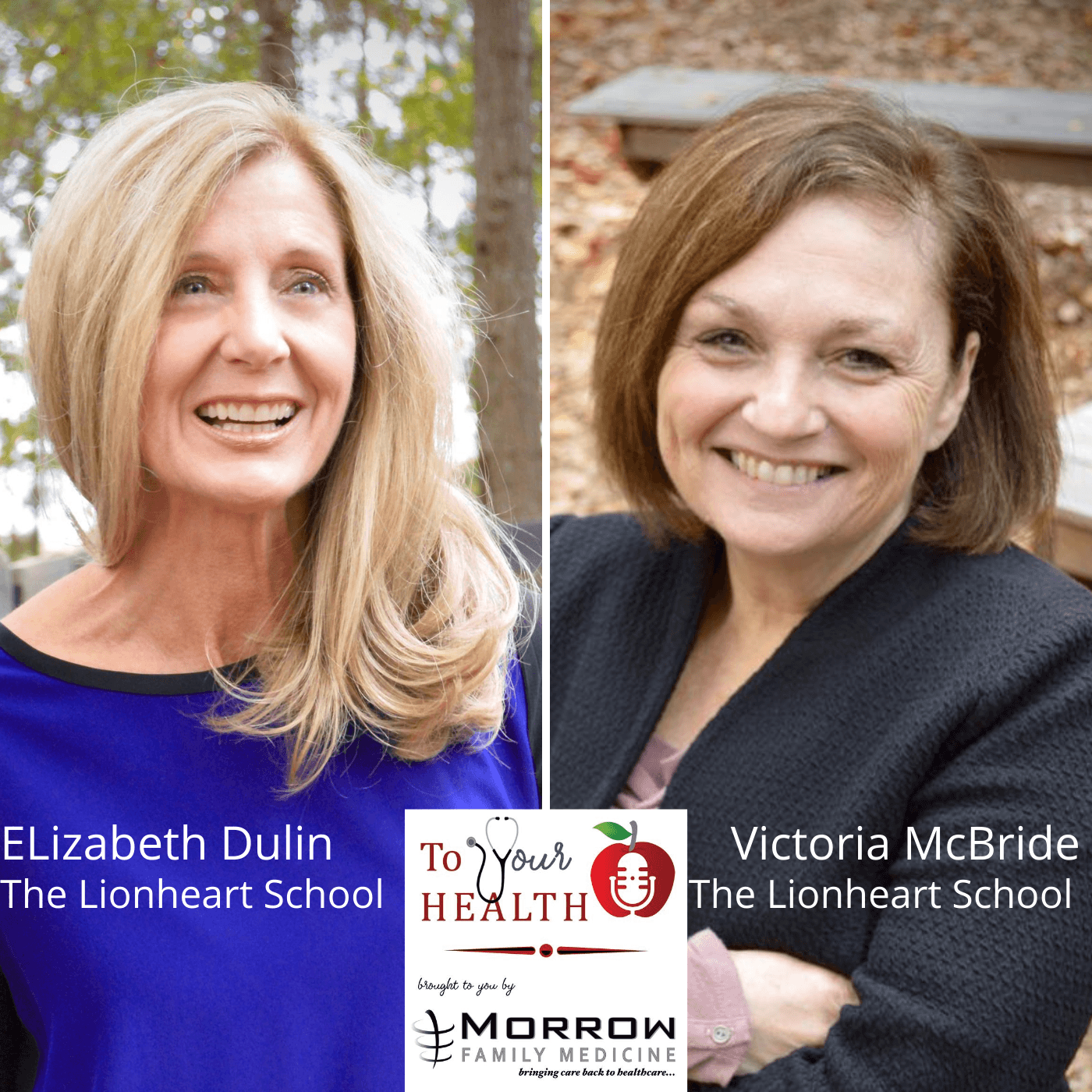
The Lionheart School’s Co-Founders Elizabeth Dulin and Victoria McBride join Dr. Jim Morrow to offer their insights on autism and what they’ve learned in working with children and young people at the school. “To Your Health” is brought to you by Morrow Family Medicine, which brings the CARE back to healthcare.

The Lionheart School

The Lionheart School is a non-profit 501(c)(3) organization founded in the year 2000 by a group of parents and professionals who created a supportive and nurturing environment for children with challenges of relating and communicating. Lionheart started in a small cottage on the grounds of the Alpharetta Presbyterian Church, and worked diligently to create a model program that focused on each child’s individual differences.

In 2010, with the support of families, friends, foundations and the community, Lionheart moved into a new building that was designed specifically for the population it serves. The Lionheart School emphasizes relationships, emotional intelligence, abstract critical thinking, problem solving, and social cognition. The academic program integrates the principles of evidence-based practices for students with learning differences while always considering their individual profiles. Each student has an individual learning plan that considers interests, strengths, and preferences, as well as strategies to address targeted challenge areas.

For more on The Lionheart School, go to their website, Twitter, Facebook, Instagram, or YouTube.

Elizabeth Dulin, M.Ed.

Elizabeth Dulin is the Co-Founder and Head of School.  Elizabeth is certified to teach special education, pre-K to 12th grade in the state of Georgia.  She received both her bachelor’s degree in Psychology and her master’s in Early Childhood Special Education from Vanderbilt University.  Elizabeth has worked for over 30 years with children in various settings; including private school, public school, and private practice with families.

Elizabeth, along with Victoria McBride oversees every aspect of the child’s programming at Lionheart.  She works closely with families to carefully identify individual needs and address them accordingly.  She has a blend of sound teaching practices and specialized training to work with children.  Elizabeth is a training leader and expert DIRFloortime™ provider and supervises the implementation of DIR® principles into the curriculum.  She has a remarkable understanding of children, and uses the relationship-based approach to foster the growth and progress of each child.  She also works with children in small groups utilizing Floortime™.  Elizabeth is a fully certified service dog handler for Lionheart’s educational service dog, LANGLEY.

Victoria A. McBride, M.Ed., CCC-SLP

Victoria McBride is the Co-Founder and Head of Therapeutic Services.  Victoria has a Master’s Degree from the University of Georgia and is a certified and licensed Speech and Language Pathologist.  She has worked for over 30 years with children in various settings; including private school, public school, and private practice with families.  Victoria, along with Elizabeth Dulin oversees every aspect of the child’s programming at Lionheart.  She works closely with families to carefully identify individual needs and address them accordingly.

Her many years of experience has afforded her the opportunity to work with the students to evaluate and assist them in successful transitioning to adulthood; overseeing the vocational and therapeutic aspects of the Lionheart for Life program.  She also works with children on their pragmatic language skills, articulation and oral-motor difficulties, as well as other language based challenges.  Victoria mentors and supports the teachers and therapists at Lionheart. She is a DIR® certified specialist, embedding DIR® principles in her intervention strategies while working with the students and supervising curriculum objectives.

About Morrow Family Medicine and Dr. Jim Morrow

Morrow Family Medicine is an award-winning, state-of-the-art family practice with offices in Cumming and Milton, Georgia. The practice combines healthcare information technology with old-fashioned care to provide the type of care that many are in search of today. Two physicians, three physician assistants and two nurse practitioners are supported by a knowledgeable and friendly staff to make your visit to Morrow Family Medicine one that will remind you of the way healthcare should be.  At Morrow Family Medicine, we like to say we are “bringing the care back to healthcare!”  Morrow Family Medicine has been named the “Best of Forsyth” in Family Medicine in all five years of the award, is a three-time consecutive winner of the “Best of North Atlanta” by readers of Appen Media, and the 2019 winner of “Best of Life” in North Fulton County.

Dr. Jim Morrow, Morrow Family Medicine, and Host of “To Your Health With Dr. Jim Morrow”

Covid-19 misconceptionsDr. Jim Morrow is the founder and CEO of Morrow Family Medicine. He has been a trailblazer and evangelist in the area of healthcare information technology, was named Physician IT Leader of the Year by HIMSS, a HIMSS Davies Award Winner, the Cumming-Forsyth Chamber of Commerce Steve Bloom Award Winner as Entrepreneur of the Year and he received a Phoenix Award as Community Leader of the Year from the Metro Atlanta Chamber of Commerce.  He is married to Peggie Morrow and together they founded the Forsyth BYOT Benefit, a charity in Forsyth County to support students in need of technology and devices. They have two Goldendoodles, a gaggle of grandchildren and enjoy life on and around Lake Lanier.

Facebook: https://www.facebook.com/MorrowFamMed/

LinkedIn: https://www.linkedin.com/company/7788088/admin/

Twitter: https://twitter.com/toyourhealthMD

The complete show archive of “To Your Health with Dr. Jim Morrow” addresses a wide range of health and wellness topics, and can be found at www.toyourhealthradio.com.

Tagged With: Autism, DIRFloortime, Elizabeth Dulin, Floortime, Lionheart, The Lionheart School, To Your Health, To Your Health With Dr. Jim Morrow, Victoria McBride

Attention Deficit Disorder (ADD) – Episode 37, To Your Health With Dr. Jim Morrow

July 23, 2020 by John Ray

attention deficit disorder
North Fulton Studio
Attention Deficit Disorder (ADD) - Episode 37, To Your Health With Dr. Jim Morrow
Loading
00:00 /
RSS Feed
Share
Link
Embed

Download file

attention deficit disorder
Dr. Jim Morrow, Morrow Family Medicine, and Host of “To Your Health With Dr. Jim Morrow”

Attention Deficit Disorder (ADD) – Episode 37, To Your Health With Dr. Jim Morrow

On this edition of “To Your Health,” Dr. Morrow discusses attention-deficit disorder: how to recognize it, how a doctor diagnoses it and treatment options. “To Your Health” is brought to you by Morrow Family Medicine, which brings the CARE back to healthcare.

About Morrow Family Medicine and Dr. Jim Morrow

Morrow Family Medicine is an award-winning, state-of-the-art family practice with offices in Cumming and Milton, Georgia. The practice combines healthcare information technology with old-fashioned care to provide the type of care that many are in search of today. Two physicians, three physician assistants and two nurse practitioners are supported by a knowledgeable and friendly staff to make your visit to Morrow Family Medicine one that will remind you of the way healthcare should be.  At Morrow Family Medicine, we like to say we are “bringing the care back to healthcare!”  Morrow Family Medicine has been named the “Best of Forsyth” in Family Medicine in all five years of the award, is a three-time consecutive winner of the “Best of North Atlanta” by readers of Appen Media, and the 2019 winner of “Best of Life” in North Fulton County.

Dr. Jim Morrow, Morrow Family Medicine, and Host of “To Your Health With Dr. Jim Morrow”

Covid-19 misconceptionsDr. Jim Morrow is the founder and CEO of Morrow Family Medicine. He has been a trailblazer and evangelist in the area of healthcare information technology, was named Physician IT Leader of the Year by HIMSS, a HIMSS Davies Award Winner, the Cumming-Forsyth Chamber of Commerce Steve Bloom Award Winner as Entrepreneur of the Year and he received a Phoenix Award as Community Leader of the Year from the Metro Atlanta Chamber of Commerce.  He is married to Peggie Morrow and together they founded the Forsyth BYOT Benefit, a charity in Forsyth County to support students in need of technology and devices. They have two Goldendoodles, a gaggle of grandchildren and enjoy life on and around Lake Lanier.

Facebook: https://www.facebook.com/MorrowFamMed/

LinkedIn: https://www.linkedin.com/company/7788088/admin/

Twitter: https://twitter.com/toyourhealthMD

The complete show archive of “To Your Health with Dr. Jim Morrow” addresses a wide range of health and wellness topics, and can be found at www.toyourhealthradio.com.

Dr. Morrow’s Show Notes

What is attention-deficit disorder (ADD)? 

  • Attention-deficit disorder (ADD) is a group of behaviors.  
  • It used to also be called attention deficit disorder (ADD).  
  • ADD is common in children and adults.  
  • People who have ADD have trouble paying attention in school, at home, or at work.  
  • Even when they try to concentrate, they find it hard to pay attention.  
  • Children who have ADD may be more active or impulsive than what is typical for their age.  
  • These behaviors cause problems in friendships, learning, and behavior.  
  • For this reason, children who have ADD are sometimes seen as being “difficult” or as having behavior problem 
  • Some people who have ADD may have other conditions as well.  
  • These could include learning disabilities,  
  • anxiety,  
  • depression,  
  • oppositional defiant disorder (ODD),  
  • bipolar disorder,  
  • and Tourette syndrome. 

Symptoms of attention-deficit disorder (ADD) 

  • People who have ADD have  
  • difficulty organizing things,  
  • listening to instructions,  
  • remembering details,  
  • and/or controlling their behavior.  
  • This can make it difficult to get along with other people at home,  
  • at school,  
  • or at work. 
  • A person with ADD who has difficulty paying attention will have 6 or more of the following symptoms: 
  • Has difficulty following instructions. 
  • Has difficulty keeping attention on work or play activities at school,  
  • work,  
  • and home. 
  • Loses things needed for activities at school,  
  • work,  
  • and home. 
  • Appears not to listen. 
  • Doesn’t pay close attention to details. 
  • Seems disorganized. 
  • Has trouble with tasks that require planning ahead. 
  • Forgets things. 
  • Is easily distracted. 
  • A person with ADD who is hyperactive or impulsive will have at least 6 of the following symptoms: 
  • Fidgety. 
  • Runs or climbs inappropriately. 
  • Can’t play quietly. 
  • Blurts out answers. 
  • Interrupts people. 
  • Can’t stay in seat. 
  • Talks too much. 
  • Is always on the go. 
  • Has trouble waiting his or her turn.

What causes attention-deficit disorder (ADD)? 

  • People who have ADD do not make enough chemicals in certain areas in the brain that are important for organizing thoughts.  
  • Without enough of these chemicals, the organizing centers of the brain don’t work well.  
  • This is thought to be the cause of ADD.  
  • The shortage of chemicals may be due to a person’s genes (research shows that ADD is more common in people who have  
  • a close family member with the disorder),  
  • environment,  
  • or physical development.  
  • Recent research also links smoking and other substance abuse during pregnancy to ADD.  
  • Exposure to environmental toxins, such as lead, can also be a factor. 

How is attention-deficit disorder diagnosed? 

  • A doctor will be better able to diagnose ADD when getting information about your child’s behavior.  
  • It may take information from several people who know your child (teachers, daycare providers).  
  • Your doctor also may have forms or checklists that you and your child’s teacher can complete.  
  • This will help you and your doctor compare your child’s behavior with other children’s behavior. 
  • Unfortunately, many people try to diagnose themselves by using a quiz or a checklist they find in a magazine or see on TV.  
  • However, it’s best to see your doctor.  
  • Some of the questions your doctor may ask you or about your child include: 
  • Do you have problems with paying attention and being hyperactive?  
  • Do you have a hard time keeping your temper or staying in a good mood? 
  • Do you have problems staying organized or being on time? 
  • Do these problems happen to you at school, work and at home? 
  • Do family members and friends see that you have problems in these areas? 
  • Do you have any physical or mental health problems that might affect your behavior?  
  • (Your doctor may give you a physical exam and do tests to see if you have any medical problems with symptoms that are like ADD.) 
  • Your doctor will probably want to test your child’s vision and hearing if these tests haven’t been done recently.  
  • A person diagnosed with ADD will have had symptoms for at least 6 months. 
  • If your doctor is uncertain about an ADD diagnosis, he or she may want to give you or your child medicine to see if it makes a difference.  
  • However, a trial of medicine alone is not enough to diagnose ADD. 
  • Also, it might be hard for your doctor to tell if your child has ADD.  
  • Many children who have ADD aren’t hyperactive in the doctor’s office.  
  • Your doctor may ask you to fill out a questionnaire regarding your child’s behavior patterns.  
  • Eventually, your doctor may want your child to see someone who specializes in children’s behavior. 
  • The American Academy of Family Physicians (AAFP) recommends that any child 4 through 18 years of age should be evaluated for ADD if they have  
  • academic or behavioral problems,  
  • and symptoms of inattention,  
  • hyperactivity,  
  • or impulsivity. 

Can attention-deficit disorder (ADD) be prevented or avoided? 

  • ADD cannot be prevented or avoided.  
  • However, doctors believe that avoiding smoking and substance abuse during pregnancy can lower the baby’s risk of developing ADD.  
  • Still, there’s no guarantee that doing everything right during pregnancy will protect a baby from developing ADD.  
  • Additionally, exposure to environmental toxins, such as lead, also can be a risk factor for ADD.  

Attention-deficit disorder (ADD) treatment 

  • Some of the medicines used to treat ADD are called psycho-stimulants.  
  • They include Ritalin,  
  • Adderall,  
  • Concerta,  
  • Vyvanse 
  • and a few others.  
  • These medicines have a stimulating effect in most people.  
  • However, they have a calming effect in people who have ADD.  
  • These medicines improve attention and concentration  
  • and decrease impulsive and overactive behaviors.  
  • Your doctor may consider other non-stimulant medicines, such as  
  • clonidine,  
  • desipramine,  
  • imipramine,  
  • and bupropion. 
  • All medicines have side effects.  
  • Psycho-stimulants may decrease your appetite and cause a stomachache or a headache.  
  • The loss of appetite can cause weight loss in some people.  
  • This side effect seems to be more common in children.  
  • Some people have insomnia (trouble sleeping).  
  • Other possible side effects include fast heartbeat, chest pain, or vomiting.  
  • To avoid or reduce the side effects of psycho-stimulants, follow these tips: 
  • Use the lowest possible dose that still controls the hyperactivity or inattention.  
  • Your doctor will work with you to find the right dose. 
  • Take the medicine with food if it bothers your stomach. 
  • Ask your doctor if you can skip the medicines on the weekends. 
  • Offer healthy snacks to children who lose weight while taking medicine for ADD. 
  • Take the medicine 30 to 45 minutes before a meal.  
  • Lunchtime doses can be given at school for some children.  
  • If your child can’t take this medicine at school, tell your doctor.  
  • He or she might suggest a long-acting form of the medicine instead. 
  •  If you are taking the long-acting form of this medicine, do not crush, break, or chew it before swallowing it. 
  • It’s important to take the medicine the way your doctor prescribes it.  
  • Follow your doctor’s advice, even if you think the medicine isn’t working.  
  • Medicines used to treat ADD have been shown to improve a person’s ability to do specific tasks.  
  • This includes paying attention or having more self-control.  
  • The length of time a person will need to take medicine depends on each person.  
  • Some people only need to take medicine for 1 to 2 years.  
  • Others need treatment for many more years.  
  • In some people, ADD may continue into adolescence and adulthood. 
  • People who have ADD should be checked regularly by their doctors.  
  • If your child has ADD, your doctor may suggest that he or she take a break from his or her medicines once in a while to see if the medicine is still necessary.  
  • School breaks or summer vacation might be best. 
  • AAFP suggests several treatment recommendations.  
  • Preschool-aged children (4-5 years of age) should be treated with behavior therapy as the first line of treatment.  
  • The medicine methylphenidate may be prescribed if behavior treatment does not provide significant improvement.  
  • This medicine also should be prescribed if ADD is interfering with the child’s friendships,  
  • home,  
  • and school life at a moderate to severe level.  
  • Elementary school-aged children (6-11 years of age) should be treated with FDA-approved medicine for ADD and behavioral therapy.  
  • Adolescents (12-18 years of age) should be treated with FDA-approved medicine for ADD and may be treated with behavioral therapy.  
  • In all cases, medicine doses should be measured and adjusted to achieve maximum benefit with few adverse effects. 

Living with attention-deficit disorder (ADD) 

  • Symptoms of ADD often get better as children grow older and learn to adjust.  
  • Hyperactivity usually stops in the late teenage years.  
  • But about half of children who have ADD continue to be easily distracted, have mood swings, hot tempers, and are unable to complete tasks.  
  • Children who have loving, supportive parents or guardians who work together with school staff, mental health workers, and their doctor have the best chance of becoming well-adjusted adults. 
  • Children who have ADD may be difficult to parent.  
  • They may have trouble understanding directions.  
  • Their constant state of activity can be challenging for adults.  
  • Some children benefit from counseling or from structured therapy.  
  • Families may benefit from talking with a specialist in managing ADD-related behavior and learning problems. 
  • Children who have ADD also tend to need more structure and clearer expectations.  
  • You may need to change your home life a bit to help your child. Here are some things you can do to help: 
  • Make a schedule. 
  • Make simple house rules. 
  • Make sure your directions are understood. 
  • Reward good behavior. 
  • Make sure your child is supervised all the time. 
  • Watch your child around his or her friends. 
  • Set a homework routine. 
  • Focus on effort, not grades. 
  • Talk with your child’s teachers.

What about Adult ADD? 

  • Adults may have ADD as well as children.  
  • This is a relatively new way of thinking.  
  • Previously, many physicians felt that adults with symptoms like those of ADD were due more to depression and anxiety than ADD.  
  • This thinking has changed somewhat.   
  • An adult with symptoms of ADD also needs to be tested in order to begin treatment.  
  • Treatment is almost always some form of medication, usually the stimulants. 
  • Untreated ADD can present as severe anxiety. It is important to make the distinction.

Tagged With: ADD, ADHD, attention deficit disorder, Dr. Jim Morrow, Jim Morrow, Morrow Community Foundation, Morrow Family Medicine, To Your Health, To Your Health With Dr. Jim Morrow

Debunking Medical Myths – Episode 35, To Your Health With Dr. Jim Morrow

June 25, 2020 by John Ray

North Fulton Studio
North Fulton Studio
Debunking Medical Myths - Episode 35, To Your Health With Dr. Jim Morrow
Loading
00:00 /
RSS Feed
Share
Link
Embed

Download file

Dr. Jim Morrow, Morrow Family Medicine, and Host of “To Your Health With Dr. Jim Morrow”

To Your Health With Dr. Jim Morrow – Episode 35, Medical Myths

Vaccines cause the flu. We only use 10% of our brains. You’re more likely to get sick in cold weather. Dr. Morrow covers a number of medical beliefs we’ve picked up throughout life which we need to reconsider and discard. Listen in to find out what is true and what is a myth. (And we also celebrate Dr. Morrow’s birthday!) “To Your Health” is brought to you by Morrow Family Medicine, which brings the CARE back to healthcare.

About Morrow Family Medicine and Dr. Jim Morrow

Morrow Family Medicine is an award-winning, state-of-the-art family practice with offices in Cumming and Milton, Georgia. The practice combines healthcare information technology with old-fashioned care to provide the type of care that many are in search of today. Two physicians, three physician assistants and two nurse practitioners are supported by a knowledgeable and friendly staff to make your visit to Morrow Family Medicine one that will remind you of the way healthcare should be.  At Morrow Family Medicine, we like to say we are “bringing the care back to healthcare!”  Morrow Family Medicine has been named the “Best of Forsyth” in Family Medicine in all five years of the award, is a three-time consecutive winner of the “Best of North Atlanta” by readers of Appen Media, and the 2019 winner of “Best of Life” in North Fulton County.

Dr. Jim Morrow, Morrow Family Medicine, and Host of “To Your Health With Dr. Jim Morrow”

Covid-19 misconceptionsDr. Jim Morrow is the founder and CEO of Morrow Family Medicine. He has been a trailblazer and evangelist in the area of healthcare information technology, was named Physician IT Leader of the Year by HIMSS, a HIMSS Davies Award Winner, the Cumming-Forsyth Chamber of Commerce Steve Bloom Award Winner as Entrepreneur of the Year and he received a Phoenix Award as Community Leader of the Year from the Metro Atlanta Chamber of Commerce.  He is married to Peggie Morrow and together they founded the Forsyth BYOT Benefit, a charity in Forsyth County to support students in need of technology and devices. They have two Goldendoodles, a gaggle of grandchildren and enjoy life on and around Lake Lanier.

Facebook: https://www.facebook.com/MorrowFamMed/

LinkedIn: https://www.linkedin.com/company/7788088/admin/

Twitter: https://twitter.com/toyourhealthMD

The complete show archive of “To Your Health with Dr. Jim Morrow” addresses a wide range of health and wellness topics, and can be found at www.toyourhealthradio.com.

Dr. Morrow’s Show Notes

Debunking Medical Myths


  • Myth: Flagyl and Alcohol will make you sick
  • Just not the case. A study of college students showed that even when drunk, metronidazole did not make anyone sick. 
  • Myth: Medicine expires after a year
  • Just not the case. Just because a date has passed does not mean that the antibiotics you got a year ago turned to poison or suddenly stopped working. It just does not happen. 
  • The expiration actually refers to the fact that the prescription itself expires, not the medicine. 
  • any refills you have are no longer valid.


  • Myth: Vaccines can cause the flu (and autism).
  • Although the body can develop a low-grade fever in response to any vaccine, rumors that a flu shot can cause the flu are an outright lie 
  • The flu shot does contain dead flu viruses, but they are, well, dead. 
  • A dead virus cannot be resurrected to cause the flu  
  • As for vaccines causing autism, this myth was started in 1998 with an article in the journal The Lancet.  
  • In the study, the parents of eight (yes, only eight) children with autism said they believed their children acquired the condition after they received a vaccination against measles, mumps and rubella (the MMR vaccine).  
  • Since then, rumors have run rampant despite the results of many studies.  
  • For example, a 2002 study in The New England Journal of Medicine of 530,000 (yes, a whopping 530,000) children found no link between vaccinations and the risk of a child developing autism.


  • Myth: Supplements always make you healthier.

  • Vitamin supplements may be not only ineffectual but even dangerous, studies have shown.  
  • For example, a study published in 2016 showed that some older women who take calcium supplements may face an increased risk of dementia. 
  • And in a huge review of 20 years of supplement research published in 2015, researchers found that taking high doses of vitamins may be linked with an increased risk of cancer. 
  • Aside from these possible long-term risks, reports have suggested that supplements can cause damage in the short term too.  
  • A report published in 2016 found that a man in Pennsylvania who took Ayurvedic herbal supplement developed lead poisoning.  
  • Another report, also published in 2016, showed that a 4-year-old boy in England went to the ER after taking a slew of “natural” supplements, and developing vitamin D toxicity. 
  • The FDA does not require supplements to be regulated in the same way that drugs are, which can be a real problem.  
  • As a result, the safety of many supplements has not been rigorously studied.  
  • Furthermore, supplement bottles can sport unsubstantiated claims and even make errors in dosage recommendations, she said.


  • Myth: Cold weather makes you sick.

  • This myth is common around the world, but it is just not true.  
  • Studies have shown we may feel more cold symptoms — real or imaginary — when we are chilled (after all, a cold is called a “cold” for a reason),  
  • but the temperature itself does not make us more susceptible to viruses.  
  • This has been known since at least 1968, when a study in The New England Journal of Medicine showed what happened when researchers exposed chilly people to the rhinovirus (one cause of the common cold). 
  • It turned out that whether they were shivering in a frigid room or in an icy bath, people were no more likely to get sick after sniffing cold germs than they were at more comfortable temperatures. 
  • Cold air also does not make a difference in people’s recovery time from a cold. In fact, although the research is in its early stages, it is possible that being exposed to cold may even help your body in some way. 
  • However, it’s unclear how chilly conditions might affect the germs themselves.  
  • Research has shown that two common causes of colds — rhinoviruses and coronaviruses — may thrive at colder temperatures,  
  • and that the flu may spread most effectively under cold, dry conditions. 
  • Some scientists speculate that colds are more common in cooler months because people stay indoors more, interacting more closely with one another and giving germs more opportunities to spread.


  • Myth: We use only 10 percent of our brains.

  • Motivational speakers and other self-help gurus have been promoting this one since as early as 1907,  
  • as a way to encourage people to tap into some latent capacity, But these people were not basing the proclamation on sound science. 
  • Today, scientists can look at any brain scan, measuring activity at any given time, and have a big laugh at this myth. The idea lingers in popular culture because we want to think we haven’t reached our full potential.


  • Myth: Sugar turns kids into little monsters.

  • It can be hard to find a parent who does not believe this 
  • In one particularly clever study among a slew of studies finding sugar’s nil effect on unruliness,  
  • kids were given Kool-Aid sweetened with aspartame, a compound that contains no sugar.  
  • Researchers told half of the parents the Kool-Aid contained sugar, and told the other half the truth. 
  • The parents in the study who thought their kids were riding a sugar high reported their children were uncontrollable and overactive.  
  • But a sensor on the kids’ wrists that measured activity level said the opposite:  
  • The kids were actually acting subdued.  
  • The study was published in the Journal of Abnormal Child Psychology in 1994 
  • Sugar is often given at times when the rules are loosened and there are lots of other kids around, like birthday parties and holidays.


  • Myth: You need to stay awake if you’ve had a concussion.

  • Anyone who may have a concussion should seek medical attention,  
  • but the condition is rarely severe or life-threatening.  
  • Warnings that people need to stay awake after incurring a concussion most likely grew out of a misunderstanding about a particular type of head injury —  
  • one that involves brain bleeding and that causes people to have a “lucid period,” followed by a coma or even death.  
  • But this is very uncommon and doesn’t pertain to people with normal concussions 
  • If you’ve been evaluated by a doctor, and he has said that you have a mild regular concussion, you don’t need to worry that someone has to wake you up every hour.


  • Myth: Chewing gum stays in your stomach for 7 years.

  • Although it is true that many of the ingredients in gum —  
  • such as elastomers, resins and waxes —  
  • are indigestible, that does not mean they hang out in your guts for seven years.  
  • Plenty of what you eat — even things you are recommended to eat, such as fiber — is indigestible.  
  • But the digestive system is a robust piece of organic machinery, and anything it can’t absorb, it moves along.  
  • Despite the stickiness and strange consistency of gum, it passes right through your digestive tract.


  • Myth: Reading in the dark or sitting too close to the TV ruins your eyesight.

  • Dim light — or alternatively, staring into the multicolored tube at close range — can undoubtedly make your eyes work so hard they hurt.  
  • But there is no evidence that these practices cause long-term damage. 
  • The TV myth may have started in the 1960s, and at that time, it may have been true.  
  • Some early color TV sets emitted high amounts of radiation that could have caused eye damage,  
  • but this problem has long been remedied, and today’s TV and computer monitors are relatively safe 
  • If you or your child tend to sit so close to the computer or TV that it hurts the eyes, it may be a good idea to get checked for nearsightedness.  
  • However, sitting too close does not create a need for glasses even if getting glasses can remedy the habit. 
  • Myth: You should drink at least 8 glasses of water a day.

  • The eight-glasses-a-day myth likely started in 1945, when the Food and Nutrition Board of the National Research Council said adults should take in about 2.5 liters of water a day  
  • (equivalent to about eight glasses, or two-thirds of a gallon).  
  • Although most media outlets reported that as fact and stopped there,  
  • the council actually went on to explain that most of the 2.5 liters comes from food.  
  • the recommendation should be amended to the following: Drink or eat about eight glasses of fluid a day.


  • Myth: You should wait an hour after eating before you go swimming.

  • This myth has ruined many summer afternoons,  
  • forcing young and old to swelter in the heat while cool waters beckoned,  
  • all because they were careless enough to down a PB&J.  
  • Let the ban be lifted:  
  • There is no special reason not to swim after eating,
  • It’s true that any type of vigorous exercise can be uncomfortable (although not dangerous) after an overwhelming feast.  
  • But for most of us whose waterfront dining experience includes sand-dusted chips and soggy sandwiches, that is hardly a concern.  
  • And cramps can happen anytime, whether you’ve eaten or not.  
  • If you are swimming in waters so rough that a charley horse will mean the death of you, you should probably swim elsewhere. 


  • Myth: Fingernails and hair continue to grow after death.

  • This myth is actually just a misperception, and for many years, most physicians couldn’t disprove it, even though they couldn’t quite explain it. 
  • Here’s what really happens to your nails and hair after you die:  
  • As the body’s skin is drying out, soft tissue, especially skin, is retracting. 
  •  The nails appear much more prominent as the skin dries out.  
  • The same is true, but less obvious, with hair. As the skin is shrinking back, the hair looks more prominent or sticks up a bit.


  • Myth: Shaved hair grows back faster, coarser and darker.

  • Here’s a myth you can debunk yourself by paying attention to your own hair after shaving.  
  • You may notice that new hair grows in with a blunt edge on top.  
  • Over time, that blunt edge gets worn down, making it seem thicker than it really is.  
  • But why might recently shaved hairs seem darker than their nonshaved counterparts?  
  • It could be that those newly spouted hairs haven’t yet been bleached by the sun 
  • But if you don’t trust your own experimental skills, there’s other evidence that this myth isn’t reality.  
  • A clinical trial conducted in 1928 compared hair growth  in shaved patches to hair growth in unshaved patches. 


  • Myth: Eating turkey makes you drowsy.

  • Your excuse for taking a nap after dinner on Thanksgiving just went out the window.  
  • While turkey does contain a chemical called tryptophan that is known to cause drowsiness,  
  • your serving of Thanksgiving bird doesn’t contain any more of the chemical than a similar-size serving of chicken or beef 
  • So why do people feel so sleepy after a Thanksgiving feast?  
  • It could be the overall quantity of food you eat on this holiday that makes you drowsy.  
  • Those heaping mounds of carbohydrates on your plate (think dinner rolls and mashed potatoes),  
  • plus a few alcoholic beverages, will almost certainly make you feel tired.


  • Myth: Ulcers are caused by spicy food and stress.

  • If you think your ulcers are acting up because of the curry you ate last night for dinner, think again.  
  • Although doctors once believed that ulcers were caused by stress, lifestyle choices or spicy foods, they now know that most ulcers are actually caused by the bacterium Helicobacter pylori. 
  • Ulcers — sores that develop in the lining of the esophagus, stomach or the first part of the small intestine — can also be caused by certain medicines.  
  • Aspirin, NSAIDs and iron tablets are the most common culprits
  • Myth: Poinsettias are toxic.

  • Poinsettias aren’t toxic.  
  • The plants can make people sick,  
  • but there have been no definitive cases of a person dying from exposure to a poinsettia plant. 
  • In a paper published in the Southern Medical Journal in 1996, researchers reviewed 22,793 cases of poinsettia exposure that were reported to poison control centers over a seven-year period.  
  • They found that not one of those cases was fatal. The most severe reactions reported were stomachaches and cramping. 
  • The myth about poinsettias being toxic may have come from a case, reported in 1919, of a 2-year-old in Hawaii who allegedly died after ingesting parts of the plant, according to a 2012 article in the Western Journal of Emergency Medicine. But the child’s death was never confirmed, nor was the cause of death.
  • Myth: Chicken noodle soup cures … everything.

  • Everybody’s heard that chicken soup is supposedly the best cure for whatever ails you.  
  • But does this delicious food really help you get better when you’re sick? 
  • Unfortunately, no.  
  • The combination of hot broth and yummy veggies is more of a comfort than a cure 
  • However, some research suggests that chicken noodle soup may work well as a placebo.  
  • In other words, it may convince you that you’re getting better. 

[Source:  livescience.com]


Tagged With: flu, flu myths, health tips, medical myths, Morrow Family Medicine, To Your Health, To Your Health With Dr. Jim Morrow, vitamin supplements

Covid-19 Misconceptions and Straight Talk – Episode 34, To Your Health With Dr. Jim Morrow

June 11, 2020 by John Ray

Covid-19 misconceptions
North Fulton Studio
Covid-19 Misconceptions and Straight Talk - Episode 34, To Your Health With Dr. Jim Morrow
Loading
00:00 /
RSS Feed
Share
Link
Embed

Download file

Covid-19 misconceptions
Dr. Jim Morrow, Host of “To Your Health”

Covid-19 Misconceptions and Straight Talk – Episode 34, To Your Health With Dr. Jim Morrow

Dr. Morrow corrects some Covid-19 misconceptions, such as comparing Covid-19 to the flu. He also delivers straight talk on wearing masks, conspiracy theories about Covid-19 being man-made, whether it’s safe to fly, and more. “To Your Health” is brought to you by Morrow Family Medicine, which brings the CARE back to healthcare.

About Morrow Family Medicine and Dr. Jim Morrow

Morrow Family Medicine is an award-winning, state-of-the-art family practice with offices in Cumming and Milton, Georgia. The practice combines healthcare information technology with old-fashioned care to provide the type of care that many are in search of today. Two physicians, three physician assistants and two nurse practitioners are supported by a knowledgeable and friendly staff to make your visit to Morrow Family Medicine one that will remind you of the way healthcare should be.  At Morrow Family Medicine, we like to say we are “bringing the care back to healthcare!”  Morrow Family Medicine has been named the “Best of Forsyth” in Family Medicine in all five years of the award, is a three-time consecutive winner of the “Best of North Atlanta” by readers of Appen Media, and the 2019 winner of “Best of Life” in North Fulton County.

Dr. Jim Morrow, Morrow Family Medicine, and Host of “To Your Health With Dr. Jim Morrow”

Covid-19 misconceptionsDr. Jim Morrow is the founder and CEO of Morrow Family Medicine. He has been a trailblazer and evangelist in the area of healthcare information technology, was named Physician IT Leader of the Year by HIMSS, a HIMSS Davies Award Winner, the Cumming-Forsyth Chamber of Commerce Steve Bloom Award Winner as Entrepreneur of the Year and he received a Phoenix Award as Community Leader of the Year from the Metro Atlanta Chamber of Commerce.  He is married to Peggie Morrow and together they founded the Forsyth BYOT Benefit, a charity in Forsyth County to support students in need of technology and devices. They have two Goldendoodles, a gaggle of grandchildren and enjoy life on and around Lake Lanier.

Facebook: https://www.facebook.com/MorrowFamMed/

LinkedIn: https://www.linkedin.com/company/7788088/admin/

Twitter: https://twitter.com/toyourhealthMD

The complete show archive of “To Your Health with Dr. Jim Morrow” addresses a wide range of health and wellness topics, and can be found at www.toyourhealthradio.com.

Dr. Morrow’s Show Notes

MORE ON COVID-19

  • This virus is more easily transmitted than the flu virus.
    • It is a much worse disease than the flu.
  • Respiratory distress occurs when your immune system produces cytokines o and the lungs get very inflamed
    • and this inflammation causes fluid and debris to be deposited into the lungs
  • Attacks the heart and kidneys also. o Cardiomyopathy
    • Renal failure – dialysis
  • Causes blood clots, venous and arterial. PE, strokes.
  • At first and for a long time we thought it was not affecting children.
    • Now, we know that is not true.
    • Attacks the blood vessels in young children and causes a condition known as Kawasaki’s Disease or a Kawasaki-like Disease.
      • This is pathologic changes that seem to result from an exaggerated immune response to a pathogen in patients with genetic susceptibility.
  • Hydroxychloroquine has been shown not to be effective and, in some cases, harmful in Covid-19.
    • Has finally been put to bed. o Increased mortality if given late
  • Remdesivir might work.
    • o Patients are often much worse in the second week of the disease.  o This has to be given IV early.
    • Hard to do that.
    • Very short supply of this
  • Total cases have started to plateau in the US, but with social distancing waning somewhat and states opening up, we will definitely see a bump in cases.
  • Bacteremia: o Week 2-3 o Can be septic
    • Can be fatal
  • Second trimester miscarriages are being linked to this infection
  • Peds: Multi-inflammatory Syndrome
  • Fever
  • Median age is ten – up to 20
  •  Rash
  • Swelling of nodes in neck
  • Most get conjunctivitis, red eyes and red and cracked lips o Fuzzy thinking o Nausea o Diarrhea o Abd pain
  • Some heart involvement – LV dysfunction o This is still rare but definitely happening o Responds to therapy:
    • IV-Ig;
    • steroids
  • The healthcare system has been spared the overwhelming push that would have made all of this dramatically worse.
  • Masks:
    • Wear one anytime in public.
    •  They protect others from you.
    • 44% of people in a NY study who had NO symptoms were found to be positive for having the disease at the time they had no symptoms.
  • Viral Testing:
      • Lots of false positive and negative tests o Saliva test, approved by FDA.
      • At home tests available. Nasal swab
        • letsgetchecked.com
      • about $100
      • about a 4 day turn around
  • Antibody Tests:
    • There are three antibodies that are tested for in most of these tests.
      • IgA, a respiratory antibody.
    • One that is produced in response to a respiratory infection. As opposed to a stomach bug or what people insist on calling a “stomach flu”, even though that does not exist.
    • IgM
    • one that you produce acutely as you are in the midst of an active infection.
    • IgG
    • One you make that is at the end of an infection and the one that lasts the longest, giving you some degree of immunity to an infection you have already had.
  • IgA and IgM can cross react with the coronaviruses that cause the common cold, mainly 229E and OC43.
  • IgG is specific for the type of virus that caused a particular infection, such as SARS-CoV-2.
  • So, if you get the antibody test, you are looking for a positive IgG antibody to know if you were infected with or exposed to this novel coronavirus.
  • We presume that this infers some degree of immunity but we really are not certain of that yet.
  • ACE inhibitors and ARBs: stay on them if you take them. They could actually benefit you
  • Aspirin: stay on it
  • Allergy meds: stay on them; Covid-19 does not cause sneezing. Period.
  • You need to understand that scientists are accustomed to saying “I don’t know”
  • but the public is accustomed to us having all the answers.
  • For the past 75 years, when it comes to infections and public health issues, the public has come to expect medicine to know what’s what.
    • But this is a totally new virus.
      • It’s like the time of Louis Pasteur when scientists did not know everything,
      • or hardly anything compared to today.
    • Information that I learned two weeks ago is being proven wrong this week.
    • Social media and the public’s access to information of all kinds,
      • most of it unproven,
      • is making it difficult to sort out fact from fiction.
    • People have a need to believe something,
      • so when they see someone who sounds knowledgeable, they want to believe it.
      • When it gives them an answer they want to believe it.
  • Late stage issues:
    • Prolonged positivity, up to 2 months
      • People get better,
    • then get worse,
    • PCR neg then wbc goes up,
    • inflammatory markers up.
    • Some are concerned about people getting reinfected…

o Late stage symptoms:

  • joint pain,
  • muscle pan,
  • leg pain,
  • think mucus.
  • Fever – to 102 for 2 months
  • Chronic diarrhea – we don’t understand this o
  • Making progress:
  • 9 weeks ago: 1.03 people were infected by an infected person. o 7 weeks ago: 86 o A few weeks ago: 0.76
  • Last week: Back to 1.03 after state opened back up

Tagged With: conspiracy theories, coronavirus, COVID-19, Dr. Jim Morrow, flu virus, hydroxychloroquine, Morrow Family Medicine, Remdesivir, To Your Health, To Your Health With Dr. Jim Morrow

To Your Health With Dr. Jim Morrow:  Episode 33, Covid-19 Hard Truths and Science, with Dr. Manny Rodriguez, Infectious Disease Services of Georgia

May 27, 2020 by John Ray

Infectious Disease Services of Georgia
North Fulton Studio
To Your Health With Dr. Jim Morrow:  Episode 33, Covid-19 Hard Truths and Science, with Dr. Manny Rodriguez, Infectious Disease Services of Georgia
Loading
00:00 /
RSS Feed
Share
Link
Embed

Download file


Infectious Disease Services of Georgia

To Your Health With Dr. Jim Morrow: Episode 33, Covid-19 Hard Truths and Science, with Dr. Manny Rodriguez, Infectious Disease Services of Georgia

Dr. Morrow discusses some Covid-19 hard truths and science with Dr. Manny Rodriguez, a Cumming-based infectious disease specialist. Myths on wearing face masks, a second wave, school reopening in the fall, are just a few of the topics covered in this episode. “To Your Health” is brought to you by Morrow Family Medicine, which brings the CARE back to healthcare.

Dr. Manny Rodriguez, Infectious Disease Services of Georgia

Infectious Disease Services of Georgia
Dr. Manny Rodriguez, Infectious Disease Services of Georgia

Dr. Manuel D. Rodriguez received his Bachelors of Science degree in Psychobiology in 2000 from Florida Atlantic University. He continued on and received his Master’s degree in Biomedical Science from Barry University in 2002. In 2006, he obtained both his Doctor of Osteopathic Medicine and Master’s of Public Health from Nova Southeastern University in South Florida. After completing his Osteopathic internship at Palmetto General Hospital in Hialeah, Florida in 2007 he moved to Mobile, Alabama where he completed his residency at University of South Alabama in 2010 and stayed on as Chief Medical Resident for an additional year. In 2011, he and his family moved to Washington, DC where he completed his fellowship in Infectious Diseases at The George Washington University in 2013.

Throughout his training he has received numerous teaching awards, and since joining IDSGA has been asked to lecture on Infectious Disease topics at both local and state conferences. He is currently Board Certified in Infectious Disease and Internal Medicine and has professional affiliations with the Alpha Omega Alpha Medical Honor Society, the American College of Physicians where he serves as a member of the Council of Young Physicians, the American Osteopathic Association, and the Infectious Disease Society of America.

In his spare time, he enjoys cooking, reading, hiking and spending time with his family.

More information is available at the Infectious Disease Services of Georgia website.

Questions/Topics Discussed in this Episode:

  • Mitigation as opposed to complete shut-down
  • On re-opening, what do you anticipate as far as the almost inevitable bump in cases?
  • What might a “second wave” look like?
  • Masks and social distancing
  • Dr. Fauci seems to go against the grain, if you can believe what you see on social media and YouTube.
  • Hydroxychloroquine
  • Remdesivir
  • Antibody testing
  • Saliva for testing?
  • Mutations versus Strains
  • Man-made or a Lab Accident?
  • Could this have been prevented?
  • What do you predict for schools in the fall?
  • Touching on the issue of so many unknowns

About Morrow Family Medicine and Dr. Jim Morrow

Morrow Family Medicine is an award-winning, state-of-the-art family practice with offices in Cumming and Milton, Georgia. The practice combines healthcare information technology with old-fashioned care to provide the type of care that many are in search of today. Two physicians, three physician assistants and two nurse practitioners are supported by a knowledgeable and friendly staff to make your visit to Morrow Family Medicine one that will remind you of the way healthcare should be.  At Morrow Family Medicine, we like to say we are “bringing the care back to healthcare!”  Morrow Family Medicine has been named the “Best of Forsyth” in Family Medicine in all five years of the award, is a three-time consecutive winner of the “Best of North Atlanta” by readers of Appen Media, and the 2019 winner of “Best of Life” in North Fulton County.

Dr. Jim Morrow, Morrow Family Medicine, and Host of “To Your Health With Dr. Jim Morrow”

Dr. Jim Morrow is the founder and CEO of Morrow Family Medicine. He has been a trailblazer and evangelist in the area of healthcare information technology, was named Physician IT Leader of the Year by HIMSS, a HIMSS Davies Award Winner, the Cumming-Forsyth Chamber of Commerce Steve Bloom Award Winner as Entrepreneur of the Year and he received a Phoenix Award as Community Leader of the Year from the Metro Atlanta Chamber of Commerce.  He is married to Peggie Morrow and together they founded the Forsyth BYOT Benefit, a charity in Forsyth County to support students in need of technology and devices. They have two Goldendoodles, a gaggle of grandchildren and enjoy life on and around Lake Lanier.

Facebook: https://www.facebook.com/MorrowFamMed/

LinkedIn: https://www.linkedin.com/company/7788088/admin/

Twitter: https://twitter.com/toyourhealthMD

The complete show archive of “To Your Health with Dr. Jim Morrow” addresses a wide range of health and wellness topics, and can be found at www.toyourhealthradio.com.

Tagged With: antibody testing, COVID-19, Dr. Jim Morrow, hydroxychloroquine, infectious disease, Infectious Disease Services of Georgia, infectious diseases, Jim Morrow, masks, mitigation, Morrow Family Medicine, Remdesivir, saliva testing, second wave, social distancing, To Your Health, To Your Health With Dr. Jim Morrow

To Your Health With Dr. Jim Morrow:  Episode 32, Stress in a Pandemic with Dr. Brooke Jones, Fresh Start for the Mind, and a Covid-19 Update

May 13, 2020 by John Ray

stress in a pandemic
North Fulton Studio
To Your Health With Dr. Jim Morrow:  Episode 32, Stress in a Pandemic with Dr. Brooke Jones, Fresh Start for the Mind, and a Covid-19 Update
Loading
00:00 /
RSS Feed
Share
Link
Embed

Download file

Stress in a Pandemic
Dr. Jim Morrow, Morrow Family Medicine, and Dr. Brooke Jones, Fresh Start for the Mind

To Your Health With Dr. Jim Morrow:  Episode 32, Stress in a Pandemic with Dr. Brooke Jones and a Covid-19 Update

Dr. Morrow discusses dealing with stress in a pandemic with Dr. Brooke Jones, Fresh Start for the Mind. Dr. Morrow also shares a Covid-19 update, which includes a debunking of the “Plandemic” video and comments on the ineffectiveness of hydroxychloroquine.  “To Your Health” is brought to you by Morrow Family Medicine, which brings the CARE back to healthcare.

Dr. Brooke Jones, Fresh Start for the Mind

stress in a pandemic
Dr. Brooke Jones, Fresh Start for the Mind

In 2013, Dr. Brooke Jones branched out on her own to open a mental health practice, Fresh Start for the Mind. She wanted a practice that incorporated the mind, body, and spirit. Her love for psychological evaluations became evident in the Alpharetta and surrounding communities. As referrals grew, so did Fresh Start.

Fresh Start for the Mind is a comprehensive mental health practice that provides counseling, psychological evaluations, psychiatry and medication management, coaching, and nutrition support to children, adults, and families. Since its inception in 2013, Fresh Start has grown to over 30 staff members and has maintained a reputation for providing quality and heart-felt services. Fresh Start has three facilities and proudly serves patients in and around Suwanee, Stockbridge, and Canton, GA.

You can find out more at their website or call Fresh Start at 404-808-1161.

About Morrow Family Medicine and Dr. Jim Morrow

Morrow Family Medicine is an award-winning, state-of-the-art family practice with offices in Cumming and Milton, Georgia. The practice combines healthcare information technology with old-fashioned care to provide the type of care that many are in search of today. Two physicians, three physician assistants and two nurse practitioners are supported by a knowledgeable and friendly staff to make your visit to Morrow Family Medicine one that will remind you of the way healthcare should be.  At Morrow Family Medicine, we like to say we are “bringing the care back to healthcare!”  Morrow Family Medicine has been named the “Best of Forsyth” in Family Medicine in all five years of the award, is a three-time consecutive winner of the “Best of North Atlanta” by readers of Appen Media, and the 2019 winner of “Best of Life” in North Fulton County.

Dr. Jim Morrow, Morrow Family Medicine, and Host of “To Your Health With Dr. Jim Morrow”

Dr. Jim Morrow is the founder and CEO of Morrow Family Medicine. He has been a trailblazer and evangelist in the area of healthcare information technology, was named Physician IT Leader of the Year by HIMSS, a HIMSS Davies Award Winner, the Cumming-Forsyth Chamber of Commerce Steve Bloom Award Winner as Entrepreneur of the Year and he received a Phoenix Award as Community Leader of the Year from the Metro Atlanta Chamber of Commerce.  He is married to Peggie Morrow and together they founded the Forsyth BYOT Benefit, a charity in Forsyth County to support students in need of technology and devices. They have two Goldendoodles, a gaggle of grandchildren and enjoy life on and around Lake Lanier.

Facebook: https://www.facebook.com/MorrowFamMed/

LinkedIn: https://www.linkedin.com/company/7788088/admin/

Twitter: https://twitter.com/toyourhealthMD

The complete show archive of “To Your Health with Dr. Jim Morrow” addresses a wide range of health and wellness topics, and can be found at www.toyourhealthradio.com.

Dr. Morrow’s Show Notes

Coronavirus Update

  • Hydroxychloroquine has been shown not to be effective and in some cases harmful in Covid-19.
  • Patients are often much worse in the second week of the disease.
  • Total cases have started to plateau in the US, but with social distancing waning somewhat and states opening up, we will definitely see a bump in cases.
  • The healthcare system has been spared the overwhelming push that would have made all of this dramatically worse.
  • Masks:
    • Wear one anytime in public.
    • They protect others from you.
    • 44% of people in a NY study who had NO symptoms were found to be positive for having the disease at the time they had no symptoms.
  • Antibody Tests:
    • There are three antibodies that are tested for in most of these tests.
      • IgA, a respiratory antibody.  
        • One that is produced in response to a respiratory infection. As opposed to a stomach bug or what people insist on calling a “stomach flu”, even though that does not exist.
      • IgM 
        • one that you produce acutely as you are in the midst of an active infection.
      • IgG
        • One you make that is at the end of an infection and the one that lasts the longest, giving you some degree of immunity to an infection you have already had.
    • IgA and IgM can cross react with the coronaviruses that cause the common cold, mainly 229E and OC43.
    • IgG is specific for the type of virus that caused a particular infection, such as SARS-CoV-2.
    • So, if you get the antibody test, you are looking for a positive IgG antibody to know if you were infected with or exposed to this novel coronavirus.
    • We presume that this infers some degree of immunity but we really are not certain of that yet.
    • ACE inhibitors and ARBs: stay on them if you take them. They could actually benefit you
    • Aspirin: stay on it
    • Allergy meds: stay on them; Covid-19 does not cause sneezing. Period.
  • “Plandemic” video: so many people sent this to me.
    • It is complete bunk.
    • You need to understand that scientists are accustomed to saying “I don’t know”
      • but the public is accustomed to us having all the answers.
    • For the past 75 years, when it comes to infections and public health issues,
      • the public has come to expect medicine to know what’s what.
    • But this is a totally new virus.
      • It’s like the time of Louis Pasteur when scientists did not know everything,
      • or hardly anything compared to today.
    • Information that I learned two weeks ago is being proven wrong this week.
    • Social media and the public’s access to information of all kinds,
      • most of it unproven,
      • is making it difficult to sort out fact from fiction.
    • People have a need to believe something,
      • so when they see someone who sounds knowledgeable,
      • they want to believe it.
      • When it gives them an answer they want to believe it.
      • Well, don’t believe one word in that video. Not one.


Stress in a Pandemic

Outbreaks can be stressful

    • The outbreak of coronavirus disease 2019 (COVID-19) may be stressful for people. 
      • Fear and anxiety about a disease can be overwhelming and cause strong emotions in adults and children. 
  • Coping with stress in a pandemic will make you, the people you care about, and your community stronger.
  • Stress in a pandemic can include
    • Fear and worry about your own health and the health of your loved ones
    • Changes in sleep or eating patterns
    • Difficulty sleeping or concentrating
    • Worsening of chronic health problems
    • Worsening of mental health conditions
    • Increased use of alcohol, tobacco, or other drugs
  • Everyone reacts differently to stressful situations
    • How you respond to the outbreak can depend on 
      • your background,
      • the things that make you different from other people, 
      • and the community you live in.

Our Guest Today:

Brooke Jones,  Psychologist and Owner, Fresh Start for the Mind

Fresh Start for the Mind is a comprehensive mental health practice that provides counseling, psychological evaluations, psychiatry and medication management, coaching, and nutrition support to children, adults, and families.  Since it’s inception in 2013, Fresh Start has grown to over 30 staff members and has maintained a reputation for providing quality and heart-felt services.  Fresh Start has three facilities and proudly serves patients in and around Suwanee, Stockbridge, and Canton, GA.  

Question/Topics in this interview:

  • What have been some common reactions you’ve seen in response to COVID-19 pandemic?
  • Do you have any advice on how to help children cope with these changes?
  • What are some specific examples of self-care and how would you recommend our listeners make this apart of their routine?
  • How can I support a loved one, who may be directly or indirectly affected by COVID-19?
  • If I needed help with managing stress, anxiety, depression, or anger – weather it’s directly or indirectly related to COVID, or in general, where can I find help?
  • Do you have any advice on how to help children cope with these changes?
  • What are some specific examples of self-care and how would you recommend our listeners make this apart of their routine?
  • How can I support a loved one, who may be directly or indirectly affected by COVID-19?

Outbreaks can be stressful (cont’d)

  • People who may respond more strongly to stress in a pandemic include
    • Older people and people with chronic diseases who are at higher risk for severe illness from COVID-19
    • Children and teens
    • People who are helping with the response to COVID-19, like doctors, other health care providers, and first responders
    • People who have mental health conditions including problems with substance use
  • Take care of yourself and your community
    • Taking care of yourself, 
      • your friends, 
      • and your family can help you cope with stress. 
      • Helping others cope with their stress can also make your community stronger.
  • Ways to cope with stress
    • Take breaks from watching, 
    • reading, 
    • or listening to news stories, 
      • including social media. 
      • Hearing about the pandemic repeatedly can be upsetting.
  • Take care of your body.
    • Take deep breaths, stretch, or meditate
    • Try to eat healthy, well-balanced meals.
    • Exercise regularly, get plenty of sleep.
    • Avoid alcohol and drugs
    • Make time to unwind. Try to do some other activities you enjoy.
    • Connect with others. Talk with people you trust about your concerns and how you are feeling.

Tagged With: anxiety, COVID-19, Depression, Dr. Brooke Jones, Dr. Jim Morrow, Fresh Start for the Mind, hydroxychloroquine, Jim Morrow, mental health, Morrow Family Medicine, pandemic, Plandemic video, stress, stress in a pandemic, To Your Health, To Your Health With Dr. Jim Morrow

To Your Health With Dr. Jim Morrow: Episode 31, Telemedicine and Georgia Opens Up

April 23, 2020 by John Ray

telehealth
North Fulton Studio
To Your Health With Dr. Jim Morrow: Episode 31, Telemedicine and Georgia Opens Up
Loading
00:00 /
RSS Feed
Share
Link
Embed

Download file

telehealth
Dr. Jim Morrow, Host of “To Your Health”

To Your Health With Dr. Jim Morrow: Episode 31:  Telemedicine and Georgia Opens Up

Dr. Morrow offers his thoughts on Gov. Brian Kemp’s “opening” of Georgia, as well as a thorough discussion of telemedicine, its pros and cons, and how he is using telemedicine currently to treat patients at Morrow Family Medicine.  As always, Dr. Morrow responds to listener emails and feedback, including one from a disgruntled tinnitus sufferer. “To Your Health” is brought to you by Morrow Family Medicine, which brings the CARE back to healthcare.

About Morrow Family Medicine and Dr. Jim Morrow

Morrow Family Medicine is an award-winning, state-of-the-art family practice with offices in Cumming and Milton, Georgia. The practice combines healthcare information technology with old-fashioned care to provide the type of care that many are in search of today. Two physicians, three physician assistants and two nurse practitioners are supported by a knowledgeable and friendly staff to make your visit to Morrow Family Medicine one that will remind you of the way healthcare should be.  At Morrow Family Medicine, we like to say we are “bringing the care back to healthcare!”  Morrow Family Medicine has been named the “Best of Forsyth” in Family Medicine in all five years of the award, is a three-time consecutive winner of the “Best of North Atlanta” by readers of Appen Media, and the 2019 winner of “Best of Life” in North Fulton County.

Dr. Jim Morrow, Morrow Family Medicine, and Host of “To Your Health With Dr. Jim Morrow”

Dr. Jim Morrow is the founder and CEO of Morrow Family Medicine. He has been a trailblazer and evangelist in the area of healthcare information technology, was named Physician IT Leader of the Year by HIMSS, a HIMSS Davies Award Winner, the Cumming-Forsyth Chamber of Commerce Steve Bloom Award Winner as Entrepreneur of the Year and he received a Phoenix Award as Community Leader of the Year from the Metro Atlanta Chamber of Commerce.  He is married to Peggie Morrow and together they founded the Forsyth BYOT Benefit, a charity in Forsyth County to support students in need of technology and devices. They have two Goldendoodles, a gaggle of grandchildren and enjoy life on and around Lake Lanier.

Facebook: https://www.facebook.com/MorrowFamMed/

LinkedIn: https://www.linkedin.com/company/7788088/admin/

Twitter: https://twitter.com/toyourhealthMD

The complete show archive of “To Your Health with Dr. Jim Morrow” addresses a wide range of health and wellness topics, and can be found at www.toyourhealthradio.com.

telemedicine


Dr. Morrow’s Show Notes

Coronavirus Update


Worldwide cases: 2,561,915

Total Deaths: 177,200

Total Recovered: 679,819

Total Hospitalized in the US: 120,268

Hospitalized in Georgia: 3,779

Incidence rate: 198.89 per 100,000 persons

Antibody test not yet generally available and the tests have a cross reactivity with some of the common cold CVs.

The average number of people who become infected by an infectious person is declining in every state. See this at rt.live.


Telemedicine Facts

  • According to Healthcare Business & Technology,
    • Almost 75% of all doctor, urgent care, and ER visits “are either unnecessary or could be handled safely and effectively over the phone or video,”
  • MedCity Newsreports that 90% of healthcare executives say their organizations are developing or already have a telehealth application.
  • The majority of healthcare organizations are increasing or maintaining their telehealth investments this year.
  • According to the American Hospital Association, about 20% of Americans live in rural areas without easy access to primary care or specialist medical services.
  • A survey conducted by American Well found that 65% of consumers want to use telehealth
  • According to the American Hospital Association, more than three-fourths of hospitals are currently using or implementing telehealth.

Pre-Pandemic Situation

 Limited Medicare coverage impeded the expansion of telehealth services.

    • Current statute restricts most telehealth services to patients located in
      • rural areas and
      • in specific settings (such as a hospital or physician office),
      • covers only a limited number of services, and
      • allows only real-time, two-way video conference capabilities.
  • Changes needed include:
    • widespread elimination of geographic and setting locations requirements so patients outside of rural areas can benefit from telehealth;
    • expanding the types of technology that can be used, including remote monitoring; and
    • covering all services that are safe to provide, rather than a small list of approved services.
  • Additional research is needed to evaluate telehealth.
    • Research and experience under the Medicare program suggest that policymakers’ concerns about increased access to telehealth leading to increased spending may be overstated,
      • particularly when weighed against the potential benefits in quality, patient experience and efficiency.
      • However, there are insufficient studies on the cost-benefits of telehealth outside of a limited number of services.
    • Federal programs to expand broadband need to be simplified.
      • According to the FCC, 34 million Americans still lack access to adequate broadband.
      • And, there is a large digital divide, with almost 40 percent of those living in rural areas lacking access.
        • The FCC has a program that supports broadband adoption, but it is administratively burdensome and provides an insufficient level of subsidy for remote health care providers.
          • While the FCC has taken positive steps by increasing the subsidy, we need even greater federal investment in broadband access, particularly in rural areas.
        • More and better research is needed for other conditions and newer technologies, such as remote monitoring of patients.
      • Telehealth connects patients to vital health care services through
        • videoconferencing,
        • remote monitoring,
        • electronic consults
        • and wireless communications.
        • By increasing access to physicians and specialists,
          • telehealth helps ensure patients receive
            • the right care,
            • at the right place,
            • at the right time.
          • Currently, 76 percent of U.S. hospitals connect with patients and consulting practitioners at a distance through the use of video and other technology.
            • Almost every state Medicaid program has some form of coverage for telehealth services,
              • and private payers are embracing coverage for many telehealth services.
              • However, there are barriers to wide adoption of telehealth.
              • Medicare generally still limits coverage and payment for many telehealth services, lagging behind other payers.
              • The Medicare program recently expanded coverage for telehealth services for stroke patients and substance use treatment in response to statutory changes.
              • Medicare also expanded payments to clinicians for virtual check-ins.
                • While promising,
                  • these incremental steps are not sufficient.
                • In addition, limited access to adequate broadband services hampers the ability of some rural facilities to deploy telehealth.
                • The challenge of cross-state licensure also looms as a major issue.
                • Other policy and operational issues include credentialing and privileging,
                  • online prescribing,
                  • privacy and security
                  • and fraud and abuse.
                • The federal government needs to do more to increase the use of telehealth.

Telemedicine and Covid-19

  • Healthcare is seeing a surge of direct-to-consumer telemedicine providers
    • operating at a large scale
    • helping to provide care to patients who might be wondering if they need care after exhibiting potential symptoms associated with the novel coronavirus.
  • Simultaneously we’re also seeing a rapidly increasing need for on-demand acute care via telemedicine.
    • This includes ICU programs offering intensive care for the most critical patients.
      • However, tele-triage is exploding in terms of the number of use-cases that involves determining when a patient presents in the emergency department whether they need to be issued a bed or if they can be seen in another area within the hospital in order to keep the patient safe and to reduce potential exposures.
    • This helps to limit providers’ exposure to the virus and other infectious diseases.
  • If a hospital worker is exposed without adequate protection, they’d be put into self-quarantine for 14 days
    • Using acute telemedicine for tele-triage is helping keep staff in a low-risk category for infection
      • by completely eliminating exposure for those doctors or other hospital staff.
  • Unfortunately, providers and policymakers are playing catch-up with telehealth technologies right now
    • and are just beginning to recognize that they are essential solutions for keeping potentially infected individuals out of hospitals and doctors’ offices
    • As this public health crisis continues to escalate, however,
      • telemedicine is quickly gaining recognition as a critical tool to slow the spread of COVID-19
    • There are three primary roles for telehealth technologies during this crisis
      • The first:
        • to screen patients remotely rather than having them visit the practice or hospital.
        • They can be used to triage patients with cold and flu-like symptoms and to remotely care for those who don’t need medical intervention or could receive care at home.
        • By keeping potentially infected individuals out of hospitals and doctors’ offices, the healthcare system can lower the risk of transmission to other patients and healthcare staff.
      • Second:
        • To help provide routine care for patients with chronic diseases who are at high risk if exposed to the virus
      • And third:
        • Providers and their staff are not immune to infection and are at increased risk for contracting COVID-19 due to their continuous exposure to infected patients
          • Once tested and confirmed, these providers will be quarantined and become unavailable to the healthcare system just when it needs them most.

Limitations of Telehealth

  • Inability for most clinicians to fully examine a patient
    • The hardware exists to do this but it is expensive and has limitations
  • Limitations in broadband and device access
  • Laboratory testing not possible
  • In cases where patients are using on-demand telemedicine services that connect them with a random healthcare provider, care continuity suffers.
  • A patient’s primary care provider may not have access to records from those other visits and end up with an incomplete history for the patient.
    • Service provider shuffling increases the risk that a doctor won’t know a patient’s history or have notes about care routines.
  • Healthcare laws, reimbursement policies, and privacy protection rules struggle to keep up with this fast-growing industry.
    • As a healthcare provider, you want to promote best practices when approaching telemedicine.
  • While major developments have been made to telehealth reimbursement over the past couple years, it still remains a common stumbling block for providers interested in telemedicine.

The Bottom Line

  • Telehealth helps increase health care value and affordability.
    • Virtual care technology saves patients time and money,
      • reduces patient transfers,
      • emergency department and urgent care center visits,
      • and delivers savings to payers.
    • In addition, telehealth helps address physician burnout by reducing clinicians’ drive times and allowing more time for patients.

Tagged With: Dr. Jim Morrow, Gov. Brian Kemp, Jim Morrow, Morrow Family Medicine, teleHealth, telemedicine, tinnitus, To Your Health, To Your Health With Dr. Jim Morrow

  • « Previous Page
  • 1
  • 2
  • 3
  • 4
  • 5
  • Next Page »

Business RadioX ® Network


Our Most Recent Episode

CONNECT WITH US

  • Email
  • Facebook
  • LinkedIn
  • Twitter
  • YouTube

Our Mission

We help local business leaders get the word out about the important work they’re doing to serve their market, their community, and their profession.

We support and celebrate business by sharing positive business stories that traditional media ignores. Some media leans left. Some media leans right. We lean business.

Sponsor a Show

Build Relationships and Grow Your Business. Click here for more details.

Partner With Us

Discover More Here

Terms and Conditions
Privacy Policy

Connect with us

Want to keep up with the latest in pro-business news across the network? Follow us on social media for the latest stories!
  • Email
  • Facebook
  • Google+
  • LinkedIn
  • Twitter
  • YouTube

Business RadioX® Headquarters
1000 Abernathy Rd. NE
Building 400, Suite L-10
Sandy Springs, GA 30328

© 2025 Business RadioX ® · Rainmaker Platform

BRXStudioCoversLA

Wait! Don’t Miss an Episode of LA Business Radio

BRXStudioCoversDENVER

Wait! Don’t Miss an Episode of Denver Business Radio

BRXStudioCoversPENSACOLA

Wait! Don’t Miss an Episode of Pensacola Business Radio

BRXStudioCoversBIRMINGHAM

Wait! Don’t Miss an Episode of Birmingham Business Radio

BRXStudioCoversTALLAHASSEE

Wait! Don’t Miss an Episode of Tallahassee Business Radio

BRXStudioCoversRALEIGH

Wait! Don’t Miss an Episode of Raleigh Business Radio

BRXStudioCoversRICHMONDNoWhite

Wait! Don’t Miss an Episode of Richmond Business Radio

BRXStudioCoversNASHVILLENoWhite

Wait! Don’t Miss an Episode of Nashville Business Radio

BRXStudioCoversDETROIT

Wait! Don’t Miss an Episode of Detroit Business Radio

BRXStudioCoversSTLOUIS

Wait! Don’t Miss an Episode of St. Louis Business Radio

BRXStudioCoversCOLUMBUS-small

Wait! Don’t Miss an Episode of Columbus Business Radio

Coachthecoach-08-08

Wait! Don’t Miss an Episode of Coach the Coach

BRXStudioCoversBAYAREA

Wait! Don’t Miss an Episode of Bay Area Business Radio

BRXStudioCoversCHICAGO

Wait! Don’t Miss an Episode of Chicago Business Radio

Wait! Don’t Miss an Episode of Atlanta Business Radio