Business RadioX ®

  • Home
  • Business RadioX ® Communities
    • Southeast
      • Alabama
        • Birmingham
      • Florida
        • Orlando
        • Pensacola
        • South Florida
        • Tampa
        • Tallahassee
      • Georgia
        • Atlanta
        • Cherokee
        • Forsyth
        • Greater Perimeter
        • Gwinnett
        • North Fulton
        • North Georgia
        • Northeast Georgia
        • Rome
        • Savannah
      • Louisiana
        • New Orleans
      • North Carolina
        • Charlotte
        • Raleigh
      • Tennessee
        • Chattanooga
        • Nashville
      • Virginia
        • Richmond
    • South Central
      • Arkansas
        • Northwest Arkansas
    • Midwest
      • Illinois
        • Chicago
      • Michigan
        • Detroit
      • Minnesota
        • Minneapolis St. Paul
      • Missouri
        • St. Louis
      • Ohio
        • Cleveland
        • Columbus
        • Dayton
    • Southwest
      • Arizona
        • Phoenix
        • Tucson
        • Valley
      • Texas
        • Austin
        • Dallas
        • Houston
    • West
      • California
        • Bay Area
        • LA
        • Pasadena
      • Colorado
        • Denver
      • Hawaii
        • Oahu
  • FAQs
  • About Us
    • Our Mission
    • Our Audience
    • Why It Works
    • What People Are Saying
    • BRX in the News
  • Resources
    • BRX Pro Tips
    • B2B Marketing: The 4Rs
    • High Velocity Selling Habits
    • Why Most B2B Media Strategies Fail
    • 9 Reasons To Sponsor A Business RadioX ® Show
  • Partner With Us
  • Veteran Business RadioX ®

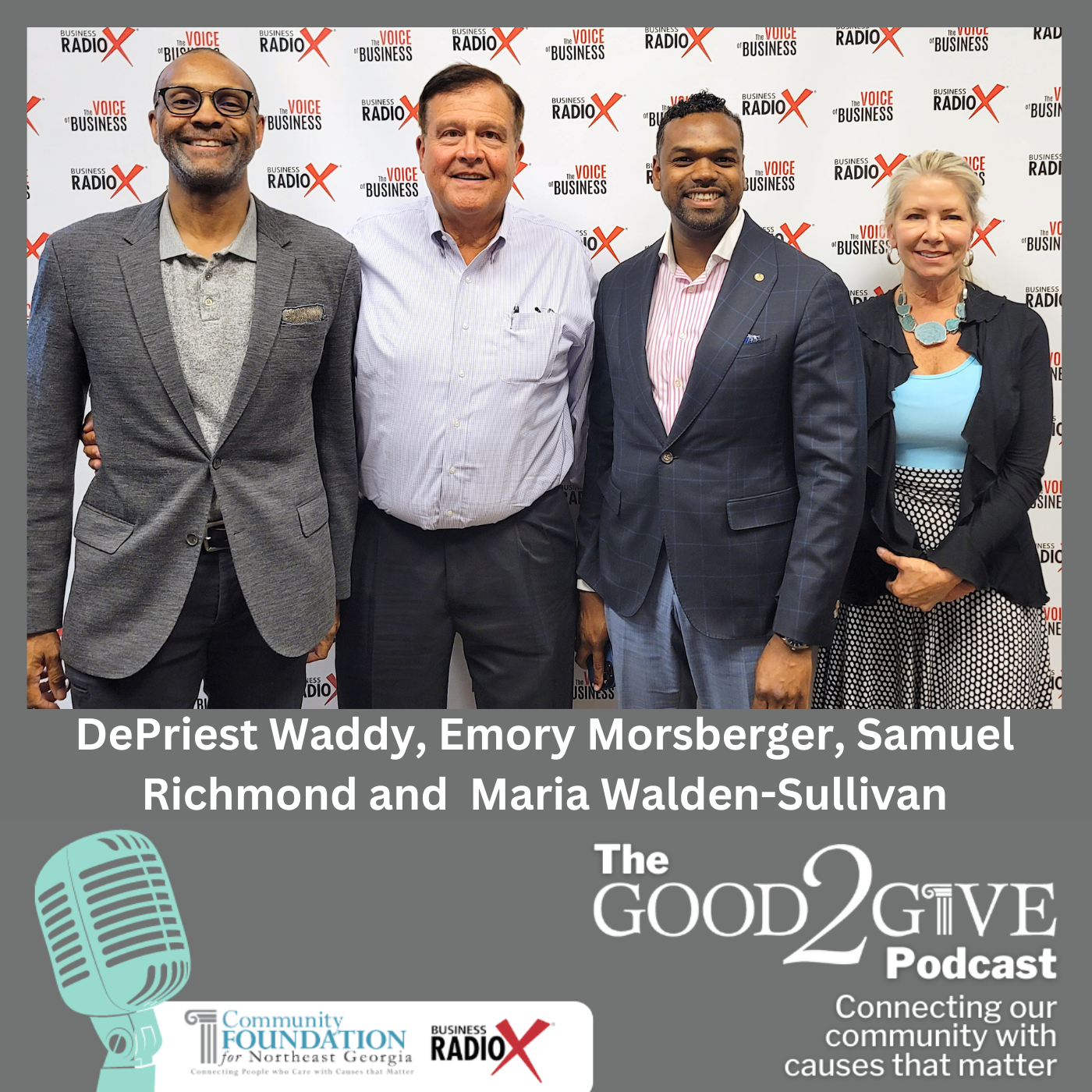
Emory Morsberger, Helping Ukraine, and Samuel Richmond, Nvestfit

October 2, 2023 by John Ray

Helping Ukraine
Good2Give Podcast
Emory Morsberger, Helping Ukraine, and Samuel Richmond, Nvestfit
Loading
00:00 /
RSS Feed
Share
Link
Embed

Download file

Helping Ukraine

Emory Morsberger, Helping Ukraine, and Samuel Richmond, Nvestfit (Good2Give Podcast, Episode 4)

Emory Morsberger, Founder of Helping Ukraine, and Samuel Richmond, President at Nvestfit, were the guests on this edition of the Good2Give Podcast. Emory Morsberger discussed his work and that of others to provide needed medical supplies and other goods to the people of Ukraine. He shared a compelling vision given to him and the invitation to deliver supplies. Emory also shared how Helping Ukraine has provided portable incubators, surgical tools, medical supplies, blankets, generators, support for orphanages, and Hope Centers for those left homeless by the destruction. Samuel Richmond discussed the benefits of philanthropic giving, the advantages of donor-advised funds, and more.

The Good2Give Podcast is presented by the Community Foundation for Northeast Georgia and is produced by the North Fulton studio of Business RadioX®. You can find the full archive of shows by following this link. The show is available on all the major podcast apps, including Apple Podcasts, Spotify, Google, Amazon, iHeart Radio, Stitcher, TuneIn, and others.

Helping Ukraine

Helping Ukraine is a 501(c)3 designed to raise funds for medical supplies and other goods for the people of Ukraine.

The growing concern for the people of Ukraine has never been more evident than in the months since the February 24th bombing. Stimulated by Dr. Olha Paliychuk, Ukraine, her call for medical supplies, became a call heard around the world. Through individuals who reached out to one another from Ukraine to the US, a mission began sending medical supplies, ready to eat food and even cots for shelters bound for Ukraine. Rotarian Emory Morsberger of Atlanta, Georgia played a personal role by escorting expensive Stryker Drill Sets to hospitals in Ukraine in his own luggage.

Emory Morsberger founded Helping Ukraine, and joined Ken Ward and his team for a humanitarian mission to deliver stoves, generators, blankets, clothes, food and medical supplies to those along the frontlines of the war in Ukraine.

Website | Facebook | Instagram| YouTube

Emory Morsberger, Founder, Helping Ukraine
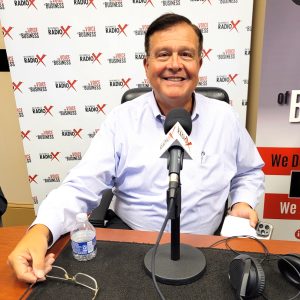
Emory Morsberger, Founder, Helping Ukraine

In 1991 Emory Morsberger, CEO of the Morsberger Group, founded Avalon homes, a strip of 350 town homes, and spearheaded the Highway 78 project to improve the declining conditions of the area. He became active in organizations, such as the Highway 78 Community Improvement District board, the Gwinnett County Revitalization Task Force, and the Gwinnett Chamber of Commerce board, which promoted the success of Gwinnett County.

His trademark “Progress Coming” signs began to appear in the windows of empty buildings that lined the seemingly abandoned Lawrenceville City Square and the Morsberger Group was created. As an extension of his development firm Morsberger created Lawrenceville Properties. Stripping down the Square’s century old buildings to their original brick and wood floors, the Morsberger Group transformed the Lawrenceville Square into a bustling destination for fine dining, shopping, and entertainment.

As a longtime Rotarian and Atlanta businessman, Emory was moved to service after seeing images, media coverage and hearing stories of the needs of the Ukrainian people. Through his connections, he was able to help elevate an effort that had begun with local Rotary clubs to send surgical and medical supplies, food and other goods.

In June 2022, Emory traveled to Ukraine and hand-delivered much needed supplies and also deepened my connections with Rotary Clubs throughout the country. Upon his return in July, he was moved to do more and launched Helping Ukraine US.

LinkedIn

Nvestfit

Nvestfit’s mission is to help their clients work toward financial independence through planning. They spend time with clients to determine their goals and objectives, time horizon, risk tolerance, and help them make suitable financial decisions for their future.

Their goal is to be a trusted and knowledgeable advisor to their clients for the long term through education, training, integrity, and outstanding client service.

Website | LinkedIn |Facebook

Samuel Richmond, M.S., CFP, President, Nvestfit
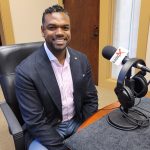
Samuel Richmond, M.S., CFP, President, Nvestfit

As a CFP® professional, Samuel strives to serve his clients to the highest ethical standards of care. Taking the time to understand what is MOST important to you is paramount, while utilizing an established process to work towards your stated goals. Sam engages with his clients in a fiduciary capacity, providing specialized, objective and independent advice, putting your needs and best interest first.

His practice is geared towards how his clients measure peace of mind as business owners and families navigating the unique challenges faced in our world today. He offers his clients a holistic financial planning approach to help them maintain overall financial health and pursue multiple (and competing) financial goals. Whether it’s a more comprehensive financial plan or a specific planning need, his services always align with your current priorities, including ongoing review and monitoring.

For over a decade, he has passionately sought out all investment personalities with confidence, expertise and insight. As part of your executive team, he will partner with your CPA’s and attorneys to coordinate the components of your entire financial picture, making a positive impact on generations to come.

Samuel says his most notable accomplishments include the marriage to his beautiful wife Melanie going on 17 years and the birth of their wonderful boys Samuel and Isaiah. The family’s hobbies include exploring the great outdoors as well as an appreciation for the arts, theater and music. They also enjoy a worship experience that adds great value to their lives.

Samuel is on the Board of Visitors for the School of Business at Georgia Gwinnett College. He was appointed by former Commissioner Marlene Fosque to serve on the SPLOST Citizens Project Selection Committee overseeing the funding of transportation projects throughout Gwinnett County.  He has been involved in various non-profit organizations throughout Georgia and Tennessee such as Gwinnett Chatt Outreach, Preface, The Urban League, Big Brothers Big Sisters and Operation Hope.  Samuel is a proud member of Rotary International.

In 2009 Samuel earned a Bachelors of Science in Organizational Management from Covenant College followed by a Master’s in Personal Financial Planning from Kansas State University in 2014. He achieved his CFP® designation in 2015 and continues to feed his appetite for learning through ongoing trainings, workshops and books.
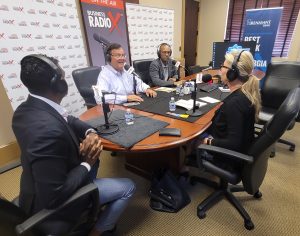
LinkedIn

About the Good2Give Podcast

The Good2Give Podcast celebrates the work of donors, nonprofits, and the causes they care about. The hosts of the show are DePriest Waddy and Maria Walden-Sullivan, and the show series is presented by the Community Foundation for Northeast Georgia.

The Good2Give Podcast is produced by the North Fulton studio of Business RadioX®. You can find the full archive of shows by following this link. You can also find the show on all the major podcast apps, including Apple Podcasts, Spotify, and many others.

Community Foundation of Northeast Georgia

At the Community Foundation for Northeast Georgia, everything they do centers around one purpose – improving the world through the power of philanthropy.

On a fundamental level, they do that through managing funds held in trust, donated by individuals, organizations, and businesses. Most funds are donor-advised funds, similar to savings accounts. These funds are pooled for investment purposes and their income is used to make grants for a wide variety of charitable purposes.

But the Foundation’s goals expand far beyond managing funds. They desire to strengthen the communities they serve in Gwinnett, Northeast Georgia, and beyond by providing leadership, addressing community needs, and assisting individuals and organizations with their charitable giving.

Connect with CFNEG:
Website | Facebook | LinkedIn | Twitter | Instagram
Tagged With: Ambulances, cfneg, community foundation for northeast Georgia, DAF, DePriest Waddy, donor advised funds, Emory Morsberger, Good2Give Podcast, Helpingukraine.us, Hope Centers, Maria Walden-Sullivan, medical supplies, nvestfit, Rotary, samuel richmond, Ukraine

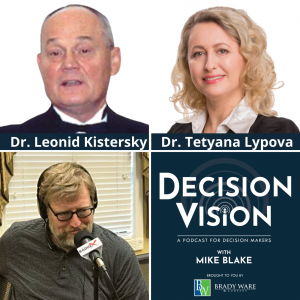
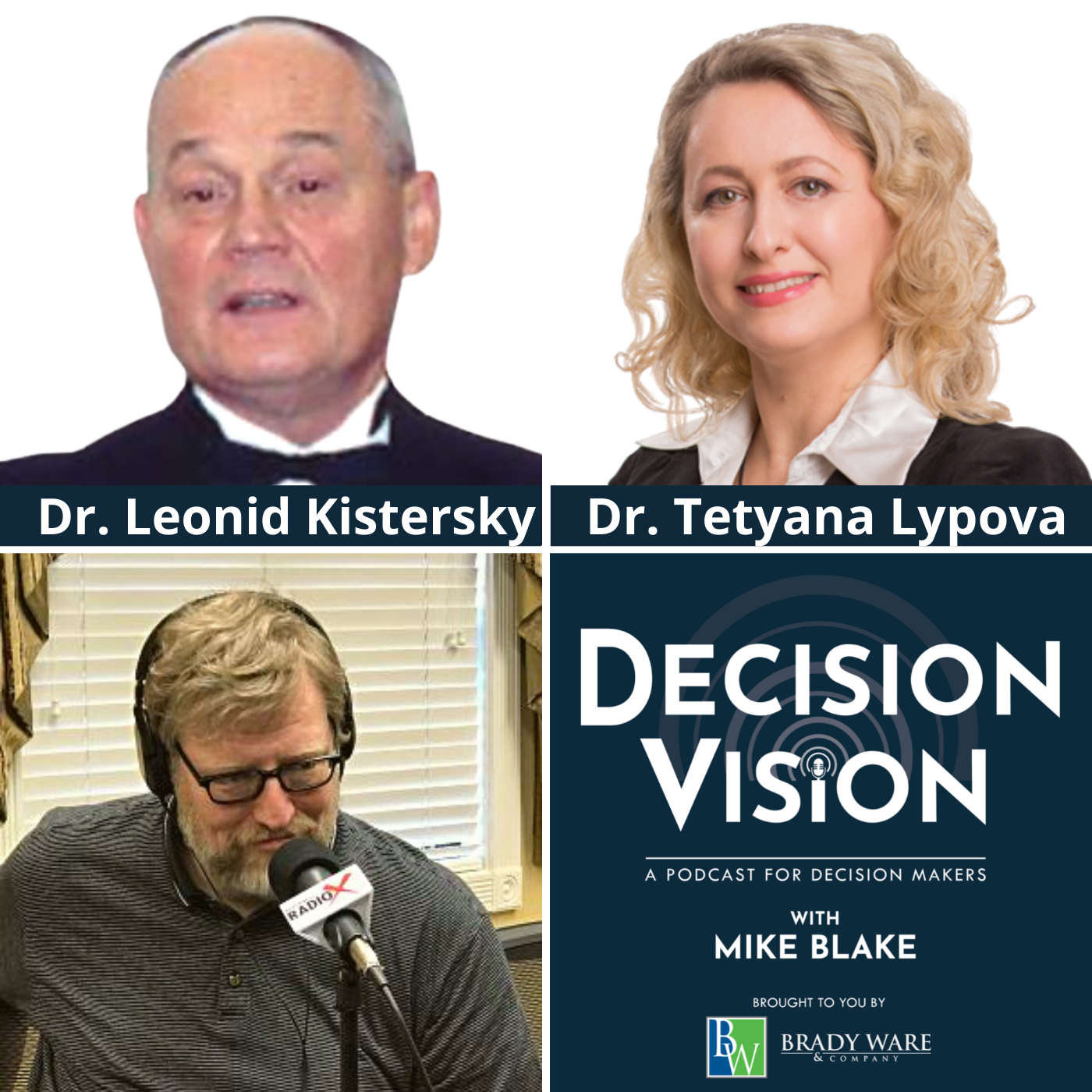
Decision Vision Episode 164: Should I Do Business in Ukraine? – An Interview with Dr. Leonid Kistersky and Dr. Tetyana Lypova

April 14, 2022 by John Ray

Ukraine
Decision Vision
Decision Vision Episode 164: Should I Do Business in Ukraine? - An Interview with Dr. Leonid Kistersky and Dr. Tetyana Lypova
Loading
00:00 /
RSS Feed
Share
Link
Embed

Download file

Ukraine

Decision Vision Episode 164: Should I Do Business in Ukraine? – An Interview with Dr. Leonid Kistersky and Dr. Tetyana Lypova, IPR Group

Dr. Leonid Kistersky and Dr. Tetyana Lypova, co-founders of Kyiv-based IPR Group and long-term friends of host Mike Blake, joined the show from Poland after safely escaping their home country Ukraine. They discussed their work, the evolution of their work as they cope with the realities of war, the way the war has reshaped the economy in Ukraine, the resiliency of the Ukrainian people, future opportunities in the country, and much more.

Decision Vision is presented by Brady Ware & Company and produced by the North Fulton studio of Business RadioX®.

During the show, Leonid and Tetyana offered several causes to which you can contribute to help the Ukrainian cause. Follow this link for more information.

Dr. Leonid Kistersky

Dr. Leonid Kistersky

Doctor of Economics, Professor, Founding Director of the Institute for International Business Development (Kyiv), Professor of Vasyl Stus Donetsk National University (Vinnytsia).

He worked as an economic adviser at the Secretariat of the United Nations Conference on Trade and Development (UNCTAD) in Geneva (Switzerland), was the founding chairman of the National Center for Implementation of the International Technical Assistance to Ukraine in the rank of a Minister. 

Leonid Kistersky has taught and conducted research at the world’s leading research centers and universities – Institute of Economics of the National Academy of Sciences of Ukraine, Konstance University (Germany), Brown and Stanford Universities (USA), Kyiv Institute of International Relations at Taras Shevchenko National University, Higher School of Business (Poland). 

Dr. Kisterski is the author and co-author of almost 150 scientific works, including 15 books and textbooks on international economic relations and business development, published in Ukraine, Switzerland, Russia, USA, Great Britain, Poland, Germany, Czech Republic and in other countries; international organizations such as the UN, the World Bank and the European Union also published his books and articles. 

Leonid Kistersky is a member of prestigious international and national scientific institutions and organizations – specialized scientific councils at the Kyiv Institute of International Relations and Vasyl Stus Donetsk National University, Ukrainian Association of International Economists, Ukrainian Academy of Economics, the Academy of Higher Education of Ukraine; for many years he was a member of the UN Scientific Council, editorial boards of foreign and Ukrainian scientific journals and publications.

In 2019, President of Ukraine Volodymyr Zelenskyy awarded Professor Kistersky the title of “Honored Worker of Science and Technology of Ukraine”.

LinkedIn

Dr. Tetyana Lypova (Tatiana Lipovaya)

Dr. Tetyana Lypova

Dr. Tetyana Lypova received a Ph.D. in economics from the Institute of International Relations of Taras Shevchenko National University of Kyiv. She is Associate Professor and Deputy Director of the Institute for International Business Development, which promotes business development and financing of business projects.

Graduated from the Faculty of Economics and Management of Vadym Hetman National Economic University of Kyiv. She underwent internships in the programs of Brown University (USA), the London Center for International Economics, and the Consortium for the Improvement of Education Management in Ukraine. 

Tetyana Lypova has worked as a trainer, consultant, expert analyst on numerous projects and programs of such international organizations as the EU, UNDP, World Bank, USAID, Know-How Found, and other leading international institutions.

Since 2015, she has also been working as the head of the licensing department at the international company IPR Group, where she provides advice to Ukrainian and foreign entrepreneurs on prosecution and registration of trademarks, enforcement of rights, licensing and franchising, protection of geographical indications, copyrights, dispute resolutions, etc. She works with national and international clients and companies on intellectual property protection in Ukraine and in post-soviet independent countries like Georgia, Armenia, Azerbaijan, Kazakhstan, Kyrgyzstan, Tajikistan, Turkmenistan, Uzbekistan, and Moldova.

She was a member of the Geographical Indications Committee of the International Trademark Association (INTA).

Tetyana Lypova is the author of about 60 scientific publications, including 5 monographs and textbooks on international economic relations, international technical assistance, and small and medium business development.

LinkedIn

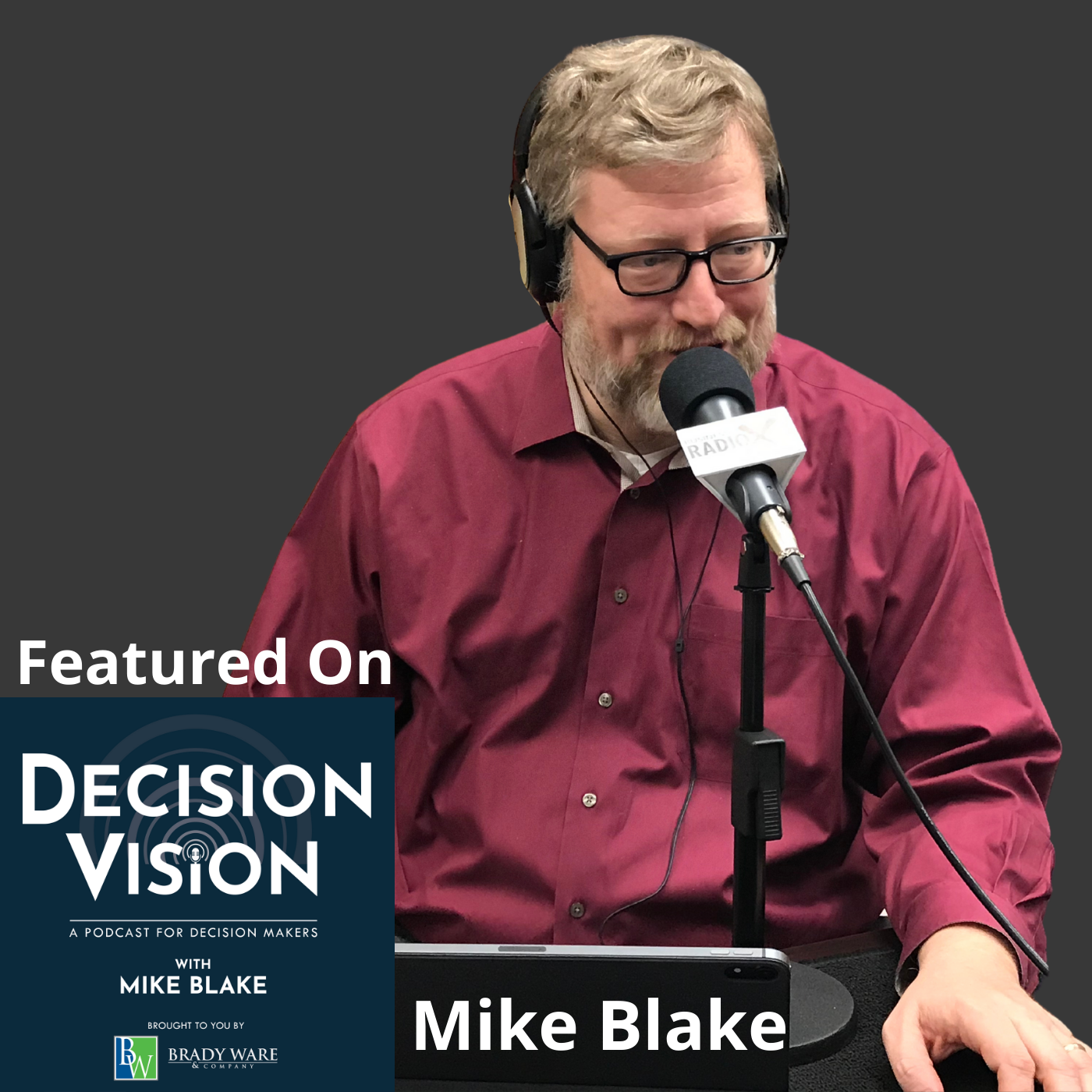
Mike Blake, Brady Ware & Company

Mike Blake, Host of the “Decision Vision” podcast series

Michael Blake is the host of the Decision Vision podcast series and a Director of Brady Ware & Company. Mike specializes in the valuation of intellectual property-driven firms, such as software firms, aerospace firms, and professional services firms, most frequently in the capacity as a transaction advisor, helping clients obtain great outcomes from complex transaction opportunities. He is also a specialist in the appraisal of intellectual properties as stand-alone assets, such as software, trade secrets, and patents.

Mike has been a full-time business appraiser for 13 years with public accounting firms, boutique business appraisal firms, and an owner of his own firm. Prior to that, he spent 8 years in venture capital and investment banking, including transactions in the U.S., Israel, Russia, Ukraine, and Belarus.

LinkedIn | Facebook | Twitter | Instagram

Brady Ware & Company

Brady Ware & Company is a regional full-service accounting and advisory firm which helps businesses and entrepreneurs make visions a reality. Brady Ware services clients nationally from its offices in Alpharetta, GA; Columbus and Dayton, OH; and Richmond, IN. The firm is growth-minded, committed to the regions in which they operate, and most importantly, they make significant investments in their people and service offerings to meet the changing financial needs of those they are privileged to serve. The firm is dedicated to providing results that make a difference for its clients.

Decision Vision Podcast Series

Decision Vision is a podcast covering topics and issues facing small business owners and connecting them with solutions from leading experts. This series is presented by Brady Ware & Company. If you are a decision-maker for a small business, we’d love to hear from you. Contact us at decisionvision@bradyware.com and make sure to listen to every Thursday to the Decision Vision podcast.

Past episodes of Decision Vision can be found at decisionvisionpodcast.com. Decision Vision is produced by John Ray and the North Fulton studio of Business RadioX®.

Connect with Brady Ware & Company:

Website | LinkedIn | Facebook | Twitter | Instagram

TRANSCRIPT

Intro: [00:00:01] Welcome to Decision Vision, a podcast series focusing on critical business decisions. Brought to you by Brady Ware & Company. Brady Ware is a regional, full-service accounting and advisory firm that helps businesses and entrepreneurs make visions a reality.

Mike Blake: [00:00:22] Welcome to Decision Vision, a podcast giving you, the listener, clear vision to make great decisions. In each episode, we discuss the process of decision making on a different topic from the business owners’ or executives’ perspective. We aren’t necessarily telling you what to do, but we can put you in a position to make an informed decision on your own and understand when you might need help along the way.

Mike Blake: [00:00:45] My name is Mike Blake, and I’m your host for today’s program. I am a director at Brady Ware & Company, a full-service accounting firm based in Dayton, Ohio, with offices in Dayton; Columbus, Ohio; Richmond, Indiana; and Alpharetta, Georgia. I am Managing Partner of the Strategic Valuation and Advisory Services Practice, which brings clarity to the most important strategic decisions that business owners and executives face by presenting them with factual evidence for such decisions. Brady Ware is sponsoring this podcast.

Mike Blake: [00:01:16] If you would like to engage with me on social media with my Chart of the Day and other content, I’m on LinkedIn as myself and @unblakeable on Facebook, Twitter, Clubhouse, and Instagram. I also recently launched a new LinkedIn Group called Unblakeable’s Group That Doesn’t Suck, so please join that as well if you would like to engage.

Mike Blake: [00:01:39] Today’s topic is a topic that I hoped that I would address at some point over the course of this program in a very different context. But there’s a saying in Yiddish that roughly translates into, Man plans and God laughs. And there’s nothing particularly funny about this topic, but life does have a way of of bringing the unexpected.

Mike Blake: [00:02:06] So, as I record this on the 8th of April 2022, we are something on the order of about six weeks into the Russia-Ukraine war. And I recorded a podcast on this about five or six weeks ago with the topic Should I continue to do business in Russia and Belarus? And I explained my qualifications to address that topic in that episode. And I would encourage you to listen to that episode for that information as well as more.

Mike Blake: [00:02:39] And the only thing that I’ll rehash here – I dislike strongly that I have to address this topic in the way that it is being addressed – the early part of my career was formed by living and working in Russia, and in Belarus, and in Ukraine. And if there’s anything good that I’ve brought to the table professionally today in large part, it is due to the learning experiences of which I had the benefit those many years ago, long before I had any grey hair, that’s for sure, and I was a lot thinner then as well. But here we have it.

Mike Blake: [00:03:28] And so, the topic we’re going to discuss is sort of the flip side of the topic, instead of Should I do business with Russia and Belarus, I laid forth a case that I don’t think you should. And, frankly, I’m not sure it’s realistically feasible. I think it’s very difficult to do business there. I think that although no set of economic sanctions work perfectly, we have certainly made life very difficult for the Russians and for those who may seek to do business with them.

Mike Blake: [00:04:00] And if they choose to become a client state of China, as appears to be their choice at this point, there’s really nothing that we can do about that. But one thing we can do, and I guess I’m pleased to say that I’m pleased that we’re doing is we are supporting Ukraine, a fascinating country with a fascinating history that for most of its history has been a people much longer than it has been an organized country, if you will. It’s very paradoxical, and there are people who can discuss it much better than I can. We have professors that do that. But it’s a very interesting place with a very complicated history.

Mike Blake: [00:04:51] And as we’re now six weeks into the Russian invasion and we’ve witnessed extraordinary events, things that I think my generation -I’m going to be 52 next month – we never thought that we would see in my generation. We thought this is something that my grandfather would have dealt with, but certainly not today. But, again, here it is. History does have a tendency to be cyclical in nature.

Mike Blake: [00:05:27] And the discussion of whether or not to do business in Ukraine may seem bizarre. And I grant you, if you’re not all that familiar with Ukraine, its history, its geography, I can understand that. And that’s why this topic is so necessary, because Ukraine is a very big place. And although a large portion of the country – really, any portion of the country in those conditions be considered large – but something on the order of about 10 percent is an active war zone. And most of the country is under threat of some attack in some fashion by the Russian armed forces.

Mike Blake: [00:06:13] The fact of the matter is that (A) there has been a war going on since 2014, since the annexation of Crimea and the bizarre quasi independence of the Donetsk and Luhansk regions. That’s been going on anyway. It was simply sort of self-contained. But, of course, now it’s been expanded, and most of you have seen the pictures, you’ve read the news, in many ways it’s probably worse than is being reported on the ground, there before the grace of God go I.

Mike Blake: [00:06:50] But the reality is that there’s a lot of Ukraine that amazingly is still functioning. It is still a functioning state. Volodymyr Zelenskyy, their President, who, frankly, if I’m honest about it, I had a lot of doubts when he was elected. That a comedic actor would rise to the level of being able to govern such a complex country with a very complex political structure as Ukraine. And, now, he’s being mentioned in the same words as Winston Churchill. So, it really goes to show you what I know, which is probably absolutely nothing.

Mike Blake: [00:07:28] But all of a sudden now we all know who he is. We all know his famous quote that he says he wants weapons, not a ride. And, you know, this is a country that’s not going away silently by any stretch of the imagination.

Mike Blake: [00:07:46] And I think I owe it to you as the listeners to help you understand what the opportunities are to do business in Ukraine, not just from a humanitarian perspective, not just from a moral and ethical imperative, although those do still exist. But the country is amazingly, with all the things that are happening to it, that they are still open for business.

Mike Blake: [00:08:17] And joining us today are two longtime dear friends of mine, who I was very relieved to speak to only a few days ago. I realized that they had managed to escape the country after their home came under attack. And joining us from Poland are Dr. Leonid Kistersky and Dr. Tatiana Lipovaya. Who, again, I’ve known for a very long time.

Mike Blake: [00:08:44] And they are co-founders of a company called IPR. That, among other things, is a law firm that provides counsel for companies seeking to do business from the West into the former Soviet Union. I’m not even sure what that region of the world is going to be called anymore. I think it’s going to be different. I just can’t predict what that’s going to be. And their specialization has long been about protecting Western intellectual property rights in those countries, anti-counterfeiting in particular.

Mike Blake: [00:09:25] As well as working with a sister company, where I guess I was sort of an entrepreneur or teacher in residence, for lack of a better term, for about two-and-a-half years, The Institute for International Business Development, whose focus has been to serve as a bridge between Western companies seeking to learn about how to do business in that region, how to take advantage of the opportunities that that region has held and, I think, will hold at some point in the future – God knows only when – as well as how to navigate the many risks that region holds.

Mike Blake: [00:10:07] And they’ve just been fantastic people. And I’m delighted – but really proud – to call them my friends. By way of a little bit of a professional introduction in no particular order, Dr. Leonid Kistersky got a lot of things to his claim to fame. I could read a very lengthy bio, but I don’t want to do that because I want to get to questions.

Mike Blake: [00:10:35] But suffice to say that he was the First Minister of Foreign Economic Relations in the First Post-Independent Ukrainian Government of the early 1990s. He has been a visiting instructor at places such as Brown University, Stanford University, and Columbia, there are others that I’m probably forgetting. And he’s been doing this for about 50 years.

Mike Blake: [00:11:01] I couldn’t believe it when I looked up his bio, he does not look like he’s as old as his calendar would say. Hedoesn’t sound like he’s that old either. I look and sound older than the guy does. So, Leonid, whatever you’re doing, keep doing it because God knows it’s helping you.

Mike Blake: [00:11:19] And he was also recently the recipient of Ukraine’s Highest National Honor in Support of Science and Technology for the Republic of Ukraine.

Mike Blake: [00:11:31] Dr. Tatiana Lipovaya is the Head of Licensing and Trademark at IPR, where she’s been advising national and international clients on trademark filing, prosecution and enforcement, domain name infringements, unfair competition assignments, licensing, and all the work that goes with that. Has done a tremendous amount of work, in particular with some places that are very hard to do business in, Kazakhstan, Georgia, Armenia, Azerbaijan, Kyrgyzstan, et cetera.

Mike Blake: [00:12:05] And she, herself – I can’t believe it’s been this long. We knew each other when we were much younger – accumulated over two decades of experience in not just the legal aspect, but also becoming a top notch business advisor and holds a PhD in International Economics. She’s a member of INTA as well as the Ukrainian Association of International Economics. Has graduated with economics and management degrees of the Kiev National Economic University.

Mike Blake: [00:12:42] The firm itself has been in operation since 1999, and the sister group, IIBD, since before that, since at least the early 1990s. And I guess fittingly, it’s always seemed to me to be a very awkward translation, but the title of Ukrainian’s National Anthem is Ukraine is not yet perished, and neither has their firm. And I think when you think about what they’re doing, how they continue to do business in spite of all that’s going on, it gives you an appreciation as to why the Russians have, frankly, failed to achieve their military objectives by and large, and have redefined kind of what a Pyrrhic victory is, if you can even call it that.

Mike Blake: [00:13:34] I’m going to stop talking. I think I’ve established these are really good guests. You’re really going to enjoy talking to them. The more I talk, the less you hear from them. So, Leonid and Tatiana, welcome to the program. It is so good to see you and it’s so good to hear from you, more or less safe and sound. And I guess you’re joining us from Poland.

Leonid Kistersky: [00:13:57] Yes. Mike, thank you very much for such a very kind introduction. And sometimes I think that you know more about us than we do. Anyway, we can see that you to be, not only our long term friend, but we consider you also to be a founding father of our businesses and all endeavors since, as you rightly mentioned, we came together in the middle of previous millennium a long time ago.

Leonid Kistersky: [00:14:42] And in order to train Ukrainian entrepreneurs who set up Institute for International Business Development, which you helped to establish, and through which we started developing private business training people in Ukraine more than a quarter of a century ago already. And, in fact, IPR Group, it’s probably sort of a business which has been set up by the Institute for International Business Development and helped to develop even to a much more important private business now than the Institute for International Business Development is.

Leonid Kistersky: [00:15:42] So, both of us try to combine private business since I keep on provide consultancy before the war, of course, for governmental institutions, for international companies, for Ukrainian private businesses, just helping them to establish and to use high ethical norms in business, and was helping to develop high moral values of them, like personalities and like entrepreneurs. And still combining my activities with consultancy and private business.

Leonid Kistersky: [00:16:33] I still until now keep on training it to Ukrainian universities, Kiev National, Taras Shevchenko University, and Donetsk National University named after Vasyl’ Stus, which, eight years ago, moved from Donetsk to Vinnytsia in order to continue its activity. And they needed specialists in international economic relations. And that’s why I willingly joined them. And still I keep on doing this online until today and will continue to do so.

Leonid Kistersky: [00:17:25] Well, Tatiana is more a private businessman now.

Tatiana Lipovaya: [00:17:30] Businesswoman.

Leonid Kistersky: [00:17:33] Businesswoman, yeah. And probably she will tell herself about what is she doing in the IPR Group.

Tatiana Lipovaya: [00:17:45] I actually deal with the trademarks protection, prosecution. So, our IPR Group company, it’s a Ukrainian established and based in Ukraine business, but we deal with a lot of other countries. We provide our services in former Soviet Union countries, like Mike already mentioned, Georgia, Tajikistan, Turkmenistan, and other countries which are not accessible for foreigners because they have special laws, they have special rules which you need to know to deal with these countries, especially for business and for also intellectual property rights protection, there are a lot of specific in these countries.

Tatiana Lipovaya: [00:18:39] And I’m really happy that I’m involved in such kind of business. I received a lot of new skills. And all the time develop myself, not only as a business consultant, which I used to be for the last 20 years, but now I developed myself as a lawyer and as a specialist in intellectual property rights protection.

Tatiana Lipovaya: [00:19:11] So, it’s also important for developing business, because intellectual property rights is the very important part of the business development, especially for new companies, for companies who involve the new technologies, would like to protect their property rights, patents licensing. So, they need a lot of advice and a lot of support for doing business in our countries.

Leonid Kistersky: [00:19:48] So, we continue our businesses.

Mike Blake: [00:19:52] And I think that’s remarkable and I think that’s one thing I want to make sure our audience hears, is, how are you continuing your business?

Leonid Kistersky: [00:20:07] Well, as you know, we had to move from Ukraine further to west, west, west, and so we appeared in Poland. And, currently, we are in the City of Nowy Sącz in Poland.

Leonid Kistersky: [00:20:28] Of course, we used to live some 30 kilometers from Kiev, in the City of Vasylkiv. Probably does ring a bell for you since press wrote a lot of the city there was the [inaudible] and airport and the tank farm which was bombed every day, and we were living nearby. In a couple of weeks, the situation at that time became dangerous to my mind. And we read that Russian, you know, monsters rush into houses, kill people, rape women and girls. So, that’s why we drove to the west in a couple of weeks after the start of the Russian invasion.

Leonid Kistersky: [00:21:30] So, we were going west and west, and so Tatiana’s colleague wrote us when we were in Lviv, and we were invited to live three weeks in their house while her kids were away. And so, during this time, we somehow managed to do now business, establish again contacts to start doing business online. And so, moving in, we rented a small apartment in Nowy Sącz. There is a famous school of business here where I taught 25 years ago, again for some time, and my colleagues helped us to rent an apartment here.

Leonid Kistersky: [00:22:26] So, there are, of course, difficulties in doing business outside of Ukraine, but in Ukraine. But still it is quite possible as far as teaching is concerned, it’s almost no difference. You have good internet, you have good connections, and you keep on doing it online.

Leonid Kistersky: [00:22:52] With Tatiana’s business, it is more complicated. Tatiana probably will tell about it herself. Not only our businessmen, but also our government on a daily basis introduces new opportunities first to revive businesses in Ukraine and to further develop there.

Tatiana Lipovaya: [00:23:26] As for my business, we understood that in such situations which all of us need to move from Kiev to other places, some of us still stay in Ukraine. For example, in the western part of Ukraine, some of our staff – and some of our staff means women – who can leave Ukraine, they are moved to Poland and to other countries in the Western Europe. We understand there’s a weak possibility to keep our business awake. It’s only the distance, the remote work on a distance. It’s online work. Hopefully, our kind of business, because we provide the services for international companies, our business allowed us to work remotely.

Tatiana Lipovaya: [00:24:30] So, our technical specialists did as much as possible to secure our business, our services, emails, our database, to put them to the safe servers to support our everyday activities. We’re happy that the Government of Ukraine, especially the national body, which is responsible for intellectual property rights protection in Ukraine, allowed us to work and link to them also online. So, they provided the system which allowed us to apply and file trademarks, patents, other intellectual property requests to the office online without providing papers.

Leonid Kistersky: [00:25:37] You mean Ukrainian Patent Office?

Tatiana Lipovaya: [00:25:40] Yes. I mean the Ukrainian Patent Office, which still works, still keep their activities, and still provide full range of services to the clients and allowed us, as the patent attorneys, to conduct our activities on a very good level.

Leonid Kistersky: [00:26:03] In fact, Tatiana already mentioned a very good example of the Ukrainian State Patent Office, which provides all opportunities for this business to be on the surface, so to say. And private entrepreneurs, as you taught us, still used to take care of themselves. Moreover, I would like to say that we have a lot of big and middle sized businesses in Ukraine.

Leonid Kistersky: [00:26:38] And, now, our government helps them materially to move from those parts of our country, which is still bombed by Russian monsters, to move to the center of Ukraine, to the more safe areas. And until today, several hundreds of such businesses were moved to central part of our country and they keep on functioning. Also, government introduced several important privileges for businesses to function.

Leonid Kistersky: [00:27:20] Now, this is decreased taxation. For example, when I saw the consultant, I owned some small money and there is so-called simplified system of taxation. I was paying just 5 percent from turnover. Now, during the war time, it was brought down to 2 percent only. And we keep on paying taxes. We keep on paying now for our communal services for the apartments.

Leonid Kistersky: [00:28:02] Also, businesses were given an opportunity to have access to cheap credits, sometimes interest free credits. Tatiana, what is the amount of such? Several million hryvnia. Effective cost of hryvnia to U.S. dollar is approximately, roughly, 29 hryvnias per U.S. dollar. And you can get several million hryvnias of interest-free credit. So, there are simplified now procedures for registering your business, for reporting about your financial and other situations.

Leonid Kistersky: [00:28:53] So, I would like to say that it’s very sad that really this awful war triggered such support of private business in Ukraine. But, still, I am absolutely sure that after our victory, the war is over, business in Ukraine will be developing at a very high speed, especially internationally.

Mike Blake: [00:29:24] So, you said something I had not even thought of, and it reminds me of history. Because in World War II, the Soviet Union had to move entire industries east, out of the way of Hitler. And it hadn’t even occurred to me, but I suppose in a way that’s actually a skill and, in fact, if factories were built during Soviet times, they may have been designed to be moved again in case of an invasion. It’s history repeating itself.

Leonid Kistersky: [00:29:57] Yes, the history repeating. But to tell you very openly, we did not expect that this history repeats in Ukraine. We didn’t expect it.

Mike Blake: [00:30:12] Of course. And you didn’t think you’d be moving out west.

Leonid Kistersky: [00:30:18] I think [inaudible] how we cope with it.l

Mike Blake: [00:30:18] But I hadn’t even thought of that, but you’re right. I mean, there’s historical precedent that entire industries, factories can be picked up and simply moved to a part of the country that is not as close to the combat area.

Leonid Kistersky: [00:30:36] Look, now combat area, it’s all over Ukraine now. Of course, Russian bombed the country or fired missiles on a random basis. That is done deliberately to create panic, to create atmosphere of fright. But, still, people in Ukraine somehow coped with it, and business continues functioning despite. This is one of the purposes of Russia now, to destroy Ukraine.

Leonid Kistersky: [00:31:24] Again, also like you, Michael, I like history. And very recent history after the dissolution of the Soviet Union. And when Putin came to power, on many occasions, including internationally, he was saying that dissolution of the Soviet Union is the greatest, probably, awful event of the 19th Century. He did not mention First World War. He did not mention starvation. He didn’t mention Second World War. A lot of original wars. But dissolution of the Soviet Union. And this is his maniacal idea to restore it in some form. And, of course, without Ukraine, that is not attainable. And that’s why he is trying to do away with our country. But as you rightly said, he failed and continues to fail.

Mike Blake: [00:32:36] So, a thought that occurred is one of the things that already is resulting from the war, and I think will result for a generation, is that, economic ties between Russia and Ukraine will be effectively cut off. Forgive and forget is one thing. But I think there’s decades of healing that’s going to have to take place, I think, for that to occur. Belarus the same.

Mike Blake: [00:33:13] And as you know, oddly enough, you guys are as pro-Russia as any Ukrainians I’d ever met. You always took a very pragmatic view. Why do we want to make a big enemy? There’s no reason to do that. Not that it matters. I’m an American citizen, but I always thought it was smart. But now this has happened.

Mike Blake: [00:33:36] And there are certain things that Ukraine is not going to be able to get from Russia or Belarus anymore. Are there opportunities now for other countries to supply those things? What are those things that you can’t get from Russia anymore? Is it steel? Or is it fuel? Or is it something else? And are there opportunities for another country now to come in and and fill the void that is left because the Russia trade link has been cut off?

Leonid Kistersky: [00:34:09] Yeah. That’s true. Because sentiments in Ukraine against Russia now are self-understandable, because our country to no extent was anti-Russian. We treated Russia in a very friendly way. And we did not expect such a cruelty from their side and such behavior to do away with our country. And, now, I am, and all of us, are so anti-Russian and we cannot forgive what they did. And during my lifetime, I will never forgive them. And probably that will take several generations, somehow, to cool down with our sentiments towards Russia.

Leonid Kistersky: [00:35:11] Because a recent statistical polls indicated that now about 85 percent of Ukrainians see no way of improving the relations with Russia. And the other 12 percent just are still hesitant and they think that maybe it may take a generation or 10, 15 years. And only two or three percent believe that it could be repaired very soon. So, unfortunately, Russia should blame itself only for such a cut off of all kind of relations with Ukraine and with other countries.

Leonid Kistersky: [00:36:05] And so, I would like to separately single out one sphere that we have lost Russia and they have lost us for generations. But we gained a lot of friends, other friends. We are so grateful to Poland, which hosted 2.5 million Ukrainians now. And we feel such friendly relations and they take care of Ukraine and they support us. Also, the United Kingdom.

Leonid Kistersky: [00:36:47] Separately, I would like to mention the United States, which is the country with which we have long term friendly relations, including a lot of individuals. I would like to mention Al and Cher who introduced us to each other, and we continue this cooperation and friendly. Of course, the United States is the world leader, which provides moral, economic, military, all types of support. And other countries, I cannot just mention every country, a lot of them.

Leonid Kistersky: [00:37:29] That is why we are very optimistic about the outcome of this war and the prospects of business development in Ukraine. Michael and John, you have our invitation to meet in Kiev after the victory in this war and you will enjoy our hospitality.

Mike Blake: [00:37:56] I’ll be on the first plane.

Leonid Kistersky: [00:37:59] Yeah.

Mike Blake: [00:38:00] I’ll be on the first plane. So, now that trade has been cut off, what did Ukraine used to import from Russia that it can’t get anymore and now has to go to a different source?

Leonid Kistersky: [00:38:14] First of all, oil and gas. Anything else is of meager importance. It could not be even mentioned. And so, moreover, they are deliberately bombing and destroying our tank farms. They bombed one of them, I mentioned near Vasylkiv, where we used to live before the war for several years, for almost ten years already. And so, they wanted to cut off, not only supplies of oil, but also to destroy available oil tanks in our country.

Leonid Kistersky: [00:39:06] And we started to receive gas on a reverse basis from Europe. And, again, I would like to mention the very important initiative of the United States is to discontinue buying oil, gas, and coal from Russia, which is extremely important. But more so, United States announced, to put it correctly, the availability of their strategic oil reserves for the international market. And, you know, it’s like a positive signal for the market and other countries join this initiative. And, now, about 30 countries, including the United States, made their strategic oil reserves available for the international market.

Leonid Kistersky: [00:40:11] So, due to this, our military drivers and other sectors of economy started receiving gas – I mean, petrol. Meaning petrol, you call it gas in the United States. But for us, gas is gas, petrol is petrol. So, we started receiving it by railways, through automobile supplies in the country. Of course, we felt sometimes, you know, deficit of petrol in Ukraine, but still it is in the quantity sufficient for the country to survive now. So, energy resources, of course.

Leonid Kistersky: [00:41:07] Same thing with Belarus. But we were supplying services of electricity for Belarus, which we do not do anymore. And we discontinued our electricity system from Russia a couple of months ago. And it took Europe, European Union, only about three days to include Ukraine into the European system of electricity. And so, it functions properly. So, step by step, we are discontinuing our ties and our business links with Russia, Belarus, and other countries from former Soviet Union, and switched it to Europe and to the United States. Among the countries, of course, I would like to mention Canada and North America.

Mike Blake: [00:42:09] Of course, there’s a very large Ukrainian diaspora in Canada, especially in the western part of the country.

Leonid Kistersky: [00:42:15] Which raised their voice and provide support.

Mike Blake: [00:42:20] So, another challenge to the economy must be labor, right? Four million people have left. Ten million people have been displaced. We don’t know how many people have been killed. I’m guessing 100,000 people have probably been killed. We just can’t count them yet. And pretty much almost every able bodied man, whatever they were doing six weeks ago, they’re now holding a gun. And many women as well, by the way. There’s a lot of reports that women are also in active military service as well. And is that impacting simply the supply of labor to actually do economic things?

Leonid Kistersky: [00:43:11] Of course, this is an issue which is widely discussed, but there are speculations how many people were killed in Ukraine. I would like to say that especially we have heavy casualties among the civil population, of course. Probably today you’ve heard that they bombed the railway station killing several thousands of people and wounding more than 100.

Leonid Kistersky: [00:43:52] But our economy now is being restructured. And, again, it’s an irony that war forces us to reform at a quicker pace, introducing higher technologies which are not so labor intensive. And that is the way out of the situation. More so, as I see from internet, IPR Group, from Tatiana’s business, that ladies now do all this business. Even sometimes Tatiana invites our 18 year old daughter, Olga, to join. So, even kids, even grown up already with kids, but, still, they do what they can to make the country not to feel the deficit of a labor force. That is, high technologies, less labor important technologies. And, of course, our female population started to do a lot of work, which they were not even thinking about before the war.

Mike Blake: [00:45:13] So, you mentioned something that surprised me positively. I think you said the hryvnia is something around 29 to the dollar, is that correct?

Leonid Kistersky: [00:45:26] Yes. That is correct.

Mike Blake: [00:45:29] So, it’s fairly –

Leonid Kistersky: [00:45:31] 29.3 it seems to be.

Tatiana Lipovaya: [00:45:33] [Inaudible].

Leonid Kistersky: [00:45:34] Yeah.

Mike Blake: [00:45:35] 29.3.

Tatiana Lipovaya: [00:45:37] It’s by the National Bank.

Mike Blake: [00:45:40] So, is the banking system able to still function? It sounds like it is.

Leonid Kistersky: [00:45:51] Yes. Look, again, I like very much comparison and historic examples like you. And before the war, the exchange rate of hryvnia-dollar was something 27.9, about 28. Now, it’s 29.3. It says that our government understands the basics of the economy. If we recollect historically, Adam Smith, who wrote his famous book some 250 years ago, he said, “Stable exchange rate is a fundamental principles of successful functioning of any economy.” And he explained why.

Leonid Kistersky: [00:46:51] So, our National Bank maintains stable, despite there is higher inflation – of course as compared before the war period – but still the exchange rate is very stable.

Leonid Kistersky: [00:47:10] Examples, we keep on working. We receive hryvnias on our business cards, and we can pay by those cards in Poland. Our National Bank agreed with the Polish banking system about the exchange rate, which is fair enough, and so we can pay by hryvnias from our business cards in Poland. Tatiana, maybe you will tell the rest.

Leonid Kistersky: [00:47:46] For businesses, there are still some problems since the beginning of the war [inaudible] because budgetary deficit and, again, a lot of countries support us on a grand basis supporting our budget. But, still, our Ministry of Finance and National Bank are doing a lot of useful things on their own. At the beginning of war, they stopped currency operations, which was not very useful for business but, still, it helped our economy to survive and our banking system to function. And today, it was announced that they are easing those regulations in order to allow our businesses to function internationally to make payments and to receive payments.

Mike Blake: [00:48:43] So, that means that they’re loosening capital controls.

Tatiana Lipovaya: [00:48:46] Yes.

Leonid Kistersky: [00:48:47] Yes. Exactly, Michael. Exactly. Yeah. Despite there are still some limitations, but they are also because –

Tatiana Lipovaya: [00:48:59] Emergency goods, medical goods, and for humanitarian purposes. They just drove down this –

Leonid Kistersky: [00:49:06] Easing, easing regulation.

Tatiana Lipovaya: [00:49:08] And they allowed for payments in the foreign currencies as well.

Leonid Kistersky: [00:49:15] That is true, especially for critical sectors of our economy, like agriculture, chemistry, and others.

Tatiana Lipovaya: [00:49:27] It’s a first step for the future.

Leonid Kistersky: [00:49:33] For future business development internationally.

Mike Blake: [00:49:40] So, as a matter of history, any time that there’s a great disruption, such as a war, that also sometimes creates opportunities in its aftermath. And I’m curious, what do you see will be the opportunities of a post-war or post-victory Ukraine?

Leonid Kistersky: [00:50:09] I am very optimistic about those opportunities. Of course, for those weeks, maybe weeks or month ahead of us, in this state of war, I hope people understand the importance of real values. You cannot imagine how people in Ukraine became friendly to each other. I was always surprised in the United States or in Western Europe, people were smiling to each other, helping each other. When driving, they’re making friendly gestures. They are just letting all the cars to go.

Leonid Kistersky: [00:50:55] It was not the case in Ukraine before the war, as you probably know. But, now, it took us several weeks to cover this huge distance. So, before war period, I see a period of very quick reconstruction of our country. Of course, our government and our administration are ready to take steps to achieve agreements with countries, with companies for reconstructing Ukraine.

Leonid Kistersky: [00:51:35] And remember that some 22 years ago, I published an article – it is available in English – Marshall Plan for Ukraine. At that time, I was thinking of reforming the economy of Ukraine. But, now, it will be a real Marshall Plan for Ukraine to reconstruct the country, and ways of reconstruction, and ways of further development will be unprecedented, believe me. And Ukraine may become, in some near future, a member of the European Union. And we have support of key players in Europe and in North America. So, I’m very optimistic about this period. Of course, war changed people in my country in a very positive way.

Mike Blake: [00:52:33] I’m talking with Dr. Leonid Kistersky and Dr. Tatiana Lipovaya. And the topic is, Should I do business in Ukraine? So, I’m going to ask you a very unfair question, but I want to know the answer. I know our listeners want to know the answer. And that is, how do you think this ends? What does it look like? Is there a total Ukrainian victory? Is there a return to the 2014 situation? Is it something else? How does this end?

Leonid Kistersky: [00:53:10] Michael, it’s one of the most probably difficult questions for me to address. And I could just mention that there are possible scenarios. If we receive more weapons, more support, then maybe rather quickly with our victory. Of course, Russia behaving in such a monstrous way because before recently, nobody dared to protect itself and to give them heavy blows, which they received from Ukraine.

Leonid Kistersky: [00:54:06] If we come back to a more remote history, I always remember an article so-called Long Telegram of the prominent American Historian Diplomat George Kennan. In his Long Telegram, who explained the essence of Russian empire and of the Soviet Union. And Russia inherited the Soviet Union efficiently, all of them. So, it will be attacking and attacking its neighbors because of its traditions. They are not capable of creating something on their own. They are capable of destroying other people.

Leonid Kistersky: [00:54:58] Let’s take now very recent history, for example, 1993, occupation of part of Moldova, Pridnestrovian so-called, non-recognised artificial republic. Then, ’08 the War in Georgia, they unleashed and occupied Abkhazia and South Ossetia. Then, Syria, other countries, some other continents, and 14 that is occupation of Crimea and part of Donbas. And at that time, there was their market. They’re in charge of Ukraine, which, in fact, allowed infiltrating our country by Russian agents.

Leonid Kistersky: [00:55:58] So, now, it’s different. And February 24, Russia attacked Ukraine, it received severe blows and keep on receiving it. So, end of the war depends decisively, probably not on negotiations, but on the performance of our military, and our territorial defense, and on patriotic support of all Ukrainian population, which is practically unanimous now. So, it may take more time. It may take several weeks or several months.

Leonid Kistersky: [00:56:51] I don’t like to see freezing this conflict because our military are in a position, not only to defend, but also to attack. And, now, I see that Western democracies at least started supplying heavy weapons to Ukraine, which may be a decisive factor in achieving a victory in the quite predictable future. Anyway, I will inform you. I’ll be the first to inform you that this is end of war. But end of war could be only a victory for Ukraine.

Tatiana Lipovaya: [00:57:39] Yeah.

Leonid Kistersky: [00:57:41] As our president told this.

Mike Blake: [00:57:44] I think not many people would doubt you at this point. Underestimate Ukraine at your peril, I think, is probably a good way to put this and maybe a good way to wrap this up. I know it’s late there. You have a lot of other things that you need to take care of.

Mike Blake: [00:58:08] But I would like to ask you this, and that is, many people are asking me – and I’m helping them as best I can, but you probably have better information – people, individual citizens, in the United States do want to donate money or other things to support Ukrainian refugees, to support Ukraine’s struggle against Russia, are there organizations that you recommend that you think are the most helpful that provide the most direct assistance on the ground?

Leonid Kistersky: [00:58:44] Yeah. First of all, Michael, when we will prepare the information which we promised to do after the show, we will probably give you official addresses how to do it. But may I tell you what Tatiana and I are doing in this respect. We are not rich people, as you know, but at least we are well to do, I would like to say some middle Ukrainian class.

Leonid Kistersky: [00:59:19] First of all, we donate money to official sides of Ukraine for our military. Then, we know a lot of individual families whose husbands or fathers now in the military of Ukraine and they require some equipment, some arms. And the people who know those family, we put our money together in order to buy what they require. They have all these devices which make it possible to see during night time, for example, the necessity of such.

Leonid Kistersky: [01:00:16] Then, we like animals very much, and we have a cat here in Poland. We took it together. We said that all of us or nobody. So, all of us. And we donate money to special organizations which support animals. Plus, we buy tickets for zoos in various parts of Ukraine. They appeal, “Please buy tickets for our zoos online. Transfer money for buying tickets.” And they feed their animals.

Leonid Kistersky: [01:00:55] So, there are a lot of opportunities how to support Ukraine, and probably people in the United States they would prefer to support it in some official way, which supports directly Ukrainian military or humanitarian support. And we will send those addresses to you, so you could provide your fellow citizens with those reliable addresses.

Mike Blake: [01:01:33] Very good. Well, we’ll make sure that those get published when we publish this show next Thursday.

Leonid Kistersky: [01:01:40] Yeah.

Mike Blake: [01:01:44] Leonid, Tatiana, I can’t tell you how this is a confusing time. It’s a very difficult time, obviously. But I truly thank God that you and Olga are safe. I know many others are not. And I wish I could help them, but I can’t. But I can at least speak to you. And I cannot imagine what you’re going through physically, emotionally. But, again, if there’s any way that I or my family can help or our community here – and we do even have a Ukrainian church here in Atlanta – please let us know. I would like to know.

Mike Blake: [01:02:33] But you’ve shared, I think, a lot of information that I don’t think gets reported here. And I’m extremely grateful. [Foreign Language] that you agreed to come on our show. Yeah, I still remember a little Ukrainian. In fact I find it very hard to speak Russian right now. It’s emotionally very difficult. But thank you very much for, again, being on the program and for being patriots.

Mike Blake: [01:03:06] And I think you guys realize and we realize in America that the war for, in many cases, humanity’s soul is being fought in Ukraine. We always thought that it would be in Iraq over oil for something like that. But it turns out it’s in Ukraine. And, you know, we all are pulling for you. And we just thank you for your courage. We admire you for your courage and the sacrifice you’re making. And, hopefully, you’ll achieve a swift victory and get this thing over with and send a message that this just was a bad idea from the outset.

Leonid Kistersky: [01:03:49] Yeah. Michael, may I say that we are very grateful to our American friends, Michael Blake and John Ray, and to all of the American people who are interested in Ukraine, who support Ukraine. And so, this is minimum what we can do now for American-Ukrainian development sharing our information with you. And we will be more than happy to do it in the future. We are so grateful to you. Thank you, guys.

Tatiana Lipovaya: [01:04:28] Thank you very much.

Mike Blake: [01:04:30] Well, all right. Thank you very much. And have a pleasant evening. And we will tell you when the podcast is ready so that you can see it and listen to it and, hopefully, share with other people that you think will be interested and have an impact.

Leonid Kistersky: [01:04:44] Thank you very much, Michael.

Tatiana Lipovaya: [01:04:45] Thank you, Michael.

Leonid Kistersky: [01:04:45] And we will try to share this show with our Ukrainian contacts back in Ukraine to demonstrate to everybody that America fully supports us on all levels. Thank you.

Mike Blake: [01:05:01] [Foreign Language]. Thank you very much and all the very best.

Leonid Kistersky: [01:05:08] [Foreign Language].

Tatiana Lipovaya: [01:05:10] [Foreign Language].

Mike Blake: [01:05:11] Okay. That’s going to wrap it up for today’s program. And I’d like to thank Dr. Leonid Kistersky and Dr. Tatiana Lipovaya so much for sharing their expertise with us.

Mike Blake: [01:05:21] We will be exploring a new topic each week, so please tune in so that when you’re faced with your next business decision, you have clear vision when making it. If you enjoy these podcasts, please consider leaving a review with your favorite podcast aggregator. It helps people find us so that we can help them.

Mike Blake: [01:05:38] If you would like to engage with us on social media with my Chart of the Day and other content, I’m on LinkedIn as myself and @unblakeable on Facebook, Twitter, Clubhouse, and Instagram. Also, check out my new LinkedIn Group called Unblakeable’s Group That Doesn’t Suck. Once again, this is Mike Blake. Our sponsor is Brady Ware & Company. And this has been the Decision Vision podcast.


Tagged With: Brady Ware & Company, Decision Vision, Dr Tetyana Lypova, Dr. Leonid Kistersky, hryvnia, Mike Blake, Ukraine

Decision Vision Episode 158: Should I Stop Doing Business in Russia and Belarus? – Mike Blake, Brady Ware & Company

March 3, 2022 by John Ray

stop doing business in Russia
Decision Vision
Decision Vision Episode 158: Should I Stop Doing Business in Russia and Belarus? - Mike Blake, Brady Ware & Company
Loading
00:00 /
RSS Feed
Share
Link
Embed

Download file

Russia

Decision Vision Episode 158: Should I Stop Doing Business in Russia and Belarus? – Mike Blake, Brady Ware & Company

The Russian invasion of Ukraine prompted host Mike Blake to reflect on the issues which now affect whether companies should stop doing business in Russia or Belarus. He shared his own personal experience working and living in the region, and how sanctions now make doing business not only possibly illegal, but virtually impossible, given the shutdown of banking, access to technology, and other sanctions. Mike also discussed questions around sourcing materials from other places, physical and personal risks, the potential for persecution, the impact on the economy in Russia, and much more. Decision Vision is presented by Brady Ware & Company and produced by the North Fulton studio of Business RadioX®.

Mike Blake, Brady Ware & Company

Mike Blake, Host of the “Decision Vision” podcast series

Michael Blake is the host of the Decision Vision podcast series and a Director of Brady Ware & Company. Mike specializes in the valuation of intellectual property-driven firms, such as software firms, aerospace firms, and professional services firms, most frequently in the capacity as a transaction advisor, helping clients obtain great outcomes from complex transaction opportunities. He is also a specialist in the appraisal of intellectual properties as stand-alone assets, such as software, trade secrets, and patents.

Mike has been a full-time business appraiser for 13 years with public accounting firms, boutique business appraisal firms, and an owner of his own firm. Prior to that, he spent 8 years in venture capital and investment banking, including transactions in the U.S., Israel, Russia, Ukraine, and Belarus.

LinkedIn | Facebook | Twitter | Instagram

Brady Ware & Company

Brady Ware & Company is a regional full-service accounting and advisory firm which helps businesses and entrepreneurs make visions a reality. Brady Ware services clients nationally from its offices in Alpharetta, GA; Columbus and Dayton, OH; and Richmond, IN. The firm is growth-minded, committed to the regions in which they operate, and most importantly, they make significant investments in their people and service offerings to meet the changing financial needs of those they are privileged to serve. The firm is dedicated to providing results that make a difference for its clients.

Decision Vision Podcast Series

Decision Vision is a podcast covering topics and issues facing small business owners and connecting them with solutions from leading experts. This series is presented by Brady Ware & Company. If you are a decision-maker for a small business, we’d love to hear from you. Contact us at decisionvision@bradyware.com and make sure to listen to every Thursday to the Decision Vision podcast.

Past episodes of Decision Vision can be found at decisionvisionpodcast.com. Decision Vision is produced by John Ray and the North Fulton studio of Business RadioX®.

Connect with Brady Ware & Company:

Website | LinkedIn | Facebook | Twitter | Instagram

TRANSCRIPT

Intro: [00:00:02] Welcome to Decision Vision, a podcast series focusing on critical business decisions. Brought to you by Brady Ware & Company. Brady Ware is a regional, full-service, accounting and advisory firm that helps businesses and entrepreneurs make visions a reality.

Mike Blake: [00:00:22] Welcome to Decision Vision, a podcast giving you, the listener, a clear vision to make great decisions. In each episode, we discuss the process of decision-making on a different topic from the business owners’ or executives’ perspective. We aren’t necessarily telling you what to do, but we can put you in a position to make an informed decision on your own and understand when you might need help along the way.

Mike Blake: [00:00:43] My name is Mike Blake, and I’m your host for today’s program. I’m the managing partner of the Strategic Valuation and Advisory Services practice for Brady Ware & Company, a full-service accounting firm based in Dayton, Ohio, with offices in Dayton; Columbus, Ohio; Richmond, Indiana; and Alpharetta, Georgia. The SVAS practice specializes in providing fact-based strategic and risk management advice to clients that are buying, selling, or growing the value of companies and intellectual property. Brady Ware is sponsoring this podcast, which is being recorded in Atlanta for social distancing protocols.

Mike Blake: [00:01:17] If you would like to engage with me on social media with my Chart of the Day and other content, I’m on LinkedIn as myself and @unblakeable on Facebook, Twitter, Clubhouse, and Instagram. I also recently launched a new LinkedIn group called A Group That Doesn’t Suck or Unblakeable’s Group That Doesn’t Suck. So, please join that as well if you like to engage. If you like this podcast, please subscribe on your favorite podcast aggregator, and please consider leaving a review of the podcast as well.

Mike Blake: [00:01:47] Today is going to be a different kind of show. I almost always have a guest on the show, but the timeliness and nature of the topic really don’t permit that in a way that is practical or frankly that I’m personally comfortable with. And that is, should I stop doing business with Russia and Belarus?

Mike Blake: [00:02:13] All of you know that war has broken out between Ukraine and Russia roughly almost exactly a week ago, maybe it is exactly a week ago, starting with the invasion of Russian military forces into Ukraine and the subsequent bombardment and siege of several major population centers and military installations. The consensus among western analysts is that Ukraine has put up a very spirited defense and has likely surprised Russia with the tenacity and efficacy of its defense inflicting much greater losses than they had anticipated. And I think I agree with that. I think that that war would have been – I think the Russians – the Russian high command, at least, the military leaders thought that the war would be over by now. Maybe, no war even, whatsoever. But I’m not a military strategist. I’m not even very good at risks, so I’m not qualified to discuss that.

Mike Blake: [00:03:17] But I am qualified to discuss this general topic because we do now have a choice. And, of course, unprecedented economic and political sanctions have been levied on Russia and its partner in this, the Republic of Belarus, which is a republic that is wedged in between the western frontier of Russia and the eastern border of Poland. And those sanctions are ongoing, and they may yet be tightening. There may be more things that are to come.

Mike Blake: [00:03:58] And, it does pose a challenge for American businesses, and forget it for the moment about – forget for the moment about the political ramifications. Well, you can’t forget about them, can you? Because this is the most – this is the highest that our tensions have been with Russia or the Soviet Union since the Cuban Missile Crisis. And I don’t think that they’re there yet. I don’t think we’re at that level yet, but we are closing that gap fairly rapidly, especially with President Putin announcing that he was raising the alertness of the so-called nuclear deterrent of the Russian Federation.

Mike Blake: [00:04:41] Now, by way of background, you know, why am I talking about this? Why do I feel like I’m qualified to talk about this? Well, you know, as it turns out, I spent the early part of my career in Russia, and in fact, my first visit over there was to the Soviet Union in 1987. I had an unusually rare, just unusual, and very rare opportunity to actually study Russian in a public high school. It turns out that the French teacher there was also a Russian emigre who lived in the, at that time was a very big Russian Jewish community in Brookline, Massachusetts, and then commuted to our school up in Thomasville, Massachusetts.

Mike Blake: [00:05:26] And so, I had the unique opportunity in the late ’80s to actually start learning Russian in high school. And as time went on, of course, the Berlin Wall fell, the Soviet Union went away, and it was a fascinating time to be in college. It’s really, frankly, a joyous time to be in college because every day, you know, you’d wake up – for me anyway I’d try to get the Boston Globe or if I were in school, I’d get the latest, the newest copy of The New York Times. This is before, really, news on the internet was a thing. And read about what was the latest thing going on, which country was throwing off communism successfully.

Mike Blake: [00:06:07] And I even remember the first, like, real big-time rock concert I went to was to see Billy Joel on Long Island with my girlfriend at that time on the Storm Front Tour in 1990, I think it was 1990. And it was 1980 – it was December 1989, I guess. And that was the time – and Billy Joel comes out and he says, “How about Romania?” And we hadn’t heard about what had happened to Romania yet. Again, we didn’t have smartphones or anything like. We didn’t have cell phones unless you’re like a really big deal. You didn’t even have a car phone back then. So we had to wait until the concert was over. That’s when we learned that Nicolae Ceausescu, who was the dictator of Romania, had been overthrown and, very much like Mussolini, had been basically captured on the lam and captured by his own people and shot.

Mike Blake: [00:06:59] And, of course, history unfolded that the Eastern European and Russian sphere decided that communism was untenable. They threw off their chains and with varying degrees of success became liberalized democracies with some brand of what we consider as reasonably recognizable capitalism. And I remember that time, you know, the notion that there’d be an independent Ukraine was completely foreign. The notion of being independent Lithuania, Latvia, all that stuff, was completely foreign.

Mike Blake: [00:07:40] But it was against that backdrop that I was in college, so I did study Russian. I didn’t have a major at the time, but I was very fortunate in my college days to get a fantastic education. I basically said to the Russian Department head there, I said, “Look, I’m not interested in literature. I want to prepare – I want to be prepared to go over there and actually talk to people and do impactful things.” And so, to their immense credit, they did an independent study whose sole mission was to help me develop a real-world facility for the language. That later enabled me to be a student at the Mendeleev Institute in Moscow for a summer in 1992, living in Minsk, Belarus, working on a defense conversion and privatization project, economic transformation project from 1993 to 1995, and then doing something very similar in Ukraine from 95 to 97. And also, while I was doing that, I had a chance to learn the Ukrainian language both in-country as well as I was a graduate student at Georgetown.

Mike Blake: [00:08:53] To this day, I still have or have had up, until a week ago, I still do have Russian-speaking clients, have many Russian-speaking friends. I have Ukrainian clients, Ukrainian-speaking clients and friends. And at a very high level, this is very sad for me because it’s almost like watching a devastating family dispute and not being able to do anything about it. But, here we are. And, you know, I can communicate in any either of those languages. I consider myself bilingual in English and Russian. My Ukrainian is not nearly as good, but it’s good enough to understand what’s going on on the ground there without filtration through the American press or, frankly, through a translator.

Mike Blake: [00:09:47] And so, that’s a big preamble to that. If you want a perspective on what’s happening over there from a business perspective, I think I’m reasonably qualified. There are people who are more qualified, but the challenge is that many of them who are more qualified still have associates, friends, family in Russia and Belarus that might be targeted for retribution, retaliation. I didn’t even ask them to do this program on the off chance that they would say yes because I don’t want to put them – I don’t want to even put the possibility in front of them of putting their friends and family and their other commercial interests in danger.

Mike Blake: [00:10:27] So, while I’ll be the first to admit that there’s better out there and for purposes of this show, for better or worse, I’m the best you got. But I’ll do my best to make this adequate. And I hope that given my background, give you some perspective on not just my knowledge. But if you feel like there are inherent biases, and there are, like I’m the first guy to say, you know, it’s rare in international relations that there’s a clear wrong and a clear right. You rarely have that sense of moral clarity. There is here. There is no – there is no right side. There is no moral justification for what Russia is doing. Could Ukraine have maybe made some different decisions to make? Maybe they could have. I’m not sure. On the other hand, what’s going on, I think, simply proves every day why Ukraine thought it was important to be part of NATO. Russia is proving that every single day. And I’m not even sure they realize that.

Mike Blake: [00:11:36] So, I’m going to preface this here with a very important distinction that there is a massive difference between the Russian government and the Russian people. And the same goes for Belarus. My sense is – and we’ve seen this. We’ve seen that many people have risked their lives and livelihoods to take to the streets and protest in Russia against that government where they do not have the right to free assembly. They do not practically have the right to freedom of speech. They’re taking enormous personal risk, and there’s really unlimited power of the state to exact retribution. And I believe that they are the tip of the iceberg. I think for every one person you see that that is protesting, I think there are 10 or 20 sympathizers. I believe that. I just – but the powers of expression in Russia are very limited, and the levers by which power has changed would be changed are very limited, which is why Russia has historically had very messy powers of transition that date all the way back Ivan the Terrible.

Mike Blake: [00:12:56] But that having been said, the government is not unimportant. The government is directing the military action. The government has tremendous power over daily life and commercial life in Russia and Belarus. And, you know, there are some hard decisions to be made and I can appreciate that they’re hard to be made.

Mike Blake: [00:13:20] Beyond the sanctions, Apple and Microsoft have said they’re going to stop selling products and will stop updating their software. That’s something I wish they had done at the very start. I wish that that had been an economic sanction, but they’re late to the party, but they’re at the party and I think that that’s an underrated sanction. That’s going to be very noticeable throughout all strata of society.

Mike Blake: [00:13:50] General Motors is no longer going to sell cars or spare parts there. Other western automakers may well be following suit. I just – I don’t know. I haven’t seen all of that. And Boeing is also going to stop providing spare parts and repair services. And I suspect Airbus will very soon do the same, which is going to largely ground the civilian air fleet of Russia and Belarus, particularly Russia. Belarus still mostly uses Russian – vintage Russian-built aircraft [inaudible] and all that sort of thing.

Mike Blake: [00:14:25] So now, all that’s happening. But most of the listeners here are with Boeing. They’re not with Coca-Cola, McDonald’s. They’re not with the Big Four. They’re small businesses just like mine that are trying to make a go of things. And in the case of your business, you may very well be dependent, highly dependent upon resources from Russia and Belarus in some way. And there are real decisions that have to be made, and I hope that I can help you at least lay out what those decisions are.

Mike Blake: [00:15:05] So, let’s start with some very basic questions then move to the more nuanced. The first question is, is it legal for you to do business with Russia? And that’s something that you need to speak to an attorney with if it’s not extremely obvious. If you’re a small business, you cannot afford to fight charges of breaking economic sanctions. And, frankly, there’s so much ill will towards Russia at this point nationwide. Maybe, it’s one of the few things our country is unified on right now. That you don’t even want your company to be perceived as trying to break those sanctions.

Mike Blake: [00:15:52] So, that’s number one. Can you even legally do it? And if you can’t, there’s really nothing else to discuss. You can stop listening to the podcast, go off and do something else and make contingency plans if you haven’t already.

Mike Blake: [00:16:06] The second is, is your business with Russia existential? And that starts to get difficult. There are some materials that are very hard to get from any place other than Russia, such as palladium and platinum, which are rare earth elements that are very important in electronics, automobiles because they’re at the heart of catalytic converters, and other delicate but widely used devices in our society. There are other sources of them. Canada has some. South Africa has some. There are other sources, but Russia has been a big source of them. It helps when you’re the largest country in the world by landmass and you occupy 13 time zones. You’re going to have some rare Earth metals.

Mike Blake: [00:17:01] Many companies have been looking to Russia and Belarus for software engineering for years and have received great results in doing so. Can you switch? Can you easily switch? And, you know, I wouldn’t necessarily switch to Ukraine right now because I don’t know if they’re going to have power. I don’t know if they’re going to have internet. You know, if you want to support Ukraine, I don’t think that doing business with them is the way to do it. There are a number of charities out there that are supporting Ukraine in various forms, not the least of which is the Red Cross. You know, that would be a way to go. Don’t – I don’t know that I would necessarily counsel doing it as a show of solidarity. There are more efficient ways to do that. But the question you have to ask is, is it existential? And then, you know, and if it isn’t, if there are alternatives available, you probably want to take a hard look at them for the reasons that I discussed earlier and also because it’s now just more challenging to do business with Russia.

Mike Blake: [00:18:10] You know the first question is, how do you pay them? We’ve effectively severed the banking system, the Russian banking system, from the global banking system. So, even if Russia wants to do work for you, how are you going to pay them, right? It may consist of you taking a flight to Helsinki, a car to the Russian border, and meeting somebody there to hand a bag of cash to. I’ve seen that. I saw that done in the early days, post-Soviet Union, when I was in Belarus, in particular, because the banking system was neither sophisticated nor trustworthy. It was not unusual. It was unusual but it was not unheard of to encounter people or see people that were traveling with tens of thousands of dollars in a bag so they could settle payments between Belarus or Russia and a western country.

Mike Blake: [00:19:11] Back in the old days, there was a lot of barter trade going on. Pepsi beat Coke to the Russian market because they figured out a way to basically trade Pepsi for vodka. And I think maybe [inaudible] dollars. I don’t recall exactly. But that’s how they got there – that’s how they were able to convert their product into business and to cash there. You can’t even do that anymore ironically because most of the vodka brands, the Russian-sounding vodka brands, are actually distilled in the United States or in the west. Like Smirnoff, I think, is a Swiss brand of vodka now.

Mike Blake: [00:19:47] So, all these people are swearing off Russian vodka, I mean, that’s great. I think frankly other countries make better vodka than the Russians do. But it really – it probably actually is not making any difference one way or the other in terms of the Russian economy because most of that’s probably never hitting the Russian economy unless this is like a royalty fee or something.

Mike Blake: [00:20:12] You know, the next question is, how reliable are communication links going to be? It’s a drop-dead certainty that the Belarusian KGB, yes, they kept that name, or the FSB, the Russian version of the FBI or the Federal Security Bureau, is going to be eavesdropping and intercepting private communications, anything they can. They’re looking to – they’re looking to rat out potential traders in their minds. They’re looking to find security vulnerabilities and exploit them. They’re looking for any place that may be a source of hard currency and take it, and we’ll get to that consideration in a moment. But at any point, those communication links could be cut off either through an act of cyber warfare from the Ukrainians or an outright policy decision that cuts communication links or due to a Russian desire to either implement surveillance or to cut those communications off unilaterally.

Mike Blake: [00:21:32] The next consideration is, do the Russians still want to do business with you? I’m sure there are some Russians somewhere that think that invading Ukraine is a great idea that they buy into the Putin narrative, that Ukraine never should have been an independent country in the first place, et cetera, et cetera, et cetera. And as such, they’re going to be unhappy with the fact that we are supporting a country and sending them weapons that are inflicting massive casualties on the Russian Armed Forces and inflicting, already inflicting damage on vehicles that will take them multiple years to rebuild. And so, you have to kind of read the room. The Russians, the Belarusians, if they’re patriotic, in quotes, in that way. You have to take their temperature. They may or may not want to do business with you right now.

Mike Blake: [00:22:31] And if you’re doing business with Ukrainians at the same time, you have Ukrainians on your staff, those are going to be things that you’re going to have to confront and work out. As you might imagine, Ukrainians have a very dim sense of humor about this entire thing. And the Ukrainian diaspora in North America, as I’ve experienced it, has a reputation for being faithful to their home country and being very suspicious of Russian domination in any event. So, you need to be sympathetic. You need to be sympathetic to those sensibilities.

Mike Blake: [00:23:11] And then, now that Big Tech is pulling out, how do you keep your data secure? You know, the weekly updates that prevent or plug vulnerabilities and firewalls and so forth, those are going away. And any vulnerabilities that are found will start to be exploited and they may be exploited by Ukrainian cyberattackers. They may be exploited by other cybercriminals.

Mike Blake: [00:23:41] How are you going to ensure security of data? I’m not sure what the alternative is to do that. That may be something that you want to talk to your I.T. services provider about. I don’t think that’s going to be an easy question to answer.

Mike Blake: [00:24:00] I think you have to consider physical risk to personnel. I think the longer this goes on, the larger the probability of widespread social instability, whatever that means. It could be protests. It could be riots. It could be things that we can’t even think of.

Mike Blake: [00:24:30] And do you want your people in the middle of that? Do they want to be in the middle of that? And so, you need to think about that. Is it smart to have people in harm’s way? Is it worth it? Can you get them to stay? And beyond that, I think there’s a very real risk of persecution by the government. At some point, the Russians are going to be fed up with the fact that they can’t easily reach us except with a nuclear weapon. I don’t think there’s any way they’re going to conventionally confront NATO after seeing what they’ve seen over the last week. It’d be suicide.

Mike Blake: [00:25:13] But I would not put it past the Belarusian and Russian governments to start identifying western personnel as spies, as agent provocateurs, as potential saboteurs, as something undesirable to the Russian government, and make their lives uncomfortable, possibly jail them. And, you know, you have – and again, just as with the local population. There may not be much recourse. Basically, once the Russians get a hold of you, you’re there as long as they want you there. And right now, our State Department is going to have zero influence on getting somebody released. Again, there may be squads of sort of white right-wing thugs that are looking for foreign scapegoats that could put people in danger.

Mike Blake: [00:26:25] So, you know, we need to think about that. And alongside of that, we need to think very carefully about the risk of expropriation. It’s highly likely that Russia is going to default on external debt. I’d be very surprised that they didn’t. You know, we’re basically cutting off their ability to repay debt. Why would they make a special effort to repay it? Can they make their relations with us any worse by not paying their debt? I don’t think that they can. They can in other ways, but not in that particular way.

Mike Blake: [00:26:59] As I had predicted, their currency has gone from being semi-convertible to non-convertible again. They already have controls on sending currency, hard currency, dollars, euros, et cetera, outside the country. And if these sanctions go on long enough and relations get bad enough, the conversation inside of Russia is going to be, “Well, you know, what if we just seize the GM factory? What if we just seize the McDonald’s and hand it off to one of the oligarchs to run? Or, the Coca-Cola plant or Boeing repair facilities. Whatever it is that that’s over there, what if we just seize it? What if we just seize real estate?” What does a western company going to do? And the answer is most likely nothing. If that’s happening, your personnel are just trying to get out with their lives. That’s one of those deals. You know, you have a suitcase packed. Hopefully, you have an extraction plan at this point, and off you go. But that’s a very real – that’s a real, a very real concern. And I think there’s barely any recourse at this point that’s realistic.

Mike Blake: [00:28:19] To the extent that you’ve had insurance on your assets or people over there, you know, your insurance may no longer apply. You need to check your writers. I certainly think it would be hard to renew an insurance policy there. I don’t even know as you know this is just not on the actuarial table. How would you – how would you measure, manage, and price risk? So if insurance is important to the business that you’re doing there, I think that needs to be factored on whether or not it’s feasible to continue doing business with Russia and Belarus.

Mike Blake: [00:28:55] And then, finally, a very fundamental question going from the more finesse questions to of a more brute force question, can the Russians actually buy anything at this point? The ruble has collapsed. Stock market prices on the shadow markets are collapsing. And the ability of the country to generate income is basically limited to oil. And I suspect within another week or so, we’re going to see a generalized embargo on Russian oil and gas exports.

Mike Blake: [00:29:34] It’s not clear what their capacity is going to be to generate the economic energy whereby the Russians can be a customer, even if you overcome all of this. How are the Russians going to pay for anything that isn’t simply designed to keep themselves alive and in the case of the Russian government keep their military going? And so, I think that’s a very hard conversation you have to – or hard assessment that you have to make. The hope is that the Russian government will change in some fashion or change their policy or change the people and make the policy so that these sanctions will be quickly lifted.

Mike Blake: [00:30:20] But I don’t think that they will. I think, unfortunately, we have seen this is truly a second Cold War with the Russians. I think that most of these sanctions are here to stay for the foreseeable future, and I think it’s important to think about the long game. I’d be very surprised this is a 90-day or 180-day issue because the damage they’re doing to Ukraine in some cases is permanent in terms of lives, lives lost, but is going to take required decades to fully repair, and that’s even if they just stop today.

Mike Blake: [00:31:00] So, you know, think long term, and I’m not sure what the Russian’s ability to buy things will be except for the oligarchs and I’m sure, in spite of the sanctions, have billions of dollars socked away someplace if nothing else in gold. They’re not dumb. They knew these sanctions were coming. They’ve taken measures. But that’s okay. I don’t think the oligarch sanctions are going to be what moves the needle here anyway.

Mike Blake: [00:31:30] So that said, that’s what I’ve got in terms of laying out the decision on whether or not you should continue to do business with Russia and Ukraine. First of all, can you? And really, just, a lot of it boils down to whether or not you can. Can you do so legally? Can you do so? Do you have to? Is it realistically feasible to do so? And then, what risks in terms of the physical safety of your personnel and assets are you taking by continuing that practice?

Mike Blake: [00:32:05] And, I’m sorry if you find yourself in the situation of having to make that choice. I’m certainly very saddened about the conflict in general because I see places that contributed to the early part of my life that are at war and are being destroyed in real-time in front of my eyes. And I’d very much like it to stop. But they don’t care what I think.

Mike Blake: [00:32:37] So, that’s it. And with that, I’m going to wrap it up for today’s program, and I’d like to thank you for joining us.

Mike Blake: [00:32:43] We’ll be exploring a new topic each week, so please tune in so that when you’re faced with your next big business decision, you have clear vision when making it. If you enjoy these podcasts, please consider leaving a review with your favorite podcast aggregator. It helps people find us that we can help them.

Mike Blake: [00:33:01] If you’d like to engage with me on social media with my Chart of the Day and other content, I’m on LinkedIn as myself and @unblakeable on Facebook, Twitter, Clubhouse, and Instagram. Also, check out my new LinkedIn group called Unblakeable’s Group That Doesn’t Suck. Once again, this is Mike Blake. Our sponsor is Brady Ware & Company. And this has been the Decision Vision podcast.


Tagged With: Belarus, Brady Ware & Company, Decision Vision, international business, Mike Blake, Russia, sanctions, Ukraine

Business RadioX ® Network


Our Most Recent Episode

CONNECT WITH US

  • Email
  • Facebook
  • LinkedIn
  • Twitter
  • YouTube

Our Mission

We help local business leaders get the word out about the important work they’re doing to serve their market, their community, and their profession.

We support and celebrate business by sharing positive business stories that traditional media ignores. Some media leans left. Some media leans right. We lean business.

Sponsor a Show

Build Relationships and Grow Your Business. Click here for more details.

Partner With Us

Discover More Here

Terms and Conditions
Privacy Policy

Connect with us

Want to keep up with the latest in pro-business news across the network? Follow us on social media for the latest stories!
  • Email
  • Facebook
  • Google+
  • LinkedIn
  • Twitter
  • YouTube

Business RadioX® Headquarters
1000 Abernathy Rd. NE
Building 400, Suite L-10
Sandy Springs, GA 30328

© 2025 Business RadioX ® · Rainmaker Platform

BRXStudioCoversLA

Wait! Don’t Miss an Episode of LA Business Radio

BRXStudioCoversDENVER

Wait! Don’t Miss an Episode of Denver Business Radio

BRXStudioCoversPENSACOLA

Wait! Don’t Miss an Episode of Pensacola Business Radio

BRXStudioCoversBIRMINGHAM

Wait! Don’t Miss an Episode of Birmingham Business Radio

BRXStudioCoversTALLAHASSEE

Wait! Don’t Miss an Episode of Tallahassee Business Radio

BRXStudioCoversRALEIGH

Wait! Don’t Miss an Episode of Raleigh Business Radio

BRXStudioCoversRICHMONDNoWhite

Wait! Don’t Miss an Episode of Richmond Business Radio

BRXStudioCoversNASHVILLENoWhite

Wait! Don’t Miss an Episode of Nashville Business Radio

BRXStudioCoversDETROIT

Wait! Don’t Miss an Episode of Detroit Business Radio

BRXStudioCoversSTLOUIS

Wait! Don’t Miss an Episode of St. Louis Business Radio

BRXStudioCoversCOLUMBUS-small

Wait! Don’t Miss an Episode of Columbus Business Radio

Coachthecoach-08-08

Wait! Don’t Miss an Episode of Coach the Coach

BRXStudioCoversBAYAREA

Wait! Don’t Miss an Episode of Bay Area Business Radio

BRXStudioCoversCHICAGO

Wait! Don’t Miss an Episode of Chicago Business Radio

Wait! Don’t Miss an Episode of Atlanta Business Radio