Please log in to view this content
BRX Pro Tip: Quarterly Priority Check

/
RSS Feed

BRX Pro Tip: Quarterly Priority Check
Stone Payton: [00:00:00] And we are back with Business RadioX Pro Tips. Stone Payton and Lee Kantor here with you. Lee, let’s talk about this discipline of the quarterly priority check.
Lee Kantor: [00:00:11] Yeah. I think it’s important, probably every quarter is a good time frame to do this. But put it on your calendar so that you make sure it’s scheduled, so then you’ll do this every quarter. But do a priority check and just determine all those kind of big goals you had and all the opportunities you’re pursuing. Go down each one, one by one and decide, is this still a priority? Is this something that I should be spending my time working on?
Lee Kantor: [00:00:38] And then, just, you know, kind of hold yourself accountable for that and hold that opportunity accountable. Is it doing the thing I want it to do? Is it working? Is it not working? If it’s not working, then start winding it down. You know, start getting that off your calendar, you know, it’s taking up too much space. So, wind that down, stop doing it. But if it is working, then put more energy into it. Double down on things that are working. And if you do this every quarter, you’re going to be pruning some of that kind of dead weight that’s holding you back and you’ll be putting more energy and action into the things that are working so they should accelerate your growth.
Stone Payton: [00:01:19] And I would suggest that if you’re wrestling with it and trying to decide if it is a priority or it’s not; if you’re wrestling with it, it’s not a priority. It might be next month. It might be next quarter. But it’s not right now.
WBENC 2022: Pam Prince-Eason
/
RSS Feed
 Pam Prince-Eason, President, WBENC
TRANSCRIPT
Intro: [00:00:04] Broadcasting live from the Business RadioX studios in Atlanta, Georgia, it’s time for GWBC Radio’s Open for Business. Now, here’s your host.
Lee Kantor: [00:00:18] Lee Kantor here, broadcasting live from the WBENC National Conference 2022 inside the GWBC booth, booth 1812, if you want to come by and check us out. We are proud to have Pam Prince-Eason. Welcome, Pam.
Pam Prince-Eason: [00:00:31] Oh, thank you for having me. I’m super happy to be here with you.
Lee Kantor: [00:00:34] Well, I’m excited to be talking to you. You’re the President of WBENC. When you look around at this conference, is this a few weeks ago, a few months ago, it was kind of chaotic, and now, here we are with just literally thousands of your closest friends around you.
Pam Prince-Eason: [00:00:49] Yeah. So, we have 3,800 people that are registered for it. And I’m sure on any given day, there might not be quite 3,800 people, but we’re definitely over 3,000 every day. Yesterday was the first day, and today, it just keeps getting more and more excitement going. So, we’re glad to be here in Atlanta. What a great place to be for an event like this. We’re at the GWCC, as you said, wonderful venue for what we’re trying to do here. You can see we’ve got a new concept going on. After COVID, things are changing, right? And so, we had to change with it. When we booked this property, we were supposed to have been here in April of 2020. And so, they were gracious enough to work with us to rebook. But when you rebooked, you didn’t know like the virus was staying with us or what. So, we opted to come out of your normal format, where you have a lot of smaller rooms and that sort of thing, and take all this wonderful space.
Lee Kantor: [00:01:45] Right. This big, open air space.
Pam Prince-Eason: [00:01:47] It’s great, isn’t it? And so, then we could make it what we wanted it to be. Even with that, the chaos has been real, right? Because it was really January 1st when we decided we think we can pull this off safely. So, will COVID occur? I would imagine that it would in any large group, but are we going to be this huge super spreader? I don’t think so, right? And people are being super careful. We’ve got a lot of precautions in place. And so, you can do business and do it safely.
Lee Kantor: [00:02:13] Right. And this is living testament to that. I mean, you’re seeing right here, it feels like a reunion, doesn’t it?
Pam Prince-Eason: [00:02:19] It does, doesn’t it?
Lee Kantor: [00:02:19] It feels like we’ve been so kind of locked in for a year-plus, and then seeing people, little squares on your computer, and now, you’re here, and the hugs are real, they feel real, right?
Pam Prince-Eason: [00:02:31] They sure are.
Lee Kantor: [00:02:31] The first time probably you’ve seen some of these people maybe in person, right?
Pam Prince-Eason: [00:02:35] Three years, it’s the first time I’ve seen people I knew pretty much in person in three years, because our last event was in another state three years ago in June, right? And so, that’s very real. And then, there’s been very little opportunity since then to be in person. So, as you said, it’s all been Zoom, and now, we’re finally here, and we have 200 new corporate members, right? So, we’re up well over 500 active corporations wanting to make a difference.
Lee Kantor: [00:03:04] Isn’t that amazing? I mean-
Pam Prince-Eason: [00:03:06] So, those 200 people, I’ve only seen them via Zoom, right?
Lee Kantor: [00:03:09] Right.
Pam Prince-Eason: [00:03:09] And so, now, I’m seeing them and the teams that they have with them, and I’m seeing their commitment come to life. It’s amazing.
Lee Kantor: [00:03:15] Yeah. Now, for you as the leader of this organization, what’s kind of your dream of dreams? How do you want to leave this at the end of your tenure? What do you see? Is it more corporate, more WBEs? How do you want to see the growth of the organization?
Pam Prince-Eason: [00:03:28] So, just this week, our overall.
Lee Kantor: [00:03:30] Overall. You’re kind of over your dream of how this could be at the end of your tenure.
Pam Prince-Eason: [00:03:35] Okay. There are millions of women-owned businesses out there, and those businesses could be Caucasian businesses. They could be women of color. They could be disabled businesses. They could be veteran businesses. They could be LGBT businesses. And those are all women businesses. I want to see every business that wants to grow in scale be certified by this organization, because we are by far the best at connecting you with Corporate America, and, oh, by the way, with the federal government as well. The women-owned small business program is one that we support with our certification. And so, the opportunities are there. I have 14 great regional partners, one of which is Roz Lewis, who you know here in Atlanta, and they work with us all during the year to make sure that we’re getting opportunities available to women-owned businesses. So, what I’d love to see is millions of people certified.
Lee Kantor: [00:04:27] Right. And that’s what you’re talking about. A universe of it could be hundreds of thousands of women-owned businesses. That’s not a dream that’s impossible, it’s possible.
Pam Prince-Eason: [00:04:35] It’s not impossible.
Lee Kantor: [00:04:37] Right. But I mean, we’re at—it seems like there’s a lot of people here, and there are, and there seems like there’s a lot of certified businesses, and there are, but there’s tremendously, a vast majority are not certified, and they should be considering it at least to go through the process. I mean, it’s for their own good.
Pam Prince-Eason: [00:04:54] Yes, exactly. And I hope that you’re getting the opportunity while you’re here to talk to new corporate members who had not been a part of anything like this before, as well as new WBEs. The new WBEs that I talked to yesterday, there were just a plethora of them, and they all said, I had no idea that getting certified would lead to this type of connection.
Lee Kantor: [00:05:18] Right. It’s game-changing.
Pam Prince-Eason: [00:05:18] It is game-changing.
Lee Kantor: [00:05:19] I’ve interviewed enough people to know, I’ve interviewed small businesses, I’ve interviewed corporates, the budgets that corporates have are tremendous, and if they could just take a small sliver of it, it’s pennies on the dollar or even fractions of pennies, it makes a world of difference to these small business people. I mean, it’s not like these small business owners are saying, here, give me $50 Million, I mean, $50,000, $25,000, $10,000 is game-changing for a lot of these folks.
Pam Prince-Eason: [00:05:48] Absolutely. And that’s what we want, right? Every one of us really cares about making an impact with either our customer base or our community in which we live in, right? We want to see that impact. It is much easier for a small business to add just one employee than it is for any of these large businesses to add 10, right?
Lee Kantor: [00:06:09] Right.
Pam Prince-Eason: [00:06:09] And so, if we can get some of that money flowing toward smaller businesses, so that it can impact the community, so that they can spend it in those communities, it’s amazing. And what you see when you look around here at the great large corporations here supporting this, that’s what they’re trying to do, right? They’re trying to—if you’re not large enough to take those large orders yet, then they’re working on executive education programs with us, right? They’re working to scale those businesses. So, we’re super proud about being the representative for all women-owned businesses.
Lee Kantor: [00:06:37] Well, it’s more than a representative. I mean, you’re kind of the community builder for both sides of this kind of matchmaking marketplace that you’ve created here, because in order for the small business to do business with a large business, they have to be trained, and educated, and certified, and be legit so that they can really serve them. And these large businesses have to kind of learn how to work with the small businesses, and they have to get together, and everybody has to kind of communicate, and there has to be kind of this center part, where everybody can go in one place like this and learn how to work together.
Pam Prince-Eason: [00:07:09] Yeah. Over a decade ago, I was vice president of global sourcing at Pfizer. And I’ll admit that initially, I mean, Pfizer was very smart, they recognized that I was great at large business interaction. But I’ll be honest, I wasn’t great at recognizing all the innovation that’s there with a small business, how much of an impact they can make, how quickly they can pivot for something needed. And really, that fluidity that those businesses have make great solutions for us, right?
Lee Kantor: [00:07:38] Right.
Pam Prince-Eason: [00:07:38] And so, luckily, they put me on the board of this organization and it’s led to being here all the time.
Lee Kantor: [00:07:42] Right. It probably changed the trajectory of your career.
Pam Prince-Eason: [00:07:44] It did. Never would I have imagined this, but I’ll tell you, there’s no more work that you can be so gratified by than seeing a small business owner get an order.
Lee Kantor: [00:07:55] Right. Look, every large business start as a small business, right?
Pam Prince-Eason: [00:07:59] They sure do.
Lee Kantor: [00:07:59] So, they need an opportunity. They need the chance to meet that kind of corporate that says, hey, I can do this, I can solve this need. And a lot of these corporate, I’m seeing are very creative in the sense that they’re using these smaller businesses as kind of beta testers of ideas, and, hey, I’m doing this thing, you might be able to use this. It’s like their R&D budget for some of these folks.
Pam Prince-Eason: [00:08:22] That is absolutely true. We have—I won’t out any names right now, but we’ve got some pretty progressive corporations here right now who have their innovation department here, right?
Lee Kantor: [00:08:31] Exactly. It’s not an accident. That’s on purpose.
Pam Prince-Eason: [00:08:34] Yeah, it’s not. We have two great pitch competitions going on. One is with our college students. The other one is with other women business owners who are here. And those innovation teams are watching these pitch competitions, and they’re saying, oh, is that something that can happen in my industry? Is that something that would be totally different if I brought it into my industry? So, again, I think that we are a wonderful organization, and throughout the year, we have about 850 things available either nationally or with my 14 regional partners. And every one of those gives a WBE the opportunity to interact with corporate partners who care about them becoming part of the supply chain.
Lee Kantor: [00:09:13] And it’s important for every business out there, every woman-owned business to get certified. I know it’s a bit of a pain. There’s paperwork, there’s stuff, hoops you got to jump through, but the payoff is so large, it can be game-changing. And one account from one of these corporates, where you would never get to meet them in real life unless you were certified and working with one of your RPOs, it can change the trajectory of yourself, your business, your community. It can really—it’s big if you do it and take the time to do it. Do you have anything actionable that you can share with that women business owner that may be kind of heard of certification? Is it clear how to do it? What should they be doing to get involved?
Pam Prince-Eason: [00:09:53] Yes. So, the easiest thing that I can say is our website is wbenc.org. So, that’s wbenc.org. Again, wbenc.org. When you go there, there’s a tap for certification. If you go to that, it will simply say, if you need to be certified, this is what it requires to be certified. It is laid out there step by step on what you need. And there are questions at times, about do you need that much paperwork? Do you really need my minutes of this? Do you need various parts of what we ask for? Well, we do, right? We need to know you’re owned, operated, and controlled by a woman or women. And so, what I would say about that is we intend to grow you, and as we grow you, you’re going to potentially need a loan. Well, the paperwork you do for me to get certified, you just keep it in a little file, and you’re going to be able to just walk right into the bank with that, and have everything you need. So, we get you organized. And so, yes, it can be daunting if you’re one of the people who’s had a business, and you don’t know where any of your records are, and that sort of stuff, but once you’ve done that, it is well worth it.
Lee Kantor: [00:10:58] Absolutely. And you have to do that to get certified, but once you’ve done it, you’ve done it, and the next time is easy.
Pam Prince-Eason: [00:11:04] That’s exactly right.
Lee Kantor: [00:11:06] Alright, Pam. Thank you so much for sharing your story. You’re doing such important work and we appreciate you.
Pam Prince-Eason: [00:11:10] Thank you for covering us. We really appreciate it.
Lee Kantor: [00:11:12] Alright. This is Lee Kantor, broadcasting live from WBENC National Conference 2022 inside GWBC booth 1812. We’ll be back in a few.
About WBENC
The Women’s Business Enterprise National Council (WBENC) is a leading non-profit organization dedicated to helping women-owned businesses thrive.
We believe diversity promotes innovation, opens doors, and creates partnerships that fuel the economy. That’s why we not only provide the most relied upon certification standard for women-owned businesses, but we also offer the tools to help them succeed.
About GWBC
The Greater Women’s Business Council (GWBC®) is at the forefront of redefining women business enterprises (WBEs). An increasing focus on supplier diversity means major corporations are viewing our WBEs as innovative, flexible and competitive solutions. The number of women-owned businesses is rising to reflect an increasingly diverse consumer base of women making a majority of buying decision for herself, her family and her business. 
GWBC® has partnered with dozens of major companies who are committed to providing a sustainable foundation through our guiding principles to bring education, training and the standardization of national certification to women businesses in Georgia, North Carolina and South Carolina.
BRX Pro Tip: Being Interested vs Interesting
/
RSS Feed
BRX Pro Tip: Being Interested vs Interesting
Stone Payton: [00:00:00] Welcome back to Business RadioX Pro Tips. Lee Kantor and Stone Payton here with you. Lee, let’s talk a little bit about hosting mechanics, specifically this idea of paying more attention, being more invested in being interested versus interesting.
Lee Kantor: [00:00:19] Yeah. I think a mistake that, especially, new hosts make when they’re starting a podcast or radio show is that they worry about themselves and that they are the kind of star of the show. I think you’re much better served by making your guest the star of the show and focusing on what you have to do to make the guest seem interesting and focus on bringing out all of their brilliance, rather than worrying so much about how smart you’re appearing. I think that you get kind of the authority and the credential just by being the host. You don’t have to work that hard from that standpoint. You want to be as good as you can be, but you, in my opinion, want the guest to be the star.
Lee Kantor: [00:00:57] So, when the guest is the star, I think that that helps you kind of develop the relationship you want and it helps you kind of, at least in our business, live in to our mission in terms of helping tell the stories of other people and supporting the business community. So, if you can kind of make your guest the star, this will help you in building the relationship that you want to build and take it to the next level. And if you can then teach your clients to do this, then they’re going to reap that benefit as well.
Lee Kantor: [00:01:31] So, if you can role model the behavior, encourage your clients to focus and spotlight their clients, then everybody wins in this. So, I would say, focus more on being interested than being interesting. And you’re going to have a more successful interview.
BRX Pro Tip: Hell Yeah or No
/
RSS Feed
BRX Pro Tip: Hell Yeah or No
Stone Payton: [00:00:00] And we are back with Business RadioX Pro Tips. Lee Kantor and Stone Payton here with you. Lee, you and I, and everybody on our team, I think we have some very specific objectives, places we want to land after a productive sales exchange. But you’ve said for years, in our situation, we’re really looking for a hell, yeah or a no?
Lee Kantor: [00:00:24] Yeah. I find that the hell, yeah or no method of decision making is a great system that lets you know if this is an opportunity that’s worth pursuing. It’s simple, but what it means is, if the opportunity isn’t a hell, yeah, then it’s a no. Anything that’s ah, yeah, maybe, well, if we do it this way that might work, that’s a no.
Lee Kantor: [00:00:50] As you get busier and busier and you get kind of more mature in your entrepreneurial life, you’re going to have lots and lots of opportunities thrown your way. And in order to stay on track and stay disciplined and achieve the goals you’re setting out to achieve, then you have to have some method to kind of vet all the opportunities that are coming your way.
Lee Kantor: [00:01:11] And I find the hell, yeah or no method of decision making works for me. But in order to do it right, you’ve got to trust your intuition to determine if something’s a hell, yeah. And this might seem like an opposite, but it takes some practice and discipline to know the difference between a hell, yeah or a no.
Lee Kantor: [00:01:30] So, I would suggest auditing the last few decisions you made and see if you were able to only take part in hell, yeahs. Or did you go through some maybes and this could work if we do it this way, and see where that landed and what kind of result you got. And then, this is good practice to start saying no to more things. And when you say no to more things, you’ll see how much more time you have to really get yourself focused on the stuff that really matters and that will move the needle in your business.
Stone Payton: [00:02:01] Well, I’ll tell you, when it comes to the sales process, if you want to profit from the law of contrast, I guarantee you, if you will tell a prospective client at some point fairly early in the exchange, “Look, with our thing, the way we’re structured, the kind of work we do, I mean, we’re going to talk this through, but it is going to be for you a hell, yeah or a no. And if it’s not a hell, yeah, then it’s probably not a good fit.” There are precious few salespeople that will frame things that way. You will definitely benefit from the law of contrast and your yeah will be a real yeah.
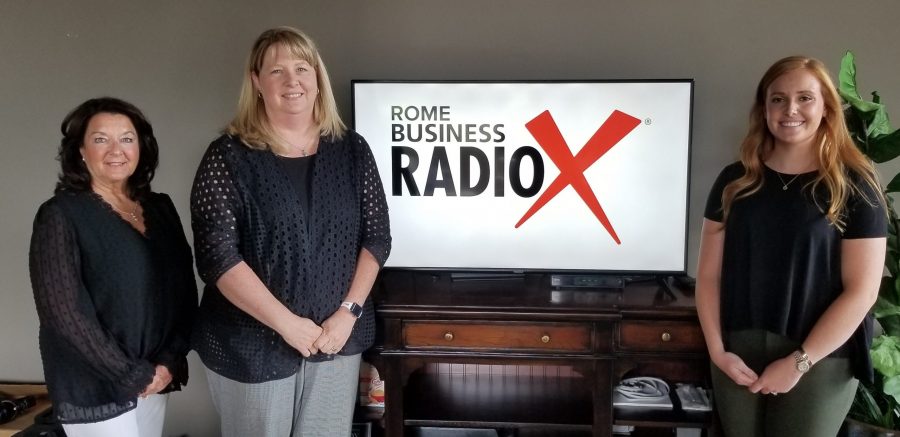
Rome Floyd Chamber Small Business Spotlight – Evie McNiece with Accounting Solutions Plus, and Dr. Heidi Popham with GNTC
/
RSS Feed
BRX Pro Tip: One Secret to Hosting a Good Show
/
RSS Feed
BRX Pro Tip: One Secret to Hosting a Good Show
Stone Payton: [00:00:00] Welcome back to Business RadioX Pro Tips. Stone Payton and Lee Kantor here with you. Lee, in your experience, what would you say is the number one secret to hosting a good show?
Lee Kantor: [00:00:11] The number one secret to me to hosting a good show is being a good, active listener. And that’s at the heart of everything that we do. At Business RadioX, we have been fortunate enough to have trained hundreds of people to be hosts and interviewers. And each of these people was not a professional host and interviewer. They were regular people who had never done this before, but our training is always around put the spotlight on your guest.
Lee Kantor: [00:00:42] This is not – your show is not about you. Your show’s objective isn’t to make you a micro-celebrity in the world. You’re going to get a credential of being a host just by being a host so you don’t have to work on that part of the job. If you would just focus on the most important job, which is putting the spotlight on your guest and giving your guest full attention and staying in the moment with the guest so the guest gets a great interview, an interview that they’re proud of and they’ll share, then you will also get to be that great host that you’re aspiring to be. But you have to do this through good, active listening.
Lee Kantor: [00:01:22] Being a good host means you’re a good listener. There’s too many times that I’m listening to an interview or watching an interview on TV where all the person that’s talking is the host. I’m not learning anything about the guest. The guest is just along for the ride to make the host look good. And that’s not what we do and that’s not why people come on shows. People come on shows because they have something to say and they want to be heard. So, your job as a host is to help facilitate the conversation, to bring out the best in that guest and to help them articulate their story and help them get the word out about the important work that they’re doing.
Lee Kantor: [00:02:00] By helping them tell their story, by helping them be heard and helping them be appreciated, then you have earned the opportunity to further build a relationship with them after the mics are turned off, and that is the objective of our hosts at Business RadioX. That is why people get into the Business RadioX business because they want to build better, deeper relationships with the people most important to them. And you can do that. You can lay the groundwork by being a good, active listener when you’re hosting them on your show.
BRX Pro Tip: Build a 100 Day Onboard and Launch for Your Clients
/
RSS Feed
BRX Pro Tip: Build a 100 Day Onboard and Launch for Your Clients
Stone Payton: [00:00:00] Welcome back to Business RadioX Pro Tips. Lee Kantor and Stone Payton here with you. Lee, we’ve come to learn that it is incredibly powerful and such a marvelous foundation if you’ll invest the time and energy to build a 100-day on-board and launch for your new clients.
Lee Kantor: [00:00:21] Yeah. If you could build this 100-day onboarding and launch plan for each of your new clients, you’re going to find you have happier clients and they’re going to have a better chance of succeeding with your service. And, the tighter the systems you have, the more confident your sales prospects will feel that you have figured out things for them and have given them the best chance to be successful with your service.
Lee Kantor: [00:00:42] Now, in these 100 days, it doesn’t have to be 100 different activities. It could be the same activities happening, you know, week after week. And, the activities can include, here, read this article; here, listen to this podcast; here, read about this success story or this case study from another client that is similar to you and this is how they have used and benefited from our service. It could be as simple as giving them easy-to-accomplish tasks. It could be, you know, here, here – give me your logos and social media link so I can put them in my record so I know to share and reshare things.
Lee Kantor: [00:01:17] You can be grabbing content and web pages that you have and just sharing with them. “Hey, check out this article that was written two years ago.” Or, “Here, check out – look on to this website. This is how one of our clients is putting our content on their website.” Any of this kind of information, if you can just sprinkle it over the course of 100 days, you’re going to be building this system that is going to make your new client more effective, it will make them more successful, and it’ll show to them that you have an expertize, that you’ve been there and done that, and that you have a system that’s going to make sure that they are successful with your service.
Lee Kantor: [00:01:53] So, the tighter you can build this system, the tighter the plan is, the more logical and easy it is to execute, everybody’s going to win from this activity. So, I strongly suggest that you invest the time to build the first 100-day on-board and launch plan for each of your new clients.
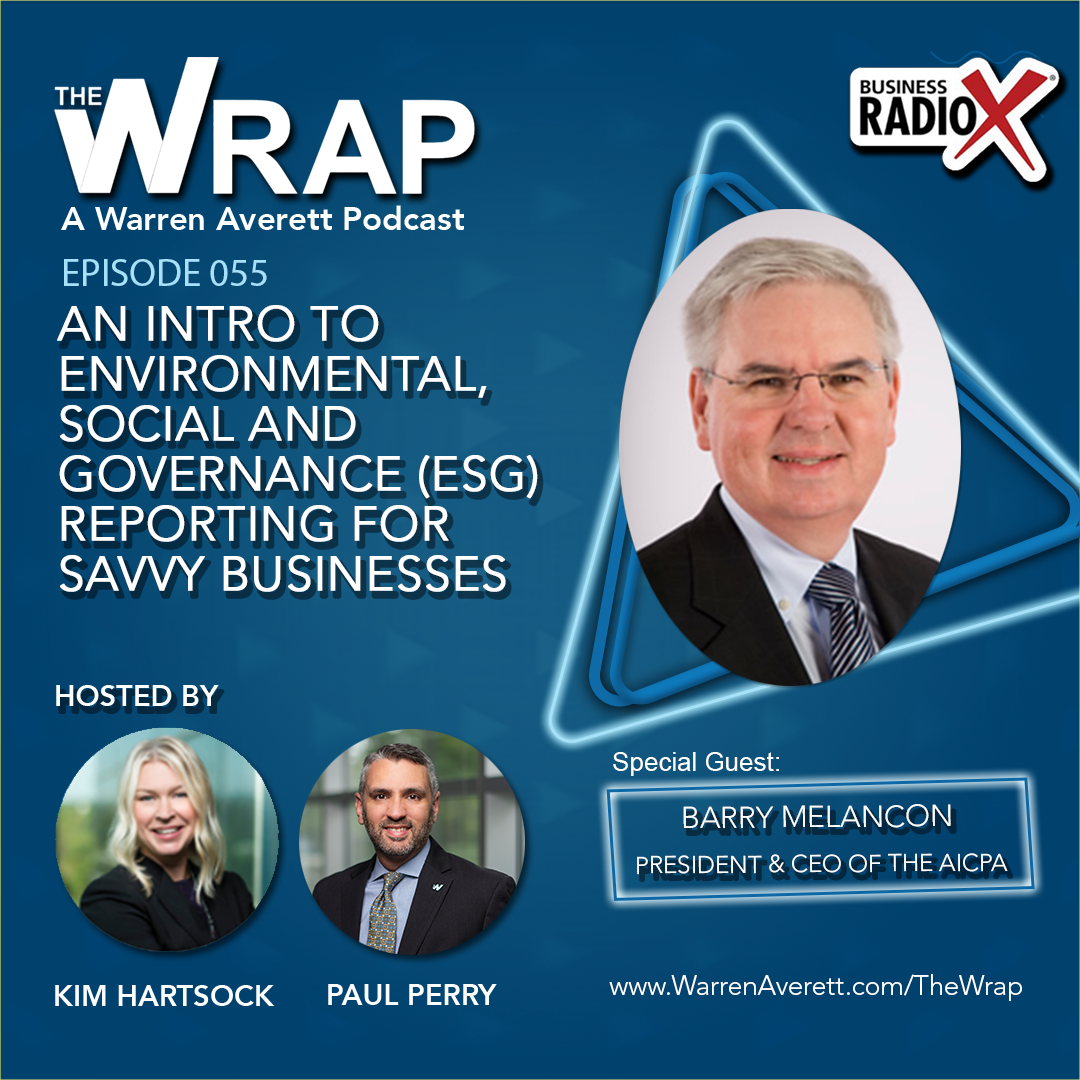
The Wrap Podcast | Episode 054: An Intro to Environmental, Social and Governance (ESG) Reporting for Savvy Businesses | Warren Averett
/
RSS Feed
Customers increasingly value (and support) businesses that share their own personal values regarding social and environmental issues. In turn, businesses that are transparent and accountable in their policies are often well rewarded. Enter: environmental, social and governance (ESG) reporting—sometimes also known as sustainability reporting.
What should businesses know about ESG reporting in order to set themselves up for success?
In this episode of The Wrap, Barry Melancon (President & CEO of the American Institute of CPAs and CEO of the Association of International Certified Professional Accountants) joins our hosts to explain the ins and outs of ESG.
After listening to this episode, you’ll:
- Know what ESG is and why it should matter to businesses
- Understand why ESG is at peak popularity for both customers and businesses
- Know what to expect when it comes to the future of ESG
- Know how to determine what your company may need to be reporting on in this area based on frameworks
Resources for additional learning:
- Article: Understanding the Accounting and Tax Implications of Adopting ESG Strategies
- Article: Sustainability Risks to the Reputation of a Business [ESG Reporting Explained]
TRANSCRIPT
(00:00:00) Commentators: Hey, I’m Paul Perry. I’m Kim Hartsock and you are listening to The Wrap, a Warren Averett podcast for business leaders, designed to help you access vital business information and trends when you need it. So, you can listen, learn and then get on with your day. Now, let’s get down to business.
(00:00:17) Kim Hartsock: Hi, everyone, and welcome to The Wrap!
(00:00:23) Paul Perry: Today, we are talking about ESG and sustainability for businesses. What that means and what is to come in the future and what do people need to be thinking about?
Today, we have a very special guest with us, Barry Melancon, who is the CEO of the AICPA. That’s both the American Institute of CPAs, as well as the Association of International Certified Professional Accountants. I think I got that right. So welcome, Barry. We’re glad to have you with us.
(00:00:49) Barry Melancon: Paul and Kim, it’s great to be with both of you. And it’s a very timely topic. And over the years, I’ve worked very closely with the firm, and I’m just really happy to be with you today.
(00:01:03) Kim Hartsock: Thank you, Barry, for being with us. We’ll let our listeners know that you’re actually joining us from London today, and we really appreciate you taking time to be with us.
(00:01:11) Barry Melancon: Yeah. I was in a series of meetings in London this week. And you may not find it surprising given our topic, but a lot of the meetings had a pretty strong ESG topic associated with.
(00:01:23) Kim Hartsock: So, Barry, you know we have a variety of listeners on our podcast, and some have probably a differing level of understanding of what ESG is.
So, can you just start by giving us some basics of ESG and what that means to business owners and leaders?
(00:01:41) Barry Melancon: Yeah, Kim, glad to do that. So, Environmental, Social and Governance is the ESG. That’s the watch word of the era that has come together, but it’s really broader than those three words in a lot of ways. The reality is, I think we start with the basics. The basics are that entities and corporations around the world are given permission to operate from governments. So, you’re organized in a state, or you’re organized under the laws of the United States in this case, but it’s the same everywhere.
Basically, entities are given permission and there’s a quid pro quo that comes with that. There’s a certain way you have to act, right? You have to pay taxes and you have to file financial information. There’s a certain way that you have to act. And for hundreds of years, it’s been a pretty simple relationship and that relationship is changing pretty dramatically with a lot of external forces today.
Some of the social issues that we’re facing in the world are a lot of concern about the environment, diversity in governance, how you treat employees and how you look at your business models. There are different levels of expectations from what we call a multi-stakeholder group. So, you know, traditionally the stakeholder group of a company was primarily the people who owned it, right?
Either shareholders as a public company or the entrepreneurs in a privately-held company, but in a world of everything social media and communications and travel on a global connected world; that is changing. And the expectations that businesses have to be responsible to is a multi-stakeholder class.
So, it’s investors, but it’s also regulators. It’s employees. It’s other players in your supply chain, either providers or your customer base, it’s the community that you operate in. It’s the expectation of people who work, who are spouses and children of people who work for a company.
So, this notion of multi-stakeholder has expanded. And with that what you’re expected to and how you’re supposed to act is set by three different things. It’s set by market expectations. It’s set in some cases by regulation or legislation. It’s set by standards or standard operating procedures and expectations in this space.
That’s really what’s happening in the world. And what I like to say, and I know, Kim, you and Paul both have heard me say this when we focus on the environmental part, it’s very emotional in this country, right? And there are people listening to this podcast who I can guarantee you believe the most important thing in their lifetimes that’s being addressed is the environmental issue.
There are people totally on the other end of the spectrum that believe it is a made-up issue. The science doesn’t support it. It’s being overblown, whatever words and adjectives you want to put into that environment, I would say is looking at it from a business perspective and the role of really how it is accounted for that doesn’t matter.
The expectations are up. People are expecting things. We’ll talk about this, but measurement, reporting and actually understanding what I would say is: the truth can prove either side, right? Frankly, that’s the beauty of, I think, what’s gelling in society today.
(00:05:31) Paul Perry: I think that’s a really good way to look at it, Barry. We appreciate that idea and that concept from a business perspective, but let’s go a little bit: this really is not a new idea. This is not a new concept of the idea of sustainability. ESG has been around for some time.
You can go back to the series of principles that were created by Exxon after their spill. You can go back to any investment policy that any corporation has, right? If a nonprofit said, “I don’t want to invest in these types of companies, I’m not going to.” They were in essence following the idea or the concept of ESG.
Our daily actions need to coincide with what our values and our cultures are. So, why the hype now? Why are we seeing people either buying into this or really jumping on the bandwagon? But there’s really not a bandwagon because it’s something that is here to stay for a while probably in looking at companies and how they’re valued. Why the hype now?
(00:06:36) Barry Melancon: Actually, in your history points there, I would say the real substantive change actually goes all the way back to 1995. And when it was sort of a general consensus that the information flow of businesses is much broader than just what’s in financial statement or tax returns.
So, that was really the genesis, and it didn’t pick up very quickly, but you’re right. It is picking up. Why now? I think there’s a lot of parts to this. I mean, clearly environment. There’s been a lot of activity that people are concerned about and there’s certainty we’re living in an era in which the environment is changing.
Now we could debate the causes of it, but it’s clearly changing. I think I would say the world is a much more transparent place and so the expectations are really driving it in this multistakeholder notion, right? I mean, you know, social media is a big driver of how much people know.
Employees. You’ve got a new generation of employees who have a different expectation of: what is a company that I’m going to work for? How are they going to act? What’s going to be their role in society? Clearly, you know, we’ve had major social issues in the diversity, equity and inclusion area that has driven a lot of this.
I would say the world has become a much smaller place as a bigger driver of it as well. What a company may be required to do, you know. Almost any size company has some attributes to their business that’s global today.
I mean, you can think about, the impact of channels of distribution or supply chains and how it’s affecting us or how it affects our phones. You know, all of these technological and geographic issues of reliability are just changing the population of people who are watching and asking questions.
That’s a major change. Clearly, then that moves onto the government or regulatory environment that people who get elected have policies that they wish to see and enacted along these lines. And frankly, they’re leading companies that are embracing and improving that decision-making. More diversity and being more attuned to some of these issues actually produces better returns and longer-term value.
That’s that cause and effect that plays out in that.
(00:09:03) Commentators: Want to receive a monthly newsletter with Wrap topics? Head on over to warrenaverett.com/the-wrap and subscribe to our email list to have it delivered right to your inbox. Now, back to the show.
(00:09:13) Kim Hartsock: So, we just talked a little bit about the history of where this started, how it’s grown and some significant things that have happened in our world recently that have shifted people’s thinking. But where do you see this going in three, five and 10 years? What do you think the short-term impact will be?
Where do you see this going long term? Talk about this will be integrated within the United States. Even how that interacts slowly with what you just talked about: how every business now has some aspect of their business that is global. You can’t really get away from that even if you consider yourself a small business, right?
(00:10:00) Barry Melancon: Yeah. So, I think where it’s going to go. So, if you want to think about the quid pro quo point that I made, you know, you can think about the government, the public or stakeholders expecting certain things. How does that manifest? That’s really your question, Kim, how does that play out? One way to think about it is just a whole bunch of broad rules that people have to apply or regulations or laws that come about.
There’ll be a lot of rhetoric around that. But that’s really, really hard to execute because what is the trigger to doing that? If we think about it (and this is where our profession comes into play), if you really think about what the most common thing is globally about business information, it’s financial reporting.
Essentially, the standards for financial reporting are the same. They’re not exactly the same globally, but essentially the same standardization has occurred over 60 or 70 years in the accounting space. And it is just commonly accepted that businesses provide financial information as a cost of doing business or a way that they they’re allowed to do business.
So, I actually think it’ll be one step below these sorts of broad-based sematic type of things. It will be delivered through requirements about information flow.
That information flow will be much more about the integrated components, not just financial components. We actually have a term that we call integrated thinking and reporting.
What it means is that there’s six elements to how you run a business. I don’t care if it’s a big business or tiny business. Two of those we’ve traditionally complied with around the world, which are what’s called financial capital and manufacturing capital. It’s the financial resources of the business, but the other four are not things that have been traditionally measured and reported on and they are what we would call natural capital, which the environment that we’re talking about falls into.
Human capital, which you could bring in any CEO and you say, “What’s your most important asset?” They would say, “My people.” Which is a great thing for them to say, but we don’t do a lot to measure and look at that.
Yeah, we have employment laws, but it doesn’t fit into that scope. Human capital is one. Actually, relationship capital; the whole notion of how you function in a supply chain, how you function with customers, how you function with third parties and how you function in your community is a third thing that is a resource of companies today.
That’s a very important element. And the sixth is the notion of intangibles, right? Intangible capitals, which is such a big part of what businesses manage today. So, what I think will happen is actually first in the environment, because I think the environment is leading the charge today. But ultimately in all of those areas over the next decade plus, you’ll see mechanisms in which businesses will report in an integrated thing how they’re managing their businesses along those capitals. For public companies, because public company information is very transparent because you have wide base shareholders, that will be very transparent information like an audited financial statement that’s public today except in all of those areas.
For private companies in which that information is more private. It may be only shared in a more limited scope, maybe to your suppliers who may require that or maybe to employees who want to know who they are working for in that particular space.
Some of the forces that are going to impact that might be… If you are a distributor of someone else’s product, a retailer or you’re a wholesaler or something along those lines, they may be a public company and they may have this notion. (These are called level three type of calculations.)
They may have a need to talk about their entire footprint, which means your footprint is part of their footprint. So that the forces in the channel will drive some of that as well. I think the world is gravitating to the way to get to all of this is through an already situated and effective information flow around finance information that gets added onto because that’s the most effective way to do it.
Instead of us seeing a new infrastructure being built around the globe.
(00:14:57) Kim Hartsock: So, I just want to say that this reiterates, why accounting is such an integral part of our economy. So, young people as they’re going into college and trying to figure out what their career path is… Obviously, I’m a huge fan of being an accountant and having an accounting degree, but I just think it shows that the world will continue to change. And accounting will adapt to that, right?
You’ve got behind your head adapt and thrive, which are two keywords for our industry, but it just shows you that even as you’re talking about environmental, sustainability, social and all these things. The world still revolves around accounting. That continues to be kind of a common language that unites us.
We have a challenge of trying to grow our industry in terms of getting people to follow into this career and see the future in this career, I think this just goes to show how important it is.
(00:15:59) Barry Melancon: You’re absolutely right. And let me define why that’s really even at a more granular level that what you said is absolutely right.
All of the things that we just talked about are: How do you gather information? What’s the right information? What’s the necessary information? How’s this reported on? There are five elements to how all of this is going to develop. It starts with controls in an organization. How do you obtain this information?
How financial information starts is with controls. The second is how do you measure it? How do you measure it against standards? Is there a process now to establish standards on a global basis for this? Well, just like accounting standards, you have to measure it against the standards.
Then, the third thing is what does that information tell you for decision-making? That again is a sweet spot of the financial profession, because we know how to do that. We look at financial information to investment decisions or business decisions.
The fourth thing is where you have an external reporting responsibility. How do you gather that information and put it in a cogent way to report externally? So, that’s what financial statements have done for hundreds of years. Then, the final thing is: How do you have assurance associated with that?
That the people who see the information know that it’s consistent and reliable, and that’s what the attest function over financial information is all about. So, Kim, your point is 100 percent accurate and the components of where this is moving basically go to the core competency of our profession.
Now, it’ll be supplemented for instance in carbon areas. You’re probably going to have engineers that are going to be part of that process to help measure it. But the control and consistency aspect are around those five points.
(00:17:46) Paul Perry: I think that that is, you know, a lot of people talk about the AICPA being there for CPA firms and for auditors.
But this to me proves even further that AICPA is there for the betterment, the advocacy of business and how business is done and run. For the business owners that are listening, they’re probably sitting there and thinking, “Well, what are those frameworks Barry’s talking about?”
I think the globe is coming up with a lot of different types of frameworks. You can follow the SASB, which has been picked up by the value reporting foundation, which I know you’re also a part of. There’s lots of groups, foundations and nonprofits coming together to say, “What is that global standard for this?”
That is what companies need to be looking at. You could go out there and there’s probably 47 areas that somebody could report on, but are those material for your type of business and for your type of service? The SASB is the Sustainability Accounting Standards Board.
Their framework really breaks it down in 77 different industries and says, “If this is your industry, these are the four or five things that are material and important, and that’s how we’re going to apply it across the board.” I think that the business leaders are thinking about: “What is my takeaway from this discussion?” It’s that there are frameworks out there and there are ways you can get into what do I need to be reporting on and how do I need to function?
(00:19:13) Barry Melancon: The key component is you use frameworks with the plural. We need to narrow those down. About two years ago, there were 200 different frameworks. And as a CEO of a company, there’s an awful lot of people, public companies and private companies that say I want to comply with this but tell me what to comply with.
That’s really what’s happening right now. You referenced SASB, the Sustainability Accounting Standards Board. So, I co-chaired a group that has merged SASB, effective June 30th, into the formation of the International Sustainability Standards Board that’s independently going to set these compliance standards in a way that does what you said.
Which looks at it on an industry basis and looks at it on a sematic basis in some cases. And the hope is that we don’t have this alphabet soup of hundreds of different frameworks that we can rationalize in some ways and simplify these measures in these standards.
Businesses that are going to be required to comply have a set of answers as to what they need to comply with instead of being second-guessed on what they’re complying with. That is really the goal. That really has to be global because the environment doesn’t stop at the Atlantic Ocean, the Pacific Ocean, the Gulf of Mexico or the Canadian border.
Companies and subsidiaries around the world have supply chain components around the world as we talked about with Kim just now. And so, it is a notion of: Can’t we get in this environment to something that is measurable and consistently done so that it has a better rationale of doing it on a global basis?
That doesn’t mean global drives because this new board that’s being set up is going to have a U.S. component, offices in Canada, offices in continental Europe, offices in London and offices in Asia. The really important part is that businesses will have an opportunity to feed into proposals that come about.
So, if something is crazy or whatever, they have an opportunity to deliver that feedback. It’s going to be done in an independent way. Not by the government, but by an independent standard-setting board that really is designed to interact with the market and to be doing that on a global basis.
Now, that’s a hopeful sort of great outcome. We may see some governments add more requirements on top. But at least if they do it from a building block approach, then we can have a core that is the starting point, which reduces the cost to implement and creates consistency.
I would make one more point. Paul, you used this industry point as the reality. If you write just generic standards in all these areas, particularly in the environmental areas, then if I’m in financial services, how do I apply that? Versus extraction industries, manufacturing or retail, et cetera.
One of the things in putting this together… an imperative that we brought forward was there has to be a notion of industry-based types of approaches. With the people implementing it, you want them to be able to go into one place and say, “I’m in financial services or I’m in oil and gas. These are the measures that I need to be looking at.”
(00:22:39) Kim Hartsock: Barry, here on The Wrap, we always try to wrap it up in 60 seconds or less. So, what is the main thing you want our listeners to leave with today after hearing this discussion?
(00:22:51) Barry Melancon: Well, you know, what I would say is the U.S. has probably got more naysayers to all of this than any other place in the globe.
I have a global role and I get to see that. I would say it this way and I’ll tell you a really good story. I was in a meeting that had a person from the UN., an organization that you would think you would label as a liberal organization. That person made a strong case that an electric automobile is actually a net negative cost to the environment. He made that point.
The general consensus would be a net positive to the environment. Right? Well, the truth is that I don’t think anybody really knows what’s the right answer to that. I certainly don’t know the right answer, whether it’s the net positive or a net negative.
But the building of a set of standards and consistent measurements, whether you believe either side of that equation standards produces the information that will let us in a transparent and consistent way answer those types of questions.
If you’re in the camp that it’s the most important thing we can do. It may prove that, but it might prove the other side of the camp. Our country has been a leader in this notion of transparency proves that in finances, in business models and businesses throughout decades and decades. This is a good evolution in that space.
You can embrace it from whatever side of the political spectrum you might actually subscribe to. That’s what I would leave for people.
(00:24:29) Paul Perry: Barry, this was a wonderful discussion. It’s been a pleasure to follow you for so many years. I do want to say thank you for all that you do for this profession, but also for business advocacy as a whole from the accounting perspective.
We appreciate what you’ve done, and we appreciate what you’re going to do going forward. And thank you very much for being a part of The Wrap with Kim and I.
(00:24:51) Barry Melancon: Glad to be here. It’s always great to be with both of you and thanks for the great comments. I hope the listeners get something out of this as well. Thank you all. See you soon. Bye.
(00:25:02) Commentators: And that’s a Wrap. If you’re enjoying the podcast, please leave a review on your streaming platform. To check out more episodes, subscribe to the podcast series or make a suggestion of other topics you want to hear, visit us at warrenaverett.com/the-wrap.















