Business RadioX ®

  • Home
  • Business RadioX ® Communities
    • Southeast
      • Alabama
        • Birmingham
      • Florida
        • Orlando
        • Pensacola
        • South Florida
        • Tampa
        • Tallahassee
      • Georgia
        • Atlanta
        • Cherokee
        • Forsyth
        • Greater Perimeter
        • Gwinnett
        • North Fulton
        • North Georgia
        • Northeast Georgia
        • Rome
        • Savannah
      • Louisiana
        • New Orleans
      • North Carolina
        • Charlotte
        • Raleigh
      • Tennessee
        • Chattanooga
        • Nashville
      • Virginia
        • Richmond
    • South Central
      • Arkansas
        • Northwest Arkansas
    • Midwest
      • Illinois
        • Chicago
      • Michigan
        • Detroit
      • Minnesota
        • Minneapolis St. Paul
      • Missouri
        • St. Louis
      • Ohio
        • Cleveland
        • Columbus
        • Dayton
    • Southwest
      • Arizona
        • Phoenix
        • Tucson
        • Valley
      • Texas
        • Austin
        • Dallas
        • Houston
    • West
      • California
        • Bay Area
        • LA
        • Pasadena
      • Colorado
        • Denver
      • Hawaii
        • Oahu
  • FAQs
  • About Us
    • Our Mission
    • Our Audience
    • Why It Works
    • What People Are Saying
    • BRX in the News
  • Resources
    • BRX Pro Tips
    • B2B Marketing: The 4Rs
    • High Velocity Selling Habits
    • Why Most B2B Media Strategies Fail
    • 9 Reasons To Sponsor A Business RadioX ® Show
  • Partner With Us
  • Veteran Business RadioX ®

Search Results for: atdc

Decision Vision Episode 73: Should I Sell to the Government? – An Interview with Sean Mahoney, Maston Space Systems

July 9, 2020 by John Ray

sell to the government
Decision Vision
Decision Vision Episode 73: Should I Sell to the Government? - An Interview with Sean Mahoney, Maston Space Systems
Loading
00:00 /
RSS Feed
Share
Link
Embed

Download file

sell to the government

Decision Vision Episode 73:  Should I Sell to the Government? – An Interview with Sean Mahoney, Maston Space Systems

If I decide to sell to the government, what are the challenges my business will face? Sean Mahoney of Maston Space Systems offers an experienced perspective on this question in this interview with host Mike Blake. “Decision Vision” is presented by Brady Ware & Company.

Masten Space Systems

Masten Space Systems is a private company founded in 2004 by CTO David Masten and has its headquarters in Mojave, CA.

Masten’s focus on reusable rocket technology is driven by the goal of enabling space transportation and reliable planetary landers for the Earth, Moon, Mars, and beyond. They are a passionate company of inventors, creators and builders with goals that include landing our own vehicle on the moon.

Masten competed in the NASA and Northrop Grumman Lunar Lander Challenge X Prize in 2009 with Xombie (model XA-0.1B). Xombie came away from the lunar lander challenge with an average landing accuracy of 6.3 inches qualifying it for Level One second prize of $150,000 on October 7th, 2009. The Xoie VTVL won the $1,000,000 Level Two prize of the Lunar Lander Challenge on October 30th, 2009 with an average landing accuracy of about 7.5 inches.  Masten’s future vehicles have improved this performance and landing accuracy to provide EDL and testbed flight services to customers through NASA’s Flight Opportunities program.

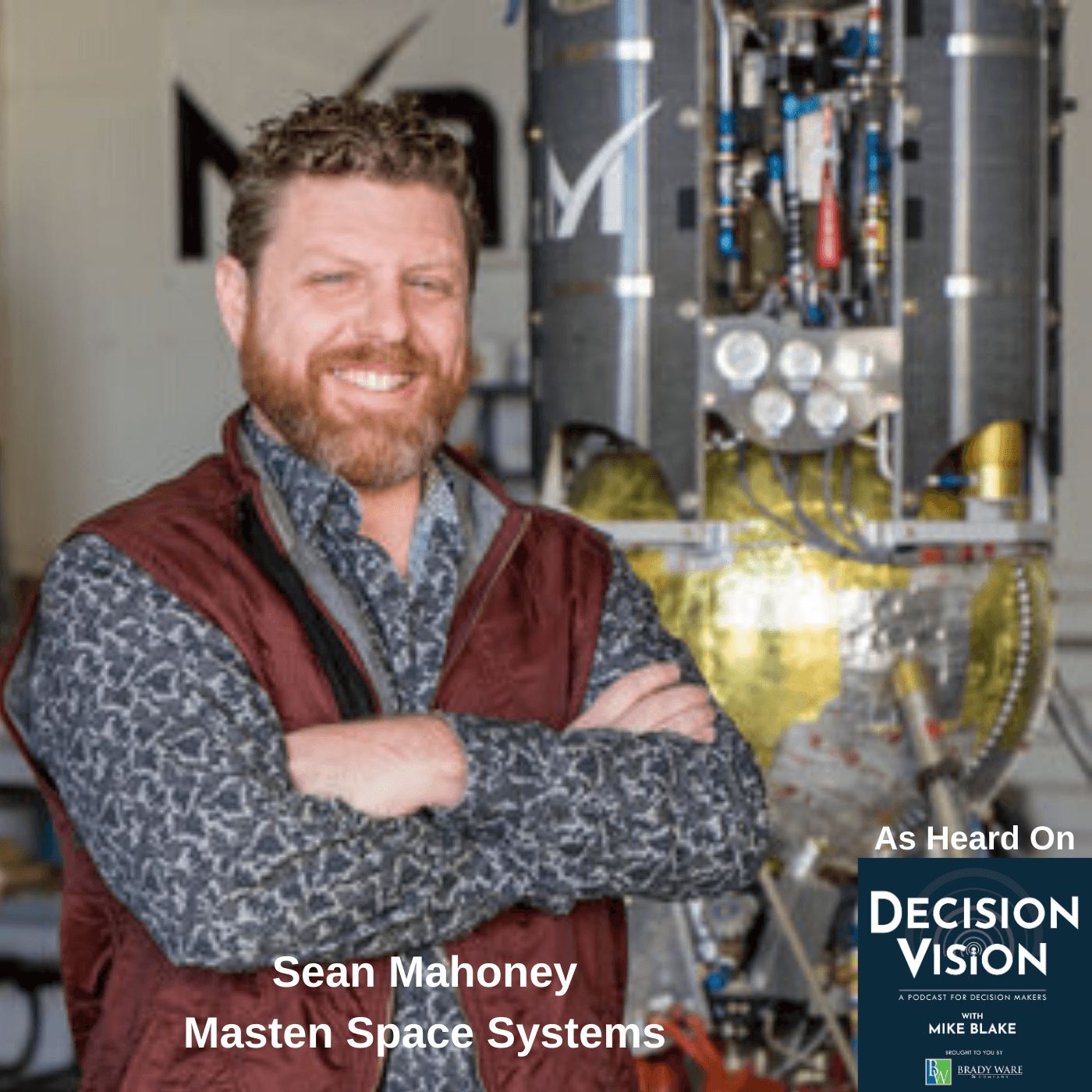
Sean Mahoney, CEO

Sean Mahoney is the CEO of Masten Space Systems, an aerospace R&D and flight services company that creates and deploys reliable, reusable rocket vehicles and components. Since joining Masten in 2010 as Director of Business Operations, Sean has focused on building a sustainable, customer-funded business. He has been instrumental in establishing Masten as one of the rising stars in the New Space movement. He served as COO during 2011-2012 and was named CEO in 2013.

Sean has over 15 years of corporate and technology industry experience, having founded and led a number of technology start-up ventures, and raised multiple rounds of private funding. Sean began his career overseeing technical sales and building internal organizations as a manager at AT&T’s Enterprise hosting division.

Sean received his MBA from Emory University’s Goizueta Business School and serves in a leadership capacity for a number of entrepreneurship and environmental non-profit organizations.

Michael Blake, Brady Ware & Company

Mike Blake, Host of the “Decision Vision” podcast series

Michael Blake is Host of the “Decision Vision” podcast series and a Director of Brady Ware & Company. Mike specializes in the valuation of intellectual property-driven firms, such as software firms, aerospace firms and professional services firms, most frequently in the capacity as a transaction advisor, helping clients obtain great outcomes from complex transaction opportunities. He is also a specialist in the appraisal of intellectual properties as stand-alone assets, such as software, trade secrets, and patents.

Mike has been a full-time business appraiser for 13 years with public accounting firms, boutique business appraisal firms, and an owner of his own firm. Prior to that, he spent 8 years in venture capital and investment banking, including transactions in the U.S., Israel, Russia, Ukraine, and Belarus.

Brady Ware & Company

Brady Ware & Company is a regional full-service accounting and advisory firm which helps businesses and entrepreneurs make visions a reality. Brady Ware services clients nationally from its offices in Alpharetta, GA; Columbus and Dayton, OH; and Richmond, IN. The firm is growth minded, committed to the regions in which they operate, and most importantly, they make significant investments in their people and service offerings to meet the changing financial needs of those they are privileged to serve. The firm is dedicated to providing results that make a difference for its clients.

Decision Vision Podcast Series

“Decision Vision” is a podcast covering topics and issues facing small business owners and connecting them with solutions from leading experts. This series is presented by Brady Ware & Company. If you are a decision maker for a small business, we’d love to hear from you. Contact us at decisionvision@bradyware.com and make sure to listen to every Thursday to the “Decision Vision” podcast.

Past episodes of “Decision Vision” can be found at decisionvisionpodcast.com. “Decision Vision” is produced and broadcast by the North Fulton studio of Business RadioX®.

Visit Brady Ware & Company on social media:

LinkedIn:  https://www.linkedin.com/company/brady-ware/

Facebook: https://www.facebook.com/bradywareCPAs/

Twitter: https://twitter.com/BradyWare

Instagram: https://www.instagram.com/bradywarecompany/

Show Transcript

Intro: [00:00:02] Welcome to Decision Vision, a podcast series focusing on critical business decisions. Brought to you by Brady Ware & Company. Brady Ware is a regional full-service accounting and advisory firm that helps businesses and entrepreneurs make visions a reality.

Mike Blake: [00:00:23] Welcome to Decision Vision, a podcast giving you, the listener, a clear vision to make great decisions. In each episode, we will discuss the process of decision making on a different topic from the business owner’s or executive’s perspective. We aren’t necessarily telling you what to do, but we can put you in a position to make an informed decision on your own and understand when you might need help along the way.

Mike Blake: [00:00:42] My name is Mike Blake and I’m your host for today’s program. I’m a director at Brady Ware & Company, a full-service accounting firm based in Dayton, Ohio, with offices in Dayton; Columbus, Ohio; Richmond, Indiana; and Alpharetta, Georgia. Brady Ware is sponsoring this podcast, which is being recorded in Atlanta for social distancing protocols. If you like this podcast, please subscribe on your favorite podcast aggregator. And please consider leaving a review of the podcast as well.

Mike Blake: [00:01:08] So, today’s topic is, should I sell to the government? And, you know, this is a topic I’ve wanted to do for a while. And I think it’s even more important now given the state of our economy. And again, the slow-moving horror movie continues that we hope we’re kind of reaching at least the final act of this thing. And, you know, I think that most companies, most business owners have thought about, you know, can I sell to the government? Should I sell to the government? And it’s certainly worth thinking about because I read somewhere that, in fact, the government does buy about 20 billion dollars of stuff every day. And that $20 billion of stuff includes things from pencils to laptops, to cars to airplanes. And as it also happens, spacecraft. More on that in a minute.

Mike Blake: [00:02:10] But I think many owners then don’t pursue the notion or the idea of selling to the government because they have some concept, or some preconceived notion, or some misapprehension of what it’s like to sell to the government and do business with the government. And maybe some of those things are true. Maybe some of those things are not. So, I think we’re going to do, maybe, today is do a little bit of myth busting. Because if you could afford to not try to sell to the government before, I think most companies now are in a position where you can’t afford to walk away from clients, even if they force you, maybe, to leave your comfort zone a bit in order to conclude a sale.

Mike Blake: [00:02:57] And to help us with that, I am bringing on a guest that I wanted to bring on for a while. He’s been harder to catch without a Taser and a butterfly net because he’s been busy building his company. But he’s a guy that I’m so excited to bring on. And I’m excited to really talk to him any opportunity I get because I’ve known him for a long time. I’ve known him since he’s been with his company. And, you know, I can tell you that right now – knock on wood. I don’t want to jinx him – but his company is enjoying some success. Believe me that the road to that success has been paid with broken glass. And he has crawled it both ways up and down the hill, however you want to express it.

Mike Blake: [00:03:45] And throughout that, I know that it’s been mentally, emotionally, physically challenging as an entrepreneur to do what he has done. And quite candidly, I think lesser men would have been broke and they would have given up. And he deserves all the credit. And he’s just – you know, through all that, he’s been authentic, he’s been nice, he’s been humble, and continues to be that way. And he’s just one of the most awesome dudes you’re ever gonna deal with. And just such an easy guy to root for. And when you listen to this, you’re going to hear that in his voice. So, you know, plan to take notes. If you’re listening to this while you’re driving, jogging, whatever, don’t take notes while you’re doing that. But plan to listen to this later. Or plan to go download the transcript, which is going to be on our website, bradyware.com. But this is going to be a good one.

Mike Blake: [00:04:46] And so, it is my absolute pleasure to introduce my friend, Sean Mahoney, who is the CEO of Masten Space Systems. It’s an aerospace research and development and flight service company that creates and deploys reliable, reusable rocket vehicles and components. Since joining Masten in 2010 as director of business operations, Sean is focused on building a sustainable, customer funded business. He has been instrumental in establishing Masten as one of the rising stars in the new space movement. He served as chief operating officer during 2011 and 2012. And was named chief executive officer in 2013. Sean has over 15 years of corporate and technology industry experience, having founded and led a number of technology startup ventures and raised multiple rounds of private funding.

Mike Blake: [00:05:33] Sean began his career overseeing technical sales and building internal organizations as a manager at AT&T’s Enterprise Hosting Division. Sean received his MBA from Emory University’s Goizueta Business School. And serves in a leadership capacity for a number of entrepreneurship and environmental non-profit organizations. Sean, thank you so much for coming on the program.

Sean Mahoney: [00:05:54] Mike, a real pleasure. Thanks to you for all of your support over the years. And thanks to folks there at Brady Ware for sponsoring this podcast and giving us a platform to talk about all this cool stuff, a little bit of space, a little bit of government, and a lot of sales. So, this is really cool. And I really appreciate the introduction. I hope to live up to the hype.

Mike Blake: [00:06:18] I think you will. This is not going to be a Batman movie for sure. But, you know, I would like – I don’t do it justice. And, in fact, I probably only know 30 percent of what you’ve gone through. But can you take a couple of minutes and sort of tell the Masten story? And I’ve hinted at your success. But, A, I want to do it justice. And B, I want to give you the opportunity to kind of express it. What is the Masten story and where are you guys now?

Sean Mahoney: [00:06:51] Yes. I will endeavor to give you a version of that that’s shorter than the 16-year history of the company. Let me just do one thing. I will tell you all about Masten, but I want to make sure just in case someone only listens this far. The one key takeaway for this whole government sales thing is, unlike perhaps other things where you just need to have someone who wants to buy a thing and they have the money to pay you, government sales requires having a third thing, which is the contract vehicle. There need to be a way to pay you that thing they want to buy. And if nothing else, maybe folks can take that away. But now, we’ll come back and explain what all that means. I just want to get that plugged in upfront.

Sean Mahoney: [00:07:46] So, I first encountered Masten hanging out down around Georgia Tech, the Technology Square. And honestly, it was a true networking breakfast that I attended on a fairly regular basis hosted by Stephen Fleming, who used to run ATDC and a bunch of stuff there in Tech Square. And the conversations in this open breakfast were really just about anything. It was about different startups and what they were doing. And there was usually some football talk and usually some Georgia Tech rivalry stuff, some politics.

Sean Mahoney: [00:08:28] And then every Monday morning, this conversation would eventually turn to the topic of discussing space. And there would be a 15-minute conversation about space policy. Because there were some space, not only enthusiasts, but people who were active in the space world. Stephen Fleming, Mike Mealing, Colin Ake, and others that we’re interested in working in space. And I used to believe it was the funniest thing. I would tell people the weirdest part of my week is the 15 minutes every Monday morning where I get to have a real conversation about space policy. And it’s not a joke. Like, it’s a real conversation. At that time, I had no idea that I would wind up working in the space industry for Masten or even running it. But for years I would tell that stories. Like, “Oh, my God. You should come to this breakfast. It’s the coolest thing.” And we have this odd conversation.

Sean Mahoney: [00:09:25] So, at that time, Masten was competing for an XPRIZE. It was the Northrop Grumman NASA Centennial Challenge Lunar Lander Challenge sponsored by XPRIZE. I think I got all of them in there. And this was phenomenal, I sat in another one of those cafe down there near Tech Square and watched on a friend’s laptop as the company competed for this big XPRIZE. And what the company was doing with the prize was, was demonstrating the ability to take off and land like you would do from a lunar orbit to the surface, refuel, then do it again.

Sean Mahoney: [00:10:07] That team with Masten Space Systems at the time was a dark horse. No one expected for them to win. There was an anointed big-name company that was going to win. And Masten Space Systems won that contest. And there’s phenomenal stories about the vehicle burning up on the pad the day before it flew and won first place. All this stuff, it’s phenomenal.

Sean Mahoney: [00:10:36] And my story with the company starts to come in after that win. Six months after they won a million dollars, the folks that I knew were like, “Hey, we need to raise the money because a million dollars doesn’t get you that far.” Which is true in space. But it’s also true – for any aspiring entrepreneurs, you think a million dollars, if you think about it in your bank account, it sounds like a lot of money. If you think about it in the operating account for paying for salaries and everything else, it’s really not that much money.

Mike Blake: [00:11:15] Payroll really changes that equation.

Sean Mahoney: [00:11:17] It turns out it does. And so, that was how I kind of started getting involved to help bring some of the – it was the decision science background and kind of structuring some of the payload opportunities and the sales opportunities and helping structure things. And that was how I first got involved with the company. And the challenge at that point was we had won an XPRIZE. The other company that had won an XPRIZE before us had turned into this company called Virgin Galactic. So, SpaceShipOne and the $10 million Ansari XPRIZE had turned into Virgin Galactic. Masten wins a $1 million XPRIZE, we’re trying to figure out what do we turn it into. And so, I honestly came in to figure that out – to help figure that out. And it was one of those things that we really didn’t know what it was going to be. And to state it bluntly, we didn’t have a big runway. We didn’t have a billionaire.

Sean Mahoney: [00:12:30] My first day on payroll, there were 42 days of cash in the bank. And some of my advisers that I still respect to this day had said, “This is a terrible idea, Sean. You’ve gone through enough of these different startups.” And they’re just, you know,” You got to find something that’s going to stick. This one is the craziest one yet.” And when I present this period of time of different crazy business ideas, it absolutely is the craziest. Hands down. But Masten had three things that I was personally looking for. I was looking for an emerging market that was transitioning from the domain of deep experts to a broader audience. Kind of, like, think internet business, internet video, green tech. They were moving from deep expertise to a broader application.

Sean Mahoney: [00:13:34] I was looking for working technology because I know how hard it is. It seems so easy to take that idea and get a prototype. But getting the prototype is really important. So, I went looking for companies that were working technology and has got a good team. Like, a good place to work. A good team to work with. And Masten fit that bill and has throughout these ten – even when there were some challenges, it has fit that screen. And so, I keep working at it.

Sean Mahoney: [00:14:10] So, what the heck do we do? So, we have this vehicle that can land, a rocket powered lander. Yes, there are other big rockets that lands now. But back then, it had been done by large government programs in this competition, of which there were only two that actually made it all the way to the final competition.

Sean Mahoney: [00:14:34] And so, “Okay, Well, how do we take this and turn this into a business?” And the big idea – and I’m going to fit in this kind of government sales thing – is that the large vision of space was that this is going to move from being government to being commercial. And people are going to buy their ticket and they’re going to go to space. Or they’re going to buy cargo and things are going to go and everyone is going to be using space. And we’re going to open use of space to everyone because it’s going to be commercial. And that is a great vision of the future. It was not the reality of the customer in 2010. It is not the reality of the customer in 2020.

Sean Mahoney: [00:15:24] And so, understanding the difference between “I’m going to solve this problem for this industry by getting away from government” might be the right answer. But be careful about confusing this ideal future state with the states you have to be to get from here to there. So, what we focused then on is the thing that we had that worked. I had a rocket powered lander. Who needs a rocket powered lander? It’s a very small market. But the thing that we found that resonated was, we had a rocket powered lander that you could come fly on. And I can offer rocket flights as a service instead of selling vehicles or selling programs that can cost, you know, 30 million or 50 million. And for less than a million dollars, we can test your thing out.

Sean Mahoney: [00:16:33] And so, we’ve figured out that there was a market for doing these terrestrial test flights. And it wasn’t because of a business case analysis. And it wasn’t because I spent a bunch of time studying market reports. The reason we are successful today is because there were people working for NASA, government employees, that saw the value we could provide. And the need that they saw existing within the agency. And they brought them together. And so, first up, the idea that it’s industry versus NASA for space or any of these things, that it’s industry versus the government, is far too great a simplification. And probably, absolutely incorrect.

Sean Mahoney: [00:17:38] So, what we did then is we took a service, a rocket powered landing test bed, which – and I’ve described it from a business perspective, I’ll say, “It does precisely what nobody needs.” Like, “Wait. What?” It does not. Our service to this day does not meet the desires of the testing community. It doesn’t meet their high-level objectives. What it does is exist. So, because I have a thing that I can do, the people are willing to use it and build up until some point we will have that higher capability. And it’s weird because if you ask – if you did a market survey, and said, “Okay. Well, what does the industry wants?” You would say, “Okay. Well, it wants all these things and we can’t do that, so therefore we need to invest. We need to build the next thing, yadda, yadda, yadda.” But that’s not a business plan that would close.

Sean Mahoney: [00:19:04] So, using the thing we have, working with the customers to meet needs they have right now is kind of the thing that we did for years. Now, along with that, we were trying to take – and we were taking the technology and spreading it out into other applications. So, we are working on technology development. Working with government agencies to develop some technologies. And then taking what we had for that low-level vehicle and applying it to other markets. And there were two that we had identified.

Sean Mahoney: [00:19:42] And Dave Masten, the founder and now CTO, had from the get go the idea of reusable launch vehicle. He, along with a couple other people that you’re probably familiar with, had the same idea. And were similarly mocked for that idea. So, what you can do with the reusable rocket is I can reduce my costs of operation if I reuse the vehicle. And then to a certain degree, the payload doesn’t care, right? If I’m buying delivery to orbit, I just need to get to orbit. I don’t care how you get me there. I just want to get there.

Sean Mahoney: [00:20:34] So, one angle to the business was launch and using reusability and launch. The other one is, where is a rocket powered lander uniquely suited to meet a need? And there are places where planes and helicopters can’t go. Places where you don’t have runways. Places where you don’t have air. Places where the air is too thin. Places that are too dangerous. So, you have a whole series of things there. But the moon is one of those places. You’re not going to land with a parachute. You’re not going to land with – you have pretty much two options to land on the moon. You either crash into it or you do some sort of propulsive landing. So, we knew those were the things. But much like the adage of, you know, can you stay liquid longer than the market can stay irrational?

Mike Blake: [00:21:38] John Keynes.

Sean Mahoney: [00:21:42] So, we had big correct ideas but the timing wasn’t right. So, part of the through broken glass has been stringing together customers creating value as some of these large trends turnover in time. And so, it’s – and I don’t know if this version of the story speaks to the decision makers that are potentially listening in. But it’s hard to know what’s the difference between grit and perseverance versus being stubborn. They are largely indistinguishable except through the lens of history. And maybe there’s – I don’t know – maybe you’ve got another guest who can speak to discerning those ones. But we have been able to persist focused largely on revenue. And I can talk about the trend to raise money in the space world and all of that stuff. But this is more about the customer side of things.

Sean Mahoney: [00:23:01] And in order to support ourselves off of revenue, realized revenue, actually getting a thing done, giving someone the value that they’re paying for, that customer or the pair for us has largely been government. And even those deals and projects and things that we have worked that are not a government entity that are commercial customer, a lot of their business is for the government. And so, either directly or indirectly, I came finally to realize, “I should stop thinking about the market in terms of what could be. And focus on what is.” And so, we’ve been able to be successful building and flying rockets. We’ve had a big DARPA program a couple of years ago. Three companies were selected to design a reusable booster, Masten Space Systems and then two other companies no one has heard of, Boeing and Northrop Grumman.

Mike Blake: [00:24:12] Oh, yeah. Those has-beens.

Sean Mahoney: [00:24:15] Yes. Yeah. And you’ll also note there’s a bunch of other companies that did not win that way. So, we had that contract that was phenomenal. I learned a lot. We grew a lot. But the market for that had turned a little crazy. And I had to make the – this was a decision point. I decided to put our launch – applying our technology to a launch solution and put it on ice. Because everyone of our brother had started a launch company. And I can’t. I was burdened with the reality of understanding how hard some of this stuff is. And I could not lie and just say, “Oh, yeah. We can do this. This will be easy.” I know it’s not going to be easy. And so, some people had the benefit of idealism and enthusiasm. Or maybe they were ten times smarter than us. But I know enough to know some of the bold proclamations of what you’re gonna do aren’t going to pan out.

Sean Mahoney: [00:25:27] So, fortunately, by the time that happened, the other piece of what we’re expecting to come around was growing. And we had been quietly working for that last decade on the lunar lander side of things. But what I didn’t do was bother talking about it. Why? Well, there was a Google Lunar XPRIZE competition going on that we had supported companies, but we were not directly competing in. And I felt that the market wasn’t real yet. I did not see the ability to actually get dollars committed and flowing. That was anticipated to change. It did change.

Sean Mahoney: [00:26:14] And now, as of today, not only do we have government buying delivery of payloads to the moon, similar to they buy payload delivery to the National Space Station. Masten has not only the broad general contract, but a specific task order. And so, we’ve been selected to deliver a series of instruments for NASA. And now, it’s time to put all of this decade in my case, a-decade-and-a-half in Dave’s case, to work delivering payloads to the moon for the government, for NASA, for other government agencies, and for commercial markets as well. So, I get to serve all of them.

Mike Blake: [00:27:03] I want to interject a little bit because hat one decision point you talked about where you had to decide if you’re going to be on a launch business or the landing business, I think was really important. And tell me if I’m wrong, but I suspect there are kind of two big factors at work. Number one is that, I don’t think you have the resources really to pursue both. You kind of have to make a decision and just put all your chips in the one square. And then second, it occurs to me – not that I want to understate the difficulty – but let’s face it, there have been a lot more spacecraft that have been launched than have been landed. So, isn’t a trick of a soft landing –

Sean Mahoney: [00:27:52] Oh, God. Yeah.

Mike Blake: [00:27:54] … isn’t that kind of a more rare thing?

Sean Mahoney: [00:27:59] Yes. Yeah. So, let me address the technology piece of it. First, absolutely going up is easy. We’ve kind of known how to do that for a long time. Coming down is even easier. Even longer amount of time we figured out how gravity works. It’s that controlled landing that is the really hard part. And so, yes. Absolutely. Now, what I can tell you is that, with that understanding, Dave started out focused on the hardest part first. And that’s why the company has – we have more flight operations. We have done more rocket landings than anyone.

Sean Mahoney: [00:28:47] But we’re not bringing it back from space. We had focused on – think of it as doing more diverse stuff rather than altitude. And there was a decision point earlier on where I was like, “Okay. Do we focus on going higher and faster or do we focus on doing more and refining more of the landing?” So, the landing stuff, I feel pretty good about. I feel like we have decent enough understanding. I know there’s things that we know. I know there’s things that we don’t know. Because we actually thought we had the whole thing figured out. And then we found out we didn’t.

Sean Mahoney: [00:29:25] And so, you know, we’ve gone through that iteration. That was the landing part is the thing that has really been a core assets of ours. And it’s not just – and this is in a lot of industries and especially in space. We really like the superlatives of saying first. But first is nice for a press release. Repeatable, reliable is what you need for the business. And so, just because you did something first doesn’t mean squat if it never goes anywhere, right? If it never gets you anywhere.

Sean Mahoney: [00:30:05] And a lot of times, because of the long timelines, people are grasping – they’re seeking something to differentiate themselves and say, “Aha. Look, I did this.” And that’s great. But I am less interested – personally, as to the business side of things, I don’t care about your feet of rocketry of technical performance. What I care about is, are you creating value for your partner? Are you helping make them rock stars inside their organization? Are you helping find ways to make someone else’s life better today? And so, yes, the landings part is hard. That was not actually the problem.

Sean Mahoney: [00:30:50] I have spent a lot of time obsessing over this question of diversification versus focus, diversification versus focus. The best practice for entrepreneurship is laser like focus. Pick a thing and do that. I understand and I agree. However, that’s not exactly what we’ve done. And we were keeping multiple things open at the same time. And here’s the reason why. For space, there are a few – it’s a small N on statistics. A few big events that happen infrequently. So, I could choose, “We’re gonna be all in on the moon. Great.” And if that had been the decision in 2011, that had been fine. But we would have run out of money and gone out of business. I could’ve said we’re all in on launch. And then when launch dried up and we weren’t selected for the next DARPA phase, we could have been them out of business there.

Sean Mahoney: [00:32:11] And so, it is a difficult thing that I’ve grappled with because I understand the best practice and yet have chosen a different approach. And so, right now, the way I frame it is, delivery to the moon is our flagship. That is the thing that is very clear. That is the big thing that gains people attention. And I can show you how the other work that we’re doing aligns with providing value to the people who want to get access to the surface of the moon. And so, our terrestrial flights.

Mike Blake: [00:32:54] Sorry about that.

Sean Mahoney: [00:32:54] No. No. It’s okay.

Mike Blake: [00:32:54] But what I take out of that is, I think, a couple of very important points. Is that one misconception is that selling to the government is fundamentally different from selling to private sector clients. But what you’re telling me is, at the end of the day, it’s still about providing value even if value might be defined somewhat differently. And it’s about making your customer somehow better. And along the way, while you talked a little bit in your story about, you know, there are some strong advocates from Masten because they know they got a technically, and I presume, decided to become advocates. And that tells me that somehow you were able to develop a relationship with the government or something in the government.

Mike Blake: [00:33:54] And I think a lot of people wouldn’t expect that that’s something you could do, at least not in a typical way. When we think about relations with the government, frankly, we think about lobbyists and we think about having your senator make a well-placed phone call to somebody. But we don’t think of it necessarily in terms of just good old-fashioned garden variety, people to people relationships. But it sounds like that that actually does – that actually is present.

Sean Mahoney: [00:34:27] Yeah. And by the way, working in space has this problem is that it oftentimes is so cool that it distracts us from whatever other conversation we’re having. So, here we’ve talked all this stuff about Masten and haven’t really addressed some of the government part.

Sean Mahoney: [00:34:44] So, yeah, first of all, the government, you do not sell to the government. No organization is actually monolithic. And that’s a mindset. Like, you’re not selling into a faceless blob. No matter what, whether you’re selling to a small company or a big company, the government. You are selling to individuals. And that is a key thing I think some people don’t quite understand. It’s not like you’re just throwing in a proposal and then someone throws money at you. There’s someone on the other side of that. That is a person that has things that they’re trying to accomplish.

Sean Mahoney: [00:35:37] And just like if you’re selling to a local mom and pop shop and you’re selling them something. The same thing applies if you’re selling something to the government. You’ve got to understand as best you can what they’re trying to do. And it’s not maybe as easy as going in. But it’s also not impossible. And it’s not necessarily as hard. So, the perception that it’s only for the bigs is not accurate. And it’s demonstrably not accurate, like, there are some specific things that are clear that our federal government has interests in working with small business.

Sean Mahoney: [00:36:23] I will tell you that there is this thing called industry capture, where any industry that is selling to the government often has a lot of influence in what the government asks for and wants to buy. It is not necessarily these whole arms, like the ideal maybe that the government chooses to acquire things and companies have to propose against it. But oftentimes the thing the government asked for is influenced and shouldn’t be influenced by what the market can provide.

Sean Mahoney: [00:37:04] And so, it is an interesting challenge. Because from the government standpoint, their risk posture is different. It’s sometimes very similar to a large organization. It used to be – and every industry has the saying, no one gets fired for buying blank industry leader. No one gets fired for buying from IBM. It doesn’t matter if it’s a good deal or a bad deal, or whatever. It doesn’t matter. They’re the industry leader. So, you’re not going to get in trouble if you buy from them.

Mike Blake: [00:37:38] Well, right now, I’d imagine in your world, nobody gets fired for buying from Grumman or Raytheon or –

Sean Mahoney: [00:37:44] Correct.

Mike Blake: [00:37:45] … Boeing, right? And I have to imagine that at least crossed your mind –

Sean Mahoney: [00:37:50] Oh, yeah.

Mike Blake: [00:37:51] … as pertaining to these things, right?

Sean Mahoney: [00:37:54] Absolutely.

Mike Blake: [00:37:54] Did it turn out that that was a legitimate fear?

Sean Mahoney: [00:38:01] Yes.

Mike Blake: [00:38:01] Or once you got in, did you find out that maybe they even kind of root for the little guy?

Sean Mahoney: [00:38:07] There are –

Mike Blake: [00:38:10] It’s not monolithic, right? It depends.

Sean Mahoney: [00:38:12] It’s not. Right. Yeah. It’s not. Yeah. So, I don’t know if it makes sense to do the negatives. Let me start with the negatives because it’s better to start there. There is an awful lot of process that is designed to prevent government fraud, waste, and abuse. There is a lot of things that exist to prevent the government from doing bad, stupid, fraudulent things. And you know what? On principle, everyone says, “Yeah, of course. We want the government to reduce fraud.”

Sean Mahoney: [00:38:53] There is a point, however, where you get diminishing returns. And so, there is an information asymmetry for you to this particular industry. And the incumbents who have mature processes and systems. And that becomes right there is the kind of the key difference. That information asymmetry means that you don’t know about the federal acquisition requirements. And if you don’t know how to quote them chapter and verse, you may wind up getting yourself into some difficulty because you have this extra burden, this extra cost of compliance. So, that favors larger companies.

Sean Mahoney: [00:39:41] Now, I will flip to the opposite side and say, “Yes.” And the government aware of that. And there are specific initiatives that have been around for a long time. And new ones where people on the government side are trying to find ways to reduce or circumnavigate those burdens of doing business with the government. And the first one is to point out the SBIR program, Small Business Innovation and Research. And then there’s an STTR, which is – oh, I don’t know. I forgot the acronym.

Mike Blake: [00:40:13] Science and Technology Transfer –

Sean Mahoney: [00:40:13] Yeah. R –

Mike Blake: [00:40:20] … Research, something like that. Yeah.

Sean Mahoney: [00:40:20] The idea there is that this is federally mandated to be a percentage of federal agency budget across, I think, 11 different agencies. And it is money that they have to spend on small businesses. Small businesses is defined as less than 500 people. So, this is obligated money that they have to push this away. The question is, how do you go about tapping into it. And how do you make sure that this is something that’s not going to just bog you down?

Mike Blake: [00:40:59] Let’s dive into that. So, how do you – I mean, what’s the first step, right? When you’ve figured out that NASA ought to be an important customer, I mean, do you just do you just call NASA up and say, “Hey, I’ve got this landing system. And, hey, you might want to use it to land on Mars, the moon, or whatever?” How do you start?

Sean Mahoney: [00:41:22] Yeah. “Dear NASA, please buy my rocket stuff.”

Mike Blake: [00:41:27] Door to door? I mean, “Hey, bud. Do you want to buy my landing system?”

Sean Mahoney: [00:41:31] The first thing to do is not to build a rocket. The first thing to do is go talk to people and understand their pain points. And so, I will refer you to the customer discovery model, and the iCore, and Steve Blank. And understand the pain in the market first. And then build a solution to it. How do you understand a pain in the market? Well, there are a lot of things that are available.

Sean Mahoney: [00:42:18] Number one, go look at the previous SBIR solicitations and the topics that are there. And you can read through what has been selected. And you can call those companies, you can call those sponsors. Most government officials probably have phone numbers and contact information available publicly that you don’t have to pay for because it’s probably required one way or another. So, you can actually pick up the phone and call people and say, “Hey, I saw the solicitation was out last year. Do you guys get what you need? Or are you looking for something different? What’s coming up in the future?” Ask the questions.

Sean Mahoney: [00:43:02] Reading industry papers. The scientists and the engineers that write industry trade papers, whatever that is, look them up, call them up. I can tell you they love talking about those papers that they wrote. And I will also tell you most people don’t read those papers and don’t refer to them. And you will immediately – if you have a topic and you actually, like, pick up and read their thing, they’ll be thrilled to talk about the thing that they spent their time writing the paper on. And can help guide you into, “Okay. Well, here’s a pain point that I know somebody has.”

Sean Mahoney: [00:43:40] And then the other one is just show up and be useful. Go to conferences, volunteer. If you’re trying to get into an industry, find an industry group. Volunteer to serve on a panel, to do a thing, to take tickets, and whatever. Become part of the community. Become a known entity. And that way you can help work your way in.

Sean Mahoney: [00:44:11] So, I know I had just kind of networked your way into the government. It sounds kind of odd. But again, it’s not the government. It is, probably, an agency. And more particularly a director. And more particularly a group. And more particularly a set of, you know, 50 to 100 people that work in and around whatever domain you have interest in. So, how to get in, that’s my recommendation for that. It is kind of pick up the phone, but start with the questions.

Mike Blake: [00:44:49] Now, let me ask you this, how did you find the government or NASA? I guess, they are not monolithic. So, I’ll ask you to talk about what you’ve actually done. How you found NASA or whatever specific office you are dealing with in NASA in terms of their responsiveness? You know, I think many of us – I don’t want to be ideological here – but many of us, when we think of the government, we basically think of the DMV. And everybody’s a DMV. And not everybody is a DMV. I don’t think the DMV could launch vehicles into orbit. But the perception is that they’re slow as molasses. And it’s going to be a nightmare in terms of length of sales cycle. And they can’t make a decision. How has your experience been relative to that perception?

Sean Mahoney: [00:45:42] Spot on.

Mike Blake: [00:45:45] Really?

Sean Mahoney: [00:45:45] In some cases, spot on. And it’s important to realize the different objectives and the different world that your government partner lives in. And it’s one thing to say, “Well, it’s crazy that this thing takes 18 months.” They might know that it’s crazy. But it also might be the way things are. And to a certain degree, some of this is a gravity problem. And this is not a space thing. A gravity problem is one of those ones that is not worth getting upset about because it’s just there. And government bureaucracy, like, if you want to skip the bureaucracy and want to just take straight payments from someone, feel free. However, you’re likely to have then have to pay the price when someone says, “Hey, how come you didn’t follow procedures and yadda, yadda, yadda.” Right?

Sean Mahoney: [00:46:52] So, yes, there are some things that are absolutely infuriating. A sales cycle for some of these things, even small amounts of money, can be 18 months easily. And if you want to go all the way back to the beginning and having the conversation with a person you want to sponsor a topic that you then apply to, that you then get selected for, then you negotiate a contract for them, and start executing on, you know, two years for a small business? I don’t know about you, but my lifestyle, like, were fruit flies. I live week to week, day to day, month to month.

Mike Blake: [00:47:37] Now, the sales cycle requires – go ahead. Sorry.

Sean Mahoney: [00:47:40] No. It’s an entirely different thing. And it’s not worth railing against it to say, “Oh, it’s not fair. It’s not right.” You know what? It’s not fair and it’s not right and it doesn’t matter. It is. And so, play the game. Play the field. Understand that it’s going to take that long. And figure out, maybe, the choice is you don’t wanna do it.

Sean Mahoney: [00:48:05] Let me also flip around the other side and say, doing a project with the Air Force – and I’m not kidding you on this – we submitted a proposal. We were contacted nine days later on a Saturday telling us we’d been selected. And we had a contract a week after that. That is unheard of. That was only 50K, but it doesn’t matter. That is the speed and why are they moving that fast? Because DOD realized that they had made it so difficult to work with. That the best and brightest are busy building, you know, the next Uber app and are not even engaging with the government. I don’t need to bother with your process and your BS and all the rest of it. I am just going to sell my stuff to someone who can pay me. And I don’t have to deal with the FAR and they don’t have to deal with all this other crap.

Sean Mahoney: [00:49:07] So, there are pieces that are in effect. Sometimes they’re referred to as Other Transaction Authority, OTA. And this can be a program if it’s set up that way. Whether the government can have reduced amount of certification, all of this other stuff that goes on. But you’ve got to have someone that’s willing to find and exercise those things.

Sean Mahoney: [00:49:38] And let me just real quick, because I talked about SBIR and I talked about the long sales cycle and how much of a pain on the butt it is. And for $125,000, it just doesn’t make sense. But this is the thing. And you have to add even more time to get to this point. Phase one might be 50, might be 150K. Not a whole lot. Phase twos might be half-a-million to a-million-and-a-half. That’s better, right? You do successful. But yield on an SBIR, depending upon the agency, 15 percent, sometimes less. Phase one to phase two, maybe 50 percent. But once you have completed an SBIR successfully, phase one, now you have a contract vehicle that will allow someone in the government to sole source a contract to you as long as it relates to that topic.

Sean Mahoney: [00:50:51] And so, I’m going to bring it back to what I said at the very beginning, someone wanting to buy the thing you’re selling, the service or product, having the budget and the money to pay for it. And you need a way for them to be able to get that to you. If you think about your business and you set it up so that you are building customers, and building budgets to support, and building a portfolio of contracts that can be used to send business to you, it can open this whole world up. So, it is a big wall in the front, but can be very beneficial once you get through it.

Mike Blake: [00:51:39] So, we’re talking with Sean Mahoney of Masten Space Systems. I think a takeaway from that is that if you are personally or institutionally impatient, selling to the government is probably not for you.

Sean Mahoney: [00:51:54] It does require – yeah.

Mike Blake: [00:51:59] I mean, again, there is a nine-day contract and so forth. But let’s face it, if you’re just the impatient type –

Sean Mahoney: [00:52:04] Yeah. Or find someone to partner with who will take half the value of the contract or more and handle all that stuff for you. Right?

Mike Blake: [00:52:17] Okay. Yeah.

Sean Mahoney: [00:52:17] If you’re really impatient, but you’ve got something that’s really valuable, don’t complain about giving up a whole – “Oh, well. I did all this work.” Yep. But you can’t sell to anybody so it doesn’t matter. Right? But yeah, it is not for the impatient. But then again, I would say entrepreneurship is not for the impatient. It takes time. You need to move extraordinarily quick every day. But then, also, it’s a marathon. So, you got to do both. You got to sprint every day in a marathon and keep your wits about you. Then it’s phenomenal, but it’s not easy, to say the least.

Mike Blake: [00:53:06] So, we’re running out of time and there are a couple more questions I want to try to sneak in here if I can. One question is about cost sensitivity. On the one hand, you hear about the government that they always go to the lowest bidder. On the other hand, you hear about $500 toilet seats. So, in your experience, what’s the reality there?

Sean Mahoney: [00:53:31] Different types of contract. So, you have a cost plus contract where the government will choose a vendor. And then, basically, you do change orders to keep adding things on. Or you then have firm fixed price contracts, which is this is the thing, you deliver it regardless. Now, in an ideal world, things that are mature would be that firm fixed price because you know your cost of production. You know, you’re selling pencils to the government. Fine.

Sean Mahoney: [00:54:06] In reality, things have kind of become inverted. And so, Masten, as a small research company, is doing from fixed price contracting for highly uncertain projects because of our R&D. I’m willing to take that risk. I have to build my pricing to the government sufficiently to cover my risk. They would be willing to allow a given contract to put me under. Does the government care about price? Yes and no. I wish I could say it’s one single answer. It’s not.

Sean Mahoney: [00:54:54] I will say to the entrepreneurs, selling on price is very difficult. And it can kill you. If you think I will cut my rate to the government in order to win this contract but you can’t pay yourself, then you will die because you’re not hitting enough. And the same in symmetry as I talked about earlier can bite you here. I am a strong advocate for the idea of SBIR programs. Basically, just coming up with a standard deduction on your tax form. They should have a standard rate and say, “We’re going to pay 200 bucks an hour on an SBIR,” or whatever it is.

Sean Mahoney: [00:55:50] In reality, you have to submit your pricing even on a firm fixed. Then you have to go through negotiations. My recommendation is use Bureau of Labor Statistics numbers. Use those industry numbers that you can. And do not allow the fact that you are taking less than market salary. And then passing that direct benefit on into an SBIR program. Because then you’ll never get yourself out of it. Right?

Sean Mahoney: [00:56:30] And so, that’s one of the things, I did not agree to price our services at the obscenely lower rate that we pay ourselves divided by 2,000 hours and say, “Okay. You can buy one hour at one/2,000ths of our salary.” No. That is not a sustainable business. So, I’m not saying government is going to buy gold plated stuff. But I am saying don’t sell on price. Because regardless if you’re selling to the government or anything else, selling on price is a bad idea.

Mike Blake: [00:57:16] Sean, there’s a lot of stuff we could still cover, but I also know you’re really busy. But if somebody wants to ask you more about selling to the government, you’re experience with it, how can people contact you? Can people contact you? And if so, how could they do it?

Sean Mahoney: [00:57:32] Yes. You can absolutely contact me, smahoney@masten.aero, A-E-R-O. That’s my email. I can not guarantee you that I’m going to be able to catch every single one. But what I’d be happy to do, if there are folks that are interested from this conversation, I’m happy to pull folks together and do another kind of seminar, Q&A sort of thing. We’re a little bit busy. I am trying to get us on our way to the moon. But I absolutely believe in making sure we’re taking others with us.

Sean Mahoney: [00:58:17] I have benefited from your advice and guidance and from others in the Atlanta area, throughout the space industry, and honoring the support they have given us. I’m doing the same. It doesn’t have to be space related. We’re absolutely trying to make sure that we don’t pull at the ladder behind us. And share some of the things that we’ve learned to help others. So, drop me an email and we’ll make sure we set something up. If you get hammered with questions about this stuff, I’m happy to do a second round less about the space stuff and more about some of these crazy contracting stories which I’m happy to share as well.

Mike Blake: [00:59:01] Very good. Well, that’s going to wrap it up for today’s program. And I’d like to thank Sean Mahoney of Masten Space System so much for joining us and sharing his expertise. We’ll be exploring any topic each week. So, please tune in so that when you’re faced with your next decision, you have a clear vision when making them. If you enjoyed these podcasts, please consider leaving a review with your favorite podcast aggregator. That helps people find us that we can help them. Once again, this is Mike Blake. Our sponsors, Brady Ware & Company. And this has been the Decision Vision podcast.


Tagged With: Brady Ware, Brady Ware & Company, government contracting, Government Contracts, Masten Space Systems, Michael Blake, Mike Blake, sales cycle, Sean Mahoney, sell to the goverment, technology transfer

Steve Bachman with Hi Tech Partners

April 30, 2020 by angishields

steve-bachman-hi-tech-partners
Atlanta Business Radio
Steve Bachman with Hi Tech Partners
Loading
00:00 /
RSS Feed
Share
Link
Embed

Download file

Onpay-blue

Brought to you by OnPay. Built in Atlanta, OnPay is the top-rated payroll and HR software anywhere. Get one month free at OnPay.com.

steve-bachman-hi-tech-partnersSteve Bachman is a 30+ year sales professional and serial entrepreneur whose experience spans sales and marketing, operations, product development, and executive management roles with startup and fast growth products and service companies. Steve’s companies have grown and been sold to McAfee, NetIQ, Computer Associates and others.

Steve is currently CEO Partner at Hi Tech Partners, a start-up accelerator and active angel investor and mentor. Steve is an advisor to, UScope, Advanced Claims Technologies, Image Analyzer, and Galaxkey.

Steve is a mentor at TechStars, ATV, ATDC, and Comcast NBCUniversal The Farm, and an advisor to EGL Holdings and EGL Ventures.

Steve is President of the Atlanta Innovation Forum, director of Executive Sales and Marketing Association, director of Atlanta Photography Group, and co-founder of the Technology Association of Georgia.

Connect with Steve on LinkedIn.

What You’ll Learn in This Episode

  • How Steve measures a business’s success
  • The qualities he looks for in entrepreneurs and salespeople
  • The biggest breakdown in the sales process
  • The difference in selling in today’s current environment
  • Advice Steve provides to his CEO clients

About Our Sponsor

OnPayOnPay-Dots is a fast-growing software company that offers small businesses and accountants the best payroll in the cloud backed up by a team of helpful, friendly experts. And as a payroll service provider with more than 30 years of experience, we know how to get it right.

Whether business owners have three employees or 1,000, OnPay makes payroll fast and easy. We also serve nonprofits, restaurants, religious organizations, and ag businesses without skipping a beat.

Follow OnPay on LinkedIn, Facebook and Twitter.

Tagged With: CEO, Entrepeneur, Growing, Sales, successful

Decision Vision Episode 56: Should I Partner with a Technology Transfer Office? – An Interview with Stephen Fleming, University of Arizona

March 19, 2020 by John Ray

technology transfer office
Decision Vision
Decision Vision Episode 56: Should I Partner with a Technology Transfer Office? - An Interview with Stephen Fleming, University of Arizona
Loading
00:00 /
RSS Feed
Share
Link
Embed

Download file

technology transfer office

Decision Vision Episode 56: Should I Partner with a Technology Transfer Office? – An Interview with Stephen Fleming, University of Arizona

Why and how should a business work with a university’s technology transfer office? How does the ownership and use of intellectual property work? These questions and much more are addressed by Stephen Fleming, University of Arizona, in this edition of “Decision Vision.” The host of “Decision Vision” is Mike Blake and this series is presented by Brady Ware & Company.

Stephen Fleming, University of Arizona

technology transfer office
Stephen Fleming, University of Arizona

Stephen Fleming is with the University of Arizona and serves as Vice President, Strategic Business Initiatives.

Stephen was originally trained as a physicist, and spent 15 years in operations roles at AT&T Bell Laboratories, Nortel Networks, and a venture-funded startup. He has 25 years of experience as a technology-focused venture capitalist and angel investor. Stephen is the former general partner of a $260-million early-stage venture capital firm responsible for 18 investments, 16 board seats and 13 successful exits.

After retiring from venture capital, he served at Georgia Tech as Vice President, Economic Development and Technology Ventures, Executive Director of the Enterprise Innovation Institute, as well as Director of the Advanced Technology Development Center (ATDC).

In 2017, Stephen moved to Tucson in 2017 to join the University of Arizona, where he focuses on improving the university’s engagement with the private sector. He is an investor in eleven private aerospace startups, was a founding member of the Space Angels Network, and has recently organized the Arizona Space Business Roundtable.

Michael Blake, Brady Ware & Company

Mike Blake, Host of “Decision Vision”

Michael Blake is Host of the “Decision Vision” podcast series and a Director of Brady Ware & Company. Mike specializes in the valuation of intellectual property-driven firms, such as software firms, aerospace firms and professional services firms, most frequently in the capacity as a transaction advisor, helping clients obtain great outcomes from complex transaction opportunities. He is also a specialist in the appraisal of intellectual properties as stand-alone assets, such as software, trade secrets, and patents.

Mike has been a full-time business appraiser for 13 years with public accounting firms, boutique business appraisal firms, and an owner of his own firm. Prior to that, he spent 8 years in venture capital and investment banking, including transactions in the U.S., Israel, Russia, Ukraine, and Belarus.

Brady Ware & Company

Brady Ware & Company is a regional full-service accounting and advisory firm which helps businesses and entrepreneurs make visions a reality. Brady Ware services clients nationally from its offices in Alpharetta, GA; Columbus and Dayton, OH; and Richmond, IN. The firm is growth minded, committed to the regions in which they operate, and most importantly, they make significant investments in their people and service offerings to meet the changing financial needs of those they are privileged to serve. The firm is dedicated to providing results that make a difference for its clients.

Decision Vision Podcast Series

“Decision Vision” is a podcast covering topics and issues facing small business owners and connecting them with solutions from leading experts. This series is presented by Brady Ware & Company. If you are a decision maker for a small business, we’d love to hear from you. Contact us at decisionvision@bradyware.com and make sure to listen to every Thursday to the “Decision Vision” podcast. Past episodes of “Decision Vision” can be found here. “Decision Vision” is produced and broadcast by the North Fulton studio of Business RadioX®.

Visit Brady Ware & Company on social media:

LinkedIn:  https://www.linkedin.com/company/brady-ware/

Facebook: https://www.facebook.com/bradywareCPAs/

Twitter: https://twitter.com/BradyWare

Instagram: https://www.instagram.com/bradywarecompany/

Show Transcript

Intro: [00:00:01] Welcome to Decision Vision, a podcast series focusing on critical business decisions brought to you by Brady Ware & Company. Brady Ware is a regional full-service accounting and advisory firm that helps businesses and entrepreneurs make visions a reality.

Mike Blake: [00:00:20] Welcome to Decision Vision, a podcast giving you, the listener, clear vision to make great decisions. In each episode, we discuss the process of decision making on a different topic from the business owners’ or executives’ perspective. We aren’t necessarily telling you what to do, but we can put you in a position to make an informed decision on your own and understand when you might need help along the way.

Mike Blake: [00:00:40] My name is Mike Blake and I’m your host for today’s program. I’m a director at Brady Ware & Company, a full-service accounting firm based in Dayton, Ohio, with offices in Dayton; Columbus, Ohio; Richmond, Indiana; and Alpharetta, Georgia, which is where we are recording today. Brady Ware is sponsoring this podcast. If you like this podcast, please subscribe on your favorite podcast aggregator and please consider leaving a review of the podcast as well.

Mike Blake: [00:01:05] So, today, we’re talking about technology transfer offices and when it might make sense to partner up with one. And I think this is an interesting topic for a lot of reasons. One, I think this is an underutilized and underappreciated asset among companies in the tech sector broadly. And in some cases, you don’t even need to necessarily be a technology company to benefit from these kinds of relationships. But also, not many people know this because the early part of my career is convoluted and would take a podcast episode to really explain in detail.

Mike Blake: [00:01:05] But the bottom line is that my first job out of school full-time was to work for Brown University’s technology transfer office, which was called the Brown University Research Foundation. And until I had done that, I did not know what a technology transfer office was. So, you know, why did they hire me? The reason was, at the time, they were doing a lot of stuff with Russian universities. And because I was a Russian speaker that was willing to work for peanuts, they saw me as a good fit.

Mike Blake: [00:02:13] But I’m not a scientist by any stretch of the imagination. But that made a lasting impression upon me in terms of what tremendous impact a technology transfer office and generally, what private academic partnerships, and sometimes, those are public academics, sometimes, those are private academic partnerships, can do in terms of supporting the private sector and promoting economic and social development, generally.

Mike Blake: [00:02:46] So, you know, if you are a technology-related company and you feel like you may need help or maybe there’s some universities you think are working on some cool things, but you’re wondering about how to take advantage of that, and most universities are looking very actively to partner with the private sector, that’s a major priority for just about every university that I’ve spoken to over my career. I think this podcast will at least give you some understanding as to how to approach that conversation and do so in a way that’s intelligent and productive.

Mike Blake: [00:03:20] So, as is always the case, I can have a five-minute conversation about any topic we put on, but we’re going to introduce an expert in. Today, I’m delighted to introduce my friend, Stephen Fleming, who is currently Vice President, Strategic Business Initiatives at the University of Arizona. And that’s strange to say. He and I were just talking about this. And he’s a native Atlanta guy going back, I think, five or six generations.

Mike Blake: [00:03:47] And I think at least until three years ago, if you prick him, he’d bleed golden black. But now, he’s with the University of Arizona, which is ranked among the top 20 public research universities nationwide in areas such as the environment, optics, space sciences, bio sciences and southwest border issues. They’re among the best in the world. Stephen himself is a highly successful senior executive with leadership experience in startups, multinationals, private equity and university-based economic development.

Mike Blake: [00:04:18] Recognized as a thought leader for innovation entrepreneurship, including selection, as one of the first principal investigators funded by the National Science Foundation to help create the I-Corps program. Most recently, he led the Economic Development Entrepreneurship Initiatives at the Georgia Institute of Technology. There’s that golden black I told you about. He’s the former general partner of a $260-million early-stage venture capital firm responsible for 18 investments, 16 board seats and 13 successful exits.

Mike Blake: [00:04:46] I’m going to pause for that. 18 investments, 13 successful exits, that’s a high batting average, folks. Previously led introduction of residential broadband products such as DSL and cable modems. I remember DSL at Nortel Networks, vice president of product management marketing at LICOM, which is a venture-funded startup. And started his career as a bench scientist at AT&T Bell Labs. He’s an active angel investor, at least he has been, community leader and mentor to local entrepreneurs and generally just a good egg. Stephen Fleming, thanks for coming on the program.

Stephen Fleming: [00:05:22] Like I always hate listening to that intro because it seems like I can’t keep a job. But I’ve had a lot of fun and a great run so far.

Mike Blake: [00:05:31] I think the bigger issue is that they can’t keep you. I didn’t realize that you had 18 investments and 13 successful exits. How in the hell did the venture capital industry not keep you in there as a lifer?

Stephen Fleming: [00:05:48] Well, you know, I tried retiring. It was my own choice. And it turns out I have zero retirement skills. And about the time that I was realizing that I don’t golf and I don’t fish and I don’t do anything else you’re supposed to do in retirement, Georgia Tech started sinking its hooks into me as a volunteer. I was an entrepreneur and resident at ATDC, which actually, I wound up running that. I got on a couple of advisory boards and I just slowly got absorbed into the body of Georgia Tech and wound up running the group that I had there, which was actually about 200 people at the peak. And so, yeah, I loved the venture business. I enjoyed it. It’s the greatest job in the world. But honestly, I’ve been an academia now for, gosh, lasted the amount, 17 years. And this is fun, too. I love being part of a major public research university. It’s a great gig.

Mike Blake: [00:06:47] So, what I like to do with most of these podcasts, and it certainly applies here, is I want to set a vocabulary for the listener because the listener may not have heard the term technology transfer office. It doesn’t necessarily come up every day. So, can you describe for us and define what is meant by a university technology transfer office?

Stephen Fleming: [00:07:09] There’s a general set of terms that would fit just about everybody and then, you know, many universities will have their own unique spin or their own unique interpretation. But in general, a research university is going to have faculty and staff and students working on research projects which may, and the result of that research, create intellectual property. And in this case, we’re almost always talking about patents. There are other forms of intellectual property as Mike well knows, but here, we’re going to talk mostly about patents.

Stephen Fleming: [00:07:46] And if you are creating patentable technology, the law in the United States for the last 40 years, if that research was funded by the federal government, then the university has the option to assert title to that intellectual property. So, the university can patent that within the universities name. Well, yay, that means the university owns the patent, which is a piece of paper. And that by itself is basically worthless.

Stephen Fleming: [00:08:16] In order to make that have impact on society and to have economic value, that needs to be transferred to the private sector. And so, technology transfer is just that, it’s taking the intellectual property developed by the university and moving it into some sort of licensing agreement or some sort of arrangement with a private sector entity. That private sector could be an individual in the case of a consulting operation.

Stephen Fleming: [00:08:46] It frequently is a startup company, which could be created around or adjacent to that intellectual property or it could be a large company, you know, a Microsoft or Boeing or a Pfizer to license it and take it toward as part of a big company. But in all those cases, you’re transferring the technology from the research university into a place where the private sector can pick up the ball, run with it, and hopefully create value and create a positive impact on the community and on the world.

Mike Blake: [00:09:18] So, I mean, you know, sort of brass tacks, why does a university care about any of that? When we look at universities, we think about academics to sort of do their thing. You know, why do they take an interest in transitioning these technologies outside of the academic universe?

Stephen Fleming: [00:09:40] Well, let me first make it clear why we don’t do—or a reason we don’t do it. We’re not doing this to make money. A lot of people have that misconception that, you know, we’re selling off this intellectual property and we have a Scrooge McDuck money bin that we dive into and swim around in. That really isn’t true. Most major research universities lose money on intellectual property and technology transfer. It’s the cost of doing business. There are a number of reasons why we do it, none of which are financial.

Stephen Fleming: [00:10:14] The one which people may not really accept this, which is true, is that we feel it’s our obligation. This is research which is being done, especially in public universities, but it’s true as well at private universities like Emory or Stanford or MIT. You know, we feel that creating this technology and letting it sit on a shelf and gather dust is not the honorable thing to do. There should be a path forward to make this happen.

Stephen Fleming: [00:10:45] And if we can do that, and hopefully not lose too much money in the process or ideally break even in the process, then we’re fulfilling kind of a public duty. That is true, but if you don’t believe it, there are some more tangible reasons. We, the university, tend not to make money on this, but the professors individually very well can. There are some professors out there, you know, driving Ferraris based on technology transfer agreements with their university because of creation they’ve ushered through their laboratory.

Stephen Fleming: [00:11:18] And so, we are competing for good faculty and we’re always competing for good faculty. The fact that we’ve got a supportive technology transfer office and all the community around that is one of the table-stake items to recruit and retain excellent faculty. So, it’s part of, you know, building our intellectual standing. And then, finally, it’s a great way to help out our students because even though I suspect those professors who drive Ferraris, like those cars, most professors are not really driven by money, they would have probably made different career choices if they were.

Stephen Fleming: [00:11:59] They’re really driven by making their students successful. And by having these sort of technology transfer agreements and licensing offices and so forth, it’s a way to give multiple path forward to their students if the student wants to start a company based on that work in the laboratory or join a company based on the work in that laboratory or if we want to license that technology to a big company and that student wants to go work for that big company. It’s a way of helping the careers of those students that we’ve spent so much of our time and effort in supporting.

Mike Blake: [00:12:34] So, you know, that’s interesting even with the exposure I’ve had to tech transfer offices, I’ve not heard it exactly in that way. So, I’ve learned something so at least one listener learned something. I think it’s reasonable to put out there that universities are going to have a reputation for doing very, you know, so-called primary or, you know, basic research, research that is fundamental to science, but may not have a short path or even a clear path to any kind of commercialization. Is that fair and is that something the private sector has to then bridge or are universities better at producing something closer to market-ready science and maybe generally believed?

Stephen Fleming: [00:13:28] The answer to almost any reasonably complex question is it depends. So, the answer, it depends. In general, you know, your instincts are right. You know, if you look at the research and development continuum, universities are typically going to be big are a little deep. You know, we’re working on the fundamental research, the fundamental science. And, you know, much less focused on how do you develop that into a product or service that you could put in a catalog and sell to somebody. We do some of that. But really, our emphasis is on the earlier stages.

Stephen Fleming: [00:14:01] And corporations or even startups are kind of the flip side of that. They are like, you know, we have to believe the science works, but now, how do we build the sales channels? You know, how do we do pricing? How do we go through regulatory relief and things like that? So, there is this, I mean, you can always hear people calling various things, the valley of death or the chasm or what have you that needs to be bridged between the early-stage activity of university and the later-stage activity of the marketplace.

Stephen Fleming: [00:14:30] Those are some of the ancillary functions that tend to get wrapped around a technology transfer office. But I’ll also note that that chasm between fundamental research and commercial deployment can vary dramatically based on the sector of science and technology that you’re working in. If you’re doing human pharmaceutical drug development, you know, that gap can be decades, okay?

Mike Blake: [00:14:57] Yeah.

Stephen Fleming: [00:14:58] If you’re doing software and, you know, augmented reality, that gap can be months. You know, that can actually go very, very quickly. And other things, you know, advanced materials or things like that will be somewhere in between. So, just because it’s early and fundamental doesn’t mean that it’s a long wait. It depends on the sector. And, you know, the closer you get to putting something in a pill that goes into the body, the longer it takes.

Mike Blake: [00:15:25] So, of course, what we’re talking about, technology transfer offices, which are associated with academic institutions. And I think you would agree that academic institutions culturally, structurally, fundamentally are different animals than the typical corporate organism. And I guess my question is that, you know, should private companies have an amount of concern or trepidation in trying to cooperate with an academic institution, given that those cultures and sometimes the fundamental objectives are so foundationally different?

Stephen Fleming: [00:16:06] The cultures are different. There’s no doubt about that. And the role of a good tech transfer office and commercialization office and other functions, a lot of times, is to do impedance matching and, you know, making sure that the expectations are aligned and appropriate for both parties. So, the clock tends to tick slower in academia. The professor will look at something and say, you know, “Gee, I can’t get to that this semester. I can do that next semester.”

Stephen Fleming: [00:16:39] And the corporate partner, especially with the startup, says, “You know, I don’t know what a semester is, but can I have something by Tuesday?” And those are just fundamentally different. So, it’s a matter of managing expectations. It’s a matter of, you know, understanding that if you’re looking for something that’s going to go into production in your factory in the next 90 days, you probably are not going to get that out of the university.

Stephen Fleming: [00:17:04] If you’re looking for something which is going to completely obsolete what’s in your factory right now and make you build a new factory, that very well may be coming from the university. And the earlier you get a start on that, the better. Now, given that, I will say, a lot of the grief that universities get for being slow and stubborn and hard to deal with and so forth, a lot of that is anecdotal. Sometimes, that’s self-serving on the part of the non-university partners.

Stephen Fleming: [00:17:37] A lot of universities, including the two that I’ve been closely involved with, Georgia Tech and now, University of Arizona, have gotten a lot better at this in the last couple of decades. So, if you’re hearing horror stories of that in the world, you know, back in the day, I had this, you know, situation, “Well, you know, find out when back in the day it was”, because yeah, in the 1980s and even 1990s, universities were pretty bad at this. This whole area of practice of university technology transfer is only 40 years old. The whole idea of university tech transfer really only emerged with the Bayh-Dole Act of 1980.

Stephen Fleming: [00:18:22] And most universities didn’t establish tech transfer offices until the late ’80s or early ’90s. So, in the early days, yeah, we were pretty bad at this. Now, we’ve gotten good at it. We have templates, we have guidelines. We have, you know, a lot of test cases with, you know, clear crisp delineations of what we can and cannot do. And so, I think it’s much more efficient and much more—I’ll say, a much less painful process for a company to work with a university than it may have been even a decade ago.

Mike Blake: [00:18:57] And I imagine, too, one of the ways in which the offices have evolved is that they hire people candidly like you who have been in the business world and speak business. And in your case, you’re bilingual, you speak both business and academia. And that’s an important element.

Stephen Fleming: [00:19:17] That’s true. And people like me didn’t exist 20 years ago because nobody had done both sides of it. So, now, universities will have people who can help out in intelligent ways. And also, you know, we can make it really clear, you know, hey, “Well, you know, this is not our first rodeo. You know, we’ve done licenses like this frequently. You know, here’s the points which are negotiable and let’s negotiate. And here’s the points we just aren’t, you know, we’re a public university. There’s things that are a matter of law that we can’t change.”

Stephen Fleming: [00:19:52] And let me give an example. One that, you know, frequently comes up in negotiations with either startups or with big companies is around the issue of ownership of intellectual property. Well, under federal law, if we’ve asserted title to the intellectual property, you know, we have to maintain that title in the name of the university. So, basically, we cannot sell you our patent. Now, through a licensing arrangement, we can arrange for you to have exclusive worldwide sub-dividable, sub-licensable, non-recourse, non-fee control of that intellectual property, which, for all intents and purposes, is identical to ownership.

Stephen Fleming: [00:20:43] Because if your focus is not really you want to use it, you want to make sure that nobody else can use it. Well, that’s ownership. We can make that happen. We just can’t sell you the patent. We can’t transfer title, but we can give you all of the benefits of ownership. And for the companies who’ve done this before and understand that, we can actually reach an agreement very, very rapidly. If we’re working with a first-timer that has been through this that has to get educated about, “So, we’re going to hand you money and you’re not going to hand us titles or VIP. Why is that a good idea?”

Stephen Fleming: [00:21:18] We have to go through an educational process. Now, again, the good news is over the last, I will say, 40, certainly 30 years, we’ve done this enough, we’ve gotten better at the educational process. But, you know, 30 and 20 years ago, we weren’t even good at that. And there are a lot of people that got kind of crossways and got upset about the way things were being handled. We’ve gotten better at that.

Mike Blake: [00:21:41] So, we sort of danced around it, but I want to make sure we hit this very directly because it is central to the theme of the podcast. And that is, you know, as you go out into the market, make your pitch to the private sector to cooperate with University of Arizona by I think tech offices, transfer offices generally, you know, why should companies be thinking about that? Why is that something that’s worth a company to invest in?

Stephen Fleming: [00:22:08] Well, even when I worked at Bell Laboratories, that’s before divestiture, which goes to your podcast, listeners won’t even know what I’m talking about, but there, you see this wonderful emerald city called Bell Laboratories which had some of the smartest people in the world working there. You know, I had three Nobel Prize winners, you know, working within a mile of my office, at different buildings. Even then, most of the smart people in the world didn’t work for my company. And that’s even more true today. Most of the smart people don’t work for you.

Stephen Fleming: [00:22:42] And if you’re in a business where your product or service is going to depend on having the best ideas and the best technology and the best science behind them, you’re going to want to get those wherever you can. And sometimes, that’ll be from inside your own skunkworks operation in your own laboratories. Sometimes, that will be from startup companies that you go off and acquire. Sometimes, that will be from universities where you go off and make license arrangements for intellectual property.

Stephen Fleming: [00:23:14] Sometimes, that might be with national laboratories like Oak Ridge or Lawrence Livermore or something like that, which also have tech transfer offices. So, you know, you as a company, you’re going to be in search for the best ideas, the best science, the best technology, the best implementation. And you need to have processes in place to chase those ideas wherever they live. And if they happen to be at universities, you need to have processes and structures in place where you can easily incorporate those into your product and service planning without breaking your old system.

Mike Blake: [00:23:53] Now, that’s a very interesting answer because I didn’t expect it. I would have thought that the first answer when it comes to cost is that in your case, the taxpayers of the State of Arizona and to a lesser extent, federal taxpayers have funded research that’s gotten it to a certain point, so you’re able to piggyback on resources that have already been spent by somebody else. And maybe that’s true. And I’ll ask you to comment on that in a minute. But interestingly, what you’re really leading with is expanding your in- effect network of intellectual capital because, you know, even, as you said, Bell Labs can’t house it all in one place.

Stephen Fleming: [00:24:39] Right. And to, you know, replied to your approach, you’re not wrong. I mean, the taxpayer is paying, you know, country-wide, billions of dollars for this research, which your company can’t afford those billions of dollars. But the truth of the matter is, you know, going to a university tech transfer as a cost reduction strategy is probably misguided because if you’re kind of—I’m thinking for from a big company’s perspective right now, so a big company, you know, your cost is basically all payroll.

Stephen Fleming: [00:25:16] You know, everything else is a rounding error. I don’t care how many electron microscopes you’ve got and, you know, whatever other people, the test equipment you got, your cost is going to be the cost of people. And you’re going to pay those people, whether they’re working on good ideas or whether they’re working on bad ideas. So, what you want to do is maximize the time they’re working on good ideas.

Stephen Fleming: [00:25:39] And if you can jump-start them with a piece of intellectual property or maybe you just hire a really great graduate student and there’s no licensing arrangement that comes with it, you’re just hiring a great grad student and you’re jump-starting that very expensive payroll you’ve got to work on better ideas faster. You know, that’s how you go into the marketplace and compete and win. It’s not because, you know, we’ve got this wonderful, you know, gas chromatograph that you’re able to use for a cheap rate because the taxpayers paid for it. We’re happy to do that, but that’s not going to make you win.

Mike Blake: [00:26:11] So, you touched upon something at the start of the interview and I want to come back to that. Are there certain fields of science that lend themselves better to a technology transfer relationship than others?

Stephen Fleming: [00:26:28] The relationships can be different. I’d say pretty much, you know, all of the, you know, science and engineering related work that is done at the university, you know, can all be transferred. Some will transfer faster than others. What I would say is that different ones lend themselves to different structures. And let’s take the two extremes. You know, let’s take drug development and let’s take software. You know, software is very easily transferable to startups because you have essentially no capital requirements, use a couple of laptops and an internet connection.

Stephen Fleming: [00:27:07] You have, you know, very few, perhaps too few, regulatory requirements. So, you can set up shop as a startup with a license to university intellectual property, you know, very, very quickly, very, very cheaply. If you’re working in drug development, there’s an enormous amount of regulatory burden, perhaps too much, that’s a different conversation. There’s enormous amount of capital requirements. There’s enormous amount of overhead required and creating and developing channels to market. It’s a hugely expensive proposition.

Stephen Fleming: [00:27:43] And it’s very unusual that a startup company would be able to take that all the way to the marketplace. You might start with a startup company with the intention of having that startup company acquired by a Pfizer or GlaxoSmithKline or somebody like that later on. So, I’d say that, you know, all areas of technology have interesting leading-edge work being done at universities. All of that can be transferred, but you wouldn’t necessarily use the same cookie-cutter template depending on what business you’re in.

Mike Blake: [00:28:21] Yeah. And, you know, interestingly that, you know, you did cite two extremes and those two, in spite of the fact those are extreme cases, the cases for that kind of collaboration is readily visible either way, right? If it is going to a longer, more expensive process for pharmaceutical development, but that’s just the way pharmaceutical development works, whether it’s private or academic.

Stephen Fleming: [00:28:48] Right. And just the way that works because you’re putting substances in human bodies and we, as a culture, have decided we’re going to have certain rules about that. And following those rules takes a lot of time, money and talent. That’s not saying it’s a bad thing. It’s just saying that you need to know that, you know, when you’re starting a company in that sector or launching a product for a big company in that sector.

Mike Blake: [00:29:13] So, we’ve touched upon one particular model, which is technology licensing or what you’ve described sounds to me like, effectively, a sort of synthetic ownership transfer. Are there other models out there that companies can consider or does it have to be that kind of licensing model?

Stephen Fleming: [00:29:36] Well, there’s different kinds of licenses. And the fundamental, you know, dividing in two is exclusive and non-exclusive. And an exclusive license is, you know, this is mine. You know, one way or another, I paid for it and I want to control it and I want to make sure that nobody else can use it. And we’re happy to create exclusive licenses like that. They cost a little bit of money. If that’s not critical to you and what you really want is freedom to operate and just to make sure that no one else can come and say, “You have to stop doing what you’re doing” because now, they have control or ownership of the piece of intellectual property, you know, that can be a non-exclusive license.

Stephen Fleming: [00:30:25] And so, something that we grant all the time is called, the acronym is NERF, nonexclusive royalty free license. And that’s basically saying, you know, we, the university, own this piece of intellectual property for various bits of compensation, which can vary depending on the deal. You know, you’ve given us good and sufficient reason that we’re granting you a non-exclusive royalty free license, which means you can use that in your product and service and you don’t have to pay us any additional for that because you’ve paid us something upfront.

Stephen Fleming: [00:31:01] But at the same time, you can’t stop, you know, Brand X from using it and you can’t stop us from licensing it to Brand X, Y and Z under other arrangements. And that’s actually a great utility especially to some folks in the hardware-related businesses because, you know, they’re not looking to build the product around this particular way of building semiconductors. They want to build a semiconductor to put them into a laptop and sell laptops.

Stephen Fleming: [00:31:34] And that’s really what they want to do. And so, what they want is freedom to operate to know that they’re safe from getting a tap on the shoulder or a nasty letter from a lawyer saying, “You can’t do that anymore.” So, there’s a whole range of different arrangements. At the University of Arizona, we’ve got a couple of templates called the Arizona Choice, which you can look up on the website if you want to. And those are kind of the two versions, is if you really think you’re going to want an exclusive, you can pay us upfront and we’ll make sure that nobody else even gets a look at that technology.

Stephen Fleming: [00:32:11] If you just want freedom to operate, you can pay us a little less, actually a lot less and you can have that. You can also be in-between. You could say, “Look, I want to non-exclusive with a certain amount of period of time to decide if I want to negotiate an exclusive and pay more money.” We can make that happen. So, you know, we can be pretty flexible within the bounds of federal law and IRS regulation and things like that, but we can’t change within those boundaries because we’re doing this as a service to our faculty and to our students and to the community. And we’re not, you know, trying to make money off this. We’ll be as flexible as we can be.

Mike Blake: [00:32:52] So, what you’re describing to me is something that sounds to me of a highly transactional nature, which is, you know, let’s say, you know, UA has developed technology X and company A thinks that technology X is pretty cool. Tech company A says, “I’d like to have technology X.” And then, you work out some model that makes sense for you by which company A does have access to technology X. My question is this, are there other more expensive models out there? For example, purely hypothetical, but I’m going to use this example because I know you know this sector very well. You know, let’s take Boeing and they’ve had, literally, a disaster of a product launch and they’re still trying to figure out how to get that thing flying, right?

Stephen Fleming: [00:33:47] And not just on the 737 Max, I mean, they’ve had troubles in a lot of places. They’ve had a bad year.

Mike Blake: [00:33:52] They have.

Stephen Fleming: [00:33:53] Go ahead.

Mike Blake: [00:33:53] For sure, right? And, you know, if I were they, and maybe they’re already doing this, I don’t know, but I would want to go to some—I would at least think about, is there someone that we can partner with? Maybe there’s some people in spite of Boeing being Boeing and who they are and how many people. There are lots of smart engineers and all that. But is there somebody that can just help us figure this darn thing out, so we get the planes back flying again and people being willing to fly on them? Are there models where there’s this sort of an effect, I guess, a joint venture available, where, you know, that company may want to just—may not have the answer, maybe they don’t think the university itself has the answer either, but probably has the resources to help them figure out the answer. Does that make any sense to you?

Stephen Fleming: [00:34:47] Yeah. And let’s make sure to make it very clear. I’m not talking specifically about Boeing because by the time you get to the situation they’re in, I mean, they’re in an issue where it’s a public relations crisis, it’s a stock price crisis. I mean, you don’t want to get to that point.

Mike Blake: [00:35:04] Right.

Stephen Fleming: [00:35:05] And we, universities in general, really are not in the fix-it-up business. You know, we’re not turnaround specialists. And because our clock does tick slower, you know, if you’re trying to figure out how to get the stock price back up the next 90 days, we’re not going to be the ones to solve that problem. But to answer the deeper question, you know, are there other relationships? Yes, absolutely.

Stephen Fleming: [00:35:34] What you can find is certain companies will look at certain universities with particular specialties and say, “You know, there’s just a lot of great activity going on there. We’re not looking to license any specific piece of intellectual property”, which as you correctly noted is transactional. “We just want to be in the conversation with these folks to kind of figure out what’s coming next and how that’s going to affect our business and, you know, what should we be thinking about four or five years out?”

Stephen Fleming: [00:36:09] Not 90 days out, but five years out. And there, we’ve got a couple of models. We, the universities in general, have a couple of models. One of which is just, you know, a bilateral agreement between the university and a big company to say, “Hey, look, let’s come sponsor some research. Let’s do some sabbaticals for your faculty. Let’s do some internships for our grad students. Let’s just have this free-flowing set of discussions between the two of us, so we can help color your perception of what you’re working on next.”

Stephen Fleming: [00:36:46] And oh, by the way, these graduate students doing internships with you, you’re going to want to hire them. And so, we do a conveyor belt of talent to them. That would be kind of a bilateral research agreement. We can also do the multilateral and we can say, you know, “We’re working on what can be seen as pretty competitive technology or non-competitive technology and let’s put together a consortium.” And sometimes, we’ll do that purely with university partnership with companies.

Stephen Fleming: [00:37:21] Sometimes, we’ll get federal dollars to help make that happen through a National Science Foundation grant or something like that. And this brings us up to one of the important roles of a major research university, especially a public research university, is we can act as a convener. And, you know, you’ll never get Coke and Pepsi to cooperate, but you can get both Coke and Pepsi to join a university consortium to look at issues of, let’s say, you know, how—I’m making this up.

Stephen Fleming: [00:37:58] This is not a real project, but, you know, how can we minimize water use in making our soft drinks in areas where they’re under water stress, that there’s a drought or because of climate change or what have you? You know, that’s not going to be a competitive advantage for Coke nor for Pepsi. You know, they’re not going to go advertise, “Hey, we’re using less water in our production process.” It would save them money.

Stephen Fleming: [00:38:24] It would be a good thing for them, but it’s not necessarily a head-to-head competitive issue. So, that’s one where you could see—and again, this is purely hypothetical, you could see both of those companies coming together and working with the university and saying, you know, “How are the best ways to do this? And by the way, here’s some things we, as Coke, have tried” and “Here are some things we, as Pepsi, have tried.”

Stephen Fleming: [00:38:49] And the university, here are some things we, as the university, have tried. And let’s start trying to find best of breed.” And so, that sort of research consortium is not focused on a license, is not focused on a transaction, but it’s focused on moving the chains for everybody in the industry. And again, that’s something which, really, can only be done at a major research university. There are really not other entities that are able to do that very well.

Mike Blake: [00:39:18] So, we’re running up against the clock here. There’s time for a couple more questions. But one I want to make sure I get out there is, you know, let’s say a listener has become convinced that at least exploring a relationship with a tech transfer office is worthwhile. What are the first couple of steps to get started on that?

Stephen Fleming: [00:39:43] Well, first is picking the right university. And there can be lots of reasons why it’s right. The best one is that university is working on the technology that you specifically are interested in. You want to go find the leaders in that. You know, the other might be their neighbors down the street. And there’s a certain value that you shouldn’t discount the value of being able to be local to your local research university because you may find out that they’re not working on a particular widget you’re interested in, but they’ve got people who could be.

Stephen Fleming: [00:40:13] And if you were to sponsor research in that area, they could suddenly become a very strong leader in that area with just a little bit a nudge and a little bit of resource. But you need to have a thesis. You need to have a reason for why you’re talking to a particular university or a particular set of universities because there are, you know, 100 tier-one universities in the country and, you know, hundreds more in the lower tiers. You can’t talk to all of them.

Stephen Fleming: [00:40:39] So, first, you know, you pick the ones you want to talk to. After that, I would have had different advice 20 years ago. But right now, in the year 2020 and thereafter, what I would say is, you know, look up their technology transfer office online and call them or send them an email. And they’ll have lots of different sorts of names, technology transfer office, technology licensing office, office of industry engagement, I think, was the name they use down at Georgia Tech, doesn’t matter.

Stephen Fleming: [00:41:16] You know, you’ll quickly be able to poke around the website and find out who owns the licensing process because these days, any substantial research universities, and probably anyone that you’re going to want to work with, they’re going to have people whose job it is to talk to you. So, they’re waiting for that phone call or that email because that’s their job, is to do outreach. And so, in the current environment, it’s actually a very, very easy conversation to get started.

Stephen Fleming: [00:41:48] You go to the web page, you find the right link to click on or number to pick up a phone call, what have you, talk to those people and they can start navigating you through the process as it exists at that university because the basics will be the same anywhere. But some of the specifics will be different depending on what the university policy is, whether they’re public or private, how they’re structured, blah blah blah, there’s lots of reasons. But those people in the tech transfer office can act as your native guide, you know, through that process and make sure that it’s successful for you.

Mike Blake: [00:42:26] So, Stephen, to wrap up, this is obviously a complex issue and I’m sure there are going to be listeners that could very well have more questions. If they’re interested in either collaborating with the University of Arizona or just tech transfer, in general, would it be okay if they contacted you? And if so, what’s the best way to do so?

Stephen Fleming: [00:42:50] Oh, absolutely, I’m happy to talk to any of your listeners. I’m easy to find, it’s my first name and last name, stephenfleming@arizona.edu and Google find that easily. But also, you know, make sure they do talk to their local university if they got questions, even if that’s not the one they want to talk to. There also is a trade organization, AUTM, which used to stand for American University of Technology Managers. But then, the non-American started joining. So, now, AUTM just stands for AUTM. And they have publications, they have conferences and they welcome non-university participants.

Stephen Fleming: [00:43:31] So, if you decide to get serious about this, you know, go to an AUTM meeting or, you know, they have a regional, it’s not necessarily having to fly across the world to do it. You get a chance to meet a lot of people, hear about a lot of different models. Because it is a transactional business, it only survives if there are transactions. So, therefore, there are people who are motivated to make sure transactions happen. So, you’ll find that there’s many, many people anxious to work with you if this is something that makes sense for your business.

Mike Blake: [00:44:02] Well, that’s going to wrap it up for today’s program. I’d like to thank Stephen Fleming so much for joining us and sharing his expertise with us. We’ll be exploring a new topic each week. So, please tune in so that when you’re facing your next executive decision, you have clear vision when making it. If you enjoy these podcasts, please consider leaving a review with your favorite podcast aggregator. It helps people find us so that we can help them. Once again, this is Mike Blake. Our sponsor is Brady Ware & Company. And this has been the Decision Vision podcast.

Tagged With: intellectual property, Michael Blake, Mike Blake, Stephen Fleming, technology transfer office, University of Arizona

BRX Pro Tip: Co-Marketing Co-Branding

December 17, 2019 by angishields

BRXmic99
BRX Pro Tips
BRX Pro Tip: Co-Marketing Co-Branding
Loading
00:00 /
RSS Feed
Share
Link
Embed

Download file

Co-Marketing Co-Branding Transcript

Stone Payton: [00:00:01] Welcome back to BRX Pro Tips. Stone Payton, Lee Kantor here with you. Lee, I have become really enamored with this whole idea of collaborating, co-marketing, and co-branding. What have you learned, what are your observations about that approach to go into market?

Lee Kantor: [00:00:19] Yeah, I think this is a really important part of any studio partners business and even some of your clients in the shows that are being sponsored, part of their business. If they can find complementary businesses to co-brand with their co-market worth, it makes everybody’s job a lot easier. And when you’re coming at it from being the media, you have a lot of assets to offer and it should be pretty easy to find complementary businesses that want to partner with you. I know that here in town, we partnered with the ATDC, we partnered with Sandy Springs Innovation Center, we partnered with Georgia State University.

Lee Kantor: [00:00:57] There’s lots of places that we can go to partner and to elevate our brand and elevate our brand ubiquity in the market, because everybody wants the media to show up at events. Everybody wants to be interviewed by the media. So, it’s easy to use that in that manner. And it’s also important for you to share to your clients and your sponsors that, “Hey, there are the media, too, and they can use their brand to build relationships with these complementary businesses that can help them in their niche, whatever industry that they serve.” So, co-branding and co-marketing is a great way, an inexpensive way to expand your brand in your market.

Stone Payton: [00:01:37] And my counsel on this is basically take the meeting, even if someone at initial blush doesn’t look like they would be a good prospect for you, they may very well be good in this regard. Take the meeting, you’ll learn something. It’ll stimulate your thinking. It might really work out for you. So, take the meeting.

Decision Vision Episode 33: Should I Sell My Business? – An Interview with Ed Rieker, Serial Entrepreneur and CEO, Avondale Innovation District

September 26, 2019 by John Ray

Decision Vision
Decision Vision
Decision Vision Episode 33: Should I Sell My Business? – An Interview with Ed Rieker, Serial Entrepreneur and CEO, Avondale Innovation District
Loading
00:00 /
RSS Feed
Share
Link
Embed

Download file

Mike Blake and Ed Rieker

Decision Vision Episode 33:  Should I Sell My Business? – An Interview with Ed Rieker, Serial Entrepreneur and CEO, Avondale Innovation District

What should I be doing to be ready to sell my business when the right time comes? How do I know when that right time is? Find out answers to these questions and more as “Decision Vision” host Mike Blake interviews serial entrepreneur Ed Rieker, a successful seller of multiple businesses he founded. “Decision Vision” is presented by Brady Ware & Company.

Ed Rieker, Serial Entrepreneur and CEO, Avondale Innovation District

Ed Rieker

Ed Rieker is a serial entrepreneur and currently the CEO of the Avondale Innovation District™. Ed was a founder or co-founder of four healthcare software companies. He navigated successful exits for three of these companies, as two were acquired by public companies and another by investors. The fourth is still running.

Two of these software companies were accepted into the Advanced Technology Development Center at Georgia Tech (ATDC), and one is an ATDC graduate.

Ed previously served as an ATDC Entrepreneur in Residence (4x) and an ATDC Executive in Residence (1x). He has served as a Venture Catalyst at ATDC between startups.

In 2004 Ed purchased an online community, built the business up and sold it to a public company in 2011. He has owned and operated a private coworking and technology incubator. Ed is an angel investor in various startups.

Ed was awarded patent #5,832,447 for an Automated System and Method for Providing Real-Time Verification of Health Insurance Eligibility (a co-inventor).

He is the owner and developer of Tudor Square, a community-oriented, quality, dinning, shopping and entertainment venue, supporting small independent business owners in downtown Avondale Estates, GA

Ed is currently the CEO of the Avondale Innovation District™, located in downtown Avondale Estates, a place-based urban development designed specifically to support entrepreneurs and creative professionals, foster open innovation, attract and accelerate new business ventures.

Michael Blake, Brady Ware & Company

Mike Blake, Host of “Decision Vision”

Michael Blake is Host of the “Decision Vision” podcast series and a Director of Brady Ware & Company. Mike specializes in the valuation of intellectual property-driven firms, such as software firms, aerospace firms and professional services firms, most frequently in the capacity as a transaction advisor, helping clients obtain great outcomes from complex transaction opportunities. He is also a specialist in the appraisal of intellectual properties as stand-alone assets, such as software, trade secrets, and patents.

Mike has been a full-time business appraiser for 13 years with public accounting firms, boutique business appraisal firms, and an owner of his own firm. Prior to that, he spent 8 years in venture capital and investment banking, including transactions in the U.S., Israel, Russia, Ukraine, and Belarus.

Brady Ware & Company

Brady Ware & Company is a regional full-service accounting and advisory firm which helps businesses and entrepreneurs make visions a reality. Brady Ware services clients nationally from its offices in Alpharetta, GA; Columbus and Dayton, OH; and Richmond, IN. The firm is growth minded, committed to the regions in which they operate, and most importantly, they make significant investments in their people and service offerings to meet the changing financial needs of those they are privileged to serve. The firm is dedicated to providing results that make a difference for its clients.

Decision Vision Podcast Series

“Decision Vision” is a podcast covering topics and issues facing small business owners and connecting them with solutions from leading experts. This series is presented by Brady Ware & Company. If you are a decision maker for a small business, we’d love to hear from you. Contact us at decisionvision@bradyware.com and make sure to listen to every Thursday to the “Decision Vision” podcast. Past episodes of “Decision Vision” can be found here. “Decision Vision” is produced and broadcast by the North Fulton studio of Business RadioX®.

Visit Brady Ware & Company on social media:

LinkedIn:  https://www.linkedin.com/company/brady-ware/

Facebook: https://www.facebook.com/bradywareCPAs/

Twitter: https://twitter.com/BradyWare

Instagram: https://www.instagram.com/bradywarecompany/

Show Transcript

Intro: [00:00:02] Welcome to Decision Vision, a podcast series focusing on critical business decisions, brought to you by Brady Ware & Company. Brady Ware is a regional, full-service accounting and advisory firm that helps businesses and entrepreneurs make vision a reality.

Michael Blake: [00:00:21] And welcome to Decision Vision, a podcast giving you, the listener, clear vision to make great decisions. In each episode, we discuss the process of decision making on a different topic. Rather than making recommendations because everyone’s circumstances are different, we talk to subject matter experts of how they would recommend thinking about that decision.

Michael Blake: [00:00:39] My name is Mike Blake and I’m your host for today’s program. I’m a Director at Brady Ware & Company, a full-service accounting firm based in Dayton, Ohio, with offices in Dayton; Columbus, Ohio; Richmond, Indiana; and Alpharetta, Georgia, which is where we are recording today. Brady Ware is sponsoring this podcast. If you like this podcast, please subscribe and your favorite podcast aggregator. And please also consider leaving a review of the podcast as well.

Michael Blake: [00:01:03] So, today’s decision that we’re going to discuss is, should I consider selling my business? And for most people in business, there will never be a bigger decision you ever have to make in your life than whether when, how, and on what terms to sell your business. And selling a business is maybe even more challenging because most people only do it once in their life. There are a few people that are serial entrepreneurs, and we’re going to talk to one in a second, but most people, if they’ve had a good run, they sell their business, they get out, and then they go do something else, particularly if they happen to be good at leisure.

Michael Blake: [00:01:52] And the thing about selling a business, and I’ll be the first to admit this, even though I advise people on selling businesses, and I charge exorbitant fees for helping people do so, is that, actually, when you get right down, it’s not rocket science, but a lot of it isn’t necessarily intuitive. And the process of even wrestling with a decision on whether to sell a business is often such an emotionally entwined decision that has far reaching implications, even outside of the business itself that it can be very challenging to have a clear head when you’re approaching that decision.

Michael Blake: [00:02:33] And, generally speaking, in selling a business, there is no do over, right? Once you sort of sign those documents, and money comes out of escrow, and if you have that kind of business, the keys are turned over if it’s a virtual business, then all the the pass codes, passwords are handed over, that’s sort of it. So, if you have sellers or more, your only real recourse is to start new business and do better the next time.

Michael Blake: [00:02:54] So, it’s an important decision to get right. And it’s one that, like I said, you don’t really get a mulligan on this. And in trying to figure who’d be the best person to talk about this, I’m fortunate that a friend of mine actually is one of those few that has actually sold multiple businesses. So, he’s been through a few of these rodeos. And he hasn’t sold them for other people. They’re actually his businesses.

Michael Blake: [00:03:23] And so, without further doing introduce my pal, Ed Rieker, who has come all the way from Avondale Estates, which if you look at a map of Atlanta should be about a 10-minute drive. But the way our highways are set up at, it paces about an hour and a half. So, I really appreciate him coming into the studio today because he’s also got a 90-minute drive back.

Michael Blake: [00:03:47] But Ed has actually started and sold four businesses, at least, four of which I’m aware. He’ll correct me once he comes on. But he’s currently CEO of the Avondale Innovation District, an Avondale Estate Georgia. He is also the owner and principal of Tudor Square, a community-oriented quality dining, shopping, and entertainment venue supporting small independent business owners in downtown Avondale Estate Georgia.

Michael Blake: [00:04:10] He is the General Manager of the 151 Locust Fund One LLC, which is a fund established for the purpose of providing seed funding to Metro Atlanta technology startups. Ed was also the mayor of Avondale Estates for six years and is an adjunct faculty member in the Emory University Business School’s startup launch accelerator program. Ed Rieker, Your Honor, welcome to the program.

Ed Rieker: [00:04:33] Thanks, Mike. It’s a pleasure to be here.

Michael Blake: [00:04:36] So-

Ed Rieker: [00:04:37] By the way, I took a jet pack here, right.

Michael Blake: [00:04:39] Did you take a jet pack?

Ed Rieker: [00:04:40] Yeah.

Michael Blake: [00:04:40] I think that’s the best way to get here.

Ed Rieker: [00:04:42] 10 minutes.

Michael Blake: [00:04:42] Really?

Ed Rieker: [00:04:43] Yeah.

Michael Blake: [00:04:43] Now, thank God for Georgia Tech inventing that stuff, man.

Ed Rieker: [00:04:47] Absolutely.

Michael Blake: [00:04:47] So, let’s dive into it. There’s a lot of ground we can cover and hope we can cover all of it. Can you talk to us a little bit about the businesses that you have actually owned and sold?

Ed Rieker: [00:04:58] Absolutely. I’m mostly a software guy. So, the businesses that I’ve founded or co-founded were really about software, about the creation of value through pushing little buttons to make stuff happen. So, when I’ve had the privilege of being on some really great teams and also being able to cash out a few times. So, I started in 1988 when you weren’t born yet.

Michael Blake: [00:05:30] You silver-tongued devil.

Ed Rieker: [00:05:34] Absolutely. And so, what we did was we built a software system that actually worked with hospital systems and large systems to kind of get people in the hospital as quickly as possible. What it turned out to be really was a marketing thing. And so, we built that up, sold that to a group of investors in 1991. And then, I was a minority shareholder in that. I had an angel investor that had put money into that.

Ed Rieker: [00:06:09] Then, the next one, we also was in healthcare. I think once you get to be in a domain, you get to know people, they get to know you, you start to kind of build a reputation. So, health care’s been very, very good to me. And I’ve done four health care startups and sold three of those or two of those to public companies. And then, in 2004, I actually bought an online community, because I’m very interested in community and built-

Michael Blake: [00:06:37] Yes, you are.

Ed Rieker: [00:06:38] Yes, I am.

Michael Blake: [00:06:38] That’s definitely bring your MO.

Ed Rieker: [00:06:39] And both online and in the real world. And it’s just fascinating to see how people work together, and how they don’t work together, and what they need, and how it might be able to help. But we built that online community up and sold that to a public company in 2011. So, that’s kind of the story is the ability to build a solution, a tool that solves a problem, build a team, build it up.

Ed Rieker: [00:07:10] And then, the first one, I think you mentioned, was really difficult to sell because I was a minority shareholder. It was everything to me at the time. And when it got sold, it—here’s the thing though. When you—you talked about the escrow, the cash coming in, and you think about buying the yacht, but you missed a step. And that’s the part where you have to stick around for a little bit and deal with the new owners. So, that was the first time I had done that.

Ed Rieker: [00:07:46] And what happened was, is they kind of put me in a room and ignored me for a while. And then, I watched them kind of do what they wanted to do. So, you can’t make decisions anymore because you’ve sold it. You’re exactly right. But normally, once you sell it, especially like a software business, any other business, you’re gonna be there for a while to watch that transition. So, that can be a difficult thing. And over the years, I’ve been able to kind of look at the idea of building with the end in mind, which is to sell it, so.

Michael Blake: [00:08:24] Now, what was that transition like? I mean, I know you personally. I don’t see you as a very good employee.

Ed Rieker: [00:08:34] I’m a horrible-

Michael Blake: [00:08:34] And I mean that with all the love I could possibly muster.

Ed Rieker: [00:08:37] Yes, absolutely. I  know.

Michael Blake: [00:08:38] But I consider myself, and my firm will tell you, I’m a terrible employee.

Ed Rieker: [00:08:42] Right, yeah. I’m a terrible employee. I will admit that. And I think the first time I sold, I was also a terrible seller because I was so emotionally involved and so focused on what I thought was right for the business, but I didn’t have any say anymore. I didn’t have any vote anymore. So, it becomes very difficult to hang around and see people do things that you probably don’t agree with.

Ed Rieker: [00:09:13] And, also, remember, the alignment I had with the sellers was they had the money, they had an idea of what they thought they wanted to do, and I really didn’t know on that well. And when you start to kind of see the team change and see kind of what they think is right, it can be very difficult for a seller to kind of be in that world. Most of the time, after you sell something, if you look at the statistics, the CEO goes bye-bye about six months, the old CEO.

Michael Blake: [00:09:48] I was going to ask you about that because most sales I’ve seen if the CEO is asked to remain at all, it’s a two to three-year period.

Ed Rieker: [00:09:57] Right.

Michael Blake: [00:09:57] But I don’t think most CEOs actually wind up serving out that term.

Ed Rieker: [00:10:01] They’re usually gone in six months. And that’s the thing you have to learn about in terms of selling. There’s things like earn-outs. So, when you get to the part where you agree on what the value is and what the terms are, part of that term can be the offer of, “Oh, we’ll double the what we’re buying you for if you’ll stay and hit these metrics.” And normally that’s kind of phantom money. That’s really hard to do because you don’t have control over how to reach those metrics anymore.

Michael Blake: [00:10:33] Right. I mean, the special sauce that you brought is now not being used anymore. It’s just sitting in the refrigerator with the label on it saying, “Add special sauce.”

Ed Rieker: [00:10:41] Right. You’re lucky if it’s in the fridge.

Michael Blake: [00:10:46] Right. I can’t shake this vision. I mean, having sort of been put in a room, you sort of watch everybody do the thing with the business after you’ve sold that, and you just sort of have to be at peace with your powerlessness by doing that.

Ed Rieker: [00:11:00] Yeah, and I wasn’t. I absolutely wasn’t. I mean, I think I was probably a bad seller at that point because I looked around, and it wasn’t going in the direction and as well as I thought it could go. And so, I didn’t really stay for the whole six months. I kind of bugged out of there because I had other things to do.

Michael Blake: [00:11:24] Yeah.

Ed Rieker: [00:11:24] Yeah.

Michael Blake: [00:11:26] Your experience of that sounds like my experience parenting a teenager.

Ed Rieker: [00:11:31] Yeah.

Michael Blake: [00:11:32] You watch it, but there’s only so much impact you can ultimately have. It’s sort of it’s just going to happen. So, how long did you own those businesses before selling them?

Ed Rieker: [00:11:42] So, I’m looking at my notes here, and I think ’88 and ’91. So, what’s the math? That’s three years. So, I probably worked on that a little bit longer than that. So, probably looks like the average is three to four years.

Michael Blake: [00:11:56] Okay.

Ed Rieker: [00:11:57] Yeah.

Michael Blake: [00:11:57] That’s not particularly long. Even in venture capital, that’s a fairly quick turnaround.

Ed Rieker: [00:12:02] Well, I like small teams and early stage stuff. And so, I like building it up to a certain point. And one of the things, I think, that if you’re a business owner of any kind of type, what you want to see is that every six months or so, the phone rings and somebody says, “Hey, I’m thinking about doing business with you or transaction with you.” And it evolves in this sort of, “Hey, we’re thinking about buying you.” If you’re not getting that call every six months or that activity every six months, then I feel like there’s something wrong with your business-

Michael Blake: [00:12:38] Huh!

Ed Rieker: [00:12:40] … because that’s one of the key indicators that you’re on to demand is that you get these situations where maybe you’re serving a large customer. and they say, “Well, maybe we should buy you instead of being a customer.” So, you want to kind of see those things happen every six months. If that’s not happening, then there’s something wrong with the business.

Michael Blake: [00:13:01] I’m gonna go off the script because I think that is insightful point that I want to explore a little bit more because I would not have thought of that in a million years, but I think I got it. So, let me tell what I think I get, and you tell me why I’m wrong. And what I think I get is people want to buy you because they notice you, and they’re making an impact, and you’re so important, they can’t afford to not you being available at some point down the road.

Ed Rieker: [00:13:31] Yeah, absolutely.

Michael Blake: [00:13:32] Right?

Ed Rieker: [00:13:32] And it’s the noticed part and the can’t live without you part that drives the price up. It could be a strategic or a technology acquisition. And most of the stuff that we did was a technology acquisition because we had found a pocket somewhere in health care that we were serving. And it was important enough to a large corporation that instead of building it, they would try to buy it. And that’s exactly kind of what you’re looking at.

Michael Blake: [00:14:01] So, that’s interesting. So, kind of a bullet point is a lot of business owners will tell me that they get annoyed they get offers to potentially buy and sell. They don’t want to do that. But in a way, if you’re getting those calls, even if they’re not particularly serious, the fact that you’re on somebody’s radar screen means you’re doing something right-

Ed Rieker: [00:14:19] Yeah, that’s correct.

Michael Blake: [00:14:19] … in terms of the market.

Ed Rieker: [00:14:20] And every once in a while, you actually want to follow through with those calls because that’s a great way to to create a valuation for yourself, to kind of figure out, you’re in that business, you’d be a great advisor to call. And it [crosstalk]-

Michael Blake: [00:14:32] “Hey, thank you, Ed.”

Ed Rieker: [00:14:34] … product placement. Was that on the script or?

Michael Blake: [00:14:38] It should have been.

Ed Rieker: [00:14:39] It should have been.

Michael Blake: [00:14:39] It should have. My marketing department is, right now, tearing their hair out, saying, “Why do you make everybody say that?” So, you said that you’re a bad seller when you sold that first business.

Ed Rieker: [00:14:50] Absolutely, yeah.

Michael Blake: [00:14:51] And part of that was because you’re a minority shareholder, so you couldn’t really drive the bus. You could almost sort of grab the steering wheel every once in a while. By sale four, in what way were you a better seller? Were you a better seller?

Ed Rieker: [00:15:03] Well, absolutely, yeah. What happened is that I was so emotionally attached to the first one. It’s not the same thing, and it’s probably a really bad analogy, but it’s like selling your baby or selling one of the things that you love, a family member. It just really was—I was that emotionally attached to it. And then, after I went through that, when I realized that perhaps my career, if I could call it a career, would be building and selling companies. I began to think about it in a different way that the actual in-game was to sell it and to sell it successfully. And by successfully, it meant that they were happy, I was happy, there was a good outcome for both of us, and that the transition part was actually part of building the business that I was able to transition out of the business to be able to go do the next thing.

Michael Blake: [00:16:02] So, the transition was organic. And in fact, they should stick somebody else having to stay with the buyers instead of you.

Ed Rieker: [00:16:08] Absolutely.

Michael Blake: [00:16:08] Right?

Ed Rieker: [00:16:09] Absolutely. So, that’s the process, then, is to build a team, so that I was dispensable. And actually they didn’t—why should we keep that guy?

Michael Blake: [00:16:19] Now, I’m curious. And I may be all wet here, but I’m curious if, also, the financial dynamic changes. When you sell your first business, I suspect but do not know that that was a lifestyle changing event for you.

Ed Rieker: [00:16:37] I would say the first one wasn’t.

Michael Blake: [00:16:39] Okay.

Ed Rieker: [00:16:39] When you start getting into the second and third, because the first two, I had to have angel investing to build the business up.

Michael Blake: [00:16:47] Yeah.

Ed Rieker: [00:16:48] Everything else was out of my own pocket, self-funded.

Michael Blake: [00:16:52] Okay.

Ed Rieker: [00:16:52] And the reason for that is that I found out in the way that I work is that I am able to risk my money, but not so much somebody else’s. I’m more careful with other people’s money, so that it hindered the ability for me to actually do the kind of the on-the-edge things that I wanted to do. I can do that with my own money but not necessarily with someone else’s.

Michael Blake: [00:17:18] I can understand that. And I’ve long thought, even though the standard playbook for startup entrepreneurs is hit up friends and family, right? On the other hand, that can lead to some very awkward Thanksgiving dinner conversations if things don’t go great.

Ed Rieker: [00:17:36] Absolutely.

Michael Blake: [00:17:37] Right?

Ed Rieker: [00:17:37] And the first one was what I would consider friend who had resources that actually funded the first one. And, of course, we don’t talk anymore. So-

Michael Blake: [00:17:50] Okay.

Ed Rieker: [00:17:50] Exactly right.

Michael Blake: [00:17:51] Yeah. So, that is a risk.

Ed Rieker: [00:17:52] Yeah, that’s the risk. Yeah.

Michael Blake: [00:17:55] So, it sounds to me like—well, I’m gonna ask the question for this. That’s why I have you here. To what extent were these sales planned versus opportunistic? They sound like a hybrid to me, kind of.

Ed Rieker: [00:18:07] Well, I think the first one was opportunistic because I really didn’t understand. I mean, I was an idiot on the first one. I really was. And I had a deep desire to create something, and a desire to perhaps bring that into the world and make it bigger. And what I didn’t understand was that through my immaturity, I was not a really good boss. Not only not a good employee, but not a good boss. And so, I think that having that sale hit me and all the emotional stuff that went with that, just reconsider a lot of stuff. At least, I did. And then, as I built teams that actually were the core of the success, you can’t be successful without a great team. I’m just really fortunate to have people that were able to help me, and teach me, and gather the things that we needed to be successful that we’re able to build these businesses up and sell them. So, I think I avoided your question. I am not sure I-

Michael Blake: [00:19:20] No, I think you, eventually, got around the answer.

Ed Rieker: [00:19:23] Yes.

Michael Blake: [00:19:23] Yeah. So, a common thread here is that all of your business is sold within two to three years or so. What did those businesses look like? What did they have in common that made them salable at that three-year period? Why do you—I’m sure it wasn’t luck.

Ed Rieker: [00:19:42] Well, yeah, it is luck. I mean, it’s—there’s a thing called the lucky bus that drives around. And if you’re standing out on the street, and the lucky bus stops in, and they say you’re ready to go, you got your bags packed, and you have your bags packed, and you’re ready to go, you can hop on the bus. And the bags packed is actually the work to be done, the job to be done. If the lucky bus stops, and they say you get your bags packed, and you go, “No, no, wait a minute, I’ll go finish packing,” when you come back out, the bus is gonna be gone.

Ed Rieker: [00:20:18] So, the idea I think we had going forward after the first one was to kind of always be in the way of a larger company. How could we—imagine this giant that’s walking or stumbling around. How can we annoy them enough that they’ll look down, and pick us up, and go, “Oh, yeah. This looks tasty. I’ll eat it.” That was the idea. So, what we did was we developed ways to deploy software and ideas in the world, so that we wound up in front of a large corporate entity that we knew eventually would probably want to do what we were doing, but they weren’t fast enough to be able to do it. And so, they would say, “Okay. Well, it’s just cheaper for us to kind of scoop this up and go with it.”

Michael Blake: [00:21:12] So, what that tells me is that your approach has been always be prepared to be opportunistic.

Ed Rieker: [00:21:18] Yes.

Michael Blake: [00:21:18] Right?

Ed Rieker: [00:21:19] So, yeah, to sell. Right. And to sell. And one of the things I would encourage entrepreneurs and CEOs to do is there’s a thing called due diligence, which is very exciting. And it’s even more exciting if it’s a public company because when they want to buy you, they really come and look at everything.

Michael Blake: [00:21:38] It’s basically a product logical exam without the anesthetic or-

Ed Rieker: [00:21:42] Yeah, yeah.

Michael Blake: [00:21:46] Just leave it-

Ed Rieker: [00:21:46] Yeah, yeah. And at last, not seconds, but hours and days. Yeah, absolutely.

Michael Blake: [00:21:51] Just to make it extra fun.

Ed Rieker: [00:21:52] Yeah, extra fun. So, what I learned after the first one was to create. And I’ll make it simple, like these little paper boxes that you put files in. So, when you’re doing things, like you have a contract, you have an employment agreement, or you have anything that’s paper that’s important that they’re going to look at later on, you just make a second copy and throw it in that box. And you know when the due diligence comes around, you can just go point at that box, and go, “All the stuff you want is in that box.” And it makes it a lot easier because when they do come and do due diligence, if you’re not ready, you’ve got to go through all your files and find this stuff. And it’s really time consuming.

Michael Blake: [00:22:34] And distracting.

Ed Rieker: [00:22:35] And distracting.

Michael Blake: [00:22:36] Right?

Ed Rieker: [00:22:36] Yes.

Michael Blake: [00:22:36] And, also, I gotta believe, and I’ve always advised clients about—on this, so I hope I’m right, there’s something to be said for making yourself easy to buy.

Ed Rieker: [00:22:49] Absolutely.

Michael Blake: [00:22:50] It doesn’t necessarily make you more or less valuable-

Ed Rieker: [00:22:52] Right.

Michael Blake: [00:22:52] … but just offering that path of least resistance.

Ed Rieker: [00:22:56] Well, what can happen is that, for instance, when you talked about opportunity, one of the purchases that was made on one of the software companies was that the public company had actually issued some bonds. So, they had gotten some cash, and they had a timeline when they had to spend that cash. So, you know.

Michael Blake: [00:23:17] So, that the government-

Ed Rieker: [00:23:19] Absolutely. We’ve got a budget to buy stuff. Let’s go buy stuff. And that’s somebody’s job to be done is to do an M&A.

Michael Blake: [00:23:26] Yeah.

Ed Rieker: [00:23:26] So, somebody at a corporate office is absolutely getting bonuses and pay on buying companies. So, there’s actually people that do that, and they have goals, and they have responsibilities. So, if they had this money, they had to spend by a certain time. So, it gave us a couple of things. It gave us the upper limit of the purchase. It gave us the timing. And then, we kind of—that gives you a leverage that perhaps they might not know that you know and helps you in the negotiations. So, you got to make sure that when you’re getting bought that you’re paying attention to those kind of things.

Michael Blake: [00:24:10] Boy, that’s interesting. That’s a a blog post I’ve been aching to write. But you’re right, there is sort of this moral hazard on the buy side when companies have a dedicated business development from an acquisition perspective or corporate development function, right?

Ed Rieker: [00:24:27] Right.

Michael Blake: [00:24:28] Those are people who are judged based on how much stuff they buy.

Ed Rieker: [00:24:31] Yeah.

Michael Blake: [00:24:32] And often, whether or not it’s a good acquisition or not, there’s so much turnover. Those people aren’t around-

Ed Rieker: [00:24:36] Yeah.

Michael Blake: [00:24:37] …  whether it’s a good deal or not, right? And although the prudent thing to do, because we have a pro deal bias, the prudent thing to do may be to walk away from a deal. Nobody ever gets interviewed on Bloomberg or on The Wall Street Journal for someone who walked away from a deal.

Ed Rieker: [00:24:54] That’s correct.

Michael Blake: [00:24:55] It’s never happened.

Ed Rieker: [00:24:56] Yeah, yeah.

Michael Blake: [00:24:56] Right?

Ed Rieker: [00:24:58] Yeah.

Michael Blake: [00:24:58] So, if you are being approached by someone that’s got that corporate development function, they need wins.

Ed Rieker: [00:25:04] Yeah. They need wins.

Michael Blake: [00:25:04] They just do.

Ed Rieker: [00:25:04] And they need certain dollar ranges that they’re buying in. There are certain ways that they’re buying in terms of how they model their transactions. So, cash, stock, earnouts, what happens to the founders, what happens to the team. All those things are consideration. A lot of us think about the buyout as being, “Oh, it’s a certain dollar amount,” but there’s a lot of nuance that you can create for yourself and your team that you can do in a deal.

Michael Blake: [00:25:35] And I don’t know if you’ve been in this situation because your model for building and selling a business has been so focused on a venture capital type model, but I am going to throw it out there anyway. And that is, are there signs out there where an owner needs to think about actively selling a business as opposed to being opportunistic that you can think of, or maybe you’ve experienced it where we’re at a point now where it’s really time for this business to sell, or it’s time for me to get out, or some combination? Is that something you can speak to?

Ed Rieker: [00:26:07] Yeah, sure. I think that that’s an interesting thing that happens. There’s cycles that we see. We’re in a happy time right now. It’s not going to continue to be a happy time. And that’s just the way the market works.

Michael Blake: [00:26:21] Yeah.

Ed Rieker: [00:26:22] So, I own some commercial real estate now. Now, I’m thinking about it’s time to sell because I think we’re in a pretty good place in the market. And I think that’s also true of a business. There could be things going on with the team, there could be things that you know about the technology and perhaps where it’s going that you may want to try to cash out. So, absolutely. I think an example for that for me was that 2008 was the precursor to a horrible 2009. And we had the online community, and there was a company that was rolling communities up. And they had approached us about selling the year before, and we said no because we were still—revenues were rising, and we were still building things. And I was of a mindset that, “Oh, this is going to continue and go up next year.” And the guy that was wanting to buy us, we’re on the phone, and he’s literally screaming at me on the phone saying, “Take the cash, take the cash, I’ll pay all cash.” And I’m saying, “No, I think we’ll be worth more next year.” Well, guess what? We weren’t worth more.

Michael Blake: [00:27:44] It didn’t work out.

Ed Rieker: [00:27:45] It didn’t work out. It went down, and it took us a couple more years to sell it.

Michael Blake: [00:27:49] Huh! Okay.

Ed Rieker: [00:27:51] Yeah.

Michael Blake: [00:27:51] So, when you sold your businesses, were these do-it-yourself jobs, or did you kind of put a team around you to help you?

Ed Rieker: [00:27:58] Well, the team part is the CPA and, also, we used the same legal team to do the sell part. The deal structure, the first one, I was a minority shareholder in. And so, I wasn’t as involved in that and progressively got more involved in the other ones and pretty much full on. I think the idea is that you agree on a face to face, usually. You kind of agree with the principles. This is the price, the terms, what happens to the team, what happens to you? Then, you kind of wind up with maybe a one page or a page and a half. And then-

Michael Blake: [00:28:42] It’s called a term sheet-

Ed Rieker: [00:28:43] Yeah, yeah, yes.

Michael Blake: [00:28:43] … for those of us in the audience.

Ed Rieker: [00:28:44] Term sheet.

Michael Blake: [00:28:44] Yeah, term sheet.

Ed Rieker: [00:28:45] Thank you. I knew there was a name for that. And then, what happens is that two pages turns into 30 or 50 pages of mind-numbing legalese fees and schedules.

Michael Blake: [00:28:58] Oh, boy, you’re not kidding.

Ed Rieker: [00:28:59] Yeah. And so, that’s-.

Michael Blake: [00:29:00] Except, it’s only one of the most important decisions in your life, so you have to read it.

Ed Rieker: [00:29:04] You have to read it. And you have to have a team that can interpret it for you. And you have to have, both on the financial side and on the legal side, someone to make sure that what you think is happening in your head is actually what’s in the document. That’s the most important thing. It’s like you can look at the documents, and you can see what the outcome will be if certain things happen. I got tripped up once by one word in a document that was part of an earnout. And, it costs a big bucket of money because we interpreted that word differently than what it actually meant. And that was one word in probably a 40-page document.

Michael Blake: [00:29:53] Whew!

Ed Rieker: [00:29:54] Ouch.

Michael Blake: [00:29:54] Yeah.

Ed Rieker: [00:29:55] And so—yeah, but unless you make those mistakes and see them, you can’t learn from them, so.

Michael Blake: [00:30:01] Well, yeah. And exactly why I think you have such a fascinating and valuable perspective because you’ve had the opportunity to make those mistakes live to fight another day, right? And like you said, most people don’t see four transaction. They don’t see four sales.

Ed Rieker: [00:30:17] Right.

Michael Blake: [00:30:17] We’ll see one.

Ed Rieker: [00:30:18] Yeah. I’ve been lucky. Absolutely.

Michael Blake: [00:30:21] So, at any point, as you were considering a sale, were you concerned over what would happen the day after, what would you happen to you the day after you wake up, all of a sudden, there’s no office you have to be in?

Ed Rieker: [00:30:35] Well, that there was never a no office to be in. There is always a time you have to stay with the business. And after the first one, I was able to say, “All right. I know my job to be done in the world is to start them and to sell them.” So, I know when the new people come in, I want to underpromise and overdeliver. But I also want to have a team in place to where the business really doesn’t need me. My job was to think about the really big things. And so, usually, by the time the deal was done or even before that, I would be envisioning the next thing that I would be building. And that’s always been the case is that, “Okay. I know it’s time to sell because I’m thinking about something else.”

Michael Blake: [00:31:22] Did you ever find that being involved in a sale was kind of an emotional roller coaster?

Ed Rieker: [00:31:28] It’s absolutely an emotional roller coaster all the time. And remember, this idea of kind of looking at every six months, someone calls you, and they say, “Hey, maybe we should do a deal.” Well, I would do those to see kind of what the value is, to see how prepared I was, to see if our story was right, and to see if it was a real deal. And sometimes, there are corporations that want to really go to school on you. So, they’ll say, “Hey, we’re interested in buying you.” And you go, “Oh, that’s exciting. Come on in. I’ll tell you everything.”

Michael Blake: [00:32:01] Right.

Ed Rieker: [00:32:03] And then, they go, “Oh, we’ve decided to build it ourselves. Thanks.”

Michael Blake: [00:32:05] You’re totally catfished.

Ed Rieker: [00:32:07] Yeah-

Michael Blake: [00:32:07] Basically.

Ed Rieker: [00:32:07] Absolutely. So, you have to know at what point when you go, “Oh, these guys are going to school,” and then you just kind of shut it down. So, I’ve had those experiences where I’m like, “Oh, okay. Yeah. No, I’m not going to show you that. Thanks.”

Michael Blake: [00:32:26] And how about within? I mean, in my experiences, most deals are called off, at least, once before they ultimately happen.

Ed Rieker: [00:32:36] Yeah, absolutely.

Michael Blake: [00:32:36] Right?

Ed Rieker: [00:32:37] Yeah.

Michael Blake: [00:32:37] And how do you kind of stick with that and keep a level head as opposed to just setting up a YouTube video of yourself taking a baseball bat to a roomful of computers and file cabinets or maybe you do that, and that’s how you sort of keep your head on straight?

Ed Rieker: [00:32:51] Right. That’s-

Michael Blake: [00:32:52] How do you manage that?

Ed Rieker: [00:32:53] That’s why glassware is always in danger when you’re around me. So, please don’t bring me glassware. I think the idea is to isolate it from the team and compartmentalize it in your brand because what can happen, I’ve seen this with teams, where the CEO gets excited about a sale, and they move off the mark of what they’re trying to do with growing the business. And these things can take six months, a year. It can take that long to find out it’s a folly. So, if you’re get pulled off growing the business, what happens is your business dips. So, your next sell gets delayed because you’ve got to build that back up. So, the idea is isolate it from the team until you actually have a term sheet that looks real, and looks doable, and maybe even the first draft of the purchase agreement. And then, make sure that while you’re doing that, you’re continually serving the business.

Michael Blake: [00:33:54] And that’s another great reason to sort of have your due—basically build your due diligence package as you go along-

Ed Rieker: [00:34:00] Absolutely.

Michael Blake: [00:34:00] … because, then, you don’t have to bring your team in.

Ed Rieker: [00:34:02] Yeah.

Michael Blake: [00:34:04] And there’s no sort of smoking gun.

Ed Rieker: [00:34:05] Right.

Michael Blake: [00:34:06] If you’ve hired people that are smart, you start to ask for documents, all of a sudden, they’ll realize that’s why.

Ed Rieker: [00:34:11] Yeah.

Michael Blake: [00:34:12] Right? But if all of a sudden, you just have this box, you just say, “Here,” then that gives you the option-

Ed Rieker: [00:34:17] Right.

Michael Blake: [00:34:17] … to be able to let more-

Ed Rieker: [00:34:17] If you’re walking around saying, “Can you sign this employment agreement really quickly?” yeah, it’s a little late.

Michael Blake: [00:34:24] Yeah. My lawyer will be back to you with some thoughts on what I’d like in order to sign that agreement.

Ed Rieker: [00:34:32] Yes.

Michael Blake: [00:34:32] And some of the other side to that too is deals die a thousand deaths, but, also, deals are never done until they’re done. And I think I’ve seen, as you’ve probably seen it too, is plenty of businesses die while they’re up for sale-

Ed Rieker: [00:34:52] Yeah.

Michael Blake: [00:34:53] … because the process of selling a business really becomes a full-time job.

Ed Rieker: [00:34:56] Right.

Michael Blake: [00:34:57] And it can very easily distract you from actually running your business to the point where maybe a deal just doesn’t happen because it doesn’t happen, or I’ve seen—I’ve even seen it where the business has deteriorated so much during the due diligence process that it’s just no longer the valuable asset that prompted the initial proposal to buy in the first place.

Ed Rieker: [00:35:17] Yeah, absolutely.

Michael Blake: [00:35:18] Right?

Ed Rieker: [00:35:19] That’s correct, yeah.

Michael Blake: [00:35:20] And that’s why it’s important, I guess, to have those advisors and have that due diligence ready to go because you’ve got to just accept that it’s two full-time jobs.

Ed Rieker: [00:35:29] Yeah. It’s the exact same thing as raising capital, only you’re selling the business. It’s the same kind of process. And so, when you’re raising institutional money, you’re also doing the same kind of things, and it’s the same kind of roller coaster, but it’s the end game.

Michael Blake: [00:35:49] And I’ll share with you a secret that I tell my buy side clients.

Ed Rieker: [00:35:53] Oh, a secret?

Michael Blake: [00:35:53] Yeah, a secret is that many sellers, if they’ve never sold a business before, they start to get what I call Costa Rica syndrome-

Ed Rieker: [00:36:05] Yeah.

Michael Blake: [00:36:06] … which means that mentally, the second they think that those dollars are coming in-

Ed Rieker: [00:36:11] Yeah.

Michael Blake: [00:36:12] … they’re already halfway to their condo in Costa Rica.

Ed Rieker: [00:36:16] Yeah, absolutely.

Michael Blake: [00:36:17] Right?

Ed Rieker: [00:36:17] Yeah.

Michael Blake: [00:36:18] And once they’re there, the buyer acquires extraordinary leverage.

Ed Rieker: [00:36:24] Absolutely.

Michael Blake: [00:36:25] Right?

Ed Rieker: [00:36:25] Yeah.

Michael Blake: [00:36:25] And even for [indiscernible], let’s say that initially talked about a $10 million purchase price, well, in our due diligence, really, I only want to pay seven.

Ed Rieker: [00:36:34] Yeah.

Michael Blake: [00:36:35] Right? And if the seller has exposed themselves where the business is going to be hard to recover but, also, mentally-

Ed Rieker: [00:36:43] Yeah.

Michael Blake: [00:36:43] … they have to now say—they have to get back from their tropical paradise.

Ed Rieker: [00:36:48] Yeah.

Michael Blake: [00:36:49] Right? And cocktail drinks and so forth. They come back. They don’t want to do that. Now, they’re just looking at that $3 million difference as a number. But, well, I still got $7 million left. Just let me do this, so I can go to my Costa Rica.

Ed Rieker: [00:37:04] Right.

Michael Blake: [00:37:04] Right?

Ed Rieker: [00:37:04] Yeah.

Michael Blake: [00:37:04] And I think it confers a tremendous amount of leverage-

Ed Rieker: [00:37:09] Yeah.

Michael Blake: [00:37:09] … for the buyer.

Ed Rieker: [00:37:11] Yeah. I’ve had stuff happen at closing or right before closing where a buyer will come back and say, “Well, maybe we should do this,” and you have to be prepared to say no.

Michael Blake: [00:37:23] Yeah.

Ed Rieker: [00:37:24] You have to be able to say, “You know what? That’s okay. We’ll pass.”

Michael Blake: [00:37:29] Yeah, that’s right.

Ed Rieker: [00:37:30] So-

Michael Blake: [00:37:30] If you can’t walk away from a deal of any kind, you’re not negotiating. You’re just asking.

Ed Rieker: [00:37:36] Yeah. And that’s the part about the business. If your business is solid enough that you can say no, that’s a great business to have because that means there’s gonna be another buyer. And also, you always want to have a horse race, even if it’s a pretend horse. So, that-

Michael Blake: [00:37:55] The stalking horse.

Ed Rieker: [00:37:56] Yes. So, that when you’re winding up with a single buyer, there’s always this other entity that perhaps might pay more, or do quicker, or be kinder to your employees, that sort of thing. So, a one-buyer deal is really no fun.

Michael Blake: [00:38:12] Well, and even by setting yourself up the way that you’ve described, the other horse is you, as yourself, right?

Ed Rieker: [00:38:19] Right, yeah, you can stick around.

Michael Blake: [00:38:19] I can always not sell.

Ed Rieker: [00:38:21] Yeah.

Michael Blake: [00:38:22] And because I’m the idea person and not the operational person, my lifestyle is still okay.

Ed Rieker: [00:38:30] Yeah.

Michael Blake: [00:38:30] Right? And we’ll just sort of reset and wait for the next person. And that makes you pretty much impervious to the Costa Rica syndrome.

Ed Rieker: [00:38:40] Yeah.

Michael Blake: [00:38:40] And nothing against Costa Rica. I could have just as easily said Tahiti, but a friend of mine-

Ed Rieker: [00:38:44] Yeah, or Macon, Georgia.

Michael Blake: [00:38:46] Or Macon, Georgia, yeah.

Ed Rieker: [00:38:46] Absolutely.

Michael Blake: [00:38:46] But a friend—one of my clients sold a business, went down to Costa Rica, and they love it, so.

Ed Rieker: [00:38:51] Yeah.

Michael Blake: [00:38:53] Well, this has been great. We’re sort of running out of time here, but there’s a lot of ground that could be covered. If somebody is kind of thinking about maybe selling their own business, could they contact you for a little bit of advice?

Ed Rieker: [00:39:04] Sure, absolutely. Yeah.

Michael Blake: [00:39:05] How will be the best way for them to do that?

Ed Rieker: [00:39:07] Send me an email, ed@softlinc.com. S-O-F-T-L-I-N-C dot com.

Michael Blake: [00:39:14] Okay.

Ed Rieker: [00:39:15] Or call Mike. Yeah.

Michael Blake: [00:39:17] There you go. But Ed might be free. I know that I’m not.

Ed Rieker: [00:39:21] Yeah.

Michael Blake: [00:39:22] So, that’s gonna wrap it up for today’s program. I’d like to thank Ed Rieker so much for joining us and sharing his expertise with us. We’ll be exploring a new topic each week. So, please tune in, so that when you’re faced with your next business decision, you have clear vision when making it. If you enjoy this podcast, please consider leaving a review with your favorite podcast aggregator. It helps people find us, so that we can help them. Once again, this is Mike Blake. Our sponsor is Brady Ware & Company. And this has been the Decision Vision Podcast.

Tagged With: CPa, CPA firm, Dayton accounting, Dayton business advisory, Dayton CPA, Dayton CPA firm, Decision Vision, due diligence packages, due dilligence, earn-out, Ed Rieker, emotional roller coaster, merging a business, Michael Blake, Mike Blake, selling a business, serial entrepreneur, strategic acquisition, technology acquisition, valuation

Decision Vision Episode 28: Should I Raise Angel Capital? – An Interview with Charlie Paparelli, Paparelli Ventures

August 15, 2019 by John Ray

Decision Vision
Decision Vision
Decision Vision Episode 28: Should I Raise Angel Capital? – An Interview with Charlie Paparelli, Paparelli Ventures
Loading
00:00 /
RSS Feed
Share
Link
Embed

Download file

Mike Blake and Charlie Paparelli

Should I Raise Angel Capital?

What are the steps involved in raising angel capital? What traits are angel investors looking for in the founder of a startup? Noted angel investor and startup mentor Charlie Paparelli answers these questions and more in a wide-ranging interview with host Mike Blake. “Decision Vision” is presented by Brady Ware & Company.

Charlie Paparelli, Paparelli Ventures

Charlie Paparelli, Paparelli Ventures

Charlie Paparelli is a twenty-five year professional angel investor focused on helping entrepreneurs achieving their dream of starting and growing their own company. Five years ago, he began sharing his experiences in a twice-weekly blog to entrepreneurs and angel investors at paparelli.com. In addition to his writing, he is a speaker and a coach helping founders and their new teams build enormously valuable companies.

He invested in over 35 entrepreneurs over the last 25 years. He is the Angel in Residence at Georgia Tech’s Atlanta Technology Development Center. He is also a mentor at the Atlanta Tech Village. He is Chairman of the Atlanta High Tech Prayer Breakfast. The Breakfast is in its 28th year. It is the largest networking event in Atlanta technology, and it is an evangelical outreach. He has held many community leadership roles during his 40 year career in Atlanta technology.

Charlie is married to Kathy for 42 years. They have four children and three grandchildren with another on the way. They are members of Church of the Apostles in Atlanta. Charlie is an avid motorcyclist whose current ride is a 2019 BMW R1250RT.

Michael Blake, Brady Ware & Company

Mike Blake, Host of “Decision Vision”

Michael Blake is Host of the “Decision Vision” podcast series and a Director of Brady Ware & Company. Mike specializes in the valuation of intellectual property-driven firms, such as software firms, aerospace firms and professional services firms, most frequently in the capacity as a transaction advisor, helping clients obtain great outcomes from complex transaction opportunities. He is also a specialist in the appraisal of intellectual properties as stand-alone assets, such as software, trade secrets, and patents.

Mike has been a full-time business appraiser for 13 years with public accounting firms, boutique business appraisal firms, and an owner of his own firm. Prior to that, he spent 8 years in venture capital and investment banking, including transactions in the U.S., Israel, Russia, Ukraine, and Belarus.

Brady Ware & Company

Brady Ware & Company is a regional full-service accounting and advisory firm which helps businesses and entrepreneurs make visions a reality. Brady Ware services clients nationally from its offices in Alpharetta, GA; Columbus and Dayton, OH; and Richmond, IN. The firm is growth minded, committed to the regions in which they operate, and most importantly, they make significant investments in their people and service offerings to meet the changing financial needs of those they are privileged to serve. The firm is dedicated to providing results that make a difference for its clients.

Decision Vision Podcast Series

“Decision Vision” is a podcast covering topics and issues facing small business owners and connecting them with solutions from leading experts. This series is presented by Brady Ware & Company. If you are a decision maker for a small business, we’d love to hear from you. Contact us at decisionvision@bradyware.com and make sure to listen to every Thursday to the “Decision Vision” podcast. Past episodes of “Decision Vision” can be found here. “Decision Vision” is produced and broadcast by the North Fulton studio of Business RadioX®.

Visit Brady Ware & Company on social media:

LinkedIn:  https://www.linkedin.com/company/brady-ware/

Facebook: https://www.facebook.com/bradywareCPAs/

Twitter: https://twitter.com/BradyWare

Instagram: https://www.instagram.com/bradywarecompany/

Show Transcript

Intro: [00:00:01] Welcome to Decision Vision, a podcast series focusing on critical business decisions, brought to you by Brady Ware & Company. Brady Ware is a regional, full-service, accounting and advisory board that helps businesses and entrepreneurs make vision a reality.

Michael Blake: [00:00:20] And welcome to Decision Vision, a podcast giving you, the listener, clear vision to make great decisions. In each episode, we discuss the process of decision making on a different topic. Rather than making recommendations because everyone’s circumstances are different, we talk to subject matter experts about how they would recommend thinking about that decision.

Michael Blake: [00:00:37] My name is Mike Blake, and I’m your host for today’s program. I’m a Director at Brady Ware &Company, a full service accounting firm based in Dayton, Ohio, with offices in Dayton; Columbus, Ohio; Richmond, Indiana; and Alpharetta, Georgia, which is where we are recording today. Brady Ware is sponsoring this podcast. If you like this podcast, please subscribe on your favorite podcast aggregator, and please also consider leaving a review of this podcast as well.

Michael Blake: [00:01:01] Our topic today is seeking angel capital. And for those of you who don’t know me, most of you don’t because you’re out somewhere on the internet, I’ve been a cheerleader and advocate in the angel capital world for really as long as I can remember. My first job out of school actually was helping entrepreneurs in the former Soviet Union and in Russia. And at that time, there wasn’t even a term for angel capital. It’s kind of fascinating because the whole business vocabulary was evolving at that time.

Michael Blake: [00:01:34] And  when I moved to Atlanta about 15 years or so ago, I got a taste of the early stage capital scene here. And the one theme that was recurring was you can’t get a deal done here, there’s no angel capital, et cetera, et cetera, et cetera. If you live in Atlanta, it’s tedious. If you don’t, this is news to you. And the thing I, sort of, thought was, well, I saw people making investments in Minsk. And I can’t imagine that investing in Atlanta is harder than investing in Minsk. Maybe I’m wrong, but I can’t imagine it’s that big a difference. There’s got to be something kind of going on here. And as it kind of got more into the community, I was very fortunate, the community embraced me very quickly. I started to learn about the gears and cogs about this.

Michael Blake: [00:02:21] And as I start to learn more about angel capital and early stage investing, in general, and with the travels I’ve had abroad, I came to a conclusion that for all the things that we, as Americans, think make us unique, I’m not sure anything makes us more unique than the angel and venture capital sectors. I’m not sure anything makes us more unique than the way that we support startups. And if you look at at the word “entrepreneurship” in other languages, if you directly translate them, they almost have a sense of doing something semi-devious. If you’re enterprising, that’s not necessarily a good thing. But in the United States, we have a unique cultural facet where the entrepreneur is folk hero. And I can’t think of any other place in the world where we elevate the entrepreneur to that status.

Michael Blake: [00:03:13] And one of the things that makes the entrepreneurial sector go is angel capital. You can’t bootstrap a new car company. You can’t bootstrap a new airplane company, right. And many of the largest companies, the most important inventions in the world that we think of today, at some point, were funded by angel capital. Columbus’s expedition to the new world was funded by Angel Capital called The Royal Family of Spain. Thomas Edison-

Charlie Paparelli: [00:03:53] Queen Isabella.

Michael Blake: [00:03:53] King Ferdinand, who’s with Queen Isabella, right?

Charlie Paparelli: [00:03:56] Yeah.

Michael Blake: [00:03:56] I was going to say King Ferdinand. I knew that was not right, so I choke. It’s Queen Isabella. Thank you. Thomas Edison was funded for the light bulb and for General Electric by a guy named JP Morgan. And so, angel capital pervades almost everything that we think about in terms of the American economic story. And I think if you don’t understand angel capital, you don’t understand a big part about how American business works.

Michael Blake: [00:04:24] And so, here to talk about that is somebody that I’ve known, and, for a long time, I’ve come to respect. He doesn’t even know this, but he’s a spiritual mentor to me. If you don’t ― if you haven’t listened to his or read his emails, get on his email list. There’s how many? I think three times a week. They’re just phenomenal. Not good – great. Required reading. And his name is Charlie Paparelli.

Michael Blake: [00:04:47] Charlie is a 25-year professional angel investor focused on helping entrepreneurs in achieving their dream of starting and growing their own company. Five years ago, he began sharing his experience at a twice-weekly blog – so, it’s twice weekly, just assuming – to entrepreneurs and angel investors at paparelli.com. In addition to his writing, he is a speaker and a coach helping founders and their new teams build enormously valuable companies. He invested in over 35 entrepreneurs over the last 25 years. And we’re going to come back to that.

Michael Blake: [00:05:16] He is the Angel-in-Residence at Georgia Tech’s Atlanta Technology Development Center. He is also a mentor at the Atlanta Tech Village. He is chairman of the Atlanta High Tech Prayer Breakfast, which is the largest pre-6:00 a.m. start event on the Atlanta calendar. Now, that may be a small list, but it is a big deal. That breakfast is in its 28th year. It is the largest networking event in Atlanta technology, and it is an evangelical outreach. And as an aside, whenever I remember, I’ve been to about three or four of those, and one of them was an executive from Apple. Charlie will remind his name. But he’s an executive from Apple who had to come on and talk, I think, a day or two after Steve Jobs passed away, as I recall. And that was some powerful stuff. That was as raw as it gets.

Michael Blake: [00:06:11] Charlie has helped many community leadership roles during his 40-year career in Atlanta technology including Angel Lounge, which is an offshoot of Startup Lounge that serves to educate current and aspiring angel investors in the Atlanta community. Charlie is married to Kathy for 42 years. They have four children and three grandchildren, with another on the way. They are members of Church of the Apostles in Atlanta. And Charlie is an avid motorcyclist whose current ride is a 2019 BMW R125. Nope, that’s wrong. R1250 RT. Got it. That’s a lot of letters and numbers.

Charlie Paparelli: [00:06:46] That’s what it is, yeah.

Michael Blake: [00:06:48] Charlie, thank you so much for coming on the program. I’ve been looking forward to this since we started talking about it several weeks ago.

Charlie Paparelli: [00:06:53] Same here, Mike. I always love the work that you were doing. We started Angel Lounge as an offshoot, as you said, a startup lounge. I wanted to be a part of what you were doing. You’re saying we’re missing this piece. And that’s where we came up with the idea of Angel Lounge.

Michael Blake: [00:07:06] And I think due to that, I think there’s more capital available in Atlanta than there has been because I think you’re making people feel safer and more confident about making those commitments.

Charlie Paparelli: [00:07:17] Yeah. Angel Lounge, we focused Angel Lounge instead of trying to march more companies in front of people, it took us a while to get to the right formula. But the formula that we’re using is, really, our mission is to just help angel investors or those who are interested in becoming angel investors to help make them better investors by sharing each other’s stories and experience with them.

Michael Blake: [00:07:39] So, I’d like to start this podcast with the basic vocabulary question, because I think not everybody knows what angel investing is. They may think it’s venture capital, but angel investing and venture capital are related, but they’re not quite the same, are they?

Charlie Paparelli: [00:07:53] No, they’re very different. If you think about when we ― venture capital, basically, is mutual funds for high-risk investments, all right. So, if you know how mutual funds work, I mean, you have a mutual fund manager, and he has partners, and they raise money to, then, invest that money for other people in mostly public stocks. Public stocks, things that you can get in and out of pretty quickly. So, they might put in 1% to 5% of their own money into that big mutual fund. So, venture capitalists, the difference between them is they’re investing in companies that are privately held companies. And as privately held companies, you can’t get in and out of them quickly. Once you’re in, you’re in forever, okay.

Michael Blake: [00:08:47] Right. That door makes a loud slamming noise.

Charlie Paparelli: [00:08:48] It does, yeah. It’s all ― so, we’re all excited to get in. And then, next thing we’re doing is looking for exits, and we’re driving along the highway, and there are none. You’re just on there, and you hope you don’t run out of gas till you get to that last exit. So, venture capitalists, hopefully, people put money in venture capitalists, and big pension funds put money there simply because it’s a high-risk, high-reward alternative. So, you’ll find some of these big pension funds who will put in maybe up to 3% to 5% of their total fund into high-risk alternatives, of which venture is one of those.

Charlie Paparelli: [00:09:23] Angel investing, on the other hand, that’s like your own money. So, it’s like running your ― it’s like taking whatever money that you thought you wanted to put into higher risk ventures, whether it be $100,000, or $250,000, or some cases, it could be multiple millions of dollars, and you say, “No, I want to be an angel investor. I want to be on the ground. I want to invest in these early-stage startups. I want to work with these entrepreneurs. And I’m willing to risk my personal fortune on this one segment.” So, you have a lot less people, a lot less company — fewer companies that you’ll be spreading that risk across. And so, that makes the risk even higher as an angel investor versus venture capital.

Michael Blake: [00:10:08] Now, I want to clarify one thing just because you happen to be the guest, it only happens to be called an angel investor because that’s a term of art. It has nothing to do with a religious affiliation. Even though you happen to be very open about your faith, there are plenty of people who aren’t that way that are angel investors, right? There’s not a a Christian element to it, necessarily.

Charlie Paparelli: [00:10:28] There’s no Christian element to it. In fact, the term angel investor goes back to people in New York on Broadway who actually wanted to get their shows funded, their new ideas for Broadway shows. And people would come in, and they would ― very wealthy people would liked the idea, and they would fund the show. And those people were called by the producers of those shows angel investors. And that’s where the term ― that’s the genesis of the term angel investor.

Michael Blake: [00:11:00] I had no idea. I did not know that. And the producers, the people who funded Springtime for Hitler were actually angel investors.

Charlie Paparelli: [00:11:07] Oh, you would bring up that example, but, yes, that’s true. Yeah.

Michael Blake: [00:11:10] Well, my wife is Jewish. She’s a big Mel Brooks fan. And I will say, as an aside, by the way, the funniest six minutes in cinema is Springtime for Hitler. Only Mel Brooks can make the Nazis funny. So, we often hear about friends and family as investors. Do they qualify as angels too, or are they sort of a different animal?

Charlie Paparelli: [00:11:29] No, I would call — friends and family, there’s a term called the 3Fs, okay? Family, friends, and fools, okay, are those very, very early stage investors. And when you’re — when an entrepreneur is raising money, the first thing that he’s raising money around or on, as a foundation, is his credibility. Well, the first people that find the person, the entrepreneur, to be credible, especially if it’s his first time being an entrepreneur, is his family. If his family doesn’t think that he or she could do it, then why should anybody else think they should — they’d be able to do it?

Charlie Paparelli: [00:12:11] So, I think that the first round is always friends and family, because they’re other people that say, “Oh, my God. If Mike Blake is starting this company, and Mike is so smart, and I think he’s going to be able to build something great. I have no idea what his idea is. I don’t know what the market is. I don’t know anything. But I know Mike, and I’ll put money behind Mike.” So, I think they are angels. They’re the — they’ve been called fools, but I think what they’re doing — I know what they’re doing. They’re betting on the individual because they have a very deep and long personal relationship with them.

Michael Blake: [00:12:44] So, you bring something up that I want to make sure that we cover because there’s a timeline of maturity here, right? And that friends and family round, if you will, that investment is really banking on the credibility, which means there isn’t a business yet, right. There’s there’s a hope, an idea, right? A story, I guess-

Charlie Paparelli: [00:13:05] Yeah. Just somebody-

Michael Blake: [00:13:05] … in most cases?

Charlie Paparelli: [00:13:06] Most of the time, somebody will come to you and say, “Yeah, this is something that I’ve been doing. I’ve been working for such and such a company for a while.” These are the kind of people that I’ve gotten — I’m attracted to. “I’ve been working in this industry for a while, working for this company for a while. I’m 35 years old. I’ve been through… ” — either “I developed an expertise as a programmer” or “I developed an expertise as a salesperson,” or whatever. “But I know this industry, and I have this idea, and I brought it to my bosses, and no one’s interested in it. And I just can’t let loose of it. And I really want to start a company around it, but I have no idea how to do that. But I think a lot of people will buy whatever I’m going to build or sell.” And that’s kind of how it gets started.

Charlie Paparelli: [00:13:56] And then, the first place they have to go is they have to go to somebody. So, that’s all they have. They have this story. There’s interest and that they — it’s this passion. It’s, sort of, like a God-given idea they can’t let loose of, but they need to be able to feed — they’re 35. They need to be able to feed their family, and they need to start putting money away for college, and all this for the kids, and everything that we all do. They have houses, cars. They’ve got it all. How do they survive? Well, that’s where the angel comes in and says, “We can help you meet your personal expenses at the beginning while you develop — while you unhook from the corporation and your salary,” which is step one. And then, you start building out this idea.

Michael Blake: [00:14:38] You brought something up. I’m going to deviate from a script here because I think that’s — I think it’s important. That 35-year-old, the most — the iconic entrepreneur is somebody who’s in their 20s. To us, they’re basically kids, right. But they actually don’t start most companies, do they?

Charlie Paparelli: [00:14:57] No. You say iconic. What do you mean the iconic?

Michael Blake: [00:14:59] An iconic. Iconic, like the Mark Zuckerbergs, the Bill Gates of the world, Steve Jobs.

Charlie Paparelli: [00:15:05] Oh, I see what you’re saying, yeah.

Michael Blake: [00:15:05] In some case, they actually drop out of school, so they can start whatever it is they’re going to start. But actually, most entrepreneurs look like that 35-year-old, don’t they?

Charlie Paparelli: [00:15:14] Yeah, I think the statistics proved out that it’s somewhere between 35 and 38. And my statistics actually prove out this companies that were successful for me that I invested in, that’s exactly how old people were. So, they have enough. Really, like when I got out of college, I grew up, my father was a middle — he was a train man on the Jersey Central Railroad for 38 years. When I sat around the dinner table, we didn’t talk about business. In fact, I remember I was the first one in my family, first male in my family to actually get a degree from college. And I was getting an accounting degree, and they told us we need to read The Wall Street Journal. I’m reading The Wall Street Journal, and I didn’t even know what I was reading. It didn’t make any sense to me because I had no context or understanding of basic business.

Charlie Paparelli: [00:16:01] So, it’s really, when you come out of school, what do you know about business? What do you know about building a company? What do you know about the disciplines of building a product, the disciplines of launching a product? How to gain — how to hire people? How to do business reviews or reviews for people? Okay. How to properly give a presentation? You don’t know any of this stuff. You have to learn it. And so, that’s why I think those 15 to 18 years out of college, that’s the foundation where you have to prove out your functional expertise, as well as your management expertise.

Michael Blake: [00:16:38] I think the only thing I knew about business was what I remembered from watching that Michael J. Fox movie, The Secret of My Success. That was pretty much it.

Charlie Paparelli: [00:16:46] I don’t remember that.

Michael Blake: [00:16:47] Yeah, nor does anybody else. That’s-

Charlie Paparelli: [00:16:49] Okay.

Michael Blake: [00:16:49] Yeah. So, let’s, sort of, then, now get into the seat of that person that thinks they’ve got that idea, right, and they’re convinced that idea’s got legs, and the company they’re working for is not going to buy it. They sit down, they take you out to lunch, or they sit down for your own office hours at the ATDC. What do you tell them in terms of they’re if going to embark on a venture — I’m sorry, angel capital raising process, what should that entrepreneur be prepared to do?

Charlie Paparelli: [00:17:21] In order to?

Michael Blake: [00:17:24] To raise capital? I’ve got an idea. I need somebody to write me a bigger check than I can write myself. What is that process going to look like?

Charlie Paparelli: [00:17:34] All right. So, I’m going to speak beyond the friends and family.

Michael Blake: [00:17:37] Yeah.

Charlie Paparelli: [00:17:37] So, friends and family is going to provide that bridge to get you from a weekly payroll or weekly salary, if you will, to being an entrepreneur or starting your own business, in effect, okay. So, now, your future and your family’s future is dependent upon you making money. So, tell me again, what are you looking for in this?

Michael Blake: [00:18:03] I’m just looking for the process of raising angel capital, right. I’ve decided I’m going to raise angel capital. What do those steps look like to get from want to raise angel capital to having a check in the bank?

Charlie Paparelli: [00:18:18] All right. Part of this myth, I mean, you talked about entrepreneurs as folk heroes. And there’s a myth around the folk hero that soon as I come up with an idea, the next step is to actually raise capital, okay? Really, the next step is to start building a business. Capital is attracted to businesses. Capital isn’t just attracted to purely ideas, all right. I look back at Facebook, for example. So, when Zuckerberg — what happened with Zuckerberg, he started Facebook, basically, as a freshman at Harvard, I believe was Harvard.

Michael Blake: [00:18:58] I think so, yeah.

Charlie Paparelli: [00:18:59] Yeah. And, sort of, a nerdy guy, wanted to meet people, introvert. He didn’t want to meet people. He want to meet girls. So, what he did is he put together this little site to have people meet each other over this internet. And it was only open to the freshman class at Harvard. And he started to gain traction because there’s a lot of nerds, I guess, that go to Harvard.

Michael Blake: [00:19:30] I think that’s fair.

Charlie Paparelli: [00:19:31] Yeah. And they don’t-

Michael Blake: [00:19:32] I only drove by Harvard when I lived up in Boston, but I think that’s correct.

Charlie Paparelli: [00:19:35] Yeah, all right. Well, they needed to meet each other. So, they didn’t know how to do it. So, they started doing it over the web, this new medium, if you will. And then from there, it started to kind of take off. So, he met people. He became, sort of, a little bit of a rock star in his freshman class and other people in the college. And Harvard said, “Well, what about us as sophomores, and juniors, and seniors, and all that?” And, of course, we always know that seniors always like to pick up freshmen girls, right? That’s kind of how that works. And so, he opened it up, and it just became for Harvard. And then from Harvard, other people started to contact him, and said, “Hey, we’re at MIT. We want to do the same thing. Can you open it up?” So, he started to open up these silos where they couldn’t talk to each other. You can only talk within your educational institution. And from there, it’s sort of just expanded.

Charlie Paparelli: [00:20:27] At some point, people said — he said, “I need to — this thing is so popular now. I need to kind of get some money here, so I can live on and continue to build it out.” And that’s when he got his first venture capital. And by then, he had exposed — he had expanded to high schools, again, siloed. And when he first got some capital in there, it was probably angel money to start with, is they said to him, “Look, why are you doing this siloed approach? Why don’t you just kind of open it up horizontally to anybody who wants to be part of this?” And that was the beginning of Facebook.

Charlie Paparelli: [00:21:00] And that so — he started to build out the attractiveness of the idea and the business model, and that’s what it was. And he had no idea what the business model was going to be when he started. But later, it came about that it was going to be advertising-based because he had captured all of our data, and he was able to sell it to all of the advertisers.

Michael Blake: [00:21:18] Yeah.

Charlie Paparelli: [00:21:19] It worked out really well for him. But the first step, really, is for these — is to think, “I have to build a business.” Don’t think, “I have to raise capital. I have to build a business.” If you build something that looks like it’s going to be a business, that, actually, there’s some buyers out there for whatever service or product that you’re selling, then an angel investor like myself can come in and say, “It looks like this can turn into a big business,” or “This can turn into a $500,000 business, max,” or “Maybe it’s going to be a $5 million business,” then we can size what type of investment it would require. And then, we could figure out what kind of returns that we might possibly get based on the investment we put in.

Michael Blake: [00:22:00] And you and I, I think, both know and have met entrepreneurs that, I think, I’ve gotten that backwards where their business seems to be raising capital.

Charlie Paparelli: [00:22:09] Yeah.

Michael Blake: [00:22:11] That doesn’t work very well, does it?

Charlie Paparelli: [00:22:12] Yeah. One of the things I worry about in our community and other communities is we don’t celebrate. We don’t seem to celebrate the progress that a company makes in their marketplace. But what the news covers is how much money they raised on the last round. Money doesn’t build companies, people build companies.

Michael Blake: [00:22:34] Yeah.

Charlie Paparelli: [00:22:34] So, we should be celebrating, “Oh, my gosh, they did a deal with AT&T.” That should be the news, not that they raised $50 dollars in the last round at a $200 million valuation.

Michael Blake: [00:22:48] Yeah, I agree with that.

Charlie Paparelli: [00:22:50] Yeah, you’re right. So, the end point, what we celebrate is some milestone in the process as opposed to the business successes themselves.

Michael Blake: [00:23:03] So, to  raise money for a small business, angel capital is not necessarily the only game in town. It’s not necessarily the best route to go, right? You could — for example, you might be able to obtain a small business loan, right, or you may be to finance things through credit cards. Can you talk a little bit about what differentiates one opportunity that makes it appropriate for angel capital and what maybe makes another opportunity more appropriate for a small business loan kind of scenario?

Charlie Paparelli: [00:23:34] Yeah. Small business loans and credit cards, they all kind of fall in the same bucket. They’re probably 25% interest type loans.

Michael Blake: [00:23:43] Yeah.

Charlie Paparelli: [00:23:43] So, you’ve got to think of them more like working capital loans. So, I need some — I’m invoicing my — I’m doing a service company, so I’m invoicing my customers. I’ve got a 45 to 60-day, sort of, window before that money comes back in. So. maybe I can use credit cards, and I can use these business loans, if you will, to kind of finance that. But for longtime financing, 25% interest is gonna be quite a burden as you go forward. So, I see those as working capital loans.

Charlie Paparelli: [00:24:17] The angel, the other side is banking. Can I go to a bank and get a loan? Well, if you’ve got enough assets, enough collateral, and enough money in the bank, they’re willing to give you a loan. But most of these people don’t have the credit worthiness to get any meaningful sized loan that’s going to kind of move the needle for the business. So, it forces you into selling stock in your company as opposed to just accumulating debt to kind of go forward. So, with stock, you don’t have debt. You have — you’ve sold off a piece. But, now, you have a partner. And that’s what an angel investor is. They’re a financial partner in the company. So you’ve sold off 30%, or 50%, or whatever the number might be depending upon how early stage you are of your company to this investor who’s now going to be hanging out with you for a very long time.

Michael Blake: [00:25:12] And the timing issue, I think, is so important that an angel investor, if they’re experienced – and not all of them are – understands that doors are slammed shut, and you’re on a highway for a while, right? The bank, maybe they understand the door’s slammed shut, but if you’re going to be on that highway for a long time, that meter runs really quickly, right, as that interest kind of piles up. And it takes cash out of the business. But if you can pay that back fairly quickly, maybe that does make sense. If you have enough cash flow initially to kind of — as you said, as you sell through your inventory or whatnot, maybe it makes sense to do that.

Charlie Paparelli: [00:25:54] Yeah. It depends upon — I guess there’s a couple of things to consider is, what kind of business am I building? If I have to spend a lot of time in order to build out a product, a bank loan is probably not gonna be a good way to go. But if I’m doing a services company, or if I’m a reseller of some type of other products, so I’m really looking to just buy product, and then resell product, bank loans make a heck of a lot of sense because you can keep moving them. You can pay them back, you can take them down, you can do it that way. But if I have this long-term investment that I have to make in order to get set up to build my company, well, bank loans, like you said, accrued interest kind of grows very, very rapidly. And then, you’re kind of under water.

Charlie Paparelli: [00:26:44] The other thing to consider is that, do you know enough about what you’re doing to build a company? So, this is where angels come in too. They’re just not people who come with money, but they come with expertise and network. So, if you could find those kind of what I’ll call smart money angels, then they could bring a lot of value to the business to increase your chances of success and mitigate your risk.

Michael Blake: [00:27:11] I want to drill down on that because I know in your model, I think, your smart money is involved. I think you are involved with a greater degree because you do fewer deals, right? I think, in the intro, I think it said you did 30 deals over 25 years, something of that nature, right?

Charlie Paparelli: [00:27:28] Right.

Michael Blake: [00:27:28] So, you are not — you, yourself, you’re not spreading thin. You are going deep into one or two deals at any given point in time. And correct me if I’m wrong, but I think that’s, sort of, on the deeper end of the spectrum. Not all angels are as involved on a day-to-day basis as an intimate partner as are you. Is that fair?

Charlie Paparelli: [00:27:50] That’s very fair.

Michael Blake: [00:27:52] And then, there’s a spectrum. And then, on the other side — and I’ll just share with the listeners some insider baseball. We often call those doctor and dentist deals, right? Nothing against doctors or dentists, but there’s a stereotype that they have money but not the experience of being angel investors. Often, they’ll make an investment but not be involved, right.

Charlie Paparelli: [00:28:16] But the other side of the reason that doctors and dentists get involved too is there’s a jealousy that the business guys are making all the money.

Michael Blake: [00:28:26] Okay.

Charlie Paparelli: [00:28:26] So, they want to become a business guy and that becomes an easy, sort of, on-ramp angel investing, but it’s a quick way to kind of lose some of their hard-earned, sort of, cash flow too.

Michael Blake: [00:28:37] Yeah. Yeah. Oh, sure. That’s a great way to lose money, right?

Charlie Paparelli: [00:28:40] Yeah.

Michael Blake: [00:28:40] But as somebody who’s seeking angel capital, right, on the one hand, what you’re offering, you’re offering experience, you’re offering expertise, you’re offering support. The other edge of that sword is I got to share the steering wheel, right? There’s built-in, day-to-day, in-your-face accountability with which not everybody in the world is necessarily comfortable, right? And some capital seekers will say, “You know what? You’re telling me this dumb money is just going to write me $100,000 check, and then not bother me? Great. Where do I sign?” What does that funding seeker not getting right? What are they overlooking or what are — yeah. What are they failing to see because they see that “free money?”

Charlie Paparelli: [00:29:29] Yeah. I have people — I had a call just the other day, in fact, somebody who was saying to me this is their third time, actually, starting a company. And, actually, the first two companies, they had exits. So, they figured they had the formula down, they’re just going to be successful. So, this is a guy that has total exits that were equal to $37 million in exit. So, this is a pretty successful guy in health care, in the health care vertical. And he’s saying to me, “You know and understand. You understand how to price these deals out. I don’t have revenue yet in this one. I do have a lot of experience. I’ve got good track record. I think that people should pay a much higher amount of money as angel investors for the stock than I’m going to sell in this company at this stage.”

Charlie Paparelli: [00:30:16] And I said, “Well, you’ve got a choice. If you want people who are going to come in, who are going to add to the credibility of your new company, your idea, and also lock arms with you for any future, sort of — be of value add for any future funding that you’re going to do,” I said, “you’re going to have to — you’re selling to professional angel investors who are going to be asking for — they’re looking for good returns, and they understand how hard it is to build companies. So, you’re going to be pricing your company lower than you would with inexperienced – the doctors and dentists.” You go to doctors and dentists, and they say, “Oh, well, I’m pricing this brand new company, never raised money before, has no revenue, hasn’t built the product yet. We’re going to price it at $10 million.” Okay. And from the outside, you might say, “Wow, that’s a really good deal, $10 millions because I look at the stock market and all those companies have billion dollar valuations. So, this is a great deal.”

Charlie Paparelli: [00:31:14] Whereas an angel investor would probably say, “What did you raise money on your last deal for that first round?” He said, “Well, they got an outsized return because I priced it at $2 billion pre-money.” And I said, “Well, that’s what it was worth. And they didn’t get a ridiculously high sign.” I said, “What was the returns they got?” He said, “They got a 10-time return on their money.” I said, “So, what? So, what? Why does that bother you? You were a success. You made millions of dollars because of these people that put this money in.” He said, “Well, I think that I could make even more.” I said, “Well, how much more money do you want to make?” And he said, “Well, it’s not about the money. It’s about fairness.” And I said, “Oh, so it’s about greed, but it’s not about the money.” You know what I mean? It’s like a ridiculous conversation. So, I would say-

Michael Blake: [00:32:00] This is why I don’t argue with you, by the way.

Charlie Paparelli: [00:32:02] So, what do you like? Yeah. So, what you’re missing out on if you get what we’ll call as inexperienced money as opposed to using the pejorative term, is you’re missing out on the experience. I mean, I’ve been an entrepreneur in my earliest days. We built companies from scratch. We did exits. I worked for corporations. I know what it is to to build leaders. I know how to hire people. I know to help. I have a network of people I can bring to the company. I can make introductions to executives. That’s very valuable. Well, if you’ve got a doctor, and he’s not going to do any of that, he’s going to call you up and say, “So, what happened last week?”

Michael Blake: [00:32:44] Right.

Charlie Paparelli: [00:32:44] You know.

Michael Blake: [00:32:44] Unless somebody faints at the board meeting, that’s great. But otherwise, he’s not going to bring that much to the table, right?

Charlie Paparelli: [00:32:49] Exactly.

Michael Blake: [00:32:49] So-

Charlie Paparelli: [00:32:49] So, that’s what you miss out.

Michael Blake: [00:32:51] And you said something that  I want to touch on because I think this is really important. That 10x return, I don’t think that’s really an outsized return when you consider the risk that’s being taken, right? So, I just posted two days ago on my chart of the day, when you look at venture returns, which is more mature than angel, right, 65% of those deals don’t make their money back, right?

Charlie Paparelli: [00:33:14] Right.

Michael Blake: [00:33:14] So, it’s up to a 1.0x return, which means that’s cash and cash. Best scenario, you get your money back, which means that two-thirds of deals lose money, right?

Charlie Paparelli: [00:33:27] Right.

Michael Blake: [00:33:27] Two-thirds of deals in the S&P 500 do not lose money if you’re just sort of in a broad index, right?

Charlie Paparelli: [00:33:32] Right.

Michael Blake: [00:33:32] So, it’s kind of like drilling for oil that the deals that are successful also kind of got to pay for the deals that weren’t, right? The well that strikes oil also has to pay for the drills you put in that didn’t strike oil.

Charlie Paparelli: [00:33:46] Right.

Michael Blake: [00:33:47] And so, if you’re successful, perhaps you’re thinking, “Boy, you know, 10x returns seems rather greedy.” But from the investor’s standpoint, you got to have that, or you’ve got to have that aspirationally. You have to hit it once in a while or the economics, given the risk and the failure rate, just don’t work out, right?

Charlie Paparelli: [00:34:06] Yes. So, what you wind up with, I think that the average angel that has been doing it for some — let’s say, a 10-year period, I think their returns are somewhere — somebody — this is somebody that presented at Angel Lounge. I think those returns were somewhere around 3% to 6% as an internal rate of return.

Michael Blake: [00:34:26] Oh, my gosh.

Charlie Paparelli: [00:34:26] Well, that’s an awful lot of risk and an awful lot of work, okay, to get those kind of returns. And what happens is when you’re speaking with entrepreneurs, every entrepreneur know his company is going to be a great success, and it’s going to be worth a lot of money. What he doesn’t have is any kind of context to say, “As an angel investor, I’m looking at 20 people that look like you, okay, and I’m seeing — I really understand where the risk is because I’ve talked to people at all different levels. You seem to be the most attractive, but there’s no guarantee that you’re going to be successful.”.

Charlie Paparelli: [00:35:05] That guy I talked about in health care, I said, “You’ve got millions of dollars.” He says — I said, “Why don’t you put your money into this thing if it’s such a good deal?” And he said, “Well, I’ve already put $200,000 in.” And I said, “Well, $200,000 to you is nothing based on the exits that you had. So, you’ve got to be worth more than $15 million.” He goes, “Well, I’m not going to tell you what I’m worth, but you’re not far off.”

Charlie Paparelli: [00:35:28] And then I said, “Well, if this is such a great deal, if it’s so low risk that you’re going to be a success, why would you want to share it with anybody?” And he said, “Well, there’s always a chance that it’s going to fail.” I said, “Well, you didn’t say that in the first 20 minutes of our conversation, you know.” But you see, this is the reality of it. So, I want to take no risk, and I want all the risk to be put on the investors. And I don’t think they should get more than a three-time return if it works.” And I said to him, “Would you invest in that deal?” And he didn’t answer me. But you see, it’s crazy the way these deals get positioned.

Michael Blake: [00:36:06] Well, you know, I think in fairness, it’s sort of in a symmetry of kind of how you look at it. From the entrepreneur’s deal, they have one deal, and that’s it, right? But I want to build on something that you said. Even the deals you invest in, let’s say — I know you don’t do this, but let’s say you’re an angel that’s got money in six deals, right?

Charlie Paparelli: [00:36:26] Yeah.

Michael Blake: [00:36:28] When you put money in those six deals, you didn’t think any of them were going to fail individually. You wouldn’t have put your money in, right? You think that all of them are going to be successful when you put your money in, but you know that four of them are not, or five of them are not, or maybe all six of them are going to lose. You just don’t know which ones.

Charlie Paparelli: [00:36:45] You know, it’s funny that you say that, the four of the six will not be okay. There is such a deep sense of denial. Even me who has been through this that I still think I’ll be six for six. Okay? That’s why we do these deals. You know, I mean, you can’t be an angel investor, and not be idealistic, outsized, idealistic, and outsized hopeful. Otherwise, you wouldn’t do these things.

Michael Blake: [00:37:10] Right.

Charlie Paparelli: [00:37:11] So, that’s what happens.

Michael Blake: [00:37:11] Nobody would ever enlist for the army if they thought they’re the one that’s going to get shot.

Charlie Paparelli: [00:37:15] That’s right. That’s right.

Michael Blake: [00:37:16] You got to have that going in. It just doesn’t make any sense, right? So, how much lead time? I mean, how long do you think — how long does it normally take? Let’s say there’s a successful angel funding process that takes place. As an entrepreneur is thinking about their business plan, how long does that process usually take?

Charlie Paparelli: [00:37:39] Well, it’s a hard question to answer, but if I’d say in general terms, I would say 90 days.

Michael Blake: [00:37:47] Okay.

Charlie Paparelli: [00:37:47] Okay. But it’s highly dependent. If we’re speaking to entrepreneurs and business people here, it’s highly dependent upon the quality of your business. If you are sitting here, and you don’t really have anything, and the idea doesn’t really even solve a clear business problem, you can spend the next two years trying to find the first person that’s going to put money behind that. And in that two years, you’re going to change, change, change, improve, do better until you hit on some business that makes sense based on your expertise. And then, the 90 days will kick in.

Michael Blake: [00:38:23] Right.

Charlie Paparelli: [00:38:23] All right. So, it could be forever to never, okay? Or if you really do, in fact, have something, it could be as quick as 30 days, okay? That happens if you get the first person who has high credibility as an angel in the deal, then it’s a pile-on. Everybody’s got to be in the deal, right, because the credibility went up. If Charlie thinks that Mike has got a really good shot at this, and Charlie’s done a lot of these deals, I’ll put money in that deal. Well, what’s the deal? I don’t even know what it is, but Charlie’s on the deal. I’m going to do the deal. You know, that’s the old thing that we had about the t-shirt for Sig Mosley, right, who was sort of the godfather of angel investing in Atlanta that said “Sig said no.”

Michael Blake: [00:39:08] Yeah.

Charlie Paparelli: [00:39:10] Right? If Sig said no, you were dead.

Michael Blake: [00:39:12] That was already a horse head in your bed, basically.

Charlie Paparelli: [00:39:13] Yeah, exactly. That’s what it was. But if he said yes, everybody wanted in on the deal. They don’t even know what they were investing.

Michael Blake: [00:39:20] Right.

Charlie Paparelli: [00:39:21] That’s the [crosstalk].

Michael Blake: [00:39:22] It could have been alpaca as a service. And if Sig was in, you’re in.

Charlie Paparelli: [00:39:26] That’s it.

Michael Blake: [00:39:26] Now,  saddle me up, right.

Charlie Paparelli: [00:39:28] That was it.

Michael Blake: [00:39:29] So, what do you think about angel groups? There are angel groups out there. We have won the Atlanta Technology Angels, which, as my editorializing, some years are great; some years, you don’t quite know where they are. I don’t think you’ve ever been a very active member as an investor of angel groups, if I’m — correct me if I’m wrong, obviously. But do you have an opinion of angel groups as a place for somebody to go to look for capital?

Charlie Paparelli: [00:39:55] Yeah, I think that angel groups have been — angel groups have been through a process here over the last, I would say 20 years. And it’s taken them that long to get to a model that actually works. And what they’re serving is not entrepreneurs. What they’re serving as passive investors. And passive investors, I always say that wealthy — the passive investors are independently wealthy people. And my definition, personal definition of independently wealthy is I can do whatever I want, whenever I want, which means I have complete control over my time. Well, I might say as a wealthy individual, “I want to be an angel investor.” Well, if all of a sudden, I create a relationship with the entrepreneur, and I put money in, and he sees value in me, well, I might start getting calls like on Saturday morning, which is when I play golf, that this guy lost a big deal, and he just has to meet me for breakfast.

Charlie Paparelli: [00:41:00] Well, what happens is we have all these people that want to do it, but they don’t want to put time in. So, they need somebody to kind of represent them. So, what happened is over the years, these models went from sort of loosely-goosey, “Let’s have a meeting and see who wants to invest,” to actually putting putting in paying dues and paying a group of people to actually vet the deals, present the deals, do the due diligence on the deals, put the terms sheets together, negotiate the term sheets, and then present them to these passive investors. That’s where these groups have gone now. So, if you look at AIM, A-I-M-

Michael Blake: [00:41:38] Yeah, familiar with them.

Charlie Paparelli: [00:41:38] Right? Down in Birmingham. And then, you look also at Matt Dunbar Venture South in Greenville, they have adopted that model. It took them a while to get there, but they’ve adopted the model, and it works because it satisfies the needs and interests of the passive angel investors. So, they have these huge networks of people.

Michael Blake: [00:42:02] And they are funding deals. I know AIM would probably be one of the most active angel investors in Georgia, I think.

Charlie Paparelli: [00:42:10] They are one of. In fact, they started a group here in Atlanta.

Michael Blake: [00:42:16] Oh, okay. I didn’t know that.

Charlie Paparelli: [00:42:17] Yeah, they have their own group. And ATA, the Atlanta Technology Angels, like you said, they’ve had their ups and downs. And so, they haven’t quite had the leadership to kind of build something out longer term. So, they have ebbed and flowed, but they’ve been at a few good deals, you know. Even with this sort of loosey-goosey unstructured model that they have.

Michael Blake: [00:42:38] So, I want to ask you a question I get asked a lot. And that is, from your perspective, how much do business plans and financial models matter? Are they overrated? Are they underrated?

Charlie Paparelli: [00:42:52] Well, I’m a very early stage investor.

Michael Blake: [00:42:55] Right.

Charlie Paparelli: [00:42:55] Right? So, for me, they’re not rated, all right? So, what I look for is my business plan, where we kind of get started, is to say, “Let’s do a three-month forecast. Let’s start with how much money you’re going to spend over that three months.”

Michael Blake: [00:43:11] Got it.

Charlie Paparelli: [00:43:11] “And is there any opportunity for any kind of revenue in that time?” So, really, we’re very granular, okay?  But to sit here and say, “Well, here’s my five-year plan,” I say, “The first thing we need to do is we need to be able to get to cash-flow positive. Then, we can have a plan going forward. But if we can’t get the cash flow positive, that deficit is going to be make up by investors, and investors are going to be part of this drag on you as you try to kind of go forward.” So, I don’t know.

Michael Blake: [00:43:43] And that’s why you like — I mean, in your model, you like to kind of be the only guy, because I think it’s less of a distraction, right?

Charlie Paparelli: [00:43:50] Well, what I’ve done is always — it’s been me and maybe two or three other guys.

Michael Blake: [00:43:56] Okay.

Charlie Paparelli: [00:43:56] But they’re people that I trust. People don’t even know they exist. But I bring them along in some cases. Like one guy, I invite invested in a sales tax business that was selling to telecom, and there was a sales tax prep business, who I called it the ADP of sales tax. Well, I didn’t know telecom buyers. Well, I brought a fellow that’s a very good friend of mine who was a telecom executive, worked for AT&T, fast track guy. I brought him in. He walked me into two deals. Just walked in. One call, boom, we went in, they bought the stuff. Well, that’s really high value.

Michael Blake: [00:44:31] Yeah.

Charlie Paparelli: [00:44:31] So, he knew telecom, and he knew the buyers. So, I understand how to build companies from scratch, and I understand building leadership teams. He was on the other hand. He was the industry expertise that kind of brought us, and he had network like that. Sometimes, I’ll bring in somebody who’s a sales expert in the particular channel, and that would be another guy to kind of bring along that would be very helpful in the deal. So, everybody I bring along has got to be additive to the deal-

Michael Blake: [00:44:59] Okay.

Charlie Paparelli: [00:44:59] … to mitigate the risk and increase chances of success.

Michael Blake: [00:45:04] All right. So, we’re running out of time, but I have two questions I want to ask before we get you out of here and get you back to doing your angel investing. Three founder traits that turn you on?

Charlie Paparelli: [00:45:16] Three founder traits that turn me on. One is that this is the time for this company to start in this person’s life. So, I look at an idea as an arc, and I look at a person’s life as an arc, okay? So, I look at this intersection between where you are in your life as an entrepreneur, and this idea, and where it is in the marketplace. And if there looks like there’s an intersection, I call that, it’s almost like a God moment. It’s a miracle has happened, okay? It’s not artificial. It’s like it had to happen. And I think if we look back at companies like Apple, and Amazon, and Facebook, those are all those kind of moments. And I’m not saying I’ve ever invested in billion-dollar kind of companies, but that’s what I look for in an entrepreneur because it’s very personal. So, it’s not just, “Oh, I was walking down the street, and I came up with this idea.” It has to fit in their life.

Charlie Paparelli: [00:46:12] Secondly is they have to have — for me, they have to have the industry expertise. So, they are 35. So, they do have expertise in a particular functional area. And they also have a lot of experience in that marketplace. So, they have customers they can call on. They have employees who would like to come along with them because they respect them. So, that mitigates risk.

Charlie Paparelli: [00:46:35] And then, lastly, I look for character. And the character I look for, for me, which has been easy to just look for somebody who has a Christian foundation. And the reason for that is, at least, I know what they are supposed to stand for, all right?

Michael Blake: [00:46:54] I know why you’re saying it like that. Okay.

Charlie Paparelli: [00:46:55] There is some level. We’re all hypocrites, we’re all sinners, okay? But there has to be some level of integrity that we can count on. There’s a reason for your [indiscernible]. I say there’s two types of entrepreneurs. There’s those entrepreneurs who believe that there is a God, and it’s them. And there’s other entrepreneurs who realize there is a God, and it’s not them. I invest in the people who know there’s a God, and it’s not them. So, there’s higher level moral authority effect that speaks into their life. When everything’s going well, everybody’s honest, and everybody’s hard working, and everybody believes in helping the other guy. When things get tough, that’s when the values show up. So, I try to get — that last piece of character is very important to me.

Michael Blake: [00:47:41] That’s a great note to kind of wrap things up on. Can people contact you if they have more questions about this angel investing thing?

Charlie Paparelli: [00:47:50] They could write me. That would work.

Michael Blake: [00:47:52] How would they write you?

Charlie Paparelli: [00:47:53] They could send an e-mail to charlie@paparelli.com.

Michael Blake: [00:47:57] Okay.

Charlie Paparelli: [00:47:58] But sign up for the blog at paparelli.com.

Michael Blake: [00:48:03] Yeah.

Charlie Paparelli: [00:48:03] That would be great.

Michael Blake: [00:48:04] Do sign up for it. I kid you not, when it comes out, I read it. I don’t — I can’t remember the last time. It was late. It may have been late once or twice. And when it is, I miss it. So, keep doing. I’m very glad that you do it. It’s very inspirational.

Charlie Paparelli: [00:48:16] Thank you for your support.

Michael Blake: [00:48:16] So, that’s going to wrap it up for today’s program. I’d like to thank Charlie Paparelli so much for joining us and sharing his expertise with us today. We’ll be exploring a new topic each week. So, please tune in, so that when you’re faced with your next business decision, you have clear vision when making it. If you enjoy this podcast, please consider leaving a review with your favorite podcasts aggregator. It helps people find us, so that we can help them. Once again, this is Mike Blake. Our sponsor’s Brady Ware & Company. And this has been the Decision Vision Podcast.

Tagged With: CPa, CPA firm, Dayton accounting, Dayton business advisory, Dayton CPA, Dayton CPA firm, Decision Vision, early stage startups, investing in startups, Michael Blake, Mike Blake, Paparelli Ventures, Startup, startup investing, startups, Venture South

Sales Effectiveness Radio – August 14, 2019

August 14, 2019 by angishields

SalesEffectivenessRadio081319pic1
Sales Effectiveness Radio
Sales Effectiveness Radio - August 14, 2019
Loading
00:00 /
RSS Feed
Share
Link
Embed

Download file

SalesEffectivenessRadio081319pic2

Sales-Effectiveness-Radio-TSG

Phil Bush, Director of MavRen Sales and Marketing, spent 15 years focusing on Sales Enablement. He developed strategies around Sales Process, including Sales Process Definition, Territory Planning, Account Execution Planning™, Sales Coaching, Sales Team Coordination, and Partner Execution, for Divisions of IBM, Oracle, Infor, and other Large & Small companies.

Phil has worked with a variety of Start-up organizations through Georgia Tech’s Advanced Technology Development Center (ATDC). The focus has always been to drive revenue for different parts of the organizations.

Connect with Phil on LinkedIn and Twitter.

About Your Host

Steve Maul is the founder and managing principal at The Semantics Group. He brings nearly 40 years of successful marketing, sales, performance improvement and management experience to the clients with whom he works. Having a career in direct and channel sales, sales management, marketing, finance and as an executive in companies both large and small, Steve grasps quickly the challenges faced by his clients and works to clear the hurdles that prevent revenue growth and predictability.

His passion is not only helping his clients GET customers, but also ensuring that they can deliver the expected value so those customers will establish loyalty and repeat buying. Steve has authored dozens of performance improvement programs for sales, marketing, consulting and customer service professionals and worked extensively with world-class companies such as SAS Institute, CenturyLink, Cisco, FinListics, Fiserv, Mansfield Energy, Oracle, SAP, and others.

Follow The Semantics Group on Twitter and Steve Maul on Twitter and LinkedIn.

Tagged With: Enablement, Focus on Enablement, professional services, Sales, selling in 2019, Timelines

Women in Technology (WIT) Special Edition

July 12, 2019 by angishields

Wit-7-11-19Feature
Atlanta Business Radio
Women in Technology (WIT) Special Edition
Loading
00:00 /
RSS Feed
Share
Link
Embed

Download file

Wit-7-11-19-Group

WITlogo

The work of Women in Technology has an incredible impact.

Since 1992, Women in Technology has had a mission dedicated to promoting the advancement of women in Georgia’s technology community. Through the WIT COMMUNITY, WIT also educates and encourages girls and young women to pursue careers in STEAM.

Stefanie Jewett is the founder and CEO of Activvely, the premiere social-pairing app that connects you with platonic fitness buddies. After five years of covering hard news at CNN her creativity breached the spillway and Activvely was born.

A Miami native, Stefanie grew up in a Spanish-speaking household, her Cuban roots never too far from her heart. Living in Central Virginia, Maryland and Washington D.C. inspired her to pursue a journalism career in earnest. This passion for news would see her at the U.S. Congress , National Republican Senatorial Committee, WSET, the Alliance to Save Energy and eventually landing a job at CNN.

Working on several projects and shows including Crossfire and the Situation Room, she held her own among the most elite journalists at the World Headquarters and the Washington D.C. bureau. Stefanie returned to Atlanta with a singular goal: to lift the stigma off swipe platforms solely being used for dating and help the people of this vibrant city connect. Her commitment to building intentional and impactful communities led her to create, Startup Sisters USA, a space where women of wild ambition can come together and collaborate.

Most recently, Stefanie was selected for Atlanta Tech Village’s “It Takes a Village” pre-accelerator, and as one of the Metro Atlanta Chamber of Commerce’s #ChooseATL Influencers for 2019. She is also a graduate of the City of Atlanta’s Women’s Entrepreneurship Initiative (WEI ‘18), and LaunchPad2x.

Follow Activvely on Instagram.

Nancy Cox is CEO of Boxford Wood Consulting, specializing in CIO and Fintech advisory services. Nancy held CIO and CTO roles for the last 15+ years with Worldpay and fiserv, and most recently the fintech startup Greenlight Financial Technology. She launched the Fintech program at the ATDC on behalf of Worldpay to drive innovation and support early stage Fintech ventures.

Nancy is an advocate for femtech and minority owned early stage start-ups in the Atlanta area. She is an adviser for Startup Chicks, a women specific training and support organization for entrepreneurs and a board member of Women in Technology and Advisory Board member of Per Scholas (ATL).

Connect with Nancy on LinkedIn.

Penny Collins joins WIT from First Data Corporation, where she served as Chief Technology Control Officer, Global Lead for Disaster Recovery Application Development, and Head of Global Cyber Security and Controls PMO. In addition to leading the company’s technology compliance and controls, she was also the global leader for First Data’s Women’s Leadership Council, and a solid champion for the organization’s support of WIT as a strategic partner.

Prior to First Data, Penny spent time as a business owner and entrepreneur, was Chief Process and Usability Officer for British Telecom (BT), and has spent her career leading global technology teams. She was awarded Women in Payments’ award for Education in 2019 and is an active member of the Atlanta non-profit community.

Connect with Penny on LinkedIn and follow WIT on LinkedIn, Twitter and Facebook.

Tagged With: WIT, Women In Technology

Supply Chain Now Radio Episode 95

June 3, 2019 by angishields

Ep95-polaroid
Supply Chain Now
Supply Chain Now Radio Episode 95
Loading
00:00 /
RSS Feed
Share
Link
Embed

Download file

Supply Chain Now Radio, Episode 95
“Live from ATDC: FreightTech and Talent Management Innovations”
#SupplyChainCity Series on SCNR

RobinGregg-RoadsyncRobin Gregg serves as CEO of RoadSync, who’s on a mission to modernize payments across the entire logistics industry. Prior to this role, Robin served as SVP/GM Direct Fuel Cards with FLEETCOR and SVP of Product Development & Strategy with Revolution Money.

From the company’s beginnings in 2015, RoadSync has been on an upward trajectory, quickly becoming the chosen payment solution for some of the largest names in the logistics space. Our team is standing by, ready to help you integrate and manage a simpler, more efficient way to navigate payments. Connect with RoadSync on Twitter and learn more: https://www.roadsync.com/

JustinRainerHeadshotJustin Rainer serves as the CEO and Co-founder of StaffWRX. Justin co-founded StaffWRX in 2015, bringing more than 10 years of industrial facility operations, program management, mass-media marketing design, business development, and executive management experience. Justin graduated from the University of Alabama in 2004, earning his bachelor’s degree in business administration & marketing.

After graduating Justin spent 3 years in Wyoming as a U.S. Merchant Marine Officer piloting ferry boats on the lake system in Teton National Park. Following Justin’s time in Wyoming, Justin joined an energy efficiency and recycling startup, Jaco Environmental, out of Washington state. Justin was charged with business development, program design and program management of appliance recycling programs for electric utilities throughout North America. Justin spent 8 years with Jaco Environmental overseeing operations for 32 appliance recycling facilities.

Following the closure of Jaco Environmental, Justin joined Recleim, a startup in Atlanta, GA, to help them capture and run utility related business. In his time outside of work, Justin enjoys spending time with his wife and two children pursuing outdoor activities like fishing, hunting, golfing and skiing. Justin also has a strong love for anything mechanical, spending much of his spare time working on vintage cars and boats. Connect with Justin Rainer on LinkedIn and learn more about StaffWRX here: https://scheduling.staffwrx.com/

EvansheadshotEvans Rainer serves as COO and Co-founder of StaffWRX, which is providing a better way to schedule & engage hourly team members.

After graduating from the University of Alabama in 2008, Evans served as a Network Solutions Specialist at CentricsIT prior to co-founding StaffWRX. Connect with Evans Rainer on LinkedIn and learn more about StaffWRX here: https://scheduling.staffwrx.com/

BenHarrisheadshotMACBen Harris is Director of Supply Chain Ecosystem Expansion for the Metro Atlanta Chamber. Ben comes to the Metro Atlanta Chamber after serving as Senior Manager, Market Development for Manhattan Associates. There, Ben was responsible for developing Manhattan’s sales pipeline and overall Americas supply chain marketing strategy. Ben oversaw market positioning, messaging and campaign execution to build awareness and drive new pipeline growth.

Prior to joining Manhattan, Ben spent four years with the Georgia Department of Economic Development’s Center of Innovation for Logistics where he played a key role in establishing the Center as a go-to industry resource for information, support, partnership building, and investment development. Additionally, he became a key SME for all logistics and supply chain-focused projects.

Ben began his career at Page International, Inc. where he drove continuous improvement in complex global supply chain operations for a wide variety of businesses and Fortune 500 companies. An APICS Certified Supply Chain Professional (CSCP), Ben holds an Executive Master’s degree in Business Administration (EMBA) and bachelor’s degree in International Business (BBA) from the Terry College at the University of Georgia. Connect with Ben on LinkedIn and learn more about the Metro Atlanta Chamber here: www.metroatlantachamber.com

ScottheadshotScott W. Luton is the founder of Supply Chain Now Radio. He has worked extensively in the end-to-end Supply Chain industry for more than 15 years, appearing in publications such as The Wall Street Journal, Dice and Quality Progress Magazine.

Scott currently serves as Executive Vice President of APICS Atlanta and was recently named a 2019 Pro to Know in Supply Chain by Supply & Demand Executive. He founded the 2019 Atlanta Supply Chain Awards and also served on the 2018 Georgia Logistics Summit Executive Committee. He is a certified Lean Six Sigma Green Belt and holds the APICS Certified Supply Chain Professional (CSCP) credential.

A Veteran of the United States Air Force, Scott volunteers on the Business Pillar for VETLANTA and serves on the advisory board for the Georgia Manufacturing Alliance. He also serves as an advisor with TalentStream, a leading recruiting & staffing firm based in the Southeast. Connect with Scott Luton on LinkedIn and follow him on Twitter at @ScottWLuton.

Upcoming Events & Resources Mentioned in this Episode
Georgia Manufacturing Alliance: https://www.georgiamanufacturingalliance.com/
2019 AIAG/SCAC Supply Chain & Quality Conference: click here
ASCM 2019: https://www.apics.org/annual-conference/about/ascm-2019
Georgia Manufacturing Summit on October 9th:
https://www.georgiamanufacturingalliance.com/annual-summit
APICS Atlanta CSCP and CLTD Boot Camps at Georgia Tech: click here
2019 Atlanta Supply Chain Awards: https://youtu.be/z8QCs8lgyMM?t=1
EFT 3PL & Supply Chain Summit: click here
Gartner Top 25 Supply Chain List: click here
Follow Supply Chain Now Radio on Twitter: @SCNRadio or click here

Tagged With: RoadSync, StaffWRX, Supply Chain

  • « Previous Page
  • 1
  • …
  • 12
  • 13
  • 14
  • 15
  • 16
  • …
  • 19
  • Next Page »

Business RadioX ® Network


Our Most Recent Episode

CONNECT WITH US

  • Email
  • Facebook
  • LinkedIn
  • Twitter
  • YouTube

Our Mission

We help local business leaders get the word out about the important work they’re doing to serve their market, their community, and their profession.

We support and celebrate business by sharing positive business stories that traditional media ignores. Some media leans left. Some media leans right. We lean business.

Sponsor a Show

Build Relationships and Grow Your Business. Click here for more details.

Partner With Us

Discover More Here

Terms and Conditions
Privacy Policy

Connect with us

Want to keep up with the latest in pro-business news across the network? Follow us on social media for the latest stories!
  • Email
  • Facebook
  • Google+
  • LinkedIn
  • Twitter
  • YouTube

Business RadioX® Headquarters
1000 Abernathy Rd. NE
Building 400, Suite L-10
Sandy Springs, GA 30328

© 2025 Business RadioX ® · Rainmaker Platform

BRXStudioCoversLA

Wait! Don’t Miss an Episode of LA Business Radio

BRXStudioCoversDENVER

Wait! Don’t Miss an Episode of Denver Business Radio

BRXStudioCoversPENSACOLA

Wait! Don’t Miss an Episode of Pensacola Business Radio

BRXStudioCoversBIRMINGHAM

Wait! Don’t Miss an Episode of Birmingham Business Radio

BRXStudioCoversTALLAHASSEE

Wait! Don’t Miss an Episode of Tallahassee Business Radio

BRXStudioCoversRALEIGH

Wait! Don’t Miss an Episode of Raleigh Business Radio

BRXStudioCoversRICHMONDNoWhite

Wait! Don’t Miss an Episode of Richmond Business Radio

BRXStudioCoversNASHVILLENoWhite

Wait! Don’t Miss an Episode of Nashville Business Radio

BRXStudioCoversDETROIT

Wait! Don’t Miss an Episode of Detroit Business Radio

BRXStudioCoversSTLOUIS

Wait! Don’t Miss an Episode of St. Louis Business Radio

BRXStudioCoversCOLUMBUS-small

Wait! Don’t Miss an Episode of Columbus Business Radio

Coachthecoach-08-08

Wait! Don’t Miss an Episode of Coach the Coach

BRXStudioCoversBAYAREA

Wait! Don’t Miss an Episode of Bay Area Business Radio

BRXStudioCoversCHICAGO

Wait! Don’t Miss an Episode of Chicago Business Radio

Wait! Don’t Miss an Episode of Atlanta Business Radio