
Business RadioX ®

  • Home
  • Business RadioX ® Communities
    • Southeast
      • Alabama
        • Birmingham
      • Florida
        • Orlando
        • Pensacola
        • South Florida
        • Tampa
        • Tallahassee
      • Georgia
        • Atlanta
        • Cherokee
        • Forsyth
        • Greater Perimeter
        • Gwinnett
        • North Fulton
        • North Georgia
        • Northeast Georgia
        • Rome
        • Savannah
      • Louisiana
        • New Orleans
      • North Carolina
        • Charlotte
        • Raleigh
      • Tennessee
        • Chattanooga
        • Nashville
      • Virginia
        • Richmond
    • South Central
      • Arkansas
        • Northwest Arkansas
    • Midwest
      • Illinois
        • Chicago
      • Michigan
        • Detroit
      • Minnesota
        • Minneapolis St. Paul
      • Missouri
        • St. Louis
      • Ohio
        • Cleveland
        • Columbus
        • Dayton
    • Southwest
      • Arizona
        • Phoenix
        • Tucson
        • Valley
      • Texas
        • Austin
        • Dallas
        • Houston
    • West
      • California
        • Bay Area
        • LA
        • Pasadena
      • Colorado
        • Denver
      • Hawaii
        • Oahu
  • FAQs
  • About Us
    • Our Mission
    • Our Audience
    • Why It Works
    • What People Are Saying
    • BRX in the News
  • Resources
    • BRX Pro Tips
    • B2B Marketing: The 4Rs
    • High Velocity Selling Habits
    • Why Most B2B Media Strategies Fail
    • 9 Reasons To Sponsor A Business RadioX ® Show
  • Partner With Us
  • Veteran Business RadioX ®

Search Results for: marketing matters

Laura Ann Davis with Laura A Davis Associates

December 13, 2020 by angishields

Laura-Ann-Davis
GWBC Radio
Laura Ann Davis with Laura A Davis Associates
Loading
00:00 /
RSS Feed
Share
Link
Embed

Download file

Laura-A-Davis-Associates

Laura-Ann-DavisLaura A. Davis is the CEO and Founder of Laura A. Davis & Associates, Inc., an Atlanta-based transformational executive coaching, leadership and team development, and DiSC assessment training firm.

Since 1998, Laura has been coaching leaders at all levels of Fortune 500 and mid-sized companies to become more emotionally intelligent, agile, and aware of their role in creating a healthy, engaged corporate culture. Organizations must become agile in today’s world of disruption and agile organizations are made up of agile, emotionally intelligent people.

Laura and her associates also focus on assisting teams within organizations to become more cohesive by building cultures of high trust, productivity, accountability, and collective results. Laura and her team offer leading-edge mindsets, skillsets, and toolsets needed to create high performance and inspired success.

Prior to starting her business, Laura held both line and staff marketing management positions at Exxon, Equifax, and UPS. She was an Adjunct Professor of Business Studies at Mercer University and holds an MBA in Marketing from Emory University. Laura earned the coveted Master Certified Coaching designation through the ICF in 1998 and maintains that credential through her ongoing study and dedication to the profession.

Her ongoing thought leadership is demonstrated in the talks she gives at professional industry conferences around the country. She is a contributing author to “A Guide to Getting It: Self-Esteem” and has published articles in leading industry publications such as Choice magazine, ATD newsletters, and more.

She has appeared on “Good Day Atlanta” and numerous internet radio shows to talk about emerging organizational leadership best practices. Laura A. Davis and Associates, Inc. is also a certified woman-owned business through WBENC.

Connect with Laura on LinkedIn and Facebook.

Transcript

Intro: [00:00:04] Broadcasting live from the Business RadioX Studios in Atlanta, Georgia, it’s time for GWBC Radio’s Open for Business. Now, here’s your host.

Lee Kantor: [00:00:18] Lee Kantor here. Another episode of GWBC Open for Business, and this is going to be a good one. Today, we have with us Laura A. Davis with Laura A. Davis and Associates. Welcome, Laura.

Laura A. Davis: [00:00:28] Thank you, Lee. Great to be with you again.

Lee Kantor: [00:00:30] I’m excited to catch up. And for the listeners who aren’t aware, can you tell us about your work? How are you serving folks?

Laura A. Davis: [00:00:37] Absolutely. Well, we have been in business for 25 years. And my team and I help organizations strive through change. We help people to be more emotionally intelligent and more agile. And we do that by helping them understand how to really leverage their strengths and learn social and emotional skills to survive in today’s ever changing world of work. We work frequently with cohesive teams as well. Help make virtual teams more successful.

Lee Kantor: [00:01:12] Now, in today’s world, I guess, there’s a few different schools of thought when it comes to strengths. Is it better to kind of lean in and get the most out of your strengths? Or, is it better to shore up your weaknesses? Can you talk about the kind of the pros and cons of each?

Laura A. Davis: [00:01:31] Sure. I am of the camp that believes in capitalizing on your strengths. That said, we all have blind spots in areas for growth and development. So, you need to be aware of those. And that’s where emotional intelligence comes in. And a lot of people have heard of emotional intelligence, but they’re not really clear what that means precisely. And I would define it as, people really understanding how they react to situations, what their strengths are, what their blind spots are. And beyond just being aware of your own strengths and challenges, it’s extremely important to understand the strengths and needs of the people that you work with, so that you can adapt your behavior to meet the needs of the other person or persons if it’s a team, which generally is, as well as the needs of the situation.

Laura A. Davis: [00:02:28] And, too often, leaders and teams have been promoted or trained to only look at technical or functional skills. And where the rubber really meets the road or where people are successful or not is how well they can really relate to people. Do they have a high level of emotional intelligence, particularly in today’s virtual and remote environment more important than ever, to have these skills? So, that’s what we help people to develop.

Lee Kantor: [00:02:59] And aren’t these skills, even if you were great at in-person, maybe emotional intelligence, when you’re doing things virtually, that’s a kind of a slightly different skill set, right? Because you have to pick up cues in ways that maybe you hadn’t been able to rely on previously.

Laura A. Davis: [00:03:16] That’s very true. And most of us now are becoming very familiar with all the online platforms. And I happen to use Zoom in the virtual trainings and the executive coaching that my team and I does. But, really, there are ways you can leverage the tools to be more successful. I’ll give you one quick example, when you’re trying to create a psychologically safe environment – and by that, I mean an environment where people feel they can raise questions and concerns, and share dissenting opinions and have, what I call, productive conflict – sometimes you need to think about how are you phrasing the question. A poll, for example, can be a nice way to get candid feedback.

Laura A. Davis: [00:04:00] I’m doing some work right now with Habitat for Humanity International, and it’s a real privilege. We’re working through the five behaviors of a cohesive team, which is based on Pat Lencioni’s famous book, The Five Dysfunctions of a Team. And they have a beautiful concept called graceful candor. And what that really means is, it’s the intersection or balance of two mindsets, candor and grace. So, candor, of course, is being clear and direct and truthful in calling out critical matters. Sometimes that is hard to do. Virtually, it can be facilitated. And, again, the team leader or whomever is running the meeting, ideally, everyone on the team, helps to manage that by being graceful, by having kindness and respect, and listening intentionally. But those skills are hard. People are not often trained in how to give and receive feedback.

Laura A. Davis: [00:04:56] People, again, have challenges sometimes having an open mind and looking at diverse perspectives. If it’s not our own, it’s a very human tendency to look for data or evidence that supports our existing beliefs. So, all of these skills can be learned. That’s the good news. But there’s a level of finesse that needs to happen in a virtual environment. You’re absolutely right.

Lee Kantor: [00:05:22] And the level of nuance becomes extremely challenging, I would imagine, for those folks that aren’t trained or at least kind of aware that even these biases can exist in themselves and in others. And then, you multiply that by with, you know, kind of this world is flat, especially now with remote, where you’re having global conversations, and you’re dealing with cultural issues, and you’re dealing with gender and age, and all of these things coming into play. There’s, like, landmines everywhere.

Laura A. Davis: [00:05:56] Well, all is not lost. And, in fact, you bring up a great point, everything that we do in my company is about creating an emotionally intelligent, agile culture. And we start with the Everything DiSC assessment, so people see their interpersonal style, what their strengths are, and challenges, what motivates them, and what stresses them. And we do some facilitated sessions where people learn that, not only about themselves, but about their team members. And then, there’s a number of suggestions and concrete behavioral ways that you can adapt to meet the other person where they are and speak to them in their language, if you want to use that particular metaphor.

Laura A. Davis: [00:06:40] And it’s magic, you develop a lot more trust and teamwork. You can have more effective, productive conflict about the issues and not the personalities. And you get buy-in and clarity towards collective results. And I mentioned previously, the importance of peer-to-peer feedback. All of those things certainly can be taught. And when people practice them and experience the benefits, they’re sold. And we’re just delighted to introduce those skills to people because, again, often, as you say, they have not been exposed to them. And it makes such a difference in terms of their satisfaction and performance at work. So, all of the CFOs are happy too.

Lee Kantor: [00:07:27] Well, I’m sure they are.

Laura A. Davis: [00:07:28] Business case for social intelligence.

Lee Kantor: [00:07:30] Yeah. Because it, probably, becomes obvious pretty quickly. And this is one of those things where it might have been considered nice to have, you know, when we were all meeting in person and seeing each other day-to-day. And we can kind of get a feel just through body language and these other ways to see how people are doing. And, now, it gets that much more difficult. And if you’re not kind of on top of this stuff, bad situation and a bad culture can spread pretty rapidly, I would imagine.

Laura A. Davis: [00:07:59] Yes. And even in-person, sadly, the bias in many companies is on technical skills or on traditional performance measures, and all of that is important. That said, there’s a very clear connection between return on investment by investing in people, developing emotional intelligence, and understanding their behavioral personality style that we do with DiSC and so forth. It creates business results, and people are more engaged and more committed to the organization than ever before. And we’re seeing now a fair amount of attrition even in this job market. People have choices and they are moving to different opportunities. If the culture doesn’t support them, particularly millennials, then they will not stay with an organization. Perhaps, their parents did or their parent’s parents in many cases.

Lee Kantor: [00:09:03] And then, this is one of those things where people say, “Well, what if I train them and they go? And then, worse is, what if I don’t train them and they stay?” And if they’re not learning these skills, you’re hurting your organization, number one. But number two, if you’re training them on these skills, this is a gift to them where they’re going to appreciate it because this bleeds into their real life, too, not just their work life. These are skills that can affect their parenting, their being a good sibling, a good child. This stuff is important work foundational, I would think, for just human to human interaction.

Laura A. Davis: [00:09:41] Absolutely. And we take a whole person approach. And, in fact, when we conduct or have an engagement around an executive coaching initiative, we will ask people for a brief life history so that we understand their values and their beliefs and the context in which they work, because you do bring your whole self to work.

Laura A. Davis: [00:10:02] But, you know, I wanted to comment on what you said, Lee. Even beyond being a gift to them, if they leave, “Oh, well.” They’re going to leave comments on Glassdoor, and your reputation as a company certainly is more transparent than ever before with social media. We see that, there are multiple examples of that that I could cite. But they will become customers and they will become advocates for your brand even if they are not employees anymore. So, I think it’s important to recognize that as well.

Lee Kantor: [00:10:36] Now, can you share a story about maybe an impact you made in an organization? Maybe they came in, maybe, somewhat skeptical. And then, you went through this training and they got a result that was kind of more than they anticipated.

Laura A. Davis: [00:10:50] Oh, I’d love to. Yes. Fortunately, there are many such examples, and I’m thinking of an example with Dupont actually, where they were looking at trying to be more innovative. And, certainly, that’s a critical need that many organizations have today. And we worked with a team of life scientists and a team of material scientists. So, basically biologists and chemists. And this is just one example of many. But the people that were charged with working together and creating new products or services, they have very different backgrounds. They have very different worldviews, very different biases. And we introduced them to the personality assessment that I mentioned earlier, the Everything DiSC. We talked about collaboration skills, communication skills, set them up to really understand one another, and have more productive, real, candid conversations. And that was very, very powerful. I don’t have it off the top of my head, but they increased the number of new ideas that were brought to the pipeline to market, which was the intent of this, is to come up with a better generation of viable ideas that could be put into the new product development pipeline.

Laura A. Davis: [00:12:18] But we worked with many different industries. We did some work with top [indiscernible] last year, and Habitat, as I mentioned. Many, and they’re all mentioned on my website, which is lauraadavis.com.

Lee Kantor: [00:12:34] Now, Laura, you mentioned the importance of kind of creating this environment of trust and safety in order to be vulnerable to share. And I think that that’s critically important, because if you’re not feeling that level of trust and vulnerability and safety, you’re less apt to share ideas. And the ideas are the ones that matter for the organization to grow. Because if you can be getting ideas from your personnel reliably and predictably, some of those ideas are going to be good. I mean, you don’t know which ones are going to be good. The only way to get the good ones are to get the bad ones, so you’ve got to get all of them. So, if you don’t have an environment that lets those ideas happen, you’re never going to get the good ones that can really create exponential growth in your organization. You have the resources. You might as well do what you can do to get the most out of them.

Laura A. Davis: [00:13:28] Beautifully said. And these resources, the people who are closest to the work often really know what’s going on. They have the best ideas. So, one of the challenges, however, in hierarchies, is it’s not natural to speak up. Sometimes we’ve spoken up and perhaps the manager didn’t seem receptive or seemed to get angry that their position was challenged. And so, that can really dampen people’s candor. It’s important, not only for good ideas, it can be a safety issue.

Laura A. Davis: [00:14:02] Think about in a hospital – actually, I will mention one of my favorite resources is Amy Edmondson. She’s a professor at Harvard and she’s written a number of wonderful books. But her book, The Fearless Organization, cites a number of examples in various industries, health care, nuclear plants, mining, et cetera, where, because people didn’t speak up, they had a terrible accident or fatality. Where, that could have easily have been avoided. And, often, in the five behaviors programs that we run, we talk about the Challenger accident, and many of the challenges that NASA had with [indiscernible] psychological safety. It’s a cultural issue many times.

Lee Kantor: [00:14:54] Now, this show is GWBC’s Open for Business, can you talk about the impact being a member of GWBC has meant to you, maybe personally and your organization?

Laura A. Davis: [00:15:05] Yes. Absolutely. I have been a member for three years now. And every year, I think, my participation grows. GWBC has wonderful educational programs, networking opportunities, opportunities like this for me to talk with you and highlight some of the things I’m passionate about and the results that we create for our clients. So, it’s a wonderful organization. And I think that I would encourage anyone new to business or even experienced in business that hasn’t participated in the past to participate.

Lee Kantor: [00:15:39] Now, in your work with leaders or people who are trying to train leaders, can you share, maybe, that pain that they’re having where it might be a good idea to call you or somebody on your team to help them. Like, what are some symptoms of maybe problems or things that maybe they can get better or maybe not, and maybe not even necessarily problems, but just areas that could have an impact down the road that the result is to call you or somebody on your team?

Laura A. Davis: [00:16:09] Yes. That’s a great question. What are the catalyzing events? Well, often, when a leader is promoted, as I mentioned before, too often people have been promoted because they have the technical skills, but they don’t necessarily have the leadership skills and the teaming skills through no fault of their own. There is an art and science to that. So, transitions in leadership would be one. When teams are not as effective as they’d like to be, and that can take a variety of forms. People are coming on and off the team or the team is not getting the results. There are delays of time. Deadlines are not being met. Budgeting deadlines are not being met. When you’re trying to hire the right person for the right role. We also do selection and succession planning and hiring and so forth.

Laura A. Davis: [00:17:07] But, you know, many times leaders may experience attrition and they think they have the right product, they have the right people. What’s missing many times is an understanding of the interpersonal dynamics. And that’s what we can really help leaders and teams do, promote truly collaborative interactions – and as you mentioned, whether that’s virtual or in-person, either one – so that you have top performing individuals and great leaders of cohesive teams. And you reduce all the unnecessary politics, and the waste of time meetings, and all the pain and angst of people on a team not getting along with one another or passive aggressive behaviors. I could go on, Lee, but you get the gist.

Lee Kantor: [00:17:56] Absolutely.

Laura A. Davis: [00:17:58] That common everyday challenges that people have in communication and collaboration are what we help with to achieve those results.

Lee Kantor: [00:18:05] Well, Laura, if somebody wanted to learn more, have a more substantive conversation with you or a member your team, what’s the website again?

Laura A. Davis: [00:18:12] Yes. It’s www.lauraadavis.com. That’s L-A-U-R-A-A-D-A-V-I-S.com. Or you can email me, it’s laura@lauraadavis.com. And the mobile phone for the office is 678-637-8977. And we’d be delighted to see if it’s a match, if we can help. And I’m very passionate about this work, as are my associates, because it does make a difference to your whole life, as you said. When you are happy at work and bringing your best self to the table, everyone benefits personally and professionally.

Lee Kantor: [00:18:53] Well, thank you again for sharing your story, Laura.

Laura A. Davis: [00:18:59] My pleasure. Thank you so much, Lee.

Lee Kantor: [00:19:00] All right. This is Lee Kantor. We will see you all next time on GWBC Open for Business.

About GWBC

The Greater Women’s Business Council (GWBC®) is at the forefront of redefining women business enterprises (WBEs). An increasing focus on supplier diversity means major corporations are viewing our WBEs as innovative, flexible and competitive solutions. The number of women-owned businesses is rising to reflect an increasingly diverse consumer base of women making a majority of buying decision for herself, her family and her business. GWBC-Logo

GWBC® has partnered with dozens of major companies who are committed to providing a sustainable foundation through our guiding principles to bring education, training and the standardization of national certification to women businesses in Georgia, North Carolina and South Carolina.

Tagged With: Laura A Davis Associates

Franchise Bible Coach Radio: Anne Huntington with Huntington Learning Center

December 12, 2020 by angishields

Huntington-Learning-Center-logo
Denver Business Radio
Franchise Bible Coach Radio: Anne Huntington with Huntington Learning Center
Loading
00:00 /
RSS Feed
Share
Link
Embed

Download file

Anne-Huntington-Huntington-Learning-CenterAnne Huntington brings a unique perspective and depth of experience to Huntington Learning Center. In her role as President, Anne is focused on the company’s digital transformation efforts, continued franchise expansion, developing strategic partnerships and serving as the company’s public-facing representative.

In her previous role as Vice President of Business Development, Anne developed and executed programs and partnerships that positioned the company to help more students. Anne works with each department to ensure the company’s vision is carried out. Anne brings more than ten years of proven experience in sales and business development within the education and art industries.

Before joining Huntington Learning Center in 2014, Anne launched — and remains — the Principal of AMH, a creative agency for contemporary art and culture. In this capacity, she has curated over 30 exhibits across the country with organizations to help build awareness and raise millions of dollars for various causes.

Anne serves on the Executive Committee for the Learning Disabilities Association of the Americas, and is a member of the Women’s Franchise Committee for the International Franchise Association (IFA). She is also an active chair and member of numerous education and arts-based groups such as the Young Collectors Council at the Guggenheim Museum, the Future Leadership Council at the Whitney Museum, NYC’s Coalition for the Homeless, Teaching Matters, CHADD and COPAA. Anne received a Bachelor of Arts from Colgate University.

Follow Huntington Learning Center on LinkedIn and Facebook.

About the Show

The Franchise Bible Coach Radio Podcast with Rick and Rob features no-nonsense franchise industry best practices and proprietary strategies that franchisors and FranchiseBibleCoachRadioTilefranchise owners can implement to improve their profitability and operational efficiencies.

Our show guests are franchise superstars and everyday heroes that share their tips for growth and strategies to survive and thrive during the current challenges.

About Your Hosts

Rick-GrossmanRick Grossman has been involved in the franchise industry since 1994. He franchised his first company and grew it to 49 locations in 19 states during the mid to late 1990s. He served as the Chief Executive Officer and primary trainer focusing on franchise owner relations and creating tools and technologies to increase franchisee success.

Rick developed and launched his second franchise organization in 2003. He led this company as the CEO and CMO growing to over 150 locations in less than three years. He developed the high tech/high touch franchise recruiting and sales system.

Both companies achieved ranking on Entrepreneur Magazine’s Franchise 500 List. During this period Rick served as a business and marketing consultant to small business and multimillion dollar enterprises. He also consulted with franchise owners and prospective franchisees, franchisors, and companies seeking to franchise.

Rick had the honor of working with his mentor, Erwin Keup as a contributing Author for the 7th edition of Entrepreneur Magazine’s Franchise Bible published by Entrepreneur Press.

Mr. Grossmann has been chosen as the new Author of Franchise Bible and his 8th Edition was released worldwide in January of 2017. He currently serves as an executive coach and strategist for multiple franchise clients.

Follow Franchise Bible Coach on Facebook.

RobGandleyHeadShot250x250Rob Gandley has served as SeoSamba’s Vice President and Strategic Partner since 2015.

With 25 years of experience in entrepreneurship, digital marketing, sales, and technology, he continues to focus on leading the expansion of SeoSamba’s product and service capabilities and US market penetration. SeoSamba specializes in centralized marketing technology built for multi-location business models and continues to win industry awards and grow consistently year over year.

Concurrent with his work at SeoSamba, Gandley is a strategic growth consultant and CEO of FranchiseNow, a digital marketing and sales consulting firm.  Gandley consults digital businesses, entrepreneurs, coaches and multi-location businesses across diverse industries.  Prior to SeoSamba, he built an Internet Marketing business and platform responsible for generating over 100,000 qualified franchise development leads used by more than 400 US-based franchise brands for rapid business expansion.

Gandley also held various senior sales and management positions with IT and Internet pioneers like PSINet, AT&T, and SunGard Data Systems from (1993-2005) where he set sales records for sales and revenue growth at each company.  He graduated from Pennsylvania State University’s Smeal Business School in 92’ with a BS degree in Finance and emphasis on Marketing.

Connect with Rob on LinkedIn.

Celebrating Women in Agile with Sally Elatta E4

December 10, 2020 by Karen

Celebrating-Women-in-Agile-with-Sally-Elatta-E4-feature
Phoenix Business Radio
Celebrating Women in Agile with Sally Elatta E4
Loading
00:00 /
RSS Feed
Share
Link
Embed

Download file

Celebrating-Women-in-Agile-with-Sally-Elatta-E4

Celebrating Women in Agile with Sally Elatta E4

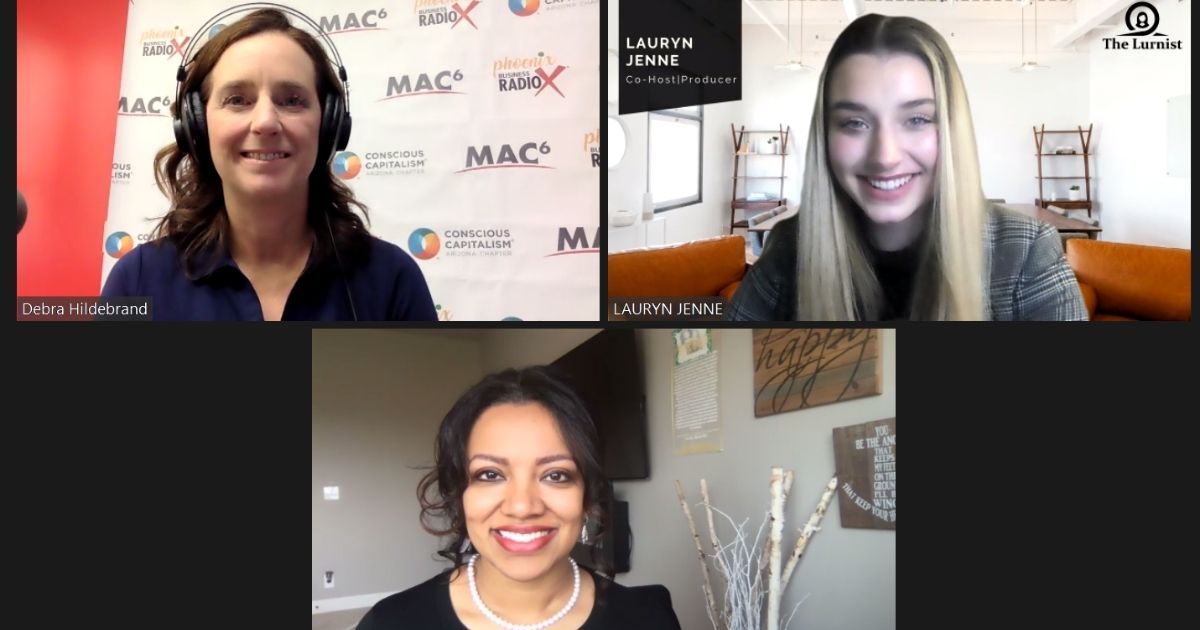
The Lurnist Show had the honor of having Sally Elatta CEO/Founder of AgilityHealth. The episode is jam packed with valuable lessons one should learn about in the professional and personal side. Sally Elatta shares her story on how she got to where she is now and how she was so successful.

Sally Elatta is a thought leader in the space of Business Agility and Measurement. She advises top executives of leading global organizations through their Enterprise Business Agility (EBA) transformations using the Enterprise Business Agility Model. Sally strongly believes in measuring what matters, and that measurement without growth is effort without impact. AgilityHealth®, is the world’s leading measurement and continuous improvement platform, to help organizations accelerate their enterprise business agility transformations and thrive in ever-changing markets.

AgilityHealth offers the world’s leading measurement and continuous improvement platform designed to accelerate the enterprise business agility journey and make ‘New Ways of Work’ a reality – not just a statement.

AgilityHealth is passionate about turning data and insights into action, enabling teams to help themselves grow to scale and sustain the change. AgilityHealth brings together the 3 metrics that matter: Maturity, Performance and Outcomes, and its AgileVideos platform enables digital and Agile talent development at scale with short on-demand videos.

Sally-ElattaSally Elatta is a thought leader in the space of Business Agility and Measurement. She is a dynamic and engaging speaker who advises top executives of leading global organizations through their Enterprise Business Agility (EBA) transformations using the Enterprise Business Agility Model. Sally strongly believes in measuring what matters, and that measurement without growth is effort without impact.

These guiding principles inspired the creation of AgilityHealth®, the world’s leading measurement and continuous improvement platform, to help organizations accelerate their enterprise business agility transformations and thrive in ever-changing markets. The online video library, AgileVideos, helps organizations scale Digital and Agile learning across their enterprises with 230+ lessons developed by Agile experts and practitioners.

She is also an activist and founder of the non-profit Sudan NextGen. Sally has three beautiful children, loves music and travel.

Follow AgilityHealth on LinkedIn, Facebook and Twitter.

About The Lurnist – Celebrating Women in Agile

We highlight fantastic women who are doing great things in the Agile field, all the while creating role models to inspire young women in high school and college to want to have a career in Agile. TheLurnistShowPromotingWomeninAgileDebraandLauryn

Who do you know that leads scrum teams? Builds great products as a product owner or product manager? Coaches leading agile transformations? Or, is an agile teacher or trainer? We’d love to get to know her with the hope to feature her story and journey to success on The Lurnist Radio Show & Podcast. 

About Your Co-hosts

Debra-Hildebrand-on-Phoenix-Business-RadioXDebra Hildebrand is the Founder and CEO of LurnAgile and has over 20 years’ experience in project management; including consulting and training in the public and private sector and teaching in higher education.

She is one of the architects for the Project Management Certification program at the University of Washington, where she received the Team-Teaching Excellence Award and currently instructs in the online portion of the program. Additionally, she developed and currently teaches traditional and agile project management courses at Stanford University.

 Her passion projects include Celebrating Women in Agile through her Business RadioX Show, The Lurnist Show, and helping veterans transition into meaningful careers in project management after service disconnection through her work on the board of Veteran Project Manager Mentor Alliance (VPMMA).

She is a certified SAFe Program Consultant (SPC 5.0), Project Management Professional (PMP) from the Project Management Institute and has an MBA from Columbia Business School in New York, NY.

Co-hostLaurynJenneHeadshotLauryn Jenne is a senior student at University of Washington Bothell (UWB), majoring in Management Information Systems with a minor in Computer Science IT. Lauryn currently works for UWB School of Business and is also the Digital Marketing Manager at Veteran Project Manager Mentor Alliance (VPMMA), a non-profit that assists veterans and military spouses in gaining careers in project management.

Additionally, she is the Vice President of Fundraising for Delta Sigma Pi, a professional business fraternity at the University.

Lauryn aspires to work for an organization as  a project manager and eventually create her own brand and startup company.

Lauryn currently lives in Seattle, WA

About Our Sponsor LurnAgile

LurnAgile is a Boutique, Woman Owned Small Business that delivers top quality Agile Certification courses and Agile Coaching.  We are a Scaled Agile Silver SponsorLurnAgileLogoTransformation Partner, which shows our clients that we have invested in and are committed to the Scaled Agile training standards and coach offerings.

Each of our team of Elite coaches/instructors have over 10 years of leading and coaching Agile Transformations in some of the largest Fortune 100 and 500 companies in the world. This means that your organization is learning from someone who has “been there and done that”.


Tagged With: accelerating digital and talent development, agilityhealth, business agility, measurement platform, radar assessment

Living the Golden Rule E32

December 10, 2020 by Karen

Living-the-Golden-Rule-E32-feature
Phoenix Business Radio
Living the Golden Rule E32
Loading
00:00 /
RSS Feed
Share
Link
Embed

Download file

Living-the-Golden-Rule-E32

Living the Golden Rule E32

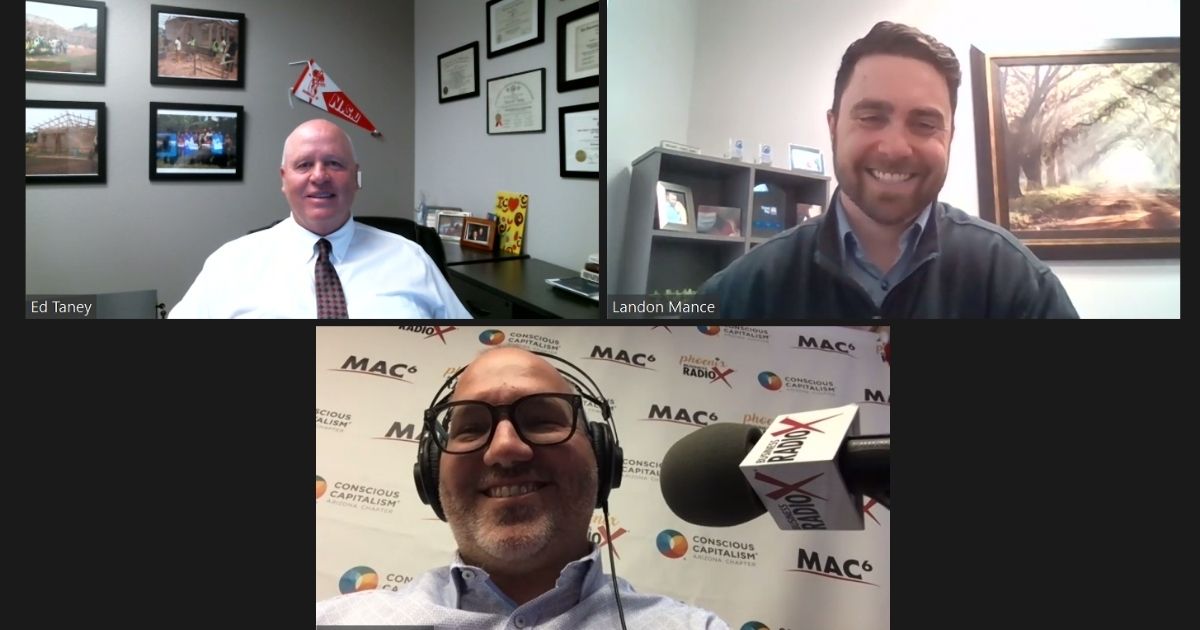
Ed Taney has seen some high highs and low lows in the Las Vegas civil engineering industry, but he remains focused on what matters most to stay grounded. His team is dedicated to quality and efficiency, while always staying current to the needs and changes of the marketplace. It was interesting to hear about the shift in consumerism and how it effects the construction industry.

Ed talks about the constant need for our own personal growth and how it inevitably impacts business decisions. This is a true story of staying humble and focused to persevere through uncertain times and recognizing his deep appreciation for his team.

Taney-Engineering-LogoTEShadow

Taney Engineering specializes in providing civil engineering and design as well as construction-related services for private land development and public works engineering projects.

The firm possesses a hydrology department specializing in hydrology/hydraulics and their team of project managers are diverse in their expertise to deliver projects of all types including grading, paving, drainage, bridges, transportation including multi-modal design, and streets/roadway arterial design, intelligent transportation systems, (ITS), curb, gutter, sidewalks, ADA compliance, water and sewer systems, utility design, coordination and public agency approval processing. Public works engineering design services include preparation of studies and reports, plans (30%, 70%, and 100% Final Design), specifications, cost estimates, bidding services, and construction administration. Their project managers manage projects from the kick-off through construction completion.

Taney Engineering knows the approval processes for all of the local public entities and development services departments and will process projects through permitting and approvals quickly. They know the public works engineering departments and agency processes for project delivery and will work as good stewards of public funds to manage projects efficiently.

Taney’s experience in construction delivery includes Design/ Bid/Build, Design/Build, Construction Manager at Risk, [CMAR], and Design/Assist construction delivery methods.

Ed Taney - Taney Engineering 2019Edward Taney, PE possesses over 30 years of experience in the development of civil engineering design and construction solutions for clients throughout the United States.

Mr. Taney’s diverse portfolio includes projects ranging from subdivision design and college campus master planning to urban arterial design and storm drainage facilities.

Mr. Taney’s dedication to efficiency, document quality, and client service guide the Taney team to excellence in design.

Follow Taney Engineering on LinkedIn and Facebook.

About Your Hosts

Autsin-Peterson-on-Phoenix-Business-RadioXAustin Peterson is a Comprehensive Financial Planner and owner of Backbone Financial in Scottsdale, AZ. Austin is a registered rep and investment advisor representative with Lincoln Financial Advisors. Prior to joining Lincoln Financial Advisors, Austin worked in a variety of roles in the financial services industry.

He began his career in financial services in the year 2000 as a personal financial advisor with Independent Capital Management in Santa Ana, CA. Austin then joined Pacific Life Insurance Company as an internal wholesaler for their variable annuity and mutual fund products. After Pacific Life, Austin formed his own financial planning company in Southern California that he built and ran for 6 years and eventually sold when he moved his family to Salt Lake City to pursue his MBA.

After he completed his MBA, Austin joined Crump Life Insurance where he filled a couple of different sales roles and eventually a management role throughout the five years he was with Crump. Most recently before joining Lincoln Financial Advisors in February 2015, Austin spent 2 years as a life insurance field wholesaler with Symetra Life Insurance Company. Austin is a Certified Financial Planner Professional and Chartered Life Underwriter.

Austin and his wife of 21 years, Robin, have two children, AJ (19) and Ella (16) and they reside in Gilbert, Arizona. He is a graduate of California State University, Fullerton with a Bachelor of Arts in French and of Brigham Young University’s Marriott School of Management with a Master of Business Administration with an emphasis in sales and entrepreneurship.

Connect with Austin on LinkedIn, Facebook, Twitter, and Instagram.

LandonHeadshot01Landon Mance is a Financial Planner and founder of YourFuture Planning Partners out of Las Vegas, Nevada. His firm came to life in 2020 after operating as Mance Wealth Management since 2015 when Landon broke off from a major bank and started his own “shop.”

Landon comes from a family of successful entrepreneurs and has a passion and excitement for serving the business community. This passion is what brought about the growth of YourFuture Planning Partners to help business owners and their families. At YourFuture, we believe small business owners’ personal and business goals are intertwined, so we work with our clients to design a financial plan to support all aspects of their lives.

In 2019, Landon obtained the Certified Exit Planning Advisor (CEPA) designation through the Exit Planning Institute. With this certification, YourFuture Planning Partners assists business owners through an ownership transition while focusing on a positive outcome for their employees and meeting the business owner’s goals. Landon is also a member of the Business Intelligence Institute (BII) which is a collaborative group that shares tools, resources and personnel, and offers advanced level training and technical support to specifically serve business owners. Your-Future-Planning-Partners-logo

Landon enjoys spending time with his beautiful wife, stepson, and new baby twins. He grew up in sunny San Diego and loves visiting his family, playing a round of golf with friends, and many other outdoor activities. Landon tries make a difference in the lives of children in Las Vegas as a part of the leadership team for a local non-profit. He regularly visits the children that we work with to remind himself of why it’s so important to, “be the change that you wish to see in the world.”

Landon received his B.S. from California State University Long Beach in business marketing and gets the rest of his education through the school of hard knocks via his business owner clients.

Connect with Landon on LinkedIn.

About The Tycoons of Small Biz Sponsor

Whether you’re an established local company, or a brand new start-up, you can count on GBS to be a part of your family.

We’re not just any benefits consulting firm, we’re GBS. We have nearly 30 years of experience in group benefits, a strong sense of purpose and it shows.

Austin Peterson and Landon Mance are registered representatives of Lincoln Financial Advisors Corp. Securities and investment advisory services offered through Lincoln Financial Advisors Corp., a broker/dealer (member SIPC) and registered investment advisor. Insurance offered through Lincoln affiliates and other fine companies. Backbone Financial and Your Future Planning Partners are marketing names for registered representatives of Lincoln Financial Advisors Corp. CRN-3361624-120820

Lincoln Financial Advisors Corp. and its representatives do not provide legal or tax advice. You may want to consult a legal or tax advisor regarding any legal or tax information as it relates to your personal circumstances.

The content presented is for informational and educational purposes. The information covered and posted are views and opinions of the guests and not necessarily those of Lincoln Financial Advisors Corp.

Business RadioX® is a separate entity not affiliated with Lincoln Financial Advisors Corp.

Tagged With: Civil Engineering, Construction Administration, Land Planning & Development, land surveying, renewable energy

Lisa Apolinski with 3 Dog Write

December 9, 2020 by angishields

3-Dog-Write-logo
GWBC Radio
Lisa Apolinski with 3 Dog Write
Loading
00:00 /
RSS Feed
Share
Link
Embed

Download file

Lisa-Apolinski-3Dog-WriteLisa Apolinski is the CEO of 3 Dog Write, a digital consulting agency. She works with businesses who want to accelerate revenue and take market share using digital means. In the last eight years, she has helped her clients create nearly $1 billion in revenue growth.

Her first book, Weathering The Digital Storm, is used by businesses globally to fortify their digital growth strategies in unpredictable times. Her latest book, Persuade With A Digital Content Story, will be available on Amazon in the coming weeks. Because of her thought leadership on digital engagement, she has been dubbed “America’s Digital Content Futurist”.

Connect with Lisa on LinkedIn

Transcript

Intro: [00:00:04] Broadcasting live from the Business RadioX studios in Atlanta, Georgia, it’s time for GWBC Radio’s Open for Business. Now, here’s your host.

Lee Kantor: [00:00:19] Lee Kantor here. Another episode of GWBC Open for Business. And this is going to be a good one. Today, we have with us Lisa Apolinski with 3 Dog Write. Welcome, Lisa.

Lisa Apolinski : [00:00:29] Thank you, Lee. It’s awesome to be on your show.

Lee Kantor: [00:00:32] Well, before we get too far in things, tell us about 3 Dog Write. How are you serving folks?

Lisa Apolinski : [00:00:37] Sure. So, we are a full-service digital consulting agency. And in a nutshell, we work with businesses who want to accelerate revenue and take market share using digital means. And that is clearly a hot topic of today. It’s the fastest way to get to people. And in some cases, it’s the only way to get to people since we’re all staying at home and trying to be safe and healthy.

Lee Kantor: [00:01:07] So, how did you get into this line of work?

Lisa Apolinski : [00:01:11] So, I come from an entrepreneurial family. My father and mother owned a drug store many years ago. And I remember when they actually purchased it, I was around four or five. And just working in the store with my dad, and seeing how he built his business and the things that he worked on and one of his, really, guiding principles was to have conversations. So, the art of conversation and talking to people one on one to understand their needs and their wants.

Lisa Apolinski : [00:01:58] I have been doing digital marketing since digital became a thing. I, actually, was trained in traditional marketing and started to segue into digital. And I feel like I have kind of the best of both worlds. I understand how traditional marketing works and how conversation works in a traditional setting, and then being able to relay that into the digital world and having digital conversations, which is huge right now, digital content, and just being able to connect with your audience in a unique way and showing up in a way that allows them to tell their story to you.

Lee Kantor: [00:02:44] So, now, why don’t you share an example about how maybe somebody who was great at marketing in person, when there was in person, and they’re doing a great job, maybe branding in person, and how they can kind of leverage those skills to kind of enter the digital content realm.

Lisa Apolinski : [00:03:05] Yeah, absolutely. So, if you think about storytelling, you think about when you were growing up as a child, even having stories read to, if I said once upon a time, you get your blanket, you’re ready to go with your hot cocoa. Our brains are hard wired for stories. And everyone’s story matters. The issue or the trip-up that I see clients do is the way that they develop their stories and how they cast their audience versus themselves.

Lisa Apolinski : [00:03:46] If you think about a story, you really have three main characters, right? You have the hero. You have the nemesis. That’s the person that’s preventing the hero from getting what he or she wants. And then, you have your mentor character. That’s true in books and movies. Think about Harry Potter, Karate Kid, all those stories are structured in that way. What I’ve seen clients do is they choose the hero role for themselves. And if they do that, the only other role that really their audience can show up in, which would be their client or their prospect, is the role of damsel in distress.

Lisa Apolinski : [00:04:29] If they put themselves as Superman, their audience shows up as Lois Lane. There’s so much more power and longevity if they take the mentor role, so they become, let’s say, Mr. Miyagi in the story, and they allow their audience to become Daniel San. It really breeds a couple of things. It gives the audience control over their situation, which, as you know, right now, nothing is in our control. With the pandemic, with the global recession, with everything that’s happening in politics, it feels like nothing is within our control. If you can show up to help your client, your customer, your audience have tools to be in control, that’s number one in my book.

Lisa Apolinski : [00:05:19] And number two, it allows them to have something that a lot of stories are missing and that is hope. Hope will outlast anything else that’s out there, and hope is self-generating. If you can allow your audience to feel hope that they, somehow, with these skills, with these tools and with your guidance can get to where they are now to where they need to go, that’s something that they will take with them. And those will become repeat customers, no doubt about it.

Lee Kantor: [00:05:55] So, then, your clients or folks out there would be better served rather than talking about me, me,  look how great I am, they should be talking about kind of thought leadership and knowledge on helping their clients get what they want?

Lisa Apolinski : [00:06:13] Absolutely. And they can tell a story about what they’ve done for someone in a similar situation. You can say, “Let me tell you about this client that I have that had the same problem as you, and the tools that they gained from our interaction to be able to get from where you are now, which is where they are, to where they ended up, which was a successful endeavor.” That’s what people want to see. They want to envision themselves in that story that you’re telling them and say, “Well, so-and-so could do it. I can do it too.”

Lee Kantor: [00:06:52] So, then, you think it’s a mistake for folks to be out there maybe on social media or in any digital platform talking about them? More time has to be spent on talking about what their clients are doing and how the clients are succeeding rather than themselves.

Lisa Apolinski : [00:07:09] Right. And it’s a paradigm of showing up to solve rather than sell. I actually did an article in LinkedIn right when this pandemic hit that before, when we had all sorts of economic prosperity, and it was like spring in the Serengeti, and there’s water everywhere, and food and great supply, and you have this very superficial relationship with your audience, with your customers, you were providing something and you were getting money in return. You were selling and getting compensated. That is a very short-term strategy.

Lisa Apolinski : [00:07:51] We are now in the middle of … The water has dried up, and there’s very few resources on the ground, and scarce food. And that’s when it’s almost feels counterintuitive that you actually want to show up to solve and to provide something without really expecting anything back. You’re showing up because you want to see your audience, and your customers, and your prospects actually succeed, and you have the tools that will help them get there.

Lisa Apolinski : [00:08:28] So, it’s just shifting the mindset into how can I solve the issue that you’re dealing with now versus how can I sell you something with features and benefits? And one of the real big reasons that I’m a huge proponent of this is a lot of other companies are still in selling mode and me-too strategies do not work. If you can show up in a different way, you will absolutely attract those customers and prospects to you because that’s what they’re looking for. They’re looking for someone to help them solve their problems, not just sell them things that may or may not work.

Lee Kantor: [00:09:12] So, in your business, do you have a niche that you serve?

Lisa Apolinski : [00:09:17] So, because of my kind of ridiculous background, I have worked in retail, pharmaceutical, manufacturing, professional services. I worked the gamut of industries. So, our industry is very wide. Our expertise is very wide in that regard, but we look for clients, typically, Fortune 500 or 100 companies that are looking to kind of launch out of this paradigm that they’re in right now, and move into this new digital paradigm, and to be able to show up in a different way, and see almost immediate results. I mean, it’s kind of amazing. And at the same time, it’s quite expected.

Lee Kantor: [00:10:16] So, you’re looking to meet the chief marketing officer of Fortune 500 companies? That’s your prospect?

Lisa Apolinski : [00:10:23] Chief marketing officer. I have conversations with CEOs all the time helping them to understand how to use digital in several aspects of their business, whether it’s operations, IT, sales, marketing, customer service, the whole gamut. We talk to just C-level individuals, definitely.

Lee Kantor: [00:10:51] And then, the conversation you’re having with them is how to leverage this type of storytelling and more authentic conversations rather than kind of pitchy, pitchy, pitchy stuff?

Lisa Apolinski : [00:11:02] Yes. And I have a motto that you should not do random acts of content. A lot of times, companies … And I mean, this can be anybody from a small organization to a very large one, they believe, as long as I put content out, that’s all that matters. And it’s not about quantity; it’s about quality, and it’s about having that digital storytelling aspect, and understanding what is it that you’re trying to achieve with your content.

Lisa Apolinski : [00:11:39] Now, I know that everyone would say, “Well, I want to make more money.” That’s great, but there has to be an interim spot of what you’re hoping to achieve with your content. Are you hoping to transform banking, so that people feel empowered to handle their own finances? Are you looking to educate and bring best-in-class solutions to the retail space or the healthcare space? Are you looking to educate and empower your customers, so they make the best decision for the solutions that are out there?

Lisa Apolinski : [00:12:23] There should be a mission statement of what your content does, and that mission statement will drive the type of content that you create, and it will really help you to pick what type of content really fits in with this. It’s very easy to start backsliding and going into that selling mode, and features, and benefits. And if you constantly look at your content mission statement, it will help you to really align with that and give you new ideas of how can I show up to really inspire, educate and empower my audience.

Lee Kantor: [00:13:08] Well, it sounds like these kind of authentic digital storytelling techniques are an important way to differentiate yourself in today’s world. Like you said, it’s very chaotic, there’s a lot of change happening all at one time. So, this level of authenticity becomes a very important point of differentiation.

Lisa Apolinski : [00:13:29] Absolutely, absolutely. And it’s also allowing you to create something new. I mean, if you think about digital engagement, there’s a lot of the same old, same old out there. And if you actually show up in a different way, you’re moving away from your competitors, you’re creating this new space, and that absolutely will attract the right clients in. And I mean, imagine creating something new where competitors aren’t part of the equation, pricing isn’t part of the equation. It’s really about solving problems.

Lee Kantor: [00:14:07] Well as part of the growth of your organization, you decided to become a certified women-owned business. Why was it important for you to get certified? And why was GWBC an important part of your team?

Lisa Apolinski : [00:14:22] So, being certified as a woman on business, I felt really differentiated my agency from others. Showing the power that women bring to business, and this is becoming more and more apparent. There’s actually been studies shown that women on boards can increase the profitability of a company by as much as 40%. Women bring a different perspective into the equation. And I think it really ties into this idea of solving. Women inherently look at how they can solve and help versus just selling. And for me, the GWBC, some of their guiding principles, really resonated with the DNA of the agency that I’ve created. I started my agency in 2012. And the idea of collaboration and investment in community are two huge factors for me and why GWBC is really an amazing organization and, absolutely, something to consider being part of if you are able to become certified as a woman-owned business.

Lee Kantor: [00:15:45] Now, talk a little bit about why you decided to become an author and writing books. Why was that part of kind of the way you differentiate yourself from others?

Lisa Apolinski : [00:15:57] So, yeah. So, I had received a book from a very good friend, Ways to Grow Your Consulting Business. And one of the authors, Henry DeVries, is a huge baseball nut, and I am a huge baseball nut. I’m not as out there as Henry. I love him. He’s almost visited every single ballpark in the United States. I would love to do that to see a game at every single ballpark. But one of the things he had on there is if you’re ever in Oceanside, call me and let’s go for a coffee. And I was going to be in Oceanside, California, so I took him up on his offer in the book.

Lisa Apolinski : [00:16:41] And I sat down with him. And my goal of the conversation was to understand his story. I wanted to know what he did and how he grew his his business because that’s what I wanted to do. And a 45-minute coffee turned into a three-hour conversation. And he said to me, “You really need to write a book.” And I was like, “Oh, no. That sounds awful.” I write every day, I do content every day, but actually sitting down and writing a book sounds terrible. And what I possibly have to say? And he was like, “No, no, no. You need to write a book.”

Lisa Apolinski : [00:17:24] Henry DeVries has a publication house, and we started to talk, and I was like, “Okay. Let me see how that goes, and let me try my hand at it.” And my first book was published in 2019 called Weathering the Digital Storm. I knew something was coming down the horizon and I wanted to make sure my clients were ready and had their digital house in order. And my first book has been well received, and it’s used internationally by CEOs in organizations all around the world.

Lisa Apolinski : [00:18:03] And when the pandemic hit, I was starting to talk about my second book, and it really just dovetailed perfectly into what’s happening in the world today and the idea of getting in front of your audience using digital means and digital content because, as we know, that’s the fastest way to do it. And digital content has the lowest cost to enter. You can do it yourself and post things, and it’s just your time and your thoughts putting your content out. But I want to make sure that people, again, were not doing random acts of content, that their digital content was doing what it’s supposed to do, which is to touch, move and inspire your audience.

Lisa Apolinski : [00:18:55] And Henry and I have just finished our second book, Persuade With a Digital Content Story. It’s actually coming out a week or two. And I love this book. I mean, I read it several times, obviously, for editing. And every time I read it, I’m like, “Oh, yeah. That’s a really good point.” And even I kind of refresh myself with it. And it is a business guide with formula on how to create your digital content story.

Lisa Apolinski : [00:19:27] I am a huge believer in repeatability. If you can get a process down and it’s repeatable, it makes it faster, it makes it more efficient and it reduces cost. And if you can get your digital content story formula down – and I include that in the book – really, as far as I’m concerned, the sky’s the limit for you. Use the book, apply the strategies, and you’ll be amazed at the type of results you get and the revenue that shows up.

Lee Kantor: [00:20:02] Now, if somebody-

Lisa Apolinski : [00:20:03] Even in the pandemic.

Lee Kantor: [00:20:05] Well, I would imagine, especially in the pandemic, everybody’s in front of their screens. So, this is the perfect time to be doing that kind of work.

Lisa Apolinski : [00:20:12] Absolutely, absolutely.

Lee Kantor: [00:20:14] Now, if somebody wanted to learn more, have a more substantive conversation with you or somebody on your team, what’s the best coordinates, website, social, et cetera?

Lisa Apolinski : [00:20:22] Sure. So, they can visit my website at 3dogwrite.com. It’s the number 3, dog, D-O-G, write, W-R-I-T-E dot com. Or they can send me an email at lisa@3dogwrite.com It’s the fastest way to get a hold of me. And I love talking about the stuff. I am happy to chat with anyone about what they’re doing, and how it’s going, and any kind of guidance I can give them. Even if they don’t become a client, I really want to see digital content being transformed into true storytelling where people feel that hope coming through the content that you create.

Lee Kantor: [00:21:07] Good stuff. Well, thank you so much for sharing your story today.

Lisa Apolinski : [00:21:11] Thank you, Lee. This is a lot of fun.

Lee Kantor: [00:21:14] All right. This is Lee Kantor. We’ll see you next time on GWBC Open for Business.

About GWBC

The Greater Women’s Business Council (GWBC®) is at the forefront of redefining women business enterprises (WBEs). An increasing focus on supplier diversity means major corporations are viewing our WBEs as innovative, flexible and competitive solutions. The number of women-owned businesses is rising to reflect an increasingly diverse consumer base of women making a majority of buying decision for herself, her family and her business. GWBC-Logo

GWBC® has partnered with dozens of major companies who are committed to providing a sustainable foundation through our guiding principles to bring education, training and the standardization of national certification to women businesses in Georgia, North Carolina and South Carolina.
d follow 3 Dog Write on Facebook.

Martha Johnson with Hypur and Stan Deak with Skynamo

November 15, 2020 by angishields

Tech-Talk-Martha-Johnson-with-Hypur-and-Stan-Deak-with-Skynamo-feature
Tech Talk
Martha Johnson with Hypur and Stan Deak with Skynamo
Loading
00:00 /
RSS Feed
Share
Link
Embed

Download file

Tech-Talk-Martha-Johnson-with-Hypur-and-Stan-Deak-with-Skynamo

An entrepreneur and investor with over 25 years of leadership experience, Martha Johnson, CMO of Hypur, has a proven track record of bringing multi-billion-dollar products and services to market.

Striking the balance between strategic vision and what is operationally achievable, she has been successful across a range of startups and industries including content providers, manufacturing, hospitality, consumer packaged goods, and cannabis. Martha brings her mastery at creating and managing monetization to Hypur, driving the implementation and operationalization of Hypur’s services.

Follow Hypur on LinkedIn, Facebook and Twitter.

Stan Deak is GM of Skynamo, is a Georgia Tech grad and long time Atlantan who brings more than 20 years experience in business-to-business SaaS technology, with a focus on building and developing early stage companies.

Most recently with Experience, the Atlanta-based mobile ticketing technology company, he was the ninth employee and helped grow the company to more than 350 sports and entertainment partners worldwide.

Deak was also part of the core team that conceptualized INWEGO, the company’s consumer subscription service. Deak also spent 10 years at Silverpop, now part of Acoustic, leading sales and customer success teams prior to its acquisition by IBM.

Follow Skynamo on LinkedIn, Facebook and Twitter.

About Your Host

JoeyKlineJoey Kline is a Vice President at JLL, specializing in office brokerage and tenant representation. As an Atlanta native, he has a deep passion for promoting the economic growth and continued competitiveness of communities in and around Atlanta, as well as the Southeast as a whole.
He has completed transactions in every major submarket of metro Atlanta, and works primarily with start-ups, advertising/marketing agencies, and publicly-traded companies. With a healthy mix of tenacious drive and analytical insights, Joey is a skilled negotiator who advises clients on a myriad of complex real estate matters.

With a strategy and business development background, Joey is first and foremost a pragmatic advisor to his clients. Most recently, he was the Director of Business Development for American Fueling Systems, an Atlanta-based alternative energy company. Tech-Talk

While at JLL, he has become a member of the Million Dollar Club, and has built a reputation as an expert on the intersection of transit-accessibility and urban real estate. With intimate involvement in site selection and planning/zoning concerns, Joey approaches real estate from the perspective of the end user, and thus possesses a unique lens through which to serve his clients.

Joey holds a Master of Business Administration from Emory University, and a Bachelor of Arts from Washington University in St. Louis. He is a founder, board member, and the treasurer of Advance Atlanta, and also sits on the Selection Committee for the Association for Corporate Growth’s Fast 40 event. In addition, he is a member of CoreNet and the Urban Land Institute. Finally, he is part of LEAD Atlanta’s Class of 2019.

Connect with Joey on LinkedIn.

Tagged With: Hypur, Skynamo

Detroit Business Radio: Tina Williams with QT Business Solutions

November 9, 2020 by angishields

QT-Business-Solutions
Detroit Business Radio
Detroit Business Radio: Tina Williams with QT Business Solutions
Loading
00:00 /
RSS Feed
Share
Link
Embed

Download file

QT-Business-Solutions

QT-Business-SolutionsTina Williams is a Force in the Entrepreneurial Community. There are many important aspects of being an entrepreneur and building a profitable business. The competency of the management team, the product or service being offered, executing the business model, and marketing all contribute to the overall success of the business. However, none of that matters if there is no capital to get it off the ground.

Ask any entrepreneur you meet, and they will tell you, funding and cash flow is the lifeblood of their business. Tina Williams, Founder & COO of QT Business Solutions, stands by that belief. As a former Personal Banker with J.P. Morgan Chase and Fifth Third Bank, Tina knows all too well how important it is for small businesses to have continuous access to capital. Therefore, she started QT Business Solutions.

Founded in Detroit in 2001, QT Business Solutions was created to provide business education and technical assistance services to entrepreneurs in need of financing. During her time in the banking industry she noticed that most entrepreneurs who applied for financing were unprepared. Often, they had no business plans and many of them did not fully understand the banks’ approval criteria for business financing. This resulted in many of them being denied for a business loan. Tina started QT Business Solutions to solve that problem.

QT Business Solutions has grown largely by word-of-mouth, because of Tina’s commitment to ensuring entrepreneurs are well-prepared to go after financing before they ever sit down and talk to a loan officer or investor.

Many of the Metro Detroit area’s well-known entrepreneurs have been clients of QT Business Solutions. So many of the businesses she has worked with have been able to successfully obtain capital and launch with Tina’s help. They have also become household names the Metro Detroit area. Just to name a few, Tijuana’s Mexican Kitchen was able to obtain $138,000, Your Emerging Space $450,000, Little Big World Paint & Play Gallery + $60,000 and thousands more.

Connect with Tina on LinkedIn and Facebook and follow QT Business Solutions on Twitter.

Tagged With: QT Business Solutions

Tech Talk: Adwait Joshi with DataSeers, Karen Cashion with Tech Alpharetta and Jason Perez with Yardz

November 2, 2020 by angishields

Tech-Talk-Tech-Alpharetta-Feature
Tech Talk
Tech Talk: Adwait Joshi with DataSeers, Karen Cashion with Tech Alpharetta and Jason Perez with Yardz
Loading
00:00 /
RSS Feed
Share
Link
Embed

Download file

Tech-Talk-tech-alpharetta

This episode is brought to you in part by our Co-Sponsor Trevelino/Keller

TKNewLogosv002-02

Adwait Joshi is the founder and Chief Seer at DataSeers. He has been successfully helping his customers Taming the Data Demon giving them working solutions tailored to their needs.

Adwait was not only a straight A student in school but was always interested in business opportunities. When he was 15 years old, he won a scholarship and learned C++. This exposure encouraged him to start his first company at the age of 15, AD’s Computers, which was extremely profitable and paved a path for Adwait’s future; not only giving him the right exposure but also making enough money to pay for his education. While at University at Buffalo, Adwait’s thesis on Visualization Techniques for Anthropometric Data made the concept of Universal Design easy and became a very important part of UB’s research for the next 10+ years.

Adwait’s IT career in the US began with Fisher Price where he spent his summer creating tools for mechanical engineers to speed up the design of toys and he was successful in automating a lot of trivial tasks. He then went on to work at Intel where he was given a challenge that had not been solved before, migrating a 3D visualization software to a 64-bit architecture. He not only took that challenge, but tenuously worked towards finishing the project and won an award for doing it 4 weeks ahead of schedule.

For more than a decade now, Adwait has been working with various verticals solving their Data problems. He has tremendous expertise in Big Data and analytics. After a successful exit in 2016, he is back in the startup mode. His latest venture DataSeers, is a startup focused on RegTech and helping FinTech companies with Reconciliation, Compliance, Fraud, and Analytics. The product he has engineered, FinanSeer, has been so majorly successful that within the first year the company was already profitable and winning awards.

Follow DataSeers on LinkedIn and Facebook.

Karen Cashion is CEO of Tech Alpharetta, which was created by the City of Alpharetta in 2012 and is now a 501(c)6 nonprofit organization. Tech Alpharetta’s mission is to help grow technology and innovation in Alpharetta. Tech Alpharetta is a tech economic development engine for Alpharetta and the region, helping to: grow new tech companies and jobs, attract and retain tech companies, and develop skilled workforce. Tech Alpharetta accomplishes these goals through its strategic advisory board, its tech startup incubator in Alpharetta, its tech thought leadership and educational programs, and key partnerships.

Karen is also the founder, Chairperson, and past president of the Greater Alpharetta Tech Network (“GATN”), a 501(c)6 organization, which she formed in 2013 in order to provide the Greater Alpharetta technology community with locally-based tech thought leadership, educational, and networking events. GATN merged into Tech Alpharetta as of January 1, 2018.

Karen is an attorney with twenty years of experience as a commercial litigator and corporate technology lawyer. Karen began her career at Simpson Thacher & Bartlett in New York City, and in addition to law firm practice, has served as Assistant General Counsel for EarthLink and Legal Counsel, Global Technology for Travelport, LP in Atlanta.

Karen received her J.D. with high honors from Duke University School of Law, where she served as Senior Editor of the Law & Contemporary Problems Journal. Karen received her Bachelor of Arts degree, summa cum laude, from Emory University, where she graduated Phi Beta Kappa.

Karen has served as a Commissioner on the City of Alpharetta’s Planning Commission, is a graduate of Leadership North Fulton, and is a graduate of the Georgia Academy for Economic Development. She has also served on the Board of Directors for the North Fulton Bar Association. Karen currently serves on the Advisory Board for the University of North Georgia’s Center for Entrepreneurship and Innovation, and on the Advisory Board for Vinings Bank. Karen and her husband and two children are longtime residents of the city of Alpharetta.

Follow Tech Alpharetta on LinkedIn, Facebook and Twitter.

Jason Perez, entrepreneur, advisor, and co-founder of Yardz comes from a pedigree of construction and entrepreneurship.

He has sat on several boards and has been a trusted advisor for a widespread array of companies. As CEO of Yardz, he brings a high business aptitude mixed with a passion-driven culture.

Connect with Jason and follow Yardz on LinkedIn.

About Your Host

JoeyKlineJoey Kline is a Vice President at JLL, specializing in office brokerage and tenant representation. As an Atlanta native, he has a deep passion for promoting the economic growth and continued competitiveness of communities in and around Atlanta, as well as the Southeast as a whole. He has completed transactions in every major submarket of metro Atlanta, and works primarily with start-ups, advertising/marketing agencies, and publicly-traded companies. With a healthy mix of tenacious drive and analytical insights, Joey is a skilled negotiator who advises clients on a myriad of complex real estate matters.
With a strategy and business development background, Joey is first and foremost a pragmatic advisor to his clients. Most recently, he was the Director of Business Development for American Fueling Systems, an Atlanta-based alternative energy company. While at JLL, he has become a member of the Million Dollar Club, and has built a reputation as an expert on the intersection of transit-accessibility and urban real estate. With intimate involvement in site selection and planning/zoning concerns, Joey approaches real estate from the perspective of the end user, and thus possesses a unique lens through which to serve his clients.

Joey holds a Master of Business Administration from Emory University, and a Bachelor of Arts from Washington University in St. Louis. He is a founder, board member, and the treasurer of Advance Atlanta, and also sits on the Selection Committee for the Association for Corporate Growth’s Fast 40 event. In addition, he is a member of CoreNet and the Urban Land Institute. Finally, he is part of LEAD Atlanta’s Class of 2019.

Connect with Joey on LinkedIn.

Tagged With: DataSeers, Tech Alpharetta, yardz

Decision Vision Episode 85: How do People Decide to Become White Collar Criminals? – An Interview with Vic Hartman, The Hartman Firm, LLC

October 1, 2020 by John Ray

Vic Hartman
Decision Vision
Decision Vision Episode 85: How do People Decide to Become White Collar Criminals? - An Interview with Vic Hartman, The Hartman Firm, LLC
Loading
00:00 /
RSS Feed
Share
Link
Embed

Download file

Decision Vision Episode 85: How do People Decide to Become White Collar Criminals? – An Interview with Vic Hartman, The Hartman Firm, LLC

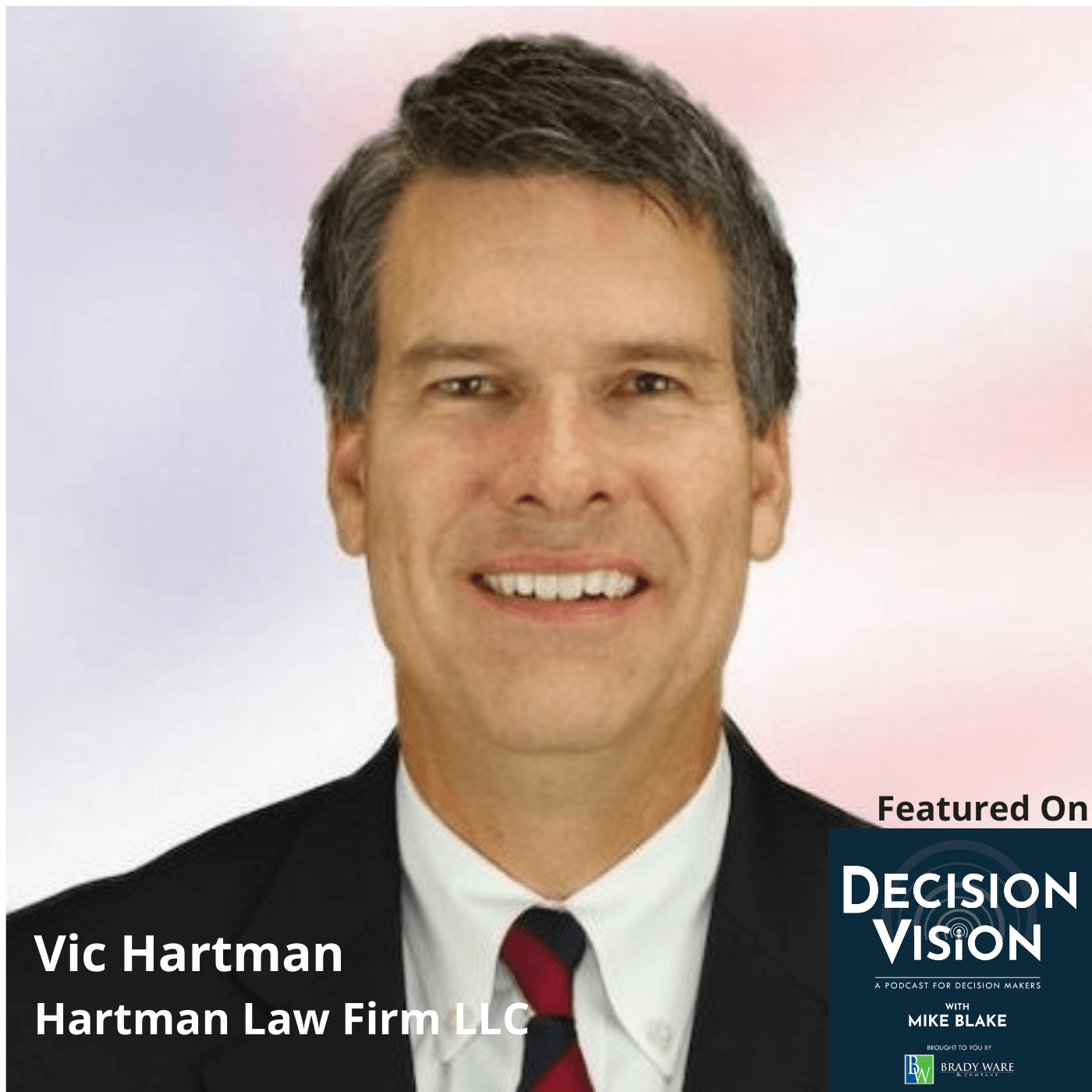
Former FBI agent and now attorney and CPA Vic Hartman joined host Mike Blake to discuss the “three branches of the fraud tree,” how the motivations for each type of fraud differ, and much more. “Decision Vision” is  presented by Brady Ware & Company.

Vic Hartman, Principal, The Hartman Firm, LLC

Victor E. Hartman is the Principal of The Hartman Firm. He specializes in Internal Investigations, Forensic Accounting, and Fraud Mitigation Consulting. His experience as an attorney, CPA, and FBI Special Agent enables him to bring a breadth of knowledge to address clients’ needs. Clients include individuals, companies, governmental entities, and legal counsels. Vic is also an Adjunct Professor at Georgia State University, and Fairfield University, Fairfield Connecticut where he teaches a master’s-level Forensic Accounting course.

He is the author of the book, The Honest Truth About Fraud. Vic wrote this book for an audience that includes corporate managers and forensic practitioners responsible for the prevention, detection, and investigation of fraud. He also uses the book in the classroom and workshops where he speaks.

Prior to founding The Hartman Firm, Vic served as the Chief Division Counsel and Supervisory Special Agent for the FBI in Georgia. He provided advice and counsel to executive management and investigative personnel regarding national security matters, criminal investigations, cyber issues, employment law, civil litigation, and asset forfeiture. As a leader in the FBI’s Houston Division, Vic supervised an FBI financial institution fraud squad, public corruption squad, and the Houston Area Health Care Fraud Task Force.

Highlights of his career with the FBI include playing a leadership role during the initial investigative phases of both the Enron and Worldcom investigations. These and other corporate fraud investigations necessitated the creation of the FBI’s Corporate Fraud Response Team in which Vic served as a member.

Vic is active in the forensic accounting and fraud examination community. He serves on Georgia Southern University’s Forensic Accounting Advisory Board. He is the past two-term President of the Georgia Chapter of the Association of Certified Fraud Examiners (ACFE). Vic provides continuing education presentations to both attorneys and CPAs on the topics of fraud, forensic accounting, and internal investigations.

Vic is a graduate of Emory University’s School of Law. He is a licensed Attorney and CPA in the state of Georgia. He is also a member of the State Bar of Georgia and the American Institute of Certified Public Accountants (AICPA). His credentials include being Certified in Financial Forensics by the AICPA and a Certified Fraud Examiner by the ACFE. He is member of the Society of Former Special Agents of the FBI, and he previously served on the Board of Crime Stoppers Greater Atlanta.

Michael Blake, Brady Ware & Company

Mike Blake, Host of the “Decision Vision” podcast series

Michael Blake is Host of the “Decision Vision” podcast series and a Director of Brady Ware & Company. Mike specializes in the valuation of intellectual property-driven firms, such as software firms, aerospace firms and professional services firms, most frequently in the capacity as a transaction advisor, helping clients obtain great outcomes from complex transaction opportunities. He is also a specialist in the appraisal of intellectual properties as stand-alone assets, such as software, trade secrets, and patents.

Mike has been a full-time business appraiser for 13 years with public accounting firms, boutique business appraisal firms, and an owner of his own firm. Prior to that, he spent 8 years in venture capital and investment banking, including transactions in the U.S., Israel, Russia, Ukraine, and Belarus.

Brady Ware & Company

Brady Ware & Company is a regional full-service accounting and advisory firm which helps businesses and entrepreneurs make visions a reality. Brady Ware services clients nationally from its offices in Alpharetta, GA; Columbus and Dayton, OH; and Richmond, IN. The firm is growth minded, committed to the regions in which they operate, and most importantly, they make significant investments in their people and service offerings to meet the changing financial needs of those they are privileged to serve. The firm is dedicated to providing results that make a difference for its clients.

Decision Vision Podcast Series

“Decision Vision” is a podcast covering topics and issues facing small business owners and connecting them with solutions from leading experts. This series is presented by Brady Ware & Company. If you are a decision maker for a small business, we’d love to hear from you. Contact us at decisionvision@bradyware.com and make sure to listen to every Thursday to the “Decision Vision” podcast.

Past episodes of “Decision Vision” can be found at decisionvisionpodcast.com. “Decision Vision” is produced and broadcast by the North Fulton studio of Business RadioX®.

Visit Brady Ware & Company on social media:

LinkedIn:  https://www.linkedin.com/company/brady-ware/

Facebook: https://www.facebook.com/bradywareCPAs/

Twitter: https://twitter.com/BradyWare

Instagram: https://www.instagram.com/bradywarecompany/

Show Transcript

Intro: [00:00:01] Welcome to Decision Vision, a podcast series focusing on critical business decisions. Brought to you by Brady Ware & Company. Brady Ware is a regional full service accounting and advisory firm that helps businesses and entrepreneurs make visions a reality.

Mike Blake: [00:00:21] And welcome to Decision Vision, a podcast giving you, the listener, a clear vision to make great decisions. In each episode, we discuss the process of decision making on a different topic from the business owner’s or executive’s perspective. We aren’t necessarily telling you what to do, but we can put you in a position to make an informed decision on your own and understand when you might need help along the way.

Mike Blake: [00:00:39] My name is Mike Blake and I’m your host for today’s program. I’m a director at Brady Ware & Company, a full service accounting firm based in Dayton, Ohio, with offices in Dayton, Columbus, Ohio, Richmond, Indiana, and Alpharetta, Georgia. Brady Ware is sponsoring this podcast, which is being recorded in Atlanta for social distancing protocols. If you like this podcast, please subscribe on your favorite podcast aggregator and please consider leaving a review of the podcast as well.

Mike Blake: [00:01:05] So, today’s topic is a little bit different, but it’s an approach that I anticipate we’re going to be doing more of because I find it interesting and I think many of our listeners will as well. And what I mean by that is, we’re going to inject some topics on decisions that are not just at the tactical and strategic level, but at the foundational level. In other words, how do people make decisions in general? A spoiler alert, I’m starting to put together a book on this and I’ve done some mind mapping.

Mike Blake: [00:01:44] And by the way, mind mapping is really cool. I learned how to do this about two months ago. And now, I’m addicted. You might imagine that a mind map would be a blank piece of paper. And that’s not necessarily an unfair prediction. But, anyway, a fun thing to do is just sort of think about a topic and then kind of draw it out. It’s actually quite addictive. But that’s neither here nor there. Maybe we’ll do a topic on mind mapping.

Mike Blake: [00:02:14] But I want to do and I’m becoming fascinated by how do people arrive at their decisions. And people make decisions that make sense to us and people make decisions that, I think to many of us, seem baffling. And the baffling decisions can be very interesting. They can be very insightful. They can be very instructive. And so, you know, as we move forward with recording podcasts, we’re going to talk about different decision making themes and processes and paradigms.

Mike Blake: [00:02:51] And the topic we’re going to discuss today is, how do people decide to become white collar criminals? So, you know, there’s no shortage of kind of content, if you will, on criminal activity. And look, at least as Americans, we love crime stuff. I’m now on the older side of 50, which means I’ve started watching NCIS. And, I mean, we just love the show even though the things from 20 years ago are a little bit dated. You know, Law and Order has, like, five spinoffs and they’re on their 200th season or something like that. You know, even law firms, I mean if you think about it, a lot of people think about law firms – and with all due respect to my attorney friends out there – it’s not the thing you normally think about to say, “Man. I got to get inside a law firm.”

Mike Blake: [00:03:49] But on the other hand, law firm related shows are some of the most popular. So, people are fascinated with the law and people are fascinated with law enforcement and how that, at least, ostensibly works in a dramatized version. I can go on and on. But you just didn’t think about how many shows on TV has something to do with law enforcement? You know, it’s staggering. I’d be willing to bet you one out of every four shows has something to do with law enforcement.

Mike Blake: [00:04:22] And so, I think it’s a natural segue or a natural foothold into the topic we’re going to discuss today, which is, how do people decide to become white collar criminals? And this is an extremely broad topic because as we’re going to learn today, you know, a white collar criminal can mean a broad range of things. There’s no shortage of types of white collar crime that one might commit. But having worked alongside forensic accountants for a number of years – I am not one – but listening to the stories and then also talking with our guest who some fascinating stories of his own, you know, the question I ask all the time when I meet someone who is a forensic accountant is, how do people decide they’re going to become white collar criminals? What leads to that path?

Mike Blake: [00:05:26] And we’re going to get into a little bit of the psychology and the pathology, if you will, of white collar crime. Not because I’m encouraging somebody to make that decision. But rather, if you want to combat white collar crime or just if you want to understand what makes people kind of go down that road, you know, that’s useful intelligence. It can give you some insight in terms of how do you decide that somebody is trustworthy and how much trust can you place in them? And so, I hope you’ll agree that at the end of the day, this is going to be a very interesting and engaging topic and a very interesting and engaging guest.

Mike Blake: [00:06:15] And joining us today is Vic Hartman, who is a retired FBI agent and head of The Hartman Firm, LLC, a law firm and CPA firm here in Atlanta, Georgia, serving individuals, businesses, government entities, and outside counsels. Vic is a licensed attorney and certified public accountant in the State of Georgia and a graduate of the Emory University School of Law. He holds a credential Certified in Financial Forensics by the American Institute of Certified Public Accountants and Certified Fraud Examiner by the Association of Certified Fraud Examiners. And he’s the author of his recent book, The Honest Truth About Fraud: A Former FBI Agent Tells All. I’m sure that book will be woven into our conversation today.

Mike Blake: [00:06:56] Vic addresses his client’s needs in the interrelated disciplines of internal investigations, forensic accounting, and fraud mitigation consulting. Once an adverse event has occurred, Vic will communicate compassionately with the client and develop a positive strategy for moving forward. Prior to founding the firm, Vic was a special agent with the Federal Bureau of Investigation, where he served as a street agent, supervisory special agent, and chief division counsel. These varied experiences with the FBI enabled him to become an experienced investigator, interviewer, interrogator, forensic accountant, attorney, and leader.

Mike Blake: [00:07:31] Vic is also an adjunct professor at Georgia State University and Fairfield University teaching forensic accounting to master degree candidates. Vic hold a Bachelor’s Degree in Accounting from Valdosta State University and the aforementioned law degree from Emory University. And if we have time, we’ve got to get him to tell the moon rock story, and I hope we will. So, I had lunch with him for the first time a couple of years ago. I was transfixed about this because we had a discussion on how do you value a moon rock? So, hopefully we’ll have time. Vic, welcome to the program.

Vic Hartman: [00:08:04] Hey, Mike. Thanks for having me. Glad to be here.

Mike Blake: [00:08:07] So, Vic, you’ve been a long time agent, you’re a professor of financial forensics, and catching white collar bad guys. Is there a typical profile or anatomy of the white collar criminal?

Vic Hartman: [00:08:25] Wow. That’s a fairly simplistic question. It’s amazingly complex to answer, actually. But at a 30,000 foot view, I would break white collar criminals into two categories, predatory fraudsters and situational fraudsters. Predatory fraudsters, we’ve got to know through the ransomware where somebody encrypts your hard drive and extorts a ransom. Or the business email compromise, which is the biggest fraud happening across the world and the U.S. right now. Common frauds, you know, “Congratulation, you won a prize. And you got to pay something for it.” Those are predatory fraudsters. They’re very thought out. They know what they’re doing. And they got into it very intentionally.

Vic Hartman: [00:09:08] The other category is situational fraudsters, which means if a certain group of circumstances during an occupation, a certain pressures, and opportunities, rationalizations, and other things come to fold, then they make a bad choice when the situation arises. So, broadly, we can put those into those two camps. Most of my time has been spent with the situational fraud, however.

Mike Blake: [00:09:35] You know, Vic, as you make that response, I’m reminded of a reading that I’ve done on espionage and, in particular, Soviet, U.S., Cold War espionage. And I would argue that espionage is a kind of white collar crime. It’s simply a crime against the state as opposed to an individual or a company. And the common theme that emerged of American spies for the USSR was that it was that situational transactional scenario. And I’m sure we’ll get into more of this. But somebody who had gambling debts or who is particularly financially vulnerable that was pushed into crime out of an act of desperation. And it sounds like there may be kind of a common thread there.

Mike Blake: [00:10:29] There’s a wide range of white collar criminals, isn’t there? I mean, it’s not just somebody forging checks anymore, is it? I mean, there’s just this broad range now of opportunities and, therefore, types of white collar crime, isn’t there?

Vic Hartman: [00:10:44] Yeah. There’s actually a classification system where we can categorize every fraud known to man in certain categories, which is very helpful for investigators, it’s very helpful for management just trying to develop internal controls to prevent them. It’s formulated by the Association of Certified Fraud Examiners and it’s known as the Occupational Fraud and Abuse Classification System, affectionately known as the Fraud Tree. And we can’t get into all the details on this podcast, but from a high level view, we can break it down into three branches. This is very important because these frauds in these three different branches are dramatically different and the motivations which causes them to commit those crimes are dramatically different.

Vic Hartman: [00:11:32] One, it’s the most easily understood, and that’s misappropriation of assets. Good news and bad news. The good news is, this lower dollar amounts, usually. The bad news, it’s the most popular types of frauds. It includes embezzlements, time and attendance fraud, travel reimbursements, credit card abuse, these types of things we commonly seen as misappropriation of assets. On the other end of the spectrum, there was financial statement fraud. So, good news, bad news there. The good news is, it doesn’t happen that often. The bad news is, the magnitude of it can result in the demise of the organization. And then, the third branch of the fraud tree, and it happens in intermediate degree of frequency and intermediate degree of loss, and that’s corruption and conflicts of interest. And that would be paying bribes or having a conflict that you don’t disclose to your board.

Vic Hartman: [00:12:25] What I find fascinating, though, is these three branches, misappropriation of assets, financial statement fraud, and corruption, the motivations to commit those are radically different. In the case of misappropriation of assets, the most common types of fraud, I call them, status crimes. And that people are trying to keep their status or increase their status. So, to keep their status, it’s fear based. Fear of losing their job, fear of not being able to pay the mortgage, fear of not being able to keep up with their gambling habit. And fear is a tremendous driver of fraud. And then, the other status is greed based. That, “I’m not happy where I am with my lot in life. And my salary doesn’t support my lifestyle, therefore, I will commit fraud.” So, those status crimes are commonly associated with misappropriation of assets.

Vic Hartman: [00:13:16] For financial statement fraud, radically different. And I’ve played leadership roles in Enron and WorldCom and got to know some of the motivations of those executives who are already tremendously wealthy. So, it wasn’t about the money for those. It was other drivers like pride and shame and managing those emotions in the workforce. And then, lastly, corruption, which I find the most fascinating branch of all the trees because it’s the most difficult to investigate. But I call it, the social contract of reciprocity. Actually, a marketing term. But it’s a quid pro quo that if I scratch your back, you’ll scratch mine. If I give you gifts over time, I just slowly corrupt you. And that’s the core motivator that I found for most types of corruption.

Mike Blake: [00:14:07] I want to follow that up, because I think that’s really the answer. Why is it that corruption is, in your view at least, so much harder to investigate than the status and wealth motivators?

Vic Hartman: [00:14:23] So, of the three branches of the fraud tree, with misappropriation of assets and financial statement frauds, they’re somewhat accounting frauds. You can trace the money. There’s money that went from point A to point B and you can follow that with not too much difficulty. With corruption, however, the payments, often cash bribes, paid outside of the organization. And for some reason it happens by passing a cash envelope in the men’s restroom. I’ve just seen that happen that way so many times. But it can happen in all different ways. But if you don’t have an undercover FBI agent or some other undercover type investigating that, doing wiretaps and other complicated investigative techniques, it’s hard to prove corruption because there’s often not an easily traceable money trail.

Mike Blake: [00:15:13] So, that’s interesting. So, the thing we see on TV with the brown envelope full of cash, that actually —

Vic Hartman: [00:15:19] It actually happens more than times that I would have thought. I wouldn’t have believed it if I hadn’t seen it happen so many times.

Mike Blake: [00:15:26] I guess Hollywood has, at least, one good consultant somewhere along the way. Now, in your book, you talked about a construct – I think it was in your book – called the fraud triangle, which I thought is really interesting. I think it’s a widely held construct in your profession. If that’s correct, could you explain what that means?

Vic Hartman: [00:15:49] Sure. Well, it’s a theory that explains most, but not all. There’s a major exception where it does not explain. But a fraud triangle explains why fraud occurs. And it was actually theorized by Dr. Ronald Cressey in the 1950s. And really didn’t get popular until the 1980s and ’90s. But now, it’s in all the literature for CPAs, accountants, the PCAOB. This theory of Dr. Ronald Cressey is now in all the accounting standards. And it’s instructive for auditors and CPAs to consider these three branches or these three vertices of the fraud triangle when doing audits and other techniques. The theory is that if these three vertices the fraud triangle exists, then fraud is highly likely to happen or could occur. And the three vertices are opportunity, pressure, and rationalization. So, if those three come into play – these are often occupational frauds – an employee is more tempted to and may commit fraud.

Vic Hartman: [00:16:57] Opportunities is the easiest to understand. If you can’t have the opportunity to commit fraud, then it just won’t occur. So, internal auditors can develop internal controls around opportunity. But pressure and rationalization, those are a lot more difficult vertices of the fraud triangle to prevent against. And the theory is that, if we knock out one of these three sides of the fraud triangle, then we’ll prevent fraud in our organizations.

Vic Hartman: [00:17:22] And pressure can come from two types, pressure inside the organization, pressure to make the numbers. Those often is incentivized by the HR Department where they put commission structures and such and incentivizes it. So, pressure to make the numbers. And then, there’s pressure outside the organization, and I call them life happens events. Divorce, drugs, gambling, bankruptcy, all these things happen. So, these employees bring that pressure into the workforce and are tempted to commit fraud. Employee assistance programs are very helpful things to try to work with employees. Because if your employer is trying to help you, you’re much less likely to steal from them.

Vic Hartman: [00:18:05] And then, the third vertex of the fraud triangle is rationalization. And that’s a really difficult one to try to mitigate around. But it deals with the culture of the organization. And we have a strong culture. The employees feel like they’re on the same team. Pulling for the same mission statement. That’s ways to mitigate that rationalization.

Vic Hartman: [00:18:25] So, the theory is that if these three components are present, then fraud may occur where some employees will be more tempted to commit fraud. There’s one extreme limitation now on the fraud triangle. And the fraud triangle works when you’re in, what I call, privity of trust or in a trust based relationship. So, that’s why we have rationalization of the fraud triangle, because we have a conscience and we have to rationalize around that to commit fraud. But if we don’t have to rationalize, if we’re not in privity of trust with our victim, the business email compromise, the ransomware, scams that we’re getting via emails, these predators don’t even know their victims. So, for this one category for which the fraud triangle does not apply, I call them, predatory fraudsters because they’re not in privy of trust with their victim.

Mike Blake: [00:19:29] That’s really interesting and I like to explore that. So, you talked about rationalization and that vertex of the fraud triangle, it seems to me that one thing I hear a lot about white collar crimes and criminals is a perception that a crime can be, you know, “victimless.” We both heard the term victimless crime. Is that a frequent perception that drives or enables that rationalization along the line or is that more of a stereotype and myth?

Vic Hartman: [00:20:05] Well, first of all, fraud is a human act. It’s intentional. It’s what one person does. At any time there’s a fraud, it’s a criminal act, it’s an unethical act. The fraudster gains and the victim loses. Not often by equal amounts, but the fraudster gains and the victim loses. So, every crime, by definition, has a victim. However, in writing the book, The Honest Truth About Fraud, there’s three frauds that jumped out for me. And I’ve been doing this for 30 years. But there’s three humongous categories of fraud that struck me as to their magnitude. And then, I asked myself the question, why are these frauds occurring? What is health care fraud? And that actually was not a surprise to me because I was over the Houston Area Health Care Fraud Task Force. So, humongous amounts of fraud and try to quantify how much this fraud was happening across the U.S. But health care fraud is one of those categories.

Vic Hartman: [00:21:02] The second one was tax fraud. It’s amazing how much intentional underpayment of taxes that U.S. Citizens, people, and corporations fail to pay in their taxes. Tax evasion and it’s tax fraud. And in the third category that really struck me is a very large category is theft of intellectual property, which technically is not fraud because it’s theft. And just think China about espionage and theft of intellectual property.

Vic Hartman: [00:21:32] But what these three frauds have in common, health care fraud, tax fraud and theft of intellectual property is that, the victims, yes, it’s U.S. Citizens. We don’t feel victimized by any of these. And yet we pay more for health care, we pay more in taxes, and we pay more for goods and services because intellectual property has been stolen. So, while it appears victimless, we all pay the price. We just don’t feel it. And each of these are about a quarter trillion plus as we have calculated in the book. But these are humongous frauds that’s ripping us all off. And none of us feel it. You know, after this podcast, none of your listeners are going to run their congressman and complain about this. And if it came out of your paycheck, you’d be up in arms if somebody stole $500 out of your paycheck this month. But these frauds are ripping us off daily and we don’t even feel it.

Mike Blake: [00:22:29] That perception certainly sounds like you can rationalize it all you want. Of course, I’m not suggesting there is such a thing as a victimless crime. But you bring up something that gets me thinking and that this relatively new avenue of fraud via cybercrime really provides, I guess, a new channel, if you will. I don’t know if that’s the right term of art. But a new channel for the intentional, malicious, malignant fraudster whose sole desire is to steal money as opposed to an opportunist who kind of emotionally warps and rationalizes their way into a crime. But with cybercrime, 99 times out of 100, you know, more than that out of a million, you don’t know and you don’t even care who the identity of your victim is. It’s really pushing buttons, hacking code, and then taking people’s information, and doing something malignant with them. Is that something that, maybe, makes cybercrime more scary because it’s a natural venue, if you will, for, maybe, even professional criminals? Does that question make any sense to you?

Vic Hartman: [00:23:56] It certainly does. And even with cybercrime, there’s two categories. There’s theft of intellectual property. And, again, think China and they’re doing it as a nation state actor and they’re very intentional. And they don’t consider it fraud by their standards at all. It’s for the greater good of communism that they’re stealing intellectual property from governments and businesses. The FBI director said, every 50 states have ongoing espionage cases. But that’s one category of cyber fraud.

Vic Hartman: [00:24:25] And then, there’s a radically different, so that’s the trying to hack computers, the business email compromise, ransomware. And the profile of that individual is often Eastern country actors, Ukrainians – not to pick on them – but others in foreign countries. And the profile is a white male between 20 and 30 years old. And they’re not necessarily doing it for the money. There’s more excitement, fun. And it often takes a combination of hackers with various skill sets and they come together and then they pull off hacks. And sure, they get a lot of money. But that’s not really their primary motivator, or at least not at first. It’s really about the challenge. And it’s like a new game. You know, when you don’t see your victim, it’s just a game.

Mike Blake: [00:25:13] Really? I would not have guessed that. That’s fascinating. So, what you’re saying is that, for a lot of these cybercrimes, the motivation is as much about vandalism, effectively. And I guess sort of showcasing their skills and just trying to beat somebody else’s security. And the fact is a financial payoff, I guess, just makes it all the more attractive. But that’s not why they get into it.

Vic Hartman: [00:25:41] No. It’s like a pinball game and you just got higher number. More money was the goal, but you weren’t in it for the money. You’re in just to see who could do the most damage.

Mike Blake: [00:25:54] So, let’s talk about the situational fraudsters as opposed to the intentional and professional ones. Because the professional intentional ones, I think, is a fairly straightforward mindset that we may come back to it. But on the opportunistic or situational side, can you talk, are there patterns that have emerged on how people kind of start down that path? Because my impression is, people in that situation – I don’t know what percentage that is of all fraud, if it’s 10 percent or 90, or 52.8 – but they don’t wake up in the morning saying, “Hey, I’m a crook, so it’s time for me to steal something today.” Is it something else that kind of drives that decision and then the subsequent decisions to pursue that criminal path?

Vic Hartman: [00:26:52] Yes. So, first of all, we’ll rule out the predatory fraudsters, which are very intentional. And they do wake up and say, “I’m going to be a crook.” They don’t consider it that way, but it’s more of a game type for them. But the situational fraudster, everyone that I’ve met, they never joined the organization with the intent to commit fraud. They’re otherwise mostly outstanding members of the community. They would be your next door neighbor and then they find themselves in a corporate environment. This is an example of where – think about the fraud triangle – pressure, opportunity, rationalization. And then, they find themselves either on one of the three branches of the fraud tree. They’re either in the finance department responsible for financial statements. Or they’re out doing sales with government officials they might be tempted to bribe them. Or they’ve been given a credit card with no controls.

Vic Hartman: [00:27:50] You know, now in my private practice, since I’ve left the FBI, I would say 80 percent of the frauds that I’m called in to look at, it’s going to involve credit cards. And if you give somebody a credit card with no internal controls around it, a high percentage of people will abuse it. But they find themselves in the situation where (A) they have the opportunity to commit the fraud. Then, there’s some self-perceived pressure and then they rationalize in some way. Like, “I’ve been in this organization all my life. I deserve better.” Or, “I see corporate officials abusing the company.” And so, just that piece of rationalization will get them over the edge. And they find themselves in the circumstances and then they’re committing fraud. They would never have thought of it of themselves. The people around them never would have thought they would have done that. And then, here they are committing fraud.

Mike Blake: [00:28:44] And so, they rationalize. And that’s a fascinating number, by the way – or not number – characterization. If I heard this correctly, if you give most people an effective blank credit card, at some point down the road, they’re going to commit fraud. Which interesting, I would not have necessarily thought that. But my perception and, maybe, I just sort of made this up, do they start with something that’s small that’s kind of in a gray area where you could credibly argue that it’s not fraud. It’s really just a decision on this. Maybe there’s a dual purpose to that charge, which you can argue that did bring value to whoever has the credit card liability. And then, once that slides through, you’re then encouraged to become more aggressive. Or, is that some other kind of emotional pathology that is at work there?

Vic Hartman: [00:29:48] No. It’s a slippery slope concept? You know, I’ve never seen anybody that started at a million dollars and worked their way down. It always goes the other direction. And they do it once and they feel uncomfortable about it. And then, they don’t get caught. There’s no internal controls. And then, they increase it. And then, the next thing you know, they’re into significant frauds.

Vic Hartman: [00:30:08] You know, I’ve seen this slippery slope concept with financial statement fraud where the CFO will call an all hands on deck and said, “It’s the end of the quarter. We’re just a few shy cents of our number meeting Wall Street’s expectation. Can everybody, the finance department, the accounting department, go back and scrub the numbers for mistakes or judgments? And by the way, there’s this thing called Sarbanes-Oxley, and I don’t want you to violate that. And we want to uphold the highest of ethical standards. But do scrub the numbers and look for judgments or mistakes.” And then, a day or two later, somebody comes back and, “Hey, boss. Congratulations. We did this. We found a couple of mistakes and there’s some accounting judgments that we tweaked and we think it’s more in line. And by the way, we made our numbers.” And then, the CFO or the CEO lavishes praise and congratulations.

Vic Hartman: [00:31:01] Then, the next quarter comes up and the same thing, “We’re just shy of Wall Street’s expectations, go back and scrub the numbers. Look for mistakes and judgments issues.” And somebody comes back and saves the day. And then, this happens quarter after quarter. And then, we went from a gray area to the financial statements are just absolutely bogus and fraudulent. And we’re scratching our head, “How did we get here?”

Vic Hartman: [00:31:27] Well, the CFO had a leadership failure by doing two things. One, he asked them to look for the numbers that only helped them. So, he didn’t ask to scrub the numbers and see which would come up the other way because they turned up negative numbers. But he only asked to look for a biased number, which is a positive number. And then, he lavished praise on them for doing that. And you get to an organization where nobody really intended to do this and they went down the slippery slope and now they have bogus financial statements they’re reporting to Wall Street.

Mike Blake: [00:32:06] And what happens is sort of there’s a reinforced behavior, right? So, you talked about the leadership there, and I can’t agree more. What you’re basically doing is you’re training people – maybe without even those people fully understanding it, you’re basically training them to commit fraud. And from my perspective, I love your opinion on this, it’s okay to ask people to go back and scrub the numbers. But then, at a minimum, that number should be looked at, maybe, constructively. I might have one team whose objective is to find numbers that will help us. Another team to find numbers that would hurt us. Or the second team reviews the first one and try to play the role of the auditor, if you will, and try to have some sort of backstop.

Mike Blake: [00:32:58] But you’re right, there’s, at least, that implicit notion that, “Yeah. Don’t violate Sarbanes-Oxley, but don’t necessarily help the auditors either.” And that is a lot of omission as much as it is one of commission.

Vic Hartman: [00:33:14] Right. Right.

Mike Blake: [00:33:15] So, one thing we really haven’t talked about – and it may mean that the question is not relevant. And if it is, that’s great – is personality. You know, we’ve talked about opportunity, and pressure, and rationalization. Are there some personality types or emotional states and, maybe, that goes more to pressure – I’m actually going to take that off the table. Are there personality traits that in your mind seem to make people more susceptible or more receptive or more resistant to the notion of being a perpetrator of fraud?

Vic Hartman: [00:33:58] Yeah. There definitely are. First, just by the numbers. The Association of Certified Fraud Examiners does a biannual report to the nations. And so, they track all these thousands of frauds that they’re looking at. And they’ve come up with some numbers that the average white collar defendants between the ages of 35 and 45, 70 percent are male, they have a tenure of one to five years in their organization, and they’re more likely to work in accounting and finance department. That being said, those are some raw characteristics of the white collar defendant. I don’t like to look at that at all. That’s profiling. And to me, it’s somewhat nothing wrong with profiling in this context, but it’s just not helpful because it really can be anybody in the organization. So, I’ll throw that out there as just some raw data.

Vic Hartman: [00:34:45] But, really, what I look at is frauds happen – think about the fraud tree again, there’s different motivators for those different types of frauds. And there’s different personality traits associated with each of those. So, you know, for the misappropriation of assets, that status of fear, greed based, that’s going to have a certain profile of the individual. The social compact and reciprocity, the concept of corruption and how we’re being influential, a lobbyist type, an outgoing, gregarious personality, and try to influence people. So, that would be a different personality trait.

Vic Hartman: [00:35:32] And then, with financial statement fraud, it’s really how we manage pride and shame. And so, it takes a certain personality to handle those issues. You know, what I really like to think in fraud outside of the fraud tree is – and I know most of my audience, at least my students, people in business – we think we’re very intellectual, analytical people. And so, when we make a decision to whatever we’re making a business decision, we put the analytics, and the pros and the cons, and we have our algorithms. But, actually, we as humans, when we make judgment decisions, we make it with emotions. I learned this through a psychiatrist that I consult with in the behavioral forensics group.

Vic Hartman: [00:36:19] So, what I like to tell people in this field is let’s use emotions as data. And there’s affects or emotions psychologists and psychiatrists would describe as an enjoyment, fear, shame, contempt, anger. But these emotions drive decision making. So, we might tee up a decision with pros and cons for various issues. But it’s actually our personality and our emotions that’s actually going to drive a particular decision.

Mike Blake: [00:36:53] So, I’m curious about one thing – and you may not even want to answer this. And if you don’t, that’s entirely okay. But I’m curious, are there traits that make people more successful as white collar criminals? I’m sure there’s not a 100 percent catch rate. You know, the reality of life is that some people do get away with murder. You know, are there personality traits that make people more likely to be successful or, at least, be able to avoid detection for a longer period of time and, therefore, do more damage than others?

Vic Hartman: [00:37:38] Absolutely. Again, it depends on the individual and what part they’re in the organization as to what traits would make them effective. For example, if you’re in the accounting or finance department, the trait may be – and what we’re looking at is fraud is a violation of trust. So, we’re looking at personality traits that make that person appear to be trustworthy because then you trust them, misplace trust, and you get victimized by fraud. So, the accounting and finance example, that individual may be smart, hardworking stays late, maybe even be a little boring. That’s their personality and it makes them trustworthy. So, that personality trait, if you’re in the finance or accounting department, might be the profile that would gain trust.

Vic Hartman: [00:38:24] Whereas, say, you’re in sales, totally different personality. You have charisma, you relate to people, you’re believable but, again, you’re trustworthy. And then, in the C-suite, the CEOs and CFOs and those types, they have the appearance of success. The hard work in them, the hard driven personalities that build trust. And in this area, which my time with the FBI, I’ve spent more time working with financial statement frauds, even though they occur less frequently. And I’ve learned of this concept of the dark triad of personalities. And these were three very negative personalities can come together. One is psychopathy, it’s where you have no empathy towards your victim. Narcissism, all about yourself, promoting yourself. And Machiavellianism, which means the ends justify the means. And some CEOs who have these combinations of deadly traits known as the dark triad, you don’t know what’s going on in their mind. But they look very successful. But it’s a very dangerous personality to have.

Mike Blake: [00:39:37] So, I’m so delighted that you put it in this way because it justifies the reason for my doing this interview, which is about the decision making in white collar crime is not necessarily what we would consider a purely rational one. And one of the irrational facets about decision making process that I find fascinating – and you even touched upon this in the very start of this conversation – is, do white collar criminals not appreciate the consequences of getting caught? Because the consequences of being caught are often disastrous. I mean, I guess sometimes there are slaps on the wrist. But from where I sit, they’re often disastrous. Do people not perceive that? Is there a rational tradeoff saying, “Yeah. I know I can get caught. And it’s really bad but I’m going to take the risk anyway.” What does that emotional state look like in your mind?

Vic Hartman: [00:40:38] No. They never think they’re going to get caught. In the first instance, they really don’t think what they’re doing is wrong. They’ve rationalized in such a way that they don’t fully appreciate what they’re doing is wrong. And they certainly don’t think they’re going to get caught. Every time we have a major scandal in the U.S. – and I’ve watched this over my 30 years of watching how Congress reacts – they’ll come out with new laws and now we’re up to 20 year offenses for many federal crimes. I’ve never known one white collar defendant that said, “Well, I looked at the statute and it said I could get 20 years. I think I’m not going to do that.” The consequences of their action have no bearing on their decision making.

Vic Hartman: [00:41:18] And I’ve also never seen, for example, a white collar defendant that says, “Yeah. I think there’s a five percent chance of me getting caught, but there’s a $3 million reward. So, I’ll take my odds and I’ll go with the three million.” I’ve never find anybody that works under that calculus. It’s the fraud triangle at work. It’s more of they’re caught up in a situation. They think what they’re doing is not wrong or not too wrong. They’re going to get out of it. They’re going to repay the money. And certainly they’re never going to get caught.

Mike Blake: [00:41:54] And this overlaps nicely with another question – and I think we’re answering it in real time and that’s fine – is that, you know, I agree with you. From what I’ve seen sort of secondhand is that a lot of people who are caught, they’re (A) surprised they got caught and (B) surprised they even committed a crime. Sometimes you have to go to jail for a long time before they finally really get it that they’ve actually done something wrong because they’ve so rationalized it in their mind. And that de-linkage of actions and consequences, I think, is really important and very perceptive, because maybe that’s the pattern that leads to the pressure to commit the fraud in the first place. Right?

Mike Blake: [00:42:46] If you have a drug problem, you have a gambling addiction that puts you outside of something that you can sustain financially that, therefore, creates the pressure that has you seek the opportunity to create the rationalization for fraud. These are not a standalone things. They’re probably linked. Is it the person who is inclined to rationalize fraud that same mental approach is probably what has led to the pressure to commit the fraud in the first place. Does that make any sense at all?

Vic Hartman: [00:43:20] Absolutely. Yes.

Mike Blake: [00:43:25] So, I think there’s a notion out there that, you know, good people become criminals. But it always reminds me of, you know, when we hear of a mass violent crime in the United States, it’s never. “Oh, yeah. That person was outgoing.” Or, “Everybody knew that person was nuts.” It’s always somebody that, you know, kept to themselves, seemed nice enough, nobody really knew them, they’re kind of invisible. And you kind of wonder maybe there’s even a linkage between the emotional state of someone who’s willing to commit a violent crime versus a nonviolent crime, probably a matter of degree.

Vic Hartman: [00:44:11] Right. So, good people commit fraud. Bad people commit fraud as well. But my experience has actually been that there are good people, at some level, they’ve done certain things in their life that are probably very noteworthy and would be your next door neighbor that you wouldn’t mind living next to. The reason why most of the times it’s good people that did a bad thing is because fraud is a violation of trust. And so, you have trust in that individual. And in order for you to have trust in the individual, you must have experienced some level of good that they’ve done in the past or you wouldn’t have that trust. And recidivism rate among white collar defendants is very low. When you have an executive in a company that gets caught with white collar crime, they’re not likely to do it again.

Mike Blake: [00:45:07] That’s interesting, so people do, I guess, sort of snap out of it or they learn the lesson and then try to pick the pieces up. Now, I suspect part of that is also once you have a record that says you’re a fraudster, the opportunities to do so go down. So, that’s got to be part of it as well.

Vic Hartman: [00:45:25] They have a lot more to lose. So, when you fall from the top, the pinnacle company, I mean, you fell a long way. You have a personal embarrassment, which is pride and shame that was lost. You have a financial pitfall. You experienced a heavy penalty other than like some drug dealer on the street who gets arrested. Their loss is nowhere near the loss of one of these white collar defendants.

Mike Blake: [00:45:54] We are speaking with Vic Hartman, who is the author of The Honest Truth About Fraud: A Retired FBI Agent Tells All. And we’re running out of time here, but I do want to get back to what I hinted at the start because I think we have time to work it in. So, you’re telling me that you worked on a case where there is a theft of moon rocks. Meaning, rocks that had actually been recovered from one of the NASA lunar missions. Can you tell us sort of a synopsis or a succinct description of kind of what that case was like?

Vic Hartman: [00:46:34] Sure. You know, I got a call from a German geologist and he said that somebody was selling moon rocks on the internet. And so, when you get that cold call, you’re like, “Who are you? And why are you calling me?” And, certainly, nobody is selling moon rocks on the internet, which is what he thought as well. But he was very credible and an expert in his field. And so, I, certainly, wanted to look into it. And naturally, what I thought was that this was some scam. That somebody is going to sell rocks from the Earth and they’re going to sell it for a lot of money to this German geologist. So, we put an undercover in the scenario and started developing an online relationship and then a personal relationship of the sellers of these moon rocks. And it turns out they were some Brigham Young interns that were purportedly selling these rocks.

Vic Hartman: [00:47:35] So, with the undercover staying, it happened, it went through. They sold them. And sure enough, they were moon rocks. They were actually interns at NASA. And NASA had put the rocks in safes, but the safes had wheels on them so they could roll them around the different floors of NASA. And these brilliant students decided they would take the safe, roll it down the freight elevator, load it onto a van, and drive off with them, which is exactly what they did, and then sold them.

Vic Hartman: [00:48:04] The fascinating piece about this, Mike – because I know your expertise is valuation – and the reason why this became relevant when a defendant gets sentenced at trial, one of the factors that a judge considers is what’s the loss to the victim. In this case, it’s theft of government property and it belongs to the United States Government. So, what are the value of these moon rocks? Now, I think, the question that I posed to you –

Mike Blake: [00:48:34] You did. I mean, I go back to that question a lot, actually, because it is one of the more fascinating valuation problems I’ve discussed. Do you want to do the big reveal or should I?

Vic Hartman: [00:48:46] And I’m not an expert in valuation, but I learned a little bit about valuation because I was working a savings and loan fraud case and the issue pivoted on what’s the value of a skyscraper in Houston. And they overvalued the building in order to get a humongous loan and commit fraud against the bank. So then, I schooled myself up on valuation issues. And there’s three approach to valuations as I understand it. What would be the fair market value? So, what does a product sell, or a house, or whatever good between two parties A and B? So, the fair market value. Of course, in moon rocks, there’s no fair market value. They don’t trade so that’s not available.

Vic Hartman: [00:49:36] Another is an income stream. So, what’s the income stream of this skyscraper in Houston I was trying to value? If it threw off rents and revenues and you discounted it for 20 years, it threw up X million dollars and you just got current present value. That might be the value of that. But that wouldn’t work for moon rocks either.

Vic Hartman: [00:49:58] And so, what the government actually did in this case was the cost approach today. So, if you had to go back to the moon and get these rocks, what would it cost? And we looked at the Apollo 11 or one of the Apollos that got these rocks, the cost of that mission to the moon and then brought it forward to present value of how much it would be to get those moon rocks. And it turned out to be in the billions of dollars, which was off the sentencing guidelines. I mean, once you exceed, I think, $100 million or some number, it really becomes irrelevant. So, these defendants just maxed out on the value of what they had stolen.

Mike Blake: [00:50:39] And I agree with that. They aren’t traded. I don’t know what the disposition of moon rocks are. Certainly, the U.S. Government has them. I imagine a few academic institutions hold them as well. But I would imagine they’re probably not allowed to sell them. Like, if a donor came on and said, “Hey, I’ll give you $100 million dollars because I would like some moon rocks.” The university were tempted to accept that offer they probably would not be allowed to. Because I think they’d be considered sort of a property of humanity, not of an individual.

Mike Blake: [00:51:16] And I think you’re right, it’s pulled into more focus now as we have and the Artemis Program that we think we’re going to be returning to crude lunar missions sometime this decade. I mean, that’s the only two ways to get a moon rock legally. One is, you go back to the moon and get them. Or two, you hope that something really big hits the moon, create some meteorites, and pieces of the moon hit in your backyard. And that’s a pretty tough, very [inaudible] to wait for. And the interesting thing, as you mentioned that’s safe, it’s the opportunity. Right?

Mike Blake: [00:51:51] The amazing thing is that there is an opportunity for interns who are probably being paid less than minimum wage to somehow – not only was the safe itself mobile, but there is a way to get that safe out of NASA without a security stopping them and asks, like, “What are you doing with the safe?” You know, clearly there is an issue on the opportunity. And NASA, I’m sure, has tightened up ever since.

Vic Hartman: [00:52:19] Vic, this has been a great conversation. I’m already holding you longer than I had promised. And I know you have more bad guys you’ve got to go out there and catch. If people want to contact you to learn more about kind of this topic and how you might be able to help them with fraud matters in general, what’s the best way for them to contact you?

Vic Hartman: [00:52:40] You know, I have a big internet presence. If you type my name. Vic Hartman, into Google, you’ll quickly find hartmanfirm.com. So, I would love to reach out to your audience if I could help them in some way. And we only scratched the surface on the topics that I covered in my book, The Honest Truth About Fraud. And I will offer your listeners this, if you’ll go to my website and purchase the book, at checkout, if you type in the coupon Hartman, H-A-R-T-M-A-N, you’ll get 25 percent off. So, I’d love for your readers to read the book and contact me and give me some feedback what they think.

Mike Blake: [00:53:17] All right. That’s a good deal. So, not only good information, but you get a coupon as well, which I think is a first on the Decision Vision program. So, thank you for that. That’s going to wrap it up for today’s program. And I’d like to thank Vic Hartman so much for joining us and sharing his expertise with us.

Mike Blake: [00:53:32] We’ll be exploring a new topic each week. So, please tune in so that when you’re faced with your next executive decision, you have clear vision when making it. If you enjoy these podcasts, please consider leaving a review with your favorite podcast aggregator. It helps people find us that — once again, this is Mike Blake. Our sponsor is Brady Ware & Company. And this has been the Decision Vision Podcast.

Tagged With: Certified Fraud Examiner, FBI, financial fraud, forensic accounting, fraud detection, Fraud Investigations, fraud mitigation, fraud response, internal investigations, The Hartman Firm, Vic Hartman

  • « Previous Page
  • 1
  • …
  • 46
  • 47
  • 48
  • 49
  • 50
  • …
  • 67
  • Next Page »

Business RadioX ® Network


Our Most Recent Episode

CONNECT WITH US

  • Email
  • Facebook
  • LinkedIn
  • Twitter
  • YouTube

Our Mission

We help local business leaders get the word out about the important work they’re doing to serve their market, their community, and their profession.

We support and celebrate business by sharing positive business stories that traditional media ignores. Some media leans left. Some media leans right. We lean business.

Sponsor a Show

Build Relationships and Grow Your Business. Click here for more details.

Partner With Us

Discover More Here

Terms and Conditions
Privacy Policy

Connect with us

Want to keep up with the latest in pro-business news across the network? Follow us on social media for the latest stories!
  • Email
  • Facebook
  • Google+
  • LinkedIn
  • Twitter
  • YouTube

Business RadioX® Headquarters
1000 Abernathy Rd. NE
Building 400, Suite L-10
Sandy Springs, GA 30328

© 2026 Business RadioX ® · Rainmaker Platform

BRXStudioCoversLA

Wait! Don’t Miss an Episode of LA Business Radio

BRXStudioCoversDENVER

Wait! Don’t Miss an Episode of Denver Business Radio

BRXStudioCoversPENSACOLA

Wait! Don’t Miss an Episode of Pensacola Business Radio

BRXStudioCoversBIRMINGHAM

Wait! Don’t Miss an Episode of Birmingham Business Radio

BRXStudioCoversTALLAHASSEE

Wait! Don’t Miss an Episode of Tallahassee Business Radio

BRXStudioCoversRALEIGH

Wait! Don’t Miss an Episode of Raleigh Business Radio

BRXStudioCoversRICHMONDNoWhite

Wait! Don’t Miss an Episode of Richmond Business Radio

BRXStudioCoversNASHVILLENoWhite

Wait! Don’t Miss an Episode of Nashville Business Radio

BRXStudioCoversDETROIT

Wait! Don’t Miss an Episode of Detroit Business Radio

BRXStudioCoversSTLOUIS

Wait! Don’t Miss an Episode of St. Louis Business Radio

BRXStudioCoversCOLUMBUS-small

Wait! Don’t Miss an Episode of Columbus Business Radio

Coachthecoach-08-08

Wait! Don’t Miss an Episode of Coach the Coach

BRXStudioCoversBAYAREA

Wait! Don’t Miss an Episode of Bay Area Business Radio

BRXStudioCoversCHICAGO

Wait! Don’t Miss an Episode of Chicago Business Radio

Wait! Don’t Miss an Episode of Atlanta Business Radio