Business RadioX ®

  • Home
  • Business RadioX ® Communities
    • Southeast
      • Alabama
        • Birmingham
      • Florida
        • Orlando
        • Pensacola
        • South Florida
        • Tampa
        • Tallahassee
      • Georgia
        • Atlanta
        • Cherokee
        • Forsyth
        • Greater Perimeter
        • Gwinnett
        • North Fulton
        • North Georgia
        • Northeast Georgia
        • Rome
        • Savannah
      • Louisiana
        • New Orleans
      • North Carolina
        • Charlotte
        • Raleigh
      • Tennessee
        • Chattanooga
        • Nashville
      • Virginia
        • Richmond
    • South Central
      • Arkansas
        • Northwest Arkansas
    • Midwest
      • Illinois
        • Chicago
      • Michigan
        • Detroit
      • Minnesota
        • Minneapolis St. Paul
      • Missouri
        • St. Louis
      • Ohio
        • Cleveland
        • Columbus
        • Dayton
    • Southwest
      • Arizona
        • Phoenix
        • Tucson
        • Valley
      • Texas
        • Austin
        • Dallas
        • Houston
    • West
      • California
        • Bay Area
        • LA
        • Pasadena
      • Colorado
        • Denver
      • Hawaii
        • Oahu
  • FAQs
  • About Us
    • Our Mission
    • Our Audience
    • Why It Works
    • What People Are Saying
    • BRX in the News
  • Resources
    • BRX Pro Tips
    • B2B Marketing: The 4Rs
    • High Velocity Selling Habits
    • Why Most B2B Media Strategies Fail
    • 9 Reasons To Sponsor A Business RadioX ® Show
  • Partner With Us
  • Veteran Business RadioX ®

Search Results for: marketing matters

Jonathan Weathington With Shuckin’ Shack

September 10, 2021 by Jacob Lapera

Franchise Marketing Radio
Jonathan Weathington With Shuckin' Shack
Loading
00:00 /
RSS Feed
Share
Link
Embed

Download file

Brought To You By SeoSamba . . . Comprehensive, High Performing Marketing Solutions For Mature And Emerging Franchise Brands . . . To Supercharge Your Franchise Marketing, Go To seosamba.com.

Jonathan Weathington joined Shuckin’ Shack in an official capacity in 2014 at the outset of franchising. Initially hired as VP of Franchise Development, he was promoted to CEO in November of 2014.

Prior to working for Shuckin’ Shack, Jonathan helped build the second Shuckin’ Shack in Historic Wilmington NC, and spent 14 years in the service and retail industry with companies such as VF and BB&T.

He holds a BA in Political Science and an MA in International Relations. At home, Jonathan enjoys spending time outdoors and hanging with his wife and two cats – Frank and Etta.

This transcript is machine transcribed by Sonix

TRANSCRIPT

Intro: [00:00:07] Welcome to Franchise Marketing Radio, brought to you by SEO Samba, Comprehensive, high performing marketing solutions for mature and emerging franchise brands to supercharge your franchise marketing. Go to SEOsamba.com. That’s SEOSamba.com.

Lee Kantor: [00:00:31] Lee Kantor here, another episode of Franchise Marketing Radio, and this is going to be a good one today on the show, we have Jonathan Wethington with Shukin’ Shack. Welcome, Jonathan.

Jonathan Weathington: [00:00:42] Hey, Lee, how are you doing?

Lee Kantor: [00:00:43] I am doing great. Before we get too far into things, tell us about Chuck and check How are you serving folks?

Jonathan Weathington: [00:00:50] Sure, I think we’re serving folks really well. We started in two thousand seven single unit and grew to a second unit in two thousand twelve and then started franchising in twenty fourteen. And and really, it’s our goal to just treat people well by serving them the best seafood and coldest drinks possible.

Lee Kantor: [00:01:06] Now what’s the kind of the origin story of the franchise? Did it start out as a mom and pop and then just organically grew into a franchise? Or did it set out to be a franchise from the beginning?

Jonathan Weathington: [00:01:18] It did not set out to be a franchise from the beginning. I think like most other restaurants, it really just set out to survive the first year from the beginning, and that was that was twenty seven. We were kind of headed into not a great place as far as macroeconomics are concerned across the nation, but just kind of started kicking butt and taking off and grew from there. And the partners. I was not a founder, but I knew the founders and I was around when the concept started and I saw it grow from just a single location. Mom and pop with two business partners and a 960 square foot location just grew every year. Started looking for a second location somewhere around late. Twenty ten or sorry, around late two thousand eight. And then things really started taking off. Finally opened a second location in twenty twelve. And then we’re in the process of looking for a third location and at that point decided to shift gears a little bit and focus a little more on franchise growth.

Lee Kantor: [00:02:18] Now, when you made that kind of switch to being a franchise group. Organizationally, how did that impact kind of your day to day because that’s a different real business, right running a franchise. Being a franchisor as opposed to, you know, running a franchise?

Jonathan Weathington: [00:02:36] It’s an extremely different business, you’re no longer just an operator, and I came in from the outside, though I knew the founders and I helped them build the second location. I was working for a couple of other companies at the time that they started franchising, and so I came in completely from the outside to help them specifically grow the franchising side. I had a rich history and, you know, processes and procedure and all of those things and kind of consolidating. I’d gotten a taste of really ultra ultra large business for some of the previous organizations I had worked with, and I knew that Chuck and Jack was scalable. But to answer your question directly, the partners, I think, found out and really knew coming into it that you’re no longer an operator of a single restaurant. It’s no longer your base. Goals are the same, which is to treat your customers exceptionally well, served great food and give people a good time. But how you get there on the franchising side is a little bit different because now you’re responsible for imparting that knowledge and training that within your own system to new franchisees coming in who may or may not have any familiarity whatsoever with your brand.

Lee Kantor: [00:03:44] Now, what does that ideal franchisee look like? Are they kind of that second act executive or are they the professional franchisee that is looking for another maybe a food concept to kind of round out of portfolio or the empire builder that’s going into a market and wants to take over the, you know, the the area?

Jonathan Weathington: [00:04:08] I think all of the above, I think that’s one of the beautiful things about franchising in general is that for us, at least for us, I can’t speak for every brand, but I’ve certainly had these conversations with other brands and that the diversity within their own franchise system is pretty great and that we do have folks in our system who are in empire building mode. I want to start with one, I want to build 10 and I want to do that over the next 10 or 12 years. And they have multiple units of multiple brands and they see us as as a long term investment. We also have a single unit franchise owners who are owner operators, and right now in our system, that’s our bread and butter. We love single unit owner operators. They tend to care about the business extremely well. Their numbers are typically even better than us as our company units, because let’s face it, they have to pay us royalties and marketing fees. And so there’s more of an incentive for them to run a little bit tighter ship. And, you know, they’re really invested within the community. And then on the other side, we have former military former military in our system. We have folks who have retired from their other careers and started the second career in this. So they come from all different directions. And I don’t think that’s just your main to check and check. I think that’s franchising as a whole. That’s one of the best parts about the industry and the sector overall.

Lee Kantor: [00:05:25] So in your system, what separates kind of the rock stars from the kind of average?

Jonathan Weathington: [00:05:31] How they treat people. That’s it. You know, we give people a great systems, we give them great products, we give them great marketing materials to reach their customers. We can drive customers in the door. That’s not an issue. It’s how they treat people. That’s what separates the rock stars from from the average folks. And again, that may not be just germane to us, but at the end of the day, when people come into a restaurant, they’ve already decided that they’re going to spend money there. It’s how you can make that money, have value to them. What is the worth like? How do they feel walking out of the doors? Would they, without hesitation, say yes, I will absolutely come back within the first few minutes of coming into their visit. And that’s it how they treat people and how invested they are within their local communities. That’s what separates the great from just the good.

Lee Kantor: [00:06:20] Now how does the organization help a franchisee when it comes to their people and their talent? What are you doing to help them kind of identify the right check and check employee and also keep them?

Jonathan Weathington: [00:06:37] Sure. So I think on our end, a lot of what we do, we don’t we don’t certainly hire for any of our franchisees or anything like that, but we encourage folks to hire for talent as opposed. I mean, sorry, we encourage folks to hire for personality as opposed to talent or as opposed to skill. We want people within our four walls who can speak to others just like you’re in someone’s living room. We desire folks who work for us to have a genuine sense of connection with other human beings. And quite frankly, the product doesn’t matter. We just happen to serve an exceptional product. And so that’s that’s one of the things that we teach is a part of our university training is how do you identify those kind of life skills that go beyond what you might find in a restaurant? And then as a part of our further training, once we actually get people in the doors and we’re training our employees, we kind of throw out all what we believe are a bunch of bad habits that a lot of other brands use that may work for them, but it doesn’t work for us. We don’t have greetings within our stores. We don’t wear name tags. We don’t do all the typical stuff that you might see in a franchise restaurant. And that’s because when we want, when people walk in the door, we want them to feel welcome. We want them to feel like they actually belong there, like it’s a place that they would go, hang out. I’m not going to come to your house and hope that you have a nametag on and hang out with me. That’s not what I’m after. And so for us, we kind of create that homegrown environment and we are teaching. And I say this very, very often, especially when we’re talking about bartenders and servers in front of the house employees. We’re not teaching them to do the certain things we are teaching them to read the room. We are teaching them to read other people and respond accordingly. And that’s one of the things that makes us extremely different from other brands.

Lee Kantor: [00:08:24] Now, during the pandemic, were you forced to kind of make some changes that maybe will have legs post-pandemic?

Jonathan Weathington: [00:08:33] Of course, yeah, I think we were we would be not telling you the truth entirely. We didn’t take a look at our entire system and say, What’s working, what’s not working, what’s not working? Let’s not put any time, effort and energy into it, and let’s focus on what’s working. That was a little bit more of our approach. We knew, practically speaking, when you’re talking about seafood and you’re talking about our brand. There’s not a whole lot of ubiquity on seafood and delivery. And so we knew that we could not compete with pizza or or some other concepts that may have a great delivery program because that’s what they’re known for. I mean, I order pizza at my own home, and we knew that we wouldn’t be able to compete with that and capture that customer. However, what we did know we could do is stay engaged with our customer base. And then when they were ready to come back or ready to order to go or pick something up, or they just wanted to get out of the house and drive up to the curb and pick something up from us, we were there and we tried to focus a lot of time, effort and energy on exactly that, which is engaging our customer base, making sure that they were there and that we were there for them. And then as time progressed, we were able to, depending upon, of course, the state and the municipality. We were able to develop some take home programs with taken boil kits and booze to go kits and those things. But I think the name of the game for the pandemic for us was just agility. No idea was stupid. Quite frankly, no idea was immediately swept under the table. We everything was on the table and we considered everything and adaptability and agility. Just pragmatism, I think, is perhaps the best way to encapsulate our approach to dealing with COVID and continuing to do it

Lee Kantor: [00:10:15] Now as we end this year and we move into next year. Are you targeting certain regions or is it kind of the whole country in play right now?

Jonathan Weathington: [00:10:27] I think a majority of the country, you know, 20, 20 was kind of our early twenty twenty one late twenty twenty was kind of the first time we started offering franchise opportunities for the right folks across the country. Prior to that, we had primarily been focused on the southeast U.S. east of the Mississippi, of course. We just wanted to have a little bit more market proof and markets outside of the Carolinas. And now that we have that and we’ve seen our restaurants grow and do exceptionally well, not only away from the coast but outside of the Carolinas. We’re at the stage in our development. We’ve got a lot of the right pieces on board internally. We’re partnered with the Great Development Group, Braintree Franchise Systems, franchise brands and we’re poised to grow as long as with the right people. And I think that matters more than anything else is that we would consider relationships and franchise partners in other states near or far. But you got to be the right fit in our system, and not everybody fits and that’s OK.

Lee Kantor: [00:11:32] Now, any advice for the emerging franchisor that’s out there, that’s listening on how to kind of get over the hump and get that escape velocity?

Jonathan Weathington: [00:11:44] Sure, I think the biggest thing is to have high brand confidence, and that sounds that sounds so silly and stupid, especially if you’re a founder of your own brand. But if you know your brand more than anyone else, which you should, is that continue to lean into that and continue to make sure that you depend upon that when you’re making decisions. And I think furthermore, just because someone hasn’t done something doesn’t mean that you can’t do it. And so I think that, you know, you have to determine obviously systems, procedures, all of those things, but lean on what you know. And that’s at the core DNA of what your brand is and what it has been and what’s gotten you there. Then maybe it’s not something you should you should sacrifice moving forward.

Lee Kantor: [00:12:30] Well, if there’s somebody out there that wants to learn more about the opportunity, what’s the website?

Jonathan Weathington: [00:12:35] Sure, it’s Chicken Shack franchise,

Lee Kantor: [00:12:38] And that’s chicken with no gee, right?

Jonathan Weathington: [00:12:41] No, gee, that’s right s s h youkai n Shack franchise.

Lee Kantor: [00:12:48] Well, Jonathan, thank you so much for sharing your story today. Thanks, Lee. All right, this is Lee Kantor, we’ll see you next time on Franchise Marketing Radio.
Tagged With: Jonathan Weathington, Shuckin' Shack

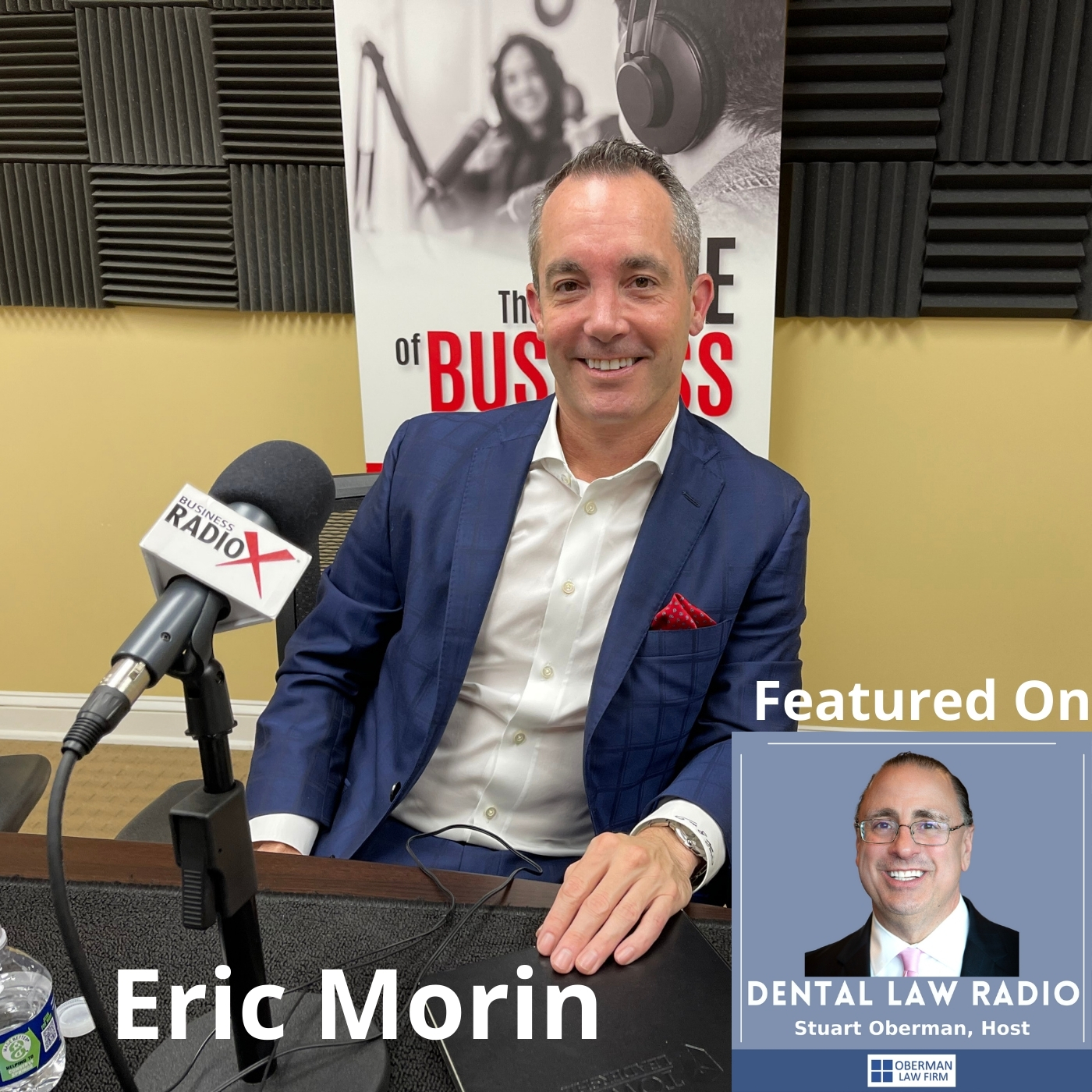
Growing Your Practice Through Effective Leadership, with Eric Morin, Tower Leadership

September 10, 2021 by John Ray

EricMorinDLREpisode19Album
Dental Law Radio
Growing Your Practice Through Effective Leadership, with Eric Morin, Tower Leadership
Loading
00:00 /
RSS Feed
Share
Link
Embed

Download file

EricMorinDLREpisode19Album

Growing Your Practice Through Effective Leadership, with Eric Morin, Tower Leadership (Dental Law Radio, Episode 19)

In a few years, Eric Morin argues, few dental practices will have less than $1 million in revenues. In this era of consolidation, what enables a practice to acquire other practices and scale effectively? In this conversation with host Stuart Oberman, Eric argues that the answer gets down to great employees, and he discusses the management and leadership fundamentals needed to attract those people. Dental Law Radio is underwritten and presented by Oberman Law Firm and produced by the North Fulton studio of Business RadioX®.

Eric Morin, Founder and CEO, Tower Leadership

Eric J. Morin, Founder and CEO of Tower Leadership, is an MBA and an experienced successful financial and business consultant, Eric truly is an innovative thought leader and powerful dynamic speaker. His words compel you to grow your business, live optimally, and make a transformative impact on this world.

For over a decade, Eric J. Morin has left a successful track record in the dental consulting industry. Hundreds of Dental Practices are now thriving in wealth, work environment, and community impact.

Eric founded Tower Leadership with the sole purpose of keeping dentistry in the hands of dentists by equipping them with the knowledge and tools they need to run a flourishing practice where everyone on the team benefits.

Connect with Eric on LinkedIn.

DLR-2021-08-2710.52.58 DLR-2021-08-2711.22.04

TRANSCRIPT

Transcript
Intro: [00:00:02] Broadcasting from the Business RadioX Studios in Atlanta, it’s time for Dental Law Radio. Dental Law Radio is brought to you by Oberman Law Firm, a leading dental-centric law firm serving dental clients on a local, regional, and national basis. Now, here’s your host, Stuart Oberman.

Stuart Oberman: [00:00:26] Welcome, everyone, to Dental Law Radio. Usually, I’m given a couple items on a podcast, but today we’ve got an extraordinary special guest in the studio, Eric Morin, Tower Leadership. And the reason why I wanted to talk to Eric – and he and I have done some projects and clients along the way for many years now. And I know Eric has clients all the way from Washington to probably Maine, probably to Florida, and probably some internationals. Who knows? – I wanted to really get Eric’s sort of feedback, if you will, what’s going on in the industry, where things are at. I know he’s got the the pulse of the industry and what’s going on at the practices, whether you have one practice or, I think, we’re working on a project now that we’re probably going to get him to about 30 practices at some point, if we can keep him on track, keep him on track.

Eric Morin: [00:01:23] It’s a big one.

Stuart Oberman: [00:01:23] But I think, really, Eric, you did a great job getting your guys through COVID-19. I know that was a very difficult spot. And I know that you and I did a seminar together that we had to go to a very remote location in a winery because no one else with houses. And you were on the forefront of a lot of areas, and I know that if your doctors listened to you when you were giving advice in March and April, they were well on the way to succeed. But I wanted to get, you know, your conversational sauce.

Stuart Oberman: [00:01:58] We’re going to cover a couple of things today, because you’re right on the front on this. You’re way out in front of this. Everyone’s scaling, scaling, scaling. You know, the questions we have are, how do you keep associates without giving up equity? One other area we want to take a look at is where are we at on the change of the business environment as we sort of revisit COVID, if you will, and all this coming with that. We’re seeing things that are already going into the first quarter of 2022.

Stuart Oberman: [00:02:33] So then, we want to take a look at, you know, leadership. And I’ve heard you talk and I take notes when you talk and implement when you say things. And God forgive me, but you introduced me to the sigmoid curve. I couldn’t even spell sigmoid curve until I actually listened to you talk when we were giving a little seminar.

Stuart Oberman: [00:02:57] But great to be here. Thank you, my friend. You are amazing in what you do. And I will tell you and I’ll tell listeners, every time you speak and every time I hear you, I learn something. Whether it’s one thing or a handful, I learn something. So, I want to talk about, really, what Tower Leadership is doing. Then, I want to get into some very specific industry topics that I know you’re out in front of. But tell us a little about Tower Leadership and what you guys do.

Eric Morin: [00:03:24] Well, first, thank you for having me. I’m glad to be here today. This is a lot of fun. I’ve been looking forward to it. As you said, you and I have worked on a lot of projects together, a lot of conversations. We’ve dealt with a lot of clients. You know, we really experienced a lot of issues together. This is a great time to have this conversation. There are so many changes. And then, all this thing called the Delta variant comes out.

Eric Morin: [00:03:48] So, just when we think that everything is settled and we can get back to business as usual, winter comes again. We don’t know. There’s uncertainty. And I think that’s business as a whole is there’s always uncertainty in the marketplace, and I think preparing for that. And then, what do you do when that happens?

Eric Morin: [00:04:04] And I think that’s one of the conversations you had brought up, which is when COVID happens. I think in the show we’ll talk through that is what were the differences during that time? Because one of the things I’m seeing now is, when we go back and we look at the time period, some people say we won’t count 2020 and some people say 2020 was a great launching point.

Stuart Oberman: [00:04:26] Best year they ever had.

Eric Morin: [00:04:27] That’s right. So, what was the difference? I think it’s really important in this podcast to identify those things. As a company, Tower Leadership, I’ve been in the consulting dental space for approximately 20 years. I’m married to a dentist. And I was consulting for companies outside of dental. And then, she said, “Will you help me start a dental practice?” I always tell people that my best asset was that I didn’t know anything about dental. And so, I just started growing and scaling this dental practice and hiring doctors. And I thought that was normal until someone told me it wasn’t.

Eric Morin: [00:05:01] But then, my career, I ended up getting investment licenses so that I could see also the investments that doctors were making. Tower Leadership came from this idea of, after all my years of experience, you can have great management systems, you can have great training, you can have all these things in place. But if you don’t have great leadership within the business, and leadership encompasses a lot of things, and there’s certainly some great things you need in management and leadership.

Eric Morin: [00:05:31] But the idea of Tower Leadership was, let’s create a business that shows doctors that if you invest, if you grow and you scale, yes, you can have all the financial rewards, but you can also impact a lot of people, too. And as idealist as that sounds, we’ve been able to do that. And it’s a fun pursuit of passion. And we get to see the changes in our clients lives, which is a lot of fun.

Stuart Oberman: [00:05:54] So, one of the big things now is, our doctors are sort of in a quandary where they really don’t want to give up leadership or ownership, but they don’t want to work 80 hours a week. So, the question is, in today’s tight market, tight, tight associate market – and we get this question all the time. And I know you get the question. You had a big conference on this recently – how do you keep associates in today’s world where you’re only as good as your last paycheck and your last patient without giving up equity? That’s probably a 17 day topic in a four year span. But, you know, how do our doctors do that? And what are you seeing on that side? You know, how do you keep these associates without giving up equity? That’s a loaded question.

Eric Morin: [00:06:50] You’re right. I mean, we could sit here and talk about this for a long time. I think it’s very important for people to know that a lot of times that associates feel that that’s being successful. But let’s unwind it a little bit more. The idea of ownership – and a lot of it actually, believe it or not, and all the conversations, I mean, I’ve had conversations with thousands of associates – it’s always that, “I want to be able to have a say in the practice. I want to be able to have leadership.” That’s the hard part to get over, right? Because you could give somebody equity.

Eric Morin: [00:07:19] Let’s just say that you gave up 30 percent or even 40 percent or 50 percent of your practice. But if someone’s whole goal is to be able to have a leadership conversation, to be able to contribute, and they’re not able to do that, of course, then they still won’t be happy. So, I think the first thing it goes down to is, what does the person ultimately want?

Eric Morin: [00:07:38] Because I think the marketplace in the past had said to this person, let’s take an associate, highly educated, highly competitive. Dentists tend to be competitive people by nature. And we say, “Here’s what I want you to do. I want you to come in. I’m going to figure out how to pay you as little as possible. I’m going to give no say on my dental practice.” And I love it if you just stay a really, really long time and no equity. I mean, none of us would go into that conversation to go, “This sounds like a win-win long term.””

Stuart Oberman: [00:08:04] It happens every day.

Eric Morin: [00:08:05] And so, I think that if you look, this is not what happens in other industries, by the way. This is kind of a way, a paradigm, that was in the dental market space for so long. And so, I will tell you that before we even get to a financial model or talk through those types of models, I think it’s more important to say, can this person contribute to the practice? Are they allowed to contribute? Because these are intelligent people.

Eric Morin: [00:08:30] And by the way, if doctors want to pull back, I might want to pull on that part of their skill set and have them be part of the practice as far as the ability to contribute to a leadership team or contribute to the management of the practice. So, it’s really important that we talk about that first in that component because they want to be part. They want to feel like they’re part of something. Don’t we all, though? I mean, don’t we all want to feel like we’re part of something? And I think the way we’ve treated associates in the past is wrong, I’ll say that first.

Eric Morin: [00:09:04] The other part is, what does it mean to get ownership? I think we have to unwind that. What does that actually even mean? Equity. What is equity? Equity, first of all, until you sell it, it’s just something filed with the state. I mean, it doesn’t really mean anything. You can say, “Well, it means distributional equity. So, I get some distributions.” But I think what do those distribute – distributions?

Stuart Oberman: [00:09:30] You’re the financial guy. You’re asking a lawyer?

Eric Morin: [00:09:30] I know, right. I think one of those distributions will be long term. So, I think it’s one of those mean long term. And I think it’s creating an asset. You know, what we have found is, by allowing someone to be part of a leadership team, to have some say in what’s happening in the practice, and then by giving them an asset, showing them that they could have a multimillion dollar asset without having equity, then they say, “Okay. Hold on. Let me get this right. So, I could work four days a week, not deal with H.R., not have to do with marketing, not deal with all the headaches and complexities, and I could have a multimillion dollar asset?” The answer is yes.

Eric Morin: [00:10:16] And so, actually, believe it or not, I’ve had partnership agreements that the partners have unwound the agreement to do a deferred compensation or some type of other program, because they see clearly financially. I’ve had people take that type of an arrangement and put it in front of their lawyers, their accountants, their financial advisers, and they have come back and said, “Wow, this is pretty amazing. And it’s actually better financially.”

Eric Morin: [00:10:44] So, what happens is, when the associates end up in dental school, they tell them the natural progression is you’re going to get out, you’re going to work for a few years. Oftentimes and nowadays, it’s for corporate for years. And then, they’re going to go buy a dental practice. But even that market’s changing, isn’t it? I mean, we’re starting to see the complexities. And I’m shifting a little bit here, but as the marketplace changes, the complexity around owning a dental practice is getting much harder.

Stuart Oberman: [00:11:11] It’s getting harder. Individual, not when you got numbers on DSOs.

Eric Morin: [00:11:15] It is. Even in the last ten years, Stuart, I mean, we got to think about –

Stuart Oberman: [00:11:21] And days.

Eric Morin: [00:11:21] Right. So, we think about this and say, even five years ago. I argue that five years from now, there’ll be very few practices that are operating under a million dollars in revenue. Independent dentists that are thriving outside of, maybe, a small boutique type cosmetic firm. And if you look at the medical space, you’ll see the same thing. I mean, in the medical space, you’ve got dermatologists and you’ve got plastic surgeons. And for the most part, they stayed out of groups. But the vast majority of medicine, you know, MDs are now all part of groups.

Eric Morin: [00:12:00] So, when we look at the marketplace and the way it’s shifting, we say even the people who might have bought a practice, it’s going to cost you a lot more to get into them because – and we’re seeing this and you’re seeing this, too – it might cost you $2 or $3 million now to get into a practice where it would have cost you 400. And then, you’ve got to have the business acumen to be able to compete in that space.

Eric Morin: [00:12:19] So, when we’re retaining associates, what we have to think about first is the environment. Are we providing a world class environment? Are we providing a place where they can thrive? Can their career grow? Can they be excited? All those traditional things in any other industry we will look at. Let’s say you and I started to create another firm, we would want to take care of our C-suite, our top players.

Stuart Oberman: [00:12:44] We don’t sleep as it is.

Eric Morin: [00:12:47] [Inaudible]. What a side note. So, I think that we can keep unwinding this. The truth is that, no matter where you are, this marketplace is changing. And I actually think there’s a lot of it that’s good news. And the marketplace is changing and we can kick and scream, but it is. And I think that the more we adapt to that marketplace, the more we can thrive. I think if you look at large corporations, or private equity, or DSOs, or however you want to call it in this space, they are not handing over equity to these practices. And I think that people have been telling people for a long time that you need to hand over equity.

Eric Morin: [00:13:29] But in the case that you had mentioned from coast to coast, I was working with a doctor recently. And if he had given up half his practice, he would have taken a 50 percent pay cut. But that pay cut literally would have made it so he could not pay his bills, literally. And so, I sat down with the associate. I said, “Do you care about this doctor?” And the associate said, “Yeah. I’m just trying to take care of my family, but I also want him to be taken care of.” I said, “Well, if we do this deal long term, this is going to fall apart.”

Eric Morin: [00:14:03] And so, we would do the math with the associate. And we were able to put a really good agreement in place where the associate had a long term asset. Also, had some leadership say in the practice, was able to thrive. And this was a few years back, actually. And, now, I mean, they are just just doing so well together. So, I love to see that you do not have to just hand over equity. That is a paradigm that is changing. It will continue to change. And I think it’s really important in this marketplace.

Eric Morin: [00:14:37] Maybe you do want to sell back. Maybe you want a partner. I’m not saying you never should. I’m just saying that if that is not your game plan, you should not be forced into that game plan, or strategic direction maybe is a better way to say that. I think you have to think through why you’re doing this, and who it benefits, and what your long term vision is.

Stuart Oberman: [00:14:55] Does this go hand in hand when a doctor says to you, “I want to get out of the chair.” Does that go hand in hand on or is that a before conversation that would get to the associates? Is it, “I want to get out of the chair, how do you figure it out? Then, what do I need to do with an associate?” Is that a first conversation when when a doctor says that to you? How do we get out of the chair?

Eric Morin: [00:15:19] I have to tell you, this is like my happy place. Can we make this show five hours? We got to like [inaudible]. We can do this for a long time.

Stuart Oberman: [00:15:27] How do I get out of the chair? How do I get out of the chair? How many times have you heard that, how do I get out of the chair?

Eric Morin: [00:15:33] So, here’s a thought, so what happens is, is just like any other position. Sometimes we put a square peg in a round hole. Look, we oftentimes will bring in this associate that does not meet the business model. It does not meet the vision. For instance, the person who says this doctor does not want to give up equity long term, wants to build a team, wants to do some type of other business or economic model to provide an asset for the associate. And this associate walks in, stomps their feet and says, “No. I will not do anything but take ownership.” So, the doctor says, “Okay. Fine. I’ll hire many. How many?” They’ll change their mind.

Eric Morin: [00:16:16] That’s your hiring process. There’s a thought process between selection and recruitment. Selection is that you’ve sort so many candidates coming into the position that you can pick the right person and select them. We always want to select people. So, if you have multiple candidates, you get to select. Recruiting is almost that last minute thing where you’re like, we really need a body or we really need an associate right now, so we just put whoever comes into that position, we just say, “We’re going to hire you. We’ve seen this with front desk.”

Stuart Oberman: [00:16:49] Is that more prevalent in today’s market because they can’t find good associates or they’re just filling bodies?

Eric Morin: [00:16:55] See, I would push back against can’t find good associates. It’s interesting, the reason I say that is because the doctors who have built an amazing environment to work in, doctors hang out with doctors. I don’t know how many times someone has said to me, I’ve recruited two or three people from my class to come work for this doctor, because if you create an amazing environment to work where somebody can do well, can take care of their family, and have an asset, it’s going to attract other people.

Stuart Oberman: [00:17:27] Build it and they will come.

Eric Morin: [00:17:28] Yeah. Sometimes I say to people, it’s like the harsh truth. But sometimes when someone says, “I can’t find anyone.” I say, “It’s you.” And that’s kind of a harsh truth. And let me kind of back that up.

Stuart Oberman: [00:17:42] It’s true, though.

Eric Morin: [00:17:43] Sometimes it’s like I have not built the environment to attract people. Someone said to me this one time, Stuart, this person said to me, “You can’t find any good people in Atlanta.” I was like, “Wow. An entire city. I’m sure it’s the entire city.”

Stuart Oberman: [00:18:00] You can’t find one person out of six million.

Eric Morin: [00:18:02] That’s right. So, I pushed back and and said, “Well, let’s talk about the environment.” We’ve always had this idea that dental is different, but it’s not different. The business acumen, the business principles always apply is you’ve got to create an environment. No matter who you are, every study shows, people still don’t come to work for money. We say, “Well, yes, they do.” Somebody can always pay them more. There’s still all these other intangibles that you have to make it a place that’s great to work.

Eric Morin: [00:18:32] Now, obviously, somebody wants to get paid their value. They want to have the ability to increase their income. All those things are true. And I’ll give you an example of what I mean by that. There is a young doctor. She is one of the most amazing doctors that I’ve ever had the pleasure to spend time with. She took a job out of GPR residency. And what she did was she went up to Indiana. She gets up there. She gets a practice who’s going to pay her more money. And it ends up being a really bad environment for her to work in. And we’ve had a business relationship.

Eric Morin: [00:19:10] And she says, “Hey, Eric. I need some help. I’m in this practice. They pay me a lot of money, but I’m so miserable.” And here’s here’s the thing, going back to my earlier point, “They will not let me have any say. They will not let me contribute. They tell me just to shut up and see patients.”

Eric Morin: [00:19:24] And what happened was she quit there, is now working for one of my clients. She is running the entire location. This entire location she runs. She’s learning advanced procedures. And the doctor there, he goes, “She’s a unicorn. I don’t know if I’d ever find another one of her.” And yet this other doctor had her. Now, the other doctor that lost her is probably saying, “It was her. You know, you can’t find good people.”

Stuart Oberman: [00:19:49] Has an attitude. Lack clinical skills.

Eric Morin: [00:19:50] Right. All these things. It was like, “No. It was you.” And so, I do think it’s important that we all look at our business and say, “Do we have the environment to attract top talent?” All businesses have to do that. Can we attract top talent? Would they want to stay here? Do they have a say? And by the way, that’s not just doctors, it’s your entire team. Hygiene is no different, right? We are in a tough, tough market to find hygienists. Hygienists talk to hygienists. If you had a great place to work, other hygienists will say, “You got to come work for here.” So, that’s just something to consider.

Eric Morin: [00:20:26] So, yes, at Tower Leadership, we’re a financial firm in many ways and we do plans around retaining associates. But I would still argue that if you don’t have the foundations of strong business management, then it’s not going to work anyhow.

Stuart Oberman: [00:20:47] That’s why there’s one practice or 20. It’s all the same.

Eric Morin: [00:20:49] That’s right. And I say management leadership, one thing I’ll say on the show that I think it’s important. Sometimes you scroll through LinkedIn and I see some amazing post by Stuart Oberman, so I’m scrolling through.

Stuart Oberman: [00:21:04] I got good people. I got good people. I got much smarter people than me, I could tell you that.

Eric Morin: [00:21:09] Well, they’re doing great. It’s looking good. So, as I’m scrolling through, I always see these posts that pop up. And they’ll say something to the idea of, “Leadership is when you care. Management is just a number.” And it’s silly because it’s not true. Look, all great businesses need leadership and management. Management doesn’t mean that you don’t care? You have to have strong management because you can be a great leader. But if you have bad management, then the company is going to fall apart. You can train people, but if you don’t have a way to have standard operating procedures, you cannot continue to manage the business to grow. So, you do need both.

Eric Morin: [00:21:54] By the way, if you just have management but no leadership, that’s not good either. So, I think it’s important to understand, you have to have strong leadership within a business, the visionaries, the the visionary leader, the people that are driving the show and looking at direction and inspiring people. But I think there’s another side that says, “Do I have strong management?” And by the way, I think associates play a crucial role in both of those.

Stuart Oberman: [00:22:19] So, you know, it’s amazing what’s changed in the last three years, maybe 36 hours, we got scaling, we got corporate coming in, and we’ve got DSOs, we’ve got growth, we got no growth, we got COVID. I would say with COVID, it’s got to be something else. If it’s COVID today, it’s Delta tomorrow, and it’s something else down the road.

Eric Morin: [00:22:42] The Foxtrot variant.

Stuart Oberman: [00:22:44] Yeah. It just keeps going. So, from a practice standpoint, how do our doctors adapt to the change in this new business environment? And it changes, like, everyday it seems like.

Eric Morin: [00:23:02] Three words, access to capital. I’m serious. Let me tell you what I mean by that, you can look at business over business over business outside of dental as well. And you and I talked about this actually during COVID. I said, you got to have access to capital. One of the things that the federal government provided was access to capital. Had that not happened, then what would have happened? Have we not have PPP and EIDL, what would have happened to the dental market space?

Eric Morin: [00:23:32] And so, I think when we look at the future, first of all, one of the ways we insulate ourselves from those types of things is access to capital.

Stuart Oberman: [00:23:40] And what does that mean? Access to capital, what does that mean?

Eric Morin: [00:23:42] It means that either you have credit lines you can pull from. It means that you might be able to have money in the bank. You have access to be able to borrow money.

Stuart Oberman: [00:23:54] Is that what they call good debt?

Eric Morin: [00:23:56] Here’s what I always tell people, there’s two things you cannot get when you need them, credit lines and insurance. Okay? So, those things are really cheap and you could get it really easy when you don’t need them. The second you need them, they’re gone. Also, you’re about to go to bankruptcy and you’re like, “Can we get a lot of credit?” NO. It’s not happening. You get diagnosed with something, you can’t get insurance.

Eric Morin: [00:24:15] So, I think it’s important for us to know that, as businesses, we have to start projecting. We have business winters. One of the things I said before – COVID now – I certainly did not know it was going to be COVID, but I was telling people, “Listen, this is a great economic time.” Take 2021, we would argue that 2021 – I think everybody can see – it’s a great business year. We can talk about all the reasons why, and that’s maybe for another show. But it’s a great economic year for most businesses. So then, are you taking that money and are you making sure that you have capital?

Eric Morin: [00:24:45] Let’s play this Delta variant, or something changes, or the economy changes. We saw the dental marketplace change in 2008, 2009, 2010. People are doing procedures now that they weren’t doing before. They’re getting checks from the government. So, what happens if you had a 20 percent drop in revenue, I’m just saying, play that scenario out. In business, we call that pessimistic modeling. Hey, what if we weren’t to grow at this rate? Well, what if something was to happen? Do we have the ability to pay our bills for some period of time? Do we have the ability to get capital? And maybe that’s capital for expansion. It doesn’t have to be a negative thing. It doesn’t necessarily need to be something that’s going down.

Eric Morin: [00:25:22] But you always have to have access to capital. Businesses go under because they don’t have access to capital, which is the whole saying cash is king. And so, I would argue that businesses have to have that. So, the first primary thing I would say is – by the way, this is like a business school 101 – profitability doesn’t keep the lights on. Cash flow does. Do you have enough cash flow to get through or the ability to get capital to get through a difficult time? I think it’s very important that any business owner assess that at any given time.

Stuart Oberman: [00:25:54] Wow. So, the practices that want to scale, how do they get access to capital?

Eric Morin: [00:26:04] Wow. This is just so exciting. So, we can, first of all, say, right now for a dentist to get leverage – otherwise known as debt – it’s not that hard, right? I mean, as long as your financials are in pretty good order, you can go to a bank and get a loan and buy another practice, as long as the financials make sense. They’ll look at your personal, obviously, financial statement and see if you are a good, qualified buyer. But that’s only to a certain point, right?

Eric Morin: [00:26:35] There’s going to be at some point where the banks go, “We have taken enough of risk here.” And then, we start to get to the point where we go into getting capital that’s outside of a bank, which that could be bringing another partner, it could be mergers and acquisitions, it could be pulling in private equity. And that’s a good thing for you to look at in your long term vision.

Eric Morin: [00:27:00] If you have a dental practice, and let’s just play the scenario that you’re two locations and you say, “I really love to go to 30 million.” You and I were talking about this process of moving drastically. And so, we’ve seen that. But what happens is, is you have to say, what is my plan for getting capital in the future? When the banks cut me off – and they will at some point –

Stuart Oberman: [00:27:22] They will.

Eric Morin: [00:27:23] .. you have to say, “What is my plan -” you can’t wait and then start making phone calls. You have to think now – “at the point at which the banks cut me off?” So, let’s just say it was a certain revenue, or four locations, or whatever that is in your head. And by the way, your banker can help you with that. And you can –

Stuart Oberman: [00:27:41] I’m going to allow you to purchase one practice a year.

Eric Morin: [00:27:44] See. So, that’s something I wasn’t aware of. And so, I think it’s important to get that information. And then, if that’s the case, then, what is my – going back to number one thing – access to capital? What is my next step to get capital? If I can no longer get any more capital, how else will I get it? Do I want to bring in an equity partner?

Eric Morin: [00:28:07] Because there isn’t an old saying and I love this saying. When I heard it, I thought it was brilliant. Some people will say partnerships don’t work. It’s just not true. They just have to be running in the same direction. And so, do I want to own 20 percent of a watermelon or 100 percent of a grape? Depending on what your long term strategy is, it might make sense to earn 20 percent of a watermelon. You know, everyone’s situation is different.

Eric Morin: [00:28:32] But if you’re trying to become a large dental group, I think you have to understand, in business, the number one thing is, what’s my vision? Where am I going? What do I want long term? How does this impact my family? What does this do to my legacy? I think you have to write all those things out first.

Eric Morin: [00:28:48] I’ll tell you a story. Years ago – I want to say about seven years ago – I had a group come to me.

Stuart Oberman: [00:28:55] When we were young.

Eric Morin: [00:28:59] I had a group come to me, they had nine locations, has four partners. And they had flown up to see me and I sat down with them and I asked them that same question. I said, “Where are we going? What are we trying to get accomplished?” And they said, “We want to be a $100 million dental practice. And we heard you were the guy to get us there.” And I looked at them and I just said, “Why? Why do you want to be $100 million? What does that do? Why do you want that?” And their answer was, “I don’t know. It sounded good.” It sounds like a good round number.

Stuart Oberman: [00:29:33] I heard it at a seminar.

Eric Morin: [00:29:33] That’s right. I heard it at a seminar. It’s not like we couldn’t do that. So, I said, “Let’s talk through that more.” And it’s interesting, because I told them, “If I was a bank -” sometimes when I’m speaking to a doctor or any business, I would say, “Let’s play that I’m your investor. Explain to me why I should give you money.” “-if you came to me and said you were trying to grow, but you don’t know why, you just had no reason, and you didn’t have an economic model, I probably won’t give you the money.” So, believe it or not, it took about four hours to finally get to their why.

Stuart Oberman: [00:30:08] I believe it.

Eric Morin: [00:30:08] And then, when we got there, here’s what they said, “We want one location with 24 hours.” I thought, “We should have figured that out eight locations ago.” So, we just wasted time and money and energy.

Stuart Oberman: [00:30:18] Or four hours ago.

Eric Morin: [00:30:19] And interestingly enough, you know, part of the story is one of the partners was actually diagnosed with a heavy disease at the time. And I thought, “Gosh. You guys have spent so much time in the wrong direction. So, I think that the first part is always, where are we going and why?” And one of the reasons why I try to get people at the dental chair is, I think that some people love dentistry. Stay in the chair if you want to. But have the ability to pull back. Have the ability to spend time with your family and do the things you want to, which is one of the reasons why we start a business.

Stuart Oberman: [00:30:54] So, you talk about this a lot and this could probably interject into every scenario you just mentioned, leadership. You guys talk about that a lot. You groom it. You touch base on it. You figure out how to get better at it. How much of a role does leadership play in a successful practice, whether it’s one or 20 practices? And you talked about this a lot during COVID. How leadership, really, will take you through the storm and put you on top of the mountain. So, tell me about leadership and doctors and what you see what they don’t do. I know that’s a whole day’s conversation.

Eric Morin: [00:31:37] No. There’s this old saying, you find out who your friends are during the difficult times. And I think that we also saw what people were made up from a leadership standpoint during the difficult times.

Stuart Oberman: [00:31:54] And we’re not out of there yet.

Eric Morin: [00:31:56] Right. But I think what I was saying during that time is – and we have doctors that send everybody home. And when I say we, I mean the industry. Doctors not even communicate with their team for 45 days. And I said, “These people are scared.” By the way, they’re going to start looking for a job because if you don’t take care of them now – and by the way, that’s what’s happened for a lot of people, because it was a great time for people to reflect and say, “Is this where I want to work long term? Does this person actually care about me?” During that time, people were scared. Everybody was scared.

Eric Morin: [00:32:26] And I said doctors play a huge role in this. It doesn’t matter whether you’re a medical doctor or not. Not just within your own team. But what do you look like in your community? Are you communicating with your community? Are you communicating with your team? Are you talking them through it? I mean, our team started working, you know, 20 hour days just to support teams. We had team members on the phone and started having financial conversations with them. We worked through each doctor. I think we spent so much time working through that time. But so many people in that time were attracted. And that was the worst thing they could have done. I said, you know, “This is a time when they need you.”

Stuart Oberman: [00:32:58] I remember you talking about that.

Eric Morin: [00:32:59] They need you. They need their leader at this point to look at them and say, “We’re going to be okay. We’re going to make it through. I’m going to make sure we’re all taken care of.” And sometimes that didn’t happen. And we see in a lot of practices what the consequences of that, you know, ended up being. As the marketplace, by the way, let’s look at hygienists again, as it becomes more competitive, they’re like, “Do I want to work here long term?” And so, I think leadership, this is one of those ones where we have to get outside of dental marketplace and just look at business. Great business leaders attract great people, and it is difficult.

Eric Morin: [00:33:40] I want to give some knowledge-ment to the fact that, being in a chair all day long, and seeing patients all day long, and trying to lead, and trying to manage is very, very difficult. Which is why you need to lead and build an amazing team. Because you can’t do it all. But building a leadership team and building a team around you, but to get them there – one of the things I was just saying to you before we went on air was one of the reasons we do this large leadership retreat every year. And one of the reasons I do it is when they say, “Well, Eric, I don’t communicate like you communicate. So, would you tell my team what you just said.”

Stuart Oberman: [00:34:13] You send them an email.

Eric Morin: [00:34:16] That’s right. And the other thing is, “But I want to get the team inspired on my why.” When I say my why, I mean your why as a doctor, why are you there? What’s the purpose? What are you trying to get accomplished? How do you impact their lives? I think that you have to get the team to understand why they should care. Because if it’s like, I think, we get to this place where we’re always like, “Well, I’ll just pay them more money. I’ll just pay them more money.” Somebody can always pay them more. So, why should they follow you? We see it all the time.

Eric Morin: [00:34:41] One of the things I’ve done at Tower is, I’ve brought people on and I’ve asked them to come on for like, literally, a 30, 40 percent pay cut from what they were getting paid. And I’ll tell you why. That wasn’t to cut anyone out of money, by the way. It was to say, “Are you willing to commit to the vision that’s here? And if you are, actually, you’re income will increase. But I want you to buy into the vision of what Tower is trying to do.” So, the same thing I would say, is, if people aren’t inspired by you as a leader and they don’t see you as a leader or somebody they want to follow, people will take a pay cut just to be with a great leader, to be with a great organization.

Eric Morin: [00:35:14] You might say, “Well, Eric. I don’t have time to do all that.” “Okay. Then, bring in somebody who can.” If we’re trying to go to 5 locations, 10 locations, 20, you can’t do that without great leadership. You can’t do that without great management. And so, why I think it’s so crucial is, business is littered with stories of great leaders and poor leaders. And we work on leadership, and we inspire, and motivate, and drive people towards a direction. And that sounds idealistic. I know it’s like, “That sounds idealism,” but it’s just true.

Stuart Oberman: [00:35:48] It’s true though.

Eric Morin: [00:35:48] And it’s like, how much time in the last 12 months have you spent on growing your leadership skills and leadership teams, inspiring people? And I think that’s got to be a focus if you’re going to, especially if you’re going to grow and you’re going to compete in this market. Because what I am seeing is a lot of DSOs that are private equity. They’re not focused on leadership. And it gives you a competitive place in this market. I mean, it really does. It allows you to differentiate yourself. I’m not saying DSOs don’t care. That’s not what I said. But I’m saying that, if it’s all about money, you get what you measure. And if they’re focused just on money, well, then I’m telling you, they’re going to take their eye off of leadership. And that’s a place where you can dominate and attract top talent.

Stuart Oberman: [00:36:29] Amazing. Amazing. You know, again, I don’t even know where to start. I think we’ve been just about 45 minutes. I’m trying to think how much I could take back myself and say, “Okay. Here’s my office.” But as usual, it’s amazing conversation. I was looking over and trying to figure out what do we even call this. I mean, we’ve touched on so many things, but we’ll come up with a great name. So, tell me what you got going on. Do you got some events coming up? Where are you going to be at? When you sell out Phillips is what I want to know.

Eric Morin: [00:37:06] Well, we haven’t sold out our September and October foundation.

Stuart Oberman: [00:37:09] [Inaudible] Phillips.

Eric Morin: [00:37:12] We’re blessed to have some amazing doctors. We get to work with some of the best in the industry. And work with some of the best people to team up with, like yourself.

Stuart Oberman: [00:37:21] You know, you do work with the best. I mean, I could tell. We’ll also hear the guys that we work with together are at a different level. You know, the clients [inaudible]. They’re at a different level. They got a whole separate different vision where they’re going. And at times, they’re a little bit hard to corral in. Sometimes I just wanted to get to Marietta, not necessarily Nebraska.

Eric Morin: [00:37:47] I just give you the difficult stuff, Stuart. You know, you and I worked on some really complex stuff together and some great things. And that’s why it’s such an honor to work with you as well, because I know that the clients that have these sophisticated issues, the clients that need help, and need great guidance. I know you take care of them, which is why you and I have worked together on so many of these cases.

Stuart Oberman: [00:38:09] It’s like, “Why is Eric calling me at 8:30? I’m taking that call. There’s got to be a reason.”

Eric Morin: [00:38:13] I think I called you on Sunday once a week. Don’t call Stuart on Sunday.

Stuart Oberman: [00:38:18] It’s not to watch cable TV, I could tell you that. So, tell us what next event is coming up. What is it? Tell us about it?

Eric Morin: [00:38:24] What we do is an introductory – two days initially – as to what we do. And what we do is, we talk about the financial. So, it’s financial and its leadership and its management. Which is, what do I need to do if I want to build an organization that grows and scales? If I want to pull back from the chair, how do I have a business that runs without me? What does this mean financially? How do I make investments? One of the things that’s missing in this industry is people don’t know where to invest the practice. We talk about where to invest, what’s the ROI, where’s the best place to put money, how does that pay off debt. All those two days worth of concept.

Eric Morin: [00:39:00] So, we do those once a quarter. We’ve actually sold out September so we’ve added some more. And we get this leadership retreat we’re doing in November. And it’s a large, large event. We have practices from all over the country. And it’s really about that message, which is, how do we get our teams inspired? If we’re going to build scalable businesses, how do we get our teams inspired, motivated, and ready to tackle head on 2022?

Stuart Oberman: [00:39:28] If anyone got any questions, how do you get hold of you?

Eric Morin: [00:39:31] Towerleadership.com. I think it’s the best place. We’ve got a lot of information. And then, right there who wants to send email, info@towerleadership.com. And our team is ready and waiting. We’ll be more than happy to help you. They are excited to talk to you and excited to help. And, really, you know, we see the spectrum, as you know, and so it doesn’t matter where you are, it doesn’t matter if you’re just beginning this journey and you’re questioning what do I need a buyer or investor do.

Eric Morin: [00:40:00] I mean, a doctor years ago had said to me, they gave me their pro forma going into a practice. And I said, “Who gave this to you? It’s wrong. Trust me. We’re going to move all this around.” He had seven options, these seven options are going to be gone in 12 months. He said, “No way.” They were.

Eric Morin: [00:40:17] Even on the frontend or the person who’s trying to go, “We’re working with a lot of organizations that are going to 3, 4, 5, 10, 20, 30 locations.” So, no matter where someone’s at, no matter what the complexity is, we can coach you through how, where, and why.

Stuart Oberman: [00:40:36] Get there. Fantastic. Fantastic. Fantastic. I can’t even begin to write down any information. I’m going to have to listen to this myself and figure out where I’m at.

Eric Morin: [00:40:45] I appreciate the honor to be your guest, sir. This has been a great time. I literally think we could go for 18 hours nonstop. And this has been such a pleasure to be here. I really do. It means a lot. I’m glad to be part of it.

Stuart Oberman: [00:40:58] My pleasure. My pleasure. Thank you. I sure appreciate it. Eric Morin, Tower Leadership. It’s always a pleasure.

Eric Morin: [00:41:03] Thank you, sir.

Stuart Oberman: [00:41:05] For those that want to reach out Dental Law Radio, my name is Stuart Oberman. Reach us at stuart@obermanlaw.com. Thank you for listening. Please listen to this podcast multiple times because you will pick up multiple bits of information every time you do. Have a great day and we’ll talk to you soon.

About Dental Law Radio

Hosted by Stuart Oberman, a nationally recognized authority in dental law, Dental Law Radio covers legal, business, and other operating issues and topics of vital concern to dentists and dental practice owners. The show is produced by the North Fulton studio of Business RadioX® and can be found on all the major podcast apps. The complete show archive is here.

Stuart Oberman, Oberman Law Firm

Oberman Law Firm
Stuart Oberman, host of “Dental Law Radio”

Stuart Oberman is the founder and President of Oberman Law Firm. Mr. Oberman graduated from Urbana University and received his law degree from John Marshall Law School. Mr. Oberman has been practicing law for over 25 years, and before going into private practice, Mr. Oberman was in-house counsel for a Fortune 500 Company. Mr. Oberman is widely regarded as the go-to attorney in the area of Dental Law, which includes DSO formation, corporate business structures, mergers and acquisitions, regulatory compliance, advertising regulations, HIPAA, Compliance, and employment law regulations that affect dental practices.

In addition, Mr. Oberman’s expertise in the health care industry includes advising clients in the complex regulatory landscape as it relates to telehealth and telemedicine, including compliance of corporate structures, third-party reimbursement, contract negotiations, technology, health care fraud and abuse law (Anti-Kickback Statute and the State Law), professional liability risk management, federal and state regulations.

As the long-term care industry evolves, Mr. Oberman has the knowledge and experience to guide clients in the long-term care sector with respect to corporate and regulatory matters, assisted living facilities, continuing care retirement communities (CCRCs). In addition, Mr. Oberman’s practice also focuses on health care facility acquisitions and other changes of ownership, as well as related licensure and Medicare/Medicaid certification matters, CCRC registrations, long-term care/skilled nursing facility management, operating agreements, assisted living licensure matters, and health care joint ventures.

In addition to his expertise in the health care industry, Mr. Oberman has a nationwide practice that focuses on all facets of contractual disputes, including corporate governance, fiduciary duty, trade secrets, unfair competition, covenants not to compete, trademark and copyright infringement, fraud, and deceptive trade practices, and other business-related matters. Mr. Oberman also represents clients throughout the United States in a wide range of practice areas, including mergers & acquisitions, partnership agreements, commercial real estate, entity formation, employment law, commercial leasing, intellectual property, and HIPAA/OSHA compliance.

Mr. Oberman is a national lecturer and has published articles in the U.S. and Canada.

LinkedIn

Oberman Law Firm

Oberman Law Firm has a long history of civic service, noted national, regional, and local clients, and stands among the Southeast’s eminent and fast-growing full-service law firms. Oberman Law Firm’s areas of practice include Business Planning, Commercial & Technology Transactions, Corporate, Employment & Labor, Estate Planning, Health Care, Intellectual Property, Litigation, Privacy & Data Security, and Real Estate.

By meeting their client’s goals and becoming a trusted partner and advocate for our clients, their attorneys are recognized as legal go-getters who provide value-added service. Their attorneys understand that in a rapidly changing legal market, clients have new expectations, constantly evolving choices, and operate in an environment of heightened reputational and commercial risk.

Oberman Law Firm’s strength is its ability to solve complex legal problems by collaborating across borders and practice areas.

Connect with Oberman Law Firm:

Company website | LinkedIn | Twitter

Tagged With: dental law, Dental Practice, dental practice acquisitions, DSO, Eric Morin, Leadership, Oberman Law Firm, scaling the business, Stuart Oberman, Tower Leadership

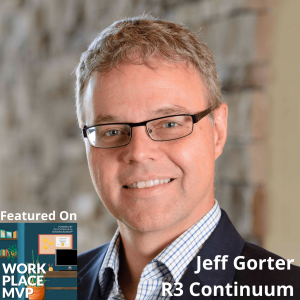
Workplace MVP: Jeff Gorter, R3 Continuum

September 9, 2021 by John Ray

Jeff Gorter
Minneapolis St. Paul Studio
Workplace MVP: Jeff Gorter, R3 Continuum
Loading
00:00 /
RSS Feed
Share
Link
Embed

Download file

Jeff Gorter

Workplace MVP:  Jeff Gorter, R3 Continuum

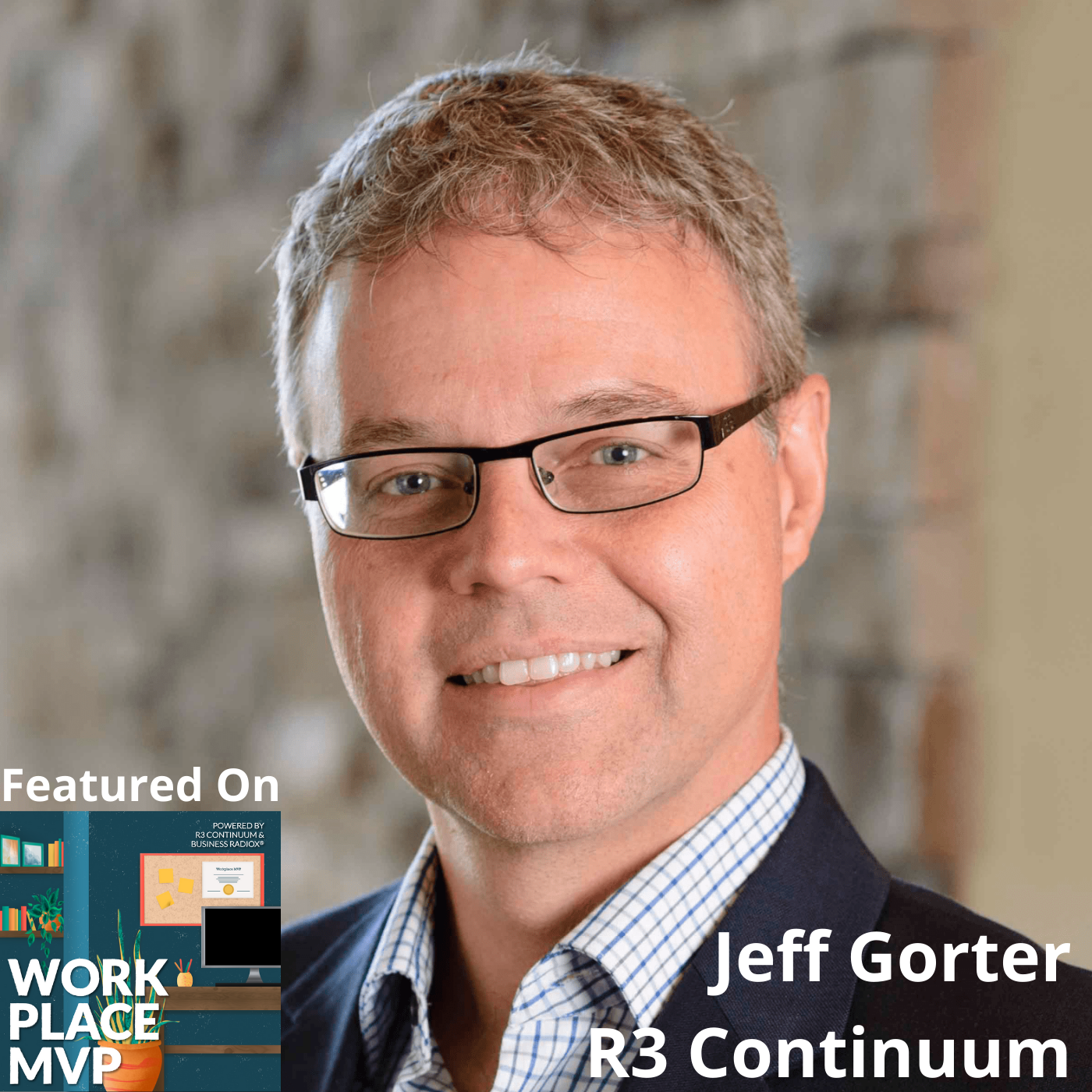
Critical incident response veteran Jeff Gorter contends that business and human responses to crisis events are not separate but interwoven. On the twentieth anniversary of the September 11th terrorist attacks, Jeff and host Jamie Gassman discussed the parallels of that event and the COVID-19 pandemic, and the importance of acknowledging 9/11 for your employees.  Workplace MVP is underwritten and presented by R3 Continuum and produced by the Minneapolis-St.Paul Studio of Business RadioX®.

Jeff Gorter, Vice President of Crisis Response Services, R3 Continuum

Jeff Gorter, Vice President of Crisis Response Services, R3 Continuum

Jeff Gorter, MSW, LCSW, is VP of Clinical Crisis Response at R3 Continuum. Mr. Gorter brings over 30 years of clinical experience including consultation and extensive on-site critical incident response to businesses and communities. He has responded directly to the Sept. 11 terrorist attacks, Hurricane Katrina, the Virginia Tech shootings, the Deepwater Horizon Oil spill, the 2011 earthquake/tsunami in Japan, the Newtown Tragedy, the Orlando Pulse Nightclub Shooting, the Las Vegas Shooting, and the breaching of the US Capitol on 1/6/21. He has conducted trainings and presented at the Employee Assistance Professionals Association Annual Conference, the American Psychological Association Annual Conference, the World Conference on Disaster Management, the International Society for Traumatic Stress Studies Annual Meeting, and at other state, national and international venues on a variety of topics.

LinkedIn

R3 Continuum

R3 Continuum is a global leader in workplace behavioral health and security solutions. R3c helps ensure the psychological and physical safety of organizations and their people in today’s ever-changing and often unpredictable world. Through their continuum of tailored solutions, including evaluations, crisis response, executive optimization, protective services, and more, they help organizations maintain and cultivate a workplace of wellbeing so that their people can thrive. Learn more about R3c at www.r3c.com.

Company website | LinkedIn | Facebook | Twitter

About Workplace MVP

Every day, around the world, organizations of all sizes face disruptive events and situations. Within those workplaces are everyday heroes in human resources, risk management, security, business continuity, and the C-suite. They don’t call themselves heroes though. On the contrary, they simply show up every day, laboring for the well-being of employees in their care, readying the workplace for and planning responses to disruption. This show, Workplace MVP, confers on these heroes the designation they deserve, Workplace MVP (Most Valuable Professionals), and gives them the forum to tell their story. As you hear their experiences, you will learn first-hand, real life approaches to readying the workplace, responses to crisis situations, and overcoming challenges of disruption. Visit our show archive here.

Workplace MVP Host Jamie Gassmann

In addition to serving as the host to the Workplace MVP podcast, Jamie Gassmann is the Director of Marketing at R3 Continuum (R3c). Collectively, she has more than fourteen years of marketing experience. Across her tenure, she has experience working in and with various industries including banking, real estate, retail, crisis management, insurance, business continuity, and more. She holds a Bachelor of Science Degree in Mass Communications with special interest in Advertising and Public Relations and a Master of Business Administration from Paseka School of Business, Minnesota State University.

TRANSCRIPT

Intro: [00:00:03] Broadcasting from the Business RadioX Studios, it’s time for Workplace MVP. Workplace MVP is brought to you by R3 Continuum, a global leader in workplace behavioral health and security solutions. Now, here’s your host, Jamie Gassmann.

Jamie Gassmann: [00:00:24] Hi, everyone. Your host, Jamie Gassmann, here. And welcome to this episode of Workplace MVP. This year marks the 20th anniversary for the 9/11 terrorist attacks. We are also halfway through the second year of the COVID-19 pandemic. Some are calling these two tragic bookends to the last two decades. Interestingly, though, while these two events are different in nature, the impact they made on businesses and employees are very similar.

Jamie Gassmann: [00:00:53] Is this a coincidence? Or is there something to be learned about the impact disruption can have on an organization and its people? What should an employer be focused on when an event like 9/11 or COVID-19 happens? Are there solutions or support options that can be leveraged to help them successfully navigate the troubled aftermath of the events?

Jamie Gassmann: [00:01:15] With us today to share his expertise and firsthand knowledge from responding to the psychological first aid needs of employers for both 9/11 and COVID-19, among other major events across our history, is Workplace MVP Jeff Gorter, Vice President of Crisis Response Services for our show sponsor, R3 Continuum. Welcome to the show, Jeff.

Jeff Gorter: [00:01:37] Thank you, Jamie. I appreciate the opportunity.

Jamie Gassmann: [00:01:40] So, we’re glad to have you here and really interested in hearing a little bit about yourself and your career journey that’s led you to R3 Continuum and to where you’re at today.

Jeff Gorter: [00:01:53] No. Thanks. And just by way of background, I am a clinical social worker, master’s level social worker. And so, I come from a clinical background and have been in the field providing services either in private practice or in a public setting for 35 years. But the last 20 years of that have been specifically focused on providing disaster response.

Jamie Gassmann: [00:02:20] And so, can you share with our audience the disaster response work that you did post-9/11? And how does that compare to the work that you’re doing today in response to the COVID-19 pandemic?

Jeff Gorter: [00:02:33] And if you caught the 20 year reference, I really look at 9/11 as sort of that was certainly my first experience in responding to a large scale event. Part of the backstory of that is that the former president of Crisis Care Network, which is now known as R3 Continuum, Bob VandePol and I were in private practice together. And he had left the practice I’d say six months before 9/11.

Jeff Gorter: [00:03:03] And when the attacks occurred on that day, I called Bob and I said, “Bob, from what I understand, based on the new position that you’re in, I guess your company is going to be involved in this. I just want to let you know I am trained in this, if there’s anything I can do to help.” To which he said, “Can you be on a plane in four hours?” And I was in New York City that evening able to provide and to begin providing response.

Jamie Gassmann: [00:03:34] And how does that compare to some of the response works? I know you’ve done some response work with the COVID-19 pandemic, a lot of that’s been done virtually. But are some of the sessions or some of the work that you’re doing with that, can you tell us a little bit about, you know, how they work and kind of what your role is that you play within that?

Jeff Gorter: [00:03:56] It’s an excellent question. Because I’ve really been wrestling with the fact that, you know, this being the 20th anniversary of 9/11, that was very much in the forefront of my mind, and yet COVID has such a dominating factor. And, as you said in your intro, it’s kind of no surprise that these two things are, you know, juxtaposed here at this moment.

Jeff Gorter: [00:04:19] So, specifically, when I went to New York City, I was deployed to assist businesses as employees were returning to work for the first time following the attacks. And that’s a key element in that, you know, businesses played a major role in helping employees feel like they were getting back to some sense of normalcy or something that they could control. And so, many of the things that they talked about were more tangible, if you will, in the sense that they talked about things like the smells, things like the grittiness of the dust that was everywhere, how a siren going off for a police or fire would create a startle response the first time. And many of us can remember that the first time we saw a plane flying again after all flights had been grounded.

Jeff Gorter: [00:05:19] And so, for many of them these were much more visceral kind of descriptions of what they were going through. And, yet, for many of them, their stories were also about how resilience, how going back to work was not just getting back to work, but was in for many of them, a patriotic act. A small but very tangible stand against the darkness, if you will. And their getting back to work meant this is something I can do in this national crisis.

Jeff Gorter: [00:05:52] Now, in juxtaposing it to COVID-19 that the swift recovery of business operations is and has been continues to be a central component to our nation’s recovery. But it’s different because 9/11 was confined to a day and we didn’t know that at the time. But it’s confined to 9/11. It was a specific point in our calendar that we can look back. And it was a moment of sharp human initiated attack.

Jeff Gorter: [00:06:24] Now, COVID has a different perspective in that it is a prolonged, ongoing, unfolding, still not done crisis, driven primarily by biology. And so, in that sense, you know, the fear and the emotions elicited are, in many ways, just as powerful. Whereas, you could point to it, you could feel it between your fingers in New York City what the attack was like. Here, it’s kind of a vague, shadowy fear creeping outside your door. It’s everywhere, and yet I can’t point to it. And so, the fear is the common factor, but it’s also different kind of fear. And so, I think that’s important to recognize.

Jamie Gassmann: [00:07:16] Absolutely. And, obviously, from a business perspective, there’s some similarities in some of the thinking. And so, looking at your perspective of business leaders – and I know we’ve talked about this and I know you’ve got an opinion and kind of some thoughts – around that balancing act between human and business and how employers need to be looking at that following a disruption in the workplace, can you share your perspective on that with us?

Jeff Gorter: [00:07:42] Yeah. Well, I begin with the assumption that many business makers or business leaders have that the human response and the business aspects are two different things. And I contend that they are not. That they are, in fact, inextricably woven. And that, typically, when a large scale disaster hits, business leaders will go to their business continuity plan. They’ll pull that three ring binder off the shelf or they’ll go to their files and they’ll look at that plan, as they should. And they’ll review that crisis plan, the policies, procedures, what the strategies were to contain the crisis and mitigate the impact. That’s a sound thinking.

Jeff Gorter: [00:08:25] The trouble is, most of those plans focused on issues like I.T. security, facilities management, supply chain integrity, things that undoubtedly are important elements in a business recovery. But these plans often forget the most essential aspect, the human element. It doesn’t matter how secure your firewalls are or how quickly you get the power restored and the computers working again, if the people aren’t reassured and ready to go back to work. So, taking care of your people is taking care of your business. And I know I think it’s a mistake when a business owner says, “Well, I’m going to do one over the other.” They have to be done simultaneously.

Jamie Gassmann: [00:09:10] And, you know, so focusing on that people side of it, when a major incident occurs such as 9/11, or when you’ve got a pandemic like COVID-19, or other types of disruptions that impact a workplace, typically, if you were going to provide recommendation, what’s that first thing that an employer should be focusing on when it comes to their people?

Jeff Gorter: [00:09:33] So, I look at it as two parts. The first part, first and foremost always is safety. I need to ensure the safety of the employees. And that means physical safety and emotional safety. I have to prepare or provide for both aspects of that. So, I need to make sure when a large-scale event happens, have all the appropriate authorities been called? Have the right people been notified? Is the site secure? Are all the employees accounted for? Have immediate steps been taken, even simple steps like providing food, water, or blankets? Have immediate steps been taken for the care and comfort of my team? And has leadership physically directly checked on the team? Have they been visible? Have they gone around? Have they checked on and ensured the safety of everybody, both physically and emotionally? So, safety is first, job one.

Jeff Gorter: [00:10:32] But then, followed up by that, there are three simple things that I would say that the leader needs to do, and that is communicate, communicate, communicate. That one safety is restored, it’s imperative that leadership starts communicating early and often. This establishes them as a credible source of verifiable information, and that is in short supply following a crisis.

Jeff Gorter: [00:11:01] And it’s a common mistake among leaders to say, “Well, you know what? I’ll send a message out.” Or, “I’ll do some communication once I know all the facts. Once I have a complete idea of what’s going on, once I know the whole ball of wax, then I’ll be able to send out a message that encompasses everything.” And then, as one hour goes by and two hours go by and four hours go by, employees in that absence are going to become increasingly anxious. And it’s human nature in the absence of real information to plug in our worst possible fears.

Jeff Gorter: [00:11:40] And so, you know, maybe they’re going to ask themselves, “Maybe leadership was hurt. I thought we would have heard by now. Maybe they’re part of the injured. Maybe they don’t know that this is going on. Maybe they’re unaware of this. Maybe they don’t care.” And you can see that in the absence of real information. By that point, a negative narrative has already begun to take root.

Jeff Gorter: [00:12:04] And it is so hard to play catch up after that and try and establish. Especially in the age of instantaneous communication through social media and other sources like that, it is absolutely essential that a leader is out there early with frequent brief updates sharing what you know, what is verifiable, and share what you don’t know, but promising to confirm it as soon as you can. Which is to say, “I’m going to be open about I don’t know. I don’t, as a leader, have to have all the answers right now.”

Jeff Gorter: [00:12:42] And doing that, sharing what you know, admitting what you don’t but saying I’ll get it as soon as I can, has an incredibly calming and reassuring effect. It will enhance a leader’s standing with their employees and lets them know, “Okay. The leaders have a plan. They know what they’re doing. They are on top of this. I can take a deep breath at this moment.”

Jeff Gorter: [00:13:08] So, again, as an example, saying something like, “Following this event, we can confirm that three employees were injured and have been transported to the hospital,” that’s verifiable. “We don’t know their status at this point, but we will share that info as soon as we get it.” That’s all you need, something as brief as that. So often, again, leaders will, “Well, until we know more, I’m not going to say anything.” Or they’ll make, “I’m sure everybody’s going to be okay.” Are you sure? Can you guarantee that? No? Don’t say it if you can’t.

Jeff Gorter: [00:13:45] Just simply say what you know, admit what you don’t know. But assure them that as soon as we can have verifiable information, we’ll get back to you. It’s amazing how comforting and calming that is for an employee group that is looking to you for leadership in the midst of this.

Jamie Gassmann: [00:14:06] Great. And, you know, as you continue to go through kind of that recovery process after these types of events, when an organization is starting to regain a sense of new normalcy, how, at that point, can business leaders help to support employees and, really, the organization as a whole in that recovery effort?

Jeff Gorter: [00:14:27] Yeah. Kind of building on what I was saying before, that the employee and organizational interplay is inextricably interwoven. The employee recovery depends on organizational recovery and vice versa. Employees are going to look to the workplace for stability, financial stability, as well as just something that I know is there, predictability, structure. They crave a return to something that feels normal, and where they feel in control, and where they know what they’re supposed to do.

Jeff Gorter: [00:15:03] When the crisis happened, I had no idea what I was supposed to do. I’d like to get back to something where I feel I am trained and where I have a sense of influence and agency. Likewise, organizations are only as strong as their employees. And they need engaged, motivated, healthy workers to weather the storm. There’s an old quote from Kipling in which he said, “The strength of the pack is the wolf. And the strength of the wolf is the pack.” Meaning, the interplay between the organization and the individual they support each other.

Jeff Gorter: [00:15:41] And so, business leaders set the tone of positive resilience and an expectation of recovery for everybody. And part of that is ensuring access to the resources that are supportive to their employees, like onsite or virtual behavioral health specialists who are able to provide immediate support, psychological first aid, and encouragement. Being able to offer 24-7 phone or text access, perhaps via their employee assistance program or through other strategic vendors who can provide that. Offering and making sure there is access to print or electronic resources for education, coping, guidance. Things like that are immediate steps that the employer can do to support the employee. And as the employees come back, they support the organization and it is a common effort.

Jamie Gassmann: [00:16:48] And so, for disruptions like with the COVID-19 pandemic where we’re kind of on this ever changing kind of evolution, if you will, for the last year-and-a-half, do some of those same initiatives apply in the context of a disruption that maybe continues to evolve as opposed to a one day event?

Jeff Gorter: [00:17:11] I think you’re absolutely right. And even more so, I think that because what we have come to realize, even though we’re 18 months into this – the words almost stick in my throat in saying that, but that’s where we are right now at this taping – almost every day, it is a changing, fluid, dynamic circumstance. Where we are now and where we were back in February 2020 are vastly different places. And we know so much more and yet we are incredibly aware of how much we don’t know.

Jeff Gorter: [00:17:48] And so, that same central concept that in the absence of real information – I’m going to plug in my fears – just highlights the need for leadership to have a constant, steady, reliable drumbeat of information, even if it’s little bits. Even if my update today is to say no new changes today, that’s worth doing. That is something that reassures them that leadership is on top of it.

Jeff Gorter: [00:18:20] Because, again, that’s one of the things that clearly has typified this prolonged, slow moving disaster is that, you know, almost no two days are the same. And yet there’s still this emotional sense of Groundhog Day of, “What? It’s still here? We’re still talking about this.” And so, yeah, for leadership to not fall into the trap of thinking, “Oh. They don’t want to hear any more updates.” No, keep doing it. It’s essential.

Jamie Gassmann: [00:18:52] Great. And, obviously, for 9/11 this is a milestone anniversary, so looking at milestone anniversaries, you know, some employees may have or may experience kind of a reaction or, like, a triggering effect to that. And just how an employee handles the disruption when it’s happening, it’s all different in terms of the different levels of resilience and how people kind of process trauma. From your experience, you know, what should an employer be looking at so that they can show support and care knowing that with an anniversary like the 20 year anniversary everyone’s going to kind of approach it differently?

Jeff Gorter: [00:19:37] Yeah. No, that’s a great question. I mean, there were some organizations, obviously those in the New York area or Pennsylvania or in D.C. that were directly impacted. But I think it would be a mistake for a business leader to assume that, “Well, I don’t think any of my people were involved. I don’t need to pay attention to that. I don’t need to mention that.” In the 20 years people have moved, people have relocated, people have taken different jobs. People who were children at that point, who may have lost a loved one at that time, have grown up, moved, taken on new jobs. Again, it would be a mistake to think, “Oh, it’s so far back, we don’t really need to worry about it.” This is a significant day.

Jeff Gorter: [00:20:21] And so, for an employer, I think it’s important for them to acknowledge the solemnity of this day, the power of this day itself, and to recognize that employees may have some challenges with it. Not everybody. Not that they have to. But some may. And so, as a leader, getting out ahead of that and simply recognizing and acknowledging that lets them know that you get it, that you understand that this day is different from other days. It has significance, which helps those employees to feel understood and validated, not isolated and alone as if something is broken or wrong with them.

Jeff Gorter: [00:21:02] And so, it’s important, too, one of the ways that an employer can do that is to remind their employee of the wide range of resources that they have. Again, the behavioral health support, either onsite or virtually, as we’ve talked about before, should they choose to use it. So, for them, again, highlighting what their EAP can do or other groups. In most cases, people just want to be able to share their experiences. And anniversaries are times where we talk about it, because that helps us when we talk about it. It helps us feel less alone. It feels connected. We feel like we’re part of something. They may or may not want to talk about it, but it’s important for a leader to create this safe space for people to do that, to be able to talk about it.

Jeff Gorter: [00:21:54] Because I think one of the things that I am sure once we get past COVID, we’re going to do this. But one of the things that happened during 9/11, if we look back on it, all of us constructed a narrative. A story of where we were when it happened. What happened next? How did it impact us? Where are we now? We developed a story. That’s human nature. It’s how we make peace with it. It’s how we wrap our minds around it. This narrative is where we begin to constrain it as a chapter in our lives. An important chapter, a significant chapter, but not the only chapter in our lives. Things happen to be for that. Things have happened since that.

Jeff Gorter: [00:22:39] And so, being able to talk about it in that narrative sense, as if it’s a chapter helps to, again, feel a sense of control. And I begin to view myself, not as a victim, as if it’s still going on today, but more as a survivor or perhaps even a thriver. Here’s how I grew from this. Here’s how I’m different because of that. Here’s where I learned some things that are important.

Jeff Gorter: [00:23:07] So, being at work on the day of an anniversary, I think is beneficial to employees impacted by any major disruptive event because, again, there’s surprising power in the mundane, comfort in the normal. I want to be around something that feels supportive and and constrained. And going about their everyday lives helps a sense of control, helps them get through that day, and it helps them to have a balanced perspective on the significance of the past. The reality of this present. And the hope for the future. We will move to the next chapter as it were.

Jamie Gassmann: [00:23:49] Great. So, if a leader were starting a conversation like that with their employees – you know, because I love that concept of creating kind of this, like, open area. This comforting, you know, feeling that it’s okay to be transparent in how you feel about that – if you were going to provide a conversation starter for how a leader could set that tone and set that stage for that conversation, how would you advise them to speak to kind of get that conversation moving?

Jeff Gorter: [00:24:25] So, I think, you know, a generalized statement to begin with saying, “As we approach this anniversary, we recognize the power it has for us as a nation, for many of us as individuals. We want to acknowledge that and here’s the things we’re going to do.” And maybe that, again, if they are aware of folks who were survivors or who had a closer context, or it is part of our organizational history that our company was impacted by that day, then I think it would be a very wise idea to have onsite or virtual counselors available to be able to provide immediate, tangible, I could point down the hall and I can see that person if I want to go talk to them, I know they’re there. That’s an immediate thing that they can do.

Jeff Gorter: [00:25:14] The other is to remind them of other resources that they may have. Their employee assistance program, 24-7 hotline that is offered. To simply say at the point of the towers collapsing, many organizations I’m aware of will have a moment of silence at the moment, perhaps, when the first plane struck the building. They will do that, and that is, again, a way of honoring the solemnity of it, a way of acknowledging the reality of it, and just simply let your employees know, “Okay. We get this. We’re taking it seriously. This means something to us. And we’re doing some things to acknowledge that.”

Jeff Gorter: [00:26:01] Other organizations may say, “You know what? Given this day -” maybe even something simple like saying “- we’re having lunch brought in as just a way to acknowledge and provide a communal opportunity for us to get together and share that experience.” You know, depending on the the structure of your work site, that is a pretty low cost way to affirm to your employee group because they will talk about that afterwards. “Wow. Our company got it and they did something substantial to help us.”

Jamie Gassmann: [00:26:44] Great advice. So, we’re going to take a quick break and hear a word from our sponsor. Workplace MVP is sponsored by R3 Continuum. R3 Continuum is a global leader in providing expert, reliable, responsive, and tailored behavioral health, crisis, and security solutions to promote workplace wellbeing and performance in the face of an ever changing and often unpredictable world. Learn more about how R3 Continuum can tailor a solution for your organization’s unique challenges by visiting r3c.com today.

Jamie Gassmann: [00:27:19] So, some feel, Jeff – and we kind of mentioned it in the introduction too – that 9/11 and COVID-19 pandemic are tragic bookend events and have various similarities in their impact on employees, you know, with mental health concerns, substance abuse, sleeping concerns. Can you share your perspective on this? You know, are there similarities? And if so, what would you say are the similarities? And do you have any context to why that might be the case?

Jeff Gorter: [00:27:56] I think that’s a great observation, because I think on the surface, it would be easy to say, “Well, my goodness. I can hardly think of two completely disparate type of events.” I mean, they are radically different and they’re separated by 20 years. But if we did that, we lose tapping into the accumulated wisdom and knowledge that we gained from how we adapted to 9/11, and how that has sustained us through so many other crises that have happened in between, and how that can inform and shape what we’re doing now in response to the current crisis.

Jeff Gorter: [00:28:35] So, some areas of similarities that occurred to me is that, you know, both 9/11 and COVID changed everything about how business is conducted. I mean, if we think back on it, I think one when cheap and easy example is – for those of us of a certain age – can you remember when you didn’t have to take your shoes off at the airport to get on a plane? You know, it changed how we travel. It changed what we define as safety. It changed what security protocols with baggage. It changed even the work environment itself, where we work, who we work with, how we work has been changed.

Jeff Gorter: [00:29:18] There was radical change after 9/11 and the same thing has been happening after COVID, that it’s created changes that are going to be likely permanent as a way of adaptations to that. And so, that’s one area of similarity in that everything’s changed.

Jeff Gorter: [00:29:38] Another is that both 9/11 and COVID-19 have required a massive expenditure of time, money, resources by companies to respond to it, to adapt to it, to restore some sense of functional operations and confidence. That happened after 9/11. The same thing happened after COVID-19. I defy you to find a company that says, “You know what? We are pretty much operating exactly the same way with exactly the same plans, policies, and procedures as we did before those events. You know, it really didn’t touch us. It didn’t change us.”

Jeff Gorter: [00:30:19] I mean, to the contrary and particularly in the midst of the pandemic, we had to initiate almost immediate changes. As I said earlier, things like we’re operating from home now where many of us who never envisioned ourselves as remote workers now find themselves with their library kingdom. And other things in which we’ve changed. We’ve made so many initiatives in response to this to try to enhance the safety while returning to operations. And we don’t know the effectiveness of many of these until later. You know, we have to make the change. We’re going to do it.

Jeff Gorter: [00:31:07] But many leaders and workers alike are saying, “Well, did we do the right thing? Did we make the right decision? Are we doing enough? Or did we do too much?” So, I mean, these questions were the same that’s an echo of 9/11. We said the same kinds of things. We wrestled with the same sort of initiatives then as we do now in determining what was the right calibration. It’s only in hindsight that we’ll know. But it did require massive amounts of time and energy.

Jeff Gorter: [00:31:41] And then, the third thing, and I think this is probably the one that is most pertinent to me as a behavioral health professional, is that, both of these events had a global emotional impact unlike any other event. And if we think back over the last 20 years, there have been many major events. We are only a few days away from the 16th anniversary of Hurricane Katrina. There have been multiple large scale mass shootings at schools or in other public locations. There has been a breach of the U.S. Capitol.

Jeff Gorter: [00:32:21] All of these things are major defining events, yet none of them had the emotional charge on a global scale. There’s almost no person on the planet that has not been aware of those events that was not emotionally moved by those events. There was a universal sense of shock, vulnerability, fear that defined 9/11 and was very similar to the pandemic. And I think, you know, those other tragedies that I said were huge and highly visible, but they were constrained to areas, regions, cities, location. Whereas, 9/11 led the whole world to know things are different and the same has happened with COVID-19.

Jamie Gassmann: [00:33:18] Interesting. And you you mentioned in a previous conversation with us and you may have have kind of touched on it a little bit here that events like 9/11 and COVID-19 pandemic are described as seminal moments that impact an individual’s view on life, which can lead to them re-evaluating what’s important. So, can you elaborate a little bit more on that?

Jeff Gorter: [00:33:45] Yeah. I think, the easiest way to understand, seminal moments are those milestones, those tragic milestones in the story of your life. As I talked about, they are unavoidable reference points in the story of our lives. You know, we will say, “Was that pre-COVID or post-COVID?” It’s the kind of thing that you immediately will recognize and you reference events as almost, you know, magnetically rotating around that.

Jeff Gorter: [00:34:19] But what I think is so important about that is that the events are the events. The events themselves are only the beginning. I think the way we responded to them is much more compelling and is much more reflective of that personal agency, that personal story that we construct, that narrative that we build following these events. So, the event happened, but the story of how we endured, what we had to let go of, where we grew, how we changed, how we adapted, how we found moments of happiness or lightness even in the midst, those kinds of things are lived experiences that I think hold tremendous value.

Jeff Gorter: [00:35:09] You know, I think that in older days that might have been called wisdom. That’s the kind of thing that you look back on and you say, “You know, I would never want to go through that again. But I learned some things about myself, about my company, about my community, or about my country.” And that is important knowledge to be able to have and to incorporate. I know that we all want to hurry by. We all want to get to the happy ending. Can I just flip through the book? Can I fast forward to the end of the show here and see the happy ending?

Jeff Gorter: [00:35:44] But the reality is, if we let this moment pass by without intentionally purposely reflecting on what this means to me as a person, what this means to me as a leader, what this means to my company, what it means to my team, I think we lose something of incredible value.

Jeff Gorter: [00:36:05] And so, again, especially with something that has been as prolonged as the pandemic, we’re just like, “Well, I just need to get through it. I just need to get through another day. I just need to keep rolling.” But I think savvy leaders have found that stepping back, intentionally reflecting on this, and what lessons I learned from it, it positions them for better success in the future when they get past this.

Jamie Gassmann: [00:36:38] Right. So, almost like attributing meaning to the event and how that is having an impact on your life, because it could be both in positive ways and negative ways. So, there could be a couple of different things that are learned from that, both professionally and personally when you’re looking at it, would you agree?

Jeff Gorter: [00:36:57] Exactly. I think, again, attributing meaning to it as part of that narrative making. It’s human nature that when we go through an event that has that kind of power that impacts us like a physical blow, we try and make sense of it. We try and reassert a sense of control. And we typically go – sorry. I’m going to go a little Psych 101 here for a moment – in one of two directions. Meaning, attribution means we either determine internal disposition, what does this say about me? About how I handle it? What does this reveal about me? Or external situation, what does this say about my context, my company, my community, my country? So, we’re going to assign a meaning to this.

Jeff Gorter: [00:37:51] And, again, the event is the event. So, the pain has occurred, the trauma has occurred, the tragedy has occurred. That doesn’t change. But my meaning will greatly influence my trajectory afterwards. And so, by that, there is a critical inflection point. There is a moment. A moment where almost all of us, whether we’re conscious of it or not, where we look at this and we say, “Wow. What I just went through, what does this say about me?”

Jeff Gorter: [00:38:24] Do I look at this and do I say, “You know what? I was in the wrong place at the wrong time. But, man, I’m just glad I got through that.” Or do I say, “You know what? This just proves once again that I am the unluckiest guy on the face of the Earth. You know, I am a soccer ball on the field of life. I just get kicked around all the time.” Do I view this as, “Wow. I am so happy to be alive following this. I am going to go home and kiss my partner and hug the kids. And I’m going to enjoy life in a different way. I’m going to value life.” Do I say that? Or do I say, “What’s the point? Why even try? Stuff like this happens. I told you it’s just one bad thing after another.”

Jeff Gorter: [00:39:13] And you know why? The event is the event. My interpretation is going to determine whether I move ahead with resilience and in a positive way. Or that I add on to the sense of negativity, the sense of pathology, something must be broken. And, you know, do I view this as, “Okay. These powerful emotions I’m experiencing are normal, understandable reactions to this really powerful event.” That makes sense. Or do I say, “I’m not handling it right. I must be doing it poorly. I think I’m not smart enough or strong enough. Maybe I’m broken. Maybe I’m losing it.” You know, the event is the event, but my interpretation is going to determine where I go from. And so, I think that how we attribute meaning is going to help us move forward.

Jamie Gassmann: [00:40:09] Interesting. And so, you know, looking at kind of moving forward and looking at leaders that might be listening in on this conversation, if you are going to give them a take away from this show, something that you wanted to leave them with that can help them to effectively support their employees when disruption occurs, what would you share with them? What would you want them to take with them?

Jeff Gorter: [00:40:35] So, I’m going to share not something that originates from me, but I want to share a quote from one of my favorite poets, Maya Angelou. She had a quote that I think I have reflected on and it has helped me in so many situations when responding to a large scale event. And the quote is, “They will never remember what you said. They will never remember what you did. But they will always remember how you made them feel.” And I find that so incredible.

Jeff Gorter: [00:41:09] Because as a leader, I urge you, I encourage you to help your team feel cared for, help them feel supported, help them feel valued. And when you do that, they will surprise you. They will inspire you. They will lift up your company in ways you can’t do alone. So, it’s not about having the magic words. It’s not about following exactly the ten point plan. It’s about keeping in mind that my goal is they will remember how I made them feel. Make them feel cared for and valued, and they will take care of the rest.

Jamie Gassmann: [00:41:49] Fantastic. So, looking out over your career, I’m always curious to ask my guests, what are you most proud of when you look out over your career?

Jeff Gorter: [00:42:01] Well, that is a challenging question. The things that are obvious particularly in the context of our conversation, being able to have responded directly to 9/11, having had an influence here during COVID, or responding to the Vegas shootings, or going to D.C., all of those events that I have done. But I don’t want to be distracted by, let’s say, the bright, shiny, big is the only thing that matters.

Jeff Gorter: [00:42:40] I think probably what I’m most proud of is that I consider it a humbling honor to be able to walk alongside somebody in what might have been one of the worst days of their lives. And it doesn’t matter whether it was a mass event that rocks the globe or whether it was the loss of a friend and co-worker who they had really come to depend on. Being able to be there and help take a little bit off their shoulders, it’s a day well spent. And so, it’s each one of those times that I’ve had an opportunity to speak into somebody’s life.

Jamie Gassmann: [00:43:20] Wonderful. So, with our listeners, if they wanted to get a hold of you, Jeff, how would they be able to do that?

Jeff Gorter: [00:43:28] Well, as I mentioned, I am with R3 Continuum, and so, certainly, being able to access that through our website. But also being able to respond to me directly, if you’d like to send an email to jeff.gorter@r3c.com, jeff.gorter@r3c.com. And I’d certainly be willing to respond to any questions.

Jamie Gassmann: [00:44:00] Fantastic. Well, thank you so much, Jeff. It was very moving, great information shared, very powerful stories, and advice. And we really do appreciate you. And thank you for letting us celebrate you on the show today. And hearing the experiences you had, the work you did in supporting workplaces at 9/11, and even with COVID, and other events within our history. So, thank you so much for being a part of our show.

Jeff Gorter: [00:44:31] Thank you so much, Jamie. And I urge all your listeners, be well, be safe.

Jamie Gassmann: [00:44:38] Great. And we also want to thank our show sponsor, R3 Continuum, for supporting the Workplace MVP podcast. And to our listeners, thank you for tuning in. If you’ve not already done so, make sure to subscribe so you get our most recent episodes and other resources. You can also follow our show on LinkedIn, Facebook, and Twitter at Workplace MVP. If you are a workplace MVP or know someone who is, we want to know. Email us at info@workplace-mvp.com. Thank you all for joining us. And have a great rest of your day.


Tagged With: COVID-19, covid-19 crisis management, Crisis Response, critical incident, Jamie Gassmann, Jeff Gorter, R3 Continuum, September 11th, workplace, Workplace MVP

Andy Kalajian of Fort Leadership, Dixie McCurley with Cherry Bekaert, Tanya Osensky of Osensky Law LLC

August 16, 2021 by John Ray

Family Business Radio
Andy Kalajian of Fort Leadership, Dixie McCurley with Cherry Bekaert, Tanya Osensky of Osensky Law LLC
Loading
00:00 /
RSS Feed
Share
Link
Embed

Download file

Andy Kalajian of Fort Leadership, Dixie McCurley with Cherry Bekaert,  and Tanya Osensky of Osensky Law LLC (Family Business Radio, Episode 23)

Legal, accounting, and executive leadership development may be something business owners consider doing themselves, but host Anthony Chen’s guests on this Family Business Radio episode discuss when its time to get professional support to deliver faster and more reliable results. Andy Kalajian with Fort Leadership discussed how mindset impacts the success of a business, Dixie McCurley talked about the need for proactive expert accounting, and attorney Tanya Osensky discussed how properly written contracts are necessary for any business. Finally, Anthony offers some advice about when to bring in an outside perspective. Family Business Radio is underwritten and brought to you by Anthony Chen with Lighthouse Financial Network.

Andy Kalajian, Founder and President, Fort Leadership and Sales Consulting, LLC

Andy Kalajian, Founder and President, Fort Leadership and Sales Consulting, LLC

Fort Leadership and Sales Consulting, LLC is a Professional and Personal Development company that creates healthy corporate cultures by developing the personal and professional leadership capacity of the person. Fort Leadership and Sales Consulting, LLC believes that a healthy Corporate Culture benefits the business leader and the employee alike, and it enhances the customer experience.

The culture on the inside of a company is what the customer experiences on the outside of the company. That is the customer experience. But if this is true, why do so many employees feel that their corporate culture is not where it needs to be? Why do some employees describe their corporate culture as dysfunctional or even toxic? How does this dysfunction impact the customer experience? Furthermore, why do some business leaders when asked “how many employees work for you?” respond by saying, “about 1/2”!
Demographic studies indicate that in 5 years up to 75% of the employees will be millennials. That means that for a business leader to be able to attract and retain the best talent from the biggest pool of talent, the business leader must have a healthy corporate culture.

But if a healthy corporate culture is what the employer and the employee is looking for, what does a healthy corporate culture look like? How is a healthy corporate culture created? The answer is Leadership! Fort Leadership and Sales Consulting creates healthy corporate cultures through Leadership Development. Leadership development is all about Character. After all, when we talk about corporate culture, what we are really talking about is corporate character. Corporations are made up of people. And people bring their character to work. So, it only stands to reason that when a collection of people brings their collective characters to work, a corporate character or a corporate culture is created.

Fort Leadership and Sales Consulting, LLC is creating healthy corporate cultures.

Company website | LinkedIn | Instagram

Dixie McCurley, Principal, Digital Advisory, Client Accounting Services Lead, Cherry Bekaert

Dixie McCurley, Principal, Digital Advisory, Client Accounting Services Lead, Cherry Bekaert

Ranked among the largest accounting and consulting firms in the country, Cherry Bekaert LLP provides guidance and support that helps our clients move forward to reach their organizational goals. We will ignite growth with integrated, forward-looking industry solutions that effectively deliver on our Client Promise, and we will deliver this growth by empowering our people and investing in efficient innovative processes to become the Firm of the Future.

Company website | LinkedIn | Twitter


Tanya Osensky, Owner, Osensky Law LLC

Tanya Osensky
Tanya Osensky, Owner, Osenksy Law, LLC

Osensky Law’s business model is designed around being more cost-effective and efficient for clients. No fancy office space. No staff. No run-around. When you call Tanya, you get Tanya. Not a paralegal; not an administrative assistant; not a receptionist. You won’t be transferred among several people. You don’t have to explain things twice to someone else. Nothing gets lost in translation.

Osensky Law is different from other law firms because Tanya’s experience comes from working inside the business, rather than an outside law firm.  Unlike a traditional law firm, which is motivated to bill more hours by unnecessarily prolonging or over-complicating matters, Tanya’s focus is on providing business value to clients. Being a company’s in-house legal counsel gives a lawyer a unique insight into what kind of legal support a business wants and needs – not just technically correct legal advice, but strategic problem-solving.

Company website | LinkedIn

Anthony Chen, Host of Family Business Radio

family owned craft breweries
Anthony Chen

This show is sponsored and brought to you by Anthony Chen with Lighthouse Financial Network. Securities and advisory services offered through Royal Alliance Associates, Inc. (RAA), member FINRA/SIPC. RAA is separately owned and other entities and/or marketing names, products or services referenced here are independent of RAA. The main office address is 575 Broadhollow Rd. Melville, NY 11747. You can reach Anthony at 631-465-9090 ext 5075 or by email at anthonychen@lfnllc.com.

Anthony Chen started his career in financial services with MetLife in Buffalo, NY in 2008. Born and raised in Elmhurst, Queens, he considers himself a full-blooded New Yorker while now enjoying his Atlanta, GA home. Specializing in family businesses and their owners, Anthony works to protect what is most important to them. From preserving to creating wealth, Anthony partners with CPAs and attorneys to help address all of the concerns and help clients achieve their goals. By using a combination of financial products ranging from life, disability, and long term care insurance to many investment options through Royal Alliance. Anthony looks to be the eyes and ears for his client’s financial foundation. In his spare time, Anthony is an avid long-distance runner.

The complete show archive of “Family Business Radio” can be found at familybusinessradioshow.com.

Tagged With: Accounting, Andy Kalajian, Anthony Chen, business law, Cherry Bekaert, Dixie McCurley, Family Business Radio, Fort Leadership and Sales Consulting, in-house legal counsel, Lighthouse Financial Network, Tanya Osensky

Patty Ponder, Candi Hannigan, and Jennifer Coleman from Aroundabout Local Media

August 13, 2021 by Kelly Payton

Women In Business
Women In Business
Patty Ponder, Candi Hannigan, and Jennifer Coleman from Aroundabout Local Media
Loading
00:00 /
RSS Feed
Share
Link
Embed

Download file

This episode was brought to you by

Alpha and Omega

Patty PonderPatty Ponder, President of Aroundabout Local Media

Patty has responsibility for the day-to-day operations, strategic planning, marketing and sales for ALM. She joined ALM after a 20-year career with AT&T, where she spent most of her time as a program manager in various AT&T companies on many different projects and had responsibility for customer service training for small business, mid-market and large business sales. Her experience includes participation in a five-year leadership program, and extensive sales and customer service training that gives Patty the qualifications to drive our company’s philosophy of focusing on the customer, and going above and beyond to satisfy our customer’s needs.

Patty has lived in Towne Lake since 1991 with her husband Mark, and children Ansley and Daniel. She is engaged in the community as an active member of the Cherokee County Chamber of Commerce, a chair for a Downtown Woodstock committee and serves in her church. You will see her often in our community enjoying concerts, art festivals, dining in local restaurants and promoting our local businesses.

Connect with Patty on LinkedIn


Candi HanniganCandi Hannigan, Executive Editor of Aroundabout Local Media
A Cherokee County resident since 1987, has more than 30 years journalism experience as a page designer, copy editor and writer. After earning a journalism degree from the University of South Carolina, she worked at the St. Petersburg Times and Evening Independent, and The Charlotte Observer before moving to Atlanta to join the Atlanta Journal-Constitution staff. Candi spent more than a dozen years as a freelance writer covering the community of faith for the AJC, and started a monthly publication called The Cherokee Vine before joining the Aroundabout Local Media staff in 2012. In addition to her professional background, Candi volunteers in many capacities which led to her co-founding Give a Kid a Chance – Cherokee in 2006. She also serves on the board of Cherokee FOCUS. Candi and husband Glenn, a local United Methodist pastor, have three children.
Connect with Candi on LinkedIn


Jennifer ColemanJennifer Coleman

Jennifer Coleman is a graduate of Georgia Southern University with extensive advertising experience on both the local and national levels. She has excelled in creating integrated marketing packages inclusive of print, digital and content marketing for clients nationwide and parts of Canada. With over 20 years of sales and marketing experience, part of her expertise stems from managing luxury lease-up apartment communities where she created strategic sales and marketing goals along with building and training strong leasing teams. She was on the buyer’s end of advertising for her properties which has given her a realistic and empathetic understanding for the businesses she serves. She enjoys promoting the heartbeat of her clients and continues to share her passion by helping local businesses thrive with effective, affordable advertising plans.

Jennifer attends Woodstock City Church with her husband Mike and their daughter Abigail. A few of her favorite things: spending quality time at the barn with her daughter and their horse Amberjack, hiking in the area with their dog Flynn and shopping locally to support small businesses. She considers it a privilege to live, work and play in the communities she serves!
Connect with Jennifer on LinkedIn
AroundaboutlocalmediaFollow with Aroundabout Local Media on LinkedIn


This transcript is machine transcribed by Sonix


TRANSCRIPT

Speaker1: [00:00:07] Broadcasting live from the Business RadioX Studios in Woodstock, Georgia. Welcome to Women in Business, where we celebrate influential women making a difference in our community.

Speaker2: [00:00:22] Now here’s your host.

Speaker3: [00:00:29] Welcome to Women in Business, powered by Business RadioX, where we support and celebrate influential women making a difference in our community. I’m live in the studio, Lori Kennedy here. And we also have Stone as our producer. First, I want to introduce Patti Ponder, who is the president of Roundabout Local Media, and she is going to tell you a little about herself and what she does. And then we have some other guests that she is going to introduce us to. So, Patty, why don’t you let us know a little about you?

Speaker4: [00:00:58] Well, thank you so much. Well, I’m Patti Ponder and I’ve been with the company for 11 years this past June. And we as a as a present company, I do run operations of the company and try to oversee everything that we do and make sure that we are cohesive from from sales to operations. Look and feel of the magazine content, which is actually handled by our executive editor, Andy Hanigan, who is here with us. We also have our director of marketing, which is Jennifer Coleman. She’s here with us today. And we are all here and hope to share with you exactly what we do at around about local media and why we call this local media.

Speaker3: [00:01:41] Well, I am looking here at your around about local media team, and I see a lot of beautiful faces on here. And I do notice that many of them are female. Is that by design or is that something that has just naturally occurred or what does that how does that play out in your business?

Speaker4: [00:02:02] Well, it’s not really by design. It just seems to have have occurred over the years. We when we interview, we you interview all all types of people and all candidates that apply with us. We’ve just it’s just gravitated that way. We definitely have diversity among age in our organization. We have young women with small children, young women who have just gotten married. Some of us are more seasoned, experienced. We like to use the word seasoned organization yet so we have that diversity. We definitely have the diversity through our photographers. We have women and men of all different ages and races through the organization, and we make sure that our magazine definitely addresses all demographics is very, very important to us.

Speaker3: [00:02:51] Yeah, I think that’s great. Why don’t you tell us exactly what it is that around about local media does?

Speaker4: [00:02:58] Well, we have a couple of different missions we’d like to look at. One is our altruistic mission, which we’re most proud of and we are altruistic. Mission is to build stronger communities by sharing positive, uplifting and relevant information about our neighborhoods and our communities to our readers. So with that mission, we share local information. I always share things when I talk to other people outside of our magazine or could be our clients or readers that we like to share. Information going on in the community could be that we have two rival football games and you might see a spread of two high schools in the magazine, or there might be a Little League Baseball team who’s won a championship, or there might just be local news, which our executive editor, who is she’s very experienced and she looks for what might be coming next in the community. For example, when we built the amphitheater, she was able to find a schematic and share that in the magazine. And I can’t say that other magazines have that ability and that talent. So that’s our altruistic mission. And we also have a commercial mission, which we’re very proud of, and that is helping small businesses grow to small businesses. We like to focus on them, help them work with them to select the correct marketing, the best marketing plan for them. Our we have a very consultative approach. And you’ll find that when you meet Jennifer Coleman, she’s very warm and friendly, really works with the customer to find out their needs and designs, marketing plan to work well with them as well as I do myself. We care about the customer, their business and their growth.

Speaker3: [00:04:35] You mentioned a couple of people that are here, and then you also mentioned a little about what they do. Jennifer, we’ll start with you. How did you come to this company? What brought you here? And what do you enjoy most about what you do? How do you support the community?

Speaker5: [00:04:50] You’re so excitingly. This is my third publishing company that I’ve worked for. And I started with hyper local community magazines in Houston, Texas, and I absolutely loved it. Transitioned to national media sales several years ago in the Atlanta area when we relocated. This is home for us. So we’re back home, but met Patty Pinder a few years ago, fell in love with her. There happened to be an opportunity available, jumped on board. And ever since then, it’s just been a perfect fit. So and like Patty said, I work with our advertisers on a consultative approach. I really like to have one on ones and find out what makes the most sense for. Their business, what’s going to fit their budget, what type of presence can we create for them? There’s so many options that we offer. We have content, writing opportunities. We have thought leadership, editorial writing opportunities, multiple sizes of print advertising, you know, to fit their needs as well. So it’s exciting to work one on one with these local businesses and and partner together to help their business thrive.

Speaker3: [00:05:53] And Candy, where what is your history? What brought you to this place?

Speaker2: [00:05:57] Well, I moved to Cherokee County 34 years ago, I guess, as a newlywed. So we have been here for quite some time now. And before that, I have a journalism degree and I work for three newspapers in the Southeast and then came to the AJC. Then I left the AJC, raised our children, and then when it was time to go back into the working environment, I started doing freelance work for the newspaper out of the Cherokee bureau. So I started my hyper local experience there. And I see how that’s kind of built over the years into what I’m doing now through the magazines.

Speaker3: [00:06:38] Who actually founded the magazine?

Speaker4: [00:06:42] Well, that was Gina Carr and Don Kyle, and it’s been 25 years ago, this past June, so they were local, their realtors, Gina was a realtor in our community. And in fact, I used to live I lived in the neighborhood with them. They were neighbors not too far from me. And their son went to school. My daughters, they were local community residents as well.

Speaker3: [00:07:06] Ok, so then how did it come to where it is right now? Like who got involved first?

Speaker4: [00:07:12] Here they were the past owners, and then they turned it over to John Flagg, who is our owner now. And John has the wonderful man in the community that I always admired and respected and wanted to work for. And so John has a multitude of businesses. He’s an entrepreneur, and he jumped in the business at the appropriate time when Gina and Don left the business and took over and just did some amazing things. So to stabilize the business, I guess, is the best term to use. And then he went kind of back on the road and he has a lot of, as I said, different businesses. But one of them is building homes and custom luxury homes. And so he was back doing that. And that’s when he asked me to take over to run the business. And that’s kind of when we started building this team. I, I have to say, Candy’s not giving herself near enough credit. I always tell people I said, do you remember the Dixie living sections of Journal Constitution? That’s what Candy did. So she she would of course she wouldn’t, because she’s just a personality. She’s just not giving herself credit for what she’s done. And she was really working in the background with this magazine before she came on and became the editor of our Around Canton magazine. I believe first and through changes in the company, we asked her to become the executive editor, since she’s become the executive editor of this magazine has just flourished more and more and grown. The content has just grown. And people tell us all the time how much they love our publication, how they read it, cover to cover. And I attribute that to Candy with her content because we wouldn’t be able to market this magazine if it didn’t have the robust content that it has. And she’s now building a wonderful editorial team of some younger people coming up, which we needed. And so I just I just had to give a little shout out to Candy because she won’t give it to herself.

Speaker3: [00:09:13] Well, I love it. And I do. I mean, y’all what you guys are doing is so encompassing of so many areas, like there are stories that have to be written well. But there are also, you know, your companies that you support and from a marketing standpoint that you have to support well and make sure that they’re seen in the community and you are doing all of those things with such excellence. Can you tell me how many magazines that you have and what their reach is?

Speaker4: [00:09:40] Well, I’ll I’ll let Jennifer jump in on this, too. I’ll just start off saying that we have five are really proud to say we just launched around Kenesaw and since I was Jennifer’s territorial, let her expand on our distribution numbers and so forth.

Speaker5: [00:09:55] So we have five hyper local community magazines with having just added Kenesaw. So we’re so excited. And each magazine respectively is around seventeen thousand in total distribution. So if you put that together, but we’re very specific with our targeted demographics. As far as the carrier routes in the neighborhoods, we put a lot of focus into that for each of our magazines just to make sure that it benefits the reader and that it also benefits the advertiser. Gosh, I’m trying to think, Patty, what else I could add to that?

Speaker4: [00:10:26] Well, our I’d love Candy to share really about the content and how she makes those magazines fit each community.

Speaker2: [00:10:35] It’s it’s a lot of fun, honestly. And I think over the years I’ve started to work a little more with our marketing team to blend the editorial in the businesses, the local businesses. But but from my perspective, I I love it when I have a three page calendar because then I’m sharing everything possible in the community with the readers. So they aren’t going to miss anything exciting because there’s so much happening in each of the areas that we serve. And then for larger stories, because we’re a monthly magazine, I get a lot of press releases with news, but I always try to look to the next level and say, OK, by the time the magazine comes out, people will know this already. So what can we do to provide an interesting story still? And sometimes that involves going to the person, the stories about and getting a personal reflections from that person or just looking at things from a different aspect to make the content unique.

Speaker4: [00:11:32] Would you say, Candy, that like having a mayor write in the magazine? People like that is one of the things that makes our magazines unique or local.

Speaker2: [00:11:43] No, absolutely, absolutely. Some of the port city councilors, I’m bugged and so much like what you write about this and this is coming, but you were the person behind getting this project off the ground and moving into the community. You write about how that happened and let’s send some photos to and we’ll just kind of share everything. So, yeah, we rely a lot on our local leaders for information.

Speaker4: [00:12:08] And don’t we rely on them on recipes sometimes?

Speaker2: [00:12:13] Absolutely. Well, you know, you got to have faith. And honestly, if we happen to leave out an ingredient in a recipe, oh, my goodness, the phone calls come in because people are reading and they’re trying these recipes for something even as small as that is to do

Speaker3: [00:12:28] That on purpose, just to see if they’re looking. Well, that’s a good idea.

Speaker4: [00:12:32] Well, we know they’re engaging with us. I love

Speaker3: [00:12:35] It. Yeah, well, I do notice that the articles are very positive. Like, I really appreciate being able to pick up the magazine and know that I’m going to find it, get information and leave with with more knowledge, but not feel like, oh, my goodness, the world is going crazy because we all already know that. Right.

Speaker2: [00:12:59] That’s intentional for sure. We we definitely and that’s kind of a personal goal of mine. I have kind of a mission minded focus to to share good news and to let people know the good things that are happening in the community and also to help them to know how they can plug in and get involved and and participate themselves and the different ministries and missions that are going on out there.

Speaker3: [00:13:22] Yeah, that’s great. So there are so many things that you’ve already shared about what makes your publications unique. Is there anything in addition that you would like to add to that?

Speaker4: [00:13:32] I mean, I have to say our people make it unique.

Speaker3: [00:13:35] I agree.

Speaker4: [00:13:36] Really. We’re we are you know, I want to start crying here, right here, because it’s really emotional. They can’t see

Speaker3: [00:13:42] You

Speaker4: [00:13:43] Yet. But we were just so extremely fortunate with the quality people we have in this team and the new people that have come on I candesartan, just a fabulous job interview and bringing on her new people. I would so, you know, it didn’t just happen when I met Jennifer because I can’t look at her because we you know, she saw me we saw each other really in the community. And then we met at our local copper coin. And, you know, just so she kept sending me messages and I thought, who is this kind of person that wants to meet with me? And finally I saw her. Finally, I thought I better be with her. But golly, I always say, you know, we met and we it’s just such a a marriage. A blended family is what our team is. It’s it’s more of somebody hurt somebody doesn’t you know, we help each other. We jump in. It’s amazing. And I think that shows when we work with our clients and our clients help us out. We just had a situation where we had a client, you know, still recovering from covid and just couldn’t handle a commitment. And we had another client who jumped in and was able to, you know, to help. We were able to help each other. And that’s really what it’s about.

Speaker3: [00:15:08] What are some different marketing options that you offer local advertisers? Jennifer?

Speaker5: [00:15:13] Yes, and one thing that I love and Candy and I work together a lot on this is the content marketing opportunities, which are essentially advertorials. We have full and half page advertorials, and it’s where a client can tell their story. And we found people love to be able to tell their story. And it just pianism beyond the print ad to tell a little bit more about the company, how they got started, something new and new and unique. And that’s one thing that advice tell advertisers is, you know, what is your unique value proposition? What makes you different from other businesses? And we all have a story to tell. So this content marketing pieces are invaluable. Love that. Another thing that’s very unique that we offer is for a regular advertiser that does what, say, a half page ad for 12 issues. You know, we will really take it to heart and consider it. That will offer them a writing opportunity. This is more what I call thought leadership, where it’s educational versus non self promoting. And it might be, you know, three tips to consider when renovating your kitchen, that type of thing. So and we found that advertisers love that opportunity and that exposure.

Speaker5: [00:16:20] So, you know, those are just a few things. And again, with our print advertising, we have anything from a quarter page ad, third half full. So really, you know, it’s very important to consider what type of presence do they want to you know, how much do they want to dominate the market? Do they want to just have a little bit of brand awareness and have a quarter page ads? Do they want to dominate the market and have that full page ad or a cover issue with a two page spread? We do sell our covers and we found to that advertisers love those covers and love the two page spread. So one thing, too, I just want to note is all of our magazines are online. They’re all digital. And with that, their ad has a live link that would take a reader directly to their website. So we have that. And lastly, so I don’t talk too much, but each of our magazines have a dedicated Facebook and Instagram page. We have a strong presence online, a lot of engagement, a lot of followers. And then each magazine has its own dedicated website as well.

Speaker3: [00:17:17] I do find that we are on the cover this month, Alpha and Omega Automotive is the town liquor, and I do find that people want to know who you are. They want to know your heart. They want to know what drives you. They want to know your story. They want to know who you are. And that is an opportunity to allow people to get behind the curtain, so to speak, and and get to know whether you’re somebody that they want to do business with. And so that opportunity is greatly appreciated. And we have truly seen an increase in customers through this. We’ve done it twice now in two different of your publications. And both times I tried to be prepared with enough staffing to keep everybody happy. And I just keep not measuring up there because it’s just the demand is so great. You guys have a great influence in the community. And I do think part of that is the opportunity to let people know who we are. Like, I think they like that.

Speaker2: [00:18:19] That kind of is part of the way I approach writing covers and advertorials because of my background as a journalist is I’m more of a storyteller is more so than a marketing person. So my goal with each article is to have the reader go to you and say, hey, I’ve read about you. I feel like I know you. And they know your business and your your values and all the things you offer. But but more importantly, just in a you as a person.

Speaker3: [00:18:44] Well, I feel like a celebrity because a couple people have come in and asked my husband to sign the magazines. It’s not

Speaker4: [00:18:52] Great. It’s been great.

Speaker3: [00:18:55] So what are the benefits of a consistent monthly print ad versus just one time? Like what? What is that look like for you guys as far as how many times before you see a difference and that sort of thing?

Speaker5: [00:19:12] Sir, I’ll jump in. Well, there is a marketing role that is the marketing role of seven. And typically research shows that an ad has to be viewed five to seven times before somebody makes a purchasing decision. So in order for the advertisers to get a fair return on their investment, we encourage that because it’s for their benefit. So you want to stay top of mind. You want that repetition that’s very, very important in a marketing plan because marketing takes time. Just because somebody sees your ad does not mean they’re ready to buy. And so when they see you over and over repeatedly, it sinks in. It builds that awareness and it can help lead to that decision.

Speaker3: [00:19:52] Awesome. All right, I’m going to ask Patty first, what motivates or inspires you, and I’m going to ask all of you this. So let’s start with you, Patty.

Speaker4: [00:20:04] In business or personally or just

Speaker3: [00:20:07] However you feel need to share. I would like to know you just like just like the articles in the magazine, like knowing us personally makes people want to do life with us. I want to know you personally.

Speaker4: [00:20:20] I think what what motivates me is when I walk away from a person, a person has a good feeling leaving somebody feeling like they trust me, like they like me, like they have a good feeling when I leave, whether it’s a client or an individual.

Speaker2: [00:20:38] I’d love to say this about Patti, too, because Patti is not she makes sure that she gets to know the client and really understands their needs. So she. She picks just the right marketing campaign for that person. She’s not going to oversell, she’s going to find just the right thing and that makes them more successful.

Speaker3: [00:21:01] That’s great. What about you, Candy?

Speaker2: [00:21:04] I love to connect people. And I love to share stories, the good news stories in the community, because we have so many of them and and we’re a perfect way to kind of get that out. So that motivates me the most.

Speaker3: [00:21:21] Jennifer?

Speaker5: [00:21:22] Yes. Well, one thing that motivates me is building relationships in the communities we serve. And I had read a quote recently, it was in a book I had read that it said, you know, when you’re in sales, which essentially, you know, part of my job is advertising sales. But when you’re in that you’re not closing a sale, you’re opening a relationship. And that just stuck with me because I thought, that’s it. That’s what matters. People see that they can tell when you care. And so with every interaction I have, I look at it is a new window of opportunity to build a relationship and hopefully keep those long term clients.

Speaker4: [00:21:56] That’s I think that’s the commonality with our team, is building relationships really. We’ve never been driven by I’ve never met a customer and thought, oh, this means X number of dollars, ever. Never. Exactly. And and I think everybody on our team, you know, everybody will meet somebody and they’ll know about their kids, their husband, their dog, their you know, that’s just a common theme throughout our company.

Speaker3: [00:22:24] I believe I’ve seen that a lot in our community and specifically more recently. But I feel like that so many people that I’ve met are in the business to help you be the best version of you that you can be to help you become successful. And then as you become successful, then automatically the light shines back on them, too. And I just feel like we are such a community of lifting each other up. And I love how you guys do that in the community so dramatically. Why don’t you tell me a little bit of how you how you use that influence in the community? How do you use the influence of the magazine specifically in the community?

Speaker4: [00:23:08] And Candy’s probably best to answer that from the content.

Speaker2: [00:23:13] I think that having a platform to offer folks a way to tell their stories and not just your. Not just your leaders in the community. I mean, that’s very important, too, but just off thugs of all walks of life. But to offer to come alongside our city leaders, the mayor and council people and and our county commissioners, chairman of the board, he writes for us. So just I think allowing them a voice through us is a good way to use our influence.

Speaker4: [00:23:48] And you have Candy does some things noteworthy playing with that.

Speaker2: [00:23:53] Oh, it’s all those cute little

Speaker4: [00:23:54] Stories that were the the stories

Speaker2: [00:23:56] That you won’t see in the newspaper or anywhere else. And it could be just, you know, a little Girl Scout troop that that got five hundred books donated for a cause. And and they’re so proud. So, you know, we’ll run a photo and make an announcement about it. And Rob’s

Speaker4: [00:24:13] Rescues

Speaker2: [00:24:14] Held. Oh, my goodness. He started he was in Rob McMillan was in like third grade. And he’s probably about six feet tall now. But he he sent an email and he said he wants to help shelter animals. Could he write an article monthly, an article and feature a dog and a cat from the shelter? I’m like, yeah, oh, well,

Speaker3: [00:24:33] Heard of

Speaker2: [00:24:33] That. And so now it’s expanded to include an interview with a nonprofit leader. And he’s done so many of them. He’s run out of once in Cherokee. So we we break a little bit of the hyper local ruling, let him interview other nonprofit leaders, because it still impacts us here. But but it’s something generated totally by him. I’ve got pictures of him at the shelter with his notebook in his lap, with the cats climbing all over him as he’s writing. So is genuine good? Yeah, it’s very sweet.

Speaker3: [00:25:06] Then the next question, how do you handle mistakes in your business and give me an example of it feels like an interview, doesn’t it? Yeah. Oh, I guess it is an interview, but it feels like a job interview. Tell me about your time to time.

Speaker4: [00:25:21] No one is very open and honest. We have made mistakes. Jennifer and I look at each other because we know of things that have happened with the client and we’ve made a mistake and we’re up front with the client. We tell them exactly what happened and then we usually offer them some type of compensation. And I can’t think of, I believe 100 percent of the time they feel better. They appreciate that we’ve offered some type of compensation and they appreciate that we’ve been upfront there. There’s some mistakes we can’t help or or put in a magazine. Client calls their ads not in the magazine because they left out a couple of pages, the printer. It’s just a weird, flukey thing that happens to the printer that’s happened. You know, we still offered a compensation, even though it’s not our fault. But our number one focus is a client. You ask, you know, salespeople, Jennifer and I are marketing consultants. Really a client is gold for us. And everybody in our ad on our team knows a client is gold for us and we want to keep that client happy. I don’t care if it was a client’s mistake. I don’t care if the client sent you the wrong picture for the cover and they’re mad. I don’t care. We want that client to be happy.

Speaker3: [00:26:38] Yeah, I feel like on some level that when I was young, I thought I wasn’t supposed to make any mistakes. But the older I get, the more I realize obviously we all make mistakes. I think I’ve heard it said that if you have, you know, on Google reviews, if you’re a complete 5.0 or whatever, that nobody believes that because somebody is going to get mad sooner or later about something even unreasonably. And so I do feel like what you’re saying, you know, you just you say, I’m sorry that happened. Let’s figure out how we can fix it. You know, I feel like that’s the best way to deal with anything like that. So, Candy, tell me who’s in your house or who was in your tell me about your family. Want to hear about your pets, your kids, your husband. Tell me about your family. Oh, my

Speaker2: [00:27:26] Goodness. OK. Well, I’m not a grandparent yet, I’ll just say that up front. Are you

Speaker3: [00:27:31] Jealous? A little bit.

Speaker2: [00:27:34] A little bit. I have to admit, but

Speaker3: [00:27:37] Kids are a little older than yours.

Speaker2: [00:27:39] Well, now, let me tell you, my oldest is third 32. I probably shouldn’t even be saying anxious because, you know, I started when I was 10. Right. Right. Let’s just say they’re adults now. The three children, Julie, Drew and Rebecca, and they’re all out on their own doing great things. My husband, Glenn, is a local pastor and. We just because of the grandparent thing, we just adopted two puppies because we thought that would fill our lives, so we figured,

Speaker3: [00:28:11] Oh, I think I’ve seen pictures. What kind of puppies are they?

Speaker2: [00:28:14] They are part Australian Shepherd, part blue heeler.

Speaker3: [00:28:17] And what are their names there?

Speaker2: [00:28:19] Ellie and Bertie now are two cats at home named Barney and John Henry aren’t quite sure. And I think they’re ganging up and about to revolt. So if I don’t show up some place someday, I just know it’s probably the cats that we love our animals. So it’s a good thing.

Speaker3: [00:28:36] I’ve heard that cats are always you can just look in their eyes and tell that they’re always trying to figure out their next move, which they’re going to do to their to their adult.

Speaker2: [00:28:45] Oh, yeah, for sure. Yeah.

Speaker3: [00:28:47] What about you, Paddy?

Speaker4: [00:28:48] I have two children, Daniel, who’s soon to be 25. He explained that his frontal lobe will be in five. I can’t always share that because it’s so hilarious. He lives in Florida and my daughter, Anjali’s twenty seven. She lives in Atlanta, works at Ponseti market. If she ever goes back in the office and then at home, we have little Zoe. She’s my also pseudo grandchild and I have Millie, the Cat’s Calico, and my husband Marc, who’s now working at his home office, which is lucky but lucky to home and round about local media is a home.

Speaker3: [00:29:29] Awesome. Jennifer, who’s in your family?

Speaker5: [00:29:33] So my husband, he is a pilot, so he flies the friendly skies for a living and goes all over the place. And I kind of live vicariously through him. He goes to some very interesting places and I think, wow, tell me about, you know, everything you did on this trip. Truly, he could write a coffee table book. Some of the experiences have in the places he’s gone. It he just in some of the pictures he’s gotten out of the cockpit or just beautiful. But so that’s his his deal. And then I have a sixteen year old daughter that attends Wittstock High School. She is the apple of my eye. She’s our only child. I could cry thinking about it right now because I can’t believe in two years I’ll be headed to college. But she loves horses. Is she? Art and horses? Those are her things. And so we bought a horse for her 16th birthday last year and we just love him to pieces. I mean, I sneak a little right here in there and she’ll give me little lessons. Haven’t done anything crazy, but I’ve gotten on him and I haven’t fallen off. So that’s the good news. But when we do have three dogs, so got that going home to you.

Speaker2: [00:30:37] But we love our pets. Let me ask you something.

Speaker3: [00:30:44] You should have some sort of party where everybody brings their pets and see if they all get along with each other.

Speaker4: [00:30:49] Should I had a party for Zoe’s first birthday,

Speaker2: [00:30:52] We could have met at Brewsters. Well, I can get Glenn to do a blessing of the animals. We’re actually talking about that at our church. So now that would be sweet.

Speaker3: [00:31:00] Now, doesn’t Brewsters have a pup?

Speaker2: [00:31:02] Oh, yeah.

Speaker3: [00:31:04] Hops or whatever. Ice cream. Ice cream. Yeah. Oh, I think that’s a grand idea. I’ll bring my pets. OK, so yeah I think we should do it. Well there is somebody else besides Stone in our studio today. Would you like to talk a little about what you have coming up?

Speaker4: [00:31:19] Very excited to introduce Kelly Black, and she’s sitting here. She’s a chief strategist that’s going to join us very soon, like Monday. But we’ve I’ve been sending her emails. We’ve been talking and she comes to us with experience of growing businesses. Say, hi, Kelly. Hello. Hello. So we just experienced the growth of adding around Kenesaw and we want to grow this company. So Kelly has experience doing that and we’re excited to have her join us. And she’s been people are going to be so surprised when we put that on social media Monday because she’s been out and about in Kenesaw. And Jennifer actually told me about her and I said I’d like to go meet her. Little did she know what we did and none of us knew what was going to happen. But here she is and we’re really excited that she’s going to be on our team.

Speaker3: [00:32:12] Wow, that’s awesome. OK, we are getting ready to start winding down. So before we do that, I want to make sure that you have had a chance to tell me everything that you want to tell me. So I’m going to start with you, Miss Jennifer. Is there anything else that was on that was on your list of things that you wanted people to know for sure?

Speaker5: [00:32:31] Well, one thing. So I’m a nerd. I’ll have to research, marketing, advertising. You know, it’s just fun to me to read articles and keep up with with what’s current and trendy. But I also like to just kind of look at facts and figures. And I found some interesting things I just wanted to share about print media and just a few things that the Small Business Chronicle had shared. An article is that one of the advantages of print media is that it has staying power. So you have to think about it. It’s. Something that isn’t just quick, like an ad that pops up, it has a longer shelf life, and especially with our community magazines in the home, that’s our goal. And with the engaging content that Candy helps provide, that makes it where people it sticks around. So another thing, it’s viewed as credible. And again, these are statistics that multiple reports and research has shown, but very, very credible. And overall consumer consumers view print media is more trustworthy than the Internet and then it’s non interruptive. So the fact that you’re not interrupted when you’re looking at it, you have more it’s more leisurely, you know, as far as the time that you take with it. And with that, a lot of times the ad is viewed for a longer period of time. So I thought those were kind of neat things, just little tidbits of information that are fun to know about.

Speaker2: [00:33:54] So that’s so true about the staying power. Not long ago, I received a phone call or an email from someone. It was referring to an article that actually ran like two years ago. And I said, gosh, I could not figure out what they were talking about. And then we finally nailed it down to it’s an old copy that they still had in their home. So that felt good to know. Oh, yeah. You know, that was that staying power is really true.

Speaker5: [00:34:18] I have had that same thing. Interestingly, there was somebody that had called it was for around Dagworth magazine and they had no copy. And it was a question. But the point being is that it was still in their home. And I thought, yeah, it’s still there. So I was

Speaker3: [00:34:32] Crazy. I mean, the recipes alone are what’s right. Absolutely right. Anything else, Candy, from you specifically that you want to make sure that people know?

Speaker2: [00:34:43] I want people to know that they can contact me, they can email me or call me because I couldn’t get all that amazing content without hearing from folks in the community. So don’t ever hesitate to give us a call, shoot an email, put us up, put something on social media, on our Facebook pages, and we’d love to hear from you. Any kind of story, ideas, sharing anything awesome that someone did, even if it’s your you know, your daughter, you know, raised one hundred dollars in a lemonade stand. That’s great. So anything we’re interested in hearing about and sharing.

Speaker3: [00:35:15] Ok, awesome. Well, before I go to you, Patty, let me go back to you, Jennifer, for a second. And can you share all that contact information with us like Instagram and Facebook and how to get in touch with you guys?

Speaker5: [00:35:28] Oh, yeah. So you mean in other words, if somebody wanted to reach out to us, how could they reach out to us? So basically in each of our magazines and the very friendly magazine for Woodstock in town, L.A., Patty’s contact information, her email and phone number is right there. And then same for me with Canton, Acworth and Kenesaw. So if you have a magazine and you want to reach out to us, there we are. And another great way is just to send a message through either our Facebook or direct messages on Instagram that be a great way to reach out to us as well.

Speaker4: [00:36:01] And if you go to a roundabout local media dot com, you can access any of our publications online. And really all I want to do is think the loyal readers and advertisers and without y’all, we couldn’t be who we are.

Speaker3: [00:36:16] And he thinks, Stone, that you can think of

Speaker6: [00:36:18] No, but I really appreciate you guys letting me play. I’ve enjoyed this because I didn’t have any real responsibility to ask or answer questions so I could just listen. And I just as you might imagine, I really, really resonate with the whole idea of wanting to share stories and celebrate all the great stuff that’s happening in our community. And I I love what you’re doing. I am just absolutely enamored with your mission. And I know this is women in business, but I certainly want to do anything that I can or the network can to support your efforts. So I hope you won’t hesitate to ask us as well. And thank you, Lori, for for letting me be a part of it.

Speaker3: [00:36:57] Awesome. Well, thank you for joining us. Joining us today on Women in Business, powered by Business RadioX until next time, this is Lori Kennedy reminding you to keep learning and growing.

Tagged With: Aroundabout Local Media

Reviving a Legacy Brand: An Interview with Stephanie Stuckey, Stuckey’s Corporation

July 30, 2021 by John Ray

Stephanie-Stuckey-DLR-Album
Dental Law Radio
Reviving a Legacy Brand: An Interview with Stephanie Stuckey, Stuckey's Corporation
Loading
00:00 /
RSS Feed
Share
Link
Embed

Download file

Stephanie-Stuckey-DLR-Album

Reviving a Legacy Brand: An Interview with Stephanie Stuckey, Stuckey’s Corporation (Dental Law Radio, Episode 14)

How do you revive a brand name which the world has left for dead? CEO Stephanie Stuckey joined host Stuart Oberman to share the compelling story of how she and her team are resurrecting Stuckey’s Corp. Stephanie discusses why she plunged into this rebuild even when she was discouraged by others, the importance of having a management team which balances each other’s skills, the power of sharing not just victories but setbacks, and much more. It’s must listening, not just for dentists thinking of acquiring practices, but any entrepreneur considering a brand reconstruction of their own. Dental Law Radio is underwritten and presented by Oberman Law Firm and produced by the North Fulton studio of Business RadioX®.

Stephanie Stuckey, CEO, Stuckey’s Corporation

Stephanie Stuckey is CEO of Stuckey’s, the roadside oasis famous for its pecan log rolls. The Company was founded by Stephanie’s grandfather, W.S. Stuckey, Sr. as a pecan stand in Eastman, Georgia in 1937 and grew into over 350 stores by the 1970’s. The company was sold in 1964 but is now back in family hands and poised for a comeback.

Billy Stuckey, son of the founder and former U.S. Congressman, reacquired Stuckey’s in 1985. Stephanie took over in November of 2019 and, under her leadership, Stuckey’s has purchased a healthy pecan snack company, undergone a rebranding, added three new franchised stores, expanded its B2B retail customer base, ramped up its online sales with a new website and will soon acquire a pecan processing and candy manufacturing plant.

Stephanie received both her undergraduate and law degrees from the University of Georgia. She has worked as a trial lawyer, elected to seven terms as a state representative, run an environmental nonprofit law firm that settled the largest Clean Water Act case in Georgia history, served as Director of Sustainability and Resilience for the City of Atlanta, and taught as an Adjunct Professor at the University of Georgia School of Law.

Stephanie’s achievements include being named one of the 100 Most Influential Georgians by Georgia Trend Magazine and a graduate of Leadership Atlanta. She is active in her community and serves on many nonprofit boards, including the National Sierra Club Foundation, EarthShare of Georgia, and her local zoning review board.

Connect with Stephanie on LinkedIn and follow Stuckey’s on Facebook, Twitter and Instagram.

Stephanie Stuckey and Stuart ObermanStuart Oberman and Stephanie Stuckey


TRANSCRIPT

Intro: [00:00:01] Broadcasting from the Business RadioX Studios in Atlanta, it’s time for Dental Law Radio. Dental Law Radio is brought to you by Oberman Law Firm, a leading dental-centric law firm serving dental clients on a local, regional, and national basis. Now, here’s your host, Stuart Oberman.

Stuart Oberman: [00:00:26] Welcome everyone to Dental Law Radio. I know usually we’re talking about dental law, and employment law, and compliance. But, today, we have an absolute amazing guest in-studio, Stephanie Stuckey, the CEO of the famous world-renowned Stuckey’s Corporation. Stephanie, it is an honor, honor, to have you in here.

Stephanie Stuckey: [00:00:48] Well, thank you. The honor is all mine. I’m delighted.

Stuart Oberman: [00:00:51] You know, being the CEO of Stuckey’s, you have now reached the pinnacle of your career being on Dental Law Radio, right?

Stephanie Stuckey: [00:00:57] I absolutely think so. And the irony is not lost on me that a candy company is being featured on a dental radio show. I think it actually makes a lot of sense because we have sent you a lot of customers over the years.

Stuart Oberman: [00:01:12] Our clients love that. Thank you.

Stephanie Stuckey: [00:01:14] Right. You should be serving pecan log rolls in every dental office in this country because we are giving you a fair amount of clientele.

Stuart Oberman: [00:01:22] I appreciate that. It sort of keeps us paying the rent. So, you know, you are amazingly busy, amazingly. First of all, thank you. I know we scheduled this about two months ago to get you into studio here. So, I know how busy you are and your schedule. But, you know, the interesting part is, I think this says a lot about you and what you’re doing with Stuckey’s.

Stuart Oberman: [00:01:45] So, I remember one Saturday, I’m just playing around on LinkedIn and I pinged you. And I was going to introduce you to a client of ours that is in the industry that you’re in, in the pecan industry. And then, you, almost immediately, sent me a message back like, “You know, hey. [Inaudible].” And then, we’ve kept in touch a little bit. And then, you know, I’ve watched you take this brand, this iconic brand, that was almost on the brink of failure, I guess would be a good word.

Stephanie Stuckey: [00:02:19] Oh, yeah. Absolutely. I thought it’s generous.

Stuart Oberman: [00:02:21] Yeah. It was not doing well.

Stephanie Stuckey: [00:02:25] Not well.

Stuart Oberman: [00:02:26] And then, you know, this sort of American dream is you became CEO – and I want you to get into this little bit later – but you’ve taken this brand to a whole another level. This not only applies to our dental guys, but in the podcast, we have construction companies, all the way from a $1,000 a year to 500 million, that are listening to the podcast. And we’re very fortunate we have clients in about 35 states. I thought, “You know what? Really, this is a story that anyone who has any ups and downs in business that wants to rebrand can really benefit from hearing your story.” So, I’m just very, very grateful that you’re on the show.

Stephanie Stuckey: [00:03:11] Well, thank you.

Stuart Oberman: [00:03:12] And then, you know, Stuckey’s is a roadside iconic brand. I mean, I just stopped at one from Florida. You know, I bought a pecan roll and got a picture, and I’ll send that to you.

Stephanie Stuckey: [00:03:23] So appreciate that. Yes. Please stop.

Stuart Oberman: [00:03:26] And that’s what’s it really all about. So, we wanted to bring you in and talk to you really about a few things of what you’re doing. You got an amazing background, what I want you to get into a little bit. And then, how you got to rebrand and bring this company back. You’re a CEO, you graduated from UGA Law School, and House of Representatives, and you were recently named 100 Most Influential Georgians by Georgia Trend Magazine. That is an amazing, amazing accomplishment.

Stephanie Stuckey: [00:03:57] You know, that was actually not for Stuckey’s. That was related to my work with Sustainability.

Stuart Oberman: [00:04:03] Really?

Stephanie Stuckey: [00:04:04] Yes. So, that was only a couple of years ago. But I’ve only been running Stuckey’s for a-year-and-a-half. But prior to this, I was Head of Sustainability for City of Atlanta, and got that acknowledgment as part of my work with the City of Atlanta. So, I feel like I share that honor also with all the work that we were doing in Sustainability and Resilience. My position was actually Chief Resilience Officer. By the time I left the city, it had advanced to include a lot more functionality. But, anyway, it was a fun ride working for the City of Atlanta.

Stuart Oberman: [00:04:37] So, tell us a little bit about you and then how you became the CEO of Stuckey’s.

Stephanie Stuckey: [00:04:43] That’s a crazy journey. Yes.

Stuart Oberman: [00:04:45] I know. We can talk about it for like five days. I assure that –

Stephanie Stuckey: [00:04:49] I’ll condense it. Yeah. Yeah. So, I think the important takeaway – and I’m very mindful that this is a diverse group of people listening, so I’m going to try to make sure my comments are relevant – I was literally sitting at my desk one day happily in Sustainability world, which is what I had been doing for two decades, practicing environmental law and working on sustainability initiatives not only with Atlanta, but had advanced to working with cities throughout the southeast.

Stephanie Stuckey: [00:05:19] And I was at my desk and I got an email from one of my dad’s former business partners asking me if I wanted to buy their shares of Stuckey’s stock. And that’s how it began. It was initially just a financial transaction, “Do you want to buy stock?” And I asked to look at the financials, which is what any of us would do if you’re given an opportunity to add to your business portfolio. Or, in my case, I had no business portfolio.

Stuart Oberman: [00:05:50] Now, what did you think when you saw that message? What was your initial reaction? Did you fall off the chair? Or you thought, “No way.”

Stephanie Stuckey: [00:05:57] I was not surprised. And I’ll give a very quick recap of the Stuckey’s history, because it puts this into context. Stuckey’s was founded by my grandfather in 1937 as a roadside pecan stand in Eastman, Georgia. And from those incredibly humble beginnings, he grew it with my grandmother to 368 stores and 40 states, all over the nation’s Interstate Highway System.

Stephanie Stuckey: [00:06:22] We owned a candy plant. He owned a trucking company. Had a sign company. And he built that and sold it in 1964, which is not uncommon for a lot of entrepreneurs of that era. Howard Johnson’s, Holiday, and Kentucky Fried Chicken, all these entrepreneurs that we know that were household names, they sold. And that was sort of what you did, you build this company and you sold it and you made a lot of money. And he was a product of the depression, so he sold.

Stephanie Stuckey: [00:06:50] It was out of family hands for decades. There was a series of corporate takeovers. The company was really floundering. My father got the company back in 1985. He was already running several other companies at the time. So, Stuckey’s was a bit of a side hustle for my dad. He owned and operated Dairy Queen franchises on the Interstate Highway System. He had the exclusive rights to Dairy Queens within a half mile radius of a highway exit.

Stuart Oberman: [00:07:19] That’s a heck of a side hustle.

Stephanie Stuckey: [00:07:20] Heck of a side hustle. So, dentists should totally love my family because we are sending you all sorts of patients.

Stuart Oberman: [00:07:27] That is one side hustle.

Stephanie Stuckey: [00:07:27] Right? So, no, no. Stuckey’s was his side hustle.

Stuart Oberman: [00:07:31] Yeah. That’s what I mean.

Stephanie Stuckey: [00:07:31] His main business was Dairy Queen. And when he got Stuckey’s, it was in bad shape. And it was a little over 100 stores at that time. So, he just combined the Stuckey’s with the Dairy Queen, and so built on the Dairy Queen. And he also started putting Stuckey’s in other travel plazas, a store within a store cobranding concept, and that proved to work for decades.

Stephanie Stuckey: [00:07:59] And then, my dad and his business partners sold their Dairy Queen business to Warren Buffett – some of the listeners may have heard of him – in 2014 – 2012 – I should know the exact date – like, about a decade ago. And they all retired. So, they went home. They left only a very small skeleton crew, basically two people running Stuckey’s. It didn’t have a CEO. It didn’t have a marketing budget. There was really no franchise system to speak of. Most of the remaining locations were the store within a store concept. We had a rented distribution facility and that’s it.

Stephanie Stuckey: [00:08:43] So, I knew that the business had been floundering. What I didn’t know was how much it had been floundering. And so, when I pulled these financials, and I consulted some financial experts, and they were looking at the books. And I talked to three experts, two said, “Do not do this. The company had been losing money steadily for several years.” And the third person said – and I kept the third person because I kept shopping it around. I wanted a different answer, right?

Stuart Oberman: [00:09:13] You want the right answer. My clients do that.

Stephanie Stuckey: [00:09:14] They’re like economists, they have a different opinion. So, you keep going until you get the one who will tell you, “Yes. You should do this. It’s a good idea.” The one who said do it said, “I know what’s not on the balance sheet, which is the value of the brand,” which is what I knew, too.

Stephanie Stuckey: [00:09:30] And even though my entire childhood, Stuckey’s was no longer owned by our family, I knew and loved my grandfather. I vacation like everyone else and stopped at Stuckey’s. I knew innately that this was something really special. And that it would take a Stuckey, frankly, to bring it back. It needed that special touch. And with a little love, I figured we could bring it back.

Stephanie Stuckey: [00:09:53] The fact that it was not bankrupt, despite all the ups and downs over the year also told me it had some sticking power. So, you know, that’s what I thought. Like, I wasn’t surprised. I immediately also knew that I was not the first choice. I’m number four of five kids, they went through the roster and I was the only one. I’m like Mikey in the Life cereal commercial. The one kid who will try it. I was the only one who said yes.

Stuart Oberman: [00:10:19] So, here’s a key point, because as a firm, we do a lot of mergers and acquisitions in our dental clients and all those things. So, who did you consult with before you made the decision to go, the CPAs, the lawyers? Who were your advisors? Because that’s key in any transaction. And our guys have got to know that.

Stephanie Stuckey: [00:10:39] I went with people I knew and trusted. So, I think often what’s overlooked in business is the value of relationships and relationship building. And throughout my career, even though I never worked in business, I served on boards and I had colleagues on the nonprofit boards that I served on who had financial backgrounds. So, I went to some CPAs who served on boards with me, and I really respected their opinions.

Stuart Oberman: [00:11:10] So, what did you have to do? Obviously, was this a huge learning curve for you.

Stephanie Stuckey: [00:11:14] Yes. Absolutely.

Stuart Oberman: [00:11:16] What did you do to get through that learning curve?

Stephanie Stuckey: [00:11:17] A huge learning curve.

Stuart Oberman: [00:11:18] What did you do?

Stephanie Stuckey: [00:11:19] I surrounded myself with really smart people who understood areas where I lacked expertise. And I also spent a ton of time, which I still do, learning. I read Harvard Business, magazine, books.

Stuart Oberman: [00:11:34] I was going to ask you about that. I read that somewhere.

Stephanie Stuckey: [00:11:38] Yeah. Harvard Business School has a whole series of books, basically entrepreneurship 101. They have a book on mergers and acquisitions, and I read that several times. I also watched webinars. So, much of this is available, basically, for free. There’s a ton of webinars available. And so, I watched webinars. And, honestly, this is how big my learning curve is, I didn’t even know what EBITDA was. Somebody used that in a sentence and I’m Googling it during the conversation. Thankful that it was a phone call so they wouldn’t see me having to look up basic financial terms. So, I had a huge learning curve.

Stephanie Stuckey: [00:12:19] But at the same time, I also sought out people who knew what they were doing. So, I knew what I could do well. So, that’s the other thing, you fill your gaps and then you really double down on what you know you’re good at. So, what I knew was this brand. I’ll never forget when I first decided I was going to do this – well, frankly, it’s my father who said this, he asked me why I thought I could run Stuckey’s when, he said, “You can’t even run a lemonade stand.” And I thought for a minute and I said, “Well, you’re right. I can’t run a lemonade stand. But I can run Stuckey’s.” And it occurred to me what I knew about Stuckey’s was the brand. And I could tell the story of Stuckey’s unlike anyone else. I have that personal emotional connection.

Stephanie Stuckey: [00:13:08] And so, I just started going online and learning, how do you do social media? How do you do storytelling? And I just started practicing. That’s the other thing, you can learn and then you practice. And I made a vow to myself that every single day I would post on LinkedIn. I figured that’s where I need to be. That’s the business network. And I just started posting my story every day on LinkedIn. And I went from a handful of likes to, now, my posts routinely get a 1,000 plus likes, engagements, comments. My followers grew. I think I started with a couple hundred and I think it’s 36,000 in a year. And it’s just posting every day. It’s having personal discipline and having focus, which I constantly work on. I tend to be one of those people who has 50 things going at any given time. And I throw it against the wall and see what sticks. So, that’s more my personality.

Stephanie Stuckey: [00:14:11] So, it’s really important to surround yourself who, not only fill in your gaps with your skills and expertise, but also emotionally. So, I tend to be very high energy and a little high strung. And I have since gotten a business partner, and he is pretty chill. I mean, he’s a hard worker, but he’s unflappable.

Stuart Oberman: [00:14:34] Would you say your type A?

Stephanie Stuckey: [00:14:35] I am type A. But I think there’s different type A’s. Like, you can be really ambitious and a go-getter type, but also not easily excitable. And I do tend to get really – you know, like something will happen that’s really great and I am just on the moon. Like, “This is the best thing. We’re going to totally be like a $20 million in sales company this year.” And then, something bad will happen, I’m like, “Oh, my God. We’re going to go bankrupt.”

Stephanie Stuckey: [00:15:06] And my business partner just set nice, even keeled influence on me. So, he’s very financially savvy and he also knows the pecan market inside and out, which is very important with what we do.

Stuart Oberman: [00:15:18] So, you surround yourself with people that know more than you, which is key.

Stephanie Stuckey: [00:15:23] Yes. And balance my personality. If our leadership team are a bunch of people who are super high energy, I think our heads would all pop off. So, you to have the chill people with the energy folks. And I’m an eternal optimist, even though I do occasionally have these, “Oh, no. Everything’s falling.” But I am very, very optimistic. And one of our key team leaders is – I’ll just say if he hears this, he’ll agree – he’s a curmudgeon. And any time I have an idea, he will literally come up with 20 ways that it won’t work. And I need someone like that around me because it forces me to think through all the details. And I’m not a detail person. So, I’ve got this person who’s, like, overly detailed and that will say, “Oh, that will never happen. You are overthinking this.” But I need that. I need that balance.

Stuart Oberman: [00:16:20] So, you’ve got a variety of personal experiences. You’re practicing law. You’re a state representative.

Stephanie Stuckey: [00:16:25] I’m still practicing law. I am in-house counsel for Stuckey’s. I do a lot of – I’m serious.

Stuart Oberman: [00:16:32] General counsel, CEO.

Stephanie Stuckey: [00:16:32] Welcome to being an entrepreneur. You know, you wear 21 hats. I’m Chief Brand Officer. I was Chief Sales Officer, and it got to be overwhelming so my business partner and I have split up those duties. He does a large retail accounts and I do the small sort of mom and pop, which is really what I thrive at. And I do the marketing. And I’m Chief Storyteller. Yeah. I love it. I’ve got a lot of roles.

Stuart Oberman: [00:16:59] Welcome to Business.

Stephanie Stuckey: [00:17:03] Yes. Yes.

Stuart Oberman: [00:17:04] Then, you have been running Sustainability for City of Atlanta. So, you know, what lessons – and I know it’s been a long, long journey being in the family and then becoming CEO. So, what roles helped you for this new CEO position? I mean, what have you learned? What previous roles helped?

Stephanie Stuckey: [00:17:24] Politics and –

Stuart Oberman: [00:17:27] That’s a blood sport.

Stephanie Stuckey: [00:17:29] Right. And being an attorney. I started out actually as a public defender in Fulton County, Georgia. So, City of Atlanta, that was overwhelming. I had 200 clients at any given time, which is welcome to the world of being a public defender. So, I learned not only the ability to manage a lot and perform under pressure. And know it’s not the end of the world if something goes wrong. Like, the ability to just put things in perspective has been critical.

Stephanie Stuckey: [00:18:01] One of my favorite sayings since I’ve taken over – and I stole it from another candy maker, Goo Goo Cluster. I stole those comments from their chief marketing officer. But she said, “When I get stressed out, I think it’s just candy.” So, that’s what I think. When I get overwhelmed with running Stuckey’s, like, “It’s just candy.” But having managed politics and running my own campaigns and working the City of Atlanta, which can be a blood sport. Just being able to roll with the punches and not get easily overwhelmed is critical.

Stephanie Stuckey: [00:18:35] The other thing I learned was almost all of my roles, I was fighting for the underdog. As a public defender, I would represent some really hard to represent individuals. As a politician, I was very active in environmental issues, which isn’t always the most popular, the Georgia General Assembly. And then, as an attorney, I practice environmental law representing Riverkeeper, Sierra Club. So, I represented environmental groups against large corporations. Many of the corporations with whom I now partner. So, it’s interesting turnabout.

Stephanie Stuckey: [00:19:08] But what I learned was the ability to persuade. If you can stand up for a tough cause – and that’s what you learn in law school – whether you believe in the cause or not, although it certainly helps if you believe in the cause, you’ve got to believe in something fundamental about the cause in order to really have it be a compelling case. So, like when I was a public defender, I may not have thought that my client’s case was the best case, but I believed in the justice system. So, you have to have a core set of values and beliefs that stabilizes you. But being able to stand up and persuade is a critical skill.

Stephanie Stuckey: [00:19:45] And everything I’ve done, and most critically in Stuckey’s, because I am trying to persuade financial investors, potential financial investors, potential large retailers who are used to doing business with established brands. And, yes, Stuckey’s has sticking power. We’ve been around for 80 years, but we’re a dusty brand. We’ve been losing money. We don’t have market share. And so, here I am trying to make the case to large, big box retailers, “You need to carry Stuckey’s products.” That’s a tough sell sometimes. So, just the ability to persuade and connect with people, it’s, I think, the most valuable skill you can have.

Stuart Oberman: [00:20:27] So, you had taken this audacious challenge of reviving this family brand. Most people that have had your experience are not even looking for a second career. They’re winding down their career. They’re like, “You know what? I’m just going to ride it out. I’m good.” And you’ve done a total career pivot. It’s this whole another world. Why?

Stephanie Stuckey: [00:20:48] Well, it’s interesting. I really think that this is what I was always meant to do. I just finally figured it out and it was later in life.

Stuart Oberman: [00:20:56] So, the message is, you know, from a goal standpoint, no matter what you do, who you are, it is never too late to start what you love.

Stephanie Stuckey: [00:21:05] Absolutely. And there’s so many great examples in business. I look at Harland Sanders with Kentucky Fried Chicken, he was in his 60s when he started that chain. I was the exact same age, age 53, as Ray Kroc when he bought the McDonald’s franchise from the McDonald’s brothers.

Stuart Oberman: [00:21:22] I wasn’t going to ask you your age.

Stephanie Stuckey: [00:21:23] Well, I don’t mind. Like, I know. I’m a Southern woman. My mom has cautioned me, “You got to watch what you say your age is, because suddenly I’m going to be ten when you were born.” So, I am very mindful that that is a fine Southern tradition, that we like to maybe not broadcast our age. But it’s relevant for this, because 53 was when I made that pivot. And I think it’s an excellent age.

Stephanie Stuckey: [00:21:52] And here’s why, especially for business. When you’re starting something that’s entrepreneurial – and I consider ourselves an 80 year old startup. I could not have gotten the financing to buy a manufacturing facility. And I got a business partner. I’ve mentioned him, but his name is RG Lamar. He’s a pecan farmer. He’s 17 years younger than me. Great age gap there, where we really do complement each other well. And he and I jointly acquired a pecan shelling and a candy plant in January of this year, so about six months ago.

Stuart Oberman: [00:22:25] So, not only are you reviving, you’re expanding out even more, taking more risk.

Stephanie Stuckey: [00:22:31] That’s right. Well, I’m getting back to our roots, which is we started as a pecan stand on the side of the road. And my grandfather had a candy plant. And I realized the way we were making our profit was through the sale of our product. Eighty percent of our profit is being driven by product sales. So, you double down on what’s working. That’s the other lesson, especially if you’re buying a distressed company, look at what does move the needle financially. And then, you hunker down on that.

Stephanie Stuckey: [00:23:01] So, the point I was getting to as far as my age, though, with buying this candy plant, which was a multimillion dollar acquisition, I could have never done that earlier in my life. It’s because I had a strong credit rating. It’s because I had some financial assets that I had acquired over the year that, actually, age 53 was the perfect year. Because at age 40, I would have never gotten a bank to approve a loan of this size. So, I think 50 plus is the best time to start a new venture. Financially, you are in a good position to be able to do that.

Stuart Oberman: [00:23:38] So, it’s taken you 30 years to be an overnight success.

Stephanie Stuckey: [00:23:41] Absolutely. And we’re not even done yet. Like, we’re just starting. The brand – I know I’m an optimist – we’re on the brink, really, of hitting it.

Stuart Oberman: [00:23:50] That’s a great point, because the roadside competition on the highways is brutal. Retail is brutal. I don’t have to tell you that. What’s sort of the plan going forward? What’s the growth plan? And I know certain things are obviously trade secrets and you don’t want to reveal, but what’s sort of the position going forward? How do you revive that?

Stephanie Stuckey: [00:24:12] Well, that’s why I take a lesson from politics. Because when you’re running for office, people frequently say, “Well, who else is running and tell us about your competition. How are you different from your competition?” And I learned pretty quickly to say, “I’m not here to talk about my competition. I’m here to talk about me. And more importantly, I’m here to talk about you. What can I do for you if you vote for me? What’s important to this community? What can I bring to the table that’s going to align with what you want?”

Stephanie Stuckey: [00:24:43] And so, yes, I’m very aware of the competitive market landscape on the Interstate Highway System. But at the same time, I’m more focused on what is the unique differentiator that Stuckey’s bring that will add value to customers. Having said that, I shop all the time at every roadside establishment. And I actually posted on LinkedIn the other day – I throw stuff out there on LinkedIn and I never know if it’s going to resonate or not. I put posts up that literally get, you know, 20 comments or likes. And then, I’ll put one up and it gets 3,000. So, this is one that really did resonate. And I put up that I was shopping at Bucky’s.

Stephanie Stuckey: [00:25:25] People always ask me, “Have you ever heard of Bucky’s?” And I try to be polite but I really want to scream. It’s like asking Pepsi if they heard of Coke. I mean, not that I have any pretense that Stuckey’s is at that level. But, you know, of course, I am aware of the competition on the highway. And not only am I aware of it, I stop all the time at Bucky’s. I stop all the time at T.A. I stop all the time at Pilot. And I’m taking notes. I’m paying attention. I’m looking at the customers and seeing what they’re interested in. I study the cars in the parking lot. Where are the cars coming from? What states are they coming from?

Stuart Oberman: [00:26:00] So, you’re doing your homework.

Stuart Oberman: [00:26:00] Are these families? Are these motorcycles? Are these people on a vacation, because you can see all the luggage? I study retail, and that’s exactly what my grandfather did. And I’m less concerned with beating the competition as I am with winning the customer. What is it that the customer wants? And I look at what is the competition offering where there’s a gap? Where is there a gap in what they are providing? Now, that’s where it’s trade secret. I have a whole list I compiled.

Stephanie Stuckey: [00:26:33] The other thing I do, I think, you got to use what you have as an advantage, even if others may see it as a vulnerability. We don’t have a big budget. We don’t have a big marketing team. In fact, I do the marketing for Stuckey’s, by and large. I have a few outsource 1099s who help me, but I pretty much do it myself. So, I use that to my advantage. I do my own LinkedIn post, and guess what? People respond because it’s real and it’s honest. And I don’t have the money to do market research to find out who’s stopping at Bucky’s and what do they think of that? Or what do they think of Pilot? So, I do my own research. I go on to Yelp. I go on to Google reviews. I read what people are posting. Now, some of that I think is fabricated, but some of it is authentic.

Stephanie Stuckey: [00:27:23] So, you do your own research and you pay attention. And you know what the market trends are and you read the industry publications. And I have a whole plan for how Stuckey’s is different. But more importantly, how we’re growing the brand right now is selling our product, because we do not own or operate any of our stores.

Stuart Oberman: [00:27:40] Did I [inaudible] that your growth is, like, 550 percent?

Stephanie Stuckey: [00:27:44] Oh, that was on the Internet. Our e-commerce.

Stuart Oberman: [00:27:47] Got it. Okay. Which is huge.

Stephanie Stuckey: [00:27:50] It’s huge. Yes. Because when I started we, basically, just had a Bare Bones website. And even then, we have done so little with the e-commerce because we just don’t have the capacity. We’re actually having a big confab this afternoon with our team trying to figure out how we’re going to prep for Q4, because we don’t have the capacity right now to make sure we can fulfill orders. But we will. We’ll have it together.

Stuart Oberman: [00:28:15] So, you bought a shelling and a candy plant in Wrens.

Stephanie Stuckey: [00:28:18] Yes.

Stuart Oberman: [00:28:19] Why? Because that was an enormous step for where you guys are at now. Why? What was the purpose of doing that? And from a CEO standpoint, what are your thoughts on manufacturing in America right now?

Stephanie Stuckey: [00:28:31] Well, there’s two questions here.

Stuart Oberman: [00:28:32] At least two.

Stephanie Stuckey: [00:28:33] Right. We could talk for an hour. But it gets back to the point I raised earlier, look at where the money is coming from. And Michael Coles taught me that. It’s a very basic concept but, still, having someone on the outside with that different perspective advising you. Michael Coles founded the Great American Cookie Company. He went on to run Caribou. And is just such an incredible businessman. And gave me a lot of advice, and he said, “Stephanie, you need to really look at where your money is coming from.”

Stephanie Stuckey: [00:29:03] And so, I put it in buckets and I realized the bucket that was sale of our product, not only to branded Stuckey’s locations, because there’s only 65 of them. And of those, only 20 are standalone stores. And of those, we don’t own or operate any of them. So, we have very limited control over that line. I realized that the biggest potential for growth was selling our product to third party retailers. So, Ace Hardware stores, tourism’s gift shops, you name it. High end gift shops is really what I’m looking for, and we’re getting a lot of those accounts.

Stephanie Stuckey: [00:29:41] And then, I was thinking we could get into big box retail. Well, we couldn’t get into big box retail because we couldn’t make the margins, because we’re not producing our product ourselves. They run their margins so tight, especially if you want to get into like a Walmart or Costco, and that’s a whole other conversation about whether or not you should get into those markets.

Stephanie Stuckey: [00:30:03] Because there’s two sides to getting into Walmart, right? They have low prices for a reason. And I don’t blame them, they want to offer that value to the consumer. But it’s not always a good deal for the business and their vendors. It depends on whether it’s a good fit for you or not.

Stephanie Stuckey: [00:30:22] But we couldn’t even play in that space unless we were making the product ourselves. So, we had to manufacture. The other thing is you can control the quality better. You can control the margins. And you can play with the big box retailers.

Stuart Oberman: [00:30:38] How was the quality before you became CEO? And where is it today?

Stephanie Stuckey: [00:30:42] It was okay. I would give it a C. Where it is today, is an A. It is the absolute best ingredients you can find at this facility that we have acquired. And that’s really been the differentiator. We’re not changing the recipe. This is not New Coke. But we’re getting the best ingredients. We’re getting the absolute most premium quality pecans that we are shelling onsite and going right next door and putting it into the candy, literally, as soon as it’s shelled. You can’t get fresher or better tasting.

Stephanie Stuckey: [00:31:15] We’re using real chocolate. I don’t think people always realize that if you buy a candy bar and the chocolate’s not melting, guess what? It’s not chocolate. So, we’re using real chocolate. We’re using real vanilla, not imitation vanilla. And you can absolutely taste the difference. And a lot of our product is made by hand. And I swear, you can taste the difference if it’s been made by hand versus going through an extruder, or any of the enrober, or some of the other. And we do use some of that machinery. But a lot of the process – and I filmed that and I put this up online – is done by hand.

Stuart Oberman: [00:31:54] So, you took a whole quality control overview. No matter what business you’re in, services, products, you took that overview and said, “This quality is a C. I want to get it to an A.” So, you just drilled down on the whole process on how to improve that. Which every business owner should do from a services or products standpoint.

Stephanie Stuckey: [00:32:14] That’s how we’re making our profit, is the sale of product. So, what can we do to improve the profit, and improve the quality, and improve the quantity of the product? And that all gets down to you have to control it. You have to do it yourself. And so, I knew I needed support with that. I got a business partner who could help me with the financing and help me with the negotiations. And RG negotiated the sale of buying an existing candy plant, existing pecan plants that was turnkey ready. And we are really turning the company around with that. And we’re expanding our market. So, we’re now exporting product. We exported three container loads of pecans to the Taiwanese.

Stuart Oberman: [00:32:59] Wow. Yeah. So, you’re taking a small little company, and now we’re doing exports.

Stephanie Stuckey: [00:33:03] Yeah. Yeah. So, I mean, you realize, like, so once you get into that market then you think – so your other question was about manufacturing. So, we’re manufacturing, so that opens up this whole world where we can offer direct to our customers. Most of our customers are other businesses. So, we’re more B2B, even though the front facing is what a lot of people remember about Stuckey’s. The way I’m rebuilding the brand is this B2B piece, and it’s by making it ourselves.

Stephanie Stuckey: [00:33:35] So, manufacturing, I really believe, is the key to turning our economy around, not just the key to turning Stuckey’s around. Making stuff ourselves, controlling the supply chain, not having to ship things from abroad. And even though the labor is cheap, the shipping costs are astronomical. And the delays are incredible. And you don’t have these relationships like you have if you are producing things domestically. And I try as much as possible not only to have vendors and partners, like who’s making our packaging, have them be U.S. I prefer Southeastern and even Georgia.

Stephanie Stuckey: [00:34:16] Because you can build those relationships. And it’s those relationships that if you’re in a bind, they’re going to back you up. They’re going to help you out. You’re going to say, “Oh, my gosh. I’m in a rut. I need packaging for a big order to fill. Can you provide it for me?” If you’ve got that relationship, they’re going to deliver, and vice versa.

Stuart Oberman: [00:34:37] You said bind, so if my research is correct, after you bought the company, you had a massive fire in one of your locations.

Stephanie Stuckey: [00:34:47] That’s right. Day two. Day two of ownership

Stuart Oberman: [00:34:50] And then, you had to work through the pandemic. So, tell us, as a business owner, head of this company, how did you get through those struggles?

Stephanie Stuckey: [00:35:01] Well, like I said, we do not own or operate any of the stores. So, that store burning, we did not own that store. But it was a big account for us, so we were losing the income from that account. They not only purchased product from us, but they paid a franchise fee and we waived the franchise fee for them the entire time. They were just building.

Stuart Oberman: [00:35:21] Which is another hit as soon as [inaudible].

Stephanie Stuckey: [00:35:23] Yes. Yes. And we just had to think about where else can we get revenue. And that fire made me look closely at how our branded locations were being run. And you’re a lawyer, this is lawyer show, so not to get too much in the weeds, but I realized that what we were doing was not running a franchise. We were licensing because we don’t have an operations program. We don’t have an operations manual. We don’t have a point of sale system. We don’t charge a percentage of sales. We don’t do any of the traditional indicia of owning and operating a franchise. We don’t even meet the legal definition. And so, that process of figuring out how we were going to deal with this one location that had closed turned into an opportunity for me to really hunker down and try to understand.

Stuart Oberman: [00:36:12] So, you took a failure into an absolute success.

Stephanie Stuckey: [00:36:15] Yeah. And I realized we really aren’t making our money through – and I’ve got air quotes here – the “franchising”. Because we’re not franchising and we don’t have the capacity financially or logistically staffing-wise to be running what’s a franchise system, either legally or realistically. So, we are transitioning all that to a flat out licensing program. And what we’re doing to make our money is we are selling product. So, that got me to reorient.

Stephanie Stuckey: [00:36:46] And I think the hardest thing when you are taking on an established venture like this is being able to let go of what that venture was. And in order to move it forward, you have to change things.

Stuart Oberman: [00:37:01] Dramatically.

Stephanie Stuckey: [00:37:01] And I had this total emotional attachment to Stuckey’s as this roadside store. Because, like so many of us, especially a certain era, I pulled over. I had that experience. And I want that again. But we’re not there yet. We don’t have the money to do that. You have to take a cold bath of reality and realize, “If I’m going to turn this company around, I have to let go of things to bring on new things that are going to grow the company.” I had to let go of that emotional and financial attachment that was weighing us down of we’re going to build back the stores. I still want to do it. I’m putting it on a shelf. But we’re making our money from selling our product. So, I got to do that. And not only just say I’m going to do it, I’ve got to go all in, hunker down on what’s working. And so, we bought a candy plant.

Stuart Oberman: [00:37:48] So, you’ve had to gut and rebuild, essentially, from square one.

Stephanie Stuckey: [00:37:53] Yes. Yeah.

Stuart Oberman: [00:37:54] Now, how did you get through the pandemic? Not that we’re out of it, but how did you get –

Stephanie Stuckey: [00:37:57] Online sales.

Stuart Oberman: [00:38:00] You had a whole different strategy, a regroup?

Stephanie Stuckey: [00:38:02] Online sales and getting new accounts with retailers who were thriving during the pandemic. So, I had to take a hard look at there are some businesses that did very well during the pandemic. Hardware stores is a great example. So, I mentioned Ace earlier, we got into over 250 Ace Hardware stores. So, you start going after the businesses that are doing well in a pandemic that are continuing to have their doors open.

Stephanie Stuckey: [00:38:35] Now, especially that we own manufacturing, have more opportunity to get into grocery channels for grocery stores who did well in the pandemic. So, we started opening up into more grocery channels. So, we’re in some food lines, not in all of them. And then, I started learning the grocery store business, which, frankly, the main thing I did in the grocery store business is to get a business partner who knows a grocery store business and let him do it.

Stuart Oberman: [00:38:58] Again, surround yourself.

Stephanie Stuckey: [00:38:59] My business partner, R.G., knows grocery channels. He understands slotting fees. He understands how they do their different pricing. He gets the promotional schedule. And so, he is running with that. And it’s amazing. You will soon see us in quite a few grocery store chains. I can’t wait.

Stuart Oberman: [00:39:18] I really can’t wait until the interview is over because there’s a lot of notes I need to make for myself.

Stephanie Stuckey: [00:39:24] Yeah. Thank you. I’m glad. I’m hopeful that, you know, this has some lessons.

Stuart Oberman: [00:39:28] It’s an amazing story. I mean, you started out in a very difficult spot growing, you know, 550 percent in this area. You took a risk. You bought a new plant, growth. I mean, it is truly a success story. It really, really is. And that’s why I wanted you to come in, because you had so much to offer, not only to our dentist, but, again, we’re talking about bankers that came up to us at the conference, “Hey, we’re now following Stuckey’s. What a great story.” So, it’s truly, truly a great story.

Stephanie Stuckey: [00:40:04] I love it. Tell them to get us some capital so we can actually rebuild the stores. But, you know, one thing I’ll add about that, because, yes, I did face a lot of challenges and I still do every single day. I heard Ralph Nader speak once – and you may love him or hate him, whatever, but this was good advice – he said, “It takes a certain amount of naivete to be a success were you don’t realize how hard it is or how rough it is.”

Stephanie Stuckey: [00:40:27] And he said when he took on the Big Three Automakers with his Unsafe at Any Speed book, he had no idea the immensity of what he was taking on. Because he was a really young Harvard grad, full of all this venom vigor, and he just went and did it. And he said, “Looking back on it, I realized how naïve I was and that was actually my strength.”

Stephanie Stuckey: [00:40:50] So, that’s when you take what may be a vulnerability and you turn it into your superpower. It probably was good that I didn’t have a business background. Because if I’d had a business background, I wouldn’t be sitting here today talking to you. I would be working on my sustainability initiatives

Stuart Oberman: [00:41:06] As we close, is there anything that you want to add that we haven’t covered, or what’s the future plans, or anything else we could add?

Stephanie Stuckey: [00:41:17] I think one of the the most important things I want to highlight – and this gets back to LinkedIn – because I scroll through LinkedIn all the time and I look and see what other people –

Stuart Oberman: [00:41:27] I was actually surprised. I have to say so, I was surprised you even got back to me. I can be honest with you, I’m like, “Okay, [inaudible].” So, here’s where I was even more surprised about, so I said, “You know what? This is a story I want our guys who listen to know this.” And I thought, “I want to invite her on the show.” I will tell you never in a million years that I think you’d even respond to my email.

Stephanie Stuckey: [00:41:48] Well, thank you. Yeah. I try to be accessible, and that is something I learned from politics. I remember when I first ran, I did this mail piece, and it went to, what seemed at the time, like an immense number of households. It was like 10,000 homes. And it gave my personal number. This was back when we had home phones. I gave my home phone number. And I remember my mother just being appalled and she said, “Honey, you can’t do that. You’re going to just be overwhelmed.” And I said, “Well, I want people to know that I’m accessible.”

Stephanie Stuckey: [00:42:15] And, you know, I didn’t get overwhelmed with calls even after I got elected. People will call you when they need you. And so, that gets back to the LinkedIn. I try to be accessible. I will say I am so overwhelmed with the sheer volume of LinkedIn messages. I’m getting now about 100 a day. It’s not personal if I don’t respond. And what I did was I put an auto response that says, “Please email me. I’m better at managing my email.” But I think I’m going to have to hire someone to help me manage the email.

Stuart Oberman: [00:42:45] You’re going to need people soon.

Stephanie Stuckey: [00:42:47] If I’m not responding, just try again maybe or email me. My email information is in my profile for a reason. A lot of people don’t put their email. You can actually email me. I will respond.

Stuart Oberman: [00:43:00] So, LinkedIn, how can they reach you on LinkedIn? And do you want to give us your email address?

Stephanie Stuckey: [00:43:05] I would rather people email me. So, it’s sstuckey@stuckeys.com. And you know, I took a page. I’m nowhere near anywhere even in the stratosphere of these men, but Jeff Bezos and Mark Cuban both post their email addresses, and they will sometimes respond. And, actually, Mark Cuban and I had a really nice exchange. I emailed him and asked him for some advice and he responded, and it was just amazing.

Stephanie Stuckey: [00:43:29] But I did have a final point. Sorry, we’re kind of all over the place. But you asked if I had a parting thought, and I was going to say, scrolling through LinkedIn, what we often see – and I do this too – is accomplishments. I won this award. We opened a new store. We were named best at blah, blah, blah, whatever, which is good. We should all celebrate those wins. But what you don’t see as much are the losses, are the hard times, are the missteps.

Stephanie Stuckey: [00:43:58] And so, I posted that the other day. I posted about how I’d gotten rejected from Tractor Supply. And I didn’t say that to shame Tractor Supply. I absolutely love Tractor Supply. If anyone’s listening, I would love to do business with you. Give us a second chance. I put it up more to say, you don’t always win them. We just don’t talk about that. And that we actually should be talking about that more. Because I think if you’re being hit with these rejections and all you see out there is people who are winning, winning, winning, it gives you this false sense of success.

Stuart Oberman: [00:44:32] It’s easy. Right.

Stephanie Stuckey: [00:44:32] Or yes, that it’s easy. It’s not. For every yes I get, I get nine no’s. I can’t tell you how many private equity investors have turned me down. I had one that said, “Well, we would be interested in Stuckey’s, but we would need to put in a real CEO.” Like, they basically said they were going to replace me. And I literally got off that call and cried. I had myself a good old fashioned cry. So, you get that every single day.

Stephanie Stuckey: [00:45:00] And I guess that’s what I want to leave with, is, you just have to keep going and you have to not let the successes get to your head. And you can’t let the losses bring you down. Otherwise, you’re just not going to move forward. I always say, I’m two steps forward, one step back. I really feel like I’m overall moving forward, and I just focus. Every single one of us has down days, every single one. It’s just your turn. So, you just accept it like, “Yeah. It’s my turn. It’s my turn to have a bad day.” But it doesn’t have to be because you learn from it.

Stephanie Stuckey: [00:45:40] And so, I’m just like such a huge advocate of – the Marines call it – embrace the suck. Just embrace the suck. Like, that is part of the learning. We should celebrate those losses. You celebrate them because you learn from them. If you don’t learn from them, then you just wasted a good loss.

Stuart Oberman: [00:45:57] Well, I mean, again, I can’t even thank you enough for coming on.

Stephanie Stuckey: [00:46:01] This is fun.

Stuart Oberman: [00:46:03] Literally, I learned something. You know, every time I talk, I learn something. I can’t even begin to start writing stuff down. I just can’t.

Stephanie Stuckey: [00:46:11] Thank you.

Stuart Oberman: [00:46:13] So, it’s an absolute pleasure. I know you’re extremely busy. So, I can’t really thank you enough for being on here. And I know that this will benefit to our listeners. There’s no doubt about it.

Stephanie Stuckey: [00:46:23] Well, I’m grateful to you for giving me the opportunity to to tell our story. Because that’s what it’s all about is getting the story out. So, thank you.

Stuart Oberman: [00:46:30] Yeah. My pleasure. Well, thank you for joining us on the Dental Law Radio podcast. And we’ll look forward to seeing you on air. If you need anything, any comments, concerns, anything we need to pass on to Stephanie, please feel free to email us at stuart@obermanlaw.com. Thank you and have a fantastic day.

About Dental Law Radio

Hosted by Stuart Oberman, a nationally recognized authority in dental law, Dental Law Radio covers legal, business, and other operating issues and topics of vital concern to dentists and dental practice owners. The show is produced by the North Fulton studio of Business RadioX® and can be found on all the major podcast apps. The complete show archive is here.

Stuart Oberman, Oberman Law Firm

Stuart Oberman, Dental Law RadioStuart Oberman is the founder and President of Oberman Law Firm. Mr. Oberman graduated from Urbana University and received his law degree from John Marshall Law School. Mr. Oberman has been practicing law for over 25 years, and before going into private practice, Mr. Oberman was in-house counsel for a Fortune 500 Company. Mr. Oberman is widely regarded as the go-to attorney in the area of Dental Law, which includes DSO formation, corporate business structures, mergers and acquisitions, regulatory compliance, advertising regulations, HIPAA, Compliance, and employment law regulations that affect dental practices.

In addition, Mr. Oberman’s expertise in the health care industry includes advising clients in the complex regulatory landscape as it relates to telehealth and telemedicine, including compliance of corporate structures, third-party reimbursement, contract negotiations, technology, health care fraud and abuse law (Anti-Kickback Statute and the State Law), professional liability risk management, federal and state regulations.

As the long-term care industry evolves, Mr. Oberman has the knowledge and experience to guide clients in the long-term care sector with respect to corporate and regulatory matters, assisted living facilities, continuing care retirement communities (CCRCs). In addition, Mr. Oberman’s practice also focuses on health care facility acquisitions and other changes of ownership, as well as related licensure and Medicare/Medicaid certification matters, CCRC registrations, long-term care/skilled nursing facility management, operating agreements, assisted living licensure matters, and health care joint ventures.

In addition to his expertise in the health care industry, Mr. Oberman has a nationwide practice that focuses on all facets of contractual disputes, including corporate governance, fiduciary duty, trade secrets, unfair competition, covenants not to compete, trademark and copyright infringement, fraud, and deceptive trade practices, and other business-related matters. Mr. Oberman also represents clients throughout the United States in a wide range of practice areas, including mergers & acquisitions, partnership agreements, commercial real estate, entity formation, employment law, commercial leasing, intellectual property, and HIPAA/OSHA compliance.

Mr. Oberman is a national lecturer and has published articles in the U.S. and Canada.

LinkedIn

Oberman Law Firm

Oberman Law Firm has a long history of civic service, noted national, regional, and local clients, and stands among the Southeast’s eminent and fast-growing full-service law firms. Oberman Law Firm’s areas of practice include Business Planning, Commercial & Technology Transactions, Corporate, Employment & Labor, Estate Planning, Health Care, Intellectual Property, Litigation, Privacy & Data Security, and Real Estate.

By meeting their client’s goals and becoming a trusted partner and advocate for our clients, their attorneys are recognized as legal go-getters who provide value-added service. Their attorneys understand that in a rapidly changing legal market, clients have new expectations, constantly evolving choices, and operate in an environment of heightened reputational and commercial risk.

Oberman Law Firm’s strength is its ability to solve complex legal problems by collaborating across borders and practice areas.

Connect with Oberman Law Firm:

Company website | LinkedIn | Twitter

Tagged With: acquisitions, Brand name, Branding, candy, Oberman Law Firm, reviving a brand, Stephanie Stuckey, Stuart Oberman, Stuckey's

Randell Beck from Beckshot and Aria Taboada from Aria Music Studios

July 28, 2021 by Kelly Payton

Cherokee Business Radio
Randell Beck from Beckshot and Aria Taboada from Aria Music Studios
Loading
00:00 /
RSS Feed
Share
Link
Embed

Download file

Aria and RandellThe Innovation SpotAlma Coffee


Randell BeckRandell Beck, Photographer – Cinematographer–and Post-Production at Beckshot

Randell is a former Naval Commander with a background in engineering and special operations. A lifelong outdoorsman and photographer, he also holds an MBA from the University of Texas in Community Planning (joint program between the school of architecture and real estate programs), and extensive experience in logistics and team building.

He applies his business expertise, operational planning background, and award-winning photographic talent to the challenge of producing exquisite marketing materials for his clients. His extensive real estate career spans over 25 years in every aspect of real estate: development, construction, marketing, operations, and design.

He is a member of the Board of Directors of Lutheran Social Services of New York and an accomplished guitarist.

BeckshotFollow Beckshot Media on Instagram and Facebook


Aria Taboada, Owner of Aria Music Studios

Aria Taboada has been passionately engaged in music since she was nine years old, when she picked up the violin for the first time. She spent many hours practicing her craft as well as learning piano. She played as a member of the Atlanta Youth Symphony as well as the Georgia All State Orchestra in high school, and later attended Georgia State university as a violin performance major, studying under Dr. Christos Galileas. She has been featured in multiple artists recordings, including Latin Artists Seich Music and country artist Alison Nichols. Although she enjoys performing, her true passion lies in educating and inspiring young musicians. She believes that the fine arts are a very important part of the community.

Aria Music StudiosFollow Aria Music Studios on Facebook and LinkedIn


This transcript is machine transcribed by Sonix


TRANSCRIPT

Speaker1: [00:00:07] Broadcasting live from the Business RadioX Studios in Woodstock, Georgia, it’s time for Cherokee Business Radio. Now here’s your host.

Speaker2: [00:00:22] Welcome to Turkey, Business RadioX Stone Payton here with you this morning, and today’s episode is brought to you in part by Alma Coffee, sustainably grown, veteran owned and direct trade, which of course means from seed to cup, there are no middlemen. Please go check them out at my Alma Coffee Dotcom and go visit their grocery café over at thirty four forty eight Holly Springs Parkway in Canton. Ask for Harry or the brains of the outfit Letitia and please tell them that Stone sent you. You guys are in for a real treat this morning. A little bit later in the broadcast, we’re going to get a chance to visit with Aria and I’m going to try to pronounce her last name, but we’ll get a handle on that. And she runs a school where she teaches folks how to make beautiful music. But first up on Cherokee Business RadioX this morning, please join me in welcoming to the broadcast with best shot Mr. Randall Beck. Good morning, sir.

Speaker3: [00:01:23] Good morning, Stone.

Speaker2: [00:01:24] How are you? I am doing well. It’s a delight to have you here in the studio. You and I have talked about this idea of having you come in and visit and talk to us about your work. It’s finally happening. Thanks for coming down. Tell us a little bit about mission purpose. What are you out there trying to do for folks, man?

Speaker3: [00:01:45] In the corporate world, there’s this thing in the instilled it in us in business school back when I was getting my degree right, and you you ask somebody, what do I what do you do? And so it bigshot that they would ask me that. And I might say, you know, I subvert dominant paradigms by leveraging industry best practices through accentuated technology, what you know, and so, so big shot is about messaging. Right. And what we try to do, what we’re trying to do is transform business messaging and really grab people. We help the business tell their story about why they do what they do and what makes them different than their competitors in a way that has impact through video and high quality photography. And we put the impact on the story so that they can reach their clients and, you know, generate a better client experience.

Speaker2: [00:02:34] Well, I tell you, I can’t think of anything that is more important and would have a larger impact faster than getting that messaging crystal clear. And I think I suspect you tell me there’s probably a tremendous advantage in having third party perspective come in and help you think through articulating that message. Because I can tell you this, my business partner, Lee Kantor, I mean, he and I can talk we can tell each other what we do. And it all sounds great. But like if you have a third party, there’s some value just from that third party perspective, isn’t there?

Speaker3: [00:03:11] Clarity is everything. Yeah. And particularly in today’s marketing world, the Internet marketing and social media, explosive growth there has kind of transformed the marketing equation. Now, I’m a big Simon Sinek disciple, and so it’s all about why

Speaker2: [00:03:29] He’s the why guy. As I’ve seen a little YouTube, I got to confess, I didn’t read the book. I should probably read the book and read the book.

Speaker3: [00:03:35] It’s really good. Yeah, it’s called Start With Why? And I’m not going to try to recap the book, but the central message for him is, is that the research shows that nowadays people aren’t buying what you sell, they’re buying why you do it. Yeah. And so to communicate that why is the most important thing and the best way to do that is is through. High impact, direct communication. Forget the business, speak like I was joking about a minute ago. Right, right. Talk simply and directly to people in ways that engage them. And of course, with social media and the Internet, the best way to do that is video. The video revolution is is in full swing. If you if you’re not doing video. Five years ago, you’re already behind, so.

Speaker2: [00:04:24] Right. Right. Well, that’s where we come in. One of the things that I think I like about the idea of video, interesting in some respects, audio, but certainly you’ve got once you get it nailed and the pros like you, piece it all together properly and we’re all happy with what we’re going to place out there. I got this I got this stone out there. I think I don’t know. I don’t have one, but I’ve got this stone out there working for me 24/7 while I’m doing other things. That’s got to be a tremendous advantage. And he gets it right every time

Speaker3: [00:04:56] He gets it right every time. And it’s a consistent message if you if you. If you orient your narrative so that each piece that you put out is is really hitting on your core values, your core message, your HWI, right, then he is getting it right every time. And of course, nobody likes to be sold to. And so when you’re having a conversation with somebody, if you start coming across like a salesman, they start tuning you out. Right. But it’s a better approach to be able to say, yeah, you know, I do Business RadioX and hey, check out my website. There’s a bunch of stuff on there for you to look at and you can see what it is we do. And then you just have a conversation with them where they can get your they can get your pitch and your differentiation and your messaging from that website that’s getting it right every time. Right. So that’s the that’s the social media revolution.

Speaker2: [00:05:44] So these I think I heard you say this is is your council typically to do more like and rather than do a 15 minute ditty, you would do five, three minutes, you would do multiple pieces with little different angles on them.

Speaker3: [00:05:58] They call it the three second world that we live in, you know, three seconds to grab somebody’s attention. That’s spans are really short. So you start with a bang, right? Yes. And, you know, one minute, maybe two sometimes is is really as long as you want to go in that environment. And, you know, marketing in general tells you to always, always be putting your key message out. Right. Nike, Nike says just do it on everything. Yeah. They want you to understand what they’re about. We work with champions. We open doors for you to achieve your potential. Just do it. You get that on everything you see from Nike.

Speaker2: [00:06:32] Ok, so let’s walk it through a minute. So let’s say so. I understand that you probably have a wide variety of the kinds of people you could service for for the moment. Just purely hypothetically, let’s talk about me for a minute. I mean, it is my show, let’s say when it was my as soon as the check clears, Randall, as soon as the check clears. If we were doing this and I were the subject, like what? Walk us through the engagement, especially like the early steps. How do we how do we do a certain set of videos or a Cherokee Business RadioX? Yeah, Walkerston, we would start

Speaker3: [00:07:09] Off with the idea of what is Business RadioX? What is Cherokee Business RadioX? What’s what’s this about?

Speaker2: [00:07:16] And this is me and you just talking casually, just trying to get out. Just I was trying to

Speaker3: [00:07:21] Find out what you’re about. Right. And then I want to explain what I’ve just explained to you about about proper marketing and the way way to get your messaging out. So now you decide, OK, this is this is really for me. I really want to do, you know, maximize my impact. Right. And do this. So then we sit down on camera and we do a structured interview where I’m going to elicit from you during the interview

Speaker2: [00:07:47] The you’re probably a lot better than I am. I don’t know about that. You’re going to give me a report card after. I don’t know about that. I interrupted you. Go ahead. All right. So so you’re a structured kind of interviewer structured interview. You’re pulling you’re pulling the best of me out of me.

Speaker3: [00:08:01] I guess you’re getting your why and you’re how wrong. What makes you different. Right. And that’s all on camera. So I can edit that video and audio together once we’re done to to craft the narrative that you’re wanting to put out there, you know, in a very concise and powerful way.

Speaker2: [00:08:18] And that’s encouraging that you can that you can just clean it up a little bit.

Speaker3: [00:08:23] You know, we’re talking business messaging here. We don’t need

Speaker2: [00:08:27] Nice, you know, is

Speaker3: [00:08:29] Like like like you

Speaker2: [00:08:30] Can I think you tell me. I think maybe you can get away with a little bit more that kind of thing, like in this format where you’re just sort of chewing the fat, as my dad would say, but not in a professional messaging piece. That’s a different animal. That’s right.

Speaker3: [00:08:44] Yeah. Because you only have that one minute to run before they’re turning you back out. And so then once we have their narrative crafted, right, we edit in what we call Berel, which is, you know, you’re cutting away from your smiling face and showing what you do, showing in this context, we’d be showing you doing some interviews, show your facility like, oh, you

Speaker2: [00:09:04] Were just some faces, get more big role than others. You why do I get the feeling that there would be a lot of money

Speaker3: [00:09:13] That’s up to you. We edit all that in there, too. So still getting your message, you know, you’re still hearing your voice. But this is almost like a documentary, right? You’re hearing your voice. You’re narrating your story. But we’re seeing aspects of what you do, too, in a very impactful way. And then that is that goes to color correction in the whole editing process we call post-production. Right. Just like you do. Right.

Speaker2: [00:09:34] And you make me six foot three with the blast and

Speaker3: [00:09:37] We make you look like Clark Gable. And then and then we distribute.

Speaker2: [00:09:41] Ok, well, OK, let’s talk about that, because that’s nothing to gloss over. When you say distribute, the last thing we want to do is based on my little tiny circle of knowledge. You don’t want me making major decisions about when to distribute what how to frame it. So I’m going to get some direction from you on that, too, right?

Speaker3: [00:09:58] Not for me personally, but. I’m no marketer, OK, but part of the package can be that we bring in a marketing person to help do that campaign. OK, or if you already have that marketing person we give you, we give them your deliverables. Right. You know, execute your marketing strategy. Right. Whether that’s Facebook or Instagram or both or, you know, website or blog or whatever it is. And so we work we work together with your team to come up with that.

Speaker2: [00:10:24] Well, I like that idea. I like the flexibility of it. If I’ve got someone who I really have gotten to know and trust and really respect their their professionalism and their expertize on on how to fully leverage that kind of content, you’re flexible. Find Stone. Here it is. Run with it. And if not, sounds like you have relationships with best in class folks that have that knowledge and expertize. And I can I can team up with them. Or do you just build it into my whole

Speaker3: [00:10:49] Package, build it into your package. That’s right. And the bigger we go, the bigger the company are. Sometimes they have their own agency. Right. And in that case, the agencies will be given us delivery specifications. So we’re just working to the specs then. Right. They already have the campaign defined and at that point we’re giving them the content.

Speaker2: [00:11:07] So talk about that a little bit, because I think, you know, a lot of our listeners are some of them are aspiring entrepreneurs, but a great many of them have a little something going, even if it’s a side hustle and they’re trying to figure out different aspects of their business. And a big piece of it is this whole sales and marketing piece. How does the whole sales and marketing thing work for for a guy like you? Like we were talking about, like an individual you and I met at a at Woodstock business club function on in stock in Woodstock thing. So I think I have a feel for how you might meet people like me or Oria. But how do you how does all sales and marketing thing work when you’re trying to build relationships with people that own, you know, large firms? That cannot be easy, I wouldn’t think.

Speaker3: [00:11:54] No mystery to networking. Right. The introduction is always the best. A good referral is the next best.

Speaker2: [00:12:01] So you get referred in a lot of time. Doing good work is a heck of a sales tool in that area. Yeah, you’re right. I mean, if you taught my kid how to play the violin and they couldn’t walk and chew gum before I brought them to you and then I tell my neighbor, did get your kid over there. Are you straight about right?

Speaker3: [00:12:16] Definitely not the drums or the trumpet.

Speaker2: [00:12:19] Right. Right. So so your business, I mean, you you have to have a tremendous amount of trust. It’s not just the money. I mean, OK, I mean, I’ve spent money on stuff that didn’t work. But to trust you, to put me in the best light, that’s the that’s

Speaker3: [00:12:38] The key factor in this business. And yeah. And so we make a real point that we are always loyal to the project and to our client, you know, whatever it takes to get it done, right. That’s right. And and, you know, there’s never a time that I want them to be surprised by anything that’s happening. Yeah, communication’s critical because once you lose the trust in this kind of business, it’s all relationship. When she loses the trust,

Speaker2: [00:13:05] That’s better and better, I suspect. I mean, I think better to overcommunicate and have them cry uncle on that and then not communicate and then over deliver.

Speaker3: [00:13:16] You know, if you’re in a real estate shoot for a brokerage and they contract for twenty photos, we might give them twenty five because, you know, it’s just better we don’t nickel and dime and we overdelivered.

Speaker2: [00:13:28] Ok, so I wanted to ask industry sectors, are you fine because you just mentioned real estate. I chose myself. I thought it might be fun to do something for someone like an already small business people that we know. But are you finding that your business over the years has sort of gravitated toward certain sectors, certain industries, certain types of businesses?

Speaker3: [00:13:47] Yes. You know, in the broad sense, it’s professionals, right? It’s businesses of any size, but in a professional environment, the need to differentiate themselves. But there are sweet spots that. Right. We’ve developed. Real estate’s obviously a big one in the photography.

Speaker2: [00:14:02] Well, it wasn’t obvious to me. Why is that? Why is that?

Speaker3: [00:14:05] Because my photographs all the time on their listings and they need videos about why you should work with me. And, you know, here’s what my process is, OK? And related businesses to them, to mortgages and people like that need to do the same

Speaker2: [00:14:16] Because those are crowded arenas, right? I mean, you can’t swing a dead cat without hitting a mortgage broker or a realtor, right?

Speaker3: [00:14:22] That’s right. And they need to differentiate themselves in a big way. Right. But then there are other industries related to that. Commercial real estate is one commercial buildings. The property managers that are leasing apartments and office space, you know, are starting to discover out there that that showing their operation in their properties in the best light is going to be very critical post covered with all the downsizing and shuffling going on. Right. Leasing is going to get very competitive

Speaker2: [00:14:50] And I’m going to look at it. Will you tell me, is this right? I’m going to look at that space, look at shots, videos of anything around this on a computer long before I ever try to set up any visit. I’m not going to drive all the way to wherever, right? That’s right.

Speaker3: [00:15:06] And in a real sense, you know, you want that buyer that’s seen those photos to come in prepared to make an offer. Right. The better, the better. The presentation online that’s your first showing in the better that presentation is, the more likely they are to to do that. Transaction and in a bigger sense than that, you know, in other related industries, architects, engineers, property developers, construction contractors that need to show a portfolio, our approach is really well for them. Now, that’s some high level involvement on those issues. They’re really looking to express a design concept and really show it in its best light. Some of those shoots are very involved and are our secret to this is we shoot everything we do as if it’s for publication for an architect. Right. So even even a real estate agent says, just shoot. My listing gets the same approach with some standardization and some things that we do to make that efficient for them. Right. We have we have standard pingle, standard shots, you know, some standard settings and things like that. And so they get that same approach as is the architectural shoot would be if they’re going to be featured in residential design. Right. Wow. So it’s a it’s a good way to make their business advertise their business.

Speaker2: [00:16:23] So then you get a chance. I would think you get a chance to build relationships and genuinely serve. I don’t know the the people who run the building. Right. Or run the the marketing of the can be. Do you enjoy. You must you must enjoy seeing all the different architecture and have a real appreciation for design,

Speaker3: [00:16:41] Something I thought about doing in my life and didn’t do. And maybe that was a good decision and maybe it was so, so I’m fascinated by it. But because I’ve been involved in it, you know, even back in the Navy, I built team buildings for the SEAL teams. And so,

Speaker2: [00:16:55] Ok, we got back involved with they just got sort of I built training for the SEAL teams. I got to hold my breath for an hour and a half. Well, let’s back let’s get the back story on this thing. Although as far back as you’re willing to go, how does one, you know, land where you have what’s the what’s the Randall big back story? Oh, no. We call it the back story. Oh, I like that. See?

Speaker3: [00:17:17] Ok, how do I get to where I am? A long series of miscalculation and error. So, no, I. I was a naval officer out of college for 14 out of school, 14 years total. And about 10 of that I spent in, you know, some various capacities in the SEAL teams or the special bone units. And my last job in the Navy was on the on the staff of the commander in chief Atlantic Fleet as the special warfare liaison. Oh, my. So I was in big involved in R&D and acquisition budgets. You know, new things. Right. Like my favorite project was we were developing a wave piercing speedboat, combat speedboat. Oh, my. So things like that that were very interesting. But one of one of the projects was building a team building with some very specialized electronics and security features and things like that was a fascinating process. And and post Navy, I got into the real estate world development and construction operations world. And so I’ve learned to speak, engineer, architect, city planner, all those languages. Right.

Speaker2: [00:18:24] Do you feel. I’m sure the answer is yes. So maybe I should say, why do you feel how do you feel that having that that background in the military and in this case even highly specialized, you know, elite pocket of the military, how do you feel like that has served you in the business world?

Speaker3: [00:18:44] Mission focus, true leadership, an orientation towards results.

Speaker2: [00:18:51] So do you get frustrated occasionally so you can you can tell me it’s just us girls here, just it’s just me and Ariah. Do you get frustrated sometimes when you see people that are less than driven or less than disciplined or a little bit lazy? Is that frustrating to a Navy SEAL?

Speaker3: [00:19:10] No, never.

Speaker2: [00:19:12] I don’t think I’m buying that. You have to find a way to work with those folks. But but I’m sure you do run into most people must seem a little less disciplined, a little less on point than you would prefer, I would think at times. OK, maybe at times. OK, so you also learn diplomacy and all that, as I say, less timely.

Speaker3: [00:19:36] Maybe sometimes you just you just want people to hurry up, you know.

Speaker2: [00:19:40] So but you’re just like the people, some of the constituencies you serve your go.

Speaker3: [00:19:46] Before we go on talk about constituency, we kind of talked a lot about real estate and architecture, which are lovely, sweet spots. I enjoy that tremendously. But we’re also in the art world where we’re currently working on a five part documentary for Cousins Properties. Speaking of developers, I’ve heard

Speaker2: [00:20:01] Them nice little cute little cottage

Speaker3: [00:20:03] Industry. But they are they are doing a four sculpture installation in their renovation of Buckhead Plaza, OK. And so we are filming. We’re videoing the creation and the installation of these sculptures, which represent intersections around the Atlanta area. And of course, by that, you’re automatically drawing in some historic and cultural context. Right. Cousins is a company that’s made a real commitment towards art in public spaces and impacting the culture in ways other than just don’t we have a pretty building lease in it right now, a very unique company among developers out there. So we’re doing a five part documentary series on that, which puts us we’re working with an art consultant and the sculptor himself. We’re in his studio doing the creation, as well as in the Plaza for the installation in the finished product. So that’s an interesting one. We’ve done health care and, you know, health allied health services.

Speaker2: [00:20:57] Now, why that would not have thought. I wouldn’t I’m not getting a good visual on health care.

Speaker3: [00:21:02] Remember that our thing is differentiation, right? Writing anybody, any professional that needs to differentiate themselves from the others is is a good client and they have need of what we do.

Speaker2: [00:21:14] Well, and I guess there’s a pocket there’s a there’s a a sandbox in the health care world that is that has medical devices and stuff. And I bet design and that kind of things like visual is important in that regard. I bet.

Speaker3: [00:21:27] I don’t know. But design always reveals intent. Right.

Speaker2: [00:21:30] And if somebody write that down and

Speaker3: [00:21:32] Design is design, it’s fascinating to me, no matter what form it takes, one of my friends from up in New York City is works for a company that does packaging design. They package products for their clients, while a strange. You wouldn’t believe how technical that that is. You know, there’s a science to product design and packaging and

Speaker2: [00:21:58] The packaging, I mean, it’s the kind of thing I don’t even think about the

Speaker3: [00:22:02] Shape of the grip on the skill. So it’s not an accident

Speaker2: [00:22:06] And neither is the box that it comes in. Maybe that’s it.

Speaker3: [00:22:11] So design is fascinating. Right. So in any aspect and I personally really like design.

Speaker2: [00:22:17] Yeah. And it’s and you get the joy of capturing it and putting it in its best light and then helping them think through how to get that message out there. We touched on it a little bit, but is there anything else that comes to your mind when maybe we’ll get it? We’ll ask in the form of getting some counsel for for some of the the folks in our tribe. What advice, if any, do you have with regard to to those of us who might be in an arena that that is kind of noisy, kind of crowded? What advice do you have for us to try to achieve a little bit of differentiation, to just separate ourselves a little bit from the from the crowd?

Speaker3: [00:22:52] I would say inspiration is the key, and so you need to find a way to inspire people to do business with people that inspire them. Right. And that’s that’s the challenge when I talk about impact, when I talk about differentiation, that’s really what we’re trying to do, is give them your your big why in a way that inspires them to participate with you.

Speaker2: [00:23:14] Know this whole Y thing for you, it’s not a parlor trick. I mean, I think you take this very seriously. This is the core of what you do, isn’t it?

Speaker3: [00:23:22] How many businesses say you’ve got the best price? Right. How many of them say we’ve got the best product? Right.

Speaker2: [00:23:30] Do they? I don’t know. All right.

Speaker3: [00:23:34] On any given day, that can change. Right, right, right. And if your customer is coming to you because you’re. Your convenience store and you’ve got the cheapest price on gasoline today, they’re going to buy their gas from you, but tomorrow when the other guy undercuts you by a nickel where they’re going to buy their gasoline. Right, right, well, that’s a simplistic example, but you want to inspire loyalty and continued. Continued commitment from your client. All right, so now you’re in the white world. Yeah. Why are we doing this?

Speaker2: [00:24:04] I must start asking why more like that. Yeah, that’s it. I enjoyed the video when I watched it. This Simon guy, Simon. Yeah, but I don’t know. I don’t feel like I’ve applied enough. I should just I should be I should ask you more like if people think they might want to sponsor a show or a host of serial, maybe I should say. Well why. Well, I mean, maybe there are other maybe I have come up with some other phrases besides why or, you know, what makes you feel that way or something, but kind of just keep poking. Right.

Speaker3: [00:24:32] Said you hadn’t read the book, but in the book he tells you how to do that.

Speaker2: [00:24:35] Oh, he does.

Speaker3: [00:24:35] It’s a process, not a destination.

Speaker2: [00:24:37] And so since I’m on an invoice, we’re giving him quite a little poker. He doesn’t believe

Speaker3: [00:24:43] The world is talking about him. It’s just, you know, it’s a good framework.

Speaker2: [00:24:49] So, yeah, before we before we wrap, I want to make sure that our listeners know how to get in touch with you. So whatever you think is appropriate in terms of contact info, whether it’s a phone number or email address, maybe a website, maybe there’s a cool place to go. Look at some of your work or whatever you think is appropriate. Let’s make sure we let them.

Speaker3: [00:25:09] So a part of why is is a contact, contact, communication and commitment. So at best shot when you need to get hold of us, you’re getting hold of me. And whatever needs to happen, I will take care of with our crew or our suppliers or whatever you can get. You can reach me through the website. It’s bigshot shot dotcom. Beck shot singular dotcom. There is a big shots that’s plural and that’s not us. My email and phone number are on the website. Phone numbers five one six five oh nine six nine four three. Email is Rendel L.L. at Bigshot Dotcom and we’re on Instagram and Facebook as well. Just type in best shot and up will come.

Speaker2: [00:25:59] Well, and I do. I think maybe that’s even a point of differentiation. If I pick up the phone or even if I sent you an email, the next contact, probably I’m going to look you in the eye or talk to you on the phone. Yes. I mean, not to me, that seems like a real point of differentiation right there. No, it is. Well, thank you so much for coming to visit. And I hope you’ll come back. I’ll tell you an idea that might be worth pursuing. I think it be fun. Might be fun if if you have a local client to maybe have them come in. We’ll spotlight their business, too, because I love learning about other other businesses. But maybe it would be fun to talk about this a little bit about the relationship, how you guys work together and or if that’s do that, or maybe one of these trusted market partners, these best in class, somebody that handles the other part of the engagement. If someone needs like to have someone that does, you know, the the distribution work. So if you’re up for that, we’ll do that sometime.

Speaker3: [00:26:56] Yeah, that would be fun. I can think of several good local clients that might really enjoy that.

Speaker2: [00:27:01] Yeah, I’d love it. Hey, listen, how about hanging out with us while we visit with our next guest?

Speaker3: [00:27:06] Sure. It’s a great studio. I’d love to hang out with you guys for a little bit.

Speaker2: [00:27:10] All right. Next up on Cherokee Business RadioX, we have with us from us Aria. Armelle, take a swing. I should have asked before we went on air, would have been the last sort of professional interviewer would have done right to both of you.

Speaker1: [00:27:23] Got it. That’s exactly right.

Speaker2: [00:27:24] Are you all that built up or not? She just took a swing. Right. So, Aria, the the name of your outfit. Am I saying that right? Aria, Aria, Aria, Music Studios, Music studio. Clever. All right. Music Studios, you’re teaching folks how to play music. What are you doing?

Speaker1: [00:27:43] So I personally teach violin. That’s my main instrument that I teach. And also piano, ukulele and viola. We also have a bunch of other or a few other instructors that teach other instruments, such as saxophone, recorder, bass guitar, guitar, drums, beginning voice. I hope I’m not leaving any out there. There have been several that have been added recently, which is a great thing.

Speaker2: [00:28:09] So I’m going to tell them myself and my my supreme lack of musical knowledge or talent. When my oldest was in the third grade, I had I wasn’t very long in this business of running studios for the Business RadioX network. And one of the things on the list was you had to have a recorder and Holly was going to the store to get a recorder. I said, Holly, I got more recording equipment and you can take a look at what do they need? It’s a little flute, etc.. So that was my education that they have. What a recorder that I

Speaker3: [00:28:42] Think Stone should come to your school.

Speaker2: [00:28:45] Maybe, you know, maybe you should have just a class for parents to just like just basic terms. And I want to say and not to say, because I don’t know in third grade, though, and actually in third grade, you’re still kind of a smart guy. You’re like Daddy, the hero. I was at seventh, eighth grade where you got to be really stupid. I don’t know, somewhere. I don’t

Speaker1: [00:29:03] Remember. I was a big nerd the whole way, so who knows?

Speaker2: [00:29:07] All right. So you’ve got a you’ve got a physical location that people come to. We do, yeah.

Speaker1: [00:29:13] So we recently opened our brick and mortar location in the beginning of March. We have been around for a long time, though, probably about ten years. We were previously located in Kennesaw actually at my home studio. So I just moved it now to a brick and mortar because we wanted to have some more instructors and also to be able to do a little bit more in the community, in the Woodstock community. So I was really lucky to land that new that new office that we can actually be in Woodstock and kind of, you know, do some outreach and stuff like that.

Speaker2: [00:29:48] Well, congratulations on that. I think that’s fantastic. So the the the end user profile, probably not the person writing the check, but the ah, most of the students, young people,

Speaker1: [00:29:59] We have a wide range of students. The ages range from anywhere from four years old to eighty, just however old. We have some adult students that actually take with their kids, which I think is really good.

Speaker2: [00:30:13] That’s cool. That’s the way we do it. Right.

Speaker1: [00:30:16] And I have several adult students. They tend to not be as they’re a little bit more shy about performing. But I’m trying to get some more performance opportunities that they would be comfortable with so that they can kind of get their music out there.

Speaker2: [00:30:30] So we should just bring them to the studio and be like, OK, it’s time for the. The area, our show us what you heard last week, Bill,

Speaker1: [00:30:38] So I have a few for you.

Speaker2: [00:30:39] Yes, but like the four year olds, a six year old, I bet they’re probably less inhibited. Right. And they don’t have it right or willing to stand and strong string or blow the thing or whatever, Netley.

Speaker1: [00:30:50] Well, I do have some shy ones. I will say I have some kids that I, I haven’t really heard a peep from, you know, for the duration of their lesson. And sometimes they’ll open up. But, you know, after a year of teaching and they’ll just start talking, I’m like, wow, I’ve never heard you talk before. But for the most part, yeah, the kids are a little bit more free and bold.

Speaker2: [00:31:11] So the hats that you must have to wear, the all the the disciplines that you must be able to exercise because you have this highly specialized knowledge from in the music world and talent in the music world. But you’re also running a business, a big piece of which I suspect is, you know, getting the business, the sales and marketing and all that kind of stuff. And you got to sort of know how to how to run a class, even though there’s a lot of your work, one on one or some group.

Speaker1: [00:31:43] So it’s actually all one on one up until this point. But we are opening a mommy and me type class that taught its toddler music, baby music, and we’re calling it baby rock stars. And it’s going to be opening in September. So we’re hoping to get a couple people for that, for the group class. That will be kind of a new avenue for us.

Speaker2: [00:32:04] But having a child that you don’t know initially come in. I mean, to me, it was I mean, I my kids were wonderful, but still they were I mean, that was a handful. And then try to get them focused on learning something. Do you have did you just learn that by trial and error or you just have a knack for that? Or is there like formal education? And here’s how you handle a kid for an hour and a half. Right.

Speaker1: [00:32:28] I mean, really what we focus on is the individual. So everybody’s different in their learning style. I’ll have some parents that will bring their children in like we want them to do competitions. We want them to, you know, be a little Mozart. And then I have other parents that come in. There’s just like, you know, just let them have fun, just explore what they want to do with music. So it really depends on the individual. And I just try to make that individual comfortable when they come in for lessons by trying to figure out what their individual goals are, what they want to do. And if it’s a kid or an adult, I’ll ask them, what is the song that you really want to play? Like something that you’ve heard on the radio, just your favorite song. And even if it’s something that they can’t do for a year or more, will work towards that so that they have a goal to work towards.

Speaker2: [00:33:19] Now, are there some instruments that are easier in general to pick up and do a pretty good job over other? I mean, because I have zero musical talent, there’s no one no one in my family on my side, no one sings, dances, plays any music. My wife says that I’m tone deaf. I maintain that I am tone mute. I can hear you just fine. I just can’t I just can’t produce it. But are some instruments you have little if you’re going to get if you’re going to have a stone style studio, let’s get him on. I don’t know. Maybe it’s that recorder thing.

Speaker1: [00:33:53] I would say recorder is a really good instrument to start with. That’s the reason that a lot of schools use that instrument to kind of get kids acclimated to learning music. Also, I do have some students that want to learn stringed instruments right off the bat, and I wouldn’t recommend that if they’re below a certain age, I would recommend starting with piano. It’s a little bit more instant gratification to play piano because you don’t have to, though. There is technique involved. There’s no screeching sounds or anything like that. When you play piano as opposed to violin. There’s just so much to think about when you’re playing a stringed instrument. And that can frustrate a lot of the younger musicians.

Speaker2: [00:34:34] Ok, is the violin and the fiddle the same thing? Is it the same instrument?

Speaker1: [00:34:39] It is the same instrument. It’s just the style that it’s played. There is an argument, though, that there were old time fiddles that were shaped a little bit differently, the bridge that holds the strings up so that fiddle players could play more strings at the same time. But I think in general, it’s just a violin. Yeah.

Speaker2: [00:34:59] Randall, you I remember now, if it was during during our conversation or before we went on air, but you play something in your room.

Speaker3: [00:35:08] I’ve played a number of instruments in my life, but. But guitar is the one that stuck.

Speaker2: [00:35:12] Yeah. And did you learn from a really early age like like she’s talking about her? I started about

Speaker3: [00:35:18] Six years old or so I said, oh wow,

Speaker2: [00:35:21] That’s awesome.

Speaker3: [00:35:21] It got a little songbook with a bunch of old, you know, bluegrass songs and Johnny Cash songs and John Denver songs in it. Right.

Speaker2: [00:35:28] Learn them. Oh what fun. So it out in the community. You obviously find yourself working with parents to provide them and their child a great experience, you get to the 80 year old who says, I always wanted to play guitar or whatever. Do you find yourself collaborating with community organizations, associations, other businesses in some way to either on the business side of things or just to try to be a visible, vibrant part of the local community?

Speaker1: [00:36:04] Yes, of course, when we open the studio and of course, I know covid is still kind of a thing. It’s still kind of going on now. But, you know, covid has really kind of inhibited us from doing community stuff. So we are looking forward to doing a little bit more out in the community. I really would like to get the kids especially and the adults out, you know, playing at different locations, maybe for children’s hospitals or retirement homes or anything like that. We are going to be doing or I say we I mean, me and some of the other teachers are going to be doing a benefit concert, a charity event for Circle of Friends. You might have heard of them.

Speaker2: [00:36:44] Oh, yeah. I get my coffee there on Thursday morning.

Speaker1: [00:36:48] Thursday morning. I see you there every Thursday, too. So, yeah, we are planning on doing a Valentine’s Day concert. I know that super far away, but I’ve already started practicing for it. So I will be playing the Vivaldi Four Seasons, All Four Seasons. And one of my coworkers are employees, Lanard. He’s going to be doing piano and I’m not sure what he’s going to do yet, but I’m hoping that something kind of jazz related, I think that would really balance it out well. So unfortunately, I don’t have the venue get the information, but it is going to happen. It’s in sometime in February. So if you follow the social media links, we will definitely announce that.

Speaker2: [00:37:27] Well, that is fun. You can call it the Business RadioX folks there. But I have

Speaker3: [00:37:32] A question for you is if that’s OK. Absolutely. You know, listening to this and with my perspective on the world, I’m interested in what you do that’s different and all the music stores that give lessons, right? Yes. Why would there’s that question? Why would somebody

Speaker2: [00:37:49] And you’re getting all those for free, are or are you going to send us a bill?

Speaker3: [00:37:56] Size matters. You get a big bill. You know, why would somebody come to your school instead of those lessons or, you know, what is it that you do different?

Speaker1: [00:38:05] I think one thing that differentiates us is our focus more on the individual during the lesson, as I said, just figuring out what their goals are and trying to focus on them instead of just having a core curriculum that we do. So whereas some people might do better with a curriculum, other people do better with just learning individual songs, just kind of, you know, piddling around a little bit. Playing by ear is a big one, too, like some people read music better, some people play by ear better and just, ah, you know, just being able to perform as well. We have to recital’s a year currently that we do. So the students really get to show off what they’ve learned during the year. And also we have other you know, we help we help students out with competitions that they want to do, all state orchestra, stuff like that, to to just inspire them. You know, I think that’s our main our main thing is to inspire musicians.

Speaker2: [00:39:04] There’s that word again where you were on to something, you

Speaker3: [00:39:07] Know, that resonates with me, though, because when I was a kid and taking piano lessons, the thing that frustrated me about it was the structure of it. You know, it was all exercises and these little songs you wanted me to learn. And they weren’t at all what I was wanting to play. And ultimately I stopped doing that and moved over in the guitar direction. So I didn’t play the things that I was interested in. Yes. Like she was saying,

Speaker1: [00:39:27] I think it’s important for us as teachers to communicate well with our students because sometimes you can tell if they’re not having a good time, you know, after a while and I’ll just stop and ask, like, hey, sweetie, you know, or buddy can are you enjoying this? Like, are you do you like the song? Is there something else that you want to do? And that’s more effective because more often than not, students will not communicate with you and then they’ll just end up quitting. So it’s better to communicate them from the get go to see what they want to do, what their goals are.

Speaker2: [00:40:00] So how about what about recruiting other team members? Because you want them to have that same love for the craft. You want them to have that same presence with the kids? Have you have you kind of got it dialed in and crack the code on how to recruit good people and keep them on board?

Speaker1: [00:40:21] Well, so far I’ve been very lucky with the staff that I have. I know I don’t I don’t think I’ve cracked the code yet because we just really started. And so this is my. First time having employees or having, you know, people, there’s

Speaker2: [00:40:37] Another hand, I mean, when you run into you, can you wear all these hats?

Speaker1: [00:40:40] Yeah, well, you know what one thing? My husband was a marketing major, so he helps me a lot. And I definitely wouldn’t be able to do that kind of stuff is not my cup of tea, but I’m learning a lot more through him and also through the Woodstock Business Club where I met you guys as well.

Speaker2: [00:40:58] So your husband’s name, if you don’t mind, Taylor.

Speaker1: [00:41:01] Taylor.

Speaker2: [00:41:02] All right. Shout out for Taylor. Make it happen. Behind us is Taylor’s musical at all.

Speaker1: [00:41:07] He’s not. No, but he supports music, though.

Speaker2: [00:41:13] That’s fantastic.

Speaker1: [00:41:14] It’s the radio

Speaker2: [00:41:15] You give me, too. So talk a little bit about Woodstock Business Club specifically, but also just the the the the I don’t even know what to call it. The collegial, supportive environment. At least I have found it that way since I’ve come here. That’s been your experience to apparently, yes.

Speaker1: [00:41:34] I was pleasantly surprised because I’m definitely an introvert. I don’t really put myself out there very much as far as talking to people. Playing music is fine. That’s that’s kind of odd, I’m sure. But but I just I’ve made so many great contacts and great friends, and it’s amazing how one thing will kind of lead to another. You know, you meet someone that you don’t really think is going to to help Persay, you know. But I think just putting yourself out there and just being getting to know everybody and kind of helping collaborating with them, I really enjoy that a lot more than just trying to recruit people to help my business, you know, so so I found a lot of it’s been great to kind of get to know people and also just to drive around Woodstock and be like, oh, wow, I know the owner of that business is kind of cool where, you know, I would have never met all of these people otherwise.

Speaker2: [00:42:28] So I’m that experiences that. That’s what I’m finding as well. The other thing that I did not anticipate, although I have run another studio and my day job is trying to find other people across the country to run studios, I’ve run another studio in Sandy Springs for years, but it wasn’t as intimate because they might be from, you know, the east side of Atlanta or whatever. Now, on the client side of our work, I mean, it’s they’re going to be a client of mine. I might see them at church. I might see them at Reformation. I might run into him at the piebald. I kind of I got to live with he’s going to look them in the eye. So I feel like there’s this I don’t know, I’m feeling even a higher obligation of making sure that I can I can give them whatever type of result they’re seeking if they’re going to write me a check to be part of this team.

Speaker1: [00:43:17] Right. Right.

Speaker2: [00:43:18] Do you feel like this higher sense of obligation? I certainly

Speaker1: [00:43:21] Do. I do. Yeah. I definitely want to help out anybody that I can if I if I can, you know, and give them give them some business and just kind of collaborate with them. That’s that’s that’s my favorite word. I guess lately it’s just collaborating.

Speaker2: [00:43:36] I can’t even spell it, but I walk away from the and I get energized when I go over here. My new routine is just to walk across the street to the circuit and I really enjoy the Ypersele. I don’t know. We may need an opower crusty

Speaker3: [00:43:50] Old

Speaker2: [00:43:51] Curmudgeon’s what

Speaker1: [00:43:52] I’m getting there too,

Speaker2: [00:43:53] But I’m really I’m enjoying that. And it’s a little different flavor and it’s a it’s a it’s some of the same folks but other folks. And then I try to time it so I can get over to the Reformation and enjoy the Woodstock business. So that’s that’s kind of my get to know people day. And there are a lot of people for whom I might not be a good client for, and they are probably not a good client for me. But I swear to you, I really am. After I got a chance to sit down, this was my intellect is kind of up, you know, if there’s a way for me to help someone. So I’m going to, you know, I keep it. So I feel like I’ve got all these I call market mates. Yes. Like, I get all these, you know, market mates. And I’m going to try to help. And I feel like they are the same. Yes. That they’re going to try to help me. So I don’t maybe that happens in other communities, but it’s all new to me.

Speaker1: [00:44:40] Yes. Yeah. And I never go in there with the intention of I’m going to get some business today. I’m going to drum up some business. Yeah.

Speaker2: [00:44:45] That’s not the right frame. Right.

Speaker1: [00:44:47] I think that people can sense that too, if you feel that way, you know. So I think it’s it’s great just to just to make new friends, you know,

Speaker2: [00:44:55] That’s probably what maybe turned me away from years ago, investing much time or energy in that kind of activity, because I can remember going to a to a thing. And I swear to you, the some of the people to have a conversation with me. And as soon as they put me in whatever box they wanted to put me in, I probably wasn’t answering the question properly. Randall thought I had some training from you. I probably answered, you know, what do you do? I probably got. But I swear to you, I could I could tell they were looking right over my shoulder like, who’s my next victim? Who’s my name? This is I’m not. Yeah, but that is not been my experience at all for this.

Speaker3: [00:45:32] That’s tell them that you subvert leveraging industry best

Speaker2: [00:45:37] Practices and then they’ll just move right along. So what’s next for for for you and mastermind Taylor? What do you guys got some world domination plans for this thing?

Speaker1: [00:45:47] Well, I don’t know about that. I mean, you know, I haven’t thought about that, though. So maybe that’s a that’s a good idea, but not for right now. I mean, we’re we’re just focusing on filling up our studio with awesome students and awesome teachers. We currently have five studios open, but we’re really only utilizing two of them.

Speaker2: [00:46:05] So we got some capacity.

Speaker1: [00:46:07] Yes. Yes. So we we definitely want some of our students. And I think for us, we we definitely want to get out in the community more. That’s our main focus right now, is to have more performance opportunities for the students, which creates, you know, just inspiration in them to learn music as well as retention.

Speaker2: [00:46:28] So, yeah. So how can we help the most? I mean, obviously, you know, maybe this will help you get a little something. You can get out there to the to the masses and share and that kind of thing. But yeah. How how can people like Randall and me and our listeners, what can we do to support what you’re what you’re trying to accomplish?

Speaker1: [00:46:47] I mean, you know, if you can make it out to the performances, that’s great. Just support us. And and then if you know anybody that needs lessons, you know, you might want to come by and check us out first. I don’t know if you’ll feel like us or not. I’m sure we will. But but yeah, that’s pretty much it.

Speaker2: [00:47:07] Fantastic. Do you have any great pictures of you anyway? Didn’t you want me to ask her that? Really great

Speaker1: [00:47:12] Pictures. Actually, I was I was thinking about that during this whole thing. Like, I need some headshots. And and then I also learned from Randall about I need to be making more videos and maybe I need someone to make them for me.

Speaker2: [00:47:24] But no, I would think that, gee, I wonder who could do that. We’ll find somebody for you. We’ll we’ll go on for you. But no, I could see if I were looking for lessons for Katie or Kelly, my too. And if I went to your website and I saw a beautiful picture of you on a cello or I mean, to me the instruments are so gorgeous, the cello and the fiddle, the two instruments that you should be in every song. No, I could see that, you know, really making an impact. So. All right. Well, we’ll keep our our eyes open and our our ears open for for some opportunities. It’s been a lot of fun having, you know,

Speaker1: [00:48:03] Thank you for having me.

Speaker2: [00:48:04] Yeah, well, I hope you do. And I’m quite sincere with this. I hope you’ll think about coming back and letting us know how things proceed. Definitely. For sure. And maybe when you’re getting the next event that your thing is February,

Speaker1: [00:48:19] February, it’s going to be around Valentine’s Day. And we’re hoping to have kind of like a romantic setting, like some y, you know, whether you’re single or in a couple, you can enjoy some wine. Yeah. Enjoy some music.

Speaker2: [00:48:32] All right. So, I mean, I’ll I’ll definitely participate by the ticket or whatever. And me and my roommate of thirty plus years, Holly, will come on down. So but what I was going to say is, if you like, as we get closer to that event, anything you’ve got going or if you’re doing something kind of connected to one of these causes, because I know you’re great about trying to support these causes. Let me know even if you can just swing by the studio for a quick segment just to get people caught up. I mean, the platforms at your disposal, I’m happy to help and we’re happy to help in any way we can. Thank you. Yeah. All right. So before we wrap, let’s make sure folks know where you are, OK? So let’s make sure we tell them that again and then how to how to get to you and have a conversation with you or someone else on the team or have a kid, have them in their kid, come see whatever whatever works for you.

Speaker1: [00:49:17] All right. So we are located basically in downtown Woodstock. It is off of Highway Ninety two in the Creekstone office, Creekstone Ridge sorry, office complex. And it’s right behind that Dairy Queen on off of Highway 92. And if you want to look at our website, it’s our music studios dot com, and you can also reach us on pretty much any form of social media. So if you look us up on Instagram at our music studios and also on Facebook at the same address, and we are also on LinkedIn and I’m missing something, but we’re we’re we’re definitely on those news websites. So you can check us out just type in area music studios on any of those platforms.

Speaker2: [00:50:04] Sounds to me like you’re incredibly accessible. Yes, I know. Randle would support. Well, thank you, Aria. Thank you, Randall. This has been an absolute delight. What a fantastic way to to invest a Tuesday morning. Thanks so much. Thanks for having me. You all right. Until next time. This is Stone Payton for our guest this morning and everyone here at the Business RadioX family saying we’ll see you next time on Cherokee Business RadioX.

Tagged With: Aria Music Studios, Beckshot

Victoria Lynne Hannu With Heart and Soul CEO

July 22, 2021 by Jacob Lapera

Victoria-Lynne-Hannu
Coach The Coach
Victoria Lynne Hannu With Heart and Soul CEO
Loading
00:00 /
RSS Feed
Share
Link
Embed

Download file

heart&soulceo

Victoria-Lynne-HannuVictoria Lynne Hannu is a business transformation artist specializing in operations strategy and leadership coaching. She is the Founder/CEO of Heart & Soul CEO and works with purpose-driven business leaders to up level their business and themselves to drive success without killing themselves in the process.

She brings nearly 4 decades of combined corporate and entrepreneurial business experience to her work with her clients as a trusted, consultant, coach, and mentor. The creator of the R.I.S.E. Method™, she’s developed a unique integrative approach to business success grounded in her experience and education.

She is a numbers ninja and passionate about working with other business leaders to create transformation in the world through business and thrive in the process.

Connect with Victoria on Facebook, and LinkedIn.

What You’ll Learn In This Episode

  • What your numbers can reveal to help you realize your goals
  • Objectives without killing yourself in the process
  • How can there be stories hiding in a business’s numbers
  • Importance of knowing the stories hiding in your numbers

This transcript is machine transcribed by Sonix 

TRANSCRIPT

Intro: [00:00:02] Broadcasting live from the Business RadioX Studios in Atlanta, Georgia, it’s time for Coach the Coach Radio brought to you by the Business RadioX ambassador program, the no cost business development strategy for coaches who want to spend more time serving local business clients and less time selling them. Go to brxambassador.com To learn more. Now here’s your host.

Lee Kantor: [00:00:33] Lee Kantor here, another episode of Coach the Coach Radio, and this is going to be a good one. Today we have with us Victoria Lynne Hannu, new with Heart and Soul CEO. Welcome, Victoria.

Victoria Lynne Hannu: [00:00:45] Hi Lee. Thanks for having me. I’m excited to be here.

Lee Kantor: [00:00:48] Well, I’m excited to learn what you’re up to. Tell us a little bit about Heart and Soul CEO. How are you serving folks?

Victoria Lynne Hannu: [00:00:54] Well, Heart and Soul CEO is about helping entrepreneurs, CEOs and founders really make an impact in the world by bringing purpose into business, by bringing values into the core of the business.

Lee Kantor: [00:01:10] So what’s your back story? How’d you get into this line of work? Have you always been a coach?

Victoria Lynne Hannu: [00:01:15] Well, technically, yes. But I started out in corporate and I found coaching as I was getting ready to leave and wanted to figure out what the heck I wanted to do, what was my next step. And I got a coach and it was like, oh, this is what I want to do. And then shortly thereafter, I launched my business. And as I was looking at my business plan, I was looking at it and I’m going, OK, I’m supposed to do a business plan because I have a background. I’m a business analyst and that’s my background before I became a coach. And looking at all of this, I’m going, how do you incorporate values into the business plan? How does that business plan actually authentically reflect who you are, what you’re here to do and where you want to go? And there was no answer. It was just kind of dry looking at it. And so I was on a journey to figure that out and help other entrepreneurs to do that as well.

Lee Kantor: [00:02:29] So now you said your background was as an analyst. Analysts tend to like numbers and spreadsheets and things are very black and white. When you’re dealing with kind of values and mission, it’s hard to put that on the spreadsheet. How do you help your folks do that?

Victoria Lynne Hannu: [00:02:47] Well, as a as a business analyst and one of the gifts that I have is that I can see the stories in the numbers because we have a tendency as an analyst, you can look at things, the numbers are numbers, math, map, spreadsheets or spreadsheets. Yeah, that’s great. But what do they mean? Right. It’s really. What do they mean.

Lee Kantor: [00:03:11] So then how do you help your clients kind of get a better understanding of maybe the numbers that matter rather than just numbers, because some business people are just kind of collecting numbers and they kind of lose track of what are the metrics that matter?

Victoria Lynne Hannu: [00:03:29] Right. Well, the thing is, is you are absolutely correct, there are so many people out there that look at the numbers, OK, now it’s time to take actions to if you want to increase your revenue numbers based on the market, based on what your past is, you have to take these actions and nine times out of ten those actions. Won’t necessarily get you your next numbers, that your goal, because they’re one, they’re not looking at the outcomes that you want. And number two, they’re not looking at what gets in the way. And there’s a there’s a little Diddy joke story I’d like to ask you, why is six afraid of seven?

Lee Kantor: [00:04:21] Because seven, eight, nine.

Victoria Lynne Hannu: [00:04:23] That’s right. That’s the story. Gets seven. Really? Eight, nine.

Lee Kantor: [00:04:27] Probably not. I don’t think so.

Victoria Lynne Hannu: [00:04:30] No, but just the fact that you can give that just that little one shows that there’s meetings inside of numbers because everybody when they look at numbers, you can look at your PNL and you so just say your revenues. You had a top revenue line of two million dollars, right? And somebody could look at that and say, wow, that’s awesome. Somebody else would look at it and go, that’s not enough, that’s. The number is the number one million.

Lee Kantor: [00:05:08] But the number is also a story, and it’s the story you tell yourself or the story they see in the numbers, and I think that a lot of folks have a hard time discerning what are really the numbers that matter most to them. And it might matter most to your banker, might matter most to your accountant. It might matter most to your neighbor. But what is the number that matters to you in your mission and what you’re trying to kind of achieve?

Victoria Lynne Hannu: [00:05:36] Absolutely. And and it could be any of those numbers, right? It could be your bank account balance. It could be your income numbers. It could be the number of people that you help. And it could be the number of sales that you make which are in line with the number of people that you help. There’s also the green numbers. You know, we have companies looking at reducing carbon footprint, those numbers, but they’re all tied up in the stories. You tell yourself about what those numbers mean. And it’s that meaning that can get in your way.

Lee Kantor: [00:06:18] Right. And that’s in the end, if you get that number wrong, that could mean that you’re spending a lot of sleepless nights worrying about things that really aren’t your true north. And it could get you off track and it creates stress and you can create disharmony within your family and your own personal life, your health. How do you help your clients kind of get aligned with their numbers as well as what they’re really trying to accomplish?

Victoria Lynne Hannu: [00:06:45] Well, one of the things we do is the first thing I do with my clients is sit down with them and really help them to identify the stories that are in their numbers. Right. And sometimes the story isn’t with the owner of the company. Right. Sometimes the story is with their staff. I had one client where his accounting systems were one way, but there was it seemed like he was losing money, right. There was not a lot of money left over for bonuses and those kind of things. Well, it turns out that he had staff members, a team. This was a concierge company and they were on site and they weren’t charging people for small things of doing things for clients because they felt it was wrong to charge for something so small. So they had stories about what it meant to serve a customer and it actually was hurting them and the company.

Lee Kantor: [00:07:54] So now walk me through what an engagement with your firm looks like. What is the pain that this client is having and how do you help them kind of get their numbers and their mission aligned?

Victoria Lynne Hannu: [00:08:07] All right. So they’re stuck, right? My clients are typically stuck there in overwhelm their burned out. The camps, you mentioned it earlier, they can’t sleep at night because they’ve got things they think they’re missing something they’ve got things going on in their brain. And so what I do is I work with them to identify the signs that this is the stories in there. No, of course, which overwhelmed burnout being stuck are some of some of the signs. And it’s like, OK, let’s take a look at your numbers. And I also have a quantitative assessment that turns the subjective into the qualitative so that we can really look at that. And then we identify those stories. And I help them to understand what story do they have going on that is keeping them stuck. Sometimes it’s three stories, sometimes it’s five stories, sometimes it’s just one, but they can’t see it. And then we look at that story and see, is there parts of it to keep it there, parts of it to let go. So we let go of the old stories that are keeping them stuck and then we can write a new story that helps them to achieve the outcomes that they want versus going after numbers, which is typically goals and objectives are often numbers driven. What is the outcome? And then we can back off that to find the numbers that match the outcome and we lay out the path to get from where they are to where they want to go.

Lee Kantor: [00:09:50] Now, the way you do this, I believe, is through your first step rise method, can you talk a little bit about that?

Victoria Lynne Hannu: [00:09:58] Yes. So the rice method is the path that we follow and arise. We start with the R, which is to recalibrate your mind set. And you can’t go to where you want to go from where you are without creating the mindset of where you’re going. And then the I in rice is in leadership. Who are you innately as the leader? Because to lead your company where you want to go, you really need to be authentic to who you are innately as a leader. And that doesn’t mean authentic to who you think you are. It’s who you really are. And then the answer is to put the structures in place. It’s a structure. Let’s structure your business. Let’s make sure that your vision is in real alignment and that the purpose of your business is the purpose of your business for real, rather than something that somebody put out there or you put out there in order to have other people think that’s what it is. But it’s not really what it is. It’s kind of a convoluted place, but it’s really having that clarity that you’re really on track and you’re doing what you want to do. And then the E in the rice method is to execute. You can plan, you can lay things out, you can talk things out until you’re blue in the face. But until you actually have the rubber meets the road, nothing is happening. So it’s really about executing and bringing everything to life, to showing up in your business, to leading your team, being the leader in the world that you’re here to be. And then the key is also to evolve and elevate because it’s a constant process.

Lee Kantor: [00:11:50] Now, do you find that the folks that are drawn to your message and to your solutions are kind of these purpose driven companies, the ones that are trying to do well and to do good at the same time? But they’re just maybe operationally challenged that their dream kind of gets cluttered by the reality of some of the operations and that your team is able to help them from an operational standpoint to get back on track.

Victoria Lynne Hannu: [00:12:23] Absolutely. Absolutely. And one of the things is a purpose driven business leader. It’s very personal as well. So. They have a tendency to sometimes be too soft and they don’t think about the operational aspects of it, and my company is here to have people, processes, systems all working together synchronously so that my clients can organically grow and have a sustainable business that doesn’t kill them in the process.

Lee Kantor: [00:13:04] Now, can you share a story about maybe one of your clients don’t name their name, but maybe explain the back story, what they were struggling with and how you were able you and your team were able to come in and interject yourself in your services to help them reach new levels?

Victoria Lynne Hannu: [00:13:20] Absolutely. Well, I’ll I’ll take the simplest story. I have lots of stories. One of my clients was making low five figures. Right. And she was looking at her numbers based on what she thought she should be doing. And she wanted to make a huge impact in the world and she was in marketing. And marketing is one of the best ways to really get out there and help your clients get out there. And she loves working with visionaries. Well, when we first worked with her, she was here in Denver and there’s Colorado Springs, the Denver Tech Center, all the way to Boulder. So she thought she had to her story was that for her to increase her income the way she wanted to, she had to do social media and that she had to be the social media expert for her companies. And she was working in the financial industry at that time, which was kind of out of alignment for where she really wanted to go and the impact she wanted to make. So she’s going up and down, driving hundreds of miles, sometimes in one day, thinking that that’s what she had to do. Well, in the process of looking at our numbers, looking at the stories, looking at what was going on, she had thought because the market was asking for social media. People, that’s what she had to do, regardless of what she was here to do, was to be a leader of leaders. And so we got that turned around and she’s making multiple six figures today and she takes pride in.

Lee Kantor: [00:15:12] So it is it’s not a it’s a dream that can come true if you can get your operations right and get everything in alignment.

Victoria Lynne Hannu: [00:15:20] It absolutely is. You know, your mind who you are is the leader. What you’re here to do, get yourself set up in your structures, in your operations, put in place to support you, not here to do everything by yourself.

Lee Kantor: [00:15:36] So now you mentioned that she started out as a five figure business. Do you have a sweet spot in the size of the firms that you work with? Are they the five, six figure businesses or do you work with enterprise level brands? What is the sweet spot for your clients?

Victoria Lynne Hannu: [00:15:50] The sweet spot for my clients is six and seven figure businesses is sometimes multiple, seven figure businesses. I really like working with companies that are teams that can be zero to twenty five. That’s the. Sweet spot. And although some are a little larger, one company, which actually was an organization, a nonprofit, I turned them around, got them all on the same page, and they had. 30 employees.

Lee Kantor: [00:16:26] So you can really make a big impact, no matter really what size the firm is.

Victoria Lynne Hannu: [00:16:33] Exactly, exactly, I have this real sweet spot or this place in my heart for the smaller entrepreneurs, and so I have some things that I do with them. They do more of the work themselves versus me and my team. But when you’re at the low five figures and you’re purpose driven, just know that you can move past that. It doesn’t take a whole lot other than really shifting more into who you innately are as a leader.

Lee Kantor: [00:17:06] Well, congratulations on all the success. Victoria, if somebody wants to learn more about you, your team and your firm, is there a website?

Victoria Lynne Hannu: [00:17:16] Yes, that’s Heart and Soul CEO dot com. And they can connect with me on LinkedIn as well. And I’m also on Facebook.

Lee Kantor: [00:17:28] Well, thank you again for sharing your story, you’re doing important work and we appreciate you.

Victoria Lynne Hannu: [00:17:32] You’re welcome. Well, thank you, Lee, for giving me the opportunity and inviting me to be on your show.

Lee Kantor: [00:17:38] All right. This is Lee Kantor Rules. How next time on Coach the Coach Radio.


Tagged With: Heart and Soul CEO, Victoria Lynne Hannu

Doing Good in Arizona E22

July 21, 2021 by angishields

Doing-Good-in-Arizona-E22
Phoenix Business Radio
Doing Good in Arizona E22
Loading
00:00 /
RSS Feed
Share
Link
Embed

Download file

Doing-Good-in-Arizona-E22-top

Doing Good in Arizona E22

Culture, business as a force for good, giving back, higher purpose, and small business were all topics of discussion on this episode of Collaborative Connections Radio Show and Podcast.

Host, Kelly Lorenzen, was joined on-air by Arizona business leaders, Bob Blum, founder of Alcyon Consulting, Kindra Maples with Conscious Capitalism Arizona, and Sara Kelley with Bell Insurance.

Are you a business owner or leader in Arizona? Need more resources to grow your business? Want to know more about how to use business as a force for good? Then check out this great conversation between Kelly and her featured guests.

Thank you, KLM Consulting, Marketing and Management for sponsoring this show.

Alcyon Consulting can help you in two ways…Financial & Business Operations Management and Business Consulting & Advisory Services. With Alcyon’s financial and business operations support, you can shift the burden of managing and overseeing those necessary, but non revenue generating activities, to a professional who has the passion, experience, and training to assess, manage and improve your company’s business infrastructure thus freeing you to focus on generating revenue and building the business. alcyonlogofinal002

If you are looking for a fresh set of eyes to review and analyze any or all aspects of your business…from financial statements to fraud prevention, then Alcyon’s Business Consulting & Advisory Services could be the answer.

As an Accredited Small Business Consultant (ASBC), Bob and Alcyon utilize a proprietary approach to review and analyze your business, and along with its broad business partner network, Alcyon will not be able to not only make solid recommendations for improvements, but will be able to identify, vet and implement the right solution.

Bob-BlumBob Blum leverages over 35 years of extensive and varied experience, in both staff and leadership roles, helping companies build and maintain stable business operations by focusing on maximizing both financial and human assets.

These roles include Principal and Chief Financial Officer for Peerless Candy & Tobacco Company, Senior Human Resource Consultant for Peoples Energy Corporation, Controller for Ben Brooks & Associates, Controller for Incentive Logic, and most recently CFO for MAC6.

Bob is a Certified Public Accountant (CPA), an Accredited Small Business Consultant (ASBC), a Lean Six Sigma Green Belt and has a Bachelor’s in Business Administration from Ohio University. In addition, Bob earned a Master’s in Human Resources, with a specialization in Organization Development, from Loyola University in Chicago.

Connect with Bob on LinkedIn.

Free enterprise capitalism has served to lift more people out of poverty than any other socio-economic system ever conceived – empowering social cooperation, human progress, and elevating humanity.

Good business is the answer to many of the global issues that humankind is facing.

For too long, capitalism in the media has been associated with lying, cheating, manipulating, gaming the system, and taking advantage of society.

But for every horror story being told about the selfishness of corporate America and Wall Street, there are thousands of stories of businesses supporting their communities, investing in their employees, and making the world a better place.

We are working to change the capitalism narrative by shining a bright light on good business – telling the stories of conscious Arizona companies (and encouraging others to follow in their footsteps).

Kindra-MaplesThere is a lot in her background that has led Kindra Maples to where she is today.

Her past experiences, interactions, careers, and partnerships have led her to growing the roles she holds in the community; the VP of Volunteers with Conscious Capitalism Arizona, Sales Development with YellowBird, and the host of the Culture Crush Business Podcast.

She is spartan racer, past animal trainer, previous magician’s assistant, and has a weakness for Oreo cookie shakes. Her journey working with people actually started working with animals as a teenager (don’t worry we won’t go that far back for her bio).

She worked for over 15 years in the zoo industry working with animals and the public. Her passion of working with animals shifted into working with people in education, operations and leadership roles. From there her passion of leadership and helping people develop has continued to grow.

Her experience in non-profit operations, communications, and program engagement has brought her to the place she is today. Her experiences have built her passion and her “why” in areas of culture building, engagement, and growing strong teams.

Connect with Kindra on LinkedIn and follow Conscious Capitalism Arizona on Facebook, Twitter and Instagram.

Bell Insurance is one of the largest independently owned, full-service agencies. They’ve worked in insurance for more than 100 years, giving them unparalleled experience and expertise on policies designed to serve you, your family and your business in the best way possible. BellInsuranceLogo

in 1911 as Warner and Company Insurance in Fargo, N.D., they became Bell Insurance in 2019 when they joined forces with Bell Bank, one of the largest independently owned banks in the nation.

Bell is known for exceptional service and high integrity, where people matter, which shows in how their team members treat each other, their customers and those around them.

They understand one of your biggest challenges is managing around the things you can’t control. They can help you by building an insurance plan based on what you need to address the unique risks your operation faces.

By getting to know you and your business and working with you to figure out an insurance policy that gives you the right coverage at the best rate, they’ll help you protect what you’ve worked so hard to build.

Whether you need small business insurance or coverage for a large, niche operation, they’ll help you protect what matters with commercial insurance coverage options in your best interest, competitive pricing, stress-free claims, and the high-quality service you can expect from Bell.

Sara-KelleySara Kelley has over 20 years of experience serving clients in a risk management capacity. She started her insurance career in Chicago, IL with the world’s largest insurance brokerage firm and moved with them to the Phoenix market. Since being in Arizona, Mrs. Kelley has developed her expertise to serve the businesses that thrive in the Valley of the Sun.

Sara specializes in property and casualty insurance and risk management for a variety of industries including Healthcare, Social Services, and Non Profits, as well as Indian Nations, contractors, manufacturers, and many other businesses. Sara provides clients with insurance solutions for various insurable risks.

For Insureds, Sara Kelley delivers risk and policy coverage reviews that focus on your firm’s expense reduction, cash-flow improvement, balance sheet protection, and decision-making insight.

Connect with Sara on LinkedIn.

About Collaborative Connections

Kelly Lorenzen started the “Collaborative Connections” show to bring her clients and favorite charities together to meet each other, connect and collaborate in life and business.  She hopes to build a stronger community one show at a time. KLM Consulting

About Our Sponsor

KLM Consulting is a business concierge and project management firm. They help small business owners and non-profits build, brand and brag about their businesses.

About Your Host

Kelly-Lorenzen-on-Phoenix-Business-RadioXKelly Lorenzen, CEO of KLM Consulting, is an award-winning entrepreneur with over 15 years of business-ownership experience. She is also a certified project management professional.



Kelly’s expertise is in business development, customer service, marketing, and sales.

Connect with Kelly on LinkedIn, and follow KLM Consulting on Facebook.

Tagged With: casualty, commercial insurance, Conscious Capitalism, Leadership, Property, Risk Management

  • « Previous Page
  • 1
  • …
  • 45
  • 46
  • 47
  • 48
  • 49
  • …
  • 70
  • Next Page »

Business RadioX ® Network


Our Most Recent Episode

CONNECT WITH US

  • Email
  • Facebook
  • LinkedIn
  • Twitter
  • YouTube

Our Mission

We help local business leaders get the word out about the important work they’re doing to serve their market, their community, and their profession.

We support and celebrate business by sharing positive business stories that traditional media ignores. Some media leans left. Some media leans right. We lean business.

Sponsor a Show

Build Relationships and Grow Your Business. Click here for more details.

Partner With Us

Discover More Here

Terms and Conditions
Privacy Policy

Connect with us

Want to keep up with the latest in pro-business news across the network? Follow us on social media for the latest stories!
  • Email
  • Facebook
  • Google+
  • LinkedIn
  • Twitter
  • YouTube

Business RadioX® Headquarters
1000 Abernathy Rd. NE
Building 400, Suite L-10
Sandy Springs, GA 30328

© 2026 Business RadioX ® · Rainmaker Platform

BRXStudioCoversLA

Wait! Don’t Miss an Episode of LA Business Radio

BRXStudioCoversDENVER

Wait! Don’t Miss an Episode of Denver Business Radio

BRXStudioCoversPENSACOLA

Wait! Don’t Miss an Episode of Pensacola Business Radio

BRXStudioCoversBIRMINGHAM

Wait! Don’t Miss an Episode of Birmingham Business Radio

BRXStudioCoversTALLAHASSEE

Wait! Don’t Miss an Episode of Tallahassee Business Radio

BRXStudioCoversRALEIGH

Wait! Don’t Miss an Episode of Raleigh Business Radio

BRXStudioCoversRICHMONDNoWhite

Wait! Don’t Miss an Episode of Richmond Business Radio

BRXStudioCoversNASHVILLENoWhite

Wait! Don’t Miss an Episode of Nashville Business Radio

BRXStudioCoversDETROIT

Wait! Don’t Miss an Episode of Detroit Business Radio

BRXStudioCoversSTLOUIS

Wait! Don’t Miss an Episode of St. Louis Business Radio

BRXStudioCoversCOLUMBUS-small

Wait! Don’t Miss an Episode of Columbus Business Radio

Coachthecoach-08-08

Wait! Don’t Miss an Episode of Coach the Coach

BRXStudioCoversBAYAREA

Wait! Don’t Miss an Episode of Bay Area Business Radio

BRXStudioCoversCHICAGO

Wait! Don’t Miss an Episode of Chicago Business Radio

Wait! Don’t Miss an Episode of Atlanta Business Radio