Business RadioX ®

  • Home
  • Business RadioX ® Communities
    • Southeast
      • Alabama
        • Birmingham
      • Florida
        • Orlando
        • Pensacola
        • South Florida
        • Tampa
        • Tallahassee
      • Georgia
        • Atlanta
        • Cherokee
        • Forsyth
        • Greater Perimeter
        • Gwinnett
        • North Fulton
        • North Georgia
        • Northeast Georgia
        • Rome
        • Savannah
      • Louisiana
        • New Orleans
      • North Carolina
        • Charlotte
        • Raleigh
      • Tennessee
        • Chattanooga
        • Nashville
      • Virginia
        • Richmond
    • South Central
      • Arkansas
        • Northwest Arkansas
    • Midwest
      • Illinois
        • Chicago
      • Michigan
        • Detroit
      • Minnesota
        • Minneapolis St. Paul
      • Missouri
        • St. Louis
      • Ohio
        • Cleveland
        • Columbus
        • Dayton
    • Southwest
      • Arizona
        • Phoenix
        • Tucson
        • Valley
      • Texas
        • Austin
        • Dallas
        • Houston
    • West
      • California
        • Bay Area
        • LA
        • Pasadena
      • Colorado
        • Denver
      • Hawaii
        • Oahu
  • FAQs
  • About Us
    • Our Mission
    • Our Audience
    • Why It Works
    • What People Are Saying
    • BRX in the News
  • Resources
    • BRX Pro Tips
    • B2B Marketing: The 4Rs
    • High Velocity Selling Habits
    • Why Most B2B Media Strategies Fail
    • 9 Reasons To Sponsor A Business RadioX ® Show
  • Partner With Us
  • Veteran Business RadioX ®

Search Results for: regions business radio

Decision Vision Episode 66: Should I Fire My Underperforming Employee? – An Interview with Peter Rosen, HR Strategies & Solutions

May 21, 2020 by John Ray

fire underperforming employee
Decision Vision
Decision Vision Episode 66: Should I Fire My Underperforming Employee? - An Interview with Peter Rosen, HR Strategies & Solutions
Loading
00:00 /
RSS Feed
Share
Link
Embed

Download file

fire underperforming employee

Decision Vision Episode 66: Should I Fire My Underperforming Employee? – An Interview with Peter Rosen, HR Strategies & Solutions

If I decide to fire my underperforming employee, how should I go about it? How do I mitigate the risks? Experienced HR professional Peter Rosen joins “Decision Vision” to discuss these questions and much more with Host Mike Blake. “Decision Vision” is presented by Brady Ware & Company.

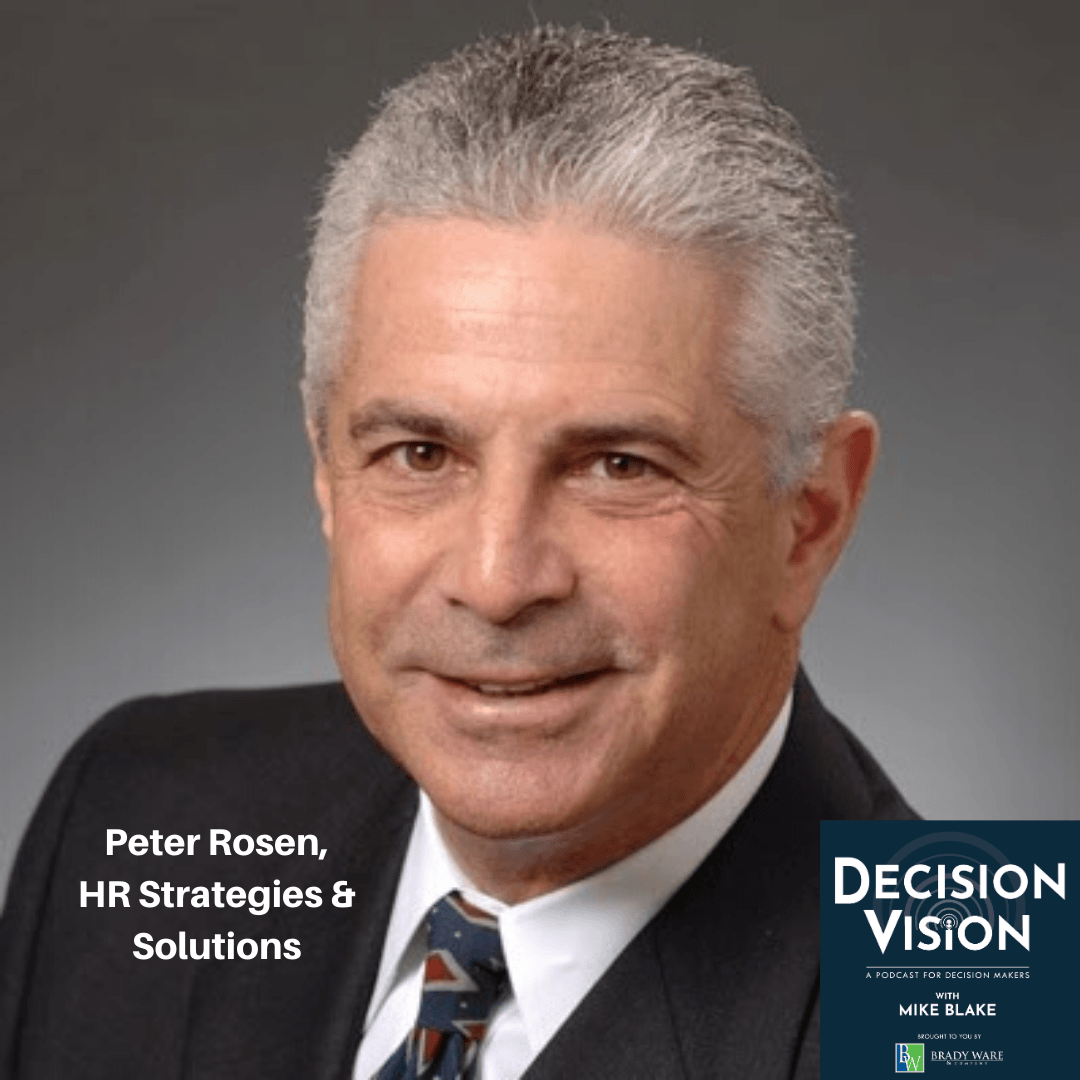
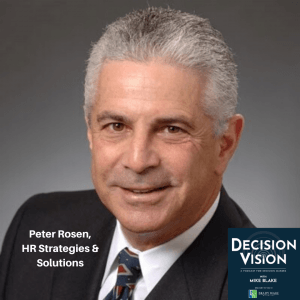
Peter Rosen, HR Strategies & Solutions
fire underperforming employee
Peter Rosen

Peter Rosen is the Founder and President of HR Strategies & Solutions. Known for his ability to quickly build trust and credibility with his clients and colleagues, Peter Rosen, a thoughtful and practical human resources executive and consultant, has a unique capacity to understand and assimilate into a variety of corporate cultures at different stages of the corporate lifecycle. With over 25 years of experience in both domestic and international companies, he is able to tailor his approach to specific HR situations and translate his larger corporate experience into start-up and growing environments. His contagious enthusiasm and optimism make working with him a pleasurable experience. Peter’s easy-going manner and hands-on approach helps him connect with people, understand their needs, and gain buy in for strategies that strengthen both organizations and individuals.

Peter uses a practical, business-focused approach to HR issues based on both theory and experience. He has built human resources capability and the infrastructure to support it in a variety of environments, from start-ups to Fortune 500 companies in the financial services, consumer products, technology, healthcare, and staffing industries. He has held strategic roles in established companies like The Coca-Cola Company, SmithKline Beecham Clinical Laboratories, Norrell Corporation, Alexander and Alexander, Capital One Financial Services and TeamStaff. As the founder and owner of a boutique human resources consulting firm, he now focuses on helping growing companies establish and implement HR infrastructure and works with their senior executives on strategic HR issues.

An expert in strategic planning, employee relations, independent investigations of employee complaints, executive coaching, business development, culture building, and team building, Peter has made significant contributions to companies throughout his career and has enhanced both individual and team effectiveness. He has developed and executed strategic human resources action plans, improved executive teams’ communication and performance, led the successful integration of acquisitions, worked collaboratively with dozens of labor unions, designed and gained acceptance for new departmental organizational structures, created and implemented new benefits programs, and successfully led change initiatives.

Peter’s reputation is one of integrity, trust, innovation, and common sense, backed up by solid experience, a strong educational background, sound business judgment, and self-awareness. He possesses a Bachelor of Science in Industrial and Labor Relations from Cornell University and a J.D. from St. John’s University School of Law with an emphasis on employment law. Peter is a member of the New York and Georgia Bars and is certified in the Marshall Goldsmith Executive Coaching Process, the Prosci Change Management Process and Tools, and the Myers-Briggs Type Indicator.

Michael Blake, Brady Ware & Company

Mike Blake, Host of the “Decision Vision” podcast series

Michael Blake is Host of the “Decision Vision” podcast series and a Director of Brady Ware & Company. Mike specializes in the valuation of intellectual property-driven firms, such as software firms, aerospace firms and professional services firms, most frequently in the capacity as a transaction advisor, helping clients obtain great outcomes from complex transaction opportunities. He is also a specialist in the appraisal of intellectual properties as stand-alone assets, such as software, trade secrets, and patents.

Mike has been a full-time business appraiser for 13 years with public accounting firms, boutique business appraisal firms, and an owner of his own firm. Prior to that, he spent 8 years in venture capital and investment banking, including transactions in the U.S., Israel, Russia, Ukraine, and Belarus.

Brady Ware & Company

Brady Ware & Company is a regional full-service accounting and advisory firm which helps businesses and entrepreneurs make visions a reality. Brady Ware services clients nationally from its offices in Alpharetta, GA; Columbus and Dayton, OH; and Richmond, IN. The firm is growth minded, committed to the regions in which they operate, and most importantly, they make significant investments in their people and service offerings to meet the changing financial needs of those they are privileged to serve. The firm is dedicated to providing results that make a difference for its clients.

Decision Vision Podcast Series

supplier diversity program“Decision Vision” is a podcast covering topics and issues facing small business owners and connecting them with solutions from leading experts. This series is presented by Brady Ware & Company. If you are a decision maker for a small business, we’d love to hear from you. Contact us at decisionvision@bradyware.com and make sure to listen to every Thursday to the “Decision Vision” podcast. Past episodes of “Decision Vision” can be found here. “Decision Vision” is produced and broadcast by the North Fulton studio of Business RadioX®.

Visit Brady Ware & Company on social media:

LinkedIn:  https://www.linkedin.com/company/brady-ware/

Facebook: https://www.facebook.com/bradywareCPAs/

Twitter: https://twitter.com/BradyWare

Instagram: https://www.instagram.com/bradywarecompany/

Show Transcript

Intro: Welcome to Decision Vision, a podcast series focusing on critical business decisions. Brought to you by Brady Ware & Company. Brady Ware is a regional, full-service accounting and advisory firm that helps businesses and entrepreneurs make vision a reality.

Mike Blake: And welcome to Decision Vision, the podcast giving you, the listener, clear vision to make great decisions. In each episode, we discuss the process of decision making on a different topic from the business owner’s or executive’s perspective. We aren’t necessarily telling you what to do, but we can put you in a position to make an informed decision on your own and understand when you might need help along the way.

Mike Blake: My name is Mike Blake and I’m your host for today’s program. I’m a Director at Brady Ware & Company, a full-service accounting firm based in Dayton, Ohio, with offices in Dayton; Columbus, Ohio; Richmond, Indiana; and Alpharetta, Georgia. Brady Ware is sponsoring this podcast, which is being recorded in Atlanta per social distancing protocols. If you like this podcast, please subscribe on your favorite podcast aggregator, and please consider leaving a review of the podcast as well.

Mike Blake: So, today’s topic is, Should I fire my Underperforming Employee? And we’re getting back to a little bit to normal topics. We still do have a couple of COVID-related business topics that are along the way. But every once in a while, it is nice to, at least, sort of pretend that we’re back to normal. And at some point, this whole thing is going to end. We are going to return to work. We are going to reopen restaurants, and cafes, and bars, and hotels. And God help us, so to actually get back on cruise ships as well.

Mike Blake: But we do have businesses to run. And although something like a quarter of the economy, maybe almost a third has an effect and had the pause button put on on it, that still means that two-thirds or three-quarters of the economy is still running in some fashion. And my hope is that most of you that are listening are in that two-thirds to three-quarters that are still functioning. But if you’re not, we certainly wish you a speedy transition to whatever positive outcome awaits you over the horizon.

Mike Blake: And speaking of positive outcomes, today’s topic is, Should I Fire My Underperforming Employee? And why do I say that that’s a positive outcome? Well, we’re going to learn just how important it is to make a decision as to whether or not an employee is going to make it because one of the things you learn as you as you hire and manage people is that certain underperforming employees represent a disproportionate draw of management, time and energy, employee morale, and overall organizational effectiveness.

Mike Blake: And it actually reminds me of a verse from an Elton John song called Empty Garden, which was put out in 1982 as a song about the assassination of John Lennon. And one of the lyrics that song written by Bernie Taupin is “It’s funny how one insect can damage so much grain.” And an underperforming employee can indeed damage a ton of grain. If you have a hundred employees, and one person is just not making it, it’s more than a 1% in overall effectiveness of the organization.

Mike Blake: And this topic is is particularly poignant today because as I sit here recording this, or we sit here recording this on April 10th, we have seen something on the order of 12 million people in the last four weeks declare themselves unemployed. And that’s probably undercounting because the phone lines are jammed up like a talk show host basically, and you can’t get in. So, all of a sudden, the music stopped, and we found out there are a lot fewer chairs than there are people that want to fill them.

Mike Blake: And then, it’s hard to ignore the reality that almost four years ago, we elected a president, whether you love him or not love him, the fact of the matter is his claim to fame in the last 20 years has been the catchphrase, “You’re fired,” right? And I think that has created a lot of mystique around him and really shows just how important it is to fire people, the right people at the right time because I think a lot of the appeal of that catch phrase and the show, The Apprentice, is that everybody has worked with somebody in their career that just is desperately begging to be fired.

Mike Blake: And when they’re not, and when it takes a long time for that person to be fired, if they ever are, I mean, the Peter Principle would say that they’re promoted, but that person can be so toxic to the organization. And people who’ve had to live with, work around accommodates somebody who just is not a constructive part of the team, whether it’s due to personality, temperament, professional competence, or some cocktail of the three, that makes life miserable for people who come to a job every day that they otherwise like.

Mike Blake: And I think it’s that visceral connection with having to put up with somebody who doesn’t belong in the organization, but the people who are running the organization may not necessarily be as be close to that situation. And so, that scenario is allowed to fester. And therefore, when you see that play out on TV, I think there are a lot of people that sort of stand up and cheer. Now, I’ve never actually seen the show. I’m sort of going on on what I’ve heard about it, but I do think there’s something to that mindset and, we’ll see how it goes.

Mike Blake: Joining us today to help us kind of work through this is is Peter Rosen. And I’m so glad we have him on. And now I’ll introduce him formally in a second. But firing an employee is a traumatic experience, right? Even though it’s necessary. I think any cancer patient – and I have not been one, thank God – will tell you that that exercising and removing a tumor, particularly if it’s of any size, is a traumatic experience. It is painful. It can take a long time to recover from that. And even though it is necessary for the ongoing health of the body, it is still a difficult thing to do.

Mike Blake: And it probably should be a difficult thing to do. I don’t think it’s a good idea for businesses or employers to take a cavalier attitude to firing people. That’s not a good idea either because it creates a highly politicized environment in the organization. It leads to mistrust. It leads to management by fear. And management by fear can work for a small amount of time, but it generally does not work well in the long run. And I’m highly suspicious of anybody who claims that they’re very comfortable firing people. It usually means they’ve done that a lot. And if people find they have to fire employees a lot, the problem may not lie with the employees. But we’ll get to that in a second.

Mike Blake: So, joining us today is my friend, Peter Rosen, who is President of HR Strategies and Solutions, a boutique consultancy firm addressing the unmet human resource and organizational needs of companies from startups to large organizations. Human Resources Strategies and Solutions provides human resources, leadership and expertise. They enable growth, improve efficiency, and prevent problems. From human resource strategy development to human resource recruitment, they do it all. Their clients recognize the importance of having a strong culture resulting in an aligned, motivated and engaged workforce. They’re committed from the very top to doing the right thing and to doing doing things right.

Mike Blake: Known for his ability to quickly build trust and credibility with his clients and colleagues, Peter Rosen, a thoughtful and practical human resource executive and consultant, has a unique capacity to understand and assimilate into a variety of corporate cultures at different stages of the corporate lifecycle. With over 25 years of experience in both domestic and international companies, he’s able to tailor his approach to specific HR situations and translate his larger corporate experience into startup and growing environments. His contagious enthusiasm and optimism make working with him a pleasurable experience. Peter’s easygoing manner and hands-on approach helps them connect with people, understand their needs, and gain buy-in for strategies that strengthen both organizations and individuals. But he’s going to bring the goods today. Peter, thanks so much for coming on the program.

Peter Rosen: Oh, you’re very welcome. Thanks for mentioning that. I wasn’t going to miss this for for anything.

Mike Blake: So, before we get started, I noticed something today as I was preparing for the show. You and I have something in common, and that we are both big east guys. You actually hold a Law Degree from St. John’s University, do you not?

Peter Rosen: I do.

Mike Blake: So, you and I harken back to the days of big east basketball actually meant something. I’m a Hoya myself. So, we go back to the days of Chris Mullin and Patrick Ewing battling it out in the Big East. Later, Alonzo Mourning and so forth. But that was a different time. So, do you find that your law degree comes into play at all anymore with what you do in human resources?

Peter Rosen: Yes, absolutely. It was interesting because when my career got started, I was actually a trial attorney down here with the federal government, with the Equal Employment Opportunity Commission.

Mike Blake: Oh.

Peter Rosen: And I was a litigator. In a sense, litigating charges of discrimination brought by employees of companies like Georgia Power Company, a lot of the big organizations back at the time. And unbeknownst to me, there was another large corporation here called the Coca-Cola Company who was beginning to experience some of the strains of discrimination, affirmative action, and they were looking to start, at at the time, it was called an EO department. And somebody reached out to me, and I interviewed, and I got hired in the position, ended up being in the HR department, not the legal department. So, over the years, I have always kept up my legal knowledge. And I was a member – I’m, now, I’m inactive member of the bar because I get a lot of referrals from employment lawyers. And so, I don’t compete with them whatsoever. But I think my last five years at Coca-Cola, I was the head of HR for Europe and Africa. So, that’s how I got into the human resource piece of things.

Mike Blake: Well, I’ll say I did not know that. So, I’m glad you brought some color to that. So, you’re a bigger expert than I thought. So, again, thanks for coming on the program. The first question, I want establish kind of a foundation here for the rest of our conversation. And so, let’s start off with this. Why do companies find or managers find that they have to fire people?

Peter Rosen: You have about two hours for me to list the reasons why companies could decide to fire somebody.

Mike Blake: I’ve got the time if you do. It’s not like there’s a restaurant we can go get lunch at.

Peter Rosen: That’s why I have my coffee right here next to me. It could be anything from performance, a bad hire. The company made a mistake in hiring. It could be the person is a total jerk, which, by the way, is very often, the reason why companies would fire somebody. They could be toxic. They could be a bully. They are violating company policy. They could be sexually harassing. So, there are just so many reasons why a company would want to or choose to fire somebody.

Mike Blake: And the common thread among all those things is that they pose an effective, clear and present danger to the ongoing viability of the companies. Is that a fair way to wrap that up?

Peter Rosen: Yes. And the smaller the company, the bigger the impact. With larger companies, a lot of these toxic employees or poor performers may be in a particular department, the accounting department, marketing department. So, that’s the group that typically would be impacted, but it’s not the whole corporation.

Mike Blake: So, most the people that I interface with, work with, worked for, to a person, thankfully, I think they find it very difficult to fire people. We’ll come back to why that isn’t necessarily the best thing in the world. But does anybody find firing easy?

Peter Rosen: I would hope not, first of all. I would hope nobody finds firing-

Mike Blake: I am going to guess it’s the odd psychopath out there that just sort of just likes firing people, I guess. But I think people approach firing from a place of a lot of consternation, right?

Peter Rosen: A very insecure boss or ego-driven person, actually, would probably enjoy it. but it’s their only way to avoid conflict or avoid challenge because they’re insecure. That’s when they may like doing it.

Mike Blake: So, for those of us who are maybe – I don’t want to say those of us. It gets misinterpreted. What are the dangers or risks of firing somebody? I want to ask this sort of a two-dimensional perspective. One is, what do most people think the dangers and risk of firing someone is or are? And then, what are they in actuality?  Are the risks and dynamics of firing somebody, in actuality, do they meet up with kind of the anxiety that somebody feels before they’re going to pull the trigger on that?

Peter Rosen: It really depends on how the firing occurs. And there are risks to firing somebody. There are probably greater risks to not firing somebody if, in fact, it’s appropriate. And we can get into it later, the different ways you can accommodate somebody that you want to fire. But given our legal environment and the risks of that, there are ways to address it to minimize but not eliminate the risks.

Mike Blake: So, there’s a widely used expression of hiring slowly and firing quickly. I think I heard it coined out in Silicon Valley, but that may not necessarily be the origin. But can you describe kind of what that means? I’m sure you’re familiar with the expression. And do you agree with that philosophy?

Peter Rosen: I am familiar with the expression. I generally do agree with it. The most important thing is the hiring process. And I work with a lot of my clients on developing a more robust hiring process to really better assess candidates, to really understand what you are looking for for a person to bring to the organization. And we don’t slow it down, but we make it very robust. And I’m actually involved in the final interviews with a lot of my clients. And I also make it very clear that the CEOs and business owners agree that the hiring manager is the one that’s actually responsible for the decision to hire. What the process is doing is giving them more information and more data on which to make their decision. And they’re not doing it based on they just like the person or they’re referred by somebody. So, it’s a very thorough process.

Peter Rosen: So, that’s where the term comes, “Hire slow, fire quick.” Now, fire quick seems a little – I’m not sure I agree with that terminology, but I have been a student of terminations and firings pretty much my whole career. And there are studies out there too where when any time there’s a big change in an organization, or you ask a business owner or a CEO, “Okay, you’ve had a great career. What would you have done differently in your career? What would be one of the biggest mistakes or things you would have done differently?” And inevitably, it’s, “I should have gotten rid of certain people a lot quicker.”

Mike Blake: Now, interesting. On the hiring practice, I thoroughly agree with that practice. Even when I bring in somebody that is as junior, very junior in our organization, I still do like to have them meet a lot of people. And so, my colleagues do look at me like I’m an escaped mental patient when I’m using partner time to have them interview and spend a day for what is in effect an entry level position. But I agree with your observation. Just having different perspectives, different information, lots of information, I think makes the likelihood of a successful hire so much greater.

Mike Blake: And you also you also learn something about an applicant to when you take a slow hiring process, I think. And maybe this will be a different topic in a program, but I think you learn a little bit about how committed the employee is to pursuing the process, your learn about their patience, you learn about their mental toughness and their mental stamina, you learn about their emotional stability. And I think you correctly point it out, it’s not about hiring slowly but it’s about hiring thoroughly. But hiring thoroughly necessitates slowing things down just a little bit, I guess.

Peter Rosen: Yes. And again, it becomes very logistical. You can move fairly quickly because I have found, again, for the hiring manager, the debriefing sessions because, also, I am a big advocate of what I call group interviews – more than two, or three, or four people from the company interviewing the candidate at the same time. [1], that’s more efficient. [2], it avoids a candidate going from person to person being asked the same questions by people that are not really very good at interviewing. And that could turn off a good candidate to the company.

Peter Rosen: The other thing too is that there’s an exercise we can get in to later that I work with my business owners and executives. It’s called the ABC Exercise. But let’s just, for now, an A player is your top player, he person that represents the culture, they’re performing, everybody loves working with them. The only people you want in interviews are your A players because the B and C players are going to end up being threatened by good – and it comes across. It’s amazing how it comes across in an interview where they start challenging the person, and it becomes very uncomfortable. So, setting up the hiring process is the key to reducing the need to fire people.

Mike Blake: So, I think in most cases, and we’ll talk about the other scenario in a second, but in most cases, the decision to fire, usually, comes. And, again, we’re talking about firing somebody for underperformance, not because of economic necessity that just creates a mass layoff scenario but for performance. Most companies do try to give an employee an opportunity to make corrections before firing them. Part of that, I think, is a legal consideration. Part of that, I think, is a good business practice. In your experience, how much time or, for lack of a better term, how much rope should you give an employee to make those corrections before you decide, “Well, this just isn’t going to work out. We got to make a change here”?

Peter Rosen: It really depends on the performance issue. Let’s use an example of somebody that is just has a history of getting things, projects, or whatever part of a project they’re working on late. They’re late in getting things done. They don’t meet deadlines. That is worth confronting directly saying, “From now on, if you’re not going to meet a deadline, you need to let us know,” because they hadn’t been letting them know, and you’re basically on final warning ’cause we can’t afford. It’s not fair to anybody else. You give them the chance. You give them whatever meager, 30 days. And the first time during that 30 days, if they’re late, you say, “Listen, we already warned you. It’s time to move on.”

Mike Blake: So, that brings to mind, the depends, I think, brings to mind different scenarios. One scenario, it seems like, is there’s an issue of performance in terms of how you go about your business. That’s sort of behavioral, right, whether it’s time management, whether it’s communication, as you point out here. And then, there can be underlying issues where maybe the person has good “work habits,” but maybe they don’t have quite the skill set that you thought they did when you interviewed them and they walked through the door, right? Maybe there’s a flaw in interviewing, or bad job description, or something happened, right? And maybe the issue is … or maybe it is a behavioral issue but training is required. Does that timeline get altered perhaps if it’s an issue that you think might be remediated with training versus, “Hey, this is not going well. Fix it”?

Peter Rosen: If it is a particular process or skill set that training could lend itself to, as long as the person has a good attitude, it’s worth trying it. But if the company made a mistake in hiring the person, they thought the … and this happens a lot in smaller companies. They thought they were really looking for this when, in fact, they really needed that. And if they made a mistake, what you do is you sit down with the employees and, “Listen, this is not working out. We want to be fair to you. We’ll give you 30 days of severance to help you look for another role, but we do need to part ways.”

Mike Blake: So, let’s go back to the first issue where there’s a fundamental issue. It’s not necessarily a hiring mistake, but it’s something that is fundamental to the way the employee approaches their job. And if you’ve done things right, you’ve issued some kind of warning. There’s been some kind of review process that makes it known to the employee that there’s, I guess, for lack of a better term, an effect on notice. I’m curious, in that scenario, how often is it that employees actually then take that and are able to make the meaningful corrections that stick versus once you get to that point, do a lot or most employees really kind of never make it? Does that question make any sense?

Peter Rosen: Yeah. Well, I think statistically, and I will not swear to this, but statistically, for my experience, I would say more employees don’t make it than make it. And again, I work with-

Mike Blake: That’s my belief too.

Peter Rosen: And I think, probably, if there’s data out there, and there probably is, it’s going to support that. With performance reviews, and I work with a lot of my companies too, and there are a lot of good performance reviews systems out there or HR systems that have performance reviews built into them. And one in particular, which I really like, but it includes quarterly peer feedback, and it is so eye opening to hear the peers talk about it. You sit down, you’d be subtle and be discreet. You can say, “Hey, Bob said this about you,” but it gives the manager, “Hey, wait a second. This person has really not been working well with the graphics department,” or this and that. And then, you have to deal with that. And if it’s not addressed, then, again, I think most times, it’s not. I mean, it’s addressed but not corrected, then you have the documentation and the reason to make the move.

Mike Blake: And I want to touch upon something that you mentioned because I think this is very important. When it becomes necessary to fire an employee, and if he can’t look back and do a postmortem, if you will, or after-action analysis, how often is it that the employee may well have been fine, but the employer just simply made the wrong hire? Maybe they made a poor evaluation, they didn’t ask the right interview questions, or maybe they just tried to take shortcuts. Talking again about hiring too quickly. Maybe they didn’t do the diligence, such as checking references. How often is it the company’s fault that they’ve got a square peg in the round hole?

Peter Rosen: I would say it happens frequently.

Mike Blake: And do you agree that that happens frequently because … is it because … I mean, a few reasons. And sometimes, I see this, there’s a danger of, even in my own firm. I’m not going to tell you that it’s actually true, but I know there’s a danger here.  Does it happen because when you feel like you’re understaffed that people think about just sort of the warm body, and we’ll figure it out, or do employers have underdeveloped talent acquisition  skills or some other systemic issue within the firm that leads to these outcomes?

Peter Rosen: I would say that there is a lacking of recognizing the importance of doing it right. I mean, a lot of the type, especially in professional service firms like you, like your firm, there are a lot of people, a lot of consultants, and I worked for Capital One for a number of years, and they were made up of all these McKinsey and Boston Consulting Group people that got paid to be right. And when the hiring decision, when somebody in a professional services firm, they just trust their own judgment rightfully or wrongfully. “I’m right. I made my assessment,” and that value, the input that they would get from so many other sources. They just want to get it done. And then, when it’s on the back end, that’s when the problems occur. And another benefit of having a little more robust hiring process is you give the candidate more time to really see the culture in the organization. So, they ultimately can make a better decision for themselves.

Mike Blake: I think there’s a lot too. I think there’s there’s a lot to that self-selection. I think it comes in two places. One, if you’d like a candidate to kind of withdraw if they see that there is not a good fit in advance. And I also think, going back to the negative review,  I would like an employee, particularly if the employee thinks are doing a good job, right, and then you tell them that they’re not, I would like to see an employee then kind of put their resumé out on the street at that point because it’s one thing. And the people who can’t be self-aware and you say, “Hey, look. You’re not doing things one, two and three. You need to fix them.” And there are people that will deny and say, “No, I’m doing a great job.” No, you’re out of order. But on the other hand, there are people that say, “I think I’m okay. But this, really, is a warning shot. And maybe I’m just going to make everybody’s job easier and find a better fit for myself.” Do you think there’s something to that?

Peter Rosen: Yes, it happens very often. And I have a couple of clients, those owners or the CEO will work with somebody and say, “Listen, you’re a good person. This is just not working out,” they’ll start looking for a job. Maybe we’ll limit their function a little bit because we don’t want them to continue where they’re not performing and do the right thing. And especially when other employees in that organization really know that this person has been trying hard, they’re a decent person because every time you fire or don’t fire a person, there are a lot of repercussions within the organization.

Mike Blake: Yeah. And in our industry in accounting, we have a term called counseling out. For the most part, we try to avoid the Dr. Evil scenario where you push a button and the person just adheres through a trapdoor on the floor, and there’s fire that sort of burns them on the way out, but we try to have that conversation and say, “Look, for whatever reason, it’s not working out, but let’s do this discreetly and give you some time to find something new,” ’cause it’s easier to find a job when when you already have one. And it doesn’t mean the person’s a bad person.

Mike Blake: In our industry, public accounting is hard. And public accounting, particularly for a busy season, the mental and physical rigors of 55 plus billable hours from January 1st to April 15th, that is not for everyone. And for some reason, entry level, you may think you’re ready for it, but you don’t know if you’re ready for it until it actually happens. And for other people, maybe you’re ready for it when you’re aged 23. But then, you’re aged 27, you’re married, and you have a kid, life changes, right? And maybe you have decided that accounting is not going to be your thing. You don’t want to take part. It doesn’t make you a bad person. It doesn’t make you incompetent. It just means that a mismatch has developed from the demands of the job versus what you’re able and willing to provide to it. And so, I think that model of counseling people out, I think, is one that works well for us.

Peter Rosen: There is so many different ways to have a person leave. And that’s why it becomes so situational and so dependent on the organization, the culture, the person. And you remember, I know you remember Jack Welch.

Mike Blake: Yeah.

Peter Rosen: And Jack Welch had this matrix. Yeah, I think it was called the Culture Performance Matrix. And like if you have an employee that was performing really well, and they were really a great guy that they lived the culture, that’s a no-brainer, that person, you need to figure out a way to keep them. Then, you have, on the other hand, the person that’s totally underperforming and they’re a jerk, that also becomes very simply, you get rid of them. The questions, the difficulty becomes the person that is – and this happens very often in sales, they’re a rainmaker, performing like gangbusters, but they are abusive, they’re toxic, they have high turnover. I mean, I don’t find it that difficult, by the way, to make that decision, but a lot of business owners who’s dependent on the revenue would have some difficulty making that decision. And then, there is the person that is really, again, lives the culture, accepts the values, everybody loves working with them, but they’re just in the wrong job. That’s the person you give another shot to to try to find another role for them.

Mike Blake: Yeah, essentially, you’re bringing up the sales role because it’s so hard to walk away from revenue, right? The key worry, I think, in every business leader’s mind is, “Am I going to be generating enough revenue?” The thing that I wake up every morning worried about is, do I have enough projects to keep my people busy, and engaged, and to generate ROI of our department? The thing worry about when I wake up in the morning, the thing I worry about before I go to sleep at night. And in addition, because it’s so hard to hire a competent salesperson, I do think that employees probably wind up giving salespeople a lot more leeway than, perhaps, they should because of the perceived scarcity of that skill set of someone who can actually sell and wants to do it.

Mike Blake: But that other part of the matrix brings a question up that I want to ask anyway. So, it’s a great segue, which is what about the employee that isn’t an obvious fire, right? That’s in the lower-left hand quadrant, but it seems like a worthwhile person has sort of the right attitude, is smart, are there realistic alternatives to firing that person? Maybe it’s finding him a new job. Maybe it’s additional training. Maybe it’s something else, right? Are there other alternatives that can be looked at, so that you can salvage that asset?

Peter Rosen: The answer is yes and no. On my website in one of my articles, and I didn’t write the article, but I’ve contributed towards it, it was called the Transfer Trap. And back in the old day, and I think it’s still occurring now, if somebody was an issue, they just moved him to a different department and let that other department deal with it. That’s usually in larger corporations. That’s the transfer trap. And that person, because they didn’t want to fire him because they were uncomfortable, conflict-avoidant, or fearful of legal risks, whatever the reason may be, all you’re doing is taking a toxic particle and exposing it to more parts of the organization.

Mike Blake: Yeah. So, just shifting a problem from one person to another, basically. And maybe because you don’t have the guts to pull the trigger yourself.

Peter Rosen: And back in the day, and I hope it’s not done as much anymore, but the receptacle for problem employees was HR.

Mike Blake: Yeah.

Peter Rosen: And if you remember, during the FBI issue, I don’t know, three years ago, it was struck or something, one of them was taken out of his role and was assigned to the human resources department.

Mike Blake: Really?

Peter Rosen: Yes. So, I guess it still occurs.

Mike Blake: Interesting. So, one of the things that I think most business owners and executives are familiar with, at least, is the need for some kind of documentation prior to firing an employee, right? Because there is some legal exposure that we have to be aware of. You’ve been on the prosecuting end of some of that as I just learned at the start of this interview. How much documentation do you need to protect yourself prior to firing an employee?

Peter Rosen: The most documentation that you need is consistent for every employee that gets terminated. The amount of documentation also decreases the higher up you are in the organization. If somebody is performing more day-to-day tasks that can be measured, then you need to document not getting things in on time and things like that. But as long as you end up letting the person know, and you’re consistent in how you apply it through all your organizations with all your people, you should be fine. That doesn’t mean you’re not going to get a charge or a lawsuit against you, but the point is you’re just doing it the right way. And the higher you are, usually, it’s a personality issue, it’s a bullying issue, it’s communications issue, it’s more interpersonal the higher you go, typically.

Mike Blake: So, now, in an ideal world, you want to kind of have some sort of documentation that presumably describe … again, you’re talking about having a consistent firing process. I imagine, also, there’s some documentation to document that you have communicated concerns about performance prior to firing somebody, right?

Peter Rosen: Yes.

Mike Blake: And it’s important to point out that a lawsuit is always … I think a lawsuit is always a risk, right? Because at the end of the day, all you need to levy a lawsuit is a lawyer and a judge is willing to take the case. And if you get those two things, it can be a lawsuit regardless of the merits of the case. It’s rare to get them dismissed. But what if you don’t have the documentation? And that may arise for a number of reasons, and I want to get to one in a minute, but maybe you’re just a small organization or maybe you just, frankly, are not that great at HR, or you’ve expanded very rapidly and, again, you just don’t have the documentation, does that mean that the problem employee gets a free pass because you don’t have the documentation to back it up, or you have to wait until documentation can catch up? And if you’re in that position, what is that decision process look like now?

Peter Rosen: Okay. Well, since the company put themselves in that position, you have to adapt. And one way to adapt is saying, “Okay, do I want a lawsuit or an EEOC charge, whatever it may be – age, race, sex, whatever it may be, or do I want to pay some severance pay and offering this person knowing that, ‘Hey, I screwed up as a company, therefore it’s going to cost me, but it’s going to cost me a lot less than if I have to deal with a lawsuit?'” So, you just have to pay for it in a different way.

Mike Blake: So, I want to ask a question about a so-called zero tolerance policy. And I think we’ve heard that term a lot in the in the Me Too Movement, but you hear that you hear the term pop up a lot elsewhere. And the question I want to ask is this is, is a zero tolerance policy truly sustainable or more than anything, is that just sort of a buzzword that, in reality, gets nuanced somewhat?

Peter Rosen: Probably. Now, there is a niche of my business that I had not mentioned, which is I do a third-party, independent investigations of employee complaints.

Mike Blake: Oh.

Peter Rosen: Because of my background and whatever, I’m brought either by the employment lawyer themselves or by the company. So, as you mentioned, zero tolerance. If there is an allegation, zero tolerance can go as far as an allegation of can you get rid of them. But that, to me, is a horrible culture of the organization. What you do is you take an allegation seriously. You have it investigated either internally or through somebody like me. And then, I would end up making a recommendation, a third-party recommendation, because very often you’re going to find out that this was an isolated incident or there’s a pattern of it. So, you’re really not dealing with zero tolerance. Actually, the investigation is enabling you to dig deeper into the pattern or lack of pattern. So, I don’t agree. I don’t support in any way zero tolerance. But if somebody is found to have done something egregious after you’ve investigated it, then I would definitely support termination.

Mike Blake: Peter, so, what you’re talking about is interesting because I hadn’t I really thought about it this way, but I think it makes sense. When companies use the term zero tolerance policy, what they really mean is presumption of guilt on the part of the person that’s accused. And that’s not the same thing necessarily. I mean, I guess it is a zero tolerance policy but it’s a hyper zero tolerance policy as opposed to a much more more constructive application of zero tolerance policy in which there’s an actual fact-finding process and trying to ascertain whether or not there actually is merit to the accusations rather than just simply assuming they’re true and firing somebody, creating exposure that you don’t necessarily need to do.

Peter Rosen: It’s a company that is committed to taking employee complaints or allegations very seriously, but yet, at the same time, will bring in an independent investigator to dig deeper and provide the company with the facts that they need to know the weather on how they’re going to respond.

Mike Blake: So, we’re going to wrap up here. We’re running out of time. I want to be respectful. I know you have a lot of other things you got to do today. But a question I want to make sure that I sneak in here is, should you fire an employee for one mistake? We’ve seen the TV shows, somebody makes one mess up, and they wind up getting let go. Does that happen? Is there a case for that to happen in the real world? Or is that just something that makes good TV theater?

Peter Rosen: It’s like anything else, it depends. But generally, my answer would be we all make mistakes. Now, if somebody makes a mistake, and it’s an obvious mistake, and they don’t have the emotional intelligence, or the self-awareness to accept the fact that they made a mistake and learned from it, that’s a whole other issue. So, I would generally say no, firing for one mistake. Again, it’s an outburst where somebody punches somebody in the workplace, that is probably a determination for one mistake is appropriate.

Mike Blake: Yeah. So, as we have this interview on on April 10th, 2020, we’re in an unprecedented economy and unprecedented labor market, and one that there’s a lot of imbalance. As I mentioned at the outset, we have a lot of people that suddenly found themselves jobless through no fault of their own or even their businesses. And on the other hand, if you’re in the right industry, you cannot hire people fast enough and there’s a perception that maybe you do need just sort of warm bodies. In that kind of environment, does that change the firing dynamics in any way? Does an underperforming employee perversely have unusual leverage because you just sort of have to have a pair of hands doing things? So, what’s your view on that?

Peter Rosen: I would be consistent to the culture that you’ve been wanting to have in your organization. And again, it varies. The answer to that question really varies on the level of the employee. Now, if you were talking about a customer service rep that is maybe not as fast or as efficient as you would like because it’s so difficult to find people, then maybe you put up with it for a while. But if you have a manager of a call center or a manager of customer service reps that is not a very good manager and causing turnover, I would still you act and you address that situation.

Mike Blake: Peter, it has been a great conversation. I think our listeners are going to get a lot out of it. Everybody wrestles with this problem from from time to time. The only people who doesn’t is somebody who’s never managed, or fired or hired somebody. If somebody was to learn more about this topic, maybe get some advice from you, how can they contact you?

Peter Rosen: Well, there are two ways. The two best ways would be my email address, which is peter.rosen@hrsas.com. And my website is hrsas.com.

Mike Blake: So, that’s going to wrap it up for today’s program. I like to thank Peter Rosen of HR Strategies and Resources so much for joining us and sharing his expertise with us. We’ll be exploring a new topic each week. So, please tune in, so that when you’re making your next executive decision, you have clear vision when making it. If you enjoy this podcast, please consider leaving a review with your favorite podcast aggregator. It helps people find us, so that we can help them. Once again, this is Mike Blake. Our sponsor is Brady Ware & Company. And this has been the Decision Vision Podcast.
Tagged With: Brady Ware, Brady Ware & Company, firing, firing employees, HR, HR Strategies & Solutions, hr strategy, Human Resources, Michael Blake, Mike Blake, Peter Rosen, terminating an employee

Decision Vision Episode 65: Should I Have a Supplier Diversity Program? – An Interview with Stacey Key, Georgia Minority Supplier Development Council

May 14, 2020 by John Ray

supplier diversity program
Decision Vision
Decision Vision Episode 65: Should I Have a Supplier Diversity Program? - An Interview with Stacey Key, Georgia Minority Supplier Development Council
Loading
00:00 /
RSS Feed
Share
Link
Embed

Download file

Stacey Key, CEO, Georgia Minority Supplier Development Council

Decision Vision Episode 65:  Should I Have a Supplier Diversity Program? – An Interview with Stacey Key, Georgia Minority Supplier Development Council

Should my company develop or formalize a supplier diversity program? How does a supplier diversity program build my own company’s value? The answer to these questions and more are answered by Stacey Key of the Georgia Minority Supplier Development Council in a conversation with host Mike Blake. “Decision Vision” is presented by Brady Ware & Company. (This episode was recorded March 13, 2020)

Stacey Key, Georgia Minority Supplier Development Council

supplier diversity program
Stacey Key, CEO, Georgia Minority Supplier Development Council

Stacey Key is the President and Chief Executive Officer of the Georgia Minority Supplier Development Council (GMSDC), the leading authority on supplier diversity and minority business development in the state of Georgia. Key has more than 20 years of corporate experience in sales, marketing, operations and customer service at global brands like IBM, AT&T, Schlumberger and Samsung Telecommunications.

Prior to joining the GMSDC, Stacey was responsible for leading nationwide marketing efforts at Samsung Telecommunications as its Marketing Director. She also served as Vice President – Public Sector for Schlumberger, the world’s leading supplier of products and services to the oil and gas industry. She is an accomplished entrepreneur, with more than 15 years of experience at the helm of a successful family business.

Stacey has been recognized as a leader throughout the state for her career accomplishments and community service. Some of her awards and honors include: the 100 Influential Women to Know by Engineering Georgia, Who’s Who of Black Atlanta, the Business Advocacy Award from MARTA, the Atlanta Business League’s 100 Top Women of Influence, Diversity Plus Magazine’s Top 25 Women in Power Impacting Diversity, the Black & Latino Council’s Global Commerce Award, and the DeKalb Chamber of Commerce Apex Small Business Champion Award.

Key earned a Bachelor of Science degree in Business Administration and Computer Science from Western Kentucky University, and an MBA from Kennesaw State University. She holds a certificate in Mergers and Acquisitions from Kennesaw State University and is a graduate of the Leadership Atlanta Class of 2014. Key is actively involved in the community and serves on numerous boards of directors, including the Georgia Department of Transportation, Georgia Chamber of Commerce, the Midtown Alliance and the Renew Atlanta Infrastructure Bond Advisory Committee. She is the proud mother of one daughter who is a college student.

You can learn more about the work of the GMSDC on their website, and you can also find them on Twitter and Facebook. To get in touch directly, call them at 404-589-4929.

Michael Blake, Brady Ware & Company

Mike Blake, Host of the “Decision Vision” podcast series

Michael Blake is Host of the “Decision Vision” podcast series and a Director of Brady Ware & Company. Mike specializes in the valuation of intellectual property-driven firms, such as software firms, aerospace firms and professional services firms, most frequently in the capacity as a transaction advisor, helping clients obtain great outcomes from complex transaction opportunities. He is also a specialist in the appraisal of intellectual properties as stand-alone assets, such as software, trade secrets, and patents.

Mike has been a full-time business appraiser for 13 years with public accounting firms, boutique business appraisal firms, and an owner of his own firm. Prior to that, he spent 8 years in venture capital and investment banking, including transactions in the U.S., Israel, Russia, Ukraine, and Belarus.

Brady Ware & Company

Brady Ware & Company is a regional full-service accounting and advisory firm which helps businesses and entrepreneurs make visions a reality. Brady Ware services clients nationally from its offices in Alpharetta, GA; Columbus and Dayton, OH; and Richmond, IN. The firm is growth minded, committed to the regions in which they operate, and most importantly, they make significant investments in their people and service offerings to meet the changing financial needs of those they are privileged to serve. The firm is dedicated to providing results that make a difference for its clients.

Decision Vision Podcast Series

supplier diversity program“Decision Vision” is a podcast covering topics and issues facing small business owners and connecting them with solutions from leading experts. This series is presented by Brady Ware & Company. If you are a decision maker for a small business, we’d love to hear from you. Contact us at decisionvision@bradyware.com and make sure to listen to every Thursday to the “Decision Vision” podcast. Past episodes of “Decision Vision” can be found here. “Decision Vision” is produced and broadcast by the North Fulton studio of Business RadioX®.

Visit Brady Ware & Company on social media:

LinkedIn:  https://www.linkedin.com/company/brady-ware/

Facebook: https://www.facebook.com/bradywareCPAs/

Twitter: https://twitter.com/BradyWare

Instagram: https://www.instagram.com/bradywarecompany/

Show Transcript

Intro: [00:00:02] Welcome to Decision Vision, a podcast series focusing on critical business decisions. Brought to you by Brady Ware & Company. Brady Ware is a regional full-service accounting and advisory that helps businesses and entrepreneurs make vision a reality.

Mike Blake: [00:00:20] And welcome to Decision Vision, a podcast giving you, the listener, clear vision to make great decisions. In each episode, we discuss the process of decision making on a different topic from the business owner’s or executive’s perspective. We aren’t necessarily telling you what to do, but we can put you in a position to make an informed decision on your own and understand when you might need help along the way.

Mike Blake: [00:00:39] My name is Mike Blake, and I’m your host for today’s program. I’m a Director at Brady Ware & Company, a full-service accounting firm based in Dayton, Ohio, with offices in Dayton; Columbus, Ohio; Richmond, Indiana; and Alpharetta, Georgia, which is where we’re recording today. And as of March 13th, when we were recording this, we are not yet under quarantine. Brady Ware is sponsoring this podcast. The beauty of being a podcast. I guess you probably could do it under quarantine. If you like this podcast, please subscribe on your favorite podcast aggregator. And please consider leaving a review of the podcast as well.

Mike Blake: [00:01:12] So, today, we’re going to talk about implementing a supplier diversity program. And I think most people who are listening to this podcast have heard that term before but may not know exactly what it is. I think they don’t know exactly what the benefits are in providing one, and then how you actually go about doing it. It is not necessarily as simple as saying, “Hey, I want to give people of color a chance to supply stuff for my business.” And I think it’s a little more complicated than that.

Mike Blake: [00:01:45] And also, in order to make it a sustainable exercise, it needs to go beyond a purely socially motivated activity. At least, I think that’s the case. We will find out. I am not an expert on this. And as we do on our program, I invited somebody who is an expert on this. And joining us today is Stacey Key, who is President and CEO of the Georgia Minority Supplier Development Council. Stacey has more than 20 years of corporate experience in sales, marketing, operations and customer services at global brands like IBM, AT&T, Schlump Berger, and Samsung Telecommunications.

Mike Blake: [00:02:20] Her educational accomplishments include a Bachelor’s Degree in Computer Science and Business Administration from Western Kentucky University, her MBA from Kennesaw State University and the Regional Leadership Institute in 2018. Stacey sits on the boards of the Georgia Chamber of Commerce and the Midtown Alliance, and as a graduate of the Leadership Atlanta Class of 2014, the best class ever, where she is my classmate.

Mike Blake: [00:02:47] In 2018 and ’19, Stacey was named to the list of 100 Influential Women to Know by Engineering Georgia Magazine, was named to the Atlanta Business League’s 100 Top Women of Influence, and received the DeKalb Chamber of Commerce as APICS’ Small Business Champion Award. She has many more awards. Her trophy case looks like Michael Jordan’s. But we don’t have time to go through all that because we have a topic to discuss. Stacey, thank you so much for coming on the program.

Stacey Key: [00:03:12] Michael, thank you so much for having me. Wow. Listening to myself. I don’t really know that person.

Mike Blake: [00:03:20] So, you’re head of the Georgia Minority Supplier Development Council.

Stacey Key: [00:03:26] GMSDC, it’s actually called.

Mike Blake: [00:03:26] Okay, GMSDC. And it’s Georgia’s leading small business development supplier diversity organization. it’s been around a long time, hasn’t it?

Stacey Key: [00:03:35] Actually, thank you for that lead-in. We’re celebrating 45 years this year. And it’s been a journey, I will tell you. And a little bit about it, if I have the liberty, a little bit about our history.

Mike Blake: [00:03:45] Please, please.

Stacey Key: [00:03:45] … and our pedigree, 45 years ago, if you can imagine, corporation, the Coca-Cola Company and some other major corporations, WesTrac, which was then MeadWestvaco, Cox was involved, Delta involved, AT&T, Southern Company, Georgia Power, these companies came together and decided that they wanted to open up their supply chain and be more inclusive. And so, they led the charge to form this non-profit organization to help them in doing that. Again, there were other major corporations at the table at the time, but they saw the long-term vision and value and, actually, return on investment to their shareholders of expanding their supply chain to include others that can bring innovative solutions and products to the table.

Mike Blake: [00:04:35] And you have quite a bit of corporations that are engaged with you right now, isn’t it? What’s the number?

Stacey Key: [00:04:41] We have over 400 corporations. And all the ones you know and love here, of course.

Mike Blake: [00:04:45] Yeah.

Stacey Key: [00:04:45] You’re a Southern Company, Georgia Power, UPS, the Coca-Cola Company, Home Depot, Cox obviously, Delta Airlines, everybody, NCR, AT&T. All those you know and love are engaged, and involved, and have a commitment, again, to drive shareholder value by opening up that supply chain to include others.

Mike Blake: [00:05:08] And roughly how many minority business suppliers are there that are kind of under your tender caring stewardship?

Stacey Key: [00:05:15] I love that tender caring stewardship. We have over 700 minority businesses throughout the great State of Georgia that are involved and certified through us. And let me take a minute to tell you a little bit more about GMSDC. And so, corporations formed us. And so, are our customer is primarily corporate America. The minority businesses are the constituents that we serve on behalf of corporate America. And so, the process is that we certify minority businesses. We certify that you are who you are, a minority business, that you own, manage and control 51% of that business. And we’ve heard some of those horror stories of companies that are not quite that, but I’m in the business of making sure that the suppliers I bring to the table for the Coca Cola’s, and the UPSs, and the Coxes that they are who they say they are, and I’m in the business of protecting them and their supply chain.

Mike Blake: [00:06:10] So, let’s go ahead and jump in to that then because I think that’s that’s very important. There’s, obviously, an incentive to become identified as a diversity supplier. Is that the right term of ours, diversity supplier?

Stacey Key: [00:06:24] Diverse supplier. And that includes, it could be women. That can be minority-owned. It could be veterans or not diverse, but veterans are part of that. LGBTQ a part of that.

Mike Blake: [00:06:35] Oh, they are.

Stacey Key: [00:06:36] They are part of that.

Mike Blake: [00:06:36] Okay, I did not know that. Okay.

Stacey Key: [00:06:37] Yeah. And there are organizations that certify the women, LGBTQ, those other organizations that are there, and they’re part of the family that they certify those other groups.

Mike Blake: [00:06:47] And is that a certification a definition that is determined at the state level or the federal level?

Stacey Key: [00:06:52] Neither.

Mike Blake: [00:06:53] Okay.

Stacey Key: [00:06:53] GMSDC is a private sector certification.

Mike Blake: [00:06:57] Oh, okay.

Stacey Key: [00:06:58] So, corporations look to that. If you’re doing business with the State of Georgia, they use a certification that is done by either GDOT or MARTA. I sit on the GDDOT board and, actually, head of the Equal Access Committee in the State of Georgia. If you’re going to do business with the City of Atlanta, they have their own, but they all are asking for the same thing. They call them different things. DBEs, if you’re looking to do business on a federal level, it’s got Disadvantaged Business Enterprise. That’s not based on ethnicity. That’s based on size and income of the business.

Mike Blake: [00:07:33] So, definitely a lot of ground kind of being covered here. I’m going to take a little bit of a different tack than I originally thought because our conversation is taking a different tack and it’s fine. Some of my listeners, some of our listeners may be thinking about becoming identified and certified as a supplier  in this regard. And I know I have clients that, perhaps, would be eligible, and they decide not to for whatever reason. I think some of them say, “Well, I don’t need an advantage.” Others say, “I don’t want the government involved.” And, now, they just learned this is not a government exercise. It’s actually a private exercise.

Stacey Key: [00:08:09] There is no government involved. It’s private enterprise.

Mike Blake: [00:08:11] And others worry that it’s a bunch of hoops that you have to go through, and is it really kind of worth it for the opportunity? So, before we dive into the main questions I want to talk about, could you kind of make the pitch for somebody listening that if they’re eligible as a female-owned businesses, African-American, LGBTQ, whatever the classification may be, make the case that it’s worth it?

Stacey Key: [00:08:35] So, let me tell you this, not every business should be certified. For those that should be, let me tell you, where else can you go for an introduction to someone at Coca-Cola, UPS, Delta Airlines to sell your product or service? Where else can you go to get in front of them, someone brings you to the door, opens it up, and sits you down in front of them. There’s no way that a small, diverse business would have the access and/or the connections to be exposed to the vast array of corporations that are a part of our organization. And that’s why they come to the door. And everyone comes with the idea of Coca-Cola, Home Depot, all of those. But also, a side benefit is you may be able to market your product and services to 700 other small businesses that are part of the family. Your services, you’re in a CPA accounting kind of-

Mike Blake: [00:09:32] Correct.

Stacey Key: [00:09:34] Every single small business needs one. Why can’t it be you? And so, we open doors to other small businesses. We open the door to corporate America. And if you feel you have the gravitas to be able to do that on your own, then maybe it’s not for you. But for the majority of the small businesses, they do not have access to that door and GMSDC opens that door.

Mike Blake: [00:10:01] So, the impression I have, and this is purely an impression. I’m embarrassed I do not have data to back this up. I should look this up today.

Stacey Key: [00:10:10] You have, yeah.

Mike Blake: [00:10:10] But I think my impression is that companies that are looking for diverse suppliers frequently can’t find enough to fit the bill. There’s kind of a shortage. Is that an accurate picture in a lot of cases?

Stacey Key: [00:10:26] In many sectors and industries, that is absolutely correct. And that’s my job of helping them do just that. And so, corporations don’t have the time or the resource to go in and find diverse suppliers. Hence, that’s why maybe they become members of GMSDC because my job is to work on their behalf to do exactly that.

Mike Blake: [00:10:47] So, I didn’t know this. It’s worth underscoring, is that not only are you certifying, not only are you advocating, but you’re actually walking people in the door to the decision maker, the people that have the potential to sign multi-million dollar contracts.

Stacey Key: [00:11:00] We are connecting them to the supply chain to do business. We are looking for companies that are corporate-ready to go to the table with appropriate products and services. So, part of the things that we also do with our suppliers is make sure you are corporate-ready because I may have the vision that I’m ready, but can I afford to wait 120 days for my invoice? I’ve got a full cash. Do I have a product or service that corporate America is looking for? If I’m selling widgets, are they looking for more widgets? That’s the part of the discussion we have as part of the developing because we certify, develop and connect them to corporate supply chains.

Mike Blake: [00:11:40] So, you then also serve a vetting role?

Stacey Key: [00:11:43] Absolutely.

Mike Blake: [00:11:43] But it also sounds like if somebody is not ready for primetime, you don’t just sort of leave them there. You have a process and a program in place to help them get ready for primetime.

Stacey Key: [00:11:54] Absolutely, corporate-ready. We have developmental programs. In fact, about 10 years ago, we took over the State of Georgia’s Mentor Protege Program. And that’s a program that partners a small business, not a minority business necessarily, but a small business with a major corporation for growth, and development, and for long-term sustainable growth. So, think about if you were a company, and you’re partnered with UPS for a year. UPS is bringing the vast resources of their company to the table to help you grow. Where else is that happening?

Mike Blake: [00:12:28] Nowhere.

Stacey Key: [00:12:31] Exactly.

Mike Blake: [00:12:31] Certainly not my round. Look, I’m a white guy. Nobody’s given me an outside complaint. That’s just a reality. But it sounds great.

Stacey Key: [00:12:38] And we have white guys in that program. Again, it’s about small business. It’s not about ethnicity. It’s not about income. Well, income, yes. We’re looking for companies that are part of the mid protegé that are, at least, a million dollars but not not over $30 dollars. And so, that’s a sweet spot for us to help grow them to the next level.

Mike Blake: [00:13:01] So, why does Coca-Cola, why does Delta or Cox care? Why do they feel like a special effort is required, necessary, desirable to diversify their supplier base?

Stacey Key: [00:13:15] Because it brings shareholder value. Do you actually think people would do this just because? No. Because they clearly understand that using diverse suppliers with innovative products and services that they don’t currently have access to today brings shareholder value. It drops to the bottom line. That’s why they care.

Mike Blake: [00:13:37] And can that translate to a smaller business too? We’ve talked about sort of brand names, right? And although I think it’d be great if Home Depot and Delta are listening to this podcast. I think most of my listeners are a little smaller than that.

Stacey Key: [00:13:53] But you know what? I’m gonna send this to them, so they have an opportunity to hear this podcast.

Mike Blake: [00:13:58] Well, great. Well, Delta, Home Depot, Cox, welcome aboard. We’re glad to have you. Glad to have you. So, you’re walking me up to them?

Stacey Key: [00:14:06] That is exactly correct.

Mike Blake: [00:14:06] There’s no off switch, is there?

Stacey Key: [00:14:06] Yes.

Mike Blake: [00:14:10] But let’s take kind of a smaller business now, right? Does this scale downward? Can a smaller business benefit? Are some of the corporate partners with whom you work, are they smaller businesses?

Stacey Key: [00:14:23] Well, there’s a concept we call like tier two. And so, for example, if I’m a a major corporation, and I have a relationship with the Coca-Cola Company. And so, Coca-Cola has a process in place, and most do that, says, “Stacey Kay Inc., and I’m doing business with Coke. Coke also wants me to do business with other small suppliers as well, feeding that supply chain.” And so, there is an opportunity. I may not be able to be big enough to actually do business with Coca-Cola but I can do business with the prime that is doing business with Coca-Cola. So, downstream, I’m engaging other smaller suppliers that are not quite as big to do business with me, but they can do business with my prime suppliers.

Mike Blake: [00:15:06] Like in the auto industry-

Stacey Key: [00:15:07] Correct.

Mike Blake: [00:15:07] … they have tier one, tier two-

Stacey Key: [00:15:08] Exactly.

Mike Blake: [00:15:08] … all that stuff.

Stacey Key: [00:15:08] That’s exactly correct. There a prime industry that’s done an outstanding job of feeding that complete supply chain of small businesses and giving them opportunities. And then, ultimately, I grow up, and maybe I can be a prime. Not necessarily but that potential exist.

Mike Blake: [00:15:26] So, you said a diverse supplier base drives shareholder value. And I think I’ve seen-

Stacey Key: [00:15:32] And innovation.

Mike Blake: [00:15:32] Okay. I want to drill into that because I think I’ve seen the high level case but, candidly, that is not something I’ve studied in great depth. What are the levers where having a diverse supplier base translates into that higher shareholder value?

Stacey Key: [00:15:47] And so, as I open up the supply chain, cost because supply chain is about driving cost out of the business, which is value. And so, I may have a select group that I currently do business with that I have not opened up. By opening it up, I have the potential [1], to lower my cost.

Mike Blake: [00:16:05] Through competition, if nothing else.

Stacey Key: [00:16:07] Absolutely. Bringing in a new product that provides value to my customer that may allow me to raise my pricing because I’m adding additional value. So, I’ve got top line revenue there. They may have an innovative thing that gives me a competitive advantage that sets me apart from my competition. So, now, I own market share. Again, driving value.

Mike Blake: [00:16:31] So, is another part of this, also, just simple visibility? For example, as you know, I’m involved in the tech community.

Stacey Key: [00:16:40] Yes.

Mike Blake: [00:16:41] I go to a tech meeting. Pretty much there, everybody looks like me or my wife. All right?

Stacey Key: [00:16:47] Okay. And we need to talk about how, ’cause we have a technology industry group, how we help you change that.

Mike Blake: [00:16:52] Yes, absolutely. And there are others in our class that are interested in that, as you know, and are trying to do what they can as well. But I’m clueless. But the point is, is that the normal places where if I were looking for a supplier of some technology solution within a diversity-driven community, the normal places I look, I’m just not seeing them, right? And I don’t think that it’s a function that people of color, that people who are of a different orientation or whatever are unwelcome. I think just the outreach has not been there. There’s a lack of awareness.

Stacey Key: [00:17:32] I think you’re going to see, there’s a more of a technology focus because technology is the foundation for many things. For example, we’ve got a technology industry group. And then, we also have transportation and logistics. We also have focused on retail or the movie industry. And a lot of that’s focused around technology. And so, our technology industry group is going to be the kind of the peach tree, with that peach, the color peach, one little thing when you’re doing experiments, but our technology group is kind of the-

Mike Blake: [00:18:04] The peach pep.

Stacey Key: [00:18:04] It’s going to be the catalyst.

Mike Blake: [00:18:06] The petri dish.

Stacey Key: [00:18:06] Petri dish.

Mike Blake: [00:18:06] That’s it, yeah.

Stacey Key: [00:18:06] Petri dish. But art technology group is going to be the foundation for all of our industry groups because it’s at the core of what you do. So, if there’s something innovative that the technology group can do to help the transportation and logistics industry group. Is there something that the manufacturing group can help with? That’s the key for us. And so, I think, there’s more technology out there that’s being developed by people of color. I think getting them access to and exposed to that broader ecosystem is key. I know there’s Rodney Sampson, who he’s out there, he’s working hard around this technology.

Mike Blake: [00:18:48] Boy, is he ever?

Stacey Key: [00:18:49] Yeah, he’s working hard. And there’s recently online, the Russell Innovation Center that’s coming online that’s got to focus around technology.

Mike Blake: [00:18:56] I was just there two weeks ago.

Stacey Key: [00:18:57] So, you see it coming and more and more. You’re going to see more of that. And today, I’ve got some phenomenal suppliers that have some great technology today that they’re working on and doing things with corporate America, but there’s more to come.

Mike Blake: [00:19:15] So, I think there’s a pretty compelling case that a diverse supplier base is a good thing to do.

Stacey Key: [00:19:24] Absolutely.

Mike Blake: [00:19:25] And this can scale down. You touched upon this, but I want to make sure. If I, myself, am the owner of, say, a $20 million business, I can still benefit from this, right?

Stacey Key: [00:19:36] Let me tell you, we have companies that are billion-dollar enterprises. Absolutely. Again, for the mid protegé, we do want $1 to $30 million. Yeah. And so, yes, if you’re $20 million, any business that’s interested in growing. If you’re not interested in growth, then maybe not. But if you’re interested in growing that business, I would look at all my options around the business plan to diversify my options.

Mike Blake: [00:20:03] So, I’m listening to this now, this program now, and I realize that I would benefit from having a more diverse supplier base.

Stacey Key: [00:20:14] And maybe you even need to partner with a diverse supplier. That’s even opens up a whole another avenue.

Mike Blake: [00:20:19] Well, let’s talk about that because I would like to get into the nuts and bolts of this, right? Right now, I realize I’ve got a supplier base that is not very diverse. I need to change it. First two or three steps to implement are what?

Stacey Key: [00:20:34] Well, first of all, if you are a corporation or entity, you want to develop a policy, something that the whole organization can rally around and be a part of, something that truly reflects the culture of the organization and what you intend to do. So, first of all, it’s establishing a policy, “Here’s what we’re gonna do. We’re going to open up our supply chain. We’re going to use diverse suppliers. I need everybody on board. That’s my policy.”

Stacey Key: [00:20:56] Then, you start developing processes around and execute on that. How a supplier is going to know that I’m now excited about this? How do I communicate that to everybody? How do I find diverse suppliers? What areas of my business am I going to have opportunities for suppliers? All of that’s the background. And that’s where a GMSDC organization, we help corporations come to us every single day due to do just that.

Mike Blake: [00:21:22] So, a charged word that is associated with diversely suppliers and, frankly, anything where diversity is engaged in business is the word quota, right? And quota is a very charged word. You particularly see it in diversity, hiring, affirmative action. I’m not going to open that Pandora’s box here.

Stacey Key: [00:21:42] Let’s open that door. Let’s open the door because when you-

Mike Blake: [00:21:46] Take it down.

Stacey Key: [00:21:47] Yeah, yeah. When we’re dealing with corporate America and the private sector, there are no quotas. There’s no set-asides. That’s more government-related.

Mike Blake: [00:21:54] Really?

Stacey Key: [00:21:54] So, you have to compete for the business.

Mike Blake: [00:21:57] Okay.

Stacey Key: [00:21:58] And so, when a diverse supplier wins, it’s because they’re the best of the best. The pricing and the product and service, all of that meets the corporation standards. They’re not lowering standards to do business with diverse suppliers. Their suppliers are coming up to the corporate standard.

Mike Blake: [00:22:15] So, okay. So, I’m delighted you’ve kicked down that door because I thought I knew the answer to that question. I don’t. So, if you don’t kind of know this world, I think you’re thinking, “Oh, gosh, if I put in this program, then we’re going to have a quota. And meeting that quota leaves all kinds of awkward distortions.”

Stacey Key: [00:22:32] It does not.

Mike Blake: [00:22:33] But you’re saying quotas is not part of it. Quota is not best practices.

Stacey Key: [00:22:37] There are no quotas in corporate America in doing business. Now, government sectors and federal government may have the 8A Program, which is a set-aside specifically. They may have designated and organizations may have designated, but in corporate, that just does not exist. They are interested in doing business with the best and brightest to derive shareholder value to their corporations. There is no favoritism here.

Mike Blake: [00:23:01] Okay. So, how do you ensure that setting up a program like this has impact beyond PR and marketing that has a real substantive impact that digs itself into the supply chain?

Stacey Key: [00:23:16] And we call it having teeth to the program.

Mike Blake: [00:23:17] Having teeth, I love it.

Stacey Key: [00:23:19] Well, you set some measurements. You set some goals. And so, when you’ve got your C-suite involved and engaged in this process, and so the whole company, it’s part of their culture, it’s part of their DNA, and you tie it to performance. “Oh, my. I measured on that now.” What gets measured gets done. And so, now, I’m integrating it in the culture of the organization. And so, it’s beyond just PR because people are compensated based on it, people are measured based on it, and there’s requirements for how does this impact our bottom line? So, when you have those kind of measurements involved in the process, people rally around it or are part of that.

Mike Blake: [00:24:01] So, some companies go so far … Actually, I’m going to ask that question later because there’s another final question I want to ask. When you do measure the integration of a diversity supplier program or supplier diversity program, what do you think are the most important metrics? What KPI would I be looking for?

Stacey Key: [00:24:19] And so, some of the metrics that are there today. For example, last year, I believe our number was about $7 billion was spent on diverse suppliers in this state last year.

Mike Blake: [00:24:19] That’s a big number.

Stacey Key: [00:24:30] It’s a huge number, $7 billion. So, spend. How much are you spending? How many diverse suppliers that are a part of your supply chain? What strategic areas are you using them as part of the supply chain? What are you doing to help develop them and grow them as part of your supply chain? Some of the measurements that are there today to help and guide this journey.

Mike Blake: [00:24:54] So, I believe that some of, at least, larger companies will actually have a person who is in charge of-

Stacey Key: [00:25:01] Supplier diversity?

Mike Blake: [00:25:01] … supplier diversity.

Stacey Key: [00:25:03] Yes, and that-

Mike Blake: [00:25:03] Chief diversity. Your chief supplier diversity officer, in fact.

Stacey Key: [00:25:05] They have a resource committed to this process. That’s absolutely required. Some have one, some have two, some have five, some have six. Whatever that number, I’ve committed resources because it’s important to my business.

Mike Blake: [00:25:19] And do you need to commit that resource because it’s just so time consuming and the expertise is so specialized that you can’t sort of make that a side gig, you’ve got to really kind of commit yourself to it?

Stacey Key: [00:25:31] My personal opinion is that it should not be a side gig. However, there are people that have that role of supplier diversity, and they may have sourcing, which is they’re a buyer as well. So, depending on the organization and the timing of when they develop their program depends on the resources and the commitment.

Mike Blake: [00:25:49] So, I have to imagine all programs like these are not alike, right?

Stacey Key: [00:25:55] Yeah.

Mike Blake: [00:25:55] What Delta needs and what Home Depot needs, they’re different.

Stacey Key: [00:25:57] That is correct. The programs are different. And as they should be, the needs of their businesses are unique and should be different, yes. But they have some common things across all businesses in terms of their focus and and some of the measurements, but the execution could be different based on that individual business.

Mike Blake: [00:26:15] So, this may not be a fair question, but I’m in the business of asking unfair questions.

Stacey Key: [00:26:21] Okay, okay, that’s fine.

Mike Blake: [00:26:21] Can you describe common threads that run through most diversity supplier programs? Talk about measurement. That’s one.

Stacey Key: [00:26:29] Okay. That’s the-

Mike Blake: [00:26:29] What are some other threads?

Stacey Key: [00:26:30] All of them have a resource, even if it’s a shared resource. Most of them are measuring spend, how much they’re actually spending. Most of them are looking at the quantitative or qualitative parts of it in terms of helping suppliers grow. For the most part, they care that they grow them and have a long-term relationship. And all of this is relationship-based. And so, typically, I do business with people I know, like and trust. And so, that’s a common thread that you’re going to see among most of them as well. But those are some of the basic things that you will see across the board. The measurements, I’ve got a resource, how many I’m doing business with, the spend, how much I’m spending with them, helping them develop, and grow, and understand my organization, so that they can truly be a partner as opposed to a vendor.

Mike Blake: [00:27:24] So, I am going to go back a little bit in our interview here because I think it’s now relevant here, which is talking about a mission statement. And I’m  actually a big fan of mission statements because I’m a big Simon Sinek fan. And it borders on the man crush.

Stacey Key: [00:27:39] Okay. Oh, wow, man crush!

Mike Blake: [00:27:39] It borders on the stalker kind of level, okay?

Stacey Key: [00:27:43] Okay.

Mike Blake: [00:27:43] So, Simon, I love you! Come on our podcast. But he’s, obviously, big on missions if you’re familiar with his work at all, right? And so, I’m curious, as I’m formulating a mission to address this kind of activity, supplier diversity, are there sort of best practices for the elements of what that mission ought to contain?

Stacey Key: [00:28:06] Well, again, you have to customize that mission to the culture of the organization. So, you can’t have a cookie cutter. What works for Southern Company and Georgia Power may not work for Delta. So, you’ve got to customize it based on the organization and the commitment. But again, the bottom line, as part of that mission statement, it is to say we are committed to utilizing, and growing, and incorporating diverse suppliers in our supply chain to create shareholder value and create jobs in this great state, because that’s what that does. And so, some semblance of that and how they craft it based on their culture and their unique organizational traits is up to them.

Mike Blake: [00:28:54] So, how do you go about – not you personally, but a firm that’s sort of in the reach of our voice today. How do they start to go about recruiting candidates to become diverse suppliers? Obviously, they can work through you, but even you can’t handle every potential request coming in.

Stacey Key: [00:29:12] Oh, but we can. Small but mighty.

Mike Blake: [00:29:16] Okay.

Stacey Key: [00:29:16] Small but mighty. Yes, we can. But no, if an organization is looking to do outreach to identify diverse suppliers, you’ve got to establish some communication channels. Again, GMSDC, because corporations don’t have a time and resources, “GMSDC, I need your help. I need to find suppliers that can sing, dance and jump through a hoop, and then bend over backwards at the same time.” That’s what I go find. I go to my network, I go to my small business partner networks, and I identify those suppliers, and vet them, and bring them back. Now, they can put out communications using all kinds of of tools. They can use their individual corporate websites. They can send a blast-out. They can do all that work, or they can rely on organizations. That’s our core competency. That’s what we do every day and leverage us to do that.

Mike Blake: [00:30:11] Can you work with out-of-state clients?

Stacey Key: [00:30:13] Well, I am part of a network, a nationwide network across the country of councils. You’ve got the Chicago Minority Supplier Development Council. You’ve got the Michigan Supplier. So, part of a network. My corporations are not all in Georgia. For example, Accenture has a large presence here, but they’re headquartered in Chicago. And Accenture is one of our key partners. Johnson & Johnson, they’re headquartered up on the East Coast. But Procter & Gamble, they may have some distribution channels here, but they’re in Ohio. And so, we work with corporations all over the country that are interested in having suppliers in this state. But again, I have counterparts across the country that can service them if they’ve got other interests in other states throughout the country.

Mike Blake: [00:30:57] So, that’s a benefit. You’re not a government organization. So, although your name-

Stacey Key: [00:31:01] That’s right.

Mike Blake: [00:31:01] … says Georgia, that doesn’t mean you’re necessarily beholden to our state.

Stacey Key: [00:31:05] It says Georgia because I certify, develop and connect minority businesses in this state. I work across the country with all of the Fortune 1000 corporations that are interested in doing business in this state.

Mike Blake: [00:31:17] So, do companies alongside working with you, do they have their own parallel programs to help identify suppliers? Are we-

Stacey Key: [00:31:27] Absolutely.

Mike Blake: [00:31:27] What are some of the things that they do?

Stacey Key: [00:31:29] Yeah. Again, for example, we get requests all the time but, again, it just happened this week, Hartsfield Jackson Airport just held their annual outreach. We partner with them or we’ll work with them because they’re a member of GMSDC, but they do all the lifting and they do all the work. So, they do the outreach to the whole community and say, “Hey, we’re having an annual conference. We love you to be a part of it,” and they do the outreach and invite suppliers, and working through their prime suppliers as well.

Mike Blake: [00:31:55] Okay. So, in effect, they have kind of their own captive trade fair out there.

Stacey Key: [00:31:59] They have, yes. They have their own database of people that they’ve done business with that want to do business and they do outreach to those organizations as well.

Mike Blake: [00:32:07] Okay.So, I love to learn a little bit more and let you share more about what your process is for vetting potential suppliers because that seems to me to be a huge amount of value that you bring knowing that it’s got your seal of approval, that it’s okay, right?

Stacey Key: [00:32:24] So, that seal is cuts being a certified minority business. And anybody who is an ethnic minority can be certified through us. Again, there are other sister organizations if you’re going to get women, or LGBT, or even veteran. And then, SBA has a self-certify for small business. So, you can go to any one of those organizations, but there’s a process. We’re going to ask for operating agreement. We’re going to look for bank statement, bank signature cards. We’re going to make sure you all manage and control your operating agreement for that entity. We’re asking for a lot of information to make sure we’re protecting corporate America and that you are who you say you are for doing business.

Mike Blake: [00:33:01] So, you’re putting on the rubber glove.

Stacey Key: [00:33:03] That’s exactly right, and all the way up, and we’re using them.

Mike Blake: [00:33:06] Okay. How long does that process take?

Stacey Key: [00:33:10] It could take anywhere from 30 to 60 days.

Mike Blake: [00:33:12] Okay, not long.

Stacey Key: [00:33:12] Yeah. Again, assuming you bring all the stuff in, it’s electronic, you upload all the information, and we take it from there.

Mike Blake: [00:33:21] And like so many things like that, the more organized your information is, the easier your job is.

Stacey Key: [00:33:25] Yes. We have a checklist on our website. You go through the checklist. We do a pre-certification webinar. You can sit in the comforts of your home and listen, and we go through the whole application, and we could take you through the whole process.

Mike Blake: [00:33:37] So, what are some mistakes that are made that are sort of cautionary tales from folks that have tried to put in programs like this and they have not been successful? What are some what are some crashes along the side of the road we can look by and say, “We shouldn’t do that”?

Stacey Key: [00:33:57] I don’t know if this crashes along the road, but if you don’t have the commitment from your C-suite, And you’ve not got the commitment from the organization, it’s tough to execute. You’ve got to have buy-in. Everybody’s got to be all in. Otherwise, you’re swimming up the stream the whole time and it’s harder. But when you’re C suite comes out or your CEO says, “We’re gonna do this, I need all hands on deck,” everybody lands up to support the effort. When you tie it to compensation, guess what? Everybody’s focused.

Mike Blake: [00:34:26] Sure does.

Stacey Key: [00:34:26] Laser-focused and intentional about the actions they take. So, it’s getting the entire organization is probably the number one thing. Supply chain can’t do it by themselves. They’ve got to have their end user groups involved as part of this process.

Mike Blake: [00:34:41] Now, will your office also not just bring people to the table but can you also help a company formulate those policies, procedures-

Stacey Key: [00:34:51] It can.

Mike Blake: [00:34:51] … or maybe even help them make the internal argument to the C suite-

Stacey Key: [00:34:54] We do that all the time. We’ve got some best practices that we share that help. Companies come and say, “We’re new. We’re starting. We’re gonna start down this journey, but we’re gonna need your help.” We may partner them with another major corporation, like AT&T, as a buddy, because AT&T is big, bad and audacious. They spend well over $2 billion with diverse suppliers. And so, we can do that as part of our network and part of being a part of our family.

Mike Blake: [00:35:20] So, you answered the question that I thought might be unfair, but if there’s anything I’ve learned over the last half an hour, I don’t think you have an unfair question. So, sounds like AT&T is a great example of somebody who’s doing this very well.

Stacey Key: [00:35:31] AT&T is a perfect example of some and there’s others. They’re not alone who’s doing it well. As I said, the Coca-Cola Company, UPS, Cox, Southern Company, Georgia Power, Delta Airlines, Home Depot, we’ve got some great partners that are doing some phenomenal things. Accenture does some phenomenal, phenomenal things. You’ve got SunTrust. You’ve got Bank of America … no, I’m sorry, SunTrust, now Truist.

Mike Blake: [00:36:00] I still struggle with that.

Stacey Key: [00:36:01] Yeah, the SunTrust, now Truist.

Mike Blake: [00:36:01] I know you have to correct yourself, and that’s appropriate. I have to admit, when I hear it, I still feel like I’m biting into aluminum foil. I’m still struggling with it.

Stacey Key: [00:36:10] I’ve got SunTrust, now Truist. Wells Fargo. So, you’ve got some great companies here in Georgia that are truly committed and laser-focused. E&Y comes to mind. E&Y is incredible. They do a phenomenal job. Their Entrepreneur of the Year program that is the best conference I’ve been in in my career. They’ve got some good stuff.

Mike Blake: [00:36:32] It’s well known, but I did not know that there is a diversity supplier element to that.

Stacey Key: [00:36:38] It’s an entrepreneur segment to it that has not just diverse suppliers but it has entrepreneurs. Their conference, the E&Y Entrepreneur of the Year, outstanding. It’s the best conference I’ve been in. It’s incredible.

Mike Blake: [00:36:56] I’m, again, going to go off script because it’s so fascinating to me and I’m kind of thinking through in real time, how can I kind of implement some of this? So, my firm is 65 years old.

Stacey Key: [00:37:09] Wow!

Mike Blake: [00:37:09] We’re based in Ohio. And to be perfectly candid, we do not have enough diversity in our company. I don’t think that it’s a specific thing. In fact, I’m confident it’s not. I would not be a shareholder if I thought that were the case. But I think that firms like us don’t know how to diversify our supplier base or by extension, a lot of our inputs are people.

Stacey Key: [00:37:39] That’s right.

Mike Blake: [00:37:39] Getting more people of color, getting more people that are diverse into our industry, and then getting them into our firm. Is that the kind of thing you help in E&Y with because they’re just a big competitor to us. I imagine they just face similar problems on a larger scale.

Stacey Key: [00:37:54] I am going to tell you, E&Y has been at this for a very, very long time. And their CEO is all in globally. They’re not doing it just here. This is globally for them. But for a company of your size, you’ve got history of 65 years, there’s an opportunity for you to form some strategic alliance and partnerships because you may have a core competency and skill that other firms don’t have that you can bring to the table. And so, in working with another diverse business or businesses, depending on the key pieces of elements of your business, that could make sense for you. So, it not only brings suppliers, it may be it brings up opportunity for corporations to grow your business by working with corporate America as well.

Mike Blake: [00:38:46] This is a major strategic decision for a company to do. I think it’s hard to imagine a scenario in which this is not a good thing for a company to explore, because why not take advantage of the opportunity? It seems to cost you so little to do it, right? It’s just-

Stacey Key: [00:39:00] Well, again, you’ve got to commit resource to do it. And so, it’s been shown, the return on investment here, it pays for itself tenfold. I mean, yeah.

Mike Blake: [00:39:12] How can people contact you to learn more about this? What’s the best way for someone to reach out to you? I mean, you’re kind of shy, I can tell.

Stacey Key: [00:39:18] Yeah, I know.

Mike Blake: [00:39:18] But maybe we can get them to get you to come out of your shell and talk to them.

Stacey Key: [00:39:21] So, you can always go to our website at www.gmsdc.org or you can call our office. Let me give you a number, 404-589-4929. And again, you can Google us, www.gmsdc.org, find out all about what we do, how we do it. We’re celebrating 45 years of doing just this. I’m telling you, we’re creating jobs. I think, last year, the number was about 55,000 jobs in the state from diverse suppliers. So, we’re part of this economic engine of the state that’s growing this thing. So, this train is moving and moving fast.

Mike Blake: [00:40:01] Well, that’s a great place to leave it. You want to be on a fast train. You want to be on it, not in front of it. So, if you are, give Stacey a call or give her staff a shout. That’s going to wrap it up for today’s program. I’d like to thank Stacey Key so much for joining us and sharing her expertise with us today. We’ll be exploring a new topic each week, so please tune in, so that when you’re faced with your next executive decision, you have clear vision when making it. If you enjoy this podcast, please consider leaving a review with your favorite podcast aggregator. It helps people find us, so that we can help them. Once again, this is Mike Blake. Our sponsor is Brady Ware & Company. And this has been the Decision Vision Podcast.

Tagged With: Brady Ware, Brady Ware & Company, diversity supplier program, diversity suppliers, Georgia Minority Supplier Development Council, GMSDC, LGBTQ, Michael Blake, Mike Blake, minority business, minority business suppliers, Stacey Key, supplier diversity program, Supply Chain, vendor management, Veteran Owned Business, women owned business

Decision Vision Episode 64: Should I Fire My Accountant? – An Interview with Brian Woodman, Woodman & Associates, LLC

May 7, 2020 by John Ray

should I fire my accountant
Decision Vision
Decision Vision Episode 64: Should I Fire My Accountant? - An Interview with Brian Woodman, Woodman & Associates, LLC
Loading
00:00 /
RSS Feed
Share
Link
Embed

Download file

should I fire my accountant
“Decision Vision” Host Mike Blake and Brian Woodman, Woodman & Associates

Decision Vision Episode 64:  Should I Fire My Accountant? – An Interview with Brian Woodman, Woodman & Associates, LLC

What are the circumstances under which I should change accountants? How can I tell whether my accountant is doing a good job for me and my business? Brian Woodman joins “Decision Vision” to discuss these questions and much more with Host Mike Blake. “Decision Vision” is presented by Brady Ware & Company.

Brian Woodman, Woodman & Associates, LLC

should I fire my accountant
Brian Woodman, Woodman & Associates

Woodman & Associates is a professional accounting services firm specializing in CFO services, financial reporting, audit support services and internal accounting assistance, all typically on a project basis for small to mid-size businesses.

Brian Woodman is a senior financial leader with 18 years of proven technical and financial management expertise with a focus on middle market technology, services and manufacturing + distribution businesses from start-up to $1 billion in revenue. He has proven expertise in leading internal and external finance and accounting based projects and teams, business and accounting process development and review, and financial reporting research and implementation expertise under U.S. GAAP. He is a CPA licensed in Georgia.

For more information, go to the Woodman & Associates website or contact Brian directly by email.

Michael Blake, Brady Ware & Company

Mike Blake, Host of the “Decision Vision” podcast series

Michael Blake is Host of the “Decision Vision” podcast series and a Director of Brady Ware & Company. Mike specializes in the valuation of intellectual property-driven firms, such as software firms, aerospace firms and professional services firms, most frequently in the capacity as a transaction advisor, helping clients obtain great outcomes from complex transaction opportunities. He is also a specialist in the appraisal of intellectual properties as stand-alone assets, such as software, trade secrets, and patents.

Mike has been a full-time business appraiser for 13 years with public accounting firms, boutique business appraisal firms, and an owner of his own firm. Prior to that, he spent 8 years in venture capital and investment banking, including transactions in the U.S., Israel, Russia, Ukraine, and Belarus.

Brady Ware & Company

Brady Ware & Company is a regional full-service accounting and advisory firm which helps businesses and entrepreneurs make visions a reality. Brady Ware services clients nationally from its offices in Alpharetta, GA; Columbus and Dayton, OH; and Richmond, IN. The firm is growth minded, committed to the regions in which they operate, and most importantly, they make significant investments in their people and service offerings to meet the changing financial needs of those they are privileged to serve. The firm is dedicated to providing results that make a difference for its clients.

Decision Vision Podcast Series

“Decision Vision” is a podcast covering topics and issues facing small business owners and connecting them with solutions from leading experts. This series is presented by Brady Ware & Company. If you are a decision maker for a small business, we’d love to hear from you. Contact us at decisionvision@bradyware.com and make sure to listen to every Thursday to the “Decision Vision” podcast. Past episodes of “Decision Vision” can be found here. “Decision Vision” is produced and broadcast by the North Fulton studio of Business RadioX®.

Visit Brady Ware & Company on social media:

LinkedIn:  https://www.linkedin.com/company/brady-ware/

Facebook: https://www.facebook.com/bradywareCPAs/

Twitter: https://twitter.com/BradyWare

Instagram: https://www.instagram.com/bradywarecompany/

Show Transcript

Intro: [00:00:02] Welcome to Decision Vision, a podcast series focusing on critical business decisions. Brought to you by Brady Ware & Company. Brady Ware is a regional, full-service service accounting and advisory that helps businesses and entrepreneurs make visions a reality.

Mike Blake: [00:00:20] And welcome to Decision Vision, a podcast giving you, the listener, clear vision to make great decisions. In each episode, we discuss the process of decision making on a different topic from the business owner’s or executive’s perspective. We aren’t necessarily telling you what to do, but we can put you in a position to make an informed decision on your own and understand when you might need help along the way.

Mike Blake: [00:00:39] My name is Mike Blake, and I’m your host for today’s program. I’m a Director at Brady Ware & Company, a full-service accounting firm based in Dayton, Ohio, with offices in Dayton; Columbus, Ohio; Richmond, Indiana; and Alpharetta, Georgia, which is where we’re recording today. Brady Ware is sponsoring this podcast. If you like this podcast, please subscribe to your favorite podcast aggregator, and please consider leaving a review of the podcast as well.

Mike Blake: [00:01:02] So, today we’re going to talk about whether you should fire your accountant. And we are recording this podcast on lucky Friday the 13th of March in 2020, which means that in the accounting world, we are in the heart of what is known as busy season, which may or may not be extended depending what the IRS decides to do in response to coronavirus. But this is the time when the relationship between the accountant and the client is at its most intense, at least, for most clients. And for good or ill, in many cases, clients talk to their accountants pretty much only this time of year. And we can have a discussion at some point later as to whether or not that’s a good thing or the prudent thing.

Mike Blake: [00:01:50] But this is the time of year when things get tense. Things pop up on the tax return that the client wasn’t necessarily expecting, when phone calls and emails are not returned as quickly as they are through the rest of the year because there’s a traffic jam. And so, the most strain is put on that accountant-client relationship. And at some point, as a client, you may start thinking about, “Well, is this relationship really working for me? Should I be looking elsewhere?” Or “Is this just kind of the nature of the business? And is what I’m experiencing something that I would likely get from somebody else if I switched, and I should just sort of leave well enough alone.” So, I hope that you’ll find it is a timely topic. And if you listen to a podcast from a few weeks ago, we did one on Should We Fire a Lawyer? So, this is an equal opportunity podcast. We’ll haves, should we fire your financial advisor? Should we fire your gardener? Should we fire your Uber driver? Should you fire the person that mows your lawn? So, we’ll go through all kinds of firing kinds of podcasts.

Mike Blake: [00:03:02] But today we’re talking about accounting. And even though I work for an accounting firm, I am not an accountant. If I talk anything about accounting, it’s instantly malpractice. So, joining us today to help us talk about accountants and relationships with our accountants is my longtime friend, Brian Woodman of Woodman & Associates. We go back a long way, at least 10 years. Woodman & Associates is a professional accounting services firm specializing in CFO services, financial reporting, audit support services, and internal accounting assistance all typically on a project basis for small and mid-sized businesses.

Mike Blake: [00:03:37] Brian is a senior financial leader with 18 years of proven technical and financial management expertise, the focus on middle market technology services, and manufacturing, and distribution businesses from startup to a billion dollars in revenue. He has proven expertise in leading internal and external finance and accounting-based projects and teams, business and accounting process development and review, and financial reporting, research and implementation expertise under US GAP. He is a CPA license in Georgia. All around good and sporting his brand-new glasses that I just can’t take my eyes off of. Brian Woodman, welcome to the program.

Brian Woodman: [00:04:13] Thank you, Mike. You reading that makes me sound like I’m bragging. So, I’ve never had that read back to me, my bios. I’m a little embarrassed, but-

Mike Blake: [00:04:23] Well, but some of this-

Brian Woodman: [00:04:24] Thanks for the interest.

Mike Blake: [00:04:24] Some of it’s true, right?

Brian Woodman: [00:04:26] Yes..

Mike Blake: [00:04:29] It’s interesting that you mentioned that. I hate having my bio read as well when I do speaking gigs and so forth. I do want to sort of put my hands over my ears like this. It’s like, yeah.

Brian Woodman: [00:04:29] I’m sorry.

Mike Blake: [00:04:44] My marketing people made me write that. I’m really a bad guy. So-

Brian Woodman: [00:04:51] No worries.

Mike Blake: [00:04:51] … let’s jump into this. And I’m having you on the program for a lot of reasons, but your expertise is that you’ve been in the CPA role. You grew up as an auditor.

Brian Woodman: [00:05:03] Yes.

Mike Blake: [00:05:04] Right?

Brian Woodman: [00:05:04] Yeah.

Mike Blake: [00:05:04] And in public accounting. And now, you’re in a position where you’re doing some accounting work, but I think you’re also coordinating who your clients hire and work with to get-

Brian Woodman: [00:05:17] Correct.

Mike Blake: [00:05:17] … sort of the kind of the bulk work done, right?

Brian Woodman: [00:05:20] Yes, yeah.

Mike Blake: [00:05:20] So, you are sort of a kingmaker. And if you decide that somebody needs to be voted off the island, you’re going to tell the client. And more often than not, they’re going to do what you tell them because why pay for your advice if they’re not going to follow it?

Brian Woodman: [00:05:34] Right, yeah. I’ve been in both sides at this point. On the service provider side, I was an auditor for many years. So, I know what makes clients happy and what makes them upset. So, it’s good for me to have that on the other side to help my client make the right decision about which service provider to pick.

Mike Blake: [00:05:54] Yes. So, I mean, how often do clients make a change? Are clients kind of always looking for a reason to fire their CPA? Or do they tend to come to that decision after a lot of thought?

Brian Woodman: [00:06:11] Well, I think entering a relationship with an accountant is a very thoughtful process. So, especially with small business, your business is tied to your personal life in many cases. So, business is personal. So, you’re sharing your intimate financial details with someone. So, in most cases, at least for small businesses, it’s a somewhat personal decision, and you want to find someone that you trusts. So, you put a lot of thought into that. So, the intent is to go into that relationship to last. So, I would say, how often do the clients look to change their accountants? I would say they’re not looking to necessarily change their accountants unless they have to. So, I’d say not often.

Mike Blake: [00:07:02] Yeah, okay. So, when you come to that decision, and you’re advising, what are the most frequent reasons that clients do decide they’re going to change accountants?

Brian Woodman: [00:07:17] Well, let’s see. There’s a few. Price, unmet expectations. Some of the reasons where it’s not really a choice is if there’s a change in control of the company or with larger companies, a change in the C-suite. So, they may kind of bring their own accountants along or advisors. I mean, so when we define accountant, that could mean several different things. There’s compliance-related work, which is tax returns and audits. And then, there’s more advisory work. So, it kind of depends on who you’re talking about.

Brian Woodman: [00:07:52] But I would say, so, I was in audit, so I know that best. So, if it’s an auditor, and you’ve got a new CFO in place, it’s possible that the CFO kind of brings in the firm that they’ve known, depending on where the company is at at any time. So, change of in control. If an acquisition takes place, so a foreign parent buys a US sub, there could be a reason to change the accounting relationship there. I think I mentioned price, although it’s not always the best reason to change. Oftentimes, clients or companies or required to go out and bid the work out just to make sure they’re still in range. And oftentimes, the change occurs just through that process. Other reasons, a company can grow and kind of outgrow the depth of their current single shingle shop, you could say, and it may require more depth and expertise in a specific area. So, they may have to go and find a firm that can meet their needs there.

Mike Blake: [00:09:02] Yeah, I just had a conversation. I do office hours in Alpharetta, Georgia, an organization called Tech Alpharetta twice a month. And last Wednesday, somebody came in and started talking about research and development, tax credits.

Brian Woodman: [00:09:19] Sure.

Mike Blake: [00:09:20] And I said, “Well, look out. I have a passing familiarity with them, but I’m not an actual CPA. I don’t even do my own tax returns. So, who’s your accountant?” He says, “Well, our accountant is just sort of a guy that we decided to go with because he was the chief business.” I said, “Well, maybe for research and development tax credits, you need more than just some guy.” And that is a case where the complexity of what the client needs outgrows kind of the single shingle that for certain there is maybe a fine accountant, but reaches a technical depth that just you cannot reasonably expect unless that person just happened to be an R&D tax expert at a bigger firm that did that.

Brian Woodman: [00:10:02] And that that is the case. So, hope it doesn’t sound like I’m knocking single shingle.

Mike Blake: [00:10:07] You’re notOr.

Brian Woodman: [00:10:08] It’s just that the single shingle can’t do everything to the depth that, say, a large national firm could probably do. But you may have a boutique shop or a single shingle that may fit your specific need and that might be the right person.

Mike Blake: [00:10:24] Yeah. And, an interesting thing I just thought of because you you mentioned your audit background, when you have an auditor, I mean, firing an order is a little bit trickier because there’s observers who are going to kind of wonder, “Well, why did you fire the auditor?”

Brian Woodman: [00:10:45] Yes.

Mike Blake: [00:10:46] Did you fire the auditor because they legitimately did something from a business perspective that was not cool? Or was the auditor telling you to do something on your financial statements that was the right thing to do, and you didn’t want him to? And you found the equivalent of the break inspector that says, “Ah, for 20 bucks, we’ll let those then brake pads slide and I’ll give you the sticker.” That’s a real concern.

Brian Woodman: [00:11:13] You could call that opinion shopping. So, I think that I go back to my audit days, that was a specific question. We fill out all sorts of checklists as accountants as we go through and QC our work. And in the planning stage in an audit, there was a specific question about how many times has your client fired their accountants in the past, and what are the reasons, and take those into consideration, [1], in accepting this client; and then, [2], if you’re comfortable accepting the client, you need to potentially build that into the audit risk, which determines how deep you really need to go in an audit.

Mike Blake: [00:11:53] You know what? That’s interesting. So, as I mentioned at our intro, we did have a podcast talking about should I fire my attorney with Jeff Berman from Berman Fink Van Horn. And one of the things he talked about as is attorneys are kind of reluctant to take on a client that rolls through other attorneys. It sends up some red flags. I had not thought about that from the accounting perspective, but I mean, that’s right. Accountants, for those of you who don’t know, accountants have this process called client acceptance. At least, most accounting firms do. And I think that’s the checklist you’re talking about is should we accept this client or retain and continue the client? And it hadn’t occurred to me, but I guess on that checklist is, does this person make a habit of having a rotating accountant merry go round, basically? And so, if you can develop that reputation of being somebody that does that, you may find it, at some point, hard to find somebody good that wants to represent you.

Brian Woodman: [00:12:56] That’s right. That’s right. The question’s going to get asked eventually.

Mike Blake: [00:12:59] Yeah, sure.

Mike Blake: [00:13:01] And I guess another reason why firms change accountants too is because they receive an investment or even just financing, in general, right?

Brian Woodman: [00:13:09] Right.

Mike Blake: [00:13:10] I know that VCs will often say, “Congratulations! Here’s the check. Here’s also the accountant you’re gonna be working with,” right?

Brian Woodman: [00:13:20] Right. I have actually seen the name of a firm written into a loan agreement.

Mike Blake: [00:13:26] I was gonna ask you about that. Does that work for banks as well?

Brian Woodman: [00:13:29] I’ve seen it.

Mike Blake: [00:13:29] Okay.

Brian Woodman: [00:13:29] I’ve seen it where in order to get the funding, now, I’m trying to think if it was … I mean, it was a debt agreement. I don’t know if it was with a bank, but it did specifically name the firm that was to do the audit of the financial statements.

Mike Blake: [00:13:48] So, it’s conditional.

Brian Woodman: [00:13:49] Yeah, yes. So, in order to get the debt, you may have to change your accounting firm.

Mike Blake: [00:13:53] Man, I gotta find that lender and make sure they’re my best friend. That sounds great.

Brian Woodman: [00:13:59] So, I’ve seen some that will say it must be a national firm or big four firm. But I’ve only once seen where it was the specific firm was named. And I thought that was interesting.

Mike Blake: [00:14:11] Yeah. I haven’t seen that either, but I’ve certainly seen it where at a minimum, sort of as part of the term sheet, they say you’re going to adopt whatever accounting firm we say you’re going to adopt to be named later. So, in your mind, as as an advisor to clients that kind of coordinates the work of other accountants, what starts you down the road thinking, “I’m not sure this is the right match. And maybe I’m going to tell the client to start looking at other alternatives”?

Brian Woodman: [00:14:47] I would say, broadly, unmet expectations.

Mike Blake: [00:14:52] Like what?

Brian Woodman: [00:14:52] On price. So, I’ve often seen situations where the bidding process, you’ve got the low bidder coming in. And then, all it is, is coming in with a low price subject to conditions that the client must meet. And if that fine print isn’t read in detail and held to, you’re going to see change orders. So, for every little thing, so that it allows the firm to come in and get the work, but then on the back end, I don’t know. Firms that kind of take that approach, I don’t think that’s a really good long-term approach to going out and generating business because it kind of leaves a bad taste in the clients.

Mike Blake: [00:15:38] You might generate business but you won’t keep it.

Brian Woodman: [00:15:38] Yeah, yeah. That’s right. Yeah. So, I think you’ll have high turnover in those situations, but as far as expectations go, last minute surprises. And I can talk about this from an audit perspective and from a tax perspective. You discuss the communication throughout the year. Why are we having the conversation just before the deadline? Why haven’t we discussed these things?  And I’ve been able, fortunately for me. So, I’m sitting on the other side of the table now where the client had asked me before, “Okay, why are we talking about this now at the end of the audit? We’re just about to issue.” So, I go, “Yeah, I get it.”

Brian Woodman: [00:16:21] So, I’m able to have these conversations now where, okay, we’ve had all year, which is not your busy season. So, there should have been time. I mean, I realize everything’s cramming in here at the last minute for everybody, but we’ve had all year to talk about some of these issues. So, let’s try to plan a little bit to be a little more proactive. So, I’d say the more that that happens and the more heartburn accumulates over a couple of years, if that happens a couple of times, you’re going to want to move on or think about moving on.

Mike Blake: [00:16:59] Yeah, it makes sense. I mean, you think about the desired outcome of an accounting relationship, you want them to manage risk and bring stability. If it seems to be at risk and having instability, that seems to run counter to the purpose of what you’re trying to do, right?

Brian Woodman: [00:17:18] Right.

Mike Blake: [00:17:18] And you can appreciate if someone is going to be hit on their personal taxes an additional $10,000 tax bill. And by the way, you’re finding about that on April 13th, that’s a little bit frustrating.

Brian Woodman: [00:17:31] Yes, yeah.

Mike Blake: [00:17:32] And can be financially challenging, right? Or if you find that you’ve been telling everybody, all your stakeholders, you’re expecting a massive profit this year, and then five days before the audit issues, you’ve got a massive write-off you got to take, that’s an issue too.

Brian Woodman: [00:17:52] To be fair, accounting is historical. So, the end result is based on what happened. So, I can’t tell you what the answer is going to be in June for where we’re going to be in December. But I can tell you, okay, here is where we’re at in June. What are your plans for the rest of the year, so we’re not going to have any surprises? Remember, we talked about this. If you were going to buy that building, if you were going to do that acquisition, if you were going to launch a product or not, to make a decision at launching a product or not, or changing out the C-suite, those are things that could affect and change the end results. So, let me know what those are now. Let’s discuss and let’s head those up at the pass versus on April 15th or March 15th or 16th, I think is the deadline, is, “Oh, that’s what happened. Okay. Well, that changes everything now. Your answer is completely different. And it’s the first I’ve heard of it.” So, again, I think being proactive with communication. In my career, keeping the number of surprises down with your client is the best. That’s preventative action to an upset client or client wanting to move on.

Mike Blake: [00:19:18] Yeah, yeah. So, let me ask this, accountants aren’t cheap. I mean, I guess some are, but most aren’t. You’re not cheap. I’m not. My firm is not cheap. The firm we used to work for really isn’t cheap. Is it unreasonable for a client to demand perfection or near perfection?

Brian Woodman: [00:19:39] Yeah, I was going to say perfection. Perfection can be subjective, especially, and you know this very well that this business can be somewhat of an art. The answer on a tax return that’s acceptable to the IRS could be different from … the same exact return prepared two or three different ways could be acceptable to the IRS. So, which one is perfect? Probably the one that as long as is acceptable has the highest refund, but I think that, and especially in your business, and I know you say you’re not an accountant, but your business involves … it certainly involves numbers.

Mike Blake: [00:20:17] I certainly am in the accounting industry. I work for accounting firms, so.

Brian Woodman: [00:20:21] Right. So, I would say that relatively perfect. We’re certainly not perfect, but I would say that generally and materially perfect is a reasonable expectation. But you also have to understand kind of where you’re at. So, if you have the wrong person in place. So, if you got highly complex transactions, and you’re asking a bookkeeper to book those transactions perfectly, and they involve estimates, and they involve a lot of inputs, I would say you shouldn’t, in the first place, expect perfection from that level of service provider. But if you have a bookkeeper at the lowest level, the transactional level, I would say where there’s not a lot of judgment, there’s not a lot of art-

Mike Blake: [00:21:18] Right, it’s just a mechanical process.

Brian Woodman: [00:21:20] Yeah, it’s mechanical, I would say that, yeah, should you could expect something close to perfection there.

Mike Blake: [00:21:26] So, is changing an accountant easy? And let me put some parameters around that because I know this is very much a big it depends answer, but let’s say there’s already been a five-year relationship. The accounting firm is helping both in the tax and maybe the financial reporting side. How hard is it to change accountants? And what is your existing accountant’s obligation to facilitate that transition?

Brian Woodman: [00:21:56] It’s becoming easier. With your accountant having the documents, having the documents that are yours, sourced documents, things that you own that they’re using to perform the work, I think technology has enabled the facilitation of transmission of documents from one place to another. I know that in the past, it was difficult, especially like if you hadn’t paid your bill to your prior accountant, or it was an adverse relationship, it was a little more difficult to get all your stuff, but you really should have any way. And that would be my suggestion is just as a best practice is anything that your service provider, your accountant prepares for you, or documents that you provide them to prepare tax return, or audit, or whatnot, keep files of those yourself. Don’t just let them keep all that stuff.

Brian Woodman: [00:22:56] They stay as organized as they can, but it may not be exactly what you need in order to transition. So, I see a lot of heartburn, heartache in gathering documents that you just don’t have on file. Your old accountant or my old accountant has that, or all the journal entries that were ever booked on my books, I don’t have them in my QuickBooks. My accountant has all of my journal entries that fix all my books for the last five years. And they just rebook those every year. Well, we’ve got to go get that from them. Well, just get those every year from your accountant.

Mike Blake: [00:23:29] So, make that part of the deliverable.

Brian Woodman: [00:23:30] Yes, yeah, yeah. So, yes. I would say that technology is enabling better transmission because those documents would be available there for you to log into your portal. And a lot of firms are doing that now.

Mike Blake: [00:23:44] So, what are some instances where a client might be thinking that they want to change their accountant, but, really,  at the end of the day, it’s really the client’s issue, not the accountant’s issue that the client is just being unreasonable and the client needs to kind of weigh the beat and take it down a notch?

Brian Woodman: [00:24:05] Yeah. There’s certain circumstances where it’s always a fee issue. So, it’s never going to be cheap enough for what you’re getting. And then, second is the information and effort that is often required on the client’s side, you’re just never gonna get it. So, it’s like garbage in, garbage out. Well, you’re not getting my tax return done. We’re not getting through the audit. Well, we’re not getting what we need as service providers in order to complete the task. So, if you give us garbage, we’re not going to give you garbage back. You just gonna get nothing. So, I would say clients get hung up on price, and then don’t deliver on their end of the bargain.

Mike Blake: [00:24:59] Okay. And then, I think you’re kind of touching upon this. Are there sources of client unhappiness that they don’t realize is just there’s certain things a client has to do to make the relationship work. And even though they may not love doing it that they just have to understand it’s part of the process. For example, in one of my assignments, I asked for a lot of data. And I don’t apologize for that. I asked for a lot of data because earlier in my career, I’ve given the surprise to the client, and it’s because I didn’t ask for the right data upfront because I was, “They’re not going to have. That doesn’t matter.” And then, it turns out that had I asked for that 45 days ago, my answer would have been radically different and right as opposed to wrong, basically. So, I don’t apologize for that. But I know and I sympathize the fact that sometimes a client is overwhelmed by the data, what looks like a very burdensome data request initially because they start to think, “Well, who’s working for who?” Does that phenomenon occur in your side of the house too on the conventional accounting world?

Brian Woodman: [00:26:12] Well, that keeps me in business.

Mike Blake: [00:26:14] Okay.

Brian Woodman: [00:26:15] So, I do audit support. And basically, that’s a function where I sit between my client and the auditor. So, I facilitate all of the requests that the auditor needs from the client. So, I’m kind of the buffer in between that takes the burden. My client and their personnel still have to pull documents, but I kind of backed down things. I make sure that the documents are really needed and kind of temper the list. So, yeah, it’s definitely an issue, and it can definitely be overwhelming. And  I mean, it’s certainly generated business for me. It’s a need out there.

Mike Blake: [00:27:03] How do you figure out if … as you said, nobody’s perfect. I’m not perfect. I know there are deliverables I would like to have back in my career and have had to take back and fix them. At what point do you decide this advisor just made a mistake that I just sort of can’t live with? How do you kind of come to that conclusion that a mistake or maybe a series of mistakes – I’m not sure if there’s a difference there – but rises to the level that you just gotta make a change? Is there any kind of rule of thumb that you have, or a trigger point, or a threshold that you cross and you say, “You know what? This goes beyond the normal bumps and turbulence of an advisory relationship”?

Brian Woodman: [00:27:57] I would say on the audit side, the ultimate would be a misstatement. So, a financial misstatement. So, something that the auditor didn’t catch that they may have known about. And then, we may talk about accountant liability. But I would say that if the financial statements are materially misstated and your auditor signs off on it, that would be large enough to really, really consider making the decision at that point to go with another auditor. I can’t speak so much on the tax side, but I would say that frequency has something to do with it. Some of some of my clients, I don’t do the taxes, but they have tax providers, and if they’re seeing IRS notices often, that means that someone is not being proactive. So, I think the frequency of IRS notices and issues there can certainly weigh on needing to make a change and needing to choose another firm.

Mike Blake: [00:29:01] So, one thing I’ve noticed that you have not talked about specifically is firing your CPA because the tax bill is too high.We talked about surprises, we talked about mistakes, but I think and I’ve seen that there can be a client tendency to blame the accountant because they’ve discovered that they’re going to have to write a bigger check to Uncle Sam than they wanted to. They don’t have the IRS to strangle in front of them. So, their tax preparer is kind of seen as an extension. So, what I’m curious about is, have you seen that? And is there a point where maybe the accountant isn’t doing enough or hasn’t made enough of an effort to “optimize” tax liability? And how does that in your world kind of play in terms of how you consider that dynamic? We only ask hard questions here on this podcast.

Brian Woodman: [00:29:01] I have seen it, and I’ve seen plenty of tax accountants fired because the tax bill at the end of the day was hefty. And that occurs for various reasons. And I think maybe we come back to communication and the expectations of the client. And also, how you communicate with your client. So, if your client is big picture, if they don’t read paragraphs and paragraphs of an email where you lay everything out for them, understand your client. Understand how they consume information, so you can get the point across. So, I may say, “Hey, if you do this or you don’t do this all year long, we’re gonna have an issue on April 15th.” But they may not read that. And maybe that’s not their fault. Maybe that’s just not the best way to communicate with your client. So, I would say just expectations, no surprises, and find out how to communicate with your client about those things will avoid the real surprises. And have your client … I know I’m speaking from the service provider side. I’m trying to go from looking at our service for providers.

Mike Blake: [00:31:22] Yeah. Well, I mean, you’ve been on both sides of the fence. So, that’s why I have you here because you can speak to that.

Brian Woodman: [00:31:28] Yeah. So, from the client side, demand a proactive approach and tell them how you want to be communicated with, especially when it comes to surprises. And from the service provider side, do the same.

Mike Blake: [00:31:43] That house is really interesting. I want to kind of pause on that because I don’t think I’ve explicitly reflected on that enough or even pushed on that. We’ve had a lot of advisors come on the program, and the theme of communication in terms of a successful relationship comes up a lot. But what hasn’t come up is how you communicate. And that leads me to think in my own personal experience, my wife is terrible with physical mail. If you send her something in the mail, she just will not read it. And so, I have to bring in the mail to make sure that our mail kits are read. And if we have jury duty, or a subpoena, or some bill or something that it actually gets taken care of because my wife just flat out won’t read it.

Mike Blake: [00:32:32] And we wound up firing a service provider over that because it didn’t communicate with my wife about something that needed her attention, but they solely relied upon physical mail, which she never reads. And they did their best to communicate, they met their obligation, but they didn’t take the temperature of their customer well enough to say, “Okay,  are we communicating in a way where they have the radio turned to the right channel to receive it?” And the point you bring up there, I think that is so critical. It’s not just about communicating, but communicating the right way.

Brian Woodman: [00:33:15] Exactly, exactly. And you and I, we’ve been through some leadership courses together. So, you’ve got emotional intelligence. I’m sure you’ve heard of that disk profiles. And there’s all sorts of different versions. They kind of have four quadrants usually and kind of put you into different boxes. Sometimes, that’s social, how you deal with things socially, and then whether you’re detailed or a high level type person in your decision making. So, if you’ve got somebody that’s very high level that makes decisions quickly, usually, higher levels of leadership, they have to act fast, they’re decisive, they don’t need as much detail to make their decisions. So, you give that information to them in bullet points as opposed to a long narrative when you know all the details.

Brian Woodman: [00:34:08] Some people require high levels of detail in order to make decisions or feel comfortable. So, those are just kind of two quadrants of people, and how you deal, you should consider. Actually, I worked for a firm for a brief stint, and I know of, at least, a couple of firms that actually have their clients do the surveys that give you the results of what [indiscernible] and where your emotional intelligence is, what you require as far as communication. And every time they get on the phone with their client, they kind of look at their profile first or even send an email to make a decision about how should I communicate with my client, what I expect from them, what needs to be done. So, I think that’s interesting. I mean, I don’t employ that currently, but I think that’s a good idea. And I try to, at least, get a read on how my client consumes information and needs to get it.

Mike Blake: [00:35:12] Well, and even the communication channel itself, right? I mean=

Brian Woodman: [00:35:15] Yeah, medium. Yeah.

Mike Blake: [00:35:17] My oldest son, who’s about to turn 18, I can’t get him to read an e-mail. But he’ll respond to a text. He’ll respond to a Slack. He’ll even respond to an Instagram. And that’s kind of interesting. You want something creative, yell at your teenager with Instagram. There so many options of angry pictures that you can sort of send and things that depict being left to dead in a ditch and things of that. So, it’s actually quite liberating. It gives you a sense of being creative as a parent basically. But I have clients around me older, not that many. Most of my clients are 35 and younger. But the older ones, for anything in depth, they still want a phone call.

Brian Woodman: [00:36:03] Yes.

Mike Blake: [00:36:04] But then, the younger ones don’t, or they want to do a video conference, which I’m embarrassed to say because I pride myself on being a tech guy, I am still getting used to doing the video conference thing because I’ve got an ugly mug, and I don’t dress in a suit every day.

Brian Woodman: [00:36:22] Don’t say that.

Mike Blake: [00:36:23] And there have been times where I realized, “I’ve got a video chat in five minutes,” and I still have my Christopher Walken. I need more cowbell t-shirt on, and I’m in trouble. I don’t even have pants on, but I got to have a shirt. But that’s sort of a reality of learning how to communicate the right way with a client because if you send the message to a non-receiving medium, you really don’t get points for having sent something that the client has no realistic chance of receiving.

Brian Woodman: [00:36:55] Right. Well, so, when I manage large audit teams, working … so,  I guess I’m an X-er. I’m very close to millenial, but I think I’m still categorized as Gen X. The most effective way for me to get an answer was to pick up the phone. That’s the most effective and efficient way. But as my clients have become younger, and I guess as I’ve gotten older, I realized that I would harp on some of my staff when I was an audit manager. I would say, “Just pick up the phone, just call them. Don’t send an elaborate e-mail. Just pick up the phone and get the answer. That’s the quickest way, so we can move on. And don’t send the e-mail, then leave for the day and just be able to clear your mind out. Let’s just get to the issue.” But now, a lot of my clients would prefer to receive a text or an e-mail. So, I guess I’ve aged out of my communication method. So, I need to keep thinking about my clients’ preferred communication method.

Mike Blake: [00:38:02] A lot of younger people don’t even have their voicemails set up, right?

Brian Woodman: [00:38:02] Yeah.

Mike Blake: [00:38:07] They won’t, let alone, return one. They’ll see a voicemail, they’ll delete it because they’ll just assume if it’s that important, you’ll just call back. So, let me ask this. Accounting, like so many services, is a competitive field. Let’s say I’m not necessarily unhappy with my accountant, but I meet somebody else, and they want to kind of work their way in and see if they can knock the incumbent accountant out. That happens.

Brian Woodman: [00:38:42] It does.

Mike Blake: [00:38:42] And as a client, how open should I be to that? And even as as a client, should I see that as kind of all a little sketchy? Is there a kind of turf there or some professional courtesy that’s being violated? Or is that just sort of big boy football, and that’s the way it works, and an incumbent always has to remain competitive and assume that somebody else is trying to knock him out for their business? . How do you think about that?

Brian Woodman: [00:39:17] So, CPA firms, accounting firms are businesses. So, there is a degree of marketing that you’ll see and there’s  business development. Otherwise,an accounting firm would have no clients if you didn’t reach out, if you didn’t create a network. The direct approach is fine. I would say don’t waste too much time. I mean, listen to what they have to say. And if there’s something that they say that makes sense that piques your interest, continue the conversation. But it’s more of an unspoken. If you feel like it’s just a sleazy sales pitch, I would say don’t waste too much time with it. But I think if it’s a thoughtful approach, and if you’re in a genuine conversation, and they seem to understand your business somewhat, and you think that there might be something that they could add to it, I’d certainly have the conversation.

Mike Blake: [00:40:21] Now, let me change gears here. And this will be, I think, the most uncomfortable question I’m going to ask you all day. And that is, as we talked about, mistakes happen. In your mind, where is the line between a mistake, stuff happens, people are not perfect, and then you have to start thinking about, was their malpractice?

Brian Woodman: [00:40:50] I think that it’s a matter of severity and materiality. As accountants, there’s certain guidelines that we have to follow. When it comes to an audit, we’re auditing under GAAS, which are auditing standards, the generally accepted accounting principles. So, we have to stay within the confines of those. And if there is a big material miss there, then that’s an issue. I would say that whether you know about it, if you knowingly … so, as an accountant, whether you knowingly look over something that’s material, that to be considered a crime. So, I think that would probably fall more heavily into malpractice. If there’s a misrepresentation that’s intentional that you know you’re deceiving or skirting, maybe it’s not your client, but you’re helping them skirt the loan covenant, meet earnings, something like that, I would say that that falls along the lines of malpractice. Is that a good answer? Is that-

Mike Blake: [00:42:08] You tell me. I think so. I mean, yeah. I mean, yeah. I think what you’re talking about is understanding kind of what professional standards are, right? And is the mistake big enough that it costs the client a lot of money, basically?

Brian Woodman: [00:42:28] That’s usually-

Mike Blake: [00:42:28] And is this something that they should have caught, right, had they been doing their job correctly?

Brian Woodman: [00:42:35] Right. And then, even if they don’t know about it, were they negligent? So, were they just not following the rules and negligent in the performance of their service to not catch something material?

Mike Blake: [00:42:49] So, when your client is thinking about maybe changing accountants, do you advise a client to maybe try to do something to salvage the relationship? Maybe, is it a conversation or different kind of engagement parameters? Or maybe you talk to the accountant instead and say, “Hey, look, we got an unhappy client. You’ve got to kind of fix these things.” But other other pre-cursor thought processes that you would recommend if you’re thinking about changing accountants before you actually pull the trigger and do it?

Brian Woodman: [00:43:28] It should not be a knee-jerk decision. So, in my experience, and you know me, I often find myself as in the position of a mediator. So, I see-.

Mike Blake: [00:43:40] Which you’re good at.

Brian Woodman: [00:43:41] Yeah, and I see both sides. And people, for some reason, kind of open up to me. So, I’m able to see different perspectives. Now, in some cases, I’ll give people the benefit of the doubt to my own detriment, but I can see where someone is making a knee-jerk decision or wants to make a knee-jerk decision based on just one thing that went wrong. So, we’re coming down to the wire, getting the tax return done. It’s rush, rush. It’s high stress. People want to make a knee-jerk decision just because of the pain in that moment. Let’s step back and look at the entire relationship. Just because it’s high stress right now, and we may miss a deadline, what else is this firm doing for you? And then, at the same time, I can talk to the firm and say, “My client is really having a heartache with these last-minute decisions, and always coming down at the wire on the audit. Is there something that we can do or something that they’re not doing that can make your job easier?” So, let’s, at least, have these conversations before we make a decision to part ways. So, I think it’s worth it to just step back before you just make a decision based on one event.

Mike Blake: [00:45:02] So, we’re running out of time, and we can’t cover sort of every possible scenario. But if one of our listeners is kind of thinking about whether or not they should be changing accountants, could they reach out to you? Would you be willing to help them out?

Brian Woodman: [00:45:17] Oh, sure, sure.

Mike Blake: [00:45:18] What’s the best way from the contact you?

Brian Woodman: [00:45:20] You can either ping me directly at brian.woodman@woodmancpa.com or info@woodmancpa.com. You can reach me those ways.

Mike Blake: [00:45:33] So, somebody actually reads info at woodmanscpa.com?

Brian Woodman: [00:45:37] Yes, yeah.

Mike Blake: [00:45:38] Okay, good.

Brian Woodman: [00:45:38] I think they all go to the same inbox.

Mike Blake: [00:45:43] Well, I’d like to thank Brian “Info” Woodman so much for joining us and sharing his expertise with us today. We’ll be exploring a new topic each week. So, please tune in, so that when you’re faced with your next executive decision, you have clear vision when making it. If you enjoy this podcast, please consider leaving a review of their favored podcast aggregator. It helps people find us, so that we can help them. Once again, this is Mike Blake. Our sponsor is Brady Ware & Company. And this has been the Decision Vision Podcast.
Tagged With: accountants, accounting firm, Brady Ware, Brady Ware & Company, Brian Woodman, CPa, CPA firm, fire an accountant, Michael Blake, Mike Blake, Woodman & Associates

Shazia Ginai with Neuro-Insight

April 13, 2020 by angishields

rita-trehanfeatureimage-1500x1500
Daring to
Shazia Ginai with Neuro-Insight
Loading
00:00 /
RSS Feed
Share
Link
Embed

Download file

Welcome to Daring To, a podcast that finds out how CEOs and entrepreneurs navigate today’s business world – the conventions they’re breaking, the challenges they’ve faced and the decisions that they’ve made, and lastly, just what makes them different.

Shazia-Ginai-Neuro-InsightShazia Ginai is the CEO of Neuro-Insight in the UK, managing the growth of the business and overseeing projects across a range of media and industries.

A creative and curious insight and marketing professional with a passion for people and leading insight to action.

She has a track record of successfully building and leading insight capability and embedding this into organizations to drive action across multiple markets and functions.

Connect with Shazia on LinkedIn.

Show Transcript

Intro: [00:00:02] Welcome to Daring To, a podcast that finds out how CEOs and entrepreneurs navigate today’s business world, the conventions they’re breaking, the challenges they face, and the decisions that they’ve made. And lastly, just what makes them different?

Rita Trehan: [00:00:19] Well, if you’re sitting at home this afternoon and you are wondering what to do, I’m glad you’ve tuned into today’s podcast because joining me today, we may be touching on the coronavirus, but maybe not in a way that you’ve heard before, so do listen in. And joining me is Shazia Ginai, and she’s the CEO of Neuro-Insight. Shazia, you have a background that’s in marketing but we’re going to talk about marketing from a very different perspective. Highly acclaimed, and I’m also honored to be interviewing you because you are also passionate about a particular charity in the UK, which I also have experienced myself around endometriosis. So, it haunts me to see that there are all women out there that speak about it because it is a condition that affects many, many women around the world. And as somebody that had suffered from it in the past, it was heartwarming and kind of put me in my place that maybe I should have been doing more in those days to sort of spread the news.

Rita Trehan: [00:01:18] But let’s move on because let’s talk about a really important topic, which is what neuroscience is about. I mean, your career has been in marketing. You’ve worked for some of the big players in the industry, P&G and others, obviously. But you became CEO about a year ago. So, we’re going to talk about that journey in a little bit. But I want to start off with what you guys actually do, which I am really curious about. You use a phrase about bringing the subconscious to the conscious and neuromarketing. Now, I know I’ve been around the block a bit, right? I’ve heard of neuroscience, but neuromarketing, is that just a buzzword?

Shazia Ginai: [00:01:57] I get asked that quite a lot.

Rita Trehan: [00:01:58] Do you?

Shazia Ginai: [00:01:58] Thank you so much for having me. First, to everyone listening, I hope you’re all safe and well in this real moment in human history. And hopefully, we can sort of change the subject of it by talking about neuroscience and neuromarketing. But yeah, it’s a fascinating space. It’s a space that’s kind of come about, I’d say come to life maybe over the last decade or so. And I mean, I got in to this through a series of accidents, and curiosity, and passion. But neuromarketing is just that level-up of understanding the human truth. We talk about making the subconscious conscious because what we’re actually doing is we’re tapping into the seed of all of our decision making, which is the brain. There are many, many research techniques that exist out there in the marketing space, lots of qualitative/quantitative research techniques.

Shazia Ginai: [00:02:50] And then, you move into the space of biometrics where you have things like eye tracking and facial coding, and they allow you to understand physiological responses to things that are happening to people. But actually, the seed of all of it is in the brain. And that’s what neuromarketing is about. It’s about understanding your subconscious mind and getting real insight. So, the business that I run is called Neuro-Insight. And we have a proprietary technology called Steady State Topography or SST for short because as you said, I’m an ex-P&G, which means I love an acronym. And SST is an amazing tech that was created by a neuroscience professor. So, it is rooted very much in the science, but we’ve brought it to the commercial world in order to allow us to generate kind of insights for the marketing space.

Rita Trehan: [00:03:42] And tell us a little bit about that because in the world, where, today, we are crowded with competitors, where companies are struggling to figure out how to differentiate themselves, technology is changing how business is done in so many different levels. As an individual, we have access to so much information and we are so, I think, attuned now to both information and for personalization. We want things the way we want them and how we want them. And you guys have an interesting take on how you’re using SST to sort of look at that in helping companies to really figure out how to connect to consumers like yourself, like me and you. When we look at, do we buy something, don’t we buy something, we’re seeing—I can recall a couple of years ago when the Volkswagen issue hit, their brand reputation, which is people love them and looked at their marketing because they’re a company you could trust. And then, crash and burn, they have an emissions issue and nobody wants to buy their product anymore. Nobody wants to drive a Volkswagen car. But how does SST work? I mean, what does it actually do?

Shazia Ginai: [00:04:48] So, SST measures electrical activity in the brain. So, our brains are incredibly busy. And you gave a really interesting example of that because you recalled something that clearly was encoded into your memory. And that’s kind of key to what we look at. Now, with measuring electrical activity in the brain, there are all other things that people do, sometimes, use some things like EEG. The way SST works, which is different is people wear headsets, they’ve got a cap on their heads with little sensors on them. And those little felt sensors, they are kind of spaced on your brain in various positions.

Shazia Ginai: [00:05:25] Now, our brains are really specialized, so the way it works is different areas of the brain are responsible for different cognitive functions. And we, by using SST, can measure the activity in those different regions of the brain. But they also do wear a visor. This is what makes SST so unique. So, they were a visor, which you can see straight through, but there’s a flickering light in the periphery of the vision that sends a stimulus signal in the brain. And we track the electrical activity of all those different regions versus that signal. So, you strip away all the noise because our brains are very noisy. They have a lot going on. They work at lots of different frequencies, which is why SST is a really robust way because of that stimulus signal to allow us to measure what’s going on.

Shazia Ginai: [00:06:09] And as I said, your example, you recalled something which was embedded in memory. Now, with SST, for marketers or brands are trying to get their message across and trying to sell some magic and a dream to their consumers. What’s really critical is that that brand, and that call to action, and that message is encoded into their memory but for the long term. So, that’s what we’re measuring. It’s one of the things that we’re measuring. We’re measuring what goes into your memory center. We look at that both from the left and right side of the brain.

Shazia Ginai: [00:06:45] So, our left brain is where our speech capability develops. So, it’s where we process a lot of our very granular, detailed information, those detailed words and phrases. And then, the right side is responsible for processing that more bigger picture overall feel of something, holistic processing. And what we know from the academic work that’s been done is that memory, long-term memory, it correlates to future decision-making, action and behavior change. So, it’s really important for brands to understand what goes in.

Shazia Ginai: [00:07:19] Now, there are ways you can do kind of qualitative research or quantitative where you’re asking people questions, but we’re reliant then on a human being’s ability to articulate what they think and feel. And we’re kind of limited from that point of view. About 90% of our decisions are made in our subconscious, so powerful.

Rita Trehan: [00:07:39] Okay. I saw that. I saw that, like 95% of our decisions are made by the subconscious. I’m like, I’m going to take that fight, I’m going to take that home to my husband and say, “When I’m making a decision, don’t—when you want to make a decision, you say it’s based on fact. I, now, have some proof that actually it’s not. So, don’t try and pull that one over me.” But that just blew me away. That blew me away.

Shazia Ginai: [00:08:00] Yeah. It’s so fascinating because there’s so much stuff going on in there that we don’t even know. And equally, we aren’t able to know or able to articulate. And so, being able to measure the subconscious gives a layer of insight. You just can’t get it out of the way. Now, also, it’s great knowing what goes into your memory. That’s super important. So, what every good researcher is looking for the so what, the why behind everything. So, we also look at areas of the brain that are responsible for emotion. So, certain emotional responses that we have. And that’s also a big part of what we do. And by measuring all of those areas, we are able to build a really true picture of how somebody feels and thinks about something. We can quantify it. Quantifying emotion seems like a slightly out-there concept, but this is what this technology allows us to do.

Rita Trehan: [00:08:52] Now, I read that you guys were involved in the Super Bowl in 2019. And living in the US right now, obviously, like the Super Bowl resonates to a lot of my readers. But you guys were responsible in helping some of the companies. I think it’s either seven or nine of the companies out of the 55 put together their adverts as a company sort of like trying to appeal and connect to those adverts to come on float, which is what we really watch the Super Bowl for. At least, that’s what I watch the Super Bowl for. Don’t tell everybody else, but that’s what I watch it for, for those adverts because they are. And like now, you’re making me think of like what’s encoded in my brain. And I always remember the e-trade adverts from a few years back where they have had the little kid that would be like making deals and stuff like that. That was obviously, as you call it now, encoded in my brain.

Rita Trehan: [00:09:38] But how do you get companies to sort of buy into this idea of neuro? Because like we’ve been out doing marketing for years, right? And most people are like, let’s go get a focus group together. Let’s go ask people what they think. Let’s like do little surveys at the end. This is kind of where like people goes, “This is a bit like fuzzy. This is a bit like ‘Wah.” This is a bit too much for us.” So, how are you convincing companies that this is real, this brings about results?

Shazia Ginai: [00:10:11] Yeah. I mean, that’s a great question. I, myself, was client side for a long time. So, I spent 12 years client side probably back at P&G. And then, I was working a hair styling brand after that.

Rita Trehan: [00:10:23] And it’s a very well-known hair styling brand.

Shazia Ginai: [00:10:25] Yeah, yeah, yeah.

Rita Trehan: [00:10:26] [Crosstalk]. We love them, yeah.

Shazia Ginai: [00:10:28] Yeah, yeah, they’re great. Still have some of those, very brand loyal. But the thing that I found being both client and agency side is marketers have been asking the same questions for many, many years, right? And there’s a reason that they are still asking those questions. It’s because those methodologies that exist, whilst they definitely have their place, they are not giving enough of an answer. And the reason is going back to that stat, so much about decision making happens in the subconscious. If you can’t tap into it, you can’t get the answers that you need.

Shazia Ginai: [00:11:00] And I think that, now, we’re in an interesting space because people are becoming a lot more open to innovation, but they are also still quite risk-averse. And we’re at a tipping point where a lot of businesses are looking to do something a little bit wacky, do something a bit more kind of forward-thinking, but at the same time, they like to wrap themselves in a safety blanket or can I have that consumer debate that I can go to my key stakeholders with, or can I have about one statistic that’s a percentage that’s really easily digestible? And they’re seeing that there’s value in thinking outside. So, a lot of the conversations that I have, I’ll often just talk to my clients about why is it that the questions have not been answered? And the reason is because there’s no way of answering them unless you tap into the subconscious.

Rita Trehan: [00:11:55] It’s a fascinating application that is like as you were talking and I think about the applications that that could have beyond sort of like the consumer area that I’m smiling as you were saying, why is it that marketers have been asking the same questions for the last X number of years, and they’re getting the same result. I say the same thing around when I talk to CEOs around talent and talent development. It’s like, why is it? It’s like number three or like it’s in the top three of CEO concerns every year. And yet, as functions like HR and as leadership, we have not solved that issue because we’re using the same staff that we’ve always used, and we know it doesn’t work, but we still keep doing it, right? So-

Shazia Ginai: [00:12:35] Yeah, that was a really fascinating space. I mean, there’s hundreds of psychometric tests that can help us to segment people. There are lots of training programs that exist when it comes to people. I mean, the people side of my job is actually my favorite part of my job. I’ve always really enjoyed that. And also, the work that I did with endometriosis with UK, it’s about understanding and enabling humans to grow and thrive. And so, I mean, I could talk about that for days. Just yeah, it’s fun for me [crosstalk]-

Rita Trehan: [00:13:03] Do you think that you could apply then? Do you see what you’re doing in the marketing space as a company, as a CEO, do you see that being applicable across other areas? I mean, obviously, we’re tapping into the subconscious, which is basically, really, the conscious. It is actually really the conscious, right, if it’s 95% of our decisions are coming from that to some extent?

Shazia Ginai: [00:13:28] Yeah. So, absolutely, I definitely think it fits in with other areas. I mean, where we’re applying at the moment is in a very commercial space that we look at brand appetizing, we look at shopper journey, we look at context effects of different types of media, but there is a lot more room for this space to grow, particularly SST to have a role to play in this arena. I mean, we have sort of specific things around the sample sizes that we use. So, we tend to do a lot less B2B work. We tend to work with more B2C brands. But I mean, that’s something as a business that we are looking into because I mean, I for one think it would be incredible if we could help to improve working relationships and anything in the space of training and talent by using this kind of insight. I mean, it would just be so powerful.

Rita Trehan: [00:14:20] I’ve got goose bumps as you’re talking about it, making me think about where that could go. I really have. So, let’s look at the flip side, right? So, here I am a listener listening to this going like, for those of us that are kind of like intrigued by all of this and think it’s fascinating, and we’re going like, “Wow, we want to hear more.” But then the other side, let’s play the other side a little bit. There are people there sitting there like, how dare you think about like trying to get into my brain? Like, is my space not my privacy, my space, my data, now already like shared enough around the world that we live in today? How do you counteract that argument? Because it’s a tough one.

Shazia Ginai: [00:15:00] Yeah, it is a tough one. But ultimately, I think the key to everything is consent and in every way. And I think that where there’s been a lot of discussion around people’s data and what their data is being used for, I think the most critical thing any business can do in this space is be transparent. I mean, we all know what happened with the Cambridge Analytica scandal. And anybody who works in the research space, we know that data is such a powerful commodity and humans can either use it for good or use it for evil.

Shazia Ginai: [00:15:35] So, as a business, in Neuro-Insight, we have an ethical policy. So, there are some categories that we refuse to work with. So, our ethical policy states we don’t work with tobacco, gambling, or kind of payday loans, anything that in its intended usage could cause harm. But when it comes to other lives when people are saying, “Oh, but you’re getting inside my head. You’re using my information to tailor something,” that’s what any kind of research does. If you ask people to fill the survey, if you ask them to come to a focus group, you’re using the words to help develop something.

Shazia Ginai: [00:16:08] And the thing is, most brands, the likes of P&G or Unilever, they’re creating products that change our lives for the better. And they’re the brands that we work with, the ones that are changing lives to improve them. And so, helping them to be able to create the right kind of communication for those products that will help change people’s lives for the better. Arguably, that’s what Maxim has been forever. And this is just another level of getting to the truth behind how you do that.

Rita Trehan: [00:16:38] How quickly do you think it will take off? I mean, we’ve seen the neuroscience field expand. Neuromarketing has expanded. But it hasn’t really taken off that that much yet, right? There are, I think, some of your research or the research of these outlets says that there are sort of projections, I guess. The 2026 or around like a compound, right, to upsell or something like that. So, I mean it looks like it could grow massively. How convinced are you that that’s true, that people will shift away from that known safe environment and actually try to build, I guess, strategies but also connect to people because this is about connection? What I took away from reading about the company and what you guys do, it’s like this is all about connections.

Shazia Ginai: [00:17:30] Yeah. I mean, really, if you’re asking this two months ago, I would have said it’s expanding and it will continue to expand. There will be a soft change. So, the data that exists, people will need soft changes from back into this new world of using neurodata. The outputs are different, so they need to be able to understand how it looks. So, it will happen. It will be slower. I actually think given the way that the world is going right now, when we come out of the back of the COVID-19 situation, the world will have changed. Marketers will be asking questions in a slightly different way. And I think that will actually enhance and also speed up the progress that neuro is making because asking people how they think or feel, I’m not sure that we’re going to get the right answers.

Shazia Ginai: [00:18:16] I remember when I was at P&G, and I also recall a progress about two months ago about sound and music, because we’ve done a lot of work on looking at how humans are very visually dominant but how sound and music can impact our brains. One of the things I’ve always said is that people find it very difficult. In qualitative research, I’ve heard them say the two things that they find difficult to explain their feelings around are smell and music. There are some things that we just can’t explain.

Rita Trehan: [00:18:46] How interesting.

Shazia Ginai: [00:18:46] And coming out of crisis or things that are incredibly emotive, being able to articulate those feelings and being able to articulate why behaviors have changed also, we are all gonna be coming out of this as more values-driven buyers, right? Instructors. And I definitely think that being able to get the answers out of people with the limitations that we have on our ability to explain means that these techniques will become even more critical.

Rita Trehan: [00:19:19] Well, I have to concur with you on that one. I also have a belief that we are going to see differences when the idea of sort of like back to normal is going to look very different. And the winners and the losers from a business perspective of coming out of COVID-19 are going to be those who have really like fallen back on those values, those principles, those purpose, and how they’ve actually handled this sort of situation because I think you’re going to start to—I think it’s going to be very interesting what gets revealed, right, about how companies really operate because we are now operating in ways we’ve never really operated on the scale that we’re operating right now.

Shazia Ginai: [00:19:59] Oh, for sure.

Rita Trehan: [00:19:59] So, you make a point that if I asked you two months ago, you would’ve said one answer. And now, you’re saying another. What do you think that people will change in marketing? What will marketeers and organizations be asking? Because nobody wants to know. I think people are tired of being asked, how are you feeling about this, right, because as you said, it’s kind of a predictive question to respond to?

Shazia Ginai: [00:20:25] I mean, the tricky part is we can only hypothesize right now. I feel like we’re in the middle of something we don’t fully understand. And even sort of in terms of countries, everyone’s kind of going through different stages of the same crisis in terms of how far or how long they’ve been locked down, what that isolation looks like, and also the impact on the economy. But I do think that marketers, they’re not just going to be asking the same old stuff. Things like usage and attitude studies, habits and practices, all those basic fundamentals that make up segmentation models or shopper journey models, understanding kind of sharing the market size of the market, the way that people are actually interacting with brands and products. So, those changes are going to cause people to ask very different questions.

Shazia Ginai: [00:21:18] So, we’ve always had a lot of questions around how do we tell a story. I think that’s one of the main things that marketers talk about, particularly in advertising, like how do we tell the right story? I think that there will be a bigger question around what are the intrinsic values that humans now hold dear? And how do those values now manifest themselves in terms of that interaction and their relationship with the other humans in their world? One of the things that we know in terms of brain response is that our brains are wired to look for stories; that we make meaning of life through these stories because we make sense of the world with these stories, which is like brands. There’s a bit of fun with our brain called the frontal cortex, which actually acts as a human ad blocker. It doesn’t exist when you’re a kid. It’s why you believe in the Tooth Fairy and Santa Claus.

Rita Trehan: [00:22:16] Don’t tell me that they don’t exist now. I kind of like [crosstalk] keeping me going in this life long time.

Shazia Ginai: [00:22:25] That bit of the brain that allows us to believe in fairy tales and all those beautiful things. It develops when you’re in your late teens to help you assess risk as an adult. And what happens is it, also, is the bit that is not being sold to and it’s just the bit that just don’t like brands. So, if you have advertising where the brand is shoved in your face right at the start, your brain will tune out. It does not want to be sold to. So, your brain is always looking for stories. That’s how it works.

Shazia Ginai: [00:22:54] Now, what we will see is the way we put narrative together ongoing will change. You talked about the Super Bowl earlier. So, in the US, obviously, it is like the big event with a very long ad breaks, and the extensive advertising, and all that sort of hype around it beforehand. Same as for Christmas, right, in the UK? People are actively waiting-

Rita Trehan: [00:23:16] That famous John Lewis advert.

Shazia Ginai: [00:23:16] … for the John Lewis plays their ads.

Rita Trehan: [00:23:21] Exactly.

Shazia Ginai: [00:23:21] And the reason is because those ads, they are all stories. They are really powerful stories. Now, in this future world that we’re going into, the not-so-distant future, when we come out the back of this, it’s not just going to be about stories, it’s going to be about emotion, as I said. And one of the other things that we’ve done some work, we think also of trade TV advertising in the UK, where we’ve looked at the drivers of creative effectiveness. And one of them, which is so relevant right now, is our brains really love human interaction. And you said the word earlier, it’s about connection. I mean, we walk around on this earth all our lives doing what? We’re looking for love, right?

Rita Trehan: [00:23:21] Yeah.

Shazia Ginai: [00:24:02] We look for human connection and love, whether that’s romantic love, friendship, families, or whatever else. And that is going to heavily play out even more than it ever has when we come out the back of this, where we’re distanced from people, and we can finally be united. But the way it manifests itself will change. And I think that’s where a lot of the questions are going to be coming out from.

Rita Trehan: [00:24:29] Fascinating insight as to how we can see this playing out in the future. I wonder, like there’s a lot of—we’ve seen it in the UK, we’ve seen it here in the US, we’ve seen it in lots of other countries in Europe and around the world of government sort of appealing people stay at home. This is lockdown. This is important. These are the things you need to do and not do. In a sense, they are making advertising pleas, if you like, or marketing pleas to the world at large. If you apply your kind of neuroscience thinking to that, how do you think that they could be appealing or doing something differently or are they doing it okay in terms of what they’re doing? Just curious as to your thoughts on that.

Shazia Ginai: [00:25:10] Yeah, I mean, I think that the messages and the calls to action are really critical. So, they have to come across in the same way you would in any brand ad or anything. I think we’ve seen some different examples from the NHS here and also different examples on certain TV channels. So, one of the TV channels, Comedy Central, they have a little lad that comes on, which is about staying home. The ones that I have seen, the ones I would say would have the most impact from the brain’s point of view are the ones where they’re showing some form of human interaction on people. So, they’ve done some brilliant stuff where they’ve showed like little vignettes or clips of people sort of giving messages from their homes. We’ve seen that the brain responds really well when you have a direct address to the viewer because, then, the brain of the viewer will feel like it’s part of the narrative that it’s being told rather than being removed from it.

Shazia Ginai: [00:26:10] And so, I think in those cases, that works really well, showing people an environment that there is a home for a start because there’s a bit of our brains that we measure, which is we call it the metric engagement or personal relevance. It’s a part of your brain that’s responsible for activating if you see something you relate to. And again, when you show people in that setting what’s familiar and relevant, that will activate the brain. That part of the brain is also something that drives information into memory. So, there’s the correlation analysis around that. So, we know that if you can show something of relevance, it will help drive it into memory. If you make people feel like they’re part of the narrative, that will also drive it into memory. So, those are the examples where I would say it’s more effective than just having some text come up on the screen. Now, understandably for advertisers right now, it’s quite tough shooting an ad of any description.

Rita Trehan: [00:27:05] Yeah, and getting it right, right?.

Shazia Ginai: [00:27:06] Yeah. And I think there’s something really authentic about the ones that show the clips. It’s super authentic because I think everybody is very aware that we’re all in this. It’s not just affecting a social class or a country. We’re all in it. This is bigger than all of us, not just taking the planet back, right?

Rita Trehan: [00:27:30] Yeah, that’s right.  Yeah.

Shazia Ginai: [00:27:32] Yeah.

Rita Trehan: [00:27:32] And it’s interesting. You’ve made me think about all of the little videotapes that I’ve been getting, like family sort of like groups that you have and friendship groups. And the ones that I’ve really connected to are the ones that they show people in their own homes kind of doing something lighthearted or trying to sort of like connect to people around what’s happening right now to say, like, “Hey, look, we know this.” It’s like from like a head teacher still doing her own version of, I think, I will survive to like lots of other ones that I’ve seen that have been like very funny. But also, like you say, they kind of bring that emotional connection to that. So, I’m going to pass that message on to my friendship virtual commune group that we have created. We’re testing out whether we could actually live in a commune together when we get old. We’re realizing that maybe we can’t, but that’s it. And that’s on a virtual basis. But like the idea of having that sort of connection I think is important.

Rita Trehan: [00:28:26] I’m going to switch topics a little bit because I have to give a big shout out because you are a fellow female CEO. There are not enough of us in the world.

Shazia Ginai: [00:28:35] It’s very rare.

Rita Trehan: [00:28:37] Right? So, I like to make a big deal about it when we have got one the show because, hopefully, it’s an inspiration to those that are thinking about it or have never considered taking their management careers forward. So, you’re a really interesting character. I like to do my research on my guests, but I can’t find too much about what your background and stuff like that. Normally, I find like one little piece of nugget. And I wonder if that was partly a female trait that we have as women and that we don’t tend to be all out there and say, “Look at me, who I am, and what I am, and all the great things that I do.” And there’s loads of stuff that talk about you giving an opinion, and like you’ve done some great articles and some great stories about neuroscience and also about the passions that you have. But tell us a little bit that you, like your background. Who are you? Tell me a little bit more.

Shazia Ginai: [00:29:31] Yeah, wow!

Rita Trehan: [00:29:31] I’ve got a funny story about you that I can share with my listeners. I’d like to ask you the question.

Shazia Ginai: [00:29:37] Well, I mean, gosh. I mean, there’s not loads out there probably because I was never really one of those people who did a lot of profiling of myself. I mean, I’m riddled with imposter syndrome like so many. So, I just didn’t necessarily see myself as someone who—I mean, I looked up to those people who did that, right? I didn’t see myself necessarily as one of them. So, I mean, I’m 37. I come from quite a traditional Muslim family. My parents are amazing champions of my choices, which is also quite rare culturally. And to be fair, it’s not always that way. I still went against the grain. I was always quite an outspoken child. I’m a middle child. I like to think of myself as a textbook child. And I did a Degree in Pharmaceutical and Cosmetic Science. I got an internship and went to P&G, a massive company.

Rita Trehan: [00:30:41] I see your parents would have loved that. Your parents would have loved that. You would have ticked every box.

Shazia Ginai: [00:30:44] They loved it, yeah.

Rita Trehan: [00:30:44] Coming from an Indian culture, it’s like, “Look, my daughter is educated.”

Shazia Ginai: [00:30:48] Did a Science degree, yeah.

Rita Trehan: [00:30:50] Yeah, right. You’ve made it. Next thing would be to get married. So, let’s talk about that because-

Shazia Ginai: [00:30:54] Exactly. I mean, that’s an interesting bit.

Rita Trehan: [00:30:58] This is a good conversation because it isn’t just about winning. It’s actually like that cultural heritage-

Shazia Ginai: [00:31:02] Cool.

Rita Trehan: [00:31:02] … also plays the part, right?

Shazia Ginai: [00:31:06] Absolutely.

Rita Trehan: [00:31:06] And I can remember like you, probably been about 22, my dad sitting there thinking like, “She’s going to get married now, isn’t she?” And I just looked at him like, “Sorry, did I just walked into here like some sort of like film that I own playing no part in because that’s not happening right now.” So-.

Shazia Ginai: [00:31:22] I mean, yeah, that was exactly it. I was 18, and I went to university, and I’ve got two sisters and a brother. And my brother’s the youngest. And we all went to uni. We’re all educated. My dad is a real advocate of being educated because he’s worked a little of his life, and my grandmother got widowed quite young, and he values a woman being able to take care of herself. My mother is an incredibly spiritual woman who’s incredibly fiery at the same time. She has a real sense of independence. And she’s from Pakistan. She moved here when she was 22, and she had an arranged marriage to my dad, and they’ve been happily married for 40 years, still very much in love.

Shazia Ginai: [00:32:07] But one of the things that was really interesting was after I finished my degree, I didn’t move back home. I went and got my job at P&G, and I moved straight into a rented flat in Surrey. My parents from heart-wretched. And I think it really did go against the grain. There were a lot of people who wondered why I did that. Surely, I should have moved back home. Surely, I can work, but I should be considering marriage. But my parents has always been really supportive of that choice.

Shazia Ginai: [00:32:32] And eventually, I made the brave decision of getting a mortgage. I think at that point, quite a lot of people were wondering if I’d ever get married. My older sister got married. Then, my youngest sister got married. And that’s always quite a funny conversation. And I’d often go to weddings and people from the mosque would say, “Don’t worry, we’re praying for you”-

Rita Trehan: [00:32:53] Yeah, yeah. I can imagine.

Shazia Ginai: [00:32:54] … which is a whole nother situation.

Rita Trehan: [00:32:54] Say, “Thanks every much. I appreciate that.” Yeah.

Shazia Ginai: [00:32:58] But I love my career. I’m really passionate and I’m a very curious person. And I have a lot of hobbies that I enjoy. I do a lot of yoga. And that’s a lot to help me with the endometriosis. So, I still do. I’m quite an active person. I mean, I’m currently in isolation. That has changed things a little. But those sorts of things are really important to me. And yeah, there were a few heated discussions around my choices. But generally, everyone’s been really supportive. And then, last year, when my predecessor handed the reins over, I will never forget the day that she told me because-

Rita Trehan: [00:33:39] How did you find out?

Shazia Ginai: [00:33:39] I stood like a rabbit in headlights. And I knew, she had said one day this will happen, and you just don’t believe it’s a thing.

Rita Trehan: [00:33:50] When you reflected on it, say, 24 hours later, share what was going through your mind, because there are so many people and I think particularly women, they find themselves in that position that they’re like, “Oh, my God. Oh, my God. It’s here.” It’s like, “Ah!”

Shazia Ginai: [00:34:09] I mean, the first thing I thought was, “Am I even capable?” which is an interesting question because I look back at it now and I know in my bones that if I hadn’t have been, no one would have given it to me. I mean, that’s the thing. I think the people who make those choices, they have the experience and expertise to know, and they can tell if you are. But I was like, “Am I even capable?”

Shazia Ginai: [00:34:38] And the second thing actually was to do with my health because I was diagnosed with endometriosis about eleven or twelve years ago. I’ve had a couple of surgeries. And I kept thinking, “What if I get sick? What if I get sick and I have to have another surgery?” Now, my doctors have told me about a year and a half ago that I should have a hysterectomy because I also have an additional condition called adenomyosis. And all I kept thinking was, if I have to go under the knife, I’ll have to have something done, how am I going to be able to juggle based on that? It’s not like someone can just come in and take over for a few weeks while you’re recovering. It’s not the same as having someone in your team just taking care of projects. It’s really different. It feels all consuming.

Shazia Ginai: [00:35:25] And the other thing I kept thinking was, “How the hell am I going to have a personal life?” because I live on my own, I kind of love my life. It’s amazing. But I just thought I’m going to have to really immerse myself in this. I’m quite a reflective person and I do have a lot of conversations with myself. So, I took a beat and really thought about it. But it was interesting because for people who were looking from the outside in, so many people said, “Well, of course, this is going to happen. If anyone was going to do it, it was gonna be you.” And I was in utter shock because I just could not see myself the way that they saw me. And every time I’ve spoken to a man who’s in a similar position, they’ve been very accepting of that sort of feedback. They’ll kind of go, “Oh, okay, cool. Yeah, that’s what everyone thinks. It must be true;” whereas, I think women have an inherent tendency to retreat within themselves.

Rita Trehan: [00:36:28] So, what advice could you give women? You’re what now? Nearly a year into being in the CEO role?

Shazia Ginai: [00:36:32] Yeah.

Rita Trehan: [00:36:33] It’s a year on. So, you reflect back. What have you learned about yourself and about what it’s like to be a CEO? What advice would you give to other women?

Shazia Ginai: [00:36:43] I mean, my advice is accept it. Accept what you are. Embrace it. And there is no harm in allowing yourself to celebrate that. I think women don’t celebrate themselves enough. We’re told not to. I mean, the idea of celebration of oneself is heavily linked to ego. And I think that women aren’t necessarily—they don’t feel that they have the entitlement to do that. And it’s not ego.

Rita Trehan: [00:37:16] No, it’s not.

Shazia Ginai: [00:37:17] We have the right to celebrate because we’ve earned our place in the world whether you’ve given birth to a child, which is quite possibly one of the biggest thing you can do is celebrate becoming a mother. If you are helping a friend with something, celebrate the fact that you have a right to exist in the space that you’re in.

Shazia Ginai: [00:37:37] I think the other thing that I learned was surround yourself with people who will champion you and tell you when you mess it up. I’ve got an amazing, amazing friend of mine who’s a coach, and I used to actually be one of his coaching clients called David McQueen and his wife, Madeline McQueen as well. They both are incredible. And he gave me some great advice. He said, give yourself permission. It’s the simplest thing anyone’s ever said to me and the most powerful. Give yourself permission and allow yourself to say, “I’m great.” He also said find your advisory board. And by that, it was anyone in your life who is worth having on it. So, my two best mates – my mom, David, and another friend of mine – that’s sort of my people that I go to.

Shazia Ginai: [00:38:28] And I don’t ever believe there’s anything wrong with asking for help, but I talk a lot. I’m a big Brené Brown fan, so I love all the things about kind of embracing vulnerability. And it’s relationships, courage, or its actual meaning being courage. And you don’t always have to know what you’re doing. One of the interesting things to me was somebody asked me,”Oh, it must be great being CEO. It must be quite hard.” And I said, “You know what?  It’s pretty tough, and I don’t think people talk about that enough. But also, there is nothing that can prepare you for it necessarily, because each person does a version of it themselves.” And I think that’s one-

Rita Trehan: [00:39:10] You have to make it your own, right? You’re right. I mean, it’s a role that actually although the title has existed, the role of any CEO coming to the role is a new role, right? It’s not something done before.

Shazia Ginai: [00:39:21] Yeah. And I think the reason that these perceptions exist around it is because the people who have made the noise about what it’s like to be a CEO or hears the roles of being CEO, they kind of dabble their mistake making, and they’re doing it when they’re quite well established, but no one talks about that first step when you’re first getting there and how you’re learning a bunch of stuff that you wouldn’t necessarily have had to do before because even if you’ve managed large teams and groups, you are peerless all of a sudden. Your peers exist outside of your organization. And people are looking to you to set a vision. And I mean there are things that I enjoy the most actually. I really like the autonomy. And I also like the relationship of being able to ask people who work for me what they really want. I think that’s probably one of the biggest failings, it’s not a dictatorial role. It’s supposed to be about understanding the people who are on the ground are making your business work. What is it that they want and need? And what is it that your clients want and need?

Shazia Ginai: [00:40:30] But yeah, I mean, there’s a lot of richness to it. And anybody who would ask me, could I do this? Would I be able to do it? I’d say, find your people that are gonna help you. Mentors are incredibly important. I feel like we should all have them from the get-go. But you can do it. Like it’s not something that’s impossible. I don’t feel like I went to CEO school and learned of stuff. I kind of developed some thinking and, I believe, an emotional intelligence being quite key to it. But yeah, I don’t feel like it’s impossible for so many who would look at it and think it was.

Rita Trehan: [00:41:10] I find it fascinating that the guest I’d had on the podcast, you reflect the views of one of my other guests, who was a young CEO. Young CEO because I like to think of myself as young, but seasoned is the reality, right? The tack that you guys are taking, which I think is heartening for businesses of the future, it’s to say, hey, look, this is a role that when you get into it, (1), you don’t need to have all the answers. I mean, it’s really refreshing to hear from CEOs. And I’ve heard that from a couple of CEOs on this podcast that come from this view that I think is very different to the view of CEOs in the past. So, I encourage that message to get across more. But also, it’s a lonely role, right? How did it feel to begin with, right? Because like when you first go there, like the people that used to be your colleagues now work for you. How did you deal with that?

Shazia Ginai: [00:42:12] Yeah, that’s an interesting one because I did, I did feel, I think that another thing we’re told from the outside world is that you have to behave in a certain way when you get the role. And that is also, I mean, partly true but also partly crap. And the reason for that is you are, if you’re  being promoted within an organization, the people around you will know you as being something else. And all of a sudden, it will shift. What I found was super helpful, and I talked about this, I did a short video for the BBC, they have a program called BBCC: Secrets in the UK, where I talks about transparency, about my illness with my team. And I think this is really critical to when you are making that shift, how you come across your colleagues.

Shazia Ginai: [00:43:01] You are still who you are, right? That’s not changed. You will start to develop in terms of your professional persona. You will also start to develop in terms of what you learn in yourself as we do in every stage of life. But what’s really critical is to not speak to people as though they don’t understand you because we’re all still people. And when I did the BBCC, the Secrets thing, what I was talking about was because endometriosis is a chronic pain condition, and I talk about this very openly, I have to be really clear to my team because I mean, I work all the hours God gives me, and I am incredibly busy all the time.

Rita Trehan: [00:43:41] Okay, I’m sending you some tips. I’m sending you some tips on mental health. You need to beat them.

Shazia Ginai: [00:43:47] That’s true.

Rita Trehan: [00:43:47] I’m very good at giving other people advice. Not necessarily following it myself, but it’s important to keep that balance.

Shazia Ginai: [00:43:55] It is. It’s so important. And when I first started out, I was like constantly on the go. And one of the things that became really apparent was if I wasn’t honest and open about—if I wasn’t managing it myself, firstly, then that would have an impact on my team. But in addition to that, if I wasn’t open and honest, I wouldn’t be able to earn their respect in any way because they would be able to see through it because people are fairly good at that. And so, with particularly one member of my team, she’s the research director, and we’re friends, we’re good friends, and the transition, we had a really open conversation where we talked about the fact that I was, from that point on, going to be her boss. And we talked about how you manage those relationships.

Shazia Ginai: [00:44:45] And I think P&G is a really good training ground for that. And anybody who’s worked at P&G will know, you work in these massive, massive sites, and everyone’s everyone’s mate, everyone’s everyone’s other half. There were lots of marriages there. There were lots of relationships, lots of best friendships, and people start from graduate level, and they stay for years. So, I learned very early in my career how you separate and how you manage relationships and don’t take offense basically. And keep some professionalism, but also have a personal touch. And I think that’s actually a really good way of just building a comfortable team dynamic. And I think that shows in the way the happiness we have in our office. I’d like to think so anyway.

Rita Trehan: [00:45:28] They’re all listening. I hope they are going to be listening to this podcast, and they’ll be saying, “Yeah, we agree. We agree. We definitely agree.” So, tell us a bit more, like just before we kind of wrap up, because do you think like this whole, the newer marketing, what do you see as the future for Neuro-Inisght going forward?  I mean, you run the UK operation. It’s an organization that has a significant role to play, I think, in neuromarketing in the future of how we look at consumerism brands, and connecting to people, and how businesses can be sustainable in the future? What do you see some of the future outreaches to that going forward?

Shazia Ginai: [00:46:07] I mean, I definitely think that the only way is up for neuromarketing. It’s starting its growth and it’s only going to grow and get bigger. I think that currently for Neuro-Inishgt specifically, we’ve been working in a certain space. So, we do a lot of advertising research. Over the last few years, that shifted into context-related work. So, in the UK, we published a whitepaper last year, which was all about the impacts of media context because human beings are now being bombarded with information from every kind of medium that exists. We’ve got different platforms and channels, but we’ve also got different devices. We’re also on the go. We’ve got podcasts in our areas with all sorts of stuff going on. So, context became a big part of the conversation over the last couple of years.

Shazia Ginai: [00:46:53] I, now, think that in terms of the technology and the way it will move, we’ll get to a point where we can really scale this up in a way that we’ve not seen. And I know as a business, that’s something that we all are definitely looking into. We’re really into a kind of team of neuroscientists based in Australia as part of the group business, and they’re working on some really cool stuff on the tech side. I think in general, for us, we’re going to be moving to larger areas of insight. So, we’re already doing some work on understanding shopper behavior, but there’ll be even more than that because just advertising research isn’t enough. I think it will be helped to very front end design and innovation projects, understanding what the needs are at a much, much earlier stage. That’s something that a lot of businesses do well in terms of disruptive innovation. And I was lucky to work on a couple of those projects myself in the past, client side, but that’s something I think neuroscience can add so much value to.

Rita Trehan: [00:47:56] It must be huge opportunities in the online space, I would imagine for you guys, right?

Shazia Ginai: [00:47:56] Yeah. So, I mean, we do some great work looking at social media, but I think the e-commerce site is a place where we’re going to develop quite heavily. I think that, currently, the COVID-19 situation has meant that people are doing everything online. And literally, they’re not just shopping online, they’re also working out online. They’re having conversations online. They’re doing classes and lessons and everything. And I do think that neuromarketing, it will just expand in terms of its reach to different areas and that growth is going to be absolutely enormous.

Shazia Ginai: [00:47:56] I feel really lucky, actually, because there are other businesses and other research companies that use techniques like EEG, which is a good technique, but as somebody who was client side, I mean, I was quite picky about my agencies. And I always said I’d never go agency side. The only reason I would do it is if it was someone I would’ve hired myself when I was a client or if it was something that completely changed my life. And I feel like the SST technology does that, I mean, in a way that I can’t even articulate. You’d have to read my minds to know exactly how I feel.

Rita Trehan: [00:49:12] Well, you never know, we might have you put it on and we’ll be able to see, right? Look, I’m not sure that having my subconscious be that conscious is good for anybody, particularly when they’re locked down at home right now. But that being said, I do think there are fascinating applications for it, as I said, like when I was thinking about some of the places that you could play in a much more sort of broader organizational context around culture [crosstalk].

Shazia Ginai: [00:49:38] Oh, yeah.

Rita Trehan: [00:49:39] That may be a conversation we have you on talk about another time because it’s an area that I think would be highly interesting to explore. But I always ask my guests their daring to. What’s their daring to? Because this is about people that dare ,to either be somebody, do something, think something, or just be different. What’s your daring to do you think if you look back on your life? Whether it’s like work-related, person-related, what’s your daring-to moment?

Shazia Ginai: [00:50:13] I mean, oh, God, there’s been quite a few. I think, one of the big moments for me was a very personal moment. And actually it all happened at the same time last year in March, I got told I was becoming CEO. At the same time, I had just publicly, after a decade, had opened up and talked about endometriosis. And Rankin, the amazing photographer, I was lucky enough to have him shoot my portrait for an exhibition that was done on invisible illnesses.

Rita Trehan: [00:50:50] It’s beautiful. I’ve looked it up. Yeah, it’s beautiful.

Shazia Ginai: [00:50:50] I found that the most difficult thing I have ever done. It was so challenging because I was putting myself in a very vulnerable and open position. I also had a headscarf/no headscarf debacle over that from a cultural point of view.  And I think what I really dared to do, it was a really brave moment because I hadn’t talks about endometriosis because it impacts fertility and culturally being known as being someone who may have fertility issues who’s unmarried and in her 30s was not something I wanted to be associated with. And I just had my mouth shut for a long time. And I think being brave and daring to open myself up like that and talk about it. And I feel like, hopefully, that has paved the way for others to do the same, and I will not stop talking about it. I think it’s so important for us to find a cure. But I think that happened coinciding with the moment when I got told I was going to be a CEO. They were too kind of cultural taboos, but I guess I had no idea prior to that that I’d be breaking during that year. So, I mean, ’19 was certainly kind of epic for me.

Rita Trehan: [00:52:10] Well, you know what? That has to be one of the best daring to shares that we’ve had. And that’s no disrespect to any of my other guests that had been on the show, but I think you will have open the windows of light to many, many listeners, and that can relate in their own way, whether it’s culturally or from just a perspective around if you to think something or feel like something different, how you’ve opened the window of light in how you’ve described that. So, hats off, really, I guess I would say. Thank you so much for sharing that. I think-

Shazia Ginai: [00:52:49] Thank you.

Rita Trehan: [00:52:51] Yeah. You’ve like hit that emotional intensity button in my encoded subconscious, I think, there. So, yeah. I really appreciate it. Now, I will say, my other piece of advice is, as you said, get out there, be visible, be who you are, be proud of it. So, let’s see more of you on social media and your brand. Let’s get it out there. But if people do you want to know more about you, get in contact with Neuro-Insight, what’s the best way to reach you? Website? LinkedIn?

Shazia Ginai: [00:53:21] Yeah. Our website is great. You can find me on LinkedIn. So, Shazia Ginai, just look me up. But the website’s great. It has all the information and a place to contact the team.

Rita Trehan: [00:53:34] Well, cool, cool episode today. Fellow woman, sister, call it what you want, like we band together. And then, guys, we expect you to contribute too listeners. Like we’re in this together. It’s not just COVID-19. We are in this together to help change the businesses for the future, and to be more inclusive, and to really live and show what we can bring to the world and solve some of the big problems. So, thank you very much. If you want to get ah old of me, you’ll know where to get me, but I am on Twitter @rita_trehan, and you can find out more about us.

Rita Trehan: [00:54:05] Thanks for listening. Enjoyed the conversation? Make sure you subscribe, so you don’t miss out  on future episodes of Daring To. Also, check out our website, dareworldwide.com, for some great resources around business in general, leadership, and how to bring about change. See you next time.

Andrew Traub, A&S Culinary Concepts

April 10, 2020 by John Ray

A&S Culinary Concepts
North Fulton Business Radio
Andrew Traub, A&S Culinary Concepts
Loading
00:00 /
RSS Feed
Share
Link
Embed

Download file

A&S Culinary Concepts

A&S Culinary Concepts, Andrew Traub, Chef & Owner (North Fulton Business Radio, Episode 214)

Because of “shelter in place” directives, Johns Creek-based culinary studio A&S Culinary Concepts pivoted to offering oven ready gourmet dinners delivered curbside. The host of “North Fulton Business Radio” is John Ray and the show is produced virtually from the North Fulton studio of Business RadioX® in Alpharetta.

A&S Culinary Concepts

A&S CulinaryA&S Culinary Concepts is a culinary studio, offering cooking classes for private groups or open classes on line, team building for businesses and corporations, and provide corporate catering. They are a culinary partner with the Big Green Egg, so A&S offers many different type of Big Green Egg classes from grilling to all day boot camps. A&S are farm to table and deal with local vendors as much as possible. Most of their food is made on premises from scratch from mayonnaise to ice cream and pickles. They have a pastry chef on premise, so all of their pastries are made from scratch. Their menus are guidelines, they like to work with the customer to personalize what they want, this way you also know everything is made fresh for you. They invite anyone to come and see the studio at any time.

Due to the recent troubles the world over, they have had to adapt to continue to provide delicious food, now available for curbside delivery from Monday through Friday. This is a temporary business adaptation as they look forward to the day that they can once again serve our treasured corporate clients. So get it while you can!

Each oven-ready meal will feed 4-6 people with an entrée, salad, and your choice of two side dishes.  Rolls & delicious cornbread and fabulous desserts are available as add-ons.

Pricing is on each day’s menu. Simple heating instructions will be sent with your order confirmation.

A&S Culinary is located at 9945 Jones Bridge Road, Suite 303; Johns Creek, GA 30022.

For more information, go to their website (https://asculinaryconcepts.com/) or call 678-336-9196.

Andrew Traub, Chef and Owner

Andrew Traub, A&S Culinary

When Andrew Traub was 15, his mother requested he go out and find a job. So he went down the block to the local Italian steakhouse and asked if they needed help. Luckily they did, and he was hooked into the world of food and beverage. That experience cemented his desire to become a chef and led him to choose a culinary school in the Catskill Mountains of New York for his college education. Andrew gained invaluable experience working in the enormous kitchens in the Catskill resort hotels while earning his degree. Recruited right out of school by Marriott Hotels and Resorts, Andrew was asked to be a member of the opening management team of the New York Marriott Marquis in Times Square. After moving his way up the culinary ladder and winning several culinary awards along the way, from culinary shows to corporate events, he left Marriott.

Andrew partnered with his college friend and opened Love at First Bite Catering in Manhattan. Clients included Radio City Music Hall, the Luxembourg Consulate, the Pace Collection and Fordham University. After selling Love at First Bite, Andrew and his wife, Sue, followed a dream and traveled around the United States for six months, sampling the cuisines of the various regions of our great country along the way.

Upon returning to New York after their travels, Andrew was offered a position as Executive Chef at a corporate catering company in Manhattan. Ten months later, Marriott came calling again and Andrew was offered a position as Executive Sous Chef at the Marriott Marquis in Atlanta, Georgia. He accepted the position at the Marquis, which was the host hotel for the 1996 Olympic Headquarters.

After three years, Andrew was offered the opportunity to become Executive Chef of the Memphis Marriott Downtown Hotel and Convention Center. After a couple of years, Atlanta once again beckoned, and his next promotion was the position of Executive Chef of the Atlanta Evergreen Marriott Conference Resort in Stone Mountain, Georgia.

Andrew was at Evergreen for 14 years. During that period, he served on several Advisory Boards, notably Avendra (the purchasing company for Marriott, Hyatt and several other hotel companies); Lakeview High School in DeKalb County; and Grayson Technical Culinary Arts Program. The board position he is most honored to hold for thirteen years is on the Advisory Board of the Atlanta Community Food Bank and he is proud to continue to serve.

With his extensive professional contacts–many who have become friends–and his knowledge of the local culinary scene, he is ready to share his experience with you through his food studio, A&S Culinary Concepts.


North Fulton Business Radio” is produced virtually from the North Fulton studio of Business RadioX® in Alpharetta. You can find the full archive of shows by following this link. The show is available on all the major podcast apps, including Apple Podcasts, Spotify, Google, iHeart Radio, Stitcher, TuneIn, and others.

Renasant Bank has humble roots, starting in 1904 as a $100,000 bank in a Lee County, Mississippi, bakery. Since then, Renasant has grown to become one of the Southeast’s strongest financial institutions with over $13 billion in assets and more than 190 banking, lending, wealth management and financial services offices in Mississippi, Alabama, Tennessee, Georgia and Florida. All of Renasant’s success stems from each of their banker’s commitment to investing in their communities as a way of better understanding the people they serve. At Renasant Bank, they understand you because they work and live alongside you every day.

Share
Tweet
0Share

Tagged With: A&S Culinary Concepts, Andrew Traub, Big Green Egg, corporate catering, culinary studio, curbside delivery, Farm to Table, North Fulton Business Radio, oven ready gourmet meals

Decision Vision Episode 59, “How Do I Work at Home Effectively?” – An Interview with Shane Metcalf, 15Five

April 9, 2020 by John Ray

Decision Vision
Decision Vision
Decision Vision Episode 59, "How Do I Work at Home Effectively?" – An Interview with Shane Metcalf, 15Five
Loading
00:00 /
RSS Feed
Share
Link
Embed

Download file

how do I work at home effectively
Shane Metcalf, 15Five, and Mike Blake, Host of “Decision Vision”

Decision Vision Episode 59, “How Do I Work at Home Effectively?” – An Interview with Shane Metcalf, 15Five

Because of “shelter in place” directives, millions of employees are now working at home for the first time and asking themselves, “how do I work at home effectively?” In this edition of “Decision Vision,” host Mike Blake explores various aspects of this question with Shane Metcalf, 15Five. “Decision Vision” is presented by Brady Ware & Company.

Shane Metcalf, Co-Founder and Chief Culture Officer of 15Five

how do I work at home effectively?
Shane Metcalf, 15Five

Shane Metcalf is the Co-Founder and Chief Culture Officer of 15Five. 15Five is a leading provider of people management software that not only guides employee growth and development but empowers people to become their best selves. Through strategic weekly check-ins, 15Five delivers everything a manager needs to maintain visibility and impact employee performance, including continuous feedback, objectives (OKR) tracking, recognition, 1-on-1s, and 360° reviews. 15Five is a top-rated performance management software on G2 and has won top culture and workplace awards, including ranking #3 Best Workplace in the nation on Glassdoor. Over 2,200 forward-thinking companies use the solution to bring out the best in their people. To learn more, please visit: https://www.15five.com/.

Michael Blake, Brady Ware & Company

Mike Blake, Host of “Decision Vision”

Michael Blake is Host of the “Decision Vision” podcast series and a Director of Brady Ware & Company. Mike specializes in the valuation of intellectual property-driven firms, such as software firms, aerospace firms and professional services firms, most frequently in the capacity as a transaction advisor, helping clients obtain great outcomes from complex transaction opportunities. He is also a specialist in the appraisal of intellectual properties as stand-alone assets, such as software, trade secrets, and patents.

Mike has been a full-time business appraiser for 13 years with public accounting firms, boutique business appraisal firms, and an owner of his own firm. Prior to that, he spent 8 years in venture capital and investment banking, including transactions in the U.S., Israel, Russia, Ukraine, and Belarus.

Brady Ware & Company

Brady Ware & Company is a regional full-service accounting and advisory firm which helps businesses and entrepreneurs make visions a reality. Brady Ware services clients nationally from its offices in Alpharetta, GA; Columbus and Dayton, OH; and Richmond, IN. The firm is growth minded, committed to the regions in which they operate, and most importantly, they make significant investments in their people and service offerings to meet the changing financial needs of those they are privileged to serve. The firm is dedicated to providing results that make a difference for its clients.

Decision Vision Podcast Series

“Decision Vision” is a podcast covering topics and issues facing small business owners and connecting them with solutions from leading experts. This series is presented by Brady Ware & Company. If you are a decision maker for a small business, we’d love to hear from you. Contact us at decisionvision@bradyware.com and make sure to listen to every Thursday to the “Decision Vision” podcast. Past episodes of “Decision Vision” can be found here. “Decision Vision” is produced and broadcast by the North Fulton studio of Business RadioX®.

Visit Brady Ware & Company on social media:

LinkedIn:  https://www.linkedin.com/company/brady-ware/

Facebook: https://www.facebook.com/bradywareCPAs/

Twitter: https://twitter.com/BradyWare

Instagram: https://www.instagram.com/bradywarecompany/

Show Transcript

Intro: [00:00:02] Welcome to Decision Vision, a podcast series focusing on critical business decisions, brought to you by Brady Ware & Company. Brady Ware is a regional, full-service accounting and advisory firm that helps businesses and entrepreneurs make visions a reality.

Michael Blake: [00:00:22] Welcome to Decision Vision, a podcast giving you, the listener, clear vision to make great decisions. In each episode, we discuss the process of decision making on a different topic from the business owners or executives’ perspective. We aren’t necessarily telling you what to do, but we can put you in a position to make an informed decision on your own and understand when you might need help along the way.

Michael Blake: [00:00:40] My name is Mike Blake, and I’m your host for today’s program. I’m a Director at Brady Ware & Company, a full-service accounting firm based in Dayton, Ohio, with offices in Dayton; Columbus, Ohio; Richmond, Indiana; and Alpharetta, Georgia. Brady Ware is sponsoring this podcast, which is being recorded in Atlanta per social distancing protocols. If you like this podcast, please subscribe to your favorite podcast aggregator, and please consider leaving a review of the podcast as well.

Michael Blake: [00:01:05] This is the third of a sub series of topics regarding how to address the coronavirus process. And specifically, today, we’re going to talk about, really, sort of the front line end user, if you will, of remote work. And that is the employee themselves. We’ve had a show on managing cybersecurity risk by moving outside of the enterprise firewalls and into the home. And we’ve had a discussion on how to lead and manage teams remotely, but I think it’s important that we don’t forget about the fact that the vast majority of people who are impacted by working from home are the people who are actually doing the work themselves.

Michael Blake: [00:01:48] And as it happens, I happen to be somebody that’s been working from home more or less the last 10 years. So, from my perspective, I’m not necessarily noticing that much of a difference, but I know that from talking to other people and reading other people’s experiences, it’s actually been quite jarring. And I hope that this podcast will help serve as a field guide to help people make that transition more easily.

Michael Blake: [00:02:15] So, in spite of the fact that I’ve been working at home for a good amount of time, I certainly do not consider myself an expert on the topic. And as we always do in this podcast, we bring in an expert of our own. And joining us today is Shane Metcalf, who is the CEO and Co-founder of 15Five, which is a leading provider of people management software that not only guides employee growth and development, but empowers people to become their best selves. Through strategic weekly check-ins 15Five delivers everything a manager needs to maintain visibility and impact employee performance, including continuous feedback, objectives tracking recognition, one-on-ones, and 360 degree reviews. 15Five is a top-rated performance management software on G2, and has won top culture and workplace awards, including ranking number three Best Workplace in the Nation on Glassdoor. Over 2200 forward thinking companies use the solution to bring out the best in their people. To learn more, please visit www.15five.com. Shane, thanks so much for coming on the program.

Shane Metcalf: [00:03:19] Michael, thanks for having me. What an unprecedented moment we’re in. And I think that it presents a lot of real challenges. And I think it also presents real opportunities. And, fundamentally, I think that we, as a business community, we kind of need to take a note at Darwin’s book. We need to adapt. I think this is really happening. We don’t know how long this is going to be the case, but I do know that the world won’t be the same. Even if some of the social distancing protocols get lifted, and we’re able to return to offices. I really don’t think that we’re going to be seeing the world that we saw before.

Michael Blake: [00:04:00] So, before we get started, if you can comment because you’re in San Francisco, at least, the San Francisco area, and we’re in Atlanta. California is effectively on what we would consider a lockdown, is that correct?

Shane Metcalf: [00:04:13] Yeah, that is correct. Yeah, only essential businesses are open, and everyone is highly discouraged from leaving the house. So, yeah. I think we were in the first state in the nation to go towards this. And hopefully, it’s working. It does seem to be flattening of the curve.

Michael Blake: [00:04:28] So, from a personal perspective, what’s that like for you, sort of, day-to-day? Most of our listeners I don’t think are in California or, thank God, not in a lockdown state; although, we do have quite a few in Ohio because of our offices there. On a personal level, before we get into the interview, how are you dealing with that?

Shane Metcalf: [00:04:45] Yeah. Well, I have a somewhat unique circumstance. I, typically, would work in the office four to five days a week. And little contacts. So, 15Five, we’re a couple hundred people. And we’ve actually been a semi-distributed team from the beginning. We have about 50% of our people working out of offices in North Carolina, and New York City, and the Bay Area. And the other half are throughout different states and different countries in Europe. And so, in some ways, this has actually been a somewhat seamless transition for us because we already had the infrastructure and the mindset for working remotely. And I think that’s something that I’m going to get into because so much of working remotely, and being effective, and being a successful experience comes down to mindset shifts from both the employer and the employees. And for me, I was actually already at home for the last couple of months because I just had my first kid, and I’ve been on this blissful paternity leave. And I lead the company, and everything’s great, and I disappear, and the whole world falls apart. I’m like, “Man, I really should have stayed, I guess.”

Michael Blake: [00:05:51] Right. I leave for two months, and what happens.

Shane Metcalf: [00:05:54] Yeah, come on. But so, it’s an interesting one for me because there’s, of course, challenges and opportunities inherent to it for me because on the one hand, it’s really great because as I’m getting back to work, I get to stay home and spend more time with my daughter. I don’t have to waste the time of commute. I get to be there and help in between meetings. And on the other hand, that’s okay, not only am I not working from home, I’m also working from home with a kid and a screaming baby and all of the challenges that that presents. And so, it is a really fascinating balancing act. And I think that fundamentally, we need to have compassion and flexibility for all of each other right now.

Shane Metcalf: [00:06:39] And I’m speaking. A lot of my perspective is coming out as a founder, as an executive at a company that is leading and managing the team, but I’m also the employee. And really, I am more certain than ever that this is the opportunity we’ve been waiting for to bring those empathy muscles, those compassion muscles, that humanity that we have been talking about as an essential component to building great companies and to building great culture, this is the moment where the rubber meets the road because you look at Maslow’s hierarchy, everyone isn’t just focused on work right now. As much as we’d like to think that, “Okay, , great. Well, all my employees are now at home working,” and they just flipped off the humans switch and flipped on the employee switch. Now, people are are very concerned. They don’t know if they’re going to get laid off. They don’t know if the economy is going to recover. They don’t know if they have enough food. They are inundated with a lot of uncertainty right now. And so, we, as employers, can actually say, “Hey, we get it. We’re human too. And we recognize your humanity. And we’re in this together. And there’s space for all of it. And we can still be a high-performing team.”

Michael Blake: [00:08:00] Because there’s nothing quite like having to try to be productive when you’re literally in the middle of what might be a horror movie.

Shane Metcalf: [00:08:05] Yeah, you’re right. That doesn’t work. We need to actually — and that’s where I think companies can actually play a role is if you look at the triune brain, this idea that we have kind of three different brains. We have our reptilian brain, our mammalian brain, and our cortex, our human brain. And survival is happening in the amygdala, in the reptilian brain. And we need to recognize that, create a little space for people to have their feelings and to be seen in the process of this because when that happens, okay, cool. I don’t have to cover my ass and pretend that I’m not freaked out right now or pretend that I’m not like trying to jump, ditch out between meetings to run to Costco because I don’t have any toilet paper, And shit, there’s no more toilet paper at Costco. And oh, my God, what are we going to do? We need to have allowance for the entire human experience.

Shane Metcalf: [00:09:10] And there’s certain ways that I think we can actually structure that. But fundamentally, I believe that it starts with a shift in mindset where instead of making people earn trust, we grant people trust. We say, “We know what we need to accomplish as a company. I’m going to grant you the trust that you’re going to accomplish that. And I’m not going to be there looking over your shoulder. I’m not going to be checking your logs to see what you’re searching for on your computer, because that’s a big problem with people of the fear of allowing people to work remotely is, what if they don’t work? What if they just slack off? And that can be a corrosive to a remote culture.

Michael Blake: [00:09:58] Well, true; although, I would argue. I would argue that that attitude is corrosive, whether you have a remote working paradigm or architecture or not.

Shane Metcalf: [00:10:09] Absolutely, absolutely.

Michael Blake: [00:10:09] So, it’s just to amplified.

Shane Metcalf: [00:10:12] And that’s a cool thing is that, actually, this entire coronavirus thing is, it’s an opportunity for every single company in the world to upgrade their culture, to upgrade their value system, to upgrade the operating system with how they think about the people in their company, because you know what, this whole paradigm of human resources, just the words, my humans are our resources, they’re lumps of coal I’m going to throw in the furnace and get a little steam at it. And actually, we’re human beings. We’re fully fledged human beings with thoughts, feelings, emotions, fears, dreams, hopes, desires. And if we can start to actually recognize the humanity of our people in the workplace, pretty incredible things start to happen.

Michael Blake: [00:11:03] So, at the start of this conversation, you talked about the mindset. So, I’d like to start with that in terms of the formal kind of content here. And although it’s hard, I think it’s instructive. Put coronavirus aside for a second, because coronavirus or not, regardless of the circumstances, one day, you’re in the office; the next day, you can’t go in even if you want to. And you can’t go to Starbucks, you’re at home.

Shane Metcalf: [00:11:35] Well, lucky you if you can-

Michael Blake: [00:11:35] What mindset-

Shane Metcalf: [00:11:36] … go to Starbucks. Although, you can’t work at Starbucks.

Michael Blake: [00:11:39] Right. There, you can’t work there. Yes, you can get a coffee, right? But you can’t open up your laptop. I guess she could sit outside, but that would be weird. But talk about the mindset. As an employee, what is the mindset shift that you have to be prepared to embrace and pursue as you move from cubicle to home desk, or kitchen table, or couch, or wherever it is that you’re going to be working from?

Shane Metcalf: [00:12:05] Well, start by making a list of all the pros of working from home. Just get present to the reality of what the opportunity actually is. I don’t have to commute. I don’t have to deal with the crowded train. I don’t have to, you know, waste all that time. I get to not be less distracted. I have a higher chance of being able to enter deep, deep work flow states. I mean, open offices, it’s proven. It’s like they’re very economical, and they’re great for the social connections, but they are disastrous for deep work.

Michael Blake: [00:12:40] Right, they’re brutal.

Shane Metcalf: [00:12:41] Constant people flooding your space. And so, all of a sudden, “Ha! No one’s around. I can actually get some real work done.” And so, you have to make that list yourself. You have to personalize it. You have to look at, okay, look, this is a crazy situation, but what is good about this, and focus on the good. And then, the second thing is optimize your environment. Now, this is challenging. I mean, we have employees who — I have a — one of my guys is in New York City and in an apartment with three kids. A one-bedroom apartment with three kids or something. And there’s not really space for him to work at home. And so, those are challenging situations. And I have a lot of compassion and empathy for the people who don’t have home environments that are easily pivoted to being dedicated workspaces.

Shane Metcalf: [00:13:38] In those situations, I think that’s when you really want to start off utilizing technology – noise-canceling headphones. There’s a cool app that I’ve been playing around with, Krisp.AI. And it’s a noise canceling software. It’s not hardware, it’s a software that cancels all the noise coming from your background. Things like that are where you want to start optimizing the tools you’re using and the environment. For people who can create more of a home office space, optimize that. Create it. Put a little attention on it, clean it up, make it feel good. Our environment, that’s why we spend billions of dollars on designing cool office spaces is because our built environment affects our psychology. And so, don’t just neglect your home office.

Michael Blake: [00:14:35] There’s a variance in kind of cultural point, cultural in terms of American culture point that comes to mind just through this conversation. When I think Silicon Valley and I think California, I think of a mindset generally that looks at all disruption as an opportunity, right? And I don’t think everybody is necessarily hardwired for that. But I think it’s really interesting, the first words out of your mouth are not that this is going to be lousy but, rather, what is the opportunity this disruption provides? I think that’s really interesting.

Shane Metcalf: [00:15:11] Well, yeah. And I think that that’s part of what helps call the amygdala because we were in a fight or flight or freeze state, what we can start to do to shift, that is actually start focusing on what we’re grateful for. What is the positive element of that? And then, actually, start to change our brain chemistry. Now, know this from neuroscience, like, if you’re in a heightened state of survival, just saying, “I’m afraid, but I’m also grateful that I’m still alive,” or “I’m afraid that I might lose my job, but I also don’t know if that’s going to happen, and I’m grateful that I have a job right now,” it actually starts to change our neurology and opens up more creative thinking opportunities. And so, yeah. Look, this is an opportunity. I mean, there is an enormous hardship that we’re gonna be going through.

Shane Metcalf: [00:16:10] And what’s remarkable, it’s not just an American crisis. It’s not just an Italian crisis. It’s not just a Chinese crisis. It is a human crisis. I’ve never been alive in a time where all of humanity was experiencing the same collective crisis and that we actually took it seriously.

Michael Blake: [00:16:31] Yeah, nor have I. And I think you’d have to go back to the Cuban Missile Crisis. And that’s before, even a little before my time. But, yeah, I think you’re right about that.

Shane Metcalf: [00:16:39] And not just the potential of a crisis.

Michael Blake: [00:16:39] What-

Shane Metcalf: [00:16:44] And I mean, I do believe there is going to be enormous surge of companies that get created to fulfill the demands of this moment. And I mean, people are having to pivot their business models. And wait, this is more, I guess, from the entrepreneurial perspective, but there are enormous problems. And anytime there’s a problem, there are opportunities to build companies and products that service that problem.

Michael Blake: [00:17:13] What do you think is the most common misperception about working from home for somebody that hasn’t done it, really hasn’t experienced it? What do people perceive about working from home versus the reality?

Shane Metcalf: [00:17:27] Well, I think that people, when you’re confronted with that prospect of working from home that there’s gonna be no emotional connection to the other people in the company, that there’s not going to be any kind of the watercooler talk, just the random social interactions that really contribute to a sense of well-being at work. And now, that’s not necessarily the default, but what you can do is it’s not rocket science to start doing some social engineering to create opportunities for that kind of social interaction. Every Friday at our company, we do this thing called Question Friday. It’s never been more valuable. And what we do is we take a half an hour, everybody gets on a Zoom call, there’s a question master for the month, and they ask a kind of a random non-business related question, an ice breaker question. And then, we break out into Zoom rooms of 10 to 20 people each, and everybody goes around and answers.

Shane Metcalf: [00:18:28] And what’s so cool as you get this deep perspective. You learn about your colleagues at pretty deep levels. And all of a sudden, you’re actually having this human connection. And I would say that practice alone is one of the reasons why we’ve been ranked number three best place to work in the country by Glassdoor, that we do things to encourage the non-business-related human connection. And that’s more important than ever. We began all of our all-hands meetings with five minutes of every Monday, we do a five-minute gratitude meditation. Now, it’s not just immediately, “Okay, here’s the business numbers, people. Here’s how we’re tracking on our objectives.” That’s important too but, also, just a little little micro doses of connection that remind us that we’re actually all just human beings doing the best that we can.

Michael Blake: [00:19:28] So, you’re put in this position now as a remote worker. What of the most important habits that you need to focus on developing right away in order to make this a success?

Shane Metcalf: [00:19:40] Yeah. Well, look, don’t just throw your whole routine out the window now that you’re not coming into the office. Create a sense of, “Okay, great. Well, what’s my mornings look like? What does my morning practice look like? How do I get prepared for the day?” Don’t necessarily just wear sweat shirt, sweat pants, and t-shirts. Our clothing actually affects our psychology. So, put on a button up shirt, get dressed up, see how that actually changes your psychology around this. You want to ensure that there is an abundance of communication.

Shane Metcalf: [00:20:18] In the absence of information, people often go negative. When we aren’t hearing from each other, when we don’t know what we’re working on, without systems of accountability built in, it’s easy to just be like, “Oh, I don’t know if anyone is actually working.” And so, you want to create systems and processes that encourage an abundance of of good communication. And so, that’s where asynchronous check-ins come in, asking the questions like, “How are you feeling? What’s going well? Where are you stuck? What do you need help with?” is insanely valuable because it allows people to share their real experience and the truth of what’s actually happening for them – the wins and the challenges. And then, that allows for you to have really productive one-on-ones.

Shane Metcalf: [00:21:12] And I mean, also, I mean, there’s a lot of fundamentals. And what I would actually encourage our readers to do,w e just released an article that is everything we know about remote working, everything that we’ve learned in eight years of doing this and building an award-winning culture, and we’ve put that all into a pretty meaty medium article, and we can link to it in the show notes, but it has all of our best advice.

Michael Blake: [00:21:40] So-

Shane Metcalf: [00:21:42] Yeah. And other habits, I think that you want to engage in an appropriate amount of kind of — we use Slack and Zoom for everything. Like our three essentials are Zoom, Slack, and 15Five because that allows for video connection, which is really important, video over everything. Don’t minimize the phone calls. Turn on video for your calls. It’s really important to still see each other, to see that, yeah, I’m not just a disembodied voice. I’m actually the human. And the micro expressions that happen with the whole body. I mean, we know that something like 70% of communication actually happens nonverbally. And so, when we go virtual, we miss a lot of that. And video is the closest we can get to it until we have holograms or something.

Michael Blake: [00:22:37] Yeah, that’s a good point. Now, of course, one subtle but important difference in our current environment is that many remote workers didn’t necessarily work from home, right? And working from home is a subset of working remotely, but that presents its own kind of unique challenges, doesn’t it?

Shane Metcalf: [00:23:00] Yeah. Look, the home can be an non-predictable, and chaotic, and demanding place. I used to prefer not to work from home because when I work from home, it’d be like, “Oh, you know what, I got to take the trash out.” And my wife would be like, “Yeah, you’ve got to take the trash out, buddy.” I go, “I got to go do a little maintenance on that thing.” And there are a lot. There can be more distractions at home. And so, it, fundamentally, becomes also a process and a practice of self-discipline.

Shane Metcalf: [00:23:32] And so, if you can start to get clear, “Well, what does my ideal day of working from home look like?” and maybe that is that involves creating some — I don’t know if you can hear it, but my baby’s crying right now. And my kids are with my wife, and I can hear it, and I’m like, “Oh, man. Okay. I’m doing this podcast. And maybe the crying baby’s gonna get picked up by mic. And now, that’s on the recording of the podcast.” And you know what? I just have to be okay with that. Like we have to have a little more allowance for some of the unpredictable elements that get introduced to our business meetings. And being okay with a little bit more integration between the personal and the professional.

Shane Metcalf: [00:24:22] So, get clear on what you actually need to be productive at home. And part of this comes down to setting boundaries of saying, “Look, honey, I know that I’m home, but I’m not going to be able to help with the kids between these hours. Like, I need to go lock myself in the room and get into deep focus.” And so, personal discipline and boundary setting is more important than ever if we’re gonna be successful at working from home.

Michael Blake: [00:24:52] I think that boundary setting, I think that’s a really good point, that it’s worth pausing and spending some time on because it likely is also not going to be something that simply happens organically. If you just assume, “I’m gonna be okay, and the other person’s gonna be okay picking up whatever it is I’m not picking up. There’s no communication. That’s a recipe for disaster.

Shane Metcalf: [00:25:12] That’s expectations, which guarantee will lead to disappointment?

Michael Blake: [00:25:17] And I’m not putting myself in the position of a marriage counselor. I don’t want to put you in that position unless you want to. But it does sound to me like that needs to be a very intentional discussion in order for an arrangement to be tenable.

Shane Metcalf: [00:25:32] Yeah. Well, look, like at the office, we have, hopefully, a series of explicit agreements around how we’re gonna behave. If you’re going to go take a conference room, there’s usually a social agreement that you need to sign up for that conference room. Otherwise, there’s no guarantee you’re gonna get actually get it. There’s a social contract that you’ll clean your dishes after you use them in the office, things like that. There’s a multitude of agreements that we have in our working environments.

Shane Metcalf: [00:26:02] It’s no different at home. We need to take things out of implicit expectations and into explicit agreements with the other people that we live with or even with ourselves. Like I’m going to make an agreement that I’m not going to sleep in, and I’m actually going to get up, and I’m going to shave, and I’m going to get dressed, and I’m going to make my coffee, and I’m going to be sitting down at whatever hour, and start my day on a positive note.

Michael Blake: [00:26:35] So, one challenge, you sort of touched on this, but I want to hit it explicitly is, unless you happen to be like you or me, where we’ve had kind of this lifestyle for a while, your home isn’t set up to be an office, right? Like you said, homes are chaotic. And I think to my mind, my own personal experience, I never realized how chaotic home is until I actually worked here.

Shane Metcalf: [00:26:59] Yes.

Michael Blake: [00:27:01] You get a different perspective than if you’re just sort of home kind of part time, you sort of see how the sauces, and see all the answer [indiscernible], whatever analogy you want to have. So, I think many people then walk back into a chaotic environment. Are there any other tips you can think of that can help an employee kind of gain control over that chaos? You’ll never stamp all of it out but, at least, manage the chaos, so that you can get things done, meet your obligations professionally, and not lose your sanity.

Shane Metcalf: [00:27:38] Yeah. Well, look, I think that it starts with, well, what’s your vision for your home? I mean, this is a great opportunity for people to upgrade their home environments. If there’s a lot of chaos, well, what is controllable? Is it that you need to repurpose a room that’s, right now, used for something else and you say, “You know what, this is now my home office, and I’m going to paint the walls, and I’m going to go ask my employer if I can go steal a desk from the office and bring it home.”

Shane Metcalf: [00:28:09] And so, what you really want. Like, actually, open up in Word Doc, and write out a vision for what you want your home to look like, and what your experience of working at home can be. And then, come up with some strategies. Like vision and strategy. It’s no different than writing the business plan. Like, what’s the vision? What do we really want to create here? I want to have uninterrupted flow states at home. I want to feel good about the space that I’m in. I want a beautiful environment. I want to get the right technology. And then, my strategy is, “Okay, great. I’m going to go, I’m going to procure a desk. I’m going to borrow one from the office, or go get one myself, or order one. I’m going to set it up.” I mean, this this room I’m in, this is the first time I’ve set up. This is my home office. And I’m actually pretty stoked. I’m like, “Oh, wow, I’m digging this.”

Shane Metcalf: [00:29:08] And so, come up with this strategy. But again, work. Human beings are so incredibly resourceful and creative. And so, apply that, get to liberate because one of my big messages around culture is the culture happens regardless of whether you’re deliberate about it or not. And if you’re not deliberate about it, then it’s going to it’s going to reflect some of your worst unconscious habits and conditioning. If you’re deliberate about your culture, you have an opportunity to create something to reflect your highest values, your best self. And so, it’s the same thing with creating your home culture.

Michael Blake: [00:29:48] A great resource that if you need kind of ideas, and I have to confess, over time, I’ve become sort of addicted to this is, is there are desk setup tours you can see on YouTube where influencers talk about their workspaces, and they have envious — somehow you can’t see a cable, and I don’t know how they do that. They must spend weeks hiding cables, right? But they have beautiful spaces that are a joy to behold. And if you can kind of replicate that, it does become an island of serenity. You can get ideas through Pinterest as well, where people kind of put up their desks setups. And you don’t have to spend $25,000 to do that, but I’ve found that it does kind of give me some ideas in terms of placement and energy and-

Shane Metcalf: [00:30:32] All of that.

Michael Blake: [00:30:32] And even colors and lighting.

Shane Metcalf: [00:30:34] We don’t need to just be like, “Well, I’m working from home, so I’m going to just plop on the couch all day.” Actually, let this be inspirational. Get some inspiration. I love that. I’m probably going to, right after this, go look up to desk stories on YouTube. And yeah, like make this fun. I know that it’s hard to even think about fun right now, but if you can insert little bits of creativity, little bit of proactive creation, it goes a long way to feeling confident, and seeing the possibility in this crisis.

Michael Blake: [00:31:16] And it’s a sense of control, right? I mean, why are people buying toilet paper? They’re grasping for control. It’s not because we go to the bathroom more often, right? It’s a desperate attempt to grab control. And I found that if you can take this opportunity, as you’ve put it, to make a workspace kind of a home with a work home within the home, I found that helpful for myself as well, even though I’ve been doing this for a while, but as an opportunity to revisit this and kind of make it my own kind of mission control, it does give me some sense that I’ve turned this into an opportunity. So, I’ve taken command, at least, a little piece of the environment that I can control.

Shane Metcalf: [00:31:59] Absolutely, absolutely.

Michael Blake: [00:32:02] So-

Shane Metcalf: [00:32:02] The other thing I think that I want to mention, as an remote worker, I think that, often, the fear is will they know that I’m actually working? Do they trust that I’m being productive? And again, I’ll just reiterate that the communication, having some systems of structure and accountability that can create some transparency around what you’re working on really goes a long way for knowing that that you’re seen for the work that you are doing, and that’s where goal tracking, and check-ins, and things like that are super valuable in this process because you don’t just leave it up to chance whether your boss thinks you’re productive. You can actually communicate and demonstrate on a regular cadence.

Michael Blake: [00:32:57] I think one of the things that we touched upon is a little bit, but I think it’s important, one of the things that I think a lot of remote workers are now adjusting to, and myself included, because this has not been that big a part of the tech world, at least, where I am is webcams and video calls. And video calls have been the thing of the future since the 1962 World’s Fair with AT&T, and we’ve resisted, we’ve resisted. And now, everybody is now having to do it to some extent, right? It’s just unavoidable. And I think people feel a little bit uncomfortable. I don’t love it ’cause I consider myself very photogenic. So, I have to I have to kind of work on that emotionally. But as important now as those video cues are, we talked about dressing the part. You don’t just kind of walk around without pants, even if you’re just going to have a neck up view because you never know if you have to get up. And that could be uncomfortable for everybody involved.

Shane Metcalf: [00:34:06] Right.

Michael Blake: [00:34:06] What are the things you have to do to adapt to a video cam culture?

Shane Metcalf: [00:34:10] Yeah. Well, listen. Look, again, opportunity. This is a good chance to get better on video. This is a chance for all to work on whatever issues, whatever thoughts and things come up when we’re like, “Oh, I don’t really want people to see my house.” You know what? Clean your house up then. It’s like-

Michael Blake: [00:34:29] Yeah, you’re right.

Shane Metcalf: [00:34:31] It’s like uplevel your home experience. Comb your hair. And another really good trick is don’t just look at the face of the person on the video. Look at the camera.

Michael Blake: [00:34:43] Yeah, that’s hard. I’m struggling to do that right now because I have an over-sized monitor. But you’re right, it’s hard to do.

Shane Metcalf: [00:34:49] Yeah, it’s really tempting to think that I’m looking at you because it feels like I’m looking at you and I’m looking in your eyes. You’re not actually. Just practice looking at the camera when you’re speaking. And that can go a long way. And so, it’s these tricks of like, how do I actually turn this into a practice where I can get better at video? For personal use, I love the app, Marco Polo for mobile, and it’s just asynchronous video messages. And I love it because it’s great to stay connected with friends, but, also, it’s really good practice for how do you get better showing up on video?

Michael Blake: [00:35:30] Huh.

Shane Metcalf: [00:35:31] We all need to get really good if work — look, we know that communication, and presentation skills, and storytelling is one of the most valuable skills in business. We’re now entering a domain where all those things are still true, but we need to do it with the added complexity and added weight of transmitting that energy through video and audio. And so, it’s all just practice. Like we’re going to come out of the other side of this all way better at talking on video.

Michael Blake: [00:36:07] Yeah. And there’s good reasons to do that too. And it’s not just because more direct communication is going to happen on that but, also, video is becoming so important on social media now. And what some people do, I know that they’ve walked into this as rank amateurs but, now, they look like multi-million dollar productions out of the home studio.

Shane Metcalf: [00:36:28] Yeah.

Michael Blake: [00:36:28] And a lot of that, I think, is because, simply, they’ve practiced. How do you become a great chef? Make a lot of lousy food.

Shane Metcalf: [00:36:34] Yeah, right. Like, one time, a coach, and I was working with her on video, they’re like, “Look, the first hundred videos you make are going to suck. No way around it. But you got to do it. You’ve just got to put in the time, and put into practice, and look at yourself, cultivate a growth mindset around it, and just go forward. We can only go forward as a community. There’s no reverse. We need to just go forward. The past was what it was. And maybe we need to grieve the world pre-coronavirus. But then, we need to move forward. We need to pull up our big boy, big girl pants, and just accept that this is the new normal for now. And we don’t know. We don’t know how long. It could be summer. It could be next year.

Michael Blake: [00:37:25] So, what do you consider as kind of the most important tech that you can have in your house to give yourself or in your home to give yourself the best work-from-work experience and opportunity?

Shane Metcalf: [00:37:41] Well, I think that a good pair of noise canceling headphones is essential. Because of the chaos of home and same with an office, being able to block the world out and move into a more focused state whether with music or not, with music, with noise canceling headphones is really good. Zoom is awesome. Zoom, Eric Yu from Zoom is probably doing pretty well. And I’m sure Zoom is doing some pretty good business right now. And I know there’s some other video chat apps out there. We love Zoom. We use it. We’ve been using it for everything for a long time. And we’re continuing to use it for everything.

Shane Metcalf: [00:38:25] Slack or some other kind of chat app is really useful. And make it fun. Just stick to the facts. And that’s one of the big dangers of remote work, is that, “Okay. Well, I’m working remotely, so I just need to only focus on work.” No, bring in some of your personality. Throw in gifs, thrown appreciations, throw in just some of your own thoughts and reflections into channels like the Watercooler. We have a lot variety of channels in Slack. We have a gratitude channel where people just go in and post what they’re grateful for that’s connected to the Monday gratitude meditations that we do. The pets of 15Five, we have. And nothing is better than going and looking at your colleagues’ dogs and cats and goats. We have some goats in the family, which is pretty cool.

Shane Metcalf: [00:39:17] Okay, Zoom, Slack. And then, it’s not just a pitch of our product, but we really do rely on our own’s platform for the more structured asynchronous communication. Getting an insight into what’s really going on with people and being able to ask questions. Like I can go in, and I can ask a question for all 200 people in my company of, what are your biggest concerns around coronavirus. In a week or in a couple of days, I get all of the answers. And as the Chief Culture Officer of the company, I get to go through, and I get to read those, and I get to respond to them, and I get to have unparalleled access to the heart parts of my people, and what’s really going on, and figuring out how to problem solve, and how to be of service, and how to contribute to people that are struggling right now.

Shane Metcalf: [00:40:11] And then, another really important piece in in this moment right now is let people know they’re appreciated. We have a tool called High Fives in our app where every week, you’re prompted to give people high fives for contributions they made to you and for things that they did. And building that culture of gratitude and appreciation is the antidote to a culture of fear and stress.

Michael Blake: [00:40:44] The other benefit to headphones too is psychological. When you wear them, people are less inclined to bother you.

Shane Metcalf: [00:40:53] Yes, absolutely. It works.

Michael Blake: [00:40:55] Even if you don’t even have them turned on, people, there’s a barrier. Some people are happy to cross a barrier, but it does sort of preclude a lot of would-be interruptions.

Shane Metcalf: [00:41:06] I wonder if that holds true for spouses. If the spouse just doesn’t see that barrier.

Michael Blake: [00:41:12] Well, not not as much. And that’s the one issue I have with noise canceling headphones at home because if she is trying to get a hold of me, and I’m not hearing her, and she has to come down two floors to come find me, the cure may be worse than the disease in that particular case.

Shane Metcalf: [00:41:28] Yeah. I’ve been having that same thought of like I’d love to put on my headphones right now. But then, I’m not going to be able to hear the baby cry while mom is trying to get some R&R. Then, I’m going to be in trouble. So, I’m going to just go with low volume air pods today.

Michael Blake: [00:41:42] Yeah, I think you have to live with that. That’s good. I know you’re a rookie father, but you’re obviously catching up quickly. So, good for you. Any other advice you could offer that we haven’t covered yet? I want to be respectful of your time. So, we only have another couple of questions ago.

Shane Metcalf: [00:41:58] Well, listen, I think that we do need to be looking at the opportunities here that, yes, this is a very serious crisis that humanity is facing, and there is opportunity to upgrade the operating system. We can build healthier cultures where we’re valued and respected as human beings, not just as resources. We can build cultures where we grant trust and freedom; where instead of saying you need to be in the office all the time, we’re saying, “Hey, actually, as long as you’re getting your work done, we’re going to loosen some of the chains around how and when you need to work. We’re going to start granting more autonomy.”

Shane Metcalf: [00:42:44] And if you look at the research on the difference between intrinsic and extrinsic motivation, one of the highest intrinsic motivators is autonomy. It’s feeling like I’m being given the autonomy to get the job done in the best way that I see fit. That doesn’t mean that we can’t get coaching, and support, and that accountability, but if we were never given autonomy, were leaving money on the table. And look, like, it’s not like there isn’t room for improvement in the global workforce. 70% disengagement. What if this is one of the things that we discover is, actually, we can start to flip that. So, it’s 70% engagement. That’s our vision of the world is that companies start to seek out building high performance by helping people become their best selves, by tapping into intrinsic motivation, by tapping into psychological safety. Yeah, I mean, that’s a whole other conversation that we need to be having right now is, how do we create high psychological safety amidst times of great uncertainty?

Michael Blake: [00:43:56] Shane, this has been great. It’s terrific to have an opportunity to have an expert of your profile here on this program. I’m sure people have a lot of questions we have not been able to cover. How can they contact you if they want some more advice? Maybe they just want to learn more about your 15Five platform.

Shane Metcalf: [00:44:16] Yeah. Well, listen, you can go to 15Five.com. That’s 15Five.com. You can also check out the resource, the medium article, where we lay out everything we know about remote working. It’s a 37-minute read. It’s not a snack, it is definitely a meal, but it really gives you a ton of our best practices for building high-performing remote teams. Follow me on LinkedIn too. I’m pretty active on LinkedIn. I’m posting videos and content there pretty regularly. That’s the best place to find me.

Michael Blake: [00:44:52] Well, that’s going to wrap it up for today’s-

Shane Metcalf: [00:44:54] One other thing. We are giving away 15Five to two teams of under 50 people until, I think, some time something like mid-June or something. We want to support people in this transition. And so, we are giving the product away for free for now.

Michael Blake: [00:45:12] Okay. Well, I might check that out. Our Atlanta office has exactly 39 people. So, we’ll qualify for that.

Shane Metcalf: [00:45:18] Excellent. Excellent. Yeah. Well, and I’d love to hear what you think because part of how we’re also thinking about this is, “Okay, cool. We know that our platform supports virtual teams really well. But how can we innovate? How can we listen to what is needed? And then, build products and services.” And that’s what I think everyone should really be thinking about. Don’t just operate on the same mindset that you were two months ago. Think about what has changed. How can I actually create value for this new world that we’re in?

Michael Blake: [00:45:56] So, that’s going to wrap it up for today’s program, I’d like to thank Shane Metcalf, who’s Chief Culture Officer – I said Chief Operating Officer before. That was a mistake – Chief Culture Officer and Co-founder of 15Five so much for joining us and sharing his expertise with us today. We’ll be exploring a new topic each week. So, please tune in, so that when you’re faced with your next executive decision, you have clear vision when making it. If you enjoy this podcast, please consider leaving a review at your favorite podcasts aggregator. It helps people find us, so that we can help them. Once again, this is Mike Blake. Our sponsor is Brady Ware & Company. And this has been the Decision Vision Podcast.

Tagged With: Brady Ware, Brady Ware & Company, Michael Blake, Mike Blake, Shane Metcalf, work at home, work at home effectively, workplace culture

Decision Vision Episode 58, How Do I Manage My Work at Home Employees? – An Interview with Bruce Tulgan, RainmakerThinking

April 2, 2020 by John Ray

manage work at home employees
Decision Vision
Decision Vision Episode 58, How Do I Manage My Work at Home Employees? - An Interview with Bruce Tulgan, RainmakerThinking
Loading
00:00 /
RSS Feed
Share
Link
Embed

Download file

manage work at home employees
Bruce Tulgan, RainmakerThinking, Inc.,

Decision Vision Episode 58, How Do I Manage My Work at Home Employees? – An Interview with Bruce Tulgan, RainmakerThinking

The question of “how do I manage work at home employees?” has suddenly been thrust upon them of the workplace disruption caused by the coronavirus pandemic. In this edition of “Decision Vision,” host Mike Blake explores various aspects of this issue with Bruce Tulgan, RainmakerThinking. “Decision Vision” is presented by Brady Ware & Company.

Bruce Tulgan, RainmakerThinking, Inc.

manage work at home employees
Bruce Tulgan, RainmakerThinking

Bruce Tulgan is an adviser to business leaders all over the world and a sought-after keynote speaker and seminar leader. He is the founder and CEO of RainmakerThinking, Inc., a management research and training firm, as well as RainmakerLearning, an online training resource. Since 1995, Bruce has worked with tens of thousands of leaders and managers in hundreds of organizations ranging from Aetna to Wal-Mart; from the Army to the YMCA. Bruce is the best-selling author of numerous books including Not Everyone Gets a Trophy (Revised & Updated, 2016), Bridging the Soft Skills Gap (2015), The 27 Challenges Managers Face (2014), and It’s Okay to be the Boss (Revised & Updated, 2014). Bruce lectures at the Yale Graduate School of Management, as well as other academic institutions. He has written for the New York Times, the Harvard Business Review, HR Magazine, Training Magazine, and the Huffington Post.

Since 1995, Bruce has worked with tens of thousands of leaders and managers in hundreds of organizations. In recent years, Bruce was named by Management Today as one of the few contemporary gurus to stand out as a “management guru” and he was named to the 2009 Thinkers 50 Rising Star list. On August 13, 2009, Bruce was honored to accept Toastmasters International’s most prestigious honor, the Golden Gavel. He lives in New Haven, CT with his wife Debby Applegate, Ph.D., who won the 2007 Pulitzer Prize for Biography for her book The Most Famous Man in America: The Biography of Henry Ward Beecher (Doubleday, 2006).

For more information, you can follow Bruce on Twitter or go to the RainmakerThinking website.

Michael Blake, Brady Ware & Company

Mike Blake, Host of “Decision Vision”

Michael Blake is Host of the “Decision Vision” podcast series and a Director of Brady Ware & Company. Mike specializes in the valuation of intellectual property-driven firms, such as software firms, aerospace firms and professional services firms, most frequently in the capacity as a transaction advisor, helping clients obtain great outcomes from complex transaction opportunities. He is also a specialist in the appraisal of intellectual properties as stand-alone assets, such as software, trade secrets, and patents.

Mike has been a full-time business appraiser for 13 years with public accounting firms, boutique business appraisal firms, and an owner of his own firm. Prior to that, he spent 8 years in venture capital and investment banking, including transactions in the U.S., Israel, Russia, Ukraine, and Belarus.

Brady Ware & Company

Brady Ware & Company is a regional full-service accounting and advisory firm which helps businesses and entrepreneurs make visions a reality. Brady Ware services clients nationally from its offices in Alpharetta, GA; Columbus and Dayton, OH; and Richmond, IN. The firm is growth minded, committed to the regions in which they operate, and most importantly, they make significant investments in their people and service offerings to meet the changing financial needs of those they are privileged to serve. The firm is dedicated to providing results that make a difference for its clients.

Decision Vision Podcast Series

“Decision Vision” is a podcast covering topics and issues facing small business owners and connecting them with solutions from leading experts. This series is presented by Brady Ware & Company. If you are a decision maker for a small business, we’d love to hear from you. Contact us at decisionvision@bradyware.com and make sure to listen to every Thursday to the “Decision Vision” podcast. Past episodes of “Decision Vision” can be found here. “Decision Vision” is produced and broadcast by the North Fulton studio of Business RadioX®.

Visit Brady Ware & Company on social media:

LinkedIn:  https://www.linkedin.com/company/brady-ware/

Facebook: https://www.facebook.com/bradywareCPAs/

Twitter: https://twitter.com/BradyWare

Instagram: https://www.instagram.com/bradywarecompany/

Show Transcript

Intro: [00:00:02] Welcome to Decision Vision, a podcast series focusing on critical business decisions brought to you by Brady Ware & Company. Brady Ware is a regional full-service accounting and advisory firm that helps businesses and entrepreneurs make visions a reality.

Mike Blake: [00:00:25] Welcome to Decision Vision, a podcast giving you, the listener, clear vision to make great decisions. In each episode, we discuss the process of decision making on a different topic from the business owners’ or executives’ respective. We aren’t necessarily telling you what to do, but we can put you in a position to make an informed decision on your own and understand when you might need help along the way.

Mike Blake: [00:00:43] My name is Mike Blake and I’m your host for today’s program. I’m a director at Brady Ware & Company, a full-service accounting firm based in Dayton, Ohio, with offices in Dayton; Columbus, Ohio; Richmond, Indiana; and Alpharetta, Georgia. Brady Ware is sponsoring this podcast, which is being recorded in Atlanta per social distancing protocols. If you like this podcast, please subscribe on your favorite podcast aggregator, and please consider leaving a review of the podcast as well.

Mike Blake: [00:01:10] So, this is the second of a sub-series of topics regarding how to address the coronavirus crisis from the executive decision makers’ perspective. And in our last discussion, we heard from Justin and Jody Daniels, who talked about the unique challenges that we confront in terms of data security and privacy when we move en masse to a remote working environment. And today, we’re going to move to the issue of management and leadership itself from a remote management environment.

Mike Blake: [00:01:46] So, full disclosure, I’ve been working largely from my home for the last 10 years or so. So, as it turns out, I’m kind of used to this thing. This whole virus has forced me into something that I would prefer to do anyway. The one thing that I had to learn as I did this is I learned that I had—not just to work differently, but you also have to manage differently and lead differently because that physical space means something.

Mike Blake: [00:02:17] The technology that has evolved over the last 25 years that enables us to work well remotely is of a blink of an eye in comparison to the evolution of humanity that makes us want to be together in the same cave, in the same herd, in the same hunting group, in the same tribe that makes us work together, build together and grow together. And if you are somebody who is suddenly thrust into the necessity to manage teams remotely, maybe you’ve even been opposed to them, maybe you’ve been a person that really has believed in face time, and you’re a person that really thrives on that needs, that craves, that personal connection.

Mike Blake: [00:03:04] With all that’s been written to tell employees how they can transport their jobs home, I don’t think enough attention is given to the managers and leaders that suddenly have to figure out how to lead when they can’t even, in many cases, see the faces of the people that they’re leading and don’t have the same nature of contact. So, I think this is a very interesting topic. We’re going to get into the weeds here. And I hope that if you’re in the position of being a manager or leader that is thrust into this unprecedented scenario, that this topic is going to be helpful.

Mike Blake: [00:03:42] So, joining us today is a great expert on this topic. Bruce Tulgan is CEO of Rainmaker Thinking, a research, training and consulting firm in New Haven, Connecticut and Rainmaker Learning, an online training resource. He is internationally recognized as one of the foremost experts on leadership and performance management in the workplace. Bruce is the author or co-author of 20 books, including his best-selling It’s Okay to Be the Boss, The Classic Managing Generation X, that’s me; his popular, Not Everyone Gets a Trophy, How to Manage the Millennials, and The 27 Challenges Managers Face: Step-by-Step Solutions to Nearly All of Your Management Problems.

Mike Blake: [00:04:23] His newest book, The Art of Being Indispensable at Work is due for release in the summer of 2020 from Harvard Business Review Press. Bruce’s work has been the subject of thousands of news stories around the world, and he has written for The New York Times, USA Today, Training Magazine, HR magazine and the Harvard Business Review. Bruce also lectures regularly at the Yale School of Management and other business schools. Bruce holds a six-degree black belt, and I hope I’m pronouncing this correctly, in Uhuru Karate.

Bruce Tulgan: [00:04:52] Yeah, you can just say karate.

Mike Blake: [00:04:53] Okay. Making him a master in that style. Interestingly enough, his wife, Debby Applegate, won the 2007 Pulitzer Prize for her book, The Most Famous Man in America about the 19th Century Mr. Henry Ward Beecher. Bruce, thanks so much for coming on the program.

Bruce Tulgan: [00:05:11] Well, thanks so much for having me. That’s quite an introduction. Thanks for mentioning my latest book.

Mike Blake: [00:05:18] Well, you know, I have some books in me that I need to get out. And I’m so admiring of people who have managed to do that. And I think a lot of that is ruthless time management. And we’ve actually had somebody come on the podcast, be ready, talks about should I write a book, how to do it, et cetera. So, I won’t pepper you with questions that are off-topic about that. But I must express that the fact you’ve been able to create so much thoughtful content, well done to you, sir.

Bruce Tulgan: [00:05:47] Well, I’m doing my best. If anyone who wants to write a book, I always recommend, our agent has a great book called Thinking Like Your Editor. Her name is Susan Rabiner. That’s a book worth reading.

Mike Blake: [00:05:59] And I’m going to make a quick note of that, so everybody on the podcast world can just wait for a second. I’m going to write that quickly. There you go. So, before we get started, I’m curious, you’ve created so much content, you have a book that, is it coming out later this year? Yeah.

Bruce Tulgan: [00:06:21] Yeah. It’s coming out-

Mike Blake: [00:06:21] Due later this summer.

Bruce Tulgan: [00:06:22] It’s coming out in July if there’s still a world.

Mike Blake: [00:06:26] Oh, there will still be a world, whether anybody reason it or not, we’ll see, but there’ll be a world for sure. But my question is, what do you think the next book after that will be?

Bruce Tulgan: [00:06:37] Well, I’m not sure. You know, the book that’s coming out in July, it’s called The Art of Being Indispensable at Work, and it’s about how to handle the incredible pressure that everybody has been under. Everyone’s been so overcommitted, scrambling and trying to manage relationships up, down, sideways and diagonal. That’s what the book is about. And we’re always doing research on the front lines in the workplace, and we’re always trying to figure out, you know, what can we glean from the research that could be a value add for folks. So, I’m not sure what will come next.

Mike Blake: [00:07:17] Okay.

Bruce Tulgan: [00:07:17] Maybe How to Manage Remotely.

Mike Blake: [00:07:21] Maybe. I have a feeling that book would do very well.

Bruce Tulgan: [00:07:24] Yeah.

Mike Blake: [00:07:24] So, we’re all sort of sailing along and all of a sudden, we have run into a hurricane that nobody really—I guess some people saw it coming, but most of us sort of person on the street really didn’t see it coming. I don’t think we saw it getting to this point. How do managers themselves ground, right? Because if if you’re freaking out, if you’re losing it, it’s really hard to lead others and be a source of stability and safety unless you, yourself, ground, right? So, how do you do that when you feel yourself like you just want to throw your hands up and run in a circle screaming?

Bruce Tulgan: [00:08:02] Yeah, I think you’re—that’s very true what you’re saying. You know, I always say to people the first person you have to manage every day is yourself. And sometimes, when we’re doing leadership seminars, you know, it takes a little while for somebody in the room to have the guts to say what you just said. Because that’s the sort of acknowledgement of the human element. You know, people are feeling so out of control right now. When you’re operating in an environment of uncertainty, it’s really a feeling of a lack of control.

Bruce Tulgan: [00:08:40] And so, what I always say to folks is, remember, if you focus on what you can’t control, then you render yourself powerless by definition. So, the first thing you have to do is focus on what you can control, and that’s you, and try to help your people stay focused on what they can control, and that’s them. But I think the most important thing is to be authentic, and don’t pretend. It’s natural to be worried right now. It’s natural to be uncertain. It’s natural that people are feeling out of control. But it’s also the case that somebody has got to be in charge. In this case, that’s you, and people need you now more than ever.

Mike Blake: [00:09:27] Yeah. And there’s no playbook for this, right? There’s practically nobody alive who remembers the influenza outbreak of 1918, right? And certainly, nobody in a decision-making capacity. And, you know, I want to ask you about 2008, and even back to 2000 with the first dot-com crash. What are the parallels with then and now? And then, what’s also a difference?

Bruce Tulgan: [00:09:56] Yeah, I mean, the parallels, of course, are that people are genuinely worried about their livelihoods. If you remember the ’90s, as you and I do, maybe not everyone listening, some people are in the third grade or whatever.

Mike Blake: [00:10:09] They’ve read about it.

Bruce Tulgan: [00:10:10] Right. But back in the ’90s, you know, it was peace and prosperity, magical business models, a foosball table in every teeming space, remember? And then, all of the sudden-

Mike Blake: [00:10:22] The classy office space in Manhattan, that’s what I remember.

Bruce Tulgan: [00:10:25] Right. And then, you know, everything’s going to be great. And then, no. Boom. All over. Never mind. Crash. Everything’s terrible. And then, quite literally, crash because, you know, 9/11 followed right on that. And so, for a long time, I mean, I think 9/11 is a better parallel just in the economic crash because people were so scared. You know, an economic crash is frightening. It has a huge effect on people. You know, some people, they live paycheck-to-paycheck. Many people do. They’re worried about feeding their families. What am I going to do? And so, not to minimize the concerns about economic frailty, but I think, you know, after 9/11, people thought, “Well, gee, are terrorist attacks going to happen all over the place now?”

Mike Blake: [00:11:22] Yeah.

Bruce Tulgan: [00:11:22] Well, I can remember the anthrax scare happened shortly after that.

Mike Blake: [00:11:27] Yeah.

Bruce Tulgan: [00:11:27] And so, when people are genuinely afraid for their safety and the safety of their loved ones, I think, you know, it’s more like a war, but it’s like a neutron bomb, right? Because it’s just poison. And so, 2008, ’09, ’10, I mean, it seemed like, gee, maybe we’re heading for another depression. But of course, it turned out that the economic system was more resilient with the help of a government bailout. And of course, now, the government has all of a sudden found a couple of trillion dollars that didn’t—you know, there it is, yeah, here we go. No problem. Here’s a couple of trillion dollars.

Bruce Tulgan: [00:12:18] But the problem now is that it’s not just financial. I don’t think anyone’s ever seen anything like this. I mean, I don’t know what to do. And so, what I’m doing is every single day, I’m thinking, okay, how can I make myself stronger? How can I make my mind stronger? How can I make my body stronger? How can I make my spirit stronger? And then, what can I do to add value for someone else? And first and foremost, what can I do to add value for my family?

Bruce Tulgan: [00:12:54] Second, what can I do to add value for my team, the people who are part of my business who rely on me? And then, what can I do to add value for my clients who rely on me for advice? And, you know, every day, that’s what I’m trying to do. I’m just trying to focus on what I can control and what I’m trying to help my team focus on what they can control. And that’s the advice I’m giving to my clients is, what is not going to change your mission and your values? And what can you control today? You set yourself up for success and set your people up for success. And I don’t know what else we can do.

Mike Blake: [00:13:49] I think you’re right. I think that the ’01, September 11th is actually a more apt analogy because there’s an ambient fear. There’s an environment around that is not just economic, and at least there for a week, everybody, everything sort of shut down, right?

Bruce Tulgan: [00:14:10] Right.

Mike Blake: [00:14:10] And we had to—everything was outside of our comfort zone. It wasn’t just being unemployed. It was everything, how to keep yourself safe, right? And now, we’re outside of our comfort zone because we’re probably having to take care of ourselves medically in a way that we might not necessarily do. In my case, I have a nine-year old, so I have to learn how to home-school on the fly, and his teachers need to learn how to home-teach on the fly. And I have team members that have home-schooling obligations now, and I’m trying to balance that.

Mike Blake: [00:14:48] And you’re right. I think there is that difference, and at least one way I respond to it is I try to keep a wave of empathy up as much as I can. I don’t know if that’s the right thing. I’m curious if you agree with that, but everybody right now is frazzled, and we’re only one week into this in most states. If this continues through Easter or later, I’m not sure that I agree this is going to be over by Easter. People are going to get frazzled and frayed and really stretched to their limits and they’re going to rely on us more than ever to be that rock of stability.

Bruce Tulgan: [00:15:26] Yeah. I mean, I’m glad you used the term empathy. I think sympathy and empathy are both—you know, I’m somebody who often tells business leaders, look, it’s not your job to be somebody’s pastor, their best friend, their therapist, and you’re not qualified to do that. But wow, this is really bringing the human element to the fore in a way that is different. When I’m out, I was out yesterday running in the neighborhood. And, you know, it’s so odd.

Bruce Tulgan: [00:16:05] You see people out there, they cross the street, you know, and if they don’t, then you cross the street or I cross the street like you don’t—you know, when you look at them and you sort of nod and smile, and then nobody takes offense, it’s just sort of, yeah, wow, you’re out here being a human being and we better steer clear of each other, and it’s just so peculiar. So, I think, you know, I say that because I was trying to think of my own moments of empathy in the last 24 hours, and I had that gut feeling of yeah, of course, you’re crossing the street because you don’t want to be infected by it.

Mike Blake: [00:16:49] Or they don’t want to infect you.

Bruce Tulgan: [00:16:51] Right. Right. Right. Exactly. Exactly. Exactly.

Mike Blake: [00:16:54] So, now, this environment as a manager and as a leader particularly remotely, does that force us to kind of change our priorities, right? I think you’re an advocate of something called a stop, start and continue list, which I think is a priority set.

Bruce Tulgan: [00:17:12] Right.

Mike Blake: [00:17:12] How do you reformulate that, you know, now that the martini’s been totally shaken?

Bruce Tulgan: [00:17:18] Yeah. I mean, well, one of the things that I’ve been doing is looking at our research on organizations where uncertainty is a regular part of their day-to-day routine. So, we may be facing uncertainty today in a way on a wholesale level that none of us are accustomed to. But there are a lot of people who, what they do for a living is they manage uncertainty. And so, the sort of pillars are every day, you say, all right, what are our anchors? What’s never going to change as far as we can tell?

Bruce Tulgan: [00:17:52] And then, what’s changing right now? And how do we adapt? And the way we adapt in the moment is, what are we going to stop doing? What are we going to start doing? What are we going to continue? And it’s just a very quick reset in terms of your daily execution priorities. And, you know, in downtime, what organizations do and what people do who have to be accustomed to uncertainty, in downtime, what they do is they try to anticipate contingencies and prepare for them and prepare their people for them and even scrimmage or drill on those contingencies.

Bruce Tulgan: [00:18:37] But what most uncertainty masters know is that they’re going to run into things they didn’t anticipate. So then, they extrapolate from that stuff. But, you know, it’s one part anticipate and prepare. And it’s one part adjust in the moment. And adjust in the moment, it’s like today, what are we going to stop doing today? What are we going to start doing? What do we need to continue? And how do we proceed on that?

Mike Blake: [00:19:13] And part of that adjustment, too, is it also kind of understanding part of that empathy, I guess, but also understanding that the employees are undergoing massive adjustments, too? Learning how to work—you know not everyone wants to work from home. Not everybody is in a great environment to do that. You may have an employee that is great at work, but then they go home and they’re a young married couple with a kid in a one-bedroom apartment, and then trying to work in that environment, right? I mean, you can imagine how emotionally and intellectually challenging that is. I think we kind of have to make leeway and allowances for that, too, right?

Bruce Tulgan: [00:19:54] My advice there is a blanket fort.

Mike Blake: [00:19:58] For you or the kid?

Bruce Tulgan: [00:19:59] Well, yes. But, you know, I often joke that, you know, people until recently, they want to work from home because the dog gets lonely at home and they want to be there with the dog or, you know, the kid or whatever it is, they want to be able to do their laundry. You know, some people, they’re accustomed to having a routine for working at home. But what I always tell managers is yeah, you need to manage yourself. You need to figure out what your routine is going to be, and then try to talk through with your people, “Hey, what’s your routine going to be?” And you have to be a little bit careful because, you know, some people will be—they think it’s a snow day.

Mike Blake: [00:20:51] Yeah.

Bruce Tulgan: [00:20:52] So, we’re just on hold. And so, you have to talk him through that. No, we’ve got to stay focused. We’ve got to get stuff done every day. And it may be very different stuff than what we’ve been getting done in the past. Some of it’s going to continue. There may be new stuff we have to do. I mean, I’m in the business of going around to auditoriums packed full of people and speaking from a stage. I saw hot air to rooms full of people. You know, how’d you like to be in that business, right?

Bruce Tulgan: [00:21:28] So, you know, okay, we need to get really good at doing webinars, I guess. And so, that’s something we’re going to start doing. What am I going to stop doing? Going to the airport, at least for a while. What am I going to continue doing? Interviewing people, studying the data, trying to glean insights and trying to find good ways to share those insights with our clients. So, everybody, that formula is going to be different for everybody.

Bruce Tulgan: [00:21:58] But I think one of the common denominators that we’re all grappling with is doing this in our shelter in place. And as you say, some people, their shelter in place is more amenable or less amenable to work. You know, look, even—the reality is a lot of people in the workplace, they get interrupted all day long. A lot of people in the workplace, they don’t have a moment for focused execution. I mean, some people come in at 5:00 a.m. or they stay into the night or they say, “When I go home, it’s the only time I get stuff done.”

Mike Blake: [00:22:32] Right.

Bruce Tulgan: [00:22:35] So, whether you’re in the workplace or at home, you need to set yourself up for success. That means every day, you need to choose your execution priorities. It means you need to make time for structured communication. Who do I need to talk with today? It means you need to have good conversations and document those conversations. And you need to make time for focused execution, for getting stuff done. And that’s true whether you’re a leader, manager, supervisor or whether you’re an individual contributor.

Bruce Tulgan: [00:23:11] But if you’re a leader, manager, supervisor, then other people are looking to you to make decisions. Other people are looking to you to help set priorities. Other people are looking to you to solve the resource needs. Other people are looking to you to problem-solve. Other people are looking to you for guidance and direction and support. So, you know, I think leadership matters. And I think it’s a contact sport. And boy, it just got a lot harder because the only points of contact now we’re going to be through Facetime or email or telephone.

Bruce Tulgan: [00:23:56] But, you know, as you say, empathy, you’ve got to put yourself in the position of the people who are counting on you and try to ask them, “Hey, you know, do you have the space where you can work? Do you have a routine? How are you going to set your hours?” You’ve got to give people some real flexibility. “When are you going to do your job? How are you going to do your job? You know, what challenges are you facing? What do you need from me?

Mike Blake: [00:24:27] Yeah. And I think that last point, you know, I think, resonates because that puts you in a position of being a resource, which in my view, philosophically, is the role of a leader is to be a resource. And in that vein being a resource, you touched upon this a little bit, but I do want to hit this, some people are going to handle this environment better than others. Some people are going to have a really hard time simply being cooped up. Some people are going to have a hard time being cooped up with their family. Some people are going to have a hard time just simply having the background noise and a running tally saying, “Five more people got infected, one more person died”, right? And so-

Bruce Tulgan: [00:25:13] You know, that’s so true.

Mike Blake: [00:25:16] It’s like-

Bruce Tulgan: [00:25:16] That last part-

Mike Blake: [00:25:17] … living in a horror movie, isn’t it?

Bruce Tulgan: [00:25:19] Right. It’s like a movie.

Mike Blake: [00:25:22] Except there isn’t some closet that you know that you shouldn’t open. That’s the problem, right?

Bruce Tulgan: [00:25:29] Yes.

Mike Blake: [00:25:29] So, some people are going to handle that better than others. And when people are going to handle it as well, it doesn’t make them bad, that just makes them human beings. Not everybody was born to serve in a nuclear submarine and be in a two-year mission under the Arctic Circle for a while, right?

Bruce Tulgan: [00:25:43] That’s for sure.

Mike Blake: [00:25:44] But in spite of the fact that, you know, we’re not meant to be their advisers, their best friends, their pastors or counselors, we are going to have more contact probably with our teammates and most of the outside world well. And so, does that give us as leaders and as managers a special responsibility to kind of be on the lookout for signs that somebody may be weathering the storm not as well as others? And if so, is there something that we can do to inquire and offer a hand without being intrusive? Does that question make any sense at all?

Bruce Tulgan: [00:26:21] It does. I mean, look, this is true. If the person’s in the cubicle next to you, you look at somebody and they look tired or they look bad or they look scared or they look, you know—and you have to want this fine line of being human and being prepared to make accommodations for people if they need them, but also recognizing that, you know, some stuff is none of your business, and you’re not qualified to deal with that. I mean, look, one of the things I say to business leaders is, sure, if you can see that somebody is struggling personally, the question you have to ask yourself is, do you have resources to make available to that person? Now, sometimes, you are that person’s friend. My view is if you’re somebody’s boss, and you’re also that person’s friend, that’s a complication that you have to navigate.

Mike Blake: [00:27:18] Yeah.

Bruce Tulgan: [00:27:18] And so, maybe what you say is, “Hey, after work, let’s go out for a soda.” Right now, it’s after work, “Let me call you and we’ll have sodas in our remote locations and talk about it”, or something. But somehow, to try to recognize that it’s a different role. Being your friend is a different role than being your boss, being your leader, your manager, your supervisor. And I agree with you. Being a resource is a big part of it.

Bruce Tulgan: [00:27:49] Look, I mean, what a lot of managers are worried about right now is not necessarily the emotional well-being of their people. It’s gee, they’re at home, well, how do I know they’re working? And that’s the other side of the equation. It’s like the policing part. And I always say to leaders, look, you know, if somebody’s sitting in a desk during certain hours where you can see them, that’s place and time.

Bruce Tulgan: [00:28:18] That’s actually a lazy measure of performance, that if you’re a good leader, manager, supervisor, you shouldn’t drill them down anyway, and, you know, figuring out if they know what to do, if they know how to do it, if they’re producing, if they’re getting stuff done at a good rate of productivity, if they have good quality, you know. And so, if you’re in a remote location, you can’t see the body in a chair during certain hours.

Bruce Tulgan: [00:28:56] You know, maybe that’s going to help you get to be a better manager. And what you need to do is try to help people use their work time to succeed. So, yes, some people are going to be going stir crazy. Some people are going to be feeling scared. Some people are going to be distracted. Help them stay focused on doing one concrete thing at a time. And the good news is, you know, you don’t need to be a police, you don’t need to be policing people.

Bruce Tulgan: [00:29:28] Helping them be effective and get stuff done and stay productive and keep adding value is healthy. And it is a much more appropriate role for a manager. Sometimes, the best thing you can do if somebody is going stir crazy at home or if they’re having a hard time being effective at home is help them be more effective at home, help them be more effective and get more done, then they’ll have something to feel good about today.

Mike Blake: [00:29:57] You bring up a couple of interesting points that I want to go back and hit on because I think they’re so important and I think they’re so insightful. One, I do think there is an opportunity here for all of us to become better managers. And you’re right, this seeing a butt in the cubicle is not a measure of value unless the value that you have is to be able to survey your empire, right? If that’s your source of value, then I guess yeah, I see that, right? But if you haven’t been able to measure productivity already, then this is a great opportunity to force you. Like just in the old days, you and I are—I won’t say you. I’m old enough, and I remember taking typing classes in high school.

Bruce Tulgan: [00:30:44] I did. I did. I did.

Mike Blake: [00:30:46] And they would give you a little piece of cardboard over the keyboard so you couldn’t actually see your fingers, right?

Bruce Tulgan: [00:30:51] Yeah.

Mike Blake: [00:30:51] And I knew if I was type on the right thing because I saw it on the piece of paper.

Bruce Tulgan: [00:30:55] Yeah.

Mike Blake: [00:30:55] It’s on a real typewriter, right?

Bruce Tulgan: [00:30:57] Exactly.

Mike Blake: [00:30:58] That’s the way that we have to manage now. And I think that’s actually a good thing. That’s going to force us to develop that muscle.

Bruce Tulgan: [00:31:10] Yeah, that’s huge. I mean, look, I say to managers all the time when they said, “Oh, well, you know, people want to work from home” or, you know, they’re worried about people who want flexibility, right?

Mike Blake: [00:31:22] Right.

Bruce Tulgan: [00:31:22] Until a few weeks ago, this was, people want flexibility and managers were worried that if they’re not in a certain chair during certain hours, that they couldn’t manage them. And one of things I like to do with a group of managers is say, “Okay, show a hand. What’s more valuable to you? Somebody who gets a whole bunch of work done very well, very fast with good quality and a good attitude or somebody who’s in a certain chair during certain hours?”, right?

Bruce Tulgan: [00:31:54] And nobody votes for a body in a chair during certain hours, right? Everybody votes for somebody who gets a lot of work done and good quality. But then, if you actually followed them around, they see the empty chair and they say, “Oh, where’s that person? Where’s that person?” So, this is a chance to start managing results, to start managing concrete actions, to start zeroing in on what people are doing and how they’re doing it, more than where and when.

Mike Blake: [00:32:31] So, you know, one of the keys that we’ve kind of touched upon here is the importance now of being intentional about your communication because communication is no longer going to happen organically. You’re not going to bump into somebody on video chat most likely.

Bruce Tulgan: [00:32:47] Right.

Mike Blake: [00:32:47] So, you’ve written about it and talked about another venue, as I know, about over-communicating and over-communicating with prepositions up, down, sideways and diagonal. What does that mean?

Bruce Tulgan: [00:33:00] Well, look, the way most people communicate in the workplace is they touch base, has everything going, everything on track, any problems I should know about? They interrupt each other all day long. They see each other on email. They’re in meetings every once in a while. And then, what happens is problems hide below the radar, and then eventually, you know, sometimes, they blow up, and then it’s all hands on deck, firefighting.

Bruce Tulgan: [00:33:23] And then, we go back to touching base, interrupting, and then seeing each other in meetings or on e-mail. And, you know, it’s unstructured, unsubstantiated communication is the rule for most people. And what we have found is that when you communicate with much greater structure and substance, things go better. So, when I say up, I mean, the first person you got to talk to is your boss. You got to get aligned. You’ve got to make sure that you know what’s changing today, what’s staying the same.

Bruce Tulgan: [00:34:02] I’ve got too much to do, not enough time. What should I back-burner? I need decisions made. I need priorities clarified. I want to show you what I’m going to do and how I’m going to do it. So, you know, align up. Then, second is down. Anybody who reports to you for any period of time, you owe it to them to give them some time to help them get aligned, to help them make sure they know what priorities should come first, second and third today, and what should go on the back burner if they need decisions made, if they need resource planning, if they need problem solving. And then, sideways and diagonal.

Bruce Tulgan: [00:34:46] So many relationships now are outside that chain of command. It’s not just your boss. It’s not just the people who report to you, but it’s your sideways colleagues. It’s somebody you need something from, but they don’t report to you, you don’t report to them. You need something from them, but they don’t report to you. So, what I tell people is every single day, you need to think about not just your schedule, not just your to-do list, but also see your people list. Who do you need to talk to today? And plan the conversation. What do you need to cover in that conversation? And then, give them a heads up. Nobody’s at their best when they’re being interrupted anyway, right?

Mike Blake: [00:35:38] Yeah.

Bruce Tulgan: [00:35:38] So, there’s so much communication that happens in the ordinary workplace, that’s what I call, you know, management by interruption. We interrupt each other all day long. So, you have to pull yourself out of what you’re doing, try to tune into the interrupter. What you really want to do is get back to what you were doing in the first place. So, a much better way is to plan and prepare your communication. So, every single day, you know, start with, okay, what’s my schedule today? What do I need to get done today? And who do I need to talk with? And by the way, nine out of 10 times, if you talk to those people, you’re going to make adjustments in your schedule and your to-do list.

Mike Blake: [00:36:23] So, another disruption that I think doesn’t get talked about enough is the fact that, you know, we try to create offices that people want to be in, at least many companies do. Certainly, we do at ours at Brady Ware, and that’s something I personally pay a lot of attention to. And they could be things as rudimentary as free Coke Zeros and snacks, that could be, you know, high quality office shares, ergonomic supplies, whatever it happens to be. And now, those things are gone, right? And employees and team members are used to having those kind of creature comforts. You know, is there anything realistic that we, as leaders, can do or think about doing, if not to replicate those things, maybe to replace them with something else?

Bruce Tulgan: [00:37:26] You know, I’m not somebody who focuses as much on the ping pong table, the pool table, I do think what you want to do is create an environment where people have what they need, where people are comfortable, where people want to be at work, where people can make it their own space. And people really do care about work space. I mean, when people are at home, I mean, look, maybe we should be sending people rolls of toilet paper, you know.

Mike Blake: [00:38:06] That’s a new bonus program.

Bruce Tulgan: [00:38:07] Yeah. Right, the new bonus program. And I think that what people are going to be struggling with is staying focused and effective and knowing what to get done today and what to back-burner and how to get their hands on the information they need, how to get their hands on the resources they need to get their work done. And as a leader, manager, supervisor, I think that’s got to come first. I think if you have the resources to provide, create your comforts, I think, okay, that’s good. What most people care about the most is being able to get their work done and avoid unnecessary problems, have the resources they need to get their work done, so they can earn what they need to take care of their family. I think the second thing that people really care about is having more control over their own schedule.

Mike Blake: [00:39:18] Yeah.

Bruce Tulgan: [00:39:18] And now, I think, you know, it’s the great irony. People are going to have so much control over their own schedule that they’re going to need help staying focused and productive.

Mike Blake: [00:39:33] This reminds me of a Simpson cartoon, and I haven’t watched that show in forever. But I remember one where Homer Simpson somehow is sent into space. Don’t ask me-

Bruce Tulgan: [00:39:44] Sure, of course. Of course.

Mike Blake: [00:39:46] Perfectly plausible, right? And as would be expected, he messed up the space shuttle and he broke some sort of ant farm experiment and the ant start going crazy and they start doing their whatever language it is that ants speak. And, you know, as they’re floating in space, the subtitle says, “Freedom, horrible, horrible freedom”, right? It kind of reminds me of that, right? When you’re all of a sudden confronted with this, you don’t realize that it is a burden to cope with that and kind of wrestle the fire hose to the ground, isn’t it?

Bruce Tulgan: [00:40:20] Yeah. And, you know, one of the things that I’ve learned over the years, and it’s something that when people are having a hard time managing their time, a tool that we recommend using is a simple time log, which is just keeping track of your time, your activity and your time, you know, and you can do it as thoroughly or as—you can do it very thoroughly. So, every activity you start and stop, time start activity, time stop.

Bruce Tulgan: [00:40:51] And, you know, it’s probably a good time to start keeping a time log so that you have a reality check. And after a couple of days, take a look and see how you’re spending your time. It’s a way to start to see where are you wasting time? When are you getting stuff done? What’s wasting your time? What’s distracting you? So, if you’re having a hard time with all the freedom, it’s a very simple tool. Just a piece of paper and a pencil is all you need.

Bruce Tulgan: [00:41:34] When you wake up, write what time you wake up and just start writing down what you do. It’s an incredible reality check for most people. And that’s true in the best of times. And maybe during these times, it’s a good way to optimize this freedom and learn a little bit about yourself and see where your strengths and weaknesses are when it comes to time management.

Mike Blake: [00:42:02] So, I want to turn the conversation around a little bit. And we’re recording a podcast on Friday that’s going to talk about best practices from the employee’s perspective. But I think one thing that gets overlooked is that leaders need care and feeding as well, right? As leaders, and you don’t have to be a narcissist to think this way, but the feedback, the benefit that you receive from the people that you lead is what we take our cues from that motivates us to take on the responsibility of leadership.

Mike Blake: [00:42:38] And it’s not easy. And so, I guess my question is this, you know, to those of us, maybe some of us are at the top of the food chain, so it doesn’t apply, but others of us, myself included, I do have other people to whom I report, even if they are very senior people, what do leaders need in terms of care and feeding as well to make them? And how can employees kind of support leaders to make them feel empowered and effective?

Bruce Tulgan: [00:43:12] Well, I mean, I guess it depends on the leader. If you happen to report to a narcissistic demagogue and you should tell them how great they are all the time, I guess. But assuming that’s not your particular burden, then what my advice to people is help your boss manage you. You know, do what you can to create structured dialogues so that it’s not all on manager, the leader, to create that structured dialogue.

Bruce Tulgan: [00:43:46] Maybe suggest a time, maybe prepare an advance, send a note to your leader, manager, supervisor 24 or 12 or six hours before the conversation and say, “Here’s some decisions I need made. Here’s some problems I need help solving. Here are some resources. I need some advice about how to get my hands on. Here are competing priorities and my available time. I need help setting these priorities. Here’s my project that I’m working on.

Bruce Tulgan: [00:44:20] And here’s my preliminary plan. Could you take a look? Here is a recurring task or responsibility. And here’s my standard operating procedure usually, but here’s a change I think I’m going to make.” I think that’s one way. I think if you are the leader, manager, supervisor who has a hard time getting feedback, then you can make it clear you want that feedback. If you have a leader, manager, supervisor who wants your feedback, then be candid. And I guess, you know, once in a while, you can inquire about their well-being and tell them how great they are.

Mike Blake: [00:45:06] Or not. That’s fine. Yeah, but, you know-.

Bruce Tulgan: [00:45:08] Or not.

Mike Blake: [00:45:08] Yeah. And you’re right. You’re right. Everyone is different. But, you know, I do think that at least for some people, you’re in a leadership position because you want to lead people. And the benefit of leading people when you have this barrier, you know, that connection is stressed. And I think your suggestions are good ones. You know, the employee doesn’t have an obligation to do that really necessarily, but I do think that, you know, if the employee has a desire to make that relationship work, I think that’s good advice to facilitate that.

Mike Blake: [00:45:53] We’re running out of time, but we have time for a couple more questions. And one we touched upon a little bit, but I want to circle back and hit explicitly is there are some good things that can come out of this whole thing, right? I mean, number one, you know, we talked about as developing different management skills and talents is a good thing that I think can and will come out of this. Can you think of any other positives from a leadership development perspective that may come out of this whole thing?

Bruce Tulgan: [00:46:28] Yeah, I mean, look, so what should happen in management relationship is you should be engaged in regular structured dialogue with your people, whether they’re sitting next to you or whether they are working from a remote location. So, putting more structure and substance into your ongoing conversation, that’s step one. Step two, make sure that everybody who works for you understands the broad performance standards for their basic tasks and responsibilities.

Bruce Tulgan: [00:47:03] This is a good time to check in on broad performance standards. And even though they may be changing, check in, make sure people understand what they’re supposed to be doing, how they’re supposed to be doing it. Zero in on priorities. Make sure that people understand expectations. Expectations are different from broad performance standards because broad performance standards are from now on, right?

Mike Blake: [00:47:29] Right.

Bruce Tulgan: [00:47:29] Expectations are today, tomorrow, this week. Get better at helping people make plans. Get better at helping people set goals and spell out guidelines and parameters for their goals. Get better at helping people schedule their concrete actions and time chunks. You know, a time motion study goes way back to Frederick Taylor, but, you know, help people understand exactly how do you do that and how long does it take you to do that?

Bruce Tulgan: [00:48:04] Well, gee, if it takes you six minutes to do that, shouldn’t you be able to do that 10 times in an hour or, well, nine times with a six-minute break? And okay. Well, would you be able to do that 72 times in a day? Oh, well, okay, maybe 60, giving yourself a few deep breaths. And, you know, this is a time when you can get better at checking working progress. It’s a time when you can get better at looking at tangible results and evaluating quality.

Bruce Tulgan: [00:48:44] This is a time when you and your direct reports can get better at helping them monitor their own work. You know, one of the things that I’ve learned over the years is that, you know, in the workplace, most managers only start keeping score for people. They only start really documenting performance once things start going wrong. Well, maybe we should get better at keeping score for people when things are going average and when things are going well.

Bruce Tulgan: [00:49:17] And not only that, but let’s start helping people keep score for themselves, keep better track of what you’re doing and how you’re doing it. Time log is one way. A checklist is another way. A plan is another way. Take note of the tangible results you’re creating and get better at managing yourself and your time. I think it’s also a time when—you know, you started earlier on in the conversation talking about empathy.

Bruce Tulgan: [00:49:51] And so, maybe this is a time where we can—maybe we need to bookmark this and remember that we’re all human and that the human element is central. And maybe it’s a time where we’re all going to get more tuned in to the need to serve and to add value and to care of ourselves and take care of each other. Maybe some people are going to come out stronger. Let’s hope.

Mike Blake: [00:50:29] So, I’m going to ask you a patently unfair question, but I think that you can handle it. That patently unfair question is at some point, this is going to end, and we’re going to return back to something. Maybe it’s normal, maybe it’s not. Do you think when we go back to what we looked like in terms of the workplace and organizational operation, say, as of January 1st, are they going to look like the same thing or do you think there are going to be some things that are a little different going forward?

Bruce Tulgan: [00:51:07] You know, I’m not a futurist and I’m very tied to data, so what’s the data we’re seeing?

Mike Blake: [00:51:19] Right.

Bruce Tulgan: [00:51:19] And I don’t project out much from the data we’re seeing. I can tell you, one of my best friends is an anthropologist. And actually, did you say you’re in Atlanta?

Mike Blake: [00:51:30] Yes.

Bruce Tulgan: [00:51:32] He teaches at Agnes Scott.

Mike Blake: [00:51:35] Okay, few miles from where I live, three miles from where I live.

Bruce Tulgan: [00:51:38] And he’s one of my best friends for many, many years. And he was saying, you know, just as an anthropologist, what’s the likelihood that after all this, people are going to want to go back to all of the norms? It may be that this has lasting change on people’s willingness to congregate. What I don’t think is that we can predict how this is going to change us. I do think we can predict we’re not going to go back to the way things were. I think there are going to be big changes.

Mike Blake: [00:52:21] I think that’s a fair answer. So, Bruce, this is a bigger topic than we can probably fairly address in an hour, but I need to be respectful, of course, of your time. How can people contact you for more information?

Bruce Tulgan: [00:52:37] Rainmakerthinking.com is the best way to contact us. I’m on Twitter @brucetulgan. My email address is brucet@rainmakerthinking.com. I answer a lot of emails every day. And one thing I can tell you in terms of my values and my mission, my mission is to help leaders, managers and supervisors provide guidance, direction, support and coaching for their people. And that’s not going to change. And I want to help leaders stay in dialogue and provide that support that people need. And my two monitors are structure and substance, create structured dialogue with your people. And if I can help in any way, you send me an email, I promise I’ll respond, and I type faster than I talk.

Mike Blake: [00:53:27] All right. So, that’s going to wrap it up for today’s program. I’d like to thank Bruce Tulgan of Rainmaker Institute so much for joining us and sharing his expertise with us today. We’ll be exploring a new topic each week, so please tune in so that when you’re faced with your next executive decision, you have clear vision when making it. If you enjoy these podcasts, please consider leaving a review with your favorite podcast aggregator. It helps people find us so that we can help them. Once again, this is Mike Blake. Our sponsor is Brady Ware & Company. And this has been the Decision Vision podcast.

Tagged With: Brady Ware, Brady Ware & Company, Bruce Tulgan, managing work at home employees, Michael Blake, Mike Blake

Decision Vision Episode 57, How Do I Secure Data for Work at Home Employees? – An Interview with Justin Daniels, Baker Donelson, and Jodi Daniels, Red Clover Advisors

March 26, 2020 by John Ray

How Do I Secure Data for Work at Home Employees?
Decision Vision
Decision Vision Episode 57, How Do I Secure Data for Work at Home Employees? - An Interview with Justin Daniels, Baker Donelson, and Jodi Daniels, Red Clover Advisors
Loading
00:00 /
RSS Feed
Share
Link
Embed

Download file

How Do I Secure Data for Work at Home Employees?

Decision Vision Episode 57, How Do I Secure Data for Work at Home Employees? – An Interview with Justin Daniels, Baker Donelson, and Jodi Daniels, Red Clover Advisors

Millions of employees are now working at home because of coronavirus-related “shelter in place” directives, creating a data security problem for many employers. Justin Daniels, Baker Donelson, and Jodi Daniels, Red Clover Advisors, address this problem in the latest edition of “Decision Vision.” This series is hosted by Mike Blake and presented by Brady Ware & Company.

Justin Daniels, Baker Donelson

how do i secure data for work at home employees
Justin Daniels

Justin Daniels, Baker Donelson, provides corporate advice to growth-oriented and middle market domestic and international businesses. He is also a cybersecurity thought leader who believes cybersecurity is a strategic business enterprise risk.

His corporate practice consists of representing businesses and business owners in all aspects of their growth cycle, from structuring new ventures, raising capital and advising on acquisitions and divestitures to reviewing and negotiating key vendor, franchise, employment and customer contracts.

Justin specifically advises on cyber business and legal issues that impact every aspect of a company from mergers and acquisitions, investment capital transactions and related due diligence matters, vendor and customer contracts and cyber insurance. He runs tabletop exercises to help companies practice and identity opportunities to improve their cyber incident response plan. He also has a strong background in blockchain technology as he represents one of the largest cryptocurrency mining facilities in the country. He has particular experience in helping clients navigate how the blockchain might apply to a specific use case and the potential business and legal issues arising from it.

Justin has taken a leadership role in Georgia’s cybersecurity industry. In 2017, he founded and led the inaugural Atlanta Cyber Week, where multiple organizations held 11 events that attracted more than 1,000 attendees. Atlanta Cyber Week created business opportunities between growth cyber companies and Atlanta’s middle market and Fortune 1,000 customer base while also burnishing the reputation of Atlanta’s regional cybersecurity ecosystem. At the end of Atlanta Cyber Week 2017, he gave a Ted Talk entitled “Why You Hold the Key to Cybersecurity.” In March 2015, he traveled with Atlanta Mayor Kasim Reed and a 36-member delegation on a Georgia cybersecurity mission to the state of Israel to promote the Atlanta regional cybersecurity ecosystem. He has also given presentations about Atlanta’s cybersecurity ecosystem and U.S. privacy laws as part of his travels to London and Manchester surrounding the InfoSec cybersecurity conference in 2016 and 2017.

You can connect with Justin on LinkedIn, or email him directly.

Jodi Daniels, Red Clover Advisors

how do I secure data for work at home employees
Jodi Daniels

Jodi Daniels is the Founder and CEO of Red Clover Advisors. She is a Certified Informational Privacy Professional (CIPP/US) with more than 20 years of experience helping a range of businesses from solopreneurs to multi-national companies in privacy, marketing, strategy, and finance roles. During her corporate career, she proved a valuable asset to companies like Deloitte, The Home Depot, Cox Enterprises, Bank of America where she most recently served as the privacy partner for Digital Banking and Digital Marketing. Ms. Daniels started her privacy career by creating the comprehensive privacy program at Cox Automotive. She launched an online advertising network for Autotrader and Kelley Blue Book.

Since launching in 2017, Red Clover Advisors has helped hundreds of companies create privacy programs, achieve GDPR, CCPA, and US privacy law compliance, and establish a secure online data strategy their customers can count on. Jodi makes privacy easy to understand by breaking it down into measurable steps using plain language her clients can relate to. She passionately supports the idea that privacy is more than just compliance and concern over fines. It’s a human right we all deserve. She has made it her mission to help businesses build trust and transparency with this core value at its foundation.

Jodi holds a Masters of Business Administration and a Bachelor of Business Administration with a concentration in Accounting from Emory University’s Goizueta Business School. She lives in Atlanta, GA with her husband, two little girls, and a big fluffy dog named Basil.

You can connect with Jodi on LinkedIn, or email her directly.

Michael Blake, Brady Ware & Company

Mike Blake, Host of “Decision Vision”

Michael Blake is Host of the “Decision Vision” podcast series and a Director of Brady Ware & Company. Mike specializes in the valuation of intellectual property-driven firms, such as software firms, aerospace firms and professional services firms, most frequently in the capacity as a transaction advisor, helping clients obtain great outcomes from complex transaction opportunities. He is also a specialist in the appraisal of intellectual properties as stand-alone assets, such as software, trade secrets, and patents.

Mike has been a full-time business appraiser for 13 years with public accounting firms, boutique business appraisal firms, and an owner of his own firm. Prior to that, he spent 8 years in venture capital and investment banking, including transactions in the U.S., Israel, Russia, Ukraine, and Belarus.

Brady Ware & Company

Brady Ware & Company is a regional full-service accounting and advisory firm which helps businesses and entrepreneurs make visions a reality. Brady Ware services clients nationally from its offices in Alpharetta, GA; Columbus and Dayton, OH; and Richmond, IN. The firm is growth minded, committed to the regions in which they operate, and most importantly, they make significant investments in their people and service offerings to meet the changing financial needs of those they are privileged to serve. The firm is dedicated to providing results that make a difference for its clients.

Decision Vision Podcast Series

“Decision Vision” is a podcast covering topics and issues facing small business owners and connecting them with solutions from leading experts. This series is presented by Brady Ware & Company. If you are a decision maker for a small business, we’d love to hear from you. Contact us at decisionvision@bradyware.com and make sure to listen to every Thursday to the “Decision Vision” podcast. Past episodes of “Decision Vision” can be found here. “Decision Vision” is produced and broadcast by the North Fulton studio of Business RadioX®.

Visit Brady Ware & Company on social media:

LinkedIn:  https://www.linkedin.com/company/brady-ware/

Facebook: https://www.facebook.com/bradywareCPAs/

Twitter: https://twitter.com/BradyWare

Instagram: https://www.instagram.com/bradywarecompany/

Show Transcript

Mike Blake: [00:00:00] Welcome to Decision Vision, a podcast giving you, the listener, clear vision to make great decisions. In each episode, we discuss the processes of decision making on a different topic from a business owner’s or executive’s perspective. We aren’t necessarily telling you what to do, but we can put you in a position to make an informed decision on your own and understand when you might need help along the way.

Mike Blake: [00:00:19] My name is Mike Blake, and I’m your host for today’s program. I’m a Director at Brady Ware & Company, a full-service accounting firm based in Dayton, Ohio, with offices in Dayton; Columbus, Ohio; Richmond, Indiana; and Alpharetta, Georgia. Brady Ware is sponsoring this podcast, which is being recorded in Atlanta per social distancing protocols. If you like this podcast, please subscribe to your favorite podcast aggregator and please consider leaving or review the podcast as well.

Mike Blake: [00:00:44] This is a first in a sub-series of topics regarding how to address the coronavirus crisis. And I think we’re gonna have a few of these podcasts that we’re going to record before everything is said and done. But this is our initial attempt at this, and we’ll see how it goes. But I think that it should go pretty well. And specifically, we’re going to talk about data security.

Mike Blake: [00:01:07] Now, in episode 15, we had Charles Hoff come on to talk generally about data security practices and procedures. But now, we are faced with an unprecedented data security challenge. We’ve all been basically told to take our balls, and go home, and don’t come back until somebody else gives us the all clear. Now, for a lot of us, like myself, this is a good thing. It means that we don’t have to not be working at all. We can work from home, but it does present some novel challenges that, frankly, I don’t think a lot of us ever thought we would ever wind up having to face – certainly not on the scale. And as we always do for our podcasts, I bring in the best experts that I can find for this because I don’t know anything about this. All I know is to ask a few questions and we’ll let the experts talk.

Mike Blake: [00:01:59] So, joining us today are Justin and Jodi Daniels. Justin is a partner with Baker Donelson, which is the 64th largest firm in the US, giving their clients access to a team of more than 700 attorneys and public policy advisors, representing more than 30 practice areas, all seamlessly connected across 21 offices to serve virtually any legal and policy needs. Baker Donelson provides their clients a global network of global counsel and other professionals and to help their clients take advantage of global opportunities in more than 90 countries spanning six continents.

Mike Blake: [00:02:30] Justin’s corporate practice consists of representing middle-market and emerging growth businesses and business owners in all aspects of their growth cycle from structuring new ventures, raising capital, and advising on acquisitions and divestitures, to reviewing and negotiating key vendor franchise employment and customer contracts. Justin specifically advises businesses on cyber business and legal issues that pertain to mergers and acquisitions, investment capital transactions, and related due diligence matters, vendor customer contracts, information security plans, and cyber insurance. His representation of one of the largest crypto mining facilities in the country has provided him with a strong background in blockchain technology. This experience has been especially relevant in helping clients navigate how the blockchain might apply to a specific use case and the potential business and legal issues arising from it. He is also co-founder of Baker Donelson’s Cybersecurity Accelerator.

Mike Blake: [00:03:22] Jodi Daniels as founder and CEO of Red Clover Advisors. Since launching in 2017, Red Clover Advisors has helped hundreds of companies create privacy programs, achieve GDPR, CCPA, and US privacy law compliance -if you want to know what those are, again, go back and listen to Episode 15 – and establish a secure online data strategy their customers can count on. Jodi makes privacy easy to understand by breaking it down into measurable steps using plain language her clients can relate to. She passionately supports the idea that privacy is more than just compliance and concern over fines, it’s a human right we all deserve. She’s made it her mission to help businesses build trust and transparency with this core value at its foundation.

Mike Blake: [00:04:05] Jodi is a certified informational privacy professional with more than 20 years of experience, helping a range of businesses from solopreneurs to multinational companies in privacy, marketing, strategy and finance roles. During her corporate career, she proved a valuable asset to companies like Deloitte, the Home Depot, Cox Enterprises, Bank of America, where she most recently served as a privacy partner for digital banking and digital marketing. Ms. Daniels studied her privacy career by training at the Comprehensive Privacy Program with Cox Automotive. She launched an online advertising network for Auto Trader and Bluebook, Justin and Jodi Daniels, welcome to the program.

Jodi Daniels: [00:04:43] Hi. I’m glad to be here.

Mike Blake: [00:04:45] So, with all that said, you guys know a thing or two, you know a thing or two about security. Before we get started, I just kind of want to dive in to kind of a high level. When everything started hitting the fan about two weeks ago, what were your first thoughts in terms of how this is going to impact and really just sort of change the game in terms of business, privacy, and data security?

Justin Daniels: [00:05:14] So, thanks, Mike. Let me take that one. So, the biggest thing that we identified is pretty much overnight, companies, as you said, told their workforce, “Take your ball, and go home, and work remotely.” So, now, when you take a whole lot of companies who may not have had a significant part of their workforce work remotely and introduce them into this whole new concept of working remotely, a lot of the security challenges that companies were struggling to deal with, just in the workplace, now take on an added focus now that you’ve got all these people who are unfamiliar working at home, who now have to go and work at home and connect remotely to the company server, and all of the potential mischief and mayhem that can present for our trusty cyber criminals who are always out there.

Mike Blake: [00:06:10] So, let me ask this. I’m already going off the script, but I know you can handle it. Do you think as soon as this started happening, cyber criminals around the world, and crime syndicates, and so forth, and even state-sponsored are sort of rubbing their hands in anticipation because of the vulnerabilities here?

Justin Daniels: [00:06:27] I have three words for you. They think of this as target-rich environment. Absolutely, because any kind of dislocation like that, just like you’re advising your clients to think strategically about new ways to do business, a pandemic like this for a cyber-criminals says, “Wow, look at all this dislocation and people working remotely, this is just a great opportunity to commit different and varied types of crimes.” And as we get into this, I’ll share with you some of the things that we’re already seeing, which are cyber threats that are very specific to coronavirus when it comes to phishing and other kinds of things, but absolutely.

Mike Blake: [00:07:08] So, now, everybody has gone home. And for, at least, in many cases, they’re working on their personal device in some respect. And they may have been before, but certainly more of them are now. What sort of issues does using your personal device to telework present?

Jodi Daniels: [00:07:25] Sure. And so, you have the teleworking piece, but you also have, a lot of people like us, you have children doing distance learning and virtual learning. And so, it’s very similar scenarios. But you have probably no VPN, maybe the home Wi-Fi doesn’t have a password, or the password is password, or my pet’s name, something very simple that’s really easy to crack. So, if I don’t have a good password or no password, that’s sort of the first line of defense on the Wi-Fi or router. And then, I might not have a VPN, a virtual private network. That’s often been sort of saved for some of the more sophisticated or bigger companies. And again,  just an aside, if I was a company and sent everyone home because that’s what we needed to do, I didn’t think about a VPN and how I set that up.

Jodi Daniels: [00:08:15] A lot of people who are now potentially exposing company data fairly easily, the Wi-Fi might be one kind of wall that’s a bad actor has to make it through. A VPN would be a second wall that they’d have to make it through. You also have company information now on a personal device, which presents two interesting things. You have the security challenge. You actually also have a privacy challenge because the privacy laws haven’t gone away. And now, you’ve just exposed further where that personal information is. And you have others in the home who might be seeing it. And maybe someone comes along and, oops, accidentally sends that email that you had and draft that had all this information on it or shared information that they didn’t anticipate doing or a variety of things kind of like that.

Mike Blake: [00:09:10] So, you talk about the Wi-Fi piece. And I wanted to divert into that because I think that’s really important. When I think of Wi-Fi security, I think of going on airport Wi-Fi, Starbucks, whatever. Obviously, a vulnerability. And as you mentioned, that’s a target rich environment because if I’m a hacker, I know there’s 20 people in there that are using them, that are using Wi-Fi. Chances are there’s one computer in there, at least, that’s not secured properly. In a residential environment, what is the crime case there? Have you heard of criminals literally just like is parking outside somebody’s home, or a group of homes, or maybe a multi residential property, and just scanning for open networks and seeing if they can hack in?

Jodi Daniels: [00:09:58] Yeah. Well, if you actually think back to some of the stories you’ve seen on the children’s baby monitors that had Wi-Fi on them and how people were able to hack in. And sort of a nanny cam, people would call. The same idea is true. Those are on Wi-Fi networks. So, you have a couple different things. You have people from around the world who can break into those Wi-Fi networks that don’t necessarily … You know, there’s backdoors into all of this. Certainly, people could park outside my house. My neighbors can break in. We all don’t exactly know who our neighbors are all the time. So, you’re certainly exposing yourself. And the way the digital system works, I don’t necessarily have to be in range to be able to still break in, just like with those nanny cams years ago or ring devices. We’ve seen the developers of certain different Wi-Fi-enabled devices be able to break in and see whatever they want to see on those exposed devices.

Mike Blake: [00:10:53] So, are there any new threats that are being posed by mass teleworking, or do kind of the distribution or the composition of the threats change? Well, I guess what is the threat? How does the threat landscape change now that we’re in this mass remote working environment?

Justin Daniels: [00:11:14] So, Mike, I think the way that it changes is the type of phishing scams that you had before where they try to get to you through work, they’re now going to try to get to you as a remote worker. And let me break this down for you a little bit. So, you’re going to start to get emails that are very specific to coronavirus. And someone shared with me one that said, “Hey, this is from the CDC.com,” or I’m sorry, .gov.org. And the fact that they added on the “.org,” that’s what made it a phishing type of e-mail. So, now think about instead of phishing people at work, you’re now going to phish people at home, and they’d be distracted because they have kids, or trying to get work done, they have a million things on their mind.

Justin Daniels: [00:11:56] Well, let me take a step further for you. And it’s a concept called Identity Access Management. And what that really is, is have companies – because they so quickly get their remote workforce working remotely – did they really think about, “Well, how do I have to limit the access of my employees?” Like, for example, with what you do, Mike, it might be that your company says, ‘You know what? Mike gets access to the network, but there’s probably no reason for him to get access to invoicing or cash management,” because that’s not really your role. But I think what you’re going to find with a lot of these other companies who are just quickly trying to get their employees working remotely, they didn’t think about how to limit the employees’ access to the company network.

Justin Daniels: [00:12:43] So, now, if I phish remotely on someone, not only may I get through their e-mail, I may get access to the entire company network because the company didn’t think through, “Well, maybe I need to limit their access.” And now, they can get to the invoicing, they can get the wiring, they can get this sensitive company IP. So, it’s really a cascading effect because it’s not just the remote working, it’s how did you setup identity access management? How are you putting in layers of defense to help your people who are working remotely? Because just the phish e-mail is just the first step in getting access to a network that they may not have limited appropriately for the different workers because you put several thousand people working remotely, a lot of companies may not have thought about this.

Mike Blake: [00:13:29] I think that’s a really interesting point that you bring up. So, I want to drill back into that. So much of cyber security still relies on the focus of the individual user. And that distraction I face, I have a nine year old that we’re homeschooling now. My wife has her own business. Our situation is not that dissimilar to yours. And it’s different. Even though I work from home a lot, it’s still different. And I have to change my work hours and so forth to make sure I can concentrate. But all it does, and because the nature of cyber threats, all it does is, it takes one wrong clicked email when you’re not 100% focused, and the whole house of cards can come down, right?

Justin Daniels: [00:13:29] That’s it. That’s it.

Mike Blake: [00:14:17] And so, I think a key bullet point, if you’re a remote worker and you’re listening to this podcast or if you’re a manager, one of the things to think about, aside from policies, and software, and hardware – and we will get into that – is also just maintaining concentration and focus because not only are we in a target rich environment but, realistically, for a lot of people, we’re in an environment that encourages mistakes. Sorry. Go ahead.

Jodi Daniels: [00:14:49] I just want to add. I think this environment, also, it’s emotionally charged. People are tired. They’re stressed. We’re all at home hoping we don’t get this disease. We might know others who do. And there’ll also be a fair amount of personal information that might come through our personal emails like, “Please donate to this cause here,” or like the one that Justin just said, “Let’s get more information on the virus here.” And so, when your defenses are down because you’re tired, and you’re trying to do 14 things at the same time, there’s going to be a multitude of different ways of how these actors are going to try and get at you.

Mike Blake: [00:15:33] So, let’s start at the heart of this from the infrastructure-wise. I think we’ll kind of start there and work our way out. Employees are now going to be accessing their servers remotely through the internet, through their home access. It maybe cable. It maybe fibr for some case. It maybe through their mobile device. How does that change the security equation? And how should companies be reacting or addressing that to minimize the security exposure at the infrastructure level?

Justin Daniels: [00:16:09] So, Mike, let’s talk about that. So, when you log on to your network with your business, I suspect you may have something, as Jodi alluded to, what’s called a virtual private network. So, let’s talk a little bit in general business terms  what that is. So, that is software that you can put on your computer that creates a secure link between you and your company network using your home internet. But here’s the thing with VPN that’s interesting, is IT infrastructure wasn’t built so that everybody would be connecting via virtual private network.

Justin Daniels: [00:16:54] So, one of the things that companies may face is, one, they may not have sufficient licenses to put everyone on a VPN. But second, and probably just as important, is their network may not have the capacities to sustain the load of almost all of your workforce being remote. So, you may need to put in policies and procedures that say only certain employees have access during certain times because if everybody goes at the same time and is using it at the same time, you’re likely to have a disruption to your network or worse, it could go down. And then, you compound the problem.

Justin Daniels: [00:17:30] So, that’s just from an IT perspective, in addition to the security, because security is part and parcel of how do I keep stuff running because if it’s not secure, and we have a breach, then things don’t really run. But in general, how are you thinking about your IT infrastructure? And I think a lot of people did this because they had to get it done to keep working without thinking through, we’re gonna do this for an indefinite period of time. How do I make sure my IT infrastructure has the capacity to take care of all these people and also do it in a reasonably secure fashion?

Mike Blake: [00:18:05] So, you bring up virtual private network. I want to touch on that too because some people may have virtual private networks already, they may have purchased one because they’re concerned about the abolition of net neutrality. Some people have them because they want to be able to access Star Trek Discovery on Netflix. So, they spoof it into thinking they’re an international subscriber. So, it has been a consumer use case for VPN. Is that the same thing? And if I already have a VPN, does that mean that I’m using that to access those corporate documents or are we talking about two different animals?

Jodi Daniels: [00:18:45] I don’t know that it’s necessarily different. I think if you’re going to use any software on your personal computer to access the company network, your company and their IT professionals should be involved in that because I think one of the things you and I talked about was, should you use your own devices? And I think the answer to that is my company issued me a computer, but that may not be a realistic choice under this time pressure for everyone. So, my answer to you is you might be able to do it, but it’s not something where a company should said, “Hey, Mike, go off in whatever VPN you might have. Just go and use it.” It needs to be more of a concerted, “we’ve engaged with professionals and this is the type of VPN we want you to use. We’re going to give it to you because even though you’re letting employees have their own access, you want to have some level of control.”

Justin Daniels: [00:19:35] And we haven’t even talked about our iPhones. And that’s a whole nother area. And remember, a VPN just deals with the connection from you connecting to your server. It doesn’t really deal with any PII or other sensitive information that may now reside on your phone or your computer, and how that might impact the ransomware attack.

Mike Blake: [00:19:56] Yeah. And we’re definitely going to get to that. So, we’re kind of moving from that access in on out. The licensing issue you bring up is interesting. We phased out at the firm that I used to work for, when we had the Snowmageddon back, I want to say 2014, I think that sort of was. And of course, we’re all home. Once we finally got home, we’re home for about three days while the ice melted. And a lot of us couldn’t get on because we didn’t have enough licenses. We had to start rationing license. Then, we scrambled. But we never foresaw a scenario where 300 people, all of a sudden, would need remote access. And ironically, I think that’s actually made a lot of Atlanta companies better prepared for this, because we had sort of a dress rehearsal back and forth team to do just that.

Mike Blake: [00:20:52] Let me ask this. I know this is an area that you deal with a lot. So, I think your answer is going to be great. And that is, what are the cyber liability policy implications of moving to this mass remote working? When insurers wrote that policy, they thought there’s only a certain amount of remote and a certain amount of onsite. Now, that whole thing’s been disrupted. Are people’s policies being blown up if there is a breach? Are companies still covered?

Justin Daniels: [00:21:23] So, I think the answer to that question, Mike, is you really have to look at your individual policy, because if I’ve learned anything when I’ve been involved in the cyber insurance game is that there is no uniform policy out there like you have with commercial general liability or some of the other more well established type of policies. And so, I think what you’re going to have to do is take a look at the exclusions in your policy because it’s one of the hardest contracts that I have to read. And I hesitate to give you an answer that’s definitive because it’s really policy-dependent.

Justin Daniels: [00:21:58] But what I will say is companies should really be looking at whether or not they have specific, they call it social engineered emails in their coverage because a lot of companies may not realize that they’re not covered for the kinds of increase in what I expect of phishing scams to be, and they may want to look at their insurance and say, “Well, how am I covered for this?” because you probably know this, we’re in kind of the season where insurance is being renewed. And so, this is now a great time to bring up the issue of, “Hey, what is my coverage for socially engineered emails? And what is covered? What isn’t covered? Can I increase my defenses, so that I can get bigger coverage? What is excluded now that I’m more of a remote workforce?

Justin Daniels: [00:22:48] These are questions that should be brought up now because I know we are now in the season for people getting renewals on their insurance, and premiums might be changing on that kind of stuff. But now is the time to be asking those questions to the insurers because you know what, when you talked about Snowmageddon, you bring up a larger point. A lot of companies who really don’t have or never practice their business continuity plan, they’re now having to build it in flight.

Justin Daniels: [00:23:16] And so, an additional challenge is this teleworking issue is a big one. I think we’re going to see a rise in cyber breaches, but they’re going to have to figure that along with furloughing employees. What if my employee, do I have to test them for the COVID? If they test positive, what do I do? So, now, you’ve got this teleworking issue sitting alongside all those other issues as a business. And it’s a capacity issue. How many of these issues can you deal with in mid-flight if you don’t have a plan and you’ve never practiced it? And that’s why I think you’re going to see such a rise in breaches because people are going to discount this one for some of these more immediate ones until this one becomes a huge problem.

Mike Blake: [00:23:57] Yeah, I think a key bullet point. And I appreciate you can’t answer this blanket. I mean, you sound like you have command of everybody’s insurance policy.

Justin Daniels: [00:24:06] Yeah.

Mike Blake: [00:24:06] But it does sound like it is definitely worth your while at a minimum to pull your policy out and see how this changing environment may alter the coverage. So, let’s move then sort of away from the infrastructure then to the individual device access. We’ll get to mobile in a second but I want to ask a question about computers first because I think they’re slightly different. And my question is this, I guess, broadly, what would best practices be for companies in terms of monitoring, policing, developing  standards, I guess, around the actual hardware that employees are using to telework?

Jodi Daniels: [00:24:59] Well so, I think that starts with a few different things. There’s certainly software that companies can use to manage and monitor what’s happening. There’s data loss prevention software, there’s monitoring software, there’s VPN monitoring software, there’s noodles of software to actually manage the ins and outs of data on a network. At the same time, you really have to have some policies in place that inform the employee what is actually being monitored. And that’s really important depending on the country you’re in. So, if you’re outside the US, there’s some stricter policies in place, especially if you’re in GDP, what you can and can’t be monitoring, and what you have to disclose to me. If I’m here in the United States, there are still some issues. So, you kind of need to factor in the HR component combined with an information security policy.

Jodi Daniels: [00:25:56] So, while there’s an IT team who can identify the right software depending on the type of information and the number of employees to be able to monitor and determine where is traffic coming in and out of, what’s being downloaded, there’s capabilities to restrict what’s being downloaded, or shared, or forwarded. There’s a lot that you can do. And again, it’s very dependent on the company and the type of data. You do have to factor in the human element and the notice requirements, so that employees understand what is happening to them, to not have it be such a huge surprise.

Mike Blake: [00:26:37] Now, the question I think that follows from that naturally is, where’s that software going to reside? Of course, many people, not everybody, but many people do own their own computers. And so, they could use that to access whatever it is they need access or do. Is that the right answer is BYOD? And now, WYOD, just work on your own device. Is that presenting additional challenges? And if so, maybe, should a company consider them, at least, giving employees the option to use company issued equipment, so that maybe the company has more power over this, or maybe I’m barking up the wrong tree? Is that a way to think about this?

Jodi Daniels: [00:27:31] I think it’s a great question. So, BYOD, WWOD, pick your flavor of acronym, they all do present big issues. And again, a policy piece is something I’ve helped a number of companies on, which is, what is the policy? Because it does make it a little bit harder if I have my own device, depending on the tools that I’m using, you may or may not be able to see what I’m doing on that device. So, in some policies, the company has the right to take a look at it at any time. I have the right to be able to wipe it at any time. And I know we’re gonna get into mobile, but that’s really quite similar for mobile because a lot of times, I’m putting my company email on mobile, I might access my apps on mobile. It’s really very similar of what power does the company have to be able to come in and kind of audit, if you will, be able to test and control when it needs to, and it reserves the right to be able to do so.

Jodi Daniels: [00:28:29] At the same time, because there’s so much in the cloud these days, if I’m using Google Docs or I’m using Exchange, there are still some monitoring tools that can be connected to those cloud servers. So, let’s say I’m sending an email, and I’m trying to forward it to a personal email, there is some capabilities to be able to limit that. You can put in certain … you can’t forward it to G-mails, and Yahoo!’s, and things like that. I’ve seen companies do that. So, it’s a little bit dependent on the type of software I’m using, but it is definitely still possible.

Mike Blake: [00:29:06] So, let me bring up a specific case that I think if I were in a decision making capacity – I guess I semi am – that would concern me if I’m allowing all my employees to use their personal devices, particularly if they’re not necessarily particularly conscientious about their own security is, who knows what is on the employees computer, right? And whether it’s free apps, whether they’ve downloaded pornography, whatever they’ve done with their computer, we know that there’s malware and other things that piggyback off of other content that may be basically cohabitating with company data in some respect, right? So, if we’re going to ask employees to use their own equipment, is that an additional risk? And is that one that the company can reasonably manage absent issuing everybody a company-issued laptop that then the company can lock down, and restrict use, and downloads, and all that good stuff?

Justin Daniels: [00:30:15] So, Mike, I think to address that question, what I would say is I am going use a term I learned from the US Secret Services, it’s really about concentric rings of defense. And what I mean by that is you’re absolutely right, who knows what employees have downloaded? And if you’re a company who’s not in the position to configure a hundred computers or whatnot and just disseminate them out, you’re kind of in a spot where you’re going down BYOD. But as I alluded to before, I think you have to go at this with a sense of you’re going to assume that some fish e-mail is going to make it through. They only have to be right once. So, you do security, I think, you train people up the best that you can, but you do it under the assumption that some e-mail or something is going to get clicked on because that’s just the law of averages.

Justin Daniels: [00:31:06] But the other things that you can do, and I alluded to it before, is are you making sure that your employees have the least amount of access necessary to do their work? Meaning that even if you phish someone, maybe it’s the administrative assistant to the CEO, that they don’t have access to billing and invoicing. The access that a criminal would get is very limited. So, then, what you’re adding in are these other layers of defense that make it harder for a criminal to get around, to get to your wire instructions or get to other information that they’re seeking to get to because you just don’t give people carte blanch access to the network.

Justin Daniels: [00:31:46] And are you using – and you’ve probably heard of this – two factor authentication? Maybe you have instances where if you want access to certain parts of the network, there has to be a higher level of authentication than is required, so that people get access to invoicing, billing, financial statements, things of that nature. So, there are other things that you can implement to institute all these different layers of defense among the different assets that you’re identifying as being the most important for your organization.

Justin Daniels: [00:32:15] And that’s a lot of what I’ve been doing lately for clients is I’ve been helping them issue spot across a whole different swath of areas that are impacting their business. And when we start talking about teleworking, I start to ask these questions. When they say, “Oh, well, they just have access to the network,” then that’s where you’re creating the opportunities to help clients identify these issues, and then start to implement this defense and depth, which, really, it’s a factor of the technology that you’re using, we talked about; pop processes and procedures, Jodi alluded to that; and also, it’s educating your workforce about what to look for in phishing. It’s really doing all three of those things and doing it in layers of defense.

Jodi Daniels: [00:32:58] All right. So, let’s then move out to the mobile device. And I appreciate that that’s similar to the more conventional work device, but I think they’re a little bit different in that mobile devices are more likely to have been issued by someone’s employment. At a minimum, they’re probably picking up the tab for the access, which I think, then, gives the company certain rights that they may not have with respect to a true BYOD. So, how does the equation now change for mobile devices? Or let me ask this. iPhone or Apple has gotten a lot of publicity for their security. Even the government can’t crack it, et cetera. So, I don’t know if that’s true or that’s a sort of an urban legend like roving bands of surgeons that steal kidneys, but that’s certainly the reputation. Does the security equation change with mobile devices? And if mobile devices do, in fact, offer superior security, is there a case to be made that maybe you want to try to work off a mobile devices as much as possible?

Justin Daniels: [00:34:12] So, Mike, I’m going to answer the first part of that. So, when I was in Israel on a mission for cyber, even the Israelis said the iPhone is a much better platform for security. And one of the big reasons why is everything with Apple is internal to Apple with the apps and everything else. With Android and some of the other users system environments, other developers can come, and create things, and put them onto their systems. So, those are potential areas of weakness as opposed to Apple that’s very much self-contained. It is very difficult to breach Apple’s security, as we know from the San Bernardino issue and whatnot. So, Jodi and I happen to have the iPhones. So, one thing people should be doing is you can have a passcode that’s six digits long instead of four. People should implement that. It’s another layer of security.

Justin Daniels: [00:35:09] As for the other parts of your question, with mobile devices, I know that you can install software from a company perspective on devices that you give people that allows you to monitor the software or monitor the machine, what’s coming on to it, but also more importantly, what if somebody just loses it or something happens? It allows you to wipe their machine immediately. And having some of that software, particularly on devices that the company has issued, can really be the difference between a large breach and keeping something on a low boil because you’re able to get to your machine or your phone and just wipe it.

Justin Daniels: [00:35:43] So, that’s where, to me, mobile devices have some other security that might be if the companies issued all the phones, and they don’t have it on there, they might want to consider pushing apps out to their users, so they can now monitor the phone, the ISPs. And it shouldn’t be an issue if those are phone issued by the company, you just probably want to check some of your policies and employee handbook, so that people are made aware of you, and you put it on the computer or the phone that says, “Hey, look, anything you do on this, we can monitor.”

Jodi Daniels: [00:36:15] I’d add two interesting things. So, on the Apple side, one important distinction is a lot of people, they might use Slack or other chat channels, but if they use the iMessage, iMessage, so Apple to Apple is what’s encrypted. But if I’m Apple to Android, I’m not encrypted. So, kind of an interesting differentiation on that. And then, if I’m a company who didn’t issue devices, and now everyone’s remote, and I have all these mobile devices, another avenue to, at least, be able to protect the data without … there are going to be some companies who don’t want to say, “I’m going to wipe all the data on your personal device.” That’s just not going to be the culture. For that company, the six digit passcode is going to be really important one. You can also have two factor authentication on the different company-focused apps, and tools, and suites, and things along those lines too. Again, it’s another added layer to Justin’s concentric methodology.

Mike Blake: [00:37:15] And what do you think about biometric authentication? That’s getting more and more common. Android is headed for a while. Apple is catching up. Windows, hello. I’m a big fan of it. And I also use KeyLemon for Apple devices. Are you a big fan of biometric authentication as well, or do you think it’s overkill?

Jodi Daniels: [00:37:36] I think it depends on the type of data that your company has. I think it’s just all relative to the type. Again, what kind of information and the volume of information that the employee has? Maybe it’s appropriate for some employees, not for other employees. And bring it to the privacy side, biometrics is a very sensitive area. So, for anyone who has employees really actually anywhere in Europe, for sure, it’s a sensitive data field under GDPR. That requires special notice and consent. And then, for States, here in the United States, biometric, also, there’s a variety of hoops you have to go through. So, can absolutely still do it. Just have to make sure you follow the laws where you’ve notified, you’ve asked for consent, I get what I’m doing. And to me, it’s just a matter of, does it make sense? Is it the right method for what I’m using?

Mike Blake: [00:38:30] So, you mentioned privacy. That’s a good segue to the next question I wanted to ask, which is, does this new work regime create loopholes that have not been foreseen in privacy protection and ownership protocols? Are there companies that, therefore, might be tempted to collect data that they wouldn’t necessarily be in a position to collect before? Is that an issue? And then, what are best practices to kind of safeguard against that?

Jodi Daniels: [00:39:05] So, from an employee standpoint … And there’s a difference, I think, between us and the rest of the world. The rest of the world generally has stricter privacy regulations than what we have here in the US. And in the US, we’re very sectoral. Every industry is going to have its own privacy laws. But if I had any level of a remote workforce, I likely was already monitoring something – IP addresses, where are people accessing my network from, and things along like that. If I have more of them, I probably just have more data points. If a company is going to start analyzing it and using it in some other fashion, then I think that does tie into the loopholes that you’ve just described.

Jodi Daniels: [00:39:50] I personally haven’t heard of any company yet trying to do that. I think everyone is just in a little bit of survival mode trying to keep their business afloat as best as they can. So, it’s quite possible, but I haven’t heard of that yet. It would, though, go to the same theme that we’ve been talking about, which it brings it back to policy. Whatever it is that a company is doing, whether it’s on your customers or for your employees, you need to have a policy that informs them of what it is that you’re doing. And in some countries, the individual rights might be a little bit greater and the notice might be a little bit greater, but it is a fundamental privacy baseline to inform of what it is that companies are doing.

Justin Daniels: [00:40:37] Mike, I want to add one other point alongside of what Jodi is saying is. If I’m a company, and if it’s the difference between my sales going down by 80% and collecting and using data to market to people, I think you know what a lot of companies are likely to decide to do, particularly small or medium sized companies that may not have the cash reserves to withstand this. So, I think you’re going to have a lot of companies making some pretty tough decisions. Well, we got these privacy laws and these other things. Well, I need to sell this because I need to generate revenue. And I think that’s also going to create some issues.

Mike Blake: [00:41:13] Yeah. And that answer segues in a question that I’ve got to ask. And it’s an unfair question, but I’m going to ask it anyway.

Justin Daniels: [00:41:20] Okay.

Mike Blake: [00:41:20] And the question is this, is that I think more companies are in this position than are going to admit. One day, everybody is in the office. The next day, everybody isn’t. Most companies probably are just not compliant as they need to be day one. I mean, I think that’s a fact of life. How do you manage that? Is the best practice to cause all of your operations until you get compliant? Do you just sort of roll that, and do the best you can, and hope that you don’t get unlucky, and you kind of make it until you do get to the point where you want to be? That’s a real kind of brass tacks decision. How do you think about that? I got to imagine your clients are raising that issue with you.

Jodi Daniels: [00:42:10] Yeah, we each have some thoughts. I think we’re going to both take a stab. I think that the reality is business needs to go on, especially in the environment that we’re in right now. And for any of the privacy laws and security requirements, it’s impossible to be perfectly 100% secure and 100% compliant. Companies should do the best that they can. And for some, it’s just starting out, and they know the five things they need to do. They have a list and they’re going to dedicate to working towards as many of them as they can. For others, they’re farther down the path, and they’re going to try and maintain where it is that they are.

Jodi Daniels: [00:42:50] So, generally, I don’t think it’s the best idea to just stop all business and wait for sort of your perfect compliance secure program because it’s moving. The security challenges are continuously changing. It’s doing the best that you can. Everyone can pretty simply educate a workforce of what they should be on the lookout for. There’s some practical items that they can do pretty simply. And there’s some more complicated things that they can work towards. And this is probably not the first time we’re going to have this. So, planning for the next iteration, I think, is going to be incredibly important. And Justin, I’m sure you have some thoughts too.

Justin Daniels: [00:43:34] So, Mike, I’ve already had that some pretty tough discussions with people, particularly around potentially violating one law or having a potential lawsuit. And I’ve had to give some tough advice because you’re put in a position where the uncertainty of a lawsuit versus maybe violating some other law, I’m going to violate the law, kind of know what that might look like because you’re just trying to make some tough business decisions. When it comes to the security and the privacy, it’s like every other risk in your business. You need to manage it.

Justin Daniels: [00:44:07] And what Jodi and I have tried to articulate in our discussion today are some of the real commonsense things that you can do that don’t cost tons of money, don’t take an overwhelming amount of effort to start to manage this because you and I both know there’s no way people are going to wait to be perfectly compliant. That’s not what they’re gonna do. But what they can do is, is if they do none of the things we’ve talked about and have these issues, if you have a data breach on top of what the environment is now, I think most companies, you’re done.

Justin Daniels: [00:44:40] And so, what can companies be doing to do some commonsense things that don’t cost the sun and the moon to address this? And that’s really the approach that Jodi and I have taken with our clients and customers on how to manage this amongst all the other things that people are trying to manage, because you know what businesses are focused on. How do I trim expenses and how do I generate new revenue? And within all of that, how do I manage these risks, which are very real when you have a remote workforce from a security and privacy standpoint?

Mike Blake: [00:45:12] So, Jodi and Justin, this has been a great conversation. I’ve learned a lot. I think our listeners are going to learn a lot as well. They probably will have more questions. How can they contact you for more information?

Jodi Daniels: [00:45:26] Sure. So, for me, a couple of different ways. My website is redcloveradvisors.com. You can also find me on LinkedIn, Red Clover Advisors or personally, Jodi Daniels. Real simply, email is just jodi@redcloveradvisors.com.

Justin Daniels: [00:45:45] As for me, my email is jdaniels@bakerdonelson.com. And you can also find me on LinkedIn because Jodi and I post on these topics very regularly for more information. And I also have been advising companies just generally on strategically issue spotting. And so, if companies need help with that as this is important but not the only point. I’ll be honest, Mike, that’s been the bulk of my advisory services lately is helping companies strategically implement a business continuity plan in mid air because they either haven’t had one or the one they have doesn’t really relate to something this significant.

Mike Blake: [00:46:33] Well, thanks so much. That’s going to wrap it up for today’s program. I’d like to thank Jodi Daniels of Red Clover and Justin Daniels of Baker Donelson so much for joining us and sharing their expertise with us today. We’ll be exploring a new topic each week. So, please tune in, so that when you’re faced with your next executive decision, you have clear vision when making it. If you enjoy these podcast, please consider leaving a review with your favorite podcast aggregator. It helps people find us, so that we can help them. Once again, this is Mike Blake. Our sponsor is Brady Ware & Company. And this has been the Decision Vision Podcast.

Tagged With: Brady Ware, Brady Ware & Company, coronavirus, coronavirus effect on business, cyber security, data security, Red Clover Advisors, shelter in place, virtual private network, VPN

Decision Vision Episode 56: Should I Partner with a Technology Transfer Office? – An Interview with Stephen Fleming, University of Arizona

March 19, 2020 by John Ray

technology transfer office
Decision Vision
Decision Vision Episode 56: Should I Partner with a Technology Transfer Office? - An Interview with Stephen Fleming, University of Arizona
Loading
00:00 /
RSS Feed
Share
Link
Embed

Download file

technology transfer office

Decision Vision Episode 56: Should I Partner with a Technology Transfer Office? – An Interview with Stephen Fleming, University of Arizona

Why and how should a business work with a university’s technology transfer office? How does the ownership and use of intellectual property work? These questions and much more are addressed by Stephen Fleming, University of Arizona, in this edition of “Decision Vision.” The host of “Decision Vision” is Mike Blake and this series is presented by Brady Ware & Company.

Stephen Fleming, University of Arizona

technology transfer office
Stephen Fleming, University of Arizona

Stephen Fleming is with the University of Arizona and serves as Vice President, Strategic Business Initiatives.

Stephen was originally trained as a physicist, and spent 15 years in operations roles at AT&T Bell Laboratories, Nortel Networks, and a venture-funded startup. He has 25 years of experience as a technology-focused venture capitalist and angel investor. Stephen is the former general partner of a $260-million early-stage venture capital firm responsible for 18 investments, 16 board seats and 13 successful exits.

After retiring from venture capital, he served at Georgia Tech as Vice President, Economic Development and Technology Ventures, Executive Director of the Enterprise Innovation Institute, as well as Director of the Advanced Technology Development Center (ATDC).

In 2017, Stephen moved to Tucson in 2017 to join the University of Arizona, where he focuses on improving the university’s engagement with the private sector. He is an investor in eleven private aerospace startups, was a founding member of the Space Angels Network, and has recently organized the Arizona Space Business Roundtable.

Michael Blake, Brady Ware & Company

Mike Blake, Host of “Decision Vision”

Michael Blake is Host of the “Decision Vision” podcast series and a Director of Brady Ware & Company. Mike specializes in the valuation of intellectual property-driven firms, such as software firms, aerospace firms and professional services firms, most frequently in the capacity as a transaction advisor, helping clients obtain great outcomes from complex transaction opportunities. He is also a specialist in the appraisal of intellectual properties as stand-alone assets, such as software, trade secrets, and patents.

Mike has been a full-time business appraiser for 13 years with public accounting firms, boutique business appraisal firms, and an owner of his own firm. Prior to that, he spent 8 years in venture capital and investment banking, including transactions in the U.S., Israel, Russia, Ukraine, and Belarus.

Brady Ware & Company

Brady Ware & Company is a regional full-service accounting and advisory firm which helps businesses and entrepreneurs make visions a reality. Brady Ware services clients nationally from its offices in Alpharetta, GA; Columbus and Dayton, OH; and Richmond, IN. The firm is growth minded, committed to the regions in which they operate, and most importantly, they make significant investments in their people and service offerings to meet the changing financial needs of those they are privileged to serve. The firm is dedicated to providing results that make a difference for its clients.

Decision Vision Podcast Series

“Decision Vision” is a podcast covering topics and issues facing small business owners and connecting them with solutions from leading experts. This series is presented by Brady Ware & Company. If you are a decision maker for a small business, we’d love to hear from you. Contact us at decisionvision@bradyware.com and make sure to listen to every Thursday to the “Decision Vision” podcast. Past episodes of “Decision Vision” can be found here. “Decision Vision” is produced and broadcast by the North Fulton studio of Business RadioX®.

Visit Brady Ware & Company on social media:

LinkedIn:  https://www.linkedin.com/company/brady-ware/

Facebook: https://www.facebook.com/bradywareCPAs/

Twitter: https://twitter.com/BradyWare

Instagram: https://www.instagram.com/bradywarecompany/

Show Transcript

Intro: [00:00:01] Welcome to Decision Vision, a podcast series focusing on critical business decisions brought to you by Brady Ware & Company. Brady Ware is a regional full-service accounting and advisory firm that helps businesses and entrepreneurs make visions a reality.

Mike Blake: [00:00:20] Welcome to Decision Vision, a podcast giving you, the listener, clear vision to make great decisions. In each episode, we discuss the process of decision making on a different topic from the business owners’ or executives’ perspective. We aren’t necessarily telling you what to do, but we can put you in a position to make an informed decision on your own and understand when you might need help along the way.

Mike Blake: [00:00:40] My name is Mike Blake and I’m your host for today’s program. I’m a director at Brady Ware & Company, a full-service accounting firm based in Dayton, Ohio, with offices in Dayton; Columbus, Ohio; Richmond, Indiana; and Alpharetta, Georgia, which is where we are recording today. Brady Ware is sponsoring this podcast. If you like this podcast, please subscribe on your favorite podcast aggregator and please consider leaving a review of the podcast as well.

Mike Blake: [00:01:05] So, today, we’re talking about technology transfer offices and when it might make sense to partner up with one. And I think this is an interesting topic for a lot of reasons. One, I think this is an underutilized and underappreciated asset among companies in the tech sector broadly. And in some cases, you don’t even need to necessarily be a technology company to benefit from these kinds of relationships. But also, not many people know this because the early part of my career is convoluted and would take a podcast episode to really explain in detail.

Mike Blake: [00:01:05] But the bottom line is that my first job out of school full-time was to work for Brown University’s technology transfer office, which was called the Brown University Research Foundation. And until I had done that, I did not know what a technology transfer office was. So, you know, why did they hire me? The reason was, at the time, they were doing a lot of stuff with Russian universities. And because I was a Russian speaker that was willing to work for peanuts, they saw me as a good fit.

Mike Blake: [00:02:13] But I’m not a scientist by any stretch of the imagination. But that made a lasting impression upon me in terms of what tremendous impact a technology transfer office and generally, what private academic partnerships, and sometimes, those are public academics, sometimes, those are private academic partnerships, can do in terms of supporting the private sector and promoting economic and social development, generally.

Mike Blake: [00:02:46] So, you know, if you are a technology-related company and you feel like you may need help or maybe there’s some universities you think are working on some cool things, but you’re wondering about how to take advantage of that, and most universities are looking very actively to partner with the private sector, that’s a major priority for just about every university that I’ve spoken to over my career. I think this podcast will at least give you some understanding as to how to approach that conversation and do so in a way that’s intelligent and productive.

Mike Blake: [00:03:20] So, as is always the case, I can have a five-minute conversation about any topic we put on, but we’re going to introduce an expert in. Today, I’m delighted to introduce my friend, Stephen Fleming, who is currently Vice President, Strategic Business Initiatives at the University of Arizona. And that’s strange to say. He and I were just talking about this. And he’s a native Atlanta guy going back, I think, five or six generations.

Mike Blake: [00:03:47] And I think at least until three years ago, if you prick him, he’d bleed golden black. But now, he’s with the University of Arizona, which is ranked among the top 20 public research universities nationwide in areas such as the environment, optics, space sciences, bio sciences and southwest border issues. They’re among the best in the world. Stephen himself is a highly successful senior executive with leadership experience in startups, multinationals, private equity and university-based economic development.

Mike Blake: [00:04:18] Recognized as a thought leader for innovation entrepreneurship, including selection, as one of the first principal investigators funded by the National Science Foundation to help create the I-Corps program. Most recently, he led the Economic Development Entrepreneurship Initiatives at the Georgia Institute of Technology. There’s that golden black I told you about. He’s the former general partner of a $260-million early-stage venture capital firm responsible for 18 investments, 16 board seats and 13 successful exits.

Mike Blake: [00:04:46] I’m going to pause for that. 18 investments, 13 successful exits, that’s a high batting average, folks. Previously led introduction of residential broadband products such as DSL and cable modems. I remember DSL at Nortel Networks, vice president of product management marketing at LICOM, which is a venture-funded startup. And started his career as a bench scientist at AT&T Bell Labs. He’s an active angel investor, at least he has been, community leader and mentor to local entrepreneurs and generally just a good egg. Stephen Fleming, thanks for coming on the program.

Stephen Fleming: [00:05:22] Like I always hate listening to that intro because it seems like I can’t keep a job. But I’ve had a lot of fun and a great run so far.

Mike Blake: [00:05:31] I think the bigger issue is that they can’t keep you. I didn’t realize that you had 18 investments and 13 successful exits. How in the hell did the venture capital industry not keep you in there as a lifer?

Stephen Fleming: [00:05:48] Well, you know, I tried retiring. It was my own choice. And it turns out I have zero retirement skills. And about the time that I was realizing that I don’t golf and I don’t fish and I don’t do anything else you’re supposed to do in retirement, Georgia Tech started sinking its hooks into me as a volunteer. I was an entrepreneur and resident at ATDC, which actually, I wound up running that. I got on a couple of advisory boards and I just slowly got absorbed into the body of Georgia Tech and wound up running the group that I had there, which was actually about 200 people at the peak. And so, yeah, I loved the venture business. I enjoyed it. It’s the greatest job in the world. But honestly, I’ve been an academia now for, gosh, lasted the amount, 17 years. And this is fun, too. I love being part of a major public research university. It’s a great gig.

Mike Blake: [00:06:47] So, what I like to do with most of these podcasts, and it certainly applies here, is I want to set a vocabulary for the listener because the listener may not have heard the term technology transfer office. It doesn’t necessarily come up every day. So, can you describe for us and define what is meant by a university technology transfer office?

Stephen Fleming: [00:07:09] There’s a general set of terms that would fit just about everybody and then, you know, many universities will have their own unique spin or their own unique interpretation. But in general, a research university is going to have faculty and staff and students working on research projects which may, and the result of that research, create intellectual property. And in this case, we’re almost always talking about patents. There are other forms of intellectual property as Mike well knows, but here, we’re going to talk mostly about patents.

Stephen Fleming: [00:07:46] And if you are creating patentable technology, the law in the United States for the last 40 years, if that research was funded by the federal government, then the university has the option to assert title to that intellectual property. So, the university can patent that within the universities name. Well, yay, that means the university owns the patent, which is a piece of paper. And that by itself is basically worthless.

Stephen Fleming: [00:08:16] In order to make that have impact on society and to have economic value, that needs to be transferred to the private sector. And so, technology transfer is just that, it’s taking the intellectual property developed by the university and moving it into some sort of licensing agreement or some sort of arrangement with a private sector entity. That private sector could be an individual in the case of a consulting operation.

Stephen Fleming: [00:08:46] It frequently is a startup company, which could be created around or adjacent to that intellectual property or it could be a large company, you know, a Microsoft or Boeing or a Pfizer to license it and take it toward as part of a big company. But in all those cases, you’re transferring the technology from the research university into a place where the private sector can pick up the ball, run with it, and hopefully create value and create a positive impact on the community and on the world.

Mike Blake: [00:09:18] So, I mean, you know, sort of brass tacks, why does a university care about any of that? When we look at universities, we think about academics to sort of do their thing. You know, why do they take an interest in transitioning these technologies outside of the academic universe?

Stephen Fleming: [00:09:40] Well, let me first make it clear why we don’t do—or a reason we don’t do it. We’re not doing this to make money. A lot of people have that misconception that, you know, we’re selling off this intellectual property and we have a Scrooge McDuck money bin that we dive into and swim around in. That really isn’t true. Most major research universities lose money on intellectual property and technology transfer. It’s the cost of doing business. There are a number of reasons why we do it, none of which are financial.

Stephen Fleming: [00:10:14] The one which people may not really accept this, which is true, is that we feel it’s our obligation. This is research which is being done, especially in public universities, but it’s true as well at private universities like Emory or Stanford or MIT. You know, we feel that creating this technology and letting it sit on a shelf and gather dust is not the honorable thing to do. There should be a path forward to make this happen.

Stephen Fleming: [00:10:45] And if we can do that, and hopefully not lose too much money in the process or ideally break even in the process, then we’re fulfilling kind of a public duty. That is true, but if you don’t believe it, there are some more tangible reasons. We, the university, tend not to make money on this, but the professors individually very well can. There are some professors out there, you know, driving Ferraris based on technology transfer agreements with their university because of creation they’ve ushered through their laboratory.

Stephen Fleming: [00:11:18] And so, we are competing for good faculty and we’re always competing for good faculty. The fact that we’ve got a supportive technology transfer office and all the community around that is one of the table-stake items to recruit and retain excellent faculty. So, it’s part of, you know, building our intellectual standing. And then, finally, it’s a great way to help out our students because even though I suspect those professors who drive Ferraris, like those cars, most professors are not really driven by money, they would have probably made different career choices if they were.

Stephen Fleming: [00:11:59] They’re really driven by making their students successful. And by having these sort of technology transfer agreements and licensing offices and so forth, it’s a way to give multiple path forward to their students if the student wants to start a company based on that work in the laboratory or join a company based on the work in that laboratory or if we want to license that technology to a big company and that student wants to go work for that big company. It’s a way of helping the careers of those students that we’ve spent so much of our time and effort in supporting.

Mike Blake: [00:12:34] So, you know, that’s interesting even with the exposure I’ve had to tech transfer offices, I’ve not heard it exactly in that way. So, I’ve learned something so at least one listener learned something. I think it’s reasonable to put out there that universities are going to have a reputation for doing very, you know, so-called primary or, you know, basic research, research that is fundamental to science, but may not have a short path or even a clear path to any kind of commercialization. Is that fair and is that something the private sector has to then bridge or are universities better at producing something closer to market-ready science and maybe generally believed?

Stephen Fleming: [00:13:28] The answer to almost any reasonably complex question is it depends. So, the answer, it depends. In general, you know, your instincts are right. You know, if you look at the research and development continuum, universities are typically going to be big are a little deep. You know, we’re working on the fundamental research, the fundamental science. And, you know, much less focused on how do you develop that into a product or service that you could put in a catalog and sell to somebody. We do some of that. But really, our emphasis is on the earlier stages.

Stephen Fleming: [00:14:01] And corporations or even startups are kind of the flip side of that. They are like, you know, we have to believe the science works, but now, how do we build the sales channels? You know, how do we do pricing? How do we go through regulatory relief and things like that? So, there is this, I mean, you can always hear people calling various things, the valley of death or the chasm or what have you that needs to be bridged between the early-stage activity of university and the later-stage activity of the marketplace.

Stephen Fleming: [00:14:30] Those are some of the ancillary functions that tend to get wrapped around a technology transfer office. But I’ll also note that that chasm between fundamental research and commercial deployment can vary dramatically based on the sector of science and technology that you’re working in. If you’re doing human pharmaceutical drug development, you know, that gap can be decades, okay?

Mike Blake: [00:14:57] Yeah.

Stephen Fleming: [00:14:58] If you’re doing software and, you know, augmented reality, that gap can be months. You know, that can actually go very, very quickly. And other things, you know, advanced materials or things like that will be somewhere in between. So, just because it’s early and fundamental doesn’t mean that it’s a long wait. It depends on the sector. And, you know, the closer you get to putting something in a pill that goes into the body, the longer it takes.

Mike Blake: [00:15:25] So, of course, what we’re talking about, technology transfer offices, which are associated with academic institutions. And I think you would agree that academic institutions culturally, structurally, fundamentally are different animals than the typical corporate organism. And I guess my question is that, you know, should private companies have an amount of concern or trepidation in trying to cooperate with an academic institution, given that those cultures and sometimes the fundamental objectives are so foundationally different?

Stephen Fleming: [00:16:06] The cultures are different. There’s no doubt about that. And the role of a good tech transfer office and commercialization office and other functions, a lot of times, is to do impedance matching and, you know, making sure that the expectations are aligned and appropriate for both parties. So, the clock tends to tick slower in academia. The professor will look at something and say, you know, “Gee, I can’t get to that this semester. I can do that next semester.”

Stephen Fleming: [00:16:39] And the corporate partner, especially with the startup, says, “You know, I don’t know what a semester is, but can I have something by Tuesday?” And those are just fundamentally different. So, it’s a matter of managing expectations. It’s a matter of, you know, understanding that if you’re looking for something that’s going to go into production in your factory in the next 90 days, you probably are not going to get that out of the university.

Stephen Fleming: [00:17:04] If you’re looking for something which is going to completely obsolete what’s in your factory right now and make you build a new factory, that very well may be coming from the university. And the earlier you get a start on that, the better. Now, given that, I will say, a lot of the grief that universities get for being slow and stubborn and hard to deal with and so forth, a lot of that is anecdotal. Sometimes, that’s self-serving on the part of the non-university partners.

Stephen Fleming: [00:17:37] A lot of universities, including the two that I’ve been closely involved with, Georgia Tech and now, University of Arizona, have gotten a lot better at this in the last couple of decades. So, if you’re hearing horror stories of that in the world, you know, back in the day, I had this, you know, situation, “Well, you know, find out when back in the day it was”, because yeah, in the 1980s and even 1990s, universities were pretty bad at this. This whole area of practice of university technology transfer is only 40 years old. The whole idea of university tech transfer really only emerged with the Bayh-Dole Act of 1980.

Stephen Fleming: [00:18:22] And most universities didn’t establish tech transfer offices until the late ’80s or early ’90s. So, in the early days, yeah, we were pretty bad at this. Now, we’ve gotten good at it. We have templates, we have guidelines. We have, you know, a lot of test cases with, you know, clear crisp delineations of what we can and cannot do. And so, I think it’s much more efficient and much more—I’ll say, a much less painful process for a company to work with a university than it may have been even a decade ago.

Mike Blake: [00:18:57] And I imagine, too, one of the ways in which the offices have evolved is that they hire people candidly like you who have been in the business world and speak business. And in your case, you’re bilingual, you speak both business and academia. And that’s an important element.

Stephen Fleming: [00:19:17] That’s true. And people like me didn’t exist 20 years ago because nobody had done both sides of it. So, now, universities will have people who can help out in intelligent ways. And also, you know, we can make it really clear, you know, hey, “Well, you know, this is not our first rodeo. You know, we’ve done licenses like this frequently. You know, here’s the points which are negotiable and let’s negotiate. And here’s the points we just aren’t, you know, we’re a public university. There’s things that are a matter of law that we can’t change.”

Stephen Fleming: [00:19:52] And let me give an example. One that, you know, frequently comes up in negotiations with either startups or with big companies is around the issue of ownership of intellectual property. Well, under federal law, if we’ve asserted title to the intellectual property, you know, we have to maintain that title in the name of the university. So, basically, we cannot sell you our patent. Now, through a licensing arrangement, we can arrange for you to have exclusive worldwide sub-dividable, sub-licensable, non-recourse, non-fee control of that intellectual property, which, for all intents and purposes, is identical to ownership.

Stephen Fleming: [00:20:43] Because if your focus is not really you want to use it, you want to make sure that nobody else can use it. Well, that’s ownership. We can make that happen. We just can’t sell you the patent. We can’t transfer title, but we can give you all of the benefits of ownership. And for the companies who’ve done this before and understand that, we can actually reach an agreement very, very rapidly. If we’re working with a first-timer that has been through this that has to get educated about, “So, we’re going to hand you money and you’re not going to hand us titles or VIP. Why is that a good idea?”

Stephen Fleming: [00:21:18] We have to go through an educational process. Now, again, the good news is over the last, I will say, 40, certainly 30 years, we’ve done this enough, we’ve gotten better at the educational process. But, you know, 30 and 20 years ago, we weren’t even good at that. And there are a lot of people that got kind of crossways and got upset about the way things were being handled. We’ve gotten better at that.

Mike Blake: [00:21:41] So, we sort of danced around it, but I want to make sure we hit this very directly because it is central to the theme of the podcast. And that is, you know, as you go out into the market, make your pitch to the private sector to cooperate with University of Arizona by I think tech offices, transfer offices generally, you know, why should companies be thinking about that? Why is that something that’s worth a company to invest in?

Stephen Fleming: [00:22:08] Well, even when I worked at Bell Laboratories, that’s before divestiture, which goes to your podcast, listeners won’t even know what I’m talking about, but there, you see this wonderful emerald city called Bell Laboratories which had some of the smartest people in the world working there. You know, I had three Nobel Prize winners, you know, working within a mile of my office, at different buildings. Even then, most of the smart people in the world didn’t work for my company. And that’s even more true today. Most of the smart people don’t work for you.

Stephen Fleming: [00:22:42] And if you’re in a business where your product or service is going to depend on having the best ideas and the best technology and the best science behind them, you’re going to want to get those wherever you can. And sometimes, that’ll be from inside your own skunkworks operation in your own laboratories. Sometimes, that will be from startup companies that you go off and acquire. Sometimes, that will be from universities where you go off and make license arrangements for intellectual property.

Stephen Fleming: [00:23:14] Sometimes, that might be with national laboratories like Oak Ridge or Lawrence Livermore or something like that, which also have tech transfer offices. So, you know, you as a company, you’re going to be in search for the best ideas, the best science, the best technology, the best implementation. And you need to have processes in place to chase those ideas wherever they live. And if they happen to be at universities, you need to have processes and structures in place where you can easily incorporate those into your product and service planning without breaking your old system.

Mike Blake: [00:23:53] Now, that’s a very interesting answer because I didn’t expect it. I would have thought that the first answer when it comes to cost is that in your case, the taxpayers of the State of Arizona and to a lesser extent, federal taxpayers have funded research that’s gotten it to a certain point, so you’re able to piggyback on resources that have already been spent by somebody else. And maybe that’s true. And I’ll ask you to comment on that in a minute. But interestingly, what you’re really leading with is expanding your in- effect network of intellectual capital because, you know, even, as you said, Bell Labs can’t house it all in one place.

Stephen Fleming: [00:24:39] Right. And to, you know, replied to your approach, you’re not wrong. I mean, the taxpayer is paying, you know, country-wide, billions of dollars for this research, which your company can’t afford those billions of dollars. But the truth of the matter is, you know, going to a university tech transfer as a cost reduction strategy is probably misguided because if you’re kind of—I’m thinking for from a big company’s perspective right now, so a big company, you know, your cost is basically all payroll.

Stephen Fleming: [00:25:16] You know, everything else is a rounding error. I don’t care how many electron microscopes you’ve got and, you know, whatever other people, the test equipment you got, your cost is going to be the cost of people. And you’re going to pay those people, whether they’re working on good ideas or whether they’re working on bad ideas. So, what you want to do is maximize the time they’re working on good ideas.

Stephen Fleming: [00:25:39] And if you can jump-start them with a piece of intellectual property or maybe you just hire a really great graduate student and there’s no licensing arrangement that comes with it, you’re just hiring a great grad student and you’re jump-starting that very expensive payroll you’ve got to work on better ideas faster. You know, that’s how you go into the marketplace and compete and win. It’s not because, you know, we’ve got this wonderful, you know, gas chromatograph that you’re able to use for a cheap rate because the taxpayers paid for it. We’re happy to do that, but that’s not going to make you win.

Mike Blake: [00:26:11] So, you touched upon something at the start of the interview and I want to come back to that. Are there certain fields of science that lend themselves better to a technology transfer relationship than others?

Stephen Fleming: [00:26:28] The relationships can be different. I’d say pretty much, you know, all of the, you know, science and engineering related work that is done at the university, you know, can all be transferred. Some will transfer faster than others. What I would say is that different ones lend themselves to different structures. And let’s take the two extremes. You know, let’s take drug development and let’s take software. You know, software is very easily transferable to startups because you have essentially no capital requirements, use a couple of laptops and an internet connection.

Stephen Fleming: [00:27:07] You have, you know, very few, perhaps too few, regulatory requirements. So, you can set up shop as a startup with a license to university intellectual property, you know, very, very quickly, very, very cheaply. If you’re working in drug development, there’s an enormous amount of regulatory burden, perhaps too much, that’s a different conversation. There’s enormous amount of capital requirements. There’s enormous amount of overhead required and creating and developing channels to market. It’s a hugely expensive proposition.

Stephen Fleming: [00:27:43] And it’s very unusual that a startup company would be able to take that all the way to the marketplace. You might start with a startup company with the intention of having that startup company acquired by a Pfizer or GlaxoSmithKline or somebody like that later on. So, I’d say that, you know, all areas of technology have interesting leading-edge work being done at universities. All of that can be transferred, but you wouldn’t necessarily use the same cookie-cutter template depending on what business you’re in.

Mike Blake: [00:28:21] Yeah. And, you know, interestingly that, you know, you did cite two extremes and those two, in spite of the fact those are extreme cases, the cases for that kind of collaboration is readily visible either way, right? If it is going to a longer, more expensive process for pharmaceutical development, but that’s just the way pharmaceutical development works, whether it’s private or academic.

Stephen Fleming: [00:28:48] Right. And just the way that works because you’re putting substances in human bodies and we, as a culture, have decided we’re going to have certain rules about that. And following those rules takes a lot of time, money and talent. That’s not saying it’s a bad thing. It’s just saying that you need to know that, you know, when you’re starting a company in that sector or launching a product for a big company in that sector.

Mike Blake: [00:29:13] So, we’ve touched upon one particular model, which is technology licensing or what you’ve described sounds to me like, effectively, a sort of synthetic ownership transfer. Are there other models out there that companies can consider or does it have to be that kind of licensing model?

Stephen Fleming: [00:29:36] Well, there’s different kinds of licenses. And the fundamental, you know, dividing in two is exclusive and non-exclusive. And an exclusive license is, you know, this is mine. You know, one way or another, I paid for it and I want to control it and I want to make sure that nobody else can use it. And we’re happy to create exclusive licenses like that. They cost a little bit of money. If that’s not critical to you and what you really want is freedom to operate and just to make sure that no one else can come and say, “You have to stop doing what you’re doing” because now, they have control or ownership of the piece of intellectual property, you know, that can be a non-exclusive license.

Stephen Fleming: [00:30:25] And so, something that we grant all the time is called, the acronym is NERF, nonexclusive royalty free license. And that’s basically saying, you know, we, the university, own this piece of intellectual property for various bits of compensation, which can vary depending on the deal. You know, you’ve given us good and sufficient reason that we’re granting you a non-exclusive royalty free license, which means you can use that in your product and service and you don’t have to pay us any additional for that because you’ve paid us something upfront.

Stephen Fleming: [00:31:01] But at the same time, you can’t stop, you know, Brand X from using it and you can’t stop us from licensing it to Brand X, Y and Z under other arrangements. And that’s actually a great utility especially to some folks in the hardware-related businesses because, you know, they’re not looking to build the product around this particular way of building semiconductors. They want to build a semiconductor to put them into a laptop and sell laptops.

Stephen Fleming: [00:31:34] And that’s really what they want to do. And so, what they want is freedom to operate to know that they’re safe from getting a tap on the shoulder or a nasty letter from a lawyer saying, “You can’t do that anymore.” So, there’s a whole range of different arrangements. At the University of Arizona, we’ve got a couple of templates called the Arizona Choice, which you can look up on the website if you want to. And those are kind of the two versions, is if you really think you’re going to want an exclusive, you can pay us upfront and we’ll make sure that nobody else even gets a look at that technology.

Stephen Fleming: [00:32:11] If you just want freedom to operate, you can pay us a little less, actually a lot less and you can have that. You can also be in-between. You could say, “Look, I want to non-exclusive with a certain amount of period of time to decide if I want to negotiate an exclusive and pay more money.” We can make that happen. So, you know, we can be pretty flexible within the bounds of federal law and IRS regulation and things like that, but we can’t change within those boundaries because we’re doing this as a service to our faculty and to our students and to the community. And we’re not, you know, trying to make money off this. We’ll be as flexible as we can be.

Mike Blake: [00:32:52] So, what you’re describing to me is something that sounds to me of a highly transactional nature, which is, you know, let’s say, you know, UA has developed technology X and company A thinks that technology X is pretty cool. Tech company A says, “I’d like to have technology X.” And then, you work out some model that makes sense for you by which company A does have access to technology X. My question is this, are there other more expensive models out there? For example, purely hypothetical, but I’m going to use this example because I know you know this sector very well. You know, let’s take Boeing and they’ve had, literally, a disaster of a product launch and they’re still trying to figure out how to get that thing flying, right?

Stephen Fleming: [00:33:47] And not just on the 737 Max, I mean, they’ve had troubles in a lot of places. They’ve had a bad year.

Mike Blake: [00:33:52] They have.

Stephen Fleming: [00:33:53] Go ahead.

Mike Blake: [00:33:53] For sure, right? And, you know, if I were they, and maybe they’re already doing this, I don’t know, but I would want to go to some—I would at least think about, is there someone that we can partner with? Maybe there’s some people in spite of Boeing being Boeing and who they are and how many people. There are lots of smart engineers and all that. But is there somebody that can just help us figure this darn thing out, so we get the planes back flying again and people being willing to fly on them? Are there models where there’s this sort of an effect, I guess, a joint venture available, where, you know, that company may want to just—may not have the answer, maybe they don’t think the university itself has the answer either, but probably has the resources to help them figure out the answer. Does that make any sense to you?

Stephen Fleming: [00:34:47] Yeah. And let’s make sure to make it very clear. I’m not talking specifically about Boeing because by the time you get to the situation they’re in, I mean, they’re in an issue where it’s a public relations crisis, it’s a stock price crisis. I mean, you don’t want to get to that point.

Mike Blake: [00:35:04] Right.

Stephen Fleming: [00:35:05] And we, universities in general, really are not in the fix-it-up business. You know, we’re not turnaround specialists. And because our clock does tick slower, you know, if you’re trying to figure out how to get the stock price back up the next 90 days, we’re not going to be the ones to solve that problem. But to answer the deeper question, you know, are there other relationships? Yes, absolutely.

Stephen Fleming: [00:35:34] What you can find is certain companies will look at certain universities with particular specialties and say, “You know, there’s just a lot of great activity going on there. We’re not looking to license any specific piece of intellectual property”, which as you correctly noted is transactional. “We just want to be in the conversation with these folks to kind of figure out what’s coming next and how that’s going to affect our business and, you know, what should we be thinking about four or five years out?”

Stephen Fleming: [00:36:09] Not 90 days out, but five years out. And there, we’ve got a couple of models. We, the universities in general, have a couple of models. One of which is just, you know, a bilateral agreement between the university and a big company to say, “Hey, look, let’s come sponsor some research. Let’s do some sabbaticals for your faculty. Let’s do some internships for our grad students. Let’s just have this free-flowing set of discussions between the two of us, so we can help color your perception of what you’re working on next.”

Stephen Fleming: [00:36:46] And oh, by the way, these graduate students doing internships with you, you’re going to want to hire them. And so, we do a conveyor belt of talent to them. That would be kind of a bilateral research agreement. We can also do the multilateral and we can say, you know, “We’re working on what can be seen as pretty competitive technology or non-competitive technology and let’s put together a consortium.” And sometimes, we’ll do that purely with university partnership with companies.

Stephen Fleming: [00:37:21] Sometimes, we’ll get federal dollars to help make that happen through a National Science Foundation grant or something like that. And this brings us up to one of the important roles of a major research university, especially a public research university, is we can act as a convener. And, you know, you’ll never get Coke and Pepsi to cooperate, but you can get both Coke and Pepsi to join a university consortium to look at issues of, let’s say, you know, how—I’m making this up.

Stephen Fleming: [00:37:58] This is not a real project, but, you know, how can we minimize water use in making our soft drinks in areas where they’re under water stress, that there’s a drought or because of climate change or what have you? You know, that’s not going to be a competitive advantage for Coke nor for Pepsi. You know, they’re not going to go advertise, “Hey, we’re using less water in our production process.” It would save them money.

Stephen Fleming: [00:38:24] It would be a good thing for them, but it’s not necessarily a head-to-head competitive issue. So, that’s one where you could see—and again, this is purely hypothetical, you could see both of those companies coming together and working with the university and saying, you know, “How are the best ways to do this? And by the way, here’s some things we, as Coke, have tried” and “Here are some things we, as Pepsi, have tried.”

Stephen Fleming: [00:38:49] And the university, here are some things we, as the university, have tried. And let’s start trying to find best of breed.” And so, that sort of research consortium is not focused on a license, is not focused on a transaction, but it’s focused on moving the chains for everybody in the industry. And again, that’s something which, really, can only be done at a major research university. There are really not other entities that are able to do that very well.

Mike Blake: [00:39:18] So, we’re running up against the clock here. There’s time for a couple more questions. But one I want to make sure I get out there is, you know, let’s say a listener has become convinced that at least exploring a relationship with a tech transfer office is worthwhile. What are the first couple of steps to get started on that?

Stephen Fleming: [00:39:43] Well, first is picking the right university. And there can be lots of reasons why it’s right. The best one is that university is working on the technology that you specifically are interested in. You want to go find the leaders in that. You know, the other might be their neighbors down the street. And there’s a certain value that you shouldn’t discount the value of being able to be local to your local research university because you may find out that they’re not working on a particular widget you’re interested in, but they’ve got people who could be.

Stephen Fleming: [00:40:13] And if you were to sponsor research in that area, they could suddenly become a very strong leader in that area with just a little bit a nudge and a little bit of resource. But you need to have a thesis. You need to have a reason for why you’re talking to a particular university or a particular set of universities because there are, you know, 100 tier-one universities in the country and, you know, hundreds more in the lower tiers. You can’t talk to all of them.

Stephen Fleming: [00:40:39] So, first, you know, you pick the ones you want to talk to. After that, I would have had different advice 20 years ago. But right now, in the year 2020 and thereafter, what I would say is, you know, look up their technology transfer office online and call them or send them an email. And they’ll have lots of different sorts of names, technology transfer office, technology licensing office, office of industry engagement, I think, was the name they use down at Georgia Tech, doesn’t matter.

Stephen Fleming: [00:41:16] You know, you’ll quickly be able to poke around the website and find out who owns the licensing process because these days, any substantial research universities, and probably anyone that you’re going to want to work with, they’re going to have people whose job it is to talk to you. So, they’re waiting for that phone call or that email because that’s their job, is to do outreach. And so, in the current environment, it’s actually a very, very easy conversation to get started.

Stephen Fleming: [00:41:48] You go to the web page, you find the right link to click on or number to pick up a phone call, what have you, talk to those people and they can start navigating you through the process as it exists at that university because the basics will be the same anywhere. But some of the specifics will be different depending on what the university policy is, whether they’re public or private, how they’re structured, blah blah blah, there’s lots of reasons. But those people in the tech transfer office can act as your native guide, you know, through that process and make sure that it’s successful for you.

Mike Blake: [00:42:26] So, Stephen, to wrap up, this is obviously a complex issue and I’m sure there are going to be listeners that could very well have more questions. If they’re interested in either collaborating with the University of Arizona or just tech transfer, in general, would it be okay if they contacted you? And if so, what’s the best way to do so?

Stephen Fleming: [00:42:50] Oh, absolutely, I’m happy to talk to any of your listeners. I’m easy to find, it’s my first name and last name, stephenfleming@arizona.edu and Google find that easily. But also, you know, make sure they do talk to their local university if they got questions, even if that’s not the one they want to talk to. There also is a trade organization, AUTM, which used to stand for American University of Technology Managers. But then, the non-American started joining. So, now, AUTM just stands for AUTM. And they have publications, they have conferences and they welcome non-university participants.

Stephen Fleming: [00:43:31] So, if you decide to get serious about this, you know, go to an AUTM meeting or, you know, they have a regional, it’s not necessarily having to fly across the world to do it. You get a chance to meet a lot of people, hear about a lot of different models. Because it is a transactional business, it only survives if there are transactions. So, therefore, there are people who are motivated to make sure transactions happen. So, you’ll find that there’s many, many people anxious to work with you if this is something that makes sense for your business.

Mike Blake: [00:44:02] Well, that’s going to wrap it up for today’s program. I’d like to thank Stephen Fleming so much for joining us and sharing his expertise with us. We’ll be exploring a new topic each week. So, please tune in so that when you’re facing your next executive decision, you have clear vision when making it. If you enjoy these podcasts, please consider leaving a review with your favorite podcast aggregator. It helps people find us so that we can help them. Once again, this is Mike Blake. Our sponsor is Brady Ware & Company. And this has been the Decision Vision podcast.

Tagged With: intellectual property, Michael Blake, Mike Blake, Stephen Fleming, technology transfer office, University of Arizona

  • « Previous Page
  • 1
  • …
  • 69
  • 70
  • 71
  • 72
  • 73
  • …
  • 81
  • Next Page »

Business RadioX ® Network


Our Most Recent Episode

CONNECT WITH US

  • Email
  • Facebook
  • LinkedIn
  • Twitter
  • YouTube

Our Mission

We help local business leaders get the word out about the important work they’re doing to serve their market, their community, and their profession.

We support and celebrate business by sharing positive business stories that traditional media ignores. Some media leans left. Some media leans right. We lean business.


Sponsor a Show

Build Relationships and Grow Your Business. Click here for more details.

Partner With Us

Discover More Here

Terms and Conditions
Privacy Policy

Connect with us

Want to keep up with the latest in pro-business news across the network? Follow us on social media for the latest stories!
  • Email
  • Facebook
  • Google+
  • LinkedIn
  • Twitter
  • YouTube

Business RadioX® Headquarters
1000 Abernathy Rd. NE
Building 400, Suite L-10
Sandy Springs, GA 30328

© 2025 Business RadioX ® · Rainmaker Platform

BRXStudioCoversLA

Wait! Don’t Miss an Episode of LA Business Radio

BRXStudioCoversDENVER

Wait! Don’t Miss an Episode of Denver Business Radio

BRXStudioCoversPENSACOLA

Wait! Don’t Miss an Episode of Pensacola Business Radio

BRXStudioCoversBIRMINGHAM

Wait! Don’t Miss an Episode of Birmingham Business Radio

BRXStudioCoversTALLAHASSEE

Wait! Don’t Miss an Episode of Tallahassee Business Radio

BRXStudioCoversRALEIGH

Wait! Don’t Miss an Episode of Raleigh Business Radio

BRXStudioCoversRICHMONDNoWhite

Wait! Don’t Miss an Episode of Richmond Business Radio

BRXStudioCoversNASHVILLENoWhite

Wait! Don’t Miss an Episode of Nashville Business Radio

BRXStudioCoversDETROIT

Wait! Don’t Miss an Episode of Detroit Business Radio

BRXStudioCoversSTLOUIS

Wait! Don’t Miss an Episode of St. Louis Business Radio

BRXStudioCoversCOLUMBUS-small

Wait! Don’t Miss an Episode of Columbus Business Radio

Coachthecoach-08-08

Wait! Don’t Miss an Episode of Coach the Coach

BRXStudioCoversBAYAREA

Wait! Don’t Miss an Episode of Bay Area Business Radio

BRXStudioCoversCHICAGO

Wait! Don’t Miss an Episode of Chicago Business Radio

Wait! Don’t Miss an Episode of Atlanta Business Radio