Business RadioX ®

  • Home
  • Business RadioX ® Communities
    • Southeast
      • Alabama
        • Birmingham
      • Florida
        • Orlando
        • Pensacola
        • South Florida
        • Tampa
        • Tallahassee
      • Georgia
        • Atlanta
        • Cherokee
        • Forsyth
        • Greater Perimeter
        • Gwinnett
        • North Fulton
        • North Georgia
        • Northeast Georgia
        • Rome
        • Savannah
      • Louisiana
        • New Orleans
      • North Carolina
        • Charlotte
        • Raleigh
      • Tennessee
        • Chattanooga
        • Nashville
      • Virginia
        • Richmond
    • South Central
      • Arkansas
        • Northwest Arkansas
    • Midwest
      • Illinois
        • Chicago
      • Michigan
        • Detroit
      • Minnesota
        • Minneapolis St. Paul
      • Missouri
        • St. Louis
      • Ohio
        • Cleveland
        • Columbus
        • Dayton
    • Southwest
      • Arizona
        • Phoenix
        • Tucson
        • Valley
      • Texas
        • Austin
        • Dallas
        • Houston
    • West
      • California
        • Bay Area
        • LA
        • Pasadena
      • Colorado
        • Denver
      • Hawaii
        • Oahu
  • FAQs
  • About Us
    • Our Mission
    • Our Audience
    • Why It Works
    • What People Are Saying
    • BRX in the News
  • Resources
    • BRX Pro Tips
    • B2B Marketing: The 4Rs
    • High Velocity Selling Habits
    • Why Most B2B Media Strategies Fail
    • 9 Reasons To Sponsor A Business RadioX ® Show
  • Partner With Us
  • Veteran Business RadioX ®

Search Results for: regions business radio

Decision Vision Episode 88: Should I Mix My Faith With Business? (Part Two) – An Interview with Soumaya Khalifa, Khalifa Consulting, Inc.

October 22, 2020 by John Ray

Khalifa Consulting
Decision Vision
Decision Vision Episode 88: Should I Mix My Faith With Business? (Part Two) - An Interview with Soumaya Khalifa, Khalifa Consulting, Inc.
Loading
00:00 /
RSS Feed
Share
Link
Embed

Download file

Decision Vision Episode 88: Should I Mix My Faith With Business? (Part Two) – An Interview with Soumaya Khalifa, Khalifa Consulting, Inc.

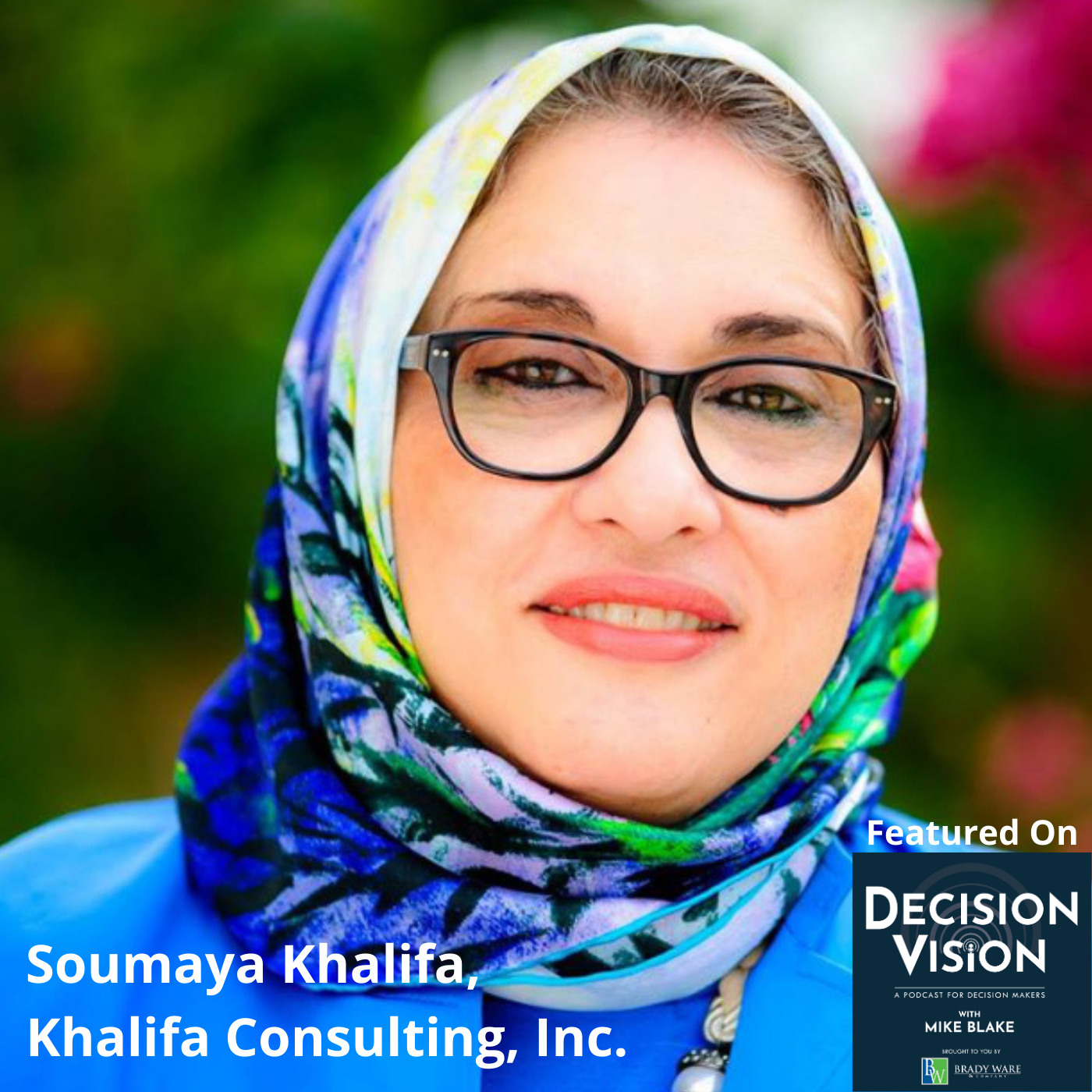
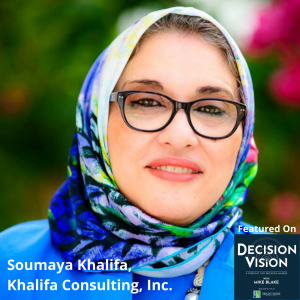
Khalifa Consulting CEO Soumaya Khalifa joins host Mike Blake to discuss how she integrates her Islamic faith with her work and business, as well as her community-building work with the Islamic Speakers Bureau. “Decision Vision” is  presented by Brady Ware & Company.

Soumaya Khalifa, Khalifa Consulting, Inc.

Soumaya Khalifa founded Khalifa Consulting, a strategic intercultural and leadership consulting firm, in 2007. Her career spans more than 25 years in human resources, management, business management and ownership, non-profit and entrepreneurship. Khalifa Consulting specializes in helping executives and organizations succeed when doing business across cultures by providing them the most relevant, practical and up to date cross cultural coaching and training. In addition, Khalifa Consulting offers training and coaching on global virtual teams. Soumaya and team apply this work to a broad range of clients, from large established national and global organizations to startups.

Prior to founding Khalifa Consulting, Soumaya served in several leadership roles in U.S.-based Fortune 100 companies in human resources, leadership development and diversity and inclusion. An alumnus of the University of Houston and Georgia State University, Soumaya is a board member of the Society of Intercultural Education, Training and Research (SIETAR) and the Atlanta Interfaith Broadcasters (AIB). She is also an adjunct professor at Emory University Center for Continuing Education and at the Federal Executive Institute. Soumaya is the author of Diversophy Egypt and has contributed to several publications.

Along with a group of Atlantans, Soumaya launched the Islamic Speakers Bureau (ISB) of Atlanta in August 2001. As the current Executive Director of ISB, she serves the Muslim and wider community by building bridges of understanding, creating interfaith partnerships, developing community leaders, and creating spaces for mutual understating and respect. Under Soumaya’s leadership, the ISB has developed its core programming and launched other key initiatives, including ISB Leadership Institute (ISBLI), 100 Influential Georgia Muslims, and 40 Under 40 Georgia Muslims.  In 2017, Soumaya created a partnership with the Atlanta Mayor’s Office to host the ISB’s first ever Ramadan Iftar hosted at Atlanta’s City Hall and in 2018, the second Atlanta Mayor’s Iftar was attended by over 250 people.

Soumaya has received many awards and recognitions for her work with the ISB, including:

  • 2019 Academy of Women Achievers, YWCA
  • 2018 Arab American High Achiever Award, Alif Institute
  • 2017 City of Atlanta Phoenix Award, presented by Mayor Kasim Reed
  • 2012 FBI’s Community Leadership Award
  • Citizen Diplomat for the U.S. State Department
  • 2012 Invited to the annual White House Iftar hosted by President Barak Obama
  • 2015 Inducted into the College of Ministers and Laity

To learn more on Khalifa Consulting, follow this link.

Michael Blake, Brady Ware & Company

Mike Blake, Host of the “Decision Vision” podcast series

Michael Blake is Host of the “Decision Vision” podcast series and a Director of Brady Ware & Company. Mike specializes in the valuation of intellectual property-driven firms, such as software firms, aerospace firms and professional services firms, most frequently in the capacity as a transaction advisor, helping clients obtain great outcomes from complex transaction opportunities. He is also a specialist in the appraisal of intellectual properties as stand-alone assets, such as software, trade secrets, and patents.

Mike has been a full-time business appraiser for 13 years with public accounting firms, boutique business appraisal firms, and an owner of his own firm. Prior to that, he spent 8 years in venture capital and investment banking, including transactions in the U.S., Israel, Russia, Ukraine, and Belarus.

Brady Ware & Company

Brady Ware & Company is a regional full-service accounting and advisory firm which helps businesses and entrepreneurs make visions a reality. Brady Ware services clients nationally from its offices in Alpharetta, GA; Columbus and Dayton, OH; and Richmond, IN. The firm is growth minded, committed to the regions in which they operate, and most importantly, they make significant investments in their people and service offerings to meet the changing financial needs of those they are privileged to serve. The firm is dedicated to providing results that make a difference for its clients.

Decision Vision Podcast Series

“Decision Vision” is a podcast covering topics and issues facing small business owners and connecting them with solutions from leading experts. This series is presented by Brady Ware & Company. If you are a decision maker for a small business, we’d love to hear from you. Contact us at decisionvision@bradyware.com and make sure to listen to every Thursday to the “Decision Vision” podcast.

Past episodes of “Decision Vision” can be found at decisionvisionpodcast.com. “Decision Vision” is produced and broadcast by the North Fulton studio of Business RadioX®.

Visit Brady Ware & Company on social media:

LinkedIn:  https://www.linkedin.com/company/brady-ware/

Facebook: https://www.facebook.com/bradywareCPAs/

Twitter: https://twitter.com/BradyWare

Instagram: https://www.instagram.com/bradywarecompany/

Show Transcript

Intro: [00:00:01] Welcome to Decision Vision, a podcast series focusing on critical business decisions. Brought to you by Brady Ware & Company. Brady Ware is a regional, full-service accounting and advisory firm that helps businesses and entrepreneurs make visions a reality.

Mike Blake: [00:00:20] And welcome to Decision Vision, a podcast giving you, the listener, clear vision to make great decisions. In each episode, we discuss the process of decision making on a different topic from the business owners’ or executives’ perspective. We aren’t necessarily telling you what to do, but we can put you in a position to make an informed decision on your own and understand when you might need help along the way.

Mike Blake: [00:00:39] My name is Mike Blake, and I’m your host for today’s program. I’m a Director at Brady Ware & Company, a full-service accounting firm based in Dayton, Ohio, with offices in Dayton; Columbus, Ohio; Richmond, Indiana; and Alpharetta, Georgia. Brady Ware are sponsoring this podcast, which is being recorded in Atlanta per social distancing protocols. If you like this podcast, please subscribe on your favorite podcast aggregator and please consider leaving our view of the podcast as well.

Mike Blake: [00:01:04] So, today’s topic is actually a continuation of a prior topic or a previously recorded topic, which is, should I mix my faith with my business? And this will be part two. In part one, we had, I thought, a tremendous discussion with Bill Leonard and Jonathan Minnen, who are from the Christian and Jewish faiths, respectively. And really, I really appreciate it, and I hope you, as listeners, appreciated the fact that they were very open about how they came to approach mixing their faith with their business, how it impacts their business, what that decision process looks like. And I think that we learned a lot.

Mike Blake: [00:01:53] But to be candid, in an ideal world, I wanted to have this be a little bit broader than that because there’s another faith. I mean, you could say there are many faiths that are missing, but I think a faith that was obviously missing – and that was due simply to scheduling constraints – is Islam. And Islam, I think … I’m not going to claim to be particularly knowledgeable about it. I know what I’ve read, I know what I studied in college five million years ago, but that’s about it. But Islam has a different or, certainly, a very identifiable place in American society.

Mike Blake: [00:02:39] And it’s different. I think it’s much more prominent now in the United States than it was, say, 50 years ago or even 30 years ago. And I think that people who practice Islam face different challenges and maybe even different rewards. We’ll find out from our guests. But I think there’s a different relationship with business, in general. I think there’s a different relationship with Islam and mainstream American society than the Jewish and Christian faith have.

Mike Blake: [00:03:08] So, to be perfectly candid, I just felt like this conversation was not complete without getting a view from the Muslim perspective. And I hope you’ll agree that it’s worthwhile. So, we’ve never done a two-parter before. We didn’t necessarily have a cliffhanger or anything, but I do think that this is necessary to have a more comprehensive and complete discussion.

Mike Blake: [00:03:33] So, joining us today is Soumaya Khalifa, who founded Khalifa Consulting, a strategic intercultural and leadership consulting firm back in 2007. Her career spans more than 25 years in human resources management, business management and ownership, nonprofit and entrepreneurship. Khalifa Consulting specializes in helping executives and organizations succeed when doing business across cultures by providing them with the most relevant, practical and up-to-date cross-cultural coaching and training.

Mike Blake: [00:04:07] Along with a group of Atlantans, Soumaya launched the Islamic Speakers Bureau of Atlanta back in August 2001. We’ll talk about that. That’s an interesting date. As the current executive director of ISB, she serves the Muslim and wider community by building bridges of understanding, creating interfaith partnerships, developing community leaders, and creating spaces for mutual understanding and respect. Under Soumaya’s leadership, the ISB has developed its core programming and launched other key initiatives, including ISB Leadership Institute, 100 Influential Georgia Muslims, and 40 under 40 Georgia Muslims.

Mike Blake: [00:04:44] In 2017, Soumaya created a partnership with the Atlanta Mayor’s Office to host ISB’s first ever Ramadan Iftar hosted at Atlanta City Hall. And in 2018, the second Atlanta mayor Iftar was attended by over 250 people. Soumaya has received many awards and recognitions for her work with the ISP, including Academy of Women Achievers of the YWCA, the Arab-American High Achiever Award of the Alif Institute, City of Atlanta Phoenix Award, the FBI’s Community Leadership Award. That’s interesting. We’ll have to get back to that. She’s a citizen diplomat for the US State Department and numerous other recognitions, but you get the idea. She’s highly accomplished and highly recognized for those accomplishments. And we are fortunate. And I am so glad she agreed to come on the podcast. Soumaya, thank you for coming on the program.

Soumaya Khalifa: [00:05:36] Mike, it’s my pleasure and honor. Thank you so much for having me.

Mike Blake: [00:05:40] So, before we get into this, I want to ask because I think this is really important, the FBI’s Community Leadership Award. Tell us about what led to being recognized. I assume it’s the FBI, like what I recognized, Federal Bureau of Investigation, or some other acronym. What led to that?

Soumaya Khalifa: [00:06:03] Yeah. So, that was quite an experience. I got to actually travel to their headquarters and receive the award by then FBI Director Mueller. And it was quite an experience being there, and touring their facility and just seeing what’s there. I was part of their outreach, diversity and inclusion outreach team that we had for several years many years ago. And they recognized the work that the ISB does here in Atlanta in terms of building bridges, and they felt like that was something that is much needed, and they recognized me for the work. So, I was, again, very fortunate and gotten a lot of awards and recognitions that I wouldn’t have dreamt of many years ago. So, again, very lucky and very fortunate.

Mike Blake: [00:06:57] Well, congratulations and thank you for your service to our society. So, I’ve studied Islam about as much as I needed to to graduate from college with a Liberal Arts degree. I know it’s a highly complex religion, but how would you describe your faith? I think you can do a much better job than I ever could.

Soumaya Khalifa: [00:07:22] Yeah. So, it’s not any more complicated than Christianity or Judaism. The three faith traditions are monotheistic religions and they’re Abrahamic traditions. So, there are a lot of similarities between the three. In terms of the essence of Islam in the word itself, it means peace, submission to the will of God, and creating peace in the world. And the person, even Muslims, when they greet each other, they have a covenant that they say to each other, and that is, “May peace be upon you,” which means that you will not get anything from me but peace, whether it’s in interactions, or talking about you, or anything at all, it’s peace.

Soumaya Khalifa: [00:08:09] So, it is a misunderstood religion. It is a religion, unfortunately, that a lot of people associate terrorism with. And I love talking to groups and asking them, “You know what comes to mind when you hear the word “Islam” and “Muslims?” And sometimes, people don’t want to say, and I say, “Hey, how about the T word, does that come to mind? Do you hear it?” And yeah, they do.

Soumaya Khalifa: [00:08:33] So, the two misconceptions about Islam that I hear all the time is that Islam is associated with terrorism, all Muslims are terrorists, and the other one is that all women are oppressed. And I have a lot of fun with the second one because I ask audiences and people, do you think I’m oppressed? And they look at me and they say, “Well.” “So, you should ask my husband.” And we have a little fun with that.

Soumaya Khalifa: [00:08:58] But absolutely, it is. It’s a religion that people don’t know about. And a lot of times, when they hear about it, it is in a very negative sense. There isn’t a face of Islam that is carried throughout our country and our communities that portrays the good that Muslims do. And Muslims, like any other group of people, Christians included, Jews and Hindus and others, there is the good, the bad and the ugly.

Mike Blake: [00:09:28] So, you made an interesting decision and a conscious one, not just to really connect your faith with your business but to build a business, if you will, around your faith. A lot of it is around educating individuals, companies, organizations about Islam, about inclusiveness with people who practice that faith and others. I know it’s not just limited to that, but certainly it is sort of the headline. So, what drew you to that? I mean, you’re a very capable person. You could have done, I’m sure, anything that you wanted. What drew you to make that your mission?

Soumaya Khalifa: [00:10:11] Sure. I just want to make a distinction here. I wear a couple of scarves, if you will. So, I have a nonprofit (versus hats). There’s the nonprofit that I started in 2000 right along with a group of people who wanted to do something about building bridges of understanding because what we saw then, and it’s still happening right now, is that people speak about Islam and Muslims, and they have not a good idea and not a correct idea about Islam and Muslims. They don’t know about our community. So, we wanted to train people within the First Amendment guidelines of teaching and not preaching to be able to speak about Islam and Muslims to have embody they’re my neighbor, they’re my coworker, et cetera, and really building that connection between people.

Soumaya Khalifa: [00:10:57] And so, that is one thing that was started in 2001. And at the time, I was in corporate America doing human resources. So, thinking back about that journey and what I did then, I just can’t even comprehend how I did that while having a full-time job in corporate America. So, that’s one thing that I felt like was necessary to build bridges of understanding. And it wasn’t about promoting the religion. It was just to understand each other and build a stronger community where people don’t fear others. So, that’s one of the things that I do.

Soumaya Khalifa: [00:11:29] The other one is a business, and that is Khalifa consulting. And as you mentioned in the introduction, it’s to help people understand the business they’re getting into, to understand the culture for them to be successful. Khalifa Consulting has many consultants that cover the whole wide world. So, if we have a client that’s going to Germany, we have somebody who can do Germany. China, Russia, what have you, there’s that network of consultants who cover the whole wide world.

Soumaya Khalifa: [00:12:00] Because of my own background, my own cultural background, my own upbringing, I offer the training, and the consulting and the coaching on the Arab world. And as you know, the majority of the Arab world is Muslim. And so, we talk about Islam, and how it impacts their business, and what do they need to be aware. Of anything from gift giving, don’t do pork or alcohol, to the holidays, to how people communicate. And that’s not religion; it’s more culture.

Soumaya Khalifa: [00:12:31] So, those are the two distinctions in terms of the business piece and the nonprofit work. But it’s like you said, both of them are about helping people understand in different circumstances. With the ISB, it’s more about community and community building. And Khalifa Consulting is about the business world and helping individuals, leaders and organizations be successful as they interact with different cultures.

Mike Blake: [00:13:00] So, yeah and understood. There’s a cultural component, religious component. And while they are certainly separate, they frequently are quite closely linked. And so, what I’d be curious to understand from you is this, is that, are there ways in which the way you conduct business is maybe different from what kind of a garden variety, if this can even be said, but a garden variety American business is conducted because of your desire and the importance to you of being true to your faith? Does it manifest itself in the business? Does Islam manifest itself in the business itself? I hope I have asked that question in a way that you understand

Soumaya Khalifa: [00:13:49] Yeah. I think each and every one of us has a moral compass. And the moral compass is the faith tradition that we adhere to. And whether we realize it or not, it kind of helps us navigate through things. For instance, holding true to your word, keeping the individual, valuing the customer, valuing yourself, telling the truth. And I don’t think this is just to Islam, but I think it’s due to many faith tradition, treating people with dignity and respect, not cheating people, et cetera, et cetera.

Soumaya Khalifa: [00:14:30] And again, this is in Islam ,as well, I’m sure, as Christianity, and Judaism, and other faith traditions as well. So, it is my moral compass. It’s probably unconscious, but it’s there. It’s how I’m kind of wired. And again, I believe that that’s not just particular to me, but it’s to everyone else.

Mike Blake: [00:14:54] So, you chose to name your firm Khalifa Consulting. And I think to most people that they may understand that that’s your last name or your family name or not. But it clearly sounds like a name that comes from a region that practices a lot of Islam, at least fairly widely. Was that a conscious decision in the branding? And whether it was or not, have you found that it evokes any kind of maybe preconceptions or stereotypes? Does it help you within the Islamic community? Does it create barriers elsewhere? Talk about kind of how that’s impacted the business. If it has at all?

Soumaya Khalifa: [00:15:43] I love the question. So, I’m going to tell you a story. There was an event in Atlanta and a high-up person in the Gulf State was here to speak about their country and how opportunities are there, et cetera. And I attended, and I walked in, and people saw my name who are not part of that country’s entourage, if you will. And they saw my name, and I was like given the royal treatment. And I was just saying, “What in the world is that?” I was just like not really comprehending what was going on. But they saw my name and they thought I was part of the royal clan for that country. And they just took care of me. And after a while, I realized what happened.

Soumaya Khalifa: [00:16:30] But, yeah, I think the reason that I chose Khalifa Consulting is because when I started out, I was not sure how it was going to go in terms of what my business is going to focus on because I have a wide variety of things that I provide and do, all the way from consulting, coaching, executive coaching, and human resources, and the intercultural world diversity and inclusion. So, I wanted something that kind of was an umbrella name that brought all those things under it. So, that’s the reason. I don’t know whether it was a smart way of doing it or not, but that’s how I started. And because I started that way and I’ve been known in the marketplace as that, I’m just continuing with it. Is there a better name? Maybe, but moving forward with Khalifa Consulting.

Mike Blake: [00:17:23] So, I’m going to ask you a completely off-the-wall question because I’m a language junkie and probably a lot of our listeners will roll their eyes, but that’s okay, it’s my show. And that is, I’m curious-

Soumaya Khalifa: [00:17:35] Go for it.

Mike Blake: [00:17:35] I’m curious if the name Khalifa, is at all related to the term chalice, which implies some sort of of Ducci, or county, or something of that nature.

Soumaya Khalifa: [00:17:47] Yeah. Khalifa means Vice Gerente or the ruler. And so, within the Islamic tradition, the Khalifa is the leader of the group, or the family, or  I’m just really lucky to have that name. I feel like, “Hey, all right, I need to live up to it,” but yeah. Khalifa means a responsible person, right? So, it’s a godsend human beings to be His vice gerente on earth, so human beings could take care of the earth, et cetera. So, it has like a title of of leadership, but it also has a title of true responsibility.

Mike Blake: [00:18:31] Well, good. Thank you for that. So, that’ll be our duo-lingo diversion for the day. So, do you ever run into any kind of conflict? Do you ever have to make any conscious decisions of where your faith starts and ends, where your business starts and ends? Do you find yourself having to make decisions that maybe today, I want to be less obvious or open about my faith, or another day in another situation, I want to be more open about my faith? So, do you ever have to make those kinds of decisions? And if so, what goes into that?

Soumaya Khalifa: [00:19:06] Yeah. I really don’t think about it that way at all. I am who I am. And I struggle with that for a long time, and it was a journey. I was born in Egypt, came to Texas as a teenager. I went to middle school and high school. And throughout my early years, I really struggled with my identity, and I struggled with my Egyptianness, if you will, my Muslimness and my Americanness. And it was like three people in one. And those three people in one did not come out as three people in one told people. I would reveal parts of me that I thought people were comfortable with.

Soumaya Khalifa: [00:19:47] So, until I took that journey of being comfortable with who I was that I said, “Hey, world, here I am,” and this is when I started covering my hair. It was shortly thereafter that I started the Islamic Speakers Bureau. This is when I really embraced who I was. It was not an easy journey. It was much, much easier not to wear a headscarf and to just kind of try to build in and assimilate, but I felt like part of me was being lost. That, besides the nagging of my mom. When are you going to cover your hair, right? When are you going to cover your hair?

Mike Blake: [00:20:24] Parents. Well, parents will always have a big influence on that.

Soumaya Khalifa: [00:20:27] They sure do.

Mike Blake: [00:20:28] So, I’m curious, and if this question is out of bounds, weigh it out, but was there one particular incident that pushed you over and said, “You know what? Yeah, I want to embrace this identity. I’m going to wear the headscarf and let strangers know that I’m a practitioner of Islam”?

Soumaya Khalifa: [00:20:51] Yeah. I think it was more than a journey versus a one incident that happened that kind of got me to do that. I was listening to religious tapes about how women are supposed to do that. And by the way, women who do not cover their hair, who are Muslim, it does not mean they are less religious. It’s just they choose not to. So, it was just that, plus my mom, plus I just felt like, “Hey, I’m not getting any younger, I need to do something about it.” And I did.

Soumaya Khalifa: [00:21:18] And I have to tell you, that was just like the most uncomfortable decision I ever made in my life. I did not know how to put the headscarf on. I remember, at the time I was working, I just finished my MBA, and I was working as an intern for a major company, and one day, I went with my hair. And then, the following Monday, I went in with the head covered, and people did not know what to make of me, and I had to do a lot of explanation. And as that was going on, my scarf fell off because I did not know how to put it on. And it was just like a real ordeal.

Soumaya Khalifa: [00:21:55] And even though it’s a piece of cloth, it’s a lot of psychological getting used to and being able to be comfortable with it. And I wasn’t comfortable with it for a long time. And I felt like people were staring at me and the whole nine yards until I embraced it myself and started shopping for different headscarves. And there was something more to shop for. I got very excited about that. And that’s when I became okay with it.

Mike Blake: [00:22:23] Now, we had a previous conversation. You said something that I think is fascinating and I just did not know is that not all scarves are alike. And the way that one wears it, you can identify somebody’s origin from the Muslim world or how they practice Islam by virtue of how their scarf is is worn, correct?

Soumaya Khalifa: [00:22:46] Yes, yes, yes, absolutely. And even what age category they might be from. It’s fascinating. It’s a fascinating observation just to sit there and kind of look at women’s scarfs, and how they tie them, and what color, what’s the material, et cetera. Now, I’ve discovered something since we talked. I discovered there’s a COVID scarf. And the COVID scarf is a scarf where people could put their masks on while having a scarf on. So, the regular scarf that I used to wear would not allow me to put this really easily. And so, this is now my COVID scarf because it allows us to put on the mask and take it off easily.

Mike Blake: [00:23:26] Well, one adapts, right? So, Islam has been around a long time. So, it’s gone through many adaptations. This is another one of those adaptations, I guess. So, you led off by kind of pointing out the elephant in the room.

Mike Blake: [00:23:44] So, I want to put a bright light on it. And that is it strikes me that having a business that is associated with Islam is different from one that’s associated with Christianity or Judaism, not only because it’s less common and also more concentrated, I think, in certain regions of the country but, of course, America itself has had a troubled, and frankly – and I’m not going to get into the reasons why, but you cannot deny there’s a violent relationship with, say, certain elements of Islam, I guess, for lack of a better term or, at least, conflict with individuals who have decided to brand themselves under the name of Islam in order to accomplish whatever social and political goals that they’re accomplishing. And that’s a little bit different, right? You’re operating in a country that in some cases, recently, has been in a state of war with Islamic countries.

Mike Blake: [00:24:54] And I will say this. I thought George Bush the first did a really good job of trying to make clear that we were at war with states that happen to have governments that claim to espouse Islam, and we are not pursuing war against the Muslim people. It’s a very sort of dancing on the head of a pin there. But I do think he made a good faith effort to try to communicate that. But I mean, it’s got to be different, right?

Mike Blake: [00:25:21] I mean, America right now does not have a military conflict with a Christian-dominated or a Jewish-dominated nation, but America has had that. I think it necessarily creates, I think, certain tensions, certain preconceptions. I think even, unfortunately, among certain people, a starting point of suspicion and hostility. One, I guess, do you agree with that observation? And two, if so, how do you work within that? How do you survive mentally in that kind of environment, because I can only imagine how difficult that must be?

Soumaya Khalifa: [00:26:16] Yeah. In terms of the conflict between the US and Muslim majority countries, that is a debate that people can have. Is it really a conflict, or we talked about weapons of mass destruction in Iraq, and after so many years, we found that there were no weapons of mass destruction? And so, there are a lot of debate going on about about the validity of the conflicts that we are part of and claimed for it to be because of whatever. So, let’s put that aside.

Soumaya Khalifa: [00:26:50] But what I want to say, what’s really here and now that is a very troublesome is the Muslim ban. When we have a Muslim ban, and I walked down the street with the headscarf on, that puts me and my fellow 12 million Muslims, American Muslims, in jeopardy because people are getting a message from the highest office in this land saying Muslims are a danger to our country and our society. So, that is truly something that hits very close to home, and I can talk for a long time about that.

Soumaya Khalifa: [00:27:25] But in terms of the business itself, it’s not about just Islam and Muslims. Khalifa Consulting, it’s about cultural understanding for the whole wide world. And it’s not just me. I have about 10 or 12 colleagues who cover, again, the entire world. But when it comes to the part of the world that I handle, which is the Arab world and the US, people want to come to us because we know how to help them to navigate in that part of the world, in the business world, so they could be successful.

Soumaya Khalifa: [00:27:58] I have worked with so many different organizations, US organizations, that their market in the US is basically shrinking, and the only way for them to expand is to go to emerging markets, what they call emerging markets. And the Arab world with over 300-400 million people, it’s a very opportune place for many of the businesses, whether it is in the car business, or the automotive business, or defense, or food. So, it’s a business decision. It’s not about the faith. It’s not about anything.

Soumaya Khalifa: [00:28:39] We talk about the faith that’s part of them understanding what they’re getting into because you don’t want them to schedule meetings for Friday. Why weren’t the Saudis, or the Egyptians, or, or, or coming to our meetings on Fridays? Because it’s their holidays. It’s their weekly weekend. And so, you don’t do that. And this is just a very simplistic example of seeing people who don’t understand the different ways of communication.

Soumaya Khalifa: [00:29:07] Americans tend to be more direct communicators. When you go to the Arab world, it’s about saving face. It’s to not put anybody in an embarrassment position. So, how do we understand indirect communicators, and how do we bridge that gap between the two cultures to run the business, to get to the bottom line, to add to the bottom line and be successful? So, it’s not all about religion. It’s about being successful in a different culture that is very different for many people to navigate through.

Mike Blake: [00:29:43] Before we recorded our show, I got dressed because we’re doing video. I had originally put on a T-shirt that said “Got bacon,” and my wife said, “Aren’t you doing that interview about Islam today?” I go, “Yeah.” She says, “Are you really sure you want to wear that for this video?” “No. Maybe you’re right. Maybe I’ll do a quick change here.” So-

Soumaya Khalifa: [00:30:10] But there is turkey bacon too. So, there are always options. It’s not all pork. There’s turkey bacon.

Mike Blake: [00:30:16] Oh! I haven’t thought of that. I had a chance to win an argument with my wife and I blew it. Ugh! Okay. Well, at any rate, but-

Soumaya Khalifa: [00:30:16] You should have called me, Mike.

Mike Blake: [00:30:28] Sure, I should have. I should have. So, let me ask this. The thing about … actually, this actually segues to one of the questions I really wanted to make sure I got to. So, bearing what you just described in mind, and to me, it reminds me of maybe a little bit of what it might have been like to be a Russian immigrate here during the height of the Cold War, right? You’re here, but you’re obviously from “the other side.” And I have to imagine that that also had its own challenges. Now, the timeline for Khalifa Consulting was you started it in August of 2001, correct?

Soumaya Khalifa: [00:31:15] That’s the ISB.

Mike Blake: [00:31:16] ISB, sorry. The ISB in 2001.

Soumaya Khalifa: [00:31:18] Yeah, yeah.

Mike Blake: [00:31:18] That’s right. Khalifa was 2007. So, you started that. And then, a month later, the attacks of September 11th, 2001.

Soumaya Khalifa: [00:31:30] Three weeks.

Mike Blake: [00:31:30] And so, I mean, walk through as as somebody who just launched an Islamic commercial venture, and feel free if you want to just comment on being a practitioner of Islam at that time, what’s going through your head? How does your life experience change? What are you thinking about your business?

Soumaya Khalifa: [00:31:57] When you were talking about that, my whole body felt like I was there in September 11th, 2001. It was a nonprofit that I launched. It was into businesses, and non-profit, educational outreach. We had our training on August the 18th, which was approximately three weeks before 9/11 happened. We had just trained people to speak about Islam and Muslims within the First Amendment guidelines. They took their test, and we were getting ready to launch.

Soumaya Khalifa: [00:32:30] When the morning of 9/11, I went to my job, and I was in downtown Atlanta in the high-rise up on a very high floor. I heard the news about what happened in New York and in Washington. And I was scared. I was very scared. I was sad. I was angry. I had no idea what was going on. I was just thinking the people who were killed. Are people like me who went to their work in the morning, and they were waiting to get home to their kids and their family? And guess what? They did not make. And what was the reason for that? And it was a very, very tough day, I had three children at the time. I still have them, Thank God. They were in daycare and what have you. I was very worried about them. I was very worried about my husband.

Soumaya Khalifa: [00:33:28] They were talking about the terrorists were going to hit Atlanta because of CNN. We were very close to CNN. They pulled us all into a conference room to watch what’s going on. And I mean, I’m talking about right now, and just my whole body feels the same way. It was just very, very, very angry, very scared, very just in despair. Why did that happen? How can anybody do this?

Soumaya Khalifa: [00:34:02] And then a few days later, we find out who did it. And I got even angrier because the people not only killed 3000 people for no reason at all, innocent people, but they also hijacked a whole religion at 1.5 billion people. And so, anger. It got even worse because what they did to a religion in people. And we’re still paying the price of the horrendous, stupid act that they did. I can’t tell you how angry I am still. And I hope they get what they deserve in the hereafter because human life is very sacred in Islam, and taking innocent life is just one of the worst ever transgressions in the religion. Nobody could call themselves a Muslim and do that.

Mike Blake: [00:35:10] Yeah. As an observer, you try to put yourself, and as an interviewer, you try to put yourself in the shoes of the person that you’re interviewing. And I can hear in your voice how tremendously upsetting that must have been and continues to be. And like the rest of us as a country, we’ve had to move on, and the Islamic community has had to move on and attempt to build bridges. And in our society, some people have moved on, I would characterize, more successfully than others.

Mike Blake: [00:35:55] And let’s move on beyond that. In spite of that, I’m curious kind of in the wake of that attack, there must have been – I would hope that there was – maybe even a rise of interest in the Islamic Speakers Bureau because I think a lot of us … I grew up in the ’80s and the ’70s. So, when I was a child, I remember the conflict with Iran, the Iranian hostage crisis. I remember that there was a spate of hijacks of American aircraft, but the September 11th attack was, of course, an entirely different animal.

Soumaya Khalifa: [00:36:43] It was in our land.

Mike Blake: [00:36:44] Yeah. And in our land against one of the most important symbols, I think, of American economic strength in many ways, you could say, and at the heart of the country, short of an attack on the White House or Congress or something. I don’t want to belabor, but the point is that I think a lot of us were kind of left why. And some of us seek answers in the why. We want to know who’s responsible, right? Who overlooked opportunities to stop this? And there are many reports, and conspiracy theories and whatnot. I’m not going to discuss those today.

Mike Blake: [00:37:22] But I wonder and I hope that maybe you saw a surge of interest in speakers after the attack as people kind of want to understand, okay, this is horrible, and it’s probably going to lead to worse things down the road because you know the United States is not going to just not respond. You know there’s going to be a significant response. Did you see an increase in interest in people wanting to get your take in some expert opinion as to kind of what’s going on here?

Mike Blake: [00:37:55] Yeah. So, absolutely. When we realized who did it, et cetera, the board of the newly found Islamic Speakers Bureau or ISB, we kind of talked about what do we do? Do we kind of backtrack like we didn’t exist or do we move forward? And the decision was made, fortunately, that we needed to move forward. And we started receiving calls, and emails, and a lot of interest in people wanting to meet a Muslim, wanting to understand better, and wanting to understand their neighbors, et cetera.

Soumaya Khalifa: [00:38:34] And one of the stories that happened right after 9/11 is when an Episcopal pastor in Fayetteville – we used to live in Fayetteville – who reached out. He called. He called the number for the ISB and said, “This is so and so. And I’m driving up to the mountains, but I want to invite a speaker to come on.” And he gave his numbers, but it was so mumbly towards the end, it was a bad connection that the last three numbers didn’t come through. And I remember trying all possible three number combinations until I was finally able to get through to him.

Soumaya Khalifa: [00:39:17] And that friendship has lasted all through the years. He has moved on to different parts of the country, but we still stay in touch and communicate very often. So, there are a lot of silver linings from 9/11, as well as the tragedy, and the heartache, and the sadness that also came out of it. So, absolutely, there was and still is a silver lining from that.

Mike Blake: [00:39:47] So, I’m going to switch gears here. Sometimes, you can see in some face that people can use faith opportunistically in business. And I’ve certainly seen it. I speculate that you’ve seen it, but I don’t know. But I’m curious, so I’m going to ask you that question. Have you seen – and it doesn’t even have to be related to Islam, I guess, but since that was where your expertise lies, I imagine that’s going to be your perspective. Is there a temptation or have you encountered where people have tried to somehow capitalize kind of overtly on presenting a faith because they think it’s going to ingratiate themselves to a particular community, and therefore allow them to address what they think is an attractive market?

Soumaya Khalifa: [00:40:48] Yeah. I don’t believe in that. I don’t.

Mike Blake: [00:40:55] Right, I’m sure you don’t, but I’m sure, but have you seen it.

Soumaya Khalifa: [00:40:59] I’m sure I’ve seen it. I just can’t think of an example right now. But I am of the opinion and of the practice that everybody’s free to believe in whatever they want to believe. All that matters to me is how you treat me and you treat others around you. And pushing anybody’s faith on anybody else, I think that is so disrespectful. I really do. I believe that people are smart enough to think through what’s important to them and how they want to believe or not believe.

Soumaya Khalifa: [00:41:31] In the business that I’m in, whether it’s the non-profit or the consulting, it’s whoever feels that I’m a good fit for them and could provide the services that they need, then let’s let’s talk about it. But I don’t feel like it’s the right thing to use the business or the faith to be opportunistic.

Mike Blake: [00:41:56] Are there-

Soumaya Khalifa: [00:41:56] Did I answer your question?

Mike Blake: [00:41:58] Yeah. No, you did. You did.

Soumaya Khalifa: [00:42:00] Okay.

Mike Blake: [00:42:00] You did because I have seen it. I guess I bring it up because I have overtly seen people, for example, that they’ll go to a Bible study circle. And I know for a fact they do that because they think that that’s a way to generate prospects. And that strikes me as, frankly, repugnant, and repulsive, and immensely disrespectful to the religion.

Mike Blake: [00:42:36] And really, what I’m trying to get at is my hope is that that would be a unique case, but I’m not quite certain that it is. And in some religions and some religious communities, I think that there is a temptation to present a certain faith because they think that’s going to drive the business, but they aren’t necessarily themselves people of faith. And it bothers me. I’ve only seen that really in certain communities. I’m just curious because I have somebody here who’s embedded very much in the Muslim community, if that’s a phenomenon that you’ve ever witnessed.

Soumaya Khalifa, Khalifa Consulting: [00:43:23] Yeah.

Mike Blake: [00:43:24] Basically, it’s a universal temptation.

Soumaya Khalifa, Khalifa Consulting: [00:43:27] Got it. So, for instance, do real estate agents who happened to be Muslim go to a mosque, so they could pass out their card, et cetera? I’m sure that happens all the time. But for my own business, actually, my clients are not within the Muslim community itself, whether it’s the nonprofit or for my consulting. It’s people who are doing business outside the United States or talking about diversity and inclusion, and having Muslims in the workplace, and what are the reasonable accommodations, and how do we do that, and how do we understand them? How do we make sure everyone under our roof as an organization feels comfortable, valued and they belong? So, those are the clients that I’m looking for, people who need my help and find me to be the most competent person to help them get to where they want to go.

Mike Blake: [00:44:20] So, we’re talking to Soumaya Khalifa today of Khalifa Consulting and the Islamic Speakers Bureau. And we’re doing a part two of our podcast on Should I Mix My Faith With My Business? And we’re running out of time, but I do have a couple more questions that I’d like to to squeeze in here. And one is, is there a company that you admire that is Islamic facing – it doesn’t even have to be an American company. But is there a company that you admire that you think really gets it right, that maintains its commitment to its faith, but at the same time, doesn’t shy away from its faith, and at the same time, it’s commercially successful?

Soumaya Khalifa, Khalifa Consulting: [00:45:08] That is a really good question. Locally, here we have Chick-fil-A. And I haven’t been really associated with them on a professional level but their food is great, right? And people love their food. And for me, lemonade, their lemonade is really awesome. But I think diversity and inclusion – and I believe that faith comes under that – is a journey. It’s not that, “Hey, I’ve done this, and this, and this. Now, we are there.” There was never there, right? It’s always trying to get to being better, and better, and better.

Soumaya Khalifa, Khalifa Consulting: [00:45:46] And so, I know there are many, many, many organizations throughout the country that are striving to be the best that they can be, but they will never get there because it’s always changing. The environment is always changing. With the recent Black Lives Matter and many other things that are going on, companies had to pivot. They had to understand where they’re at, where they’re going, and what does the market need, and what do the employees need. And so, it’s a constant, constant journey. I don’t think anybody would say, “I made it and I’m there.”

Mike Blake: [00:46:22] So, this has been a great discussion. I want to thank you so much for being willing to come on and discuss some tough topics and answer, I think, some challenging questions. I’m sure people would like to learn more about you, your business, and maybe even want to ask more about this. I have a feeling we have listeners that practice Islam and are wrestling with this question. Can people contact you for more information? And if so, what’s the best way to do that?

Soumaya Khalifa, Khalifa Consulting: [00:46:52] Absolutely. Would love to hear from the listeners. My email address, soumaya@khalifa.consulting. There is no dot com. So, soumaya@khalifa.consulting. And the phone number is 678-523-5080. And our website is khalifa.consulting. For the Islamic Speakers Bureau, its isbatlanta.org. Again, isbatlanta.org. And again, looking forward to staying connected. Mostly in LinkedIn and Facebook. So, find me whichever way that makes sense to you.

Mike Blake: [00:47:38] Thank you so much. That’s going to wrap it up for today’s program. And I’d like to thank Soumaya Khalifa so much for joining us and sharing her expertise with us. We’ll be exploring a new topic each week. So, please tune in, so that when you’re faced with your next executive decision, you have clear vision when making it. If you enjoy this podcast, please consider leaving a review of your favorite podcast aggregator. It helps people find us that we can help them. Once again, this is Mike Blake. Our sponsor’s Brady Ware & Company. And this has been the Decision Vision Podcast.
Tagged With: Brady Ware, Brady Ware & Company, cross cultural coaching, faith and business, faith in business, Human Resources, Islamic Speakers Bureau, Khalifa Consulting, Mike Blake, Soumaya Khalifa

Decision Vision Episode 87: Should I Mix My Faith With Business? (Part One) – An Interview with Bill Leonard and Jonathan Minnen

October 15, 2020 by John Ray

mix faith with business
Decision Vision
Decision Vision Episode 87: Should I Mix My Faith With Business? (Part One) - An Interview with Bill Leonard and Jonathan Minnen
Loading
00:00 /
RSS Feed
Share
Link
Embed

Download file

Decision Vision Episode 87: Should I Mix My Faith With Business? (Part One) – An Interview with Bill Leonard and Jonathan Minnen

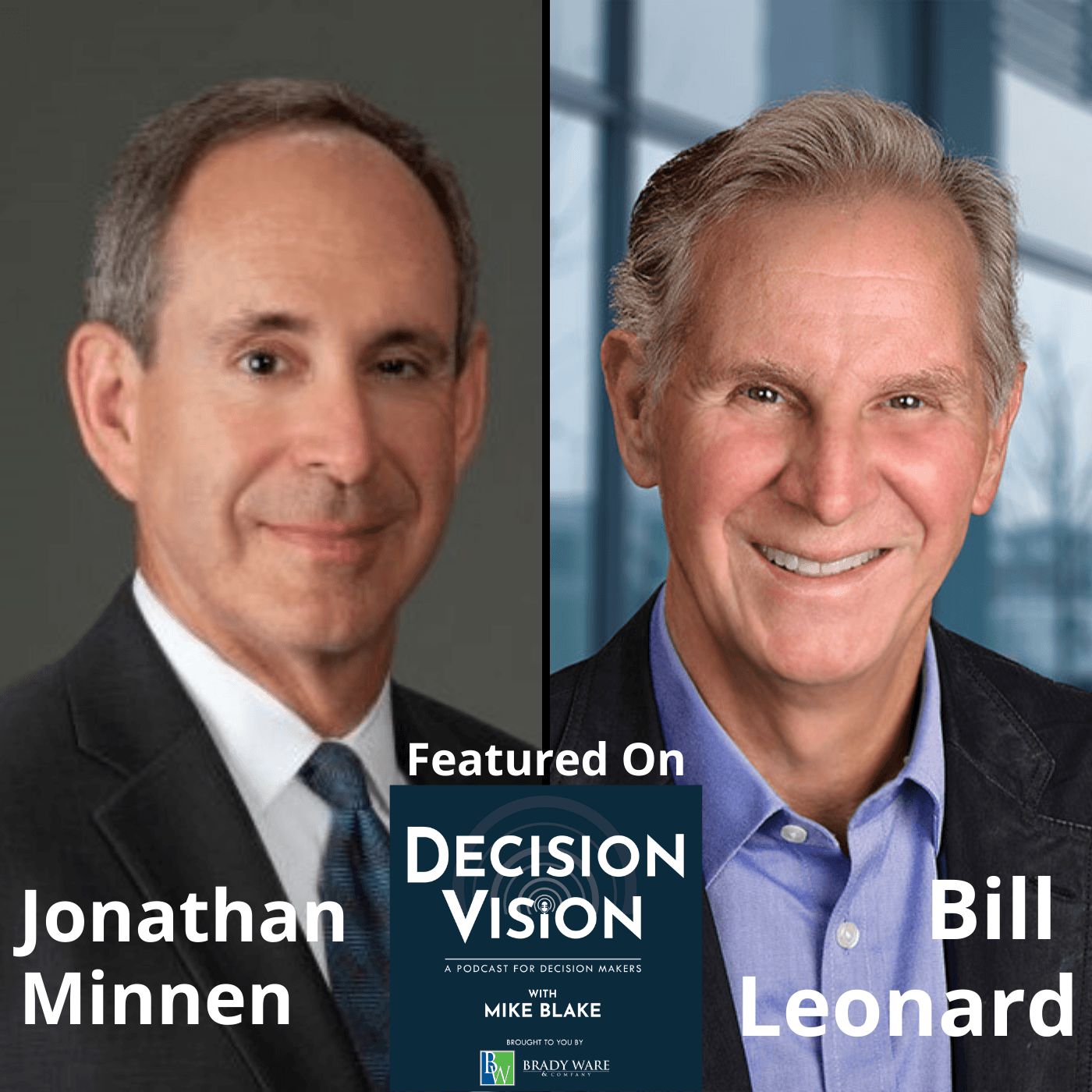
“Mix my faith with business?” Many won’t even touch the question, and others struggle with it. Christian business owner Bill Leonard and Jewish attorney Jonathan Minnen join host Mike Blake to discuss how they integrate their faith with their business work. “Decision Vision” is  presented by Brady Ware & Company.

Bill Leonard, Founder and President of Wm. Leonard & Co

Wm. Leonard & Co is a commercial real estate advisory firm providing services primarily to high growth technology companies in locating office space, negotiating the lease and advising them in the design of their facility to best reflect the culture of the company and align their real estate objectives with their business plan.

Bill Leonard is a native of Atlanta and a Life Member of the Atlanta Commercial Board of Realtor’s Million Dollar Club. In 1975, Bill founded Wm. Leonard & Co. which provides commercial real estate advisory services primarily to tenants in negotiating office leases. He is a former member of the Board of Directors of the Atlanta Commercial Board of Realtors, recipient of the Board’s Exclusive Phoenix Award and the Silver Phoenix Award. He has been active in commercial real estate since 1971 and is dedicated to the development of value-added services and lasting client relationships. A large percentage of his clients are high-growth technology companies.

Bill is actively involved in the Atlanta technology community and has served on the boards of the Technology Executives Roundtable, the Southeastern Software Association and the Tech CEO Forum. In 2000, the Technology Association of Georgia honored Bill by making him the recipient of the Leader of Influence Award for his outstanding service to the area’s technology community. He was selected by the Atlanta Business Chronicle’s “Who’s Who in Technology” in 2002.

In addition, Bill takes a leadership role in the Christian business community. He is the founder of the High Tech Prayer Breakfast; co-founder of the Commercial Real Estate Prayer Breakfast; co-founder of the Fellowship of Companies for Christ International and has served on a number of boards including Ambassadors for Christ International, The Fellowship of Companies for Christ International, Crown Financial Ministries, High Tech Ministries, Camp Highland and Teach Every Nation.

Bill received his B.A. degree in Economics & Business Administration from Furman University. Bill and his wife, Sandy, have been married for 47 years and have two grown children and five grandchildren.

Jonathan Minnen, Partner, Smith, Gambrell & Russell, LLP

Smith, Gambrell & Russell, LLP is a full service, International law firm that advises regional, national, and global businesses on a wide range of legal matters. The firm’s 250 attorneys provide legal counsel in more than 45 specialized practice areas, including corporate transactions, litigation, intellectual property, aviation, banking, real estate, construction, employment law, and employee benefits and executive compensation. Founded in 1893, SGR has offices in Atlanta, Austin, Jacksonville, London, Los Angeles, Miami, Munich, New York, Southampton, and Washington, D.C.

Jonathan Minnen, partner,  has extensive experience in a wide range of U.S. and overseas business transactions, including mergers and acquisitions and ongoing transactional matters across many business sectors. He practices from both the New York City and Atlanta offices of SGR. His client experience includes businesses which range in size from emerging companies to large publicly traded enterprises; both domestic and overseas. These clients have been involved in a variety of industries including both traditional and high-tech manufacturing, healthcare and financial information systems, robotics, medical devices, biomedical polymers, and technologies involving the telecommunications industry. For some of his clients, Mr. Minnen functions as de facto outside general counsel and is responsible for managing those clients’ entire legal portfolio, which involves routinely teaming with other practice groups of the Firm to achieve the client’s objectives.

Michael Blake, Brady Ware & Company

Mike Blake, Host of the “Decision Vision” podcast series

Michael Blake is Host of the “Decision Vision” podcast series and a Director of Brady Ware & Company. Mike specializes in the valuation of intellectual property-driven firms, such as software firms, aerospace firms and professional services firms, most frequently in the capacity as a transaction advisor, helping clients obtain great outcomes from complex transaction opportunities. He is also a specialist in the appraisal of intellectual properties as stand-alone assets, such as software, trade secrets, and patents.

Mike has been a full-time business appraiser for 13 years with public accounting firms, boutique business appraisal firms, and an owner of his own firm. Prior to that, he spent 8 years in venture capital and investment banking, including transactions in the U.S., Israel, Russia, Ukraine, and Belarus.

Brady Ware & Company

Brady Ware & Company is a regional full-service accounting and advisory firm which helps businesses and entrepreneurs make visions a reality. Brady Ware services clients nationally from its offices in Alpharetta, GA; Columbus and Dayton, OH; and Richmond, IN. The firm is growth minded, committed to the regions in which they operate, and most importantly, they make significant investments in their people and service offerings to meet the changing financial needs of those they are privileged to serve. The firm is dedicated to providing results that make a difference for its clients.

Decision Vision Podcast Series

“Decision Vision” is a podcast covering topics and issues facing small business owners and connecting them with solutions from leading experts. This series is presented by Brady Ware & Company. If you are a decision maker for a small business, we’d love to hear from you. Contact us at decisionvision@bradyware.com and make sure to listen to every Thursday to the “Decision Vision” podcast.

Past episodes of “Decision Vision” can be found at decisionvisionpodcast.com. “Decision Vision” is produced and broadcast by the North Fulton studio of Business RadioX®.

Visit Brady Ware & Company on social media:

LinkedIn:  https://www.linkedin.com/company/brady-ware/

Facebook: https://www.facebook.com/bradywareCPAs/

Twitter: https://twitter.com/BradyWare

Instagram: https://www.instagram.com/bradywarecompany/

Show Transcript

Intro: [00:00:00] Welcome to Decision Vision, a podcast series focusing on critical business decisions. Brought to you by Brady Ware & Company. Brady Ware is a regional, full-service accounting and advisory firm that helps businesses and entrepreneurs make vision a reality.

Mike Blake: [00:00:20] And welcome to Decision Vision, a podcast giving you, the listener, clear vision to make great decisions. In each episode, we discuss the process of decision making on a different topic from the business owner’s or executive’s perspective. We aren’t necessarily telling you what to do, but we can put you in a position to make an informed decision on your own and understand when you might need help along the way.

Mike Blake: [00:00:40] My name is Mike Blake, and I’m your host for today’s program. I’m a Director at Brady Ware & Company, a full-service accounting firm based in Dayton, Ohio, with offices in Dayton; Columbus, Ohio; Richmond, Indiana; and Alpharetta, Georgia. Brady Ware is sponsoring this podcast, which is being recorded in Atlanta per social distancing protocols. If you like this podcast, please subscribe and your favorite podcast aggregator and please consider leaving a review of the podcast as well.

Mike Blake: [00:01:07] So, today’s topic is, should I mix my faith with my business? And this can be a very broad topic, to be sure, but I think it is a very relevant topic, and it is a deeply personal and impactful decision that somebody decides to make, whether you decide in the affirmative or the negative to mix faith with business. One of the first things they taught me, at least, as I went out into the marketplace, is you don’t talk politics, you don’t talk religion, and you don’t talk something else. I forget what the third thing is. Knowing me, I probably talk about it all the time.

Mike Blake: [00:01:54] And as a young professional, I made sure to sort of stay away from those things; although, frankly, my best relationships are with people where I can have conversations about those things and we frequently disagree, but we don’t have to declare war over it, but that’s a separate discussion.

Mike Blake: [00:02:12] But there are potentially risks. It is not a decision to be taken lightly because any time that you decide that you’re going to put a stake out there and define yourself in a way that not everybody necessarily agrees with, you are taking a risk, and you’re investing something of yourself and of your business out there. And there can be some very positive results that come from that, but they aren’t necessarily always positive.

Mike Blake: [00:02:46] And the thing that I find of particular interest about this topic is if you do a search for this topic on Google, should I mix my faith with my business, number one, what’s enticing to me is nobody really authoritative touches it. The economist hasn’t covered it, to my knowledge. Harvard Business Review, Wall Street Journal, the big what I consider kind of intellectual journals really haven’t covered this at all, which tells me then that that’s an interesting topic to cover because other places just don’t know how to treat it. And I’m not afraid to take risks on the program.

Mike Blake: [00:03:25] And second, when you do find that information, nine times out of ten – this is not a statistical study, this is all my own personal observation – is they tell you exactly what I just said, “Don’t do it. There’s just not enough upside to justify the downside.” But, you as you go on in life and I’ve accumulated experience in exchange for gray hair and two arthritic ankles, you learn that there are people of faith who are very open about their faith. They’re not shove it down your throat about their faith, but they’re certainly very open about it. That is their identity. They’re their identity and they make that part of the business. And there are people that are happy with the results that have occurred.

Mike Blake: [00:04:18] And so, I think this is an opportunity to kind of present a couple of case studies where I think that has been successful. People have made that decision, taking the plunge, and have accepted both the good and the bad of having made that decision. So, I hope you, as listeners, are going to enjoy the topic as much as I anticipate that we are going to. And again, I think this is the kind of thing you can’t just sort of get everywhere, which makes it a more exciting topic to do.

Mike Blake: [00:04:48] So, to address this topic – and as an aside, this may wind up being a two-part topic. We have a panel of two guests. There’s a third I’ve been working on trying to get, but I wasn’t able to make the schedule work for today, so we may revisit this in a second session, but I’m not going to commit to that because I can’t force the guest to come on. I’m hopeful that we will. So, this may be standalone, maybe second part. you’ll just have to stay tuned and keep downloading these things to find out.

Mike Blake: [00:05:18] So, we do have a panel of sources today. And my first introduction will be of Bill Leonard, who is the founder of WM Leonard & Company. And they are commercial real estate advisory firm providing services to high-growth technology companies and locating office space, negotiating the lease and advising them on the design of their facility to best reflect the culture of the company and align their real estate objectives with their business plan.

Mike Blake: [00:05:42] I’d be remiss also if I didn’t acknowledge that they’re the stalwart supporters of the old Startup Lounge. And you have to sort of be of a certain age to remember Startup Lounge now. And that’s okay. We’re happy to fade into history. But Bill was there when not a lot of other people were. And I can’t express that gratitude frequently enough.

Mike Blake: [00:06:03] Bill is a native of Atlanta and is a life member of the Atlanta Commercial Board of Realtors Million Dollar Club. In 1975, Bill founded WM Leonard & Co., which provides those real estate advisory services primarily to tenants in negotiating office leases. In other words, it’s a tenant representation firm. He’s a former member of the Board of Directors of the Atlanta Commercial Board of Realtors, recipient of the board’s Exclusive Phoenix Award and the Silver Phoenix Award. He has been active in commercial real estate since 1971 and is dedicated to the development of value added services and lasting client relationships. A large percentage of his clients are high-growth technology companies.

Mike Blake: [00:06:40] In addition, Bill takes a leadership role in the Christian business community. He is the founder of the High Tech Prayer Breakfast, which is a big deal. If you don’t know Atlanta, High Tech Prayer Breakfast, I would say, is one of the maybe one of the top three events on the technology professional calendar. And the way that I know that is because they routinely clear 1500 attendees. I’ve been to many of these as guests of Bill and others. And the thing starts at 5:59 a.m. And that is not an easy commitment for people to make, especially for a night owl like myself.

Mike Blake: [00:07:15] Bill is co-founder of the Commercial Real Estate Prayer Breakfast, co-founder of the Fellowship of Companies for Christ International, and has served on a number of boards, including Ambassadors for Christ International, The Fellowship of Companies for Christ International, Crown Financial Ministries, High Tech Ministries, Camp Highland and Teach Every Nation. Bill earned his Bachelor’s Degree in Economics and Business Administration from Furman University. He and his wife Sandy had been married for 47 years and two grown children and five grandchildren.

Mike Blake: [00:07:42] And also on our panel and certainly not least is Jonathan Minnen, a dear friend of mine for, at least, a decade – and I think he’d actually admit to that – who is a partner with Smith, Gambrell & Russell and works out of the Atlanta office. Smith, Gambrell & Russell is a full-service international law firm that advises regional, national and global businesses on a wide range of legal matters. The firm’s 250 attorneys provide legal counsel to more than 45 specialized practice areas, including corporate transactions, litigation, intellectual property, aviation, banking, real estate, construction, employment law, and employee benefits and executive compensation.

Mike Blake: [00:08:19] Jonathan Minnen is a partner with Smith Gambrell and has extensive experience in a wide range of United States and overseas business transactions, including mergers and acquisitions and ongoing transactional matters across many business sectors. He has the bar from both New York and Georgia, and works from both the New York City and Atlanta offices.

Mike Blake: [00:08:43] Jonathan’s client experience includes businesses which range in size from emerging companies to large publicly traded enterprises, both domestic and overseas. These clients have been involved in a variety of industries, including both traditional high-tech manufacturing, healthcare and financial information systems, robotics, medical devices, biomedical polymers and technology involved in the telecommunications industry. For some of his clients, Jonathan functions as de facto outside general counsel and is responsible for managing those clients’ entire legal portfolio, which involves routinely teaming with other practice groups of the firm to achieve the client’s objectives.

Mike Blake: [00:09:18] Jonathan is also on the American Israel Chamber of Commerce, Board of Directors and Executive Committee. And as an aside, the American Israel Chamber of Commerce, Israel, last I checked, is a country of somewhere around seven million people. So, the whole country is roughly the population of the greater Atlanta Metro area. That is an incredible chamber. They punch well above their weight. In fact, I would say, among … And I’m involved with other binational chambers. They are the most effective bar non-binational chamber in the Atlanta area. And we have a lot of competition. There are 28 of them. They’re just a fantastic organization.

Mike Blake: [00:09:54] And Jonathan is also a member of the Attorneys for Family Held Enterprises and the Family Firm Institute, and holds a law degree from Emory University. Bill and Jonathan, thank you so much for coming on the program.

Bill Leonard: [00:10:06] A pleasure.

Jonathan Minnen: [00:10:08] My pleasure. Thank you.

Mike Blake: [00:10:11] So, I want to set some groundwork here because I’d like people to understand their perspectives. This is one question I’m not going to define for you that I think you need to answer it however you think is best answered because I want our listeners to understand that we’re trying to create kind of multiple perspectives because I do think that different faiths experience this decision and I think must approach this decision, have a different environment. So, they must approach that decision in a different way.

Mike Blake: [00:10:42] So, Jonathan, let me start with you. How would you describe your faith? If somebody asked you to describe your faith as I’m doing now, how would you do so?

Jonathan Minnen: [00:10:54] That’s a great question, Mike. And thanks again for having me on the podcast, Judaism is, of course, an ancient faith dating back many thousands of years. It is one of the three main Abrahamic faiths – Judaism, Christianity and all its various forms, as well as Islam. So, all three of these faith systems come from a common root core and have as a central tenet of their faith, monotheism, essentially one supreme being.

Jonathan Minnen: [00:11:30] The way I would differentiate Judaism from some other religions is that Judaism is much more focused on, I would say, personal, that you’re really responsible for your your personal conduct. And I’ll give you a great example. At the time this podcast is being recorded, we are about to approach the holiday season, which are the dual holidays of Rosh Hashanah, which is the Jewish New Year, and 10 days later, Yom Kippur, which is the Jewish day of Atonement.

Jonathan Minnen: [00:12:09] And one of the things that I find so striking, so meaningful during the Yom Kippur service is a passage that roughly translates this way. For the sense that you make against God, the day of atonement atones. However, sins or wrongdoings against your fellow person, the day of atonement is not atone until you make peace – you personally make peace with that person. And I think that passage speaks volumes as to kind of one of the course of Judaism.

Mike Blake: [00:12:53] Thank you for that, Jonathan. So, Bill, let me turn that to you. How would you describe your faith? You’re talking to somebody and that subject comes up, how would you describe it?

Bill Leonard: [00:13:10] Yeah. Mike, again, thank you for allowing me to participate today. I think I would best describe it as John 3:16, “For God so loved the world that He gave his only begotten Son. And whoever believes in him should not perish, but have everlasting life.” God created man to have fellowship with God, but that was broken. That fellowship was broken when man sinned in Genesis 3. And so, since then, man and God has looked for ways to restore and reconcile, I should say, that relationship.

Bill Leonard: [00:13:48] And as a believer, as a Christian, we believe that God sent His Son, Jesus Christ, to pay the ultimate penalty, the ultimate sacrifice for our sins. And it’s up to, not just ours, for anyone to receive that gift of salvation. We believe Jesus died on the cross. He was raised again the third day. He had victory over death. So, the key to us is forgiveness of sins, a different way, and the resurrection.

Mike Blake: [00:14:23] So, Bill and Jonathan, one thing that strikes me, I both certainly recognize and respect you both immensely for being people of faith. And as I said, not everybody is willing to kind of express it as openly as you do and even link it to your professional lives in a meaningful way.

Mike Blake: [00:14:52] And what I like – Bill, let me start with you – is talk about your decision to link your faith to your business. You’re very open about it. It’s not hard to find your connection to your faith, obviously, with the High Tech Prayer Breakfast, High Tech ministries, and all the other things that you’ve done. I have a feeling I’ve only read a fraction of the things you do. The same thing with Jonathan. But come back to the decision to say, “I’ve got this business, and I like it. I think it’s doing pretty well. I like it also to somehow be an expression of my faith.” Talk about that decision, please.

Bill Leonard: [00:15:33] We got to go back a long ways. I grew up in the church, but I rejected the church in early teen years and was away from the church. I was in rebellion. When I surrendered my life to Christ, I was 30 years old, and it was a very radical change in my life. And I think you find people who accept Christ as an adult, and have a contrast in their life, and recognize that particularly time when it happened. Actually you’re maybe a little bit more outspoken about it. I think it’s because you just recognize that forgiveness for the sins committed in the past and the future.

Bill Leonard: [00:16:13] But when I came to Christ, I was very fortunate. The guy that was most instrumental in that decision, was struggling with an issue. He was running a business, I had my business, and he was relatively new Christian himself, but he was trying to find out what the Bible had said anything about running a business. And he kind of pulled me by the collar, and the seven of us began to meet twice a month to see what the Bible had to say about running a business, hiring, firing, paying your bills, how you treat your employees.

Bill Leonard: [00:16:45] And we did this for a couple of years, and we started this organization called the Fellowship Companies for Christ International, whose purpose is to encourage and equip Christian CEOs and business owners to operate their business, to conduct their personal lives in accordance with Christ’s internal objectives.

Bill Leonard: [00:16:59] So, what that did for me is it gave me an opportunity as a new Christian to see that the Bible was relevant to what I was doing on a daily basis. And I really felt like God was calling me 24/7 to live out my faith, not on Sunday, and then go to work on Monday and live a totally different life. So, basically, it allowed me to integrate my faith with my work and my whole life, really.

Bill Leonard: [00:17:26] And so, as far as being a conscious decision, it’s really what gave me purpose in business and purpose in life, for that matter, is integrating my life and my business or my faith in my business. And so, then, it was just a matter of how do you do that? And that was a long process.

Mike Blake: [00:17:47] Right. And we’ll get to those specifics shortly. So, Jonathan, let me turn it over to you. Talk about the decision that you made – whether it was conscious or unconscious, you’ll tell us – that you’re going to to make your faith somehow a part of your business.

Jonathan Minnen: [00:18:10] For me, it was really, I think, somewhat automatic in that it’s just who I am and always have been. I mean, I’ve always identified as a Jewish person. I’m not an Orthodox Jewish person. I would be part of what would be called the Modern Reform Movement in the United States. But it’s just always been part of my identity. I believe that, when I was in business before law, and I grew up in a small town in Kentucky, and then also when I became a lawyer, I’m very much aware that Judaism has been subject to a variety of forms of anti-Semitism for most of our history. And a lot of very anti-Semitic tropes have evolved from that, from the ancient to the modern.

Jonathan Minnen: [00:19:12] And so, I’ve always felt, because it’s pretty obvious if anybody looks at my website or LinkedIn bio, it’s pretty obvious I’m Jewish. I don’t need a beard, and I don’t have to look like the character of a Jewish person with a hat and beard, neither of which I wear to figure out I’m Jewish. And I have always felt that I’m not only speaking for me, I’m also a representative of all of my coreligionists. And so, therefore, I’ve always felt that it was incumbent on me in all of my dealings to act in a very above board and ethical manner as a way to confront these anti-Semitic stereotypes that have been around forever.

Jonathan Minnen: [00:20:07] And to some degree, obviously, they’re still around. But I remember this story from my parents, remember that years ago at Sea Island, the place here, the rule was no blacks, no dogs and no Jews. When they went for their honeymoon in 1951, they went down to St. Petersburg, Florida, and many of the hotels on the beaches had signs that said restricted clientele. It was a code phrase – no blacks and no Jews. So, I felt that the way I conduct myself professionally and personally, I’m not just speaking for myself, I’m also essentially a representative for every other Jewish person out there. So, it kind of just happened and evolved.

Mike Blake: [00:20:56] So, one thing that strikes – and I like both of you to respond to this – about how you describe your respective faiths, and your decisions and how you integrate that into your business life is Bill’s approach – and I’m just going to extrapolate here. Please do correct me if I’m full of it – is it’s an approach to religion that is high profile, if you will, and that glorifying God is a very important and central feature of that practice of faith; whereas Judaism, at least the way you, Jonathan, described it, it’s somewhat more introspective.

Mike Blake: [00:21:46] And neither one is right or wrong, but I think that does inform that when I think of Christian-owned businesses, I think that, frankly, they’re easier to identify because of that tenet; whereas, Jewish-owned businesses, aside from the stereotypical deli and that kind of thing right, they’re not quite as easy to identify. Jonathan, I wouldn’t necessarily identify you as linking your faith to your business, except for the fact you do wear the flag of the State of Israel on your suit lapel. But there are two very different approaches that I think also inform the ways in which you link your faith to your business. Is that a fair observation or am I full of it?

Jonathan Minnen: [00:22:36] Bill, you want to go first?

Bill Leonard: [00:22:36] Yeah, I think, first of all, Christ commanded us to go into all the world and make disciples. So, I’m an evangelical Christian. Someone cared enough about me to reach out to me when I really had a lot of challenges going on in my life and literally changed my life. So, I’m evangelistic. I don’t know many Jewish people who, in a sense, are evangelistic to try to convert somebody to Judaism. And I can’t convert anybody, but I feel compelled to tell everybody about my faith in Christ.

Bill Leonard: [00:23:24] And so, I think maybe that’s part of the reason that you would see Jonathan and myself different in our approach to integrating our faith into our practice because ours, clearly, is evangelistic and that’s the whole purpose of the High Tech Prayer Breakfast, and the Commercial Real Estate Prayer Breakfast in the other prayer breakfast that we have started. And that’s just a part of it. But I mean, that is, on my mind, literally all the time. The people I meet is praying for them and sharing my faith with them at the appropriate time. So, I think that would be very different for me as I see a Jewish person versus an evangelical Christian.

Mike Blake: [00:24:09] Jonathan?

Jonathan Minnen: [00:24:11] Yeah, I would agree with Bill’s assessment because there’s really … I mean, you can always find exceptions, okay. There are always exceptions. There’s a general rule. I would completely agree with Bill, because there’s really not an evangelical component as part of Judaism. And it’s just not really part of the faith system. There is a process if somebody chose to become Jewish by choice, but it’s not an easy process because there’s a lot you take on by being Jewish. And so, it’s not something that should be done lightly if somebody chooses to be Jewish by choice, but we really don’t do much in the way of being evangelical.

Jonathan Minnen: [00:25:07] I do want to point out one thing you said because I think it merits pointing it out. There are a very large number of probably Christians but probably evangelical Christians who are extremely supportive of the State of Israel, the modern State of Israel, and probably would be very happy to wear the same kind of pin that I wear, which is one of these dual flag pins with the American flag and the Israeli flag side by side. And I will speak strictly my own opinion here. Israel would be in a lot of difficulty if she did not have the loving support of the evangelical Christian community. And I think people who think about it a little bit, they have two words in response, which is thank you. And so, I didn’t want that opportunity pass by.

Bill Leonard: [00:26:02] I just want to speak and say that next to the Jewish people, the evangelical Christians are Israel’s best friend because we believe in the Scripture. And the scripture, I mean, Jews are God’s chosen people, no doubt about that. He chose the Jewish people. Why He chose the Jewish people? Why He chose me? We don’t know. But we are big supporters of Israel.

Mike Blake: [00:26:30] So-

Jonathan Minnen: [00:26:31] And this may be.

Mike Blake: [00:26:34] Please go ahead.

Jonathan Minnen: [00:26:36] No. I’d say, Bill – and some time, maybe you and I will have a chance to have a cup of coffee together – something, and this is just again, my own feeling is when some Christians and Jews get together, and they have this rift about Jesus is what I developed in my own feeling is in both Christianity and Judaism, there is the concept of the Messiah. And if we are so blessed in our lifetimes where the Messiah should come before us, Christians would say, essentially, “Welcome back;” Jews might say, “What took you so long?” but at that point, does it really matter anymore? And so, when you get down to the fundamentals, there’s so much more similarity than there is a difference.

Bill Leonard: [00:27:32] I agree. We share the same path.

Jonathan Minnen: [00:27:33] And similarities, yes, to embrace. And even though there’s a little difference in in methodology, at its core, there’s really not much daylight between the two faiths.

Bill Leonard: [00:27:49] I read through the Bible, the Old Testament and the New Testament, every year. And it’s nine months in the Old Testament, and only three months in the New Testament. So, I’ve just graduated from the Old Testament, Jonathan.

Jonathan Minnen: [00:28:05] All right, Mike, back to you.

Mike Blake: [00:28:07] Yeah, thank you. But this is really good stuff and this is fun to listen to. So, question I’d like both of you to answer. Bill, I’ll just toss this to you is, can you talk about … There are probably lots of ways, but we want to limit our time here a little bit. What are the sort of two or three ways, most important ways that you find that your faith manifests itself in your day-to-day business?

Bill Leonard: [00:28:36] Well, I believe that God gave me my business as a platform for ministry, as a tool or a vehicle to reach people for Christ. So, I would hope that … I mean, I have a quiet time every morning and I read through the Bible every year now, and I pray for a lot of people. I try to pray for the people that I am going to see that day or I’m going to talk to that day, and asking God to use me in whatever way He chooses to use me.

Bill Leonard: [00:29:08] So, that would manifest itself in a lot of ways. It might manage to manifest itself in serving. It may manifest itself in sharing my faith. Again, hopefully, it is totally integrated in everything I do. And I think that begins with loving people and how you treat people. It’s followed by doing things with excellence. And I think, Jonathan, I would certainly agree on that that, hey, listen, if you don’t treat people right, if you don’t do your work with excellence, you can forget about the rest of it because you don’t have any basis, you don’t have any foundation to talk to anybody about what you believe.

Mike Blake: [00:29:48] Jonathan, how about you?

Jonathan Minnen: [00:29:52] I would absolutely agree with Bill with your last comment, and that’s what really kind of guides me is that I’m a business lawyer, obviously, as I was introduced so graciously by Mike, but it’s fine to attend to your business. And as a lawyer, my ethical responsibility is to advocate forcefully for my client, but I have always felt it is absolutely a rock solid foundation to do that in an ethical manner, and ethics and all of its manifestations – truth, reliability, honesty. If you make a mistake, you admit it. You don’t try to hide anything. And that’s a big part.

Jonathan Minnen: [00:30:49] The other thing – and this is one of the the differences between faith systems – is that Judaism does not have the same concept of of life after death as Christianity does. And I can tell you from personal experience, having lost my mother last April, it would be very comforting for me right now if Judaism had such a concept, but it does not. It doesn’t deny it; it just doesn’t get into it very much. But what Judaism does focus on is that you are remembered by your deeds. You’re remembered how you acted to fellow people.

Jonathan Minnen: [00:31:31] And so, one of the things is I ask myself, how do I want to be remembered by the people who I touched in my life and in my profession? And I always, whether I carry the day to negotiate or did not, I always want to be remembered as somebody who was honest and ethical in everything I did. I hope that answers the question.

Bill Leonard: [00:32:00] Yeah, there’s a New Testament verse that I think that Jonathan agree with, and that is in Colossians 3:23. It says, “Whatever you do, do your work hardly as for the Lord, rather than for men, knowing that from the Lord, you will receive the reward of your inheritance.” That’s one of the foundational verses that I try to live my life by.

Bill Leonard: [00:32:23] Another one’s an Old Testament verse. It’s Proverbs 231:1 that says, “A good name is to be more desired than great riches.” We all want to make a deal, we all want to make money, et cetera, but it’s it’s hard to develop a good reputation. It’s very easy to lose it.

Mike Blake: [00:32:42] Yeah, boy, it sure is. I mean, I posted a quote of the day on my LinkedIn profile a couple of weeks ago that, “It takes a lifetime to build a reputation and five minutes to destroy it.”

Bill Leonard: [00:32:53] Right. Absolutely.

Mike Blake: [00:33:00] When I thought of the next question, I write these questions, I think and I kinda anticipate what the answers may look like, and I love it when I’m surprised. I almost thought about not asking this question, but I’m going to ask it anyway because I think it’s important to make the answer very clear. And that is, do you draw a line between promoting your faith versus promoting your business? And if so, how do you decide where that line should be? Jonathan, let me start with you on that.

Jonathan Minnen: [00:33:36] Sure. Well, because Judaism doesn’t really have an evangelical component, I don’t promote my faith to others. I try rather, as I mentioned earlier, to be an honorable representative of my faith in all the dealings that I do. And again, this also goes back to the fact that there’s been so much anti-Semitism over the millennia that it offends me deeply when I see a Jewish person not acting in an ethical manner. And people are people. And there are plenty of Jews who don’t act in an ethical manner. It’s not because they’re Jews. It’s because they’re unethical people. But what people remember is that they were Jews. And that really upsets me.

Jonathan Minnen: [00:34:33] And I had a situation, and I can’t get into the details, but it was somebody that I had an association with who was part of the Orthodox community and acted in an unethical manner, and I was absolutely livid because I said, “You have just confirmed all the anti-Semitic tropes that I worked so hard to show are nothing but anti-Semitic tropes. And here you’ve manifested them.” And I was livid. And he didn’t do that because he was Jewish. He did it because he’s an unethical guy. But what do people remember? They remember he was Jewish. So, there’s a responsibility. You’re not just dealing with yourself.

Jonathan Minnen: [00:35:31] And when I first started working with Israeli companies in the United States, I gave a lecture in Israel to a bunch of early-stage companies. And I remember this very well. I said, “When you are conducting business with the US company, you go ahead and negotiate as hard as you want. But when you strike a deal, that is the deal. Your word is the bond.” And I said, “Because if you break that, let me tell you, nobody is going to remember that Solomon broke his word. It’s going to be the Israeli broke his word. And you have now tarnished the reputation of everybody.” So, when you go out in the business world, you’re not just out there yourself, you’re out there as representative.

Mike Blake: [00:36:19] Let me comment on that. I think that’s a really interesting point, and it’s something I’ve never given any thought to. But one of the things that makes the Jewish religion unusual and maybe unique, but at a minimum, unusual is that being Jewish is both a religion, and for the most part, ethnicity. Of course, there are conversions and so forth, but for good or ill, there is an ethnic component and association with it.

Mike Blake: [00:36:51] And I think about that person, and I imagine that as you are, frankly, upgrading him, he’s maybe thinking, “I didn’t ask for this,” right? “I’m just a guy who happened to be Jewish.” He may not may or may not be practicing. “Why am I sort of tasked with representing an entire people?”

Mike Blake: [00:37:18] And I’m not defending the behavior necessarily, but but because of the history, and I think because of the unique sort of ethnic religious silo that occurs, there is sort of whether you like it or not, I guess, you can say there, you are sort of out there, no pun intended, waving a bar representing that people. And what you do does reflect on others who are associated with you in a way to say same myself as a Catholic. If I’m a jerk to somebody, people will say, “Well, Catholics are jerks,” and say, “Blake’s a jerk.” I don’t have that burden that I think, Jonathan, you do.

Jonathan Minnen: [00:38:04] That’s correct. At least, I feel that I do. And you talked about both a religion and ethnicity. You are correct. And I’ll give you an example of that. Mike, I know you’re a science fiction fan. I certainly am. And if we all ran across a wormhole or a temporal rift, to borrow from Star Trek, and I was suddenly transported a thousand years into the past and deposited in Europe. So, we’re now looking at the year … what would that be? 2000 or 1020 at a common area, the A.D. And I walked into a synagogue, okay. I don’t know their street language. They don’t know mine. And I’m now a thousand years into the past. But I can tell you that I know which direction to stand when we pray, and I’m going to be able to pray in a common language with them. I mean, where else can you say that?

Mike Blake: [00:39:19] Yeah, I mean-

Jonathan Minnen: [00:39:19] And I could go through the whole service with them. From beginning to end, we can pray as if there is no difference between this at, all in the same language, doing the same things at the same time.

Mike Blake: [00:39:34] So, Bill, let me get to you on the same question. I think I already know the answer to this, but I don’t want to assume. Is there a line, in your mind, between promoting your faith and promoting your business? And if so, what in your mind does that line look like?

Bill Leonard: [00:39:53] Yeah, there definitely has to be since, again, I’m  evangelical. And I’ll tell you, it was harder, Mike, in the early days as a Christian because there’s a verse in Roman that said, “I’m not ashamed of the Gospel.” And I felt I need it. In other words, I needed to share my faith. I need to tell people who I was. I needed to pray over the food. I didn’t need to be embarrassed about praying over the food, regardless of who I was having lunch with, et cetera. I saw it as an opportunity for evangelism.

Bill Leonard: [00:40:36] It took a while, but I learned. And sometimes, I will ask, “Can I bless the food?” And if I do, it’s a very short prayer because I know the guy on the other side is probably embarrassed to bow his head even for five seconds. But it is a way to bring up my faith. Sometimes, somebody asked you then, “Where do you go to church?” And so, it gives you an opportunity to just talk.

Bill Leonard: [00:41:01] But yeah, clearly, you’ve got to draw a line. You got to draw a line. God didn’t put me here just to irritate people because I want to share my faith, but I’d be sensitive to where they are because it’s not going to do any good anyway. Again, I cannot convert anybody. Only God can do that. And then, really, I just need to be sensitive to where people are, and meet them where they are, and hopefully take them from where they are to one step closer to Christ. Or if they’re not interested, to shut up. It’s not my responsibility. But definitely, there should be a line. Let’s put it that way. I haven’t always gotten it right. I’m not sure I get it right now, but recognize that that’s definitely a challenge.

Mike Blake: [00:41:45] So, if you’re not all about sort of converting people, clearly, you’re not a big Facebook user.

Bill Leonard: [00:41:51] No, I don’t use Facebook. I try to stay away from that, do a little bit of LinkedIn, but I have got five friends on Facebook, and I’d like to really get rid of them just because I don’t want to be on Facebook.

Mike Blake: [00:42:02] Yeah. I don’t blame you. Probably should be renamed Judgebook, but at any rate. So, we walked through some of the decision making processes here. And I’d like to spend the next couple of minutes talking about, first, I want to talk about has there been a noticeable positive effect on your respective businesses? And what I mean is, do you seem to attract more and better clients or maybe better fit is a better word, employees or something else?

Mike Blake: [00:42:45] In other words, can you point to good things that have happened to you commercially because of your choice to align your business with your faith that otherwise might not have happened had you chosen a more secular path? And, Bill, let me let you continue talking about that, if you can.

Bill Leonard: [00:43:06] Well, there’s no [indiscernible]. No doubt about that. You know I’m Charlie Paparelli. Charlie Capparelli came to Christ through High-Tech Ministries. Matt McConnell. Some really radical life change has taken place. And that’s the bottom line for us or for me. That is life change.

Bill Leonard: [00:43:26] And the real value … I mean, I’ll be 74 years old this month. Looking back, do I remember the deals? Yeah, I remember the deals. Do you remember the money? Absolutely. Money’s important. But what’s really important is seeing lives radically changed, not just like Charlie, but his wife, his family, and the impact he’s had throughout the technology community, far more than I’ve had. And so, that’s that’s the real value.

Bill Leonard: [00:43:55] Yeah, I think it does bring people together. I admire Jewish people. I think they’re very loyal to each other. Christians aren’t nearly as loyal, but a lot of my clients are Christians. And I have to be careful that I don’t get stuck in the holy huddle because I really want to get out and build relationships with people who are not believers. But as far as our company goes, everyone here is a believer because we’re a small company. And we’re only four people, Jonathan. We’ve been in business for 45 years. We’ve gone up to seven, back down to four.

Bill Leonard: [00:44:26] So, I mean, it’s important because it’s integral to who we are. And as a company being small, yeah, we’re all believers, and that’s just part of the way we live it. So, if I was larger, if I had 20-40 people, it wouldn’t be that way. But that’s just the way God’s led me in the way I’m wired, so.

Mike Blake: [00:44:47] Jonathan, well, same question to you. Can you identify ways in which your decision to to connect your faith with your business activities has brought some positive impact that you otherwise may not have had had that connection not been made?

Jonathan Minnen: [00:45:07] In my case, because we need to separate being Jewish and building US work for Israeli companies because those are not the same things, okay. In terms of the Jewish aspect, no, I can’t really point to anything that has directly benefited my practice where I only got work because I’m known as Jewish. It would not surprise me, although I don’t know, but it would not surprise me if I have been rejected for that same reason by certain people. I wouldn’t know that because if you’re rejected, you don’t really know. You just don’t get the business. You don’t get the representation.

Jonathan Minnen: [00:46:00] On the Israeli side, because I started 20 years ago to say, “Hey, I’d like to kind of develop a practice niche in doing US work for Israeli companies,” being Jewish, I think, that certainly helped that because the normal model is that you have a company that develops in Israel, so you hire hte Israeli parent company, and as you correctly pointed out, Israel is real tiny in a difficult neighborhood, although I thank the good Lord, it’s gotten a little less difficult recently.

Jonathan Minnen: [00:46:42] Yeah.

Jonathan Minnen: [00:46:42] But I mean, you talk about the population of Israel being like the population of Metro Atlanta, the land area of Israel, the square mile land area of Israel and the land area of San Bernardino County, California is about the same. That’s how tiny it is. So, Israeli companies, when they want to get bigger, look to the United States for expansion. Som they open up subsidiaries here. I am quite sure that the fact that I am Jewish was a point of comfort to Israeli business owners who were looking for US representation because they felt there was some common ground affinity.

Jonathan Minnen: [00:47:27] But I will also tell you that that only gets you in the door. After that, it’s back to what I said before, do you perform and conduct your business in an ethical and proper manner? Because if you don’t, it doesn’t matter whether you’re Jewish or not, you’re going to get fired. So, all that does is maybe help you get yourself in the door. And after that, you have to prove yourself as a competent and ethical individual.

Mike Blake: [00:47:56] We are speaking with Jonathan Minnen and Bill Leonard on the Decision Vision Podcast, talking about linking or mixing business with one’s faith. And we’re coming to the end of our time here, but I want to squeeze in a couple of questions. Jonathan, you touched upon this a little bit already, so I’m going to throw this to Bill instead, and then let you add to it if you want. And, Bill, my question is this. It’s that, have you found that linking your business to your faith has been limiting in any way? Have people, in any way, been turned off, have been intimidated, have been made uneasy that you can discern?

Bill Leonard: [00:48:40] Yeah, absolutely. There are times. Again, we’re visible about our faith. And so, I think that attracts that rejection, yeah. But I’ve been fired because of my faith because they don’t do business with me. That’s fine. But ultimately, I believe it all comes from God. I believe there’s not one deal that we’ve done in 45 years that wasn’t from Him.

Bill Leonard: [00:49:06] There’s a verse that I love that’s actually King David’s prayer after raising the money to build a temple. It says, “Riches and honor come from you alone. You’re the ruler of all mankind. Your hand controls power and might.” And it says, “Your discretion that men are made great and given strength.” That’s the way I look at it, is first of all, I’m to be obedient to Him. And I believe He provides. I believe He’s a very active God. And so, yeah, there have been times, but you know what? The blessings have so far outweighed any negative. I’m not worried about that. Just trying to be more discerning at times when I should keep my mouth shut as far as sharing my faith.

Mike Blake: [00:49:52] Jonathan, you talked about that a little bit. Is there anything you want to add to it?

Jonathan Minnen: [00:49:59] I really like what Bill said. I mean, I’m really right with you. I mean, I am who I am and if somebody has a problem with that, guess what? The sun will rise in the east tomorrow, and they’re welcome to find a different lawyer if my faith bothers them. So, I’m right there with Bill that we’re not going to change who we are at our core just to get the next piece of business. I fully agree with Bill.

Mike Blake: [00:50:28] So, gentlemen, this has been a great conversation. And absent of any kind of constraints, we could easily go on for another hour or so, and I would continue to be on the edge of my seat. But unfortunately, time is limited. I suspect, at least, somebody in our audience is going to have questions about this topic and maybe learning more about your experiences. Can they contact you? And if so, what is the best way for somebody to contact you if they want to pursue this topic further with you?

Bill Leonard: [00:51:02] I’ll go first, it’s WM Leonard & Co. Phone number is 404-252-9700. And my email address is Bill@wmleonard.com. I’m happy to talk about it.

Jonathan Minnen: [00:51:19] And people are welcome to contact. Probably the easiest way is by email, which you can find on the on our website. Our website is sgrlaw.com or you can email me at first initial and last name, jminnen@sgrlaw.com.

Mike Blake: [00:51:39] All right. So, that’s going to wrap it up for today’s program. I’d like to thank Jonathan Minnen and Bill Leonard so much for joining us and sharing their experience, their expertise with us today.

Mike Blake: [00:51:49] And we’ll be exploring a new topic each week. So, please tune in, so that when you’re faced with your next executive decision, you have clear vision when making it. If you enjoy this podcast, please consider leaving a review of your favorite podcast aggregator. That helps people find us, so that we can help them. Once again, this is Mike Blake. Our sponsor is Brady Ware & Company. And this has been the Decision Vision Podcast.
Tagged With: Bill Leonard, Brady Ware, Brady Ware & Company, faith and business, faith in business, Jonathan Minnen, Michael Blake, Mike Blake, Smith Gambrell Russell, Wm. Leonard & Co

Decision Vision Episode 86: Should I Sell my Business During the Covid-19 Pandemic? – An Interview with Cliff Bishop, Brady Ware Capital

October 8, 2020 by John Ray

Brady Ware Capital
Decision Vision
Decision Vision Episode 86: Should I Sell my Business During the Covid-19 Pandemic? - An Interview with Cliff Bishop, Brady Ware Capital
Loading
00:00 /
RSS Feed
Share
Link
Embed

Download file

Brady Ware Capital

Decision Vision Episode 86: Should I Sell my Business During the Covid-19 Pandemic? – An Interview with Cliff Bishop, Brady Ware Capital

Cliff Bishop of Brady Ware Capital joins host Mike Blake to discuss the pros and cons of selling a company in today’s business climate, how attractive targets for buyers have changed, due diligence issues sellers should be aware of, and much more. “Decision Vision” is  presented by Brady Ware & Company.

Cliff Bishop, President, Brady Ware Capital

Cliff Bishop joined Brady Ware’s Mergers & Acquisition’s team in 2004 and is President of Brady Ware Capital. Cliff has more than 20 years of experience working with middle-market companies. Formerly a Senior Vice President in commercial banking with a large regional bank, Cliff provides creative solutions relating to mergers, acquisitions, and capital raising projects. Cliff’s creativity combined with his extensive experience in structuring, negotiating, and executing transactions equates to exceptional results for Brady Ware clients.

Cliff earned his undergraduate degree in finance from Indiana University and his MBA from the University of Dayton. He also holds the Series 7 and 24 securities registrations. Cliff was chosen as one of Dayton’s “Forty Under 40” business leader award recipients and is a graduate of Leadership Dayton.

Cliff is an active volunteer/board member with the YMCA of Metropolitan Dayton and currently serves as the Chair of its Board of Directors. He has also been a volunteer for Big Brothers/Big Sisters of the Miami Valley and Junior Achievement in the Dayton Public Schools.

For more on Brady Ware Capital, visit their website.

Michael Blake, Brady Ware & Company

Mike Blake, Host of the “Decision Vision” podcast series

Michael Blake is Host of the “Decision Vision” podcast series and a Director of Brady Ware & Company. Mike specializes in the valuation of intellectual property-driven firms, such as software firms, aerospace firms and professional services firms, most frequently in the capacity as a transaction advisor, helping clients obtain great outcomes from complex transaction opportunities. He is also a specialist in the appraisal of intellectual properties as stand-alone assets, such as software, trade secrets, and patents.

Mike has been a full-time business appraiser for 13 years with public accounting firms, boutique business appraisal firms, and an owner of his own firm. Prior to that, he spent 8 years in venture capital and investment banking, including transactions in the U.S., Israel, Russia, Ukraine, and Belarus.

Brady Ware & Company

Brady Ware & Company is a regional full-service accounting and advisory firm which helps businesses and entrepreneurs make visions a reality. Brady Ware services clients nationally from its offices in Alpharetta, GA; Columbus and Dayton, OH; and Richmond, IN. The firm is growth minded, committed to the regions in which they operate, and most importantly, they make significant investments in their people and service offerings to meet the changing financial needs of those they are privileged to serve. The firm is dedicated to providing results that make a difference for its clients.

Decision Vision Podcast Series

“Decision Vision” is a podcast covering topics and issues facing small business owners and connecting them with solutions from leading experts. This series is presented by Brady Ware & Company. If you are a decision maker for a small business, we’d love to hear from you. Contact us at decisionvision@bradyware.com and make sure to listen to every Thursday to the “Decision Vision” podcast.

Past episodes of “Decision Vision” can be found at decisionvisionpodcast.com. “Decision Vision” is produced and broadcast by the North Fulton studio of Business RadioX®.

Visit Brady Ware & Company on social media:

LinkedIn:  https://www.linkedin.com/company/brady-ware/

Facebook: https://www.facebook.com/bradywareCPAs/

Twitter: https://twitter.com/BradyWare

Instagram: https://www.instagram.com/bradywarecompany/

Show Transcript

Intro: [00:00:04] Welcome to Decision Vision, a podcast series focusing on critical business decisions. Brought to you by Brady Ware & Company. Brady Ware is a regional full service accounting and advisory firm that helps businesses and entrepreneurs make visions a reality.

Mike Blake: [00:00:24] Welcome to Decision Vision, a podcast giving you, the listener, clear vision to make great decisions. In each episode, we discuss the process of decision making on a different topic from the business owner’s or executive’s perspective. We aren’t necessarily telling you what to do, but we can put you in a position to make an informed decision on your own and understand when you might need help along the way.

Mike Blake: [00:00:43] My name is Mike Blake and I’m your host for today’s program. I’m a director at Brady Ware & Company, a full service accounting firm based in Dayton, Ohio, with offices in Dayton, Columbus, Ohio, Richmond, Indiana, and Alpharetta, Georgia. Brady Ware is sponsoring this podcast, which is being recorded in Atlanta for social distancing protocols. If you like this podcast, please subscribe on your favorite podcast aggregator and please consider leaving a review of the podcast as well.

Mike Blake: [00:01:08] So, today’s topic is, should I try to sell my business during the COVID epidemic? And we did a show fairly early on in the series, probably back in April of — year, which would be 2019, relatively speaking, with Roger Furrer of Brady Ware Capital. And we talked about, you know, should I hire somebody to help me sell my business? And I thought that was a useful conversation. Given the download metrics, it seems like a lot of you felt that that was a useful conversation as well.

Mike Blake: [00:01:45] And I wanted to return to the topic of of selling your business in a more specific way. And as most of you know, who have been longtime listeners or consistent listeners, we’ve done a series of COVID specific tactical podcasts. And they’re a little bit different than the normal fare we have in the Decision Vision podcast. But we felt that it was necessary to acknowledge that the world was changing, continues to change, and will have changed in many material ways that will necessitate a different decision making process and offer different decision making inputs into some very important decisions that have to be made.

Mike Blake: [00:02:34] And there are fewer decisions that are more important than selling your business. For most people who are business owners, the business is their primary, perhaps, even their sole source of wealth. And so, clearly, you have to get that right because it has an impact on your financial future and, perhaps, even the financial future of ongoing generations. And it’s also, frankly, a decision that is very hard to reverse. Once you sell a business, generally speaking, it’s no givesies backsies. And if you don’t like the deal that you’ve got a year after the fact, generally speaking, that’s kind of tough. I guess there are some ways you can kind of clause something back. But those are very hard. They’re very expensive. And those have very uncertain outcomes.

Mike Blake: [00:03:29] And as somebody who is in the business of appraising businesses and also does transaction advisory, but not in the way Brady Ware Capital does, because I don’t actually go out and market a business. I just advise people on kind of how to position a business for sale and advise them on how to select representation and so forth. But I used to do what they do, but I hated it, so I stopped doing it. I like the role that I’m in much better as a referee more than an advocate.

Mike Blake: [00:04:04] But the question comes up now that, is it worthwhile to try to sell my business? It’s a reasonable position to take to think that with all this uncertainty, perhaps, are cautious that they’re much more choosy or that prices are depressed because, maybe, everybody wants to sell their business, right? You may want to sell your business because you’re planning to sell — whatever age was your target age. And then, this virus had the audacity to show up and mess up your plans. It could be that, you know, you just don’t see kind of what the path forward is and the way that you want to pursue it.

Mike Blake: [00:04:51] I think it’s perfectly reasonable to kind of look at this environment and say, “Look, man, I didn’t sign up for this. I like running a business but when I did so, I really didn’t count on having to manage through a period of global once in a century pandemic, massive social upheaval, and murder hornets. Really, it’s not what I signed up for.” But maybe somebody else wants to sign up for it and you’re going to sell the business. Or maybe, you know, you just don’t know what to do and you’re not sure you’re the person to kind of lead your business through that and have the resources to absorb what may be very slow revenues coming in, particularly, if you’re in the hospitality industry and you kind of want to get what you can and get out. Or there may be other reasons as well.

Mike Blake: [00:05:43] But the point is that, I think there’s likely an assumption out there that you just can’t sell a business. But I think we’re going to learn that life is going on. It’s adapting for sure. But, you know, commerce does go on in this country. You know, even with lockdowns, commerce does go on. Capital needs to be deployed, wants to generate a return. But you may have to temper your expectations and you may have to approach this differently.

Mike Blake: [00:06:15] So, anyway, I hope I’ve convinced you that this is a worthwhile topic and you’ll keep listening through the end. Because I do think this is going to be a very interesting conversation and it’s going to give you a lot of great information as you think about whether trying to sell your business at this particular point in time is a worthwhile exercise to pursue.

Mike Blake: [00:06:34] And joining us to help talk us through this is my colleague and friend, Cliff Bishop, who is president of Brady Ware Capital, the boutique investment banking arm of Brady Ware & Company. Brady Ware Capital’s mergers and acquisitions specialists help business owners and entrepreneurs understand, increase, and unlock the value of their businesses. Business owners often find that managing the complexities of transactions and overwhelming experience. You need an advocate who has your best interests in mind to evaluate the opportunity to find the right partner, structure, and close the deal. Brady Ware’s business brokers are here to ease the challenges and allow you to continue running your business — throughout the transaction. And as we learned with Roger, selling your business on your own, you can do it but it’s hard. There’s a reason investment bankers make the fees they do. It’s not because we’re all just nice guys.

Mike Blake: [00:07:28] Cliff has more than 20 years of experience working with middle market companies. Formerly a senior vice-president in commercial banking with a large regional bank, Cliff provides creative solutions relating to mergers, acquisitions, and capital raising projects. Cliff’s creativity combined with his extensive experience in structuring, negotiating, and executing transactions equates to exceptional results for Brady Ware clients.

Mike Blake: [00:07:50] Cliff earned his undergraduate degree in finance from Indiana University. His MBA from the University of Dayton – go Flyers. He holds the Series 7 and 24 securities registrations. Cliff was chosen as one of Dayton’s 40 under 40 Business Leader Award recipients and is a graduate of Leadership Dayton. Cliff is an active volunteer board member with the YMCA of Metropolitan Dayton and currently serves as a chair of its board of directors. I did not know that. He has also been a volunteer for Big Brothers Big Sisters of the Miami Valley. And junior achievement in the Dayton Public Schools. Cliff, welcome to the program.

Cliff Bishop: [00:08:26] — Mike. Thank you for having me. I look forward to our conversation.

Mike Blake: [00:08:30] So, you heard the intro and we’ve talked about this online. But let’s sort of dive right in. Talk about, you know, from where you sit as somebody who does transactions day to day is really sort of in it. You know, how are valuations for business acquisitions – maybe generally, how are conditions for business acquisitions changed or have they changed due to the pandemic?

Cliff Bishop: [00:08:57] Well, Mike, it’s a question that we get all the time recently. And we spent a lot of time talking to people about it. I would say, big picture, it depends. But more specifically, I think surprisingly, valuations have held up very, very well. And I think there’s a couple of things driving that. There’s actually more capital out there than there is good deals. So, simple supply and demand. There’s a trillion dollars of private equity money out there looking to find a home to find good businesses. Public companies have record amounts of capital cash on their balance sheet. And it’s just not as many good companies now out there going to market.

Cliff Bishop: [00:09:36] So, we’re pleasantly surprised on valuations. We closed one transaction in the middle of the onset of the pandemic in March, early April at a strong multiple. And we just attended virtually a private equity conference earlier this week. We talked to 40 different private equity groups who all confirmed, “We’re ready and open for business. We want to find good fundamentally sound companies.” So, deal flow is good and we’re very optimistic about valuations.

Mike Blake: [00:10:11] I’m seeing something similar. We’ve been doing research to kind of just track multiples because we thought that multiples might be coming down a bit. And so far, estate and gifting clients, this is a great time to make transfers to trust. And you can burn less of your lifetime exemption. Or if you’re already above that, to incur less gift tax. But we’re actually finding out that valuations are holding up as well.

Mike Blake: [00:10:38] And I think I agree with you that, you know, there’s just capital out there and the capital is sitting on the sidelines. And the the weird thing about capital, the way the way that works – I know you know this, but for the benefit of our audience – is that, you know, a lot of that capital is sort of earmarked for acquisitions. Because the way mandates work for private equity firms and so forth, you can’t easily say, “Well, we’re just going to switch and dump it into tech stocks or real estate or alpaca farms or something like that.” It’s having to chase acquisitions, isn’t it?

Cliff Bishop: [00:11:21] Absolutely. And its organic growth is even more challenging now than it was before. So, growth is what drives all values of businesses. So, if you’re going to pursue that strategy, you probably need to be in the acquisition mode.

Mike Blake: [00:11:37] A question that, I think, must come up a lot is certainly one that I think about a lot and I do encounter sometimes is, if you’re going to sell a business in this environment, do you have to be nearly perfect in order to be saleable? Do you have to be basically work free in order to stand a chance of being sold?

Cliff Bishop: [00:11:58] No. Absolutely not. And if there was a near perfect company that we sold, it would be the first one. Every company, without exception, has some issues that need to be addressed or could be addressed or less than perfect. That’s the nature of business and buyers understand that. So, we think the key is to be self-reflective and understand what those are going into the process. And if we can work with a business owner, you know, three, six months, a year before they go to market, we can address most of those issues. And we’re used to working with them. Buyers understand that there’s going to be issues. But we can always find a way to get over those hurdles.

Cliff Bishop: [00:12:41] One thing that’s very dangerous, though, is to ignore them and wait until the end of a transaction. And a couple of weeks before a potential closing, a buyer uncovers something that they weren’t aware of. And that’s going to do one of two things. Either end the transaction because of a lack of trust or it’s going to have a very detrimental effect on the valuation.

Cliff Bishop: [00:13:02] But we enjoy working with companies that have some challenges. We think that we can be creative and help them address those and have had some very successful transactions with companies who, quite frankly, when they talk to us, said, “Well, we’re nowhere close to being ready.”

Mike Blake: [00:13:19] You know, one thing I’ve observed over the years is, investors will and buyers can accept bad news if you’re transparent about it. But they really don’t like bad news that is surprising and late. That makes it ten times more damaging to the transaction than the bad news otherwise normally would be, right?

Cliff Bishop: [00:13:42] Yeah. Absolutely. I guess it’s a little bit like buying a house. If you tell someone there’s a small leak in the roof that needs to be fixed or you go and fix it beforehand, that’s okay. If you tell them everything is okay and they walk through the day after a rain and there’s puddles in the house, they’re probably going to move on to the next house.

Mike Blake: [00:14:00] So, let’s settle here on this topic for a minute, because I think there’s a lot of valuable stuff to get into. And that is, you know, I know you like to and are good at helping businesses kind of take a self-inventory and figure out, you know, what are those leaky holes in the roof, so to speak, and how do you patch them up? So, you know, what are the most common things that businesses ought to be looking at doing in terms of sprucing up their own business for acquisition that can reasonably address in a short term timeframe?

Cliff Bishop: [00:14:40] Great question. I wish more people would ask that – more business owners. But a couple of things. I think number one is the accounting records. And it doesn’t just mean you have good audited statements or tax returns or something like that. I would say it’s more of the management information reporting. So, for example, most buyers are going to ask a company, “Can you break down your gross profit by customer? Can you break down your gross profit by line of business or product?” And things like that. Things that may not relate directly to the bottom line income or being correct or incorrect, but it’s how you get to that bottom line income.

Cliff Bishop: [00:15:20] So, for example, if somebody has a customer that’s a 30 percent concentration of their total revenue, the buyer wants to know what does that result in 50 percent of the total profit. Or, is it a low margin business that even if they went away, it won’t have much effect? I would say over 50 percent of the companies that we deal with can’t answer that kind of bellwether question, gross profit by customer product. But it’s something that can be, maybe not easily, but it can certainly be addressed.

Mike Blake: [00:15:52] You know, interestingly, in my world, one of the questions I always ask is, what are your key performance indicators? And, you know, a lot of companies don’t really have one. At least they don’t have them explicitly. The business owner, I think, internalizes them. But they don’t really have a process for recording and tracking them over time. And along those lines, that is something in terms of management information, that’s something that’s a hanging fruit that you ought to be able to adapt or update yourself or with relatively little cost, bring in outsourced CFO control or something, and have — kind of track that.

Mike Blake: [00:16:35] And I agree with you, that’s the kind of thing that can really generate a high ROI. Because it also helps the buyer understand the gears and cogs of how the business works, too, doesn’t it?

Cliff Bishop: [00:16:49] Absolutely. And it helps them identify risk. So, buyers are looking for two things, the growth opportunities, they want to understand that, and they also want to understand the risk, you know, what could go wrong with the deal. So, that’s one way to help them understand it. And it’s really revealing sometimes to the business owner when we dig into that. And even if we don’t get the perfect number, we can, at least, directionally help them understand where it is. And they’ll say, “Wow. I had no idea that I was doing all that work for that one customer and not making any money.” It changes the way they view their own business. To be clear, not everyone we work with ends up selling the business right now. They may be looking a year or two years out. And in the interim, they say, “Well, gosh, I can do these couple of things to really make a much better result.”

Cliff Bishop: [00:17:40] And, Mike, the second topic you asked, where are the things that can be addressed? The one thing that we really see sometimes being ignored is the second level management team. So, if you’re the owner and selling the business and you want to exit the business, then it’s really imperative that we have a good second level team. Because if you’re going to leave the business and you have all the customer relationships, all the supplier relationships, you handle HR and everything else. But yet we tell a seller this person is going to walk away 90 days after closing. That doesn’t make people very confident. But if we can present a solid management team where there’s three, or four, or five people who handle all the day to day operations, and know the business, and know the customers, and almost make the selling shareholder irrelevant, that’s a much better story to tell than the former.

Mike Blake: [00:18:40] So, I’d like to drill down with that if I can, because I think that’s a very important observation. How do you set it up so that you can ensure or, at least, strongly encourage the continuity of that management level, that second tier, or the bench part of the management? And assume for the moment maybe nothing’s been done yet in terms of noncompete agreements or anything like that. As a business owner, what would the to-do list look like to kind of tick off that risk item?

Cliff Bishop: [00:19:18] Yeah. I think it’s basically bringing the rest of the management team under the tent, so to speak. You know, one of the challenges we have is a lot of owners say at the beginning, “I want to keep this quiet. I don’t want anyone to know.” So, at that point, we make it an economic exercise, Mike. It’s like, “Okay. We can do that.” But if you take that approach, we think, for instance, your business is going to be worth $8 million. I’m picking a number, obviously. If we can bring in that second level management team and show the continuity and the growth, your business might be worth $12 million. So, you can do some things. You can have your employees sign nondisclosure agreements, put some incentives out there for them to get the transaction closed.

Cliff Bishop: [00:20:02] Surprisingly, most business owners think as soon as employees find out there’s going to be a transaction, that they’re going to put their resumes out and leave. Surprisingly, it sometimes energizes that second level management because they’re saying, “Wow. This is my opportunity to shine. I can step up. I can be the main person. I’m going to have more resources.” So, it can really be empowering to them. And just by including them in conversations, we see a lot of energy injected into the process most of the time.

Mike Blake: [00:20:34] Now, what about more concrete steps? Putting things in like noncompete agreements and/or stay bonuses or change of control bonus programs or something? Have you seen those? Are those also tools that you can do to manage that risk on behalf of the buyer?

Cliff Bishop: [00:20:54] Absolutely. And it’s very important because almost every business we deal with is heavily dependent on a handful of people or even less, whether that be the [inaudible] owner or the day to day manager, minority shareholder. So, to be able to tie those people up and know that the continuity is going to be there is extremely important. The noncompete, as you mentioned, Mike, I think that’s something that is not addressed very often by business owners. In my opinion, that should be in place whether you’re selling the business or not, because there’s such a heavy, heavy reliance on key people on a privately owned business.

Mike Blake: [00:21:30] Yeah. And the problem is, once you reveal that you’re going to sell, the employee then, all of a sudden, has a lot of leverage. So, you know, the longer you wait to do that, the more expensive getting somebody to sign those agreements is going to be. So, getting out in front of that today or yesterday is most likely going to be the easiest path for you as opposed to, “Hey, I want to sell my business. Would you please sign this agreement that’s going to commit you to work for the business so that I can get rich?” You know, they’re going to want their piece of that as well.

Cliff Bishop: [00:22:06] No question. And sometimes that can be done, as you said earlier, in conjunction with year-end bonus, maybe some incentive plans that get put in place, the stay bonuses that you talked about. All very good tools. Are good, quite frankly, though, for the owner and the employee. It’s not a one way street if you do it right. And we’ve also seen, you know, there’s a big reluctance for an owner to bring other people under the tent, as I said. But if they present it to employees, “Hey. Not that I’m selling the business and leaving, but we’ve grown this business together as far as we can. I’ve decided that to take it to the next level, we need to bring in outside capital. And I’m going to go explore options to bring in partners who could provide money and expertise to help us grow this business quicker and farther than I could do it on my own.” That’s a heck of a lot better story than saying I just put the business up for sale and who knows what’s going to happen.

Cliff Bishop: [00:23:02] So, that message is really important. And quite honestly, it’s a true story. I mean, the buyer coming in is typically going to put more resources than they’re going to hire more people. It’s probably – in this concert, it’s not probably. It is a misconception that buyers are going to come in and cut cost. And the vast majority of situations are coming in and adding employees. They’re adding equipment, they’re adding infrastructure, I.T. capabilities. It’s a net-net positive for the employees that stay most of the time. Not always, but most of the time.

Mike Blake: [00:23:37] So, let’s switch gears here. What kind of businesses are relatively attractive, generally? And when I say type of business, I guess, maybe I’m thinking about both a minimum size profile as well as the nature of the industry or the nature of the business itself. And is that profile at all changing because of the impact of the pandemic?

Cliff Bishop: [00:24:02] Another great question. And, again, I’m going to start by saying it depends. I’m going to get into a little bit more detail. I think what we’ve learned and it hasn’t changed with the pandemic is the biggest thing that drives value – well, two things, growth and repeatability. So, I think most business owners are probably trained to look at their financials by their banker who is always looking in the rearview mirror. What did you do last year? Did you meet your covenants? All the banker cares about, did you make the minimum amount of money possible and to pay the debt back?

Cliff Bishop: [00:24:36] A buyer is taking a totally different approach. They’re going to look at the history as kind of a starting point, but they care about what the business is going to be worth three, five, seven years out. So, if it’s doing 20 million in revenue, their question is, what can we do to make this a $50 million revenue business over time, even if they have to invest more money. So, that’s by far the most important thing that’s going to get a higher multiple.

Cliff Bishop: [00:25:00] Mike, the second is the predictability and repeatability. So, if a company has consistent earnings and grows 5, 10, 15 percent a year every year, that’s easier to put a value on than if they make $4 million dollars one year, two the next, and six, and then five, and three. And it’s project related and bumps all around. Consistent earnings, consistent customers. For instance, a security type company where clients are sending in a check every month, month after month after month. And you can go back five years and see it’s the same customer base. That company is going to be worth a lot more than a construction company who builds a hospital this year and has to go find a big school to build next year. And it’s not a repeat customer. So, again, I can’t stress enough, growth and repeatability and consistency is what people are looking for.

Mike Blake: [00:25:59] So, you touched on something of the start of this conversation. I want to go back and address it explicitly. And that’s about liquidity in the markets. Most of us remember the last big recession, it wasn’t that long ago. It’s about a little bit over a decade ago. You know, the banks and financing sources really just sort of seized up. Like, throwing sand inside of a machine, basically. I think it’s tempting to make an assumption that that’s the case this time around. But you tell me, is it the same where it’s hard to find liquidity, find acquisitions? Or, are capital sources or liquidity providers, are they still on the hunt for deals?

Cliff Bishop: [00:26:42] Yeah. It’s totally different from 2008 and other situations before that. The capital is abundant. We’re, as I said at the beginning, pleasantly surprised. Very surprised in some cases. The liquidity in the market, both from the private sector and what the government has put in, the PPP loans, things like that, it causes the market not [inaudible]. We have seen senior banks, the commercial banks have become a little bit more conservative. They’ve been busy with PPP loans. They’re always going to be more cautious. So, they’re not being quite as aggressive on acquisition related loans. But others are stepping up to fill the gaps. The mezzanine lenders, which without getting in a lot of details, are the private groups that will put money in that’s kind of between the senior data and the equity. That capital is flowing very strong. We talked to five or six of those just last week that confirmed that’s the case.

Cliff Bishop: [00:27:41] And then, buyers are willing to put more equity in that deal, Mike, than they used to. Because they have all the liquidity, the funds that have been raised, they need to put that money to work. If they think they can double the size of the business, it doesn’t bother them to put in an extra 10 or 15 percent of equity to fill that gap that the senior debt used to have. So, you know, very strong driver of the market. And I know I’m not a stock market guy, but I think that’s what we’ve seen in the stock market, too. People don’t have anywhere else to put their money.

Mike Blake: [00:28:15] So, I’m sure a question you get asked all the time, and certainly I do very frequently, is, say, somebody does make a decision that, “Yeah. I’d like to sell my business. Let’s go.” How long does that process take? And are you finding that that time frame is different from what it was pre-pandemic?

Cliff Bishop: [00:28:36] Yeah. It depends on how organized a company is, to start with. I mean, we’ve been involved in situations where, maybe, one company has approached a client and said, “We want to put a deal together.” That can be done in 90 days or less. I would say, typically, from the time that we start talking to somebody to get a transaction done, it’s six months to a year. But it’s driven by how prepared they are, those items I talked about earlier. If their accounting and everything is in good shape and they’re ready to go, we can move pretty quickly. I would say the timing for a deal has maybe extended 30 days from what it was before the pandemic. But not a lot.

Cliff Bishop: [00:29:20] I think we’ve talked – and I’m sure Roger did in your conversation earlier – due diligence is stringent. It’s brutal. There’s a lot of buyers, valuations are good, but you better be ready because the due diligence is unrelenting. They’re going to bring in outside accounting firms, outside I.T. firms, environmental. It’s not unusual for private equity to bring in a firm to do psychological profiles on the management team. I mean, it is a tough process. And part of that is a game where, one, they want to make sure that they’re buying the company they think they’re buying. But, two, they’re trying to drive down the price. And if they can come in and find those those holes in the roof, they’ll do it. Again, we’re going to prepare and make sure that’s not the case. But it is a tough process. And I’m coming from a biased position that I’d hate to navigate that without some help.

Mike Blake: [00:30:20] You know, you mentioned the types of due diligence action. That brings actually brings up a question I’d like to kind of run by you. I’m seeing more buyers now also retain cyber due diligence specialists, because data security, it’s become important, it’s become expensive. And, you know, not a lot of companies have probably paid as much attention to it as they need to. Are you seeing the same thing? Is that also a big deal, especially if you’re selling a company where people are working from home?

Cliff Bishop: [00:30:56] You know, Mike, we haven’t seen that a lot in the lower or middle market. Some people touch on it. I’m surprised that it hasn’t become more prevalent because – I agree with you – it’s really important. I think people are starting to ask the question more and more, though, with people working from home and the safety and security of the data.

Mike Blake: [00:31:16] So, let me ask this just sort of generally, I think there’s a psychology that, at least, some potential seller where they say, “You know what? One of the reasons I’m selling is because there’s this pandemic, I don’t want to deal with it.” So, if I don’t want the business, why would anybody else, right? Why would anybody want to buy in a pandemic? And I appreciate this is a little bit repetitive of what we’ve talked about, but I think it’s worth kind of driving that point home. Can you explain kind of the mentality of how buyers are generally looking at the pandemic, maybe because they feel like it’s a temporary phenomenon or a risk that can be managed or some other perspective. But when you get inside the head of the typical buyer that you work with, how do they view the pandemic generally in the context of acquisitions?

Cliff Bishop: [00:32:12] Yeah. Okay. And if I can, I’m going to touch on something else that you mentioned as a lead in there, the mentality of the seller as well. We are seeing a lot of sellers that kind of say, “I’m tired of this now.” Or maybe the opposite. Maybe they’ve been away from the office a little bit, working remotely, and say, “You know, I like this. It’s time for me to move on if I can get the value for my business.” And I think it’s so important as a seller – I think there’s a lot of business owners listening to this – it’s not all about dollars and cents. There’s a lot of emotion and personal preference in this.

Cliff Bishop: [00:32:48] So, you might ask Mike and I, “When should I sell my business?” We can’t answer that. We can educate you on some of the facts, but it’s a very personal decision. When is it time to walk away? We have some owners that are 80 years old that it’s their life. They’re never going to sell and I would tell them they shouldn’t, because they come in every day. It keeps them vibrant. It’s what they like to do. There’s others that are 45 that say, “I view this as just like buying a stock. If you can give me the right number, I’m going to sell it.”

Cliff Bishop: [00:33:15] I have a passion about that though. As a seller, you need to think about your life after selling. But, honestly, most people when they sell are going to have enough money to live happily ever after if we do our jobs right, which we will. But from a lifestyle and day to day “what am I going to do?” That’s really important.

Cliff Bishop: [00:33:36] Sorry to take a detour there. But the buyers are looking for what platform is there? What are the fundamentals of the business? And is there a good platform there that we can take and we can grow it? So, they’re looking at that second level management team. They’re looking at customers. They’re looking at what’s there when the owner leaves. So, I don’t think the pandemic itself hasn’t affected the mentality of buyers. It makes them a little bit more critical. I’m looking and digging into the business and saying, what’s the long term effect of the pandemic going to be on this business? If they’re looking to buy a hotel, they may look at that differently than they did six months ago because the question is, “Is business travel ever going to come back to where it did?” But somebody that’s manufacturing parts for cars, you know, cars are going to be manufactured next year and the year after and ten years after. They’re going to dig in a little bit deeper to see what those levels may be. But still, the mentality is that there’s pretty critical businesses out there that are going to be steady.

Mike Blake: [00:34:46] So, let’s switch gears here to something else. You know, in my world, of course, I’m a business appraiser, so I’m in the business of trying to help clients understand the value of either what they’ve got or what they’d like to acquire. And, you know, an often overlooked and, I think, frequently underappreciated element of any transaction is the terms of that transaction. And in fact, a dear friend of mine years ago taught me that you can sell at almost any valuation you want as long as you’re willing to completely roll over on the terms. The terms are important. They’re not as sexy as the headline number but they can offset or outweigh any value advantage you may think that you’re getting. And one of the most important terms that you see, particularly in the sale of a small closely held business, is that earnout provision.

Mike Blake: [00:35:42] And so, that’s a long winded preamble to the short question, which is this, how prevalent are earnouts generally and how have earnouts changed, if at all, due to the pandemic conditions out there?

Cliff Bishop: [00:36:00] That’s a great question, because earnouts usually get discussed in those deals that we’re involved in. I’ll tell you, we’re pushed back very hard against that. We want to make sure that the cash upfront is sufficient to meet all the goals of our seller. Earnouts are tough. We’ve certainly seen some that work well, but it’s tough. It’s slanted to the buyer because they’re going to be the one keeping score. So, we really work hard to minimize that. That being said, they’re inevitable on some deals.

Cliff Bishop: [00:36:29] And, Mike, the thing that’s going to almost always result in an earnout are a couple of things. One, being a high customer concentration. So, if a company has 70 percent of their revenue to one customer, the buyer, and probably rightly so, is going to say, “Hey, if I come in there and that relationship goes away completely or starts to decline, I can’t make that up quick enough to get the value out of the business.” So, what we’re going to do in that situation now is try and structure that on an earnout based on revenue. As we say, we like to have earnouts based on the numbers higher up in the income statement versus the EBITDA down at the bottom of the income statement, because a lot of funny things can go into that to calculate it once the transaction happens.

Cliff Bishop: [00:37:20] The second thing would be back to the topic we talked about earlier, Mike, would be the predictability. If a buyer is looking at a business that seems to jump around year after year, they’re going to want to put more into the earnout.

Mike Blake: [00:37:38] You know, and you mentioned the customer concentration. I think that when our team performs business appraisals – putting startups aside because start ups are different animals – if it’s an established operating business, I think that the biggest source or the biggest driver behind a risk adjustment to value is customer concentration. And, unfortunately, customer concentration is not something that’s easy to change in the short term. The best you can do maybe is to convince the buyer that wants – if it’s an existing buyer that’s synergistic, then maybe the customer concentration issue isn’t as big a deal because it’s in a larger portfolio. But, yeah, that customer concentration issue is big.

Mike Blake: [00:38:27] There are several takeaways that people should be taking out of this conversation. But one, generally, even if you’re not going to sell your business today, is, if you have a customer concentration issue – and I’m curious, Cliff, I’ll ask you to define that if you can. I define that as, I think, customer concentration starts to become an issue when you have one customer that accounts for at least ten percent of annual revenue or more. And then, it goes up from there. You need to be thinking a lot about how do you reduce your reliance on that one customer? Because, you know, over time, that can de-risk the business significantly and get you a lot of value.

Mike Blake: [00:39:10] So, Cliff, actually, I’d love to get your perspective, if you can. I didn’t prepare you for this question and it may be entirely unfair. But sort of gut feeling, at what point in your mind does customer concentration start to become an issue? Do you generally agree with me or do you have a different sort of trigger point?

Cliff Bishop: [00:39:31] Yeah. I think it depends on the whole makeup of the customers. But I’d say, probably, 15, 20 percent really gets on somebody’s radar. That depends. You know, if there’s a 30 percent concentration, but the other 70 percent is from 20 customers, then that’s not as big of a deal. If there’s 30 percent and the remaining is only another seven or eight, that’s going to be a bigger issue. But I’ll say, it’s very typical. Most businesses started out supporting one customer and you’re not going to say no to a customer. So, we would never recommend, “Hey, turn business away from this customer to reduce reliance on them.” Hopefully, you can go grow the rest of the business to make it a lower number. But it’s a tough issue.

Cliff Bishop: [00:40:17] I will say and, I guess, follow up the last question I think you’d ask about specifically the pandemic and if that’s changed things, I think earnouts are a little bit more prevalent now just because earnings are a little bit less predictable. It goes back to that issue of predictability. If the company has performed consistently throughout the pandemic, then our position would be it doesn’t warrant an earnout and we’re going to push pretty hard to structure a deal that doesn’t have an earnout or minimizes it, certainly.

Cliff Bishop: [00:40:49] And, again, I think this is really important from my perspective and experience and seeing how earnouts work out. If an earnout can be structured as icing on the cake, then we can usually accept that, and we can move ahead, and we can protect it, and do a pretty good job of getting most of the earnouts. If you’re relying on that earnout, as I say, live happily ever after and that if I don’t get this earnout, I don’t have enough money to live the way I want to live. Then, I won’t do the deal. Because you’re going to bring in more stress to yourself. You’re not going to be able to control it. And you’re really in a position of weakness at that point.

Cliff Bishop: [00:41:23] Now, most of the time, we can stretch [inaudible] that there’s enough cash up front and protections going forward. But, Mike, as an advisor and I’ve advised people to walk away from deals, even though it means the deal not happening and the fee not happening. You know, if the earnout is too much and you know you’re relying on it, you got to take a hard look at it.

Mike Blake: [00:41:48] That’s a good point, because, you know, there is a certain point after which if there’s so much of a backend earnout, then you’re not really selling a business so much as you are taking a job with a heavy bonus component. And if that’s your goal, fine. But it’s important to understand what you’re actually doing. Some earnout can be so heavy that it’s really taking a job disguised as a business sale. And that may not necessarily be what you —

Cliff Bishop: [00:42:26] We’re talking with Cliff Bishop of Brady Ware Capital on the Decision Vision podcast about, should I try to sell my business during the COVID epidemic? And we just have time for a couple more questions before we got to let you get out of here and help some more clients. But one question I want to make sure we get to before we get out of here – it’s a technical question – is, have you seen any change on behalf of buyers in terms of their preference of asset purchases versus stock purchases? Has the pandemic changed kind of how they view their preferences in that regard? Or is that still purely tax driven?

Cliff Bishop: [00:43:12] I would say it’s very tax and risks driven. We haven’t seen a change specific to the pandemic. I would say, informally, you know, over the last three or four years, it’s probably about 50 percent stock and 50 percent asset. That our sellers, typically, want to do stock and it can be for tax reasons. But I’ll be honest, if it’s structured the right way, there’s not always as much difference between stock and asset as a seller may think.

Cliff Bishop: [00:43:43] Back to your point about structure, we can do an asset sale and still get them a lot of the tax treatments by purchase price allocation and things like that. So, again, that’s why it’s really important to understand those things going into a transaction. Because if we’re proactive on telling potential buyers, “This is how we expect it to be structured and this is how you need to make your offer,” then we’re more likely to get that result than if we just throw it out there and hope for the best.

Mike Blake: [00:44:15] So, Cliff, we are — time, but, as usual, I haven’t gotten close through all the questions that I’d like to ask and probably that our listeners have. If somebody wants to follow up with you and ask questions about potentially selling their business during the pandemic, what’s the best way for them to contact you?

Cliff Bishop: [00:44:33] Yeah. Thanks, Mike. I love to talk to people. I really enjoy talking to business owners on this topic, whether they’re ready to sell tomorrow or next year or five years from now. It’s a conversation that can really set the stage for a successful transaction. But I enjoy doing it. So, I encourage any of you listening, I’m happy to talk to you formally or informally. I would say we’re pretty good at being able to tell you what’s going to happen before it happens. And some of these topics we’ve had valuations, what earnouts might be, what some of the challenges you might have in your business, how we can do those things. But feel free to reach out to us, either be me or some of our other team who have expertise in different industries. You can reach me by email, it’s on our website. It’s cbishop, C-B-I-S-H-O-P, @bradyware.com. And my direct phone number is 937-913-2538. But sincerely, feel free to reach out to us and I’d love to talk to you.

Mike Blake: [00:45:39] Great. Thank you, Cliff. That’s going to wrap it up for today’s program. I’d like to thank Cliff Bishop so much for joining us and sharing his expertise with us. We’ll be exploring a new topic each week, so please tune in so that when you’re faced with your next executive decision, you have clear vision when making it. If you enjoy these podcasts — aggregator. It helps people find us that we can help them. Once again, this is Mike Blake. Our sponsor is Brady Ware & Company. And this has been the Decision Vision podcast.

Tagged With: Brady Ware & Company, Brady Ware Capital, Cliff Bishop, Mike Blake, selling a business

Decision Vision Episode 84: Should My Next Job Be My Own Business? – An Interview with Stacy Reece, Down South House & Home

September 24, 2020 by John Ray

should my next job be my own business
Decision Vision
Decision Vision Episode 84: Should My Next Job Be My Own Business? - An Interview with Stacy Reece, Down South House & Home
Loading
00:00 /
RSS Feed
Share
Link
Embed

Download file

Decision Vision Episode 84: Should My Next Job Be My Own Business? – An Interview with Stacy Reece, Down South House & Home

The question of “should my next job be my own business” is a consideration many are struggling with now. In a candidly vulnerable and insightful conversation, Stacy Reece of Down South House & Home shares the journey she took from a successful job to unemployment and eventually her own business. “Decision Vision” is  presented by Brady Ware & Company.

Stacy Reece, CEO, Down South House & Home

Down South House & Home offers high quality southern themed home goods with clean, classic designs. Down South House & Home is for Southern women who wanted to grow up and be Atticus Finch. They’re for Southern women who had fight to the death for their grandmother’s cast iron collection. They’re for Southern women who value equality, literacy, and hospitality. They’re for Southern women who know how to act in a cow pasture or a country club. They’re for Southern women with resolute characters and gracious disposition. They’re for Southern women who hoard bacon fat.

They make things in a tiny red barn in Clarkston, Georgia. They don’t pretend they live in a perfect camera ready house. And they don’t expect that you do either. But if your home is like theirs, there’s a lot of laughter, love, and piles of precious memories in every corner. The way they see it, if your home has that, then it’s beautiful.

They make high quality goods for Southern women at reasonable prices. They make products that come from a clean and traditional Southern aesthetic. They celebrate ordinary Southern women with extraordinary lives. And they expect their products to stand up to the extraordinary lives you lead. Because a dishtowel is not just a piece of cloth — it sops up family memories. Every stain, every tear, every burn mark tells the story of a family’s history. It tells the story of triumphs and defeats. It tells the story of your kitchen and everybody you fed in it. Their towels will stand up to the test of time and be there with you through all of your ups and downs. Absorbing family memories every step of the way.

Stacy Reece has a long and varied career, including as a scientific adviser, a patent analyst, a facilitator of biotechnology business in Georgia and the Southeast. She is a Daughter of the American Revolution and holds a Bachelor’s Degree in Chemistry from the University of Georgia and a PhD in Organic Chemistry from Carnegie Mellon University.

Michael Blake, Brady Ware & Company

Mike Blake, Host of the “Decision Vision” podcast series

Michael Blake is Host of the “Decision Vision” podcast series and a Director of Brady Ware & Company. Mike specializes in the valuation of intellectual property-driven firms, such as software firms, aerospace firms and professional services firms, most frequently in the capacity as a transaction advisor, helping clients obtain great outcomes from complex transaction opportunities. He is also a specialist in the appraisal of intellectual properties as stand-alone assets, such as software, trade secrets, and patents.

Mike has been a full-time business appraiser for 13 years with public accounting firms, boutique business appraisal firms, and an owner of his own firm. Prior to that, he spent 8 years in venture capital and investment banking, including transactions in the U.S., Israel, Russia, Ukraine, and Belarus.

Brady Ware & Company

Brady Ware & Company is a regional full-service accounting and advisory firm which helps businesses and entrepreneurs make visions a reality. Brady Ware services clients nationally from its offices in Alpharetta, GA; Columbus and Dayton, OH; and Richmond, IN. The firm is growth minded, committed to the regions in which they operate, and most importantly, they make significant investments in their people and service offerings to meet the changing financial needs of those they are privileged to serve. The firm is dedicated to providing results that make a difference for its clients.

Decision Vision Podcast Series

“Decision Vision” is a podcast covering topics and issues facing small business owners and connecting them with solutions from leading experts. This series is presented by Brady Ware & Company. If you are a decision maker for a small business, we’d love to hear from you. Contact us at decisionvision@bradyware.com and make sure to listen to every Thursday to the “Decision Vision” podcast.

Past episodes of “Decision Vision” can be found at decisionvisionpodcast.com. “Decision Vision” is produced and broadcast by the North Fulton studio of Business RadioX®.

Visit Brady Ware & Company on social media:

LinkedIn:  https://www.linkedin.com/company/brady-ware/

Facebook: https://www.facebook.com/bradywareCPAs/

Twitter: https://twitter.com/BradyWare

Instagram: https://www.instagram.com/bradywarecompany/

Show Transcript

Intro: [00:00:01] Welcome to Decision Vision, a podcast series focusing on critical business decisions. Brought to you by Brady Ware & Company. Brady Ware is a regional full service accounting and advisory firm that helps businesses and entrepreneurs make visions a reality.

Mike Blake: [00:00:21] And welcome to Decision Vision, a podcast giving you, the listener, clear vision to make great decisions. In each episode, we discuss the process of decision making on a different topic from the business owner’s or executive’s perspective. We aren’t necessarily telling you what to do, but we can put you in a position to make an informed decision on your own and understand when you might need help along the way.

Mike Blake: [00:00:39] My name is Mike Blake and I’m your host for today’s program. I’m a director at Brady Ware & Company, a full service accounting firm based in Dayton, Ohio, with offices in Dayton, Columbus, Ohio, Richmond, Indiana, and Alpharetta, Georgia. Brady Ware is sponsoring this podcast, which is being recorded in Atlanta for social distancing protocols. If you like this podcast, please subscribe on your favorite podcast aggregator and please consider leaving a review of the podcast as well.

Mike Blake: [00:01:05] So, today’s topic is, should my next job be my own business? And, you know, as we record this now on September 18th, which means it’s probably going to come out in, probably, the middle or second half of October, but I’m going to go out on a limb and say that the world will not have changed terribly much in the intervening time. I think a lot of people are being faced with this decision, you know, not to be a doomsayer or a Debbie Downer or whatnot, but the fact of the matter is that a lot of jobs that have been lost are not coming back very quickly. Some of them may not be at all. And, you know, some of us have the savings and wealth that, you know, we can kind of hold out for the market to come back around. And, frankly, if statistics started to leave, a lot of us don’t have that kind of financial cushion.

Mike Blake: [00:02:02] And a choice, I think, that many people are likely thinking about is, you know, can I take my considerable talents into the entrepreneurial sector? And I think that America, like all other countries, is far from a perfect place. But one thing that is easy to do here is to start and launch your own business. I think in a lot of ways it’s never been easier to do that, at least, from a mechanical perspective. But, you know, that’s not an easy decision. We make it look easy. We glorify the entrepreneur in American society. In fact, I would argue that one of the things that makes America unique is that we are the one society, of which I’m aware, that positions the entrepreneur as a folk hero. And I don’t know of any place in the world that quite does that.

Mike Blake: [00:02:56] And really to the point where, you know, you almost feel if you’re not an “entrepreneur”, you feel like something wrong with me. And that’s not the case. In fact, if the whole world were entrepreneurs, we’d never get anything done. We’d never aggregate talent and capital because nobody would take direction from anybody else. And given kind of the environment where now we’re applauding the fact that there are 850,000 new unemployment claims in a given week, you know, that’s still a staggering number. It’s just not as staggering as two million, which is where we were a few weeks ago.

Mike Blake: [00:03:41] And so, I think this topic of helping you walk through and really walk in the shoes of somebody who’s really been through it, maybe not quite under the same circumstances, but I think you’ll agree that it really does get you to the same place, I think, is going to be a very instructive journey that, I think, you can learn some lessons of what to do. And I have a feeling there’ll be a sentence or two of what not to do as well. So, buckle up. And I think this is going to be a really good show.

Mike Blake: [00:04:15] And joining us today is my dear friend, Stacy Reece. And we have been arguing for the last ten minutes of when we last saw each other. I think we’ve settled in that, probably, sometime before the last total solar eclipse is when it was.

Mike Blake: [00:04:29] But she’s CEO of Down South House & Home, whose motto is “Southern women don’t have attitudes. We have standards.” Down South House & Home offers high quality southern themed home goods with clean, classic designs. Down South House & Home is for Southern women who wanted to grow up and be Atticus Finch. They’re for Southern women who had fight to the death for their grandmother’s cast iron collection. They’re for Southern women who value equality, literacy, and hospitality. They’re for Southern women who know how to act in a cow pasture or a country club. They’re for Southern women with resolute characters and gracious disposition. They’re for Southern women who hoard bacon fat.

Mike Blake: [00:05:06] They make things in a tiny red barn in Clarkston, Georgia. They don’t pretend they live in a perfect camera ready house. And they don’t expect that you do either. But if your home is like theirs, there’s a lot of laughter, love, and piles of precious memories in every corner. The way they see it, if your home has that, then it’s beautiful.

Mike Blake: [00:05:22] Stacy has a long and varied career, including as a scientific adviser, a patent analyst, a facilitator of biotechnology business in Georgia and the Southeast. She is a Daughter of the American Revolution and holds a Bachelor’s Degree in Chemistry from the University of Georgia and a PhD in Organic Chemistry from Carnegie Mellon University. So, as an aside, organic chemistry is basically the class that convinces people who think they want to be doctors not to be doctors. That’s the class that washes people out in premed and medical school more often than not. So, she got a PhD in it. In other words, this lady is really smart and she’s awesome. And she is Stacy Reece. Thank you for coming on the program.

Stacy Reece: [00:06:04] Hey, Michael Blake. It’s so good to see you again and hear your voice.

Mike Blake: [00:06:09] Well, thank you. It’s great to see you again as well. If you don’t need a fix, there are 82 podcasts of this stuff before us. So, just feel free to turn that on in the background when you’re fighting for some of these cast iron pan. So, your story, I think, is so fascinating, as I said in the introduction. Because I think a lot of people are finding themselves in a decision. And the decision, frankly, really is, is there another job out for me, right? The music has stopped. There are a lot fewer chairs and there are people kind of dancing around them. Is there a job for me? Do I need to think about creating my own job? And so, I think your origin story for Down South House & Home is very instructive in this regard. So, can you talk a little bit about what you were doing before you started Down South House & Home?

Stacy Reece: [00:07:04] Well, it’s a long and torrid story. I was working for the State of Georgia as a facilitator of innovation. And I had a pretty good big budget. It was about $270,000. Basically, an old white man came and tried to raid my budget and I stood up to him. And he used his power to get me run off, derail my career. And the science community in Georgia is pretty small and there wasn’t a whole lot of employment for me after that happened.

Stacy Reece: [00:07:44] So, I started with an information security startup after that. And, you know, you and I are both terminal entrepreneurs. We just can’t help it. And, probably, our personalities contribute to that as well. And so, I started with this information security startup. And this is before the Sony hack, when that really bad movie got hacked by South Korea at Sony. And people were all of a sudden interested in information security. And so, this was before that. And this company had, like, this really awesome solid encryption program that could move large bits of data, large amounts of data very quickly into end encryption.

Stacy Reece: [00:08:39] And I didn’t know anything about encryption at the time. But I went with them figuring, “Hey, how can encryption be so hard? I’ll figure it out.” So, I started, like, going on course run Udemy classes. And encryption is really hard. And this information security company had a great technology and they were able to pay me for the first four months. And then, they kind of ran out of money. But the money was coming. And I really did believe that the money was coming and so did they. But there were some Saudis involved and a crazy Finnish encryption specialist. So, with that mixture, it blew up. But I stayed with the company without getting paid for about a-year-and-a-half after I quit getting paid. Because I believed in the technology. I understood — about encryption, finally, to understand how good it was. But this is before the Sony hack. And nobody really cared because they were using secure socket layer and they thought that was fine. And it has not been fine for ten years, but we still continue to use it.

Stacy Reece: [00:09:56] Anyway, I finally had to decide that that was not going to go anywhere. And so, I left the company and tried to find another job. And being a woman of a certain age and in a male dominated field, it’s very, very hard to get an interview. And if you do get an interview, it’s very hard to get a job. And my husband had started an online publication. And so, he was rather entrepreneurial himself. And I said, “I’ve just got to find something.”

Stacy Reece: [00:10:34] And so, I took this really, really, really bad job working for a couple of artists who did high quality screen printed poster art. And it was a terrible job. The building was full of black mold. I don’t know why they had thousands of dollars worth of paper goods in a building with black mold, but they did. But they also had these little dishtowels that they were selling. They were selling for, like, $28. And nobody buys a dishtowel for $28. But they were really beautiful. And I was trying to get them to like, “We should focus on that some more because my husband’s company can sell more of them.” And finally, we had an agreement that I was not a good fit for their company. And that was fine because I was tired of the black mold filling my lungs.

Mike Blake: [00:11:33] You’re such a prima donna.

Stacy Reece: [00:11:41] I was using my $15 an hour pay to buy all the allergy medication. And so, you know, my husband’s company at the time was having some real financial problems. And I was like, “We need to make our own stuff.” And through our dual entrepreneurial life, we moved from less and less expensive housing over the course of two or three years. And we wound up out in Clarkston, Georgia, which is right outside of the perimeter of Atlanta. And it’s a very charming place. And we moved into this little 1939 cottage with a two story barn in the backyard. And the person who put the barn in the backyard used to work for the Center for Puppetry Arts. And so, it was all tricked out with all the right electrical wiring and things like that. And one of the things I learned in the black mold place was there was a screen printer right next door. And I got to actually see the screen printing process and got to meet the guy who did the screen printing process. And he was a master at screen printing.

Stacy Reece: [00:12:59] But I started to realize, “You know what? I could screen print. You know, it’s not that hard. I have a PhD in Chemistry. How hard can it be?” So, I took a little class in screen printing. And this two story barn was doing nothing but holding all my China patterns, because I have about three or four. And so, there’s a two story barn in the backyard doing nothing but for storage. And I said, “I can put a screen printing shop in there.” And so, I took a class and then I bought, like, a $2,500 kit of a screen printing press and inks and all the stuff you have to do to make the screens. And started making towels. And so, that was something that my husband’s company could sell to generate revenues. And that’s kind of the long and winding way that I got to this place.

Mike Blake: [00:14:03] I mean, it doesn’t sound like you’re necessarily thinking about this while you’re employed, right? The way you tell the story – correct me if that’s wrong, please – is that, you know, one day you kind of had a job and the next day you were in business or something close to it. I mean, is that accurate or was there a transition? Was there a plan for you that –

Stacy Reece: [00:14:23] It was a long period of unemployment. You know, I’ve been an entrepreneurism junkie since graduate school. And I’ve always thought, like you were mentioning before in the intro, it’s like, “Well, if you’re not really an entrepreneur, then you just don’t have any guts.” It’s like you just have a day job then you’re just kind of wussing out. And that’s not necessarily true. And, actually, it is very nice to have a steady income. And I highly recommend it not having had one for long periods of time. But that was sort of the way that I thought. I’ve either been an entrepreneur or have been doing something to assist entrepreneurs. And so, I finally realized that I’ve got to be an entrepreneur because nobody’s going to hire a woman over 50 in a male dominated field. And if I don’t make it myself, I’m just going to have to go work in a library or a craft store if I don’t make my own business.

Mike Blake: [00:15:44] And I want to pause on that for a second, because I do think that’s really important. It’s unfortunate that there is this age discrimination. And, you know, I recently flipped the switch and made my 50th year — and, you know, I kind of think about what would I be doing if I weren’t still where I am. I’m a [inaudible]. I’m a part owner of my business. I’m responsible for my own pee now, but it’s different. But as a man, even at the age that I’m at, the likelihood that I’m going to land a job is quite low, right? And I probably would have to start something on my own.

Mike Blake: [00:16:30] So, I think that’s important for a listener to think about is, you know, are you in a field or a scenario where age discrimination can be very real? And look, we’re setting the line arbitrarily at 50. If you’re out in Silicon Valley, it’s 35. I read all kinds of stories about men are getting plastic surgery now and doing all kinds of things to keep themselves looking younger. And people are now hiding age in their resumes and their LinkedIn profile. That age discrimination is real. And, you know, you may want to just sort of take stock of that and recognize, “Hey, you know, maybe I won’t be the target of age discrimination, but I probably will.” And that might go into the calculus. At least, if you start your own business, you’re not going to discriminate against yourself.

Stacy Reece: [00:17:20] Exactly.

Mike Blake: [00:17:20] And, you know, it’s funny, people are happy even if you don’t do what you’ve done, which is, you know, you’re in the product business – and we’ll get to that – even if you’re in services like me, somebody who would never hire somebody like me to be their CFO would happily hire somebody like me to be their outsource contract CFO. It’s purely a psychological thing.

Mike Blake: [00:17:45] But anyway, one question I want to kind of drill down because I think every entrepreneur goes through this. I have for sure when I’ve had my own business. And even sometimes in my own practice. How do you keep from freaking out? I mean, you’ve gone through long periods without an income because you made some bets that haven’t panned out. And that’s entrepreneurship. How do you keep from freaking out? Or maybe I’m even assuming something. Did you keep from freaking out? Maybe the answer is, how did you recover from freaking out?

Stacy Reece: [00:18:23] Well, I became a good and proper alcoholic, Mike. And I think it started, like, when the information security company started. Like, it wasn’t going to get some money. I mean, it’s not like it popped up like a mushroom overnight. I’d been practicing for years.

Mike Blake: [00:18:42] The rule of a lifetime.

Mike Blake: [00:18:45] It takes commitment. And I used alcohol to cover up my insecurities. I mean, I’d work all day at something. But at 5:00, the stress of it all, the worry, I soothe that with a couple of martinis and then more than that, a lot more than that. And I got sober about three years ago. And that was when my company started doing a lot better. And oddly enough, when you’re not hungover, you can focus on things. One of the things I’ve realized more and more as I’ve gotten better at being sober and living with myself without the the comfort of alcohol, you know, my beliefs limit me. And the more that I can identify the negative beliefs about myself and my value and my worth, the better I am at my company.

Stacy Reece: [00:20:00] And I’m not saying that it’s all my fault. But it is all my responsibility and it’s all my choice. And I can choose to look at the negative sides of myself and question whether or not they’re actually valuable beliefs. Or I can just keep floundering away with all of my negative beliefs. And it’s like, I have to choose to confront them. And the more that I confront them, the better I am at my business.

Mike Blake: [00:20:38] Well, first, congratulations. I’m glad that you’re healthy and you’re in a healthier lifestyle and healthier place. And thank you for sharing that with our audience. In fact, I’m quite confident most of our guests probably would not. But I think that’s a real thing. I think that’s a struggle. And I’ll cap to this. I mean, being an entrepreneur is a really lonely place. And I think the reason that it’s so lonely is because, really, everything is your fault. Everything appears to be approximately your fault. I mean, yeah, things just sort of don’t go your way. You know, you can’t realistically predict that you are going to be hit by a pandemic, and then massive social upheaval, and then murder hornets, and everything else. But the fact of the matter is that, being an entrepreneur is not that different than doing a nude scene in a worldwide film release. It’s all out there. There’s no hiding from this all. And, literally, it’s self-exposure, but it’s exposure of the mind and the psyche, not the body.

Stacy Reece: [00:21:54] Yeah. Yeah. Yeah. Because you don’t really have anyone else to blame.

Mike Blake: [00:22:00] No, you don’t.

Stacy Reece: [00:22:00] But I think blaming yourself is not the way to go. Because I’ve tried that for a long time and it’s not very successful. There are tools and resources that you can go to, to help. It doesn’t have to be a psychologist. It doesn’t have to be AA. But there are coaching options for helping you look at your limiting beliefs. And I have been surprised at all the limiting beliefs that I carry. And those were the things that I used to drink over.

Stacy Reece: [00:22:38] And I would say, if you are in the throes of starting your own company or you’re in the desperate place of having to start your own company, have a little grace with yourself and seek out tools and communities that can help you confront your negative beliefs, so that you can turn them into beliefs that are more empowering. Because going into an entrepreneurship believing that you’re going to be a failure is pretty much a good prescription for failure. And so, it is very lonely.

Stacy Reece: [00:23:24] And you and I, Michael, are introverts. And I consider socialization as having a conversation with the checkout guy at the Home Depot Garden Center. I’m good for a week. And that’s pretty much all I need. But there are other people who are extroverts. And if you’re an extrovert and you’re going to be an entrepreneur, you need to figure out, like, how are you going to get your people time and how do you make that productive. Because you can get very lonely. And if you have any negative beliefs about yourself, they will ricochet around your brain all day long until you realize that they’re not actually true.

Mike Blake: [00:24:10] And I think those beliefs are natural. It’s the unusual person. And I would even argue somewhat psychopathic person that truly doesn’t have any self-doubt, that truly believes, “You know what? It’s under my control. I’m just going to do everything and it’s all going to turn out great.” You know, it’s natural for fear and doubt. But courage is not the absence of fear. And, of course, it’s not the absence of fear. The absence of fear is being a psychopath. And that’s generally a very harmful individual. But the ability to address and confront and manage that fear and direct it into something that is constructive, that, to me, is a definition of courage.

Mike Blake: [00:25:04] So, I think a very important lesson we’re already getting from this podcast and this interview is that, if you’re thinking about starting that business or you already have and you’re wondering if you really have it in you just because you have self-doubt, you have imposter syndrome, or you tend to spiral, and you have anxiety, and you’re wondering where that next paycheck is going to come from. Those are actually healthy — motivational. And all the people out there who are your competitors and you see on social media and everything is just perfect, I’m here to tell you it ain’t. But people have now become very good self-marketers on social media.

Stacy Reece: [00:25:49] Yeah. And that was one of the things because I spent a lot of time thinking all these other people don’t have problems. Because I’m just riddled with all these imperfections and I was spending all this time trying to make sure that nobody saw them. Because if they saw them, then they would think less of me. I would think I would have less value. And the older that I get and the more sober I get, I realize that lots and lots and lots and lots of people have those same self-doubts. Some of them don’t really have to confront them because their lives are okay. But when you’re an entrepreneur, it’s like, “Ahh.” It’s all right there in your face because, like you said, don’t have anyone else to blame.

Stacy Reece: [00:26:38] And I try to incorporate some of that into my brand because I get so tired of looking at these Instagram kitchens that are all perfect.

Mike Blake: [00:26:53] That drives me crazy.

Stacy Reece: [00:26:54] It drives me up the wall.

Mike Blake: [00:26:56] It’s insufferable.

Stacy Reece: [00:26:56] And it’s debilitating to compare yourself to that. And so, when I was first starting out, you know, my big problem is – like, I don’t have a problem working. I can work all day. I can do manual labor. Actually, I prefer manual labor. I have a complete collection of power tools and a pressure washer. And if you need to know how to use anything, come on over. I’ll show you how to do it.

Mike Blake: [00:27:26] I do because I’m a danger to myself and others with those things. I’ll come out there.

Stacy Reece: [00:27:31] Exactly. So, I’m not afraid of work. But the creative artistic side that I need for the company, not so much. And so, my photography was just awful. And so, I was comparing my photography to these perfect dance around kitchens, not realizing they were using a Photoshop filter to make it all look like merry. Like, nobody’s kitchen looks like that. Nobody’s photography looks – you have to manipulate those pictures to make it look that bright and fresh.

Stacy Reece: [00:27:59] And it kind of dawned on me that so many brands are focused on the perfection. You know, Southern Living, Garden & Gun, all these magazines, everything, everything, everything is perfect. And I wanted a brand that had a little wiggle room. I want to make things for Southern women who have a skillet full of bacon grease sitting on top of their stove, because they just finished cooking something yesterday and they haven’t had a chance to clean up the skillet because you can’t throw your iron skillet in the dishwasher. And it’s like I want to have a brand that has some imperfections in it and cracks, you know, the wabi-sabi. It’s like the thing is more beautiful because it’s been repaired. And I have tried to incorporate a lot of that in my brand because I find the more I start to recognize my own self-doubt and my self-limiting beliefs, I realized more people have them. And I realized how damaging those perfect Instagram posts really are when you compare that picture to the reality of your life.

Stacy Reece: [00:29:25] But the reality of your life is the messy hurly-burlyness of your house. It’s like that because you’re living your life and it’s a life full of love, hopefully. And, you know, you’re busy spending time with people you love than scrubbing the kitchen. And so, I do try to incorporate that in my brand so that people don’t feel diminished when they come and look at my products.

Mike Blake: [00:29:58] And what a freeing thing it is to, at least, at some point not give an inch, right? Because the effort in life that is required to go from 85 to 90 percent good to 100 percent perfection is so much effort to go from that between that point A and point B. It can break you. The nickname for our house that I’ve given it – and I’m going to give our listeners a little bit of inside baseball in the life of Mike Blake here – we call it Barely Legal. And the reason we call it that is not for the reason that some people are going to think that we call it that. We call it that because that’s the amount of yard work that we do. We do the minimum amount of yard work to prevent us from getting a ticket from the police and having our neighbor show up to our house with torches and pitchforks, basically. And not be sued for being the eyesore that lowers the value of somebody’s house. Because I hate it and I detest it.

Mike Blake: [00:31:03] And the only reason we own a house is because I need a house to keep all the crap that I’m – well, not crap – my collections that are near and dear to me that I could not fit — But, unfortunately, they do not make many 3000 square foot apartments. So, here I am. But for a while it’s just crazy. And why am I doing this? And it was making my work suffer. It was messing with my psyche [inaudible]. And I’m going to keep it Barely Legal. If that’s not good enough, we’re [inaudible] the whole damn thing up and put an AstroTurf, which I have researched.

Mike Blake: [00:31:43] But anyway, we’ll keep going on. I think the mental game of entrepreneurship is so important. It’s one that I still think about because I think so much of this is a mental game. So, you talked about your insecurities. You talked about kind of one coping mechanism that you learned was not a very effective coping mechanism. So, once you kind of emerged from that or started to emerge now – I know it’s a constant struggle, not a cure – did you start to then turn to any external expertise? Did you have advisers? Did you read books? Or, do you listen to any podcast other than this one?

Stacy Reece: [00:32:30] You know, one podcast I find really helpful is a woman named Dr. Shannon Irvine. And she has a background in neuroscience. And I don’t know, probably a lot of your listeners at some point in their lives have listened to like a Tony Robbins or Bob Proctor or, you know, Think and Grow Rich, that sort of thing which I’ve dabbled in. The Secret, that was a big hit.

Mike Blake: [00:33:07] The 4-Hour Workweek.

Stacy Reece: [00:33:07] You know, if you visualize it, the universe will send it to you. Which doesn’t work, by the way.

Mike Blake: [00:33:15] You shouldn’t want it. Have it.

Stacy Reece: [00:33:17] Yeah. Because a lot of that seems a little too woo-woo, you know. The universe is going to organize itself and rain down success on you. Which is interesting, you think, “Well, gosh. I got to find this out. Find out about this.” But there is actually a neuroscience foundation in a lot of that. It’s just not ever presented in a neuroscience sort of way. And Shannon Irvine, she breaks down a lot of this. The neuroscience that you’re reticular activating system in the base of your brain is sort of the pathway between your subconscious and your conscious. And if you can start creating messages for your reticular activating system to start communicating back and forth between your conscious and subconscious, that’s where you start changing or confronting beliefs. And I’ve found that really effective.

Stacy Reece: [00:34:25] And that has been the most effective thing I found in confronting the negative beliefs. Because your negative beliefs are so automatic. They come from your childhood. They are not your fault most of the time. They got imprinted into your brain when you were a small child and you couldn’t tell any different. From an entrepreneurial standpoint, I find that perspective of the neuroscience of how the brain works and how the negative beliefs affect your ability to succeed and how do you change your negative beliefs, that has been the most freeing thing for me. Listening to a lot of business podcast is like watching the Instagram profiles of all the HomeGoods – not HomeGoods, but like –

Mike Blake: [00:35:23] Oh, it’s so tedious.

Stacy Reece: [00:35:25] You know, it’s like everybody’s an expert. Nobody ever had any fumbles. So, sometimes I find a lot of business podcast to be just as demoralizing as watching the Instagram profiles of all these influencers. And, really, I can’t do it. Because I have a science background, I like things that can help solve my problem from a scientific perspective. Which is why The Secret and Bob Proctor and Tony Robbins never really did it for me. But when you break it down to actual neurons, I’m golden. I’m ready to listen. And it actually does help.

Mike Blake: [00:36:09] You know, it’s interesting about those podcasts, there are a couple that I listen to selectively. But you’re right, you know, a lot of them are basically the interview goes something like this, “Hey, thanks for coming on the show. How awesome is it to be successful? It’s really awesome, Jim. Thanks for asking. How are you?” And it’s really sort of 45 minutes of sort of that back and forth. It’s like, you know what the most awesome thing is about being awesome is the being awesome part. Where’s the learning

Mike Blake: [00:36:45] And, you know, I will say this, one of my favorite shows that lived on, on this show, was talking with Milas King and about shutting down a business. What is that process like? How do you get through that kind of thing emotionally? Because like Bill Gates said, success is a lousy teacher. And the failures are really where the action is in terms of the learning. But of course, it’s hard to get people to come on and talk about their failures because that’s how we are.

Mike Blake: [00:37:22] So, let me ask you this, now, thinking back to this particular business, in retrospect and we’ve talked about the emotional aspect, what are the other one or two hardest things that you had to do to get this business going and off the ground?

Stacy Reece: [00:37:45] You know, marketing and self-promotion are really hard for me. And I can go and tout somebody else’s achievements all day long. But I really have a hard time saying, “Hey, look how great I am.” Or, “Look how great this is.”

Mike Blake: [00:38:14] You can even let people know you’re alive. I had to find you through the witness protection program.

Stacy Reece: [00:38:27] I know. And that is a shortcoming that limits my company. And using social media, which is something which surprised me. Because back in 2008 when I was working for the state in the Innovation Department, I was one of the first people in the state and state government start using social media to promote my position. Not really promote myself, but promote innovation in Georgia. And this is 2008, everybody was losing their house. My marketing budget got cut by about $75,000. And I was supposed to be this beacon of light to all these innovators wherever in the State of Georgia. How do you reach them? And so, like, I’ve been using social media for a long, long time.

Stacy Reece: [00:39:23] But then, when you had to turn around and use social media to promote myself, and my products, and my company, and say how great I am, that wasn’t easy. And then, also, the photography. I’m a pretty good photographer right now, especially when it comes to still lives. You know, I’ve learned how to adjust the shutter speed, and aperture, and ISO of my camera. But that was a long time and learning. I’ve taken a lot of really, really crappy pictures and posted them, you know, over the course of the past two or three years. And that was really hard.

Stacy Reece: [00:40:07] And then, also, coming up with new designs – you know, the reason why my towels have the word Y’all in American typewriter font screen printed on them is because I’m not a designer. So, I just made words. I just put Southern words on towels with no designs. And part of that was intentional because there’s a lot of really bad digital art out there. And I was going in the opposite direction. I just want a clean classic Southern words, clean classic Southern designs.

Mike Blake: [00:40:38] Understated.

Stacy Reece: [00:40:41] Understated goes with any decor. Black ink on white towels. You don’t have to worry about anything clashing. That’s when I go on the business podcast, not yours. But, like, a really big, important business podcast. I’m going to say that I just intentionally went in a different direction than the market. But it was really because I’m just not a very good artist. And all I could screen print legibly and effectively was a word. But I have gotten better at some design and I have gotten better at my photography. But those were real stumbling blocks, especially when you don’t really want to promote yourself. And then, you’ve got this crappy picture saying, “Hey, look how great I am.” But I have learned a motto that has helped me over these many, many years. It’s, “Do something even if it’s wrong.” And that has helped me immensely.

Mike Blake: [00:41:41] Yeah. I think that’s great advice. A great plan never executed, never has anything good come of it. And for the record, by the way, I use the word understated because that was the word I used to get me through a lot of art exhibitions back when I was an investment banker in New York. Everybody invited me and I was expected to attend all these art galleries because that’s where you’d find the high ticket clients. So, I was basically a poser. I haven’t had the all black outfit and everything. But the one thing I knew I could always say and nobody ever challenged me on is if I said it was understated. And people always thought that was deep. So, I just wanted to give that little hint — if you want to be poser like me, use the word understated.

Stacy Reece: [00:42:21] Understated.

Mike Blake: [00:42:25] What’s something that you wish you had done differently when you started the business, if anything?

Stacy Reece: [00:42:38] Well, you know, I wish I quit drinking earlier. I wish that I had confronted a lot of my doubts earlier and limiting self-beliefs earlier. But, you know, it is what it is. And one of the things that I do to myself is that, when I have a break through on a negative belief or I learn something and it becomes easy, I have this habit of turning around and viewing the entire scope of my life based on this brand new knowledge and judging it. Like, why didn’t you figure this out ten years ago? Why didn’t you figure this out 20 years ago? And so, I try not to go back and say, I wish I had done something differently. Because I’m trying to break myself of that habit because it’s like you work and work and work to try to get this new knowledge. And then, the new knowledge becomes easy. And then, you use that new easy knowledge to look back on your life and judge yourself. And I think that’s a bad habit for any entrepreneur. Because if you’re going to be an entrepreneur, you have to constantly be learning new things and you can’t judge yourself for not knowing it back then.

Mike Blake: [00:43:52] We are talking with Stacy Reece of Down South House & Home on the Decision Vision Podcast. And the topic is, should my next job be to work for myself? We’re coming up on our allotted time. There’s a couple of questions I want to make sure I get in. What have you learned about yourself?

Stacy Reece: [00:44:14] I’m awesome, Mike. And success is really, really –

Mike Blake: [00:44:17] I could have told you that. Good grief. Of course, you wouldn’t have believed me.

Stacy Reece: [00:44:27] I’ll save it for a real business podcast to say that. But no, actually, that is a little bit true. You know, it’s like I’ve got a lot to offer. And, you know, when you’re looking at what are you going to do with yourself if nobody will hire you – and this is cliche – find something you love and do it. But it is kind of like find a niche. You know, the whole world is splintering apart. And with a pandemic, people are just gravitating to things that they love and provide them comfort. And so, if there’s something that comforts you, do that and be it, even if it’s nerdy or even if you’ve been judged by it by other people in the past. What you have to offer that other people need.

Stacy Reece: [00:45:23] And I think that that’s something I have found that as I’ve gotten a larger social media audience, I do provide some comfort and happiness through my social media posts and my products. And I want to keep doing that. Because what I’ve got in my head is good, and right, and kind. At this age, I’m no longer as snarky as I used to be. And I just want to be a beacon of grace and peace. And if I can do that through my products and my social media, you know, that’s what I’m going to do. And if you don’t like it, you know, there are other options for you. See you later.

Mike Blake: [00:46:15] I mean, that sounds like a great place to be. So, where is the business now?

Stacy Reece: [00:46:23] It is growing. I’m not buying a red Corvette with it. But it constantly grows. And I’ve got a great announcement. My husband, Chuck Reese, who’s a wonderful writer, is coming on full time with me to write the blog post. Because one of the things I can’t do is sit down and write an email or a blog post. And those are really important things for submitting your brand. And he’s a fantastic writer. And I’m looking the next year to be the audience to grow a lot because he’s well-known as a writer and he’s going a completely different direction. And I think it’s going to be a great direction that people need to hear in this time of the pandemic.

Mike Blake: [00:47:19] Stacy, this has been a great conversation. You and I could easily continue this for the next six hours. But our listeners are starting a cauliflower ear. If people want to contact you for more information about this topic, maybe they have a similar story or a similar mindset, you’re always so generous with your time despite your introversion. And someday, I think, you’re going to live in a missile silo. But how can people contact you for more information?

Stacy Reece: [00:47:45] Sure. You can reach me at Stacy, S-T-A-C-Y, @downsouth.house. And that’s D-O-W-N-S-O-U-T-H.house, H-O-U-S-E. And you can reach me by email or you can come to our website downsouth.house. And all that contact information is there. You can reach out to me any time.

Mike Blake: [00:48:11] And this is a first on the Decision Vision program, somebody came on with a .house domain extension. We’re setting records every day here on this program. You’ll hear it here first. That’s going to wrap it up for today’s program. I’d like to thank Stacy Reece so much for joining us and sharing her expertise.

Mike Blake: [00:48:27] We’ll be exploring a new topic each week. So, please tune in so that when you’re faced with your next executive decision, you have clear vision when making it. If you enjoy this podcast, please consider leaving a review of your favorite podcast aggregator. That helps people find us that we can help them. Once again, this is Mike Blake. And our sponsor is Brady Ware & Company. And this has been the Decision Vision podcast.

Decision Vision Episode 79:  Should I Take on a Business Partner? – An Interview with Evelyn Ashley of Trusted Counsel

August 20, 2020 by John Ray

Evelyn Ashley
Decision Vision
Decision Vision Episode 79:  Should I Take on a Business Partner? - An Interview with Evelyn Ashley of Trusted Counsel
Loading
00:00 /
RSS Feed
Share
Link
Embed

Download file

Decision Vision Episode 79:  Should I Take on a Business Partner? – An Interview with Evelyn Ashley, Trusted Counsel

Attorney and business advisor Evelyn Ashley joins host Mike Blake to discuss the practical questions of business partnerships and what makes for a good business partnership. “Decision Vision” is presented by Brady Ware & Company.

Evelyn Ashley, Managing Partner, Trusted Counsel Ashley, LLC

Evelyn Ashley advises clients on matters such as mergers and acquisitions, joint ventures, financing and investments, corporate governance, intellectual property strategy, as well as protection, monetization and licensing; commercial agreements and ventures, including manufacturing, distribution, and agency; entity structure and related issues, corporate spin-outs, and international transactions. She has wide ranging experience and brings a refreshing, results focused, pragmatic approach to the practice of law.

She has practiced in large, medium, and boutique legal practices, finding that the latter gives her the most professional and personal satisfaction and flexibility. After practicing with Morris, Manning & Martin and co-founding and building Balboni, Ashley & Schoenberg, Evelyn founded and grew Red Hot Law Group, which quickly became a noted technology boutique law firm.  She was also co-founder of Red Hot Venture Consulting, a strategic consulting firm and incubator for technology businesses affiliated with the law firm.  Red Hot Law was acquired by Long Aldridge & Norman (now Dentons) in 2001, and Evelyn served as a Partner, heading the Firm’s technology practice. She left the Dentons predecessor at the end of 2003 to form Trusted Counsel Ashley LLC.

Prior to graduation from law school, Evelyn served on The Coca-Cola Company’s mergers and acquisition team that created and took Coca-Cola Enterprises public.  Her first employment out of college was as a tender offer corporate paralegal at Skadden, Arps, Slate, Meagher & Flom in New York in the early ‘80s.

Along with Trusted Counsel’s Partner John Monahon, Evelyn co-hosts “In Process: Conversations about Business in the 21st Century,” a radio show and podcast where national guests are interviewed on emerging business trends, ideas and techniques.

Evelyn loves creating and collecting art, choosing on the basis of what she likes, not what “experts” say is art… Evelyn and her husband Alan McKeon are avid travelers to both exotic and “usual suspect” locales.

Michael Blake, Brady Ware & Company

Mike Blake, Host of the “Decision Vision” podcast series

Michael Blake is Host of the “Decision Vision” podcast series and a Director of Brady Ware & Company. Mike specializes in the valuation of intellectual property-driven firms, such as software firms, aerospace firms and professional services firms, most frequently in the capacity as a transaction advisor, helping clients obtain great outcomes from complex transaction opportunities. He is also a specialist in the appraisal of intellectual properties as stand-alone assets, such as software, trade secrets, and patents.

Mike has been a full-time business appraiser for 13 years with public accounting firms, boutique business appraisal firms, and an owner of his own firm. Prior to that, he spent 8 years in venture capital and investment banking, including transactions in the U.S., Israel, Russia, Ukraine, and Belarus.

Brady Ware & Company

Brady Ware & Company is a regional full-service accounting and advisory firm which helps businesses and entrepreneurs make visions a reality. Brady Ware services clients nationally from its offices in Alpharetta, GA; Columbus and Dayton, OH; and Richmond, IN. The firm is growth minded, committed to the regions in which they operate, and most importantly, they make significant investments in their people and service offerings to meet the changing financial needs of those they are privileged to serve. The firm is dedicated to providing results that make a difference for its clients.

Decision Vision Podcast Series

“Decision Vision” is a podcast covering topics and issues facing small business owners and connecting them with solutions from leading experts. This series is presented by Brady Ware & Company. If you are a decision maker for a small business, we’d love to hear from you. Contact us at decisionvision@bradyware.com and make sure to listen to every Thursday to the “Decision Vision” podcast.

Past episodes of “Decision Vision” can be found at decisionvisionpodcast.com. “Decision Vision” is produced and broadcast by the North Fulton studio of Business RadioX®.

Visit Brady Ware & Company on social media:

LinkedIn:  https://www.linkedin.com/company/brady-ware/

Facebook: https://www.facebook.com/bradywareCPAs/

Twitter: https://twitter.com/BradyWare

Instagram: https://www.instagram.com/bradywarecompany/

Show Transcript

Intro: [00:00:02] Welcome to Decision Vision, a podcast series focusing on critical business decisions. Brought to you by Brady Ware & Company. Brady Ware is a regional full service accounting and advisory firm that helps businesses and entrepreneurs make visions a reality.

Mike Blake: [00:00:21] And welcome to Decision Vision, a podcast giving you, the listener, clear vision to make great decisions. In each episode, we discuss the process of decision making on a different topic from the business owner’s or executive’s perspective. We aren’t necessarily telling you what to do, but we can put you in a position to make an informed decision on your own and understand when you might need help along the way.

Mike Blake: [00:00:40] My name is Mike Blake and I’m your host for today’s program. I’m a director at Brady Ware & Company, a full service accounting firm based in Dayton, Ohio. With offices in Dayton, Columbus, Ohio, Richmond, Indiana, and Alpharetta, Georgia. Brady Ware is sponsoring this podcast, which is being recorded in Atlanta for social distancing protocols. If you like this podcast, please subscribe on your favorite podcast aggregator. And please consider leaving a review of the podcast as well.

Mike Blake: [00:01:06] Today’s topic is, should I take on a business partner? And as we record podcast number 79 in the series, I realized I’m derelict in not getting to this topic sooner. It really should have been in one of the top ten and I’m not quite sure why we didn’t get to it sooner. Because this is a topic that, for many people in businesses, is one of the most important decisions they’ll ever make. And it is a decision, as we will learn with our guest, you often have to make many times over in your career or over the life of a business or several businesses. And we see, unfortunately, that quite often making the bad decisions or making this decision poorly can lead to very painful results and outcomes.

Mike Blake: [00:02:05] And I, myself, have been a business partner. I’ve taken on business partners with varying degrees of success. I’m in a partnership now with 23 other people, I think, that have not thrown me out yet. And I’ve only threatened to burn the building down twice. And I’ve been in a business partnership that lasted exactly two months, and really should have lasted one. But the benefit of that was that we all realized that was a mistake early in accordance with best practices of Google. And being inspired by Google, we decided to fail fast. And that also was a very good decision.

Mike Blake: [00:02:49] We’ll probably have an episode at some point soon on should I exit or should I terminate a business partnership. Because, you know, all business partnerships end. It’s just a matter of the manner and expectedness in which they actually do end. So, I’m looking forward to a very deep and profound, a very impactful discussion today. And as our guest noted, this could actually be a-half-a-day seminar just based on the questions I have written. And maybe, maybe we’ll have her back if she’s willing to do it. We have not yet had a repeat guest. Most of them are wise by the end of this thing. But maybe we’ll fool her into coming back. But there’s a lot of – this is a good topic I’m looking forward to.

Mike Blake: [00:03:33] And joining us today is my friend and someone I’ve been trying to get on this podcast for forever. But I think it would have been easier to get Beyonce to come on this thing. But my friend, Evelyn Ashley, who is managing partner of Trusted Counsel, a law firm here in Atlanta. And Evelyn is a person that, herself, has been a partner in law firms, as managing partner of her own firm, has had partners come in, has had partners come out. She’s married to one of them. And she’s really been through – I’m guessing she’s been through or has addressed some permutation of every business partner relationship that you can possibly imagine. And I think we’re going to hear some cool war stories today.

Mike Blake: [00:04:21] Trusted Counsel is a firm specializing in corporate law and intellectual property. They are a WBENC certified woman owned businesses that represent small and medium private company clients on matters such as mergers and acquisitions, financing and investments, intellectual property strategy, commercialization protection, licensing, manufacturing, distribution and destruction related issues, corporate spin outs, international transactions. Their lawyers have wide ranging experience and bring a results focused, pragmatic business approach to the practice of law.

Mike Blake: [00:04:53] Evelyn has practiced in large, medium, and boutique legal practices. Finding that the latter gives her the most professional and personal satisfaction and flexibility. And I suspect, also, that Evelyn is like me, we don’t take orders well. After practicing with Morris, Manning & Martin and co-founding and building Balboni, Ashley & Schoenburg, Evelyn founded and grew Red Hot Law Group, which if you’re not from Atlanta or if you are from Atlanta but you’re not of a certain age, they were the startup law firm. It took a lot of companies from venture or startup to venture funding and took a bunch of them public as well, I believe. So, in their day, they were the name in technology here in Atlanta and, really, in southeast.

Mike Blake: [00:05:40] She was also co-founder of Red Hot Venture Consulting, a strategic consulting firm, an incubator for technology businesses affiliated with the law firm. Red Hot, while it was acquired by Long Aldridge & Norman, now Dentons, in 2001. And Evelyn served as a partner heading the firm’s technology practice. I didn’t know you were acquired by Dentons. She left Dentons predecessor at the end of 2003 to form Trusted Counsel.

Mike Blake: [00:06:07] Prior to graduation from law school, Evelyn served in the Coca-Cola Company’s mergers and acquisitions team that created and took Coca-Cola Enterprises public. I did not know that. Her first employment out of college was as a tender offer corporate paralegal at Skadden, Arps, Slate, Meagher & Flom in New York in the early 1980s. There got to be some stories there. Along with – sorry.

Mike Blake: [00:06:29] Evelyn also co-hosts In Process: Conversations about Business in the 21st Century, a radio show and podcast where national guests are interviewed on an emerging business trends, ideas, and techniques. And her podcast has been around way longer than this one, so do give that a listen. And I think I was on one of the early episodes of that, if I’m not mistaken. Or they may have deleted it.

Mike Blake: [00:06:49] Evelyn loves creating and collecting art, choosing on the basis of what she likes, not what experts say is art. Evelyn and her husband, Alan McKinnon, are avid travelers to both exotic and usual suspect locales. And in fact, sometimes when I’m feeling sort of isolated, I will take their Facebook pictures, put it up on my 4K monitor, grab a cup of Tension Tamer Tea, and will just go to one of those places. And right now, if you want to travel, that’s pretty much the only way to get there. So, I’m glad you’re doing that. Evelyn, thank you for coming on the program.

Evelyn Ashley: [00:07:21] Thanks for having me, Mike. That’s such a mouthful. Now, I’m so exhausted having reflected on what I’ve done over my career. I do think that I need to – well, I need to think about bringing on a business partner so I can retire, you know?

Mike Blake: [00:07:38] Well, the goal is to wear down the gas before we get to the interview. So, I’m glad to hear we may have accomplished that to some extent. So, as I said, one of the reasons I want to get you on this program and talk about this topic is, you know, you don’t just have bias in this topic. You’ve lived it, right? And you’re living kind of one of these partnership moments, if you will, in real time, as we’ve talked about before the program. And I know you’re not going to get into specifics about that, but I think it’s important to understand that you’re not just an academic. You are definitely a practitioner when it comes to business partnerships.

Evelyn Ashley: [00:08:17] That’s true.

Mike Blake: [00:08:17] Business partners can be such a pain in the neck. And I am a pain in the neck business partner. I’ll be the first to tell you and everybody else will be second. Why would you take one on? Why would you deal with this?

Evelyn Ashley: [00:08:33] Well, I mean, I think it’s important for any business owner to actually realize that throughout the growth of a business and then even kind of the exit of that person or the business itself through a sale or maybe retirement, it’s important to know that you probably want to grow. So, increase revenue, expand the territory where your products and services are offered, bring in expertise that you don’t have, bringing capital that you need. And then, you know, that whole idea of succession planning that I already mentioned.

Evelyn Ashley: [00:09:19] So, yes, it can be challenging to have business partners, because we’re all human and we all have different personalities and attitudes. But the reality of a good partnership – and I’m using that kind of in the general business term because there’s a legal term of art that means something completely different. But I think that good partnerships can grow great businesses. And that’s why you actually put up with the challenge of them.

Mike Blake: [00:09:58] So, are there different kinds of business partners? I don’t necessarily mean good partners versus bad partners, because that’s a different kind of case. But are there different kinds of partners? I guess, for example, in the CPA world, we have equity partners, which I happen to be. There are also non-equity equity partners and different sort of classifications. In law, I guess there’s something called of counsel, which I kind of understand. Are there different classifications of business partners and why does that matter? Why do different classifications or partner identifications exist?

Evelyn Ashley: [00:10:39] So, I think within professional services, which really is kind of the law, the management consulting, the accounting and CPA structures, yes, you typically would have, at least, two kinds of partners. An of counsel isn’t really a partner. They might go by that bill at some point, but it’s a misnomer within the scope of the business.

Evelyn Ashley: [00:11:02] And an equity partner, basically, it’s someone who, personally, has the hopes and dreams that they’ll become an equity partner and share in the profits of the business. And then, of course, the equity partners are usually the ones that are very focused on rainmaking and business development, as well as also the doing of the work. And so, tend to share much more in the benefits, the profits that actually come out of that business.

Evelyn Ashley: [00:11:32] Within general businesses, there’s a much more expansive scope of “business partner.” As I kind of alluded, one of the reasons to take partners on, you know, if you look at it from the narrow, a co-owner, but as you broaden the scope of potential, that could also be an investor to the business that doesn’t work in the business, but brings access to not only money but to a network and maybe business introductions for expanding the business. That also can be a “partner.” Although, we’ll talk a little bit more about how they typically interact with the business.

Evelyn Ashley: [00:12:26] But then, also “strategic partners” other businesses that can – because they’re complementary in products and services or perhaps they’re in a different geographic location, they help businesses to expand that business faster without having to have the internal overhead, and cost, and expense, and risk of actually expanding into those areas. So, I think that there’s a large potential scope of what a business partner can be.

Mike Blake: [00:13:02] Now, you and I have one thing in common and that we do a lot of work with emerging technology companies, high growth companies. Part of the recipe there is that they’re taking on some form of equity investment. We typically call them “investors.” But in point of fact, many of them would be considered legally and maybe functionally partners, right?

Evelyn Ashley: [00:13:26] Yeah. Well, because they are – if we’re using the business terminology of a “partner,” then an investor would be a partner. They’re not necessarily – typically, they come in and they want a return on their investment. They are more concerned from the financial perspective of return inside the business. They’re not usually part of the day to day operation of the business. If you have an angel investor that is interested in working for some time, sometimes they’ll actually do that for a while. But it’s very unusual for an investor to actually come in and grow with the intent of every day in their growing the business.

Evelyn Ashley: [00:14:15] So, you know, having that kind of investor relationship, as they said, can be very beneficial growth-wise. And within technology, if you have a technology that has major impact on a market, it’s very typical that you would want external capital to help you actually grow it fast because speed to market and growth is pretty critical in that kind of sector. But there are many other businesses where you might say, “Well, this can actually help me to bootstrap the business faster. I’m not necessarily going to grow it and sell it out or do a public offering.” But there are also reasons to actually have kind of that investor partner involved, too.

Mike Blake: [00:15:07] And the vocabulary, the legal vocabulary makes that, I think, a bit more confusing. Because there is a legal form of a partnership. But investors, like we’re talking about, typically invest in some sort of corporate form, usually a sequel of their venture investor, so they’d be called shareholders. But depending on their involvement, they may function as a partner. Some will actually take on a formal role in the business. And others are kind of more, we would consider, maybe a silent or quasi absentee partner.

Evelyn Ashley: [00:15:38] Yes. Absolutely. I mean, I think it’s important – the legal term of our partner, basically, if we’re in a legal partnership, kind of the most key challenge of those kinds of relationships is, if you and I were in a partnership, and I was kind of wild and did some things that maybe you didn’t agree with, you, under a partnership structure, would be liable for the risk that I have created inside the business or the potential losses.

Evelyn Ashley: [00:16:18] Within a limited liability company, where you have a member, in a corporation where you have shareholders, those individuals are protected. They are essentially capped at their investment in the business with regard to losses and liabilities. Unless, of course, they’ve signed personal guarantees and then that’s a different situation.

Mike Blake: [00:16:40] And that’s a really good point. I, generally, had not thought of that really through. But the nature of the partnership and the relative incentive structures can be very sharply impacted by the nature of the corporate form. And this may be just my myopic view, because I work in finance. I’m in a CPA firm. So, of course, everything to me looks like a tax or a finance problem. So, when people ask me, “What kind of corporate form should I have?” Well, the first thing I do is I tell, “Ask anybody but me.” Because I’m not really that fluent in it. But the answers I hear tend to be more, “Well, if you do this and here’s how the taxes work. If you do this, here’s how taxes work.” But on the legal side, there’s a whole different dynamic of how liability and risk is distributed or not distributed within the firm.

Evelyn Ashley: [00:17:33] Yes. Absolutely. Absolutely. And you’re right, there are – you know, I don’t know if we want to get too much into entity choice at this point. But certainly, there are investors that are very interested, particularly in the early stages of a business, in the losses that can actually come out of a business. Because if I invest cash and I know that business is going to have some losses for the next few years, I can actually get a tax benefit against my profits that I’ve received from other businesses. And so, that can be very attractive, particularly to individual investors and then also family offices, because that’s usually one person or a family’s money. And so, they like to flow it through.

Evelyn Ashley: [00:18:21] Within venture capital, of course, because they have limited partners inside their funds, they want to cut off that flow. And that’s why a C Corp from a tax perspective to them is very attractive. It cuts off the flow. But the other side of that is, they can also rely very much on the statutory structure of corporations, which is very, very expensive. So, things like corporate governance and minority shareholder structures, they can actually – they have confidence that that entity is going to protect them and things will be done in a certain way simply because of the statutory format.

Mike Blake: [00:19:05] Yeah. And I’ll just sort of add a footnote, as Evelyn is alluding to, this in itself could easily be a multi-hour conversation. It really requires an analysis of the particular facts, circumstances, and goals of a particular partnership. So, I don’t think we will – I certainly hope we will never ever have a show specifically on corporate structure.

Evelyn Ashley: [00:19:30] Come on. This is key. And very interesting.

Mike Blake: [00:19:34] For all I know I’m going to get an email tomorrow saying I’ve already done one and I just forgotten. But the point here is that corporate structure is important and it’s complex. Don’t take anything you hear off this show and all of a sudden start filing corporate documents. Talk to both your CPA and your attorney to help you figure out kind of what’s best for you. So, those are disclaimer at no additional cost to the listener.

Evelyn Ashley: [00:20:04] Exactly. Thank you.

Mike Blake: [00:20:06] In your experience, does the distinction between an active versus a silent partner come up? Is it often a choice that’s even in the hands of the founder or whoever is sort of offering the partnership? And let me give us some context to that. As you know, I do a lot of shareholder or membership divorces. And to me, the biggest and the most frequent reason I’m engaged to do one of these is that, at the outset, two or more partners or people had gotten together and said, “We’re going to go build this business. Take over the world.” And then, one or more of them kind of lose interest and stop working. And then, the other one or two feel like they’re doing all the effort and putting all the value. And then, the other person kind of sitting on the beach and doing, say, smoke and drinking cocktails with little umbrellas in them. And so, they want to get that person out. Right? And so, that person can transition from being an active to a silent partner.

Mike Blake: [00:21:14] So, with that in mind, is there a rule or is there kind of a decision flow chart that can help somebody listening identify whether or not they should be seeking or bringing in an act of sort of operational partner? Or if it should be somebody that’s from the outset is designed to be silent, which usually means just give me the capital and maybe some of your Rolodex and I’ll do the rest.

Evelyn Ashley: [00:21:40] Right. You know, I think the choice of the concept of the silent partner, if we call that silent partner as a capital access, I think, those choices really are based on what the business is, what the business plan is, what’s going to happen over the next two, three, five years. And if you’ve got an owner or a group of owners inside that business that have growth plans, therefore, in that situation, a “silent partner” can certainly work.

Evelyn Ashley: [00:22:18] I think from the concept of I’m an operator and I have a silent partner who used to be an operator, but is now sitting on the beach or I’m getting divorced and my spouse is going to end up having a partial ownership in this business as a result, all of those events are usually tied to the fact that you don’t have a very good owner agreement in place with your partner.

Evelyn Ashley: [00:22:53] And you’ll find that in the early years of many businesses, founder-owners will sit there saying, “I can’t have these difficult conversations. I can’t afford to have this conversation. I just don’t want to. I just don’t want to do this.” And that is really where the failing will happen, because something that is going to cost you, probably, a few thousand dollars to get in place in the early years could end up costing you your business in many ways. It could end up costing multi-thousands of dollars to get a whole variety of people in to help break up that relationship. Or it could just lead to being pissed off all the time while that partner is sitting on the beach.

Evelyn Ashley: [00:23:46] I have, years ago, two founders, and they were best friends from high school. And both were very technological programmers. One was very social. And after college, they were like, “Yeah. We’re going to start a business.” They went into it. They had a very basic shareholder agreement. And about ten years into it, the business was growing. It was doing well. It was actually throwing out some profits for them. But one of the owners basically said, “You know, I’m married. You’re not married. I have four kids and a wife. I am going to have a very early mid-life crisis here at 31. And so, I’m not going to divorce my wife and kids, but I’m going to divorce you.” And, unfortunately, it was a 50/50 split. And they didn’t have an agreement that addressed what would happen if someone wanted to leave.

Evelyn Ashley: [00:24:57] And so, in that situation, they could not come to an agreement on a buyout because the departing partner had a very high expectation of what the value was and did not want to believe the appraisal. And so, they could never come to a conclusion on this. The one thing that he did do was he allowed the partner who was – the shareholder who was still in the business to control the board. And so, he was able to do a little bit of work around growth inside of the business. But that is a situation where he was pissed. That partner who stayed was pissed for the next five years, basically. And then, he did raise external capital, which the other agreed to, which kind of broke the breakup between them.

Mike Blake: [00:25:55] Stay on them.

Evelyn Ashley: [00:25:56] Yes, exactly. The deadlock, if you will. But expensive, stressful, horrible, actually. And so, those are all important things to be thinking about as you’re in business. And it doesn’t matter where you are in the business. If you don’t have a good agreement, you really need to take care of it because disaster happens in many ways.

Mike Blake: [00:26:22] I make a lot of money off of bad agreements.

Evelyn Ashley: [00:26:27] Well, you know, and probably good agreement, too, because good agreements will actually call for an appraisal. But what you need in that situation is the process and the procedure to actually make sure that it’ll be followed and the exiting shareholder or owner actually gets out.

Mike Blake: [00:26:47] Yeah. Yeah. So, you know, in your experience, are people who tend to be alike, do they tend to make better business partners? Or people who are less alike, maybe, are more complementary? Do they make better business partners or is that all over the board?

Evelyn Ashley: [00:27:05] I think people who are alike – people need to be alike, but they need to be different. So, I think the best ownership relations are people that have the same attitude toward culture inside the business, with the environment, how do we treat our people, what are the benefits that we want to provide. All of those kind of soft play things that go along with creating a place people want to be. Do we have similar views on money? You know, are we in this because we want to make a massive killing? Are we in it because we just really want to have a a business where we have a great lifestyle? Can I trust you with my money? You know, with each other’s money. What’s our work ethic? What’s our values? Those are things that you really do need to have alignment on.

Evelyn Ashley: [00:28:11] From a different perspective, I think some of the best partners are those that are complementary to each other. Certainly, one needs to be more of the strategist and have the big vision. The other needs to be the executor, needs to kind of be the internal focus. Someone needs to make sales. So, similarities are important, but difference is also important.

Evelyn Ashley: [00:28:49] In your experience, what are the most frequent reasons partnerships don’t work out?

Evelyn Ashley: [00:28:57] Well, because human beings are human beings. And a lot of human beings –

Mike Blake: [00:29:02] Stupid human beings.

Evelyn Ashley: [00:29:02] Yes. Darn. You know, attitudes change, life changes as certain challenges get presented. You know, I think we’re in a big situation right now in a pandemic where it’s pretty clear that cracks in business relationships are probably being identified. Maybe cracks in marriages are being identified as people are spending all day every day with each other. So, I think, it has to do with economic challenges from a broad perspective kind of in the market, but also economic challenges within the business. And, you know, just life will do it.

Mike Blake: [00:30:01] You know, I think that is such a good answer and it’s not the one I expected. But knowing you, I should have expected to hear that from you. And that goes to why the right documentation is so important and so hard, because the one cause about humans is that they change. If you never change as a human being, there’s probably something wrong with you. It’s a natural human condition that your circumstances will change, your health will change, your priorities will change.

Mike Blake: [00:30:39] I was a horrible person in my 20s. I’m a less horrible person in my 50s, I like to think. And we all change, right? And the partnership and the way you think about the partnership and the way you structure it needs to be flexible in order to accommodate the inevitability of change.

Evelyn Ashley: [00:31:00] Absolutely. Absolutely. It’s kind of like, good fences build good neighbors. Good contracts build good partnerships. And, typically, we’ll take into account, basically, every kind of downside that can happen as the business goes forward. The other reason, too, why partnerships fail is that, just as you said, in our 20s, we’re kind of trying to figure it out. In our 30s, we’re kind of getting it together. Sometimes by the time we hit our 30s and our 40s, we’re like, “Holy cow, this isn’t what I want to do with the rest of my life.”

Evelyn Ashley: [00:31:41] Or the business has grown to a size where my skills actually don’t work inside the business anymore. And so, there needs to be a rotation almost of owners. And maybe that doesn’t mean that I have to be gone, you know, out of the business as an owner. But it probably does bring me down to a lower percentage of the business as new people come in that can actually grow it.

Mike Blake: [00:32:12] You know, that latter part is a really smart point and one that I don’t think is talked about – just talked about a lot. When we think of the captains of industry and the ones that have founded companies and are really sort of legendary, whether it’s Steve Jobs, or Mark Zuckerberg, or somebody else.

Evelyn Ashley: [00:32:33] Bill Gates.

Mike Blake: [00:32:35] Bill Gates. It’s not just that they were technology visionaries. Frankly, there are a lot of those. But the fact that they have the skill sets and could evolve to run a startup and to run a publicly held multibillion dollar multinational business, that’s the uniqueness. That’s the prodigy part. And if you happen to be a prodigy, great. But maybe your partnerships – or at least ask the question, well, what if we’re not all prodigies? What if we’re not all the next Bill Gates? And just because a company outgrows somebody’s skill set, it doesn’t mean you have to kick them to the curb, right?

Mike Blake: [00:33:17] Maybe a great example of that is Steve Wozniak. There came a point – I don’t know him. I call him Steve. He calls me who the hell are you? But I suspect that to a point at which he said, “Look, I’m not the guy that’s going to be CTO of a multibillion dollar company. I still want to tinker and invent things and be a futurist and technology advocate.” And Apple didn’t just kick him to the curb. They’ve figured out a way to let him fulfill himself within that company.

Evelyn Ashley: [00:33:45] Exactly. Exactly. And in all honesty, I do think that one of the failings of Media Bites, which I have many opinions on the failings of Media Bites. But with regard to technologists that actually become big leaders and highly successful, I think, what happens is other technologists view them and say, “That’s me. That’s me, too.” But it’s so hard to actually be that person who does go through those transitional elements and allows others, you know, it becomes – it’s respect, actually. It’s respect and it’s trust, which is kind of one of the points I want to raise for choosing a good partner.

Evelyn Ashley: [00:34:40] But if I am the founder of the business, I have to be willing to be respectful of other people’s skills and their ability to get the boat higher in the water, if you will. And I think that’s one of the keys. Steve Jobs, may be not so much really brilliant, complete driver. Not necessarily too respectful of the people around him. But others generally do except that. Other people know things they don’t and they can help them to succeed the critical part of business growth, really. Any business, not just technology.

Mike Blake: [00:35:22] So, many business partnerships, not all, but many arise out of existing friendships. Is that a good basis for a business partnership? Does that create unique dangers in a potential business partnership when, “Hey, we’ve been friends for a long time. We got to be business partners. Let’s go.”

Evelyn Ashley: [00:35:44] Yeah, I don’t agree in a – I guess I don’t agree with the idea that, “Wow. Because we are besties or really long term and we just love each other,” subjective reasons are not the reasons to actually have a business partner. You have to have a set of objective criteria of what am I trying to achieve. Or if we’re together and we’re putting that together, again, what do we have with regard to the business? How are we alike? How are we different? How would we handle X, Y, Z?

Evelyn Ashley: [00:36:24] So, I think it’s critically important when you’re thinking about going into business or bringing in someone after, do they meet the key objective criteria? I think it can be great fun. It’s important to like your partners. You don’t necessarily have to love them. And you don’t have to want to spend all your time with them. You’re going to spend a good amount of time with them. So, you probably don’t want to be, like, totally annoyed by them.

Evelyn Ashley: [00:36:59] But I just think the other thing, you have to look at it like – you have to look at a business partnership almost like marriage. You have to choose based on what your personal criteria really are. And you can’t look at someone and say, “Not to worry. They’re almost there because I can change them and then they’ll be perfect.” It fails every time, right?

Mike Blake: [00:37:30] Yeah. You know, and the partnership I was in that – and I was not exaggerating – last two months or the last one, we were friends. We had a conversation for years and really thought we knew each other. We thought that was just going to sort of lead to the nirvana. But then, once we actually had to operate with each other, we actually had different communication styles, different priorities, different skill sets, frankly.

Mike Blake: [00:37:57] And particularly, since I was joining a partnership, I have skill sets that were very valuable, just not to them. And the things they needed were things that I was not good at and didn’t want to get better at. It was a real shock to the system. It shocked us that it didn’t work. And I think it shocked a lot of observers in the market, our competitors. I mean, they were really afraid when we joined forces that we were going to dominate the market. And it it collapsed very quickly. And I’m glad that it did, because we’re now still friends. If we tried to hang on for six months, we would not still be friends.

Evelyn Ashley: [00:38:34] I think that’s really important. I’ve got a great example of friends. So, two women that actually met each other at another company became very close friends. Very different, one a creative, the other kind of much more of the seller, the kind of externally focused, let’s drive revenue, but also very process oriented, which is pretty unusual in a sales person. Not to insult salespeople. But the two of them came together, decided to form a business. And within the first three months, nearly blew up because, one, the process oriented one was, “What the heck is she doing all day? Oh, my God. She’s completely ADD. She cannot focus on anything.” And the other one was, “Why is she harassing me all of the time? Leave me alone. I can’t think.”

Evelyn Ashley: [00:39:38] So, the two of them – and I thought this was really very, very unique. There are certainly business consultants that can actually help to bring partners together and kind of help them sort things out. They couldn’t afford that. It was very early stage in the business. They did find out that the health care that they had from their spouses actually provided counseling services. So, the two of them went to counseling for six months. And so, ten years later, great business, did $64 million dollars in revenue last year. Amazing. A complete turnaround. They understand the nuances and the personalities of the others and now they know how to work together. It’s cool.

Mike Blake: [00:40:23] What a great story. And a thing I want to dive into, too, that I hadn’t thought about asking, but now begs the question is that, there’s a skill to becoming a business partner, isn’t there? I mean, if you haven’t done it before and you’re used to being an employee or you’re used to being a sole practitioner or anything other than a partner, you don’t just walk in and become a great business partner in a lot of cases,. There’s a little bit of a training period.

Evelyn Ashley: [00:40:52] Oh, yeah. Absolutely. I mean, I think one of the challenges, particularly in professional services, is that lawyers, CPAs, financial people go into a partnership, are there for quite – or go into what is a partnership as an employee, perhaps an associate level. And over time have the expectation that they will become a partner. And I think what I’ve learned kind of both by doing and also by helping is, you never want to bring on a partner because of expectations. Because an employee will often always be an employee. They will not be able to handle the shifts and the changes and kind of the non-business elements, the communication, the interaction, the discussion. How do you actually come to decisions on behalf of the business together?

Evelyn Ashley: [00:42:06] And certainly founders, solos particularly, they have a challenge, too, because once you’re used to making all the decisions, it’s pretty hard to actually let somebody else in. So, there is communication and wanting to succeed together is absolutely critical.

Mike Blake: [00:42:29] So, that segues nicely to the next question, which is – and I know you’ve been in this position – when you’re considering to take somebody on as a business partner, how do you vet them? What are the most important things you do to vet a potential business partner?

Evelyn Ashley: [00:42:47] So, really, the first thing is, what, again, is the criteria for the right partner? What does the business need? And so, once you’ve identified that, I think you have to ask the question – and this was actually put to me many, many years ago as I was going into founding my first law firm with another partner. He told me, you must have mutual respect or you must have mutual trust. But you always must have financial integrity. So, you can respect that person. It’s great if you also trust that person. But as long as you respect that person, you don’t necessarily have to be completely trustworthy. But within the business, you have to know that you could trust that person from the financial perspective of the business itself.

Evelyn Ashley: [00:43:57] So, you know, these are all elements, so it is both a soft element, but it’s also, again, what’s their work ethic? Does our work ethic mesh? Because if one of us wants to retire and the other one wants to grow big, is that going to be a challenge or can we actually just migrate it to allow that person to take the reins and move forward? I think what’s really important too, again, in business partnerships – and this doesn’t work so much, certainly, not in the Dentons world or anything. But you do need to have someone who acts as the CEO. And that could be an executive committee of a large partnership to a small group of partners that kind of are making choices. But it’s very hard for us all to move together forward and be successful. You know, typically you need to allow someone to have the responsibility, the control, and, again, trust that they will do the right thing on behalf of everyone in the business and, certainly, the owners of the business.

Mike Blake: [00:45:24] So, assuming that it’s an external partner – if it’s an internal partner, there’s a different dynamic because you have information inside. You would not as easily obtain from an externally sourced partner. So, you know, if you’re considering – I know you brought in external partners. If you’re looking at an externally sourced partner, how do you go about finding those things out? Do you do a background check? Do you ask to see work samples? Do you talk to their clients? Do you consult the tarot deck? What do you do?

Evelyn Ashley: [00:46:01] Well, I’ve always relied on the tarot myself. But, absolutely, you want to take up as much reference as you possibly can. You know, one of the things that you might think about if you kind of go through a diligence process and feel like, “Yeah. This is the person.” I think the other thing, assuming that person coming in is amenable to the idea, I think, having a six month or a 12 month period where it’s kind of, “Let’s see how it goes. Let’s work together. Let’s do this.” Maybe it depends on what business we’re talking about. But, certainly, if we’re talking about professional services, maybe that’s, “We’re working together, but we’re going to be separate entities from a back office perspective. Clients won’t necessarily know. But, you know, we will go forward as a group. But we actually have the ability to split without too much of an issue.”

Evelyn Ashley: [00:47:08] Within kind of a more product based business, it’s not unique to actually say, “Come in. Let’s work together for X amount of time. And let’s put a contract in place. If we are both agreeable to this relationship going forward, within a year the contract will actually trigger an ownership structure, a buy in or, you know, an option grant, or a restricted stock grant, or something along those lines within the business. And then, from there, we can go forward.” Pretty much if you spend time, basically, that six month to 12 month period, you’re going to know. You might know in three months, right? You might know in a month, like you did, right?

Mike Blake: [00:48:06] Yeah. And thank God we did. So, we’re speaking with Evelyn Ashley of Trusted Counsel about should I take on a business partner. And we touched upon this a little bit, but I want to come back and be explicit. What do you think about 50/50 partnerships? Can they work? I know people that are in the camp of avoid them at all costs and avoid them like murder hornets. And I know others are kind of sanguine about it. Where do you fall on that?

Evelyn Ashley: [00:48:39] So, the way I look at 50/50 partners is they happen much more often than I ever will recommend. And so, if you’re going to do it, it’s fine, but you have got to have a great contract between the two of you. Because, invariably, as we’ve already discussed, things change, people change, business changes. And so, essentially, you want to have a roadmap to separate, to divorce, if you will, the business divorce. And unfortunately, with 50/50 partners who basically split everything down the middle, all decisions we made together. It gets to a point where I think, “Wow. More power to you if you can do it.”

Evelyn Ashley: [00:49:38] And there are 50/50 partners that can do it. But at some point there’s going to be a disagreement or a split. It’s very likely. Now, it turns into can we communicate our way out of it? Can we know that, “All right. I’m going to go with what you’re so passionate with and go forward.” Or do I have to rely on my agreement that’s probably going to put me in a situation where we both agree to an independent who will come in that we both respect. Maybe that we both know that we respect that can help us to resolve our business issue. Or do I have to hire a mediator to do that?

Evelyn Ashley: [00:50:22] And then, if that doesn’t succeed, then typically what you’re going to warrant is what’s termed a Texas shootout. And essentially, if I want you out, I will make an offer to you that, basically, I would be willing to be bought out myself because I make the offer to you, you decide, fine. I’ll buy you out and take over the company. Or fine, go ahead, buy me out. And so, it does create a dynamic.

Evelyn Ashley: [00:51:01] When I first started dealing with this, I was like, “Oh, disastrous.” But the other side of that is at least it’s a process that can keep the business intact. And certainly that buyout doesn’t have to be cash. It can be a note. And so, again, you might be looking at an appraisal situation in that situation. You’ve probably dealt with those too. But sometimes they’ll just pull it from the air because they really want to get it over with. So, again, yes, they can work. And wow, there’s lots of litigation out there on the books, too, for 50/50 owners that could not agree as to what the next step of the business was. And that’s unfortunate when a judge or a jury has to make those decisions for business partners.

Mike Blake: [00:51:59] Yeah. Pretty much everybody loses at that point.

Evelyn Ashley: [00:52:04] Absolutely.

Mike Blake: [00:52:07] Do you recommend trial periods for partnerships?

Evelyn Ashley: [00:52:11] Well, like I said, I think trial partners are a good idea. You know, if you can’t actually – if there’s someone that you want to be in business with, I think you can go ahead and make the commitment to each other. But again, I think you need to know that there’s a lot of things that can come about when you start working together. That over time you realize this is not going to work. And so you, again, have to have that good agreement to figure out how do we separate from this situation.

Evelyn Ashley: [00:53:00] I think certainly from the employee perspective, in a situation where you’ve got – perhaps you’ve got an owner that wants to retire out of the business. And if you’ve got, you know, a young, sharp employee in there that wants to take it to the next level, and has worked with you for years, and you trust them, and you respect them and you know they have financial integrity, then I would say, yeah, that’s a great way of getting to the next point in the business.

Mike Blake: [00:53:39] Evelyn, we’ve covered a ton of ground today and as we predicted, I’m not going to get to all the questions, but that’s okay. I think we’ve got most of the very critical ones.

Evelyn Ashley: [00:53:50] Quite a lot.

Mike Blake: [00:53:51] If somebody wants to find out more about this topic, can they contact you? And if so, how would they best be able to do that?

Evelyn Ashley: [00:54:00] Absolutely. So, I can be reached at info@trusted-counsel, C-O-U-N-S-E-L,.com. The number is 404-898-2900. And I really would thank you very much for the promotion on the podcast. But I also want to kind of reiterate that our impressive podcasts can be found on our website. And because we focus on business conversations, typically there’s about five years of content sitting there. So, private company owners often find it very helpful and educational kind of with regard to their businesses. So, I hope they’ll go check it out.

Mike Blake: [00:54:53] Yeah. Right after you listen to this podcast, go check that one out. You will not be disappointed. And that’s going to wrap it up –

Evelyn Ashley: [00:55:00] And your podcast is still up there, Mike

Mike Blake: [00:55:03] Oh, good. Good. I appreciate that.

Evelyn Ashley: [00:55:09] Of course. We –

Mike Blake: [00:55:09] That’s going to wrap it up for today’s program. I’d like to thank Evelyn Ashley so much for joining us and sharing her expertise with us today. We’ll be exploring a new topic each week, so please tune in so that when you’re faced with your next executive decision, you have clear vision when making it. If you enjoy these podcasts, please consider leaving a review with your favorite podcast aggregator. That helps people find us that we can help them.

Mike Blake: [00:55:32] Once again, this is Mike Blake. Our sponsor is Brady Ware & Company. And this has been the Decision Vision podcast.

Tagged With: Brady Ware, Brady Ware & Company, business partners, business partnership, Evelyn Ashley, Michael Blake, Mike Blake, Partnership, Trusted Counsel

Customer Experience Radio Welcomes: Jay Papasan with Papasan Properties Group

July 30, 2020 by angishields

JayPapasanheadshot
Customer Experience Radio
Customer Experience Radio Welcomes: Jay Papasan with Papasan Properties Group
Loading
00:00 /
RSS Feed
Share
Link
Embed

Download file

Jay-Papasan

CER

JayPapasanheadshotJay Papasan [Pap-uh-zan] is a bestselling author that serves as the vice president of learning for Keller Williams Realty International, the world’s largest real estate company.

He is also vice president of KellerINK and co-owner, alongside his wife Wendy, of Papasan Properties Group with Keller Williams Realty in Austin, Texas.

He was born and raised in Memphis, TN.

After attending the University of Memphis he spent several years working abroad in Paris before attending New York University’s graduate writing program. Upon graduating he found work at HarperCollins Publishers, where he helped piece together such bestselling books as Body-for-Life by Bill Phillips and Go for the Goal by Mia Hamm.

After moving to Austin, Jay joined Keller Williams Realty International, and in 2003 he co-authored The Millionaire Real Estate Agent, a million-copy bestseller, alongside Gary Keller and Dave Jenks.

His most recent work with Gary Keller on The ONE Thing has sold over 2 million copies worldwide and garnered more than 500 appearances on national bestseller lists, including #1 on The Wall Street Journal’s hardcover business list and has been translated into 39 different languages.

Follow Papasan Properties Group on LinkedIn and Facebook.

Transcript

Jill Heineck: [00:00:12] Welcome everyone to this very special edition of Customer Experience Radio. I’m your host, Jill Heineck. And I’m a business owner, real estate adviser, and customer experience enthusiast. Some of you may not know that I helped start the southeast region of Keller Williams Realty International back in 1999. It’s the world’s largest real estate company, by the way. It has been a wild ride ever since, which is why I’m super excited about our guests today.

Jill Heineck: [00:00:38] Jay Papasan is a best selling author that serves as the vice-president of Learning for Keller Williams Realty, as well as vice-president of Keller Inc., and is co-owner alongside his wife, Wendy, of Papasan Properties with Keller Williams Realty in Austin, Texas. In 2003, Jay co-authored The Millionaire Real Estate Agent, a million copy bestseller. And for some of us, a business Bible whether you’re with Keller Williams or not. He wrote this alongside the great Dave Jenks, who was once my coach back in the day, and Gary Keller, co-founder and current CEO of Keller Williams Realty International.

Jay Papasan: [00:01:11] Jay’s most recent work with Gary on The One Thing has sold over two million copies worldwide and garnered more than 500 appearances on national bestseller lists. The premise of the book is to give the reader tools on how to become laser focused on The One Thing that will propel your business, marriage, life, family, et cetera, forward. Perfect for today’s discussion. Welcome, Jay.

Jay Papasan: [00:01:33] Thank you, Jill. I’m really happy to be here.

Jill Heineck: [00:01:37] I’m so excited to talk to you. So one of the biggest attractions for me when I came to work with Keller Williams was that Gary’s commitment, even early on then, was to encourage agents to build their brand under the Keller WIlliams umbrella and really deemed us as agent partners. And so, for this discussion today around customer experience, we’re talking about really the internal customer from this perspective. And I kind of wanted to get an idea of if you could give us a little bit more about the leadership journey and what the discussions were around this concept.

Jay Papasan: [00:02:12] From Keller Williams Realty, we think of the agent as our customer and not the buyer or seller. Is that what you’re referring to?

Jill Heineck: [00:02:15] Right. Exactly.

Jay Papasan: [00:02:17] Absolutely. And what’s weird is our actual legal customer is the franchisee. So, there’s a little wormhole of land renting customers here. But the reality is, we’re a franchise company. So, the broker, the franchisor is our customer. But Gary understood pretty early on that success on a local level was about the reputation and quality of the local agent and the business they brought. So, he made all of his success measures if we become this the company of choice for the best agents, then everything else will follow. The franchisees will attract the best agents. They’ll have the most buyers and sellers.

Jay Papasan: [00:02:54] So, it was very much a one thing principle before The One Thing was around. But the first domino is how do we attract, how do we get in business with the highest quality, the most successful agents, and just the most of them. Because a lot of times the quality comes from the quantity as well. So, that’s where that philosophy comes from in everything. I mean, we prize people who’ve been in the real estate business. My wife runs one of the top real estate teams in the country. You know, we want people with direct experience, with the agent experience so that we’re always creating the best tools for them. It’s a deeply embedded philosophy here.

Jill Heineck: [00:03:29] That’s what has been, you know, really an eye opener for me as I talk to agents from other companies, whereas, there might be some things that are going on internally that a lot of things that can happen that fall on deaf ears. And what I’m finding is that we have had such a phenomenal – even in the last five years, the biggest changes have been the agents have spoken and leadership has responded. And so, when I talk about the customer experience, I’m talking about my experience as an agent within Keller Williams and how that’s enabling me to bring the best experience possible to my end user, the buyer and the seller.

Jill Heineck: [00:04:04] So, I’d love for you to touch a little bit more on how internally you all are working on trying to keep the franchisors, giving them the best tools they can to provide the rest of us the tools that we need for the end. You know, is there anything fine or is there are one thing that you like to share with us about what’s happening behind the scenes?

Jay Papasan: [00:04:24] So there’s a lot happening behind the scenes. I think when I first really got to know Gary – this move me back in summer of 2002 – I had worked in the company for a couple of years. I bumped into him in the bathroom and I broached the topic that “I hear you’re writing a book,” because I’d come from publishing, and that sparked a whole conversation. And the thing I remember is that day was the day he dedicated it. And back in the early 2000s, at least two days a month, he would spend all day just talking to our top agents. So, he would carve out a huge amount of time to have one- on-one conversations with our top performers.

Jay Papasan: [00:05:02] And, you know, you hang around with Gary and he’s like, “Jill, what are the big challenges that you’re facing? What’s working well for you?” Lots and lots of curiosity. So, he’s always leaned in to what are they experiencing? What do they need? So, the closer you get to the field, the people who are doing a 100 – I mean, back then 100 transactions was a lot. We had about five agents who are doing over a thousand transactions now. Right? So, you talk to those people, they have a deep sense of what’s needed. And so, it started with, I would call it entrepreneurial conversations. That was just Gary being Gary, a great entrepreneur.

Jay Papasan: [00:05:38] Now, we’ve ensconce, we call them labs. But we actually have a whole division of our company – a lot of other companies would call it focus groups. But we actually designed all of our products, whether they be education or technology, we bring the best of the best in and we say, what is it you’re looking for? And I’ve been in these rooms and they’ll literally hand out, like, 11 by 17 paper with a blank screen of computers on it or blank screens of mobile phones on it and saying, “Let’s draw the experience.” So if you opened up your phone and you were trying to host an open house on your phone, what would that look like?

Jay Papasan: [00:06:14] And granted, I mean, there’s a huge gap between what the average person thinks technology should be and the technologist. But having the technologist in the room with top performers has been a game changer for us. And it’s also allowed us to set, I think, better and better expectations with our customers because we understand what their pain point is. We can communicate it back to them clearly. We’ve heard from them what we think the solution is. And we use our expertise to translate that to actually a best practice.

Jay Papasan: [00:06:43] So, from direct conversations with your customers, now, we have very formal ones. We call them labs. I think that that is the test kitchen. The big secret behind a lot of our success is our willingness to take longer to ask the question, what do we need? And then, go all in on those solutions and really be dedicated. Our current technology platform – I mean, we’re just coming into the light. In my mind, we’re five years into this journey. I mean, that takes a huge commitment when you’re already number one to blow up your business and say let’s recreate it from the ground up. But that’s Gary Keller. That’s who we work for.

Jill Heineck: [00:07:20] And I am a beneficiary of that. And I really appreciate where that has come from. And I know that no matter what, nothing’s perfect. But we certainly have come light years from where we were, like you said, five years ago or even five years before that. But I think I’m seeing a lot of – we’re talking a lot about pivoting during this this pandemic time. We’re talking a lot about how can we continue to serve and still have these opportunities for agents to grow, even though we’re still in a learning phase, right, with labs? It’s just going to continue to evolve.

Jay Papasan: [00:07:57] I think it’s a discipline for the business. I don’t think it’s a phase. I think, I see it as an evolution to Gary. I mean, he started that practice in the early 90s of spending a few days a month with his top people and then masterminding four times a year. We’ve just taken that process and made it a business practice and ask how do we get more of our top people in the building who are designing products and courses really in tune with what’s happening in the field so that we can keep our products really, really relevant.

Jay Papasan: [00:08:27] And here’s the trick, like you said, it’s not perfect. The joke in the building is like, “Jill, if you don’t like it, you and your peers helped design it. So, how do we fix it?” And it’s part of our culture, right? It’s a we culture, not an I and they. And we’re going to do it together. And we’re going to share the blame when it doesn’t work. And we’re going to be accountable when it doesn’t work. And we’re going to fix it together.

Jay Papasan: [00:08:50] And that’s just been a fairly unique hallmark of our culture, this willingness of people that are paying to be in business with us, to roll up their sleeves and say, “I want to have a voice in this process. I want to have agency so that I can help make this experience even better for me and my customers.” It’s fairly unusual, I think, in business.

Jill Heineck: [00:09:11] I agree. And so, I’d love to dive in a little bit deeper regarding what you mentioned about franchisors ,and, you know, when someone is looking to Keller Williams as a possible option. I mean, is there one or two or top three things that you would have that person really bear in mind when they’re approaching Keller Williams about becoming a franchisor?

Jay Papasan: [00:09:37] I think it’s not for everyone. I think that it used to be we’ve never had a franchise sales department, I think early on, when Gary was selling – and this is the early ’90s when he was selling – we got in business with the wrong people. So, now it’s much more of a selection process. So, I think come from curiosity, unlike a lot of franchises, I don’t consider it a passive investment. It is, I think, a very complex business instrument our franchise. We run a big model. Our average number of agents in one of our market centers is around 170. The closest competitor is going to be about 60. So, we run a very much kind of like a Walmart, but with a lot of the perks you would think from the higher end stores.

Jay Papasan: [00:10:22] We have good margins. I think, 95 percent of our franchises are profitable in an annual basis. It goes up and down plus or minus two percent, but it’s extremely high percentage. But I don’t think it’s not something you just buy and let your third cousin run for you. You want to be actively engaged if you want to get the most out of it. And I think you really want to look hard at our culture. Is this the culture I want to be a part of? I think that’s the thing that most people who love our company love the most about it.

Jay Papasan: [00:10:52] But I also admit it’s not for everyone. We’re a team. We’re interdependent on each other versus being independent. Even though as independent franchise owners, they have a lot of independence but they choose to give some of that up. So I don’t know. It’s a quirky place. I think it’s a fabulous business to own.

Jay Papasan: [00:11:10] I own part of the franchise in my hometown of Memphis. And it’s got a fabulous rate of return and it’s gotten a lot of my family involved. My sister’s now an assistant team leader in that office, which makes me so happy to see my big sister getting into leadership in the company I’m so fond of. But it is a special place and we’re growing worldwide. I don’t know, we’re in 40 countries now. That culture has really attracted a lot of people. And I think that’s why, in terms of the number of agents who want to be in business with us, we’ve been number one for a while. And I think the culture is number one.

Jay Papasan: [00:11:44] So, it’s not a passive investment. It’s not for everyone. Just because you can write a check doesn’t mean you get one. And you should definitely check out the culture and say, “Is this something I want to be a part of?” Most people fall in love pretty quickly, then you’ll know, like, this is worth pursuing.

Jill Heineck: [00:12:00] Right. And I noticed that early on in the late ’90s that, you know, there were a lot of people throwing checks around and a lot of people got them thrown back right at them. So, it was really interesting to top players, which is not even – it wasn’t even a conversation. So, I find that to be very attractive because the selection process does make a huge difference and that does impact the culture, right?

Jay Papasan: [00:12:24] Absolutely. Well, you know that. You helped run one of the regions, right? I mean, who you’re in business with matters. That is one of our really big cultural values that we will get out of business with high performers that don’t match our culture.

Jill Heineck: [00:12:38] Right. And we’ve seen that happen on the local level here. What would you say the definition of the the customer or agent experiences for Keller Williams when we’re talking about lab [inaudible].

Jay Papasan: [00:12:51] Oh, even though you sent me that question in advance and I struggled with it. And it’s because it’s always evolving. I think that we have a philosophy that every great business has three essential components. You have a value proposition. You have a service plan to deliver on your value proposition. So, it’s not just a false promise. So, here’s what we do for you that’s special. Here’s how we do it consistently. And then, you know this, we believe in the database. The power of the database that we’re going to run a relationship business and stay in touch.

Jill Heineck: [00:13:23] So, I’ve seen our value proposition to the agents change. When I first joined the company, we were a profit sharing company. Very quickly thereafter, when we launched MAPS Coaching, which is now the largest coaching company in the industry even though they can only coach KW people. We, for many years, said that we were a coaching and training company. And on that, I mean, the profit share – let’s just toss it. We’ve given out $1.4 billion historically in terms of profit share. So that’s no false promise. We made as of last month –

Jill Heineck: [00:13:56] I can attest to that.

Jay Papasan: [00:13:56] As of last month, we’ve made 90 millionaires just from that one program. And that’s the direct benefits. We have no idea if they reinvested that money for more.

Jay Papasan: [00:14:07] As a training and coaching company, we were named number one by Training Magazine so many times. We’re now in the Training Magazine Hall of Fame. So, it was kind of like when they created the children’s hardcover book list in The New York Times because they were so tired of seeing Harry Potter taking all the spots in the fiction. So they just created a whole new list. And today we’re a technology company and it evolves.

Jay Papasan: [00:14:31] And I think if you’re going to stay relevant, it’s a particularly dangerous thing when you become number one. You think that how we got here is how we stay here. It’s very disruptive too. If you’re constantly blowing up your value proposition, but you have to ask, what is the next generation need? What is the next – here’s the really morose question, but it’s a great business question for everyone listening. What does the company that puts us out of business look like? And how do I become that tomorrow? And Gary is always asking, like, who is the biggest threat to us and how do we just become that instead of let them attack us? And we would do that within reason. We wouldn’t become something that didn’t match our values.

Jay Papasan: [00:15:17] We asked that question about five years ago. And everyone was like, “Well, look at Zillow, look at Trulia, look at Redfin, or whatever.” It’s going to be a tech company most likely in ten years that’s dominant. So like, “Great. Let’s go become one.” So, I think when you ask what is the definition of the customer experience, you have to ask that question every year. That would be my answer. I wish I could give you, “And here’s the formula.” But the formula is always be adapting so that you’re always relevant to your customers.

Jill Heineck: [00:15:48] And again, it goes back to what you’re saying, you know, what is your value prop, how are you delivering the value prop, and then how are you delivering it, like, in 2020, in 2021, in 2022? So it will evolve and change it. But as long as you are stating this and being transparent with the customer, I think that that’s where these top producing agents and franchises are doing well. And how often – I mean, do you really see a market center go away because they just lost it? They lost the culture. They’ve lost kind of momentum. I mean, how often does that really happen?

Jay Papasan: [00:16:26] You know, we have about – I don’t know – 850 franchise offices. We call them market centers, if someone’s listening and doesn’t know what that means. Maybe one a year. I mean, it’s at the very tail end and that almost always comes from – always rises and falls with leadership. That there was some massive mistake with leadership. The culture went awry and that created a situation.

Jay Papasan: [00:16:51] And a lot of times what we do is either those offices do sometimes close. Or we’ll just merge them in, say, “Look, why don’t you take a smaller portion of a better run office so you all merge.” And a lot of times what we see is the people who fled, maybe, the bad atmosphere, will then coalesce around the new opportunity and we can quickly right that situation.

Jill Heineck: [00:17:14] Right. Which I think, you know, fantastic. It’s not like just somebody just loses. They can at least, potentially, have another option.

Jay Papasan: [00:17:21] Yeah. It doesn’t always happen that way, right? But I do think that one of the people who is looking to get in business with us hired an attorney to look into our litigious backgrounds. And for a company our size – the report is out there on the web somewhere. He ended up publishing it. Like, it’s some of the least litigious places ever. And we’ve had our fair share. You know, we’ve gone through a couple of CEOs in the last five years. We’ve had our turmoil. We’ve had our moments. But we generally get it right in the end.

Jay Papasan: [00:17:50] And I think one of the values of we don’t want to have to go to court. We don’t want to have our corporate attorneys enforce these things. Find a win- win. Win-win is the first thing in our value system. Win-win or no deal. Every win is not equal. It’s not like you get 50 and I get 50. It might be you get 25 and I get 75, but you didn’t get zero. So I think that they’re always looking for how can we make this a win. Because I got to tell you, over the long run, just avoiding the litigation makes being a little bit generous in all those situations, even for people who may not completely deserve it is absolutely a great best practice.

Jill Heineck: [00:18:31] Absolutely. So pick an internal customer, what is the one thing that you would do to improve the internal customer experience at the moment?

Jay Papasan: [00:18:41] You said the magic words, the one thing. Our book is The One Thing. And every training that we’ve ever created around this, everything I’ve learned, this goes all the way back to my parents, if you want to have an amazing customer experience, everything, rides and falls, and how you set expectations. If we set expectations properly, the customer experience will go well.

Jay Papasan: [00:19:03] And it’s so funny, my wife, you know, they do a couple of hundred transactions a year. And I’m married to a realtor, so we’re always kind of on, right? She’ll get a call. We’re driving around. Like, in corona, one of the things that we do sometimes is we need to take the dog for a long walk in the afternoons or sometimes we’ll go, “We never drive our cars anymore.” You just want to drive around the neighborhood and we’ll get a call. And it’s so funny.

Jay Papasan: [00:19:30] Almost all of the challenges we have with consumers can be traced back to a poor setting of expectations. Even when things go wrong, “Hey, Jill. The reason I’m calling you today is we got bad news from the appraiser and here’s what we’re going to do to handle it.” But when we don’t communicate exactly what’s happening and what will happen and the way that our customers can hear it and actually internalize it, we’re always going to be – though we deliver, we’ll be faced with maybe a poor customer experience. So to me, it’s all about how do we set expectations? How can we do it better in the future?

Jill Heineck: [00:20:05] That’s right. And I found that each time that I don’t set the expectation with the client or if I deviate from what I normally do, like having both decision makers at the initial appointment or from the initial call, any time there’s deviation there, almost always we’ll have a hiccup or ten. And then, you’re backpedaling and trying to fix it. So, that I appreciate so much and I agree 100 percent.

Jill Heineck: [00:20:30] So, now when we’re talking about, you know, you’re on the – there’s the technology team, there is the learning team, there’s the ops team. So how are you coaching your teams internally to really deliver on the customer experience, to whomever we’re discussing whether it’s the franchisee, or the agent, et cetera?

Jay Papasan: [00:20:52] So, you know, our president is Josh Team. He comes from a software background. And he wants things to be predictable. He wants things to be measurable. I mean, he’s like a chess champion kind of smart guy. So he can do a lot of the stuff in his head. His intuition is very smart. But he really looks to data. So one of the things, without it also being like this chore, what we try to do is be really clear going into a new initiative is, what’s going to be our success measure. And I think with a lot of entrepreneurs, we know a good idea when we hear it. And because we’re entrepreneurs, we’re good at pivoting quickly and moving to it. And I think Keller Williams is incredibly agile.

Jay Papasan: [00:21:35] In the last couple of years, though, under Josh’s leadership – we have an executive leadership team that I get to be a part of – we work together. And say, “Look, we have some corporate initiatives that we know our top four or five. Does this new thing actually serve those or are we just doing something because it’s new? So, I think a little bit of it’s not can we do it. It’s should we do it. And if we do it, how will we know we’re successful? And asking that question up front forces us to build in some sort of tracking mechanism.

Jay Papasan: [00:22:08] You know, it might be – like, I know a lot of agents, you know, who do, like, a net promoter score. I mean, anything super simple. On a scale of one to ten, how likely are you to refer me to one of your friends? It’s just one question, but it gives them kind of a canary in the coal mine so they know when things are going off the rails. And they also know when they can sit back and go, “You know, this is good. And I can look at my key metric. That’s my leading indicator of success that’s working.” So, we try to do that as much as we can without it becoming burdensome.

Jay Papasan: [00:22:37] Because I’ll also say, if you have everybody on your team, you know, constantly checking things off on a Google spreadsheet, that becomes a chore that takes some of the joy out of it. So, if we can track it automatically, that’s the beauty of our tech platform. More and more of this is getting automated, but we still rely on surveys. So, I think that, one, should we be doing this? Is it truly something that we need to be getting into? And if so, what is the higher goal that it serves and how will we know we’re successful?

Jay Papasan: [00:23:05] I think if you just ask a couple of questions before you die, then that helps everybody on the team. One, they know what we’re doing, why we’re doing it, and how they can be successful. If we know that the measure exists then how do we make that measure go up? That’s how Southwest Airlines, right? So much of their model came from the low cost airlines. They were very clear that one of their goals was to be the low cost airlines because they wanted people to be able to travel.

Jay Papasan: [00:23:33] And that’s why we had the cattle calls, that’s why they only serve snacks, that’s why, I mean, frankly, a lot of their airline flight attendants are practically comedians. Because they’re not going to wine and dine you, they’re just going to have to make it fun. And so, I think when everybody knows what we’re doing and why we’re doing it, it allows some innovation to bubble up to make those things happen faster, too.

Jill Heineck: [00:23:59] Absolutely. I think that during this time, this crazy time we’re in, have you seen a change in attitude in your teams regarding delivering? Or are you able to continue to pump them up from Zoom and whatever else we’re using to keep everybody engaged?

Jay Papasan: [00:24:19] Well, I’m an introvert. A lot of people don’t know that. But I am a writer, fundamentally. I like to create things. So, I like to live in my cave. I’m here in the office. I’m one of, like, two people on this whole floor and I’m happy. I close my door. I’m very effective. So pumping people up is not necessarily my style. I want to communicate that it’s a mission. Like, you know, a lot of my staff, I’ve got our video team. I’ve got our publishing team. And our, you know, instructional design team, which is the course writing. They’re crafts people. And what they want and value is to know that they made great work and they had an impact.

Jay Papasan: [00:24:58] So, for me, it’s no harder or easier through this medium of Slack and Zooms. Just remind them that, like, this is a mission moment. Like, when we went into this, I kind of gathered the troops and said, “Learning is what is going to get people through this. They’re going to have to adapt their businesses or they’re going to go out of business.” Like, it’s really life or death for a lot of small businesses right now. This is our moment. So, as hard as it is for us with our kids at home, we’re afraid for our parents and our grandparents, we’re dealing with the same things. But we get a paycheck every 15 days. They are relying on a sales commission that is not guaranteed. So we have a duty. We have a mission.

Jay Papasan: [00:25:41] And I saw a lot of people rally around the mission because we have a job to do. And now is the time that we get to write the story. My coach, Abe Shreve – I don’t know if you know him – but you had Dave Jenks as your coach, so you know what a great coach does for you. A lot of times they just ask great questions. They don’t even give you the answers.

Jay Papasan: [00:26:00] But probably two weeks into this, we were curating about 40 live courses a week because we wanted to offer it to the industry. We started up a Facebook Group that grew from zero to 77,000, like, in a-month-and-a-half. It became the second largest Facebook Group in our industry, like, overnight. And we were just sharing free education. He said to me, “What is the story you want to tell about this time when it’s done?” He goes, “Right now is the time you get to author that, so be very clear. Are you going to talk about how you got in great shape? How you cleared out all of your Netflix series that you wanted to watch?” There are a lot of people that are writing this out on the couch, and that’s okay. That might be exactly what they need to do. But he asked me, “What’s the story that you want to write?” And I asked that of my team and we said, “We want to make a difference.”

Jay Papasan: [00:26:57] So, I think that there’s a lot of challenges to working remotely. I think that, ironically, people are far more productive, but they’re also teetering on burnout much faster. Because the kind of work – like, there’s no transition time. You drop one screen, you open another. There’s no transition between your home’s workspace and your workspace. So, people are kind of at work all the time if they’re not careful. So, there’s really good things in productivity. There’s very bad things, like how do we on board new people? How do we teach them culture? There’s all these challenges.

Jay Papasan: [00:27:32] But the net is we can still do our job and we have a mission. It’s not just a job. We have a mission to fulfill. That’s what we’ve been rallying around. And I’ve seen great realtors do it, too. I mean, people have never been more aware of their homes than they are right now. They’re trapped in it, right? Wow. I never thought I would need two home offices, but now maybe I need a bigger space.

Jill Heineck: [00:27:55] That’s exactly what’s happening. And I will tell you that, again, I’m a beneficiary of the amazing training that started right when we were coming in to coronavirus. And every single morning I’m listening to you, and Gary, and these amazing agents who are sharing what they’re doing during this time. And I think that it’s made a big impact on how I’m pivoting for 2021. So, kind of 2020 is still here. So, don’t get me wrong. We’re still working here. But for 2021, we’re going to be in a prime position.

Jill Heineck: [00:28:32] So thank you because I know you guys have been working really hard behind the scenes. And as an agent customer, I appreciate that so much. And I know my office will talk once a week on what KWRI is doing for us. And who is benefiting from it and who can share what they learned. Maybe I didn’t get on all the calls they did. So kudos to you and your team. You’re doing a fantastic job.

Jay Papasan: [00:28:56] Well, kudos to you and your leadership, too. I think that we look at the market and I think we’re down overall about 30 percent. But when I talked to our top people, a lot of them are at least matching last year’s numbers or better. And when you think about a 30 percent drop in the market and you’re still doing as good as you did last year, that’s a big increase.

Jay Papasan: [00:29:13] And what we talked about – we wrote in a book called SHIFT about this – the time to grab market share is in a down market. This is the opportunity. And we usually just admonish people. It’s like it’s an equal opportunity sport, but it has unequal rewards. So, go get your unfair share of the market right. Get your unfair share. And when the last recession happened, we went into it number four and came out of it number one. So, we’ve lived this multiple times.

Jay Papasan: [00:29:41] So, I just think that if you have the right leadership and we can focus on the opportunity – like, I love what you said 2021 – the work that you’re doing in our industry, the work that you do today at best is laying a platform for income 90 days down the road, right? Sixty to 90 days. But the reality is that, when you work for tomorrow’s dollars instead of today’s dollars, you know, we talk about internet leads, only two to five percent of those convert. Only two to five percent of those convert in the first 12 months. But over a five year period, virtually 100 – I mean, people move every seven years, 80 percent of those will.

Jay Papasan: [00:30:18] If you’re playing the long hay and laying a foundation, that is the key. And that was the thing I asked Gary. I was with him, believe it or not, in the 2000s. He started this company in the early ’80s. And I was with him when he took his first million dollars out of the business. And I said, “Are you kidding me?” Because I know franchisees that have taken a billion dollars in a year out of their business. And he’s like, “Nope.” And he goes, “I was intent on laying a bigger and bigger foundation. And every time I thought I could just take the money and do something with it, I realized I could invest in another person. I can invest in another something. And that would lay just a bigger foundation for the future.”

Jay Papasan: [00:30:56] And that platform from ’96 to, I think, 2006, our company grew by 40 percent on average year over year. Like, it laid a foundation for pretty unparalleled growth. So my admonition is to do like Jill, if you’re laying a foundation for your 2021, that is our opportunity. Can we protect the best talent in our business? Can we wrap our arms around the best, most loyal customers? And know that this year is – the goals that we set in January, just chuck those out the window. We may be laying a foundation for something really great next year.

Jill Heineck: [00:31:28] I absolutely agree with that. I’ll be interested to hear what has been a recent surprise and delight story that you’ve experienced, either with a company or with a service person, anything off the top of your head.

Jay Papasan: [00:31:42] Yeah. I thought about this. Like, I always go back if you’ve ever read – there’s a book by Derek Sivers called Anything You Want. It’s a real short book. He started a company in, I think, 1999 called CD Baby. And the thing that made him famous is he’s running this little shop where he’s just got a couple of workers and they’re packaging up CDs for artists and putting them in the mail. He wrote a really exquisite thank you letter when someone made a purchase. It’s like, “Hey, you know, our team is carrying a picture of you around the office. And like, it was really funny and it was really cute.” He took what was a – you know, here’s your order number and tracking to something that was actually really fun. Laugh like wow. Laugh out loud experience. And I loved it when I find moments that should be mundane. But a great customer service advocate has said, “Can we just make this fun?”

Jay Papasan: [00:32:34] So we shop at the local co-op. So this is all set up. We have a cooperative called the Wheatsfield Co-op. It’s a really old grocery store in Austin that used to be run by hippies. It’s run just a little bit better now. But we go in for the organic food and stuff. And Wendy and I go shopping. And, you know, those little dots they put on the floor just so that you know that you’re six feet apart. I look down at the dot, right? You don’t even read it anymore. You know what it is. And it said, “Please stay six feet apart.” Approximately the width of majungasaurus or twelve breakfast tacos. And it just cracks me up. I was like, they did that little extra thing. They put a picture of a dinosaur on there and they reminded us – because Austin’s a breakfast taco town. That’s part of our image. So they took something ordinary. No one would spend any time and they gave you just a little bit of delight. So I love those moments.

Jay Papasan: [00:33:28] I love it when I hear that our realtors do that. And they find ways to make a closing, which is a big moment. Right? But what about the first time you meet someone, can you make that a special moment? That first email you get, how do we make those kind of throwaway moments special? Because no one else is focused on it. No one else put that effort into that dot. And that’s what made that experience stand out and be worthy of talking about. If you only focus on the milestones that everybody else does, you’re competing with them. So, you know, in baseball, they say hit them where they ain’t. That’s how you get a baseball hit.

Jay Papasan: [00:34:02] So our top agents often do this with lead generation too. If everybody is stopping with postcards, they amp up their postcards. We saw that in the last shift. Nobody could afford them. So our top agent said, “Hey, I’m not just going to send postcards. I’m going to spend eight by eleven-and-a-half like glossies. I’m going to stand out.” So look for ways that not just that you can provide an interesting service, but provide an interesting service that’s worthy of conversation.

Jill Heineck: [00:34:31] I love it. I love it. I mean, I think that’s where we close out our conversation because I don’t even know how you could top that, honestly.

Jay Papasan: [00:34:41] Okay. It’s the breakfast tacos, right? It’s the breakfast tacos.

Jill Heineck: [00:34:43] Well, first of all, I’m starving now. But that is, I think, an excellent piece of advice for our listeners. Jay, you’ve been absolutely incredible. I really appreciate your time and your leadership. And, you know, all the sharing that you have done on your podcast is great. So I’m a big Jay fan. I appreciate it.

Jill Heineck: [00:35:07] And I want to thank everyone out there for listening. I’m proud to share with you these stories. Prioritize the customer experience as a legit business strategy. Reminding us that no matter what business you are in, whether it be real estate, consulting, marketing, writing, the customer experience should always be the heart of the business.

About Your Host

Jill-Heinick-Customer-Experience-RadioJill Heineck is a leading authority on corporate relocations, and is highly sought after for her real estate industry acumen and business insights. As a published author, frequent panelist and keynote speaker, Jill shares her experience and perceptions with people from around the globe.

Jill is a founding partner of Keller Williams Southeast, established in 1999, and the founder and managing partner of Heineck & Co. Her real estate practice specializes in corporate relocations, individual relocations, luxury residential, and commercial properties. Jill’s analytical approach to problem-solving, along with her expert negotiation skills and sophisticated marketing, deliver superior results to her clients. Her winning strategies and tenacious client advocacy have earned her a reputation for excellence among Atlanta’s top producers.

While Jill has received many accolades throughout her career, she is most gratified by the personal testimonials and referrals she receives from her clients. Jill’s unwavering commitment to the customer experience, and her focus on the unique needs of each client, serve as the foundation of her success.

Follow Jill Heineck on LinkedIn.

Tagged With: Keller Williams, KellerINK, Papasan Properties Group

Decision Vision Episode 76: Should I Pursue a Workout for my Business? – An Interview with Tom Rosseland, Bodker, Ramsey, Andrews, Winograd & Wildstein, P.C.

July 30, 2020 by John Ray

Tom Rosseland
Decision Vision
Decision Vision Episode 76: Should I Pursue a Workout for my Business? - An Interview with Tom Rosseland, Bodker, Ramsey, Andrews, Winograd & Wildstein, P.C.
Loading
00:00 /
RSS Feed
Share
Link
Embed

Download file

Decision Vision Episode 76:  Should I Pursue a Workout for my Business? – An Interview with Tom Rosseland, Bodker, Ramsey, Andrews, Winograd & Wildstein, P.C.

What is a business workout and when is it a good option for struggling businesses in this economic climate? Tom Rosseland joins host Mike Blake to discuss workouts, working with creditors, bankruptcy, and more. “Decision Vision” is presented by Brady Ware & Company.

Bodker, Ramsey, Andrews, Winograd & Wildstein, P.C.

Bodker, Ramsey, Andrews, Winograd & Wildstein, P.C. was founded in 1986 by law school classmates who shared a common approach for practicing law and a passion for providing clients with creative solutions to their legal needs. Although the firm retains its collegial culture from those origins, it has grown by selectively adding attorneys who excel in their respective areas of expertise. Today, Bodker, Ramsey, Andrews, Winograd & Wildstein is a full-service law firm that handles a variety of complex legal matters covering a wide range of practice areas and industries.

Thomas Rosseland, Principal

Tom Rosseland represents domestic and international clients in a variety of industries and practices in the international, corporate, employment, and business litigation areas at Bodker, Ramsey, Andrews, Winograd & Wildstein, P.C.  Tom has worked with and successfully handled a wide array of complex legal matters for individual and corporate clients. Tom extensively works with CFOs for many businesses and he also supports the C-Level community, both professionally and personally, as a mentor and as a networking resource.
Tom is the host and moderator of the International Business Radio program on ProBusinessChannel.com, and serves as Chair of the International Section of the Atlanta Bar Association. Early in his career, Tom served as in-house counsel for ExxonMobil. Born as a first generation American to a Swedish mother and a Norwegian father, Tom now serves as the Honorary Consul for both the Kingdom of Sweden and the Kingdom of Norway in Georgia.

Michael Blake, Brady Ware & Company

Mike Blake, Host of the “Decision Vision” podcast series

Michael Blake is Host of the “Decision Vision” podcast series and a Director of Brady Ware & Company. Mike specializes in the valuation of intellectual property-driven firms, such as software firms, aerospace firms and professional services firms, most frequently in the capacity as a transaction advisor, helping clients obtain great outcomes from complex transaction opportunities. He is also a specialist in the appraisal of intellectual properties as stand-alone assets, such as software, trade secrets, and patents.

Mike has been a full-time business appraiser for 13 years with public accounting firms, boutique business appraisal firms, and an owner of his own firm. Prior to that, he spent 8 years in venture capital and investment banking, including transactions in the U.S., Israel, Russia, Ukraine, and Belarus.

Brady Ware & Company

Brady Ware & Company is a regional full-service accounting and advisory firm which helps businesses and entrepreneurs make visions a reality. Brady Ware services clients nationally from its offices in Alpharetta, GA; Columbus and Dayton, OH; and Richmond, IN. The firm is growth minded, committed to the regions in which they operate, and most importantly, they make significant investments in their people and service offerings to meet the changing financial needs of those they are privileged to serve. The firm is dedicated to providing results that make a difference for its clients.

Decision Vision Podcast Series

“Decision Vision” is a podcast covering topics and issues facing small business owners and connecting them with solutions from leading experts. This series is presented by Brady Ware & Company. If you are a decision maker for a small business, we’d love to hear from you. Contact us at decisionvision@bradyware.com and make sure to listen to every Thursday to the “Decision Vision” podcast.

Past episodes of “Decision Vision” can be found at decisionvisionpodcast.com. “Decision Vision” is produced and broadcast by the North Fulton studio of Business RadioX®.

Visit Brady Ware & Company on social media:

LinkedIn:  https://www.linkedin.com/company/brady-ware/

Facebook: https://www.facebook.com/bradywareCPAs/

Twitter: https://twitter.com/BradyWare

Instagram: https://www.instagram.com/bradywarecompany/

Show Transcript

Intro: [00:00:02] Welcome to Decision Vision, a podcast series focusing on critical business decisions. Brought to you by Brady Ware & Company. Brady Ware is a regional full-service accounting advisory firm that helps businesses and entrepreneurs make visions a reality.

Mike Blake: [00:00:21] Welcome to Decision Vision, a podcast giving you, the listener, clear vision to make great decisions. In each episode, we discuss the process of decision making on a different topic from the business owner’s or executive’s perspective. We aren’t necessarily telling you what to do, but we can put you in a position to make an informed decision on your own and understand when you might need help along the way.

Mike Blake: [00:00:40] My name is Mike Blake and I’m your host for today’s program. I’m a director at Brady Ware & Company, a full-service accounting firm based in Dayton, Ohio. With offices in Dayton, Columbus, Ohio, Richmond, Indiana, and Alpharetta, Georgia. Brady Ware is sponsoring this podcast, which is being recorded in Atlanta for social, distancing protocols. If you like this podcast, please subscribe on your favorite podcast aggregator. And please consider leaving a review of the podcast as well.

Mike Blake: [00:01:07] So the topic we’re going to discuss today is, should I pursue a workout for my business. And by workout, I don’t mean go to the gym and make your business buff somehow. I’m not sure how that would go, but there’s probably a business coach out there that adopts that kind of branding, I suppose.

Mike Blake: [00:01:26] But rather, frankly, kind of the other side. And a workout is, in case you don’t know, a workout is a process where you reach a point where you can’t pay all of your bills in full on time. And it’s sort of – and we’ll get into the proper definition in a minute with our guest, who’s the expert. But it’s sort of this in-between land, if you will, of financial health and solvency on the one end of the spectrum. And the other spectrum, some sort of reorganization or liquidation.

Mike Blake: [00:02:05] And unfortunately – excuse me – I suspect that this is a topic that is particularly appropriate and timely and relevant. We think as we record this in mid-June, that we think we’re coming to something that approximates a recovery. But the fact of the matter is that, you know, life is going to go on, but it’s not necessarily going to go on for everybody in terms of businesses. And it’s not going to go on for everybody at least the way that they had hoped to or wanted to. And a workout is a process where you try to kind of work things out. I think that’s probably the best way to describe it.

Mike Blake: [00:02:53] And, you know, I’ve assisted clients in a tangential way. I don’t want to position myself as an expert here on this because I am not. But, you know, I have ridden a shotgun sidecar with some clients on a workout process and it’s tough. And it’s tough because nobody likes it when you tell them that you can’t pay them. Nobody is going to welcome that with open arms necessarily. And some of those conversations can be very unpleasant indeed. And, you know, a few people, I think, frankly, like telling somebody that, “I can’t meet my commitment to you,” especially a financial commitment. And it really tests, frankly, it’s going to test your own commitment to your own business in a lot of ways.

Mike Blake: [00:03:42] But there are right ways to do a workout. There’s a wrong way to do a workout. And then, maybe a point where a workout is not appropriate, right? You may be thinking you have to enter a workout too soon and there are ways you can avoid that. And there are, on the other end of the spectrum, you know, a workout is just going to be too little, too late. And you need to look at things that are more – options that are more drastic.

Mike Blake: [00:04:06] And so, helping us with this as our guest today is my dear friend, Tom Rosseland, who is with a law firm called Bodker, Ramsey, Andrews, Winograd and Wildstein. I always feel badly for anybody whose name comes after the first two because nobody ever says the final names after the first two. For example, my firm was Brady Ware and Schoenfeld. Nobody ever says Brady Ware and Schoenfeld. And I’m sure, Schoenfeld is or was a very nice person, very capable. But for whatever reason, they sort of got screwed. So to Mr.’s Andrews, Winograd, and Wildstein, I’m sorry about that. But you ought to work it out with your own partners on that.

Mike Blake: [00:04:47] But Tom represents domestic and international clients in a variety of industries and practices in the international, corporate, employment, and business litigation areas. Tom has worked with and successfully handled a wide array of complex legal matters for individual and corporate clients. He extensively works with chief financial officers for many businesses. And he also supports the sea level community, both professionally and personally, as a mentor and as a networking resource. I’m happy to personally attest to that.

Mike Blake: [00:05:18] Tom is also the host and moderator of the International Business Radio Program on probusinesschannel.com. I did not know that. He’s been holding out on me. And serves as chair of the International Section of the Atlanta Bar Association. Early in his career, Tom has served as in-house counsel for ExxonMobil. Born as a first generation American to a Swedish mother and Norwegian father, Tom now serves as the honorary consuls for both the Kingdom of Sweden and Kingdom of Norway in Georgia.

Mike Blake: [00:05:47] Tom, thank you so much for coming on the program. I’m tempted to try to do this in Swedish, but I’m not going to. So, I’m just going to say welcome and thank you so much.

Tom Rosseland: [00:05:56] Thank you so much, Mike, for having me on the program. I’m excited to talk about the subject matters that are probably going to be of consequence in the months ahead. And so, feel free to far away with what you think might be relevant to our audience

Mike Blake: [00:06:09] So, here’s a question I’ve always wanted to ask you and I never had. It has nothing to do with the topic whatsoever. Is there ever a conflict of being the honorary consul for both Sweden and Norway? Do they ever get, like, mad they think you’re, like, pro-Norway and pro – because those two countries have a long history of smash and grab violence.

Tom Rosseland: [00:06:31] You’re right about the history. But, you know, thankfully, Norway gets to award the peace prize every year in Oslo. And there is actually a very cordial relationship now between the two governments. So, Norway got its independence in 1905. And I think that the good feelings that have come out of that are the current vibe. So, in fact, the opportunity to be the consul for Norway came after I was already appointed by Sweden.

Tom Rosseland: [00:06:58] And the offer was related by my contact at the embassy, the Swedish Embassy in Washington. She said, “Would you be interested in being a candidate?” Because the Norwegians had reached out to her. And I asked the same question you asked, which wouldn’t that be a conflict. And, basically, she indicated that there was such a – they have such overlapping interests and do so many things together that, in fact, that would not be a problem whatsoever. And in fact, she had already gotten approval from the Ministry of Foreign Affairs in Sweden, in Stockholm to, you know, if I could work out with the Norwegians, go for it. So that’s a good question, but no problems these days.

Mike Blake: [00:07:33] All right. So, let’s clean up the mess I’ve already made describing what a workout is. So, what is a workout? Was I even close in my definition of the introduction?

Tom Rosseland: [00:07:46] No. It’s very good. You nailed it. I think, there’s a whole range of issues that come out with workouts. And a workout can be – essentially, it’s an alternative to bankruptcy. And in many ways, the idea is that you get to an end point that is acceptable to both parties. But it’s a process. And that’s the point I want to emphasize, that it’s so important that you come to it with eyes wide open. And to your point, Mike, that there are going to be uncomfortable conversations because no one likes to come back to a creditor or a counterparty that you owe money to and start talking about why you can’t pay them in full or you can’t pay them on time.

Tom Rosseland: [00:08:21] But I think that the most important thing you can do earlier in the process is to be mindful of the moving parts. Being aware of what are the administrative requirements of that agreement or the contract. Getting things mapped out. And being proactive and being candid. I think the most important thing people come to the table with is their credibility. And the way to maintain that is to go ahead and be forthright and to be, you know, be entirely candid about what is going on.

Tom Rosseland: [00:08:50] There are other ways that this can be played, where if a workout comes into play and there’s already distress in the relationship, and there’s already some level of, you can call it, recrimination, or just a dispute that’s in the offing, there are other tactics that we can use to come to the same end point. It’s just it depends on where you are in the cycle. I think that the earlier you can identify the issue and call the question, the better off you are in many, many regards. And if you want to just-

Tom Rosseland: [00:09:21] So, what’s the difference? I mean, I think everybody struggles to pay bills at some point. What is that tipping point where you’re not just struggling to pay bills, but you need to sort of take more dramatic action and start making kind of really hard and uncomfortable choices? What does that tipping point of that inflection point look like?

Tom Rosseland: [00:09:46] I think just based on your own historical experience, you know, we can talk about it from the perspective of a business owner and operator. Or somebody who has, you know, a high net worth individual who has a lot of obligations that are guarantee obligations. It’s basically the same conversation or the same approach. But I think the tipping point, Mike, would be when you are no longer able to carry on as you are used to doing and expecting to do.

Tom Rosseland: [00:10:11] So, if you are now in a different place that is making you stay up at night. And it’s different than what it has felt like in the past. Your gut is telling you something that you need to be listening to. And I think it’s at that point where you need to go ahead. And it may even be before your bills are at that point of being out of sorts or being out of order or not being paid. I think that certainly will – you know, that will call the question when you’re not paying or being able to pay. But if you can think ahead and put wishful thinking aside and just say, “Where things currently are for me and my business, I’ve not been there before. And I’m looking at a wall of debt or obligations that are coming due. I need to figure out what my Plan B is.” That’s the time where you’ve hit the tipping point. I think that’s the easiest answer – almost straightforward answer.

Mike Blake: [00:11:06] Now, is there a – I’m thinking, you know, is there a difference between, you know, I’m probably going to pay bills a little bit late, but they’re still going to get their money. I guess what you’re describing is that you’re looking ahead and you’re just seeing an avalanche. And it’s not just that I’m going to be a few days late paying some bills, but, you know, probably many bills are going to wind up going into delinquency, I guess, if I don’t get ahead of that. Is that a reasonable way to think about the decision?

Tom Rosseland: [00:11:44] It’s a reasonable way to approach the decision. And also it touches upon the touching – sorry – the tipping point, Mike, where if you got a handful of obligations, you know, maybe rent obligations or things like that where with the current environment that we’re having, a lot of, you know, landlords are expressing some leniency or willingness to defer payments. That’s one thing. But when you actually have a stream of payment obligations to various of your vendors and your creditors that are coming due that are systemically, from your perspective, going to be a problem to manage. That’s where I think you have to have that bigger conversation.

Tom Rosseland: [00:12:21] So, there’s just a, you know, a one off. You know, there may be a glitch where you’ve had a customer file bankruptcy on you or something where your cash flow is being affected by – you know, due to no fault of your own. But it is something you expect to surmount in the next few months. That’s one set of issues and opportunities and conversations. There’s another one where you’re looking at just a broader picture that may be driven by economic factors beyond your control.

Mike Blake: [00:12:51] You know, let’s drill down on that, because I think there’s potentially a really important point there. Are all workouts created equal in terms of the conversation? What I mean by that is, are creditors going to react differently if they perceive that the reason for the workout is something that is clearly an act of God. Say a pandemic, we know that would never happen, right? Or murder moments versus, you know, simply you didn’t manage your business very well. It’s clear that you just sort of screwed up or you were cavalier. Do creditors want to hear the reason for the workout? Or do they immediately sort of generally say, “Well, my money is at stake? I really don’t care about the answer.” And now we kind of move forward.

Tom Rosseland: [00:13:53] That’s an excellent point. I do think that they care to know how you got there to the extent that helps them to understand your perspective about how you expect to get out. So, I think they are interested in learning about the entrance point, you know, to your problems and how long that’s been going on. You know, nobody wants to just have their shoulder cried upon as the basis for a negotiation or discussion.

Tom Rosseland: [00:14:18] I think, though, you do get sympathies with creditors where if you were, you know, again, if you had a good payment history or a good working relationship. And that really is the driver of this conversation. You have a “relationship” with that creditor. And something comes up that’s untoward and unexpected, you will get sympathy, especially if, you know, you’ve been doing all the right things and then something, you know, comes your way.

Tom Rosseland: [00:14:42] But if you were, basically, sideswiped by an economic event such as what we’re dealing with right now, that’s one thing. You know, they understand. We’re all sharing some version of those pain points. It’s a question then of what are you going to articulate as an approach to get out of that ditch, so to speak? And what can you help them to map out with you? So, how can you get them to support the vision and then move forward from there? If that is something that you have that opportunity to create a relationship.

Tom Rosseland: [00:15:16] It’s really hard to create a relationship with a creditor that you’ve had antagonisms with. You know, if there’s been operational issues that have, you know, resulted in a lot of friction in the past, you know, that goodwill factor is not really there. So, in that situation, very often these kinds of things – we joked about agreements, right? The best agreements are the ones that are written up and that you never have to look at. And that means you’ve got a great relationship.

Tom Rosseland: [00:15:41] But then if something goes south, everyone starts pulling out the papers and looking at the finer points in the documentation. And more and more attention will be focused on the fire points in the documentation, the more your sideways in terms of that relationship. So, I think if you got a good relationship, very often creditors are willing to sort of look aside or not really focus on the language of the agreements. If you don’t have that goodwill, you’re going to be starting to look at a bunch of paper and legal terms that will come into the conversation.

Mike Blake: [00:16:14] I’m glad you brought that up, too, because there is this concept out there, I believe, of a technical default. Which I understand means that, yeah, you’re still paying your bills, but maybe you’re required to have some sort of interest coverage ratio or certain financial metrics you’re supposed to meet. So you’re still meeting your cash payment obligation. But on the other hand, you’re not maintaining a level of a financially measured health as, maybe, your loan covenant or other covenants dictate. Is there a difference there too?

Tom Rosseland: [00:16:49] Yeah. Absolutely, Mike. I mean, those situations where you are maybe servicing the obligation. But there are other events of technical default. There may be a covenant that you’re not complying with. It could be anything from insurance coverages to other duties that come into the relationship. And that’s when you start getting into the creditor, you know, your counterparty saying, you know, “We reserve all rights.” You know, so we are talking to you, but, you know, we reserve all our rights. And technically, this is to notify you.

Tom Rosseland: [00:17:20] So if a creditor wanted to keep its options open and still work with you, they will send out a notice saying that, you know, under the provisions of that agreement, you are technically in default. And that that creditor reserves rights to pursue relief for that default. But at this point, any conversations will not be a waiver of those rights. Does that make any sense?

Mike Blake: [00:17:44] Yes, it does. So, in that vein, I’d like to get back and I’d like to get into another, I think, potentially very important technical definition, which is, the difference between a workout in a Chapter 11 restructuring. We know Chapter 7 is game over. Sell everything off and let people figure out how much they’re going to get out of that. But Chapter 11 sounds to me like a workout. It sounds to me like it has a number of things in common with a workout. Are they the same thing or are there important distinctions between a workout in a Chapter 11 reorganization?

Tom Rosseland: [00:18:23] Yes. That’s a great question. The bankruptcy process in and of itself – and I cut my teeth when I started practicing law dealing with credit issues and the bankruptcy for a number of years. And I’m very familiar with that area. So, the bankruptcy provisions or the code Chapter 11 is basically, as you said, a reorganization for a business. The problems with a Chapter 11 are the costs. They’re very expensive. There is the administrative oversight by the court. They also have the bankruptcy trustee. It’s either a court appointed trustee or the U.S. Trustees Office that they directly work for the government. You have a lot of reporting requirements in a bankruptcy. You are court supervised.

Tom Rosseland: [00:19:05] So, any action that you would propose to do in a bankruptcy is going to be overseen by somebody, whether it’s by the judge or by a trustee. But there is going to be a heavy level of reporting and accountability. And a creditor also may not necessarily appreciate having you in bankruptcy, because there is this thing called the automatic stay. Which basically prevents a creditor from unilaterally taking action to collect on a debt without the blessings or permission of the court. So the outcomes of a Chapter 11 could very, very much be the same, perhaps, as a workout.

Tom Rosseland: [00:19:44] So, for instance, in a Chapter 11, you can actually have a company that restructures itself and recapitalizes itself and moves on. That’s what we would call a successful Chapter 11. You have also things called a liquidating Chapter 11, which is that bankruptcy, essentially, is a sale of assets that’s court supervised with the doors open, the lights are still on. So, you don’t have, you know, a garage sale. You don’t have a fire sale. But you basically end up having creditors getting assets of the company for distribution. Or a purchaser would sell those assets – I’m sorry. A purchaser would buy those assets. And creditors would get a portion of those proceeds of the sale.

Tom Rosseland: [00:20:23] A workout is out of court. It’s meant to be a nonjudicial proceeding. It’s meant to be consensual. There is no oversight process. There are things such as what they call an assignment for benefit of creditors, which has some level of supervision or reporting to a court. But typically, a workout is meant to be an independent thing that you were doing yourself with the creditors involved without other party’s supervision. Other than the relationships you have with the creditors or whatever deal you can structure under the circumstances.

Mike Blake: [00:21:06] So, you bring up an interesting distinction, which I think, is one of the most important things is that, when you declare bankruptcy, you are limiting the choices of your creditors, at least, temporarily their ability to act and influence. And therefore, it seems like that’s a much more aggressive posture to take than initiating a workout initially, right? In a way, I guess there’s sort of a graduated series of events, potentially, where I could certainly see a scenario under which you might start with a workout and then go into bankruptcy if the workout is not effective. But on the other hand, if you declare bankruptcy and then you say, “Oh, never mind. Let’s go back to a workout scenario.” That’s probably a lot harder to do since a bankruptcy basically slams a door in your creditor’s face. Is that fair?

Tom Rosseland: [00:22:10] That’s an excellent point, Mike, which is, you know, filing a bankruptcy is sort of, very often, is the last option that you want to pursue. And so, for me, when I advise clients in terms of their range of options, typically, the end of the line is a bankruptcy. There are cases that where it’s very clear based on the nature of the obligations, and how much debt there is, and how big the business is, and what its prospects are, that you might come in knowing you’re a big enough company with enough assets and enough of a runway to actually have successful outcome.

Tom Rosseland: [00:22:43] And you can get what they call debtor in possession financing if you have your financing sources lined up. You know what the problems are. You’re trying to go into sort of a one off event that occurred. You have a pathway and a game plan. You can file a Chapter 11 and actually get a good outcome if you think far enough ahead.

Tom Rosseland: [00:23:00] They even have bankruptcies that are called prepackaged in a Chapter 11, which is you’ve already talked with your creditors. You’ve already worked things out with them. And, you know, there are things you can do in a bankruptcy that you can’t do anywhere else. Like in a bankruptcy sales, you know, you can sell certain assets with the permission of the court, what they call free and clear liens and encumbrances. So, there are certain things where, you know, if a creditor is wanting to accomplish even something in the nature of a workout, they might just say, we need you to do this, that or the other, which may include a bankruptcy filing and the sale of those assets free and clear just to clean title up to those.

Tom Rosseland: [00:23:35] But to your point, Mike, very often typically, for me, when I go and make a recommendation to a client about a bankruptcy, that is the last straw. Because you typically have a very heavy-handed supervision, as we’ve talked about. And there are tremendous amounts of administrative costs with professional fees and reporting requirements. You have a monthly budget, you have monthly expenses, and all that. It takes a lot of time and it’s a distraction to the process.

Mike Blake: [00:24:02] So going back to the idea of a workout, I think, you know, if you have the runway and the wherewithal to sit down and think about your strategy is and you can work it out with those creditors, that creditor, or those creditors outside of bankruptcy, by far is preferable. But not always. There are times when it’s apparent evidence, self-evident that you need to do something more than a workout. I don’t know if that answers the question.

Mike Blake: [00:24:31] No, it does. So, let’s fast forward a little bit or advance the ball a little bit, you know, I’m a client and I’ve decided that I want to or I need to place myself or start having workout conversations. I walk into your office and say, “Tom, you know, I’m in financial trouble. I don’t think it rises to the level of bankruptcy yet. But I need to, frankly, work things out with my creditors.” What are the immediate things that I need to put on my to-do list? What are you telling me to do as my advisor?

Tom Rosseland: [00:25:04] Yeah. Thanks for that. That’s exactly right. You know, when people come in, very often – and I have to share this, that I’ve seen it again and again -very often by the time people come my way, they are already what we call in the bunker. They already almost have a siege mentality. They are so, whatever, beaten up or downtrodden. And they’ve gone so far down negative alleyways with their creditors that very often they come to me, unfortunately, later in the game than they should.

Tom Rosseland: [00:25:30] But if I have the opportunity to help somebody even if it’s not a blank slate, but at least it’s certainly where there is an opportunity to make a difference, I would ask them to come in. And before they even come in, you know, give me one to two-page summary, chronological summary of how they got to where they are. And keep it short and keep it succinct and concise. And then also, what’s their thought process about how they would propose to move on. What would be the thing that they would need to accomplish to turn things around?

Tom Rosseland: [00:26:04] Now, if they realized that it’s too late in the game and their business is just, so to speak, done for, if there is no obvious opportunity based on market conditions or where they are, then we can look at other things that would at least buy time, would at least perhaps defer the obligation. So, in that situation, I can work with them and then be more focused on if we can’t get a resolution in terms of getting you right sized, then what we can at least talk about is mitigating your exposure. What can we do to mitigate your risks and your exposure with your creditors in a way that gives you a meaningful outcome?

Tom Rosseland: [00:26:42] And then, that becomes a conversation focused on enlightened self-interest with your creditors. How can you show them to their satisfaction that they have an incentive or a reason to play ball and that they will do better by working with you rather than, you know, than the alternatives. And one of those alternatives I’ve seen is, you know, worst case, you come to a creditor. And again, it depends how far down the road this thing has gone. But if it’s pretty far off the rails already, you know, the creditor might say, “Well, I’m not really liking what you’re telling me. I’m not buying it.”

Tom Rosseland: [00:27:14] And that comes down to them wanting to see your financial information. So, they will likely ask for some detailed financial information. And then, it’s up to you whether you want to sort of tip your hand. Because they’re going to look for what assets you’ve got. And if there’s a personal guarantee involved. You know, there’s all kinds of ways to skin this thing and to consider it. They may want more information than you’re comfortable in sharing and, maybe, where you actually have access to resources, you know, that are not really your family. It’s not your money in your bank account, but you have a father-in-law or a mother-in-law, or some relative who could actually help but they’re not really on the line for any of this.

Tom Rosseland: [00:27:56] So, you know, there are times where, you know, it’s appropriate to poor mouth yourself, even though you might be in a situation where if you know there’s an opportunity to be had, you might be able to tap those additional lines of credit – informal lines of credit, to see if you can turn things around the creditor. But I think that creditor is going to be very focused on what you got. And they may want to have a lot more access to information than you’re willing to share under the circumstances.

Mike Blake: [00:28:25] So it sounds like then one of the key items on that to-do list is have your financial documentation in order, right? And that may include some sort of forecast or projections as well. Because at some point they want to know what you’re planning to pay them back is. Do you think creditors care – this is a blatantly self-serving question but it needs to be asked anyway. In your experience, do creditors care if you’re working with, say, a CPA to put that information together? Will that help?

Tom Rosseland: [00:29:03] I think, in certain situations, you know, in terms of – you know, it depends on whether you are actually having a good faith negotiation with a creditor or you’re doing some version of a blind man’s bluff. I think that in many situations, working with an accounting firm and getting a financial professional involved to look at the numbers of the business is very helpful to the process. Especially, if the accounting firm with a financial professional can translate things in a way that’s meaningful to a creditor that they would want to focus on.

Tom Rosseland: [00:29:35] So, I think there are absolutely appropriate times, actually, that professionals help with that process. And to me, you know, I’ve done this long enough to appreciate that when people come in and they want to schedule a meeting with me, I make it as a matter of course now. I request that they actually, before the meeting, email me confidentially that short summary of what’s going on. Because if they can’t bother to even sit down and put pencil to paper and help me with that thought process before they come into the office, they’re not really invested in their own success. And I need somebody who’s actually going to show that they have skin in the game.

Tom Rosseland: [00:30:09] And going back to your point, Mike, I think having professionals involved is great. You know, the one thing that would come into play is if you’re coming to a creditor and saying, you know, I’m broke, they might just want to know, “Well, how did you get a really good firm, you know, such as Brady Ware to do those things?” But that’s that time and that place. But I think there’s absolutely a role for financial professionals in this process.

Mike Blake: [00:30:37] That leads into another question, which is, in that adviser conversation – there’s actually a broader issue, which is, if I’m the company owner or I’m the executive that sort of somehow in-charge of this for my company, it’s got to be really tempting to see if I can find somebody else to just sort of have and take care of it. And we’ll get to this in a second. But, you know, the conversations are not pleasant. They are humbling. They’re humiliating. They may get heated, frankly.

Mike Blake: [00:31:13] And so, the temptation would be to hand it off to a subordinate. The temptation would be, “Okay. Tom, I just need a workout. Here are my creditor’s phone numbers and emails. Here are my financial documents. Here’s my CPA’s phone number. Go make it happen. And then, come back to me when you have the plan set up.” Sounds great. Is that a realistic process?

Tom Rosseland: [00:31:39] Wow. That’s a fabulous question/observation. And they’re all different reasons for doing it different ways. I’ll say for the most part, offshoring and offloading that process to other folks is not necessarily – there are certain times where it is a good idea. But I think in general, you need to have the stakeholders, the chief executive, or certainly the sea level people in the business at least involved in some fashion. And to offload it raises its own challenges.

Tom Rosseland: [00:32:10] I will say that, for instance, what I typically recommend to a business owner or manager is that, you know what? Let’s not lawyer it up. Let’s go ahead and let me help you with the conversation. So, let me give you some guideposts and some discussion points. Let’s go in and see what we can accomplish and whether it’s the owner, or the manager, or some senior person who has a relationship with that creditor who actually starts trying to make things happen.

Tom Rosseland: [00:32:37] Because for them to lawyer it up on the front end, I’m gonna be stuck dealing with the creditor’s attorney. Because typically a creditor is going to get their attorney involved once I am reaching out on behalf of my client to the business – the creditor, they’re going to say, “Okay. Fine. You got a lawyer, I’m going to get a lawyer.” And then, the ethical rules are that the lawyers can’t talk directly to the opposing party. They actually have to go through the opposing party’s attorney. So, it becomes another layer of communications that may be appropriate under the circumstances.

Tom Rosseland: [00:33:11] But I typically are not the one. Unless my client who owes the money is aggrieved. They were clearly taken advantage of. And there is a reason to raise my hand as an attorney and say, “Hey, we’ve got a problem here, Houston.” I’m going to go and try and help the client, you know, work that conversation through. And then, I will eventually appear on the scene if necessary. But that’s the typical way I’d recommend it.

Tom Rosseland: [00:33:37] Now, getting a third-party financial professionals, again, it depends on how big a mess it is. And if, in fact, the manager/ owner of the business that’s in distress has lost all credibility with that creditor, then it certainly makes sense to bring in financial professionals who can help with that conversation or even the attorneys, because nobody else is gonna be listening. That party who owes the obligation is persona non grata. Then we have to find other ways to have that conversation. I don’t know if that answers the question.

Mike Blake: [00:34:14] No, it does. So, now we’ve been talking a lot about – we’ve been using examples that heavily involved banks because that’s sort of the classical workout posture. But a workout may involve other creditors as well, right? You know, it’s not just for breakfast anymore. And not necessarily just for banks, right?

Tom Rosseland: [00:34:31] Absolutely. Now, there are – you name it. There are so-called private banks. There are a lot of investors, you know, who even though they may not have documented the relationship as an equity investment. It’s a loan. But there is a lot of money out there that’s non-bank money that clearly plays into this process. And everyone has different motivations. So when we talk about workouts or restructurings, that’s not really the banks. Very often it’s actually quite the opposite.

Mike Blake: [00:35:04] What about landlords?

Tom Rosseland: [00:35:08] So, yeah, landlords are – almost any creditor, including your landlord, you know, is somebody you could work with if done with a proper approach and come to a resolution. So, absolutely. The universe of creditors includes everything from landlords to trade creditors to vendors, you name it, they are all non-bank. And quite often it’s those things, those trade creditors and vendors that come in, you know, crash land on your deck that are insisting on getting paid. And, you know, that becomes your pressure point. So, very often the banking process is the last thing that comes into play. And that may be triggered because then you are in violation of covenants. Or you are not able to pay a certain loan with that bank based on these other creditor issues. So, they may come into the mix, but that’s not always where it starts. It goes any number of directions.

Mike Blake: [00:36:06] So, I want to ask this then, you know, once you kind of start these conversations, how do you manage – can you manage emotions in the scenario?You described, you know, with a lot of depth – and I think this is important – is, you know, most people, frankly, if they’re not sociopathic when they walk in, they feel badly that they’re defaulting on obligations. And they feel like they are a failure. Their business is failing to some extent. And you know, you’re going into a situation where the outcome of the phone call is that you’re going to be disappointing somebody. How do you manage the emotions of that conversation so that it doesn’t spiral out of control and the emotions don’t dominate the conversation as opposed to a more constructive problem-solving posture?

Tom Rosseland: [00:37:13] That is, again, just spot on. For me, having done this long enough, you know, my role is not only to be an advocate, but also actually be an adviser who manages the process in a positive way, in a proactive way, and also trying to take the emotion out of it. So, when I communicate with my clients about how do we respond to a creditor, how do we go in and have a communication with the creditor. I always tell them to be aware.

Tom Rosseland: [00:37:42] Really, your audience, think about this. So, they go south and it becomes a litigation matter. Then very often the communications, the correspondence, and the documents are being exchanged. It will become an exhibit in a court related matter. And so, for me, when I’m looking at the audience, it’s not just the creditor who may end up being asked or second guess who did the right thing or the wrong thing in the moment with regard to the debt at issue and what the process would look like from an equitable perspective or a legal perspective. So, that allows me to actually help the client think in a different way. They may want to shout at the moon or howl at the moon, all those things, vent, you know, scream in a quiet place, and all those things.

Tom Rosseland: [00:38:29] But to get them to a place where they’re in a better situation or a clearer posture, my goal is to sort of take the emotion out of it. And it requires a lot of empathy on my part. So, I think when clients understand that I’m in their shoes and I’m actually thinking for them and very much concerned about it, and then, I’m very tactically aware of what’s going on in the moment. If I know where the traps are, the booby traps, and where they would likely get into some significant exposure, they know I’m taking that on. They can almost transfer some of that stress and they still have the financial part of it. But they understand that I’m thinking, you know, that process through for them. And I’m their advocate, then they become a lot more clear headed that they can get out of the bunker and start helping me to envision the best pathway to have either an outcome that’s acceptable or at least a conversation or a pathway that is more productive than it would otherwise be.

Mike Blake: [00:39:29] So, you know, we pick up the phone, you and I, I come to your office, we have a speaker phone on, the door closed, we start making these phone calls that we didn’t want to have, but we got to make them. At the end of the day, a workout seems to me with what you’re really doing is you’re going on a campaign to ask people for something financial who have no obligation given to you. What are the most common concessions you see or the most common asks you see on behalf of creditors in exchange for agreeing to a workout program or a workout concession, whatever the proper term of art is? What should I expect that to give up in order to get what I want from my creditors?

Tom Rosseland: [00:40:19] So, I think, you know, the typical creditor doesn’t want to leave any money on the table. They need to be convinced that it’s in their own self-interest to deal. So I’ve had situations where I’ve reached out to creditors, bank and non-bank creditors, and have said that my client is in financial straits. Here’s where we are, how we got there, here’s what we’re asking you to help us with.

Tom Rosseland: [00:40:41] And then very often, you know the things, Mike, that the creditor will be asking for would be asking for financial statements. They may want a sworn financial statement, where basically you’re under oath saying this is a true and correct summary of your financial condition. They may want to be asking, if they’re really, really focused on things, they may want to know about what your assets are and where, if any, transfers have occurred. If a creditor is really, really into it, full tilt, they’re going to go and do their own search of real estate records, you know, just to see if there has been any transfers, interfamily transfers of real or commercial property just to see if your poor mouthing yourself.

Tom Rosseland: [00:41:24] You know, I think that the problem is it depends on how much the creditor already thinks it knows you. So, the creditor thinks that you are a high net worth individual or that your company is doing very, very well. They’re going to, basically, have a disconnect saying how did all this money go away? Why are we here? What can you share with me that actually gives me, the creditor, comfort to know you’re not playing a game with me? Because that happens a lot, unfortunately.

Tom Rosseland: [00:41:54] I mean, I will never willingly or knowingly be a party to any of those things, but it happens. So, I think the creditor has to actually be assured that you are actually speaking a truth that they can appreciate. And I think what a creditor would want to know is either you’ve got a legitimate story to tell or you don’t. And I think that’s where it comes to – very often I will say to a creditor, you know, “If we can’t work this out, my client may have to file bankruptcy.” And you will get less than the bankruptcy versus what we’re trying to do under the circumstances.

Tom Rosseland: [00:42:31] And I tell my clients that I represent in that situation, “Be aware.” Be prepared for the possibility that that creditor might say, “Well, you know what? I’ll take my chances. You know, file your bankruptcy.” Because then I know I’ll get a full disclosure. Again, that goes back to the whole idea in bankruptcy. You do have a whole variety of tools a creditor has to get discovery as a matter of course that would require less work or more work if this were a non-bankruptcy situation. There’s a litigation matter, for instance, right? There’s a lawsuit. Then the creditor has actually, you know, do what they called discovery. You have to actually seek a production of documents and financial information. And in bankruptcy, it’s almost as a matter of course that you as the debtor in bankruptcy have to disclose a variety of information without that much effort on the part of a creditor to actually have that required of you to stay in the bankruptcy proceeding. I don’t know if that answers the question.

Mike Blake: [00:43:27] Well, it does, especially, the informational side. Now, I want to approach this from the financial side too. In my experience, if I asked for a workout, a creditor is going then ask for something in return to compensate me for foregoing something financially and, frankly, for what you just described. By initiating a workout, I have now just inflicted a series of expenses upon my creditor that they would rather have not spent. Whether it’s legal fees, accounting fees, investigation, all that sort of thing.

Mike Blake: [00:44:05] So, in addition to the informational burden, can I expect to be asked to make concessions in terms of it could be governance and oversight, maybe a board seat. Could it be stricter lending covenants going forward? Could it be an increase in interest rate? Could it be some sort of equity positions such as warrants thing? All of the above. None of the above. What can that look like on the financial side?

Tom Rosseland: [00:44:32] The range of options could be, to your point, all the above or any of the above in terms of what a creditor could ask for. So, you’re basically asking a creditor to do is go outside the terms of the document. The contract provides for this, that, and the other. You know what that script looks like. You know what the creditor can do under the circumstances. You’re trying to convince the creditor that it’s in their best interest to come to a different outcome than what they would otherwise have expected. And to show them that that is actually the best pathway for that creditor under the circumstances.

Tom Rosseland: [00:45:04] So, I think it would very well – could very well be where a creditor would ask for more oversight, more financial reporting, a change in the covenants where there may be a trigger point. They may defer the debt and renegotiation of the debt. And so, very often what they’ll do is they’ll defer, extend, renegotiate the debt. But their new version of reality is going to be a stricter one, which is you crossed – we move that, whatever, trip wire. And we moved it down, you know, a few yards or a field down the way. But next time you hit it, you know, we’re going to come at you for more.

Tom Rosseland: [00:45:42] They might ask, for instance, for not only personal guarantees. They might ask for collateral. They might say what you got, what you got in terms of real estate, what you got in terms of bank accounts. So, they may want to have a position where they’re not going to be behind. That they will actually be in a better place and better prepared to collect on that debt if you still can’t service it. So, that’s for situations where it’s very important to talk to your attorney to confirm that you, as the person owing that debt, are not digging a hole that is a worse outcome for you down the road than what you’re currently dealing with as the waterfront of issues. If that makes sense.

Mike Blake: [00:46:24] So, you know, in your experience, I think one of the big kind of very high level questions is whether it’s worth entering a workout scenario at all from a perspective of – is this one of these things where once you enter a workout, you’re very unlikely to ever come out? Or, you know, is it possible that more companies than maybe the average person thinks, if they do get creditors that are willing to plan and be constructive in the conversation? You know, do a lot of companies actually successfully exit the workout process and are able to put that behind them and ultimately thrive?

Tom Rosseland: [00:47:06] That is, as in everything else, entirely dependent on, you know, the nature of the business, the nature of whatever dysfunction or the interruption that occurred that caused these problems to take place. What’s the vision looking like? It’s a leadership question. I think a creditor wants to know – this is sort of like it’s the same thing where it’s an irony. But in bankruptcies, Chapter 11, bankruptcy is the big ones. Very often the management team that’s putting the company into bankruptcy seeks to get compensation or bonuses, retention bonuses just to stay on board and keep the ship – you know, keep the lights on and keep the ship running. And very often creditors shake their heads like, “Let me get this straight. You’re the management team that brought the company to the brink of bankruptcy. And now, you’re asking to get special compensation and consideration for continuing to run the show.”

Tom Rosseland: [00:48:00] And so, I think that’s the same mindset or questions that come into play as like, you know, if you’re trying to get a creditor to think differently about you, then you need to have a story about why you’re going to be able to do better than what you’ve currently done. So they want to know, a creditor wants to know who’s a management team, who are you bringing in.

Tom Rosseland: [00:48:18] So, maybe, Mike, to your point, one of the things that could change the conversation is like, you know, we don’t trust your management because you have failed to do this, that, or the other. But if you bring in somebody who actually – and again, it all depends on what the resources are, and what the lay of the land is, and what the business environment looks like for that particular company. But if you were just to say, “You know what? We’re bringing in somebody else, you know, who is an expert in this area to help us come to a better place.” And that person has a track record that might make a difference. They just need to know that you’re shifting the conversation. And if you’re not shifting conversation, how is it that you’re going to have a better outcome than what you’ve already got in hand?

Mike Blake: [00:49:01] You know, I picked something up out of that response I want to go back and highlight. You don’t necessarily have to comment, but you’re welcome to if you want to. And that is that, at the end of the day, whether or not you emerged from the workout is heavily dependent upon whether or not you fixed the conditions that led you to the workout in the first place. If you’ve got a lousy airplane and you get more runway, the airplane still isn’t going to fly. It just has a longer runway to crash on. And so, at the end of the day, if you don’t remediate the fundamental issue, then you’re going to be right back where you started.

Tom Rosseland: [00:49:42] And the thing about workouts, too, is the client, we hope, is at a structural disadvantage. What I mean by that is creditors are in workout conversations all the time. It’s part of their job description. They’d rather not be there. But that’s what they do for a living. A borrower, you hope, has never been in a workout scenario before. And so, from an experiential standpoint, the client or the borrower is actually taking a knife to a gunfight. The people with whom they’re negotiating have likely seen it all before three different times.

Mike Blake: [00:50:21] But your client, for example, is fumbling around in the dark with a blindfold on for a flashlight that has no batteries left in it. And I think that makes a big difference in terms of what you’re able to secure from this. And then, the creditors are making a decision too. If I allow this company to continue the pay at the rate they’re going, there’s not going to be any liquidation value either. So, maybe we’re better off kind of stopping the music and taking our chances and getting in line at this point. Because if we wait, it just means there’s going to be less available when we go to the buffet to sort of get our serving, right?

Tom Rosseland: [00:51:10] Right. Yeah. You nailed it.

Mike Blake: [00:51:15] So we’re running out of time. We’re really getting through a fraction of the questions I had, which is typical. But that’s a good thing. But what I want to make sure w hit on before we get out is, you know, what are the specific – no. This is not the question I want to ask. The question I want to ask is, at a time like this, do borrowers maybe have a little bit more leverage than in a time, say, 90 days ago we thought everybody was hunky dory, roaring economy, et cetera, et cetera? There’s this saying that, if you owe a thousand dollars and can’t pay, you’re in trouble. If you owe a million dollars and can’t pay, the bank is in trouble. Is there a sense in your part that maybe there is more leverage on the part of a borrower because creditors maybe want to go the extra mile to just sort of keep things from going into delinquency? Is that a fair statement?

Tom Rosseland: [00:52:12] Yeah. And, you know, we talked about bankers and lenders, you know, the bankers have what they call the special assets department, which is basically foreclose on the assets. And then, they’re stuck with disposing or managing or administering those assets to make lemonade out of those lemons. And I think, Mike, to your point, how the current environment colors the conversation, absolutely. Right now, the fact that you, as a business operator, are in distress and you actually have problems should come as no surprise to the vast majority of creditors, bankers, lenders, and landlords that you’re talking to.

Tom Rosseland: [00:52:50] Then that comes back to the idea of, “Okay. So, we understand maybe you got here because of a lot of other reasons than even your own conduct.” But how are you going back to the storytelling? How are you going to articulate a vision of like, “Okay. So, what do you need to do to get to a better place? And what do you want from me as a creditor? And how can I help you or what would that look like?” And then, you know, it might be one of those things where right now commercial landlords are looking at a lot of things that are not as rosy as it was just a few months ago in terms of their forecasting, in terms of rents to be collected. And occupancy levels for – and I’m not looking at, you know, real estate. There are many other aspects like this.

Tom Rosseland: [00:53:29] But I think to your point, you know, this is a new opportunity to have a conversation. So, if you’re not a repeat workout candidate and this is your first rodeo or, hopefully, one of the first rodeos, you actually have a much better opportunity to dig yourself out of a hole if you can come up with a game plan that is viable and actually holds water. So, yeah, I think, you know, we’re all in a different place than we were just a few months ago. That gives you a lot more latitude with a lot less excuses than you would otherwise have to if this were just a flush economy and everybody’s doing well, arguably, and you’re not. Then how did you get here? I think that now is a different concept. What does well look like and how did you get here are two questions now that are more easily answered than they were just a few months ago. So, that maybe is the relevant point.

Mike Blake: [00:54:31] Yeah. So, Tom, lots of other things we can ask and maybe some people may have other questions about, unfortunately, bankruptcy or something else that’s related to this. How can they contact you if they want to, maybe, go right to the horse’s mouth and get some questions answered?

Tom Rosseland: [00:54:47] Sure. So they can email me at Tom Rosseland, so it’s Tom Rosseland, R-O-S-S-E-L-A-N-D. And my email address is trosseland, T-R-O-S-S-E-L-A-N-D,@brawwlaw. I’ll spell that, B-R-A-W-W-L-A-W.com. Or they can call me at 404-351-1615, extension 107. And I am always available. So glad to help out any way I can.

Tom Rosseland: [00:55:17] But, for me, the differentiator is being invested in the outcome and actually helping a client see their way through this process. And it is a process. But I think there is more opportunity for a good outcome now, believe it or not, than it would have been just a few months ago considering, you know, where we’re all in this conversation together. So, I think there’s many stuff happening. There’s things that can be done. And, you know, my job is to be resourceful. So, thank you for the opportunity, Mike. This is great. I hope I covered some of the areas you wanted to address.

Mike Blake: [00:55:52] Yeah. I know that we did. So, that’s gonna wrap it up for today’s program. I’d like to thank Tom Rosseland of Bodker Ramsey so much for joining us and sharing his expertise with us. We’ll be exploring a new topic each week. So please tune in so that when you’re faced with your next executive decision, you have clear vision when making it. If you enjoy these podcasts, please consider leaving a review with your favorite podcast aggregator. It helps people find us that we can help them. Once again, this is Mike Blake. Our sponsors, Brady Ware & Company. And this has been the Decision Vision podcast.

Tagged With: Andrews, bankruptcy, bankruptcy court, Bodker, Bodker Ramsey, Brady Ware, Brady Ware & Company, Chapter 11, creditors, default, Michael Blake, Mike Blake, P.C., Ramsey, Tom Rosseland, Winograd & Wildstein, working with creditors, workout

Decision Vision Episode 74: How Can I Improve My Business Decision Making Skills? – An Interview with Tyler Ludlow, Decision Skills Institute

July 16, 2020 by John Ray

decision making skills
Decision Vision
Decision Vision Episode 74: How Can I Improve My Business Decision Making Skills? - An Interview with Tyler Ludlow, Decision Skills Institute
Loading
00:00 /
RSS Feed
Share
Link
Embed

Download file

decision making skills

Decision Vision Episode 74:  How Can I Improve My Business Decision Making Skills? – An Interview with Tyler Ludlow, Decision Skills Institute

Decision making skills are vital for any successful business owner. In this edition of “Decision Vision,” decision scientist Tyler Ludlow joins host Mike Blake to discuss the process for making good decisions and much more. “Decision Vision” is presented by Brady Ware & Company.

Decision Skills Institute

The Institute helps people that might otherwise might be overwhelmed by complexity, stress, or worry, to overcome them and take action. We took 50 years of cutting-edge research, applied for decades at the world’s most successful companies, and created a framework that empowers individuals to consistently make better decisions, leading to better results, faster. We are the Robin Hoods of Decision Science!

Tyler Ludlow, Founder and Chief Decision Scientist, Decision Skills Institute

As a decision scientist, Tyler Ludlow helps people everywhere turn decision burdens into opportunities for growth.

He began his Decision Science career at Unilever, part of the team that won the 2008 DAS Practice Award for embedding DA into organizational decision making.  Two years later Chevron won the same award prior to receiving the first Raiffa-Howard Award for Organizational Decision Quality in 2014.  Meanwhile, Tyler joined Lilly in 2012 and was a part of the team that received the Raiffa-Howard Award in 2016.

At Lilly he facilitated large, complex, and strategic decisions, such as a $750M clinical trial investment and corporate change initiatives that structurally changed the business.  Tyler has trained over a thousand business leaders and managers in basic and advanced decision science applications, always with a practice-oriented, how-can-I-actually-use-this-stuff mindset.  He is now the owner at Decision Science Advisory, a company focused on establishing and strengthening decision expertise groups in the pharmaceutical industry.

After a decade of helping senior leaders and organizations make large, complex, and strategic decisions, he turned his focus to individual and personal contexts.  He established and led Lilly’s efforts to support and enable better decision making between patients and their healthcare providers, including creating the Shared Decision Making Summit, an event that brings together stakeholders from across healthcare (patients, caregivers, advocates, providers, researchers, pharma companies, regulators, etc) to identify practical ways to collectively change and improve healthcare decision making.  He founded the Decision Skills Institute to make cutting-edge decision science accessible to everyone.  It’s mission is to make the world more deciderate by impacting 10 million decisions in 10 years.

At home, he with his wife try to apply decision science in one of the most difficult contexts – in parenting their ten children.

Michael Blake, Brady Ware & Company

Mike Blake, Host of the “Decision Vision” podcast series

Michael Blake is Host of the “Decision Vision” podcast series and a Director of Brady Ware & Company. Mike specializes in the valuation of intellectual property-driven firms, such as software firms, aerospace firms and professional services firms, most frequently in the capacity as a transaction advisor, helping clients obtain great outcomes from complex transaction opportunities. He is also a specialist in the appraisal of intellectual properties as stand-alone assets, such as software, trade secrets, and patents.

Mike has been a full-time business appraiser for 13 years with public accounting firms, boutique business appraisal firms, and an owner of his own firm. Prior to that, he spent 8 years in venture capital and investment banking, including transactions in the U.S., Israel, Russia, Ukraine, and Belarus.

Brady Ware & Company

Brady Ware & Company is a regional full-service accounting and advisory firm which helps businesses and entrepreneurs make visions a reality. Brady Ware services clients nationally from its offices in Alpharetta, GA; Columbus and Dayton, OH; and Richmond, IN. The firm is growth minded, committed to the regions in which they operate, and most importantly, they make significant investments in their people and service offerings to meet the changing financial needs of those they are privileged to serve. The firm is dedicated to providing results that make a difference for its clients.

Decision Vision Podcast Series

“Decision Vision” is a podcast covering topics and issues facing small business owners and connecting them with solutions from leading experts. This series is presented by Brady Ware & Company. If you are a decision maker for a small business, we’d love to hear from you. Contact us at decisionvision@bradyware.com and make sure to listen to every Thursday to the “Decision Vision” podcast.

Past episodes of “Decision Vision” can be found at decisionvisionpodcast.com. “Decision Vision” is produced and broadcast by the North Fulton studio of Business RadioX®.

Visit Brady Ware & Company on social media:

LinkedIn:  https://www.linkedin.com/company/brady-ware/

Facebook: https://www.facebook.com/bradywareCPAs/

Twitter: https://twitter.com/BradyWare

Instagram: https://www.instagram.com/bradywarecompany/

Show Transcript

Intro: [00:00:01] Welcome to Decision Vision, a podcast series focusing on critical business decisions. Brought to you by Brady Ware & Company. Brady Ware is a regional full-service accounting and advisory firm that helps businesses and entrepreneurs make visions a reality.

Mike Blake: [00:00:21] And welcome to Decision Vision, a podcast giving you, the listener, clear vision to make great decisions. In each episode, we discuss the process of decision making on a different topic from the business owner’s or executive’s perspective. We aren’t necessarily telling you what to do, but we can put you in a position to make an informed decision on your own and understand when you might need help along the way.

Mike Blake: [00:00:41] My name is Mike Blake and I’m your host for today’s program. I’m a director at Brady Ware & Company, a full-service accounting firm based in Dayton, Ohio, with offices in Dayton, Columbus, Ohio, Richmond, Indiana, and Alpharetta, Georgia. Brady Ware is sponsoring this podcast, which is being recorded in Atlanta for social distancing protocols. If you like this podcast, please subscribe on your favorite podcast aggregator. And please consider leaving a review of the podcast as well.

Mike Blake: [00:01:09] So today’s topic is a little bit of a meta topic. And by meta, what I mean is that, this podcast is called Decision Vision. And for the most part, the topics have involved exploring the process of making a decision on a particular topic. We’ve gotten more granular and topical from time to time because events warranted it, or I just thought it was interesting, or, quite frankly, because the conversation needed to be more tactical, particularly during the onset of the coronavirus pandemic. But today we’re going to kind of go out in a different direction and explore the process of making good decisions.

Mike Blake: [00:01:58] And I think we’re going to do a series of these over time that explore different facets of making a good decision generally. And how to develop a good decision-making skill set. And I was kind of inspired by this, of all things a MasterClass video. And if you spend any time on YouTube, for some reason, your MasterClass will throw up a commercial on YouTube. And by the way, those things are fantastic. I watch the commercials – just the commercials. They are so good.

Mike Blake: [00:02:36] But anyway, they had this thing by Garry Kasparov, who is a world chess champion and a dominant player for a very long time. And he has a MasterClass on chess playing. And I used to play chess competitively. I don’t anymore. I’m too old and I do other things now. But one of the things that he said about the value of the game of chess, I thought it was so insightful. And for all the games I played and all that I’ve studied about the game, I never really understood this. It’s that the game of chess makes you a better decision maker. Because the game of chess is about making decisions. It is a process of making decisions and thinking ahead. And not just thinking ahead, but also having to decide, you know, “Do I move this piece here? This piece there? Do I capture this piece? Don’t I not capture this piece?” And every move is a decision. And I thought, “Wow. That’s really neat and profound.” I didn’t waste all that time in college and high school playing chess.

Mike Blake: [00:03:42] And so, a few weeks ago, I ran into this fellow – rather he was introduced to me by Brian Falony, who’s our marketing director here at Brady Ware. And he’s a specialist on making decisions. And a specialist on making a decision in one particular facet that I find excruciatingly interesting. And I know that’s a strange turn of phrase. But it really is that. And that is, the use of data in making decisions. And, you know, data is all now. It really has been for about ten years or so. Everybody is listening to this podcast or at least 98 percent of you, I’m sure, have heard the term big data. Most of you probably has a pretty good idea as to what it means, has a handle on it.

Mike Blake: [00:04:42] But what do you do with that? Right? And is big data for me? I happen to be a numbers geek. I do numbers for a living. So, I have some training in data analytics. But a lot of people don’t. And data analytics was really not taught in business school any meaningful way until about 10, 15 years ago, with the exception of some very specialized programs, for example, at Georgia Tech.

Mike Blake: [00:05:10] And on top of that – and this will probably be another topic that I’d do at some point – but for those who know me or listen to the podcast, you know, I do a lot of work with startups. And I can’t tell you how many times somebody pitches me a deal and they say, “Our business model is data. And we’re going to sell that data to folks that want to use that data.” But then you sort of get into it, “Well, how do you do that?” Or, “What’s the data worth?” Or, “What’s the business that even sell data?” And very quickly that conversation goes from smooth sailing to running a ground in about 19 icebergs and a rocky shore. Because data is so – oddly enough, data for something that is designed to be very specific. Once you really sort of get down to brass tacks, you try to convert the — into useful, actionable business strategy. It’s not all that easy to do.

Mike Blake: [00:06:10] And so, helping us with that is my new friend, Tyler Ludlow, who is Founder and Chief Decision Scientist of Decision Skills Institute. After earning a Degree in Applied Mathematics and an MBA, Tyler studied Decision Science at Stanford University. He then mastered its application at Global 500 companies leading decisions for $750 million investment, a global product launch, and more. Tyler has worked with top universities such as Stanford, Yale, and Dartmouth, as well as 18 of the top 20 pharmaceutical companies.

Mike Blake: [00:06:45] After a decade in those contexts, Tyler decided to pull a Robin Hood at decision science and founded the Decisions Skills Institute to bring it to people everywhere. He helps people like you turn your decision burdens into opportunities for growth. Tyler’s best decisions were marrying his wife and having their ten children. That’s not a typo. I may have to go into that as well. Talk about a recidivist. Together they enjoy the outdoors. I’ll bet you do this. No space for anybody. Hiking, backpacking, rafting, ice climbing, etc. Tyler, thanks so much for coming on the program and welcome.

Tyler Ludlow: [00:07:21] Hey, thank you. I’m glad to be here.

Mike Blake: [00:07:24] Ten children?

Tyler Ludlow: [00:07:27] Yes. And actually, I had to recently update that description. A couple months ago, it used to be nine but we have a little two-month-old.

Mike Blake: [00:07:34] Well, congratulations. Are you guys like The Partridge Family and you just drive around in an old school bus or what?

Tyler Ludlow: [00:07:42] We haven’t owned a regular vehicle in a long time, that’s for sure. Yeah. No. But we love it. We love it. They’re great kids. They’re awesome. It’s a lot of fun. It’s a party.

Mike Blake: [00:07:54] I mean, do all ten still live at home? I mean, some must be out of the house by now.

Tyler Ludlow: [00:07:59] Our oldest is 21 and he has an interesting life that kid. His senior year of high school, he did a computer full-time programming bootcamp, three=month program thing. So, he’s had a full=time professional career job as a developer at Geico for two years now. And is looking to buy his first house shortly. So, he’ll be moving out. And then our 19-year-old will be moving out shortly. But we go down every two years or so down to – well, down to our newest. So, we still have a full house at the moment.

Mike Blake: [00:08:39] Well, that’s neat. And you now hold the official Decision Vision podcast record for most children. The previous record holder was Tom Brooks, who came on, I think, somewhere in the thirties for this show. And he has eight. And I thought that record was a stand, frankly, for a lot longer than it did. So, congratulations. I know that this acknowledgement makes the whole thing worthwhile, I’m sure.

Tyler Ludlow: [00:09:05] Absolutely. Absolutely.

Mike Blake: [00:09:08] Wow. Okay. Well, that could be a separate podcast. But I did promise our audience we would talk about big data decisions, so we will transfer back to that. So, Tyler, let’s start off. What makes for a good decision? How do you know if a decision that you made is a good decision?

Tyler Ludlow: [00:09:33] That’s a great question. You know, actually, that exact question many times when I speak at an event or do a workshop, I will start with that question prompt. And use a Q&A response and then I can record everyone’s ideas. And what I find when most people answer that question, the most common theme is that I got what I wanted. They got good results. It’s something about the outcomes.

Tyler Ludlow: [00:10:02] I think it’s interesting in the corporate settings where a lot of decisions are made by committee or by group. The number two thing that I see come up is, everyone agrees on it. Everyone’s on board or something like that, which I think most of us could envision we can make a good decision. And sometimes the best decision, everyone doesn’t agree with. And as well as you can make a good decision and have bad results and have a bad outcome.

Tyler Ludlow: [00:10:33] I can also talk about kids and what not. I mean, I can’t remember the number of times where I didn’t study for a test. Which I think normally will be considered a bad decision. And still ended up getting a good or decent grade on. so that’s a good outcome. So, the key to me in answering this question is, first, being able to decouple or detangle decisions and their results or their outcomes. And to realize that we’re talking about what makes a good decision. It’s, we want to focus in on making good decisions regardless of the outcomes. Recognizing that better outcomes happen more frequently when we make good decisions.

Mike Blake: [00:11:18] And I want to spend a little bit of time on that point, because you can, in fact, have a good outcome from a bad decision, can’t you?

Tyler Ludlow: [00:11:30] Oh, yeah, yeah.

Mike Blake: [00:11:30] Right. Well, let’s-

Tyler Ludlow: [00:11:30] People notice all the time.

Mike Blake: [00:11:33] Well, they do. But take an extreme example. Let say that, a person decided that for whatever reason, they would start using drugs. And in the course of using drugs, they met another user that led to a fantastic professional opportunity. And it made them very wealthy. It made them very successful. And maybe that even led to a scenario in which they went into rehab and got off the drugs. But you’d never tell somebody to go start using drugs because that’s the path to success.

Tyler Ludlow: [00:12:12] Right. Right.

Mike Blake: [00:12:12] And I think one of the things that makes the – one of the things that makes a decision good versus bad is separating kind of process from luck. When you make a decision, the goal, I think, is to control as much of the outcome as possible. Because you control how much you just sort of stacked the deck in your favor as opposed to whether or not there is actually a good outcome.

Tyler Ludlow: [00:12:42] Yeah. There’s a lot about – I love the way you kind of separate out process. There’s the process that you use to make the decision. And then there’s sort of the moment that you decide. And then there’s all the other implementations, so to speak, putting it into action that happens down the road. And we can do all sorts of things to influence the outcome or mitigate certain risks or whatnot that help better results to show it more frequently. Usually we can’t guarantee it. That’s what makes life so interesting and exciting and fun. I mean, that’s what makes it all that variety. It also is what brings us all the stress and the worry so much about these things in the future.

Tyler Ludlow: [00:13:21] But, yeah, we do what we can at the moment that we make the decision. Then, we do our best, again, to stick to it, implement, adjust all those things afterwards. But it’s not the actual outcome itself that should be our measuring stick for whether we made a good choice or not.

Mike Blake: [00:13:37] Now, could the definition be modified, maybe if you have a process that’s leading to lots of good outcomes? Maybe that’s a way to kind of think about it, is if you have a good decision process, over time you should have better outcomes than the person that has the poorer decision process. And then that gets into basic statistical analysis that, over time as your sample size gets greater, your expected outcomes should start to match your actual outcomes from your sample size.

Tyler Ludlow: [00:14:15] Yes. Absolutely. On the nose. I tend to use the phrasing of better outcomes more frequently. You’re never guaranteed on one to be better off. But you’re right, as you make more overtime, you should be better off. Yes, absolutely.

Mike Blake: [00:14:28] So, you’re approaching decision making from a data perspective, which I love. I wish people that did what I do for a living would approach things from a more rigorous data perspective as well. But again, that’s another podcast. You know, everything is about big data and artificial intelligence now. And we sort of have this healthy sprinkling of block chain as well somewhere in there. Why aren’t we just turning everything over to robots, some websites, at this point to make our decisions?

Tyler Ludlow: [00:15:05] That’s a good question, because we probably should be turning more – we’re learning that we can be turning more and more over. So, why do we not just turn it all over? I think there’s a few reasons. One, for example, just last week, I attended a virtual conference. And it was on decision making. And at that conference, there was a session on the merging or the integration of data science and decision science.

Tyler Ludlow: [00:15:34] And one of the presenters was this gentleman who was a data scientist. And he had sort of a framework, a model, slides, some pictures, graphics that he was showing. And it was really intriguing because he showed how, from a data science perspective, one of the features that big data provides is identifying problems or opportunities. I mean, it’s seeing the patterns that we, as humans, don’t. Our brains can’t handle all that.

Tyler Ludlow: [00:16:07] And those are, I think, potential opportunities. Because I think the key – we talked about decision making process in general. I think the place that most of us go wrong is that most folks will see decision making as, “I go collect some data. I analyze it. And make a decision.” And where that cynically can go wrong is that you get the right answer to the wrong problem. That you’re not really tackling. That you’re not framing. Taking some time to sort of frame that decision. You know, what is this? What’s my main objective? What’s most important to me? Just kind of early insight and all that kind of stuff.

Tyler Ludlow: [00:16:43] And I think that is one of the opportunities to blend data – what you call it data science or big data or whatever. But data with decision making is, one, identifying the opportunities. Sometimes we don’t see those. I think big machine learning AI can bring up opportunities. So, I think that’s one way that it can help in that mix to make classic definition of being able to decide.

Tyler Ludlow: [00:17:11] Even the root of the word to decide comes from decision. You can hear it in sort of the root of the word scissors. I think they both come from the same root in Greek or Latin. And so, it’s about cutting off all options except one that then you move forward with. And that’s what a decision is. To select that best alternative, the measuring stick is what we care about. It’s the value criteria that are important to us. And AI can’t tell us that. We have to get clear on what we want. And that’s part of – I mean, AI can do it. Machinery can do a lot to learn how to find that in the data and get better at spotting a cat in the picture or other more important things. But to be clear about what’s important in the beginning and what we’re driving after, let alone to take these opportunities and then say, “Yes. This is one that we want to move after and frame that decision.” I think that’s where the humans are needed.

Mike Blake: [00:18:16] Now, I think there’s a misconception that all of a sudden data matters as if nobody used any data before to rely on making important decisions. Right?

Tyler Ludlow: [00:18:27] Right.

Mike Blake: [00:18:27] And so, it’s a misconception to say that data hasn’t been around or hasn’t been driving decisions for a long time. But what’s different now? What has changed where data is now sort of a top of mind, very much kind of vote set, if you will, a decision tool that’s available.

Tyler Ludlow: [00:18:54] Well, I think it’s just the last word that you used, availability. Something being available. I think that’s one of the biggest keys. I mean, you could layer onto that computing power, right? The ability to be able to do something with it, to make sense of it, especially to be able to make sense of it in a timely fashion. Often we don’t control the time bounds of the decisions in which we need to – that we need to make. I can think, you know, we’ve done a lot over the years with stochastic simulation or Monte Carlo simulation, being able to use a computer to do that. The theory and the thought of how that would be valuable existed before the computing power. And even in the early days, it could be done on big behemoth processors.

Tyler Ludlow: [00:19:37] But to be able to put that at people’s fingertips, I mean, I’ve worked on projects where it was, you know, all of that rocket science, so to speak, gets embedded under the hood. And the decision makers, they’re not even going to an expert anymore to work with it. It’s just happening at their fingertips. They’re getting almost instantaneous looks at distributions of potential future outcomes and then being able to make their decision about whether to go forward or not

Tyler Ludlow: [00:20:01] So, I think the availability of the data, like as you asked your question, I was thinking how a company that I used to work at, a pharma company. Every drug that we had, every molecule that we had for every potential disease that it might be efficacious in, we would do an assessment of the likelihood of it being able to clear each of its clinical study hurdles on its way to potentially being approved. And so, it’s an assessment about the future.

Tyler Ludlow: [00:20:33] And historical data in the past might be informative, but there’s a lot of subjective information about current science, regulatory stuff, and all sorts of things that we’re looking towards the future. One reason why we relied so much on subjective assessment in that process is because there wasn’t available data to be able to aggregate. That’s happening. That’s changing in more and more places where you get the data available. And then you have the computational power to make sense of it in a timeframe that’s useful for the decision maker. I think those are some of the big keys.

Mike Blake: [00:21:09] You know the Monte Carlo tools are now so powerful. And I found out with my clients to be so eye opening. I’m fortunate, I kind of made a commitment to learn that kind of modeling a long time ago. And in addition to having it sort of generate referrals for my competitors who aren’t really very comfortable doing that. When you are able to show a client not a static outcome, like a forecast, for example, or three or four forecasts based on best case scenario, worst case, middle case, scenario. That stuff drives me crazy. But instead, with Monte Carlo, you’re able to show people a full range of potential outcomes. And literally show an image that paints a picture of the distribution to show kind of the relative trade=off between likelihood of outcome and extreme amount of outcome, basically.

Mike Blake: [00:22:12] And at first my client thought it was witchcraft. But once I sort of explained to them that, “No. It’s not witchcraft. But it is different.” There’s just so much there. And I don’t think Monte Carlo simulation and the tools that enable it, they don’t get enough credit in terms of how much that can and is starting to revolutionize decision making.

Tyler Ludlow: [00:22:36] Yeah. Yeah. Dead on. And as you were talking, I was just thinking, “This is just timely.” Just last night three of my boys were playing Risk together, 19-year-old, my 14-year-old, and my nine year old. And a week or so – it may have been during this conference that I mentioned that was attending. You know, we were looking all this at remodeling stuff. And I had this idea that I should teach my kids just the concepts of Monte Carlo simulation. And I thought, it’s been a little while since we played a game of Risk. I’ll teach them to use it in Risk. And I’ll show, “Hey, you can look at these different strategies. Should I attack one country to the other? There’s a best case. There’s the worst case. There’s an average.” But it’s really the distribution of potential outcomes that you want to make your strategy based off of.

Tyler Ludlow: [00:23:23] And so, it just so happened they started their own game last night. And so, they’re partway through when I walked in. And I said, “Hey, guys. I’m going to interrupt your game a little bit. I’m going to teach you this thing called Monte Carlo simulation.” We homeschool our kids so they’re okay with a little bit of mom and dad interrupting life to do some teaching. So, we did that. And we talked, like, 15, 20 minutes. I just gave them the concepts. I showed them the loop sheets engine. That was a very light Monte Carlo engine. And they all got it. In fact, my nine-year-old was the most excited about it because he usually gets pounced on by his older brothers when he plays. But he was like, “I can have this little magic crystal ball type spreadsheet that can give me an idea of how successful I might be. That’s really cool, dad.

Tyler Ludlow: [00:24:11] So, it went better than I thought it would. But it made me think kind of like your last comments, you know, as we keep moving forward and people become more fluent in these sorts of techniques and data and in the use of it, even if they’re not a data scientist, just the usage of it, I think it will dramatically inform and increase the quality of our decision making.

Mike Blake: [00:24:35] So, what is it that makes data big? How did data go from being data to big data?

Tyler Ludlow: [00:24:42] Good question. Well, certainly back to maybe a little bit of this availability piece and the ubiquitousness of that availability. A lot of it having to do with databases becoming more proliferated in all different areas of our business. Things being more trackable so that they leave behind a database trail. And then the ability to share that data between systems. I mean, even just the analysis that we’re talking about doing, even if that analysis was possible processor-wise, and the data existed to do it with, you still have to then get the data into the system that’s going to do the analysis.

Tyler Ludlow: [00:25:27] And whether that’s an engine like Excel or add-ons into it or it’s a bespoke piece of software, the interoperability – so the availability, the ubiquitousness of that, and the interoperability of that, sharing of that data – to get it to the points where it’s gets closer to that point in time where the decision is being made or being looked into. To me, those are some of the key things that had it go from data to big data.

Tyler Ludlow: [00:25:58] I think one of the big challenges is how do you make big sense from big data? Now, we’re swimming in it. We’re swimming in this stuff. And how do you then use that in a timely fashion to actually make sense of it where it’s not a block box. Where you understand the story that’s being told. And you could communicate to somebody else this is why we’re doing it this way. As opposed to just, “Hey, this machine told me I don’t know that type things.

Mike Blake: [00:26:27] Can every business benefit from using data to drive decisions or maybe using it more than they already do?

Tyler Ludlow: [00:26:39] So, I think the answer is yes. But that’s kind of the answer that most people would expect. But then I think the cynics are rightly so in thinking, “Really? Like, everyone? All of us? Even some of these small entrepreneurs, small business folks?” Which, I think, that sort of pushback is good. So, I think the answer is yes in the right way.

Tyler Ludlow: [00:27:04] One of the biggest challenges, I think, we have in smaller organizations down to our personal lives – I think that’s the smallest organization, me and my individual life. One of the biggest challenges, I think, we have is learning how to press the pause button and reflect a little bit before we make a decision. And not just be in the flow of everything else that’s going on. And creating an opportunity like almost creating that fork in the road. And then saying, “Hey, I’m going to do something about it.” Sometimes in the moment when we’re going down the river, we don’t have the ability to necessarily make – take much time and make a decision about which fork in the river we’re going to go down just because of how fast the current is.

Tyler Ludlow: [00:27:54] So, in the moment, I think, there’s one answer about when is it appropriate to use big data and when do you just not have the time or the resources to make it makes sense. But the frequency with which it is useful goes up if we learn how to press the pause button. If we learn to sort of pre-think some of our decisions in a more strategic fashion. Rather than being so reactionary when they actually come up. And so I think in times like this, we get have a little bit of time to reflective. It provides more of an opportunity to go out and get your hands on and do something with that big data. And then once you’ve kind of pre-made that strategic decision, it might pop up here there, here there as you’re running down the river, so to speak.

Mike Blake: [00:28:38] You know, I think that last point is really smart. And I know we didn’t bring you on here to talk about the psychology of decision making. And I’m going to make a topic out of that at some point. But that pressing the pause button before you make a decision, I think I found to be so helpful. If there’s one thing that I’ve learned over my career that has made me a better decision maker, is to push pause and realize that most decisions I need to make in business are not snap decisions. Nobody expects me to make a snap decision. And there is something to taking a morning, or an afternoon, or sleeping on something, or even a weekend to make a decision that just leads to much better – just better outcomes.

Tyler Ludlow: [00:29:26] Yeah. I remember I was approached to help develop a training for, like, 3,000 thousand employees at large companies to work at. And the whole point of that training, it wasn’t around how do you make really big strategic decisions. Which was the normal place that my day job was. It was within the organization. It was about how to help employees think about just taking 15 or 20 minutes to stop and just jot down a few notes. Think through or a little bit of reflection before making that next sort of day to day – thoughtful day to day decision. So you’re absolutely right, learning to be able to do that is one of the biggest challenges. Having a great decision process is fantastic. But if you never take the time to actually deploy it, you’re missing out on it’s value.

Mike Blake: [00:30:19] Yeah. I mean, it’s rare in business that you really have to make wady snap decisions like that. We’re not in the military, so we don’t have to start moving troops around, otherwise people die. It’s like, “Okay. Well, this problem is going to be here.” As long as not using it to avoid the problem, right? There’s something to be said for sort of taking your time and perspective and adding some intellectual capital.

Mike Blake: [00:30:46] One of the things I hear about data and I hear people offer a lot of misgivings – I’m somewhat sympathetic to this argument – is that complete data is almost never reality. And can you fall into a trap of striving to collect that last bit of information that you just never actually make a decision? And then what’s that inflection point? Can you talk through what that inflection point kind of looks like or even feels like? Or you just need to say, “Okay. I’ve got enough. I’m never going to get a sure thing.” But in terms of kind of cost benefit, this is as much as I’m going to get. How do you figure that out?

Tyler Ludlow: [00:31:35] So, yeah. Great question. And I think my answer to it all come from, essentially, just building on the previous little discussion point that we had about pressing the pause button. Or the language that we use is to declare a decision. So, when you declare that decision, there’s some time that you take to say, “What’s my overall objective here? What am I trying to achieve? What are the alternatives I have on the table?” One of the biggest mistakes that people make is that they’ll frame up decisions as being, “Do I do this? Yes or no. Should I do X or Y?” Rather than being able to go sort of a step above that and say, “You know what? How do I frame these questions so I can look at a myriad of alternatives?

Tyler Ludlow: [00:32:24] One of the other mistakes that folks make is that there’s sort of some descriptive titles here. People tend to be alternative focused in their decision making rather than value focused. And what that means is, if you’re going to buy a car or something, you show up at the lot and you start looking at the alternatives, the vehicles that are available to you. And you start looking at the differences between them, horsepower, miles per gallon, leathers, whatever, the trim packages, whatever they have.

Tyler Ludlow: [00:32:56] Rather than being clear about what it is that you’re looking for, what’s important to you. Going in and only starting to look at the value focused side of it. And only going in and saying, “Okay. This is what we’re looking for. How do the options compare?” Even to the point where you’re saying, “I only want to look at options that meet these criteria.”

Tyler Ludlow: [00:33:17] So, when it comes to the data, I think the connection there is that – I’ll give an example aside from car buying. One is apropos. We work with all these kids. We’ve got a bunch of teenagers. And we were looking at another vehicle for the kids, primarily, to drive. So, I’m looking at getting a used vehicle. And I’m trying to think, “Well, what is it that we’re looking at?” If I open the Auto Trader app, there’s a couple hundred thousand vehicles. So, I specify and it needs to be under 150,000 miles. It needs to be $7,000 or less. It needs to have four or five criteria. And from that, we ended up with 14 cars that were nearby. And so, that was really easy then to start sifting through.

Tyler Ludlow: [00:33:58] And I’m not distracted by all of the other pieces of information about this vehicle. I’ve been thoughtful and say, for us, it’s the kids driving. So, it’s miles per gallon because we want them to get to good places. We might use it on long tripe, so we’re looking for leather seats for comfort. And I didn’t want it to break. I wanted it to be cheaper, but not start breaking down the next month, so some limit on the number of miles. And everything else beyond that was not all that important.

Tyler Ludlow: [00:34:28] So, I think that the first key to not being overwhelmed with data and decision making and the wrong one and getting too much is being really clear about what’s important to us. What are the criteria that we’re going to use to make the decision? And those are the only things I needed to go and gather data about or the unknowns that affect that data. I might go, can do some market research to forecast my revenue, which is going to impact my profit. And that’s what I’m basing my decision on or something.

Tyler Ludlow: [00:35:00] So, I think one is gaining clarity of those value criteria ahead of time. So, people that market stuff, like back to the car buying example, the sales guy on the lot is going to want to tell me up and down about these cars. I really only care about the information that matters to me helping to distinguish between my preferred alternative. I don’t really need all the other information. I just need my stuff. So, I think the biggest key is to be clear about our value criteria ahead of time, so that we don’t get distracted with all of the possible data that’s out there. We zero in on what’s really important to us.

Tyler Ludlow: [00:35:40] And then we get clear about saying, “Hey, is the cost of going out and getting that extra data, is that worth the additional insight that it might provide?” And the answer is not always yes. We tend to sometimes take comfort in saying, “Oh, I’ll just go get more data and more data and more data.” Even if it is data that informs my value criteria. It might not be worth it in the time or the cost that it takes to get it relative to the benefit of the additional insight that it might provide.

Mike Blake: [00:36:09] So, on the flip side of this question, I want to ask, is there value to even having a relatively small amount of data? Let’s say that you’re – I don’t know – a food truck. And you may have a very limited amount of data. Perhaps no more than simply your receipts in your inventory. And maybe you have a little bit more. But can good decisions be made on a small amount of data? Or maybe better put, on a fairly incomplete data set.

Tyler Ludlow: [00:36:46] Yes. Yes, they can. And as you’ve kind of alluded to, sometimes that’s all you have. There are some times that that’s all you could reasonably get your hands on or might be affordable to get your hands on, so to speak. And I think this is where coming back to, again, sort of framing up that decision. One of the next pieces of that is saying, “Well, what are the key unknowns that could really drive my outcome scenarios to be really good or really bad?” Like, we talked about this Monte Carlo simulations that range with its potential outcomes. So, what are the factors that really are key to that?

Tyler Ludlow: [00:37:25] So, I’ll give you an example. Years ago, I used to work for a company that did a lot of home, personal care, and food products. And so, some of those would be manufactured in big warehouses. So, we might have a huge product launch. I mean, we’re working on a product launch of a new laundry crystal. So, it was something. It wasn’t sort of a laundry powder nor was it the liquid. It was these crystal things. They were new. They were looking onto this. And it required a new manufacturing line. So, that huge capital expenditure was in the hundreds of millions of dollars. And as you looked at the overall revenue for the project, that was impactful. But it actually had a very – because that was very controlled, we knew a lot about it, it had a very small range of uncertainty around it. Whereas, the range of uncertainty around our market share was much more uncertain.

Tyler Ludlow: [00:38:17] And so, for us to go out and get that data was even a small bit would be super helpful. Whereas, the data on the CAPEX side didn’t provide sort of the benefit or as much benefit. So, having a clear idea of what are the key factors that could really swing my outcomes in one direction or the other. Again, that’s important to know beforehand. And then if you have one of those key factors that you have, even just a little insight on, a little data can go a long way. I mean, if you know nothing about something happening or not, you essentially have a 50-50 chance. But if you just get a little data that helps you to know, hey, it’s more 60-40 than 50-50. The relative value of that uncertainty, you’ve just shrunk that uncertainty by 20 percent. So, that relative value of that little piece of information can be super valuable.

Mike Blake: [00:39:18] So, one of the things I’m sure our listeners are concerned about and I’ve asked before is, “Look, this sounds great. But I don’t have Tyler’s massive education and data analytics. I don’t even have Blake’s sort of back of the envelope iPhone calculator level of data analytics.” Do you need to be a statistician or have one on your staff sort of full time in order to use big data?

Tyler Ludlow: [00:39:49] No. No – I mean, yes. This goes back to the question of should every company use it, right? If you can pick and deploy, there will be times where you want to invest more heavily in it. And times, where you invest less, I believe. And this goes back a little bit to being able to press the pause button and insert, maybe, some strategic decisions. When the time is right, you might buy into it a little bit more than not. But the basic process of being able to be recognizing how to plug data in, how it can create value, give you insight, in particular about unknowns into the future, that sort of process and principle can always be applied.

Tyler Ludlow: [00:40:30] One of the things that we teach in our workshops is how to use something that we call decision archetypes, which is a way to say there’s these simple patterns that show up over and over again in decision making that hinge on these uncertainties. And if you can just start to get a read on the ballpark, sometimes all you really need to know to make the decision is which side of the fence you’re on. You don’t necessarily know how far away from the fence you are to an exact team. At times, it’s nice to know that exact distance from the fence. But as long as I know which side of the fence I’m sitting on, then I know how to decide and how to move forward.

Tyler Ludlow: [00:41:11] And so, sometimes, just like you’re talking just a little bit of data or a little bit of – if you’re going back to your question was about, “Hey, do I need all of the analytical chops?” No. Having a process that allows you to do a little bit quickly could take and just – you know, got to take a little bit of learning. But it’s not overly complex, no.

Mike Blake: [00:41:31] We’re talking with Tyler Ludlow of Decision Skills Institute. And we’re sort of running out of time here. But a couple of questions I want to make sure we get to. One is, if I’m a small company, you know, I have limited resources. What are some tips to, maybe, at least amp up my data access or collecting game? Are there some easy things maybe a lot of companies could be doing that are not in order just to, maybe, capture more data they already have or access data, maybe, they don’t know exists? It doesn’t completely upend their entire cost structure.

Tyler Ludlow: [00:42:11] That’s a good question. I’m going to answer it in a slightly – I hope it isn’t in a field to dodging the question to your listeners. I want to say, first, I think the key is to be thoughtful about the decisions that you currently make. The bigger ones, the ones that you’re already taking some time and thought for. And to take the time to say what bits of data or information, if we knew better, might really impact our ability to make that decision in a more quality manner.

Tyler Ludlow: [00:42:48] This goes back to maybe sort of the alternative focus versus value focus bit. Before you start just collecting data, because that’s the style and the fad, I think having clarity about what data would be most meaningful is probably the first thing. And then you can set some very simple strategies to start with of being able to either collect or get your hands on that specific data at the right time. Especially if you’re a small business, and we think about collecting data off of your own processes, that can be an expensive sort of thing to put in a program, a collection program like that. Let alone in the moment. Sometimes it takes longer to do a process in a way that it’s completely trackable afterwards. So, those are investments that you’re making.

Tyler Ludlow: [00:43:39] You want to make sure you’re not doing those just because of fad. And because, “Hey, I know that if we start collecting this data, it will give us insight about this unknown.” And that can really drive our insight into potential outcomes in the future in which way we might go or things going forward. So, that would be my sort of – it’s a bit dodging the answer, but I would start with the bits of information that would be most useful.

Mike Blake: [00:44:03] I don’t think it dodges the answer. I mean, at the end of the day, kind of restating the answer back to you, I think, the answer is you may have to spend some money. Make an investment to extract the data that you already have. But it doesn’t sound like it’s a binary discussion where you either spend no money on it or you spend millions and millions of dollars on it. You can sort of snipe this and decide what data is the most important. And it could be, for some companies – you tell me if I’m wrong – some companies, just one data point or one data set makes all the difference.

Tyler Ludlow: [00:44:41] Yeah. Yeah.

Mike Blake: [00:44:42] Right? And that’s the leverage part you talked about.

Tyler Ludlow: [00:44:44] Absolutely. Absolutely. And I would say that – maybe building onto this – one of the most common themes that I tried to drive home to people when we do teaching and training and workshops and whatnot is that, we know more typically than we think we know about how things might be in the future. So, often, whether it’s scientists or whoever, I start working with someone to help make a decision, it will be clear that it kind of hinges on this one unknown. I’ll start asking about it and the response is, “Well, we don’t know, it could be anything.” Well, that’s true. What would be the height of the next person to walk through the door? Well, it could be anywhere.

Tyler Ludlow: [00:45:19] But you know what? I know it’s probably less than seven feet tall and more than four feet tall. And I could probably still go in narrower and narrower down there. And we tend to know more than we allow ourselves in first pass to think we know about something. And oftentimes just starting to put some reasonable boundaries on things, we realize we can get it into a space where we can then start deriving some insights about what we do. Rather than just saying, “Well, it could be anything. We don’t know until we bought some market research,” or whatever it might be. So, a lot of times you’ve got some of that insight just in our minds – in our heads because of our expertise and our experience.

Mike Blake: [00:45:56] Tyler, we are running out of time. And I have to let you go and do your many things. But I’m sure there are questions that our listeners have out of this discussion where they like to, maybe, ask you and get some expertise on it. Would you be willing to share your contact information if anybody wants to ask your question?

Tyler Ludlow: [00:46:13] Absolutely. If you want to follow up with me directly, my email is just Tyler@decisionskillsinstitute.com.

Mike Blake: [00:46:24] Well, great. That’s going to wrap it up for today’s program. I like to thank Tyler Ludlow, Decision Skills Institute, so much for joining us and sharing his expertise with us. We’ll be exploring a new topic each week, so please tune into so that when you’re faced with your next decision, you have clear vision when making it. If you enjoy this podcast, please consider leaving a review with your favorite podcast aggregator. It helps people find us, so that we can help them. Once again, this is Mike Blake. Our sponsor is Brady Ware & Company. And this has been the Decision Vision Podcast.
Tagged With: Brady Ware, Brady Ware & Company, business decisions, data, Decision Skills Institute, Decision Vision, decision-making, decisions, making decisions, Michael Blake, Mike Blake, Tyler Ludlow

Decision Vision Episode 72: Should I Leverage Blockchain in my Business? – An Interview with Linda Goetze, Blockchain Chamber of Commerce

July 2, 2020 by John Ray

blockchain in my business
Decision Vision
Decision Vision Episode 72: Should I Leverage Blockchain in my Business? - An Interview with Linda Goetze, Blockchain Chamber of Commerce
Loading
00:00 /
RSS Feed
Share
Link
Embed

Download file

blockchain in my business

Decision Vision Episode 72: Should I Leverage Blockchain in my Business? – An Interview with Linda Goetze, Blockchain Chamber of Commerce

How can blockchain lower my costs? What’s the risk? On the other hand, how does blockchain lower my risk? Linda Goetze, President of the Blockchain Chamber of Commerce, answers these questions and much more with “Decision Vision” host Mike Blake. “Decision Vision” is presented by Brady Ware & Company.

The Blockchain Chamber of Commerce

The Blockchain Chamber of Commerce, Inc. (BCC) is an international association supporting the emerging blockchain, distributed ledger technologies, and crypto currency industries. BCC is a membership-based organization comprised of professionals, individuals, corporations, blockchain companies, vendors, partners, non-profits and government agencies.

MISSION: “Awareness – Adoption – Advocacy” Their mission is to raise awareness, facilitate adoption, and insipire advocacy in 3 core areas: a) blockchain for commerce b) blockchain for consumers c) blockchain for careers

CHALLENGES (SOLUTIONS):

1) AWARENESS: Blockchain technology and crypto currencies are new and are cumbersome to understand. The mainstream community is entering into this market and needs to be aware of the risks, challenges, and rewards. (EDUCATION, EVENTS, COACHING, NEW CHAPTERS)

2) ADOPTION: Millions of individuals and new companies will join the blockchain ecosystem; new startups, new careers, or investors. Standards and best practices are needed.

3) ADVOCACY: a) Blockchain industry needs a proper balance of regulations for technological advancements, prevention of market scams, and protecting individual and corporate privacy/rights. (SMART REGULATIONS, INDUSTRY ORGANIZATION, DECENTRALIZED SOLUTIONS)

The https://blockchainecosystem.io/ platform is an initiative of the Chamber and a place for the community to organize, be seen, and collaborate.

Linda Goetze

Linda Goetze, M.Ed., is the President and CEO of the Blockchain Chamber of Commerce and has served on the Blockchain Association Board of Directors. An educator and connector, Linda has been engaged with blockchain technology since 2012. A member of Mensa and CEO of Balancing Health, Linda helped establish the Atlanta Neurotherapy Institute after spending 13 years as an award-winning educator. An advocate for the safe mass adoption of blockchain and cryptocurrencies, she led the team that launched the BlockchainECOsystem.io platform to give the community a place to get rewarded for their contributions in a synergistic environment (where privacy is respected.) Proud mother of twins birthed as the Bitcoin whitepaper was completed, she is passionate about cutting edge technologies, her family and her favorite charity, BloomintheDark.org.

Michael Blake, Brady Ware & Company

Mike Blake, Host of the “Decision Vision” podcast series

Michael Blake is Host of the “Decision Vision” podcast series and a Director of Brady Ware & Company. Mike specializes in the valuation of intellectual property-driven firms, such as software firms, aerospace firms and professional services firms, most frequently in the capacity as a transaction advisor, helping clients obtain great outcomes from complex transaction opportunities. He is also a specialist in the appraisal of intellectual properties as stand-alone assets, such as software, trade secrets, and patents.

Mike has been a full-time business appraiser for 13 years with public accounting firms, boutique business appraisal firms, and an owner of his own firm. Prior to that, he spent 8 years in venture capital and investment banking, including transactions in the U.S., Israel, Russia, Ukraine, and Belarus.

Brady Ware & Company

Brady Ware & Company is a regional full-service accounting and advisory firm which helps businesses and entrepreneurs make visions a reality. Brady Ware services clients nationally from its offices in Alpharetta, GA; Columbus and Dayton, OH; and Richmond, IN. The firm is growth minded, committed to the regions in which they operate, and most importantly, they make significant investments in their people and service offerings to meet the changing financial needs of those they are privileged to serve. The firm is dedicated to providing results that make a difference for its clients.

Decision Vision Podcast Series

“Decision Vision” is a podcast covering topics and issues facing small business owners and connecting them with solutions from leading experts. This series is presented by Brady Ware & Company. If you are a decision maker for a small business, we’d love to hear from you. Contact us at decisionvision@bradyware.com and make sure to listen to every Thursday to the “Decision Vision” podcast.

Past episodes of “Decision Vision” can be found at decisionvisionpodcast.com. “Decision Vision” is produced and broadcast by the North Fulton studio of Business RadioX®.

Visit Brady Ware & Company on social media:

LinkedIn:  https://www.linkedin.com/company/brady-ware/

Facebook: https://www.facebook.com/bradywareCPAs/

Twitter: https://twitter.com/BradyWare

Instagram: https://www.instagram.com/bradywarecompany/

Show Transcript

Intro: [00:00:02] Welcome to Decision Vision, a podcast series focusing on critical business decisions brought to you by Brady Ware & Company. Brady Ware is a regional full-service accounting and advisory firm that helps businesses and entrepreneurs make visions a reality.

Mike Blake: [00:00:22] And welcome to Decision Vision, a podcast giving you, the listener, clear vision to make great decisions. In each episode, we discuss the process of decision making on a different topic from the business owner’s or executive’s perspective. We aren’t necessarily telling you what to do, but we can put you in a position to make an informed decision on your own and understand when you might need help along the way.

Mike Blake: [00:00:42] My name is Mike Blake and I’m your host for today’s program. I’m a director at Brady Ware & Company, a full service accounting firm based in Dayton, Ohio. With offices in Dayton, Columbus, Ohio, Richmond, Indiana, and Alpharetta, Georgia. Brady Ware is sponsoring this podcast, which is being recorded in Atlanta for social distancing protocols. If you like this podcast, please subscribe on your favorite podcast aggregator. And please consider leaving a review of the podcast as well.

Mike Blake: [00:01:09] So today’s topic is showing leverage blockchain in my small business. And blockchain, I think, has been on everybody’s radar screen to some extent for, I’m going to say, at least the last five years or so, maybe a little bit longer, depending on how much the bleeding as you are in terms of technology. And blockchain so far seems to be one of these things that’s always on the horizon. We haven’t really hit that inflection point where a blockchain appears to be everywhere. Although, I’ll bet you, it is more prevalent than we realize. It’s just not one of those things that you drive by somebody’s office building and say, “Hey, they’ve got a blockchain.” So it’s not necessarily all that visible, right?

Mike Blake: [00:01:55] And the media’s attention only lasts for so long, right? They’re only going to really get behind and publicize something for so long. And they don’t really like gradual improvements or gradual incarnations or intrusions upon the status quo. They like to report the Big Bang because that’s kind of what grabs headlines and click-throughs and so forth. But it’s a mistake to think that blockchain, I think, has gone away. It’s not going away. It is, I believe, much more prevalent in Europe and Asia. And in fact, there’s increasing regulation that is requiring blockchain to accomplish certain things in Europe that we do not have in the United States yet.

Mike Blake: [00:02:47] But I promise you, all of the big four accounting firms, all the major consulting firms, continue to have blockchain on their radar screen and continue to train their people on not just the tactical implementation of blockchain, but also that the strategic implications and opportunities that blockchain provides. Because it is coming. But this is one of these things that’s gonna be, I think, top down because the level of knowledge is so specialized. And also because, I think, frankly, blockchain has the biggest monetary impact on large businesses. When you think about one of the applications, say, smart contracts of blockchain, blockchain becomes a lot more interesting if you have 10,000 contracts than if you’re a small business that has four of them. So the fact that you have something that makes four contracts more efficient, “Nuh,” right? That’s not going to get your attention. At least not yet, especially, if it’s a five or ten percent increase of efficiency.

Mike Blake: [00:03:53] But eventually that’s going to become – it’s either going to become law. You’re either going to see either legal ramifications or, in certain cases, large suppliers and customers saying, “I want to do this in blockchain and we just can’t do business together.” Or the cost benefit relationship is going to change. And maybe the cost savings instead of ten percent or 90 percent. And that’s going to have an impact on small businesses wanting to flip over to blockchain.

Mike Blake: [00:04:31] So now, of course, I understand we’re recording this on May 21st, 2020. This likely is not going to be published, I think, until a month later. So mid to late June, if everything kind of holds up. And I understand that everybody here is still, in some way or another, responding to coronavirus. And we’ve published a number of podcasts. I think we’ll do one or two more that talk about specific tactical responses to blockchain. And if you haven’t listened to these, I’d encourage you to do so. We’ve done about five or six of this special episode. And you may find that even now they give you some helpful tips.

Mike Blake: [00:05:16] But a lot of people, whether you agree with it or not – and I know there’s a lot of disagreement out there – are ready, frankly, to put coronavirus behind them and get back to some semblance of normalcy. And I’m not going to comment on whether that’s the right thing or not. I’m not an expert. I can’t tell you whether that’s the right thing or not.

Mike Blake: [00:05:39] But what I do know or, at least, I strongly believe, is that there are a lot of companies that are chomping at the bit to get back to business as usual. To not think about masks, and infection vectors, and vaccine, clinical trials, and constant sanitation, which turns everybody into an OCD patient. But get back to kind of the strategic elements that that make business interesting and stimulating and in some cases fun. And, really, COVID has been fun for, I think, exactly zero people. And so, with respect to this topic, this is sort of a small step in that direction as well.

Mike Blake: [00:06:25] So, I’m well read on blockchain, but I’m hardly expert. And if you’re a listener to this program with any regularity, you know that what we do is we bring in experts. And boy, we’ve got a good one. So, today, joining us is Linda Goetze. Linda is President of the Blockchain Chamber of Commerce. The Blockchain Chamber of Commerce is leading the grassroots effort to bring collaborative connectivity throughout the blockchain ecosystem in order to raise awareness, facilitate adoption, and inspire advocacy for commerce, consumers, and professionals building careers in blockchain technology. Linda, thanks for joining us on the program.

Linda Goetze: [00:07:03] My pleasure, Mike. Happy to be here.

Mike Blake: [00:07:06] So, before I get to the first question, we’re going to have question zero instead of question one because I just thought of something. How long has the  Blockchain Chamber of Commerce been around?

Linda Goetze: [00:07:15] We were established the end of 2017. And if you know your blockchain history, that was right at the peak of the hype cycle. And Abraham Xiong actually was the ideator of the Chamber. And he was actually educating about blockchain technology and cryptocurrencies to people who are coming to classes that he was doing through the Government Contractors Association. And he found that there was a real dearth of good information.

Linda Goetze: [00:07:43] And if you know anything about hype cycles, you know that that’s a lot of people putting out as much noise as they can to get you to look at them and invest in their token, their coin. That was happening in spades in 2017. And because Abe saw that and he was trying to provide quality education to the community that was connecting with him through the Government Contractors Association, he’s like, “Something needs to change. We need to have some trust in source. Some resource base to be able to come to a place for the community to gather.” And that’s how the the Blockchain Chamber of Commerce was born.

Mike Blake: [00:08:20] So, I’m glad you used that term. I didn’t want to use the hype cycle because I didn’t want to, frankly, be pejorative. But I think –

Linda Goetze: [00:08:30] Were very open about it. No worries.

Mike Blake: [00:08:32] But I certainly give – that’s fair. And I think in some ways I wonder if the hype cycle maybe hurt blockchain a little bit because it raised expectations well ahead of where blockchain could reasonably be expected to penetrate industry.

Linda Goetze: [00:08:49] Yeah. The hype cycle is just a natural sequence of events that’s happened in the adoption of just about every new technology. So, it is really part of the adoption cycle. And when you have things hyped up that aren’t true value ads, then, yes, it’s detrimental. Absolutely. But it’s just part of the process. And one of the good things of having a hype cycle and then having, I guess, they called it crypto winter after the 2017, 2018 timeframe it roots out the bad actors. And it shows them for what they are. And then the people that are really doing good things with the technology that continue moving forward and continue building are able to showcase the end result of their work.

Linda Goetze: [00:09:35] And so, the hype cycle is just part of the process of mass adoption. And we’ll have another one, basically, run by the increasing price of Bitcoin that will fundamentally bring a greater adoption. And the goal is to have mass adoption through education. Not through the fear of missing out. Just to share my perspective, we’ve had an issue where fear has been the major driver. And at first, it’s fear of the unknown. People experience that with every new technology. They don’t understand  it. They don’t know it.

Linda Goetze: [00:10:16] Remember when people first used credit cards on the internet? Like, “Wow.” You can just read all the commentaries around that, right? But as people got comfortable with it, then you had mass adoption occur. The same thing, we have fear of the unknown with blockchain. And the only thing that has pushed people past the fear of the unknown is the fear of missing out. So, we actually have two fears at play here. And that’s what drives the hype cycle. People see their buddy 10x-ing in their money and they’re like, “I don’t want to miss out on that.” They don’t have a clue about the technology but they jump in. They’re like, “I’m just gonna get my piece of this action.” And that’s been what we’ve seen.

Linda Goetze: [00:10:55] But I believe that education is truly the key to help us go into mass adoption. Not necessarily having to have the fear of missing out being the motivator. Actually, having people educated about what blockchain is, what value-add it can bring to their business, what level of diversification it can help them bring to their portfolio. There’s so many different value-adds and potential pain points that people need to be educated around, so that they can make informed decisions. And we can have a smoother mass adoption cycle.

Mike Blake: [00:11:32] Yeah, in fact, I would speculate – and you tell me if I’m wrong, but I would speculate that when a FOMO or fear of missing out person jumps into blockchain and then it doesn’t work out, as it probably won’t because they don’t really know why they’re doing it or how to maximize the value once they’re in there. That’s even more damaging to the reputation. Because then you have one person and is, “Ah. You know what? I put X number of thousand dollars into blockchain or a cryptocurrency.” We’ll get into that distinction in a second. “And it didn’t work out, the whole thing is vaporware,” which is grossly unfair, right?

Mike Blake: [00:12:08] That’s like saying, “Well, I got into a plane. I sat in the cockpit. And it didn’t go anywhere.” Well, because you don’t know how to fly. But Bombardier is going to take the hit. So, let’s dive in and sort of level set here. Because blockchain, I’m sure to you it’s second nature. But it is a little bit of a complex concept to somebody, especially if they’re not kind of really into technology, if you know what I mean. I’m sure you know there’s nobody better to define this. So, what’s sort of the simplest, kind of easiest layman’s way to convey blockchain and its value to somebody listening to this podcast?

Linda Goetze: [00:12:50] Well, that’s a great question. And I’m going to assume that the majority of people on this call will have heard or participated in, let’s say, a group text. So, you think about you get a group text. And you can look at it. You can see it. You can forward it. But you can’t pretend that something was sent in that group text that wasn’t actually sent. You can’t make one person think that that was – say, you send – like, you take the text and you switch it around and then you send it to someone who was in the group text previously. And say, “Hey, this is really what happened.” They can look back  at their previous text and go, “You’re totally spinning this. And that’s not what happened.” Anyone in that group text can validate the actual sequence of messages that were sent in that group text. And you can’t pretend it was any different.

Linda Goetze: [00:13:58] So, that’s a little bit what the value of blockchain is, is you have data and it can be transactions, it can be hashes of songs, or evidence that you are the creator of a piece of content. And once it is put into one of these blocks – and I am going to use a kind of a generalized blockchain because there are literally thousands of different blockchains. And they all have variances in how they function. So, I don’t want anyone to hear what I’m saying and be like, “No. That’s not how the theory of blockchain works.” Because they very well may be right. It may not be how the Bitcoin blockchain works.

Linda Goetze: [00:14:42] But the overarching aspect of what makes blockchain blockchain is that there are a series of blocks where each one has the hash of the previous block in it. And there’s a lot of nuances that can go into that. But if you try to change something in any of the previous transactions, everybody who’s in that group text, everyone that’s a node or a validator on that blockchain can say, “Nuh-uh. That’s not correct. That didn’t really happen.” And your attempt to change the past is invalidated and the blocks continue forward.

Linda Goetze: [00:15:25] One of the things that’s a potential pain point is you can put faulty data in to a block when it is originally formed. Okay? So, when I say faulty data, I’m saying, for instance, with the Bitcoin blockchain, one of the first things that was put on it was an article that was talking about the 2008 meltdown. And you could have had someone, instead of putting something that was real news, put in a piece of fake news. And that fake news would have been held immutably in the Bitcoin blockchain for the last 11 plus years. So, it’s an immutable record.

Linda Goetze: [00:16:06] It is a way for multiple parties to interact with each other without having to know or trust each other. They trust the code and how it works. And they work within the rules of that blockchain. So, I don’t know if that was a good explanation or not. But if you understand a group text and you know that, “Hey, everybody knows what really happened and can look back to see it,” that’s kind of how it is with blockchain.

Mike Blake: [00:16:32] I think the group text is a great analogy, right? Because you can’t erase all the records of history. And that’s really the key is that, there’s no one single point of failure that would enable you to call and to question the veracity of the reliability – yeah – the reliability of the information. It’s just there.

Linda Goetze: [00:16:57] The reliability of the information that it’s there. Not necessarily the reliability of the information.

Mike Blake: [00:17:02] Yes. That is there.

Linda Goetze: [00:17:04] The cool thing about that, though, is it gives a really high level of accountability. Because if you are the one that put that information there and it gets proven out as being false, then you can’t pretend you didn’t put it there. It’s on you. So, it does create a level of trust, and accountability, and responsibility within the ecosystem.

Mike Blake: [00:17:32] So, we talked about cryptocurrencies a little bit, what is the difference between blockchain and cryptocurrency such as Bitcoin? I hear those terms often used interchangeably. And I’m not sure that’s right.

Linda Goetze: [00:17:45] Yeah. One of the first things I learned was that blockchain was not spelled B-I-T-C-O-I-N. And that’s a very important distinction to draw. But the Bitcoin blockchain was the first iteration of something built on blockchain that the majority of people have heard about.

Linda Goetze: [00:18:07] There may be some deep devs that might have heard of blockchain previous to that. But that was the first instance that the majority have been exposed to. So cryptocurrencies need blockchain to function. Like, they function on blockchains. But blockchain as a technology does not require cryptocurrencies to exist or to do its job of having an immutable record.

Mike Blake: [00:18:40] If a dollar is a currency, and then we have the Fed and we have the U.S. Mint, is blockchain more like the Fed or is it like the Mint? Just pick one.

Linda Goetze: [00:18:50] I really don’t want to get political on this answer.

Mike Blake: [00:18:54] Well, no. It’s not political. It’s not a question of what they should do. But a question of what their current function is. Right? I mean, they’re not regulating it. But the blockchain effect really issues it and just sort of keeps track of who has what, right?

Linda Goetze: [00:19:10] Right. The blockchain is just the record. Right? So, you can have a blockchain that one person can take. And issue a billion coins on that blockchain. You can have a blockchain like the Bitcoin blockchain that its design enables a deflationary aspect. So, with the Fed, we have an institution that can print dollars at will. With the Bitcoin blockchain, that’s impossible. The code just mandates that only 21 Bitcoin will ever exist.

Linda Goetze: [00:20:03] And we just had the happening that occurred where the block reward that’s given to minors for supporting the Bitcoin blockchain went from 12.5 Bitcoin every ten or so minutes to 6.25. So, it’s actually a deflationary supply that is being provided over time. And that’s something that is just inversely – I mean, it’s so, I guess, polar opposite is the best way to describe it compared to how we’ve seen the U.S. dollar function and the inflation that has occurred with that. It’s a staggering difference.

Mike Blake: [00:20:53] Okay. So, I think when most people think of blockchain, of course, they think of cryptocurrency as the application. Let’s set that aside for the moment. What are some of the more common applications of blockchain aside from a cryptocurrency?

Linda Goetze: [00:21:12] Yeah. That’s a great question, because we have loads of them. There is, in FinTech, a lot of implementations. And to a certain extent you might say that still includes cryptocurrencies because you’re transferring value digitally, quickly using cryptocurrencies. But those can be stable coins. There’s a lot that’s been done in the financial services sector. So, that’s a huge vertical that has been impacted just by the use of the technology, but also using the cryptocurrency side of things.

Linda Goetze: [00:21:48] In agriculture. we actually just did an event the Chamber hosted where AgriLedger was one of the guests. Gen Leveille, I believe, is the CEO’s name, a beautiful lady. That has just worked with Haitian’s to bring their mangoes to market using blockchain technology. And it doesn’t use cryptocurrency at all. But what it effectively did is took farmers that we’re getting about two percent of the value of their mangoes back to them, to getting 20 percent of the final value of the mangoes back to them. Huge positive impacts. Supply chain is a really huge vertical that we’ve seen fantastic impact through blockchain implementation.

Linda Goetze: [00:22:43] And just going digital with the bills of lading is a really key reducer in cost. And really raises transparency and allows for a lot more seamless interaction between parties that may not know each other well or trust each other. You can have smart contracts in place that just put rules around the transaction that if you don’t meet them, then you don’t get paid. And it’s just built into the code. It’s not something that you have to go chase somebody across the world and try to get your money back or force them to pay you. It’s just executed automatically through a blockchain. So, yeah, those are just a couple of avenues. But there’s a lot that I can talk about.

Mike Blake: [00:23:40] So, what was the mechanism? I’m curious about this Haitian mango trade. What’s the mechanism by which blockchain enable the farmers to capture more of their value? Is it because it took the need away for intermediaries? Is that what happened?

Linda Goetze: [00:23:55] The intermediary aspect of it was huge. Yes, they were able to disintermediate the intermediaries. But yeah, it allowed for the payment to everybody in the supply chain at the time of the final purchase. So, if you can imagine how that is a value add. It also was set up in the smart contract to penalize different parts of the supply chain that didn’t meet the requirements that they were supposed to. And there’s certain, like, temperature and timeframes that are mandated by the FDA in regards to food that can be sold in the U.S.

Linda Goetze: [00:24:36] So, any piece in the supply chain that did not manage the temperature effectively or deliver in a timely manner had a penalty that actually gave back to the farmer directly. So, even if their mangoes couldn’t go to market, they at least got that two percent that they would have made in the traditional flow of supply chains. So, to be able to guarantee that you’re going to get at least your two percent, but then have the potential to get 20 plus percent over, it’s going to change a lot of farmer’s lives.

Mike Blake: [00:25:19] So, where are you seeing blockchain? Again, putting cryptocurrency aside. So, I think this is just sort of a different animal. Where are you seeing blockchain have the most impact in the U.S. or, if you prefer, maybe among your Chamber of Commerce members?

Linda Goetze: [00:25:37] I would point to supply chain. Right now, we have – and this is gonna be showcased probably three weeks before this show comes out. The last Thursday of this month, which is May. We are going to be showcasing DFM Data Corp., which is a member of the Chamber.

Linda Goetze: [00:25:55] And a fun story there, you have Michael Darden, who is the president and CEO of that organization. He’s been a member of the Chamber for about a year. But the story starts back in 2004 when he wrote a patent. And that patent defined digital freight matching. It’s been cited over 100 times and it has – I mean, the Walmart’s, the Uber freight’s, the big boys that are doing digital freight matching now all reference back into that patent. And he wrote it after he actually managed the logistics for Coca-Cola during the 1996 Olympics. So, he has an interesting background in supply chain starting with his work with Coke.

Linda Goetze: [00:26:42] And that coming forward, interestingly, he wrote the patent while working for another company. And because he did, the company held that patent. But right at the time, I was initially meeting him a little over a year ago, that patent was reacquired by Michael. And so, it’s one of those things that at the time that he wrote it, there weren’t even cell phones in people’s cars. And he envisioned a time where every driver would have a digital device that could showcase where they were that could allow them to get information about where they should go to pick up their load.

Linda Goetze: [00:27:23] And blockchain really wasn’t a thing that he was aware of. But what he’s come to recognize – and it was neat being part of the process with him – is that he can use blockchain technology to really bring together a brand new marketplace and facilitate the most efficient digital freight matching. And the numbers that we’ve seen, I think we’re going to be able to see a reduction of about 30 percent of carbon emissions by empty trucks on the roads. So, that’s carbon that shouldn’t be being burned. And having efficient matching of those loads to the available drivers that have the certifications for that specific type of load and have the license for the different states and all of that. Those complexities can be managed by the code. And you can have consistent matching of the most efficient combination of driver, tractor, trailer, load. And, yeah, blockchain enables that.

Linda Goetze: [00:28:23] So, it’s definitely one of those if you want to say, “Where have you seen this potential?” I think that’s one of the biggest areas that you’re going to really see a lot of benefit and value add, both for the drivers, for the companies, and for the environment.

Mike Blake: [00:28:45] So, this is probably an unfair question, but I’m in the unfair questions business. And that is, can you think of an application of blockchain that has surprised you? Maybe somebody has done something with blockchain who said, “You know what? Huh. I don’t think that would be something you’d use blockchain for.” But there they are and they’re kind of making a go of it. Is there anything like that out there that you can think of?

Linda Goetze: [00:29:14] Your listeners can look up SpankChain and have an idea of some of the things that have shocked me.

Mike Blake: [00:29:19] Okay. It sounds like we’ll just leave it at that.

Linda Goetze: [00:29:22] I would. Yes, sir.

Mike Blake: [00:29:25] Maybe not do it from your work computer it sounds like. In your observation, what industries are being disrupted the most by blockchain?  I guess supply chain logistics. And if that would be your answer, is there a particular part of supply chain? Is it freight management? Is it something else? What industry is really having to undergo or is undergoing a sharp change because blockchain has come on the scene?

Linda Goetze: [00:29:57] As much as I’d love to point back to the supply chain side of things, because that’s our focus this month at the Chamber. I really have to point to financial services and banks. And the good thing is they have been disrupting themselves. They have recognized what this implementation of blockchain through cryptocurrencies, through almost instant value transfer for not even pennies. Like hundreds of pennies per transaction. They realized that that was going to just what it does, shake up their model of charging.

Linda Goetze: [00:30:40] I’ve heard ridiculous numbers. But you send a hundred bucks, it ends up costing you 30 dollars to get it to where you want it. That just is untenable. When I can take my digital wallet and send it to the digital wallet of anybody in the world in seconds for almost nothing. So, the banks saw that they would be disrupted. And they are also established institutions. They have relationships, they have reputations, some positive, some not. And they realized that they would have to shift.

Linda Goetze: [00:31:18] The majority – it’s very interesting. I think Bank of America probably has the most blockchain patents of any organization I’m currently aware of. And that may have changed since I saw those numbers. But we have a lot of banks that have put a lot of effort into figuring out how they could use blockchain technology for their benefit and for the benefit of their customers. And really try to stay ahead of this adoption cycle, so that they weren’t the ones disintermediated.

Mike Blake: [00:32:00] Is there an emerging application? I’m going to go back, I just want to react  It’s interesting how banks – the thing you said how banks have really taken a lead in blockchain adoption. Because they are not known for being the most forward thinking, an industry that’s willing to self-disrupt. So, that’s interesting that they have embraced this. To me, that means that they see that the economics are quite compelling. That has to be it, right?

Linda Goetze: [00:32:28] Well, absolutely. And I mean, the JP story, Jamie Dimon, basically, threatened that he would fire anybody who bought Bitcoin that was on his staff. And then next thing you know, JP Morgan is leading the charge. And the story that I heard was that it was an internal – I think it was a VP that showcased the power of blockchain in some transactions. I believe it was with the Royal Bank of Scotland. And when they saw the reduction in fees that was possible based on making it a blockchain transaction, I think that won over the administration. So, it was a very interesting transition. And now, obviously, they’re leading in a lot of different aspects there and building network.

Linda Goetze: [00:33:17] And yeah, I mean, they saw the writing on the wall against their will in many cases. But you can’t deny that it’s a disruptor. And then, you either just say, “Hey, like Polaroid. We’re just going to keep making this film.” Or you go, “Hey, we’re going to bring out a better digital camera.” So, anyway, I think it’s a good thing. But it hasn’t been an easy road necessarily during this transition time.

Mike Blake: [00:33:53] How important is regulation for a blockchain adoption? And how important do you think it’s going to be?  Is widespread – I mean, aside and fair, is increased blockchain adoption going to continue to be led by the private sector in the U.S. just simply seeing the value of adopting it and maybe some customers forcing their providers to adopt it? Or do you think regulation has a significant role to play here?

Linda Goetze: [00:34:23] I think we’re in a really, really interesting time in history. And COVID-19 is playing part of the role of making this even more interesting. But we’ve seen a lot of RFPs coming from government, both on the national and state level. And not just here in the U.S. India, Australia. There’s been a lot of outreach from government into the private sector looking for blockchain based solutions to help deal with the current issues.

Linda Goetze: [00:34:52] That said, there needs to be kind of a catch up done with the regulatory and legislative side of things to make sure that the things that are in place are not going to – I mean, just think about when being able to have a digital signature was a big deal. And was it valid? Would it stand up in court? We’re getting that same stage now with blockchain-based technologies. Is you signing with your private key tantamount to you validating personally and then you’re legally responsible for that? Those are the questions that need to be answered.

Linda Goetze: [00:35:33] And there’s standards bodies. GS1 has been working towards bringing standards to bear our global standards. I think they’re right around now completing the blockchain and supply chain standards. And it’s a process. And because the technology is so nascent and because there’s so many iterations of it, building a standard that actually speaks to all of the possibilities is challenging. And we’re moving in to the graph of things timeframe. And that’s a whole another way of the world working that’s almost going past blockchain and enabling digital agency.

Linda Goetze: [00:36:24] And digital agency is something that another one of the members of the Chamber is bringing to the table. And they have a phenomenal technology stack. Just to give you a quick awareness point, Charlie Northrup is the gentleman that owns the technology stack. And he’s the guy that saw an instance of the internet when it was just in between universities. And his buddy was a professor. Charlie sees this and he said, “That’s gonna be commercialized.” And his buddy is like, “No. Man, this is just how we share research.” Charlie went home and wrote ten patents that defined e-commerce.

Linda Goetze: [00:37:01] And I got to sit at lunch with him a couple of months ago when he was hanging out with the guys who had helped broker the sale of his first patent stack. And one of them said, “Hey, Charlie. Did we tell you about that email we got from the winning broker after the bids got wrapped up?” And Charlie is like, “No. What did it say?” And it was in response to the broker’s request for how much more he could bid. And the email said, “Whatever it takes.” And it was signed Bill Gates. And so, that’s the start point. And the winning bid basically has been what has funded the development of this new technology stack.

Linda Goetze: [00:37:43] And at that same lunch table, Charlie said, “You know what? My current patent stack will dwarf my first one.” And I believe it will. He has a way of approaching digital identity and provisioning people into the digital space, into the digital world, into digital ecospheres and ecosystems that is unique and is empowered by digital agents that are a brand new form of A.I..

Linda Goetze: [00:38:16] So, I mean, it can be spun up on a raspberry pie. This isn’t, like, super complex tech, but it’s 500,000 lines of code that empower his digital agent. And that agent can learn. And it can learn nouns, verbs, and modifiers. And it is going to, I believe, usher in the fourth industrial revolution and empower us, as humans, to actually have agency in the web, in the digital world. And right now, what do we do? We provision ourselves into someone else’s website using a username and password. We get tracked all our activities by cookies while we’re on that site. And then that information that’s gleaned from our activities is then sold to sell us more. And we don’t benefit from that.

Linda Goetze: [00:39:12] I’m really happy that because my daughter searched up something on my phone, I start getting advertising for slime or whatever the little 10, 11 year old thing is that she’s looking at. That’s not the way we should have our data managed, for us as human beings, to be able to take control of our data and be able to provision it at our own benefit to whoever we think it’s most appropriately provisioned to, I think, should be part of our digital rights.

Mike Blake: [00:39:51] We’re talking with Linda Goetze, who is President of the Blockchain Chamber of Commerce. And one thing I want to make sure we get to for this interview is, there’s a concept of a private blockchain and a public blockchain. What are the differences between the two?

Linda Goetze: [00:40:10] Yeah. Private blockchain is nodes are spun up by, say, an institution. It could be – I don’t want to name names – but you guys know the big boys. They can spin up 20 nodes. And they can provision them to other companies that are in their trusted network. And it’s distributed. But it’s not decentralized. So, DLT stands for Distributed Ledger Technology. And that’s blockchain and DLT get thrown back and forth, usually as synonymous but there are variances. So, you have this distributed ledger that is shared by multiple trusted parties. That’s a private blockchain.

Linda Goetze: [00:41:00] And one central entity is responsible for determining the governance of the blockchain. And sometimes that central entity can actually be a consortia. So, there’s a group of companies that are in the decision making process, but it’s centralized. Nobody from anywhere can just tap into it and interact on it.

Linda Goetze: [00:41:25] But a public blockchain does have the capacity for anybody, like for instance, the Bitcoin blockchain. You could spin up a Bitcoin node today if you wanted to participate in the blockchain. You can go purchase Bitcoin on public exchanges. It’s not only reserved for an elite group of people to transact on their specific business implementation blockchain instance.

Linda Goetze: [00:41:59] So, the main difference is, one is publicly accessible and is distributed to the public. And anybody can go and look at the blockchain. So, you can use a block explorer and go see all of the different wallets and how much they hold. And have an awareness of what’s happening on a public blockchain in a way that you can’t unless you’re provisioned into a private blockchain. So, it’s the provisioning into it, who is able to do that provisioning, who has the right to see the data. That’s very different in a public and private blockchain.

Mike Blake: [00:42:38] Are there used cases in small businesses today? And we’ve talked about supply chain a little bit  We’ve talked about banks, I don’t think are necessarily small businesses. But the main street kind of businesses that we think of in terms of retail, restaurants, bars, things of that nature, is there a use case or creative firms, consulting firms? Is there a use case for blockchain for firms like that?

Linda Goetze: [00:43:11] There are multiple use cases. And one of the things that we’re seeing in the ecosystem at large is the building out of platforms that are low code or no code. And they’re basically taking the business functions that a blockchain could make better, faster, cheaper. And allowing a small business to take advantage of those functions without having to create their own blockchain, spin up all their own nodes to participate. So, that’s happening more and more.

Linda Goetze: [00:43:44] So, it’s going to be how creative do you want to get. And which of your business processes do you think would benefit from the automation of a blockchain implementation. But for businesses in general, anybody can benefit from starting to engage with cryptocurrencies. Taking payment in cryptocurrencies, paying their suppliers. You reduce costs across the board. You’re not having to pay, possibly, a MasterCard or a Visa one to three percent on every transaction.

Linda Goetze: [00:44:23] It can reduce costs for anybody who’s willing to say, “Hey, I’m interested in starting to explore this. I’m interested in a deflationary currency rather than an inflationary currency. I’d like to diversify.” There’s a lot of ways to approach it. But I believe every business and any human being gets value from diversification. And that’s what I see both the cryptocurrency side of things and the blockchain implementation. It’s diversifying. It’s saying, “All my eggs aren’t in the same basket. I’m not dependent on just one way of doing business. I am making the choice to diversify.” And I think diversification is going to determine our destiny. And that’s as individuals and as companies.

Mike Blake: [00:45:18] So, we’re running out of time. But I have a couple more questions I do want to get to. And one is, in your view – and I’ll bet you see this a lot – how is blockchain most frequently misunderstood?

Linda Goetze: [00:45:38] How is it most frequently misunderstood?

Mike Blake: [00:45:43] Yeah. Is there a common misconception around what blockchain can do or can’t do that you find yourself having to or needing to educate people about?

Linda Goetze: [00:45:54] I think probably saying that it is a trustless way of doing business is something that’s just saying that it’s confusing. But the way that some people take that and say, “Hey, if it’s on the blockchain, it’s immutable and it’s correct.” And it’s like, “No. No. That doesn’t necessarily mean it’s correct.” Going back to the example I gave near the beginning around the fake news. If you put fake news on any blockchain, it’s still fake news. And it doesn’t engender trust. And the fact that it is immutable does give a responsibility point to whoever posted it. But it doesn’t make it truth and it doesn’t make it trustworthy. So, that’s something that has been a kind of scratch your head when you hear people talking about that aspect of blockchain.

Mike Blake: [00:47:01] Okay. I think that’s a great point. And I would agree with that. I think that is the most widely misunderstood other than blockchain and Bitcoin being the same thing. I think the other misunderstood part is that because it’s blockchain, therefore it’s true. When, in fact, it’s only as true as the veracity of the data when it was first entered into the blockchain ledger. It was false to begin with. It’s false all the way through.

Linda Goetze: [00:47:27] Yeah. And it’s provable that somebody put it in false.

Mike Blake: [00:47:30] Yeah. That’s right.

Linda Goetze: [00:47:30] And that’s a value add for sure.

Mike Blake: [00:47:32] There is that accountability that you’re talking about, right?

Linda Goetze: [00:47:36] Absolutely.

Mike Blake: [00:47:36] So, there’s no dilution there. Linda, this has been great. There’s more to this topic than we can possibly cover in an hour. How can people contact you for more information?

Linda Goetze: [00:47:47] Yeah. Blockchainchamber.org is our website. The blockchainecosystem.io platform is another one I’d like to welcome all of your listeners to come to. It’s a great place to connect with people. I don’t like calling people experts, but experienced contributors to blockchain technology can be found there. And I would be happy to have anyone reach out to me. I’m on LinkedIn. My name is spelled G-O-E-T-Z-E. So, Linda Goetze. I’m one of the few on there. I don’t think you’ll have any trouble finding me. So, I would be happy to connect with your audience and the community that’s listening to this podcast today.

Mike Blake: [00:48:30] Well, thanks very much. That’s going to wrap it up for today’s program. I would like to thank Linda Goetze of Blockchain Chamber of Commerce so much for joining us and sharing her expertise with us. We’ll be exploring a new topic each week. So, please tune in, so that when you’re faced with your next executive decision, you have clear vision when making it. If you enjoy this podcast, please consider leaving a review with your favorite podcast aggregator. It helps people find us that we can help them. Once again, this is Mike Blake. Our sponsor is Brady Ware & Company. And this has been the Decision Vision podcast.

Tagged With: Bitcoin, blockchain, Blockchain Chamber of Commerce, Brady Ware, Brady Ware & Company, cryptocurrencies, cryptocurrency, Linda Goetze, Michael Blake, Mike Blake, Supply Chain

  • « Previous Page
  • 1
  • …
  • 6
  • 7
  • 8
  • 9
  • 10
  • …
  • 81
  • Next Page »

Business RadioX ® Network


Our Most Recent Episode

CONNECT WITH US

  • Email
  • Facebook
  • LinkedIn
  • Twitter
  • YouTube

Our Mission

We help local business leaders get the word out about the important work they’re doing to serve their market, their community, and their profession.

We support and celebrate business by sharing positive business stories that traditional media ignores. Some media leans left. Some media leans right. We lean business.

Sponsor a Show

Build Relationships and Grow Your Business. Click here for more details.

Partner With Us

Discover More Here

Terms and Conditions
Privacy Policy

Connect with us

Want to keep up with the latest in pro-business news across the network? Follow us on social media for the latest stories!
  • Email
  • Facebook
  • Google+
  • LinkedIn
  • Twitter
  • YouTube

Business RadioX® Headquarters
1000 Abernathy Rd. NE
Building 400, Suite L-10
Sandy Springs, GA 30328

© 2025 Business RadioX ® · Rainmaker Platform

BRXStudioCoversLA

Wait! Don’t Miss an Episode of LA Business Radio

BRXStudioCoversDENVER

Wait! Don’t Miss an Episode of Denver Business Radio

BRXStudioCoversPENSACOLA

Wait! Don’t Miss an Episode of Pensacola Business Radio

BRXStudioCoversBIRMINGHAM

Wait! Don’t Miss an Episode of Birmingham Business Radio

BRXStudioCoversTALLAHASSEE

Wait! Don’t Miss an Episode of Tallahassee Business Radio

BRXStudioCoversRALEIGH

Wait! Don’t Miss an Episode of Raleigh Business Radio

BRXStudioCoversRICHMONDNoWhite

Wait! Don’t Miss an Episode of Richmond Business Radio

BRXStudioCoversNASHVILLENoWhite

Wait! Don’t Miss an Episode of Nashville Business Radio

BRXStudioCoversDETROIT

Wait! Don’t Miss an Episode of Detroit Business Radio

BRXStudioCoversSTLOUIS

Wait! Don’t Miss an Episode of St. Louis Business Radio

BRXStudioCoversCOLUMBUS-small

Wait! Don’t Miss an Episode of Columbus Business Radio

Coachthecoach-08-08

Wait! Don’t Miss an Episode of Coach the Coach

BRXStudioCoversBAYAREA

Wait! Don’t Miss an Episode of Bay Area Business Radio

BRXStudioCoversCHICAGO

Wait! Don’t Miss an Episode of Chicago Business Radio

Wait! Don’t Miss an Episode of Atlanta Business Radio