Business RadioX ®

  • Home
  • Business RadioX ® Communities
    • Southeast
      • Alabama
        • Birmingham
      • Florida
        • Orlando
        • Pensacola
        • South Florida
        • Tampa
        • Tallahassee
      • Georgia
        • Atlanta
        • Cherokee
        • Forsyth
        • Greater Perimeter
        • Gwinnett
        • North Fulton
        • North Georgia
        • Northeast Georgia
        • Rome
        • Savannah
      • Louisiana
        • New Orleans
      • North Carolina
        • Charlotte
        • Raleigh
      • Tennessee
        • Chattanooga
        • Nashville
      • Virginia
        • Richmond
    • South Central
      • Arkansas
        • Northwest Arkansas
    • Midwest
      • Illinois
        • Chicago
      • Michigan
        • Detroit
      • Minnesota
        • Minneapolis St. Paul
      • Missouri
        • St. Louis
      • Ohio
        • Cleveland
        • Columbus
        • Dayton
    • Southwest
      • Arizona
        • Phoenix
        • Tucson
        • Valley
      • Texas
        • Austin
        • Dallas
        • Houston
    • West
      • California
        • Bay Area
        • LA
        • Pasadena
      • Colorado
        • Denver
      • Hawaii
        • Oahu
  • FAQs
  • About Us
    • Our Mission
    • Our Audience
    • Why It Works
    • What People Are Saying
    • BRX in the News
  • Resources
    • BRX Pro Tips
    • B2B Marketing: The 4Rs
    • High Velocity Selling Habits
    • Why Most B2B Media Strategies Fail
    • 9 Reasons To Sponsor A Business RadioX ® Show
  • Partner With Us
  • Veteran Business RadioX ®

Decision Vision Episode 80: Should I Become a Servant Leader? – An Interview with Mark Bachmann, McCracken Alliance Partners

August 27, 2020 by John Ray

servant leader
Decision Vision
Decision Vision Episode 80: Should I Become a Servant Leader? - An Interview with Mark Bachmann, McCracken Alliance Partners
Loading
00:00 /
RSS Feed
Share
Link
Embed

Download file

Decision Vision Episode 80: Should I Become a Servant Leader? – An Interview with Mark Bachmann, McCracken Alliance Partners

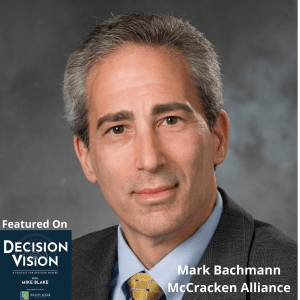
What does being a servant leader mean? How does servant leadership really work in managing an organization? Mark Bachmann joins host Mike Blake to discuss these questions and much more. “Decision Vision” is presented by Brady Ware & Company.

Mark Bachmann, McCracken Alliance Partners

McCracken Alliance Partners (MAP) is focused on providing financial leadership services including full time or interim CFO’s as well as experienced professionals to lead critical strategic initiatives or transactions. MAP is comprised of experienced public and private company CFO’s whose skills and knowledge can create immediate value. Additionally, some of the partners are experienced executive coaches providing relevant, actionable counsel to existing CFO’s.

Mark R. Bachmann has a broad business background including both Division President and CFO of a public company. Currently, Mr. Bachmann is a Partner with McCracken Alliance Partners, providing financial leadership services as well as President of The Bachmann Group where he is an Executive Coach to CFOs to help them to accelerate their performance.

Previously, Mr. Bachmann was Executive Vice President and Chief Financial Officer of Zep Inc. ($700 million publicly traded chemical company) from 2005 until 2015 and retired when Zep was sold to a private equity firm.

During his tenure as CFO for Zep, Mr. Bachmann was instrumental in the spin-off of Zep from its parent, (Acuity Brands, Inc. NYSE:AYI) and prepared the Company to go public in the fall of 2007. After the spin-off, Mr. Bachmann played a critical role in restructuring the business post-recession and developing its growth strategy. Beginning in 2010, Mr. Bachmann led the company through seven acquisitions with total revenues of $235 million that reshaped the portfolio. He refinanced the business twice ensuring liquidity to support its strategies. Mr. Bachmann was also critical in selling the company in 2015 by supporting the marketing, due diligence and financing processes. He led the company through crisis communications and business continuity plan following a fire at a major production facility and was the primary individual negotiating a $50+ million settlement with the insurance companies.

Prior to becoming CFO at Zep, Mr. Bachmann held a number of other executive leadership positions in Operations and Finance within the Company or its predecessor parent companies.

Earlier in his career, Mr. Bachmann was associated with The Quaker Oats Company ($6 billion publicly-traded Consumer Packaged Goods Company) where he held nine different financial management positions of increasing responsibility including both domestic and international assignments. He began his career as an auditor at Deloitte.

Mr. Bachmann is currently serving on the Board of Trustees, Treasurer and on the Development and Endowment Committees of his religious institution. He is serves on the Operating Committee as the immediate Past President of CEO Netweavers, a not-for-profit professional organization in Atlanta, as well as on the Leadership Council for Junior Achievement of Atlanta.

Mr. Bachmann has invested significant time and effort in leadership development and strengthening the finance function within the companies he has led, as well as in the community. He was Executive in Residence at Georgia State University and on their Board of Advisors for the Master of Science in Finance Program as well as previously served as Co-Chairman of its CFO Council. Mr. Bachmann is a frequent lecturer at universities and professional organizations. He has and continues to mentor and coach a number of finance professionals.

Mr. Bachmann received his Bachelor of Science degree in accounting from the University of Illinois and his MBA from Northwestern University.

Michael Blake, Brady Ware & Company

Mike Blake, Host of the “Decision Vision” podcast series

Michael Blake is Host of the “Decision Vision” podcast series and a Director of Brady Ware & Company. Mike specializes in the valuation of intellectual property-driven firms, such as software firms, aerospace firms and professional services firms, most frequently in the capacity as a transaction advisor, helping clients obtain great outcomes from complex transaction opportunities. He is also a specialist in the appraisal of intellectual properties as stand-alone assets, such as software, trade secrets, and patents.

Mike has been a full-time business appraiser for 13 years with public accounting firms, boutique business appraisal firms, and an owner of his own firm. Prior to that, he spent 8 years in venture capital and investment banking, including transactions in the U.S., Israel, Russia, Ukraine, and Belarus.

Brady Ware & Company

Brady Ware & Company is a regional full-service accounting and advisory firm which helps businesses and entrepreneurs make visions a reality. Brady Ware services clients nationally from its offices in Alpharetta, GA; Columbus and Dayton, OH; and Richmond, IN. The firm is growth minded, committed to the regions in which they operate, and most importantly, they make significant investments in their people and service offerings to meet the changing financial needs of those they are privileged to serve. The firm is dedicated to providing results that make a difference for its clients.

Decision Vision Podcast Series

“Decision Vision” is a podcast covering topics and issues facing small business owners and connecting them with solutions from leading experts. This series is presented by Brady Ware & Company. If you are a decision maker for a small business, we’d love to hear from you. Contact us at decisionvision@bradyware.com and make sure to listen to every Thursday to the “Decision Vision” podcast.

Past episodes of “Decision Vision” can be found at decisionvisionpodcast.com. “Decision Vision” is produced and broadcast by the North Fulton studio of Business RadioX®.

Visit Brady Ware & Company on social media:

LinkedIn:  https://www.linkedin.com/company/brady-ware/

Facebook: https://www.facebook.com/bradywareCPAs/

Twitter: https://twitter.com/BradyWare

Instagram: https://www.instagram.com/bradywarecompany/

Show Transcript

Intro: [00:00:01] Welcome to Decision Vision, a podcast series focusing on critical business decisions. Brought to you by Brady Ware & Company. Brady Ware is a regional full service accounting and advisory firm that helps businesses and entrepreneurs make visions a reality.

Mike Blake: [00:00:21] And welcome to Decision Vision, a podcast giving you, the listener, clear vision to make great decisions. In each episode, we discuss the process of decision making on a different topic from the business owner’s or executive’s perspective. We aren’t necessarily telling you what to do, but we can put you in a position to make an informed decision on your own and understand when you might need help along the way.

Mike Blake: [00:00:39] My name is Mike Blake and I’m your host for today’s program. I’m a director at Brady Ware & Company, a full service accounting firm based in Dayton, Ohio. With offices in Dayton, Columbus, Ohio, Richmond, Indiana, and Alpharetta, Georgia. Brady Ware is sponsoring this podcast, which is being recorded in Atlanta for social distancing protocols. If you like this podcast, please subscribe on your favorite podcast aggregator. And please consider leaving a review of the podcast as well.

Mike Blake: [00:01:05] Today’s topic is, should I become a servant leader? And we’ll get into definitions in a moment. But, you know, as we record this on July 31st, which means it’ll probably show up sometime around Labor Day if our current publishing schedule holds, I think we’re being confronted right now with the notion of servant leadership every day. And I don’t want to make this a political discussion. It’s not going to be a political discussion, if I have anything to say about it.

Mike Blake: [00:01:44] But nevertheless, we’re being confronted right now, in particular in the private sector, so what is the role of the company in society? And, you know, the notion of shareholder primacy in the company, the thesis of why a company should exist. Meaning that, companies exist to provide return for shareholders – financial return to shareholders, full stop, period, end of discussion is now, I think, being widely challenged. And there’s been a challenge to it, I think, that’s been bubbling up the last ten years as millennials come of age and start to become not only highly sought after employees and contributors to companies and organizations, but now are becoming executives and owners of organizations.

Mike Blake: [00:02:41] By the way, if you want to feel old, have the kid of one of your friends ask to connect with you on LinkedIn. I don’t think anything has made me feel older. And I turned 50 a couple of months ago. That was not as devastating as the kid of one of my peers connected with me on LinkedIn. Not Facebook, not Instagram, but on LinkedIn. That was jarring.

Mike Blake: [00:03:04] But anyway, the notion of what leadership is right now, I think, is being redefined in real time or at least is being re-examined on a society and an economy wide level in real time. Now, does that mean that everybody’s going to change? No, I don’t think so. Does that mean, I think, our entire society is going to be upended and we’re going to move from whatever dominant leadership style we think we have. I think it’s actually fragmented. But whatever leadership style you think prevails in society, is that going to be converted wholesale into something else? No, I don’t.

Mike Blake: [00:03:46] But I do think what’s happening is that alternative leadership approaches are necessarily being given a second look, for no other reason, because with the exception of close family and friends, this is assuming that you’re in the camp that thinks that social distancing is important. And again, if it’s not important to you, okay. But be safe. But for those of us for whom it is important, it means that almost every relationship we have, especially business relationship, has been disrupted. It is harder to sell. It is harder to hire, to recruit, to train, to motivate, to inspire. And the one thing that, I think, we know for certain is that what worked and what we were comfortable with on January 31st, 2020 is not going to be the same thing that we’re going to be – we need to be comfortable with and effective on July 31st, 2020. And so, that’s why I think this topic is of particular interest and is timely today.

Mike Blake: [00:05:04] And joining us today is a person that I think is a terrific example of a servant leader and is a person who’s going to tell you through his own story. It didn’t necessarily come out of the chute as it certainly is. There’s an origin story there that, I think, we’re all going to benefit from. Because if we didn’t consider ourselves servant leaders or maybe we’re not even familiar with the term until very recently, it’s not too late to become that if that resonates with the kind of leader that you want to be and you need to be, given the new environment that may or may not return to what we enjoyed, again, about a-half-a-year ago.

Mike Blake: [00:05:51] So, joining us today is Mark Bachmann, who is a partner at MacCracken Alliance Partners. And they are focused on providing financial leadership services, including full time or interim CFOs, as well as experienced professionals to lead critical strategic initiatives or transactions. MAP is comprised of experienced public and private company CFOs, whose skills and knowledge can create immediate value. Additionally, some of the partners are experienced executive coaches providing relevant, actionable counsel to existing chief financial officers.

Mike Blake: [00:06:20] Mark has a broad business background, including both division president and CFO of a public company. He’s currently, as I said, a partner with MacCracken Alliance Partners. And he’s also an executive coach to chief financial officers to help them accelerate their performance. Mark demonstrates strong business acumen with solid conceptual and analytical thinking to lead enterprise critical initiatives. He is a highly effective, trusted advisor in working with CEOs, boards, senior management teams, and strategic partners with a collaborative and participatory management style, common stable influence, and sharp focus on value creation and organizational integrity.

Mike Blake: [00:06:58] Mark is currently serving on the Board of Trustees as treasurer and on the Development Endowment Committees of his religious institution. He serves on the operating committee and is the immediate past president of CEO Netweavers – of which I’m a member and how we know each other – a not-for-profit professional organization in Atlanta as well as on the Leadership Council for Junior Achievement of Atlanta. Mark earned his Bachelor of Science degree in accounting from the University of Illinois and his MBA from Northwestern University. Mark, welcome to the program.

Mark Bachmann: [00:07:29] Thank you, Mike. You did a nice job there. I appreciate it.

Mike Blake: [00:07:33] Thanks. I hope I got the right bio. Because, otherwise, we’ll have to record this again. Given the accounting industry, I’d be remiss. You don’t want a job as a tax accountant right now, do you?

Mark Bachmann: [00:07:45] I did that for one busy season – and that was enough – many years ago.

Mike Blake: [00:07:51] That’s enough for a lot of people. I thank goodness that I’m not an accountant, even though I work for an accounting firm. That, you know, seeing how people went through or go through a busy season and then this year where it, basically, got dragged out through July. They are better people than I am. I’ll just leave it at that.

Mark Bachmann: [00:08:10] Yeah, yeah, yeah. I don’t even do my own taxes anymore.

Mike Blake: [00:08:14] There you go. And neither do I, so I’m not in jail. So, Mark, let’s start with a basic definition, because I don’t think everybody necessarily knows what the term servant leadership means. How would you define it?

Mark Bachmann: [00:08:30] So, I think the phrase servant leadership probably goes back to the early 1970s when a gentleman by the name of Robert Greenleaf wrote an essay entitled The Servant as Leader. I think he goes on to say that as a philosophy and a set of practices that enriches the lives of individuals and build better organizations. But it’s really the focus that the servant leader is servant first, and they want to serve, and serve first.

Mark Bachmann: [00:09:04] And that’s sharply different than a leader who considers them a leader first. Perhaps maybe a need to, you know, meet a power drive or to acquire material possessions. You know, it’s not quite the same, but I’ve also sort of thought of it as being similar as paying it forward. I mean, where you’re doing good for someone else without the expectation of anything in return.

Mike Blake: [00:09:35] So, how would you characterize servant leadership in contrast to other kinds of leadership? That’s a semi-unfair question. But assuming you even can put names in other kinds of leadership, how does that differ?

Mark Bachmann: [00:09:54] Well, I mean, as you said there, Mike, there are a lot of different styles of leadership, whether you’re someone who might be considered an autocratic type of leader, and we can think of people like that, or authoritarian in their approach. But I think, you know, it depends sort of on how you think about sharing of power and how decisions are made and whether you’re thinking yourself of being that leader first or servant first. And sort of, I think, the servant leader shares power and puts the needs of others first and helps people develop and perform as highly as possible. As opposed to, maybe, other forms of leadership where, you know, you’re thinking you’re the most important person in the room and you’re driven by that power or that ego.

Mike Blake: [00:10:49] And why is servant leadership effective? Why is that mentality of kind of working outside in, if you will, if you think of an egocentric thought process? What are the benefits of that kind of approach?

Mark Bachmann: [00:11:08] Well, I mean, I think some would say that you’re getting greater engagement of the people who are in your organization, whether it’s a for-profit or not-for-profit, that if you’re thinking of them first and trying to serve them first. That you’re getting a greater engagement, you’re getting then, you know, greater creativity, enthusiasm. You know, you probably are going to end up with lower turnover.

Mark Bachmann: [00:11:44] And so, the thought is if you have an engaged group as opposed to, you know, maybe a style where you’re telling and dictating what shall be done and not giving a lot of leeway for ideas or voices to be heard, you know, once again, I think different situations also call for different leadership. I don’t necessarily think that one style is necessarily right for all situations either.

Mike Blake: [00:12:15] You know, that’s an interesting point. I’m going to think about that. That’s a very thought provoking comment, but I think you’re right that servant leadership may not necessarily be the optimal in every situation.

Mark Bachmann: [00:12:31] Well think about it this way, I mean, you know, would you say that the military is a servant leadership organization?

Mike Blake: [00:12:40] I would say only partially, and I say that because one of my favorite leadership books is a book called It’s Your Ship by a former Navy Captain named Michael Abramoff. And I thought there were instances of servant leadership in terms of team building and loyalty and unit cohesion. But I think I see what you’re getting at. In a combat scenario, you can only throw yourself on a grenade once, right? And so, it may not be practical in a combat scenario to embrace a servant leadership kind of mentality.

Mike Blake: [00:13:18] So, I’d like to hear your origin story. We’ve sort of chatted about it in passing, but even I don’t know the details. But tell us about what led you to a servant leadership mentality?

Mark Bachmann: [00:13:40] Well, honestly, I went through the majority of my career without ever hearing the word servant leadership or really knowing what it was. You know, if I look back over my 35 plus years of being in business and, primarily, in large public corporations, I worked for probably over 20 different managers. Some were pretty good. Others, frankly, were pretty bad. Through that, I developed my own leadership style, probably more closely aligned with what might be referred to as a democratic style. I would frequently ask people, “What do you think?” And seek people’s opinions before reaching a final decision.

Mark Bachmann: [00:14:24] And I enjoyed, as I went up through the ranks, the increased responsibility. But honestly, I don’t think I was personally driven by power or ego. I was just trying to do what was best for the organization. And as I became a manager of people, I wanted to help them become the best they could be. I was interested in their development and providing feedback and mentoring them as they progressed. And what were their goals and how could I help achieve them. And, honestly, when I have conversations with people and if they want to pursue and sort of leave my group and go to another part of the organization or even leave the organization, I would say fine. Helping them be their best, if you will. So, that was sort of always at the core of sort of what I thought was right.

Mark Bachmann: [00:15:12] But it’s really been since I’ve retired from a full time position that I’ve increased my focus and, frankly, became aware of servant leadership. I really felt blessed to have achieved both the personal and professional success and accomplishments that I wanted to give back. I mean, really help others. And I found this organization that you mentioned that we’re both members of, CEO Netweavers. And for our listeners, it’s a group of current and former CEOs, along with a select group of trusted advisers and C-suite executives. And the organization is based on the principles of servant leadership. And we provide service to our members by trying to help them achieve their goals and aspirations, as well as serving the community through a few of the outreach programs.

Mark Bachmann: [00:16:03] And so, you know, as I got to know this organization – and we both know Jim Dupree and I want to thank him. He’s one of the founders of the group and he encouraged me to get involved. And so, I first got involved by leading the mentoring program there. And then, he asked if I would become treasurer and so I became treasurer. And then, I had the privilege of, last year, being its president. And now, I lead the Governance Nominating Committee. So, I really saw that as a great vehicle to be with other like-minded professionals who really want to give and really not having an expectation of anything in return. And so, really, that was my introduction to servant leadership and, really, has been very rewarding.

Mike Blake: [00:17:00] Well, you mentioned CEO Netweavers, I don’t mind giving them a shameless plug. It is the only civic organization to which I belong. And there’s good reason for that. You learn so much there and there is a camaraderie. And the agenda of every meeting is how can we help somebody else in some form or another. And if you’re into that, you know, we also have a chapter in Houston. But it is a terrific organization. It’s a focus for that. And hopefully, over time, there’ll be more of them because it is such a great focus, not just to exercise servant leadership, but how to become better at it.

Mike Blake: [00:17:53] So, you know, you mentioned you came to serve in leadership, kind of as you retire. But let’s take a listener that is not retired. Let’s take a listener that’s in the middle of their career, is doing what they’re doing. You know, a cynic might say, “Well, you can’t afford to be a servant leadership. You’ve got to grab what you can when you can, because once that opportunity is over, it’s over.” And my question to you is, in your experience, you know, for somebody that is, again, at that stage of their career, are they potentially giving something up in exchange for adopting a servant leadership mentality, maybe just because they feel it’s spiritually rewarding or it just makes their life feel more purposeful, whatever it is, or is that a false choice?

Mark Bachmann: [00:18:51] Well, you know, I’m not sure that it’s a false choice and that you’re giving things up. I mean, I think once again, it’s how are you choosing to lead and whose interests are you motivated by? And while trying to – you know, and you lead in and I’m sure we’ll probably get to it around shareholder value and the role of the corporation. I mean, in business, you know, you have a set of objectives, the organization has a set of objectives. And there’s many ways in how do you try to align people to accomplish those objectives. And I think servant leadership is just trying to shift the power or shift the focus a little bit on how you try to execute.

Mark Bachmann: [00:19:50] And so, you know, if people are unable to drive success through that or feel like they have to have a more command and control to ensure success, they’ll fight with, you know, letting go a bit and and shifting the focus, I’m sure. But I don’t know that it’s necessarily a tradeoff for everyone.

Mike Blake: [00:20:20] Well, you know, I did want to cover exactly that question as how servant leadership and shareholder value creation, whether they can coexist. And if so, what does that look like? So, you know, you’re a finance guy. You’re a guy that is used to making hard-nosed decisions. You’ve been in a leadership role in a public company. I’m sure you’ve had your compensation tied very clearly to stock performance. So, I think you’re in a great position to offer an informed point of view on this. You know, can servant leadership and a shareholder value mentality coexist?

Mark Bachmann: [00:21:04] Oh, absolutely. Absolutely. I mean, being a servant leader doesn’t mean you don’t care about creating shareholder value. You know, last year, I think it was the Business Roundtable announced a new statement of what the purpose of a corporation was. And previously, it was solely to maximize shareholder value. But, you know, I think they got over 150 or 170 CEOs who committed to lead their companies for the benefit of all stakeholders. And so, they include customers, employees, suppliers, communities, and shareholders.

Mark Bachmann: [00:21:42] And they had a section I was reading about the employee where they’re talking about investing in our employees. And they say it starts with compensating them fairly and providing them important benefits. It also includes supporting them through training and education, so they develop new skills and that they foster diversity, inclusion, dignity, and respect.

Mark Bachmann: [00:22:06] Now, you know, when I take it to my own perspective, having to make those trade offs, I learned an incredibly valuable lesson when I was the division president of Zep’s retail business. We had a huge opportunity to launch a whole new product line at Walmart. And we had 40 days to do it. And as a result, I pushed the organization really hard. And I placed so much focus on the customer that I lost sight of the employee. You know, you’re talking about the largest retailer in the world. You have this opportunity and you have 40 days to get it done.

Mark Bachmann: [00:22:51] As a result, our employees launched a union organizing campaign. And so, I invested a considerable amount of time to listen to our employee’s concerns and was able to build trust with them. You know, they thought I would have learned from this and would address it. And so, we ended up defeating the union two to one, which was fabulous. And I made a lot of changes. And ever since I consciously needed to have balance. The need of multiple stakeholders that being skewed towards the customer or the shareholder at the expense of the employee wasn’t the right formula for success.

Mark Bachmann: [00:23:40] And I guess the last thing I’d say, Mike, is I know that there have been studies out there that have shown a positive correlation between employee engagement and shareholder returns. And, you know, when you had engaged employees, you will improve retention, thereby reducing turnover. And, you know, it doesn’t necessarily mean you have a whole bunch – an organization has a whole bunch of servant leaders, you know, in there. But clearly if you have an engaged workforce, you know, if you think about these surveys, like, great places to work or whatever, I’m sure there’s a much greater understanding of the needs of the employees than just the shareholders.

Mike Blake: [00:24:35] You know, I wonder if that scenario that you described matches up with one of the concepts in the seven habits of highly effective people, where there’s this notion of, in effect, an emotional bank account. You have a particular goal where in order to accomplish a goal – in your case, in 40 days – you just have to go into a flat out sprint with your knees hurt, you’re out of breath, your feet hurt too bad. You just got to figure it out.

Mike Blake: [00:25:04] Failure, if it’s a non-option, it’s certainly a bad option. You know, if there have been, maybe, some sort of capital in the emotional bank account before that, then maybe driving for that sprint then becomes a little bit easier. So, it’s not just about kind of doing the right thing in the moment. But, also, I think it’s building capital where, you know, you’re kind of the first to give, so that when you’re asking somebody to give in return, they have a sense that it’s a relationship with some semblance of equity, too.

Mark Bachmann: [00:25:49] I absolutely believe that you need to build goodwill. You know, you need to have – as a leader, you need to have emotional intelligence, EQ as well as IQ in terms of being able to motivate your workforce, understand what their needs are. So that, you know, in these times, you could tap on them and ask them to go, you know, sort of all out.

Mike Blake: [00:26:28] So, as you decided that you wanted to embrace servant leadership, were there any new skills that you felt like you had to either acquire or develop further in order to be effective in that kind of mode?

Mark Bachmann: [00:26:48] Well, I mean, I think I’m not sure that there are new skills per se. But if I think about some of the key skills that are important in servant leadership, so you might then tune them up or continue to be more aware. I mean, you really – you know, first and foremost, it’s all about listening. You know, you really need to understand that you’re going to need to understand what the needs of others are, what are they truly saying, what are they truly needing in that.

Mark Bachmann: [00:27:26] I think also, you know, a healthy understanding of yourself, self-awareness, to really understand how you are managing your emotions, your behaviors, and how what you do might impact others. And then, you know, having a commitment that you want to help other people grow and develop. I think those are all sort of important. And, you know, sort of checking in on your ability to persuade rather than sort of using authority to get that.

Mark Bachmann: [00:28:10] And, you know, I will tell you, that’s been a really key learning for me working in non-profit and volunteer organizations, on the operating committee of the CEO Netweavers, or on my synagogue board. You know, I don’t necessarily have the authority, but I need to encourage people. And I’m trying to sell an idea or whatever and having other people, you know, follow. Leadership is also creating followership, right? And so, aspiring to those people’s interests and inclinations.

Mike Blake: [00:29:03] So, I’d like to share with you, at least, a couple of things I think I’ve had to develop to become a more effective servant leader. And one of those two things is proactivity. I think a lot of leadership – and even your description of the 40 day dash and unionization, I think, is actually somewhat illustrative of this – is, I think, a major characteristic of servant leadership is being proactive and addressing or trying to address people’s needs or wants before they’re ever even articulated to you.

Mike Blake: [00:29:46] And I have a feeling anybody who’s been married understands the value of this, that a bouquet of flowers before your spouse gets mad at you is often much more effective than a bouquet of flowers afterwards, right? And I think that’s sort of human nature. And something that I have – a skill that I am not naturally good at. I tend to be a reactive person. But being a – I think it’s very hard to be an effective servant leader if you’re purely reactive, because that misses so many opportunities to exhibit that kind of leadership.

Mark Bachmann: [00:30:26] Right. I agree.

Mike Blake: [00:30:28] And I think the other mentality is I had to give up an external need for validation. That servant leadership, I think, often is best applied when it’s not noticed. In a way, I kind of think of it like being an umpire in a baseball game. The best umpire in a baseball game is when you don’t even notice he’s there. But you just know that the game went well. You think the right team won the game and that’s it. But you never say, “You know what? That guy did a really great job calling balls and strikes that day. Good on him.”

Mike Blake: [00:31:08] And I think servant leadership requires that. And that requires, I think, subverting your ego a little bit and requires developing an inner source of validation. We say, “You know what? I did good today. I don’t need to have a thank you note, I don’t need to have a trophy or anything like that. I’m just going to open a nice bottle of Cabernet at the end of the day and just enjoy the fact that somebody else had a positive impact because of something that I did.”

Mark Bachmann: [00:31:43] I absolutely agree with that.

Mike Blake: [00:31:49] So, let me ask this, I’m curious, is there somebody that you look up to as an example of servant leadership? And if so, what is it about them that makes you put them in the position of sort of serving as a good example for you?

Mark Bachmann: [00:32:08] You know, I don’t know that I have one example or whatever of being a servant leader. I mean, I think, you know, there’s been certainly a lot of footage and coverage over the last couple of weeks about John Lewis. You know, a civil rights leader and what he was trying to do. And he seemed like he was a servant leader, really trying to, you know, meet the needs of others than himself. But I don’t know, you know, when I look at others out there, I mean, I can’t say I have a role model that I’m following.

Mike Blake: [00:33:01] Okay. Well, that’s fair, I mean, you know, you don’t necessarily have to. I think in the mainstream, the concept of servant leadership is still relatively new. And I think there are lots of people that behave as servant leaders, even though I don’t think they would necessarily characterize themselves that way. But you certainly see it kind of out there.

Mark Bachmann: [00:33:30] Yeah. I mean, I think we both know – I don’t know if he’s been on your show or not – but Tom Berger, who is a member of CEO Netweavers, I mean, talk about selflessness and just the amount of knowledge and what he’s willing to do to share with people and help others. I mean, you know, I’m inspired by a lot of our other members in CEO Netweavers.

Mike Blake: [00:34:08] Let me ask you this, a person who’s often held up as the archetypal servant leader is Martin Luther King Jr. And, you know, we know who he is because he was effective at promoting a grand cause. You could easily argue maybe the grandest at least domestic cause in the United States in the 20th Century. But, you know, do you have to be promoting a grand cause to be a servant leader? I don’t want to put words in your mouth. But as I observe you in the way that you carry yourself every day, you know, it’s not obvious to me that you necessarily have a grand cause other than to serve.

Mike Blake: [00:34:57] But maybe I’m wrong. So, I’d love you to tell me either right or wrong. And the question is, do I have to have some grand cause, some grand vision to be a servant leader? Or can that mentality be effective as simply as saying, “I’m going to try to do what I can to make my corner of existence a little bit better one day at a time.”

Mark Bachmann: [00:35:25] Yeah. No. I mean, I don’t have a grand cause. And, you know, as I said, now, I’m in the enviable position of largely being able to decide how I spend my time and with whom and doing what. But I believe servant leadership can be done on a one-on-one basis. And once again, you know, the more people you can affect in a positive way and help them, you know, the hope is that they will pay it forward and adopt some of those same behaviors and traits and help others. And so, I do think there’s some merit to what Greenleaf wrote about some 50 years ago, about a more just and caring world. And so, you know, let’s do it one at a time.

Mike Blake: [00:36:27] We’ll switch gears here, because I think it’s an important question. And that is, I think there may be a tendency for somebody to hear about servant leadership and think that it’s effectively the same thing as philanthropy. And I’d love to get your observation on that. Is, in fact, servant leadership different from philanthropy? Or if they’re not the same, are they linked? What view, if any, do you have in the relationship between those two kind of conceptual frameworks?

Mark Bachmann: [00:37:04] Well, most often when I think of philanthropy, I think about, you know, the big donors who are giving money to the various causes out there and so forth. And I guess, you could also say that there’s – you know, giving up one’s time is philanthropic as well. But I think largely it’s thought about as money. But if you include time or volunteering and then you say, “Well, okay.” Then I think there are some crossover or some things that cross over into being a servant leader because you truly are serving and giving or helping others. But I don’t think of servant leadership of giving money.

Mike Blake: [00:38:00] Now, you and I are both, as we’ve talked about, we’re in a group that promotes and, for lack of a better term, I think in a way aggregates servant leadership. And there are others like that, Knights of Columbus and Kiwanis and, even to an extent, Rotary Club, things of that nature. What do you think is the benefit of creating groups that are servant leaders as opposed to individuals kind of doing it alone?

Mark Bachmann: [00:38:33] Well, I mean, I think, first of all, it’s nice when you’re with other like-minded people. And I think that you learn from each other. I think there’s inspiration that is shared, absorbed. When you hear stories and see actions that, you know, question, “Okay. Can I up my game? What else can I do? How can I be better?” And then, I think it also sort of channels our energies or our focus for some of the initiatives.

Mark Bachmann: [00:39:13] So, you know, as you’re aware, but the organization has an initiative called Inflection Point, where we are pulling a group of executives together to create an advisory board for a CEO on a short term basis. While you’re getting four or five people together to help that organization as opposed to just one-on-one. And there’s so much learning in one of those sessions. And I know you light it for a while as well. But I think there’s just so much that you take away as well as you give in those sessions. So, you know, I think that’s the benefit of being in a group.

Mike Blake: [00:40:01] And we’re talking to Mark Bachmann on the discussion of becoming a servant leader or the decision of whether to become a servant leader. Do you ever kind of think about or wonder about how do you measure or how do you know that you’re being effective? I mean, do you just sort of have a gut instinct? Is there anything that you monitor? I mean, I know your finance – you’re a quantitative kind of guy. Have you ever given any thought to kind of measuring your effectiveness as a servant leader? And if so, you know, what might your key performance indicators or KPIs look like?

Mark Bachmann: [00:40:45] Yeah. Great question. And I haven’t really gone to measure it other than sort of – and you mentioned this earlier about where you can get the self-validation because you don’t necessarily get it externally. But how do you feel after you’ve worked with someone or helped someone out? So, it’s a lot of that, you know, self-reflection and feeling of “Oh, I’ve done it.” You know, you do get some positive accolades from time to time.

Mark Bachmann: [00:41:26] And I think, you know, when I look back in the mentoring program that we have with Casal State University, in particular, I had a student a couple of years ago who we still stay in contact with. And to me, that’s a validation that I’ve really helped him, that he’s been wanting and willing to continue. You know, he’s reaching out to me and we built a nice relationship as a result of that. So, I know I’ve done some good and helped in that regard.

Mike Blake: [00:42:13] So, we’re running up against our time limit, but I’m going to squeeze a couple more questions in. And one of those kind of parting shots I want to get your thoughts on is how has servant leadership changed, if at all, in this current coronavirus massive social upheaval/murder hornets environment? Has it limited your ability to express it? Has it enhanced it? Has it put it on hold? Exposed a need? How is this environment kind of reframed your relationship with a servant leadership posture, if any?

Mark Bachmann: [00:42:58] Well, I mean, there’s certainly a growing need for that. I think that, you know, in a crisis, depending on how severe and what the circumstances are, I mean, some people may sort of gravitate back to whatever their natural tendencies are. And, you know, if they were a servant leader before, they’ll likely still think that way first. But, I think there’s clearly people who are in need. And so, you know, to the extent that some people have time and I’ve had some time, so I’ve been able to do some things with some folks, you know, not face to face, but through Zoom and through other means to try to help them get through or counsel them.

Mike Blake: [00:44:02] Mark, this has been a great discussion. And as is often the case with these interviews, I learned a ton, which is what makes them so rewarding. I’m sure, at least, some of our listeners have questions about servant leadership and what it might mean in their particular situation or circumstances. Would you be willing to entertain a question from them if they wanted to contact you? And and if so, what would be the best way for them to do that?

Mark Bachmann: [00:44:30] Yeah. So, they certainly can reach out to me through LinkedIn is fine. And I have contact information out there. It’s probably the best way to do it. And I’m certainly willing to have a conversation with them. And you know, if you really want to dive deeply into servant leadership, there is an organization called the Greenleaf Center for Servant Leadership that they could also follow up with.

Mike Blake: [00:45:09] Very good. That’s going to wrap it up for today’s program. I’d like to thank Mark Bachmann so much for joining us and sharing his expertise with us.

Mike Blake: [00:45:16] We’ll be exploring a new topic each week. So, please tune in so that when you’re faced with your next executive decision, you have clear vision when making it. If you enjoy these podcast, please consider leaving a review with your favorite podcast aggregator. It helps people find us that we can help them. Once again, this is Mike Blake. Our sponsor is Brady Ware & Company. And this has been the Decision Vision podcast.
Tagged With: Brady Ware, Brady Ware & Company, Leadership, Michael Blake, Mike Blake, Netweavers, servant leader, Servant Leadership

Decision Vision Episode 79:  Should I Take on a Business Partner? – An Interview with Evelyn Ashley of Trusted Counsel

August 20, 2020 by John Ray

Evelyn Ashley
Decision Vision
Decision Vision Episode 79:  Should I Take on a Business Partner? - An Interview with Evelyn Ashley of Trusted Counsel
Loading
00:00 /
RSS Feed
Share
Link
Embed

Download file

Decision Vision Episode 79:  Should I Take on a Business Partner? – An Interview with Evelyn Ashley, Trusted Counsel

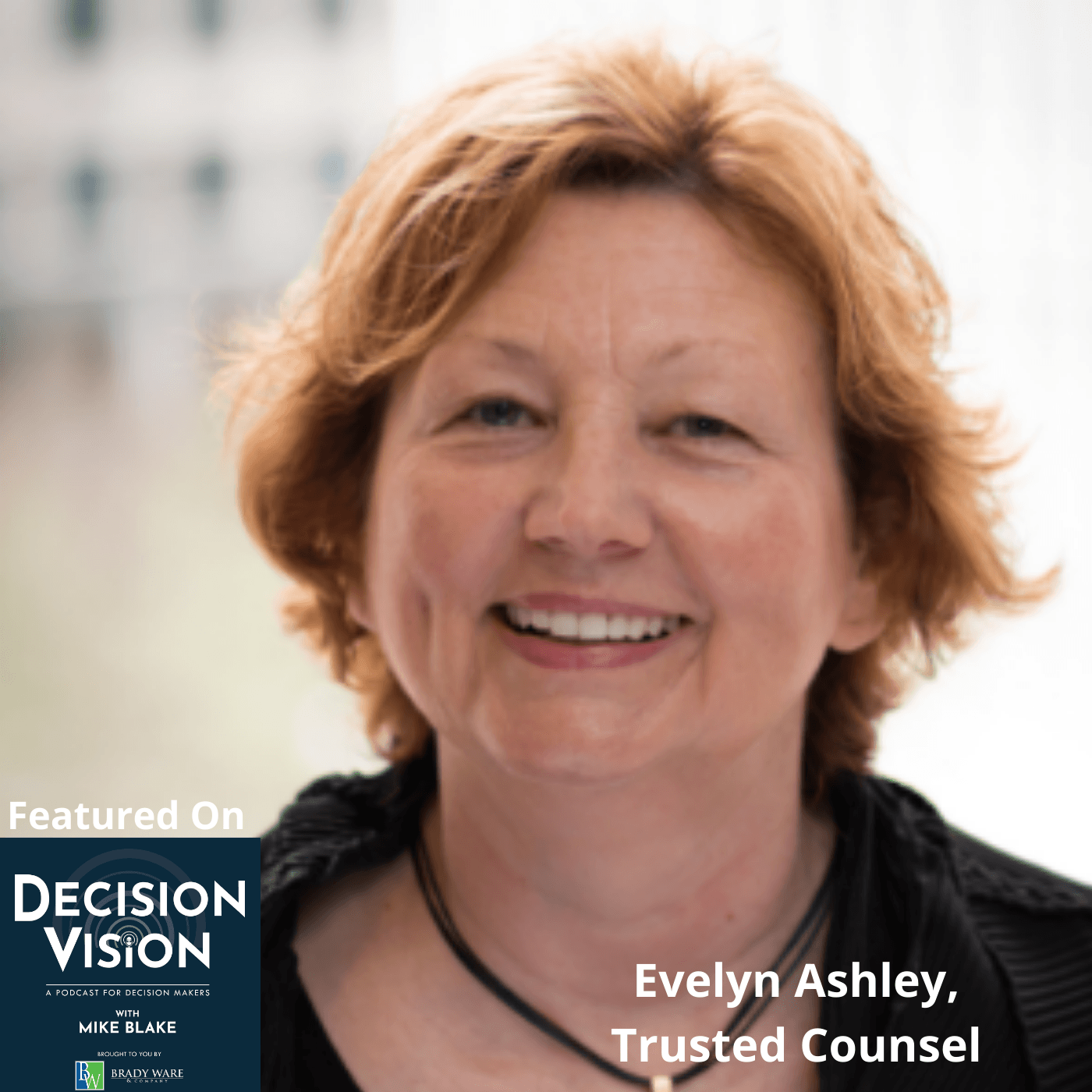
Attorney and business advisor Evelyn Ashley joins host Mike Blake to discuss the practical questions of business partnerships and what makes for a good business partnership. “Decision Vision” is presented by Brady Ware & Company.

Evelyn Ashley, Managing Partner, Trusted Counsel Ashley, LLC

Evelyn Ashley advises clients on matters such as mergers and acquisitions, joint ventures, financing and investments, corporate governance, intellectual property strategy, as well as protection, monetization and licensing; commercial agreements and ventures, including manufacturing, distribution, and agency; entity structure and related issues, corporate spin-outs, and international transactions. She has wide ranging experience and brings a refreshing, results focused, pragmatic approach to the practice of law.

She has practiced in large, medium, and boutique legal practices, finding that the latter gives her the most professional and personal satisfaction and flexibility. After practicing with Morris, Manning & Martin and co-founding and building Balboni, Ashley & Schoenberg, Evelyn founded and grew Red Hot Law Group, which quickly became a noted technology boutique law firm.  She was also co-founder of Red Hot Venture Consulting, a strategic consulting firm and incubator for technology businesses affiliated with the law firm.  Red Hot Law was acquired by Long Aldridge & Norman (now Dentons) in 2001, and Evelyn served as a Partner, heading the Firm’s technology practice. She left the Dentons predecessor at the end of 2003 to form Trusted Counsel Ashley LLC.

Prior to graduation from law school, Evelyn served on The Coca-Cola Company’s mergers and acquisition team that created and took Coca-Cola Enterprises public.  Her first employment out of college was as a tender offer corporate paralegal at Skadden, Arps, Slate, Meagher & Flom in New York in the early ‘80s.

Along with Trusted Counsel’s Partner John Monahon, Evelyn co-hosts “In Process: Conversations about Business in the 21st Century,” a radio show and podcast where national guests are interviewed on emerging business trends, ideas and techniques.

Evelyn loves creating and collecting art, choosing on the basis of what she likes, not what “experts” say is art… Evelyn and her husband Alan McKeon are avid travelers to both exotic and “usual suspect” locales.

Michael Blake, Brady Ware & Company

Mike Blake, Host of the “Decision Vision” podcast series

Michael Blake is Host of the “Decision Vision” podcast series and a Director of Brady Ware & Company. Mike specializes in the valuation of intellectual property-driven firms, such as software firms, aerospace firms and professional services firms, most frequently in the capacity as a transaction advisor, helping clients obtain great outcomes from complex transaction opportunities. He is also a specialist in the appraisal of intellectual properties as stand-alone assets, such as software, trade secrets, and patents.

Mike has been a full-time business appraiser for 13 years with public accounting firms, boutique business appraisal firms, and an owner of his own firm. Prior to that, he spent 8 years in venture capital and investment banking, including transactions in the U.S., Israel, Russia, Ukraine, and Belarus.

Brady Ware & Company

Brady Ware & Company is a regional full-service accounting and advisory firm which helps businesses and entrepreneurs make visions a reality. Brady Ware services clients nationally from its offices in Alpharetta, GA; Columbus and Dayton, OH; and Richmond, IN. The firm is growth minded, committed to the regions in which they operate, and most importantly, they make significant investments in their people and service offerings to meet the changing financial needs of those they are privileged to serve. The firm is dedicated to providing results that make a difference for its clients.

Decision Vision Podcast Series

“Decision Vision” is a podcast covering topics and issues facing small business owners and connecting them with solutions from leading experts. This series is presented by Brady Ware & Company. If you are a decision maker for a small business, we’d love to hear from you. Contact us at decisionvision@bradyware.com and make sure to listen to every Thursday to the “Decision Vision” podcast.

Past episodes of “Decision Vision” can be found at decisionvisionpodcast.com. “Decision Vision” is produced and broadcast by the North Fulton studio of Business RadioX®.

Visit Brady Ware & Company on social media:

LinkedIn:  https://www.linkedin.com/company/brady-ware/

Facebook: https://www.facebook.com/bradywareCPAs/

Twitter: https://twitter.com/BradyWare

Instagram: https://www.instagram.com/bradywarecompany/

Show Transcript

Intro: [00:00:02] Welcome to Decision Vision, a podcast series focusing on critical business decisions. Brought to you by Brady Ware & Company. Brady Ware is a regional full service accounting and advisory firm that helps businesses and entrepreneurs make visions a reality.

Mike Blake: [00:00:21] And welcome to Decision Vision, a podcast giving you, the listener, clear vision to make great decisions. In each episode, we discuss the process of decision making on a different topic from the business owner’s or executive’s perspective. We aren’t necessarily telling you what to do, but we can put you in a position to make an informed decision on your own and understand when you might need help along the way.

Mike Blake: [00:00:40] My name is Mike Blake and I’m your host for today’s program. I’m a director at Brady Ware & Company, a full service accounting firm based in Dayton, Ohio. With offices in Dayton, Columbus, Ohio, Richmond, Indiana, and Alpharetta, Georgia. Brady Ware is sponsoring this podcast, which is being recorded in Atlanta for social distancing protocols. If you like this podcast, please subscribe on your favorite podcast aggregator. And please consider leaving a review of the podcast as well.

Mike Blake: [00:01:06] Today’s topic is, should I take on a business partner? And as we record podcast number 79 in the series, I realized I’m derelict in not getting to this topic sooner. It really should have been in one of the top ten and I’m not quite sure why we didn’t get to it sooner. Because this is a topic that, for many people in businesses, is one of the most important decisions they’ll ever make. And it is a decision, as we will learn with our guest, you often have to make many times over in your career or over the life of a business or several businesses. And we see, unfortunately, that quite often making the bad decisions or making this decision poorly can lead to very painful results and outcomes.

Mike Blake: [00:02:05] And I, myself, have been a business partner. I’ve taken on business partners with varying degrees of success. I’m in a partnership now with 23 other people, I think, that have not thrown me out yet. And I’ve only threatened to burn the building down twice. And I’ve been in a business partnership that lasted exactly two months, and really should have lasted one. But the benefit of that was that we all realized that was a mistake early in accordance with best practices of Google. And being inspired by Google, we decided to fail fast. And that also was a very good decision.

Mike Blake: [00:02:49] We’ll probably have an episode at some point soon on should I exit or should I terminate a business partnership. Because, you know, all business partnerships end. It’s just a matter of the manner and expectedness in which they actually do end. So, I’m looking forward to a very deep and profound, a very impactful discussion today. And as our guest noted, this could actually be a-half-a-day seminar just based on the questions I have written. And maybe, maybe we’ll have her back if she’s willing to do it. We have not yet had a repeat guest. Most of them are wise by the end of this thing. But maybe we’ll fool her into coming back. But there’s a lot of – this is a good topic I’m looking forward to.

Mike Blake: [00:03:33] And joining us today is my friend and someone I’ve been trying to get on this podcast for forever. But I think it would have been easier to get Beyonce to come on this thing. But my friend, Evelyn Ashley, who is managing partner of Trusted Counsel, a law firm here in Atlanta. And Evelyn is a person that, herself, has been a partner in law firms, as managing partner of her own firm, has had partners come in, has had partners come out. She’s married to one of them. And she’s really been through – I’m guessing she’s been through or has addressed some permutation of every business partner relationship that you can possibly imagine. And I think we’re going to hear some cool war stories today.

Mike Blake: [00:04:21] Trusted Counsel is a firm specializing in corporate law and intellectual property. They are a WBENC certified woman owned businesses that represent small and medium private company clients on matters such as mergers and acquisitions, financing and investments, intellectual property strategy, commercialization protection, licensing, manufacturing, distribution and destruction related issues, corporate spin outs, international transactions. Their lawyers have wide ranging experience and bring a results focused, pragmatic business approach to the practice of law.

Mike Blake: [00:04:53] Evelyn has practiced in large, medium, and boutique legal practices. Finding that the latter gives her the most professional and personal satisfaction and flexibility. And I suspect, also, that Evelyn is like me, we don’t take orders well. After practicing with Morris, Manning & Martin and co-founding and building Balboni, Ashley & Schoenburg, Evelyn founded and grew Red Hot Law Group, which if you’re not from Atlanta or if you are from Atlanta but you’re not of a certain age, they were the startup law firm. It took a lot of companies from venture or startup to venture funding and took a bunch of them public as well, I believe. So, in their day, they were the name in technology here in Atlanta and, really, in southeast.

Mike Blake: [00:05:40] She was also co-founder of Red Hot Venture Consulting, a strategic consulting firm, an incubator for technology businesses affiliated with the law firm. Red Hot, while it was acquired by Long Aldridge & Norman, now Dentons, in 2001. And Evelyn served as a partner heading the firm’s technology practice. I didn’t know you were acquired by Dentons. She left Dentons predecessor at the end of 2003 to form Trusted Counsel.

Mike Blake: [00:06:07] Prior to graduation from law school, Evelyn served in the Coca-Cola Company’s mergers and acquisitions team that created and took Coca-Cola Enterprises public. I did not know that. Her first employment out of college was as a tender offer corporate paralegal at Skadden, Arps, Slate, Meagher & Flom in New York in the early 1980s. There got to be some stories there. Along with – sorry.

Mike Blake: [00:06:29] Evelyn also co-hosts In Process: Conversations about Business in the 21st Century, a radio show and podcast where national guests are interviewed on an emerging business trends, ideas, and techniques. And her podcast has been around way longer than this one, so do give that a listen. And I think I was on one of the early episodes of that, if I’m not mistaken. Or they may have deleted it.

Mike Blake: [00:06:49] Evelyn loves creating and collecting art, choosing on the basis of what she likes, not what experts say is art. Evelyn and her husband, Alan McKinnon, are avid travelers to both exotic and usual suspect locales. And in fact, sometimes when I’m feeling sort of isolated, I will take their Facebook pictures, put it up on my 4K monitor, grab a cup of Tension Tamer Tea, and will just go to one of those places. And right now, if you want to travel, that’s pretty much the only way to get there. So, I’m glad you’re doing that. Evelyn, thank you for coming on the program.

Evelyn Ashley: [00:07:21] Thanks for having me, Mike. That’s such a mouthful. Now, I’m so exhausted having reflected on what I’ve done over my career. I do think that I need to – well, I need to think about bringing on a business partner so I can retire, you know?

Mike Blake: [00:07:38] Well, the goal is to wear down the gas before we get to the interview. So, I’m glad to hear we may have accomplished that to some extent. So, as I said, one of the reasons I want to get you on this program and talk about this topic is, you know, you don’t just have bias in this topic. You’ve lived it, right? And you’re living kind of one of these partnership moments, if you will, in real time, as we’ve talked about before the program. And I know you’re not going to get into specifics about that, but I think it’s important to understand that you’re not just an academic. You are definitely a practitioner when it comes to business partnerships.

Evelyn Ashley: [00:08:17] That’s true.

Mike Blake: [00:08:17] Business partners can be such a pain in the neck. And I am a pain in the neck business partner. I’ll be the first to tell you and everybody else will be second. Why would you take one on? Why would you deal with this?

Evelyn Ashley: [00:08:33] Well, I mean, I think it’s important for any business owner to actually realize that throughout the growth of a business and then even kind of the exit of that person or the business itself through a sale or maybe retirement, it’s important to know that you probably want to grow. So, increase revenue, expand the territory where your products and services are offered, bring in expertise that you don’t have, bringing capital that you need. And then, you know, that whole idea of succession planning that I already mentioned.

Evelyn Ashley: [00:09:19] So, yes, it can be challenging to have business partners, because we’re all human and we all have different personalities and attitudes. But the reality of a good partnership – and I’m using that kind of in the general business term because there’s a legal term of art that means something completely different. But I think that good partnerships can grow great businesses. And that’s why you actually put up with the challenge of them.

Mike Blake: [00:09:58] So, are there different kinds of business partners? I don’t necessarily mean good partners versus bad partners, because that’s a different kind of case. But are there different kinds of partners? I guess, for example, in the CPA world, we have equity partners, which I happen to be. There are also non-equity equity partners and different sort of classifications. In law, I guess there’s something called of counsel, which I kind of understand. Are there different classifications of business partners and why does that matter? Why do different classifications or partner identifications exist?

Evelyn Ashley: [00:10:39] So, I think within professional services, which really is kind of the law, the management consulting, the accounting and CPA structures, yes, you typically would have, at least, two kinds of partners. An of counsel isn’t really a partner. They might go by that bill at some point, but it’s a misnomer within the scope of the business.

Evelyn Ashley: [00:11:02] And an equity partner, basically, it’s someone who, personally, has the hopes and dreams that they’ll become an equity partner and share in the profits of the business. And then, of course, the equity partners are usually the ones that are very focused on rainmaking and business development, as well as also the doing of the work. And so, tend to share much more in the benefits, the profits that actually come out of that business.

Evelyn Ashley: [00:11:32] Within general businesses, there’s a much more expansive scope of “business partner.” As I kind of alluded, one of the reasons to take partners on, you know, if you look at it from the narrow, a co-owner, but as you broaden the scope of potential, that could also be an investor to the business that doesn’t work in the business, but brings access to not only money but to a network and maybe business introductions for expanding the business. That also can be a “partner.” Although, we’ll talk a little bit more about how they typically interact with the business.

Evelyn Ashley: [00:12:26] But then, also “strategic partners” other businesses that can – because they’re complementary in products and services or perhaps they’re in a different geographic location, they help businesses to expand that business faster without having to have the internal overhead, and cost, and expense, and risk of actually expanding into those areas. So, I think that there’s a large potential scope of what a business partner can be.

Mike Blake: [00:13:02] Now, you and I have one thing in common and that we do a lot of work with emerging technology companies, high growth companies. Part of the recipe there is that they’re taking on some form of equity investment. We typically call them “investors.” But in point of fact, many of them would be considered legally and maybe functionally partners, right?

Evelyn Ashley: [00:13:26] Yeah. Well, because they are – if we’re using the business terminology of a “partner,” then an investor would be a partner. They’re not necessarily – typically, they come in and they want a return on their investment. They are more concerned from the financial perspective of return inside the business. They’re not usually part of the day to day operation of the business. If you have an angel investor that is interested in working for some time, sometimes they’ll actually do that for a while. But it’s very unusual for an investor to actually come in and grow with the intent of every day in their growing the business.

Evelyn Ashley: [00:14:15] So, you know, having that kind of investor relationship, as they said, can be very beneficial growth-wise. And within technology, if you have a technology that has major impact on a market, it’s very typical that you would want external capital to help you actually grow it fast because speed to market and growth is pretty critical in that kind of sector. But there are many other businesses where you might say, “Well, this can actually help me to bootstrap the business faster. I’m not necessarily going to grow it and sell it out or do a public offering.” But there are also reasons to actually have kind of that investor partner involved, too.

Mike Blake: [00:15:07] And the vocabulary, the legal vocabulary makes that, I think, a bit more confusing. Because there is a legal form of a partnership. But investors, like we’re talking about, typically invest in some sort of corporate form, usually a sequel of their venture investor, so they’d be called shareholders. But depending on their involvement, they may function as a partner. Some will actually take on a formal role in the business. And others are kind of more, we would consider, maybe a silent or quasi absentee partner.

Evelyn Ashley: [00:15:38] Yes. Absolutely. I mean, I think it’s important – the legal term of our partner, basically, if we’re in a legal partnership, kind of the most key challenge of those kinds of relationships is, if you and I were in a partnership, and I was kind of wild and did some things that maybe you didn’t agree with, you, under a partnership structure, would be liable for the risk that I have created inside the business or the potential losses.

Evelyn Ashley: [00:16:18] Within a limited liability company, where you have a member, in a corporation where you have shareholders, those individuals are protected. They are essentially capped at their investment in the business with regard to losses and liabilities. Unless, of course, they’ve signed personal guarantees and then that’s a different situation.

Mike Blake: [00:16:40] And that’s a really good point. I, generally, had not thought of that really through. But the nature of the partnership and the relative incentive structures can be very sharply impacted by the nature of the corporate form. And this may be just my myopic view, because I work in finance. I’m in a CPA firm. So, of course, everything to me looks like a tax or a finance problem. So, when people ask me, “What kind of corporate form should I have?” Well, the first thing I do is I tell, “Ask anybody but me.” Because I’m not really that fluent in it. But the answers I hear tend to be more, “Well, if you do this and here’s how the taxes work. If you do this, here’s how taxes work.” But on the legal side, there’s a whole different dynamic of how liability and risk is distributed or not distributed within the firm.

Evelyn Ashley: [00:17:33] Yes. Absolutely. Absolutely. And you’re right, there are – you know, I don’t know if we want to get too much into entity choice at this point. But certainly, there are investors that are very interested, particularly in the early stages of a business, in the losses that can actually come out of a business. Because if I invest cash and I know that business is going to have some losses for the next few years, I can actually get a tax benefit against my profits that I’ve received from other businesses. And so, that can be very attractive, particularly to individual investors and then also family offices, because that’s usually one person or a family’s money. And so, they like to flow it through.

Evelyn Ashley: [00:18:21] Within venture capital, of course, because they have limited partners inside their funds, they want to cut off that flow. And that’s why a C Corp from a tax perspective to them is very attractive. It cuts off the flow. But the other side of that is, they can also rely very much on the statutory structure of corporations, which is very, very expensive. So, things like corporate governance and minority shareholder structures, they can actually – they have confidence that that entity is going to protect them and things will be done in a certain way simply because of the statutory format.

Mike Blake: [00:19:05] Yeah. And I’ll just sort of add a footnote, as Evelyn is alluding to, this in itself could easily be a multi-hour conversation. It really requires an analysis of the particular facts, circumstances, and goals of a particular partnership. So, I don’t think we will – I certainly hope we will never ever have a show specifically on corporate structure.

Evelyn Ashley: [00:19:30] Come on. This is key. And very interesting.

Mike Blake: [00:19:34] For all I know I’m going to get an email tomorrow saying I’ve already done one and I just forgotten. But the point here is that corporate structure is important and it’s complex. Don’t take anything you hear off this show and all of a sudden start filing corporate documents. Talk to both your CPA and your attorney to help you figure out kind of what’s best for you. So, those are disclaimer at no additional cost to the listener.

Evelyn Ashley: [00:20:04] Exactly. Thank you.

Mike Blake: [00:20:06] In your experience, does the distinction between an active versus a silent partner come up? Is it often a choice that’s even in the hands of the founder or whoever is sort of offering the partnership? And let me give us some context to that. As you know, I do a lot of shareholder or membership divorces. And to me, the biggest and the most frequent reason I’m engaged to do one of these is that, at the outset, two or more partners or people had gotten together and said, “We’re going to go build this business. Take over the world.” And then, one or more of them kind of lose interest and stop working. And then, the other one or two feel like they’re doing all the effort and putting all the value. And then, the other person kind of sitting on the beach and doing, say, smoke and drinking cocktails with little umbrellas in them. And so, they want to get that person out. Right? And so, that person can transition from being an active to a silent partner.

Mike Blake: [00:21:14] So, with that in mind, is there a rule or is there kind of a decision flow chart that can help somebody listening identify whether or not they should be seeking or bringing in an act of sort of operational partner? Or if it should be somebody that’s from the outset is designed to be silent, which usually means just give me the capital and maybe some of your Rolodex and I’ll do the rest.

Evelyn Ashley: [00:21:40] Right. You know, I think the choice of the concept of the silent partner, if we call that silent partner as a capital access, I think, those choices really are based on what the business is, what the business plan is, what’s going to happen over the next two, three, five years. And if you’ve got an owner or a group of owners inside that business that have growth plans, therefore, in that situation, a “silent partner” can certainly work.

Evelyn Ashley: [00:22:18] I think from the concept of I’m an operator and I have a silent partner who used to be an operator, but is now sitting on the beach or I’m getting divorced and my spouse is going to end up having a partial ownership in this business as a result, all of those events are usually tied to the fact that you don’t have a very good owner agreement in place with your partner.

Evelyn Ashley: [00:22:53] And you’ll find that in the early years of many businesses, founder-owners will sit there saying, “I can’t have these difficult conversations. I can’t afford to have this conversation. I just don’t want to. I just don’t want to do this.” And that is really where the failing will happen, because something that is going to cost you, probably, a few thousand dollars to get in place in the early years could end up costing you your business in many ways. It could end up costing multi-thousands of dollars to get a whole variety of people in to help break up that relationship. Or it could just lead to being pissed off all the time while that partner is sitting on the beach.

Evelyn Ashley: [00:23:46] I have, years ago, two founders, and they were best friends from high school. And both were very technological programmers. One was very social. And after college, they were like, “Yeah. We’re going to start a business.” They went into it. They had a very basic shareholder agreement. And about ten years into it, the business was growing. It was doing well. It was actually throwing out some profits for them. But one of the owners basically said, “You know, I’m married. You’re not married. I have four kids and a wife. I am going to have a very early mid-life crisis here at 31. And so, I’m not going to divorce my wife and kids, but I’m going to divorce you.” And, unfortunately, it was a 50/50 split. And they didn’t have an agreement that addressed what would happen if someone wanted to leave.

Evelyn Ashley: [00:24:57] And so, in that situation, they could not come to an agreement on a buyout because the departing partner had a very high expectation of what the value was and did not want to believe the appraisal. And so, they could never come to a conclusion on this. The one thing that he did do was he allowed the partner who was – the shareholder who was still in the business to control the board. And so, he was able to do a little bit of work around growth inside of the business. But that is a situation where he was pissed. That partner who stayed was pissed for the next five years, basically. And then, he did raise external capital, which the other agreed to, which kind of broke the breakup between them.

Mike Blake: [00:25:55] Stay on them.

Evelyn Ashley: [00:25:56] Yes, exactly. The deadlock, if you will. But expensive, stressful, horrible, actually. And so, those are all important things to be thinking about as you’re in business. And it doesn’t matter where you are in the business. If you don’t have a good agreement, you really need to take care of it because disaster happens in many ways.

Mike Blake: [00:26:22] I make a lot of money off of bad agreements.

Evelyn Ashley: [00:26:27] Well, you know, and probably good agreement, too, because good agreements will actually call for an appraisal. But what you need in that situation is the process and the procedure to actually make sure that it’ll be followed and the exiting shareholder or owner actually gets out.

Mike Blake: [00:26:47] Yeah. Yeah. So, you know, in your experience, are people who tend to be alike, do they tend to make better business partners? Or people who are less alike, maybe, are more complementary? Do they make better business partners or is that all over the board?

Evelyn Ashley: [00:27:05] I think people who are alike – people need to be alike, but they need to be different. So, I think the best ownership relations are people that have the same attitude toward culture inside the business, with the environment, how do we treat our people, what are the benefits that we want to provide. All of those kind of soft play things that go along with creating a place people want to be. Do we have similar views on money? You know, are we in this because we want to make a massive killing? Are we in it because we just really want to have a a business where we have a great lifestyle? Can I trust you with my money? You know, with each other’s money. What’s our work ethic? What’s our values? Those are things that you really do need to have alignment on.

Evelyn Ashley: [00:28:11] From a different perspective, I think some of the best partners are those that are complementary to each other. Certainly, one needs to be more of the strategist and have the big vision. The other needs to be the executor, needs to kind of be the internal focus. Someone needs to make sales. So, similarities are important, but difference is also important.

Evelyn Ashley: [00:28:49] In your experience, what are the most frequent reasons partnerships don’t work out?

Evelyn Ashley: [00:28:57] Well, because human beings are human beings. And a lot of human beings –

Mike Blake: [00:29:02] Stupid human beings.

Evelyn Ashley: [00:29:02] Yes. Darn. You know, attitudes change, life changes as certain challenges get presented. You know, I think we’re in a big situation right now in a pandemic where it’s pretty clear that cracks in business relationships are probably being identified. Maybe cracks in marriages are being identified as people are spending all day every day with each other. So, I think, it has to do with economic challenges from a broad perspective kind of in the market, but also economic challenges within the business. And, you know, just life will do it.

Mike Blake: [00:30:01] You know, I think that is such a good answer and it’s not the one I expected. But knowing you, I should have expected to hear that from you. And that goes to why the right documentation is so important and so hard, because the one cause about humans is that they change. If you never change as a human being, there’s probably something wrong with you. It’s a natural human condition that your circumstances will change, your health will change, your priorities will change.

Mike Blake: [00:30:39] I was a horrible person in my 20s. I’m a less horrible person in my 50s, I like to think. And we all change, right? And the partnership and the way you think about the partnership and the way you structure it needs to be flexible in order to accommodate the inevitability of change.

Evelyn Ashley: [00:31:00] Absolutely. Absolutely. It’s kind of like, good fences build good neighbors. Good contracts build good partnerships. And, typically, we’ll take into account, basically, every kind of downside that can happen as the business goes forward. The other reason, too, why partnerships fail is that, just as you said, in our 20s, we’re kind of trying to figure it out. In our 30s, we’re kind of getting it together. Sometimes by the time we hit our 30s and our 40s, we’re like, “Holy cow, this isn’t what I want to do with the rest of my life.”

Evelyn Ashley: [00:31:41] Or the business has grown to a size where my skills actually don’t work inside the business anymore. And so, there needs to be a rotation almost of owners. And maybe that doesn’t mean that I have to be gone, you know, out of the business as an owner. But it probably does bring me down to a lower percentage of the business as new people come in that can actually grow it.

Mike Blake: [00:32:12] You know, that latter part is a really smart point and one that I don’t think is talked about – just talked about a lot. When we think of the captains of industry and the ones that have founded companies and are really sort of legendary, whether it’s Steve Jobs, or Mark Zuckerberg, or somebody else.

Evelyn Ashley: [00:32:33] Bill Gates.

Mike Blake: [00:32:35] Bill Gates. It’s not just that they were technology visionaries. Frankly, there are a lot of those. But the fact that they have the skill sets and could evolve to run a startup and to run a publicly held multibillion dollar multinational business, that’s the uniqueness. That’s the prodigy part. And if you happen to be a prodigy, great. But maybe your partnerships – or at least ask the question, well, what if we’re not all prodigies? What if we’re not all the next Bill Gates? And just because a company outgrows somebody’s skill set, it doesn’t mean you have to kick them to the curb, right?

Mike Blake: [00:33:17] Maybe a great example of that is Steve Wozniak. There came a point – I don’t know him. I call him Steve. He calls me who the hell are you? But I suspect that to a point at which he said, “Look, I’m not the guy that’s going to be CTO of a multibillion dollar company. I still want to tinker and invent things and be a futurist and technology advocate.” And Apple didn’t just kick him to the curb. They’ve figured out a way to let him fulfill himself within that company.

Evelyn Ashley: [00:33:45] Exactly. Exactly. And in all honesty, I do think that one of the failings of Media Bites, which I have many opinions on the failings of Media Bites. But with regard to technologists that actually become big leaders and highly successful, I think, what happens is other technologists view them and say, “That’s me. That’s me, too.” But it’s so hard to actually be that person who does go through those transitional elements and allows others, you know, it becomes – it’s respect, actually. It’s respect and it’s trust, which is kind of one of the points I want to raise for choosing a good partner.

Evelyn Ashley: [00:34:40] But if I am the founder of the business, I have to be willing to be respectful of other people’s skills and their ability to get the boat higher in the water, if you will. And I think that’s one of the keys. Steve Jobs, may be not so much really brilliant, complete driver. Not necessarily too respectful of the people around him. But others generally do except that. Other people know things they don’t and they can help them to succeed the critical part of business growth, really. Any business, not just technology.

Mike Blake: [00:35:22] So, many business partnerships, not all, but many arise out of existing friendships. Is that a good basis for a business partnership? Does that create unique dangers in a potential business partnership when, “Hey, we’ve been friends for a long time. We got to be business partners. Let’s go.”

Evelyn Ashley: [00:35:44] Yeah, I don’t agree in a – I guess I don’t agree with the idea that, “Wow. Because we are besties or really long term and we just love each other,” subjective reasons are not the reasons to actually have a business partner. You have to have a set of objective criteria of what am I trying to achieve. Or if we’re together and we’re putting that together, again, what do we have with regard to the business? How are we alike? How are we different? How would we handle X, Y, Z?

Evelyn Ashley: [00:36:24] So, I think it’s critically important when you’re thinking about going into business or bringing in someone after, do they meet the key objective criteria? I think it can be great fun. It’s important to like your partners. You don’t necessarily have to love them. And you don’t have to want to spend all your time with them. You’re going to spend a good amount of time with them. So, you probably don’t want to be, like, totally annoyed by them.

Evelyn Ashley: [00:36:59] But I just think the other thing, you have to look at it like – you have to look at a business partnership almost like marriage. You have to choose based on what your personal criteria really are. And you can’t look at someone and say, “Not to worry. They’re almost there because I can change them and then they’ll be perfect.” It fails every time, right?

Mike Blake: [00:37:30] Yeah. You know, and the partnership I was in that – and I was not exaggerating – last two months or the last one, we were friends. We had a conversation for years and really thought we knew each other. We thought that was just going to sort of lead to the nirvana. But then, once we actually had to operate with each other, we actually had different communication styles, different priorities, different skill sets, frankly.

Mike Blake: [00:37:57] And particularly, since I was joining a partnership, I have skill sets that were very valuable, just not to them. And the things they needed were things that I was not good at and didn’t want to get better at. It was a real shock to the system. It shocked us that it didn’t work. And I think it shocked a lot of observers in the market, our competitors. I mean, they were really afraid when we joined forces that we were going to dominate the market. And it it collapsed very quickly. And I’m glad that it did, because we’re now still friends. If we tried to hang on for six months, we would not still be friends.

Evelyn Ashley: [00:38:34] I think that’s really important. I’ve got a great example of friends. So, two women that actually met each other at another company became very close friends. Very different, one a creative, the other kind of much more of the seller, the kind of externally focused, let’s drive revenue, but also very process oriented, which is pretty unusual in a sales person. Not to insult salespeople. But the two of them came together, decided to form a business. And within the first three months, nearly blew up because, one, the process oriented one was, “What the heck is she doing all day? Oh, my God. She’s completely ADD. She cannot focus on anything.” And the other one was, “Why is she harassing me all of the time? Leave me alone. I can’t think.”

Evelyn Ashley: [00:39:38] So, the two of them – and I thought this was really very, very unique. There are certainly business consultants that can actually help to bring partners together and kind of help them sort things out. They couldn’t afford that. It was very early stage in the business. They did find out that the health care that they had from their spouses actually provided counseling services. So, the two of them went to counseling for six months. And so, ten years later, great business, did $64 million dollars in revenue last year. Amazing. A complete turnaround. They understand the nuances and the personalities of the others and now they know how to work together. It’s cool.

Mike Blake: [00:40:23] What a great story. And a thing I want to dive into, too, that I hadn’t thought about asking, but now begs the question is that, there’s a skill to becoming a business partner, isn’t there? I mean, if you haven’t done it before and you’re used to being an employee or you’re used to being a sole practitioner or anything other than a partner, you don’t just walk in and become a great business partner in a lot of cases,. There’s a little bit of a training period.

Evelyn Ashley: [00:40:52] Oh, yeah. Absolutely. I mean, I think one of the challenges, particularly in professional services, is that lawyers, CPAs, financial people go into a partnership, are there for quite – or go into what is a partnership as an employee, perhaps an associate level. And over time have the expectation that they will become a partner. And I think what I’ve learned kind of both by doing and also by helping is, you never want to bring on a partner because of expectations. Because an employee will often always be an employee. They will not be able to handle the shifts and the changes and kind of the non-business elements, the communication, the interaction, the discussion. How do you actually come to decisions on behalf of the business together?

Evelyn Ashley: [00:42:06] And certainly founders, solos particularly, they have a challenge, too, because once you’re used to making all the decisions, it’s pretty hard to actually let somebody else in. So, there is communication and wanting to succeed together is absolutely critical.

Mike Blake: [00:42:29] So, that segues nicely to the next question, which is – and I know you’ve been in this position – when you’re considering to take somebody on as a business partner, how do you vet them? What are the most important things you do to vet a potential business partner?

Evelyn Ashley: [00:42:47] So, really, the first thing is, what, again, is the criteria for the right partner? What does the business need? And so, once you’ve identified that, I think you have to ask the question – and this was actually put to me many, many years ago as I was going into founding my first law firm with another partner. He told me, you must have mutual respect or you must have mutual trust. But you always must have financial integrity. So, you can respect that person. It’s great if you also trust that person. But as long as you respect that person, you don’t necessarily have to be completely trustworthy. But within the business, you have to know that you could trust that person from the financial perspective of the business itself.

Evelyn Ashley: [00:43:57] So, you know, these are all elements, so it is both a soft element, but it’s also, again, what’s their work ethic? Does our work ethic mesh? Because if one of us wants to retire and the other one wants to grow big, is that going to be a challenge or can we actually just migrate it to allow that person to take the reins and move forward? I think what’s really important too, again, in business partnerships – and this doesn’t work so much, certainly, not in the Dentons world or anything. But you do need to have someone who acts as the CEO. And that could be an executive committee of a large partnership to a small group of partners that kind of are making choices. But it’s very hard for us all to move together forward and be successful. You know, typically you need to allow someone to have the responsibility, the control, and, again, trust that they will do the right thing on behalf of everyone in the business and, certainly, the owners of the business.

Mike Blake: [00:45:24] So, assuming that it’s an external partner – if it’s an internal partner, there’s a different dynamic because you have information inside. You would not as easily obtain from an externally sourced partner. So, you know, if you’re considering – I know you brought in external partners. If you’re looking at an externally sourced partner, how do you go about finding those things out? Do you do a background check? Do you ask to see work samples? Do you talk to their clients? Do you consult the tarot deck? What do you do?

Evelyn Ashley: [00:46:01] Well, I’ve always relied on the tarot myself. But, absolutely, you want to take up as much reference as you possibly can. You know, one of the things that you might think about if you kind of go through a diligence process and feel like, “Yeah. This is the person.” I think the other thing, assuming that person coming in is amenable to the idea, I think, having a six month or a 12 month period where it’s kind of, “Let’s see how it goes. Let’s work together. Let’s do this.” Maybe it depends on what business we’re talking about. But, certainly, if we’re talking about professional services, maybe that’s, “We’re working together, but we’re going to be separate entities from a back office perspective. Clients won’t necessarily know. But, you know, we will go forward as a group. But we actually have the ability to split without too much of an issue.”

Evelyn Ashley: [00:47:08] Within kind of a more product based business, it’s not unique to actually say, “Come in. Let’s work together for X amount of time. And let’s put a contract in place. If we are both agreeable to this relationship going forward, within a year the contract will actually trigger an ownership structure, a buy in or, you know, an option grant, or a restricted stock grant, or something along those lines within the business. And then, from there, we can go forward.” Pretty much if you spend time, basically, that six month to 12 month period, you’re going to know. You might know in three months, right? You might know in a month, like you did, right?

Mike Blake: [00:48:06] Yeah. And thank God we did. So, we’re speaking with Evelyn Ashley of Trusted Counsel about should I take on a business partner. And we touched upon this a little bit, but I want to come back and be explicit. What do you think about 50/50 partnerships? Can they work? I know people that are in the camp of avoid them at all costs and avoid them like murder hornets. And I know others are kind of sanguine about it. Where do you fall on that?

Evelyn Ashley: [00:48:39] So, the way I look at 50/50 partners is they happen much more often than I ever will recommend. And so, if you’re going to do it, it’s fine, but you have got to have a great contract between the two of you. Because, invariably, as we’ve already discussed, things change, people change, business changes. And so, essentially, you want to have a roadmap to separate, to divorce, if you will, the business divorce. And unfortunately, with 50/50 partners who basically split everything down the middle, all decisions we made together. It gets to a point where I think, “Wow. More power to you if you can do it.”

Evelyn Ashley: [00:49:38] And there are 50/50 partners that can do it. But at some point there’s going to be a disagreement or a split. It’s very likely. Now, it turns into can we communicate our way out of it? Can we know that, “All right. I’m going to go with what you’re so passionate with and go forward.” Or do I have to rely on my agreement that’s probably going to put me in a situation where we both agree to an independent who will come in that we both respect. Maybe that we both know that we respect that can help us to resolve our business issue. Or do I have to hire a mediator to do that?

Evelyn Ashley: [00:50:22] And then, if that doesn’t succeed, then typically what you’re going to warrant is what’s termed a Texas shootout. And essentially, if I want you out, I will make an offer to you that, basically, I would be willing to be bought out myself because I make the offer to you, you decide, fine. I’ll buy you out and take over the company. Or fine, go ahead, buy me out. And so, it does create a dynamic.

Evelyn Ashley: [00:51:01] When I first started dealing with this, I was like, “Oh, disastrous.” But the other side of that is at least it’s a process that can keep the business intact. And certainly that buyout doesn’t have to be cash. It can be a note. And so, again, you might be looking at an appraisal situation in that situation. You’ve probably dealt with those too. But sometimes they’ll just pull it from the air because they really want to get it over with. So, again, yes, they can work. And wow, there’s lots of litigation out there on the books, too, for 50/50 owners that could not agree as to what the next step of the business was. And that’s unfortunate when a judge or a jury has to make those decisions for business partners.

Mike Blake: [00:51:59] Yeah. Pretty much everybody loses at that point.

Evelyn Ashley: [00:52:04] Absolutely.

Mike Blake: [00:52:07] Do you recommend trial periods for partnerships?

Evelyn Ashley: [00:52:11] Well, like I said, I think trial partners are a good idea. You know, if you can’t actually – if there’s someone that you want to be in business with, I think you can go ahead and make the commitment to each other. But again, I think you need to know that there’s a lot of things that can come about when you start working together. That over time you realize this is not going to work. And so you, again, have to have that good agreement to figure out how do we separate from this situation.

Evelyn Ashley: [00:53:00] I think certainly from the employee perspective, in a situation where you’ve got – perhaps you’ve got an owner that wants to retire out of the business. And if you’ve got, you know, a young, sharp employee in there that wants to take it to the next level, and has worked with you for years, and you trust them, and you respect them and you know they have financial integrity, then I would say, yeah, that’s a great way of getting to the next point in the business.

Mike Blake: [00:53:39] Evelyn, we’ve covered a ton of ground today and as we predicted, I’m not going to get to all the questions, but that’s okay. I think we’ve got most of the very critical ones.

Evelyn Ashley: [00:53:50] Quite a lot.

Mike Blake: [00:53:51] If somebody wants to find out more about this topic, can they contact you? And if so, how would they best be able to do that?

Evelyn Ashley: [00:54:00] Absolutely. So, I can be reached at info@trusted-counsel, C-O-U-N-S-E-L,.com. The number is 404-898-2900. And I really would thank you very much for the promotion on the podcast. But I also want to kind of reiterate that our impressive podcasts can be found on our website. And because we focus on business conversations, typically there’s about five years of content sitting there. So, private company owners often find it very helpful and educational kind of with regard to their businesses. So, I hope they’ll go check it out.

Mike Blake: [00:54:53] Yeah. Right after you listen to this podcast, go check that one out. You will not be disappointed. And that’s going to wrap it up –

Evelyn Ashley: [00:55:00] And your podcast is still up there, Mike

Mike Blake: [00:55:03] Oh, good. Good. I appreciate that.

Evelyn Ashley: [00:55:09] Of course. We –

Mike Blake: [00:55:09] That’s going to wrap it up for today’s program. I’d like to thank Evelyn Ashley so much for joining us and sharing her expertise with us today. We’ll be exploring a new topic each week, so please tune in so that when you’re faced with your next executive decision, you have clear vision when making it. If you enjoy these podcasts, please consider leaving a review with your favorite podcast aggregator. That helps people find us that we can help them.

Mike Blake: [00:55:32] Once again, this is Mike Blake. Our sponsor is Brady Ware & Company. And this has been the Decision Vision podcast.
Tagged With: Brady Ware, Brady Ware & Company, business partners, business partnership, Evelyn Ashley, Michael Blake, Mike Blake, Partnership, Trusted Counsel

Inspiring Women, Episode 24:  Strategies For Success Using Your Own Leadership Style

August 13, 2020 by John Ray

Betty Collins, Brady Ware
Inspiring Women PodCast with Betty Collins
Inspiring Women, Episode 24:  Strategies For Success Using Your Own Leadership Style
Loading
00:00 /
RSS Feed
Share
Link
Embed

Download file

Betty Collins, Brady Ware
Betty Collins, Brady Ware & Company

Inspiring Women, Episode 24:  Strategies For Success Using Your Own Leadership Style

As host Betty Collins explains, successful leadership requires a mix of knowing your values, understanding your strengths, and defining your uniqueness. This edition of “Inspiring Women” is presented by Brady Ware & Company.

Betty’s Show Notes

What does successful leadership look like? There’s so many definitions out there, but we’re well aware we’re desperate for good leadership.

When you look at successful leadership, you look at people who are pretty open and honest; good communication skills; they connect with that team member; they encourage personal and professional growth; they don’t just think that they are the only ones that should be learning and doing.

They make others better around them for sure, keeping that positive attitude. Nothing worse than working for a downer, right?

They teach employees instead of giving orders. It’s a huge, huge mindset. Some people just don’t have that ability, but that’s a successful leader. That’s what they look like.

But what about your own style in your leadership? Not everyone should be doing it the same. If you’re going to be a good leader, and you’re trying to be somebody else, you’re probably not going to be effective. You’ve got to find your style in the midst of all of it.

You’ve got to know your values. They’re traits upon which your reputation is built. They affect how you will consciously and subconsciously lead.

You’ve got to know what your strengths are. Chances are, you’re a leader because you have those certain strengths. A lot of times those strengths, too, are your weaknesses, so you have to be careful, but leverage them.

You’ve got to define your uniqueness. What sets you apart? Why are you so special?

What are your true-to-the-core motivations? In fact, what would people say you’re motivated by? When you’re figuring out your style, find out your motivation. Then, you’ve got to observe the leaders and peers around you. Who do you admire right now? Who do you look up to? But you’ve got to be you at the same time. It’s not that impossible.

Successful leadership is all about influence. It’s having followers and getting it done. But doing it on your terms, with your style, is even better. It’s the only way to do it.

Betty Collins, CPA, Brady Ware & Company and Host of the “Inspiring Women” Podcast

Betty Collins, Brady Ware & Company

Betty Collins is the Office Lead for Brady Ware’s Columbus office and a Shareholder in the firm. Betty joined Brady Ware & Company in 2012 through a merger with Nipps, Brown, Collins & Associates. She started her career in public accounting in 1988. Betty is co-leader of the Long Term Care service team, which helps providers of services to Individuals with Intellectual and Developmental Disabilities and nursing centers establish effective operational models that also maximize available funding. She consults with other small businesses, helping them prosper with advice on general operations management, cash flow optimization, and tax minimization strategies.

In addition, Betty serves on the Board of Directors for Brady Ware and Company. She leads Brady Ware’s Women’s Initiative, a program designed to empower female employees, allowing them to tap into unique resources and unleash their full potential.  Betty helps her colleagues create a work/life balance while inspiring them to set and reach personal and professional goals. The Women’s Initiative promotes women-to-women business relationships for clients and holds an annual conference that supports women business owners, women leaders, and other women who want to succeed. Betty actively participates in women-oriented conferences through speaking engagements and board activity.

Betty is a member of the National Association of Women Business Owners (NAWBO) and she is the President-elect for the Columbus Chapter. Brady Ware also partners with the Women’s Small Business Accelerator (WSBA), an organization designed to help female business owners develop and implement a strong business strategy through education and mentorship, and Betty participates in their mentor match program. She is passionate about WSBA because she believes in their acceleration program and matching women with the right advisors to help them achieve their business ownership goals. Betty supports the WSBA and NAWBO because these organizations deliver resources that help other women-owned and managed businesses thrive.

Betty is a graduate of Mount Vernon Nazarene College, a member of the American Institute of Certified Public Accountants, and a member of the Ohio Society of Certified Public Accountants. Betty is also the Board Chairwoman for the Gahanna Area Chamber of Commerce, and she serves on the Board of the Community Improvement Corporation of Gahanna as Treasurer.

“Inspiring Women” Podcast Series

“Inspiring Women” is THE podcast that advances women toward economic, social and political achievement. The show is hosted by Betty Collins, CPA, and presented by Brady Ware and Company. Brady Ware is committed to empowering women to go their distance in the workplace and at home. Other episodes of “Inspiring Women” can be found here.

Show Transcript

Betty Collins: Today, we’re going to talk about strategies for success with your own leadership style. What does successful leadership look like? There’s so many definitions out there, but we’re well aware we’re desperate for good leadership. When you look at successful leadership, you look at people who are pretty open and honest; good communication skills; they connect with that team member; they encourage personal and professional growth; they don’t just think that they are the only ones that should be learning and doing. They make others better around them for sure, keeping that positive attitude. Nothing worse than working for a downer, right? They teach employees instead of giving orders. It’s a huge, huge mindset. Some people just don’t have that ability, but that’s a successful leader. That’s what they look like.

Betty Collins: Chances are they’re going to set clear goals with their employees, definitely expectations. People would rather know, “I’ve got to run up the hill today,’ rather than, “Well, let’s just see where we’re going to go.” Running up the hill doesn’t sound fun to me, but at least it’s clear, and I got it, and I know that’s what’s expected. Chances are they’re going to ask for feedback, as they are leader. That’s not always easy to take because you’re always going to have somebody with an opinion. A successful leader definitely looks like they’re open to new ideas. They understand their own motivation. By the way, the others around you know, probably, what you’re motivated by, so you’d better be careful with it. Good, successful leadership, they focus on impact, not just for themselves, but the whole team. They go even further. It’s about the whole organization.

Betty Collins: Those are things that successful leadership looks like, but what about your own style in your leadership? Not everyone should be doing it the same. If you’re going to being a good leader, and you’re trying to be somebody else, you’re probably not going to be effective. You’ve got to find your style in the midst of all of it. You’ve got to know your personality traits, right? I live in a very technical world at Brady Ware. It’s generally not a personable world, where I live. That happens to be something that is my strength. I can relate to people. I can talk with people. I have to be taking that style of leadership and applying it. It sets me apart. You’ve got to know a little bit about your personality. I’m not a technical person. If you had me sit in front of a computer all day, I’d be pretty tired. But, you know what? Accounting needs technicians, and entrepreneurs need advisors. Those are two very different things. So, as I understand who I am and what I’m best at, I really fit in that nice ‘entrepreneurs need advisors’ category. When you’re finding your style, you’ve got to understand those things.

Betty Collins: You’ve got to know your values. They affect how you will consciously and subconsciously lead. In my prior firm, I had a partner for many years who valued work flexibility. Well, his work flexibility … He would come in, 9:00, 9:30-ish, in that timeframe, because he enjoyed breakfast with his kids and driving them to school. Great. For the people who wanted to come in at 7:00 and leave by 4:00, he didn’t have the same respect for them, necessarily. He didn’t really value flex time because he didn’t hesitate to sit, while they were packing up their bags and even walk out to the door with them and to their car. Values are really important. No matter what you say … I love flex time … Not that that’s a value necessarily, but it’s my example. You only really enjoy flex time if you allow the others around you; you really don’t only believe it for yourself. He didn’t believe it for the employees that were there.

Betty Collins: Values, they’re traits upon which your reputation is built. I had another situation, where always talked about church, and faith, and family. That’s great, and his reputation was very, very much like that. But the close circle around him also knew that he was having an affair. So, everything that he was talking about, all those traits his reputation was built on, meant nothing. You’ve got to know your values. You can gauge someone’s personality and understand how that person thinks when you understand what they value. You really do. If my past person would have understood that the people who came in at 7:00, who wanted to leave by 3:00 because they also had families, if he would have understood they also were thinking just like him; his was just morning time, and theirs were evening. You’ve got to know that.

Betty Collins: Core values, the real core stuff – respect, impact, being authentic, courage, and integrity – those are the things that you take and put that into your style. How other ways do you find your style? Well, you’ve got to know what your strengths are. You’ve really got to look back, and go, “These are my strengths.” By the way, I would get a second opinion to make sure that those are really your strengths, because when you’re trying to find your own style, I’m going to lead completely different than my partner since 1995. We just are two very, very different people.

Betty Collins: His strengths are details, and his strengths are making sure, and driving, and all those things. My strengths were totally talking with people. “Where do you think we are? How do you think we can do this?” I just had a different approach. That was my strength. I could listen. He was more of a telling guy. There’s a time for both of those things, but you’ve got to know those strengths, and, again, get a second, maybe third opinion to make sure they really are your strength. There’s nothing worse than seeing a leader think they know how to do something, and they think it’s really good, and it’s not.

Betty Collins: Chances are, you’re a leader because you have those certain strengths. A lot of times those strengths, too, are your weaknesses, so you have to be careful. What I found at Brady Ware, truly, was as I began to really like that, hey, I’m not this technical crazy person. I’m really about entrepreneurship and advising. I’m really a personable person. I realized, too, that I started uptapping different strengths within me that have helped me be a better CPA, and they’ve helped me be a better business advisor. You’re going to have to look in … I really went through the book of, “What’s You’re Why?” by Simon Sinek. That totally changed my entire way I started doing business, how I started treating people, how I started leading. I took the “know your why” thing, which most accountants would not, and I applied that to: hey, these are my these are my characteristics and strengths that I could use and totally set myself apart.

Betty Collins: So, know those strengths, but know your weaknesses and leverage them. What does that mean? Well, when you know your weaknesses, they will affect your leadership style. Don’t be stubborn and prideful and go, “I’ve got this!” Instead, be transparent. It speaks volumes to your team, speaks volumes to your company. By the way, the people already know this about you, that you have these weaknesses … So, overcome them, great, or just realize you’re not going to and make sure you have a team member who can compensate that around you. That’s finding your style. It’s okay that you’re not going to do this part of the leadership because it’s probably not going to go well.

Betty Collins: You’ve got to define your uniqueness. What sets you apart? Why are you so special? There’s three tough questions that I think you have to really answer honestly. First one, what do I really do for the people around me? I’ll say it again. What do I really do for the people around me? I had to really think about that. So, what do I do for my team as I’m leading it? Because I kind of have a team within Brady Ware. What am I genuinely passionate about? For sure, the client experience; for sure, small business. I have to take that and go, “Okay, boom …” How does what I do and what am I passionate about- how do you combine that to make a fantastic difference to another person, or another client, or the peers in your office? How do you do that?

Betty Collins: I came across this formula, which I think is hilarious. What I’m just saying can be wrapped up beautifully like this: My brilliance – what I do – plus my passion is your gain. How does that sound? I read that, and went, “That’s perfect!” Really, when you’re defining your uniqueness, it isn’t just that, “Hey, I’m just loud and I talk too much.” I’m not talking about that uniqueness. I’m talking about what sets you apart to add to your success when you’re trying to be a leader, and you’re trying to do it with your own style. What do you do, and what are you passion about, and how are you going to combine those to really have impact? Again, my brilliance plus my passion is your gain. I love it.

Betty Collins: When you’re talking about your own style, you’ve got to come up with a few things. What are your true-to-the-core motivations? In fact, what would people say you’re motivated by? My children, this Mother’s Day, decided to give me a coffee cup, or actually, it was for was my birthday, that was huge. It’s probably, honestly, a half a gallon. On the outside of it, it says, “More.” So, I would say, easily, that my true-to-the-core motivation, according to my children, is I always want more. They got me this big cup; they think they’re so funny.

Betty Collins: Those around you think they probably know what your motivation is, but I would tell you, motivation is the reason behind all of your actions. It’s behind every desire, thought, needs. Hopefully, you can relate to this example. I’m working with a new training client at the gym, and they tell me they want to burn fat, and they want to lose weight. I ask immediately, why? The first answer is usually something like this: “Oh, because I want to be healthy. I want to look better.” So, I continue on. I want to know, why are they really motivated to be here, and that’s a really generic answer. So, I continue on, and I say, “So, why do you want to be healthy and look better?” At this point, they usually get a little embarrassed because, well, why wouldn’t I want to look better? So, at this point, I sit back in my chair, I take a breath, and I try to make them comfortable, but I’m going to dig deeper. I’m going to get to that. “What motivated you to come all the way to the gym, set an appointment with me, and you want to dedicate all this time to losing weight?” Again, I’m not letting them off the hook.

Betty Collins: After some squirming and a few more attempts to brush me off, the truth usually comes out. They might want to lose some fat, but it could be that they haven’t been asked out in a long time. They haven’t had some intimacy. They want to be more attractive. Their parent recently died of obesity that’s related to disease; or maybe they want to have a baby and they have to be healthier. I know, for me, I went through a weight loss this year, and I did have to dig down. I had to get a better reason than I’ve got to get on a diet; I can’t do this. Part of my reasoning, really, at the end of the day, was twofold. I have a grandson who I want to keep up with, and I have 10 more years to work. I’m very healthy, and I have so many people around me who are not. I have this gift, so, I’m motivated to take care of it.

Betty Collins: What are your true-to-the-core motivations? I mean, not just weight loss – everybody can do that – but in business, as you want to be that successful leader, as you want to do it with your own style, you really have to ask what those motivations are, and you have to keep digging deeper til you get to the real ones. Then, the people around you that you’re leading, probably, will follow differently. So, keep asking why til get to the truth. I’ve got to make money. Okay, why do you have to make money?

Betty Collins: Honestly, probably, one of the biggest time periods of my career in accounting was when I had the motivation to put my children through college. I did not work harder than those years because I wanted them to have that experience, and I didn’t have a lot of time. So, you’ve got to get to that. My core motivation- I rose up, and I became much more of a leader. I needed people to follow me to be successful. It’s just a point I want- when you’re figuring out your style, find out your motivation. Then, you’ve got to observe the leaders and peers around you. I mean, who do you admire right now? Who do you look up to? But you’ve got to be you at the same time. It’s not that impossible.

Betty Collins: Strategies to bring success and style together- we’re talking about leading success, whatever you put your success in. Then, I want to do it on my terms. By the way, if you think, “I’m really not a leader,” you are. We all lead. You’ve got to do continual assessment of where you are. Disengagement and stagnant? Man, game over, if there’s no new players or plays, right? I would tell you, a continual assessment is key to success. Try something different. Don’t do the norm. Is this part of your style now? You should maybe try these things. You’ve got to pay attention to the people around you that you’re trying to lead and not just be talking and telling. You’ve got to provide purpose and sense of belonging.

Betty Collins: One of the things I really emphasize with the team that I work with is not so much: did we get this done? Did we meet the deadline? It’s did the client get served? That’s a different purpose. Strategies to bring that success and style together … Also, you’ve got to try sometimes just some radical transparency. I’m not telling you to tell your story and divulge everything, but secrecy can really create a basis of mistrust. When you just put enough cards on the table just to get by instead of just putting it all out there, it can do a lot of mistrust and confusion.

Betty Collins: Then, another thing we don’t see a lot today – this is not of the norm – is what can I do for you? What can I do for you to make this day easier? What can I do for you to make sure this gets done? I’m not an admin person, but if I need to do admin work to make it easier to get where we need to go, I’m going to do it. Then, you’ve got to create a safe place. Those are different things that you don’t see a lot when you’re talking about your style, and leadership, and success, because those are more things about you giving than, “This is my team, and I’m going to run this, and I’m going to lead.” So, think about those things.

Betty Collins: Another strategy is just honest feedback from you. If you’ve got to have those conversations in your head, it’s okay. Maybe from your team, from your peers, certainly from mentors. Feedback is huge. Another strategy is recognize signs of poor leadership strategy. What does that mean? If nobody on your team has criticized you about one of your ideas in the past month, you probably don’t have any ideas. You really need to think about that. You maybe need to spend more time planning your own career progression than theirs. Their career is theirs; yours is yours. Poor leadership generally is trying to direct somebody so that they are doing what you want them to do. Poor signs of leadership: you haven’t had at least three completely non-work-related conversations with your team members. When’s the last time you heard about the kids and another things?

Betty Collins: I had this client who, part of their leadership strategy – he was the CFO – is how you approach people. I went into his office, and it said, “Before we talk business, I want to do these things. Ask me about my wife and my kids.” That was a top priority for him. That’s a good sign of someone who’s successful. Your team members, if they’re afraid to fail and live in fear, you’ve got some work to do. You’ve got some poor leadership strategy that’s not happening. I would tell you to recognize those signs and look around.

Betty Collins: You know what? You don’t know everything. In fact, you don’t know what you don’t know. When you want to succeed, one of the strategies – you especially want to succeed with your style, right? – ask yourself, how is this working? If you’re drawing a blank, it’s probably not working. I had somebody who was so funny; they kept talking about wanting to be a spiritual person. He’s Muslim, and he was reading the Koran. I said, “So, why aren’t you spiritual? You’re reading the Koran,” and he said, “I don’t know.” I said, “Well, is it working for you?” He goes, “It really isn’t.” I said, “You might want to read something else, you know?” The strategy comes back to how is it working? You really assess that and say, “I’ve got to do something different.” We all know what the definition of insanity is, right? You keep doing the same things over.

Betty Collins: Here’s one of the things that you have to … If you feel like you’re not being taken serious, what’s the strategy? Well, here’s what I would tell you. If you don’t want to end up at the circus, stop acting like a clown. Two great examples of this is Susan Boyle. Love her voice. She was on America’s Got Talent with Simon. I remember watching that, when she came out on stage. She looked completely- she didn’t own the stage. She came out just goofy. She had no presence. She mumbled around. Of course, the judges are all looking … We don’t know what’s reality TV and what isn’t. Then, she sang. Wow. I mean, everyone was mesmerized. For her- there’s a lot of singers. It takes beyond just being talented.

Betty Collins: Now, you see her, it’s nothing like that. She went through a whole thing. It was a big appearance, and her demeanor, and how she talked, and unfortunately … I don’t know why I always remember her coming out like that. Then you look at how far she came because she got the right direction; she got the right guidance. So, if you want to be taken seriously, sometimes you have to do that. Obviously, she did that. She also won a million dollars, and she’s probably beyond. But I will just never forget, how would anyone take her seriously? Now, when she sang, they took her seriously.

Betty Collins: Then I think of another singer, Aretha Franklin, who’s really my favorite. I watched her sing to President Obama, and her stage presence, her talent was like she was 20; yet she’s in her 70s. She had a lifetime of experience and she showed it. It was a completely different thing. I hadn’t really seen any clips of her, or I haven’t been that interested in her. Now, of course, everything’s on YouTube and Facebook. So, my first seeing of her really singing like that, I was like, wow. I don’t have a bad impression or anything, but I took her seriously because she owned the stage from the time she got on there.

Betty Collins: So, if you want to be taken seriously as a leader, even if you have … Susan Boyle’s style was just to kind of be goofy and come out and do her thing and then, she just figured singing would be enough. Now, in her case, it was because she was beyond talented. Successful leadership, at the end of the day, it’s all about influence. It’s having followers and getting it done but doing it on your terms with your style is even better. It’s the only way to do it.

Tagged With: Betty Collins, Brady Ware, Brady Ware & Company, influence, Inspiring Women, Inspiring Women podcast, Inspiring Women with Betty Collins, Leadership, strengths, successful leadership, uniqueness, values

Decision Vision Episode 77:  Should I Get to Know my Employees on a Personal Level? – An Interview with Alain Hunkins

August 6, 2020 by John Ray

Alain Hunkins
Decision Vision
Decision Vision Episode 77:  Should I Get to Know my Employees on a Personal Level? - An Interview with Alain Hunkins
Loading
00:00 /
RSS Feed
Share
Link
Embed

Download file

Decision Vision Episode 77:  Should I Get to Know my Employees on a Personal Level? – An Interview with Alain Hunkins

Alain Hunkins joins host Mike Blake to discuss moving leadership from a transactional to a personal level, a particularly important topic as employees expect more from their relationships at work than ever before. “Decision Vision” is presented by Brady Ware & Company.

Alain Hunkins, Hunkins Leadership Group

A sought-after keynote speaker, facilitator and coach, Alain Hunkins is a leadership expert who connects the science of high performance with the performing art of leadership. Leaders trust him to help unlock their potential and expand their influence, leading to superior results, increased engagement, higher levels of retention, and greater organizational and personal satisfaction. He has a gift for translating complex concepts from psychology, neuroscience and organizational behavior into simple, practical tools that can be applied on the job.

Over the course of his 20+ year career, Alain has worked with tens of thousands of leaders in over 25 countries, and served clients in all industries, including 42 Fortune 100 companies. He delivers dynamic keynotes, seminars, and workshops covering a variety of leadership topics including communication, team building, conflict management, peak performance, motivation, and change.

Alain HunkinsWith his Master’s in Fine Arts in Acting from the University of Wisconsin-Milwaukee’s Professional Theater Training Program, and a BA from Amherst College, Alain also serves on the faculty of Duke Corporate Education, ranked #2 worldwide in 2018 by Financial Times on its list of customized Executive Education programs. Alain has lectured at UNC Kenan-Flagler’s business school and Columbia University.

Alain has authored over 400 articles, and been published by The Association for Talent Development, CEO Refresher, and the American Management Association.

Alain also authored the book Cracking the Leadership Code:  Three Secrets to Building Strong Leaders.

A certified co-leader for ManKind Project International, a non-profit whose mission is to help men lead lives of service to their families, communities, and workplaces, he’s based in Northampton, MA with his wife and two children.

To connect with Alain, visit his website or connect with him on LinkedIn.

Michael Blake, Brady Ware & Company

Mike Blake, Host of the “Decision Vision” podcast series

Michael Blake is Host of the “Decision Vision” podcast series and a Director of Brady Ware & Company. Mike specializes in the valuation of intellectual property-driven firms, such as software firms, aerospace firms and professional services firms, most frequently in the capacity as a transaction advisor, helping clients obtain great outcomes from complex transaction opportunities. He is also a specialist in the appraisal of intellectual properties as stand-alone assets, such as software, trade secrets, and patents.

Mike has been a full-time business appraiser for 13 years with public accounting firms, boutique business appraisal firms, and an owner of his own firm. Prior to that, he spent 8 years in venture capital and investment banking, including transactions in the U.S., Israel, Russia, Ukraine, and Belarus.

Brady Ware & Company

Brady Ware & Company is a regional full-service accounting and advisory firm which helps businesses and entrepreneurs make visions a reality. Brady Ware services clients nationally from its offices in Alpharetta, GA; Columbus and Dayton, OH; and Richmond, IN. The firm is growth minded, committed to the regions in which they operate, and most importantly, they make significant investments in their people and service offerings to meet the changing financial needs of those they are privileged to serve. The firm is dedicated to providing results that make a difference for its clients.

Decision Vision Podcast Series

“Decision Vision” is a podcast covering topics and issues facing small business owners and connecting them with solutions from leading experts. This series is presented by Brady Ware & Company. If you are a decision maker for a small business, we’d love to hear from you. Contact us at decisionvision@bradyware.com and make sure to listen to every Thursday to the “Decision Vision” podcast.

Past episodes of “Decision Vision” can be found at decisionvisionpodcast.com. “Decision Vision” is produced and broadcast by the North Fulton studio of Business RadioX®.

Visit Brady Ware & Company on social media:

LinkedIn:  https://www.linkedin.com/company/brady-ware/

Facebook: https://www.facebook.com/bradywareCPAs/

Twitter: https://twitter.com/BradyWare

Instagram: https://www.instagram.com/bradywarecompany/

Show Transcript

Intro: [00:00:01] Welcome to Decision Vision, a podcast series focusing on critical business decisions. Brought to you by Brady Ware & Company. Brady Ware is a regional full service accounting and advisory firm that helps businesses and entrepreneurs make visions a reality.

Mike Blake: [00:00:21] And welcome to Decision Vision, a podcast giving you, the listener, clear vision to make great decisions. In each episode, we discuss the process of decision making on a different topic from the business owner’s or executive’s perspective. We aren’t necessarily telling you what to do, but we can put you in a position to make an informed decision on your own and understand when you might need help along the way.

Mike Blake: [00:00:40] My name is Mike Blake, and I’m your host for today’s program. I’m a director at Brady Ware & Company, a full service accounting firm based in Dayton, Ohio. With offices in Dayton, Columbus, Ohio, Richmond, Indiana, and Alpharetta, Georgia. Brady Ware is sponsoring this podcast, which is being recorded in Atlanta for social distancing protocols. If you like this podcast, please subscribe on your favorite podcast aggregator and please consider leaving a review of the podcast as well.

Mike Blake: [00:01:07] So, today’s topic is, should I get to know my employees on a personal level? And this is a topic in business leadership that has been percolating and, I think, bubbling up to the surface really for some time. You know, it’s either been couched in certain other leadership contexts.

Mike Blake: [00:01:32] One of my favorite books on leadership by a retired naval officer named Michael Abramoff called It’s Your Ship. I heard him speak and then later read his book. And it’s a story about how he took over the the lowest performing or lowest performance rated destroyer in, I think, it was the US Pacific fleet and turned it around into the highest performing destroyer in the course of his two year tour. And terrific book. And I’m always fascinated in how you can potentially translate military leadership into the civilian sector. But one of the things that comes across very clearly in that book is that even though he had, you know, a destroyer full of officers and seamen by the hundreds, you know, he got to know most of them and care about them. And you can talk about the other things he did, which I think were very important.

Mike Blake: [00:02:32] Some of the things that I do as an aside, one of the things that I get questioned on a lot is back in the days when our firm used to actually work in an office and we would eat together, I would always make sure that I ate last or at least I ate after any of the non-partner employees did. And people would ask me, “Why do you do that?” And I said, “Well, that’s a military tradition where the enlisted people always eat first.” And the people kind of then go out from there in reverse order or ascending order of rank. And I think that’s a good idea because it’s a symbol of how you put the people on the front lines or closest to the front lines first, even though if it’s in a relatively modest way.

Mike Blake: [00:03:21] And as far as those of you who listen to this program know, I have a massive man crush on Simon Sinek. And I am going to find a way to get him on this podcast or get a restraining order. We’ll see which one of those things actually happens. And I’m a big fan of Start With Why. And then, I recently finished reading his book, The Infinite Game. And not necessarily explicit, but certainly implicit, The Infinite Game is about building relationships. As opposed to the traditional archetypal 20th Century and previous management model, which is really a transactional model. You do work. I pay you. We both go our separate ways. Simon Sinek, I think, is very much a thought leader in this notion of The Infinite Game that the notion of transaction based leadership is simply no longer viable in the 21st Century.

Mike Blake: [00:04:22] People are too smart. Maybe you can say people are too needy. A cynic might say, “Well, in a world of participation trophies, parenting is now being outsourced to leadership in the private world.” And that’s a little too cynic. But I can also see that point from a certain point of view. But, you know, what it really comes down to is moving from a transaction based leadership model into one that is relationship based. And there’s a limit to how much of a relationship you can have with somebody if you don’t know them. You can have a little bit of a relationship. But if you don’t actually know them, it’s really hard to take an interest in them in a way that is authentic and useful if you don’t actually know what kind of matters to people.

Mike Blake: [00:05:14] And frankly as an introvert, it’s something that I have to be very conscious of because I can be a very robotic manager without blinking an eye. Because, again, I’m a Generation X person, which means I’m a shut up, put your head down, do your work, and go home. That’s the culture I grew up in. That’s a culture I shake to – I struggle to shake. But I fully understand, I certainly make a conscious effort to evolve beyond that. And so, I hope for those of you who are like me that are looking for something useful in exchange for having, in my case, gray hair and two arthritic ankles, you know, something that goes along with the wisdom of age and that is evolving into a non-transactional form of leadership.

Mike Blake: [00:06:02] And so, I think this is going to be a great topic. And as an aside, by the way, I think it’s all that much more important because, you know, our people are – I mean, there are a lot of things right now, right? People ask me how I am and I tell them jokingly that, “Well, once you put a global once in a century pandemic, massive social upheaval, and murder hornets aside, I’m actually doing pretty well.” But imagine the slow moving horror movie that we find ourselves in. And our employees, our co-workers, our business partners, our bosses are all finding themselves in a life that is completely disrupted that overnight most of our support structures have been badly damaged or wiped out altogether. And there’s a lot of fear. There’s a lot of anger. There’s a lot of angst. There’s a lot of uncertainty. And frankly, there are just more mental demands on people.

Mike Blake: [00:07:10] And what that means to me is that, getting to know the people you work with on a personal level is more important than ever. And it’s not just because people are isolated now and they’re working at their coffee table. Yeah, there is that. But I think, also, people want to know that somebody out there kind of gives a damn about them. And in an environment where we can’t have that kind of contact we once had with our close friends and family, in some cases, it’s dangerous to interact with them. We need to pay attention to this all the more.

Mike Blake: [00:07:55] So, this is too big and complex a topic for me to cover myself. So, as we always do on this program, I brought in an expert who does know how to help us think about this. And joining us today is author and keynote speaker Alain Hunkins.

Mike Blake: [00:08:11] Alain is a leadership expert who connects the science of high performance with the performing art of leadership. Over the course of his 20 plus year career, Alain has worked with tens of thousands of leaders in over 25 countries and served clients in all industries, including 42 Fortune 100 companies. He delivers dynamic keynotes – I’ve seen them on YouTube -seminars and workshops covering a variety of leadership topics, including communication, team building, conflict management, peak performance, motivation and change.

Mike Blake: [00:08:40] He has a Master’s of Fine Arts in Acting from the University of Wisconsin- Milwaukee’s Professional Theater Training Program. Take that, all the parents who have said that kind of degree doesn’t get you anywhere. And a Bachelor of Arts from Amherst College. Alain also serves in the Faculty of Duke Corporate Education. Ranked number two worldwide in 2018 by Financial Times on this list of customized executive education programs. He has also lectured at the University of North Carolina Kenan-Flagler Business School and Columbia University.

Mike Blake: [00:09:11] Alain has authored over 400 articles that has been published by the Association for Talent Development, CEO Refresher, and the American Management Association. And he just released a book, Cracking the Leadership Code, which treats leadership as a skill set rather than a purely innate talent. And offers helpful guidance on how to develop or improve your own leadership skills. He’s a certified co-leader for ManKind Project International, a nonprofit whose mission is to help men live lives of service to their families, communities, and workplaces.

Mike Blake: [00:09:39] He is talking to us from the Netherlands today. But I also understand he hails from Northampton, Massachusetts, which is close to University of Massachusetts and the National Basketball Hall of Fame in Springfield. And I know that because I grew up about two hours away from there in Boston. I’m embarrassed to say I’ve never been to the Basketball Hall of Fame. Nevertheless, Alain, thank you for coming to the program and welcome.

Alain Hunkins: [00:10:06] Mike, thank you so much. I’m really excited to be with you here today. Thanks.

Mike Blake: [00:10:10] So, let’s jump in here with something very basic, which is when we talk about getting to know your employees on a personal level, what does that mean to you? How would we define that?

Alain Hunkins: [00:10:26] Wow. It’s a great question. And I loved your context up front was really useful. Because I think what that means has really changed over time, getting to know. So, you talked about you’re a self-identified Gen X-er, as am I. And we came of age in the business world where it’s very common. I have even heard this, like, we check your feelings at the door. And so, the idea that work and life were two separate beings.

Alain Hunkins: [00:10:49] But, you know, the world has really changed. You talked about that and just thinking about moving from this transactional based leadership to relationship based leadership. And so, what’s happening now is the fact that we, not just as employees, but just as members of society, our expectations have totally changed about what we expect from everything.

Alain Hunkins: [00:11:13] And a big part of that has to do with information technology has allowed us to be transparent, so we know what’s going on. If we don’t like our jobs, we can look in LinkedIn and Glassdoor and there are options and we can leave. So, I say all that because what it means to get to know your people is people expect more from their relationships at work than they ever have in the past. And the cool thing is we’ve had all this great social science research that shows that when people perform at their best, they’re actually feeling at their best. So, if we want our employees to do a good job, it’s actually in our best interest to make sure the environment they’re in serves that. And a big part of how that environment becomes optimal for them to perform is for them to feel good, which means they have to feel that someone cares about them.

Alain Hunkins: [00:12:06] And actually Tony Schwartz, who wrote a book called The Power of Full Engagement, and Christine Porath, who is a Georgetown professor, did this great article in The New York Times a few years ago called Why You Hate Work. And it had tons of research. And they found that actually feeling cared for is the number one thing that improves engagement and decreases turnover. So, it’s so funny because it sounds so soft and fluffy, right? “Oh, I got to care about my people. Get to know them.” There’s actually some great metrics that show there’s a lot of hard science and performance result. So, for the bottom liners, there is a lot of hard evidence for this very soft and fluffy skill. So, that’s why it’s so important to get to know your people.

Mike Blake: [00:12:56] So, a term that often enters a discussion like this and others, but we’re talking about this, is the notion of authenticity. And I’m hoping you can talk about what authenticity means in your mind and how does it enter this discussion of getting to know your employees?

Alain Hunkins: [00:13:18] Yeah. It’s a great question. You know, there’s this big hoopla around authentic. It’s like people are like, “Well, what if you’re authentically a jerk? Do I show up as an authentic jerk?” Like, “Ah. Maybe.” So, that’s not really what authenticity is about. I mean in the work context, when we think about being authentic, it’s that sense that people don’t have to wear a mask. I mean, obviously, we’re in COVID times, people are wearing physical masks. I’m talking about the psychological mask. The armor that people put on.

Alain Hunkins: [00:13:45] You know, Deloitte did this great study a few years ago and they found that 61 percent of the US employee workforce feels the need to cover their identities in some ways. They have to wear a mask. And the thing is, we all know what it’s like. We’ve all been in situations where we have to kind of put up our guard and wear a mask. And when we do that, we are disconnected both from the people around us, but in some ways from ourselves, because it takes a lot of extra energy to put on that shield.

Alain Hunkins: [00:14:14] So, authenticity is about having a relationship where people can be who they are and express what’s going on. Like, I think the idea that right now, for example, we’re going through this coronavirus pandemic. It makes sense for a leader to say, “You know, it’s okay not to be okay.” This is really tough. This is tough. These are hard times. And so, we have to normalize people’s experience because people are always looking to leaders to set the tone. And if we just pretend like it’s business as usual, deep down people are going to feel like, “Well, there’s nothing wrong. And we’re not talking about this.” And it becomes the elephant in the room.

Alain Hunkins: [00:14:55] So, authenticity is a way to address things in a way where people can drop their guard, let down their defenses, and just relax. And when they do that, the neuroscience would be it actually calms your central nervous system. And when you’re calmer, it frees up these neural resources, your brain, so you can actually focus on the job at hand instead of kind of going, “Am I okay? Is this okay? What does my boss think about me?” And all those weird thoughts that we all have all the time. So, authenticity is key to all that.

Mike Blake: [00:15:27] And, you know, that brings up another question. So, I’m going to go ahead and go off script, which by question three that means we’re on schedule. But you know, in these trying times, I think most companies are at least asking the question, how can we help our employees cope? And some things are realistically within the purview of employers to help with. And some things, frankly, just aren’t. And we cannot fix everything. We don’t have the resources. We don’t have the standing to do that. But you really can’t even begin to help employees through this. And I’m going to make this deliberately vague, whatever this is, because it’s different for everybody. You can’t begin to fix it if you don’t know them, can you?

Alain Hunkins: [00:16:13] No, you can’t. You can’t. And it’s so interesting, because as you describe this idea of fixing it, you’ve touched on such a big leadership trap, which I call – it’s actually the fixer. So, many people in organizations who are in leadership roles think, “Oh, I’m in charge. I have to fix things. I have to solve problems and make things better.” People don’t actually want to work for fixers. They want to work for leaders. And the cool thing is you don’t need to be a mind reader to figure out what’s going on. The fact is, like, for example, coronavirus pandemic. I guess we’re all in the same storm, but we’re not all in the same boat. The fact is, everyone is experiencing this. And I’ll call it a trauma because, by the way, the definition of trauma in the dictionary is a deeply distressing or disturbing experience. So, I think this qualifies, global pandemic, would you say? It’s a trauma.

Mike Blake: [00:16:58] I think so.

Alain Hunkins: [00:16:59] Yeah. I think it qualifies. Sure. So, that being said, how every single person that you work with is going to respond differently. Some people are living home and they’re alone. Other people have small kids. They have to suddenly home school and they’re now teaching on top of work. I mean, people who may be immunocompromised. They may have elderly parents. Like, we don’t know what they’re dealing with. So, the key to knowing your people isn’t to try to fix it and guess. It’s to ask them.

Alain Hunkins: [00:17:26] So, you know, I’ve been coaching a lot of leaders on this over the last few months. Like a simple question just to stop and go, “Hey. How are you? How are you feeling?” And not just, “I’m fine, how are you? Let’s get to business.” Like, “No. Really, how are you doing?” Which means as a leader, you need to park your own agenda. Put it to the side and hold space for somebody else. Now, some people are really uncomfortable because if they ask the question, how are you feeling? Guess what? If you listen, they might tell you. And some people think, “I can’t handle that.”

Alain Hunkins: [00:17:57] You know, the thing that’s really good, you don’t need to be some kind of a licensed psychologist to deal with this. All you have to be is an emphatic human. The fact is, if there are people in your life, like your family and your friends that you love and care about, you do this much more easily. Somehow, though, a lot of us have this barrier when it comes to work, when it comes to employees and asking them how they feel, that’s inappropriate. And then, they’re like, “Oh, let’s get to business.” So, yeah, it’s very much – it’s key for you to, first of all, get out of that fixer mindset.

Alain Hunkins: [00:18:26] And then second, start to listen with some purpose and have some empathy for other people’s situations. And if it turns out that what they’re dealing with is not something you can fix, just the fact that you listen and go, “I hear you. I don’t know what I can do, but I’d like to help you figure out what can get done.” That goes a long way. People get the fact that, “You know what? Ninety-five percent of our customers are gone and our business is about to close.” People get it. You know, they’re not stupid. They’re adults. And so, we have to stop treating them like their children. And a big part of that is getting to know them in their full life outside of just the functional job box that they sit in on your two dimensional industrial aged org chart.

Mike Blake: [00:19:12] And that speaks to, I think, getting out, again, of a transactional mindset. You know, getting away from – you’re not asking somebody how they are or what’s going on because that’s the necessary social protocol than to extract work. It’s a legitimate question. And I love the term empathy. I love the term empathy there.

Mike Blake: [00:19:36] And you bring up a point which I think about a lot and I want to share here, too. Is that it is scary to ask people how they’re doing because you don’t know what you’re going to get back. Right? And caring requires a certain level of courage, doesn’t it? Because once you care, you then adopt some form of ownership or responsibility. Maybe not to fix what’s going on, because that may be beyond your power. But once you do care, you do then have an obligation to share a little bit of yourself, whether it’s your time, your attention, your empathy, in order to help that person deal with whatever it is that’s going on.

Alain Hunkins: [00:20:26] Absolutely you do. Yeah. You can’t but help become invested in some way. You know, as you say that it’s funny. It reminds me, you know, we talk a big game about how important it is for employees to be engaged. You know, we’re always measuring how is our employee engagement? Well, do we ever stop and think about how is the engagement of our leaders? The fact is, as leaders, if we’re not engaged with employees, why would they be engaged with us and or at work? It doesn’t make any sense.

Alain Hunkins: [00:20:52] So, yeah, definitely you need to extend yourself to what’s going on. And yeah, you may not be comfortable with it. And this may derail your agenda. But that’s part of leadership. This is part of stepping into a role where, you know, you want to get somewhere, you have an outcome, but the map is not the territory. And somebody brings something up and suddenly this is the most important thing in this moment. Now, hopefully we’ll get back to something else, but this may take us in a different direction. And that’s being – I’ll call it mature. A mature leader to be able to do that.

Alain Hunkins: [00:21:29] And it’s funny, before you said, Mike, about the sense that, you know, some people are scared of bringing it up or they feel like there’s this protocol. The fact is, we can all smell it really quickly when someone is faking this. When someone thinks, “Oh, I have to ask you how you’re feeling, because my leadership coach told me I’m supposed to ask you that, but I really don’t care. And now that I’ve asked you that, I’m going to move on.” We all know when people are faking it. So, this does have to come from that – we’ll use that word again – authenticity that you actually genuinely care. And that is a different mindset for a lot of people. In fact, I would say that shift, which you described earlier, you know, that shift from transactional to relational may be the biggest divide that leaders have to cross to be able to do this whole caring for your people well.

Mike Blake: [00:22:14] So, let’s say that a listener now is convinced, I need to do a better job or I want to do a better job of getting to know my employees at all on a personal level or better. Is that a formal process, is it an informal process, or is it both? And I guess what I’m really getting at is, what are a couple of steps to get started once I’ve made that decision? Or if I’m going to make that decision, what are the next steps going to be?

Alain Hunkins: [00:22:42] Great question. So, I think there are some formal and there are some informal. I say on the formal side, first of all, is be intentional and make some time. Because this won’t necessarily happen in the elevator, on the water cooler, or in this case, you know, while people are just coming in waiting for the Zoom meeting to start. So, get intentional about carving out some time. The other thing I’d say on a formal point of view is, think about your structure if this helps you. Now, some people are really good at drawing people out, we call it naturally or they’ve already had some practice at it. If you’re not one of those people, you want to think about what would be some really great open-ended questions to get people talking. Because ideally they are doing 80, 85 percent of the talking and you are just asking some really good questions. And then, maybe prompting them with a tell me more. So, that’s the formal side.

Alain Hunkins: [00:23:33] On the informal side, I think it’s showing up, being present, being really open, being curious as to what they have to say, and listening with purpose. So, if I want to get to know someone, so asking a really provocative question like, “What is your biggest aspiration professionally?” That suddenly is different from, you know, “What do you want to be when you grow up?” Or, “What is really exciting to you now?” Or, “What was your biggest hobby growing up?” Or, “What was a big challenge growing up?” You know, suddenly just getting people – it sort of doesn’t matter which one you choose. Let’s face it, we all had these rich lives with incredible history. And if someone just asked us to share, tell me – or you could even say, “So, what’s your story? Tell me your story. I’d like to know more about you.”

Alain Hunkins: [00:24:23] If it’s genuine, people know it and they’ll start to open up. And if you give them the cues that you’re interested and want to hear more, they will share more. You know, I think it was Dale Carnegie in his book, How to Win Friends and Influence People who said, if you want to be interesting, be interested. And so, being interested in people – you know, we love to joke in the field that people’s favorite subject to talk about is themselves. So, you know, it’s true for customers. Why wouldn’t it be true for the people that you lead? So, taking some time upfront, thinking about intentionally how would you structure this conversation, it’s amazing. You can get more information in a half-an-hour call like this than you can otherwise.

Alain Hunkins: [00:25:07] In fact, in one of the leadership trainings I run, I actually have strangers who are confederates. We bring them in, but they’re strangers to the participants – the leader participants. And they have to basically spend a-half-an-hour engaging with a stranger. And then, we debrief the experience at the end. And one of the leaders who went through this said to me, “Oh, my gosh. I just spent 30 minutes with someone. I’m convinced I know more about this person than people who have been on my team working for me for the last five years.”

Alain Hunkins: [00:25:35] So, it’s amazing what the power of intention and the power of saying “I want to engage and get to know you” can do. You know, we like to say that,”Oh, it takes years and years to build trust.” You can accelerate that process with some good intention and some great questioning and listening skills.

Mike Blake: [00:25:55] So, how much of this also is making yourself knowable, right? And I think in that same book, Dale Carnegie talks about making it easy for people to get to know you as well. For example, in my office, I keep a music synthesizer. I almost never play it, but I keep it because it lets people know that I have a musical interest. So, if they ever wanted to ask about that, it sort of gives them an entree. And I’m big into the retro video games and I’m 50, so I’m not trying to impress anybody anymore. And I’m open about it. But I guess my point is that, how important is it also to allow yourself to be known at the same time?

Alain Hunkins: [00:26:42] It’s really important. In fact, there’s this really cool studies that have come out about this. There’s a guy named David Meerman Scott, and he’s got a book that came out about a year ago called Fanocracy. And what he discovered in his research – so, David Meerman Scott happens to be a Grateful Dead fan and he shares that whenever he does talks and workshops, he shares pictures, he talks about it. And what’s amazing is the impact is it doesn’t matter. It isn’t about what it is. It’s that he’s got an interest in something that that creates connection. So for you, it’s your synthesizer and your music in your office. It’s just like showing people that you’re not just a two dimensional worker bee. You know, people want to know that you have a life, you have interests outside. And when we do that, it actually humanizes us, it softens the edges and it creates and accelerates this power of connection. So, it’s called Fanocracy, this idea of how do you turn customers into raving fans. I think we could also say how do you turn employees into raving fans? It’s like let them know who you are.

Alain Hunkins: [00:27:45] You know, we talked earlier about the whole Gen X thing. So, 61 percent of our workforce today is Gen Y and Gen Z. And, you know, they’ve grown up in this digital world where there’s so much more transparency. I have a sister who’s 14 years younger than me and the amount of personal stuff that she posts on Facebook versus me, it’s just we’re different generations in some ways. And it’s just amazing. Because, again, she’s kind of grown up and this is what her peer group does. And they’re just so comfortable with having their world be transparent and knowing that everything is seen. I mean, this is the issue now with social media and the digital footprint is that if you say something somewhere, there’s probably a track on it. So, you’ve got to be pretty comfortable with whatever you put out there someone’s going to see somewhere.

Mike Blake: [00:28:31] So, some of our listeners may be thinking, you know, I’m already making an effort. We have our annual holiday party. We have a couple of firm events. Maybe we have an outing to a baseball game back when that wasn’t a risk your life kind of thing. But, you know, we have our spring outing or whatever. Isn’t that enough? Doesn’t that already mean I’m getting to know my employees?

Alain Hunkins: [00:28:58] Well, it’s funny, right? Yeah. We do it once a year. I mean, to me, the analogy there is a little bit – so, I’ve been married to my wife. We’re coming up on 20 years of marriage. We’ve been together 22 years. And I think the analogy I come up with it is like, so I said to her on our wedding day that I love you. Now, can I use the excuse like, “Well, I said it on our wedding day. Isn’t that good enough?” So, this idea that telling people you care about them at the annual picnic, I mean, if people care about you, wouldn’t you want them to tell you more often?

Alain Hunkins: [00:29:26] So, Gallup did this wonderful study, which they published in this book called First Break All the Rules, where they actually interviewed over a million people around the world. And they spent 20 years doing all the research to put this together. And what they found is that there’s one thing above everything else that makes for a successful employee. And they measured success by profitability, productivity, lower turnover, higher retention, stuff like that. It was what was that relationship with their immediate supervisor?

Alain Hunkins: [00:29:55] So, I would say a couple of things on this. Number one is, let’s say your – let’s just call you the CEO for now and you have 400 employees in your organization. Now, I wouldn’t expect you to get to know every single person on a deep, deep personal because it’s 400. But, hopefully, there are some layers of leadership. And so, you may have, let’s say, ten direct reports. You should really be modeling getting to know them well and being explicit about the importance of them getting to know their people well and so on and so forth. So, that’s one piece.

Alain Hunkins: [00:30:24] The other thing that the Gallup study talked about that was really useful, they turned it into these 12 questions, the Gallup 12. And one of these questions is, has someone, basically, praised me in the last seven days? Now, I’ve shared that research with people in my work. And people say, “Seven days? I’d settle for seven months.” Because some of us think, “Oh, I do it once a year. We do it on our performance review. After all, they have a job. They have a paycheck. Isn’t that motivation enough?” No, it’s not. I mean, all the studies would say, actually, money, once we get to a certain threshold, isn’t going to motivate a whole lot of performance, especially in this knowledge work economy that we live in.

Alain Hunkins: [00:31:01] You know, it might have been so if you said, “Okay. I got to produce ten widgets today. And tomorrow, if you do 12, we’ll pay you more.” But in this creative problem solving knowledge world that we live in, money is not going to be that motivator. So, yeah, getting to know people is, in fact, quite important.

Mike Blake: [00:31:20] So, now we have this relatively new dynamic. It’s not that new anymore, I guess. But for Gen X-ers like me, where the internet consisted of a 300 board modem connected to an Atari 400, it is new. But social media now comes into this, right? And I’d love to get your thoughts. I generally don’t connect with my coworkers on, say, Facebook. And really hesitate even to do it on LinkedIn. Mainly because, particularly, if they’re subordinate with me, I don’t want to feel like they – I don’t want to put them in a position of wondering if they feel like they have to connect with me because I’m higher ranked within the organization. Is that a legitimate concern or am I being overly cautious or am I not being cautious enough?

Alain Hunkins: [00:32:12] Well, Mike, what I love about your approach there is you’re not – now, I don’t know how you are. If they send you an invite, if you accept or not. So, here’s the thing, I think the point of view of, you know, there is all sorts of, we’ll call it baggage, that the leader wears along with their position, which is we have an outsized influence. So, like you’ve said, if you reach out and send a Facebook invitation to one of your direct reports like, “If I don’t accept this, what’s that going to say?” And then, suddenly they have this whole story. So, I think the strategy of if you’re in that leader role, I would wait. I would not reach out. And I would let people make the first move and be quite okay with them not. Or the other option is you are also welcome to be very explicit.

Alain Hunkins: [00:32:59] I’m a huge believer that one of the things great leaders do is they make their implicit assumptions explicit. So, if you feel comfortable, say, you know, as you are onboarding people onto your team, “Hey, I just want to let you know up front here’s my social media policy. I don’t connect. It doesn’t mean this. It doesn’t mean that. This is what it means.” And letting people know because then they’re not getting into this whole weird guessing game. You know, it’s amazing how much drama and politics goes on when people don’t have accurate information and they have to fill in the vacuum. And where we tend to fill in vacuums as humans is with negativity. So, the more you can be clear and overt and also realize you don’t want to put undue pressure on people, yeah, I wouldn’t go and start sending out friend invites to everybody because, otherwise, it’s going to put them in a very uncomfortable situation.

Mike Blake: [00:33:48] So, another question I think some of our listeners will likely have and a concern is, does getting to know your employees lead to a scenario in which you’re playing favorites? And can that – is there a risk of that interjecting kind of unwelcome politics into the workplace? And if that is a risk, what would your recommendations be on managing it?

Alain Hunkins: [00:34:15] That is a great question. So, yeah, it certainly presents a risk, this whole idea of playing favorites. So, you know, there’s a couple of things that go on the psychological level when you get to know people. So, psychologists call one of these things the similarity attraction effect, which is a fancy way for saying, “Oh, you went to the same college I did. Did you? Oh.” Like, suddenly you’re bonded. Or you have the same sports team you love. We start bonding over our shared commonalities.

Alain Hunkins: [00:34:43] So, one thing leaders should be aware of is this creates a huge unconscious bias. So, if you don’t check that and go, “Wow. I am totally wanting to spend time and promote this person because they’re so much like me. They look like me. They talk like me.” So, this is a huge thing, especially in this age where we’re trying to understand that if you want to get the best people in the best places, you want to create a diverse and inclusive workforce. And I’m not meaning just racially and socially economic. In every way, you want to create diversity and inclusion because that’s how you’re going to get the best ideas to innovate and come up with great things to move your business forward.

Alain Hunkins: [00:35:21] So, what this means is we want to be able to check our unconscious bias as best as we can, which is hard. It’s really hard to do that well. And realize that getting to know some people, am I starting to play favorites? And I think one thing that’s really valuable around this is for us, as leaders, to clarify our own values and check in with this. Because if we don’t recognize that we’re doing it, we will be doing it unconsciously and it can definitely lead to problems.

Alain Hunkins: [00:35:58] Now, one of the issues also connected to this is the idea that treating people differently actually makes sense. I’m not saying treat everyone the same, but different people are motivated by different things. And so, a big piece of effective leadership around getting to know people is different people. For example, if you want to recognize them, one person on your team, giving them a cash gift or some kind of a bonus means a lot. Somebody else, it might be doing a public thank you in front of the team or sending a note home to their family. So, you don’t want to treat everyone the same. However, the intention behind it is you want to care for people with an equal level of respect. I realize that is a bit of a subtle distinction, but this is why leadership is a lot easier to talk about than it is to do.

Mike Blake: [00:36:51] And the bias thing, that brings up kind of what I think is an interesting discussion topic, which is, I think in some cases we see employees run amok. Especially with that built-in connection, in particular, when we encounter or we observe what is now known, I guess, as the bro culture. Which is being revealed to be pretty toxic in areas of finance and areas of high growth emerging technology companies. And one of the things that I guess I struggle with, but I try to be very conscious of is that, right now the way our society is generally structured, you know, women and men have a different availability for our friendship or different availability for those kinds of of communications.

Mike Blake: [00:37:47] And to be very specific, right now in America, it is more likely still that women are bearing the bulk of the responsibility for domestic management, taking care of children, et cetera. Men, conversely, don’t necessarily have that responsibility. So, if you want to go out for drinks afterwards, men are more likely to be available than women. Women often need to or have needs that ought to be accommodated. They need to leave the office early, right? And there have been studies that have shown that that does, in fact, hurt women’s careers. And that’s something that we have to be conscious of.

Mike Blake: [00:38:31] But I think what you’re talking about that having the commonality and that bias, if you’re really not careful, it can run amok into creating a massive wedge within the organization, often in an unintended way along gender and, potentially, even racial boundaries.

Alain Hunkins: [00:38:53] Oh, completely, Mike. I mean, as you’re talking about that, that’s exactly where my mind was going to, is realizing, you know, as there has been such an awakening in the US over the last eight or so weeks since before we recorded here, thinking about all of the social unrest in the wake of the George Floyd murder. And recognizing that people are being more woken up to the fact that these biases exist. And the challenge with any kind of power dynamic bias is, in general, power tends to be blind to itself unless it gets some kind of a wake up call that says, “Hey, you should notice this because your privilege is creating these inequities.”

Alain Hunkins: [00:39:36] And for example, like you said, if I don’t stop and think, “Oh, when I invite the team out to drink, some people don’t come.” If I don’t stop to think about what that implication is and I go, “Oh. So, I’m building relationships with those people.” I need to really check – I’m doing all of that from a position of power and a position of privilege. So, it is important for me to check my position of privilege and power at the door and realize what’s the implications. Because, as you said, that can get very messy very quickly.

Mike Blake: [00:40:08] So, another concern is how do you prevent developing relationship with your employees from interfering with tough but necessary to say — but the downside of getting to know your employees as the time may come when you effectively have to fire a friend? And I fired people before. For the most part, I haven’t enjoyed it. There’s one person I couldn’t wait to see leave. I’m just going to be honest about it. That person made my life bad from start to finish. I could not wait for him to leave. So, I didn’t lose any sleep. For most part when I had to let people go, it’s a terrible day. Not as terrible as the person who’ve been let go, but it still ain’t fun.

Mike Blake: [00:40:55] And now, I’m imagining somebody who’s been through the worse and they’ve had to fire, maybe, lots of people over the years. And saying, “You know what? I don’t want to put myself in a position of potentially having to fire somebody that I care about and sees me as their friend.” Because now there’s not just a level of commercial betrayal. There’s a level, potentially, of personal betrayal. How do you work through that? How do you work through that head maze?

Alain Hunkins: [00:41:25] Yeah. There’s a lot. So, we have to unpack this a bit because there’s a lot there. So, let’s just start with, first of all, getting to know people and having to fire them in terms of – let’s just back it up for a second. One of the things I see a lot of leaders struggle with employees is, we don’t make – we talked about this earlier, about this whole mind reading thing -is we need to really clarify expectations and accountabilities upfront. Accountability is this big buzzword these days. We have to hold our people accountable.

Alain Hunkins: [00:41:57] I don’t actually think that leaders need to hold anyone accountable. I think what we need to do is clarify expectations, co-create objectives up front, set those with people, and check in with them along the way, ideally to support them. And if things start to go off track, if they’re not achieving what we have co-created and agreed upon, then I’m not really holding you accountable. I’m just reminding you of the commitments you’re making and that we’ve made. And that should be built on a foundation of honesty, openness, and trust.

Alain Hunkins: [00:42:32] And so, that’s why we can get to know each other. And if there are issues, let’s say you’re under performing in some way. So, my first take is I’m not going to wait until the end of whatever project deliverable or year performance review to come over and say, “Hey, Mike. You know, you screwed this up. And now, you better watch out because you may not have a job here.” Ideally, I would have caught that way sooner, come in and noticed where the trend is, and saying, “Hey, I just want to check in. What’s going on? Is there something that I can support you with?” Suddenly we have a different conversation. So, a big piece around accountability is co-creating those expectations.

Alain Hunkins: [00:43:07] Now, that being said, it doesn’t make it easier when you let people go when you care about them. So, I mean, to me, it’s also recognizing, you know, we tend to – and I’ll go back to what you talked about Simon Sinek and The Infinite Game. If we see a person’s career as this finite, “Okay. You’re hired. You’re fired.” And so, hired means success and fired means failure. I mean, how can we extend those relationships beyond that? So, for example, I have seen and known people who have actually walked out of a meeting getting terminated and actually feel closer to their leader than they did when they walked in, because their leader cared for them. They talked about how we can support you in this transition. They talked about how do we stay in touch and be an alumnus of this network in our organization.

Alain Hunkins: [00:43:57] So, a lot of this is the mindset. If we walk into this of, “You know, I’m firing them. I am slitting their throats.” It’s like, “No, you’re not. You’re actually terminating an employment contract. Like, let’s get clear on that.” And then, how can I – so, this has to do with being honest, straightforward, clear, and you can be empathetic. And we can all learn. And this, again, takes maturity to do all this. So, there’s a lot here. And again, easier said than done. But that’s the ideal that we’re moving towards is, how do we treat people that way? I mean, you could look at that in an analogy. You can look at that at a family system. It’s like, “Well, you know, I could care about my kids and love them, but, you know, they’re going to just move out of the house when they’re 18.”

Alain Hunkins: [00:44:40] You know, at a certain point you’ve got to invest because the investment actually pays dividends longer term. And it will pay dividends in ways you don’t even know. So, as opposed to just thinking, “Okay. Well, this is just an employee, so I’m not going to get to know them too much.” Because what you’re really doing is you’re treating them as a thing. And we’re going back to transactional world again.

Mike Blake: [00:45:04] And really what you’re describing, I think – and I’m using extreme event. It doesn’t have to be termination, but it just makes the conversation easier – is really, probably, what, I think, we consider best practices when you have to let anybody go. You would like it, again, not to be sort of the Dr. Evil kind of scenario. You push a button, the employee drops through a flaming pit. But there is actually some empathy that this is a transitional conversation. And, you know, how can I help make this easier for you, even though this is necessary?

Mike Blake: [00:45:40] You know, in a way, getting to know the employees, I think, if you follow that thesis to the conclusion here, it’s really nudging you in a way that you probably want to go and you probably want to have yourself viewed as a leader and as a company to other prospective employees down the road, right?

Alain Hunkins: [00:46:02] Totally. Totally. I mean, if you think about it, the natural extension of getting to know your people is, “Now that I know them, if it comes time for us to part ways, I’ll be in a much better position to part ways in a more effective, we’ll call win-win situation than we would otherwise.” Because otherwise, it’s much more transactional and much more Dr. Evil less. So, that’s what we can do. And so, by being a kind of leader that cares about people, you’re in a much better situation and you know so much more, so you can make better decisions as you move forward.

Mike Blake: [00:46:38] But I got to be careful using Dr. Evil because there are going to be millennials and Gen Y who have no idea who Dr. Evil is. So, anyway, look it up on YouTube, or Instagram, or TikTok, or whatever it is you’re doing. So, a question I’ve got to get to – and we’re wrapping up. I want to be respectful of your time, especially where you are, it’s approaching dinnertime. But the elephant in the room here – and we’re saving the best for last – is what is the danger of a romantic relationship? Or I’m not sure if it’s worse, but at least equally bad, a romantic feeling that is not reciprocated arising from getting to know your employees better.

Mike Blake: [00:47:29] It’s a natural danger that, you know, intimacy can lead then to desires for other things. I think we both agree can be, in my view, personally, I think are very likely to be enormously destructive. How do you put up a firewall to minimize the likelihood of something like that occurring?

Alain Hunkins: [00:47:55] Oh, my gosh. What a good juicy question we have here. Yes. So this is a big one because, let’s face it, we’re human. And, you know, there’s lots going on. So, one of the things is, first of all, if you’re in a position of leadership in an organization – this probably varies from state to state and even organization – first of all, check your policies first. Like, see what’s legitimate and legal in terms of your organizational policies and all that first. And get really clear on that before any of this stuff happens. Just find it out first, do me a favor, please.

Alain Hunkins: [00:48:27] And then, in terms of that, yeah, for certain, if you are in the leadership role, again, there is a power dynamic. Even though we don’t talk about it, it’s there. And I think that you have to proceed with huge caution around moving forward anyway because of that power dynamic going on. So, again, kind of like you talked about before – let’s assume that the policy is it’s okay. I would say, like we talk with social media, if I’m in a position of power, I do not think it is appropriate for me to initiate any of this. And I would backtrack as much as possible. Like, I wouldn’t send a friend invite, the same thing, because that’s going on.

Alain Hunkins: [00:49:13] Now, you also talked about the sense of what if it’s not reciprocated? I mean, this is where we get into dicier waters, right? So, you want to maintain professional boundaries. That being said, many people in the world have met who ends up becoming their partner/spouse in a work context. It’s going to happen. But I think underneath the principle we’re talking about is being intentional, being conscious, checking your biases, and being respectful of the other person at all times. I think that’s a good rule of thumb to proceed, but also check your policies.

Mike Blake: [00:49:52] You know, and I think that brings to mind a theme that then, I think, recurs is, make sure you’re authentic and you have the right motivation for initiating the get to know you better kind of relationship, the friendship. Because part of the issue with the power dynamic of romance is that, I think, in many cases that does revert back to a transactional space. And I think one of the ways that, at least, a nominally well-intentioned effort to get to know your employees better can be perverted is to then adopt a view that while this is going to become transactional, there’s something that I can extract out of this. And boy, that is sticking your fork in a plugged in toaster standing in a bathtub full of water, isn’t it?

Alain Hunkins: [00:50:53] Totally. It totally is. And, you know, you talked about the sense of, you know, where caring for your people might start to cross the line. We’ve got to be clear, there’s caring for people and that doesn’t necessarily mean intimate caring. There’s a big difference. Just in the same way that I can tell someone that I love them. I have coworkers and I say I love you all. You know, this is totally platonic love. It’s not like I love you and now let’s go and get married.

Alain Hunkins: [00:51:20] Love, there’s a difference. And, you know, part of this is having the wisdom to be able to say that and understand it and to live that. And this goes back to, like you said, the authenticity and the clarity of your purpose and what your intentions are behind it. And people can tell – you know, people smell out intentions pretty well. So, it’s important for us to smell out our own intentions first.

Mike Blake: [00:51:41] And if you can’t handle that, then maybe it makes sense that maybe you dial it back, right? You may not be emotionally wired to engage in a productive relationship. And that may require some kind of psychotherapy or reflection or spirituality to help you kind of work through. But, you know, if in your own self-assessment, you say, “You know what? I just can’t.” Maybe you even have a history. Once I start that relationship, I’m kind of all or nothing. But that may be a situation where if it’s really all or nothing, then maybe nothing is actually better.

Alain Hunkins: [00:52:19] Yeah, for sure. You bring up such a good point here around this whole sense. Because, you know, different people learn about how you develop romantic relationships from a lot of different role models. And some of those role models are healthy and a lot are not healthy. So, we need to kind of check out, like, where am I coming from? And of course, the problem with this is when you’re in a leadership role in an organization, you now have a position of privilege. And people are going to project onto you. It’s like, “Oh, you’re an executive vice president. You’ve got your stuff together and all these other things.” Well, maybe that person has actually gotten some emotional arrested development around relationship building skills when it comes to romance. And suddenly that lack of maturity is now acting out all over the place.

Alain Hunkins: [00:53:01] So, this is why it’s so important, as you said, for us to go back and understand where we’re coming from. So, that’s why we talked about leadership development and personal development. The fact is the two are totally inextricably linked. You can’t really do one without the other because the person is the leader and the leader is the person.

Mike Blake: [00:53:21] So, Alain, this has been a terrific conversation, frankly, even better than than I had hoped. I think we’re already setting a record for the longest podcast we’ve ever done. So, thank you for putting up with that. And I have nine more questions I could ask. But how could people contact you if they want to learn more about this topic, maybe open a dialogue with you, get a quick piece of advice, something like that?

Alain Hunkins: [00:53:46] Yeah, sure thing. So, easiest place to find me is my website, which is www.alainhunkins. I’m going to spell that because it’s a French name. Alain, A-L-A-I-N-H-U-N-K-I-N-S.com. A lot of my thinking is actually been captured in my book, Cracking the Leadership Code. There’s a link to it on my website. You can also go to crackingtheleadershipcode.com and preview the book, download a chapter. And you can also connect with me on LinkedIn. I’m pretty active on that platform. But you won’t find me on Instagram because I’m an old Gen X-er who doesn’t do that as my 13 year old daughter reminds me of all the time.

Mike Blake: [00:54:24] Well, that’s going to wrap it up for today’s program. And I’ll haul out my French degrees and pronounce it properly. So, I like to thank Alain Hunkins so much for joining us and sharing his expertise with us today.

Mike Blake: [00:54:35] We’ll be exploring a new topic each week, so please tune in so that when you’re faced with your next executive decision, you have clear vision when making it. If you enjoy these podcasts, please consider leaving a review with your favorite podcast aggregator. It helps people find us that we can help them. Once again, this is Mike Blake. Our sponsor is Brady Ware & Company. And this has been the Decision Vision podcast.
Tagged With: Alain Hunkins, authenticity, Brady Ware, Brady Ware & Company, Change, communication, conflict management, Leadership, Michael Blake, Mike Blake, motivation, peak performance, team building, thought leader

Decision Vision Episode 76: Should I Pursue a Workout for my Business? – An Interview with Tom Rosseland, Bodker, Ramsey, Andrews, Winograd & Wildstein, P.C.

July 30, 2020 by John Ray

Tom Rosseland
Decision Vision
Decision Vision Episode 76: Should I Pursue a Workout for my Business? - An Interview with Tom Rosseland, Bodker, Ramsey, Andrews, Winograd & Wildstein, P.C.
Loading
00:00 /
RSS Feed
Share
Link
Embed

Download file

Decision Vision Episode 76:  Should I Pursue a Workout for my Business? – An Interview with Tom Rosseland, Bodker, Ramsey, Andrews, Winograd & Wildstein, P.C.

What is a business workout and when is it a good option for struggling businesses in this economic climate? Tom Rosseland joins host Mike Blake to discuss workouts, working with creditors, bankruptcy, and more. “Decision Vision” is presented by Brady Ware & Company.

Bodker, Ramsey, Andrews, Winograd & Wildstein, P.C.

Bodker, Ramsey, Andrews, Winograd & Wildstein, P.C. was founded in 1986 by law school classmates who shared a common approach for practicing law and a passion for providing clients with creative solutions to their legal needs. Although the firm retains its collegial culture from those origins, it has grown by selectively adding attorneys who excel in their respective areas of expertise. Today, Bodker, Ramsey, Andrews, Winograd & Wildstein is a full-service law firm that handles a variety of complex legal matters covering a wide range of practice areas and industries.

Thomas Rosseland, Principal

Tom Rosseland represents domestic and international clients in a variety of industries and practices in the international, corporate, employment, and business litigation areas at Bodker, Ramsey, Andrews, Winograd & Wildstein, P.C.  Tom has worked with and successfully handled a wide array of complex legal matters for individual and corporate clients. Tom extensively works with CFOs for many businesses and he also supports the C-Level community, both professionally and personally, as a mentor and as a networking resource.
Tom is the host and moderator of the International Business Radio program on ProBusinessChannel.com, and serves as Chair of the International Section of the Atlanta Bar Association. Early in his career, Tom served as in-house counsel for ExxonMobil. Born as a first generation American to a Swedish mother and a Norwegian father, Tom now serves as the Honorary Consul for both the Kingdom of Sweden and the Kingdom of Norway in Georgia.

Michael Blake, Brady Ware & Company

Mike Blake, Host of the “Decision Vision” podcast series

Michael Blake is Host of the “Decision Vision” podcast series and a Director of Brady Ware & Company. Mike specializes in the valuation of intellectual property-driven firms, such as software firms, aerospace firms and professional services firms, most frequently in the capacity as a transaction advisor, helping clients obtain great outcomes from complex transaction opportunities. He is also a specialist in the appraisal of intellectual properties as stand-alone assets, such as software, trade secrets, and patents.

Mike has been a full-time business appraiser for 13 years with public accounting firms, boutique business appraisal firms, and an owner of his own firm. Prior to that, he spent 8 years in venture capital and investment banking, including transactions in the U.S., Israel, Russia, Ukraine, and Belarus.

Brady Ware & Company

Brady Ware & Company is a regional full-service accounting and advisory firm which helps businesses and entrepreneurs make visions a reality. Brady Ware services clients nationally from its offices in Alpharetta, GA; Columbus and Dayton, OH; and Richmond, IN. The firm is growth minded, committed to the regions in which they operate, and most importantly, they make significant investments in their people and service offerings to meet the changing financial needs of those they are privileged to serve. The firm is dedicated to providing results that make a difference for its clients.

Decision Vision Podcast Series

“Decision Vision” is a podcast covering topics and issues facing small business owners and connecting them with solutions from leading experts. This series is presented by Brady Ware & Company. If you are a decision maker for a small business, we’d love to hear from you. Contact us at decisionvision@bradyware.com and make sure to listen to every Thursday to the “Decision Vision” podcast.

Past episodes of “Decision Vision” can be found at decisionvisionpodcast.com. “Decision Vision” is produced and broadcast by the North Fulton studio of Business RadioX®.

Visit Brady Ware & Company on social media:

LinkedIn:  https://www.linkedin.com/company/brady-ware/

Facebook: https://www.facebook.com/bradywareCPAs/

Twitter: https://twitter.com/BradyWare

Instagram: https://www.instagram.com/bradywarecompany/

Show Transcript

Intro: [00:00:02] Welcome to Decision Vision, a podcast series focusing on critical business decisions. Brought to you by Brady Ware & Company. Brady Ware is a regional full-service accounting advisory firm that helps businesses and entrepreneurs make visions a reality.

Mike Blake: [00:00:21] Welcome to Decision Vision, a podcast giving you, the listener, clear vision to make great decisions. In each episode, we discuss the process of decision making on a different topic from the business owner’s or executive’s perspective. We aren’t necessarily telling you what to do, but we can put you in a position to make an informed decision on your own and understand when you might need help along the way.

Mike Blake: [00:00:40] My name is Mike Blake and I’m your host for today’s program. I’m a director at Brady Ware & Company, a full-service accounting firm based in Dayton, Ohio. With offices in Dayton, Columbus, Ohio, Richmond, Indiana, and Alpharetta, Georgia. Brady Ware is sponsoring this podcast, which is being recorded in Atlanta for social, distancing protocols. If you like this podcast, please subscribe on your favorite podcast aggregator. And please consider leaving a review of the podcast as well.

Mike Blake: [00:01:07] So the topic we’re going to discuss today is, should I pursue a workout for my business. And by workout, I don’t mean go to the gym and make your business buff somehow. I’m not sure how that would go, but there’s probably a business coach out there that adopts that kind of branding, I suppose.

Mike Blake: [00:01:26] But rather, frankly, kind of the other side. And a workout is, in case you don’t know, a workout is a process where you reach a point where you can’t pay all of your bills in full on time. And it’s sort of – and we’ll get into the proper definition in a minute with our guest, who’s the expert. But it’s sort of this in-between land, if you will, of financial health and solvency on the one end of the spectrum. And the other spectrum, some sort of reorganization or liquidation.

Mike Blake: [00:02:05] And unfortunately – excuse me – I suspect that this is a topic that is particularly appropriate and timely and relevant. We think as we record this in mid-June, that we think we’re coming to something that approximates a recovery. But the fact of the matter is that, you know, life is going to go on, but it’s not necessarily going to go on for everybody in terms of businesses. And it’s not going to go on for everybody at least the way that they had hoped to or wanted to. And a workout is a process where you try to kind of work things out. I think that’s probably the best way to describe it.

Mike Blake: [00:02:53] And, you know, I’ve assisted clients in a tangential way. I don’t want to position myself as an expert here on this because I am not. But, you know, I have ridden a shotgun sidecar with some clients on a workout process and it’s tough. And it’s tough because nobody likes it when you tell them that you can’t pay them. Nobody is going to welcome that with open arms necessarily. And some of those conversations can be very unpleasant indeed. And, you know, a few people, I think, frankly, like telling somebody that, “I can’t meet my commitment to you,” especially a financial commitment. And it really tests, frankly, it’s going to test your own commitment to your own business in a lot of ways.

Mike Blake: [00:03:42] But there are right ways to do a workout. There’s a wrong way to do a workout. And then, maybe a point where a workout is not appropriate, right? You may be thinking you have to enter a workout too soon and there are ways you can avoid that. And there are, on the other end of the spectrum, you know, a workout is just going to be too little, too late. And you need to look at things that are more – options that are more drastic.

Mike Blake: [00:04:06] And so, helping us with this as our guest today is my dear friend, Tom Rosseland, who is with a law firm called Bodker, Ramsey, Andrews, Winograd and Wildstein. I always feel badly for anybody whose name comes after the first two because nobody ever says the final names after the first two. For example, my firm was Brady Ware and Schoenfeld. Nobody ever says Brady Ware and Schoenfeld. And I’m sure, Schoenfeld is or was a very nice person, very capable. But for whatever reason, they sort of got screwed. So to Mr.’s Andrews, Winograd, and Wildstein, I’m sorry about that. But you ought to work it out with your own partners on that.

Mike Blake: [00:04:47] But Tom represents domestic and international clients in a variety of industries and practices in the international, corporate, employment, and business litigation areas. Tom has worked with and successfully handled a wide array of complex legal matters for individual and corporate clients. He extensively works with chief financial officers for many businesses. And he also supports the sea level community, both professionally and personally, as a mentor and as a networking resource. I’m happy to personally attest to that.

Mike Blake: [00:05:18] Tom is also the host and moderator of the International Business Radio Program on probusinesschannel.com. I did not know that. He’s been holding out on me. And serves as chair of the International Section of the Atlanta Bar Association. Early in his career, Tom has served as in-house counsel for ExxonMobil. Born as a first generation American to a Swedish mother and Norwegian father, Tom now serves as the honorary consuls for both the Kingdom of Sweden and Kingdom of Norway in Georgia.

Mike Blake: [00:05:47] Tom, thank you so much for coming on the program. I’m tempted to try to do this in Swedish, but I’m not going to. So, I’m just going to say welcome and thank you so much.

Tom Rosseland: [00:05:56] Thank you so much, Mike, for having me on the program. I’m excited to talk about the subject matters that are probably going to be of consequence in the months ahead. And so, feel free to far away with what you think might be relevant to our audience

Mike Blake: [00:06:09] So, here’s a question I’ve always wanted to ask you and I never had. It has nothing to do with the topic whatsoever. Is there ever a conflict of being the honorary consul for both Sweden and Norway? Do they ever get, like, mad they think you’re, like, pro-Norway and pro – because those two countries have a long history of smash and grab violence.

Tom Rosseland: [00:06:31] You’re right about the history. But, you know, thankfully, Norway gets to award the peace prize every year in Oslo. And there is actually a very cordial relationship now between the two governments. So, Norway got its independence in 1905. And I think that the good feelings that have come out of that are the current vibe. So, in fact, the opportunity to be the consul for Norway came after I was already appointed by Sweden.

Tom Rosseland: [00:06:58] And the offer was related by my contact at the embassy, the Swedish Embassy in Washington. She said, “Would you be interested in being a candidate?” Because the Norwegians had reached out to her. And I asked the same question you asked, which wouldn’t that be a conflict. And, basically, she indicated that there was such a – they have such overlapping interests and do so many things together that, in fact, that would not be a problem whatsoever. And in fact, she had already gotten approval from the Ministry of Foreign Affairs in Sweden, in Stockholm to, you know, if I could work out with the Norwegians, go for it. So that’s a good question, but no problems these days.

Mike Blake: [00:07:33] All right. So, let’s clean up the mess I’ve already made describing what a workout is. So, what is a workout? Was I even close in my definition of the introduction?

Tom Rosseland: [00:07:46] No. It’s very good. You nailed it. I think, there’s a whole range of issues that come out with workouts. And a workout can be – essentially, it’s an alternative to bankruptcy. And in many ways, the idea is that you get to an end point that is acceptable to both parties. But it’s a process. And that’s the point I want to emphasize, that it’s so important that you come to it with eyes wide open. And to your point, Mike, that there are going to be uncomfortable conversations because no one likes to come back to a creditor or a counterparty that you owe money to and start talking about why you can’t pay them in full or you can’t pay them on time.

Tom Rosseland: [00:08:21] But I think that the most important thing you can do earlier in the process is to be mindful of the moving parts. Being aware of what are the administrative requirements of that agreement or the contract. Getting things mapped out. And being proactive and being candid. I think the most important thing people come to the table with is their credibility. And the way to maintain that is to go ahead and be forthright and to be, you know, be entirely candid about what is going on.

Tom Rosseland: [00:08:50] There are other ways that this can be played, where if a workout comes into play and there’s already distress in the relationship, and there’s already some level of, you can call it, recrimination, or just a dispute that’s in the offing, there are other tactics that we can use to come to the same end point. It’s just it depends on where you are in the cycle. I think that the earlier you can identify the issue and call the question, the better off you are in many, many regards. And if you want to just-

Tom Rosseland: [00:09:21] So, what’s the difference? I mean, I think everybody struggles to pay bills at some point. What is that tipping point where you’re not just struggling to pay bills, but you need to sort of take more dramatic action and start making kind of really hard and uncomfortable choices? What does that tipping point of that inflection point look like?

Tom Rosseland: [00:09:46] I think just based on your own historical experience, you know, we can talk about it from the perspective of a business owner and operator. Or somebody who has, you know, a high net worth individual who has a lot of obligations that are guarantee obligations. It’s basically the same conversation or the same approach. But I think the tipping point, Mike, would be when you are no longer able to carry on as you are used to doing and expecting to do.

Tom Rosseland: [00:10:11] So, if you are now in a different place that is making you stay up at night. And it’s different than what it has felt like in the past. Your gut is telling you something that you need to be listening to. And I think it’s at that point where you need to go ahead. And it may even be before your bills are at that point of being out of sorts or being out of order or not being paid. I think that certainly will – you know, that will call the question when you’re not paying or being able to pay. But if you can think ahead and put wishful thinking aside and just say, “Where things currently are for me and my business, I’ve not been there before. And I’m looking at a wall of debt or obligations that are coming due. I need to figure out what my Plan B is.” That’s the time where you’ve hit the tipping point. I think that’s the easiest answer – almost straightforward answer.

Mike Blake: [00:11:06] Now, is there a – I’m thinking, you know, is there a difference between, you know, I’m probably going to pay bills a little bit late, but they’re still going to get their money. I guess what you’re describing is that you’re looking ahead and you’re just seeing an avalanche. And it’s not just that I’m going to be a few days late paying some bills, but, you know, probably many bills are going to wind up going into delinquency, I guess, if I don’t get ahead of that. Is that a reasonable way to think about the decision?

Tom Rosseland: [00:11:44] It’s a reasonable way to approach the decision. And also it touches upon the touching – sorry – the tipping point, Mike, where if you got a handful of obligations, you know, maybe rent obligations or things like that where with the current environment that we’re having, a lot of, you know, landlords are expressing some leniency or willingness to defer payments. That’s one thing. But when you actually have a stream of payment obligations to various of your vendors and your creditors that are coming due that are systemically, from your perspective, going to be a problem to manage. That’s where I think you have to have that bigger conversation.

Tom Rosseland: [00:12:21] So, there’s just a, you know, a one off. You know, there may be a glitch where you’ve had a customer file bankruptcy on you or something where your cash flow is being affected by – you know, due to no fault of your own. But it is something you expect to surmount in the next few months. That’s one set of issues and opportunities and conversations. There’s another one where you’re looking at just a broader picture that may be driven by economic factors beyond your control.

Mike Blake: [00:12:51] You know, let’s drill down on that, because I think there’s potentially a really important point there. Are all workouts created equal in terms of the conversation? What I mean by that is, are creditors going to react differently if they perceive that the reason for the workout is something that is clearly an act of God. Say a pandemic, we know that would never happen, right? Or murder moments versus, you know, simply you didn’t manage your business very well. It’s clear that you just sort of screwed up or you were cavalier. Do creditors want to hear the reason for the workout? Or do they immediately sort of generally say, “Well, my money is at stake? I really don’t care about the answer.” And now we kind of move forward.

Tom Rosseland: [00:13:53] That’s an excellent point. I do think that they care to know how you got there to the extent that helps them to understand your perspective about how you expect to get out. So, I think they are interested in learning about the entrance point, you know, to your problems and how long that’s been going on. You know, nobody wants to just have their shoulder cried upon as the basis for a negotiation or discussion.

Tom Rosseland: [00:14:18] I think, though, you do get sympathies with creditors where if you were, you know, again, if you had a good payment history or a good working relationship. And that really is the driver of this conversation. You have a “relationship” with that creditor. And something comes up that’s untoward and unexpected, you will get sympathy, especially if, you know, you’ve been doing all the right things and then something, you know, comes your way.

Tom Rosseland: [00:14:42] But if you were, basically, sideswiped by an economic event such as what we’re dealing with right now, that’s one thing. You know, they understand. We’re all sharing some version of those pain points. It’s a question then of what are you going to articulate as an approach to get out of that ditch, so to speak? And what can you help them to map out with you? So, how can you get them to support the vision and then move forward from there? If that is something that you have that opportunity to create a relationship.

Tom Rosseland: [00:15:16] It’s really hard to create a relationship with a creditor that you’ve had antagonisms with. You know, if there’s been operational issues that have, you know, resulted in a lot of friction in the past, you know, that goodwill factor is not really there. So, in that situation, very often these kinds of things – we joked about agreements, right? The best agreements are the ones that are written up and that you never have to look at. And that means you’ve got a great relationship.

Tom Rosseland: [00:15:41] But then if something goes south, everyone starts pulling out the papers and looking at the finer points in the documentation. And more and more attention will be focused on the fire points in the documentation, the more your sideways in terms of that relationship. So, I think if you got a good relationship, very often creditors are willing to sort of look aside or not really focus on the language of the agreements. If you don’t have that goodwill, you’re going to be starting to look at a bunch of paper and legal terms that will come into the conversation.

Mike Blake: [00:16:14] I’m glad you brought that up, too, because there is this concept out there, I believe, of a technical default. Which I understand means that, yeah, you’re still paying your bills, but maybe you’re required to have some sort of interest coverage ratio or certain financial metrics you’re supposed to meet. So you’re still meeting your cash payment obligation. But on the other hand, you’re not maintaining a level of a financially measured health as, maybe, your loan covenant or other covenants dictate. Is there a difference there too?

Tom Rosseland: [00:16:49] Yeah. Absolutely, Mike. I mean, those situations where you are maybe servicing the obligation. But there are other events of technical default. There may be a covenant that you’re not complying with. It could be anything from insurance coverages to other duties that come into the relationship. And that’s when you start getting into the creditor, you know, your counterparty saying, you know, “We reserve all rights.” You know, so we are talking to you, but, you know, we reserve all our rights. And technically, this is to notify you.

Tom Rosseland: [00:17:20] So if a creditor wanted to keep its options open and still work with you, they will send out a notice saying that, you know, under the provisions of that agreement, you are technically in default. And that that creditor reserves rights to pursue relief for that default. But at this point, any conversations will not be a waiver of those rights. Does that make any sense?

Mike Blake: [00:17:44] Yes, it does. So, in that vein, I’d like to get back and I’d like to get into another, I think, potentially very important technical definition, which is, the difference between a workout in a Chapter 11 restructuring. We know Chapter 7 is game over. Sell everything off and let people figure out how much they’re going to get out of that. But Chapter 11 sounds to me like a workout. It sounds to me like it has a number of things in common with a workout. Are they the same thing or are there important distinctions between a workout in a Chapter 11 reorganization?

Tom Rosseland: [00:18:23] Yes. That’s a great question. The bankruptcy process in and of itself – and I cut my teeth when I started practicing law dealing with credit issues and the bankruptcy for a number of years. And I’m very familiar with that area. So, the bankruptcy provisions or the code Chapter 11 is basically, as you said, a reorganization for a business. The problems with a Chapter 11 are the costs. They’re very expensive. There is the administrative oversight by the court. They also have the bankruptcy trustee. It’s either a court appointed trustee or the U.S. Trustees Office that they directly work for the government. You have a lot of reporting requirements in a bankruptcy. You are court supervised.

Tom Rosseland: [00:19:05] So, any action that you would propose to do in a bankruptcy is going to be overseen by somebody, whether it’s by the judge or by a trustee. But there is going to be a heavy level of reporting and accountability. And a creditor also may not necessarily appreciate having you in bankruptcy, because there is this thing called the automatic stay. Which basically prevents a creditor from unilaterally taking action to collect on a debt without the blessings or permission of the court. So the outcomes of a Chapter 11 could very, very much be the same, perhaps, as a workout.

Tom Rosseland: [00:19:44] So, for instance, in a Chapter 11, you can actually have a company that restructures itself and recapitalizes itself and moves on. That’s what we would call a successful Chapter 11. You have also things called a liquidating Chapter 11, which is that bankruptcy, essentially, is a sale of assets that’s court supervised with the doors open, the lights are still on. So, you don’t have, you know, a garage sale. You don’t have a fire sale. But you basically end up having creditors getting assets of the company for distribution. Or a purchaser would sell those assets – I’m sorry. A purchaser would buy those assets. And creditors would get a portion of those proceeds of the sale.

Tom Rosseland: [00:20:23] A workout is out of court. It’s meant to be a nonjudicial proceeding. It’s meant to be consensual. There is no oversight process. There are things such as what they call an assignment for benefit of creditors, which has some level of supervision or reporting to a court. But typically, a workout is meant to be an independent thing that you were doing yourself with the creditors involved without other party’s supervision. Other than the relationships you have with the creditors or whatever deal you can structure under the circumstances.

Mike Blake: [00:21:06] So, you bring up an interesting distinction, which I think, is one of the most important things is that, when you declare bankruptcy, you are limiting the choices of your creditors, at least, temporarily their ability to act and influence. And therefore, it seems like that’s a much more aggressive posture to take than initiating a workout initially, right? In a way, I guess there’s sort of a graduated series of events, potentially, where I could certainly see a scenario under which you might start with a workout and then go into bankruptcy if the workout is not effective. But on the other hand, if you declare bankruptcy and then you say, “Oh, never mind. Let’s go back to a workout scenario.” That’s probably a lot harder to do since a bankruptcy basically slams a door in your creditor’s face. Is that fair?

Tom Rosseland: [00:22:10] That’s an excellent point, Mike, which is, you know, filing a bankruptcy is sort of, very often, is the last option that you want to pursue. And so, for me, when I advise clients in terms of their range of options, typically, the end of the line is a bankruptcy. There are cases that where it’s very clear based on the nature of the obligations, and how much debt there is, and how big the business is, and what its prospects are, that you might come in knowing you’re a big enough company with enough assets and enough of a runway to actually have successful outcome.

Tom Rosseland: [00:22:43] And you can get what they call debtor in possession financing if you have your financing sources lined up. You know what the problems are. You’re trying to go into sort of a one off event that occurred. You have a pathway and a game plan. You can file a Chapter 11 and actually get a good outcome if you think far enough ahead.

Tom Rosseland: [00:23:00] They even have bankruptcies that are called prepackaged in a Chapter 11, which is you’ve already talked with your creditors. You’ve already worked things out with them. And, you know, there are things you can do in a bankruptcy that you can’t do anywhere else. Like in a bankruptcy sales, you know, you can sell certain assets with the permission of the court, what they call free and clear liens and encumbrances. So, there are certain things where, you know, if a creditor is wanting to accomplish even something in the nature of a workout, they might just say, we need you to do this, that or the other, which may include a bankruptcy filing and the sale of those assets free and clear just to clean title up to those.

Tom Rosseland: [00:23:35] But to your point, Mike, very often typically, for me, when I go and make a recommendation to a client about a bankruptcy, that is the last straw. Because you typically have a very heavy-handed supervision, as we’ve talked about. And there are tremendous amounts of administrative costs with professional fees and reporting requirements. You have a monthly budget, you have monthly expenses, and all that. It takes a lot of time and it’s a distraction to the process.

Mike Blake: [00:24:02] So going back to the idea of a workout, I think, you know, if you have the runway and the wherewithal to sit down and think about your strategy is and you can work it out with those creditors, that creditor, or those creditors outside of bankruptcy, by far is preferable. But not always. There are times when it’s apparent evidence, self-evident that you need to do something more than a workout. I don’t know if that answers the question.

Mike Blake: [00:24:31] No, it does. So, let’s fast forward a little bit or advance the ball a little bit, you know, I’m a client and I’ve decided that I want to or I need to place myself or start having workout conversations. I walk into your office and say, “Tom, you know, I’m in financial trouble. I don’t think it rises to the level of bankruptcy yet. But I need to, frankly, work things out with my creditors.” What are the immediate things that I need to put on my to-do list? What are you telling me to do as my advisor?

Tom Rosseland: [00:25:04] Yeah. Thanks for that. That’s exactly right. You know, when people come in, very often – and I have to share this, that I’ve seen it again and again -very often by the time people come my way, they are already what we call in the bunker. They already almost have a siege mentality. They are so, whatever, beaten up or downtrodden. And they’ve gone so far down negative alleyways with their creditors that very often they come to me, unfortunately, later in the game than they should.

Tom Rosseland: [00:25:30] But if I have the opportunity to help somebody even if it’s not a blank slate, but at least it’s certainly where there is an opportunity to make a difference, I would ask them to come in. And before they even come in, you know, give me one to two-page summary, chronological summary of how they got to where they are. And keep it short and keep it succinct and concise. And then also, what’s their thought process about how they would propose to move on. What would be the thing that they would need to accomplish to turn things around?

Tom Rosseland: [00:26:04] Now, if they realized that it’s too late in the game and their business is just, so to speak, done for, if there is no obvious opportunity based on market conditions or where they are, then we can look at other things that would at least buy time, would at least perhaps defer the obligation. So, in that situation, I can work with them and then be more focused on if we can’t get a resolution in terms of getting you right sized, then what we can at least talk about is mitigating your exposure. What can we do to mitigate your risks and your exposure with your creditors in a way that gives you a meaningful outcome?

Tom Rosseland: [00:26:42] And then, that becomes a conversation focused on enlightened self-interest with your creditors. How can you show them to their satisfaction that they have an incentive or a reason to play ball and that they will do better by working with you rather than, you know, than the alternatives. And one of those alternatives I’ve seen is, you know, worst case, you come to a creditor. And again, it depends how far down the road this thing has gone. But if it’s pretty far off the rails already, you know, the creditor might say, “Well, I’m not really liking what you’re telling me. I’m not buying it.”

Tom Rosseland: [00:27:14] And that comes down to them wanting to see your financial information. So, they will likely ask for some detailed financial information. And then, it’s up to you whether you want to sort of tip your hand. Because they’re going to look for what assets you’ve got. And if there’s a personal guarantee involved. You know, there’s all kinds of ways to skin this thing and to consider it. They may want more information than you’re comfortable in sharing and, maybe, where you actually have access to resources, you know, that are not really your family. It’s not your money in your bank account, but you have a father-in-law or a mother-in-law, or some relative who could actually help but they’re not really on the line for any of this.

Tom Rosseland: [00:27:56] So, you know, there are times where, you know, it’s appropriate to poor mouth yourself, even though you might be in a situation where if you know there’s an opportunity to be had, you might be able to tap those additional lines of credit – informal lines of credit, to see if you can turn things around the creditor. But I think that creditor is going to be very focused on what you got. And they may want to have a lot more access to information than you’re willing to share under the circumstances.

Mike Blake: [00:28:25] So it sounds like then one of the key items on that to-do list is have your financial documentation in order, right? And that may include some sort of forecast or projections as well. Because at some point they want to know what you’re planning to pay them back is. Do you think creditors care – this is a blatantly self-serving question but it needs to be asked anyway. In your experience, do creditors care if you’re working with, say, a CPA to put that information together? Will that help?

Tom Rosseland: [00:29:03] I think, in certain situations, you know, in terms of – you know, it depends on whether you are actually having a good faith negotiation with a creditor or you’re doing some version of a blind man’s bluff. I think that in many situations, working with an accounting firm and getting a financial professional involved to look at the numbers of the business is very helpful to the process. Especially, if the accounting firm with a financial professional can translate things in a way that’s meaningful to a creditor that they would want to focus on.

Tom Rosseland: [00:29:35] So, I think there are absolutely appropriate times, actually, that professionals help with that process. And to me, you know, I’ve done this long enough to appreciate that when people come in and they want to schedule a meeting with me, I make it as a matter of course now. I request that they actually, before the meeting, email me confidentially that short summary of what’s going on. Because if they can’t bother to even sit down and put pencil to paper and help me with that thought process before they come into the office, they’re not really invested in their own success. And I need somebody who’s actually going to show that they have skin in the game.

Tom Rosseland: [00:30:09] And going back to your point, Mike, I think having professionals involved is great. You know, the one thing that would come into play is if you’re coming to a creditor and saying, you know, I’m broke, they might just want to know, “Well, how did you get a really good firm, you know, such as Brady Ware to do those things?” But that’s that time and that place. But I think there’s absolutely a role for financial professionals in this process.

Mike Blake: [00:30:37] That leads into another question, which is, in that adviser conversation – there’s actually a broader issue, which is, if I’m the company owner or I’m the executive that sort of somehow in-charge of this for my company, it’s got to be really tempting to see if I can find somebody else to just sort of have and take care of it. And we’ll get to this in a second. But, you know, the conversations are not pleasant. They are humbling. They’re humiliating. They may get heated, frankly.

Mike Blake: [00:31:13] And so, the temptation would be to hand it off to a subordinate. The temptation would be, “Okay. Tom, I just need a workout. Here are my creditor’s phone numbers and emails. Here are my financial documents. Here’s my CPA’s phone number. Go make it happen. And then, come back to me when you have the plan set up.” Sounds great. Is that a realistic process?

Tom Rosseland: [00:31:39] Wow. That’s a fabulous question/observation. And they’re all different reasons for doing it different ways. I’ll say for the most part, offshoring and offloading that process to other folks is not necessarily – there are certain times where it is a good idea. But I think in general, you need to have the stakeholders, the chief executive, or certainly the sea level people in the business at least involved in some fashion. And to offload it raises its own challenges.

Tom Rosseland: [00:32:10] I will say that, for instance, what I typically recommend to a business owner or manager is that, you know what? Let’s not lawyer it up. Let’s go ahead and let me help you with the conversation. So, let me give you some guideposts and some discussion points. Let’s go in and see what we can accomplish and whether it’s the owner, or the manager, or some senior person who has a relationship with that creditor who actually starts trying to make things happen.

Tom Rosseland: [00:32:37] Because for them to lawyer it up on the front end, I’m gonna be stuck dealing with the creditor’s attorney. Because typically a creditor is going to get their attorney involved once I am reaching out on behalf of my client to the business – the creditor, they’re going to say, “Okay. Fine. You got a lawyer, I’m going to get a lawyer.” And then, the ethical rules are that the lawyers can’t talk directly to the opposing party. They actually have to go through the opposing party’s attorney. So, it becomes another layer of communications that may be appropriate under the circumstances.

Tom Rosseland: [00:33:11] But I typically are not the one. Unless my client who owes the money is aggrieved. They were clearly taken advantage of. And there is a reason to raise my hand as an attorney and say, “Hey, we’ve got a problem here, Houston.” I’m going to go and try and help the client, you know, work that conversation through. And then, I will eventually appear on the scene if necessary. But that’s the typical way I’d recommend it.

Tom Rosseland: [00:33:37] Now, getting a third-party financial professionals, again, it depends on how big a mess it is. And if, in fact, the manager/ owner of the business that’s in distress has lost all credibility with that creditor, then it certainly makes sense to bring in financial professionals who can help with that conversation or even the attorneys, because nobody else is gonna be listening. That party who owes the obligation is persona non grata. Then we have to find other ways to have that conversation. I don’t know if that answers the question.

Mike Blake: [00:34:14] No, it does. So, now we’ve been talking a lot about – we’ve been using examples that heavily involved banks because that’s sort of the classical workout posture. But a workout may involve other creditors as well, right? You know, it’s not just for breakfast anymore. And not necessarily just for banks, right?

Tom Rosseland: [00:34:31] Absolutely. Now, there are – you name it. There are so-called private banks. There are a lot of investors, you know, who even though they may not have documented the relationship as an equity investment. It’s a loan. But there is a lot of money out there that’s non-bank money that clearly plays into this process. And everyone has different motivations. So when we talk about workouts or restructurings, that’s not really the banks. Very often it’s actually quite the opposite.

Mike Blake: [00:35:04] What about landlords?

Tom Rosseland: [00:35:08] So, yeah, landlords are – almost any creditor, including your landlord, you know, is somebody you could work with if done with a proper approach and come to a resolution. So, absolutely. The universe of creditors includes everything from landlords to trade creditors to vendors, you name it, they are all non-bank. And quite often it’s those things, those trade creditors and vendors that come in, you know, crash land on your deck that are insisting on getting paid. And, you know, that becomes your pressure point. So, very often the banking process is the last thing that comes into play. And that may be triggered because then you are in violation of covenants. Or you are not able to pay a certain loan with that bank based on these other creditor issues. So, they may come into the mix, but that’s not always where it starts. It goes any number of directions.

Mike Blake: [00:36:06] So, I want to ask this then, you know, once you kind of start these conversations, how do you manage – can you manage emotions in the scenario?You described, you know, with a lot of depth – and I think this is important – is, you know, most people, frankly, if they’re not sociopathic when they walk in, they feel badly that they’re defaulting on obligations. And they feel like they are a failure. Their business is failing to some extent. And you know, you’re going into a situation where the outcome of the phone call is that you’re going to be disappointing somebody. How do you manage the emotions of that conversation so that it doesn’t spiral out of control and the emotions don’t dominate the conversation as opposed to a more constructive problem-solving posture?

Tom Rosseland: [00:37:13] That is, again, just spot on. For me, having done this long enough, you know, my role is not only to be an advocate, but also actually be an adviser who manages the process in a positive way, in a proactive way, and also trying to take the emotion out of it. So, when I communicate with my clients about how do we respond to a creditor, how do we go in and have a communication with the creditor. I always tell them to be aware.

Tom Rosseland: [00:37:42] Really, your audience, think about this. So, they go south and it becomes a litigation matter. Then very often the communications, the correspondence, and the documents are being exchanged. It will become an exhibit in a court related matter. And so, for me, when I’m looking at the audience, it’s not just the creditor who may end up being asked or second guess who did the right thing or the wrong thing in the moment with regard to the debt at issue and what the process would look like from an equitable perspective or a legal perspective. So, that allows me to actually help the client think in a different way. They may want to shout at the moon or howl at the moon, all those things, vent, you know, scream in a quiet place, and all those things.

Tom Rosseland: [00:38:29] But to get them to a place where they’re in a better situation or a clearer posture, my goal is to sort of take the emotion out of it. And it requires a lot of empathy on my part. So, I think when clients understand that I’m in their shoes and I’m actually thinking for them and very much concerned about it, and then, I’m very tactically aware of what’s going on in the moment. If I know where the traps are, the booby traps, and where they would likely get into some significant exposure, they know I’m taking that on. They can almost transfer some of that stress and they still have the financial part of it. But they understand that I’m thinking, you know, that process through for them. And I’m their advocate, then they become a lot more clear headed that they can get out of the bunker and start helping me to envision the best pathway to have either an outcome that’s acceptable or at least a conversation or a pathway that is more productive than it would otherwise be.

Mike Blake: [00:39:29] So, you know, we pick up the phone, you and I, I come to your office, we have a speaker phone on, the door closed, we start making these phone calls that we didn’t want to have, but we got to make them. At the end of the day, a workout seems to me with what you’re really doing is you’re going on a campaign to ask people for something financial who have no obligation given to you. What are the most common concessions you see or the most common asks you see on behalf of creditors in exchange for agreeing to a workout program or a workout concession, whatever the proper term of art is? What should I expect that to give up in order to get what I want from my creditors?

Tom Rosseland: [00:40:19] So, I think, you know, the typical creditor doesn’t want to leave any money on the table. They need to be convinced that it’s in their own self-interest to deal. So I’ve had situations where I’ve reached out to creditors, bank and non-bank creditors, and have said that my client is in financial straits. Here’s where we are, how we got there, here’s what we’re asking you to help us with.

Tom Rosseland: [00:40:41] And then very often, you know the things, Mike, that the creditor will be asking for would be asking for financial statements. They may want a sworn financial statement, where basically you’re under oath saying this is a true and correct summary of your financial condition. They may want to be asking, if they’re really, really focused on things, they may want to know about what your assets are and where, if any, transfers have occurred. If a creditor is really, really into it, full tilt, they’re going to go and do their own search of real estate records, you know, just to see if there has been any transfers, interfamily transfers of real or commercial property just to see if your poor mouthing yourself.

Tom Rosseland: [00:41:24] You know, I think that the problem is it depends on how much the creditor already thinks it knows you. So, the creditor thinks that you are a high net worth individual or that your company is doing very, very well. They’re going to, basically, have a disconnect saying how did all this money go away? Why are we here? What can you share with me that actually gives me, the creditor, comfort to know you’re not playing a game with me? Because that happens a lot, unfortunately.

Tom Rosseland: [00:41:54] I mean, I will never willingly or knowingly be a party to any of those things, but it happens. So, I think the creditor has to actually be assured that you are actually speaking a truth that they can appreciate. And I think what a creditor would want to know is either you’ve got a legitimate story to tell or you don’t. And I think that’s where it comes to – very often I will say to a creditor, you know, “If we can’t work this out, my client may have to file bankruptcy.” And you will get less than the bankruptcy versus what we’re trying to do under the circumstances.

Tom Rosseland: [00:42:31] And I tell my clients that I represent in that situation, “Be aware.” Be prepared for the possibility that that creditor might say, “Well, you know what? I’ll take my chances. You know, file your bankruptcy.” Because then I know I’ll get a full disclosure. Again, that goes back to the whole idea in bankruptcy. You do have a whole variety of tools a creditor has to get discovery as a matter of course that would require less work or more work if this were a non-bankruptcy situation. There’s a litigation matter, for instance, right? There’s a lawsuit. Then the creditor has actually, you know, do what they called discovery. You have to actually seek a production of documents and financial information. And in bankruptcy, it’s almost as a matter of course that you as the debtor in bankruptcy have to disclose a variety of information without that much effort on the part of a creditor to actually have that required of you to stay in the bankruptcy proceeding. I don’t know if that answers the question.

Mike Blake: [00:43:27] Well, it does, especially, the informational side. Now, I want to approach this from the financial side too. In my experience, if I asked for a workout, a creditor is going then ask for something in return to compensate me for foregoing something financially and, frankly, for what you just described. By initiating a workout, I have now just inflicted a series of expenses upon my creditor that they would rather have not spent. Whether it’s legal fees, accounting fees, investigation, all that sort of thing.

Mike Blake: [00:44:05] So, in addition to the informational burden, can I expect to be asked to make concessions in terms of it could be governance and oversight, maybe a board seat. Could it be stricter lending covenants going forward? Could it be an increase in interest rate? Could it be some sort of equity positions such as warrants thing? All of the above. None of the above. What can that look like on the financial side?

Tom Rosseland: [00:44:32] The range of options could be, to your point, all the above or any of the above in terms of what a creditor could ask for. So, you’re basically asking a creditor to do is go outside the terms of the document. The contract provides for this, that, and the other. You know what that script looks like. You know what the creditor can do under the circumstances. You’re trying to convince the creditor that it’s in their best interest to come to a different outcome than what they would otherwise have expected. And to show them that that is actually the best pathway for that creditor under the circumstances.

Tom Rosseland: [00:45:04] So, I think it would very well – could very well be where a creditor would ask for more oversight, more financial reporting, a change in the covenants where there may be a trigger point. They may defer the debt and renegotiation of the debt. And so, very often what they’ll do is they’ll defer, extend, renegotiate the debt. But their new version of reality is going to be a stricter one, which is you crossed – we move that, whatever, trip wire. And we moved it down, you know, a few yards or a field down the way. But next time you hit it, you know, we’re going to come at you for more.

Tom Rosseland: [00:45:42] They might ask, for instance, for not only personal guarantees. They might ask for collateral. They might say what you got, what you got in terms of real estate, what you got in terms of bank accounts. So, they may want to have a position where they’re not going to be behind. That they will actually be in a better place and better prepared to collect on that debt if you still can’t service it. So, that’s for situations where it’s very important to talk to your attorney to confirm that you, as the person owing that debt, are not digging a hole that is a worse outcome for you down the road than what you’re currently dealing with as the waterfront of issues. If that makes sense.

Mike Blake: [00:46:24] So, you know, in your experience, I think one of the big kind of very high level questions is whether it’s worth entering a workout scenario at all from a perspective of – is this one of these things where once you enter a workout, you’re very unlikely to ever come out? Or, you know, is it possible that more companies than maybe the average person thinks, if they do get creditors that are willing to plan and be constructive in the conversation? You know, do a lot of companies actually successfully exit the workout process and are able to put that behind them and ultimately thrive?

Tom Rosseland: [00:47:06] That is, as in everything else, entirely dependent on, you know, the nature of the business, the nature of whatever dysfunction or the interruption that occurred that caused these problems to take place. What’s the vision looking like? It’s a leadership question. I think a creditor wants to know – this is sort of like it’s the same thing where it’s an irony. But in bankruptcies, Chapter 11, bankruptcy is the big ones. Very often the management team that’s putting the company into bankruptcy seeks to get compensation or bonuses, retention bonuses just to stay on board and keep the ship – you know, keep the lights on and keep the ship running. And very often creditors shake their heads like, “Let me get this straight. You’re the management team that brought the company to the brink of bankruptcy. And now, you’re asking to get special compensation and consideration for continuing to run the show.”

Tom Rosseland: [00:48:00] And so, I think that’s the same mindset or questions that come into play as like, you know, if you’re trying to get a creditor to think differently about you, then you need to have a story about why you’re going to be able to do better than what you’ve currently done. So they want to know, a creditor wants to know who’s a management team, who are you bringing in.

Tom Rosseland: [00:48:18] So, maybe, Mike, to your point, one of the things that could change the conversation is like, you know, we don’t trust your management because you have failed to do this, that, or the other. But if you bring in somebody who actually – and again, it all depends on what the resources are, and what the lay of the land is, and what the business environment looks like for that particular company. But if you were just to say, “You know what? We’re bringing in somebody else, you know, who is an expert in this area to help us come to a better place.” And that person has a track record that might make a difference. They just need to know that you’re shifting the conversation. And if you’re not shifting conversation, how is it that you’re going to have a better outcome than what you’ve already got in hand?

Mike Blake: [00:49:01] You know, I picked something up out of that response I want to go back and highlight. You don’t necessarily have to comment, but you’re welcome to if you want to. And that is that, at the end of the day, whether or not you emerged from the workout is heavily dependent upon whether or not you fixed the conditions that led you to the workout in the first place. If you’ve got a lousy airplane and you get more runway, the airplane still isn’t going to fly. It just has a longer runway to crash on. And so, at the end of the day, if you don’t remediate the fundamental issue, then you’re going to be right back where you started.

Tom Rosseland: [00:49:42] And the thing about workouts, too, is the client, we hope, is at a structural disadvantage. What I mean by that is creditors are in workout conversations all the time. It’s part of their job description. They’d rather not be there. But that’s what they do for a living. A borrower, you hope, has never been in a workout scenario before. And so, from an experiential standpoint, the client or the borrower is actually taking a knife to a gunfight. The people with whom they’re negotiating have likely seen it all before three different times.

Mike Blake: [00:50:21] But your client, for example, is fumbling around in the dark with a blindfold on for a flashlight that has no batteries left in it. And I think that makes a big difference in terms of what you’re able to secure from this. And then, the creditors are making a decision too. If I allow this company to continue the pay at the rate they’re going, there’s not going to be any liquidation value either. So, maybe we’re better off kind of stopping the music and taking our chances and getting in line at this point. Because if we wait, it just means there’s going to be less available when we go to the buffet to sort of get our serving, right?

Tom Rosseland: [00:51:10] Right. Yeah. You nailed it.

Mike Blake: [00:51:15] So we’re running out of time. We’re really getting through a fraction of the questions I had, which is typical. But that’s a good thing. But what I want to make sure w hit on before we get out is, you know, what are the specific – no. This is not the question I want to ask. The question I want to ask is, at a time like this, do borrowers maybe have a little bit more leverage than in a time, say, 90 days ago we thought everybody was hunky dory, roaring economy, et cetera, et cetera? There’s this saying that, if you owe a thousand dollars and can’t pay, you’re in trouble. If you owe a million dollars and can’t pay, the bank is in trouble. Is there a sense in your part that maybe there is more leverage on the part of a borrower because creditors maybe want to go the extra mile to just sort of keep things from going into delinquency? Is that a fair statement?

Tom Rosseland: [00:52:12] Yeah. And, you know, we talked about bankers and lenders, you know, the bankers have what they call the special assets department, which is basically foreclose on the assets. And then, they’re stuck with disposing or managing or administering those assets to make lemonade out of those lemons. And I think, Mike, to your point, how the current environment colors the conversation, absolutely. Right now, the fact that you, as a business operator, are in distress and you actually have problems should come as no surprise to the vast majority of creditors, bankers, lenders, and landlords that you’re talking to.

Tom Rosseland: [00:52:50] Then that comes back to the idea of, “Okay. So, we understand maybe you got here because of a lot of other reasons than even your own conduct.” But how are you going back to the storytelling? How are you going to articulate a vision of like, “Okay. So, what do you need to do to get to a better place? And what do you want from me as a creditor? And how can I help you or what would that look like?” And then, you know, it might be one of those things where right now commercial landlords are looking at a lot of things that are not as rosy as it was just a few months ago in terms of their forecasting, in terms of rents to be collected. And occupancy levels for – and I’m not looking at, you know, real estate. There are many other aspects like this.

Tom Rosseland: [00:53:29] But I think to your point, you know, this is a new opportunity to have a conversation. So, if you’re not a repeat workout candidate and this is your first rodeo or, hopefully, one of the first rodeos, you actually have a much better opportunity to dig yourself out of a hole if you can come up with a game plan that is viable and actually holds water. So, yeah, I think, you know, we’re all in a different place than we were just a few months ago. That gives you a lot more latitude with a lot less excuses than you would otherwise have to if this were just a flush economy and everybody’s doing well, arguably, and you’re not. Then how did you get here? I think that now is a different concept. What does well look like and how did you get here are two questions now that are more easily answered than they were just a few months ago. So, that maybe is the relevant point.

Mike Blake: [00:54:31] Yeah. So, Tom, lots of other things we can ask and maybe some people may have other questions about, unfortunately, bankruptcy or something else that’s related to this. How can they contact you if they want to, maybe, go right to the horse’s mouth and get some questions answered?

Tom Rosseland: [00:54:47] Sure. So they can email me at Tom Rosseland, so it’s Tom Rosseland, R-O-S-S-E-L-A-N-D. And my email address is trosseland, T-R-O-S-S-E-L-A-N-D,@brawwlaw. I’ll spell that, B-R-A-W-W-L-A-W.com. Or they can call me at 404-351-1615, extension 107. And I am always available. So glad to help out any way I can.

Tom Rosseland: [00:55:17] But, for me, the differentiator is being invested in the outcome and actually helping a client see their way through this process. And it is a process. But I think there is more opportunity for a good outcome now, believe it or not, than it would have been just a few months ago considering, you know, where we’re all in this conversation together. So, I think there’s many stuff happening. There’s things that can be done. And, you know, my job is to be resourceful. So, thank you for the opportunity, Mike. This is great. I hope I covered some of the areas you wanted to address.

Mike Blake: [00:55:52] Yeah. I know that we did. So, that’s gonna wrap it up for today’s program. I’d like to thank Tom Rosseland of Bodker Ramsey so much for joining us and sharing his expertise with us. We’ll be exploring a new topic each week. So please tune in so that when you’re faced with your next executive decision, you have clear vision when making it. If you enjoy these podcasts, please consider leaving a review with your favorite podcast aggregator. It helps people find us that we can help them. Once again, this is Mike Blake. Our sponsors, Brady Ware & Company. And this has been the Decision Vision podcast.

Tagged With: Andrews, bankruptcy, bankruptcy court, Bodker, Bodker Ramsey, Brady Ware, Brady Ware & Company, Chapter 11, creditors, default, Michael Blake, Mike Blake, P.C., Ramsey, Tom Rosseland, Winograd & Wildstein, working with creditors, workout

Decision Vision Episode 75: Should I Form a Benefit Corporation? – An Interview with Juliana Neelbauer, Drew Eckl Farnham

July 23, 2020 by John Ray

benefit corporation
Decision Vision
Decision Vision Episode 75: Should I Form a Benefit Corporation? - An Interview with Juliana Neelbauer, Drew Eckl Farnham
Loading
00:00 /
RSS Feed
Share
Link
Embed

Download file

benefit corporation

Decision Vision Episode 75:  Should I Form a Benefit Corporation? – An Interview with Juliana Neelbauer, Drew Eckl & Farnham

What is a benefit corporation, or B Corp, and why would I want to form one? What are the legal obligations of such an entity? Juliana Neelbauer of Drew Eckl & Farnham discusses these questions and much more with host Mike Blake. “Decision Vision” is presented by Brady Ware & Company.

Juliana Neelbauer

Juliana Neelbauer is a senior attorney who is the outside general counsel for companies that are product- or SaaS-centered, or IP-driven and that work with data and sensitive information in highly regulated industries. Her practice leverages her insights in cybersecurity, data management and analytics, government contracting, fintech, consumer-web, enterprise-software, health care delivery, medical products, supply chain, film, and political action sectors. She handles the full lifecycle of her clients’ needs including venture capital or private equity rounds, subsidiary formation, contract or governmental compliance, licensing, international transaction, and mergers and acquisitions. She is known as an attorney who brings an operator’s mindset, a technologist’s know-how, and an executive’s strategy to her clients’ legal concerns.

Prior to joining Drew Eckl & Farnham’s Atlanta office, Juliana was the chief operating officer of Ad Hoc LLC. Ad Hoc is a Maryland-based mid-market federal contracting company that builds custom web portals that deliver government services to millions of Americans. Juliana oversaw the scaling of Ad Hoc from a 2-person small business to a 90-employee mid-market prime contractor with a 10x increase in revenues within a 14-month period.

Juliana started her career in software and business operations, founded two high-growth companies, and has overseen the scaling of many startups and mid-market companies in the tech industry before building a technology-focused law firm in the DC-metro area. She was born in Decatur and after more than 18 years away from the State, she was happy to return with her husband and daughter in 2017 to build the Drew Eckl & Farnham technology law practice in Georgia.

You can connect with Julia by email, on LinkedIn, or on Twitter.

Drew Eckl & Farnham

Drew Eckl & Farnham is a full-service law firm that offers deep litigation experience, strategic corporate and transactional counsel, and practical legal advice to companies, individuals and families. Their approach to practicing law is to resolve each new legal matter as expeditiously and efficiently as possible. They strive to propose a legal strategy that directly correlates with the risks involved.

Powered by their diversity, innovation and commitment to the communities in which they work, Drew Eckl & Farnham has grown to more than 100 attorneys in Atlanta, Albany and Brunswick, Georgia and serves local and national clients throughout the Southeast.

Michael Blake, Brady Ware & Company

Mike Blake, Host of the “Decision Vision” podcast series

Michael Blake is Host of the “Decision Vision” podcast series and a Director of Brady Ware & Company. Mike specializes in the valuation of intellectual property-driven firms, such as software firms, aerospace firms and professional services firms, most frequently in the capacity as a transaction advisor, helping clients obtain great outcomes from complex transaction opportunities. He is also a specialist in the appraisal of intellectual properties as stand-alone assets, such as software, trade secrets, and patents.

Mike has been a full-time business appraiser for 13 years with public accounting firms, boutique business appraisal firms, and an owner of his own firm. Prior to that, he spent 8 years in venture capital and investment banking, including transactions in the U.S., Israel, Russia, Ukraine, and Belarus.

Brady Ware & Company

Brady Ware & Company is a regional full-service accounting and advisory firm which helps businesses and entrepreneurs make visions a reality. Brady Ware services clients nationally from its offices in Alpharetta, GA; Columbus and Dayton, OH; and Richmond, IN. The firm is growth minded, committed to the regions in which they operate, and most importantly, they make significant investments in their people and service offerings to meet the changing financial needs of those they are privileged to serve. The firm is dedicated to providing results that make a difference for its clients.

Decision Vision Podcast Series

“Decision Vision” is a podcast covering topics and issues facing small business owners and connecting them with solutions from leading experts. This series is presented by Brady Ware & Company. If you are a decision maker for a small business, we’d love to hear from you. Contact us at decisionvision@bradyware.com and make sure to listen to every Thursday to the “Decision Vision” podcast.

Past episodes of “Decision Vision” can be found at decisionvisionpodcast.com. “Decision Vision” is produced and broadcast by the North Fulton studio of Business RadioX®.

Visit Brady Ware & Company on social media:

LinkedIn:  https://www.linkedin.com/company/brady-ware/

Facebook: https://www.facebook.com/bradywareCPAs/

Twitter: https://twitter.com/BradyWare

Instagram: https://www.instagram.com/bradywarecompany/

Show Transcript

Intro: [00:00:02] Welcome to Decision Vision, a podcast series focusing on critical business decisions. Brought to you by Brady Ware & Company. Brady Ware is a regional full-service accounting and advisory firm that helps businesses and entrepreneurs make visions a reality.

Mike Blake: [00:00:22] And welcome to Decision Vision, a podcast giving you, the listener, a clear vision to make great decisions. In each episode, we discuss the process of decision making on a different topic from the business owner’s or executive’s perspective. We aren’t necessarily telling you what to do, but we can put you in a position to make an informed decision on your own and understand when you might need help along the way.

Mike Blake: [00:00:42] My name is Mike Blake and I’m your host for today’s program. I’m a director at Brady Ware & Company, a full-service accounting firm based in Dayton, Ohio. With offices in Dayton; Columbus, Ohio; Richmond, Indiana; and Alpharetta, Georgia. Brady Ware is sponsoring this podcast, which is being recorded in Atlanta for social distancing protocols. If you like this podcast, please subscribe on your favorite podcast aggregator. And please consider leaving a review of the podcast as well.

Mike Blake: [00:01:09] So today’s topic is, should I form a B Corporation? Sometimes also known or maybe more often known as a benefit corporation. And this topic has triggered, I think, simply because I find myself hearing about B Corps or benefit corps with increasing frequency. To be perfectly candid, I had never heard of one until about, I’m going to say, four or five years ago when I was retained to perform an appraisal of one that was a startup software company. And that’s the first time that I had encountered it.

Mike Blake: [00:01:52] And, you know, it was novel. It was interesting. And it gave me a chance to do an assignment where you learn something new as the provider. You know that’s always a good thing. And, you know, I sort of filed it away. And, you know, in the last few years, I hear B Corporations being mentioned more frequently. They’re talked about more often, I think, frankly, as more of the younger generation, whether it’s millennials or Generation Y or Z or, I guess AA comes after that if you’re thinking Excel spreadsheets.

Mike Blake: [00:02:28] But, you know, as more companies and company founders, I think, kind of reject the Friedman kind of notion where building shareholder value holds primacy above all other objectives. And we’re seeing the pendulum kind of swing back to a stakeholder point of view that B Corporations have become increasingly important. And I paused on my brain now because I’m trying to remember if they have been authorized in Georgia very recently or they’re on the verge of being authorized. And our guests will correct me there. I’m sort of spacing out on it. But we’re about to be one of the states that allow this. The majority of U.S. states allow them now, but not every single one.

Mike Blake: [00:03:19] And, you know, they’re kind of neat. And depending on what your desire is for a company you already have or company you’re going to found, you know, this may be the first time you’re hearing about a B Corp or maybe you’ve heard about it before but you never really took the time to sit and research it. So, this is your opportunity while you’re driving, or jogging, or cooking, or building bird houses out of wood, or tinkering with your car, or replacing a graphics card in your computer, whatever it is you’re doing while you’re listening to a podcast. Here’s an opportunity to kind of learn something more about it.

Mike Blake: [00:03:59] And, you know, it’s kind of interesting because – and this is the accounting geek in me. Although, I’ve repeatedly protested many times I’m not actually an accountant. And it’s instantly malpractice for me to call myself one. But you really don’t hear of, like, a new kind of company of – sorry – corporation or corporate form being created, right? You just assume that there’s S Corps, there are C Corps, there are limited liability companies, partnerships, sole proprietorships, et cetera. And they’ve been around forever. And that number kind of is a static. It’s something like talking about adding a new state. It’s like, “That’s kind of cool. Where are they going to put the extra star?” Fifty one is a hard number to divide well because it’s a prime number – not a prime number. But it’s a weird number.

Mike Blake: [00:04:48] And so, when a new kind of corporate form comes along, you kind of perk your ears up and say, “Okay. Well, here’s something that’s gonna be a little bit different, a little bit out of the ordinary, a little bit novel.” So, I have told you now the sum total of my knowledge. I have literally spewed it out onto the internet and podcast form in terms of my sum knowledge of a B corporation.

Mike Blake: [00:05:13] So as we do on the Decision Vision podcast, I’m inviting an expert on it. And joining us today is my friend, Juliana Neelbauer, who is a senior associate at Drew Eckl Farnham, a law firm here in Atlanta. Drew Eckl and Farnham is a full service law firm that offers deep litigation experience, strategic, corporate, and transactional counsel, and practical legal advice to companies, individuals, and families.

Mike Blake: [00:05:39] Juliana focuses her practice on virtual general counsel for for-profit, nonprofit, charitable, trade organizations, high net worth individuals, and families which hail from the consumer technology, commercial technology, healthcare, industrial/supply chain, finance government contracting, charitable, and political action industries.

Mike Blake: [00:05:58] Prior to joining Drew Eckl. Juliana was the chief operating officer of Ad Hoc LLC, a fast growth federal prime contracting company that builds custom web portals to deliver government services more efficiently to millions of Americans by using agile software development and other modern web development methods. Juliana oversaw the scaling of Ad Hoc from a nine-person small business to a 90 employee mid-market prime contractor, with a ten times increase in revenue within a 14 month period.

Mike Blake: [00:06:26] And the cool thing I like getting to do these podcasts, I’ve known Juliana for a couple of years. I did not know that about her. I knew about Ad Hoc. I did not know that she led that kind of growth. So that’s awesome.

Mike Blake: [00:06:36] In the academic realm, Juliana has organized a legal clinic program for hacker participants of the University of Maryland’s Bitcamp, Georgia Tech’s HackGT, and University of Maryland’s all female technical hackathon events. She served for half-of-a-decade as the attorney advisor to the executive board and entrepreneurs of the Student Governance Startup Shell Incubator of the University of Maryland campus. And as a business mentor and lecturer for the Mtech Program at the Clark School of Engineering. And for Fearless Founders classes at the Dingman Center for Entrepreneurship in the Smith School of Business at the University of Maryland. Juliana is a pen undergraduate interviewer for the North Atlantic region and a past board member of the Pen Club of District of Columbia.

Mike Blake: [00:07:20] Juliana, welcome to the program.

Juliana Neelbauer: [00:07:23] Thanks for having me, Mike. It is good to have you. It’s weird that we’re not eating biscuits this time. I think that’s when we first met, we got biscuits. And so, that felt like the right thing to do when we were outside of Atlanta at the time.

Mike Blake: [00:07:36] Well, it was. And one of the reasons that I took an instant liking to you as well. So, thank you for that. I don’t say that about many people. I normally take an instant dislike. So, they’re on the narrow side of the ledger there.

Juliana Neelbauer: [00:07:53] We’ll see if it — before the end of the podcast, Mike-

Mike Blake: [00:07:57] Right back at you. Well, we’ll see if we’re still Facebook friends at the end of this. But let’s start off very basic. What is a B Corporation?

Juliana Neelbauer: [00:08:09] Sure. So, a B Corporation, as you pointed out in the beginning, is a new corporate form or business entity, business organizational form. And what does that mean? Well, on the most basic level as a business owner, you have a choice of what kind of entity you want to form in its legal form. And then also what kind of tax treatment you want your entity to have. And the reason why you might form it is, just because you didn’t even mean to, but you just started engaging in business activity. And by doing so, in certain states, that automatically makes a business arise around you and with you, whether it be a sole proprietorship that you never register anywhere, or a general partnership, or a partnership with you and somebody else.

Juliana Neelbauer: [00:08:56] And then some of us choose to actually register those things. And when you do, you have, as you mentioned, all these choices. You have your corporations, which can be C Corporations or S Corporations for tax purposes. That’s a tax status, actually, more than a legal status. And then your LLCs, your limited liability corps, your various forms of limited partnerships, your general partnership, and then your nonprofit. And so, those are the most common forms.

Juliana Neelbauer: [00:09:21] Now, there’s a new kid on the block. And it’s these B Corps or BLLCs or KBCs. And we can talk a little bit more about the differences if it would be of interest to your listeners.

Mike Blake: [00:09:35] I’m sure it would be. So, we’ll put a pin on them and come back to it. So, can you sharpen my knowledge? I know there’s something going on with B Corporations in Georgia. Are they just about to be authorized? Have they been authorized? Where are we in our state for that?

Juliana Neelbauer: [00:09:52] Your instincts are right. We have passed both the House and the Senate in Georgia. And the General Assembly have passed a benefits corporation law, which is Georgia House Bill 230. You can look it up online, it’s available. And you can see the full text if you Google it for the General Assembly site. And then the governor is in a period of review. And until August 5th, he may veto this bill even though it was passed. And we don’t expect that to happen. But Governor Kemp has said some things that have surprised business in the past. And so, we’ll see what happens. But the outlook and the prognosis from all of the policy wonks here is that he’s either going to let it lie, which will make it automatically pass at the end of August 5th, or he will actively sign it in to put his signature on it and show that level of executive support politically for it.

Juliana Neelbauer: [00:10:45] And one thing to note is that Georgia’s law is not really controversial within the B Corp community. There is almost a trade or some folks call it the benefit economy of businesses that are already engaging in this type of business. And so, as each state decides whether it’s going to adopt one of these laws and is often being heavily lobbied to do so, they can add their own elements into each of these state laws. They can be a little bit different the way the corporate forms work. But Georgia’s is pretty vanilla. So, when we talk about what Georgia has passed in this podcast, it will apply to most of the other states that you would look at and sort of shop when you’re thinking about where you might want to form one of these.

Mike Blake: [00:11:35] So, how long have these B Corporations been around? Because we talked about not too long, but how long have they been around? And do you happen to know kind of what state authorized them first?

Juliana Neelbauer: [00:11:48] I knew you were going to ask me that. And then, I wasn’t 100 percent sure that I could tell you which state for sure. But I know that Delaware was one of the first. As normally the case, when you are trying to create something new in the corporate legal sphere, it’s smart as a trade group to target Delaware because the Delaware court system is older than our country when it comes to the corporate law that has been established there. And so, in fact, this is one of the primary reasons why shareholders, investors, and major businesses register in Delaware.

Juliana Neelbauer: [00:12:24] It’s not as many new folks getting into business believe because the taxes are better. In fact, the tax rates are often worse when you’re starting out in Delaware. There are tax advantages that you can capture once you’ve gotten bigger, and especially as you go public. But when you’re a private business starting out, it’s actually the corporate tax rates and some of the filing fees are much higher than other states. And so, that’s not why you pick Delaware. You pick Delaware because it’s an old court system. And when you’re in business, you like things that are old in the legals realm because then they’re predictable.

Juliana Neelbauer: [00:12:57] And uncertainty is your enemy, right? Uncertainty means you have to spend more money to prepare for more contingencies. And that’s expensive when you could instead know the future, know how the courts are going to rule, and either settle more disputes outside of having to go to court, or know exactly how much it’s going to cost you if you do. So, you want to target Delaware and that’s what we have here. So, the public benefit corp law in Delaware or PBC form has been established. And it’s been around, I think, for at least maybe over ten years for sure. And the real movement and the push to make this a nationwide opportunity, where there is active lobbying in all state legislatures and organized lobbying to make public benefit corps or, really, just B Corps, which is sort of a more common name for them now, to be pushed through.

Juliana Neelbauer: [00:13:59] It started in 2006 when one organization, a trade group called B-Lab, was formed by three founders. I’m just gonna go ahead and tell you that it’s Jay Coen Gilbert, Bart Houlahan, and Andrew Kassoy. And for those who are from the startup community, whether it be fashion or retail or traditional technology startups, you might recognize their names. They are the founders of AND1, which was a very popular retailer that sold athletic wear, including shoes. And they had a very successful growing fast growth company. That, unfortunately, for them, once they got some additional funding in one of their realms, they gave up control of their company.

Juliana Neelbauer: [00:14:43] And their director, who was then made chairman, had so much power that he had a differing opinion than they did as far as how they should operate their company. And made some decisions that they felt were not in the best interests of society at large and the environment. And that they felt would actually hurt marketing for their company. And therefore, hurt their bottom line. In putting all those three things together, once that company was sold at a price and at a stage that they felt was too early and too low, they were really passionate, even though they had – they had some capital, so they said, “Well, let’s actually fix this problem for the future. Let’s create a legal shelter under which founders can let investors know and also legally be allowed to make decisions that aren’t just to increase shareholder value, that don’t just go to Milton Friedman’s shareholder primacy philosophy and have the legal cover to do so.”

Mike Blake: [00:15:43] So, you know, there’s been some pretty good and some pretty significant uptake on this. I think one of the more famous early B Corporations was also Ben and Jerry’s, Ben and Jerry’s Ice Cream. And, you know, they would not consent to be acquired, unless they were acquired by some entity that was going to continue to pursue a social mission. Because that was always a big part of their culture. And I think that acquisition kind of led to kind of legitimizing, if you will, for lack of a better term, legitimizing the the B Corporation. And now, if I remember correctly, I read in a Forbes article recently, there’s over two thousand of these B Corporations around at least.

Juliana Neelbauer: [00:16:37] Correct. And those are just the one – well, there’s more than 50,000 that are certified by B-Labs. And they are, again, a trade group, but also a certifying organization. And so, you know what I should say? I believe that they have certified that more than 50,000 organizations are meeting the standards of what a B Corp would be required to do if they were a mission driven or a purpose driven organization. Now, I do not know if all of those are, in fact, registered as B Corps now that I think about it. That might have been a nuance in their marketing that I would want to see.

Juliana Neelbauer: [00:17:15] But to your point, there are thousands of these around the country now, more than 35 states. Once Georgia passes its law, which we expect to happen again on August 5th, have these laws on the books so that you can form these. And so, more and more of them are being formed every day.

Juliana Neelbauer: [00:17:31] In my practice, I would say about, maybe, 30 percent of the clients who contact me to form a new business in the last year have asked me about B Corps and benefit corps and public benefit corps. And asked me, “Is there a benefit to me doing this for my business?” And so, we’ve walked through that analysis quite a bit in the last –

Mike Blake: [00:17:55] Thirty percent? That’s a much bigger number than I would have expected.

Juliana Neelbauer: [00:17:59] Yeah. And that might be my target audience, which is a lot of technology companies. It’s a lot of second time entrepreneurs as well. So they’ve had a nice exit and now they really want to do the company – they want to operate it in the right way. You know, fix all the problems, you know, as a company even if it was successful. And then they also want to have the company be more purpose driven because now they can do what they really always wanted to do, not just what they thought they economically needed to do. Does that make sense?

Mike Blake: [00:18:27] Yeah. No. It sure does. As a give back mode that a lot of tech entrepreneurs kind of enter once they’ve had that big exit.

Juliana Neelbauer: [00:18:36] Right.

Mike Blake: [00:18:38] So, you know, there’s already a nonprofit corporate structure out there. Why is a B Corporation needed? Why is there room for the B Corporation to exist when a nonprofit organization exists or maybe a for-profit but has a specific mission why they take Newman’s zone? Where they’ve been very open, that, basically, their profits or most of them go to various charities, I think mostly for sustainability. Why was the development of a B Corporation needed or welcomed when you sort of have a nonprofit structure already available?

Juliana Neelbauer: [00:19:19] Yeah. That’s a great question. I think there’s actually two different answers. And so, I’m gonna try to wear both of my business side hat and my law hat. On the legal side, there’s a need for it because on the nonprofit side, you know, you have a mission. It is defined. It must be defined in your charter. It is also something that you calculate against when you file your quarterly and annual tax returns to the IRS and then also to your state. And so, it’s very important that you are working within your mission.

Juliana Neelbauer: [00:19:53] In fact, it can affect whether you maintain your nonprofit status or you don’t. If you are not meeting certain thresholds as far as how much of your activity is falling within the parameters of your mission activity versus activity that’s outside of your mission. And that can include both spending and also taking in of income. And so, that’s a very rigid structure.

Juliana Neelbauer: [00:20:16] And that can be hazardous if you are a new organization and you’re not sure what that balance between your activities that you have to engage in, in order to keep your lights on, to bring in income into the organization. Whether that is going to be sufficient on the mission side in order to keep your lights on. Whether you’re going to have enough donations. When you’re a new organization, you’re unknown. Versus activities that you know you can immediately generate revenue. But that might not qualify under the IRS tax – the IRC for being within a mission.

Juliana Neelbauer: [00:20:52] So, for instance, one of the quintessential trips of nonprofits is selling T-shirts or merchandise. Very often you can actually include merchandise sales for T-shirts or mugs within your mission, even if you just, you know, put your logo on there and you do it for a fundraiser. There’s very specific rules for how you can do that and get away with that and not be subject to having reclassifying of that income when you go through an audit. And so, that rigidity puts off a lot of organizations, a lot of founders, especially those who are maybe even sophisticated in business, but not sophisticated in law or taxes, tax law in particular. And they avoid the nonprofit form for that reason. Or it just doesn’t work for the scale phase of their organization.

Juliana Neelbauer: [00:21:40] And so, in that scale phase, they opt in for an LLC or a C Corp, which allows them to go after whatever revenue generation they can, help some scale organization. And then down the road, maybe they spin out. They form a separate nonprofit and fund that nonprofit with proceeds from their personal funds, from the business, their compensation or through marketing activities of the business or what have you.

Juliana Neelbauer: [00:22:05] And it’s imperfect. And there’s a friction there for those founders who have said I want to be more true to what this organization is really about. I want to be more honest with my shareholders and my investors. I want to be able to be as honest as I can without creating liability for myself by saying I want to spend 30 percent of the revenue that comes in the door. Or, at least, the net, you know, the profit that comes in the door on social good activities, environmental activities. Or I want to be able to opt overtly for the vendors that costs more in the supply chain, but that do better work, that don’t use sweatshop labor for, you know, the sewing of the garments that we produce or what have you.

Juliana Neelbauer: [00:22:51] And so, in those cases, there was actual legal liability that could arise not only if you mismanage your nonprofit and lose your standards because you’re not perfectly meeting these requirements while you’re trying to keep your organization alive.

Juliana Neelbauer: [00:23:05] But then on the business side, if you have a for-profit business, you know, there is a famous case where Henry Ford, after Ford Motor Company was wildly successful and he’s invested a lot in the City of Detroit and the State of Michigan. And while he was helping his organization, one point he started to give out double digit percent of the net profit to these really, truly charitable aims throughout the city. And his shareholders filed suit against him and said, you’re not following the Milton Friedman – you know, of course, that Milton Friedman was later. But you’re not increasing the value of the company with these actions.

Juliana Neelbauer: [00:23:46] You knowingly are spending money where dollar for dollar. There is no chance that this is going to increase the value of the shares of Ford Motor Company. And so, he said, “I’m a brilliant man who’s changed the face of the industrial economy in United States. I’ve created one of the most successful automotive companies in history. I get to do this. I am Ford Motor Company. Come on, courts, I’m going to win this case.” So, he fought back. He didn’t settle. He took it to the courts and he lost. And the court said, if you want to engage in charitable activity, form a nonprofit. And then we have the Ford Foundation as a result of that.

Juliana Neelbauer: [00:24:28] So, you know, cases like that are – and that’s probably the most famous one where we talk about the responsibility of shareholders to increase their shareholder value. But it’s a real risk. It’s a way to pierce the protection you, as a director or officer of a company, have when you create your business entity. And you register it and you get this corporate shield that protects you individually. And in your bylaws and in your operating agreement, if it’s written at all competently, it will say in one of the last clauses in there that the company agrees to protect you and indemnify you for the base. Effectively making a bad call or having bad judgment in business, which in hindsight is very clear.

Juliana Neelbauer: [00:25:14] But the problem is, if you do things that are overtly against creating additional shareholder value or that there’s really no justification you can make other than I just did this for the good of the community, not for the good of the company. That can pierce your protection within your organization. It can pierce those protections in the company. And so, if you look at those clauses, it will talk about willful and wanton negligence and willful and wanton activity, where you purposefully do something that is not in the best interest of increasing the value of your company. Boy, now you can be sued individually by your own company or by individual shareholders and have these derivative suits pop up.

Juliana Neelbauer: [00:25:57] And so, it’s a real risk on the legal side to take a significant portion of your business activity, of your time, of your team’s time and energy to engage in activities that don’t increase revenue, don’t increase profit.

Mike Blake: [00:26:14] So that’s good. That really lays out the case. I’m familiar somewhat with the Ford history. You know, ultimately, he was also deposed because he was declared insane. I have to wonder with that story that you just shared, I did not know that background. I wonder if part of the reason that his family tried to declare him insane is because he was spending money on that kind of stuff.

Mike Blake: [00:26:43] So I think you’ve done, frankly, a really good job of explaining kind of the gap that a B Corporation sells. Is it harder or easier to set up a B Corp versus other more conventional or more, I guess, this longstanding corporate forms

Juliana Neelbauer: [00:27:03] I would say on the spectrum between setting up an LLC, which is probably the easiest form to set up. I mean, there’s a website that will set this up for you for a couple hundred dollars. And you just click a few buttons and they’ll register it for you and they’ll create your corporate entity government documents as well as make the filings. All the way to the, I would say, nonprofits or certain kind of exotic holding companies that might be offshore, where you’re going to have an accountant and a lawyer and maybe multiple involved with setting up the initial company.

Juliana Neelbauer: [00:27:40] The B Corps would fall somewhere in the middle, but probably closer to the LLC. It’s really not that difficult to set them up. The reason why you will want to talk to an accountant or, better, a lawyer who’s done one of these before or are very familiar with the statute of your state in which you’re going to register it, is because they’re new, quite frankly. And there are a few clauses that you do need to put in your articles of incorporation or certificate of incorporation, which is the formal attestation that you’re going to file. The form that you’re going to file with the state you choose. And they’re not vanilla. They’re not the normal ones. It’s not the template that you’re going to find online.

Juliana Neelbauer: [00:28:26] Some states have automated registration now for business filings, which is amazing and wonderful, and democratizes the ability for people to create businesses, which I think is all a good thing. I would rather do less work myself as a lawyer on the front end of filling out throughout forms. And do more advising and have you spend your dollars and your time talking to lawyers to get real time and advice. And so, anything that makes that easier for you to do that, you know, it doesn’t require a kind of brainpower from a lawyer or an accountant is good.

Juliana Neelbauer: [00:28:57] But I don’t know if all of those forms are updated to include those extra clauses that you really do want to include when you register a benefit corp, a benefit LLC, a public benefit corporation, whatever the designation is for that state. I hope that they would. There’s also some, in addition to what the minimum you’d have to have in there, which is an extra clause talking about the mission. What is that social good, environmental good, public good mission that your organization is going to be evaluated against as whether or not it is on mission and it is acting within its requirements to be in the public benefit. You do need a clause for that for sure. And I would imagine that they would include that.

Juliana Neelbauer: [00:29:39] But in addition, you’re going to potentially want to add in your articles of incorporation a few extra statements to narrow the scope of responsibility of the directors and officers in this time where these are new. It is a little bit unclear how you’re going to balance shareholder value with the best interests of those materially affected by the corporation’s conduct. And then also kind of as a third category, the public benefit. Those are three different things. And so, you know, that is one of the risks legally and also on a business level for anyone who is going to form one of these or going to operate or govern one of these is, making sure that you have set in writing how you plan to balance these three things.

Juliana Neelbauer: [00:30:28] And in some cases, being more general could benefit you based on the type of business you’re engaged in. In some cases, being very specific is going to benefit you because you’re going to have a lot of professional investors who are going to absolutely hold your feet to the fire about this. And not be day to day involved in your business. And the understanding is at the end of the quarter of the year, you haven’t met what they consider success against that mission.

Mike Blake: [00:30:56] So, let’s talk about that, because I think that notion of the mission – I mean, it certainly sounds important. Intuitively, it’s important. I imagine you cannot simply write a clause or be hired to write a clause in your organizational documents and say, “Hey, we’re going to be a nice company and we’re going to do good social things full stop.” I imagine you probably have got some pretty specific language that defines kind of what that social or – maybe it’s not social, you know, that sounds kind of polarizing but what your non-business mission is.

Juliana Neelbauer: [00:31:35] Right. I think to answer your question – and we can actually look directly at the new Georgia statute, right? So, let’s use that as a template here. In Georgia, now, once August 5th passes and presuming Governor Kemp does nothing or signs this into law, either way, it becomes an effective form that you can file. You have to create a more objective standard for what your mission is and what success against that mission is than just generally saying we’re going to do good for the world or we’re going to do good for nature.

Juliana Neelbauer: [00:32:11] You have to no less than annually give to your shareholders and any other person who requested in writing a written report talking about your performance as a corporation, with respect to the public benefit or benefits that you included in your articles of incorporation. And by the way, your articles of incorporation are a publicly filed document. So, they can be audited by anybody.

Juliana Neelbauer: [00:32:38] And this sounds like – the statute sounds like truly anybody could have a standing to say, “I don’t think you’re meeting your mission. I don’t think you’re performing sufficiently.” Or, have you even created this report? Are you in violation of the law? And if you haven’t been creating these annually, then right there you have a ding. You could potentially lose the right to have your corporate form. And that creates, most importantly, liability for you with your shareholders so they could have derivative suits against you from mismanagement of the organization.

Juliana Neelbauer: [00:33:10] And then, within the report, well, what has to be in there? Georgia actually tells you, you have to create specific objectives for the board of directors in connection with that pursuit of the mission. There has to be standards that are defined, that are measurable, that the board has adopted, that show that the company is either progressing or not progressing positively in pursuit of those benefit or benefits. And then, you have to provide some factual information that can be used to flush out those standards. And so, it can’t just be a report with a spreadsheet with calculations that are not explained with effectively history of facts or specific events that have occurred that support that the numbers are, in fact, tied to activities that occurred in the real world and had real effect.

Juliana Neelbauer: [00:34:06] And so, that alone right there is a pretty heavy burden administratively compared to not having to do any of that.

Mike Blake: [00:34:16] Yeah. And I mean, that’s really interesting. So, I want to try to put the brakes here and really dive into that because I think that is so important. And I did not know that walking in. But, you know, on the finance side where I live, we have gap. We have generally accepted accounting principles that, you know, effectively is a common language that we pretty much all agree on in our society, at least in the financial world, where, you know, a dollar in revenue equals a dollar in revenue, profit equals profit, et cetera, et cetera.

Mike Blake: [00:35:00] And we have a set of professional standards, even licensing, for people that aren’t experts in presenting to an external audience what the financial position and results have been for our company at a given point of time and over a given point in time. And commenting basis to whether or not the financial statements can be can be relied upon. Now, we’re adding this new benefits statement, for lack of a better term. Maybe there’s a term to award which I’m unaware.

Mike Blake: [00:35:34] And as you say, anybody can kind of make an objection and say, “Hey, I don’t think that you’re doing this right.” And it sounds like the burden of proof is on the company to prove that it’s meeting its objective, which is, that’s extraordinary. There’s very few areas of law, crippling from law to put the burden of proof on the defendant effectively.

Juliana Neelbauer: [00:36:00] Well, let’s talk about that. So, I want to say kind of, right? I suggest that let’s say kind of. Because, you know, what does this burden of proof mean? Like, what I’ve described so far as these factors, these elements that you have to meet, that’s about as detailed as the statute gets. And those are general statements. And so, yes, you have a burden to show that you’ve, in fact, gone through these steps and have some activity that shows that you have created objectives that are – you created objective factors and metrics and standards of what you’re going to be graded against. And that they’re going to be something that numbers can be applied to.

Juliana Neelbauer: [00:36:45] And then that certain factual information responsive to those standards – now, I’m quoting the statute. “Factual information responsive to the standards regarding your success or failure in meeting those objectives has occurred.” But beyond that, that’s all the statute really says, right? I mean – well, I shouldn’t say that. I just said a little bit more. But it’s pretty general.

Juliana Neelbauer: [00:37:07] And so, there’s a lot of what’s maybe more interesting to you is not that the burden of proof is shifted. You have to show that you’ve taken these steps and that you’ve done these things. What’s actually interesting is that you suddenly have a new kind of accounting standard for this activity. In the sense that, I think, it’s very likely that until the accounting community kind of jumps in on this and says, “Here’s what meeting these requirements looks like from an accounting perspective and we’re going to standardize this.” It will be non-standard. There will be a lot of different ways that organizations define their standards, define their objectives, and then define success. And like, how are the numbers going to define success? And so, there will be a wide variance of what is “compliant.”

Juliana Neelbauer: [00:37:53] And so, I say kind of, because just by showing you made that attempt to comply and you have, you know, checked off these sort of general boxes, you may, in fact, be in compliance initially until the accounting committees kind of defines what a standard really is and says it isn’t a standard. Unless you’re meeting the standard. The kind of expanded gap for this.

Juliana Neelbauer: [00:38:16] And then the last part of this is, you have to self-assess in theory. In Georgia, you have to, as an organization, assess the benefit corp’s success or failure in meeting the objectives, in accomplishing the goals based upon the factual information. The standards applied to the standards and the objectives.

Juliana Neelbauer: [00:38:36] And so, the real swirl that I’m seeing is it says an assessment. It doesn’t say by whom. So, in theory, you can self-assess. But it’s risky legally to self-assess because we are in this gray area of what really is compliant. And until a court says you can’t do something, it sounds like you can. But who wants to go to court and be the first company to be told by a judge, “Well, actually, that’s the limit. You went too far.” You’re the one that’s now going to get your hand slapped – snapped in the cookie jar lid.

Mike Blake: [00:39:09] So that’s – having a case named after you is like having a disease named after you. You never want that to happen.

Juliana Neelbauer: [00:39:16] You know, it’s not a good look for anybody. And it’s certainly not great for marketing. I mean, there’s no way you can spin this as a good thing. Well, I guess, you know, somebody couldn’t say, “Well, we’ve now learned our lesson and we want to do it right. We want to lead the way for doing it right.” But the Georgia statute, you know, it’s clear and that there’s these four prongs, right? You have to have real objectives, not just as a namby-pamby statement of the mission. You have to have actual standards that can be quantified. And then you have to apply actual factual information to those standards. And then you have to assess at the end of the year whether you succeed or failed. Okay. Great. But what does that really mean? So to your point, it’s pretty squishy. It’s pretty squishy.

Mike Blake: [00:40:01] So, I mean, are there standards being built up? Is there something akin to a gap for B Corp so you can have some sort of objective or, at least, generally accepted measurement stick? Is there an industry of experts? Or CPA firms being asked to step into this role? How is that shaking out right now?

Juliana Neelbauer: [00:40:26] Yeah. So, yes is the short answer. And so, let’s flush that out. The power of a trade organization like B-Labs, which kind of is, I would say, like the leader out there right now. It’s the most popular one by far. And is really the one that’s put the dollars and the time in to lobby to get these state level B Corporation statute path. And to really make the movement happen within the business community. Their power is really great right now because they are defining what these terms are going to be, what these prongs are going to be for you to operate properly.

Juliana Neelbauer: [00:41:10] And then at the back end, they do certification. And so, when you hit the section that says you can do an assessment, and then, what does that mean? You go into a subsection of the statute and it says, “Well, it’s best if you make your report more frequently than annually, maybe quarterly. You really should be making it available to the public. You should use some kind of third-party standard in connection with measuring where are you going to get that.”

Juliana Neelbauer: [00:41:37] I mean, going to your question, how do I protect myself and make sure I’m doing this in a way that I can justify? Is there anybody else doing it? Can I analogize to something else? Well, they are providing all these templates to their members for how to do this. They’re assessing you. And then they’re also providing you templates for mission statements, for protocols, for creating standards. And so, you know, they have a lot of authority and control. And then, in addition, they’re getting either amendments to existing laws to make them in line with their standards that they provide. And then, also getting – in states like Georgia – they’re lobbying to get these new laws passed.

Mike Blake: [00:42:20] So this segues really very nicely then to this notion of B Corp certification. Because as I was preparing for this conversation, I learned that there are – it looks like there is a cottage industry of B Corp certification. I suppose B-Labs is kind of a leader and a vanguard for that. So, correct me if I’m wrong, it sounds like that’s what the role of a certification process is. I guess not. I understood that to kind of bless a B Corporation at the outset saying, “Okay. You’ve got the right things.” But do they also then perform trying to audit or investigation or some kind of gestation to the effect that the company is continuing to meet its B Corporation obligations?

Juliana Neelbauer: [00:43:15] Yeah. So every year, typically, you would have to – under, like the B-Lab model, you’re having to provide them effectively the same kind of information that you would be providing to a state entity, typically, or, like, the IRS if you’re a nonprofit. And so, you would provide them with those reports if you want to get re-certified. And then, they maintain your certification. And so, yeah, it’s almost as if they have privatized the regulator.

Juliana Neelbauer: [00:43:45] And the idea is that’s a good thing for you because they want you to get certified. Everyone’s incentive is to make sure that you get certified and that you’re doing this the right way. So that, as a whole, they’re creating this benefit economy and that you’re all going to be able to participate in it. And then, have on the back end the membership has its privileges. You get access to all of these other benefit organizations that ideally can make up a supply chain that is very efficient for you and potentially helps you remain compliant. Because you know your vendors are also compliant. And so, you don’t have to audit them yourself.

Mike Blake: [00:44:21] Now, let’s say that I’m listening to this so I’m thinking, “Wow.” You know, sort of hearing yourself in the head, saying, “You know, I sort of had a VA.” But instead of VA, you said you could have a B Corp. And are you familiar with or aware of scenarios where companies have converted from some other corporate form into a B Corporation? Or is that something that’s sort of exceedingly hard to get?

Juliana Neelbauer: [00:44:48] I have not personally converted an existing corporation into a benefit corporation. When that has been discussed in the past with a client or a potential client, typically, it was easier in those specific situations to just create a new entity. But there’s not – in most states that I have looked at, there’s nothing that would block you from doing that. Just like you could convert an LLC into a C Corporation in most states or even between states and maintain the same IRS EIN number.

Juliana Neelbauer: [00:45:23] So effectively, you don’t have to always close one entity. Pay the heck all of your investors their investments or, you know, pay out to your investors with the value the company is put everything up. Divide up the horses and the mules. And then, reform something which is to tax events. Right? No one ever really wants to do it if you don’t have to. There are ways to convert.

Juliana Neelbauer: [00:45:46] And there’s nothing in the Georgia statute that I’ve seen that would block that. In fact, they have a clause or two that talked about what the voting minimums would be amongst your shareholders if they were gonna take all of the existing stock and the existing organization, and have it purchased by a B Corp or convert into B Corp stock. And so, I think they’re planning for many organizations wanting to convert in Georgia from their LLC form or their corporate form.

Mike Blake: [00:46:26] Let me switch gears. And I think you’re really well qualified to answer this, because it sounds like you do a lot of advisory work on the front end of these things. What are some scenarios when, maybe, you talked somebody out of a B Corporation, right? What are some triggers or characteristics of a company or a founder or something else around the company structures who says, “You know. I appreciate you asking but a B Corporation probably isn’t the way that I would suggest that you go.” What does some of those things kind of look like?

Juliana Neelbauer: [00:47:01] Sure. I’d say any time that you’re in an industry that’s already heavily regulated, often by more than one body or by a state level and then a federal level body, that can turn your lights off with an injunction or an administrative action without you having your day in court. That type of entity, that kind of organization, and that kind of industry is one where often it’s not such a great idea. Because what you’re going to have is potentially a conflict between the responsibilities to your mission in some cases. And maybe a regulation that you didn’t even realize had been amended or were changed. Or an opinion that had come out from the regulating body that now makes your existing benefit corp mission activity in violation of your other industry regulation requirements.

Juliana Neelbauer: [00:47:54] And so, things where you’re – you know, a lot of entities that are in the health care sphere are interested in this. Because from a marketing perspective, it sounds great, right? We want to let everyone in the world know that we’re not a nonprofit. But we have a lot of the benefits of a nonprofit. And that we can act in accordance with a greater mission than just profit. But depending upon what part of the health care, or medical device, or medical services, medical research industries you’re in, it might not be a great idea. It might be better to, again, either create a separate nonprofit that can engage in the activities that you want to be able to then show the community, “Hey, we’re taking a percentage of revenue and we have approval through other means from our board to have that go towards a nonprofit that’s going to take care of those activities.” And so, that’s a typical one.

Juliana Neelbauer: [00:48:50] Another one is, if you are in a, let’s say, a business where, you know, you do very fast growth, you’re going to have to get outside capital. It’s going to have to come from an investor community that is either deeply unsophisticated but very conservative and not aware of these types of entities already. And not understanding how they function and how that can affect their investment – the value of their investment. You know, the multiples on their investment over time. Or if you’re going after investors who are professional investors and VC fund managers, who have a lot of LPs that they’re responsible to.

Juliana Neelbauer: [00:49:29] But again, it’s in a very conservative industry where there’s plentiful other investment targets that are in your same space that don’t have the same structure. Anything in that case where you’re not the vanilla option, you’re not the option that just fits their standard rubric of what they’re looking for. It might mean that you don’t get the meaning or that you do a pitch and you never get a callback or an email back.

Juliana Neelbauer: [00:49:57] And so, in those cases where it’s very competitive, you have a conservative investor pool that it’s so hard to get the meeting in the first place. To then spend half of your ten minute pitch time educating your investor community about what your form is. Boy, that can be really inefficient when you really just want to talk every second about how you’re going to change the world and make them tons of money while you do it through your business model.

Mike Blake: [00:50:25] I’m going to ask you an unfair question. And if it isn’t fair, just tell me. No reason to hold you accountable for. But I’m curious, have you ever looked into it? Have you ever heard of any studies that talk about whether or not B Corporations actually tend to perform relatively well compared to their counterparts? I read studies from time to time that talk about companies with double and triple bottom lines that seem to do pretty well. And I’m curious if you’re aware of kind of any learned information as to whether or not B Corporations tend to enjoy some kind of performance advantage or not.

Juliana Neelbauer: [00:51:06] Right. Well, Mike, you know, my undergraduate majors were science degrees. So, I’m a numbers person. I’m a research-oriented person. And so, this a question that doesn’t bother me at all. I, myself, am very interested to see what the trends are with real numbers behind them on these organizations. And whether this really is just a marketing opportunity as much as anything else. Or if there really are multiple players that can happen here as a result of choosing this specific form.

Juliana Neelbauer: [00:51:40] And I have not seen a study that I felt was statistically significant. I’ve seen white papers that replicate or try to appear like they are scientific studies. But they are, I would say, still in the marketing realm. And they’re anecdotal as far as the sample sizes that they’re looking at. And so, I think it’s early days. You know, this form has been around since 2006. We’ve had corporations in the United States that have been legally recognized since the 1600s. And of course, the corporate form goes back to the Merry Olde England, you know, even further. And LLCs have been around since mid-century of the 1900s. So, you know, these are the new kids on the block. They are so new that I don’t know that we’re going to have trend information that is really anything that you can rely upon for a while.

Juliana Neelbauer: [00:52:38] I would say we got to almost give it 40 years minimum before we know whether that’s just an overall economic trend versus some kind of benefit that this form has. That’s me. Maybe I’m a little bit too scientifically oriented in that way as far as wanting to have a big enough sample size. But I will tell you that I’m seeing objective shifts that could, in fact, create opportunities for these entities that other entities can’t capture. And anytime that you make a choice on a business level that gives you an advantage and puts you in a smaller competitive pool, that’s a good thing, right? That can only benefit you fiscally over time if you have your other fundamentals of your business operation in order.

Juliana Neelbauer: [00:53:24] And so, for example, there are grants that traditionally were only available to nonprofit organizations. That now, there is movement to open those up to benefit corps and to benefit LLCs. By definition, if you’re in a benefit LLC or benefit corp and everyone else in your industry is for-profit and they can’t access that capital. And it’s, you know, a low-cost type of capital to get a grant versus having to give out the very expensive over time, you know, buying capital with your equity or, you know, paying interest on capital that you get from other financial institutions. Boy, that’s a real advantage.

Juliana Neelbauer: [00:54:02] And I would expect that if that trend matures, where more grant organizations consider these almost like quasi nonprofits and allow them to compete for grant and major grants, then we will start to see that there’s an advantage in that realm for sure. And then, in addition, you know, B-Labs and others are not only trying to create a trade group to conglomerate and standardize what these organizations are, how they operate, how they evaluate success and performance. But they’re also trying to conglomerate investor pools that are only willing to invest in these entities. And so, if they are successful, then again, got a cartel. The moment you have a cartel, others can’t compete to get into that realm.

Juliana Neelbauer: [00:54:49] Now, there’s a whole tranche of capital out there that you can only access if you’re a benefit corp, if you’re a BLLC. Boy, that should give you some kind of advantage over time if, again, your fundamentals of your business are proper, if your market fit is proper, if your ability to execute is real.

Mike Blake: [00:55:12] Well, I’m planning on being around 40 years from now so we can check in on it, because I’m still waiting for my ticket to Mars. So, I’ll tell you what, we’ll circle back in 40 years. We’ll have another podcast. And assuming I have any more — left at all, we will come back and check and see how B Corps did.

Juliana Neelbauer: [00:55:31] That’s great. We’ll do it from Mars. How about that?

Mike Blake: [00:55:33] We’ll do it from Mars. Yeah. Well, we’ll have to be. There’ll be too much to land in the interview. So, Juliana, this has been great. And thank you for coming on. For those of you who are listening, we’re doing sort of a late-night recording here. This is late night with Decision Vision. And so, thanks for staying on and staying up so we could get you on here. This has been fantastic. I’ve learned a ton about B Corporations that I didn’t know and probably should have before I valued them. But that’s something here or there. If someone wants to ask you questions we didn’t cover, would you be willing to take a question? And how can they best contact you?

Juliana Neelbauer: [00:56:14] Sure. Yeah. So I’m happy to answer questions about these. And if I don’t know the answer already, I will track it down. I’m happy to do that. It’s education for your listeners. It’s education for me, too. I’ve heard a lot of mixed bag of questions, so hopefully I can answer most of them. The way to reach me is through my e-mail address, which I think is going to be made available through this podcast. But also, I’m online almost everywhere because with my website —

Mike Blake: [00:56:41] Yeah. It will be on the website for sure.

Juliana Neelbauer: [00:56:41] Yeah. I’m on Twitter @neelbauer and @neelbauerlaw. I think I have both of them on Twitter, two accounts. I’m on Facebook. I’m accessible via Messenger. I’m on every major messaging app, you know, that you can imagine because a lot of my clients are on all major apps. So, I’m on LinkedIn as well. And the law firm is in these places as well. So if you can’t remember my name, but you remember Drew Eckl and Farnham, either one is a great way to reach me.

Mike Blake: [00:57:12] Do you have a TikTok account?

Juliana Neelbauer: [00:57:14] I do have a TikTok account. Have I posted anything? Absolutely not. And I have removed the app from my mobile devices, even though I still have an account out either. Because the terms of service are ridiculous. And it is a backdoor for you have given up so much of your data rights when you join that thing. And then it’s extremely hackable, I think, by design. It’s almost as bad as Facebook Messenger as far as the data rights you give up. But I think they’re neck and neck for being the most atrocious online that I’ve seen.

Mike Blake: [00:57:50] All right. We will wrap that up there. A little bit of free information about TikTok. Although, I am disappointed I’m not going to get to see your post on it. But I would like to thank Juliana Neelbauer so much for joining us and sharing her expertise with us today.

Mike Blake: [00:58:03] We’ll be exploring a new topic each week. So, please tune in so that when you’re faced with your next executive decision, you have clear vision when making it. If you enjoy these podcasts, please consider leaving a review with your favorite podcast aggregator. That helps people find us that we can help them. Once again, this is Mike Blake. Our sponsor is Brady Ware & Company. And this has been the Decision Vision podcast.
Tagged With: b corp, b corporation, benefit corporation, Brady Ware, Brady Ware & Company, Drew Eckl & Farnham, Juliana Neelbauer, Michael Blake, Mike Blake

Decision Vision Episode 74: How Can I Improve My Business Decision Making Skills? – An Interview with Tyler Ludlow, Decision Skills Institute

July 16, 2020 by John Ray

decision making skills
Decision Vision
Decision Vision Episode 74: How Can I Improve My Business Decision Making Skills? - An Interview with Tyler Ludlow, Decision Skills Institute
Loading
00:00 /
RSS Feed
Share
Link
Embed

Download file

decision making skills

Decision Vision Episode 74:  How Can I Improve My Business Decision Making Skills? – An Interview with Tyler Ludlow, Decision Skills Institute

Decision making skills are vital for any successful business owner. In this edition of “Decision Vision,” decision scientist Tyler Ludlow joins host Mike Blake to discuss the process for making good decisions and much more. “Decision Vision” is presented by Brady Ware & Company.

Decision Skills Institute

The Institute helps people that might otherwise might be overwhelmed by complexity, stress, or worry, to overcome them and take action. We took 50 years of cutting-edge research, applied for decades at the world’s most successful companies, and created a framework that empowers individuals to consistently make better decisions, leading to better results, faster. We are the Robin Hoods of Decision Science!

Tyler Ludlow, Founder and Chief Decision Scientist, Decision Skills Institute

As a decision scientist, Tyler Ludlow helps people everywhere turn decision burdens into opportunities for growth.

He began his Decision Science career at Unilever, part of the team that won the 2008 DAS Practice Award for embedding DA into organizational decision making.  Two years later Chevron won the same award prior to receiving the first Raiffa-Howard Award for Organizational Decision Quality in 2014.  Meanwhile, Tyler joined Lilly in 2012 and was a part of the team that received the Raiffa-Howard Award in 2016.

At Lilly he facilitated large, complex, and strategic decisions, such as a $750M clinical trial investment and corporate change initiatives that structurally changed the business.  Tyler has trained over a thousand business leaders and managers in basic and advanced decision science applications, always with a practice-oriented, how-can-I-actually-use-this-stuff mindset.  He is now the owner at Decision Science Advisory, a company focused on establishing and strengthening decision expertise groups in the pharmaceutical industry.

After a decade of helping senior leaders and organizations make large, complex, and strategic decisions, he turned his focus to individual and personal contexts.  He established and led Lilly’s efforts to support and enable better decision making between patients and their healthcare providers, including creating the Shared Decision Making Summit, an event that brings together stakeholders from across healthcare (patients, caregivers, advocates, providers, researchers, pharma companies, regulators, etc) to identify practical ways to collectively change and improve healthcare decision making.  He founded the Decision Skills Institute to make cutting-edge decision science accessible to everyone.  It’s mission is to make the world more deciderate by impacting 10 million decisions in 10 years.

At home, he with his wife try to apply decision science in one of the most difficult contexts – in parenting their ten children.

Michael Blake, Brady Ware & Company

Mike Blake, Host of the “Decision Vision” podcast series

Michael Blake is Host of the “Decision Vision” podcast series and a Director of Brady Ware & Company. Mike specializes in the valuation of intellectual property-driven firms, such as software firms, aerospace firms and professional services firms, most frequently in the capacity as a transaction advisor, helping clients obtain great outcomes from complex transaction opportunities. He is also a specialist in the appraisal of intellectual properties as stand-alone assets, such as software, trade secrets, and patents.

Mike has been a full-time business appraiser for 13 years with public accounting firms, boutique business appraisal firms, and an owner of his own firm. Prior to that, he spent 8 years in venture capital and investment banking, including transactions in the U.S., Israel, Russia, Ukraine, and Belarus.

Brady Ware & Company

Brady Ware & Company is a regional full-service accounting and advisory firm which helps businesses and entrepreneurs make visions a reality. Brady Ware services clients nationally from its offices in Alpharetta, GA; Columbus and Dayton, OH; and Richmond, IN. The firm is growth minded, committed to the regions in which they operate, and most importantly, they make significant investments in their people and service offerings to meet the changing financial needs of those they are privileged to serve. The firm is dedicated to providing results that make a difference for its clients.

Decision Vision Podcast Series

“Decision Vision” is a podcast covering topics and issues facing small business owners and connecting them with solutions from leading experts. This series is presented by Brady Ware & Company. If you are a decision maker for a small business, we’d love to hear from you. Contact us at decisionvision@bradyware.com and make sure to listen to every Thursday to the “Decision Vision” podcast.

Past episodes of “Decision Vision” can be found at decisionvisionpodcast.com. “Decision Vision” is produced and broadcast by the North Fulton studio of Business RadioX®.

Visit Brady Ware & Company on social media:

LinkedIn:  https://www.linkedin.com/company/brady-ware/

Facebook: https://www.facebook.com/bradywareCPAs/

Twitter: https://twitter.com/BradyWare

Instagram: https://www.instagram.com/bradywarecompany/

Show Transcript

Intro: [00:00:01] Welcome to Decision Vision, a podcast series focusing on critical business decisions. Brought to you by Brady Ware & Company. Brady Ware is a regional full-service accounting and advisory firm that helps businesses and entrepreneurs make visions a reality.

Mike Blake: [00:00:21] And welcome to Decision Vision, a podcast giving you, the listener, clear vision to make great decisions. In each episode, we discuss the process of decision making on a different topic from the business owner’s or executive’s perspective. We aren’t necessarily telling you what to do, but we can put you in a position to make an informed decision on your own and understand when you might need help along the way.

Mike Blake: [00:00:41] My name is Mike Blake and I’m your host for today’s program. I’m a director at Brady Ware & Company, a full-service accounting firm based in Dayton, Ohio, with offices in Dayton, Columbus, Ohio, Richmond, Indiana, and Alpharetta, Georgia. Brady Ware is sponsoring this podcast, which is being recorded in Atlanta for social distancing protocols. If you like this podcast, please subscribe on your favorite podcast aggregator. And please consider leaving a review of the podcast as well.

Mike Blake: [00:01:09] So today’s topic is a little bit of a meta topic. And by meta, what I mean is that, this podcast is called Decision Vision. And for the most part, the topics have involved exploring the process of making a decision on a particular topic. We’ve gotten more granular and topical from time to time because events warranted it, or I just thought it was interesting, or, quite frankly, because the conversation needed to be more tactical, particularly during the onset of the coronavirus pandemic. But today we’re going to kind of go out in a different direction and explore the process of making good decisions.

Mike Blake: [00:01:58] And I think we’re going to do a series of these over time that explore different facets of making a good decision generally. And how to develop a good decision-making skill set. And I was kind of inspired by this, of all things a MasterClass video. And if you spend any time on YouTube, for some reason, your MasterClass will throw up a commercial on YouTube. And by the way, those things are fantastic. I watch the commercials – just the commercials. They are so good.

Mike Blake: [00:02:36] But anyway, they had this thing by Garry Kasparov, who is a world chess champion and a dominant player for a very long time. And he has a MasterClass on chess playing. And I used to play chess competitively. I don’t anymore. I’m too old and I do other things now. But one of the things that he said about the value of the game of chess, I thought it was so insightful. And for all the games I played and all that I’ve studied about the game, I never really understood this. It’s that the game of chess makes you a better decision maker. Because the game of chess is about making decisions. It is a process of making decisions and thinking ahead. And not just thinking ahead, but also having to decide, you know, “Do I move this piece here? This piece there? Do I capture this piece? Don’t I not capture this piece?” And every move is a decision. And I thought, “Wow. That’s really neat and profound.” I didn’t waste all that time in college and high school playing chess.

Mike Blake: [00:03:42] And so, a few weeks ago, I ran into this fellow – rather he was introduced to me by Brian Falony, who’s our marketing director here at Brady Ware. And he’s a specialist on making decisions. And a specialist on making a decision in one particular facet that I find excruciatingly interesting. And I know that’s a strange turn of phrase. But it really is that. And that is, the use of data in making decisions. And, you know, data is all now. It really has been for about ten years or so. Everybody is listening to this podcast or at least 98 percent of you, I’m sure, have heard the term big data. Most of you probably has a pretty good idea as to what it means, has a handle on it.

Mike Blake: [00:04:42] But what do you do with that? Right? And is big data for me? I happen to be a numbers geek. I do numbers for a living. So, I have some training in data analytics. But a lot of people don’t. And data analytics was really not taught in business school any meaningful way until about 10, 15 years ago, with the exception of some very specialized programs, for example, at Georgia Tech.

Mike Blake: [00:05:10] And on top of that – and this will probably be another topic that I’d do at some point – but for those who know me or listen to the podcast, you know, I do a lot of work with startups. And I can’t tell you how many times somebody pitches me a deal and they say, “Our business model is data. And we’re going to sell that data to folks that want to use that data.” But then you sort of get into it, “Well, how do you do that?” Or, “What’s the data worth?” Or, “What’s the business that even sell data?” And very quickly that conversation goes from smooth sailing to running a ground in about 19 icebergs and a rocky shore. Because data is so – oddly enough, data for something that is designed to be very specific. Once you really sort of get down to brass tacks, you try to convert the — into useful, actionable business strategy. It’s not all that easy to do.

Mike Blake: [00:06:10] And so, helping us with that is my new friend, Tyler Ludlow, who is Founder and Chief Decision Scientist of Decision Skills Institute. After earning a Degree in Applied Mathematics and an MBA, Tyler studied Decision Science at Stanford University. He then mastered its application at Global 500 companies leading decisions for $750 million investment, a global product launch, and more. Tyler has worked with top universities such as Stanford, Yale, and Dartmouth, as well as 18 of the top 20 pharmaceutical companies.

Mike Blake: [00:06:45] After a decade in those contexts, Tyler decided to pull a Robin Hood at decision science and founded the Decisions Skills Institute to bring it to people everywhere. He helps people like you turn your decision burdens into opportunities for growth. Tyler’s best decisions were marrying his wife and having their ten children. That’s not a typo. I may have to go into that as well. Talk about a recidivist. Together they enjoy the outdoors. I’ll bet you do this. No space for anybody. Hiking, backpacking, rafting, ice climbing, etc. Tyler, thanks so much for coming on the program and welcome.

Tyler Ludlow: [00:07:21] Hey, thank you. I’m glad to be here.

Mike Blake: [00:07:24] Ten children?

Tyler Ludlow: [00:07:27] Yes. And actually, I had to recently update that description. A couple months ago, it used to be nine but we have a little two-month-old.

Mike Blake: [00:07:34] Well, congratulations. Are you guys like The Partridge Family and you just drive around in an old school bus or what?

Tyler Ludlow: [00:07:42] We haven’t owned a regular vehicle in a long time, that’s for sure. Yeah. No. But we love it. We love it. They’re great kids. They’re awesome. It’s a lot of fun. It’s a party.

Mike Blake: [00:07:54] I mean, do all ten still live at home? I mean, some must be out of the house by now.

Tyler Ludlow: [00:07:59] Our oldest is 21 and he has an interesting life that kid. His senior year of high school, he did a computer full-time programming bootcamp, three=month program thing. So, he’s had a full=time professional career job as a developer at Geico for two years now. And is looking to buy his first house shortly. So, he’ll be moving out. And then our 19-year-old will be moving out shortly. But we go down every two years or so down to – well, down to our newest. So, we still have a full house at the moment.

Mike Blake: [00:08:39] Well, that’s neat. And you now hold the official Decision Vision podcast record for most children. The previous record holder was Tom Brooks, who came on, I think, somewhere in the thirties for this show. And he has eight. And I thought that record was a stand, frankly, for a lot longer than it did. So, congratulations. I know that this acknowledgement makes the whole thing worthwhile, I’m sure.

Tyler Ludlow: [00:09:05] Absolutely. Absolutely.

Mike Blake: [00:09:08] Wow. Okay. Well, that could be a separate podcast. But I did promise our audience we would talk about big data decisions, so we will transfer back to that. So, Tyler, let’s start off. What makes for a good decision? How do you know if a decision that you made is a good decision?

Tyler Ludlow: [00:09:33] That’s a great question. You know, actually, that exact question many times when I speak at an event or do a workshop, I will start with that question prompt. And use a Q&A response and then I can record everyone’s ideas. And what I find when most people answer that question, the most common theme is that I got what I wanted. They got good results. It’s something about the outcomes.

Tyler Ludlow: [00:10:02] I think it’s interesting in the corporate settings where a lot of decisions are made by committee or by group. The number two thing that I see come up is, everyone agrees on it. Everyone’s on board or something like that, which I think most of us could envision we can make a good decision. And sometimes the best decision, everyone doesn’t agree with. And as well as you can make a good decision and have bad results and have a bad outcome.

Tyler Ludlow: [00:10:33] I can also talk about kids and what not. I mean, I can’t remember the number of times where I didn’t study for a test. Which I think normally will be considered a bad decision. And still ended up getting a good or decent grade on. so that’s a good outcome. So, the key to me in answering this question is, first, being able to decouple or detangle decisions and their results or their outcomes. And to realize that we’re talking about what makes a good decision. It’s, we want to focus in on making good decisions regardless of the outcomes. Recognizing that better outcomes happen more frequently when we make good decisions.

Mike Blake: [00:11:18] And I want to spend a little bit of time on that point, because you can, in fact, have a good outcome from a bad decision, can’t you?

Tyler Ludlow: [00:11:30] Oh, yeah, yeah.

Mike Blake: [00:11:30] Right. Well, let’s-

Tyler Ludlow: [00:11:30] People notice all the time.

Mike Blake: [00:11:33] Well, they do. But take an extreme example. Let say that, a person decided that for whatever reason, they would start using drugs. And in the course of using drugs, they met another user that led to a fantastic professional opportunity. And it made them very wealthy. It made them very successful. And maybe that even led to a scenario in which they went into rehab and got off the drugs. But you’d never tell somebody to go start using drugs because that’s the path to success.

Tyler Ludlow: [00:12:12] Right. Right.

Mike Blake: [00:12:12] And I think one of the things that makes the – one of the things that makes a decision good versus bad is separating kind of process from luck. When you make a decision, the goal, I think, is to control as much of the outcome as possible. Because you control how much you just sort of stacked the deck in your favor as opposed to whether or not there is actually a good outcome.

Tyler Ludlow: [00:12:42] Yeah. There’s a lot about – I love the way you kind of separate out process. There’s the process that you use to make the decision. And then there’s sort of the moment that you decide. And then there’s all the other implementations, so to speak, putting it into action that happens down the road. And we can do all sorts of things to influence the outcome or mitigate certain risks or whatnot that help better results to show it more frequently. Usually we can’t guarantee it. That’s what makes life so interesting and exciting and fun. I mean, that’s what makes it all that variety. It also is what brings us all the stress and the worry so much about these things in the future.

Tyler Ludlow: [00:13:21] But, yeah, we do what we can at the moment that we make the decision. Then, we do our best, again, to stick to it, implement, adjust all those things afterwards. But it’s not the actual outcome itself that should be our measuring stick for whether we made a good choice or not.

Mike Blake: [00:13:37] Now, could the definition be modified, maybe if you have a process that’s leading to lots of good outcomes? Maybe that’s a way to kind of think about it, is if you have a good decision process, over time you should have better outcomes than the person that has the poorer decision process. And then that gets into basic statistical analysis that, over time as your sample size gets greater, your expected outcomes should start to match your actual outcomes from your sample size.

Tyler Ludlow: [00:14:15] Yes. Absolutely. On the nose. I tend to use the phrasing of better outcomes more frequently. You’re never guaranteed on one to be better off. But you’re right, as you make more overtime, you should be better off. Yes, absolutely.

Mike Blake: [00:14:28] So, you’re approaching decision making from a data perspective, which I love. I wish people that did what I do for a living would approach things from a more rigorous data perspective as well. But again, that’s another podcast. You know, everything is about big data and artificial intelligence now. And we sort of have this healthy sprinkling of block chain as well somewhere in there. Why aren’t we just turning everything over to robots, some websites, at this point to make our decisions?

Tyler Ludlow: [00:15:05] That’s a good question, because we probably should be turning more – we’re learning that we can be turning more and more over. So, why do we not just turn it all over? I think there’s a few reasons. One, for example, just last week, I attended a virtual conference. And it was on decision making. And at that conference, there was a session on the merging or the integration of data science and decision science.

Tyler Ludlow: [00:15:34] And one of the presenters was this gentleman who was a data scientist. And he had sort of a framework, a model, slides, some pictures, graphics that he was showing. And it was really intriguing because he showed how, from a data science perspective, one of the features that big data provides is identifying problems or opportunities. I mean, it’s seeing the patterns that we, as humans, don’t. Our brains can’t handle all that.

Tyler Ludlow: [00:16:07] And those are, I think, potential opportunities. Because I think the key – we talked about decision making process in general. I think the place that most of us go wrong is that most folks will see decision making as, “I go collect some data. I analyze it. And make a decision.” And where that cynically can go wrong is that you get the right answer to the wrong problem. That you’re not really tackling. That you’re not framing. Taking some time to sort of frame that decision. You know, what is this? What’s my main objective? What’s most important to me? Just kind of early insight and all that kind of stuff.

Tyler Ludlow: [00:16:43] And I think that is one of the opportunities to blend data – what you call it data science or big data or whatever. But data with decision making is, one, identifying the opportunities. Sometimes we don’t see those. I think big machine learning AI can bring up opportunities. So, I think that’s one way that it can help in that mix to make classic definition of being able to decide.

Tyler Ludlow: [00:17:11] Even the root of the word to decide comes from decision. You can hear it in sort of the root of the word scissors. I think they both come from the same root in Greek or Latin. And so, it’s about cutting off all options except one that then you move forward with. And that’s what a decision is. To select that best alternative, the measuring stick is what we care about. It’s the value criteria that are important to us. And AI can’t tell us that. We have to get clear on what we want. And that’s part of – I mean, AI can do it. Machinery can do a lot to learn how to find that in the data and get better at spotting a cat in the picture or other more important things. But to be clear about what’s important in the beginning and what we’re driving after, let alone to take these opportunities and then say, “Yes. This is one that we want to move after and frame that decision.” I think that’s where the humans are needed.

Mike Blake: [00:18:16] Now, I think there’s a misconception that all of a sudden data matters as if nobody used any data before to rely on making important decisions. Right?

Tyler Ludlow: [00:18:27] Right.

Mike Blake: [00:18:27] And so, it’s a misconception to say that data hasn’t been around or hasn’t been driving decisions for a long time. But what’s different now? What has changed where data is now sort of a top of mind, very much kind of vote set, if you will, a decision tool that’s available.

Tyler Ludlow: [00:18:54] Well, I think it’s just the last word that you used, availability. Something being available. I think that’s one of the biggest keys. I mean, you could layer onto that computing power, right? The ability to be able to do something with it, to make sense of it, especially to be able to make sense of it in a timely fashion. Often we don’t control the time bounds of the decisions in which we need to – that we need to make. I can think, you know, we’ve done a lot over the years with stochastic simulation or Monte Carlo simulation, being able to use a computer to do that. The theory and the thought of how that would be valuable existed before the computing power. And even in the early days, it could be done on big behemoth processors.

Tyler Ludlow: [00:19:37] But to be able to put that at people’s fingertips, I mean, I’ve worked on projects where it was, you know, all of that rocket science, so to speak, gets embedded under the hood. And the decision makers, they’re not even going to an expert anymore to work with it. It’s just happening at their fingertips. They’re getting almost instantaneous looks at distributions of potential future outcomes and then being able to make their decision about whether to go forward or not

Tyler Ludlow: [00:20:01] So, I think the availability of the data, like as you asked your question, I was thinking how a company that I used to work at, a pharma company. Every drug that we had, every molecule that we had for every potential disease that it might be efficacious in, we would do an assessment of the likelihood of it being able to clear each of its clinical study hurdles on its way to potentially being approved. And so, it’s an assessment about the future.

Tyler Ludlow: [00:20:33] And historical data in the past might be informative, but there’s a lot of subjective information about current science, regulatory stuff, and all sorts of things that we’re looking towards the future. One reason why we relied so much on subjective assessment in that process is because there wasn’t available data to be able to aggregate. That’s happening. That’s changing in more and more places where you get the data available. And then you have the computational power to make sense of it in a timeframe that’s useful for the decision maker. I think those are some of the big keys.

Mike Blake: [00:21:09] You know the Monte Carlo tools are now so powerful. And I found out with my clients to be so eye opening. I’m fortunate, I kind of made a commitment to learn that kind of modeling a long time ago. And in addition to having it sort of generate referrals for my competitors who aren’t really very comfortable doing that. When you are able to show a client not a static outcome, like a forecast, for example, or three or four forecasts based on best case scenario, worst case, middle case, scenario. That stuff drives me crazy. But instead, with Monte Carlo, you’re able to show people a full range of potential outcomes. And literally show an image that paints a picture of the distribution to show kind of the relative trade=off between likelihood of outcome and extreme amount of outcome, basically.

Mike Blake: [00:22:12] And at first my client thought it was witchcraft. But once I sort of explained to them that, “No. It’s not witchcraft. But it is different.” There’s just so much there. And I don’t think Monte Carlo simulation and the tools that enable it, they don’t get enough credit in terms of how much that can and is starting to revolutionize decision making.

Tyler Ludlow: [00:22:36] Yeah. Yeah. Dead on. And as you were talking, I was just thinking, “This is just timely.” Just last night three of my boys were playing Risk together, 19-year-old, my 14-year-old, and my nine year old. And a week or so – it may have been during this conference that I mentioned that was attending. You know, we were looking all this at remodeling stuff. And I had this idea that I should teach my kids just the concepts of Monte Carlo simulation. And I thought, it’s been a little while since we played a game of Risk. I’ll teach them to use it in Risk. And I’ll show, “Hey, you can look at these different strategies. Should I attack one country to the other? There’s a best case. There’s the worst case. There’s an average.” But it’s really the distribution of potential outcomes that you want to make your strategy based off of.

Tyler Ludlow: [00:23:23] And so, it just so happened they started their own game last night. And so, they’re partway through when I walked in. And I said, “Hey, guys. I’m going to interrupt your game a little bit. I’m going to teach you this thing called Monte Carlo simulation.” We homeschool our kids so they’re okay with a little bit of mom and dad interrupting life to do some teaching. So, we did that. And we talked, like, 15, 20 minutes. I just gave them the concepts. I showed them the loop sheets engine. That was a very light Monte Carlo engine. And they all got it. In fact, my nine-year-old was the most excited about it because he usually gets pounced on by his older brothers when he plays. But he was like, “I can have this little magic crystal ball type spreadsheet that can give me an idea of how successful I might be. That’s really cool, dad.

Tyler Ludlow: [00:24:11] So, it went better than I thought it would. But it made me think kind of like your last comments, you know, as we keep moving forward and people become more fluent in these sorts of techniques and data and in the use of it, even if they’re not a data scientist, just the usage of it, I think it will dramatically inform and increase the quality of our decision making.

Mike Blake: [00:24:35] So, what is it that makes data big? How did data go from being data to big data?

Tyler Ludlow: [00:24:42] Good question. Well, certainly back to maybe a little bit of this availability piece and the ubiquitousness of that availability. A lot of it having to do with databases becoming more proliferated in all different areas of our business. Things being more trackable so that they leave behind a database trail. And then the ability to share that data between systems. I mean, even just the analysis that we’re talking about doing, even if that analysis was possible processor-wise, and the data existed to do it with, you still have to then get the data into the system that’s going to do the analysis.

Tyler Ludlow: [00:25:27] And whether that’s an engine like Excel or add-ons into it or it’s a bespoke piece of software, the interoperability – so the availability, the ubiquitousness of that, and the interoperability of that, sharing of that data – to get it to the points where it’s gets closer to that point in time where the decision is being made or being looked into. To me, those are some of the key things that had it go from data to big data.

Tyler Ludlow: [00:25:58] I think one of the big challenges is how do you make big sense from big data? Now, we’re swimming in it. We’re swimming in this stuff. And how do you then use that in a timely fashion to actually make sense of it where it’s not a block box. Where you understand the story that’s being told. And you could communicate to somebody else this is why we’re doing it this way. As opposed to just, “Hey, this machine told me I don’t know that type things.

Mike Blake: [00:26:27] Can every business benefit from using data to drive decisions or maybe using it more than they already do?

Tyler Ludlow: [00:26:39] So, I think the answer is yes. But that’s kind of the answer that most people would expect. But then I think the cynics are rightly so in thinking, “Really? Like, everyone? All of us? Even some of these small entrepreneurs, small business folks?” Which, I think, that sort of pushback is good. So, I think the answer is yes in the right way.

Tyler Ludlow: [00:27:04] One of the biggest challenges, I think, we have in smaller organizations down to our personal lives – I think that’s the smallest organization, me and my individual life. One of the biggest challenges, I think, we have is learning how to press the pause button and reflect a little bit before we make a decision. And not just be in the flow of everything else that’s going on. And creating an opportunity like almost creating that fork in the road. And then saying, “Hey, I’m going to do something about it.” Sometimes in the moment when we’re going down the river, we don’t have the ability to necessarily make – take much time and make a decision about which fork in the river we’re going to go down just because of how fast the current is.

Tyler Ludlow: [00:27:54] So, in the moment, I think, there’s one answer about when is it appropriate to use big data and when do you just not have the time or the resources to make it makes sense. But the frequency with which it is useful goes up if we learn how to press the pause button. If we learn to sort of pre-think some of our decisions in a more strategic fashion. Rather than being so reactionary when they actually come up. And so I think in times like this, we get have a little bit of time to reflective. It provides more of an opportunity to go out and get your hands on and do something with that big data. And then once you’ve kind of pre-made that strategic decision, it might pop up here there, here there as you’re running down the river, so to speak.

Mike Blake: [00:28:38] You know, I think that last point is really smart. And I know we didn’t bring you on here to talk about the psychology of decision making. And I’m going to make a topic out of that at some point. But that pressing the pause button before you make a decision, I think I found to be so helpful. If there’s one thing that I’ve learned over my career that has made me a better decision maker, is to push pause and realize that most decisions I need to make in business are not snap decisions. Nobody expects me to make a snap decision. And there is something to taking a morning, or an afternoon, or sleeping on something, or even a weekend to make a decision that just leads to much better – just better outcomes.

Tyler Ludlow: [00:29:26] Yeah. I remember I was approached to help develop a training for, like, 3,000 thousand employees at large companies to work at. And the whole point of that training, it wasn’t around how do you make really big strategic decisions. Which was the normal place that my day job was. It was within the organization. It was about how to help employees think about just taking 15 or 20 minutes to stop and just jot down a few notes. Think through or a little bit of reflection before making that next sort of day to day – thoughtful day to day decision. So you’re absolutely right, learning to be able to do that is one of the biggest challenges. Having a great decision process is fantastic. But if you never take the time to actually deploy it, you’re missing out on it’s value.

Mike Blake: [00:30:19] Yeah. I mean, it’s rare in business that you really have to make wady snap decisions like that. We’re not in the military, so we don’t have to start moving troops around, otherwise people die. It’s like, “Okay. Well, this problem is going to be here.” As long as not using it to avoid the problem, right? There’s something to be said for sort of taking your time and perspective and adding some intellectual capital.

Mike Blake: [00:30:46] One of the things I hear about data and I hear people offer a lot of misgivings – I’m somewhat sympathetic to this argument – is that complete data is almost never reality. And can you fall into a trap of striving to collect that last bit of information that you just never actually make a decision? And then what’s that inflection point? Can you talk through what that inflection point kind of looks like or even feels like? Or you just need to say, “Okay. I’ve got enough. I’m never going to get a sure thing.” But in terms of kind of cost benefit, this is as much as I’m going to get. How do you figure that out?

Tyler Ludlow: [00:31:35] So, yeah. Great question. And I think my answer to it all come from, essentially, just building on the previous little discussion point that we had about pressing the pause button. Or the language that we use is to declare a decision. So, when you declare that decision, there’s some time that you take to say, “What’s my overall objective here? What am I trying to achieve? What are the alternatives I have on the table?” One of the biggest mistakes that people make is that they’ll frame up decisions as being, “Do I do this? Yes or no. Should I do X or Y?” Rather than being able to go sort of a step above that and say, “You know what? How do I frame these questions so I can look at a myriad of alternatives?

Tyler Ludlow: [00:32:24] One of the other mistakes that folks make is that there’s sort of some descriptive titles here. People tend to be alternative focused in their decision making rather than value focused. And what that means is, if you’re going to buy a car or something, you show up at the lot and you start looking at the alternatives, the vehicles that are available to you. And you start looking at the differences between them, horsepower, miles per gallon, leathers, whatever, the trim packages, whatever they have.

Tyler Ludlow: [00:32:56] Rather than being clear about what it is that you’re looking for, what’s important to you. Going in and only starting to look at the value focused side of it. And only going in and saying, “Okay. This is what we’re looking for. How do the options compare?” Even to the point where you’re saying, “I only want to look at options that meet these criteria.”

Tyler Ludlow: [00:33:17] So, when it comes to the data, I think the connection there is that – I’ll give an example aside from car buying. One is apropos. We work with all these kids. We’ve got a bunch of teenagers. And we were looking at another vehicle for the kids, primarily, to drive. So, I’m looking at getting a used vehicle. And I’m trying to think, “Well, what is it that we’re looking at?” If I open the Auto Trader app, there’s a couple hundred thousand vehicles. So, I specify and it needs to be under 150,000 miles. It needs to be $7,000 or less. It needs to have four or five criteria. And from that, we ended up with 14 cars that were nearby. And so, that was really easy then to start sifting through.

Tyler Ludlow: [00:33:58] And I’m not distracted by all of the other pieces of information about this vehicle. I’ve been thoughtful and say, for us, it’s the kids driving. So, it’s miles per gallon because we want them to get to good places. We might use it on long tripe, so we’re looking for leather seats for comfort. And I didn’t want it to break. I wanted it to be cheaper, but not start breaking down the next month, so some limit on the number of miles. And everything else beyond that was not all that important.

Tyler Ludlow: [00:34:28] So, I think that the first key to not being overwhelmed with data and decision making and the wrong one and getting too much is being really clear about what’s important to us. What are the criteria that we’re going to use to make the decision? And those are the only things I needed to go and gather data about or the unknowns that affect that data. I might go, can do some market research to forecast my revenue, which is going to impact my profit. And that’s what I’m basing my decision on or something.

Tyler Ludlow: [00:35:00] So, I think one is gaining clarity of those value criteria ahead of time. So, people that market stuff, like back to the car buying example, the sales guy on the lot is going to want to tell me up and down about these cars. I really only care about the information that matters to me helping to distinguish between my preferred alternative. I don’t really need all the other information. I just need my stuff. So, I think the biggest key is to be clear about our value criteria ahead of time, so that we don’t get distracted with all of the possible data that’s out there. We zero in on what’s really important to us.

Tyler Ludlow: [00:35:40] And then we get clear about saying, “Hey, is the cost of going out and getting that extra data, is that worth the additional insight that it might provide?” And the answer is not always yes. We tend to sometimes take comfort in saying, “Oh, I’ll just go get more data and more data and more data.” Even if it is data that informs my value criteria. It might not be worth it in the time or the cost that it takes to get it relative to the benefit of the additional insight that it might provide.

Mike Blake: [00:36:09] So, on the flip side of this question, I want to ask, is there value to even having a relatively small amount of data? Let’s say that you’re – I don’t know – a food truck. And you may have a very limited amount of data. Perhaps no more than simply your receipts in your inventory. And maybe you have a little bit more. But can good decisions be made on a small amount of data? Or maybe better put, on a fairly incomplete data set.

Tyler Ludlow: [00:36:46] Yes. Yes, they can. And as you’ve kind of alluded to, sometimes that’s all you have. There are some times that that’s all you could reasonably get your hands on or might be affordable to get your hands on, so to speak. And I think this is where coming back to, again, sort of framing up that decision. One of the next pieces of that is saying, “Well, what are the key unknowns that could really drive my outcome scenarios to be really good or really bad?” Like, we talked about this Monte Carlo simulations that range with its potential outcomes. So, what are the factors that really are key to that?

Tyler Ludlow: [00:37:25] So, I’ll give you an example. Years ago, I used to work for a company that did a lot of home, personal care, and food products. And so, some of those would be manufactured in big warehouses. So, we might have a huge product launch. I mean, we’re working on a product launch of a new laundry crystal. So, it was something. It wasn’t sort of a laundry powder nor was it the liquid. It was these crystal things. They were new. They were looking onto this. And it required a new manufacturing line. So, that huge capital expenditure was in the hundreds of millions of dollars. And as you looked at the overall revenue for the project, that was impactful. But it actually had a very – because that was very controlled, we knew a lot about it, it had a very small range of uncertainty around it. Whereas, the range of uncertainty around our market share was much more uncertain.

Tyler Ludlow: [00:38:17] And so, for us to go out and get that data was even a small bit would be super helpful. Whereas, the data on the CAPEX side didn’t provide sort of the benefit or as much benefit. So, having a clear idea of what are the key factors that could really swing my outcomes in one direction or the other. Again, that’s important to know beforehand. And then if you have one of those key factors that you have, even just a little insight on, a little data can go a long way. I mean, if you know nothing about something happening or not, you essentially have a 50-50 chance. But if you just get a little data that helps you to know, hey, it’s more 60-40 than 50-50. The relative value of that uncertainty, you’ve just shrunk that uncertainty by 20 percent. So, that relative value of that little piece of information can be super valuable.

Mike Blake: [00:39:18] So, one of the things I’m sure our listeners are concerned about and I’ve asked before is, “Look, this sounds great. But I don’t have Tyler’s massive education and data analytics. I don’t even have Blake’s sort of back of the envelope iPhone calculator level of data analytics.” Do you need to be a statistician or have one on your staff sort of full time in order to use big data?

Tyler Ludlow: [00:39:49] No. No – I mean, yes. This goes back to the question of should every company use it, right? If you can pick and deploy, there will be times where you want to invest more heavily in it. And times, where you invest less, I believe. And this goes back a little bit to being able to press the pause button and insert, maybe, some strategic decisions. When the time is right, you might buy into it a little bit more than not. But the basic process of being able to be recognizing how to plug data in, how it can create value, give you insight, in particular about unknowns into the future, that sort of process and principle can always be applied.

Tyler Ludlow: [00:40:30] One of the things that we teach in our workshops is how to use something that we call decision archetypes, which is a way to say there’s these simple patterns that show up over and over again in decision making that hinge on these uncertainties. And if you can just start to get a read on the ballpark, sometimes all you really need to know to make the decision is which side of the fence you’re on. You don’t necessarily know how far away from the fence you are to an exact team. At times, it’s nice to know that exact distance from the fence. But as long as I know which side of the fence I’m sitting on, then I know how to decide and how to move forward.

Tyler Ludlow: [00:41:11] And so, sometimes, just like you’re talking just a little bit of data or a little bit of – if you’re going back to your question was about, “Hey, do I need all of the analytical chops?” No. Having a process that allows you to do a little bit quickly could take and just – you know, got to take a little bit of learning. But it’s not overly complex, no.

Mike Blake: [00:41:31] We’re talking with Tyler Ludlow of Decision Skills Institute. And we’re sort of running out of time here. But a couple of questions I want to make sure we get to. One is, if I’m a small company, you know, I have limited resources. What are some tips to, maybe, at least amp up my data access or collecting game? Are there some easy things maybe a lot of companies could be doing that are not in order just to, maybe, capture more data they already have or access data, maybe, they don’t know exists? It doesn’t completely upend their entire cost structure.

Tyler Ludlow: [00:42:11] That’s a good question. I’m going to answer it in a slightly – I hope it isn’t in a field to dodging the question to your listeners. I want to say, first, I think the key is to be thoughtful about the decisions that you currently make. The bigger ones, the ones that you’re already taking some time and thought for. And to take the time to say what bits of data or information, if we knew better, might really impact our ability to make that decision in a more quality manner.

Tyler Ludlow: [00:42:48] This goes back to maybe sort of the alternative focus versus value focus bit. Before you start just collecting data, because that’s the style and the fad, I think having clarity about what data would be most meaningful is probably the first thing. And then you can set some very simple strategies to start with of being able to either collect or get your hands on that specific data at the right time. Especially if you’re a small business, and we think about collecting data off of your own processes, that can be an expensive sort of thing to put in a program, a collection program like that. Let alone in the moment. Sometimes it takes longer to do a process in a way that it’s completely trackable afterwards. So, those are investments that you’re making.

Tyler Ludlow: [00:43:39] You want to make sure you’re not doing those just because of fad. And because, “Hey, I know that if we start collecting this data, it will give us insight about this unknown.” And that can really drive our insight into potential outcomes in the future in which way we might go or things going forward. So, that would be my sort of – it’s a bit dodging the answer, but I would start with the bits of information that would be most useful.

Mike Blake: [00:44:03] I don’t think it dodges the answer. I mean, at the end of the day, kind of restating the answer back to you, I think, the answer is you may have to spend some money. Make an investment to extract the data that you already have. But it doesn’t sound like it’s a binary discussion where you either spend no money on it or you spend millions and millions of dollars on it. You can sort of snipe this and decide what data is the most important. And it could be, for some companies – you tell me if I’m wrong – some companies, just one data point or one data set makes all the difference.

Tyler Ludlow: [00:44:41] Yeah. Yeah.

Mike Blake: [00:44:42] Right? And that’s the leverage part you talked about.

Tyler Ludlow: [00:44:44] Absolutely. Absolutely. And I would say that – maybe building onto this – one of the most common themes that I tried to drive home to people when we do teaching and training and workshops and whatnot is that, we know more typically than we think we know about how things might be in the future. So, often, whether it’s scientists or whoever, I start working with someone to help make a decision, it will be clear that it kind of hinges on this one unknown. I’ll start asking about it and the response is, “Well, we don’t know, it could be anything.” Well, that’s true. What would be the height of the next person to walk through the door? Well, it could be anywhere.

Tyler Ludlow: [00:45:19] But you know what? I know it’s probably less than seven feet tall and more than four feet tall. And I could probably still go in narrower and narrower down there. And we tend to know more than we allow ourselves in first pass to think we know about something. And oftentimes just starting to put some reasonable boundaries on things, we realize we can get it into a space where we can then start deriving some insights about what we do. Rather than just saying, “Well, it could be anything. We don’t know until we bought some market research,” or whatever it might be. So, a lot of times you’ve got some of that insight just in our minds – in our heads because of our expertise and our experience.

Mike Blake: [00:45:56] Tyler, we are running out of time. And I have to let you go and do your many things. But I’m sure there are questions that our listeners have out of this discussion where they like to, maybe, ask you and get some expertise on it. Would you be willing to share your contact information if anybody wants to ask your question?

Tyler Ludlow: [00:46:13] Absolutely. If you want to follow up with me directly, my email is just Tyler@decisionskillsinstitute.com.

Mike Blake: [00:46:24] Well, great. That’s going to wrap it up for today’s program. I like to thank Tyler Ludlow, Decision Skills Institute, so much for joining us and sharing his expertise with us. We’ll be exploring a new topic each week, so please tune into so that when you’re faced with your next decision, you have clear vision when making it. If you enjoy this podcast, please consider leaving a review with your favorite podcast aggregator. It helps people find us, so that we can help them. Once again, this is Mike Blake. Our sponsor is Brady Ware & Company. And this has been the Decision Vision Podcast.

Tagged With: Brady Ware, Brady Ware & Company, business decisions, data, Decision Skills Institute, Decision Vision, decision-making, decisions, making decisions, Michael Blake, Mike Blake, Tyler Ludlow

Inspiring Women, Episode 23: An Interview with Haley Boehning, Storyforge

July 14, 2020 by John Ray

Haley Boehning Storyforge
Inspiring Women PodCast with Betty Collins
Inspiring Women, Episode 23: An Interview with Haley Boehning, Storyforge
Loading
00:00 /
RSS Feed
Share
Link
Embed

Download file

Haley Boehning Storyforge
Host Betty Collins, Brady Ware, and Haley Boehning, Storyforge

Inspiring Women, Episode 23: An Interview with Haley Boehning, Storyforge

On this edition of “Inspiring Women,” host Betty Collins speaks with Haley Boehning, Storyforge, on why stories are so important in client marketing, employee engagement, and other essential company functions. The “Inspiring Women” series is underwritten by Brady Ware & Company.

Betty’s Show Notes

“When you have a story — the right story — everything changes. Customers become evangelists. Employees fully engage. Decision-making simplifies. Innovation accelerates. And marketing costs go down.” That’s what you find when you go to Storyforge’s website. I had the honor of interviewing Haley Boehning, Co-Founder and Principal of Storyforge.

“We call it a meaningful story.” And that’s what she does best.  Help businesses find their story, their higher purpose.  And when their clients discover it, it’s, as she puts it, “knock over the table” time and run out to tell the world.

I talk to Haley about:

  • The Storyforge story
  • Her story
  • The Storyforge concept and what their clients do with their story to make a difference
  • Why women can’t wait around
  • What she has learned from being a business owner
  • What would today’s Haley tell a younger Haley if she had the chance
  • Conscious Capitalism and its four tenets

Haley has decades of experience working with Fortune-500 companies, non-profits and start-ups to create alignment, elevate storytelling and build differentiated brand positions. She is a regular speaker, lecturer and author on the subject of leadership, communication and conscious capitalism.

Prior to Storyforge, Haley spent 16 years with L Brands (NYSE: LB), most recently as vice president of internal communications, directly supporting the company’s founder/CEO in strategic, leadership and internal communications to connect with 100,000 employees around the globe. As internal communications function head for the enterprise, she and her team were also responsible for all change communications including mergers, acquisitions, reorganizations and reductions in force.

Haley is chair of Conscious Capitalism Columbus, a member of the international Conscious Capitalism Inc. Community Advisory Council and a founding member of The Matriots, Ohio’s first multi-partisan PAC dedicated to electing more women to public office. She is a member and chapter sponsor of The National Association of Women Business Owners and was named to Columbus CEO’s 2020 Future 50 list, recognizing her as a leader with the ideas, energy and heart to move the region forward in the critical decade ahead.

Betty Collins, CPA, Brady Ware & Company and Host of the “Inspiring Women” Podcast

Betty Collins, Brady Ware & Company

Betty Collins is the Office Lead for Brady Ware’s Columbus office and a Shareholder in the firm. Betty joined Brady Ware & Company in 2012 through a merger with Nipps, Brown, Collins & Associates. She started her career in public accounting in 1988. Betty is co-leader of the Long Term Care service team, which helps providers of services to Individuals with Intellectual and Developmental Disabilities and nursing centers establish effective operational models that also maximize available funding. She consults with other small businesses, helping them prosper with advice on general operations management, cash flow optimization, and tax minimization strategies.

In addition, Betty serves on the Board of Directors for Brady Ware and Company. She leads Brady Ware’s Women’s Initiative, a program designed to empower female employees, allowing them to tap into unique resources and unleash their full potential.  Betty helps her colleagues create a work/life balance while inspiring them to set and reach personal and professional goals. The Women’s Initiative promotes women-to-women business relationships for clients and holds an annual conference that supports women business owners, women leaders, and other women who want to succeed. Betty actively participates in women-oriented conferences through speaking engagements and board activity.

Betty is a member of the National Association of Women Business Owners (NAWBO) and she is the President-elect for the Columbus Chapter. Brady Ware also partners with the Women’s Small Business Accelerator (WSBA), an organization designed to help female business owners develop and implement a strong business strategy through education and mentorship, and Betty participates in their mentor match program. She is passionate about WSBA because she believes in their acceleration program and matching women with the right advisors to help them achieve their business ownership goals. Betty supports the WSBA and NAWBO because these organizations deliver resources that help other women-owned and managed businesses thrive.

Betty is a graduate of Mount Vernon Nazarene College, a member of the American Institute of Certified Public Accountants, and a member of the Ohio Society of Certified Public Accountants. Betty is also the Board Chairwoman for the Gahanna Area Chamber of Commerce, and she serves on the Board of the Community Improvement Corporation of Gahanna as Treasurer.

“Inspiring Women” Podcast Series

“Inspiring Women” is THE podcast that advances women toward economic, social and political achievement. The show is hosted by Betty Collins, CPA, and presented by Brady Ware and Company. Brady Ware is committed to empowering women to go their distance in the workplace and at home. Other episodes of “Inspiring Women” can be found here.

Show Transcript

Today, I get to do an interview for my podcast. I like to do that at times. I’m fortunate enough to live in Columbus, Ohio, and there’s just a lot of women in business, or women business owners that either have a great story; they’ve had success. I could do podcasts weekly just on that. Columbus is a thriving town.

Today, I really wanted to interview Haley Boehning. She’s the co-founder of Storyforge. I’ve gotten to experience Storyforge – just go through that – through an organization I’m involved with, which is NAWBO, which is the Columbus Charter. NAWBO is the National Association of Women Business Owners. We’re the Columbus chapter, and we’re the largest chapter … Like any organization, you go through crossroads in time, where you’re like, “Which way do we go? We can do 100 things, or maybe we should do two things really well.” She came in, her, and her firm, to help us get on the same page, so that’s been my experience.

Welcome today, Haley. We’re glad that you’re with us. We’re going to talk about several things, but I tell you, I love your website. I had looked at it probably a year ago, when we started this whole thing, or probably six months ago, whatever it was, with helping NAWBO get on the same page and tell our story. I love your line … As soon as you click on it, it says, “When you have a story, the right story, everything changes.” The other thing that caught my attention, I loved: “Customers become evangelists.” That’s just … First of all, you don’t hear that word a lot – evangelists. “Employees get fully engaged.” That’s become a very hot topic, if you can achieve that; and, “Decision-making gets simplified,” which, we’re on 24/7. So, man, that could be awesome. “Innovation accelerates,” and, at the end of the day, “Your marketing costs go down.” That’s awesome. Haley, I want you to first tell us a little about Storyforge, and then, I want to talk a little bit about your story, so go ahead.

Well, thank you for having me. It’s always a delight to talk with you, and we could probably talk for four hour, so getting this into a couple of minutes will be challenging for us. Storyforge was founded by my business partner, and I about six years ago. It came out of some insights that both of us had had separately throughout our careers about what made businesses successful. Because I had worked in a large corporate environment for 17 years doing a lot of mergers and acquisitions; I had seen hundreds of businesses and noticed differences between them. Those that were successful; those that were able to really succeed and come out the other end of a crisis stronger; and those for whom a crisis, or a challenge, or growth, even some of those positive things would see these businesses crumble and fall.

My business partner had been on the marketing side. I had seen it from an internal side, and he from an external side. As we began talking about our observations, and our beliefs in business, this idea about what story can do for you, as an organization, began to form, and the clarity that we got, through studying hundreds of businesses, has proven itself to be true over the last six years. We’ve worked with hundreds of companies, and we found that there are a few pieces of a company’s story that, when they have these pieces in place, when they’re clear about them, and they’ve had the insights necessary to articulate them, it makes all the difference.

Sure. I get that because it really did with NAWBO, when we … All the sudden, I could go talk differently. Are we doing anything different? I don’t think it’s how we say it, it’s how we talk about ourselves. It’s how we get that.

Well, you said it earlier. It’s also that decision-making. Every business, every organization has a story. The question is whether they’ve been intentional about forming that story, and if they’ve let the world create the story for them, because your story, your brand, is really a collection of all the stories – the stories you tell about yourself and the stories that other people tell about you. You can let that happen in the universe, or you can try to influence it by being very clear, yourself, about who you are, what you’re trying to achieve, what you believe, what you stand for, and what it is that you, as a business, do that’s unique; what differentiates you from all of your competitors in the marketplace.

Tell us about your story of entrepreneurship.” I took this 17-year, maybe safe deal, and said, ‘I’m doing this …'” Tell your story with that.

Yeah, I often call myself an accidental entrepreneur.

That would be 50 percent of them.

50 percent, yeah. I don’t come from a family of entrepreneurs. It always seemed like a crazy idea that risk-takers – which, I don’t consider myself a risk-taker – would endeavor to try to become … It was a strange animal. I had the opportunity, after this 17-year career in the corporate world, to rethink what I wanted to do with my life, which is a wonderful gift. Being able to consider what unique skills I had … What are my superpowers that I can bring to the world, and how do I want to apply those superpowers to help others. Storyforge- the idea of creating a business like Storyforge came from that; this desire to do meaningful work – meaningful for me, meaningful for my clients, but also meaningful for the world around us – was really born from that.

Something that has intrigued me is, because I’m an accountant, I don’t even think I have a story, but I do. I know I do … But the name Storyforge being one … I always like to know where that came from. How did that come together?

Well, it’s interesting. In our process, as we work through our process with businesses, there are a lot of amazing raw materials. So that’s part of our discovery, and you’ll remember this, as we worked together, was digging in and understanding the objective realities of business, and learning about our stakeholders, and mapping them, and understanding the beliefs and the vision that was there at the founding of whatever our business was. All of these great raw materials are just raw materials. They’re inert. When you forge them together, they become an even stronger material than they were in their incomplete parts.

Yeah.

For me, as I think about Storyforge, that’s what it is. Often people forge their stories from the outside in. I have people call me regularly and say, “Do I need an Instagram account?” “How can I better improve my digital marketing?” All questions that I cannot answer, not because I’m not qualified to, but because I don’t understand what their businesses is intending to do. Without having those fundamental answers, without understanding the DNA of your business and what you’re really trying to achieve, all of those tactical questions are meaningless.

When I think of forging, there- my husband likes that show Fire Forge, where they’re making the knives. I hate the show, but I watch it … The one thing I always look at is when they they’re working hard … Of course, it’s reality TV, so none of it’s reality, right? But when they dip it in the fire, and it comes out, the piece is solid now. There’s something about that. When I think of your forge, I think of the same thing – that the story has come together, and now … Wow.

Yeah. We call it, and you’ll remember this because you were there for that moment with our NAWBO work, we call it the kicking over the tables moment. It’s the moment where the discovery has been completed, and we’ve done the hard work as a leadership team to debate and have really intensive dialogues about do we want A, or B, C, or D? Are we going this way or that way? We codify our thinking about those essential questions of the business. When it all comes together, when it’s all forged, it is like going in that water and coming out a stronger metal – a forged story. We often have to hold leaders back because they want to kick the tables out, run out the door, and start screaming it from the mountaintops.

But there is a second important phase to this work, and that’s where many businesses actually fail in this work. It’s not necessarily not forging the correct story, but figuring out what to do with the story, after you have it. Because a really, truly meaningful story is not just a story that’s told, but it’s a story that’s lived. That’s the work that I know the board of NAWBO is doing right now is thinking about all the different aspects of the organization – from people, to process, to place, to positioning, to philanthropy – and making sure that what we do is in alignment with what we say.

Well, one of the thing … You have a definite passion for women. We experienced that from the beginning of time, when you were interviewing the board, and we were going through it. One of the things that I loved that you said to us – because we were talking about the different … Why we’re on the board? We’re women in business. Why are we business owners? All those things. One of the things you said to me that I never stopped thinking about was, “Let’s not wait another decade to accomplish something as women.” I’ve thought about that ever since we talked about that.

So, your passion for women and your passion for the time is now is so there. Tell me what … Because I’m looking at, we just started a new decade, so everyone’s saying that; it’s kind of the buzzword. It’s my last decade to work. Sometimes, I say that out loud, and I go, “Oh … Yay!” Then, I go, “Oh … Did I do enough? Did I get what I needed? Did I …?” All those things come to play, where you’re thinking about legacy and stuff. But, for you, what would you love- as a woman business owner, and someone who doesn’t want us to wait 10 years or a hundred, what’s on your mind when you think about those things that you don’t want to see us wait, and let’s execute? It’s a tough question, but …

Yeah, something I think I see a lot – but especially with women business owners, with many entrepreneurs, but especially women – is we keep our nose to the grindstone. We’re in the day-to-day operations of the business and trying to make things incrementally better every day. We don’t often give ourselves the luxury of stepping back, pulling up our head, looking out at the horizon, and saying, not, “Where do I want to be this week, next week, this quarter, next quarter?” but what does 10 years from now look like? What do I want my legacy to be? What do I want to have accomplished? There is something to that truism that we underestimate what we can do in 10 years, and overestimate what we can do in one.

Yes, that’s a great saying!

I try to keep that in mind, especially when I’m working with our clients, because we … People think too small, sometimes. To be able to swing for the fences, we have to look out in the distance to be able to get there. We can’t just look at the day-to-day operations. So, I think, for me, for women business owners, I would love to see more of us give ourselves that opportunity to reflect, to think long term, to think big, sustainable growth for our business and sustainable impact for our stakeholders, for our customers, our clients, our families, ourselves. What are we really working toward? What’s all this about?

Say that one more time – not the whole thing … Say it one more time. So, we overthink- we do too much in a year, but not enough in … Say that again? I love the way you say that-

Yeah, we often … I know I do this. Every day, I overestimate what I think I can get done in a day. I leave every day with things on my to-do list. It’s just typical. So, we overestimate what we can do in a year, but we underestimate what we can do in 10.

Right, I love that [crosstalk]

-that often keeps us thinking in short-term-ism, rather than really thinking long term.

Everybody goes to their own school. Haley went to the Hard Knocks of Haley, or you got your MBA, and something that, “Oh, I wasn’t expecting to learn this, but I did …” In these last six years, especially from going from corporate America to you’re now a business owner … For me, it was a huge change when I just wanted to be an employee. I wanted somebody signing my check. I didn’t want to be the signer, right? Tell us maybe a thing or two of what you learned, getting that MBA in the last six years of business, that you would want a woman-owned business owner to know.

It’s interesting. There was a moment, for me, when I left the corporate world. I was with a group of other executives, V.P.s and above, from businesses that were transitioning out of their prior careers and into their new one. We were sitting around a table doing introductions, and everyone introduced themself the same way. They said, “Hello, my name is Haley Boehning, and I used to be the Vice President of Internal Communications at [crosstalk].” “Hi, my name is Ted Smith, and I was the Chief Financial Officer of Blank Company.”

This went around about 12 people. Then, it came to me, and I said, “We’ve got to stop doing this. We have to stop defining ourselves by the title that we have – CEO, entrepreneur, vice president. We have to rethink how we define ourselves and our identity. Wouldn’t it be wonderful if we could think about what our unique skill set is – the thing that we do better than anyone else – that exists at an intersection of a need in the world that we now can uniquely fill. If we could talk about ourselves that way, wouldn’t that be more meaningful, and wouldn’t that help us frame our identity around something bigger than a paycheck?”

What did the 12 people around the table do? They go, “Uhh …”

There was a lot of that [crosstalk] but it did change. If you ask people the right questions, they will give you far more meaningful answers.

What’s something you really feel like, in the last- in your career, in general- I know, for me, I look back and say I wish I would have been an owner sooner. I wish I would have jumped into entrepreneur sooner. When you look back over your career, over this stuff that you’ve accomplished, what do you look back and go, “If I had to do it again, what would I say to Haley, who was 30, and 40?” What would you … Is there anything that comes your mind when you think about …?

I think maybe two different Haleys. If I could go back to the Haley in her 20s, starting out in the corporate world and looking at all of these people with these very big titles, with these very big offices, at the time, I thought that being a leader meant having all the answers and that, somehow, if I worked hard enough, and if I learned everything I could learn, and I had the right mentors, that someday, I, too, could be a leader and have all the answers. Now, I realize that being a leader doesn’t mean having the answers. It means having the  questions.

Yes.

I think that-

Very good.

That insight could have served me well in my 20s. When I started the business, if I think about those early days of Storyforge, there were two lessons that I learned that now we apply, and it’s made all the difference. One is to be very, very clear about who you are, what you stand for, who you serve, and how you serve them and be willing to say no to clients. Because I’m a people pleaser. I like people to be happy. But that’s not the best approach, when you’re a business owner, or when you’re in sales, or doing business development. It’s really making sure that you’re the right fit for that client and that the client’s the right fit for you.

Very good. Great insight. Now, I’ve known you for a little while and I’ve heard you talk about an organization that you’re very involved with. I know enough about it to be dangerous, but I love the title – Conscious Capitalism.

Yes.

I would love for you to talk about that because I’m a big fan of the marketplace. The marketplace in our country is crucial. It’s not about how much money can we make, or greed, any of those things. To me, it is if you have an idea and a passion, you have the ability to do it, and you have of an environment that allows you to do it. If you’re fortunate enough, you, one day, have employees because you’re an employer. Those employees have families, which are households that form communities. It all works together. When the U.S. is successful, the country is successful, the world is because we have the abilities here to do things. When it’s mixed with really bad things, it doesn’t do well; but when it’s really good, it’s really good. I’m a huge fan of I get to be a CPA in this environment, in this country, and do things. I’m very intrigued by what is this organization, so I’d like for you to talk about that.

Well, thank you for asking about that, because I am very passionate about Conscious Capitalism, and I love the combination of the two words.

Mm-hmm. Yes.

When I go out, and I speak with audiences, generally, each audience has some concern with one of those two words. Either I’m in an audience of people that say, “Oh, capitalism … Of course. Fantastic. Best thing since sliced bread. What’s this consciousness word you keep throwing in there? What’s this woo-woo you’re trying to add to my capitalism?”

What’s that guilt thing [crosstalk]

-but when I talk with younger people … I was recently out at Denison University talking with some of their Commerce Department, and there were a lot of students who said, “Consciousness, absolutely. Capitalism? I’m not so sure about that word.” But when you ask them what they want to do when they grow up, they all want to be business people. They all want to be entrepreneurs. But capitalism, itself, has a big PR problem right now.

It does.

Conscious Capitalism was born from a book that was written by two gentlemen who you probably have heard of: John Mackey, the founder of Whole Foods, and Raj Sisodia, who is a Professor of Business at Babson College. It was codifying a way of thinking about business that wasn’t just John’s idea. It was a number of different business leaders had been practicing business this way, recognizing that business both can and should be a force for good in the world; that capitalism, itself, is one of the greatest inventions that we’ve had and has done more to lift people out of poverty than many things in the last couple hundred years, but that people have misused capitalism.

Yeah.

Because of that, we have a crisis on our hands. We need to reinvent capitalism. There’s been a lot of talk recently. Just as recently, I think, as this week, Jamie Dimon was talking about reinventing capitalism in Time Magazine. We know that the Business Roundtable has come out and redefined the purpose of business to include a purpose bigger than profitability because they see the cracks in this system. We believe that business is good because it creates value; at its most essential, it creates value. It’s ethical because it’s based on voluntary exchange.

Sure.

It’s noble because we know that when done more consciously, business can actually elevate our existence, and that’s the world that we want to create. Conscious Capitalism is an international movement. There are hundreds of thousands of people all around the globe, from Sydney to Columbus, Ohio- Sydney, Australia to Columbus, Ohio, all working to advance this idea of business as a force for good.

We think about business in terms of four principles. The first, which I’ve already mentioned, is that business should have a purpose bigger than profitability. Profitability is necessary; without margin, there’s no mission. But the purpose of the business should be to solve some need in the world and that profitability helps to drive that. Just like I need red blood cells every day to live, it’s not my reason for existence. I don’t get up every day and think, “Thank God, another day I can create red blood cells!” That idea of purpose, a purpose bigger than profitability, is the first tenet.

The second is stakeholder orientation – understanding that a business doesn’t just have one stakeholder, the shareholder; it has multiple stakeholders – employees, community, shareholders, investors, partners, vendors. All of these stakeholders need to be considered, and when we have an orientation to them, when we understand and are thoughtful about the impact and the value that we create for each of them, we’re more conscious. Then, understanding that both leadership and culture have an important role to play in the success of business.

I have two kids who said, “I will never be in business. I would never be a CPA,” and they made sure of that. I have a daughter who’s a teacher because it’s what she loves, and I have a son who is a minister because that’s what he loves. My daughter is more like me – she’s a spender. She’s one of those consumers, right? But my son and I have had long debates on capitalism, and I always remind him that, “Capitalism put you through college. Please remember that …” because it did. He will tell me, “I just need provision from somebody so I can do what I do in life.” We both see it, and we talk more about- we’re coming together more with it because there is good capitalism out there. The marketplace is so very, very necessary.

When NAWBO met with- a roundtable with Governor DeWine, I just said the marketplace has to really be held high so that the taxation can do more than just run our government. There’s tremendous need out there. There are people who can’t do and have what I have. It’s a system that has to work really well, and when it’s not run well, it’s a bad deal. I really learned about … When I came to Brady Ware in 2012, one of the things I did was read Simon Sinek’s book and did the Why University, and I had somebody help me come together. I came up with my whole why being – because I have 150 employees who are families who need health insurance, who need to live in- to have provision that forms those communities and households. It just became a whole new way to think about it.

So, then it wasn’t just accounting. Accounting is just a part of it. It’s a necessary evil that business has to have that. I’ve always loved that you’ve talked about that, and I would love to know more about it, so I wanted my audience to hear about it, as well. Because my son’s generation, the denizens that you’re talking about – he’s 28 years old – will eat chicken at Joe DeLoss’s place because he understands Joe DeLoss and what their whole social enterprise is. That’s huge for him-

Yeah. Joe DeLoss, and Hot Chicken Takeover being a local company that makes some damned fine Nashville hot chicken-

It’s awesome.

-but more importantly than that, they’re a business that was created to employ people who are difficult to employ – people who’ve been in the- who’ve been incarcerated, who are coming back into the workforce – that many other companies would overlook. I think we’re beginning to- we’re beginning to have a realization and insight as a country about the power of business, when business thinks more consciously about who does it employ, why does it employ, how does it employ? We can make a difference where we have more in common than not. We really do. There’s so much more that binds us together. Unfortunately, there’s a lack of civility, I think, in conversation, today, which often polarizes us.

Right.

But when we get down to the brass tacks of it, we all want the same things. We want communities that are thriving. We want families that are thriving. We want to leave the world a better place when we go. We want it to be better than it was when we found it, and-

It’s why I love working for Brady Ware, getting to be … Getting to even have a women’s initiative that we can … They put a lot of resource and time in. This podcast is one of those resources. It goes just beyond that, and it goes so beyond accounting. I think that’s where you see things going. There is still reality of paying the lease, and the electric; and people want to be paid well because they did spend a lot on an education, or they want to be valued, or they have goals, as well. It all wraps together, but-

Well, I’m sure you see it with your clients because you do work with so many small businesses. There’s good that business does just by being in business-

Yeah, absolutely.

Employing people by enabling people to send kids to school, enabling people to care for their elderly parents – all of the things that having a job and doing that job well enable you to do. A lot of businesses have trouble seeing a purpose bigger than just that. But we have worked with hundreds of businesses over the last six years at Storyforge. There has not been one single business that we have worked with that has not been able to articulate a purpose higher than profitability. We have worked with toilet manufacturers.

There you go.

We have worked with distilleries, and we’ve worked with accounting firms. All of them were able to find this more emotional, meaningful story about what they did that helped unite their teams and helped them think differently about how they serve their customers.

Well, this podcast is Inspiring Women, and I think we had a very inspiring woman today. I appreciate your passion, certainly, for women, for what you’ve done with NAWBO, just telling our story. Forging – I love the force of just that word. I can picture the knife going down in the- whatever they’re putting it in, I’m assuming. Then, just putting business owners, women in business, men in business, doesn’t matter … It’s this two words of conscience and capitalism together. Thank you for spending time with us today. We appreciate your efforts in coming and making time because you’re busy and you do what you do well. I’m Betty Collins, and I appreciate the opportunity that I get to do a podcast; that you get to listen to us today and check us out on our website. Thanks.

Tagged With: Betty Collins, Brady Ware, Brady Ware & Company, Employee Engagement, Haley Boehning, Inspiring Women with Betty Collins, marketing, story, Storyforge

Decision Vision Episode 73: Should I Sell to the Government? – An Interview with Sean Mahoney, Maston Space Systems

July 9, 2020 by John Ray

sell to the government
Decision Vision
Decision Vision Episode 73: Should I Sell to the Government? - An Interview with Sean Mahoney, Maston Space Systems
Loading
00:00 /
RSS Feed
Share
Link
Embed

Download file

sell to the government

Decision Vision Episode 73:  Should I Sell to the Government? – An Interview with Sean Mahoney, Maston Space Systems

If I decide to sell to the government, what are the challenges my business will face? Sean Mahoney of Maston Space Systems offers an experienced perspective on this question in this interview with host Mike Blake. “Decision Vision” is presented by Brady Ware & Company.

Masten Space Systems

Masten Space Systems is a private company founded in 2004 by CTO David Masten and has its headquarters in Mojave, CA.

Masten’s focus on reusable rocket technology is driven by the goal of enabling space transportation and reliable planetary landers for the Earth, Moon, Mars, and beyond. They are a passionate company of inventors, creators and builders with goals that include landing our own vehicle on the moon.

Masten competed in the NASA and Northrop Grumman Lunar Lander Challenge X Prize in 2009 with Xombie (model XA-0.1B). Xombie came away from the lunar lander challenge with an average landing accuracy of 6.3 inches qualifying it for Level One second prize of $150,000 on October 7th, 2009. The Xoie VTVL won the $1,000,000 Level Two prize of the Lunar Lander Challenge on October 30th, 2009 with an average landing accuracy of about 7.5 inches.  Masten’s future vehicles have improved this performance and landing accuracy to provide EDL and testbed flight services to customers through NASA’s Flight Opportunities program.

Sean Mahoney, CEO

Sean Mahoney is the CEO of Masten Space Systems, an aerospace R&D and flight services company that creates and deploys reliable, reusable rocket vehicles and components. Since joining Masten in 2010 as Director of Business Operations, Sean has focused on building a sustainable, customer-funded business. He has been instrumental in establishing Masten as one of the rising stars in the New Space movement. He served as COO during 2011-2012 and was named CEO in 2013.

Sean has over 15 years of corporate and technology industry experience, having founded and led a number of technology start-up ventures, and raised multiple rounds of private funding. Sean began his career overseeing technical sales and building internal organizations as a manager at AT&T’s Enterprise hosting division.

Sean received his MBA from Emory University’s Goizueta Business School and serves in a leadership capacity for a number of entrepreneurship and environmental non-profit organizations.

Michael Blake, Brady Ware & Company

Mike Blake, Host of the “Decision Vision” podcast series

Michael Blake is Host of the “Decision Vision” podcast series and a Director of Brady Ware & Company. Mike specializes in the valuation of intellectual property-driven firms, such as software firms, aerospace firms and professional services firms, most frequently in the capacity as a transaction advisor, helping clients obtain great outcomes from complex transaction opportunities. He is also a specialist in the appraisal of intellectual properties as stand-alone assets, such as software, trade secrets, and patents.

Mike has been a full-time business appraiser for 13 years with public accounting firms, boutique business appraisal firms, and an owner of his own firm. Prior to that, he spent 8 years in venture capital and investment banking, including transactions in the U.S., Israel, Russia, Ukraine, and Belarus.

Brady Ware & Company

Brady Ware & Company is a regional full-service accounting and advisory firm which helps businesses and entrepreneurs make visions a reality. Brady Ware services clients nationally from its offices in Alpharetta, GA; Columbus and Dayton, OH; and Richmond, IN. The firm is growth minded, committed to the regions in which they operate, and most importantly, they make significant investments in their people and service offerings to meet the changing financial needs of those they are privileged to serve. The firm is dedicated to providing results that make a difference for its clients.

Decision Vision Podcast Series

“Decision Vision” is a podcast covering topics and issues facing small business owners and connecting them with solutions from leading experts. This series is presented by Brady Ware & Company. If you are a decision maker for a small business, we’d love to hear from you. Contact us at decisionvision@bradyware.com and make sure to listen to every Thursday to the “Decision Vision” podcast.

Past episodes of “Decision Vision” can be found at decisionvisionpodcast.com. “Decision Vision” is produced and broadcast by the North Fulton studio of Business RadioX®.

Visit Brady Ware & Company on social media:

LinkedIn:  https://www.linkedin.com/company/brady-ware/

Facebook: https://www.facebook.com/bradywareCPAs/

Twitter: https://twitter.com/BradyWare

Instagram: https://www.instagram.com/bradywarecompany/

Show Transcript

Intro: [00:00:02] Welcome to Decision Vision, a podcast series focusing on critical business decisions. Brought to you by Brady Ware & Company. Brady Ware is a regional full-service accounting and advisory firm that helps businesses and entrepreneurs make visions a reality.

Mike Blake: [00:00:23] Welcome to Decision Vision, a podcast giving you, the listener, a clear vision to make great decisions. In each episode, we will discuss the process of decision making on a different topic from the business owner’s or executive’s perspective. We aren’t necessarily telling you what to do, but we can put you in a position to make an informed decision on your own and understand when you might need help along the way.

Mike Blake: [00:00:42] My name is Mike Blake and I’m your host for today’s program. I’m a director at Brady Ware & Company, a full-service accounting firm based in Dayton, Ohio, with offices in Dayton; Columbus, Ohio; Richmond, Indiana; and Alpharetta, Georgia. Brady Ware is sponsoring this podcast, which is being recorded in Atlanta for social distancing protocols. If you like this podcast, please subscribe on your favorite podcast aggregator. And please consider leaving a review of the podcast as well.

Mike Blake: [00:01:08] So, today’s topic is, should I sell to the government? And, you know, this is a topic I’ve wanted to do for a while. And I think it’s even more important now given the state of our economy. And again, the slow-moving horror movie continues that we hope we’re kind of reaching at least the final act of this thing. And, you know, I think that most companies, most business owners have thought about, you know, can I sell to the government? Should I sell to the government? And it’s certainly worth thinking about because I read somewhere that, in fact, the government does buy about 20 billion dollars of stuff every day. And that $20 billion of stuff includes things from pencils to laptops, to cars to airplanes. And as it also happens, spacecraft. More on that in a minute.

Mike Blake: [00:02:10] But I think many owners then don’t pursue the notion or the idea of selling to the government because they have some concept, or some preconceived notion, or some misapprehension of what it’s like to sell to the government and do business with the government. And maybe some of those things are true. Maybe some of those things are not. So, I think we’re going to do, maybe, today is do a little bit of myth busting. Because if you could afford to not try to sell to the government before, I think most companies now are in a position where you can’t afford to walk away from clients, even if they force you, maybe, to leave your comfort zone a bit in order to conclude a sale.

Mike Blake: [00:02:57] And to help us with that, I am bringing on a guest that I wanted to bring on for a while. He’s been harder to catch without a Taser and a butterfly net because he’s been busy building his company. But he’s a guy that I’m so excited to bring on. And I’m excited to really talk to him any opportunity I get because I’ve known him for a long time. I’ve known him since he’s been with his company. And, you know, I can tell you that right now – knock on wood. I don’t want to jinx him – but his company is enjoying some success. Believe me that the road to that success has been paid with broken glass. And he has crawled it both ways up and down the hill, however you want to express it.

Mike Blake: [00:03:45] And throughout that, I know that it’s been mentally, emotionally, physically challenging as an entrepreneur to do what he has done. And quite candidly, I think lesser men would have been broke and they would have given up. And he deserves all the credit. And he’s just – you know, through all that, he’s been authentic, he’s been nice, he’s been humble, and continues to be that way. And he’s just one of the most awesome dudes you’re ever gonna deal with. And just such an easy guy to root for. And when you listen to this, you’re going to hear that in his voice. So, you know, plan to take notes. If you’re listening to this while you’re driving, jogging, whatever, don’t take notes while you’re doing that. But plan to listen to this later. Or plan to go download the transcript, which is going to be on our website, bradyware.com. But this is going to be a good one.

Mike Blake: [00:04:46] And so, it is my absolute pleasure to introduce my friend, Sean Mahoney, who is the CEO of Masten Space Systems. It’s an aerospace research and development and flight service company that creates and deploys reliable, reusable rocket vehicles and components. Since joining Masten in 2010 as director of business operations, Sean is focused on building a sustainable, customer funded business. He has been instrumental in establishing Masten as one of the rising stars in the new space movement. He served as chief operating officer during 2011 and 2012. And was named chief executive officer in 2013. Sean has over 15 years of corporate and technology industry experience, having founded and led a number of technology startup ventures and raised multiple rounds of private funding.

Mike Blake: [00:05:33] Sean began his career overseeing technical sales and building internal organizations as a manager at AT&T’s Enterprise Hosting Division. Sean received his MBA from Emory University’s Goizueta Business School. And serves in a leadership capacity for a number of entrepreneurship and environmental non-profit organizations. Sean, thank you so much for coming on the program.

Sean Mahoney: [00:05:54] Mike, a real pleasure. Thanks to you for all of your support over the years. And thanks to folks there at Brady Ware for sponsoring this podcast and giving us a platform to talk about all this cool stuff, a little bit of space, a little bit of government, and a lot of sales. So, this is really cool. And I really appreciate the introduction. I hope to live up to the hype.

Mike Blake: [00:06:18] I think you will. This is not going to be a Batman movie for sure. But, you know, I would like – I don’t do it justice. And, in fact, I probably only know 30 percent of what you’ve gone through. But can you take a couple of minutes and sort of tell the Masten story? And I’ve hinted at your success. But, A, I want to do it justice. And B, I want to give you the opportunity to kind of express it. What is the Masten story and where are you guys now?

Sean Mahoney: [00:06:51] Yes. I will endeavor to give you a version of that that’s shorter than the 16-year history of the company. Let me just do one thing. I will tell you all about Masten, but I want to make sure just in case someone only listens this far. The one key takeaway for this whole government sales thing is, unlike perhaps other things where you just need to have someone who wants to buy a thing and they have the money to pay you, government sales requires having a third thing, which is the contract vehicle. There need to be a way to pay you that thing they want to buy. And if nothing else, maybe folks can take that away. But now, we’ll come back and explain what all that means. I just want to get that plugged in upfront.

Sean Mahoney: [00:07:46] So, I first encountered Masten hanging out down around Georgia Tech, the Technology Square. And honestly, it was a true networking breakfast that I attended on a fairly regular basis hosted by Stephen Fleming, who used to run ATDC and a bunch of stuff there in Tech Square. And the conversations in this open breakfast were really just about anything. It was about different startups and what they were doing. And there was usually some football talk and usually some Georgia Tech rivalry stuff, some politics.

Sean Mahoney: [00:08:28] And then every Monday morning, this conversation would eventually turn to the topic of discussing space. And there would be a 15-minute conversation about space policy. Because there were some space, not only enthusiasts, but people who were active in the space world. Stephen Fleming, Mike Mealing, Colin Ake, and others that we’re interested in working in space. And I used to believe it was the funniest thing. I would tell people the weirdest part of my week is the 15 minutes every Monday morning where I get to have a real conversation about space policy. And it’s not a joke. Like, it’s a real conversation. At that time, I had no idea that I would wind up working in the space industry for Masten or even running it. But for years I would tell that stories. Like, “Oh, my God. You should come to this breakfast. It’s the coolest thing.” And we have this odd conversation.

Sean Mahoney: [00:09:25] So, at that time, Masten was competing for an XPRIZE. It was the Northrop Grumman NASA Centennial Challenge Lunar Lander Challenge sponsored by XPRIZE. I think I got all of them in there. And this was phenomenal, I sat in another one of those cafe down there near Tech Square and watched on a friend’s laptop as the company competed for this big XPRIZE. And what the company was doing with the prize was, was demonstrating the ability to take off and land like you would do from a lunar orbit to the surface, refuel, then do it again.

Sean Mahoney: [00:10:07] That team with Masten Space Systems at the time was a dark horse. No one expected for them to win. There was an anointed big-name company that was going to win. And Masten Space Systems won that contest. And there’s phenomenal stories about the vehicle burning up on the pad the day before it flew and won first place. All this stuff, it’s phenomenal.

Sean Mahoney: [00:10:36] And my story with the company starts to come in after that win. Six months after they won a million dollars, the folks that I knew were like, “Hey, we need to raise the money because a million dollars doesn’t get you that far.” Which is true in space. But it’s also true – for any aspiring entrepreneurs, you think a million dollars, if you think about it in your bank account, it sounds like a lot of money. If you think about it in the operating account for paying for salaries and everything else, it’s really not that much money.

Mike Blake: [00:11:15] Payroll really changes that equation.

Sean Mahoney: [00:11:17] It turns out it does. And so, that was how I kind of started getting involved to help bring some of the – it was the decision science background and kind of structuring some of the payload opportunities and the sales opportunities and helping structure things. And that was how I first got involved with the company. And the challenge at that point was we had won an XPRIZE. The other company that had won an XPRIZE before us had turned into this company called Virgin Galactic. So, SpaceShipOne and the $10 million Ansari XPRIZE had turned into Virgin Galactic. Masten wins a $1 million XPRIZE, we’re trying to figure out what do we turn it into. And so, I honestly came in to figure that out – to help figure that out. And it was one of those things that we really didn’t know what it was going to be. And to state it bluntly, we didn’t have a big runway. We didn’t have a billionaire.

Sean Mahoney: [00:12:30] My first day on payroll, there were 42 days of cash in the bank. And some of my advisers that I still respect to this day had said, “This is a terrible idea, Sean. You’ve gone through enough of these different startups.” And they’re just, you know,” You got to find something that’s going to stick. This one is the craziest one yet.” And when I present this period of time of different crazy business ideas, it absolutely is the craziest. Hands down. But Masten had three things that I was personally looking for. I was looking for an emerging market that was transitioning from the domain of deep experts to a broader audience. Kind of, like, think internet business, internet video, green tech. They were moving from deep expertise to a broader application.

Sean Mahoney: [00:13:34] I was looking for working technology because I know how hard it is. It seems so easy to take that idea and get a prototype. But getting the prototype is really important. So, I went looking for companies that were working technology and has got a good team. Like, a good place to work. A good team to work with. And Masten fit that bill and has throughout these ten – even when there were some challenges, it has fit that screen. And so, I keep working at it.

Sean Mahoney: [00:14:10] So, what the heck do we do? So, we have this vehicle that can land, a rocket powered lander. Yes, there are other big rockets that lands now. But back then, it had been done by large government programs in this competition, of which there were only two that actually made it all the way to the final competition.

Sean Mahoney: [00:14:34] And so, “Okay, Well, how do we take this and turn this into a business?” And the big idea – and I’m going to fit in this kind of government sales thing – is that the large vision of space was that this is going to move from being government to being commercial. And people are going to buy their ticket and they’re going to go to space. Or they’re going to buy cargo and things are going to go and everyone is going to be using space. And we’re going to open use of space to everyone because it’s going to be commercial. And that is a great vision of the future. It was not the reality of the customer in 2010. It is not the reality of the customer in 2020.

Sean Mahoney: [00:15:24] And so, understanding the difference between “I’m going to solve this problem for this industry by getting away from government” might be the right answer. But be careful about confusing this ideal future state with the states you have to be to get from here to there. So, what we focused then on is the thing that we had that worked. I had a rocket powered lander. Who needs a rocket powered lander? It’s a very small market. But the thing that we found that resonated was, we had a rocket powered lander that you could come fly on. And I can offer rocket flights as a service instead of selling vehicles or selling programs that can cost, you know, 30 million or 50 million. And for less than a million dollars, we can test your thing out.

Sean Mahoney: [00:16:33] And so, we’ve figured out that there was a market for doing these terrestrial test flights. And it wasn’t because of a business case analysis. And it wasn’t because I spent a bunch of time studying market reports. The reason we are successful today is because there were people working for NASA, government employees, that saw the value we could provide. And the need that they saw existing within the agency. And they brought them together. And so, first up, the idea that it’s industry versus NASA for space or any of these things, that it’s industry versus the government, is far too great a simplification. And probably, absolutely incorrect.

Sean Mahoney: [00:17:38] So, what we did then is we took a service, a rocket powered landing test bed, which – and I’ve described it from a business perspective, I’ll say, “It does precisely what nobody needs.” Like, “Wait. What?” It does not. Our service to this day does not meet the desires of the testing community. It doesn’t meet their high-level objectives. What it does is exist. So, because I have a thing that I can do, the people are willing to use it and build up until some point we will have that higher capability. And it’s weird because if you ask – if you did a market survey, and said, “Okay. Well, what does the industry wants?” You would say, “Okay. Well, it wants all these things and we can’t do that, so therefore we need to invest. We need to build the next thing, yadda, yadda, yadda.” But that’s not a business plan that would close.

Sean Mahoney: [00:19:04] So, using the thing we have, working with the customers to meet needs they have right now is kind of the thing that we did for years. Now, along with that, we were trying to take – and we were taking the technology and spreading it out into other applications. So, we are working on technology development. Working with government agencies to develop some technologies. And then taking what we had for that low-level vehicle and applying it to other markets. And there were two that we had identified.

Sean Mahoney: [00:19:42] And Dave Masten, the founder and now CTO, had from the get go the idea of reusable launch vehicle. He, along with a couple other people that you’re probably familiar with, had the same idea. And were similarly mocked for that idea. So, what you can do with the reusable rocket is I can reduce my costs of operation if I reuse the vehicle. And then to a certain degree, the payload doesn’t care, right? If I’m buying delivery to orbit, I just need to get to orbit. I don’t care how you get me there. I just want to get there.

Sean Mahoney: [00:20:34] So, one angle to the business was launch and using reusability and launch. The other one is, where is a rocket powered lander uniquely suited to meet a need? And there are places where planes and helicopters can’t go. Places where you don’t have runways. Places where you don’t have air. Places where the air is too thin. Places that are too dangerous. So, you have a whole series of things there. But the moon is one of those places. You’re not going to land with a parachute. You’re not going to land with – you have pretty much two options to land on the moon. You either crash into it or you do some sort of propulsive landing. So, we knew those were the things. But much like the adage of, you know, can you stay liquid longer than the market can stay irrational?

Mike Blake: [00:21:38] John Keynes.

Sean Mahoney: [00:21:42] So, we had big correct ideas but the timing wasn’t right. So, part of the through broken glass has been stringing together customers creating value as some of these large trends turnover in time. And so, it’s – and I don’t know if this version of the story speaks to the decision makers that are potentially listening in. But it’s hard to know what’s the difference between grit and perseverance versus being stubborn. They are largely indistinguishable except through the lens of history. And maybe there’s – I don’t know – maybe you’ve got another guest who can speak to discerning those ones. But we have been able to persist focused largely on revenue. And I can talk about the trend to raise money in the space world and all of that stuff. But this is more about the customer side of things.

Sean Mahoney: [00:23:01] And in order to support ourselves off of revenue, realized revenue, actually getting a thing done, giving someone the value that they’re paying for, that customer or the pair for us has largely been government. And even those deals and projects and things that we have worked that are not a government entity that are commercial customer, a lot of their business is for the government. And so, either directly or indirectly, I came finally to realize, “I should stop thinking about the market in terms of what could be. And focus on what is.” And so, we’ve been able to be successful building and flying rockets. We’ve had a big DARPA program a couple of years ago. Three companies were selected to design a reusable booster, Masten Space Systems and then two other companies no one has heard of, Boeing and Northrop Grumman.

Mike Blake: [00:24:12] Oh, yeah. Those has-beens.

Sean Mahoney: [00:24:15] Yes. Yeah. And you’ll also note there’s a bunch of other companies that did not win that way. So, we had that contract that was phenomenal. I learned a lot. We grew a lot. But the market for that had turned a little crazy. And I had to make the – this was a decision point. I decided to put our launch – applying our technology to a launch solution and put it on ice. Because everyone of our brother had started a launch company. And I can’t. I was burdened with the reality of understanding how hard some of this stuff is. And I could not lie and just say, “Oh, yeah. We can do this. This will be easy.” I know it’s not going to be easy. And so, some people had the benefit of idealism and enthusiasm. Or maybe they were ten times smarter than us. But I know enough to know some of the bold proclamations of what you’re gonna do aren’t going to pan out.

Sean Mahoney: [00:25:27] So, fortunately, by the time that happened, the other piece of what we’re expecting to come around was growing. And we had been quietly working for that last decade on the lunar lander side of things. But what I didn’t do was bother talking about it. Why? Well, there was a Google Lunar XPRIZE competition going on that we had supported companies, but we were not directly competing in. And I felt that the market wasn’t real yet. I did not see the ability to actually get dollars committed and flowing. That was anticipated to change. It did change.

Sean Mahoney: [00:26:14] And now, as of today, not only do we have government buying delivery of payloads to the moon, similar to they buy payload delivery to the National Space Station. Masten has not only the broad general contract, but a specific task order. And so, we’ve been selected to deliver a series of instruments for NASA. And now, it’s time to put all of this decade in my case, a-decade-and-a-half in Dave’s case, to work delivering payloads to the moon for the government, for NASA, for other government agencies, and for commercial markets as well. So, I get to serve all of them.

Mike Blake: [00:27:03] I want to interject a little bit because hat one decision point you talked about where you had to decide if you’re going to be on a launch business or the landing business, I think was really important. And tell me if I’m wrong, but I suspect there are kind of two big factors at work. Number one is that, I don’t think you have the resources really to pursue both. You kind of have to make a decision and just put all your chips in the one square. And then second, it occurs to me – not that I want to understate the difficulty – but let’s face it, there have been a lot more spacecraft that have been launched than have been landed. So, isn’t a trick of a soft landing –

Sean Mahoney: [00:27:52] Oh, God. Yeah.

Mike Blake: [00:27:54] … isn’t that kind of a more rare thing?

Sean Mahoney: [00:27:59] Yes. Yeah. So, let me address the technology piece of it. First, absolutely going up is easy. We’ve kind of known how to do that for a long time. Coming down is even easier. Even longer amount of time we figured out how gravity works. It’s that controlled landing that is the really hard part. And so, yes. Absolutely. Now, what I can tell you is that, with that understanding, Dave started out focused on the hardest part first. And that’s why the company has – we have more flight operations. We have done more rocket landings than anyone.

Sean Mahoney: [00:28:47] But we’re not bringing it back from space. We had focused on – think of it as doing more diverse stuff rather than altitude. And there was a decision point earlier on where I was like, “Okay. Do we focus on going higher and faster or do we focus on doing more and refining more of the landing?” So, the landing stuff, I feel pretty good about. I feel like we have decent enough understanding. I know there’s things that we know. I know there’s things that we don’t know. Because we actually thought we had the whole thing figured out. And then we found out we didn’t.

Sean Mahoney: [00:29:25] And so, you know, we’ve gone through that iteration. That was the landing part is the thing that has really been a core assets of ours. And it’s not just – and this is in a lot of industries and especially in space. We really like the superlatives of saying first. But first is nice for a press release. Repeatable, reliable is what you need for the business. And so, just because you did something first doesn’t mean squat if it never goes anywhere, right? If it never gets you anywhere.

Sean Mahoney: [00:30:05] And a lot of times, because of the long timelines, people are grasping – they’re seeking something to differentiate themselves and say, “Aha. Look, I did this.” And that’s great. But I am less interested – personally, as to the business side of things, I don’t care about your feet of rocketry of technical performance. What I care about is, are you creating value for your partner? Are you helping make them rock stars inside their organization? Are you helping find ways to make someone else’s life better today? And so, yes, the landings part is hard. That was not actually the problem.

Sean Mahoney: [00:30:50] I have spent a lot of time obsessing over this question of diversification versus focus, diversification versus focus. The best practice for entrepreneurship is laser like focus. Pick a thing and do that. I understand and I agree. However, that’s not exactly what we’ve done. And we were keeping multiple things open at the same time. And here’s the reason why. For space, there are a few – it’s a small N on statistics. A few big events that happen infrequently. So, I could choose, “We’re gonna be all in on the moon. Great.” And if that had been the decision in 2011, that had been fine. But we would have run out of money and gone out of business. I could’ve said we’re all in on launch. And then when launch dried up and we weren’t selected for the next DARPA phase, we could have been them out of business there.

Sean Mahoney: [00:32:11] And so, it is a difficult thing that I’ve grappled with because I understand the best practice and yet have chosen a different approach. And so, right now, the way I frame it is, delivery to the moon is our flagship. That is the thing that is very clear. That is the big thing that gains people attention. And I can show you how the other work that we’re doing aligns with providing value to the people who want to get access to the surface of the moon. And so, our terrestrial flights.

Mike Blake: [00:32:54] Sorry about that.

Sean Mahoney: [00:32:54] No. No. It’s okay.

Mike Blake: [00:32:54] But what I take out of that is, I think, a couple of very important points. Is that one misconception is that selling to the government is fundamentally different from selling to private sector clients. But what you’re telling me is, at the end of the day, it’s still about providing value even if value might be defined somewhat differently. And it’s about making your customer somehow better. And along the way, while you talked a little bit in your story about, you know, there are some strong advocates from Masten because they know they got a technically, and I presume, decided to become advocates. And that tells me that somehow you were able to develop a relationship with the government or something in the government.

Mike Blake: [00:33:54] And I think a lot of people wouldn’t expect that that’s something you could do, at least not in a typical way. When we think about relations with the government, frankly, we think about lobbyists and we think about having your senator make a well-placed phone call to somebody. But we don’t think of it necessarily in terms of just good old-fashioned garden variety, people to people relationships. But it sounds like that that actually does – that actually is present.

Sean Mahoney: [00:34:27] Yeah. And by the way, working in space has this problem is that it oftentimes is so cool that it distracts us from whatever other conversation we’re having. So, here we’ve talked all this stuff about Masten and haven’t really addressed some of the government part.

Sean Mahoney: [00:34:44] So, yeah, first of all, the government, you do not sell to the government. No organization is actually monolithic. And that’s a mindset. Like, you’re not selling into a faceless blob. No matter what, whether you’re selling to a small company or a big company, the government. You are selling to individuals. And that is a key thing I think some people don’t quite understand. It’s not like you’re just throwing in a proposal and then someone throws money at you. There’s someone on the other side of that. That is a person that has things that they’re trying to accomplish.

Sean Mahoney: [00:35:37] And just like if you’re selling to a local mom and pop shop and you’re selling them something. The same thing applies if you’re selling something to the government. You’ve got to understand as best you can what they’re trying to do. And it’s not maybe as easy as going in. But it’s also not impossible. And it’s not necessarily as hard. So, the perception that it’s only for the bigs is not accurate. And it’s demonstrably not accurate, like, there are some specific things that are clear that our federal government has interests in working with small business.

Sean Mahoney: [00:36:23] I will tell you that there is this thing called industry capture, where any industry that is selling to the government often has a lot of influence in what the government asks for and wants to buy. It is not necessarily these whole arms, like the ideal maybe that the government chooses to acquire things and companies have to propose against it. But oftentimes the thing the government asked for is influenced and shouldn’t be influenced by what the market can provide.

Sean Mahoney: [00:37:04] And so, it is an interesting challenge. Because from the government standpoint, their risk posture is different. It’s sometimes very similar to a large organization. It used to be – and every industry has the saying, no one gets fired for buying blank industry leader. No one gets fired for buying from IBM. It doesn’t matter if it’s a good deal or a bad deal, or whatever. It doesn’t matter. They’re the industry leader. So, you’re not going to get in trouble if you buy from them.

Mike Blake: [00:37:38] Well, right now, I’d imagine in your world, nobody gets fired for buying from Grumman or Raytheon or –

Sean Mahoney: [00:37:44] Correct.

Mike Blake: [00:37:45] … Boeing, right? And I have to imagine that at least crossed your mind –

Sean Mahoney: [00:37:50] Oh, yeah.

Mike Blake: [00:37:51] … as pertaining to these things, right?

Sean Mahoney: [00:37:54] Absolutely.

Mike Blake: [00:37:54] Did it turn out that that was a legitimate fear?

Sean Mahoney: [00:38:01] Yes.

Mike Blake: [00:38:01] Or once you got in, did you find out that maybe they even kind of root for the little guy?

Sean Mahoney: [00:38:07] There are –

Mike Blake: [00:38:10] It’s not monolithic, right? It depends.

Sean Mahoney: [00:38:12] It’s not. Right. Yeah. It’s not. Yeah. So, I don’t know if it makes sense to do the negatives. Let me start with the negatives because it’s better to start there. There is an awful lot of process that is designed to prevent government fraud, waste, and abuse. There is a lot of things that exist to prevent the government from doing bad, stupid, fraudulent things. And you know what? On principle, everyone says, “Yeah, of course. We want the government to reduce fraud.”

Sean Mahoney: [00:38:53] There is a point, however, where you get diminishing returns. And so, there is an information asymmetry for you to this particular industry. And the incumbents who have mature processes and systems. And that becomes right there is the kind of the key difference. That information asymmetry means that you don’t know about the federal acquisition requirements. And if you don’t know how to quote them chapter and verse, you may wind up getting yourself into some difficulty because you have this extra burden, this extra cost of compliance. So, that favors larger companies.

Sean Mahoney: [00:39:41] Now, I will flip to the opposite side and say, “Yes.” And the government aware of that. And there are specific initiatives that have been around for a long time. And new ones where people on the government side are trying to find ways to reduce or circumnavigate those burdens of doing business with the government. And the first one is to point out the SBIR program, Small Business Innovation and Research. And then there’s an STTR, which is – oh, I don’t know. I forgot the acronym.

Mike Blake: [00:40:13] Science and Technology Transfer –

Sean Mahoney: [00:40:13] Yeah. R –

Mike Blake: [00:40:20] … Research, something like that. Yeah.

Sean Mahoney: [00:40:20] The idea there is that this is federally mandated to be a percentage of federal agency budget across, I think, 11 different agencies. And it is money that they have to spend on small businesses. Small businesses is defined as less than 500 people. So, this is obligated money that they have to push this away. The question is, how do you go about tapping into it. And how do you make sure that this is something that’s not going to just bog you down?

Mike Blake: [00:40:59] Let’s dive into that. So, how do you – I mean, what’s the first step, right? When you’ve figured out that NASA ought to be an important customer, I mean, do you just do you just call NASA up and say, “Hey, I’ve got this landing system. And, hey, you might want to use it to land on Mars, the moon, or whatever?” How do you start?

Sean Mahoney: [00:41:22] Yeah. “Dear NASA, please buy my rocket stuff.”

Mike Blake: [00:41:27] Door to door? I mean, “Hey, bud. Do you want to buy my landing system?”

Sean Mahoney: [00:41:31] The first thing to do is not to build a rocket. The first thing to do is go talk to people and understand their pain points. And so, I will refer you to the customer discovery model, and the iCore, and Steve Blank. And understand the pain in the market first. And then build a solution to it. How do you understand a pain in the market? Well, there are a lot of things that are available.

Sean Mahoney: [00:42:18] Number one, go look at the previous SBIR solicitations and the topics that are there. And you can read through what has been selected. And you can call those companies, you can call those sponsors. Most government officials probably have phone numbers and contact information available publicly that you don’t have to pay for because it’s probably required one way or another. So, you can actually pick up the phone and call people and say, “Hey, I saw the solicitation was out last year. Do you guys get what you need? Or are you looking for something different? What’s coming up in the future?” Ask the questions.

Sean Mahoney: [00:43:02] Reading industry papers. The scientists and the engineers that write industry trade papers, whatever that is, look them up, call them up. I can tell you they love talking about those papers that they wrote. And I will also tell you most people don’t read those papers and don’t refer to them. And you will immediately – if you have a topic and you actually, like, pick up and read their thing, they’ll be thrilled to talk about the thing that they spent their time writing the paper on. And can help guide you into, “Okay. Well, here’s a pain point that I know somebody has.”

Sean Mahoney: [00:43:40] And then the other one is just show up and be useful. Go to conferences, volunteer. If you’re trying to get into an industry, find an industry group. Volunteer to serve on a panel, to do a thing, to take tickets, and whatever. Become part of the community. Become a known entity. And that way you can help work your way in.

Sean Mahoney: [00:44:11] So, I know I had just kind of networked your way into the government. It sounds kind of odd. But again, it’s not the government. It is, probably, an agency. And more particularly a director. And more particularly a group. And more particularly a set of, you know, 50 to 100 people that work in and around whatever domain you have interest in. So, how to get in, that’s my recommendation for that. It is kind of pick up the phone, but start with the questions.

Mike Blake: [00:44:49] Now, let me ask you this, how did you find the government or NASA? I guess, they are not monolithic. So, I’ll ask you to talk about what you’ve actually done. How you found NASA or whatever specific office you are dealing with in NASA in terms of their responsiveness? You know, I think many of us – I don’t want to be ideological here – but many of us, when we think of the government, we basically think of the DMV. And everybody’s a DMV. And not everybody is a DMV. I don’t think the DMV could launch vehicles into orbit. But the perception is that they’re slow as molasses. And it’s going to be a nightmare in terms of length of sales cycle. And they can’t make a decision. How has your experience been relative to that perception?

Sean Mahoney: [00:45:42] Spot on.

Mike Blake: [00:45:45] Really?

Sean Mahoney: [00:45:45] In some cases, spot on. And it’s important to realize the different objectives and the different world that your government partner lives in. And it’s one thing to say, “Well, it’s crazy that this thing takes 18 months.” They might know that it’s crazy. But it also might be the way things are. And to a certain degree, some of this is a gravity problem. And this is not a space thing. A gravity problem is one of those ones that is not worth getting upset about because it’s just there. And government bureaucracy, like, if you want to skip the bureaucracy and want to just take straight payments from someone, feel free. However, you’re likely to have then have to pay the price when someone says, “Hey, how come you didn’t follow procedures and yadda, yadda, yadda.” Right?

Sean Mahoney: [00:46:52] So, yes, there are some things that are absolutely infuriating. A sales cycle for some of these things, even small amounts of money, can be 18 months easily. And if you want to go all the way back to the beginning and having the conversation with a person you want to sponsor a topic that you then apply to, that you then get selected for, then you negotiate a contract for them, and start executing on, you know, two years for a small business? I don’t know about you, but my lifestyle, like, were fruit flies. I live week to week, day to day, month to month.

Mike Blake: [00:47:37] Now, the sales cycle requires – go ahead. Sorry.

Sean Mahoney: [00:47:40] No. It’s an entirely different thing. And it’s not worth railing against it to say, “Oh, it’s not fair. It’s not right.” You know what? It’s not fair and it’s not right and it doesn’t matter. It is. And so, play the game. Play the field. Understand that it’s going to take that long. And figure out, maybe, the choice is you don’t wanna do it.

Sean Mahoney: [00:48:05] Let me also flip around the other side and say, doing a project with the Air Force – and I’m not kidding you on this – we submitted a proposal. We were contacted nine days later on a Saturday telling us we’d been selected. And we had a contract a week after that. That is unheard of. That was only 50K, but it doesn’t matter. That is the speed and why are they moving that fast? Because DOD realized that they had made it so difficult to work with. That the best and brightest are busy building, you know, the next Uber app and are not even engaging with the government. I don’t need to bother with your process and your BS and all the rest of it. I am just going to sell my stuff to someone who can pay me. And I don’t have to deal with the FAR and they don’t have to deal with all this other crap.

Sean Mahoney: [00:49:07] So, there are pieces that are in effect. Sometimes they’re referred to as Other Transaction Authority, OTA. And this can be a program if it’s set up that way. Whether the government can have reduced amount of certification, all of this other stuff that goes on. But you’ve got to have someone that’s willing to find and exercise those things.

Sean Mahoney: [00:49:38] And let me just real quick, because I talked about SBIR and I talked about the long sales cycle and how much of a pain on the butt it is. And for $125,000, it just doesn’t make sense. But this is the thing. And you have to add even more time to get to this point. Phase one might be 50, might be 150K. Not a whole lot. Phase twos might be half-a-million to a-million-and-a-half. That’s better, right? You do successful. But yield on an SBIR, depending upon the agency, 15 percent, sometimes less. Phase one to phase two, maybe 50 percent. But once you have completed an SBIR successfully, phase one, now you have a contract vehicle that will allow someone in the government to sole source a contract to you as long as it relates to that topic.

Sean Mahoney: [00:50:51] And so, I’m going to bring it back to what I said at the very beginning, someone wanting to buy the thing you’re selling, the service or product, having the budget and the money to pay for it. And you need a way for them to be able to get that to you. If you think about your business and you set it up so that you are building customers, and building budgets to support, and building a portfolio of contracts that can be used to send business to you, it can open this whole world up. So, it is a big wall in the front, but can be very beneficial once you get through it.

Mike Blake: [00:51:39] So, we’re talking with Sean Mahoney of Masten Space Systems. I think a takeaway from that is that if you are personally or institutionally impatient, selling to the government is probably not for you.

Sean Mahoney: [00:51:54] It does require – yeah.

Mike Blake: [00:51:59] I mean, again, there is a nine-day contract and so forth. But let’s face it, if you’re just the impatient type –

Sean Mahoney: [00:52:04] Yeah. Or find someone to partner with who will take half the value of the contract or more and handle all that stuff for you. Right?

Mike Blake: [00:52:17] Okay. Yeah.

Sean Mahoney: [00:52:17] If you’re really impatient, but you’ve got something that’s really valuable, don’t complain about giving up a whole – “Oh, well. I did all this work.” Yep. But you can’t sell to anybody so it doesn’t matter. Right? But yeah, it is not for the impatient. But then again, I would say entrepreneurship is not for the impatient. It takes time. You need to move extraordinarily quick every day. But then, also, it’s a marathon. So, you got to do both. You got to sprint every day in a marathon and keep your wits about you. Then it’s phenomenal, but it’s not easy, to say the least.

Mike Blake: [00:53:06] So, we’re running out of time and there are a couple more questions I want to try to sneak in here if I can. One question is about cost sensitivity. On the one hand, you hear about the government that they always go to the lowest bidder. On the other hand, you hear about $500 toilet seats. So, in your experience, what’s the reality there?

Sean Mahoney: [00:53:31] Different types of contract. So, you have a cost plus contract where the government will choose a vendor. And then, basically, you do change orders to keep adding things on. Or you then have firm fixed price contracts, which is this is the thing, you deliver it regardless. Now, in an ideal world, things that are mature would be that firm fixed price because you know your cost of production. You know, you’re selling pencils to the government. Fine.

Sean Mahoney: [00:54:06] In reality, things have kind of become inverted. And so, Masten, as a small research company, is doing from fixed price contracting for highly uncertain projects because of our R&D. I’m willing to take that risk. I have to build my pricing to the government sufficiently to cover my risk. They would be willing to allow a given contract to put me under. Does the government care about price? Yes and no. I wish I could say it’s one single answer. It’s not.

Sean Mahoney: [00:54:54] I will say to the entrepreneurs, selling on price is very difficult. And it can kill you. If you think I will cut my rate to the government in order to win this contract but you can’t pay yourself, then you will die because you’re not hitting enough. And the same in symmetry as I talked about earlier can bite you here. I am a strong advocate for the idea of SBIR programs. Basically, just coming up with a standard deduction on your tax form. They should have a standard rate and say, “We’re going to pay 200 bucks an hour on an SBIR,” or whatever it is.

Sean Mahoney: [00:55:50] In reality, you have to submit your pricing even on a firm fixed. Then you have to go through negotiations. My recommendation is use Bureau of Labor Statistics numbers. Use those industry numbers that you can. And do not allow the fact that you are taking less than market salary. And then passing that direct benefit on into an SBIR program. Because then you’ll never get yourself out of it. Right?

Sean Mahoney: [00:56:30] And so, that’s one of the things, I did not agree to price our services at the obscenely lower rate that we pay ourselves divided by 2,000 hours and say, “Okay. You can buy one hour at one/2,000ths of our salary.” No. That is not a sustainable business. So, I’m not saying government is going to buy gold plated stuff. But I am saying don’t sell on price. Because regardless if you’re selling to the government or anything else, selling on price is a bad idea.

Mike Blake: [00:57:16] Sean, there’s a lot of stuff we could still cover, but I also know you’re really busy. But if somebody wants to ask you more about selling to the government, you’re experience with it, how can people contact you? Can people contact you? And if so, how could they do it?

Sean Mahoney: [00:57:32] Yes. You can absolutely contact me, smahoney@masten.aero, A-E-R-O. That’s my email. I can not guarantee you that I’m going to be able to catch every single one. But what I’d be happy to do, if there are folks that are interested from this conversation, I’m happy to pull folks together and do another kind of seminar, Q&A sort of thing. We’re a little bit busy. I am trying to get us on our way to the moon. But I absolutely believe in making sure we’re taking others with us.

Sean Mahoney: [00:58:17] I have benefited from your advice and guidance and from others in the Atlanta area, throughout the space industry, and honoring the support they have given us. I’m doing the same. It doesn’t have to be space related. We’re absolutely trying to make sure that we don’t pull at the ladder behind us. And share some of the things that we’ve learned to help others. So, drop me an email and we’ll make sure we set something up. If you get hammered with questions about this stuff, I’m happy to do a second round less about the space stuff and more about some of these crazy contracting stories which I’m happy to share as well.

Mike Blake: [00:59:01] Very good. Well, that’s going to wrap it up for today’s program. And I’d like to thank Sean Mahoney of Masten Space System so much for joining us and sharing his expertise. We’ll be exploring any topic each week. So, please tune in so that when you’re faced with your next decision, you have a clear vision when making them. If you enjoyed these podcasts, please consider leaving a review with your favorite podcast aggregator. That helps people find us that we can help them. Once again, this is Mike Blake. Our sponsors, Brady Ware & Company. And this has been the Decision Vision podcast.
Tagged With: Brady Ware, Brady Ware & Company, government contracting, Government Contracts, Masten Space Systems, Michael Blake, Mike Blake, sales cycle, Sean Mahoney, sell to the goverment, technology transfer

  • « Previous Page
  • 1
  • …
  • 4
  • 5
  • 6
  • 7
  • 8
  • 9
  • Next Page »

Business RadioX ® Network


Our Most Recent Episode

CONNECT WITH US

  • Email
  • Facebook
  • LinkedIn
  • Twitter
  • YouTube

Our Mission

We help local business leaders get the word out about the important work they’re doing to serve their market, their community, and their profession.

We support and celebrate business by sharing positive business stories that traditional media ignores. Some media leans left. Some media leans right. We lean business.

Sponsor a Show

Build Relationships and Grow Your Business. Click here for more details.

Partner With Us

Discover More Here

Terms and Conditions
Privacy Policy

Connect with us

Want to keep up with the latest in pro-business news across the network? Follow us on social media for the latest stories!
  • Email
  • Facebook
  • Google+
  • LinkedIn
  • Twitter
  • YouTube

Business RadioX® Headquarters
1000 Abernathy Rd. NE
Building 400, Suite L-10
Sandy Springs, GA 30328

© 2025 Business RadioX ® · Rainmaker Platform

BRXStudioCoversLA

Wait! Don’t Miss an Episode of LA Business Radio

BRXStudioCoversDENVER

Wait! Don’t Miss an Episode of Denver Business Radio

BRXStudioCoversPENSACOLA

Wait! Don’t Miss an Episode of Pensacola Business Radio

BRXStudioCoversBIRMINGHAM

Wait! Don’t Miss an Episode of Birmingham Business Radio

BRXStudioCoversTALLAHASSEE

Wait! Don’t Miss an Episode of Tallahassee Business Radio

BRXStudioCoversRALEIGH

Wait! Don’t Miss an Episode of Raleigh Business Radio

BRXStudioCoversRICHMONDNoWhite

Wait! Don’t Miss an Episode of Richmond Business Radio

BRXStudioCoversNASHVILLENoWhite

Wait! Don’t Miss an Episode of Nashville Business Radio

BRXStudioCoversDETROIT

Wait! Don’t Miss an Episode of Detroit Business Radio

BRXStudioCoversSTLOUIS

Wait! Don’t Miss an Episode of St. Louis Business Radio

BRXStudioCoversCOLUMBUS-small

Wait! Don’t Miss an Episode of Columbus Business Radio

Coachthecoach-08-08

Wait! Don’t Miss an Episode of Coach the Coach

BRXStudioCoversBAYAREA

Wait! Don’t Miss an Episode of Bay Area Business Radio

BRXStudioCoversCHICAGO

Wait! Don’t Miss an Episode of Chicago Business Radio

Wait! Don’t Miss an Episode of Atlanta Business Radio