Business RadioX ®

  • Home
  • Business RadioX ® Communities
    • Southeast
      • Alabama
        • Birmingham
      • Florida
        • Orlando
        • Pensacola
        • South Florida
        • Tampa
        • Tallahassee
      • Georgia
        • Atlanta
        • Cherokee
        • Forsyth
        • Greater Perimeter
        • Gwinnett
        • North Fulton
        • North Georgia
        • Northeast Georgia
        • Rome
        • Savannah
      • Louisiana
        • New Orleans
      • North Carolina
        • Charlotte
        • Raleigh
      • Tennessee
        • Chattanooga
        • Nashville
      • Virginia
        • Richmond
    • South Central
      • Arkansas
        • Northwest Arkansas
    • Midwest
      • Illinois
        • Chicago
      • Michigan
        • Detroit
      • Minnesota
        • Minneapolis St. Paul
      • Missouri
        • St. Louis
      • Ohio
        • Cleveland
        • Columbus
        • Dayton
    • Southwest
      • Arizona
        • Phoenix
        • Tucson
        • Valley
      • Texas
        • Austin
        • Dallas
        • Houston
    • West
      • California
        • Bay Area
        • LA
        • Pasadena
      • Colorado
        • Denver
      • Hawaii
        • Oahu
  • FAQs
  • About Us
    • Our Mission
    • Our Audience
    • Why It Works
    • What People Are Saying
    • BRX in the News
  • Resources
    • BRX Pro Tips
    • B2B Marketing: The 4Rs
    • High Velocity Selling Habits
    • Why Most B2B Media Strategies Fail
    • 9 Reasons To Sponsor A Business RadioX ® Show
  • Partner With Us
  • Veteran Business RadioX ®

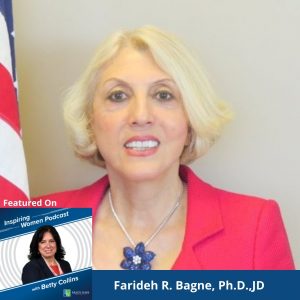
Developing Resilience: How to Bounce Back from Challenges and Changes – An Interview with Dr. Farideh Bagne, Magnolia By The Lakes

July 14, 2021 by John Ray

Farideh-Bagne-Inspiring-Women
Inspiring Women PodCast with Betty Collins
Developing Resilience: How to Bounce Back from Challenges and Changes - An Interview with Dr. Farideh Bagne, Magnolia By The Lakes
Loading
00:00 /
RSS Feed
Share
Link
Embed

Download file

Farideh-Bagne-Inspiring-Women

Developing Resilience – How to Bounce Back from Challenges and Changes, An Interview with Dr. Farideh Bagne, Magnolia By The Lakes (Inspiring Women, Episode 34)

After successfully selling the largest privately-owned conglomerate of cancer centers in the United States, Dr. Farideh Bagne wasn’t done. In this interview with host Betty Collins, Dr. Bagne discussed a unique senior living concept she has developed: a winterless senior resort complex for states with harsh winter. Dr. Bagne discussed the challenges she has faced and overcome in her entrepreneurial journey, balancing life as a business owner and mother, and much more. Inspiring Women is presented by Brady Ware & Company.

Betty’s Show Notes

I speak with Farideh R. Bagne, Ph.D.,JD. She’s one of the most brilliant, successful and hardworking people that I’ve ever met. She has an amazing story, with some great insight on resilience. And she’s built this really cool bridge at Magnolia by the Lakes, the gold standard of senior living, a luxury Independent and Assisted Senior Village on the shores of Cass Lake, overlooking Sylvan Lakes in Oakland County Michigan. I think you’re going to want to hear about the story about this for sure.

As Dr. Bagne states…

You know that thing when you look challenge in the eye and you don’t blink and you even have a smile on your face. That’s what we’re going to talk about. So don’t miss out. My advice to you again is, number one, belief in yourself and do not have a defeatist attitude. Always remember that race, national origin, gender had nothing to do with business, science, medicine or whatever endeavor you are planning to do. It is not what others think of you. It is what you think of yourself. And with that attitude, believe that you should have that axiom of your life that truly everything happens for the best. And at the moment that disaster happens. You don’t know what the best is, but believe that somehow it will be and will become one of the best events of your life unless you follow these three acts and you’ll really become successful throughout your life.

Coming up on July 30th is the 7th annual Brady Ware Women’s Leadership Conference.  Each year, 100% of the proceeds go to support women initiatives through non profit organizations within Ohio. This year our supporting non profits are the Better Business Bureau and the Women’s Small Business Accelerator.

Many months ago when we began planning for this year’s conference, we felt it best to err on the side of safety, so this year’s conference will be held virtually. While this may not be the most ideal situation, it does allow for us to offer participants speakers that are nationally recognized as well as locally recognized women leaders.

We’re excited to be able to present keynote speaker, Peggy Klaus, author of ‘Brag! How to toot your own horn without blowing it’. We’ll start the morning with a lively discussion with a panel of women business owners and leaders.

And to add to the excitement of the day, you’ll be able to network, visit exhibitor tables and win wonderful prizes throughout the day!

I would like to personally invite you to join us on July 30th. Just go to Columbus Women’s Leadership and complete a simple form. We’ll do all the rest!

Don’t miss this opportunity to expand your knowledge! Register now!

Hope to see you there!

This is THE podcast that advances women toward economic, social and political achievement. Hosted by Betty Collins, CPA, and Director at Brady Ware and Company. Betty also serves as the Committee Chair for Empowering Women, and Director of the Brady Ware Women Initiative. Each episode is presented by Brady Ware and Company, committed to empowering women to go their distance in the workplace and at home.

For more information, go to the Resources page at Brady Ware and Company.

Remember to follow this podcast on Apple Podcasts and Google Podcasts.  And forward our podcast along to other Inspiring Women in your life.

TRANSCRIPT

[00:00:00] Betty Collins
So, today, we’re going to talk about developing resilience. And developing resilience, how do you bounce back from challenges and change? And my guest today is very familiar with this topic. She had to live it to have the success that she has. So, developing resilience is key to having success in your life at all levels in circumstances. For me, personally, resilience is the ability to recover from those difficulties and those everyday life challenges.

[00:00:32] Betty Collins
Certainly, 2020 was that, and 2021 is going to be probably that. But prior to 2020 and after, it will still be needed, because life isn’t a matter of if, it’s a matter of when. So, resilience, to me, when I try to define it, is looking at challenges in the eye and not blinking. But some days, it takes everything you have to not blink. It depends on how bad you want to overcome the challenge. And are you willing to look at that challenge in the eye and not blink?

[00:01:02] Betty Collins
It’s very hard to do, right? But this is my life every day as a leader, whether I’m doing accounting or podcasting or whatever it is. But what makes you a leader is that people will follow. So, they need leaders in people in business. You need to be resilient and completely confident in it. And by the way, when you can blink with a smile on your face, it’s even better. So, let me encourage you to be resilient for something that’s worth it, that’s impactful and it makes a difference.

[00:01:32] Betty Collins
Too many times, we’re resilient, giving it all for nothing. Instead, be resilient for a world who need you, like your family, your business, partners, your employees or causes. So, today, this is a first. The podcast is going to be sponsored by ICS Tax, and I’m honored- I’ll start that over. And I’m very honored to introduce to you, Michelle Mackerdichian of ICS Tax. We partner together on all kinds of issues. There’s a lot of aspects to tax.

[00:02:07] Betty Collins
And so, they do some things that are very unique and very good, and they do a fantastic job. And it’s been great to work with the firm, especially her. From the beginning of knowing her, it was really more than business. We just have similar personalities and we’re interested- just connected in the same things. And it was not long after knowing Michelle, that she talked about our guests with such awe. So, Michelle, tell us a little bit about ICS Tax and then introduce our special guest, who will tell her story.

[00:02:42] Michelle Mackerdichian
Thank you so much, Betty, for the beautiful introduction. You are an inspiration for all women, and it has been an absolute pleasure working with you and your team ay Brady Ware. ICS Tax is a specialty tax consulting firm that provides innovative tax planning strategies. We collaborate with tax payers and their tax professionals to identify credits and incentives that reduce tax liabilities and increase profitability. Our services include cost aggregation studies, mixed asset reviews, R&D tax credit and green building tax incentives.

[00:03:16] Michelle Mackerdichian
We serve business owners in numerous industries, including construction and real estate, manufacturing, hotels and lodging, retail and numerous others. Our team brings decades of combined industry experience, assuring great depth of knowledge and expertise. We have offices across the nation with two in Ohio. I work in our Columbus office and our president, Alex Bagne, office is in Cleveland. Today, Betty Collins will be interviewing our president’s mother, Dr. Bagne, who is someone all of us here at ICS have the greatest admiration and respect for. Dr. Farideh R. Bagne is one of the most brilliant, successful and hardworking people I know.

[00:04:00] Michelle Mackerdichian
She founded and operated the largest, privately-owned conglomerate of cancer centers in the United States, which included seven radiation oncology centers in Oakland, McCombe, and throughout counties in Michigan. Ditched into radiation oncology, Dr. Bagne also owned and operated gynecological, oncology surgery, internal medicine and medical oncology clinics. She is indeed a true visionary. After selling all of the medical centers to Century 21st Oncology, a publicly-traded company, Dr. Bagne created a unique concept in senior living, a winterless senior resort complex for states with harsh winter.

[00:04:43] Michelle Mackerdichian
Dr. Bagne’s background is just as impressive. She received her bachelor’s degree with high honors in physics and mathematics at Michigan State University and her Master’s and Doctorate degrees in nuclear physics from the University of Pennsylvania. Dr. Bagne was the first and only female recipient of the National Institute of Health Scholarship in radiological [INAUDIBLE] University. She also has a law degree with magna cum laude from Wayne State University, and is a licensed attorney in the state of Michigan.

[00:05:16] Michelle Mackerdichian
She has been a professor at Duke Medical Center, Dartmouth Medical School, Medical College of Ohio and Wayne State Medical School. Not only is Dr. Bagne highly accomplished and successful, she has a wonderful and close-knit family; two sons, two daughters-in-law and seven grandchildren, whom she is extremely proud of.

[00:05:34] Betty Collins
Thank you, Michelle, and most certainly, thank you and welcome, Dr. Bagne. It’s such a pleasure to have you in here. Going to hear your story, get some perspective and certainly, tie developing resilience. How does it fit into all this? I’m pretty sure that resilience is in your DNA, so let’s get started. So first again, welcome. Could you tell our audience a little background about you and your education, your degrees, family, a simple overview of your career?

[00:06:06] Farideh Bagne
First of all, Betty and Michelle, thank you for inviting me to participate in your wonderful podcast. And I’m truly honored to be on this program. I will be happy to respond to any questions you have and also, go over my past career, present career, as well as my educational background. I received in my bachelor’s degree in two years from Michigan State University and followed that by a Master’s degree and Ph.D. through a scholarship. And after that, it is rather a funny story.

[00:06:53] Farideh Bagne
I was at the University of Pennsylvania Physics Department. It’s a very large physics department, and I was the only female and my first name is not really masculine or feminine. Farideh could be either one because it’s a sort of unfamiliar name. And when I applied to NIH- actually, the chairman of the department applied for me. They didn’t know I was a female, so they accepted me as the first recipient and they were very surprised when they found out that I was a female.

[00:07:33] Farideh Bagne
And so, I got my Ph.D. and I received my scholarship and did my residency at Thomas Jefferson University. And then I started my career at Dartmouth Medical School and I became the director there. And after that, I went to Duke University and did the same. Now, you may wonder why I received also, a law degree and why I’m a licensed attorney. Well, what happened was that after I was about 32, 33 years old and I was a full professor at the Medical College of Ohio, and I felt I couldn’t go any further.

[00:08:27] Farideh Bagne
So, what should I be doing? And at that time, I was the acting director of the therapeutic radiology department at the medical college, and a priest came home, we had treated for cancer, and he asked to meet with me. And I met with him and he said, “I’m a poor priest. I don’t have that much money. You’ve done an excellent job. Because of my birthday, my family and my parishioners have given me $300. And I would like to give this to you, to the department, to medical college and the hospital, and I would like to have- for you to buy a large crystal ball and then routinely fill it up with candies.”

[00:09:24] Farideh Bagne
Now, at the time, at the hospital, there would not be any coffee, any candy, cookies, anything, for cancer patients or for the loved ones that would bring them. And so, he thought that that would be a good idea. So, I took his check, went to meet with the president of the hospital and explained to him. And he looked at me and said, “What? We’re not going to spend money on candies and cookies for people.” But he did take the check.

[00:10:02] Farideh Bagne
So, at that time, I decided that really working in the academics is not what I want to do. And at that point, I decided to go to law school. And so, during daytime I worked at my routine job and at night, I would go to law school at Wayne State University, and that’s how I got my law degree. And also then, I passed the bar exam, and I have been a licensed attorney ever since.

[00:10:42] Betty Collins
Wow, what a background. My goodness. And I’m glad that you could have some insight to say, “I’m not going to do this because you can’t even buy candy and cookies for people- someone asking and sacrificing and giving us money for that.” I’m glad you saw bigger than that but … What an impressive background and education. I’m a little overwhelmed. In reading about you, you’ve been a business owner and built a very successful businesses. In fact, more than one. But you also have a wonderful family as I’ve met your son. How did you manage family and careers, without sacrificing either?

[00:11:25] Farideh Bagne
Well, this is very interesting because when I started going to law school, both my sons were teenagers. And first of all, I asked their permission to go to law school and they both said, “That’s okay.” And every time I went to law school, I learned something. Obviously, being in physics and mathematics and sciences, I had no idea about the law. And so, everything I learned was interesting to me. So, when I would come home, I would sit down and tell them about what I’d learned and discussed it with my sons.

[00:12:14] Farideh Bagne
And the interesting part is that both of them have gone and have gotten their law degrees, and they both are licensed attorneys. But it’s not so much the time you spend with your children, it is the quality that you spend with them and the quality of time you give them and the respect that they give to your kids. And whatever I always did, I asked permission from my kids to make sure that it was okay with them.

[00:12:55] Farideh Bagne
And that respect and that feeling of importance made them part of the whole success of me, and just as much as I am proud of their success, they are proud of my success. And that is what I would like to instill in the young mothers and young fathers, for that matter, that respect your kids and don’t treat them as little pets. Treat them as little adults and always get permission with them, discuss what you’re doing and listen to what they have to say.

[00:13:41] Betty Collins
That is phenomenal advice. And that’s a great way, I guess, of how you did balance all of that going on. And the fact that they both became attorneys, that’s pretty cool show that you had a lot of influence and a great relationship over the years, as you guys shared in all of that. So, that’s phenomenal. You started cancer centers. What motivated you to do that? And how did resilience play a role in that?

[00:14:12] Farideh Bagne
Well, the resilience is very important in this case because I live in, and I still do, in Michigan and I was the director at Medical College of Ohio, which is in Toledo, Ohio. So, every day, I had to travel back and forth and then at night, I would be going to law school. And the resilience was that every time I would become tired or discouraged or felt like there was too much pressure on me, I always looked forward.

[00:14:57] Farideh Bagne
In other words, I always look at any obstacle in life as a temporary obstacle that you jump over it. You go through it and you don’t let it block your progress towards the future. And I had a lot of those, first of all, having two teenagers at home. And we always had homemade food, so I had to cook during the weekend and make sure that we always had fresh fruit and fresh food and never buy frozen dinners. At the same time, making sure that I am there at 7:30 in the morning at my work, because the president of the hospital had a rule that you had to live in Ohio in order to practice and to actually work at the medical college.

[00:16:06] Farideh Bagne
And I didn’t want to move to Toledo, so I explained to him what I was doing and he said, “If you’re late one time, then you have to move to Toledo.” So, that was our bet. And regardless of how bad the weather was or what was going on, I was the first person that would be in the conference room. Every morning, we had a patient review conference. I was there before anybody else, just to make sure that I could live in Michigan and I could have my sons go to the schools they had been going all along.

[00:16:51] Betty Collins
Well, that takes a lot of resilience for certain, as I’m just hearing you. You played a role in these cancer centers. You played a role in building businesses, raising kids and on your terms of, “I’m going to live in Michigan.” But you were there and on time, so they never had a reason to to back you in a corner, I guess. That’s awesome. So, you had your cancer centers and you sold them. And then what- but then you started a very unique senior community after you sold your practices. Again, how did resilience play a role in your starting something all over again when really, you probably could be spending a lot of time on a beach, you know?

[00:17:34] Farideh Bagne
Yes. Well, what happened was that when I sold my cancer centers and all my practice in 2007, it was end of 2007, they had a non- compete agreement with me that I could not practice, I could not own, I could not operate, I could not be on the board. I had- I could not have anything to do with any field of medicine. The only thing I could do was to be a consultant for them. And here I was, trying to figure out, what am I going to do with the rest of my life.

[00:18:17] Farideh Bagne
Yes, I had plenty of money, but what am I going to be doing? And at the time, my sons were gone, they had their own life. And I guess all my life, I had worked, I had gone to school, I had 12 to 16 hours a day doing something else. What was I going to do? So, I decided, well, during the time that I had my cancer centers, I came to respect and love seniors a great deal, particularly for their patience, for their experience and for somewhat, their innocence, compared to the younger people that look at others with a lot of suspicion and- it’s a different world.

[00:19:15] Farideh Bagne
And so, I thought, “Well, if I can’t do anything in medicine, nobody prohibits me from having a senior facility. And that’s when, this was again, in 2007, I started looking around and at first, I started in Michigan. And the standard I had set for myself was I would want to create a place that I, myself, would go. Just the same way that when I started the cancer centers, at the time, there were only two types of cancer centers.

[00:20:02] Farideh Bagne
One were the hospitals that had their radiation therapy in the basement of the hospital, next to the morgue, next to the kitchen or they used little cobalt machines in a tiny little clinics. And at the time, I decided that, I don’t want to have either one of these. I want to create something new to bring in the medical school experience, quality assurance and knowledge of the staff, and combine it with the ease of having a clinic which has windows and doors, and you can park right in front. And that’s how I started building freestanding clinics.

[00:20:48] Farideh Bagne
And now, if you go anywhere, you will see that hospitals all have freestanding cancer centers. They no longer have them in the basement. They no longer have these little cobalt machines. They all have very sophisticated linear accelerators and they all are in freestanding, beautiful clinics. And so, I thought the same thing about the- any incentives that I wanted to have somewhere that if I had to go, I would feel good about it. So, I started in Michigan and I didn’t like anything that I saw here.

[00:21:31] Farideh Bagne
And also at the time, I was, as I mentioned, a consultant for 21st Century Oncology and their headquarters in Fort Myers, Florida. And so, I bought a condo in Naples, Florida. It was a beautiful condo on the Gulf of Mexico, and I get to know a lot of these residents that were there and the majority of them were seniors. And when I would talk with them, “Why did you leave Michigan, New York, Wisconsin, Pennsylvania to come here?” Every one of them would say, “Look at the weather. Look at that beautiful water. Look at the sunset.”

[00:22:20] Farideh Bagne
And at the same time, the next day, they would complain about the fact that they miss their loved ones back at home. They miss the Christmas trees. They they miss the snow and the fireplace. So, I started thinking that the only way that you can be extremely successful in building a senior community is number one, not to have the winter weather affecting the seniors. Number two, have water; to be on the body of the water. And number three, have a beautiful sunset. So, I started looking in Michigan where to find all of that.

[00:23:07] Farideh Bagne
Of course, northern Michigan has beautiful lakes, but it’s very, very cold, and not many people would move up north to go to a senior community. So, I live in Bloomfield Hills and I looked at Birmingham’s Bloomfield Hills area. There are no lakes there. As a matter of fact, it was with Alex, my son, that we were driving around and there was this tiny little town, they call it the city of Keego Harbor, with a population of 3000 that was sitting on two lakes.

[00:23:45] Farideh Bagne
Cass Lake, which is the largest and deepest lake in southeast Michigan, with beautiful sunset and Sylvan Lake, which a beautiful, calm lake that has sunrise every morning. Beautiful. And so, I decided, “Well, that’s where I want to be.” But then I looked around, there are all these little fishing cottages and vacation cottages and little stores. How am I going to find enough property to have my senior community?

[00:24:26] Farideh Bagne
At that time, I knew the mayor of Keego Harbor, Mayor Sidney Rubin, who was a visionary himself. And I talked to him and said, “Well, what do I do?” He said, “Well, just sit tight,” and as you say, “Be resilient and to start buying.” So, I built an office, three-story that two story of it was just dirt, floor, and then the third story was my office, overlooking both lakes. And I was just watching what’s going to happen.

[00:25:05] Farideh Bagne
Well, unfortunately, as well as fortunately for Magnolia, the recession hit in 2008 and everybody was selling. So, I would be just looking around and I had a real estate agent that I said, “Any time you see anything in Keego Harbor, let me know,” and we would buy it. My other son, Stephon, was also an attorney, he’s a partner at Clark Hill law firm. He then would go and we’d just pay the asking price and we buy it. So, I got enough land in Keego Harbor.

[00:25:49] Farideh Bagne
However, there is a major road that belongs to the county, it’s called Cass Lake Road that runs between Cass Lake and Sylvan Lake, and the properties I had bought were on both sides of that street, that road. So, I went back to the mayor and say, “Mayor Rubin, what do I do?” He said, “Well, why don’t you put a bridge over it?” And I said, “How am I going to build a bridge over this?”

[00:26:19] Betty Collins
It’s a great idea.

[00:26:21] Farideh Bagne
And we’ll go to the county. So, I went to the county and I said, “I would like to put a covered bridge over Cass Lake Road, between the two giant parcels. Now, they both were giant because I had bought all these little cottages, businesses, etc., and by the way, that took many years. Now, we’re talking, I started in 2007, this is 2013.

[00:26:54] Betty Collins
Wow.

[00:26:54] Farideh Bagne
And anyway, with my son Stephon as my attorney, we went back and forth and it cost me a million dollars to put a temperature- controlled, beautiful, private bridge between the two parcels and then they started building. And so, Magnolia North, which is the assisted living, was built and completed in 2015- 2014, 2015, and then in end of 2017, we built a five-story building for Magnolia South independent living. So now, we are the only private group that has a major bridge over a major road that is not open to the public.

[00:27:57] Betty Collins
I love it. I love it.

[00:27:59] Farideh Bagne
So, here we are with the most beautiful views in Michigan for our seniors that can enjoy life in the autumn of their lives.

[00:28:12] Betty Collins
Well, I just can’t help but hear resilience through this whole story; from how you raised your kids, how you got your education, how you changed how cancer centers are are put together, built and seen, to now- I love Naples Beach, Florida, I will tell you. But to be at a senior place like that in Michigan, and I will have to come and see it because it just sounds amazing.

[00:28:41] Farideh Bagne
Definitely.

[00:28:41] Betty Collins
I definitely want to come there. So, you have shown and defied- defined resilience your entire career, and I love that. Plus, just the impact that people are having. I want to cross that bridge. I definitely want to do that, so. But looking back and it’s our last question, looking back, I can see where the resilience with the mayor, he was definitely helpful, and you had to weigh time. It wasn’t instant and it was probably a lot of- more money than you thought. But what advice would you give my audience on developing resilience?

[00:29:19] Farideh Bagne
My advice to your audience is number one, believe in yourself and do not have defeatist attitude. Always remember that race, national origin, gender have nothing to do with business, science, medicine or whatever endeavor you are planning to do. It is not what others think of you. It is what you think of yourself. And with that attitude, believe that, and you should have that axiom of your life, that truly, everything happens for the best.

[00:30:06] Farideh Bagne
And at the moment that disaster happens, you don’t know what the best is, but believe that somehow, it will be and will become one of the best events of your life. And if you follow these three axioms, you’ll really become successful throughout your life. That is my advice to particularly, the young people.

[00:30:35] Betty Collins
Great advice. And I’m a young 57, so I’ll still take that advice, so. But again, resilience is looking those challenges in the eyes and not blinking. We’ve obviously heard that from an amazing lady today. And sometimes, you may not have that in you to do it, but you just, how bad you want to overcome and challenge and how are you- how much are you willing to look that challenge in the eye and not blink and make it happen? Because it’s definitely was worth it for this wonderful woman example.

[00:31:11] Betty Collins
Especially for those people who got to enjoy the senior center that- or the senior retirement community that they’re in now, as well as those cancer centers, and then raising two fine young men who I know one of them who is impacting their world as well. So, I thank you for spending time with us today. You’ve given us a lot to think about. Great story; I always loved the story. And I would have never had this opportunity to meet with you if it was not for Michelle and of course, ICS Tax. So, I want her to close out the podcast with just something about ICS and then I’ll close with my saying. So, go ahead, Michelle.

[00:31:50] Michelle Mackerdichian
Thank you so much, Betty. ICS Tax loves being part of the Women’s Inspiring podcast today, as well as partnering with Brady Ware.

[00:31:59] Betty Collins
Well, we thank you guys for just being a great partner with us as well. So, I’m Betty Collins and so glad that you joined us today. Inspiring Women, it’s what I do and I will leave you with this; being strong speaks of strength, but being courageous speaks to having a will to do more and overcome.

Betty Collins, CPA, Brady Ware & Company and Host of the Inspiring Women Podcast
Betty Collins is the Office Lead for Brady Ware’s Columbus office and a Shareholder in the firm. Betty joined Brady Ware & Company in 2012 through a merger with Nipps, Brown, Collins & Associates. She started her career in public accounting in 1988. Betty is co-leader of the Long Term Care service team, which helps providers of services to Individuals with Intellectual and Developmental Disabilities and nursing centers establish effective operational models that also maximize available funding. She consults with other small businesses, helping them prosper with advice on general operations management, cash flow optimization, and tax minimization strategies.

In addition, Betty serves on the Board of Directors for Brady Ware and Company. She leads Brady Ware’s Women’s Initiative, a program designed to empower female employees, allowing them to tap into unique resources and unleash their full potential.  Betty helps her colleagues create a work/life balance while inspiring them to set and reach personal and professional goals. The Women’s Initiative promotes women-to-women business relationships for clients and holds an annual conference that supports women business owners, women leaders, and other women who want to succeed. Betty actively participates in women-oriented conferences through speaking engagements and board activity.

Betty is a member of the National Association of Women Business Owners (NAWBO) and she is the President-elect for the Columbus Chapter. Brady Ware also partners with the Women’s Small Business Accelerator (WSBA), an organization designed to help female business owners develop and implement a strong business strategy through education and mentorship, and Betty participates in their mentor match program. She is passionate about WSBA because she believes in their acceleration program and matching women with the right advisors to help them achieve their business ownership goals. Betty supports the WSBA and NAWBO because these organizations deliver resources that help other women-owned and managed businesses thrive.

Betty is a graduate of Mount Vernon Nazarene College, a member of the American Institute of Certified Public Accountants, and a member of the Ohio Society of Certified Public Accountants. Betty is also the Board Chairwoman for the Gahanna Area Chamber of Commerce, and she serves on the Board of the Community Improvement Corporation of Gahanna as Treasurer.

Inspiring Women Podcast Series

This is THE podcast that advances women toward economic, social and political achievement. The show is hosted by Betty Collins, CPA; Betty is a Director at Brady Ware & Company. Betty also serves as the Committee Chair for Empowering Women, and Director of the Brady Ware Women Initiative. Each episode is presented by Brady Ware & Company, committed to empowering women to go their distance in the workplace and at home. For more information, go to the Resources page at Brady Ware & Company.

Remember to follow this podcast on Apple Podcasts and Google Podcasts. And forward our podcast along to other Inspiring Women in your life.

The complete Inspiring Women show archive can be found here.
Tagged With: Betty Collins, Brady Ware & Company, Brady Ware Women's Leadership Conference, Columbus Women’s Leadership, Developing Resilience, Farideh Bagne, Magnolia by the Lakes, senior living, senior living community

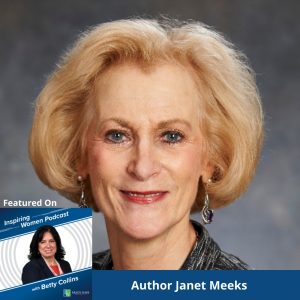
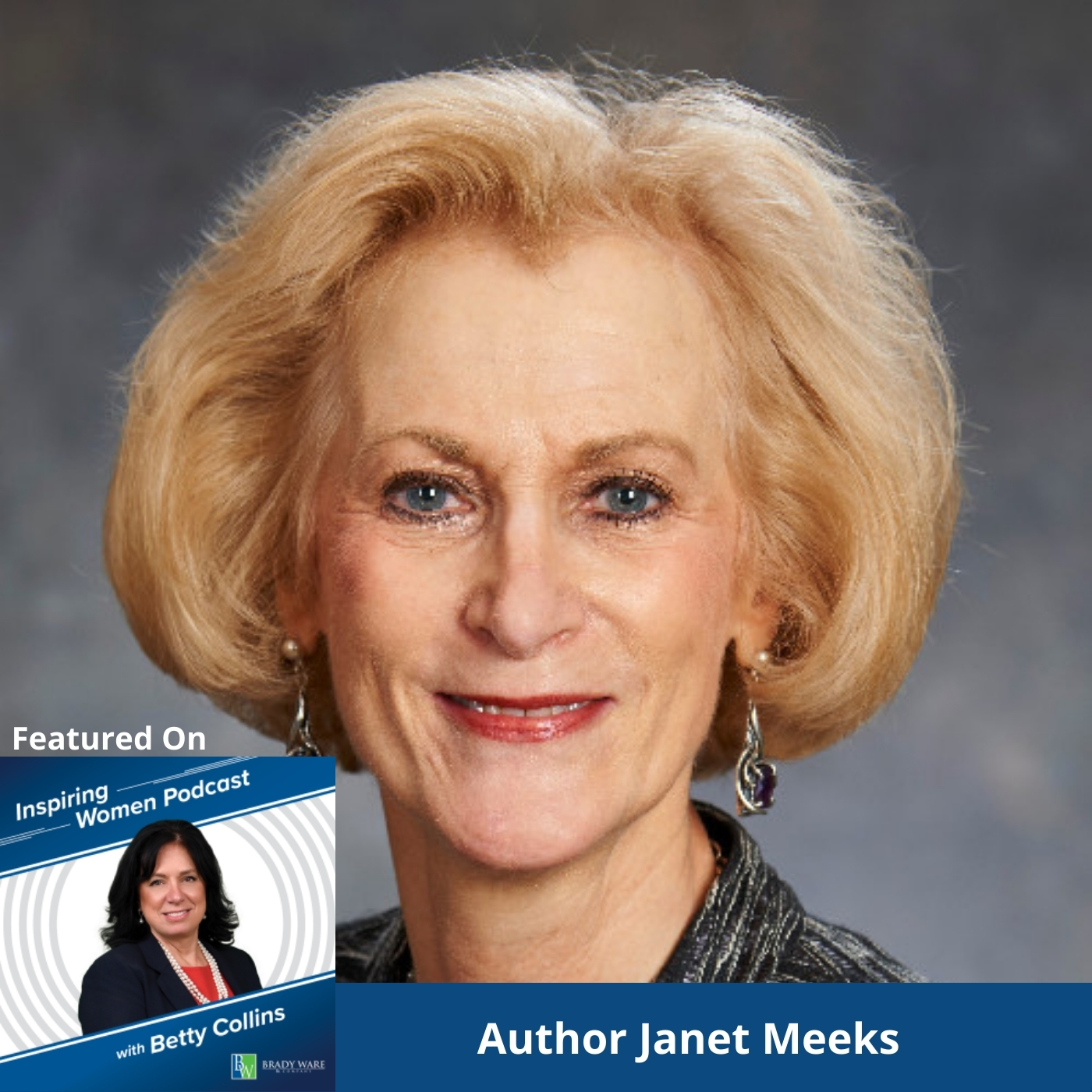
How To Lead In Uncertain Times – An Interview with Author Janet Meeks (Inspiring Women, Episode 33)

June 15, 2021 by John Ray

Janet-Meeks-Inspiring-Women-Album
Inspiring Women PodCast with Betty Collins
How To Lead In Uncertain Times - An Interview with Author Janet Meeks (Inspiring Women, Episode 33)
Loading
00:00 /
RSS Feed
Share
Link
Embed

Download file

Janet-Meeks-Inspiring-Women-Album

How To Lead In Uncertain Times – An Interview with Author Janet Meeks (Inspiring Women, Episode 33)

Janet Meeks joins host Betty Collins to discuss what she means by gracious leadership, and how gracious leaders foster an environment of respect and engagement. In turn, their team members are motivated and productive because they see themselves doing meaningful work. “Inspiring Women” is presented by Brady Ware & Company.

Betty’s Show Notes

I speak with Janet Meeks. Janet is the author of Gracious Leadership, Lead Like You’ve Never Led Before. You will love getting the perspective from her because she has lived it, she’s experienced it, and her amazing journey as a leader.

She’s going to talk from her book, which is such a simple read. Yet there are some very important basics in there. What should we expect from our leaders? There’s an expectation we should have.

As Janet mentions…

I also believe that leaders need to be secure enough to understand they don’t have all the answers and that leaders who try to hoard getting the results accomplished are really holding back the organization they need to trust their employees who are subject matter experts and free them, let them lie in the war, if you will, and be all they were created today so they can play at the top of their game. And then that leaves time and room for the person with the big title to be able to take on those difficult tasks that perhaps someone and other levels of the organization cannot.

Coming up on July 30th is the 7th annual Brady Ware Women’s Leadership Conference.  Each year, 100% of the proceeds go to support women initiatives through non profit organizations within Ohio. This year our supporting non profits are the Better Business Bureau and the Women’s Small Business Accelerator

Many months ago when we began planning for this year’s conference, we felt it best to err on the side of safety, so this year’s conference will be held virtually. While this may not be the most ideal situation, it does allow for us to offer participants speakers that are nationally recognized as well as locally recognized women leaders.
We’re excited to be able to present keynote speaker, Peggy Klaus, author of ‘Brag! How to toot your own horn without blowing it’. We’ll start the morning with a lively discussion with a panel of women business owners and leaders.
And to add to the excitement of the day, you’ll be able to network, visit exhibitor tables and win wonderful prizes throughout the day!
I would like to personally invite you to join us on July 30th.  Early bird registration ends on June 15th, so I encourage you to sign up now!  Just go to Columbus Women’s Leadership and complete a simple form. We’ll do all the rest!
Don’t miss this opportunity to expand your knowledge! Register now!  ColumbusWomen’s Leadership. Hope to see you there!

This is THE podcast that advances women toward economic, social and political achievement. Hosted by Betty Collins, CPA, and Director at Brady Ware and Company. Betty also serves as the Committee Chair for Empowering Women, and Director of the Brady Ware Women Initiative. Each episode is presented by Brady Ware and Company, committed to empowering women to go their distance in the workplace and at home.

For more information, go to the Resources page at Brady Ware and Company.

Remember to follow this podcast on Apple Podcasts and Google Podcasts.  And forward our podcast along to other Inspiring Women in your life.

TRANSCRIPT

[00:00:00] Betty Collins
So, today, we’re going to talk about how to lead in uncertain times. If anybody believes that today, 2020 and 2021 are uncertain times, then you’re just- you’re totally not in the- living in the surroundings, or seeing how things are going, that’s for sure. And so- but even before 2020, and even after 2021, we need people to be able to lead, whether it’s in our communities, in our country, in our companies, in our homes. And the good times are just as important as the uncertain times.

[00:00:37] Betty Collins
So, the guest today is going to talk with us. She just has such insight on this because she’s lived it, so. But leadership today has a huge vacuum and it’s really lacking, certainly in our country, businesses, corporate America, communities and homes. And whether, again, you’re in good or easy times or hard or tough, it’s just not optional. In fact, I’m a believer that in the good times is when we don’t lead well enough because we just don’t- we’re not on our game maybe as much, because it is good times. So, you don’t have to worry. This is not going to be a podcast on COVID or politics or negative.

[00:01:19] Betty Collins
The good news is that we’re going to talk about how to just navigate through it, and what are some things that can help us? So, we’re going to have a discussion and dialogue with someone who knows and lead, and has been through different things, whether it’s been corporate America or in her community. So, today, we’re going to hear from a gracious leader, Janet Meeks, and you will leave inspired with insight on how to lead, for sure. I was really fortunate to meet this amazing woman when she had her book come out a few years ago.

[00:01:53] Betty Collins
And she’s been on my podcast as well in the past, because her book was so good, I thought it was great for people to hear. And of course, I’ve read it, my company- the women in my company have read it. I would encourage you; you can listen to it as well as read it and go back to that podcast. It was a really good one. But it’s Gracious Leadership; Lead Like You’ve Never Led Before. And you can find her resume and bio attached to this website.

[00:02:20] Betty Collins
I don’t want to take the time to read a lot because it’s a huge, because she just has a really, really- has had an amazing journey, for certain. And her credentials and experience, they’re just the real deal. So, welcome, Janet, to my podcast. My audience is really fortunate to have you today. And so, let’s just get started. So, welcome, and why don’t you just tell the audience a little bit who you are, get that quick overview of your career. Nothing’s quick, but I think it’s important for my listeners just to get a feel for who you are.

[00:02:55] Janet Meeks
Well, thank you so much, Betty. It is such a joy to be with you today. And I appreciate the opportunity to share with you and with those who listen to your podcast. Let me think about my career for a second, and I guess I would have to take you back to the 1960s and early 70s. I grew up in a town of 3,000 people and I played basketball. And in these small communities, basketball was certainly, a focal point for everything we did. And little did I know at the time that I was learning so much about leadership from playing that sport.

[00:03:29] Janet Meeks
As a matter of fact, I wanted to be a coach and my father, in his infinite wisdom, encouraged me, instead of becoming a coach, that I should pursue a degree in finance. And if my father told me to jump off the bridge, believe you, me, I would have said, “Which side shall I go?”

[00:03:47] Betty Collins
Do you go?

And so- yeah, exactly. So, I got a BBA and an MBA in finance. Then I started out in the banking industry and was there for about five years and absolutely loved banking. But it was a life-changing event that caused me to take a detour in my career progression. I won’t go into the details of it; I think we probably talked about that in the earlier podcast when I was your guest. But I had a baby and that baby was born and died on the same day. And it was just the most unnerving, distressing crisis moment; the deepest valley of my life.

[00:04:28] Janet Meeks
And when I was in the hospital following the death of the baby, recovering from the delivery, the employees there, who did not know me from the next patient, really surrounded me with love and care and concern. And something about that experience led me to believe that I needed to depart banking and to enter the field of health care. And only four months after the death of my baby, I was offered an opportunity to join the senior leadership team of the largest medical center in the nation, outside a metropolitan area, and to report directly to the CEO, and I was only 27 years old.

[00:05:08] Betty Collins
That’s fantastic.

[00:05:10] Janet Meeks
So, over the course, it was amazing. And I think if I realized how daunting a task that was at the time, it probably would have scared me to death. But my naivete helped me in that case, and I just dove right in. So, I have had the pleasure of working for four major healthcare systems over about 40 years and traditionally, was responsible for marketing, strategy, planning, business development and so forth. And I loved leading those disciplines.

[00:05:38] Janet Meeks
But I’ve also been told along the way that I should strive to lead a hospital, primarily because I have always enjoyed working with doctors and also, because I’ve always had a keen sense of appreciation for the value brought forth by every employee, regardless of their role. So, in 2004, I was recruited to Columbus, Ohio, to join the Mount Carmel Health System and to be their senior VP of corporate development.

[00:06:06] Janet Meeks
And I, at the time, decided to take a risk. I told the CEO that if I accepted the opportunity of senior VP of corporate development, I would do my best to help to refine and build upon that division. But I also wanted him to promise me that one of these days, as opportunities might present, that I could actually lead one of the Mount Carmel hospitals, and he said yes. And so, about 18 months after I arrived in Columbus, I was given the opportunity to lead St. Anne’s, and that was 2006.

[00:06:41] Janet Meeks
So, there were 700 doctors, about 2,000 employees and 300 volunteers. And the irony is that there were 3,000 people on my campus that I was responsible for leading. There were 3,00- people who had lived in my home town. And at the end of the day, what I actually got to do, as the leader of that hospital, was to be a coach, to make sure we had a solid game plan, to ensure that the discipline was practiced so that we could execute our game plan and and have happy patients, happy employees and engaged physicians.

[00:07:22] Janet Meeks
It was my responsibility to be the cheerleader for the team and to offer praise for great performances, but also, to give the constructive feedback when the performance could be better. So, that’s a quick overview of my career from banking to health care. But at the end of the day, I believe a lot of what we do as leaders is to coach.

[00:07:42] Betty Collins
Well, you’re definitely respected. Everyone that knows you or talks about you talks well and you’re definitely- have walked your talk when it comes to leadership and the principles that you believe.

[00:07:58] Janet Meeks
And thank you. Thank you.

[00:07:58] Betty Collins
So, when I met you, you had authored a book, Gracious Leadership; Lead Like You’ve Never Led Before. Just a great book. Why did you write the book, and then give me an update on how it’s gone.

[00:08:14] Janet Meeks
Well, thank you so much. It seems like yesterday I was sitting at the island in my kitchen, writing the transcript for that book, but three years have passed by pretty quickly. Betty, I announced in January of 2015 that I was going to be retiring later that summer. And that was a big decision for me. And so, I found myself over the course of the month between the announcement and the actual retirement, truly becoming contemplative about different lessons of leadership I had learned along the way.

[00:08:47] Janet Meeks
And so, I would jot down my thoughts on a piece of paper and put those notes into a file, and they just stayed there in my desk. And then in early 2016, I was approached by two different leadership institutes, and both of them asked me if I would make a presentation on a leadership topic of my choice. And so, the first thing I did was pull out that file with those notes within it, just to review my thoughts on leadership. And when I laid out those notes across my desk, and I looked at and contemplated, pondered those values, really, the words that rose to the top of my mind were gracious leadership.

And so, I made these two presentations and totally independent, one or the other, the feedback I was given was, “Janet, when are you going to write the book?” And so, I started thinking about it. And lo and behold, in 2016, in the late- in that year and then in 2017, it was almost like Pandora’s box just burst wide open with this proliferation of examples of toxic leadership. And I’m talking about leaders in the political thing, I’m talking about leaders in organizations of all types. This is when the Me Too movement really started building some steam and we started learning about workplace hostility and bullying in the workplace.

[00:10:16] Janet Meeks
And what I saw every day, everywhere I turned, was that we were given so many examples of bad leaders that I thought, “Well, wait, where are the examples of the good leaders?” And so, I decided that I had to own the responsibility to produce some playbook, if you will, so that aspiring leaders could know, and very easy-to-implement simple steps, some actions that they could take, in order to lead in a better way, in a respectful way. And that’s why I wrote the book. And so, you’re right, it was released in the early ’18. And I’m so humbled, and also excited to tell you that Gracious Leadership has now made it into all 50 states and Canada.

[00:11:08] Janet Meeks
And it’s been so gratifying for me to meet people all over our country and beyond, who are just starving to learn more about how to be a respectful leader. And so, I’ve been spending, pre-COVID, I spent a good bit of time making keynote presentations about Gracious Leadership to senior leadership teams and middle managers at healthcare systems and other organizations throughout the country, even as far away as Alaska. And the book, even in the COVID era, continues to penetrate the leadership circles.

[00:11:46] Janet Meeks
I know that in Nashville, as an example, the American College of Healthcare executives have actually used the book as part of its curriculum for its Physician Leadership Academy. Other organizations are incorporating it into their mentorship training. And so, the book, in its own way, just continues to plant seeds. And I can’t wait to see how those seeds will blossom into beautiful flowers of respectful leadership that, hopefully, will last for many decades to come.

[00:12:17] Betty Collins
Oh, that’s a great way. That’s a great update. And that’s just so encouraging. I know I had the women in Brady Ware read this book, or bought it for them if they chose to read it, especially our managers and senior managers. And I had a woman come to me and said, “This has totally changed the way I think.” She just, really- it was simple, she said it was really simple, but it was eye-opening. So, it, definitely, has been impactful.

[00:12:46] Janet Meeks
Well, I’m so glad to hear that, betty. I think simple things are easier to implement, and also, it’s easier to sustain them if it’s not difficult or complex.

[00:12:55] Betty Collins
Well, that was a great, just inner dose of who you are, your career, the book that you’ve written. So, I want to really get into some of the details of that, gracious is a gentle word, right? Leadership, it’s just gentle, and so it sounds peaceful and easy. I want you to expand on why you chose ‘gracious’ and what it means, because I think that’s what sets this book apart when you read the title.

[00:13:25] Janet Meeks
Thank you for that question, Betty. That is certainly one that has been posed to me on multiple occasions, to the point that there is a chapter in the book entitled, “Gracious leadership, is it soft stuff?” And, of course, the answer is no. If you look at the definition of gracious, one of the definitions is that, it means you’re kind. But I want to tell you that we should be challenged to use the words gracious and leadership as one thought. Leadership, to me, is about getting the right results achieved, and gracious is how we achieve those results. So, gracious leadership is about being both kind and tough.

[00:14:14] Janet Meeks
A leader is truly kind if they’re tough enough to have a conversation in a soulful manner with an employee, to say, “Hey, you’re not meeting the mark, and here are the opportunities for you to improve.” A gracious leader is kind when he or she is crystal clear about accountabilities, about what goals are to be achieved, what are the expectations. And that same leader is tough enough to help the employee understand that they get off course, but again, kind enough to give positive feedback and affirmation when the employee achieves the right results. So, I think that gracious leadership is not at all about, necessarily, being gentle, it’s about being kind, compassionate and tough, so that we, as leaders, are ensuring that the right results are generated.

[00:15:16] Betty Collins
I think that’s what stood out to me a lot in this book, and in your stories of when you had that toughness combined with kindness, because that was the right thing to do and lead, either the team or the person to where you needed them to be. And that just stayed with me. But today, Janet, it’s such a tough environment. It just seems to be everywhere, and it’s overwhelming. So, what I want you to share with the audience, especially as we all lead something somewhere, we’re not all followers. We’re more leaders than we are followers. But I would love for you to share a tough time that seemed hopeless to you pertaining to leadership, and how did you navigate through it?

Wow, that’s a great question. And how many times have I lost sleep over this particular situation? I won’t describe. I mentioned earlier that I always had the dream of wanting to lead a hospital, and I was given the opportunity in 2006 to go to St. Anne’s, and to do the leader of that campus. I did not know everything I would be inheriting as the new leader of that organization. I’m an eternal optimist, I believe that we can always do better, and we can achieve more together as a team than we can alone.

[00:16:45] Janet Meeks
But when I arrived at St. Anne’s, here’s what I found; the hospital had the worst patient satisfaction in all of Central Ohio. In fact, that was plastered as a headline in the Columbus Dispatch. Quality was so inconsistent that I was almost afraid to get my mail every day, because it was full of letters from angry patients and family members. The financial performance was not good at all, and because my predecessor had been released from the organization, and oh, by the way, he was beloved. So, I inherited employees, many of whom were broken-hearted, and even angry, because they wanted their old leader, not a new leader.

[00:17:35] Janet Meeks
And many of the doctors were disenchanted. The culture was deemed by many of the employees to be healthy, but it was not. And it’s like, “Oh, my goodness, where do you start? There’s so many problems to solve.” So, as leaders, especially as top A leaders, we have this inclination to want to just dive right in and start changing things, and that would have been the wrong thing to do. One of the lessons I have learned throughout my career is that sometimes you have to slow down first before you can speed up.

[00:18:11] Janet Meeks
So, I had to learn that the most important thing I could do as the new leader of that campus, was to slow down and build relationships of trust with doctors, with employees, not only of the leadership and management level, but even with the janitors and the dietary employees. I made it part of my leadership mantra to start listening to them, and to ask them questions, and to get their feedback. In my book, I talk about the importance of three powerful questions. Number one, what one thing can we do to make your work life better? Number two, what one thing can we do to make the customer experience better?

[00:18:59] Janet Meeks
And number three, it’s open-ended, what in the world do you want to talk about? What would you like to share? And Betty, I found that, over the course of time, that when employees realized that I was sincere in wanting to understand their opinions and I valued their feedback, it was magical. I, then, found that we had an opportunity to create an exciting vision for the growth and development of St. Anne’s. It had traditionally been known as a wonderful place to have a baby, but this hospital had the potential to grow into a regional medical center.

[00:19:38] Janet Meeks
And so, creating an exciting vision that employees could get excited about, buy into, and most importantly, to understand how they could help to realize that vision, was also a key aspect of getting out of that hopeless situation. I’ll also tell you, Betty, that it was important to get the right people on the bus. I had to make sure that we had leaders and employees who were excited about where we were going, and that if there were people there who were like, “No, we don’t want to change, we don’t want to go with a new vision. What we had 20 years ago was just fine.” Well, we had to liberate some of those employees, and encourage them to go be happy somewhere else, as opposed to being unhappy and slowing down.

[00:20:25] Betty Collins
Very nicely said. Nicely said.

[00:20:27] Janet Meeks
And so, then, from there, it just went into putting disciplines into place, that didn’t sound like discipline. It was being clear about goals, teaching our managers to apologize if we disappointed a patient or a family member, teaching our employees the importance of systematic, sincere praise. And so, that’s really the scenario; it was a struggling community hospital that just had so many problems, and we were able to effect a cultural turnaround, a financial turnaround, and an operational turnaround. And I always have given the credit to that team of loyal employees at St. Ann’s who believed in the art of possibility, and that we could become a place where physicians wanted to practice, patients wanted to come for care, and employees wanted to work.

[00:21:22] Betty Collins
You really answered my next question, so I’m going to move on to the next one. Because you’ve talked, really, about where does a leader start? And you gave so many good ideas of, where do you start to navigate that team? So, I want to spend my last two questions, because I think this is important. What should we expect from leadership in our lives? Sometimes, and I say this, I became the leader I didn’t have, and that’s called leading without a tail, it can be very dangerous. It can be very heartbreaking, and it’s a lot harder, by the way. But sometimes you become that. So, what should we expect from the leadership? And I’m not talking about just the president of the United States, or- what should we expect?

[00:22:12] Janet Meeks
Oh, Betty, without exception, and this applies to any leader in any role, whether they have a formal title or not, they should be 100 percent uncompromisingly honest and truthful. And I’ll just continue to go along the line of what I’m thinking, leaders must show respect. I’ve been in organizations where respect was only shown to other people who had big titles, and that is just not okay. Every person who is a member of the team, regardless of their title, has value to bring forth, and should be fully respected for what they do, and for who they are.

I also believe that leaders need to be secure enough to understand they don’t have all the answers. And that leaders who try to hoard getting the results accomplished are really holding back the organization, they need to trust their employees who are subject matter experts, and free them, let them fly and soar, if you will, and be all they were created to be, so they can play at the top of their game. And then that leaves time and room for the person with the big title to be able to take on those difficult tasks, that perhaps someone in other levels of the organization cannot.

[00:23:47] Janet Meeks
And then I just think that, lastly, for this question, leaders have got to be humble, to understand and to admit that we’re all going to make mistakes. Leaders make mistakes, too. It’s just that as a leader, we need to know and to communicate to our staff, and to live the reality that if we make a mistake, what did we learn from it, and how can we improve from that from that situation?

[00:24:18] Betty Collins
Thank you very much, those were great. We just need to have some expectations that are different, instead of just accepting sometimes. And I love that, really good.

[00:24:28] Janet Meeks
Well, it’s a sad commentary, Betty, that we have to say, that leaders should be uncompromisingly honest. But you have said earlier, and we say in leadership, in organizations of all types, that that’s not the case today. But we’ve got to get there.

[00:24:47] Betty Collins
Right, we have to. We have to. So, let me ask you this last thing to get there, we want to get there. Give us a simple take-away that we can all think about, that possibly could lead to the change that we need.

[00:25:01] Janet Meeks
I believe that any person can be, and probably is, a leader, any person. It doesn’t require a fancy title to be a leader. Mothers are leaders, teachers are leaders, staff accountants are leaders, nurses, bank tellers, housekeepers. Regardless of the role of the individual, I think that if we will just own responsibility, first, to lead by example, and to do the work we are to do, as best as we possibly can, to give it our very best. Once you lead by example, then, all of a sudden, you realize that you have the opportunity to lead by influence.

[00:25:52] Janet Meeks
And that others will want to follow you. And whether or not you’re looking for a formal promotion in life, you may have a greater likelihood of getting one if, in fact, you’ve been a leader within your original roles. I was thinking about my career, and I have to tell you, the hardest job that I’ve ever been given has not been in a healthcare system or a bank, or even in consulting. The most difficult and challenging job, and the most gratifying has been that of mother. And I have the joy of- I feel like I’ve been promoted, because I have two daughters, who now are both wonderful mothers, and each of them is successful in her own respective rights. And they, certainly, are gracious leaders. So, I think that anybody can lead, we just have to understand that we have to own the responsibility for giving it our best every day.

[00:26:56] Betty Collins
Well-said, Janet, that’s just a great way to end our time together. I really love it when you said, maybe I’m putting your words in the way I hear them, but when you lead by example, you lead by it, you become an influencer.

[00:27:13] Janet Meeks
Exactly.

[00:27:14] Betty Collins
Those two things together, that’s a great- thank you for sharing that with me. And I’ve read your book, and I’ve talked to you, and that that’s my ‘aha’ moment for this moment. But I do want to thank you, because you’re busy, and you’re willing to come on my podcast, and share your perspective. I’m truly grateful, my audience will be better because of it. But I would like them to be able to know, where can they buy the book? Where can they find that? Are you on Amazon? What’s the best way to do it?

[00:27:45] Janet Meeks
There are several places where they can find the book. I encourage your listeners to visit my website, graciousleadershipbook.com, and they can buy the book there. They also can sign up at the bottom of any of the pages, they can sign up for the free Gracious Leadership newsletter, that about once a month, I send out a blog with whatever is on my mind, and I do my best to make those inspirational, or just to continue to talk about different aspects of leadership. So, graciousleadershipbook.com. The book is available on Amazon, and it’s in hardback, Kindle and an audio book. And then on social media, you can find me on Facebook, on LinkedIn, and on Twitter. The Twitter handle is @agraciousleader.

[00:28:41] Betty Collins
Well, we, also, will have attached to this, of course, your bio and those links, so that our listeners can definitely tap into becoming a gracious leader, for sure. But one last thing, I always love to ask this; what podcast or book would you recommend? And then we will sign off.

Janet Meeks
I really am enjoying Brené Brown, and her series about Unlocking Us. And her particular podcast with an interview of Dolly Parton, and it was about songtelling. And, really, this particular podcast was about love, empathy and the power of truth. And I would encourage your listeners to check it out, because Dolly Parton, truly, is an incredible person, and an amazing business woman, that I think I, personally, was inspired by that, and I think your listeners would be too.

[00:29:39] Betty Collins
Well, I will check that out. I love her, she’s really good, Brené Brown, for sure. Well, thank you again, Janet.

[00:29:47] Betty Collins
I’m Betty Collins, and so glad you joined me today. Inspiring women, it’s what I do. I leave you with this; being strong speaks of strength, but being courageous speaks to having a will to do more and overcome.

Betty Collins, CPA, Brady Ware & Company and Host of the “Inspiring Women” Podcast

Betty Collins is the Office Lead for Brady Ware’s Columbus office and a Shareholder in the firm. Betty joined Brady Ware & Company in 2012 through a merger with Nipps, Brown, Collins & Associates. She started her career in public accounting in 1988. Betty is co-leader of the Long Term Care service team, which helps providers of services to Individuals with Intellectual and Developmental Disabilities and nursing centers establish effective operational models that also maximize available funding. She consults with other small businesses, helping them prosper with advice on general operations management, cash flow optimization, and tax minimization strategies.

In addition, Betty serves on the Board of Directors for Brady Ware and Company. She leads Brady Ware’s Women’s Initiative, a program designed to empower female employees, allowing them to tap into unique resources and unleash their full potential.  Betty helps her colleagues create a work/life balance while inspiring them to set and reach personal and professional goals. The Women’s Initiative promotes women-to-women business relationships for clients and holds an annual conference that supports women business owners, women leaders, and other women who want to succeed. Betty actively participates in women-oriented conferences through speaking engagements and board activity.

Betty is a member of the National Association of Women Business Owners (NAWBO) and she is the President-elect for the Columbus Chapter. Brady Ware also partners with the Women’s Small Business Accelerator (WSBA), an organization designed to help female business owners develop and implement a strong business strategy through education and mentorship, and Betty participates in their mentor match program. She is passionate about WSBA because she believes in their acceleration program and matching women with the right advisors to help them achieve their business ownership goals. Betty supports the WSBA and NAWBO because these organizations deliver resources that help other women-owned and managed businesses thrive.

Betty is a graduate of Mount Vernon Nazarene College, a member of the American Institute of Certified Public Accountants, and a member of the Ohio Society of Certified Public Accountants. Betty is also the Board Chairwoman for the Gahanna Area Chamber of Commerce, and she serves on the Board of the Community Improvement Corporation of Gahanna as Treasurer.

“Inspiring Women” Podcast Series

This is THE podcast that advances women toward economic, social and political achievement. The show is hosted by Betty Collins, CPA; Betty is a Director at Brady Ware & Company. Betty also serves as the Committee Chair for Empowering Women, and Director of the Brady Ware Women Initiative. Each episode is presented by Brady Ware & Company, committed to empowering women to go their distance in the workplace and at home. For more information, go to the Resources page at Brady Ware & Company.

Remember to follow this podcast on Apple Podcasts and Google Podcasts. And forward our podcast along to other Inspiring Women in your life.

The complete “Inspiring Women” show archive can be found here.

Tagged With: Columbus Women’s Leadership, gracious leadership, Janet Meeks, Lead Like You’ve Never Led Before, Leadership

Business RadioX ® Network


Our Most Recent Episode

CONNECT WITH US

  • Email
  • Facebook
  • LinkedIn
  • Twitter
  • YouTube

Our Mission

We help local business leaders get the word out about the important work they’re doing to serve their market, their community, and their profession.

We support and celebrate business by sharing positive business stories that traditional media ignores. Some media leans left. Some media leans right. We lean business.

Sponsor a Show

Build Relationships and Grow Your Business. Click here for more details.

Partner With Us

Discover More Here

Terms and Conditions
Privacy Policy

Connect with us

Want to keep up with the latest in pro-business news across the network? Follow us on social media for the latest stories!
  • Email
  • Facebook
  • Google+
  • LinkedIn
  • Twitter
  • YouTube

Business RadioX® Headquarters
1000 Abernathy Rd. NE
Building 400, Suite L-10
Sandy Springs, GA 30328

© 2025 Business RadioX ® · Rainmaker Platform

BRXStudioCoversLA

Wait! Don’t Miss an Episode of LA Business Radio

BRXStudioCoversDENVER

Wait! Don’t Miss an Episode of Denver Business Radio

BRXStudioCoversPENSACOLA

Wait! Don’t Miss an Episode of Pensacola Business Radio

BRXStudioCoversBIRMINGHAM

Wait! Don’t Miss an Episode of Birmingham Business Radio

BRXStudioCoversTALLAHASSEE

Wait! Don’t Miss an Episode of Tallahassee Business Radio

BRXStudioCoversRALEIGH

Wait! Don’t Miss an Episode of Raleigh Business Radio

BRXStudioCoversRICHMONDNoWhite

Wait! Don’t Miss an Episode of Richmond Business Radio

BRXStudioCoversNASHVILLENoWhite

Wait! Don’t Miss an Episode of Nashville Business Radio

BRXStudioCoversDETROIT

Wait! Don’t Miss an Episode of Detroit Business Radio

BRXStudioCoversSTLOUIS

Wait! Don’t Miss an Episode of St. Louis Business Radio

BRXStudioCoversCOLUMBUS-small

Wait! Don’t Miss an Episode of Columbus Business Radio

Coachthecoach-08-08

Wait! Don’t Miss an Episode of Coach the Coach

BRXStudioCoversBAYAREA

Wait! Don’t Miss an Episode of Bay Area Business Radio

BRXStudioCoversCHICAGO

Wait! Don’t Miss an Episode of Chicago Business Radio

Wait! Don’t Miss an Episode of Atlanta Business Radio