Business RadioX ®

  • Home
  • Business RadioX ® Communities
    • Southeast
      • Alabama
        • Birmingham
      • Florida
        • Orlando
        • Pensacola
        • South Florida
        • Tampa
        • Tallahassee
      • Georgia
        • Atlanta
        • Cherokee
        • Forsyth
        • Greater Perimeter
        • Gwinnett
        • North Fulton
        • North Georgia
        • Northeast Georgia
        • Rome
        • Savannah
      • Louisiana
        • New Orleans
      • North Carolina
        • Charlotte
        • Raleigh
      • Tennessee
        • Chattanooga
        • Nashville
      • Virginia
        • Richmond
    • South Central
      • Arkansas
        • Northwest Arkansas
    • Midwest
      • Illinois
        • Chicago
      • Michigan
        • Detroit
      • Minnesota
        • Minneapolis St. Paul
      • Missouri
        • St. Louis
      • Ohio
        • Cleveland
        • Columbus
        • Dayton
    • Southwest
      • Arizona
        • Phoenix
        • Tucson
        • Valley
      • Texas
        • Austin
        • Dallas
        • Houston
    • West
      • California
        • Bay Area
        • LA
        • Pasadena
      • Colorado
        • Denver
      • Hawaii
        • Oahu
  • FAQs
  • About Us
    • Our Mission
    • Our Audience
    • Why It Works
    • What People Are Saying
    • BRX in the News
  • Resources
    • BRX Pro Tips
    • B2B Marketing: The 4Rs
    • High Velocity Selling Habits
    • Why Most B2B Media Strategies Fail
    • 9 Reasons To Sponsor A Business RadioX ® Show
  • Partner With Us
  • Veteran Business RadioX ®

Workplace MVP: Jeff Gorter, R3 Continuum

September 9, 2021 by John Ray

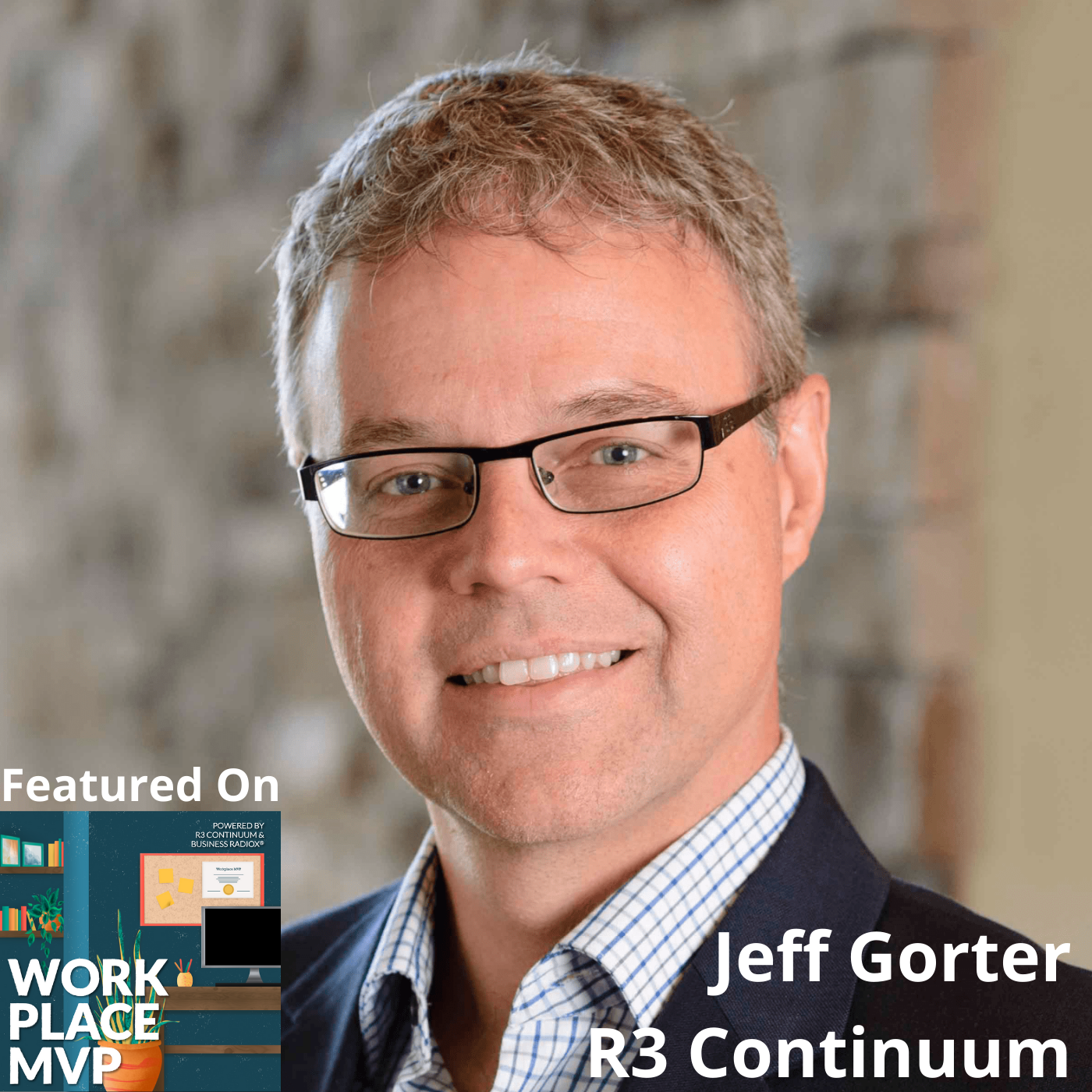
Jeff Gorter
Minneapolis St. Paul Studio
Workplace MVP: Jeff Gorter, R3 Continuum
Loading
00:00 /
RSS Feed
Share
Link
Embed

Download file

Jeff Gorter

Workplace MVP:  Jeff Gorter, R3 Continuum

Critical incident response veteran Jeff Gorter contends that business and human responses to crisis events are not separate but interwoven. On the twentieth anniversary of the September 11th terrorist attacks, Jeff and host Jamie Gassman discussed the parallels of that event and the COVID-19 pandemic, and the importance of acknowledging 9/11 for your employees.  Workplace MVP is underwritten and presented by R3 Continuum and produced by the Minneapolis-St.Paul Studio of Business RadioX®.

Jeff Gorter, Vice President of Crisis Response Services, R3 Continuum

Jeff Gorter, Vice President of Crisis Response Services, R3 Continuum

Jeff Gorter, MSW, LCSW, is VP of Clinical Crisis Response at R3 Continuum. Mr. Gorter brings over 30 years of clinical experience including consultation and extensive on-site critical incident response to businesses and communities. He has responded directly to the Sept. 11 terrorist attacks, Hurricane Katrina, the Virginia Tech shootings, the Deepwater Horizon Oil spill, the 2011 earthquake/tsunami in Japan, the Newtown Tragedy, the Orlando Pulse Nightclub Shooting, the Las Vegas Shooting, and the breaching of the US Capitol on 1/6/21. He has conducted trainings and presented at the Employee Assistance Professionals Association Annual Conference, the American Psychological Association Annual Conference, the World Conference on Disaster Management, the International Society for Traumatic Stress Studies Annual Meeting, and at other state, national and international venues on a variety of topics.

LinkedIn

R3 Continuum

R3 Continuum is a global leader in workplace behavioral health and security solutions. R3c helps ensure the psychological and physical safety of organizations and their people in today’s ever-changing and often unpredictable world. Through their continuum of tailored solutions, including evaluations, crisis response, executive optimization, protective services, and more, they help organizations maintain and cultivate a workplace of wellbeing so that their people can thrive. Learn more about R3c at www.r3c.com.

Company website | LinkedIn | Facebook | Twitter

About Workplace MVP

Every day, around the world, organizations of all sizes face disruptive events and situations. Within those workplaces are everyday heroes in human resources, risk management, security, business continuity, and the C-suite. They don’t call themselves heroes though. On the contrary, they simply show up every day, laboring for the well-being of employees in their care, readying the workplace for and planning responses to disruption. This show, Workplace MVP, confers on these heroes the designation they deserve, Workplace MVP (Most Valuable Professionals), and gives them the forum to tell their story. As you hear their experiences, you will learn first-hand, real life approaches to readying the workplace, responses to crisis situations, and overcoming challenges of disruption. Visit our show archive here.

Workplace MVP Host Jamie Gassmann

In addition to serving as the host to the Workplace MVP podcast, Jamie Gassmann is the Director of Marketing at R3 Continuum (R3c). Collectively, she has more than fourteen years of marketing experience. Across her tenure, she has experience working in and with various industries including banking, real estate, retail, crisis management, insurance, business continuity, and more. She holds a Bachelor of Science Degree in Mass Communications with special interest in Advertising and Public Relations and a Master of Business Administration from Paseka School of Business, Minnesota State University.

TRANSCRIPT

Intro: [00:00:03] Broadcasting from the Business RadioX Studios, it’s time for Workplace MVP. Workplace MVP is brought to you by R3 Continuum, a global leader in workplace behavioral health and security solutions. Now, here’s your host, Jamie Gassmann.

Jamie Gassmann: [00:00:24] Hi, everyone. Your host, Jamie Gassmann, here. And welcome to this episode of Workplace MVP. This year marks the 20th anniversary for the 9/11 terrorist attacks. We are also halfway through the second year of the COVID-19 pandemic. Some are calling these two tragic bookends to the last two decades. Interestingly, though, while these two events are different in nature, the impact they made on businesses and employees are very similar.

Jamie Gassmann: [00:00:53] Is this a coincidence? Or is there something to be learned about the impact disruption can have on an organization and its people? What should an employer be focused on when an event like 9/11 or COVID-19 happens? Are there solutions or support options that can be leveraged to help them successfully navigate the troubled aftermath of the events?

Jamie Gassmann: [00:01:15] With us today to share his expertise and firsthand knowledge from responding to the psychological first aid needs of employers for both 9/11 and COVID-19, among other major events across our history, is Workplace MVP Jeff Gorter, Vice President of Crisis Response Services for our show sponsor, R3 Continuum. Welcome to the show, Jeff.

Jeff Gorter: [00:01:37] Thank you, Jamie. I appreciate the opportunity.

Jamie Gassmann: [00:01:40] So, we’re glad to have you here and really interested in hearing a little bit about yourself and your career journey that’s led you to R3 Continuum and to where you’re at today.

Jeff Gorter: [00:01:53] No. Thanks. And just by way of background, I am a clinical social worker, master’s level social worker. And so, I come from a clinical background and have been in the field providing services either in private practice or in a public setting for 35 years. But the last 20 years of that have been specifically focused on providing disaster response.

Jamie Gassmann: [00:02:20] And so, can you share with our audience the disaster response work that you did post-9/11? And how does that compare to the work that you’re doing today in response to the COVID-19 pandemic?

Jeff Gorter: [00:02:33] And if you caught the 20 year reference, I really look at 9/11 as sort of that was certainly my first experience in responding to a large scale event. Part of the backstory of that is that the former president of Crisis Care Network, which is now known as R3 Continuum, Bob VandePol and I were in private practice together. And he had left the practice I’d say six months before 9/11.

Jeff Gorter: [00:03:03] And when the attacks occurred on that day, I called Bob and I said, “Bob, from what I understand, based on the new position that you’re in, I guess your company is going to be involved in this. I just want to let you know I am trained in this, if there’s anything I can do to help.” To which he said, “Can you be on a plane in four hours?” And I was in New York City that evening able to provide and to begin providing response.

Jamie Gassmann: [00:03:34] And how does that compare to some of the response works? I know you’ve done some response work with the COVID-19 pandemic, a lot of that’s been done virtually. But are some of the sessions or some of the work that you’re doing with that, can you tell us a little bit about, you know, how they work and kind of what your role is that you play within that?

Jeff Gorter: [00:03:56] It’s an excellent question. Because I’ve really been wrestling with the fact that, you know, this being the 20th anniversary of 9/11, that was very much in the forefront of my mind, and yet COVID has such a dominating factor. And, as you said in your intro, it’s kind of no surprise that these two things are, you know, juxtaposed here at this moment.

Jeff Gorter: [00:04:19] So, specifically, when I went to New York City, I was deployed to assist businesses as employees were returning to work for the first time following the attacks. And that’s a key element in that, you know, businesses played a major role in helping employees feel like they were getting back to some sense of normalcy or something that they could control. And so, many of the things that they talked about were more tangible, if you will, in the sense that they talked about things like the smells, things like the grittiness of the dust that was everywhere, how a siren going off for a police or fire would create a startle response the first time. And many of us can remember that the first time we saw a plane flying again after all flights had been grounded.

Jeff Gorter: [00:05:19] And so, for many of them these were much more visceral kind of descriptions of what they were going through. And, yet, for many of them, their stories were also about how resilience, how going back to work was not just getting back to work, but was in for many of them, a patriotic act. A small but very tangible stand against the darkness, if you will. And their getting back to work meant this is something I can do in this national crisis.

Jeff Gorter: [00:05:52] Now, in juxtaposing it to COVID-19 that the swift recovery of business operations is and has been continues to be a central component to our nation’s recovery. But it’s different because 9/11 was confined to a day and we didn’t know that at the time. But it’s confined to 9/11. It was a specific point in our calendar that we can look back. And it was a moment of sharp human initiated attack.

Jeff Gorter: [00:06:24] Now, COVID has a different perspective in that it is a prolonged, ongoing, unfolding, still not done crisis, driven primarily by biology. And so, in that sense, you know, the fear and the emotions elicited are, in many ways, just as powerful. Whereas, you could point to it, you could feel it between your fingers in New York City what the attack was like. Here, it’s kind of a vague, shadowy fear creeping outside your door. It’s everywhere, and yet I can’t point to it. And so, the fear is the common factor, but it’s also different kind of fear. And so, I think that’s important to recognize.

Jamie Gassmann: [00:07:16] Absolutely. And, obviously, from a business perspective, there’s some similarities in some of the thinking. And so, looking at your perspective of business leaders – and I know we’ve talked about this and I know you’ve got an opinion and kind of some thoughts – around that balancing act between human and business and how employers need to be looking at that following a disruption in the workplace, can you share your perspective on that with us?

Jeff Gorter: [00:07:42] Yeah. Well, I begin with the assumption that many business makers or business leaders have that the human response and the business aspects are two different things. And I contend that they are not. That they are, in fact, inextricably woven. And that, typically, when a large scale disaster hits, business leaders will go to their business continuity plan. They’ll pull that three ring binder off the shelf or they’ll go to their files and they’ll look at that plan, as they should. And they’ll review that crisis plan, the policies, procedures, what the strategies were to contain the crisis and mitigate the impact. That’s a sound thinking.

Jeff Gorter: [00:08:25] The trouble is, most of those plans focused on issues like I.T. security, facilities management, supply chain integrity, things that undoubtedly are important elements in a business recovery. But these plans often forget the most essential aspect, the human element. It doesn’t matter how secure your firewalls are or how quickly you get the power restored and the computers working again, if the people aren’t reassured and ready to go back to work. So, taking care of your people is taking care of your business. And I know I think it’s a mistake when a business owner says, “Well, I’m going to do one over the other.” They have to be done simultaneously.

Jamie Gassmann: [00:09:10] And, you know, so focusing on that people side of it, when a major incident occurs such as 9/11, or when you’ve got a pandemic like COVID-19, or other types of disruptions that impact a workplace, typically, if you were going to provide recommendation, what’s that first thing that an employer should be focusing on when it comes to their people?

Jeff Gorter: [00:09:33] So, I look at it as two parts. The first part, first and foremost always is safety. I need to ensure the safety of the employees. And that means physical safety and emotional safety. I have to prepare or provide for both aspects of that. So, I need to make sure when a large-scale event happens, have all the appropriate authorities been called? Have the right people been notified? Is the site secure? Are all the employees accounted for? Have immediate steps been taken, even simple steps like providing food, water, or blankets? Have immediate steps been taken for the care and comfort of my team? And has leadership physically directly checked on the team? Have they been visible? Have they gone around? Have they checked on and ensured the safety of everybody, both physically and emotionally? So, safety is first, job one.

Jeff Gorter: [00:10:32] But then, followed up by that, there are three simple things that I would say that the leader needs to do, and that is communicate, communicate, communicate. That one safety is restored, it’s imperative that leadership starts communicating early and often. This establishes them as a credible source of verifiable information, and that is in short supply following a crisis.

Jeff Gorter: [00:11:01] And it’s a common mistake among leaders to say, “Well, you know what? I’ll send a message out.” Or, “I’ll do some communication once I know all the facts. Once I have a complete idea of what’s going on, once I know the whole ball of wax, then I’ll be able to send out a message that encompasses everything.” And then, as one hour goes by and two hours go by and four hours go by, employees in that absence are going to become increasingly anxious. And it’s human nature in the absence of real information to plug in our worst possible fears.

Jeff Gorter: [00:11:40] And so, you know, maybe they’re going to ask themselves, “Maybe leadership was hurt. I thought we would have heard by now. Maybe they’re part of the injured. Maybe they don’t know that this is going on. Maybe they’re unaware of this. Maybe they don’t care.” And you can see that in the absence of real information. By that point, a negative narrative has already begun to take root.

Jeff Gorter: [00:12:04] And it is so hard to play catch up after that and try and establish. Especially in the age of instantaneous communication through social media and other sources like that, it is absolutely essential that a leader is out there early with frequent brief updates sharing what you know, what is verifiable, and share what you don’t know, but promising to confirm it as soon as you can. Which is to say, “I’m going to be open about I don’t know. I don’t, as a leader, have to have all the answers right now.”

Jeff Gorter: [00:12:42] And doing that, sharing what you know, admitting what you don’t but saying I’ll get it as soon as I can, has an incredibly calming and reassuring effect. It will enhance a leader’s standing with their employees and lets them know, “Okay. The leaders have a plan. They know what they’re doing. They are on top of this. I can take a deep breath at this moment.”

Jeff Gorter: [00:13:08] So, again, as an example, saying something like, “Following this event, we can confirm that three employees were injured and have been transported to the hospital,” that’s verifiable. “We don’t know their status at this point, but we will share that info as soon as we get it.” That’s all you need, something as brief as that. So often, again, leaders will, “Well, until we know more, I’m not going to say anything.” Or they’ll make, “I’m sure everybody’s going to be okay.” Are you sure? Can you guarantee that? No? Don’t say it if you can’t.

Jeff Gorter: [00:13:45] Just simply say what you know, admit what you don’t know. But assure them that as soon as we can have verifiable information, we’ll get back to you. It’s amazing how comforting and calming that is for an employee group that is looking to you for leadership in the midst of this.

Jamie Gassmann: [00:14:06] Great. And, you know, as you continue to go through kind of that recovery process after these types of events, when an organization is starting to regain a sense of new normalcy, how, at that point, can business leaders help to support employees and, really, the organization as a whole in that recovery effort?

Jeff Gorter: [00:14:27] Yeah. Kind of building on what I was saying before, that the employee and organizational interplay is inextricably interwoven. The employee recovery depends on organizational recovery and vice versa. Employees are going to look to the workplace for stability, financial stability, as well as just something that I know is there, predictability, structure. They crave a return to something that feels normal, and where they feel in control, and where they know what they’re supposed to do.

Jeff Gorter: [00:15:03] When the crisis happened, I had no idea what I was supposed to do. I’d like to get back to something where I feel I am trained and where I have a sense of influence and agency. Likewise, organizations are only as strong as their employees. And they need engaged, motivated, healthy workers to weather the storm. There’s an old quote from Kipling in which he said, “The strength of the pack is the wolf. And the strength of the wolf is the pack.” Meaning, the interplay between the organization and the individual they support each other.

Jeff Gorter: [00:15:41] And so, business leaders set the tone of positive resilience and an expectation of recovery for everybody. And part of that is ensuring access to the resources that are supportive to their employees, like onsite or virtual behavioral health specialists who are able to provide immediate support, psychological first aid, and encouragement. Being able to offer 24-7 phone or text access, perhaps via their employee assistance program or through other strategic vendors who can provide that. Offering and making sure there is access to print or electronic resources for education, coping, guidance. Things like that are immediate steps that the employer can do to support the employee. And as the employees come back, they support the organization and it is a common effort.

Jamie Gassmann: [00:16:48] And so, for disruptions like with the COVID-19 pandemic where we’re kind of on this ever changing kind of evolution, if you will, for the last year-and-a-half, do some of those same initiatives apply in the context of a disruption that maybe continues to evolve as opposed to a one day event?

Jeff Gorter: [00:17:11] I think you’re absolutely right. And even more so, I think that because what we have come to realize, even though we’re 18 months into this – the words almost stick in my throat in saying that, but that’s where we are right now at this taping – almost every day, it is a changing, fluid, dynamic circumstance. Where we are now and where we were back in February 2020 are vastly different places. And we know so much more and yet we are incredibly aware of how much we don’t know.

Jeff Gorter: [00:17:48] And so, that same central concept that in the absence of real information – I’m going to plug in my fears – just highlights the need for leadership to have a constant, steady, reliable drumbeat of information, even if it’s little bits. Even if my update today is to say no new changes today, that’s worth doing. That is something that reassures them that leadership is on top of it.

Jeff Gorter: [00:18:20] Because, again, that’s one of the things that clearly has typified this prolonged, slow moving disaster is that, you know, almost no two days are the same. And yet there’s still this emotional sense of Groundhog Day of, “What? It’s still here? We’re still talking about this.” And so, yeah, for leadership to not fall into the trap of thinking, “Oh. They don’t want to hear any more updates.” No, keep doing it. It’s essential.

Jamie Gassmann: [00:18:52] Great. And, obviously, for 9/11 this is a milestone anniversary, so looking at milestone anniversaries, you know, some employees may have or may experience kind of a reaction or, like, a triggering effect to that. And just how an employee handles the disruption when it’s happening, it’s all different in terms of the different levels of resilience and how people kind of process trauma. From your experience, you know, what should an employer be looking at so that they can show support and care knowing that with an anniversary like the 20 year anniversary everyone’s going to kind of approach it differently?

Jeff Gorter: [00:19:37] Yeah. No, that’s a great question. I mean, there were some organizations, obviously those in the New York area or Pennsylvania or in D.C. that were directly impacted. But I think it would be a mistake for a business leader to assume that, “Well, I don’t think any of my people were involved. I don’t need to pay attention to that. I don’t need to mention that.” In the 20 years people have moved, people have relocated, people have taken different jobs. People who were children at that point, who may have lost a loved one at that time, have grown up, moved, taken on new jobs. Again, it would be a mistake to think, “Oh, it’s so far back, we don’t really need to worry about it.” This is a significant day.

Jeff Gorter: [00:20:21] And so, for an employer, I think it’s important for them to acknowledge the solemnity of this day, the power of this day itself, and to recognize that employees may have some challenges with it. Not everybody. Not that they have to. But some may. And so, as a leader, getting out ahead of that and simply recognizing and acknowledging that lets them know that you get it, that you understand that this day is different from other days. It has significance, which helps those employees to feel understood and validated, not isolated and alone as if something is broken or wrong with them.

Jeff Gorter: [00:21:02] And so, it’s important, too, one of the ways that an employer can do that is to remind their employee of the wide range of resources that they have. Again, the behavioral health support, either onsite or virtually, as we’ve talked about before, should they choose to use it. So, for them, again, highlighting what their EAP can do or other groups. In most cases, people just want to be able to share their experiences. And anniversaries are times where we talk about it, because that helps us when we talk about it. It helps us feel less alone. It feels connected. We feel like we’re part of something. They may or may not want to talk about it, but it’s important for a leader to create this safe space for people to do that, to be able to talk about it.

Jeff Gorter: [00:21:54] Because I think one of the things that I am sure once we get past COVID, we’re going to do this. But one of the things that happened during 9/11, if we look back on it, all of us constructed a narrative. A story of where we were when it happened. What happened next? How did it impact us? Where are we now? We developed a story. That’s human nature. It’s how we make peace with it. It’s how we wrap our minds around it. This narrative is where we begin to constrain it as a chapter in our lives. An important chapter, a significant chapter, but not the only chapter in our lives. Things happen to be for that. Things have happened since that.

Jeff Gorter: [00:22:39] And so, being able to talk about it in that narrative sense, as if it’s a chapter helps to, again, feel a sense of control. And I begin to view myself, not as a victim, as if it’s still going on today, but more as a survivor or perhaps even a thriver. Here’s how I grew from this. Here’s how I’m different because of that. Here’s where I learned some things that are important.

Jeff Gorter: [00:23:07] So, being at work on the day of an anniversary, I think is beneficial to employees impacted by any major disruptive event because, again, there’s surprising power in the mundane, comfort in the normal. I want to be around something that feels supportive and and constrained. And going about their everyday lives helps a sense of control, helps them get through that day, and it helps them to have a balanced perspective on the significance of the past. The reality of this present. And the hope for the future. We will move to the next chapter as it were.

Jamie Gassmann: [00:23:49] Great. So, if a leader were starting a conversation like that with their employees – you know, because I love that concept of creating kind of this, like, open area. This comforting, you know, feeling that it’s okay to be transparent in how you feel about that – if you were going to provide a conversation starter for how a leader could set that tone and set that stage for that conversation, how would you advise them to speak to kind of get that conversation moving?

Jeff Gorter: [00:24:25] So, I think, you know, a generalized statement to begin with saying, “As we approach this anniversary, we recognize the power it has for us as a nation, for many of us as individuals. We want to acknowledge that and here’s the things we’re going to do.” And maybe that, again, if they are aware of folks who were survivors or who had a closer context, or it is part of our organizational history that our company was impacted by that day, then I think it would be a very wise idea to have onsite or virtual counselors available to be able to provide immediate, tangible, I could point down the hall and I can see that person if I want to go talk to them, I know they’re there. That’s an immediate thing that they can do.

Jeff Gorter: [00:25:14] The other is to remind them of other resources that they may have. Their employee assistance program, 24-7 hotline that is offered. To simply say at the point of the towers collapsing, many organizations I’m aware of will have a moment of silence at the moment, perhaps, when the first plane struck the building. They will do that, and that is, again, a way of honoring the solemnity of it, a way of acknowledging the reality of it, and just simply let your employees know, “Okay. We get this. We’re taking it seriously. This means something to us. And we’re doing some things to acknowledge that.”

Jeff Gorter: [00:26:01] Other organizations may say, “You know what? Given this day -” maybe even something simple like saying “- we’re having lunch brought in as just a way to acknowledge and provide a communal opportunity for us to get together and share that experience.” You know, depending on the the structure of your work site, that is a pretty low cost way to affirm to your employee group because they will talk about that afterwards. “Wow. Our company got it and they did something substantial to help us.”

Jamie Gassmann: [00:26:44] Great advice. So, we’re going to take a quick break and hear a word from our sponsor. Workplace MVP is sponsored by R3 Continuum. R3 Continuum is a global leader in providing expert, reliable, responsive, and tailored behavioral health, crisis, and security solutions to promote workplace wellbeing and performance in the face of an ever changing and often unpredictable world. Learn more about how R3 Continuum can tailor a solution for your organization’s unique challenges by visiting r3c.com today.

Jamie Gassmann: [00:27:19] So, some feel, Jeff – and we kind of mentioned it in the introduction too – that 9/11 and COVID-19 pandemic are tragic bookend events and have various similarities in their impact on employees, you know, with mental health concerns, substance abuse, sleeping concerns. Can you share your perspective on this? You know, are there similarities? And if so, what would you say are the similarities? And do you have any context to why that might be the case?

Jeff Gorter: [00:27:56] I think that’s a great observation, because I think on the surface, it would be easy to say, “Well, my goodness. I can hardly think of two completely disparate type of events.” I mean, they are radically different and they’re separated by 20 years. But if we did that, we lose tapping into the accumulated wisdom and knowledge that we gained from how we adapted to 9/11, and how that has sustained us through so many other crises that have happened in between, and how that can inform and shape what we’re doing now in response to the current crisis.

Jeff Gorter: [00:28:35] So, some areas of similarities that occurred to me is that, you know, both 9/11 and COVID changed everything about how business is conducted. I mean, if we think back on it, I think one when cheap and easy example is – for those of us of a certain age – can you remember when you didn’t have to take your shoes off at the airport to get on a plane? You know, it changed how we travel. It changed what we define as safety. It changed what security protocols with baggage. It changed even the work environment itself, where we work, who we work with, how we work has been changed.

Jeff Gorter: [00:29:18] There was radical change after 9/11 and the same thing has been happening after COVID, that it’s created changes that are going to be likely permanent as a way of adaptations to that. And so, that’s one area of similarity in that everything’s changed.

Jeff Gorter: [00:29:38] Another is that both 9/11 and COVID-19 have required a massive expenditure of time, money, resources by companies to respond to it, to adapt to it, to restore some sense of functional operations and confidence. That happened after 9/11. The same thing happened after COVID-19. I defy you to find a company that says, “You know what? We are pretty much operating exactly the same way with exactly the same plans, policies, and procedures as we did before those events. You know, it really didn’t touch us. It didn’t change us.”

Jeff Gorter: [00:30:19] I mean, to the contrary and particularly in the midst of the pandemic, we had to initiate almost immediate changes. As I said earlier, things like we’re operating from home now where many of us who never envisioned ourselves as remote workers now find themselves with their library kingdom. And other things in which we’ve changed. We’ve made so many initiatives in response to this to try to enhance the safety while returning to operations. And we don’t know the effectiveness of many of these until later. You know, we have to make the change. We’re going to do it.

Jeff Gorter: [00:31:07] But many leaders and workers alike are saying, “Well, did we do the right thing? Did we make the right decision? Are we doing enough? Or did we do too much?” So, I mean, these questions were the same that’s an echo of 9/11. We said the same kinds of things. We wrestled with the same sort of initiatives then as we do now in determining what was the right calibration. It’s only in hindsight that we’ll know. But it did require massive amounts of time and energy.

Jeff Gorter: [00:31:41] And then, the third thing, and I think this is probably the one that is most pertinent to me as a behavioral health professional, is that, both of these events had a global emotional impact unlike any other event. And if we think back over the last 20 years, there have been many major events. We are only a few days away from the 16th anniversary of Hurricane Katrina. There have been multiple large scale mass shootings at schools or in other public locations. There has been a breach of the U.S. Capitol.

Jeff Gorter: [00:32:21] All of these things are major defining events, yet none of them had the emotional charge on a global scale. There’s almost no person on the planet that has not been aware of those events that was not emotionally moved by those events. There was a universal sense of shock, vulnerability, fear that defined 9/11 and was very similar to the pandemic. And I think, you know, those other tragedies that I said were huge and highly visible, but they were constrained to areas, regions, cities, location. Whereas, 9/11 led the whole world to know things are different and the same has happened with COVID-19.

Jamie Gassmann: [00:33:18] Interesting. And you you mentioned in a previous conversation with us and you may have have kind of touched on it a little bit here that events like 9/11 and COVID-19 pandemic are described as seminal moments that impact an individual’s view on life, which can lead to them re-evaluating what’s important. So, can you elaborate a little bit more on that?

Jeff Gorter: [00:33:45] Yeah. I think, the easiest way to understand, seminal moments are those milestones, those tragic milestones in the story of your life. As I talked about, they are unavoidable reference points in the story of our lives. You know, we will say, “Was that pre-COVID or post-COVID?” It’s the kind of thing that you immediately will recognize and you reference events as almost, you know, magnetically rotating around that.

Jeff Gorter: [00:34:19] But what I think is so important about that is that the events are the events. The events themselves are only the beginning. I think the way we responded to them is much more compelling and is much more reflective of that personal agency, that personal story that we construct, that narrative that we build following these events. So, the event happened, but the story of how we endured, what we had to let go of, where we grew, how we changed, how we adapted, how we found moments of happiness or lightness even in the midst, those kinds of things are lived experiences that I think hold tremendous value.

Jeff Gorter: [00:35:09] You know, I think that in older days that might have been called wisdom. That’s the kind of thing that you look back on and you say, “You know, I would never want to go through that again. But I learned some things about myself, about my company, about my community, or about my country.” And that is important knowledge to be able to have and to incorporate. I know that we all want to hurry by. We all want to get to the happy ending. Can I just flip through the book? Can I fast forward to the end of the show here and see the happy ending?

Jeff Gorter: [00:35:44] But the reality is, if we let this moment pass by without intentionally purposely reflecting on what this means to me as a person, what this means to me as a leader, what this means to my company, what it means to my team, I think we lose something of incredible value.

Jeff Gorter: [00:36:05] And so, again, especially with something that has been as prolonged as the pandemic, we’re just like, “Well, I just need to get through it. I just need to get through another day. I just need to keep rolling.” But I think savvy leaders have found that stepping back, intentionally reflecting on this, and what lessons I learned from it, it positions them for better success in the future when they get past this.

Jamie Gassmann: [00:36:38] Right. So, almost like attributing meaning to the event and how that is having an impact on your life, because it could be both in positive ways and negative ways. So, there could be a couple of different things that are learned from that, both professionally and personally when you’re looking at it, would you agree?

Jeff Gorter: [00:36:57] Exactly. I think, again, attributing meaning to it as part of that narrative making. It’s human nature that when we go through an event that has that kind of power that impacts us like a physical blow, we try and make sense of it. We try and reassert a sense of control. And we typically go – sorry. I’m going to go a little Psych 101 here for a moment – in one of two directions. Meaning, attribution means we either determine internal disposition, what does this say about me? About how I handle it? What does this reveal about me? Or external situation, what does this say about my context, my company, my community, my country? So, we’re going to assign a meaning to this.

Jeff Gorter: [00:37:51] And, again, the event is the event. So, the pain has occurred, the trauma has occurred, the tragedy has occurred. That doesn’t change. But my meaning will greatly influence my trajectory afterwards. And so, by that, there is a critical inflection point. There is a moment. A moment where almost all of us, whether we’re conscious of it or not, where we look at this and we say, “Wow. What I just went through, what does this say about me?”

Jeff Gorter: [00:38:24] Do I look at this and do I say, “You know what? I was in the wrong place at the wrong time. But, man, I’m just glad I got through that.” Or do I say, “You know what? This just proves once again that I am the unluckiest guy on the face of the Earth. You know, I am a soccer ball on the field of life. I just get kicked around all the time.” Do I view this as, “Wow. I am so happy to be alive following this. I am going to go home and kiss my partner and hug the kids. And I’m going to enjoy life in a different way. I’m going to value life.” Do I say that? Or do I say, “What’s the point? Why even try? Stuff like this happens. I told you it’s just one bad thing after another.”

Jeff Gorter: [00:39:13] And you know why? The event is the event. My interpretation is going to determine whether I move ahead with resilience and in a positive way. Or that I add on to the sense of negativity, the sense of pathology, something must be broken. And, you know, do I view this as, “Okay. These powerful emotions I’m experiencing are normal, understandable reactions to this really powerful event.” That makes sense. Or do I say, “I’m not handling it right. I must be doing it poorly. I think I’m not smart enough or strong enough. Maybe I’m broken. Maybe I’m losing it.” You know, the event is the event, but my interpretation is going to determine where I go from. And so, I think that how we attribute meaning is going to help us move forward.

Jamie Gassmann: [00:40:09] Interesting. And so, you know, looking at kind of moving forward and looking at leaders that might be listening in on this conversation, if you are going to give them a take away from this show, something that you wanted to leave them with that can help them to effectively support their employees when disruption occurs, what would you share with them? What would you want them to take with them?

Jeff Gorter: [00:40:35] So, I’m going to share not something that originates from me, but I want to share a quote from one of my favorite poets, Maya Angelou. She had a quote that I think I have reflected on and it has helped me in so many situations when responding to a large scale event. And the quote is, “They will never remember what you said. They will never remember what you did. But they will always remember how you made them feel.” And I find that so incredible.

Jeff Gorter: [00:41:09] Because as a leader, I urge you, I encourage you to help your team feel cared for, help them feel supported, help them feel valued. And when you do that, they will surprise you. They will inspire you. They will lift up your company in ways you can’t do alone. So, it’s not about having the magic words. It’s not about following exactly the ten point plan. It’s about keeping in mind that my goal is they will remember how I made them feel. Make them feel cared for and valued, and they will take care of the rest.

Jamie Gassmann: [00:41:49] Fantastic. So, looking out over your career, I’m always curious to ask my guests, what are you most proud of when you look out over your career?

Jeff Gorter: [00:42:01] Well, that is a challenging question. The things that are obvious particularly in the context of our conversation, being able to have responded directly to 9/11, having had an influence here during COVID, or responding to the Vegas shootings, or going to D.C., all of those events that I have done. But I don’t want to be distracted by, let’s say, the bright, shiny, big is the only thing that matters.

Jeff Gorter: [00:42:40] I think probably what I’m most proud of is that I consider it a humbling honor to be able to walk alongside somebody in what might have been one of the worst days of their lives. And it doesn’t matter whether it was a mass event that rocks the globe or whether it was the loss of a friend and co-worker who they had really come to depend on. Being able to be there and help take a little bit off their shoulders, it’s a day well spent. And so, it’s each one of those times that I’ve had an opportunity to speak into somebody’s life.

Jamie Gassmann: [00:43:20] Wonderful. So, with our listeners, if they wanted to get a hold of you, Jeff, how would they be able to do that?

Jeff Gorter: [00:43:28] Well, as I mentioned, I am with R3 Continuum, and so, certainly, being able to access that through our website. But also being able to respond to me directly, if you’d like to send an email to jeff.gorter@r3c.com, jeff.gorter@r3c.com. And I’d certainly be willing to respond to any questions.

Jamie Gassmann: [00:44:00] Fantastic. Well, thank you so much, Jeff. It was very moving, great information shared, very powerful stories, and advice. And we really do appreciate you. And thank you for letting us celebrate you on the show today. And hearing the experiences you had, the work you did in supporting workplaces at 9/11, and even with COVID, and other events within our history. So, thank you so much for being a part of our show.

Jeff Gorter: [00:44:31] Thank you so much, Jamie. And I urge all your listeners, be well, be safe.

Jamie Gassmann: [00:44:38] Great. And we also want to thank our show sponsor, R3 Continuum, for supporting the Workplace MVP podcast. And to our listeners, thank you for tuning in. If you’ve not already done so, make sure to subscribe so you get our most recent episodes and other resources. You can also follow our show on LinkedIn, Facebook, and Twitter at Workplace MVP. If you are a workplace MVP or know someone who is, we want to know. Email us at info@workplace-mvp.com. Thank you all for joining us. And have a great rest of your day.


 

Tagged With: COVID-19, covid-19 crisis management, Crisis Response, critical incident, Jamie Gassmann, Jeff Gorter, R3 Continuum, September 11th, workplace, Workplace MVP

The R3 Continuum Playbook: Understanding Your Employee’s Fears About a Return to the Workplace

August 19, 2021 by John Ray

return to the workplace
Minneapolis St. Paul Studio
The R3 Continuum Playbook: Understanding Your Employee's Fears About a Return to the Workplace
Loading
00:00 /
RSS Feed
Share
Link
Embed

Download file

return to the workplaceThe R3 Continuum Playbook: Understanding Your Employee’s Fears About a Return to the Workplace

As employers make decisions about requiring employees to return to the workplace and what form that takes, Dr. Tyler Arvig says they need to consider the concerns and fears employees are having about it as well.  He offers ways employers can approach this decision and support their employees’ wellbeing.  The R3 Continuum Playbook is presented by R3 Continuum and is produced by the Minneapolis-St.Paul Studio of Business RadioX®. R3 Continuum is the underwriter of Workplace MVP, the show which celebrates heroes in the workplace.

TRANSCRIPT

Intro: [00:00:00] Broadcasting from the Business RadioX studios, here is your R3 Continuum Playbook. Brought to you by Workplace MVP sponsor R3 Continuum, a global leader in workplace behavioral health, crisis and security solutions.

Dr. Tyler Arvig: [00:00:15] Hello. My name is Dr. Tyler Arvig, the Associate Medical Director at R3 Continuum. As many organizations are beginning to make decisions about going back into the workplace or even deciding if they should return to remote work, I want to provide some information on how to handle the fears that some employees might be feeling at this time. It’s been nearly two years since we heard of the COVID-19 outbreak across the world, and it’s continuing to impact the lives of all of us.

Dr. Tyler Arvig: [00:00:50] While it’s tough to think about now, certain aspects of pre-pandemic life that seemed unimaginable when the virus struck now seemed possible again. As the world continues to evolve and change, businesses are beginning to think about making decisions regarding return to work in the office, going for a hybrid approach or utilizing work-from-home environments. When pondering these decisions, leaders should take a step back and think from the mindset of your typical employee. How are they feeling about their current situation? Are they feeling anxious or distressed? Are they concerned for their safety? What can they expect when they return to the office? And ask yourself if you asked your employees any of these questions or heard their concerns.

Dr. Tyler Arvig: [00:01:49] Over the past 16 months or really more, everything has changed. Most people have transitioned to working from home; and if not, the workplace has drastically changed over that time with health and safety measures being put in place. Those who are parents have had to work through having kids at home and helping teach them in some capacity. As changes in your work, personal and likely financial situations have occurred, this has probably also led to increases in stress. A study done by the Centers for Disease Control in 2020 mentioned that the rate of depression in adults increased almost four times, and the rate of anxiety increased almost three times since the start of the pandemic. Therefore, the pandemic and everything that’s taken place in between has definitely taken its toll.

Dr. Tyler Arvig: [00:02:52] While this may change over time, we are currently seeing a new world or rather a new old world. In most places in the US, masks are no longer required. You might be walking into your convenience store not wearing a mask, while some folks still are. That’s the new old world. For a lot of people, wearing a mask has become part of their day-to-day life. On the topic of walking into a convenience store, we are beginning to see more organizations remaining open again, flights being fully booked, concerts are happening and more. While we are seeing things like this changing back, everyone continues to be hopeful, but also somewhat tentative. As we are getting near the end of summer and vaccination has become more widely available, many employees are starting to think about returning to the office; while, some have already made their decisions and are needing to reanalyze those decisions.

Dr. Tyler Arvig: [00:04:01] As an employee, there are a lot of questions that remain. From the personal side of things they may be asking themselves, how will going back into the office affect my children? What will need to be adjusted in order for me to take care of my family? How’s the commute going to be? And how will it impact my day-to-day life again? Will I be able to maintain a work-life balance. And from a work perspective, a lot of employees are wanting to know things like, will my employer care about my challenges? How will the transition back to work even go? And will it be successful after working from home for so long? Lastly, and not insignificantly, will I be safe at work?

Dr. Tyler Arvig: [00:04:56] As a leader, making this decision for your employees isn’t easy. Whether you decide to have employees returned to the office, go back to working remotely, or continue working remotely, here are some good tips to be sure that you’re providing to your people. To start, be sure to utilize the employee assistance program that you might have. A lot of employees are unaware that they have access to an EAP. Make sure you’re communicating to your employees how they can access your EAP and let them know more information about it. Explore some applications that could potentially help with mental health. There are numerous smartphone apps that can be used to help with things like stress management, anxiety and depression. Do some research and maybe provide some options to your employees. In fact, your EAP might even have something like this. This is something you can do over email, or with links or employees can really access this in whatever way meets their needs. It’s something that you may not have thought of that you can provide.

Dr. Tyler Arvig: [00:06:14] Provide employees with resources from your HR department. HR departments often have different resources they can provide to help employees to support their well-being. Utilize what you already have and be sure to communicate and reach out to your employees about those things. Communication is really key in all of this. While this might seem like a daunting task, I’m reminded of something that’s attributed to Dr. Martin Luther King, the saying that goes, “You don’t need to see the whole staircase. Just take the first step.” The quote is powerful in this day and age as we move forward to the next normal, one step at a time.

Dr. Tyler Arvig: [00:07:02] While there are likely a lot of questions about the future, it’s important for leaders to not only feel prepared to help your employees through these difficult times, but also to support yourself. R3 Continuum can help by providing proactive efforts to maintain the psychological and physical support for your organization. R3C’s tailored solutions can help your organization with crisis prevention and preparedness, crisis response and recovery, proactive employee wellbeing outreach and more. Learn more about our custom solutions and contact us at www.r3c.com or contact us directly by email at info@r3c.com Thank you very much.


Show Underwriter

R3 Continuum (R3c) is a global leader in workplace behavioral health and security solutions. R3c helps ensure the psychological and physical safety of organizations and their people in today’s ever-changing and often unpredictable world. Through their continuum of tailored solutions, including evaluations, crisis response, executive optimization, protective services, and more, they help organizations maintain and cultivate a workplace of wellbeing so that their people can thrive. Learn more about R3c at www.r3c.com.

R3 Continuum is the underwriter of Workplace MVP, a show which celebrates the everyday heroes–Workplace Most Valuable Professionals–in human resources, risk management, security, business continuity, and the C-suite who resolutely labor for the well-being of employees in their care, readying the workplace for and planning responses to disruption.

Connect with R3 Continuum:  Website | LinkedIn | Facebook | Twitter

Tagged With: COVID-19, covid-19 crisis management, Dr. Tyler Arvig, empathy in the workplace, playbook, R3 Continuum, workplace culture, Workplace MVP

Decision Vision Episode 60, “How Can My Business Survive the Covid-19 Crisis?” – An Interview with Tommy Marsh, Brady Ware

April 14, 2020 by John Ray

Survive the Covid-19 Crisis
Decision Vision
Decision Vision Episode 60, "How Can My Business Survive the Covid-19 Crisis?" – An Interview with Tommy Marsh, Brady Ware
Loading
00:00 /
RSS Feed
Share
Link
Embed

Download file

Survive the Covid-19 Crisis
Tommy Marsh, Brady Ware & Company

Decision Vision Episode 60, “How Can My Business Survive the Covid-19 Crisis?” – An Interview with Tommy Marsh, Brady Ware & Company

Many business owners right now are asking “how can my business survive the Covid-19 crisis?” In this episode of “Decision Vision,” veteran CPA Tommy Marsh addresses the various SBA relief programs of the CARES Act, how they help business, and much more. The host of “Decision Vision” is Mike Blake, and this series is presented by Brady Ware & Company.

Tommy Marsh, Brady Ware & Company

Tommy Marsh has more than 25 years’ experience in public accounting. Prior to joining the Brady Ware family, he was a tax partner with Marsh & McConnell for 21 years.

Tommy’s responsibilities include general business consulting, strategic planning and tax and audit services. He also specializes in Federal and State income tax laws and regulations as they relate to closely held corporations and partnerships, as well as personal and financial, income and estate planning. He has significant experience in obtaining IRS ruling requests, approval for changes in tax accounting methods, and tax issues relating to problems that arise in connection with complex business transactions.

Tommy is a member of the Greater North Fulton Chamber of Commerce, the American Institute of Certified Public Accountants, as well as the Georgia Society of CPAs.

To get in touch with Tommy, you can email him or call him directly at 678-350-9503.

Michael Blake, Brady Ware & Company

Michael Blake is Host of the “Decision Vision” podcast series and a Director of Brady Ware & Company. Mike specializes in the valuation of intellectual property-driven firms, such as software firms, aerospace firms and professional services firms, most frequently in the capacity as a transaction advisor, helping clients obtain great outcomes from complex transaction opportunities. He is also a specialist in the appraisal of intellectual properties as stand-alone assets, such as software, trade secrets, and patents.

Mike has been a full-time business appraiser for 13 years with public accounting firms, boutique business appraisal firms, and an owner of his own firm. Prior to that, he spent 8 years in venture capital and investment banking, including transactions in the U.S., Israel, Russia, Ukraine, and Belarus.

Brady Ware & Company

Brady Ware & Company is a regional full-service accounting and advisory firm which helps businesses and entrepreneurs make visions a reality. Brady Ware services clients nationally from its offices in Alpharetta, GA; Columbus and Dayton, OH; and Richmond, IN. The firm is growth minded, committed to the regions in which they operate, and most importantly, they make significant investments in their people and service offerings to meet the changing financial needs of those they are privileged to serve. The firm is dedicated to providing results that make a difference for its clients.

Decision Vision Podcast Series

“Decision Vision” is a podcast covering topics and issues facing small business owners and connecting them with solutions from leading experts. This series is presented by Brady Ware & Company. If you are a decision maker for a small business, we’d love to hear from you. Contact us at decisionvision@bradyware.com and make sure to listen to every Thursday to the “Decision Vision” podcast. Past episodes of “Decision Vision” can be found here. “Decision Vision” is produced and broadcast by the North Fulton studio of Business RadioX®.

Visit Brady Ware & Company on social media:

LinkedIn:  https://www.linkedin.com/company/brady-ware/

Facebook: https://www.facebook.com/bradywareCPAs/

Twitter: https://twitter.com/BradyWare

Instagram: https://www.instagram.com/bradywarecompany/

Show Transcript

Intro: [00:00:05] Welcome to Decision Vision, a podcast series focusing on critical business decisions. Brought to you by Brady Ware & Company. Brady Ware is a regional, full-service accounting advisory firm that helps businesses and entrepreneurs make vision a reality.

Mike Blake: [00:00:25] And welcome to Decision Vision, a podcast giving you, the listener, clear vision to make great decisions. In each episode, we discuss the process of decision making on a different topic from the business owners’ or executives’ prospective. We aren’t necessarily telling you what to do, but we can put you in a position to make an informed decision on your own and understand when you might need help along the way.

Mike Blake: [00:00:45] My name is Mike Blake, and I’m your host for today’s program. I’m a Director at Brady Ware $ Company, a full-service accounting firm based in Dayton, Ohio, with offices in Dayton; Columbus, Ohio; Richmond, Indiana; and Alpharetta, Georgia. Brady Ware is sponsoring this podcast, which is being recorded in Atlanta per social distancing protocols. If you like this podcast, please subscribe and your favorite podcast aggregator and please consider leaving our view of the podcast as well.

Mike Blake: [00:01:12] This is the fifth of a subseries of topics regarding how to address the coronavirus crisis. And specifically, we’re discussing managing and leading companies in a shutdown shelter-in-place world. And we’ve gone pretty granular for the first four topics, ranging from data security, to managing remote teams, to being an effective remote worker. And by the time this is published, we may or may not have also published addressing your real estate obligations in a shutdown world.

Mike Blake: [00:01:51] But I want to sort of draw back a little bit and look at this from a 30,000-foot perspective because in addition to managing the very granular aspects of managing a company through a crisis, there is also the broad discussion of just how do you run a company in this environment and how do you lead. And let’s kind of put our cards on the table right now. We are collectively living inside of a horror movie, with the exception of we don’t have the don’t-open-that-door kind of thing. But we’re living in an unprecedented environment. And unless you’ve had – I don’t know – bomb diffusing training or something like that, none of us have specific training in how to handle a scenario like this.

Mike Blake: [00:02:53] And I think the best teacher for this kind of thing, quite candidly, is experience because, again, I don’t think there’s a course that Harvard is offering that is the Coronavirus and You: How to Manage your Company in a World That’s Being Afflicted with a Pandemic. And I think there are just sort of broad questions and conversations that as leaders, as decision makers, we would like to have, we’re trying to have, and maybe we have something in our region, in our network, or our ecosystem that can have that with us; maybe we don’t.

Mike Blake: [00:03:33] And what I want to do with the show is I want to make available too, quite candidly, one of the wisest business people I know and one of the guys you want to be in a foxhole with. And full disclosure, he is technically my boss. So, as a listener, you can decide if I’m sucking up to him or not, but if you’ve known me for more than five minutes, you know I’m not a suck-up guy. But I’ve taken an instant liking to Tommy Marsh ever since I joined the firm almost two and a half years ago. And in the short period of time, he’s become something of a mentor that I wish I’d had much earlier in my career and rarely did have. He just got a common sense to him and a way of cutting through the bullshit, but a way of addressing it with a level of humanity and compassion that you don’t see all that often, including in the accounting industry. And I think you’ll enjoy the next 45 minutes we’re going to spend with him as much as I’ve enjoyed being able to learn from him over the last two years.

Mike Blake: [00:04:45] Tommy has more than 25 years of experience in public accounting and is the managing director of our Alpharetta, Georgia office. Prior to joining the Brady Ware family, he was a tax partner with a firm called Marsh McConnell for 21 years, which, of course, that’s his name. He was co-owner and he was running that, running and owning that firm. Tommy is an involved in general business consulting, strategic planning and tax audit services. He specializes in federal and state income tax laws and regulations. They relate to closely held corporations and partnerships, as well as personal financial income and estate planning, does all this accounting stuff, yada, yada, yada. He’s a member of the Greater North Fulton Chamber of Commerce, AICPA, and the Georgia Society of CPAs.

Mike Blake: [00:05:32] But most importantly, what he does on a daily basis, I think he would tell you himself, he doesn’t do all that much raw accounting stuff anymore. He’s the guy that clients come to when they just got problems, and they’ve got major issues with their company that are potentially company or career-threatening, and they come to him for advice. And that’s the kind of guy that you want involved, that you want to ask these kinds of questions because every business, I don’t care even if you’re making N95 masks and you’re making ventilators, this environment, if you don’t navigate correctly, is an existential threat to us all. And so, great advice is it’s never been more important. And I’m so delighted I could convince Tommy to take some time off the tennis court and join us today. Tommy, welcome to the program.

Tommy Marsh: [00:06:33] Mike, thank you so much. I learned a couple of things about myself in that introduction, and it’s much appreciated. I will leave my ring on your desk because we got to have six feet apart, but I will leave it on your desk in order for you to pay the proper homage. But in all seriousness, Mike, thank you for the introduction, and I’m proud to be your partner. So, job well done.

Mike Blake: [00:07:01] So, Tom, let’s get into some background. When we say that you’re with Marsh & McConnell for 21 years. Were you the owner or and owner of that firm for all 21 years?

Tommy Marsh: [00:07:13] Yes, I’ve been in public accounting for about 38 years. And you sort of sharpen your teeth on the early years, I was with a regional farm. And then, once, I was traveling a lot. And when I started having children, I wanted to be in Atlanta versus being on a plane traveling and consulting. But I hooked up with a guy named Bob Humberstone, and myself, and Margaret McConnell, bought him out eventually. And therefore, I became an owner at about, probably, I don’t know, 20 some odd year, maybe 25 some odd years ago. So, I wasn’t a partner/of Marsh & McConnell for the 20 plus years you’ve indicated.

Mike Blake: [00:08:02] And in your career, how many financial crises have you had to weather, either as a business owner or as an executive that has to make these tough decisions?

Tommy Marsh: [00:08:14] Well, obviously, the two that come to mind, and I’m going to throw you a third one, but basically in 2008, that was the “Great Recession days” that that we all experienced. It was pretty much in the real estate world, but it also impacted banking, and financing, and a lot of industries across the board. That was a tough, tough time for a lot of people, a lot of businesses. So, that was probably the major one. The second one is what we’re experiencing today. I have never seen something like this before. So, this has got to be one of the major financial issues that are facing us today.

Tommy Marsh: [00:09:05] Now, being a CPA for a small practice and in the Marsh & McConnell years, I believe the other financial crisis that we had is with clients. When a client of yours loses a key employee, or they lose a bank funding, or they lose a line on a distributorship, I believe that I’ve had crises along the way. Nothing of magnitude as the 2008 or 2020 crisis that we’re going through today, but I can’t even tell you how many I’ve experienced of that on the front lines with clients.

Mike Blake: [00:09:48] Is this the worst crisis you think you’ve experienced in your career?

Tommy Marsh: [00:09:56] Absolutely. And I think when you talk about the 2008 Great Recession, it’s now behind us. It’s in the rearview mirror. When you talk about the 2020 coronavirus pandemic, we’re still living it. As you said, when we first started talking this morning is that we’re living it, we’re in the middle of it. And my experience has been that I believe that the unknown, most of the time, is worse than the known. And so, we’re still in the unknown part of this, whether it’s a health issue that you’re worried about, a loved one, or your children, or your spouse, or what have you from a health issue, but you’re also in a situation to where from a business owner, what’s going to happen? And so, that’s why I think for right now, it is absolutely terrifying on some stages.

Tommy Marsh: [00:10:55] However, we all know that the unknown is worse than the known. So, hopefully, in the next — and I’m not trying to put a deadline on this, but at the same token, we need to get back to work. Is that 30 days? Is that forty five? Is that 60 or 90? Only time will tell. So, yes, this is absolutely the worst situation I’ve seen in my career.

Mike Blake: [00:11:24] In the past, let’s go back to the ’08-’09 Great Recession, you and I were both advising clients back then. What advice have you given to clients in the past from financial stocks that came to you and said, “Tommy, what’s going to happen? The economy is obviously going to take a massive turn for the worse.” And they’re saying, “What do I do? What do I have to be doing?” What piece of advice that you find yourself most commonly giving out?

Tommy Marsh: [00:11:56] Well, obviously, advice is pretty much client-specific. You may have one client that really has not been impacted. So, our advice to them is, hey, it’s the general discussion and the general consulting that we do on a daily basis. Other clients typically have specific advice, but the over ending advice that I give clients is it is going to be okay. I may not know 100% what it looks like, but I believe with my experience and as much as I’ve been through the last 38 years in my industry, it’s all going to be okay. It may not look like it was prior to this, but at the end of the day, it’s all going to be okay. If we can hang in there long enough, and be healthy, and survive all of this, which I believe we will, we’ll come out the other side, and it’s all going to be okay.

Tommy Marsh: [00:12:59] Way back in my career. I would get nervous, I guess is the word, that if a client got in trouble or one of my largest clients declared bankruptcy, as a business owner, you become nervous, and what’s going to happen next, and am I going to survive and feed my family, and what have you? The reality is at the end of the day, it’s the human spirit that’s going to overcome, and we’re going to come out the other side better. Maybe a little bit different, but we’re going to come out the other side. I’m always betting on me, and you, and the clients, and the human spirit to get through this. And I believe it’s all going to be okay. So, that’s probably the 30,000-foot specific advice is it’s all going to be okay.

Mike Blake: [00:13:54] So, I know you, as I have, have fielded calls and have taken meetings with with clients about this. What are the most common worries that they’re expressing to you right now?

Mike Blake: [00:14:10] Well, it depends on the industry. So, one of the first, about the middle of March when this really was starting to shape up to where the economy was going to get shut down for whatever reason, it really depends upon what industry that you’re at. One of my trade show vendors called up and said, “When will this be over?” And I said, “Well, I’m not sure.” But if you know anything about the trade show industry, they didn’t postpone their trade shows, they canceled them. So, his worry was, “When will it get back to normalcy?” And he thinks it’s going to be in the fall. So, all the planning that we have done is for the fall.

Tommy Marsh: [00:15:01] A charity event client of mine suffered the same type of situation to where, overnight, all of his charity events that he supports were canceled. And right now, they’re pushing to have them in the fall again. So, his biggest concern and his biggest worry was, “I have assembled the best team that I’ve ever put together. How can I keep them all together? How can I keep my my great team together?”

Tommy Marsh: [00:15:33] A project company called me up, and he manufactures large displays for whether it’s a large construction client here in town or what have you. His revenue went from $7 million down to zero. “How am I gonna pay for the rent? How can I keep my my team together? How am I going to survive this and pay for my bills?” So, at the end of the day, even the hair salon that we represent, she called me up and said, “Hey, I closed the shop, sent everybody home. Will unemployment benefits be enough to take care of my team that I’ve had for the last 10 or 15 years?”

Tommy Marsh: [00:16:23] All four of those examples happened within about two and a half days of each other in the middle of March because they saw what was coming, and they were looking at what was gonna happen economically. So, at that point, most of them were just really, really, really worried, not only about their business but really about the people that work with the small business owner that they care about. So, really, it’s specific of what industry that you’re in, but you can give a sampling and a taste of what people are worried about going forward. So, those are some true-to-life examples. Obviously, I could give you probably 10 more. But then we went from 45 minutes to about an hour and fifteen, and I’m not sure we want to do that.

Mike Blake: [00:17:13] So, we, along with the rest of our industry, is scrambling to understand how the recently passed CARES/Payroll Protection Program Act is going to operate. And I think we’re starting to get a handle on it. But the interpretations are still a work in progress. But at the end of the day, I know a lot of, in particular, small businesses are looking at that as a potential savior. In your mind, how helpful do you think that is going to be for small businesses? And are you telling people to, “Yeah, this is going to be great, and it is a true lifeline,” or are you telling them that, “Maybe you should manage your expectations? This is great, but it’s not going to solve the whole thing”? Where do you kind of come down on that?

Tommy Marsh: [00:18:13] Well, that is a great question. So, a couple of comments on the frontend are, is that from about the middle of March and even to the end of March, we kept hearing about the SBA programs, and the CARES Act, and the TPP loans, and what have you. The way I see the world is that there’s really two groups of the CARES Act that is available or you could use it to your benefit.

Tommy Marsh: [00:18:45] The first part of it is your typical, what they call as the EIDL loan. It stands for economic injury disaster loan. And that is an SBA program that you go online and you apply for, which is truly a disaster loan to be able to borrow money from the federal government in order to keep your business open. You have to use the money for overhead, but that’s okay, right? In other words, if we have a good business, and we’re going to come out the other side, this is a great, great means for businesses to borrow money. And this disaster loan is no different than when a tornado hits a small town, they need relief, or a flood, they need relief, or a drought. You’re trying to loan moneys to businesses in order to survive. So, from that first part of this CARES Act, I think that’s very, very, very powerful and very, very good for the government to provide that. So, I highly recommend that. We have a lot of our clients applying for it. And hopefully, we’ll hear success stories of them funding it, and we’re starting to get that right now, is that we’re hearing clients are getting to receive the money.

Mike Blake: [00:20:13] Yeah. Go ahead.

Tommy Marsh: [00:20:16] Go ahead, Mike.

Mike Blake: [00:20:16] I was just going to say I’ve also started to see things trickling through our own internal communications and elsewhere that the money is actually starting to flow. So, in spite of the fact that I think the banks are taken a little bit by surprise that they’re going to be the frontend of processing this, and they’re scrambling to develop intake procedures and capacity. It looks like they’re actually starting to rise to the occasion fairly quickly.

Tommy Marsh: [00:20:43] And they have. And what’s interesting is up until about, again, three days to a week ago, the CPAs, not only myself but other CPAs around the country, are on the frontlines of answering questions that they really don’t know the answers to yet. So, I know it’s frustrating to some clients, but we can only do the best we can with the information that we have.

Tommy Marsh: [00:21:08] However, the other side of it is, of the CARES Act, is really it’s a separate, for lack of a better word, a bucket. And the other bucket, there’s really three things going on in this proverbial bucket that I’ve described. And basically the CARES Act, I believe, and this is my personal opinion, is trying to provide relief to people to survive two and a half months. And the reason I say that is if you break it down further, then the two and a half months, you’ll hear about the stimulus checks that individuals are getting 1200 bucks if your income is under $75,000. If you’re married jointly, you’re getting 2400 bucks. I’m not saying that everybody’s going to survive two and a half months on that kind of money, but from the stimulus side of the government, they are providing these stimulus checks, I believe, to individuals to try to weather the storm for a period of time.

Tommy Marsh: [00:22:15] The second thing that they’re doing is, is that they are maintaining in the CARES ACT, is that an employer that keeps their payroll in place, there are great credits available to them against future payroll taxes, which benefits people to keep their payroll and their team in place. So, that is a great opportunity. See your accountant to help you calculate those credits.

Tommy Marsh: [00:22:45] And then, the last would be the infamous PPP loan, which is the Paycheck Protection Program Loan. And that’s the one that’s getting the most press because if you maintain your payroll for two and a half or two months, you can borrow up to two and a half times your average monthly payroll. But if you can survive the two months of paying your regular payroll, I believe it’s in hopes that the economy gets started again and things get back to normal. So, when you look at the CARES Act, a lot of it is, “Hey, let’s see if we can survive the next two and a half months,” which we will, which we will, but that’s a that’s a high-level summary of the CARES Act in order for businesses to consider to keep going for two and a half months.

Mike Blake: [00:23:42] I agree with that. The math I did was that this is a $2.5 trillion rescue package, and the non-government piece of our national GDP is about $16 trillion of GDP, right? And so, when you work through the math, that does turn out to be 10 weeks or so of GDP in effect that the government is now replacing, right? Give or take what’s being produced by elsewhere in the economy. So, I think you’re right.

Tommy Marsh: [00:24:16] That’s very well put and that’s a great point, I believe, that whatever they’re trying to do and, again, what we’re hearing success stories that clients are now beginning to get some money, but if you think about it, there’s two things going on. What can the government do to help the citizens and small business out to get to the next event to where we’re back outside and we’re not on shelter-in-place type of things, which is under Georgia and what have you? So, that’s the first part of it. The second part of it is that, all of a sudden, we’re going to have this trillion dollar debt, but in my opinion, today, we’re just trying to make it two and a half months, right? I mean-

Mike Blake: [00:25:05] We are.

Tommy Marsh: [00:25:05] Yeah, exactly. So, I believe that the stimulus package and the CARES is really just trying to get businesses and people to, “Let’s figure this out. Let’s give us two and a half months of survival.”

Mike Blake: [00:25:20] So, tax return deadlines have been pushed back. I think it’s to July, I should know this more, but I’m not an accountant. How many full do you think that is for most business owners? Do you think that that’s appreciated – just to take one thing off their plates, they can focus on what’s right in front of them?

Tommy Marsh: [00:25:37] Well, Mike, to be very blunt with you. I think it’s the greatest law ever invented because I’m a public accountant CPA. So, I think it’s very meaningful if you want to know the truth of the matter. Now, on a serious note, it did give us a break because what was interesting was as we all know historically how important the April 15th deadline is, you have all the cartoon characters of the accountant in the white shirt with the 10 key, and the green hat on, and the visor on, and cranking out the numbers, and all that’s true.

Tommy Marsh: [00:26:14] So, what was little disturbing on the front end was we kept hearing about these SBA loans and big breaks given to other businesses, but they really didn’t take their foot off the gas pedal until later on to where they passed it to where CPA firms could defer the filing or actually taxpayers with CPAs are part of helping them prepare their taxes until July 15th. So, you and I know, Mike, because we sent our staff home, right?

Mike Blake: [00:26:47] Yeah

Tommy Marsh: [00:26:47] On a Monday, we sent everybody home to work from home because we didn’t want anybody getting sick or trying not to get them sick. But it was a great, great relief to get the filing deadline. And they’ve just recently come out with more rules to state that a lot of the filings that are normally done between now and July 15th have pretty much all been extended. So, from that aspect from a CPA firm, it was huge.

Tommy Marsh: [00:27:17] Now, from a general business type of client, really, it helps them if they owe tax, right? So, in other words, if you owe tax and you’re trying to survive the next two and a half months, they’re probably not going to make their tax payments anyway because they’re trying to keep the doors open and keep their employees in place. At that moment, it is a huge benefit for the government not to charge the typical 1% interest rate from April 15th until July 15th. They have waived that. So, from that aspect, if you are owing money, that is a great, great benefit and very meaningful to those people who just picked up the interest carry on that.

Tommy Marsh: [00:28:08] If you have a refund, obviously, the group that have refunds are still pressuring the CPAs to get the returns done. And Brady Ware is continuing to do that. We’re still in full production in order to continuously serve the clients that we have. It’s just being done a little bit differently since everybody’s at home. But yeah, in order to get refunds, you should have to file. And we are in the process of doing that. So, from a huge meaning, I think the SBA loans and the CARES package was probably more meaningful than just the “July 15th” filing date. If you want to know the truth of the matter, well, that’s my opinion. That’s totally my opinion.

Mike Blake: [00:28:58] And I’ll say for an aside here, as a shameless plug, but as a semi-outsider because I’m not in the accounting side, my busy season is fourth quarter, not second quarter or first quarter. We’ve done a fantastic job, in spite of this disruption, getting through the workflow that we’ve had to get through. And my impression is that not only has our productivity not dropped, I think it’s actually improved. I don’t know if that sort of industry wide, but that’s my perception.

Tommy Marsh: [00:29:38] Well, and that’s great of you to say because your taxes in his fourth quarter of what you do. But at the same token, I’ve got to give it to our team here. Our leadership here, the managers and the offices, the the staff, the professionalism exhibited by our team has been second to none. And I’m sure CPA firms around the country feel the same way. But right now, our team is still taking phone calls, and e-mails, and production, and reviewing, and I’ll probably at least a handful of tax returns this afternoon and keep the ship going in the right direction. But I got to give it to our team, Mike. We have a great group of of team members here that carry the buckets of water uphill. So, I don’t get credit for that. The managers that put it in place get credit for it.

Mike Blake: [00:30:38] They’ve responded very well. And again, as a clause outside because I’m not doing that stuff, it’s been impressive. So, let’s touch upon this. What have you had to change? I mean, you’re still responsible for our office of 36 people. I know you want us to be safe. I know you want us to be engaged. We also still have a job to do. We still have the public trust to serve. We still have clients that got to get stuff done, especially ones that that have refunds, because they really need those refunds. How are you adapting to changing to this new this new reality?

Tommy Marsh: [00:31:27] Well, you know me pretty well, Mike. And you can tell I’m smiling when I say this, but when we sent our team—let me back up further than that. Even prior to sending our team to work from home, you were on the front lines of this, we were in the process of saying, “Hey, team members, with the Atlanta traffic, why don’t you work one day from home, and just stay in touch, and we’ll see how it works,” right? I mean, for an accounting firm or for me, that was a big change, right, because I’m old school, and let’s get in here, and let’s get your hours done, and the chargability, and all the things that go with that.

Tommy Marsh: [00:32:09] So, for me, personally, I believe sending everybody home has changed, I’m not going to say a lot. Maybe it changes the way I look at it because our team, given the chance to be professionals without being in the office professionally, they have risen to the occasion. So, from that aspect, when we sent everybody home that Monday, I got up on Tuesday, Mike, and the sky hadn’t fallen. I went to my car, the sky was still up in the sky. I couldn’t believe it. I figured we’d be all over the parking lot. But no, the sky did not fall with us sending everybody home.

Tommy Marsh: [00:32:51] Now, that’s a little tongue in cheek because as you know, Brady Ware takes great pride with our IT, and you can log in anywhere, and the things that we do. We were already ahead of the curve of that, in my opinion. But just from a from a leadership viewpoint, obviously, it’s been harder. As you know, if you’re here on a Friday, sometimes – and again, this is rumor – you may have a fireball Friday walking around. So, what’s happened? Rumor has it there may be some virtual happy hours. So, from a leadership viewpoint, what’s happening is, I believe, everyone is incredibly professional. I also believe from a leadership viewpoint that people, our team misses the social interaction of our office. And people are coming in. I’m actually at the office today. Don’t tell Governor Kemp. But I guess I’m essential, though. So, I guess I’m good there.

Mike Blake: [00:33:54] You are essential, Tommy.

Tommy Marsh: [00:33:56] Thank you, Mike. I appreciate that. And so, what’s happening is, I think, people are coming, and they’re missing the social aspect of it, but you still got to run a business, you still got to look at the timesheets, you still got to look at production, you still got to return emails. And we’re still doing the 101 stuff, and the blocking, and tackling that we we need to do in order to take care of our clients.

Mike Blake: [00:34:21] And you’re right about that social interaction. Out of the Atlanta office, at least, we’re doing a virtual happy hour on Friday. And last Friday, half the office participated, which was remarkable. All we were doing was staring at people on the screen. Even one guy who is on vacation dialed in. I mean, I I think we need to get him counseling, but the gesture was nice. You’re right. I mean, it does show that the team has some resilience because they do miss each other. And you do have people like me on one end of the spectrum that will wander into the office once every two weeks or so just to remind people that I need a paycheck. But then, you have other people that really like to be in the office and get a good vibe from there.

Mike Blake: [00:35:11] And this segue nicely to my next question. Maybe one of the lessons, one of the good things that’s going to come out of this is we realize the sky doesn’t fall. We realize that we have hired well. We’ve always thought we hired well. We always thought we hired people that we could trust to be adults. But now, it’s been combat tested and it’s been proven victorious. And one of the things we’ve learned is that we can do this and we don’t need to focus on butts and seats anymore so much as productivity, which can maybe unleash some other good downstream effects down the road.

Tommy Marsh: [00:35:50] I totally agree. I think Brady where can look in the mirror a little bit because as I advise my clients, “Hey, why don’t you use this time to look at your business and to look at what changes you need to make, so when you come out the other side, what did we learn from it? What decisions needed to be taking place to get us to the other side? As well as once we get to the other side, then  what kind of culture and firm can you improve upon in order to be a better firm?” And that’s what I’ve been telling most clients or all clients, “Hey, look in the mirror and look at your business to see what needs to happen.”

Mike Blake: [00:36:36] And that segues, I think, into maybe the most important question I have in this interview. One of my previous interviews with a gentleman out in Silicon Valley named Shane Metcalf, and he runs basically an employee engagement software firm out there in Silicon Valley. And the thing that struck me from that interview – we just published that by the way – was he immediately looked at or turned the conversation to, how are we going to be better after all of this? And true Silicon Valley perspective, it was, “Yeah, yeah, yeah, okay. We got the virus thing going on. It’s going to do its thing. It’s going to visit tragedy among people and families. And we’re doing the best we can. But from a business perspective, it’s also creating disruption, which also means that it creates opportunity.” Very Silicon Valley way of thinking, which I have now blatantly stolen from him because I think it’s the right way to think about it.

Mike Blake: [00:37:47] And I think you think about these things the same way too, right? You’re saying we’re going to come out of this. We don’t know when. We don’t know exactly how. Although I think companies should be planning now for what that looks like, what the restart process is. How do you think companies are going to — you can make this Brady Ware specific if you would like or make it more general. How do you think companies are going to be better? Or maybe how do you think you’re going to be better professionally from all this?

Tommy Marsh: [00:38:19] Well, great question. I’m one of the best tax guys in the city because every answer, it depends, right? So, you can always answer it that way.

Mike Blake: [00:38:29] You’ll make a great economist.

Tommy Marsh: [00:38:30] Yes, exactly. So, to me, it’s a two-step process. And the first step is that like what clients are asking me today, “Hey, what about this?” and “Hey, what can I change?” and “Hey, Tommy, I need your help.” Well, the reality is I took a real estate course at college and it taught me three things, right? Location, location, location, right? We all know that old real estate joke.

Mike Blake: [00:38:59] Yeah.

Tommy Marsh: [00:38:59] Well, what’s happening today is in the coronavirus environment is really it’s cash flow, cash flow, cash flow because we need to figure out the cash flow to get us to the other side. And part of that cash flow analysis is, what moneys do I have coming in. Whether it’s from sales, or SBA loans, or fat claim, or whatever you’re going to do, that’s the first aspect of it is to say, “Hey, what money do I have coming in?

Tommy Marsh: [00:38:59] The second tier is  typically—and again, every business is a little bit different, but a lot of our clients, one of their largest expenses is, obviously, salaries. So, do you rank your owner as number one and everyone else down to number 20 or whatever? And the theory behind it is, hey, if my sales have gone down 30%, do I need to look at 30% of my salaries? That is a question mark, by the way. It’s not a rule out there.

Mike Blake: [00:40:09] Yeah.

Tommy Marsh: [00:40:09] But once you look at it in good times. Mike, what happens? You don’t really address the problem employee. You don’t really hold them accountable like you should hold them accountable because things are good, and why do I have to rock the boat to a degree? Well, when things aren’t good, it is forcing people, companies to look at their business and make those tough decisions. So, once you do that, and you have to say, “You know what, my business is down 30%, I’ve got to get rid of 30% of my workforce in order to survive,” right? We’re trying to get the cash flow to get the other side. Then, at that moment, it’s really easy to let the problem employee go or the team member who really isn’t carrying the water uphill because it’s survival.

Tommy Marsh: [00:41:02] And then, the last thing is that once you do that, you analyze your overhead. And that’s a little bit easier approach because it’s easier to to tell the specialty water person that we can no longer use their services in the break room because it’s not essential. But once you do all of this, and you get to the other side, I believe all businesses are going to be stronger, including Brady Ware. Maybe we have work anywhere policies, maybe we only meet on Mondays, or Tuesdays, or something because it’s been proven if Brady Ware so far that we have a great professional staff without having to repeat all of. that.

Tommy Marsh: [00:41:46] So, to answer your question, what it’s going to look like? I don’t know, Mike, but what it’s going to look like they’re still writing the book while we’re reading it. But I think we’re going to come out the other end a lot stronger in leadership and more trustworthy. Not that we weren’t before, but we’re going to be more professional and let our team grow and blossom where they can grow and blossom.

Mike Blake: [00:42:11] Tommy, this has been a great conversation. We could easily have it go another hour. But I know you got a lot to do, and you got ants in your pants anyway. But if we haven’t covered something that somebody else had a question about or maybe they’d want to follow up on something that we have covered, is it okay if they contact you? And if so, how best can they do that?

Tommy Marsh: [00:42:35] Two ways. The first is  my e-mail address, which is tmarsh@bradyware.com. So, tmarsha@bradyware.com or my direct line is 678-350-9503. Please call.

Mike Blake: [00:43:03] That’s going to wrap it up for today’s program. I would like to thank Tommy Marsh of Brady Ware so much for joining us and sharing his expertise with us today. We’ll be exploring a new topic each week or maybe even more frequently as we do these special episodes, but please to announce that when you’re faced with your next executive decision, you have clear vision when making it.

Mike Blake: [00:43:23] If you enjoy these podcasts, please consider leaving a review with your favorite podcast aggregator. That helps you will find us, so that we can help them. Once again, this is Mike Blake. Our sponsor is Brandy Ware & Company. And this has been the Decision Vision Podcast.

Tagged With: Brady Ware, Brady Ware & Company, CARES Act, COVID-19, covid-19 crisis management, Michael Blake, Mike Blake, SBA, survive the Covid-19 crisis, Tommy Marsh

LEADER DIALOGUE: COVID-19 Crisis Management Webinar

April 3, 2020 by Mike

Gwinnett Studio
Gwinnett Studio
LEADER DIALOGUE: COVID-19 Crisis Management Webinar
Loading
00:00 /
RSS Feed
Share
Link
Embed

Download file

This special edition of “Leader Dialogue” offers a replay of the Baldrige Foundation national webinar that was conducted on March 31, 2020 discussing “COVID-19 Crisis Management”.

Panelists included

  • Russ Branzell – CEO, College of Healthcare Information Management Executives (CHIME)
  • Scott McIntyre – CEO, Guidehouse
  • Charles A. Peck, MD, FACP – Partner, Guidehouse
  • Dr. Roger Spoelman – Community Leader, Muskegon County Covid-19 Response Team
  • Dr. Rulon Stacey – Director, Graduate Programs in Healthcare, University of Colorado & Partner, Guidehouse
  • Jennifer Strahan – COO, SOAR Vision Group

CLICK HERE to view the Webinar

About SOAR Vision Group

The SOAR Vision Group mission is to: Align People with Purpose to Achieve Exceptional Results. SOAR provides best practice strategy execution, business process optimization services, and a structured organizational development approach for organizations to effectively implement the Baldrige Performance Excellence framework. For more information, contact SOAR Vision Group at (888) 294-3303 or visit soarvisiongroup.com.

About the Baldrige Foundation

The mission of the Baldrige Foundation is to ensure the long-term financial growth and viability of the Baldrige Performance Excellence Program, and to support organizational performance excellence in the United States and throughout the world. The Malcolm Baldrige National Quality Award is presented annually by the United States President to organizations that demonstrate quality and performance excellence. For more information, contact the Baldrige Foundation at (202) 559-9195 or visit baldrigefoundation.org.

Tagged With: baldrige core principles, baldrige excellence, baldrige foundation, ben sawyer, business leadership, business podcast, business radio, Business RadioX, business strategy, coronavirus crisis management, covid-19 crisis management, Healthcare, healthcare leadership, healthcare management, leader dialogue, leader dialogue podcast, leader dialogue radio, Leadership, Radiox, soar vision, SOAR Vision Group

Business RadioX ® Network


Our Most Recent Episode

CONNECT WITH US

  • Email
  • Facebook
  • LinkedIn
  • Twitter
  • YouTube

Our Mission

We help local business leaders get the word out about the important work they’re doing to serve their market, their community, and their profession.

We support and celebrate business by sharing positive business stories that traditional media ignores. Some media leans left. Some media leans right. We lean business.

Sponsor a Show

Build Relationships and Grow Your Business. Click here for more details.

Partner With Us

Discover More Here

Terms and Conditions
Privacy Policy

Connect with us

Want to keep up with the latest in pro-business news across the network? Follow us on social media for the latest stories!
  • Email
  • Facebook
  • Google+
  • LinkedIn
  • Twitter
  • YouTube

Business RadioX® Headquarters
1000 Abernathy Rd. NE
Building 400, Suite L-10
Sandy Springs, GA 30328

© 2025 Business RadioX ® · Rainmaker Platform

BRXStudioCoversLA

Wait! Don’t Miss an Episode of LA Business Radio

BRXStudioCoversDENVER

Wait! Don’t Miss an Episode of Denver Business Radio

BRXStudioCoversPENSACOLA

Wait! Don’t Miss an Episode of Pensacola Business Radio

BRXStudioCoversBIRMINGHAM

Wait! Don’t Miss an Episode of Birmingham Business Radio

BRXStudioCoversTALLAHASSEE

Wait! Don’t Miss an Episode of Tallahassee Business Radio

BRXStudioCoversRALEIGH

Wait! Don’t Miss an Episode of Raleigh Business Radio

BRXStudioCoversRICHMONDNoWhite

Wait! Don’t Miss an Episode of Richmond Business Radio

BRXStudioCoversNASHVILLENoWhite

Wait! Don’t Miss an Episode of Nashville Business Radio

BRXStudioCoversDETROIT

Wait! Don’t Miss an Episode of Detroit Business Radio

BRXStudioCoversSTLOUIS

Wait! Don’t Miss an Episode of St. Louis Business Radio

BRXStudioCoversCOLUMBUS-small

Wait! Don’t Miss an Episode of Columbus Business Radio

Coachthecoach-08-08

Wait! Don’t Miss an Episode of Coach the Coach

BRXStudioCoversBAYAREA

Wait! Don’t Miss an Episode of Bay Area Business Radio

BRXStudioCoversCHICAGO

Wait! Don’t Miss an Episode of Chicago Business Radio

Wait! Don’t Miss an Episode of Atlanta Business Radio