
/
RSS Feed
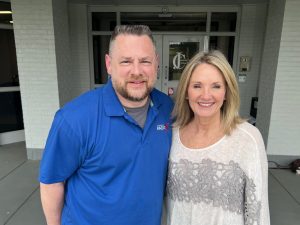
Traci Bledsoe/Peace Place
 Peace Place is a domestic violence agency providing emergency safe shelter and supportive services to adults and children fleeing abusive homes in Jackson, Banks, and Barrow Counties.
Traci Bledsoe/Peace Place
Peace Place is a domestic violence agency providing emergency safe shelter and supportive services to adults and children fleeing abusive homes in Jackson, Banks, and Barrow Counties.


Capital Stewardship is a personal and professional business development network geared toward the growth of the business owner which in turns grows their business. 
 Shasta Broadus is a personal and professional business development executive with the heart for small businesses and entrepreneurs.
She has a BS in Psychology, Masters course work in organizational leadership and a background in finance.
Connect with Shasta on LinkedIn and Facebook.

 Dr. Nancy Gaines-Dillard, DNP-BC Doctorate prepared, Board Certified Family Medicine Integrative Healthcare Practitioner with over 26 years of varied experience in Family, Emergency, and Acute Care Medicine at teaching hospitals, Level I Trauma Centers and Tertiary facilities.
She has taught at Thomas Jefferson University, Harcum College and various other educational institutions. She is a business owner, Inventor, Innovator, Philanthropist, Entrepreneur and Talk show host who owns NGC Network LLC, a media broadcast network.
Dr. Nancy’s Integrative Medicine has a unique perspective on healthcare modalities in that she is creative and progressive in her healthcare and education practice. She has two practice sites in the greater Phoenix metropolitan area with satellite offices and affiliate providers throughout the valley.
She provides services such as Telemedicine (multiple states), Women’s Health/Wellness, IV vitamin drip therapy, Stem Cell Therapy, Weight-Loss, Aesthetics, and Holistic and Traditional Medical Office Visits. She has her own product line “NG Cares” customized wellness solutions that address overall health and wellness. She offers individual and family healthcare plans. Dr. Nancy believes in living your best life now.
Her philosophy is such that she empowers her patient population by personalizing care and relationship building that improves health outcomes. She is a pioneer in her field and is dedicated to heal and educate the world, one person at a time.
Connect with Dr. Nancy on LinkedIn.
Keys Community Inc. was founded in 2013 with a goal to open doors for opportunity to their community. Just seven years later Keys Community opened their first behavioral health clinic in Phoenix, Arizona. 
Their mission is to improve access to high quality, mental and behavioral health services for all of Arizona’s youth, adults and families. They are building a healthy community by providing therapeutic services that preserve the overall family structure for individuals struggling with behavioral health and mental health challenges.
Keys Community offers a variety of services such as clinical services, life skills development, mentoring and community events. Their clinical services are geared towards trauma, child & adolescents behaviors, faith-based, LGBTQIA+ , individual, family & couples therapy and art, animal & gardening therapy.
Family services focus on family preservation, family respite and parenting classes. Keys help adults with career readiness, case management, community engagement, health & wellness, peer support and mentoring. They have a youth program called Keys Kids which provide after-school program, tutoring, life skills development, mentoring, Y.E.S -Youth Eliminating Stress respite and their skills geared summer program.
Mentoring is one of their main components when services members/clients. While mentoring they’re teaching how to model healthy coping skills, they’re providing substance recovery support and how to maintain positive relationship/interaction. Keys Community outlines the importance of health & wellness, how to create a nutritious meal plan and living a balanced physical, mental and spiritual lifestyle.
 Kyanti Palmer has a true devotion to children which drives her daily in her chosen profession of Behavioral Health, Kyanti is currently the CEO of Keys Community Inc., a behavioral health clinic in Phoenix, Arizona since 2020.
Her passion for behavioral health began eleven years ago when she was employed as a behavioral health tech. In working in the industry firsthand, she knew early on that she wanted to start her own behavioral clinic with a focus on family reunification. 
Kyanti realized the need for cultural awareness, financial wisdom, health and wellness in the community as she became more involved with families of the children she coached and mentored. She started Keys Community Foundation, Inc. a non-profit organization with a mission to support the community in developing better families by offering a variety of educational and developmental forums in mental health, wellness, daily life skills and parenting.
In addition, the non-profit provides a temporary housing program and her ultimate goal is to open a chain of community centers that supports her vision for family development.
Kyanti has a degree in Theology which enables her to mentor, counsel and lead with a compassionate heart without bias intentions. Kyanti’s work ethic is commendable and is fueled by her desire to help others. She leads by example in an outgoing, energetic, fun way.
If you ever want to see a true visionary, take time to get to know Kyanti Palmer; she truly is a great person to know and very resourceful.
Connect with Kyanti on LinkedIn and follow Keys Community on Facebook, Twitter and Instagram.
Healing Wings Ministries & Publishing is a multi-faceted ministry endeavoring to transform lives by empowering the brokenhearted and fostering healing, wholeness, and freedom through the unconditional love of Christ. We aspire to inspire by being Vessels of Light—shining light into the dark world. 
Healing Wings is publishing its first book, Vessel Of Light, a narrative biography from a compilation of journals based on Vaddess’ extraordinary life encounters and her quest for healing. Vaddess leaves nothing to imagine as she recounts complex traumas she bravely faced and overcame.
She shares her amazing stories in hopes of encouraging people to take inventory of their own lives, motivating each one to D.A.S.H. to their destiny, and Display Acts of Selfless Humanity by being a Vessel Of Light.
 Vaddess (like Goddess) has been motivating, inspiring, and empowering others for decades. Majoring in Engineering, she holds minors in Interior Design and Counseling. She worked closely with the Probation and Parole Office, counseling those sent to her by court order, and taught A.A. and N.A. classes for the probationers and parolees.
She is no stranger to television appearances and hosted a radio talk show. Through the years, she has formed various support groups and has traveled the country for motivational speaking engagements. In addition, she has coordinated and hosted leadership/inner healing conferences and women’s empowerment groups.
The hope of Vaddess is that her inspirational stories will reveal a new perspective on daily life, humanity, and future vision. She gives people the notion to partake in the voyage to D.A.S.H. to destiny by being a Vessel Of Light.
Vaddess lives in Phoenix, AZ, with her husband, Daveed, their goddaughter, Annie, her former husband, Harley, and their nine fur and feather babies. She hosts “SheRose High Tea Parties,” conferences, seminars, and speaking engagements wherever opportunities are open.
Connect with Vaddess on LinkedIn, Facebook, Twitter and Instagram.

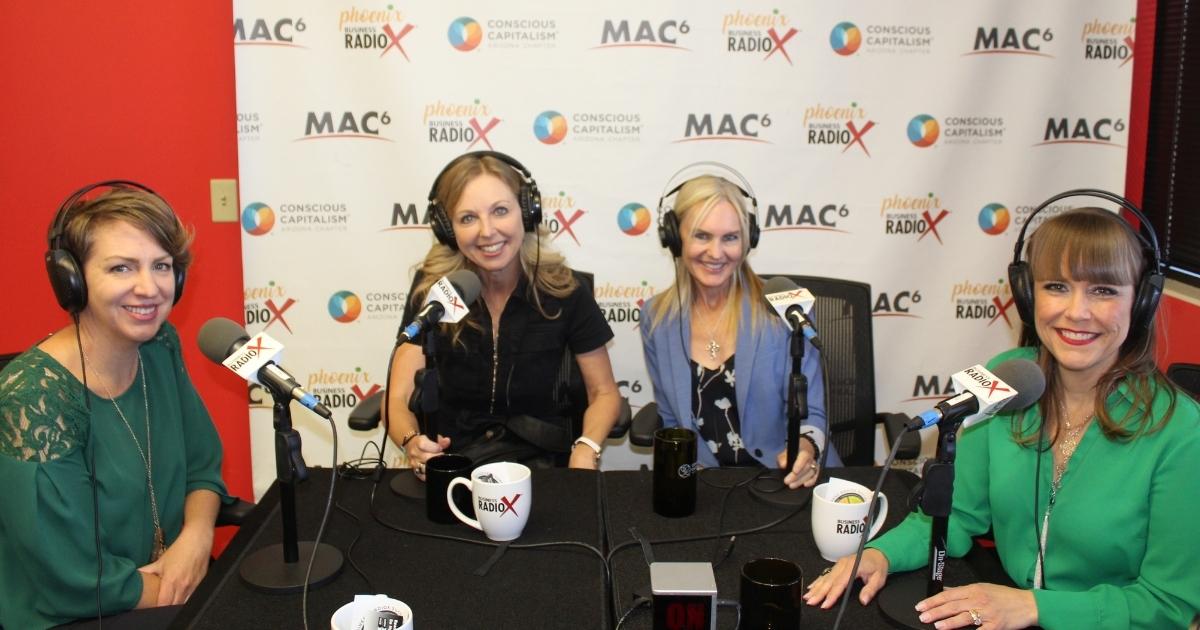
On this episode of Collaborative Connections Radio Show and Podcast, host Kelly Lorenzen had the pleasure of interviewing some amazing leaders in our community.
Ania Kubicki, CEO & Founder of ANGLES Communications and President-Elect of NAWBO Phx, Laura Bode, Director of Community Engagement of A New Leaf, and Shana Duffy, Principle Consultant, Blue Ocean Advisory and owner of Yellow Day Marketing joined Kelly on-air for an enlightening conversation.
If you want to be inspired, get more involved in the Arizona community, or learn something new about PR, non-profits, business ownership, or women in business, then check out this episode.
Did you know there is a media collaborative in Phoenix that focuses on Positivity? The Center for Positive Media just opened and Ania was excited to share about it. https://www.thecenterforpositivemedia.com/
Did you know that NAWBO advocates for women in business? They are a great resource in our community. https://www.nawbo.org/phoenix
Did you know that A New Leaf helps sexual and domestic violence victims? They are opening a Rap Crisis Center next month. Check out all of their services at https://www.turnanewleaf.org/services/
Did you know there is a consulting firm that helps brands connect with financial institutions for co-branded credit cards and loyalty programs? Shana Duffy is a principal consultant with them and a great resource for small and large businesses needing help with customer loyalty. https://boadvisory.com/
These ladies shared some GREAT resources, stories, and quotes during the show about everything above and more. It is worth the hour to listen to this episode of Collaborative Connections.
Thank you, KLM Consulting, Marketing, and Management for sponsoring Collaborative Connections Radio Show and Podcast.

A New Leaf advances its mission of “Helping Families…Changing Lives” by providing meaningful opportunities to empower disadvantaged individuals and families, and to create a stronger and healthier community. A New Leaf’s 30+ programs in the Phoenix Metro area address households’ immediate and longer-term needs through a continuum of care that promotes social and economic health and stability.
Services include emergency shelter, supportive housing, domestic and sexual violence support, financial empowerment, behavioral and primary health care, foster care, early childhood education, and family preservation. With 51 years’ experience providing social services to local communities, A New Leaf anticipates improving more than 30,000 lives this year through culturally responsive programming that cultivates equity in the community.
 Laura Bode serves as A New Leaf’s Director of Community Engagement. She has worked with A New Leaf for 10 years and is passionate about advancing the critical services the organization provides for the community.
She engages community corporations, foundations, civic leaders, and service groups to build awareness, funding, in-kind donations, and volunteer service to support all of A New Leaf’s programs.
Follow A New Leaf on LinkedIn, Facebook, Twitter and Instagram.
ANGLES is a communications agency with a mission to connect ideas and the people behind them to those who benefit from them. ANGLES works with visionaries who challenge the status quo and disrupt industries that need change. 
We help our clients bring positive change to industries, communities and the world through highly curated communications strategies and programs.
 Ania Kubicki started her career in public relations in New York City, working on high profile campaigns for destinations and political organizations. She moved to Phoenix in 2002 and started her agency, ANGLES Communications in 2006.
Ania is passionate about her clients and works with growth-oriented companies, powerful organizations and meaningful non-profits. She firmly believes that if you are not telling your story, someone will tell it for you.
Ania is an active member of our community serving on multiple committees, supporting and volunteering for causes in education, arts & entertainment as well as women and children. She is the President-Elect of the Phoenix Chapter of the National Association of Women Business Owners and is passionate about helping people overcome adversity and own their stories!
Connect with Ania on LinkedIn, Facebook and Instagram.
Blue Ocean is a multi-faceted advisory firm that excels in brand loyalty and payments solutions with a strong emphasis in the co-brand credit card space. Blue Ocean uses their vast experience and industry knowledge to successfully align brand partners and merchants with issuing banks and payment providers.
The Blue Ocean team has spent many years effectively negotiating co-branded programs nationally and internationally for travel, auto, retail, and financial institution brands. Additionally they manage RFP’s and contracts with Issuers and all three Card Networks; Visa, Mastercard, and American Express. 
Blue Ocean also provides operational and marketing guidance on credit card programs to maximize growth and revenue, create winning marketing and focused strategies that enhance consumer loyalty through enhanced product value and innovation.
Beyond marketing and business development the Blue Ocean team has strong operational backgrounds that cover Credit, Risk, Fraud, Customer Service, Forecasting, Financial Analysis, and user Analytics.
 Shana Duffy is a Principal Consultant with over 25 years of experience in the credit card and co-brand industry. Her experience runs deep across Operations, Marketing, and Business Development.
Shana spent over 20 years at Bank of America where she managed Credit Underwriting, Fraud, and Risk teams and strategies before transitioning to co-brand marketing where she spent 10 years managing a suite of successful programs such as America West, Alaska Airlines, and Hawaiian Airlines.
Prior to joining Blue Ocean Advisory in June 2020, Shana spent 7 years managing Retail, Airline, and Financial Institution co-branded programs at U.S. Bank.
Shana’s skills span across executive leadership, program management, product development and innovation, contract renewals and negotiation, revenue generation, and relationship management.
Follow Blue Ocean on LinkedIn.
Kelly Lorenzen started the “Collaborative Connections” show to bring her clients and favorite charities together to meet each other, connect and collaborate in life and business. She hopes to build a stronger community one show at a time. 
KLM is a one-stop support shop for small business owners who are starting, growing, or trying to sustain. Our purpose is to foster the growth and prosperity of small businesses in our community.
Entrepreneurs & small business owners come to KLM for support in all areas of business. KLM clients think of us as a concierge, business snuggy, another arm, or duplicate for the business owner; They call us when they need us. Business owners can continue to do what they love while having the support they need when they need it.
 Kelly Lorenzen, CEO of KLM, is an award-winning entrepreneur with over 15 years of business-ownership experience. She is also a certified project management professional.
Kelly’s expertise is in business development, customer service, marketing, and sales.
Connect with Kelly on LinkedIn, and follow KLM Consulting on Facebook.
Did you know that every nine seconds a woman is beaten in the United States? Or that people between the ages of 12 and 24 are at higher risk for sexual assault and rape? Do you know how to recognize the signs of domestic violence? And what do to help someone who’s been a victim of sexual assault or domestic violence?
Katha Blackwell/CEO, Partnership Against Domestic Violence

The mission of Partnership Against Domestic Violence is to end the crime of intimate partner violence and empower its survivors. Their vision is a community free of domestic violence.
To that end, they work to educate the public on the dynamics of intimate partner violence; promote healthy dating relationships among adolescents and teens to prevent future violence; offer safety and shelter for battered women and their children; restore power, self-sufficiency, and control to survivors; and create an effective and coordinated community response to intimate partner violence.
Lindsay Ferreira/Managing Director, Mosaic Georgia
 Founded in 1986 as the Gwinnett Rape Crisis to provide support to victims through a crisis line and accompaniment through forensic medical exams (aka, “rape kit” exam), Mosaic Georgia is a “dual services” center with specialized services for children, teens, and adults. They provide free, confidential support and services to victims and survivors of rape, sexual assault, and child sexual molestation and abuse. They work with survivors of all genders regardless of when the violence occurred and whether they choose to report. Support to children and their non-offending caregivers are offered with care.
Host: Heather Loveridge/Magnolia Media Group
 At the heart of marketing is great storytelling – and that’s what they do at Magnolia Media Group. Whether it’s through social media, e-newsletters, websites, brochures or complete marketing services, they help organizations tell their story.
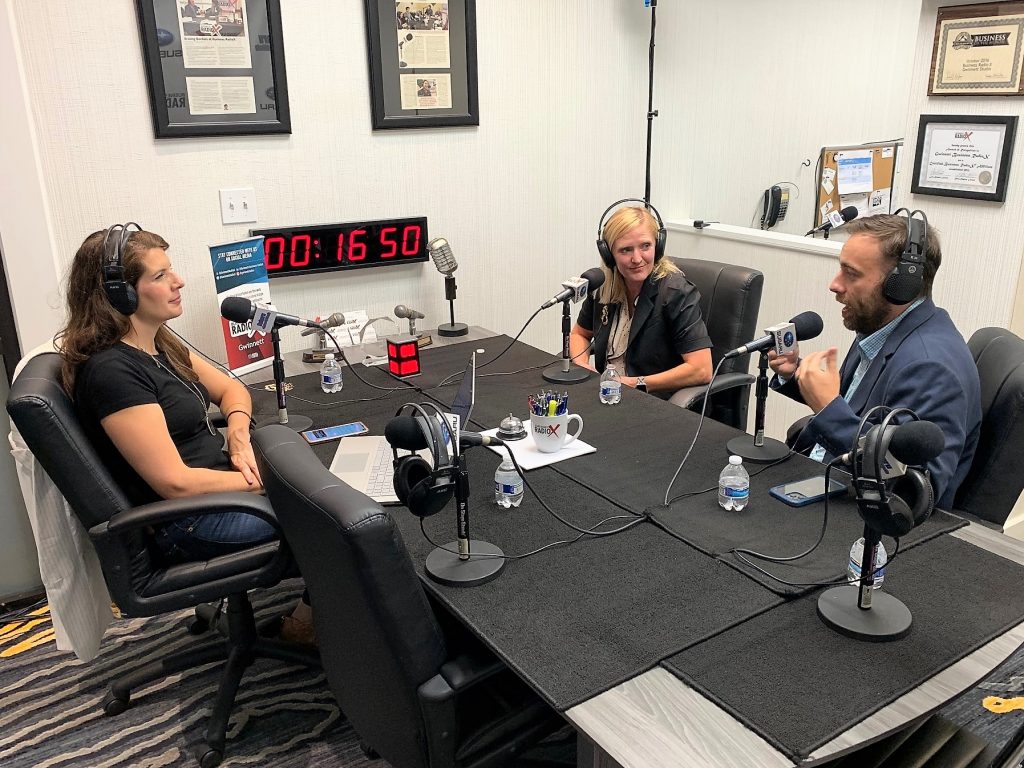
Giving Back to Gwinnett is presented by:


Partnership Against Domestic Violence hosted it’s 1st Annual “Tee It Up To End Domestic Violence” Golf Tournament on June 11, 2021 at Bear’s Best Atlanta.
Since 1977, PADV has worked passionately and tirelessly to end the crime of intimate partner violence and empower its survivors. The charity golf outing featured an 18-hole scramble and a beginner’s clinic. This special day allowed the community to take a visible stance against abuse and help end the crime of intimate partner violence. Golfers of every skill level competed for prizes and bragging rights.
Gwinnett Business RadioX dedicated a special Community Spotlight podcast promoting the event a month earlier, and then was on-site at Bear’s Best Atlanta on the day of the tournament broadcasting live remotes during the afternoon to interview organizers, sponsors and golfers. The live broadcasts were proudly presented by Buffington Burns Electric.
 Nancy Friauf (PADV President & CEO) and Sue Wyatt (Tournament Co-Chair)
 Carey Herron (PADV Board of Directors)
 Brian Shia and Randy Redner (Tournament Sponsors and Golfers)
 Dr. Yamma Brown (PADV Board of Directors)
One out of every four women will experience domestic violence. Since 1977, Partnership Against Domestic Violence (PADV) has worked passionately and tirelessly to end the crime of intimate partner violence and empower its survivors. Join them as they continue to work to combat and educate about abuse, or let them know how they can serve you as you seek safety. Call the PADV crisis line to get or give help at (404) 873-1766 (outside Georgia, call 800-799-SAFE).
The “Tee It Up To End Domestic Violence” charity golf outing will feature an 18-hole scramble and a beginner’s clinic. Whether as a company, family or individual, take a visible stance against abuse by teeing up to end domestic violence. Golfers of every skill level are invited to compete for prizes and bragging rights. They are extremely grateful for everyone who sponsors, donates, plays, and volunteers. Your compassion and support of this tournament will save and change the lives of your neighbors and friends!
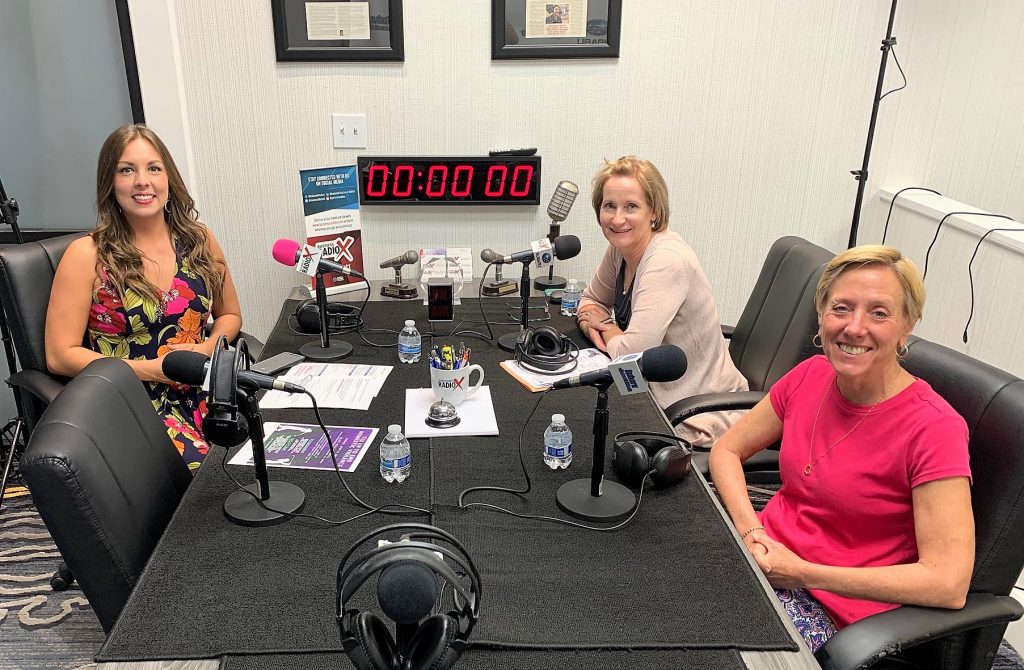
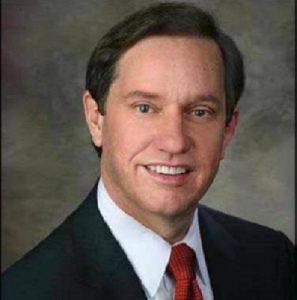
Workplace violence is a much more common phenomenon than some believe. What are the personality characteristics of someone who might initiate a workplace violence incident? How should you mitigate the risk of these incidents? Michael Blake, Host of the “Decision Vision” podcast, addresses these questions and more with workplace violence expert Bruce Blythe of R3 Continuum.
Bruce Blythe is the Owner and Executive Chairman of R3 Continuum. R3 Continuum provides employers with integrated crisis readiness, crisis response, and employee return-to-work services. They have assisted hundreds of companies worldwide with crisis, workplace violence, and business continuity planning, training, and exercising. They also provide consultations worldwide for diffusing serious disputes, hostilities, and workplace violence threats. R3 also works with insurers and large employers in accelerating employee return-to-work for workers comp disability and nonoccupational injury claims through North America and Australia.
Bruce Blythe is recognized internationally as an crisis management expert. He has been personally involved in resolutions of crises such as such as the 1993 World Trade Center bombing, the September 11th terror attacks, mass murders at the US Postal Service, and the Oklahoma City and Boston Marathon bombings. He serves as a consultant to numerous Fortune 500 executives and managers in strategic crisis leadership preparedness and response. Widely regarded as a thought leader in the crisis management and business continuity industries, Bruce is author of Blindsided: A Manager’s Guide to Crisis Leadership. Bruce has served in the military police of the US Marine Corps, is a certified clinical psychologist, has been a consultant to the FBI in workplace violence and terrorism, and has appeared on numerous national media outlets.
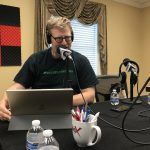
Michael Blake is Host of the “Decision Vision” podcast series and a Director of Brady Ware & Company. Mike specializes in the valuation of intellectual property-driven firms, such as software firms, aerospace firms and professional services firms, most frequently in the capacity as a transaction advisor, helping clients obtain great outcomes from complex transaction opportunities. He is also a specialist in the appraisal of intellectual properties as stand-alone assets, such as software, trade secrets, and patents.
Mike has been a full-time business appraiser for 13 years with public accounting firms, boutique business appraisal firms, and an owner of his own firm. Prior to that, he spent 8 years in venture capital and investment banking, including transactions in the U.S., Israel, Russia, Ukraine, and Belarus.
Brady Ware & Company is a regional full-service accounting and advisory firm which helps businesses and entrepreneurs make visions a reality. Brady Ware services clients nationally from its offices in Alpharetta, GA; Columbus and Dayton, OH; and Richmond, IN. The firm is growth minded, committed to the regions in which they operate, and most importantly, they make significant investments in their people and service offerings to meet the changing financial needs of those they are privileged to serve. The firm is dedicated to providing results that make a difference for its clients.
“Decision Vision” is a podcast covering topics and issues facing small business owners and connecting them with solutions from leading experts. This series is presented by Brady Ware & Company. If you are a decision maker for a small business, we’d love to hear from you. Contact us at decisionvision@bradyware.com and make sure to listen to every Thursday to the “Decision Vision” podcast. Past episodes of “Decision Vision” can be found here. “Decision Vision” is produced and broadcast by Business RadioX®.
LinkedIn: https://www.linkedin.com/company/brady-ware/
Facebook: https://www.facebook.com/bradywareCPAs/
Twitter: https://twitter.com/BradyWare
Instagram: https://www.instagram.com/bradywarecompany/
Intro: [00:00:04] Welcome to Decision Vision, a podcast series focusing on critical business decisions. Brought to you by Brady Ware & Company. Brady Ware is a regional, full-service accounting and advisory firm that helps businesses and entrepreneurs make vision a reality.
Michael Blake: [00:00:23] And welcome back to another episode of Decision Vision, a podcast giving you, the listener, clear vision to make great decisions. In each episode, we discuss the process of decision making on a different topic. Rather than making recommendations because everyone’s circumstances are different, we talk to subject matter experts about how they would recommend thinking about that decision.
Michael Blake: [00:00:42] My name is Mike Blake, and I am your host for today’s program. I am a Director at Brady Ware & Company, a full-service accounting firm based in Dayton Ohio, with offices in Dayton; Columbus, Ohio; Richmond, Indiana; and Alpharetta, Georgia, which is where we are recording today. Brady Ware is sponsoring this podcast. If you like this podcast, please subscribe on your favorite podcast aggregator, and please also consider leaving a review of the podcast as well.
Michael Blake: [00:01:07] Today’s topic is violence in the workplace. And in preparing for this program, I did a little bit of research, and I was surprised to learn the statistics. According to the National Safety Council, assaults are the fourth leading cause of workplace deaths in the United States. In 2017, assaults resulted in 18,400 and 458 fatalities. And to me, that was a stunning number. And anybody listening to this podcast, we’ve heard of the catastrophic workplace incidents. Often, a disgruntled or terminated employee that comes back to the workplace with a gun and ends in tragedy.
Michael Blake: [00:01:58] But what I’ve learned in doing background research for the show and, also, thanks to my long and dear relationship with our guest whom I’ll introduced in a minute, this is a much more common phenomenon than I think most people realize. And maybe that’s good. Maybe if we realized how dangerous it can be to actually go to work, we wouldn’t want to go to work anymore. So, maybe that’s a good thing.
Michael Blake: [00:02:26] But thankfully there are people like our guest today that help people both prepare for these incidents, mitigate the risk of them happening, and the damage occurs that when they do, and also inevitably when somebody kind of falls through the cracks, picking up the pieces when it happens.
Michael Blake: [00:02:48] And so, to that end, it is my immense pleasure to introduce, again, might my dear friend and longtime client, Bruce Blythe, who is an internationally acclaimed crisis management expert. He is the Owner and Executive Chairman of R3 Continuum, that provides employers with integrated crisis readiness, crisis response, and employee return-to-work services.
Michael Blake: [00:03:12] They have assisted hundreds of companies worldwide with crisis, workplace violence, and business continuity planning, training, and exercising. They also provide consultations worldwide for diffusing serious disputes, hostilities, and workplace violence threats. On average, they respond onsite to 1300 international workplace crises of all sorts per month. Finally, they work with insurers and large employers in accelerating employee return-to-work for workers comp disability and nonoccupational injury claims through North America and Australia.
Michael Blake: [00:03:48] Mr. Blythe has been personally involved in crises such as — and by personally involved, meaning resolving them, such as the 1993 World Trade Center bombing, the September 11th terror attacks, mass murders at the US Postal Service, and the Oklahoma City and Boston Marathon bombings, commercial air crashes, rescue of kidnap-and-ransom hostages in Colombia and Ecuador, hurricanes, earthquakes, fires, floods, and reputational crises.
Michael Blake: [00:04:16] He serves as a consultant to numerous Fortune 500 executives and managers in strategic crisis leadership preparedness and response. Widely regarded as a thought leader in the crisis management and business continuity industries, Bruce is author of Blindsided: A Manager’s Guide to Crisis Leadership. A book, which I’ve read by the way, and I firmly recommend. He has served in the military police of the US Marine Corps is a certified clinical psychologist and has been a consultant to the FBI in workplace violence and terrorism.
Michael Blake: [00:04:48] Bruce appeared on NBC Today’s Show, CNN, ABC’s 20/20, CBS’ 48 Hours. Pretty much, if they ever talk about this subject, Bruce is the guy that they call. And I can tell you that when he speaks, he commands a pretty high fee for doing that. So, I appreciate him giving us a slight discount for coming on the program. I could go on and on, but I think you get the point. Bruce knows what he’s talking about. Bruce Blythe, thanks so much for coming on the program.
Bruce Blythe: [00:05:16] Well, you just made me nervous, Mike.
Michael Blake: [00:05:19] I doubt that. I know you too well. I very much doubt that. You and I have known each other since R1. It’s been a while since it got to R3 Continuum. But let’s start with a little bit of a vocabulary lesson for the audience. When we hear about workplace violence, what forms does that take? As I mentioned in the intro, we all have heard about the gunman coming to the workplace and shooting lots of people. Is that the most prevalent form or what other forms of workplace violence do you encounter and try to help mitigate or resolve?
Bruce Blythe: [00:06:04] Sure. Well, the shootings are the least prevalent actually. The most prevalent forms of workplace violence are things like verbal and nonverbal threats, threat of violence, intimidation, bullying. Some of the sexual harassment, or sexual assault, or sexual violation kind of issues where people feel threatened. Stalking is certainly one of those things. And sometimes, it’s with a vengeance. And other times, it’s what they call a [radamania] where somebody has an unrelenting attraction to — usually, it’s a male toward a female, and won’t let go, and they just keep stalking or whatever. And that could be both physically, as well as on social media, or e-mails, or whatever. Fights certainly play into that. Hostilities of all sorts.
Bruce Blythe: [00:06:59] Those are the things that are most likely to occur in the workplace. And many of those things, then, are precursors to more serious levels of violence. The good news is that most people make threats. Most people who are hostile do not come in with a gun. So, that’s the good news. The bad news is we don’t know which one of those people are going to be the ones that end up shooting. We have a hard time. There is no psychological test, or list in the newspaper, or whatever that tells us who’s going to be the shooter, if you will, in the workplace.
Michael Blake: [00:07:33] And to your point, it’s so much more common than I realized. I actually was in Salt Lake City last week for a conference. And as it turned out, I had a layover. Actually, the first time in my life, I had a flight canceled on me. I had to be shipped off to a hotel. And I was in the bar having a beverage. I happened to sit next down next to a lady who has a a company in California. And we got to talking a little bit. And she was on her way where she had just fired somebody at one of their offices, and that person shoved her, tried to choke her, and, ultimately, of course, had to be separate and escorted out of the building.
Michael Blake: [00:08:19] And she told me that’s something that’s happened to her multiple times. And my jaw just dropped. In spite of the conversations you and I have had, it’s happened to her so many times that she had almost a nonchalance about it, and I was stunned. How common is that where maybe there are some workplaces where things like events like this can be so common that you almost get numb to it?
Bruce Blythe: [00:08:47] Well, I don’t know that you’re actually numb to it. I would be surprised if she’s numb to it. She can be nonchalant all she wants, but the fact of the matter is that she’s been lucky enough that she survived these things and not been hurt. So, I think that, sometimes, when you just dodge a bullet enough times, you think, “From that, I won’t get it.” The good news is that most of the time, even people that are hostile, that have triggers, like being fired, or feeling unfairly treated, or whatever it may be, that they’ve got a grievance about. Most people don’t actually act out violently in a very severe manner.
Bruce Blythe: [00:09:22] So, there’s certainly some warning signs there. I would recommend to her that she take a look at what can she do to address those kinds of things to be ready. So, many times, it’s kind of, “Well, I hope they don’t get violent.” Then, they do, and it’s like, “Oh my gosh.” And they get out of it by the skin of their teeth. But there’s some things that you could do to set up the room and set up the entire thing about who’s there, and maybe even have security or a police officer that may be not visible or may be visible. It depends on how you want to do it. But to actually plan out the contingencies, I think, is a really good idea. And we hope people do that. And so, many times, we know, they don’t think about it. You don’t like to think about things like that being worse than what you’ve experienced before.
Michael Blake: [00:10:09] And to a point, I kind of want to finish off the vocabulary part because I know another part of the business that, at least, you’ve dealt with, this scenario that you’ve dealt with in the past, has been violence that occurs due to crime, like a convenience store robbery, something of that nature. That’s sort of a different animal, isn’t it?
Bruce Blythe: [00:10:31] Oh sure. And it’s really hard to stop those kinds of things. Now, retail, customer service jobs, certainly taxi drivers. Less the Uber and Lyft type drivers because the people are identified who go in. A taxi driver, it takes somebody that’s anonymous, and they don’t know who they’re picking up. Police, certainly, they’re in the line of fire a lot. And interestingly, a real hotbed for violence is in medical arenas. So, hospitals, certainly emergency rooms, that sort of thing. A lot of violence in those situations.
Michael Blake: [00:11:09] I read something about that. That, in fact, with health care facilities and even nursing home facilities, the violence tends to be fairly prevalent. What are the kind of the scenarios that kind of set people off to that degree in your experience?
Bruce Blythe: [00:11:25] Well, when we talk about somebody just coming from the public that’s anonymous that may or may not have anything to do with the workplace, then, certainly, there’s nothing you can do about that. If a workplace has a high percentage of women in the workplace, there is an increased likelihood of domestic violence coming into the workplace. It happens a lot that. It could happen to men with a strange female spouse, or girlfriend, or whatever, but that’s less likely. But in those situations where you know that the person — you know them, or you’ve got a relationship with them, typically, it helps to understand the violent mind.
Bruce Blythe: [00:12:09] I think this is a big piece of what’s missing because so many times, the naive organizations, when they have a threat, they think about, “All right. There are temporary restraining order. Let’s call the police and have them arrested. And let’s get some guards with guns or without guns, either way. Maybe some cameras as well.” And if you stop and think about it, a restraining order didn’t stop anybody that would likely create violence. You think of some show, the kid that shot all the people at the Virginia Tech. I mean, they talked about having a restraining order on him because there was a young coed that was feeling intimidated by him, but that wouldn’t stop him. I mean, to violate a restraining order is no big deal when, actually, what you’re doing out there is shooting people. So, those kinds of things aren’t really what’s going to stop them.
Bruce Blythe: [00:12:59] To understand the violent mind, there’s basically three things that we see a common mental pattern. It’s interesting how again, and again, and again, as we deal with threatening individuals, the same mental algorithm and the same mental patterns are there. What is it that sets them off?
Bruce Blythe: [00:13:16] Number one, they get ego problems, okay. And what I mean by that is they have extremely or profoundly low self-esteem. I’m not talking about the kind of insecurities we all have. I’m too short, or I way too much, or don’t like my hair. We all have that, okay. I’m talking about people that have profoundly low self-esteem. And then, they don’t get into self-acceptance, or they don’t deal with it. Instead, what they do is they try to feel superior to other people.
Bruce Blythe: [00:13:43] And then, it becomes very important that they must win. They must stay ahead of other people. And they have to keep blowing up that leaky balloon, that is their ego. And if anybody challenges them – that happens in traffic, when somebody gets cut off. I mean, just like you’re not going to do something that’s going to cause me any inconvenience. So, the ego is one piece of it. That ego, low self-esteem. So, one thing you’re going to do, of course, is build them up.
Bruce Blythe: [00:14:10] The second thing is they would need to feel heard and understood. So many times, and like with this woman that you met in Salt Lake, the issue here is that so many times, they don’t feel heard and understood. And because they feel cut off, what happens is, then, they resort to whatever they can, to even the score. And too many times, it’s hostility or violence. So, you want to let them feel heard and understood because they almost always feel like they need to be heard and understood. Even some show, this kid in Virginia Tech, had a mutism disorder, whatever. People said they never heard the guy talk. He was just painfully shy, apparently. But even he left a manifesto on a videotape in his room because he wanted to be heard even from the grave because he knew what he’s going to do.
Bruce Blythe: [00:14:58] The third thing. So, it’s ego, it’s feel heard and understood. And then, the third thing is they tend to feel unfairly treated. We all have a strong sense of right and wrong, and they tend to feel unfairly treated. So, what can we do to come up with a win/win? It doesn’t mean we’re going to give the person a job back when they got fired, but it maybe we’re not going to challenge their unemployment compensation, those kinds of things. We’re going to give you a neutral reference if you have somebody call us for when you’re looking for another job. Those are the kinds of things that can help you understand where they’re coming from, and it can help reduce the likelihood that they’re going to take that next step.
Michael Blake: [00:15:40] So, we talked about health care facilities, a little bit about taxicabs. Are there other kind of industries and types of workplaces that tend to be more prone to violence? For example, I work for a CPA firm. Do I need to be afraid walking in one day and get popped in the mouth, or what other kind of high-risk industries out there?
Bruce Blythe: [00:16:02] Well, it’s a little bit like swimming in the ocean. You hear about the shark attacks and go, “Oh my gosh. I’m not going in the ocean.” A lot of people are afraid to do that. The fact of the matter is, statistically, the odds are very, very low that you’re going to get attacked by a shark if you swim in the ocean. The same thing about going to work. The overwhelming odds are that you’re not going to have to worry, Mike, when you go into work, or anybody else, that the odds are that nothing’s going to happen to you from a from a shooting standpoint. There may be some hostilities, there maybe some uncomfortable situations, but the serious kinds of workplace violence are very unlikely.
Bruce Blythe: [00:16:39] But I think back of, what are the kinds of organizations that are most prone? Back in the ’90s, I was involved in helping the US Postal Service with their mass shooting, some multiple mass shootings. So, they had one after another in different locations.
Michael Blake: [00:16:55] I remember that one.
Bruce Blythe: [00:16:56] And while I, certainly, wasn’t the only architect of helping them come up with this solution, it was a multifaceted, one of the things that was most important that, actually, once they set up a workplace violence program, including a policy, training for supervisors’ procedures of threat, a notification system, all those different kinds of things, the US Postal Service went for eight years without another shooting. That was with 750,000 employees at the time. Huge employer.
Bruce Blythe: [00:17:26] So, what is it that increases the likelihood for like the Postal Service and other organizations? Usually, and probably the thing that helped the Postal Service the most, was the fact that the supervisors were promoted from being a letter carrier to supervisor with no training whatsoever on how to manage people, how to let them feel fairly treated, how to give them — feel cared for, that sort of thing, give them positive regard. So, in those toxic environments where a supervisor or management is hostile toward employees or the employees feel unfairly treated, there’s that word again, they don’t feel heard and understood, they feel disempowered, those are the kinds of places where you’re more likely to have somebody to well up, and here they come. So, I guess, I would stop right there with that.
Michael Blake: [00:18:22] Yeah. And let me ask you this because I can think of other — I’ll even say with my own industry. A lot of what you’re describing is frequent in the accounting industry. We tend to promote people based on the fact they’re really good at auditing financial statements, and writing out 1040 forms, but we don’t necessarily do a great job of training them to be managers, especially if we’re not in the national firms. And we have our busy season. So, people putting in 60-70 hours a week. And thank God, I’m hitting my head, which is made of wood, that to my knowledge in the history of our firm, we’ve never had a workplace violence incident or anything like that.
Michael Blake: [00:19:03] I wonder if another element is that maybe you also kind of feel trapped in your job that if you work for the Postal Service, we know the benefits they have. The skills may or may not transfer easily to a private organization. Seniority is just sort of everything that you don’t even necessarily have that as an escape valve necessarily that you can just say, “Take this job and shove it. I’m going to find another one.” Do you think that’s a factor as well?
Bruce Blythe: [00:19:29] Absolutely sure. And, again, if, in fact, the job is such that you feel like, “I just can’t get another job with this kind of benefits, or with the seniority I’ve got, And I got to start all over again, or I can’t make the kind of money I’m making here, so I’m stuck with it. But I’m really, really frustrated with the way I feel like I’m being treated.” Again, it goes into the ego issues that, “I feel like a marginalized. I feel like I’m not heard and understood,” or “I can talk to them, and there’s no action. I feel unfairly treated.” Those are the kinds of things where some people are going to well up.
Bruce Blythe: [00:20:06] Interestingly, the people that don’t say anything that’s well up many times are the ones who are going to come up with the serious finals versus the people who are verbal about it, and maybe make threats, or loud and boisterous. It doesn’t mean those kinds of people aren’t going to be violent someday, but it’s that cold calculating person that doesn’t say anything many times are the ones that may be the problem. So, you need to kind of draw them out.
Bruce Blythe: [00:20:35] One of the ways that we diffuse threatening situations, and we don’t get the easy ones. Somebody who’s got the guns, they showed the co-worker in the car, and in the trunk of the car, and this is what I’m going to use. I’m the supervisor, and that kind of thing. They maybe got a history of violence. They don’t call us on the easy ones. We get called on the hard ones. One of the approaches we take and dealing with these things is — there’s no psychological test, there’s no way to really know for sure who’s going to be violent and who’s not. So, one thing to try to do is get inside their head.
Bruce Blythe: [00:21:11] And the way to do that is to make contact with them. Mike, if you were a person that is making threats, you felt unfairly treated at work, maybe you got ,fired whatever, if I were to contact you maybe by phone or face-to-face, however we’d like to do it, as a neutral third party and say something to the effect of, “My name is Bruce Blythe. I’m a neutral third party that’s being called in by X, Y, Z management. And basically, they understand you may feel unfairly treated or have a concern with whatever’s going on. And so, what I’d like to do, my job is to hear and understand your side of this situation, knowing there’s two sides to every story. And my job will be to report that back to management to make sure that this situation is handled fairly.” Let me ask you a question now, like you’ve been asking me, how would you respond if if you had somebody contact you like that?
Michael Blake: [00:22:07] Oh. I mean, I you would like to think positively. And look, I’m a repressed Irish Catholic, and I’ll be the first to admit it. So, I don’t own a gun. They terrify me. But I do kind of have that personality of internalizing and sort of have the long fuse. And my teenager will tell you that when the long fuse sort of hits zero, it’s not something he wants to be around. So, I do think that that — I think that engagement makes a big difference. You just got to have that safety valve.
Bruce Blythe: [00:22:51] Well, what happens in real life, because we’ve done this just hundreds and hundreds of times with individuals as you think, well, here’s this guy calling, I don’t know who he is, or contacting me, and I don’t know who he is. And so, I wouldn’t talk to them. In reality, we can hardly get all that out, my little scenario I just gave you there, before they start talking. Sometimes, I say, “I don’t want to talk to you, but…” And then, they’re still talking 30 minutes later. We know they want to feel heard and understood. We know they want to feel fairly treated. We know that if we build them up and find some good things about him. I do everything I can to like these people when I’m dealing with them. People don’t like the anti-social, hostile person.
Bruce Blythe: [00:23:33] And so, here, we’re in a situation where we can actually let this person feel heard and understood, fairly treated. And they’re not going to get the job back if that’s what they’re after, but what we can do is maybe come up with a compromise. We can better assess where they’re coming from or what their intentions are. We can talk to them about alternatives. We can serve as a conduit of communication, so they feel empowered when we pass the word on to management. Of course, management has more information on how better to handle this situation. So, it’s just we understand what the violent mind; and therefore, we know how to deal with it and how to help companies deal with that as well.
Michael Blake: [00:24:14] So, I’d like to go back to the of the Postal Service example. I didn’t realize — I knew you’d worked on it. I didn’t realize you had that kind of impact. And it’s worth kind of refreshing that that — I mean the Postal Services issues were so bad that the American lexicon adopted the term going postal to describe somebody that had just flown off the handle basically. So, should every organization have a plan like that, or do large organizations need more in-detail plans, or smaller have maybe more sketchy ones or more kind of outline-oriented ones set that way? If I’m a business owner, and I’m listening to this conversation, how do I think about whether or not I needed to retain you or somebody like you to put something like that in place?
Bruce Blythe: [00:25:06] Well, okay. So, the Postal Service had what? Was it something like 15 mass shootings in different locations around their system? And once they came up with a comprehensive workplace violence program, the key component there was to train supervisors on how to manage people and how to do it in a caring, fair manner, and not quite so autocratic.
Bruce Blythe: [00:25:32] So, they went for eight years with 750,000 employees, and the one employee that broke the eight-year record was somebody that hadn’t been with the company for three years. She was living in another city, went back to Southern California three years later. She was known for howling at the moon, talking to the moon, filling up her car with gasoline naked. I could go down the list. This is a crazy lady, okay. So, it wasn’t really their fault that an ex-employee came in and did the shooting even eight years later. They had a very effective program. The proof’s in the pudding.
Bruce Blythe: [00:26:09] So, if I’m an employer, it’s like, “All right. Well, wait a minute. I got workplace violence, you know. It’s like, you know. All right. So, Bruce here is saying that just having a temporary restraining order, which isn’t necessarily going to work.” If I were to shoot somebody, a restraining order is not going to stop it. It may stop some people from getting together, which is going to cause fights, which may lead into other kinds of violence. So, I’m not saying they’re not effective, but they’re not an end all be all. Call the police. If I get arrested because I made a threat or because I am threatening, first of all, I may not have done enough that I’m going to get arrested. And police don’t like to even deal with these things. If somebody hadn’t done anything yet, then they’d want to go deal with things where somebody had done something. So, that’s not necessarily going to work.
Bruce Blythe: [00:26:55] And, of course, having guards there, most places don’t want to have guns there. So, a guard with a walkie talkie is not going to stop anybody nor is a camera that it really has an intent. So, what do you need to have as a healthy company that wants to address this issue? Basically, four things, I would recommend. Number one, you want to have a policy that is well-publicized about workplace violence. There’s a lot of really good workplace violence policies out there. And it’s pretty much down to an art and science now what ought to be included there. It’s different in different organizations but, certainly, getting access to a policy is something to be pretty easy if you want to just do it on the cheap.
Bruce Blythe: [00:27:38] The second thing then is threat notification system. A threat notification system is one where employees understand that if there is a threatening situation, what they can do — and it’s a gut level feeling. Many times, that gut level feeling is what tells you more than anything else. Yeah, they may make a threat. Yeah, they may act in intimidating. Yes, they may have a history of violence, which are all indicators, okay, that they may be violent, but it’s that gut level feeling that says, “This is a person, I think, could really do it.”
Bruce Blythe: [00:28:08] So, if you have a threat notification system that people will use where they feel comfortable doing it. I don’t want to report somebody if they’re going to say, “Well, Reese said you were making threats.” Now, I’m on the hit list. I don’t want to do that. So, a good policy threat notification system.
Bruce Blythe: [00:28:25] And, now, if they get notified, you better have a threat management team that’s trained, that has standardized guidelines, which is the fourth thing. But I guess we clump that all together – a well-trained threat management team that has standardized checklists on how to handle this thing beyond the restraining order and calling the police, but some guidelines on how do you diffuse these situations. What are best practices? Those are the things that you need to have at a bare minimum, I would say. A policy threat notification system, and then the threat management team with standardized guidelines.
Michael Blake: [00:29:01] Okay, good. So, we’ve talked a little bit about restraining orders. That’s come up a couple of times. And I agree with you, they don’t seem to be that effective. And I think one of the reasons that they’re not that effective is that a shooter seems intent on not coming out alive from that incident themselves. It seems, more often than not, they take their own lives, or they wind up not being apprehended alive. I’m guessing that’s also another reason the restraining order is not all that effective. You can’t enforce it when they’re dead. Is that a common pathology for the workplace shooter that they’re just planning on doing as much destruction as they can on the way out?
Bruce Blythe: [00:29:44] 40% of the time, according to the government statistics, yes. 40% of the time, people commit suicide to do this kind of thing. Half the time, the others that are still alive, police officers may kill them. So, the fact of the matter is, certainly, it’s a risky business. If you want to live for long, you don’t want to be a workplace shooter. But with that said, the fact of the matter is that it doesn’t really matter if they’re going to act out violently, and then decide to kill themselves or not. In any case, the fact of the matter is that they feel unfairly treated, they want to commit a vengeance or whatever, or, sometimes, they just want to feel significant. I think so many of these school shootings, these kids, they feel like a nobody, that they’re an outcast or whatever. In their minds, they would rather feel significant in a negative way, and even die out of it than to feel like a nobody. And, again, it’s related to ego, it’s related to feeling unfairly treated, it’s feeling like they’re not heard and understood, and here they come.
Michael Blake: [00:31:00] We’re talking to Bruce Blythe, who is the Chairman of R3 Continuum, one of the world’s leading experts on workplace violence. I want to be respectful of your time. I just have a couple more questions if you can hang in there.
Bruce Blythe: [00:31:14] Sure.
Michael Blake: [00:31:15] One is, of course, even with the best of intentions, workplace violence happens. How can you and how can a company help kind of pick up the pieces after a workplace violence incident? Where do you kind of — if that happens in my office, where do I kind of go from there?
Bruce Blythe: [00:31:36] Well, we respond, you mentioned, 1300 times. I think it’s up to 1600 times per month now to crisis situations of all sorts. One of the common entry points for us and the one of the common calls we get is for crisis counseling. And so, there’s a social expectation, I guess, in the workplace that if, in fact, something traumatic like this happens, employers are expected to respond with a caring response. And so many times, they don’t know what that is. An employer that doesn’t have a preparedness ready for this kind of thing, they’re going to say, “Our hearts go out to the families, blah, blah, blah.” It rings hollow at this point. So, instead, caring is not a feeling. It’s behavioral. And so, employees must feel like they’re cared for. And, certainly, bringing in crisis counselors who are specialists in this kind of arena is helpful.
Bruce Blythe: [00:32:40] One of the things that I remember, I keep going back to Virginia Tech. I guess, I’m stuck on that today. But there were so many counselors who were saying, “I can help. I can help. Here I am.” The biggest issue was keeping counselors away. So, you certainly want to have people that know what they’re doing, that are skilled at this. You don’t want a plastic surgeon doing your heart surgery. And the same kind of thing. Just because you’re a mental health professional, it doesn’t mean you know how to handle these situations. So, one thing is to address the needs of those people who have been victimized. And it’s not just of the employees that work. It might be the families, it might be the people that are in the hospitals that have been injured. Who knows what else?
Bruce Blythe: [00:33:21] The second thing is that management must be doing the right things as well. And so, a big piece of what we do is helping companies understand, the company management understand how do you show caring, how do you do the right things, how soon do you bring employees back, what you need to do before you bring them back to work, how do you show caring over time, and how do you assess people who may have delayed responses, that sort of thing. So, it really comes from preparedness. But at a minimum, if you’re not prepared, then to get somebody in there that has been there before that can help out.
Bruce Blythe: [00:34:04] Just one quick other point about this, and that is at Syracuse University, several years ago, did a study about what leaders and organizations are the best crisis managers. And one of the correlates they came up with was that those managers who had an outside neutral third party who could help out, that was trusted, okay, and that was not emotionally involved in this thing, that had an idea of how to handle this thing. It was most helpful because when you’re inside the crisis’ bubble, it’s really hard to see outside that bubble, and what’s going on, and what their perspectives are, and what you should be saying, and how you’re being perceived, and how to address this thing. It’s a whirlwind, and it’s unexpected, and it’s high consequence, and people are watching, go on down the list. It’s very difficult if you don’t have somebody on the outside just kind of help steer the direction for you to, at least, assist. Not to take over but to assist in good management and what to do.
Michael Blake: [00:35:08] Bruce, as often as a case, I could talk to three hours of this, and we still wouldn’t run out of material. But I know you got things to do, and you have one of 1600 incidents to respond to this month.
Bruce Blythe: [00:35:21] Not all. I can’t do them all. Thank you. I’ve got a good network, but thank you.
Michael Blake: [00:35:26] But how can people contact you for more information if they want to learn more about this topic or more about the kind of services you guys provide?
Bruce Blythe: [00:35:36] Well, R3 Continuum, I mean, just look them up online. A lot of times, people don’t know how to spell continuum, which is two Us in it. So, our web addresses are r3c.com, probably the best way to do it. Just contact us that way. All of our contact information is there at r3c.com.
Michael Blake: [00:35:57] Bruce, thank you so much. And the next time you’re in Atlanta, I owe you dinner.
Bruce Blythe: [00:36:01] Hey, that sounds good to me. I’m coming soon.
Michael Blake: [00:36:05] There, excellent. So, that’s going to wrap it up for today’s program. I’d like to thank Bruce Blythe so much for joining us and sharing his expertise with us. We’ll be exploring a new topic each week, so please tune in, so that when you’re faced with your next business decision, you have clear vision when making it. If you enjoy this podcast, please consider leaving a review with your favorite podcast aggregator. It helps people find us, so that we can help them. Once again, this is Mike Blake. Our sponsor’s Brady Ware & Company. And this has been the Decision Vision Podcast.

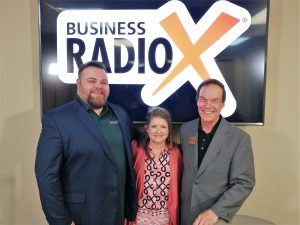
Dawn M. Echols/Dawning Phoenix
 Dawn M. Echols is a licensed professional counselor and certified professional counselor supervisor offering clinical counseling and life coaching, as well as brief solution-oriented therapy for conflict resolution using mediation techniques. She specializes in anxiety, aggression, conflict, domestic violence, relationship issues, personal growth, spirituality, depression, and divorce recovery. Dawn sees clients for problems of living as well as a variety of disorders. Ms. Echols works extensively with couples as well as individual adults. Her therapeutic approach includes exploring goal directed behavior and social interest while developing insight through mindfulness.
Her professional background includes corporate and entrepreneurial experience in music, sales, & finance. This experience honed her people skills and led her in the direction of psychology. Dawn holds degrees in marketing, music, and clinical psychology. Her counseling work includes private practice, Employee Assistance Programs, addiction, health, and court-ordered treatment for offenders in domestic violence and anger management. Ms. Echols is credentialed in clinical supervision of emerging counselors and manages a staff of counselors at Dawning Phoenix.
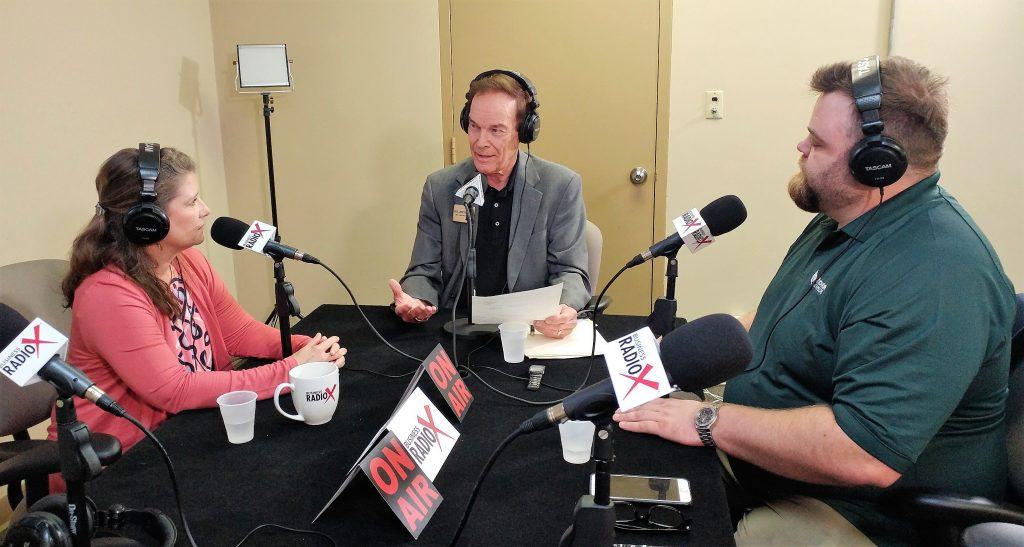
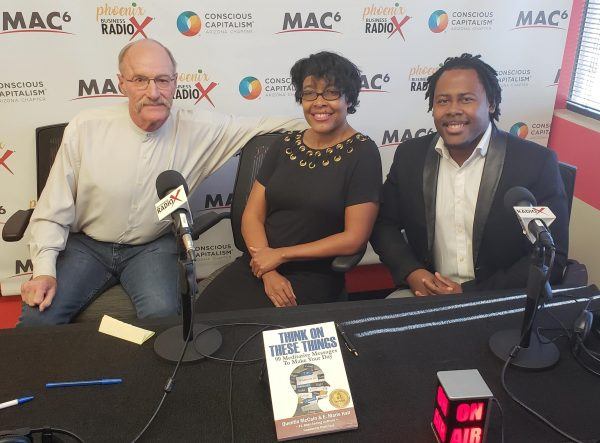
Co-Authors and Speakers E Marie Hall and Quentin McCain with Wyatt Earp of On The Spot Productions
Marie Hall Enterprises, LLC is a personal and professional development company. Its mission is to make a significant impact in the area of emotional trauma/adverse events through provision of a full range of coaching services, presentations, products and training programs. To encourage mindset awareness as well as provide a  guideline to those in search of life-long growth and transformation.
Marie Hall Enterprises, LLC seeks to be the gold standard for providing the tools to break through emotional trauma, adverse childhood events, and adversities.
 E. Marie Hall is a Traumatic Breakthrough Coach, an award-winning speaker, and co-author of the Amazon best seller, Think on These Things. She works with individuals who are ready to break free from the limiting effects of emotional trauma and adversities.
Marie also knows how to connect with audiences to inspire action that leads them to life-changing decisions. She is a passionate speaker who captivates the audience and delivers a powerful message of mastering the mindset and overcoming obstacles. Marie is an advocate for domestic violence awareness and prevention. She attended the first ever Senate hearing on Women and Violence and has shared her powerful message with members and staff of Congress in Washington, DC. In addition, Marie was a discussant in the “Protect All Women” tour and has delivered her “Create Your Fate” message across America. As a coach and speaker Marie is passionate about equipping others with the tools to literally transform their lives.
Connect with Marie on LinkedIn, Facebook and Instagram.
Quentin McCain LLC is a personal and professional development company. The company focuses on teaching entrepreneurs how to breakthrough mental barriers to success. Quentin McCain LLC’s mission is to create global mindset shifts through coaching, seminars, book, and other related products and services. 
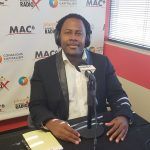 Quentin McCain works with individuals and organizations that want to maximize performance by breaking through mental barriers to success. Success begins in the mind and often stops there as well. Quentin McCain is a Maximum Performance Coach who knows that ultimate success cannot happen until we wake up and take the wheel of life.
Quentin is the coauthor of “Think On These Things”, an Amazon #1 Best Seller and knows what it takes to unlock innovation and build outrageous confidence. He utilizes his personal experiences and the proven principles of Neuro-Linguistic Programming taught by business leaders such as Tony Robbins. Quentin teaches entrepreneurs, sales people, customer service representatives, and C-level executives how to reprogram their thinking and self-talk to re-engage the mission, renew passion for their work, and reinvigorate innovation to achieve greater success. Quentin is also passionate about using these NLP principles with burn and trauma related staff and survivors.
Connect with Quentin on LinkedIn, Facebook and Instagram.
Since 1993, On the Spot Productions has enjoyed relationships with many fine schools of dance, theatre, and local schools of education. We videotape dance, choir and drama performances so that instructors can have a quality video production to review with their students.
In our twenty plus years of being the Midwest’s choice for providing exceptional videography, we have yet to charge a fee to videotape any school, dance or theater performance. Directors do not pay to receive their DVDS or Blu-rays. We have found that participants and their families often desire a copy for themselves so we do make copies available to them for purchase.
 Wyatt Earp has been portraying his famous relative in his one-man play called “Wyatt Earp: A Life on The Frontier” since 1996 which won an AriZoni award and has over 1020 performances, and was written by his wife Terry Tafoya Earp who is an award-winning Arizona playwright. A Life on The Frontier has had performances throughout the United States, Canada, and Europe along with many performances aboard cruise ships. In November 2000, Wyatt performed for the American Studies Program at the University in Budapest Hungary, in which the Cultural Attaché had attended..
In 1998 he began performing another one-man play “The Gentleman Doc Holliday” which is based on the book “Doc Holliday: A Family Portrait” by Karen Holliday Tanner, who is the closest living relative of Doc Holliday”, which the play is primarily, based on. Therefore, what you will hear in this play is truly the real story…
Wyatt is retired from the New Your Life Insurance Company where he worked as an agent for forty years. He is also a charter member of “The Arizona Gunfighters”, a historical reenactment troupe and a member of Park Central Toastmasters since 1980. His athletic endeavors include the completion of two Hawaiian Iron man Triathlons, numerous marathons, 10k’s and long distance swimming events including the “Escape from Alcatraz”. Wyatt also serves on the Phoenix Downtown YMCA board of directors as well as coaches the Y’s Master’s swim program. In addition, he is the race director for the YMCA Half-Marathon, which is the oldest foot race in Arizona. Wyatt also actively volunteers at the Arizona Spinal Injury Association and Terry is teaching how to write and execute theater from a wheel chair.
Wyatt currently resides in Phoenix, Arizona with his wife Terry, one cat named Josh and two German Sheppard’s names Xena and Zak
Follow Wyatt Earp on Facebook.














