Business RadioX ®

  • Home
  • Business RadioX ® Communities
    • Southeast
      • Alabama
        • Birmingham
      • Florida
        • Orlando
        • Pensacola
        • South Florida
        • Tampa
        • Tallahassee
      • Georgia
        • Atlanta
        • Cherokee
        • Forsyth
        • Greater Perimeter
        • Gwinnett
        • North Fulton
        • North Georgia
        • Northeast Georgia
        • Rome
        • Savannah
      • Louisiana
        • New Orleans
      • North Carolina
        • Charlotte
        • Raleigh
      • Tennessee
        • Chattanooga
        • Nashville
      • Virginia
        • Richmond
    • South Central
      • Arkansas
        • Northwest Arkansas
    • Midwest
      • Illinois
        • Chicago
      • Michigan
        • Detroit
      • Minnesota
        • Minneapolis St. Paul
      • Missouri
        • St. Louis
      • Ohio
        • Cleveland
        • Columbus
        • Dayton
    • Southwest
      • Arizona
        • Phoenix
        • Tucson
        • Valley
      • Texas
        • Austin
        • Dallas
        • Houston
    • West
      • California
        • Bay Area
        • LA
        • Pasadena
      • Colorado
        • Denver
      • Hawaii
        • Oahu
  • FAQs
  • About Us
    • Our Mission
    • Our Audience
    • Why It Works
    • What People Are Saying
    • BRX in the News
  • Resources
    • BRX Pro Tips
    • B2B Marketing: The 4Rs
    • High Velocity Selling Habits
    • Why Most B2B Media Strategies Fail
    • 9 Reasons To Sponsor A Business RadioX ® Show
  • Partner With Us
  • Veteran Business RadioX ®

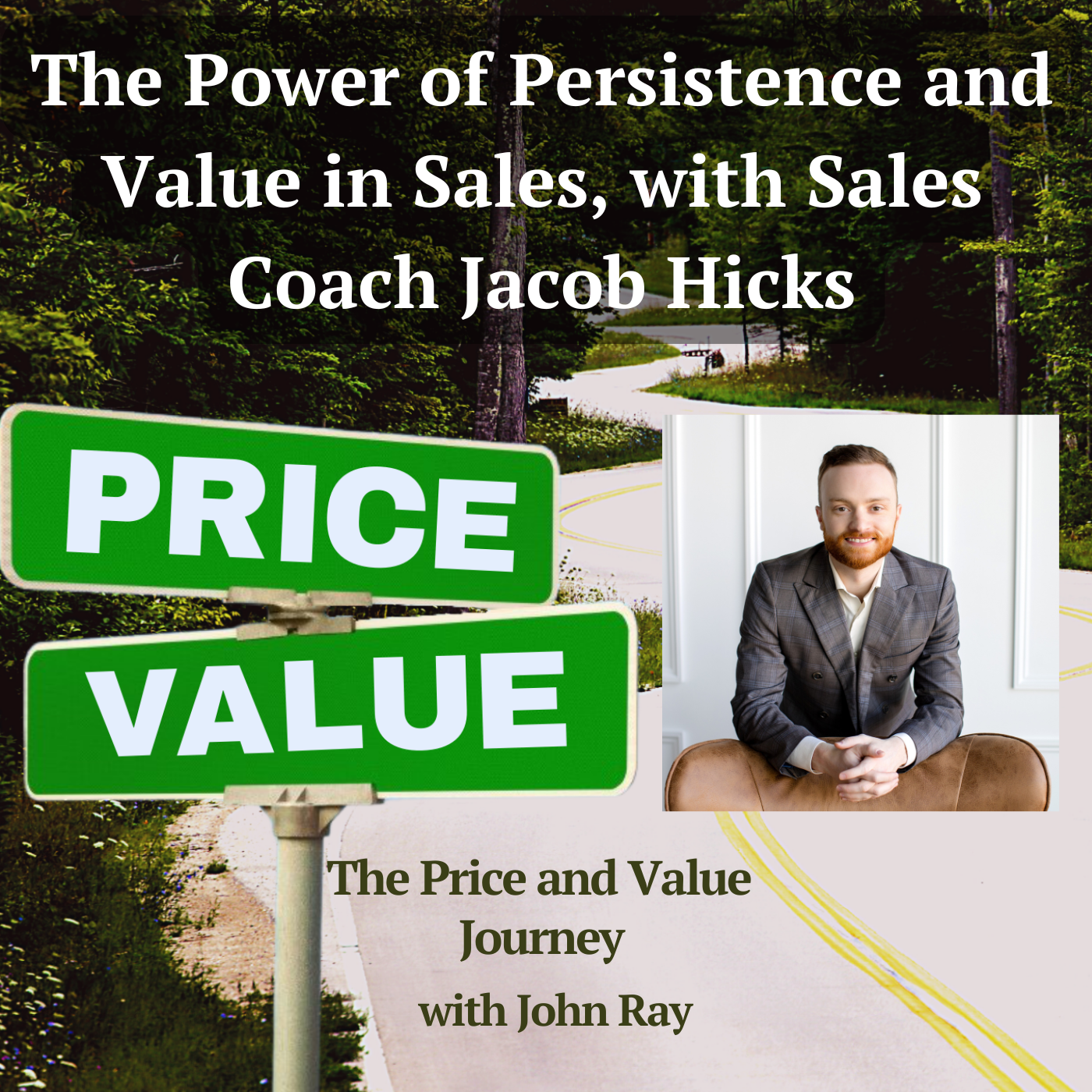
The Power of Persistence and Value in Sales, with Sales Coach Jacob Hicks

March 26, 2025 by John Ray

The Power of Persistence and Value in Sales, with Sales Coach Jacob Hicks, on The Price and Value Journey with host John Ray
North Fulton Studio
The Power of Persistence and Value in Sales, with Sales Coach Jacob Hicks
Loading
00:00 /
RSS Feed
Share
Link
Embed

Download file

The Power of Persistence and Value in Sales, with Sales Coach Jacob Hicks, on The Price and Value Journey with host John Ray

The Power of Persistence and Value in Sales, with Sales Coach Jacob Hicks (The Price and Value Journey, Episode 126)

In this episode of The Price and Value Journey, host John Ray sits down with Jacob Hicks, a dynamic sales coach, consultant, and host of the Purpose Driven Progress podcast. Jacob shares his journey from a shy retail worker to a skilled sales professional, emphasizing the importance of mindset, gratitude, and empathy in sales. The discussion delves into effective follow-up strategies, overcoming mindset blocks, and the essential role of daily affirmations and gratitude in maintaining a positive sales mindset. Jacob also introduces his “Delete and Dominate” strategy to handle negative client interactions and underscores the value of retail lessons for professional service providers. This episode is packed with actionable insights for anyone looking to enhance their sales approach and mindset.

The Price and Value Journey is presented by John Ray and produced by the North Fulton affiliate of Business RadioX®.

Jacob Hicks

Jacob Hicks, Sales and Success Coach, on the Price and Value Journey with host John Ray
Jacob Hicks

Jacob Hicks is an exceptional Elite Success Coach dedicated to helping individuals build a satisfied and full life. As a certified Elite Coach, Jacob collaborates with leaders, professionals, and entrepreneurs, guiding them towards clarity and success in both their personal and professional lives. His coaching philosophy centers on empowering his “Coaching Allies” to discover optimal strategies for business and personal fulfillment.

Jacob’s approach involves creating goals, developing actionable plans, and executing those plans effectively. Through weekly one-hour calls and supplementary exercises, Jacob provides ongoing support and accountability to his clients. His passion for coaching is evident in his commitment to helping individuals gain clarity and construct actionable plans to realize their aspirations.

With a background in sales since 2014, Jacob has consistently achieved remarkable results across various industries. His track record includes surpassing goals, setting records, receiving awards, and effectively leading teams. This experience informs his coaching practice, allowing him to offer valuable insights into sales strategies and mindset. Jacob’s expertise in sales and coaching has been recognized in various contexts, making him a trusted advisor for those seeking to enhance their performance.

Beyond his professional pursuits, Jacob is committed to continuous personal growth. He is an avid reader, a self-taught piano player, and an investor. His passion for learning extends to travel, having explored extensively throughout the United States and the world. Jacob’s travels have also led him to engage in mission work in Liberia, demonstrating his commitment to making a positive impact beyond his coaching practice. This blend of professional expertise and personal growth makes Jacob Hicks a standout figure in the field of success coaching.

Website | LinkedIn | Instagram | Facebook

Topics Discussed in this Episode

00:00 Introduction and an Overview of Jacob Hicks
01:21 Jacob Hicks’ Sales Journey
03:24 The Importance of Follow-Up in Sales
06:24 Providing Value in Follow-Ups
17:27 Lessons from Retail for Professional Services
20:46 Mindset in Sales
22:21 Morning Affirmations and Gratitude
23:11 Experimenting with Affirmations
24:21 The Power of Gratitude
26:15 Common Mindset Blocks in Sales
28:38 Empathy vs. Sympathy in Sales
29:46 “Delete and Dominate” Strategy
36:54 Effective Follow-Up Strategies
40:40 When to Hire a Sales Coach
42:20 Conclusion and Contact Information

About The Price and Value Journey Podcast

The title of this show describes the journey all professional service providers are on: building a services practice by seeking to convince the world of the value you offer, helping clients achieve the outcomes they desire, and trying to do all that at pricing that reflects the value you deliver.

If you feel like you’re working too hard for too little money in your solo or small firm practice, this show is for you. Even if you’re reasonably happy with your practice, you’ll hear ways to improve both your bottom line and the mindset you bring to your business.

The show is hosted and produced by John Ray and North Fulton Business Radio, LLC, an affiliate of Business RadioX®. The show can also be found on all the major podcast apps. The complete show archive is here.

John Ray, Host of The Price and Value Journey
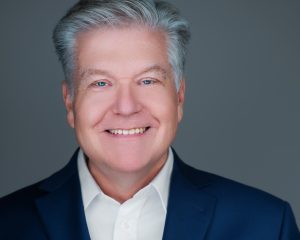
John Ray, Author of The Generosity Mindset and Host of The Price and Value Journey

John Ray is the host of The Price and Value Journey.

John owns Ray Business Advisors, a business advisory practice. John’s services include business coaching and advisory work, as well as advising solopreneurs and small professional services firms on their pricing. John is passionate about the power of pricing for business owners, as changing pricing is the fastest way to change the profitability of a business. His clients are professionals who are selling their expertise, such as attorneys, CPAs, accountants and bookkeepers, consultants, coaches, marketing professionals, and other professional services practitioners.

In his other business, John is a podcast show host, strategist, and the owner of North Fulton Business Radio, LLC, an affiliate of Business RadioX®. John and his team work with B2B professionals to create and conduct their podcast using The Generosity Mindset® Method: building and deepening relationships in a non-salesy way that translates into revenue for their business.

John is also the host of North Fulton Business Radio. With over 850 shows and having featured over 1,300 guests, North Fulton Business Radio is the longest-running podcast in the North Fulton area, covering business in its region like no one else.

John’s book, The Generosity Mindset: A Journey to Business Success by Raising Your Confidence, Value, and Prices
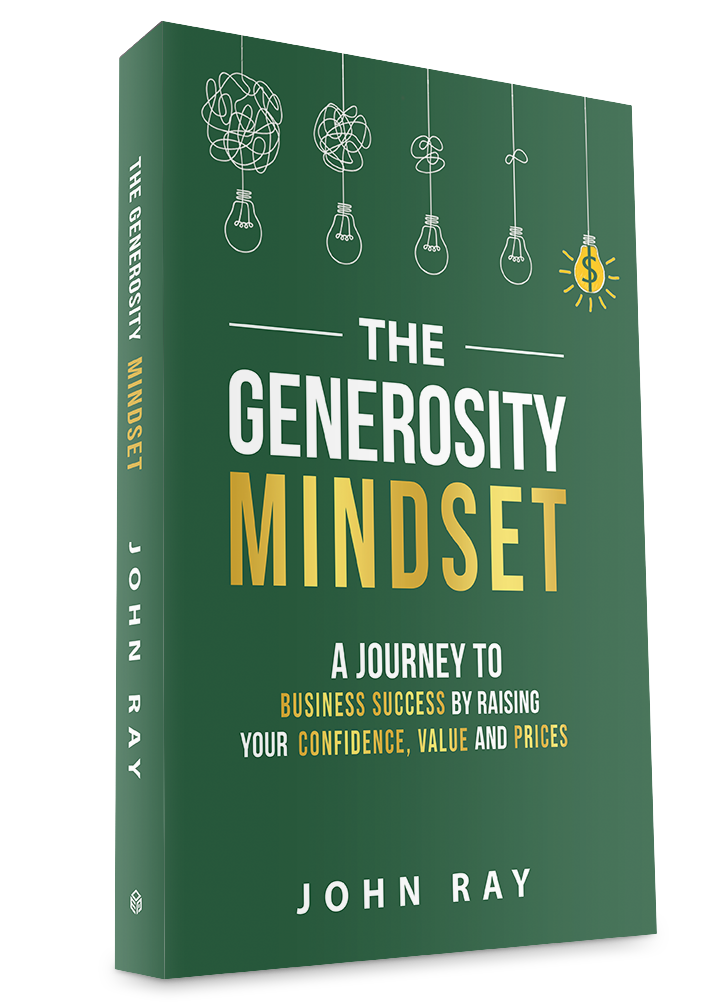
The Generosity Mindset, by John RayJohn is the #1 national best-selling author of The Generosity Mindset: A Journey to Business Success by Raising Your Confidence, Value, and Prices.

If you are a professional services provider, your goal is to do transformative work for clients you love working with and get paid commensurate with the value you deliver to those clients. While negative mindsets can inhibit your growth, adopting a different mindset, The Generosity Mindset™, can replace those self-limiting beliefs. The Generosity Mindset enables you to diagnose and communicate the value you deliver to clients and, in turn, more effectively price to receive a portion of that value.

Whether you’re a consultant, coach, marketing or branding professional, business advisor, attorney, CPA, or work in virtually any other professional services discipline, your content and technical expertise are not proprietary. What’s unique, though, is your experience and how you synthesize and deliver your knowledge. What’s special is your demeanor or the way you deal with your best-fit clients. What’s invaluable is how you deliver great value by guiding people through massive changes in their personal lives and in their businesses that bring them to a place they never thought possible.

The combination of all these elements is quite different for you compared to any other service provider in your industry. Therein lies your value, but it’s not the value you see. It’s the value your best-fit customers see in you.

If pricing your value feels uncomfortable or unfamiliar to you, this book will teach you why putting a price on the value your clients perceive and identify serves both them and you, and you’ll learn the factors involved in getting your price right.

The book is available at all major physical and online book retailers worldwide. Follow this link for further details.
Connect with John Ray:

Website | LinkedIn | Twitter

Business RadioX®:  LinkedIn | Twitter | Facebook | Instagram

Tagged With: affirmations, empathy, gratitude, Jacob Hicks, John Ray, mindset, Sales, sales coach, The Price and Value Journey

The Profitability Coach’s 14th Anniversary, with Bill McDermott, Host of ProfitSense

May 1, 2023 by John Ray

The Profitability Coach's 14th Anniversary, with Bill McDermott, Host of ProfitSense
North Fulton Studio
The Profitability Coach's 14th Anniversary, with Bill McDermott, Host of ProfitSense
Loading
00:00 /
RSS Feed
Share
Link
Embed

Download file

The Profitability Coach's 14th Anniversary, with Bill McDermott, Host of <i>ProfitSense</i>

The Profitability Coach’s 14th Anniversary, with Bill McDermott, Host of ProfitSense

In this commentary from a recent episode of ProfitSense, Bill expresses gratitude as he celebrates 14 years as The Profitability Coach, helping businesses become more profitable.

ProfitSense with Bill McDermott is produced and broadcast by the North Fulton Studio of Business RadioX® in Alpharetta.

Bill’s commentary was taken from this episode of ProfitSense.

About ProfitSense and Your Host, Bill McDermott, The Profitability Coach

Bill McDermott
Bill McDermott

ProfitSense with Bill McDermott dives into the stories behind some of Atlanta’s successful businesses and owners and the professionals that advise them. This show helps local business leaders get the word out about the important work they’re doing to serve their market, their community, and their profession. The show is presented by McDermott Financial Solutions. McDermott Financial helps business owners improve cash flow and profitability, find financing, break through barriers to expansion, and financially prepare to exit their business. The show archive can be found at profitsenseradio.com.

Bill McDermott is Founder and CEO of McDermott Financial Solutions. When business owners want to increase their profitability, they don’t have the expertise to know where to start or what to do. Bill leverages his knowledge and relationships from 32 years as a banker to identify the hurdles getting in the way and create a plan to deliver profitability they never thought possible.

Bill currently serves as Treasurer for the Atlanta Executive Forum and has held previous positions as a board member for the Kennesaw State University Entrepreneurship Center and Gwinnett Habitat for Humanity and Treasurer for CEO NetWeavers. Bill is a graduate of Wake Forest University and he and his wife, Martha have called Atlanta home for over 40 years. Outside of work, Bill enjoys golf, traveling, and gardening.

Connect with Bill on LinkedIn and Twitter and follow McDermott Financial Solutions on LinkedIn.

Tagged With: 14th Anniversary, Bill McDermott, gratitude, Profit Sense, profitability, profitability coach, Profitability Coach Bill McDermott, ProfitSense with Bill McDermott, The Profitability Coach

Generous Leadership

April 28, 2023 by John Ray

Generous Leadership
North Fulton Studio
Generous Leadership
Loading
00:00 /
RSS Feed
Share
Link
Embed

Download file

Generous LeadershipGenerous Leadership

Price and Value Journey host John Ray recently presented on generous leadership to a group of business owners and leaders, organized and led by Julie Keyes of KeyeStrategies. In his presentation, John discussed a generous mindset vs. a mindset of scarcity, focusing on assets vs. deficits, characteristics of generous leadership, including laughter, listening, and stability, and how generous leadership shows up with employees and team members, clients, and in marketing to prospects.

The Price and Value Journey is presented by John Ray and produced by the North Fulton studio of Business RadioX®.

KeyeStrategies, LLC

KeyeStrategies is an advisory firm for entrepreneurs looking to grow and improve their business, while also providing Exit Planning and Transition services for companies between $5-30M in annual revenue. The firm’s mission is to help business owners increase enterprise value and prepare the owner and the business for a future exit. Our tagline says it all… “Build enterprise value today, so you can exit on your own terms tomorrow”.

Website | LinkedIn | Facebook | Twitter

Julie Keyes, Founder/President, KeyeStrategies, LLC

Julie Keyes
Julie Keyes, KeyeStrategies, LLC and Host of the “Poised for Exit” Podcast

Julie Keyes is a Certified Exit Planning Advisor (CEPA) the founder of KeyeStrategies, LLC in Minneapolis, MN specializing in exit and transition consulting for owners of lower and middle market companies. Julie has been an entrepreneur most of her life. As the founder and operator of several companies, she understands what keeps owners up at night.

She works with business owners who seek to understand and maximize their exit and critical transition options. She is actively involved with the Exit Planning Institute, as a faculty member and regular content contributor, and winner of EPI’s “Thought Leader of Year” in 2017 and 2022.

She is also on faculty for Hoopis Performance Network and a Speaker Network member. Her speaking engagements for the financial services and entrepreneurial organizations have included NAIFA, WIFS, FPA, NAWBO, Merrill, UBS, LIMRA, Lincoln Financial Services, Principal Financial Group and Frost Bank.

Julie recently released the 2nd Edition of “Poised for Exit” a book which helps owners of privately held companies navigate the process of business exit. Her weekly podcast, also called “Poised for Exit”, provides content relevant to business owners and advisors alike, and can be found on all major podcast platforms.

She also produced an online course specifically to help advisers educate their clients and prospects on the process of Exit Planning called “Business Transition Readiness: An Owner’s Guide to the Process”.

On a personal note, Julie and her husband Shaun have 8 children and 10 grandchildren, so when she’s not working, she’s spending time with them doing something fun, active, and outdoors.

LinkedIn

TRANSCRIPT

John Ray: [00:00:00] Hello. I’m John Ray on The Price and Value Journey. Recently, I was honored to be invited by Julie Keyes to present to her group that meets once a month to learn about various issues around leadership and other important issues in team management, personal development, professional development and so forth.

And I was fortunate enough to be invited by Julie to present to her group about the power of a generous approach in team management and leadership. With her permission, I’ve been able to repurpose that presentation in this podcast. I hope you enjoy it.

Julie Keyes: [00:00:45] So, welcome everybody to another Keyes Strategies Learning session. This is something that we just started this year in 2023 on a quarterly basis to present on topics that we have been told and are hearing that are super important to business leaders all over the country.

And today, we have the honor of John Ray presenting for us, talking about leading with a generosity mindset. We know that we have a lot of businesses out there, privately held businesses, with leadership that’s going to be changing hands and has been changing hands. I have clients who are in the throes of doing that right now, and I have many who will be, right.

And so, what does that take? What does it take to be a really good leader? And what is having a generosity mindset? What does that got to do with it? So, John is a radio host and a podcast producer. We were just talking about podcasts. And he is also a partner with Studio, or I’m sorry, with North Fulton Studio of Business RadioX.

And he helps business to business professionals with pricing. That’s a huge topic. It’s a hot topic. It’s kind of a touchy topic sometimes with professional advisors, right, on pricing and he’s an expert on it. But today he’s going to be talking about grooming those leaders. And so, I’m just going to mute myself and take it away, John. And then when you’re finished, we will jump into some questions.

John Ray: [00:02:15] Thank you, Julie. And again, I’m so grateful that you had asked me to present to your group. That’s an honor and I appreciate the work you do. You and I have known each other a while now, and you do terrific work. And I appreciate following your work. So, thank you.

Julie Keyes: [00:02:32] Thanks for being here. It’s an honor to have you, too. You’ve got great expertise, and I’m anxious to hear what you have to say.

John Ray: [00:02:38] Yeah. Well, thank you. Well, just jumping off. So just to set this up for everyone and thank you for taking the time to come on, because your time is valuable, and I appreciate that.

As Julie said, I have a business advisory practice, and it’s aimed mostly at professional services firms. And I do some outside CFO work that I don’t really advertise that much. But most of that practice is oriented toward, as Julie said, helping professional services providers with their pricing. And then my fun job is I’m a podcast host and do that work and I’ll allude to that in a second.

But I’m working on a book, and the book is called The Price and Value Journey, Raising Your Confidence, Your Value and Your Prices using the Generosity Mindset Method. Now, this seems contradictory to people when I talk to them about this. It’s like, how do I be generous? How is being generous and raising my prices, how does that all fit together Well?

Well, that’s a great question, and I’m going to answer it in that book. But as I’ve written that book, what has occurred to me, and this may be my second book. Julie, we’ll see, you can challenge me on this later. But is that there’s a mindset of generosity that we can bring to our leadership roles, that is really important and valuable.

And so that’s really what I want to talk about, is what is the generous leadership and where does that show up and how do we think about that. Now, one way to define this for me is that generous leadership is leading through giving without the certainty of how that giving will come back to you.

Now, this flies in the face of a lot of things we learn in business school. It flies in the face of a lot of things that we have grown up believing. And I’m not saying that return on investment is suddenly a bad thing. So don’t get me wrong. But it is a belief in some principles that I think we know intuitively. I mean, one of those principles is the law of reciprocity.

So, a lot of you may have heard of the law of reciprocity where, you know, for example, if Julie does something nice for me, then I feel an obligation to Julie or I feel drawn to Julie, even better said, right, in some way, because she’s done something for me that’s thoughtful and generous and I’m drawn to her, right. And I want to reciprocate that in some way.

So when you’ve ever been in a business meeting and you’ve done something for someone as part of that meeting and they say, well, what can I do for you? Well, see, this is the law of reciprocity at work. But here’s the big but, I think generosity is the law of reciprocity without a giving to get mentality.

So, you’re not giving to get out of a particular relationship or out of a particular membership in an organization or out of a particular initiative that you’re doing. But your belief is that if I give to, and I’m going to say the universe, but you fill in the blank, if I give to my employees, if I give to my company, if I give to my community, I’m going to say the universe, if I give to the universe, that the universe will give back to me in multiple and unexpected ways.

And for me, that’s part of the fun. And the satisfaction of life is that when you do that, you get those gifts come back to you in unexpected ways. This avoids giving, which is transactional. And I’m not criticizing, I’m just observing, okay, here. But, you know, people give all the time to get their name on a building or, you know, what have you. And that’s good. It performs great work, but there’s something transactional in that, right.

And that doesn’t make, again, does not make it bad, but what it says, I think there’s something more here that we’re, I think as human beings, called to do. And that we don’t want to get ourselves in a situation where the only time we give is when it’s transactional. And I guess that’s the tension that we always have in our heads, to me, about this topic, right.

The reason I bring this up is because people’s radar is very acute. People can sniff transactional a mile away. This is whether it’s true from employees, our customers, our colleagues in our respective industries, they can sniff out when the transactional a mile away.

So, with that said, let me talk a little bit about, I guess, kind of what the characteristics or I guess the dichotomy is here. I mean, because what you’re talking about at its extremes or a generosity mindset versus a mindset of scarcity. Okay. And by the way, one point, any mindsets that we have, whether it’s about generosity or scarcity or anything else, they are not binary. And they’re not fixed.

We have a tendency, all of us, to be somewhere in the middle of these things. And none of us in most cases are at one extreme or the other. And we drift between these two extremes based on our predilections, how we were raised, the self-talk we have in our heads, our influences in life and our circumstances.

So, it’s kind of important for us to interrogate where we are and to be honest with where we are, right. So, let’s talk about some of what the characteristics of a generosity mindset versus a mindset of scarcity. For example, abundance. Abundance is present, always, and can be shared. Versus a mindset of scarcity which says resources are limited and must be hoarded.

So the world is a generous place. It gives to us if we give to it. It sometimes gives to us when we don’t give to it versus an idea that the pie is fixed. Enjoyment in giving and sharing and helping others versus seeing giving as a loss that must be avoided in some way or made up later.

And by the way, this outline that I’m working off of, I’m happy to send out later. So if that takes pressure off writing it down, I’m happy to give it to Julie and let her send it out to everyone. Being grateful for what’s given and seeking opportunities to give back in that gratefulness, in that gratitude versus the fear of not having enough. A collaborative approach seeking win-win solutions versus a competitive approach that everyone’s our competitor that, you know, it’s a tooth and claw world, right?

Encouraging personal growth and development versus hindering personal growth and development. I’ll talk about this with employees later. That life is full of abundance and possibilities versus limitations and obstacles. Again, just to reiterate, this is not — most people are not on either pole here. And we drift between these poles and sometimes we score higher on one of these elements than another.

So we’re not consistent all the way down the line here, but — oh, here’s another one I missed. Money and capital. Money and capital as a tool for creating opportunities and enriching lives versus money and capital as a scarce resource to be protected at all cost.

One example of that is I’m reading Bernie Marcus’ book right now. Bernie Marcus, co-founder of Home Depot. And one of the lines in that book that struck me was that they operated the company off this philosophy. They grew a little bit, you might say, over the years. Right. But they operated out of a philosophy of payroll is an investment. That’s what we’re talking about. Payroll creates opportunities and enriches lives versus being a scarce resource.

One place that this shows up here in the nonprofit world is a concept called asset-based community development. And this is a really important trend that we have seen in the way a lot of nonprofits and charitable organizations have looked at their role. And a lot of them have been real frank with themselves in saying the problem we’re trying to solve is not getting better. And so, we need to look at why that is.

And part of that has to do with looking at the community they serve. I’ll put it in that context. Instead of focusing on deficits, focusing on the assets in a community and building from there versus focusing on the deficits and needs. So, for example, looking at what is there versus what’s missing. Looking at possibilities versus problems, strengths, capacities and assets versus needs.

What are our strengths that we have? What are our assets that we have? Let’s go deep on that question. Doing with and enabling to do with whatever you have versus doing to. So working inside out in a community or in an organization versus a top-down command and control kind of philosophy.

There’s a lot more to say about ABCD, but I encourage you to maybe dip into it and think about it and I can answer more questions about it. But putting it into practice involves several things that I think all of us can take and use in our teams and our organizations. One is collecting stories. That’s one of the places ABCD starts is collecting stories.

And the idea of collecting stories is, number one, the stories are powerful. It’s almost built into our DNA in terms of how we respond to stories. Collecting stories in this case helps reinforce strengths. It helps discover strengths and discover assets. Sometimes when we ask people to share, we learn things about them that we never knew before.

One of the things I do when I facilitate a group is I go around as a — because I’m like the guy that knows nothing about anybody, right? So I go in and I say, tell me the one thing that you wish people would ask you about that they don’t know. Right. Tell me the one thing that people would be surprised about if they knew about you.

And it’s amazing what comes out of that. Just that one question. Right. And you discover assets that people have that they have been shy to talk about or have never shared before. And sometimes those assets are those capabilities you can use in some way in the organization.

Then mapping assets, gifts, and capabilities of group members. So, you collect these stories. And basically, you’re doing a census of the assets, the gifts, the capabilities of this group, of this community, of this organization, whatever you’re talking about here and you’re mapping those or compiling those, another way to say it.

And what that does is create a balance sheet of soft assets that you did not know maybe that you fully had, right, that you can utilize to the good of your organization. And then asking the group, because the group is already participating here, asking the group to contribute to a shared vision and plan that is based on those assets.

So that might be something very specific. That might be something wider, but you’ve done the work to help bring the group along toward being able to see the assets that maybe they didn’t recognize that can be used to fulfill that shared vision.

Let’s talk a little bit about characteristics of generous leadership. And this is not an all-inclusive list. But there are things that occur to me as I have done some of the work I’ve done and observed the people that I think are successful at putting this leadership of generosity mindset into place.

I’m going to — number one I’ve got on my list is laughter. That’s not the one that people would expect to be number one, but I put it number one for a simple reason is that the world sorely needs it right now. And if the world sorely needs it right now, then you can bet the people in your organization need it right now. Unless you’re doing a fantastic job keeping people in a good frame of mind all the time, and it’s hard.

Even if you’re trying, it’s hard, right, because unfortunately, they’re consuming a whole lot of stuff out there that you can’t control. But if you’re not thinking about that, I would encourage it.

And here’s the thing. Just the ability for us as leaders to laugh at ourselves is so important. It’s a trust builder. I mean, think about it. If I’m able to the people — well, let me put it this way. The people that I think about in my life, one of their consistent themes that stand out for the most successful ones are the ones that they have a great sense of humor about their mistakes. Right. I screwed that up. You know, I screwed that up bigger than Dallas. You know what I mean. I can hear some of them in my head, you know.

And that creates an openness. It relieves tension, and it relieves stress that people have. And it builds trust. And trust is the biggest currency I think we have in business, particularly today with the lack of trust that’s going on in the world, whether it — well, really across the board when it comes to institutions. And we know all those statistics and we see it played out in the world all the time.

I actually know of a company that for their awards dinner every year, they bring in a comedian and that comedian does the homework to make his emceeing work around that awards. He does his homework to figure out like where he needs to poke a little fun and have fun.

I know another company that they’re an accounting search firm. So they do executive search for accountants and CPAs. And their big thing is every year they raise, they have a big event where they raise money for junior achievement, but then the whole theme of it is they give an award to the world’s funniest accountant.

So they recruit accountants or CPAs from their network to enter this competition. And they rent out a whole comedy club. They close the place down and rent it out and they do a big fundraiser for junior achievement. And it’s a big deal, you know. And I love that because it’s not only laughter, but it goes against type, right? And so, it creates a different mindset around their whole business. And I love that.

So, another characteristic of generous leadership, you would expect me to say gratitude. And yes, I’m going to say gratitude. And gratitude is — let me just say this. Yes, gratitude is about being thankful. It’s about building relationships that get created and deepened because of gratitude. It’s creating a positive feedback loop because you’re encouraging gratitude in others. Right?

But I would say just one thing about gratitude is let’s think about using gratitude in a way beyond just, hey, great job on this thing I assigned you to. Here’s an idea. Thank you for having the courage to try something different. See, that really opens people up to innovation and ideas. And innovation and ideas are what drive our organizations in ways that we might not go otherwise.

Listening. So, you know, this is one of these things where I’ll just say we all think we listen better than we do. And that’s just not my opinion. That’s what the stats say. And we all think people have a perception of us that it’s not quite right because we don’t listen effectively enough. And everybody knows that two ears and one mouth thing. But it’s something we — it’s a lifetime amount of work to be an effective listener.

And so I’m constantly — well, I did another show on this. I’m posting it tomorrow on LinkedIn about an expert on listening. I’m doing that not because I think the world needs it as much as I need it. Okay. So, I do it for myself. And if somebody else wants to come along and benefit from that, great. But it reminds me of sharpening that skill because we can never sharpen that skill enough.

A subset of listing is asking questions and learning how to ask effective questions because you cannot ask effective questions if you’re not listening effectively. Catalytic questions are really important. Catalytic questions, this is a term, if you will, by a fellow named Hal Gregerson who talked about questions that break open and get the truth in the room.

One of the things he encourages, and we don’t have time to go into it right now, but he encourages a practice called Question Burst, where you attack a problem only with a group, small group, simply by asking questions about it. You’re limited to asking questions. Not providing solutions, asking questions. What if we did this? What about that?

And I know that sounds weird, but I’ve been through this exercise and it’s very powerful what comes out of it. So I’ll have that in the outline for you and you can look at that later. But so vulnerability, now, this is one where I know some people like want to hit like leave the meeting because we’ve heard so much about vulnerability. Right.

Here’s my thought about vulnerability. It’s not dramatically oversharing who you are. It’s just being human. Right. Because we have to examine our motivations for sharing what we share. Because sometimes it can be a little transactional, right?

I mean, you’ve seen that where people share in order to get a response and that’s not what vulnerability at its best is. It’s just being human and saying, hey, I’ve got these same problems you do, right. In the middle of the pandemic. I’m feeling the same things you’re feeling. That’s it.

And you don’t have to say, hey, my spouse has depression right now and it’s really dragging me down. You can say I’ve got things going on at home right now, and I just need your grace. That’s all you have to say. So I get the concern about what vulnerability is. That’s one way I think about it.

And then there’s stability. So stability in a very chaotic world is really, really important. I think calm is part of that as well. One of the most popular things I ever put up is a post was something I put up right at the beginning of the pandemic, was about calm.

Is that like as professional services providers, which is my tribe, our biggest value that we can give to people we could have given to people at that moment And frankly, right now, because it’s a crazy time right now, too, is calm. It just being the non-anxious presence that people can rely on. That we don’t bring a can of gasoline to the conversation.

Sometimes how we react to a negative event is much more important because it’s more memorable than the implications of the event itself. Now, think about that. Think about the people that you’ve run into in the past. Like think about the pandemic. Maybe that’s an example where we have come through that. Right. But you still remember those who reacted in certain ways, right. That really, again, brought gasoline to the problem instead of calm, instead of stability.

And then when we are calm and when we offer stability to our team, we’re modeling healthy coping mechanisms. And people need that today. That’s one thing people are lacking is healthy coping mechanisms. So I’m going to give a few examples of where generous leadership shows up. And I’ve got a few examples that involve customers, employees, and sales and marketing. So prospective clients.

Okay. So let’s talk about employees first. Encouraging personal growth and development. You know, I get really dismayed when I see corporate — major corporations are generally guilty of this. I will invite someone on a show. And they’ll tell me, well, I’m not allowed to speak for the organization or that has to go up through, you know, media approval or whatever. And I’m like, well, you know, or such and such speaks for the organization. I’m like, what, the invite’s not to such and such, I want to talk to you. Right.

And it’s odd to me that big corporations, as smart as they claim to be, can’t figure out a way to highlight their people any better than that. And that has a lot to do with encouraging personal growth and development. Right. Encouraging people to — figuring out a way to let people expand their horizons. Right. And that might not have anything to do with employee’s current role. And isn’t that kind of part of the point, right? We’re supposed to be developing people.

Speaking of Julie’s comment about, you know, developing leadership through the generations. How are you going to do that if you’re not actively trying to encourage bigger thinking and more capability in your employees in some way? And that’s a generous act. And sometimes you don’t get anything out back out of that that’s immediate at all.

But the practice itself comes back. A willingness to tolerate mistakes even when you know what the outcome will be. Boy, there’s a big one right there. When, you know, as the leader of the organization or the leader of the team, you know that everybody’s going down the wrong way, right — sorry, I’ve got Bernie Marcus on my mind because I’m finishing up his book right now.

But he talks about a meeting he had with Arthur Blank and a couple of other people and where he was on one side, and they were on the other side on a particular issue. And he said, you know, by George, I’m the CFO. I think the language was more colorful, but by George, I’m the CEO here and this is my decision. This is my company. And, you know, I’m making this decision. And so because he was tired of the arguing.

He slept on it and came back the next morning and he realized that was not the way to conclude that meeting. And he said., you all come back in here and we want to talk about this. And of course, everybody comes back in with heads down, you know, right, because they’re discouraged about that.

And he said to them, he says, I think I may have cut off that discussion in a way that was terrible. In fact, I didn’t — it wasn’t a situation where it was possible that I might have done that. I did it. Okay, so that’s the deal. I did it. So let’s talk it through.

I want to start at the beginning and let’s talk it through. And what I want to hear from everybody on why do you think this is the right way to go. And it turns out that they went ahead and they did that. And whatever decision was made on, I can’t remember what the topic was turned out to be the right decision and he was wrong.

That’s not always the case, we know this, but people cannot learn without making mistakes. And we know this in our lives, right? What we learn from are the mistakes that we’ve made. And we’ve got to tolerate mistakes, not the ones that take the organization off a cliff. I get that. But the ones that we know are simply tuition that we’re paying for people to learn.

I’m not pushing anything here because I don’t own one, but there are employee assistance programs that some of you may have in your organization. But they provide counseling and support services for employees, stress management services, financial counseling. Boy, that’s an important one for a lot of younger people that cannot afford a home, where home affordability is a problem across the United States in a lot of communities. Legal advice where younger employees cannot afford that.

These programs create much higher job satisfaction, lower levels of stress and anxiety, improved relations with coworkers. Statistically, that’s the case. So this is a work life balance question. That is a way to address work life balance without that having to be a big deal, right? So I just put that out there for you to think about real quickly, because I want to get to the end of this. And I’d rather hear your questions and thoughts as opposed to me talking much longer.

Let’s talk about customers. So empowering employees to fix problems. Ever been in an environment where somebody could fix a problem that you had without having to like go up eight levels to get that done? And how you felt about that organization when that happened? You felt a lot better about doing business with them, right? I mean, because we all know problems are going to occur. But when the employees are empowered to fix those problems, that really improves customer retention.

Listening and empathy. Just like we were talking about earlier about where the world is in terms of where people are in terms of the negatives that they see in the world. I think sometimes people are walking around with a chip on their shoulder just looking for a reason to unload.

And their problem is really not with your company. It’s really the fact that they can’t find anybody that will listen to them. And it’s not just the little old lady or the little old guy that is alone in the assisted living place and doesn’t have anybody to talk to and is calling customer service. It’s not just those folks, although they exist, but it’s people that don’t have any place to listen and they’re frustrated. They think the world’s a pretty negative place and they unload because that’s the way they see the world.

And sometimes just listening and being able to give employees tools with which to like diagnose that, and deal with that, and give them the grace to have a conversation. As opposed to — and we’re not giving people therapy, of course, but what we are doing is giving people a chance just to be human. Right.

And instead of doing the — I won’t mention any names, but, you know, the big mail order company that we all know and love and we’re all customers of that times their employee interactions and phone calls and make sure that their customer service number cannot be found, so, you know, that’s the difference, right?

Rooting customer complaint calls to the highest-ranking senior executive. Again, Home Depot did this for years until they got successor management and that got all screwed up, but they referred to it as calling Ben Hill. Ben Hill is actually the name of a road here in Atlanta.

And when a customer complaint would come in that was pretty serious, the operators were instructed to route that to Ben Hill. And Ben Hill happened to be whoever the highest-ranking senior executive that could be found. And that sometimes was Bernie Marcus. It sometimes was Arthur Blank.

But what they found was they learned a whole lot about the organization and its shortcomings by doing that. And, you know, there’s the old Bill Gates quote that people repeat, but maybe we all don’t put it into practice as much as we could, is our biggest source of learning is a disgruntled customer. So that’s what you’re really doing by creating a process around dealing with disgruntled customers.

Then sales and marketing. So let’s talk about that real briefly. And I see your question or your comment there, Julie, so I’ll come to that in a second. Sales as helping others find solutions to their problems. So sales defined that way. This means that their problem may not be one you have a solution for. So let’s just be frank about that, right? We don’t have a solution for everybody’s problem.

And so sometimes our solution may be simply to help them find answer to their problem elsewhere. And by the way, that’s better for us because if we’re taking on customers that we can’t really solve their problems, then we’re creating a monster.

So that’s getting comfortable with the idea that a successful sale might not result in immediate revenue. And I put “sale” in quotes there. That if we say that a sale is a solution, and sometimes the solution comes from outside our organization, then by definition we might not get revenue from that, but that act of generosity will come back. It always comes back. That’s what I have found in my work.

One of the little tactics this involves is getting rid of all the pre-made decks and presentations, okay, so on what my thing is. For example, I can help you with your pricing and having a pre-done deck that I dutifully march every prospect through. Wow, what a way to say that everybody’s going to fit in my box, not I’m going to try to understand them first. Right? Because that’s really what that involves.

This is why one reason talking about podcasting, just to bring that in for a second, this is one thing that really why I ended up getting involved in this as another business. Because, and actually Julie’s a great example of this, so. I’m just going to highlight you, Julie.

You can create a podcast that has — there are variations on this, of course, but you can do a podcast that is you as the guru talking about your thing, whatever that is, and sharing your expertise with the world. Some of that I can’t imagine anybody wants to listen to. I can’t imagine, I mean as much as I love my CPA, I can’t imagine listening to him go drone on and on about the latest tax act versus the idea that I’m going to highlight others.

I’m going to highlight others, interview others and showcase them. And I’m comfortable with that. Right. I don’t have the ego need of having to, like, talk about myself. I can highlight others. And here’s the interesting thing about that. When you have that kind of philosophy, that philosophy of generosity in a podcast, what happens is I’ve got a friend of mine who used to be an anchor here in Atlanta, one of the big television stations.

And he said, John, he says, when I was anchor, he said people thought I knew a lot just because I had a mic. Right. And he said, I get all these invites all over the place to speak and to be an emcee and, you know, be the master of ceremonies for this dinner and that dinner. You know, that was a lot of fun and profitable.

And it’s interesting that when you highlight others, and you do that in an organized way, and that’s really what Julie does in her podcast, you create that tribe. Really, you’re the mic at the center of that tribe, and that tribe wants to help you. And that’s what always happens in that environment.

And that’s what I advocate for my clients that do a podcast is to do it that way and quit talking about yourself. And you will get something out of it. And I actually had a — I’ve got an attorney right now, and if you know anything about the business of law, it’s extremely hard to recruit attorneys if you’re trying to build a firm.

And this guy has figured out I love this idea is the way he’s recruiting is to go out and interview other attorneys. Now, if you know anything about attorneys, you know that they like to talk. So they always are happy to get that invitation, right.

And so he’s building relationships out there among attorneys and hiring some of them for his firm through a podcast. And now that is pretty — that’s the best recruiting story I’ve got for you today. That’s a pretty good one. So those are some ideas about generosity in sales and marketing.

Yeah. So I think we’re getting kind of down to the end here, aren’t we, Julie?

Julie Keyes: [00:47:56] Sure. Yeah. There were a couple of questions that had come in from some folks previously that I popped into the chat.

John Ray: [00:48:04] Okay.

Julie Keyes: [00:48:05] And so, and I don’t see that there are any other questions right now, but if anyone out there has a question for John, we have a few minutes, so please feel free to pop one in while he’s addressing what we have here.

John Ray: [00:48:20] Yeah. So my background in the military. So I can’t claim to have that. The only background I’ve got is a proud father of a young man that’s in the Air Force and walking the line in Germany right now. So.

Julie Keyes: [00:48:40] Oh, wow.

John Ray: [00:48:40] Yeah.

Julie Keyes: [00:48:41] My apologies. I thought it was you that was in the military. That’s your son?

John Ray: [00:48:43] Yeah, it’s my son. So he –.

Julie Keyes: [00:48:46] That’s great.

John Ray: [00:48:46] Yeah, he’s —

Julie Keyes: [00:48:48] Congratulations.

John Ray: [00:48:48] Yeah. Thank you. Well, he’s doing good work, and he’s a combat arms instructor in Germany. So that’s what he does. So employee program. So you mean the employee assistance programs?

Julie Keyes: [00:49:04] Yeah. You briefly mentioned that. And I’ve got a client that actually is using the Dave Ramsey program under — it’s an employee like finance mentoring or advice or whatever. I’m not exactly sure how it runs, but it’s meant to help the employees with managing their finances, saving money, understanding how money works, that kind of thing, which we think we’d all know.

But they don’t teach you that in school. And if you didn’t get it at home, then you need to go find it, right. And they have a lot of young employees that work in the field. And so they’re using that program right now to help them out as an employee benefit, but you mentioned other ones that I had not heard of before.

John Ray: [00:49:50] Yeah. So if you — and I’m not going to like mention any names, because it’s like I’m endorsing them and I don’t know what, necessarily who is the best and whatnot. But if you do a search on employee assistance programs, you’ll find a whole series of organizations that will do that. And they do that for both larger and smaller organizations.

So the way they kind of bundle up their services, they give the benefit of what they do to smaller organizations as well. So they will have — I think I mentioned therapists on call.

Julie Keyes: [00:50:37] Yes.

John Ray: [00:50:39] Financial counselors, legal advice. And this is just some — one of these real basic things that employees run into that they don’t really necessarily want to share with the boss, us, right, but they need help and you’re acknowledging that fact.

Julie Keyes: [00:50:58] Yes.

John Ray: [00:50:58] Right. So that’s what I’m referring to there.

Julie Keyes: [00:51:04] For sure. I actually was in another meeting before we started this today And there were two people that were in the group. It’s like a women entrepreneurial roundtable who were both specifically mental health specialists. So, one actually goes into companies and helps them create programs to foster mental health because the suicide rate is so high everywhere in the country, not just with lower-level employees or mid-level employees, but like executives, too.

And so that’s what they were both actually just talking about that. So thanks for bringing that up because that’s a huge topic. We have a question here from Tara. What are other specific examples for a generous leadership with your employees? That’s a good question.

John Ray: [00:51:50] Yeah. That’s a great question. You know, I think trusting in poise with where they see their development. Sometimes we’ve got — or maybe we don’t, maybe we don’t think about this enough. Is giving people a clear path as to where they can go in the organization.

Julie Keyes: [00:52:29] Right.

John Ray: [00:52:29] Right. And having conversations around that. And sometimes it’s also saying you know what, we’ve done all we can do for you here and you need to go someplace else. And I had that circumstance happen to me. If I can just share that. I had a lady in a company that I ran, smaller company, 15 employees. And she was the person at the front desk. And given what we did, there was no place for her to go. And she had been there, I don’t know, three years or something like that.

And I called her in. And I gave this some thought. I called her in, and I said I’m doing you a favor and I’m letting You go because you need to do something better for yourself than what you’re doing right now. And you’re going along in this role, but you’ve done all you can do and you’re not growing anymore.

Well, she is now at Emory University running some sort of prevention program that Emory has. It’s a big job. And she called me several years later and said, I want to have lunch with you. And I was a little trepidatious for this, right, because I’d essentially let her go, fired her, right, with love, but I had fired her.

And she said to me, she says that was the best thing that anybody’s ever done for me, the biggest gift. And so, if we’re just looking out for people’s own individual development in whatever direction that takes, it will come back to us.

Julie Keyes: [00:54:22] For sure. Well, maybe we could summarize really quick here because we got to wrap up. So some of the key takeaways that you talked about that I think all of us could spend more time pondering. One that you said was learning how to be a better listener. You said that you’ve got an event tomorrow. You also are working on a new book that you’re going to be publishing soon. So we’re going to definitely have that in as a link in our recording. So you’ll have to send me a link on how to go about ordering that book.

But you said listening. You said letting employees make mistakes. What else did you say, John? Assistance programs.

John Ray: [00:55:09] Yes.

Julie Keyes: [00:55:10] Let’s put in the chat here so that we have a good summary. Just like you said before, trusting the employees with understanding and knowing their own development or wanting what they really — like there’s a question that I have my clients ask a lot, and that is of their employees, where do you see yourself in the future within the company?

John Ray: [00:55:31] Right.

Julie Keyes: [00:55:32] They don’t always ask that question. And I think it’s important for them to ask that question.

John Ray: [00:55:37] Yeah.

Julie Keyes: [00:55:38] Because we might get surprised by the answer.

John Ray: [00:55:39] Well, and to be comfortable with the answer, right. So how do we react to the answer is sometimes just as important as the answer. Maybe more important.

Julie Keyes: [00:55:50] Well, great. Well, thank you, everyone, for joining us today. Thank you, John, for your generosity and for being a part of this program. We really appreciate it.

John Ray: [00:56:01] And that’s it. And I would like to thank again Julie Keys of Keye Strategies so much for inviting me to present to her group. If you’d like to know more about Julie, go to keyestrategies.com, K-E-Y-E-strategies.com. You can learn more about her and her work.

And I particularly endorse her Poised for Exit podcast. It’s a show for and by business owners about a range of issues in planning your business exit strategy. So check that out. It’s on your favorite podcast app. Again, Poised for Exit podcast.

And if you would like to know more about this series, go to pricevaluejourney.com. You can find the show archive series there. You can also find the series on your favorite podcast app. And I’d be honored if you’re not already subscriber to subscribe. Thank you in advance for that.

If you’d like to know more about my upcoming book that will be released later in 2023. You can also find out more information at pricevaluejourney.com. The name of the book is The Price and Value Journey, Raising Your Confidence, Your Value, and Your Prices Using the Generosity Mindset Method. If you’d like to connect with me directly, feel free to send me an email, John@JohnRay.co. Thank you for joining me.


About The Price and Value Journey

The title of this show describes the journey all professional services providers are on:  building a services practice by seeking to convince the world of the value we offer, helping clients achieve the outcomes they desire, and trying to do all that at pricing which reflects the value we deliver.

If you feel like you’re working too hard for too little money in your solo or small firm practice, this show is for you. Even if you’re reasonably happy with your practice, you’ll hear ways to improve both your bottom line as well as the mindset you bring to your business.

The show is produced by the North Fulton studio of Business RadioX® and can be found on all the major podcast apps. The complete show archive is here.

John Ray, Host of The Price and Value Journey

John Ray The Price and Value Journey
John Ray, Host of “The Price and Value Journey”

John Ray is the host of The Price and Value Journey.

John owns Ray Business Advisors, a business advisory practice. John’s services include advising solopreneur and small professional services firms on their pricing. John is passionate about the power of pricing for business owners, as changing pricing is the fastest way to change the profitability of a business. His clients are professionals who are selling their “grey matter,” such as attorneys, CPAs, accountants and bookkeepers, consultants, marketing professionals, and other professional services practitioners.

In his other business, John is a Studio Owner, Producer, and Show Host with Business RadioX®, and works with business owners who want to do their own podcast. As a veteran B2B services provider, John’s special sauce is coaching B2B professionals to use a podcast to build relationships in a non-salesy way which translates into revenue.

John is the host of North Fulton Business Radio, Minneapolis-St. Paul Business Radio, Alpharetta Tech Talk, and Business Leaders Radio. house shows which feature a wide range of business leaders and companies. John has hosted and/or produced over 2,000 podcast episodes.

Coming in 2023:  A New Book!

John’s working on a book that will be released in 2023:  The Price and Value Journey: Raise Your Confidence, Your Value, and Your Prices Using The Generosity Mindset. The book covers topics like value and adopting a mindset of value, pricing your services more effectively, proposals, and essential elements of growing your business. For more information or to sign up to receive updates on the book release, go to pricevaluejourney.com.

Connect with John Ray:

Website | LinkedIn | Twitter

Business RadioX®:  LinkedIn | Twitter | Facebook | Instagram

Tagged With: generosity, generous leadership, generous mindset, gratitude, John Ray, Leadership, listening, Price and Value Journey, pricing, professional services, professional services providers, reciprocity, solopreneurs, value, value pricing, vulnerability

Gratitude as a Business Strategy

November 22, 2022 by John Ray

Gratitude as a Business Strategy
North Fulton Studio
Gratitude as a Business Strategy
Loading
00:00 /
RSS Feed
Share
Link
Embed

Download file

Gratitude as a Business Strategy

Gratitude as a Business Strategy

The benefits of actively practiced gratitude for an individual’s health and well-being are widely documented. What would happen in your business if you decided to make gratitude an actively practiced piece of your business strategy?

The Price and Value Journey is presented by John Ray and produced by the North Fulton studio of Business RadioX®.

TRANSCRIPT

John Ray: [00:00:00] Hello again. I’m John Ray on The Price and Value Journey. The science behind the beneficial effects of gratitude gets deeper and more compelling as more research is published and updated. Most of the studies which have been published on the effects of gratitude support an association between gratitude and an individual’s well-being.

John Ray: [00:00:25] The head of the Division of Biologic Psychology at Duke University Medical Center says that, if gratitude were a drug, “it would be the world’s best selling product with a health maintenance indication for every major organ system.” The benefits, it seems, span an individual’s physical, psychological, and social wellbeing.

John Ray: [00:00:49] According to Robert Emmons, a leading researcher in gratitude studies, people who practice gratitude consistently report benefits across the physical, psychological, and social spectrums.

John Ray: [00:01:04] Well, let’s expand that idea beyond us as individuals. What would your business look like if you made gratitude part of your everyday operating strategy? What would happen if the conscious practice of gratitude was as natural a part of your business as opening the doors every day, or checking email, or bouncing the cash drawer, or making payroll?

John Ray: [00:01:29] I’m not just talking about sending thank you notes to clients, although that’s probably a good baseline to start if you’re not doing that. But gratitude is more than just thank you notes or client gifts. I’m referring to cultivating an attitude of thankfulness, which is deep in your core as a business owner.

John Ray: [00:01:52] Maybe it’s writing a thank you note to someone who has helped you with a suggestion they’ve made, one which seemed insignificant to them at the time. It could be keeping a gratitude journal for your business, making notes about people and events which have made an impact on you and your business. Maybe it’s spending daily time and conscious reflection or meditation on something you’ve learned that day. Or maybe an event you attended from which you gained something that helped you in your business. It could involve stopping and pausing in a moment of thankfulness before you turn the key in the door to open up in the morning or before you turn on your computer.

John Ray: [00:02:37] Some time ago, I received a note from a business friend of mine who puts this principle into practice in quite a beautiful way. She writes, “This is a busy, busy time. I am exhausted, but we are very grateful. We have had long days and worked all week, including today, Sunday. I appreciate you so much. You were the first one that welcomed me, made me feel at home, and started helping me right away. And for that, I am forever grateful.” Wow, what a note to receive.

John Ray: [00:03:12] But most importantly, this business owner really gets it. This note wasn’t written to me to get my business. Although I’m a client of hers, I’m a tiny fraction of the sales of her business. This note was written from a deep sense of gratitude for life enjoyed, even the hectic, tiring life of a small business owner. Despite the exhaustion, the headaches, dealing with employees who flake out, and having days where everything seems to just go wrong, this individual is centered enough to express an attitude of joy and meaning.

John Ray: [00:03:54] I encourage you, and myself, as I speak these words – I’m more a student than a teacher, for sure – I encourage all of us to use this Thanksgiving season to reflect on adopting a practice of gratitude not only in our personal lives, but in the life of your business, as a strategy in your business. You might tap into a deeper vein of satisfaction with your business than you ever thought possible. Happy Thanksgiving.

John Ray: [00:04:27] I’m John Ray on The Price and Value Journey. Past episodes of this series can be found at pricevaluejourney.com. Or if you’d like to send me a note directly, feel free, my email is john@johnray.co. Thank you for joining me.

About The Price and Value Journey

The title of this show describes the journey all professional services providers are on:  building a services practice by seeking to convince the world of the value we offer, helping clients achieve the outcomes they desire and trying to do all that at pricing which reflects the value we deliver.

If you feel like you’re working too hard for too little money in your solo or small firm practice, this show is for you. Even if you’re reasonably happy with your practice, you’ll hear ways to improve both your bottom line as well as the mindset you bring to your business.

The show is produced by the North Fulton studio of Business RadioX® and can be found on all the major podcast apps. The complete show archive is here.

John Ray, Host of The Price and Value Journey

John Ray The Price and Value Journey
John Ray, Host of “The Price and Value Journey”

John Ray is the host of The Price and Value Journey.

John owns Ray Business Advisors, a business advisory practice. John’s services include advising solopreneur and small professional services firms on their pricing. John is passionate about the power of pricing for business owners, as changing pricing is the fastest way to change the profitability of a business. His clients are professionals who are selling their “grey matter,” such as attorneys, CPAs, accountants and bookkeepers, consultants, marketing professionals, and other professional services practitioners.

In his other business, John is a Studio Owner, Producer, and Show Host with Business RadioX®, and works with business owners who want to do their own podcast. As a veteran B2B services provider, John’s special sauce is coaching B2B professionals to use a podcast to build relationships in a non-salesy way which translate into revenue.

John is the host of North Fulton Business Radio, Minneapolis-St. Paul Business Radio, Alpharetta Tech Talk, and Business Leaders Radio. house shows which feature a wide range of business leaders and companies. John has hosted and/or produced over 1,600 podcast episodes.

Connect with John Ray:

Website | LinkedIn | Twitter

Business RadioX®:  LinkedIn | Twitter | Facebook | Instagram

Tagged With: business strategy, gratitude, ohn Ray, Price and Value Journey, pricing, professional services, professional services providers, solopreneurs, thankfulness, value, value pricing

Express Gratitude, with Bill McDermott, Host of ProfitSense

December 30, 2021 by John Ray

Gratitude
North Fulton Studio
Express Gratitude, with Bill McDermott, Host of ProfitSense
Loading
00:00 /
RSS Feed
Share
Link
Embed

Download file

GratitudeExpress Gratitude, with Bill McDermott, Host of ProfitSense

On a recent episode of ProfitSense with Bill McDermott, Bill closed the show reflecting on the value of gratitude, what happens when it goes unexpressed, and more. ProfitSense with Bill McDermott is produced and broadcast by the North Fulton Studio of Business RadioX® in Alpharetta.

Bill’s commentary was taken from this episode of ProfitSense.

About ProfitSense and Your Host, Bill McDermott

Bill McDermott
Bill McDermott

ProfitSense with Bill McDermott dives into the stories behind some of Atlanta’s successful businesses and business owners and the professionals that advise them. This show helps local business leaders get the word out about the important work they’re doing to serve their market, their community, and their profession. The show is presented by McDermott Financial Solutions. McDermott Financial helps business owners improve cash flow and profitability, find financing, break through barriers to expansion and financially prepare to exit their business. The show archive can be found at profitsenseradio.com.

Bill McDermott is the Founder and CEO of McDermott Financial Solutions. When business owners want to increase their profitability, they don’t have the expertise to know where to start or what to do. Bill leverages his knowledge and relationships from 32 years as a banker to identify the hurdles getting in the way and create a plan to deliver profitability they never thought possible.

Bill currently serves as Treasurer for the Atlanta Executive Forum and has held previous positions as a board member for the Kennesaw State University Entrepreneurship Center and Gwinnett Habitat for Humanity and Treasurer for CEO NetWeavers. Bill is a graduate of Wake Forest University and he and his wife, Martha have called Atlanta home for over 40 years. Outside of work, Bill enjoys golf, traveling, and gardening.

Connect with Bill on LinkedIn and Twitter and follow McDermott Financial Solutions on LinkedIn.

Tagged With: Bill McDermott, gratitude, ProfitSense, thankful, thankfulness, The Profitability Coach

Decision Vision Episode 144: Should I Be Thankful? – Mike Blake, Brady Ware & Company

November 25, 2021 by John Ray

Mike Blake
Decision Vision
Decision Vision Episode 144: Should I Be Thankful? - Mike Blake, Brady Ware & Company
Loading
00:00 /
RSS Feed
Share
Link
Embed

Download file

Mike BlakeDecision Vision Episode 144:  Should I Be Thankful? – Mike Blake, Brady Ware & Company

Decision Vision host Mike Blake reflects on 2021 and shares what he is thankful for this season. He discusses his family, events from the past year such as SpaceX, guests who’ve appeared on the show, and much more. Decision Vision is presented by Brady Ware & Company.

Mike Blake, Brady Ware & Company

Mike Blake
Mike Blake, Host of the “Decision Vision” podcast series

Michael Blake is the host of the Decision Vision podcast series and a Director of Brady Ware & Company. Mike specializes in the valuation of intellectual property-driven firms, such as software firms, aerospace firms, and professional services firms, most frequently in the capacity as a transaction advisor, helping clients obtain great outcomes from complex transaction opportunities. He is also a specialist in the appraisal of intellectual properties as stand-alone assets, such as software, trade secrets, and patents.

Mike has been a full-time business appraiser for 13 years with public accounting firms, boutique business appraisal firms, and an owner of his own firm. Prior to that, he spent 8 years in venture capital and investment banking, including transactions in the U.S., Israel, Russia, Ukraine, and Belarus.

LinkedIn | Facebook | Twitter | Instagram

Brady Ware & Company

Brady Ware & Company is a regional full-service accounting and advisory firm which helps businesses and entrepreneurs make visions a reality. Brady Ware services clients nationally from its offices in Alpharetta, GA; Columbus and Dayton, OH; and Richmond, IN. The firm is growth-minded, committed to the regions in which they operate, and most importantly, they make significant investments in their people and service offerings to meet the changing financial needs of those they are privileged to serve. The firm is dedicated to providing results that make a difference for its clients.

Decision Vision Podcast Series

Decision Vision is a podcast covering topics and issues facing small business owners and connecting them with solutions from leading experts. This series is presented by Brady Ware & Company. If you are a decision-maker for a small business, we’d love to hear from you. Contact us at decisionvision@bradyware.com and make sure to listen to every Thursday to the Decision Vision podcast.

Past episodes of Decision Vision can be found at decisionvisionpodcast.com. Decision Vision is produced and broadcast by the North Fulton studio of Business RadioX®.

Connect with Brady Ware & Company:

Website | LinkedIn | Facebook | Twitter | Instagram

TRANSCRIPT

Intro: [00:00:02] Welcome to Decision Vision, a podcast series focusing on critical business decisions. Brought to you by Brady Ware & Company. Brady Ware is a regional full-service accounting and advisory firm that helps businesses and entrepreneurs make visions a reality.

Mike Blake: [00:00:23] Welcome back to Decision Vision, a podcast giving you, the listener, a clear vision to make great decisions. And, last year, about this time I recorded, I guess, what amounts to an address, if I’m really honest about it, regarding the question, should I be thankful? And, as it turned out at that time, that was the most listened to episode of the podcast, which, you know, I’m a data guy that tells me that for whatever reason you are interested in what I’m thankful about and I’m certainly interested in sharing that with you.

Mike Blake: [00:01:03] This is not an attempt to be a knockoff of Oprah and her favorite things sort of stuff. It’s really just, you know, an opportunity to sort of take stock of the last year and pull something positive out of it, even though the things that are going on around us and in our lives aren’t necessarily always positive.

Mike Blake: [00:01:26] And so, I want to – what I’d like to do is I’d just like to express the things that I’m thankful for and I hope that you’ll find some value in it. Some things to think about, some things to find hope and positivity, and to give you a – you know, to give you an opportunity to kind of see through the fog, if you will see through the smoke of a lot of things that are negative, that surround us and find the good in things. Because if you don’t do that as we approach the holidays, at least here in the United States and most of what we would call the Western world, this is an important time for reflection. It’s a time of, for many of us, heightened spirituality. And, hopefully, you find this – hopefully, you find this useful and resonates in some way.

Mike Blake: [00:02:20] So, the first thing I want to be thankful for, express my thanks for is my family. You know, it’s a cliche, but, you know, those things are cliches for a reason. And, my family has been very supportive of my career. They have been very supportive of my doing this podcast, which takes some time.

Mike Blake: [00:02:41] They’ve been very supportive of the boundaries that I’ve had to set that in spite of the fact that I am at home, I’m not really at home, I’m not really available because I do have a job to do and there are people who are counting on me to do it.

Mike Blake: [00:02:55] And I’m grateful that all of them have cooperated in observing the coronavirus protocols that we have as a family have agreed upon. And that has, I think in no small part resulted in the fact that, knock on wood, nobody in the immediate family has contracted coronavirus, which, of course, is a good thing and particularly a good thing, because only just recently did my youngest son become eligible for the vaccine, and we do have a person close to us that visits us quite frequently, who if he did contract the virus, it would be a grave prognosis. So, I am thankful for that.

Mike Blake: [00:03:41] And, I’m thankful for a family that is more or less stayed unified, not just the immediate family, but the extended family. And in times like these, discussions such as race, such as the vaccine, science overall, policy, politics have divided families. They have disrupted family bonds. They have destroyed friendships.

Mike Blake: [00:04:09] And, I am thankful for the fact that that we have largely been unscathed in that regard, not that we are monolithic in our thinking. We are not. We have healthy debates all the time and sometimes I learn something and , I’ll change my mind if I’m presented with a compelling argument and in particular compelling thoughts and data to support that argument. But I am thankful for that.

Mike Blake: [00:04:36] And, as an extension, I’m thankful for my health. I’m thankful for the fact that vaccines that protect us, at least partially from coronavirus, are now effectively available to anybody who wants them whenever they want them. I need to get my booster shot and I will be doing that in the next few days and I guess I’m one of the fortunate ones. I don’t tend to react to those, unlike my wife, who unfortunately is very sensitive to them. But, you know, she grits her teeth and she gets vaccinated anyway.

Mike Blake: [00:05:09] If you choose not to be vaccinated, I don’t judge you for that. I don’t judge anybody for that. There’s really no point in judging you for that. I disagree with it. I may have a different personal risk profile than you, but it’s your risk profile. And, you know, at the end of the day, we all have the power to take whatever protections we see appropriate, at least, for the most part, to protect ourselves from the coronavirus and make our own decisions in terms of risk-reward. And I only encourage people to be vaccinated because it does seem to be, does seem to be effective. That’s how I interpret the data that I see. And I would rather people not get sick and die rather than have people get sick and die. So, it’s really as simple as that.

Mike Blake: [00:05:09] I’m thankful for SpaceX. I’m thankful, in spite of the fact that I’m on record as saying, you know, I think Elon Musk is both a genius and an inspired one as that and he’s probably a little bit nuts. And maybe those two things go hand in hand.

Mike Blake: [00:06:15] But thanks to SpaceX. There now exists a privately funded or privately derived, I guess, technically the government funds, but it’s privately operated crewed space flight program. And, I think that’s an important – an extremely important step for humanity.

Mike Blake: [00:06:36] I think that the fact that we have not returned to the moon since the early 1970s is really a shame. I think it’s something that has held American society back. I understand it was expensive to do that. I understand the main reason for getting there was so that the Russians wouldn’t or the Soviets wouldn’t, or at least get there before then.

Mike Blake: [00:06:58] But, you know, we do need to expand. We need the resources of extraterrestrial bodies. We need to understand what it takes to colonize other worlds and adapt to space flight, I’m sorry, life in space and new generations in space. And, you know, it’s such an extremely important step for all of human civilization what SpaceX is doing, you know.

Mike Blake: [00:07:24] And hopefully, Blue Origin will follow. They’re not there yet. They’re sort of doing the go outside the atmosphere fall back down, and that’s fine. But it ain’t what SpaceX is doing, where they actually have crewed missions that achieve orbit and ferry people to and from the space station. And they do so in a way that is economical. So, I’m very thankful for that.

Mike Blake: [00:07:49] I’m thankful for those who ask me for help. I serve in a volunteer capacity in a number of ways. I serve – have done office hours [inaudible] get back to that. But there are companies I coach informally that have decided that probably against their better judgment but have decided that I can help them achieve whatever it is that they want to achieve.

Mike Blake: [00:08:14] And, I’m mainly thankful for the opportunity to serve, to learn about new – about businesses that I don’t know a whole lot about and to support people as they grow and that includes my staff and my own company that has entrusted their careers – have entrusted their careers collectively to me. And, it’s an awesome responsibility and honor to do that.

Mike Blake: [00:08:43] I’m thankful for the fact we are having a very important discussion in a very, I think, listened-to discussion about the changing relationship between labor and employers. I don’t think the data suggests that people are leaving the workforce because of generous government benefits, though I remain open to being convinced. As I say very often, economics is a slow science. You know, it takes us a year to figure out if we’re in a recession, another year to figure out if we’re out of it. That’s just the way economics goes. It’s getting better. But economics is a slow science, and maybe we won’t really know the full effect of extended government benefits until early next year. But the data right now that I see indicates that there’s something more secular going on. It’s not simply about paying people not to work anymore. It’s about changing priorities. It’s about people deciding that if they don’t have to work, if they’re a second income in the family, at some point it’s not worth it. They’d rather take a step back in their so-called economic standard of living to get back a part of their life that they’re missing.

Mike Blake: [00:09:59] And I’m not – I’m neither cheering those people nor am I denigrating them in any way. I just think that it’s a very important discussion that needs to be had, and I’m grateful for the fact that both employees and employers are engaged in it. And, you know, it’s a scenario that’s been exacerbated by the fact that we have chosen to make immigration into the United States harder than it has been.

Mike Blake: [00:10:29] It’s been exacerbated by the fact that roughly 2 million people retired earlier than they would have because of the coronavirus pandemic. It’s exacerbated by the fact that roughly 350,000 working-age Americans are now dead that would not have been dead if not for the virus, and it’s a classic supply shock to go on top of a steadily declining workforce in terms of sheer numbers. And you know, that’s just we’re looking at.

Mike Blake: [00:11:01] And, I’m glad we’re having this conversation because it’s giving a chance to reopen the discussion of what we want the relationship of labor in our economy to be. Now, maybe it’s time to go back to right where it was in 2019. Maybe, we were all going right back to offices and cubicles and we’re going back to the hours we worked and, you know, pushing mental health aside and maybe not changing boundaries at all. I don’t think that’s the case, but I acknowledge the fact that it could happen. But if it does happen, at least it’s happened as a result of an intentional, society-wide conversation, which means there’s an implicit choice as opposed to millions of people feeling like that has been forced upon them.

Mike Blake: [00:11:45] I’m immensely grateful to you, the listeners, or at least the downloaders. You know, I can’t track who listens to this thing. That’s the way podcasts go. But I do know that I’m pretty sure over 30 million downloads have occurred since we launched this thing about 20 months ago. And, that’s a big number any way you slice it. And, you know, we’ve been consistently hitting now 40,000 downloads in the first 30 days after a new podcast is released. That puts us in the top 1% of at least business podcasts and maybe all podcasts altogether.

Mike Blake: [00:12:22] And it’s nice to get that feedback. It’s nice to feel like you’re having an impact. You know, the thing about podcasts is that it’s one of the least engaging social media formats out there. I talk in a microphone. You may or may not listen. That’s it. There’s no conversation that happens except for when I have the guests on. All I know is the download. So, the fact that you’re downloading and presumably you’re not all just downloading without listening.

Mike Blake: [00:12:56] I appreciate, at least, your willingness to take up valuable storage space on your cell phones, your smartphones, and that you find what we do useful. And as long as you find what we do useful, I think we’re inclined to keep doing it.

Mike Blake: [00:13:12] I’d like to thank the guests who’ve come on and have provided just a ton of expertise and, as I’ve said many times on this program, this is a way of my institutionalizing mooching from guests and their particular areas of expertise. You know, they come on, they’re not compensated. I don’t think they get a lot of referrals from the podcast. The podcast – podcast doesn’t really work that way. They do it because I asked them to, and they do it because they feel like they have something they want to share with the world and they want to share with our listener base and they take the time to do this. And, I’m enormously grateful to our guests or when they want to do that.

Mike Blake: [00:14:01] I’m grateful for political stability relatively speaking. I didn’t think I’d have this on the list at some point. Maybe, I always should have, but you don’t take – I guess you take things for granted until they’re not there anymore.

Mike Blake: [00:14:18] You know, the incidents of January 6. I don’t know how you view that as anything other than an insurrection. It was a minor one. It was one that had no chance of actually overthrowing the government. Nevertheless, it was an insurrection. Just the fact it was ineffective doesn’t mean that it wasn’t that; still met the definition.

Mike Blake: [00:14:43] And, you know, what happened afterwards were extraordinary events. Our president, whether you voted for him or not, our president was sworn in under circumstances of having to be surrounded by 25,000 National Guardsmen. We did not have a peaceful transition of power. They try to – they try to dress it up as such I guess because nobody threw a rock at the president during his oath – taking his oath of office and the vice president. But we do not have a peaceful transition. There’s a reason we needed those National Guardsmen there.

Mike Blake: [00:15:21] And, I’m thankful that at least in the first election since we’ve not had a repeat of anything like that, and, you know, our political environment while still highly divided, highly charged, highly unpredictable, at times irrational on both the left and the right. But we are, for the moment, enjoying political stability, and I’m thankful for that because I have no interest in – I have no interest in being put in a position where there’s martial law. I have no interest in picking up a gun because I have to defend my family. I don’t own a gun. I don’t want to own a gun. I don’t want my – my preference is to be in a scenario where I don’t need to have one. And, I think most people agree. Even those who own guns I think would agree with that.

Mike Blake: [00:16:16] So, I’m grateful for the relative political stability that we’ve had, and I hope that it – I hope that it continues, and that goes also for other insurrections, and I know that in other places in the country, they’re still going on. Portland, Oregon being one of them. But at least here in Atlanta, it’s a fairly safe place physically, and I am grateful for that.

Mike Blake: [00:16:43] I am grateful for digital transformation. This is not a new thought. It’s been said before and not by me but by others smarter than I am. The pandemic forced us to swallow ten years of digital transformation in about 18 months. We are learning to adopt new technologies. We are getting over Zoom fatigue. We’re starting, you know, I think most of us are starting to see Zoom calls as just simply something we do now. And, I wonder if there was ever a telephone fatigue where people were fatigued when they had their first phone call. I don’t know, I wasn’t alive back then. Sometimes it feels that way, but I wasn’t alive back then.

Mike Blake: [00:17:27] And, you know, companies are evolving to accommodate this in the ways they feel are most appropriate to accomplishing their missions. And, managers and leaders like myself are learning every day on the fly. How do you lead and engage teams digitally? How do you engage your audiences digitally? How do you maintain relationships digitally? And, I’m grateful that this has happened because I do think it was something that had to happen. It was more comfortable – more uncomfortable than we wanted to because of the suddenness of the transformation. We weren’t ready for it. But I think we’re going to find that we’re a better society for it.

Mike Blake: [00:18:10] I’d like to thank those who have engaged with me on LinkedIn, particularly with my content. It’s rewarding to write and to have people respond and feel like they’ve learned something and feel like they’ve been led to a thought that they hadn’t thought of before that there are some intellectual value.

Mike Blake: [00:18:27] And, I started a LinkedIn group recently that I’ll tell you about in a minute because the LinkedIn algorithm has become, I think, a form of alchemy at this point. And, I got tired of writing things that not everybody was seeing, just because it didn’t get enough likes in the right time period. So, now there’s a more consistent way to engage with my content.

Mike Blake: [00:18:52] I like writing. I like the way writing forces me to think. I like the way writing forces me to organize my thoughts, and I’m very thankful for the opportunity to do that for you.

Mike Blake: [00:19:05] And finally, I’d like to thank Brady Ware and Business RadioX for supporting this program. You know, Business RadioX has been a fantastic partner. There’s no way we have 30 million downloads without them, and it just ain’t happening. And you know, they do a lot of work behind the scenes, particularly in helping us schedule guests and get all those moving parts set and publishing this on social media and taking care of all the nice details to make sure that our guests feel like they’re appreciated and well treated and that the show has the high production quality that it does.

Mike Blake: [00:19:42] And so, you know, the folks at Business RadioX, in particular John Ray who’s been my recording partner for most of these programs, you know, has just done a fantastic job. And, you know, if you’re thinking about doing podcasting in a serious way, I cannot recommend them enough. We are where we are because of our partnership with them. And, it would be very hard to convince me otherwise.

Mike Blake: [00:20:11] And, Brady Ware deserves a lot of credit here too. Brady Ware pays Business RadioX to do this. John is not doing this out of the goodness of his heart. He has a good heart, but ain’t that good. And, it shouldn’t be. But Brady Ware does spend some significant money to produce this podcast. And, they don’t do it because they think it’s a massive business generator, it’s not. That’s not what podcasts are for. They do it because they have a commitment to increasing body of knowledge and business to help people become better business decision-makers.

Mike Blake: [00:20:52] And, my fellow shareholders have agreed that this is a good investment, that this is a way to give back to the community. This is a good vehicle to carry that knowledge forward. You know, and they, in effect, relieve me of some of my other duties as a shareholder in the firm so that I can invest the time and energy to do this and to do it at least well enough so that you’re inclined to listen to it.

Mike Blake: [00:21:22] So, to my partners at Brady Ware, I’m immensely grateful that you give me this platform to do this show.

Mike Blake: [00:21:32] So, that’s going to wrap it up for today’s program. Starting next week, we’ll go back to the normal format. I should know which one that is, what episode it is, but I don’t, but it’ll be awesome like all the other ones. So just, you know, tune in and keep tuning in so that when you’re faced with your next business decision, you have clear vision when making it. And, again, if you like these podcasts, please leave a review. Your reviews really help us because they help people find us. That helps us help them. We can’t help them if they don’t listen to us. They don’t listen to us, they don’t know we’re out there.

Mike Blake: [00:22:06] And, if you like to engage with me on social media, I published a chart of the day on LinkedIn and I’m also @unblakeable on Facebook, Twitter, Clubhouse, and Instagram. And, also check out my new LinkedIn group called A Group That Doesn’t Suck. And I call it that because most LinkedIn groups do suck and this one sucks a little bit less because we have more control over it. And, you know, I moderate it. I make sure there’s more content in there every day. I archive some of my old content because otherwise it disappears. And, again, if LinkedIn didn’t see fit to show it on a given day, it goes away. But there was some stuff that people thought was pretty cool.

Mike Blake: [00:22:43] And it’s also a place where other people are expressing their ideas and starting conversations, which I just really dig because that’s how I learned. It’s not about – it’s not a vehicle for Mike Blake to go out there and try to show off how smart he is. That would be a fool’s errand. But it is a vehicle for other people to share, I think, smart things and engage with smart ideas. And that, I think is, for me, is the primary attraction of any social media asset.

Mike Blake: [00:23:16] So with that, I’m going to wish you all a happy thanksgiving in 2022 whether you celebrate it or not. And this is Mike Blake. Our sponsor is Brady Ware & Company. And this has been, once again, the Decision Vision podcast.


Tagged With: Brady Ware & Company, Business Radio X, Decision Vision podcast, grateful, gratitude, John Ray, Mike Blake, thankful

Workplace MVP: Thanksgiving Edition

November 25, 2021 by John Ray

Jamie Gassmann
Minneapolis St. Paul Studio
Workplace MVP: Thanksgiving Edition
Loading
00:00 /
RSS Feed
Share
Link
Embed

Download file

Jamie Gassmann

Workplace MVP:  Thanksgiving Edition

Reflecting on the launch of Workplace MVP and its many guests over 2021, host Jamie Gassmann shares her gratitude for all who make the podcast a success, including guests, subject matter experts, listeners, and supporters. Workplace MVP is underwritten and presented by R3 Continuum and produced by the Minneapolis-St.Paul Studio of Business RadioX®.

About Workplace MVP

Every day, around the world, organizations of all sizes face disruptive events and situations. Within those workplaces are everyday heroes in human resources, risk management, security, business continuity, and the C-suite. They don’t call themselves heroes though. On the contrary, they simply show up every day, laboring for the well-being of employees in their care, readying the workplace for and planning responses to disruption. This show, Workplace MVP, confers on these heroes the designation they deserve, Workplace MVP (Most Valuable Professionals), and gives them the forum to tell their story. As you hear their experiences, you will learn first-hand, real-life approaches to readying the workplace, responses to crisis situations, and overcoming challenges of disruption. Visit our show archive here.

Workplace MVP Host Jamie Gassmann

Jamie Gassmann
Jamie Gassmann, Host, “Workplace MVP”

In addition to serving as the host to the Workplace MVP podcast, Jamie Gassmann is the Director of Marketing at R3 Continuum (R3c). Collectively, she has more than fourteen years of marketing experience. Across her tenure, she has experience working in and with various industries including banking, real estate, retail, crisis management, insurance, business continuity, and more. She holds a Bachelor of Science Degree in Mass Communications with special interest in Advertising and Public Relations and a Master of Business Administration from Paseka School of Business, Minnesota State University.

R3 Continuum

R3 Continuum is a global leader in workplace behavioral health and security solutions. R3c helps ensure the psychological and physical safety of organizations and their people in today’s ever-changing and often unpredictable world. Through their continuum of tailored solutions, including evaluations, crisis response, executive optimization, protective services, and more, they help organizations maintain and cultivate a workplace of wellbeing so that their people can thrive. Learn more about R3c at www.r3c.com.

Company website | LinkedIn | Facebook | Twitter


TRANSCRIPT

Intro: [00:00:04] Broadcasting from the Business RadioX Studios, it’s time for Workplace MVP. Workplace MVP is brought to you by R3 Continuum, a global leader in workplace behavioral health and security solutions. Now, here’s your host, Jamie Gassmann.

Jamie Gassmann: [00:00:25] Hi, everyone. It’s your host, Jamie Gassmann, here, and welcome to this special Thanksgiving edition of Workplace MVP. Thanksgiving is a time of year that gives us all an opportunity to stop and reflect on what we are thankful for and to celebrate key moments from the last year.

Jamie Gassmann: [00:00:44] So, in the spirit of giving thanks and celebration, I would like to share who I am thankful for and to celebrate some of the special moments we have had over the last seven months here on the Workplace MVP show.

Jamie Gassmann: [00:00:58] So, starting with giving thanks, I would like to give a big thank you to all of our Workplace MVP show guests. Thank you for sharing your time, your expertise, and your stories with us. You are a pivotal component to each episode and we appreciate you.

Jamie Gassmann: [00:01:16] And along with that, a big thank you to our listeners for your continued support of our podcast and for sharing your suggestions for topics and workplace MVPs with us. This show is for all of you. We go into each and every episode hoping to inspire you and to introduce you to a new resource, tool, or idea for how to better navigate the complexities and challenges you, as a business leader, face within the workplace.

Jamie Gassmann: [00:01:44] Also, I can’t forget to give thanks to our producer, John Ray, at Business RadioX, and Arlia Hoffman, you are my right and left hands in this show. Thank you for your guidance and support over the last seven months.

Jamie Gassmann: [00:01:58] And a special thank you to our show sponsor, R3 Continuum. In particular, I would like to thank the President of R3 Continuum, Jim Mortensen, for his support and contributions to the show. And to the subject matter experts at R3 Continuum: Dr. George Vergolias, Medical Director, Dr. Tyler Arvig, Associate Medical Director; and Jeff Gorter, Vice-President of Crisis Response Clinical Services, for sharing their expertise on the educational playbooks.

Jamie Gassmann: [00:02:27] Now, for celebrating firsts and some key successes, wow, what a fun year we have had so far. I know there’s only a month left, but we have had a lot of great firsts that have happened on our show. I’d like to first celebrate the launch of Workplace MVP, which took place on April 1st. And since that date, we have recorded a total of 37 shows and 17 live shows, giving us the opportunity to celebrate and showcase 46 workplace MVPs.

Jamie Gassmann: [00:02:59] These MVPs represent various industries and businesses of all sizes. And in addition to the shows, we have released 17 educational playbooks showcasing leadership tips across various topics that have been provided by our show sponsor, R3 Continuum. We also held our first in-person live event at this year’s SHRM Annual Conference, where we interviewed over 20 amazingly talented H.R. leaders and professionals right inside R3 Continuum’s booth on the exhibit floor at the conference.

Jamie Gassmann: [00:03:32] And across all of our episodes, we have covered some amazing topics that workplaces are navigating daily. So, I wanted to take a moment to share with you all the variety of content that we’ve provided throughout this year on the show.

Jamie Gassmann: [00:03:47] Now, looking out over the last seven months, we have covered second chance hiring, hiring of veterans, navigating the challenges of COVID, workplace violence, return to office, will it be hybrid, remote, or onsite in the office, leading through crisis situations, how to create a culture people stay at and thrive in, leave of absence management, mental health in the workplace.

Jamie Gassmann: [00:04:17] And coming the first week of December, we will be releasing our final episode of the year, which covers workplace trends in 2021, which includes the great reshuffle, diversity, equity, inclusion, and employees with an entrepreneurial spirit. And along with that, our guests on that show covers some things to expect going into 2022 for H.R. leaders.

Jamie Gassmann: [00:04:45] In honor of the 9/11 20th Anniversary, we also had the privilege and honor to interview Army Colonel (Retired) Garland Williams, who shared with us his survival and recovery story from being stationed and working in the Pentagon on the day of 9/11 when the terrorist attacks happened. Personally, I know that this will be an interview I will never forget, just like we will never forget the events of that day.

Jamie Gassmann: [00:05:08] And there’s been so many memorable moments over 2021 on the Workplace MVP podcast, and I’m so thankful. And I look forward to the many moments we will continue to have and the amazing workplace MVPs we will continue to celebrate on our show. So, definitely stay tuned. From all of us here at Workplace MVP, thank you and we wish you a wonderful Thanksgiving and holiday season.


Tagged With: Business Radio X, gratitude, Jamie Gassmann, Jim Mortensen, R3 Continuum, Thanksgiving, Workplace MVP

Brendan Kamm, Thnks

September 2, 2021 by John Ray

Nashville Business Radio
Brendan Kamm, Thnks
Loading
00:00 /
RSS Feed
Share
Link
Embed

Download file

Thnks

Brendan Kamm, Thnks (Nashville Business Radio, Episode 30)

Whether it’s prospects, clients, employees, or coworkers, everyone loves to feel appreciated, and Thnks has created an effortless way to express gratitude. Co-Founder and CEO Brendan Kamm joined host John Ray to share how Thnks got started, the ROI of gratitude, why Thnks moved the company from New York City to the Nashville area, why passing out swag may not be the most thoughtful way to express gratitude, and much more. Nashville Business Radio is produced virtually from the Nashville studio of Business RadioX®.

Thnks

Thnks enables sales and customer success teams to build stronger business relationships through gratitude.Thnks

We provide a digital gratitude platform that enables users to send thoughtful gestures of appreciation that foster better connections, save hours of time, and lead to faster business growth. – A week of coffee to a prospect that doesn’t have time to meet – An Uber ride to a client on a rainy morning to help with their commute – A bottle of bourbon to wish a key client happy birthday.

They are the only relationship-building platform that provides full transparency, record-keeping and reporting, digitizing the entire process to ensure full financial and compliance control.

Company website | LinkedIn | Facebook

Brendan Kamm, Co-Founder and CEO, Thnks

Brendan Kamm, Co-Founder and CEO, Thnks

Brendan Kamm is Co-Founder and CEO of Thnks, a digital gratitude platform that empowers business professionals to build better relationships by sharing personalized gestures of appreciation in a thoughtful, efficient way.

LinkedIn

Questions and Topics in This Interview

  • How the company got started
  • Why gratitude? It’s not typically discussed in business.
  • What’s the ROI on gratitude?
  • Small frequent gestures of appreciation vs SWAG, business dinners or bigger ticket items
  • The psychology of giving/gratitude

Nashville Business Radio is hosted by John Ray and produced virtually from the Nashville studio of Business RadioX®.  You can find the full archive of shows by following this link. The show is available on all the major podcast apps, including Apple Podcasts, Spotify, Google, Amazon, iHeart Radio, Stitcher, TuneIn, and others.

Tagged With: Brendan Kamm, customer appreciation, employee appreciation, gratitude, Nashville Business Radio, thankful, thankfulness, Thnks

Decision Vision Episode 93: Should I Be Thankful?, with Mike Blake, Brady Ware & Company

November 26, 2020 by John Ray

Should I Be Thankful
Decision Vision
Decision Vision Episode 93: Should I Be Thankful?, with Mike Blake, Brady Ware & Company
Loading
00:00 /
RSS Feed
Share
Link
Embed

Download file

Decision Vision Episode 93:  Should I Be Thankful?, with Mike Blake, Brady Ware & Company

It’s been a long, tough, pandemic-affected year, and host Mike Blake takes a moment to reflect on the question of “should I be thankful?” “Decision Vision” is presented by Brady Ware & Company.

Mike Blake, Brady Ware & Company

Mike Blake, Host of the “Decision Vision” podcast series

Michael Blake is the host of the “Decision Vision” podcast series and a Director of Brady Ware & Company. Mike specializes in the valuation of intellectual property-driven firms, such as software firms, aerospace firms, and professional services firms, most frequently in the capacity as a transaction advisor, helping clients obtain great outcomes from complex transaction opportunities. He is also a specialist in the appraisal of intellectual properties as stand-alone assets, such as software, trade secrets, and patents.

Mike has been a full-time business appraiser for 13 years with public accounting firms, boutique business appraisal firms, and an owner of his own firm. Prior to that, he spent 8 years in venture capital and investment banking, including transactions in the U.S., Israel, Russia, Ukraine, and Belarus.

Brady Ware & Company

Brady Ware & Company is a regional full-service accounting and advisory firm which helps businesses and entrepreneurs make visions a reality. Brady Ware services clients nationally from its offices in Alpharetta, GA; Columbus and Dayton, OH; and Richmond, IN. The firm is growth-minded, committed to the regions in which they operate, and most importantly, they make significant investments in their people and service offerings to meet the changing financial needs of those they are privileged to serve. The firm is dedicated to providing results that make a difference for its clients.

Decision Vision Podcast Series

“Decision Vision” is a podcast covering topics and issues facing small business owners and connecting them with solutions from leading experts. This series is presented by Brady Ware & Company. If you are a decision-maker for a small business, we’d love to hear from you. Contact us at decisionvision@bradyware.com and make sure to listen to every Thursday to the “Decision Vision” podcast.

Past episodes of “Decision Vision” can be found at decisionvisionpodcast.com. “Decision Vision” is produced and broadcast by the North Fulton studio of Business RadioX®.

Visit Brady Ware & Company on social media:

LinkedIn:  https://www.linkedin.com/company/brady-ware/

Facebook: https://www.facebook.com/bradywareCPAs/

Twitter: https://twitter.com/BradyWare

Instagram: https://www.instagram.com/bradywarecompany/

Show Transcript

Intro: [00:00:01] Welcome to Decision Vision, a podcast series focusing on critical business decisions. Brought to you by Brady Ware & Company. Brady Ware is a regional full-service accounting and advisory firm that helps businesses and entrepreneurs make visions a reality.

Mike Blake: [00:00:21] And welcome back to Decision Vision, the podcast giving you, the listener, clear visions to make great decisions. I’m going to record a slightly different podcast today. We have a different format because the guest today is me. And the subject we’re covering today is, Should I be thankful? And I think this is a poignant question this year, because I think for many of us, we can’t see 2020 leave fast enough. You know, people ask me who I am -they definitely ask me who I am – but how I am. And, you know, I tell them tongue in cheek – but also hoping to get a laugh out of people because I think that’s important is to laugh as well – you know, if you put aside a global pandemic, massive social upheaval, a constitutional crisis, and murder hornets, I’m actually doing pretty well. But, unfortunately, a lot of us can’t put these things aside. Some of us are much more impacted than others. And I hope that most of us can find things to be thankful for.

Mike Blake: [00:01:35] We’re seeing, of course, present at the time that nobody listening to this podcast doesn’t know already. But I want to acknowledge everybody for their courage and their will in trying to combat this pandemic and everything else that’s going on. We’re now wrestling also with massive social questions that we have not wrestled with for 50 years. I’ve never wrestled with them. I’m only 50. I was born shortly after the heat of the civil rights movement. And, you know, you read a lot now about how to cope with stress because we can’t do the things that we used to do. We can’t just go out to eat, generally. Some people are doing that, and that’s fine. It’s not a choice I would make, but others are making that choice.

Mike Blake: [00:02:22] When we’re not in our state, we may not have that choice to make as, you know, lockdowns seem increasingly likely as we have this second or third wave of COVID. But I hope that in the midst of having unprecedented burdens, whether it’s homeschooling for us. You know, for example, we’re homeschooling our nine-year-old, and that is tough. And, you know, structures that we’re used to having child care has either become prohibitively expensive or shut down entirely. The ability to freely and ad hoc socialize with friends is more challenging. And we’re homebound in many cases. And when we’re not homebound, the statistics are fairly clear that the consequences of that tend to be swift. They tend to be severe. And they tend to be fairly pervasive.

Mike Blake: [00:03:13] So, I’d like to encourage everybody to think about things that you can be thankful for. And I’d like to take this opportunity to use my platform to be thankful, to express my thanks for a lot of things. I’d like to express thanks for, you know, my family. I’m now spending a lot more time with them than I ever have. And it wasn’t necessarily by choice, but I’m glad that I have had the opportunity to do that because I’ve learned things about my family that I did not know. Some good, some things that needed improvement, some things that I needed to improve in terms of interacting with my family.

Mike Blake: [00:03:48] I would like to thank my terrific team at Brady Ware. I’m an introvert and I’ve worked from home, basically, for the last 12 years or so, often whether my employer really liked it or not. But for other people who are more social animals, this is very difficult. And, you know, not everybody has the luxury of living in, you know, a sizeable home and having a standalone separate home office the way that I do. And working under conditions of having life go around you can be extremely challenging. And so, I’d like to thank my staff that works directly for me and with me at Brady Ware for their resilience, their ability to adapt. And I’d like to express gratitude to the whole of Brady Ware for, you know, putting, at some point, our employees first and making some hard decisions.

Mike Blake: [00:04:42] But I’m proud of one thing. We have not had to lay anybody off during the entire pandemic. So, people’s jobs for the moment have been secure. I’m not going to get here and gone here to commit to the future, but I’m very proud of the fact that we’ve kept everybody. It hasn’t meant that our profits have been the best in the world, but we’ve kept our staff and I’m thankful for that. And I’m thankful to Brady Ware for sponsoring this podcast. This requires a lot of my time, which is expensive. And requires a lot of cash outlay because of the work that business radio action genre put into this. This ain’t cheap. And while it is a labor of love, it’s an expensive labor of love. And I’m thankful that I have this platform to do it.

Mike Blake: [00:05:29] And I will say this, too, and you probably guessed this because you’ve guessed I’m not a mouthpiece for Brady Ware. Brady Ware has never come on and told me not to do a topic. It has never told me to edit something. They’ve given me complete freedom to produce in terms of the content of this podcast the way that I see fit. And I hope that you, as the listeners, have enjoyed that, continue to enjoy that and benefit from it.

Mike Blake: [00:06:01] And I want to thank our guests. Our guests, particularly the ones that came on. I, basically, said, “Hey, look. I’m starting this podcast. Nobody’s listening. Do you want to spend an hour of your time and put yourself out there on the internet?” And every single one of them said yes. And, you know, since now we’ve gotten a little bit of a listener base and it’s easier for me to convince people to come on, because I can say that we’ve got 12 million or so downloads since February, which I’m told is a big number. I don’t know that, but I’m told that. I don’t know how to measure podcasts. But, you know, each host has brought something different to the table, a different knowledge, a different experience, a different tone. And each podcast a little bit different. That’s because the guests that have come on and have been willing themselves to be vulnerable. You know, for the most part, they have not come on and try to just sort of sell what they do, but rather just get inside their head and share their expertise freely. Sometimes that expertise, frankly, is valued thousands of dollars per hour. And, you know, I’m not going to sit here and be like Rush Limbaugh where I do a three-hour show by myself every day. I’ll be hoarse and I’ll be boring. So, thank you very much for the guests that have come on and done this.

Mike Blake: [00:07:08] And then, thank you to you guys, the listeners. I can speak into a microphone any time I want. It’s much more fun when it’s turned on, it’s being recorded, and people are listening to it. And the emails that I get and the engagement that we get on social media is fun. It’s nice to hear that when you do something like this that you’re making an impact. And many of you have written to me or called me, tweeted me, @Unblakeable, and told me that what we do makes an impact. This helps you make some tough decisions, helped you avoid some, what might have been, terrible mistakes. And that’s really awesome.

Mike Blake: [00:07:47] And I’m thankful for, knock on wood, my health. I have not been stricken with coronavirus. Nobody, as far as I know, in our family has. That has not been the case for everybody. And this is a scary disease. I believe that it’s real. I believe that it is scary. And we still don’t know what the long term effects are. Some people get better, some people don’t. And that is terrifying to me. So, whatever your ideology is, whatever your chosen path is, you know, I want you to be safe. And I hope you’ll be safe. Because, frankly, I mean, you can’t listen to the podcast if you’re not around. So, I need all the listeners I can get. I can’t have you guys dying off on me because you got the coronavirus.

Mike Blake: [00:08:33] And I’m thankful to the pharmaceutical companies, that a great expense, are developing new vaccines. And we seem to have three or four now that appear to be likely to be available first quarter of next year. And they’ve poured unprecedented resources into this. And they are not all going to make their money back, right? There are something, like, 20 candidate vaccines out there, if even half of them come to market, are they all going to make their money back? I’m not certain that they are. I think a lot of them are doing this from a sense of an obligation to humanity that this is kind of their time to step up and help out. And, you know, I’m thankful to all the individuals and companies that have worked tirelessly and have given up time from their families in order to develop these vaccines that can finally, maybe, put this pandemic away.

Mike Blake: [00:09:26] And, of course, we have to be thankful to the health care workers, and doctors, nurses, orderlies, everybody who is part of our health care architecture. You know, you are right now the folks that are running towards danger rather than running away from it. I’m a running away from it kind of guy, which is why I don’t do those sorts of things. And we’re grateful that you guys, under very difficult conditions, under dangerous conditions, stand there in the face of those conditions, sometimes without a whole lot of gratitude from the public, which is frustrating to see. But for what it’s worth on this one particular podcast that you’ve probably never met, you have my gratitude and appreciation for what you do.

Mike Blake: [00:10:14] And then, finally, I would like to thank our society. You know, our society has been put under immense pressure defining who we are over the last couple of years. Some of it political, some of it environmental, some of it from other places. And our society has had a lot of opportunities to breakdown. I’m not sure they’re out of the woods yet, but I’m very grateful that it hasn’t. And not every society would survive the pressures that this one has. And I’m grateful every day that we do have a society that, it seems no matter what sort of burden we place upon it, we survive. And it’s ugly sometimes. It’s often frustrating. There are winners and losers from it. But it does endure.

Mike Blake: [00:11:08] And I also want to thank my friends out there in the marketplace and the clients of mine who, for 20 years, have entrusted their businesses, their livelihoods to me and to my team. And I thank God. I thank the universe. I thank whatever you think I should be thanking every day for you to be out there. That you do entrust us with this work. And, you know, it does sustain my livelihood but also gives me a life purpose. I don’t have any other skills to feed, clothe, shelter, or heal anybody. I’m a danger to myself and others when I try. But the opportunity to help you, whether you’re a client or whether you’re somebody that simply comes to my office hours at Tech, Alpharetta, or at the Downwind. And we’re going to crank those up as soon as it’s safe to do so. You know, I’d like to thank you for the opportunity to serve you and then for the option to serve you over, in many cases, a long period of time.

Mike Blake: [00:12:17] So, I don’t want to make too big a deal of this. I’ve probably went on longer than I had intended. But it turns out that when I really started thinking about being grateful, there is a lot to be grateful for. So, again, I can’t tell you if you should be grateful or not. You may be in a really tough spot. And I’m not going to sit here and tell you that you have to be grateful to everything that happens to you. And I’m not a motivational speaker. I’m not the guy that’s going to get up on the stage like Tony Robbins and have you do jumping jacks or walk on coals or whatever it is that he does to tell people they can change their lives. Only you can determine to the extent to which that is possible.

Mike Blake: [00:12:56] But I can, again, express my gratitude. And if you’re feeling low, if you’re feeling isolated, if you’re feeling like the cards are kind of stacked against you right now, I hope you can find something positive in your life to be thankful for. I certainly can. I hope all of us can. And if you can’t find that in your heart today, then I wish you all the best in terms of getting to a place where you can do that.

Mike Blake: [00:13:24] So, I wish you a very happy Thanksgiving, if you choose to celebrate it. And, you know, all the best. And here’s looking forward to an upswing in the last part of 2020 and better times ahead in 2021. Thank you.

Tagged With: Brady Ware, Brady Ware & Company, gratitude, Michael Blake, Mike Blake, thankful

  • 1
  • 2
  • Next Page »

Business RadioX ® Network


Our Most Recent Episode

CONNECT WITH US

  • Email
  • Facebook
  • LinkedIn
  • Twitter
  • YouTube

Our Mission

We help local business leaders get the word out about the important work they’re doing to serve their market, their community, and their profession.

We support and celebrate business by sharing positive business stories that traditional media ignores. Some media leans left. Some media leans right. We lean business.

Sponsor a Show

Build Relationships and Grow Your Business. Click here for more details.

Partner With Us

Discover More Here

Terms and Conditions
Privacy Policy

Connect with us

Want to keep up with the latest in pro-business news across the network? Follow us on social media for the latest stories!
  • Email
  • Facebook
  • Google+
  • LinkedIn
  • Twitter
  • YouTube

Business RadioX® Headquarters
1000 Abernathy Rd. NE
Building 400, Suite L-10
Sandy Springs, GA 30328

© 2025 Business RadioX ® · Rainmaker Platform

BRXStudioCoversLA

Wait! Don’t Miss an Episode of LA Business Radio

BRXStudioCoversDENVER

Wait! Don’t Miss an Episode of Denver Business Radio

BRXStudioCoversPENSACOLA

Wait! Don’t Miss an Episode of Pensacola Business Radio

BRXStudioCoversBIRMINGHAM

Wait! Don’t Miss an Episode of Birmingham Business Radio

BRXStudioCoversTALLAHASSEE

Wait! Don’t Miss an Episode of Tallahassee Business Radio

BRXStudioCoversRALEIGH

Wait! Don’t Miss an Episode of Raleigh Business Radio

BRXStudioCoversRICHMONDNoWhite

Wait! Don’t Miss an Episode of Richmond Business Radio

BRXStudioCoversNASHVILLENoWhite

Wait! Don’t Miss an Episode of Nashville Business Radio

BRXStudioCoversDETROIT

Wait! Don’t Miss an Episode of Detroit Business Radio

BRXStudioCoversSTLOUIS

Wait! Don’t Miss an Episode of St. Louis Business Radio

BRXStudioCoversCOLUMBUS-small

Wait! Don’t Miss an Episode of Columbus Business Radio

Coachthecoach-08-08

Wait! Don’t Miss an Episode of Coach the Coach

BRXStudioCoversBAYAREA

Wait! Don’t Miss an Episode of Bay Area Business Radio

BRXStudioCoversCHICAGO

Wait! Don’t Miss an Episode of Chicago Business Radio

Wait! Don’t Miss an Episode of Atlanta Business Radio