Business RadioX ®

  • Home
  • Business RadioX ® Communities
    • Southeast
      • Alabama
        • Birmingham
      • Florida
        • Orlando
        • Pensacola
        • South Florida
        • Tampa
        • Tallahassee
      • Georgia
        • Atlanta
        • Cherokee
        • Forsyth
        • Greater Perimeter
        • Gwinnett
        • North Fulton
        • North Georgia
        • Northeast Georgia
        • Rome
        • Savannah
      • Louisiana
        • New Orleans
      • North Carolina
        • Charlotte
        • Raleigh
      • Tennessee
        • Chattanooga
        • Nashville
      • Virginia
        • Richmond
    • South Central
      • Arkansas
        • Northwest Arkansas
    • Midwest
      • Illinois
        • Chicago
      • Michigan
        • Detroit
      • Minnesota
        • Minneapolis St. Paul
      • Missouri
        • St. Louis
      • Ohio
        • Cleveland
        • Columbus
        • Dayton
    • Southwest
      • Arizona
        • Phoenix
        • Tucson
        • Valley
      • Texas
        • Austin
        • Dallas
        • Houston
    • West
      • California
        • Bay Area
        • LA
        • Pasadena
      • Colorado
        • Denver
      • Hawaii
        • Oahu
  • FAQs
  • About Us
    • Our Mission
    • Our Audience
    • Why It Works
    • What People Are Saying
    • BRX in the News
  • Resources
    • BRX Pro Tips
    • B2B Marketing: The 4Rs
    • High Velocity Selling Habits
    • Why Most B2B Media Strategies Fail
    • 9 Reasons To Sponsor A Business RadioX ® Show
  • Partner With Us
  • Veteran Business RadioX ®

Richard W. Smith on Moving from Price Taker to Price Setter

August 20, 2025 by John Ray

Richard W. Smith on Moving from Price Taker to Price Setter, on The Price and Value Journey podcast with host John Ray
North Fulton Studio
Richard W. Smith on Moving from Price Taker to Price Setter
Loading
00:00 /
RSS Feed
Share
Link
Embed

Download file

Richard W. Smith on Moving from Price Taker to Price Setter, on The Price and Value Journey podcast with host John Ray

Richard W. Smith on Moving from Price Taker to Price Setter (The Price and Value Journey, Episode 144)

In this episode of The Price and Value Journey with host John Ray, Richard W. Smith explains how professional service providers can stop undervaluing themselves and make the shift from being price takers to price setters. Drawing on decades of experience guiding law firms and other professionals, Richard shows how confusing professional value with commercial value often leads to underpricing, overwork, and the wrong client relationships.

He unpacks why professionals should avoid pricing their own work, how commercial imposter syndrome can quietly erode profitability, and why saying yes to the wrong opportunities is a silent killer of margin. Richard also offers practical advice for navigating RFPs and tenders, developing an ideal client persona, and asking budget questions early in the conversation.

You will hear how to build more balanced client relationships, strengthen your pricing confidence, and free yourself to focus on the clients and opportunities that matter most.

The Price and Value Journey is presented by John Ray and produced by North Fulton Business Radio, LLC, an affiliate of the Business RadioX® podcast network.

Key Takeaways You Can Use from This Episode

  • A reminder that your professional expertise is not the same as the commercial value clients look for.
  • Why getting an outside perspective on your pricing can help you avoid undervaluing your work.
  • How saying “no” to the wrong clients or matters can protect your profitability.
  • What to keep in mind when responding to RFPs and tenders, including the importance of identifying the true decision-maker.
  • Why asking about client budgets early is a fair and useful way to qualify opportunities.
  • How to think about AI as a tool to free up more time for building client trust and relationships

Topics Discussed in this Episode

00:00 Introduction to Richard W. Smith, GSJ Consulting
02:15 Understanding Business Drivers
03:27 Professional vs. Commercial Value
06:09 Pricing Strategies and Challenges
07:24 Commercial Imposter Syndrome
09:40 Navigating Client Relationships
11:40 The RFP Process
15:57 Ideal Client Persona
21:11 Long Sales Cycles and Immediate Wins
22:40 Balancing Short- and Long-Cycle Strategies
23:39 Educating Clients on Your Services
25:21 The Role of AI in Business Development
28:51 The ‘No’ Strategy: Avoiding Bad Fits
35:19 Tailoring Proposals and Maintaining Pricing Integrity
39:28 Advice for Small Firms on Business Development
44:29 Conclusion and Additional Resources

Richard W. Smith, GSJ Consulting

Richard W. Smith, GSJ Consulting

Richard W. Smith is a highly experienced business development strategist and pricing consultant, specializing in growth strategies and client acquisition for professional services firms.

Based in Sydney, Australia, Richard is the Director of GSJ Consulting, a boutique agency he founded in June 2023. At GSJ Consulting, he works closely with clients to design and implement practical, results-driven plans for sustainable revenue growth, focusing on areas such as pricing strategy, business development audits, client targeting, bid and tender management, onboarding, and account management coaching. His approach is defined by a philosophy of “Acquire–Retain–Grow,” and he is recognized for his ability to help firms transition from price-takers to price-setters and secure millions in additional profit through tailored solutions.

Richard’s professional journey includes significant roles in prominent law firms and consulting agencies. He has served as Associate Director of Business Development at Sparke Helmore Lawyers and held leadership roles in business development and marketing at Hicksons Lawyers, DLA Piper, Herbert Geer, DLA Phillips Fox, and Linklaters. With over 30 years of experience supporting tender and bid submissions across private and government sectors, Richard also leads BidWizard-AU, assisting clients in preparing compelling proposals to win high-value contracts.

Richard is a graduate of the University of Westminster (LLB, Law) and is known for his collaborative style, innovation in legal marketing, and commitment to delivering actionable, sustainable growth for his clients.

Website | LinkedIn

John Ray, Host of The Price and Value Journey

John Ray, Author of The Generosity Mindset and Host of The Price and Value Journey

John Ray is the host of The Price and Value Journey.

John owns Ray Business Advisors, a business advisory practice. John’s services include business coaching and advisory work, as well as advising solopreneurs and small professional services firms on their pricing. John is passionate about the power of pricing for business owners, as changing pricing is the fastest way to change the profitability of a business. His clients are professionals who are selling their expertise, such as attorneys, CPAs, accountants and bookkeepers, consultants, coaches, marketing professionals, and other professional services practitioners.

In his other business, John is a podcast show host, strategist, and the owner of North Fulton Business Radio, LLC, an affiliate of Business RadioX®. John and his team work with B2B professionals to create and conduct their podcast using The Generosity Mindset® Method: building and deepening relationships in a non-salesy way that translates into revenue for their business.

John is also the host of North Fulton Business Radio. With over 880 shows and having featured over 1,300 guests, North Fulton Business Radio is the longest-running podcast in the North Fulton area, covering business in its region like no one else.

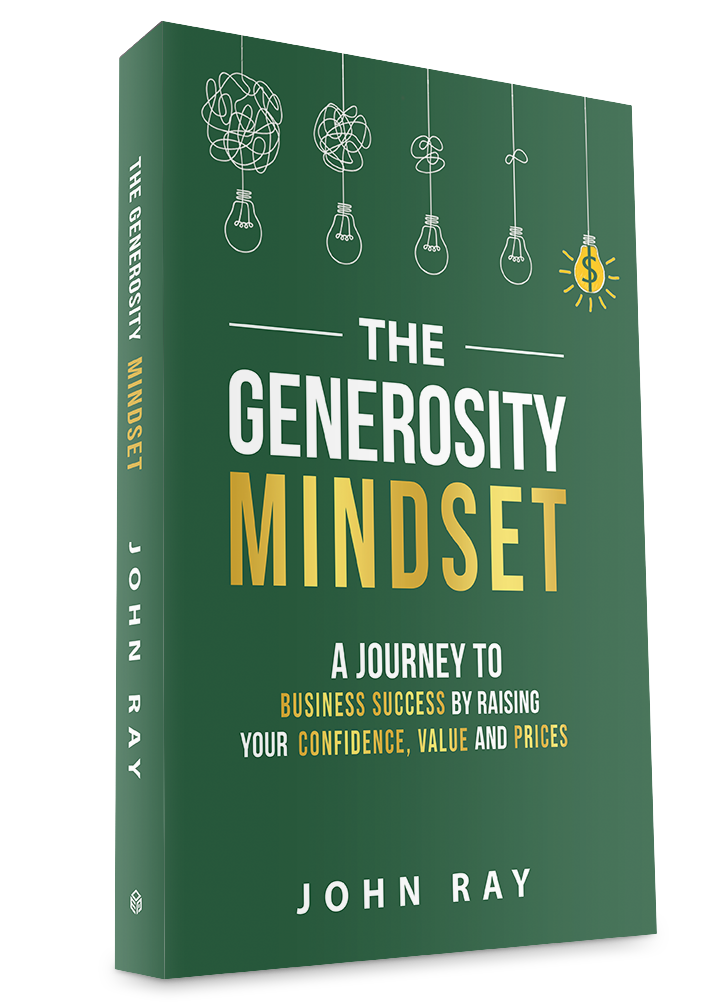
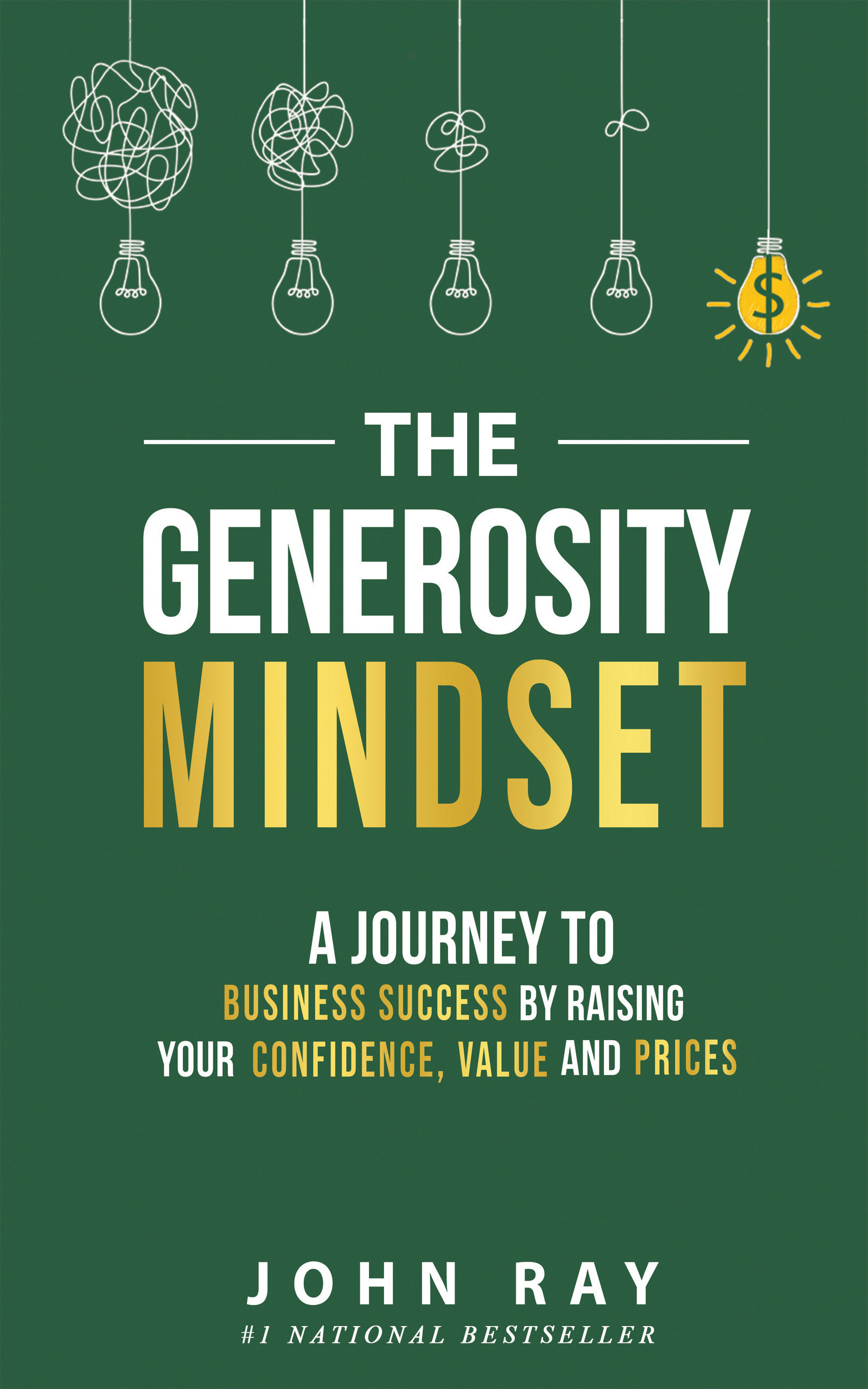
John’s book, The Generosity Mindset: A Journey to Business Success by Raising Your Confidence, Value, and Prices

The Generosity Mindset, by John RayJohn is the #1 national best-selling author of The Generosity Mindset: A Journey to Business Success by Raising Your Confidence, Value, and Prices.

If you are a professional services provider, your goal is to do transformative work for clients you love working with and get paid commensurate with the value you deliver to them. While negative mindsets can inhibit your growth, adopting a different mindset, The Generosity Mindset®, can replace those self-limiting beliefs. The Generosity Mindset enables you to diagnose and communicate the value you deliver to clients and, in turn, more effectively price to receive a portion of that value.

Whether you’re a consultant, coach, marketing or branding professional, business advisor, attorney, CPA, or work in virtually any other professional services discipline, your content and technical expertise are not proprietary. What’s unique, though, is your experience and how you synthesize and deliver your knowledge. What’s special is your demeanor or the way you deal with your best-fit clients. What’s invaluable is how you deliver outstanding value by guiding people through massive changes in their personal lives and in their businesses that bring them to a place they never thought possible.

Your combination of these elements is unique in your industry. There lies your value, but it’s not the value you see. It’s the value your best-fit customers see in you.

If pricing your value feels uncomfortable or unfamiliar to you, this book will teach you why putting a price on the value your clients perceive and identify serves both them and you, and you’ll learn the factors involved in getting your price right.

The book is available at all major physical and online book retailers worldwide. Follow this link for further details.


Connect with John Ray:

Website | LinkedIn | Twitter

Business RadioX®:  LinkedIn | Twitter | Facebook | Instagram

Tagged With: Business Development, client acquisition, commercial imposter syndrome, commercial value, GSJ Consulting, ideal client persona, imposter syndrome, John Ray, law firm business development, price taker vs price setter, pricing consultant, procurement, professional services profitability, professional services strategy, professional value, request for proposals, RFP, Richard W. Smith, saying no strategy, small law firms, tenders, The Price and Value Journey

Brand Messaging with Kerry Fennell, The Writing Barn

May 7, 2025 by John Ray

Brand Messaging with Kerry Fennell, The Writing Barn, on North Fulton Business Radio with host John Ray
North Fulton Business Radio
Brand Messaging with Kerry Fennell, The Writing Barn
Loading
00:00 /
RSS Feed
Share
Link
Embed

Download file

Brand Messaging with Kerry Fennell, The Writing Barn, on North Fulton Business Radio with host John Ray

Brand Messaging with Kerry Fennell, The Writing Barn (North Fulton Business Radio, Episode 869)

In this episode of North Fulton Business Radio, host John Ray talks with Kerry Fennell, founder of The Writing Barn. Kerry helps small business owners, consultants, and solopreneurs clarify their brand messaging and connect more effectively with their audience. She explains why clear messaging is more important than ever in today’s crowded digital world, how imposter syndrome often holds professionals back from showing up authentically, and why good writing starts with understanding rather than selling. Kerry also discusses the concept of human-centered marketing and how writing can build trust, clarity, and connection. Whether you are building a brand, refining your voice, or learning how to use AI responsibly, this conversation offers practical guidance for writing that resonates.

John Ray is the host of North Fulton Business Radio. The show is produced by John Ray and North Fulton Business Radio, LLC, an affiliate of Business RadioX®, and is recorded inside Renasant Bank in Alpharetta.

Kerry Fennell, The Writing Barn

Kerry Fennell, The Writing Barn

Kerry Fennell is a copywriter and brand messaging strategist based in the Atlanta metropolitan area, known for her work with The Writing Barn. She specializes in helping B2B founders, business coaches, consultants, and service providers clarify and communicate their brand messaging to attract ideal clients and build trust.

Kerry is professionally trained in B2B copywriting through the American Writers and Artists Institute (AWAI) and holds a Content Marketing Certification from HubSpot Academy. Her approach is rooted in providing clarity, confidence, and impactful messaging while reducing the overwhelm often associated with marketing. With experience spanning marketing strategy, website copy, sales pages, and email campaigns, she also offers ghostwriting services for executives and founders in thought leadership and branding.

Kerry’s background includes roles in executive support, event planning, and admissions, and she is recognized for her faith-driven, purpose-filled work ethic and high emotional intelligence. Through The Writing Barn, she is dedicated to bringing authenticity and human connection back into marketing communications.

Website | LinkedIn

Topics Discussed in this Episode

00:00 Introduction and Welcome to North Fulton Business Radio
00:29 Guest Introduction: Kerry Fennell from The Writing Barn
02:03 The Importance of Brand Messaging
03:05 Kerry’s Career Journey and Passion for Writing
04:46 Challenges in Marketing and Overcoming Imposter Syndrome
08:10 Defining a Clear Brand Message
10:31 Human-Centered Marketing
14:25 The Role of AI in Marketing
25:18 Success Stories and Client Experiences
27:34 Conclusion and Contact Information

About North Fulton Business Radio and host John Ray

With over 860 shows and having featured over 1,300 guests, North Fulton Business Radio is the longest-running podcast in the North Fulton area, covering business in our community like no one else. We are the undisputed “Voice of Business” in North Fulton!

The show invites a diverse range of business, non-profit, and community leaders to share their significant contributions to their market, community, and profession. There’s no discrimination based on company size, and there’s never any “pay to play.” North Fulton Business Radio supports and celebrates businesses by sharing positive stories that traditional media ignore. Some media lean left. Some media lean right. We lean business.

John Ray, host of  North Fulton Business Radio, and Owner, Ray Business Advisors

John Ray is the host of North Fulton Business Radio. The show is produced by John Ray and North Fulton Business Radio, LLC, an affiliate of Business RadioX®, and recorded inside Renasant Bank in Alpharetta.

The studio address is 275 South Main Street, Alpharetta, GA 30009.

You can find the full archive of shows by following this link. The show is available on all the major podcast apps, including Apple Podcasts, Spotify, Google, Amazon, iHeart Radio, and many others.

John Ray, The Generosity MindsetJohn Ray also operates his own business advisory practice. John’s services include advising solopreneurs and small professional services firms on their value, their positioning and business development, and their pricing. His clients are professionals who are selling their expertise, such as consultants, coaches, attorneys, CPAs, accountants and bookkeepers, marketing professionals, and other professional services practitioners.

John is the national bestselling author of The Generosity Mindset: A Journey to Business Success by Raising Your Confidence, Value, and Prices.

Tagged With: AI, brand messaging, brand voice, copywriter, copywriting, human-centered marketing, imposter syndrome, John Ray, Kerry Fennell, North Fulton Business Radio, overcoming imposter syndrome, The Writing Barn

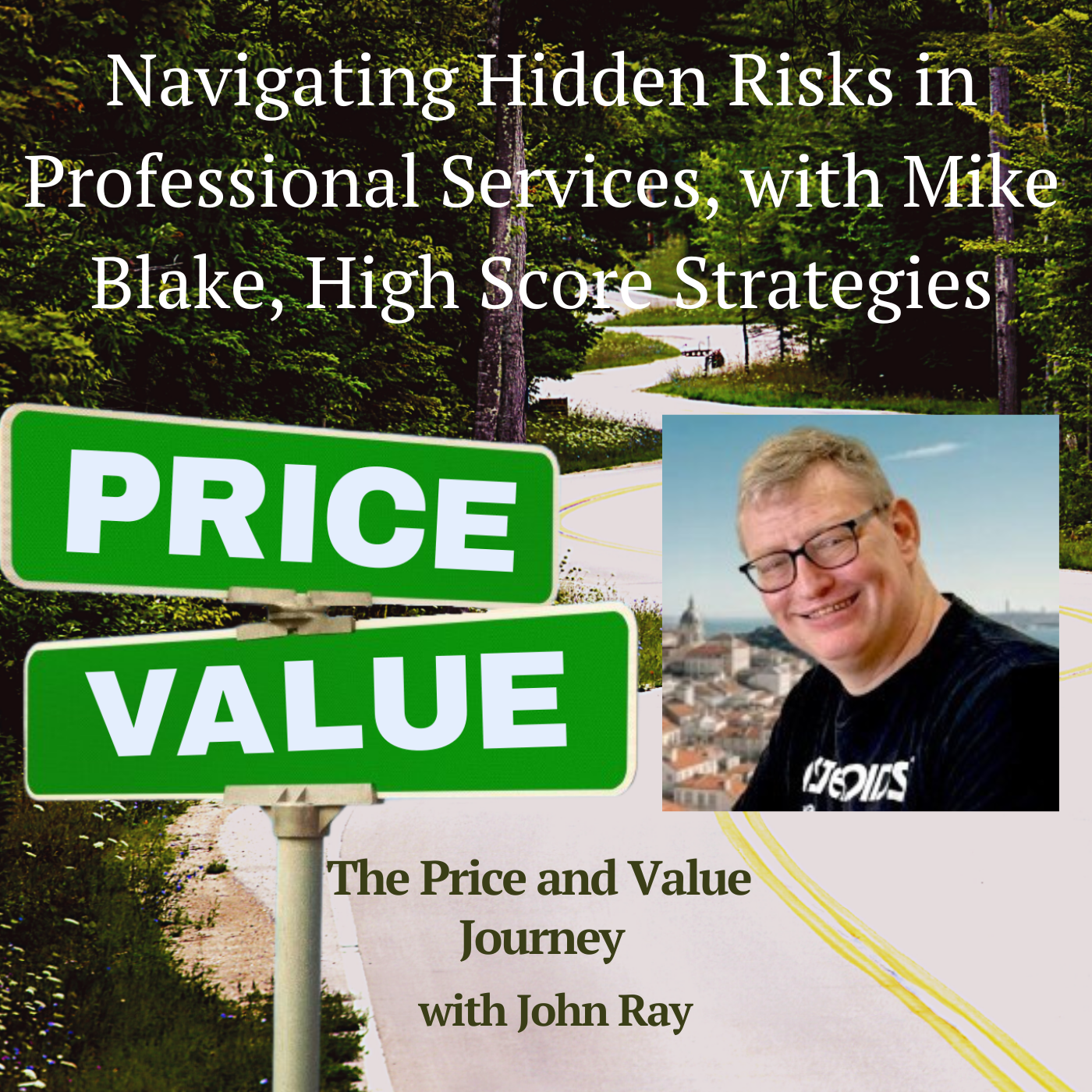
Navigating Hidden Risks in Professional Services, with Mike Blake, High Score Strategies

February 19, 2025 by John Ray

Navigating Hidden Risks in Professional Services, with Mike Blake, High Score Strategies, on The Price and Value Journey podcast with host John Ray
North Fulton Studio
Navigating Hidden Risks in Professional Services, with Mike Blake, High Score Strategies
Loading
00:00 /
RSS Feed
Share
Link
Embed

Download file

Navigating Hidden Risks in Professional Services, with Mike Blake, High Score Strategies, on The Price and Value Journey podcast with host John Ray

Navigating Hidden Risks in Professional Services, with Mike Blake, High Score Strategies (The Price and Value Journey, Episode 122)

In this episode of The Price and Value Journey, host John Ray delves into risk management for solo and small professional service providers, with guest Mike Blake, CEO of High Score Strategies. Mike, a seasoned valuation expert with over 20 years of experience and more than 400 completed valuations, discusses the unseen risks faced by small firms, including client selection, revenue management, and execution pitfalls. The conversation explores the implications of client concentration, the importance of strategic pricing, the impact of mindset on risk assessment, and practical tips for managing client relationships. Mike offers insights on maintaining business autonomy, handling imposter syndrome, and the value of transparent and strategic pricing. This episode is packed with strategies for mitigating business risks and optimizing decision-making in professional services.

The Price and Value Journey is presented by John Ray and produced by the North Fulton affiliate of Business RadioX®.

Mike Blake, High Score Strategies

Mike Blake, High Score Strategies

Mike is the CEO of High Score Strategies (HSS), a consultancy devoted to guiding clients to understand the value of their businesses and intangible assets for acquisition, investing, capital raising, disposition, and succession planning.

Investors and owners rely on Mike’s “information over validation” advisory approach, understanding that the questions he asks unearth hard but crucial answers that support their next transformative step or business stage.

Mike’s background spans 20+ years in valuation and 8 years in venture capital and investment banking. Before founding HSS, he served as Managing Partner with Brady Ware Arpeggio, Director of Valuation Services with Aprio (formerly Habif, Arogeti, & Wynne), and Managing Director with Adams Capital.

He is also a Special Lecturer at Georgia Tech, where he teaches graduate students about the valuation of emerging technologies and intellectual property, with a focus on Monte Carlo simulations and real options theory.

Mike founded and ran Startup Lounge, a nonprofit in Atlanta that helped connect hundreds of investors and startups over a decade. He currently serves on the board of the BVIUK (Business Valuation Institute UK).

He has coached six teams to victory in business plan competitions, leading to over $300,000 in cash prizes and nearly $2 million in services—including an entrepreneur who secured funding through ABC’s Shark Tank.

A highly engaging and deeply knowledgeable speaker, Mike has delivered 100+ presentations on a range of topics, including startup valuation, business appraisal, risk management, intellectual property, and emerging tech valuation.

He holds an MBA from Georgetown University and a BA from Franklin & Marshall.

Mike is multilingual, speaking fluently in English, Ukrainian, Russian, and French, and is conversant in Portuguese, German, and Spanish.

He currently lives with his family in Caldas Da Rainha, Portugal, about an hour outside of Lisbon.

Website | Mike’s LinkedIn | Firm LinkedIn | YouTube | Facebook

Topics Discussed in this Episode

00:00 Introduction to Risk Management
00:18 Meet Mike Blake: Valuation and Risk Expert
01:14 The Hidden Risks in Professional Services
03:41 Revenue Challenges for Small Firms
04:17 Execution and Malpractice Risks
05:16 Concentration Risk and Client Dependency
16:43 Client Due Diligence and Ownership
21:21 Naming Your Business and Succession Planning
25:22 Mindsets in Risk Management
26:53 Embracing Mistakes for Success
27:10 Mindsets: Scarcity, Fear, and Growth
27:34 The Impact of Poverty on Decision-Making
29:24 Professional Services and Poor Decisions
30:33 Managing Fear and Risk in Business
32:30 Imposter Syndrome and Pricing Challenges
38:19 The Language of Pricing
47:32 Radical Approaches to Pricing
51:03 Conclusion and Contact Information

About The Price and Value Journey

The title of this show describes the journey all professional service providers are on: building a services practice by seeking to convince the world of the value we offer, helping clients achieve the outcomes they desire, and trying to do all that at pricing that reflects the value we deliver.

If you feel like you’re working too hard for too little money in your solo or small firm practice, this show is for you. Even if you’re reasonably happy with your practice, you’ll hear ways to improve both your bottom line and the mindset you bring to your business.

The show is hosted and produced by John Ray and the North Fulton affiliate of Business RadioX®. The show can also be found on all the major podcast apps. The complete show archive is here.

John Ray, Host of The Price and Value Journey

John Ray, Author of The Generosity Mindset and Host of "The Price and Value Journey"
John Ray, Author of The Generosity Mindset and Host of The Price and Value Journey

John Ray is the host of The Price and Value Journey.

John owns Ray Business Advisors, a business advisory practice. John’s services include business coaching and advisory work, as well as advising solopreneurs and small professional services firms on their pricing. John is passionate about the power of pricing for business owners, as changing pricing is the fastest way to change the profitability of a business. His clients are professionals who are selling their expertise, such as attorneys, CPAs, accountants and bookkeepers, consultants, coaches, marketing professionals, and other professional services practitioners.

In his other business, John is a podcast show host and producer and owns the North Fulton (Georgia) affiliate of Business RadioX®. John and his team work with B2B professionals to create and conduct their podcast using The Generosity Mindset® Method: building and deepening relationships in a non-salesy way that translates into revenue for their business.

John is also the host of North Fulton Business Radio. With over 850 shows and having featured over 1,300 guests, North Fulton Business Radio is the longest-running podcast in the North Fulton area, covering business in its region like no one else.

John’s book, The Generosity Mindset: A Journey to Business Success by Raising Your Confidence, Value, and Prices

The Generosity Mindset, by John RayJohn is the #1 national best-selling author of The Generosity Mindset: A Journey to Business Success by Raising Your Confidence, Value, and Prices.

If you are a professional services provider, your goal is to do transformative work for clients you love working with and get paid commensurate with the value you deliver to those clients. While negative mindsets can inhibit your growth, adopting a different mindset, The Generosity Mindset™, can replace those self-limiting beliefs. The Generosity Mindset enables you to diagnose and communicate the value you deliver to clients and, in turn, more effectively price to receive a portion of that value.

Whether you’re a consultant, coach, marketing or branding professional, business advisor, attorney, CPA, or work in virtually any other professional services discipline, your content and technical expertise are not proprietary. What’s unique, though, is your experience and how you synthesize and deliver your knowledge. What’s special is your demeanor or the way you deal with your best-fit clients. What’s invaluable is how you deliver great value by guiding people through massive changes in their personal lives and in their businesses that bring them to a place they never thought possible.

The combination of all these elements is quite different for you compared to any other service provider in your industry. Therein lies your value, but it’s not the value you see. It’s the value your best-fit customers see in you.

If pricing your value feels uncomfortable or unfamiliar to you, this book will teach you why putting a price on the value your clients perceive and identify serves both them and you, and you’ll learn the factors involved in getting your price right.

The book is available at all major physical and online book retailers worldwide. Follow this link for further details.

Connect with John Ray:

Website | LinkedIn | Twitter

Business RadioX®:  LinkedIn | Twitter | Facebook | Instagram

Tagged With: client communication, client risk, High Score Strategies, imposter syndrome, Improved Decision Making, John Ray, Mike Blake, pricing, professional services, Risk Management, The Price and Value Journey

Empowering Confidence Through #IAmRemarkable, with Alejandra Torchia, Equifax Inc.

August 9, 2024 by John Ray

Alejandra Torchia, Equifax Inc. and #IAmRemarkable
North Fulton Business Radio
Empowering Confidence Through #IAmRemarkable, with Alejandra Torchia, Equifax Inc.
Loading
00:00 /
RSS Feed
Share
Link
Embed

Download file

Alejandra Torchia, Equifax Inc. and #IAmRemarkable

Empowering Confidence Through #IAmRemarkable, with Alejandra Torchia, Equifax Inc. (North Fulton Business Radio, Episode 794)

In this episode of North Fulton Business Radio, host John Ray interviews Alejandra Torchia, a Senior Vice President in Technology at Equifax and an #IAmRemarkable Gold Facilitator. Alejandra shares her journey from Buenos Aires to the U.S., her career at Equifax, and her involvement in the #IAmRemarkable initiative, which began at Google. She discusses the importance of self-recognition and the challenge of overcoming cultural and personal biases, particularly for women in technology. Alejandra emphasizes the need for both individual and environmental changes to foster self-confidence and belonging in the workplace. She also highlights the benefits of the #IAmRemarkable workshops, which aim to help people recognize and vocalize their achievements.

John Ray is the host of North Fulton Business Radio. The show is recorded and produced from the North Fulton studio of Business RadioX® inside Renasant Bank in Alpharetta.

Alejandra Torchia, Equifax Inc.

Alejandra Torchia is originally from Buenos Aires, Argentina, and currently resides in the United States, having moved with her family seven years ago.

Professionally, she serves as the Senior Vice President of Technology at Equifax, where she manages the Global Infrastructure Solutions teams across 17 countries.

Alejandra is also an Advisory Board member of the ERG Women Advancing Technology Together at Equifax and serves on the Board of the Start House Foundation, a nonprofit organization focused on guiding children to success.

Alejandra is an #IAmRemarkable Gold facilitator.

LinkedIn

#IAmRemarkable

To enable underrepresented groups to celebrate their accomplishments and get past the difficulty of self-promotion, Anna Vainer and Anna Zapesochini launched the global movement #IamRemarkable in 2016. It began as a Google workshop and has developed into a 90-minute program run by Vainer’s nonprofit organization, Rmrkblty. As of December 2023, it had reached over 550,000 participants in 180 countries, with more than 3,000 facilitators. The initiative continues to inspire individuals worldwide to embrace their worth and speak openly about their accomplishments.

Website | LinkedIn | Instagram | Facebook | X (Twitter)

Topics Discussed in this Episode

00:00 Introduction and Welcome to North Fulton Business Radio
01:19 Guest Introduction: Alejandra Torchia
01:58 Alejandra’s Personal Journey
02:47 Professional Background and Role at Equifax
03:18 The #IAmRemarkable Initiative
03:50 Challenges Faced by Women in Technology
06:16 Importance of Self-Recognition
08:46 Benefits of Celebrating Achievements
11:27 How #IAmRemarkable Workshops Work
17:01 Overcoming Imposter Syndrome
22:23 Final Thoughts and Contact Information
23:35 Closing Remarks

Renasant Bank and Casa Nuova Italian Restaurant support North Fulton Business Radio

Renasant BankRenasant Bank has humble roots, starting in 1904 as a $100,000 bank in a Lee County, Mississippi, bakery. Since then, Renasant has become one of the Southeast’s strongest financial institutions, with over $13 billion in assets and more than 190 banking, lending, wealth management, and financial services offices in Mississippi, Alabama, Tennessee, Georgia, and Florida. All of Renasant’s success stems from each of their banker’s commitment to investing in their communities as a way of better understanding the people they serve. At Renasant Bank, they understand you because they work and live alongside you every day.

Casa Nuova Italian RestaurantCasa Nuova is a proud family-owned and operated restaurant, serving classic, authentic and traditional Italian cuisine and top tier hospitality since 1998.

Casa Nuova is a cook-to-order kitchen, serving traditional fare including pasta, chicken, seafood, veal, vegetarian and gluten-free options, plus daily specials. They are a farm-to-table establishment, meaning that in the summertime, they cultivate their own vegetables in their garden, steps away from the restaurant, including tomatoes, corn, peppers, zucchini, sunflowers and more!

Celebrating more than 25 years, Casa Nuova has become a true staple in the Alpharetta area, serving more than three generations of families, including friends old and new, visiting near and far from all over the metro Atlanta area and beyond.

Website | LinkedIn | Facebook | Instagram

About North Fulton Business Radio and host John Ray

With over 790 shows and having featured over 1,200 guests, North Fulton Business Radio is the longest-running podcast in the North Fulton area, covering business in our community like no one else. We are the undisputed “Voice of Business” in North Fulton!

The show welcomes a wide variety of business, non-profit, and community leaders to get the word out about the important work they’re doing to serve their market, their community, and their profession. There’s no discrimination based on company size, and there’s never any “pay to play.” North Fulton Business Radio supports and celebrates business by sharing positive business stories that traditional media ignore. Some media leans left. Some media leans right. We lean business.

John Ray, Business RadioX - North Fulton, and Owner, Ray Business Advisors
John Ray, Business RadioX – North Fulton, and Owner, Ray Business Advisors

John Ray is the host of North Fulton Business Radio. The show is recorded and produced from the North Fulton studio of Business RadioX® inside Renasant Bank in Alpharetta. You can find the full archive of shows by following this link. The show is available on all the major podcast apps, including Apple Podcasts, Spotify, Google, Amazon, iHeart Radio, and many others.

The studio address is 275 South Main Street, Alpharetta, GA 30009.

John Ray, The Generosity MindsetJohn Ray also operates his own business advisory practice. John’s services include advising solopreneurs and small professional services firms on their value, their positioning and business development, and their pricing. His clients are professionals who are selling their expertise, such as consultants, coaches, attorneys, CPAs, accountants and bookkeepers, marketing professionals, and other professional services practitioners.

John is the national bestselling author of The Generosity Mindset: A Journey to Business Success by Raising Your Confidence, Value, and Prices.

Tagged With: #IAmRemarkable, Alejandra Torchia, belonging, enhancing self esteem, Equifax, imposter syndrome, John Ray, North Fulton Business Radio, overcoming imposter syndrome, self confidence, self esteem, self-recognition, Women In Technology

The R3 Continuum Playbook: Imposter Syndrome – How to Understand, Acknowledge, and Overcome It

April 7, 2022 by John Ray

Imposter Syndrome
Minneapolis St. Paul Studio
The R3 Continuum Playbook: Imposter Syndrome - How to Understand, Acknowledge, and Overcome It
Loading
00:00 /
RSS Feed
Share
Link
Embed

Download file

Imposter Syndrome

The R3 Continuum Playbook: Imposter Syndrome – How to Understand, Acknowledge, and Overcome It

Imposter Syndrome is not something new, but it is a current area of interest for those wanting to overcome the self-doubts that most people experience. In this excerpt from an R3 Continuum webinar, Dr. Tyler Arvig, Associate Medical Director, sheds light on exactly what Imposter Syndrome is, how it can impact your life and career if it is not addressed, and some ways to overcome it.

The full webinar, Imposter Syndrome – How to Understand, Acknowledge, and Overcome It, can be found here.

The R3 Continuum Playbook is presented by R3 Continuum and is produced by the Minneapolis-St.Paul Studio of Business RadioX®. R3 Continuum is the underwriter of Workplace MVP, the show which celebrates heroes in the workplace.

TRANSCRIPT

Intro: [00:00:00] Broadcasting from the Business RadioX Studios, here is your R3 Continuum Playbook. Brought to you by Workplace MVP sponsor, R3 Continuum, a global leader in workplace, behavioral health, crisis, and security solutions.

Shane McNally: [00:00:13] Hi there. My name is Shane McNally, Marketing Specialist for R3 Continuum. On this episode of the R3 Continuum Playbook, we’re featuring a segment from a recent webinar that was done with R3 Continuum’s Associate Medical Director, Dr. Tyler Arvig. This webinar was titled Imposter Syndrome: How to Understand, Acknowledge and Overcome It.

Shane McNally: [00:00:33] In this webinar, Dr. Arvig took a deeper dive into something that most of us have likely experienced at some point, but maybe didn’t even realize what it was. Imposter Syndrome. Imposter syndrome is defined as an internal experience of believing that you are not as competent as others perceive you to be. While it’s perfectly normal to feel this way, it can impact your mental well-being, job performance, and your ability to thrive within your career if it’s left unaddressed.

Shane McNally: [00:00:59] In this segment, Dr. Arvig provides expert advice into what you can do if you find yourself struggling with imposter syndrome.

Shane McNally: [00:01:07] What do you do if you are identifying with some of these traits?

Tyler Arvig: [00:01:12] Yeah. Well, first of all, realize that that’s normal. Humans have this wonderful ability to – we have frontal lobes and we can process things more intellectually and dig into things. But sometimes that can also have a downside, which is we overanalyze things. We worry too much about things. So, if you’re noticing these things in yourself, first of all, realize that it’s normal and it’s not pathological. We aren’t talking about pathology or you’re not sick. This isn’t an illness. It’s just your way of seeing yourself and seeing other people.

Tyler Arvig: [00:01:56] So, these are just some tips. They might work for you. They might not. But really just kind of think about these things as we talk about them. The first thing you do is show your feelings. Be transparent. If I’m having doubt in myself and what I’m feeling or my role or whatever, the first thing I can do is just, you know, talk to someone about that. Share that I’m feeling anxious or I’m feeling like I’m not maybe really part of this group or I’m not good enough. There’s something wrong with that. And everyone has those thoughts, but some people are reluctant to share them. But sharing those feelings can go a long way towards undoing what you might have built up in your mind about some of these things.

Tyler Arvig: [00:02:48] The second thing is, you know, assess your abilities. So, with imposter syndrome, what we’re talking about is, I don’t feel like I’m really good at doing what I’m doing. If the CEO – you know the CEO information that’s out there is interesting because you get these people that are heads of giant, multibillion-dollar corporations and, like, I’m not good enough to do this. Like, I’m not really that good. And, like, well, you must be because you got promoted to that level and that doesn’t happen by accident. But if we think of this as doubting our abilities, the second thing we can do is really assess our abilities. Objectively, how did I deal with that? Oh, actually, maybe I did pretty darn well with it. So, maybe some of my doubt in my abilities is misplaced.

Tyler Arvig: [00:03:46] Again, when it comes to confronting what we think of as faulty beliefs or beliefs that maybe don’t have a basis, in fact, the way you do that is by assessing facts, and then going, okay, here’s what I believe. Here’s what I actually did. What do they match up and what don’t they match up?

Tyler Arvig: [00:04:06] The third point here is to start small, which is don’t try and do everything all at once. Start with one thing. If I’m – I have – let’s say, I guess with this presentation, I’m like, oh, this presentation just didn’t go well. I feel like I didn’t know the topic and I was kind of fooling everyone and I didn’t really say anything that was intelligent. I could do a bunch of different things. I could go do a ton more research on the Internet and compare it to the slides I have and then talk to my boss and talk to this person, talk to that person. Or, maybe I just call Shane, be like, hey, Shane, how did that go? Like, did it go okay? Did it – start small. You don’t always need this big giant reaffirmation, but just a little affirmation. Chip away at it over time. And that can sometimes help to get you out of that mindset.

Tyler Arvig: [00:05:10] The fourth thing is question your thoughts. And if you’ve ever been involved in therapy or mental health treatment of any kind, one of the things we often do is when people have thoughts and those thoughts may or may not be based, in fact, the first thing we do is if someone says, “I think that this person doesn’t like me.” Okay. Well, look at that objectively. That thought, question it. Do I have any basis for that thought? What information confirms that thought? What information disconfirms that thought? Like, question it.

Tyler Arvig: [00:05:50] A thought is not a fact. A thought is thought. Right? So, start questioning your thoughts, especially those thoughts that lead to self-doubt or negativity, which, by the way, doesn’t mean you’re not going to do anything that’s wrong or the things might not happen that are negative because you will and they do. But one of the things we often do is one negative thing can happen, 99 positive things can happen. And what we walk away with is the one negative thing. We don’t walk away with all the other stuff that went really well. So, questioning your thoughts is one way of balancing out your mindset when it comes to some of these things.

Tyler Arvig: [00:06:33] Limiting social media is a big one, particularly when it comes to – well, I was going to say particularly when it comes to social, but I would say actually in relation to everything. I joke with my wife that no one posts on social media, yes, I got drunk last night and my marriage is falling apart, and this, and I’m losing my house. No one posts the bad stuff on social media. What you see is, you know, happy people and smiling people and people on vacation and people getting promotions and people doing this and people doing that. And there’s nothing wrong with that. That’s fine.

Tyler Arvig: [00:07:09] But what that can lead to is, you know, when I look at my life, I’m not happy with a lot of things and I look externally at social media and everyone’s happy about things. And then, you start to feel like you’re less than other people, or they have their stuff together and you don’t. Well, that’s not the case. It’s just, again, people post happy things. They don’t post negative things sometimes. But it leads to a comparison that’s not an accurate comparison. You know, if we get a true apples-to-apples comparison, we’re probably all kind of in the same boat. We have some stuff that’s good. We have some stuff that’s bad. And most of the time, we’re somewhere in the middle. But consuming constant social media is one way to really get yourself mentally in the wrong headspace when it comes to these comparisons with others and comparing your own abilities.

Tyler Arvig: [00:08:09] Don’t let it stop you. This might seem kind of obvious, but, you know, Tom Hanks said every – you know, the first week of every movie, he has his doubts and he thinks he is going to get fired. He doesn’t quit the movie in that first week. Right? He keeps working.

Tyler Arvig: [00:08:30] So, as with most things in our lives that are negative or negative thoughts pushing through, most of the time what we’re going to find is that what we think doesn’t come to fruition. And, we only can figure that out if we keep pushing through. If we stop every time we hit a barrier, we’re never going to move beyond that barrier.

Tyler Arvig: [00:08:57] Most things we worry about never happen, which as a quick aside for any trivia buffs, Tom Petty said the best line he ever wrote in a song is, is most things I worry about never happen anyway. It’s just we worry about things. That’s what we do. Most of the time, those things never happen. So, if we let it stop us, then we’ve created a problem for ourselves in our lives. If those CEOs and those sports stars and all those other people stopped in their tracks because they felt, I’m really a phony, I’m not going to make it, they wouldn’t make it. So, don’t do that. And then, I already talked in social media, really, about comparing ourselves to others, but there’s really not much value in it. So, try not to do that as well.

Shane McNally: [00:09:46] What I really find interesting about imposter syndrome is that it’s something that I think most people could probably relate to at some point, both in the work environment and in personal lives as well. Imposter syndrome can have a negative impact on mental well-being of employees if left unaddressed. R3 Continuum can help. Connect with us and learn about our services at r3c.com or email us directly at info@r3c.com.


Show Underwriter

R3 Continuum (R3c) is a global leader in workplace behavioral health and security solutions. R3c helps ensure the psychological and physical safety of organizations and their people in today’s ever-changing and often unpredictable world. Through their continuum of tailored solutions, including evaluations, crisis response, executive optimization, protective services, and more, they help organizations maintain and cultivate a workplace of wellbeing so that their people can thrive. Learn more about R3c at www.r3c.com.

R3 Continuum is the underwriter of Workplace MVP, a show which celebrates the everyday heroes–Workplace Most Valuable Professionals–in human resources, risk management, security, business continuity, and the C-suite who resolutely labor for the well-being of employees in their care, readying the workplace for and planning responses to disruption.

Connect with R3 Continuum:  Website | LinkedIn | Facebook | Twitter

Tagged With: Dr. Tyler Arvig, imposter syndrome, R3 Continuum, R3 Continuum Playbook, Workplace MVP

Battling Imposter Syndrome: An Interview with Stacey Ruth, Unstoppable Leader

April 5, 2022 by John Ray

Stacey Ruth
North Fulton Studio
Battling Imposter Syndrome: An Interview with Stacey Ruth, Unstoppable Leader
Loading
00:00 /
RSS Feed
Share
Link
Embed

Download file

Stacey Ruth

Battling Imposter Syndrome: An Interview with Stacey Ruth, Unstoppable Leader

Anyone who has started their own professional services practice faces imposter syndrome at some point in their journey. What happens, though, when the stress of imposter syndrome is so severe that you find yourself on the bathroom floor, bleeding internally and suffering severe headaches and hair loss? In a frank, raw interview with host John Ray, Stacey Ruth, CEO of Unstoppable Leader, shared her battle with imposter syndrome, and how it affected not only her physical health but her professional services business as well. Stacey discussed the many ways imposter syndrome shows up, how to diagnose and deal with it, how imposter syndrome can become a diversity and inclusion issue, imposter syndrome and pricing, and much more.

To download the imposter syndrome workbook Stacey mentioned in the interview, follow this link.

The Price and Value Journey is presented by John Ray and produced by the North Fulton studio of Business RadioX®.

Stacey Ruth, CPC, CEO, Unstoppable Leader

Stacey Ruth, CPC, CEO, Unstoppable Leader

Stacey Ruth is unstoppable. She founded two multimillion-dollar agencies, has been among the Top 50 Entrepreneurs Under 50 in Atlanta, and twice awarded Top 100 “It” Agencies by Experiential Marketer.

As a novice entrepreneur, she made nearly every business decision mistake possible – and learned how to make the necessary personal transformations in order to thrive. Her businesses survived personal challenges, the fallout of 9/11, deep recessions, and her own health issues resulting from a battle with imposter syndrome.

Today she coaches other CEOs and executives on how to make faster and more accurate decisions, using their inner wisdom. She is a passionate advocate for women leaders claiming their own seat at the table they design for themselves.

Stacey delivers sustainable change, measurable results, and immediate impact for her clients. Her human-centered approach is designed to help ignite the transformational leadership every organization requires.

Her book, Own Your Own Shift is available on Amazon, and her new book, Inside Out Smart will be available April 19, 2022.

Website | Stacey’s books | LinkedIn | Instagram | YouTube | Twitter | Facebook

TRANSCRIPT

John Ray: [00:00:00] And hello again, everyone. I’m John Ray on The Price and Value Journey. Today, we’re going to talk about imposter syndrome. And I think that’s an important topic for anyone who sells what’s between their ears. Because what’s between your ears and imposter syndrome can get mixed up in a big way, particularly if you’re coming out of corporate. You’ve had this shelter of corporate, maybe the branding and the assistance that comes from corporate. And, suddenly, you’re out in your own practice trying to do all your own thing, comparing yourselves to everyone else out there that’s doing what you’re doing, and wondering whether you’re doing it right or whether you belong where you are.

John Ray: [00:00:50] And we’ve got a fantastic guest to talk about this important subject. Stacey Ruth is the CEO of Unstoppable Leader. Stacey founded two multimillion dollar agencies. She’s been among the top 50 Entrepreneurs Under 50 in Atlanta. And twice awarded the Top 100 It Agencies by Experiential Marketer.

Stacey Ruth: [00:01:14] As a novice entrepreneur, Stacey made nearly every business decision mistake possible – wow. And she learned how to make the necessary personal transformations in order to thrive – even bigger wow. Her businesses survived personal challenges, the fallout of 9-11, deep recessions, and her own health issues resulting from a battle with imposter syndrome.

John Ray: [00:01:41] Today, she coaches other CEOs and executives on how to make faster and more accurate decisions using their personal wisdom. She’s a passionate advocate for women leaders claiming their own seat at the table that they designed for themselves. She’s got a new book out, it’s her second book following her first one, and her new book is called Own Your Own Shift, and it’s available on Amazon. And as we record this, it’ll be out in a few weeks on April 19, 2022. Stacey Ruth, it’s a pleasure to have you on.

Stacey Ruth: [00:02:17] Absolutely a pleasure to be here. I think you’ve got a really, really great group of listeners who can really benefit from what we’re talking about today. This is going to be great.

John Ray: [00:02:27] Yeah. Thank you. I really appreciate you being willing to share what you’ve got to share about your own journey. But talk about how you started your practice and just the background of your practice. What led you to go out on your own?

Stacey Ruth: [00:02:44] That’s a great one, because I was actually in a corporate agency. We were the largest global production and event marketing agency in the world at one time. And I’ll say, it was pre-focused on diversity and inclusion. And it was very much a, I’ll say, male lily white type of environment, very much like Mad Men if anyone watches that. And I was very much seduced, if you will, by the excitement and being a part of it. And it was also a sweatshop and I was very exhausted. And couldn’t kind of keep up with the politics. We were buying a new company, literally, every week at the time. And so, I chose to take the leap out on my own. And it was still in an industry that was male dominated.

Stacey Ruth: [00:03:52] And I don’t know if you and your listeners are aware, but imposter syndrome is not just up to the moment term that people are using to describe self-doubt. It’s actually a diversity and inclusion issue. And it belongs to the people who are first only or different in an industry or in a business or an organization.

Stacey Ruth: [00:04:17] And I was a woman CEO of a fast growing agency, and what was at the time a male dominated field. And I immediately started experiencing this since I was young and I was female, that maybe I didn’t have what it took. And then, I started trying to shore myself up. And that’s when things went a little bit sideways.

John Ray: [00:04:47] Now, was this before you left to start your own firm, or was it during this big firm experience that you had, or both?

Stacey Ruth: [00:04:56] Well, both. The big firm experience kind of set me up to feel that I was down in power structure as a young female. And I talk about that in my upcoming book, Inside Out Smart. And we’re talking about biases. And we’re talking about assumptions. And we’re talking about how society shapes a lot of our beliefs about ourselves. And so, it’s shaped a lot of my beliefs about what I was and was not capable of, even though I’m a relatively gregarious and confident person. But in that context, I experienced a sense of maybe I don’t belong here and maybe they’ll find out I don’t know what I’m doing. And that just carried over into starting my own business.

John Ray: [00:05:54] So, how were you able to start your own business when you had imposter syndrome to begin with?

Stacey Ruth: [00:06:02] That’s great, because the idea behind being able to move forward is to be able to tap into our inner concept of our self, our inner wisdom. Some of that is intuition. Some of that is our ability to connect to our own purpose, our own values. And I had enough of that to be able to take the risk, to take the leap. And that’s true of most entrepreneurs. And we have a growing entrepreneurial culture going on right now.

Stacey Ruth: [00:06:41] But 84 percent of entrepreneurs self-identify with imposter syndrome. So, it’s not just women, it’s not just underrepresented demographics, it’s not just black or brown or gay, LGBTQ+, whatever it is. There are things that will lead us to believe that maybe we don’t have what it takes. And someone somewhere is going to find out and we’ll be outed.

John Ray: [00:07:15] So, talk about what happened with you as you built your own firm. What was that journey like? What was going on with the firm? And then, what was going on with this arc of imposter syndrome for you?

Stacey Ruth: [00:07:32] Oh, absolutely. And, you know, I’m going to be really real with you, because I was my own worst nightmare boss when I started the agency. And so, I did what a lot of individuals with imposter syndrome will do.

Stacey Ruth: [00:07:51] And when we talk a little bit about how people can contact me, I do have an imposter syndrome workbook where people can identify whether they have it. There’s some questions on there and then ways to deal with it.

Stacey Ruth: [00:08:05] But I was micromanaging, so I was hovering over the folks that worked with me. I brought in additional executives who were men, who were older than me, in order to shore up what I felt was lacking credibility. I also was over delivering, over performing. So, I was burning the candle at both ends. I was working around the clock, 80 hour workweeks. And it was never enough. It was never enough for me. And my employees could never do enough for me in that dynamic.

Stacey Ruth: [00:08:50] So, a lot of people who are solopreneurs can identify and then they can also experience what might be going on in their organizations if they have employees or vendor partners and suppliers.

Stacey Ruth: [00:09:02] And what wound up happening to me, I didn’t realize what was going on. That was just what I thought I had to do. And what wound up happening to me – and I share this when I speak on imposter syndrome – is there was a day when I found myself on the floor of the women’s bathroom. My hair had been falling out. I was having headaches 24/7. And, now, I was bleeding internally. And that’s the level of pressure and stress that imposter syndrome puts on us.

Stacey Ruth: [00:09:38] And I’ve heard other women leaders talk about similar kinds of health issues. Arianna Huffington talks about it. I know there’s a number of people that discuss it. So, if we internalize it rather than recognizing it and dealing with it, it can actually do some serious damage to our physical well-being.

John Ray: [00:09:59] Did you attribute at that time imposter syndrome to the physical symptoms you are having? Or did that take a time to make that connection?

Stacey Ruth: [00:10:11] No, I did not. It took time to make that connection. And one of the reasons that I’m so willing to share what I went through was I actually was reading what Arianna Huffington was going through. I was reading what other women with imposter syndrome were going through, because I was following other women leaders, like, what are they doing? And so, I was starting to hear these stories and I was like, “Oh. That’s me.” And so, it was this slow dawning by hearing other people share what they were going through and how they were dealing with it.

John Ray: [00:10:48] And so, you really didn’t know imposter syndrome was to blame for any of this until you really identified it in others.

Stacey Ruth: [00:10:59] Correct. And I mean, I’ve certainly studied it, immersed myself in it, so that I really can deal with it. And I think I’m on a mission to share it with others, because given that I am a lifelong entrepreneur, given that I do believe that entrepreneurship is crucial as a foundation for our entire economic structure, and 84 percent of entrepreneurs are dealing with this. I think it’s so important to get it out there and not let people just think, “Oh, well. I just doubt myself.” Oh, no. There’s more going on. And it’s possible to overcome it, and it’s not difficult once you recognize it.

John Ray: [00:11:47] But what you’re implying here – or you’re not implying. You’re saying it flat out – thank you – is that you can go on and function “normally” for years and suddenly hit a wall, because that’s what I think I hear you saying was it captures your experience with imposter syndrome.

Stacey Ruth: [00:12:13] Yes. And, in fact, the more you achieve and the higher you go, I’ll say, the rarer the air where you are, the more likely you are to experience imposter syndrome in a new role in an organization where there aren’t any others like you at the level at which you’ve achieved. So, that’s what really starts to trigger it, first, only different and high achieving.

John Ray: [00:12:49] So, you found yourself on the bathroom floor. You had all these physical symptoms that were so powerful. What happened? How did you take care of yourself physically, number one? And number two, when did that connection come? You know, did it take a while before you read about Miss Huffington and others that had this same issue?

Stacey Ruth: [00:13:15] Well, I think that it tends to be when we start to realize something’s wrong and we start looking around for what it could be, that we start to see things that were right there in front of our face that we never saw before. And that certainly was my experience. Now, I had already been through all of the physical tests and they couldn’t find anything physically wrong with me, with standard blood work and all. I even had an MRI.

Stacey Ruth: [00:13:44] But I did go get therapy help with what was going on because everyone pretty much settled on. It was stress. And as we were getting into that conversation, I started to realize that it was really my concept of what was necessary and what I deserved that was not being met. And I was the only one who could meet it. And, of course, I was seeing what other women were experiencing kind of in concert with that.

John Ray: [00:14:19] Right. Right. Say more about that, the part about what you deserved. I mean, what was your mindset there?

Stacey Ruth: [00:14:27] Well, my mindset was classic for imposter syndrome. And the definition of imposter syndrome is, no matter what you’ve achieved, you tend to dismiss it as luck, knowing the right people. It’s something outside of your control. It has nothing to do with the fact that you actually worked really hard for it. You were really qualified for it. You really did the work. You did the work and you got yourself there. So, I realized I was pushing away my own credibility and handing over my success to outside situations, people that they were supportive but they didn’t cause it, if that makes sense.

John Ray: [00:15:19] So, for you, what did the arc of recovery look like? Was it something that took a while? Was it something that you had on the other extreme, a moment of pure insight where you saw the light from the heavens and you knew you were worthy? I mean, talk about the arc of your recovery.

Stacey Ruth: [00:15:41] Well, the arc of my recovery was starting to apply a lot of the tools. And the tools, for the most part, they are self-awareness and mindset tools. So, was I picking up the tools going, “This will fix my imposter syndrome”? No, not exactly. The first thing I was trying to do was get my self back in balance. As I’m getting myself back in balance, what I’m doing is talking to other people about what I’m actually feeling inside.

Stacey Ruth: [00:16:18] As impostors, we don’t want to let others see how hard we’re paddling just underneath the surface. And being able to have someone that I trusted, who I didn’t feel like sharing with them was going to sabotage anything I was doing in my career was extremely powerful. So, being able to share what you’re going through is critical. It gets it out of your head and allows you to get perspective.

Stacey Ruth: [00:16:45] Another thing that’s very important was being able to let go of some perfectionism and let go of some of that micromanaging control, which was part of the work. The other thing – and this may sound a little woo-woo to your audience, but it is probably one of the most powerful tools for dealing with imposter syndrome – is to be able to shift our internal mantras. And one of the ones that imposters have, especially if they’re starting their own business, is, no one will pay that much for what I do.

John Ray: [00:17:22] Oh, yes.

Stacey Ruth: [00:17:25] And you can shift that into an affirmation. And my agency, initially, was notoriously under charging for our services. No one will pay that much for what we do. And when we flipped that and said, “No. We are charging fair market value for very valuable services.” So, when you do an affirmation, your brain has to believe it’s possible. So, the way out there, affirmations aren’t as effective as simply saying I provide a service that has real value, and owning the value that you provide.

Stacey Ruth: [00:18:17] So, those are some of the things that it’s not a grand sweeping shift. It’s making those micromovements that continue to assert, I deserve it, I’m worth it, and I bring something of value through my experience.

John Ray: [00:18:38] Folks, we’re here chatting with Stacey Ruth. She is the CEO of Unstoppable Leader. I want to circle back around to, I guess, the how I know I’ve got imposter syndrome. For you, it was more obvious than maybe it is for some others who maybe they don’t have the physical symptoms. Maybe they haven’t hit that wall yet. But how do they know that they’ve got something that’s serious that they better take care of?

Stacey Ruth: [00:19:11] Well, I think one of the easiest ways to get our brain around the symptoms are – and this comes out of the book, The Secret Thoughts of Professional Women by one of the kind of forerunner researchers on imposter syndrome in women, which was discovered in the early ’70s – she defines five personality types.

Stacey Ruth: [00:19:37] One of them is the super hero. And that’s the person who’s going to do it all and take on that one more thing. And people are like, “Oh, my gosh. How do you get that all done?” So, if that resonates with you, you might have imposter syndrome. Another one is the expert. That’s the person who always has to have one more degree, one more credential, one more certification. They have all of this knowledge, but they can’t quite get out of the gate. And, you know, a lot of coaches deal with that. But not just coaches, a lot of folks feel that need.

Stacey Ruth: [00:20:20] Another one is – and I don’t think she calls it this. Oh, yes. She does – the natural genius. And the natural genius has always learned things really easily and things come easily to them. So, they’re smart, they’re capable. And then, they bump up against that one thing that it doesn’t come as natural to them and they don’t really know how to learn something new because it’s always been so easy for them. And so, they start to doubt themselves because, “Why is this one hard?” So, that’s another one, if that resonates.

Stacey Ruth: [00:21:04] And then, there are the perfectionists, the person who’s always got to get it 100 percent right all the time or do nothing. So, there’s a fear of failure behind that, and that leads to a lot of procrastination, which can also be a hallmark of the imposter syndrome. [Inaudible].

John Ray: [00:21:23] Well, for those folks, if they ever get it sent out or hit send or hit publish, whatever, then they’re looking at all the errors in it that they should have caught. Right?

Stacey Ruth: [00:21:36] It’s what keeps a lot of people from writing that book. It keeps people from applying for that job. It keeps people from making their deadlines. Or – oh, my gosh. This one – that burst of energy that gets you across the finish line and the person says, “Oh, well. I’m really motivated when I have a deadline, so I’ll get it done.” And yet that’s actually not how our brains work. So, what actually happens is, yeah, you get it done, but it’s probably got a lot of mistakes in it. So, the procrastination and perfectionism which can go hand in hand can actually feed each other.

Stacey Ruth: [00:22:23] So, if any of those resonated, someone might be dealing with a case of imposter syndrome. Mine was classic and mine was intense. Not everyone’s is that classic or that intense. And yet, if it goes without being dealt with, it can build, which was also what happened for me.

John Ray: [00:22:46] Now, speaking of intense, I saw Sheryl Sandberg, formerly with Facebook and Google. She said that both men and women are susceptible to imposter syndrome, but that women tend to experience it more intensely and be more limited by it. What’s your perspective on that?

Stacey Ruth: [00:23:09] This is true. It was first identified in women and in the ’70s where women were coming into the workforce. And I said it earlier in the conversation, imposter syndrome is really a diversity and inclusion issue. Because we, as a society, tend to feel like if I’m the only woman or only fill in the blank, any underrepresented demographic – I’ll just use women because it was first discovered with women – then I feel like there’s no one I can relate to. And, therefore, I don’t belong.

Stacey Ruth: [00:23:53] So, there’s a sense of not belonging where we are, because when we look around in the landscape, we can’t identify with anyone else. So, that’s one reason that women and other underrepresented demographics will feel that way.

Stacey Ruth: [00:24:09] Another reason, especially for women, we feel like we might be betraying other responsibilities. So, we might be betraying because that’s still the way the society is structured, “I have the responsibility for the home. I have the responsibility for the kids.” And then, “I’m not being true to that responsibility.” And, also, “What about my peers? I’ve now left them behind.” So, all of those internal struggles can really feed it, especially for women.

John Ray: [00:24:44] Okay. I don’t want to get men off the hook here.

Stacey Ruth: [00:24:48] No. They’re not off the hook. No, no. Especially male entrepreneurs.

John Ray: [00:24:55] Yeah. Let’s pull them in here. So, what is the issue with men? Do they not have imposter syndrome as much? Do they not talk about it as much but they really do have it underneath the surface? What’s going on with men?

Stacey Ruth: [00:25:14] Well, again, I think that especially when men achieve a certain level within an organization, that high achieving man, the man who goes out on his own and starts a business, we have then put ourselves in a first only different situation. So, all the same feelings can apply, “I’ve left my peers behind. My peer group is back there, they’re behind me. Why am I so special? So, I don’t belong here.”

Stacey Ruth: [00:25:54] Maybe the guy was a the natural genius. And now suddenly, “I’m doing something I have no context for, no experience for, and I don’t know what to do. And I feel like somebody’s going to find out that I don’t know what I’m doing.” All the same rules apply.

John Ray: [00:26:14] I got it. So, let’s talk a little bit about, I guess, how you deal with it. And do you need a third party? You mentioned getting therapy, do you need a third party, a live person to be able to help? Maybe a trusted adviser or a coach, someone like that? And if so, how do you find that person? Because you’re at a moment of, obviously, doubt, how do you find a trusted person that you can walk that journey with?

Stacey Ruth: [00:26:54] Well, as a coach, I happen to believe that no one “needs a coach”. Now, all the coaches are going to cringe when I say this. I don’t believe anyone needs a coach. I believe that coaches accelerate what we’re ready to lean into. They give perspective, accountability, and all of those kinds of things that it just takes longer and it can be harder to do on our own.

Stacey Ruth: [00:27:26] So, can someone get over imposter syndrome on their own? Yes. Of course, they can. They can pick up the books. They can do the blogs. They can get all the information. Putting it into application is so much faster and easier when you do it with somebody who understands. So, that is possible with a mastermind support group. It’s possible with a coach, like myself. It’s possible with a mentor. It’s possible with a therapist. I mean, there’s a number of outlets that you can work through.

Stacey Ruth: [00:28:02] I think for CEOs, especially women CEOs, who especially deal with this, working with a coach who’s been there, done that, got the t-shirt, is a great way to accelerate getting through that because it does slow you down, limit your growth, and limit what kind of income you can generate.

John Ray: [00:28:27] Yeah. I want to get to that now because this is The Price and Value Journey and I’m all about pricing. And you brought that up earlier, so I want to get to income and pricing here in just a second.

John Ray: [00:28:42] But you mentioned the term get over it, getting over it, and I don’t know what the term is, do you ever really get over it? Or maybe it’s a bad analogy that once an alcoholic, you’re always an alcoholic. It’s just a matter of controlling it and dealing with it mentally, the mental aspect of it, and doing what you’ve got to do, whether you’re in AA or whatever, to walk that journey as an alcoholic. Are you always suffering from imposter syndrome or it’s just a matter of controlling it?

Stacey Ruth: [00:29:20] Well, that’s an interesting choice of analogy.

John Ray: [00:29:25] Maybe it’s a bad analogy, Stacey, but –

Stacey Ruth: [00:29:28] No. Actually, I don’t know that it is. Actually, I’m going to pause for a moment. I’m going to say something I really want your listeners to lean in and hear this.

Stacey Ruth: [00:29:45] If you’re dealing with imposter syndrome, it’s not your fault. Because a lot of people will take that on and say, “There’s something wrong with me. What’s going on?” It’s not your fault. You’re a product of the society and the society’s beliefs and values. You can change yours. So, choosing to change is the important thing.

Stacey Ruth: [00:30:12] And the reason I said that that’s not such a bad analogy with someone who’s dealing with addiction, whether it’s alcoholism, drug addiction, or any other kind of addiction, is, the 12 step programs say, the solution is actually to understand, have a self-awareness, a consciousness of who you are in the context of the greater whole. And change how you’re seeing yourself so that you don’t feel empty inside. That you don’t feel like you’re lacking something inside.

Stacey Ruth: [00:30:47] And they say it’s of a spiritual nature. Well, I believe spirituality is based on values, and purpose, and meaning. And a lot of people who are dealing with imposter syndrome have kind of disconnected from their internal guidance system, which is values-based, purpose-based, meaning-based. And we’re really measuring ourselves by these externals.

Stacey Ruth: [00:31:08] We’re constantly comparing ourselves to everyone else and looking for affirmation that we’re okay. They’re not going to kick us out of the club today because they didn’t find out that we don’t really belong here. So, instead, we can turn in to our own inner guidance system that says, “No. I’m perfect, whole, complete exactly the way I am and I can do this. And if I need help, that’s not an admission of weakness. That’s an admission of willingness to grow and learn.”

John Ray: [00:31:46] I mean, we talked extensively about your bathroom floor experience. I want to give you a chance to talk about the other side of that. And just as you’ve been able to recognize and then put that experience in the box it belongs in your life. What has been the result for you and your business and your life?

Stacey Ruth: [00:32:15] Oh, my gosh. Well, I will tell you, I stopped racing. I love that question. I stopped racing against myself. It felt like I was competing with people, competitors, the industry, other CEOs. I was trying to be better, stronger, faster, all of that. I was doing it at the expense of my poor body that was just trying to serve me.

Stacey Ruth: [00:32:51] And, by the way, I do want you to know that I am 100 percent healed physically from that. So, I feel more energetic. I feel more engaged. But mostly I feel more fulfilled. The money is great. I mean, here we are, price value, you know. The money is great. It doesn’t fill the gap of self-doubt that is created by imposter syndrome. It never is enough because it’s always external.

Stacey Ruth: [00:33:29] So, what happened is I got a lot more satisfaction and I’m like, “Well, hey, this is doing something that is really of service I really love, and I get paid good money for doing it. What more do you want?”

John Ray: [00:33:45] Great words and great story here from Stacey Ruth. She’s the CEO of Unstoppable Leader. So, Stacey, let’s talk about pricing. Let’s get there. So, for you, how did imposter syndrome affect your pricing? How did you get to a point where, again, you put that in the box and kept it from affecting how you communicate and talk about your value?

Stacey Ruth: [00:34:26] Yeah. Well, it’s interesting – let me collect my thoughts on this one. Imposter syndrome can continue to pop up even after you’ve done the work. You recognize it when it does. And one of the places that it popped up for me recently, in like the last three years, when I really leaned in to doing the executive coaching, which I had people asking me to coach them, so I said, “Well, there’s a need for this. I’d be happy to step in and do this and I love it. I absolutely love it.”

Stacey Ruth: [00:35:11] And that little impostor syndrome sitting on my shoulder whispered in my ear – this is classic imposter syndrome – “Who do you think you are to coach CEOs and executives who are more successful financially, hierarchy, all of that, than you are?” And so, I’m walking through this because the answer to that is, “I don’t need to be more powerful, more successful in order to be able to serve. What I’m able to do is help them bring out their own inner wisdom.”

Stacey Ruth: [00:35:58] That’s what coaches do. We ask powerful questions and we help people discover their own truth, and their own value, and their own worth. So, I don’t have to lord it over them. I’m not even supposed to. That’s not my job. And so, I know what my value is and so I could set that imposter syndrome off my shoulder and say, “No. No. Not today. We’re not going to do that because that’s not even the truth of the experience,” if that makes sense.

Stacey Ruth: [00:36:30] I’m not sure if I answered your question, but I felt like that was an important shift for people to be able to hear that. I can charge what an executive coach charges because I’m being an executive coach. I’m not being the executive.

John Ray: [00:36:43] Right. Right. And I think what I hear you saying is that you really switched in your head from thinking about making this comparison of externals, external position, power, authority, whatever, to the outcome that you’ll help foster in the person that you’re going to be working with. And that’s where the value is, right?

Stacey Ruth: [00:37:14] Correct. That’s where the value is. And I’ve been in other industries. I’ve been in marketing. And a lot of folks are starting all different kinds of marketing and sales type organizations right now just as rife with imposter syndrome and pricing is all over the highway. And a lot of startup businesses are nickeling and diming on things that really have more value.

Stacey Ruth: [00:37:49] And you can get something on Fiverr for $5. Why would I pay someone $1,200, $2,000 for the same thing I could get for $5 on Fiverr? And so, that leads to a lot of imposter syndrome. Why should I charge $2,000 for this? Well, because you are providing the service. You’re making sure it’s tailored and customized. Whatever is going on there that makes it a higher value, own it.

John Ray: [00:38:24] Well, people are making the wrong comparison, right? I mean, they’re looking at the competitors instead of looking at the outcome they bring about. And they may have done this – like you’re saying you may have done this – many times before, but that doubt and that, “Oh, they won’t pay that,” that voice that comes in your head, it still comes back. And so, do you treat it like a friend and just wave at it and say, “Okay. I see you,” and they keep going. Is that what you do? That’s what it sounds like.

Stacey Ruth: [00:38:58] A little bit. A little bit. And the steps I go through are awareness, “Oh, I recognize that voice. I know what that voice is about. Okay. We’re having an impostor moment. Let’s just have a moment.” And then, when that happens, “Okay. Is that true?” Questioning those thoughts is critical to shifting them, “Is that true?” If it’s not true or if I don’t know that it’s true, what’s an alternative? And then, pursuing the alternative and testing it. Being willing to test that alternative. And that’s really how the shift occurs. Individual variations, of course. But that’s the critical component is awareness and then questioning our thoughts about that.

John Ray: [00:39:57] You know, I’m so glad we could do this show because I work with folks a lot on their pricing, and what I recognized, the base problem for so many of them really is imposter syndrome. And that’s really the underlying problem. I’m not the psychologist. I’m not the coach like you are.

Stacey Ruth: [00:40:18] I’m not a psychologist, I just want to be clear. Neuroscience, yes. Psychologist, no.

John Ray: [00:40:24] Okay. Noted. But I guess what I would ask you, to submit to you, is, I think it’s dangerous for people to think about this in terms of, “Oh, I need to get what I’m worth, because that takes you down the internal conundrum that you’re going through and switch it toward outcomes I bring about.” And if you do that, it should help get you out of the whole business about thinking that it’s about you. It’s not about you. It’s about the outcomes you help foster with the work that you do.

John Ray: [00:41:15] And I realized for some people that may be a subtle difference. But that’s really the step folks need to take. That’s what I would think. Now, give me your reaction to that.

Stacey Ruth: [00:41:27] Well, it actually makes me think about something that a lot of new coaches are told, is, you’re not selling coaching. Coaching is what you do. It’s not who you are. And so, to be able to share the results that you create changes the entire conversation. So, helping someone get out of overwhelm, helping someone be able to get clarity around what next steps are, that’s what coaching does.

Stacey Ruth: [00:41:57] So, when somebody says, what do you do? I don’t say coaching. I say I help executives and CEOs who are dealing with exhaustion, overwhelm, a new position, a lot of change, and really help them get clarity and focus so they can grow their influence and impact. That’s what has value. That’s what creates the price value equation.

John Ray: [00:42:22] There you go. Yeah. I love it. I love it.

Stacey Ruth: [00:42:26] Yeah. Results are the deal. Results are the deal. And allowing yourself to own the results and not feel like you’re being full of yourself.

John Ray: [00:42:42] Yeah. I like it.

Stacey Ruth: [00:42:43] And to get the testimonials, to ask for the referrals, all of those things imposters will hold back on as well.

John Ray: [00:42:52] Great point. We could talk more about that, that’s for sure. But that’s a great way to end. Stacey Ruth, CEO of Unstoppable Leader. Wow. Stacey, I can’t tell you how much I appreciate you coming on and sharing your story in such a raw and real way. I really appreciate you.

John Ray: [00:43:16] And I just want to go back because I bungled your book when I mentioned your books.

Stacey Ruth: [00:43:21] All the books. All the books.

John Ray: [00:43:21] Yeah. That’s what happens when you release multiple books, right? So, Stacey’s first book was Own Your Own Shift.

Stacey Ruth: [00:43:32] Be careful how you say that. Yes.

John Ray: [00:43:35] That’s right. And I almost bungled that, too. But her new book is called Inside Out Smart. So, be on the lookout for Inside Out Smart.

Stacey Ruth: [00:43:45] Yeah. April 19th it launches.

John Ray: [00:43:46] Coming here in April 19, 2022. And Own Your Own Shift – I got that right – is out. It’s been out. You can get it right now. So, I wanted to clarify that for everyone. But, Stacey, again, thank you so much for coming on. Before we let you go, I would love it if you could, if you don’t mind, sharing your contact information so folks that are interested in hearing more about you and your work can be in touch?

Stacey Ruth: [00:44:15] Absolutely. I think one of the best places to reach me is through my website, unstoppable-leader.com. And you can find me all over social media, Facebook, Instagram, Twitter, Stacey Ruth Says, and that’s S-T-A-C-E-Y. So, I look forward to connecting with your listeners. You’re doing great work here.

John Ray: [00:44:42] Thank you, Stacey. I really appreciate you. And thanks again for coming on.

Stacey Ruth: [00:44:46] Thank you very much.

John Ray: [00:44:48] Folks, just a quick reminder, if you’re a newcomer to this series, you can find the full show archive at pricevaluejourney.com or on your favorite app. Just use that search term price value journey, you’ll find the show. And if you’d like to connect with me directly, just send me an email. john@johnray.co. Thank you for joining us.


About The Price and Value Journey

The title of this show describes the journey all professional services providers are on:  building a services practice by seeking to convince the world of the value we offer, helping clients achieve the outcomes they desire, and trying to do all that at pricing which reflects the value we deliver.

If you feel like you’re working too hard for too little money in your solo or small firm practice, this show is for you. Even if you’re reasonably happy with your practice, you’ll hear ways to improve both your bottom line as well as the mindset you bring to your business.

The show is produced by the North Fulton studio of Business RadioX® and can be found on all the major podcast apps. The complete show archive is here.

John Ray, Host of The Price and Value Journey

John Ray The Price and Value Journey
John Ray, Host of “The Price and Value Journey”

John Ray is the host of The Price and Value Journey.

John owns Ray Business Advisors, a business advisory practice. John’s services include advising solopreneur and small professional services firms on their pricing. John is passionate about the power of pricing for business owners, as changing pricing is the fastest way to change the profitability of a business. His clients are professionals who are selling their “grey matter,” such as attorneys, CPAs, accountants and bookkeepers, consultants, marketing professionals, and other professional services practitioners.

In his other business, John a Studio Owner, Producer, and Show Host with Business RadioX®, and works with business owners who want to do their own podcast. As a veteran B2B services provider, John’s special sauce is coaching B2B professionals to use a podcast to build relationships in a non-salesy way which translate into revenue.

John is the host of North Fulton Business Radio, Minneapolis-St. Paul Business Radio, Nashville Business Radio, Alpharetta Tech Talk, and Business Leaders Radio. house shows that feature a wide range of business leaders and companies. John has hosted and/or produced over 1,100 podcast episodes.

Connect with John Ray:

Website | LinkedIn | Twitter

Business RadioX®:  LinkedIn | Twitter | Facebook | Instagram

Tagged With: imposter syndrome, Inside Out Smart, John Ray, Own Your Own Shift, Price Value Journey, pricing, professional services, professional services practice, professional services provider, solopreneurs, Stacey Ruth, Unstoppable Leader, value

Julie Keyes, Poised for Exit Podcast

February 17, 2022 by John Ray

Julie Keyes, Poised for Exit Podcast
North Fulton Studio
Julie Keyes, Poised for Exit Podcast
Loading
00:00 /
RSS Feed
Share
Link
Embed

Download file

Julie Keyes, Poised for Exit PodcastJulie Keyes, Poised for Exit Podcast

My friend Julie Keyes is an exit planning expert based in the Twin Cities area. In an episode titled “Your Price is Too Low,” Julie interviewed me on her Poised for Exit podcast about pricing for professional services providers. We chatted about why I use the word “journey,” imposter syndrome, conducting value conversations with clients, why it’s vital to offer options, and much more. The Price and Value Journey is presented by John Ray and produced by the North Fulton studio of Business RadioX®.

TRANSCRIPT

John Ray: [00:00:00] Hello, I’m John Ray on the Price and Value Journey. I was honored to be invited to join my friend, Julie Keyes, on her Poised for Exit Podcast to chat about pricing for professional services providers. We chatted about why I use the word journey in the Price and Value Journey. We talked about imposter syndrome, conducting value conversations with clients, why it’s vital to offer options and more. I’m grateful to Julie for inviting me on her show. Now, here’s our conversation.

Julie Keyes: [00:00:32] Ladies and gentlemen, we are here today with John Ray, who is a consultant, speaker and radio host of RadioX. John, welcome to Poised for Exit.

John Ray: [00:00:43] Hey, Julie. It’s great to be here and I’m just so honored to be on your show. I’ve listened to it a lot, and you’ve got great guests, and I’m delighted and humbled to be part of that pantheon you’ve had. So, congratulations on that.

Julie Keyes: [00:00:55] Well. Thank you. Well, I have to say likewise, you’ve had a lot of really great content on your show too, and I hope to get into some of that today because our listeners are really going to be interested in what you have to say because so many of us, of the people who are in our listening audience would want to know and hear a lot of the advice that you’re going to dispense for us today. So, thank you for being on the show. And it took us a while to get you here. You’re a busy guy, and I’m a busy gal, and oh my gosh. But thank you for your patience.

John Ray: [00:01:26] Absolutely.

Julie Keyes: [00:01:26] And yeah. So, I’m really looking forward to this interview. Thanks for joining us today. Let’s just jump right in. I’d like to talk with you about the work that you do in pricing and helping professionals price their services because I know that there are a lot of advisors out there who are not pricing properly regardless of their discipline. And I’m sure you see it all the time because it’s the work that you do. So, how did you get into that and why?

John Ray: [00:01:53] Well, because I wasn’t doing it right, right?

Julie Keyes: [00:01:57] I’m sure, yeah.

John Ray: [00:01:58] I mean, I’ve got a whole drawer full of t-shirts about mistakes in pricing. And you know, I did not learn pricing, and pricing strategies, and value and how to discern value. I didn’t learn any of that in business education and my career. You know, the last statistic I saw, it was like, I believe it was five percent of business schools in this country actually have a course, a course, any course on pricing.

Julie Keyes: [00:02:34] Wow.

John Ray: [00:02:34] So, if you’re educated, come out with your MBA, you don’t have great education on pricing or maybe any. So, you learn the wrong thing. You learn to do market surveys, or you just do it by the seat of your pants or what have you, and you went, “That’s wrong.” And so, I made a lot of those mistakes and I had to fix that. And so, I had to do a lot of this work on my own. And I saw this in my clients. And I was so passionate about it after a time. It’s like, “I see this over and over and over again. I want to help in this regard.”

Julie Keyes: [00:03:19] And that is — boy, you hit the nail on the head there. When I think about pricing and conversations that I’ve had – and it’s not my specialty right – but I have made some recommendations to clients that they need to adjust their pricing. And so many times you ask, “When was the last time you had a pricing adjustment?” and they’ll say, “Oh, three years ago. Four years ago.” Yeah.

John Ray: [00:03:42] Yeah.

Julie Keyes: [00:03:42] And I think, you know, with the way things are now, I think we really need to be cognizant of that. But it’s amazing to me that the schools aren’t actually teaching it. So, what are they teaching? Are they teaching people to just follow the competition around and price according to what they’re doing?

John Ray: [00:03:56] Well, to be fair, I mean, this is a relatively newer discipline, not how to price, but the philosophy behind it because so much of pricing is really tied up in behavioral economics. And that’s a relatively new field, just a few decades old. And so, you really have to get into behavioral economics to properly price, right. And so, I think that’s the issue of it all. But what’s at stake here is that pricing is the fastest way to change your bottomline. Now, this is an accounting fact. They teach you that in accounting. You know, it’s faster than improving your marketing or getting more clients or anything. This is an accounting fact. It’s not up for argument. So, if you can just work on your pricing, you will dramatically change the trajectory of your business.

Julie Keyes: [00:04:59] And probably have more fun and work fewer hours too, right?

John Ray: [00:05:03] Getting the whole idea

Julie Keyes: [00:05:05] And we’re going to get to a good story in a little bit about that. I know we are. So, I know that the name of your show is The Price and Value Journey, and I love that. But speak to me about journey. Why did you call it The Price and Value Journey?

John Ray: [00:05:20] Well, I guess there’s three elements to that. Price is obviously one. Value, let’s get to that real quick. So, this is about value that is perceived by our clients, right? This is not about value that we perceive. It’s not about what we think we’re worth, even though we’re worth a lot, right? You’re worth a lot, I’m worth a lot. Our listeners, the work they do is fantastic worth. It’s what our clients perceive, and how we get to that, and how we can price relative to the value that they perceive.

And then, journey is that we’re on a journey of trying to get this right. I mean, give yourself grace because the most common thing that happens when I work with a client on their practice and their pricing is, “Wow, I can’t believe I did that,” and as we talk and they learn, they just beat themselves up. “I don’t know how I’m going to do all this.” Well, here’s the point – it’s a journey, okay. You’re not going to fix all this today, or tomorrow, or next week or even next year. It takes some time to work these things through. And so, give yourself grace.

And pricing is an art; it’s not a science. So, that’s the other piece of it. You can’t look up in the book and find out all the answers. You have to do some trial and error and testing to get from here to there. And so, that’s a journey.

Julie Keyes: [00:06:54] And I love that you said you’ve got to give yourself permission because I think that we, as advisors, at least, when I first started exit planning six or seven years ago, I just thought that I had to get it right right out of the gate. And like you said, it takes a while. You have to figure out. I don’t know. It is definitely a journey. I guess that’s why I wanted to ask you about it because I don’t think that a lot of people who are pricing professional services view it that way. I think that they feel pressured to make sure that they get it right. And unfortunately, I think a lot of them are still charging by the hour. And I know you don’t believe in that, either. Neither do I. That could be another whole show, John, right?

John Ray: [00:07:34] How long is this show, Julie?

Julie Keyes: [00:07:38] Yeah, yeah.

John Ray: [00:07:39] Well, yeah. Well, I mean, you know, a couple of things there. I mean, yeah, pricing by the hour, I call it a red flag of poor pricing. You know, if you’re pricing by the hour, your price is too low. That’s just by definition. And again, there’s a whole explanation behind that, and we can address that some other time. But you know, the other thing is, is that to get from here to there – and by here, I mean struggling and stuck in your practice, and a lot of people are struggling and stuck, or they’re working too hard for too little money, and that’s kind of struggling and stuck to. And if any of those things describe you, pricing is probably a problem. But to get from here to there, it takes a shift in mindset. It takes a lot of deep perspective change about where value is, and how value is perceived, and how you look at your practice and how the clients look at your practice. And that takes some time. It takes some adjustment.

Julie Keyes: [00:08:47] It does. And self-awareness, I would think, would be a part of that conversation too, right? Figuring out like, why do I feel like I’m not worth a certain amount of money or why do I? And is that in line with what the client would really want or expect, right?

John Ray: [00:09:05] Oh boy. I think I heard the imposter syndrome get flopped up on the desk, yeah?

John Ray: [00:09:11] Yeah. That’s what we’re talking about, right?

Julie Keyes: [00:09:13] Yeah. Yeah, yeah, absolutely. Yeah. And I bet you deal with that all the time,

John Ray: [00:09:18] All the time. And you know, that’s a case where you’re spending with your own wallet. Nobody would pay that, right? Well, what you’re really saying is you don’t think you would because you don’t trust yourself. And I know that you, whoever you is, I know you do great work, but it’s not about you, it’s about what the client perceives.

Julie Keyes: [00:09:45] Yes.

John Ray: [00:09:45] So, let’s let the client decide how to spend the money instead of you.

Julie Keyes: [00:09:49] How do you figure that out?

John Ray: [00:09:50] Yeah.

Julie Keyes: [00:09:51] Sorry.

John Ray: [00:09:51] No, no. Instead of you selling to your own wallet is one way to put it.

Julie Keyes: [00:09:57] Yeah, that’s a cool concept. I mean, it’s a good way to look at it, [but how do you figure out what the client is actually perceiving? How do you determine that?

John Ray: [00:10:07] So, that’s a value conversation. And that’s not a term I came up with. It’s not a concept I came up with. You know, there’s some great work out there by people like Ron Baker who talk about having a value conversation with clients. And what that is is diving into their hopes, dreams, aspirations, all the intangibles that are behind the reason they picked up the phone to call you to begin with. See, when somebody calls Julie, lets say — can I use you as an example?

Julie Keyes: [00:10:42] Sure.

John Ray: [00:10:43] When when they call Julie to look for help with their exit planning, what are they looking for? There’s more to it than just the request, the tactic that they’re wanting help with, right? They’ve got a strategy. They want to exit their business in five years. Their spouse is all after them saying, “You’re spending way too much time in this business. You need to get out. It’s destroying your health,” or some other reason or set of reasons. Those are values. Those are client values. And so, what that means is it’s more what’s at stake when you counsel a client is more than just, “Oh, let’s do an exit plan,” right?

Julie Keyes: [00:11:32] Oh, yeah, yeah.

John Ray: [00:11:33] It’s about getting that person to a place where they’ve got a happier home life, their spouse, they can reconnect with their spouse, their health is better. Those are priceless values. And so, you price relative to just the plan, not just the things, the tactics that you help them with and the strategies you help them with, but the big picture intangibles that mean so much to them that are behind the request.

Julie Keyes: [00:12:03] Well, and don’t you also help your clients determine if and when pricing packages or levels make sense, so they’re not just quoting one price, but they’ve got different offerings at different levels. Let’s talk about that for a second.

John Ray: [00:12:19] Yeah, thank you. So, yeah. So, options are powerful. And there’s a reason why, you know, the car companies, for example, have a small compact car, they have a medium kind of offering, and then they have luxury offering. I mean, there’s a reason why there’s small, medium and large. The dominant one-

Julie Keyes: [00:12:46] Just like at the Dairy Queen, yeah.

John Ray: [00:12:48] Yeah, there are choices. Exactly, there are choices. And what that’s a nod to is the fact that we have different values for different products and services. So, let’s take coffee, for example. I mean, I’m a cheapskate when it comes to coffee, so I would prefer just to come to your office and drink your coffee. But if I have to, I’ll go get the dollar coffee at the gas station right? Then, there are some people that they want the Starbucks. They’re going to sit in line for the Starbucks. And then, the most expensive cup of coffee in the United States is $75. It’s served once a year in one sitting in one party, and it’s sold out. And these are people that highly value coffee. They think coffee is like wine.

Julie Keyes: [00:13:36] Wow.

Julie Keyes: [00:13:37] More power to them. I mean-

John Ray: [00:13:38] Sure, yeah,

Julie Keyes: [00:13:39] I’m not criticizing. It just shows different values. So-

John Ray: [00:13:42] Of course.

John Ray: [00:13:44] If you can offer different options for your services, then you’re more likely to hit people more how they might value you. And I promise you, your prices will go up by definition because most people are pricing based on the basic. Their price is not based on the dollar cup of coffee, and not on the premium.

Julie Keyes: [00:14:07] Right. And I think, like you said before, I think that people really do value the ability to make a choice, right?

John Ray: [00:14:19] Absolutely.

Julie Keyes: [00:14:19] And I saw on a show not too long ago where they were talking about how to place items on a menu at a restaurant, and the things that they want you to buy that are in the middle of the road, so to speak, is going to be right in the middle, right where your your line of vision is. So, beware the middle of the menu.

John Ray: [00:14:39] Yeah. Yeah, they’ve got a lot of little tricks on those restaurant menus, for sure.

Julie Keyes: [00:14:45] Well, we to have our own tactics, don’t we, John?

John Ray: [00:14:48] Absolutely. Absolutely.

Julie Keyes: [00:14:50] Yeah. So, let’s talk about a client or two. Could you share a story about not necessarily — well, you talked about struggling and stuck. So, you took them from struggling and stuck to happy and not working all the time.

John Ray: [00:15:08] Well, let’s talk about — I mean, a number I could point to, and some of them are humorous, some of them are sad actually, but let’s talk about some specific numbers because we were just talking about options. So, I worked with a consultant who I won’t mention what they do, but they had their thing, and it was kind of a one-time thing that they did for busy professionals, and they charged $800 for it. That was the only option. Well, you could look at it from the outside and see there was a lot more value than $800 to it. And once we got through talking through all that, what we decided was his base offering should be $1500, not $800. And we built on options from there. And it’s a good, better, best model.

Julie Keyes: [00:16:09] Of course.

John Ray: [00:16:10] Right?

Julie Keyes: [00:16:10] Got it.

John Ray: [00:16:11] So, better has a little bit more than good, and best has a little bit more than better, and best is you’re like premium velvet rope option. So, we got good to $1500, we got better at $3300 for his thing, and then best I can only get him to $5000. I told him it ought to be $10,000. But we could get him to $5000, and I figure we’ve done good enough job there.

Julie Keyes: [00:16:43] Wow.

John Ray: [00:16:43] Well, the first time he went and offered this, he called me back, and he was so excited. The client he offered those options to pick the middle option, which means that’s at $3300 versus $800. So, the better option. And that’s obviously about four times more revenue than he has received.

Julie Keyes: [00:17:12] He had to be cartwheeling then.

John Ray: [00:17:14] He was pretty happy, right?

Julie Keyes: [00:17:16] Right.

John Ray: [00:17:17] Think about this now[. There’s there’s a couple of things here. That’s three fewer leads he’s got to worry about converting.

Julie Keyes: [00:17:24] Oh, exactly. Yes.

John Ray: [00:17:26] So, suddenly, he’s got a lot more time on his hands to better serve that client. And here’s the most important part for me because I get this all the time from people about you’re just trying to ring people out, you know, ring clients out. That’s not the point here. The point is that’s serving clients better. The client picked what they wanted, so they received much more value than what he had been selling before.

Julie Keyes: [00:17:52] Exactly.

John Ray: [00:17:53] Yeah. So, they picked that because they saw value in it. And so, the client was better off. The consultant was better off.

Julie Keyes: [00:18:01] Everybody wins.

John Ray: [00:18:02] Everybody wins. That’s the whole idea here.

Julie Keyes: [00:18:04] Yeah. And that’s really the way things can be more sustainable, right, is if everybody is going to win. So, well, one thing I wanted to touch on really quick that you talked about in one of your recent shows was on consistency. And so, let’s briefly discuss consistency. Obviously, we could go on for that personal life, business life. We could go on for a long time about that. But as it relates to your work, let’s talk about that for a little bit.

John Ray: [00:18:35] Sure. So, consistency, I mean, everybody intellectually agrees that consistency is important. You know, it’s another thing to be consistent in a way that you’re building trust with clients. So, you know, there’s a lot of aspects to this. One is to be consistent about all the right things that clients care about. You know, not about maybe what you think is important, but what the client thinks is important. So, it’s about understanding what their values are, right? I mean, if you’re not delivering that report they’re looking for every month, but you haven’t asked about what report they’re looking for, you know, that’s kind of on you. You’ve got to figure that out, so you can be consistent about the things that are important to them in their minds.

You know, consistency is one of those things that sometimes I think we as professional services providers, particularly smaller firms, certainly solopreneurs have a problem delegating, right? So, if you don’t have a VA, go get a VA. Spend the money. I’m sorry. Go spend the money and get a VA that will help you be consistent, and you can download some of this too, right? They can help you with that.

Julie Keyes: [00:19:57] Yes.

John Ray: [00:19:57] Or if you’ve got a VA, and they’re not doing the job, get another one. Or maybe you need to reposition your people if you’ve got employees, but they can help the overall consistency of the firm and how it delivers what it delivers. So, this is where automation can help you. This is where systems can help you. This is where having a operations manual can help you. I dare say that most professional services practices that are small solopreneurs and medium or small firms do not have an operations manual.

Julie Keyes: [00:20:38] So, if something happened to them, there’s no way anybody could continue the business because they wouldn’t know what to do. Yeah, yeah.

John Ray: [00:20:45] Well, that is certainly true, but the fact that you haven’t done that means you haven’t sit and thought about your process very much. And just like how writing helps you clarify your thoughts about something, you know about this because you do a lot of writing, if you do an operations manual and a process flow, it helps you think more clearly about what’s going on in your practice and how things happen, right? And you can remove some of those frictions that make you inconsistent.

Julie Keyes: [00:21:17] Great advice. Great advice. I’m going to do that myself. I have some processes documented but some, I don’t. And much of that I was forced to do when I hired my first VA. And so, for those of you out there who don’t have a VA, this will force you to articulate your processes in writing, for sure.

John Ray: [00:21:38] There you go.

Julie Keyes: [00:21:38] So, give us a couple action items, John. We could keep going, but we got to wrap up. So, what are a couple of things that our listeners could do right away that would make a difference?

John Ray: [00:21:48] Go raise your price. So-

Julie Keyes: [00:21:48] Easy, raise your price.

John Ray: [00:21:53] Well, here’s how I’ll make it easy. I mean, if you haven’t raised your prices in — certainly, the person you described, the situation you described where they didn’t raise their prices in three or four years, I mean, look what’s happening with inflation. Raise your prices, please. So, you don’t have to go out and raise your price by 50 percent tomorrow, but raise your price. And in a one-percent price increase, nobody will even notice. I mean, they won’t care. But just go raise your price. And do it for new clients. Just do it for new clients that you get. You don’t have to worry even about your legacy book, necessarily, although you need to get into that, but raise your pricing for new clients. Start thinking about options. How can I deliver options? What’s my good, and better and best? And why am I delivering the best that I’ve got the velvet rope treatment for every client? Why am I doing that? Because if you’re doing that, you’ve got nice clients and good clients, but they’re not really paying you for the velvet rope treatment, but you’re giving it to them.

Julie Keyes: [00:23:13] Yes.

John Ray: [00:23:14] So, develop options in your practice.

Julie Keyes: [00:23:18] Wonderful advice. What’s the best way for our listeners to reach you? Because I’m sure they’re going to want to learn more?

John Ray: [00:23:24] Sure, folks can go to my website, johnray.co. You can email me John@JohnRay.co. If you want to listen to my show on The Price and Value Journey, you can go to priceandvaluejourney.com to see the show archive and of course, on your favorite podcast app, as the old saying goes.

Julie Keyes: [00:23:53] Fantastic. And we will have all of that in the show notes, John. Thank you so much for being on the show today. Wonderful advice. I can’t wait to hear what our listeners have to say about it. And for you, our listeners, you will be able to find this, of course, and all our other episodes on the Poised for Exit website available for download at any time. Thanks for joining us, and please join us again next time.

John Ray: [00:24:15] There you have it. I’d like to thank Julie Keyes so much for her kind invitation to join her as a guest on Poised for Exit. If your professional services practice has a bent toward assisting business owners with exit planning or you’re actually one of those business owners looking ahead to an exit, you need to know Julie and subscribe to her podcast. One thing I love about her is that she’s been a founder and operator of several companies, and she’s actually been through her own business exit. In other words, she’s got hands on expertise and experience to bring to the table for her exit planning clients.

I’m a subscriber and a regular listener to her show, and it’s terrific. You can find the show on your preferred podcast app, of course, but if you go to PoisedForExit.com, you’ll find not only past editions of the show, but a ton of great resources, including Julie’s book also titled Poised for Exit. There’s a ton of resources and information about Julie’s work at her website, KeyeStrategies.com. That’s KeyeStrategies.com. If you want to get in touch with Julie directly, email her at Julie@KeyeStrategies.com. Again, that’s KeyeStrategies.com. Thanks again to Julie for having me on her show. And thank you for listening to this edition of The Price and Value Journey.


Julie Keyes, Founder and President, KeyeStrategies, and Host of Poised for Exit

Julie Keyes
Julie Keyes, Founder and President, KeyeStrategies, and Host of Poised for Exit.

Julie Keyes is the founder and owner of KeyeStrategies, LLC in Minneapolis, MN, specializing in exit and transition consulting for business owners of lower middle-market companies. Julie has been an entrepreneur most of her life. As the founder and operator of several companies, she understands owner motivations and the balancing act they require to work both ‘in’ and ‘on’ the business.

Julie is a Certified Exit Planning Advisor and Value Growth Advisor. She works with business owners who seek to understand and maximize their exit and critical transition options. She founded the Exit Planning Institute Twin Cities Metro Area Chapter in 2016, serving as president until 2020, and is a faculty member for their CEPA program. In addition, Julie was awarded EPI’s 2017 “Leader of Year”.

Julie’s first book, Poised for Exit, helps owners of privately held companies navigate the process of business exit. Her weekly podcast, of the same name, provides content relevant to business owners and advisors alike and can be found on all major podcast platforms.

LinkedIn | Twitter | Poised for Exit


About The Price and Value Journey

The title of this show describes the journey all professional services providers are on:  building a services practice by seeking to convince the world of the value we offer, helping clients achieve the outcomes they desire, and trying to do all that at pricing which reflects the value we deliver.

If you feel like you’re working too hard for too little money in your solo or small firm practice, this show is for you. Even if you’re reasonably happy with your practice, you’ll hear ways to improve both your bottom line as well as the mindset you bring to your business.

The show is produced by the North Fulton studio of Business RadioX® and can be found on all the major podcast apps. The complete show archive is here.

John Ray, Host of The Price and Value Journey

John Ray The Price and Value Journey
John Ray, Host of “The Price and Value Journey”

John Ray is the host of The Price and Value Journey.

John owns Ray Business Advisors, a business advisory practice. John’s services include advising solopreneur and small professional services firms on their pricing. John is passionate about the power of pricing for business owners, as changing pricing is the fastest way to change the profitability of a business. His clients are professionals who are selling their “grey matter,” such as attorneys, CPAs, accountants and bookkeepers, consultants, marketing professionals, and other professional services practitioners.

In his other business, John is a Studio Owner, Producer, and Show Host with Business RadioX®, and works with business owners who want to do their own podcast. As a veteran B2B services provider, John’s special sauce is coaching B2B professionals to use a podcast to build relationships in a non-salesy way which translate into revenue.

John is the host of North Fulton Business Radio, Minneapolis-St. Paul Business Radio, Nashville Business Radio, Alpharetta Tech Talk, and Business Leaders Radio. house shows which feature a wide range of business leaders and companies. John has hosted and/or produced over 1,100 podcast episodes.

Connect with John Ray:

Website | LinkedIn | Twitter

Business RadioX®:  LinkedIn | Twitter | Facebook | Instagram

Tagged With: exit planning, imposter syndrome, John Ray, Julie Keyes, KeyeStrategies, offering options, options, Poised for Exit, Price and Value Journey, pricing, professional services, professional services providers, solopreneurs, value, value conversation

Overcoming Imposter Syndrome, with Kris Kelso, The Kelso Group

January 26, 2021 by John Ray

overcoming imposter syndrome
Business Leaders Radio
Overcoming Imposter Syndrome, with Kris Kelso, The Kelso Group
Loading
00:00 /
RSS Feed
Share
Link
Embed

Download file

Overcoming Imposter Syndrome, with Kris Kelso, The Kelso Group (Business Leaders Radio, Episode 2)

Kris Kelso, author of Overcoming The Imposter, joins host John Ray to discuss overcoming imposter syndrome, its causes and the antidotes he recommends, and much more. “Business Leaders Radio” is produced virtually from the Business RadioX® studios in Atlanta.

Kris Kelso, CEO, The Kelso Group

Kris Kelso is a keynote speaker for leadership conferences, corporate events, universities, and has been both guest and host on television and radio programs. He is the author of Overcoming The Impostor: Silence Your Inner Critic and Lead with Confidence.

Trained and certified as an executive coach, Kris has worked with hundreds of entrepreneurs, business owners, and their leadership teams. He is an advisor and instructor at the Nashville Entrepreneur Center, is a Facilitator / Coach with The Alternative Board, and is a contributing writer for the Nashville Business Journal.

Kris has founded multiple companies and has served on the boards of directors of several non-profit organizations. He is an active member of Cornerstone Nashville, where he serves, teaches, and coaches other leaders. He lives with his wife and three teenaged sons in a suburb of Nashville, Tennessee.

For more information or to order Overcoming The Imposter, follow this link.

Website

LinkedIn

Facebook

Twitter

Instagram

Questions/Topics Discussed in this Show

  • For those who aren’t familiar with it, explain Impostor Syndrome.
  • Tell us about your background and how you’ve experienced Impostor Syndrome.
  • How did your experience end up leading you to write this book?
  • What tip or concept from the book was the most impactful for you?
  • What’s the “impostor syndrome” thought or action that people struggle with the most?
  • Explain the “comparison trap”.
  • What are some of the differences in the way you experience impostor syndrome, and the way other people might experience it?
  • Why do you think entrepreneurs and business owners are so susceptible to impostor syndrome?
  • What’s your advice for a new business owner struggling with impostor syndrome?
  • Does impostor syndrome ever go away?
  • Why do you call that voice “The Impostor”?
  • What kind of environment will feed impostor syndrome?
  • In the book, you talk about self-confidence and self-efficacy. What’s the difference?

“Business Leaders Radio” is hosted by John Ray and produced virtually from the North Fulton studio of Business RadioX® in Alpharetta. You can find the full archive of shows by following this link. The show can be found on all the major podcast apps by searching “Business Leaders Radio.”

Renasant Bank has humble roots, starting in 1904 as a $100,000 bank in a Lee County, Mississippi, bakery. Since then, Renasant has grown to become one of the Southeast’s strongest financial institutions with over $13 billion in assets and more than 190 banking, lending, wealth management and financial services offices in Mississippi, Alabama, Tennessee, Georgia and Florida. All of Renasant’s success stems from each of their banker’s commitment to investing in their communities as a way of better understanding the people they serve. At Renasant Bank, they understand you because they work and live alongside you every day.

Tagged With: imposter syndrome, Kris Kelso, overcoming imposter syndrome, overcoming the imposter

ProfitSense with Bill McDermott, Episode 1: Tricia Dempsey, Thrive-Her Coaching

October 9, 2019 by John Ray

North Fulton Studio
North Fulton Studio
ProfitSense with Bill McDermott, Episode 1: Tricia Dempsey, Thrive-Her Coaching
Loading
00:00 /
RSS Feed
Share
Link
Embed

Download file

Tricia Dempsey and Bill McDermott

ProfitSense with Bill McDermott, Episode 1:  Tricia Dempsey, Thrive-Her Coaching

On this debut episode of “ProfitSense with Bill McDermott,” Tricia Dempsey discusses her PinPoint Your Purpose coaching program for women, overcoming self-limiting beliefs, and much more with host Bill McDermott.  “ProfitSense with Bill McDermott” is broadcast from the North Fulton Studio of Business RadioX® inside Renasant Bank in Alpharetta.

Tricia Dempsey, Thrive-Her Coaching

Tricia Dempsey

Over 4,000 ambitious career women have turned to Tricia Dempsey for advice. Her journey from 7th grade school teacher to 7-figure CEO – to the successful sale and exit from her own business – instilled in her a passion for activating women to create meaningful careers they love.

Tricia describes Thrive-Her as a movement and her life calling. The Thrive-Her coaching programs are built around The Next Level Framework where women successfully overcome self-doubt and limiting beliefs, and pursue their dreams with complete clarity and bold confidence, all while creating careers and lives that work.

Thrive-Her is dedicated to helping professional women live their purpose, leverage their strengths and love what they do. They deliver digital courses, group coaching programs and 1:1 coaching. Their courses empower women to create a vivid vision, communicate their value with confidence, increase their visibility for maximum impact and build a vibrant community of support so they can create a thriving career and life they love.

For more information visit the Thrive-Her website. You can reach Tricia by email or phone 770-309-2928. Also connect with Tricia on LinkedIn and Facebook.

About Your Host, Bill McDermott

Bill McDermott

Bill McDermott is Founder and CEO of McDermott Financial Solutions. After over three decades working for both national and community banks, Bill uses his expert knowledge to assist closely held companies with improving profitability, growing their business and finding financing. Bill is passionate about educating business owners about pertinent topics in the banking and finance arena.

He currently serves as Treasurer for the Atlanta Executive Forum and has held previous positions as board member for the Kennesaw State University Entrepreneurship Center and Gwinnett Habitat for Humanity and Treasurer for CEO NetWeavers. Bill is a graduate of Wake Forest University and he and his wife, Martha have called Atlanta home for over 40 years. Outside of work, Bill enjoys golf, traveling and gardening.

Connect with Bill on LinkedIn and Twitter and follow McDermott Financial Solutions on LinkedIn.

Tagged With: creating vivid visions, digital coaching course, Elevate yourself, employee resource groups, finance coach, goal getting goal givers, group coaching program, Healthy and Wealthy Woman, imposter syndrome, McDermott Financial, McDermott Financial Solutions, Pinpoint your purpose, presentation coach, profitability, ProfitSense, ProfitSense with Bill McDermott, purpose, Robin Roberts, self care, The Profitability Coach, Thrive, Thrive-Her, Thrive-Her Purpose, Thrive-Her Thursday, thriving life and career, train your brain, Tricia Dempsey, visualizing outcomes, vivid vision, women's challenges, women's confidence

Business RadioX ® Network


Our Most Recent Episode

CONNECT WITH US

  • Email
  • Facebook
  • LinkedIn
  • Twitter
  • YouTube

Our Mission

We help local business leaders get the word out about the important work they’re doing to serve their market, their community, and their profession.

We support and celebrate business by sharing positive business stories that traditional media ignores. Some media leans left. Some media leans right. We lean business.

Sponsor a Show

Build Relationships and Grow Your Business. Click here for more details.

Partner With Us

Discover More Here

Terms and Conditions
Privacy Policy

Connect with us

Want to keep up with the latest in pro-business news across the network? Follow us on social media for the latest stories!
  • Email
  • Facebook
  • Google+
  • LinkedIn
  • Twitter
  • YouTube

Business RadioX® Headquarters
1000 Abernathy Rd. NE

Building 400, Suite L-10
Sandy Springs, GA 30328

© 2025 Business RadioX ® · Rainmaker Platform

BRXStudioCoversLA

Wait! Don’t Miss an Episode of LA Business Radio

BRXStudioCoversDENVER

Wait! Don’t Miss an Episode of Denver Business Radio

BRXStudioCoversPENSACOLA

Wait! Don’t Miss an Episode of Pensacola Business Radio

BRXStudioCoversBIRMINGHAM

Wait! Don’t Miss an Episode of Birmingham Business Radio

BRXStudioCoversTALLAHASSEE

Wait! Don’t Miss an Episode of Tallahassee Business Radio

BRXStudioCoversRALEIGH

Wait! Don’t Miss an Episode of Raleigh Business Radio

BRXStudioCoversRICHMONDNoWhite

Wait! Don’t Miss an Episode of Richmond Business Radio

BRXStudioCoversNASHVILLENoWhite

Wait! Don’t Miss an Episode of Nashville Business Radio

BRXStudioCoversDETROIT

Wait! Don’t Miss an Episode of Detroit Business Radio

BRXStudioCoversSTLOUIS

Wait! Don’t Miss an Episode of St. Louis Business Radio

BRXStudioCoversCOLUMBUS-small

Wait! Don’t Miss an Episode of Columbus Business Radio

Coachthecoach-08-08

Wait! Don’t Miss an Episode of Coach the Coach

BRXStudioCoversBAYAREA

Wait! Don’t Miss an Episode of Bay Area Business Radio

BRXStudioCoversCHICAGO

Wait! Don’t Miss an Episode of Chicago Business Radio

Wait! Don’t Miss an Episode of Atlanta Business Radio