Business RadioX ®

  • Home
  • Business RadioX ® Communities
    • Southeast
      • Alabama
        • Birmingham
      • Florida
        • Orlando
        • Pensacola
        • South Florida
        • Tampa
        • Tallahassee
      • Georgia
        • Atlanta
        • Cherokee
        • Forsyth
        • Greater Perimeter
        • Gwinnett
        • North Fulton
        • North Georgia
        • Northeast Georgia
        • Rome
        • Savannah
      • Louisiana
        • New Orleans
      • North Carolina
        • Charlotte
        • Raleigh
      • Tennessee
        • Chattanooga
        • Nashville
      • Virginia
        • Richmond
    • South Central
      • Arkansas
        • Northwest Arkansas
    • Midwest
      • Illinois
        • Chicago
      • Michigan
        • Detroit
      • Minnesota
        • Minneapolis St. Paul
      • Missouri
        • St. Louis
      • Ohio
        • Cleveland
        • Columbus
        • Dayton
    • Southwest
      • Arizona
        • Phoenix
        • Tucson
        • Valley
      • Texas
        • Austin
        • Dallas
        • Houston
    • West
      • California
        • Bay Area
        • LA
        • Pasadena
      • Colorado
        • Denver
      • Hawaii
        • Oahu
  • FAQs
  • About Us
    • Our Mission
    • Our Audience
    • Why It Works
    • What People Are Saying
    • BRX in the News
  • Resources
    • BRX Pro Tips
    • B2B Marketing: The 4Rs
    • High Velocity Selling Habits
    • Why Most B2B Media Strategies Fail
    • 9 Reasons To Sponsor A Business RadioX ® Show
  • Partner With Us
  • Veteran Business RadioX ®

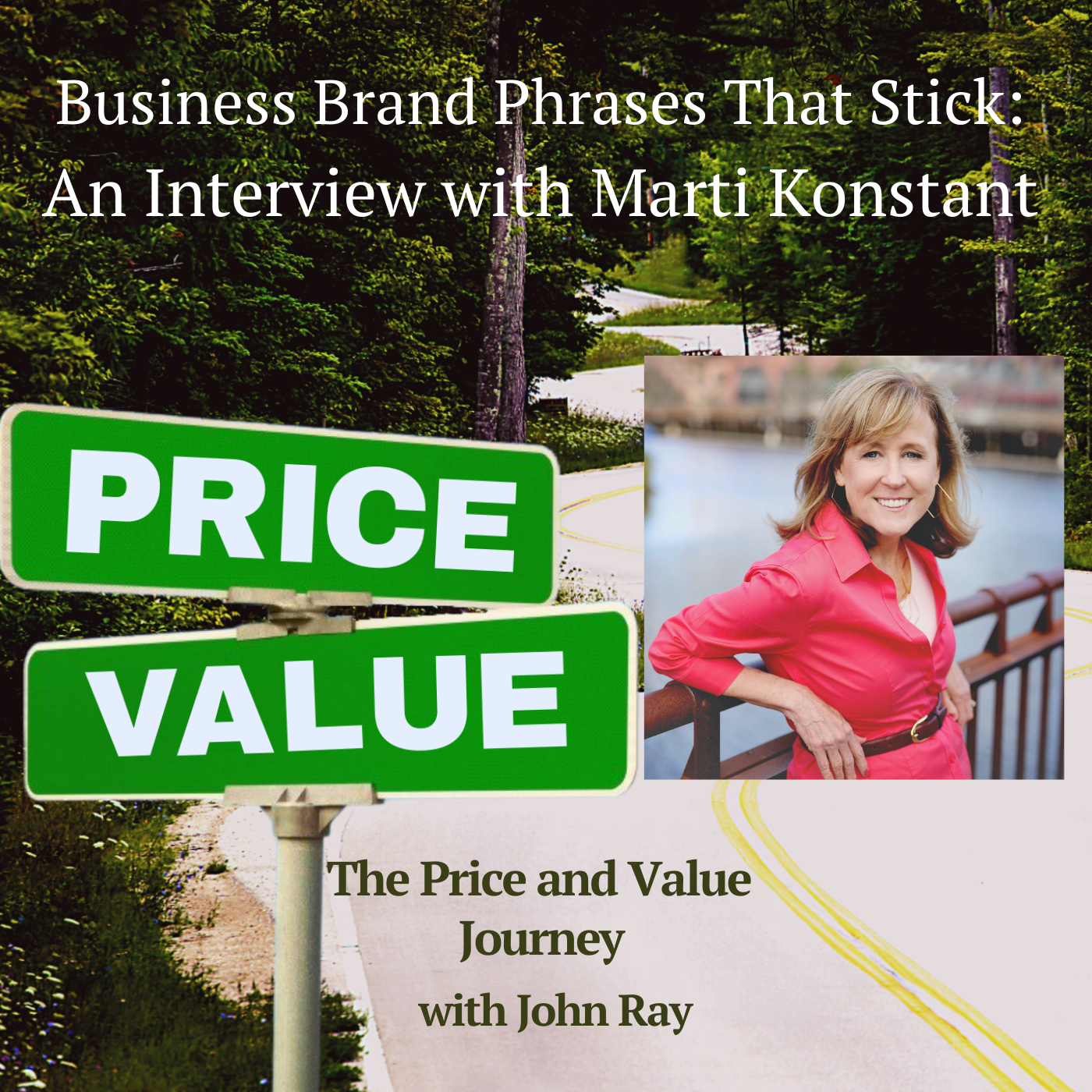
Business Brand Phrases That Stick: An Interview with Marti Konstant

March 16, 2022 by John Ray

Marti Konstant
North Fulton Studio
Business Brand Phrases That Stick: An Interview with Marti Konstant
Loading
00:00 /
RSS Feed
Share
Link
Embed

Download file

Marti Konstant

Business Brand Phrases That Stick: An Interview with Marti Konstant

How should we as professional services providers address our business branding? How can we develop branding which is memorable? Marti Konstant, noted speaker, coach, and best-selling author, joined John Ray to address these questions and much more. Marti recounted her own journey, from teenage years in a full body brace to Silicon Valley marketing executive, to running her own successful services practice, and how that career arc shaped her business branding. She spoke from her own experience on how to handle a branding process that can be overwhelming, examples of compelling brand phrases and the professionals who developed them, how effective branding affects pricing, and much more. The Price and Value Journey is presented by John Ray and produced by the North Fulton studio of Business RadioX®.

Marti Konstant, Workplace Futurist

Marti Konstant, Workplace Futurist

Marti Konstant is a workplace futurist with an agile mindset. She is a career growth analyst, author, speaker, and founder of the Happy Profitable Employee Project™.

An early adopter of workplace trends and technology change, her career path includes artist, designer, entrepreneur, technology marketing executive, business advisor, and investor. Starting her profession in the tech sector launched a style of deliberate career growth, guided by personal preferences.

As a marketing professional, Marti managed marketing programs for companies like Samsung Mobile, Apple, Tellabs, Platinum Technology, Clear Communications, and Open Kernel Labs (OK Labs). As a chief marketer in the mobile security space, her digital demand generation and market awareness strategies resulted in the acquisition of OK Labs by General Dynamics

What started out as a quest to fine-tune her evolving career sparked a research project, workshops, and book, where future of work and career agility are central themes. Her story-driven book, Activate Your Agile Career: How Responding to Change Will Inspire Your Life’s Work, is the result of 120 interviews and custom research.

She earned a Bachelor of Fine Arts in Graphic Design from the University of Illinois and holds a Master of Business Administration from the University of Chicago Booth School of Business. A persistent optimist and prolific photographer, she lives in Chicago with her husband.

Website | LinkedIn| Twitter

TRANSCRIPT

John Ray: [00:00:00] And hello again, everyone. I’m John Ray on the Price and Value Journey. Today, we’re going to chat with Marti Konstant, and Marti is a friend of mine who – we were having a conversation that resulted in this topic, and I’ll talk about the topic in a minute. But first, let me introduce Marti.

John Ray: [00:00:18] Marti is a workplace futurist. She’s the best-selling author of Activate Your Agile Career, which is a great book, by the way. She has an MBA from the University of Chicago Booth School of Business. She’s a former technology executive from Silicon Valley. I want to say more about that in just one second. She’s been featured in a variety of media outlets and has been named a top career influencer to watch. She’s worked with companies like Samsung, Dow Jones, and Apple. And her areas of expertise include the future of work, career development, the workplace, personal branding, workplace trends and ideas, agility, and I’m sure there’s some other things we could talk about. It makes me tired to read that list, Marti. You’re awesome. Congratulations on all that great work.

Mari Konstant: [00:01:12] Thanks so much for that, John. I am so psyched about this conversation because I’ve been following your work for quite some time now.

John Ray: [00:01:19] Well, thank you. I’m honored to have you on the show. Now, one of the things we just need to point out here is that Marti has tremendous experience that a former technology executive from Silicon Valley, all that experience really relates to branding and specifically B2B branding. And that’s where some of our recent chat, we were talking about business brand phrases for professional services firms. And that’s the whole notion here of this conversation is to talk about that as it relates to professional services providers. So, let’s start, Marti, by maybe talking about your own branding journey when you went out on your own and started your practice.

Mari Konstant: [00:02:08] Sure. It really starts long before that. When I was 12 years old, I was immobilized. I was in a full-body brace through my high school years and I was constricted. I couldn’t move and I couldn’t do sports and it was hard to get around. And what I learned from that experience is, well, first of all, I learned how to dream about mobility, agility, flexibility, all the things that I wanted to be doing. And I learned what it was like to go from constriction to unrestricted access to the world. And this was a very powerful backdrop for the type of work that I did. I started out in the creative field, got into branding, got my MBA, got into marketing management, and was managing growth-stage tech company brands as well as certain aspects of large company brands at that time. And right now, how has this affected my brand? Well, I invented the word career agility 10 years ago. It was a term that did not exist. So that is one way. And the phrase that I often used during that time and throughout the book is, if you don’t, it’s adapt or die. It’s flex or fade. It’s the contrast. It’s stagnation or it is growth. Why wouldn’t you want to grow?

John Ray: [00:03:47] For sure. So, this may seem like an obvious question, but I find that sometimes obvious questions give unexpected answers. So, I mean, how do you define a business brand phrase?

Mari Konstant: [00:04:05] I coined the business brand phrase terminology because people were getting stuck in making it a big, long initiative that a lot of small businesses can’t even fathom doing. They can’t fathom doing something for six to 12 months or even three to six months. And I noticed when I was managing brands in the tech space, and as I formed my own brand as a workplace futurist and as a career decoder, I noticed that things that I thought were really easy, coining phrases that didn’t exist, talking about yourself in a way that’s memorable. I just thought that everybody did that. And I realized that if you can just use a phrase and you don’t have to come up with the whole perfect elevator pitch, you can be memorable because that’s all branding is. It’s about being top of mind. It’s about being memorable when someone else wants to work with you for your services or your product.

John Ray: [00:05:22] So, I’m curious about – it just strikes me about the workplace agility phrase that you invented combines something about your life. You described your teenage years and the pain and development, I guess, that you went through because of that, right, and then, your expertise, the workplace. It combines those two things. Talk – say more about that. Is there something significant in that?

Mari Konstant: [00:05:59] Yeah. I think this idea of agility. I just thought, you know, as one who was prevented from moving for a few years, I just thought, you know, if you are agile and you are flexible, anything is possible. So, all of those self-help books like you can if you think you can are true. And you can’t do if you think you can’t, that’s also true. And I think the idea of agility has really resonated well in this area of pandemic and post-pandemic that if you are able to adapt and be agile in your thinking, you are going to future proof just about anything you’re doing because every business, every industry will be reinvented in the next 10 years. That is my futurist self stating this.

John Ray: [00:07:08] Got it. So, I can hear – so, you know, our audience here is solopreneurs, small professional services firms. You’ve got your own practice. I can hear folks saying, you know, look, I do wills and trusts or as an attorney or, you know, I do social media for other clients. I mean, what – you know, I’m a professional services provider here, Marti, not a can of green beans. So, I mean, how, how – why do I need to worry about a business brand phrase per se?

Mari Konstant: [00:07:44] Well, when you’re networking and you say something like I’m a trusted advisor, how many other businesses do you think have that as their tagline? I mean, let’s just guess. Let’s just guess, John.

John Ray: [00:07:59] Oh, 50 million. I don’t know.

Mari Konstant: [00:08:02] Yeah. It’s – I don’t even have the number. What I do know is, it starts to sound trite, and then I ask myself, well, what do people really mean when they say that? Well, sometimes they mean that they are an unapologetic truth-teller. Sometimes they mean that they have your back. Sometimes they mean that they have vision in a way that they can see through things that you can’t, and I think about taking these types of phrases. And if you’re at a networking event or at a dinner event and you make that tangible is what you do for people. People will remember that. They’ll remember things. Like, I’ll use the idea of my surgeon. He was working on my shoulder and I said, “You know, I got to know. Like, is this going to work?” And he could have said, “You know, I’m a surgeon. I’m a really good surgeon.” But what he told me, he told me something quantitative and exciting, and he said, “Marti, I have 100% confidence that you will have a full recovery. I have done 9000 shoulder surgeries.”

John Ray: [00:09:17] Oh, wow.

Mari Konstant: [00:09:18] Now I felt going into that surgery, I didn’t even have a doubt in my mind, and they tell you so much is about mindset. So, who wouldn’t want to have a doctor like that that exhibits such confidence gave me a metric. So, sometimes it’s a metric that you could put out there. That could be part of your branding phrase. It doesn’t have to be a tagline, and I’ve got lots and lots of examples. Like, a nonprofit executive that says that they do all these wonderful things. And, oh, by the way, they’re able to turn red into black. Everything is hemorrhaging right now in the nonprofit sector in, say, things like, you know, the creative arenas like orchestras and plays and things like that. Who wouldn’t want somebody that knows how to turn red into black? They could just say, “Well, I’m a CFO,” or, “I am a bean counter and I can keep things organized for you.” Well, that’s not selling me confidence.

John Ray: [00:10:20] And it’s not very memorable.

Mari Konstant: [00:10:23] No. And it’s – part of it is it’s just that confident piece of it that seems when you use something trite when you use a phrase that’s trite like the trusted advisor or there’s a number of them. I mean, maybe you can come up – maybe – what do you think people say that’s like – like they say, “Well, you know, on time, on target, on budget.” Those are good things, right?

John Ray: [00:10:52] Right.

Mari Konstant: [00:10:53] But it’s not memorable.

John Ray: [00:10:55] Yeah, for sure. You know, the interesting thing here is, I think for some people is how do I come up with something that’s memorable, but I’m not sure I’m as inventive as Marti, I mean, because workplace agility is something that – you Google workplace agility, folks, you find Marti. The question is if I’m a financial adviser, let’s say, and I’m one of a bazillion financial advisers, how do I come up with something that really is unique that makes me stand out?

Mari Konstant: [00:11:31] I think you work with a person that you know you trust that can help you do that. You could also create your own group and do some brainstorming exercises. You can learn how to do some of this. I think there’s so many consultants. And I think of things that can translate to others.

Mari Konstant: [00:11:49] Like, I often run into people in the IT space and they go, “Well, you know, I integrate this and that and it doesn’t sound all that interesting.” Yet, when they tell me, well, I’m able to translate and then they say, “Well, I translate.” And I go, “Well, tell me more about that.” And then, you come up with something like the digital fluency. Like, I am multilingual. I speak tech and I speak tech translation. That’s better than saying I translate text so that everyone can understand it. Now, you can say that other phrase I translate text so everyone can understand it after you’ve said the thing about I’m multilingual and I take digital fluency to another level. You could substitute words like financial fluency in there. You can take other words and other phrases.

Mari Konstant: [00:12:23] I thought about management consulting. There’s a lot of people that do small business management consulting, how to make your businesses more profitable and more effective. And if you said something in a networking program, you said, “You know, I’m like a master chess player.” I process if-then scenarios quickly helping you and your team to focus on a decision when every second counts, or something like that. Some sort of story –

John Ray: [00:13:14] Sure.

Mari Konstant: [00:13:14] That makes it interesting and tangible. Like, what happens when small businesses have an eruption of some sort? What do they do? What is that scenario? What does it feel like? How do they make a decision? And so, you go through a series of questions like this, figure out how that feels. And the way that you can make an effective branding phrase is to put your brain and your shoes and your feet in the shoes of your customer. You have to be an outsider looking in. You have to be a beginner. You can’t be the perfect practitioner that you already are. You have to go back to the beginning and say, “Why the heck did you start this business in the first place?” Something was broken, right? You wanted to make it better. That’s the kind of stuff that needs to come out.

John Ray: [00:14:06] I’m glad you went there because that’s where I wanted to go in terms of, again, I’m going to showcase you. I mean, your business brand that sticks is really about the client. I mean, workplace agility. It’s about the client. It’s not about your expertise. It’s about what you help affect on behalf of the client. And that’s what’s I think striking about, and the difference maybe, in the effective business brands versus the non-effective ones. Don’t you, don’t you – does that make sense?

Mari Konstant: [00:14:44] Exactly. Yeah. And I have a little acronym that I use for this. It’s called mode, M-O-D-E. And it is speaking like a media, a media professional, number one, speaking like a great PR professional, being able to talk, and then actually looking from the outside, and that’s the O. And D is being able to be different, and then E, being able to look at the world with an empathetic brain. So, that’s a little bit of part of the outside looking in.

Mari Konstant: [00:15:27] If you can do those things if you can apply mode to that, and I can go into why being like a media pro is so important, but it’s just as important as being different. I think Sally Hogshead has a book coming out, Why Different Is Better Than Better. And I’ve heard numerous branding executives say this. It’s such a smart phrase because the reason it’s better than better, you know, we all talk about in tech, smarter, faster, cheaper, that kind of thing, but really different is what makes you memorable.

John Ray: [00:16:06] I love it. Folks, we’re here chatting with Marti Konstant and we’re speaking about creating business brand phrases that stick. So, we talked about clients and our prospects and how coming up with our branding from their perspective is so crucial. How did you involve your clients’ prospects in your branding or did you? How did that work for you?

Mari Konstant: [00:16:38] Okay. So, how did I get some of the phrases that I got? I will offer you a phrase that I’m using now because I also work with job seekers and right now my phrase for them is I help mid-career job seekers, that’s the target audience, mid-career job seekers, translate their experience into a visible in-demand portfolio of skills so they can find that right fit role. And how you get to that, I think what you’re getting at, John, is understanding, looking from the outside in, wearing the shoes of who it is that you’re serving, and understanding their pain and being able to approach that with empathy.

Mari Konstant: [00:17:27] So, if for the job seeker, for instance, we all know what that’s like, and I’ve coached enough people to know how painful some of these feelings are. So, being – when people don’t know where to start, like portfolio, I’m not a creative person, why do I need a portfolio of skills? Doesn’t even make sense to them? Right? So, they don’t know where to start. They don’t even know – I was on a call this morning with some mid-career folks in between roles, and they didn’t really know how to look into the camera and to be themselves and be part of that confident brand. The lighting was poor. One-half of their face was dark. I mean, you can go on and on about how this impacts your brand.

John Ray: [00:18:24] So, let me ask you this, and, again, I’m getting back to the, I guess, the perspective and it’s – I guess the reason why we would bring in a third-party consultant or someone to help us with this is because they give us that outside view. But when you developed your branding around mid-career job seekers, did you talk to some of them about this is the branding I’m considering? Or, how did you – did you involve them?

Mari Konstant: [00:19:02] Well, I started a little bit further back than that.

John Ray: [00:19:06] Okay.

Mari Konstant: [00:19:06] So, even though I’ve studied branding, I’ve been a creative person my entire career, any time, even when I was a chief marketer, I hired outside help. So, I, as a solopreneur, have probably invested more in personal branding than most small businesses, and I do it gladly because they hold the mirror up to me so that I can see myself better. And absolutely as a marketing thinker or because I’ve done market research as well, I never want a product ever without knowing what the customer is thinking about it and whether or not they buy it.

Mari Konstant: [00:19:49] Too many entrepreneurs put products out that they think is really cool, but they don’t – they’ve not consulted with a marketer and they are not a marketer at heart, so they are not understanding the value proposition. They haven’t done the types of testing, market validation we call it. What – you know, are you doing the market validation testing for your products to say, “Gee, does this look like a problem you have?” And even better yet, what problems do you have? And we will create a product for that.

John Ray: [00:20:27] Yeah. And so – I guess the question is, how do I know if I’ve got it right? I mean, you know, if I do all this work, how do I know – beyond getting a third party to really help me soundcheck it, how do I know I’ve got it right?

Mari Konstant: [00:20:46] I will tell you. When you get it right, it feels right. Even if you have one word that describes what you do, you know it in your heart and your gut and you inhabit it like no other. And the other way that you notice when you are in front of a customer and when they are shaking their heads or smiling, now we get to see people not just online but in person at times, when you can see something land, it’s palpable. It is visible. If that is not – I mean, I’m a professional speaker, too. So if people aren’t nodding their heads, they’re not smiling, they’re not interested, they’re not even looking up from their devices, I know I have lost them. And so, it’s the same thing as a business person.

Mari Konstant: [00:21:37] And that’s why when I was working in tech, market validation was so important. We wanted to know that we were solving a problem that people wanted. And then if it was a positioning piece that was more marketing-centric, you could do the same thing. You could test that – you could do the market validation for the messaging as well. You don’t just have to do it for a product.

John Ray: [00:22:04] Does going through this exercise, does it help me – as a professional services provider, does it help me better clarify my niche, or is it the other way around? Do I have to have that segment identified and then do the branding?

Mari Konstant: [00:22:23] This is such a great question. It’s like probably the most favorite question I’ve ever gotten, and the answer is it is definitely a clarifying process. When you go through a branding process, as I have with other professionals, sometimes for like two or three days straight I’m working with an outside professional, you start to think about your business differently.

Mari Konstant: [00:22:52] I have a business that I work for corporations and I do this professional speaking, bringing the future to the present. So I have a couple of different channels of services that I deliver. One might say, “Oh, my gosh, that’s all over the place,” but many of us deliver a few services and I think a lot of entrepreneurs can relate to that.

Mari Konstant: [00:23:18] So, it absolutely is a – it’s a lightning rod, I think, for understanding who you are, what you do, why it’s important, and is this solving a problem. I mean, Sara Blakely solved the problem with Spanx. It wasn’t so much that she had these nylons, but she wanted to get rid of the lines that existed underneath skirts and pants for women. She wanted to erase those so that they weren’t so distracting. So, she knew her problem really well. And, of course, I’m sure the way that she named it and all of that, I mean, there’s we could talk a whole lot about names. I mean, right now, we’re – aren’t we in the middle of March Madness or – yeah.

John Ray: [00:24:06] Yeah.

Mari Konstant: [00:24:06] March. Isn’t that a great phrase?

John Ray: [00:24:09] For sure.

Mari Konstant: [00:24:10] I mean, isn’t that just the greatest phrase ever?

John Ray: [00:24:13] Yeah.

Mari Konstant: [00:24:13] Or just do it on Nike. But you can categorize something as simple as a theme and make it – you can generate a lot of enthusiasm around your brand, and it could just be over one of your offerings. It doesn’t even have to be the name of your company.

John Ray: [00:24:32] And I guess what you’re getting at, correct me if I’m wrong, but what I hear you saying is, is that it really doesn’t even have to cover everything I do. I mean, let’s use the March Madness, for example. The madness occurs really the first weekend of the tournament when all these Davids beat up on Goliaths, and that’s the fun part. But eventually, the Goliaths normally went out after three weeks. So, the madness only occurs, let’s say, in the first part of the tournament. So, if you want to productize that, that’s really only part of the tournament, right? The March Madness, if you will.

Mari Konstant: [00:25:10] You could say that. You could look at it that way or you can look at it in a bigger thing that this is the time period of the tournament, right? It’s something that has legs and it’s scalable beyond those few parts of the tournament. And I think I’d like to get back to what you said, you know, branding phrases. It could be a word, it could be a phrase, it could be your positioning, it could be your tagline. And the reason I’ve been expressing it this way is because a lot of people don’t get in the game and they don’t get their feet wet because they’re overwhelmed by this exhaustive branding process.

Mari Konstant: [00:25:52] I mean, I’ve gone through the branding process a few times. It’s definitely worthwhile. It’s definitely worth the investment. But if you don’t understand it and you want to dip your toes in, you can take the template of what is it that you do and what is it that is different about what you’re offering and what is that pain point that you’re getting at. Or, you could do two out of the three of those. You don’t have to do all of them, but the template is easy. Like, describing what you do in a creative way is really more memorable than not doing it that way.

John Ray: [00:26:37] How important is it that an effective business branding phrase brings up a visual? Because it’s hard for me – let’s just use workplace agility. It’s hard for me to visualize that. Yet, it’s such an effective – it makes me lean in and want to know more. Like, what do you mean by that, Marti? Which makes it for me effective. But it’s not really a visual. So, talk about that.

Mari Konstant: [00:27:07] Well, what’s interesting that you say, like five years ago, I invented this term 10 years ago, so I didn’t have a brand for it. But when I – before I launched the book and when I was – it took me five years to write this book. I did come up with a whole logo for Agile Career, and it’s got some movement to it. It’s chrome yellow and black. It’s really beautiful. I had business cards. And I knew just having been in branding for so long, I knew that that was going to be a placeholder that worked for my book at the time. But I knew that Agility Think was going to be much more expansive than that. And the name of my business is Konstant Change. It has been for 20 years. It was always my side business.

Mari Konstant: [00:27:59] So in a way, I considered the agility piece a subbrand. So, now I’m getting to my branding hierarchy. So, Konstant Change is also part of the brand. Marti Konstant is my brand for my speaking, for my keynote speaking, right? And then, the agility piece is a consulting and an offering.

Mari Konstant: [00:28:22] So you could brand it in – they call it House of Brands or a branded house. There’s all different ways of doing it. But to do it in a smart way that’s methodical makes sense. So, I actually thought that out. I thought that out, like seven years ago. So I do have business cards with Konstant Change on it. And I also have, if you go to my LinkedIn profile, Konstant Change is the logo that it pulls in to what it is that I’m doing now. It looks like I’ve been doing it for 20 years. I haven’t been doing it for 20 years. It’s just that I started my side gig of Konstant Change 20 years ago.

John Ray: [00:29:02] So, you don’t have to answer with numbers, but I’m just curious, I want to get back to the – you said you’ve spent, and I don’t remember the adjective, but I’ll just say enormous amount of time and resources on your own branding journey with third-party experts. What’s the ROI of that been for you?

Mari Konstant: [00:29:30] If I had to classify that, I could give you some anecdotal. I now am attracting five-figure speaking engagements. So, that’s 10,000 and above for keynote speaking engagements. I wasn’t eligible for that before. I’m a big believer in contact marketing and branding, so putting all of that out there contributes to the ROI. So can you say, Oh, because I had a logo or because I had these branding phrases. No, I am an integrated marketing thinker. It is your PR. It’s how you deliver on your services. It’s your personality. It’s everything about that that contributes to your brand. That’s why the investment is just a part of it.

Mari Konstant: [00:30:24] I mean, I’m even working with- for keynote speaking – I’m working with hiring a stylist, a clothing stylist. I mean, I’m sure a lot of women do this. I had never done it. But I’m just like I’m open to it because I know it’s important to package myself in a way that’s believable and credible. So, it’s just another thing that I am investing in besides the whole other part of the branding.

Mari Konstant: [00:30:51] And as I told you before, we said before we talked, I actually work with large companies and help their executives with personal branding so that they can talk to each other in a way that lets others know what their strong points are, what they’re good at, and what they’re better at than anyone else not so much what they’re really good at, but where the overlap is for what they really want to be doing because there’s a lot of people that are mismatched in organizations. And if they are better equipped to talk about what they do, it’s going to be better for the organization. It’s going to be better for the executives and better for employee retention and beyond.

John Ray: [00:31:36] For sure. So, in terms of, and maybe you can give some advice to folks, there’s a lot of branding experts out there, a lot of folks that they could hire that, you know, have got a lot of claims on what they can do for us and help transform us. Give some advice on how to find the right person.

Mari Konstant: [00:32:01] Well, it depends on what you want to do. I just mentioned I was working with a styling person. That’s her part of branding. Some people may just want to dip their toe in the water and work with somebody like Gregg Burkhalter. He’s called the LinkedIn guy.

John Ray: [00:32:17] I know that guy.

Mari Konstant: [00:32:18] Yeah. That’s his brand, right?

John Ray: [00:32:18] Yup.

Mari Konstant: [00:32:20] So, he helps individuals and businesses understand how they can better manage their content marketing program on LinkedIn, how they can better engage. I mean, he just -he came up with this idea. It’s not a new idea, but he reinforced it for me last week. I’m doing an article and he offered this, and he said, “You know, Marti, when you comment on a really popular topic on LinkedIn,” and he has a hashtag strategy. So, like, say, you know, you can go to the hashtag of your business or something and look at it. And when you can start commenting on the stream and interacting with people that have bigger businesses than you do, you are going to start to cultivate a network and an ecosystem of people that will help your business go bigger. I mean, if that’s not branding, I don’t know what it is, but it’s a different type of branding, right?

John Ray: [00:33:22] For sure.

Mari Konstant: [00:33:23] It’s not exactly phrases. But he’s got lots of ideas about how just to use – it’s the platform branding, right? So, he’s the LinkedIn guy.

John Ray: [00:33:32] Right.

Mari Konstant: [00:33:33] And then, there’s other people. I know other people that deal with small businesses. And, in fact, one of them – she’ll probably laugh when I say her name but her name is Michelle Heath. She’s out of Boston and she works with small businesses. And one of the things she did when she got hired as a marketer, she crafted one of these branding phrases about how she helps not just do the marketing stuff, but she actually brings the content to the customer at the point at which they’re willing to buy.

Mari Konstant: [00:34:13] So, you might not think, “Oh, well, that’s not that clever.” But it is. Like, how do you find how to get to that person? So, she did that. And then at the end of it, she said, and this isn’t an interview, she said, “You know, I bring the giddy-up.”

John Ray: [00:34:25] I love that.

Mari Konstant: [00:34:26] And this is a Kramer phrase, right, from Seinfeld.

John Ray: [00:34:28] Yeah.

Mari Konstant: [00:34:29] And she said I bring the giddy-up. And she was really animated. That guy hired her on the spot. Right? But she’s a person now that has her own business and works, and she’s all about branding.

Mari Konstant: [00:34:42] So there’s – you know, it’s about talking within your network and saying what type of business are you. There are specialists that only – you know, we all, you know Harry Beckwith wrote the book, Selling the Invisible, all about services about 25 years ago. A phenomenal little book.

John Ray: [00:35:00] Yup.

Mari Konstant: [00:35:01] That was the first book that really acknowledged that services were like – they’re not like – they’re not like products. And so, 25 years ago, that was an innovative thought, but it’s a timeless book. But, yeah, so there are people that specialize in services. You know, I’m working with a person right now in job search that works, you know, is an engineer and a product manager, and it’s like, I know all about this stuff. So, people like that gravitate to me because I’ve worked in tech my whole career. So, that’s my world. That and marketing. So, people like that gravitate towards me.

Mari Konstant: [00:35:40] So, yeah, there’s specialists for all different types. There’s people that do it across types of businesses. I’ve spoken at manufacturing firms. And manufacturing firms have a whole aura of their own as well.

John Ray: [00:35:55] Yeah, for sure. So, I’ve got to ask the money question, which you would expect me to ask. It’s about pricing. How does an effective business brand phrase improve your pricing? You already talked about speaker’s fees, but just address that question generally.

Mari Konstant: [00:36:15] Yeah. So, I would say the way that I would answer it is, is it enables you to close the deal? Because they remembered. So if you don’t have that deal, you’re at zero. And so, the way to quantify that is you go from zero to whatever it is that you charge for your services and you become more valuable the more people that know you and talk about you.

Mari Konstant: [00:36:44] So, I’ve got 30,000 subscribers to my Agility Think newsletter on LinkedIn. I am known in certain segments of the world, you know, as the agility person. I’ve spoken at three global agility conferences about mindset agility, and that’s worth something. And that all comes from the phrases and the positioning within LinkedIn and other places. I also use a couple of the channels, but mainly it’s, you know, you only have time for one depending on your business.

John Ray: [00:37:24] Yup.

Mari Konstant: [00:37:24] LinkedIn is probably the one for you.

John Ray: [00:37:26] Yup. I think for most of our listeners, that’s – you’ve got it. You’re right about that.

Mari Konstant: [00:37:32] But it’s worth more now. I mean, I used to do everything for free. And that’s when you know, our mutual friend Gregg said, you know, you got to talk to John. Like, you shouldn’t be doing things for free anymore.

Mari Konstant: [00:37:45] You know, it’s like it takes a while for us to get into the mindset of what our time is worth. You know, you can say a keynote that’s an hour time. No, it’s 40 hours. It’s customized.

John Ray: [00:38:00] Right.

Mari Konstant: [00:38:00] You know, it’s out of market for two days. It’s so much more than what you think it is. If you’re doing a one-hour webinar, you’ve spent 20 hours customizing it to that audience and you make certain that you deliver on the goods of the expectations. So, it’s worth more. So, it’s not, you know – I think to some – I think I had a mindset issue that probably wasn’t as healthy where I thought, “Well, I’ve got to do it for free. I’ve got to prove myself first.” And I don’t necessarily think that that’s accurate, but it’s the way that I was wired since I was a young person. You know, you got to go to college. You got to get your MBA. You got – like, you’ve got to be a manager, then you’ve got to be a director, then you’ve got to be a VP. You’ve got to prove yourself and you just have to keep on going. And in the end, I realized it was just a story I was telling myself.

John Ray: [00:38:59] Well and I think that’s a common experience most people have, right? I mean, it comes from their time in corporate. It comes from their childhood. What they’re maybe parents or whoever, you know, raised them might have put in their head or what have you. It comes from the competition, right? So, it comes from a variety of places. We get bombarded by it.

Mari Konstant: [00:39:20] Yeah. And, I mean, I know when, and this is your business, but I know that when you price things in a certain way, you have less customers, but you make more and –

John Ray: [00:39:34] Isn’t it that magic?

Mari Konstant: [00:39:36] And I honestly didn’t – I didn’t mind having a lot of clients and making less. I didn’t mind it. I mean, I was learning so much. It’s part of the game. I only want to call it a game. It’s part of learning. But I have to say when you get to a point where you know your value, it’s more fun. I wished I could have been here sooner. And I will say that getting your name out there and being the best media PR person you can for yourself.

Mari Konstant: [00:40:13] I’ll give you an example. Five years ago or six years ago, I was trying to get press opportunities for myself. I thought I’ve done this for organizations. How hard can it be for myself? I couldn’t get any traction. I hired somebody on the side to help pitch and, like, I couldn’t even get free. I mean, I got some free speeches and then I thought, “Well, you know, what the hell? I’m just going to do my own keynote speech and I’m going to film it. I’m going to pay people to put it out there, and I’m going to put it on YouTube, and I’m going to get it out there. I’m going to make my own speaker real. I’m not going to let this stop me.”

Mari Konstant: [00:40:48] But when you’re starting from zero or from a little bit above zero, it just takes a while to gain that traction. Now, I get inquiries every week. In the past, I would have just loved to have gotten an inquiry from a credible global conference. I would have loved that, but they were just – I couldn’t get in free because they didn’t know me. They didn’t know my name. They didn’t know what I stood for.

Mari Konstant: [00:41:21] I got a call from a university on the West Coast and they used my book for their curriculum. It’s called the LEAD Curriculum. It’s a very common curriculum within universities and part of it is to prepare students for the world of work. And I said, “How did you find me?” And they said, “Well, simple. I just looked up, you know, what is career agility. I knew that that was a thing.”

Mari Konstant: [00:41:52] So, any of the listeners that would type in what is career agility, you’re going to find me as the number one result. And that’s then – that’s another type of branding that exists for content. And I owe that to LinkedIn, and I owe that to people that have written articles about me in Forbes.

John Ray: [00:42:13] Wow! Great conversation with Marti Konstant. Marti, I could keep going with you, but we got to let you get on to some of the other work that you’re doing. And I want to give a proviso to listeners. Marti does not do branding work. We’re talking about her own practice and her own perspective. So, she doesn’t do branding work, but she said she’s willing to talk and give folks some general direction if they want to be in touch. Did I get that right, Marti?

Mari Konstant: [00:42:49] Yes, yes.

John Ray: [00:42:50] Awesome.

Mari Konstant: [00:42:51] And absolutely I can be a conduit to resources.

John Ray: [00:42:55] There you go.

Mari Konstant: [00:42:56] And I’ve definitely used resources myself. And the type of branding I do is on the speaking realm. You know, so there’s a speaking engagement that – or a workshop. I do three-hour workshops.

John Ray: [00:43:10] Got it. So, how can folks that would like to be in touch, how can they find you?

Mari Konstant: [00:43:15] There’s two ways. And if you go on to LinkedIn, I’m an open networker. I am the only Marti, with an I, Konstant, with a K, in the world. And so, I’m open networking. And then the other way is by subscribing to the Agility Think newsletter, which is expansive. It’s mindset agility. It’s beyond career agility. You can learn about what I’m publishing on a daily, not on a daily but on a weekly and monthly basis. And then, I guess there’s really three. It’s martikonstant.com and that’s M-A-R-T-I, the same thing, konstant.com, where the repository of my speaking engagements and speaker reels and other blog posts and things of that nature. I need to update – I need to update some of my positioning on it. I have to admit, so.

John Ray: [00:44:13] Well, I was going to say –

Mari Konstant: [00:44:15] Hopefully, you’ll understand that.

John Ray: [00:44:18] Hey, I understand that. You’re way ahead of me, Marti. In fact, I have to say, and just, folks, you really need to go to Marti’s website just to get an idea of what somebody that’s really got a tight personal brand. You say you need work on it. I think it looks fantastic. And it gives folks an idea of what they ought to do. And I told you this when Gregg first put the two of us together, you’re like the most tightly wrapped up personal brand that I’ve ever seen in a solopreneur and the work you do. So, congratulations on that.

Mari Konstant: [00:44:54] That’s so nice of you to say and I’ll – people can’t see this that I’m drinking out of a branded mug. Is this radio, you know, x? Like really wonderful. And it’s like the biggest mug I own that I have from John. And it’s like things like this, brands extend themselves in a variety of ways. It’s not just in one area. You know, we used to think, “Oh, handing out pens and mugs, is that going to be enough?” Well, yeah. I mean, it’s something that I’m going to remember. I got a T-shirt from somebody that I was on a podcast on in their manufacturing arena, and it was a really, really nice T-shirt about women in manufacturing with the woman with her fist up in the air like this.

John Ray: [00:45:42] Right.

Mari Konstant: [00:45:43] Really super fun. And I’m starting to work on that, too. So, you’re ahead of me on that, John.

John Ray: [00:45:50] Well, you know, you said a word and I’m going to let you go. But you said a great word there that we hadn’t used in this conversation. Fun. That’s – you know, fun is an important word here, folks, right? Right, Marti?

Mari Konstant: [00:46:04] Absolutely. To me, and, you know, John, you can see my face when I start talking about this topic I’ve been and this is fun. This is my world. And, you know, as a creative being and a business being, when things manifest themselves in a visual and contextual way, it’s just really thrilling and a lot of fun.

John Ray: [00:46:31] For sure. Marti Konstant has been our guest today, folks, on the Price and Value Journey. Marti, it’s been a delight. I’m so glad we were able to do this.

Mari Konstant: [00:46:40] Thank you.

John Ray: [00:46:41] Thank you. And just a quick reminder as we wrap up here, if you are listening to this show for the first time and you want to hear other episodes of the Price and Value Journey, go to pricevaluejourney.com or search Price Value Journey on your favorite podcast app. You can email me directly if you’d like, john@johnray.co. Thank you for joining us.


About The Price and Value Journey

The title of this show describes the journey all professional services providers are on:  building a services practice by seeking to convince the world of the value we offer, helping clients achieve the outcomes they desire, and trying to do all that at pricing which reflects the value we deliver.

If you feel like you’re working too hard for too little money in your solo or small firm practice, this show is for you. Even if you’re reasonably happy with your practice, you’ll hear ways to improve both your bottom line as well as the mindset you bring to your business.

The show is produced by the North Fulton studio of Business RadioX® and can be found on all the major podcast apps. The complete show archive is here.

John Ray, Host of The Price and Value Journey

John Ray The Price and Value Journey
John Ray, Host of “The Price and Value Journey”

John Ray is the host of The Price and Value Journey.

John owns Ray Business Advisors, a business advisory practice. John’s services include advising solopreneur and small professional services firms on their pricing. John is passionate about the power of pricing for business owners, as changing pricing is the fastest way to change the profitability of a business. His clients are professionals who are selling their “grey matter,” such as attorneys, CPAs, accountants and bookkeepers, consultants, marketing professionals, and other professional services practitioners.

In his other business, John a Studio Owner, Producer, and Show Host with Business RadioX®, and works with business owners who want to do their own podcast. As a veteran B2B services provider, John’s special sauce is coaching B2B professionals to use a podcast to build relationships in a non-salesy way which translate into revenue.

John is the host of North Fulton Business Radio, Minneapolis-St. Paul Business Radio, Nashville Business Radio, Alpharetta Tech Talk, and Business Leaders Radio. house shows that feature a wide range of business leaders and companies. John has hosted and/or produced over 1,100 podcast episodes.
Connect with John Ray:

Website | LinkedIn | Twitter

Business RadioX®:  LinkedIn | Twitter | Facebook | Instagram

Tagged With: Branding, branding professional services, Business Brand Phrases, futurist, Happy Profitable Employee Project, John Ray, marketing, Marti Konstant, pricing, professional services providers, solopreneurs, The Price and Value Journey, value

Decision Vision Episode 132: Should I Experiment with My Business? – An Interview with Marti Konstant, Konstant Change

September 2, 2021 by John Ray

Marti Konstant
Decision Vision
Decision Vision Episode 132: Should I Experiment with My Business? - An Interview with Marti Konstant, Konstant Change
Loading
00:00 /
RSS Feed
Share
Link
Embed

Download file

Marti Konstant

Decision Vision Episode 132: Should I Experiment with My Business? – An Interview with Marti Konstant, Konstant Change

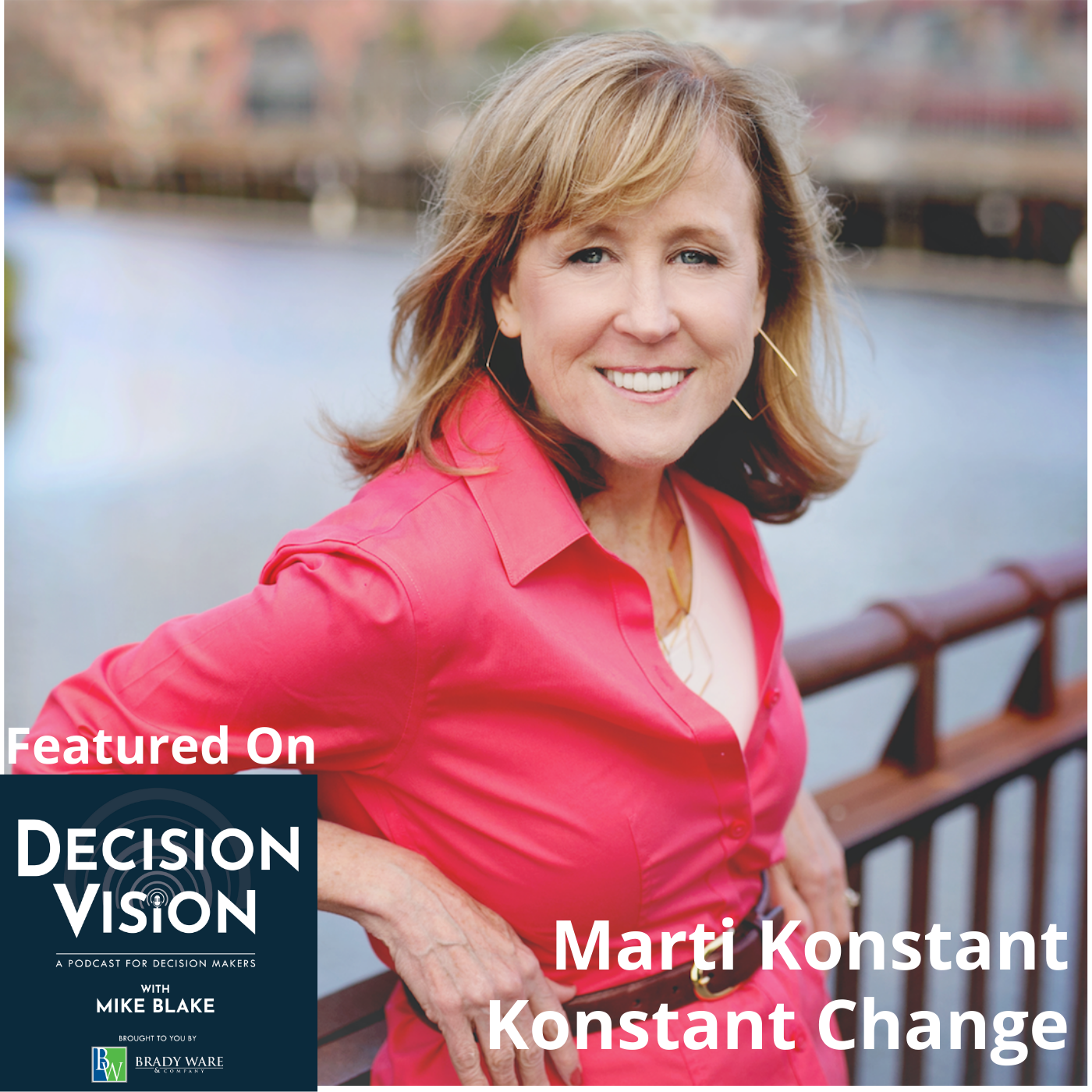
For many business owners, the pandemic raised fresh questions about diversifying revenue and pivoting into new business lines. Workplace agility authority Marti Konstant joined host Mike Blake to discuss how and when a business should experiment, how experimentation keeps a company agile and responsive, and much more. Decision Vision is presented by Brady Ware & Company.

Konstant Change

Konstant Change provides a simple yet powerful agility model, training, and tools to help individuals and organizations adapt to change and build powerful and relevant futures. The company also offers a career decoder framework for mid-career job seekers so they can uncover right fit roles in the next stage of their careers.

Company website | LinkedIn | Twitter

Marti Konstant, Workplace Futurist, Konstant Change

Marti Konstant
Marti Konstant, Workplace Futurist, Konstant Change

Marti Konstant is a workplace futurist with an agile mindset. She is a career growth analyst, author, speaker, and founder of the Happy Profitable Employee Project™.

An early adopter of workplace trends and technology change, her career path includes artist, designer, entrepreneur, technology marketing executive, business advisor, and investor. Starting her profession in the tech sector launched a style of deliberate career growth, guided by personal preferences.

As a marketing professional, Marti managed marketing programs for companies like Samsung Mobile, Apple, Tellabs, Platinum Technology, Clear Communications, and Open Kernel Labs (OK Labs). As a chief marketer in the mobile security space, her digital demand generation and market awareness strategies resulted in the acquisition of OK Labs by General Dynamics

What started out as a quest to fine-tune her evolving career sparked a research project, workshops, and book, where future of work and career agility are central themes. Her story-driven book, Activate Your Agile Career: How Responding to Change Will Inspire Your Life’s work, is the result of 120 interviews and custom research.

She earned a Bachelor of Fine Arts in Graphic Design from the University of Illinois and holds a Master of Business Administration from the University of Chicago Booth School of Business. A persistent optimist and prolific photographer, she lives in Chicago with her husband.

LinkedIn

Mike Blake, Brady Ware & Company

Mike Blake, Host of the “Decision Vision” podcast series

Michael Blake is the host of the Decision Vision podcast series and a Director of Brady Ware & Company. Mike specializes in the valuation of intellectual property-driven firms, such as software firms, aerospace firms, and professional services firms, most frequently in the capacity as a transaction advisor, helping clients obtain great outcomes from complex transaction opportunities. He is also a specialist in the appraisal of intellectual properties as stand-alone assets, such as software, trade secrets, and patents.

Mike has been a full-time business appraiser for 13 years with public accounting firms, boutique business appraisal firms, and an owner of his own firm. Prior to that, he spent 8 years in venture capital and investment banking, including transactions in the U.S., Israel, Russia, Ukraine, and Belarus.

LinkedIn | Facebook | Twitter | Instagram

Brady Ware & Company

Brady Ware & Company is a regional full-service accounting and advisory firm which helps businesses and entrepreneurs make visions a reality. Brady Ware services clients nationally from its offices in Alpharetta, GA; Columbus and Dayton, OH; and Richmond, IN. The firm is growth-minded, committed to the regions in which they operate, and most importantly, they make significant investments in their people and service offerings to meet the changing financial needs of those they are privileged to serve. The firm is dedicated to providing results that make a difference for its clients.

Decision Vision Podcast Series

Decision Vision is a podcast covering topics and issues facing small business owners and connecting them with solutions from leading experts. This series is presented by Brady Ware & Company. If you are a decision-maker for a small business, we’d love to hear from you. Contact us at decisionvision@bradyware.com and make sure to listen to every Thursday to the Decision Vision podcast.

Past episodes of Decision Vision can be found at decisionvisionpodcast.com. Decision Vision is produced and broadcast by the North Fulton studio of Business RadioX®.

Connect with Brady Ware & Company:

Website | LinkedIn | Facebook | Twitter | Instagram

TRANSCRIPT

Intro: [00:00:01] Welcome to Decision Vision, a podcast series focusing on critical business decisions. Brought to you by Brady Ware & Company. Brady Ware is a regional full-service accounting and advisory firm that helps businesses and entrepreneurs make visions a reality.

Mike Blake: [00:00:21] Welcome to Decision Vision, a podcast giving you, the listener, clear vision to make great decisions. In each episode, we discuss the process of decision making on a different topic from the business owners’ or executives’ perspective. We aren’t necessarily telling you what to do, but we can put you in a position to make an informed decision on your own and understand when you might need help along the way.

Mike Blake: [00:00:42] My name is Mike Blake, and I’m your host for today’s program. I’m a director at Brady Ware & Company, a full-service accounting firm based in Dayton, Ohio, with offices in Dayton; Columbus, Ohio; Richmond, Indiana; and Alpharetta, Georgia. Brady Ware is sponsoring this podcast, which is being recorded in Atlanta per social distancing protocols. If you’d like to engage with me on social media with my Chart of the Day and other content, I’m on LinkedIn as myself and @unblakeable on Facebook, Twitter, Clubhouse, and Instagram. If you like this podcast, please subscribe on your favorite podcast aggregator, and please consider leaving a review of the podcast as well.

Mike Blake: [00:01:18] So, today’s topic is, Should I experiment with my business? And, frankly, I think we’re in a period right now where there’s a lot of experimentation with businesses going on, much of it shoved down our throat. As we record this now on August 30th, and, now, I’m calling this the inter-pandemic period. No longer trans-pandemic because I’m not sure we’re emerging from anything. We’re just going from one pandemic into another, unfortunately.

Mike Blake: [00:01:47] You know, those of us who remember the before time remember that we had businesses that were operating kind of the same way that they had for the last few years. And things are going however they were going but we didn’t have massive social and economic upheaval changing our environment around us radically overnight. And as a consequence, I think many companies have been forced to, whether they want to or not, to experiment with their businesses in order to survive.

Mike Blake: [00:02:18] We’ve had one guest, David Audrain, who came on and talked about how adding new revenue streams, although he didn’t do it necessarily in reaction to the pandemic, most likely saved his business. And Lauren Fernandez, who’s been on the show a couple of times now, I know that she’s very big into advising her restaurant clients in how they can diversify their revenue streams. Because it’s hard to make it in a restaurant if people either aren’t allowed to be in it or don’t want to be in it because they’re concerned about, you know, contracting a potentially deadly virus. And that’s just sort of the tip of the iceberg.

Mike Blake: [00:02:58] So, what I would like to do and what I’m going to do, whether you like it or not, it’s happening, what we’re going to do in today’s show is we’re going to talk about the process of experimenting with the business or should I experiment with my business? Because even though coronavirus, in effect, has forced many of us to experiment with our business, I imagine our guest is going to come on and tell us that experimenting with a business has always been under the right circumstances, a pretty good idea to consider. Again, we’re just now forced to think of things differently. Because if we think of things the same, for most of us, it’s just not going to work out.

Mike Blake: [00:03:41] So, joining us to help us talk about this and think about this issue is Marti Konstant, who is a workplace futurist and the bestselling author of Activate Your Agile Career. She holds an MBA from the University of Chicago Booth School of Business and is a former technology executive that has worked in Silicon Valley. As a top career influencer, she has been featured in media outlets such as NBC, Forbes, the Muse. And has worked in companies like Samsung, Dow Jones, and Apple – you might have heard of them.

Mike Blake: [00:04:10] Konstant Change provides a simple yet powerful agility model, training, and tools to help individuals and organizations adapt to change and build powerful and relevant futures. The company also offers a career decoder framework for mid-career job seekers that they can uncover right fit roles in the next stage of their careers. Marti Konstant, welcome to the program.

Marti Konstant: [00:04:31] I’m so happy to be here, Mike. Thanks for the intro.

Mike Blake: [00:04:36] So, Marti, as we often do with the podcast, I want to make sure that everybody understands kind of where we’re coming from here. When we say experiment with a business, in your mind, what does that mean?

Marti Konstant: [00:04:51] Well, just to provide context to my answers, all of my answers, Mike, is I am two things. I am a futurist and I am an optimist. So, you are going to hear optimistic points of view. So, what does it mean to experiment? It’s actually testing out an idea or a concept that enables you to make your business better. That is mainly what it is. And why does someone experiment? They experiment because something isn’t working or there’s a massive amount of change going on in the world. And it begs the question, “Oh, my goodness. I have to do something to keep up with this, to fix this, to change this.”

Mike Blake: [00:05:46] So, certainly, when I think of the term experiment, and I suspect many of our listeners do as well, they think of science experiments. The old vinegar and the baking soda things, you make your playdough volcano erupt, that sort of thing, we think of those kinds of experiments. What, if any, are the similarities between a scientific experiment or a scientific experiment process and a business experiment?

Marti Konstant: [00:06:13] Well, there’s lots of different types of scientific experiments. You can look at scientific experiments that collect a lot of data over a period of time that looks backward as well as forward. And you could look at, you know, the difference between a scientific experiment and maybe one that we might do in our business would be something where you don’t worry so much about legions of data. And you worry more about doing something in an incremental fashion, doing a modest A/B test versus worrying about statistically significant.

Marti Konstant: [00:06:55] If we all waited for statistically significant situations – and I’m so proud that I could say that without stuttering here – is we wouldn’t be able to do any experimentation or pivoting at all. There is a bit of educated guessing and lean product testing. If any one of your listeners is in sync with doing lean product test, those could be done with smaller groups of people.

Mike Blake: [00:07:28] So, let me go back, you said one thing I want to make sure that I understand. What exactly is an A/B test?

Marti Konstant: [00:07:36] A/B test is a term that’s used in statistics. I first learned about it in marketing, when I was trying to test what was going to work to make a change. I also learned about it in business school. So, in doing regression analysis and doing like, does this test work better or does this test work better? So, in marketing, the simplest example is, I’m doing an email marketing campaign. And I’ve got five different headlines. And I’ve got a lot resting on the open rate. So, what you do is you conduct a smaller test.

Marti Konstant: [00:08:17] So, say, your big test, your big email campaign is tens of thousands. You conduct a smaller test. You’re doing A test with this headline, a B test with this headline, a C test with another headline. And then, you take the highest open rate as a result of that smaller sample and then run it on your big, large program. Because sometimes a tenth or two-tenths of an amount is going to make a difference on your rate of return.

Mike Blake: [00:08:47] You know, you bring up some really interesting points there, and I want to go back to your prior comment first before I ask about the A/B test, because I think that’s really important. And that is this notion of statistical significance. Statistical significance is important for some areas, because if you don’t do that, it’s literally a life or death discussion. There are statistical significance for FDA testing. There are statistical significance for engineering, such as airworthiness and seaworthiness of aircraft and seacraft. You kind of want to do that, right?

Marti Konstant: [00:09:27] But, you know, dealing with 95 percent confidence intervals and significance test – now, we get to really geek out here, which is awesome. That’s fine – you know, for a lot of small businesses, even maybe larger ones, it just isn’t realistic. And then, it goes back to the adage that done is better than perfect, I guess. Right?

Marti Konstant: [00:09:51] That’s correct. And it’s all about the size of the company, too. Like, you were talking about, you know, I would want my airplane parts to be really be tested very well. Whereas, you know, something that I’m going to make an adjustment in my business, it’s not as critical.

Marti Konstant: [00:10:11] Now, let’s get to the point of big companies versus little companies. The big companies, the consumer packaged goods companies, those that make the food that we have on our shelves in the grocery store, they can do really large tests and they could be significant about testing. “Well, is this packaging going to work or is this packaging going to work?” Or the tasting of a food product. They can afford to do that. You know, we all want our chocolate to taste good, right? So, they have the luxury to do that.

Marti Konstant: [00:10:47] Whereas, a smaller business, a lot of the businesses that I’ve worked in were smaller and they might only have the budget to work with a market research firm. Even if they’re going to do some market research, they might research the entire sample size of 200 versus 25,000 or 50,000. Is it statistically significant? No. But it is important and it does tell you something.

Marti Konstant: [00:11:16] And you can do the same thing. I do it when I’m doing a speech or a presentation. I’ll say, by a show of hands in this room of 200 people or 300 people, I ask them a question and I see the show of hands. I can guess whether it’s roughly 30 or 40 or 50 percent that have raised their hand to a particular question. It’s important to know that because it’s going to make my content more relevant knowing what their answer to that question was.

Mike Blake: [00:11:47] And, you know, I guess one thing that occurs to me as you were explaining that is, I think experimentation has become much more popularized now, not just because of coronavirus, but because of the way technology has evolved in the last 20 years. Not just communication, but fundamental business models, that the entry cost of experimentation now is so much lower than it once was. That it’s no longer, for example, the purview of Coca-Cola, who I might argue ran one of the most disastrous experiments of all time, new Coke, basically. And with all their resources, they still didn’t get that right.

Mike Blake: [00:12:35] But, now, because of what people are buying and selling virtual product software as a service, the virtually no marginal cost of email, social media, and so forth, you know, almost anybody can run an experiment of some kind. Whereas, that would have been unthinkable a generation ago.

Marti Konstant: [00:12:54] It’s the experiment itself, but it’s also the size of the experiment. So, let’s go back to when Netflix first changed their model and then they changed their model again and again. It was incremental to now we have it streaming. There was a point when it wasn’t streaming. It was a lot of different things prior to being streaming. And then, you would go to their website over a certain time period of how they would serve up choices for you and give you the things that you wanted that you didn’t even know that you wanted. How great is that?

Marti Konstant: [00:13:29] So, those were tests and incremental changes that weren’t really risky. They were small tests. And then, they would change their website, not the entire revamp of their business model all at once, but it was incremental over time. So, there’s an incrementalism piece of it, too. And let’s not get this confused with making mistakes. This isn’t the same as, like, let’s fail fast and all that. We can have a totally different discussion about the value of an experiment and the value of giving people the opportunity to really take big bets on risks and fail.

Mike Blake: [00:14:15] So, you touched on something, too, and we’ve completely gone off script. Our listeners know we probably seen a script longer than we normally do, but that’s all right. You know, that incrementalism is so important, I think. And I love your reaction to this, hopefully, it’s favorable. Otherwise, my whole business thesis goes out the window, but no pressure.

Mike Blake: [00:14:39] But, you know, I’m in the business of helping my clients become better decision makers over time. And I tell them, I believe, that even if you just become a one percent better decision maker over time, that, over that period of time, has a massive impact. So, even if an experiment gives you information that makes your decision even just slightly better than a coin flip or, even better, you create a culture of experimentation that habitually makes all your decisions slightly better than a coin flip, yeah, you’re still going to lose your share of bets. But because of those one percent additional bets that you win that you ordinarily would not have, there’s massive value isn’t there? Sort of deceptively high value on that.

Marti Konstant: [00:15:28] Right. Right. And, to me, it’s a much lower risk to make a small tweak in your offering or to make a small price adjustment in your offering. It’s a bigger risk when you do things.

Marti Konstant: [00:15:44] I was in a company that we were a mobile security company before mobile security was even needed, before the iPhone was invented. Like, nobody wanted it. And we were trying to figure out our footing back before 2007, before the iPhone was invented. And then, when the iPhone was invented, we were still struggling with the market. And it wasn’t until we narrowed and we went to the government entities to market this secure solution. Because we realized that it was the governmental bodies that were going to invest in this first.

Marti Konstant: [00:16:26] So, it was kind of a big risk in a way for us to totally abandon our enterprise strategy. We didn’t do, you know, small-medium businesses. It was enterprise and then it was government, and it eventually became both. So, it’s a little bit more of a risk for a company to put all of its resources into government only. We had a totally different sales strategy. So, that’s a big deal. Whereas, saying, you know, I’m going to charge 20 percent more, or I’m going to do an introductory discounted fee for buy it to try it for my services. That’s much less of a risk.

Mike Blake: [00:17:10] So, let me change gears here, because I’m curious about something. Does every company has the capacity to competently conduct these business experiments? Or are there certain skill sets and maybe even mindsets and culture that a company must have in order to realistically undertake these kinds of experiments and do so meaningfully?

Marti Konstant: [00:17:42] It’s a loaded question. I think the more critical the information that’s the result of this experiment, you’re probably going to want to work with a professional. Similar to how when I was customizing my salesforce database, when I was working at Samsung, I worked with a professional to help me design the customized version of the software. So, it depends on what it is that you’re trying to accomplish.

Marti Konstant: [00:18:14] I think everyone can conduct an experiment. And I think I’m going to back off and say put forth the soft skills that are necessary. I’m going to say it takes a lot of curiosity that’s involved. And it takes some patience and some impatience for setting it up, what is the length of time to run these tests and to figure out if it works or doesn’t work.

Marti Konstant: [00:18:41] I think as a small business person, I think that’s probably the biggest problem is when to jump ship on the test and to say, “You know, this isn’t achieving. Do I need to do it, like, two months longer to really run this test? Or do I need to cut bait and go forward?”

Marti Konstant: [00:19:03] I’ve answered a lot of different aspects of your question. But, again, it all has to do with size. I was running smaller experiments when I was working at the world’s largest electronics company in the world. So, I was running small experiences because – guess what? – every big company has smaller divisions. We were working in the business security division of Samsung versus the big electronics consumer products division, which would be their devices themselves and equipment themselves.

Mike Blake: [00:19:37] So, if somebody listening to this podcast says, “You know, this makes sense. We got to do some experiment to kind of help us establish some kind of direction in some fashion.” But they look sort of internally in their own companies. I don’t know that we necessarily checked those boxes so we can do it ourselves. Are there people out there? Is this what you do? I mean, frankly, I’m not sure. But are there people out there on the outside that can be brought in to help companies design, and run, and interpret the results of these business experiments?

Marti Konstant: [00:20:16] I think the answer is yes to all the above. I mean, I worked in the space of technology most of my career, and we would hire the analyst in the space to help us understand our market so that we could reasonably decide what we were going to go after. That’s a pretty steep investment. You know, if you’re hiring Gartner, for instance, just to go to their conference, you’re paying $3,000 a head just for people to attend. And then, for you to have an analyst that would come in and take a look at your business and ask you 20 questions and to help you strategize. So, that’s really in the form of a strategy session.

Marti Konstant: [00:21:05] So, I think it just depends on how you want to do it. I don’t know, it could be, you know, if you wanted to set up – I’ve worked with people that set up regression analysis. That’s not my business. But I know people that do that so that you can help companies make a decision that they’re a little bit more comfortable with because they have more data, that they have bigger data sets, and they’re running the regression analysis. You’re dependent variable, your independent variable, all those kinds of things. So, you can just have somebody that’s a geek that can help set up. Someone that’s a geek that also understands setting up a business strategy.

Mike Blake: [00:21:51] Well, let me take a drawback here and tackle a more fundamental issue. It seems to me that businesses are undertaking a risk somewhat in experimenting with their business. And not necessarily betting the company, but, I say, they’re taking on risk because they are making a commitment of some resources in order to produce an unknown result. And so, my question is, to your mind, how do you make the argument that it’s worth taking that risk to get into the business of undertaking business experiments?

Marti Konstant: [00:22:40] So, the opportunity cost of not keeping your business fresh and current is huge. It’s death. You know, we’ve seen it in Kodak. We’ve seen it in BlackBerry. We’ve seen it in companies that didn’t make those decisions. Those are big companies. But let’s come back to the smaller company size. And I’ve studied branding a lot, you know, personal branding, business branding. And one of the huge risks in not keeping yourself current from a branding perspective is you get stale.

Marti Konstant: [00:23:22] So, let’s not talk about the product. Let’s just talk about how you market the product. So, if you’re not keeping it fresh and current and people don’t feel that you’re responding to market needs – just like we responded to market needs with the restaurant, you know, takeout and stuff like that – if those companies weren’t adapting to what was going on in the market, they were going to get left behind.

Marti Konstant: [00:23:47] But I think what you’re talking about is, you know, maybe it’s not a pandemic. Maybe it’s just, you know, garden variety change and maybe it’s just technology change. Well, I would suggest and really argue the point that we’re going to have more change in the next ten years than we’ve had in the last 100. So, really, take a look at what is it that you are doing to keep your business current.

Marti Konstant: [00:24:12] It’s like the beauty of a river that keeps flowing. That’s a beautiful thing. The stagnant pond doesn’t smell so great and it’s not as interesting. It’s like the clarity of the river and the brook that’s going forward is much more interesting.

Marti Konstant: [00:24:34] And as I said earlier, I’m a fairly optimistic person. I’m inclined toward agility and flexibility, and test and experimentation is just a part of that. And I think if you looked at the successes of companies that did experiment like Amazon, as it evolved and eventually took over what Sears had in a catalog business, their ability to experiment and take the buying process to the desktop is just a beautiful example of what it took to create something new, part disruption, part what the customer needs.

Marti Konstant: [00:25:22] It’s like, what did we need during COVID? We needed really good takeout food. We suggested to ourselves, “Well, we’re just helping the restaurants out.” But guess what? Everyone is now doing more takeout than they ever did before. Do they really need it? I think they found that they really liked it. So, it’s been a very good thing for the restaurant takeout business.

Mike Blake: [00:25:47] So, this may be a dumb question, but I’m going to put it out there anyway. And that dumb question is, is it always obvious if an experiment succeeds or fails? And if it’s not obvious, how do you make sure you even interpret the results of the experiment correctly?

Marti Konstant: [00:26:11] It depends on the experiment. Let’s just say, for the sake of our example, that we wanted to accomplish something, we wanted to grow, or we wanted to change consumer buying behavior, or something like that. And the result is going to be, what are we trying to do? Was the goal met? You know, I deal with job seekers. That’s just a one-on-one, like a job seeker is a business of one. And when they achieve not just any job, but they achieve a target company with reasonable compensation, they’ve achieved that goal. It, of course, is a success. And these are people that are employed maybe somewhere else, but take the risk to get employed in a new opportunity.

Marti Konstant: [00:27:06] I find it’s always easier to look at, like, a simple example and then work upwards. And so, if growth is what you’re looking for, then you’re measuring revenues at the beginning of the year and the end of the year or revenues per employee. That’s one way of doing it.

Marti Konstant: [00:27:25] A lot of things that’s happening right now on businesses, we have this great resignation going on, we have the employee experience. So, people are leaving companies, certain companies, and going to other companies. Their experiment might be like, “Well, what is it that we can do?” And they might be spending some investment on their employee experience, a better onboarding process, a better recruitment process. They get back to the people that they didn’t choose to hire and they communicate to them. And so, they don’t get bad reviews on Glassdoor.

Marti Konstant: [00:28:05] There’s all kinds of things you could do that you could measure was this a successful initiative. You could do it with training. You know, you could have soft skills training or technical training. You invest for a certain segment of time and then figure out if that impacted your revenues or your retention rate. Whatever you choose to decide to measure what’s important to you.

Mike Blake: [00:28:37] Are there any kinds of businesses that lend themselves well or better to experimentation than others?

Marti Konstant: [00:28:48] That’s a really good question. I find sometimes, like, really big banks will choose where they want to experiment. They might not be as risky with some of their offerings, yet they are going to have to be because of block chain and because of all of the alternative currency that’s happening in getting rid of the middle person, the middleman. So, even the institutions that maybe don’t want to experiment are going to have to experiment. So, yes, I think some people are more risk averse in what they don’t want to change.

Marti Konstant: [00:29:39] But I think it’s just a matter – I don’t think that any business is necessarily immune. I haven’t studied all businesses. I don’t know as much about the energy business, and the oil business, and businesses that I haven’t spent much time in. So, it will be hard for me to respond. I can just tell you, I’ve spent most of my career in technology and now in the career development and agility research space. So, I’m more biased towards the flexible businesses that I’ve worked in and I’ve studied. And I’ve worked in businesses that have failed. So, I had bad experience as well.

Mike Blake: [00:30:24] That may be a separate podcast. So, you know, it occurs to me, as you talked through this one common thread, I think – and, you know, please tell me if I’m wrong – is that, in order for a business to be a successful experimenter, the one thing they must have, they must have a willingness and a capacity to measure. They must have a willingness to actually collect data and a willingness to kind of look at it and measure performance. Because I think if they don’t have that, how do you experiment if you don’t measure things?

Marti Konstant: [00:31:04] Yeah. It’s the measurement piece and it’s also the quest for innovation. We know that if you don’t innovate it becomes stale. So, it’s a combination of this willingness to measure and really set up the test of some sort to determine if this is going to be successful. But I think it has more to do with the requirement for you to innovate and become relevant and viable over the long haul. If you’re not in some state of invention/reinvention, all data will tell you the companies that we thought would never fail have failed. They eventually go.

Marti Konstant: [00:31:59] Someone told me ten years ago, “You know, eventually, Apple’s going to fail, Marti.” They will. IBM was a certain way back in the 60s and the 70s, and they’re different now. They’re associated more with, you know, services, and they’re not doing the same thing they were before. So, some companies become maybe different.

Marti Konstant: [00:32:27] Some companies become less than – uh, Nokia, you know, owned the feature phone market before smartphones came out. And they decided not to get into smartphones. I mean, we could go down the line of companies that were dominant in their space. Does Nokia exist right now? Yeah. They’re into network management and they do a lot of telecom network stuff and they do exist, but they don’t exist in the same space that they existed. So, in a way, they were forced into adjacent industries. It’s not necessarily that they said, “Oh, we’re going to do this to expand.” They were forced to either isolate and make make themselves smaller and not enter into the hype. They were the largest, fastest-growing handset market in the world at one time.

Mike Blake: [00:33:20] Hard to believe how much that landscape has changed. Do companies tend to gravitate towards experimentation in one particular discipline or another? For example, marketing or product development or manufacturing finance. Are there some kind of business functions where experimentation seems to either be more prevalent or seems to work better than others?

Marti Konstant: [00:33:50] Well, I can speak to marketing because I spent so much time. I think there’s been a willingness all along to experiment and become, you know, the digitization of the universe. To be able to work with the digital market has really been, I guess, a big reason why marketers have been willing to experiment. I will say there was a batch of marketers, that I knew back in business school, that went into consumer packaged goods, and they didn’t see themselves as marketing technologists and digital. And their careers were harmed somewhat, so they thought, “Well, I have people for that.” And I said, “No. I know you’re not pressing the button, but I always felt that you should know all this stuff.”

Marti Konstant: [00:34:45] And some of these big companies, they said, “Digital marketers after the dot com thing need not apply.” Well, they were totally missing the mark where innovation hit. So, there’s a segment with every, you know, assumption that you make about a profession, so that’s marketing.

Marti Konstant: [00:35:02] I will say that if you look at medtech, fintech, everything that has the tech on the end of it now, which has been on the end of it for quite some time, they have had an appetite for getting themselves into a digital arena. And the next arena is going to be in the VR/AR arena. I mean, we don’t yet have a clue what that’s going to feel like and look like in the third dimension. How we’re going to experience the work around us? Right now, we’re sitting in front of computers, what is it going to look like in the future? So, I think fintech, medtech, marketing tech, all the items, scientific technology, anything that we had a tech to it, which is pretty much across the board.

Marti Konstant: [00:35:55] So, the minute you add tech on it, it becomes experimental. It becomes the future. In finance when they start to add the block chain and all of the Bitcoin to this, there’s going to be more experimentation.

Mike Blake: [00:36:19] Are there any ethical boundaries around business experimentation that you’re aware of? Is that a conversation that’s being had at all?

Marti Konstant: [00:36:37] That’s not one that I’ve been exposed to personally. But I got to think it’s out there. I mean, there’s lots of ethics going around everywhere. I mean, look at the ethical dilemmas we’ve been going through in the past year-and-a-half since the pandemic and unrest across the country. So, there’s lots of ethical dilemmas that are in existence today that have bubbled to the surface more dramatically than ever before.

Marti Konstant: [00:37:07] So, yeah, I mean just anything to do with technology, I think of implantable devices. There’s doctors across the country that are implanting devices inside themselves because they can’t do FDA experiments. So, that’s happening. I mean, this is a thing. I don’t know how I’d feel about implanting chips inside of my body, but it is going to be a thing. Is that an ethical dilemma? I think if you read anything about Harari, who wrote Sapiens and the book about the future, he talks about a lot of these types of dilemmas in his book about the future. So, anyone that’s writing about the future right now is talking about dilemmas.

Marti Konstant: [00:38:01] We’re across the line. You know, like have we injured our children? Have we rewired their brains to the point that there’s just no attention span left? You know, do we long for a simpler time because of these ethical dilemmas that we’ve crossed the line with humanity?

Mike Blake: [00:38:23] Yeah. You know, by the time you factor in privacy, and social media is teaching us now some really important lessons that, I think as a society, we kind of already knew, but had forgotten about manipulation and influence. That there probably are some ethical walls now that that are being addressed at least implicitly.

Mike Blake: [00:38:47] For example, I’m a company. I gather customer data. I told the customers that it’s going to be used for this. Now, I want to go back and kind of mine that data for other information. Is that unethical? Do I just try to be compensating the providers of that data for that use? I don’t know. Is it unethical to – I don’t know – run a lottery saying, you know, if you participate in the survey, you’ll get $100 Amazon gift card, but nobody’s going to win it. That’s clearly kind of unethical.

Mike Blake: [00:39:22] And, you know, it’s just opening up this whole new vista just as there are ethics in terms in terms of scientific experiments. I think there must be and will be conversations around what constitutes ethical behavior when it comes to a business experiment. There has to be, right?

Marti Konstant: [00:39:37] Yeah. I mean, there has to be. You’ve just, you know, remarked on a lot of problems we have with big tech today, is, the data is being collected and it’s really not with our permission. It really isn’t. It might be buried somewhere in there, but who knows what they’re going to do with it? Who knows how elections will happen in our future? Things that are manipulated by data, who knows what countries are going to have the influence in the way that we live and the way that we want to live? So, there are a lot of concerns.

Marti Konstant: [00:40:19] So, I think it’s not so much experimenting as much as that it’s data manipulation, which is the word that you used, the phrase that you used. So, the experiment is one thing, but data manipulation is an insidious type of thing. Like, we do the research because we want the result. And then, we tell the people what we want them to hear. We used to think like, “Other countries did this. Not our country.” But, you know, what do you think? What do you think, Mike? Do you think we’re not so different than any other country that we thought, you know, manipulated?

Mike Blake: [00:41:07] We’re absolutely not. I mean, the case in point, I spent the early part of my career in the Former Soviet Union. So, I lived in Minsk for two years and I lived in Kiev for two years in the early 90s. And I had a shortwave radio, and so one of the things that I would do – because I’d studied Russian in school, but it’s different to being dropped in the country having to use it every day and survive and work and stuff. So, at the end of the day, I was exhausted – I needed to listen to some of the English language for my brain to recover. And, you know, you listen to Voice of America.

Mike Blake: [00:41:42] And we didn’t beam Voice of America into the Middle East and to the USSR because we’re nice guys. We did that because that’s a propaganda arm. There is a specific agenda. I’m not even saying it’s a wrong thing to do. But the idea that we did, just because we’re such nice guys and we were just going to spend all those tax dollars to do that, it’s just not realistic. Now, the information may be more true than, say, what Radio Moscow was. But at the same time, they are trying to achieve the same end.

Mike Blake: [00:42:22] What’s interesting now is that the line now between propaganda and business experimentation is really blurred, because the technology has allowed it to be blurred. Whereas, radio is a one way medium. Now, you can have conversations with millions of people. And there may be bots on the other side. And probably in some comical kind of circular piece of technology, there are probably bots trying to manipulate bots. And the bots don’t know each other are bots, basically. I’m sure that’s happening.

Mike Blake: [00:43:00] And so, unfortunately, the rewards are too great to not at least be tempted to manipulate. And experiments can take on a manipulative effect. And, although, the value of the experiment itself is diminished significantly, if not obviated, if on the other hand you’re manipulating behavior in your favor, who needs the experiment? Just make them do what you want them to do.

Marti Konstant: [00:43:28] I mentioned something earlier at the beginning of the episode, and that is that I’m just an optimistic person. And I tend to look at all that and think, “Okay. This is true. There’s lots of manipulation.” But experimentation, and data, and the future of technology is just utterly exciting and fantastic. We are living in an incredible time to do a lot of great things.

Marti Konstant: [00:44:02] So, I always end up, regardless of anything sinister, that we could look back at our history of military and politics and all that kind of stuff, I always twist it back to like, “Well, what’s the cost of focusing on that versus what we can be doing?” So, it’s always about how can we do it for good? And to assume the part that the 50 percent of human nature – that’s really good – to assume that will be better on the positive side of that and that we’ll use it wisely.

Marti Konstant: [00:44:41] I mean, even back to the 2001: Space Odyssey, which was the movie that kind of like where the computer took over. It was a scary thought that the computer could override human beings. However, you know, yes, they are getting smarter. And, yes, these things are going to happen. But we have it in ourselves to make positive use of this. And to fix things like climate change. And to do the things that are hurting right now and to say, “Okay. We went too far in this direction, let’s do something about it.”

Mike Blake: [00:45:21] We’re talking with Marti Konstant. And the topic is, Should I experiment with my business? I just have time for a few more questions before we let you go back to your day. But one question I wanted to make sure to ask is, are you familiar with any kind of widely accepted system or set of best practices for conducting these business experiments? Is there a a model out there that you’re familiar? Is it something that you like? Or is there somebody who’s a really good author on this? If I want to really start digging into the how and adopt best practices, how would I go about doing that?

Marti Konstant: [00:45:54] Well, I mean, you work with organizations with helping them make better decisions. So, certainly, you know, that would be where I would look to it. Are there large organizations or big organizations that have used entities that have helped them? Absolutely. There’s consultants. There’s, I guess, very smart people that have figured out how to do things and use the technology in the proper way.

Marti Konstant: [00:46:25] But I don’t have any insights into that, Mike, except that I know in my work, both work as a corporate person and as an individual business person now, I’ve always used consultants. I’ve always used specialist. Even when I was working in a compact team of the company that we built and we sold to a Fortune 100 company, even then, I had at least seven to ten consultants that I was working with at any given time. Yet we were a small company of, like, 100 people. And I was working with seven discrete consultants. It was a lot of work to manage them, but I knew that we couldn’t do it on our own. So, this is available.

Marti Konstant: [00:47:14] Just like I hired a market research firm when I wrote my book. I had a smaller sample size, but I wasn’t going to write a book that was an opinion book. I was going to write a book that actually looked at some data. And then, I also interviewed 120 people as well. So, absolutely, I know they’re out there. I know people like you are out there that understand the power of profitable decision making and wanting to mitigate risk and all that.

Marti Konstant: [00:47:46] I have to tell you, Mike, I keep looking at you. You know, people can’t see what I see. But that Packman piece of equipment that’s behind you just brings up just absolutely wonderful, wonderful images of just pure fun. I know this is a deviation from your decision, but I just had to say it.

Mike Blake: [00:48:07] Thank you. Maybe that’ll be another title of a podcast, Should I have a fun background? Well, since we’re already off ramping here, I’ll follow up on it. Our former marketing director was very nervous that I would have this in the background, because he said that nobody wants to buy serious professional services from a child. And I told them, “You know what? In a time of global pandemic, social upheaval, and murder hornets, I think everybody wants to buy professional services from a child. Maybe a smart child who knows how to take out the trash every once in a while, but still a child.”

Mike Blake: [00:48:55] And when everybody – including today, I got a call with somebody from out of the country – when they see these for the first time, their eyes light up, their faces light up. And these are never going away. I did not expect that positive reaction. Everybody loves them.

Marti Konstant: [00:49:15] Well, I hope they don’t go away. I mean, what’s hard not to like about Star Wars? This is our history, right? This is our history. This is our history of innovation. That’s our history of play. It’s our history of fun. It’s the systemic way that we were able to use certain aspects of video technology and move it up to the next level, family engagement. There’s a lot of good stuff about that.

Marti Konstant: [00:49:44] I’ve worked in a lot of tech companies and there’s been a lot of toys that I’ve seen at the desk of people. And it always gave me pure joy to be working with tech people that had all of these little elements and stickers and everything sitting on their computers. It was delightful to do that rather than walking through a sterile environment. This, to me, it’s pure creativity.

Mike Blake: [00:50:15] Well, once this whole thing is over, when and if it’s over, we’ll have to have you over. And then, you can get the full tour. You’re seeing a fraction of what’s actually here. Marti, we’ve covered a lot of ground today, and there are other questions we can ask, but I’m sure there are questions that either we didn’t get to or questions that our listeners would have liked us to have gone in more deeply, but we didn’t. If somebody wants to contact you to, like, explore this topic more, can they do so? And if so, what’s the best way to do that?

Marti Konstant: [00:50:47] Two places, martikonstant.com, M-A-R-T-I-K-O-N-S-T-A-N-T, Konstant with a K, dot com. Lots of information there. And then, I have an AgilityThink newsletter on LinkedIn that has 30,000 subscribers. There’s a lot of information. I write about agility. I write about the future. I write about some of the content that we’ve been talking about today. I write about creativity. So, those are two areas that I do most of my content. And the content engine is through my website.

Mike Blake: [00:51:29] Well, very good. Thank you so much. And that’s going to wrap it up for today’s program. I’d like to thank Marti Konstant so much for sharing her expertise with us.

Mike Blake: [00:51:39] We’ll be exploring a new topic each week, so please tune in so that when you’re faced with your next business decision, you have clear vision when making it. If you enjoy these podcasts, please consider leaving a review with your favorite podcast aggregator. It helps people find us that we can help them. If you would like to engage with me on social media with my Chart of the Day and other content, I’m on LinkedIn as myself and @unblakeable on Facebook, Twitter, Clubhouse, and Instagram. Once again, this is Mike Blake. Our sponsor is Brady Ware & Company. And this has been the Decision Vision podcast.


Tagged With: Agile Coach, agile management, Brady Ware & Company, Decision Vision, experimenting, Konstant Change, Marti Konstant, Mike Blake, workplace trends

Business RadioX ® Network


Our Most Recent Episode

CONNECT WITH US

  • Email
  • Facebook
  • LinkedIn
  • Twitter
  • YouTube

Our Mission

We help local business leaders get the word out about the important work they’re doing to serve their market, their community, and their profession.

We support and celebrate business by sharing positive business stories that traditional media ignores. Some media leans left. Some media leans right. We lean business.

Sponsor a Show

Build Relationships and Grow Your Business. Click here for more details.

Partner With Us

Discover More Here

Terms and Conditions
Privacy Policy

Connect with us

Want to keep up with the latest in pro-business news across the network? Follow us on social media for the latest stories!
  • Email
  • Facebook
  • Google+
  • LinkedIn
  • Twitter
  • YouTube

Business RadioX® Headquarters
1000 Abernathy Rd. NE
Building 400, Suite L-10
Sandy Springs, GA 30328

© 2025 Business RadioX ® · Rainmaker Platform

BRXStudioCoversLA

Wait! Don’t Miss an Episode of LA Business Radio

BRXStudioCoversDENVER

Wait! Don’t Miss an Episode of Denver Business Radio

BRXStudioCoversPENSACOLA

Wait! Don’t Miss an Episode of Pensacola Business Radio

BRXStudioCoversBIRMINGHAM

Wait! Don’t Miss an Episode of Birmingham Business Radio

BRXStudioCoversTALLAHASSEE

Wait! Don’t Miss an Episode of Tallahassee Business Radio

BRXStudioCoversRALEIGH

Wait! Don’t Miss an Episode of Raleigh Business Radio

BRXStudioCoversRICHMONDNoWhite

Wait! Don’t Miss an Episode of Richmond Business Radio

BRXStudioCoversNASHVILLENoWhite

Wait! Don’t Miss an Episode of Nashville Business Radio

BRXStudioCoversDETROIT

Wait! Don’t Miss an Episode of Detroit Business Radio

BRXStudioCoversSTLOUIS

Wait! Don’t Miss an Episode of St. Louis Business Radio

BRXStudioCoversCOLUMBUS-small

Wait! Don’t Miss an Episode of Columbus Business Radio

Coachthecoach-08-08

Wait! Don’t Miss an Episode of Coach the Coach

BRXStudioCoversBAYAREA

Wait! Don’t Miss an Episode of Bay Area Business Radio

BRXStudioCoversCHICAGO

Wait! Don’t Miss an Episode of Chicago Business Radio

Wait! Don’t Miss an Episode of Atlanta Business Radio