Business RadioX ®

  • Home
  • Business RadioX ® Communities
    • Southeast
      • Alabama
        • Birmingham
      • Florida
        • Orlando
        • Pensacola
        • South Florida
        • Tampa
        • Tallahassee
      • Georgia
        • Atlanta
        • Cherokee
        • Forsyth
        • Greater Perimeter
        • Gwinnett
        • North Fulton
        • North Georgia
        • Northeast Georgia
        • Rome
        • Savannah
      • Louisiana
        • New Orleans
      • North Carolina
        • Charlotte
        • Raleigh
      • Tennessee
        • Chattanooga
        • Nashville
      • Virginia
        • Richmond
    • South Central
      • Arkansas
        • Northwest Arkansas
    • Midwest
      • Illinois
        • Chicago
      • Michigan
        • Detroit
      • Minnesota
        • Minneapolis St. Paul
      • Missouri
        • St. Louis
      • Ohio
        • Cleveland
        • Columbus
        • Dayton
    • Southwest
      • Arizona
        • Phoenix
        • Tucson
        • Valley
      • Texas
        • Austin
        • Dallas
        • Houston
    • West
      • California
        • Bay Area
        • LA
        • Pasadena
      • Colorado
        • Denver
      • Hawaii
        • Oahu
  • FAQs
  • About Us
    • Our Mission
    • Our Audience
    • Why It Works
    • What People Are Saying
    • BRX in the News
  • Resources
    • BRX Pro Tips
    • B2B Marketing: The 4Rs
    • High Velocity Selling Habits
    • Why Most B2B Media Strategies Fail
    • 9 Reasons To Sponsor A Business RadioX ® Show
  • Partner With Us
  • Veteran Business RadioX ®

What You Must Know When Forming an LLC, Partnership, or Corporation

March 24, 2023 by John Ray

What You Must Know When Forming an LLC, Partnership, or Corporation
Advisory Insights Podcast
What You Must Know When Forming an LLC, Partnership, or Corporation
Loading
00:00 /
RSS Feed
Share
Link
Embed

Download file

What You Must Know When Forming an LLC, Partnership, or Corporation

What You Must Know When Forming an LLC, Partnership, or Corporation (Advisory Insights Podcast, Episode 36)

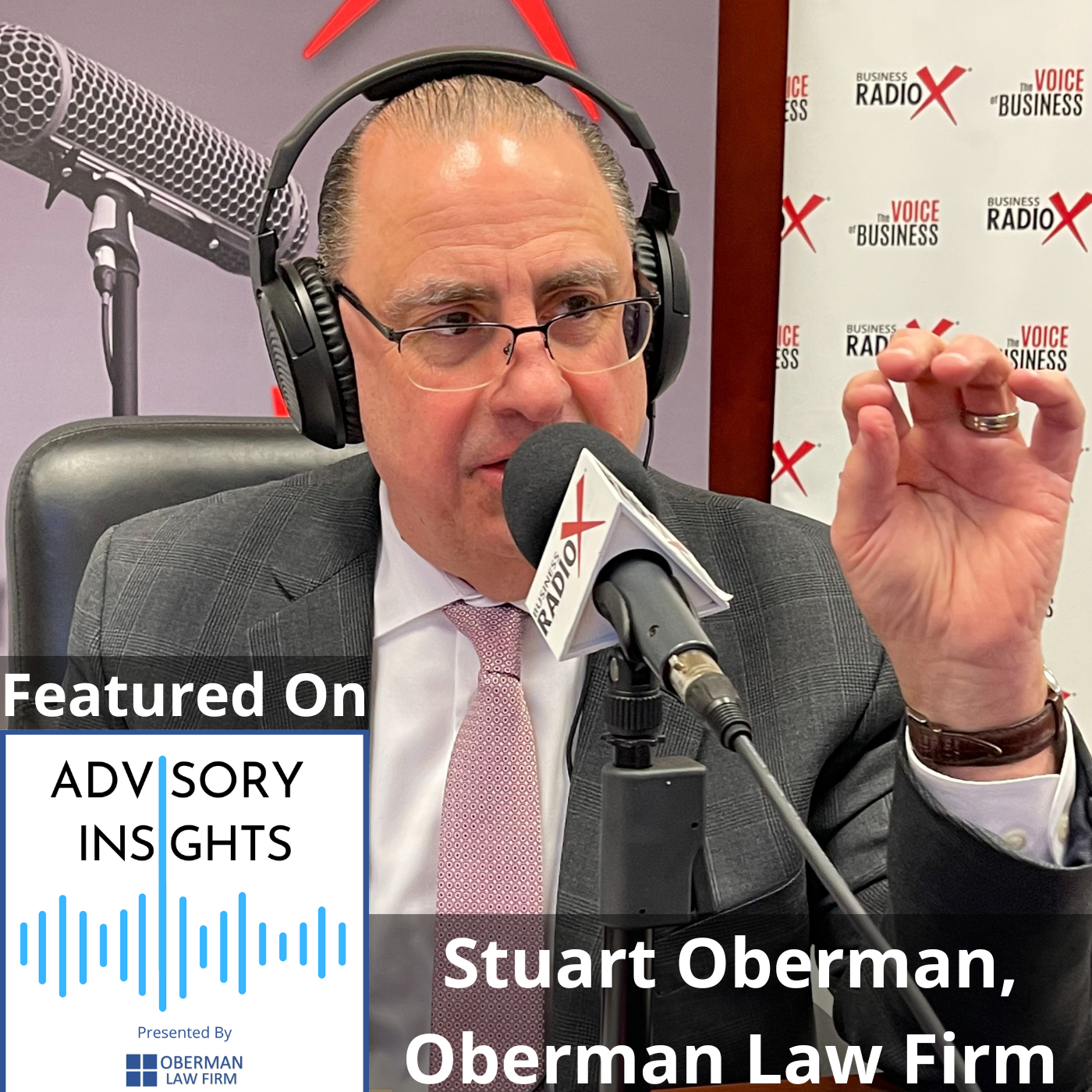
On this episode of Advisory Insights, Stuart Oberman of Oberman Law Firm discussed some of the key considerations for businesses when forming an LLC, partnership, or corporation. He stressed the importance of having a well-designed agreement in place that covers key topics such as arbitration provisions, buy/sells, and valuation methods.

Advisory Insights is presented by Oberman Law Firm and produced by the North Fulton studio of Business RadioX®. The series can be found on all the major podcast apps. You can find the complete show archive here.

TRANSCRIPT

Intro: [00:00:01] Broadcasting from the Studios of Business RadioX, it’s time for Advisory Insights. Brought to you by Oberman Law Firm, serving clients nationwide with tailored service and exceptional results. Now, here’s your host.

Stuart Oberman: [00:00:20] Hello, everyone. Stuart Oberman. Welcome, welcome to Advisory Insights. All right. We’re going to have some great stuff. As we start going quickly, quickly, quickly into 2023, I want to make sure that everyone is structurally prepared internally for their corporations, partnerships, LLCs.

Stuart Oberman: [00:00:39] We do a substantial amount of entity formations, buy-ins, buyouts, partnerships, formations for global companies, local companies, regional companies. Last year, we did about 145 transitions, mergers, acquisitions, probably total about $450 million worth of revenue on those, total practice values, and everything, business values.

Stuart Oberman: [00:01:05] So, I want to run quickly through some items that we noticed time and time and time again on some problems. So, first and foremost, whenever you’re forming a corporation, you got to look at a couple areas. So, you have to know, and your advisors have to know, your CPAs have to know, your attorneys have to know what are the best practices. Each state is completely different as to what the requirements are. You have to know what your documents are. You have to know what the record keeping is. You have to understand what your corporate responsibility is document-wise. You have to understand what the LLC documents are. You have to understand whether or not you have to have a publication involved.

Stuart Oberman: [00:01:49] And, also, what are the valuations. When you form an entity, when you form a corporation, you form an LLC, what is what we call a capital contributions? What are you bringing to the table? Is it $1? Is it your services rendered? It has to be an accounting process for this because it has to go into the operating agreement. It has to go into the corporate documents. And I’m going to get into a list of corporate documents a little bit later in this particular podcast.

Stuart Oberman: [00:02:18] So, one area we have to look at is, of course, an entity selection. What is best for you? There are no right or wrong entities necessarily. It’s just what is your structure? So, of course, you’ve got your corporations, right? Now, people get confused. I want to be a Sub-S. I want to be a C-Corp. So, those are tax elections. They’re not “corporate structures.”

Stuart Oberman: [00:02:50] So, there’s only really one kind of corporation. Depending on your state, you could have a professional corporation, you can have a PLLC, professional liability corporation. So, you’ve got a lot of things but, basically, you’re looking at the corporation. Then, you have limited liability company. Again, depending on your state, you can have a PLLC, you can have variations of these.

Stuart Oberman: [00:03:16] So then, you look at what are your partnerships. That’s a whole different world. Partnerships. They’re like a marriage. They’re easy to get in. They are a disaster to get out. If you’re even contemplating a partnership, who’s going to own their respective shares? You got two owners, individually or is each owner going to have their own entity, LLC, if you will, and then you have a master – what we call – mothership LLC. Again, those are very, very specific things you’ve got to really take a look at.

Stuart Oberman: [00:03:53] Then, you’ve got joint ventures. So then, you’ve got partnerships on joint ventures. Then, you have joint ventures LLCs. You got operating agreements. You’ve got, again, buy-ins, buy outs. So, those are all extremely technical areas you really, really have to know.

Stuart Oberman: [00:04:12] So then, you’ve got to look at what entity is going to protect the owners or owner of the companies. What are the rights and obligations of the owners? Again, internal documents. Easy to get in, hard to get out. You’ve got to know how you go into a marriage and how you’re getting out, what are the breakups, what are the wind downs, how are you going to break up the the assets, if you will. So, again, determine the entity status.

Stuart Oberman: [00:04:39] So then, this is where your advisors come in. You’ve got to look at really the benefits and pitfalls of establishing each entity. You can’t just jump and say, I want to be this or I want to be that. You have to figure out the end game, taxes, liability, crossing jurisdictional matters. What may work in Texas is not going to work in Maine. What’s going to work in Maine is not going to work in Washington. So, again, look at those things.

Stuart Oberman: [00:05:08] Tax issues. So, you’ve got a couple areas to look at. One is the S-Corp. That is best place for small businesses. Your CPA will be very familiar with that. There are certain time limits that that has to be election-wise with the IRS once you are set up. Your C-Corps, you’ve got to be really careful on that, because if you go to sell your business and you’re a C-Corp you have some problems with some tax, some goodwill matters.

Stuart Oberman: [00:05:40] And the partnerships, is it going to be a mothership scenario where you’ve got owners filing their own LLCs? Is it going to be taxed, again as a partnership, how is each entity going to be taxed? Is this particular partner going to be a S-Corp? Again, very, very complex. So, you look at the formation. You look at your operation. And you look at the termination.

Stuart Oberman: [00:06:06] Pitfalls. Who’s going to get the tax ID number, state and federal? So, when your federal, someone in the organization has to file for a tax ID number. Whose Social Security number is that going to be filed with? Because if it’s under your tax, if it’s under your Social Security number, you are essentially going to be responsible for a lot of tax matters. What’s the tax efficiency? What’s the best tax structure? Is it a tax exempt? Certain areas are tax exempt, state, federal.

Stuart Oberman: [00:06:43] Again, you’ve got to look at your CPA for these things. You’ve got to look at your financial advisors. And they have to be familiar with business. Some CPAs are not familiar with business structures. It’s just the way it is. So, again, pick your advisors carefully.

Stuart Oberman: [00:06:56] A couple of documents – as we’re sort of near closing – we should really take a look at. So, corporation’s bylaws, minutes, LLCs and corporations, consents LLC and corporations, operating agreement primarily generally in your LLC formations, that will get you started on everything from how you run the business, tax consequences, how you wind it down, what the partnerships distributions are. That is your structure.

Stuart Oberman: [00:07:32] With any joint venture, you have to have or should have a joint venture agreement. Any business that has more than one owner or partnership should have, in my recommendation, a very strong buy-in. Is it going to have arbitration provisions? Is it going to be a buy/sells? Are you going to have sort of a baseball arbitration where if one person can’t agree on the valuation, then the other person hires another appraiser, then all of a sudden you’ve got the two appraisers that are going in and equally dividing the difference between the two appraisals and come up with a number? Again, you can’t assume all this. This has to be the structure that you have to look at.

Stuart Oberman: [00:08:18] Well, folks, I know that’s a quick podcast today, but these are so many things that you just have to look at. I could literally probably talk on each topic for probably 30, 40 minutes. But this is an overall, really, really basic scenario generality that we run into. Again, it’s not the complex issues. Sometimes it’s the simplest things that get our practice owners, our business owners, our small business guys in trouble.

Stuart Oberman: [00:08:49] So, anyway, folks, thanks for joining us on the podcast today, Forming Corporations, Partnerships, LLCs, What you must know. If you have any questions, please feel free to give us a call, 770-886-2400, Oberman Law firm. Or email me at stuart, S-T-U-A-R-T, @obermanlaw.com Thanks folks, and have a fantastic day.

Outro: [00:09:14] Thank you for joining us on Advisory Insights. This show is brought to you by Oberman Law Firm, a business-centric law firm representing local, regional, and national clients in a wide range of practice areas, including healthcare, mergers and acquisitions, corporate transactions, and regulatory compliance.

About Advisory Insights Podcast

Presented by Oberman Law Firm, Advisory Insights Podcast covers legal, business, HR, and other topics of vital concern to healthcare practices and other business owners. This show series can be found here as well as on all the major podcast apps.

Stuart Oberman, Oberman Law Firm

Oberman Law Firm

Stuart Oberman is the founder and President of Oberman Law Firm. Mr. Oberman graduated from Urbana University and received his law degree from John Marshall Law School. Mr. Oberman has been practicing law for over 25 years, and before going into private practice, Mr. Oberman was in-house counsel for a Fortune 500 Company. Mr. Oberman is widely regarded as the go-to attorney in the area of Dental Law, which includes DSO formation, corporate business structures, mergers and acquisitions, regulatory compliance, advertising regulations, HIPAA, Compliance, and employment law regulations that affect dental practices.

In addition, Mr. Oberman’s expertise in the healthcare industry includes advising clients in the complex regulatory landscape as it relates to telehealth and telemedicine, including compliance with corporate structures, third-party reimbursement, contract negotiations, technology, healthcare fraud, and abuse law (Anti-Kickback Statute and the State Law), professional liability risk management, federal and state regulations.

As the long-term care industry evolves, Mr. Oberman has the knowledge and experience to guide clients in the long-term care sector with respect to corporate and regulatory matters, assisted living facilities, and continuing care retirement communities (CCRCs). In addition, Mr. Oberman’s practice also focuses on healthcare facility acquisitions and other changes of ownership, as well as related licensure and Medicare/Medicaid certification matters, CCRC registrations, long-term care/skilled nursing facility management, operating agreements, assisted living licensure matters, and health care joint ventures.

In addition to his expertise in the healthcare industry, Mr. Oberman has a nationwide practice that focuses on all facets of contractual disputes, including corporate governance, fiduciary duty, trade secrets, unfair competition, covenants not to compete, trademark and copyright infringement, fraud, and deceptive trade practices, and other business-related matters. Mr. Oberman also represents clients throughout the United States in a wide range of practice areas, including mergers & acquisitions, partnership agreements, commercial real estate, entity formation, employment law, commercial leasing, intellectual property, and HIPAA/OSHA compliance.

Mr. Oberman is a national lecturer and has published articles in the U.S. and Canada.

LinkedIn

Oberman Law Firm

Oberman Law Firm has a long history of civic service, noted national, regional, and local clients, and stands among the Southeast’s eminent and fast-growing full-service law firms. Oberman Law Firm’s areas of practice include Business Planning, Commercial & Technology Transactions, Corporate, Employment & Labor, Estate Planning, Health Care, Intellectual Property, Litigation, Privacy & Data Security, and Real Estate.

By meeting their client’s goals and becoming a trusted partner and advocate for our clients, their attorneys are recognized as legal go-getters who provide value-added service. Their attorneys understand that in a rapidly changing legal market, clients have new expectations, constantly evolving choices, and operate in an environment of heightened reputational and commercial risk.

Oberman Law Firm’s strength is its ability to solve complex legal problems by collaborating across borders and practice areas.

Connect with Oberman Law Firm:

Company website | LinkedIn | Twitter
Tagged With: Advisory Insights, Advisory Insights Podcast, Corporation, Forming a Corporation, Forming a Partnership, Forming an LLC, LLC, Oberman Law, Oberman Law Firm, Partnership, Stuart Oberman, What to Know

Forsyth Business RadioX joins forces with the Forsyth County Chamber of Commerce

February 14, 2023 by Amanda Pearch

BRXStudioCoversFORSYTH
Forsyth Business Radio
Forsyth Business RadioX joins forces with the Forsyth County Chamber of Commerce
Loading
00:00 /
RSS Feed
Share
Link
Embed

Download file

Special edition of Forsyth Business Radio


Since the inception of the Forsyth County Chamber of Commerce in 1954, the purpose has remained the same; increase prosperity and promote and better community life for all. The organization continues to be the leader in economic development, advocacy on issues of interest to business and engaging business leaders to ensure the long term economic health of our community.
Forsyth is located just northeast of Atlanta, Georgia. The County was partitioned in 1832 from a section of Cherokee County territory along with nine other counties in the area.  Forsyth County was named for John Forsyth, Governor of Georgia from 1827 – 1829.
Cumming and Forsyth County, Georgia are consistently ranked among the most desirable communities in the nation. World class schools, nationally recognized parks, over 200 miles of lake shore line, the lowest property taxes in the region and a vibrant business community are the primary factors that earn the community accolades year after year.


Forsyth Business RadioX is the “Voice of Business” in our community. Their mission is to amplify and promote business. Business RadioX is a community of builders and a champion of business. We help solopreneurs, professional organizations, and brands build community around the people who matter the most to them.

We do this by helping our community leaders become the Voice of Business for the niche they serve. Studio locations worldwide. To partner or learn more, email amanda@businessradiox.com


SPECIAL THANKS to our #ForsythBRX Studio Print Partner:

Broadcasted LIVE from the Forsyth Business RadioX Studio in Cumming, Georgia

Podcasts by Amanda Pearch


Tagged With: Amanda Marmolejo, amanda pearch, Brandywine Printing Inc, collaborate, CommunityPartners, Derek Brooks, FOCO Talks, Forsyth, forsyth business radiox, James McCoy, Partnership

What Every Partnership Needs to Know

October 7, 2022 by John Ray

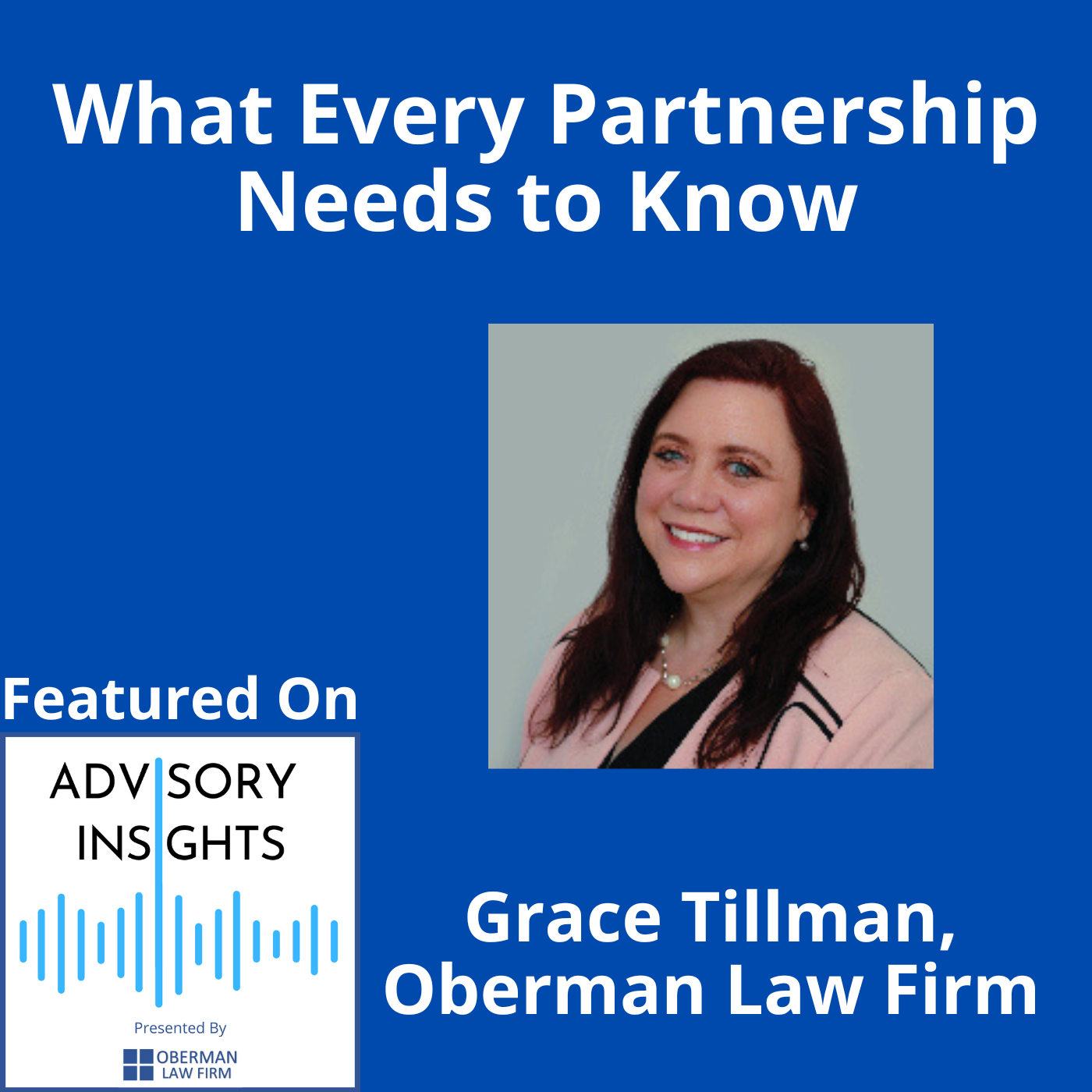
What Every Partnership Needs to Know, Grace Tillman, Oberman Law Firm
Advisory Insights Podcast
What Every Partnership Needs to Know
Loading
00:00 /
RSS Feed
Share
Link
Embed

Download file

What Every Partnership Needs to Know, Grace Tillman, Oberman Law Firm

What Every Partnership Needs to Know (Advisory Insights Podcast, Episode 12)

On this episode of Advisory Insights, Grace Tillman of Oberman Law Firm talked with Stuart Oberman about some of the key provisions that should be included in an operating agreement for a partnership, such as buy-sell provisions, redemption provisions, and dissolution provisions. Speaking from the experience of working with many other partnerships which have gone sour, the insights Grace offers in this episode could save you costly legal battles down the road.

Advisory Insights is presented by Oberman Law Firm and produced by the North Fulton studio of Business RadioX®. The series can be found on all the major podcast apps. You can find the complete show archive here.

Grace M. Tillman, Senior Corporate and Litigation Counsel, Oberman Law Firm

Grace Tillman
Grace Tillman, Senior Corporate and Litigation Counsel, Oberman Law Firm

Grace M. Tillman is Senior Corporate Counsel with Oberman Law Firm. For nearly 25 years, Ms. Tillman has represented small to large corporate clients in a wide variety of practice areas such as commercial litigation, real estate, health care, mergers & acquisitions, governmental compliance, and employment law.

Ms. Tillman provides guidance to clients regarding simple to complex labor and employment law matters, including the complexities of non-compete and non-solicitation agreements. In addition, Ms. Tillman also provides expert guidance on complex HR (Human Resources) issues, including specific employment matters involving the Americans with Disabilities Act (ADA); Family and Medical Leave Act (FMLA); the Age Discrimination in Employment Act (ADEA); and, the National Labor Relations Board (NLRB).

In the area of health care, which continues to evolve at the speed of light, Ms. Tillman’s experience includes oversight of hospital regulations, HIPAA Compliance, fraud and abuse, Medicare and/or Medicaid regulations, Anti-Kickback Statute, Stark Law, Telemedicine, state and federal insurance audits, and licensing board requirements.

Ms. Tillman has extensive litigation experience in federal, state, and appellate courts, as well as before administrative boards.

Ms. Tillman received her undergraduate degree in Business Management from Kennesaw State University, and Doctor of Jurisprudence from the University of Georgia School of Law. In addition, Ms. Tillman is licensed to practice law in Georgia and Tennessee.

LinkedIn

TRANSCRIPT

Intro: [00:00:01] Broadcasting from the studios of Business RadioX, it’s time for Advisory Insights. Brought to you by Oberman Law Firm, serving clients nationwide with tailored service and exceptional results. Now, here’s your host.

Stuart Oberman: [00:00:20] Welcome everyone to Advisory Insights. My name is Stuart Oberman of Oberman Law Firm. We have a fantastic guest with us today who’s going to cover some bombshell topics for those that are in a partnership. Grace Tillman, nice to see you today. How are you?

Grace Tillman: [00:00:38] Hi. Thank you for having me. I’m doing very well.

Stuart Oberman: [00:00:40] For those that don’t know Grace, Grace is our senior counsel at the firm, handles a lot of litigation, handles a lot of federal compliance issues, and loves and adores operating agreements, partnership agreements, everything that makes up a partnership.

Stuart Oberman: [00:01:02] Now, what we’ve got to take a look at is – Grace, you and I say this all the time – it is easy to get into a marriage, it is very difficult to get out. So, again, we could spend so much time on this one topic, but I want you to cover where are partnerships? You know, the buy-sell provisions, redemption provisions, dissolutions, majority of decisions. Who’s making that decisions? What’s the structure of this? And I know you solve a lot of problems in this area.

Stuart Oberman: [00:01:40] So, I want you to talk about some operating agreements, which is sort of like the constitution, if you will, in partnership agreements. But tell us really what’s going on, on some of these things, some of these things you’re running into and some of the problems. I know we could talk all day on this, but I want you to hit on a couple of things that really you’re running into all the time and what our listeners need to know.

Grace Tillman: [00:02:04] Sure. Sure. An operating agreement mostly are used with limited liability companies. They also can be used for partnerships. And while they’re not required, whenever there are two or more members in an LLC, like you said, like for a partnership, it is strongly recommended that you actually have an operating agreement which lays out what the member’s expectations are about what’s going to happen running and operating the LLC or partnership.

Grace Tillman: [00:02:32] But one of the most overlooked items that actually should be in every operating agreement is your exit strategy. I mean, of course nobody goes into a business, much like nobody goes into a marriage, thinking that it’s going to fail. Unfortunately, that does not always happen and people don’t always get along forever and ever, and then the company is passed on to their children.

Grace Tillman: [00:02:56] So, we need to have set in advance, while everybody is still friendly, it’s nice to set out what’s going to happen if the members no longer agree. What happens if one of the partners wants to retire? What happens if somebody dies or becomes disabled? So, these are all very important things to consider when entering into a partnership.

Grace Tillman: [00:03:23] So, some of the things that we see and we wish we would see because, oftentimes, like you said, they come to us because they don’t have a provision and people say, “Well, what do I do now?” And now we need to craft this on the backend when people aren’t in agreement or friendly and it winds up costing – I can’t even tell you how much more money to do it on the back side – because if everybody’s friendly, we can say, “Oh, yeah. It’s fair. Let’s split it this way.”

Grace Tillman: [00:03:49] But when you’re mad at somebody, it’s like a divorce and people are fighting over the dishes. Nobody wants the dishes. They just don’t want the other person to have the dishes. And so, that’s what we find out here.

Grace Tillman: [00:04:02] So, here are some provisions we like to see, some are optional, you can have maybe one or more. But a buy-sell provision, which you mentioned, buy-sell provisions are kind of like if you have two kids, they both want the cookie, and you’re asking them to split it. Somebody’s going to split it very evenly so that both people get an even share. What happens is one of the parties offers to either buy the interest of the other member in the company or sell their interest in the company for the same price.

Grace Tillman: [00:04:34] So, the offering party sets the price, says to the party that they’re trying to buy out, “Here, I would like to buy your interest for this amount.” Now, they’re going to give you a very fair and equitable amount because whatever they offered to buy your interest for, they also have to sell their interest at the same price. If the person who receives the offer says, “No, I don’t want to sell, but I would like to buy you out,” that becomes the set price. So, again, like I said, it becomes a very fair and equitable price because you’re not going to offer to buy somebody else out for $10 a share if you then had to sell your shares for $10. So, you will find generally that helps.

Grace Tillman: [00:05:20] And the problem is maybe sometimes people don’t want to buy or sell. So, now, we have some other options that are available. And one is a mandatory redemption by the company at a fair market value upon the occurrence of certain events. Fair market value is determined generally by the parties in advance. How they calculate that, it would be a predetermined valuation or formula such as an appraisal. And usually this is upon the occurrence of a specific event. Let’s say somebody wants to retire or they passed away or they become permanently disabled. We have a mandatory redemption in those situations at a set value.

Grace Tillman: [00:06:01] And the mandatory redemption, generally, is intended to maximize the value of the selling party, but also to preserve any interests that the company may have. And everybody is looking out for the best interests of both parties in this situation.

Grace Tillman: [00:06:18] Another mandatory redemption event could be upon the occurrence of other events. This time it’s a mandatory redemption at a reduced value. Now, this is usually used in a case where one of the members or a partner has engaged in some type of negative behavior, if you will, that could damage or has damaged the company, the partnership, or the other members of the company or partnership.

Stuart Oberman: [00:06:44] That never happens.

Grace Tillman: [00:06:45] It does happen. Things like this could be if you’re in a business that requires you to be licensed. Well, you’ve lost your license, you’ve done something, it might be some type of negligence, or it could be just some type of administrative error. But you’ve lost your license and now you can’t practice in whatever field that might be. It could be dentistry, medicine, the law practice, engineer, there’s lots of things. Don’t pay those bar dues and see what happens [inaudible].

Grace Tillman: [00:07:16] Other things that could be, maybe one of the members got arrested or indicted or convicted of a crime, and now you don’t want to be associated with them. Or maybe they have materially violated the terms of your partnership or operating agreement. They could have committed fraud or embezzlement. Well, in this instance, the company has a mandatory or a right to purchase the interest of this defaulting member, if you will, at a reduced value. And you can set those reduced values, it might be 75 to 50 percent of the appraised value or it could be the value determined by a specific formula.

Grace Tillman: [00:07:54] Oftentimes, we’ll see these, “We’re going to buy you back, but we’re giving you nothing for goodwill because you did your best to damage it.” So, you don’t get anything for that. You’re going to get a value of assets only.

Grace Tillman: [00:08:05] Another option, there could be mandatory dissolution of the company where everybody gets liquidated. We’re at loggerheads. We’re the complete stalemate. We can’t agree with one another. Fine. Business is over. You don’t want to agree with me. You don’t want to work with me. Then, we’re both packing up our toys and we’re going home.

Stuart Oberman: [00:08:22] I got a question for you on the cases that you work on. You mentioned fraud, so percentage-wise – and it’s maybe a little bit hard to do – but the cases that you and I work on, you work on and the office works on, how many do you think involve fraud when, basically, one partner wants to get out of the marriage, if you will.

Grace Tillman: [00:08:50] It’s actually more than you would think. But to answer the question, in true lawyer fashion I’m coming back with a question, well, how do you define fraud? Because some people, it’s intentional fraud. Other people, it’s unintentional fraud. “Oh, wait. We weren’t supposed to be doing this. I didn’t know I wasn’t allowed to be running my mortgage through the business. Wait.” But it can be a higher percentage than you think. And, again, sometimes it’s minor fraud, something little. Other times it’s a big deal. It can be something that potentially, again, if you’re in a licensed business, could put your license at risk what your partner is doing, especially if the fraud involves your client.

Stuart Oberman: [00:09:36] Well, it’s funny. A lot of businesses as a whole, like embezzlement, that’s a little bit different than what we’re talking about. But embezzlement is about 60 percent of all businesses. I’m just thinking out loud here, that may be another topic that we cover on what to do if you suspect your partner is defrauding you. That’s a whole internal investigation.

Grace Tillman: [00:10:05] It is something that is totally different, and it is absolutely a problem.

Stuart Oberman: [00:10:08] We may look at that down the road. But I’m sorry, I got off track. I’m sorry to interrupt you.

Grace Tillman: [00:10:15] No, no, no. And, again, I think that’s very important. I think it’s worthwhile exploring because I think that our clients, our listeners, everybody would benefit from that knowledge because it happens, like I said, much more often than you think it does.

Grace Tillman: [00:10:28] So, we were talking about mandatory dissolution or sale of a company in the event that the members of the partners reach a stalemate. Again, it’s set out in advance. If we’ve reached a point where we cannot agree anymore, and this is a situation, honestly, when you reach it, you don’t want to be in business with this other person anymore because you’re just fighting.

Grace Tillman: [00:10:51] It’s like the point in the marriage where all you do is fight and everybody knows it’s over. And that’s where you are, and you’re saying, “We need to call an end to it. I’m not going to continue the business without you. You’re not continuing the business without me.” And there could be any number of reasons why that may happen, but we’re done and we’re either going to sell or liquidate.

Stuart Oberman: [00:11:14] Now, you mentioned something going on. I keep going back because you’ve said so much information. I’m trying to absorb it all. I’m thinking from what our clients would say, but you mentioned something along these lines of what we call a put call option as far as sale goes.

Grace Tillman: [00:11:34] Right. That was the first one, kind of like the buy-sell. Say, I’m either going to buy you out or you’re going to buy me out. But either way, one of us is leaving at the end of this deal.

Stuart Oberman: [00:11:43] So, how many of those put call options do you see? I know the ones that I’ve looked at they’re pretty nasty.

Grace Tillman: [00:11:53] A lot of times they are, and they’re usually a whole lot nastier if they’re not equal partners and they’re drafted in a way that gives the majority partner maybe a little more push. Because somebody’s got to come up with a whole lot of money, cash at closing to buy out a partner, that becomes harder to do. But they can be nasty.

Grace Tillman: [00:12:19] Again, if they’re drafted in advance when everybody is still friends or they think the business is going to be continuing for a longer period of time, they’re not. But my recommendation is they should be in every operating agreement, whether you exercise the option or not, I think that you should have, if not that exit strategy, you need to have something. And you need to have something that addresses what happens when the parties, maybe, reach deadlock or stalemate.

Grace Tillman: [00:12:48] And first step maybe isn’t selling. There’s lots of other options that you and your attorney can work and come up with creative options, things that range from mediation to arbitration, and who do we select, do we defer to a third party, can we go to an expert and get an opinion if we disagree. There’s a whole lot of things you can put into an operating or membership agreement or partnership agreement short of shutting everything down, buying one party out. But, again, we’re just talking exit strategy. So, we’ve reached the point where we’re done and the parties aren’t going to continue anymore in this business.

Grace Tillman: [00:13:28] Kind of sort of the last one I want to touch on – and I know we don’t have a tremendous amount of time to talk about all of them because I could go on for hours.

Stuart Oberman: [00:13:35] This is a week long seminar. Are you kidding me?

Grace Tillman: [00:13:37] It could be. It could be. And I have actually spent daylong seminars just talking about operating agreements. So, the last one would be if there is a majority member or partner where one party is disproportionately greater invested in the business, a lot of times we’ll see in an operating agreement or partnership agreement where that member, that majority member, has a right to buy out the minority member if they can’t agree anymore. It’s like, “We’re not going to be in business anymore, but here it is.”

Grace Tillman: [00:14:09] And the formula is established in advance so that the minority member actually enters into the partnership or limited liability company knowing what their payment is on the backend. It’s not that the majority member can squeeze them out and say, “I am going to pay you $0.10 per membership unit that you own.” No. It’s going to be some version of a more equitable, fair market value for the minority member’s interests. And, again, it would be before the minority member entered into the business. They would know what they were getting when they were coming out, if the parties couldn’t agree.

Grace Tillman: [00:14:45] I know we talked about this briefly, and I know I really kind of flew through a bunch of these, but if there’s not an exit strategy in place – which I see a lot – and the members can agree on how to terminate or wrap up their business or what to do, you can be looking at a very costly legal battle for both parties.

Grace Tillman: [00:15:10] And when I talk about a costly legal battle, I’m not just talking about the financial cost because there is a whole bunch of work that goes into creating a business, and a lot of that comes with an emotional component. And when you’re watching that be unsuccessful or dismantled, there’s a cost to that that a lot of people don’t realize. And you don’t want to be in a position where you no longer wish to be associated professionally with someone and you’re forced to still be there.

Stuart Oberman: [00:15:44] Wow. That’s amazing information. Well, I want to mention one other thing, is that, how in tuned you are into the employment side and partnership agreements. And I know we come to the end of our podcast for this particular topic, but you have another podcast that you’ll be doing for the firm regarding EEOC, which I can’t wait to share with our business partners, we have local, national, and some global clients. But you’re also speaking on October 27th for SHRM-Atlanta. So, that’s going to be a great event.

Stuart Oberman: [00:16:30] Again, it’s a great honor because you’ve been in the forefront of what’s going on as far as employment law goes. And I know you did an enormous job during COVID-19, keeping everyone informed by the hour, including us at the firm.

Stuart Oberman: [00:16:43] But in closing, is there anything you want to add on that 10,000 foot view of getting into a marriage and getting out?

Grace Tillman: [00:16:55] Well, it’s much like a pre-nup. If you enter into an agreement or into a business relationship or a romantic relationship, and everybody knows what happens if things go south, you are going to save money, you are going to save time, you are going to save aggravation. And best of all, you have some certainty. You’re not wandering around lost wondering what happens now. You know what happens.

Stuart Oberman: [00:17:21] Perfect. I agree. Grace, thank you so much for joining us today. I can’t wait to hear your subsequent podcast on EEOC’s investigations.

Stuart Oberman: [00:17:32] Ladies and gentlemen, thank you for joining us. If you want to reach Grace Tillman, please feel free to email her at grace, G-R-A-C-E, @obermanlaw.com Phone number 770-886-2400. Thank you again, Grace. It was great having you. Ladies and gentlemen, thanks. Have a fantastic day. And we look forward to our next podcast. Thank you.

Outro: [00:17:56] Thank you for joining us on Advisory Insights. This show is brought to you by Oberman Law Firm, a business-centric law firm representing local, regional, and national clients in a wide range of practice areas, including health care, mergers and acquisitions, corporate transactions, and regulatory compliance.


About Advisory Insights Podcast

Presented by Oberman Law Firm, Advisory Insights Podcast covers legal, business, HR, and other topics of vital concern to healthcare practices and other business owners. This show series can be found here as well as on all the major podcast apps.

Stuart Oberman, Oberman Law Firm

Stuart Oberman
Stuart Oberman, Founder, Oberman Law Firm

Stuart Oberman is the founder and President of Oberman Law Firm. Mr. Oberman graduated from Urbana University and received his law degree from John Marshall Law School. Mr. Oberman has been practicing law for over 25 years, and before going into private practice, Mr. Oberman was in-house counsel for a Fortune 500 Company. Mr. Oberman is widely regarded as the go-to attorney in the area of Dental Law, which includes DSO formation, corporate business structures, mergers and acquisitions, regulatory compliance, advertising regulations, HIPAA, Compliance, and employment law regulations that affect dental practices.

In addition, Mr. Oberman’s expertise in the healthcare industry includes advising clients in the complex regulatory landscape as it relates to telehealth and telemedicine, including compliance of corporate structures, third-party reimbursement, contract negotiations, technology, health care fraud, and abuse law (Anti-Kickback Statute and the State Law), professional liability risk management, federal and state regulations.

As the long-term care industry evolves, Mr. Oberman has the knowledge and experience to guide clients in the long-term care sector with respect to corporate and regulatory matters, assisted living facilities, continuing care retirement communities (CCRCs). In addition, Mr. Oberman’s practice also focuses on health care facility acquisitions and other changes of ownership, as well as related licensure and Medicare/Medicaid certification matters, CCRC registrations, long-term care/skilled nursing facility management, operating agreements, assisted living licensure matters, and health care joint ventures.

In addition to his expertise in the health care industry, Mr. Oberman has a nationwide practice that focuses on all facets of contractual disputes, including corporate governance, fiduciary duty, trade secrets, unfair competition, covenants not to compete, trademark and copyright infringement, fraud, and deceptive trade practices, and other business-related matters. Mr. Oberman also represents clients throughout the United States in a wide range of practice areas, including mergers & acquisitions, partnership agreements, commercial real estate, entity formation, employment law, commercial leasing, intellectual property, and HIPAA/OSHA compliance.

Mr. Oberman is a national lecturer and has published articles in the U.S. and Canada.

LinkedIn

Oberman Law Firm

Oberman Law Firm has a long history of civic service, noted national, regional, and local clients, and stands among the Southeast’s eminent and fast-growing full-service law firms. Oberman Law Firm’s areas of practice include Business Planning, Commercial & Technology Transactions, Corporate, Employment & Labor, Estate Planning, Health Care, Intellectual Property, Litigation, Privacy & Data Security, and Real Estate.

By meeting their client’s goals and becoming a trusted partner and advocate for our clients, their attorneys are recognized as legal go-getters who provide value-added service. Their attorneys understand that in a rapidly changing legal market, clients have new expectations, constantly evolving choices, and operate in an environment of heightened reputational and commercial risk.

Oberman Law Firm’s strength is its ability to solve complex legal problems by collaborating across borders and practice areas.

Connect with Oberman Law Firm:

Company website | LinkedIn | Twitter
Tagged With: dental practices, dissolving a partnership, Grace Tillman, Oberman Law, Oberman Law Firm, operating agreements, Partnership, Stuart Oberman

Decision Vision Episode 101: Should I Enter Into A Business Partnership? – An Interview with Kenji Kuramoto and Matthew May of Acuity

January 28, 2021 by John Ray

business partnership
Decision Vision
Decision Vision Episode 101: Should I Enter Into A Business Partnership? - An Interview with Kenji Kuramoto and Matthew May of Acuity
Loading
00:00 /
RSS Feed
Share
Link
Embed

Download file

Decision Vision Episode 101: Should I Enter Into A Business Partnership? – An Interview with Kenji Kuramoto and Matthew May of Acuity

How do you put together a successful business partnership when the company has already been around for quite a few years? Kenji Kuramoto and Matthew May, co-owners of Acuity, join host Mike Blake to discuss why their partnership came together, why it’s worked for them and their company, stress points they’ve had to navigate, and much more. “Decision Vision” is presented by Brady Ware & Company.

AcuityCFO, LLC

Acuity was started in 2004. Founder Kenji Kuramoto built a CFO practice knowing he could help businesses by giving them the financial tools and advice they needed to reach their full potential. Along the way, he discovered that their clients had additional financial needs, including simple bookkeeping services. Acuity realized they could better serve small businesses and challenged themselves to expand their offerings.

In 2013, Matthew May joined Kenji, and Acuity was relaunched as a full-service financial firm, tackling everything from invoicing and bill pay to industry-leading financial strategy. As accounting experts, Acuity excels at pairing sound financial advice with modern technology, and they only consider themselves successful when they deliver practical accounting solutions that allow their clients to keep growing.

From balancing the books to assisting in a first acquisition, Acuity built its foundation on meeting clients where they are and helping them take the next step — wherever that may lead.

Connect with both Kenji and Matthew on Twitter:  Kenji Kuramoto | Matthew May

Mike Blake, Brady Ware & Company

Mike Blake, Host of the “Decision Vision” podcast series

Michael Blake is the host of the “Decision Vision” podcast series and a Director of Brady Ware & Company. Mike specializes in the valuation of intellectual property-driven firms, such as software firms, aerospace firms, and professional services firms, most frequently in the capacity as a transaction advisor, helping clients obtain great outcomes from complex transaction opportunities. He is also a specialist in the appraisal of intellectual properties as stand-alone assets, such as software, trade secrets, and patents.

Mike has been a full-time business appraiser for 13 years with public accounting firms, boutique business appraisal firms, and an owner of his own firm. Prior to that, he spent 8 years in venture capital and investment banking, including transactions in the U.S., Israel, Russia, Ukraine, and Belarus.

Brady Ware & Company

Brady Ware & Company is a regional full-service accounting and advisory firm which helps businesses and entrepreneurs make visions a reality. Brady Ware services clients nationally from its offices in Alpharetta, GA; Columbus and Dayton, OH; and Richmond, IN. The firm is growth-minded, committed to the regions in which they operate, and most importantly, they make significant investments in their people and service offerings to meet the changing financial needs of those they are privileged to serve. The firm is dedicated to providing results that make a difference for its clients.

Decision Vision Podcast Series

“Decision Vision” is a podcast covering topics and issues facing small business owners and connecting them with solutions from leading experts. This series is presented by Brady Ware & Company. If you are a decision-maker for a small business, we’d love to hear from you. Contact us at decisionvision@bradyware.com and make sure to listen to every Thursday to the “Decision Vision” podcast.

Past episodes of “Decision Vision” can be found at decisionvisionpodcast.com. “Decision Vision” is produced and broadcast by the North Fulton studio of Business RadioX®.

Visit Brady Ware & Company on social media:

LinkedIn:  https://www.linkedin.com/company/brady-ware/

Facebook: https://www.facebook.com/bradywareCPAs/

Twitter: https://twitter.com/BradyWare

Instagram: https://www.instagram.com/bradywarecompany/

TRANSCRIPT

Intro: [00:00:01] Welcome to Decision Vision, a podcast series focusing on critical business decisions. Brought to you by Brady Ware & Company. Brady Ware is a regional, full service accounting and advisory firm that helps businesses and entrepreneurs make visions a reality.

Mike Blake: [00:00:21] Welcome to Decision Vision, a podcast giving you, the listener, clear vision to make great decisions. In each episode, we discuss the process of decision making on a different topic from the business owners’ or executives’ perspective. We aren’t necessarily telling you what to do, but we can put you in a position to make an informed decision on your own and understand when you might need help along the way.

Mike Blake: [00:00:40] My name is Mike Blake, and I’m your host for today’s program. I’m a director at Brady Ware & Company, a full service accounting firm based in Dayton, Ohio, with offices in Dayton; Columbus, Ohio; Richmond, Indiana; and Alpharetta, Georgia. And Brady Ware is sponsoring this podcast. This podcast is being recorded in Atlanta per social distancing protocols. If you like this podcast, please subscribe on your favorite podcast aggregator, and please consider leaving a review of the podcast as well.

Mike Blake: [00:01:07] So, today we’re going to talk about the decision of entering into a business partnership. And I feel I need to do a little bit of a preamble to this, because if you’ve been listening to the show or if you can count, you know that this is episode number 101 that we are recording. So, we just passed the century mark and we’re very pleased about that, and we’re pleased that people choose to listen. There are lots of things you can do on the Internet, and we’re glad that you decided to make us one of those things.

Mike Blake: [00:01:41] But we are going to kind of change the tenor of the show just a little bit. Now, we’re not going to go away from talking about individual business decisions, that’s why we do this. And, frankly, I can’t think of anything interesting that I could talk about with others or with you for a 45 minute period. But we are going to do something a little bit different because we are always looking to improve, of course. And that is, most of our guests up to this point have been expert advisors. And look, there’s nothing wrong with that. I consider myself an adviser. Some of my best friends are expert advisers. Our guests are, in fact, expert advisors, although they’re not coming on the show today necessarily in that capacity.

Mike Blake: [00:02:29] But I do think there’s value to having a conversation, not just with an expert about a particular decision, but somebody who has actually done it. Somebody who actually had to pull the trigger, do the analysis or not, and live with the results, whatever they may be, positive or negative, because I think that’s just a different perspective. And so, that’s going to mean two things in addition to the fact that the nature of our guests will change. Now, we’re still going to have experts on, don’t worry about that. But, also, I’m not going to be afraid necessarily to repeat a topic, because if I think that somebody has a different take on a topic and everybody comes into a decision with a different background and a different bias and, frankly, a different set of priorities and circumstances, you can have, I think, a constructive interview or conversation multiple times about the same topic and learn something different.

Mike Blake: [00:03:30] So, if you come on, you start to see these episodes, download into your phone or your computer or you look on our website, and you see repeats, don’t worry. We haven’t all of a sudden become a skipping record. But simply that we’re changing the tenor of the show, that we’re just not going to be afraid to go back and look at the same topic from a different angle. And, as you know, we can’t cover everything that we would like to in a 45 minute period. There are times when we could have easily had a three hour conversation. So, I hope you’ll agree with that. I think that’s going to be an improvement to the show.

Mike Blake: [00:04:05] Finally, a bit of housekeeping. We looked at our numbers today – really, I looked at them for the first time in a long time – and in addition to now 101 shows, I learned that we have now exceeded 15 million downloads and we’re getting into 25,000 to 30,000 downloads in the first 30 days territory, which puts us in the top 2 percent of all podcasts. And I just want to take a moment to acknowledge everybody that has made that possible.

Mike Blake: [00:04:38] I’m the front man, the ugliest one we could possibly find. But between Brady Ware’s support of the show – and I’ve mentioned this before, they’ve given me a blank check – they don’t tell me what to say or not to say. They don’t tell me what to talk about or not to talk about. I’ve been critical of my firm on occasion on the show. And it’s to their credit, they allow me to do that. Maybe it means they haven’t listened, but I’m just going to take the sunny side of the equation. You know, our marketing department has done a great job with us. Our business partner, Business RadioX, has helped get the show exposure that it could not have obtained organically.

Mike Blake: [00:05:13] And our guests that have devoted their time to being on the show. You know, me speaking into a microphone, that’s bad radio, even by Internet standards. And so, having guests that are willing to come on and take time out of their busy day to be on the show, you know, there is no show without them. So, as you can tell, this is a massive team effort.

Mike Blake: [00:05:32] And then, finally, you, the listeners. The listeners that have tuned in and have commented, have left reviews, and helped the show get out to help other people. Again, if there’s no listeners, I may just as well speak into this microphone turned off. And that’s not really my jam. So, I just wanted to acknowledge that the show has come a long way in under two years, and we hope for even better and more powerful things in the year ahead. All right. Stump speech over.

Mike Blake: [00:06:07] Today, we’re going to talk about this decision about entering in a business partnership with two longtime friends, Kenji Kuramoto, who is Chief Executive Officer, and Matthew May, who is Vice-president of Sales and Marketing, of Acuity, which is an Atlanta based firm that provides a wide array of accounting related support services. And they’ll probably correct me in how I’m describing it, but that’s the way that I described it. And I’ve known them before they’re in this partnership. And they’ve been in this partnership for a bit now.

Mike Blake: [00:06:40] And just as one person observer, you know, I think they are the fastest growing accounting services firm, certainly from an organic standpoint in the Atlanta market. There may be a couple of others that have exceeded them because they’ve gone on a massive acquisition spree. But in terms of organic, I mean, these guys are just killing it. You see them on social media, it’s all smiles. They don’t look like accountants. They almost make me want to be an accountant, except I’m a lousy accountant myself. But what I want to do is, I want to find out about these guys and what makes their partnership tick. It seems to work so well, but we’ll find that out. Maybe there’s dirty laundry that’s going to be aired right on the show. Kenji and Matthew, thank you for coming onto the program.

Kenji Kuramoto: [00:07:25] Happy to be here, Mike.

Matthew May: [00:07:27] Thanks for having us, man.

Mike Blake: [00:07:28] So, I’d like you guys to talk about your origin stories. I’m going to just invoke my inner nerd here. You know, before you became partners of Acuity, what were the tracks that kind of led you up to that point? Kenji, let’s start with you.

Kenji Kuramoto: [00:07:45] Sure. So, coming out of college with an accounting degree, I did what I thought everyone was supposed to do, you go work in big global public accounting. So, my first stop was in the Atlanta office of Arthur Andersen. You know, that firm that people used to know about that –

Mike Blake: [00:08:01] I remember them.

Kenji Kuramoto: [00:08:02] Crazy things happened too. I was in their audit practice for about four, almost five years. I got out before that crazy Enron thing or whatever happened, but it was during the dot com kind of the initial kind of take off back around 2000. So, I jumped over to a technology services company who I thought was going public because that’s what everybody did back then, was to go public.

Mike Blake: [00:08:31] Absolutely.

Kenji Kuramoto: [00:08:31] I went over as their controller, ultimately became their CFO after the bubble burst. And so, I was a young CFO for about three or four years at a technology company in Atlanta called Intelenet. And that’s actually after Intelenet got together with, actually, another former business partner – so I’m sure we’ll talk about that later – to start Acuity. And that was around ’04, and ran that up for a number of years, bought out my other partner, ran it by myself for a little while – which is an interesting period – and quickly got Matthew to come join up with Acuity.

Mike Blake: [00:09:10] All right. So, let’s put a pin on that. And now, we’ll do a screen wipe here. Matthew, what about your origin story? What radioactive insect bit you to become the man you are today?

Matthew May: [00:09:22] Well, first, I’m a lot younger than Kenji. Let’s just get that out there. Everybody thinks Kenji is younger than me, but I am a lot younger than Kenji.

Mike Blake: [00:09:30] I didn’t want to have to be the person to say it.

Matthew May: [00:09:32] It’s like a-year-and-three months, I think, he’s older than me. And he’s, like, not just – because this is how he bicker. He’s like ‘You’re older than me. It’s a-year-and-three months.” So, I went to Baylor University. I was an accounting grad. I did the same thing, I went to Big Six right out of college. I did do a little more kicking around Big Six than Kenji did. I switched firms once. I did a startup in ’99, where I was the controller. I was like the 11th hire. We ended up selling that right before the bubble burst for cash instead of stock, which was really smart. You know, that’s one of the days when a million dollar revenue company could sell for $100 million dollars, which was kind of crazy.

Matthew May: [00:10:18] I worked for the Fortune 500 company, [Levanos], it was like the 15th largest company in the world or something at the time. I think we used to call it Fortune 15. I learned about kind of working in a big environment in the shared service center. I actually came back to public accounting. Then, when I moved to Atlanta, I switched from Ernst and Young, where I’d been almost ten years, to Cherry Bekaert, where I made partner. And then, I decided to become a recovering auditor, which, I really am a fan of recovering auditors out there. I sympathize with you. So, we’re a large and growing group. And, you know, what was seven or eight years ago, I joined up with Kenji and bought half of Acuity from him. And the rest, as they say, is history.

Mike Blake: [00:11:06] So, Matthew, you brought up something I’ve always wanted to ask you about and, finally, I get the chance. And that is, I mean, you accomplished what many in public accounting spend their entire lives trying to accomplish is to make partner in a significant firm. Although Cherry Bekaert is not a Big Four, it is a significant – I don’t know what size rank it is, but it’s bigger than my firm.

Matthew May: [00:11:33] It’s number 25. It’s a top 25 at the time. I think it’s somewhere between 20 and 25 today. It’s a big firm with smart people that challenged me that we’re great. It was a wonderful experience to be able to do that. That was a great achievement.

Mike Blake: [00:11:53] So, you do that, right? And I mean, when you reached partner – I haven’t done it myself. I think many people feel like you’re sort of at the top of the steps of the Philadelphia Museum in Rocky. You sort of put your hands up and there’s music going on in the background. That’s the top of the profession, unless you get to managing partner, et cetera. You do that and then, really, in my mind, not that long afterwards, just say, “I’m going to go hang with Kenji and do what he’s doing.” What was in your mind that said once you kind of accomplished that thing, you’re like you’re just going to do something else?

Matthew May: [00:12:37] Well, it’s kind of like the analogy I give when tech clients, like, raise money. Like, it’s not the destination. So, making partner is not the destination in accounting. Although, in your early years, your first ten years or 15 years period, that’s all you go for. If you split your career up and when I reflected on it, that was like basically saying, “Now, I have to make the decision. Do I want this to be my career for the next 20 years?” So, this is kind of like when you raise money in a tech firm, raising money is not the thing. It’s what you do with that money is how you’re judged and things like that. And I did some reflection – and we’re going to get into the story a little bit – when this opportunity came up and I did what do I want the next 20 years to look out and went this way instead of sticking with it.

Mike Blake: [00:13:32] And I promise we’ll get to the actual topic, but I do got to ask sort of a follow up. In my view, being partner now is not the same as it was 25 years ago. My father was a partner in Ernst & Young in the Boston office, and he was there forever until Sarbanes-Oxley, basically, killed his business overnight. But, you know, I think, in our generation – and I’m older than Kenji so maybe I’m painting this with a too broad a brush but bear with me. I think in our generation just becoming a partner at a CPA firm is just different. I’m not going to say it’s better or worse, but I think the experience itself is different. Would you agree with that?

Matthew May: [00:14:12] I would agree with that. But I think there’s just part of it there’s a little bit of mystique to it as well that once you get there, you realize, “Oh, do I want this to be my career? Or was I just a type A? Like, I have been told all my life you need to make partner,” right? I left public and came back so I could make partner. I think I left for four years.

Mike Blake: [00:14:36] So, you have these two tracks. Interestingly, both of you came in from partnerships in one way or another – I didn’t think of that until just now. But one way or another, you decided that another partnership was a good thing. So, talk about the story, how did you become business partners? Who asked who out first? Who said I like you first? How did that all sort of work out?

Kenji Kuramoto: [00:15:03] I’ll tell this one. I love telling this one. It’s a distinct possibility, Mike, you may have been almost in the room or very close by when this was happening, because this actually occurred at – we used to host this Acuity friends and clients kind of party at the end of every year. Actually, we wait until January –

Mike Blake: [00:15:28] I’ve been to one of those.

Kenji Kuramoto: [00:15:28] – just after the holidays. Yes.

Mike Blake: [00:15:29] Those are mad joint, man. I’ve been to one of those.

Kenji Kuramoto: [00:15:33] That’s right. And so, the funny thing was because all of our friends and clients, all of our friends are other accountants. Honestly, you look around the room and there’s just a whole bunch of our other fellow accountants who are friends there that we’re referral partners and such. And we always have it at a local watering hole in Atlanta. Taco Mac from back in the day, they let us use that, they were a client. And, honestly, we get after a whole bunch of beer and hang with a bunch of our friends. And so, at one of those events, Matthew, of course, was there. Again, Mike, you may probably be in the room somewhere.

Kenji Kuramoto: [00:16:07] And he and I, after maybe a few beverages, started sort of talking about it more. And I had already at this point bought out my former business partner. And Matthew and I had been friends. We had Falcons tickets together. And so, it was certainly good to see him. But we stepped outside, kind of January in Atlanta, out of this kind of little speakeasy little bar kind of area and, you know, trying to clear my head a little bit. But I said, “Listen, this is hard. This is hard going alone and this is tough stuff.” And Matthew is always interested in what we were doing over at Acuity. He’s kind of inquiring. And just like you had pointed out earlier, with him grabbing that kind of partnership brass ring, you know, I’m thinking, “Oh, he’s found that lifelong career piece.” But I’m kind of in his ear a bit like a, “Ha. Ha.” I turn away from that like, “I could really use you over here at Acuity.” And I always remember – do you remember what you said, Matthew, when I was joking, like, “You should come work with me.” What you said?

Matthew May: [00:17:03] I probably said, “Don’t joke around about stuff like that.”

Kenji Kuramoto: [00:17:07] Don’t joke around. He said, “Don’t joke about that.” I thought, “Wait a minute. Is this guy actually, like – come on. He’s not really considering. He’s a partner at a great firm.” But that’s actually how it started outside after many beers at one of our annual events. Just kind of talking about the work –

Matthew May: [00:17:28] I was interested. He was drunk. I was actually leaving to go home early and he was already in. So, when he was walking me out, like, I thought he was just being nice and walk around as we went out.

Mike Blake: [00:17:40] He was walking you home, basically.

Matthew May: [00:17:44] He did. I think he even had his arm around me.

Kenji Kuramoto: [00:17:46] I made my move right there. I knew he was vulnerable.

Mike Blake: [00:17:49] So, is the key to initiating a partnership is there should be alcohol involved? Is that a learning point from this conversation?

Matthew May: [00:17:57] For at least one of the people over in his end –

Kenji Kuramoto: [00:18:00] Well, I will say –

Matthew May: [00:18:02] I mean, you do have to ask.

Kenji Kuramoto: [00:18:03] It stayed a recurring theme in our partnership. We certainly enjoy that time together having a beer for ourselves.

Mike Blake: [00:18:13] And you know, that part, I think, is important all joking aside, you know, especially at the outset. I think you may have added a partner since then. I’m not sure. But at the outset, if it’s just the two of you guys, you know, you better enjoy spending time together because you’re going to be doing a lot.

Kenji Kuramoto: [00:18:32] That is for sure. For sure.

Mike Blake: [00:18:40] So, I’m guessing that then because of the – well, no. I’m not going to guess anything. I’ll let you answer the damn question. After you guys had decided that a partnership was a possibility, something that is potentially desirable, what were the steps after that? I mean, it’s one thing to have – and I can speak from experience – it’s one thing to have Falcons tickets with somebody. It’s another thing to make them your business partner and place your livelihood in their hands. And so, was there any kind of vetting process, a feeling out process, anything that happened after that one initial date? Or did you rush right to Vegas and and go to the chapel?

Matthew May: [00:19:24] Wow. So, yeah, we had some interesting discussions. So, we used the same attorney to draft the documents. We did it in relatively short order as far as the fielding points I did take. After we kind of have this kind of mapped out, I did go back to Cherry Bekaert and talk about what my long term thing looks like there so I could make a decision and figure out what was going on. So, that took probably 30 days. And then, I ended up having a 90 day stick to my contract where my partnership agreement required me to stay 90 more days after that.

Matthew May: [00:20:02] But we had some great discussions. I think we got, like, the bigger points done in about an-hour-and-a-half, probably, at a Mexican food restaurant about a week later — to what ends up there. But we had some funny discussions in there, some things that would probably say a lot to us. Like, I initially wanted the deal to be 40.95 to 50.5 or 49.51. And Kenji was adamantly opposed to that. I mean, I was going to take the minority. And Kenji was adamantly opposed to that because in his previous partnership they had been not 50/50. So, we were negotiating each other backwards. It was weird. So, it was kind of some odd discussions. That was the oddest one for me. I was like, “You know, I think I need to have 49 percent.” And you’re like, “Nope. Not doing that.”

Mike Blake: [00:20:57] So, Kenji, why was that important to you? And I’m really sort of drilled down on this because there’s a lot of common wisdom out there that says that a 50/50 partnership is a bad idea. In fact, I make a lot of money helping 50/50 partnerships unwind, unfortunately. Hopefully, that will never be the case with you guys. But why did you want to do that?

Kenji Kuramoto: [00:21:20] Like Matthew mentioned, part of that had been from previous experience. I had bought out a previous partner, he was the majority and I was the minority partner. And that ended very amicably. That partner is still a friend of mine today. He’s a huge supporter and cheerleader for Acuity. But that was always something that was challenging for me as a minority partner of just feeling like we were imbalanced. And even my previous partner realized that, too. He felt like it was difficult too. Kind of as time progressed, we felt like that should have evened out a bit more. But just some of the mechanics of equity made that challenging.

Kenji Kuramoto: [00:22:02] And so, I had that experience of not feeling equal, even though we tried our best to operate that way, we did a pretty good job operating as equals. That said, I knew kind of in my heart of hearts coming into this the next time around that I wanted to make sure we were equally kind of hitched up and yoked on this one. Like, it just wanted that all of our decisions that you can never kind of look at one another and go, “Well, of course, you like it this way because that benefits you.” So, that was after, I guess – gosh – eight, nine years. So, I had a little bit of experience under my belt. I had a short window of time, about a year of doing it solo, which I thought was going to be fantastic. And I ended up coming away from that going, “That’s terrible. I hate it. It was awful.” I mean, the business was just on a downhill trajectory, which is probably why I was out drunk begging Matthew, “Please help me.” Everyone thinks this is going great. I’m struggling here.

Kenji Kuramoto: [00:22:57] So, I knew I needed a partner. And I needed a partner, you know, one that I just could feel completely vulnerable with. And likewise, he should too. And I think having that aligned equity, a perfectly aligned equity, was at least one way to make sure we didn’t get on different pages.

Mike Blake: [00:23:14] So, let me follow up on that, what is it that you felt that you’re missing at the time that Matthew was the solution to?

Kenji Kuramoto: [00:23:23] So, it was interesting because being such good friends – and, actually, Matthew and I were really strong referral partners, that was another thing we actually talked about was, “Wait a minute. Are we better together or apart?” Because we do a lot to help each other as referral partners in each other’s firms. And we got over that and realized we think we’re better together.

Kenji Kuramoto: [00:23:50] But when I bought out my previous partner, I had a number of ideas that I wanted to kind of get rolling that I thought could be beneficial for the startup business community, and entrepreneurs, and for us as a firm. And I had some good foresight on that and got some of those going, but, essentially, created another line of business that operated very different from the traditional CFO services that we were providing. And I just failed to take into account that we’re really kind of running almost two different business models and businesses. It just doubled kind of the workload. I’m still trying a little bit to manage. Should I be out there billing myself as the owner, doing all those things, that I’m actually working on the business? And all those are kind of happening at once, realizing that I need some help.

Kenji Kuramoto: [00:24:35] I had tried empowering a couple of our other more senior employees to say, “Hey, maybe I can get them to help share some of this management strategy kind of leadership load.” And it didn’t work. And so, I realized like, “Okay. This may be a good idea of this new direction line of business we’re going in.” I don’t think I can get it off the ground. There’s just not enough hours to the day for me to pour into it, to try to keep the other lines of business going, to keep cash flow in the firm going enough. So, it was, I needed someone else who saw the vision – and this is something Matt and I talked about what we were building and believed in it. It just had the energy and some of that. Not just an employees vision of like, “Hey, that sounds good. If you pay me a salary, I’ll do it.” It was a, “No. I’m a believer. I’m willing to stake some of my reputation and some equity in this thing to go forward.” And so, that’s where I knew I needed help there. And Matthew was the perfect one to bring in to do that.

Mike Blake: [00:25:33] So, Matthew, on your side, you know, what was it that made you so attracted to this particular partnership? Because a guy as capable as you with your pedigree, you could have done a lot of things. You could have flown a lot of airlines, but you chose to fly Acuity. And Kenji, what made that attractive to you?

Matthew May: [00:25:59] Well, the sad reality of being a partner at a bigger firm is that you have to deal with bigger clients. And I’ve always had that passion for the smaller clients, the million dollar revenue clients, not the $100 million revenue clients. You come and do their audit like it’s a check-a-box thing, you know. We add any value. And I felt like I’ve always enjoyed just getting in the ecosystem. Being in a lot of businesses, helping out a bunch, and helping five or six $100 million clients versus how could we help one hundred startups. You know, like, do things better just got my juices flowing.

Matthew May: [00:26:39] And then, when kind of the other things kind of – I did a bunch of checklist stuff about the pros and cons of keeping with this joker. But one of the couple of things that I – and my dad is an entrepreneur so I talked to him a lot. He had two failed partnerships, so I assumed he was going to be, like, really anti-partnership. But it started a bunch of great conversations with him about how long we had been, that’s why he kept trying to do the partnerships even though two of them failed. It’s just a lonely place to be if you try to do it by yourself. So, I could have tried to do something by myself, but then I would have been in that same spot with my dad where it was very lonely.

Matthew May: [00:27:23] And then, a couple of things aligned really well with Kenji. And the oddest one, I think, that I keep always pointing back to is our kids are the same age, so I knew that we were going to be able to invest in the company at the same time and need cash from the company at the same time. And I think a lot of people underestimate kind of those kind of things. So, I knew I had seven years before my kid goes to college that we could invest in the business and grow it as big as we could. And then, we would need some cash flow so we could send the kids to college. So, we had a bunch of things like that lining up outside of our kind of mutual interest.

Matthew May: [00:27:59] And then, the biggest negative is, I was like, “Well, you’re one of my best friends. I’m probably losing my best friend at this point because I would put us more like very sibling like now versus friend like.” And that was kind of a negative to me at the time. I was like losing kind of one of those friendships which are hard to come by, right?

Mike Blake: [00:28:23] They are. So, you said a couple of things I want to pause on, because I think they’re so insightful and underrated. That loneliness thing, you know, I’ve been a sole practitioner and the loneliness of being in business for yourself is underrated. And if you’re a social person – I’m not. I’m an excessive introvert. You can bury me in the ground in a missile silo for six years, I’ll be fine. But I’m weird. My wife, on the other hand, has had a number of businesses. And without fail, the times when she has been happiest and most successful was when she simply had a business partner. Someone to shoulder the load, that could shoulder the emotional toll that being a business owner takes on you. And it does, even if you’re successful. It does.

Mike Blake: [00:29:16] And the fact that you bring that up, I think, is a really important point to bring up to anybody listening to this podcast thinking about a partnership, is that, that social is such a big difference. Even if you only have one business partner, there’s such a big difference in the dynamics and the emotional support you get for running a business, if it’s the right business partner. And it seems like that’s – I see Kenji nodding, so it sounds like you find that to be the case as well.

Kenji Kuramoto: [00:29:42] That was my experience, not as long as Matthew’s dad, who is the entrepreneur so much longer than I was by himself. But that year that I was getting to run the business the way I wanted to, which was exciting, I failed to recognize that aspect of loneliness. And I am an extrovert. I like being out and about. And I’ve learned, especially as I’ve kind of matured, that I operate better with a partner. I operate better in a group in community. And I saw it firsthand for that year of where, “Gosh. I’m at one of the most exciting points. I own my own business. And I’m getting pats on the back from everybody. And I’ve got new things launching.” But it was incredibly frustrating and lonely.

Kenji Kuramoto: [00:30:25] And, you know, even I tried to empower some employees to kind of help offset that, it didn’t work. And so, I do think it’s incredibly underestimated. So, knowing yourself a bit, what you like, are you going to be kind of missile silo Mike or are you going to need to kind of be a little bit more of someone who you need someone. There’s probably other aspects of your life you can look at and say, “Well, where have I gotten better productivity or achievement out of it? Has it been like when I’ve gone into that silo or is it when, like, I just had to get around other people who are helping push me?” And that may help you get some thought process and direction around the partnership concept.

Mike Blake: [00:31:03] And, you know, there’s another kind of lesson point there, too. And something I tell my clients is that, you know, you can try to get your employees to behave like owners all you want, but unless they’re owners, you just ain’t going to get there.

Kenji Kuramoto: [00:31:20] Absolutely. I mean, it’s very rare. We’ve tried it a few times. We have one exception to that today, I mean, Matthew and I don’t have any other partners, but we do. Our COO, Lisa, we absolutely refer to as a partner. And I think at this point, we just probably haven’t wanted to burden her with some of the aspects that some people don’t think about coming with Acuity. But she’s been one exception of, again, the vast minority of people that really helped us think about the business. We consider her and call her a partner. But by and large, it’s not a direction that I’ve seen most of our employees step up to.

Mike Blake: [00:31:57] Probably the exception that proves the rule as much as anything else.

Kenji Kuramoto: [00:32:00] Absolutely. Absolutely.

Kenji Kuramoto: [00:32:02] And the other part Matthew brought up that I think does not get talked about enough as partnerships are formed, is the priority to take out cash. And, boy, does that come up. If you walk into a partnership assuming that your cash needs or desires are the same as other partners, then they aren’t, that is just a killer. So, you know, whether you said that explicitly – or, again, I think taking the cues from the fact you’re in a similar life stage and, probably, similar kind of financial position, if you will, but understanding disposition of cash and profits, boy, that’s really important to get on the table early. Because if you have one person that just wants to leave it in because maybe they can, but another person that needs to draw because otherwise you’re on food stamps. Boy, don’t assume that, right?

Matthew May: [00:32:54] That was probably the hardest part of our partnership where we were most disaligned was while I was paying off a debt buying the company. Like, we had fundamentally different cashflow for the first four or five years of the company, because most of my cashflow – almost all my free cashflow was going to debt service. And Kenji’s is going to whatever Kenji wants to do, you know.

Mike Blake: [00:33:18] Falcons tickets for some reason.

Kenji Kuramoto: [00:33:18] Falcons ticket, that’s right.

Matthew May: [00:33:21] That was the biggest disalignment that we ever had in our partnership. It was that for several years.

Kenji Kuramoto: [00:33:30] And it was the number one thing with my previous partner – as close as you and I were, as amicable as it was – which is an age difference. Like, he was older than I was. He had kids. Just like Matthew mentioned, seven years ago, they were heading off to college. My kids were still in middle school, elementary school. And so, he needed a different cash situation, which causes you to make different decisions about the business and how you invested it. And so, that was probably the number one reason why he said, “Hey, I’m going to go do something else.” Just because we were at different stages of life personally and had different needs. It’s an incredibly important aspect to consider before getting into a partnership with someone.

Mike Blake: [00:34:11] And this touches upon an important thing too. Matthew, you weren’t just given shares, right? If you’re on the outside of the accounting and legal world, you’re not given shares because they’d be taxable. If you do, you normally buy in. The company lends you money to buy into the company, basically. And it sounds like that happened here as well. And interestingly, you know, because of the debt service, you did have a bit of a cash disconnect. Did that ever become a source of friction? And if so, how did you work through it?

Matthew May: [00:34:47] It was hard. I worked to getting a home equity line of credit and then bothered Kenji with it.

Mike Blake: [00:34:51] Okay. That’s an answer.

Matthew May: [00:34:57] No. And I do encourage every business owner, too, before you get off W2s to get a home equity line of credit for the max value that you possibly can, because once you start drawing on that home equity line of credit, you have to make some big changes in your business to make cashflow different changes. But I don’t know if I did. Maybe I was stress for you, but –

Kenji Kuramoto: [00:35:20] Well, I think that one of the ways that we offset that, I think for me, it does cause stress. Because, again, I had a proclivity from day one to have just this very clear, perfect alignment. Because then, every issue that we’re approaching were coming from a common framework and a common place. So, it did stress me out. It stressed me out that you had that. But one thing, I think, what we did to mitigate that was, we were just very open. We know everything about each other. We know each other’s personal financials. I mean, we don’t just, “Hey, how much are you drawing out this month?” It is, we know each other’s mortgages. We know what our investments look like together.

Kenji Kuramoto: [00:36:01] I know it’s a little unusual, but for us having transparency and understanding of the situation that each other was in, I mean, it just allows for, if one of us needs something, we can help each other out. We get into this whole thing to help each other out. So, I know he and I don’t want each other to be in a place where, you know, one of us needs help and the other doesn’t know about that. That would be the most ridiculous aspect of the partnership or the friendship. It’s like, “Gosh. You just don’t step up and say something.” So, we’ve always been really good about just, “Yep. Here you go. You want to see the personal financials? Boom. Here they are.”

Mike Blake: [00:36:34] And I think another learning element from that is, perhaps a driver of the success that you guys have enjoyed with Acuity is your ability and willingness to be vulnerable with one another. I mean, really open the kimono like that that’s important to building relationships and trust. And I think a lot of partnerships do fall apart because there isn’t that level of trust and there isn’t that level of vulnerability. And, you know, like in a marriage, if you don’t have that, then, all of a sudden, you find yourself one day you think your marriage is great, the next day you’re hit with divorce papers because one of your partners was just simmering for 20 years, basically. And it sounds like you’ve taken intentional steps to avoid that.

Kenji Kuramoto: [00:37:26] We have. I think we’ve been very focused on being vulnerable and trusting each other. I will say that, however, we’ve been really lucky. And I mean that luck in that we realized there was just unique things about both he and I and our situations that I also felt like we have to take advantage of. For example, you heard we have this very eerie similarities in so many parts of our life. Matthew mentioned our oldest kids being – having kids being the same age, boy and a girl. One of each, the same age. We both married our college sweethearts. We both worked at Arthur Andersen right out of college. We worked in the same exact job in different offices. We’re both the oldest of three boys in our household. We have all these very interesting similarities. I was just at Matthew’s house this morning because we get together on Tuesdays to do our partner meeting.

Kenji Kuramoto: [00:38:19] And, you know, we find out that – this is kind of a silly one – but it does feel like this happens all the time with he and I. Both of our refrigerators broke down the last couple of weeks. I’m like, “You got a new refrigerator?” Like, “That’s the exact same one that I have too.” We didn’t talk about that. Like, that seems weird. And then, we find out that his 18 year old son starts his first job today at a restaurant. And my 18 year old started his first job yesterday. And so, we have all these interesting similarities. And I think that’s very fortunate and lucky. But I think that you take advantage of that. And this is just too – I don’t know what you want to call it to this matter or anything else, but that’s really special and awesome so why not take advantage of that? Because it’s showing us there’s some already good alignment there just in the way that life has kind of unfolded for us. Maybe that means we need to kind of be doing more together as business partners.

Mike Blake: [00:39:09] Well, I’ve heard – and I haven’t looked this up to see if it’s medically true, but I’ve heard that when women spend enough time with each other, that their monthly cycles will synchronize. But I’ve never heard about business people that have refrigerators synchronized if they work together long enough.

Kenji Kuramoto: [00:39:26] Like, it’s amazing.

Mike Blake: [00:39:28] Somebody is going to do a dissertation on that, I promise you. Someone is going to take this and go do a PhD on that. So, let me switch gears here for a little bit, because I want to take advantage of the fact that you guys work with so many clients and have over the years. And I’m sure many of those have been partnerships as well. Is that fair? And you’ve seen some of them succeed. You’ve seen some of them not succeed. And I love each of you to offer a couple of observations in terms of what’s made other partnerships successful broadly. And what has made other partnerships unsuccessful that might be cautionary tales for somebody listening on the program.

Matthew May: [00:40:09] Well, I think alignment is really key when you’re having that. When I think about alignment, I often think about what people have to contribute to earn their equity in the company. And I see a lot of startups, in particular, make the mistake of just saying, “Hey, you own a third, you own a third, you own a third.” And then, ten months later, one of the founders goes off and owns a third of the company. So, I like places where you have to actually buy in. Or if you don’t buy in, there is some portion of time that has to elapse for you to earn what your determined contribution is. But that’s a big red flag to me when I see companies that even though it started as a napkin, I still like to see you have to earn kind of your ownership somehow or buy your ownership somehow.

Mike Blake: [00:41:07] So, skin the game, right?

Matthew May: [00:41:09] Yeah. I mean, when you give things away for free, people tend to devalue them. I know that as a service provider. When we give away free services, nobody cares. But if we give service away for $10, they’ll be like, “I have to write a check for $10.” They respond to your emails and things like that. It’s the same thing with equity, like, you’ve got to be careful.

Mike Blake: [00:41:31] Kenji?

Kenji Kuramoto: [00:41:33] I agree. I think, Matthew started down this path as well, too, about kind of your values. Every time I see a partnership work well, they tend to be very aligned values of the owners involved. So, there’s really smart ways that he mentioned to mechanically build some components of equity. You know, it’s got to start from a sense of values. And it doesn’t mean you have to be exactly the same or buy the same refrigerators necessarily. There are plenty of differences that Matthew and I have. But when it comes to values, whether it’s us or other successful partnerships I’ve seen, all of them are very consistent where the partners share very much the same values and beliefs and desires for what they want out of that business. And the ones that get put together really, really quickly or treat equity as being some cheap, easy, free thing, where you just got to have a lawyer paper up, those are the ones that tend to be the problematic ones.

Mike Blake: [00:42:35] Well, that’s interesting. And that’s really sort of an interesting tale, too, because I know you do a lot of work with tech companies as well as I do. You know, there can sometimes be a tendency to treat stock certificates like you’re pulling them off of a roll of paper towels, basically. And, you know, one of the worst things you can have in any team, whether it’s a partnership or not, I guess, is a sense of entitlement.

Kenji Kuramoto: [00:43:02] Absolutely. And I think that from an accounting perspective – we’ll take it there as, in fact, I know there a lot who, maybe, who listen to the show or part of it – I was also very much shaped by looking at cap tables. I’ve had so many clients over the years, you look at these cap tables and they were just like, “How in the world did this happen?” You’re looking at this thing and we’re trying to write crazy formulas and tabs and things that well before there was such a thing as kind of equity software just to keep track of like, “What is happening? I get there’s been multiple rounds of funding, but what are all these people doing on the cap table?” And, ultimately, those are always problematic.

Kenji Kuramoto: [00:43:39] And I think Matthew and I have talked a lot about this. Others have been successful in their partnerships have talked about how much they honor and respect equity. Like, “Wow. The cleanliness of our cap table. The simpleness of our cap table. It’s something that when I hear people talk in those terms, those are people that have taken great care in how they distribute the equity and how they manage it. And I’ve seen the opposite side again, when it’s any kind of a spreadsheet that’s got the cap table on huge crazy spreadsheet, those are the problematic ones.

Mike Blake: [00:44:14] That’s actually interesting. I’m going to let that sink in and think about that. I think that’s a really interesting observation. So, in your partnership, I would characterize the two of you as, I guess, having complementary skill sets, but fairly compatible personalities. Is that a fair characterization?

Kenji Kuramoto: [00:44:38] I think so.

Mike Blake: [00:44:39] Or not? Are you different? I can tell, one of you is about to livethrough the Internet saying, “I’m a complex human being. What are you talking about?”

Kenji Kuramoto: [00:44:49] In fact, we’re very different in many ways. But like I mentioned, our values are super aligned, which is the basis of it. But we are very complementary. There’s some things that each other does that, you know, helps the other person. Like for me, for example, Matthew, in the way that he analytically thinks about deals or does some very strategic, very complex thinking, I mean, very non-linear, like, out there thinking is just mind blowing. It’s very frustrating at times, too. But it’s just something that I don’t have the capacity for. I’ve got to have this very concrete, linear process to my thinking. I have to kind of see the data. Matthew has just a very interesting abstract mind and, again, a lot of times it drives me nuts. But it fills a huge gap for us, especially when we’re in situations.

Kenji Kuramoto: [00:45:46] We just did our first acquisition of another firm, and, really, Matthew was the real architect of that. Like he, really, from a deal structure standpoint, is excellent at that and enjoys doing that. Whereas, me, that’s kind of stressful. Like, that doesn’t feel quite right, and I kind of muddle my way through it, and I second guess myself. Whereas, I think Matthew sees deals and complexity and kind of salivates. Like, “Yes. Let me get after this thing.” Is that fair?

Matthew May: [00:46:17] Oh, you’re asking me now?

Kenji Kuramoto: [00:46:20] I used to tell you but I’m doing nice with Mike here.

Matthew May: [00:46:22] I mean, if you flip that around and you say – you know, so we have a hundred people now. So, I mean, back in the day when we had eight or nine, it was not the same. But we have a hundred people now and Kenji is the one that’s predisposed to like, “Hey. Yeah. We’ve got to have, like, constant messaging.” And he’s doing the async videos where he’s getting our team updates every single week in that cadence and things like that. And that’s not something that I have the strength for. I believe in community building. I believe in investing in our team. But he’s got the DNA where it’s like built in where he’s going to do that stuff for our people.

Matthew May: [00:47:09] I think it’s really funny, our teams, we all did personality profiles and it ended up in one of those ones where you could be in one in four quadrants. We knew Kenji and I were going to be in opposite quadrants, but similar quadrants. But the top four people at our firm were all in different quadrants, it was crazy. So, our COO was more of the methodology person, will take ideas and put them into action and things like that. Then, we have, you know, our head of bookkeeping was the compliance minded person. I forget where we were. We were the crazy ones. We always are.

Matthew May: [00:47:44] But it was weird. I expected that he and I. But we had also unintentionally surrounded ourselves with people that also complemented ourselves, which I think as partners you’ve got to be really okay in your own skin in acknowledging that somebody can do things better than you. Because there’s lots of times where you got to set your ego aside. And if you have a big ego like me, those are tough days. You know, those are tough times.

Mike Blake: [00:48:19] We’re talking with Kenji Kuramoto and Matthew May of Acuity, and we’re talking about entering into a business partnership with the Decision Vision podcast. We’re running out of time but I have a couple questions I want to make sure we, at least, try to get to before we let you guys skedaddle and go back to helping clients and thinking about what the Falcons are going to do next year or are they going to draft.

Matthew May: [00:48:44] When in your mind does it make sense not to be in a partnership? Are there times where you just – you’ve probably had people come to you asking for advice and they’re thinking about entering a partnership. And maybe you’ve just sort of done, you know, the Warning! Warning! Will Robinson kind of thing and say don’t do it. What sort of things have you seen that are warning signs that maybe a partnership is not the right way for somebody to go?

Matthew May: [00:49:15] For me, when I came back from industry back into public accounting, that was a time where, I mean, I could have started something. But I realized I really needed to learn more. Like, I needed to kind of have a bigger baseline of a certain skill set and piece together some of the things I’m still working. And I guess the number one thing to me was kind of when you feel like you’ve stopped learning, I think is an okay time to start thinking about. Because I think a partnership is going out on my own and doing something new. When you stop that kind of big – I mean, you always keep learning – hurdle learning and you start kind of telling out the curve. I made partner, right? So, I think those are times when it’s great to think about.

Mike Blake: [00:50:07] Kenji?

Kenji Kuramoto: [00:50:07] I guess I have a harder time because majority of my career has been spent as an owner of something and being a partner to someone. So, certainly, I’m personally predisposed to that. But I’ll take it from a perspective of bringing another partner in, having to have to make that choice a few times, or when to encourage someone and when not to encourage someone. And, again, I think that so often when you’re trying to convince someone to join you as a partner, it gets a little easy to talk about all the wonderful great things. The profits we’re going to share. When we exit, here’s what’s going to happen. And you’re kind of the boss and the leader of things that no one can tell us what to do.

Kenji Kuramoto: [00:50:52] And when you start digging into, “Well, when we get sued, because basically, I guess, as a business, guess what happens? Pretty much everybody’s going to get sued.” You’re dealing with lawyers. You’re dealing with issues. You have to lay people off. And not to be the Debbie Downer, but it is important to speak to people who sometimes have, maybe, glamorized the, “I’m a hustler. I’m going to go and start up my own thing.” There’s a lot of people out there that say that. But, really, what they got to think about, you’re the person that’s going to be on-call to impact people’s lives and the lives of their families. And that could come in terms of, again, disastrous things happening with a client or in the business. And we’re going to count on you as a business partner. That’s someone you need to be held to be accountable to say, “Yep. I’m willing to jump in and help with that.” And that’s okay.

Kenji Kuramoto: [00:51:45] It’s completely okay if someone says, “You know what? I’m not really down for that. Like, I want to learn and progress in my career more. I want to be a contributor. But like, I’m also not looking to have to wear some of the burdens of being a business partner.” And I think it’s important to be able to have someone think through that as well too. Because if someone’s not ready for that responsibility yet, boy, you certainly don’t want to put them in there. There’s other ways to engage them within your organization as opposed to saying, “Great. Let me get you the stock certificate. Let me get you on here. We’re going to need to go ahead and get, you know, some signatures on the mortgage on your house and things like that stuff.” You got to make sure they’re all on board before that happens.

Mike Blake: [00:52:28] Guys, this have been a great conversation. I’ve only gotten through about half the questions I had prepared, which I expected, so maybe we’ll have you back on at some point. But if people want to learn more about building a successful partnership, can they contact you to ask a question or two? And if so, what’s the best way to do that?

Matthew May: [00:52:45] Oh, I’m TheTechCPA on Twitter, so you can reach out to me.

Mike Blake: [00:52:48] Yes, you are.

Matthew May: [00:52:48] TheTechCPA on Twitter. Or you can LinkedIn, too, I’m TheTechCPA.

Kenji Kuramoto: [00:52:53] I keep mine a little more simple, a little more humble than Matthew, I’m just kenjikuramoto on Twitter. A little harder to spell, probably. But you can find us both on Twitter.

Matthew May: [00:53:04] I just said tech, TheTech —

Mike Blake: [00:53:09] The Tech, I mean, that’s it. Don’t look no further.

Matthew May: [00:53:12] Look no further, folks.

Mike Blake: [00:53:14] Well, that’s going to wrap it up for today’s program. I’d like to thank Matthew May and Kenji Kuramoto so much for joining us and sharing their expertise with us.

Mike Blake: [00:53:22] We’ll be exploring a new topic each week, so please tune in so that when you’re faced with your next executive decision, you have clear vision when making it. If you enjoy these podcasts, please consider leaving a review with your favorite podcast aggregator. It helps people find us that we can help them. Once again, this is Mike Blake. Our sponsor is Brady Ware & Company. And this has been the Decision Vision podcast.

Tagged With: Acuity, AcuityCFO, Brady Ware, Brady Ware & Company, business partners, business partnership, Kenji Kuramoto, Matthew May, Michael Blake, Mike Blake, Partnership

Decision Vision Episode 79:  Should I Take on a Business Partner? – An Interview with Evelyn Ashley of Trusted Counsel

August 20, 2020 by John Ray

Evelyn Ashley
Decision Vision
Decision Vision Episode 79:  Should I Take on a Business Partner? - An Interview with Evelyn Ashley of Trusted Counsel
Loading
00:00 /
RSS Feed
Share
Link
Embed

Download file

Decision Vision Episode 79:  Should I Take on a Business Partner? – An Interview with Evelyn Ashley, Trusted Counsel

Attorney and business advisor Evelyn Ashley joins host Mike Blake to discuss the practical questions of business partnerships and what makes for a good business partnership. “Decision Vision” is presented by Brady Ware & Company.

Evelyn Ashley, Managing Partner, Trusted Counsel Ashley, LLC

Evelyn Ashley advises clients on matters such as mergers and acquisitions, joint ventures, financing and investments, corporate governance, intellectual property strategy, as well as protection, monetization and licensing; commercial agreements and ventures, including manufacturing, distribution, and agency; entity structure and related issues, corporate spin-outs, and international transactions. She has wide ranging experience and brings a refreshing, results focused, pragmatic approach to the practice of law.

She has practiced in large, medium, and boutique legal practices, finding that the latter gives her the most professional and personal satisfaction and flexibility. After practicing with Morris, Manning & Martin and co-founding and building Balboni, Ashley & Schoenberg, Evelyn founded and grew Red Hot Law Group, which quickly became a noted technology boutique law firm.  She was also co-founder of Red Hot Venture Consulting, a strategic consulting firm and incubator for technology businesses affiliated with the law firm.  Red Hot Law was acquired by Long Aldridge & Norman (now Dentons) in 2001, and Evelyn served as a Partner, heading the Firm’s technology practice. She left the Dentons predecessor at the end of 2003 to form Trusted Counsel Ashley LLC.

Prior to graduation from law school, Evelyn served on The Coca-Cola Company’s mergers and acquisition team that created and took Coca-Cola Enterprises public.  Her first employment out of college was as a tender offer corporate paralegal at Skadden, Arps, Slate, Meagher & Flom in New York in the early ‘80s.

Along with Trusted Counsel’s Partner John Monahon, Evelyn co-hosts “In Process: Conversations about Business in the 21st Century,” a radio show and podcast where national guests are interviewed on emerging business trends, ideas and techniques.

Evelyn loves creating and collecting art, choosing on the basis of what she likes, not what “experts” say is art… Evelyn and her husband Alan McKeon are avid travelers to both exotic and “usual suspect” locales.

Michael Blake, Brady Ware & Company

Mike Blake, Host of the “Decision Vision” podcast series

Michael Blake is Host of the “Decision Vision” podcast series and a Director of Brady Ware & Company. Mike specializes in the valuation of intellectual property-driven firms, such as software firms, aerospace firms and professional services firms, most frequently in the capacity as a transaction advisor, helping clients obtain great outcomes from complex transaction opportunities. He is also a specialist in the appraisal of intellectual properties as stand-alone assets, such as software, trade secrets, and patents.

Mike has been a full-time business appraiser for 13 years with public accounting firms, boutique business appraisal firms, and an owner of his own firm. Prior to that, he spent 8 years in venture capital and investment banking, including transactions in the U.S., Israel, Russia, Ukraine, and Belarus.

Brady Ware & Company

Brady Ware & Company is a regional full-service accounting and advisory firm which helps businesses and entrepreneurs make visions a reality. Brady Ware services clients nationally from its offices in Alpharetta, GA; Columbus and Dayton, OH; and Richmond, IN. The firm is growth minded, committed to the regions in which they operate, and most importantly, they make significant investments in their people and service offerings to meet the changing financial needs of those they are privileged to serve. The firm is dedicated to providing results that make a difference for its clients.

Decision Vision Podcast Series

“Decision Vision” is a podcast covering topics and issues facing small business owners and connecting them with solutions from leading experts. This series is presented by Brady Ware & Company. If you are a decision maker for a small business, we’d love to hear from you. Contact us at decisionvision@bradyware.com and make sure to listen to every Thursday to the “Decision Vision” podcast.

Past episodes of “Decision Vision” can be found at decisionvisionpodcast.com. “Decision Vision” is produced and broadcast by the North Fulton studio of Business RadioX®.

Visit Brady Ware & Company on social media:

LinkedIn:  https://www.linkedin.com/company/brady-ware/

Facebook: https://www.facebook.com/bradywareCPAs/

Twitter: https://twitter.com/BradyWare

Instagram: https://www.instagram.com/bradywarecompany/

Show Transcript

Intro: [00:00:02] Welcome to Decision Vision, a podcast series focusing on critical business decisions. Brought to you by Brady Ware & Company. Brady Ware is a regional full service accounting and advisory firm that helps businesses and entrepreneurs make visions a reality.

Mike Blake: [00:00:21] And welcome to Decision Vision, a podcast giving you, the listener, clear vision to make great decisions. In each episode, we discuss the process of decision making on a different topic from the business owner’s or executive’s perspective. We aren’t necessarily telling you what to do, but we can put you in a position to make an informed decision on your own and understand when you might need help along the way.

Mike Blake: [00:00:40] My name is Mike Blake and I’m your host for today’s program. I’m a director at Brady Ware & Company, a full service accounting firm based in Dayton, Ohio. With offices in Dayton, Columbus, Ohio, Richmond, Indiana, and Alpharetta, Georgia. Brady Ware is sponsoring this podcast, which is being recorded in Atlanta for social distancing protocols. If you like this podcast, please subscribe on your favorite podcast aggregator. And please consider leaving a review of the podcast as well.

Mike Blake: [00:01:06] Today’s topic is, should I take on a business partner? And as we record podcast number 79 in the series, I realized I’m derelict in not getting to this topic sooner. It really should have been in one of the top ten and I’m not quite sure why we didn’t get to it sooner. Because this is a topic that, for many people in businesses, is one of the most important decisions they’ll ever make. And it is a decision, as we will learn with our guest, you often have to make many times over in your career or over the life of a business or several businesses. And we see, unfortunately, that quite often making the bad decisions or making this decision poorly can lead to very painful results and outcomes.

Mike Blake: [00:02:05] And I, myself, have been a business partner. I’ve taken on business partners with varying degrees of success. I’m in a partnership now with 23 other people, I think, that have not thrown me out yet. And I’ve only threatened to burn the building down twice. And I’ve been in a business partnership that lasted exactly two months, and really should have lasted one. But the benefit of that was that we all realized that was a mistake early in accordance with best practices of Google. And being inspired by Google, we decided to fail fast. And that also was a very good decision.

Mike Blake: [00:02:49] We’ll probably have an episode at some point soon on should I exit or should I terminate a business partnership. Because, you know, all business partnerships end. It’s just a matter of the manner and expectedness in which they actually do end. So, I’m looking forward to a very deep and profound, a very impactful discussion today. And as our guest noted, this could actually be a-half-a-day seminar just based on the questions I have written. And maybe, maybe we’ll have her back if she’s willing to do it. We have not yet had a repeat guest. Most of them are wise by the end of this thing. But maybe we’ll fool her into coming back. But there’s a lot of – this is a good topic I’m looking forward to.

Mike Blake: [00:03:33] And joining us today is my friend and someone I’ve been trying to get on this podcast for forever. But I think it would have been easier to get Beyonce to come on this thing. But my friend, Evelyn Ashley, who is managing partner of Trusted Counsel, a law firm here in Atlanta. And Evelyn is a person that, herself, has been a partner in law firms, as managing partner of her own firm, has had partners come in, has had partners come out. She’s married to one of them. And she’s really been through – I’m guessing she’s been through or has addressed some permutation of every business partner relationship that you can possibly imagine. And I think we’re going to hear some cool war stories today.

Mike Blake: [00:04:21] Trusted Counsel is a firm specializing in corporate law and intellectual property. They are a WBENC certified woman owned businesses that represent small and medium private company clients on matters such as mergers and acquisitions, financing and investments, intellectual property strategy, commercialization protection, licensing, manufacturing, distribution and destruction related issues, corporate spin outs, international transactions. Their lawyers have wide ranging experience and bring a results focused, pragmatic business approach to the practice of law.

Mike Blake: [00:04:53] Evelyn has practiced in large, medium, and boutique legal practices. Finding that the latter gives her the most professional and personal satisfaction and flexibility. And I suspect, also, that Evelyn is like me, we don’t take orders well. After practicing with Morris, Manning & Martin and co-founding and building Balboni, Ashley & Schoenburg, Evelyn founded and grew Red Hot Law Group, which if you’re not from Atlanta or if you are from Atlanta but you’re not of a certain age, they were the startup law firm. It took a lot of companies from venture or startup to venture funding and took a bunch of them public as well, I believe. So, in their day, they were the name in technology here in Atlanta and, really, in southeast.

Mike Blake: [00:05:40] She was also co-founder of Red Hot Venture Consulting, a strategic consulting firm, an incubator for technology businesses affiliated with the law firm. Red Hot, while it was acquired by Long Aldridge & Norman, now Dentons, in 2001. And Evelyn served as a partner heading the firm’s technology practice. I didn’t know you were acquired by Dentons. She left Dentons predecessor at the end of 2003 to form Trusted Counsel.

Mike Blake: [00:06:07] Prior to graduation from law school, Evelyn served in the Coca-Cola Company’s mergers and acquisitions team that created and took Coca-Cola Enterprises public. I did not know that. Her first employment out of college was as a tender offer corporate paralegal at Skadden, Arps, Slate, Meagher & Flom in New York in the early 1980s. There got to be some stories there. Along with – sorry.

Mike Blake: [00:06:29] Evelyn also co-hosts In Process: Conversations about Business in the 21st Century, a radio show and podcast where national guests are interviewed on an emerging business trends, ideas, and techniques. And her podcast has been around way longer than this one, so do give that a listen. And I think I was on one of the early episodes of that, if I’m not mistaken. Or they may have deleted it.

Mike Blake: [00:06:49] Evelyn loves creating and collecting art, choosing on the basis of what she likes, not what experts say is art. Evelyn and her husband, Alan McKinnon, are avid travelers to both exotic and usual suspect locales. And in fact, sometimes when I’m feeling sort of isolated, I will take their Facebook pictures, put it up on my 4K monitor, grab a cup of Tension Tamer Tea, and will just go to one of those places. And right now, if you want to travel, that’s pretty much the only way to get there. So, I’m glad you’re doing that. Evelyn, thank you for coming on the program.

Evelyn Ashley: [00:07:21] Thanks for having me, Mike. That’s such a mouthful. Now, I’m so exhausted having reflected on what I’ve done over my career. I do think that I need to – well, I need to think about bringing on a business partner so I can retire, you know?

Mike Blake: [00:07:38] Well, the goal is to wear down the gas before we get to the interview. So, I’m glad to hear we may have accomplished that to some extent. So, as I said, one of the reasons I want to get you on this program and talk about this topic is, you know, you don’t just have bias in this topic. You’ve lived it, right? And you’re living kind of one of these partnership moments, if you will, in real time, as we’ve talked about before the program. And I know you’re not going to get into specifics about that, but I think it’s important to understand that you’re not just an academic. You are definitely a practitioner when it comes to business partnerships.

Evelyn Ashley: [00:08:17] That’s true.

Mike Blake: [00:08:17] Business partners can be such a pain in the neck. And I am a pain in the neck business partner. I’ll be the first to tell you and everybody else will be second. Why would you take one on? Why would you deal with this?

Evelyn Ashley: [00:08:33] Well, I mean, I think it’s important for any business owner to actually realize that throughout the growth of a business and then even kind of the exit of that person or the business itself through a sale or maybe retirement, it’s important to know that you probably want to grow. So, increase revenue, expand the territory where your products and services are offered, bring in expertise that you don’t have, bringing capital that you need. And then, you know, that whole idea of succession planning that I already mentioned.

Evelyn Ashley: [00:09:19] So, yes, it can be challenging to have business partners, because we’re all human and we all have different personalities and attitudes. But the reality of a good partnership – and I’m using that kind of in the general business term because there’s a legal term of art that means something completely different. But I think that good partnerships can grow great businesses. And that’s why you actually put up with the challenge of them.

Mike Blake: [00:09:58] So, are there different kinds of business partners? I don’t necessarily mean good partners versus bad partners, because that’s a different kind of case. But are there different kinds of partners? I guess, for example, in the CPA world, we have equity partners, which I happen to be. There are also non-equity equity partners and different sort of classifications. In law, I guess there’s something called of counsel, which I kind of understand. Are there different classifications of business partners and why does that matter? Why do different classifications or partner identifications exist?

Evelyn Ashley: [00:10:39] So, I think within professional services, which really is kind of the law, the management consulting, the accounting and CPA structures, yes, you typically would have, at least, two kinds of partners. An of counsel isn’t really a partner. They might go by that bill at some point, but it’s a misnomer within the scope of the business.

Evelyn Ashley: [00:11:02] And an equity partner, basically, it’s someone who, personally, has the hopes and dreams that they’ll become an equity partner and share in the profits of the business. And then, of course, the equity partners are usually the ones that are very focused on rainmaking and business development, as well as also the doing of the work. And so, tend to share much more in the benefits, the profits that actually come out of that business.

Evelyn Ashley: [00:11:32] Within general businesses, there’s a much more expansive scope of “business partner.” As I kind of alluded, one of the reasons to take partners on, you know, if you look at it from the narrow, a co-owner, but as you broaden the scope of potential, that could also be an investor to the business that doesn’t work in the business, but brings access to not only money but to a network and maybe business introductions for expanding the business. That also can be a “partner.” Although, we’ll talk a little bit more about how they typically interact with the business.

Evelyn Ashley: [00:12:26] But then, also “strategic partners” other businesses that can – because they’re complementary in products and services or perhaps they’re in a different geographic location, they help businesses to expand that business faster without having to have the internal overhead, and cost, and expense, and risk of actually expanding into those areas. So, I think that there’s a large potential scope of what a business partner can be.

Mike Blake: [00:13:02] Now, you and I have one thing in common and that we do a lot of work with emerging technology companies, high growth companies. Part of the recipe there is that they’re taking on some form of equity investment. We typically call them “investors.” But in point of fact, many of them would be considered legally and maybe functionally partners, right?

Evelyn Ashley: [00:13:26] Yeah. Well, because they are – if we’re using the business terminology of a “partner,” then an investor would be a partner. They’re not necessarily – typically, they come in and they want a return on their investment. They are more concerned from the financial perspective of return inside the business. They’re not usually part of the day to day operation of the business. If you have an angel investor that is interested in working for some time, sometimes they’ll actually do that for a while. But it’s very unusual for an investor to actually come in and grow with the intent of every day in their growing the business.

Evelyn Ashley: [00:14:15] So, you know, having that kind of investor relationship, as they said, can be very beneficial growth-wise. And within technology, if you have a technology that has major impact on a market, it’s very typical that you would want external capital to help you actually grow it fast because speed to market and growth is pretty critical in that kind of sector. But there are many other businesses where you might say, “Well, this can actually help me to bootstrap the business faster. I’m not necessarily going to grow it and sell it out or do a public offering.” But there are also reasons to actually have kind of that investor partner involved, too.

Mike Blake: [00:15:07] And the vocabulary, the legal vocabulary makes that, I think, a bit more confusing. Because there is a legal form of a partnership. But investors, like we’re talking about, typically invest in some sort of corporate form, usually a sequel of their venture investor, so they’d be called shareholders. But depending on their involvement, they may function as a partner. Some will actually take on a formal role in the business. And others are kind of more, we would consider, maybe a silent or quasi absentee partner.

Evelyn Ashley: [00:15:38] Yes. Absolutely. I mean, I think it’s important – the legal term of our partner, basically, if we’re in a legal partnership, kind of the most key challenge of those kinds of relationships is, if you and I were in a partnership, and I was kind of wild and did some things that maybe you didn’t agree with, you, under a partnership structure, would be liable for the risk that I have created inside the business or the potential losses.

Evelyn Ashley: [00:16:18] Within a limited liability company, where you have a member, in a corporation where you have shareholders, those individuals are protected. They are essentially capped at their investment in the business with regard to losses and liabilities. Unless, of course, they’ve signed personal guarantees and then that’s a different situation.

Mike Blake: [00:16:40] And that’s a really good point. I, generally, had not thought of that really through. But the nature of the partnership and the relative incentive structures can be very sharply impacted by the nature of the corporate form. And this may be just my myopic view, because I work in finance. I’m in a CPA firm. So, of course, everything to me looks like a tax or a finance problem. So, when people ask me, “What kind of corporate form should I have?” Well, the first thing I do is I tell, “Ask anybody but me.” Because I’m not really that fluent in it. But the answers I hear tend to be more, “Well, if you do this and here’s how the taxes work. If you do this, here’s how taxes work.” But on the legal side, there’s a whole different dynamic of how liability and risk is distributed or not distributed within the firm.

Evelyn Ashley: [00:17:33] Yes. Absolutely. Absolutely. And you’re right, there are – you know, I don’t know if we want to get too much into entity choice at this point. But certainly, there are investors that are very interested, particularly in the early stages of a business, in the losses that can actually come out of a business. Because if I invest cash and I know that business is going to have some losses for the next few years, I can actually get a tax benefit against my profits that I’ve received from other businesses. And so, that can be very attractive, particularly to individual investors and then also family offices, because that’s usually one person or a family’s money. And so, they like to flow it through.

Evelyn Ashley: [00:18:21] Within venture capital, of course, because they have limited partners inside their funds, they want to cut off that flow. And that’s why a C Corp from a tax perspective to them is very attractive. It cuts off the flow. But the other side of that is, they can also rely very much on the statutory structure of corporations, which is very, very expensive. So, things like corporate governance and minority shareholder structures, they can actually – they have confidence that that entity is going to protect them and things will be done in a certain way simply because of the statutory format.

Mike Blake: [00:19:05] Yeah. And I’ll just sort of add a footnote, as Evelyn is alluding to, this in itself could easily be a multi-hour conversation. It really requires an analysis of the particular facts, circumstances, and goals of a particular partnership. So, I don’t think we will – I certainly hope we will never ever have a show specifically on corporate structure.

Evelyn Ashley: [00:19:30] Come on. This is key. And very interesting.

Mike Blake: [00:19:34] For all I know I’m going to get an email tomorrow saying I’ve already done one and I just forgotten. But the point here is that corporate structure is important and it’s complex. Don’t take anything you hear off this show and all of a sudden start filing corporate documents. Talk to both your CPA and your attorney to help you figure out kind of what’s best for you. So, those are disclaimer at no additional cost to the listener.

Evelyn Ashley: [00:20:04] Exactly. Thank you.

Mike Blake: [00:20:06] In your experience, does the distinction between an active versus a silent partner come up? Is it often a choice that’s even in the hands of the founder or whoever is sort of offering the partnership? And let me give us some context to that. As you know, I do a lot of shareholder or membership divorces. And to me, the biggest and the most frequent reason I’m engaged to do one of these is that, at the outset, two or more partners or people had gotten together and said, “We’re going to go build this business. Take over the world.” And then, one or more of them kind of lose interest and stop working. And then, the other one or two feel like they’re doing all the effort and putting all the value. And then, the other person kind of sitting on the beach and doing, say, smoke and drinking cocktails with little umbrellas in them. And so, they want to get that person out. Right? And so, that person can transition from being an active to a silent partner.

Mike Blake: [00:21:14] So, with that in mind, is there a rule or is there kind of a decision flow chart that can help somebody listening identify whether or not they should be seeking or bringing in an act of sort of operational partner? Or if it should be somebody that’s from the outset is designed to be silent, which usually means just give me the capital and maybe some of your Rolodex and I’ll do the rest.

Evelyn Ashley: [00:21:40] Right. You know, I think the choice of the concept of the silent partner, if we call that silent partner as a capital access, I think, those choices really are based on what the business is, what the business plan is, what’s going to happen over the next two, three, five years. And if you’ve got an owner or a group of owners inside that business that have growth plans, therefore, in that situation, a “silent partner” can certainly work.

Evelyn Ashley: [00:22:18] I think from the concept of I’m an operator and I have a silent partner who used to be an operator, but is now sitting on the beach or I’m getting divorced and my spouse is going to end up having a partial ownership in this business as a result, all of those events are usually tied to the fact that you don’t have a very good owner agreement in place with your partner.

Evelyn Ashley: [00:22:53] And you’ll find that in the early years of many businesses, founder-owners will sit there saying, “I can’t have these difficult conversations. I can’t afford to have this conversation. I just don’t want to. I just don’t want to do this.” And that is really where the failing will happen, because something that is going to cost you, probably, a few thousand dollars to get in place in the early years could end up costing you your business in many ways. It could end up costing multi-thousands of dollars to get a whole variety of people in to help break up that relationship. Or it could just lead to being pissed off all the time while that partner is sitting on the beach.

Evelyn Ashley: [00:23:46] I have, years ago, two founders, and they were best friends from high school. And both were very technological programmers. One was very social. And after college, they were like, “Yeah. We’re going to start a business.” They went into it. They had a very basic shareholder agreement. And about ten years into it, the business was growing. It was doing well. It was actually throwing out some profits for them. But one of the owners basically said, “You know, I’m married. You’re not married. I have four kids and a wife. I am going to have a very early mid-life crisis here at 31. And so, I’m not going to divorce my wife and kids, but I’m going to divorce you.” And, unfortunately, it was a 50/50 split. And they didn’t have an agreement that addressed what would happen if someone wanted to leave.

Evelyn Ashley: [00:24:57] And so, in that situation, they could not come to an agreement on a buyout because the departing partner had a very high expectation of what the value was and did not want to believe the appraisal. And so, they could never come to a conclusion on this. The one thing that he did do was he allowed the partner who was – the shareholder who was still in the business to control the board. And so, he was able to do a little bit of work around growth inside of the business. But that is a situation where he was pissed. That partner who stayed was pissed for the next five years, basically. And then, he did raise external capital, which the other agreed to, which kind of broke the breakup between them.

Mike Blake: [00:25:55] Stay on them.

Evelyn Ashley: [00:25:56] Yes, exactly. The deadlock, if you will. But expensive, stressful, horrible, actually. And so, those are all important things to be thinking about as you’re in business. And it doesn’t matter where you are in the business. If you don’t have a good agreement, you really need to take care of it because disaster happens in many ways.

Mike Blake: [00:26:22] I make a lot of money off of bad agreements.

Evelyn Ashley: [00:26:27] Well, you know, and probably good agreement, too, because good agreements will actually call for an appraisal. But what you need in that situation is the process and the procedure to actually make sure that it’ll be followed and the exiting shareholder or owner actually gets out.

Mike Blake: [00:26:47] Yeah. Yeah. So, you know, in your experience, are people who tend to be alike, do they tend to make better business partners? Or people who are less alike, maybe, are more complementary? Do they make better business partners or is that all over the board?

Evelyn Ashley: [00:27:05] I think people who are alike – people need to be alike, but they need to be different. So, I think the best ownership relations are people that have the same attitude toward culture inside the business, with the environment, how do we treat our people, what are the benefits that we want to provide. All of those kind of soft play things that go along with creating a place people want to be. Do we have similar views on money? You know, are we in this because we want to make a massive killing? Are we in it because we just really want to have a a business where we have a great lifestyle? Can I trust you with my money? You know, with each other’s money. What’s our work ethic? What’s our values? Those are things that you really do need to have alignment on.

Evelyn Ashley: [00:28:11] From a different perspective, I think some of the best partners are those that are complementary to each other. Certainly, one needs to be more of the strategist and have the big vision. The other needs to be the executor, needs to kind of be the internal focus. Someone needs to make sales. So, similarities are important, but difference is also important.

Evelyn Ashley: [00:28:49] In your experience, what are the most frequent reasons partnerships don’t work out?

Evelyn Ashley: [00:28:57] Well, because human beings are human beings. And a lot of human beings –

Mike Blake: [00:29:02] Stupid human beings.

Evelyn Ashley: [00:29:02] Yes. Darn. You know, attitudes change, life changes as certain challenges get presented. You know, I think we’re in a big situation right now in a pandemic where it’s pretty clear that cracks in business relationships are probably being identified. Maybe cracks in marriages are being identified as people are spending all day every day with each other. So, I think, it has to do with economic challenges from a broad perspective kind of in the market, but also economic challenges within the business. And, you know, just life will do it.

Mike Blake: [00:30:01] You know, I think that is such a good answer and it’s not the one I expected. But knowing you, I should have expected to hear that from you. And that goes to why the right documentation is so important and so hard, because the one cause about humans is that they change. If you never change as a human being, there’s probably something wrong with you. It’s a natural human condition that your circumstances will change, your health will change, your priorities will change.

Mike Blake: [00:30:39] I was a horrible person in my 20s. I’m a less horrible person in my 50s, I like to think. And we all change, right? And the partnership and the way you think about the partnership and the way you structure it needs to be flexible in order to accommodate the inevitability of change.

Evelyn Ashley: [00:31:00] Absolutely. Absolutely. It’s kind of like, good fences build good neighbors. Good contracts build good partnerships. And, typically, we’ll take into account, basically, every kind of downside that can happen as the business goes forward. The other reason, too, why partnerships fail is that, just as you said, in our 20s, we’re kind of trying to figure it out. In our 30s, we’re kind of getting it together. Sometimes by the time we hit our 30s and our 40s, we’re like, “Holy cow, this isn’t what I want to do with the rest of my life.”

Evelyn Ashley: [00:31:41] Or the business has grown to a size where my skills actually don’t work inside the business anymore. And so, there needs to be a rotation almost of owners. And maybe that doesn’t mean that I have to be gone, you know, out of the business as an owner. But it probably does bring me down to a lower percentage of the business as new people come in that can actually grow it.

Mike Blake: [00:32:12] You know, that latter part is a really smart point and one that I don’t think is talked about – just talked about a lot. When we think of the captains of industry and the ones that have founded companies and are really sort of legendary, whether it’s Steve Jobs, or Mark Zuckerberg, or somebody else.

Evelyn Ashley: [00:32:33] Bill Gates.

Mike Blake: [00:32:35] Bill Gates. It’s not just that they were technology visionaries. Frankly, there are a lot of those. But the fact that they have the skill sets and could evolve to run a startup and to run a publicly held multibillion dollar multinational business, that’s the uniqueness. That’s the prodigy part. And if you happen to be a prodigy, great. But maybe your partnerships – or at least ask the question, well, what if we’re not all prodigies? What if we’re not all the next Bill Gates? And just because a company outgrows somebody’s skill set, it doesn’t mean you have to kick them to the curb, right?

Mike Blake: [00:33:17] Maybe a great example of that is Steve Wozniak. There came a point – I don’t know him. I call him Steve. He calls me who the hell are you? But I suspect that to a point at which he said, “Look, I’m not the guy that’s going to be CTO of a multibillion dollar company. I still want to tinker and invent things and be a futurist and technology advocate.” And Apple didn’t just kick him to the curb. They’ve figured out a way to let him fulfill himself within that company.

Evelyn Ashley: [00:33:45] Exactly. Exactly. And in all honesty, I do think that one of the failings of Media Bites, which I have many opinions on the failings of Media Bites. But with regard to technologists that actually become big leaders and highly successful, I think, what happens is other technologists view them and say, “That’s me. That’s me, too.” But it’s so hard to actually be that person who does go through those transitional elements and allows others, you know, it becomes – it’s respect, actually. It’s respect and it’s trust, which is kind of one of the points I want to raise for choosing a good partner.

Evelyn Ashley: [00:34:40] But if I am the founder of the business, I have to be willing to be respectful of other people’s skills and their ability to get the boat higher in the water, if you will. And I think that’s one of the keys. Steve Jobs, may be not so much really brilliant, complete driver. Not necessarily too respectful of the people around him. But others generally do except that. Other people know things they don’t and they can help them to succeed the critical part of business growth, really. Any business, not just technology.

Mike Blake: [00:35:22] So, many business partnerships, not all, but many arise out of existing friendships. Is that a good basis for a business partnership? Does that create unique dangers in a potential business partnership when, “Hey, we’ve been friends for a long time. We got to be business partners. Let’s go.”

Evelyn Ashley: [00:35:44] Yeah, I don’t agree in a – I guess I don’t agree with the idea that, “Wow. Because we are besties or really long term and we just love each other,” subjective reasons are not the reasons to actually have a business partner. You have to have a set of objective criteria of what am I trying to achieve. Or if we’re together and we’re putting that together, again, what do we have with regard to the business? How are we alike? How are we different? How would we handle X, Y, Z?

Evelyn Ashley: [00:36:24] So, I think it’s critically important when you’re thinking about going into business or bringing in someone after, do they meet the key objective criteria? I think it can be great fun. It’s important to like your partners. You don’t necessarily have to love them. And you don’t have to want to spend all your time with them. You’re going to spend a good amount of time with them. So, you probably don’t want to be, like, totally annoyed by them.

Evelyn Ashley: [00:36:59] But I just think the other thing, you have to look at it like – you have to look at a business partnership almost like marriage. You have to choose based on what your personal criteria really are. And you can’t look at someone and say, “Not to worry. They’re almost there because I can change them and then they’ll be perfect.” It fails every time, right?

Mike Blake: [00:37:30] Yeah. You know, and the partnership I was in that – and I was not exaggerating – last two months or the last one, we were friends. We had a conversation for years and really thought we knew each other. We thought that was just going to sort of lead to the nirvana. But then, once we actually had to operate with each other, we actually had different communication styles, different priorities, different skill sets, frankly.

Mike Blake: [00:37:57] And particularly, since I was joining a partnership, I have skill sets that were very valuable, just not to them. And the things they needed were things that I was not good at and didn’t want to get better at. It was a real shock to the system. It shocked us that it didn’t work. And I think it shocked a lot of observers in the market, our competitors. I mean, they were really afraid when we joined forces that we were going to dominate the market. And it it collapsed very quickly. And I’m glad that it did, because we’re now still friends. If we tried to hang on for six months, we would not still be friends.

Evelyn Ashley: [00:38:34] I think that’s really important. I’ve got a great example of friends. So, two women that actually met each other at another company became very close friends. Very different, one a creative, the other kind of much more of the seller, the kind of externally focused, let’s drive revenue, but also very process oriented, which is pretty unusual in a sales person. Not to insult salespeople. But the two of them came together, decided to form a business. And within the first three months, nearly blew up because, one, the process oriented one was, “What the heck is she doing all day? Oh, my God. She’s completely ADD. She cannot focus on anything.” And the other one was, “Why is she harassing me all of the time? Leave me alone. I can’t think.”

Evelyn Ashley: [00:39:38] So, the two of them – and I thought this was really very, very unique. There are certainly business consultants that can actually help to bring partners together and kind of help them sort things out. They couldn’t afford that. It was very early stage in the business. They did find out that the health care that they had from their spouses actually provided counseling services. So, the two of them went to counseling for six months. And so, ten years later, great business, did $64 million dollars in revenue last year. Amazing. A complete turnaround. They understand the nuances and the personalities of the others and now they know how to work together. It’s cool.

Mike Blake: [00:40:23] What a great story. And a thing I want to dive into, too, that I hadn’t thought about asking, but now begs the question is that, there’s a skill to becoming a business partner, isn’t there? I mean, if you haven’t done it before and you’re used to being an employee or you’re used to being a sole practitioner or anything other than a partner, you don’t just walk in and become a great business partner in a lot of cases,. There’s a little bit of a training period.

Evelyn Ashley: [00:40:52] Oh, yeah. Absolutely. I mean, I think one of the challenges, particularly in professional services, is that lawyers, CPAs, financial people go into a partnership, are there for quite – or go into what is a partnership as an employee, perhaps an associate level. And over time have the expectation that they will become a partner. And I think what I’ve learned kind of both by doing and also by helping is, you never want to bring on a partner because of expectations. Because an employee will often always be an employee. They will not be able to handle the shifts and the changes and kind of the non-business elements, the communication, the interaction, the discussion. How do you actually come to decisions on behalf of the business together?

Evelyn Ashley: [00:42:06] And certainly founders, solos particularly, they have a challenge, too, because once you’re used to making all the decisions, it’s pretty hard to actually let somebody else in. So, there is communication and wanting to succeed together is absolutely critical.

Mike Blake: [00:42:29] So, that segues nicely to the next question, which is – and I know you’ve been in this position – when you’re considering to take somebody on as a business partner, how do you vet them? What are the most important things you do to vet a potential business partner?

Evelyn Ashley: [00:42:47] So, really, the first thing is, what, again, is the criteria for the right partner? What does the business need? And so, once you’ve identified that, I think you have to ask the question – and this was actually put to me many, many years ago as I was going into founding my first law firm with another partner. He told me, you must have mutual respect or you must have mutual trust. But you always must have financial integrity. So, you can respect that person. It’s great if you also trust that person. But as long as you respect that person, you don’t necessarily have to be completely trustworthy. But within the business, you have to know that you could trust that person from the financial perspective of the business itself.

Evelyn Ashley: [00:43:57] So, you know, these are all elements, so it is both a soft element, but it’s also, again, what’s their work ethic? Does our work ethic mesh? Because if one of us wants to retire and the other one wants to grow big, is that going to be a challenge or can we actually just migrate it to allow that person to take the reins and move forward? I think what’s really important too, again, in business partnerships – and this doesn’t work so much, certainly, not in the Dentons world or anything. But you do need to have someone who acts as the CEO. And that could be an executive committee of a large partnership to a small group of partners that kind of are making choices. But it’s very hard for us all to move together forward and be successful. You know, typically you need to allow someone to have the responsibility, the control, and, again, trust that they will do the right thing on behalf of everyone in the business and, certainly, the owners of the business.

Mike Blake: [00:45:24] So, assuming that it’s an external partner – if it’s an internal partner, there’s a different dynamic because you have information inside. You would not as easily obtain from an externally sourced partner. So, you know, if you’re considering – I know you brought in external partners. If you’re looking at an externally sourced partner, how do you go about finding those things out? Do you do a background check? Do you ask to see work samples? Do you talk to their clients? Do you consult the tarot deck? What do you do?

Evelyn Ashley: [00:46:01] Well, I’ve always relied on the tarot myself. But, absolutely, you want to take up as much reference as you possibly can. You know, one of the things that you might think about if you kind of go through a diligence process and feel like, “Yeah. This is the person.” I think the other thing, assuming that person coming in is amenable to the idea, I think, having a six month or a 12 month period where it’s kind of, “Let’s see how it goes. Let’s work together. Let’s do this.” Maybe it depends on what business we’re talking about. But, certainly, if we’re talking about professional services, maybe that’s, “We’re working together, but we’re going to be separate entities from a back office perspective. Clients won’t necessarily know. But, you know, we will go forward as a group. But we actually have the ability to split without too much of an issue.”

Evelyn Ashley: [00:47:08] Within kind of a more product based business, it’s not unique to actually say, “Come in. Let’s work together for X amount of time. And let’s put a contract in place. If we are both agreeable to this relationship going forward, within a year the contract will actually trigger an ownership structure, a buy in or, you know, an option grant, or a restricted stock grant, or something along those lines within the business. And then, from there, we can go forward.” Pretty much if you spend time, basically, that six month to 12 month period, you’re going to know. You might know in three months, right? You might know in a month, like you did, right?

Mike Blake: [00:48:06] Yeah. And thank God we did. So, we’re speaking with Evelyn Ashley of Trusted Counsel about should I take on a business partner. And we touched upon this a little bit, but I want to come back and be explicit. What do you think about 50/50 partnerships? Can they work? I know people that are in the camp of avoid them at all costs and avoid them like murder hornets. And I know others are kind of sanguine about it. Where do you fall on that?

Evelyn Ashley: [00:48:39] So, the way I look at 50/50 partners is they happen much more often than I ever will recommend. And so, if you’re going to do it, it’s fine, but you have got to have a great contract between the two of you. Because, invariably, as we’ve already discussed, things change, people change, business changes. And so, essentially, you want to have a roadmap to separate, to divorce, if you will, the business divorce. And unfortunately, with 50/50 partners who basically split everything down the middle, all decisions we made together. It gets to a point where I think, “Wow. More power to you if you can do it.”

Evelyn Ashley: [00:49:38] And there are 50/50 partners that can do it. But at some point there’s going to be a disagreement or a split. It’s very likely. Now, it turns into can we communicate our way out of it? Can we know that, “All right. I’m going to go with what you’re so passionate with and go forward.” Or do I have to rely on my agreement that’s probably going to put me in a situation where we both agree to an independent who will come in that we both respect. Maybe that we both know that we respect that can help us to resolve our business issue. Or do I have to hire a mediator to do that?

Evelyn Ashley: [00:50:22] And then, if that doesn’t succeed, then typically what you’re going to warrant is what’s termed a Texas shootout. And essentially, if I want you out, I will make an offer to you that, basically, I would be willing to be bought out myself because I make the offer to you, you decide, fine. I’ll buy you out and take over the company. Or fine, go ahead, buy me out. And so, it does create a dynamic.

Evelyn Ashley: [00:51:01] When I first started dealing with this, I was like, “Oh, disastrous.” But the other side of that is at least it’s a process that can keep the business intact. And certainly that buyout doesn’t have to be cash. It can be a note. And so, again, you might be looking at an appraisal situation in that situation. You’ve probably dealt with those too. But sometimes they’ll just pull it from the air because they really want to get it over with. So, again, yes, they can work. And wow, there’s lots of litigation out there on the books, too, for 50/50 owners that could not agree as to what the next step of the business was. And that’s unfortunate when a judge or a jury has to make those decisions for business partners.

Mike Blake: [00:51:59] Yeah. Pretty much everybody loses at that point.

Evelyn Ashley: [00:52:04] Absolutely.

Mike Blake: [00:52:07] Do you recommend trial periods for partnerships?

Evelyn Ashley: [00:52:11] Well, like I said, I think trial partners are a good idea. You know, if you can’t actually – if there’s someone that you want to be in business with, I think you can go ahead and make the commitment to each other. But again, I think you need to know that there’s a lot of things that can come about when you start working together. That over time you realize this is not going to work. And so you, again, have to have that good agreement to figure out how do we separate from this situation.

Evelyn Ashley: [00:53:00] I think certainly from the employee perspective, in a situation where you’ve got – perhaps you’ve got an owner that wants to retire out of the business. And if you’ve got, you know, a young, sharp employee in there that wants to take it to the next level, and has worked with you for years, and you trust them, and you respect them and you know they have financial integrity, then I would say, yeah, that’s a great way of getting to the next point in the business.

Mike Blake: [00:53:39] Evelyn, we’ve covered a ton of ground today and as we predicted, I’m not going to get to all the questions, but that’s okay. I think we’ve got most of the very critical ones.

Evelyn Ashley: [00:53:50] Quite a lot.

Mike Blake: [00:53:51] If somebody wants to find out more about this topic, can they contact you? And if so, how would they best be able to do that?

Evelyn Ashley: [00:54:00] Absolutely. So, I can be reached at info@trusted-counsel, C-O-U-N-S-E-L,.com. The number is 404-898-2900. And I really would thank you very much for the promotion on the podcast. But I also want to kind of reiterate that our impressive podcasts can be found on our website. And because we focus on business conversations, typically there’s about five years of content sitting there. So, private company owners often find it very helpful and educational kind of with regard to their businesses. So, I hope they’ll go check it out.

Mike Blake: [00:54:53] Yeah. Right after you listen to this podcast, go check that one out. You will not be disappointed. And that’s going to wrap it up –

Evelyn Ashley: [00:55:00] And your podcast is still up there, Mike

Mike Blake: [00:55:03] Oh, good. Good. I appreciate that.

Evelyn Ashley: [00:55:09] Of course. We –

Mike Blake: [00:55:09] That’s going to wrap it up for today’s program. I’d like to thank Evelyn Ashley so much for joining us and sharing her expertise with us today. We’ll be exploring a new topic each week, so please tune in so that when you’re faced with your next executive decision, you have clear vision when making it. If you enjoy these podcasts, please consider leaving a review with your favorite podcast aggregator. That helps people find us that we can help them.

Mike Blake: [00:55:32] Once again, this is Mike Blake. Our sponsor is Brady Ware & Company. And this has been the Decision Vision podcast.

Tagged With: Brady Ware, Brady Ware & Company, business partners, business partnership, Evelyn Ashley, Michael Blake, Mike Blake, Partnership, Trusted Counsel

Franchise Marketing Radio: Jason Westhoff with Cousins Subs

April 9, 2020 by angishields

Cousins-Subs-logo
Franchise Marketing Radio
Franchise Marketing Radio: Jason Westhoff with Cousins Subs
Loading
00:00 /
RSS Feed
Share
Link
Embed

Download file

Brought To You By SEO SAMBA . . . Comprehensive, High Performing Marketing Solutions For Mature And Emerging Franchise Brands . . . To Supercharge Your Franchise Marketing, Go To SEO SAMBA.com

Jason-Westhoff-Cousins-SubsJason Westhoff, President of Cousins Subs, is a trusted strategic Executive with broad experience in multiple aspects of accounting, audit, financial management, marketing, development, human resources, technology, purchasing and operations.

Direct industry experience in multiple market segments including, financial services, technology, manufacturing, software services, home improvements and hospitality. Continuous learner who fosters relationships to bring his organization and those around him forward specifically in entities which are closely held or family owned. Professional partner who respects outsider needs while balancing shareholder needs.

Connect with Jason on LinkedIn and follow Cousins Subs on Facebook and Twitter.

Tagged With: communication, Cousins Subs, hard working, integrity, Partnership, relationships, trust

Business RadioX ® Network


Our Most Recent Episode

CONNECT WITH US

  • Email
  • Facebook
  • LinkedIn
  • Twitter
  • YouTube

Our Mission

We help local business leaders get the word out about the important work they’re doing to serve their market, their community, and their profession.

We support and celebrate business by sharing positive business stories that traditional media ignores. Some media leans left. Some media leans right. We lean business.

Sponsor a Show

Build Relationships and Grow Your Business. Click here for more details.

Partner With Us

Discover More Here

Terms and Conditions
Privacy Policy

Connect with us

Want to keep up with the latest in pro-business news across the network? Follow us on social media for the latest stories!
  • Email
  • Facebook
  • Google+
  • LinkedIn
  • Twitter
  • YouTube

Business RadioX® Headquarters
1000 Abernathy Rd. NE
Building 400, Suite L-10
Sandy Springs, GA 30328

© 2025 Business RadioX ® · Rainmaker Platform

BRXStudioCoversLA

Wait! Don’t Miss an Episode of LA Business Radio

BRXStudioCoversDENVER

Wait! Don’t Miss an Episode of Denver Business Radio

BRXStudioCoversPENSACOLA

Wait! Don’t Miss an Episode of Pensacola Business Radio

BRXStudioCoversBIRMINGHAM

Wait! Don’t Miss an Episode of Birmingham Business Radio

BRXStudioCoversTALLAHASSEE

Wait! Don’t Miss an Episode of Tallahassee Business Radio

BRXStudioCoversRALEIGH

Wait! Don’t Miss an Episode of Raleigh Business Radio

BRXStudioCoversRICHMONDNoWhite

Wait! Don’t Miss an Episode of Richmond Business Radio

BRXStudioCoversNASHVILLENoWhite

Wait! Don’t Miss an Episode of Nashville Business Radio

BRXStudioCoversDETROIT

Wait! Don’t Miss an Episode of Detroit Business Radio

BRXStudioCoversSTLOUIS

Wait! Don’t Miss an Episode of St. Louis Business Radio

BRXStudioCoversCOLUMBUS-small

Wait! Don’t Miss an Episode of Columbus Business Radio

Coachthecoach-08-08

Wait! Don’t Miss an Episode of Coach the Coach

BRXStudioCoversBAYAREA

Wait! Don’t Miss an Episode of Bay Area Business Radio

BRXStudioCoversCHICAGO

Wait! Don’t Miss an Episode of Chicago Business Radio

Wait! Don’t Miss an Episode of Atlanta Business Radio