Business RadioX ®

  • Home
  • Business RadioX ® Communities
    • Southeast
      • Alabama
        • Birmingham
      • Florida
        • Orlando
        • Pensacola
        • South Florida
        • Tampa
        • Tallahassee
      • Georgia
        • Atlanta
        • Cherokee
        • Forsyth
        • Greater Perimeter
        • Gwinnett
        • North Fulton
        • North Georgia
        • Northeast Georgia
        • Rome
        • Savannah
      • Louisiana
        • New Orleans
      • North Carolina
        • Charlotte
        • Raleigh
      • Tennessee
        • Chattanooga
        • Nashville
      • Virginia
        • Richmond
    • South Central
      • Arkansas
        • Northwest Arkansas
    • Midwest
      • Illinois
        • Chicago
      • Michigan
        • Detroit
      • Minnesota
        • Minneapolis St. Paul
      • Missouri
        • St. Louis
      • Ohio
        • Cleveland
        • Columbus
        • Dayton
    • Southwest
      • Arizona
        • Phoenix
        • Tucson
        • Valley
      • Texas
        • Austin
        • Dallas
        • Houston
    • West
      • California
        • Bay Area
        • LA
        • Pasadena
      • Colorado
        • Denver
      • Hawaii
        • Oahu
  • FAQs
  • About Us
    • Our Mission
    • Our Audience
    • Why It Works
    • What People Are Saying
    • BRX in the News
  • Resources
    • BRX Pro Tips
    • B2B Marketing: The 4Rs
    • High Velocity Selling Habits
    • Why Most B2B Media Strategies Fail
    • 9 Reasons To Sponsor A Business RadioX ® Show
  • Partner With Us
  • Veteran Business RadioX ®

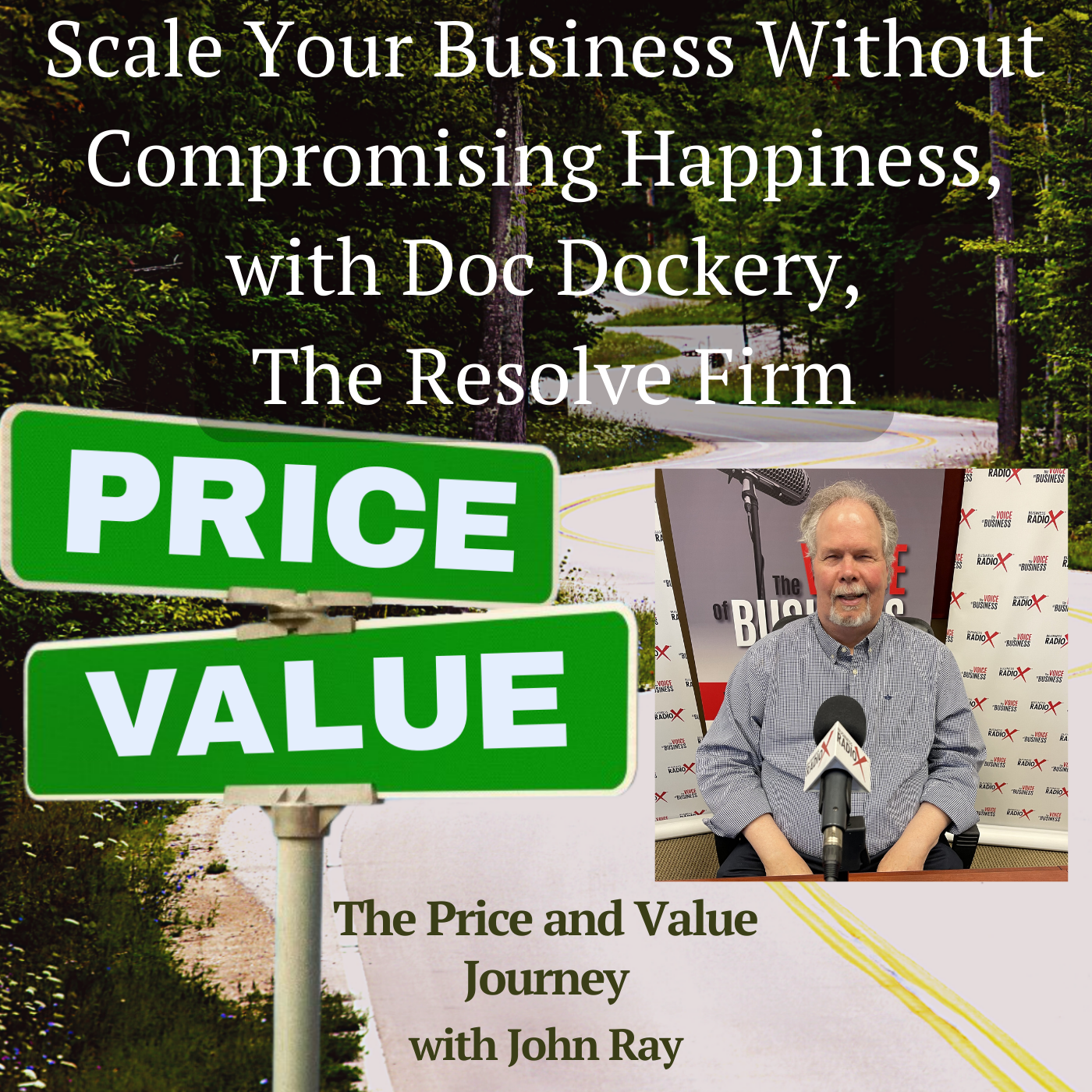
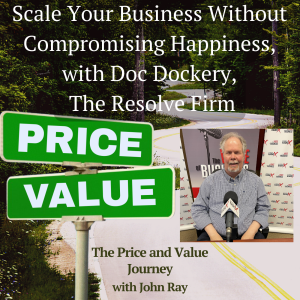
Scale Your Business Without Compromising Happiness, with Doc Dockery, The Resolve Firm

April 17, 2024 by John Ray

Scale Your Business Without Compromising Happiness, with Doc Dockery, The Resolve Firm, on The Price and Value Journey with John Ray
North Fulton Studio
Scale Your Business Without Compromising Happiness, with Doc Dockery, The Resolve Firm
Loading
00:00 /
RSS Feed
Share
Link
Embed

Download file

Scale Your Business Without Compromising Happiness, with Doc Dockery, The Resolve Firm, on The Price and Value Journey with John Ray

Scale Your Business Without Compromising Happiness, with Doc Dockery, The Resolve Firm (The Price and Value Journey, Episode 108)

Dr. Terry “Doc” Dockery, a renowned expert in business scalability and the author of the Amazon number one bestseller, Leadership, Happiness, and Profit: 12 Steps to a High Performance Business, was host John Ray’s guest on this edition of The Price and Value Journey. The discussion centers on the critical role of happiness and personal fulfillment as you scale your business. Doc discusses sustainable business growth, emphasizing leadership development, achieving a balance between professional achievements and personal life, and the impact of positive psychology in the workplace. The conversation also covers the challenges of recruiting and retaining top talent, debunking the myth of a talent shortage, and the essential elements of feedback and trust in effective leadership. Moreover, they address specific hurdles service firms encounter during scaling, the value of skill development, and how to synchronize individual team member advancement with organizational goals.

The Price and Value Journey is presented by John Ray and produced by the North Fulton studio of Business RadioX®.

Dr. Terry “Doc” Dockery, Founder, The Resolve Firm

Dr. Terry "Doc" Dockery, The Resolve Firm
Dr. Terry “Doc” Dockery, The Resolve Firm

Dr. Terry “Doc” Dockery, a true maestro in the realms of business scaling and leadership development. With a career that spans decades, Doc stands out not only as a licensed business psychologist and founder of The Resolve Firm but also as a beacon of guidance for businesses ranging from small enterprises to Fortune 500 giants across the country, particularly in the Atlanta region. His unparalleled expertise in doubling revenues without the baggage of stress or risk has not only propelled companies to new heights but has also cultivated environments recognized nationally as “Best Places to Work.”

Doc’s insights have been crystallized in his Amazon #1 Bestseller, Leadership, Happiness, and Profit: 12 Steps to a High-Performance Business, offering a roadmap to success that balances professional achievement with personal fulfillment. A fervent advocate for maintaining family harmony amidst business success, he often shares, “There are a hundred ways to make money, but you’ve only got one family. It’s a shame to ruin your family relationships over making a buck.”

Beyond his professional prowess, Doc’s soulful side emerges through music—whether he’s playing and singing in a band or charmingly putting the “harm” in harmonica. Receiving the Lucille Award from B.B. King himself is his proudest moment as a professional musician.

As a happily married father of three grown children, Doc embodies the very essence of leading a harmonious life, blending passion, purpose, and play. Join us as we delve into the journey of a man who helps leaders navigate the intricate dance of business growth, family values, and musical escapades.

Website | LinkedIn

Topics Discussed in this Interview

00:00 Welcome to The Price and Value Journey with guest Dr. Terry “Doc” Dockery
00:25 Unveiling Doc Dockery: From Business Scaling to Harmonica Playing
03:15 The Essence of Happiness in Business and Life
06:16 Scaling Your Business: Insights and Strategies
08:12 Leadership and Self-Discovery: Key to Scaling Success
14:53 Effective Leadership: Balancing Consideration and Process
23:56 Navigating Team Conflicts and Leadership Dynamics
24:19 Parenting as a Metaphor for Leadership
25:38 The Essence of Trust in Leadership
26:51 Conflict Resolution and Family Business Challenges
27:36 Identifying and Hiring A-Players
30:53 Addressing the Talent Shortage Myth
35:12 Feedback: The Breakfast of Champions
37:52 Aligning Individual and Organizational Growth
42:06 Deciding to Scale Down
43:42 Closing Remarks and Contact Information

About The Price and Value Journey

The title of this show describes the journey all professional service providers are on:  building a services practice by seeking to convince the world of the value we offer, helping clients achieve the outcomes they desire, and trying to do all that at pricing that reflects the value we deliver.

If you feel like you’re working too hard for too little money in your solo or small firm practice, this show is for you. Even if you’re reasonably happy with your practice, you’ll hear ways to improve both your bottom line and the mindset you bring to your business.

The show is hosted and produced by John Ray and the North Fulton studio of Business RadioX®. The show can also be found on all the major podcast apps. The complete show archive is here.

John Ray, Host of The Price and Value Journey

John Ray, Author of The Generosity Mindset and Host of "The Price and Value Journey"
John Ray, Author of The Generosity Mindset and Host of The Price and Value Journey

John Ray is the host of The Price and Value Journey.

John owns Ray Business Advisors, a business advisory practice. John’s services include business coaching and advisory work, as well as advising solopreneurs and small professional services firms on their pricing. John is passionate about the power of pricing for business owners, as changing pricing is the fastest way to change the profitability of a business. His clients are professionals who are selling their expertise, such as attorneys, CPAs, accountants and bookkeepers, consultants, coaches, marketing professionals, and other professional services practitioners.

In his other business, John is a Show Host and Producer and owns the North Fulton (Georgia) studio of Business RadioX®. John and his team work with B2B professionals to create and conduct their own podcast using The Generosity Mindset™ Method:  building and deepening relationships in a non-salesy way that translates into revenue for their business.

John is also the host of North Fulton Business Radio. With over 750 shows and having featured over 1,200 guests, North Fulton Business Radio is the longest-running podcast in the North Fulton area, covering business in its region like no one else.

John’s Book, The Generosity Mindset: A Journey to Business Success by Raising Your Confidence, Value, and Prices
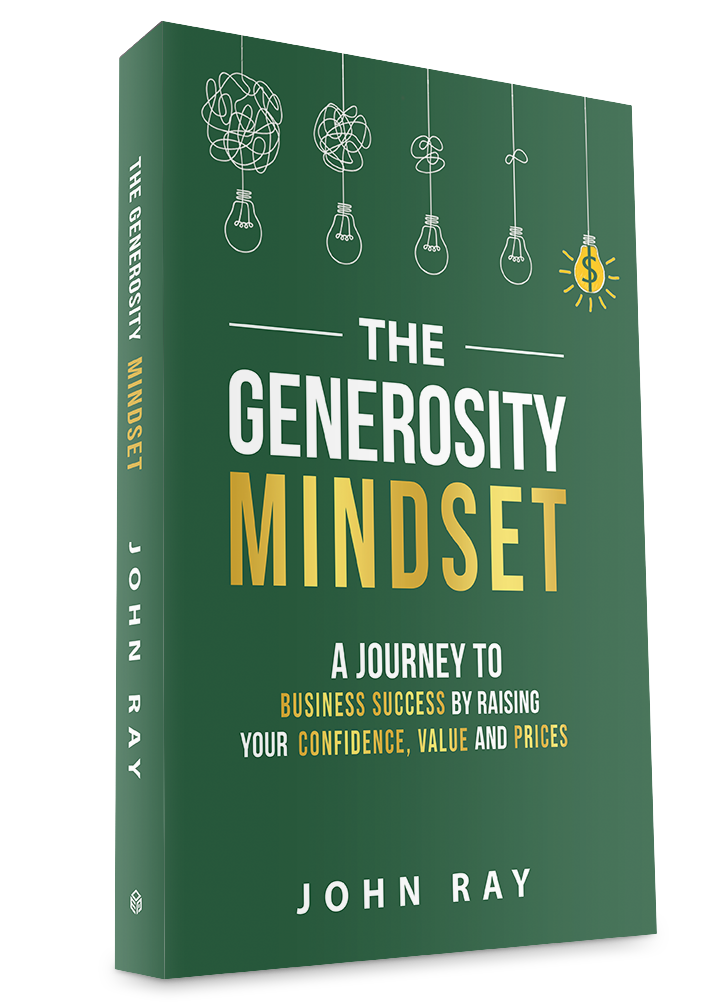
The Generosity Mindset, by John RayJohn is the #1 national best-selling author of The Generosity Mindset: A Journey to Business Success by Raising Your Confidence, Value, and Prices.

If you are a professional services provider, your goal is to do transformative work for clients you love working with and get paid commensurate with the value you deliver to those clients. While negative mindsets can inhibit your growth, adopting a different mindset, The Generosity Mindset™, can replace those self-limiting beliefs. The Generosity Mindset enables you to diagnose and communicate the value you deliver to clients and, in turn, more effectively price to receive a portion of that value.

Whether you’re a consultant, coach, marketing or branding professional, business advisor, attorney, CPA, or work in virtually any other professional services discipline, your content and technical expertise are not proprietary. What’s unique, though, is your experience and how you synthesize and deliver your knowledge. What’s special is your demeanor or the way you deal with your best-fit clients. What’s invaluable is how you deliver great value by guiding people through massive changes in their personal lives and in their businesses that bring them to a place they never thought possible.

The combination of all these elements is quite different for you compared to any other service provider in your industry. Therein lies your value, but it’s not the value you see. It’s the value your best-fit customers see in you.

If pricing your value feels uncomfortable or unfamiliar to you, this book will teach you why putting a price on the value your clients perceive and identify serves both them and you, and you’ll learn the factors involved in getting your price right.

The book is available at all major physical and online book retailers worldwide. Follow this link for further details.
Connect with John Ray:

Website | LinkedIn | Twitter

Business RadioX®:  LinkedIn | Twitter | Facebook | Instagram

Tagged With: Doc Dockery, happiness, John Ray, personal fulfillment, professional services, professional services firms, retaining talent, scale your business, scaling, talent shortage, Terry Doc Dockery, The Generosity Mindset, The Price and Value Journey

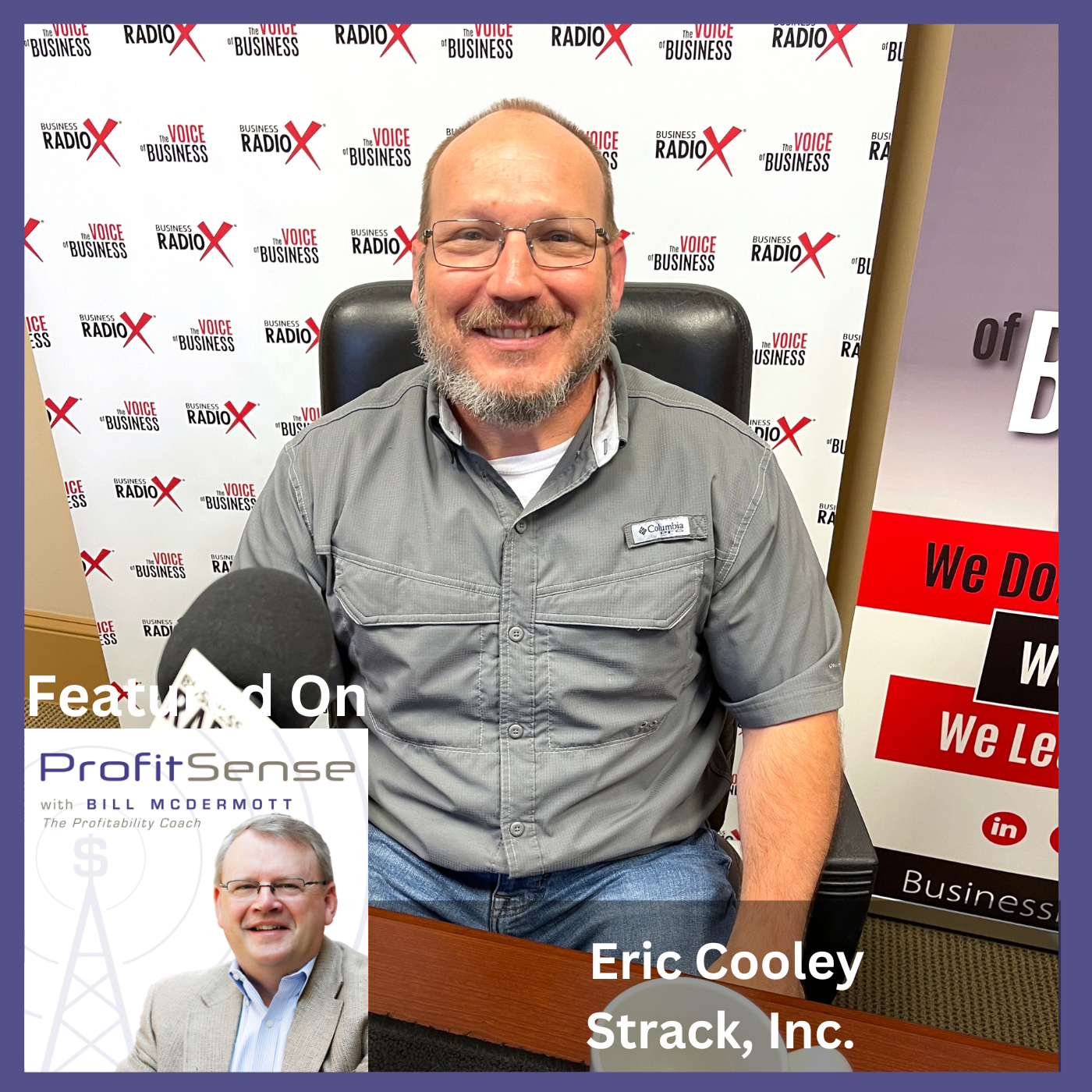
Keys to Retaining Talent, with Eric Cooley, Strack, Inc.

August 4, 2023 by John Ray

Eric Cooley
North Fulton Studio
Keys to Retaining Talent, with Eric Cooley, Strack, Inc.
Loading
00:00 /
RSS Feed
Share
Link
Embed

Download file

Eric Cooley

Keys to Retaining Talent, with Eric Cooley, Strack, Inc.

Eric Cooley: I think a lot of construction has high turnover and we’re not that different as it comes to that and that’s one thing we’re really focused on.

We’ve had to, as we’ve tried to grow, we’ve also had to replace. But I think, the key things we look at is, we start training from day one. So a lot of folks from an orientation perspective, they may come in, have you just sign some papers.  We’re running a four day orientation program right now. Come in, you learn the standard operating procedures for the company, get safety training, you have an opportunity to go through we’ve got equipment simulators to get familiarization with the equipment. And really making that investment starting in day one.

I think living out our core values, that’s something that’s key to trying to retain them. If we’ve sold them on something, it’s important that we live that out. They’re able to see that demonstrated to hold on to them.

I think Jonathan touched a little bit on the training. So we’ve got this frontline leadership training program we built. We’re also building an operator training program where we’ve promoted four guys from inside the business and they’re going to go out and help on the job sites to help train and really bring up the level of experience and understanding to some of the newer employees.

Because part of this, attracting new talent means we might be looking at folks from other industries.


Listen to Eric’s full ProfitSense with Bill McDermott interview here. 


The “One Minute Interview” series is produced by John Ray and the North Fulton studio of Business RadioX® in Alpharetta. You can find the full archive of shows by following this link.

Renasant Bank has humble roots, starting in 1904 as a $100,000 bank in a Lee County, Mississippi, bakery. Since then, Renasant has grown to become one of the Southeast’s strongest financial institutions with over $13 billion in assets and more than 190 banking, lending, wealth management and financial services offices in Mississippi, Alabama, Tennessee, Georgia and Florida. All of Renasant’s success stems from each of their banker’s commitment to investing in their communities as a way of better understanding the people they serve. At Renasant Bank, they understand you because they work and live alongside you every day.

Tagged With: Bill McDermott, Construction, Eric Cooley, hiring, labor shortage, One Minute Interviews, ProfitSense, ProfitSense with Bill McDermott, Retaining talen, retaining talent, skilled labor, Strack Inc.

Jonathan Strack and Eric Cooley, Strack, Inc., and Chris Smith, CB Smith & Associates

July 14, 2023 by John Ray

Strack Inc.
North Fulton Studio
Jonathan Strack and Eric Cooley, Strack, Inc., and Chris Smith, CB Smith & Associates
Loading
00:00 /
RSS Feed
Share
Link
Embed

Download file

Strack Inc.

Jonathan Strack and Eric Cooley, Strack, Inc., and Chris Smith, CB Smith & Associates (ProfitSense with Bill McDermott, Episode 47)

On this edition of ProfitSense with Bill McDermott, Jonathan Strack and Eric Cooley from Strack, Inc., and Chris Smith, CB Smith & Associates, joined host Bill McDermott for a discussion on building their respective businesses and adapting to the digital age. Jonathan and Eric talked about cultivating a company culture, getting outside their comfort zone to recruit talent and market their business, growing the skills of their people, and more. Chris discussed the ways his firm is leveraging technology and AI, how they support their clients through tax planning, new tax laws, and more.

Bill concluded the episode with comments on the one liquidity rule every business owner should know.

ProfitSense with Bill McDermott is produced and broadcast by the North Fulton Studio of Business RadioX® in Alpharetta.

Jonathan Strack and Eric Cooley, Strack, Inc. 

Eric Cooley and Jonathan Strack, Strack, Inc.

Founded in 1948, Strack, Inc. is a heavy civil contractor focused on delivering value-driven project solutions, advanced industry training, and workforce development in the Southeast. Strack provides grading & excavation, pipeline construction, trenchless boring, design build, railroad construction and drilling and blasting services.

With a focus on the residential, municipal, industrial, and commercial markets, Strack is committed to delivering quality infrastructure built by an equipped and empowered team of nearly 600 employees. At Strack, they foster a relationship-driven culture and are driven by living out their core values of Better Every Day, Mindful in Everything, Humble Hearts Open Hands, and Everyone Matters in everything they do.

Jonathan Strack is CEO and President of Strack, Inc. He is a  3rd generation Strack, who has led the way for growth and provided vision for the future of Strack Inc., unlike anyone else. Under his leadership, Strack has more than quintupled in revenue all while expanding into new market segments and construction disciplines. Jonathan was awarded Construction Equipment’s ‘Under 40 in Construction Equipment Award’ for 2020.

Eric Cooley joined Strack as Chief Financial Officer in June 2019. Eric has more than two decades of experience serving in construction financial management roles. Over his career, Eric has had the privilege of building and developing many successful teams in the areas of finance, accounting, HR, IT, project management, training, and recruiting.

He holds a BS in Business Administration from Longwood University and an MBA from Campbell University. He is also a Certified Construction Industry Financial Professional (CCIFP) and IMA Certified Management Accountant (CMA). During his career, Eric has gained a mix of public, private, and private equity experience with company revenues from $100 million to $4 billion. Eric enjoys working collaboratively across the organization to strategically solve business problems, create structure, and develop systems.

Website | Facebook| Instagram

CB Smith & Associates

CB Smith & Associates is a Georgia-based business advisory and CPA firm that delivers big-firm expertise and acumen with small-town thoughtfulness and warmth. We help bring to light the stories that numbers tell — about the health of your business, the soundness of your financial or tax plan, and the options that can lead you to a path of success. We believe that awareness makes opportunity visible.

Website | Facebook | LinkedIn

Chris Smith, President, CB Smith & Associates

Chris Smith, President, CB Smith & Associates

With over 30 years of financial experience, Chris Smith is passionate about his work. Since founding the accounting firm in 2003, he has led the firm’s growth from one to three office locations in Georgia to include 35 employees with a solid team of certified public accountants and other tax professionals.

CB Smith & Associates is a business advisory and full-service accounting firm that works in tandem with its sister company, Reliance Payroll LLC, a full-service payroll and human resources outsourcing firm.

Prior to starting his own firm, Chris was a corporate controller. He earned a degree in accounting from Georgia State University’s J. Mack Robinson College of Business, is active in local community groups such as the Rotary Club and numerous CPA groups.

LinkedIn

About ProfitSense and Your Host, Bill McDermott

Bill McDermott
Bill McDermott

ProfitSense with Bill McDermott dives into the stories behind some of Atlanta’s successful businesses and business owners and the professionals that advise them. This show helps local business leaders get the word out about the important work they’re doing to serve their market, their community, and their profession. The show is presented by McDermott Financial Solutions. McDermott Financial helps business owners improve cash flow and profitability, find financing, break through barriers to expansion, and financially prepare to exit their business. The show archive can be found at profitsenseradio.com.

Bill McDermott is the Founder and CEO of McDermott Financial Solutions. When business owners want to increase their profitability, they don’t have the expertise to know where to start or what to do. Bill leverages his knowledge and relationships from 32 years as a banker to identify the hurdles getting in the way and create a plan to deliver profitability they never thought possible.

Bill currently serves as Treasurer for the Atlanta Executive Forum and has held previous positions as a board member for the Kennesaw State University Entrepreneurship Center and Gwinnett Habitat for Humanity and Treasurer for CEO NetWeavers. Bill is a graduate of Wake Forest University and he and his wife, Martha have called Atlanta home for over 40 years. Outside of work, Bill enjoys golf, traveling, and gardening.

Connect with Bill on LinkedIn and Twitter and follow McDermott Financial Solutions on LinkedIn.

TRANSCRIPT

Intro: [00:00:03] Broadcasting from the Business RadioX Studio in Alpharetta, it’s Time for ProfitSense with Bill McDermott.

Bill McDermott: [00:00:16] Good morning. Welcome to ProfitSense. This podcast dives into the stories behind some of Atlanta’s successful businesses, and business owners, and the professionals that advise them. We help local business leaders get the word out about the important work they’re doing to serve their market, their community, and their profession, as well as discuss current issues that business owners are facing today across a wide variety of industries.

Bill McDermott: [00:00:43] I’m your host, Bill McDermott. And this show is presented by The Profitability Coach. When business owners want to increase their profitability, they often don’t have the expertise to know where to start or what to do. I leverage my knowledge and relationships from 32 years in banking to identify the hurdles getting in the way and create a plan to deliver profitability they never thought possible.

Bill McDermott: [00:01:07] We have three great guests on the show today and I just want to welcome each one of them. Jonathan Strack with Strack, Inc. Jonathan, welcome to ProfitSense.

Jonathan Strack: [00:01:17] Thank you very much.

Bill McDermott: [00:01:18] And Eric Cooley also with Strack. Eric, welcome to ProfitSense today.

Eric Cooley: [00:01:23] Thank you, Bill.

Bill McDermott: [00:01:24] And then, Chris Smith. Chris, welcome to ProfitSense. So glad you’re here.

Chris Smith: [00:01:28] Yeah. Thank you, Bill. Thanks for having me.

Bill McDermott: [00:01:30] So, Jonathan and Eric, I’m going to start with you. You know, we all know there’s a war for talent out there in the industry, especially in the construction industry. But I think across the board, it’s really hard to find great people. But you and your management team have done a fabulous job of building the business over a period of time. So, you know, I don’t want you to reveal any trade secrets here, but you’ve been in business for 75 years, how do you use that to attract top talent to the company? Jonathan?

Jonathan Strack: [00:02:08] Yeah. Just being in business for 75 years, you’ve got great relationships, you’ve got stability. We’ve got a really good long running reputation for quality, treating people well, doing a good job, and being fair. So, from that regard, it helps us sell ourselves.

Jonathan Strack: [00:02:27] But, you know, trying to find talent, you’re competing against everybody in a really saturated market. So, we really had to rethink how we went about attracting and retaining folks. We had to get used to being on social media and hire some additional staff we’ve never had before. So, that’s just part of an evolution of 75 years of business and changing times.

Bill McDermott: [00:02:53] Sure. And, Eric, I know there was a time, I want to say, maybe five or six years ago when you joined Strack, and I’m sure with your background and experience, you could probably go just about anywhere. What attracted you to Strack to become CFO there?

Eric Cooley: [00:03:10] For me, it was the longevity of the company, the reputation, and the marketplace. It’s the family feel. It really has a strong family culture. Again, we’ve doubled in size over the last three years. We’re nearly 600 employees at this point. But it’s just this feeling that you’re not just a number there. You mean something to the team no matter where you sit in the organization. So, just that culture, it’s hard to find that. I have a background in the corporate side. I’ve done some private equity. And so, just having this feeling of like a belonging there was important to me.

Bill McDermott: [00:03:44] Yeah. Yeah. I could understand why. And so, I know certainly there is a huge benefit of working for a privately held company. Core values typically come into play there. And so, I know, Jonathan, many employers do focus on their core values to be sure they find and retain the right people. So, how does Strack use that in their hiring process?

Jonathan Strack: [00:04:19] Well, we had to really sit down and define who we were as we grew. We had a set of well-known core values that were known by everybody that had been in the business, because that flowed from the family, we had long running employees. We were not typically a fast growing company, so it learned through osmosis or tribally, and it got handed down effectively well.

Jonathan Strack: [00:04:47] One of the things we figured out as we started to grow is how do you replicate you into all these folks that you’re bringing on board and make sure you’re still a special place to be. So, we sat down to find our core values so we’re better every day, mindful in everything, humble hearts, open hands, and everyone matters. Those are our core values. And trying to really teach the team right now to make every decision around that framework of those core values.

Jonathan Strack: [00:05:22] So, you know, it kind of went hand-in-hand with attraction or attracting and retaining talent and recruitment. And what we came up with was we decided we wanted to do our own management training, our own leadership training. We came up with our own leadership training program. We call it Frontline Leadership Training. It’s six days of training with cohorts of 20 to 30 people. And we’re going to put everybody in the business from pretty much a lead man up through a CEO. We’re all going to go through the training together.

Jonathan Strack: [00:06:03] And what it’s about is really two halves of the coin. It’s teaching what’s our standard professionally. We take a job from acquisition, we schedule it, we track it, we close it out. So, everybody in the business gets some appreciation for every other position in the company.

Jonathan Strack: [00:06:23] Like, our first one we did, we did a bid wedding. So, we had guys that they may run a Finnish crew, they may run a skid steer and a dozer and a couple of guys, and they’re having to bid on a job all of a sudden. So, they get a lot of appreciation for what the guys in the office have to do and disseminate a whole lot in a hurry.

Jonathan Strack: [00:06:45] But the other half of the coin is the personal side, the soft skill side. We want to relate to some household budget. You know, if your household finances at home are in disarray, how do we expect you to take care of our dollars? We want to do some career coaching, some goal setting, teach folks about how to properly communicate on the job, written, spoken, how to do an interview. Definitely, we’ve got a culture that is not typical. And we want to make sure that gets reflected by all our leadership. So, it’s really six days of teaching who we are and what’s our standard from professional standard attitude and ethics.

Bill McDermott: [00:07:33] Eric, from your perspective, similar question, how do you find that you, as CFO, are embodying those core values that Jonathan mentioned in your hiring process?

Eric Cooley: [00:07:48] Yeah. I mean, a lot of this obviously, as Jonathan said, we use that as a filter as we’re looking to hire folks. I think there’s always some of the professional stuff you can teach, but finding the right person with that character that shares those values with you is really important. And so, you know, if I evaluate talent on my team, that’s something we look at and try to coach around. And I try to embody those things to the best of my ability on an every day. And it’s just about being intentional about it and trying to recognize it.

Eric Cooley: [00:08:17] One thing I do talk to my team about is that we’re not an accounting company that also does construction. We’re really here to serve the construction business. So, we’re a construction company. We happen to be a piece of the wheel. And I think just recognizing where you fit in the organization is important. You know, looking at mindful and everything, that’s talking about, not just worrying about what’s going on in accounting, but think about these folks have other responsibilities they have to look at and serve, and so just working through that.

Bill McDermott: [00:08:46] And I think I’ve found, Eric, once you start sharing those core values in the interviewing process, a lot of times you find people that just don’t feel a fit and they’ll self-select out as well. Has that been your experience as well?

Eric Cooley: [00:09:01] That has been some, historically, yes. So, I think it’s important if you kind of talk about, “Hey. These are the things we’re doing,” then you get someone else talking about, “Hey. I really want to advance quickly or I really want money,” then it pretty much doesn’t line up. We’re not just about making money at Strack. It’s about the culture, about the fit.

Bill McDermott: [00:09:19] Sure. Sure. Excellent points. Jonathan, as you have built the organization, are there any particular hiring methods that seem to work well at Strack, Inc.?

Jonathan Strack: [00:09:33] Well, as we started growing six or seven years ago, pretty heavily, one of the things I had to get used to was social media. Typically, in our industry, my view was stay off social media because you don’t want to attract any needless attention to what you’re doing. It’s already a risky business. But, really, anything that’s on a social media platform, that’s your best attraction and retention tool. And that really legitimizes what you’re doing now.

Jonathan Strack: [00:10:05] We’ve gotten business based off our social media presence, you know, especially when we started grading. We’d been primarily a pipe contractor most of my life. And as we started doing earthwork, that was a definite change in perception for the industry.

Jonathan Strack: [00:10:22] And as we were trying to win some work, I’d have conversations with really large clients that said, “Hey, we see what you’re doing on social media. You look like you know what you’re doing. We trust you. You’ve been in business 70 something years and we’ve worked with you before in other places. So, hey, come on, we’re willing to give you a shot.” And that really perked me up and surprised me. So, I’ve become a lot more open to exposing ourselves to what we do.

Jonathan Strack: [00:10:51] And I mean, the other piece is you’ve got to be willing to accept some failure and learn from it. We’ve definitely had some of that along the way.

Bill McDermott: [00:11:00] Growing up in an era where there were no mobile phones, no internet, let alone no social media, like you, I have my own stories about social media. And thank goodness I’ve got one or two people that are in their 30s and can guide me in those processes. But like you, I struggled with Instagram and all the things that have to do with social media.

Jonathan Strack: [00:11:34] Yeah. And I think, you know, for construction, just changing our perception of who we are and what we are is a big deal. I mean, we’re not well-thought of by the public. I mean, when you think of construction, a lot of people think about the home remodeling guy that ran off with the work half done with all their money. And that’s not us.

Jonathan Strack: [00:11:55] And trying to really expose ourselves to high school students, college students, even middle and elementary school students and explain, “Hey. You know, we’ve got marketing folks, we’ve got accounting folks, we’ve got surveying folks. Any other legitimate business that has all these positions, we have them, too.”

Jonathan Strack: [00:12:17] I mean, I had a young man, he runs our lube truck and he’s 22 or 23, and he just was not feeling it. He says, “Look, you know, I don’t know where my path is.” But he has this passion for photography. I said, “Well, we spend a lot of money every year paying for a photographer to come out and document our stuff, make social media content for us, you obviously know what you’re doing. What do you want? Make me a wish list. I’ll buy the equipment and let’s work you into a full time position. I already paid for it anyway. You’re here. You love it. You know us. You represent us well. You and your brother work for us. Come on, let’s do it.”

Bill McDermott: [00:13:02] Wow. Wow. That’s a great story. I do know construction has a reputation. I can so relate because I come from a banking background, and bankers are challenged. There are some great bankers out there, but also banking in general is just kind of a hard process to go through.

Bill McDermott: [00:13:28] Eric, it’s one thing to attract top talent, but how, in your view, does Strack retain that talent in the company?

Eric Cooley: [00:13:37] Yeah. So, retention has been tough just in this market, particularly in the field. I think a lot of construction has high turnover and we’re not that different as it comes to that. And that’s one thing we really focused on, as we’ve tried to grow, we’ve also had to replace. But I think the key things we look at is, you know, we start training from day one.

Eric Cooley: [00:13:58] So, a lot of folks from an orientation perspective, they may come in, have you just sign some papers. We’re running a four day orientation program right now. You come in. You learn the standard operating procedures for the company. You get safety training. You have an opportunity to go through. We’ve got equipment simulators to get familiarization with the equipment. And so, you know, really making that investment starting in day one.

Eric Cooley: [00:14:21] And I think living out our core values, that’s something that’s key to trying to retain them. If we’ve sold them on something, it’s important that we live that out and they’re able to see that demonstrated to hold on to them.

Eric Cooley: [00:14:33] I think Jonathan touched a little bit on the training. So, we’ve got this frontline leadership training program we’ve built. We’re also building an Operator Training Program, where we’ve promoted four guys from inside the business and they’re going to go out and help on the job sites to help train and really bring up the level of experience and understanding to some of the newer employees. Because part of this, you know, attracting new talent means we might be looking at folks from other industries. And so, part of that’s just trying to help increase the knowledge base out there.

Eric Cooley: [00:15:06] And then, you know, some other things we’ve done is we’ve got Marketplace Chaplains. So, we have a chaplain service to really demonstrate the care. And at this point, Jonathan’s not able to talk to every employer. Historically, he could take calls consistently. But at this point, it’s making sure that that message is out there, we care and how can we help you there.

Bill McDermott: [00:15:25] We had that at a bank that I worked at, too, and that made a world of difference because there was a point in time when I had lost my father and was going through a grieving process. And so, that is wonderful.

Eric Cooley: [00:15:37] And I think something else that is kind of unique here is we have a charitable gift matching. So, any employee, any charitable gift giving they make, the company will match that. And there is a limit set for just normal charities. As it comes to tithing, it’s unlimited. So, just really pushing further on the values and demonstrating from our actions that we’re going to live those out.

Bill McDermott: [00:15:58] Yeah, that’s awesome. We’re talking today with Jonathan Strack and Eric Cooley with Strack Inc. Founded in 1948, Strack Inc. is a heavy civil contractor focused on delivering value driven project solutions, advanced industry training and workforce development in the southeast. They provide grading and excavation, pipeline construction, trenchless boring, and many other things. They’re committed to delivering quality infrastructure built by and equipped and empowered team of nearly 600 employees.

Bill McDermott: [00:16:31] And, Jonathan, what a great legacy that you’re continuing to leave and will do into future generations. But I’m curious, how, in your view, have your hiring and retention processes evolved through the years?

Jonathan Strack: [00:16:49] Well, most of your hiring in years past was either referral, and you still have a fair bit of that. But it used to be you’d have guys walk in your front door, want to fill out an application. It was a very organic process. You might put an ad out in the local newspaper or in the Atlanta Journal Constitution.

Jonathan Strack: [00:17:10] But, now, you get very few people that way. And if they’re coming in the front door, those are probably not the guys you want to hire, honestly, in today’s environment. I’m not saying that doesn’t ever happen, but by and large like I talked about earlier, you’ve got social media platforms, you do paid ads. We actually have a human resources software now that helps us post some of our jobs. We’ve gotten a lot of traction that way. We have a full time recruiter on staff, full time that calls and vets folks before we really ever get into an interview.

Jonathan Strack: [00:17:53] And the team itself, they pretty well supply the needs to the recruiter. And between HR and recruitment, they disseminate the needs back out to the guys as they do interviews. We’ve got paid billboard advertisements right now. I mean, we’re trying things we’ve never tried before just to get some attention to us. I mean, we’ve got three or four billboards at the I-85 Corridor right now.

Eric Cooley: [00:18:22] We do. Yes.

Jonathan Strack: [00:18:22] I’ve never, never thought I would do that. I never liked talking about us. You know, we’re pretty humble as a whole. And that always used to appear arrogant to me. But now, it’s out of necessity. I’ve got to try whatever I can, regardless of what I may or may not be comfortable with, because we don’t know what works right now. We’re having to learn.

Bill McDermott: [00:18:46] So, Eric, I think if you say it, sometimes it can be taken as bragging. But I’m sure if your employees are saying it, that’s testimony. And so, I’m wondering from your perspective, how do you maybe engage your workforce in looking for people just like them to send your way as well?

Eric Cooley: [00:19:13] Right. Yeah. A lot of that is giving our employee that experience so they do want to do the referrals. And then, we do have an Employee Referral Program to where the employees are rewarded for bringing new employees onboard.

Eric Cooley: [00:19:26] We’re working on an internal communications app. It’ll actually be an application on your phone. And I think given that connectivity, you know, the consistent message all the way throughout the organization will help the employees that may not get to see everything or be aware of everything to really make them more aware of what’s going on in the company, and then want to invite their friends or other other folks to join them. So, I think that communication is big. And, really, the encouragement to bring folks, more like yourself, to come to the company is how I see that.

Bill McDermott: [00:19:55] Sure. Sure. Absolutely. So, just in case we have any potential great employees who might be out there, let’s use the ProfitSense Podcast too. Jonathan, Eric, what’s the best way if there’s someone interested in coming to work for a great company like Strack, Inc., how should they get in touch with you?

Jonathan Strack: [00:20:14] I’ll take it. Yeah. I mean, the best way, you can get on the website and put an app in. You can always message us on any social media platform. That’s monitored full time by folks we have on staff. So, really, any public facing portal we have, whether it’s LinkedIn, Facebook, website, shoot us a message, put in an application, and we’ll call you back pretty promptly.

Bill McDermott: [00:20:42] And, Eric, what’s the website address for the company?

Eric Cooley: [00:20:45] It’s www.strackinc.com.

Bill McDermott: [00:20:49] Great. Jonathan and Eric, thanks so much for coming on ProfitSense today and sharing your experience and your expertise. And congratulations on building a company with an employee base of 600 people. That’s quite an accomplishment. Congratulations.

Eric Cooley: [00:21:05] Thank you for inviting us.

Jonathan Strack: [00:21:06] Thank you.

Bill McDermott: [00:21:09] And so, Chris Smith, Chris is with CB Smith & Associates. Chris, so glad to have you. For our listeners, tell us a little bit about CB Smith & Associates. You’ve got a headquarters in Alpharetta, but also Macon and the Lake Oconee area. As an accounting and business advisory firm, what do you do for businesses and individuals?

Jonathan Strack: [00:21:34] Yes. Thanks, Bill.

Chris Smith: [00:21:36] So, CB Smith is celebrating their 20th year being in business. I started CB Smith in the Cumming area back in 2003. And we’ve slowly grown over the years. Today, we’re a full service firm. I have a partner at the firm, his name is Tim Whittemore. And as you mentioned, we have offices in Macon and here in Alpharetta, and we have a satellite office in the Lake Oconee area. Today, we’re a full service firm. We do audit work. We do reviews. We do tax planning, business advisory services, and, of course, tax compliance work for our clients.

Chris Smith: [00:22:19] But one of the areas that we’ve really focused in – gosh – since 2007 timeframe is moving accounting into a paperless environment. And once accounting gets into a paperless environment, it’s all X’s and O’s. And then, you can do things like process automation, really automate processes, and improve collaboration amongst team members. And, hopefully, help to make a business more scalable.

Chris Smith: [00:22:51] From a philosophical standpoint, I’m a big believer in the things that got you out of Egypt are not the same things that will get you to the Promised Land.

Bill McDermott: [00:23:00] Well said.

Chris Smith: [00:23:03] We love working with businesses that are at that stage. They’ve hit a ceiling of complexity and they’re trying to figure out what are those things that will get us to the Promised Land. And so, we help them by implementing and retooling the accounting function. We’re a big believer that the accounting function shouldn’t be an anchor on the business. It should be a driver of growth. And so, we try to work with our clients from that standpoint.

Chris Smith: [00:23:29] So, we’ve got some young folks at the firm that are taking advantage of these no code, low code solutions that are out there, power apps, mostly for the Microsoft platform that takes those X’s and O’s or those ones and zeros, and, really, starts to build a better process for our clients and their business processes, improves internal controls in the business. And, hopefully, that leads to growth and that’s where we come in and help them from a tax planning standpoint.

Bill McDermott: [00:24:09] Now, you’re preaching to the choir here when you start talking about processes. One of the things that I found in working with my clients is rarely do I see processes in writing. And if they’re in writing, are they being followed? And so, when you started talking about business process automation, that’s like documented processes on steroids. But tell us a little bit more about that, because I think you’ve really carved a niche in the marketplace with business process automation, haven’t you?

Eric Cooley: [00:24:41] Yeah. Yes. Certainly, we really love working with our clients from that standpoint and putting everything on its side. You know, the documents as an example, having an SOP document and all the binders and everything to that effect, we integrate it into the process. That documentation is the process. So, if someone gets to a form and how do I fill this out or what am I doing with this, you can have a Help Menu item that just shows up. And it is, “Here’s our policy. This is how this works.” So, we integrate it into the tools that are in place.

Chris Smith: [00:25:18] You know, historically speaking, you have your software and then you have your policy document. And so, now the software and the policy document become one. And with the low code and no code development that can be done just by accountants, you’re able to now integrate those things together. And it’s flexible. It’s agile. As the business changes, the environment for the business changes. You can change your policies and integrate it right into the app right at the same time.

Chris Smith: [00:25:49] It also eliminates so much human error that may be in place, especially if you do have a document. A lot of times they come in electronically as it is. But even if they’re scanned in, you can OCR. Artificial intelligence sometimes can be scary for folks but it’s here and leverage it.

Chris Smith: [00:26:07] And so, if you have an AI that can sit there and read a document and know it’s an invoice from a particular vendor, and knows where to go look on that invoice for the amount, when it’s due, so on and so forth, use the AI. And then, your people, instead of becoming data entry clerks, they’re reviewing what the AI does, make sure it’s good.

Chris Smith: [00:26:26] And once that’s in there and, again, ones and zeros, you don’t have any room for human error later on down the road. The integrity of your data really improves. And there’s a lot of benefits in terms of efficiency so the business can focus in on what it does and reduce its administrative costs accordingly.

Bill McDermott: [00:26:48] Yeah. I can really see the benefit of not only improving efficiency, but also improving effectiveness. I can’t talk to a CPA without talking about taxes. Taxes come up. And so, I’m going to insert a little personal bias here. So, businesses that have a tax strategy that minimizes taxable income make them very difficult to bank lending customers, coming from a banking background. So, that’s my bias there I have to get over.

Bill McDermott: [00:27:26] But I do know tax planning is a big part of your business. What do you see as tax planning? How do you do it? And then, why is it important for small businesses to do tax planning?

Chris Smith: [00:27:41] Our first philosophy is, first off, we’re going to be your advocate for our clients. Tax planning is important, but tax planning isn’t the end all, be all. Improving your wealth is the end all, be all. And so, we’re not going to implement or suggest a tax solution that isn’t necessarily in line with improving our client’s overall financial well-being. And so, that’s always secondary to financial well-being. But it’s a very important piece.

Chris Smith: [00:28:15] We’re in a segment. We’re not a large national firm, so we don’t have a lot of clients that are publicly traded or anything like that. Our clients don’t have investors to impress. They’ve got to impress the bank every once in a while. You know, so our focus is going to be on tax planning. It’s a heavy part of our relationships with our clients. And, you know, that is the business we’re in, by the way, is the relationship business. We may be accountants, but that’s what it is.

Chris Smith: [00:28:43] And so, we’re going to work with our clients to ensure their financial well-being is in place. And they’re doing it as a tax efficient manner as possible. And if they need a source of funding because of some sort of, you know, new business plan, new venture that they’re going to move into, then we’ll work with our clients and we’ll work with the bankers. And make sure the bankers understand these are things that we’re doing from a tax perspective, so let’s make some adjustments accordingly so you can get a better picture of what the cash flow would be for the organization, so you can make better lending decisions from that standpoint.

Bill McDermott: [00:29:25] Yeah, it makes perfect sense. So, the baby boomer generation business owners are retiring in droves. They’ve been successful. They’re wanting to exit. So, talk a little bit about how CB Smith & Associates helps business owners with succession planning.

Chris Smith: [00:29:45] Yeah, certainly. There is a time frame. Each business sits at a different life cycle and all businesses are different. We’re dealing with clients that are startups, that are on that front end stage, cash is really tight, they’re in a high growth environment. We’re trying to help them with business process automation to leverage the tools that are out there.

Chris Smith: [00:30:07] And then, we have clients that maybe are at that little more mature stage, but they’re ready to go another 10, 15 years. And so, that’s where tax planning comes into play. That’s where we’re thinking about, “Okay. How can we minimize your tax as much as possible?” So, that’s available cash to reinvest in the business or harvest from the business.

Chris Smith: [00:30:29] And then, we have clients that are very mature, you know, multi-generational businesses and they’re dealing with other issues where they’ve just got more pieces of the pie that they have to spread out, and so how do they manage growth from that standpoint.

Chris Smith: [00:30:46] But then, we have folks that they’re not ready to pass it on to the next generation. They’re looking for some sort of a succession plan. And the key to them is planning ahead of schedule. It’s a five year look. That’s where we change our strategy. We’re not necessarily interested in maximizing the tax benefits that they may be receiving, but we’re interested in making sure that business looks like a nice rose on the bush and it’s ready to be plucked off.

Chris Smith: [00:31:16] So, we’re going to help our clients from that standpoint. We’re going to make sure that maybe we don’t take those deductions as benefits that you have been taking in the past. Let’s see what we can do to improve the cash flow from the business to the owners. We often refer to it as EBITDA.

Chris Smith: [00:31:35] And sometimes it’s different. It depends on the business. It could be a heavy asset business, got a lot of assets to it, or it could be a business that doesn’t have much of a balance sheet at all and it’s more of a service business. So, we’re going to look at those aspects and make sure that that business is in a good position so they can maximize value out of it.

Chris Smith: [00:31:53] What are they doing from a management standpoint? Bill, you know this really well. What are they doing from a management standpoint so the business is not defined by the owner. It’s defined by the team. And so, that really enhances value of that business from that standpoint. And that’s a philosophy you should have even if you’re not looking to sell the business. Make the business work for you. You not work for the business. But we’re going to work with them and make sure that they have the right mindset in terms of what they’re doing.

Chris Smith: [00:32:27] And then, we’ll have conversations with them, they are going to cash it. How do you handle that? What’s the estate going to look like? What are we looking at in terms of the value of the estate and how is that going to go? How are those assets going to get passed on? How is it going to get taxed when you die? Having some conversations on that.

Chris Smith: [00:32:49] Also, having conversations of do you want to sell it to a competitor or do you want to sell it to your employees. We’re working with a company right now. It’s a civil engineering firm. And we’re working with them to potentially have a tax free sale through an ESOP. And so, we’re going to have those conversations with the clients, here are the benefits, this is how much of a squeeze you need to make to get the juice out of the fruit, per se. This is what’s going to be involved administratively to be able to get those benefits.

Chris Smith: [00:33:22] We had another client that was in the chemical business that they’re getting ready to be bought out by a competitor right now. And there was a big discussion as to whether it was going to be a stock sale or an asset sale. And an asset sale was going to cost them about an additional $800,000 in tax. And so, that’s an important conversation to have with your client in saying, “Hey, we need to have an understanding of this.” And that may be a renegotiation that you have with the buyer that says, not only do we have $800,000 in tax associated with an asset sale, but we also have capital gains on that $800,000. So, we probably need to have close to $1 million of additional compensation from the sale of the business. And, fortunately, it was a nice business, so the buyer agreed to that.

Bill McDermott: [00:34:12] Yeah. That’s great. We’re talking today with Chris Smith, who’s president of CB Smith & Associates. Chris has over 30 years of financial experience, passionate about his work since founding the accounting firm in 2003. He’s led the firm’s growth from one to three offices in Georgia to include 35 employees with a solid team. CB Smith & Associates is a business advisory and full service accounting firm that works in tandem with its sister company, Reliance Payroll, which is a full service payroll and human resources outsourcing firm.

Bill McDermott: [00:34:48] Chris, last question. Today, what are some tax law changes in Georgia that individuals or businesses need to know this year?

Chris Smith: [00:35:00] Certainly. Thanks for asking that question. There have been some recent tax law changes here in Georgia. And, you know, we just had a little internal, we have a First Friday Program with all of our staff. The first Friday of every month, everyone gets together and we talk about recent changes.

Chris Smith: [00:35:19] So, we, literally, just last Friday had a conversation about some tax law changes here in Georgia. So, it’s kind of still somewhat fresh in my head. The big piece that we have – there’s a couple pieces – one is, last year, Georgia passed what was called a Pass-Through Entity Election Law that allowed for S-corporations, in particular, and some partnerships to elect to be treated as a C-corporation for Georgia tax purposes.

Chris Smith: [00:35:51] And the benefit to that has to do with the S-corporation and partnership owners’ personal tax returns, because state taxes, when you itemize your deductions on the federal return, state taxes are limited to $10,000. And so, if you have a business of any worthiness that you can quickly exceed that, especially if you own a house and you’ve got property taxes of $5,000, $6,000, before you know it, you’ve hit that $10,000 threshold.

Chris Smith: [00:36:20] So, what this election does is it allows the Georgia income to be taxed at the entity level and it becomes a deduction for trade and business purposes purposes. And it eliminates it from your itemized deductions. And, of course, the income on your personal Georgia return that was taxed at the entity level is excluded from your income on your personal return. So, there’s a lot of benefits to that.

Chris Smith: [00:36:46] One problem we had with this is that it was limited. The partnerships that could participate in that was limited. You had to have certain qualifications in order to be able to do that. And so, Georgia has amended that law, I think it’s House Bill 415 that did that. So, they have amended House Bill 415 to allow all partnerships to participate in that election beginning in 2023, the 2023 tax year. So, that’s a big benefit for some of those businesses that were out there that there was a partnership arrangement they couldn’t do it. We had a couple of clients that just couldn’t do it from that standpoint, just due to the nature of the partners or in their partnership.

Chris Smith: [00:37:29] The other change that was been made and, of course, this is good news if you are one that likes paying less tax to the state of Georgia. House Bill 454 was just passed. And with that, the individual rate is going down. In prior years, the Georgia tax rate for both corporations and individuals was 5.75 percent. And Georgia’s individual rate is going to go down to 5.49 percent in 2024. And then, every year after that, it will go down another 10th of a point and it will rest in 2029 at 4.99 percent. So, that’s a good benefit for a lot of individuals.

Chris Smith: [00:38:16] The other things that changed for individuals is the Georgia Standard Deduction for filing married, filing jointly individuals has gone to $24,000. And the standard deduction for all others filing single, married, single head of household has moved over to $12,000. So, those are some of the changes that, just in the last legislative session, have been passed. And so, we’re going to see some benefits from that going forward.

Bill McDermott: [00:38:47] Yeah. Wow. Tax rates actually going down a little bit. What a concept. Chris, if someone has accounting questions or needs to get in touch with you for some accounting advice, what’s the best way for them to get in touch with you?

Chris Smith: [00:39:01] Yeah. So, website is a great place to go to. You can be a very small business just getting started, you’re trying to conserve every dollar you can, go to our website, sign up for a newsletter. We send out articles. We do blog posts monthly on various topics. A lot of great articles on our website about starting a business.

Chris Smith: [00:39:26] If you’re at a different stage in your business and tax is becoming a problem, business is growing, you know, feel free to reach out to us. There’s a couple links on the website to inquire with us and one of our senior level tax managers will call you up and have a conversation about how we can help you and how we can build a relationship with you from that standpoint.

Bill McDermott: [00:39:50] That’s great. And that web address is?

Chris Smith: [00:39:52] Yes. It’s CB Smith and Associates, so it is www.cbsmithcpa.com. That’s our website. And, of course, as your previous guests here had mentioned, we are also looking for talent in the area. And we work with a lot of the universities and schools, but we’re also looking for senior level talent as well that would help fuel our growth.

Chris Smith: [00:40:19] We’re a big believer that the players bring the fans. And so, the quality of our employees bringing clients and help us with growth. And so, we encourage anyone that may be interested in joining the team to go out to our website as well. You can go to About Us, and there’s a link there for joining the team, and we’d love to have an opportunity to speak with you.

Bill McDermott: [00:40:38] That’s great. Chris, thanks so much for coming on ProfitSense today.

Chris Smith: [00:40:42] Thank you.

Bill McDermott: [00:40:45] I want to take a minute to talk a little bit about liquidity. You’ve heard the idea that cash is king, and there is one liquidity rule that I think every business owner should know. Every business owner understands that cash is critical to running a business. But knowing how much cash is needed leaves many business owners confused and frustrated.

Bill McDermott: [00:41:08] I worked with a professional services firm that has a practice with three locations. Their revenue came from professional services that were reimbursed by insurance – insurance companies, as we all know, are notoriously slow in this practice – found themselves with at least half of their receivables over 90 days. No one was accountable for collections and they were forced to borrow from very expensive lending sources just to fund payroll.

Bill McDermott: [00:41:34] Quickly, we put the internal accountant in charge of collections. She blocked time on her calendar daily to make collection calls. In the next six weeks, the amount of over 90 day receivables was reduced to about 10 percent of the total, that was $100,000 cash impact to that firm. And the firm’s cash balance doubled because of it. They no longer had to borrow and saved a significant amount of interest expense.

Bill McDermott: [00:41:59] Now, the firm who works in the manufacturing space was able to increase their cash balance simply by requiring a 50 percent deposit for their product upfront. That way, they weren’t fronting all of their costs.

Bill McDermott: [00:42:14] No matter how you achieve it, my recommendation is that 15 to 20 days sales is a good number. Take your annual sales, divide it by 360, then divide that number into your cash balance. So, if you have $5 million in revenue, that’s about $14,000 a day to have 15 days sales and cash, your cash balance would need to average about $210,000. If you’re struggling with liquidity, work with your finance person to find out how to improve your cash balance and take action.

Bill McDermott: [00:42:49] If you want to keep up with the latest in pro business news, follow us on LinkedIn and Instagram at The Profitability Coach. If you want to listen to past or future ProfitSense episodes, you can find us on profitsenseradio.com. This is ProfitSense with Bill McDermott signing off. Make it a great day.


Tagged With: Accounting, AI, Bill McDermott, CB Smith & Associates, Chris Smith, Eric Cooley, Jonathan Strack, ProfitSense with Bill McDermott, retaining talent, Social Media, Strack Inc., talent aquisition, tax law, The Profitability Coach

Workplace MVP: Amy Zimmerman, Relay Payments

March 17, 2022 by John Ray

Amy Zimmerman
Minneapolis St. Paul Studio
Workplace MVP: Amy Zimmerman, Relay Payments
Loading
00:00 /
RSS Feed
Share
Link
Embed

Download file

Amy Zimmerman

Workplace MVP: Amy Zimmerman, Relay Payments

In a wide-ranging conversation, Amy Zimmerman, Chief People Officer at Relay Payments, and host Jamie Gassmann discussed best practices for retaining talent. They covered incentives, rewards, and recognition, the need for companies to keep abreast of market conditions, the value of stay interviews and what happens when they go wrong, talent retention methods which go beyond compensation, and much more.

During the show, Amy referenced a recent interview she gave on stay interviews. You can find that interview by following this link.

Workplace MVP is underwritten and presented by R3 Continuum and produced by the Minneapolis-St.Paul Studio of Business RadioX®.

Relay Payments

After years of gaining a profound understanding of the ingrained payment problems in the logistics industry, co-founders Ryan Droege (CEO) and Spencer Barkoff (President) ultimately shared the vision of building the supply chain and logistics digital payment network of the future.

Now, Relay is a fast-growing, venture-backed fintech company, which raised $100 million in investment funding to fully support the goal of spearheading the industry transformation to digital, contactless payments, ensuring America continues to run during COVID-19 and well beyond.

As a result of the immense expansion, Relay has grown exponentially, boasting a workforce of 100+ across 12 states; all focused on building a customer experience unlike any other while modernizing age-old payment processes in the supply chain industry.

Relay’s customer-centric approach has entrusted the company to process more than 250,000 transactions every month, working with the largest carriers, freight brokers, and 3PLs across 50 US states and Canada, ensuring their products get to shelves quickly for consumer consumption.

Company website | LinkedIn | Facebook | YouTube

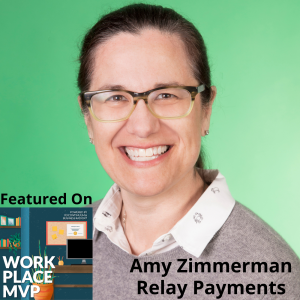
Amy Zimmerman, Chief People Officer, Relay Payments

Amy Zimmerman, Chief People Officer, Relay Payments

Amy joined Relay Payments in 2020 to support their explosive growth plans. She was hired to establish their people function and build it from the ground up. During this time, they have grown from fewer than 10 team members to over 120 globally. Relay Payments is a mission-driven, Series C, venture-backed start-up in the fintech space, headquartered in Atlanta, GA. They are building a contactless payment network in the transportation and logistics industry.

Amy co-founded PeopleCo. to be a strategic partner for founders and a growth catalyst for companies on the rise. Central to her work, of course, is the development and nurturing of a company’s culture. Whether the focus is on foundational elements, like defining core values and communication practices or developing more mature programs to support organizational effectiveness like performance development and engagement initiatives, it’s all in service to ensure that the culture is intentional and aligned with the company’s growth objectives and financial goals.

In her previous life, as chief people officer for Kabbage (recently acquired by American Express), Amy was responsible for building the company’s award-winning culture, driving engagement, and guiding all people strategy initiatives. She oversaw the integration of M+A teams to build and grow capabilities across a diversity of cultures and geographies. Before that, she worked for VSI as a recruiter, people leader, and culture ambassador prior to their acquisition by TransUnion.

She graduated from the University of South Florida with a completely irrelevant degree in Criminology.

LinkedIn

About Workplace MVP

Every day, around the world, organizations of all sizes face disruptive events and situations. Within those workplaces are everyday heroes in human resources, risk management, security, business continuity, and the C-suite. They don’t call themselves heroes though. On the contrary, they simply show up every day, laboring for the well-being of employees in their care, readying the workplace for and planning responses to disruption. This show, Workplace MVP, confers on these heroes the designation they deserve, Workplace MVP (Most Valuable Professionals), and gives them the forum to tell their story. As you hear their experiences, you will learn first-hand, real-life approaches to readying the workplace, responses to crisis situations, and overcoming challenges of disruption. Visit our show archive here.

Workplace MVP Host Jamie Gassmann

Jamie Gassmann, Host, “Workplace MVP”

In addition to serving as the host to the Workplace MVP podcast, Jamie Gassmann is the Director of Marketing at R3 Continuum (R3c). Collectively, she has more than fourteen years of marketing experience. Across her tenure, she has experience working in and with various industries including banking, real estate, retail, crisis management, insurance, business continuity, and more. She holds a Bachelor of Science Degree in Mass Communications with special interest in Advertising and Public Relations and a Master of Business Administration from Paseka School of Business, Minnesota State University.

TRANSCRIPT

Intro: [00:00:03] Broadcasting from the Business RadioX Studios, it’s time for Workplace MVP. Workplace MVP is brought to you by R3 Continuum, a global leader in workplace behavioral health and security solutions. Now, here’s your host, Jamie Gassmann.

Jamie Gassmann: [00:00:25] Hi, everyone. Your host, Jamie Gassmann here, and welcome to this episode of Workplace MVP. This last year brought on an additional challenge for workplace leadership with what some experts are referring to as The Great Resignation or The Great Reshuffle.

Jamie Gassmann: [00:00:41] Turnover in 2021 was 12.2 percent higher than pre-pandemic turnover rates across all industries in the U.S., according to the U.S. Bureau of Labor Statistics. There are varying opinions as to why employees were leaving their current employers over this last year and what some believe will continue into this year. Some feel it was as a result of employees realizing a need for better work-life balance and improved work environment or culture.

Jamie Gassmann: [00:01:11] Employees seeking a remote or hybrid work option, better pay. And some feel it may have just been as a result of people who were already looking to make a change but held off during the volatile times in 2020. And there are, of course, others from both a professional and personal reasoning that drive employees to make career changes.

Jamie Gassmann: [00:01:33] The concern for employers with the increase in resignations and employee movement to other organizations is the cost that turnover can have on the organization. At an average, for every salaried employee who leaves an organization, it can cost the company six to nine months of the employee salary to replace them.

Jamie Gassmann: [00:01:52] But not all turnover is bad. Sometimes it is better for the organization and the individual. But for those employees you want to keep, how do you create an environment that aids in your ability to retain them?

Jamie Gassmann: [00:02:04] Well, joining us today to share her best practice approaches to retaining talent is Workplace MVP and Chief People Officer at Relay Payments, Amy Zimmerman. Welcome to the show, Amy.

Amy Zimmerman: [00:02:15] Thanks, Jamie. I’m glad to be here.

Jamie Gassmann: [00:02:17] So, share with us your career journey to becoming the Chief Police – Chief People Officer at Relay Payments.

Amy Zimmerman: [00:02:25] Thankfully, I actually don’t feel like the Chief Police Officer at Relay. Long story short, I started my career post-college as a substance abuse counselor, which is probably a bizarre journey to where I landed. But as a social worker at heart, I think it shaped in every way the type of people leader that I’ve become.

Amy Zimmerman: [00:02:58] Ultimately, early on, I was a recruiter, and would still say that I identify as a recruiter in so many different ways. But started with a tech company in Atlanta in 1999. I probably just aged myself a lot. The company was eventually acquired by TransUnion. And I stayed on with TransUnion for a couple years as part of the agreement. But certainly learned very quickly that I’m a startup person through and through, and so left and did some consulting after my oldest daughter was born.

Amy Zimmerman: [00:03:35] And then, wound up connecting with Kabbage as a client of mine for quite a while. I actually helped them hire their first team member after they were funded. And eventually joined them full time and was with them pretty much the entire ten year journey to acquisition by American Express in October of 2020.

Amy Zimmerman: [00:03:58] I started consulting again and was introduced to the founders at Relay. And despite not being interested initially in being a full-time team member again, I quickly realized that it was a no-brainer our values aligned in every possible way. And if I was going to do this one more time, I’ve been part of two acquisitions at this point, I figured the third one, I’d go out with a bang.

Amy Zimmerman: [00:04:27] So, I’m at Relay Payments now and started with the founders when they were single digit team member numbers about a-year-and-a-half ago, fractionally. And we’re over 140 team members now and will likely be somewhere around 300 by end of year. So, giant growth plans and an exciting kind of road ahead with these guys.

Jamie Gassmann: [00:04:51] Wow. Very exciting. Can you tell us a little bit more about what Relay Payments does?

Amy Zimmerman: [00:04:57] I can. Imagine, we’re basically like the Venmo in the logistics industry. So, we’re modernizing payments for an industry that’s been ignored for a good while. I would say many of the ways payments is done in logistics and trucking, specifically, is very archaic. There’s lots of paper involved, which certainly leads to fraud, and leads to lost receipts, and lots of wasted time. And so, we’re creating solutions that modernize a very old practice. And as a result, save money in time for the really, really important people who are moving goods throughout the country.

Jamie Gassmann: [00:05:44] Wow. So, from your perspective, why do you think we’ve seen so much turnover in the last year across various industries with having employees leaving their employers?

Amy Zimmerman: [00:05:57] You know, I think a couple of things. You touched on some of them, certainly, and that’s, I think, there was a buildup. I think 2020 was so uncertain that some of the natural attrition that would have happened was delayed. And so, I think the uptick in 2021, for a lot of reasons, made sense. I think the complexity or the piece that probably was a little different or not COVID related necessarily was the fact that people realized that some companies were offering an enormous amount of flexibility and also care.

Amy Zimmerman: [00:06:40] You know, people were burning out. There was this confusion between work-life balance and work-life integration. When does work start? When does it stop? Does it stop? Is it fully integrated? Is there this expectation now that I work all day and all night? Maybe not even imposed by the employer, but self-imposed, because there was some confusion as individual team members about kind of boundaries, et cetera. And so, I think there were a lot of things, but I think a lot of companies got it right and a lot of companies got it wrong.

Amy Zimmerman: [00:07:13] And so, people were sharing stories with friends. I think there was more opportunity. A lot of companies decided that they weren’t confined by their geography, and so they were opening opportunities up to people in other states and other locations. And so, I think the opportunistic reasons that people left probably increased dramatically, in addition to the fact that people from 2020 that hadn’t already started contemplating a move decided to.

Amy Zimmerman: [00:07:49] And the part about companies not getting it right was some companies just didn’t do a good job of investing in their people and staying connected to their people while they were gone. Rewards and recognition, I think, is a giant way you do that, and we can talk more about that. But I don’t think a lot of the companies got that right. And so, there were just a number of reasons why people decided it was time to consider something new.

Jamie Gassmann: [00:08:16] Yeah. So, we’re going to talk a little bit this kind of first part of the show just discussing a little bit of the impact that this has on organizations when you’re having that turnover. So, looking at retention and turnover, what is that impact on the organization from your perspective of both of those?

Amy Zimmerman: [00:08:38] I think aside from the financial cost, which you referenced as potentially six to nine months of somebody’s salary, which is huge, there’s a loss of knowledge that walks out the door that can be hugely impactful, not only on the organization from an expertise and bench strength perspective, but also on the team members.

Amy Zimmerman: [00:09:01] You know, if the person that knows the most is leaving, then (A) We all have to step up in a way that maybe we didn’t have to before. (B) There’s a learning curve that we now need to navigate or figure out. And (C) If I’m the person who knew as much as the person leaving or say the second most, now, suddenly, there’s a burden. I’m feeling all of the pressure to be the subject matter expert on the team or at the company in a way that is imposing. Because I already had a full-time job, potentially, and now, suddenly, everybody’s looking to me to lean on and leverage because some of the other expertise walked out the door.

Amy Zimmerman: [00:09:42] And so, I think there’s obvious impact financially to the bottom line. But I think there’s more subtle impacts to morale and to people that are affected and caught up in some of that, that is harder to quantify, but super damaging, potentially nonetheless.

Jamie Gassmann: [00:10:01] Yeah. And that definitely leads into my next question in regards to, obviously, you can quantify those hard costs. You can put dollar signs to it. But what you can’t put dollar signs to is the soft costs around what happens to your people. And so, let’s kind of dive into that a little bit in terms of, like, the mental health impact or, to your point, the pressure, particularly in situations where maybe that person is trying to step up and maybe not getting noticed. Like, some of that impact that kind of ripple effects that happens from those situations. Can you share a little bit of your thoughts around that?

Amy Zimmerman: [00:10:37] Yeah. I think that’s probably one of the biggest opportunities for an employer to really double down. And when you think about losing somebody that could be material to the business for a number of reasons, sometimes that has a ripple effect. And people start thinking, “Ay yay yay. If that person left, what do they know that I either don’t know? Or they know something I also know, they had the nerve to leave, maybe I should do the same.”

Amy Zimmerman: [00:11:07] And so, in my mind, what an employer should do at that point is really, really double down. First of all, you can start doing stay interviews with some of the more key folks that you’d be in really big trouble if you lost. And, essentially, that’s a conversation where you get vulnerable. You ask, What do you love about this place? What should we do more of? And where are the gaps? What are our opportunities? If you were to leave, help me understand why so that I can try and solve some of those issues, or address some of those issues ahead of it getting you to a point where you’re potentially going to walk out as a result?

Amy Zimmerman: [00:11:50] The other thing is rewards and recognition. If people are working really hard, they want to be recognized for it. I think, you know, a lot of times people think, “Well, that’s what we’re paying them for.” They are being recognized for it. They get a paycheck every two weeks. I would say that’s pretty old school thinking. Companies that are doing the best work at retaining their folks show an enormous amount of appreciation.

Amy Zimmerman: [00:12:16] And so, one of the ways that you show appreciation is through rewards and recognition. And, certainly, there’s a cost associated, but the cost is small. I mean, $100 gift card or a dinner. Public recognition, it really goes a long way. And in many ways, it’s actually more impactful, in my experience, than giving somebody a raise. But giving somebody a raise can be a lot more expensive, but it’s typically private. That’s between you and the team member, and so there’s no public recognition.

Amy Zimmerman: [00:12:47] But when you celebrate somebody’s success, whether it’s a product launch, or whether it’s a customer win, or whether it’s some sort of accomplish toward the company’s goals, the entire company or department or team is actually celebrating. And so, that recognition has a ripple effect well beyond the moment of the discussion or the moment of the acknowledgement. And so, it’s really, really crucial that managers, and owners, and founders recognize the value and the impact of their team members and that they show appreciation for that, and that shows up in any number of ways.

Jamie Gassmann: [00:13:26] They can get really creative in some of those rewards and recognitions as well. So, where do employers go wrong when they’re trying to retain their employees? What are some of the taboo, if you will, things that employers do where you go, “No, no, no. Don’t do that”?

Amy Zimmerman: [00:13:44] So, there’s a couple of things. I will never discourage giving somebody a raise because, you know, money talks. No doubt, at the end of the day, everybody shows up at their job and, ultimately, they’re looking to earn a living to support their lifestyle, their family, et cetera. But it’s not all about money, and there’s a lot of research and a lot of data that proves it.

Amy Zimmerman: [00:14:06] But what a lot of times people do because they don’t know really how to do the softer stuff is they say, “All right. I’m going to throw some money at the person and I’m going to assume that’s going to solve all the problems.” And I can tell you that’s only a Band-Aid. And that is probably the biggest – I was going to say misconception or how much of a misconception it is. But if you think throwing money at somebody is the only way to solve a problem, I think you’re going to be really disappointed in three months when they leave anyway.

Amy Zimmerman: [00:14:38] Because what ultimately will happen is they’ll find somebody else willing to pay them what you’re paying them or more, and they’ll have a clean slate. So, they won’t have the baggage. They won’t have the burdens. They won’t have, potentially, the drama. Whatever it is that has created a negative experience, they’ll literally get to walk away from with a clean slate, in many instances, for more money. Minimally for the same money. And most people aren’t leaving for the same money. They’re leaving for more.

Amy Zimmerman: [00:15:08] But it really isn’t just about the money. It’s really to escape whatever the root cause is that’s creating the issue for the person in the first place.

Jamie Gassmann: [00:15:19] Like, when you think of an employee putting in their notice, is that the time that you offer the money? Or do you be a little bit more proactive prior to that? So, share with me a little bit of your thoughts on that because I’ve heard that throughout my career, and it’s awful. Somebody, when we’re trying to get them to stay, we threw a promotion their way or an extra money their way. You know, it sounds, to me, from some of your comments that that’s just kind of putting, to your point, a Band-Aid on it. And it’s probably not a waterproof Band-Aid, which means it’s going to fall off in a little bit.

Amy Zimmerman: [00:15:54] For sure. And the truth is, it’s too late. Most people understand that accepting a counter is a big mistake because the problems are never resolved. If you were so dissatisfied that you went through an interview process, got another job, and actually resigned, it’s too late.

Amy Zimmerman: [00:16:16] My advice to team members is, if you really want to stay, don’t stick around for a counter. Try and solve the problem before you start interviewing elsewhere. As the employer, if you want to keep somebody, make sure you understand market, make sure you’re paying your team members competitively. You’re not waiting for them to get a competitive offer. You’re actually paying them competitively because it’s the right thing to do for their skills, for their contributions compared to market, et cetera.

Amy Zimmerman: [00:16:43] We do market assessments a couple of times a year. It’s easy to get out of whack when somebody who’s been at the company for a while because, typically, people get raises when they leave. And so, if you’re somebody that’s been at a company for three or four or five years, you’ve potentially missed out on opportunities to get bumps to your salary unless your company is staying on top of how the shift in your comp should be happening.

Amy Zimmerman: [00:17:08] And it’s not three to four percent a year, which might be a fine raise in a customary situation or a traditional situation. But it’s not going to keep you up to market standards if that’s all you’re getting. And so, as the team member, as the consumer, you should also be aware of your value and your worth and having conversations proactively with your manager. Like, “Hey, I’m in this role, this is the value that I add. Market says I should be making X, but I’m only actually making Y. Can we talk about the disconnect?” Because that’s one way you can ensure that you’re going to retain strong contributors, but it’s got to be fair on both sides.

Jamie Gassmann: [00:17:53] And employees should be, you know, comfortable making some of those conversations. It’s okay to bring that up. You may not get what you’re looking for, but being comfortable in having a transparent kind of relationship where you can share that information openly. So, thinking of that, if they’ve got this employee who’s feeling undervalued or isn’t getting something – because I agree, it’s not always about money – how can an employer get that understanding from their employees before it gets to that point where they’re seeking other options?

Amy Zimmerman: [00:18:30] I’ve actually talked a good bit lately about this concept of stay interviews, and it’s essentially the opposite. If you think about when somebody resigns and they’re leaving, it’s pretty customary that companies run an exit interview. You know, what could we have done differently? And what was the ultimate decision that drove your exit, et cetera?

Amy Zimmerman: [00:18:52] So, turn that around. Have that conversation a couple of times a year. If you’re an effective leader anyway, you’re having regular one on ones with your people, you’ve got a relationship, you’ve established a rapport, throw in. And you can Google good questions for stay interview. I mean, there’s just a ton of writing. I’ve written some stuff on it. A lot of people have. And get a list of questions so that you’re not going at it blind.

Amy Zimmerman: [00:19:18] But, ultimately, you’re asking people, what is it that makes them tick? What is it that they need in their career, or in their role, or with the company that brings them joy? How do they feel excited about waking up on Monday?

Amy Zimmerman: [00:19:34] You want your team members to wake up on Monday excited to tackle a new week. Not dreading a new week. If they wake up on Monday and they dread going to work, they’re only going to do that so many times before they decide it’s time to look for something new. And so, if you conduct a stay interview with them ahead of a departure decision, you potentially will retain them. And in the process, you might even retain others, because a lot of times they’re raising issues that other people are feeling and, potentially, just not as brave to bring up.

Jamie Gassmann: [00:20:08] And the stay interview is kind of a newer concept that I’ve heard the terminology for, but there’s been other types with the Traction 555 meetings is a similar concept to that. What’s so powerful about those is, you learn so much about what drives your employee when you’re doing those types of meetings. I mean, you really can get to, kind of what you’re mentioning, what makes them tick, what their career aspirations are, what do they enjoy doing, what would they like to do more of.

Jamie Gassmann: [00:20:42] And it’s really fun, especially if you have new projects that come up, you know who you can assign it to because you’ve got somebody who’s already expressed that interest and you know them better. And I think through that, you just get to know each other better. So, it’s really kind of just a great leadership technique and approach to do as well.

Jamie Gassmann: [00:21:01] But what are some other ways that an employer can help to improve retention? Is there cultural things? What are some other ways that an employer can look to improve retention that maybe is broader, not just with the individual employee, but maybe the employee group?

Amy Zimmerman: [00:21:19] For sure. So, a couple of things. I think really building a strong community where people feel like they belong is a huge thing. If you wake up every day and you’re going to work and you’re part of this really awesome community, and you understand the mission of the company, and you’re excited, and you’re inspired by the mission, that’s a huge way to keep people excited about the work they’re doing and, ultimately, staying on the team.

Amy Zimmerman: [00:21:46] I touched on the idea of rewards and recognition, but people want public recognition, most people do. That’s not to say everybody does. But most people want shout outs. It doesn’t cost anything to give people a shout out when they just knock it out of the park. “Oh, you were instrumental in this new product release. I also noticed you worked round the clock for four days or four weeks to get something out the door, what an amazing, heroic contribution. Also, you missed dinner with your spouse or your kids, how about a $100 gift card so that you can make up that dinner on the company, since the company was responsible for the dinners that you missed while you were in the critical path on this project?”

Amy Zimmerman: [00:22:33] So, there’s free ways to recognize people. There’s inexpensive ways to recognize people. There’s so many different things that you can do from a culture perspective to create a community that people are excited to be a part of, and that will, ultimately, keep people at the company rather than contemplating the grass being greener somewhere else.

Jamie Gassmann: [00:22:55] Great points. Love that. So, we’re going to take a quick moment to hear from our sponsor. So, Workplace MVP is sponsored by R3 Continuum. R3 Continuum is a global leader in empowering leaders to effectively support and help their employees thrive during disruptive times. Through their tailored workplace, behavioral health support, disruption, response and recovery, and violence mitigation solutions, they can help you create a work environment where your employees can feel psychologically and physically safe. To learn more, visit our r3c.com today.

Jamie Gassmann: [00:23:29] So, we’ve talked a little bit about the stay interviews, so I’m going to keep moving here. So, quick question, and we talked about the positive sides of the stay interviews. How can they go wrong? How can they fall apart on the employer? How can, like, what was really well-intended, just go wah-wah?

Amy Zimmerman: [00:23:53] It’s a really great point. And they absolutely can. And I’ll tell you how and that’s, don’t ask people for feedback if you’re not willing to act on it. And that doesn’t mean you have to act on everything. You should acknowledge it. And if you’re not going to act on something, have a dialogue, be transparent about what it is that you’re doing and why, and why what they’re asking for may not make sense for the company or for the team.

Amy Zimmerman: [00:24:20] But if you ask, call it, eight questions, and you have an excuse for why you’re not willing to do anything, it will likely go wrong. Because now I’m a team member who felt supported and cared for. You engaged in an hour long conversation or a 45 minute long conversation. You seemed like you cared about my input. You ultimately acted on none of it. And so, what message did you send to me as a team member? You really don’t care. It was lip service.

Amy Zimmerman: [00:24:52] You know, it’s similar to an engagement survey. When you ask a series of questions, whether it be in a survey or whether it be in person, to your company or to your department or to your team, and, ultimately, take no action, I think you’re sending the wrong message and you would have been better served to not even put yourself out there and pretended to care about the feedback or to care about making any changes.

Jamie Gassmann: [00:25:17] Yeah. I mean, even if you just acknowledge like, “I heard what you were referencing, I will see what I can do to get you more training in that area.” Or just something to show that you’re going to take action with it, even if it’s just, “I’ve looked into that. I’m not able to do that, but here’s why. But here’s what I can do.” So, just kind of having something to fall back on, I could definitely see where that could go sideways.

Jamie Gassmann: [00:25:41] So, something you shared with me previously, and this kind of relates back to where those stay interviews could go wrong as it comes down to the management, and having good leaders that know how to navigate those kind of conversations effectively, or how to model some of that transparency and vulnerability within your organization. So, talk to me about what’s so important about this need for good management? How can an employer ensure that they have that? And what needs to be considered when you’re bringing a new leader on to your team?

Amy Zimmerman: [00:26:16] Great question. And, ultimately – gosh – so many things. I think there’s a lot there to unpack. But, ultimately, if you’re a company who operates from a set of values, which is a shared language between a team member, a shared commitment, a shared language between the team member and the company, your managers should all be bought in, and your managers should all be operating within that framework.

Amy Zimmerman: [00:26:43] And so, if there’s a disconnect between what you as the company, the founder, the CEO, whomever, believes you’re doing and you’re committed to, and you’ve got a manager who isn’t onboard or isn’t aligned or, frankly, isn’t qualified and isn’t operating in the capacity that you expect, they could absolutely be damaging your reputation as an employer, certainly internally and potentially externally.

Amy Zimmerman: [00:27:12] And so, I think it’s important that companies invest in making sure that their managers understand how management happens at the company. And so, developing those managers, developing those leaders, creating a shared sense of language and commitments. At Relay, we talk about continuous compassionate feedback. We talk about saying the last ten percent. We talk about being super transparent. These are all things that we’re committed to as a company and that our leaders absolutely align with and they understand.

Amy Zimmerman: [00:27:52] We’re actually in the process of building out a leadership development program that will run six months. And, ultimately, all of our leaders will go through the programming. It’s not a super heavy lift. It’ll be a 75 minute monthly commitment. And so, if you think about it, that’s not a lot of time for the amount of impact and access they have to your team members who are, ultimately, doing the work and driving the outcomes of the company. And so, there is an investment, I think, required of the company. But if you care about the team and you care about how your leaders show up, it’s probably an investment that’s worthwhile.

Jamie Gassmann: [00:28:32] Yeah. Absolutely. And I’m sure it contributes to this next question of mine for you is that, hearing that term creating a culture of safety. I think your leaders play a big impact on that. But in your opinion, what does that culture of safety look like and feel like in your opinion? And how does that help with retention?

Amy Zimmerman: [00:28:57] Oh, it’s huge. I think that’s part of the hierarchy of needs for humans. You’ve got to feel safe before you can do anything else. And so, I think the same concept applies professionally. If somebody doesn’t feel safe, they probably aren’t taking risks. If they aren’t taking risks, they absolutely aren’t innovating. Which means, they’re doing things the way they’ve always been done before.

Amy Zimmerman: [00:29:22] And if your company is trying to innovate, and trying to stand out, and trying to do something different, how is it possible with people that aren’t willing or able or feel safe taking risks and potentially failing? Because if they fear their job and they think that getting something wrong could ultimately lead to their termination, then they’re probably going to do everything really safe. And that’s not, in my opinion, going to move the business forward.

Amy Zimmerman: [00:29:53] And so, really, really important that you create a culture where people feel safe, and they feel like they can take risks, and they feel like they can actually learn and grow and impact the company in a positive way, which sometimes means you fail first and, hopefully, you fail fast, but only if you feel safe.

Jamie Gassmann: [00:30:12] Yeah. Absolutely. And sometimes that’s a big hurdle to get over, especially for newer employees that maybe are fresh in their careers and not really quite sure what they can or cannot do. So, I love that feedback and that thought process around helping them to feel safe about their role, even if they fail.

Amy Zimmerman: [00:30:36] So, looking at regular feedback, and this kind of ties into that, too, in creating that safety net for employees. That constant feedback, and giving regular feedback, and having that commitment to no surprises, can you share a little bit about that? Because, obviously, a lot of organizations right now are going through their annual review process, and the number one rule of a review is there shouldn’t be a surprise in it. So, talk a little bit about how organizations really need to focus on that feedback, how that plays into that culture of safety, how that plays in kind of this overall concept of retention?

Amy Zimmerman: [00:31:13] Absolutely. If you’re meeting regularly and, as a manager, you should be meeting with your team member if not weekly, biweekly at the very least. And those conversations should be super transparent. I think they should be compassionate, but they should be direct. And continuous feedback is a two way conversation. It’s not happening to me. It’s something that I’m participating in.

Amy Zimmerman: [00:31:38] And so, if you’re committed to continuous feedback and no surprises, it means you’re having conversations about opportunities. “Here’s some feedback. Here’s some things that didn’t really go well this week or last week. And here are some gaps. Here are some opportunities.”

Amy Zimmerman: [00:31:56] If you’re compassionate in your approach and you have a decent relationship with the person, it should be a conversation that’s received well. And if it’s received well, there’s a potential that the person will actually act on the feedback and do better. And you’ll create a situation where you’re turning an average employee into potentially a high performer. If not, and ultimately you wind up having to manage them out of the organization, they weren’t surprised.

Amy Zimmerman: [00:32:27] I mean, it’s one of the things that is absolutely most important to me. I am supportive of firing fast when somebody isn’t getting it. Look, we all make hiring mistakes. We’re human. Sometimes we miss something. And sometimes somebody is just a really good interviewer and then they just don’t show up for the work, whether they oversold themselves or they have other reasons why they just couldn’t show up. But it happens.

Amy Zimmerman: [00:32:57] And being transparent about the gaps, and being transparent about what the needs are, and how the needs of the organization aren’t being met means that if you do ultimately have to have a conversation where you’re parting ways, the person may not be happy with it, but they’re not surprised. And when you blindside somebody and surprise them in that way, it feels like something happened to them and it doesn’t feel fair.

Amy Zimmerman: [00:33:21] And so, in order to create a level playing field where somebody doesn’t feel like something is happening to me and that the company was being unfair, make sure that they’re not blindsided. Make sure that they know and that they have the opportunity to step up or to make changes where they needed to make changes. Ultimately, they could be an amazing employee. It could be that there was just a misunderstanding because the manager wasn’t effectively communicating the expectations. Or the team member wasn’t effectively hearing it. But the more the conversation happens, the more likely it is that you find common ground, alignment, and people really understand how to best work with one another.

Jamie Gassmann: [00:34:04] I think it also goes to, if there is that opportunity for growth and providing that feedback, sometimes you learn a little bit about your employee and how you need to manage them. That’s kind of been what I have found through the years of leading teams. So, looking at pay, you can see the research that sometimes or, actually, is usually the most common reason that an employee leaves an organization.

Jamie Gassmann: [00:34:31] But you have organizations out there that might be smaller or a midsize that they may not be in that financial position to be able to give the size of raise that an employee is expecting. What are other ways that an organization that maybe can’t give a pay raise can show value to an employee that would be enough to help keep them retained?

Amy Zimmerman: [00:34:54] I think there’s quite a few ways. I think showing the impact that the employees work has on the organization’s progress is big. I think one of the biggest ways is sharing equity. I’m a huge fan, and when I do advisory work with startups, I’m always a huge advocate for share equity with the company. If you create a situation where everybody at the company is an owner, everybody is incented and motivated to making that company successful. And sometimes you can get away with being under market on comp because people see the giant opportunity, if indeed it is a giant opportunity, from an upside perspective.

Amy Zimmerman: [00:35:38] And so, I’ve been lucky enough, fortunate enough, to be at companies that did have successful exits. And in each case, every single team member on the company made some money. And in some cases it was life changing. But, ultimately, it was the fruits of the labors paying off, and you don’t always have to be as competitive on cash if you’ve got other ways to incent people and motivate people to contribute.

Jamie Gassmann: [00:36:05] Sometimes it could be in skill growth too. Some of the opportunities that are presented within the organization that you could go and chase a bigger paycheck, but you may not get the opportunity to do something more than what you’re doing now. Can you talk a little bit about that?

Amy Zimmerman: [00:36:22] For sure. Especially in smaller environments. In larger environments, roles are typically better defined and they’re more structured and they’re more siloed. But in a smaller company, you usually have a lot more breadth, and depth, and access, and ability to have an impact. And so, if you’re in a smaller environment and you’ve got a lot of access, you’re going to learn probably at an accelerated pace than any other environment.

Amy Zimmerman: [00:36:49] I tell people all the time, you’re going to get promoted every six months, whether you’re ready or not. So, if you’re working in a high growth, fast moving company, you’ve got to buckle your seatbelt because it’s literally an accelerated MBA that you’re not paying for. What it winds up yielding, of course, especially if you’re in a situation where you’re not making as much money as maybe market or some of the competitive companies can pay, is, now you’ve got two years or three years or five years under your belt and talk about what that does for your value.

Amy Zimmerman: [00:37:24] You know, having a pedigreed company that exited that was well-known from a reputation perspective for hiring good people, putting out good quality products, and, ultimately, having an excellent outcome, you can pretty much pick your next opportunity and the money will be exponential. I’ve seen it a thousand times.

Jamie Gassmann: [00:37:43] Awesome. And, obviously, some of this firm play retention comes down to how do you properly hire the right employees. So, share a little bit about that. I know you talked a little bit about some of the ways you’ve hired in the L&D space and with coaching, share a little bit about some strategic approaches to employee hiring that helps.

Amy Zimmerman: [00:38:05] It’s huge. So, first of all, know your values. Know your company. Know what success looks like. And so, we’ve created this concept called Success Criteria. And, essentially, what Success Criteria is, it’s traits and characteristics that we believe the most successful people at the company possess. And so, we were able to create a scorecard.

Amy Zimmerman: [00:38:30] You hear people talk all the time, “Oh, that person is a great culture fit” or “That person is not a good culture fit,” what’s the barometer? I always ask people, “What does that mean to your organization?” And for a lot of companies it still applies. I think what people think about when they think about culture fit is people’s personalities. Are they going to fit in? Are they somebody I’m going to want to have a beer with? Are they somebody I’m going to want to sit across a room from at a meeting and spend a lot of time with and work with?

Amy Zimmerman: [00:39:02] But how do you quantify that? You know, when you think about D&I, I think about how do you create a more objective interview process to really determine whether somebody’s a culture fit or not. It should have nothing to do with whether or not you want to have a beer with that person. It should have everything to do with their capabilities. It should have everything to do with how likely they are to succeed in your environment.

Amy Zimmerman: [00:39:29] And so, by creating this notion of Success Criteria, you’ve at least objectively identified the traits and characteristics that will drive success. Now, you have to figure out how to evaluate candidates against your success criteria, no doubt. But if you create behavioral-based or competency-based interview questions, you can really zero in on the candidates that actually possess those traits. And so, that’s what we’ve done at Relay.

Amy Zimmerman: [00:39:58] The truth is, everybody, any company, can do a better job. I think we’ve done a pretty outstanding job. Our team is insanely high performing. And it’s very, very intentional on our part in terms of how we set it up, how we’ve recruited, how we’ve onboarded, how we’ve organized. I mean, you name it, we’ve been very, very deliberate and very intentional in all of those structures and all of those processes because I believe culture is a very intentional journey. And if you just leave it to chance, you’re going to have a culture, all right, it’s just probably not going to be the one you wanted.

Jamie Gassmann: [00:40:38] Absolutely. And it starts at the top and it starts, to your point, with an intentional this is what I want for my organization. So, I love that feedback and that advice to our listeners.

Jamie Gassmann: [00:40:49] So, you’ve given so much great advice over this conversation. It’s been such a great conversation. So, if our listeners wanted to get a hold of you to get more information or ask questions around how you’ve structured your hiring process or your retention efforts, how could they do that?

Amy Zimmerman: [00:41:06] I’m on LinkedIn, and that’s probably the best. But I’ve got quite a few advisory clients that I work with in addition to my full-time commitment to Relay in building an amazing team and an amazing culture. But I’m super responsive on LinkedIn, so if anybody wanted to reach out, I’d be happy to respond and be as supportive as I possibly could, given some of the other dependencies and commitments that I have.

Jamie Gassmann: [00:41:39] Absolutely. Oh, it’s been such a pleasure to talk with you and learn from you. And thank you so much for being a part of our show and for letting us celebrate you on our show today.

Amy Zimmerman: [00:41:50] I appreciate that, Jamie. It was a lot of fun.

Jamie Gassmann: [00:41:53] We truly appreciate you being here. And we also want to thank our show sponsor, R3 Continuum, for supporting the Workplace MVP podcast. And to our listeners, thank you for tuning in. If you’ve not already done so, make sure to subscribe so you get our most recent episodes and other resources. You can also follow our show on LinkedIn, Facebook, and Twitter at Workplace MVP. If you are a workplace MVP or know someone who is, we want to hear from you. Email us at info@workplace-mvp.com. Thank you so much for joining us today and have a great rest of your day.


Tagged With: Amy Zimmerman, employee retention, HR, Human Resources, Jamie Gassmann, R3 Continuum, Relay Payments, retaining talent, stay interviews, talent retention, Workplace MVP

Karen Williams, MinTech Agency

July 27, 2021 by John Ray

MinTech Agency
Nashville Business Radio
Karen Williams, MinTech Agency
Loading
00:00 /
RSS Feed
Share
Link
Embed

Download file

MinTech Agency

Karen Williams, MinTech Agency (Nashville Business Radio, Episode 26)

Karen Williams founded MinTech Agency to connect diverse tech talent to companies. She and host John Ray discussed why she founded MinTech, her perspective on attracting and retaining diverse talent, the benefit of sponsors vs. mentors, and new initiatives at MinTech. Nashville Business Radio is produced virtually from the Nashville studio of Business RadioX®.

MinTech Agency

MinTech’s mission is to identify and place traditional and nontraditional tech talent in internships, entry-level and experienced roles.

They believe the more diverse talent an organization hires, engages, and develops the more it will attract, promote and retain. MinTech Agency is assisting organizations with diversifying their tech talent. They make it easier to identify and hire qualified diverse tech talent for current and future roles, company culture, and growth.

They take pride in assisting Black & Latinx tech talent in cultivating thriving careers in tech by partnering with companies who are actively working to create a diverse & inclusive workplace.

MinTech Agency is passionate about the candidates they work with and their experience. MinTech understands the impact a career in tech can have on an individual, their family, and their community. So their purpose is to help their candidates not only land a role but to join an organization where they can thrive and grow professionally.

Company website | LinkedIn | Facebook | Twitter | Instagram


Karen Williams, Founder and CEO, MinTech Agency

MinTech Agency
Karen Williams, Founder and CEO, MinTech Agency

Karen Williams is a speaker, entrepreneur, founder, and CEO of MinTech Agency, a diversity tech recruitment company that is passionate about increasing the number of Black and Latinx tech professionals leading in the technology industry.

Karen realized the inconsistencies of how major organizations were handling the tech talent pipeline issue when it came to hiring minorities and knew she could be part of the solution. Ultimately starting MinTech Agency, where she connects diverse tech talent to companies where they can thrive and grow professionally.

Karen studied Business Administration and Human Resource Management at Strayer University. She serves as a member of WITT (Women in Technology of Tennessee) Scholarship Committee and the Nashville Technology Council Diversity Committee.

LinkedIn

Questions and Topics in This Interview

  • Retaining diverse talent
  • Hiring diverse talent
  • Working MinTech
  • The shortage of talent and what to do about it

Nashville Business Radio is hosted by John Ray and produced virtually from the Nashville studio of Business RadioX®.  You can find the full archive of shows by following this link. The show is available on all the major podcast apps, including Apple Podcasts, Spotify, Google, Amazon, iHeart Radio, Stitcher, TuneIn, and others.

Tagged With: diversity and inclusion, diversity hiring, diversity in tech, Karen Williams, MinTech Agency, Nashville Business Radio, retaining talent

Decision Vision Episode 8: Should I Hire a Recruiter? – An Interview with Joanna Cheng, Creative Financial Staffing (CFS)

March 28, 2019 by John Ray

Decision Vision
Decision Vision
Decision Vision Episode 8: Should I Hire a Recruiter? – An Interview with Joanna Cheng, Creative Financial Staffing (CFS)
Loading
00:00 /
RSS Feed
Share
Link
Embed

Download file

Joanna Cheng, Creative Financial Staffing (CFS), and Mike Blake, Host of “Decision Vision”

Should I Hire a Recruiter?

Should I hire a recruiter? What’s the best way to work with a recruiter? Michael Blake, Director of Brady Ware & Company and Host of the Decision Vision podcast, interviews Joanna Cheng on these questions and much more in this edition of Decision Vision.

Joanna Cheng, Managing Director and Branch Manager, Creative Financial Staffing (CFS)

Joanna Cheng, Creative Financial Staffing (CFS)

Joanna Cheng is a Managing Director and Branch Manager with Creative Financial Staffing (CFS). CFS is a leading, employee-owned accounting and financial staffing firm—the largest one founded by CPA firms. With more than two decades of experience helping companies locate, attract and hire exceptional accounting & finance professionals, CFS has unique resources to better understand hiring needs, attract higher-caliber candidates and assess candidate potential. Established in 1994, CFS today operates 30+ offices across 21 states and the Caribbean. Serving most major U.S. markets and beyond, CFS connects companies with candidates, from entry-level to executive level, temporary to direct hire and project support to interim management.

CFS has twice been named to Forbes’ list of “Best Professional Recruiting Firms” and twice cited by LinkedIn as one of the “Most Socially Engaged Staffing Agencies.”

Michael Blake, Brady Ware & Company

Mike Blake, Host of “Decision Vision”

Michael Blake is Host of the Decision Vision podcast series and a Director of Brady Ware & Company. Mike specializes in the valuation of intellectual property-driven firms, such as software firms, aerospace firms and professional services firms, most frequently in the capacity as a transaction advisor, helping clients obtain great outcomes from complex transaction opportunities. Mike is also a specialist in the appraisal of intellectual properties as stand-alone assets, such as software, trade secrets, and patents.

He has been a full-time business appraiser for 13 years with public accounting firms, boutique business appraisal firms, and an owner of his own firm. Prior to that, he spent 8 years in venture capital and investment banking, including transactions in the U.S., Israel, Russia, Ukraine, and Belarus.

Brady Ware & Company

Brady Ware & Company is a regional full-service accounting and advisory firm which helps businesses and entrepreneurs make visions a reality. Brady Ware services clients nationally from its offices in Alpharetta, GA; Columbus and Dayton, OH; and Richmond, IN. The firm is growth minded, committed to the regions in which they operate, and most importantly, they make significant investments in their people and service offerings to meet the changing financial needs of those they are privileged to serve. The firm is dedicated to providing results that make a difference for its clients.

Decision Vision Podcast Series

Decision Vision is a podcast covering topics and issues facing small business owners and connecting them with solutions from leading experts. This series is presented by Brady Ware & Company. If you are a decision maker for a small business, we’d love to hear from you. Contact us at decisionvision@bradyware.com and make sure to listen to every Thursday to the Decision Vision podcast. Past episodes of Decision Vision can be found here. Decision Vision is produced and broadcast by Business RadioX®.


Visit Brady Ware & Company on social media:

LinkedIn: https://www.linkedin.com/company/brady-ware/

Facebook: https://www.facebook.com/bradywareCPAs/

Twitter: https://twitter.com/BradyWare

Instagram: https://www.instagram.com/bradywarecompany/

Show Transcript:

Intro: [00:00:02] Welcome to Decision Vision, a podcast series focusing on critical business decisions brought to you by Brady Ware & Company. Brady Ware is a regional, full-service accounting and advisory firm that helps businesses and entrepreneurs make vision a reality.

Michael Blake: [00:00:21] And welcome to Decision Vision, a podcast giving you, the listener, clear vision to make great decisions. In each episode, we’ll discuss the process of decision making on a different topic. Rather than making recommendations because everyone’s circumstances are different, we talk to subject matter experts about how they would recommend thinking about that decision.

Michael Blake: [00:00:39] My name is Mike Blake, and I’m your host for today’s program. I’m a Director at Brady Ware & Company, a full-service accounting firm based in Dayton, Ohio, with offices in Dayton; Columbus, Ohio; Richmond, Indiana; and Alpharetta, Georgia, which is where we are recording today. Brady Ware is sponsoring this podcast. If you like this podcast, please subscribe on your favorite podcast aggregator, and please consider leaving a review of the podcast as well.

Michael Blake: [00:01:05] So, today, our discussion is going to be about whether to work with a recruiter when hiring new employees. And talent acquisition is a funny topic because we deal with human beings. And human beings are, for the most part, the most unpredictable things on the planet. And you don’t know necessarily what you’re going to get when you’re hiring. You don’t even know what you’re going to get when you get through the interview process. I mean, you pick a resume, you don’t even know what’s going to show up and walk through that door.

Michael Blake: [00:01:38] And in an environment now, we have some 4% unemployment and talent is not exactly growing on trees. And if you live in the Atlanta area, you can see that just by the traffic that’s in the area. You know that everybody is back to work because it, now, takes about an hour to get from [Chamblee] to Alpharetta. Talent is hard to find. But the question is you can, of course, go to the route where you can try to find talent “for free,” and we’ll find out just how free free actually is, or you can pay for help.

Michael Blake: [00:02:10] And here to help us with that conversation is my good friend, my pal, Joanna Cheng, who is Managing Partner and Branch Manager of Creative Financial Staffing in Atlanta. Prior to joining CFS, she worked for an Atlanta CPA firm in the audit practice for seven years. So, she’s a recovering CPA just like I’m a recovering investment banker and venture capitalist. She holds a bachelor’s degree from Kennesaw State University and is an avid adventure racer. I hope I’m saying that right.

Michael Blake: [00:02:40] CFS is the leading employee-owned accounting and financial staffing firm, the largest one founded by CPA firms. With more than two decades of experience helping companies locate, attract, and hire exceptional accounting and finance professionals, CFS has unique resources to better understand hiring needs, attract higher caliber candidates, and assess candidate potential.

Michael Blake: [00:02:59] Established in 1994, CFS today operates over 30 offices across 21 states and the Caribbean. Serving most major US markets and beyond, CFS connects companies with candidates from entry level to executive level, temporary to direct hire, and project support to intern management. CFS has twice been named to Forbes List of Best Professional Recruiting Firms and twice cited by LinkedIn as one of the most socially-engaged staffing agencies. And with that, my pal, Joanna Cheng. Joanna, thanks for coming in.

Joanna Cheng: [00:03:31] Thanks, Mike, for having me.

Michael Blake: [00:03:35] So, I got to ask this first. You have an office in the Caribbean. I mean, that’s just a front for like resort staff, or does one of your owners live in the Caribbean, and that’s how they sort of minimize their taxes?

Joanna Cheng: [00:03:47] We have an office in Puerto Rico, and it’s actually a pretty robust practice.

Michael Blake: [00:03:51] Okay.

Joanna Cheng: [00:03:51] Even in the light of recent events.

Michael Blake: [00:03:54] In light of the fact that island destroyed a year ago.

Joanna Cheng: [00:03:56] Yeah, there were interests, yeah.

Michael Blake: [00:03:58] So, that is a robust practice. That’s interesting.

Joanna Cheng: [00:04:02] Well, I mean, I think, as of late, they’ve had some struggles. But, again, from a temporary staffing perspective, there certainly continues to be a need for people to kind of fill the gaps.

Michael Blake: [00:04:12] Yeah, okay. That’s interesting. I would not have guessed that. So, I mean, I’ve given out, sort of, your name, rank, and serial number. You’re at CFS. You’ve been there. I think you’ve been there as long as I’ve known you. I’m not sure that I knew you when you’re an accountant, maybe for six months.

Joanna Cheng: [00:04:29] I don’t know. I left public accounting at the end of 2011. Joined CFS beginning of 2013. So-

Michael Blake: [00:04:38] Okay. So, there’s a couple of year overlap actually but-

Joanna Cheng: [00:04:40] Yeah, six years now at CFS officially.

Michael Blake: [00:04:42] But they locked me down the sixth floor of the building, so they didn’t let me out much.

Joanna Cheng: [00:04:46] Exactly. We are probably like ships in the night.

Michael Blake: [00:04:49] Yes. It’s ships in the night that were locked and never allowed to see one another.

Joanna Cheng: [00:04:53] Just like when I was an audit. It’s funny because I was gone for a year from the firm, and when I came back people, I’d run into people, and they’d say, “Oh, I haven’t seen you for a while. Have you been in out in the field?” And I’m like, “Yeah. I’ve actually not worked here for a year, but I’m back.”

Michael Blake: [00:05:07] And thanks for noticing.

Joanna Cheng: [00:05:10] It’s like I just took a hiatus.

Michael Blake: [00:05:11] A walkabout.

Joanna Cheng: [00:05:13] Right. I was just very long on it.

Michael Blake: [00:05:15] A self-audit, maybe you can call it that. So, what do you do at CFS? I mean, it sounds like you’re basically the Grand Poobah, the head honcho, the big cheese. Is that fair, at least, for the Atlanta office?

Joanna Cheng: [00:05:28] Right, queen of middle management here in Atlanta.

Michael Blake: [00:05:30] Queen of middle management.

Joanna Cheng: [00:05:31] Yeah.

Michael Blake: [00:05:31] Okay. Your highness.

Joanna Cheng: [00:05:31] I run the Atlanta office for CFS. We’re a national firm. And so, I manage a team of recruiters. And we are able to help on a temporary or direct hire basis, kind of, at any level, as long as it relates to accounting and finance within the middle market.

Michael Blake: [00:05:49] And how many people do you have on your staff right no?

Joanna Cheng: [00:05:51] We have four. We’re a team of five.

Michael Blake: [00:05:53] Okay, team of five. So, as I said, you’re a recovering CPA as I’m a recovering investment banker, et cetera, et cetera, recovering adult. What made you make that jump? When did you wake up one day and said, “Yeah, I just can’t count stuff anymore. I’ve got to go be me.”

Joanna Cheng: [00:06:11] It was really by happenstance. I think, like many people who come out of public accounting or start to look around, I didn’t really know what I wanted to do. I didn’t know what the next move was. So, I reached out to some recruiters, had some less-than-great experiences. I met one in particular that had a similar background to mine, had gone up the ranks in public accounting, gone into recruiting, was successful, opened up an office, and needed her first-time employee.

Joanna Cheng: [00:06:50] So, it was just something I decided try for a year. I mean, I think, from the things I enjoyed the most about being in professional services was the networking aspect, the relationship aspect, the adding value, and, of course, being a profit center versus a call center. So, I thought-

Michael Blake: [00:07:08] Boy, that’s huge.

Joanna Cheng: [00:07:08] Yeah. I thought recruiting could kind of be a good segue into that. And worst thing that could happen is go back and do accounting. So, some years later-

Michael Blake: [00:07:18] Which isn’t so bad.

Joanna Cheng: [00:07:19] Right. Seven years later, it seems to be working out.

Michael Blake: [00:07:23] I guess, it’s worked. Yeah. I mean, you’re still gainfully employed, productive member of society, and we haven’t had to bust you out of jail.

Joanna Cheng: [00:07:29] Yeah, not yet, yeah.

Michael Blake: [00:07:29] So, not yet. So, so far, so good. So, you mentioned you had some experience with recruiters that weren’t so awesome. I think you mentioned that.

Joanna Cheng: [00:07:40] Yeah.

Michael Blake: [00:07:40] What’s an example of that when you’ve had a bad experience yourself?

Joanna Cheng: [00:07:44] Well, it’s interesting. So, for instance, one of the — part of our process that CFS is we prefer to meet with our candidates in person, just like we like to go on site to our clients, just so we can get a really good 360 feel for the person, and the opportunity, and find that good fit. So, even before I went into recruiting, I mean, I wanted to meet people. I don’t like just virtually knowing people. I feel like I’m best face-to-face. It was just really interesting to me.

Joanna Cheng: [00:08:18] I talked to this recruiter that was referred to me, and it was a great conversation. But, by the end of it, I asked, “Oh, yes. We should meet for coffee. You should probably meet me, make sure I’ve two eyes, and off of my limbs, and yeah.” I mean, he said no, and it was just — I didn’t really know what to think about it because I felt like I couldn’t really adequately work with someone that I had never met in person, especially for such a big decision, which was a possibly career change and change of industry. Experiences like that made me think like, “There’s just got to be a better way.”

Michael Blake: [00:08:56] Yeah. I mean, it’s not like it’s a multi-level marketing scheme. It’s a serious professional position. And in what you do, every time you recommend a hire to a client, I mean, your reputation is big time on the line with that, isn’t it?

Joanna Cheng: [00:09:14] Yeah.

Michael Blake: [00:09:14] So, how you could go into that, how you could get behind somebody, and put that cloud without meeting the candidate, I’m no recruiter, but I don’t see how I could do that either.

Joanna Cheng: [00:09:24] Yeah, exactly. We’ve done hiring together in our past lives. And, yeah, I think it’s just — We don’t sell paper. And I always say that. And I don’t know if that really resonates. I think that’s a common stereotype among recruiters, and we just throw a bunch of things out there, and we just hope and pray that one of them makes us money. But I mean, there are people behind these pieces of paper. And I’ve seen the best of candidates with the worst resumes. I’ve seen pretty terrible people with really outstanding resumes. That’s part of the sniff test. That’s why we charge for our services. That’s why we have value, and yeah.

Joanna Cheng: [00:10:05] So, along with that, I also worked with a number of recruiters that provided jobs that were clearly not a match for my background. And so, again, I just kept thinking like, “This doesn’t even make sense.” This is not a, “Hey, I need a job. Here’s a job. You want this job?” I mean, it just didn’t make any sense to me. I kept thinking, “Are you even listening to me?” And, of course, I never met these people. So, I mean, I’m like, “Well, you honestly don’t know me from the next person.” So, yeah. So, I think, probably naively, going into recruiting, I thought I can make that just a better experience for people.

Michael Blake: [00:10:47] So, in your opinion, why do you think your clients hire you?

Joanna Cheng: [00:10:54] Really, I wish I knew the answer to that. If there was a concrete answer, I would package it and sell it. Prospecting would be so easy.

Michael Blake: [00:11:02] Well, how about this? How about instead of you, because I know you have a humble streak that we will try to break down and destroy over the course of this podcast. But until we get there, why do people hire you as a profession? Why do they hire somebody like you?

Joanna Cheng: [00:11:20] Well, initially, I think it’s typically out of need. But outside of that, I will say that, just like anything else, whether it’s audit, valuation, services, recruiting, people do business with people they like. I mean, that’s something that’s very important to me is to develop sincere relationships with people and to understand people’s businesses.

Joanna Cheng: [00:11:41] Hopefully, I think, my background is helpful in some sense and really understanding accounting and finance, and what that means to your company for specific positions, but yeah. I mean, it’s either that or my sparkling personality. I mean, I think.

Michael Blake: [00:11:58] I’m sure it’s a healthy combination of the two. But a thought occurred. I’m going to go off the script a little bit but not too far. It’s that, in one respect, what you and I do is very much alike is that I put together merger and acquisition transactions, and you put together talent acquisition transactions.

Michael Blake: [00:12:19] And in what I do, the reason my clients hired me, I think, is because they either have never been through a transaction, or they do it very rarely, right. And the chances are good the other person on the side of that table has done many transactions, okay. And so, they’re hiring me to kind of leverage the expertise of, say, the 200 transactions I’ve done into the one that they’ve done, right.

Michael Blake: [00:12:45] In your world, correct me if I’m wrong, but I think that, hopefully, they’re not hiring all that often for the same position. If they are, that’s a different issue if it’s a merry go round, right. But in an ideal world, you’re maybe hiring once a year, once every couple of years, or maybe once every few months if you’re growing like gangbusters, but that’s still different from somebody whose job it is to hire people 24/7 or place people to be hired 24/7, right?

Joanna Cheng: [00:13:16] Yes.

Michael Blake: [00:13:16] There’s a big advantage to having that expertise and experience in that discussion, isn’t there?

Joanna Cheng: [00:13:24] Well, absolutely. I mean, it’s what we do day in and day out. And I think that’s what the advantage is. I mean, we’re talking to people, we’re talking to companies where we have like the pulse on talent. We can see what’s available, what’s not. And, again, I think, CFS, one thing that we really emphasize is being consultative. I mean, this is, hopefully, not just a transaction. I mean, this is so important to your business. I mean, finding the right controller. And when I say right controller, I mean not someone who understands accounting can do the job. It’s someone who can help your business go from A to Z or wherever it is that you want to go that you like and that likes you.

Joanna Cheng: [00:14:02] I mean, that’s the magic, right. That’s what you can’t see from the paper. That’s what you can’t see from an online application. And I think that’s a fallacy that creates the need quite honestly. People have these experiences. We did it ourselves. We found this person. They were perfect on paper. They’re perfect in the interview. They showed up, and they were crazy.

Michael Blake: [00:14:23] Right.

Joanna Cheng: [00:14:24] Yeah? And you go, “Well, we hear that story all the time.”

Michael Blake: [00:14:26] Because they don’t say on the resume interests and crazy.

Joanna Cheng: [00:14:30] Right.

Michael Blake: [00:14:30] Right? It doesn’t show up, right? And-.

Joanna Cheng: [00:14:32] Their representative was like, “Let’s keep that.”

Michael Blake: [00:14:36] It’s on the down low.

Joanna Cheng: [00:14:36] Yeah, yeah.

Michael Blake: [00:14:36] Yeah. And, often, the people who have the most polished resumes have them polished because they’re polishing them frequently.

Joanna Cheng: [00:14:45] Right, or they’re paying for the polish.

Michael Blake: [00:14:46] They’re paying for the polish, one of the two, right? And you probably developed a spider sense. You must developed a sixth sense of some kind.

Joanna Cheng: [00:14:55] There is a little bit of that. I mean, you do get a feel for people, but that feel is — That’s, I think, the fun part. I think the best part of my job is really knowing my client, understanding their business, and then meeting somebody. I think this happened with you. Meeting someone and going, “Hey, I just met this person, and I just think you should really talk to them. I think they may be a good fit for your group.”

Michael Blake: [00:15:20] That’s true. I’d almost forgotten, I was actually a client of yours.

Joanna Cheng: [00:15:23] Yes. And we know when that works, and those types of situations more than often does, I mean, it’s a good feeling because you just feel like all the stars aligned and maybe you’re good at your job.

Michael Blake: [00:15:40] And that hire worked out. I mean, he stayed longer than I did by a lot. So, I really can’t disagree with that. So, can you point to like a favorite success story of yours where you really helped the company or even maybe helped the candidate out?

Joanna Cheng: [00:15:58] I can think of a lot of stories, but I think one thing, in fact, I had lunch today with a candidate that was a relocation candidate. It’s a really tough and usual position. It was like on the request of one of my favorite clients. And the process was painful, and it was hard because I don’t think either — we didn’t really — we didn’t know what we were looking for until we found it. But I’ve been talking to that candidate today, and how happy they are, and what they’ve been able to achieve in the time they’ve been at the company. I don’t know. It just made — that’s what makes me wake up and do what I do. And, in fact, that client is one of my adventure race buddies.

Michael Blake: [00:16:45] Really?

Joanna Cheng: [00:16:47] So, I’ve recruited for them since their inception as a startup to, now, a very successful business. And that’s something I’m very proud of.

Michael Blake: [00:16:56] So, in addition to running away from alligators and copperhead snakes and jumping over quicksand, you’re doing that.

Joanna Cheng: [00:17:02] Yeah. So, now, we throw ourselves in the briar patches and the like, yes. So, that’s real trust.

Michael Blake: [00:17:08] Yeah.

Joanna Cheng: [00:17:09] That’s when you trust, yeah.

Michael Blake: [00:17:09] Yeah, it is.

Joanna Cheng: [00:17:09] Like your service provider.

Michael Blake: [00:17:13] It is. I don’t know if anybody would trust me to lead them through an alligator or copperhead. In fact, it’s-

Joanna Cheng: [00:17:17] Oh, I didn’t say I led. I’m just, you know, but I’m there.

Michael Blake: [00:17:22] You don’t necessarily shove their head into the water-

Joanna Cheng: [00:17:25] Right.

Michael Blake: [00:17:25] … if something bad happens

Joanna Cheng: [00:17:26] Right. I would put a stick between my client and the alligator.

Michael Blake: [00:17:28] Okay.

Joanna Cheng: [00:17:30] Yeah, yeah.

Michael Blake: [00:17:31] Okay. So, let me ask you. I want to ask you this in a very smart aleck kind of way.

Joanna Cheng: [00:17:37] Okay.

Michael Blake: [00:17:37] Why haven’t you been replaced by websites? They’ve been all over. They’ve come and gone, Monster, Hot Jobs, CareerBuilder, Yahoo Jobs.

Joanna Cheng: [00:17:46] And, again, they all have their place, and they certainly have their success. And we leveraged that technology. We partner, in fact, with some of these companies.

Michael Blake: [00:17:56] Is that right?

Joanna Cheng: [00:17:56] And they’re our vendors. But, again, it just goes back to the relationship. I mean, valuation. I mean, can’t we just make a calculator, and plug in some assumptions, and-

Michael Blake: [00:18:09] There are people that are saying that.

Joanna Cheng: [00:18:10] Yeah. Come up with a number or a multiple and go, “This is the-” It’s not the point. I don’t think that’s how the world works. I mean, we’re not — people aren’t widgets. Talent, it can’t be manufactured. It’s so interesting because, I think, especially within accounting and finance, I mean, people just think, “Oh, I just need a CPA,” or “I just need an AP clerk.” And I don’t know. It’s just like anything else.

Joanna Cheng: [00:18:36] Let’s say, think about you in any job that you’ve ever had, okay. And I don’t know. Maybe people have just been very lucky, and loved everywhere that they worked, and loved the people, and those people love them. But I’ve been in several situations where I could do the job, I did it well, I just didn’t like it, or they like me, and that’s what doesn’t work, right.

Joanna Cheng: [00:18:59] I mean, middle market, in particular, is really attractive to me, (1), because that’s all I know professionally; but (2), it’s like these businesses are often someone’s baby. I mean, they’re trying to achieve a very specific goal. They’re not looking for workers. They’re looking for partners. They’re looking for people who want to be part of this team. They want people to help drive their passion to do whatever it is they want to do with this business. And that just can never be measured by a machine. And I may be eating my own words when Skynet takes over the world. But as for now, I think, my job is safe.

Michael Blake: [00:19:40] Well, I think there’s truth to that. It’s interesting you bring up the valuation part because much of my industry is being replaced by websites. And I don’t think my children would have any interest in doing what I do. But if they did, I don’t think there’s a job there necessarily for them. And we have to move towards an advisory position. And I tell people, if you want a valuation, here’s a website that you can just go get a valuation done. If that’s good enough for you, then do that, right.

Joanna Cheng: [00:20:10] I like that, make valuation.

Michael Blake: [00:20:11] If, on the other hand, you want to learn something about the business that you didn’t already know, that technology is not is not out there yet. And I think I sense that’s a very similar kind of conversation, at least, implicit conversation.

Joanna Cheng: [00:20:27] Yeah, advisory, consultative, it’s all the same thing, right. I think people aren’t looking for an answer. I mean, the answer in valuation isn’t the number. It’s, “Can I achieve my goal? What are your thoughts on that? Do you have any advice for me? What do you think?” And those are the types of questions, and that’s the type of insight, I think, I can provide to my clients. What should the salary reasonably be? Is this reasonable? Historically, this is a person’s background. Does this make sense? Is this a fit?

Joanna Cheng: [00:21:09] And we can talk through all of those things. I mean, again, it’s not a perfect science. I mean, I think that’s one thing that’s always really resonated with me just professionally is an accounting in all things. And I think, I remember you saying this many years ago, but, sometimes, we are looking into a crystal ball, and it’s just not a binary world, and there is no right or wrong. I mean, the perfect — everything could go perfect in the hiring process, and it could be the perfect candidate, but something can happen, and you have to — all recruiting is or financial reporting is just trying to control, and assess, and analyze enough of the variables to, hopefully, ensure success or some type of predictable outcome, but there’s no guarantees.

Michael Blake: [00:22:00] So, let’s talk. The large companies that have their own in-house HR departments, do they also use recruiters, or are they typically bring the whole function in-house?

Joanna Cheng: [00:22:13] Oh no, they absolutely use recruiters.

Michael Blake: [00:22:14] They do, okay.

Joanna Cheng: [00:22:14] Yeah. So, we tend to shy away from large HR departments for that reason. It’s just a lot more cooks in the kitchen than needed. We prefer to work directly with hiring manager and get a better sense of what that position is. Not saying that HR isn’t our ally, and we certainly want to work through their process, but something like a Fortune 100 company is just a completely different beast. And I think if, again, create a financial staffing just specifically, we don’t typically serve that large of a company. We probably aren’t the best resource. We’re not as willing to go and work with a VMS system where, again, in many ways, it’s selling paper. You could be drawing-

Michael Blake: [00:23:03] What is a VMS system?

Joanna Cheng: [00:23:04] Vendor management systems-

Michael Blake: [00:23:06] Okay, yeah.

Joanna Cheng: [00:23:08] … where you have to upload resumes and something, probably a robot, is looking for keywords. Again, anyone can do that. I mean, it just makes no sense to me. I could put CPA controller manufacturing expert on a piece of paper and have that picked up, but is that the right candidate for your job? I mean, maybe, maybe not. But I’ll tell you, like the effort and cost to go through all of that doesn’t really make sense for our model.

Michael Blake: [00:23:38] Now, hiring somebody today is a big commitment. And it’s not just a big commitment economically, but, to some extent, it’s a big commitment legally. And you can’t just hire completely whatever your whim takes you, right. There are certain processes, there’s certain standards of fairness that we have to observe both from a moral standpoint, a legal standpoint. Is that something that you also can help a company navigate to make sure it doesn’t accidentally step in something during the hiring process?

Joanna Cheng: [00:24:10] Absolutely.

Michael Blake: [00:24:11] And you save somebody’s bacon doing that?

Joanna Cheng: [00:24:13] Well, I mean, and I won’t use any specific examples here, but I think especially smaller businesses or owner-operated businesses. People just don’t know what they don’t know. I mean, it’s purely out of ignorance, not out of spite, but yes. I mean, there will be certain things discussed that we’re like, “Yeah, we can’t have that. That can’t be a variable.”.

Michael Blake: [00:24:35] Right. You can’t ask that question.

Joanna Cheng: [00:24:37] Right, or don’t ask that question.

Michael Blake: [00:24:39] Right.

Joanna Cheng: [00:24:42] So, yes. And from a hiring liability perspective, I mean, I think, we do our diligence as well as kind of anyone else, right. You got do your reference checks, background checks. And technology has certainly been very helpful in that that it’s more difficult now, I think, to kind of hide some of your educational or criminal skeletons than maybe you could have in the past.

Michael Blake: [00:25:05] Now, 10 years ago, we saw, remember, the job market was – to use a technical term – in the toilet. But I think firms were even using recruiters then, even in times where there’s ostensibly a much more rich labor pool from which to select talent. Why do you think that is?

Joanna Cheng: [00:25:27] Well, again, your needs are your needs. Very often, that looks and smells a certain way. So, the question to yourself is return and your effort. Your company, your people, your internal efforts, that’s going to cost you money to source and go through kind of just all the bodies, or you could outsource that function to someone that does it every day.

Joanna Cheng: [00:25:55] I mean, again, good economy, bad economy, businesses have to operate. Everyone’s always looking for talent in some respect, whether that’s from a project basis or a direct hire. And I think that each economy has different demands, and that’s why recruiting has kind of been able to navigate these different cycles.

Michael Blake: [00:26:20] So, we hear a lot or I hear a lot, and I’m sure others do, about different models where one fee model is contingency-based, the other is retained search basically. Can you explain kind of the difference between the two? And from a customer’s perspective, what do you think the pros and cons are of each?

Joanna Cheng: [00:26:39] CFS is a contingency model. So, I always like to say I work for free. I get paid upon my success, and I really enjoy that aspect of what I do. Retained search is different the sense that you pay a fee regardless of outcome, in some respects. And those are typically very specialized positions, more difficult to find positions. I mean, national and international searches.

Joanna Cheng: [00:27:08] So, pros and cons. Contingency, I mean, the pro is, again, you can get a lot of recruiters working for you for free. They’re out there kind of kicking bushes, and doing all the legwork, and hopefully bringing in the best of the best, and you can make a hire, and best recruiter wins. The con is those recruiters are working on many different other contingent searches, and you may not be their sole focus, or there could be other drivers of why you’re not seeing what you think you should be seeing from the caliber of candidate, or quantity of candidates, or whatever it is.

Joanna Cheng: [00:27:44] From a retained search perspective, I mean, that typically should be a dedicated effort. I mean, they want not only to take you money, but they do want to earn it. I’m a little bias because I’ve never worked in the retained search model. I think that the only thing I can think of is everyone has to make money, and just makes me wonder sometimes the bandwidth of recruiters even within the retained model like how much time are they truly dedicating to your search. I mean, that’s something to think about. But, again, you got to use who you know and use who you trust, right?

Michael Blake: [00:28:23] Yeah. That’s why you got us. What is a stereotype about your industry or people in your industry that we should dispel? What do most people think about what you do that’s just wrong?

Joanna Cheng: [00:28:35] I’m a big advocate of the saying that stereotypes come from somewhere.

Michael Blake: [00:28:39] Okay.

Joanna Cheng: [00:28:40] Okay. And I think one of the reasons I became a recruiter is because I had terrible experience with recruiters. And I continue to kind of hear those stories often. So, recruiting is a sales job. And I think that’s-

Michael Blake: [00:28:59] Twice over.

Joanna Cheng: [00:29:00] … the reality. That’s the reality of this job. And what I’d like to dispel is that we’re like used car salesmen, and we’re just throwing bodies at companies, and just walking away with a check.

Michael Blake: [00:29:15] Wish, it was that easy, right?

Joanna Cheng: [00:29:16] Oh yeah. I mean, that would be great because that’s the issue is that does happen. And there is a reason why recruiters can have a bad reputation. But what I would encourage people to think about is there are good recruiters, just like there are good accountants, like good doctors, good lawyers, good valuation experts. People who, hopefully, kind of care a little bit more, who take pride in what they do, and really stand behind their business.

Joanna Cheng: [00:29:47] And, also, too, I think, have the luxury to say that as a privately-held company, like we certainly are making things a little bit differently than maybe some of our larger publicly-traded competitors, and they’re driven by a different — they need a different outcome.

Michael Blake: [00:30:02] Well, they’re going to be driven — they have to be driven by a quarterly number, right?

Joanna Cheng: [00:30:07] Right.

Michael Blake: [00:30:07] They have to have 90 days of view ahead of them. And then, after that, they’ll worry about the next 90 days.

Joanna Cheng: [00:30:13] There’s just a reality of that.

Michael Blake: [00:30:15] Yeah, that’s right because that’s what shareholders are telling them they wanted them to do.

Joanna Cheng: [00:30:18] Right.

Michael Blake: [00:30:20] How does a company best work with you? Like you, I’m in the service business, but there are certain conditions in my business where the client does certain things, they make my job a lot easier, and the likelihood of a positive outcome that much greater, right?

Joanna Cheng: [00:30:36] Right.

Michael Blake: [00:30:37] For a company to maximize your effectiveness, what should they be prepared to do on your end as part of that partnership to give the best chance of securing that great outcome?

Joanna Cheng: [00:30:48] Just being available. I think that’s number one.

Michael Blake: [00:30:54] What does that mean exactly?

Joanna Cheng: [00:30:56] I think we’re in this hyper-busy world, especially when you’re a man short, or you need an extra pair of hands. You’re busier than ever. And that drives the backbone of my business. That being said, if you were truly looking for the right fit, you’ll spend the upfront time to invest in speaking with me, so I can learn about your business. You’ll make time for me to come visit, and talk to me in person, and show me around. And when we make our recommendations, really take the time to listen, and discuss, and ask questions.

Joanna Cheng: [00:31:33] I think that’s the best way to work with a recruiter. Like we’re, again, not selling paper. I mean, there are people here. There’s a reason why I’m making a recommendation. If you don’t have the time to talk to me about it, it’s very hard for me to help you. So, I’m often thinking like, “Help me help you.” I know you’re busy, but we’ve got to talk about this, and we’ve got to make time because I think this is a choice.

Michael Blake: [00:31:59] Yeah. I think I would imagine in your world, there are clients that look at you and say, “Oh, thank God, I can just hand this entire thing off to Joanna. She’ll go away for whatever period of time, and she’ll just come back with-”

Joanna Cheng: [00:32:13] A magical unicorn.

Michael Blake: [00:32:14] Magical unicorn.

Joanna Cheng: [00:32:15] Yeah.

Michael Blake: [00:32:15] Right?

Joanna Cheng: [00:32:16] Mhmm (affirmative).

Michael Blake: [00:32:18] But maybe you’ll come back with a magical unicorn, but if they don’t just sort of throw the thing over the wall, that’s more likely to happen, right?

Joanna Cheng: [00:32:25] Right. Yeah, exactly. And that’s exactly right. I think what happens a lot in recruiting, especially when you’re working, again, with many firms who will just take a general job description and kind of run with it, is, again, these are people, they’re unique. And I do, actually, use that term in my office is we hunt for unicorns. And so, something that like a purple unicorn with a gold horn is very different than the green speckled one. So, when you show up with the pink one with orange sprinkles, and you go, “That’s not what I wanted at all-”

Michael Blake: [00:33:00] It sounds like a very mythical place to work, by the way.

Joanna Cheng: [00:33:01] It’s a magical land.

Michael Blake: [00:33:03] It sounds like it.

Joanna Cheng: [00:33:05] I mean, again, it just comes down to information. And that’s what I typically advise my clients, especially when I first worked with them. I say, “Hey, we present candidates in very small rounds. We like to discuss their backgrounds with you and discuss why we think they would be a fit, and why you should consider them for hire.” And if we’re completely off target, then someone is missing information, or maybe we don’t know what we’re looking for yet. And I see that a lot as well. Sometimes, people think they need these 10 bullet points, and you go, “Well, yes, but this unicorn has six of those, and you don’t even need the other four.” But until you have that conversation and kind of work through that process, you kind of don’t know what you don’t know.

Michael Blake: [00:33:53] And then, maybe, it turns out you don’t need a unicorn, just a really nice horse will do.

Joanna Cheng: [00:33:57] Exactly, yeah, with a party hat on.

Michael Blake: [00:33:59] With the party hat on.

Joanna Cheng: [00:33:59] Yeah.

Michael Blake: [00:33:59] So, last question, and then then we got to wrap up. But I think a lot of people miss the fact that recruiting is an active job. When we call your recruiter, that’s an action-related. To recruit is as active as opposed to just sort of posting a job and waiting for resumes to fill in. And a question I’ve always had and just been kind of curious about is when you recruit somebody who wasn’t necessarily looking for a job at that time, how do you kind of gauge or kind of verify that that person’s really invested in the process, and that if they do kind of make it through your vetting process, you’re going to present them to the client that they’re going, there’s a fully invested candidate, and not just sort of as a hired gun that might be recruited away from them two years later? You know what I mean?

Joanna Cheng: [00:34:55] Well, yeah. And you see that in like the tightest labor market we’ve seen in many years.

Michael Blake: [00:35:00] Right.

Joanna Cheng: [00:35:00] And I mean, I think that in some respects, it’s the new normal, just poaching or the temptation to jump in for what it is when times are good. I think people are always open to opportunity. Again, we can’t see into the future. I don’t know if someone’s going to leave in two years or 20. All we can assess now is your factors causing them to be open to opportunities, like why are they looking? Why would they want your job? Why would they want work here? Why would they stay? I think into overriding all of that is something that is mentioned, but it’s probably not discussed as much as it should, which is retention. Whose job is it to retain these employees? Is it the recruiters’ job?

Michael Blake: [00:35:52] It doesn’t sound like because your job description is not retainer.

Joanna Cheng: [00:35:57] Right. So, that’s something I always think about. And I will say this, I mean, generally speaking, for instance, there are definitely companies that are known for extremely high turnover. And those are companies we tend to shy away from, or we will provide staffing on a project basis. But it’s hard for us to put — I always say it’s hard for us to put A people in kind of a C Company. It’s hard for us to put C people in an A company. It’s the same thing. It doesn’t work.

Joanna Cheng: [00:36:29] So, yeah. I mean, my advice in terms of choosing a recruiter also says, “Hey, yeah, there’s a cost to that. There is a benefit there. There could be some risk associated with it, but what are we doing as a company to retain that talent?” because you can get in the door, but keeping them, that goes beyond my job.

Michael Blake: [00:36:52] Sure.

Joanna Cheng: [00:36:52] And I think that’s pervasive in recruiting. I mean, people switch firms all the time. One thing that attracted me to CFS and kind of holds true in my experiences, our tenure of employees is unusually long for our industry. I do think that says something in a positive way.

Michael Blake: [00:37:14] Well, this went great. We got a lot of great information, great insights, but we can’t cover everything that we’d like to cover in a half-an-hour podcast. So, if somebody wants to ask you some questions, reach out to you, follow up, can they do that?

Joanna Cheng: [00:37:27] Yeah, absolutely.

Michael Blake: [00:37:28] So, how would they reach you?

Joanna Cheng: [00:37:30] I’m on LinkedIn. So, Joanna Cheng with, apparently, not enough of my background. I’ll let you-

Michael Blake: [00:37:41] Yes. Well, it was background-light. We’ll just say you use social media judiciously.

Joanna Cheng: [00:37:47] Right.

Michael Blake: [00:37:47] And Cheng is spelled C-H-E-N-G.

Joanna Cheng: [00:37:48] Yes.

Michael Blake: [00:37:48] Correct?

Joanna Cheng: [00:37:51] And our website is cfstaffing.com. It will have our company number. You’re welcome to give a shout, shoot us an e-mail. Happy see how we can be a resource for you.

Michael Blake: [00:38:03] Okay, very good. Well, that’s going to wrap it up for today’s program. I’d like to thank Joanna Cheng so much for joining us and sharing her expertise with us. We’ll be exploring a new topic each week, so please tune in, so that when you’re faced with your next business decision, you have clear vision when making it. If you enjoy this podcast, please consider leaving a review with your favorite podcast aggregator. It helps people find us, so that we can help them. Once again, this is Mike Blake. Our sponsor is Brady Ware & Company. And this has been the Decision Vision Podcast.

Tagged With: contingency fee, contingency fees, Dayton accounting, Dayton business advisory, Dayton CPA, Dayton CPA firm, Decision Vision, Decision Vision podcast, Decision Vision podcast series, employee recruiting, employee retention, Employee retention strategies, Executive Recruiter, executive recruiting, executive recruitment, financial staffing, hiring a recruiter, hiring candidates, hiring employees, hiring needs, LinkedIn, Michael Blake, Mike Blake, online hiring sites, polished resume, recruiter, Recruiting, resumes, retained search, retaining talent, staffing, talent acquisition, talent recruitment, talent retention, vendor management system, VMS

ATL Developments with Geoff Smith: Lamar Wakefield, Wakefield, Beasley & Associates

March 25, 2019 by John Ray

North Fulton Business Radio
ATL Developments with Geoff Smith: Lamar Wakefield, Wakefield, Beasley & Associates
Loading
00:00 /
RSS Feed
Share
Link
Embed

Download file

Lamar Wakefield and Geoff Smith on “ATL Developments with Geoff Smith”

ATL Developments with Geoff Smith:  An Interview with Lamar Wakefield

Host Geoff Smith speaks with Lamar Wakefield about mixed-use development, the background on planning and designing Avalon in Alpharetta, what makes The Battery at SunTrust Park different than Avalon, how demographics and psychographics influenced both these developments, and City of Refuge.

Lamar Wakefield, Wakefield Beasley & Associates

Lamar Wakefield, Wakefield Beasley & Associates

Lamar Wakefield is a Founder and a Principal with Wakefield Beasley & Associates. Wakefield Beasley & Associates (WBA), founded in 1980 by Richard Lamar Wakefield and John B. Beasley, Jr., offers high-quality design across a diversity of corporate capabilities, anchored by an unwavering commitment to providing exceptional client service. WBA is currently ranked among Atlanta’s top 25 architectural firms. Headquartered in Atlanta, with studios in Jacksonville and Orlando, Florida, Shanghai, China and Panama City, Panama, Wakefield Beasley & Associates has grown steadily over the years. WBA maintains a staff of talented professionals from 14 countries, including registered and LEED accredited professionals, and construction administration managers. Their team has executed the design of more than 3,000 architectural projects and 1,700 interior projects throughout the United States and six foreign countries. Ranging in size up to over 3 million square feet, these projects include both new and renovated facilities. Their diverse range of specialties include master planning, architecture, interior design, program management, construction management, furniture procurement and facilities management.

Geoff Smith, Host of “ATL Developments with Geoff Smith”

Geoff Smith, Host of “ATL Developments with Geoff Smith”

Geoff Smith is the host of “ATL Developments with Geoff Smith” and a mortgage banker with Assurance Financial. Possessed with a strong passion for helping his community, Geoff works closely with people and their families so they may live comfortably in fantastic homes and neighborhoods in the booming Atlanta area.

Geoff is an active member of his community serving on the Board of Directors of the Greater North Fulton Chamber of Commerce, as well as holding the position of chairman for the Chamber’s Education Committee. He is also Secretary of the Roswell Youth Baseball Association and coaches his sons in football, baseball and basketball. Geoff enjoys golf, camping and traveling with his wife and two sons. He is a graduate of the University of Georgia.


Tagged With: demographics, Greenway, infinite energy center, Mark Toro, marketing demographics, Microsoft, Microsoft in Alpharetta, mixed use, mixed use development, North American Properties, Prospect Park site, psychographics, retail mixed use, retail mixed use development, retaining talent, sense of community, sense of place, The Battery, The Battery at SunTrust Park, thyssenkrupp headquarters atlanta, town center concept

Business RadioX ® Network


Our Most Recent Episode

CONNECT WITH US

  • Email
  • Facebook
  • LinkedIn
  • Twitter
  • YouTube

Our Mission

We help local business leaders get the word out about the important work they’re doing to serve their market, their community, and their profession.

We support and celebrate business by sharing positive business stories that traditional media ignores. Some media leans left. Some media leans right. We lean business.

Sponsor a Show

Build Relationships and Grow Your Business. Click here for more details.

Partner With Us

Discover More Here

Terms and Conditions
Privacy Policy

Connect with us

Want to keep up with the latest in pro-business news across the network? Follow us on social media for the latest stories!
  • Email
  • Facebook
  • Google+
  • LinkedIn
  • Twitter
  • YouTube

Business RadioX® Headquarters
1000 Abernathy Rd. NE

Building 400, Suite L-10
Sandy Springs, GA 30328

© 2025 Business RadioX ® · Rainmaker Platform

BRXStudioCoversLA

Wait! Don’t Miss an Episode of LA Business Radio

BRXStudioCoversDENVER

Wait! Don’t Miss an Episode of Denver Business Radio

BRXStudioCoversPENSACOLA

Wait! Don’t Miss an Episode of Pensacola Business Radio

BRXStudioCoversBIRMINGHAM

Wait! Don’t Miss an Episode of Birmingham Business Radio

BRXStudioCoversTALLAHASSEE

Wait! Don’t Miss an Episode of Tallahassee Business Radio

BRXStudioCoversRALEIGH

Wait! Don’t Miss an Episode of Raleigh Business Radio

BRXStudioCoversRICHMONDNoWhite

Wait! Don’t Miss an Episode of Richmond Business Radio

BRXStudioCoversNASHVILLENoWhite

Wait! Don’t Miss an Episode of Nashville Business Radio

BRXStudioCoversDETROIT

Wait! Don’t Miss an Episode of Detroit Business Radio

BRXStudioCoversSTLOUIS

Wait! Don’t Miss an Episode of St. Louis Business Radio

BRXStudioCoversCOLUMBUS-small

Wait! Don’t Miss an Episode of Columbus Business Radio

Coachthecoach-08-08

Wait! Don’t Miss an Episode of Coach the Coach

BRXStudioCoversBAYAREA

Wait! Don’t Miss an Episode of Bay Area Business Radio

BRXStudioCoversCHICAGO

Wait! Don’t Miss an Episode of Chicago Business Radio

Wait! Don’t Miss an Episode of Atlanta Business Radio