Business RadioX ®

  • Home
  • Business RadioX ® Communities
    • Southeast
      • Alabama
        • Birmingham
      • Florida
        • Orlando
        • Pensacola
        • South Florida
        • Tampa
        • Tallahassee
      • Georgia
        • Atlanta
        • Cherokee
        • Forsyth
        • Greater Perimeter
        • Gwinnett
        • North Fulton
        • North Georgia
        • Northeast Georgia
        • Rome
        • Savannah
      • Louisiana
        • New Orleans
      • North Carolina
        • Charlotte
        • Raleigh
      • Tennessee
        • Chattanooga
        • Nashville
      • Virginia
        • Richmond
    • South Central
      • Arkansas
        • Northwest Arkansas
    • Midwest
      • Illinois
        • Chicago
      • Michigan
        • Detroit
      • Minnesota
        • Minneapolis St. Paul
      • Missouri
        • St. Louis
      • Ohio
        • Cleveland
        • Columbus
        • Dayton
    • Southwest
      • Arizona
        • Phoenix
        • Tucson
        • Valley
      • Texas
        • Austin
        • Dallas
        • Houston
    • West
      • California
        • Bay Area
        • LA
        • Pasadena
      • Colorado
        • Denver
      • Hawaii
        • Oahu
  • FAQs
  • About Us
    • Our Mission
    • Our Audience
    • Why It Works
    • What People Are Saying
    • BRX in the News
  • Resources
    • BRX Pro Tips
    • B2B Marketing: The 4Rs
    • High Velocity Selling Habits
    • Why Most B2B Media Strategies Fail
    • 9 Reasons To Sponsor A Business RadioX ® Show
  • Partner With Us
  • Veteran Business RadioX ®

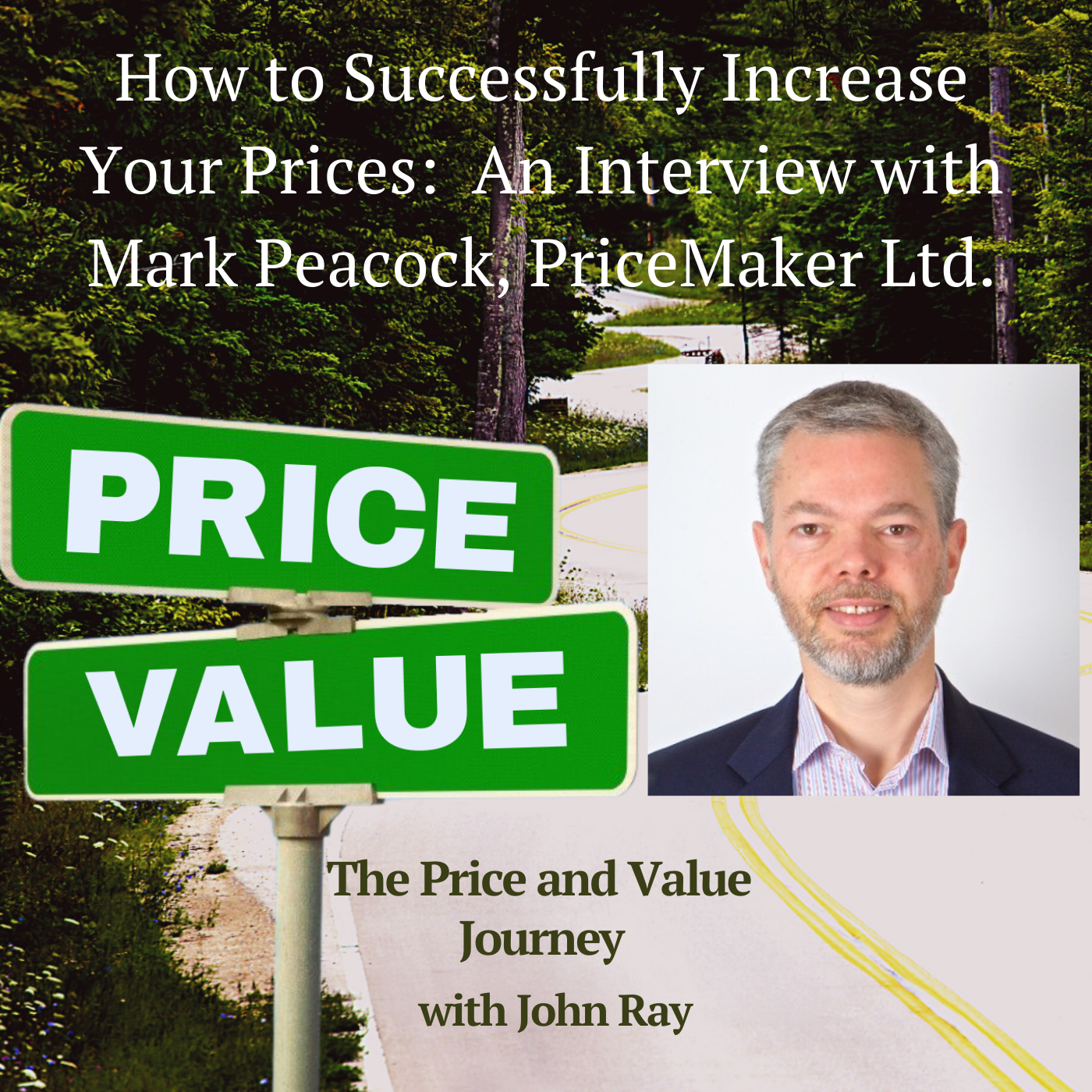
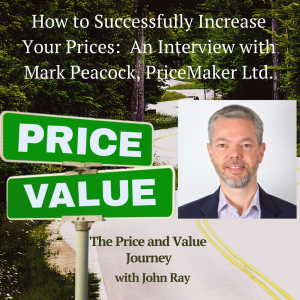
How to Successfully Increase Your Prices: An Interview with Mark Peacock, PriceMaker Ltd.

March 23, 2022 by John Ray

How to Successfully Increase Your Prices
North Fulton Studio
How to Successfully Increase Your Prices: An Interview with Mark Peacock, PriceMaker Ltd.
Loading
00:00 /
RSS Feed
Share
Link
Embed

Download file

How to Successfully Increase Your Prices

How to Successfully Increase Your Prices: An Interview with Mark Peacock, PriceMaker Ltd.

Pricing expert Mark Peacock joined host John Ray to discuss how to successfully increase prices in your professional services practice. Mark covered the primary reason services providers don’t raise their prices (fear), the role of options in better pricing, the two-stage communication process he advocates for a successful price increase, mistakes to avoid, and much more.

The Price and Value Journey is presented by John Ray and produced by the North Fulton studio of Business RadioX®.

PriceMaker Limited

Pricing is one of the most powerful levers any business can use to increase profits and drive revenue growth. Yet all too often businesses are too scared to review their pricing and typically many business owners are leaving a lot of money on the table as a result.

PriceMaker is a leading UK pricing consultancy that has helped its clients increase net profits by an average of 20%. They use a simple 7 step process for designing a better pricing strategy that focuses on what customers value, and helps businesses implement new pricing without the fear of upsetting customers. PriceMaker helps with any of the following pricing services:

  • Pricing New Products or Services
  • Review of Existing Pricing Strategies
  • Digital Pricing Strategy
  • Implementing Price Increases
  • Customer Pricing Research
  • Competitor Pricing Assessment
  • Tender Response Pricing
  • Training for Management & Sales Teams

Company website

Mark Peacock, Managing Director, PriceMaker Ltd.

Mark Peacock, Managing Director, PriceMaker Ltd.

Mark Peacock is a leading UK pricing expert focusing on growth businesses in the Tech, Services, B2B and Product development sectors. He is the founder and M.D of PriceMaker Ltd, a specialist pricing consultancy and has helped his clients create new pricing solutions that add significant bottom-line value (+20% average increase in net profits). Mark spent 25 years working in the corporate world for brands such as DHL and The AA and was business unit director for two business units with £25M revenue and +100 staff where he grew profits by +250% over 5 years. His broad expertise covers pricing, product management, sales, marketing, commercial strategy and P&L management and he is a full member of the Chartered Institute of Marketing, the European Mentoring & Coaching Council, and the Institute of Directors.

LinkedIn | Twitter

TRANSCRIPT

John Ray: [00:00:00] And hello again, everyone. I’m John Ray on The Price and Value Journey. And I’m delighted today to welcome Mark Peacock. Mark is a leading pricing expert based in the UK, focusing on growth businesses in tech services, B2B, and product development sectors.

John Ray: [00:00:21] He’s the Founder and Managing Director of PriceMaker Limited, a specialist pricing consultancy who has helped his clients create new pricing solutions that add significant bottom line value, on average 20 percent increase in net profits. Do I have your attention, folks?

John Ray: [00:00:41] Mark spent about 25 years in the corporate world for brands such as DHL. He has been in charge of business units with over 25 million in revenue, that’s pounds, not dollars. So, folks, that’s more than what you think given the conversion. And over 100 of staff headcount where he grew profits by 250 percent over five years. His expertise, not only includes pricing, but product management, sales, marketing, commercial strategy, and PNL management. Mark Peacock, welcome to the show.

Mark Peacock: [00:01:21] Well, thank you, John. It’s a real pleasure to be here. And thanks for that lovely introduction. I’m looking forward to our chat.

John Ray: [00:01:27] Yeah. It’s an honor to have you here. And we’ve got you here to address the question of how to successfully increase prices. But before we get to that, just real quick, you’ve got all this experience in corporate that goes well beyond pricing. And I’m just curious, when you left corporate to start your own practice, why did you focus on pricing?

Mark Peacock: [00:01:54] Yeah. That’s a great question, John. And when I originally left, I wasn’t absolutely sure what I was going to do. As you say, I have all of this experience in product management, marketing, running sales teams, and running a business. And then, I have my eureka moment and I thought, “Pricing. Nobody talks about pricing, particularly in the small and medium sized business world.”

Mark Peacock: [00:02:18] You know, you’ve got the likes of McKinsey’s and the big consultancies helping large corporates with pricing, but nobody really talks about it in the SME world. And I just felt that there was a place and a gap for somebody to come in and talk about how pricing can make a big difference to your business, and show people that it doesn’t actually have to be scary or difficult. And, actually, that there are lots of simple tactics that anybody can use that can make a big difference. So, I saw that as my mission, if you like. So, that’s why I’m on the show today, I guess, to help spread the word about the power of pricing.

John Ray: [00:02:58] Absolutely. And I think as we covered in the introduction, your focus is on several different sectors. Ours here on this show is on professional services firms, which you also have a wide experience with. Talk about from your perspective how bad the problem of inadequate or poor pricing is for professional services firms.

Mark Peacock: [00:03:26] Yeah. I think it starts with the point that people running these businesses are generally brilliant at what they do, whether they’re a marketing consultant, a lawyer, an accountant, an advisor, a consultant, whatever it is. They’re brilliant at what they do. But more often than not, particularly when it comes to pricing, they are a bit scared about it and they just default to the same method of pricing that everybody else in their industry uses. So, hourly rates, and daily rates, and project fees and things like that.

Mark Peacock: [00:04:04] And they don’t really put the thought that they need to into what’s the best pricing strategy for me. And the extent of that thought process is really, What’s my hourly rate going to be? Is it $50? Is it $500? Or is it $50? You know, where do I sit on that scale? And there’s a lot of hand wringing and worry and consideration. And then, we eventually settle on a number, whatever it is, and then we stick with it. So, we’ve gone through that hard question of what’s my hourly rate? And we don’t want to go through it again. So, we don’t move on any further.

Mark Peacock: [00:04:49] And in terms of how prevalent, it is what I think it’s right. You know, show me a business in the sector that’s got an amazing pricing strategy. And I’ll be quite surprised, people might be doing quite well with their pricing, which is great. But then, the question is, well, how much better could it be? So, yeah, there’s a lot. That’s why I’m passionate about what I do, because I think there’s a lot of people in this space that need help with their pricing.

John Ray: [00:05:19] How does someone that’s not an expert like you are, who has their own practice, how do they know they need to raise their prices?

Mark Peacock: [00:05:34] For me, the biggest indicator is the answer to the question, When did you last put your prices up? If the answer to that is more than a year ago, then you’re going backwards in terms of where you should really be. Now, we’re all aware of the threat of inflation, rising costs, rising prices. I’m sure it’s just as bad in the U.S. as it is in the UK at the moment for all sorts of reasons.

Mark Peacock: [00:06:07] So, if you don’t really think about it, people are unaware of the damaging effect of inflation over time. So, if I give a very quick made up example basing it on UK figures, $100 from ten years ago is not worth $100 today. It’s probably worth only about $70 in equivalent buying power. So, if you haven’t put your prices up in ten years, you’ve lost up to $30 in value, in buying power, that you would have had ten years ago.

Mark Peacock: [00:06:45] And the longer it goes on, the worse it gets, because you might think that inflation is only two or three percent – I’m not sure what it is in the U.S. at the moment – but that erodes the power of your dollar every single year. So, if you don’t do anything about it, you might think that the way to overcome that is to grow your business, is to sell more. You can do that, but your net margin is still deteriorating.

Mark Peacock: [00:07:11] So, I think the first question I always ask people is, When did you last put your prices up? Normally, always more than a year. People often say, “Well, probably three years ago we last put our rates up.” And often you’ll hear people saying, “Well, we haven’t put our prices up in ten years.” And that’s a big red flag for me. So, if that’s the case, then you really need to think about doing something about it.

John Ray: [00:07:40] Yeah. And I’m going to come back to what you said about if it’s been less than a year, because I’m sure there’s some folks that are probably shrieking at horror thinking about raising their prices every year. But I want to come back to that. But I want to talk about the reasoning behind why price increases don’t occur. And I assume fear is the biggest reason. But do you agree with that? And if so, why? And if you see something else, please comment on that.

Mark Peacock: [00:08:13] Yeah. Totally. I totally agree that fear is the underlying reason why people do not put their prices up. They might think it’s something else. They might think it’s due to market situation, increased number of competitors, my business is growing so I don’t need to. But the underlying reason is fear.

Mark Peacock: [00:08:38] And that’s because when it comes to thinking about that awkward conversation that you’ve got to have with your customers, people are scared. We’re scared because we don’t want to upset our customers. And if we do put our prices up, we don’t know how our competitors might react. So, all of that is going to affect our ability to achieve our revenue targets. And we might also lose out on new sales in the future that we would have got at our old prices.

Mark Peacock: [00:09:10] So, the conclusion, the thought process is, it’s far too risky. I don’t want to rock the boat. You know what? I’m just not going to bother and I’m going to focus on other things to grow my business, if that’s important to me. So, better marketing campaign, new products, recruit more salespeople, invest in new systems, whatever it is. There’s a whole load of things people will do to grow their business before they look at pricing.

Mark Peacock: [00:09:40] The pricing is the most powerful lever, as you know, John. So, it’s a shame that the fear gets in the way. Ignorance, I think lack of awareness of how to do it is another big factor, because that doesn’t get taught in business school, does it? You don’t do a module on how to increase your prices. You might remember what you learn about supply and demand and microeconomics, but that’s of no use at all in this situation. So, yeah, fear and lack of awareness, I think, are big factors in stopping people putting their prices up.

John Ray: [00:10:15] And unlike those that are in manufacturing, let’s say, that produce a product, what’s being sold for a professional services provider is what’s between their ears. So, it’s highly personal, right? I mean, it’s like you’re putting a price on your forehead, if you will, for people to say no to. And I think as much as people don’t want to admit that’s what’s happening, that’s really the way they feel down deep, right?

Mark Peacock: [00:10:45] Totally. And I think that’s also what holds people back from reviewing their pricing, because they take it very personally. And if somebody says no to the price increase, that’s a personal rejection. What I try and teach my clients is to separate the person from the product. So, think of it, this is the service I provide, it’s a product, and it has a price. And the best strategy, of course, is to provide options on our product range at different price points.

Mark Peacock: [00:11:17] So, it changes the conversation from the seller from “Will you buy from me, yes or no? And my rate is $100 an hour” to “Well, here’s the range of options that I provide, which one of these best meets your needs or the price you’re willing to pay?” So, it depersonalizes that link between the amount they’re paying you and your own self-worth and self-value. So, you need to get into that mindset of separating the two things and thinking about your pricing more carefully will enable you to do that.

John Ray: [00:11:53] Yeah. I just love that. I mean, because it really turns the conversation into yes or no. It’s a binary kind of thing into let’s talk about what your options are and you make the decision. And I, as the service provider, in a way, I don’t care what selection they make. Because I’m giving them options and they’re picking the one that fits best for them.

Mark Peacock: [00:12:21] Exactly that. And the best way to achieve that is rather than selling an hourly rate – so, let’s say I’m a website designer and I design websites for a living, and my hourly rate is $500 a day. And I estimate the job is going to take ten days, so $5,000 in total. So, rather than me pitching to the client and say, “Well, look, I charge $500 a day and it’s ten days, do you want me to do it, yes or no? And it might take more than that” – far better to just turn that into a project fee.

Mark Peacock: [00:12:51] And say, “Well, look, I’ve estimated the requirements. These are your objectives. This is what I can do. This is how it will look. And the overall project costs to meet your requirements is £5,000. By the way, if you want an enhanced version of what I can do, here’s another option with a load of extra services and features, and that’s £7,500.”

Mark Peacock: [00:13:14] So, you’re immediately moving away from “I charge $500 an hour” to “Well, here are two options. Which one of these best meets your needs at the price you’re willing to pay?” And of course, we’re using a few psychological pricing tricks in there, John, by high price anchor, which I’m sure you’re aware of. And that’s highly useful in terms of positioning the quality of what you do and allowing people to reference that to make a choice.

John Ray: [00:13:42] Yeah. I want to get back to options here in a second, but before we leave, I guess, the psychology of the service provider, let’s talk about ignorance. And as you said so well, the folks we’re talking about, those that are listening to this conversation, are brilliant people in what they do. But could that ignorance be what we’re talking about is the lack of understanding of a client’s perception of value and that’s where that ignorance is based. Is that what you see?

Mark Peacock: [00:14:21] I think it’s both facts and the lack of awareness of other ways to price what you do. I mean, if you work in a marketing agency, you’ve been trained to estimate hours and you’ve got a ladder of hourly rates, depending on your seniority. And that’s just the way it is. It’s the same in legal firms, accountancy, it’s just the same approach. And nobody takes the time or effort to think, “Well, is there a different way to price out what we do?” And we just get so used to pricing using that methodology.

Mark Peacock: [00:14:59] But you’re absolutely right, in terms of understanding customer value, that’s another area that people really struggle with. And the best way to think about this is, let’s say, I’m that website designer again and I’m charging $500 an hour. And if I’m [inaudible] a very small business, [inaudible], but they really love my help. Well, their ability to pay is very low, but they might perceive high value. Whereas, at the other end of the scale, you might have a much larger business as a client who thinks, “Oh, yeah. £500 a day, that’s a bargain. Let’s crack on.”

Mark Peacock: [00:15:41] So, if that’s the case, if that’s what happens in your market, why on earth would anybody try and sell the same price to both types of customer? It makes no sense if you think about it like that. Because people do perceive value in very different ways, and we need to adapt and adjust our pricing response accordingly. That doesn’t mean just saying, “Well, I’m going to charge you $300. And I’m going to charge you $500.” It needs to be more intelligent than that.

Mark Peacock: [00:16:15] But, yeah, understanding customer value is where really it all starts. And I think that is hard for people in this space. But there are ways and means to go about doing that.

John Ray: [00:16:27] Yeah. And we may get to some of that, but we want to get focused on how to increase prices because a lot of folks are struggling with that, knowing they maybe need to. And I think we talked about competitors and how folks are really focused in on what their competitors are up to. And the competitors are afraid, too, so how can I increase my prices, Mark, if my competitors aren’t?

Mark Peacock: [00:17:00] Yeah. That’s a really good question. I think the problem starts with the assessment that we’re all charging roughly the same price in terms of an hourly rate, whatever the number is. So, if I’m charging $500 and my nearest competitor, let’s say, they’re exactly the same price, how on earth can I get away with putting that up to $550 or $600? That feels difficult. Why would I want to do that? That makes no sense businesswise, because I’m going to lose business to those guys down the road and I’m not going to win any new contracts.

Mark Peacock: [00:17:40] Well, this is the problem with selling on an hourly rate or a daily rate, because you’re allowing the buyer to make it very easy to compare your rate with somebody else’s rate. So, the first step is turning it into options, or packages, or bundles. And that immediately sidesteps the easy comparison for a buyer to say, “Well, they’re £500 an hour and you’re telling me you’re £600 an hour and you turn it into a bundle?” Well, it’s $5,000, it’s $10,000 or whatever the number is, that’s far better, I think.

Mark Peacock: [00:18:18] In terms of how we go about this, the best advice I can give is, if you can understand your customers in terms of [inaudible] you need to do that. But in terms of the competitors, my advice is people get too worried about what competitors might or might not do.

Mark Peacock: [00:18:44] And whilst it’s important to know where you sit versus your competition, and particularly in terms of your price positioning, then get hung up on it. And if you feel your product or service has a high value, you have a good reputation, you have a strong brand, and you have lots of referrals and recommendations, then focus on that, first and foremost. And work out a plan to improve your pricing, not necessarily increase, but improve your pricing across your mix and let the competitors worry about it for themselves.

Mark Peacock: [00:19:24] I think all too often people, they anchor their pricing to the competitors. But why would you let somebody else determine the most important value lever that you’ve got that you can control, which is your price. And then, if you’re not sure, try and work out ways to improve your value proposition. Do I need to invest more in my branding, in my marketing? Do I need better systems to offer a better service? Do I need more people to support what I do? And all of that enhances and justifies the product that you’re selling unique to the needs and the market that you serve, rather than worrying about the customers.

Mark Peacock: [00:20:06] So, I guess my best advice there, John, is just forget them for a second and just crack on and sort yourself out. And then, worry about them further down the line. What do you think to that?

John Ray: [00:20:18] I couldn’t agree more. And, to me, that you’re focused on the wrong crowd. But you said it, instead of worrying about your competitors, focus on your customers. Go ask them why they’re doing business with you and you’ll be amazed at what you’ll find out, right? You will find out reasons that you’re delivering value that you didn’t even think of, right?

Mark Peacock: [00:20:41] Yeah. Yeah. Absolutely. And the other reason to do it like that is, you might flush out some really important things that you need to know about. So, if you do everything that we suggest and you go out with a very thoughtful price increase campaign, and you get some feedback from people that say, “Well, look, we’re not happy.” Well, what does that tell you? But what it probably tells you that it’s not actually the price that’s the problem. It’s the underlying quality of service or the product offering that you’re selling. That’s the real problem because they’re unhappy with it.

Mark Peacock: [00:21:17] So, the price of value equation has now gone out of balance in the eyes of the customer. Before, they were okay with the price value ratio, but now it’s tilted in the direction they don’t like. So, you need to know that so far better to have those awkward conversations and find out these things, than just carry on regardless. And, eventually, you’ll lose customers and business because you don’t understand why people are leaving.

Mark Peacock: [00:21:48] So, yeah, another good reason I think to tackle your pricing at least annually, I would say, to make sure you know what your customers really value. That’s my observation on that I think, John.

John Ray: [00:22:00] And then, on the positive side, you may have value that you’re delivering in ways that you don’t even think about. I mean, I’ll give the example of the accountant, that people do business with that accountant, not because they’re technically at the top of their game, which they are, but because they can explain difficult concepts in a way that folks can understand. I mean, I hear that a lot. And so, that’s a highly valued skill that that particular practitioner might not think about.

Mark Peacock: [00:22:45] Absolutely. And that’s a great point. So, it’s the soft reason why people are actually, “I love working with John because he explains things really clearly.” So, if John, the accountant, could turn that into a positioning statement and be very clear about the market, the people that they serve, and why he is particularly good for them, that will justify a price premium. Because people would be willing to pay more for John, the accountant, who’s brilliant at explaining difficult technical problems than the other guy down the road who just completes the books and sends in your tax return and doesn’t really explain things.

Mark Peacock: [00:23:27] So, really understanding that and having then the confidence to take that back to your business and say, “Yeah. Look, we’re really good at this. We should be pricing in line with the value that we’re offering because our customers see that value and are willing to pay for it.”

John Ray: [00:23:48] So, in terms of introducing options as a way to increase your pricing, and it sounds like there’s a process here, Mark, in going from hourly to introducing options. So, should I increase my hourly rate in the meantime while I’m preparing to introduce options?

Mark Peacock: [00:24:18] I would say not. Because if you don’t know where you’re trying to get to, you might make a mistake. Pricing is a long term game. Every single decision you make on your price today, or tomorrow, or next year will affect your business for years to come.

Mark Peacock: [00:24:37] So, for example, if we say, my hourly rate is $100 an hour. That’s your core price positioning then set for the next three to five years. And it’s very hard to move up from there. If you accept a deal and you knock a few dollars off because you really want it, well then you’ve lost that revenue and it comes off your bottom line for the next one, two, three years. So, every decision price is a long term game.

Mark Peacock: [00:25:06] So, I wouldn’t just rush ahead and increase the hourly rate without having thought through where do I want to get to in terms of my pricing. I think it’s far better to do that detailed work. It doesn’t have to be onerous or difficult. And you can come up with some ideas around options fairly quickly, evaluate the pros and cons of each, and then think, Where are we going to go with this? When are we going to do it? And is that acceptable to us as a business? I think that’s what I’d say on jumping too soon on that, John.

John Ray: [00:25:43] Got it. And what are the characteristics of successfully segmenting your clients so that you can introduce options that fit? And how important is fit with your current clients versus the clients you hope to get?

Mark Peacock: [00:26:07] Yeah. So, the simplest method that I talk about is to think about your market in terms of three different levels of price segmentation, high, medium, and low. So, every market, all of your listeners, all of their markets, will always have three levels of price willingness to pay.

Mark Peacock: [00:26:27] So, in the low segment, you’ve got your customers who are price sensitive. So, they have a low willingness to pay either because they can’t afford what you do. Or they don’t see the value in it, which is a different question.

Mark Peacock: [00:26:41] And the high willingness to pay segment, you’ve got customers that are willing to pay more, relatively speaking, for what you do because they value things other than price. They value your brand, your expertise, your reputation, the level of service you provide, whatever it is.

Mark Peacock: [00:26:58] And then, in the middle, you’ve got the core of your market, which is those people who don’t want to play at the cheapest end of the range but can’t afford the more expensive end of the range. And if you can design three options that fits each of those segments, you’ll be in a very good place, and that could be based around a package of services.

Mark Peacock: [00:27:23] So, one digital marketing agency I worked with had three bundles. An entry bundle for start up businesses for digital and design services. A medium bundle for existing businesses who were happy with where they were at with their marketing but wanted to take it up a level. And then, a premium bundle for investors and high growth businesses who were like, “Look, we’re totally ambitious. We want to go for it, basically.” And there were increasing components to each of these bundles. And, obviously, the fee went up, whether it’s a project fee, or a monthly retainer fee, or whatever it is.

Mark Peacock: [00:28:11] And the beauty is, when you now go out to market and sell like this, whoever you meet, you can basically say, “Well, here are the three options we have or here are three typical options. Which one of those best meets your needs at a price you’re willing to pay?” And you really don’t mind if the really wealthy buyers buy the cheapest package or the guys in the startup buy the most expensive package. You don’t mind. You might be slightly surprised.

Mark Peacock: [00:28:38] But it’s entirely their decision because they feel in control of that buying decision, which option might I choose. And it moves the buying process on one stage from “Am I going to buy from you, yes or no?” to “If I do buy from you, which option might I buy?” And that’s why options are so powerful.

Mark Peacock: [00:29:00] I always say one of the most important parts of pricing is choice and freeing your customers well-designed choices of price will do far more for your business than anything else. And three is the magic number, as we know. Two is okay, because it’s more than one. Four might be okay, but you’re probably getting into the territory of that’s too many.

Mark Peacock: [00:29:29] So, you can come up with three options that meet a broad range of customer needs. You’ll be doing very well. And you’re hedging your bets. You’re presenting a range of prices to the broadest spectrum of your market in terms of what they might be willingness to pay. So, you’re going to increase your chances of success.

John Ray: [00:29:52] So, I can hear folks now saying, “This is lovely, this conversation you guys are having about options, but how do options fit with increasing prices?” I mean, why does introducing options help me increase my prices?

Mark Peacock: [00:30:09] Okay. So, you could either just increase your price and, let’s say, it’s an hourly or a daily rate. So, let’s say one approach is to say, “Well, I’m charging $100 an hour and I’m going to put that price up by 10 percent. So, for next year, the price is $110 an hour.” So, that’s the traditional approach.

Mark Peacock: [00:30:28] The alternative to that is to say, “Well, if we can turn that hourly rate into packages, we can now go out to all of our existing customers and say, ‘Previously, we’ve been working on an hourly rate, but would now like to present to you some different options that you can consider.'” And it’s entirely their decision. So, I’ll use hourly rates for the sake of comparison, but it’s not really the best way to do it.

Mark Peacock: [00:30:56] But what I mean by that is, say for example, you now go out to your customers and say, “Well, if you want to carry on buying the same service, exactly the same, it’s $100 an hour. Or you can have a slightly enhanced version of that, which is $110 an hour. Or you can have the premium version of that, which is $130 an hour. Which one of those best meets your needs at a price you’re willing to pay?”

Mark Peacock: [00:31:19] And then, what you’ll find is that, certainly, your customers will stick with $100 product. But a proportion will upgrade to the 110 product. And maybe a couple will take 130 product. Because until you present that option to them, they can’t choose it, they can’t buy it.

Mark Peacock: [00:31:39] And then, if you can do the math, you can work out the weighted average increase. And what you’ll find if, say, 50 percent stay on the current rate, 30 percent by the £110 product, and 20 percent or less by the premium $130 product, your net average prices will have increased by between five and ten percent without you having to enforce an actual price increase on any of your customers. And that’s the power of choice.

Mark Peacock: [00:32:13] It’s that little bit of mass that works out the net effective price increase overall across each of the options. So, you can achieve increased prices by being more customer friendly, more tailored, and more responsive, and not upsetting your customers, which sounds a good way to do it. Why wouldn’t you do it like that if you know that’s the best way to do it?

John Ray: [00:32:41] Yeah. I mean that’s the proverbial having your cake and eating it, too, right?

Mark Peacock: [00:32:46] Yeah. Exactly.

John Ray: [00:32:48] Right.

Mark Peacock: [00:32:49] Sorry. Go ahead.

John Ray: [00:32:49] No. Go ahead, please.

Mark Peacock: [00:32:51] So, I was just going to say I’d use the example there by illustrating hourly rates. But, of course, that’s not the best way to do it. It’s far better to turn it into packages of options, which could be a monthly retainer, a monthly fee, a project fee, et cetera, rather than three different hourly rates. Just to clarify, I don’t want people thinking, “Mark said have three different hourly rates.” I mean, you can but it’s not ideal. I just wanted to clarify.

John Ray: [00:33:22] Thank you for clarifying that because I can see somebody getting that mixed up there. And so, talking about hourly rates, is this the way that I should make the jump from hourly? And should I make that jump with new clients only, or all of my clients, or just a few? What do you counsel on that?

Mark Peacock: [00:33:54] Yeah. It’s a good question. I always say when thinking about new pricing models, always think about new customers first, and then existing customers second. Because if we start by thinking about how can we improve our prices with our existing customers, we get tied up in knots because we just think, “Well, my biggest client, it’s going to be a nightmare talking about price increases to him, so I don’t want to do that.”

Mark Peacock: [00:34:22] So, let’s just put that issue to one side for a second and just think about new business. And the advantage of that is you can start with a blank sheet of paper, because none of your prospects or potential customers at this stage will know what your pricing is. So, you can go to them with a totally new price proposition and try things out. So, you could say, “Well, I’m just going to try out this new pricing approach on new customers only for a couple of months until I get confident with it. And then, I’ll bring it back to my existing customers and work out how we could apply it to them.”

Mark Peacock: [00:35:00] So, yeah, I always encourage folks to think about pricing for new business first, and then come back to your existing customers, and then seeing how you can translate or migrate the existing customers on to the new pricing model. And it just makes life a lot easier as well. They can have more fun because they’re new customers. So, let’s design something that’s really going to float their boat and meet our commercial requirements in terms of revenue and profit.

John Ray: [00:35:34] Let’s shift gears here, Mark, and talk just in general about how to communicate a price increase. And you’ve written and spoken on this. Let’s talk about issues like notice period, how much notice should I give? And just the communication of that, how that should unfold.

Mark Peacock: [00:35:59] And this is just as important as working out what is my new price. How you communicate and articulate and justify your pricing is as important as how you set the number. And when it comes to price increases, I think there’s a number of elements of good practice that businesses should follow.

Mark Peacock: [00:36:19] So, talking about notice period, so what’s a good what’s a reasonable notice period? So, for me, anything less than 30 days notice of a price change is a bit unreasonable. If you’re on the receiving end of a price increase and said, “Hey, John. We’re going to put our rates up effective tomorrow.” You’d be like, “Okay. Well, I haven’t budgeted for that and I wasn’t expecting it, so I’m a bit I don’t like that.”

Mark Peacock: [00:36:48] So, my advice is always minimum 30 days, even better, two months notice. So, if you can put your prices up, let’s say in January, the start of the calendar year, you need to be writing to your customers or emailing them or communicating with them by the end of October. Now, this seems quite far out, doesn’t it? “Oh, my God. That’s quite a lot.” But what it does is it gets your mind, your brain, your business geared up properly to manage and handle that price change, that price increase. So, by October, you need to have done the thinking about how you’re going to implement and apply this price increase. So, that’s what I’d say on timing.

Mark Peacock: [00:37:35] And the second reason for doing it like that is, again, it flushes out any disgruntled customer. So, you’ve got more opportunity to rescue that client and either do something bespoke for them. Or if you find that the two parties, there isn’t a meeting or there isn’t a good fit, then maybe it is time to part ways. I would say it’s far better to have 97 customers paying a higher rate than 100 customers at a lower rate. You’ll be better off financially, and you won’t be working as hard. So, what’s not to love about that?

Mark Peacock: [00:38:19] In terms of communication, it depends how many customers you have. For example, if you have hundreds or thousands, then you need to be doing some kind of mass communication, email, or letter. If you only have a couple of dozen, you can probably pick them off one by one verbally on a phone call, if you’re comfortable doing that. But get your script ready. And I don’t mean a script in the specific sense of saying something word for word. I mean, a guideline script. So, get your reasons ready. And this applies whether it’s a verbal conversation or a written communication.

Mark Peacock: [00:38:58] So, the way I would always position a price increase is as follows. We start with an acknowledgement that costs have risen. Now, in the current climate, and I’m sure this is the same in the U.S. as it is in the UK, prices are rising, costs are rising significantly. So, that is to your advantage because businesses, your clients, your customers, are aware that this is a problem at the moment.

Mark Peacock: [00:39:29] So, we can say something like, “As I’m sure you know, costs are rising at the moment and we need to move our business forwards to keep pace with the growth of our business,” or something like that – I didn’t word that very well. But we need to acknowledge upfront that cost is an issue. But once we’ve done that, we then move on to what that means for the customer. So, we only dwell on it very briefly, but then we move on to what does that mean for you. So, we can talk about the proposed price increase at that stage. “So, from next January or next April or next September, the new pricing will look like this, blah, blah, blah.”

Mark Peacock: [00:40:16] And then, it becomes a sales task. A price increase is a sales job in the sense that you have to remind and reinforce and reconvince all of your customers why they should continue to buy from you. So, we remind them of all of our strengths, all of our USP, all of our qualities.

Mark Peacock: [00:40:37] For example, “We are still the number one accountancy in our area. We specialize in providing friendly, easy to understand advice that meets the needs of your kind of business.” Or, “We’re the most creative marketing agency and we’ve won loads of awards and we are delighted to work with X,Y,Z and look forward to coming up with more ideas for you next year.”

Mark Peacock: [00:41:04] So, you’ve got to sell hard on the reasons and the benefits that people chose you in the first place. And update them, if you can, and remind them that that’s why they chose you in the first place. And then, you let them decide. Don’t play the hard sell in terms of where you’ve got to switch to our new pricing from next January. Let them decide. Because they are in control, so let them decide. And give them an out. If they don’t want to carry on, then say that’s fine. You know, “It’s been great working with you, but if you don’t see the value in this, then fine.”

Mark Peacock: [00:41:46] So, I’d be very gentlemanly about it, very professional, and treat people courteously, basically. So, I hope I’ve talked through the key stages there clearly, John. So, acknowledge the reason for the price increase. Costs are rising, explain what impact that is going to mean for the client as quickly as possible. Get it upfront. And then, thirdly, resell benefits as to why they should continue to work with you. Does that make sense?

John Ray: [00:42:18] Yes. Absolutely. Now, one post you made that discussed this, you applauded the idea of, in that first communication, not disclosing what the price increase would be. And I’m sure that’s shocking people to hear that. “You mean I’m going to tell people I’m raising price, but I’m not going to tell them how much? And isn’t the client going to ask me how much?” So, talk through that for us.

Mark Peacock: [00:42:54] Yeah. So, this is an even better price increase strategy. I’ve used it with my clients. And in the LinkedIn post I did, I was referring to my mobile phone provider, Virgin Mobile. And it’s exactly the same approach. And it’s a two stage communication process.

Mark Peacock: [00:43:14] So, stage one is we give all of the explanation and all of the reasons why our prices need to go up. And remind people of all the benefits of why they should continue to work with us. But we don’t tell them what the actual price increase is. All we say is, “We’re going to write to you next month and confirm you new prices for next year.”

Mark Peacock: [00:43:39] So, let’s say we write that first stage communication in October, and then we write the second stage for implementation in January, and then we write a second communication in November, and say, “Dear Mr. Customer. Following our communication last month, we’re pleased to confirm your new prices for next year as follows.” And then, you list them on the page.

Mark Peacock: [00:44:01] And what that does is a number of things. So, it manages expectations because the client now knows, “Okay. I’ve got a price increase coming.” It will flush out some early objectives. So, if you have any people that are particularly unhappy or want more detail, they will get on the phone to you or they will reply via email so you can start to have conversations with them.

Mark Peacock: [00:44:27] But most importantly, by the time they actually receive the price increase letter, which hopefully has some options in, in their mind, they’ll be thinking, “Oh, god. Is John going to push his prices up by – oh, gosh – it could be between ten and twenty percent maybe? I’ve heard of other people doing that in similar areas.” And you come along and it’s only eight percent and they go, “Oh, okay. Well, it’s not so bad then.” They still might quibble at this point. This is real life. This is grown up stuff. They still might argue at that point once they know what the real number is.

Mark Peacock: [00:45:03] But it’s a far better process because you’re being courteous. You’re letting them know where you’re at with your business. You’re also demonstrating courtesy by using this two stage process. And helping them get to grips with their planning, their forecasting, because they’ve got to think about their budget for next year.

Mark Peacock: [00:45:25] So, if they spent $5,000 a month on marketing fees, they need to know it might go up to five-and-a-half thousand. So, let’s shove that in the budget. And then, when the agency comes along and says, “Well, it’s only $5,300.” “Okay. Fine. Well, we’ve made a little saving.”

Mark Peacock: [00:45:43] So, I love that two stage process. Virgin did it to me for my mobile phone. I could see exactly what they were doing. But, of course, by the time the actual price increase came along, it was only an extra $0.93 a month on my mobile plan. I did the same thing for a manufacturing company. They had 300 customers, and it worked really well for them. So, no reason it can’t work for anybody in the professional services industry as well.

John Ray: [00:46:14] Yeah. That’s a really important thing you just mentioned, the psychology of it is that people assume the worst. And the worst is probably always a whole lot higher than what you’ve got in mind as a service provider. So, I love that.

John Ray: [00:46:34] We’re kind of running down on time, but I want to ask you one quick question before we wrap. Back to this business of raising prices every year, so I can hear people saying, “I’m going to be writing letters all year long here if I’m raising prices every year.” Talk about why you think that’s important as opposed to just one big increase every few years.

Mark Peacock: [00:46:59] Okay. So, far better to raise your prices on a regular pattern of frequency. So, do it once a year, every year, even if it’s only a couple of dollars or a couple of percent. And part of the reason for doing that is (A) you get your business into the habit of doing that, but you also train your customers to expect it. Even better, in your standard terms of business, you should have a clause that says, “We will increase our prices every year by an amount linked to inflation,” so they know it’s coming.

Mark Peacock: [00:47:34] So, get into the habit of doing it regularly. Do it the same time every year, whether it’s January, or April, or whatever works for you. And if there is a common habit in your industry, follow that common habit. So, if your industry generally puts prices up in January, do it in January, not in June. Because you’ll stick out like a sore thumb if you do it in June and everybody else is doing it in January.

Mark Peacock: [00:48:02] So, far better that than waiting three years and saying, “Oh. Sorry, guys. Prices are going up by 20 percent next year. We haven’t done it in three years. I hope that’s okay.” Far better, regular, small, frequent changes rather than big changes that are going to disrupt your business cycle. So, that’s my advice on that, John.

John Ray: [00:48:24] Okay. Awesome. Wow. You have shelled out the value today, Mark. And, folks, I think listening to this, you’ve gotten thousands of dollars worth of value here from Mark at no charge. So, thank you for that. But for those that want to dig deeper, learn more about your services that you offer, and maybe ask some questions, can they get in touch? And if so, how can they do that?

Mark Peacock: [00:48:55] Yeah. Of course. So, they can find me on my website which is pricemaker.co.uk. And if you go on there, there’s a pricing challenge and you click on it. It’s a self-assessment and you get a scorecard on your pricing capability. So, fill that in and it will give you loads more value. And you’ll find my contact details on the website as well. So, that’s pricemaker.co.uk.

John Ray: [00:49:21] Terrific. Mark Peacock, folks. Mark, it’s been a pleasure and thank you again for coming on and delivering so much value.

Mark Peacock: [00:49:31] Yeah. It’s been a pleasure, John. I always love talking about pricing, so thank you for inviting me today.

John Ray: [00:49:36] Thank you. And friends, just a reminder, if you’d like to hear more of this series, go to pricevaluejouney.com. And to connect with me directly, just send an email, john@johnray.co. Thank you for joining us.


About The Price and Value Journey

The title of this show describes the journey all professional services providers are on:  building a services practice by seeking to convince the world of the value we offer, helping clients achieve the outcomes they desire, and trying to do all that at pricing which reflects the value we deliver.

If you feel like you’re working too hard for too little money in your solo or small firm practice, this show is for you. Even if you’re reasonably happy with your practice, you’ll hear ways to improve both your bottom line as well as the mindset you bring to your business.

The show is produced by the North Fulton studio of Business RadioX® and can be found on all the major podcast apps. The complete show archive is here.

John Ray, Host of The Price and Value Journey

John Ray The Price and Value Journey
John Ray, Host of “The Price and Value Journey”

John Ray is the host of The Price and Value Journey.

John owns Ray Business Advisors, a business advisory practice. John’s services include advising solopreneur and small professional services firms on their pricing. John is passionate about the power of pricing for business owners, as changing pricing is the fastest way to change the profitability of a business. His clients are professionals who are selling their “grey matter,” such as attorneys, CPAs, accountants and bookkeepers, consultants, marketing professionals, and other professional services practitioners.

In his other business, John a Studio Owner, Producer, and Show Host with Business RadioX®, and works with business owners who want to do their own podcast. As a veteran B2B services provider, John’s special sauce is coaching B2B professionals to use a podcast to build relationships in a non-salesy way which translate into revenue.

John is the host of North Fulton Business Radio, Minneapolis-St. Paul Business Radio, Nashville Business Radio, Alpharetta Tech Talk, and Business Leaders Radio. house shows that feature a wide range of business leaders and companies. John has hosted and/or produced over 1,100 podcast episodes.
Connect with John Ray:

Website | LinkedIn | Twitter

Business RadioX®:  LinkedIn | Twitter | Facebook | Instagram

Tagged With: increasing prices, John Ray, Mark Peacock, price increase, PriceMaker, PriceMaker Limited, pricing, professional services, professional services providers, solopreneurs, The Price and Value Journey

How to Get Great Referrals

March 21, 2022 by John Ray

How to Get Great Referrals
North Fulton Studio
How to Get Great Referrals
Loading
00:00 /
RSS Feed
Share
Link
Embed

Download file

How to Get Great Referrals

How to Get Great Referrals

For us as professional services providers, the answer to the question of how to get great referrals lies in the clients we already have. The Price and Value Journey is presented by John Ray and produced by the North Fulton studio of Business RadioX®.

TRANSCRIPT

John Ray: [00:00:00] Hello. I’m John Ray on The Price and Value Journey. How do you get great referrals? I don’t mean referrals which are average or marginal. I mean referrals to clients who are the best fit for your practice.

John Ray: [00:00:17] For professional services providers, there’s a simple answer. The answer starts with the clients you take on, to begin with. You only accept clients who are the best fit for you and your practice. Best fit clients are those clients whom you deliver stellar results for, who see the value in what you deliver, the transformation that you give them. They’re happy to pay for that value and they’re clients you enjoy working with.

John Ray: [00:00:47] Great clients know other great clients for you. And your best clients want you to succeed. And they’ll go out of their way to refer that kind of business to you. They do this in part because they feel invested in you. That’s the way great clients react to their services providers whose work they value. That’s part of what makes them great.

John Ray: [00:01:13] Your best fit clients are invariably grateful. They appreciate you and the substantial and positive changes you’ve brought about for them. It might even be years after the engagement, but your best fit clients still refer other superb clients to you because they’re still basking in the glow of the work you did, and they remember.

John Ray: [00:01:37] Now, conversely, how do you get poor quality referrals? Well, you guessed it, if you compromise or stretch and you accept clients who aren’t the best fit, then guess what profile of client they’ll send your way. A client that looks just like them. A client who is not an ideal fit for your practice.

John Ray: [00:02:02] Roses prefer roses and thorns refer thorns. That’s another reason why it’s vital that you take good care in the clients you take on. Focus on clients who are the best fit. Who you can do a great job for, who willingly write checks which are commensurate with the value that you deliver, and who you enjoy working with.

John Ray: [00:02:27] I’m John Ray on The Price and Value Journey. I’m honored that you’d spend time listening to this episode. If you’d like to hear more of the series, you can find it at pricevaluejourney.com. If you’d like to connect with me directly, you can email me, john@johnray.co. Thank you for joining me.


About The Price and Value Journey

The title of this show describes the journey all professional services providers are on:  building a services practice by seeking to convince the world of the value we offer, helping clients achieve the outcomes they desire and trying to do all that at pricing which reflects the value we deliver.

If you feel like you’re working too hard for too little money in your solo or small firm practice, this show is for you. Even if you’re reasonably happy with your practice, you’ll hear ways to improve both your bottom line as well as the mindset you bring to your business.

The show is produced by the North Fulton studio of Business RadioX® and can be found on all the major podcast apps. The complete show archive is here.

John Ray, Host of The Price and Value Journey

John Ray The Price and Value Journey
John Ray, Host of “The Price and Value Journey”

John Ray is the host of The Price and Value Journey.

John owns Ray Business Advisors, a business advisory practice. John’s services include advising solopreneur and small professional services firms on their pricing. John is passionate about the power of pricing for business owners, as changing pricing is the fastest way to change the profitability of a business. His clients are professionals who are selling their “grey matter,” such as attorneys, CPAs, accountants and bookkeepers, consultants, marketing professionals, and other professional services practitioners.

In his other business, John is a Studio Owner, Producer, and Show Host with Business RadioX®, and works with business owners who want to do their own podcast. As a veteran B2B services provider, John’s special sauce is coaching B2B professionals to use a podcast to build relationships in a non-salesy way which translate into revenue.

John is the host of North Fulton Business Radio, Minneapolis-St. Paul Business Radio, Nashville Business Radio, Alpharetta Tech Talk, and Business Leaders Radio. house shows which feature a wide range of business leaders and companies. John has hosted and/or produced over 1,100 podcast episodes.
Connect with John Ray:

Website | LinkedIn | Twitter

Business RadioX®:  LinkedIn | Twitter | Facebook | Instagram

Tagged With: clients, generating referrals, John Ray, Price and Value Journey, pricing, professional services, professional services providers, referrals, solopreneurs, The Price and Value Journey, value

Business Brand Phrases That Stick: An Interview with Marti Konstant

March 16, 2022 by John Ray

Marti Konstant
North Fulton Studio
Business Brand Phrases That Stick: An Interview with Marti Konstant
Loading
00:00 /
RSS Feed
Share
Link
Embed

Download file

Marti Konstant

Business Brand Phrases That Stick: An Interview with Marti Konstant

How should we as professional services providers address our business branding? How can we develop branding which is memorable? Marti Konstant, noted speaker, coach, and best-selling author, joined John Ray to address these questions and much more. Marti recounted her own journey, from teenage years in a full body brace to Silicon Valley marketing executive, to running her own successful services practice, and how that career arc shaped her business branding. She spoke from her own experience on how to handle a branding process that can be overwhelming, examples of compelling brand phrases and the professionals who developed them, how effective branding affects pricing, and much more. The Price and Value Journey is presented by John Ray and produced by the North Fulton studio of Business RadioX®.

Marti Konstant, Workplace Futurist

Marti Konstant, Workplace Futurist

Marti Konstant is a workplace futurist with an agile mindset. She is a career growth analyst, author, speaker, and founder of the Happy Profitable Employee Project™.

An early adopter of workplace trends and technology change, her career path includes artist, designer, entrepreneur, technology marketing executive, business advisor, and investor. Starting her profession in the tech sector launched a style of deliberate career growth, guided by personal preferences.

As a marketing professional, Marti managed marketing programs for companies like Samsung Mobile, Apple, Tellabs, Platinum Technology, Clear Communications, and Open Kernel Labs (OK Labs). As a chief marketer in the mobile security space, her digital demand generation and market awareness strategies resulted in the acquisition of OK Labs by General Dynamics

What started out as a quest to fine-tune her evolving career sparked a research project, workshops, and book, where future of work and career agility are central themes. Her story-driven book, Activate Your Agile Career: How Responding to Change Will Inspire Your Life’s Work, is the result of 120 interviews and custom research.

She earned a Bachelor of Fine Arts in Graphic Design from the University of Illinois and holds a Master of Business Administration from the University of Chicago Booth School of Business. A persistent optimist and prolific photographer, she lives in Chicago with her husband.

Website | LinkedIn| Twitter

TRANSCRIPT

John Ray: [00:00:00] And hello again, everyone. I’m John Ray on the Price and Value Journey. Today, we’re going to chat with Marti Konstant, and Marti is a friend of mine who – we were having a conversation that resulted in this topic, and I’ll talk about the topic in a minute. But first, let me introduce Marti.

John Ray: [00:00:18] Marti is a workplace futurist. She’s the best-selling author of Activate Your Agile Career, which is a great book, by the way. She has an MBA from the University of Chicago Booth School of Business. She’s a former technology executive from Silicon Valley. I want to say more about that in just one second. She’s been featured in a variety of media outlets and has been named a top career influencer to watch. She’s worked with companies like Samsung, Dow Jones, and Apple. And her areas of expertise include the future of work, career development, the workplace, personal branding, workplace trends and ideas, agility, and I’m sure there’s some other things we could talk about. It makes me tired to read that list, Marti. You’re awesome. Congratulations on all that great work.

Mari Konstant: [00:01:12] Thanks so much for that, John. I am so psyched about this conversation because I’ve been following your work for quite some time now.

John Ray: [00:01:19] Well, thank you. I’m honored to have you on the show. Now, one of the things we just need to point out here is that Marti has tremendous experience that a former technology executive from Silicon Valley, all that experience really relates to branding and specifically B2B branding. And that’s where some of our recent chat, we were talking about business brand phrases for professional services firms. And that’s the whole notion here of this conversation is to talk about that as it relates to professional services providers. So, let’s start, Marti, by maybe talking about your own branding journey when you went out on your own and started your practice.

Mari Konstant: [00:02:08] Sure. It really starts long before that. When I was 12 years old, I was immobilized. I was in a full-body brace through my high school years and I was constricted. I couldn’t move and I couldn’t do sports and it was hard to get around. And what I learned from that experience is, well, first of all, I learned how to dream about mobility, agility, flexibility, all the things that I wanted to be doing. And I learned what it was like to go from constriction to unrestricted access to the world. And this was a very powerful backdrop for the type of work that I did. I started out in the creative field, got into branding, got my MBA, got into marketing management, and was managing growth-stage tech company brands as well as certain aspects of large company brands at that time. And right now, how has this affected my brand? Well, I invented the word career agility 10 years ago. It was a term that did not exist. So that is one way. And the phrase that I often used during that time and throughout the book is, if you don’t, it’s adapt or die. It’s flex or fade. It’s the contrast. It’s stagnation or it is growth. Why wouldn’t you want to grow?

John Ray: [00:03:47] For sure. So, this may seem like an obvious question, but I find that sometimes obvious questions give unexpected answers. So, I mean, how do you define a business brand phrase?

Mari Konstant: [00:04:05] I coined the business brand phrase terminology because people were getting stuck in making it a big, long initiative that a lot of small businesses can’t even fathom doing. They can’t fathom doing something for six to 12 months or even three to six months. And I noticed when I was managing brands in the tech space, and as I formed my own brand as a workplace futurist and as a career decoder, I noticed that things that I thought were really easy, coining phrases that didn’t exist, talking about yourself in a way that’s memorable. I just thought that everybody did that. And I realized that if you can just use a phrase and you don’t have to come up with the whole perfect elevator pitch, you can be memorable because that’s all branding is. It’s about being top of mind. It’s about being memorable when someone else wants to work with you for your services or your product.

John Ray: [00:05:22] So, I’m curious about – it just strikes me about the workplace agility phrase that you invented combines something about your life. You described your teenage years and the pain and development, I guess, that you went through because of that, right, and then, your expertise, the workplace. It combines those two things. Talk – say more about that. Is there something significant in that?

Mari Konstant: [00:05:59] Yeah. I think this idea of agility. I just thought, you know, as one who was prevented from moving for a few years, I just thought, you know, if you are agile and you are flexible, anything is possible. So, all of those self-help books like you can if you think you can are true. And you can’t do if you think you can’t, that’s also true. And I think the idea of agility has really resonated well in this area of pandemic and post-pandemic that if you are able to adapt and be agile in your thinking, you are going to future proof just about anything you’re doing because every business, every industry will be reinvented in the next 10 years. That is my futurist self stating this.

John Ray: [00:07:08] Got it. So, I can hear – so, you know, our audience here is solopreneurs, small professional services firms. You’ve got your own practice. I can hear folks saying, you know, look, I do wills and trusts or as an attorney or, you know, I do social media for other clients. I mean, what – you know, I’m a professional services provider here, Marti, not a can of green beans. So, I mean, how, how – why do I need to worry about a business brand phrase per se?

Mari Konstant: [00:07:44] Well, when you’re networking and you say something like I’m a trusted advisor, how many other businesses do you think have that as their tagline? I mean, let’s just guess. Let’s just guess, John.

John Ray: [00:07:59] Oh, 50 million. I don’t know.

Mari Konstant: [00:08:02] Yeah. It’s – I don’t even have the number. What I do know is, it starts to sound trite, and then I ask myself, well, what do people really mean when they say that? Well, sometimes they mean that they are an unapologetic truth-teller. Sometimes they mean that they have your back. Sometimes they mean that they have vision in a way that they can see through things that you can’t, and I think about taking these types of phrases. And if you’re at a networking event or at a dinner event and you make that tangible is what you do for people. People will remember that. They’ll remember things. Like, I’ll use the idea of my surgeon. He was working on my shoulder and I said, “You know, I got to know. Like, is this going to work?” And he could have said, “You know, I’m a surgeon. I’m a really good surgeon.” But what he told me, he told me something quantitative and exciting, and he said, “Marti, I have 100% confidence that you will have a full recovery. I have done 9000 shoulder surgeries.”

John Ray: [00:09:17] Oh, wow.

Mari Konstant: [00:09:18] Now I felt going into that surgery, I didn’t even have a doubt in my mind, and they tell you so much is about mindset. So, who wouldn’t want to have a doctor like that that exhibits such confidence gave me a metric. So, sometimes it’s a metric that you could put out there. That could be part of your branding phrase. It doesn’t have to be a tagline, and I’ve got lots and lots of examples. Like, a nonprofit executive that says that they do all these wonderful things. And, oh, by the way, they’re able to turn red into black. Everything is hemorrhaging right now in the nonprofit sector in, say, things like, you know, the creative arenas like orchestras and plays and things like that. Who wouldn’t want somebody that knows how to turn red into black? They could just say, “Well, I’m a CFO,” or, “I am a bean counter and I can keep things organized for you.” Well, that’s not selling me confidence.

John Ray: [00:10:20] And it’s not very memorable.

Mari Konstant: [00:10:23] No. And it’s – part of it is it’s just that confident piece of it that seems when you use something trite when you use a phrase that’s trite like the trusted advisor or there’s a number of them. I mean, maybe you can come up – maybe – what do you think people say that’s like – like they say, “Well, you know, on time, on target, on budget.” Those are good things, right?

John Ray: [00:10:52] Right.

Mari Konstant: [00:10:53] But it’s not memorable.

John Ray: [00:10:55] Yeah, for sure. You know, the interesting thing here is, I think for some people is how do I come up with something that’s memorable, but I’m not sure I’m as inventive as Marti, I mean, because workplace agility is something that – you Google workplace agility, folks, you find Marti. The question is if I’m a financial adviser, let’s say, and I’m one of a bazillion financial advisers, how do I come up with something that really is unique that makes me stand out?

Mari Konstant: [00:11:31] I think you work with a person that you know you trust that can help you do that. You could also create your own group and do some brainstorming exercises. You can learn how to do some of this. I think there’s so many consultants. And I think of things that can translate to others.

Mari Konstant: [00:11:49] Like, I often run into people in the IT space and they go, “Well, you know, I integrate this and that and it doesn’t sound all that interesting.” Yet, when they tell me, well, I’m able to translate and then they say, “Well, I translate.” And I go, “Well, tell me more about that.” And then, you come up with something like the digital fluency. Like, I am multilingual. I speak tech and I speak tech translation. That’s better than saying I translate text so that everyone can understand it. Now, you can say that other phrase I translate text so everyone can understand it after you’ve said the thing about I’m multilingual and I take digital fluency to another level. You could substitute words like financial fluency in there. You can take other words and other phrases.

Mari Konstant: [00:12:23] I thought about management consulting. There’s a lot of people that do small business management consulting, how to make your businesses more profitable and more effective. And if you said something in a networking program, you said, “You know, I’m like a master chess player.” I process if-then scenarios quickly helping you and your team to focus on a decision when every second counts, or something like that. Some sort of story –

John Ray: [00:13:14] Sure.

Mari Konstant: [00:13:14] That makes it interesting and tangible. Like, what happens when small businesses have an eruption of some sort? What do they do? What is that scenario? What does it feel like? How do they make a decision? And so, you go through a series of questions like this, figure out how that feels. And the way that you can make an effective branding phrase is to put your brain and your shoes and your feet in the shoes of your customer. You have to be an outsider looking in. You have to be a beginner. You can’t be the perfect practitioner that you already are. You have to go back to the beginning and say, “Why the heck did you start this business in the first place?” Something was broken, right? You wanted to make it better. That’s the kind of stuff that needs to come out.

John Ray: [00:14:06] I’m glad you went there because that’s where I wanted to go in terms of, again, I’m going to showcase you. I mean, your business brand that sticks is really about the client. I mean, workplace agility. It’s about the client. It’s not about your expertise. It’s about what you help affect on behalf of the client. And that’s what’s I think striking about, and the difference maybe, in the effective business brands versus the non-effective ones. Don’t you, don’t you – does that make sense?

Mari Konstant: [00:14:44] Exactly. Yeah. And I have a little acronym that I use for this. It’s called mode, M-O-D-E. And it is speaking like a media, a media professional, number one, speaking like a great PR professional, being able to talk, and then actually looking from the outside, and that’s the O. And D is being able to be different, and then E, being able to look at the world with an empathetic brain. So, that’s a little bit of part of the outside looking in.

Mari Konstant: [00:15:27] If you can do those things if you can apply mode to that, and I can go into why being like a media pro is so important, but it’s just as important as being different. I think Sally Hogshead has a book coming out, Why Different Is Better Than Better. And I’ve heard numerous branding executives say this. It’s such a smart phrase because the reason it’s better than better, you know, we all talk about in tech, smarter, faster, cheaper, that kind of thing, but really different is what makes you memorable.

John Ray: [00:16:06] I love it. Folks, we’re here chatting with Marti Konstant and we’re speaking about creating business brand phrases that stick. So, we talked about clients and our prospects and how coming up with our branding from their perspective is so crucial. How did you involve your clients’ prospects in your branding or did you? How did that work for you?

Mari Konstant: [00:16:38] Okay. So, how did I get some of the phrases that I got? I will offer you a phrase that I’m using now because I also work with job seekers and right now my phrase for them is I help mid-career job seekers, that’s the target audience, mid-career job seekers, translate their experience into a visible in-demand portfolio of skills so they can find that right fit role. And how you get to that, I think what you’re getting at, John, is understanding, looking from the outside in, wearing the shoes of who it is that you’re serving, and understanding their pain and being able to approach that with empathy.

Mari Konstant: [00:17:27] So, if for the job seeker, for instance, we all know what that’s like, and I’ve coached enough people to know how painful some of these feelings are. So, being – when people don’t know where to start, like portfolio, I’m not a creative person, why do I need a portfolio of skills? Doesn’t even make sense to them? Right? So, they don’t know where to start. They don’t even know – I was on a call this morning with some mid-career folks in between roles, and they didn’t really know how to look into the camera and to be themselves and be part of that confident brand. The lighting was poor. One-half of their face was dark. I mean, you can go on and on about how this impacts your brand.

John Ray: [00:18:24] So, let me ask you this, and, again, I’m getting back to the, I guess, the perspective and it’s – I guess the reason why we would bring in a third-party consultant or someone to help us with this is because they give us that outside view. But when you developed your branding around mid-career job seekers, did you talk to some of them about this is the branding I’m considering? Or, how did you – did you involve them?

Mari Konstant: [00:19:02] Well, I started a little bit further back than that.

John Ray: [00:19:06] Okay.

Mari Konstant: [00:19:06] So, even though I’ve studied branding, I’ve been a creative person my entire career, any time, even when I was a chief marketer, I hired outside help. So, I, as a solopreneur, have probably invested more in personal branding than most small businesses, and I do it gladly because they hold the mirror up to me so that I can see myself better. And absolutely as a marketing thinker or because I’ve done market research as well, I never want a product ever without knowing what the customer is thinking about it and whether or not they buy it.

Mari Konstant: [00:19:49] Too many entrepreneurs put products out that they think is really cool, but they don’t – they’ve not consulted with a marketer and they are not a marketer at heart, so they are not understanding the value proposition. They haven’t done the types of testing, market validation we call it. What – you know, are you doing the market validation testing for your products to say, “Gee, does this look like a problem you have?” And even better yet, what problems do you have? And we will create a product for that.

John Ray: [00:20:27] Yeah. And so – I guess the question is, how do I know if I’ve got it right? I mean, you know, if I do all this work, how do I know – beyond getting a third party to really help me soundcheck it, how do I know I’ve got it right?

Mari Konstant: [00:20:46] I will tell you. When you get it right, it feels right. Even if you have one word that describes what you do, you know it in your heart and your gut and you inhabit it like no other. And the other way that you notice when you are in front of a customer and when they are shaking their heads or smiling, now we get to see people not just online but in person at times, when you can see something land, it’s palpable. It is visible. If that is not – I mean, I’m a professional speaker, too. So if people aren’t nodding their heads, they’re not smiling, they’re not interested, they’re not even looking up from their devices, I know I have lost them. And so, it’s the same thing as a business person.

Mari Konstant: [00:21:37] And that’s why when I was working in tech, market validation was so important. We wanted to know that we were solving a problem that people wanted. And then if it was a positioning piece that was more marketing-centric, you could do the same thing. You could test that – you could do the market validation for the messaging as well. You don’t just have to do it for a product.

John Ray: [00:22:04] Does going through this exercise, does it help me – as a professional services provider, does it help me better clarify my niche, or is it the other way around? Do I have to have that segment identified and then do the branding?

Mari Konstant: [00:22:23] This is such a great question. It’s like probably the most favorite question I’ve ever gotten, and the answer is it is definitely a clarifying process. When you go through a branding process, as I have with other professionals, sometimes for like two or three days straight I’m working with an outside professional, you start to think about your business differently.

Mari Konstant: [00:22:52] I have a business that I work for corporations and I do this professional speaking, bringing the future to the present. So I have a couple of different channels of services that I deliver. One might say, “Oh, my gosh, that’s all over the place,” but many of us deliver a few services and I think a lot of entrepreneurs can relate to that.

Mari Konstant: [00:23:18] So, it absolutely is a – it’s a lightning rod, I think, for understanding who you are, what you do, why it’s important, and is this solving a problem. I mean, Sara Blakely solved the problem with Spanx. It wasn’t so much that she had these nylons, but she wanted to get rid of the lines that existed underneath skirts and pants for women. She wanted to erase those so that they weren’t so distracting. So, she knew her problem really well. And, of course, I’m sure the way that she named it and all of that, I mean, there’s we could talk a whole lot about names. I mean, right now, we’re – aren’t we in the middle of March Madness or – yeah.

John Ray: [00:24:06] Yeah.

Mari Konstant: [00:24:06] March. Isn’t that a great phrase?

John Ray: [00:24:09] For sure.

Mari Konstant: [00:24:10] I mean, isn’t that just the greatest phrase ever?

John Ray: [00:24:13] Yeah.

Mari Konstant: [00:24:13] Or just do it on Nike. But you can categorize something as simple as a theme and make it – you can generate a lot of enthusiasm around your brand, and it could just be over one of your offerings. It doesn’t even have to be the name of your company.

John Ray: [00:24:32] And I guess what you’re getting at, correct me if I’m wrong, but what I hear you saying is, is that it really doesn’t even have to cover everything I do. I mean, let’s use the March Madness, for example. The madness occurs really the first weekend of the tournament when all these Davids beat up on Goliaths, and that’s the fun part. But eventually, the Goliaths normally went out after three weeks. So, the madness only occurs, let’s say, in the first part of the tournament. So, if you want to productize that, that’s really only part of the tournament, right? The March Madness, if you will.

Mari Konstant: [00:25:10] You could say that. You could look at it that way or you can look at it in a bigger thing that this is the time period of the tournament, right? It’s something that has legs and it’s scalable beyond those few parts of the tournament. And I think I’d like to get back to what you said, you know, branding phrases. It could be a word, it could be a phrase, it could be your positioning, it could be your tagline. And the reason I’ve been expressing it this way is because a lot of people don’t get in the game and they don’t get their feet wet because they’re overwhelmed by this exhaustive branding process.

Mari Konstant: [00:25:52] I mean, I’ve gone through the branding process a few times. It’s definitely worthwhile. It’s definitely worth the investment. But if you don’t understand it and you want to dip your toes in, you can take the template of what is it that you do and what is it that is different about what you’re offering and what is that pain point that you’re getting at. Or, you could do two out of the three of those. You don’t have to do all of them, but the template is easy. Like, describing what you do in a creative way is really more memorable than not doing it that way.

John Ray: [00:26:37] How important is it that an effective business branding phrase brings up a visual? Because it’s hard for me – let’s just use workplace agility. It’s hard for me to visualize that. Yet, it’s such an effective – it makes me lean in and want to know more. Like, what do you mean by that, Marti? Which makes it for me effective. But it’s not really a visual. So, talk about that.

Mari Konstant: [00:27:07] Well, what’s interesting that you say, like five years ago, I invented this term 10 years ago, so I didn’t have a brand for it. But when I – before I launched the book and when I was – it took me five years to write this book. I did come up with a whole logo for Agile Career, and it’s got some movement to it. It’s chrome yellow and black. It’s really beautiful. I had business cards. And I knew just having been in branding for so long, I knew that that was going to be a placeholder that worked for my book at the time. But I knew that Agility Think was going to be much more expansive than that. And the name of my business is Konstant Change. It has been for 20 years. It was always my side business.

Mari Konstant: [00:27:59] So in a way, I considered the agility piece a subbrand. So, now I’m getting to my branding hierarchy. So, Konstant Change is also part of the brand. Marti Konstant is my brand for my speaking, for my keynote speaking, right? And then, the agility piece is a consulting and an offering.

Mari Konstant: [00:28:22] So you could brand it in – they call it House of Brands or a branded house. There’s all different ways of doing it. But to do it in a smart way that’s methodical makes sense. So, I actually thought that out. I thought that out, like seven years ago. So I do have business cards with Konstant Change on it. And I also have, if you go to my LinkedIn profile, Konstant Change is the logo that it pulls in to what it is that I’m doing now. It looks like I’ve been doing it for 20 years. I haven’t been doing it for 20 years. It’s just that I started my side gig of Konstant Change 20 years ago.

John Ray: [00:29:02] So, you don’t have to answer with numbers, but I’m just curious, I want to get back to the – you said you’ve spent, and I don’t remember the adjective, but I’ll just say enormous amount of time and resources on your own branding journey with third-party experts. What’s the ROI of that been for you?

Mari Konstant: [00:29:30] If I had to classify that, I could give you some anecdotal. I now am attracting five-figure speaking engagements. So, that’s 10,000 and above for keynote speaking engagements. I wasn’t eligible for that before. I’m a big believer in contact marketing and branding, so putting all of that out there contributes to the ROI. So can you say, Oh, because I had a logo or because I had these branding phrases. No, I am an integrated marketing thinker. It is your PR. It’s how you deliver on your services. It’s your personality. It’s everything about that that contributes to your brand. That’s why the investment is just a part of it.

Mari Konstant: [00:30:24] I mean, I’m even working with- for keynote speaking – I’m working with hiring a stylist, a clothing stylist. I mean, I’m sure a lot of women do this. I had never done it. But I’m just like I’m open to it because I know it’s important to package myself in a way that’s believable and credible. So, it’s just another thing that I am investing in besides the whole other part of the branding.

Mari Konstant: [00:30:51] And as I told you before, we said before we talked, I actually work with large companies and help their executives with personal branding so that they can talk to each other in a way that lets others know what their strong points are, what they’re good at, and what they’re better at than anyone else not so much what they’re really good at, but where the overlap is for what they really want to be doing because there’s a lot of people that are mismatched in organizations. And if they are better equipped to talk about what they do, it’s going to be better for the organization. It’s going to be better for the executives and better for employee retention and beyond.

John Ray: [00:31:36] For sure. So, in terms of, and maybe you can give some advice to folks, there’s a lot of branding experts out there, a lot of folks that they could hire that, you know, have got a lot of claims on what they can do for us and help transform us. Give some advice on how to find the right person.

Mari Konstant: [00:32:01] Well, it depends on what you want to do. I just mentioned I was working with a styling person. That’s her part of branding. Some people may just want to dip their toe in the water and work with somebody like Gregg Burkhalter. He’s called the LinkedIn guy.

John Ray: [00:32:17] I know that guy.

Mari Konstant: [00:32:18] Yeah. That’s his brand, right?

John Ray: [00:32:18] Yup.

Mari Konstant: [00:32:20] So, he helps individuals and businesses understand how they can better manage their content marketing program on LinkedIn, how they can better engage. I mean, he just -he came up with this idea. It’s not a new idea, but he reinforced it for me last week. I’m doing an article and he offered this, and he said, “You know, Marti, when you comment on a really popular topic on LinkedIn,” and he has a hashtag strategy. So, like, say, you know, you can go to the hashtag of your business or something and look at it. And when you can start commenting on the stream and interacting with people that have bigger businesses than you do, you are going to start to cultivate a network and an ecosystem of people that will help your business go bigger. I mean, if that’s not branding, I don’t know what it is, but it’s a different type of branding, right?

John Ray: [00:33:22] For sure.

Mari Konstant: [00:33:23] It’s not exactly phrases. But he’s got lots of ideas about how just to use – it’s the platform branding, right? So, he’s the LinkedIn guy.

John Ray: [00:33:32] Right.

Mari Konstant: [00:33:33] And then, there’s other people. I know other people that deal with small businesses. And, in fact, one of them – she’ll probably laugh when I say her name but her name is Michelle Heath. She’s out of Boston and she works with small businesses. And one of the things she did when she got hired as a marketer, she crafted one of these branding phrases about how she helps not just do the marketing stuff, but she actually brings the content to the customer at the point at which they’re willing to buy.

Mari Konstant: [00:34:13] So, you might not think, “Oh, well, that’s not that clever.” But it is. Like, how do you find how to get to that person? So, she did that. And then at the end of it, she said, and this isn’t an interview, she said, “You know, I bring the giddy-up.”

John Ray: [00:34:25] I love that.

Mari Konstant: [00:34:26] And this is a Kramer phrase, right, from Seinfeld.

John Ray: [00:34:28] Yeah.

Mari Konstant: [00:34:29] And she said I bring the giddy-up. And she was really animated. That guy hired her on the spot. Right? But she’s a person now that has her own business and works, and she’s all about branding.

Mari Konstant: [00:34:42] So there’s – you know, it’s about talking within your network and saying what type of business are you. There are specialists that only – you know, we all, you know Harry Beckwith wrote the book, Selling the Invisible, all about services about 25 years ago. A phenomenal little book.

John Ray: [00:35:00] Yup.

Mari Konstant: [00:35:01] That was the first book that really acknowledged that services were like – they’re not like – they’re not like products. And so, 25 years ago, that was an innovative thought, but it’s a timeless book. But, yeah, so there are people that specialize in services. You know, I’m working with a person right now in job search that works, you know, is an engineer and a product manager, and it’s like, I know all about this stuff. So, people like that gravitate to me because I’ve worked in tech my whole career. So, that’s my world. That and marketing. So, people like that gravitate towards me.

Mari Konstant: [00:35:40] So, yeah, there’s specialists for all different types. There’s people that do it across types of businesses. I’ve spoken at manufacturing firms. And manufacturing firms have a whole aura of their own as well.

John Ray: [00:35:55] Yeah, for sure. So, I’ve got to ask the money question, which you would expect me to ask. It’s about pricing. How does an effective business brand phrase improve your pricing? You already talked about speaker’s fees, but just address that question generally.

Mari Konstant: [00:36:15] Yeah. So, I would say the way that I would answer it is, is it enables you to close the deal? Because they remembered. So if you don’t have that deal, you’re at zero. And so, the way to quantify that is you go from zero to whatever it is that you charge for your services and you become more valuable the more people that know you and talk about you.

Mari Konstant: [00:36:44] So, I’ve got 30,000 subscribers to my Agility Think newsletter on LinkedIn. I am known in certain segments of the world, you know, as the agility person. I’ve spoken at three global agility conferences about mindset agility, and that’s worth something. And that all comes from the phrases and the positioning within LinkedIn and other places. I also use a couple of the channels, but mainly it’s, you know, you only have time for one depending on your business.

John Ray: [00:37:24] Yup.

Mari Konstant: [00:37:24] LinkedIn is probably the one for you.

John Ray: [00:37:26] Yup. I think for most of our listeners, that’s – you’ve got it. You’re right about that.

Mari Konstant: [00:37:32] But it’s worth more now. I mean, I used to do everything for free. And that’s when you know, our mutual friend Gregg said, you know, you got to talk to John. Like, you shouldn’t be doing things for free anymore.

Mari Konstant: [00:37:45] You know, it’s like it takes a while for us to get into the mindset of what our time is worth. You know, you can say a keynote that’s an hour time. No, it’s 40 hours. It’s customized.

John Ray: [00:38:00] Right.

Mari Konstant: [00:38:00] You know, it’s out of market for two days. It’s so much more than what you think it is. If you’re doing a one-hour webinar, you’ve spent 20 hours customizing it to that audience and you make certain that you deliver on the goods of the expectations. So, it’s worth more. So, it’s not, you know – I think to some – I think I had a mindset issue that probably wasn’t as healthy where I thought, “Well, I’ve got to do it for free. I’ve got to prove myself first.” And I don’t necessarily think that that’s accurate, but it’s the way that I was wired since I was a young person. You know, you got to go to college. You got to get your MBA. You got – like, you’ve got to be a manager, then you’ve got to be a director, then you’ve got to be a VP. You’ve got to prove yourself and you just have to keep on going. And in the end, I realized it was just a story I was telling myself.

John Ray: [00:38:59] Well and I think that’s a common experience most people have, right? I mean, it comes from their time in corporate. It comes from their childhood. What they’re maybe parents or whoever, you know, raised them might have put in their head or what have you. It comes from the competition, right? So, it comes from a variety of places. We get bombarded by it.

Mari Konstant: [00:39:20] Yeah. And, I mean, I know when, and this is your business, but I know that when you price things in a certain way, you have less customers, but you make more and –

John Ray: [00:39:34] Isn’t it that magic?

Mari Konstant: [00:39:36] And I honestly didn’t – I didn’t mind having a lot of clients and making less. I didn’t mind it. I mean, I was learning so much. It’s part of the game. I only want to call it a game. It’s part of learning. But I have to say when you get to a point where you know your value, it’s more fun. I wished I could have been here sooner. And I will say that getting your name out there and being the best media PR person you can for yourself.

Mari Konstant: [00:40:13] I’ll give you an example. Five years ago or six years ago, I was trying to get press opportunities for myself. I thought I’ve done this for organizations. How hard can it be for myself? I couldn’t get any traction. I hired somebody on the side to help pitch and, like, I couldn’t even get free. I mean, I got some free speeches and then I thought, “Well, you know, what the hell? I’m just going to do my own keynote speech and I’m going to film it. I’m going to pay people to put it out there, and I’m going to put it on YouTube, and I’m going to get it out there. I’m going to make my own speaker real. I’m not going to let this stop me.”

Mari Konstant: [00:40:48] But when you’re starting from zero or from a little bit above zero, it just takes a while to gain that traction. Now, I get inquiries every week. In the past, I would have just loved to have gotten an inquiry from a credible global conference. I would have loved that, but they were just – I couldn’t get in free because they didn’t know me. They didn’t know my name. They didn’t know what I stood for.

Mari Konstant: [00:41:21] I got a call from a university on the West Coast and they used my book for their curriculum. It’s called the LEAD Curriculum. It’s a very common curriculum within universities and part of it is to prepare students for the world of work. And I said, “How did you find me?” And they said, “Well, simple. I just looked up, you know, what is career agility. I knew that that was a thing.”

Mari Konstant: [00:41:52] So, any of the listeners that would type in what is career agility, you’re going to find me as the number one result. And that’s then – that’s another type of branding that exists for content. And I owe that to LinkedIn, and I owe that to people that have written articles about me in Forbes.

John Ray: [00:42:13] Wow! Great conversation with Marti Konstant. Marti, I could keep going with you, but we got to let you get on to some of the other work that you’re doing. And I want to give a proviso to listeners. Marti does not do branding work. We’re talking about her own practice and her own perspective. So, she doesn’t do branding work, but she said she’s willing to talk and give folks some general direction if they want to be in touch. Did I get that right, Marti?

Mari Konstant: [00:42:49] Yes, yes.

John Ray: [00:42:50] Awesome.

Mari Konstant: [00:42:51] And absolutely I can be a conduit to resources.

John Ray: [00:42:55] There you go.

Mari Konstant: [00:42:56] And I’ve definitely used resources myself. And the type of branding I do is on the speaking realm. You know, so there’s a speaking engagement that – or a workshop. I do three-hour workshops.

John Ray: [00:43:10] Got it. So, how can folks that would like to be in touch, how can they find you?

Mari Konstant: [00:43:15] There’s two ways. And if you go on to LinkedIn, I’m an open networker. I am the only Marti, with an I, Konstant, with a K, in the world. And so, I’m open networking. And then the other way is by subscribing to the Agility Think newsletter, which is expansive. It’s mindset agility. It’s beyond career agility. You can learn about what I’m publishing on a daily, not on a daily but on a weekly and monthly basis. And then, I guess there’s really three. It’s martikonstant.com and that’s M-A-R-T-I, the same thing, konstant.com, where the repository of my speaking engagements and speaker reels and other blog posts and things of that nature. I need to update – I need to update some of my positioning on it. I have to admit, so.

John Ray: [00:44:13] Well, I was going to say –

Mari Konstant: [00:44:15] Hopefully, you’ll understand that.

John Ray: [00:44:18] Hey, I understand that. You’re way ahead of me, Marti. In fact, I have to say, and just, folks, you really need to go to Marti’s website just to get an idea of what somebody that’s really got a tight personal brand. You say you need work on it. I think it looks fantastic. And it gives folks an idea of what they ought to do. And I told you this when Gregg first put the two of us together, you’re like the most tightly wrapped up personal brand that I’ve ever seen in a solopreneur and the work you do. So, congratulations on that.

Mari Konstant: [00:44:54] That’s so nice of you to say and I’ll – people can’t see this that I’m drinking out of a branded mug. Is this radio, you know, x? Like really wonderful. And it’s like the biggest mug I own that I have from John. And it’s like things like this, brands extend themselves in a variety of ways. It’s not just in one area. You know, we used to think, “Oh, handing out pens and mugs, is that going to be enough?” Well, yeah. I mean, it’s something that I’m going to remember. I got a T-shirt from somebody that I was on a podcast on in their manufacturing arena, and it was a really, really nice T-shirt about women in manufacturing with the woman with her fist up in the air like this.

John Ray: [00:45:42] Right.

Mari Konstant: [00:45:43] Really super fun. And I’m starting to work on that, too. So, you’re ahead of me on that, John.

John Ray: [00:45:50] Well, you know, you said a word and I’m going to let you go. But you said a great word there that we hadn’t used in this conversation. Fun. That’s – you know, fun is an important word here, folks, right? Right, Marti?

Mari Konstant: [00:46:04] Absolutely. To me, and, you know, John, you can see my face when I start talking about this topic I’ve been and this is fun. This is my world. And, you know, as a creative being and a business being, when things manifest themselves in a visual and contextual way, it’s just really thrilling and a lot of fun.

John Ray: [00:46:31] For sure. Marti Konstant has been our guest today, folks, on the Price and Value Journey. Marti, it’s been a delight. I’m so glad we were able to do this.

Mari Konstant: [00:46:40] Thank you.

John Ray: [00:46:41] Thank you. And just a quick reminder as we wrap up here, if you are listening to this show for the first time and you want to hear other episodes of the Price and Value Journey, go to pricevaluejourney.com or search Price Value Journey on your favorite podcast app. You can email me directly if you’d like, john@johnray.co. Thank you for joining us.


About The Price and Value Journey

The title of this show describes the journey all professional services providers are on:  building a services practice by seeking to convince the world of the value we offer, helping clients achieve the outcomes they desire, and trying to do all that at pricing which reflects the value we deliver.

If you feel like you’re working too hard for too little money in your solo or small firm practice, this show is for you. Even if you’re reasonably happy with your practice, you’ll hear ways to improve both your bottom line as well as the mindset you bring to your business.

The show is produced by the North Fulton studio of Business RadioX® and can be found on all the major podcast apps. The complete show archive is here.

John Ray, Host of The Price and Value Journey

John Ray The Price and Value Journey
John Ray, Host of “The Price and Value Journey”

John Ray is the host of The Price and Value Journey.

John owns Ray Business Advisors, a business advisory practice. John’s services include advising solopreneur and small professional services firms on their pricing. John is passionate about the power of pricing for business owners, as changing pricing is the fastest way to change the profitability of a business. His clients are professionals who are selling their “grey matter,” such as attorneys, CPAs, accountants and bookkeepers, consultants, marketing professionals, and other professional services practitioners.

In his other business, John a Studio Owner, Producer, and Show Host with Business RadioX®, and works with business owners who want to do their own podcast. As a veteran B2B services provider, John’s special sauce is coaching B2B professionals to use a podcast to build relationships in a non-salesy way which translate into revenue.

John is the host of North Fulton Business Radio, Minneapolis-St. Paul Business Radio, Nashville Business Radio, Alpharetta Tech Talk, and Business Leaders Radio. house shows that feature a wide range of business leaders and companies. John has hosted and/or produced over 1,100 podcast episodes.
Connect with John Ray:

Website | LinkedIn | Twitter

Business RadioX®:  LinkedIn | Twitter | Facebook | Instagram

Tagged With: Branding, branding professional services, Business Brand Phrases, futurist, Happy Profitable Employee Project, John Ray, marketing, Marti Konstant, pricing, professional services providers, solopreneurs, The Price and Value Journey, value

When Is It Time to Fire a Client?

March 14, 2022 by John Ray

When is it Time to Fire a Client?
North Fulton Studio
When Is It Time to Fire a Client?
Loading
00:00 /
RSS Feed
Share
Link
Embed

Download file

When is it Time to Fire a Client?

When Is It Time to Fire a Client?

When is it time to fire a client? There are several factors to consider, and not all of them have to do with the client or whatever problems we think they’re causing for us and our practice. We must be honest:  some of the considerations on such a decision have to do with us. The Price and Value Journey is presented by John Ray and produced by the North Fulton studio of Business RadioX®.

TRANSCRIPT

John Ray: [00:00:00] Hello again. I’m John Ray on The Price and Value Journey. When is it time to fire a client? If you think the answer is never or you don’t want to address the question, that’s a sign of a problem in your professional services practice. Clients change and so do you. You must address these changes or your practice will get unwieldy or even unprofitable.

John Ray: [00:00:23] Here are a few factors you can use to determine whether a client should be invited to explore other options. First, unreasonable and repeated boundary violations. My personal favorite on this one is the guy who always called me on Sunday mornings because, according to him, that was the only quiet time he could talk. I told him bye-bye.

John Ray: [00:00:48] Two, change in their business. Maybe their business is changed in a way which makes them less of a fit for your practice. Now, this situation may be a positive for both of you. Both of you have grown in different directions, for example.

John Ray: [00:01:05] Three, change in your business. Because you’ve developed a special expertise, maybe you’ve decided to focus on left handed house painters, for example, and right handed window washers just aren’t a fit anymore. You’re doing both yourself and the client a favor by recognizing that the fit just isn’t there anymore.

John Ray: [00:01:28] Late payers. This one is self-explanatory, but it also raises the question of why you’re not billing and collecting in advance.

John Ray: [00:01:39] Number five, the shoe doesn’t fit anymore. You’ve grown to a point where those smaller clients aren’t a great fit and they can get better attention from another provider. Admit it, it’s better for the client and it’s better for you.

John Ray: [00:01:56] And then, finally, number six, you’ve just lost that loving feeling. Maybe the client has, too. It’s when you know in your gut that you’re just not in sync with your client. If you’re sensing it, the client is too.

John Ray: [00:02:12] These are a few factors. But here’s what I hope you’ll take away, that not all the reasons why we would disengage from a client have to do with the client themselves. Some of them, if we’re honest, have to do with us and how we’ve changed, and how it’s better for the client if we give them an opportunity to move on. It’s not just about us.

John Ray: [00:02:39] I’m John Ray on The Price and Value Journey. I’m honored that you joined me. And if you’d like to hear more of this series, go to pricevaluejourney.com to find the complete show archive or subscribe using your favorite podcast app. You can also email me directly, john@johnray.co. Thank you for joining me.


About The Price and Value Journey

The title of this show describes the journey all professional services providers are on:  building a services practice by seeking to convince the world of the value we offer, helping clients achieve the outcomes they desire and trying to do all that at pricing which reflects the value we deliver.

If you feel like you’re working too hard for too little money in your solo or small firm practice, this show is for you. Even if you’re reasonably happy with your practice, you’ll hear ways to improve both your bottom line as well as the mindset you bring to your business.

The show is produced by the North Fulton studio of Business RadioX® and can be found on all the major podcast apps. The complete show archive is here.

John Ray, Host of The Price and Value Journey

John Ray The Price and Value Journey
John Ray, Host of “The Price and Value Journey”

John Ray is the host of The Price and Value Journey.

John owns Ray Business Advisors, a business advisory practice. John’s services include advising solopreneur and small professional services firms on their pricing. John is passionate about the power of pricing for business owners, as changing pricing is the fastest way to change the profitability of a business. His clients are professionals who are selling their “grey matter,” such as attorneys, CPAs, accountants and bookkeepers, consultants, marketing professionals, and other professional services practitioners.

In his other business, John is a Studio Owner, Producer, and Show Host with Business RadioX®, and works with business owners who want to do their own podcast. As a veteran B2B services provider, John’s special sauce is coaching B2B professionals to use a podcast to build relationships in a non-salesy way which translate into revenue.

John is the host of North Fulton Business Radio, Minneapolis-St. Paul Business Radio, Nashville Business Radio, Alpharetta Tech Talk, and Business Leaders Radio. house shows which feature a wide range of business leaders and companies. John has hosted and/or produced over 1,100 podcast episodes.

Connect with John Ray:

Website | LinkedIn | Twitter

Business RadioX®:  LinkedIn | Twitter | Facebook | Instagram

Tagged With: fire a client, firing a client, John Ray, Price and Value Journey, pricing, professional services firms, professional services providers, solopreneurs, The Price and Value Journey, value

A Business Lesson from an Epidural

March 11, 2022 by John Ray

A Business Lesson from an Epidural
North Fulton Studio
A Business Lesson from an Epidural
Loading
00:00 /
RSS Feed
Share
Link
Embed

Download file

A Business Lesson from an Epidural

A Business Lesson from an Epidural

Can you derive a business lesson from an epidural? Yes, says John Ray, and it involves small pinch points which cause dysfunction in an entirely different part of our business. The Price and Value Journey is presented by John Ray and produced by the North Fulton studio of Business RadioX®.

TRANSCRIPT

John Ray: [00:00:00] Hello again. I’m John Ray on The Price and Value Journey. Is there a business lesson from an epidural? Okay. Here’s fair warning. If my medical history is more than you want to hear, now’s the time to skip to another podcast episode.

John Ray: [00:00:19] I’d been having some numbness and pain in my arm from my shoulder all the way down to my fingertips. And it got to the point where it was fairly constant and I was losing sleep over it. I’ll spare you the whole story, but the medical experts decided that the problem wasn’t in my arm. It was in the cervical spine, specifically a nerve problem in the neck bones. They decided I needed an epidural, which would involve an injection of medication between the vertebrae into a very small area.

John Ray: [00:00:55] In other words, the source of a big problem was centered in a very small spot, and that spot was nowhere near where the symptoms were evident. What occurs to me is that this metaphor applies to our businesses as well. Often when we suffer from some sort of pain or dysfunction in our business, the source of that pain is not located anywhere near the dysfunction itself. So, we don’t really connect the two. We don’t connect the pinch point, if you will, with the dysfunction.

John Ray: [00:01:32] We’re focused on the pain and irritation in the arm or leg of our business, and we think that we need to focus there, fix the pain there. But all we’re really doing is playing around with symptoms instead of administering a cure.

John Ray: [00:01:49] So, let me give you an example. One of the changes I made some time ago was removing notifications from a lot of apps I have on my phone, particularly social media apps. You know, those little red dots that scream at you and say, “Open me. Open me.” So, you can satisfy that psychological curiosity you have of what do I need to see now?

John Ray: [00:02:16] So, now, instead of being lured into scrolling on social media, which is exactly what the social media companies want you to do, when I have a few extra minutes standing in line or what have you, I spend it in my Kindle app on a book I’m reading. It’s a much more edifying way to spend my time than on the scroll patrol.

John Ray: [00:02:44] Now, there are other examples of this as well that may apply for you in your practice. Maybe you’ve always been doing the bookkeeping for your practice because you know what you’re doing and you’re pretty good at it.

John Ray: [00:02:57] Maybe you handle the social media or some other marketing task. But that takes up time, even if you know those tasks quite well and you know how to do that work and it’s effective. The time that you’re taking up in those tasks takes away from something which is much more valuable to your clients and your practice. And that’s the use of what’s between your ears to create value for clients and solve their problems.

John Ray: [00:03:32] So, if you’re spending time on this back office business task because you’re saving money, what you’re really doing is creating a pinch point that may cause pain elsewhere in your business. So, where does your practice need an epidural? Where is that pain in your practice? And can you trace the source of that pain or at least some of the source of that pain back to something else?

John Ray: [00:04:03] I’m John Ray on the Price and Value Journey. Past episodes of this podcast series can be found at pricevaluejourney.com or on your favorite podcast app. And I’d be honored if you’d subscribe and share the show with those that you think would benefit from it. If you’d like to connect with me directly, just email me john@johnray.co. Thank you for joining me.


About The Price and Value Journey

The title of this show describes the journey all professional services providers are on:  building a services practice by seeking to convince the world of the value we offer, helping clients achieve the outcomes they desire and trying to do all that at pricing which reflects the value we deliver.

If you feel like you’re working too hard for too little money in your solo or small firm practice, this show is for you. Even if you’re reasonably happy with your practice, you’ll hear ways to improve both your bottom line as well as the mindset you bring to your business.

The show is produced by the North Fulton studio of Business RadioX® and can be found on all the major podcast apps. The complete show archive is here.

John Ray, Host of The Price and Value Journey

John Ray The Price and Value Journey
John Ray, Host of “The Price and Value Journey”

John Ray is the host of The Price and Value Journey.

John owns Ray Business Advisors, a business advisory practice. John’s services include advising solopreneur and small professional services firms on their pricing. John is passionate about the power of pricing for business owners, as changing pricing is the fastest way to change the profitability of a business. His clients are professionals who are selling their “grey matter,” such as attorneys, CPAs, accountants and bookkeepers, consultants, marketing professionals, and other professional services practitioners.

In his other business, John is a Studio Owner, Producer, and Show Host with Business RadioX®, and works with business owners who want to do their own podcast. As a veteran B2B services provider, John’s special sauce is coaching B2B professionals to use a podcast to build relationships in a non-salesy way which translate into revenue.

John is the host of North Fulton Business Radio, Minneapolis-St. Paul Business Radio, Nashville Business Radio, Alpharetta Tech Talk, and Business Leaders Radio. house shows which feature a wide range of business leaders and companies. John has hosted and/or produced over 1,100 podcast episodes.
Connect with John Ray:

Website | LinkedIn | Twitter

Business RadioX®:  LinkedIn | Twitter | Facebook | Instagram

Tagged With: business lesson, epidural, John Ray, Price and Value Journey, pricing, professional services, professional services providers, solopreneurs, The Price and Value Journey, value

A Real-Life Example of How Hourly Pricing Hurts Your Bottom Line

March 9, 2022 by John Ray

how hourly pricing hurts your bottom line
North Fulton Studio
A Real-Life Example of How Hourly Pricing Hurts Your Bottom Line
Loading
00:00 /
RSS Feed
Share
Link
Embed

Download file

how hourly pricing hurts your bottom line

A Real-Life Example of How Hourly Pricing Hurts Your Bottom Line

Hourly pricing or pricing by any increment of time is one of the red flags of inadequate pricing for professional services providers. Here’s a real-life example from a coaching call which illustrates how hourly pricing hurts your bottom line. The Price and Value Journey is presented by John Ray and produced by the North Fulton studio of Business RadioX®.

TRANSCRIPT

John Ray: [00:00:00] Hello. I’m John Ray on The Price and Value Journey. One of the red flags for me of inadequate pricing for professional services providers is pricing by the hour. Now, it’s not that hard once you dig into the details of a particular project or situation to prove it.

John Ray: [00:00:19] Here’s an example. Recently, I spoke with a professional about her pricing, and it was a service with significant value for the niche that she and her firm work in. They have comprehensive experience as both employees and consultants to several different organizations in this niche. They can cite case studies in which she has delivered demonstrable, hard dollar results. Their work delivered high six and low seven figure results for these organizations.

John Ray: [00:00:55] Now, one suggestion that she had received was to price her service at $150 per hour. Her first impulse was to wonder whether that was “too much”. So, let’s go through the math of this, I suggested to her, “Let’s take the example you mentioned of that $1 million result. How many hours did you spend on that project?” Well, after we chatted a bit, she decided it was about 25 hours.

John Ray: [00:01:24] I suggested we assume 50 hours for purposes of this exercise. So, double the number of hours and that we assume $150 per hour. The reason I suggested we double the number of hours is just to address the what if the project takes more hours objection that commonly occurs in these situations. So, in this exercise, which is hypothetical, but it’s based on actual results that she delivered, this provider’s total revenue would have been $7,500. So, that’s 50 hours of the project times $150 per hour.

John Ray: [00:02:04] So, let’s go back in time, I told her, to the point where you were proposing this project to the client. What would their reaction have been if you said you could deliver a $1 million result and that your fee for doing so would be $25,000? What would happen if you went on to ask them what they’d do if you only delivered $500,000? Wouldn’t they still believe the investment in you and your service was worth it? You’re still giving them a 20 times return on their investment, which is one indicator that that $25,000 might not be a high enough price, by the way.

John Ray: [00:02:48] Just in the side here, don’t ignore the fact that we’re just measuring hard dollar outcome that the client receives. We’re not measuring the intangible benefits to the organization and its leaders, which this outcome would also deliver. Those intangibles have value as well.

John Ray: [00:03:08] Further, I told her, by pricing your service in this way, you’re using your price to deliver a marketing signal to the client. A signal that indicates quality, your experience, you deliver results. Those results are demonstrable and you’re worth the investment on their part.

John Ray: [00:03:27] The question with getting off the hourly hamster wheel doesn’t even start with you. So, you start with the problems the client is experiencing that you solve. The friction in their business and their life that you can remove. And the consequent value, both tangible and intangible, you’re able to deliver back to your client. You think in those terms and you price to receive a slice of that value which still gives the client a substantial ROI. And there’s just one example of why when you price by the hour, your price is too low.

John Ray: [00:04:08] I’m John Ray on The Price and Value Journey. If you’d like to hear additional episodes of this podcast series, go to pricevaluejourney.com. And, of course, you can subscribe in your favorite podcast app. And if you’d like to connect with me directly, you can send an email to john@johnray.co. Thank you for joining me.


About The Price and Value Journey

The title of this show describes the journey all professional services providers are on:  building a services practice by seeking to convince the world of the value we offer, helping clients achieve the outcomes they desire and trying to do all that at pricing which reflects the value we deliver.

If you feel like you’re working too hard for too little money in your solo or small firm practice, this show is for you. Even if you’re reasonably happy with your practice, you’ll hear ways to improve both your bottom line as well as the mindset you bring to your business.

The show is produced by the North Fulton studio of Business RadioX® and can be found on all the major podcast apps. The complete show archive is here.

John Ray, Host of The Price and Value Journey

John Ray The Price and Value Journey
John Ray, Host of “The Price and Value Journey”

John Ray is the host of The Price and Value Journey.

John owns Ray Business Advisors, a business advisory practice. John’s services include advising solopreneur and small professional services firms on their pricing. John is passionate about the power of pricing for business owners, as changing pricing is the fastest way to change the profitability of a business. His clients are professionals who are selling their “grey matter,” such as attorneys, CPAs, accountants and bookkeepers, consultants, marketing professionals, and other professional services practitioners.

In his other business, John is a Studio Owner, Producer, and Show Host with Business RadioX®, and works with business owners who want to do their own podcast. As a veteran B2B services provider, John’s special sauce is coaching B2B professionals to use a podcast to build relationships in a non-salesy way which translate into revenue.

John is the host of North Fulton Business Radio, Minneapolis-St. Paul Business Radio, Nashville Business Radio, Alpharetta Tech Talk, and Business Leaders Radio. house shows which feature a wide range of business leaders and companies. John has hosted and/or produced over 1,100 podcast episodes.
Connect with John Ray:

Website | LinkedIn | Twitter

Business RadioX®:  LinkedIn | Twitter | Facebook | Instagram

Tagged With: Coaching, coaching call, hourly pricing, John Ray, Price and Value Journey, pricing, pricing by time, professional services firms, professional services providers, solopreneurs, The Price and Value Journey, value

The Go-Giver Philosophy: An Interview with Bob Burg

March 8, 2022 by John Ray

Bob Burg
North Fulton Studio
The Go-Giver Philosophy: An Interview with Bob Burg
Loading
00:00 /
RSS Feed
Share
Link
Embed

Download file

Bob Burg

The Go-Giver Philosophy: An Interview with Bob Burg

Bob Burg, coauthor of the best-selling book The Go-Giver and Hall of Fame keynote speaker, joined host John Ray to discuss the philosophy of being a go-giver, what it means, why giving and receiving are not opposites, why giving does not mean giving away services, how to view price and value, and much more. The Price and Value Journey is presented by John Ray and produced by the North Fulton studio of Business RadioX®.

To learn more about The Go-Giver Community Network, which Bob mentioned during the show, follow this link.

Bob Burg, Coauthor of The Go-Giver and Hall of Fame Keynote Speaker

Bob Burg, Coauthor of The Go-Giver and Keynote Speaker

Bob Burg shares how a subtle shift in focus is not only a more uplifting and fulfilling way of conducting business but the most financially profitable way, as well. For 30 years he’s helped companies, sales leaders, and their teams to more effectively communicate their value, sell at higher prices with less resistance, and grow their businesses based on Endless Referrals.

Bob has regularly addressed audiences ranging in size from 50 to 16,000 — sharing the platform with notables including today’s top thought leaders, broadcast personalities, Olympic athletes, and political leaders including a former United States President.

Although for years he was best known for his book Endless Referrals, it’s his business parable, The Go-Giver (coauthored with John David Mann) that captured the imagination of his readers.

The Go-Giver, a Wall Street Journal and BusinessWeek Bestseller, has sold over a million copies. Since its release it has consistently stayed in the Top 25 on Porchlight’s (formerly 800-CEO-READ) Business Book Bestsellers List. The book has been translated into 30 languages. It was rated #10 on Inc. Magazine’s list of the Most Motivational Books Ever Written and was on HubSpot’s 20 Most Highly Rated Sales Books of All Time.

Bob is the author of a number of books on sales, marketing, and influence, with total book sales approaching two million copies.

The American Management Association named Bob one of the 30 Most Influential Leaders and he was named one of the Top 200 Most Influential Authors in the World by Richtopia.

Bob is an advocate, supporter, and defender of the Free Enterprise system, believing that the amount of money one makes is directly proportional to how many people they serve.

He is also an unapologetic animal fanatic and served on the Board of Directors of Furry Friends Adoption and Clinic in his town of Jupiter, Florida.

Website | The Go-Giver Books | LinkedIn

TRANSCRIPT

John Ray: [00:00:00] And hello, everyone. I’m John Ray on The Price and Value Journey. And I am delighted today to have Bob Burg as a guest. Now, I have been a disciple of Bob’s – he doesn’t know this – because I’m one of those people that has read all his books, in some cases, twice. And if you haven’t done that, I would encourage you to do so.

John Ray: [00:00:22] If you don’t know Bob, he has for over 30 years been helping companies, sales leaders, and their teams to more effectively communicate their value, sell at higher prices with less resistance, and grow their businesses based on his book Endless Referrals.

John Ray: [00:00:44] But Bob is particularly known for The Go-Giver series, and that’s a series of books that he coauthored with John David Mann, and that have been bestsellers. And The Go-Giver, which is the anchor book of that series, has sold over a million copies at last count. It’s been one of the top motivational business books, really, of all time. So, I would encourage you to check those out.

John Ray: [00:01:14] And one other thing I’ll say about Bob, he’s an animal fanatic, and that’s one thing I love about Bob. So, congratulations on that work. Bob Burg, thank you so much for coming on The Price and Value Journey.

Bob Burg: [00:01:25] Hey. Thank you for having me, John. Great to be with you.

John Ray: [00:01:28] Yeah. Thank you. So, let’s talk a little bit about just the origins of The Go-Giver series and what led you to introduce that philosophy? And we’ll get more into that philosophy in just a second. But what led you to it?

Bob Burg: [00:01:49] Well, I guess the answer to what led me to that philosophy is just watching, and studying, and learning what successful people did. And I noticed that people who were sustainably successful always looked to how they could provide value to others. I think they understood something probably intuitively. That is something I say pretty much every conference where I speak, and that is to ask the audience, “How many of you agree with this statement, nobody’s going to buy from you because you have a quota to meet”?

Bob Burg: [00:02:32] How many of you believe that nobody’s going to buy from you because you need the money or just because you’re a really nice person? And it’s the same as a professional. You may not have a quota, but they’re still not buying from you because you would like them to. They’re going to buy from you, or do business with you, retain you, whatever it happens to be, however you want to call the sale, it’s going to be only because they believe that they will be better off by doing so than by not doing so. And that’s the only reason why anyone should do business with you, or with me, or with anyone else.

Bob Burg: [00:03:12] And what I noticed is the most successful people understood this. Now, again, they may have just known this intuitively or they may have learned this, but they understood it. And so, they knew that their job was to always find ways to bring value, immense value, to those they chose to do business with.

John Ray: [00:03:35] In your books, you say this is not religious, although these principles are contained in a lot of the world’s religions, one of the things that I’m curious about is, do you have to have a predisposition toward giving to be a go-giver? Because it is counterintuitive, as you say.

Bob Burg: [00:03:54] Yeah. I think that if you have a predisposition too. And you bring up a good point, too, and let’s first kind of define what we mean by giving in this context. I think people hear the title of The Go-Giver, and they may think it’s talking about giving money, or giving away your services, or not caring about making a profit. And it has nothing to do with those. When we say go-giver, we’re simply talking about understanding that shifting your focus from – and this is just your focus – getting to giving.

Bob Burg: [00:04:31] When we say giving in this context, we simply mean constantly and consistently providing immense value to others. Understanding that doing so is not only a more fulfilling way of conducting business, it is the most financially profitable way as well. And, again, not for any woo woo way out there, magical, mystical type of reasons. Not at all. It’s very rational. It’s very logical.

Bob Burg: [00:04:57] When you’re that person who can take your focus off of yourself and place it on serving others, moving off of yourself, and looking at how you can determine what they need, what they want, what they desire, when you can take your focus off of you and place it on helping another person solve their problems and challenges, well, people feel good about you. They want to get to know you. They like you. They trust you. They want to be in a relationship with you. They want to do business with you directly. And they want to tell others about you. So, when we talk about giving, that is what we what we mean.

Bob Burg: [00:05:35] So, do you have to have a predisposition to it? I think some people have a predisposition to wanting to be of value to others. Now, I think most of us do, actually. Most of us, when we get into business, it’s because it’s our way of expressing our values, our personal values.

Bob Burg: [00:05:55] If you’re an attorney, you want to help that other person. If you’re an architect, you want to help that other person. If you’re an accountant, you want to help that other person. You’re doing all these things through your business. But as human beings, we tend to have a desire to do something that makes a contribution.

Bob Burg: [00:06:19] Now, there’s nothing self-sacrificial about that, though, and it’s important to understand that. It’s through our contribution to others, through giving value to others, that we cause people to, again, want to do business with us. So, that’s why I say it’s not only in alignment with human nature, it’s very, very profitable.

Bob Burg: [00:06:43] Now, if someone does not have a predisposition to it, let’s say they are what we call a go-taker. A go-giver is someone who’s focused on providing immense value to others. A go-getter is someone who takes action. We love go-getters. A go-getter is not the opposite of a go-giver. The opposite of the go-giver is a go-taker. That’s that person who feels entitled to take, take, take without having added value to the person, to the process, to the situation.

Bob Burg: [00:07:10] Go-takers tend to be very frustrated because they rarely attain the kind of success they feel they deserve. But even when they do, and they do sometimes, it’s typically not as sustainable because it hasn’t really been built on a correct foundation. But there are also those go-takers who do, over time, build a financial empire, and they’re very good at what they do, and they make a lot of money, and it’s sustainable.

Bob Burg: [00:07:38] But, first, they’ve got to work awfully hard at it. They probably have some very specific talent that allows them to do that. But they make it as they do not because they’re a go-taker, it’s in spite of being a go-taker. Not to mention, typically, go-takers, even financially successful ones, tend to have awful personal relationships for obvious reasons.

Bob Burg: [00:08:05] So, we say be a go-getter and a go-giver, just not a go-taker. But if someone is by nature a go-taker, they can learn to become a go-giver. But they’ll have to understand why it’s in their best interest to actually focus on the other person.

John Ray: [00:08:23] There’s a moment in The Go-Giver where Joe, who’s the protagonist of the story, he has that moment where he figures it out. And it actually is not at his job, or his occupation, or, for the rest of us, in our business, it’s at home. So, talk about the significance of that, because that was striking to me. That’s when you talked about the law of influence.

Bob Burg: [00:08:54] Right. Exactly. And he realized that his relationship with his wife should not be a 50-50 proposition. It should simply be 100, with both of them looking to benefit the other person. Now, this should not be confused with a codependent type of thing, where one person is abusive and the other person is saying it’s okay. Not at all. That’s not we’re talking about.

Bob Burg: [00:09:22] We’re talking about that, at best, when two people, both, are focused on bringing happiness to the other. Well, now you’ve got a wonderful, wonderful situation. And what Joe realized was it wasn’t that he and Susan should be 50-50, but if he would focus on the 100 part and then as he saw, she did the same, and that’s what happened so often.

Bob Burg: [00:09:44] Well, the reason we put this into the story, because it is a business book and it’s through a business publishing house. But we also wanted to make the point that success principles – and we’re not talking about strategies or tactics necessarily because those do differ across the board – universal laws, they transfer, whether you’re talking about success financially, physically, spiritually, mentally, emotionally, socially, relationally.

Bob Burg: [00:10:10] And we wanted to show that, yeah, this isn’t just for business. It’s actually for all the aspects of life that are so important. But that, often, a principle that is utilized at home can be transferred to business. And a business principle can transfer to the home or to any other other areas. So, that’s why we included that.

John Ray: [00:10:35] You know, it strikes me, Bob, that you’re very familiar with Robert Cialdini and his Laws of Influence and Reciprocity. And I think some people misinterpret reciprocity, and they think it’s meant to plant something in someone else that creates an obligation. And you do a really good job of explaining that’s not what reciprocity is all about.

Bob Burg: [00:10:58] So, our law, Law Number 5, is the Law of Receptivity. Dr. Cialdini’s law is the Law of Reciprocity. And they’re two different things. They’re both fine principles. And they both have their time and place. Reciprocity – and this is in Dr. Cialdini’s book – is the very human need – so it’s an aspect of human nature – to want to return in-kind what someone else does for you. It’s just human nature. And it’s the same with all of us. If someone gives or does something for someone, we have a human need to want to give something to that person. But that’s just how it is.

Bob Burg: [00:11:44] Now, that can be used to manipulate another human being or it can be used just for very innocuous reasons. If you go about giving value to others without – what I call – an attachment to the result, so you’re not giving to this person for the idea that they have to then feel obligated to give back to you. You’re not doing it for that reason. You’re just giving value to others because that’s who you are and because that’s who you are, it’s what you do. You’re naturally creating that benevolent context for success where it will come to you.

Bob Burg: [00:12:20] Now, again, nothing magical, nothing mystical about it. And that when that happens, now is when receptivity comes in. Receptivity is simply the ability to receive that which comes your way.

John Ray: [00:12:36] Now, let’s talk more about that because, as you say in the book or you said somewhere along the way – I can’t remember if it’s in the book or not – that’s the hardest law for folks to wrap their heads around because I think it throws people off. First time readers, the first four laws are about giving and then we’re talking about receiving. Talk about why this is hard and what you counsel folks about that.

Bob Burg: [00:13:08] And you bring up a great point because as John David Mann – my fantastic co-author and really the lead writer storyteller in the series – as he says, the first four laws are like the fingers of a hand. The last law, the law of receptivity, is like the thumb. It brings it together, but it’s a little different. It’s different than the fingers. So, yeah, the fourth first four laws are all about the value you’re providing in certain ways. The fifth law says, okay, now when it comes to you, you need to be able to receive it, and this can be difficult.

Bob Burg: [00:13:40] The law of receptivity says the key to effective giving is to stay open to receiving. This really means nothing more than understanding that you breathe out, but you also have to breathe in. It’s not one or the other. You’ve got to do both in order to survive and in order to thrive. You breathe out carbon dioxide, you breathe in oxygen. You breathe out, which is giving; you breathe in, which is receiving. Well, giving and receiving are not opposite concepts. Yet the world around us gives us the message that they are.

Bob Burg: [00:14:15] And whether it’s a combination of upbringing, environment, schooling, news, media, television shows, movies, social media, political conversations, whatever, what do we hear all the time? That money is horrible, and the people who have money are bad, and they did it on the backs of others, and they this, and they that. You see it in every movie and on every T.V. show, the villains are always wealthy. Now, there are people in the world who certainly do things that are evil and bad and some of them make a lot of money.

Bob Burg: [00:14:44] But for those of us who are operating in a basically free market type economy – and when I say free market, I simply mean no one’s forced to do business with anyone else – the only way you can earn a very, very high income is by providing a lot of value to a lot of people. Because, remember, no one’s forced to do business with you. You have to earn it through the value you provide them.

Bob Burg: [00:15:12] But because of the horrible, not mixed messages, just the horrible negative messages, the anti-prosperity messages were hit with from everywhere around us. It can really get into a person’s head. And when I say in their head, I mean their unconscious, not the conscious part. That’s the most insidious thing of all. That, consciously, sure, everybody, we want to make a lot of money. Great.

Bob Burg: [00:15:35] But unconsciously, if you associate money with something evil, if you associate money with taking advantage of others, if you associate making money with being dishonest, and, again, it’s unconscious, then what you’re going to do is you’re going to push that away. You’re going to reject it unconsciously, but you’re going to do that. And that’s why people have such a difficult time.

Bob Burg: [00:15:56] And I can’t tell you how many people just wrote to us and said, that chapter is the first time I’ve ever felt it was okay to make a lot of money. Well, really, John, we didn’t go into detail in any way about that. It was very surfaced the way we handled it. And yet, still, people were able to kind of see. Because of that, what I would suggest people do is, if they have an issue with this, which most people do, and I certainly did at one time, and that is to make a study of prosperity. A study of prosperity.

Bob Burg: [00:16:36] So, there are people out there like Randy Gage. There are people out there like, well, the late Bob Proctor, who we just lost. There are people like Sharon Lechter and Ellen Rogan and Ken Honda and David Nagel. And there’s just a great book I just read by Derrick Kinney that just came out called The Good Money Revolution. And these people, they write, they speak, they blog, and they go into detail on the mental and emotional aspects of money. And 99 percent of what they talk about is the mental game. It’s how to get past all those blockages and allow the prosperity to come to you that you’ve earned.

John Ray: [00:17:21] You know, I think a lot of services providers have the perception that when you say adding value, that means giving away services to clients. And for you, I want you to say more on that, but it’s really bigger than clients and prospects, and giving value is much, much bigger than whatever your services are. In fact, it may not include anything about your services.

Bob Burg: [00:17:50] So, let’s look at the difference between price and value, because I think it begins there. And it’s important to understand that price is a dollar figure. It’s a dollar amount. It’s finite. It simply is what it is. Value, on the other hand, is the relative worth or desirability of something to the end user or beholder.

Bob Burg: [00:18:17] In other words, what is it about this thing, this product, service, concept, idea, what have you, that brings so much worth or value to another human being that they will willingly exchange whether it’s time, or money, or whatever it happens to be, for this and feel great about it while you make a very healthy profit.

Bob Burg: [00:18:40] Now, it would be like, let’s say, an accountant who does someone’s taxes and they charge the person $1,000. That’s their fee or price, $1,000. But what value are they providing their client in exchange for this $1,000? Well, through their work, their dedication, their getting to know this other person and their business, and what have you.

Bob Burg: [00:19:02] They’re able to save their client $5,000. They save them countless hours of time. They provide them and their family with the security and the peace of mind of understanding it was done correctly. They provide empathy in the process. They are able to work and teach this person how to be able to know that everything they’ve given, this value that they’ve given. They’ve given well over $5,000 in value, way over, in exchange for $1,000 fee.

Bob Burg: [00:19:35] So, the customer, the client feels great about it. But your accountant also made a very healthy profit because it was worth it to them to lease, if you will, or sell their time, their energy, their knowledge, their wisdom, their research, everything in exchange for this $1,000 fee. And maybe 900 of it was profit. And that’s exactly what they needed to make it worth their while.

Bob Burg: [00:20:01] So, in any market based exchange, there should always be two profits. The buyer should profit and the seller should profit. Because each of them comes away better off afterwards than they were beforehand. The more value you’re able to communicate, the more that you can charge, obviously. And most go-givers tend to be people who operate this way, tend to be at the higher end of the price scale, because they’re not selling on price. They’re selling on value. When you sell on low price, you’re a commodity. When you sell on high value, you’re a resource.

John Ray: [00:20:43] I love it. Bob, we’re coming to the end of our time, but I want to get to one other point, which is, you talk about in The Go-Giver Leader. And this is one of the books in your series that maybe solopreneur or small firm owners won’t necessarily read because they think they’re not leading a big team, but they ought to read it.

John Ray: [00:21:06] And one of the things you talk about is the biggest challenge that any organization has is the fear and doubt that swirls around in the minds of team members. And that a leader’s job is to hold fast to the big picture of that vision. Address, though, how do I keep holding that vision myself? Because I need to have it in myself before I can communicate it to my team members and to the world. How do I hold it in myself?

Bob Burg: [00:21:42] Well, the toughest thing for any business owner or any entrepreneur is that, when things are going sideways, which they do sometimes, is not getting so frustrated and scared and all the other emotions that come with it, that you just kind of throw up your hands because they’re looking at you to get your response. And so, we say the easy part is having the vision. Anyone can have a vision. The toughest part is holding the vision, especially as things are going wrong.

Bob Burg: [00:22:16] And so, I think it comes down to really two things. One, it’s that original desire or what they call your why. So, why are you doing what you’re doing? Why did you have that desire in the first place? What was it that caused you to create this business, knowing you were going to work long hours and probably use a lot of your own savings, or whatever you had to do? And so, you had a desire that was obviously very big in the first place. And that’s often not enough to hold it.

Bob Burg: [00:22:50] But I think when you combine that desire with belief, now, is where you’ve got it, in a couple of things. One is having a belief in yourself that you’ve got what it takes. But it’s also a belief in that vision that you’re holding. You’ve got to so believe in that vision and in your desire, the reason why you had that vision, in the first place. Because that’s what the desire is, the vision is the manifestation of that desire, what have you.

Bob Burg: [00:23:26] So, having the belief is what keeps you nine feet tall and bulletproof. It’s that belief that what you’re doing is bringing value to the world. It’s nudging the world forward. It’s doing what it’s supposed to do. And that it’s worth it. And I think when you have that, that’s what allows you to hold the vision. But without that desire being strong enough and that belief being strong enough, well, it’s very hard to hold the vision.

John Ray: [00:24:01] Great words here from Bob Burg. And, Bob, we’ve got to let you go and sprinkle more value around in the world like you always do. But before we let you go, for folks beyond just reading your books, how can people that are interested in your ideas engage with you further?

Bob Burg: [00:24:21] They could go to burg, B-U-R-G, .com, and pretty much everything’s there. One very exciting thing we have going is what’s called the Go-Giver Community. And this is where people all come together who have a business and they really just want to be with a whole community of people that believes in living their lives and conducting business the go-giver away. So, they’re focused on providing value to others and also willing to allow themselves to receive that which others wish to give to them. So, it’s a really, really great community. So, we invite people to come and take a look.

John Ray: [00:25:02] That’s great. Bob Burg, he along with his coauthor, John David Mann, is the author of The Go-Giver series of books. Bob, it’s been a pleasure and honor to have you on the show. Thank you so much for joining us.

Bob Burg: [00:25:16] Oh, thank you. It’s been a pleasure.

John Ray: [00:25:19] I want to thank Bob again so much for coming on The Price and Value Journey. I can’t think of anyone more qualified to talk about value than Bob Burg. If you want to know more about Bob and The Go-Giver philosophy, go to burg.com. You can find all his books there, including The Go-Giver. There’s an expanded edition that just came out in the last few years. He also has The Go-Giver Sell More, The Go-Giver Leader, and The Go-Giver Influencer. And I recommend all of those books, they’re terrific guides to success in business.

John Ray: [00:26:05] Bob mentioned his Go-Giver Community network, and if you’d like to know more on that opportunity, go to thegogivercommunity.com. That community is the answer to the question, What do I do now that I’ve read the books? What do I do now because I want to dive deeper? And that community is a great answer to that question if you’re interested in more.

John Ray: [00:26:29] I’m John Ray on The Price and Value Journey. And if you would like to check out our complete archive of shows, go to pricevaluejourney.com. And if you’d like to connect with me directly, send me a note at john@johnray.co. Thank you for joining us.


About The Price and Value Journey

The title of this show describes the journey all professional services providers are on:  building a services practice by seeking to convince the world of the value we offer, helping clients achieve the outcomes they desire, and trying to do all that at pricing which reflects the value we deliver.

If you feel like you’re working too hard for too little money in your solo or small firm practice, this show is for you. Even if you’re reasonably happy with your practice, you’ll hear ways to improve both your bottom line as well as the mindset you bring to your business.

The show is produced by the North Fulton studio of Business RadioX® and can be found on all the major podcast apps. The complete show archive is here.

John Ray, Host of The Price and Value Journey

John Ray The Price and Value Journey
John Ray, Host of “The Price and Value Journey”

John Ray is the host of The Price and Value Journey.

John owns Ray Business Advisors, a business advisory practice. John’s services include advising solopreneur and small professional services firms on their pricing. John is passionate about the power of pricing for business owners, as changing pricing is the fastest way to change the profitability of a business. His clients are professionals who are selling their “grey matter,” such as attorneys, CPAs, accountants and bookkeepers, consultants, marketing professionals, and other professional services practitioners.

In his other business, John a Studio Owner, Producer, and Show Host with Business RadioX®, and works with business owners who want to do their own podcast. As a veteran B2B services provider, John’s special sauce is coaching B2B professionals to use a podcast to build relationships in a non-salesy way which translate into revenue.

John is the host of North Fulton Business Radio, Minneapolis-St. Paul Business Radio, Nashville Business Radio, Alpharetta Tech Talk, and Business Leaders Radio. house shows which feature a wide range of business leaders and companies. John has hosted and/or produced over 1,100 podcast episodes.
Connect with John Ray:

Website | LinkedIn | Twitter

Business RadioX®:  LinkedIn | Twitter | Facebook | Instagram


Tagged With: Bob Burg, John Ray, law of receptivity, pricing, professional services provider, solopreneurs, The Go-Giver, The Price and Value Journey, value

Nice, Kind, and Offering Value

March 7, 2022 by John Ray

Nice, Kind, and Offering Value
North Fulton Studio
Nice, Kind, and Offering Value
Loading
00:00 /
RSS Feed
Share
Link
Embed

Download file

Nice, Kind, and Offering Value

Nice, Kind, and Offering Value

You can always be kind, but being nice can sometimes inhibit your capacity to deliver value. Yes, there’s a difference between being nice and kind. A story and some thoughts on nice, kind, and offering value to clients and prospects in your professional services practice. The Price and Value Journey is presented by John Ray and produced by the North Fulton studio of Business RadioX®.

TRANSCRIPT

John Ray: [00:00:00] And hello again. I’m John Ray on the Price and Value Journey. As you manage relationships with prospects and clients in your professional services practice, it’s important to understand the difference between nice and kind. Yes, there is a difference between being nice and being kind.

John Ray: [00:00:24] Several years ago, I was invited by a local economic development official, I’ll call her Ann, to sit in on a meeting with an entrepreneur who was opening a new business concept. This project required a significant investment on his part, and this entrepreneur, who I’ll call Bob, he wanted feedback from several business professionals on his concept. Well, Ann asked me to be one of those professionals, and I sit in on a presentation of Bob’s plans. And he talked about the market for his service, the amount of investment, et cetera. And he went on and he went on and he went on. And I began to feel like my sole purpose in the meeting, along with everyone else who had been asked to join, was to serve as basically a potted plant, making the scene look tranquil, but to stay quiet and acquiescent and nodding my head.

John Ray: [00:01:24] Well, finally, I had an opening to ask a question and then another one and more after that. And the questions that I asked were about what I thought were holes and inconsistencies that I saw in his business plan. For some of the questions, Bob had thoughtful answers. For others, he scratched his head, took some notes, and said he’d have to do further work.

John Ray: [00:01:49] Now, our exchanges were direct but friendly. Well, that’s what I thought anyway. But Ann didn’t think so. She pulled me aside after the meeting. “Is there something wrong with you?” she said. I could tell by the way she asked the question she wasn’t really interested in my health and welfare. “No. Why?” “You asked questions which bordered on rude.” “Well, I thought we were here because Bob wanted feedback on his plans.” She replied, “But all your questions were negative. You didn’t have to get into everything that was wrong.” Ann never invited me to any meetings like this again.

John Ray: [00:02:30] But several years later, Bob called me. “I want to thank you,” he said. “For what?” “Well, I remember you and you stood out in that meeting we had because you were the only person who asked me any tough questions. What you asked made us think and helped us sharpen our plan, and we’re better off because of it.”

John Ray: [00:02:53] It would have been enough if he just called to tell me that. But here’s the reason he called me. He wanted to hire me for some consulting related to his pricing. He said he knew I’d tell him what he needed to hear which was good for the project instead of just what he wanted to hear. This guy, I thought to myself, is going to be successful. He’s a mature entrepreneur who understands that asking for feedback sometimes means receiving constructive criticism, which would be vital to honing his plans.

John Ray: [00:03:30] As a professional services provider, your job is not to be nice. The best clients, in fact, don’t want nice. There’s not a lot of value in nice. Their primary concern is the outcomes that you can help them deliver. They want you to diagnose and fix their problems and, yes, be kind while you do it. But the best clients don’t have time for a shallow backslapping, and they are willing to pay you fees commensurate with the value that you deliver.

John Ray: [00:04:08] You see, nice is what golden retrievers are for. My golden retriever, Cooper, is always ready whenever I’d like the nice treatment. And the economic development official, she thought Bob wanted a room full of golden retrievers wagging their tails at everything he offered up. On the contrary, Bob wanted value, yes, value delivered in a kind way, but he wanted value. What he wanted most of all was help getting to his desired outcomes. And he was willing to pay for that value. And, yes, as a result, his business has been successful.

John Ray: [00:04:51] I’m John Ray on the Price and Value Journey. If you’d like to find our show archive, you can go to pricevaluejourney.com. And if you’d like to connect with me directly, you can email me, john@johnray.co. Thank you for joining me.


About The Price and Value Journey

The title of this show describes the journey all professional services providers are on:  building a services practice by seeking to convince the world of the value we offer, helping clients achieve the outcomes they desire and trying to do all that at pricing which reflects the value we deliver.

If you feel like you’re working too hard for too little money in your solo or small firm practice, this show is for you. Even if you’re reasonably happy with your practice, you’ll hear ways to improve both your bottom line as well as the mindset you bring to your business.

The show is produced by the North Fulton studio of Business RadioX® and can be found on all the major podcast apps. The complete show archive is here.

John Ray, Host of The Price and Value Journey

John Ray The Price and Value Journey
John Ray, Host of “The Price and Value Journey”

John Ray is the host of The Price and Value Journey.

John owns Ray Business Advisors, a business advisory practice. John’s services include advising solopreneur and small professional services firms on their pricing. John is passionate about the power of pricing for business owners, as changing pricing is the fastest way to change the profitability of a business. His clients are professionals who are selling their “grey matter,” such as attorneys, CPAs, accountants and bookkeepers, consultants, marketing professionals, and other professional services practitioners.

In his other business, John is a Studio Owner, Producer, and Show Host with Business RadioX®, and works with business owners who want to do their own podcast. As a veteran B2B services provider, John’s special sauce is coaching B2B professionals to use a podcast to build relationships in a non-salesy way which translate into revenue.

John is the host of North Fulton Business Radio, Minneapolis-St. Paul Business Radio, Nashville Business Radio, Alpharetta Tech Talk, and Business Leaders Radio. house shows which feature a wide range of business leaders and companies. John has hosted and/or produced over 1,100 podcast episodes.
Connect with John Ray:

Website | LinkedIn | Twitter

Business RadioX®:  LinkedIn | Twitter | Facebook | Instagram


Tagged With: deliver value, John Ray, kind, nice, offering value, Price and Value Journey, pricing, professional services provider, professional services providers, solopreneurs, value

How a Higher Price Makes You More Competitive

March 4, 2022 by John Ray

Higher Price Makes You More Competitive
North Fulton Studio
How a Higher Price Makes You More Competitive
Loading
00:00 /
RSS Feed
Share
Link
Embed

Download file

Higher Price Makes You More Competitive

How a Higher Price Makes You More Competitive

As a professional services provider, don’t you have to lower your price to be more attractive to the marketplace? How does a higher price make you more competitive? Answers to these questions in this episode. The Price and Value Journey is presented by John Ray and produced by the North Fulton studio of Business RadioX®.

TRANSCRIPT

John Ray: [00:00:00] And hello again. I’m John Ray on the Price and Value Journey. How does a higher price make you more competitive? I was with the services provider the other day who I’ve had multiple visits with to talk about his pricing. “I raise my prices again,” he said. He went on to talk about the benefits he’d received from that move, including weeding out clients who aren’t a great fit. He also said it’s made me more competitive. Well, that comment raised my eyebrows as most entrepreneurs think higher prices make you less competitive, not more.

John Ray: [00:00:42] “How is higher pricing made you more competitive?” I asked him. “Well, it’s gotten me into larger companies,” he said. “The larger corporate clients I want to do business with see me as a serious player. They look at me and see me as a real company, which is what I am.”

John Ray: [00:01:01] If you’re a small business or solopreneur trying to break into the corporate market, pricing as a marketing signal becomes very important. The rationale keeping your price low because it’s easier for a corporate buyer to hire you is flat out wrong. Buyers inside corporations are invariably risk-averse. They fear missing the deliverable date on the project they’re working on. They fear the project getting screwed up by the vendor they hire, thereby incurring the wrath of not only their boss but the boss’s boss who comes down on both of them. Beyond looking incompetent, a bad decision could cost them a promotion or even their job.

John Ray: [00:01:45] This is one place where consultants, speakers, and other professional services providers get mixed up on what constitutes value. You’re so used to getting beat up by nickel-squeezing small business buyers that by the time you break into the corporate space, you don’t understand what’s valued. For a corporate buyer, there’s value in reliability in knowing the project will not just get done but will be done as agreed upon and completed on time.

John Ray: [00:02:17] Value comes in knowing a vendor has the resources to get and keep the project on track. There’s value in experience and reputation and consistency, evidenced in other corporate engagements successfully completed. By the way, it’s true for your best-fit clients among small businesses, too. The best ones, the ones you want to do business with don’t have time to penny-pinch. They’ve got big goals and they need vendors who can deliver. I’m not suggesting that price is unimportant. Price is always a consideration. Price, though, is just one factor as a risk-averse corporate buyer also weighs reliability, resources, experience, consistency, and reputation. It’s all these characteristics which make you competitive in the corporate market.

John Ray: [00:03:12] I’m John Ray on the Price and Value Journey. If you’d like to connect with me, go to johnray.co, or email me, john@johnray.co. Thanks for joining me.


About The Price and Value Journey

The title of this show describes the journey all professional services providers are on:  building a services practice by seeking to convince the world of the value we offer, helping clients achieve the outcomes they desire and trying to do all that at pricing which reflects the value we deliver.

If you feel like you’re working too hard for too little money in your solo or small firm practice, this show is for you. Even if you’re reasonably happy with your practice, you’ll hear ways to improve both your bottom line as well as the mindset you bring to your business.

The show is produced by the North Fulton studio of Business RadioX® and can be found on all the major podcast apps. The complete show archive is here.

John Ray, Host of The Price and Value Journey

John Ray The Price and Value Journey
John Ray, Host of “The Price and Value Journey”

John Ray is the host of The Price and Value Journey.

John owns Ray Business Advisors, a business advisory practice. John’s services include advising solopreneur and small professional services firms on their pricing. John is passionate about the power of pricing for business owners, as changing pricing is the fastest way to change the profitability of a business. His clients are professionals who are selling their “grey matter,” such as attorneys, CPAs, accountants and bookkeepers, consultants, marketing professionals, and other professional services practitioners.

In his other business, John is a Studio Owner, Producer, and Show Host with Business RadioX®, and works with business owners who want to do their own podcast. As a veteran B2B services provider, John’s special sauce is coaching B2B professionals to use a podcast to build relationships in a non-salesy way which translate into revenue.

John is the host of North Fulton Business Radio, Minneapolis-St. Paul Business Radio, Nashville Business Radio, Alpharetta Tech Talk, and Business Leaders Radio. house shows which feature a wide range of business leaders and companies. John has hosted and/or produced over 1,100 podcast episodes.

Connect with John Ray:

Website | LinkedIn | Twitter

Business RadioX®:  LinkedIn | Twitter | Facebook | Instagram


Tagged With: competitive, corporate, corporate market, higher price, John Ray, Price and Value Journey, pricing, professional services firms, professional services providers, solopreneurs, value

  • « Previous Page
  • 1
  • …
  • 7
  • 8
  • 9
  • 10
  • 11
  • Next Page »

Business RadioX ® Network


Our Most Recent Episode

CONNECT WITH US

  • Email
  • Facebook
  • LinkedIn
  • Twitter
  • YouTube

Our Mission

We help local business leaders get the word out about the important work they’re doing to serve their market, their community, and their profession.

We support and celebrate business by sharing positive business stories that traditional media ignores. Some media leans left. Some media leans right. We lean business.

Sponsor a Show

Build Relationships and Grow Your Business. Click here for more details.

Partner With Us

Discover More Here

Terms and Conditions
Privacy Policy

Connect with us

Want to keep up with the latest in pro-business news across the network? Follow us on social media for the latest stories!
  • Email
  • Facebook
  • Google+
  • LinkedIn
  • Twitter
  • YouTube

Business RadioX® Headquarters
1000 Abernathy Rd. NE
Building 400, Suite L-10
Sandy Springs, GA 30328

© 2025 Business RadioX ® · Rainmaker Platform

BRXStudioCoversLA

Wait! Don’t Miss an Episode of LA Business Radio

BRXStudioCoversDENVER

Wait! Don’t Miss an Episode of Denver Business Radio

BRXStudioCoversPENSACOLA

Wait! Don’t Miss an Episode of Pensacola Business Radio

BRXStudioCoversBIRMINGHAM

Wait! Don’t Miss an Episode of Birmingham Business Radio

BRXStudioCoversTALLAHASSEE

Wait! Don’t Miss an Episode of Tallahassee Business Radio

BRXStudioCoversRALEIGH

Wait! Don’t Miss an Episode of Raleigh Business Radio

BRXStudioCoversRICHMONDNoWhite

Wait! Don’t Miss an Episode of Richmond Business Radio

BRXStudioCoversNASHVILLENoWhite

Wait! Don’t Miss an Episode of Nashville Business Radio

BRXStudioCoversDETROIT

Wait! Don’t Miss an Episode of Detroit Business Radio

BRXStudioCoversSTLOUIS

Wait! Don’t Miss an Episode of St. Louis Business Radio

BRXStudioCoversCOLUMBUS-small

Wait! Don’t Miss an Episode of Columbus Business Radio

Coachthecoach-08-08

Wait! Don’t Miss an Episode of Coach the Coach

BRXStudioCoversBAYAREA

Wait! Don’t Miss an Episode of Bay Area Business Radio

BRXStudioCoversCHICAGO

Wait! Don’t Miss an Episode of Chicago Business Radio

Wait! Don’t Miss an Episode of Atlanta Business Radio