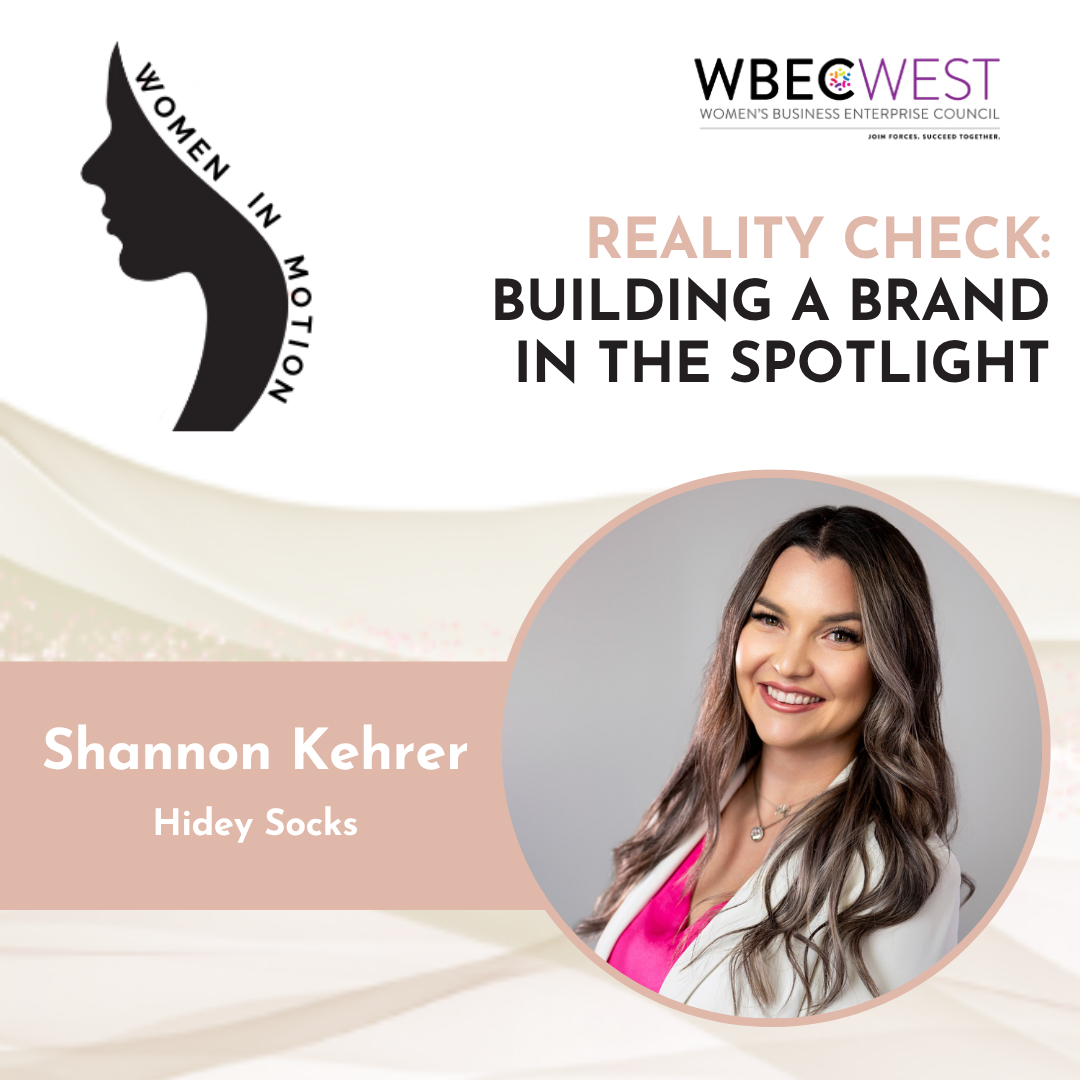

On this episode of Women in Motion, Lee Kantor and Renita Manley interview Shannon Kehrer , founder of Hidey Socks (now Hidey Style). Shannon shares her journey from launching her brand at 19 to competing on a reality TV show for entrepreneurs. The discussion covers product development, overcoming business challenges, leveraging community support from WBEC-West, and the impact of national exposure. Shannon highlights the importance of resilience, strategic networking, and continuous learning in building a successful, woman-owned business.
 Shannon Kehrer is the founder and CEO of Hidey Socks, a fast-growing, Women-Owned sock brand known for solving one of fashion’s most frustrating problems: no-show socks that actually stay on. Her patented sock design features a stylish anklet with Austrian crystals, blending function with fashion and redefining what it means to feel confident from the ground up.
Shannon turned a personal annoyance into a six-figure business, growing Hidey Socks into a viral brand featured on QVC.com, embraced by thousands of loyal fans, and admired for its fashion-forward aesthetic, topped off with luxe crystal details and packaging designed to leave a lasting impression.
Her socks have been gifted by companies for employee appreciation, used in giveaways, and even featured on reality TV. As a 2025 Enterprising Woman of the Year and a proud WBENC-certified entrepreneur, Shannon is on a mission to scale Hidey Socks into a multimillion-dollar household name—one foot at a time.
Connect with Shannon on LinkedIn.
Episode Highlights
- Shannon’s entrepreneurial journey and the founding of Hidey Socks at age 19.
- The origin of the product idea stemming from personal frustration with traditional no-show socks.
- Challenges faced in manufacturing, marketing, and launching the product.
- Intellectual property considerations, including patents and trademarks.
- Strategies for business growth, including vendor events and social media marketing.
- The role of WBEC-West in providing resources, networking, and pitch competitions.
- Experience and insights gained from participating in a reality TV show focused on entrepreneurs.
- The importance of community support and mentorship in business development.
- Rebranding efforts and expansion of the product line beyond socks.
- Future goals for Hidey Socks, including new wholesale opportunities and increased brand visibility.
Music Provided by M PATH MUSIC
 This transcript is machine transcribed by Sonix
TRANSCRIPT
Intro: Broadcasting live from the Business RadioX studios. It’s time for Women in Motion. Brought to you by WBEC-West. Join forces. Succeed together. Now here’s your host.
Lee Kantor: Lee Kantor here with Renita Manley. Another episode of Women in Motion. And this is going to be a good one. But before we get started, it’s important to recognize our sponsor, WBEC-West. Without them, we couldn’t be sharing these important stories. Today’s show is titled Reality Check: Building a Brand in the Spotlight. So excited to be talking to our guest today, Shannon Kehrer, founder of Hidey Socks. This is going to be a great show, Renita.
Renita Manley: It is. I’m really excited that Shannon then our web is going to be featured on a very special reality TV show that will be airing this fall on Amazon Prime. Is that correct? So we’re just going to dig right in. Yeah, we’re digging right in.
Shannon Kehrer: It’s going to be the second season.So there’s already a first season y’all.
Renita Manley: So we got to catch up. All right so I do know a little bit about you Shannon. I know that you launched Heidi Socks at 19 years old. What made you feel like that was an idea of worth, you know, jumpstarting so early?
Shannon Kehrer: I mean, it really stemmed from a frustration that I had of wearing those other little, like, no show socks or peds little socks that, like, barely cover your toes and go underneath your feet. But the problem is, whenever I would wear those little socks and I would walk around in my flats or my tennis shoes or even my heels, that sock would slide off of my foot and get bunched underneath my foot. And I was so frustrated from it. Like personally walking around trying to do all of the things that I’m trying to do. And so I basically designed Heidi’s style socks with a comfortable anklet for myself to guarantee that my socks would stay on my feet. And then I chatted with other people about it, and pretty much everyone that I talked with about it said, oh my gosh, we hate it when that happens too. It’s so frustrating. And that’s where the idea was born.
Lee Kantor: So how did you go from having the idea to actually kind of creating the sock where you seamstress, did you know how to do kind of this type of sewing that it would take to kind of pull this off? Like, how did you, you know, create those first iterations of the product?
Shannon Kehrer: Definitely not. Lee. I had no idea how to sew. I still don’t know how to sew. And I never went to college because when I was 19, I got my first corporate job. So I just kept with the corporate job. And so I at 19, I had this great idea. But you know what? 19 year old has the money or the resources or, like, knows what the heck they’re doing to turn an idea in their mind into an actual physical product. So it actually took me a few years to find a factory and figure out how to do a website and advertising and all of the things. And so I officially launched Heidi Socks when I was 22 years old. And at the time, I kept my corporate job and I was taking care of my dad, who, um, has been disabled since I was a kid. And so when I first launched it, it was really part time for me because I had these two big obligations that I was fulfilling. And then just about two years ago was when I went full time into entrepreneurship and just doing Heidi Socks full time. And it’s been really big for growth. Now that I’m able to finally do full time for my business.
Renita Manley: So I’m curious, you have your product idea is, it’s so amazing because it’s so simple in the nicest way of saying it, because like you got it’s a simple problem that everyone has. And you were to like the first person that was like, yeah, I got a solution for this everyday problem. How did you have to patent that idea? How are you able to stop other competitors from trying to mimic your product?
Shannon Kehrer: I did I do have two different patterns and a trademark on Heidi’s socks. And not only that, but I have an exclusive partnership with Swarovski crystals because Heidi’s socks do have genuine Swarovski, so you can put them in the washer and in the dryer, and the crystals are not going to fall off. So I’m really branding myself on the quality of the sock. I mean, I personally have had some of the same pairs for over five years because they’re just phenomenal quality and I just want my customers to, number one, have a solution to the annoying problem of their socks sliding off their feet. And number two, have a quality sock that they are happy to buy and wear.
Renita Manley: Have you spotted any will be imitators yet? Like while you’re out shopping, do you see any Renita?
Shannon Kehrer: There is a Chinese company on Amazon right now that looks similar, and they can’t put crystals on it because I have the patent for the crystals, but they put these little rinky dink pearls. And if you look at the pictures, it looks like those pearls are literally going to fall off when you walk five steps. So that’s been unfortunate. And I, like my attorney said I can’t go after them because it’s pearls instead of crystals. So it is what it is. You know, if somebody wants to buy a cheap product from overseas that’s not woman owned, then you know that’s up to them. But it’s probably going to fall apart after what you saw.
Lee Kantor: Now when.
Renita Manley: You can’t find. Yeah. Sorry, I was gonna say you can’t find Heidi socks.
Shannon Kehrer: No, Heidi socks are not on team. I’m not on team. We have our website. We’re on qvc.com. That is new. And I worked for four years. Like literally. Okay, I have a vision board every single year, y’all. And QVC logo has been on my vision board for four years and we finally made it happen. So Heidi Sale socks are currently being sold on QVC. Um, but those are really the only two platforms right now. I did have them on Amazon, but I took them off of Amazon to revamp it because this reality show that I was on, I learned a lot. Not only was it a reality show, but they actually helped us entrepreneurs scale our businesses to the next level. And they taught me so much about marketing and branding, what I was doing wrong, what I could improve on, yada yada yada. So because of this, I removed Heidi off of Amazon because we’re currently doing a little bit of a rebranding.
Lee Kantor: So talking about the marketing side of this, how did you do the marketing at the very beginning when you launched, in order to get that kind of escape velocity that is now taking you to QVC and on a reality show. So what were the kind of the early stage ways that you were marketing?
Shannon Kehrer: Well, in the beginning I had zero money. So basically what I would do is do different vendor events where I would go and I would set up a table or a ten by ten booth, um, showing like people what Heidi stocks were. And that was like a very low way to grow it. But it was great because in the city that I was in, um, a lot of people ended up like knowing what Heidi stocks were because I did those vendor events. And then once I started getting more money with those vendor events that I was doing, I would do other things like social media, ad campaigns. And then I started opening up wholesale accounts and to where I would go to boutiques and I would show them Heidi socks, and then they would purchase wholesale, then sell retail. And that was a great way to get the word out as well.
Renita Manley: We have a lot of babies. Hi. I almost killed you, Heidi. We have a lot of baby Shannon like yourself that have great products. So can you tell them how were you able to get a product like yours on what is it, QVC? How were you able to get it on QVC? Like, what did you have to do differently that maybe other VBS aren’t doing and should be doing?
Shannon Kehrer: Okay, so what I will say, number one, the fact that you’re a game changer. Like I said, um, I went full time with my business two years ago, and the number one thing that I did to help me grow it was join way back west. Okay, so the cool thing about we back West is they have different pitch competitions for products and service based companies. So as I mentioned, I’ve been trying to get on QVC for several years now. And then after I joined we back west, I saw a pitch competition that I could participate in. So I participated in my local pitch competition with we back wasps, I did well. They sent me basically. I think I had like three pitch competitions that I had to do three different stages. You know, you make it past this one, you go to the next one, you got a party to where I made it all the way to pitch at nationals, where I got to be on stage with, I believe it was 19 other entrepreneurs. And because I got to go on stage in Washington, D.C.
Shannon Kehrer: and pitch Heidi style socks in the crowd with somebody from QVC, as soon as I got done with my pitch, the very first person who approached me was Samara from QVC, and she was so funny. She comes up to me and she’s like, love your product, I’m with QVC. I am not the buyer for QVC. I don’t want to promise you anything, but what I want to do is pass on your information to the proper buyer for you. And so this was like, I think not even a year ago. And so Samara sees me because the pitch competition thankfully because of way back west. Had I not done that pitch competition with we back west, I wouldn’t have gone all the way to nationals and I, Sameera, wouldn’t have seen me pitch and I probably still wouldn’t be on QVC. So the resources that you get being a TV, especially with we back West, is phenomenal. So take advantage of all of the different things that we left West has to offer the pitch competitions, the networking events, all of the things.
Lee Kantor: Now, when you were considering becoming part of the Quebec West community, was that something that somebody told you, hey, you should do this. Like, how did how did it come about? And, you know, obviously you got this relationship with QVC out of it, but what were you thinking you would get out of it?
Shannon Kehrer: Well, originally, the only reason why I joined way back west was to get the woman owned logo on my packaging. Um, that was the main reason why I joined. And then, uh, after I had joined. You know, I was getting the emails and I was like, oh my gosh. Like, there’s networking opportunities. There’s pitch competitions where I could win money. And so once I started seeing those emails come through and realized that it was more of a networking opportunity and like pitch, competition opportunity. That’s when I really went full throttle in it. But I had no idea that we bank we back was even offered all of these different, um, events. I originally just wanted the logo on my packaging and on my website, and I’m so happy that I paid attention to those emails from way back west and actually participated in a pitch competition. And now I go to all of the networking events. Um, I also just became second chair form for way back west. Uh, which is great. It’s an interview process that you have to do. And so basically I get to be like the voice of the Los Angeles biz when we do different networking events and like hearing their input, and then also like putting together networking events in Los Angeles with my two other form leaders, Angela and Amanda Marr. And so, yeah, it’s like I’ve kind of like just dived deep in after I realized how amazing we, Beth West is to helping me grow my business.
Renita Manley: Okay, I want to definitely get into more talk about the reality TV show, what you can share with us. But before I go there, I also wanted to bring up something since we are talking about Rebekah. I first met you in our platinum supplier program and that’s another resource that we offer. So a little plug for us. Can you please share about the benefits of that PSP program and how it helped you out?
Shannon Kehrer: Okay. If you’re listening to this, you need to join the PSP program. Okay. It’s only like what, Renita? Once a year or twice a year. How did they do it?
Renita Manley: Yep. About once or twice.
Shannon Kehrer: So the moment you see it, you need to join it, because that also helped me really think outside of the box. You know, when we’re a business owners and we get so used to doing the things that we’ve been doing and we get so like stuck in it, but it’s kind of hard to see outside of it. And so when I joined the PSP program, which I was hesitant about because, you know, it’s not it’s not free, but it’s also not like a bazillion dollars. It’s totally worth it. Um, I think the money that I paid for, I got so much more value out of the PSP program. And so what I really learned, the big nugget is that I should not only be selling Heidi sell socks retail like to one consumer here and there, yada yada. But I should also be selling Heidi’s socks to corporates as employee gift appreciation. Customer appreciation and doing branding on the Heidi Sale. Socks is like the main thing that I learned. They helped me put a capability statement together and like I looked back on like my very first draft of my capability statement to what it ended up being at the very end of the PSP program, and it is night and day.
Shannon Kehrer: I’m now proud of my capability statement and what it looks like. And now before I go to any networking events, I take my capability statement, print it out because you never know who you’re going to meet or who you’re going to see. And so that was just like a huge game changer for me being in the PSP program. And at the very end you get to pitch to different corporates, which is really cool. So I mean, that in itself is, you know, why you should do it. And they coach you and they help you on your pitch. You practice your pitch with them. They, the professionals give you great feedback of how to make it better. So I’m just so excited that I did the PSP program, and now I’m even more excited for all of the other pitch competitions that I’ll be able to do. Now that I learned all the things that I did from PSP.
Lee Kantor: So now let’s talk a little bit about the reality show. Was that something that you actively sought out or did they come to you like, how did this come about?
Shannon Kehrer: I’m in a women’s mastermind group, and one of the other women entrepreneurs mentioned this to our group. And I remember, like I clicked the link and I opened it and I was like, I’m not like, I don’t really I don’t okay, personally, I don’t even watch TV. Okay? Like I don’t watch TV. All I do is work. I’m very boring in that sense. And so when I clicked on it, I was like, oh, I don’t know if this is for me. And then literally, like, I guess the day before the applications were going to close, I just ended up applying for it. And then one of the like producers, we set up a meeting and she was like, I just want to let you know, like you literally applied in the very last like minute. And so, yeah, I wasn’t even 100% sure about it. But now that I did it, I’m so happy that I did do it. I mean, it’s not like a love reality TV show. It’s an actual entrepreneur reality TV show, and they literally bring in professionals to help you scale your business. And I cannot tell you, like the value that I got from this amazing reality TV show. And I’m so excited for everybody else to watch it, especially if you’re an entrepreneur, because you were just going to, like, relate to it, relate to our stories, and relate to our hustle so much.
Renita Manley: So what can you share with us about your experience on this reality TV show and the show itself? Can you tell us the name? Um, maybe some of the other participants that were on it. And then can you share with us who maybe you were on this reality show and how how was it filming? Like, really? How was it filming? Were there cameras following you around everywhere? Were there just was it just a competitions because, you know, you kind of pull back in on some of those competitions and that was really fun. So can you just share with us everything you can about that reality show and who Shannon was on that on that show?
Shannon Kehrer: Yeah. So I’m not allowed to say the name just yet. However, the moment I am allowed to share the name and talk more details, we’re going to do another podcast. Um, I know that the red carpet premiere event is probably going to be somewhere, um, in October. So as soon as I’m allowed to, like, share that, I definitely will. Um, I do want to give a shout out to Doctor Pamela, because Doctor Pamela, the moment I knew I got on the show, I reached out to Doctor Pamela. I emailed her and I let her know that I was on this entrepreneur show, and I had no idea what it was going to entail. But I knew it was intense because I had watched the first season, and it was extremely intense, and it was going to take a lot of time and effort and help that I was going to need in order to, like, keep making it. Because every single week, different entrepreneurs are eliminated. So basically every week they give you a different challenge that you have to do. And if you don’t do well in the challenge, then you are up on stage getting ready to possibly be eliminated. And it’s very intense. There’s some drama that goes on for sure, because everybody’s like, stress hormones are up there. And you know, we’re competing for a cash prize of $100,000, so big snakes are on the line. And so Doctor Pamela helps me out a lot. Basically, every single time I went to her, she was there for me. And we all know how busy Doctor Pamela is. So huge shout out to her for helping me and believing in me and supporting me through this.
Lee Kantor: So now that this is kind of under your belt and you’re waiting for this to kind of launch, is there anything else you have going on, like how do you how do you kind of make your next move, uh, after having gone through something this exciting?
Shannon Kehrer: Well, first of all, it’s sad that it’s over because I just loved it so much. You know, I spent two months on stage and back during this question. Yes, there were cameras in my face 24 over seven. The camera crews even came to my house several different times to film. Like who? Shannon is inside of her house. Like, they literally even opened my fridge and was like, what are you eating inside of, you know, Shannon Carey’s fridge? And it was really intense. It was a lot of fun. Um, not only did I have to be on my tippy toes with all of the challenges, but also, you know, make sure that I’m, like, saying the right things and like, like being true to myself instead of, like, falling into, like, oh, this is reality TV show. And there was some opportunities that I very easily could have like X out some other entrepreneurs. But instead of doing that, I feel like I was very true to who I am as a person and who I am as an entrepreneur. And I think that I very much like kept my integrity during the reality TV show, even though there was definitely opportunities to be like more drama or, you know, cause a scene. And so it was a really cool thing to, like, watch how I act underneath all of that pressure with all of these cameras in my face and all the high intensity of there’s $100,000 on the line, which would have like which would change any small business owners life.
Renita Manley: I was going to ask you that question. You kind of led me right into it. I wanted to know, how is it building a brand right there in the spotlight? You have the cameras in your home office, um, in your face. You have to be PC. You have to be professional as much as possible in your comfort zone and your safe zone. So how is that in and even with your brand now on QVC, how is it building a brand right there in the media, right there in the spotlight? What makes it different than it was, um, when you were about 21 years of age?
Shannon Kehrer: I mean, all the pressure, right, of having these big cameras in your face and all of these other entrepreneurs that you’re now working with. What I will say is, when the show started, we started with 20 entrepreneurs from all around the United States. It did film in Los Angeles area where I’m from, which was great because it was only like an hour drive for me, but people literally flew in like every single week. Basically, we would film different days, but basically it was Thursday through Sunday and 12 hour days. I mean, it was intense. Like I woke up like at 3 or 4:00 in the morning just to like make sure I was prepped and I would drive there ahead of the time. And like, I’d always make sure I was there an hour ahead of the time because, you know, all the traffic is crazy and accidents can happen. The last thing I want to do is, you know, be late to the filming. And so, yeah, it was just very intense. On top of filming for this reality TV show, I still had to run the business. So yes, they were bringing in professionals and helping us, but I still have wholesale accounts and I still have my website sales, and I still have my social media sales, and I still have all of my emails that I had to do.
Shannon Kehrer: And so it was just a whole nother experience. But I’m so happy that I did it because I did learn so much. I mean, with every single challenge, they legitimately brought in a professional to teach us and train us and prepare us for the challenge. And I learned so much about my branding and my business and like who I am as a person. And I mean, I think my like my, my, I want to say character on the show with like I was the very like professional person. Like I went in and filmed every single day pretty much in like, slacks or a skirt. And so to me it was very like, this is my business and this is my brand and this is where it’s at. And like some people were a little bit more relaxed with it or they were a little bit more, you know, and so I think that’s the character that they’re going to portray me as is like the very like, business like minded woman on the show.
Lee Kantor: So are there any kind of key learnings or tips that you can share that you learned or picked up going through this process?
Shannon Kehrer: Oh my gosh, so many. I don’t even know where to start. Um, the branding thing was huge to me. I mean, my packaging, like I’m totally doing a whole revamp on my marketing because during one of the challenges, they brought in a focus group of like totally random people, and they pinned my product against another product and the focus group got to like sit down with both of our products, not knowing who we were, not knowing what the product was then of that. And they basically got to like, dissect and like tell us their feedback on our packaging and what it looks like to them. And basically, yeah, that’s why I’m doing a rebranding for that. Um, and then like the main thing that I learned is like, I work my tail off pretty much every single day. But this show pushed me to a whole nother extreme of like, a whole nother, like, hustler for what I’m doing with Heidi style socks. I mean, I worked, I worked smarter being on the show because there was limited time. Normally I worked like 12, 16 hour days, but when I was filming on this show, it was really intense. And then just like working smarter, not harder is what I really learned on the show and outsourcing as well. I use Upwork more. I hire more freelancers now with things that I need to get done. And so that was really good information for me to learn.
Renita Manley: So here’s a if you can’t answer to, just say I can’t answer that. Okay. Okay. I’m digging I’m trying to dig. Is is there something you might have done or said on this show that you regret? Like, oh, I wish I wouldn’t have said that. Do you have do you have any of those moments?
Shannon Kehrer: Um, there was one moment where one of the one of the other entrepreneurs, um, I was taking a picture. So one of the other entrepreneurs, she’s a female. And there was a moment where we were like at our lunch break, which was really cool because they served us breakfast, lunch and dinner. We went over and so we had like our own little room and like a buffet and a private chef. It was honestly like really phenomenal. So we’re all there and we’re eating our lunch. And one of the guy entrepreneurs, I can’t say his name, but, um, him and I took a picture together, and he just, like, put his arm around me, like, regular, like we’re just taking a picture together. And one of the other female entrepreneurs, um, she was like, don’t you have a boyfriend? And I was like, yeah. She was like, don’t you have a like like that too? Like, don’t you have a boyfriend? And I was like, yeah, I do, but this guy and I can’t say his name, but I was like, I was like him. And I were just taking a picture. Like, my boyfriend would totally be okay with me just taking a picture with another guy. And so I don’t know if they’re going to use that in the show, but I was like, what? Like, who was this girl judging me for taking a picture with one of my cast members?
Renita Manley: Yeah, maybe she was just trying to get some camera time.
Shannon Kehrer: Maybe, I don’t know. I mean, but also, like, we were we were eating our lunch. Like, I don’t like there’s cameras everywhere all the time, 24 over seven. So I don’t know if there was cameras like, rolling at that time. I mean, we were mixed up 24/7, so we were mixed up the whole entire time. So they definitely could have gotten the audio. But I just wish I would have just like, not said anything to her at that point because like, obviously if she’s going to judge me for taking a picture with a male while I’m in a relationship, that’s just, that’s just immature. But that’s that’s literally the only thing that I regret saying.
Lee Kantor: So now, um, if somebody wants to learn more about what’s going on with Heidi style, is there is the website up at all or where are you at with that?
Shannon Kehrer: Oh yeah. Of course. Yeah. I mean, I launched originally on my website, it’s heidi.com which is spelled Heidi style and it’s spelled Heidi is spelled like you’re hiding your sock. Right, Heidi? Why? Because when you wear Heidi style socks with your flats or your shoes, you can’t even tell when it’s a sock. It blends in with your shoe. So you can find us on our website, Heidi style.com. You can also find us on our social media, which is Heidi style. We still own Heidi Socks, but we rebranded to Heidi Style because we also do other products other than just socks now.
Renita Manley: I’m really excited to see your your rebranding. That’s going to be fun. Um, when you are ready to show everybody. And besides the rebranding process, what else do you have in your pipeline? What’s coming up for Shannon and for Heidi? Socks in Heidi style?
Shannon Kehrer: Yeah, we’re doing a lot more different wholesale shows. Um, trying to open up more boutiques and stores and like, larger retail stores as well. So literally this month, I’m home less than I’m traveling. Like, they I’m home like five days out of the whole entire month because it’s just travel after travel after travel and trying to open new accounts to get more stores to carry Heidi style socks so more people can have them. That’s the big thing we’re working on right now. And then just really like prepping for the show, because once the show airs, I know it’s going to completely changed my life, which I am very, very excited for people to watch my story and how I operate, and why I designed and have dedicated my whole adult life to getting Heidi out there.
Lee Kantor: Well, congratulations on all the success. Renita, is there anything going on at we back west that we should know about any events?
Renita Manley: I just want everybody to make sure you go to Shannon’s website and make sure you go to Shannon’s LinkedIn and her preferred social media page. We want to make sure all our we are supporting Shannon while the show is airing. While we are watching her journey in our real time, her reality journey and our real time, I want everybody to be out there supporting. She’s very active on Instagram, so I know you can definitely find her there. Besides that, I just want to encourage everyone to go to Rebecca Hyphen Invest. Just go to our events calendar and check out some of those events that Shannon was talking about. We do have some amazing events, and if you take advantage of them like Shannon did, and maybe your product can get in front of somebody from QVC.
Shannon Kehrer: Definitely. And I know that our We Back West conference has officially secured the dates of December 16th through the 18th. So if you guys don’t have that in your calendar, put that in your calendar. December 16th through the 18th in Phoenix, Arizona. I will personally be there and would love to meet you all.
Lee Kantor: Good stuff. Well, thank you again, Shannon, for participating today. Uh, this is Lee Kantor for Renita Manley. We will see you all next time on Women in Motion.













 Joshua Kornitsky is a fourth-generation entrepreneur with deep roots in technology and a track record of solving real business problems. Now, as a Professional EOS Implementer, he helps leadership teams align, create clarity, and build accountability.