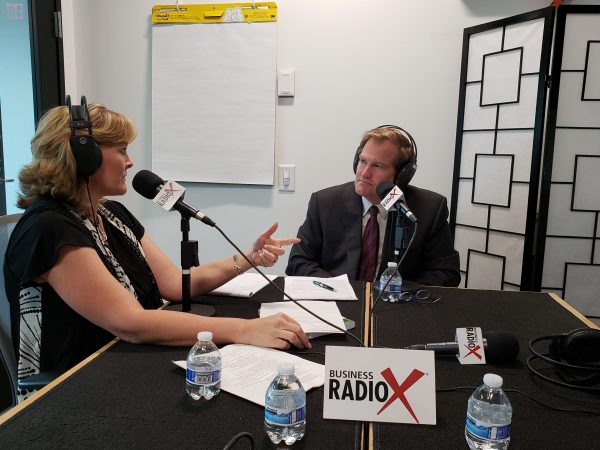



 Thomas Carroll, CFP®, Principal, President, and Chief Executive Officer at Homrich Berg, has remained a consistent player throughout Homrich Berg’s growth and M&A in Atlanta.
His expertise in wealth management makes him an expert in fiduciary fee-only client service as part of Homrich Berg’s practice management strategy.
Connect with Thomas on LinkedIn and follow Homrich Berg on Facebook and Twitter.
What You’ll Learn In This Episode
- Executive management, leadership, and trends related to the wealth management industry
- Homrich Berg’s fee-only fiduciary approach as a registered investment adviser (RIA), impact on their clientele, and their efforts in supporting the local community
 This transcript is machine transcribed by Sonix.
TRANSCRIPT
Intro: Broadcasting live from the Business RadioX studio in Atlanta, Georgia. It’s time for Atlanta Business Radio, brought to you by Kennesaw State University’s Executive MBA program, the accelerated degree program for working professionals looking to advance their career and enhance their leadership skills. And now, here’s your host.
Lee Kantor: Lee Kantor here, another episode of Atlanta Business Radio. And this is going to be a good one. But before we get started, it’s important to recognize our sponsor, CSU’s executive MBA program. Without them, we couldn’t be sharing these important stories. Today on Atlanta Business Radio, we have Thomas Carroll with HB Wealth Management. Welcome.
Thomas Carroll: Lee. Thanks for having me. Excited to be on Atlanta Business Radio with you today.
Lee Kantor: Well, I’m excited to learn what you’re up to. Tell us about your firm. How you serving folks?
Thomas Carroll: Yeah, happy to do it. Hp Wealth Management, also known as Hamrick Berg. We’ve been in business for 35 years, celebrated our 35th anniversary in October. We had a great month of celebration. We are a fee only independent wealth management firm that was was founded by Andy Berg and David Hamrick 35 years ago. And, you know, we’re still serving clients in a comprehensive way. 35 years later, like we did when we started the firm. So we’re an $18.5 billion asset under management Ria, with around 4000 clients and families that we serve every day.
Lee Kantor: Now, can you educate the listener what it means to be fee only?
Thomas Carroll: Yeah. Happy to. There are different ways that investors can access, you know, wealth management services. And ours is if the only way, which means that the only fees that a client would pay. Our firm would be to provide them advice. Its advice fee. That advice comes in different forms. It can be investment advice. It can be planning advice, estate planning and insurance planning, just all sorts of comprehensive services. But we do not make any any commissions. There’s no, you know, trailer revenue. We’re not selling a product in any way, shape or form. We are simply just getting paid to provide good, sound advice to the clients that we serve.
Lee Kantor: Now, does that mean that the that I have to do the trade or I have to act on your recommendation, or is that something that you also handle?
Thomas Carroll: Yeah. Great question. Now we are a full service firm. So so so we are able to execute, you know, do the trading, you know, through the custodians that we work with and have discretion in ultimately executing on the advice that we ultimately recommend to our to our clients.
Lee Kantor: Now does that interaction? Does that mean I talk to you once a year and you kind of rebalance? Are you talking to me quarterly or can I call you whenever. You know, my, um, brother in law has a great idea, like, like how does that interaction and service work?
Thomas Carroll: Yeah, it’s all of the above. And it really just depends on the client preference. I mean, there are some clients that, you know, that call us when they get the investment idea at the country club and want us to want us to look at it. And we do that a lot. There’s some folks that are happy to meet once a year. There are some folks that we talk to probably once a month. Um, and so it’s just a client preference is ultimately what drives the cadence of the communication. And then our advisors ultimately will execute whatever makes the client comfortable. Um, so it’s really, really up to the client.
Lee Kantor: Now, um, what would be kind of your recommendation for somebody who maybe has worked at a corporate job and hasn’t had a formal relationship with a wealth advisor before, and they’ve just been, you know, dumping money into maybe a 401 K or something along those lines is kind of autopilot. And now they’re getting close to retirement, and then they got to, you know, make more, um, decisions because they’re about to go through a transition. Can you explain to our listener, like, what does that conversation look like when you’re talking to somebody who comes from that background?
Thomas Carroll: Yeah. Look, I think just generally the, you know, part of the question is, you know, should a person of that profile be seeking professional advice around their financial lives? And, and the answer to me is, is is absolutely yes. Um, you know, the financial world is very complicated. Uh, you know, investments, integrates with taxes, which integrates with, you know, how a person of that profile might, might set up their estate plan. And there are lots of different pieces. How the insurance piece works in a in a good plan. How do you how do you appropriately budget your cash flow? How do you prepare for, uh, children’s educational expenses? All of these are pieces to a large puzzle. Uh, and it’s more it’s challenging for someone who’s not focused on doing it every day to understand how all that intersects. And that’s where a financial advisor comes in, not just to advise on investment assets, but but also to integrate all those other things that I just mentioned into a comprehensive plan. Um, you know, for me, it’s I’ve heard the analogy used from time to time. It’s it’s like a it’s like a doctor, you know, we are a doctor for financial advice. You wouldn’t go, uh, you know, kind of try to diagnose your, your, your own health issues. You’re going to go to a medical professional who’s, who’s going to help you with with the medical issue. It’s the same thing in finance in the financial world. So I certainly encourage folks with that profile that you just mentioned to to to seek out a professional adviser to help them achieve their financial goals.
Lee Kantor: Now, you mentioned kind of, uh, comparing it to a doctor, but in some cases I have a cardiologist, I have a, you know, a rheumatologist, a pulmonologist. And then I have kind of a general practice person. Are you kind of the quarterback? Are you? My general practice, or are you just kind of a specialist in one kind of leg of the stool?
Thomas Carroll: Yeah. So like, we are the general practitioner, uh, the lead advisor that serves our family serves as that general practitioner. But but we have subject matter experts on staff on our team who would who would focus on a, uh, you know, the specific discipline that’s needed. So if you needed a cardiologist in our, in our, in our nomenclature, if you needed someone to help you with an estate plan. We have an estate planning specialist on our team. Uh, who who would, you know, Go do the deep dive into estate planning. So we do have those subject matter experts in our firm that support the work that the lead advisor does as the general practitioner, so to speak.
Lee Kantor: Now, what about the CPA? Do you have a CPA on your team or do you partner with CPAs?
Thomas Carroll: Yeah, so we do. So interesting little history of our firm. We were started by two, uh, ex CPAs. So so the tax work, the tax planning is, is a foundational part of our business. Always has been and always will be. What we are not just to be clear, is we are not we are not a firm that files tax returns. So so we work very closely with, you know, CPAs on behalf of our clients to to have those CPAs ultimately do the tax filings that are required. But we take a pretty active role in in getting that CPA prepared to file that return. So so we do a good bit of tax planning. It’s a core part of our of our of our service offering.
Lee Kantor: So it doesn’t matter really the CPA you’re kind of CPA agnostic from that standpoint, but it’s important for the client to permission you to to talk to each other so you can get on the same page.
Thomas Carroll: Yeah, that’s a great way to describe it. In fact, we have a we have a tech platform that really enables the partnership with, with the CPA community, that allows us to kind of share information seamlessly through a tech tech experience. And so we are able to kind of provision rights for CPAs to go in and download data and, you know, things that they need to to effectively, you know, complete the tax returns.
Lee Kantor: Now, are you seeing any kind of trends in the wealth management industry regarding kind of this robo investing and the young people there are so many young people, it seems, that are really attracted to just kind of going online on their phone and then doing some type of investing. Um, and if if you see that trend, how does that impact the services you provide? Is that just something that young people you think will just outgrow and then move to more traditional relationship with wealth management? Or is this something to keep an eye on?
Thomas Carroll: Yeah, I think it’s something to keep an eye on. I do think that as as these younger investors that you’re describing, uh, go through life stages, accumulate more wealth, get married, start having kids. Uh, life gets more complicated. And and financial decisions, uh, have larger ramifications. Uh, and so, so I think that you will see, folks, um, you know, I think gravitate to more professional advice over time. However, one thing that I don’t think is going to change with, you know, kind of a trend to keep an eye on is the way that those clients want to consume their experience. Right? So so their parents may prefer to come into the office and, you know, put on the sports coat and, you know, come, come in and meet in person. Um, you know, the clients that you just described, you know, they’re going to want to interact digitally with their advisor and they may still want to come in and, and break bread and come into the office and do all that stuff. But but you, you know, advisors need to have a robust digital experience that allows for those clients to be able to see their data and see their portfolios at the tip of their fingers. And so so we certainly are working on that to make sure that as this next gen of, uh, you know, comes into more wealth, as there’s a tremendous amount of wealth that’s going to be transitioned, uh, to, to younger generations that, that we can meet them where they want to be met. And that’s through digital enablement.
Lee Kantor: Now, do you see any kind of unintended consequences to this new I don’t know, it’s it’s new to me, but it seems like everywhere I turn there’s ads for gambling, online gambling and sports betting and things like that. Does that is that something that is impacting the way people trade or see trading stocks or investing in the markets, or is there any kind of maybe false equivalence when it comes to people seeing themselves gambling and betting and, you know, investing in the in the markets?
Thomas Carroll: Yeah. Look, certainly there could be some unintended consequences there, you know, through the democratization of gambling and the availability of it. But, but and that could equate to maybe trying to market time and, you know, you know, buying and selling stocks and all that stuff that, that is not a long term, sustainable and successful strategy. You know, so so we, you know, preach very much to to our clients and prospective clients that the most important point that is to have a plan and to stick to it, uh, and, and we will we will rebalance as opportunities present themselves. But but we don’t, um, position ourselves as market timers and, um, you know, in fact, there’s a lot of research that shows that, you know, that’s very, very difficult to to be successful over time with the market timing strategy and in time, in time invested in the market is much more important than trying to time the market. Uh, and that’s a really key part of a relationship that we have with our clients.
Lee Kantor: Now, how do you work with your clients when it comes to the Decumulation? You know, they spend decades and decades accumulating and being disciplined and, you know, and they learned about the importance of compounding and and all this stuff is happening and and now it’s time to start taking money out. And for some people that psychologically is very difficult. How do you help them with that?
Thomas Carroll: Yeah. Well we are we are an advisor for all stages of life. Um, you know, from, from the accumulation phase through the, through the accumulation phase or the spending phase. Uh, so, so so we play a very important role in advising clients, you know, how and when to start taking required minimum, required minimum distributions, you know, off of their IRAs or 401 K’s. Um, you know, we certainly help clients thinking about transitioning money to their children or their grandchildren. Um, you know, funding, you know, grandchildren’s education, whatever it may be, that that is certainly using the assets that they accumulated and those decisions, all of those decisions have important tax implications. So we’re very much advising, you know, clients through that process. But but making sure that we’re being mindful of the tax dollars that that are being spent through that process as well. But but very important part of the relationship that we play in, the families that we serve.
Lee Kantor: Are you seeing any trends when it comes to, um, maybe giving more money to their children and grandchildren sooner than maybe historically? Back in the day, they would wait till they passed and then their transfer would occur.
Thomas Carroll: Yes. That is definitely something we’re seeing more and more of. And what I like to the way I describe it is, is I think that, that the, the givers of the wealth. So the, the wealth creators generators want their heirs to be informed, uh, more so than maybe a generation ago. So, so we are spending, you know, more and more time, um, educating the next generation of wealth or the wealth inheritors about what it means to to come into that wealth, what it means to be a good steward of that wealth. What the family goals are in, in, in, in, in, in what they want to accomplish with that wealth. So, so more and more families of wealth are setting up, you know, charitable organizations or donor advised fund, and they’re getting their kids involved in that. So, so that they can, you know, you know, be more informed when ultimately that money, you know, comes to them down the line. So, so a lot more education that we’re doing and spending time with younger generations educating them about all things around money and wealth.
Lee Kantor: Now, do you have a feel for what’s causing this shift like for like a generation ago, it was just very normal to just when when I died. That’s when my kids get the money and we didn’t think twice about it. But now, like you were saying that it seems like some of the transfers are happening sooner, you know, so you can see the joy and you can see how they’re using the money rather than wait till after you’re gone. Is there something that happened that’s causing this, or is this just there’s so much wealth now out there that they can afford to do this? Um, yeah.
Thomas Carroll: Look, I think that there’s this phenomenon that, that that wealthy families are more aware of now than maybe in the past. And that’s this phenomenon called shirt sleeves to shirt sleeves in three generations, uh, which ultimately means that, you know, there’s a generation that creates the money, and then there’s a generation that basically spends the money, and then the and then the third generation is back to not having any money. And so I think that that that trend and knowledge of that is, is is a is an outcome largely of people just, um, being given money, being given money and not being prepared to know what to do with it. So, so more families and frankly, more advisors like our firm are taking a role in making sure that the shirt sleeves to shirt sleeves in three generations phenomenon doesn’t happen. And when you have informed heirs, uh, you know, they’re more likely to have a successful outcome in, in the wealth that is bestowed upon them. Also, just candidly, it creates opportunities for life experiences with family members, you know, you know, being able to share in a charitable, uh, you know, donation or, you know, go to a charity event as a family. Um, you know, it just it allows for a happiness factor to occur that you mentioned. And I think families are enjoying that opportunity, you know, now, now more so than ever.
Lee Kantor: Now.
Lee Kantor: If somebody wants to learn more, have a more substantive conversation with you or somebody on your team, what is the best way to do that?
Thomas Carroll: Yeah. That’s great. Uh, happy to visit our website, ComicBook.com. Uh, there is, uh, all of our contact information is is on the website in the contact us, uh, section of the website. Our phone number is there. You can call and, uh, you know, get connected to an advisor on our team. Uh, or you can email us through through the website, ComicBook.com. And, uh, we’d be happy to, to talk to anybody out there, any of your listeners that are, that are thinking about seeking a financial advisor.
Lee Kantor: And that’s h o M richburg.com.
Thomas Carroll: That is correct.
Lee Kantor: Well, Thomas, thank you so much for sharing your story today. You’re doing important work and we appreciate you.
Thomas Carroll: Thank you. Lee, I really appreciate you having me today. I’ve enjoyed the conversation.
Lee Kantor: All right. This is Lee Kantor. We’ll see you all next time on Atlanta Business Radio.