Business RadioX ®

  • Home
  • Business RadioX ® Communities
    • Southeast
      • Alabama
        • Birmingham
      • Florida
        • Orlando
        • Pensacola
        • South Florida
        • Tampa
        • Tallahassee
      • Georgia
        • Atlanta
        • Cherokee
        • Forsyth
        • Greater Perimeter
        • Gwinnett
        • North Fulton
        • North Georgia
        • Northeast Georgia
        • Rome
        • Savannah
      • Louisiana
        • New Orleans
      • North Carolina
        • Charlotte
        • Raleigh
      • Tennessee
        • Chattanooga
        • Nashville
      • Virginia
        • Richmond
    • South Central
      • Arkansas
        • Northwest Arkansas
    • Midwest
      • Illinois
        • Chicago
      • Michigan
        • Detroit
      • Minnesota
        • Minneapolis St. Paul
      • Missouri
        • St. Louis
      • Ohio
        • Cleveland
        • Columbus
        • Dayton
    • Southwest
      • Arizona
        • Phoenix
        • Tucson
        • Valley
      • Texas
        • Austin
        • Dallas
        • Houston
    • West
      • California
        • Bay Area
        • LA
        • Pasadena
      • Colorado
        • Denver
      • Hawaii
        • Oahu
  • FAQs
  • About Us
    • Our Mission
    • Our Audience
    • Why It Works
    • What People Are Saying
    • BRX in the News
  • Resources
    • BRX Pro Tips
    • B2B Marketing: The 4Rs
    • High Velocity Selling Habits
    • Why Most B2B Media Strategies Fail
    • 9 Reasons To Sponsor A Business RadioX ® Show
  • Partner With Us
  • Veteran Business RadioX ®

A Checklist for Hiring New Employees

September 17, 2021 by John Ray

ChecklistforHiringDLREpisode20Album
Dental Law Radio
A Checklist for Hiring New Employees
Loading
00:00 /
RSS Feed
Share
Link
Embed

Download file

ChecklistforHiringDLREpisode20Album

A Checklist for Hiring New Employees (Dental Law Radio, Episode 20)

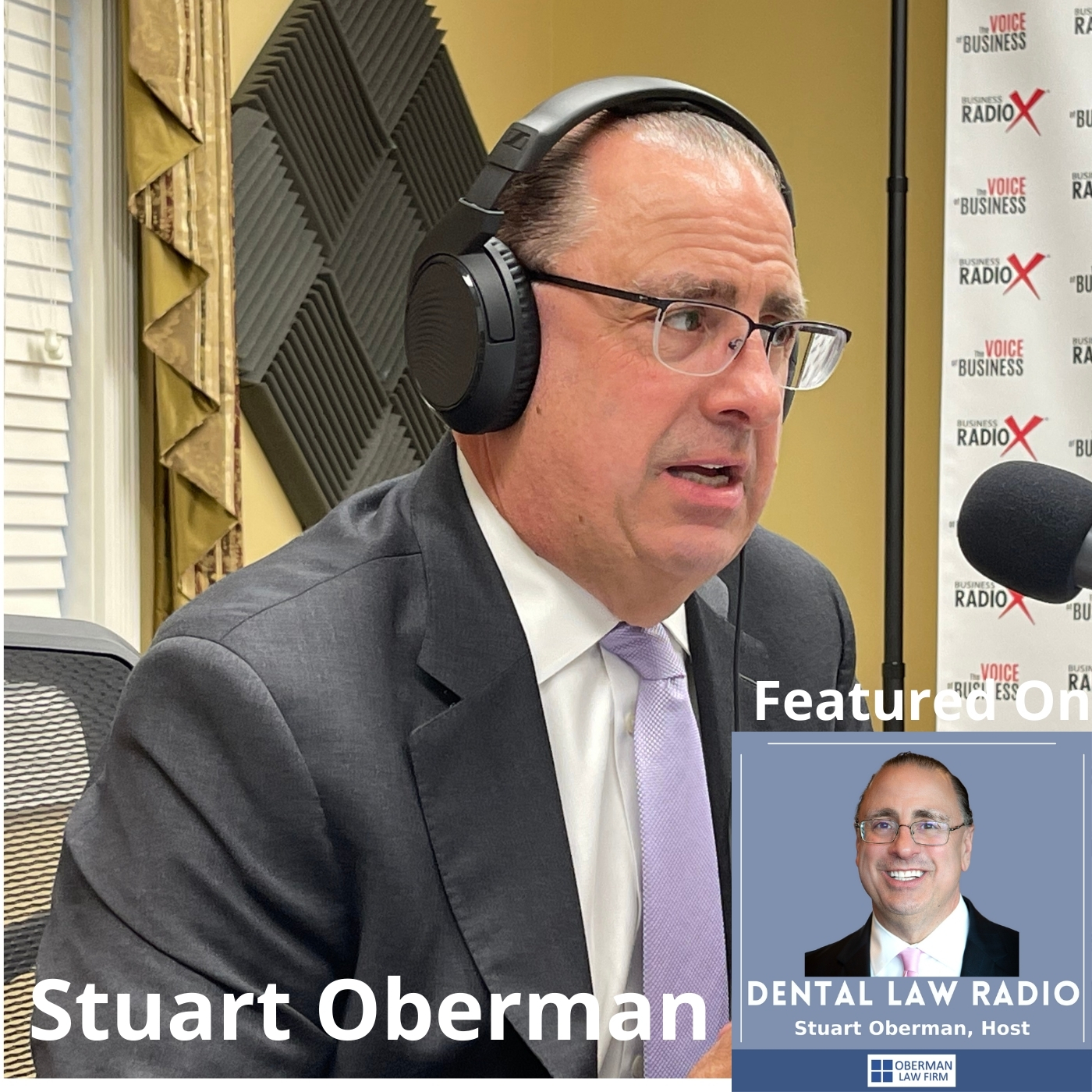
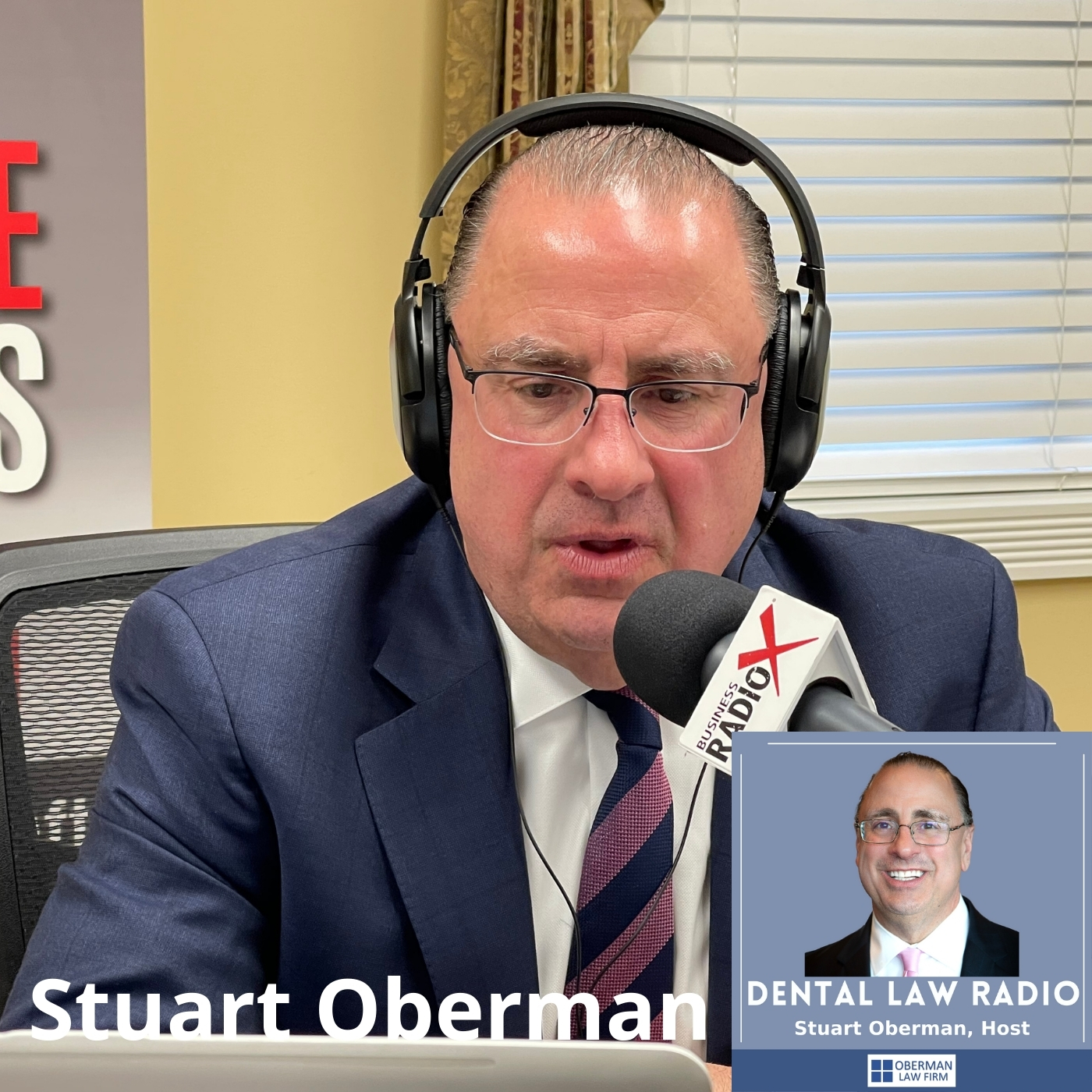
You’ve hired that new employee. Now what? As host Stuart Oberman discusses, there should be an onboarding process which involves an offer letter, a well-written employee manual (not the 20-page version downloaded from the internet), consent forms, and much more. Missing steps and inadequate documentation here sow the seeds of costly problems later. Dental Law Radio is underwritten and presented by Oberman Law Firm and produced by the North Fulton studio of Business RadioX®.

TRANSCRIPT

Intro: [00:00:01] Broadcasting from the Business RadioX studios in Atlanta, it’s time for Dental Law Radio. Dental Law Radio is brought to you by Oberman Law Firm, a leading dental-centric law firm serving dental clients on a local, regional and national basis. Now, here’s your host, Stuart Oberman.

Stuart Oberman: [00:00:26] Hello, everyone, and welcome to Dental Law Radio. So, this topic, today’s topic, a checklist for hiring new employees. I will tell you, I said this before on previous podcasts, we are very fortunate. As a law firm, we have clients in approximately 30 states all the way from California, Maine to Florida. And we do a substantial amount of HR work. Now, what does that mean, HR, human resources? So, we work with our clients on hiring, firing, internal operations, documents, non-competes, nondisclosures, non-solicitations. And one of the things that we have found out that our doctors do not – do not – onboard properly, they don’t have the processes in place, they don’t understand how to onboard, they don’t have a checklist, and they have absolutely no process in place because, at some point, without a good hiring process, if that employee does not work out your firing process, which we will cover in a subsequent podcast, will be an absolute disaster.

Stuart Oberman: [00:01:45] So, let’s take a look at a couple of things that we’ve run into. First and foremost, before that employee starts, day one, you have to have a series of forms and onboarding documents. What does that look like in your practice? You probably think, “Well, I don’t have an onboarding process.” So, then next step is you better get one because you have to have one. So, I would encourage you – encourage you – to have a new hire checklist. If you don’t have one, I’ll give you information on how to get one at the end of this podcast.

Stuart Oberman: [00:02:25] So, first and foremost, when you interview – and we covered interviewing on our previous podcasts – the proper way to interview. So, let’s assume you hire the employee. Now what? Every position that you hire has to have … or I say has to, should have an offer letter. Now, that doesn’t mean one paragraph, that means a formal offer letter, which should include a couple of things. A job description: What department are they working in? What’s their work schedule? Now, you maybe thinking, “Well, I’m going to give them an employment contract.” No. In many cases, an employment contract will get you in more trouble than not having one. So, it depends on your position within the dental practice or for those that are listening that do not own a dental practice, within your organization.

Stuart Oberman: [00:03:26] So, again, first and foremost, offer letter, job information, title, department, what is the work schedule, how long are they going to be there, what’s the compensation, what’s the benefits, what are the employer responsibilities? So, with a caveat to that, the employee benefits, assuming it’s employer’s responsibilities, should already be outlined in your employee manual.

Stuart Oberman: [00:03:56] So, we see a lot of problems with employee manuals. We have doctors that will come up to us and say, “Hey, you know what? I got an employee manual for my friend, and it’s about 25 pages.” My first thought on that is you probably need to shred it. It’s just going to get you in more trouble than not. And what are the termination conditions? It is easy to get married; it is hard to get divorced.

Stuart Oberman: [00:04:24] So, then is next step is what forms do you need from a governmental standpoint to classify and compensate employees with? And it is amazing to me how many CPAs will ask us for this information, which is, a lot of times, very basic. Again, you should have all this prepared, especially in today’s market where turnover is rampant. Of course, you got to have a W-4; for contractors, W9. It is a key concept to have your workers classified as employees or independent contractors. That’s a whole another discussion on classifications. You’re I9s, your state and federal withholdings. What are you going to do when you have multiple practices that are in multiple states? Each one is different. Do you fall for a foreign entity in that particular state, even though that is not your home base? Your E-system verification. Again, those are your basic forms. You should already have those prepared and ready to roll from day one.

Stuart Oberman: [00:05:40] So, your internal forms are a little bit different and they’re relationship-based. So, these are more what I call your protectionary forms, which every practice – and again, for those that are listening that are not dental-related – every business should have. Now, depending on your position, whether or not that is a key employee position, you will want to have a non-compete. “Well, non-competes are not enforceable.” They are absolutely enforceable. It depends on the extent. As a general rule, depending on your state, it has to be geographically specific, it cannot be overly broad, and you can’t say, “I will not allow this employee to do this anywhere in the country or in the world.” That is a recipe for disaster.

Stuart Oberman: [00:06:33] Non-disclosure forms. Every – every employee should sign a nondisclosure. What happens in your place of business must and should stay in your place of business. “Well, they won’t sign one.” Then, they should not be working in your office. Every employee signs one, including social media, cell phone, and internet policy. And I would encourage you not to get those forms off of the internet. They’re very complex employment law forms.

Stuart Oberman: [00:07:06] So, then, an employee acknowledgement handbook. So, I can’t tell you how many times I say, “What’s your employee manual say?” “Well, you know, we really did give it to him,” or “We gave it to him.” “Great! Where’s the acknowledgement form that they received it?” “Well, I don’t think they ever gave back to us.” So, honestly, unless your employee really signs an acknowledgment form, in all likelihood, you probably should assume that they did not get it.

Stuart Oberman: [00:07:34] Next, drug and alcohol consent forms for testing. Now, what are you going to do if you have a state that has legalized marijuana? That is a whole another topic for another day. That is special considerations.

Stuart Oberman: [00:07:57] Employee equipment list. Lot of our doctors, a lot of our employers will provide laptops, cellphones, equipment. You better log those in because once that employee leaves, good luck getting them back unless you inventory it. Confidentiality agreements, an absolute must. Again, what stays in the practice — what happens in practice stays in the practice.

Stuart Oberman: [00:08:24] So, then, let’s take a look at a couple of other things. These are just basic things that you really should have. So, then, in the offer letter, an employee benefits documents. You need to give the employees documents regarding life and health insurance. You can’t wait 60, 90, six months, a year later to give the employees this particular set of documents.

Stuart Oberman: [00:08:54] Cellphone plan. What is your cellphone plan? It is amazing in today’s world what employees will keep and store on their cellphones. What happens when that employee leaves and all of your data, because they downloaded it at your request, is on their cellphone? Do you have a policy to delete that? Do you have a policy that will certify from your employees when they leave that that will be deleted? Do you have an app on your phone that will essentially self-destruct the employment information that you’ve sent over to your employees? If you look at the text messages and everything else that you sent over to your employees on a daily basis, it will be amazing what data is on there, and it will be also amazing what happens if that phone is hacked, and where the data goes. Then, I would strongly recommend you specify paid vacation, time off, paid holidays, sick leave. Do not assume that your employees will know that. That’s got to be in writing.

Stuart Oberman: [00:10:07] Then, the next final data is emergency information. People move. Numbers change. Do you know how to get in touch with relatives should something happen at your office place? Now, you’ve got to be really careful with this because in some instances you’re talking about the ADA, American Disabilities Act, and EEOC. Have you obtained a brief medical history in an employment application? Again, we got to take a look at EEOC issues, especially in this world of COVID. We have to take a look at GINA Title II as far as DNA information goes. So, there’s all kind of regulatory matters we need to take a look at, whether it’s food allergies. I mean, in today’s world, we don’t know what employee problems are.

Stuart Oberman: [00:11:05] So, this is a very, very, very brief, brief summary as to what you need on a new hire checklist. And I’ll tell you, we discovered this when our doctors go through an insurance or third-party governmental audit, and they want personnel files for the last five or seven years, they want ID information, they want application information, they want checks as to whether or not those employees were checked off as far as whether or not they’re eligible to provide treatment or see patients that are on the governmental payer list, if you will.

Stuart Oberman: [00:11:50] So, those are all the things that we really want to take a look at that are absolutely mandatory because when you get a governmental order from attorney general’s office or the DOJ on a federal level, and all of a sudden, they are asking for a personnel file, you’ve got a problem if all this is not in there. And all you do is have one photograph and a one-page application process, that’s an absolute recipe for disaster on a audit.

Stuart Oberman: [00:12:18] So, hopefully you’ll take away a couple of things. Take a look at your personnel file, which should always be kept separate from all the other records, especially regarding COVID-19 shot information. That should be absolutely separate from all the other personnel files and should be maintained separately. So, in summary make sure your new hire process is in place, it’s implemented because it is so easy to get into a relationship plan-wise; it is absolutely devastating to, at times, get out of these relationships.

Stuart Oberman: [00:12:59] So, thank you for joining us today. Hopefully, you picked up a couple of good ideas. If you would, feel free to reach out to us. My name is Stuart Oberman, stuart@obermanlaw.com. 770-886-2400. And please follow us on our podcast. And I always say, if you just pick up one bit of information from each podcast, it is a fantastic day. Thanks for joining us. And we will talk to you soon.

About Dental Law Radio

Hosted by Stuart Oberman, a nationally recognized authority in dental law, Dental Law Radio covers legal, business, and other operating issues and topics of vital concern to dentists and dental practice owners. The show is produced by the North Fulton studio of Business RadioX® and can be found on all the major podcast apps. The complete show archive is here.

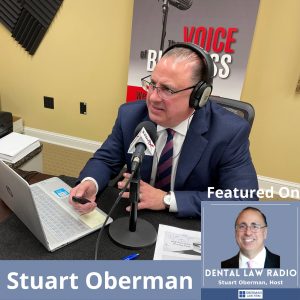
Stuart Oberman, Oberman Law Firm

Oberman Law Firm
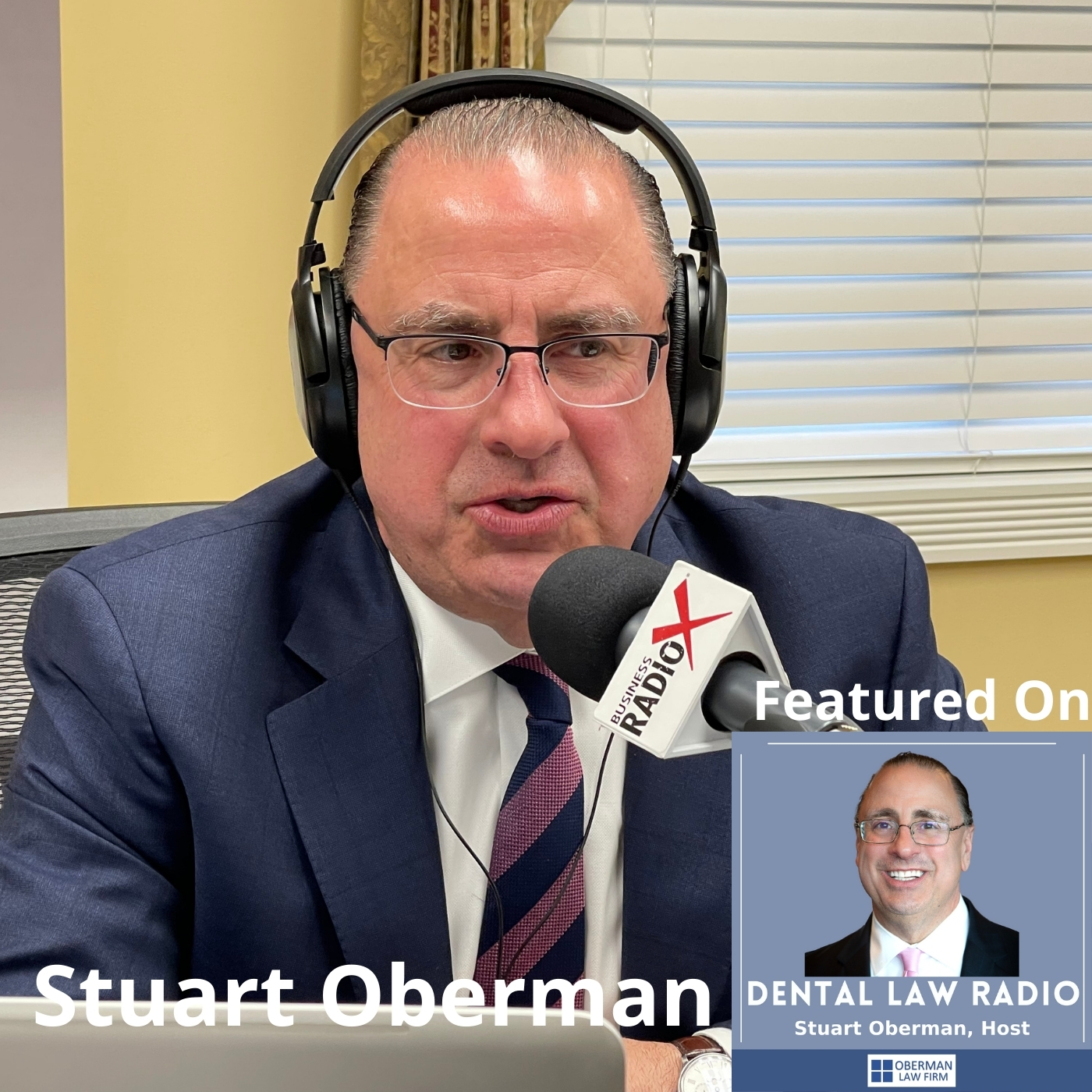
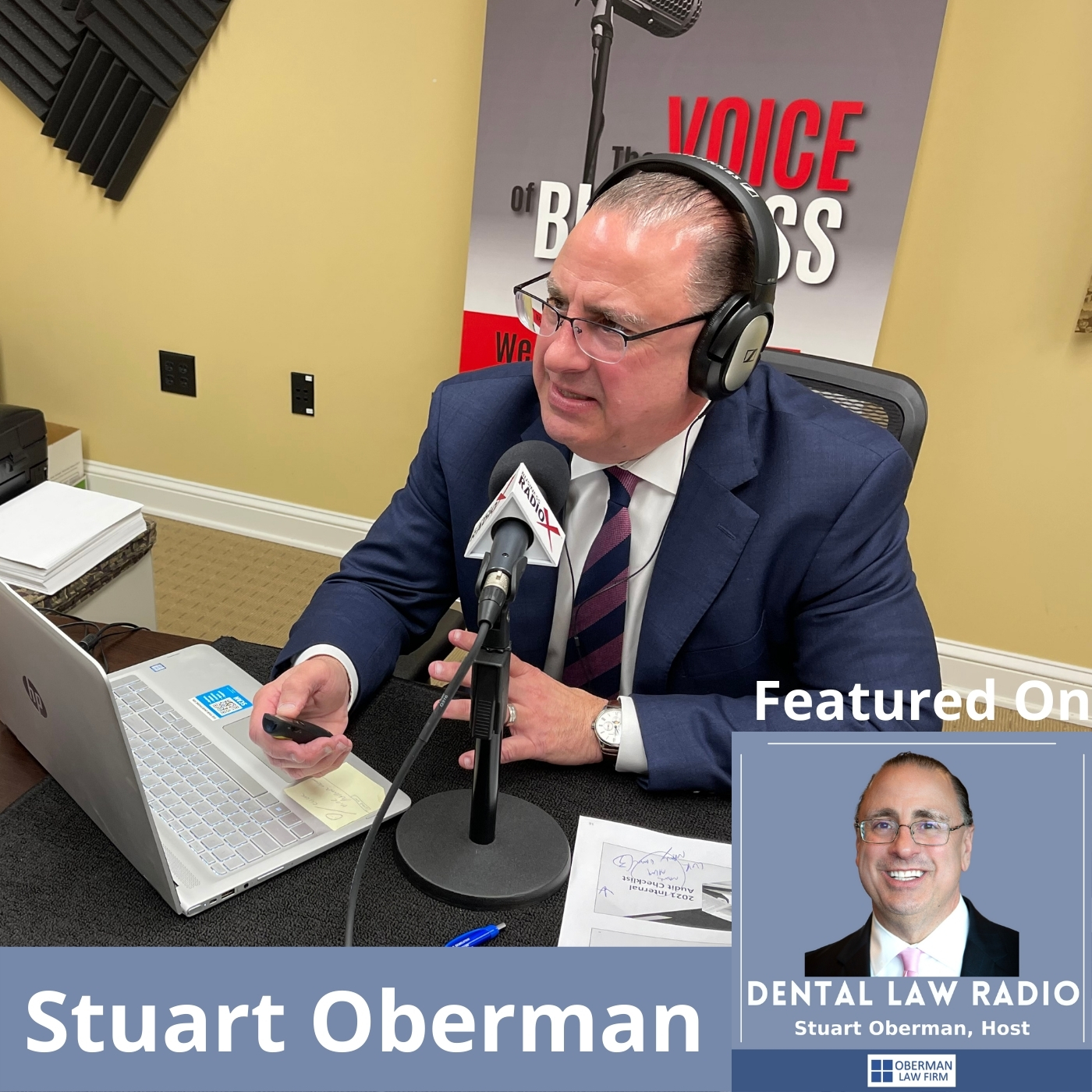
Stuart Oberman, host of “Dental Law Radio”

Stuart Oberman is the founder and President of Oberman Law Firm. Mr. Oberman graduated from Urbana University and received his law degree from John Marshall Law School. Mr. Oberman has been practicing law for over 25 years, and before going into private practice, Mr. Oberman was in-house counsel for a Fortune 500 Company. Mr. Oberman is widely regarded as the go-to attorney in the area of Dental Law, which includes DSO formation, corporate business structures, mergers and acquisitions, regulatory compliance, advertising regulations, HIPAA, Compliance, and employment law regulations that affect dental practices.

In addition, Mr. Oberman’s expertise in the health care industry includes advising clients in the complex regulatory landscape as it relates to telehealth and telemedicine, including compliance of corporate structures, third-party reimbursement, contract negotiations, technology, health care fraud and abuse law (Anti-Kickback Statute and the State Law), professional liability risk management, federal and state regulations.

As the long-term care industry evolves, Mr. Oberman has the knowledge and experience to guide clients in the long-term care sector with respect to corporate and regulatory matters, assisted living facilities, continuing care retirement communities (CCRCs). In addition, Mr. Oberman’s practice also focuses on health care facility acquisitions and other changes of ownership, as well as related licensure and Medicare/Medicaid certification matters, CCRC registrations, long-term care/skilled nursing facility management, operating agreements, assisted living licensure matters, and health care joint ventures.

In addition to his expertise in the health care industry, Mr. Oberman has a nationwide practice that focuses on all facets of contractual disputes, including corporate governance, fiduciary duty, trade secrets, unfair competition, covenants not to compete, trademark and copyright infringement, fraud, and deceptive trade practices, and other business-related matters. Mr. Oberman also represents clients throughout the United States in a wide range of practice areas, including mergers & acquisitions, partnership agreements, commercial real estate, entity formation, employment law, commercial leasing, intellectual property, and HIPAA/OSHA compliance.

Mr. Oberman is a national lecturer and has published articles in the U.S. and Canada.

LinkedIn

Oberman Law Firm

Oberman Law Firm has a long history of civic service, noted national, regional, and local clients, and stands among the Southeast’s eminent and fast-growing full-service law firms. Oberman Law Firm’s areas of practice include Business Planning, Commercial & Technology Transactions, Corporate, Employment & Labor, Estate Planning, Health Care, Intellectual Property, Litigation, Privacy & Data Security, and Real Estate.

By meeting their client’s goals and becoming a trusted partner and advocate for our clients, their attorneys are recognized as legal go-getters who provide value-added service. Their attorneys understand that in a rapidly changing legal market, clients have new expectations, constantly evolving choices, and operate in an environment of heightened reputational and commercial risk.

Oberman Law Firm’s strength is its ability to solve complex legal problems by collaborating across borders and practice areas.

Connect with Oberman Law Firm:

Company website | LinkedIn | Twitter
Tagged With: checklist for hiring new employees, dental practice management, employees, Oberman Law Firm, Onboarding new hires, Stuart Oberman

Growing Your Practice Through Effective Leadership, with Eric Morin, Tower Leadership

September 10, 2021 by John Ray

EricMorinDLREpisode19Album
Dental Law Radio
Growing Your Practice Through Effective Leadership, with Eric Morin, Tower Leadership
Loading
00:00 /
RSS Feed
Share
Link
Embed

Download file

EricMorinDLREpisode19Album

Growing Your Practice Through Effective Leadership, with Eric Morin, Tower Leadership (Dental Law Radio, Episode 19)

In a few years, Eric Morin argues, few dental practices will have less than $1 million in revenues. In this era of consolidation, what enables a practice to acquire other practices and scale effectively? In this conversation with host Stuart Oberman, Eric argues that the answer gets down to great employees, and he discusses the management and leadership fundamentals needed to attract those people. Dental Law Radio is underwritten and presented by Oberman Law Firm and produced by the North Fulton studio of Business RadioX®.

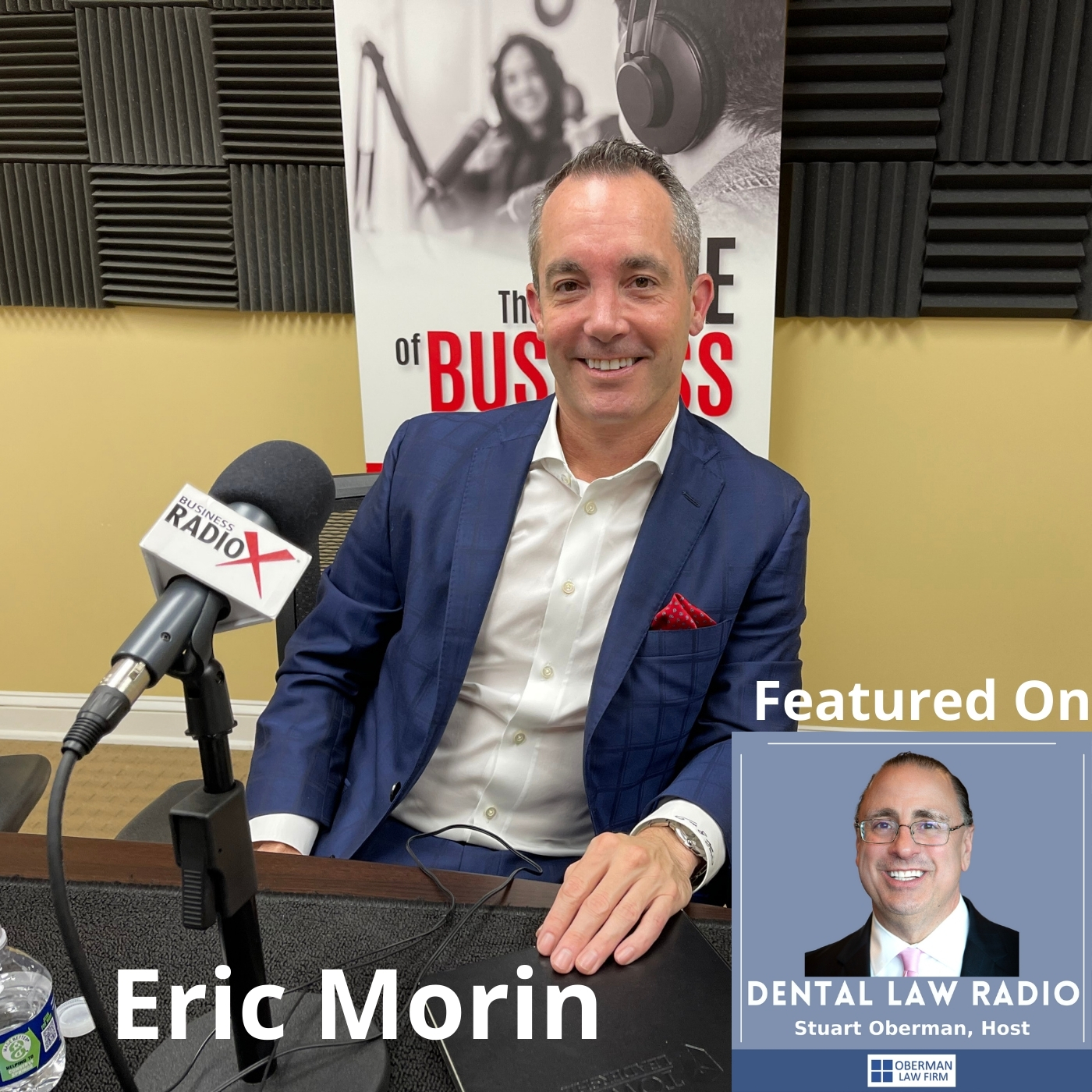
Eric Morin, Founder and CEO, Tower Leadership

Eric J. Morin, Founder and CEO of Tower Leadership, is an MBA and an experienced successful financial and business consultant, Eric truly is an innovative thought leader and powerful dynamic speaker. His words compel you to grow your business, live optimally, and make a transformative impact on this world.

For over a decade, Eric J. Morin has left a successful track record in the dental consulting industry. Hundreds of Dental Practices are now thriving in wealth, work environment, and community impact.

Eric founded Tower Leadership with the sole purpose of keeping dentistry in the hands of dentists by equipping them with the knowledge and tools they need to run a flourishing practice where everyone on the team benefits.

Connect with Eric on LinkedIn.

DLR-2021-08-2710.52.58 DLR-2021-08-2711.22.04

TRANSCRIPT

Transcript
Intro: [00:00:02] Broadcasting from the Business RadioX Studios in Atlanta, it’s time for Dental Law Radio. Dental Law Radio is brought to you by Oberman Law Firm, a leading dental-centric law firm serving dental clients on a local, regional, and national basis. Now, here’s your host, Stuart Oberman.

Stuart Oberman: [00:00:26] Welcome, everyone, to Dental Law Radio. Usually, I’m given a couple items on a podcast, but today we’ve got an extraordinary special guest in the studio, Eric Morin, Tower Leadership. And the reason why I wanted to talk to Eric – and he and I have done some projects and clients along the way for many years now. And I know Eric has clients all the way from Washington to probably Maine, probably to Florida, and probably some internationals. Who knows? – I wanted to really get Eric’s sort of feedback, if you will, what’s going on in the industry, where things are at. I know he’s got the the pulse of the industry and what’s going on at the practices, whether you have one practice or, I think, we’re working on a project now that we’re probably going to get him to about 30 practices at some point, if we can keep him on track, keep him on track.

Eric Morin: [00:01:23] It’s a big one.

Stuart Oberman: [00:01:23] But I think, really, Eric, you did a great job getting your guys through COVID-19. I know that was a very difficult spot. And I know that you and I did a seminar together that we had to go to a very remote location in a winery because no one else with houses. And you were on the forefront of a lot of areas, and I know that if your doctors listened to you when you were giving advice in March and April, they were well on the way to succeed. But I wanted to get, you know, your conversational sauce.

Stuart Oberman: [00:01:58] We’re going to cover a couple of things today, because you’re right on the front on this. You’re way out in front of this. Everyone’s scaling, scaling, scaling. You know, the questions we have are, how do you keep associates without giving up equity? One other area we want to take a look at is where are we at on the change of the business environment as we sort of revisit COVID, if you will, and all this coming with that. We’re seeing things that are already going into the first quarter of 2022.

Stuart Oberman: [00:02:33] So then, we want to take a look at, you know, leadership. And I’ve heard you talk and I take notes when you talk and implement when you say things. And God forgive me, but you introduced me to the sigmoid curve. I couldn’t even spell sigmoid curve until I actually listened to you talk when we were giving a little seminar.

Stuart Oberman: [00:02:57] But great to be here. Thank you, my friend. You are amazing in what you do. And I will tell you and I’ll tell listeners, every time you speak and every time I hear you, I learn something. Whether it’s one thing or a handful, I learn something. So, I want to talk about, really, what Tower Leadership is doing. Then, I want to get into some very specific industry topics that I know you’re out in front of. But tell us a little about Tower Leadership and what you guys do.

Eric Morin: [00:03:24] Well, first, thank you for having me. I’m glad to be here today. This is a lot of fun. I’ve been looking forward to it. As you said, you and I have worked on a lot of projects together, a lot of conversations. We’ve dealt with a lot of clients. You know, we really experienced a lot of issues together. This is a great time to have this conversation. There are so many changes. And then, all this thing called the Delta variant comes out.

Eric Morin: [00:03:48] So, just when we think that everything is settled and we can get back to business as usual, winter comes again. We don’t know. There’s uncertainty. And I think that’s business as a whole is there’s always uncertainty in the marketplace, and I think preparing for that. And then, what do you do when that happens?

Eric Morin: [00:04:04] And I think that’s one of the conversations you had brought up, which is when COVID happens. I think in the show we’ll talk through that is what were the differences during that time? Because one of the things I’m seeing now is, when we go back and we look at the time period, some people say we won’t count 2020 and some people say 2020 was a great launching point.

Stuart Oberman: [00:04:26] Best year they ever had.

Eric Morin: [00:04:27] That’s right. So, what was the difference? I think it’s really important in this podcast to identify those things. As a company, Tower Leadership, I’ve been in the consulting dental space for approximately 20 years. I’m married to a dentist. And I was consulting for companies outside of dental. And then, she said, “Will you help me start a dental practice?” I always tell people that my best asset was that I didn’t know anything about dental. And so, I just started growing and scaling this dental practice and hiring doctors. And I thought that was normal until someone told me it wasn’t.

Eric Morin: [00:05:01] But then, my career, I ended up getting investment licenses so that I could see also the investments that doctors were making. Tower Leadership came from this idea of, after all my years of experience, you can have great management systems, you can have great training, you can have all these things in place. But if you don’t have great leadership within the business, and leadership encompasses a lot of things, and there’s certainly some great things you need in management and leadership.

Eric Morin: [00:05:31] But the idea of Tower Leadership was, let’s create a business that shows doctors that if you invest, if you grow and you scale, yes, you can have all the financial rewards, but you can also impact a lot of people, too. And as idealist as that sounds, we’ve been able to do that. And it’s a fun pursuit of passion. And we get to see the changes in our clients lives, which is a lot of fun.

Stuart Oberman: [00:05:54] So, one of the big things now is, our doctors are sort of in a quandary where they really don’t want to give up leadership or ownership, but they don’t want to work 80 hours a week. So, the question is, in today’s tight market, tight, tight associate market – and we get this question all the time. And I know you get the question. You had a big conference on this recently – how do you keep associates in today’s world where you’re only as good as your last paycheck and your last patient without giving up equity? That’s probably a 17 day topic in a four year span. But, you know, how do our doctors do that? And what are you seeing on that side? You know, how do you keep these associates without giving up equity? That’s a loaded question.

Eric Morin: [00:06:50] You’re right. I mean, we could sit here and talk about this for a long time. I think it’s very important for people to know that a lot of times that associates feel that that’s being successful. But let’s unwind it a little bit more. The idea of ownership – and a lot of it actually, believe it or not, and all the conversations, I mean, I’ve had conversations with thousands of associates – it’s always that, “I want to be able to have a say in the practice. I want to be able to have leadership.” That’s the hard part to get over, right? Because you could give somebody equity.

Eric Morin: [00:07:19] Let’s just say that you gave up 30 percent or even 40 percent or 50 percent of your practice. But if someone’s whole goal is to be able to have a leadership conversation, to be able to contribute, and they’re not able to do that, of course, then they still won’t be happy. So, I think the first thing it goes down to is, what does the person ultimately want?

Eric Morin: [00:07:38] Because I think the marketplace in the past had said to this person, let’s take an associate, highly educated, highly competitive. Dentists tend to be competitive people by nature. And we say, “Here’s what I want you to do. I want you to come in. I’m going to figure out how to pay you as little as possible. I’m going to give no say on my dental practice.” And I love it if you just stay a really, really long time and no equity. I mean, none of us would go into that conversation to go, “This sounds like a win-win long term.””

Stuart Oberman: [00:08:04] It happens every day.

Eric Morin: [00:08:05] And so, I think that if you look, this is not what happens in other industries, by the way. This is kind of a way, a paradigm, that was in the dental market space for so long. And so, I will tell you that before we even get to a financial model or talk through those types of models, I think it’s more important to say, can this person contribute to the practice? Are they allowed to contribute? Because these are intelligent people.

Eric Morin: [00:08:30] And by the way, if doctors want to pull back, I might want to pull on that part of their skill set and have them be part of the practice as far as the ability to contribute to a leadership team or contribute to the management of the practice. So, it’s really important that we talk about that first in that component because they want to be part. They want to feel like they’re part of something. Don’t we all, though? I mean, don’t we all want to feel like we’re part of something? And I think the way we’ve treated associates in the past is wrong, I’ll say that first.

Eric Morin: [00:09:04] The other part is, what does it mean to get ownership? I think we have to unwind that. What does that actually even mean? Equity. What is equity? Equity, first of all, until you sell it, it’s just something filed with the state. I mean, it doesn’t really mean anything. You can say, “Well, it means distributional equity. So, I get some distributions.” But I think what do those distribute – distributions?

Stuart Oberman: [00:09:30] You’re the financial guy. You’re asking a lawyer?

Eric Morin: [00:09:30] I know, right. I think one of those distributions will be long term. So, I think it’s one of those mean long term. And I think it’s creating an asset. You know, what we have found is, by allowing someone to be part of a leadership team, to have some say in what’s happening in the practice, and then by giving them an asset, showing them that they could have a multimillion dollar asset without having equity, then they say, “Okay. Hold on. Let me get this right. So, I could work four days a week, not deal with H.R., not have to do with marketing, not deal with all the headaches and complexities, and I could have a multimillion dollar asset?” The answer is yes.

Eric Morin: [00:10:16] And so, actually, believe it or not, I’ve had partnership agreements that the partners have unwound the agreement to do a deferred compensation or some type of other program, because they see clearly financially. I’ve had people take that type of an arrangement and put it in front of their lawyers, their accountants, their financial advisers, and they have come back and said, “Wow, this is pretty amazing. And it’s actually better financially.”

Eric Morin: [00:10:44] So, what happens is, when the associates end up in dental school, they tell them the natural progression is you’re going to get out, you’re going to work for a few years. Oftentimes and nowadays, it’s for corporate for years. And then, they’re going to go buy a dental practice. But even that market’s changing, isn’t it? I mean, we’re starting to see the complexities. And I’m shifting a little bit here, but as the marketplace changes, the complexity around owning a dental practice is getting much harder.

Stuart Oberman: [00:11:11] It’s getting harder. Individual, not when you got numbers on DSOs.

Eric Morin: [00:11:15] It is. Even in the last ten years, Stuart, I mean, we got to think about –

Stuart Oberman: [00:11:21] And days.

Eric Morin: [00:11:21] Right. So, we think about this and say, even five years ago. I argue that five years from now, there’ll be very few practices that are operating under a million dollars in revenue. Independent dentists that are thriving outside of, maybe, a small boutique type cosmetic firm. And if you look at the medical space, you’ll see the same thing. I mean, in the medical space, you’ve got dermatologists and you’ve got plastic surgeons. And for the most part, they stayed out of groups. But the vast majority of medicine, you know, MDs are now all part of groups.

Eric Morin: [00:12:00] So, when we look at the marketplace and the way it’s shifting, we say even the people who might have bought a practice, it’s going to cost you a lot more to get into them because – and we’re seeing this and you’re seeing this, too – it might cost you $2 or $3 million now to get into a practice where it would have cost you 400. And then, you’ve got to have the business acumen to be able to compete in that space.

Eric Morin: [00:12:19] So, when we’re retaining associates, what we have to think about first is the environment. Are we providing a world class environment? Are we providing a place where they can thrive? Can their career grow? Can they be excited? All those traditional things in any other industry we will look at. Let’s say you and I started to create another firm, we would want to take care of our C-suite, our top players.

Stuart Oberman: [00:12:44] We don’t sleep as it is.

Eric Morin: [00:12:47] [Inaudible]. What a side note. So, I think that we can keep unwinding this. The truth is that, no matter where you are, this marketplace is changing. And I actually think there’s a lot of it that’s good news. And the marketplace is changing and we can kick and scream, but it is. And I think that the more we adapt to that marketplace, the more we can thrive. I think if you look at large corporations, or private equity, or DSOs, or however you want to call it in this space, they are not handing over equity to these practices. And I think that people have been telling people for a long time that you need to hand over equity.

Eric Morin: [00:13:29] But in the case that you had mentioned from coast to coast, I was working with a doctor recently. And if he had given up half his practice, he would have taken a 50 percent pay cut. But that pay cut literally would have made it so he could not pay his bills, literally. And so, I sat down with the associate. I said, “Do you care about this doctor?” And the associate said, “Yeah. I’m just trying to take care of my family, but I also want him to be taken care of.” I said, “Well, if we do this deal long term, this is going to fall apart.”

Eric Morin: [00:14:03] And so, we would do the math with the associate. And we were able to put a really good agreement in place where the associate had a long term asset. Also, had some leadership say in the practice, was able to thrive. And this was a few years back, actually. And, now, I mean, they are just just doing so well together. So, I love to see that you do not have to just hand over equity. That is a paradigm that is changing. It will continue to change. And I think it’s really important in this marketplace.

Eric Morin: [00:14:37] Maybe you do want to sell back. Maybe you want a partner. I’m not saying you never should. I’m just saying that if that is not your game plan, you should not be forced into that game plan, or strategic direction maybe is a better way to say that. I think you have to think through why you’re doing this, and who it benefits, and what your long term vision is.

Stuart Oberman: [00:14:55] Does this go hand in hand when a doctor says to you, “I want to get out of the chair.” Does that go hand in hand on or is that a before conversation that would get to the associates? Is it, “I want to get out of the chair, how do you figure it out? Then, what do I need to do with an associate?” Is that a first conversation when when a doctor says that to you? How do we get out of the chair?

Eric Morin: [00:15:19] I have to tell you, this is like my happy place. Can we make this show five hours? We got to like [inaudible]. We can do this for a long time.

Stuart Oberman: [00:15:27] How do I get out of the chair? How do I get out of the chair? How many times have you heard that, how do I get out of the chair?

Eric Morin: [00:15:33] So, here’s a thought, so what happens is, is just like any other position. Sometimes we put a square peg in a round hole. Look, we oftentimes will bring in this associate that does not meet the business model. It does not meet the vision. For instance, the person who says this doctor does not want to give up equity long term, wants to build a team, wants to do some type of other business or economic model to provide an asset for the associate. And this associate walks in, stomps their feet and says, “No. I will not do anything but take ownership.” So, the doctor says, “Okay. Fine. I’ll hire many. How many?” They’ll change their mind.

Eric Morin: [00:16:16] That’s your hiring process. There’s a thought process between selection and recruitment. Selection is that you’ve sort so many candidates coming into the position that you can pick the right person and select them. We always want to select people. So, if you have multiple candidates, you get to select. Recruiting is almost that last minute thing where you’re like, we really need a body or we really need an associate right now, so we just put whoever comes into that position, we just say, “We’re going to hire you. We’ve seen this with front desk.”

Stuart Oberman: [00:16:49] Is that more prevalent in today’s market because they can’t find good associates or they’re just filling bodies?

Eric Morin: [00:16:55] See, I would push back against can’t find good associates. It’s interesting, the reason I say that is because the doctors who have built an amazing environment to work in, doctors hang out with doctors. I don’t know how many times someone has said to me, I’ve recruited two or three people from my class to come work for this doctor, because if you create an amazing environment to work where somebody can do well, can take care of their family, and have an asset, it’s going to attract other people.

Stuart Oberman: [00:17:27] Build it and they will come.

Eric Morin: [00:17:28] Yeah. Sometimes I say to people, it’s like the harsh truth. But sometimes when someone says, “I can’t find anyone.” I say, “It’s you.” And that’s kind of a harsh truth. And let me kind of back that up.

Stuart Oberman: [00:17:42] It’s true, though.

Eric Morin: [00:17:43] Sometimes it’s like I have not built the environment to attract people. Someone said to me this one time, Stuart, this person said to me, “You can’t find any good people in Atlanta.” I was like, “Wow. An entire city. I’m sure it’s the entire city.”

Stuart Oberman: [00:18:00] You can’t find one person out of six million.

Eric Morin: [00:18:02] That’s right. So, I pushed back and and said, “Well, let’s talk about the environment.” We’ve always had this idea that dental is different, but it’s not different. The business acumen, the business principles always apply is you’ve got to create an environment. No matter who you are, every study shows, people still don’t come to work for money. We say, “Well, yes, they do.” Somebody can always pay them more. There’s still all these other intangibles that you have to make it a place that’s great to work.

Eric Morin: [00:18:32] Now, obviously, somebody wants to get paid their value. They want to have the ability to increase their income. All those things are true. And I’ll give you an example of what I mean by that. There is a young doctor. She is one of the most amazing doctors that I’ve ever had the pleasure to spend time with. She took a job out of GPR residency. And what she did was she went up to Indiana. She gets up there. She gets a practice who’s going to pay her more money. And it ends up being a really bad environment for her to work in. And we’ve had a business relationship.

Eric Morin: [00:19:10] And she says, “Hey, Eric. I need some help. I’m in this practice. They pay me a lot of money, but I’m so miserable.” And here’s here’s the thing, going back to my earlier point, “They will not let me have any say. They will not let me contribute. They tell me just to shut up and see patients.”

Eric Morin: [00:19:24] And what happened was she quit there, is now working for one of my clients. She is running the entire location. This entire location she runs. She’s learning advanced procedures. And the doctor there, he goes, “She’s a unicorn. I don’t know if I’d ever find another one of her.” And yet this other doctor had her. Now, the other doctor that lost her is probably saying, “It was her. You know, you can’t find good people.”

Stuart Oberman: [00:19:49] Has an attitude. Lack clinical skills.

Eric Morin: [00:19:50] Right. All these things. It was like, “No. It was you.” And so, I do think it’s important that we all look at our business and say, “Do we have the environment to attract top talent?” All businesses have to do that. Can we attract top talent? Would they want to stay here? Do they have a say? And by the way, that’s not just doctors, it’s your entire team. Hygiene is no different, right? We are in a tough, tough market to find hygienists. Hygienists talk to hygienists. If you had a great place to work, other hygienists will say, “You got to come work for here.” So, that’s just something to consider.

Eric Morin: [00:20:26] So, yes, at Tower Leadership, we’re a financial firm in many ways and we do plans around retaining associates. But I would still argue that if you don’t have the foundations of strong business management, then it’s not going to work anyhow.

Stuart Oberman: [00:20:47] That’s why there’s one practice or 20. It’s all the same.

Eric Morin: [00:20:49] That’s right. And I say management leadership, one thing I’ll say on the show that I think it’s important. Sometimes you scroll through LinkedIn and I see some amazing post by Stuart Oberman, so I’m scrolling through.

Stuart Oberman: [00:21:04] I got good people. I got good people. I got much smarter people than me, I could tell you that.

Eric Morin: [00:21:09] Well, they’re doing great. It’s looking good. So, as I’m scrolling through, I always see these posts that pop up. And they’ll say something to the idea of, “Leadership is when you care. Management is just a number.” And it’s silly because it’s not true. Look, all great businesses need leadership and management. Management doesn’t mean that you don’t care? You have to have strong management because you can be a great leader. But if you have bad management, then the company is going to fall apart. You can train people, but if you don’t have a way to have standard operating procedures, you cannot continue to manage the business to grow. So, you do need both.

Eric Morin: [00:21:54] By the way, if you just have management but no leadership, that’s not good either. So, I think it’s important to understand, you have to have strong leadership within a business, the visionaries, the the visionary leader, the people that are driving the show and looking at direction and inspiring people. But I think there’s another side that says, “Do I have strong management?” And by the way, I think associates play a crucial role in both of those.

Stuart Oberman: [00:22:19] So, you know, it’s amazing what’s changed in the last three years, maybe 36 hours, we got scaling, we got corporate coming in, and we’ve got DSOs, we’ve got growth, we got no growth, we got COVID. I would say with COVID, it’s got to be something else. If it’s COVID today, it’s Delta tomorrow, and it’s something else down the road.

Eric Morin: [00:22:42] The Foxtrot variant.

Stuart Oberman: [00:22:44] Yeah. It just keeps going. So, from a practice standpoint, how do our doctors adapt to the change in this new business environment? And it changes, like, everyday it seems like.

Eric Morin: [00:23:02] Three words, access to capital. I’m serious. Let me tell you what I mean by that, you can look at business over business over business outside of dental as well. And you and I talked about this actually during COVID. I said, you got to have access to capital. One of the things that the federal government provided was access to capital. Had that not happened, then what would have happened? Have we not have PPP and EIDL, what would have happened to the dental market space?

Eric Morin: [00:23:32] And so, I think when we look at the future, first of all, one of the ways we insulate ourselves from those types of things is access to capital.

Stuart Oberman: [00:23:40] And what does that mean? Access to capital, what does that mean?

Eric Morin: [00:23:42] It means that either you have credit lines you can pull from. It means that you might be able to have money in the bank. You have access to be able to borrow money.

Stuart Oberman: [00:23:54] Is that what they call good debt?

Eric Morin: [00:23:56] Here’s what I always tell people, there’s two things you cannot get when you need them, credit lines and insurance. Okay? So, those things are really cheap and you could get it really easy when you don’t need them. The second you need them, they’re gone. Also, you’re about to go to bankruptcy and you’re like, “Can we get a lot of credit?” NO. It’s not happening. You get diagnosed with something, you can’t get insurance.

Eric Morin: [00:24:15] So, I think it’s important for us to know that, as businesses, we have to start projecting. We have business winters. One of the things I said before – COVID now – I certainly did not know it was going to be COVID, but I was telling people, “Listen, this is a great economic time.” Take 2021, we would argue that 2021 – I think everybody can see – it’s a great business year. We can talk about all the reasons why, and that’s maybe for another show. But it’s a great economic year for most businesses. So then, are you taking that money and are you making sure that you have capital?

Eric Morin: [00:24:45] Let’s play this Delta variant, or something changes, or the economy changes. We saw the dental marketplace change in 2008, 2009, 2010. People are doing procedures now that they weren’t doing before. They’re getting checks from the government. So, what happens if you had a 20 percent drop in revenue, I’m just saying, play that scenario out. In business, we call that pessimistic modeling. Hey, what if we weren’t to grow at this rate? Well, what if something was to happen? Do we have the ability to pay our bills for some period of time? Do we have the ability to get capital? And maybe that’s capital for expansion. It doesn’t have to be a negative thing. It doesn’t necessarily need to be something that’s going down.

Eric Morin: [00:25:22] But you always have to have access to capital. Businesses go under because they don’t have access to capital, which is the whole saying cash is king. And so, I would argue that businesses have to have that. So, the first primary thing I would say is – by the way, this is like a business school 101 – profitability doesn’t keep the lights on. Cash flow does. Do you have enough cash flow to get through or the ability to get capital to get through a difficult time? I think it’s very important that any business owner assess that at any given time.

Stuart Oberman: [00:25:54] Wow. So, the practices that want to scale, how do they get access to capital?

Eric Morin: [00:26:04] Wow. This is just so exciting. So, we can, first of all, say, right now for a dentist to get leverage – otherwise known as debt – it’s not that hard, right? I mean, as long as your financials are in pretty good order, you can go to a bank and get a loan and buy another practice, as long as the financials make sense. They’ll look at your personal, obviously, financial statement and see if you are a good, qualified buyer. But that’s only to a certain point, right?

Eric Morin: [00:26:35] There’s going to be at some point where the banks go, “We have taken enough of risk here.” And then, we start to get to the point where we go into getting capital that’s outside of a bank, which that could be bringing another partner, it could be mergers and acquisitions, it could be pulling in private equity. And that’s a good thing for you to look at in your long term vision.

Eric Morin: [00:27:00] If you have a dental practice, and let’s just play the scenario that you’re two locations and you say, “I really love to go to 30 million.” You and I were talking about this process of moving drastically. And so, we’ve seen that. But what happens is, is you have to say, what is my plan for getting capital in the future? When the banks cut me off – and they will at some point –

Stuart Oberman: [00:27:22] They will.

Eric Morin: [00:27:23] .. you have to say, “What is my plan -” you can’t wait and then start making phone calls. You have to think now – “at the point at which the banks cut me off?” So, let’s just say it was a certain revenue, or four locations, or whatever that is in your head. And by the way, your banker can help you with that. And you can –

Stuart Oberman: [00:27:41] I’m going to allow you to purchase one practice a year.

Eric Morin: [00:27:44] See. So, that’s something I wasn’t aware of. And so, I think it’s important to get that information. And then, if that’s the case, then, what is my – going back to number one thing – access to capital? What is my next step to get capital? If I can no longer get any more capital, how else will I get it? Do I want to bring in an equity partner?

Eric Morin: [00:28:07] Because there isn’t an old saying and I love this saying. When I heard it, I thought it was brilliant. Some people will say partnerships don’t work. It’s just not true. They just have to be running in the same direction. And so, do I want to own 20 percent of a watermelon or 100 percent of a grape? Depending on what your long term strategy is, it might make sense to earn 20 percent of a watermelon. You know, everyone’s situation is different.

Eric Morin: [00:28:32] But if you’re trying to become a large dental group, I think you have to understand, in business, the number one thing is, what’s my vision? Where am I going? What do I want long term? How does this impact my family? What does this do to my legacy? I think you have to write all those things out first.

Eric Morin: [00:28:48] I’ll tell you a story. Years ago – I want to say about seven years ago – I had a group come to me.

Stuart Oberman: [00:28:55] When we were young.

Eric Morin: [00:28:59] I had a group come to me, they had nine locations, has four partners. And they had flown up to see me and I sat down with them and I asked them that same question. I said, “Where are we going? What are we trying to get accomplished?” And they said, “We want to be a $100 million dental practice. And we heard you were the guy to get us there.” And I looked at them and I just said, “Why? Why do you want to be $100 million? What does that do? Why do you want that?” And their answer was, “I don’t know. It sounded good.” It sounds like a good round number.

Stuart Oberman: [00:29:33] I heard it at a seminar.

Eric Morin: [00:29:33] That’s right. I heard it at a seminar. It’s not like we couldn’t do that. So, I said, “Let’s talk through that more.” And it’s interesting, because I told them, “If I was a bank -” sometimes when I’m speaking to a doctor or any business, I would say, “Let’s play that I’m your investor. Explain to me why I should give you money.” “-if you came to me and said you were trying to grow, but you don’t know why, you just had no reason, and you didn’t have an economic model, I probably won’t give you the money.” So, believe it or not, it took about four hours to finally get to their why.

Stuart Oberman: [00:30:08] I believe it.

Eric Morin: [00:30:08] And then, when we got there, here’s what they said, “We want one location with 24 hours.” I thought, “We should have figured that out eight locations ago.” So, we just wasted time and money and energy.

Stuart Oberman: [00:30:18] Or four hours ago.

Eric Morin: [00:30:19] And interestingly enough, you know, part of the story is one of the partners was actually diagnosed with a heavy disease at the time. And I thought, “Gosh. You guys have spent so much time in the wrong direction. So, I think that the first part is always, where are we going and why?” And one of the reasons why I try to get people at the dental chair is, I think that some people love dentistry. Stay in the chair if you want to. But have the ability to pull back. Have the ability to spend time with your family and do the things you want to, which is one of the reasons why we start a business.

Stuart Oberman: [00:30:54] So, you talk about this a lot and this could probably interject into every scenario you just mentioned, leadership. You guys talk about that a lot. You groom it. You touch base on it. You figure out how to get better at it. How much of a role does leadership play in a successful practice, whether it’s one or 20 practices? And you talked about this a lot during COVID. How leadership, really, will take you through the storm and put you on top of the mountain. So, tell me about leadership and doctors and what you see what they don’t do. I know that’s a whole day’s conversation.

Eric Morin: [00:31:37] No. There’s this old saying, you find out who your friends are during the difficult times. And I think that we also saw what people were made up from a leadership standpoint during the difficult times.

Stuart Oberman: [00:31:54] And we’re not out of there yet.

Eric Morin: [00:31:56] Right. But I think what I was saying during that time is – and we have doctors that send everybody home. And when I say we, I mean the industry. Doctors not even communicate with their team for 45 days. And I said, “These people are scared.” By the way, they’re going to start looking for a job because if you don’t take care of them now – and by the way, that’s what’s happened for a lot of people, because it was a great time for people to reflect and say, “Is this where I want to work long term? Does this person actually care about me?” During that time, people were scared. Everybody was scared.

Eric Morin: [00:32:26] And I said doctors play a huge role in this. It doesn’t matter whether you’re a medical doctor or not. Not just within your own team. But what do you look like in your community? Are you communicating with your community? Are you communicating with your team? Are you talking them through it? I mean, our team started working, you know, 20 hour days just to support teams. We had team members on the phone and started having financial conversations with them. We worked through each doctor. I think we spent so much time working through that time. But so many people in that time were attracted. And that was the worst thing they could have done. I said, you know, “This is a time when they need you.”

Stuart Oberman: [00:32:58] I remember you talking about that.

Eric Morin: [00:32:59] They need you. They need their leader at this point to look at them and say, “We’re going to be okay. We’re going to make it through. I’m going to make sure we’re all taken care of.” And sometimes that didn’t happen. And we see in a lot of practices what the consequences of that, you know, ended up being. As the marketplace, by the way, let’s look at hygienists again, as it becomes more competitive, they’re like, “Do I want to work here long term?” And so, I think leadership, this is one of those ones where we have to get outside of dental marketplace and just look at business. Great business leaders attract great people, and it is difficult.

Eric Morin: [00:33:40] I want to give some knowledge-ment to the fact that, being in a chair all day long, and seeing patients all day long, and trying to lead, and trying to manage is very, very difficult. Which is why you need to lead and build an amazing team. Because you can’t do it all. But building a leadership team and building a team around you, but to get them there – one of the things I was just saying to you before we went on air was one of the reasons we do this large leadership retreat every year. And one of the reasons I do it is when they say, “Well, Eric, I don’t communicate like you communicate. So, would you tell my team what you just said.”

Stuart Oberman: [00:34:13] You send them an email.

Eric Morin: [00:34:16] That’s right. And the other thing is, “But I want to get the team inspired on my why.” When I say my why, I mean your why as a doctor, why are you there? What’s the purpose? What are you trying to get accomplished? How do you impact their lives? I think that you have to get the team to understand why they should care. Because if it’s like, I think, we get to this place where we’re always like, “Well, I’ll just pay them more money. I’ll just pay them more money.” Somebody can always pay them more. So, why should they follow you? We see it all the time.

Eric Morin: [00:34:41] One of the things I’ve done at Tower is, I’ve brought people on and I’ve asked them to come on for like, literally, a 30, 40 percent pay cut from what they were getting paid. And I’ll tell you why. That wasn’t to cut anyone out of money, by the way. It was to say, “Are you willing to commit to the vision that’s here? And if you are, actually, you’re income will increase. But I want you to buy into the vision of what Tower is trying to do.” So, the same thing I would say, is, if people aren’t inspired by you as a leader and they don’t see you as a leader or somebody they want to follow, people will take a pay cut just to be with a great leader, to be with a great organization.

Eric Morin: [00:35:14] You might say, “Well, Eric. I don’t have time to do all that.” “Okay. Then, bring in somebody who can.” If we’re trying to go to 5 locations, 10 locations, 20, you can’t do that without great leadership. You can’t do that without great management. And so, why I think it’s so crucial is, business is littered with stories of great leaders and poor leaders. And we work on leadership, and we inspire, and motivate, and drive people towards a direction. And that sounds idealistic. I know it’s like, “That sounds idealism,” but it’s just true.

Stuart Oberman: [00:35:48] It’s true though.

Eric Morin: [00:35:48] And it’s like, how much time in the last 12 months have you spent on growing your leadership skills and leadership teams, inspiring people? And I think that’s got to be a focus if you’re going to, especially if you’re going to grow and you’re going to compete in this market. Because what I am seeing is a lot of DSOs that are private equity. They’re not focused on leadership. And it gives you a competitive place in this market. I mean, it really does. It allows you to differentiate yourself. I’m not saying DSOs don’t care. That’s not what I said. But I’m saying that, if it’s all about money, you get what you measure. And if they’re focused just on money, well, then I’m telling you, they’re going to take their eye off of leadership. And that’s a place where you can dominate and attract top talent.

Stuart Oberman: [00:36:29] Amazing. Amazing. You know, again, I don’t even know where to start. I think we’ve been just about 45 minutes. I’m trying to think how much I could take back myself and say, “Okay. Here’s my office.” But as usual, it’s amazing conversation. I was looking over and trying to figure out what do we even call this. I mean, we’ve touched on so many things, but we’ll come up with a great name. So, tell me what you got going on. Do you got some events coming up? Where are you going to be at? When you sell out Phillips is what I want to know.

Eric Morin: [00:37:06] Well, we haven’t sold out our September and October foundation.

Stuart Oberman: [00:37:09] [Inaudible] Phillips.

Eric Morin: [00:37:12] We’re blessed to have some amazing doctors. We get to work with some of the best in the industry. And work with some of the best people to team up with, like yourself.

Stuart Oberman: [00:37:21] You know, you do work with the best. I mean, I could tell. We’ll also hear the guys that we work with together are at a different level. You know, the clients [inaudible]. They’re at a different level. They got a whole separate different vision where they’re going. And at times, they’re a little bit hard to corral in. Sometimes I just wanted to get to Marietta, not necessarily Nebraska.

Eric Morin: [00:37:47] I just give you the difficult stuff, Stuart. You know, you and I worked on some really complex stuff together and some great things. And that’s why it’s such an honor to work with you as well, because I know that the clients that have these sophisticated issues, the clients that need help, and need great guidance. I know you take care of them, which is why you and I have worked together on so many of these cases.

Stuart Oberman: [00:38:09] It’s like, “Why is Eric calling me at 8:30? I’m taking that call. There’s got to be a reason.”

Eric Morin: [00:38:13] I think I called you on Sunday once a week. Don’t call Stuart on Sunday.

Stuart Oberman: [00:38:18] It’s not to watch cable TV, I could tell you that. So, tell us what next event is coming up. What is it? Tell us about it?

Eric Morin: [00:38:24] What we do is an introductory – two days initially – as to what we do. And what we do is, we talk about the financial. So, it’s financial and its leadership and its management. Which is, what do I need to do if I want to build an organization that grows and scales? If I want to pull back from the chair, how do I have a business that runs without me? What does this mean financially? How do I make investments? One of the things that’s missing in this industry is people don’t know where to invest the practice. We talk about where to invest, what’s the ROI, where’s the best place to put money, how does that pay off debt. All those two days worth of concept.

Eric Morin: [00:39:00] So, we do those once a quarter. We’ve actually sold out September so we’ve added some more. And we get this leadership retreat we’re doing in November. And it’s a large, large event. We have practices from all over the country. And it’s really about that message, which is, how do we get our teams inspired? If we’re going to build scalable businesses, how do we get our teams inspired, motivated, and ready to tackle head on 2022?

Stuart Oberman: [00:39:28] If anyone got any questions, how do you get hold of you?

Eric Morin: [00:39:31] Towerleadership.com. I think it’s the best place. We’ve got a lot of information. And then, right there who wants to send email, info@towerleadership.com. And our team is ready and waiting. We’ll be more than happy to help you. They are excited to talk to you and excited to help. And, really, you know, we see the spectrum, as you know, and so it doesn’t matter where you are, it doesn’t matter if you’re just beginning this journey and you’re questioning what do I need a buyer or investor do.

Eric Morin: [00:40:00] I mean, a doctor years ago had said to me, they gave me their pro forma going into a practice. And I said, “Who gave this to you? It’s wrong. Trust me. We’re going to move all this around.” He had seven options, these seven options are going to be gone in 12 months. He said, “No way.” They were.

Eric Morin: [00:40:17] Even on the frontend or the person who’s trying to go, “We’re working with a lot of organizations that are going to 3, 4, 5, 10, 20, 30 locations.” So, no matter where someone’s at, no matter what the complexity is, we can coach you through how, where, and why.

Stuart Oberman: [00:40:36] Get there. Fantastic. Fantastic. Fantastic. I can’t even begin to write down any information. I’m going to have to listen to this myself and figure out where I’m at.

Eric Morin: [00:40:45] I appreciate the honor to be your guest, sir. This has been a great time. I literally think we could go for 18 hours nonstop. And this has been such a pleasure to be here. I really do. It means a lot. I’m glad to be part of it.

Stuart Oberman: [00:40:58] My pleasure. My pleasure. Thank you. I sure appreciate it. Eric Morin, Tower Leadership. It’s always a pleasure.

Eric Morin: [00:41:03] Thank you, sir.

Stuart Oberman: [00:41:05] For those that want to reach out Dental Law Radio, my name is Stuart Oberman. Reach us at stuart@obermanlaw.com. Thank you for listening. Please listen to this podcast multiple times because you will pick up multiple bits of information every time you do. Have a great day and we’ll talk to you soon.

About Dental Law Radio

Hosted by Stuart Oberman, a nationally recognized authority in dental law, Dental Law Radio covers legal, business, and other operating issues and topics of vital concern to dentists and dental practice owners. The show is produced by the North Fulton studio of Business RadioX® and can be found on all the major podcast apps. The complete show archive is here.

Stuart Oberman, Oberman Law Firm

Oberman Law Firm
Stuart Oberman, host of “Dental Law Radio”

Stuart Oberman is the founder and President of Oberman Law Firm. Mr. Oberman graduated from Urbana University and received his law degree from John Marshall Law School. Mr. Oberman has been practicing law for over 25 years, and before going into private practice, Mr. Oberman was in-house counsel for a Fortune 500 Company. Mr. Oberman is widely regarded as the go-to attorney in the area of Dental Law, which includes DSO formation, corporate business structures, mergers and acquisitions, regulatory compliance, advertising regulations, HIPAA, Compliance, and employment law regulations that affect dental practices.

In addition, Mr. Oberman’s expertise in the health care industry includes advising clients in the complex regulatory landscape as it relates to telehealth and telemedicine, including compliance of corporate structures, third-party reimbursement, contract negotiations, technology, health care fraud and abuse law (Anti-Kickback Statute and the State Law), professional liability risk management, federal and state regulations.

As the long-term care industry evolves, Mr. Oberman has the knowledge and experience to guide clients in the long-term care sector with respect to corporate and regulatory matters, assisted living facilities, continuing care retirement communities (CCRCs). In addition, Mr. Oberman’s practice also focuses on health care facility acquisitions and other changes of ownership, as well as related licensure and Medicare/Medicaid certification matters, CCRC registrations, long-term care/skilled nursing facility management, operating agreements, assisted living licensure matters, and health care joint ventures.

In addition to his expertise in the health care industry, Mr. Oberman has a nationwide practice that focuses on all facets of contractual disputes, including corporate governance, fiduciary duty, trade secrets, unfair competition, covenants not to compete, trademark and copyright infringement, fraud, and deceptive trade practices, and other business-related matters. Mr. Oberman also represents clients throughout the United States in a wide range of practice areas, including mergers & acquisitions, partnership agreements, commercial real estate, entity formation, employment law, commercial leasing, intellectual property, and HIPAA/OSHA compliance.

Mr. Oberman is a national lecturer and has published articles in the U.S. and Canada.

LinkedIn

Oberman Law Firm

Oberman Law Firm has a long history of civic service, noted national, regional, and local clients, and stands among the Southeast’s eminent and fast-growing full-service law firms. Oberman Law Firm’s areas of practice include Business Planning, Commercial & Technology Transactions, Corporate, Employment & Labor, Estate Planning, Health Care, Intellectual Property, Litigation, Privacy & Data Security, and Real Estate.

By meeting their client’s goals and becoming a trusted partner and advocate for our clients, their attorneys are recognized as legal go-getters who provide value-added service. Their attorneys understand that in a rapidly changing legal market, clients have new expectations, constantly evolving choices, and operate in an environment of heightened reputational and commercial risk.

Oberman Law Firm’s strength is its ability to solve complex legal problems by collaborating across borders and practice areas.

Connect with Oberman Law Firm:

Company website | LinkedIn | Twitter
Tagged With: dental law, Dental Practice, dental practice acquisitions, DSO, Eric Morin, Leadership, Oberman Law Firm, scaling the business, Stuart Oberman, Tower Leadership

Employer Job Interviews and Covid-19 Questions

September 3, 2021 by John Ray

EmployerJobInterviews18DLRAlbum
Dental Law Radio
Employer Job Interviews and Covid-19 Questions
Loading
00:00 /
RSS Feed
Share
Link
Embed

Download file

EmployerJobInterviews18DLRAlbum

Employer Job Interviews and Covid-19 Questions (Dental Law Radio, Episode 18)

The hot question for dental practices seeking to hire is whether they can ask candidates about their vaccination status. The issue goes deeper than just a simple yes or no. As Stuart Oberman explains in this episode, he finds that HR is the biggest nightmare for dental practices, and that sloppy employer practices and documentation produce sweeping violations which go well beyond just one question in an interview. Dental Law Radio is underwritten and presented by Oberman Law Firm and produced by the North Fulton studio of Business RadioX®.

TRANSCRIPT

Intro: [00:00:01] Broadcasting from the Business RadioX studios in Atlanta, it’s time for Dental Law Radio. Dental Law Radio is brought to you by Oberman Law Firm, a leading dental-centric law firm serving dental clients on a local, regional and national basis. Now, here’s your host, Stuart Oberman.

Stuart Oberman: [00:00:26] Hello, ladies and gentlemen. And welcome to Dental Law Radio. Our previous segments have dealt specifically with COVID-19. We’re going to conclude this series with what happens regarding interviews. So, if we digress a little bit on our first segments, we went through complex governmental matters, employee resistance, mandates.

Stuart Oberman: [00:00:55] Now, what we’re seeing is that in this job market, we’re seeing a lot of turnover in our dental practices and, actually, across the board on our nondental clients. So, we’re getting a lot of questions. Again, this particular topic, employer job interviews, COVID-19 questions, that’s a whole another day – that’s a whole another day that we could speak about for another eight hours. But one thing that we want to do, we just want to touch on some pros and cons, some yes and nos, things you can and can’t do on interviews. Because I will tell you, in today’s world, if you think that the potential employees are not recording your conversations, your job interviews, you have another thing coming. I will assure you. And also, nowadays, we’re doing Zoom interviews, and we’re hiring people without even shaking the hands and kissing the babies. So, then, what do you do? Now, you’re on Zoom. And you don’t even know you’re being recorded on Zoom.

Stuart Oberman: [00:02:09] So, what happens is, is that, now, someone who’s not experienced in your office, it could be a wide variety of positions that do your “hiring and firing,” that are not HR-trained, that either have been the old front desk; or, now, we’ve got the hygienist who’s now interviewing; and now, we got the office manager who used to answer the phones three weeks ago, now, they’re doing the interviews. So, you’ve just opened up the door to huge potential problems if you do not – and I repeat – if you do not understand what you can and cannot do.

Stuart Oberman: [00:02:55] So, very, very succinctly. So, we get these questions, “Can I require vaccinations?” and tell people who I’m hiring, “You are now required to get a vaccination the first day”? The answer is yes. Now, that guidance is constantly changing. Last year when we started all this, COVID-19, the overall prevailing view was no because there is too much risk. Now, we’re seeing mandates on top of mandates, on top of mandates from employers. So, if you have procedures in place, if you have dotted all of your Is and crossed your Ts regarding compliance with the Americans with Disabilities Act, EEOC, the CDC, OSHA, EEO and the FDA, then, yes, there’s probably a pretty good likelihood that you will be able to require that new hires be vaccinated, but you can’t do it arbitrarily.

Stuart Oberman: [00:04:02] Now, I will say this that guidance from the ADA and EEOC, in many cases, is unsettled. So, the guidance today is yes, we can mandate, but we have to have very, very stringent federal law, state law, local law compliance on these policies. So, then, what happened is, is that let’s say you mandate that your hire does not want to get a vaccination. So, now, you’re in a couple areas. You’re in the ADA, American with Disabilities Act, EEOC because you love this new employee, this employee-to-be. So, you have to indicate that you’ve got an accommodation. medically and disability and religiously for that person because they do not and cannot get vaccinated for a wide variety of reasons.

Stuart Oberman: [00:05:12] Now, I will tell you, the sloppiest thing our dental practices do is try to maintain HR. HR is a nightmare for our dental practices. And I’ll say our employer clients, in general. So, one thing you cannot do is that you cannot intermingle the vaccination exemptions, protocols or compliance into the employer’s regular personnel file. These have to be treated as separate confidential medical records.

Stuart Oberman: [00:05:55] Now, we’ve had cases where the employers have literally given over the employee files to them to manage. That is literally like putting the fox in the henhouse. You cannot give your employees their own personnel files to manage, because I will guarantee you, if that employee is fired, leaves, discharged, that record is gone. And then, you’re going to ask me for advice. And I would say, “Where’s your file?” Are you going to say, “I don’t have it.” And I’m going to say, “Where is it at?” And then, you’re going to say, “The employee had it.” I’m going to say, “Great. At least, you had one but, now, we’re in a whole different ballgame.”

Stuart Oberman: [00:06:40] So, on the mandates, the EEOC provides guidance that employers may lawfully — a vaccination policies, even for those that are just starting. Now, the key is that’s a lot of variance there, that’s a lot of governmental guidance agency-wise. So, you have to constantly keep track of what’s going on with all these agencies. Again, I know I keep saying it, OSHA, CDC, EEOC, EO, FDA, all those will change guidance in a heartbeat, and you’ve got to keep track of that, and you have to adjust your written policies – and notice I said written policies – either way. You’ve got to stay on top of this. And honestly, you can’t leave it to one person in your office, HR to cover this. You can’t leave it to payroll. Half the time you’re lucky if you get your payroll correct from payroll companies; nevertheless, handled to HR on a complicated matter like this.

Stuart Oberman: [00:07:42] So, again, I will stress, stay on top of this. Stay on top of this. Seek counsel if you have any questions, concerns whatsoever. If you want to reach out to us, please feel free to email me directly at stuart@obermanlaw.com. We try to provide as much guidance as we can. You could get added to our newsletter. We try to put out publications as much as possible, at least a couple of times a month, on these kinds of issues, related to vaccination issues. We’ll be doing a lot of industry webinars and some live events. So, the resources are out there. Use them because this is an extremely difficult trap for the unwary.

Stuart Oberman: [00:08:37] So, that is really going to conclude our multipart segment on COVID-19, really for now, until the government issues additional guidance. Then, we’re going to have to, obviously, modify some things. So, let’s jump with thank you for joining us. It has been a pleasure. If you have any questions, concerns, please feel free to reach out to us. And have a great day. And we look forward to having you join us on subsequent Dental Law Radio podcasts. Have a great day.

About Dental Law Radio

Hosted by Stuart Oberman, a nationally recognized authority in dental law, Dental Law Radio covers legal, business, and other operating issues and topics of vital concern to dentists and dental practice owners. The show is produced by the North Fulton studio of Business RadioX® and can be found on all the major podcast apps. The complete show archive is here.

Stuart Oberman, Oberman Law Firm

Oberman Law Firm
Stuart Oberman, host of “Dental Law Radio”

Stuart Oberman is the founder and President of Oberman Law Firm. Mr. Oberman graduated from Urbana University and received his law degree from John Marshall Law School. Mr. Oberman has been practicing law for over 25 years, and before going into private practice, Mr. Oberman was in-house counsel for a Fortune 500 Company. Mr. Oberman is widely regarded as the go-to attorney in the area of Dental Law, which includes DSO formation, corporate business structures, mergers and acquisitions, regulatory compliance, advertising regulations, HIPAA, Compliance, and employment law regulations that affect dental practices.

In addition, Mr. Oberman’s expertise in the health care industry includes advising clients in the complex regulatory landscape as it relates to telehealth and telemedicine, including compliance of corporate structures, third-party reimbursement, contract negotiations, technology, health care fraud and abuse law (Anti-Kickback Statute and the State Law), professional liability risk management, federal and state regulations.

As the long-term care industry evolves, Mr. Oberman has the knowledge and experience to guide clients in the long-term care sector with respect to corporate and regulatory matters, assisted living facilities, continuing care retirement communities (CCRCs). In addition, Mr. Oberman’s practice also focuses on health care facility acquisitions and other changes of ownership, as well as related licensure and Medicare/Medicaid certification matters, CCRC registrations, long-term care/skilled nursing facility management, operating agreements, assisted living licensure matters, and health care joint ventures.

In addition to his expertise in the health care industry, Mr. Oberman has a nationwide practice that focuses on all facets of contractual disputes, including corporate governance, fiduciary duty, trade secrets, unfair competition, covenants not to compete, trademark and copyright infringement, fraud, and deceptive trade practices, and other business-related matters. Mr. Oberman also represents clients throughout the United States in a wide range of practice areas, including mergers & acquisitions, partnership agreements, commercial real estate, entity formation, employment law, commercial leasing, intellectual property, and HIPAA/OSHA compliance.

Mr. Oberman is a national lecturer and has published articles in the U.S. and Canada.

LinkedIn

Oberman Law Firm

Oberman Law Firm has a long history of civic service, noted national, regional, and local clients, and stands among the Southeast’s eminent and fast-growing full-service law firms. Oberman Law Firm’s areas of practice include Business Planning, Commercial & Technology Transactions, Corporate, Employment & Labor, Estate Planning, Health Care, Intellectual Property, Litigation, Privacy & Data Security, and Real Estate.

By meeting their client’s goals and becoming a trusted partner and advocate for our clients, their attorneys are recognized as legal go-getters who provide value-added service. Their attorneys understand that in a rapidly changing legal market, clients have new expectations, constantly evolving choices, and operate in an environment of heightened reputational and commercial risk.

Oberman Law Firm’s strength is its ability to solve complex legal problems by collaborating across borders and practice areas.

Connect with Oberman Law Firm:

Company website | LinkedIn | Twitter
Tagged With: COVID-19, Covid-19 Questions, employer liability, HR, Job Interviews, Oberman Law Firm, Stuart Oberman

Must Have Covid-19 Policies for Employers

August 27, 2021 by John Ray

Covid-19 policies
Dental Law Radio
Must Have Covid-19 Policies for Employers
Loading
00:00 /
RSS Feed
Share
Link
Embed

Download file

Must Have Covid-19 Policies for Employers (Dental Law Radio, Episode 17)

How should you handle Covid-19 policies for employees in your dental practice? Can you institute a mandatory vaccination policy? What accommodations can you (or should you) have? Whatever you decide, you’d best not be cutting and pasting what you find on a Google search in your employee handbook, as host Stuart Oberman explains in this episode. Dental Law Radio is underwritten and presented by Oberman Law Firm and produced by the North Fulton studio of Business RadioX®.

TRANSCRIPT

Intro: [00:00:01] Broadcasting from the Business RadioX studios in Atlanta, it’s time for Dental Law Radio. Dental Law Radio is brought to you by Oberman Law Firm, a leading dental-centric law firm serving dental clients on a local, regional and national basis. Now, here’s your host, Stuart Oberman.

Stuart Oberman: [00:00:26] Hello, everyone, and welcome to Dental Law Radio. The hot topic: Covid-19: What You Need to Know. I have a feeling that this is going to be going on, going for a while. Now, this is going to be sort of the second segment, if you will, of what we’ve done before, and we have probably two more segments to cover because, again, we can probably have this kind of segment speaking for eight hours on this topic.

Stuart Oberman: [00:00:59] So, last podcast, we covered COVID-19, Delta variant, mandates and legal liability. So, we covered the good, the bad, the ugly, and the mandates, the commendations, must-have policies. But now, we’re going to jump into and we’re going to drill down a little bit deeper on COVID-19 must-have policies. So, what does that mean? From a legal standpoint, I will tell you must have a policy mandatory or nonmandatory. You can’t just sort of trade defense on this. You’ve got to be all in either way. Either you’re going to mandate it and set guidelines. And then, policies and procedures, if it is not done, draw that line in the sand or you’re going to have nonmandatory policies, and then that’s a whole set of concerns.

Stuart Oberman: [00:01:59] So, what do we do? One, you’ve got to have a mandatory vaccination policy. Two, you got to have a non-mandatory vaccination policy. You got to have one or the other. If you have a mandatory policy for shots, if you will, you have to have a accommodation procedure. As we said in our previous podcast, there are some very, very stringent guidelines for mandatory matters. You have OSHA, you have CDC, you have EEOC, you have EEO, and then you have the FDA. So, on your mandated policies, you have to have a request for a medical exemption or an accommodation that is related to the vaccination. Then, you’ve got to have a request for religious exemption. And then, the accommodation related to the vaccination.

Stuart Oberman: [00:03:04] Now, I want to drill down specifically in policies. So, I want to outline things that have to be and should be in a policy. Now, I will urge you, do not go on the Internet, and cut and paste a vaccination policy because when you’re dealing with OSHA, CDC guidelines, EEOC, EEO and the FDA, that is an absolute trap that I will tell you will not be covered in the things you get on the Internet for cutting and pasting.

Stuart Oberman: [00:03:46] So, basically, basics, basics here, COVID-19 vaccination policy, what does that have to do? Okay. Purpose. You got to outline a purpose. That’s basic. You got to outline a scope. You have to have the policy which sets forth the deadline with which the employees have to have the policy or they have to do an exemption. Okay. So, those two things right there will dictate what forms you use, what forms you do not use.

Stuart Oberman: [00:04:23] So, now, I want to get into a little bit on the request for an exemption. Accommodation, if you will. Again, we’re back into — I know I keep stressing this, but any exemption that you have or receive has to be in guidance with OSHA, CDC, EEOC, EEO or FDA, because here’s why. So, what happens is the exemptions assist employees with disabilities who may be pregnant, who may be nursing, who actually have a qualified medical condition as to why they object to receiving the vaccination. And also, they have to outline that they have a sincerely held religious belief or practice.

Stuart Oberman: [00:05:14] Now, those are the requests for an exemptions. Okay. So, that’s an interactive process between you, the employee and HR. So, they have to show that one, it follows as an exemption; but two, the request has to show that it does not impose a undue hardship on the employer. And that has to be in writing in your document. And it also has to have or should have specific writing that the accommodation can be done and a request can be done without fear of retaliation. You retaliate against an employee who does not want to receive a vaccination, and you got all kind of federal law problems.

Stuart Oberman: [00:06:10] So, let’s take a little bit deeper dive into the request for a religious exemption or accommodation that’s related to the vaccination. So, first and foremost, you need to state very clearly that your practice, or for those who are not dental owners but maybe other business owners, that your business is committed to complying with all laws that protect employees’ religious beliefs. And that you will provide an exemption on a reasonable accommodation for employees’ religious beliefs and practices who prohibit the employee from receiving a COVID-19 vaccination. That is language that needs to be included, along with multiple sections of other exemptions.

Stuart Oberman: [00:07:12] Now, the language has the state — again, I would urge you to seek legal advice if you’re implementing these policies. Do not cut and paste. Now, the policy has to state that for religious exemption, you’re going to provide a reasonable accommodation – here’s the key – that does not create an undue hardship or pose a direct threat to the health or safety of others within the workplace, including the requested employee. So, those are just a small segment of things that have to be listed and outlined on the exemption accommodation.

Stuart Oberman: [00:07:59] So, now, we’ve got a whole another request. Okay. Request for a medical exemption or an accommodation related to COVID-19 vaccination. Again, key, key, key, key, your practice or business is committed to complying with all laws protecting individual rights with disabilities or medical conditions. And you, as employer, will provide an exemption for any medical condition or disability that prevents the employee from getting a COVID-19 vaccination.

Stuart Oberman: [00:08:43] Now, you can’t just go anywhere and get this. This is not like an excuse from your mom or dad, “I need to get out of school early.” This has to be a qualified medical exemption. So, you have to get, or should get, or mandated to receive written certification from a licensed treating physician or a DO – now, depending on your state, nurse practitioner or physician’s assistant, a PA. And there’s a specific outline, it must be noted in their medical report, if you will, as to why they should not receive the vaccination. Again, it has to be documented, meant medically that you are not entitled or required to receive the vaccination. That is a huge, huge burden to lift.

Stuart Oberman: [00:09:50] So, again, I’m going to refresh a little bit on a couple of things. So, mandated policies, okay, vaccination policies, it’s got to be in writing. You can’t just say, “Do this.” Nonmandatory vaccination policy, in writing. Not required. There’s whole steps for that that we’ll go into a little bit more detail. So, then if you have a mandated policy, you’ve got to have an accommodation request for either medical or religious reasons because you have to cover – it’s not optional – you’ve got to cover OSHA, CDC, EEOC, EEO and the FDA.

Stuart Oberman: [00:10:31] So, then, we just covered one of the basic things that have to be in an mandated policy. We covered specific things that have to be in the request for an exemption, for religious beliefs or for disabilities. So, again, I would urge you to seek counsel if you do not have these policies and procedures. And I will tell you, and I’ve said this before and I said this last year in 2000 when all this was taking place, if it’s not COVID-19, it’s going to be something else. We already got the Delta variant popping up that is creating a whole another set of issues. And there’s going to be something after COVID-19 because there always is. You got the swine flu. You got a million things that have happened. So, you got to get it in place now because, otherwise, you are asking for a recipe for disaster.

Stuart Oberman: [00:11:33] As a law firm, we’re going to be covering some areas in our newsletter, Constant Contact. If you have any questions or concerns, please feel free to email me directly, stuart@obermanlaw.com. You can certainly request that we schedule consults. You could certainly request that you be put on our newsletter. We’re trying to be out as a law firm out in front of this because we see where things are going. We have clients in Spokane, Washington, in Tampa, Florida, and up to Maine. So, we’ve got a pretty good idea where these things are going.

Stuart Oberman: [00:12:11] So, mandates, non-mandates, have a procedure in place. Folks, that is all for today. We’re going to go back, and we’re going to jump into two segments that are going to be following regarding COVID-19, because it is just that much of a serious issue that we need to address. Have a great day and thank you everyone for listening.


About Dental Law Radio

Hosted by Stuart Oberman, a nationally recognized authority in dental law, Dental Law Radio covers legal, business, and other operating issues and topics of vital concern to dentists and dental practice owners. The show is produced by the North Fulton studio of Business RadioX® and can be found on all the major podcast apps. The complete show archive is here.

Stuart Oberman, Oberman Law Firm

Oberman Law Firm
Stuart Oberman, host of “Dental Law Radio”

Stuart Oberman is the founder and President of Oberman Law Firm. Mr. Oberman graduated from Urbana University and received his law degree from John Marshall Law School. Mr. Oberman has been practicing law for over 25 years, and before going into private practice, Mr. Oberman was in-house counsel for a Fortune 500 Company. Mr. Oberman is widely regarded as the go-to attorney in the area of Dental Law, which includes DSO formation, corporate business structures, mergers and acquisitions, regulatory compliance, advertising regulations, HIPAA, Compliance, and employment law regulations that affect dental practices.

In addition, Mr. Oberman’s expertise in the health care industry includes advising clients in the complex regulatory landscape as it relates to telehealth and telemedicine, including compliance of corporate structures, third-party reimbursement, contract negotiations, technology, health care fraud and abuse law (Anti-Kickback Statute and the State Law), professional liability risk management, federal and state regulations.

As the long-term care industry evolves, Mr. Oberman has the knowledge and experience to guide clients in the long-term care sector with respect to corporate and regulatory matters, assisted living facilities, continuing care retirement communities (CCRCs). In addition, Mr. Oberman’s practice also focuses on health care facility acquisitions and other changes of ownership, as well as related licensure and Medicare/Medicaid certification matters, CCRC registrations, long-term care/skilled nursing facility management, operating agreements, assisted living licensure matters, and health care joint ventures.

In addition to his expertise in the health care industry, Mr. Oberman has a nationwide practice that focuses on all facets of contractual disputes, including corporate governance, fiduciary duty, trade secrets, unfair competition, covenants not to compete, trademark and copyright infringement, fraud, and deceptive trade practices, and other business-related matters. Mr. Oberman also represents clients throughout the United States in a wide range of practice areas, including mergers & acquisitions, partnership agreements, commercial real estate, entity formation, employment law, commercial leasing, intellectual property, and HIPAA/OSHA compliance.

Mr. Oberman is a national lecturer and has published articles in the U.S. and Canada.

LinkedIn

Oberman Law Firm

Oberman Law Firm has a long history of civic service, noted national, regional, and local clients, and stands among the Southeast’s eminent and fast-growing full-service law firms. Oberman Law Firm’s areas of practice include Business Planning, Commercial & Technology Transactions, Corporate, Employment & Labor, Estate Planning, Health Care, Intellectual Property, Litigation, Privacy & Data Security, and Real Estate.

By meeting their client’s goals and becoming a trusted partner and advocate for our clients, their attorneys are recognized as legal go-getters who provide value-added service. Their attorneys understand that in a rapidly changing legal market, clients have new expectations, constantly evolving choices, and operate in an environment of heightened reputational and commercial risk.

Oberman Law Firm’s strength is its ability to solve complex legal problems by collaborating across borders and practice areas.

Connect with Oberman Law Firm:

Company website | LinkedIn | Twitter
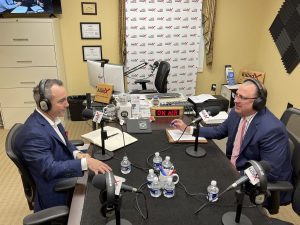
Tagged With: COVID-19, Covid-19 Policies for Employers, employee handbook, Oberman Law Firm, Stuart Oberman, vaccination policy

Covid 19 – Delta Variant Mandates & Legal Liability

August 20, 2021 by John Ray

DeltaVariant16DSOsAlbum
Dental Law Radio
Covid 19 - Delta Variant Mandates & Legal Liability
Loading
00:00 /
RSS Feed
Share
Link
Embed

Download file

DeltaVariant16DSOsAlbum

Covid 19 – Delta Variant Mandates & Legal Liability (Dental Law Radio, Episode 16)

Do you require all your employees receive the Covid-19 vaccine? How do you deal with employee resistance? What are reasonable accommodations, mandated in federal law, and how do you navigate them? There’s a lot to think about before you dive in with a poorly thought-out policy, and Stuart Oberman sorts out the issues in this episode. Dental Law Radio is underwritten and presented by Oberman Law Firm and produced by the North Fulton studio of Business RadioX®.

TRANSCRIPT

Intro: [00:00:01] Broadcasting from the Business RadioX studios in Atlanta, it’s time for Dental Law Radio. Dental Law Radio is brought to you by Obermann Law Firm, a leading dental-centric law firm serving dental clients on a local, regional and national basis. Now, here’s your host, Stuart Oberman.

Stuart Oberman: [00:00:26] Hello, everyone, and welcome to Dental Law Radio. The hot topic, that is on a national basis. We’re going to talk, in a multipart series, we’re going to first cover COVID-19 Delta variant mandates and legal liability. Then, we’re going to jump into a couple other areas on the next subsequent podcasts, such as must-have policies and employer job interviews.

Stuart Oberman: [00:01:00] So, there’s been enormous amount of buzz in our office and across the country as to what is going on and required with employees COVID-19 testing, non-testing, mandates, no mandates. So, we’re going to cover some areas on this multipart series. First, I want to take a look at the complex governmental oversight, which it’s all pretty much federal based. So, one of the things driving the mandates is you’ve got federal law, of course. You’ve got OSHA, you’ve got the CDC, the EEOC, the EEO, and the FDA. And if that is not enough acronyms for you, we could probably think of some more.

Stuart Oberman: [00:01:56] So, when all these regulatory matters come out, and the government pushes all these mandates, they’re literally encompassing all these laws, and it is a trap for the unwary, as we say. And I know I’ve said this before in our podcast, but you cannot, under any circumstances, delegate these kind of oversight matters to just anyone in your office. These are very specific guidelines, very specific procedures, and they have to be taught, learned by your staff, and they have to know where to go for this advice.

Stuart Oberman: [00:02:39] So, let’s jump into the topic. So, employee resistance, now what? Okay. So, employees are vaccinated, great, everyone’s happy. But the problem is anywhere from probably 10 to 30 percent of our dental practices have employees, 10 to 30 percent of dental practices, the employees are not vaccinated. So, now, what do you do? So, you’re thinking to yourself, “Okay, I’ll mandate it.” Great. That’s a problem, because now you’ve got to seek guidance from the American Disabilities Act, the EEOC. So, you’re thinking, “Well, how in the world is the Americans with Disabilities Act even come into play for this?” So, under the ADA, it outlines guidelines for employers who refuse to get vaccinated. Employers must have and provide reasonable accommodations. That is a very nebulous term, and there is a lot of moving pieces.

Stuart Oberman: [00:03:41] So, then you say, “Well, what do you do if employees have disabilities?” So, now, you go back under the ADA that says you cannot impose an undue burden on an employer. So, now, you’ve got sort of a dichotomy. Well, we have employees that do not want to get vaccinated, and they have disabilities, and you’ve got to accommodate them. So, then, on the other side of the fence, you say, “Well, employees have disabilities. I cannot, as an employee, impose an undue burden on an employer. So, what exactly is a reasonable accommodation?” It’s all over the map. So, you have job restructuring, part-time remodify job schedules. You’ve got acquiring or modifying equipment. That is just the tip of what the complex governmental matters oversight look at.

Stuart Oberman: [00:04:37] So, now, we say, “Well, I’m going to mandate.” All right. So, now, we say great, mandates. What should be in a vaccination policy that’s mandated? That is a whole different world. So, we’re going to walk through a couple scenarios. This whole topic that we’re talking about today can literally be an eight-hour topic, but we’re going to have to drill it down and piecemeal it over certain segments.

Stuart Oberman: [00:05:10] So, the policy should clearly identify that employees – this is mandatory policy now, employees will be required to demonstrate proof of vaccination. Now, here’s a critical point. Any employee files regarding vaccination, non-vaccination requirements, accommodations, whatever it is, have to be kept separate from a personnel file. So, first and foremost, employees should never have control of their own personnel files. That is a recipe for disaster. So, then, you have to say, “Well, I have employees who do not choose to get vaccinated.” So, then, they’ve got to provide religious or medical reasons. So, any mandatory policy should clearly set forth process by which employees can request an exemption or accommodation.

Stuart Oberman: [00:06:12] You’re thinking, “Well, I have no policy.” That is problematic, and you probably need to call your lawyer, because if you’re trying to mandate these policies, and implement certain things, and push certain procedures and you don’t have a written policy, which we’re going to cover a little bit, else you’ve got some problems.

Stuart Oberman: [00:06:35] So, what do you do if employees choose not to get vaccinated? So, there’s got to be a medical or religious reason, you got to set forth the exemption. And what if an employee declines because of a medical condition? What do you do? Or as we say, sincerely-held religious belief, what do you do? These are all exemptions. So, at a minimum. Any policy you have should identify which employees should notify or should be notified regarding receiving accommodation. How do you request one? How do you request one?

Stuart Oberman: [00:07:14] Now, ultimately, what happens is, is that under no circumstances, and you have any retaliatory measures whatsoever, if you have an employee or employees who refuse to get vaccinated, you cannot retaliate against them under federal law. That is a whole different set of problems.

Stuart Oberman: [00:07:36] Now, if employees are required to be mandated for vaccinations, they have to substantiate an exemption, and you also have to supply an exemption process as far as forms go. And we’re going to cover that a little bit later. Because otherwise, you have no reasonable basis for determining whether or not an exemption exists. So, the policy should be very clearly stated that anyone who fails to become vaccinated by a certain deadline will face certain consequences. You cannot arbitrarily do that. You’ve got to set that out in writing.

Stuart Oberman: [00:08:22] Okay. So, now, we cover two areas. And in this segment, we’re going to cover one more area. So, the first area we covered is that this complex governmental oversight. Then, you have, of course, employee resistance, and now what? So, I want to touch base a little bit on policy mandates. Under the particular mandates, we’re going to go into a deep dive on the next segment as to mandatory/non-mandatory, mandatory vaccination policies, non-mandatory vaccination policies, accommodation procedures, requests for medical exemptions, accommodations related to the vaccination, and request for religious exemptions and accommodations.

Stuart Oberman: [00:09:17] So, those are must-have policies that you have to have in place. And we’re going to go into a little bit of a deep dive on this on our next segment. But for now, take a look at what your policies are, what mandates that you have, what you do and do not want to mandate, whether or not you want to set a deadline as far as mandates go. For this segment, that is all for Dental Law Radio. And I will say this, my friends, always heed this legal advice, keep your friends close, your lawyer closer in this environment. Thank you, guys. Have a great day. And we will see you at our next segment.


About Dental Law Radio

Hosted by Stuart Oberman, a nationally recognized authority in dental law, Dental Law Radio covers legal, business, and other operating issues and topics of vital concern to dentists and dental practice owners. The show is produced by the North Fulton studio of Business RadioX® and can be found on all the major podcast apps. The complete show archive is here.

Stuart Oberman, Oberman Law Firm

Oberman Law Firm
Stuart Oberman, host of “Dental Law Radio”

Stuart Oberman is the founder and President of Oberman Law Firm. Mr. Oberman graduated from Urbana University and received his law degree from John Marshall Law School. Mr. Oberman has been practicing law for over 25 years, and before going into private practice, Mr. Oberman was in-house counsel for a Fortune 500 Company. Mr. Oberman is widely regarded as the go-to attorney in the area of Dental Law, which includes DSO formation, corporate business structures, mergers and acquisitions, regulatory compliance, advertising regulations, HIPAA, Compliance, and employment law regulations that affect dental practices.

In addition, Mr. Oberman’s expertise in the health care industry includes advising clients in the complex regulatory landscape as it relates to telehealth and telemedicine, including compliance of corporate structures, third-party reimbursement, contract negotiations, technology, health care fraud and abuse law (Anti-Kickback Statute and the State Law), professional liability risk management, federal and state regulations.

As the long-term care industry evolves, Mr. Oberman has the knowledge and experience to guide clients in the long-term care sector with respect to corporate and regulatory matters, assisted living facilities, continuing care retirement communities (CCRCs). In addition, Mr. Oberman’s practice also focuses on health care facility acquisitions and other changes of ownership, as well as related licensure and Medicare/Medicaid certification matters, CCRC registrations, long-term care/skilled nursing facility management, operating agreements, assisted living licensure matters, and health care joint ventures.

In addition to his expertise in the health care industry, Mr. Oberman has a nationwide practice that focuses on all facets of contractual disputes, including corporate governance, fiduciary duty, trade secrets, unfair competition, covenants not to compete, trademark and copyright infringement, fraud, and deceptive trade practices, and other business-related matters. Mr. Oberman also represents clients throughout the United States in a wide range of practice areas, including mergers & acquisitions, partnership agreements, commercial real estate, entity formation, employment law, commercial leasing, intellectual property, and HIPAA/OSHA compliance.

Mr. Oberman is a national lecturer and has published articles in the U.S. and Canada.

LinkedIn

Oberman Law Firm

Oberman Law Firm has a long history of civic service, noted national, regional, and local clients, and stands among the Southeast’s eminent and fast-growing full-service law firms. Oberman Law Firm’s areas of practice include Business Planning, Commercial & Technology Transactions, Corporate, Employment & Labor, Estate Planning, Health Care, Intellectual Property, Litigation, Privacy & Data Security, and Real Estate.

By meeting their client’s goals and becoming a trusted partner and advocate for our clients, their attorneys are recognized as legal go-getters who provide value-added service. Their attorneys understand that in a rapidly changing legal market, clients have new expectations, constantly evolving choices, and operate in an environment of heightened reputational and commercial risk.

Oberman Law Firm’s strength is its ability to solve complex legal problems by collaborating across borders and practice areas.

Connect with Oberman Law Firm:

Company website | LinkedIn | Twitter
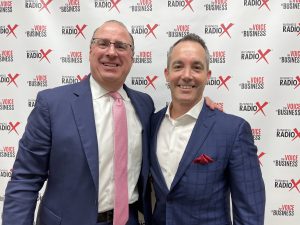
Tagged With: COVID-19, Delta Variant Mandates, dental law, Oberman Law Firm, Stuart Oberman

The DSO Deal – What You Better Know

August 6, 2021 by John Ray

DSO-Deal
Dental Law Radio
The DSO Deal - What You Better Know
Loading
00:00 /
RSS Feed
Share
Link
Embed

Download file

DSO-Deal

The DSO Deal – What You Better Know (Dental Law Radio, Episode 15)

Within the next few years, it’s likely that 60% to 70% of all dental practices will be owned by a DSO. That’s what some industry observers are predicting, and if that’s the case, says host Stuart Oberman, you’d better understand the elements of what’s involved in an acquisition. From the letter of intent to the closing, Stuart covers the key highlights in this episode. Dental Law Radio is underwritten and presented by Oberman Law Firm and produced by the North Fulton studio of Business RadioX®.

TRANSCRIPT

Intro: [00:00:02] Broadcasting from the Business RadioX Studios in Atlanta, it’s time for Dental Law Radio. Dental Law Radio is brought to you by Oberman Law Firm, a leading dental-centric law firm serving dental clients on a local, regional, and national basis. Now, here’s your host, Stuart Oberman.

Stuart Oberman: [00:00:26] Hello everyone, and welcome to Dental Law Radio. The topic of the day, DSO. The DSO deal, what you better know. I can’t tell you how many times a day, a week, a month we get calls from buyers or sellers. “I want to form A DSO. I want to scale a DSO. I want to sell the DSO. I got private equity, I want to be a DSO. I want to buy ten practices. I want to sell my practice.”

Stuart Oberman: [00:00:57] And I will tell the doctors, one, you got to take a step back – I don’t care if you’re buying, selling, merging, acquire – you have to understand the nature of the deal. It is not like it is ten years ago. Honestly, it’s not like it was five years ago or even, frankly, two years ago. We’re seeing a whole different metrics in there in the world. There’s a whole cottage industry now that does nothing but DSO deals, whether it’s law firms, consultants, buying, selling. Everyone is into the DSO deal. I think they estimated that, probably, within the next couple of years 60 to 70 percent will be group-owned practice. Now, we’ve got to understand what that means.

Stuart Oberman: [00:01:46] What does a group-owned practice mean? So, you got different levels. You got your docs, “I own maybe one to five.” Then, you got your mid-levels, you know, maybe it’s 10 to 20. Then, you got the big boys, maybe 20 to 40. Then, you got the really big boys, really big boys. There’s a big difference on economy of scale. But a lot of our guys are middle market good doctors. They want to grow. They’re a little tired. They want to get out of the chair a little bit. They want to make some revenue. Their backs getting sore. They see what the market is. It is an absolute brutal market from a legal standpoint. It is a brutal market from an accounting standpoint.

Stuart Oberman: [00:02:34] And I’ll tell you, most CPAs have no idea what this constitutes. I hate to say that, but most do not. Some are very good, some are under the cloak. We work with clients all over the country. We’re very, very fortunate we have a lot of exposure in this area and we deal with a lot, a lot of resources.

Stuart Oberman: [00:02:51] So, what I want to do is, I want to take apart a DSO deal. This is a seven day topic. We’re trying to drill it down pretty good. First and foremost, you got to understand what a letter of intent is. That’s the key. That’s the start. So, what do you do on a letter of intent? Everything looks good, you agree. And then, all of a sudden, the one page letter of intents are dead. Now, we’re talking 10 or 15 page letter of intents. I want to walk through what these are. I don’t care if you’re a buyer or a seller, you have to know what you need to know before you walk in the door. I’m trying to be generic on these as far as the terms go. And I would urge you that this is a whole different market. DSO is a whole different world, that’s if you’re going to scale.

Stuart Oberman: [00:03:46] So, first and foremost, you got to understand the terms of the purchase. Nonbinding agreements, what is it? It’s a mutual understanding, reflection of the parties, and it should never be a binding LOI. Now, you’re going to have some confidence in there that they’re going to be, you know, enforceable but should be nonbinding. If you sign a nonbinding agreement, you’re getting really, really bad advice.

Stuart Oberman: [00:04:11] So then, you have to look at what the overall transaction is. You’re thinking, “What in the world does that mean?” Every detailed LOI on DSO side has a term sheet. Everyone that we ever run across. I’ll say it’s Exhibit A, call it what you want. So, what is it? What does it include? “Well, Stuart, you know, I dealt with a broker one time and the LOI was three pages.” You might just shred that in this world.

Stuart Oberman: [00:04:43] So, what is the terms? Here it is. This is what you need to look for. You need a seller, you need a buyer, the purchase price. What’s your price reduction? There’s always price reductions. What’s your holdbacks? What’s your equity rollover treatments, your in-seller indemnification clauses. Yes, you have obligations.

Stuart Oberman: [00:05:07] So then, all of a sudden, you get into what we call bonus performances. Well, what in the world is that? So, that’s broken down in various categories. You never knew that before. You have performance bonuses. You got primary bonuses. You got 12-month collections. You got 24-month collections after closing. Yes, you’ll be held accountable for those performance bonuses. Trust me, you are not walking in there with no obligations. That’s a performance bonus. All that’s listed separately.

Stuart Oberman: [00:05:38] So, what about a primary performance bonus, your PPB parameters? “Oh, never heard of that.” So, what happens if that’s not met? What happens if you’re PPB is not met? What if it’s not earned in a specific year? How are you equating that? How is that calculated? Do you even know what that is? So then, in addition to that, you got additional performance bonus opportunities. So, what does that mean? So, you calculate what happens if your bonus exceed calculations for the 12 or 24 months. “Well, I didn’t know I had that opportunity.” These are the things that if you are not careful with, you’ll be leaving tons and tons and tons of money on and off the table. These are all performance bonuses.

Stuart Oberman: [00:06:38] If you think you’re going to walk into a DSO, whether you’re buying or selling, and not have performance bonuses, you are sadly mistaken. The days are gone where you’re going to sell your practice to a DSO. Or you’re going to buy one and the seller is going to be out on the road in 90 days, it doesn’t happen.

Stuart Oberman: [00:06:59] So then, you got to look at what are your additional performance bonuses. I know we’re getting a little deep here, but I want to run through this. Your APB parameters. You got targeted achieved, targeted not achieved. So what if you hate it, you got to prorate it. Does your CPA have any idea what these numbers are? So, now, we say, “Well, we’re just looking at the price.” So, now, you got the assets purchase agreement. A lot of times the government allocations are not included. What if you have a high subsidy of insurance or governmental payments? You got to look at those numbers. If you’re a CPA, you got to know these numbers. What are your earnout hurdle reductions? “I didn’t know I had those.” You’re always going to have earnout reductions.

Stuart Oberman: [00:07:48] So then, they say, “Well, you know what? We’re going to take a percentage of your sale price. And, now, I want you to hold back equity in our company.” That is a risk always. Are you getting more money upfront? What’s the next three to five years look like? What’s the recap look like? So then, you’ve got to take a hard, hard look, are you Class A preferred shares, Class C shares? You have to understand what those ramifications are as far as your obligations and your rights.

Stuart Oberman: [00:08:29] I will tell you that probably under these particular classes, you will not have many rights and you’ll be at the beck and call of the DSO. You got to understand that. You got to get these agreements up front before you even sign the final dotted line. Because once you sign the documents, it’s too late. You can’t get into these documents. You got to drill deep pretty hard before those.

Stuart Oberman: [00:08:54] So then, you work through the other areas, employment issues, you and your staff. How long is the employment? Employment of your staff, you want to protect your staff. It’s not going to happen. Post-closing role, what are you going to do? Are you going to be clinical director, going to be chief dental officer? How much time are you taking off? “Well, I’m going to work 246 days a year.” No, you’re not. You’ll never hit your numbers. “Well, that’s not what I wanted.” Well, you’re in the wrong game. Because you’ll have some strict numbers you got to hit. And it’s not going to be at your control because you’re going to have expenses that are going to come off your bottom line. What’s additional compensation? “Well, I don’t know what that is.” Then, you better know.

Stuart Oberman: [00:09:45] So, that’s a very, very generic overall concern regarding performance bonuses. Again, that’s pretty deep stuff. We’re talking documents and documents, documents. But I want to give you a brief overview as to what you need to look at, and what you should be prepared for, and what you need to know before you even get into the game, and your CPA needs to know.

Stuart Oberman: [00:10:09] So then, “Well, you know, we’re going to sign a noncompete.” You bet you are. You’re not going to work for another DSO for a couple of years. “Noncompete is probably two years, 25 miles. That’s a long way.” “Yes, it is, Doc. Yes, it is.” You’re going to be tied. You’re getting millions. You’re going to be tied. So, if you’re buying a practice, you better tie that doctor down. If you’re selling, you better know what you ramifications are as far as radius goes.

Stuart Oberman: [00:10:37] What’s excluded assets? There’s always excluded assets. Liabilities, are you in debt? Do you know all your debt? What’s your intellectual property? Do you own your logo? Do you own your trademarks? What are your holdbacks? Cash upfront, cash being held back? Are you repurchasing Class A shares, C shares? Are you getting equity rollover as collateral? What’s the tax consequences of that? Is it a taxable event or is it tax deferred? What’s your tax allocation in the purchase price?

Stuart Oberman: [00:11:13] There’s a big difference in a DSO and a normal sale as far as your tax allocations go as far as personal goodwill. Some are liberal, some are not. Those are things you got to drill down with the CPA. This is not a 30 day process, guys.

Stuart Oberman: [00:11:27] Let me tell you, if you’re buying, you better do your due diligence. You better have a due diligence checklist, folks. If you’re selling, you better be prepared to be worn out. You’re talking about [inaudible] earnings. You’re talking about a lot, a lot of information that’s going to be passed hands down through a lot of information. So, due diligence is going to be extensive. You get a $40 million deal, they’re going to wear you out. But you got to be prepared for it. It’s a journey.

Stuart Oberman: [00:11:59] So, one of our recommendations is, before you even start this process, get your documents upfront, get your numbers, get them loaded up, and ready to roll. Because once that process starts, it rolls quickly. And it goes quick.

Stuart Oberman: [00:12:14] So then, you got a question, “Well, they’re going to tie me down. They don’t want to deal with anybody else for 60, 120, 180 days.” You’re right. What if the deal falls apart? You’re off the market for four, six, eight months. You got no way out. You’re stuck. So, you need to understand that the offers that you get will tie you up. So, you better pick a good one. I know what’s going on upfront because otherwise you’re going to be off the market for a while and time is money in these deals.

Stuart Oberman: [00:12:52] So, how do you terminate an LOI, Letter of Intent? A couple ways, which [inaudible] the asset purchase agreement itself. When the buyer sends you a letter saying, “You know what? I’m good. I don’t want to do this anymore. The numbers didn’t add up. Sorry. We no longer wish to proceed.” You’re done but you’re still an exclusive period. Or the expiration of an exclusive period. “We’re done. We’re closing.”

Stuart Oberman: [00:13:23] So, there’s a lot of information, guys. A lot information, and it’s really way beyond this particular scope, if you will, as far as the DSO deal. This is a whole seminar, a whole topic. But we’re getting a lot of questions on this, a lot of questions every day. How I form it? How I buy it? How I sell it? What do I do? How to consolidate a merging? What do we need?

Stuart Oberman: [00:13:54] First and foremost, if you’re a buyer, you’ve got to have the right people around you. It doesn’t matter if you’re a doctor or DSO. Of course, you already know that if you’re a DSO. But if you’re a doctor, you got to be prepared to scale. You’ve got to have your systems in place before you do anything else. There’s no way that you can purchase three practices without your internal partitions being set. There are a lot of headaches.

Stuart Oberman: [00:14:18] If you’re selling, you got to be prepared for the rigors of selling to a DSO. You got to be prepared to have performance bonuses. You’ve got to be prepared to, possibly in some case, work a little harder. If you think you’re going to sell and work three days a week like you were doing before, it’s probably not going to happen. Expect to hit all your numbers, and you will be expected to hit your numbers. Again, you got performance bonuses, you got primary performance bonuses, you got additional performance bonuses, you got top additional bonuses.

Stuart Oberman: [00:14:52] So, you got to look at all those parameters and make sure you know exactly what you’re buying, what you’re selling, what’s the company like, what’s the cap rate. What are you looking at, Class A preferred shares, Class C shares, or vice versa? What are you looking at on that side? What’s the compensation on the chief financial officer side? Post-closing, what was expected there? The non-competes, your holdback numbers. So, those are all the things. And, again, you’ve got to have people, especially on the financial side, who understand this. And on the legal side, it gets very complex – very, very complex on our side. So, there’s a lot of pieces here.

Stuart Oberman: [00:15:44] So, that’s the sort of the DSO. You know, it’s hot all over the country. A lot of money to be made in these areas. But there’s a lot of risk. And it’s not for everyone. Some doctors want to scale, some don’t want to scale. So, basic parameters. Hopefully, you’ve picked on a couple of topics that you need to take a look at or be aware of, if you are not or your CPA needs to be aware of.

Stuart Oberman: [00:16:12] So, yeah, give us a call. We do it every day. We love what we do. We have access to a lot of information on a national basis because of the DSO market. And if you have any questions, give us a call, 770-886-2400. My name is Stuart Oberman. Feel free to reach out to us or e-mail at stuart, S-T-U-A-R-T, @obermanlaw.com. And thank you for joining us. And we will see you on the next DSO deal.

About Dental Law Radio

Hosted by Stuart Oberman, a nationally recognized authority in dental law, Dental Law Radio covers legal, business, and other operating issues and topics of vital concern to dentists and dental practice owners. The show is produced by the North Fulton studio of Business RadioX® and can be found on all the major podcast apps. The complete show archive is here.

Stuart Oberman, Oberman Law Firm

Oberman Law Firm
Stuart Oberman, host of “Dental Law Radio”

Stuart Oberman is the founder and President of Oberman Law Firm. Mr. Oberman graduated from Urbana University and received his law degree from John Marshall Law School. Mr. Oberman has been practicing law for over 25 years, and before going into private practice, Mr. Oberman was in-house counsel for a Fortune 500 Company. Mr. Oberman is widely regarded as the go-to attorney in the area of Dental Law, which includes DSO formation, corporate business structures, mergers and acquisitions, regulatory compliance, advertising regulations, HIPAA, Compliance, and employment law regulations that affect dental practices.

In addition, Mr. Oberman’s expertise in the health care industry includes advising clients in the complex regulatory landscape as it relates to telehealth and telemedicine, including compliance of corporate structures, third-party reimbursement, contract negotiations, technology, health care fraud and abuse law (Anti-Kickback Statute and the State Law), professional liability risk management, federal and state regulations.

As the long-term care industry evolves, Mr. Oberman has the knowledge and experience to guide clients in the long-term care sector with respect to corporate and regulatory matters, assisted living facilities, continuing care retirement communities (CCRCs). In addition, Mr. Oberman’s practice also focuses on health care facility acquisitions and other changes of ownership, as well as related licensure and Medicare/Medicaid certification matters, CCRC registrations, long-term care/skilled nursing facility management, operating agreements, assisted living licensure matters, and health care joint ventures.

In addition to his expertise in the health care industry, Mr. Oberman has a nationwide practice that focuses on all facets of contractual disputes, including corporate governance, fiduciary duty, trade secrets, unfair competition, covenants not to compete, trademark and copyright infringement, fraud, and deceptive trade practices, and other business-related matters. Mr. Oberman also represents clients throughout the United States in a wide range of practice areas, including mergers & acquisitions, partnership agreements, commercial real estate, entity formation, employment law, commercial leasing, intellectual property, and HIPAA/OSHA compliance.

Mr. Oberman is a national lecturer and has published articles in the U.S. and Canada.

LinkedIn

Oberman Law Firm

Oberman Law Firm has a long history of civic service, noted national, regional, and local clients, and stands among the Southeast’s eminent and fast-growing full-service law firms. Oberman Law Firm’s areas of practice include Business Planning, Commercial & Technology Transactions, Corporate, Employment & Labor, Estate Planning, Health Care, Intellectual Property, Litigation, Privacy & Data Security, and Real Estate.

By meeting their client’s goals and becoming a trusted partner and advocate for our clients, their attorneys are recognized as legal go-getters who provide value-added service. Their attorneys understand that in a rapidly changing legal market, clients have new expectations, constantly evolving choices, and operate in an environment of heightened reputational and commercial risk.

Oberman Law Firm’s strength is its ability to solve complex legal problems by collaborating across borders and practice areas.

Connect with Oberman Law Firm:

Company website | LinkedIn | Twitter
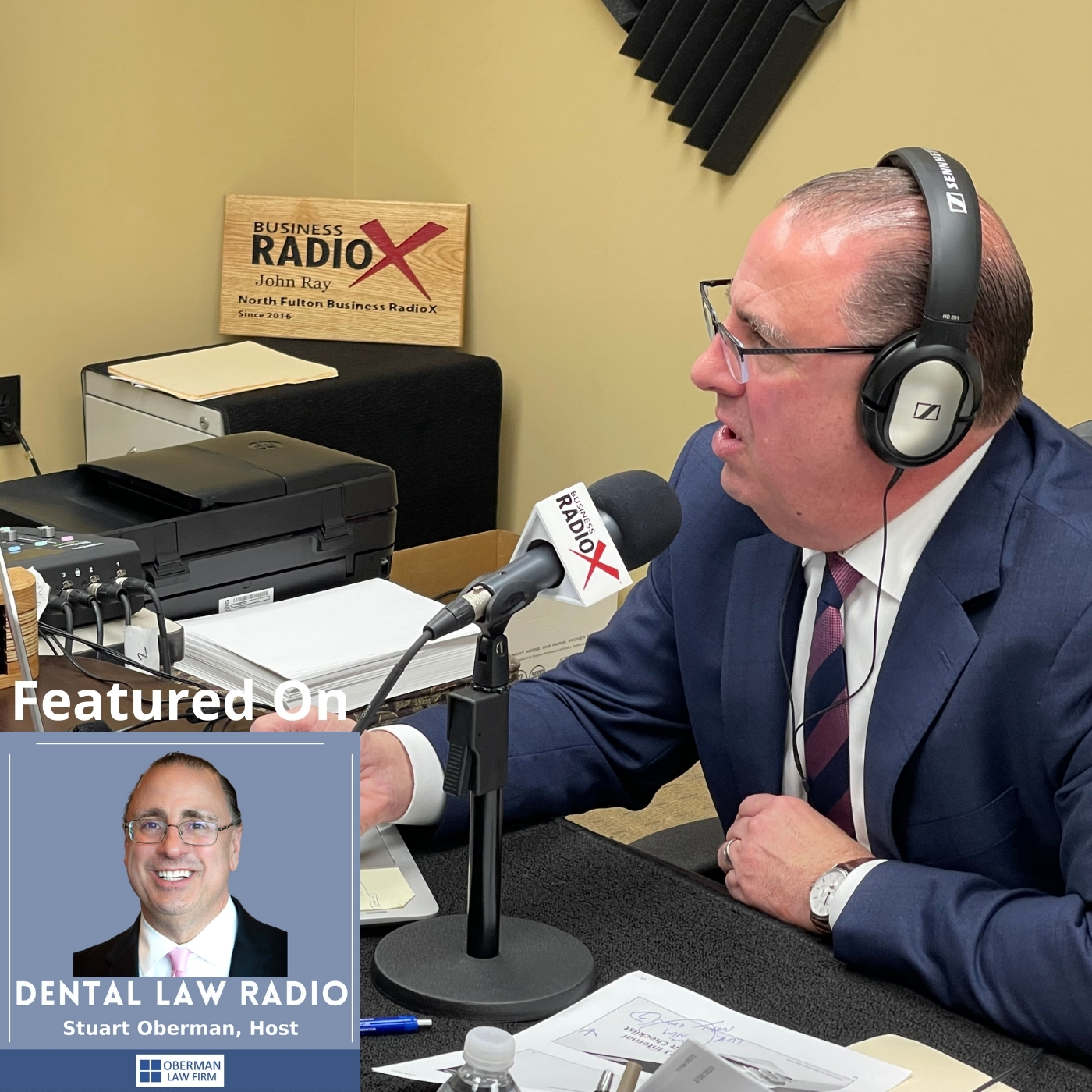
Tagged With: dental law, Dental Law Radio, dental practice acquisitions, Oberman Law Firm, Stuart Oberman, The DSO Deal

Reviving a Legacy Brand: An Interview with Stephanie Stuckey, Stuckey’s Corporation

July 30, 2021 by John Ray

Stephanie-Stuckey-DLR-Album
Dental Law Radio
Reviving a Legacy Brand: An Interview with Stephanie Stuckey, Stuckey's Corporation
Loading
00:00 /
RSS Feed
Share
Link
Embed

Download file

Stephanie-Stuckey-DLR-Album

Reviving a Legacy Brand: An Interview with Stephanie Stuckey, Stuckey’s Corporation (Dental Law Radio, Episode 14)

How do you revive a brand name which the world has left for dead? CEO Stephanie Stuckey joined host Stuart Oberman to share the compelling story of how she and her team are resurrecting Stuckey’s Corp. Stephanie discusses why she plunged into this rebuild even when she was discouraged by others, the importance of having a management team which balances each other’s skills, the power of sharing not just victories but setbacks, and much more. It’s must listening, not just for dentists thinking of acquiring practices, but any entrepreneur considering a brand reconstruction of their own. Dental Law Radio is underwritten and presented by Oberman Law Firm and produced by the North Fulton studio of Business RadioX®.

Stephanie Stuckey, CEO, Stuckey’s Corporation

Stephanie Stuckey is CEO of Stuckey’s, the roadside oasis famous for its pecan log rolls. The Company was founded by Stephanie’s grandfather, W.S. Stuckey, Sr. as a pecan stand in Eastman, Georgia in 1937 and grew into over 350 stores by the 1970’s. The company was sold in 1964 but is now back in family hands and poised for a comeback.

Billy Stuckey, son of the founder and former U.S. Congressman, reacquired Stuckey’s in 1985. Stephanie took over in November of 2019 and, under her leadership, Stuckey’s has purchased a healthy pecan snack company, undergone a rebranding, added three new franchised stores, expanded its B2B retail customer base, ramped up its online sales with a new website and will soon acquire a pecan processing and candy manufacturing plant.

Stephanie received both her undergraduate and law degrees from the University of Georgia. She has worked as a trial lawyer, elected to seven terms as a state representative, run an environmental nonprofit law firm that settled the largest Clean Water Act case in Georgia history, served as Director of Sustainability and Resilience for the City of Atlanta, and taught as an Adjunct Professor at the University of Georgia School of Law.

Stephanie’s achievements include being named one of the 100 Most Influential Georgians by Georgia Trend Magazine and a graduate of Leadership Atlanta. She is active in her community and serves on many nonprofit boards, including the National Sierra Club Foundation, EarthShare of Georgia, and her local zoning review board.

Connect with Stephanie on LinkedIn and follow Stuckey’s on Facebook, Twitter and Instagram.

Stephanie Stuckey and Stuart ObermanStuart Oberman and Stephanie Stuckey


TRANSCRIPT

Intro: [00:00:01] Broadcasting from the Business RadioX Studios in Atlanta, it’s time for Dental Law Radio. Dental Law Radio is brought to you by Oberman Law Firm, a leading dental-centric law firm serving dental clients on a local, regional, and national basis. Now, here’s your host, Stuart Oberman.

Stuart Oberman: [00:00:26] Welcome everyone to Dental Law Radio. I know usually we’re talking about dental law, and employment law, and compliance. But, today, we have an absolute amazing guest in-studio, Stephanie Stuckey, the CEO of the famous world-renowned Stuckey’s Corporation. Stephanie, it is an honor, honor, to have you in here.

Stephanie Stuckey: [00:00:48] Well, thank you. The honor is all mine. I’m delighted.

Stuart Oberman: [00:00:51] You know, being the CEO of Stuckey’s, you have now reached the pinnacle of your career being on Dental Law Radio, right?

Stephanie Stuckey: [00:00:57] I absolutely think so. And the irony is not lost on me that a candy company is being featured on a dental radio show. I think it actually makes a lot of sense because we have sent you a lot of customers over the years.

Stuart Oberman: [00:01:12] Our clients love that. Thank you.

Stephanie Stuckey: [00:01:14] Right. You should be serving pecan log rolls in every dental office in this country because we are giving you a fair amount of clientele.

Stuart Oberman: [00:01:22] I appreciate that. It sort of keeps us paying the rent. So, you know, you are amazingly busy, amazingly. First of all, thank you. I know we scheduled this about two months ago to get you into studio here. So, I know how busy you are and your schedule. But, you know, the interesting part is, I think this says a lot about you and what you’re doing with Stuckey’s.

Stuart Oberman: [00:01:45] So, I remember one Saturday, I’m just playing around on LinkedIn and I pinged you. And I was going to introduce you to a client of ours that is in the industry that you’re in, in the pecan industry. And then, you, almost immediately, sent me a message back like, “You know, hey. [Inaudible].” And then, we’ve kept in touch a little bit. And then, you know, I’ve watched you take this brand, this iconic brand, that was almost on the brink of failure, I guess would be a good word.

Stephanie Stuckey: [00:02:19] Oh, yeah. Absolutely. I thought it’s generous.

Stuart Oberman: [00:02:21] Yeah. It was not doing well.

Stephanie Stuckey: [00:02:25] Not well.

Stuart Oberman: [00:02:26] And then, you know, this sort of American dream is you became CEO – and I want you to get into this little bit later – but you’ve taken this brand to a whole another level. This not only applies to our dental guys, but in the podcast, we have construction companies, all the way from a $1,000 a year to 500 million, that are listening to the podcast. And we’re very fortunate we have clients in about 35 states. I thought, “You know what? Really, this is a story that anyone who has any ups and downs in business that wants to rebrand can really benefit from hearing your story.” So, I’m just very, very grateful that you’re on the show.

Stephanie Stuckey: [00:03:11] Well, thank you.

Stuart Oberman: [00:03:12] And then, you know, Stuckey’s is a roadside iconic brand. I mean, I just stopped at one from Florida. You know, I bought a pecan roll and got a picture, and I’ll send that to you.

Stephanie Stuckey: [00:03:23] So appreciate that. Yes. Please stop.

Stuart Oberman: [00:03:26] And that’s what’s it really all about. So, we wanted to bring you in and talk to you really about a few things of what you’re doing. You got an amazing background, what I want you to get into a little bit. And then, how you got to rebrand and bring this company back. You’re a CEO, you graduated from UGA Law School, and House of Representatives, and you were recently named 100 Most Influential Georgians by Georgia Trend Magazine. That is an amazing, amazing accomplishment.

Stephanie Stuckey: [00:03:57] You know, that was actually not for Stuckey’s. That was related to my work with Sustainability.

Stuart Oberman: [00:04:03] Really?

Stephanie Stuckey: [00:04:04] Yes. So, that was only a couple of years ago. But I’ve only been running Stuckey’s for a-year-and-a-half. But prior to this, I was Head of Sustainability for City of Atlanta, and got that acknowledgment as part of my work with the City of Atlanta. So, I feel like I share that honor also with all the work that we were doing in Sustainability and Resilience. My position was actually Chief Resilience Officer. By the time I left the city, it had advanced to include a lot more functionality. But, anyway, it was a fun ride working for the City of Atlanta.

Stuart Oberman: [00:04:37] So, tell us a little bit about you and then how you became the CEO of Stuckey’s.

Stephanie Stuckey: [00:04:43] That’s a crazy journey. Yes.

Stuart Oberman: [00:04:45] I know. We can talk about it for like five days. I assure that –

Stephanie Stuckey: [00:04:49] I’ll condense it. Yeah. Yeah. So, I think the important takeaway – and I’m very mindful that this is a diverse group of people listening, so I’m going to try to make sure my comments are relevant – I was literally sitting at my desk one day happily in Sustainability world, which is what I had been doing for two decades, practicing environmental law and working on sustainability initiatives not only with Atlanta, but had advanced to working with cities throughout the southeast.

Stephanie Stuckey: [00:05:19] And I was at my desk and I got an email from one of my dad’s former business partners asking me if I wanted to buy their shares of Stuckey’s stock. And that’s how it began. It was initially just a financial transaction, “Do you want to buy stock?” And I asked to look at the financials, which is what any of us would do if you’re given an opportunity to add to your business portfolio. Or, in my case, I had no business portfolio.

Stuart Oberman: [00:05:50] Now, what did you think when you saw that message? What was your initial reaction? Did you fall off the chair? Or you thought, “No way.”

Stephanie Stuckey: [00:05:57] I was not surprised. And I’ll give a very quick recap of the Stuckey’s history, because it puts this into context. Stuckey’s was founded by my grandfather in 1937 as a roadside pecan stand in Eastman, Georgia. And from those incredibly humble beginnings, he grew it with my grandmother to 368 stores and 40 states, all over the nation’s Interstate Highway System.

Stephanie Stuckey: [00:06:22] We owned a candy plant. He owned a trucking company. Had a sign company. And he built that and sold it in 1964, which is not uncommon for a lot of entrepreneurs of that era. Howard Johnson’s, Holiday, and Kentucky Fried Chicken, all these entrepreneurs that we know that were household names, they sold. And that was sort of what you did, you build this company and you sold it and you made a lot of money. And he was a product of the depression, so he sold.

Stephanie Stuckey: [00:06:50] It was out of family hands for decades. There was a series of corporate takeovers. The company was really floundering. My father got the company back in 1985. He was already running several other companies at the time. So, Stuckey’s was a bit of a side hustle for my dad. He owned and operated Dairy Queen franchises on the Interstate Highway System. He had the exclusive rights to Dairy Queens within a half mile radius of a highway exit.

Stuart Oberman: [00:07:19] That’s a heck of a side hustle.

Stephanie Stuckey: [00:07:20] Heck of a side hustle. So, dentists should totally love my family because we are sending you all sorts of patients.

Stuart Oberman: [00:07:27] That is one side hustle.

Stephanie Stuckey: [00:07:27] Right? So, no, no. Stuckey’s was his side hustle.

Stuart Oberman: [00:07:31] Yeah. That’s what I mean.

Stephanie Stuckey: [00:07:31] His main business was Dairy Queen. And when he got Stuckey’s, it was in bad shape. And it was a little over 100 stores at that time. So, he just combined the Stuckey’s with the Dairy Queen, and so built on the Dairy Queen. And he also started putting Stuckey’s in other travel plazas, a store within a store cobranding concept, and that proved to work for decades.

Stephanie Stuckey: [00:07:59] And then, my dad and his business partners sold their Dairy Queen business to Warren Buffett – some of the listeners may have heard of him – in 2014 – 2012 – I should know the exact date – like, about a decade ago. And they all retired. So, they went home. They left only a very small skeleton crew, basically two people running Stuckey’s. It didn’t have a CEO. It didn’t have a marketing budget. There was really no franchise system to speak of. Most of the remaining locations were the store within a store concept. We had a rented distribution facility and that’s it.

Stephanie Stuckey: [00:08:43] So, I knew that the business had been floundering. What I didn’t know was how much it had been floundering. And so, when I pulled these financials, and I consulted some financial experts, and they were looking at the books. And I talked to three experts, two said, “Do not do this. The company had been losing money steadily for several years.” And the third person said – and I kept the third person because I kept shopping it around. I wanted a different answer, right?

Stuart Oberman: [00:09:13] You want the right answer. My clients do that.

Stephanie Stuckey: [00:09:14] They’re like economists, they have a different opinion. So, you keep going until you get the one who will tell you, “Yes. You should do this. It’s a good idea.” The one who said do it said, “I know what’s not on the balance sheet, which is the value of the brand,” which is what I knew, too.

Stephanie Stuckey: [00:09:30] And even though my entire childhood, Stuckey’s was no longer owned by our family, I knew and loved my grandfather. I vacation like everyone else and stopped at Stuckey’s. I knew innately that this was something really special. And that it would take a Stuckey, frankly, to bring it back. It needed that special touch. And with a little love, I figured we could bring it back.

Stephanie Stuckey: [00:09:53] The fact that it was not bankrupt, despite all the ups and downs over the year also told me it had some sticking power. So, you know, that’s what I thought. Like, I wasn’t surprised. I immediately also knew that I was not the first choice. I’m number four of five kids, they went through the roster and I was the only one. I’m like Mikey in the Life cereal commercial. The one kid who will try it. I was the only one who said yes.

Stuart Oberman: [00:10:19] So, here’s a key point, because as a firm, we do a lot of mergers and acquisitions in our dental clients and all those things. So, who did you consult with before you made the decision to go, the CPAs, the lawyers? Who were your advisors? Because that’s key in any transaction. And our guys have got to know that.

Stephanie Stuckey: [00:10:39] I went with people I knew and trusted. So, I think often what’s overlooked in business is the value of relationships and relationship building. And throughout my career, even though I never worked in business, I served on boards and I had colleagues on the nonprofit boards that I served on who had financial backgrounds. So, I went to some CPAs who served on boards with me, and I really respected their opinions.

Stuart Oberman: [00:11:10] So, what did you have to do? Obviously, was this a huge learning curve for you.

Stephanie Stuckey: [00:11:14] Yes. Absolutely.

Stuart Oberman: [00:11:16] What did you do to get through that learning curve?

Stephanie Stuckey: [00:11:17] A huge learning curve.

Stuart Oberman: [00:11:18] What did you do?

Stephanie Stuckey: [00:11:19] I surrounded myself with really smart people who understood areas where I lacked expertise. And I also spent a ton of time, which I still do, learning. I read Harvard Business, magazine, books.

Stuart Oberman: [00:11:34] I was going to ask you about that. I read that somewhere.

Stephanie Stuckey: [00:11:38] Yeah. Harvard Business School has a whole series of books, basically entrepreneurship 101. They have a book on mergers and acquisitions, and I read that several times. I also watched webinars. So, much of this is available, basically, for free. There’s a ton of webinars available. And so, I watched webinars. And, honestly, this is how big my learning curve is, I didn’t even know what EBITDA was. Somebody used that in a sentence and I’m Googling it during the conversation. Thankful that it was a phone call so they wouldn’t see me having to look up basic financial terms. So, I had a huge learning curve.

Stephanie Stuckey: [00:12:19] But at the same time, I also sought out people who knew what they were doing. So, I knew what I could do well. So, that’s the other thing, you fill your gaps and then you really double down on what you know you’re good at. So, what I knew was this brand. I’ll never forget when I first decided I was going to do this – well, frankly, it’s my father who said this, he asked me why I thought I could run Stuckey’s when, he said, “You can’t even run a lemonade stand.” And I thought for a minute and I said, “Well, you’re right. I can’t run a lemonade stand. But I can run Stuckey’s.” And it occurred to me what I knew about Stuckey’s was the brand. And I could tell the story of Stuckey’s unlike anyone else. I have that personal emotional connection.

Stephanie Stuckey: [00:13:08] And so, I just started going online and learning, how do you do social media? How do you do storytelling? And I just started practicing. That’s the other thing, you can learn and then you practice. And I made a vow to myself that every single day I would post on LinkedIn. I figured that’s where I need to be. That’s the business network. And I just started posting my story every day on LinkedIn. And I went from a handful of likes to, now, my posts routinely get a 1,000 plus likes, engagements, comments. My followers grew. I think I started with a couple hundred and I think it’s 36,000 in a year. And it’s just posting every day. It’s having personal discipline and having focus, which I constantly work on. I tend to be one of those people who has 50 things going at any given time. And I throw it against the wall and see what sticks. So, that’s more my personality.

Stephanie Stuckey: [00:14:11] So, it’s really important to surround yourself who, not only fill in your gaps with your skills and expertise, but also emotionally. So, I tend to be very high energy and a little high strung. And I have since gotten a business partner, and he is pretty chill. I mean, he’s a hard worker, but he’s unflappable.

Stuart Oberman: [00:14:34] Would you say your type A?

Stephanie Stuckey: [00:14:35] I am type A. But I think there’s different type A’s. Like, you can be really ambitious and a go-getter type, but also not easily excitable. And I do tend to get really – you know, like something will happen that’s really great and I am just on the moon. Like, “This is the best thing. We’re going to totally be like a $20 million in sales company this year.” And then, something bad will happen, I’m like, “Oh, my God. We’re going to go bankrupt.”

Stephanie Stuckey: [00:15:06] And my business partner just set nice, even keeled influence on me. So, he’s very financially savvy and he also knows the pecan market inside and out, which is very important with what we do.

Stuart Oberman: [00:15:18] So, you surround yourself with people that know more than you, which is key.

Stephanie Stuckey: [00:15:23] Yes. And balance my personality. If our leadership team are a bunch of people who are super high energy, I think our heads would all pop off. So, you to have the chill people with the energy folks. And I’m an eternal optimist, even though I do occasionally have these, “Oh, no. Everything’s falling.” But I am very, very optimistic. And one of our key team leaders is – I’ll just say if he hears this, he’ll agree – he’s a curmudgeon. And any time I have an idea, he will literally come up with 20 ways that it won’t work. And I need someone like that around me because it forces me to think through all the details. And I’m not a detail person. So, I’ve got this person who’s, like, overly detailed and that will say, “Oh, that will never happen. You are overthinking this.” But I need that. I need that balance.

Stuart Oberman: [00:16:20] So, you’ve got a variety of personal experiences. You’re practicing law. You’re a state representative.

Stephanie Stuckey: [00:16:25] I’m still practicing law. I am in-house counsel for Stuckey’s. I do a lot of – I’m serious.

Stuart Oberman: [00:16:32] General counsel, CEO.

Stephanie Stuckey: [00:16:32] Welcome to being an entrepreneur. You know, you wear 21 hats. I’m Chief Brand Officer. I was Chief Sales Officer, and it got to be overwhelming so my business partner and I have split up those duties. He does a large retail accounts and I do the small sort of mom and pop, which is really what I thrive at. And I do the marketing. And I’m Chief Storyteller. Yeah. I love it. I’ve got a lot of roles.

Stuart Oberman: [00:16:59] Welcome to Business.

Stephanie Stuckey: [00:17:03] Yes. Yes.

Stuart Oberman: [00:17:04] Then, you have been running Sustainability for City of Atlanta. So, you know, what lessons – and I know it’s been a long, long journey being in the family and then becoming CEO. So, what roles helped you for this new CEO position? I mean, what have you learned? What previous roles helped?

Stephanie Stuckey: [00:17:24] Politics and –

Stuart Oberman: [00:17:27] That’s a blood sport.

Stephanie Stuckey: [00:17:29] Right. And being an attorney. I started out actually as a public defender in Fulton County, Georgia. So, City of Atlanta, that was overwhelming. I had 200 clients at any given time, which is welcome to the world of being a public defender. So, I learned not only the ability to manage a lot and perform under pressure. And know it’s not the end of the world if something goes wrong. Like, the ability to just put things in perspective has been critical.

Stephanie Stuckey: [00:18:01] One of my favorite sayings since I’ve taken over – and I stole it from another candy maker, Goo Goo Cluster. I stole those comments from their chief marketing officer. But she said, “When I get stressed out, I think it’s just candy.” So, that’s what I think. When I get overwhelmed with running Stuckey’s, like, “It’s just candy.” But having managed politics and running my own campaigns and working the City of Atlanta, which can be a blood sport. Just being able to roll with the punches and not get easily overwhelmed is critical.

Stephanie Stuckey: [00:18:35] The other thing I learned was almost all of my roles, I was fighting for the underdog. As a public defender, I would represent some really hard to represent individuals. As a politician, I was very active in environmental issues, which isn’t always the most popular, the Georgia General Assembly. And then, as an attorney, I practice environmental law representing Riverkeeper, Sierra Club. So, I represented environmental groups against large corporations. Many of the corporations with whom I now partner. So, it’s interesting turnabout.

Stephanie Stuckey: [00:19:08] But what I learned was the ability to persuade. If you can stand up for a tough cause – and that’s what you learn in law school – whether you believe in the cause or not, although it certainly helps if you believe in the cause, you’ve got to believe in something fundamental about the cause in order to really have it be a compelling case. So, like when I was a public defender, I may not have thought that my client’s case was the best case, but I believed in the justice system. So, you have to have a core set of values and beliefs that stabilizes you. But being able to stand up and persuade is a critical skill.

Stephanie Stuckey: [00:19:45] And everything I’ve done, and most critically in Stuckey’s, because I am trying to persuade financial investors, potential financial investors, potential large retailers who are used to doing business with established brands. And, yes, Stuckey’s has sticking power. We’ve been around for 80 years, but we’re a dusty brand. We’ve been losing money. We don’t have market share. And so, here I am trying to make the case to large, big box retailers, “You need to carry Stuckey’s products.” That’s a tough sell sometimes. So, just the ability to persuade and connect with people, it’s, I think, the most valuable skill you can have.

Stuart Oberman: [00:20:27] So, you had taken this audacious challenge of reviving this family brand. Most people that have had your experience are not even looking for a second career. They’re winding down their career. They’re like, “You know what? I’m just going to ride it out. I’m good.” And you’ve done a total career pivot. It’s this whole another world. Why?

Stephanie Stuckey: [00:20:48] Well, it’s interesting. I really think that this is what I was always meant to do. I just finally figured it out and it was later in life.

Stuart Oberman: [00:20:56] So, the message is, you know, from a goal standpoint, no matter what you do, who you are, it is never too late to start what you love.

Stephanie Stuckey: [00:21:05] Absolutely. And there’s so many great examples in business. I look at Harland Sanders with Kentucky Fried Chicken, he was in his 60s when he started that chain. I was the exact same age, age 53, as Ray Kroc when he bought the McDonald’s franchise from the McDonald’s brothers.

Stuart Oberman: [00:21:22] I wasn’t going to ask you your age.

Stephanie Stuckey: [00:21:23] Well, I don’t mind. Like, I know. I’m a Southern woman. My mom has cautioned me, “You got to watch what you say your age is, because suddenly I’m going to be ten when you were born.” So, I am very mindful that that is a fine Southern tradition, that we like to maybe not broadcast our age. But it’s relevant for this, because 53 was when I made that pivot. And I think it’s an excellent age.

Stephanie Stuckey: [00:21:52] And here’s why, especially for business. When you’re starting something that’s entrepreneurial – and I consider ourselves an 80 year old startup. I could not have gotten the financing to buy a manufacturing facility. And I got a business partner. I’ve mentioned him, but his name is RG Lamar. He’s a pecan farmer. He’s 17 years younger than me. Great age gap there, where we really do complement each other well. And he and I jointly acquired a pecan shelling and a candy plant in January of this year, so about six months ago.

Stuart Oberman: [00:22:25] So, not only are you reviving, you’re expanding out even more, taking more risk.

Stephanie Stuckey: [00:22:31] That’s right. Well, I’m getting back to our roots, which is we started as a pecan stand on the side of the road. And my grandfather had a candy plant. And I realized the way we were making our profit was through the sale of our product. Eighty percent of our profit is being driven by product sales. So, you double down on what’s working. That’s the other lesson, especially if you’re buying a distressed company, look at what does move the needle financially. And then, you hunker down on that.

Stephanie Stuckey: [00:23:01] So, the point I was getting to as far as my age, though, with buying this candy plant, which was a multimillion dollar acquisition, I could have never done that earlier in my life. It’s because I had a strong credit rating. It’s because I had some financial assets that I had acquired over the year that, actually, age 53 was the perfect year. Because at age 40, I would have never gotten a bank to approve a loan of this size. So, I think 50 plus is the best time to start a new venture. Financially, you are in a good position to be able to do that.

Stuart Oberman: [00:23:38] So, it’s taken you 30 years to be an overnight success.

Stephanie Stuckey: [00:23:41] Absolutely. And we’re not even done yet. Like, we’re just starting. The brand – I know I’m an optimist – we’re on the brink, really, of hitting it.

Stuart Oberman: [00:23:50] That’s a great point, because the roadside competition on the highways is brutal. Retail is brutal. I don’t have to tell you that. What’s sort of the plan going forward? What’s the growth plan? And I know certain things are obviously trade secrets and you don’t want to reveal, but what’s sort of the position going forward? How do you revive that?

Stephanie Stuckey: [00:24:12] Well, that’s why I take a lesson from politics. Because when you’re running for office, people frequently say, “Well, who else is running and tell us about your competition. How are you different from your competition?” And I learned pretty quickly to say, “I’m not here to talk about my competition. I’m here to talk about me. And more importantly, I’m here to talk about you. What can I do for you if you vote for me? What’s important to this community? What can I bring to the table that’s going to align with what you want?”

Stephanie Stuckey: [00:24:43] And so, yes, I’m very aware of the competitive market landscape on the Interstate Highway System. But at the same time, I’m more focused on what is the unique differentiator that Stuckey’s bring that will add value to customers. Having said that, I shop all the time at every roadside establishment. And I actually posted on LinkedIn the other day – I throw stuff out there on LinkedIn and I never know if it’s going to resonate or not. I put posts up that literally get, you know, 20 comments or likes. And then, I’ll put one up and it gets 3,000. So, this is one that really did resonate. And I put up that I was shopping at Bucky’s.

Stephanie Stuckey: [00:25:25] People always ask me, “Have you ever heard of Bucky’s?” And I try to be polite but I really want to scream. It’s like asking Pepsi if they heard of Coke. I mean, not that I have any pretense that Stuckey’s is at that level. But, you know, of course, I am aware of the competition on the highway. And not only am I aware of it, I stop all the time at Bucky’s. I stop all the time at T.A. I stop all the time at Pilot. And I’m taking notes. I’m paying attention. I’m looking at the customers and seeing what they’re interested in. I study the cars in the parking lot. Where are the cars coming from? What states are they coming from?

Stuart Oberman: [00:26:00] So, you’re doing your homework.

Stuart Oberman: [00:26:00] Are these families? Are these motorcycles? Are these people on a vacation, because you can see all the luggage? I study retail, and that’s exactly what my grandfather did. And I’m less concerned with beating the competition as I am with winning the customer. What is it that the customer wants? And I look at what is the competition offering where there’s a gap? Where is there a gap in what they are providing? Now, that’s where it’s trade secret. I have a whole list I compiled.

Stephanie Stuckey: [00:26:33] The other thing I do, I think, you got to use what you have as an advantage, even if others may see it as a vulnerability. We don’t have a big budget. We don’t have a big marketing team. In fact, I do the marketing for Stuckey’s, by and large. I have a few outsource 1099s who help me, but I pretty much do it myself. So, I use that to my advantage. I do my own LinkedIn post, and guess what? People respond because it’s real and it’s honest. And I don’t have the money to do market research to find out who’s stopping at Bucky’s and what do they think of that? Or what do they think of Pilot? So, I do my own research. I go on to Yelp. I go on to Google reviews. I read what people are posting. Now, some of that I think is fabricated, but some of it is authentic.

Stephanie Stuckey: [00:27:23] So, you do your own research and you pay attention. And you know what the market trends are and you read the industry publications. And I have a whole plan for how Stuckey’s is different. But more importantly, how we’re growing the brand right now is selling our product, because we do not own or operate any of our stores.

Stuart Oberman: [00:27:40] Did I [inaudible] that your growth is, like, 550 percent?

Stephanie Stuckey: [00:27:44] Oh, that was on the Internet. Our e-commerce.

Stuart Oberman: [00:27:47] Got it. Okay. Which is huge.

Stephanie Stuckey: [00:27:50] It’s huge. Yes. Because when I started we, basically, just had a Bare Bones website. And even then, we have done so little with the e-commerce because we just don’t have the capacity. We’re actually having a big confab this afternoon with our team trying to figure out how we’re going to prep for Q4, because we don’t have the capacity right now to make sure we can fulfill orders. But we will. We’ll have it together.

Stuart Oberman: [00:28:15] So, you bought a shelling and a candy plant in Wrens.

Stephanie Stuckey: [00:28:18] Yes.

Stuart Oberman: [00:28:19] Why? Because that was an enormous step for where you guys are at now. Why? What was the purpose of doing that? And from a CEO standpoint, what are your thoughts on manufacturing in America right now?

Stephanie Stuckey: [00:28:31] Well, there’s two questions here.

Stuart Oberman: [00:28:32] At least two.

Stephanie Stuckey: [00:28:33] Right. We could talk for an hour. But it gets back to the point I raised earlier, look at where the money is coming from. And Michael Coles taught me that. It’s a very basic concept but, still, having someone on the outside with that different perspective advising you. Michael Coles founded the Great American Cookie Company. He went on to run Caribou. And is just such an incredible businessman. And gave me a lot of advice, and he said, “Stephanie, you need to really look at where your money is coming from.”

Stephanie Stuckey: [00:29:03] And so, I put it in buckets and I realized the bucket that was sale of our product, not only to branded Stuckey’s locations, because there’s only 65 of them. And of those, only 20 are standalone stores. And of those, we don’t own or operate any of them. So, we have very limited control over that line. I realized that the biggest potential for growth was selling our product to third party retailers. So, Ace Hardware stores, tourism’s gift shops, you name it. High end gift shops is really what I’m looking for, and we’re getting a lot of those accounts.

Stephanie Stuckey: [00:29:41] And then, I was thinking we could get into big box retail. Well, we couldn’t get into big box retail because we couldn’t make the margins, because we’re not producing our product ourselves. They run their margins so tight, especially if you want to get into like a Walmart or Costco, and that’s a whole other conversation about whether or not you should get into those markets.

Stephanie Stuckey: [00:30:03] Because there’s two sides to getting into Walmart, right? They have low prices for a reason. And I don’t blame them, they want to offer that value to the consumer. But it’s not always a good deal for the business and their vendors. It depends on whether it’s a good fit for you or not.

Stephanie Stuckey: [00:30:22] But we couldn’t even play in that space unless we were making the product ourselves. So, we had to manufacture. The other thing is you can control the quality better. You can control the margins. And you can play with the big box retailers.

Stuart Oberman: [00:30:38] How was the quality before you became CEO? And where is it today?

Stephanie Stuckey: [00:30:42] It was okay. I would give it a C. Where it is today, is an A. It is the absolute best ingredients you can find at this facility that we have acquired. And that’s really been the differentiator. We’re not changing the recipe. This is not New Coke. But we’re getting the best ingredients. We’re getting the absolute most premium quality pecans that we are shelling onsite and going right next door and putting it into the candy, literally, as soon as it’s shelled. You can’t get fresher or better tasting.

Stephanie Stuckey: [00:31:15] We’re using real chocolate. I don’t think people always realize that if you buy a candy bar and the chocolate’s not melting, guess what? It’s not chocolate. So, we’re using real chocolate. We’re using real vanilla, not imitation vanilla. And you can absolutely taste the difference. And a lot of our product is made by hand. And I swear, you can taste the difference if it’s been made by hand versus going through an extruder, or any of the enrober, or some of the other. And we do use some of that machinery. But a lot of the process – and I filmed that and I put this up online – is done by hand.

Stuart Oberman: [00:31:54] So, you took a whole quality control overview. No matter what business you’re in, services, products, you took that overview and said, “This quality is a C. I want to get it to an A.” So, you just drilled down on the whole process on how to improve that. Which every business owner should do from a services or products standpoint.

Stephanie Stuckey: [00:32:14] That’s how we’re making our profit, is the sale of product. So, what can we do to improve the profit, and improve the quality, and improve the quantity of the product? And that all gets down to you have to control it. You have to do it yourself. And so, I knew I needed support with that. I got a business partner who could help me with the financing and help me with the negotiations. And RG negotiated the sale of buying an existing candy plant, existing pecan plants that was turnkey ready. And we are really turning the company around with that. And we’re expanding our market. So, we’re now exporting product. We exported three container loads of pecans to the Taiwanese.

Stuart Oberman: [00:32:59] Wow. Yeah. So, you’re taking a small little company, and now we’re doing exports.

Stephanie Stuckey: [00:33:03] Yeah. Yeah. So, I mean, you realize, like, so once you get into that market then you think – so your other question was about manufacturing. So, we’re manufacturing, so that opens up this whole world where we can offer direct to our customers. Most of our customers are other businesses. So, we’re more B2B, even though the front facing is what a lot of people remember about Stuckey’s. The way I’m rebuilding the brand is this B2B piece, and it’s by making it ourselves.

Stephanie Stuckey: [00:33:35] So, manufacturing, I really believe, is the key to turning our economy around, not just the key to turning Stuckey’s around. Making stuff ourselves, controlling the supply chain, not having to ship things from abroad. And even though the labor is cheap, the shipping costs are astronomical. And the delays are incredible. And you don’t have these relationships like you have if you are producing things domestically. And I try as much as possible not only to have vendors and partners, like who’s making our packaging, have them be U.S. I prefer Southeastern and even Georgia.

Stephanie Stuckey: [00:34:16] Because you can build those relationships. And it’s those relationships that if you’re in a bind, they’re going to back you up. They’re going to help you out. You’re going to say, “Oh, my gosh. I’m in a rut. I need packaging for a big order to fill. Can you provide it for me?” If you’ve got that relationship, they’re going to deliver, and vice versa.

Stuart Oberman: [00:34:37] You said bind, so if my research is correct, after you bought the company, you had a massive fire in one of your locations.

Stephanie Stuckey: [00:34:47] That’s right. Day two. Day two of ownership

Stuart Oberman: [00:34:50] And then, you had to work through the pandemic. So, tell us, as a business owner, head of this company, how did you get through those struggles?

Stephanie Stuckey: [00:35:01] Well, like I said, we do not own or operate any of the stores. So, that store burning, we did not own that store. But it was a big account for us, so we were losing the income from that account. They not only purchased product from us, but they paid a franchise fee and we waived the franchise fee for them the entire time. They were just building.

Stuart Oberman: [00:35:21] Which is another hit as soon as [inaudible].

Stephanie Stuckey: [00:35:23] Yes. Yes. And we just had to think about where else can we get revenue. And that fire made me look closely at how our branded locations were being run. And you’re a lawyer, this is lawyer show, so not to get too much in the weeds, but I realized that what we were doing was not running a franchise. We were licensing because we don’t have an operations program. We don’t have an operations manual. We don’t have a point of sale system. We don’t charge a percentage of sales. We don’t do any of the traditional indicia of owning and operating a franchise. We don’t even meet the legal definition. And so, that process of figuring out how we were going to deal with this one location that had closed turned into an opportunity for me to really hunker down and try to understand.

Stuart Oberman: [00:36:12] So, you took a failure into an absolute success.

Stephanie Stuckey: [00:36:15] Yeah. And I realized we really aren’t making our money through – and I’ve got air quotes here – the “franchising”. Because we’re not franchising and we don’t have the capacity financially or logistically staffing-wise to be running what’s a franchise system, either legally or realistically. So, we are transitioning all that to a flat out licensing program. And what we’re doing to make our money is we are selling product. So, that got me to reorient.

Stephanie Stuckey: [00:36:46] And I think the hardest thing when you are taking on an established venture like this is being able to let go of what that venture was. And in order to move it forward, you have to change things.

Stuart Oberman: [00:37:01] Dramatically.

Stephanie Stuckey: [00:37:01] And I had this total emotional attachment to Stuckey’s as this roadside store. Because, like so many of us, especially a certain era, I pulled over. I had that experience. And I want that again. But we’re not there yet. We don’t have the money to do that. You have to take a cold bath of reality and realize, “If I’m going to turn this company around, I have to let go of things to bring on new things that are going to grow the company.” I had to let go of that emotional and financial attachment that was weighing us down of we’re going to build back the stores. I still want to do it. I’m putting it on a shelf. But we’re making our money from selling our product. So, I got to do that. And not only just say I’m going to do it, I’ve got to go all in, hunker down on what’s working. And so, we bought a candy plant.

Stuart Oberman: [00:37:48] So, you’ve had to gut and rebuild, essentially, from square one.

Stephanie Stuckey: [00:37:53] Yes. Yeah.

Stuart Oberman: [00:37:54] Now, how did you get through the pandemic? Not that we’re out of it, but how did you get –

Stephanie Stuckey: [00:37:57] Online sales.

Stuart Oberman: [00:38:00] You had a whole different strategy, a regroup?

Stephanie Stuckey: [00:38:02] Online sales and getting new accounts with retailers who were thriving during the pandemic. So, I had to take a hard look at there are some businesses that did very well during the pandemic. Hardware stores is a great example. So, I mentioned Ace earlier, we got into over 250 Ace Hardware stores. So, you start going after the businesses that are doing well in a pandemic that are continuing to have their doors open.

Stephanie Stuckey: [00:38:35] Now, especially that we own manufacturing, have more opportunity to get into grocery channels for grocery stores who did well in the pandemic. So, we started opening up into more grocery channels. So, we’re in some food lines, not in all of them. And then, I started learning the grocery store business, which, frankly, the main thing I did in the grocery store business is to get a business partner who knows a grocery store business and let him do it.

Stuart Oberman: [00:38:58] Again, surround yourself.

Stephanie Stuckey: [00:38:59] My business partner, R.G., knows grocery channels. He understands slotting fees. He understands how they do their different pricing. He gets the promotional schedule. And so, he is running with that. And it’s amazing. You will soon see us in quite a few grocery store chains. I can’t wait.

Stuart Oberman: [00:39:18] I really can’t wait until the interview is over because there’s a lot of notes I need to make for myself.

Stephanie Stuckey: [00:39:24] Yeah. Thank you. I’m glad. I’m hopeful that, you know, this has some lessons.

Stuart Oberman: [00:39:28] It’s an amazing story. I mean, you started out in a very difficult spot growing, you know, 550 percent in this area. You took a risk. You bought a new plant, growth. I mean, it is truly a success story. It really, really is. And that’s why I wanted you to come in, because you had so much to offer, not only to our dentist, but, again, we’re talking about bankers that came up to us at the conference, “Hey, we’re now following Stuckey’s. What a great story.” So, it’s truly, truly a great story.

Stephanie Stuckey: [00:40:04] I love it. Tell them to get us some capital so we can actually rebuild the stores. But, you know, one thing I’ll add about that, because, yes, I did face a lot of challenges and I still do every single day. I heard Ralph Nader speak once – and you may love him or hate him, whatever, but this was good advice – he said, “It takes a certain amount of naivete to be a success were you don’t realize how hard it is or how rough it is.”

Stephanie Stuckey: [00:40:27] And he said when he took on the Big Three Automakers with his Unsafe at Any Speed book, he had no idea the immensity of what he was taking on. Because he was a really young Harvard grad, full of all this venom vigor, and he just went and did it. And he said, “Looking back on it, I realized how naïve I was and that was actually my strength.”

Stephanie Stuckey: [00:40:50] So, that’s when you take what may be a vulnerability and you turn it into your superpower. It probably was good that I didn’t have a business background. Because if I’d had a business background, I wouldn’t be sitting here today talking to you. I would be working on my sustainability initiatives

Stuart Oberman: [00:41:06] As we close, is there anything that you want to add that we haven’t covered, or what’s the future plans, or anything else we could add?

Stephanie Stuckey: [00:41:17] I think one of the the most important things I want to highlight – and this gets back to LinkedIn – because I scroll through LinkedIn all the time and I look and see what other people –

Stuart Oberman: [00:41:27] I was actually surprised. I have to say so, I was surprised you even got back to me. I can be honest with you, I’m like, “Okay, [inaudible].” So, here’s where I was even more surprised about, so I said, “You know what? This is a story I want our guys who listen to know this.” And I thought, “I want to invite her on the show.” I will tell you never in a million years that I think you’d even respond to my email.

Stephanie Stuckey: [00:41:48] Well, thank you. Yeah. I try to be accessible, and that is something I learned from politics. I remember when I first ran, I did this mail piece, and it went to, what seemed at the time, like an immense number of households. It was like 10,000 homes. And it gave my personal number. This was back when we had home phones. I gave my home phone number. And I remember my mother just being appalled and she said, “Honey, you can’t do that. You’re going to just be overwhelmed.” And I said, “Well, I want people to know that I’m accessible.”

Stephanie Stuckey: [00:42:15] And, you know, I didn’t get overwhelmed with calls even after I got elected. People will call you when they need you. And so, that gets back to the LinkedIn. I try to be accessible. I will say I am so overwhelmed with the sheer volume of LinkedIn messages. I’m getting now about 100 a day. It’s not personal if I don’t respond. And what I did was I put an auto response that says, “Please email me. I’m better at managing my email.” But I think I’m going to have to hire someone to help me manage the email.

Stuart Oberman: [00:42:45] You’re going to need people soon.

Stephanie Stuckey: [00:42:47] If I’m not responding, just try again maybe or email me. My email information is in my profile for a reason. A lot of people don’t put their email. You can actually email me. I will respond.

Stuart Oberman: [00:43:00] So, LinkedIn, how can they reach you on LinkedIn? And do you want to give us your email address?

Stephanie Stuckey: [00:43:05] I would rather people email me. So, it’s sstuckey@stuckeys.com. And you know, I took a page. I’m nowhere near anywhere even in the stratosphere of these men, but Jeff Bezos and Mark Cuban both post their email addresses, and they will sometimes respond. And, actually, Mark Cuban and I had a really nice exchange. I emailed him and asked him for some advice and he responded, and it was just amazing.

Stephanie Stuckey: [00:43:29] But I did have a final point. Sorry, we’re kind of all over the place. But you asked if I had a parting thought, and I was going to say, scrolling through LinkedIn, what we often see – and I do this too – is accomplishments. I won this award. We opened a new store. We were named best at blah, blah, blah, whatever, which is good. We should all celebrate those wins. But what you don’t see as much are the losses, are the hard times, are the missteps.

Stephanie Stuckey: [00:43:58] And so, I posted that the other day. I posted about how I’d gotten rejected from Tractor Supply. And I didn’t say that to shame Tractor Supply. I absolutely love Tractor Supply. If anyone’s listening, I would love to do business with you. Give us a second chance. I put it up more to say, you don’t always win them. We just don’t talk about that. And that we actually should be talking about that more. Because I think if you’re being hit with these rejections and all you see out there is people who are winning, winning, winning, it gives you this false sense of success.

Stuart Oberman: [00:44:32] It’s easy. Right.

Stephanie Stuckey: [00:44:32] Or yes, that it’s easy. It’s not. For every yes I get, I get nine no’s. I can’t tell you how many private equity investors have turned me down. I had one that said, “Well, we would be interested in Stuckey’s, but we would need to put in a real CEO.” Like, they basically said they were going to replace me. And I literally got off that call and cried. I had myself a good old fashioned cry. So, you get that every single day.

Stephanie Stuckey: [00:45:00] And I guess that’s what I want to leave with, is, you just have to keep going and you have to not let the successes get to your head. And you can’t let the losses bring you down. Otherwise, you’re just not going to move forward. I always say, I’m two steps forward, one step back. I really feel like I’m overall moving forward, and I just focus. Every single one of us has down days, every single one. It’s just your turn. So, you just accept it like, “Yeah. It’s my turn. It’s my turn to have a bad day.” But it doesn’t have to be because you learn from it.

Stephanie Stuckey: [00:45:40] And so, I’m just like such a huge advocate of – the Marines call it – embrace the suck. Just embrace the suck. Like, that is part of the learning. We should celebrate those losses. You celebrate them because you learn from them. If you don’t learn from them, then you just wasted a good loss.

Stuart Oberman: [00:45:57] Well, I mean, again, I can’t even thank you enough for coming on.

Stephanie Stuckey: [00:46:01] This is fun.

Stuart Oberman: [00:46:03] Literally, I learned something. You know, every time I talk, I learn something. I can’t even begin to start writing stuff down. I just can’t.

Stephanie Stuckey: [00:46:11] Thank you.

Stuart Oberman: [00:46:13] So, it’s an absolute pleasure. I know you’re extremely busy. So, I can’t really thank you enough for being on here. And I know that this will benefit to our listeners. There’s no doubt about it.

Stephanie Stuckey: [00:46:23] Well, I’m grateful to you for giving me the opportunity to to tell our story. Because that’s what it’s all about is getting the story out. So, thank you.

Stuart Oberman: [00:46:30] Yeah. My pleasure. Well, thank you for joining us on the Dental Law Radio podcast. And we’ll look forward to seeing you on air. If you need anything, any comments, concerns, anything we need to pass on to Stephanie, please feel free to email us at stuart@obermanlaw.com. Thank you and have a fantastic day.

About Dental Law Radio

Hosted by Stuart Oberman, a nationally recognized authority in dental law, Dental Law Radio covers legal, business, and other operating issues and topics of vital concern to dentists and dental practice owners. The show is produced by the North Fulton studio of Business RadioX® and can be found on all the major podcast apps. The complete show archive is here.

Stuart Oberman, Oberman Law Firm

Stuart Oberman, Dental Law RadioStuart Oberman is the founder and President of Oberman Law Firm. Mr. Oberman graduated from Urbana University and received his law degree from John Marshall Law School. Mr. Oberman has been practicing law for over 25 years, and before going into private practice, Mr. Oberman was in-house counsel for a Fortune 500 Company. Mr. Oberman is widely regarded as the go-to attorney in the area of Dental Law, which includes DSO formation, corporate business structures, mergers and acquisitions, regulatory compliance, advertising regulations, HIPAA, Compliance, and employment law regulations that affect dental practices.

In addition, Mr. Oberman’s expertise in the health care industry includes advising clients in the complex regulatory landscape as it relates to telehealth and telemedicine, including compliance of corporate structures, third-party reimbursement, contract negotiations, technology, health care fraud and abuse law (Anti-Kickback Statute and the State Law), professional liability risk management, federal and state regulations.

As the long-term care industry evolves, Mr. Oberman has the knowledge and experience to guide clients in the long-term care sector with respect to corporate and regulatory matters, assisted living facilities, continuing care retirement communities (CCRCs). In addition, Mr. Oberman’s practice also focuses on health care facility acquisitions and other changes of ownership, as well as related licensure and Medicare/Medicaid certification matters, CCRC registrations, long-term care/skilled nursing facility management, operating agreements, assisted living licensure matters, and health care joint ventures.

In addition to his expertise in the health care industry, Mr. Oberman has a nationwide practice that focuses on all facets of contractual disputes, including corporate governance, fiduciary duty, trade secrets, unfair competition, covenants not to compete, trademark and copyright infringement, fraud, and deceptive trade practices, and other business-related matters. Mr. Oberman also represents clients throughout the United States in a wide range of practice areas, including mergers & acquisitions, partnership agreements, commercial real estate, entity formation, employment law, commercial leasing, intellectual property, and HIPAA/OSHA compliance.

Mr. Oberman is a national lecturer and has published articles in the U.S. and Canada.

LinkedIn

Oberman Law Firm

Oberman Law Firm has a long history of civic service, noted national, regional, and local clients, and stands among the Southeast’s eminent and fast-growing full-service law firms. Oberman Law Firm’s areas of practice include Business Planning, Commercial & Technology Transactions, Corporate, Employment & Labor, Estate Planning, Health Care, Intellectual Property, Litigation, Privacy & Data Security, and Real Estate.

By meeting their client’s goals and becoming a trusted partner and advocate for our clients, their attorneys are recognized as legal go-getters who provide value-added service. Their attorneys understand that in a rapidly changing legal market, clients have new expectations, constantly evolving choices, and operate in an environment of heightened reputational and commercial risk.

Oberman Law Firm’s strength is its ability to solve complex legal problems by collaborating across borders and practice areas.

Connect with Oberman Law Firm:

Company website | LinkedIn | Twitter
Tagged With: acquisitions, Brand name, Branding, candy, Oberman Law Firm, reviving a brand, Stephanie Stuckey, Stuart Oberman, Stuckey's

Here Comes the Government! Are You Prepared for a Medicaid Audit?

July 9, 2021 by John Ray

MedicaidAuditDLREpisode9DSOsAlbum
Dental Law Radio
Here Comes the Government! Are You Prepared for a Medicaid Audit?
Loading
00:00 /
RSS Feed
Share
Link
Embed

Download file

MedicaidAuditDLREpisode9DSOsAlbum

Here Comes the Government! Are You Prepared for a Medicaid Audit? (Dental Law Radio, Episode 11)

In the last several months, host Stuart Oberman of Oberman Law Firm has noted a significant government crackdown on Medicaid fraud. Even if your practice has not engaged in any malicious activities, an audit which uncovers shoddy recordkeeping can turn out to be both painful and expensive. Stuart discusses the problem and offers a few remedies in this episode. Dental Law Radio is underwritten and presented by Oberman Law Firm and produced by the North Fulton studio of Business RadioX®.

TRANSCRIPT

Introduction: [00:00:01] Broadcasting from the Business RadioX Studios in Atlanta, it’s time for Dental Law Radio. Dental Law Radio is brought to you by Oberman Law Firm, a leading dental-centric law firm serving dental clients on a local, regional, and national basis. Now, here’s your host, Stuart Oberman.

Stuart Oberman: [00:00:24] Hello everyone, and welcome. And I tell you what, we’re going to hit the topic really hard today. Here comes the government. Are you prepared for a Medicaid audit? I will tell you, if you are not, you better be. Probably in the last – I don’t know – four to six months, we’ve seen a massive, massive, massive across the board excessive government crackdown on Medicaid.

Stuart Oberman: [00:00:51] And that involves a lot of things. It involves different states, different Attorney Generals Offices, throughout the state’s Office of Inspector General, OIG. A lot of the states are getting more active in this area because of the fraud and abuse. And we’re finding a lot of it is fraud and abuse, but a lot of it is just, frankly, sloppy recordkeeping on the part of the doctors. Nothing necessarily malicious, just really, really, really bad recordkeeping.

Stuart Oberman: [00:01:22] So, we want to walk through a couple of things. This could be a five hour topic, but we want to keep it brief to the point and sort of give you guys what’s on the verge of coming. It is very tedious, it is very time consuming to get an audit by an Attorney General’s Office, depending on what state you’re in, and, also, the Office of Inspector General on the Federal side. We’re seeing a lot of clampdowns on sole practitioners, middle market providers, and big DSOs.

Stuart Oberman: [00:02:02] So, once you get these kind of inquiries, I cannot stress enough, you have to take immediate and defensive action. There is no room for negotiation upfront, there is no room for playing games upfront. You have to hire counsel who understands this. You have to hire counsel who understands the white collar crime area, if you will.

Stuart Oberman: [00:02:34] We are, I say, fortunate in a lot of areas in that we work in this space a lot. And I want to add a couple of things to what to look at should you be convicted or found guilty of fraud. Now, we’ve got civil, we got criminal, so there’s a mixture here that we’re going to look at. But I want to take a look at the civil side more so than anything else, because a lot of it is all money based, recruitment, clawbacks from the government. So, I want to make sure we’re not getting into the criminal side so much. I want to talk about the overall investigation.

Stuart Oberman: [00:03:16] So, what happens is, you get this nice little letter from the government, that’s a subpoena, State or Federal, that says you have committed Medicaid fraud. That’s going to, probably, be a 12, 15 page request for production of documents. So, now, what do you do? Now, you’ve got to dig through 100 or 200 charts. You’ve got to put all these files together. You’ve got to document every file that you have. You’ve got to catalog every file you have. You have to produce these files in a certain electronic format. You have to be very careful how this is presented. You have to be very careful how you preserve your objections. You have to be very careful how these are downloaded and sent over to the government.

Stuart Oberman: [00:04:09] So, what happens is, the government, through their investigative powers, will, essentially, turn you out time-wise. Now, it is impossible for you to handle this internally with your office manager. There’s just no way to do it from backroom production.

Stuart Oberman: [00:04:26] So, going forward a little bit, once you turn over the documents, it is absolutely incumbent that you do an internal audit. Because invariably the government is going to find something. If you have an IRS audit, the government is going to find something. So, what do you do? Let’s say, you are found guilty of fraud and abuse. Bookkeeping problems, staff turnover, headaches, billing issues, can’t match records, X-rays don’t match treatment, treatment don’t match bills, bills to match invoices, EOBs don’t match anything. So, now you’ve got to reconcile.

Stuart Oberman: [00:05:06] So, what happens is, depending on the level – we’re talking about the Federal level because there’s so many variance in State – they’re going require you to enter into – what’s called – a Corporate Integrity Agreement, CIA. If you never heard of the CIA and you’re in a Medicaid area, you need to call someone who understands what those are. Just like the one yesterday, a 35-page integrity agreement from a DSO on a national level. It’s was 35 pages and outlines certain things. So, what happens is, you have to set up a program according to these guidelines. Generally, your CIAs will last about five years.

Stuart Oberman: [00:05:59] So, in exchange for entering into this CIA, they say, “We’re going to allow you to participate in Medicaid, Medicare, or other governmental healthcare programs. And because we’re such nice guys, we’re not going to exclude you from these programs. We’re going to allow you to run your business, your practice. However, we’re going to put you under some serious, serious scrutiny. And if you don’t comply with it, then you’re going to have a really big problem, because now we’re going to come back and reinforce this as far as the penalties go.”

Stuart Oberman: [00:06:38] So, some of the requirements were going to run through are fairly comprehensive. This is not something you can do with your office manager. These are very specific programs, implementations that have to be done. So, one of the things they’re going to do is they’re going to require you – and all these you should have anyhow. If I’m going through this list and you don’t have these, you’re already under the gun on the Medicaid/Medicare side and Federal Healthcare Program side.

Stuart Oberman: [00:07:10] First and foremost, they’re going require you to hire a compliance officer and appoint a compliance committee. Depending how big you are, you may not need a committee, but you’re going to need a compliance officer. If you don’t have a compliance officer already in your office, you already got a problem. Now, to develop a standard procedure and policies for the implementation of these programs, which you should have already, again.

Stuart Oberman: [00:07:32] Now, I would say about 90 percent of our clients, their staff is not trained for these comprehensive governmental reimbursement programs. They’re just not. In today’s market, you’re lucky to get a body in the office sometimes and then try to train someone who understands the billing process on the governmental payer side is almost an act of Congress nowadays. So, you’ve got to have a training program. You got to have a program, you have employees anyhow.

Stuart Oberman: [00:08:02] You’ll be required to retain independent review organization and conduct annual review. So, it’s going to be disclosed annually as to what the issue is. You got to go back on an annual basis. Again, I can’t stress this enough, you already have these employees – establish a confidential disclosure program.

Stuart Oberman: [00:08:26] I would say a substantial part of our clients who have State or Federal governmental assistance in their practices do not do a check on their employees to see if they are even eligible to work in the office or participate in the Medicare/Medicaid programs, which is an absolute disaster from day one. Every employee that you hire, you have to check their eligibility, especially on the government, State and Federal, pair side. You have to volunteer report overpayments, reportable events, and ongoing investigations, legal proceedings, et cetera. If you do not, again, you are in violation of the CIA agreement. And that comes under additional scrutiny.

Stuart Oberman: [00:09:26] So, what you ought to have to do is, you also have to provide an implementation report on an annual basis – a lot of times to OIG or, again, Attorney General’s Office, depending what you’re working with – a state of your compliance activities. So, if you don’t already have these things in place, you should. Because what happens is, if you don’t have these things in place already, you’re already behind the eight ball with an audit. Now, I would strongly recommend that if you have State or Federal payment systems within your practice, you literally will dissect your entire process. What your procedures are, take a look at these guidelines, take a look at these outlines, implement a program.

Stuart Oberman: [00:10:18] If you have any questions, you know, let us know. We are actively engaged in these particular areas. They are a trap for the unwary. They are a trap for the doctors and their staff who don’t understand this process. And there’s nothing worse, nothing worse, than getting a chart request subpoena from State or Federal for a copy of your entire chart, X-rays and everything. Unless, you know you’re doing your internal audit making copies, you can’t find X-rays, you can’t find records, you got your records in the wrong file, you have records that don’t match, you have billing that doesn’t match. It is the absolute recipe for disaster.

Stuart Oberman: [00:11:08] So then, once you get through producing documents, then we work with our clients to figure out what the pros are, what the cons are, know before they issue their report as to where your exposure is.

Stuart Oberman: [00:11:23] So, again, this is a whole another audit topic that we could discuss for days and days. But this is always coming down the pike. And I think our doctors have got to be aware as to what the aggressive action is. If you’re thinking about the State Attorney General’s Offices and Inspector General Offices, especially in the southeast, they’re getting very, very aggressive. It’s a zero sum game. It’s not something you’re going to win. You just have to mitigate. And if you don’t understand how to mitigate it, then you’re going to be hit pretty hard on some clawbacks, potentially lose your license, lose your practice, lose your livelihood.

Stuart Oberman: [00:12:05] So, again, take a look at what some of these outlines are. And I would urge you to take a look at your practices, evaluate it. You can make a very good living on this, but you have to document, you have to be prepared for an audit. And I always say, if you’re under the third party payer system, it is not when, but if you’re going to be audited, and it’s better to be proactive.

Stuart Oberman: [00:12:34] Thank you everyone for joining us today. Hopefully, we’ve had some good information. And we’ll look forward to seeing you on our next podcast. If you have any questions, please feel free to give us a call, 770-886-2400. My name is Stuart Oberman, and you can reach me at Stuart, S-T-U-A-R-T, @obermanlaw.com. Have a great day. Thank you everyone.

About Dental Law Radio

Hosted by Stuart Oberman, a nationally recognized authority in dental law, Dental Law Radio covers legal, business, and other operating issues and topics of vital concern to dentists and dental practice owners. The show is produced by the North Fulton studio of Business RadioX® and can be found on all the major podcast apps. The complete show archive is here.

Stuart Oberman, Oberman Law Firm

Oberman Law Firm
Stuart Oberman, host of “Dental Law Radio”

Stuart Oberman is the founder and President of Oberman Law Firm. Mr. Oberman graduated from Urbana University and received his law degree from John Marshall Law School. Mr. Oberman has been practicing law for over 25 years, and before going into private practice, Mr. Oberman was in-house counsel for a Fortune 500 Company. Mr. Oberman is widely regarded as the go-to attorney in the area of Dental Law, which includes DSO formation, corporate business structures, mergers and acquisitions, regulatory compliance, advertising regulations, HIPAA, Compliance, and employment law regulations that affect dental practices.

In addition, Mr. Oberman’s expertise in the health care industry includes advising clients in the complex regulatory landscape as it relates to telehealth and telemedicine, including compliance of corporate structures, third-party reimbursement, contract negotiations, technology, health care fraud and abuse law (Anti-Kickback Statute and the State Law), professional liability risk management, federal and state regulations.

As the long-term care industry evolves, Mr. Oberman has the knowledge and experience to guide clients in the long-term care sector with respect to corporate and regulatory matters, assisted living facilities, continuing care retirement communities (CCRCs). In addition, Mr. Oberman’s practice also focuses on health care facility acquisitions and other changes of ownership, as well as related licensure and Medicare/Medicaid certification matters, CCRC registrations, long-term care/skilled nursing facility management, operating agreements, assisted living licensure matters, and health care joint ventures.

In addition to his expertise in the health care industry, Mr. Oberman has a nationwide practice that focuses on all facets of contractual disputes, including corporate governance, fiduciary duty, trade secrets, unfair competition, covenants not to compete, trademark and copyright infringement, fraud, and deceptive trade practices, and other business-related matters. Mr. Oberman also represents clients throughout the United States in a wide range of practice areas, including mergers & acquisitions, partnership agreements, commercial real estate, entity formation, employment law, commercial leasing, intellectual property, and HIPAA/OSHA compliance.

Mr. Oberman is a national lecturer and has published articles in the U.S. and Canada.

LinkedIn

Oberman Law Firm

Oberman Law Firm has a long history of civic service, noted national, regional, and local clients, and stands among the Southeast’s eminent and fast-growing full-service law firms. Oberman Law Firm’s areas of practice include Business Planning, Commercial & Technology Transactions, Corporate, Employment & Labor, Estate Planning, Health Care, Intellectual Property, Litigation, Privacy & Data Security, and Real Estate.

By meeting their client’s goals and becoming a trusted partner and advocate for our clients, their attorneys are recognized as legal go-getters who provide value-added service. Their attorneys understand that in a rapidly changing legal market, clients have new expectations, constantly evolving choices, and operate in an environment of heightened reputational and commercial risk.

Oberman Law Firm’s strength is its ability to solve complex legal problems by collaborating across borders and practice areas.

Connect with Oberman Law Firm:

Company website | LinkedIn | Twitter
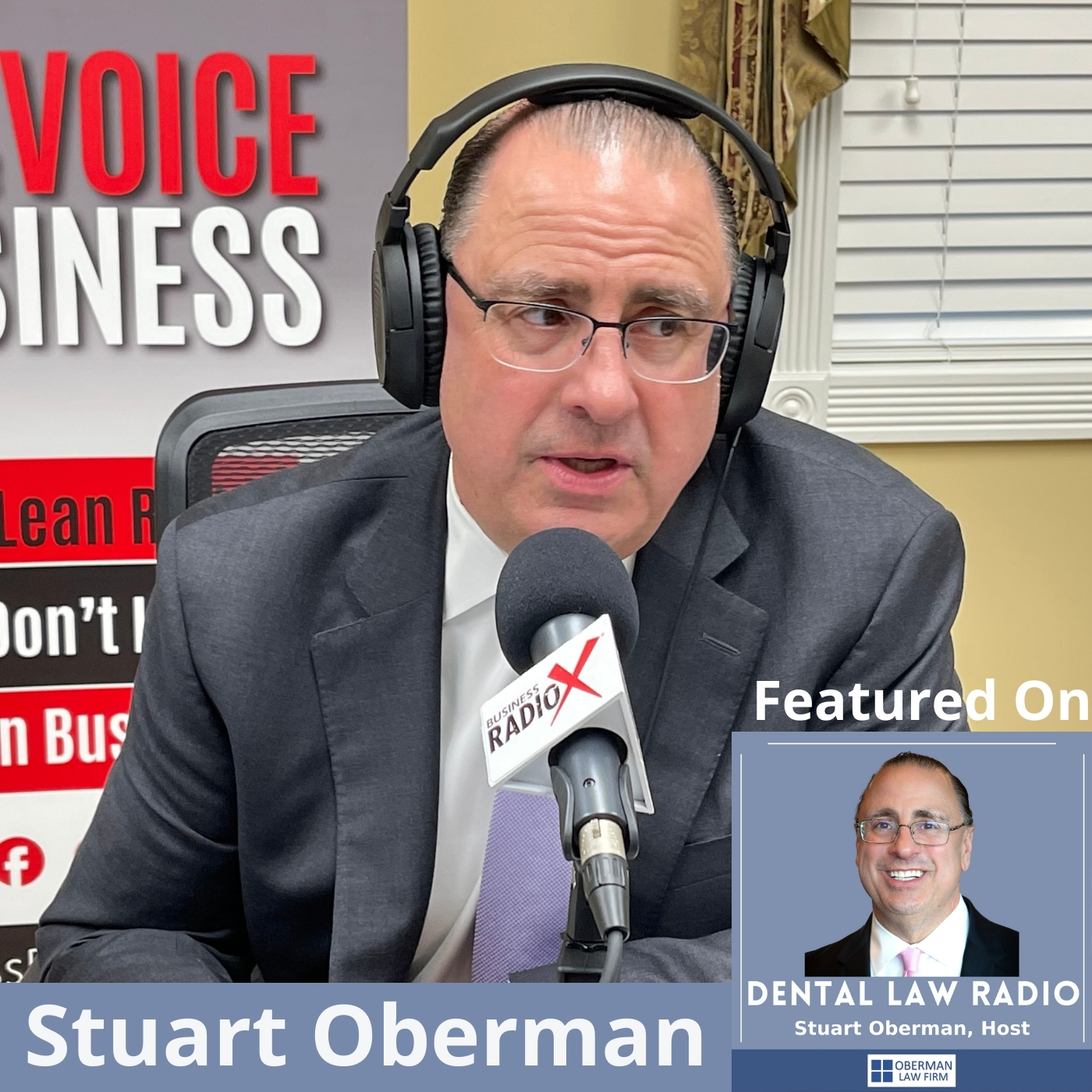
Tagged With: dental law, Dental Law Radio, Medicaid Audit, Oberman Law Firm, Stuart Oberman

How to Respond to Negative Online Patient Reviews

June 25, 2021 by John Ray

DLREpisode9DSOsAlbum
Dental Law Radio
How to Respond to Negative Online Patient Reviews
Loading
00:00 /
RSS Feed
Share
Link
Embed

Download file

DLREpisode9DSOsAlbum

How to Respond to Negative Online Patient Reviews (Dental Law Radio, Episode 10)

You work hard in your practice to create a great patient experience, and yet you wake up one morning to find a negative online patient review. The review is unfair and may even be written by someone who is not your patient. (Yes, that happens.) How do you respond in a logical way that’s best for your practice? Host Stuart Oberman weighs in on this emotional topic. Dental Law Radio is underwritten and presented by Oberman Law Firm and produced by the North Fulton studio of Business RadioX®.

TRANSCRIPT

Intro: [00:00:02] Broadcasting from the Business RadioX studios in Atlanta, it’s time for Dental Law Radio. Dental Law Radio is brought to you by Oberman Law Firm, a leading dental-centric law firm serving dental clients on a local, regional and national basis. Now, here’s your host, Stuart Oberman.

Stuart Oberman: [00:00:27] Hello, everyone, and welcome. Today’s topic, the ever growing concern, how to respond to negative patient reviews online? I cannot begin to tell you how many calls we get on a daily, weekly basis, monthly basis, “How do I respond to a negative patient review?” Well, first off, you’ve got to understand what occurs. So, there are times you will get a negative review from a patient that you’ve never seen. That patient reportedly who responded and prepared this negative online review has no idea who you are, has no idea where your office is at, has no idea what state you’re in. All they know is that someone told them about you, and they had nothing else to do but write a negative online review about you.

Stuart Oberman: [00:01:26] So, what happens is when this particular frenzy starts it, it multiplies quickly. So, all of a sudden, you get this negative review from this proposed patient in Georgia, and now, you’re getting negative reviews from someone in Seattle, California, Ohio, Nebraska. And you’re thinking to yourself, “Who in the world are these people?”

Stuart Oberman: [00:01:52] So, what happens is, is that when negative reviews go up, it just builds and builds and builds. And that is when our doctors will absolutely panic. That is where they do the wrong thing of react versus respond. So, when you see that review, you’re going to think to yourself, “I don’t know who it is, but I’m going to respond quickly and, basically, tell them they’re nuts, they’re crazy, I didn’t do anything, I don’t know who you are. And if I know you, here’s a treatment that you received, and here’s why you owe me money, and here’s why to continue your dental treatment.” The next you know, patient information is disclosed, names are disclosed, neighbors are disclosed. And now, you’ve got a huge governmental compliance issue.

Stuart Oberman: [00:02:51] So, the question is, how do I react or how do I respond? Two very, very different concepts. When you react, you’re going to have a knee-jerk reaction, you’re going to send your office manager to respond, and it’s going to be posted within like 15 minutes of you reviewing that negative review. And then, what’s going to happen is, then, you’re going to call our office and say, “Hey, I got this negative review on Google or Yelp. How do I respond because I’ve already responded? Now, what do I do?” And I’m going to say the first thing you did wrong was respond instead of call us first or call whoever you need to call – your consultant, your other turn, whoever it may be.

Stuart Oberman: [00:03:36] So, what do you do? First and foremost, I urge you that when you see a negative review, your face is going to turn absolutely red, and you’re going to go nuts. Take a step back, let that sink in. Do not do one thing in the world. Yes, you’re going to want to respond. Yes, you’re going to be upset. Yup, you’re going to be really, really ticked, and you’re going to want to lash out at everyone and let that SOB online let you know and let them know what’s going on.

Stuart Oberman: [00:04:11] Here’s what you have to do in reality. First and foremost, you got to analyze every negative review. How did it occur? Was it the result of miscommunication between you and the patient? Was there a miscommunication between you, your staff and the patient? You cannot, under any, any circumstances, take this personal. This has to be a business decision. It’s like buying a house. As soon as you get personal, you lost control. Soon as you look at buying a dental practice emotionally, you lost control. You cannot take this personally. That’s why you have to take a step back.

Stuart Oberman: [00:04:59] And there are times I even recommend sleeping on it. Well, I’m not going to sleep. Well, then, you rest on it because, otherwise, you’re going to do something you really regret and you can never, ever, ever get defensive. As soon as you get defensive, you lost control. First and foremost, you will never, ever gain the upper hand on an Internet negative review battle. You’re just not going to do that.

Stuart Oberman: [00:05:29] So, what happens is, of course, you can’t ignore negative reviews. You have to take a look at what was a patient experience. Are they justified? Not justified? Never, ever, ever respond in a public forum. Never post anything online in response to this personally. If you’re going to respond, you have to respond very carefully, very tactfully, under guidance, probably with a phone call. I would be very, very careful what you put in writing, because there’s a pretty good chance what you put in writing is going straight on the Internet.

Stuart Oberman: [00:06:15] We’ve had cases where we’ve sent out letters to patients who would put negative reviews on, and they will literally post, “I got a response from Dr. John’s attorney.” What you can never, ever do also is respond with any kind of patient information, period. Never put patient information on there. Never put any PHI information because that is a clear HIPAA violation. Any response that you have, or prepared, or will be responding to, or have responded to has to be made within governmental compliance.

Stuart Oberman: [00:07:00] So, one thing I would never do, I would never, ever say I’m sorry or I apologize. Again, no excuses online. What’s the recommendation? The high road. You thinking to yourself, “The high road?” This guy just tore me up on the Internet. I got people from Topeka, Kansas, who I never even met saying what a lousy doctor I am and I treat people horrible. And you’re expecting me to sit back and do nothing.” No. What I’m asking you to do is take a step back and respond professionally, rationally and spin it. Everything’s a spin. Politics is a spin. Internet is a spin. So, you have to spin it.

Stuart Oberman: [00:07:49] What does that mean, Oberman? So, that means to prepare a very carefully drafted corporate response. Well, how do you do that? Hire counsel, be careful that you put this venture onto your consultant. We receive a lot of negative, negative advice from consultants, some we would never follow. We have some that have their own marketing people, and they have their own perception as to what occurs. But I will tell you, from a lot of trials, a lot of experience that you have to be calculated on how you respond.

Stuart Oberman: [00:08:38] So, what to do? What do you do? You put the best foot forward for your practice in a very detailed response as to how you love your patients, about the practice, how you serve the community. And there’s a, again, very calculated way that you do this, but you cannot mix that kind of response in with, “I didn’t do anything.” So, again, you have to be very careful because once it goes on the Internet, I don’t care if you delete it three minutes later, someone has got a record of that post. So, you have to be calculated.

Stuart Oberman: [00:09:21] Again, I would wait, at least, a day before you respond. Yeah, it’s going to build up a little bit, but it may die down. So, then, the question is, “Well, what do I do with the person who posted it?” One, you have to know who it is. Two, you’ve got to make sure that you didn’t do anything wrong. So, it’s easy to point to fingers that that’s a negative review, but internally, if you see that you dropped the ball, bad treatment, bad communication, and you know what, it may be justified, but they shouldn’t have done it. That’s a whole different response. That’s a whole different review. So, you’ve got to take a look at whether or not you want to send out the letter to this particular person who responded. Sometimes, it would work. Sometimes, it won’t. It just depends on the circumstances.

Stuart Oberman: [00:10:17] So, then, this leads me to to sort of a different topic is, if I refund the patient money, does it admit liability? No, it does not. You have to have a very detailed release that outlines that if a settlement is made, they will withdraw anything is posted negative online, they will not post anything online, and, essentially, they have gone silent and will go silent.

Stuart Oberman: [00:10:50] So, we had an opportunity – I personally had an opportunity to review a lease – release, if you will – last week from an insurance company that was sent to one of our doctors that it was a fill in the blank, generic, send this to the person for the refund, and everything will be fine. So, I will tell you, I would have never, in a million years, sent that release to a patient without any kind of disclosure on that, that they would have not gone to line after I refunded their money and said negative things.

Stuart Oberman: [00:11:27] So, not only does it affect what you do now and treatment wise, but there has to be some kind of language that correlates to a settlement where the patient is not going to go back online and have negative reviews. So, again, it’s a wholesale approach. It’s a very emotional approach, but has to be very calculated, and you’ve got to have a third party, if you will, oversee this because you lose the vision, you lose the process, and you have to have a calculated response again.

Stuart Oberman: [00:12:05] I know I said that before but I can’t stress that enough. Take a step back and respond to it, because once you respond in the wrong way, it never, never goes away. And somewhere, there’s a record of a negative response and a bad response. And in today’s world where Google matters, Yelp matters, it really, really matters.

Stuart Oberman: [00:12:30] So, that is a very small analysis of a very big potential problem. But again, at some point, it’s going to happen. We always say it’s not if, but it’s when a crazy patient is going to either file a board complaint or file something online. So, you got to be prepared how to respond. Although you did nothing wrong, there has to be a calculated response to that.

Stuart Oberman: [00:12:57] So, hopefully this has helped out. Hopefully, you’ll take a step back if this ever occurs, which I never hope it does, but you’ll be prepared, and you respond to it in a very calculated way, and you will put the best foot forward for your practice, because that is what you do on a daily basis, you put your best foot forward every day, and people need to know that, and there has to be a way to respond to that. So, thank you again for listening and we look forward to providing you with additional information on our podcast. Thank you. And have a fantastic day.


About Dental Law Radio

Hosted by Stuart Oberman, a nationally recognized authority in dental law, Dental Law Radio covers legal, business, and other operating issues and topics of vital concern to dentists and dental practice owners. The show is produced by the North Fulton studio of Business RadioX® and can be found on all the major podcast apps. The complete show archive is here.

Stuart Oberman, Oberman Law Firm

Oberman Law Firm
Stuart Oberman, host of “Dental Law Radio”

Stuart Oberman is the founder and President of Oberman Law Firm. Mr. Oberman graduated from Urbana University and received his law degree from John Marshall Law School. Mr. Oberman has been practicing law for over 25 years, and before going into private practice, Mr. Oberman was in-house counsel for a Fortune 500 Company. Mr. Oberman is widely regarded as the go-to attorney in the area of Dental Law, which includes DSO formation, corporate business structures, mergers and acquisitions, regulatory compliance, advertising regulations, HIPAA, Compliance, and employment law regulations that affect dental practices.

In addition, Mr. Oberman’s expertise in the health care industry includes advising clients in the complex regulatory landscape as it relates to telehealth and telemedicine, including compliance of corporate structures, third-party reimbursement, contract negotiations, technology, health care fraud and abuse law (Anti-Kickback Statute and the State Law), professional liability risk management, federal and state regulations.

As the long-term care industry evolves, Mr. Oberman has the knowledge and experience to guide clients in the long-term care sector with respect to corporate and regulatory matters, assisted living facilities, continuing care retirement communities (CCRCs). In addition, Mr. Oberman’s practice also focuses on health care facility acquisitions and other changes of ownership, as well as related licensure and Medicare/Medicaid certification matters, CCRC registrations, long-term care/skilled nursing facility management, operating agreements, assisted living licensure matters, and health care joint ventures.

In addition to his expertise in the health care industry, Mr. Oberman has a nationwide practice that focuses on all facets of contractual disputes, including corporate governance, fiduciary duty, trade secrets, unfair competition, covenants not to compete, trademark and copyright infringement, fraud, and deceptive trade practices, and other business-related matters. Mr. Oberman also represents clients throughout the United States in a wide range of practice areas, including mergers & acquisitions, partnership agreements, commercial real estate, entity formation, employment law, commercial leasing, intellectual property, and HIPAA/OSHA compliance.

Mr. Oberman is a national lecturer and has published articles in the U.S. and Canada.

LinkedIn

Oberman Law Firm

Oberman Law Firm has a long history of civic service, noted national, regional, and local clients, and stands among the Southeast’s eminent and fast-growing full-service law firms. Oberman Law Firm’s areas of practice include Business Planning, Commercial & Technology Transactions, Corporate, Employment & Labor, Estate Planning, Health Care, Intellectual Property, Litigation, Privacy & Data Security, and Real Estate.

By meeting their client’s goals and becoming a trusted partner and advocate for our clients, their attorneys are recognized as legal go-getters who provide value-added service. Their attorneys understand that in a rapidly changing legal market, clients have new expectations, constantly evolving choices, and operate in an environment of heightened reputational and commercial risk.

Oberman Law Firm’s strength is its ability to solve complex legal problems by collaborating across borders and practice areas.

Connect with Oberman Law Firm:

Company website | LinkedIn | Twitter
Tagged With: Negative Online Patient Reviews, negative online reviews, Oberman Law Firm, Stuart Oberman

  • « Previous Page
  • 1
  • …
  • 6
  • 7
  • 8
  • 9
  • 10
  • Next Page »

Business RadioX ® Network


Our Most Recent Episode

CONNECT WITH US

  • Email
  • Facebook
  • LinkedIn
  • Twitter

  • YouTube

Our Mission

We help local business leaders get the word out about the important work they’re doing to serve their market, their community, and their profession.

We support and celebrate business by sharing positive business stories that traditional media ignores. Some media leans left. Some media leans right. We lean business.

Sponsor a Show

Build Relationships and Grow Your Business. Click here for more details.

Partner With Us

Discover More Here

Terms and Conditions
Privacy Policy

Connect with us

Want to keep up with the latest in pro-business news across the network? Follow us on social media for the latest stories!
  • Email
  • Facebook
  • Google+
  • LinkedIn
  • Twitter

  • YouTube

Business RadioX® Headquarters
1000 Abernathy Rd. NE
Building 400, Suite L-10
Sandy Springs, GA 30328

© 2025 Business RadioX ® · Rainmaker Platform

BRXStudioCoversLA

Wait! Don’t Miss an Episode of LA Business Radio

BRXStudioCoversDENVER

Wait! Don’t Miss an Episode of Denver Business Radio

BRXStudioCoversPENSACOLA

Wait! Don’t Miss an Episode of Pensacola Business Radio

BRXStudioCoversBIRMINGHAM

Wait! Don’t Miss an Episode of Birmingham Business Radio

BRXStudioCoversTALLAHASSEE

Wait! Don’t Miss an Episode of Tallahassee Business Radio

BRXStudioCoversRALEIGH

Wait! Don’t Miss an Episode of Raleigh Business Radio

BRXStudioCoversRICHMONDNoWhite

Wait! Don’t Miss an Episode of Richmond Business Radio

BRXStudioCoversNASHVILLENoWhite

Wait! Don’t Miss an Episode of Nashville Business Radio

BRXStudioCoversDETROIT

Wait! Don’t Miss an Episode of Detroit Business Radio

BRXStudioCoversSTLOUIS

Wait! Don’t Miss an Episode of St. Louis Business Radio

BRXStudioCoversCOLUMBUS-small

Wait! Don’t Miss an Episode of Columbus Business Radio

Coachthecoach-08-08

Wait! Don’t Miss an Episode of Coach the Coach

BRXStudioCoversBAYAREA

Wait! Don’t Miss an Episode of Bay Area Business Radio

BRXStudioCoversCHICAGO

Wait! Don’t Miss an Episode of Chicago Business Radio

Wait! Don’t Miss an Episode of Atlanta Business Radio