Business RadioX ®

  • Home
  • Business RadioX ® Communities
    • Southeast
      • Alabama
        • Birmingham
      • Florida
        • Orlando
        • Pensacola
        • South Florida
        • Tampa
        • Tallahassee
      • Georgia
        • Atlanta
        • Cherokee
        • Forsyth
        • Greater Perimeter
        • Gwinnett
        • North Fulton
        • North Georgia
        • Northeast Georgia
        • Rome
        • Savannah
      • Louisiana
        • New Orleans
      • North Carolina
        • Charlotte
        • Raleigh
      • Tennessee
        • Chattanooga
        • Nashville
      • Virginia
        • Richmond
    • South Central
      • Arkansas
        • Northwest Arkansas
    • Midwest
      • Illinois
        • Chicago
      • Michigan
        • Detroit
      • Minnesota
        • Minneapolis St. Paul
      • Missouri
        • St. Louis
      • Ohio
        • Cleveland
        • Columbus
        • Dayton
    • Southwest
      • Arizona
        • Phoenix
        • Tucson
        • Valley
      • Texas
        • Austin
        • Dallas
        • Houston
    • West
      • California
        • Bay Area
        • LA
        • Pasadena
      • Colorado
        • Denver
      • Hawaii
        • Oahu
  • FAQs
  • About Us
    • Our Mission
    • Our Audience
    • Why It Works
    • What People Are Saying
    • BRX in the News
  • Resources
    • BRX Pro Tips
    • B2B Marketing: The 4Rs
    • High Velocity Selling Habits
    • Why Most B2B Media Strategies Fail
    • 9 Reasons To Sponsor A Business RadioX ® Show
  • Partner With Us
  • Veteran Business RadioX ®

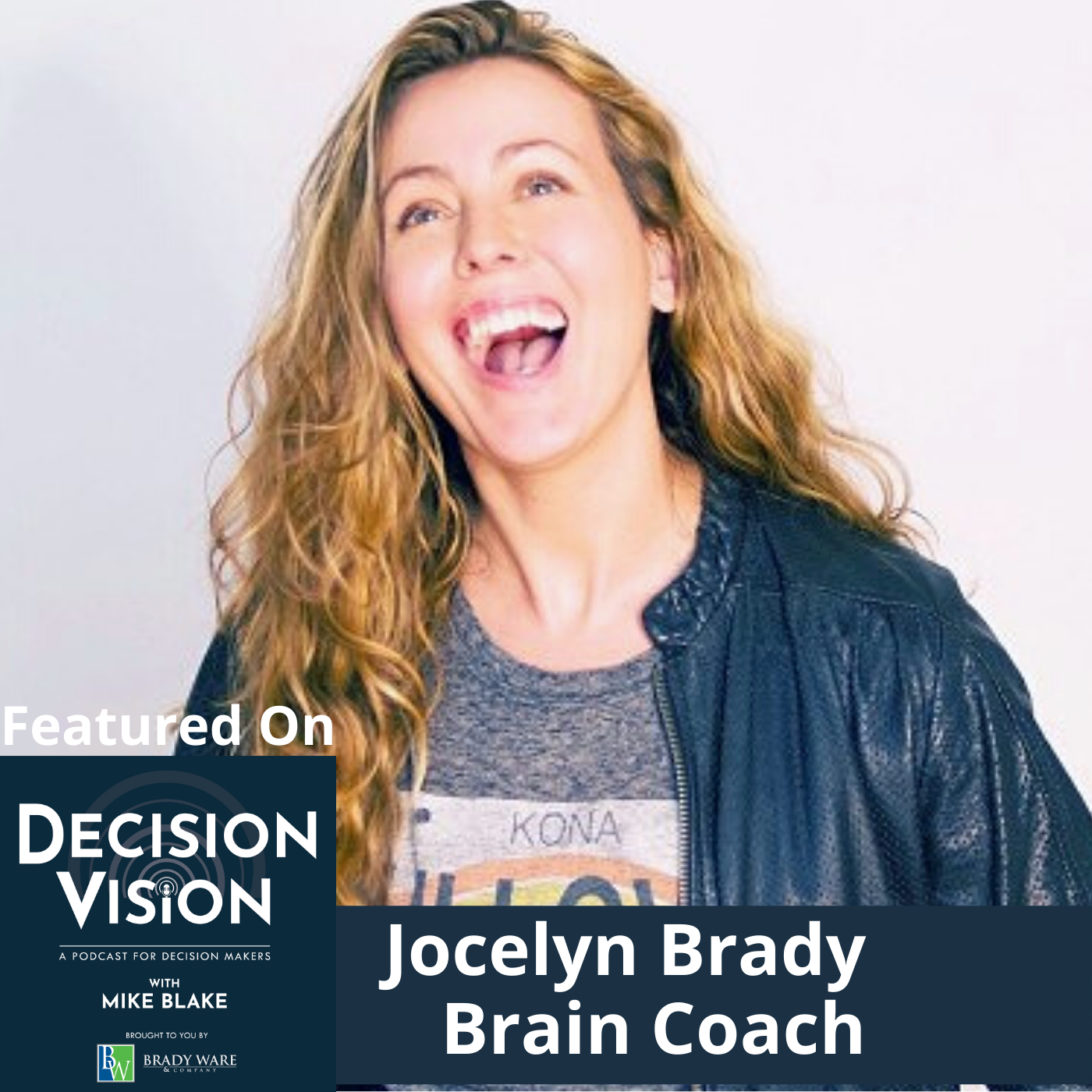
Decision Vision Episode 150: Should I Pivot? – An Interview with Jocelyn Brady, Brain Coach

January 6, 2022 by John Ray

Jocelyn Brady
Decision Vision
Decision Vision Episode 150: Should I Pivot? - An Interview with Jocelyn Brady, Brain Coach
Loading
00:00 /
RSS Feed
Share
Link
Embed

Download file

Jocelyn Brady

Decision Vision Episode 150:  Should I Pivot? – An Interview with Jocelyn Brady, Brain Coach

When Jocelyn Brady began to be bored and even resented the projects she was working on in her business, she recognized an itch she needed to investigate. Then came the pandemic, which caused its own disruption, and Jocelyn pivoted away from writing and content creation to working as a Brain Coach. In this conversation with host Mike Blake, Jocelyn describes what it is like to have a successful company and yet be unfulfilled, the impact of Covid on her trajectory, her mixed feelings about the word “coach,” and much more. Decision Vision is presented by Brady Ware & Company.

Jocelyn Brady, Brain Coach, Speaker & Chief Play Scientist

Jocelyn Brady, Brain Coach, Speaker & Chief Play Scientist

Jocelyn Brady is a writer, speaker, and professional brain jostler who thrives at the intersection of comedy, storytelling and unraveling the mysteries of the human brain. When she’s not being the Bill Nye of the brain (as the creator and host of her series Tiny Tips, the Internet’s favorite way to Brain), Jocelyn applies her certified Brain Coaching chops to help creative visionaries tap their brains’ greatest potential.

In her past life—as an award-winning copywriter, Creative Director, and agency CEO—Jocelyn led narrative strategy and international storytelling training for some of the world’s biggest brands. She also produced and co-hosted Party Time, a standup comedy and storytelling show featuring talent who went on to write or perform for Conan, Colbert, and Comedy Central. All while managing to keep her two cats and houseplants alive.

Jocelyn’s first book, tentatively titled Your Brain is a Magical Asshat, is slated for publication next year.

Website | LinkedIn | Twitter | Tiny Tips Series

Mike Blake, Brady Ware & Company

Mike Blake, Host of the “Decision Vision” podcast series

Michael Blake is the host of the Decision Vision podcast series and a Director of Brady Ware & Company. Mike specializes in the valuation of intellectual property-driven firms, such as software firms, aerospace firms, and professional services firms, most frequently in the capacity as a transaction advisor, helping clients obtain great outcomes from complex transaction opportunities. He is also a specialist in the appraisal of intellectual properties as stand-alone assets, such as software, trade secrets, and patents.

Mike has been a full-time business appraiser for 13 years with public accounting firms, boutique business appraisal firms, and an owner of his own firm. Prior to that, he spent 8 years in venture capital and investment banking, including transactions in the U.S., Israel, Russia, Ukraine, and Belarus.

LinkedIn | Facebook | Twitter | Instagram

Brady Ware & Company

Brady Ware & Company is a regional full-service accounting and advisory firm which helps businesses and entrepreneurs make visions a reality. Brady Ware services clients nationally from its offices in Alpharetta, GA; Columbus and Dayton, OH; and Richmond, IN. The firm is growth-minded, committed to the regions in which they operate, and most importantly, they make significant investments in their people and service offerings to meet the changing financial needs of those they are privileged to serve. The firm is dedicated to providing results that make a difference for its clients.

Decision Vision Podcast Series

Decision Vision is a podcast covering topics and issues facing small business owners and connecting them with solutions from leading experts. This series is presented by Brady Ware & Company. If you are a decision-maker for a small business, we’d love to hear from you. Contact us at decisionvision@bradyware.com and make sure to listen to every Thursday to the Decision Vision podcast.

Past episodes of Decision Vision can be found at decisionvisionpodcast.com. Decision Vision is produced and broadcast by the North Fulton studio of Business RadioX®.

Connect with Brady Ware & Company:

Website | LinkedIn | Facebook | Twitter | Instagram

TRANSCRIPT

Intro: [00:00:02] Welcome to Decision Vision, a podcast series focusing on critical business decisions. Brought to you by Brady Ware & Company. Brady Ware is a regional full-service accounting and advisory firm that helps businesses and entrepreneurs make visions a reality.

Mike Blake: [00:00:22] Welcome to Decision Vision, a podcast giving you, the listener, clear vision to make great decisions. In each episode, we discuss the process of decision making on a different topic from the business owners’ or executives’ perspective. We aren’t necessarily telling you what to do, but we can put you in a position to make an informed decision on your own and understand when you might need help along the way.

Mike Blake: [00:00:42] My name is Mike Blake, and I’m your host for today’s program. I’m a director at Brady Ware & Company, a full-service accounting firm based in Dayton, Ohio, with offices in Dayton; Columbus, Ohio; Richmond, Indiana; and Alpharetta, Georgia. My practice specializes in providing fact-based strategic and risk management advice to clients that are buying, selling, or growing the value of companies and their intellectual property. Brady Ware is sponsoring this podcast, which is being recorded in Atlanta per social distancing protocols.

Mike Blake: [00:01:08] If you would like to engage with me on social media with my Chart of the Day and other content, I’m on LinkedIn as myself and @unblakeable on Facebook, Twitter, Clubhouse, and Instagram. I also recently launched a new LinkedIn Group called A Group That Doesn’t Suck, so please join that as well if you would like to engage. If you like this podcast, please subscribe on your favorite podcast aggregator, and please consider leaving a review of the podcast as well.

Mike Blake: [00:01:32] Today’s topic is, Should I pivot? And we’ve done this topic before, probably about a-year-and-a-half ago. But as you know, if you’ve been a long time listener, I don’t mind revisiting a topic every once in a while, because certain topics, I think, just lend themselves well to different angles, different approaches. And something like a pivot, also, in my experience is a deeply personal experience. And so, everybody is going to come to a pivot, is going to experience a pivot, is going to engage with it, embrace it or not in their own unique way. And so, it’s one of those kind of evergreen topics that I don’t think we’ll ever get to a point where nobody ever pivots anymore.

Mike Blake: [00:02:17] And, also, frankly, from a very practical perspective, now that we’re recording podcast 140 something or whatever, like 148, I guess, or 149, the reality is that most people don’t go back and listen to a lot of the back catalog. We’re not Led Zeppelin. People aren’t going back to the initial records and trying to find the original recording. So, if you’re like most people and you’re relatively new to the podcast, statistically speaking, this will be a topic that we actually haven’t covered before. And if you want to hear more about it, then you can go back into the deep tracks in the archives somewhere around the double digit episodes. So, I hope you’re going to find this topic and this conversation as engaging as I anticipate that it will be.

Mike Blake: [00:03:02] You know, pivots are interesting because there are some very famous ones I don’t think people necessarily realized. Cornelius Vanderbilt – yes, that Vanderbilt family – initially started out with steamships. He actually started out with river barges around the island of Manhattan, and they are basically providing cut rate ferry service across the Hudson and East Rivers. And in doing so, got a lot of people killed because they used rickety boats. But that’s how they charge less for what they did. They eventually did pivot into steamships, which presumably were safer. I don’t know. I don’t have any data on that. And then, eventually railroads.

Mike Blake: [00:03:45] William Wrigley, whom you may know from Wrigley’s Gum – I don’t chew gum because it rip out all my dental work. But for those of you who do have good teeth, you may know of Wrigley – they originally were a baking powder company. Twitter, of all things, launched as a podcast directory. Yelp began as an automated email service. And YouTube, believe it or not, was once a dating site. So, we have Tinder now and we have all the others, but YouTube actually was not the YouTube that we know of today.

Mike Blake: [00:04:13] And, you know, I find it also an interesting topic because I find myself at odds intellectually with the investment community on one particular topic, and that is, Should you bet the jockey or the horse? And what that means to those of you who aren’t necessarily speaking Silicon Valley, it means that do you place the bet on the management of a startup or do you place your bet on the basic idea of the startup? And most investors will tell you that they bet the jockey, they bet the management team, over the actual idea figuring that a management team will actually figure it out.

Mike Blake: [00:04:55] The data – and this is empirically studied. This is actually a fairly old study, but still very good. It was published in the Journal of Finance back in 2011 – called it Do You Bet the Jockey or the Horse? And the empirical study determined that, in fact, the companies that generated the most value in their IPOs were the ones that had kept the fundamental idea, more or less start to finish, but actually had switched management teams.

Mike Blake: [00:05:21] And the reason behind that, I think, is that – again, probably torching this analogy beyond where it needs to go – if you have a slow horse, the best jockey in the world is not going to win the race of the slow horse. They may prevent you from coming in last. They may prevent you from having the horse fall over, break its leg, and you have to shoot it right down the track. But even a great management team can’t take a slow horse and win the Kentucky Derby. However, if you have the fastest horse, an average jockey might win that race because you actually have the fastest horse.

Mike Blake: [00:05:54] So, I think that there’s something to that. So, finding the right idea, finding the right business model, this highlights how important that is. Because if you don’t have the right business, you don’t have the right model – and the data says this. It’s not just Mike Blake talking into a microphone on the internet – the data suggests that there’s only so far a mediocre business concept will take you.

Mike Blake: [00:06:20] And I don’t care if you’re going to have the best management team in the world, and you can dig up Jack Welch and Steve Jobs and everybody else that you might have idolized, Warren Buffett, you’re only going to take that so far. And I guess that’s why I find pivots so interesting, because a pivot is truly an existential decision. I think it is one of the most important decisions that are made in business and probably one that is not as appreciated as much as it should be.

Mike Blake: [00:06:49] So, fortunately, coming on to join us somebody who is either sort of at the later stages or fresh off a pivot, she’ll tell us exactly where she is on it. But joining us is Jocelyn Brady, who is the Creative Brain Jostler and Brainutainer. She is a writer, speaker, and professional brain jostler who thrives at the intersection of comedy storytelling and unraveling the mysteries of the human brain. When she’s not being the Bill Nye of the brain as the creator and a host of her series, Tiny Tips, The Internet’s Favorite Way to Brain, Jocelyn applies her certified brain coaching chops to help creative visionaries tap their brain’s greatest potential.

Mike Blake: [00:07:30] In her past life as an award-winning copywriter, creative director and agency CEO, Jocelyn led narrative strategy and international storytelling training for some of the world’s biggest brands. She also produced and co-hosted Party Time, a stand-up comedy and storytelling show featuring talent who went on to write or perform for Conan O’Brien, Stephen Colbert, and Comedy Central. All while managing to keep her two cats and houseplants alive. And I have seen at least one of the cats and one of the plants, so we do have proof of life for at least one of each. Jocelyn Brady, welcome to the program.

Jocelyn Brady: [00:08:03] Thank you so much.

Mike Blake: [00:08:05] Oh, and before you jump in, I forgot to mention and this is really important, because you’re doing something that I’m struggling to do myself. Jocelyn’s first book tentatively titled, Your Brain is a Magical Ass Hat, is slated for publication next year. Jocelyn, again, welcome to the program and congratulations on writing a book. I’m struggling to do that, but it’s hard to do that in crayon.

Jocelyn Brady: [00:08:28] Oh, man. It’s hard to even think about or talk about writing a book, let alone actually doing it. But, yeah, I highly recommend joining other people coaching program or other people who are doing it. Just like getting some of that accountability, that’s the biggest thing is just creating that structure. Stick with it.

Mike Blake: [00:08:48] So, we have you here to talk about pivots. And as I like to do on the show, just in case somebody was listening who really doesn’t know what a pivot is, when you hear the term pivot, what does that mean to you?

Jocelyn Brady: [00:09:01] I imagine the basketball move like, “Okay. We were going to go this way and now we go this way.” I know nothing about basketball, but people do pivot.

Mike Blake: [00:09:11] They’re doing great. Yeah.

Jocelyn Brady: [00:09:14] Yeah. It’s just changing course, right? Deciding to move in a new direction, and it could be sudden.

Mike Blake: [00:09:20] So, what did your company originally set out to do?

Jocelyn Brady: [00:09:24] Well, when I started in 2008, all I wanted to do was make a living writing. And, you know, it was literally starting with can I earn enough to eat a sandwich today? And then, it started just growing really quickly. I didn’t have any business experiences in my 20s. I didn’t have a plan. I just thought, “I’m good at writing. I’ll figure it out.” And I got into copywriting. And one thing led to another. More clients were coming my way. I accidentally had more work than I could handle, so I hired a team.

Jocelyn Brady: [00:10:02] So, a team of writers and that grew into, not just content development or copywriting, but also then developing the brand voices and narrative strategy. And overseeing their most important projects, like what is the CEO saying in their annual meeting to shareholders? Or, what are you putting in your video scripts? And even overseeing a Super Bowl ad for a big company. And so, we were developing that tone of voice and then training the teams on how to be better storytellers. And like I said, it didn’t really set out with any grand plan or dream or vision. It was just, I just want to make a living writing.

Mike Blake: [00:10:42] And sandwiches. You wanted sandwiches.

Jocelyn Brady: [00:10:45] I wanted sandwiches to feed myself, I guess.

Mike Blake: [00:10:48] Yeah. And your cats wanted kibbles or Fancy Feast, whatever you feed them. We feed our children, it seems to keep them happy. So, you started this thing and it sounds like it was pretty successful. If anything, maybe so successful that in itself provided a challenge. What were some signs that things in this company weren’t meeting your expectations?

Jocelyn Brady: [00:11:15] I started to get bored. I started to almost resent the projects that were coming in. And I knew that’s not a good place to be. You don’t want to resent work coming in or pass that along to the clients themselves. It’s just a horrible way to approach something and to work with people. So, I think it was just the itch, like it’s not fulfilling. And a lot of times when you start something, you grow up or you excel, and you become now a manager of people, and you’re doing less of the thing that you started doing.

Jocelyn Brady: [00:11:53] It’s like a story as old as time in any company or large corporations, especially. You’re really good at a skill and then you get promoted and you’re like, “Wait a minute. Now, I’m just doing completely different things.” Making sure the business is functioning, and that we have good cash flow, and are the people doing their jobs, and how do we manage when people are out or leave or get vengeful or nobody’s gotten vegetable. You got to prepare for all the scenarios. So, I think that was the main thing is just feeling misaligned with what I was doing.

Mike Blake: [00:12:28] You know, it’s interesting you bring that up, because I think that one of the most underappreciated differentiators of a Bill Gates, of a Sarah Blakely, of a Steve Jobs, and Mark Zuckerberg is that, in addition to all the things that people know they brought to the table, their innovation, their energy, their messaging, and so forth, their vision, but also the skillset and the desire to run and thrive in a startup as well as in a Fortune 100 company. That is not easy to do because you’re not just scaling a person, you have to scale yourself.

Mike Blake: [00:13:15] And not to go all self-help guru here because I’m not it, but not many people can make that journey or want to make that journey. Because, when you’re running Apple, it’s not the same thing as writing code, and being in there, and designing the products and everything. Which I suspect was probably the case with Steve Wozniak why he sort of took a less prominent ride. I don’t know, Stevie. I call him Stevie. He calls me who the hell are you? But I suspect that’s kind of what happened, you know, listening to his interviews, reading what he writes, he would not have had any fun and probably not a lot of success running that kind of company.

Mike Blake: [00:13:54] And it sounds like a little bit of that may apply to you, too, that you started to get far away from what you were doing because of the way the company is growing and somebody had to run it.

Jocelyn Brady: [00:14:03] Yeah. Yeah. And I mean, there’s still things that I did love. So, the more I was doing the workshops, I realized that I really loved interacting with people, coming up with ideas on the fly, helping people pull out the creative ideas, and just that live interaction. And you never know really what’s going to happen.

Jocelyn Brady: [00:14:29] And I still love writing, obviously. I’m working on a book and I’m also working on a really big network project. But I take those few and far between because now I realize, if I’m working on a project or I’m outsourcing my writing skills, I have to absolutely love this project. That became very clear. And on the other side of that is, I love spending my time just working directly with people and things where you’re not sitting alone banging your head against the wall going, “Oh, help. Just be here writing.” So, even when we had a pretty significant team, everybody was working remotely. We rarely got together, so it can be lonely even as part of a team.

Mike Blake: [00:15:11] I would argue sometimes it’s lonelier, because, to me, one of the biggest challenges of leadership is to sort of get out there and put a smile on your face when it’s the last thing that you want to do. And when you’re responsible for the care and feeding of a team that has entrusted you to become the platform of their careers and, in some cases, their life satisfaction, that is a very lonely place to be.

Jocelyn Brady: [00:15:41] Yeah. And it could be really scary. And it’s really helpful to connect with other entrepreneurs and people running businesses because you just simply can’t relate to what it’s like, to feel responsible for, not just yourself, but all the other people who are looking up to you like, “What’s happening next?”

Jocelyn Brady: [00:16:03] And let alone – I’m sure we’ll get more into this – COVID, as for many of us, was like, “Oh, everybody is going to hell.” And that’s when all my big contracts vanished. So, the ones I didn’t want were no longer a problem. But it was terrifying because I now had to let my team go. I had to tell them, you know, “There’s no more work. And I would love to keep you around, but I can’t pay you.”

Mike Blake: [00:16:33] I’ve never had to let a whole team go, but I have let people go in my career. But I got to imagine that conversation or series of conversations – I don’t know whether you did it in a group or you did it individually. I’m sure you didn’t do it like that button CEO did it over Zoom and calling people thieves on the way out. I’m sure you didn’t do it that way – that’s got to be the hardest conversation, one of the top five you’ll ever have in your life.

Jocelyn Brady: [00:17:07] Yeah. It’s like a divorce, right? It’s just not working out between us. There’s a lot of emotion. And I got to say, with my longtime assistant, she was five or six years this one, and I absolutely loved her and I knew that she wanted to get more into filmmaking. She’d been doing, but she really wanted to move to L.A. and try it for real. And I really wanted for her to do that. So, when this came around, I think for both of us, it was like the best breakup I could ever imagine because it was sad and we were really emotional, but also really glad for each other. She decided to go to L.A.

Jocelyn Brady: [00:17:52] She just got a role – I think I’m allowed to talk about it now – Haley Joel Osment is in it, James Franco – wait. Sorry. The other Franco directed it, Alison Brie. So, anyway, I couldn’t imagine a better outcome. And I think when you have people’s best interest in mind and you’ll be as vulnerable as you can and say what’s really happening, that’s really, really scary and can be really hard to do. And I think it takes a lot of practice. I don’t think a lot of us are well-versed or trained to do that.

Jocelyn Brady: [00:18:27] Especially in a business setting, there’s this idea you need to be professional and you can’t say emotional things. But, to me, that is crucial and really important for human development, relationships, behavior, all of it.

Mike Blake: [00:18:45] Yeah. And I think it’s rapidly becoming best practices too. You know, the world has changed, obviously. It’s an open question to what extent we’ll go back to in 2019. It’s not going to be 100 percent, I think we all know that.

Mike Blake: [00:19:02] So, your pivot story, it sounds like that COVID accelerated a pivot that might have happened anyway because you really weren’t loving what you were doing. Is that fair?

Jocelyn Brady: [00:19:13] Yeah. Exactly. It had been on my mind for a year and I’d been talking to my team about making transitions. And, yeah, that came along and I was like, “Well, I guess decision made. You’re doing it now.”

Mike Blake: [00:19:28] So, COVID happens. You let your team go. What do you do the next day?

Jocelyn Brady: [00:19:38] Cry a lot, you know, mixed feelings. I was really excited about a new direction, but also terrified. And it’s so difficult to have built something up and then it’s completely gone, in a sense, where it’s starting over. It’s just me again. I have nothing. I have enough to sort of buy a few months, thankfully. But other than that, it’s like, “What am I doing?”

Jocelyn Brady: [00:20:10] And that’s not entirely true, because I did have the four years prior or 2016 or 2017, I got certified as a brain coach. But it’s something I sort of kept secret, because as someone who works with words, I couldn’t wrap my head around how to love the word coach. I hated it. I hate the word coach. The baggage I feel it comes with, it seems so phony. I just had all these unhealthy attachments to the meaning of the word, the meaning I was making.

Jocelyn Brady: [00:20:37] And at the same time, I was still doing it, still coaching people in private for four years. It was just now I got to, “If you really want to be doing this, own it. If you really want to be speaking, tell people you are a speaker. Go out there and speak. Go do the thing. You’ve got nothing to lose now. You got everything to gain.” Because, otherwise, we’ll just be moving with the cats into the crawl space and hope the new landlord doesn’t know or the owner doesn’t know.

Mike Blake: [00:21:10] So, I’m going to ask you sort of a semi-unfair question, but I feel like I want to ask it anyway. COVID gave you kind of the jolt, if you will, sort of forced the pivot on you. Do you think if the pandemic hadn’t happened, you would have made a pivot like this anyway?

Jocelyn Brady: [00:21:29] I’d like to think so. I think eventually I would have. Definitely, I do know that once I decide I’m doing something with full conviction, I’ll do it. But I definitely think it would have taken me longer. I would have had feelings about not wanting to let my team go. And so, if they don’t want to come with me on the new ride, then that would have been the end of that anyway. So, yeah, it’s always hard to say. And you never know what you’re like until really confronted with the situation.

Mike Blake: [00:22:07] That’s true. That’s entirely fair. So, I have to get back to something because I do think it’s a polarizing word, and that is the word coach. And I’d love to hear your perspective on it. My view of the word has changed over the years, but I don’t want to suck all the air out of the room. Tell me why you have such a negative relationship with that word.

Jocelyn Brady: [00:22:36] I think I did not have a lot of exposure to coaches or to good coaches in business, life coaching, whatever the case. Not counting basketball coaches, which, as we’ve established, I know nothing about. But when it comes to that mindset, and direction, achieving goals and that sort of thing – I don’t necessarily want to badmouth some of the big hitters that we see. But it’s easy. It’s easy to shoot arrows at the people standing out in front – I just did not like what I saw. I did not like this feeling that you have to look a certain way, you have to look kind of polished and perfect, and you have to come across it’s always positive and optimistic. And there’s a ton of value in that.

Jocelyn Brady: [00:23:25] But let’s get real. Sometimes life sucks and that’s okay. Let’s deal with the full spectrum of the human experience. And it just felt like there’s a lot of charade out there, and a veneer, and just not authentic sales driven behavior at the expense, a lot of the time, of people’s real mental health that can be damaged in the process.

Mike Blake: [00:23:55] I think there’s something to that. So, we’re segueing into kind of the different part of the conversation, which is fine. But I think in fairness, when I first started running across coaches – I’m a little bit older than you are – I started running across coaches about 15,20 years ago. I didn’t find very many of them to be particularly impressive. I didn’t find many of them to be people like saying, “Oh. Well, this person is worth paying 200 bucks an hour instead of the people who I do respect and are giving me lots of awesome advice for free.” I didn’t see a lot of that.

Mike Blake: [00:24:32] And I do think that there still remain coaches that, you know, sort of come from the school of those who can’t do teach. And we’ve actually had a podcast and I had my professional coach on, and we went through some of that – and maybe I’ll revisit that topic as well. But I don’t think that you’re being unfair. I mean, coaching is largely unregulated. The certifications are very disparate. You know, what does one mean versus another? How meaningful are they at all, et cetera? And, candidly, the quality of coaches is quite variable.

Mike Blake: [00:25:15] So, I don’t think you’re necessarily painting them with a broad brush. I think just the reality of life is that, if you see a pattern over and over and over again, that’s going to be the pattern that is associated with you. At some point stereotypes do come from someplace. They weren’t just made up. They occurred because enough people observed enough behaviors that they start to become an easy way to characterize people rightly or wrongly.

Jocelyn Brady: [00:25:46] Yeah. And I think we haven’t seen or been exposed to it’s like a self-fulfilling prophecy to you think it’s going to be a certain way. And then, you just start seeing it that way and you start looking for those types of people. And that’s kind of all we saw. Like white bread coaches, it’s just sort of the same message. One might be a foot taller than the other. That’s about the only difference. They all just seemed the same.

Jocelyn Brady: [00:26:15] The big discussion that’s been coming up in the last year plus – it’s been coming up a lot longer than that – who are we representing? Who are we putting out there? The diversity and thinking backgrounds, ethnicity, behaviors, we need to see more of that. And I do see that happening, and maybe it’s because I got more into it so I started looking at who else was out there who didn’t have the huge reach and the number one spot on YouTube, et cetera.

Mike Blake: [00:26:46] And I think the numbers also support it. Putting coaching aside for a second, we both know everybody listening to this knows about the great resignation, the great job hop, whatever you want to call it. And I think money is a big, big part of that. Let’s be real, money matters. More money, you have more sandwiches you can buy, and better sandwiches like wheat bread.

Mike Blake: [00:27:16] But this is also sort of the great reckoning with authenticity. You know, being in an organization where you just don’t fit and you try to make yourself fit because you feel like you have to. And I’ve been through that scenario. It is wearing. It is draining. It beats on you constantly. And, now, that people have an opportunity where labor has leverage for the first time in our economy in a very, very long time, you’re seeing just people vote with their feet.

Mike Blake: [00:27:48] My job, for example, as an employer is not so much to give people jobs. It never was. But as much as it is to provide solutions for my clients, it’s also to provide the right platform for my people to thrive, ultimately, maybe with us, maybe someplace else. They’re not going to retire with me, statistically speaking. I know that and they know that, and that’s okay.

Mike Blake: [00:28:14] But I do think that authenticity piece is real. And I think coaching is becoming more respected because, I think, coaches are now embracing and understanding for that need for authenticity. It’s no longer about turning yourself into the template that the market wants. But, rather, understanding what your own template is and bending the rest of the world around to your will.

Jocelyn Brady: [00:28:43] Yeah. Putting yourself out. It’s the whole light attracts light thing. Just put who you really are out there and then you will attract the type of people that you will probably work well with. If you’re putting out some phony shit, it’s not going to be fruitful for anybody. It’s probably a lot more damaging.

Jocelyn Brady: [00:29:07] You know something? It really drove me nuts, too, when I was doing a lot of these storytelling workshops in particular. I would see how people in office settings where it seemed there’s so much fear-based leadership, because if the leaders themselves aren’t courageous enough to put themselves out there and to be vulnerable and to say what’s really on their minds, you have to have some filtering and compassionate communication skills are good in this.

Jocelyn Brady: [00:29:40] I was just hearing about – what is it? – radical candor and sort of some people hating on it. I was like, “Yeah.” There’s a line to walk or balance. But be you. And if you’re not happy, you need to find a way to express that. And if that can’t be resolved, you need to get out because it’s just going to cause everyone to suffer.

Mike Blake: [00:30:04] And because of that – and believe it or not, audience, this actually does relate to the actual topic – this is actually what we’re seeing is a great pivot. Lots of people are pivoting their lives because they’ve been forced to reckon with things in their lives, personal or professional or both. There’s nothing like being in lockdown with your family for a while to find out if you actually like them or not. I mean, that will send a very clear signal as to what your relationship really looks like.

Mike Blake: [00:30:36] So, I’m curious – I think you have a really interesting answer for this. No pressure – when you decide that you’re going to pivot or the pivot happened, what was the hardest thing for you to leave behind?

Jocelyn Brady: [00:30:52] The first thing that pops in my head is money. Just going ahead, a regular –

Mike Blake: [00:30:57] Money is a thing.

Jocelyn Brady: [00:30:58] The least interesting answer I can think of. It’s knowing I have reliable income. So, I empathize a lot with people who are afraid to leave a job because that’s all you know and that’s what you need. You’ve got to pay the bills. So, that’s one thing. And I think it’s also a form of your identity in a story you had about yourself and what you’re doing in the world, and what you mean to people, what you bring, what kind of value you have. And now you’re at the reckoning, you’re at ground zero, and you have to decide what of those things are still true and what do you want to be true.

Mike Blake: [00:31:37] When you pivoted, did you have any kind of template? Was there somebody that you knew that had done something similar? Or was there an example of a company, individual, or organization that made a successful pivot that made you think, “Okay. There are lessons I can take from this thing.” Or, maybe mentors that helped you along the way?

Jocelyn Brady: [00:31:58] So, when I was first getting up the nerve to put myself out there as brain coach speaker, I found a coach who was previously a copywriter and transitioned, made the pivot to become a creative director. And I thought she’s going to understand what it’s like, not just making a transition, but also we have very similar backgrounds, and to just understand this world. So, working with her was instrumental in just having that empathy and also a really good coach. So, that gave me even more confidence of like, “Okay. I found a good coach and it’s continuing to change my perception.” Also, now I’m putting myself out there, so this is working.

Jocelyn Brady: [00:32:52] Her name is Hilary Weiss. She comes to mind immediately. And then, as far as what I was doing exactly, I felt like it was a bit nebulous. Jeff Chrysler is one of my favorite humans. He is a writer. He started as a lawyer and then he decided to become a stand-up comedian. And then, he got into behavioral science. And he now works in a company, quite a big one that I’m losing the name of – J.P. Morgan. And so, people like that who didn’t follow a linear path. Because it’s very difficult if you don’t have a blueprint. You’ve got to make it up as you go. And it’s just nice to see other people who’ve done that.

Mike Blake: [00:33:41] Now, I asked you earlier about what you had to let go in order to pivot. I wanted to ask the flip side of that, what did you take with you? What was valuable that you made sure from your previous experience you’re going to take with you to that next journey?

Jocelyn Brady: [00:33:58] On the very tactical, level writing skills. Everybody needs them. Storytelling and writing skills, because no matter what you do, no matter where you go, you’re going to have to learn how to communicate it and tell a good story. And so, that is lifelong. And it’s always going to be a part of what I do and who I am. And I think the courage to step out into unknown places.

Jocelyn Brady: [00:34:31] I grew up on an active volcano. When I was seven, my house burned down. We were homeless. And so, I think from an early age, after my parents split, this is a very early age of learning resilience or rebuilding and having a perspective that things can disappear. Nothing will last forever. But you will be okay or you’ll be dead. And maybe you’re still okay when you’re dead. But you will figure it out.

Jocelyn Brady: [00:35:02] I love that quote by Oscar Wilde, it’s like, “All of us are in the gutter, it’s just some of us are looking up at the stars.” And I think that it’s like you still have somewhere to go and keep going in that direction. There’s no rush or race or anything. And it’s important to kind of watch your step sometimes. But I love that notion of just keep looking up at the stars.

Mike Blake: [00:35:28] So, I know my listeners are going to kill me if I don’t ask this question. Where was this volcano that you grew up on?

Jocelyn Brady: [00:35:36] Oh, yeah. The Big Island of Hawai’i. And I haven’t been back since 2018. There was another eruption that displaced my dad again, so he moved to Maui to a town called Haiku, which is great because he’s been writing haiku for longer than I’ve been alive. Yeah, that’s my upbringing.

Mike Blake: [00:35:56] Okay. Interesting. We sort of forget that Hawai’i basically is a chain of volcanoes.

Jocelyn Brady: [00:36:03] Yeah. There’s five on the Big Island alone. And then, you know, I just read they discovered a new one they hadn’t known about before further up in the atoll. I forgot, it’s like three quarters of the size of the Big Island. That’s one volcano. It’s the most massive volcano they’ve ever discovered on Earth. It’s long dead, but they’ve just found it under the sea.

Mike Blake: [00:36:25] I was going to ask, it’s probably not above water. It must still be below sea level then.

Jocelyn Brady: [00:36:28] It’s an ancient fossil volcano.

Mike Blake: [00:36:35] I mean, do you consider yourself having pivoted or are you still in the process of doing that?

Jocelyn Brady: [00:36:45] That’s a great question. I think my answer is yes. Because I think there’s a part of me that wanted to erase and eliminate everything that came before. And it’s like I’m never touching words or writing or doing outsourcing. And then, this project came along. It’s actually currently writing about a women’s sports team. I don’t want to say too much. So, I said yes to it because I couldn’t not say no. It was too cool. It was too exciting. And I knew I would do a good job at it.

Jocelyn Brady: [00:37:25] So, while I said I’m never taking on another writing project, this came in. I think you’re always in motion. So, the pivot could be kind of like you go back over here for a bit. And you look over here and it’s a new direction, but there’s some things that I’ll still take with me.

Mike Blake: [00:37:46] Are there new skills that you’ve had to learn maybe that you weren’t expecting or maybe you didn’t expect to have to study so much in order to make this pivot to where you’re going now?

Jocelyn Brady: [00:37:56] Oh, man. Marketing yourself. I used to just be the person telling other people what to do. And, now, I’m going to put my own face out there. I think you may have found me from the Tiny Tips video. I think that might have been something on LinkedIn. So, I started figuring it out. Like, “All right. Well, no one’s going to know what you do if you don’t tell them. Hello? So, put yourself out there.” And that’s been a learning curve.

Jocelyn Brady: [00:38:25] And, really, it’s more time consuming than I thought it might be. Let alone, as you know, creating a podcast or video, and just the editing, and the production. And there’s a lot more involved than I think you might imagine at first. It’s not just make this cool little thing and put it out there. No. Being more strategic and thoughtful about the kinds of stuff I’m putting out there and when.

Jocelyn Brady: [00:38:48] So, I’m actually working on a full content plan, which it’s just hilarious to me that I did not do that for myself, but I spent, like, 13 years doing that or helping other people do that. So, I think it’s applying stuff that you might know, but now you have to do it to yourself if you’re in that position of marketing yourself.

Mike Blake: [00:39:07] We’re talking with Jocelyn Brady, Creative Brain Jostler and Brainutainer. And the topic is, Should I pivot? You know, that’s really interesting. I think a lot of us, as we kind of move along in life in our professional lives, particularly if we ever strike out on our own, we do confront the fact that we’re going to find out if everything we’ve been telling other people to do actually works.

Mike Blake: [00:39:39] I have my own single shingle for about three years or so. And that was the narrative I basically told people, “How is it?” And what we’re going to find out, if any of the advice I’ve been giving people the last ten years or so is any good at all, right? And, fortunately, it turned out that it was reasonable. But to be perfectly candid, it was a little disconcerting to sort of confront that because I did sort of internalize, rightly or wrongly, this is not just about me, but this is actually about how I have held myself out as an adviser to other people and still doing that.

Mike Blake: [00:40:18] And if I can’t even make a go of a sole practitioner, then I’m really going to have to take a step back and reevaluate myself. Probably go get a PhD and Old Norse or something and just make a living out of reading Viking sagas or something. That was sort of the fallback plan B. My wife was happy I didn’t go there. So, I can totally see how it’s jarring when, all of a sudden, you’re looking around, “Who am I going to tell to do this? Oh, nobody. It’s me.”

Jocelyn Brady: [00:40:48] Yeah. Yeah. “Oh, God. Is my advice to myself good? Can I live up to my own standards?”

Mike Blake: [00:40:58] So, where is the business? How would you characterize the business now? Tell our listeners about exactly kind of what you do and why you love it. And has it been a good move for you since you did it?

Jocelyn Brady: [00:41:15] Yeah. So, I started with just stepping into one-on-one brain coaching, and putting myself out there for that and seeing how I could make that work. And it worked. And it’s not that I couldn’t believe it, it was just like, “Wow. Fast.” And the reason I love that is – what I like to say is – helping you create what you most want before you die. No big deal. So that, to me, I couldn’t think of anything cooler than helping people create that thing, whatever it is to them.

Jocelyn Brady: [00:41:51] Some people, it’s one person always wanted to start an art gallery, and she did that. One person who wanted to write a children’s book, and she did that. Another person wanted to quit his job, make a pivot into a totally new career and make six figures, so he did that. And it spans the gamut from really personal, sometimes it’s more nebulous. Like, “I just want to have more fun in my life and have a better relationship with my kids, because my business is going really well.” And then, it’s the flip side of, “I’m just starting my business and I want to figure it out and make it work.” That is extremely fulfilling.

Jocelyn Brady: [00:42:32] And then, in the next year, I’m going harder on really speaking in workshops. So, back to doing some more workshops again – I love them – around storytelling, but also around perspective and communication skills and play creativity.

Jocelyn Brady: [00:42:52] And I picked up some speaking gigs this year. I got to speak at the 3 Percent Conference, and – oh, man – it’s so much fun. Basically, it’s a show up and talk story, and sometimes interactive, sometimes more interactive than others. And it’s like going out and being a stand-up comedian without having to put on all the work. Or you don’t have to go to the open mics every single night and no one expects you to be funny. It’s great.

Jocelyn Brady: [00:43:19] As you read in my intro, I absolutely love stand-up comedians. I hosted them. I never did it myself, but they have the most amazing work ethic and are just incredible students and minds. And so, I feel if I can tap some of that in some of the work that I do that I’m also really fulfilled with that.

Mike Blake: [00:43:42] You could do stand-up comedy, I think.

Jocelyn Brady: [00:43:45] You know, I was thinking about if open mics are a regular thing for a while, I might go check them out. I think it’s really good to put in the reps and to feel. A friend of mine actually just challenged me last week. He said, “I will go do another stand-up set if you do it.” And I was like, “Okay. I’m ready to go flail around.”

Mike Blake: [00:44:09] Jocelyn, we’re sort of running out of time here. I want to be respectful of your time. There are probably topics that we might have covered that our listeners wish we would have done so, but didn’t. Or maybe they would have liked us to go deeper on something that we did talk about. If somebody wants to follow up with you for more information, can they do so? And if so, what’s the best way to do that?

Jocelyn Brady: [00:44:31] Yeah. jocelynbrady.com. jocelthem, J-O-C-E-L-T-H-E-M, like them, not you, not us, on Instagram and YouTube. Also, what else do I got for you? LinkedIn, Jocelyn Brady.

Mike Blake: [00:44:48] Well, that’s going to wrap it up for today’s program. I’d like to thank Jocelyn Brady so much for sharing her expertise with us.

Mike Blake: [00:44:54] We’ll be exploring a new topic each week, so please tune in so that when you’re faced with your next business decision, you have clear vision when making it. If you enjoy these podcasts, please consider leaving a review with your favorite podcast aggregator. It helps people find us that we can help them. If you would like to engage with me on social media with my Chart of the Day and other content, I’m on LinkedIn as myself and @unblakeable on Facebook, Twitter, Clubhouse, and Instagram. Also, check out my new LinkedIn Group called A Group That Doesn’t Suck. Once again, this is Mike Blake. Our sponsor is Brady Ware & Company. And this has been the Decision Vision podcast.


Tagged With: Brady Ware & Company, Brain Coach, career pivot, career strategy, coaching industry, Decision Vision, Jocelyn Brady, Mike Blake, pivoting your business, Scribe Story Studios, storytelling

Decision Vision Episode 110: Should I Pivot my Company? – An Interview with Helene Lollis, Pathbuilders

April 1, 2021 by John Ray

Pathbuilders
Decision Vision
Decision Vision Episode 110: Should I Pivot my Company? - An Interview with Helene Lollis, Pathbuilders
Loading
00:00 /
RSS Feed
Share
Link
Embed

Download file

Pathbuilders

Decision Vision Episode 11o:  Should I Pivot my Company? – An Interview with Helene Lollis, Pathbuilders

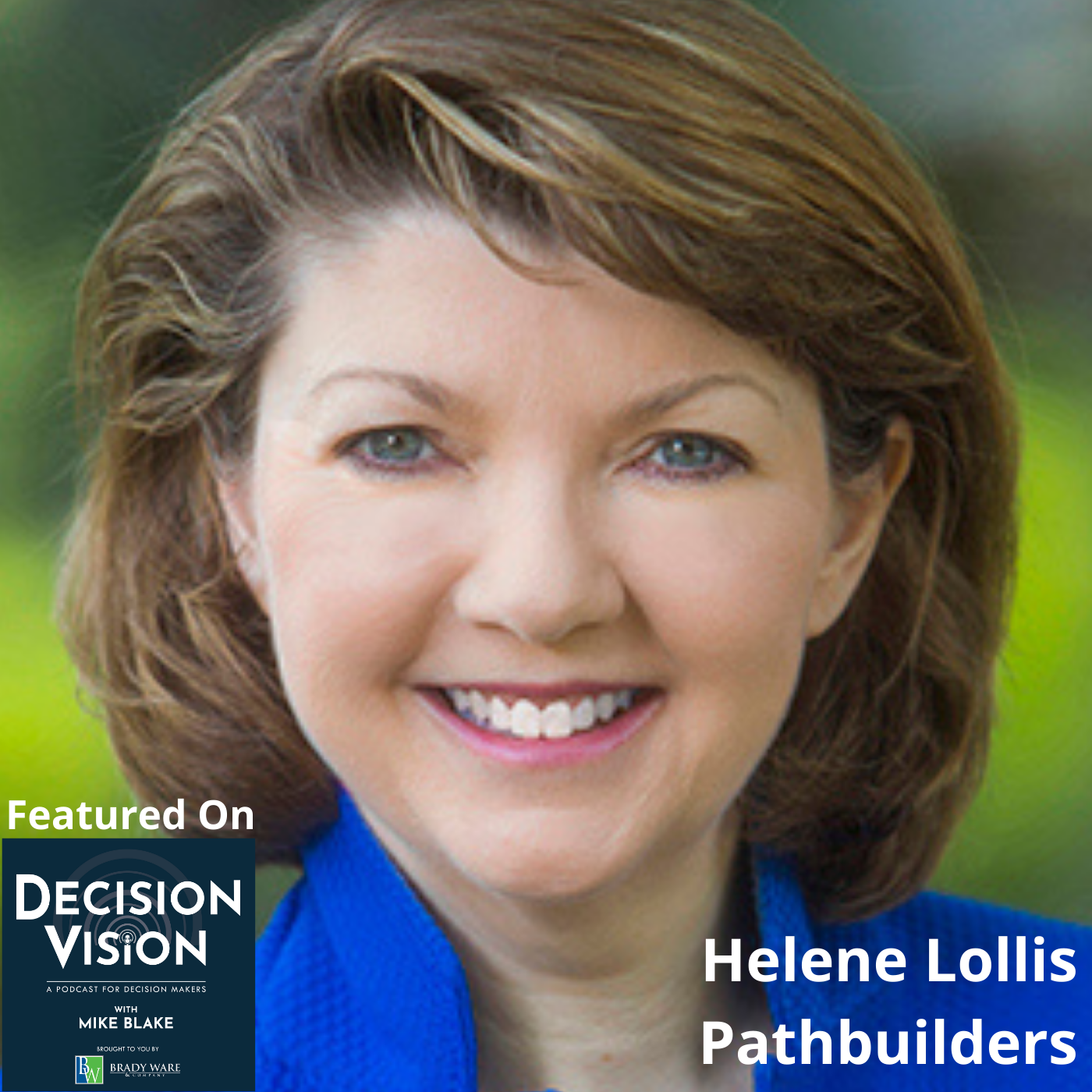
As CEO of Pathbuilders, Helene Lollis started the year 2020 planning her company’s 25th anniversary celebrations. Those plans quickly faded, however, as a pandemic created an enormous challenge for a business based on in-person learning. Helene spoke with host Mike Blake on how she guided a pivot for Pathbuilders and how the company thrived because of it. “Decision Vision” is presented by Brady Ware & Company.

Pathbuilders

Pathbuilders is a professional mentoring and leadership development company. They offer cross-company mentoring programs for women at each phase of their careers, and custom programming for organizations focused on developing high-potential women and men, creating mentoring cultures, launching women’s initiatives, and retaining key talent.Pathbuilders

At Pathbuilders, they design and deliver high-impact mentoring programs for organizations using custom tools and proven methodologies that create formalized learning environments. It is the purposeful structure and practical nature of their content that make the learnings applicable and actionable, and we pride ourselves in creating lasting mentoring relationships for our clients that directly impact retention, promotion, and satisfaction.

Company website | LinkedIn

Helene Lollis, CEO, Pathbuilders

Helene Lollis, CEO, Pathbuilders

Helene Lollis is the chief executive officer of PATHBUILDERS, an organization focused on moving women forward and increasing gender diversity in leadership. For 25 years, Pathbuilders has focused on advancing top-tier talent through high-impact mentoring, professional development, and consulting with senior executives to create cultures where women thrive. Helene guides strategic direction and program development consults with key clients and represents Pathbuilders in the community. Trained as an engineer, Helene spent 12 years with Amoco and BP Corporations in plastics process design, product development, marketing, strategic planning, and company mergers and acquisitions.

Helene is frequently invited to speak on the topics of mentoring, women in the workplace, and career planning. She has been published in HR Magazine, Diversity Executive, and Talent Management and has been featured in The Wall Street Journal. Extremely active in the community, Helene is a past chair and on the executive board of Junior Achievement of Georgia and is a Trustee of the Woodruff Arts Center, where she is a chair of its Women’s Giving Circle. She serves on the Boards of the NC State University Engineering Foundation, the Rotary Club of Atlanta, and SHRM-Atlanta and has previous board service with the Metro Atlanta Chamber and Leadership Atlanta. She is also a member of the International Women’s Forum.

Helene was proud to be recognized as one of Atlanta’s Most Admired CEOs by the Atlanta Business Chronicle in 2020. She received the Gold Leadership Award from the Junior Achievement USA Board of Directors for her service to JA. She was inducted into the YWCA Academy of Women Achievers, and she was recognized as the Guiding Star by Emory’s Executive Women of Goizueta. Helene served as a subject matter expert at The Wall Street Journal Executive Task Force on Women in the Economy. She received her bachelor’s and master’s degrees in chemical engineering from NC State and Purdue Universities.

LinkedIn

Mike Blake, Brady Ware & Company

Mike Blake, Host of the “Decision Vision” podcast series

Michael Blake is the host of the “Decision Vision” podcast series and a Director of Brady Ware & Company. Mike specializes in the valuation of intellectual property-driven firms, such as software firms, aerospace firms, and professional services firms, most frequently in the capacity as a transaction advisor, helping clients obtain great outcomes from complex transaction opportunities. He is also a specialist in the appraisal of intellectual properties as stand-alone assets, such as software, trade secrets, and patents.

Mike has been a full-time business appraiser for 13 years with public accounting firms, boutique business appraisal firms, and an owner of his own firm. Prior to that, he spent 8 years in venture capital and investment banking, including transactions in the U.S., Israel, Russia, Ukraine, and Belarus.

Brady Ware & Company

Brady Ware & Company is a regional full-service accounting and advisory firm which helps businesses and entrepreneurs make visions a reality. Brady Ware services clients nationally from its offices in Alpharetta, GA; Columbus and Dayton, OH; and Richmond, IN. The firm is growth-minded, committed to the regions in which they operate, and most importantly, they make significant investments in their people and service offerings to meet the changing financial needs of those they are privileged to serve. The firm is dedicated to providing results that make a difference for its clients.

Decision Vision Podcast Series

“Decision Vision” is a podcast covering topics and issues facing small business owners and connecting them with solutions from leading experts. This series is presented by Brady Ware & Company. If you are a decision-maker for a small business, we’d love to hear from you. Contact us at decisionvision@bradyware.com and make sure to listen to every Thursday to the “Decision Vision” podcast.

Past episodes of “Decision Vision” can be found at decisionvisionpodcast.com. “Decision Vision” is produced and broadcast by the North Fulton studio of Business RadioX®.

Visit Brady Ware & Company on social media:

LinkedIn:  https://www.linkedin.com/company/brady-ware/

Facebook: https://www.facebook.com/bradywareCPAs/

Twitter: https://twitter.com/BradyWare

Instagram: https://www.instagram.com/bradywarecompany/</a

TRANSCRIPT

Intro: [00:00:03] Welcome to Decision Vision, a podcast series focusing on critical business decisions. Brought to you by Brady Ware & Company. Brady Ware is a regional, full service accounting and advisory firm that helps businesses and entrepreneurs make visions a reality.

Mike Blake: [00:00:23] Welcome to Decision Vision, a podcast giving you, the listener, clear vision to make great decisions. In each episode, we discuss the process of decision making on a different topic from the business owners’ or executives’ perspective. We aren’t necessarily telling you what to do, but we can put you in a position to make an informed decision on your own and understand when you might need help along the way.

Mike Blake: [00:00:44] My name is Mike Blake, and I’m your host for today’s program. I’m a director at Brady Ware & Company, a full service accounting firm based in Dayton, Ohio, with offices in Dayton; Columbus, Ohio; Richmond, Indiana; and Alpharetta, Georgia. Brady Ware is sponsoring this podcast, which is being recorded in Atlanta per social distancing protocols. If you like this podcast, please subscribe on your favorite podcast aggregator and please consider leaving a view of the podcast as well.

Mike Blake: [00:01:12] So, today’s topic is a topic that we’ve visited before. We had Brandon Cooper on talking about pivoting a company. And today’s topic is, Should I pivot my company? And as I mentioned when we crossed the 100th episode threshold that, I decided that I wasn’t going to be afraid to revisit topics, because, you know, a lot of people approach the same problem or decision with a different fact set with a different fact set, with a different set of priorities and with, frankly, a different set of circumstances.

Mike Blake: [00:01:50] And, therefore, I’ve decided and the listenership seems to agree given the rise of numbers we’ve had, that it’s okay to kind of revisit a problem again and again. We’re not going to make this the pivot our company podcast or it’s all pivots all the time. But, nevertheless, I do want to come back and revisit these conversations.

Mike Blake: [00:02:12] And, of course, we have this thing called coronavirus, which as of March 25th, when we are recording this podcast, it looks like we are at least in a position where we’re seeing a light at the end of the tunnel. We’re not there. We’re not post-pandemic. I call it trans-pandemic. But we’re certainly getting there. And as many of us know, COVID has presented us with decisions we would not have ever imagined we would have needed to make. And probably if we did make them, we had to make them in a way that would have been different in the pre-pandemic environment.

Mike Blake: [00:02:50] And Brandon’s conversation was more about – or was about a circumstance where a pivot was required in a pre-pandemic scenario. But our guest today is going to come in and talk to us about the decision to pivot a company during the pandemic as a result of the pandemic. And I think a lot of companies can recognize this.

Mike Blake: [00:03:16] And even though we are emerging from the pandemic at this point, it’s still going to be instructive because we don’t know when that next external shock is going to happen. We don’t know when the next pandemic is going to happen. I mean, frankly, you know, if we’re honest about it, we don’t necessarily know that we have COVID licked. I mean, I think right now we have the upper hand, but there are mutations out there. You know, we just don’t know. So, I do believe that this is going to be somewhat of an evergreen topic for good or ill.

Mike Blake: [00:03:46] And helping us with this is my long time friend, Helene Lollis, who is the Chief Executive Officer of Path Builders. An organization focused on moving women forward and increasing gender diversity in leadership. Extremely active in the community, Helene is a past chair and on the executive board of Junior Achievement of Georgia – she’s been doing that forever, I know – and as a trustee of the Woodruff Arts Center, where she is the chair of its Women’s Giving Circle. She serves on a bunch of other boards, too, it’d take out the program to list all of them. Just take my word for it, she does a lot of stuff.

Mike Blake: [00:04:21] Helene was also recognized as one of Atlanta’s Most Admired CEOs by the Atlanta Business Chronicle in 2020. She received the Gold Leadership Award from the Junior Achievement USA Board of Directors for her service to Junior Achievement. And she was inducted into the YWCA Academy of Women Achievers and was recognized as the Guiding Star by Emory’s Executive Women of Goizueta, which is their school of business. She was trained as an engineer – which I did not know. And I’m embarrassed that I did not know this. I never asked.

Helene Lollis: [00:04:49] Why don’t you know that?

Mike Blake: [00:04:49] But she was trained as an engineer and received her Bachelor’s and Master’s Degree in Chemical Engineering from North Carolina State and Purdue University. And spent 12 years at the Amoco and BP Corporations in plastics, process design, product development, marketing, strategic planning, and company mergers and acquisitions.

Mike Blake: [00:05:08] For 25 years, Path Builders has focused on advancing top tier talent through high impact mentoring, professional development and consulting with senior executives to create cultures where women thrive. Boy, do we need that today. And Helene guides strategic decision and program development, consults with key clients, and represents path builders in the community. Helene Lollis, welcome to the program.

Helene Lollis: [00:05:30] Welcome. I wish I sent you a shorter bio.

Mike Blake: [00:05:34] No, I’m glad that we got that out there. The cool thing is, I mean, I’ve had a lot of friend whom I’ve known for some time, and it’s uncanny how many things I learn about them when I actually have to go and do the homework and learn about the bio. Fortunately, I haven’t found that somebody was like a convicted felon or anything, that might be kind of awkward, or a traitor to the state. But, you know, I did not know that you have that long background in engineering and material science before you moved into this. And at some point, I hope our conversation will come around to how does that background give you, maybe, a different perspective on the things that you do, because I suspect that it does.

Helene Lollis: [00:06:19] It does. Yeah.

Mike Blake: [00:06:20] As opposed to what I would expect a more kind of human resource background, for example.

Helene Lollis: [00:06:25] Yeah. I would tell you, my team knows every single day that I’m an engineer. You know, it’s a way of thinking. It’s a way of framing. There’s no question. And even in the processes of the things that we do at Path Builders, there’s engineering all around.

Mike Blake: [00:06:40] So, before we get into this, I’d like you to describe Path Builders. I mean, you really have been, as your bio reads, a fixture in the community. What does Path Builders do and what is the origin story of Path Builders?

Helene Lollis: [00:06:56] Yeah. So, our focus is helping companies to move women forward and to elevate their best talent every single day. And we’re probably best known for large scale mentoring programs where we match women with mentors and peers, and take them through experiential learning to really equip them to be better able to move into leadership roles inside their organizations.

Helene Lollis: [00:07:21] But if the company was actually an Anderson incubator business back in the 90s, I was a mentee, actually, in one of the programs. So, I was working for Amoco at the time. They placed me in the program as a mentee. The gentleman with whom I was matched as my mentor is still my mentor. I talk with him on Saturday. So, it clearly was rather pivotal in my own career. So, we’re probably best known for those cross-company mentoring programs.

Helene Lollis: [00:07:53] But I bought the company in 2002 after leaving BP. And, initially, kept the dynamic that the previous owners had in place, this model of mentoring women. I felt right away a couple of things. One, they were starting too late. They were kind of starting with director level women who could be officers. And if you’re serious about building a pipeline of female talent, you got to start earlier than that. And, two, we’re exclusively working with women. And to create environments where women thrive, you’ve got to be working with both women and men. So, the nutshell is, we work with organizations to move women forward. We work to really develop talent and leadership benches with both women and men inside organizations.

Helene Lollis: [00:08:40] And then, I would say, the last few years, what we have added to complement all of that is consulting at the C-suite on how do you create an environment where women can thrive and women can move forward. How do you change the dialogue in the C- suite to be around how gender is strategic to really building a great company.

Mike Blake: [00:09:01] So, you are doing that. I know you had a lot of very high profile clients. But the thing that struck me is, you’ve been working with the U.S. Military for a long time now, at least you had been. I presume that’s still the case. And then, one year ago happens, right? It was just around St. Patrick’s Day or a little bit before then, when, frankly, our world changed. So, you know, coronavirus happens. The next thing you know by, I guess, April, a lot of us are told to “shelter in place”. And what happened to Path Builders at that point?

Helene Lollis: [00:09:36] Yeah. So, I said the company is 25 years old, actually, last March was the 25th anniversary. And we had this fantastic plan that it was going to be a year of parties. And my leadership team had actually built this fantastic idea. Instead of having one big event, we were going to have a whole year of pop-up parties. And one of our clients, WesTrac, had already signed on to be the first pop-up party. And we were going to be inside all of our clients, helping them to celebrate their commitment to women. And then, a week later, we decided we’re probably not going to have at least that first pop-up party.

Helene Lollis: [00:10:17] So, long story short, I had no idea that what started out as a year thinking it was going to be celebrating an anniversary, two enormous changes. So, one, completely reinventing how we deliver. But I will also say, overnight, we shifted from being a sales driven company to being a marketing driven company. You already highlighted how much I do in the community. My whole team is out and about and it was very much being with people talking about what we do. That was one of the primary drivers of really where our clients came from. And clearly those opportunities were gone. So, I mean, not only were we shifting how we do what we do, but we were even shifting how we built the pipeline for what we do.

Mike Blake: [00:11:00] So, as coronavirus hit – and I’m curious where you kind of fall with this – my own perspective was, you know, I knew it was serious, but my own reaction was kind of incremental. Things are changing, but do I have to necessarily blow everything up to survive? I’m not there yet. So, here are five or six things I think are going to be kind of small changes and maybe we can kind of ride it out. Was that your experience, too? And if so, what were the small changes that you tried and maybe worked or didn’t work?

Helene Lollis: [00:11:35] Yeah. So, I’m fully transparent that there were four [inaudible], and I lived in each of those stages for a period of time. I mean, number one was the very simple denial, “Helene, this can’t possibly be happening. This isn’t the way we do things.” And I remember initially having that moment of paralysis of, “Oh, my gosh. We can’t do what we do in this environment.” And the reality of it was, you couldn’t survive that way, right? So, we moved to the, “Okay. If we have to, for a few weeks, do whatever.”

Mike Blake: [00:12:14] Thus bargaining.

Helene Lollis: [00:12:17] Yeah. Exactly. I can hang right with Elisabeth Kubler Ross right through this whole dynamic. Absolutely. But then, we thought, “Okay. We’ll do a couple of webinars from the basement of my house and it’ll be okay.” And it was talking about things that worked and things that did not work. We pride ourselves on flawless execution, and that means there are a lot of people monitoring different aspects of things. And so, we were doing what we deemed to be interactive workshops, but literally two of us in a basement. The rest of the team we were communicating with through Teams. And so, here, I’m trying to deliver a workshop while communicating with my team on Teams, while silently communicating with my – bless his heart – husband trying to manage the technology.

Helene Lollis: [00:13:06] And I will tell you, the morning of a huge program launch, I will never forget when the people across the street from us had one of those chipper trucks drive up in front of their house. And my husband and I are literally, like, putting together our cash. Like, could we come up with 100 bucks to make these people go away? We can’t so much of a run.

Mike Blake: [00:13:24] Wow, what a story.

Helene Lollis: [00:13:26] So, I mean, recognizing those moments – unbelievably they finished before so we didn’t have to pay them. But then, we had a client who just said, “You know what? We’ve been waiting and we don’t want to wait anymore. We’re ready to go.” And it was a client where we were working with developing all of their newly promoted managers and directors. And we had designed it as opportunities where they would be convening in one of their offices, so either in Chicago or Atlanta or New York. And it was as much about developing managers and directors to be great leaders as it was about them building a leadership team.

Helene Lollis: [00:14:05] So, the way we had designed the program was about being in-person together and relationship building. And so, we just kept postponing. We kept saying, “Well, we’ll wait until we can do that.” And they came back and said, “You know what? We’re ready to go. Figure it out, make it happen.” And so, we said, “Okay. Will you give us the space to completely redesign the program?” Because we can’t just pick it up and and pretend it’s the same online. And so, absolutely fantastic working with them. But we went back to the drawing board and we said, “Okay. So, instead of a monthly gathering, this now needs to be two week touch points.” And there’ll be certain sorts of breakout groups we do when they’re in session with us. But then, certain learning teams that they’re going to be connected to and we’ll build discussion guides and threads through all of that.

Helene Lollis: [00:15:02] So, phase three for us was, we can make – I guess that’s really phase two, we can make something that’s meaningful. Phase three, for me, was the, “Oh, my gosh. This might have some legs.” We’re actually creating connectivity, and relationship, and trust building that is not only positively impacting these people as leaders, but now they’re actually able to extend their network more broadly than they might have been able to otherwise. And then, finally, stage four for me was, this is probably something we should have done a long time ago.

Helene Lollis: [00:15:43] In the fall, we launched a program, a cross-company program completely designed to be in the online world. And first time coming out of the blocks are amazing. Clients trusted us so much. We had women from 11 states the first time we set it up to go forward. And, now, it’s such an interesting time to be having this conversation because now we’re really trying to figure out who are we going to be after, when we’re no longer trans-pandemic, as you said, but when we are perhaps actually post.

Mike Blake: [00:16:17] So, I’m going to go off-script here, because what you said and the way that you said it brings something that is, I hope, an important observation. And that is that, in all those sort of stages of grief, the one that I don’t think that you had, or at least if you did, it lasted for probably about 18 seconds, was the depression part. I think it sounds to me and knowing you as well as I think that I do, I think that this is right is that, you quickly recognized that just sort of things had to change. And you can be frustrated with it all you want, but at some point you got to solve the problem.

Helene Lollis: [00:16:57] Yeah. And, I mean, I think some of that is just a bent to the eternally optimistic entrepreneur, right? But I’d be a liar. I mean, (A) Elisabeth Kubler Ross would tell you, you don’t get to skip stages. So, clearly, I had to be there, and maybe it was a short visit point. But there were certainly moments right before going live with big offerings where that inner voice does this, “This can’t be happening to us.” But I will tell you, again, unbelievably loyal clients. Suddenly, the feedback we were getting after we got out of the basement – the basement, the feedback wasn’t too great, to be completely honest.

Helene Lollis: [00:17:43] But we were back in the office and starting to build out a Zoom studio in April and May. And I will say, largely because we had not done a lot of this, it was a brand new world for us. So, we weren’t tied to any mindset of what online delivery was going to look like. And so, I think that the creativity – and I mean, I can’t say enough positive things about the team around me – we had and the way we were redesigning to create experiential learning, we started getting such great feedback so fast that it pulled us through that curve pretty quickly.

Mike Blake: [00:18:25] So, I’m curious. I think a lot of us have had to, on some level, become amateur video and audio engineers, like it or not. Otherwise, I mean, you just can’t communicate. And as much as sort of Zoom and other platforms are interesting, one, they don’t all work the same. And number two, they are not the realization of AT&T’s video phone. You don’t just simply pick up the handset and you’re talking to somebody on video.

Mike Blake: [00:18:57] What was it like? Were you energized about the opportunity to pick up an entirely different skillset? Was your team energized about that? Were they scared? Were they frustrated? Was it a cocktail of all three? What was that like?

Helene Lollis: [00:19:11] Yeah. I don’t know that any of us took the time to contemplate it as a wonderful learning opportunity. I don’t know that that one existed. I will tell you what the team says to me. The team says to me, there was just never a moment – and I guess they mean me – at which I wasn’t just saying we are going to do this. Like, it’s just we must, we will. The mission is too important, we’ve got to continue doing what we’re doing.

Helene Lollis: [00:19:48] I will say, though, you are absolutely right in terms of this team of people who were expert at making something happen in a big ballroom, suddenly becoming producers, and onscreen personalities, and learning so fast that, quite frankly, we were doing it before we even understood what we were doing because necessity drove us to do that. So, I don’t know, I mean, I think now in retrospect, it’s easy to look back and think, “Oh, my gosh. What a fantastic learning year it was”. In the moment, you just kind of feel like you’re living in the hell of, “Okay. I don’t know.” And I can remember any number of times where we would be getting ready to go live with a couple hundred people from all over the country coming on. And we would all just kind of look each other in the eye and say, “Here we go.” I lost you.

Mike Blake: [00:20:47] Yeah. We’re going to push this button and hopefully it works, right?

Helene Lollis: [00:20:50] Okay. Yeah, yeah. Crossed fingers.

Mike Blake: [00:20:53] So, I want to be clear, you know, comparing kind of pre-COVID Path Builders to post-COVID Path Builders, what are the big differences? Or if you had to describe the before and describe the after, what do those look like?

Helene Lollis: [00:21:08] Yeah. So, the bulk of our work was, literally, we have rented a tremendous amount of ballroom space in the Atlanta area and we have traveled to our clients. So, while we don’t have offices in other locations, we’ve always gone wherever clients are. And so, if I go back even just the year before the pandemic, I spent a lot of time in New York. I had clients in Texas, and California, and Chicago, and wherever clients needed us to be live.

Helene Lollis: [00:21:43] And we pride ourselves on part of the development experience is rich interactive peer exchange. So, what it looked like was, somebody facilitating a workshop, tabletop exercises, super thoughtful seating arrangements that propagated networking, teaching people how to have dialogue and conversation. But I will also say that much of our work is surrounding creating powerful mentoring partnerships. And so, we always met every single individual with whom we were working individually for what we used to call an hour long behind closed door interview.

Helene Lollis: [00:22:27] And so, Mike, I was skeptical if even the interview piece would be able to have the same integrity to it, to really understand what was making people tick, and what their opportunities were, and what their challenges were. But if I had to come down to one element that gave me the greatest pain, what we go through when we first introduced a mentee to a mentor, we have to be really focused on the fact that we don’t want people to have preconceived notions because we’re creating mentoring partnerships that would never happen on their own.

Helene Lollis: [00:23:02] And so, if people are prejudging their partner before they meet them, that works against us. And so, when mentee and mentor meet for the first time, the first couple of experiences that they have together was always pretty carefully planned in a live environment and recreating – I wouldn’t for a second dismiss how hard it was to get all the technology in place to do what we do. But when I think about the big lift, it was, how do we redesign moments of individuals interacting so that the same sort of trust building relationship can be there to create the vulnerability that we know has to be there or people just don’t grow.

Mike Blake: [00:23:42] So, as you say that, a thought occurs in that. I wonder if Path Builders in some respects is impacted even more than most because, not only is your service delivery impacted, but the downstream effects after your service delivery and how you’re training people to communicate and build relationships are now impacted, right? It’s not just that you have to deliver things over video, but, now, how do you be an effective mentor remotely? How do you build real relationships virtually? And that may or may not be the most desirable goal, but, you know, July of 2020 is all you got. And some of that is probably going to stay. I think most of us think that some of that’s going to stay. In what proportion? That remains to be seen. And so, I’m curious, is that also kind of a part of the calculus that makes that sort of extra challenging for you guys?

Helene Lollis: [00:24:52] Yeah. So, you’re absolutely right on that. The creation of a lasting relationship. I mean, I commented at the top of our time that I’m still connected to my mentor and that, 20 years later, is still my mentor. That emotion of, will we do enough for that to even be feasible? Again, I will tell you that what it took was being highly prescriptive. Like, where it used to be, we kind of celebrated how we put people together. But then, we gave them a little space to be natural. We couldn’t afford that anymore because, now, it’s the silence of before a conversation and after a conversation, which we all know creates a degree of awkwardness.

Helene Lollis: [00:25:35] And so, thinking about how we were using music and what were the first questions they would ask each other, I mean, all of that was so highly scripted to bring them to a point where we knew that they would go forward. But, now, in answer to the question that you closed with there, Mike, the thing that had us so getting out of bed in the morning right now is the more senior people we work with, we’re always going to be at a level where their companies would pay to put them on an airplane to go someplace. When I think of the work we’re doing with manager level individuals who now have an ability to build a national network, that was never going to happen without this.

Helene Lollis: [00:26:19] We launched a program in three weeks, it’s one of our programs for women new managers. It’s got women from 15 states in Canada. And the thought that those individuals, on a monthly basis, are building close trusting personal relationships with women from all across the country, that was never going to happen for them at the manager level before. So, it absolutely informs where do we go from here?

Mike Blake: [00:26:46] That’s fascinating. That went in a direction I did not anticipate. But you’re right, I mean, to me, what you’re really talking about is that, it enables you to scale your impact in a way that just simply would not have been possible in person. The benefit of digital today is scale.

Helene Lollis: [00:27:04] Yeah. Yeah. And I will tell you, I’m in a CEO peer group. We just, in the first quarter, did our go around the room and tell each other what we do well and what we suck at because we’re peers and that’s what we do for each other. And to a person, my whole group said, “Fantastic watching how you pivoted. Hate that it took a pandemic to make it happen.”

Mike Blake: [00:27:31] It’s that classic necessity being the mother of invention, right? But it also created the conditions, too. Because, you know, in the start of this thing, many of us are resistant. We really resisted Zoom. You know, we talk about Zoom fatigue and I got to do Zoom calls. And I can’t speak for other people, but for myself, I’ve gotten used to Zoom now. I’ve gotten used to seeing my mug on camera. And become more comfortable that it’s not nearly as emotionally and mentally draining as it once was. You know, the pandemic also created the conditions, I think, for a market that was receptive to this kind of delivery.

Helene Lollis: [00:28:13] Agreed. Yeah. I will tell you, though, you asked earlier around learnings and things that we extracted from things that were challenging. One of the things we never saw coming was, we need to be brokering very different conversations with our clients about the expectations that they are putting on their people. And so, what I mean by that is, like, we just assumed if we have an event, people show up and they listen. And the downside of what you just said with that comfort is, I have watched far too many people start to move into a mode of audit. That, quite frankly, the work that we do, where we’re focused on experiential learning, doesn’t play well in audit mode.

Helene Lollis: [00:29:03] And, quite frankly, it causes us to be very provocative with participants in our programs about, if you’re auditing today, how much of your career are you auditing? And, literally, recognizing now that when we go inside a client, we’re having to have conversations with the client around, “We need you saying to your folks this is a cameras on experience. This is a get into breakout groups and have dialogue.” Because one of the things we have learned looking over the past 12 months is, you having your camera off in a breakout room doesn’t only negatively impact you from the lack of exposure. It’s impacting the other people in the room.

Helene Lollis: [00:29:43] And I’ll tell you the quote one of the women shared with us. She go into a breakout room and somebody’s got their camera off, “It’s like there’s this big black creepy box sitting there. And I wonder if the big black creepy box is listening to me or if it’s going to speak.” And I think we’ve got to be really clear, especially as we start to move into hybrid mode now, we’re talking a lot with our clients around what are the norms that you’re putting in place so that folks don’t live in audit mode?

Mike Blake: [00:30:12] Yeah. That’s interesting. And the one thing, I think, the technology has not yet fixed in-person and maybe virtual reality will be the thing that crosses that. But, frankly, it’s just knowing that the people in the room are paying attention. The downside to virtual is that, it’s too easy to pretend that you’re paying attention when you’re not. And, yeah, I can imagine that. In particular, if a leader looks like they’re “in audit mode” what a disastrous message that sends to the rest of the group.

Helene Lollis: [00:30:50] Well, and as somebody who’s been accustomed to working with large groups in ballrooms, I always had the ability to walk over to a table and stand near someone and make them uncomfortable. I don’t have that ability any longer. And, you know, when you’re in the space of developing people, people have to want to be a part of that. But I’m also going to be super frank, one of our biggest challenges is, there’s a lot of really lousy online stuff out there. And if you’re entering with the mindset that this is going to be another lousy online thing. And then, we’re bringing you together, tossing you into a breakout, and telling you to go on a scavenger hunt in your house as a way to get to brainstorm what it’s like to work with people, and you’re in a mode of thinking you’re going to show up and have your camera off were a little bit of a surprise.

Mike Blake: [00:31:50] Yeah. So, I want to ask you a question that may be blatantly unfair, but I’m going to kick myself if I don’t ask the question. And your response to the last one sort of led into it. And that question is this, is a digital relationship perhaps even better for women with the challenges they face? And I mean two things. One is, for good or ill, women still bear primary responsibility for home management and child development. And that, in my view, unfortunately, has not changed materially. And you can’t fix that. But at least the digital world, I think, in some cases gives a woman a fighting chance to balance some of that or at least levels the playing field where you’re not present, where some of your other cohorts are also not present for certain things. And you know as well as I do, that lack of presence, whether consciously or unconsciously, can be a barrier to career development.

Mike Blake: [00:33:00] And the second – and I have to ask this question, because it just begs the asking – frankly, is it safer for women? We both know – you know, I’m sure, a hundred times more than I do – the workplace can be very predatory towards women in certain cases, right? We have a governor in New York that seems like every day has got another allegation. And I don’t know if they’re true or not, but it’s bad optics at the minimum. At least in the digital world, do women feel safer? Is the digital world potentially a leveler of the playing field for some of the women that you’re coaching?

Helene Lollis: [00:33:42] Yeah. I mean, it’s an interesting question and I think it’s going to be something that we’re all challenged with as we start to think about this whole return to work, back to work mindset, and what that is. I will tell you, we’re working pretty closely with women to get them today thinking about the strategy of what return to work looks like for them. Because you’re absolutely right, and I’ll add to your list that women, in addition to child care, it’s elder care as well. So, I mean, it’s on every side of the spectrum, right, that women take the challenges on.

Helene Lollis: [00:34:19] I mean, I will say, I agree that there is an access element that is probably positive. There are no question women that, because of getting kids on the bus, miss and choose not to participate in things if I have to drive an hour someplace to get to an experience. So, no question that access element is there.

Helene Lollis: [00:34:45] I will tell you, we have mentoring partnerships where both mentee and mentor, especially in an environment where we’ve got about 80 percent of our mentors repeat from year to year, mentors are telling us that in some cases they actually feel like they’re getting to a degree of depth faster than they did when there was a lot of we’re eating breakfast or lunch and we end up talking about a lot of random things. Part of that is the online world. Part of that is what you just said, the comfort we’re all building with Zoom.

Helene Lollis: [00:35:19] I hesitate to jump into your thread of safety only because, at the end of the day, there is a real world and we need to be in it. And I do not think that the answer is just extracting ourselves from that reality as a way to advance in that reality. And I feel that we absolutely have to be really strategically thinking. I mean, Wall Street Journal had a whole section last week around this whole idea of what return to work is going to look like, what hybrid is going to look like. And one of the huge challenges managers are facing right now is figuring out, “How do I make sure that I’m continuing to create exposure opportunities for individuals to have informal conversations?” This world is particularly challenged in creating informality.

Helene Lollis: [00:36:17] So, I totally see why the depth of a mentoring conversation actually might be there online. What we are hearing so loud and clear from women, Mike, is, they didn’t realize how much learning there was from the, “I’m in the middle of a meeting and the senior leader turns to me and says one quiet thing and that becomes a launch point for something.” Or,” I hang around five minutes after the meeting and get to express my interest in being on that new project.” And the loss of that informal interaction, I think, from a long term standpoint would exceed the benefit of what you’re talking about.

Mike Blake: [00:36:57] Interesting. Okay. So, getting back to the topic at hand, we’ve talked about your service delivery having changed as a result of the pandemic. Has it impacted your business model at all? For example, it occurs to me there might be an opportunity for more modular offerings or things that are prerecorded. I don’t know if you’re pursuing that, but it seems to me there might be opportunities to have a more diverse business model as a result of the pandemic. Is that something you’ve thought about? And if so, what are your thoughts on that?

Helene Lollis: [00:37:36] Yeah. So, you know, it’s interesting, the video thing comes up a lot. And our model is so interactive. Our model is so driven by scripting what the conversation is that you’re going to have in a breakout, and mixing you into a different breakout, and having that experience. So, I will say, yes, there are absolutely elements of the model that are changing. So, in addition to the large scale programs that we run and the custom programs that we do inside organizations, we also have public programming.

Helene Lollis: [00:38:12] And maybe a week ago, it became evident to us, “You know what? Public programming is never going back to a ballroom.” Like, that will forever be something that is all around reach and making sure we are getting more and more, in this case, women focused on great content, great ability to interact. I will also say that, clearly the business model has changed in terms of the ability to work with global clients. And so, we have organizations now where, you know, we do each workshop several times and we pick up the team in Israel at one time a day. We pick up the team in Asia at another time of day. And in a world where that used to mean jumping on an airplane and now, absolutely, we’re able to design series for global clients in a way that we’ve never been able to before.

Helene Lollis: [00:39:08] I will also just say that, as we look at this world of not only the program execution, but the consulting, we work with C-suite leaders to really help increase their awareness around gender diversity, change their dialogue around diversity, get them to think about their talent plans. And one of the biggest hurdles that has typically been in place for us to have a great session with a C-suite is their ability to be in the same place at the same time. And so, absolutely, that is an added opportunity that now we’ve got an ability to convene those individuals and, I think, be able to have at least more frequent touches. It would be like, “Okay. They’re going to be together this day, pack it all in. We’re going to do a four hour session.” Where, now, we’ve got the ability to really thoughtfully think how do we move an executive team’s awareness because I can work with them for individual hours instead of a four hour session. Does that make sense?

Mike Blake: [00:40:12] It does make sense. And it also, for me, raises the question then, has the pandemic with digitization or digital transformation, has that led to opportunities maybe for longer term times of engagements, too? Because I imagine in your world, you do a workshop and the way I’ve understood workshop – I’m not a workshop guy – you’ve had to basically get the unanimous consent of the UN General Assembly to get all the people at the same time. They’re going to commit. They’re going to be there in the same room, same time for four hours, go. And if you don’t do it in that four hours, it all blows up. And the plan is still in line for five years.

Mike Blake: [00:40:57] And on the one hand, I can see the value in the intensity of that. But on the other hand, it seems to me that it opens up now a vista or an opportunity of a different kind of instruction that can be delivered over time, which has some benefits over a one shot intense kind of workshop.

Helene Lollis: [00:41:20] Yes. So, we’ve never been one shot, intense kind of workshop people. But I will say, you’re absolutely correct in this environment aligning better with that. So, our model has always been those one shot things are great if you want to inspire people and charge them up. It’s not going to develop people. Development is a step-by-step process over time where you try some stuff and then you’ve got people you can talk about with what worked and what didn’t work. And then, you try some more stuff. And so, absolutely, this format allows us, I think, to be more impactful with that, because of what you said, it’s hard to get everybody to fly into the Chicago office to do that.

Helene Lollis: [00:42:04] My sense is where we will evolve to, is, there will be moments in programs that are like that. There will be a big kickoff where it is live and in-person. But then, the execution throughout the months that follow, the beginnings, endings, things like that. But, absolutely, this format lends itself to that ability to make sure we’re having that high touch connectedness that really allows development to happen.

Mike Blake: [00:42:36] Do you ever record any of those interactions?

Helene Lollis: [00:42:38] Yes. So, I will say that is different. It did used to be a world where, if you missed, you missed. And so, absolutely, now we’re recording so that if something does happen on that day or whatever happens, yeah. So, now, we’re writing into all of our contracts with clients that we will record and make that available for the term so that people can get up to speed. So, certainly, that’s a new add that wasn’t there before.

Mike Blake: [00:43:06] We’re talking with Helene Lollis of Path Builders. And the topic is, Should I pivot my company? Is there anything from pre-pandemic Path Builders that you’re still trying to figure out how to bring into trans and post-pandemic Path Builder? Something that still is a work in progress that you want to make sure carries over?

Helene Lollis: [00:43:27] Yeah. So, yes, and it’s funny because we were holding out and we weren’t going to do it. And folks came to us and said you need to do this. So, we’ve identified what we see as the four key stages in a woman’s career. And so, entry level women, women learning to manage, women learning to lead leaders, and then executive suite women. At the executive level, we have always hosted these intimate, small, invitation only dinners, where we bring together women that are all facing the same sort of issues. And it was always a lovely private club, nice dinner, nice wine opportunity to come together. But really to dive into really substantive issues that maybe you can’t talk about all the time. And almost in that vision of the officers club where you get to have some of those conversations. And we had just been avoiding it, Mike. We just were like, “Oh, we can’t do and bring you dinner.” And women came to us and said, “What’s up? Like, we’re ready to have one of these.”

Helene Lollis: [00:44:36] So, literally, a couple of weeks ago, we moved heaven and earth and worked with this fantastic little wine shop in Atlanta where they created these special little wine and cheese plates. And we had them TaskRabbit it all over the city. And then, oh, my gosh. Two people from Florida signed up. And, oh, my gosh. Somebody who just happened to be skiing in Colorado signed up and somebody in Richmond signed up. And so, suddenly, we were working with all of these different little shops, sending little bottles of wine and food.

Helene Lollis: [00:45:13] There’s still something so magical about creating those safe environments where we get to have conversation. And there’s a social element to it as well. And, you know, they loved the first one. I’m not so sure my team did. It was a little bit of a lift, maybe all of that happened. But, clearly, we’ve got to be able to come back to do something and maybe it evolves to where it travels from city to city.

Mike Blake: [00:45:42] So, as you look back at your transformation, are there any decisions you look back and said, “You know what? If I had to do that over again, I would have done it differently or sooner or later.”

Helene Lollis: [00:46:03] Wow. Yeah. You’d think I would have been prepared for that question.

Mike Blake: [00:46:09] I mean, maybe the answer is no. I mean, maybe you’re happy with everything the way turned out, and that’s fine.

Helene Lollis: [00:46:13] You know, I don’t know, that is not to make it sound like it was easy. That is not to make it sound like there weren’t things that we didn’t do particularly well. I’m just not one for regret much. I mean, things that didn’t go well, we fixed it the next time. Yeah. Now, if I think back to those first couple of webinars in our basement, I wouldn’t mind erasing that from my memory. I will tell you, the very first that we did out of the basement was a group mentoring program where there are three men. So, everybody’s from different companies, three mentees, one mentor. And I’m not going to remember, but maybe there were 40 or some odd groups. And I will never forget the first time we hit that button to go into breakout rooms. And I think it took us half-an-hour to get everyone in breakout groups, which now totally cracks me up since that’s now a 30 second activity.

Helene Lollis: [00:47:13] But, yeah, was there stuff we didn’t do well? Absolutely. I don’t have regret. I think everything we did, we learn from, and we may have changed it. But maybe we needed to screw that up to be able to figure out what it needed to look like going forward. And I hope that doesn’t sound too gratuitous. I’m not sure I would actually do it differently.

Mike Blake: [00:47:35] Well, look, I think if it’s true, it’s not gratuitous. So, you know, if you think it’s true, I’m sure that it is, so that’s fair. And you said yourself, the first few webinars, you know, that’s a learning curve. We’ve all had to learn how to present in this world. And, for me, you do much more presenting than I do because that’s what you do for a living. The first few webinars I’ve done over Zoom, where you have to generate all the energy yourself, there’s no audience to generate it from, they look like hostage tapes, man. Literally, it looked like I was kidnapped someplace and they just ripped the duct tape off of my mouth. And you’ve got to free some people out of a German prison somewhere or I’m not going to get let out by this people. They’re that bad.

Mike Blake: [00:48:29] Yeah. I will tell you, though, I mean, it’s caused us to think about – I mean, the bookends on a meeting are silent, which is such a different norm. One of the things we focused on a lot is sound and feeling and how there’s got to be music on the way in.

Helene Lollis: [00:48:47] And one of the things I was most struck by was, early in the pandemic, one of our participants said to us that she missed the energy of the room. And when we did a deep dive on that, what we really recognized was, when you’re surrounded by other people who care about what you care about, even if you aren’t hearing the words of the conversation, the energy of that conversation when everybody cares about the same thing, opens you up to listen in a way that isn’t there when it’s silent and you’re sitting at your home PC drinking a cup of coffee. And then, boom, it turns on and somebody is speaking.

Helene Lollis: [00:49:27] Like, none of that preparedness for embracing insight and knowledge is there. And you’re absolutely right, I mean, we’ve worked really hard how do we create mood and how do we really think about. So, I mean, this is perhaps a silly little thing. But now that we’ve done it, it’s another thing that we think we’ll probably never go back. We now create welcome kits for all of our participants, where a box comes and it’s a Path Builder’s box. And you’ve got your Path Builders pen, and your Path Builders coaster, and your Path Builders – now, we’re doing ring lights for their laptops. I mean, we need to do something for them to feel that sense of connectedness and togetherness that they might be getting if they were in a ballroom together. But, now, that I think of some of those elements, that’s some of the stuff that just won’t go away.

Mike Blake: [00:50:22] You know, it’s really interesting, that just gave me an idea I’m going to steal from my own practice. I mean, the move to virtual and digital does provide an opportunity to embrace a different kind of client onboarding. And who doesn’t love to receive a welcome kit? And it could be stupid. It could be one of those stress balls or whatever, and maybe a COVID mask or something – I don’t know. A little go on or some big ass mug or something like this. But, you know, it’s those those simple things. And even grown ups like to receive something in the mail that isn’t a bill. It’s something that they didn’t pay for. That just is never going to go away, right? I may steal that idea. That’s a great client onboarding idea.

Mike Blake: [00:51:10] Helene, you’ve been very generous with your time and I want to be respectful of that generosity. But I’ll close the question I always close with, which is, if one of our listeners or some of our listeners have a question that we didn’t cover, they like to go into more depth than we were able to today, can they contact you with questions about how you pivoted? And if so, what’s the best way to do that?

Helene Lollis: [00:51:32] Yeah. Absolutely. And thank you for asking. So, website, pathbuilders.com, I’m sure is the easiest. Not to be confused with Pathfinders because the car makes people think Pathfinders. We’re actually Path Builders. But I will say, not only about pivoting, but, Mike, I feel like we’ve gotten such insight into what could be holding women back right now in this – I’ll go with your phrase – trans-pandemic environment. And if that’s something people find value in talking about as well, I’d love to talk with folks about that.

Mike Blake: [00:52:05] Excellent. Well, that’s going to wrap it up for today’s program. I’d like to thank Helene Lollis so much for joining us and sharing her expertise with us. We’ll be exploring a new topic each week, so please tune in so that when you’re faced with your next business decision, you have clear vision when making it. If you enjoy these podcasts, please consider leaving a review of your favorite podcast aggregator. It helps people find us that we can help them. Once again, this is Mike Blake. Our sponsor is Brady Ware & Company. And this has been the Decision Vision podcast.

 

Tagged With: Brady Ware, Brady Ware & Company, gender diversity, Helene Lollis, mentoring, mentoring women, Michael Blake, Mike Blake, Pathbuilders, pivoting your business, Women in Leadership

Decision Vision Episode 92: Should I Pivot? – An Interview with Brandon Cooper, Aphid

November 19, 2020 by John Ray

should I pivot
Decision Vision
Decision Vision Episode 92: Should I Pivot? - An Interview with Brandon Cooper, Aphid
Loading
00:00 /
RSS Feed
Share
Link
Embed

Download file

Decision Vision Episode 92:  Should I Pivot? – An Interview with Brandon Cooper, Aphid

The question of “should I pivot?” is not just a question for a pandemic, but one businesses are often confronted by as markets grow, target customers change, and competition arises. In this edition of “Decision Vision,” Aphid Founder & CEO Brandon Cooper tells host Mike Blake the engaging story of his company’s pivots and what he’s learned along the way. “Decision Vision” is presented by Brady Ware & Company.

Brandon Cooper, CEO, Aphid

Aphid is a financial technology company and ecosystem that specializes in Internet-related services and products utilizing Artificial Intelligence and Blockchain technologies.

Brandon has over 15 years of experience in Information Technology, graphic design, and over 6 years of chat support. His specialty is in machine learning, and blockchain technology. Cooper has been featured on Steve, NBC, MTV, FOX, and more.

He holds a degree from Michigan State University in Marketing and Merchandising Management.

LinkedIn

Company Website

Company LinkedIn

Mike Blake, Brady Ware & Company

Mike Blake, Host of the “Decision Vision” podcast series

Michael Blake is the host of the “Decision Vision” podcast series and a Director of Brady Ware & Company. Mike specializes in the valuation of intellectual property-driven firms, such as software firms, aerospace firms, and professional services firms, most frequently in the capacity as a transaction advisor, helping clients obtain great outcomes from complex transaction opportunities. He is also a specialist in the appraisal of intellectual properties as stand-alone assets, such as software, trade secrets, and patents.

Mike has been a full-time business appraiser for 13 years with public accounting firms, boutique business appraisal firms, and an owner of his own firm. Prior to that, he spent 8 years in venture capital and investment banking, including transactions in the U.S., Israel, Russia, Ukraine, and Belarus.

Brady Ware & Company

Brady Ware & Company is a regional full-service accounting and advisory firm which helps businesses and entrepreneurs make visions a reality. Brady Ware services clients nationally from its offices in Alpharetta, GA; Columbus and Dayton, OH; and Richmond, IN. The firm is growth-minded, committed to the regions in which they operate, and most importantly, they make significant investments in their people and service offerings to meet the changing financial needs of those they are privileged to serve. The firm is dedicated to providing results that make a difference for its clients.

Decision Vision Podcast Series

“Decision Vision” is a podcast covering topics and issues facing small business owners and connecting them with solutions from leading experts. This series is presented by Brady Ware & Company. If you are a decision-maker for a small business, we’d love to hear from you. Contact us at decisionvision@bradyware.com and make sure to listen to every Thursday to the “Decision Vision” podcast.

Past episodes of “Decision Vision” can be found at decisionvisionpodcast.com. “Decision Vision” is produced and broadcast by the North Fulton studio of Business RadioX®.

Visit Brady Ware & Company on social media:

LinkedIn:  https://www.linkedin.com/company/brady-ware/

Facebook: https://www.facebook.com/bradywareCPAs/

Twitter: https://twitter.com/BradyWare

Instagram: https://www.instagram.com/bradywarecompany/

Show Transcript

Intro: [00:00:01] Welcome to Decision Vision, a podcast series focusing on critical business decisions. Brought to you by Brady Ware & Company. Brady Ware is a regional, full-service accounting and advisory firm that helps businesses and entrepreneurs make vision a reality.

Mike Blake: [00:00:20] Welcome to Decision Vision, a podcast giving you, the listener, clear vision to make great decisions. In each episode, we discuss the process of decision making on a different topic from the business owners’ or executives’ perspective. We aren’t necessarily telling you what to do, but we can put you in a position to make an informed decision on your own and understand when you might need help along the way.

Mike Blake: [00:00:42] My name is Mike Blake, and I’m your host for today’s program. I’m a Director at Brady Ware & Company, a full-service accounting firm based in Dayton, Ohio, with offices in Dayton; Columbus, Ohio; Richmond, Indiana; and Alpharetta, Georgia. Brady Ware is sponsoring this podcast, which is being recorded in Atlanta per social distancing protocols. If you like this podcast, please subscribe on your favorite podcast aggregator and please consider leaving a review of the podcast as well.

Mike Blake: [00:01:10] So, the topic today is Should I Pivot My Business? And in one sense, you might look at this topic and think, “Well, doesn’t everybody pivot my business?” Our producer, John, and I were talking a little bit before we started the program and, well, doesn’t everybody’s business pivot? Because there are not many businesses that are static throughout their existence, right? Maybe if you’re an electrical utility, maybe if you’re in some kinds of real estate, maybe if you’re in some kinds of mineral industries, maybe that’s true. But for the most part, most businesses do find themselves in what they would think is a pivot every day.

Mike Blake: [00:01:55] But I’m not talking about that. I’m putting my startup hat back on today. And I don’t put it on often because I want the show to be more of a generalized business show and not just focused on startups, but this is something that I think is more applicable to startups. And in the coronavirus environment, I think that this topic should be, at least, thought about or on the radar screen of even established companies.

Mike Blake: [00:02:25] And so, what I mean by a pivot, to not put too fine a point on it, is you’re in one business one day, and then the next day, you come to the realization that the business you’re in is no good. And it’s most likely no good because the need that you thought was in the market just isn’t there or, at least, not in the manner that you can effectively address it. Or if you’re in the coronavirus timeframe, your business Feb. 1 looked great. And then, by June, your business doesn’t look great, right?

Mike Blake: [00:03:06] If you’re a restaurant, and I know restaurants are places that we will never do takeout, right? Well, that restaurant did one of two things. They either pivoted to take out or they weren’t a restaurant anymore unless they had a big pile of cash they’re sitting on. Hotels are are pivoting. They’re renting out their rooms now, not to people who are traveling, but they’re renting them out to people like me who are working from home, and then come to the realization that if they stay at home one more day, they’re going to get either fired or they’re going to go crazy because of their family. And people are sort of taking these refugees and that’s what hotels are catering to.

Mike Blake: [00:03:51] So, even in a conventional industry, companies are are pivoting, for sure. I would even argue, Apple Computer back in 2007 pivoted from being a computer company to a mobile device, and software, and media service and sales company. They started that pivot. And now, they’re well along the road. General Motors is very much pivoting towards becoming an electric vehicle company because they see the handwriting on the wall, like it or not, gas-powered cars are going away sometime in our lifetimes. At least, new ones will be. And the list goes on and on.

Mike Blake: [00:04:33] Well, if you’re in a startup, the necessity to pivot, at least, the potential is a way of life. And some startups have to pivot multiple times, and we’ll talk about that. But what you find is nobody really talks about pivoting because pivoting is not really sexy. Pivoting is necessary. It’s often ugly. It’s a survival mode. And you find out who your friends really are in the pivot. And then, after you successfully emerge from the pivot, everybody’s your friend again. Everybody wants to interview you again, and you’re the darling of the startup world.

Mike Blake: [00:05:08] So, it’s a topic I really want to sink my teeth into. And you know what? It’s hard to find a guest that wants to talk about a pivot because it is tough. You have had to admit a setback to your business. And so, it takes somebody that has a willingness to be vulnerable, that has a lot of emotional intelligence that is willing to come out and publicly talk about the pivot. And fortunately, found somebody great who’s going to talk about that with us. And that person is Brandon Cooper, who is joining us from California. And he is the CEO of Aphid.

Mike Blake: [00:05:43] Aphid is a financial technology company and ecosystem disrupting the 9:00 to 5:00 workforce, using artificial intelligence and blockchain technology. And they’re preventing what’s called the singularity, meaning that robots take human jobs, and robots basically think independently and become sentient artificial life forms. From Detroit, Michigan, Brandon is a serial entrepreneur and inventor. He’s an expert in blockchain and machine learning, has over 15 years of experience in information technology and graphic design, and over six years in client support. He specializes in machine learning and blockchain technology. Brandon’s been featured on Steve, NBC, MTV, Fox and more. He owns a Degree from Michigan State University in Marketing and Merchandising Management. Brandon Cooper, thanks for coming on the program.

Brandon Cooper: [00:06:36] Thank you for having me. Glad to be here, Mike.

Mike Blake: [00:06:39] So, Brandon, did I get it right when I described what a pivot is? Do you think I got that description right? Is there something you want to add or change?

Brandon Cooper: [00:06:47] No, you’ve hit the nail right on the head. That’s exactly what it is. Basically looking at businesses and deciding to take a turn down a different street.

Mike Blake: [00:06:59] So, let’s go to pre-pivot days. How long ago did you do your pivot?

Brandon Cooper: [00:06:59] I’ll completely unveil everything, and these are things that I don’t talk about. But as you know, a lot of people don’t like to talk about pivot. As you said, it isn’t sexy. But we had the company a long time ago. This is when I was just really just trying to conceptualize something. It was AphidByte, and we were trying to prevent the piracy protection. So, we would put these Easter eggs hidden encryption into music songs and, also, into video files, so when people were streaming it, midway, we’ll cut them off and say, “Hey, go to iTunes.” Hey, go to whatever outlet it is to actually buy it, right? And these big companies were going to pay us money. We just flood the internet with all of these things.

Brandon Cooper: [00:07:54] I mean, I’m tired running into these aphids. And then, I said, “Yeah, that’s a great business for large enterprises and movie companies like Universal and Warner Brothers, but people are going to hate us.” So, that was short-lived, and we dropped it. And then, I saw that streaming was coming into effect. I knew that Spotify was going to change that. That’s what Sean Parker really wanted to do with Napster anyway, but just did not formulated him and Shawn Fanning. But I saw the streaming was coming, so I knew that there was no business there. So, I really just shelved the company and didn’t do anything with AphidByte any more at the time.

Brandon Cooper: [00:08:34] And in the midst of that time, I did different ventures, just trying to find my way, just looking for different projects to try to work on them. And I’m naturally an inventor. I worked on a project called Proximity that, basically, can show anyone in a room nearby, and you can get all that information with one button as long as they allow it to be seen. So, it destroys business cards. So, different projects like that I worked on. And then, I resurrected AphidByte in about 2017-2018. We were looking at the creative economy, seeing there are a lot of media people who aren’t making much money in the industry. These companies take a big chunk out of the record companies that take a lot of money. So, I was just looking at how to use blockchain technology and things like that with AphidByte.

Brandon Cooper: [00:09:23] So, we made two pivots. And as you’ve mentioned, we’ve changed everything over to AI and that’s the final pivot. This is what we are. I wanted to make sure when we went to market that we established our identity with automation and artificial intelligence. So, I pull back on the marketing and made a tough decision. There are people in the company at that time who didn’t really like the pivot, and they wanted to kind of stick with what we had, and I made a decision, and people left the company, and they’re great people. I’m sure that they didn’t leave because they didn’t believe in the pivot. They probably just got a little exhausted on the change, but I did what was best for the company. So, now, we have Aphid. No Byte, just Aphid.

Mike Blake: [00:10:08] So, I want to talk a little bit about the times leading up to those pivots, either one or both, however you want to answer this. But you tell me if I’m wrong, but I imagine that there was some sort of struggle, if you will, for lack of a better term, to kind of make that business work, right? I would imagine you would have thought that if you tweak X and Y, or change A and B a little better, then the core business is still potentially viable. So, if that’s true, what were the kinds of things that you tried and, I guess, ultimately, didn’t work that, then, led you to the conclusion that that business just was not going to be viable?

Brandon Cooper: [00:10:54] For the initial business premise, streaming was coming into effect. So, I knew that it was going to be dead in the water, where piracy is not going to matter as long as people are paying $10 a month to use Apple Music and TIDAL, or whatever to use. So, that’s when I knew that business model was dead in the water. And then, in terms of the creative economy, it definitely works, it’s just more expensive.

Brandon Cooper: [00:11:18] So, just leading into to that, it’s great to have it as a feature in the future as a future phase, but having that as a business is very expensive. Music industry, streaming, data, I mean SoundCloud is still trying to raise money just to stay profitable. They might make $100 million, but their expenses are $100 million because they ultimately become the YouTube of audio. So, things like that I did a lot of R&D on and realized that artificial intelligence was the future anyway. So, that’s when I knew.

Mike Blake: [00:11:54] So, I think it’s really interesting that you saw … I mean, it sounds like that you saw soon streaming came on, it came on the scene, that things like iPods were just not going to matter anymore, things like stored music were not going to matter anymore, that everything is just going to go online to this virtualized streaming model where there’s not even a transfer of ownership of media anymore for the most part. It’s really just everybody rents them, which is interesting.

Brandon Cooper: [00:12:24] Yeah.

Mike Blake: [00:12:25] I think, frankly, that’s extraordinary because a lot of founders would have denied it, but they would have gone through sort of the stages of grief, and they would have hung on to denial, and said, “No, streaming is not going to be all that. Maybe it’ll have our role alongside it,” right? Netflix was doing streaming and DVDs, parallel for a long time. There’s still going to be a role. We can still make a go of it. What was it that you saw or is it something about you and your makeup that you said, “No, there’s no reason pulling with it. Let’s just look at this with ice-cold clarity. Call it for what it is and get out in front of it before we get run over by it.”

Brandon Cooper: [00:13:10] It’s a tough decision to make because of all the work that’s put into it. And I said I stayed up, I mean, ultimately, you know, at least a year and a half to two years into it and worked just to say everything has been done, just throw it in the trash, or just throw it on the shelf for later or someone else, right? A lot of founders cannot make that decision because of prior issues, because of the amount that they put in opposed to just making the right decision that’s best for the team members and the company.

Brandon Cooper: [00:13:47] So, I saw that piece. I definitely don’t want to get in my own way. A lot of founders can get in their own way, get in their own head, and get emotional, and there’s no room for emotion in business unless you’re like your Steve Jobs putting the spirit into the company and everything. But you can’t be too emotional of something that doesn’t make business sense. It doesn’t make sense to be the SoundCloud in the SoundCloud predicament. We’re not profitable, right?

Mike Blake: [00:14:21] Now, when you’ve had either those two incarnations of your company, have you taken outside money for them?

Brandon Cooper: [00:14:30] Yes, very small. Very, very minute. Small thousands. So, no big angel or venture money. It’s really, really small. And most of that was just for legal information, just structuring LLC, things like that.

Mike Blake: [00:14:48] And do you think that made the pivot easier because you didn’t? Or maybe I’m assuming something. I mean, did that make the pivot easier that you didn’t have large institutional capital in it? Or did you still have to say a lot of uncomfortable conversations where you’re based upon time of death on the investment and saying, “Look, this is what’s happening. I don’t know. We’ll see what will happen next. You may or may not get your money then.” How hard was that?

Brandon Cooper: [00:15:18] It’s a lot easier when it is not big money and you know who the investor is. If it is VC level, they try to control a lot of it. I’m a bigger fan of angel investment because of that reason, unless you have a really, really good VC. But yes, it definitely made it a lot easier to make a pivot. And one of the investors understood the pivot and was supportive of it. And because of the results, they feel better about the pivot even now because there was no worry in their mind. They trust me as a leader to make the best decision. And because of the results that we’ve merited, they’re happy that that has occurred. If there’s no results, then, of course, there’s blame. You made a bad decision. That’s all people care about is results. So, they put money in behind me or into the company. Then, I have to make the best decision for their money and not get emotional myself.

Mike Blake: [00:16:21] You brought something up a couple of times, and I think it’s worth kind of spending a beat on. And that is the emotions of pivoting and being able to look at a company almost like an assassin, if you will, that whatever you spend today, you can’t get it back. It’s gone. And the only thing you can change is from this moment on, what is the future going to look like? And I guess how do I take whatever resources I have left, and then redirect them towards something that has a chance of being successful?

Mike Blake: [00:17:00] But, boy, that’s so hard, especially with that first venture because you really think you’re on to something, you’re getting traction, and then boom, the market just changes. In that case, there  was no bad decision there. It was just bad luck that somebody came out with streaming, and that wasn’t necessarily visible. That emotional mind set to be able to cut the loss, and be decisive, and absorb uncomfortable conversations, if nothing else, with your employees, that is such an important leadership quality in order to execute a pivot and do it in time to actually save the company.

Brandon Cooper: [00:17:43] Yes. I talk about that emotional piece. If you think in terms of relationships, how many people do we know that are in mediocre relationships, but they stay in them just because they’ve been dating them for so long but it’s no longer serving them, right? Look, we’ve been together. I’ve known him since high school, or we’re eight years in, and all the time we put in but it’s no longer serving them. Or even a close friend who is supportive of your business or they want to see you do good, but not better than them, but they’ve been your friends your whole life, and you keep them in your circle even though you know they’re toxic and they’re cancerous to your vibration and your energy. So, if you think in terms of that, that should be applied to business too. And especially when you have people believing you, in the team, and investors.

Brandon Cooper: [00:18:30] And also, an added point for me is with Aphid, we didn’t actually go live. So, that did make the pivot easier as well. These were things that we were just working on. It’s one thing to launch as McDonald’s and you say, “Hey, we’re selling tacos.” That’s not going to work. It doesn’t matter what McDonald’s tries to do. If they start delivering pizzas, I mean that they’re not going to have much success. It’ll probably tank. I have this where they did a joke or whatever, and they called it International House of Burgers.

Mike Blake: [00:19:04] Yeah, I remember that.

Brandon Cooper: [00:19:05] And people went crazy on Twitter about it because they’ve set an identity. So, that was a key piece in my decision of looking at what is your identity. Once you get out here and really start getting the mass press, what is going to be your identity when they see that Aphid? Is it going to be automation or is it going to be this over here? And luckily, we were able to pivot before we actually “got out here.”

Mike Blake: [00:19:31] You said something that, again, I want to latch on to because it is so true that a failing business itself can be very toxic. I’ve been in a failing business before, and it was so toxic and so demoralizing on so many levels that the business itself can almost become a bully. And being able to pivot, this is really interesting, I’m learning something really interesting is that being able to pivot is so much dependent on the emotional state of mind that I’d be willing to bet you that every reason you think of not to pivot is probably, really, just an emotional facet to yourself trying to put up a barrier to making the hard decision.

Brandon Cooper: [00:20:25] Yeah, no question because it’s the work that you put in to it. If you build a house halfway up, no one wants to knock it down and start from the first brick again. And they would rather just continue to build a mediocre house and get mediocre results, but that’s never been me. I’d rather knock it down and start from scratch if that’s what it takes.

Mike Blake: [00:20:48] When you decide to pivot either one or both times, I mean, you talk about what were you able to salvage from the previous businesses or reuse from the previous businesses to help the next incarnation of the business be more successful? It could be anything. It could be physical assets. It could be lesson learned. It could be labor, skills that you could transfer over. Whatever it is, but were you able to salvage from the first incarnation to try to make the likelihood of the next incarnation would be more successful that much more likely?

Brandon Cooper: [00:21:25] It’s definitely putting time into people and understanding delegation. And the terms of order of importance is the idea itself. How scalable is it? Is this something that’s going to be here five years, 10 years, 20 years? And I try to do my best to anticipate the next 15 to 20 years. General Electric, it’s here for how long, right? Ford has been here for how long? And even though they make strides in there, but they’ve created businesses that don’t necessarily shift based upon fads or flip of a switch that can change things. So, that was important for me to say, “Okay. Well, ideas first.”

Brandon Cooper: [00:22:11] And then, the next one of things that I’ve salvaged and I’ve learned to answer your question is bringing in people that had the strengths that I didn’t have. So, whatever my weaknesses were, I brought with me and got out of the way. With this current team with Aphid, there are people on the team who have domain expertise in their particular department. I tell everyone on our team, you’re the CEO of your own position. I don’t micromanage them. They go in and they handle their own thing on their own on autopilot. And the previous team, there were people in a team, there was a lot of retention. People were always managing people in terms of babysitting, not just general managing, but babysitting them.

Brandon Cooper: [00:22:56] And if I have to tell you to do something, then it’s taking away time for me that’s stressing me out. So, I learned that to have people on your team that don’t require you every waking hour is a very, if not the most vital thing to the success of a company because Steve Jobs and all these people got a lot of credit, but there are so many people in the back end that helped these people. Even in sports, everyone gives praise to Aaron Rodgers and these kind of players in the NFL, but they have ball boys, coaches, nutritionists. These are all people who make LeBron James who he is and Tom Brady who he is, right? It is no different in business, whether that’d be a performance coach or your colleagues. I learn from my team. Even though they work with me and look up to me, it works both ways.

Mike Blake: [00:23:49] So, in your mind … I mean, we’ve talked about pivoting. Now, at any point, an option could have been to simply shut down and build something entirely new. Did that thought ever occur to you? And if so, why did you choose to go the way that you did as opposed to just blowing everything up, shutting it down and starting entirely new?

Brandon Cooper: [00:24:15] What occurred? It really was something universal and divine, to be honest with you, because an aphid is an insect that can clone itself. As I mentioned, the original premise was to just flood the internet full of these encrypted files, right?

Mike Blake: [00:24:33] Yeah.

Brandon Cooper: [00:24:33] And then, it would just reproduce at a really high rate. But it just so happened that when I was thinking about artificial intelligence and the reason for creating Aphid was because I was so tired of working for the company I was working for, I said, “Man, I wish I could just clone myself.” I’m so exhausted. I was stressed out. I had a therapist. I took a lot of leave of absence just because. And I worked from home. And I was in my pajamas, and still, just, it wasn’t for me. I just felt there was something pulling me, some energy field pulling me.

Brandon Cooper: [00:25:08] And because I said I wish I could just clone myself, I looked at AphidByte at the time, and I said, “Man, how can I have artificial intelligence work for me?” And I looked at it and I saw AphidByte. And I said, “Let’s just drop the Byte and make it Aphid.” Like there’s Apple, let’s just do Aphid. And it ended up working. Otherwise, it would have just been a different company name, but it fits so perfectly divine that I kept the name.

Mike Blake: [00:25:38] So, talk about your thought process, how you came across the current incarnation of artificial intelligence, and maybe tell the audience too because I did a very high level and probably bad job of describing the company. What’s Aphid doing now and how did you come across that idea that that’s what you’re going to put the new direction?

Brandon Cooper: [00:26:02] Yeah, I was looking to see how can something be at work for me, and make money for me, and I don’t have to be there, where I could spend more time with my family. Typically, we go to work and we get a paycheck every two weeks or some people get paid every week, but typically, it’s biweekly, right? So, I said, “Well, how can we make this go from horse and buggy to the electric car overnight?” And that’s basically creating a digital version of ourselves.

Brandon Cooper: [00:26:28] So, what we’ve created is a mechanism that allows people to earn from the efforts of bots. And what that means is we create a network of chatbot solutions for websites, and we basically take the digital version of yourself, put them on those sites as sales agents. And when it makes sales, you get a commission. So, now the Michael Bot or the John Bot goes on to those websites. If it sells an iPad or refrigerator, you as the controller of your bot, we call aClones, you get a commission. So, now, you’re in your sleep, you wake up, Michael Bot has sold five items. You’ve installed a plug-in for the Michael Bot to trade artificial intelligence, stock trading, or cryptocurrency trading. You can install those plug-ins to your bot, you can train it up to sell different things to people who want to license out your decision trees in terms of the artificial intelligence mechanism in our ID, which is our development system environment.

Brandon Cooper: [00:27:28] But yeah, it’s creating time leverage, right? Time is our biggest asset and we’re losing it every day. If you were to go into a job, and you started a job at 20, or let’s just say 23 out of college, and you’re working at Pfizer or whoever, just pick any company name, and they say, “All right. Well, here’s your 40-year plan,” and then they put how many hours you’re going to work and they time the hour and say, “Here’s your 63,000 hours that you have to work.” Walk to the company, saw on the wall every day, you will lose your brain looking up seeing 61,000. It will feel like you’re in prison. But we don’t look at it that way because the time is diced up and it’s hidden under the table.

Brandon Cooper: [00:28:11] But I know that. We know that it doesn’t work because we see the older people at Walmart, no disrespect, greeting people and everything. They say they’re tired, but the truth is they ran out of money because the system is technically a joke. So, we’re preventing the singularity, saying, “Hey, don’t be afraid about robots taking your jobs.” A robot taking our job is the only way we’re going to be able to spend more time with our family. We just need to pick those machines to a human. And when they work, you get paid. So, we’re going to start off on the internet with the chat bots, the digital agents, and then we’re eventually going to go into IoT and smart cities.

Mike Blake: [00:28:51] So, what’s been the timeline of this whole thing? How long is it taken you to get from starting AphidBytes to this current incarnation of Aphid?

Brandon Cooper: [00:29:03] We’ve done this in about a year and a half.

Mike Blake: [00:29:07] Okay. So-

Brandon Cooper: [00:29:07] Just like about on paper and everything that we’ve accomplished, it looks like about five years of work. We have a large team. Since the pivot, we’re now at almost 30 people in the company without funding.

Mike Blake: [00:29:22] So, without funding. So, just as an aside, I’m curious, how has that happened? Do you have your own funds to bankroll this thing or are you generating revenue now that’s able to support it? How is that working?

Brandon Cooper: [00:29:35] It’s all bootstrapped. And we’re working on our pilots now. So, everyone that’s in the company, believe it or not, has joined the company, they’re equity holders, and then they’re contracting people out as well. But they all believe in the project and glad to be on board. So, I can’t really explain to you how these many crazies have believed in the vision but they see it, and going to be a part of it, and have a piece of that pie. Yeah.

Mike Blake: [00:30:04] I have a feeling we may be coming back to ask you for another podcast because of what you’re describing sounds remarkable. That’s a major accomplishment in and of itself.

Brandon Cooper: [00:30:15] Thank you.

Mike Blake: [00:30:15] How quickly have you seen validation in your decision to pivot?

Brandon Cooper: [00:30:24] I think it only took, I would say, roughly about eight months is what it took for everything to really because we had to formulate the technology behind it, how it’s feasible economically, the tokenomics and the cryptocurrency, the digital asset that we’re creating takes a lot of work. So, I would definitely say at least 18 months.

Mike Blake: [00:30:50] And when you started this thing, you were originally in Atlanta. That’s how we know each other. And you moved out to California. Was the move part of that pivot process?

Brandon Cooper: [00:31:03] Yeah, a big part of the move was I felt like I exercised as much as I could for raising funds and the opportunity of what’s going to be best for the company. Silicon Valley is great, but I didn’t want to go there. I wanted a little bit of a nightlife too just in between. So, I came to LA and like second to third in terms of raising funds for technology with kind of back and forth between here and Austin, Texas beyond Silicon Valley. So, I saw that and said, “All right. Well, that’s a better opportunity for us.” I think the innovation in Atlanta is really stifled because there are people who don’t invest into real innovation. They play it safe. And to me-too companies, nice B2B companies and things like that, but there’s no real innovation. I love Atlanta. There’s no disrespect Atlanta and everything that Atlanta did for me, but the resources just weren’t there. And I honestly felt my presence wasn’t felt in Atlanta in terms of what I was doing with proximity and things like that. So, the pivot towards AI was made once I came to California.

Mike Blake: [00:32:21] Now, along the way, were there other people or resources that you withdrew upon that made the pivots easier than they otherwise might have been? Were their advisers? Were there sources of information? Networks? Anything like that that you kind of leaned on to help make this happen?

Brandon Cooper: [00:32:43] Not at all. It really was just the instinct and the gut. The advisers, at the time, wanted me to stay.

Mike Blake: [00:32:49] Really?

Brandon Cooper: [00:32:50] Yeah, they actually wanted me to stay, and I went against it. And I listened very well to the team and to the advisers, but I looked at the past, I just didn’t want to recreate that past into our future. And I saw the desert, and I had to go to uncharted waters to see what was out there and see what’s here. So, we’ve made great connections. And since I’ve moved out here, the press is night and day.

Mike Blake: [00:33:22] So, what do you attribute what appears to be a great calmness, at least, externally anyway? Where do you get this sort of calmness to pursue a pivot and the way you pursued your venture, the way that you have, frankly, without panicking because I think a lot of people in your position would panic? Where does that come from in your mind?

Brandon Cooper: [00:33:51] Knowing that one day, we’re all going to die and everything, in my opinion, is an illusion, some type of a test to see how bad you want it. But even though the failures occur and things don’t go your way, it’s just a test. It’s a grand test. And I want to be here to make history and just choose a business model that’s going to allow to, not from egotistical point, but just as a company, as the camaraderie of our culture and our company, that’s the most important.

Mike Blake: [00:34:33] So, a lot of businesses right now – just have time for a couple more questions here, but one I want to get to is a lot of businesses are pivoting in a certain extent the way AphidByte pivoted and that there’s an external event that was not foreseeable, that is just overnight rendering certain business models not just obsolete but, in some cases, physically dangerous. And their businesses are very much in jeopardy. Regardless of industry, if somebody were to ask you, “Brandon, I’ve got this business, but I just don’t think in the post-COVID, it’s going to be relevant anymore,” what would be the first couple of pieces of advice or maybe the questions you’d ask them, either one or both, about helping them think through that pivot and giving it a chance to be successful?

Brandon Cooper: [00:35:32] I would always say definitely get what’s changed before change gets with you because at that point, you become [bored with first books]. You become a blockbuster. And if you don’t know how to predict or try to forecast these changes in business or your industry, you probably don’t know your industry, and you have to look in the mirror, ask yourself, do you really know your industry or is this something that you just want to make some money, and you want to make an exit and sell it off because you know it’s a fad, it’s it’s a snuggy, or is this something that you want to pass down to your kids? And I think that’s the first question to ask.

Brandon Cooper: [00:36:12] And then, for the people who don’t know how to forecast or what that looks like in the near future or long-term future is to get a mentor, someone who sees it and knows the business. And you have mentors from afar. You can go on YouTube and see people, Gary V that these people will talk about. You have resources that are free. You don’t have to go to a conference and pay $2000 to get this information. We have the internet.

Mike Blake: [00:36:38] For sure.

Brandon Cooper: [00:36:39] You can piece it together and save yourself a lot of money and learn this information. But the wrong thing to do is to act as if you are a master of your business and you’re not. You have to be learning at all times and always be a student. If you’re not a student at all times, then you’re egotistical. And then, when you’re egotistical, the door’s going to smack you right in the face when you least expect it. You start in yourself. So, that’s really, really important. That would be my advice to that person.

Mike Blake: [00:37:14] Brandon, this has been a very helpful conversation. And I love how vulnerable you’re willing to be. I love how raw you are here. If there’s a question we haven’t covered that one of our listeners would like to ask, can they contact you? And if so, what’s the best way to do that?

Brandon Cooper: [00:37:33] Certainly. The company’s website is aphid.io. That is A-P-H-I-D-dot-I-O. And our social media is @aphidfs. FS is for free society. That’s our slogan, our motto. A-P-H-I-D-F-S, that’s on Instagram and Twitter, and as well as Facebook. And then, me personally is @brandonc00per, the Os in Cooper are zeroes. And that’s on Instagram and Twitter. I’m also on Facebook as well. Yeah.

Mike Blake: [00:38:08] Okay. Well, thank you for that. That’s going to wrap it up for today’s program. I’d like to thank Brandon Cooper so much for joining us and sharing his expertise with us today. We’ll be exploring a new topic each week, so please tune in, so that when you’re faced with your next executive decision, you have clear vision when making it. If you enjoy this podcast, please consider leaving review with your favorite podcast aggregator. It helps people find us, so that we can help them. Once again, this is Mike Blake. Our sponsor is Brady Ware & Company. And this has been the Decision Vision Podcast.

Tagged With: Aphid, artificial intelligence, blockchain, Brady Ware, Brady Ware & Company, Brandon Cooper, Machine Learning, Michael Blake, Mike Blake, pivoting your business

“Should I Quit Selling in this Chaotic Business Climate?,” an Interview with Scott Siegel, Beacon Sales Advisors

April 17, 2020 by John Ray

should I quit selling
North Fulton Business Radio
"Should I Quit Selling in this Chaotic Business Climate?," an Interview with Scott Siegel, Beacon Sales Advisors
Loading
00:00 /
RSS Feed
Share
Link
Embed

Download file

should I quit selling
Scott Siegel, Beacon Sales Advisors

“Should I Quit Selling in this Chaotic Business Climate?” – Scott Siegel, Beacon Sales Advisors (North Fulton Business Radio, Episode 219)

Sales authority Scott Siegel joins us to discuss the number one question he’s fielding from clients right now:  “should I quit selling in this chaotic business climate?” It’s a must-listen show for business owners and sales managers concerned on how to manage sales in this Covid-19 world.  The host of “North Fulton Business Radio” is John Ray and the show is produced virtually from the North Fulton studio of Business RadioX® in Alpharetta.

Scott Siegel, Founder, Beacon Sales Advisors

should I quit selling
Scott Siegel ,Beacon Sales Advisors (picture taken in a previous studio visit)

Scott Siegel is the founder of Beacon Sales Advisors. He is an outsourced, fractional Vice President of Sales, who focuses on helping small and mid-size companies optimize their sales strategy, process, and execution. Scott helps companies with hiring and developing the sales force, transforming company sales culture, implementing new sales processes and procedures, and instilling best practices. He focuses not only at the strategic level but also at the tactical level; all to help companies achieve record-breaking sales.

Scott earned his bachelor’s from West Virginia Wesleyan and an MBA from the University of New Haven. He started his career with Frito-Lay and worked for Welch’s, Keurig Green Mountain and good2grow leading sales organizations ranging from $25 million to $3 billion. Scott’s held broad cross-functional leadership roles in national sales, field sales, operations, marketing and corporate strategy.
To learn more, go to the Beacon Sales Advisors website, email Scott, or call directly: 978-881-4069.

Questions and Topics in this Interview:

  • Should I quit selling in this terrible economic climate?
  • sales prospecting
  • pivoting your business
  • what works in sales right now
  • sales basics
  • building relationships
  • evaluating the sales pipeline
  • managing a sales team now
  • “trust the process”

North Fulton Business Radio” is produced virtually from the North Fulton studio of Business RadioX® in Alpharetta. You can find the full archive of shows by following this link. The show is available on all the major podcast apps, including Apple Podcasts, Spotify, Google, iHeart Radio, Stitcher, TuneIn, and others.

Renasant Bank has humble roots, starting in 1904 as a $100,000 bank in a Lee County, Mississippi, bakery. Since then, Renasant has grown to become one of the Southeast’s strongest financial institutions with over $13 billion in assets and more than 190 banking, lending, wealth management and financial services offices in Mississippi, Alabama, Tennessee, Georgia and Florida. All of Renasant’s success stems from each of their banker’s commitment to investing in their communities as a way of better understanding the people they serve. At Renasant Bank, they understand you because they work and live alongside you every day.


Tagged With: Beacon Sales Advisors, building relationships, John Ray, managing a sales team, North Fulton Business Radio, pivoting your business, relationships, Sales, sales basics, sales pipeline, sales prospecting, Scott Siegel, trust the process, what works in sales

Business RadioX ® Network


Our Most Recent Episode

CONNECT WITH US

  • Email
  • Facebook
  • LinkedIn
  • Twitter
  • YouTube

Our Mission

We help local business leaders get the word out about the important work they’re doing to serve their market, their community, and their profession.

We support and celebrate business by sharing positive business stories that traditional media ignores. Some media leans left. Some media leans right. We lean business.

Sponsor a Show

Build Relationships and Grow Your Business. Click here for more details.

Partner With Us

Discover More Here

Terms and Conditions
Privacy Policy

Connect with us

Want to keep up with the latest in pro-business news across the network? Follow us on social media for the latest stories!
  • Email
  • Facebook
  • Google+
  • LinkedIn
  • Twitter
  • YouTube

Business RadioX® Headquarters
1000 Abernathy Rd. NE
Building 400, Suite L-10
Sandy Springs, GA 30328

© 2025 Business RadioX ® · Rainmaker Platform

BRXStudioCoversLA

Wait! Don’t Miss an Episode of LA Business Radio

BRXStudioCoversDENVER

Wait! Don’t Miss an Episode of Denver Business Radio

BRXStudioCoversPENSACOLA

Wait! Don’t Miss an Episode of Pensacola Business Radio

BRXStudioCoversBIRMINGHAM

Wait! Don’t Miss an Episode of Birmingham Business Radio

BRXStudioCoversTALLAHASSEE

Wait! Don’t Miss an Episode of Tallahassee Business Radio

BRXStudioCoversRALEIGH

Wait! Don’t Miss an Episode of Raleigh Business Radio

BRXStudioCoversRICHMONDNoWhite

Wait! Don’t Miss an Episode of Richmond Business Radio

BRXStudioCoversNASHVILLENoWhite

Wait! Don’t Miss an Episode of Nashville Business Radio

BRXStudioCoversDETROIT

Wait! Don’t Miss an Episode of Detroit Business Radio

BRXStudioCoversSTLOUIS

Wait! Don’t Miss an Episode of St. Louis Business Radio

BRXStudioCoversCOLUMBUS-small

Wait! Don’t Miss an Episode of Columbus Business Radio

Coachthecoach-08-08

Wait! Don’t Miss an Episode of Coach the Coach

BRXStudioCoversBAYAREA

Wait! Don’t Miss an Episode of Bay Area Business Radio

BRXStudioCoversCHICAGO

Wait! Don’t Miss an Episode of Chicago Business Radio

Wait! Don’t Miss an Episode of Atlanta Business Radio