Business RadioX ®

  • Home
  • Business RadioX ® Communities
    • Southeast
      • Alabama
        • Birmingham
      • Florida
        • Orlando
        • Pensacola
        • South Florida
        • Tampa
        • Tallahassee
      • Georgia
        • Atlanta
        • Cherokee
        • Forsyth
        • Greater Perimeter
        • Gwinnett
        • North Fulton
        • North Georgia
        • Northeast Georgia
        • Rome
        • Savannah
      • Louisiana
        • New Orleans
      • North Carolina
        • Charlotte
        • Raleigh
      • Tennessee
        • Chattanooga
        • Nashville
      • Virginia
        • Richmond
    • South Central
      • Arkansas
        • Northwest Arkansas
    • Midwest
      • Illinois
        • Chicago
      • Michigan
        • Detroit
      • Minnesota
        • Minneapolis St. Paul
      • Missouri
        • St. Louis
      • Ohio
        • Cleveland
        • Columbus
        • Dayton
    • Southwest
      • Arizona
        • Phoenix
        • Tucson
        • Valley
      • Texas
        • Austin
        • Dallas
        • Houston
    • West
      • California
        • Bay Area
        • LA
        • Pasadena
      • Colorado
        • Denver
      • Hawaii
        • Oahu
  • FAQs
  • About Us
    • Our Mission
    • Our Audience
    • Why It Works
    • What People Are Saying
    • BRX in the News
  • Resources
    • BRX Pro Tips
    • B2B Marketing: The 4Rs
    • High Velocity Selling Habits
    • Why Most B2B Media Strategies Fail
    • 9 Reasons To Sponsor A Business RadioX ® Show
  • Partner With Us
  • Veteran Business RadioX ®

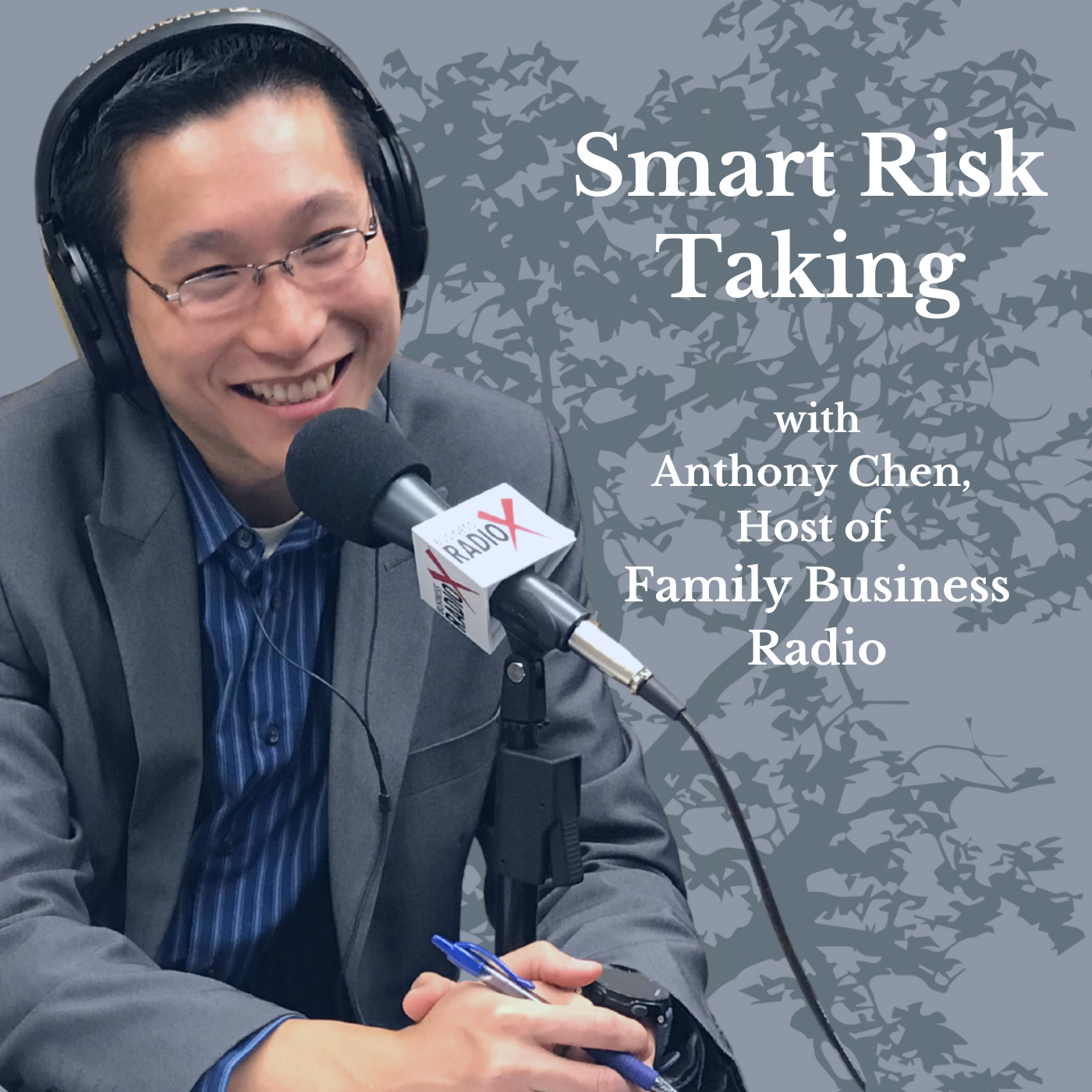
Smart Risk Taking, with Anthony Chen, Host of Family Business Radio

August 5, 2024 by John Ray

Smart Risk Taking, with Anthony Chen, host of Family Business Radio.
Family Business Radio
Smart Risk Taking, with Anthony Chen, Host of Family Business Radio
Loading
00:00 /
RSS Feed
Share
Link
Embed

Download file

Smart Risk Taking, with Anthony Chen, host of Family Business Radio.

Smart Risk Taking, with Anthony Chen, Host of Family Business Radio

In a commentary from a recent Family Business Radio episode, host Anthony Chen discusses smart risk taking for major financial decisions.

Anthony’s commentary was taken from this episode of Family Business Radio. Family Business Radio is underwritten by Anthony Chen with Lighthouse Financial Network.

Transcript

Anthony Chen: Now, for closing out the show, here’s a little bit of called Anthony’s Financial Take. From today’s show of themes all about building values, sticking true to your values, and standing behind your professionalism and workmanship.

So the financial take for today is as you’re going through your journey, whether it’s taking that potential risk of,  should I start my own business? How’s that going to look like for me financially? Should I stay in my quote unquote, safe or conservative nine to five job? That’s really something that only you would be able to find the right answers to, but instead of sticking kind of what Chris mentioned, Going analysis by paralysis, or I think the other way around, I’m also very much guilty of that, where I just have spreadsheets on spreadsheets.

And so you know what? Why don’t you just take Michael’s advice here and just do enough due diligence where I know I’m not jumping off a cliff and that I’m going with a glider or a parachute.  Make smart risk taking decisions and don’t think that you know it all. Reach out to people, reach out to other professionals.

And as Chris mentioned in terms of his example, as he’s interviewing other roofing companies, also look at their end product. So in your situation, when you’re looking to establishing your own financial future, establishing your own business, Look upon your peers. They’re not just competition because we’ve all been through this.

We’ve gone through the growing pains and more likely than not the business community is pretty friendly. Say, Hey, I went through this. You don’t need to reinvent the wheel here. Here’s the things that you should avoid because I went through that. So reach out to your peers, find some mentors, connect with them.

And really that’s all I’ve got. And thank you for listening to “Family Business Radio.”

Anthony Chen, Host of Family Business Radio

Anthony Chen, Host of Family Business Radio

Family Business Radio is sponsored and brought to you by Anthony Chen with Lighthouse Financial Network. Securities and advisory services are offered through OSAIC, member FINRA/SIPC. RAA is separately owned, and other entities and/or marketing names, products, or services referenced here are independent of OSAIC. The main office address is 575 Broadhollow Rd., Melville, NY 11747. You can reach Anthony at 631-465-9090, ext. 5075, or by email at anthonychen@lfnllc.com.

Anthony Chen started his career in financial services with MetLife in Buffalo, NY, in 2008. Born and raised in Elmhurst, Queens, he considers himself a full-blooded New Yorker while now enjoying his Atlanta, GA, home. Specializing in family businesses and their owners, Anthony works to protect what is most important to them. From preserving to creating wealth, Anthony partners with CPAs and attorneys to help address all of the concerns and help clients achieve their goals. By using a combination of financial products ranging from life, disability, and long-term care insurance to many investment options through Royal Alliance, Anthony looks to be the eyes and ears for his client’s financial foundation. In his spare time, Anthony is an avid long-distance runner.

The complete show archive of Family Business Radio can be found by following this link.
Tagged With: Anthony Chen, Family Business Radio, financial advisor, risk, risk taking

Liens and Preliens and Laughs Oh My with Amy Houk E10

July 27, 2022 by Karen

Liens-and-Preliens-and-Laughs-Oh-My-with-Amy-Houk-feature
Phoenix Business Radio
Liens and Preliens and Laughs Oh My with Amy Houk E10
Loading
00:00 /
RSS Feed
Share
Link
Embed

Download file

Liens-and-Preliens-and-Laughs-Oh-My-with-Amy-Houk

Liens and Preliens and Laughs Oh My with Amy Houk E10

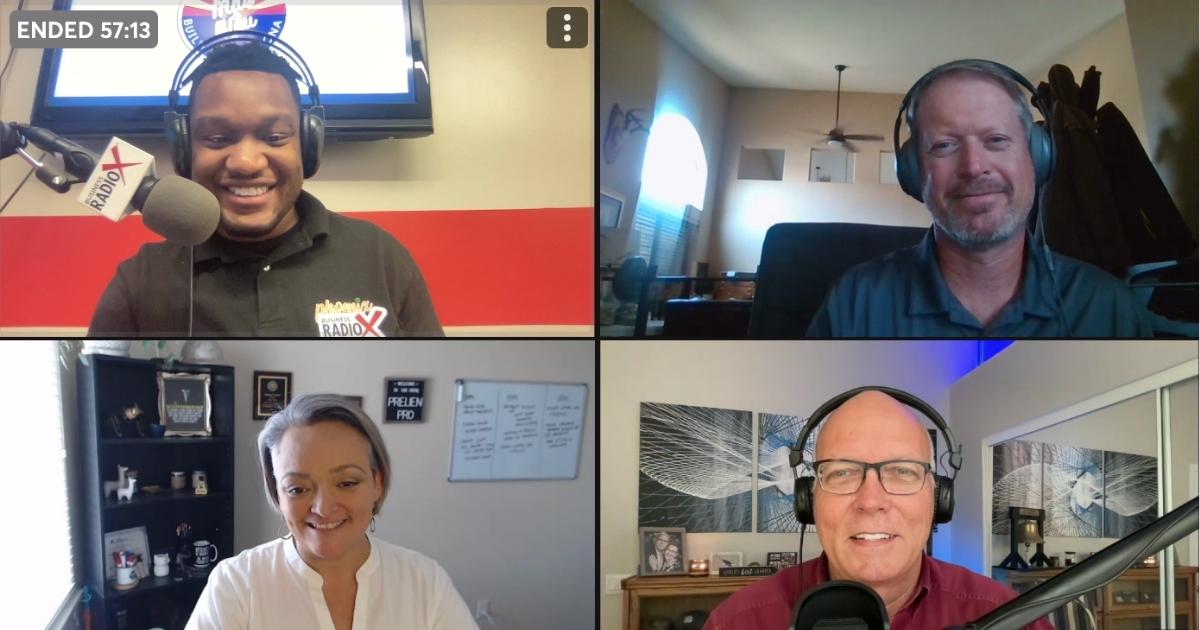
Robert and J.J. meet up with Amy Houk, Chief Marketing/Product Officer with Prelien Pro Technologies to discuss all things liens and preliens. Amy is the authority and shares her wealth of knowledge with the guys, and shares the why behind Prelien Pro Technologies and the development of software for the world of construction. If you are a general contractor, subcontractor, or supplier this episode is a must have as a reference to often misunderstood statutes pertaining to the lien and prelien process and your rights.

General Contractors, Subcontractors and suppliers learn the answers to often misunderstood processes surrounding your lien rights. Prelien-Pro-Technologies-logo

Prelien Pro Technologies, Inc. began when a team of consultants were asked to develop an easier workflow for lien companies to manage the hundreds of prelien notices submitted to their company weekly. Once they dove into the structure and processes lien companies were utilizing, it became very obvious that the lack of “out-of-the-box” solutions was crippling this industry. Lien companies were spending 10’s of thousands of dollars to create custom, single-user solutions or relying on a dos-based, single desktop solution for software that was cumbersome, antiquated, and rigid. Shocked by what they found, they sought out the guidance of one of the most dynamic and successful CTO’s to wrestle the “ dot-com boom” they could find… one laptop, one monitor, and one hot conference room later, a dream team of developers, innovators, and consultants came together to form what would become Prelien Pro Technologies, Inc.

As they researched and learned more about this industry, they also found that construction companies were forced to submit their notice requests on an equally outdated interface. The team was shocked to hear that most construction companies weren’t too bothered by the legacy look and feel as most software they used at the time was just as clumsy. Realizing that the construction industry was ripe for a solution to weave together all of these processes and workflows, the team devised a strategy – to learn the lien management industry from the inside out. They achieved this by creating their own lien company, collaborating with the construction industry, and building a solution that solves all of the obvious (and not so obvious) issues this process had on the overall performance and cost of a project.

This strategy led to an immeasurable amount of input from the construction industry – not just from the builders, but also the suppliers, the funders, the developers, and the insurers. The team built relationships with every level of construction to prepare and plan for a development strategy that would lead them on a two-year journey of discovery, development, and some trial and error to create a single application – bringing together the multitude of excel spreadsheets, three-ring binders, filing cabinets, fax machines, and single-task applications that “solved” their day-to-day issues.

Today, Prelien Pro Technologies, Inc. has fully deployed its construction lien software (cls) application to the captive lien company with a second onboarding in mid to late 4th quarter, 2021. That application currently supports 466 construction firms, 1500 users, and 10 lien preparation professionals. They have also created the only fully embedded experience with Procore technologies and have a focus group of our target general contractors currently using the prelien pro application. Because of the strategic development plan outlined by our CTO, all further development is 75% (or more) completed as the foundational Prelien Pro Technologies, Inc. platform fully supports the additional products and services.

Amy-Houk-MAC-and-BleuAmy Houk’s history as a founding member of Prelien Pro has seen the company grow from a handful of valued relationships to a large and growing community of clients, industry partners, association affiliations, and friendships.

Amy brings a cool and dynamic element to the team. Her ability to forge relationships and create an open dialogue with clients has been a vital asset to our team. She brings over 20 years experience offering a variety of services and consultation to businesses.

Her expertise and knowledge with construction companies and the industry has made her a pivotal addition to the team.

When Amy isn’t working with the team, she spends her time promoting women’s equality in construction, donating her time to construction associations, going on photo safaris with her husband of 15 years, taking construction pics, traveling, and spending time with family (especially her new grand baby).

Follow Prelien Pro Technologies on LinkedIn, Facebook and Twitter.

About Your Hosts

Meet JJ Levenske

jj-levenske-bleuwaveJJ Levenske is a seasoned construction executive with over 30 years of experience in the commercial and industrial sectors. From pre-construction services to complex quality controls and close-outs, he brings a commitment to delivering the highest levels of professionalism and customer service.

JJ’s dedication to construction has allowed him to become an industry expert which he aims to share with customers and investors alike. JJ does not believe in mediocrity and strives to see the “end at the beginning” for each project, effectuating a higher return on investment for the entire team.

Early on in his career, JJ worked as a cost engineer conducting feasibility estimates, strategic capital estimates, cost planning, and analysis of value engineering for the technology, petrochemical, and food industries. He went on to develop and implement a variety of systems for estimating, scheduling, resource management, and cost tracking while holding Project Manager and Senior Management Positions.

During his tenure, JJ has been involved in $1 billion worth of construction services. A strong entrepreneurial acumen allows him to be the perfect advocate for your facility based business solutions.

Meet Robert Johnson

robert-johnsonRobert Johnson is a knowledgeable construction professional with over 40 years of experience. His experience ranges from residential to the commercial and industrial sectors.


Robert began working in the trades immediately out of high school and quickly advanced to Journeyman status. Robert went on to estimating, operations, senior level management and then business development.

Robert is consistently building relationships and networking with those associated with all aspects of development and construction. Robert has become a respected source for prefabricated construction solutions.

Robert enjoys spending time with Pam, his wife of 42 years, their 3 children, and 10 grandchildren.

About Our Sponsors

Bleuwave is a Phoenix-based general contractor with a specialty in land development & site improvement, pre-construction, design build, remodel and renovations, construction management, and post construction.

Bleuwave is passionate about what they do and takes pride in their partner’s success.logo-BleuWave-01

When you need it done right the first time, call Bleuwave.

Follow Bleuwave on LinkedIn, Facebook, Twitter and Instagram.

Tori Contracting’s smaller, cohesive structure results in superior workmanship and economical solutions.

The Tori Contracting team has construction experience acquired by performing highly successful work for hotels and casinos, restaurants, retail stores, healthcare facilities and a wide range of commercial and themed projects.

We provide design assist capabilities from start to finish…from schematic design and development through construction documents with the aid of our full-time AUTOCAD staff.Tori-Contracting-logo

Tagged With: construction technology, Contech, DIY, lien, mechanics lien, prelien, preliminary notice, risk, software

Jay R. Weiser, Jay Weiser Consulting

March 21, 2022 by John Ray

Jay Weiser Consulting
North Fulton Business Radio
Jay R. Weiser, Jay Weiser Consulting
Loading
00:00 /
RSS Feed
Share
Link
Embed

Download file

Jay Weiser Consulting

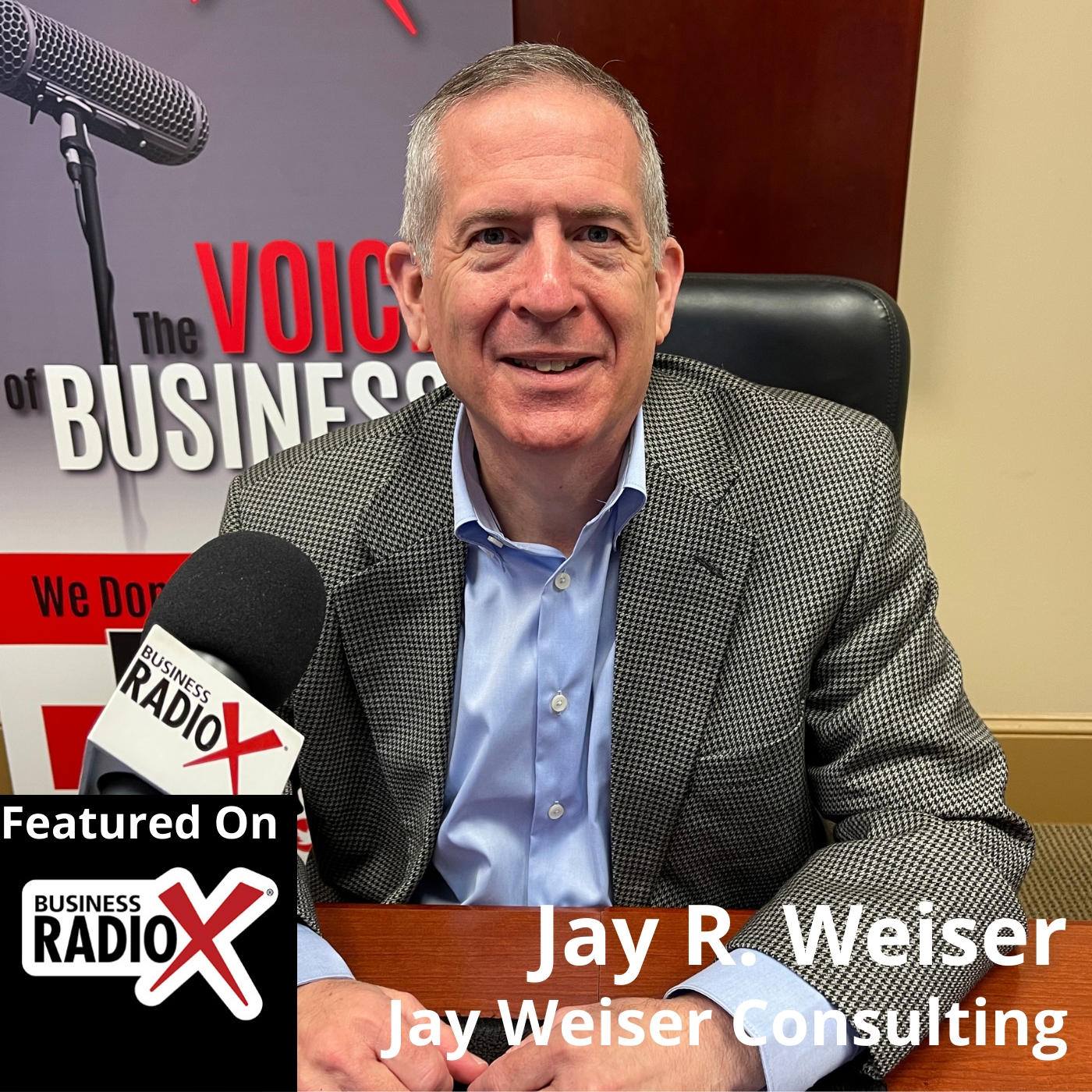
Jay R. Weiser, Jay Weiser Consulting (North Fulton Business Radio, Episode 444)

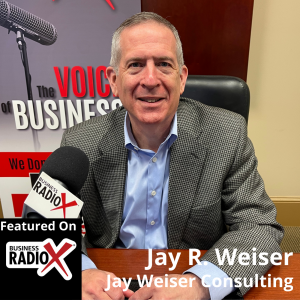
Jay R. Weiser, Principal and Founder at Jay Weiser Consulting, helps his clients thrive in the face of disruption and uncertainty. He and John Ray discussed the need to be prepared and responsive, how his experience informs his approach, his Five Leadership Superpowers™ needed to drive and sustain change, and much more. North Fulton Business Radio is broadcast from the North Fulton studio of Business RadioX® inside Renasant Bank in Alpharetta.

Jay Weiser Consulting

Choosing the right consultant for your organization is very important. You do not want to just pick anyone.

You want to choose a partner that

  • Puts your organization’s interests first

  • Takes the time to understand the organization and its challenges/opportunities

  • Works collaboratively with leadership to frame and solve its problems

  • Enables the organization to solve today’s AND prepare for tomorrow’s challenges

  • Is enjoyable to work with and sits alongside, not across from, you

That is a tall order, but you deserve nothing less. That is how Jay works.

Jay Weiser Consulting is right for you if you want a:

Catalyst – Who challenges the status quo, increases awareness, creates urgency, drives decision-making, and mobilizes the organization.

Challenger – Who asks tough questions, stretches the team’s thinking, helps them see and think differently, and brings in new perspectives.

Integrator – Who helps synthesize information from inside and outside the company, converts it into actionable insights to inform and drive decision-making.

Guide and Navigator – Who, with leadership, determines where to go, charts the course, prepares for the journey, and foresees and manages risks on the way.

and a Force Multiplier – Who amplifies and extends leaders’ efforts and impact, ensures focus on the most important and accelerates the time to results.

Faced with disruptions and uncertainty, leaders must make a choice.

Do they want to be CAPTIVES, victims of circumstances and at the mercy of others, OR CAPTAINS, leaders prepared to take charge, enable the organization, and confidently and successfully steer it to its destination? Ready to be a captain? If so, talk with Jay now.

Company website | LinkedIn | Twitter | YouTube | Facebook

Jay R. Weiser, Principal and Founder, Jay Weiser Consulting

Jay R. Weiser, Principal and Founder, Jay Weiser Consulting

Jay Weiser is the Principal and Founder of Jay Weiser Consulting. His practice is dedicated to enabling leadership teams and their organizations and individual leaders to not only survive but thrive in the face of disruptiveness and uncertainty. Leaders need a new set of capabilities to succeed in this turbulent environment.

Jay developed a leadership capability framework, THE FIVE LEADERSHIP SUPERPOWERS™ to address this very need. Through his advisory services, educational offerings, and speaking, he helps them build, apply, and sustain these SUPERPOWERS. By doing so, clients improve their overall preparedness and readiness, dampen downside risk from disruptions and uncertainty, recover and rebound faster, and pounce on opportunities faster amplifying their returns and value delivered to stakeholders.

Jay has a passion for helping clients sustainably create value at the intersections of strategy, organization (and leadership) and operations, no matter the context. He is an integrative thinker and continuous learner fueled by an insatiable curiosity to find the right, best way to do this for his clients. Knowing one size does not fit all and that there are no silver bullets, he guides clients in developing, implementing, and sustaining fit-for-purpose and -the future solutions that deliver results.

Jay has over 3 decades of experience advising executives across multiple industries and in a wide variety of environments. He clients and employers span from the middle market to Fortune/Forbes 500 organizations including recognizable names like Accenture, Autotrader (Cox Auto), Bristol Myers Squibb, Fulton County Schools, JP Morgan Chase, to Tiffany and Publix. Jay has been interviewed for Fortune.com and several podcasts. He has had articles published by Harvard Business School Press and other publications. He frequently shares his thought leadership via LinkedIn posts and on his site.

He has an undergraduate business degree from The Wharton School (UPenn) and his MBA from Goizueta Business School (Emory). He lives happily with his wife of 32 years, an educator, in Alpharetta, GA.

LinkedIn

Questions and Topics in this Interview:

  • Likelihood and sources of continuing disruption and uncertainty
  • Weaknesses that disruption and uncertainty have exposed.
  • Why new leadership capabilities are needed
  • New leadership capability model – The Five Leadership Superpowers(TM)
  • Ask about each of the five Superpowers and how they work
  • Assessing the Superpowers in your organization
  • How Jay Weiser Consulting can help

North Fulton Business Radio is hosted by John Ray and broadcast and produced from the North Fulton studio of Business RadioX® inside Renasant Bank in Alpharetta. You can find the full archive of shows by following this link. The show is available on all the major podcast apps, including Apple Podcasts, Spotify, Google, Amazon, iHeart Radio, Stitcher, TuneIn, and others.

RenasantBank


Renasant Bank has humble roots, starting in 1904 as a $100,000 bank in a Lee County, Mississippi, bakery. Since then, Renasant has grown to become one of the Southeast’s strongest financial institutions with over $13 billion in assets and more than 190 banking, lending, wealth management and financial services offices in Mississippi, Alabama, Tennessee, Georgia and Florida. All of Renasant’s success stems from each of their banker’s commitment to investing in their communities as a way of better understanding the people they serve. At Renasant Bank, they understand you because they work and live alongside you every day.


Special thanks to A&S Culinary Concepts for their support of this edition of North Fulton Business Radio. A&S Culinary Concepts, based in Johns Creek, is an award-winning culinary studio, celebrated for corporate catering, corporate team building, Big Green Egg Boot Camps, and private group events. They also provide oven-ready, cooked from scratch meals to go they call “Let Us Cook for You.” To see their menus and events, go to their website or call 678-336-9196.

Tagged With: Disruption, Jay R. Weiser, Jay Weiser Consulting, Leadership, Leadership consulting, North Fulton Business Radio, renasant bank, risk, uncertainty

Decision Vision Episode 128: Should I Take More Risk? – An Interview with Amanda Setili, Setili & Associates, LLC

August 6, 2021 by John Ray

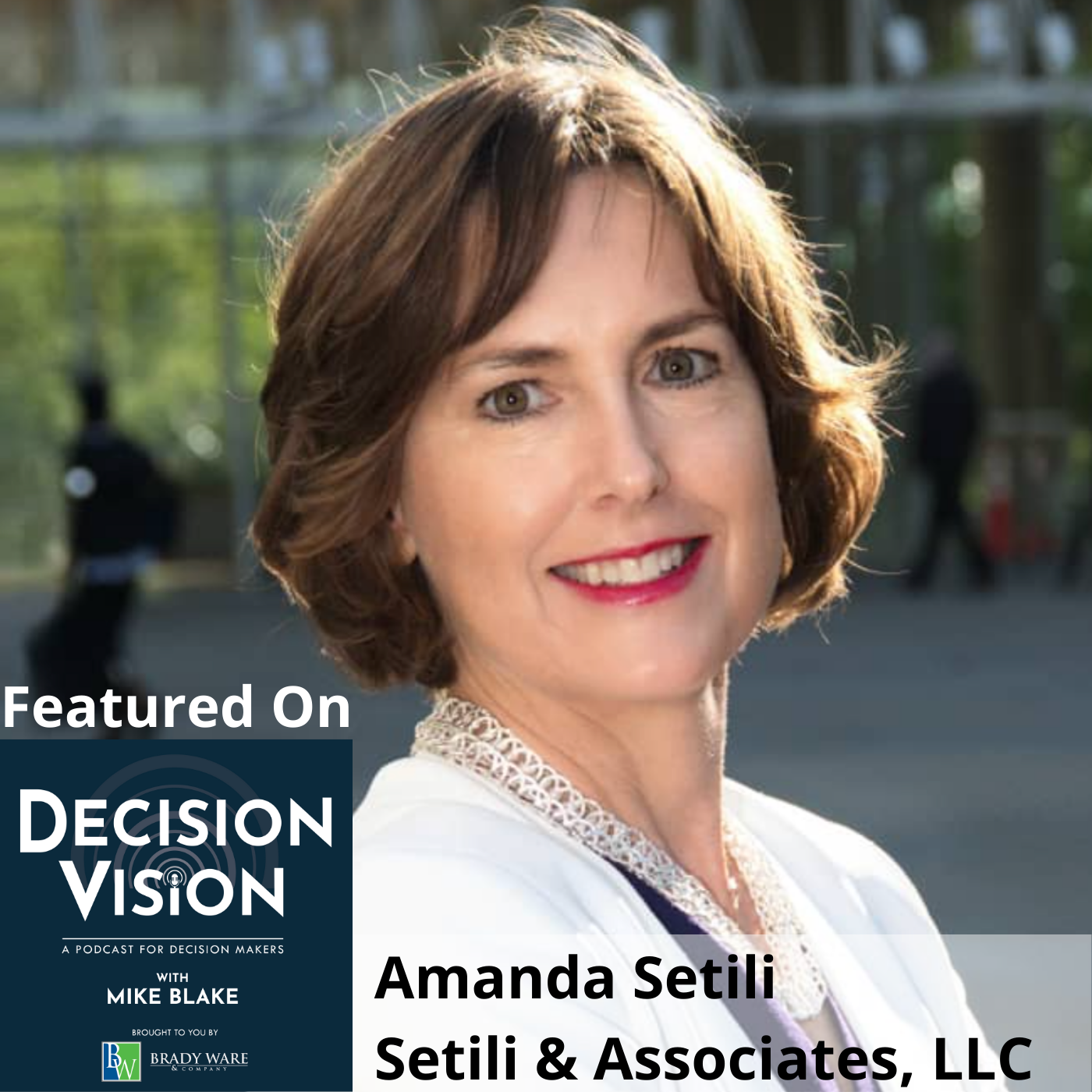
Amanda Setili
Decision Vision
Decision Vision Episode 128: Should I Take More Risk? - An Interview with Amanda Setili, Setili & Associates, LLC
Loading
00:00 /
RSS Feed
Share
Link
Embed

Download file

Amanda Setili

Decision Vision Episode 128:  Should I Take More Risk? – An Interview with Amanda Setili, Setili & Associates, LLC

Do you think you understand risk? Whether you do or not, your understanding of risk and how it applies to your business is sure to deepen if you listen to Amanda Setili. Amanda joined host Mike Blake to consider what risk is, if and how we should take risks professionally and personally, the consequences of taking risks, and many other questions. In her words, “To be able to deal with uncertainty effectively and manage risks effectively is probably the number one thing that companies do to succeed in a fast-changing world.” Decision Vision is presented by Brady Ware & Company.

Setili & Associates, LLC

Setili & Associates provides experienced strategic and management consulting to Fortune 500 and growing companies, to generate profits, improve performance, and drive growth.

Clients call Setili when they would like to:

  • Develop and launch innovative new products, services, and platforms
  • Increase margins, and identify and expand profitable segments
  • Gain top service rankings and create differentiated customer experiences that drive loyalty and word of mouth
  • Enter new channels and make existing channels more productive
  • Develop new business models and expand into new markets
  • Achieve greater organizational performance and commitment

Company website | LinkedIn | Facebook | Twitter

Amanda Setili, President, Setili & Associates, LLC

Amanda Setili
Amanda Setili, President, Setili & Associates, LLC

Amanda Setili is president of strategy consulting firm Setili & Associates. An internationally acclaimed expert on strategic agility®, she gives her clients—including Cardinal Health, Coca-Cola, Delta Air Lines, The Home Depot, UPS and Walmart—unbiased and laser-clear advice on how to respond quickly and intelligently to a changing marketplace.

Setili has advised organizations in industries as diverse as consumer and industrial products, financial services, technology, non-profit, and retail. Her work has taken her throughout North America, Europe and Asia.

Before starting Setili & Associates, she served as director of marketing for Global Food Exchange, consulted for McKinsey & Company (where she planted seeds that became the firm’s Kuala Lumpur office), served as chief operating officer of Malaysia’s leading Internet services company, and developed products and optimized manufacturing operations for Kimberly-Clark.

Setili is author of Fearless Growth: The New Rules to Stay Competitive, Foster Innovation, and Dominate Your Markets(Career Press, 2017) and The Agility Advantage, How to Identify and Act On Opportunities in a Fast-Changing World (Jossey-Bass, 2014). Setili served as an adjunct professor at Emory’s Goizueta Business School, is a member of the Marshall Goldsmith 100 coaches program and the Million Dollar Consulting Hall of Fame.

She earned her degree in chemical engineering from Vanderbilt, and her MBA, with distinction, from the Harvard Business School. She is past president and board chair of the Harvard Business School Club of Atlanta.

LinkedIn

Mike Blake, Brady Ware & Company

Mike Blake, Host of the “Decision Vision” podcast series

Michael Blake is the host of the Decision Vision podcast series and a Director of Brady Ware & Company. Mike specializes in the valuation of intellectual property-driven firms, such as software firms, aerospace firms, and professional services firms, most frequently in the capacity as a transaction advisor, helping clients obtain great outcomes from complex transaction opportunities. He is also a specialist in the appraisal of intellectual properties as stand-alone assets, such as software, trade secrets, and patents.

Mike has been a full-time business appraiser for 13 years with public accounting firms, boutique business appraisal firms, and an owner of his own firm. Prior to that, he spent 8 years in venture capital and investment banking, including transactions in the U.S., Israel, Russia, Ukraine, and Belarus.

LinkedIn | Facebook | Twitter | Instagram

Brady Ware & Company

Brady Ware & Company is a regional full-service accounting and advisory firm which helps businesses and entrepreneurs make visions a reality. Brady Ware services clients nationally from its offices in Alpharetta, GA; Columbus and Dayton, OH; and Richmond, IN. The firm is growth-minded, committed to the regions in which they operate, and most importantly, they make significant investments in their people and service offerings to meet the changing financial needs of those they are privileged to serve. The firm is dedicated to providing results that make a difference for its clients.

Decision Vision Podcast Series

Decision Vision is a podcast covering topics and issues facing small business owners and connecting them with solutions from leading experts. This series is presented by Brady Ware & Company. If you are a decision-maker for a small business, we’d love to hear from you. Contact us at decisionvision@bradyware.com and make sure to listen to every Thursday to the Decision Vision podcast.

Past episodes of Decision Vision can be found at decisionvisionpodcast.com. Decision Vision is produced and broadcast by the North Fulton studio of Business RadioX®.

Connect with Brady Ware & Company:

Website | LinkedIn | Facebook | Twitter | Instagram

TRANSCRIPT

Intro: [00:00:01] Welcome to Decision Vision, a podcast series focusing on critical business decisions. Brought to you by Brady Ware & Company. Brady Ware is a regional full service accounting and advisory firm that helps businesses and entrepreneurs make visions a reality.

Mike Blake: [00:00:21] Welcome to Decision Vision, a podcast giving you, the listener, clear vision to make great decisions. In each episode, we discuss the process of decision making on a different topic from the business owners’ or executives’ perspective. We aren’t necessarily telling you what to do, but we can put you in a position to make an informed decision on your own and understand when you might need help along the way.

Mike Blake: [00:00:41] My name is Mike Blake, and I’m your host for today’s program. I’m a director at Brady Ware & Company, a full service accounting firm based in Dayton, Ohio, with offices in Dayton; Columbus, Ohio; Richmond, Indiana; and Alpharetta, Georgia. Brady Ware is sponsoring this podcast, which is being recorded in Atlanta per social distancing protocols. If you’d like to engage with me on social media with my Chart of the Day and other content, I’m on LinkedIn as myself and @unblakeable on Facebook, Twitter, Clubhouse, and Instagram. If you like this podcast, please subscribe on your favorite podcast aggregator, and please consider leaving a review of the podcast as well.

Mike Blake: [00:01:19] So, today’s topic is a topic I’m very excited about, because it’s a topic that I, frankly, do a lot of thinking about and is central to what I purport to do for a living. And that topic is, Should I take more risk? And the reason I’m so intrigued by this topic is because, frankly, I think risk gets a bad rap. I think it gets a bad rap because it’s misunderstood. And I think it gets a bad rap, frankly, because it’s not very sexy. And it gets a bad rap because it’s not very visible, it’s not very high profile.

Mike Blake: [00:02:01] But when you think about risk in business and, I think, in life, risk is an overarching and underlying variable that impacts or should impact every decision that we make. And risk is often viewed negatively. We think of risk as something that is always to be avoided. Conversely, we admire the people who are risk takers.

Mike Blake: [00:02:35] As somebody who has traveled abroad quite a bit, I’m frequently asked in my travels, “What is it that makes Americans different from everybody else?” And I think there’s really one thing that makes Americans different from everybody else, and that is that we treat the entrepreneur as a folk hero. There’s no other society that I’ve been to, that I’ve studied, that does it quite the same way that we do. And I think we treat the entrepreneur as a folk hero because we admire their willingness to take risk. And by and large, in our economy, we are okay with rewarding people handsomely who take risks and benefit from that risk paying off, basically.

Mike Blake: [00:02:35] But at the same time, risk is one of these things that I think is highly underappreciated. And on that same token, I’m asked pretty frequently, actually, you know, “How do I improve the value of my business in the short term?” Thinking of selling or I want to make it a better asset to leave to my children or to somebody else, how do I make it more valuable? And the answer that I think most people expect are, “Well, make your company more profitable or find a way to make it grow.” And those things are fine as far as they go, except those things are a lot easier said than done. It’s not that easy to grow a company. It’s not that easy to make a company more profitable. Those are hard things to do.

Mike Blake: [00:04:17] But the thing you almost never hear somebody saying, is my stock answer, is, “Well, figure out a way to de-risk the business. Take what you’ve got and make it more reliable, more resilient, more predictable.” And that in and of itself is going to make the company more valuable. And I would argue and I think I could show you the math to do this for an audio, so I’m not going to inflict that upon you. But I can very easily illustrate with math that if you can decrease the risk by, say, two percent, you will improve the value of your company more than if you increase growth or profitability by two percent. But, again, it’s not sexy.

Mike Blake: [00:05:02] The chief risk officer never appears on Bloomberg television, has never profiled in The Wall Street Journal, at least very rarely. In spite of the fact that we are currently involved in emerging from – I call this – a trans-pandemic period, I think that’s probably still out, we’re still in this this pandemic period where our nature, our very relationship with risk and the nature of risk in our society and our lives, is just different and I think irreversibly so.

Mike Blake: [00:05:33] And so, when our current guest comes on – and we had a conversation earlier and she wanted to talk about risk, I just jumped at the opportunity because I think it’s so important and it’s really not given its due. And so, it’s my pleasure to introduce Amanda Setili, who is president of strategy consulting firm Setili and Associates. Setili and Associates provides experience, strategic, and management consulting to Fortune 500 and growing companies that generate profits, improve performance, and drive growth.

Mike Blake: [00:06:05] An internationally acclaimed expert on strategic agility, she gives her clients, including Cardinal Health, Coca-Cola, Delta Airlines, the Home Depot, UPS, and Walmart- you might have heard of them – unbiassed and laser clear advice on how to respond quickly and intelligently to a changing marketplace. Amanda is also author of Fearless Growth: The New Rules to Stay Competitive, Foster Innovation, and Dominate Share Markets; and the Agility Advantage: How to Identify Opportunities and Act on Opportunities in a Fast-Changing World.

Mike Blake: [00:06:36] Amanda served as an adjunct professor at Emory’s Goizueta Business School, is a member of the Marshall Goldsmith 100 Coaches Program and the Million Dollar Consulting Hall of Fame. Amanda earned her degree in chemical engineering from Vanderbilt and her MBA with distinction from the Harvard Business School. She is past president and board chair of the Harvard Business School Club of Atlanta. Amanda Setili, welcome to the program.

Amanda Setili: [00:07:00] Thanks so much, Mike. It’s a pleasure to be here.

Mike Blake: [00:07:04] So, Amanda, I want to lead off because, you know, we haven’t known each other that long. But the thing that struck me from our first conversation is, you and I are kindred spirits, I think, in one regard in that we really find risk fascinating and conversations about risk to be very impactful. And I’d love to hear your take. You’ve heard mine in my opening monologue. But I’d love to hear your take on why risk interests you. Why is it important? Why do people need to understand it better?

Amanda Setili: [00:07:37] Two main reasons. One is, I work mainly with big companies. And big companies do what they do very well and very consistently. So, they’ve been historically good at managing risk, but they’re really bad at taking a risk of entering into a new market or learning something new, building new capabilities, dealing with the changes that are coming at them so fast in the market today. Just in terms of the way customer behaviors are changing fast, the way competition is changing fast, the way competition can come out of nowhere, which they’re used to be able to do as easily.

Amanda Setili: [00:08:14] And the unwillingness to take risks, whether either because of trying to make sure to make quarterly earnings promises that they’ve made, or fear of having to lay people off, or fear of not being able to build new capabilities fast enough. That fear of the risks hold so many companies back from being successful. And you can see tragedies of large companies who just lose their way and don’t adapt quickly enough to the market change.

Mike Blake: [00:08:47] Yeah. And that’s really interesting, we both can probably name numerous examples, but the one that comes to mind – of which I only learned fairly recently, but it’s such a shocking story – many people don’t realize that Kodak had invented compact flash storage many years before it actually became widely available in the marketplace. But they were so afraid to risk disrupting their own industry, they wound up eventually being effectively consumed by the digital photography market, that they had every opportunity to dominate by virtue of patent protection. And that, to me, is an object lesson of how a company killed itself by not taking enough risk.

Amanda Setili: [00:09:34] Absolutely. It’s like the perfect story to illustrate that exact point, because they did invent digital photography, but they were so intent on protecting their film category that they just couldn’t step into that territory.

Amanda Setili: [00:09:49] So, I said I was going to tell you two things and I didn’t tell you the second one. The second reason, I think is important and interesting, is, because most companies don’t do a good job at managing risk. They do a good job at seeing the risk, but they don’t do a good job at managing the risk. They flee from risk without just saying, “There’s steps we can take to manage this.”

Amanda Setili: [00:10:11] So, one of the stories that I think is illustrative of this is, back when Elon Musk first started Tesla, he said, “There’s only a 50/50 chance that I’ll be successful.” But what he did was he said, “So, why would I not be successful? Maybe people will have range anxiety, so I’ll build a car that instead of only can go 80 miles on a battery, can go 350. I’ll build these superchargers going up every major highway corridor.” He said, “Why else would they be worried? They will be worried about safety, so I’ll win the top safety ratings. Why else would they be worried? They’d be worried about resale value.”

Amanda Setili: [00:10:48] So, he even, for a time, promised to buy their Tesla back for a price pegged to the price of a certain Mercedes model. So, he just said, “Okay. It’s risky. There’s only a 50 percent chance of success. Figure out what the risks are and address each of them very explicitly.” And that’s why he’s been quite successful.

Mike Blake: [00:11:10] I love that Elon Musk story. I hadn’t heard it before. But I think it’s brilliant and a couple of business geeks like us, I think, can appreciate sort of the subtle genius and that buy back part. Because they’re basically then selling a car with a built-in protective put. I mean, it’s just classic hedging.

Mike Blake: [00:11:32] So, I want to come back to this, but before I go too far off the deep end with you, even though it’s really tempting to do so, I want to make sure that everybody understands, our listeners understand, when we say risk, what exactly does that mean? So, if I could maybe, please, ask you to give your definition of risk.

Amanda Setili: [00:11:52] My definition is just that you have uncertainty about the outcome. That’s all it is. There’s many different sources of risk. But the bottom line is you’re not sure it’s going to work.

Mike Blake: [00:12:03] Now, I love that definition. And for what it’s worth coming from me, I mean, to me, that definition shows why you’re an expert on risk. Because I think when most people hear the word risk, they automatically think of the definition of risk being that risk is the possibility that something will go wrong. But you said it differently and I think correctly, which is, it’s simply the risk that something will go differently than how you anticipated. And that’s a massive distinction, isn’t it?

Amanda Setili: [00:12:37] Right. Because there’s always an upside too. So, there are things that are uncertainty about the outcome that are actually on the positive side. And if you don’t recognize what might happen better than what you expect, you’re never prepared to take advantage of your good luck.

Mike Blake: [00:12:57] So, you said something in the opening question, which, again, I just think is so smart that I want to make sure that we hit on, and that is that, you described many companies as failing to manage risk because instead they avoid risk. And there’s a subtle but important distinction there I’d love you to go into, if you would. And that is, why is avoiding risk not the same as managing risk?

Amanda Setili: [00:13:29] Well, they’re completely different. So, avoiding risk is, “Oh, I don’t know what’s going to happen. I’m afraid. I better not do anything.” Managing risk is, “Oh, I don’t know what’s going to happen. What could affect what might happen?” List those things out and then say, “What can we do to manage each of these? What can we do to make it more likely that the good thing is going to happen and less likely that the bad thing is going to happen?” And then, be very explicit about assigning each of those risk to somebody who can make sure that that risk is managed well.

Amanda Setili: [00:14:07] So, for example, you’re launching a new product. What could go wrong? The market fails to understand it. Our call center gets overwhelmed with calls. The sales force is incapable of selling it or is hesitant to sell it because it cannibalizes another product. Just list these things out and then say, “So, what are we going to do about each of them? And who’s in charge of managing that risk? If we’re worried about the call center being overwhelmed, can we get some backup capacity lined up? If we’re worried about the sales people being unwilling to sell it because it cannibalizes something else, give them some kind of override on their commission?”

Amanda Setili: [00:14:48] All of these things could be managed. And at the same time, when you talked about, you know, uncertainty about the outcome can also be on the upside, what if this goes even better than we expect? Do we have our suppliers organized to be able to sell us more supply than what we thought? Do we have the ability to expand geographically faster than what we were anticipating? Do we have the ability to make the biggest PR buzz out of anybody that likes our product that we didn’t expect to like it? You know, there’s all kinds of things that can go right. And if you plan for them, you get to jump on it and take advantage of them.

Mike Blake: [00:15:27] So, you have a great pedigree working with brand name companies. And, clearly, the subject comes up when you’re working with them. Why, in your mind, do large companies struggle so much with risk management? Is it something that’s cultural? Is it a misalignment of economic incentives or some sort of pathology? What, in your mind, kind of drives that?

Amanda Setili: [00:15:52] Two things. One is the incentives usually incent you to do the same thing that you did last year plus five or ten percent. And if you don’t do that, you’re in big trouble, you don’t make your bonus or you might get fired or whatever. And if you do way better than that, it’s not necessarily as big of an advantage. So, the incentives tend to be very much disincenting taking risks. The second thing is they’re just sloppy. They’re not disciplined about how they think about risk and how they manage it.

Mike Blake: [00:16:32] So, what, in your mind, when you work with companies like that and you present them with the case that they should be taking on more risk than they are, how do you position that argument? Or what does that argument typically look like that a given entity, person, organization should take on additional risk?

Amanda Setili: [00:16:53] Well, first of all, we find ways to manage it where it’s not all that risky. So, understand the market better. Maybe make a small experiment before you make a big experiment. Play several different small bits at once, which is a hedging strategy. Isolate the risk into a certain area of the company where it can’t damage the other areas of the company. So, there’s a lot of things that we can do to manage risk that’s on the plus side on the kind of way to get them to kind of emotionally accept the risk more. It’s often a case of saying, “If you don’t do this, you’re going to be left in the dust.” I mean, they know that, but sometimes they have to be reminded.

Mike Blake: [00:17:45] One of the basic concepts of behavioral finance is the concept or the construct that humans seem to be hardwired against taking risk. And in particular, they’re hardwired to avoid loss or with this notion of loss aversion. Which, I know you know what this means, but our listeners may not. It means that people miss more on a dollar that they actively lose than they do on a dollar that is an opportunity missed. And that sort of creates this perception of risk asymmetry. Have you encountered that as well? And if so, how do you get people to confront that and look at risk in a more clinical way?

Amanda Setili: [00:18:38] Well, first of all, you do want to make sure you don’t lose anything that you can’t afford to lose. So, you don’t want to get in a position where you can’t pay your mortgage. So, there’s a certain level of risk that you just can’t afford to take and so be very explicit about that. But then, I think, thinking about expected value, which is the percent chance that something’s going to happen, times of value that would come to you if it did happen is pretty helpful. And just being very explicit about there is an upside here. The upside is worth it. There’s some downside. But if you look at the expected value, it’s probably a favorable thing to do. And if you don’t do it, you’re going to be in a slow decline.

Mike Blake: [00:19:29] So, it leads nicely to my next question and we’ve touched upon this a little bit with the Kodak story, but I’d like to make this part of the discussion explicit. And that is, so what if people don’t take enough risk? What are the consequences of not taking enough risk?

Amanda Setili: [00:19:49] Well, you mentioned people, and so I think that it would be interesting to take this out of a corporate context and just into a human being context. You take risk when you decide to ask somebody on a date. You take risk when you decide to get married. You know, 50 percent of marriages end in divorce, do you say, “I better not do that because mine might be one of the 50 percent?” Or do you say, “This is my chance for a wonderful life with this wonderful person, I’m going to go for it even with the risk.” What’s was your question exactly?

Mike Blake: [00:20:25] What do you miss out on when you’re not taking enough risk?

Amanda Setili: [00:20:31] A lot of stuff. You have fewer experiences. Fewer experiences or opportunity to grow your business. Fewer opportunities to fully live your life. You name it. You miss out on a lot if you’re too risk averse.

Mike Blake: [00:20:49] So, another question I wanted to cover is, you know, there are varying degrees of risk and you talked about you never want to bet your mortgage or put anything on the line you can’t afford to lose. And, of course, that’s a relative construct. But the question I’d like to ask you to engage with is, is high risk always bad? Is something that’s high risk always something that you should walk away from? Or are there cases in which, you know, something that’s high risk may actually be sensible?

Amanda Setili: [00:21:30] Well, if you just look at investments, for instance, you tend to have a higher return for the higher risk. So, it’s definitely not always bad. You also never would achieve anything truly remarkable and knock it out of the park if you didn’t take risks. Because we would have never gone to the moon if we didn’t accept some risk, for instance. So, high risk is certainly not always bad. But high risk without managing the risk is probably always bad. So, high risk without considering the consequences, mitigating what you can mitigate, taking into account how can we reduce the risk that we see, that is bad.

Mike Blake: [00:22:15] And, you know, that sounds like there’s an important distinction to be made there, if I can semi-put words in your mouth. It seems to me that a risk taker is somebody who takes risks but manages it, can be contrasted with someone who’s reckless that also takes risks. But they don’t manage it and maybe they don’t even fully understand the risks that they’re taking.

Amanda Setili: [00:22:39] That’s exactly it. They don’t understand or don’t think about it. And that probably happens more often when the risk is long term and the benefit is short term. So, if I eat a piece of cake with ice cream every single day, my risk is that I’m going to become obese, and I’m going to have diabetes, and I’m going to die early. But people don’t take that into consideration when they serve themselves that extra helping of dessert.

Mike Blake: [00:23:09] Well, that’s true. And that’s interesting, because, you know, there’s another element. I typically think of risk in terms of two dimensions. One dimension is, what is the likelihood of a bad outcome? And then, B, how bad is that bad outcome? Or what is the distribution of bad outcomes look like and how bad can it go? But a third dimension to that, actually, is the timing of risk. And some risks are accretive over a long period of time and some are instantaneous. And I guess that’s something that also is an important part of the discussion and maybe even gets back to your Fortune 500 clients, where you talk about incentives. Can there be perverse incentives to take risk because the negative impact of the risk may not manifest itself for years after that person’s tenure at the company has long since ended.

Amanda Setili: [00:24:14] That’s exactly right. So, you know, if I’m in a job, I’m the president of a division, and I’m being incented based on this quarter’s results or this year’s results, I don’t want to risk anything for something that’s going to happen after I retire in a few years. Why would I want to do that? So, that’s the kind of thing you need to watch out for when you’re managing a company. But, also, some of the benefits occur way down the line. Well, I guess that’s the same thing that I’m saying, is that, in companies, often the cost is now and the benefit is later.

Mike Blake: [00:24:52] Well, you know, and I think that’s really important. And I have a hypothesis that one of the reasons that private equity and venture capital struggles is because their return thresholds have become much more compressed. And this notion that most venture and private equity funds have a ten year lifespan. That may very well just not be enough time for companies to mature to the point where they can generate a return. And indeed, there’s data out there to suggest that as you approach a 20 year time horizon for a company, that’s when you kind of optimize your risk adjusted return.

Mike Blake: [00:25:31] But on the other hand, if your bonuses are calculated year-to-year or you’re only going to be in that fund for five years or whatever the circumstances are, it probably motivates not industry perverse behavior, for example, to try to harvest companies before they’re fully baked, which is not doing the investors any favors. And that’s just an illustration of that mismatch between the risk and return time horizons.

Amanda Setili: [00:25:59] Right. So, public companies, I think, have even more of a problem with short term thinking because they have to deliver on their earnings expectations every single quarter, and they get really dinged by Wall Street if they don’t do that. Whereas, at least with a private equity firm, if you say we’re shooting for a five year horizon, at least in years one, two and three, you can let it go negative on EBITDA, if that’s the right thing to do, for instance. Because you know that it’s going to pay off in the five years. So, if private equity firms can stay a little bit flexible of what’s the right period of time for this investment to turn positive, then they can protect themselves from that.

Amanda Setili: [00:26:45] But you look at somebody like Amazon, Amazon didn’t make money for years and years and years. They just kept investing. And I’ll never forget that way back in about 2001, I was talking with one of my classmates from Harvard Business School who was way up in the chain at Amazon working closely with Jeff Bezos. And somebody in the crowd said, “When will you guys stop losing money?” And she said, “Well, it only costs us $4 to acquire a new customer. When would you stop?” I just thought that’s a really, really smart way of putting it. Because if it’s only $4 to acquire a new customer, keep doing it until you have everybody in the world using Amazon. And then, you’ve cornered the market, which is kind of what they did.

Mike Blake: [00:27:33] Well, I hadn’t heard that story, but you’re right. I mean, the logic there is very hard to escape, isn’t it?

Amanda Setili: [00:27:39] Yes.

Mike Blake: [00:27:40] So, let’s say that somebody listening to this is starting to ask themselves, “Hey, I wonder if our company is taking enough risk.” What are some signs that a company should be taking more risk or at least should consider taking on more risk than it currently is? What are the warning signs?

Amanda Setili: [00:28:04] If you’ve got a lot of change in your market and you haven’t done anything about it is one of the key things that I look at. If you haven’t invested in any innovation is another thing. Innovation can be product innovation, but it can also be systems integration, process innovation. Even simple stuff like changing the script that your call center is typically a sign that you’re not taking enough risk. If you’re not talking about where do we need to take more risk. And if you don’t have discipline systems for managing risk, that probably means you’re not taking enough risk because you don’t have it in your DNA of how do we think about risk?

Amanda Setili: [00:28:51] You know, because the world is changing fast, the companies that can deal with uncertainty effectively, that’s a huge competitive advantage. To be able to deal with uncertainty effectively and manage risk effectively is probably the number one thing that companies can do to succeed in a fast changing world.

Mike Blake: [00:29:14] I’m absorbing that statement. I think you’re right. And my perspective is one of corporate finance. And I refer to the law of gravity and finance, which says that, high return only accompanies high risk. And if you generate a high return from something that you thought was low risk, you probably just got lucky. And you misevaluated the risk as being lower than it actually was.

Mike Blake: [00:29:46] And I think what you’re describing is fairly closely connected with that. You know, if you want to outperform, then you must do something different from what the rest of the market is doing. Otherwise, you just simply fall into the trap of reversion to the mean. I mean, you might have temporary day-to-day, month-to-month, even year-to-year variability or noise, if you will. But the ending in the long run, you cannot possibly outperform everybody else if all you do is what everybody else is doing.

Amanda Setili: [00:30:23] Exactly.

Mike Blake: [00:30:27] In your mind, is all risk created equal? Or are there different kind of flavors of risk, if you will?

Amanda Setili: [00:30:37] Yeah. There’s definitely different flavors. One major flavor is, are we capable of doing this? Another major flavor is, how are other entities or other people going to respond to what I’m doing? Another is, just what are the consequences of what I’m going to do? So, I think, yeah, there’s a number of different categories that you can think about and each can be managed.

Mike Blake: [00:31:04] So, in your mind, do you have a distinction of what a good risk is versus a bad risk? Is there such a thing as good versus bad risk?

Amanda Setili: [00:31:14] A good risk is something that you can at least name, and that you at least have either some kind of plan to reduce it or manage it. Or, at minimum, monitor it so that you can respond and you have a plan for how to respond if it starts going going badly. A bad risk is the risk you don’t even know is there.

Mike Blake: [00:31:39] The famous unknown unknowns, right?

Amanda Setili: [00:31:42] Yeah. Right.

Mike Blake: [00:31:44] Because those bad risks are almost kind of like open-ended liabilities. There may be no limit to how bad that outcome could be.

Amanda Setili: [00:31:57] Right. Or it’s something that maybe you sort of think might happen, but you don’t really think it’s going to happen, so you don’t worry about it. Like, pandemics, which we all knew. I had a friend at the CDC who, ten years ago said, “We’re way overdue for a pandemic, a worldwide pandemic.” I just go, “Yeah. Yeah. It probably won’t happen.” And here we are.

Mike Blake: [00:32:19] Here we are. So, here’s a question I want to ask you, I hope you’ll agree it’s an interesting one. And that is that, if you take a risk and it doesn’t produce a positive outcome, does that mean that the act of taking the risk was automatically bad?

Amanda Setili: [00:32:46] Definitely not. I mean, there’s some really good speakers on this topic, they’re often professional poker players. And they say, “You know, you calculate your odds and you place your bet. Of course, you don’t always win because the odds were not 100 percent that you were going to win. So, of course, you know that you’re not always going to win. But don’t let the evidence from your failures teach you that you made a bad decision in the first place.”

Mike Blake: [00:33:17] Yeah. And that last point, I think, is so important because, again, it ties back to psychology, at least the things I’ve read. I’m no expert in psychology. But, again, we as people seem to be hardwired to very clearly remember our losses and failures. Whereas, we don’t dwell as much or remember or even place as much value in our successes. And in that regard, it can dissuade people just because you have one bad outcome. It can dissuade people from doing more of the right thing.

Amanda Setili: [00:33:52] I think that’s really true. I think people learn from their failures and that can be kind of bad. Because, oftentimes, when you fail, you think, “Oh, that was because of something that I did that I made a bad decision.” And when you succeed, unfortunately, you often think, “Oh, I got lucky. It wasn’t because of what I did. I just got lucky.” So, yeah, I think that no matter what you do, you’re being trained every day. And you’re training your employees every day. And, often, you’re training them things that you really shouldn’t be training them.

Mike Blake: [00:34:27] Oh, you know what? That’s interesting. What are some examples of things that somebody might be inadvertently training their employees themselves be too risk averse?

Amanda Setili: [00:34:39] A typical one is, you start a new venture within your company because you think that you need to enter a new market or something. And you assign somebody to manage that, they try their hardest. But, you know, it’s hard. Stuff goes wrong. They fail and they either get switched into a different department, or demoted, or even maybe fired, or at least not rewarded very well. But maybe they should have been rewarded well because maybe they did everything that they could have possibly done to make that successful. And the outcome was uncertain and the outcome didn’t go their way. But once you said a couple of examples like that, boy, people are watching. Nobody wants to go near a project like that anymore.

Mike Blake: [00:35:26] Yeah. You know what? That’s really interesting. And I wonder if we’ll ever get to a point where American businesses – and it may not be unique to America, but something I can comment on intelligently – actually celebrate failures? Because, first of all, failures are great teachers, number one. And number two, because the nature of risk that things just aren’t always going to go your way. And I’m curious if you agree with us or not, really, in order for risk management to really take hold and to really make an impact, you almost have to do it a lot. You have to accumulate enough of a sample size so that the impact of the risk management becomes pronounced. And you can actually attribute performance to something other than simple dumb luck of a small sample size.

Amanda Setili: [00:36:28] Right. Right.

Mike Blake: [00:36:30] And on that, I’m curious if you have an opinion on this. On that note, that brings to mind the archetypal Google, now Alphabet, approach to new projects where they like to fail fast. And our conversations made me start to wonder about that particular approach. I think many people idolize Google for the fail fast approach. It’s gutsy. It’s splashy. It’s high profile and everything else. But on the other hand, I wonder if, actually, that could be kind of a perverse or unhealthy form of risk aversion because you may not be writing things out as much as you should.

Amanda Setili: [00:37:18] So, what I think is important is being very clear about what you need to learn from each experiment that you run, and what metrics you’re going to be watching, what behaviors you’re going to be watching, what you’re really wanting out of it. And fail fast, part of it is really good, which is saying, if something isn’t going well and it’s not going to turn around, it’s not going to do any better. Kill it right away, and document what you learned from it, and then try something else.

Amanda Setili: [00:37:51] Because sometimes, especially big companies, they’re slow anyway. It’s a long time between getting the management team together. They just don’t make decisions fast. So, they let this thing linger because they don’t want to embarrass the person who runs it or they don’t want to have to go back to Wall Street and say, “We told you this is going to be successful, but it wasn’t.” So, they let these things linger hoping that they’ll turn around and continuing to pour not quite enough money into them to make them successful, maybe. And so, because there’s a stigma against failure, they don’t let things fail.

Amanda Setili: [00:38:28] So, I think, actually the concept of fast failure is healthy for Google. And I like the fact that they just keep putting different stuff out there and seeing if it flies. And if it doesn’t, they kill it. You know, Facebook is famous for that, too. They do A/B testing, hundreds of different A/B tests every day. And they let almost anybody – I don’t know about almost anybody – but there’s a lot of people who have the decision rights to be able to conduct A/B tests and to learn from them very, very, very quickly.

Mike Blake: [00:38:59] We’re talking with Amanda Setili. And the topic is, Should I take on more risk? You know, we’re both talking kind of a good game here about risk, if you will. I wonder if you’d be willing to share with the audience an instance in which you took a pretty significant risk. And, you know, whether that was a success or a failure, the impact of taking that risk and the lessons that you learned from doing that for yourself or your own company.

Amanda Setili: [00:39:28] You really got me thinking with that one. I guess, that writing my first book was kind of a risk because I invested a lot of time for many months doing that and I didn’t know if this was really important to do, so that was a risk and it did pay off.

Amanda Setili: [00:39:44] I don’t know if I’ve told you, Mike, that my husband and I are really, really into kiteboarding. And in July in kiteboarding, we tend to only get wind when there’s a thunderstorm. So, we’re always watching the radar and trying to figure it out. And, you know, back in March, April, or May, when we get more wind, we might say, “Oh, we’re going to pack up the kites and go home if the lightning is within 20 miles.” And then, it gets to July and you’re, like, desperate for wind. There’s been no wind for seven days or whatever you’ve been waiting for wind. And there’s wind, but the lightning is within ten miles and you go, “Well, maybe I’ll just go out there for a little while.” So, that’s an example.

Mike Blake: [00:40:32] Well, you know, that’s an interesting story and actually is illustrative, I think, of a dimension of risk where, you know, the same risk is there. But because your perceived return was higher, you then determine that it was a risk that was worth taking. I do think there’s a business application to that, is that, higher risk is okay as long as you’re being adequately compensated with the potential upside of taking that risk alongside with, of course, management of downside as well. And in your case, that upside manifested itself with, I think, relative scarcity, because the downside was that if you didn’t take the risk, you might have just missed out on your entire kiteboarding season and have to wait another year.

Amanda Setili: [00:41:24] That’s right.

Mike Blake: [00:41:30] Now, a common approach to managing risk and finances where I live is this concept called diversification. I’m sure you’re familiar with it, too. Can diversification as a risk management tool be applied outside of the direct investment world?

Amanda Setili: [00:41:51] Well, yeah. We do that all the time, where, you know, you are trying to enter a new market, let’s say. And instead of just doing it one way, you might run three to five different experiments. We’ll try different things in different markets. We’ll try different ways of going to market. We’ll try different sales pitches for this product. So, I think that diversification, in that sense, is just trying different things and being very systematic about what you try and what you need to learn from your trials.

Mike Blake: [00:42:27] So, Amanda, we’re running out of time, and this is a topic that, frankly, we could do a whole semester on risk. Maybe we should. But there are probably questions that I didn’t get to or questions that somebody would have liked us to go deeper into but we didn’t. And if that’s so, can people contact you with additional questions about this topic? And if so, what’s the best way for them to do that?

Amanda Setili: [00:42:50] So, you can certainly email me at amanda@setili.com, S-E-T-I-L-I. And reach out to me on LinkedIn. I’ve got a weekly newsletter there which you can subscribe to, which I address issues like this. And, actually, I think both of my books have a chapter on managing uncertainty, and how it’s so important, and how people who don’t accept uncertainty are probably not going to do very well. So, get a hold of those and you might be able to get some additional insight. Connect with me on LinkedIn and my website.

Mike Blake: [00:43:29] Do you want to give us the website domain?

Amanda Setili: [00:43:34] The website is just setili.com, S-E-T-I-L-I.com. There’s lots of information there, and videos, and other podcasts, and things like that.

Mike Blake: [00:43:44] Very good. Well, that’s going to wrap it up for today’s program. I’d like to thank Amanda Setili so much for sharing her expertise with us.

Mike Blake: [00:43:52] We’ll be exploring a new topic each week, so please tune in so that when you’re faced with your next business decision, you have clear vision when making it. If you enjoy these podcasts, please consider leaving a review with your favorite podcast aggregator. It helps people find us that we can help them. If you’d like to engage with me on social media with my Chart of the Day and other content, I’m on LinkedIn as myself and @unblakeable on Facebook, Twitter, Clubhouse, and Instagram. Once again, this is Mike Blake. Our sponsor is Brady Ware & Company. And this has been the Decision Vision podcast.


Tagged With: Amanda Setili, Brady Ware & Company, Decision Vision, Fearless Growth, manage risk, Mike Blake, risk, risk advisory, risk advisory services, Settili & Associates, The Agility Advantage

E40 Laura Burford with LAD Enterprizes and ASU Professor Andrew Maynard

October 21, 2019 by Karen

E40-Laura-Burford-with-LAD-Enterprizes-and-ASU-Professor-Andrew-Maynard1
Phoenix Business Radio
E40 Laura Burford with LAD Enterprizes and ASU Professor Andrew Maynard
Loading
00:00 / 56:45
RSS Feed
Share
Link
Embed

Download fileDuration: 56:45

E40-Laura-Burford-with-LAD-Enterprizes-and-ASU-Professor-Andrew-Maynard

E40 Laura Burford with LAD Enterprizes and ASU Professor Andrew Maynard

How comfortable are you working with and managing risks? What tools and techniques do you use for managing risks on your projects as well as personally with your own career? How did PMI do with managing the risk of rolling our the new PMI logo?

Listen to hear Laura Burford and Andrew Maynard discuss risk management, innovation and entrepreneurship. Laura was a speaker at the recent 50th Anniversary PMI Global Conference. With all the buzz of the new PMI logo we heard from Laura how the rollout was received at the conference. Laura also shares her story and evolution from corporate employee to independent consultant and how she is now using those experiences to help others seeking to branch out on their own.

Andrew, as an Academic, Scientist and Author, enjoys breaking boundaries and examining risk specifically with social movements and personal attitudes.​ He is the Director of the ASU Risk Innovation Lab and shares how they are taking an innovation mindset and applying that to risk. Andrew and Laura also share how story-telling has become an important tool they use as authors and within their careers.

Tune in for upcoming shows with Project Management leaders and subscribe to the podcast on Apple Podcast, iHeartRadio, Spotify, Spreaker, Stitcher or your favorite podcast platform!

Thanks to our sponsor THE PMO SQUAD. Visit www.thepmosquad.com to learn about the Purpose Driven PMO, PMO as a Service, and all their project management services.

Laura-Burford-on-Project-Management-Office-HoursAs the founder of LAD Enterprizes and Laura’s Consulting Guide, Laura Burford leverages over thirty years of management consulting expertise and experience to help the independent business professionals grow their consulting businesses.

She does this by following her proprietary approach, The Consultancy Model©, a model that starts by clarifying a person’s focus enabling them to engage with and build relationships with the right clients. The model is supported by her signature system, the Consultant’s Jumpstart Blueprint©, and on-line courses found at “Laura’s Consulting Guide.”

Prior to starting her own business, Laura was recruited to start-up an international consulting operation, worked 10 years for two then different “Big 4” consulting organizations, Coopers & Lybrand and Price Waterhouse, and worked with or consulted to multiple Fortune 50 companies.

She has provided advice to profit and non-profit organizations leading large multi-million-dollar initiatives, established consulting organizations, and built project management offices. When she started her own practice, Laura decided to focus on smaller businesses and operations. In addition to providing seminars, she is a speaker, writer, and the author of Project Management for Flat Organizations, a 2013 Small Business Book Awards winner.

Connect with Laura on LinkedIn, Facebook and Twitter.

ASURiskInnovationLabHorizRGBMaroonGold600ppi

The Arizona State University School for the Future of Innovation in Society (SFIS) is at the vanguard of ASU’s commitment to linking innovation to public value, as it pursues a vision of responsible innovation that anticipates challenges and opportunities, integrates diverse knowledge and perspectives, and engages broad audiences.

As part of SFIS, The Risk Innovation Nexus supports successful innovation through helping entrepreneurs and others navigate an increasingly complex land convolutes landscape between good ideas and their successful realization.

Andrew-Maynard-on-Project-Management-Office-HoursAndrew Maynard is a professor in the Arizona State University School for the Future of Innovation in Society, Director of the ASU Risk Innovation Lab, and head of the ASU Risk Innovation Nexus–an initiative focused on helping businesses and others achieve success through developing a risk innovation mindset.

As well as serving as vice-chair on the ILSI North America Board of Trustees, he is a member of the Canadian Institute for Advanced Research President’s Research Council, and a contributor to the World Economic Forum’s annual list of top ten emerging technologies.

Andrew’s work focuses on socially responsible and ethical technology innovation. His latest book is Films from the Future: The Technology and Morality of Sci-Fi Movies.

Connect with Andrew on LinkedIn and Twitter.

ABOUT PROJECT MANAGEMENT OFFICE HOURS SERIES

Project Management Office Hours is intended to provide Project Management professionals a place to drop in and discuss Success Stories, Best Practices, and Lessons Learned.  Project Management Consultant Joy Gumz has shared with us, “Operations keep the lights on, strategy provides the light at the end of the tunnel, but project management is the train engine that moves the organization forward.”

Each of us has a unique story to tell, but collectively we share a message that organizations who embrace Project Management Best Practices perform better than those which don’t.  Organizations which align Projects to Strategy perform better.  Organizations with Engage Executive Sponsors deliver better results.  Organizations which measure Project Management performance outperform those which don’t.

During our Project Management Office Hours, we hear directly from Industry leaders how to make an impact in our profession. How we, collectively, will Advance Project Management Best Practices, One Listener at a time! 

ABOUT YOUR HOST

Joe Pusz started THE PMO SQUAD to bring real world PMO Leadership experience to the consulting space and to advocate for Project Management through his blog PMOJOE.com. The old saying is “Do what you love and you’ll never work a day in your life.” Following this mindset Joe left Corporate America in 2013 to start THE PMO SQUAD and work with fellow Natural Born Project Managers to advance Project Management Best Practices.

ABOUT OUR SPONSOR

THE PMO SQUAD focuses exclusively on PMO and Project Management consulting. Corporate America is full of Accidental Project Managers running projects who haven’t been trained to be PMs. To help solve this problem THE PMO SQUAD is on the Leading Edge with PMO As a Service. PMO As a Service allows our clients to focus on their respective core competencies while THE PMO SQUAD delivers Project Management expertise. Contact Joe at 678-591-7868. Follow The PMO Squad on LinkedIn, Twitter and Facebook.

Tagged With: Consultant, consulting, emerging technologies, future, PMO Consultant, Project Management Consultant, responsible innovation, risk, technology innovation

Decision Vision Episode 22: Should I Set Up a Captive Insurance Company?, An Interview with Matthew Queen, Venture Captive Management

July 4, 2019 by John Ray

Decision Vision
Decision Vision
Decision Vision Episode 22: Should I Set Up a Captive Insurance Company?, An Interview with Matthew Queen, Venture Captive Management
Loading
00:00 /
RSS Feed
Share
Link
Embed

Download file

“Decision Vision” Host Mike Blake and Matthew Queen

Should I Set Up a Captive Insurance Company?

What is a captive insurance company? How can I use a captive insurance company both to manage my risks and control the cost of insuring those risks? In a conversation with “Decision Vision” host Michael Blake, Matthew Queen of Venture Captive Management answers these questions and much more.

Matthew Queen, Venture Captive Management

Matthew Queen, Venture Captive Management

Matthew Queen is the Chief Compliance Officer and General Counsel for Venture Capital Management. Venture Captive Management provides turnkey alternative risk financing services for middle market companies seeking greater control and profit in their risk funding solutions. The firm is a boutique provider of underwriting, accounting, claims management, and risk management. Solutions offered by VCM include the establishment and operation of single parent captives, group captives, association captives, risk retention groups, and managing general agencies. VCM manages insurance companies with three guiding principles: to provide asset protection for the beneficial owner, to control the process, and to provide profit to the beneficial owners. The captive is first and foremost designed to capture the underwriting profit that would normally stay with the standard commercial carrier under traditional insurance coverage.

Michael Blake, Brady Ware & Company

Mike Blake, Host of “Decision Vision”

Michael Blake is Host of the “Decision Vision” podcast series and a Director of Brady Ware & Company. Mike specializes in the valuation of intellectual property-driven firms, such as software firms, aerospace firms and professional services firms, most frequently in the capacity as a transaction advisor, helping clients obtain great outcomes from complex transaction opportunities. He is also a specialist in the appraisal of intellectual properties as stand-alone assets, such as software, trade secrets, and patents.

Mike has been a full-time business appraiser for 13 years with public accounting firms, boutique business appraisal firms, and an owner of his own firm. Prior to that, he spent 8 years in venture capital and investment banking, including transactions in the U.S., Israel, Russia, Ukraine, and Belarus.

Brady Ware & Company

Brady Ware & Company is a regional full-service accounting and advisory firm which helps businesses and entrepreneurs make visions a reality. Brady Ware services clients nationally from its offices in Alpharetta, GA; Columbus and Dayton, OH; and Richmond, IN. The firm is growth minded, committed to the regions in which they operate, and most importantly, they make significant investments in their people and service offerings to meet the changing financial needs of those they are privileged to serve. The firm is dedicated to providing results that make a difference for its clients.

Decision Vision Podcast Series

“Decision Vision” is a podcast covering topics and issues facing small business owners and connecting them with solutions from leading experts. This series is presented by Brady Ware & Company. If you are a decision maker for a small business, we’d love to hear from you. Contact us at decisionvision@bradyware.com and make sure to listen to every Thursday to the “Decision Vision” podcast. Past episodes of “Decision Vision” can be found here. “Decision Vision” is produced and broadcast by the North Fulton studio of Business RadioX®.

Visit Brady Ware & Company on social media:

LinkedIn:  https://www.linkedin.com/company/brady-ware/

Facebook: https://www.facebook.com/bradywareCPAs/

Twitter: https://twitter.com/BradyWare

Instagram: https://www.instagram.com/bradywarecompany/

Show Transcript

Intro: [00:00:05] Welcome to Decision Vision, a podcast series focusing on critical business decisions, brought to you by Brady Ware & Company. Brady Ware is a regional, full-service, accounting and advisory firm that helps businesses and entrepreneurs make visions a reality.

Michael Blake: [00:00:23] And welcome to Decision Vision, a podcast giving you, the listener, clear vision to make great decisions. In each episode, we discuss the process of decision making on a different topic. But rather making specific recommendations because everyone’s circumstances are different, we talk to subject matter experts about how they would recommend thinking about that decision.

Michael Blake: [00:00:42] My name is Mike Blake, and I am your host for today’s program. I’m a director at Brady Ware & Company, a full-service accounting firm based in Dayton, Ohio, with offices in Dayton; Columbus, Ohio; Richmond, Indiana; and Alpharetta, Georgia which is where we are recording today. Brady Ware is sponsoring this podcast. If you like this podcast, please subscribe on your favorite podcast aggregator, and please also consider leaving a review of the podcast as well.

Michael Blake: [00:01:07] And today’s topic is a topic about captive insurance companies, and should you have your own captive insurance program? And I’ve only started to run into this about five years ago when I worked for another accounting firm, and we happened to have a partner that kind of specialized in captives. And I didn’t really realize that if you want to, you can start your own insurance company. Now, it’s not as easy as doing that. It’s not like you just sort of go on Amazon.com, and click buy that insurance company, and you get started. It is a fairly complex process. And we’ve got an expert to talk about that today.

Michael Blake: [00:01:46] But it is under the right circumstances, something that companies, high-net worth individuals and investors may want to consider. It is complex. It certainly kind of goes up and down in terms of reputation. There are accounting firms and law firms that specialize in captive insurance programs. There are accounting firms and law firms that will not touch them with a 10-foot pole. So, you sort of see the gamut. And I think that’s what makes the — one of the things that makes this topic so interesting is because it’s hard to find folks that know what they’re talking about and are willing to talk about it.

Michael Blake: [00:02:30] So, with that, I’d like to introduce Matthew Queen, who is Chief Compliance Officer and General Counsel for a company called Venture Captive Management. He is responsible for regulatory compliance, program development, and claims management for captive insurance companies and risk retention groups. Prior to joining Venture Captive Management, Matthew developed his knowledge base by defending multinational corporations and state, federal and administrative courts, and provided state and local tax minimization strategies for Fortune 500 companies as a tax accountant at big four consulting firm. Matthew holds an undergraduate degree in business management from the Georgia Institute of Technology, a school that I flunked out of as a PhD candidate, and Advanced Degrees in Law and taxation from Georgia State University.

Michael Blake: [00:03:19] Venture Captive Management provides turnkey alternative risk financing services for middle market companies seeking greater control and profit in their risk funding solutions. The firm is a boutique provider of underwriting, accounting, claims management, and risk management. Solutions offered by Venture Captive Management include the establishment and operation of single parent captives, group captives, association captives, risk retention groups, and managing general agencies.

Michael Blake: [00:03:46] Venture Captive Management manages insurance companies with three guiding principles: to provide asset protection for the beneficial owner, to control the process, and to provide profit to the beneficial owners. The captive is first and foremost designed to capture the underwriting profit that would normally stay with a standard commercial carrier under traditional insurance coverage. Matthew, welcome to the program. Thanks for coming on.

Matthew Queen: [00:04:09] Thank you for having me.

Michael Blake: [00:04:11] So, as I like to do with many of my podcasts, I like to start with the vocabulary lesson because we can very quickly get into terms of art, and acronyms, and jargon that will lose the listener. So, let’s start with the basics. What is insurance, and where do captives fit within the insurance universe?

Matthew Queen: [00:04:34] Thank you very much, Captive insurance is really not as complicated as you think. So, you’ve got your checking and your savings account. Generally speaking, you want to spend the money in your checking account relatively soon. The savings account, you keep over here just in case. While the money put into your savings account is no different the money put into a captive insurance company, except, now, by funding our captive, we get a huge tax deduction for the premiums that we put in there.

Matthew Queen: [00:04:58] So, at its basic level, all I’m really doing is helping people to fund for risk. Now, the risks that you look at in a worker’s compensation, you’ve got health care benefits you’re providing for your employees, general, professional liability, those are all just various risks that you can fund with either traditional insurance where you pay premiums over to AIG, let’s say, or you can form your own captive and take all or a part of that risk. So, at the end of the day, it’s just a very tax-efficient way providing for risk management.

Matthew Queen: [00:05:30] So, one of the things that really is fun about what I do is that captive insurance exists at the frontier of insurance. Now, back when I was in my traditional defense, I never really got to go to the frontier. So, you get a case. Ssome plaintiff’s attorney is trying to beat you up for support, sort of, a slip and fall. You may find an exotic case that helps you win the case in some sort of a novel way but at no point are you going to the frontier of legal thought. That is not the case with captives because captives are, in a way, the zenith of risk financing. So, you’re taking on board underwriting, accounting. And even there within accounting, it’s not just gap. You need to have some knowledge of statutory accounting. You got to understand the claims process. You’ve got to understand how to talk in re-insurances. You’ve got to be able to go out there and lay out the risks. So, it really does bring in some novel theories.

Matthew Queen: [00:06:27] Consequently, we get to develop custom insurance products that can insure literally anything. So, my joke I tell people when they’re asking about captives is I can underwrite a ham sandwich. Not me personally, I’m a terrible underwriter. But what you would look at is any sort of a risk may be a good idea for a captive. So, why talk about the boring things? Let’s go straight to the fun stuff. So, for example, you’re now doing business in the UK, Japan, and America. And let’s assume things go south with Brexit and something wacky happens with the currency exchange rate between the dollar and begin-

Michael Blake: [00:07:04] That’s a good assumption, by the way.

Matthew Queen: [00:07:06] Yeah. So, what happens if the pound goes crazy? Can you insure against losses that would manifest as a result of doing cross-border transactions? The IRS is going to sit there and say, “No, no, no. That is nuts.” And this exact issue is that they have some guidance from the IRS where they’ve said, “We don’t like it,” but in 2015, they had a case called the RBI guarantee case where people were essentially insuring against the unexpected bad value of a fleet of cars. Long story short, it kind of looks like a put contract in the sense that you had a fleet of cars that are X when you bottom, expect to be Y at the end of five years. And if some foolish guy gets into an automobile accident, it’s worth much less than Y. They had captive pay out a claim, and the IRS said, “We don’t like that,” took it to tax court, got beaten up. Long story short, you can now ensure a financial interest. So, the currency exchange interest would be analogous to that.

Matthew Queen: [00:08:05] The reason I’m telling you this is only to just bust down the barriers right off the bat that when you’re dealing with captives, general liability, workers comp, all day long, no problem. But then, when you have like a supply chain risk, so you’re now an oil and gas company, and you’ve got some sort of an oddball issue with Venezuela 20 years ago, the IRS would say, “You cannot take a deduction for the premiums paid for supply chain risk. It’s just not an insurable event.” Over time, a lot of these middle market and large companies that have supply chain risks said, “We’re purchasing this in commercial markets. It’s being offered from Lloyd’s of London. We demand that we have the right to do this.” And that sorted itself out in courts. So, that’s where we are constantly. Where the market breaks down or the market is heading, consequently, I get to basically sit at the frontier and look just a little further than I was normally looking back when I was doing insurance defense.

Michael Blake: [00:09:02] And where that frontier is – just I want to make sure I’m absolutely clear – is that some entities are now basically setting up their own insurance companies, their captive, because they’re captive to that one particular company they serve, I assume, one customer, the customer that sets it up. Is that correct?

Matthew Queen: [00:09:25] Yeah, generally speaking. So, what you’re describing is a single parent captive insurance company. And that was developed by Fred Reiss in the mid-50’s. And he had a mining operation where he was unable to get normal insurance. So, he said, “To heck with it, I’ll just go directly to the re-insurers myself. I’ll take the first, let’s just say, quarter million dollars of each million dollar claim, and then I’ll place reinsurance above that.” That is the tried and shrewd method.

Matthew Queen: [00:09:48] And then, he went back and forth with the IRS trying to be able to deduct the premiums to finance that quarter million dollar layer in an reinsurance premium, but that was actually not much of an issue. That worked out really well. That was the creation of captive insurance. But he got laughed out of every single American domicile. And in order to make that fly, he had to go get an insurance license from Bermuda. That’s why captives are huge offshore. Bermuda looked at him, and they said, “This isn’t crazy. This is beyond anything we’ve looked at.”

Matthew Queen: [00:10:18] Now, when he showed up, he had a couple of million dollars to put into a captive insurance company. I mean, it was no different than just starting a new subsidiary company. General Motors wants to start Pontiac. It went ahead and put some capital to do that. So, this mining company said, “We’re just going to start an insurance company.” So, the IRS looked at this, and they said, “I doubt this is real. I mean, at the end of the day, I get that the parent company’s balance sheet is not going to be affected by your losses in this subsidiary. But come on, it’s all on the same economic family. So, if you’re paying premiums into your own little insurance company, how can you deduct that?”

Matthew Queen: [00:10:54] And that right there, we have described the first 60 years of captives. So, that’s a bit of an exaggeration. But in 2005, ’06, ’07, there was a pair of case called Rent-A-Center and Securities cases. The least you need to know about those cases is the IRS had been basically just losing ground inch by inch as larger or smaller and smaller companies start adopting captives for any number of risks. Automobile liability, you’ve got a fleet of cars, you’re probably going to be overpaying if you go to AIG. So, they brought in a captive expert, sit there and set him up with a self-insurance solution. The health care industry, they’re constantly having to deal with issues of medical malpractice and professional liability, so they started adopting it.

Matthew Queen: [00:11:41] And eventually, the IRS started conceding bit by bit like, “Well, maybe if you have 12 subsidiaries, and you’re paying us between that, but we’d never let you to insure the parent company because for whatever reason, that was not allowed.” It just became more complicated and more complicated to the point where the tax court said “Enough.” We look at this right here, this group of risks — and by the way, this is now the new rule for captives. We look at this group of risks, if in that group you can achieve the law of large numbers, such that we can accurately forecast within a standard deviation or two, the frequency of risks and the general severity, then we’re probably going to have an insurance situation. And that’s the debate right there. Do you have enough risk within your captive to actually have insurance?

Matthew Queen: [00:12:29] So, what I like about what we do is we focus on middle market companies that are in areas that are either uninsurable in some periods or lack capacity in the market. So, our company, about 80% of what we do is skilled nursing facilities and assisted living. At one point in the late 1990’s, the rate per bed was over $10,000 per bed for assisted living facilities. So, we created a risk retention group to, essentially, become a new insurance carrier focusing only on professional liability for ALS across the country. And I mean, that’s the model. You see a market breakdown. It’s just basic business 101. So, we created a solution that was accustomed to the market.

Michael Blake: [00:13:15] So, you mentioned awhile back that single parent captives are one type of captive. What are the other kinds? And kind of succinctly, what are the differences between them?

Matthew Queen: [00:13:27] Okay. So, the two big things that you want to think about are single parent group, group captives, and association captives. It’s kind of all in one bucket. So if you have a large company, you probably don’t necessarily need a group captive. You might be able to create your own captive on your own. And that’s really going to be a function of the type of risks that you have running through your company. So, if you have 5000 employees, probably don’t need to be in a group. But if you have like 100 employees, you may need to be in a group. And the simple reason is if one loss is going to basically eat up all the capital in your captive, I actually agree with the IRS, you don’t really have a captive.

Matthew Queen: [00:14:08] So, we can get into the differences between those but what I like about that association group and single parent captives is you can underwrite literally anything. So, all those nut job things I was saying in the beginning, totally fine. 100%, I will defend those to the end of time. Now, there is another form of captive. It’s called a risk retention group. We have a very large one, and it’s operating in 11 states. And I love this because it’s a huge trade-off. You can only write liability through a risk retention group, but you only have to get licensed in one state.

Matthew Queen: [00:14:45] So, I’m going to bring you up to date on something called the McCarran-Ferguson Act. So, in 1945, the Supreme Court was essentially overruled by Congress. So, in ’44, there’s a case called SouthEastern Underwriters where the Supreme Court determined that the business of insurance, like basically everything else, is subject to interstate commerce. Consequently, now, the federal government can regulate insurance. And the Departments of Insurance in 50 states went nuts. And with a surprisingly quick response, Congress passed the McCarran-Ferguson Act 1945, and that restored the power of insurance back to the states.

Matthew Queen: [00:15:25] Now, McCarran-Ferguson Act, you cannot overstate the power of this act. It not only restored the power of insurance back to the states, but it also did so by incorporating an understanding of due process that as it existed in the 1800s. So, not only is it the business of insurance, it’s state law, but it’s that ridiculously strong state law that you had back way before the Interstate Congress clause became a flexible part of the Constitution.

Matthew Queen: [00:15:53] And that’s relevant. I won’t explain why right now, but the least need to know is that when AIG, or CNA, or Chubb, if they want to enter into Georgia, they have to get on their knees and say, “Please let me in. Here’s the filing. Here’s the rates.” And the commissioner has the ability to sit there and say, “You know, I just don’t know how I feel about this.”  And that creates a significant amount of power in the insurance department. By the way, it doesn’t matter if AIG has got that exact policy rate and all the capitalization that you need up and running in 49 other states. The State of Georgia has the absolute right to say goodbye.

Matthew Queen: [00:16:31] Now, with the risk retention group, we have IRS domiciled in the District of Columbia. And because the Risk Retention Act was passed pursuant to federal law as one of the very few exceptions to McCarran-Ferguson, all I have to do is get chartered interstate. And chartered is just our legalistic way of saying you can’t stop me. So, I can march into Florida, Georgia, Alabama, Alaska, and I can write liability anywhere I want. It’s this huge loophole, and it allows us to undercut most of the carriers in the market because we’re just not as regulated. So, that’s what I love about the RRG. It’s like a curveball. But, again, I can’t underwrite a ham sandwich. It’s only liability. So, product liability, general liability, medical malpractice, all of those types of risks we can throw into an RRG, but property, no, no, no, no. Worker’s comp? Absolutely not. So, it’s just an interesting way of being able to add some value.

Michael Blake: [00:17:25] So, yeah. And it sounds like under the right circumstances, an organization may want to sponsor or be participant in one of these risk retention groups and may have their own separate captive entities as well, depending on what they want to insure.

Matthew Queen: [00:17:42] Yeah.

Michael Blake: [00:17:43] You have your own sort of portfolio, I guess.

Matthew Queen: [00:17:45] Yes. So a company like General Motors, they have their like multiple captive insurance companies. So, that would be your Fortune 1000 strategy. Most of your middle market companies, getting a captive up and running, it’s a sink of capital. So, you really do need to be in a situation where either you are best in class in what you do, and you don’t need to be paying as much in premium as you are, or you’ve got some sort of an unusual spot where the markets just can’t keep up.

Matthew Queen: [00:18:13] So, I mean, I’ll tell you an area in the market right now that if we could figure out how to underwrite a little bit better, we’d be able to become billionaires overnight. Coastal property anywhere is virtually uninsurable. I mean, it’s borderline uninsurable, and it’s industry non-specific. I don’t care if you’ve got a nuclear power plant, or an oil and gas facility, or a hotel, or anything in a REIT, the property rates are absolutely insane. That’s just because the past couple of years, the hurricanes have been really, really bad.

Matthew Queen: [00:18:43] Now, nobody’s come up with a solution for this quite yet because at the end of the day, there is some efficiency in the marketplace. Underwriters are doing the best that they can, but if we were able to sit there and use maybe insure tech to be able to get there and underwrite a little cheaper or get into a little bit better model of how the hurricanes are going to arise, then, yeah, we could roll out a captive tomorrow and bring in a whole bunch of different maybe hotels, for example, or municipalities, and basically custom write an insurance program.

Michael Blake: [00:19:12] That’s very interesting. So, I think, historically, one use of captives has been to insure risk that you couldn’t necessarily get out in the market. In the early days of my association with captives, I used to see cyber liability insurance because you couldn’t get it, or you couldn’t get in a conventional form. You see a lot of terrorism insurance as well. Are captives also being used to find kind of these holes in the market where you just cannot buy conventional insurance, or it’s just economically just not feasible to do it the normal way or the conventional way?

Matthew Queen: [00:19:53] Yeah. So, like the oil and gas industry, it has a huge loophole in its standard commercial general liability policy. The cyber risk for oil and gas is unusual, where if you can lean — I need an oil and gas expert here to walk me through it, but you can basically shut down safety valves in parts of the pipelines and turn these things into bombs remotely. Now, that’s a cyber liability, and it dovetails with terrorism, but it’s not going to be covered under property, and it probably wouldn’t be covered on your CGL. So, if that occurs-

Michael Blake: [00:20:25] CGL is what?

Matthew Queen: [00:20:25] Commercial general liability policy. So, you may be stuck with an uninsured exposure right there. And that, if you are covering an uninsured exposure, your broker and the underwriters, they should have caught that along the way. But what people don’t realize is that when you’re buying insurance, the insurance contract that you get is like a Tetris piece where each page or, really, each element of the contract is just put together. And each of the elements – let’s maybe just say we have 10 paragraphs over here that talk about the declarations and a couple more paragraphs over here that talk about the coverages and the exclusions, blah, blah, blah – that’s all been put together by teams of attorneys in different carriers that have worked together to come together with some sort of almost like Super Mario solution.

Matthew Queen: [00:21:10] And what I mean by Super Mario is in Super Mario Kart sense where he is kind of good at nothing but kind of okay at everything. That’s your standard ISO forms that you get. So, they have unintentionally some exposures in there that people just overlook because when you’re trying to say, “Oh, okay. Well, you’re a certain type of company over here, you need all of this form, basically paragraphs, that we’re just going to shove in there like little puzzle pieces, it just leads to some coverage gaps.”

Michael Blake: [00:21:37] So, you’ve hinted, and I know this is true, the IRS has — I don’t know if oppose is the right word, but certainly is looking at captives very carefully.

Matthew Queen: [00:21:50] Yeah.

Michael Blake: [00:21:50] Is that fair? So, in general, how is the IRS reacting to them now? Would you say that they’re — right now, would you say they’re more or less welcoming? They’re unwelcoming? Is it purely a case-by-case basis, and you have to kind of look at precedent and make your captive look like something else the IRS has already kind of let pass? How would you characterize that environment?

Matthew Queen: [00:22:13] The IRS’s relationship with captive insurance is like a guy’s relationship with his ex-wife’s new husband. I mean, it is never good, and they are tolerant only because kids are involved. And to lose the metaphor for a second, the IRS looked at the whole concept of self-insurance as a sham. I’m putting money from my checking account into my savings account. You shouldn’t get a tax deduction for that, but at the end of the day, if you’re saying that you can’t get a tax deduction for that, what you’ve really said is you don’t have the right to form an insurance company.

Matthew Queen: [00:22:47] Now, fundamentally speaking, that trumps all over the Constitution, and there’s no way that the IRS could have ever supported that if the defense attorneys that time had been smart enough to just key in on that. But what happened was they had some ill-prepared defense attorneys who just really didn’t understand what was going on back in the 50’s, 60’s and 70’s. It wasn’t until the late 80’s, specifically with a guy who won the Humana case, where they finally started to cobble together the elements of insurance. Now, insurance, as I hinted at before, it’s not a thing. Like when you go out and buy insurance, this is illusory. You’re really entering into a contract. And the concept of insurance is more of an emergent phenomena that exists when you have a couple of elements present.

Matthew Queen: [00:23:32] So, this phenomena was outlined in a long, long, long ago case called [Health Review of the Gears], where they had four elements you want to see. You want to have insurance in a commonly accepted sense. So, right off the bat, standard is kind of nebulous. They also have an insurable interest. You want have risk shifting in risk distribution. So, insurance in the commonly accepted sense is as follows. Let’s say everyone in a room puts money into a pot, and the last man standing gets all the money that’s left over in the pot. But if there’s anything that happens during the course of our lifetimes, we will take money from the pot to indemnify you. But that’s a Totten trust. That is not insurance. So, you have to have insurance in commonly accepted sense, which, generally speaking, is going to involve premiums to a third party that are underwritten appropriately, have an actuary that assesses their appropriate rate and amount of reserves that you need to pay the claims. That’s insurance in the commonly accepted sense.

Matthew Queen: [00:24:25] Then, you have to have an insurable interest. So, going right back to what I was saying in the beginning, the concept of an insurable interest could be a balance sheet item like the residual value of your fleet of cars, or it could be a fleet of workers to whom we owe coverage for worker’s comp. I mean, it could be anything that is a quantifiable loss.

Matthew Queen: [00:24:45] Then, you have the next element or elements, depending on how you look at it, risk shifting and risk distribution. I like to think of it very simply. Risk shifting is making sure that a loss on the captive insurance’s balance sheet does not travel up to the parent company. So, just capitalize that thing. How much you put in there? Whatever the actuary tells you to do. So, they say half a million bucks, there you go. Anything less than that, you’re wrong.

Matthew Queen: [00:25:10] Then, you’ve got risk distribution. And this is the one where we could just argue about angels dancing on the head of a pin. Nobody knows what risk distribution is. And if you hear differently, they’re lying. The IRS doesn’t know. The tax court certainly doesn’t know. And it’s never gone beyond tax court. So, everyone’s kind of up in the air. My personal thought is this. When I’m working with the actuaries, we can reasonably say that in the course of a year, based off of your lost history, you’re going to have X claims, you’re probably going to be okay because you’ve got enough different points of risk in there. So, how do you calculate that? Do you look at it just under your — we’ve got 500 employees in the worker’s comp policy. Is that risk distribution? Or what if we have a general professional liability policy with 500 beds that are insured plus 500 points? Now, do we have 1000 points of risk? Nobody knows.

Matthew Queen: [00:25:57] So there’s a lot of ways of creating this distribution with reinsurance, and I’m probably going way too far in underwriting, but that’s kind of the fun part of what we do. Like everything comes to us is a little puzzle, and it’s my job to say either you have a solution to your puzzle, or you know what, you maybe better serving commercial insurance.

Michael Blake: [00:26:14] So, can we boil it down to two or three things that can help a listener understand what are the gates that we need to think about as to whether or not they should seriously consider a captive insurance program?

Matthew Queen: [00:26:31] So, what I’m always looking for are people who are in high-risk industries. So, anyone who’s getting sued all the time should probably consider a captive. We’re in health care, and the doctors are getting sued all the time, skilled nursing facilities are getting sued all the time. Anything like that is a perfect candidate because 9 times out of 10, with a captive, you’re going to do just a little bit better risk management. And then we can select our own defense counsel. And then, rather than relying on the insurance companies’ hammer clause that just says “Fine, I’ll settle the whole thing for three quarters of a million bucks,” you work with your own defense counsel that says, “You know what, let’s push back, let’s punch him in the nose. And you know what? We may lose this thing, but I bet we won’t lose it for 750 grand.” And you can make that decision when you own the insurance company.

Matthew Queen: [00:27:16] So, that’s one area I look at. Others are just best in class. At the end of the day, there’s winners and losers in the insurance marketplace. And if you’re a loser, stick with commercial insurance. And what I defined by loser is if you are taking more money from the insurance companies than you’re paying in premiums, you probably won’t be insurable for long, but a captive would not be right for you. But there are people out there that are just better than the industry average in terms of the frequency of claims. Consequently, you are now a source of profit to your carrier of choice.

Michael Blake: [00:27:48] So, if you’re, in effect, a good driver, right-

Matthew Queen: [00:27:50] Yes.

Michael Blake: [00:27:51] … insuring yourself makes sense.

Matthew Queen: [00:27:53] Absolutely. And then, I guess the last area I would look at is just anyone who’s in a novel industry. So, we do get calls about once a month on cannabis and hemp. We haven’t really found a good way to do a captive in that situation. But that’s just an area where the market’s breaking down because the underwriters haven’t really figured out what those kind of risks look like. So, any sort of a new industry where you’ve got a lot of more unknowns than knowns, that may be a situation that may be a good fit for captives.

Michael Blake: [00:28:26] So, let’s say now that somebody has kind of heard enough, they say that, “I want to look into a captive,” what does it take to set one up? Because, first of all, is there a kind of a pile of cash you have to have available as a minimum to kind of see that captive, A? And then B, once you pass that threshold, what does that process look like from an expertise in time and expense perspective?

Matthew Queen: [00:28:54] So, the good news is that when you start the process, it’s no different than any other insurance submission. So, if you’ve ever had to go through that, you have to accumulate a couple of years of lost history. You guys sit there and send people in your current policies and the declarations page to see what’s currently being insured. Then, what I do is I take all that info, and I hand it off to the underwriting department. And then, they assess whether or not they think that they can put some layer of the risk within your captive.

Matthew Queen: [00:29:21] So, let’s assume, for the sake of argument, you’ve got some sort of a lender or maybe a landlord that requires you to have 1 million, 3 million commercial general liability limits. Well, you would never put a million bucks of exposure into your own captive. But guess what? Neither does AIG. That’s the joke. AIG, when they look at a risk, why even screw around with AIG? Space X, they have a captive insurance company and limits on their policy are $100, $300 million dollars a piece. And that’s because the FAA has something to say about that. When they were using AIG before, AIG only took like the first couple of million bucks of that claim. And then, they went to the reinsurance markets and said, “Who wants a piece of this?” And that’s a real skill set, by the way, learning how to layer those risks on the back end.

Michael Blake: [00:30:05] Sure.

Matthew Queen: [00:30:06] Now, the piece of paper there, it’s an AIG but that’s not true. At the end of the day, it was a village of insurance carriers all came together for this risk. Now, essentially, all you’re doing with the captive is just taking some layer of that. So, again, going back to the one mill, three mill example, maybe you take the first quarter million dollars because, right now, your capital is such that you can only really put like 100,000 or maybe 250,000 to a captive. Then, over time, theoretically, you don’t have too many clients because you’re a good operator. And instead of taking dividends out of your capital, you let it grow.

Matthew Queen: [00:30:42] Now, we’ve got half a million bucks of capital in the captive. And now, we can write a little bit more risk. We can take, instead of maybe first quarter million per claim, we take the first 350, and so on, and so forth. You expand vertically, and you capture more of that underwriting profit, and you basically cut out the reinsurers or the excess carriers along the way. And eventually, over time, may expand into another line of captive of insurance. So, maybe we started with professional liability. And then, we say, “Oh, man, I’m really getting beat up on health care. So, why don’t we put some benefits through there?” So then, that’s the way we model it. You always want to just start with the biggest problem that you’ve got, and then just slowly expand from there.

Michael Blake: [00:31:17] Okay. So, you figure out what you need to insure. Then, I guess, you figure out kind of what number of dollars makes sense to start that first layer of the insurance pool. And then, you got to arrange, in effect, a syndicate of reinsurers, right? And that’s what you guys do, at least, in part.

Matthew Queen: [00:31:36] Yeah. Yeah. So, I mean, I don’t pretend to know enough about captive insurance to actually do the accounting behind it. I’m not really an underwriter, but we have them on staff. And I think that’s really important. A captive manager should have someone on staff who can underwrite anything. And you need a really experienced accounting — either accounting expert or team, that can sit there and handle these things, because it’s not rocket science, but it’s just not normal accounting.

Michael Blake: [00:32:04] It isn’t, right? Statutory accounting is a little bit different. It’s not quite the same language as GAAP.

Matthew Queen: [00:32:10] That’s right. And whenever you’re dealing with a risk retention group, in particular, you have to be able to present things like that to the regulators. And then, you’ve also got to have somebody on staff that knows something about risk management, litigation, and somebody has to actually get the licenses. So, it really does take a team to actually make these things work. Some people can do it on their own.

Matthew Queen: [00:32:29] So, we were talking with a very, very large grocery store chain not too long ago, and they could just do it on their own. They have an accounting department, but we haven’t talked about that. I know for a fact, Amazon, they do not use a captive manager. They do it on their own. They have a whole risk management department. And within that, they just went out and purchased the best minds from Marsh, and Aon, and Willis, and they’re just doing it on their own. Most people do not have the resources to do that. So, that’s where people like us do really well. That’s why we’re middle market specialists.

Michael Blake: [00:33:04] So, in putting all these specialists together, it sounds like one of the things that you bring to the table is you can be a one-stop shop. And I think that’s fairly new. I’ve normally seen where a client has kind of had to go out, and get an account, and get a law firm, and get an underwriter, and kind of pull all those resources individually, and kind of put that puzzle together. But whether it’s through you or through somebody else, what kind of fees are we looking at or are we looking at fees? Maybe there’s a different structure. I’m just not — I don’t understand. But what is the cost of kind of putting together a — let’s call it a basic plain vanilla captive insurance program?

Matthew Queen: [00:33:46] Yeah, there’s no question about it, captives are not cheap, but they only get expensive when the time is right. So, when I look at a captive, I will look at your lost history. Look, first and foremost, if you can’t get me the right data, you’re not serious enough to even worry about. So, that’s one level of screening. But if someone goes through the process of saying, like, “Hey, I want to use a captive with this. Would you look at it?” I say, “Okay, all right, let’s get a good underwriting submission in.”.

Matthew Queen: [00:34:11] And then, when we look at the underwriting submission and if we can assess the true rate, not what you’re getting charged by the markets, but if your true rate is going to be favorable, and we look at the pro forma that we develop internally, we say kind of — with, then, let’s just say, many standard deviations, if we generally think we can earn a profit for you, that’s when we ask for a little bit of money to actually get off to the races. But by that point, we’re all on board with this thing is going to require for like quarter million in capital, maybe a half a million in capital, depending how much you want to insure. And then, our fees are going to be baked into that, just on the front end to get this thing up and running because we really do have to spend some time going off to reinsurers.

Matthew Queen: [00:34:52] For example, so you’ve got maybe a group captive. All of us are stronger than some of us. And we’ve determined that our little insurance company could probably serve the needs of Georgia. All right. So, maybe all the car dealers come together, and they have some sort of a policy that you have to self-insure the property they have that’s at risk from hail. That’s just one thing we saw in Texas. So then, you go to the reinsurers, and you sit there and say, “Well, any one of these guys, you’re just going to to take your crappy reinsurance policy, but I’ll bet you, you’ll like this aggregate amount of premiums so much that you’ll make a deal.”

Matthew Queen: [00:35:24] So, we’ll get something like a swing rated plan where if we have fewer claims than we expected, then the reinsurers owe us money at the end of the year. You will never get that deal on your own unless you’re absolutely enormous. That’s where group captives can work really well. But that’s not something that I can just wake up and say, “Hold on. Let me just go call my broker real quick.” No, that’s like a whole project that will probably require three to four weeks of work. And then, we go out, and we basically sell to reinsurers on just how much money they’re going to make because we’re just so safe.

Michael Blake: [00:35:52] It’s like putting to their co-op basically?

Matthew Queen: [00:35:53] 100%, yeah. So, there aren’t that many great captives out there. You don’t need that many. What we saw and what we like to laugh at are what I call the 831(b) enterprise risk captives. So, you’ll have like 14 lines of insurance, and it’ll be like one line of insurance will be for computer equipment, and you own like a laptop. So, the IRS looked at this, and they said, “Well, that doesn’t seem like insurance to us.” And it doesn’t to me, either. And that’s where you see some of these. There are some managers in the market who’ve kind of poisoned well a little bit because they were promoting that tax swing.

Matthew Queen: [00:36:27] So, in an 831(b)election, you don’t have to pay taxes on the gross revenues of your captive, just the investment income. So then, what happens is you can basically throw a bunch of premium into a captive, never pay taxes on it, and then dividend it back out, and live the high life. Well, the IRS woke up to that scandal because of the world’s stupidest captive manager. So, if you’re going to do a tax shelter, don’t tell anyone about it.

Michael Blake: [00:36:50] That’s right. The IRS understands there’s tax shelters out there but don’t trash talk about it. They really have a bad sense of humor about that.

Matthew Queen: [00:37:00] So, I was talking with a guy named Jay Atkinson, and he’s one of the early proponents of captives. And he told me the inside story of how the IRS got clued into the captive tax shelter. So, I won’t name who it was, but this poor guy, I mean, he made a very bad mistake. So, the IRS just lost the Securities in Renaissance cases, which were two enormous companies that got legitimate captive insurance companies together and beat the IRS so badly that it really raised the question as to whether or not the IRS still needed to have a captive insurance unit. So, obviously, that bureaucrats inside the IRS went to the Commissioner of Insurance and said, “I don’t think you need us anymore. So, why don’t you go ahead and give a severance package? We’ll go to private industry.” Obviously, that did not happen. So, what they were doing is they were looking for any reason.

Matthew Queen: [00:37:46] Now, back in those days, they had some sort of a conference that occurred once on the West Coast and once on the East Coast on a rotating basis. On the East Coast, in 2005, ’06 or ’07, somewhere in there, they located in Washington, DC. So, who shows up to the DC Captive Insurance conference? Every single guy who just gotten his butt kicked in this case. And then, this fool gets up there in front of the audience and says, “This 831(b) tax election is,” and I quote, “the best tax shelter in the history of the Internal Revenue Code.”

Matthew Queen: [00:38:16] So, then the IRS got real smart, and they just waited like a snake. And quite frankly, I think they got this right because there was a problem with these guys for a while crafting these. The insurance policies are written in crayon, and I don’t want to speak in a metaphor, I’ll tell you exactly what they’re doing wrong. You have this one manager, in particular, when her captive management blew up, I was looking at some of these policies, they were confusing claims made and occurrence-based language, which is a huge deal because under the current policy, your insurance covers you forever during that period of time. Under claims made, your insurance policy ends whenever you get a new insurance contract. So, if you don’t buy tale coverage to cover all that previous period of time, you could be uninsured, but if you combine that language into one policy like an idiot, a court’s going to say, “I have no idea what’s going on here. This is stupid.”.

Matthew Queen: [00:39:04] So, she was doing that among many other problematic things. So, the IRS found the world’s stupidest GAAP manager, and just ran them through the ringer, and then used that as an example to create the 831(b) election transaction of interest. So, that’s called Notice 2016-66. So, they waited over 10 years just looking. And when they finally found the right case to take to court, it was an overwhelming victory for the IRS. And then, they used that under Notice 2016-66 to essentially audit the entire industry. And this was right around the time I started with captives. So, I got real intimate with all my clients real quick because I essentially had to audit everyone right on my first day of work. And it was a tremendous gift, by the way. I mean it couldn’t have been timed better.

Michael Blake: [00:39:46] Sure.

Matthew Queen: [00:39:47] I mean, for me, selfishly speaking. But then, we then started to hear some rumors. Like the IRS had sent secret agents into — I can’t name the name of this guy but it was a huge Southwestern captive manager owned by a Fortune 500 company. And then, they were also sending agents in disguise down to Caribbean domicile, sit there and talk with captive managers and got them on record openly promoting tax shelters through the guise of insurance. And then, they brought another case called Reserve. I know you have two more that are in the hopper right now. And then, I checked the tax docket just the other day, there’s literally hundreds of cases against this one captive manager just waiting.

Matthew Queen: [00:40:28] It all started because one guy was foolish enough to sit there and just openly brag about running a tax shelter in front of the IRS. Now, it took him 10 years to get there, but for these captive managers who are promoting these slipshod insurance companies, their first problem is going to be with the IRS. Now, we’ve already seen the class actions start to pile up.

Michael Blake: [00:40:48] Right.

Matthew Queen: [00:40:49] And there’s this one. I guess it’s the same manager that’s sitting there, just got a hundred tax court cases against him, sat there and said to the plaintiff’s firm, “We are not going to toll the statute of limitations on this class action. The reason being is we don’t believe that you even have a class action because we have this arbitration agreement.” Unfortunately, for them, their defense counsel was a little, let’s just say, overzealous. He didn’t really understand that good plaintiffs firm can rip apart an arbitration agreement that’s already occurred. And now, in addition to having many hundreds of case against the IRS, you now have hundreds of really angry clients all banding against you. And I mean, it’s just falling apart. But to a certain extent, that was to our benefit because there are a number of actors that just kind of need to shrivel off the vine and find their way into the Maltese pension plans in the next tax shelter.

Michael Blake: [00:41:41] So, Matthew, this is obviously a very deep topic. We’ve already gone pretty deep. We could go many more layers deep, but we’ve got to wrap it up because of time. If somebody wants to reach out to you and learn more about this, maybe explore if becoming a captive sponsor is right for them, how can they do that?

Matthew Queen: [00:41:58] So, I work for Venture Captive Management, and we’re located at venturecaptive.com. My phone number is 770-255-4907. And you can reach me at mqueen@venturecaptive.com.

Michael Blake: [00:42:13] Well, that’s going to wrap it up for today’s program. I’d like to thank Matthew Queen so much for joining us and sharing his expertise with us. We’ll be exploring a new topic each week, so please tune in, so that when you’re faced with your next business decision, you have clear vision when making it. If you enjoy this podcast, please consider leaving a review with your favorite podcast aggregator. It helps people find us that we can help them. Once again, this is Mike Blake. Our sponsor is Brady Ware & Company. And this has been the Decision Vision Podcast.

Tagged With: Dayton accounting, Dayton business advisory, Dayton CPA, Dayton CPA firm, group captive, group captive insurance company, insurance against risk, insurance company, malpractice insurance, Matthew Queen, Michael Blake, Mike Blake, professional liability insurance, reinsurance, risk, risk distribution, risk retention group, self insurance, skilled nursing facilities, supply chain risk, Venture Captive Management

Decision Vision Episode 12: Splitting Up a Business Partnership – An Interview with Bill Piercy, Berman Fink Van Horn

April 25, 2019 by John Ray

Decision Vision
Decision Vision
Decision Vision Episode 12: Splitting Up a Business Partnership - An Interview with Bill Piercy, Berman Fink Van Horn
Loading
00:00 /
RSS Feed
Share
Link
Embed

Download file

Michael Blake, Host of “Decision Vision” and Bill Piercy, Berman Fink Van Horn

Splitting Up a Business Partnership

It’s inevitable that business partnerships will dissolve, argues Bill Piercy of Berman Fink Van Horn, so partners need to prepare for the inevitable. In this episode of “Decision Vision” host Michael Blake talks with Piercy on how to prepare ahead of time, signs it is time to dissolve a partnership, and mistakes to avoid.

Bill Piercy, Berman Fink Van Horn

Bill Piercy is a Shareholder with Berman Fink Van Horn. Bill works with business owners to bring successful resolution to disputes concerning the management and control of the business. Frequently this means representing partners or shareholder groups who find themselves embroiled in controversy with their co-owners. After more than two decades of practice in the “corporate divorce” arena, he understands the challenges and the opportunities that arise from internal dissension within the management, operations and ownership of a closely held business.


Bill was named a “SuperLawyer” in the Atlanta legal community by Atlanta Magazine in 2012 – 2019, and as a “Rising Star” by that same periodical in 2006, 2009, 2010 and 2011. He is a member of the 2012 Class of Leadership DeKalb, as well as an Eagle Scout.

Recently, Bill put pen to paper to share his more than two decades of practice in the “corporate divorce” arena with entrepreneurs in his new book Life’s Too Short for a Bad Business Partner.

Michael Blake, Brady Ware & Company

Mike Blake, Host of “Decision Vision”

Michael Blake is Host of the “Decision Vision” podcast series and a Director of Brady Ware & Company. Mike specializes in the valuation of intellectual property-driven firms, such as software firms, aerospace firms and professional services firms, most frequently in the capacity as a transaction advisor, helping clients obtain great outcomes from complex transaction opportunities. Mike is also a specialist in the appraisal of intellectual properties as stand-alone assets, such as software, trade secrets, and patents.

He has been a full-time business appraiser for 13 years with public accounting firms, boutique business appraisal firms, and an owner of his own firm. Prior to that, he spent 8 years in venture capital and investment banking, including transactions in the U.S., Israel, Russia, Ukraine, and Belarus.

Brady Ware & Company

Brady Ware & Company is a regional full-service accounting and advisory firm which helps businesses and entrepreneurs make visions a reality. Brady Ware services clients nationally from its offices in Alpharetta, GA; Columbus and Dayton, OH; and Richmond, IN. The firm is growth minded, committed to the regions in which they operate, and most importantly, they make significant investments in their people and service offerings to meet the changing financial needs of those they are privileged to serve. The firm is dedicated to providing results that make a difference for its clients.

Decision Vision Podcast Series

“Decision Vision” is a podcast covering topics and issues facing small business owners and connecting them with solutions from leading experts. This series is presented by Brady Ware & Company. If you are a decision maker for a small business, we’d love to hear from you. Contact us at decisionvision@bradyware.com and make sure to listen to every Thursday to the “Decision Vision” podcast. Past episodes of “Decision Vision” can be found here. “Decision Vision” is produced and broadcast by Business RadioX®.

Visit Brady Ware & Company on social media:

LinkedIn: https://www.linkedin.com/company/brady-ware/

Facebook: https://www.facebook.com/bradywareCPAs/

Twitter: https://twitter.com/BradyWare

Instagram: https://www.instagram.com/bradywarecompany/

Show Transcript:

Intro: [00:00:01] Welcome to Decision Vision, a podcast series focusing on critical business decisions, brought to you by Brady Ware & Company. Brady Ware is a regional, full-service accounting and advisory firm that helps businesses and entrepreneurs make vision a reality.

Michael Blake: [00:00:20] And welcome back to another episode of Decision Vision, a podcast giving you, the listener, clear vision to make great decisions. In each episode, we discuss the process of decision making on a different topic. Rather than making recommendations because everyone’s circumstances are different, we talk to subject matter experts about how they would recommend thinking about that decision.

Michael Blake: [00:00:38] Hi, I’m Mike Blake. And I’m your host for today’s program. I’m a Director at Brady Ware & Company, a full-service accounting firm based in Dayton, Ohio, with offices in Dayton; Columbus, Ohio; Richmond, Indiana; and Alpharetta, Georgia, which is where we are recording today. Brady Ware is sponsoring this podcast. If you like this podcast, please subscribe on your favorite podcast aggregator, and please also consider leaving a review of the podcast as well.

Michael Blake: [00:01:04] Today, we’re going to talk about splitting up a business partnership, or some people call it a business divorce. And for purely selfish reasons, this is a topic that’s near and dear to my heart because this, actually, happens to be a big part of my practice. Often though, not every time, that there’s a business split, somebody wants to know what the number is that one person should be bought out at. And, so, that’s a part of my practice from, sort of, a purveyor of misery.

Michael Blake: [00:01:35] But the thing about business divorces is that they can be equally as dramatic, equally as painful, equally as tense. And, yes, on some levels, equally as entertaining as watching a conventional marital divorce. But we don’t have to just take my word for it. We’re bringing in a subject matter expert. And joining us today, to help us work through this decision process is my good friend Bill Piercy of Berman Fink Van Horn here in Atlanta.

Michael Blake: [00:02:02] Bill works with business owners to bring successful resolution to disputes concerning the management and control of businesses. Frequently, this means representing partners or shareholder groups who find themselves embroiled in controversy with their co-owners. After more than two decades of practice in the corporate divorce arena, Bill understands the challenges and the opportunities that arise from internal dissension within management, operations, and ownership of a closely-held business.

Michael Blake: [00:02:28] Through hard work, candid advice and effective advocacy, Bill helps clients achieve successful outcomes. Bill was named a Super Lawyer in the Atlanta Legal Community by Atlanta Magazine in 2012 and as a Rising Star by that same periodical in 2006, 2009, 2010 and 2011. Bill is a member of the 2012 Class of Leadership DeKalb. Bill previously served on the Executive Committee of the Gators for Business Arm of the Atlanta Gator Club and as a member of the Board of Directors of the Sole Practitioner Small Firm Section of Atlanta Bar Association.

Michael Blake: [00:03:04] In addition, to practicing in the corporate divorce arena, Bill has written a book on the subject, Life’s Too Short for a Bad Business Partner. Bill’s book is available for purchase at amazon.com. I would also say a bookseller near you, but those are pretty much gone now, especially, I think, Barnes & Noble is history, about to be history. And Bill has an undergraduate degree from the University of Florida and earned his law degree from Emory University in Atlanta. And I understand his parents did not bribe either institution in order to get in there. So, we’re getting the real deal. Bill Piercy, thanks so much for coming on the program.

Bill Piercy: [00:03:38] Thank you very much. I appreciate the opportunity to be here.

Bill Piercy: [00:03:41] So, you’ve got kids, I’ve known you a long time. You’re a busy successful attorney doing important things. Why do you find the time to write this book on business divorce?

Bill Piercy: [00:03:55] I found myself saying the same things to clients over and over again. And it occurred to me one day, “Why don’t I write this stuff down? It might be easier or better for people to digest it that way.” When someone has dissension in their business particularly with the other owners that can be a very lonely time and a lonely place to be.

Bill Piercy: [00:04:23] You can’t really go talk to the CPA to ask for a referral to a lawyer because, well, he answers to your business partner too. You certainly don’t want to go to clients and had them know that there’s some sort of problem with the business. You don’t tell vendors, you don’t tell lenders. And so, sort of like when your leg hurts and you go on to Google or Web MD to figure out what’s going on, people would find my blog and find me through that. And it occurred to me that if I created maybe a little more comprehensive guide, I might be able to help even more people.

Michael Blake: [00:05:02] Okay. I’d never thought of that but you’re right. I mean, all the venues that you would normally associate with getting help are close to you because the last thing you want broadcasted to anybody is I’ve got a potential business dispute internally. That freaks out employees. It freaks out advisors. It freaks out clients, vendors. Pretty much everybody within earshot gets freaked out by that.

Bill Piercy: [00:05:28] It’s absolutely right.

Michael Blake: [00:05:28] So, essentially. I haven’t thought of it that way, but that makes sense. So, they say that debt and taxes are the two things in the world that are inevitable. Is the same true of business partnerships? Are business partnerships kind of hired to be fired?

Bill Piercy: [00:05:43] I mean, they should be. Marriage is supposed to last forever or until death do us part, but that’s not the way business partnerships are supposed to be. You come together. You work together. It’s the common goal of making some money. And hopefully everybody leaves with their pockets loaded and as friends. Sometimes, they don’t end that way. And my practice is typically revolves around those situations where folks are less than happy as they are parting ways.

Michael Blake: [00:06:16] I did not expect that answer. I learned something. And you’re right, the notion of death do us part. And what the heck, my wife will never listen to this. But we know that that convention came into play when the life expectancy was about 42. And by then, you’re expected to die of black death, or a rotten chicken bone, or having somebody impale you with a hoe, basically, right?

Michael Blake: [00:06:45] And, now, things have changed. That till death do you part is a much larger commitment. I think when we think of partnership as intimate as a business partnership, I have to admit, I think of it as a lifelong engagement. But maybe you’re right, it’s healthy that you should kind of plan for the split. And maybe if it works out, that you both, as two business partners, you die lovingly and in each other’s arms on a pile full of money, right?

Bill Piercy: [00:07:15] That’s right.

Michael Blake: [00:07:15] Maybe that’s the optimal outcome, but that’s sort of a rarity. So, planning for that in advance, I guess, makes you more prepared, right?

Bill Piercy: [00:07:25] Absolutely.

Michael Blake: [00:07:26] Okay. So, where do the cracks start? I mean, you and I could trade war stories probably all afternoon. We don’t have unlimited time unfortunately. But I’d like to hear from you and maybe I’ll jump in, but where the cracks start to show? What are the things that tend to be the kernels that, ultimately, result in a dispute that is most likely to lead to some kind of split?

Bill Piercy: [00:07:52] Sure. Lack of communication is huge. Lack of transparency is distinguished, in my mind, from lack of communication because it’s one thing for everybody be talking. It’s another thing to actually reveal the financial statements or the underlying transactions that one partner may be responsible for as opposed to the other. The lack of a shared vision among the partners, one wants fast growth, the other doesn’t.

Bill Piercy: [00:08:28] And tied to that, maybe a divergent comfort level with risk score, with debt. Some people, rob Peter, pay Paul, let’s run to the races. And other people want all kinds of money in the bank before they do anything. And that can cause a lot of tension among owners of a business. Disparity and contribution, right. It’s owned 50/50, but one guy is doing 80% of the work. You can see why he might get frustrated.

Bill Piercy: [00:08:56] And a lack of clearly defined roles. Sometimes, early on, we’re all going to jump in. We’re all going to do everything that needs to be done to make this a success, and they’re excited. And 10 years down the line, it would make sense for one person with a particular set of skills to do certain aspects of the business, and someone else to do other tasks. And sometimes, those either formally or informally happen. Sometimes, they don’t. Sometimes, it’s, “Well you were in the office, so you did it, or I thought you were going to do it,” and that can lead to problems.

Michael Blake: [00:09:36] That communication transparency part it, really resonates with me. With the partnership splits in which I’ve been involved in appraising the core business, it has always struck me that if a few honest conversations for 30 minutes had happened two years prior to when they’ve hired me, we may very well not be here, right? And the transparency, to me, is connected with surprise, right?

Bill Piercy: [00:10:11] That’s right.

Michael Blake: [00:10:11] When a surprise happens in the business. In my case, one of the things I really insist on is if a company hires me in a buy/sell that I want to interview both partners even if one of them is retaining me, and try to get them all involved in that, and engaged in that conversation because you’re more likely to get buy-in if there’s not a surprise, if you see the freight train coming, right. And the lack of transparency leads to surprise. Surprise leads to anger. And then, that leads to imagination.

Bill Piercy: [00:10:43] That’s exactly right.

Michael Blake: [00:10:44] And that’s where you kind of get the runaway train, right?

Bill Piercy: [00:10:46] Well put.

Michael Blake: [00:10:50] So, are there are the reasons that are, kind of, avoidable? I mean, we just talked a little about communication. But when you kind of look at that portfolio of partnership disputes, what are the ones you see most often that maybe resonate with what I describe which is, “Jeez, why are we here?” Like the old cartoon of what would you’ve done right to the police is never what would have happened, that sort of thing. Are there things in your mind or patterns that you see that have you, kind of, asking yourself why we’re at this point or are we sure this is not reparable?

Bill Piercy: [00:11:29] It’s whatever the problem is, it’s festering for a while. And so, it’s not necessarily — I mean, communication is a huge one, but whatever the issue is, the people, the partners involved aren’t addressing it head on. They aren’t confronting it with each other. And from my perspective, if there is tension in that way, I would encourage folks to consider ending the business relationship, in its current form. I’m not saying that every fight should lead to divorce, but if there is a persistent problem, the underlying structure isn’t working, right.

Bill Piercy: [00:12:22] And so, it may just need to be fixed, but I find it’s often more productive to go into that fix with, “You know what, the old way is done. We are starting from scratch, and we’re going to talk about how often we’re going to communicate, and we’re going to talk about who is responsible for what, and we’re going to talk about who stays in whose lane, and we’re going to decide what level of commitment and what level of compensation we’re going to have.” And I think those are the business relationships that can be salvaged, if that’s the right word.

Michael Blake: [00:12:57] Yes. So, I’m going to go off script a little bit. I think that’s really smart, if nothing else, because I never thought of it that way. The notion that there is this binary choice that you either keep the partnership as is, baby and bathwater, or you dump baby and bathwater out, it’ s a false choice, isn’t it, right? There’s an option to say, to consider, maybe this relationship, the way it’s structured, isn’t working. But what if we just sort of took a blank sheet of paper, literally a blank sheet of paper, that clean slate, what would we do differently to make us both happy? And maybe there’s a way to salvage that.

Bill Piercy: [00:13:33] That’s my idea.

Michael Blake: [00:13:35] And I’m curious, what’s your betting average with that? Have you suggested that? Have you gotten traction with that?

Bill Piercy: [00:13:44] I have, not a lot.

Michael Blake: [00:13:46] Yeah.

Bill Piercy: [00:13:46] By the time folks get to me, and they’re paying a lawyer by the hour to fight, they’re generally pretty mad. I think that there are probably a lot of transactional lawyers that do this sort of thing all the time. I’m a litigator. When they get to me, we’re typically filing lawsuits, or threatening lawsuits, or being threatened with a lawsuit.

Bill Piercy: [00:14:12] And so, it’s pretty rare, but I do have one shining moment example where I helped. And my opposing counsel was of a similar mindset. And we got these folks to agree to have breakfast at Shoney’s every Friday morning with a checklist. And they would talk through that checklist because despite all their hating each other, they were printing money, and it just made sense to keep printing money. And as far as I know, they’re still printing money today.

Michael Blake: [00:14:43] No kidding. Well, good for you. Well, if the law thing doesn’t work out, maybe you can be a counselor.

Bill Piercy: [00:14:48] Maybe.

Michael Blake: [00:14:48] Maybe as a second career. So, you’ve written this book, and you’ve done it because it’s an opportunity to, kind of, avoid the repetition. And it’s a quick read. Certainly, you’re not going to be mistaken for a Russian novel. But even that having been said, if you wanted a reader to take one thing away from that book, what do you think that would be? ***

Bill Piercy: [00:15:15] To focus on the future, where you’re headed, where you want to be, and not on the past, and what your partner did or didn’t do, and how angry you are about it, if you’re at the point where you’re reading a book called Life’s Too Short for a Bad Business Partner, or talking to a business litigator, or to a business valuation person because your business is in some sort of crisis, then, you’ve already, kind of, lost. And, now, it’s time to stop the bleeding, and to focus on going somewhere else, and making some money. It is easy to let that anger or fear consume you, and it’s just not productive.

Michael Blake: [00:16:07] And I will attest that. I’ve never had to go as far as a litigation, but I’ve been involved in business partnerships where I’ve been upset. And I think that advice is so good that, on the one hand, you do feel like you’ve been wounded somehow. And you’ve been wounded in what, really, is a very intimate relationship. You’ve placed your financial well-being and that of your family in somebody else’s hands to a certain extent.

Bill Piercy: [00:16:39] That’s right.

Michael Blake: [00:16:39] And that means that the second that is even a whiff of being threatened in some way, it’s very hard not to react. Like your bass is super tight in piano string, right?

Bill Piercy: [00:16:51] I’m not suggesting it’s easy.

Michael Blake: [00:16:52] Yeah. And there’s a lot of deep breaths and whatnot that sort of have to take place. And I think that focusing kind of — because you can remedy the passing. A lot of what you do is to recover things from the past, the past injuries. But the end of the, day everything’s out in front of us, I guess, right?

Bill Piercy: [00:17:12] That’s right.

Michael Blake: [00:17:15] Okay. So, you talked about, by the time you get to reading a book, by the time you get to talking to somebody like you, and paying your fees, and so forth, what is that trigger? How do I know that I’m so mad that I got to contact Bill Piercy, and have him help me figure this out, and have some combination of making me whole/extracting horrible revenge versus, yeah, I’m ticked off, but do I really like to get a lawyer involved? You know what I mean? What’s that Rubicon? What’s that inflection point?

Bill Piercy: [00:18:01] Sure. It’s nice when folks have the option of just being mad or annoyed. Sometimes, they do. Sometimes, they don’t. Frankly, in either circumstance, I would encourage folks to get a handle pretty quickly on what rights and obligations they have to and from the business, to and from the other owners, to and from lenders and landlords. And that may mean getting a hold of your shareholder’s agreement, seeing where you can’t remember if you guaranteed the lease on the building or not. Those kinds of things.

Bill Piercy: [00:18:44] Some people are pretty organized. And sometimes, those documents are pretty easy to read. Sometimes, it takes a lot of work. Sometimes, there is no document. Sometimes, it’s on the back of a napkin, or it’s just a handshake, right. And a good lawyer can help folks understand that the law will impose some order on your situation, but it’s not intuitive always what those rules are. So, I would encourage folks to do it.

Bill Piercy: [00:19:15] And as for the trigger, as to when you start investigating those things, I mean, when you don’t trust your partner anymore, when you just can’t see yourself being in business with them anymore. or on a shorter time frame when your little key doesn’t work in the office lock one day-

Michael Blake: [00:19:37] Okay, that’s a trigger.

Bill Piercy: [00:19:38] … or you get served with a summons. I mean those sorts of things.

Michael Blake: [00:19:43] Okay, yeah. Or, as I’ve had with a client, just all of a sudden, one day, gets walked out of the building.

Bill Piercy: [00:19:51] That’s right.

Michael Blake: [00:19:51] Right. Obviously, there’s going to be a call to maybe multiple counsel at that point. So, I was going to ask one question, but I want to interject or intercede one question. Obviously, one sign that a business breakup is coming is that summons, that walking out, right. But are there more subtle signs that it’s sort of happening, but it may not be that apparent, and you’re like the frog in the water? You don’t realize it’s a business break until you’re the boiled frog in the water. You know what I mean?

Bill Piercy: [00:20:25] There are. There absolutely are. Trust that spidey sense or trust your gut. If it seems like maybe, “Boy, my partner seems to be having a lot of meetings with a closed door, or out of the office, or he’s kicked the can down the road on our weekly catchup meeting four weeks in a row. And I keep asking about the financial statements, and I keep being told I’ll see them tomorrow.” We all have other things to do. And not everybody turns everything in on time. But when those things start to lag, and you start to get suspicious, listen to your gut. Trust but verify.

Michael Blake: [00:21:12] Yeah. So, when that spidey sense, then, kicks in, what should you do? First thing, top of the to-do List.

Bill Piercy: [00:21:24] Gather whatever information you can that will help you and your team understand what rights and obligations you have and your partner has because that will be hugely determinative about your next steps and, frankly, the obstacles and opportunities that you have.

Michael Blake: [00:21:47] Now, do you have to treat a little bit differently when — I mean, you’re a company insider. On the one hand, I could certainly see advising somebody to be aggressive because if you think you might get locked out of the business, that means you may be locked out of your access to that information, and the only way we’re going to get it is through discovery. But on the other hand, do I have to be careful if I’m in that scenario because I may be acquiring and taking information that isn’t rightfully mine to have custody? Or I’m an owner of the business, therefore, I have the right to custody. Is there a balance there or a maze there that has to be navigated?

Bill Piercy: [00:22:28] It’s absolutely a complicated maze. And you’ve touched on a really good point. It’s as an owner of the business, you generally have the right to look behind the curtain and see whatever is there. But property that belongs to the business doesn’t belong to you just because you own a piece of the business. It’s not so much taking that information to yourself. I wouldn’t counsel anybody to email the customer a pricing list to their Gmail account, but I would encourage them to access it regularly and to ensure that they have that access.

Bill Piercy: [00:22:28] Sometimes, the division of labor leads partners to where one’s never met the landlord, or the IT guy, or the banker. And, all of a sudden, those things get shut off. It’s much harder to turn it back on when the relationship manager at the bank has never heard of you, and the IT guy doesn’t really know who you are. But if you have — not saying you take over that responsibility, but every once in a while, you stick your head in, and you make sure those folks know you. It’s much easier to restore your access should your partner do something nefarious.

Michael Blake: [00:23:49] So, one of the lessons here is in a partnership, protect yourself. Make sure that there are no key relationships and information sources that are proprietary to your other business partner. Maybe you’ll never have to call upon that, but if you do, you’ll be glad that you made that effort to have that line of communication, that recognition regularly.

Bill Piercy: [00:24:10] Absolutely.

Michael Blake: [00:24:10] So, sort of a hypothetical. Let’s say that that maybe there’s a bunch of information on a laptop, right. It’s a company laptop. It’s one that has not necessarily been assigned to me, but that laptop has information that, I think, is material to my potential case going forward. Is that’s something I may be forced to kind of leave behind, or can I take it, or is it a it-depends kind of deal.

Bill Piercy: [00:23:12] I mean, it’s a it-depends kind of deal. Is it used in the day-to-day business by you? Physically taking it, are you depriving the business of the opportunity to use that information? I’m not so worried about where the laptop sits. It’s, “Can the other partner access the data on it just because it’s sitting in your living room?” Maybe. Maybe it’s linked to cloud, or they can call you up and say, “Hey, I want to come look at it.” And if you allow that, I’m much less concerned about that conduct than one partner excluding the other from some critical piece of the business.

Michael Blake: [00:25:19] Right. So, don’t take the laptop, and then put in a safe deposit box, or bury it, or something like that.

Bill Piercy: [00:25:25] That’s probably right.

Michael Blake: [00:25:26] Okay. So, one of the most common mistakes you see business owners, soon-to-be-splitting partners make during that process that if they hadn’t made those mistakes, they might have had a better outcome.

Bill Piercy: [00:25:40] I think that we’ve touched on really the two big ones already here today. And that’s taking company property and assuming that because you own a piece of that company, you can take this equipment or this data, and either use it for competitive purposes or exclude the other folks in the business from using it. That’s number one. And number two, just not having keys to the castle. Not knowing how to turn your access to the network back on, or get back in the front door, or whatever it may be.

Michael Blake: [00:26:18] I’m going to go off script again because I think this is an important question. What about the scenario, I’ve got two clients in the scenario now, the majority shareholder, basically, fires a minority shareholder, cuts off their income, cuts off access to bank accounts. How is that properly handled? Can the majority shareholder typically just do that? Is it that simple, or, for the minority shareholders, is there are remedy, or does a majority shareholder have to go through a process to do that legally?

Bill Piercy: [00:26:53] So, the firing, pretty much if the majority owner can say, “You know what, we’re going to hire out whatever work you’ve been doing,” or “I’m going to start doing it.” And it’s a complicated question but, generally, can show that minority owner to the door.

Michael Blake: [00:27:15] Okay.

Bill Piercy: [00:27:16] But access to information, if you own a piece of the company, you have a statutory rite, generally, to review the books and records of the business. And it’s a different right, whether it’s a corporation or an LLC, but, generally, you’ve got that right. And you’re supposed to just be able to write a letter, and then be provided reasonable access and an opportunity at your cost to copy whatever information you want to copy. And if that information is not provided, there is generally an expedited legal remedy for ensuring your access to that information. Basically, it means filing a lawsuit, but that lawsuit is supposed to and typically does move faster than your average case.

Michael Blake: [00:28:13] Okay. So, not all business divorces go to court, right, thankfully. But some of them do. I think you’ve touched upon this, but I want to make sure the point is clear. What, in your mind, distinguishes the amicable or, at least, non-hostile partnership dissolution from the all-out, knockdown, drag-out, street-fight of litigation?

Bill Piercy: [00:28:42] Sure. Fundamentally, people change their interest in the business, change their interest in being involved in the business, and what they want to do can change over time. Those are legitimate bases for folks just deciding to part ways and go do something else. Where it turns hostile and expensive, typically, I mean without getting too philosophical about it, it’s pride, greed, lust, anger, gluttony, envy, and sloth. The seven deadly sins or some combination of them that cause people not only to decide they don’t want to be in business together but decide that I want all the business or whatever their dispute may be. Those typical, those raw emotions are often what’s behind it.

Michael Blake: [00:29:44] That’s interesting. That’s a heck of a checklist. I’ve been around a long time now. So, have you found — I mean, people talk a lot about buy/sell agreements. And for the listeners, a buy/sell agreement is just the rules by which the two or more partners agree that a share will be bought out either by the company of one or more shareholders or between each other when somebody is going to get out of the partnership. Have you found them to be helpful? I mean, are they as useful as advertised?

Bill Piercy: [00:30:16] So, in some, typically, when they’re is useful as advertised, I never see it because it doesn’t result in litigation. And so, the transactional lawyers that are deal makers do them and do them well all the time. And I think they provide a valuable set of rules for — agree when you’re agreeable, right. And so, everyone has come to it. We’ve already established how we’re going to decide, how much, and when somebody pays somebody else for their share in the business. And we’re going to already decide ahead of time on these triggering mechanisms. And so, it provides, I think, an efficient and useful tool for helping people through what can sometimes be a pretty difficult situation.

Michael Blake: [00:31:09] Okay.

Bill Piercy: [00:31:10] That said, when I see them, either there is a legitimate dispute about language, and who’s got the right to do what, or somebody is gaming the system. It may be that one partner or faction has significantly more resources than the other. And so, a common buy/sell arrangement is one in which one partner makes an offer to buy the other out at a fixed price per share. And the recipient of that offer, then, has the option. I can either take that offer, or turn it around, and buy out the offer, or at the same price. So, that ought to result in a fair offer because you don’t know if you’re going to be a buyer or a seller.

Bill Piercy: [00:32:02] And it, probably, most of the time, does. I never see it because I’m a business litigator. I see it when maybe one side has more money than the other and thinks, “You know what, even if I make a low-ball offer, he still can’t come up with the cash to buy me out,” or the insider trading, kind of, “I know something about the business that’s about to happen that he doesn’t know. So, I’m either going to offer more than fair market value or try to get myself bought out before things go down the tubes by manipulating my offer. So, those are, unfortunately, the kinds of things that I see on a fairly regularly basis with buy/sell. But I’m certainly not against them. I think in a lot of situations, they can be very useful.

Michael Blake: [00:32:56] I see similar manipulation. In particular if the buy/sell price is either a set number or a set formula because that’s set number or set formula could be right whenever the buy/sell was initiated. But now, five years down, the road the company has changed, the market has changed, the economy has changed. That price is going to benefit someone, right?

Bill Piercy: [00:33:21] Right.

Michael Blake: [00:33:23] And then, there’s at least a financial incentive to manipulate or force a transaction because you know you’re either going to be bought dear or you have an opportunity to sell cheap, right?

Bill Piercy: [00:33:33] That’s absolutely right.

Michael Blake: [00:33:34] And I’m guessing that’s also a scenario that might come your way even though there is a buy/sell. I think in those cases the buy/sells actually can do more harm than good because they motivate the kind of behavior they’re trying to avoid.

Bill Piercy: [00:33:48] That’s right.

Michael Blake: [00:33:51] So, I’m going to switch gears here, more of a governance question. So, I would imagine if I’m a general counsel for a company – internal, external, it doesn’t matter – I have to imagine the worst nightmare I could think of is I’m in the middle now of a business partnership because I’m going to be asked to take sides. All right. It’s just inevitable.

Michael Blake: [00:34:21] But on the other hand, I mean, on one level, it’s “Golly, does the company have to have an attorney, and both sides have to have their own counsel and combine? You’re running the clock at $2000 an hour or something like that.” Have you seen that? Is that a legitimate concern? How does that get resolved? If you’re a corporate counsel or if you’re involved in that, what can you reasonably expect your corporate counsel to do and not do…

Bill Piercy: [00:34:48] Sure.

Michael Blake: [00:34:49] … or that they cannot do for you.

Bill Piercy: [00:34:51] That’s right. The corporate counsel can certainly help partners to access the information that they need to determine their respective rights and obligations like we’ve talked about. What the company’s lawyer can’t do, what would be a conflict of interest is for the company’s attorney to offer advice or suggestions to one partner, or the other, or God forbid. both on what their respective rights are, or what positions or strategies they might employ. The company’s lawyers got to look out for the company and really needs to be careful not to be answering to more than one chief at any one time.

Michael Blake: [00:35:47] The last thing you said, “God forbid, both.” So, I want to expand on that a little bit because I can see a scenario where maybe a counsel feels like they’re doing the right thing, right. They feel like, somehow, they’re giving equal advice to both parties. There’s no conflict of interest. Can you expand that upon it? That sounds like a land mine.

Bill Piercy: [00:36:08] I mean, yeah, it sounds to me like a call to your malpractice carrier at some point because, eventually, likely, one partner is not going to be happy with the advice they got, or even if they are happy with it, they may see an opportunity, and because desperate times call for desperate measures. And really, it doesn’t help anybody to do that. Partners would do well to go get their own private independent counsel even if it’s just a, “Hey, run through this with me for an hour and help me understand where I stand,” as opposed to relying on someone who has multiple folks to answer to and may or may not have your best interest at heart.

Michael Blake: [00:36:59] Now, I think, if I’m not mistaken, there’s a nuclear option out there where if there’s enough of an impasse, at least, in our State in Georgia, I don’t know if this is true in all 50 states. Logically, I don’t, but a judge could actually dissolve a company if there is a sufficient impasse. Is that correct? And what are the circumstances under which that might actually occur?

Bill Piercy: [00:37:23] There absolutely is. It’s called judicial dissolution. And there are two general scenarios when that can happen. One is — and I think it’s the more common of the two deadlock. And that would be very common if you’ve got two partners, and each one of them owns 50% of the company, and one of them wants to franchise and go national, and the other wants a sole location and to become the master of one particular area of town in which whatever they do, they do. One wants white, the other wants black. They can’t agree. They have equal voting power. The company can’t do anything. In that circumstance, a judge can order that the company be dissolved. And we’ll talk about that. I’ll talk about that just a little more after I talk about the other factor.

Bill Piercy: [00:38:19] The other is waste. If the one partner – often, the majority owner – is taking advantage of the company paying unequal distributions, just taking money, and not even calling it a distribution out of the company or steering work to other businesses, all of those things can happen. And in those circumstances, a judge can order, “You know what, this is never going to work. The majority isn’t taking care of the minority here, not fulfilling his fiduciary duties. I’m just going to order this company dissolved.”

Bill Piercy: [00:38:57] And basically, a receiver is typically appointed. some third party. It might be a business broker. It might be a real estate agent. It, kind of, depends on what the company’s assets are. The assets are marshaled, gathered all in one place, and then sold. Sometimes, on the courthouse steps on foreclosure day. Other times, in a more orderly fashion. And then, that money is used to pay the company’s debts. And if there’s any money left over, it’s divided up pro-rata among the owners of the company.

Michael Blake: [00:39:31] And just like that.

Bill Piercy: [00:39:32] It is not a simple process, it’s not an inexpensive process, and you’re never going to get top dollar for a business that’s being sold on the first Tuesday of the month.

Michael Blake: [00:39:44] Yeah, yeah. In effect, it’s a slightly dignified fire sale.

Bill Piercy: [00:39:50] That’s exactly it. I’m not even sure it’s dignified.

Michael Blake: [00:39:53] Okay, fair enough. I certainly don’t want to put words in your mouth. Well, we’re running out of time. I wish we could talk more about this. There’s a lot of war stories I know that we could swap. But if somebody wants to learn more, or they’re thinking about they may be in this situation, think may be in the situation, and want to learn more, how can they contact you to to benefit from your expertise?

Bill Piercy: [00:40:16] I am fairly easy to find on the internet. Again, my name is Bill Piercy. I practice law with the Berman Fink Van Horn. The firm web site is bfvlaw.com. And my email address is bpiercy@bfvlaw.com.

Michael Blake: [00:40:37] All right. Well, thank you. That’s going to wrap it up for today’s program. I’d like to thank Bill Piercy so much for joining us and sharing his expertise with us today. We’ll be exploring a new topic each week. So, please tune in, so that when you’re faced with your next business decision, you have clear vision when making it. If you enjoy this podcast, please consider leaving a review with your favorite podcast aggregator. It helps people find us, so that we can help them. Once again, this is Mike Blake. Our sponsor’s Brady Ware & Company. And this has been the Decision Vision Podcast.

Tagged With: corporate counsel, corporate divorce, Dayton accounting, Dayton business advisory, Dayton CPA, Dayton CPA firm, debt, Decision Vision, Decision Vision podcast, Decision Vision podcast series, dissolving a business partnership, dissolving a partnership, lack of shared vision, lack of transparency, mediation, Michael Blake, Mike Blake, partnership disputes, risk, shareholders agreement, splitting a business partnership, William J. Piercy

Bill Madison with LexisNexis Risk Solutions

November 27, 2018 by Mike

North Fulton Business Radio
Bill Madison with LexisNexis Risk Solutions
Loading
00:00 /
RSS Feed
Share
Link
Embed

Download file

Mike Sammond, Bill Madison, John Ray

Bill Madison/LexisNexis Risk Solutions

Based in Alpharetta, LexisNexis Risk Solutions is a provider of data and advanced analytics solutions that helps companies and governmental entities improve decisions and reduce risk. For the benefit of consumers, solutions from LexisNexis:
• Find and locate missing children
• Help keep the U.S. a safer place from criminals and terrorists
• Prevent identity theft and protect society from fraud
• Make the ability to obtain credit a reality for disadvantaged and/or low income individuals, and
• Help individuals get fair prices on insurance and promote safe driving habits.
More specifically within insurance, LexisNexis Risk Solutions helps leading insurers automate and improve critical business processes, reduce expenses, combat fraud and deliver great customer experiences through products such as data prefill, location intelligence and usage-based insurance, also known as telematics. (125)

Tagged With: credit, data solutions, Digital Ignition, fraud, identity theft, insurance, LexisNexis Risk Solutions, Mike Sammond, North Fulton Business Radio, risk, risk assessment

Tom Martin with Proactive Payroll, Alan Rosenbaum with Dream Vacations, and Zane Kinney with Astinel Security & Forensics

June 28, 2016 by Mike

North Fulton Business Radio
Tom Martin with Proactive Payroll, Alan Rosenbaum with Dream Vacations, and Zane Kinney with Astinel Security & Forensics
Loading
00:00 /
RSS Feed
Share
Link
Embed

Download file

John Ray, Tom Martin, Zane Kinney, Alan Rosenbaum, Mike Sammond

Tom Martin/Proactive Payroll

Proactive Payroll was founded to be a different kind of payroll service. They do only payroll and don’t try to be everything to everybody. They are a team of very experienced payroll professionals. Proactive Payroll networks extensively so they can refer their clients to the best professionals, whether they are associated with payroll or not. Proactive Payroll has state of the art technologies that help their clients comply with the complexities surrounding payroll and integrate with other related service providers. They are inquisitive people who really want to know all about their clients and find ways to help them in any way they can.

Alan Rosenbaum/Dream Vacations

Alan Rosenbaum has been planning vacations since 2003. In 2003, Dream Vacations was known as CruiseOne because virtually all bookings were cruises. However, over the years they added almost everything related to vacations, so in April of 2016, they re-branded to Dream Vacations. In the past, Alan served on the CruiseOne Advisory Board. He has been quoted numerous times in trade publications and he is currently mentoring two new franchise owners.

Zane Kinney/Astinel Security & Forensics

Astinel Security & Forensics provides risk and investigative services. They respond to the crisis in your business related to fraud, theft, risk, security, embezzlement and workplace misconduct. More importantly, they show you as a business how to prevent loss. Serving the legal community, they conduct private investigations and forensic reviews. Zane Kinney has spent his entire adult life in the protection field. His background exceeds 25 years in law enforcement, loss prevention, corporate investigations, physical security, private investigations and forensics. He is a Certified Fraud Examiner (CFE) and licensed Private Investigator in the state of Georgia. Zane sits on the board of the Atlanta Chapter of Certified Fraud Examiners and frequently speaks on fraud prevention in the workplace.

Tagged With: cruise, customer service, Dream Vacations, embezzlement, fraud, investigation, Mike Sammond, North Fulton Business Radio, payroll, Proactive Payroll, professionals, risk, theft, Tom Martin, travel, travel agency, vacation bookings

  • 1
  • 2
  • Next Page »

Business RadioX ® Network


Our Most Recent Episode

CONNECT WITH US

  • Email
  • Facebook
  • LinkedIn
  • Twitter
  • YouTube

Our Mission

We help local business leaders get the word out about the important work they’re doing to serve their market, their community, and their profession.

We support and celebrate business by sharing positive business stories that traditional media ignores. Some media leans left. Some media leans right. We lean business.

Sponsor a Show

Build Relationships and Grow Your Business. Click here for more details.

Partner With Us

Discover More Here

Terms and Conditions
Privacy Policy

Connect with us

Want to keep up with the latest in pro-business news across the network? Follow us on social media for the latest stories!
  • Email
  • Facebook
  • Google+
  • LinkedIn
  • Twitter
  • YouTube

Business RadioX® Headquarters
1000 Abernathy Rd. NE
Building 400, Suite L-10
Sandy Springs, GA 30328

© 2025 Business RadioX ® · Rainmaker Platform

BRXStudioCoversLA

Wait! Don’t Miss an Episode of LA Business Radio

BRXStudioCoversDENVER

Wait! Don’t Miss an Episode of Denver Business Radio

BRXStudioCoversPENSACOLA

Wait! Don’t Miss an Episode of Pensacola Business Radio

BRXStudioCoversBIRMINGHAM

Wait! Don’t Miss an Episode of Birmingham Business Radio

BRXStudioCoversTALLAHASSEE

Wait! Don’t Miss an Episode of Tallahassee Business Radio

BRXStudioCoversRALEIGH

Wait! Don’t Miss an Episode of Raleigh Business Radio

BRXStudioCoversRICHMONDNoWhite

Wait! Don’t Miss an Episode of Richmond Business Radio

BRXStudioCoversNASHVILLENoWhite

Wait! Don’t Miss an Episode of Nashville Business Radio

BRXStudioCoversDETROIT

Wait! Don’t Miss an Episode of Detroit Business Radio

BRXStudioCoversSTLOUIS

Wait! Don’t Miss an Episode of St. Louis Business Radio

BRXStudioCoversCOLUMBUS-small

Wait! Don’t Miss an Episode of Columbus Business Radio

Coachthecoach-08-08

Wait! Don’t Miss an Episode of Coach the Coach

BRXStudioCoversBAYAREA

Wait! Don’t Miss an Episode of Bay Area Business Radio

BRXStudioCoversCHICAGO

Wait! Don’t Miss an Episode of Chicago Business Radio

Wait! Don’t Miss an Episode of Atlanta Business Radio