Business RadioX ®

  • Home
  • Business RadioX ® Communities
    • Southeast
      • Alabama
        • Birmingham
      • Florida
        • Orlando
        • Pensacola
        • South Florida
        • Tampa
        • Tallahassee
      • Georgia
        • Atlanta
        • Cherokee
        • Forsyth
        • Greater Perimeter
        • Gwinnett
        • North Fulton
        • North Georgia
        • Northeast Georgia
        • Rome
        • Savannah
      • Louisiana
        • New Orleans
      • North Carolina
        • Charlotte
        • Raleigh
      • Tennessee
        • Chattanooga
        • Nashville
      • Virginia
        • Richmond
    • South Central
      • Arkansas
        • Northwest Arkansas
    • Midwest
      • Illinois
        • Chicago
      • Michigan
        • Detroit
      • Minnesota
        • Minneapolis St. Paul
      • Missouri
        • St. Louis
      • Ohio
        • Cleveland
        • Columbus
        • Dayton
    • Southwest
      • Arizona
        • Phoenix
        • Tucson
        • Valley
      • Texas
        • Austin
        • Dallas
        • Houston
    • West
      • California
        • Bay Area
        • LA
        • Pasadena
      • Colorado
        • Denver
      • Hawaii
        • Oahu
  • FAQs
  • About Us
    • Our Mission
    • Our Audience
    • Why It Works
    • What People Are Saying
    • BRX in the News
  • Resources
    • BRX Pro Tips
    • B2B Marketing: The 4Rs
    • High Velocity Selling Habits
    • Why Most B2B Media Strategies Fail
    • 9 Reasons To Sponsor A Business RadioX ® Show
  • Partner With Us
  • Veteran Business RadioX ®

Workplace MVP: Soumaya Khalifa, Khalifa Consulting

March 24, 2022 by John Ray

Khalifa Consulting
Minneapolis St. Paul Studio
Workplace MVP: Soumaya Khalifa, Khalifa Consulting
Loading
00:00 /
RSS Feed
Share
Link
Embed

Download file

Khalifa Consulting

Workplace MVP: Soumaya Khalifa, Khalifa Consulting

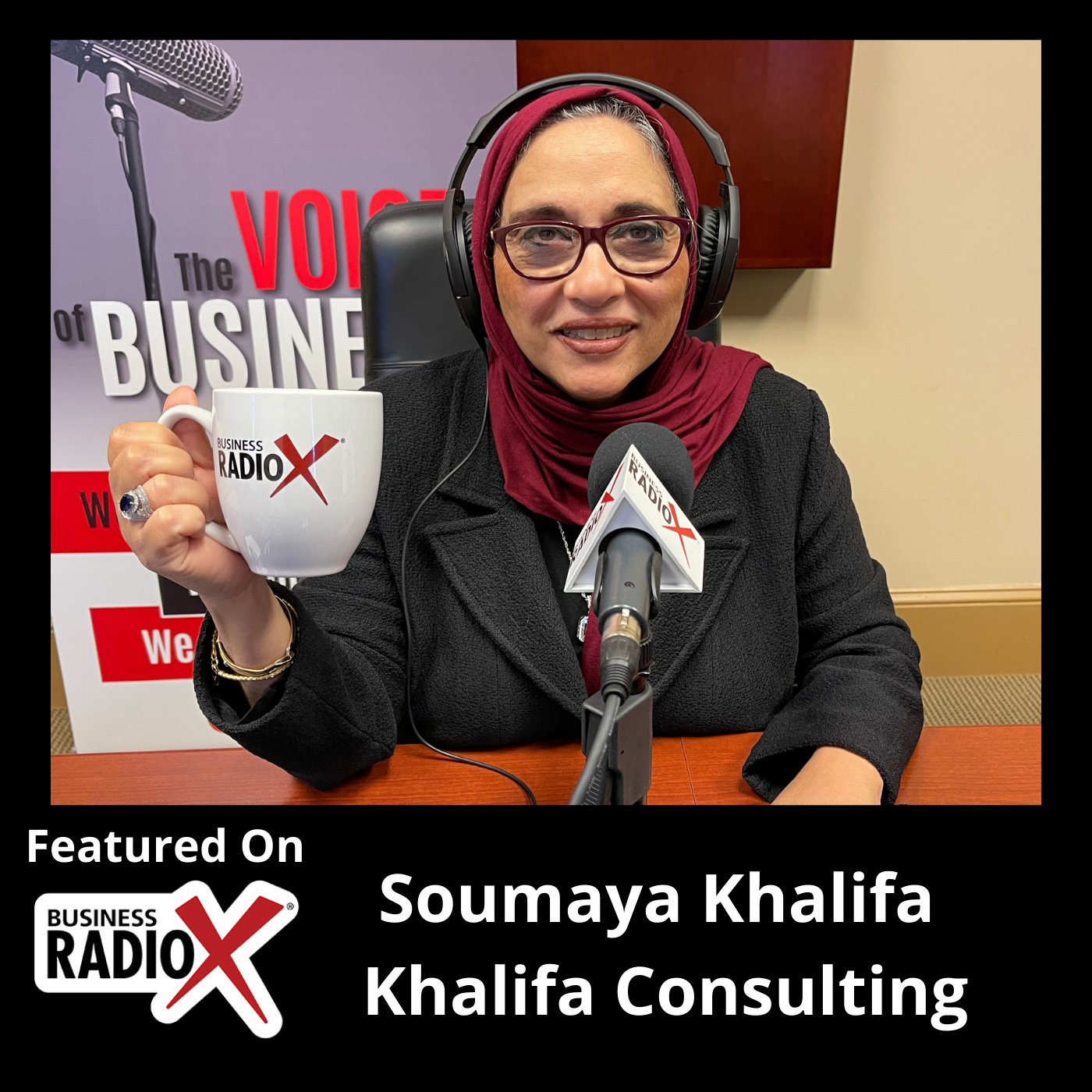
On this episode of Workplace MVP, Soumaya Khalifa, President of Khalifa Consulting, joined Jamie Gassmann to discuss diversity, equity, and inclusion at the leadership level. Noting that diversity is now a given when hiring, Soumaya elaborated on the qualities an effective leader must have to be an inclusive leader. She and Jamie went on to discuss what diversity is, the impact when it’s missing, how leaders can uncover their unconscious bias, a culture of belonging, and much more. Workplace MVP is underwritten and presented by R3 Continuum and produced by the Minneapolis-St.Paul Studio of Business RadioX®.

Khalifa Consulting

Khalifa Consulting provides Fortune 100 companies, non-profit organizations, and governmental institutions with wide-ranging expertise and practical solutions to cross-cultural operations in the Arab world and the US.
Our team of top-level Diversity and Inclusion experts offers training and coaching services including Understanding the Diversity and Cultures of Arab Americans, Intercultural Communication, Managing a Cross-Cultural Team, Cultural Competency for Law Enforcement, and Keys to Success as a Woman Executive in the Arab World.

▪ For international business clients, we offer the specific cultural tools and information needed to successfully conduct business in the Arab World, including how to work within global/virtual teams, and crafting culturally appropriate videos and other media messages.

▪ For domestic and international business clients, we offer training workshops and individualized coaching to support diversity, equity, and inclusion initiatives.

▪ For US-based clients, we offer guidance and technical assistance on how to provide reasonable accommodations for their Muslim employees, by auditing current practices, making recommendations, and suggesting inclusive ways to support a positive work environment.

▪ For clients planning relocations to or from the Arab World, we offer general and specific direction for personal and family adjustment, practical shortcuts for managing new systems, and how-tos for everyday life.

▪ For our executive coaching clients, Khalifa Consulting offers personalized, ongoing, one-on-one high-level coaching to increase motivation, improve business skills and create work-life balance leading to thriving businesses and families.

Company website | LinkedIn | Facebook | Twitter

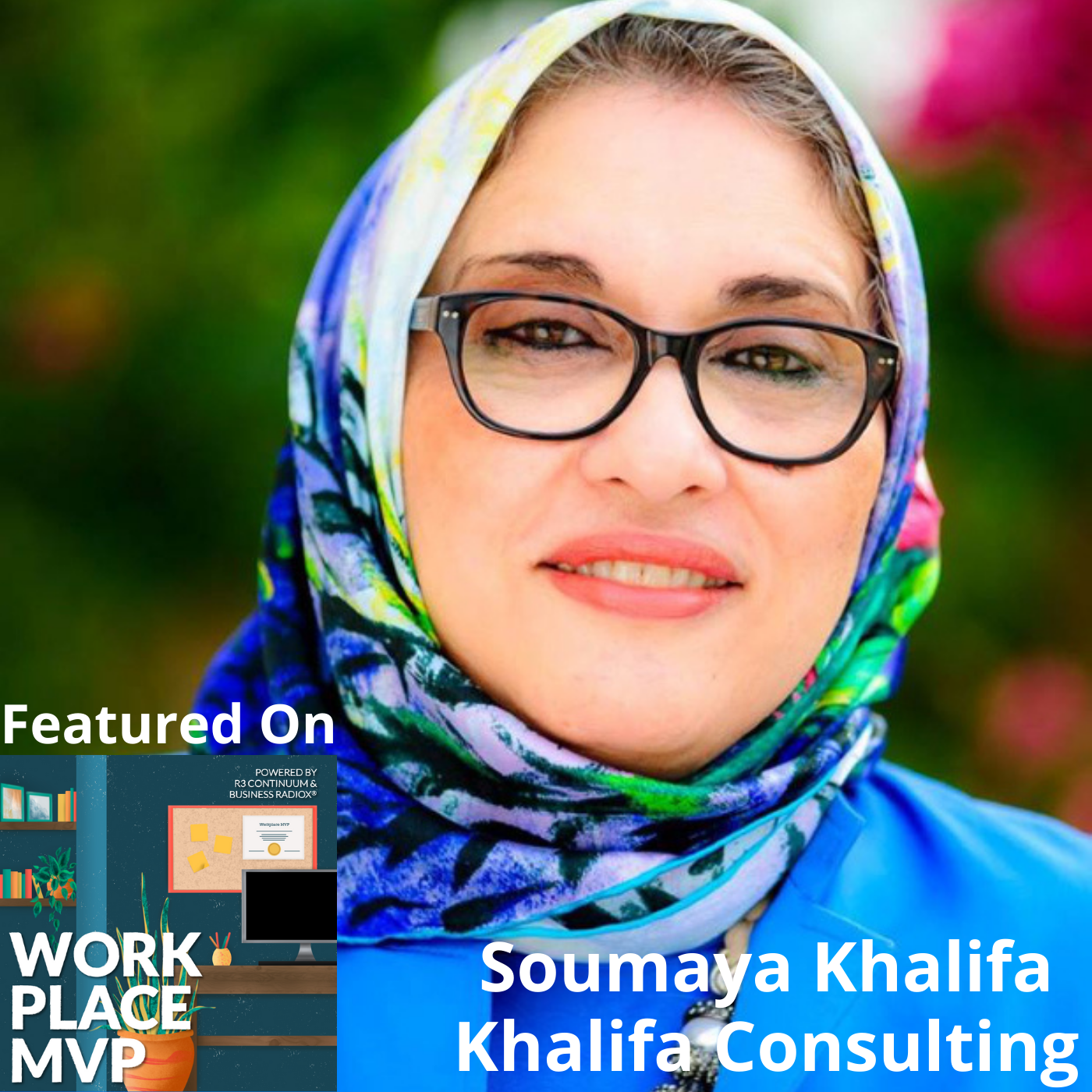
Soumaya Khalifa, President, Khalifa Consulting

Soumaya Khalifa, President, Khalifa Consulting

Soumaya Khalifa is the president of Khalifa Consulting, an Atlanta-based consulting firm specializing in intercultural coaching, consulting, and training. She is also an executive coach and teaches at Emory University Continuing education courses on Human Resources Management, Diversity, Equity and Inclusion, and Women in Leadership.

Soumaya is passionate about her work to build bridges of understanding and help leaders and organizations positively impact their employees and their bottom line.


LinkedIn

About Workplace MVP

Every day, around the world, organizations of all sizes face disruptive events and situations. Within those workplaces are everyday heroes in human resources, risk management, security, business continuity, and the C-suite. They don’t call themselves heroes though. On the contrary, they simply show up every day, laboring for the well-being of employees in their care, readying the workplace for and planning responses to disruption. This show, Workplace MVP, confers on these heroes the designation they deserve, Workplace MVP (Most Valuable Professionals), and gives them the forum to tell their story. As you hear their experiences, you will learn first-hand, real-life approaches to readying the workplace, responses to crisis situations, and overcoming challenges of disruption. Visit our show archive here.

Workplace MVP Host Jamie Gassmann
Jamie Gassmann, Host, “Workplace MVP”

In addition to serving as the host to the Workplace MVP podcast, Jamie Gassmann is the Director of Marketing at R3 Continuum (R3c). Collectively, she has more than fourteen years of marketing experience. Across her tenure, she has experience working in and with various industries including banking, real estate, retail, crisis management, insurance, business continuity, and more. She holds a Bachelor of Science Degree in Mass Communications with special interest in Advertising and Public Relations and a Master of Business Administration from Paseka School of Business, Minnesota State University.

TRANSCRIPT

Intro: [00:00:04] Broadcasting from the Business RadioX Studios, it’s time for Workplace MVP. Workplace MVP is brought to you by R3 Continuum, a global leader in workplace behavioral health and security solutions. Now, here’s your host, Jamie Gassman.

Jamie Gassmann: [00:00:25] Hi, everyone. Your host, Jamie Gassmann, here, and welcome to this episode of Workplace MVP. Diversity and inclusion is an area of focus for many senior leaders and H.R. executives. A great number of workplaces are re-examining their organization’s approach to ensuring diversity and inclusion and looking for how they can improve, build or implement new initiatives for their work environments. There are a lot of ways employers can take to building their diversity and inclusion program. But to aid in their ability to ensure their program is effective and successful, their efforts need to start at the top where they’re leaders embodying what is called inclusive leadership.

Jamie Gassmann: [00:01:08] As an inclusive leader, you are aware of your own biases and you are actively seeking out and considering different perspectives to inform your decision making and collaboration with others. These leaders are committed to ensuring all team members are treated equitably, feel a sense of belonging and value, and have the resources and support they need to achieve their full potential. How does an organization ensure they have inclusive leaders or how do their leaders learn to be inclusive if not already? Where does this fall within the process of establishing or reinventing an organization’s diversity and inclusion program?

Jamie Gassmann: [00:01:47] Well, joining us today to share her expertise and recommendations for workplaces looking to incorporate or reinvent their diversity and inclusion programs is workplace MVP and President and CEO of Khalifa Consulting, Soumaya Khalifa. Welcome to the show, Soumaya.

Soumaya Khalifa: [00:02:03] Thank you. It’s so wonderful to be with you today.

Jamie Gassmann: [00:02:07] Oh, we’re really happy to have you. So, I’d like to start out with you sharing with me your journey to becoming the President and CEO of Khalifa Consulting.

Soumaya Khalifa: [00:02:16] That is an incredible question. It has been a long road and it also has been a very unconventional journey. I earned my B.S. degree in Chemistry of all things and decided that I wanted to do something with people and not in labs. So, what I did is I pursued my MBA in human resources, worked in Corporate America for many years in the H.R. field, which I truly loved. Towards the end of that career in Corporate America, I was involved in a lot of diversity and inclusion work as well as organizational effectiveness, and it’s really amazing that the two really kind of complement each other. When I went out on my own, I wanted to bring all of my journey, all of my experiences to my clients. And so, that’s when I founded Khalifa Consulting, and it’s been about 12, 13 years now.

Jamie Gassmann: [00:03:01] Wow. So, talk to me a little bit about some of the work and the business that you do with Khalifa Consulting and helping your clients.

Soumaya Khalifa: [00:03:09] Khalifa Consulting is a boutique firm with a network of consultants covering the world. We specialize in executive coaching, intercultural and DEI training and consulting. I have a special interest in women and leadership and how to bring religion or faith into the DEI framework. We cater to large and mid-sized organizations and in the intercultural and DEI work, and also we do executive coaching for all sizes of organizations.

Jamie Gassmann: [00:03:41] Great. So, this topic we’re talking about is very near and dear to your heart. Share with me your opinion about workplaces having a diversity and inclusion program. Should they – is it – what’s the level of importance in making sure that they have something built-in?

Soumaya Khalifa: [00:03:59] Well, you know, diversity is a given because our population right here in the US has been diversifying over the last couple of decades. So, it is a given. If we are, as employers, looking for the best talent that there is out there, we will get diverse talent. Now, the real issue is how do we make our workplaces inviting enough for that talent, that top talent, to want to join us, but not only in joining us but to stay with us. So, inclusion needs to be very intentional. What does an employer have to do to attract and retain the talent that’s out there?

Soumaya Khalifa: [00:04:39] And, you know, it’s not only about talent. But if we have that talent, we are able to get into new markets. Because when we go into new markets, we have to understand them. And if we do have representation from them, that gives us an advantage, a competitive advantage to reach people in different markets. And, diversity is being invited to a party, and inclusion is being able to dance up the party. So, that’s the framework. So, diversity is a given, but what do we do with it in organization is the act and that is inclusion.

Jamie Gassmann: [00:05:19] Yeah. It’s such a great analogy. I’ve never heard it referred to that way, but it gives some context to how those two play together, basically. So, looking at that term inclusive, inclusive leader, you know, can you share from your expertise what that means? I know I gave a little brief definition of it at the beginning, but can you share from your perspective what that means?

Soumaya Khalifa: [00:05:43] Sure. In my opinion, an effective leader by default is an inclusive leader. And if we are to look at some of the characteristics of an inclusive leader, they have to have commitment to cultivate a diverse and inclusive workforce, and that takes really time and energy from them. And they have to believe in the business case for diversity and inclusion and how that is driving or will drive or will impact on the mission and vision of their organization.

Soumaya Khalifa: [00:05:43] They need to have courage. They need to have courage and not be afraid to challenge organizational attitudes and practices that yield homogeneity, even if their recommendations are politically or culturally unpopular within their organization. You know, they have to be very careful there.

Soumaya Khalifa: [00:06:34] They need to also display humility by acknowledging their own personal limitations and seeking contributions from others to overcome that. Some leaders, you know, as we all know, find it difficult to admit that they don’t have all the answers. So if they are, if they do have humility and reach out to others, that makes them better leaders. They need to be able to recognize that they have biases. We all do this. It’s just human nature. They need to work on identifying what their own biases are and learn ways to prevent them from influencing their talent decisions.

Soumaya Khalifa: [00:07:14] They want to also look at their policies, processes and structures to see if there are organizational biases that are undermining diversity and inclusion in their organization.

Soumaya Khalifa: [00:07:27] They have to be curious. They have to have an open mind and a passion for learning and a desire for their own exposure to different ideas. And, they have to also be culturally intelligent. By that, I mean that they have to be aware of their cultural preferences. When they are on autopilot, how do they act? What do they go to? But they also need to learn about the cultures of people that they work with, their team, their colleagues, and be able to identify if there are gaps and how can they bridge those gaps to be able to leverage the best from all their team members.

Soumaya Khalifa: [00:08:13] An inclusive leader needs to also be collaborative. They have to understand that collaboration is important for the success of their teams. And for them to be collaborative, they have to create a psychologically safe environment in which all individuals feel that they are empowered to express their opinions in the group. So, these are just some of the characteristics of an inclusive and, in my opinion, an effective leader.

Jamie Gassmann: [00:08:45] Great. And now, looking at those biases and thinking about diversity, just real quick, can you share with us when we hear the term diversity. I feel sometimes that can show up differently with different individuals. From your perspective, when you hear the term diversity, what does that include? What does that mean?

Jamie Gassmann: [00:09:07] Sure. Diversity, in my opinion, is everything that makes us different but also everything that makes us the same. So, a lot of organizations focus on race and on gender. And, within the US framework, that’s usually what is focused in on. But there are so many different layers of diversity that we need to look into if we are telling people bring your whole professional self to work in terms of, for instance, sexual orientation, in terms of religion, and many other different layers of diversity.

Soumaya Khalifa: [00:09:51] People on the outside might look the same, but when we start peeling off the different layers, there are differences amongst them. So, we need to treat diversity in the broadest sense. And, what’s really interesting is diversity, we need to look at the history of the nation that we’re looking at diversity at. We need to look at the social construct in it and many other things.

Soumaya Khalifa: [00:10:15] I was working with a client who works for a French company, and the French company’s diversity and inclusion philosophy is getting more women in and bringing more non-French people into their boards and into their leadership. So, that is how they define it in a French company. In a US company, that is defined a little bit differently. There’s more emphasis on race and on gender, of course.

Jamie Gassmann: [00:10:45] Interesting. So, looking at that inclusive leadership and looking at that work environment, why is it so important that you have inclusive leadership within that work environment? What are the consequences if you don’t? Or the impact?

Soumaya Khalifa: [00:11:00] The impact there is really huge. And some of it is a direct impact and some is an indirect impact. If the workplace is not inclusive, where employees don’t feel like they belong, if it is a hostile work environment, it’s not a friendly work environment, then the implications can be very enormous, anywhere from a turnover rate where people are not – don’t want to stay with the company or the organization. People can get depressed. The medical cost of the organization that they pick up on productivity goes down. People call out sick more often. Just a lot of negative consequences if we don’t have an inclusive environment in our workplaces.

Soumaya Khalifa: [00:11:55] I don’t feel like I belong. If I don’t feel like I belong and I could be myself, I don’t want to be there. I want to find somewhere else to go. And, I think with COVID-19 and if leaders were not intentional in diversity and inclusion because we went into more online and it was more difficult to provide that culture of inclusivity when we are online. So, leaders have to be even more intentional and organizations have to be more intentional to bring that inclusiveness culture into the workplace.

Jamie Gassmann: [00:12:31] Yeah. Interesting. I could imagine with the great resignation, if you will, if maybe some of that realization was coming through for some of those employees. Do you think that that had some contribution to it once they moved into this kind of remote work environment, feeling a little bit more isolated than before?

Soumaya Khalifa: [00:12:50] I do believe so. I do believe so. All our worlds really turned upside down. We did not think that we could work from home as much as we did, and we adapted to it. Everybody had an opportunity to pivot. And, as employees, they looked at their priorities and what’s important to them and decided is this the right organization for me to stay in, or do I look for something else where I’m happier? Because happiness is really important for individuals now.

Jamie Gassmann: [00:13:24] Yeah. Absolutely. And so, looking at a leader in a work environment, you know, how do they identify the biases that they have? How do they know they’ve got them? Like, what are some ways that they can help themselves to maybe identify ones that they might have that they weren’t even aware of? So, just we’d like to get some of your thoughts around that.

Soumaya Khalifa: [00:13:47] Well, thank you so much for the question. We all have biases and we have unconscious bias, whether – and they’re called unconscious because we don’t know about them and they could be really detrimental for us. If we don’t know about them, we can’t do anything about them.

Soumaya Khalifa: [00:14:02] So, your question of how do we find out. Well, there are so many different ways to find out. One quick way of doing it is for the individual leader to look at their circle of friends. Do they all look like them? Look at who they’re hiring. Do they all look like them? This is similar to me impact. And, you know, so that is looking in the mirror and seeing what world have I created around me.

Soumaya Khalifa: [00:14:33] I was involved with Leadership Atlanta and I went through that many years ago. And one of the things that came out of it is that we were challenged to look at our circle of friends. And many people from our class decided that, hey, I golf with all white guys or all black guys or whatever the race and gender happened to be. And they made a conscious decision that I need to diversify my circle of friends, circle of people that I go out with, circle people that I golf with, and that impacted them.

Soumaya Khalifa: [00:15:15] Now, another way to find out about our own cultural biases or unconscious biases, I’m sorry, is to ask a colleague or confidant. That would be a very sensitive conversation. But there needs to be a very high level of trust there.

Soumaya Khalifa: [00:15:32] There’s another way too and that is, there’s an online tool that is developed – that has been developed by Harvard University, and that’s an instrument to identify unconscious bias. And it’s free and it’s online. And, if one types implicit Harvard edu, then they will take that, take it to that website. And it’s really an amazing one. If you want to look at race or gender or religion or what have you, there are many different instruments there for people to identify what unconscious bias they might be playing.

Jamie Gassmann: [00:16:09] So, you kind of identified a couple of approaches that they can take by looking at their group of peers or that they’re spending a lot of their extra time with and look, you know, re-evaluating and identifying ways to kind of diversify that. But what are some other ways that they could overcome their bias, their unconscious bias, or even biases they know that they have and relearn a thinking, you know, that likely has been instilled in them from a really young age, because I think some of our biases that we have comes from how we grew up or how we, you know, life events that we’ve experienced. And so, how can one kind of relearn, if you will, how to look at people differently or how to kind of be more diverse or more inclusive?

Soumaya Khalifa: [00:17:00] Yeah. That is such a great question. And, you know, we pick up our unconscious biases as children at the dinner table, what is said at the dinner table. So, parents and grown-ups and leaders, we need to be watching what is said at the dinner table because the younger generations are picking up on the biases that we already have, spoken and unspoken. So, we don’t have to say much of anything and that’s picked up. Kids are very, very smart.

Soumaya Khalifa: [00:17:30] So, in terms of how do we get over that, I know that a client, he worked with very diverse background people. And one of the stories that he shared is they were talking about we don’t have, you know, we only have one Jewish person in the group. And to him, he looked and he said, “Who’s that?” And that Jewish person was somebody that he became friends with and he no longer saw him as Jewish. He was just Ed.

Soumaya Khalifa: [00:18:11] And so, that is how we can work around unconscious biases. First of all, identifying what unconscious bias we might have, and then be intentional in terms of expanding our experiences so that we have meaningful interactions with people from whatever background that we have the unconscious bias on. And then, when we see people as individuals, the stereotypes or the assumptions we have based on the group kind of falls out the way. And that is a very effective way to overcome our unconscious biases. But, again, it takes awareness. It takes intentionality, and it also takes a strong will of wanting to do it.

Jamie Gassmann: [00:18:56] Great. Great, great advice there. Because I imagine there’s people who are like, I don’t want to be seen as that person that’s not inclusive because they might feel internally that they are and maybe aren’t aware of what they can’t see. So, very interesting.

Soumaya Khalifa: [00:19:11] And, you know, more on that because that is a very important subject to think about. Again, unconscious, it’s not seen, it’s not felt. But knowing that the biases show up when we are in an ambiguous situation, such as if we don’t know about a person and we meet them, and all of a sudden we go to our stereotypes. So, we want to be able to minimize ambiguous situations. We you want to learn about all the situations we get into so we won’t be surprised. We won’t be able to surprise ourselves in a negative way when snap decisions need to be made right away, our hardwired stereotypes pop up. So, taking time to make decisions. And usually, it’s recommended that leaders make decisions early in the day when they have had a good night’s sleep and they’re less likely to make mental shortcuts.

Soumaya Khalifa: [00:20:09] And, you know, being able to push back against default assumptions when we put a stereotype in our mind that’s hardwired, you know, and I’m a short person. I love to give that example. If our stereotype in our mind is that short people are not very smart and we see a short person, then the way the stereotype works is that they are not very smart. And if that happens, if that person happens to be smart, then we push back through those stereotypes. Well, well, they’re the exception. They’re not really the rule.

Soumaya Khalifa: [00:20:44] So, we need, again, self-awareness to get over that. And then, being able to learn, learn and meet new people, be challenged and challenge our stereotypes and prejudices if they have gotten to that level.

Jamie Gassmann: [00:21:06] Yeah. Ask questions get to know people. Yeah. Be open to that. That’s kind of the approach that I like to take because I just love to hear people’s stories. So, which is why this show is so great because I get to hear so many leaders’ stories and expertise.

Jamie Gassmann: [00:21:19] So, real quick, we’re going to take a break and listen from our sponsor. So, Workplace MVP is sponsored by R3 Continuum. R3 Continuum is a global leader in empowering leaders to effectively support and help their employees thrive during disruptive times. Through their tailored workplace behavioral health support, disruption response and recovery, and violence mitigation solutions, they can help you create a work environment where your employees can feel psychologically and physically safe. To learn more, visit our r3c.com today.

Jamie Gassmann: [00:21:53] So, you mentioned in our previous conversation the importance of creating a culture of belonging within that work environment. Can you help kind of describe for our listeners what does a culture belonging look and feel like?

Soumaya Khalifa: [00:22:09] Sure. Belonging is a sense one gets that they are a valued member of an organization. They feel a sense of purpose. A sense of belonging brings meaning into our lives and all the circles. I mean, let’s face it, we spend more time at work than we spend with our family. And if we feel good about ourselves, good about the organizations that we work for, just think about how that’s going to impact us individually, as employees, as leaders, but also the organization.

Soumaya Khalifa: [00:22:44] So, there was a survey done in 2019 by an organization called BetterUp, and they found that workplace belonging can lead to a 56% increase in job performance. It can also lead to a 50% reduction in employee turnover. Workplace belonging can lead to 75% decrease in employee sick days. So, those numbers really give us the business case for why having a culture of belonging is very important. It adds to the bottom line.

Jamie Gassmann: [00:23:19] Wow. Sounds like – I mean, those are great statistics to show, you know, just by creating that environment that people want to be at and be a part of. Fantastic. So, looking at that, there was something when we talked before that really resonated with me in regards to religion and the symbolism around religion and certain holidays that are celebrated. And you and I were kind of discussing, in particular, the Christmas or Hanukkah and kind of that a lot of leaders have taken the approach of this broad messaging of happy holidays, and then removing certain symbolism like Christmas trees. And you talked about how not all your employees really want you to take that down, even if they don’t celebrate it.

Jamie Gassmann: [00:24:06] And so, the question I have is, you know, by taking and removing some of those symbolism, does it help to create that culture belonging, or what are some of your thoughts around how they can really handle those holiday seasons, you know, in an appropriate approach that allows all employees to feel like they belong and that their holidays are being celebrated.

Soumaya Khalifa: [00:24:32] I love that question. I super love that question. I am not in favor of somebody saying happy holidays. First of all, I am a Muslim. And, most of the time I don’t have a holiday around Christmas. And, for somebody to say happy holidays, it really doesn’t resonate with me. And that’s not only for Muslims, but you have Buddhists and you have Hindus, etc., who do not have a holiday around the holiday season.

Soumaya Khalifa: [00:25:02] I am not in favor of taking down the Christmas tree, but I am in favor of having an inclusive work environment that acknowledges and celebrates the religious holidays and traditions that are represented in the workforce. So, if we do have Jewish members, then Hanukkah, Passover, needs to be acknowledged. Holly, Ash Wednesday, Ramadan, and the list goes on. I want to be – I want to feel like I’m validated. By just saying happy holiday, I think it’s just a brush over and it alienates the Christians and it does not bring anybody into the fold.

Soumaya Khalifa: [00:25:44] But we want to be intentional. Again, we want to be knowing who’s in our workforce and what matters to them. If we have a calendar, let’s put it on there that Ramadan starts April 2nd. Ash Wednesdays on that date. Hanukkah is on that date. So, bring all those holidays, acknowledged people, validate people, and they feel like, hey, my workplace cares about me enough to wish me a Ramadan Mubarak or Happy Hanukkah or whatever the holidays.

Jamie Gassmann: [00:26:16] Yeah. Well, even to allow other employees to understand how each of those faiths practice their various holidays and what the symbolism and meanings are behind what they’re practicing so that people can learn.

Soumaya Khalifa: [00:26:30] Yes. And that’s the intention behind that. Because if I know – if I am – we have something called the iceberg. And the iceberg is where we say that what’s visible is what people see. But what’s below the waterline is what drives the visible attributes that we see.

Soumaya Khalifa: [00:26:50] So, if people know that my colleague’s religion is Muslim and when he takes or she takes a longer lunch hour on Friday, it’s because they have to go to prayer, or they’re not eating from April 2nd to May 2nd lunch and they leave early and we know it’s Ramadan. What is Ramadan like? What is Hanukkah like? What is the Passover and High Holy Days are like? Then, we get to know people at a deeper level and that goes hand-in-hand with belonging. I am accepted for who I am. I’m celebrated for who I am, and I am appreciated for who I am. And I don’t have to fit a mold to be able to be a validated person.

Jamie Gassmann: [00:27:40] Yeah. I love that. So, looking at that and looking at that validation of a person because obviously, you know, not feeling like you belong, not feeling validated can start to really impact somebody’s mental health and obviously ultimately their productivity. So, how does a workplace that’s not culturally belonging in your opinion, what do you see as the impact on that mental health and productivity of its employees?

Soumaya Khalifa: [00:28:08] There’s been a lot of research about that. And the outcome says – it was a 20-year research project. And it said that there’s increased depression of the employees, substance abuse, and health issues that kind of manifest themselves because of the stress and the pressure that they feel in that particular workplace. And, we know we’ve heard about people being disgruntled. We’ve heard people possibly committing suicide. We’ve heard people going postal. If the situation really gets out of hand and there’s a mental issue there, an employee could go back to the workplace and do horrific things, do it. So, it does have very negative implications.

Soumaya Khalifa: [00:29:00] But, you know, we’re talking about the employee and their mental health, which is really important. But the research also shows that the organizations are suffering as well. So, they’re suffering from decreased productivity, lower levels of employee commitment, increased turnover, and that doesn’t take into account the higher medical insurance premiums that the employer will be paying, the use of the employee assistance programs. So, it’s negative for all concerned, both the employees, leaders and the organization.

Jamie Gassmann: [00:29:38] Yeah. Absolutely. You know, it’s like when you want to bring your whole self to work because you’re passionate about the work that the company is doing, but yet you don’t feel like your whole self can be at work. You know, you want to – it’s like when you’re at work, it gets like you’re home away from home is kind of how I call it when you’re in the office because you spend so much of your day there. You want to feel like you’re welcome just like you are within your own home. So, I could see where that could have a huge impact on those individuals.

Soumaya Khalifa: [00:30:04] Absolutely.

Jamie Gassmann: [00:30:07] So, looking at cultural differences you shared previously that there are cultures that are relationship-oriented and then there’s cultures like the US that are very task-oriented. So, within our workplaces becoming more and more diverse, how does this show up? How does a leader strike that balance between allowing people to really congregate and socialize, you know, at the water cooler, if you will, when we get, you know, get that opportunity back to those days to really that task-oriented? How do they strike that balance?

Soumaya Khalifa: [00:30:39] Yeah. So, I want to share that I ran into a website that is a Ramsey County Minnesota website. And what struck me is that that website has been translated into languages that I had never heard of before. I mean, Somali, Hmood, Oromo, and Kara. All right. I had to Google each one of those languages to see where they’re spoken. So, this is not a hypothetical question. This is a true question that we need to be thinking about is we have people represented from all over the world working right here. Different cultures have different orientations. You mentioned that task-oriented cultures and the relationship-oriented cultures and they are on a spectrum.

Soumaya Khalifa: [00:31:36] So, the task-oriented culture is let’s get to work. We have a project to do. Let’s get down to what’s going to be done. What is it going to be done? Who’s going to be responsible? Where are the deliverables? And, relationships are really a second or third item that people will think about. Let’s just get the job done.

Soumaya Khalifa: [00:31:55] Now, the cultures that are relationship cultures and all those languages that I just named off, they are relationship cultures, which means that before I start doing work with you, I want to get to know you. I want to get to know about your family. I want to get to know where you went to school. What do you like to eat? Let’s go out to lunch together. Right?

Soumaya Khalifa: [00:32:15] So, if we have people who are on the opposite spectrums of that task orientation or relationship and we want them to work together, we need to be very, again, intentional. That word is very important for understanding who do we have in our teams. Come up with the team norms, identify what is a hybrid culture that will work for both the task-oriented people and the relationship-oriented people.

Soumaya Khalifa: [00:32:44] The task-oriented people, just an FYI, will look at the relationship people and say, “Gosh, they waste so much time. Why do they need to do all this small talk and drink tea or coffee? Let’s just get down to business.” The relationship people will look at the task people and say, “Oh, they’re just so rude and abrupt. They don’t even say hello and drink coffee with me.” So, that can be a real issue in terms of breakdown and communication. So, as leaders, we need to know who is on our team and how do we create a culture that would be understood and accepted by both.

Soumaya Khalifa: [00:33:20] When we look at a lot of data and research and looking at a homogeneous team versus a multicultural team and looking at when they are at their best and when they are very well managed, the multicultural team way outperforms the homogeneous team. So, it is a gift to have the diversity, but we have to manage it well to be able to leverage the results that we want to be able to achieve.

Jamie Gassmann: [00:33:55] Yeah. I find that there’s so much value in being able to build up some of those relationships. Even as a leader, you get to know people so differently. If you’re only focused on the day-to-day task, you’re not taking that time to get to know the people you’re working with. And so, when you think of that culture of belonging, it makes me think there’s benefit in trying to bring them closer to a balancing act. What are your thoughts around that and like how it contributes to that culture of belonging?

Soumaya Khalifa: [00:34:26] Yeah. One thing that I want to mention here is we are in a business to do business. So, let’s not lose sight of that. Right?

Jamie Gassmann: [00:34:35] Right.

Soumaya Khalifa: [00:34:35] And doing DEI is a very strong business case to do our business better. So, I don’t want us to just talk about DEI and not forget the bigger picture. We are doing DEI because of the bigger picture and we have to keep that very clear in front of our eyes. We are here to further and achieve the mission and vision of our organizations, and I’m a firm believer that DEI will help us achieve that.

Soumaya Khalifa: [00:35:04] So, let me give you an example and we touched upon that just a little bit earlier when we include religion and the DEI conversation. All right. We want to be able to leverage the organizational values and how they are very much aligned with our employee values. And they’re probably aligned in their religious beliefs values. So, when we say bring your religion into work, it does not mean that, hey, let’s bring everybody together and let’s argue about which faith tradition is the right tradition that’s going to get us to heaven or what have you. But it is to understand what’s below the waterline for our employees is to get to know them. It’s to be able to celebrate them, make them feel like they’re validated. So here is the way, as an example with DEI, when we bring faith tradition into work, the parameters that we need to build around it. There shouldn’t be a discussion about or proselytizing or what have you, but it’s about the person, about my teammate, about my leader, about everybody matters. And that part of them, which in many situations is a big part of who they are.

Jamie Gassmann: [00:36:25] Yeah. Absolutely. And there definitely is that you still have a business to run. So, I love that you brought that up and, you know, sharing that you’re focusing on the business needs while also focusing on your employee needs. So, how do you know when you’ve got it right? Like, is there a way for them to measure that? I mean, is it employee surveying? Is it pulling? Like, what can a leader do to know they’re striking that right balance and that right chord within that organization?

Soumaya Khalifa: [00:36:52] Well, yeah. Employee surveys are definitely something that many organizations look at and, you know, they’re done anonymously so people feel comfortable giving their true, honest opinions about the culture of the organization, about whether the culture has moved the needle to belonging or not.

Soumaya Khalifa: [00:37:15] There is something called the stay interview, like the exit interview but for people who do stay in the company, to get a read on how others perceive in the company. There are employee exit interviews, of course, but hopefully, we don’t get there. But if we do, then we want to understand why people left.

Soumaya Khalifa: [00:37:36] And one of my favorites is a very simple thing, and it’s just sitting down and speaking with employees and team members about how things are going. We look at performance management. A lot of organizations do at least that it’s done once a year, but we do ourselves a disservice when we do that. Managers and leaders need to have frequent check-ins with their employees to see how they’re doing, and hopefully, they have created a relationship with their employees where they’re open enough to share with them how things are going for them.

Soumaya Khalifa: [00:38:12] A leader should not wait very, very long time to have that conversation, but the more frequent the conversations are, the better off it is. So, it’s not rocket science. It’s communication, it’s caring, and it’s letting the employees know that there is a positive psychology within the organization and they can speak their mind.

Jamie Gassmann: [00:38:36] Yeah. Awesome. So, the leader is looking to evaluate, build or reinvent their diversity and inclusion program within their organization. What is your advice for how they should prioritize this initiative and where should they start?

Soumaya Khalifa: [00:38:51] Well, a couple of thoughts here is they need to be very clear on why they want to do that. They need to understand the business case for it. If an organization is doing DEI just to check the box, they need to rethink that. I believe that when just checking the box is done, it has very negative repercussions on the organization. And they can hire an outside consultant to assess the organization in terms of where they’re at with their DEI and collaborate.

Soumaya Khalifa: [00:39:30] If somebody brings in a consultant, it needs to be a collaboration. It’s not, “Here, consultant, take this. Let me know what I need to do.” It needs to be a collaboration. It needs to be a commitment of time and energy and resources and to understand that DEI is really a journey and not a destination. We don’t get there. It’s always work in progress. So, a lot of times people want to say, “Okay, we’ve arrived.” There’s no such thing. It’s always work in progress.

Jamie Gassmann: [00:40:02] Great. Well, I know I personally have learned a lot from you, and I so appreciate you being here on our episode. But if we have guests that want to hear more from you, or to get a hold of you, how can they do that?

Soumaya Khalifa: [00:40:17] I am on LinkedIn, Soumaya Khalifa. Our website is khalifa.consulting. So, K-H-A-L-I-F-A, dot consulting. Send us a message at info@khalifa.consulting, or call at 678-523-5080. I would love and appreciate hearing from you.

Jamie Gassmann: [00:40:40] Yeah. Wonderful. Well, thank you again so much for being on the show, Soumaya. It’s been such a great conversation. I truly appreciate you and all the work that you do.

Soumaya Khalifa: [00:40:48] Thank you so much. What a pleasure and honor to be with you.

Jamie Gassmann: [00:40:52] And we also want to thank our show sponsor, R3 Continuum, for supporting the Workplace MVP podcast. And to our listeners, thank you for tuning in. If you’ve not already done so, make sure to subscribe so you get our most recent episodes and other resources. You can also follow our show on LinkedIn, Facebook, and Twitter at Workplace MVP. If you are a workplace MVP or you know someone who is, we want to hear from you. Email us at info@workplace-mvp.com. Thank you all for joining us today and have a great rest of your day.
 

Tagged With: belonging, DEI, diversity, equity, executive coaching, inclusion, Jamie Gassmann, Khalifa Consulting, R3 Continuum, sense of belonging, Soumaya Khalifa, Workplace MVP

Soumaya Khalifa, Khalifa Consulting

March 1, 2022 by John Ray

Khalifa Consulting
North Fulton Business Radio
Soumaya Khalifa, Khalifa Consulting
Loading
00:00 /
RSS Feed
Share
Link
Embed

Download file

Khalifa Consulting

Soumaya Khalifa, Khalifa Consulting (North Fulton Business Radio, Episode 435)

Soumaya Khalifa, President of Khalifa Consulting, revisited the show to chat with host John Ray about her work in workplace cross-cultural and diversity, equity, and inclusion (DEI) issues. She discussed religion as an aspect of employees’ identities which must be acknowledged and respected, and well as why DEI work needs to go one step further and include belonging. Soumaya addressed the pandemic’s effect on the workplace, the consulting work she does with clients, success stories, and much more.  North Fulton Business Radio is broadcast from the North Fulton studio of Business RadioX® inside Renasant Bank in Alpharetta.

Khalifa Consulting

Khalifa Consulting provides Fortune 100 companies, non-profit organizations, and governmental institutions with wide-ranging expertise and practical solutions to cross-cultural operations in the Arab world and the US.Soumaya Khalifa

Our team of top-level Diversity and Inclusion experts offers training and coaching services including Understanding the Diversity and Cultures of Arab Americans, Intercultural Communication, Managing a Cross-Cultural Team, Cultural Competency for Law Enforcement, and Keys to Success as a Woman Executive in the Arab World.

▪ For international business clients, we offer the specific cultural tools and information needed to successfully conduct business in the Arab World, including how to work within global/virtual teams, and crafting culturally appropriate videos and other media messages.

▪ For domestic and international business clients, we offer training workshops and individualized coaching to support diversity, equity, and inclusion initiatives.

▪ For US-based clients, we offer guidance and technical assistance on how to provide reasonable accommodations for their Muslim employees, by auditing current practices, making recommendations, and suggesting inclusive ways to support a positive work environment.

▪ For clients planning relocations to or from the Arab World, we offer general and specific direction for personal and family adjustment, practical shortcuts for managing new systems, and how-tos for everyday life.

▪ For our executive coaching clients, we offer personalized, ongoing, one-on-one high-level coaching to increase motivation, improve business skills and create work-life balance leading to thriving businesses and families.

Company website | LinkedIn | Facebook | Twitter

Soumaya Khalifa, President, Khalifa Consulting

Soumaya Khalifa, President, Khalifa Consulting

Soumaya Khalifa is the president of Khalifa Consulting, an Atlanta-based consulting firm specializing in intercultural coaching, consulting, and training. She is also an executive coach and teaches at Emory University Continuing education courses on Human Resources Management, Diversity, Equity and Inclusion, and Women in Leadership. Soumaya is passionate about her work to build bridges of understanding and help leaders and organizations positively impact their employees and their bottom line.

LinkedIn 

Questions and Topics in this Interview:

  • Tell us about Khalifa Consulting
  • What is the role of religion in DEI?
  • How do you define belonging?
  • What does it look like to include religion in the workplace?
  • How has the pandemic impacted DEI?
  • What is your advice for small businesses?
  • How should a leader approach Ramadan with their Muslim employees?
  • Accountability in DEI initiatives
  • How do I measure inclusion or belonging?
  • Say more about your work with clients

North Fulton Business Radio is hosted by John Ray and broadcast and produced from the North Fulton studio of Business RadioX® inside Renasant Bank in Alpharetta. You can find the full archive of shows by following this link. The show is available on all the major podcast apps, including Apple Podcasts, Spotify, Google, Amazon, iHeart Radio, Stitcher, TuneIn, and others.

RenasantBank


Renasant Bank has humble roots, starting in 1904 as a $100,000 bank in a Lee County, Mississippi, bakery. Since then, Renasant has grown to become one of the Southeast’s strongest financial institutions with over $13 billion in assets and more than 190 banking, lending, wealth management and financial services offices in Mississippi, Alabama, Tennessee, Georgia and Florida. All of Renasant’s success stems from each of their banker’s commitment to investing in their communities as a way of better understanding the people they serve. At Renasant Bank, they understand you because they work and live alongside you every day.


Special thanks to A&S Culinary Concepts for their support of this edition of North Fulton Business Radio. A&S Culinary Concepts, based in Johns Creek, is an award-winning culinary studio, celebrated for corporate catering, corporate team building, Big Green Egg Boot Camps, and private group events. They also provide oven-ready, cooked from scratch meals to go they call “Let Us Cook for You.” To see their menus and events, go to their website or call 678-336-9196.


Tagged With: A&S Culinary Concepts, belonging, Cross-cultural training, DEI, Intercultural Communication, Khalifa Consulting, North Fulton Business Radio, Ramadan, religion, renasant bank, Soumaya Khalifa

Decision Vision Episode 88: Should I Mix My Faith With Business? (Part Two) – An Interview with Soumaya Khalifa, Khalifa Consulting, Inc.

October 22, 2020 by John Ray

Khalifa Consulting
Decision Vision
Decision Vision Episode 88: Should I Mix My Faith With Business? (Part Two) - An Interview with Soumaya Khalifa, Khalifa Consulting, Inc.
Loading
00:00 /
RSS Feed
Share
Link
Embed

Download file

Decision Vision Episode 88: Should I Mix My Faith With Business? (Part Two) – An Interview with Soumaya Khalifa, Khalifa Consulting, Inc.

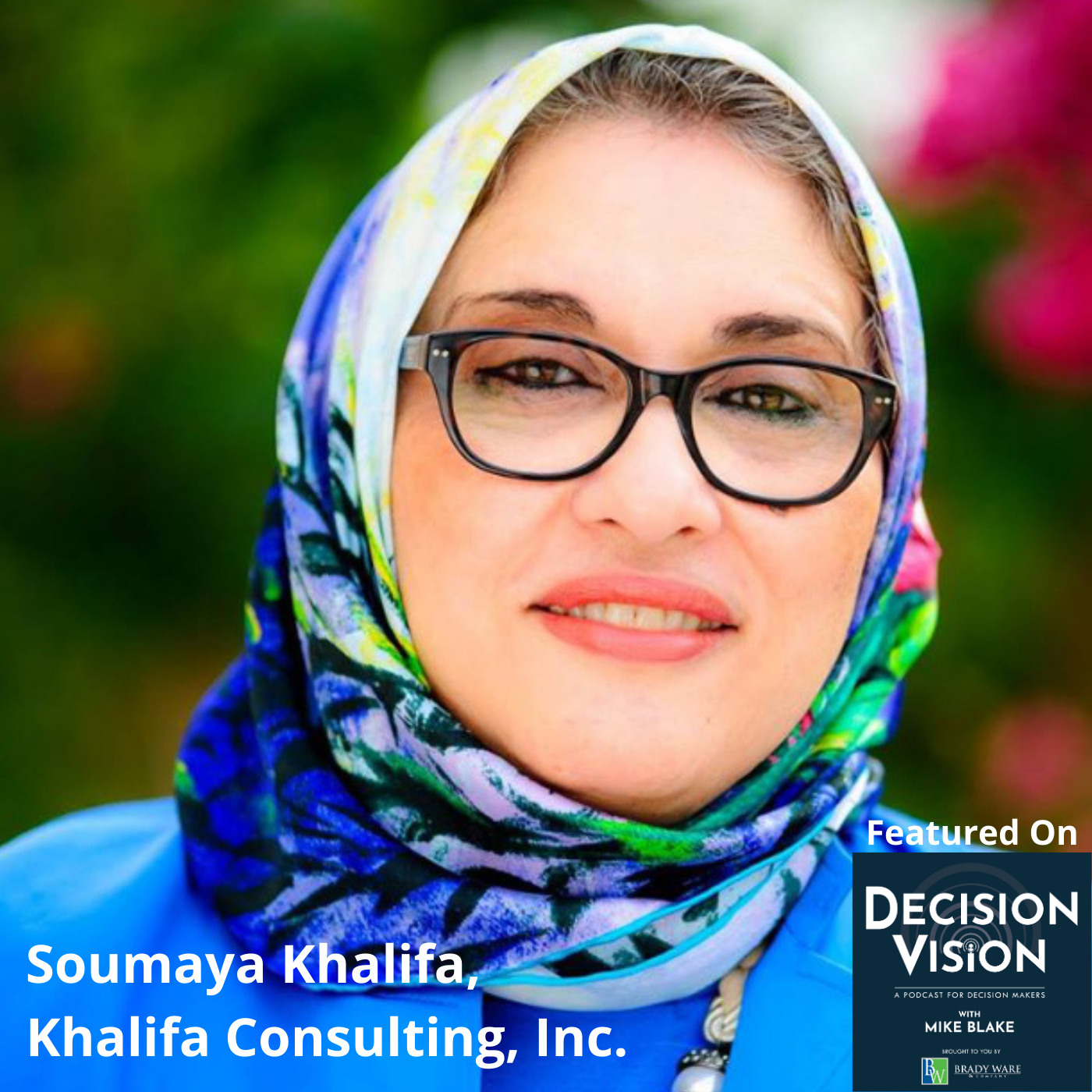
Khalifa Consulting CEO Soumaya Khalifa joins host Mike Blake to discuss how she integrates her Islamic faith with her work and business, as well as her community-building work with the Islamic Speakers Bureau. “Decision Vision” is  presented by Brady Ware & Company.

Soumaya Khalifa, Khalifa Consulting, Inc.

Soumaya Khalifa founded Khalifa Consulting, a strategic intercultural and leadership consulting firm, in 2007. Her career spans more than 25 years in human resources, management, business management and ownership, non-profit and entrepreneurship. Khalifa Consulting specializes in helping executives and organizations succeed when doing business across cultures by providing them the most relevant, practical and up to date cross cultural coaching and training. In addition, Khalifa Consulting offers training and coaching on global virtual teams. Soumaya and team apply this work to a broad range of clients, from large established national and global organizations to startups.

Prior to founding Khalifa Consulting, Soumaya served in several leadership roles in U.S.-based Fortune 100 companies in human resources, leadership development and diversity and inclusion. An alumnus of the University of Houston and Georgia State University, Soumaya is a board member of the Society of Intercultural Education, Training and Research (SIETAR) and the Atlanta Interfaith Broadcasters (AIB). She is also an adjunct professor at Emory University Center for Continuing Education and at the Federal Executive Institute. Soumaya is the author of Diversophy Egypt and has contributed to several publications.

Along with a group of Atlantans, Soumaya launched the Islamic Speakers Bureau (ISB) of Atlanta in August 2001. As the current Executive Director of ISB, she serves the Muslim and wider community by building bridges of understanding, creating interfaith partnerships, developing community leaders, and creating spaces for mutual understating and respect. Under Soumaya’s leadership, the ISB has developed its core programming and launched other key initiatives, including ISB Leadership Institute (ISBLI), 100 Influential Georgia Muslims, and 40 Under 40 Georgia Muslims.  In 2017, Soumaya created a partnership with the Atlanta Mayor’s Office to host the ISB’s first ever Ramadan Iftar hosted at Atlanta’s City Hall and in 2018, the second Atlanta Mayor’s Iftar was attended by over 250 people.

Soumaya has received many awards and recognitions for her work with the ISB, including:

  • 2019 Academy of Women Achievers, YWCA
  • 2018 Arab American High Achiever Award, Alif Institute
  • 2017 City of Atlanta Phoenix Award, presented by Mayor Kasim Reed
  • 2012 FBI’s Community Leadership Award
  • Citizen Diplomat for the U.S. State Department
  • 2012 Invited to the annual White House Iftar hosted by President Barak Obama
  • 2015 Inducted into the College of Ministers and Laity

To learn more on Khalifa Consulting, follow this link.

Michael Blake, Brady Ware & Company

Mike Blake, Host of the “Decision Vision” podcast series

Michael Blake is Host of the “Decision Vision” podcast series and a Director of Brady Ware & Company. Mike specializes in the valuation of intellectual property-driven firms, such as software firms, aerospace firms and professional services firms, most frequently in the capacity as a transaction advisor, helping clients obtain great outcomes from complex transaction opportunities. He is also a specialist in the appraisal of intellectual properties as stand-alone assets, such as software, trade secrets, and patents.

Mike has been a full-time business appraiser for 13 years with public accounting firms, boutique business appraisal firms, and an owner of his own firm. Prior to that, he spent 8 years in venture capital and investment banking, including transactions in the U.S., Israel, Russia, Ukraine, and Belarus.

Brady Ware & Company

Brady Ware & Company is a regional full-service accounting and advisory firm which helps businesses and entrepreneurs make visions a reality. Brady Ware services clients nationally from its offices in Alpharetta, GA; Columbus and Dayton, OH; and Richmond, IN. The firm is growth minded, committed to the regions in which they operate, and most importantly, they make significant investments in their people and service offerings to meet the changing financial needs of those they are privileged to serve. The firm is dedicated to providing results that make a difference for its clients.

Decision Vision Podcast Series

“Decision Vision” is a podcast covering topics and issues facing small business owners and connecting them with solutions from leading experts. This series is presented by Brady Ware & Company. If you are a decision maker for a small business, we’d love to hear from you. Contact us at decisionvision@bradyware.com and make sure to listen to every Thursday to the “Decision Vision” podcast.

Past episodes of “Decision Vision” can be found at decisionvisionpodcast.com. “Decision Vision” is produced and broadcast by the North Fulton studio of Business RadioX®.

Visit Brady Ware & Company on social media:

LinkedIn:  https://www.linkedin.com/company/brady-ware/

Facebook: https://www.facebook.com/bradywareCPAs/

Twitter: https://twitter.com/BradyWare

Instagram: https://www.instagram.com/bradywarecompany/

Show Transcript

Intro: [00:00:01] Welcome to Decision Vision, a podcast series focusing on critical business decisions. Brought to you by Brady Ware & Company. Brady Ware is a regional, full-service accounting and advisory firm that helps businesses and entrepreneurs make visions a reality.

Mike Blake: [00:00:20] And welcome to Decision Vision, a podcast giving you, the listener, clear vision to make great decisions. In each episode, we discuss the process of decision making on a different topic from the business owners’ or executives’ perspective. We aren’t necessarily telling you what to do, but we can put you in a position to make an informed decision on your own and understand when you might need help along the way.

Mike Blake: [00:00:39] My name is Mike Blake, and I’m your host for today’s program. I’m a Director at Brady Ware & Company, a full-service accounting firm based in Dayton, Ohio, with offices in Dayton; Columbus, Ohio; Richmond, Indiana; and Alpharetta, Georgia. Brady Ware are sponsoring this podcast, which is being recorded in Atlanta per social distancing protocols. If you like this podcast, please subscribe on your favorite podcast aggregator and please consider leaving our view of the podcast as well.

Mike Blake: [00:01:04] So, today’s topic is actually a continuation of a prior topic or a previously recorded topic, which is, should I mix my faith with my business? And this will be part two. In part one, we had, I thought, a tremendous discussion with Bill Leonard and Jonathan Minnen, who are from the Christian and Jewish faiths, respectively. And really, I really appreciate it, and I hope you, as listeners, appreciated the fact that they were very open about how they came to approach mixing their faith with their business, how it impacts their business, what that decision process looks like. And I think that we learned a lot.

Mike Blake: [00:01:53] But to be candid, in an ideal world, I wanted to have this be a little bit broader than that because there’s another faith. I mean, you could say there are many faiths that are missing, but I think a faith that was obviously missing – and that was due simply to scheduling constraints – is Islam. And Islam, I think … I’m not going to claim to be particularly knowledgeable about it. I know what I’ve read, I know what I studied in college five million years ago, but that’s about it. But Islam has a different or, certainly, a very identifiable place in American society.

Mike Blake: [00:02:39] And it’s different. I think it’s much more prominent now in the United States than it was, say, 50 years ago or even 30 years ago. And I think that people who practice Islam face different challenges and maybe even different rewards. We’ll find out from our guests. But I think there’s a different relationship with business, in general. I think there’s a different relationship with Islam and mainstream American society than the Jewish and Christian faith have.

Mike Blake: [00:03:08] So, to be perfectly candid, I just felt like this conversation was not complete without getting a view from the Muslim perspective. And I hope you’ll agree that it’s worthwhile. So, we’ve never done a two-parter before. We didn’t necessarily have a cliffhanger or anything, but I do think that this is necessary to have a more comprehensive and complete discussion.

Mike Blake: [00:03:33] So, joining us today is Soumaya Khalifa, who founded Khalifa Consulting, a strategic intercultural and leadership consulting firm back in 2007. Her career spans more than 25 years in human resources management, business management and ownership, nonprofit and entrepreneurship. Khalifa Consulting specializes in helping executives and organizations succeed when doing business across cultures by providing them with the most relevant, practical and up-to-date cross-cultural coaching and training.

Mike Blake: [00:04:07] Along with a group of Atlantans, Soumaya launched the Islamic Speakers Bureau of Atlanta back in August 2001. We’ll talk about that. That’s an interesting date. As the current executive director of ISB, she serves the Muslim and wider community by building bridges of understanding, creating interfaith partnerships, developing community leaders, and creating spaces for mutual understanding and respect. Under Soumaya’s leadership, the ISB has developed its core programming and launched other key initiatives, including ISB Leadership Institute, 100 Influential Georgia Muslims, and 40 under 40 Georgia Muslims.

Mike Blake: [00:04:44] In 2017, Soumaya created a partnership with the Atlanta Mayor’s Office to host ISB’s first ever Ramadan Iftar hosted at Atlanta City Hall. And in 2018, the second Atlanta mayor Iftar was attended by over 250 people. Soumaya has received many awards and recognitions for her work with the ISP, including Academy of Women Achievers of the YWCA, the Arab-American High Achiever Award of the Alif Institute, City of Atlanta Phoenix Award, the FBI’s Community Leadership Award. That’s interesting. We’ll have to get back to that. She’s a citizen diplomat for the US State Department and numerous other recognitions, but you get the idea. She’s highly accomplished and highly recognized for those accomplishments. And we are fortunate. And I am so glad she agreed to come on the podcast. Soumaya, thank you for coming on the program.

Soumaya Khalifa: [00:05:36] Mike, it’s my pleasure and honor. Thank you so much for having me.

Mike Blake: [00:05:40] So, before we get into this, I want to ask because I think this is really important, the FBI’s Community Leadership Award. Tell us about what led to being recognized. I assume it’s the FBI, like what I recognized, Federal Bureau of Investigation, or some other acronym. What led to that?

Soumaya Khalifa: [00:06:03] Yeah. So, that was quite an experience. I got to actually travel to their headquarters and receive the award by then FBI Director Mueller. And it was quite an experience being there, and touring their facility and just seeing what’s there. I was part of their outreach, diversity and inclusion outreach team that we had for several years many years ago. And they recognized the work that the ISB does here in Atlanta in terms of building bridges, and they felt like that was something that is much needed, and they recognized me for the work. So, I was, again, very fortunate and gotten a lot of awards and recognitions that I wouldn’t have dreamt of many years ago. So, again, very lucky and very fortunate.

Mike Blake: [00:06:57] Well, congratulations and thank you for your service to our society. So, I’ve studied Islam about as much as I needed to to graduate from college with a Liberal Arts degree. I know it’s a highly complex religion, but how would you describe your faith? I think you can do a much better job than I ever could.

Soumaya Khalifa: [00:07:22] Yeah. So, it’s not any more complicated than Christianity or Judaism. The three faith traditions are monotheistic religions and they’re Abrahamic traditions. So, there are a lot of similarities between the three. In terms of the essence of Islam in the word itself, it means peace, submission to the will of God, and creating peace in the world. And the person, even Muslims, when they greet each other, they have a covenant that they say to each other, and that is, “May peace be upon you,” which means that you will not get anything from me but peace, whether it’s in interactions, or talking about you, or anything at all, it’s peace.

Soumaya Khalifa: [00:08:09] So, it is a misunderstood religion. It is a religion, unfortunately, that a lot of people associate terrorism with. And I love talking to groups and asking them, “You know what comes to mind when you hear the word “Islam” and “Muslims?” And sometimes, people don’t want to say, and I say, “Hey, how about the T word, does that come to mind? Do you hear it?” And yeah, they do.

Soumaya Khalifa: [00:08:33] So, the two misconceptions about Islam that I hear all the time is that Islam is associated with terrorism, all Muslims are terrorists, and the other one is that all women are oppressed. And I have a lot of fun with the second one because I ask audiences and people, do you think I’m oppressed? And they look at me and they say, “Well.” “So, you should ask my husband.” And we have a little fun with that.

Soumaya Khalifa: [00:08:58] But absolutely, it is. It’s a religion that people don’t know about. And a lot of times, when they hear about it, it is in a very negative sense. There isn’t a face of Islam that is carried throughout our country and our communities that portrays the good that Muslims do. And Muslims, like any other group of people, Christians included, Jews and Hindus and others, there is the good, the bad and the ugly.

Mike Blake: [00:09:28] So, you made an interesting decision and a conscious one, not just to really connect your faith with your business but to build a business, if you will, around your faith. A lot of it is around educating individuals, companies, organizations about Islam, about inclusiveness with people who practice that faith and others. I know it’s not just limited to that, but certainly it is sort of the headline. So, what drew you to that? I mean, you’re a very capable person. You could have done, I’m sure, anything that you wanted. What drew you to make that your mission?

Soumaya Khalifa: [00:10:11] Sure. I just want to make a distinction here. I wear a couple of scarves, if you will. So, I have a nonprofit (versus hats). There’s the nonprofit that I started in 2000 right along with a group of people who wanted to do something about building bridges of understanding because what we saw then, and it’s still happening right now, is that people speak about Islam and Muslims, and they have not a good idea and not a correct idea about Islam and Muslims. They don’t know about our community. So, we wanted to train people within the First Amendment guidelines of teaching and not preaching to be able to speak about Islam and Muslims to have embody they’re my neighbor, they’re my coworker, et cetera, and really building that connection between people.

Soumaya Khalifa: [00:10:57] And so, that is one thing that was started in 2001. And at the time, I was in corporate America doing human resources. So, thinking back about that journey and what I did then, I just can’t even comprehend how I did that while having a full-time job in corporate America. So, that’s one thing that I felt like was necessary to build bridges of understanding. And it wasn’t about promoting the religion. It was just to understand each other and build a stronger community where people don’t fear others. So, that’s one of the things that I do.

Soumaya Khalifa: [00:11:29] The other one is a business, and that is Khalifa consulting. And as you mentioned in the introduction, it’s to help people understand the business they’re getting into, to understand the culture for them to be successful. Khalifa Consulting has many consultants that cover the whole wide world. So, if we have a client that’s going to Germany, we have somebody who can do Germany. China, Russia, what have you, there’s that network of consultants who cover the whole wide world.

Soumaya Khalifa: [00:12:00] Because of my own background, my own cultural background, my own upbringing, I offer the training, and the consulting and the coaching on the Arab world. And as you know, the majority of the Arab world is Muslim. And so, we talk about Islam, and how it impacts their business, and what do they need to be aware. Of anything from gift giving, don’t do pork or alcohol, to the holidays, to how people communicate. And that’s not religion; it’s more culture.

Soumaya Khalifa: [00:12:31] So, those are the two distinctions in terms of the business piece and the nonprofit work. But it’s like you said, both of them are about helping people understand in different circumstances. With the ISB, it’s more about community and community building. And Khalifa Consulting is about the business world and helping individuals, leaders and organizations be successful as they interact with different cultures.

Mike Blake: [00:13:00] So, yeah and understood. There’s a cultural component, religious component. And while they are certainly separate, they frequently are quite closely linked. And so, what I’d be curious to understand from you is this, is that, are there ways in which the way you conduct business is maybe different from what kind of a garden variety, if this can even be said, but a garden variety American business is conducted because of your desire and the importance to you of being true to your faith? Does it manifest itself in the business? Does Islam manifest itself in the business itself? I hope I have asked that question in a way that you understand

Soumaya Khalifa: [00:13:49] Yeah. I think each and every one of us has a moral compass. And the moral compass is the faith tradition that we adhere to. And whether we realize it or not, it kind of helps us navigate through things. For instance, holding true to your word, keeping the individual, valuing the customer, valuing yourself, telling the truth. And I don’t think this is just to Islam, but I think it’s due to many faith tradition, treating people with dignity and respect, not cheating people, et cetera, et cetera.

Soumaya Khalifa: [00:14:30] And again, this is in Islam ,as well, I’m sure, as Christianity, and Judaism, and other faith traditions as well. So, it is my moral compass. It’s probably unconscious, but it’s there. It’s how I’m kind of wired. And again, I believe that that’s not just particular to me, but it’s to everyone else.

Mike Blake: [00:14:54] So, you chose to name your firm Khalifa Consulting. And I think to most people that they may understand that that’s your last name or your family name or not. But it clearly sounds like a name that comes from a region that practices a lot of Islam, at least fairly widely. Was that a conscious decision in the branding? And whether it was or not, have you found that it evokes any kind of maybe preconceptions or stereotypes? Does it help you within the Islamic community? Does it create barriers elsewhere? Talk about kind of how that’s impacted the business. If it has at all?

Soumaya Khalifa: [00:15:43] I love the question. So, I’m going to tell you a story. There was an event in Atlanta and a high-up person in the Gulf State was here to speak about their country and how opportunities are there, et cetera. And I attended, and I walked in, and people saw my name who are not part of that country’s entourage, if you will. And they saw my name, and I was like given the royal treatment. And I was just saying, “What in the world is that?” I was just like not really comprehending what was going on. But they saw my name and they thought I was part of the royal clan for that country. And they just took care of me. And after a while, I realized what happened.

Soumaya Khalifa: [00:16:30] But, yeah, I think the reason that I chose Khalifa Consulting is because when I started out, I was not sure how it was going to go in terms of what my business is going to focus on because I have a wide variety of things that I provide and do, all the way from consulting, coaching, executive coaching, and human resources, and the intercultural world diversity and inclusion. So, I wanted something that kind of was an umbrella name that brought all those things under it. So, that’s the reason. I don’t know whether it was a smart way of doing it or not, but that’s how I started. And because I started that way and I’ve been known in the marketplace as that, I’m just continuing with it. Is there a better name? Maybe, but moving forward with Khalifa Consulting.

Mike Blake: [00:17:23] So, I’m going to ask you a completely off-the-wall question because I’m a language junkie and probably a lot of our listeners will roll their eyes, but that’s okay, it’s my show. And that is, I’m curious-

Soumaya Khalifa: [00:17:35] Go for it.

Mike Blake: [00:17:35] I’m curious if the name Khalifa, is at all related to the term chalice, which implies some sort of of Ducci, or county, or something of that nature.

Soumaya Khalifa: [00:17:47] Yeah. Khalifa means Vice Gerente or the ruler. And so, within the Islamic tradition, the Khalifa is the leader of the group, or the family, or  I’m just really lucky to have that name. I feel like, “Hey, all right, I need to live up to it,” but yeah. Khalifa means a responsible person, right? So, it’s a godsend human beings to be His vice gerente on earth, so human beings could take care of the earth, et cetera. So, it has like a title of of leadership, but it also has a title of true responsibility.

Mike Blake: [00:18:31] Well, good. Thank you for that. So, that’ll be our duo-lingo diversion for the day. So, do you ever run into any kind of conflict? Do you ever have to make any conscious decisions of where your faith starts and ends, where your business starts and ends? Do you find yourself having to make decisions that maybe today, I want to be less obvious or open about my faith, or another day in another situation, I want to be more open about my faith? So, do you ever have to make those kinds of decisions? And if so, what goes into that?

Soumaya Khalifa: [00:19:06] Yeah. I really don’t think about it that way at all. I am who I am. And I struggle with that for a long time, and it was a journey. I was born in Egypt, came to Texas as a teenager. I went to middle school and high school. And throughout my early years, I really struggled with my identity, and I struggled with my Egyptianness, if you will, my Muslimness and my Americanness. And it was like three people in one. And those three people in one did not come out as three people in one told people. I would reveal parts of me that I thought people were comfortable with.

Soumaya Khalifa: [00:19:47] So, until I took that journey of being comfortable with who I was that I said, “Hey, world, here I am,” and this is when I started covering my hair. It was shortly thereafter that I started the Islamic Speakers Bureau. This is when I really embraced who I was. It was not an easy journey. It was much, much easier not to wear a headscarf and to just kind of try to build in and assimilate, but I felt like part of me was being lost. That, besides the nagging of my mom. When are you going to cover your hair, right? When are you going to cover your hair?

Mike Blake: [00:20:24] Parents. Well, parents will always have a big influence on that.

Soumaya Khalifa: [00:20:27] They sure do.

Mike Blake: [00:20:28] So, I’m curious, and if this question is out of bounds, weigh it out, but was there one particular incident that pushed you over and said, “You know what? Yeah, I want to embrace this identity. I’m going to wear the headscarf and let strangers know that I’m a practitioner of Islam”?

Soumaya Khalifa: [00:20:51] Yeah. I think it was more than a journey versus a one incident that happened that kind of got me to do that. I was listening to religious tapes about how women are supposed to do that. And by the way, women who do not cover their hair, who are Muslim, it does not mean they are less religious. It’s just they choose not to. So, it was just that, plus my mom, plus I just felt like, “Hey, I’m not getting any younger, I need to do something about it.” And I did.

Soumaya Khalifa: [00:21:18] And I have to tell you, that was just like the most uncomfortable decision I ever made in my life. I did not know how to put the headscarf on. I remember, at the time I was working, I just finished my MBA, and I was working as an intern for a major company, and one day, I went with my hair. And then, the following Monday, I went in with the head covered, and people did not know what to make of me, and I had to do a lot of explanation. And as that was going on, my scarf fell off because I did not know how to put it on. And it was just like a real ordeal.

Soumaya Khalifa: [00:21:55] And even though it’s a piece of cloth, it’s a lot of psychological getting used to and being able to be comfortable with it. And I wasn’t comfortable with it for a long time. And I felt like people were staring at me and the whole nine yards until I embraced it myself and started shopping for different headscarves. And there was something more to shop for. I got very excited about that. And that’s when I became okay with it.

Mike Blake: [00:22:23] Now, we had a previous conversation. You said something that I think is fascinating and I just did not know is that not all scarves are alike. And the way that one wears it, you can identify somebody’s origin from the Muslim world or how they practice Islam by virtue of how their scarf is is worn, correct?

Soumaya Khalifa: [00:22:46] Yes, yes, yes, absolutely. And even what age category they might be from. It’s fascinating. It’s a fascinating observation just to sit there and kind of look at women’s scarfs, and how they tie them, and what color, what’s the material, et cetera. Now, I’ve discovered something since we talked. I discovered there’s a COVID scarf. And the COVID scarf is a scarf where people could put their masks on while having a scarf on. So, the regular scarf that I used to wear would not allow me to put this really easily. And so, this is now my COVID scarf because it allows us to put on the mask and take it off easily.

Mike Blake: [00:23:26] Well, one adapts, right? So, Islam has been around a long time. So, it’s gone through many adaptations. This is another one of those adaptations, I guess. So, you led off by kind of pointing out the elephant in the room.

Mike Blake: [00:23:44] So, I want to put a bright light on it. And that is it strikes me that having a business that is associated with Islam is different from one that’s associated with Christianity or Judaism, not only because it’s less common and also more concentrated, I think, in certain regions of the country but, of course, America itself has had a troubled, and frankly – and I’m not going to get into the reasons why, but you cannot deny there’s a violent relationship with, say, certain elements of Islam, I guess, for lack of a better term or, at least, conflict with individuals who have decided to brand themselves under the name of Islam in order to accomplish whatever social and political goals that they’re accomplishing. And that’s a little bit different, right? You’re operating in a country that in some cases, recently, has been in a state of war with Islamic countries.

Mike Blake: [00:24:54] And I will say this. I thought George Bush the first did a really good job of trying to make clear that we were at war with states that happen to have governments that claim to espouse Islam, and we are not pursuing war against the Muslim people. It’s a very sort of dancing on the head of a pin there. But I do think he made a good faith effort to try to communicate that. But I mean, it’s got to be different, right?

Mike Blake: [00:25:21] I mean, America right now does not have a military conflict with a Christian-dominated or a Jewish-dominated nation, but America has had that. I think it necessarily creates, I think, certain tensions, certain preconceptions. I think even, unfortunately, among certain people, a starting point of suspicion and hostility. One, I guess, do you agree with that observation? And two, if so, how do you work within that? How do you survive mentally in that kind of environment, because I can only imagine how difficult that must be?

Soumaya Khalifa: [00:26:16] Yeah. In terms of the conflict between the US and Muslim majority countries, that is a debate that people can have. Is it really a conflict, or we talked about weapons of mass destruction in Iraq, and after so many years, we found that there were no weapons of mass destruction? And so, there are a lot of debate going on about about the validity of the conflicts that we are part of and claimed for it to be because of whatever. So, let’s put that aside.

Soumaya Khalifa: [00:26:50] But what I want to say, what’s really here and now that is a very troublesome is the Muslim ban. When we have a Muslim ban, and I walked down the street with the headscarf on, that puts me and my fellow 12 million Muslims, American Muslims, in jeopardy because people are getting a message from the highest office in this land saying Muslims are a danger to our country and our society. So, that is truly something that hits very close to home, and I can talk for a long time about that.

Soumaya Khalifa: [00:27:25] But in terms of the business itself, it’s not about just Islam and Muslims. Khalifa Consulting, it’s about cultural understanding for the whole wide world. And it’s not just me. I have about 10 or 12 colleagues who cover, again, the entire world. But when it comes to the part of the world that I handle, which is the Arab world and the US, people want to come to us because we know how to help them to navigate in that part of the world, in the business world, so they could be successful.

Soumaya Khalifa: [00:27:58] I have worked with so many different organizations, US organizations, that their market in the US is basically shrinking, and the only way for them to expand is to go to emerging markets, what they call emerging markets. And the Arab world with over 300-400 million people, it’s a very opportune place for many of the businesses, whether it is in the car business, or the automotive business, or defense, or food. So, it’s a business decision. It’s not about the faith. It’s not about anything.

Soumaya Khalifa: [00:28:39] We talk about the faith that’s part of them understanding what they’re getting into because you don’t want them to schedule meetings for Friday. Why weren’t the Saudis, or the Egyptians, or, or, or coming to our meetings on Fridays? Because it’s their holidays. It’s their weekly weekend. And so, you don’t do that. And this is just a very simplistic example of seeing people who don’t understand the different ways of communication.

Soumaya Khalifa: [00:29:07] Americans tend to be more direct communicators. When you go to the Arab world, it’s about saving face. It’s to not put anybody in an embarrassment position. So, how do we understand indirect communicators, and how do we bridge that gap between the two cultures to run the business, to get to the bottom line, to add to the bottom line and be successful? So, it’s not all about religion. It’s about being successful in a different culture that is very different for many people to navigate through.

Mike Blake: [00:29:43] Before we recorded our show, I got dressed because we’re doing video. I had originally put on a T-shirt that said “Got bacon,” and my wife said, “Aren’t you doing that interview about Islam today?” I go, “Yeah.” She says, “Are you really sure you want to wear that for this video?” “No. Maybe you’re right. Maybe I’ll do a quick change here.” So-

Soumaya Khalifa: [00:30:10] But there is turkey bacon too. So, there are always options. It’s not all pork. There’s turkey bacon.

Mike Blake: [00:30:16] Oh! I haven’t thought of that. I had a chance to win an argument with my wife and I blew it. Ugh! Okay. Well, at any rate, but-

Soumaya Khalifa: [00:30:16] You should have called me, Mike.

Mike Blake: [00:30:28] Sure, I should have. I should have. So, let me ask this. The thing about … actually, this actually segues to one of the questions I really wanted to make sure I got to. So, bearing what you just described in mind, and to me, it reminds me of maybe a little bit of what it might have been like to be a Russian immigrate here during the height of the Cold War, right? You’re here, but you’re obviously from “the other side.” And I have to imagine that that also had its own challenges. Now, the timeline for Khalifa Consulting was you started it in August of 2001, correct?

Soumaya Khalifa: [00:31:15] That’s the ISB.

Mike Blake: [00:31:16] ISB, sorry. The ISB in 2001.

Soumaya Khalifa: [00:31:18] Yeah, yeah.

Mike Blake: [00:31:18] That’s right. Khalifa was 2007. So, you started that. And then, a month later, the attacks of September 11th, 2001.

Soumaya Khalifa: [00:31:30] Three weeks.

Mike Blake: [00:31:30] And so, I mean, walk through as as somebody who just launched an Islamic commercial venture, and feel free if you want to just comment on being a practitioner of Islam at that time, what’s going through your head? How does your life experience change? What are you thinking about your business?

Soumaya Khalifa: [00:31:57] When you were talking about that, my whole body felt like I was there in September 11th, 2001. It was a nonprofit that I launched. It was into businesses, and non-profit, educational outreach. We had our training on August the 18th, which was approximately three weeks before 9/11 happened. We had just trained people to speak about Islam and Muslims within the First Amendment guidelines. They took their test, and we were getting ready to launch.

Soumaya Khalifa: [00:32:30] When the morning of 9/11, I went to my job, and I was in downtown Atlanta in the high-rise up on a very high floor. I heard the news about what happened in New York and in Washington. And I was scared. I was very scared. I was sad. I was angry. I had no idea what was going on. I was just thinking the people who were killed. Are people like me who went to their work in the morning, and they were waiting to get home to their kids and their family? And guess what? They did not make. And what was the reason for that? And it was a very, very tough day, I had three children at the time. I still have them, Thank God. They were in daycare and what have you. I was very worried about them. I was very worried about my husband.

Soumaya Khalifa: [00:33:28] They were talking about the terrorists were going to hit Atlanta because of CNN. We were very close to CNN. They pulled us all into a conference room to watch what’s going on. And I mean, I’m talking about right now, and just my whole body feels the same way. It was just very, very, very angry, very scared, very just in despair. Why did that happen? How can anybody do this?

Soumaya Khalifa: [00:34:02] And then a few days later, we find out who did it. And I got even angrier because the people not only killed 3000 people for no reason at all, innocent people, but they also hijacked a whole religion at 1.5 billion people. And so, anger. It got even worse because what they did to a religion in people. And we’re still paying the price of the horrendous, stupid act that they did. I can’t tell you how angry I am still. And I hope they get what they deserve in the hereafter because human life is very sacred in Islam, and taking innocent life is just one of the worst ever transgressions in the religion. Nobody could call themselves a Muslim and do that.

Mike Blake: [00:35:10] Yeah. As an observer, you try to put yourself, and as an interviewer, you try to put yourself in the shoes of the person that you’re interviewing. And I can hear in your voice how tremendously upsetting that must have been and continues to be. And like the rest of us as a country, we’ve had to move on, and the Islamic community has had to move on and attempt to build bridges. And in our society, some people have moved on, I would characterize, more successfully than others.

Mike Blake: [00:35:55] And let’s move on beyond that. In spite of that, I’m curious kind of in the wake of that attack, there must have been – I would hope that there was – maybe even a rise of interest in the Islamic Speakers Bureau because I think a lot of us … I grew up in the ’80s and the ’70s. So, when I was a child, I remember the conflict with Iran, the Iranian hostage crisis. I remember that there was a spate of hijacks of American aircraft, but the September 11th attack was, of course, an entirely different animal.

Soumaya Khalifa: [00:36:43] It was in our land.

Mike Blake: [00:36:44] Yeah. And in our land against one of the most important symbols, I think, of American economic strength in many ways, you could say, and at the heart of the country, short of an attack on the White House or Congress or something. I don’t want to belabor, but the point is that I think a lot of us were kind of left why. And some of us seek answers in the why. We want to know who’s responsible, right? Who overlooked opportunities to stop this? And there are many reports, and conspiracy theories and whatnot. I’m not going to discuss those today.

Mike Blake: [00:37:22] But I wonder and I hope that maybe you saw a surge of interest in speakers after the attack as people kind of want to understand, okay, this is horrible, and it’s probably going to lead to worse things down the road because you know the United States is not going to just not respond. You know there’s going to be a significant response. Did you see an increase in interest in people wanting to get your take in some expert opinion as to kind of what’s going on here?

Mike Blake: [00:37:55] Yeah. So, absolutely. When we realized who did it, et cetera, the board of the newly found Islamic Speakers Bureau or ISB, we kind of talked about what do we do? Do we kind of backtrack like we didn’t exist or do we move forward? And the decision was made, fortunately, that we needed to move forward. And we started receiving calls, and emails, and a lot of interest in people wanting to meet a Muslim, wanting to understand better, and wanting to understand their neighbors, et cetera.

Soumaya Khalifa: [00:38:34] And one of the stories that happened right after 9/11 is when an Episcopal pastor in Fayetteville – we used to live in Fayetteville – who reached out. He called. He called the number for the ISB and said, “This is so and so. And I’m driving up to the mountains, but I want to invite a speaker to come on.” And he gave his numbers, but it was so mumbly towards the end, it was a bad connection that the last three numbers didn’t come through. And I remember trying all possible three number combinations until I was finally able to get through to him.

Soumaya Khalifa: [00:39:17] And that friendship has lasted all through the years. He has moved on to different parts of the country, but we still stay in touch and communicate very often. So, there are a lot of silver linings from 9/11, as well as the tragedy, and the heartache, and the sadness that also came out of it. So, absolutely, there was and still is a silver lining from that.

Mike Blake: [00:39:47] So, I’m going to switch gears here. Sometimes, you can see in some face that people can use faith opportunistically in business. And I’ve certainly seen it. I speculate that you’ve seen it, but I don’t know. But I’m curious, so I’m going to ask you that question. Have you seen – and it doesn’t even have to be related to Islam, I guess, but since that was where your expertise lies, I imagine that’s going to be your perspective. Is there a temptation or have you encountered where people have tried to somehow capitalize kind of overtly on presenting a faith because they think it’s going to ingratiate themselves to a particular community, and therefore allow them to address what they think is an attractive market?

Soumaya Khalifa: [00:40:48] Yeah. I don’t believe in that. I don’t.

Mike Blake: [00:40:55] Right, I’m sure you don’t, but I’m sure, but have you seen it.

Soumaya Khalifa: [00:40:59] I’m sure I’ve seen it. I just can’t think of an example right now. But I am of the opinion and of the practice that everybody’s free to believe in whatever they want to believe. All that matters to me is how you treat me and you treat others around you. And pushing anybody’s faith on anybody else, I think that is so disrespectful. I really do. I believe that people are smart enough to think through what’s important to them and how they want to believe or not believe.

Soumaya Khalifa: [00:41:31] In the business that I’m in, whether it’s the non-profit or the consulting, it’s whoever feels that I’m a good fit for them and could provide the services that they need, then let’s let’s talk about it. But I don’t feel like it’s the right thing to use the business or the faith to be opportunistic.

Mike Blake: [00:41:56] Are there-

Soumaya Khalifa: [00:41:56] Did I answer your question?

Mike Blake: [00:41:58] Yeah. No, you did. You did.

Soumaya Khalifa: [00:42:00] Okay.

Mike Blake: [00:42:00] You did because I have seen it. I guess I bring it up because I have overtly seen people, for example, that they’ll go to a Bible study circle. And I know for a fact they do that because they think that that’s a way to generate prospects. And that strikes me as, frankly, repugnant, and repulsive, and immensely disrespectful to the religion.

Mike Blake: [00:42:36] And really, what I’m trying to get at is my hope is that that would be a unique case, but I’m not quite certain that it is. And in some religions and some religious communities, I think that there is a temptation to present a certain faith because they think that’s going to drive the business, but they aren’t necessarily themselves people of faith. And it bothers me. I’ve only seen that really in certain communities. I’m just curious because I have somebody here who’s embedded very much in the Muslim community, if that’s a phenomenon that you’ve ever witnessed.

Soumaya Khalifa, Khalifa Consulting: [00:43:23] Yeah.

Mike Blake: [00:43:24] Basically, it’s a universal temptation.

Soumaya Khalifa, Khalifa Consulting: [00:43:27] Got it. So, for instance, do real estate agents who happened to be Muslim go to a mosque, so they could pass out their card, et cetera? I’m sure that happens all the time. But for my own business, actually, my clients are not within the Muslim community itself, whether it’s the nonprofit or for my consulting. It’s people who are doing business outside the United States or talking about diversity and inclusion, and having Muslims in the workplace, and what are the reasonable accommodations, and how do we do that, and how do we understand them? How do we make sure everyone under our roof as an organization feels comfortable, valued and they belong? So, those are the clients that I’m looking for, people who need my help and find me to be the most competent person to help them get to where they want to go.

Mike Blake: [00:44:20] So, we’re talking to Soumaya Khalifa today of Khalifa Consulting and the Islamic Speakers Bureau. And we’re doing a part two of our podcast on Should I Mix My Faith With My Business? And we’re running out of time, but I do have a couple more questions that I’d like to to squeeze in here. And one is, is there a company that you admire that is Islamic facing – it doesn’t even have to be an American company. But is there a company that you admire that you think really gets it right, that maintains its commitment to its faith, but at the same time, doesn’t shy away from its faith, and at the same time, it’s commercially successful?

Soumaya Khalifa, Khalifa Consulting: [00:45:08] That is a really good question. Locally, here we have Chick-fil-A. And I haven’t been really associated with them on a professional level but their food is great, right? And people love their food. And for me, lemonade, their lemonade is really awesome. But I think diversity and inclusion – and I believe that faith comes under that – is a journey. It’s not that, “Hey, I’ve done this, and this, and this. Now, we are there.” There was never there, right? It’s always trying to get to being better, and better, and better.

Soumaya Khalifa, Khalifa Consulting: [00:45:46] And so, I know there are many, many, many organizations throughout the country that are striving to be the best that they can be, but they will never get there because it’s always changing. The environment is always changing. With the recent Black Lives Matter and many other things that are going on, companies had to pivot. They had to understand where they’re at, where they’re going, and what does the market need, and what do the employees need. And so, it’s a constant, constant journey. I don’t think anybody would say, “I made it and I’m there.”

Mike Blake: [00:46:22] So, this has been a great discussion. I want to thank you so much for being willing to come on and discuss some tough topics and answer, I think, some challenging questions. I’m sure people would like to learn more about you, your business, and maybe even want to ask more about this. I have a feeling we have listeners that practice Islam and are wrestling with this question. Can people contact you for more information? And if so, what’s the best way to do that?

Soumaya Khalifa, Khalifa Consulting: [00:46:52] Absolutely. Would love to hear from the listeners. My email address, soumaya@khalifa.consulting. There is no dot com. So, soumaya@khalifa.consulting. And the phone number is 678-523-5080. And our website is khalifa.consulting. For the Islamic Speakers Bureau, its isbatlanta.org. Again, isbatlanta.org. And again, looking forward to staying connected. Mostly in LinkedIn and Facebook. So, find me whichever way that makes sense to you.

Mike Blake: [00:47:38] Thank you so much. That’s going to wrap it up for today’s program. And I’d like to thank Soumaya Khalifa so much for joining us and sharing her expertise with us. We’ll be exploring a new topic each week. So, please tune in, so that when you’re faced with your next executive decision, you have clear vision when making it. If you enjoy this podcast, please consider leaving a review of your favorite podcast aggregator. It helps people find us that we can help them. Once again, this is Mike Blake. Our sponsor’s Brady Ware & Company. And this has been the Decision Vision Podcast.

Tagged With: Brady Ware, Brady Ware & Company, cross cultural coaching, faith and business, faith in business, Human Resources, Islamic Speakers Bureau, Khalifa Consulting, Mike Blake, Soumaya Khalifa

Soumaya Khalifa, Khalifa Consulting

February 25, 2020 by John Ray

Soumaya Khalifa, Khalifa Consulting
North Fulton Business Radio
Soumaya Khalifa, Khalifa Consulting
Loading
00:00 /
RSS Feed
Share
Link
Embed

Download file

Soumaya Khalifa, Khalifa Consulting
John Ray and Soumaya Khalifa

North Fulton Business Radio, Episode 198: Soumaya Khalifa, Khalifa Consulting, Inc.

On this edition of “North Fulton Business Radio,” Soumaya Khalifa, President and  Founder of Khalifa Consulting, Inc. discusses her firm’s work in cultural and diversity training for businesses and executives, why diversity matters, her work as a leader in the Atlanta Muslim community, and much more. “North Fulton Business Radio” is hosted by John Ray and is broadcast from the North Fulton Business RadioX® studio inside Renasant Bank in Alpharetta.

Soumaya Khalifa, Khalifa Consulting, Inc.

Soumaya Khalifa, Khalifa Consulting

Soumaya Khalifa founded Khalifa Consulting, a strategic intercultural and leadership consulting firm, in 2007. Her career spans more than 25 years in human resources, management, business management and ownership, non-profit and entrepreneurship. Khalifa Consulting specializes in helping executives and organizations succeed when doing business across cultures by providing them the most relevant, practical and up to date cross cultural coaching and training. In addition, Khalifa Consulting offers training and coaching on global virtual teams. Soumaya and team apply this work to a broad range of clients, from large established national and global organizations to startups.

Prior to founding Khalifa Consulting, Soumaya served in several leadership roles in U.S.-based Fortune 100 companies in human resources, leadership development and diversity and inclusion. An alumnus of the University of Houston and Georgia State University, Soumaya is a board member of the Society of Intercultural Education, Training and Research (SIETAR) and the Atlanta Interfaith Broadcasters (AIB). She is also an adjunct professor at Emory University Center for Continuing Education and at the Federal Executive Institute. Soumaya is the author of Diversophy Egypt and has contributed to several publications.

For more information visit the Khalfia Consulting website, or call 678-523-5080.

Soumaya Khalifa, Khalifa Consulting

North Fulton Business Radio” is broadcast from the North Fulton studio of Business RadioX®, located inside Renasant Bank in Alpharetta. You can find the full archive of shows by following this link.

Renasant Bank has humble roots, starting in 1904 as a $100,000 bank in a Lee County, Mississippi, bakery. Since then, Renasant has grown to become one of the Southeast’s strongest financial institutions with over $13 billion in assets and more than 190 banking, lending, wealth management and financial services offices in Mississippi, Alabama, Tennessee, Georgia and Florida. All of Renasant’s success stems from each of their banker’s commitment to investing in their communities as a way of better understanding the people they serve. At Renasant Bank, they understand you because they work and live alongside you every day.

Tagged With: consulting, diversity, diversity and inclusion, executive coaching, intercultural training, Khalifa Consulting, Muslim-owned businesses, North Fulton Business Radio, Soumaya Khalifa, Study Abroad in Egypt

Danielle Claffey with Kuck Baxter Immigration, Soumaya Khalifa with Khalifa Consulting, and Jason Livy with Gateway Classic Cars

January 23, 2018 by Mike

North Fulton Business Radio
Danielle Claffey with Kuck Baxter Immigration, Soumaya Khalifa with Khalifa Consulting, and Jason Livy with Gateway Classic Cars
Loading
00:00 /
RSS Feed
Share
Link
Embed

Download file

John Ray, Soumaya Khalifa, Danielle Claffey, Jason Livy, Mike Sammond

Danielle Claffey/Kuck Baxter Immigration

Kuck Baxter Immigration is a medium size firm practicing exclusively in the area of immigration law. Kuck Baxter is comprised of eight attorneys who specialize in immigration law. Ms. Claffey has more than ten years of experience representing corporate clients in all matters including non-immigrant work visas, permanent visas, investment visas, PERM applications, and I-9 and Everify compliance issues. Ms. Claffey also has extensive experience with family-based immigration matters, deportation defense and federal court litigation before U.S. District Courts.

Soumaya Khalifa/Khalifa Consulting

Khalifa Consulting is an Atlanta based consulting firm specializing in intercultural training, coaching and consulting to leaders and organizations in the U.S. and beyond. They also provide executive coaching, destination services, global virtual teams, and specialize in religious diversity in the workplace. The firm has consultants throughout the country to serve a wide range of clients.


Jason Livy/Gateway Classic Cars

Gateway Classic Cars is the world’s largest classic and exotic car sales company with 16 combined locations. They sell to private owners, collectors and estates via consignment. Gateway Classic Cars has been in business since February of 1999. They can assist in arranging shipping for both U.S. and international buyers. Gateway Classic Cars has access to both open or enclosed land transport. You can choose whichever you prefer. For international buyers, they have a freight forwarding company that will assist in setting up the export, taking care of clearance, duty charges, import fees and taxes. You might be asking “How do I make a purchase?” It’s easy. Pick out a vehicle that you would like to purchase and contact the showroom where this car is located.

Tagged With: consulting, Danielle Claffey, Digital Ignition, executive coaching, exotic car sales, Gateway Classic Cars, immigration, immigration law, intercultural training, Khalifa Consulting, Kuck Baxter Immigration, Mike Sammond, PERM applications, permanent visas, Proactive Payroll, Soumaya Khalifa

Business RadioX ® Network


Our Most Recent Episode

CONNECT WITH US

  • Email
  • Facebook
  • LinkedIn
  • Twitter
  • YouTube

Our Mission

We help local business leaders get the word out about the important work they’re doing to serve their market, their community, and their profession.

We support and celebrate business by sharing positive business stories that traditional media ignores. Some media leans left. Some media leans right. We lean business.

Sponsor a Show

Build Relationships and Grow Your Business. Click here for more details.

Partner With Us

Discover More Here

Terms and Conditions
Privacy Policy

Connect with us

Want to keep up with the latest in pro-business news across the network? Follow us on social media for the latest stories!
  • Email
  • Facebook
  • Google+
  • LinkedIn
  • Twitter
  • YouTube

Business RadioX® Headquarters
1000 Abernathy Rd. NE
Building 400, Suite L-10
Sandy Springs, GA 30328

© 2025 Business RadioX ® · Rainmaker Platform

BRXStudioCoversLA

Wait! Don’t Miss an Episode of LA Business Radio

BRXStudioCoversDENVER

Wait! Don’t Miss an Episode of Denver Business Radio

BRXStudioCoversPENSACOLA

Wait! Don’t Miss an Episode of Pensacola Business Radio

BRXStudioCoversBIRMINGHAM

Wait! Don’t Miss an Episode of Birmingham Business Radio

BRXStudioCoversTALLAHASSEE

Wait! Don’t Miss an Episode of Tallahassee Business Radio

BRXStudioCoversRALEIGH

Wait! Don’t Miss an Episode of Raleigh Business Radio

BRXStudioCoversRICHMONDNoWhite

Wait! Don’t Miss an Episode of Richmond Business Radio

BRXStudioCoversNASHVILLENoWhite

Wait! Don’t Miss an Episode of Nashville Business Radio

BRXStudioCoversDETROIT

Wait! Don’t Miss an Episode of Detroit Business Radio

BRXStudioCoversSTLOUIS

Wait! Don’t Miss an Episode of St. Louis Business Radio

BRXStudioCoversCOLUMBUS-small

Wait! Don’t Miss an Episode of Columbus Business Radio

Coachthecoach-08-08

Wait! Don’t Miss an Episode of Coach the Coach

BRXStudioCoversBAYAREA

Wait! Don’t Miss an Episode of Bay Area Business Radio

BRXStudioCoversCHICAGO

Wait! Don’t Miss an Episode of Chicago Business Radio

Wait! Don’t Miss an Episode of Atlanta Business Radio