Business RadioX ®

  • Home
  • Business RadioX ® Communities
    • Southeast
      • Alabama
        • Birmingham
      • Florida
        • Orlando
        • Pensacola
        • South Florida
        • Tampa
        • Tallahassee
      • Georgia
        • Atlanta
        • Cherokee
        • Forsyth
        • Greater Perimeter
        • Gwinnett
        • North Fulton
        • North Georgia
        • Northeast Georgia
        • Rome
        • Savannah
      • Louisiana
        • New Orleans
      • North Carolina
        • Charlotte
        • Raleigh
      • Tennessee
        • Chattanooga
        • Nashville
      • Virginia
        • Richmond
    • South Central
      • Arkansas
        • Northwest Arkansas
    • Midwest
      • Illinois
        • Chicago
      • Michigan
        • Detroit
      • Minnesota
        • Minneapolis St. Paul
      • Missouri
        • St. Louis
      • Ohio
        • Cleveland
        • Columbus
        • Dayton
    • Southwest
      • Arizona
        • Phoenix
        • Tucson
        • Valley
      • Texas
        • Austin
        • Dallas
        • Houston
    • West
      • California
        • Bay Area
        • LA
        • Pasadena
      • Colorado
        • Denver
      • Hawaii
        • Oahu
  • FAQs
  • About Us
    • Our Mission
    • Our Audience
    • Why It Works
    • What People Are Saying
    • BRX in the News
  • Resources
    • BRX Pro Tips
    • B2B Marketing: The 4Rs
    • High Velocity Selling Habits
    • Why Most B2B Media Strategies Fail
    • 9 Reasons To Sponsor A Business RadioX ® Show
  • Partner With Us
  • Veteran Business RadioX ®

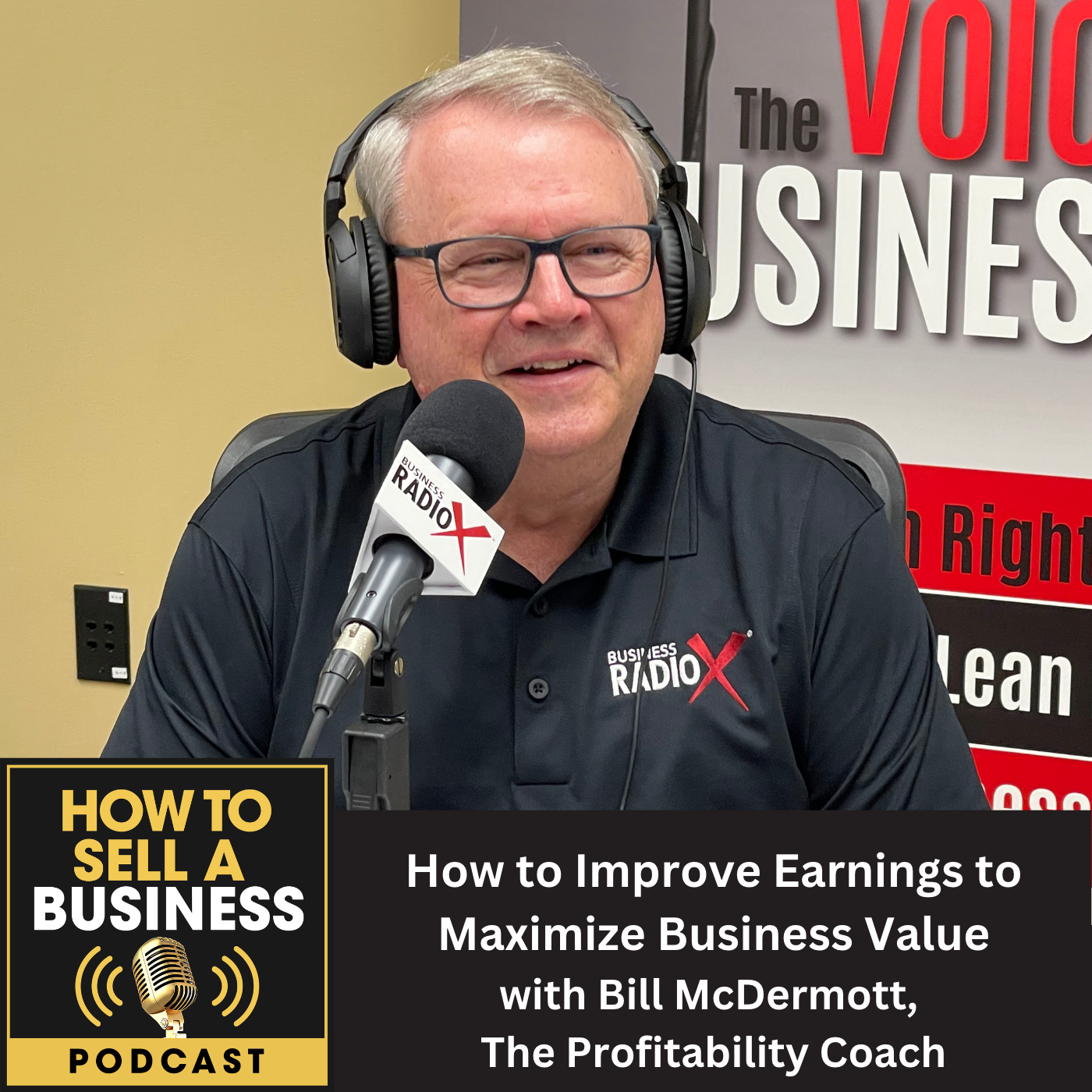
What is Your Business Worth?, with Bill McDermott, Host of ProfitSense

December 14, 2023 by John Ray

What Is Your Business Worth?

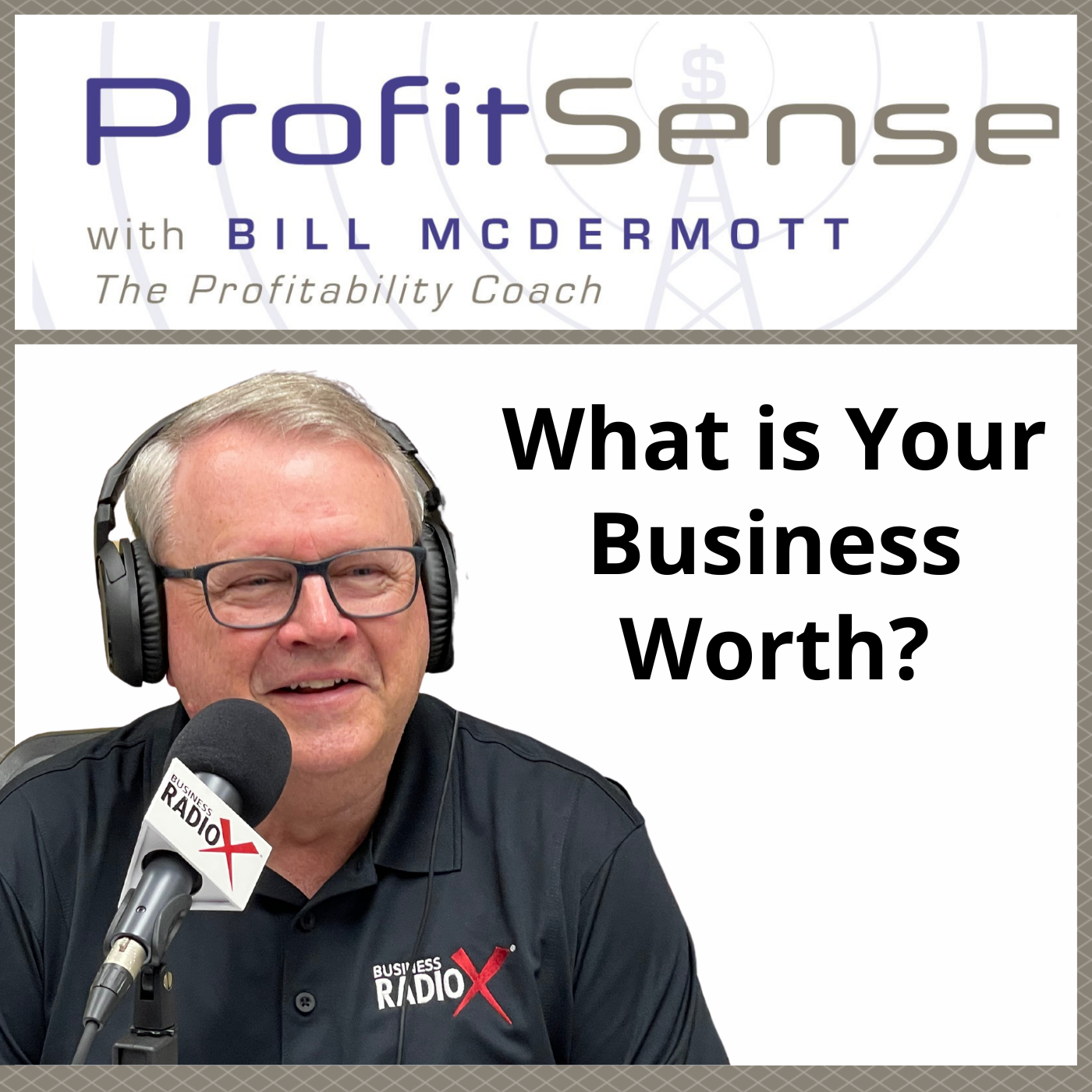
What is Your Business Worth?, with Bill McDermott, Host of ProfitSense

In this commentary from a recent episode of ProfitSense, Bill McDermott asks business owners to consider what their business is worth, and why an informed answer to that question is so important.

Bill’s commentary was taken from this episode of ProfitSense.

ProfitSense with Bill McDermott is produced and broadcast by the North Fulton Studio of Business RadioX® in Alpharetta.

Bill McDermott: I’d like to talk about the one question every business owner should be able to answer, and that’s: what’s my business worth?

In a recent study, business owners were asked what they estimated the value of their business to be. Ten percent didn’t have a clue. The other 90% answered in a wide range between $500,000 and $100 million.

When asked how they arrived at that valuation, two-thirds answered that they had no specific method or that they used some kind of informal methodology. Only 1/3 answered that they obtained an independent valuation from a qualified professional.

But it’s crucial to know the true value of your business for two main reasons:

  1. To make informed decisions about the future, such as whether to sell, expand, or make other major changes. For example, if you know that your business is worth a significant amount of money, you may be more likely to consider selling it in the future. Or, if you know that your business is growing rapidly, you may be more likely to consider expanding into new markets.
  2. To attract investors or partners.  If you are looking to attract investors or partners, knowing the value of your business can be a valuable asset. Investors and partners will want to know how much your business is worth before they commit any money or resources. By having a professional valuation, you can show potential investors and partners that your business is a sound investment.

Typically, our business is the largest asset on our personal financial statement. We should know the value to make informed decisions.
About ProfitSense and Your Host, Bill McDermott

Bill McDermott
Bill McDermott

ProfitSense with Bill McDermott dives into the stories behind some of Atlanta’s successful businesses and business owners and the professionals that advise them. This show helps local business leaders get the word out about the important work they’re doing to serve their market, their community, and their profession. The show is presented by McDermott Financial Solutions. McDermott Financial helps business owners improve cash flow and profitability, find financing, break through barriers to expansion, and financially prepare to exit their business. The show archive can be found at profitsenseradio.com.

Bill McDermott is the Founder and CEO of McDermott Financial Solutions. When business owners want to increase their profitability, they don’t have the expertise to know where to start or what to do. Bill leverages his knowledge and relationships from 32 years as a banker to identify the hurdles getting in the way and create a plan to deliver profitability they never thought possible.

Bill currently serves as Treasurer for the Atlanta Executive Forum and has held previous positions as a board member for the Kennesaw State University Entrepreneurship Center, Gwinnett Habitat for Humanity, and Treasurer for CEO NetWeavers. Bill is a graduate of Wake Forest University, and he and his wife, Martha, have called Atlanta home for over 40 years. Outside of work, Bill enjoys golf, traveling, and gardening.

Connect with Bill on LinkedIn and Instagram, and follow McDermott Financial Solutions on LinkedIn.

Tagged With: Bill McDermott, business valuation, McDermott Financial Solutions, Profitability Coach Bill McDermott, ProfitSense with Bill McDermott, small business, valuation

How To Sell a Wireless Cell Phone Store, with Tamer Shoukry, Wireless Dealerz

February 28, 2023 by John Ray

Tamer Shoukry
How to Sell a Business
How To Sell a Wireless Cell Phone Store, with Tamer Shoukry, Wireless Dealerz
Loading
00:00 /
RSS Feed
Share
Link
Embed

Download file

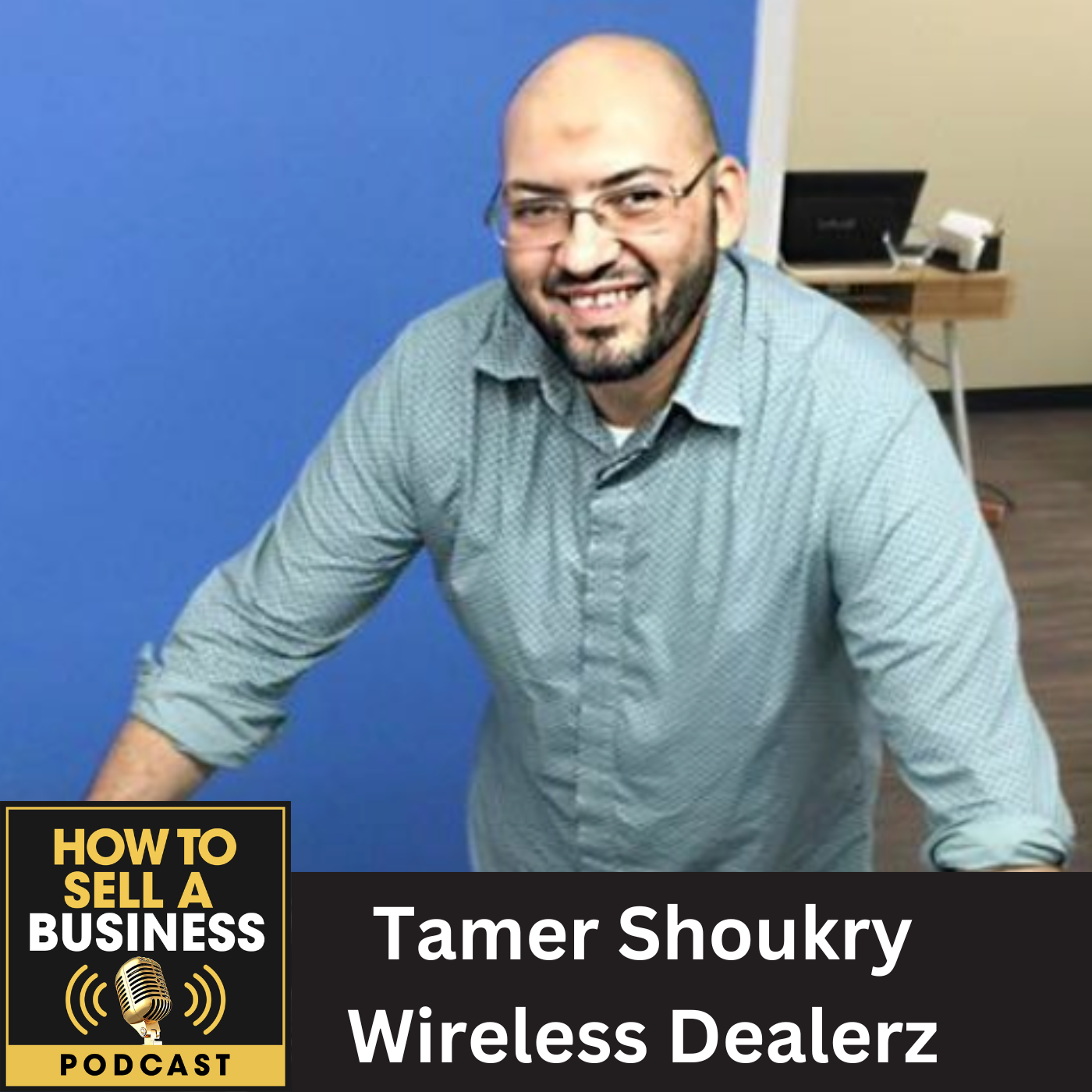
Tamer Shoukry

How To Sell a Wireless Cell Phone Store, with Tamer Shoukry, Wireless Dealerz (How To Sell a Business Podcast, Episode 13)

There is more to a wireless store than just a storefront selling and repairing cell phones. On this edition of How To Sell a Business Podcast, Tamer Shoukry, owner of Wireless Dealerz, talked with host Ed Mysogland about how he got into the business and gave an overview of the industry. They discussed the flow of cellphones from dealer to consumer and from the US to other countries. Tamer covered how they make their money, margins, the challenges of retaining techs and managing inventory, why wireless dealers don’t usually get SBA loans, his advice as a business broker, and much more.

How To Sell a Business Podcast is produced and broadcast by the North Fulton Studio of Business RadioX® in Atlanta.

Tamer Shoukry, Owner, Wireless Dealerz

Tamer Shoukry, Owner, Wireless Dealerz

Tamer Shoukry AKA Mr. Wireless Ohio Wholesale had been a leader in the Prepaid Wireless Marketing , Sales and Fulfillment. He has assisted many leading Prepaid brands in Establishing Their Markets since 2006 such as Page Plus, Boost Mobile, Simple Mobile and H2O.

Sign up for any of these services and work directly with him and ENSURE  success in implementing these services. Tamer posseses the experience, know-how and connections to make these services increase a shop’s income.

Tamer started in the wireless industry in 2006 when he started in regional sales which allowed him to build a network of small and medium sized wireless retailers. He moved into selling in bulk to small carriers, started a repair business, and also started a wireless repair school.

In 2o15 Tamer started his wireless software company that serves independent wireless dealers.

Website | LinkedIn | Facebook | Instagram

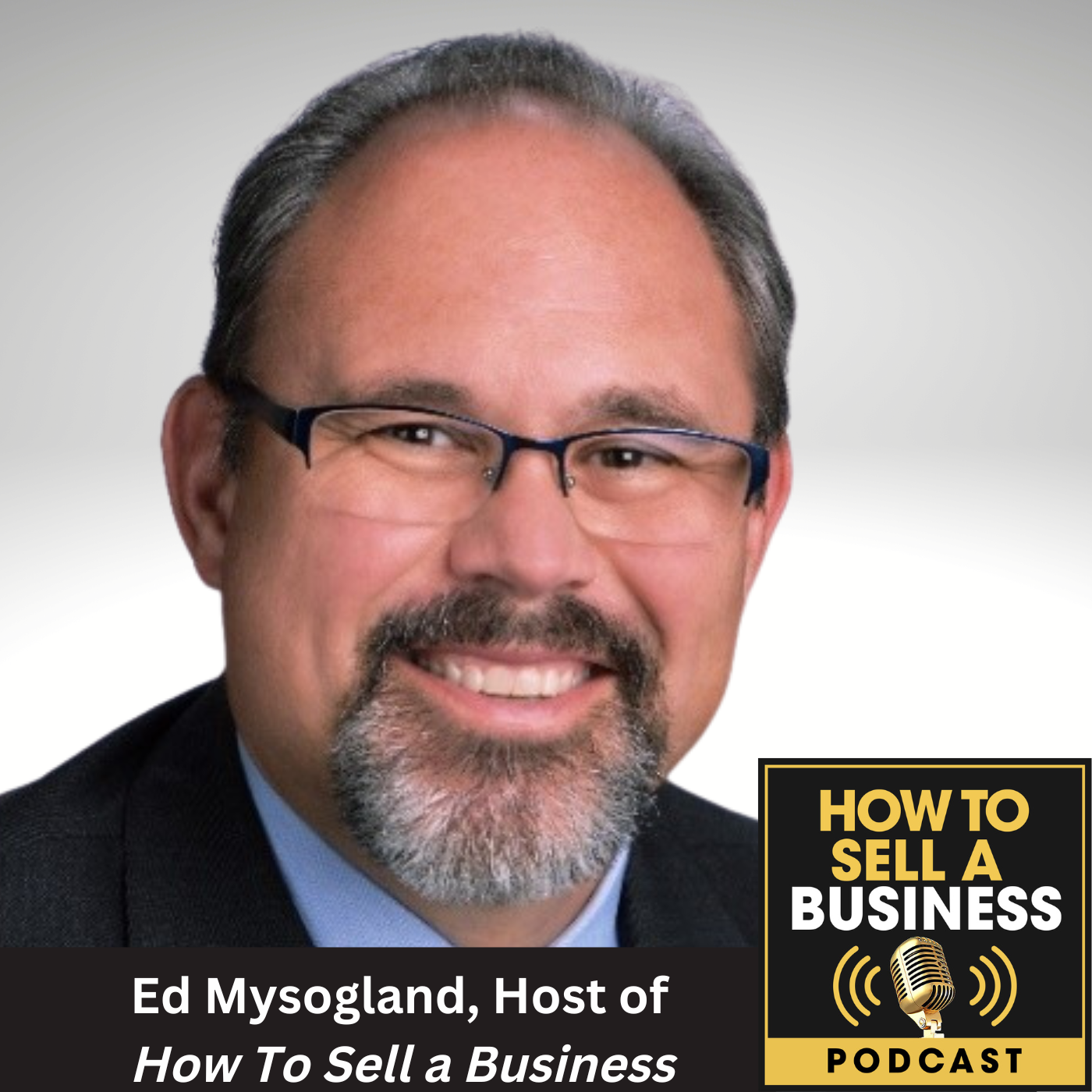
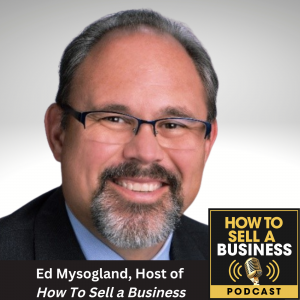
Ed Mysogland, Host of How To Sell a Business Podcast

Ed Mysogland, Host of “How To Sell a Business”

The How To Sell a Business Podcast combines 30 years of exit planning, valuation, and exit execution working with business owners. Ed Mysogland has a mission and vision to help business owners understand the value of their business and what makes it salable. Most of the small business owner’s net worth is locked in the company; to unlock it, a business owner has to sell it. Unfortunately, the odds are against business owners that they won’t be able to sell their companies because they don’t know what creates a saleable asset.

Ed interviews battle-tested experts who help business owners prepare, build, preserve, and one-day transfer value with the sale of the business for maximum value.

How To Sell a Business Podcast is produced virtually from the North Fulton studio of Business RadioX® in Alpharetta.  The show can be found on all the major podcast apps and a full archive can be found here.

Ed is the Managing Partner of Indiana Business Advisors. He guides the development of the organization, its knowledge strategy, and the IBA initiative, which is to continue to be Indiana’s premier business brokerage by bringing investment-banker-caliber of transactional advisory services to small and mid-sized businesses. Over the last 29 years, Ed has been appraising and providing pre-sale consulting services for small and medium-size privately-held businesses as part of the brokerage process. He has worked with entrepreneurs of every pedigree and offers a unique insight into consulting with them toward a successful outcome.

Connect with Ed: LinkedIn | Twitter | Facebook

TRANSCRIPT

Intro: [00:00:00] Business owners likely will have only one shot to sell a business. Most don’t understand what drives value and how buyers look at a business. Until now. Welcome to the How to Sell a Business podcast, where, every week, we talk to the subject matter experts, advisors, and those around the deal table about how to sell at maximum value. Every business will go to sell one day. It’s only a matter of when. We’re glad you’re here. The podcast starts now.

Ed Mysogland: [00:00:35] On today’s episode, I had the opportunity to visit with Tamer Shoukry. And Tamer is a business broker out of Ohio, and his claim to fame is Mr. Wireless. And it’s funny during our interview, I was thinking I was talking about wireless stores. And what I didn’t realize is just how deep that business goes. And what I’m saying is the resale market. I’m thinking we’re talking about new cell phone sales and products and services. But it was so much more than that.

Ed Mysogland: [00:01:17] So, it was a fascinating interview. And I’m certain that you will sit there and never look at another wireless store without going, “Wow, I had no idea.” So, my point is, it’s a good one. And so, I hope you enjoy my conversation with Tamer Shoukry.

Ed Mysogland: [00:01:35] I’m your host, Ed Mysogland. On this podcast, I interview buyers, sellers, dealmakers, and other professional advisors about what creates value in a business and then how can that business be effectively sold for a premium value.

Ed Mysogland: [00:01:48] On today’s show, like I indicated in my introduction, I’m really excited about Tamer Shoukry, who’s known as Mr. Wireless. And so, you can imagine to get that moniker, that is a real special person. And this industry is not quite what you might think. You think of it as a retail operation, but it really is so much more than that. So, Tamer, welcome.

Tamer Shoukry: [00:02:16] Well, thank you. Ed, thank you so much for having me today. I really appreciate that.

Ed Mysogland: [00:02:20] Well, I didn’t do your practice justice, so I was hoping that maybe you could talk a little bit about the work that you’re doing and your practice and your specialty.

Tamer Shoukry: [00:02:37] Awesome. Awesome. Well, in 2006, I started working for this nationwide distributor for wireless products. And, basically, what they did, they made me travel city to city, state to state, especially Indiana, to sell their product, which was Boost Mobile and Page Plus. And I had to go and flourish the markets. The market would not be familiar with these products, so I would move and I would spend weeks there until everybody starts selling this product, other retailers will start pushing the products.

Tamer Shoukry: [00:03:17] And that gave me a very, very strong stronghold when it comes to networking with small business owners who own retail shops, you know, corner shops, gas stations, all these mom and shop businesses, and bigger size retailers to introduce the products to them.

Tamer Shoukry: [00:03:40] I spent three years there and then I decided to start my own distribution company, that was in 2009. I became the master dealer for Boost Mobile, and number one distributor in the Midwest. So, we grew up from there. And then, I started selling devices in bulk to small carriers. So, smaller carriers will buy 5,000, 10,000, 20,000 devices per month, so I focused on this side of the business.

Tamer Shoukry: [00:04:14] Later on, in 2012, I started the first repair store in my area in Dublin, Hilliard, Ohio. And after one year, I started a cell phone repair school in Houston, Texas. And after that, I came back to Ohio. After three years, I came back to Ohio, and I started a little wireless software company that serves cell phone stores. So, I have a very good existence in the wireless industry in the country and overseas.

Ed Mysogland: [00:04:49] I would say. So, I guess the first place I would want to start – and I know this is a big ask – what’s the overview of the industry? Because like we were talking about before we got started, I mean, it’s not necessarily what everybody thinks that it’s just a retail operation. So, can you kind of give me a little bit of an overview on that?

Tamer Shoukry: [00:05:13] Sure. Yeah. The cell phone service or the telecom service is part of the infrastructure of any country and everybody is getting the service, any business, any field, medical, industrial, science, education. Everybody is using the wireless industry. And when it comes like this, you find yourself in a situation. There is always high demand on these kind of services and there is not enough people providing the service. You can imagine —

Ed Mysogland: [00:05:48] How is that? Is that true? I mean, how does that work? What you were saying was that there’s not enough people providing the service, I mean, what does that mean?

Tamer Shoukry: [00:06:00] Well, if you look at the country here, we have mainly, like, three or four major carriers – you know them – and they’re providing the airtime. And then, you have the dealers or retailers who are working under them providing the service. And then, you have the repair shops that do repairs for the devices when they have any problems or issues. And then, you have companies producing the devices, you know, Apple, Samsung, whatever. So, there is always high demand and there is not enough devices. I don’t think there’s enough devices in the market.

Ed Mysogland: [00:06:38] Really?

Tamer Shoukry: [00:06:40] Yes.

Ed Mysogland: [00:06:40] That was what caught my ear. I’m like, “Wow. There’s not enough devices in the market.” And as large as this market is, that’s a staggering statement. But you would know.

Ed Mysogland: [00:06:58] So, we have the market now. And I guess, when you think of a wireless operation – because when you were talking a little bit about your practice, you are not only talking about retail operations, but you were also talking about in truck stops, gas stations, things like that, where those are respective profit centers – tell me what does that look like, the mechanics of that. I know from a retail store, but does the retail store then go and sell to the truck stop? Or is there some other operation that has the cornerstone on that type of business? You know what I mean?

Tamer Shoukry: [00:07:47] Very, very good question. This industry is not stable. It’s changing every other year. It’s changing dramatically. So, back in the days when I started, we used to sell in corner stores. We used to sell in barbershops. We sell the device activated already with airtime, so you just turn on the phone and it has minutes and you can start talking and texting.

Tamer Shoukry: [00:08:11] But, now, all these venues start shrinking. But we have something new or we have the repair shops. The repair shop will be independent, will be providing services like fixing devices, activating new lines, and doing more than that. With the high price of the devices now, it becomes more like a car dealership. And this is the real — in the business, when you buy broken phones, fix them, and resell them. Huge margin. It’s more than anything you can imagine.

Ed Mysogland: [00:08:54] Now, I’m following you. So, where do you sell the repaired phones? Do you now turn online? Or are you getting foot traffic? Where is the source of that profit center?

Tamer Shoukry: [00:09:08] Okay. Perfect. So, if somebody who owns a store, usually the customer would walk into the store and they will ask do you have any affordable iPhone, for example, I don’t want to pay the full price. I said I have this model, I have that model. It sometimes will be like 30 percent off, 50 percent off from buying a brand new one. So, he would sell this, or he would sell them online, or he will export all the devices overseas for higher margin.

Ed Mysogland: [00:09:42] I get it. So, how do you – yeah. Go ahead. I’m sorry.

Tamer Shoukry: [00:09:45] So, you have some company that is selling, let’s say, 100 phones a month and some other companies selling 20,000, 50,000 phones for a month. You have this size and you have that bigger —

Ed Mysogland: [00:10:01] Sure. So, what’s a good size as far as revenue goes? What’s a reasonable operation? I mean, is that a half-a-million dollar revenue store? Or is that a $5 million revenue store?

Tamer Shoukry: [00:10:18] Usually, the independent one, the repair shops, they would be between 50 to mil. Some of them can reach mil. Especially if you’re in a busy city like New York, you can reach this number. The other bigger size companies, they do not do retail. They don’t face the end user. They would collect the devices, repair them, and then send them overseas for higher prices. And that margin will go up to $300, 400, 500 million.

Ed Mysogland: [00:10:57] Wow. So, the companies you just referenced, the ones that are buying up the damaged and subsequently repaired phones, they’re going around to all these shops saying, “Hey, I want to buy your damaged phones.” They refurb them and then sell them, right? That’s how that works?

Tamer Shoukry: [00:11:19] This one of the venues they do this. And the other way is they go directly to the carriers, because carriers will always — returns. And they will buy it through an auction. And the auction is not for everyone. You need to get certain certifications, like the R2 Certification, to be able to participate on those auctions.

Ed Mysogland: [00:11:45] So, what’s an R2 Certification? What does that mean?

Tamer Shoukry: [00:11:48] Responsible Recycling Certification. It’s very similar to the — but it comes to the electronics.

Ed Mysogland: [00:11:58] I got it. So, I’m based here in Indianapolis and so I know that there’s all kinds of retail operations that are selling phones, so that’s easy. But what about the folks that you just mentioned, the ones that are approved by the vendor to collect the phones, I mean, is that a big market? I mean, is there five people or 50 people that are buying up these phones?

Tamer Shoukry: [00:12:28] No. No. I would say the certified companies would be around maybe 30 certified. It’s not a big number. I can tell you the names of the owners of each company very easy because they don’t change that much. They don’t go out of business that quickly. I’d never seen any one of those companies dealing with the assets on the large scale getting sold. I never seen that.

Ed Mysogland: [00:13:03] Yeah. Those kind of margins, I’d hold them too. I wouldn’t sell it.

Tamer Shoukry: [00:13:09] There’s only a few companies that are the biggest companies. They’re going with billions of dollars. They got sold to private equities and entities like that. So, as I wanted to mention to you, it’s not only the small shop in front of you that one guy is working there. No. It goes way, way beyond that.

Ed Mysogland: [00:13:33] Sure. No, no, no. That’s where I was going with it, is that, it seems as though that’s the entry point but it just broadens out from there. And there is all kinds of money after just the retail side of the business.

Tamer Shoukry: [00:13:49] Yes. And there is also the companies that doing special type of software, companies doing finance technologies, and these guys are way beyond your imagination.

Ed Mysogland: [00:14:05] Well, circling back to the retail, I’ve always wanted to know how they make money. I mean, I know we’ve been focusing on, “Look, we’re taking damaged phones and we’re reselling them.” So, that’s a little bit of a profit center. But it would appear that the real profit is the guy that’s buying it, not necessarily the guy that’s selling the damaged phones. So, they’re getting a little bit of a hit, but it’s downstream that they’re making all the money. So, when I look at the retail operation, where are my profit centers? I know probably, you know, cases and things like that. But where else? Where am I looking at?

Tamer Shoukry: [00:14:57] When you go and you pay your bill, the monthly bill, this is profit. You get a margin. You get a small percentage. But by the time you will have more people coming to your store and doing the payments, that can pay your rent. For example, it can be, like, $2,000 or 3,000. When you are doing the repairs, you charge at least $50 up to $100 per device, so that is another thing. The accessories is another thing. In the accessories, usually you can make up to ten times your cost. So, you buy a charger for $2 and you sell it for $20. You bought this for $5 and you sell it for $25.

Ed Mysogland: [00:15:50] Yeah. Okay. So, the locations, the ones that I see, like when I’m looking at these locations here in Indianapolis, it seems as though – I don’t want to say they’re in the lower income, but it does appear that there’s a concentration in some of our lower income communities. I mean, conversely, where you would see like a Verizon not necessarily down in those same areas. Is that true or not?

Tamer Shoukry: [00:16:26] Yes. Yes. Usually, the lower income areas where you make most of the money. And it’s funny that you mentioned Indiana, because Indiana is very close to my heart. I started my career in Indiana. I consider Indiana as my school to understand the cell phone industry. And every city will have this one store that everybody likes to go there. And you had one, I guess, in the east side of Indy, and the store was amazing. Generation after generation, this is the spot. Everybody wants to go there. It’s not the nicest part of the town, but you know what? Everybody just go there.

Ed Mysogland: [00:17:09] Great service. I know what you’re talking about.

Tamer Shoukry: [00:17:11] But when it comes to the stores owned by the carriers, they usually go for the nicer areas. They usually go for prime locations. And the individuals do not like to open next to them because you cannot compete with the carrier. The carrier can hire the best executives, nicest looking sales people, the best devices. It’s not going to affect them. But if you’re an individual business owner, you cannot compete. You cannot compete. You want to be integrating with that company.

Ed Mysogland: [00:17:50] Well, that was where I was heading next. How does a company like this compete when you’re looking at online, you’re looking at BestBuy, you’re looking at where else can you activate —

Tamer Shoukry: [00:18:03] Amazon.

Ed Mysogland: [00:18:04] Yeah. And some of the bigger box stores. So, how does the mom and pop shop compete against something like that?

Tamer Shoukry: [00:18:12] I’m going to tell you a fact. It’s funny, when you go to one of the big boxes, you don’t get the service. You can grab the device, but no one is going to talk to you about it. No one is going to want to explain the plan. No one is going to tell you this is the most suitable plan for you. And if you have a problem, guess what? Nobody’s going to be able to answer your question. This is why they go to the repair shop to do the activation, to ask questions, and fix problems. And the same thing goes for the bigger carriers, they don’t have this technicality to sort issues with the device itself.

Ed Mysogland: [00:18:55] Yeah. I follow that. And I think one of the biggest challenges that I see, and we’ve tinkered around with a couple of them, has to do with repair. And I know you alluded to this just a minute ago that there’s a lot of profit baked into the repairs. And I have some children that have broken, you know, phones and iPads and so on and so forth, so I am well aware of the cost to repair it.

Ed Mysogland: [00:19:31] But one of the things that we continue to see is the difficulty in finding and then retaining help, especially with that. I think you can be easily trained on selling and understanding the product and the needs of the consumer. But a technician, that’s a different animal. So, how do I find them? How do I retain them?

Tamer Shoukry: [00:20:03] When it comes to technicians, this is the rarest type of employee you can ever — it’s very hard.

Ed Mysogland: [00:20:13] No, I’m with you.

Tamer Shoukry: [00:20:14] And usually, if I’m new in town, I don’t know everybody in town already, I would go to Google them and they said phone repair. And these guys, they would spend a lot of money just advertising online. So, when it comes to Google Maps, MapQuest or whatever, it will show you he’s there. He’s there. There is no single town, big town in the whole country without two, three, five stores doing repairs now. When I started my first store, I was the only one in my whole town in Dublin and Hilliard area. So, now it’s different — very well.

Ed Mysogland: [00:20:59] Yeah. And now what? You’ve got the major repair repair franchises. What, Cell Phone Repair? And I think there’s two or three others.

Tamer Shoukry: [00:21:09] CPR.

Ed Mysogland: [00:21:10] Yeah. CPR.

Tamer Shoukry: [00:21:12] Yeah. It’s funny, because these guys, they are not franchised really. It’s something – I don’t know how to explain it. The company used to be a franchise. CPR used to be a franchise. And then, they went to every individual store and they convinced them to change their sign and become under them. So, it’s Mike Repair, and everybody likes Mike. They will come to you and tell you, “Come join us. You will have certain kinds of benefits.”

Ed Mysogland: [00:21:44] I get it.

Tamer Shoukry: [00:21:46] I know the guy who started the CPR. He’s a friend of mine, I can say that. But when the company got sold a couple of times, now corporate is really separated from the store owners. It become a full franchise, really, you know.

Ed Mysogland: [00:22:08] Yeah. No, no, I get it. But circling back to the retention of the technician, I mean, is that just an economic thing or is there any other way to induce that type of person to stay with the company? Because if I’m looking at it as a buyer, I’m sitting here going, “All right. I got to figure out how I’m going to keep this guy.” Because what you just said is that the other shops are looking for a repair guy. And my guy probably has a target on his back. You know what I mean?

Tamer Shoukry: [00:22:39] True. This is a very important point, and from my experience, the best thing is to be generous to your technician. And, you know, you always have to have two or three of them. You can’t just depend on one.

Ed Mysogland: [00:22:55] That’s true.

Tamer Shoukry: [00:22:56] Once you have one technician, you hire somebody to be trained under him. Just in case something happened, he got sick, he had to travel, he got married, he got divorced, whatever, you always have a backup. You always have a backup. Somebody will get in and finish all the repairs. When I had my store, I had three. I had three all the time. Because if somebody got sick, we get heavy loads of repairs coming in, I always have enough people to do the repairs.

Ed Mysogland: [00:23:29] I get you. So, moving to financials, so are there various metrics or benchmarks that I could say, you know, if I have a 10 percent net profit margin, I’m doing great. If I have a 50 percent gross profit margin, I’m doing great. Are there any, like, ways to quickly look at a business and say, “Yeah. You know what? That’s a good target for me.”

Tamer Shoukry: [00:23:58] I would usually go and see how many repairs they do per month. I would see how many phones they sell per month. From my side, from my experience, I prefer the stores that sells more devices than the stores that repair more devices, because the biggest goal for you is to have the biggest sales. You need to sell more devices. So, it’s okay, you can do repairs, but you cannot focus on repairs only and neglect selling.

Tamer Shoukry: [00:24:33] So, I would like always to go to the store that’s selling the most devices in the whole area. You sell 100, I know exactly how much money you’re making. Because I would know he would at least make $50 to 100. So, if you sell 100, that’s $5,000. You sell more, you make more money. The rent shouldn’t be more than $2,000 under any circumstances. Some guys, they will go with more, but it will be always a big risk.

Ed Mysogland: [00:25:07] I get it. So, I guess as it relates financially, most people need their cell phone, so my question originally was centered around, you know, is the industry correlated to disposable income. And I think just from our conversation thus far, I can tell that’s probably not the case. There is no correlation to any part of the economy because people are going to need some means to communicate. Right?

Tamer Shoukry: [00:25:49] — percent true. And nowadays, with a device costing you up to $2,000, it’s not only people who do not have money, they go and fix the phones. I had a lawyer used to damage his small tablet all the time and come and spend $300 because all the documents that he has on these tablets.

Ed Mysogland: [00:26:13] Oh, sure, sure.

Tamer Shoukry: [00:26:14] Every time, every day he can buy brand new. But with the documents he has there, it’s worth his life. His career is only in this small device. He will come and spend $300 to fix it.

Ed Mysogland: [00:26:29] Sure. So, one of the challenges that I continue to see is this business as well as a business that is dealing with repairs as well as retail of new, and that’s inventory management. I got to imagine that it is a real challenge in this industry, isn’t it, to keep track of your inventory? Or is there like a universal point of sale type inventory management service or no?

Tamer Shoukry: [00:27:06] There are. There are. It would work for smaller shops. And there is software for wholesalers. But from the bottom of my mind, there is no real solution until today. I’m not saying this to bash the companies that designed those software, but you can do better than this. It can be more in details than what we have now. You can use QuickBooks like any other business. But when it comes to tracking your inventory, there is some software being used now, but I am not satisfied with the results.

Ed Mysogland: [00:27:49] No, no, I get it. So, who buys these things? Because I know you’ve sold a lot of them and I’m just kind of curious to know what does that person look like or does it vary?

Tamer Shoukry: [00:28:04] It varies. You can be a mom. You can be a dad. You can be a teacher. You can be a — you can be a government agency. You can be individual who is sending these devices, selling overseas. So, everybody is — but who’s buying more? You can ask me who is the most who’s bought more?

Tamer Shoukry: [00:28:27] And I would answer the question honestly. If you have any market with lots of immigrants, they would buy these devices more than anybody else, because the relatives back home in their countries, they’re going to ask them, we need devices, we need iPhones, we need Samsung, we need this, we need this. And there is no place in the whole Earth is cheaper than the U.S. when it comes to devices. So, the demand is crazy high.

Ed Mysogland: [00:28:59] I get it. That’s interesting. I mean, market multiples, do they vary in the industry or they stay fairly consistent? Because I got to imagine the risk remains the same, so I would assume the multiples fairly consistent or no.

Tamer Shoukry: [00:29:24] I would say it’s different between cities. Because if you’re new, it’s not the same thing. If you are in Kansas or Arkansas, you have less people, so your ability to sell devices is less than if you are in a bigger city.

Ed Mysogland: [00:29:46] So, multiples increase based on the density of the population in the area.

Tamer Shoukry: [00:29:55] Of course. Of course.

Ed Mysogland: [00:29:55] I get it. No, I mean that makes sense. So, as we talk about selling these things, is it a normal lending environment? I mean, it’s just based on cash flow and it works? Or is there a special way that these things get financed given the inventory fluctuations and such? I would assume it’s just like any other business. If it can support the cash flow, you know, you’re in business. Or is that not the case?

Tamer Shoukry: [00:30:31] Well, I would say, the biggest chunk of the business done cash upfront. And I was involved in one of those companies that provides a tool for financing for the independent store owners. So, the software will go and check the background of the person who’s buying the device. It will give you colors: red, don’t give him the device — it’s up to you; and green, go ahead and you can sell him, you can trust him, he has a good credit background, and he has the ability financially to give you the payment every week, $50, $20, whatever you agree on.

Tamer Shoukry: [00:31:17] But I would say cash is the biggest chunk of what’s happening here. Everybody just go and pay upfront. The financing comes from the bigger companies. If you go and buy from Apple, that’s brand new, expensive devices. They have their own financing and they make it easy.

Ed Mysogland: [00:31:37] Okay. But as far as buying the company, is it just like any other SBA lender? You know what I mean? From that standpoint, it seems that this is just based on cash flow. I would assume based on what we’re talking about, I would imagine my cash flow to revenue ratio has to be 20, 25 percent. That’s two-and-a-half, three multiple, which then takes me, as I look at it, to a bank. I mean, that’s plenty of cash flow to support some reasonable debt. What I’m trying to establish is the risk associated with, if I’m a lender, where is my risk in loaning that money, aside from the borrower him or herself? You know what I mean?

Tamer Shoukry: [00:32:40] I’ll tell you something, when it comes to small businesses, like individual stores, I never got any lender involved, just usually cash. But talking about bigger companies, the multiple million dollars, then it’s a totally different story. It’s a totally different story.

Ed Mysogland: [00:33:00] But if I come in some of the lower income areas, you had already indicated that the buyer pool tends to be —

Tamer Shoukry: [00:33:17] Competition.

Ed Mysogland: [00:33:18] Yeah. So, there is consolidation, so they understand it. But as individual buyers, so seller financing – because I’m sitting here, let’s just say it’s $200,000, would you risk 200,000 to buy this business that a lot of which is cash? You know what I mean? It’s almost like a food and beverage business. And to me, this seems harder to track my cash or no?

Tamer Shoukry: [00:34:00] True. This is why I mentioned that most of the buyers will be people from the industry itself. He can be somebody from outside the certain city or town. It can be the guy next door who always wanted to eliminate the competition. He would say, “Okay. I’ll buy it. I’ll take this place.” And usually it goes cash. They pay everything cash. If they have terms that’s between the buyer and seller, I do not recommend that at all because the consequences might escalate to a —

Ed Mysogland: [00:34:39] No, that’s great advice. Like I said, I didn’t anticipate that coming out of your mouth, but it totally makes sense. So, since we’re bumping up on time, the last question I asked every single guest, and you being the expert in the industry, what’s the one piece of advice that you would give, I guess, business owners in the wireless retail or the wireless industry? What piece of advice would you give them that would have the greatest impact on their value and their ability to sell?

Tamer Shoukry: [00:35:15] Do not buy a business based on your emotions. Never. You have to always —

Ed Mysogland: [00:35:21] Okay. So, that’s the buyer.

Tamer Shoukry: [00:35:24] Yes.

Ed Mysogland: [00:35:25] So, what about the seller? How is the seller? What does the seller need to do in order to make this business saleable?

Tamer Shoukry: [00:35:33] Your business has more value than what you think. Your business has more value than you think.

Ed Mysogland: [00:35:43] So, how do I get that out? Because I’m certain there are plenty of sellers that just heard that and say, “Tell me more. How do I get more money out of my business?”

Tamer Shoukry: [00:35:55] Hire a broker, like me. And I will go to your finances and I will make sure to represent your business in a better way than if you try to represent by yourself, based on numbers, facts.

Ed Mysogland: [00:36:14] Yeah. Yeah. I got it. So, the quality of your financial statements, even though you’ve got a bunch of cash that is flowing in and out of the business, that will determine whether or not you’re going to be able to sell at a premium value.

Tamer Shoukry: [00:36:32] Yes.

Ed Mysogland: [00:36:32] Perfect. So, Tamer, what’s the best way we can connect with you and how can people find you?

Tamer Shoukry: [00:36:38] You can search my name on Google or you can find me on Facebook at Tamer Shoukry. You can find me on Instagram, @cellphonesinbulk. Or you can call me at 614-226-2723.

Ed Mysogland: [00:36:56] Okay. Well, Tamer, I got to tell you, I didn’t know what to expect out of this. I’ve always seen it. I’ve always heard that the business was lucrative. I just had no idea that there was so much more to it than just a storefront. So, thanks for the education. I’m certain everybody’s kind of in the same camp with me of like, “Wow. What a crazy business. And, boy, that might be a nice little business for me to buy.” So, thanks for coming on and telling us all about that.

Tamer Shoukry: [00:37:33] You’re welcome. And thank you so much for inviting me.

Outro: [00:37:36] Thank you for joining us today on the How to Sell Your Business Podcast. If you want more episodes packed with strategies to help sell your business for the maximum value, visit howtosellabusinesspodcast.com for tips and best practices to make your exit life changing. Better yet, subscribe now so you never miss future episodes. This program is copyrighted by Myso, Inc. All rights reserved.


Tagged With: business broker, Business Owners, cellphone repair, cellphones, Ed Mysogland, entreprenuers, How to Sell a Business, How to Sell a Business Podcast, Mr. Wireless, pricing, selling a business, Tamer Shoukry, valuation, value, Wireless Dealerz, wireless phones, wireless reseller

How to Maximize Profit as a Car Dealership, with Max Zanan, MZ Dealer Services and Author of the Perfect Dealership Series

February 14, 2023 by John Ray

Max Zanan
How to Sell a Business
How to Maximize Profit as a Car Dealership, with Max Zanan, MZ Dealer Services and Author of the Perfect Dealership Series
Loading
00:00 /
RSS Feed
Share
Link
Embed

Download file

Max Zanan

How to Maximize Profit as a Car Dealership, with Max Zanan, MZ Dealer Services and Author of the Perfect Dealership Series (How To Sell a Business Podcast, Episode 11)

Max Zanan, owner of MZ Dealer Services and author of Perfect Dealership, a four book series dedicated to helping car dealership owners adapt and thrive in their business, joined host Ed Mysogland. They discussed the industry as a whole, how dealers make their money, where the profit actually is, why dealerships are not likely to stay in the owner’s family, the role of the service department, how to keep qualified employees or train them, why buying a car takes so long, and much more.

How To Sell a Business Podcast is produced and broadcast by the North Fulton Studio of Business RadioX® in Atlanta.

MZ Dealer Services

Max Zanan is an automotive industry leader offering a comprehensive automotive consulting service for car dealers nationwide. His goal is to improve customer experience and retention while increasing dealership’s profits.

Contact Max today to build a better dealership including automotive compliance, F&I optimization, sales strategy, and more. He welcomes phone calls at  917-903-0312.

Website | Facebook| YouTube

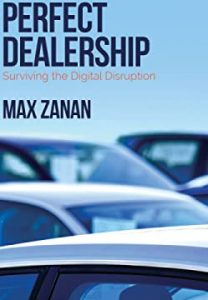
Perfect Dealership Books by Max Zanan

Remember travel agencies? They were a thriving business not so long ago. Then online services transformed the industry, and brick-and-mortar travel agencies died—and died quickly.

Today, traditional car dealerships are facing much the same threat. Innovative and convenient digital startups and services threaten to disrupt the traditional car-sale process, egged on by consumers who aren’t happy with the existing sales process. If car dealerships don’t adapt, they too will face an industry-wide extinction.

Perfect Dealership offers help and hope for dealerships struggling to adapt to this digital-based paradigm shift. Consultant Max Zanan applies fifteen years of automotive-industry experience to the future of the car dealership. Arguing that dealerships must make significant changes if they are to survive the coming storm, Zanan takes a close look at every department within the business, including

    • human resources,
    • business development centers,
    • information technology,
    • parts and service, and
    • finance and insurance.

By improving the role of each department and transforming them from individual echelons into a cohesive whole, Zanan offers a road map for the creation of a perfect dealership—the only way to remain relevant and solvent in the digital age.

Find all of Max’s books here: Perfect Dealership

Max Zanan, Owner, MZ Dealer Services, and Author of the Perfect Dealership Series

Max Zanan, Owner, MZ Dealer Services, and Author of the “Perfect Dealership” Series

Max Zanan is the author of four best-selling books on automotive retail management: Perfect Dealership, Car Business 101, The Art and Science of Running a Car Dealership, and Effective Car Dealer. Each book is a top-ranked Amazon category leader and have received many 5-star reviews from prominent car dealership owners and managers. Max’s success as an author, general manager and entrepreneur has helped to cement his position as a preeminent voice leading the charge for modernization of the auto retail industry.

Max Zanan is a seasoned automotive industry expert with 20 years of experience in sales, F&I, compliance, and dealership management consulting. His goal is to help car dealers improve profitability while increasing customer satisfaction and retention. Zanan is a thought leader, organizer of the Perfect Dealership Conference, keynote speaker, and frequently quoted in trade publications such as Automotive News, Fixed Ops Journal, and Auto Dealer Today.

LinkedIn

Ed Mysogland, Host of How To Sell a Business Podcast

Ed Mysogland, Host of “How To Sell a Business”

The How To Sell a Business Podcast combines 30 years of exit planning, valuation, and exit execution working with business owners. Ed Mysogland has a mission and vision to help business owners understand the value of their business and what makes it salable. Most of the small business owner’s net worth is locked in the company; to unlock it, a business owner has to sell it. Unfortunately, the odds are against business owners that they won’t be able to sell their companies because they don’t know what creates a saleable asset.

Ed interviews battle-tested experts who help business owners prepare, build, preserve, and one-day transfer value with the sale of the business for maximum value.

How To Sell a Business Podcast is produced virtually from the North Fulton studio of Business RadioX® in Alpharetta.  The show can be found on all the major podcast apps and a full archive can be found here.

Ed is the Managing Partner of Indiana Business Advisors. He guides the development of the organization, its knowledge strategy, and the IBA initiative, which is to continue to be Indiana’s premier business brokerage by bringing investment-banker-caliber of transactional advisory services to small and mid-sized businesses. Over the last 29 years, Ed has been appraising and providing pre-sale consulting services for small and medium-size privately-held businesses as part of the brokerage process. He has worked with entrepreneurs of every pedigree and offers a unique insight into consulting with them toward a successful outcome.

Connect with Ed: LinkedIn | Twitter | Facebook

TRANSCRIPT

Intro: [00:00:00] Business owners likely will have only one shot to sell a business. Most don’t understand what drives value and how buyers look at a business. Until now. Welcome to the How to Sell a Business podcast where every week we talk to the subject matter experts, advisors and those around the deal table about how to sell at maximum value. Every business will go to sell one day. It’s only a matter of when. We’re glad you’re here. The podcast starts now.

Ed Mysogland: [00:00:36] On today’s show, I get the opportunity to interview Max Zanan. Max is the author of four bestselling books on automotive retail management, and they’re entitled Perfect Dealership, Car Business 101, The Art and Science of Running a Car Dealership, and Effective Car Dealer. Each book — and I did this in my — reviewed them in my research for this interview. Each book has plenty of stars right next to it. So each book is a top-rated Amazon category leader and certainly has received many five-star reviews from prominent dealership owners and managers.

Max’s success as an author, general manager, and entrepreneur has helped position himself as the premier preeminent voice of leading the charge for modernization of the auto retail industry. He has 20 years of experience in sales, compliance, dealer management, consulting. And everywhere I looked, his name kept popping up. So I hope you enjoy my conversation with Max Zanan.

I’m your host, Ed Mysogland. And on this podcast, I interview buyers, sellers, dealmakers and other professional advisors on what creates value in a business and then how that business can be effectively sold at a premium value. So as I — in the introduction, you heard me talk about Max. And Max Zanan of MZ Dealer Services is literally the authority on automobile dealerships. I looked high and low for my research, during my research, and he is just that guy. And so I’m so grateful to introduce to you Max Zanan. So welcome to the show.

Max Zanan: [00:02:34] I mean, Ed, thank you for this wonderful introduction and the opportunity to be part of your podcast.

Ed Mysogland: [00:02:41] Well, I’ll tell you, I’ve been looking forward to this because it’s a different animal. And like I said in my research and all the things that, all the different pieces that go into making a successful dealership, there’s a lot going on there. But before we get into my questions, can you talk a little bit about MZ Sealer Services?

Max Zanan: [00:03:07] So MZ Dealer Services is me. There’s nobody else.

Ed Mysogland: [00:03:12] That’s the MZ part.

Max Zanan: [00:03:14] Right. There’s nobody else. Meaning literally, I do not even have an assistant.

Ed Mysogland: [00:03:19] Okay.

Max Zanan: [00:03:20] And my job is to help dealers make money. And it sounds easy, but car business is so complicated and complex that there’s a reason why a lot of dealers do not make money. So again, there are different ways where you can make money. And I tried to bring all the options to the table, so the dealer doesn’t become a one trick pony. They can maximize profit opportunities in every single department because oftentimes, dealers make a mistake, and they obsess over the sales department, right, because they’re convinced that you can sell your way out of any trouble.

But when you buy a dealership, a franchised dealership, you’re not just getting a new car department. You’re getting a used car department. You’re getting a service department. You’re getting parts department. Sometimes you get in the body shop. So unless you’re maximizing every single opportunity that you paid for, you’re literally leaving money on the table.

Ed Mysogland: [00:04:37] Yeah. Some of the research that I had found was that you look at each of those respective divisions as almost their own business within a larger business and each has their own various attributes that contribute to value. One of the things that — you know, I’ve been appraising companies for 30 years or so. And the funny thing is that everybody says business valuation, it’s both an art and science. And the funny thing was in the research, I saw the same thing about what you do. So can you talk a little bit about the art and science of what you do?

Max Zanan: [00:05:16] So the science is easy, right? Because there are certain KPIs. Right, whether it’s profit per car, number of line items on the repair order, number of hours worked per repair order, stuff like that. But the art part is the hard part, right, because you’re right, sometimes and actually most of the times, each department operates in a silo. To a degree, where there’s zero communication with other departments. And the art is actually to bring them all together and make sure that they work towards a common goal. Because the common goal is to sell cars and then to service cars and then to sell cars again. So if the sales department and the service department are in silos, you will never get that full circle.

Ed Mysogland: [00:06:20] I get it. So is it a people issue? For the art part, is it a people issue? Is it a technology issue or is it an all of the above issue?

Max Zanan: [00:06:36] You know, it’s all of the above, plus lack of professional training issue. So the problem that we have is that I don’t think you’ll ever run into a Harvard MBA at a car dealership. Car dealers fail to attract talent the way Wall Street does.

Ed Mysogland: [00:06:58] So why is that?

Max Zanan: [00:06:59] Or the way Silicon Valley does.

Ed Mysogland: [00:07:00] Yeah. Why is that?

Max Zanan: [00:07:02] Well, because people think of car dealers — you know, car dealers have a terrible reputation, right, up there with Congressman. Right?

Ed Mysogland: [00:07:10] Right.

Max Zanan: [00:07:13] So, when there is this stigma attached to the industry, nobody is growing up saying that Ed, I can’t wait to grow up and get into car sales. But let’s say Wall Street doesn’t have that stigma and you do have kids finishing school, going to college with a goal of getting into Wall Street. Whether as a trader, as a broker, as an analyst, they just want to be part of that institution.

Ed Mysogland: [00:07:47] I get it. Well, the funny thing you would think, like, isn’t it John Elway? Doesn’t he own like a portfolio of —

Max Zanan: [00:08:00] Everybody wants to be a car dealer. John Elway, you know, Mark Wahlberg. You know, everybody. I mean, Warren Buffett.

Ed Mysogland: [00:08:09] Sure. That’s what I’m getting at. So you would think that with that kind of notoriety, that it would garner attention for more people to get into it, but it doesn’t seem to be the case. Maybe it’s a best kept secret in entrepreneurship.

Max Zanan: [00:08:27] Maybe, but it works against the dealer, right, because you cannot attract talented people.

Ed Mysogland: [00:08:34] I see.

Max Zanan: [00:08:35] You don’t even get an opportunity, right? You literally get the bottom of the barrel.

Ed Mysogland: [00:08:41] So how do you offset that? I mean, yeah, that’s a big problem.

Max Zanan: [00:08:45] The only way to offset it is to grow your own talent internally.

Ed Mysogland: [00:08:49] Okay. And then that begs, how do you keep them? How do you keep them from going to the — is it all economics or is there something else that keeps the tech, keeps whoever there?

Max Zanan: [00:09:03] There is definitely something else because it’s not just money. Right. It’s the organizational culture.

Ed Mysogland: [00:09:10] Okay.

Max Zanan: [00:09:11] So, and again, I think a lot of dealerships fail at that. You know, for example, if you talk about organizational culture, the best example I can give you is probably Zappos.

Ed Mysogland: [00:09:25] Okay. Oh, sure. The shoe company. All right.

Max Zanan: [00:09:27] That’s right. I mean, there’s a reason why Amazon paid billion dollars for a shoe company. Right. It was the culture.

Ed Mysogland: [00:09:35] I see.

Max Zanan: [00:09:36] And it’s that culture that keeps the people, you know, allows you to retain talent and attract talent so you can be the highest paying dealer on the block. But if the organizational culture is terrible, people will go elsewhere and work for less money and be happy.

Ed Mysogland: [00:09:57] Yeah. Yeah. And certainly — and I’ve got a question that I found. This is a statement from CDK Global. I don’t know who CDK Global is, but it said that, and I’ll just read it. So it says, CDK said that there are a lot of assumptions made about Gen Z loosely defined as individuals born between 1997 and 2012, the need for instant gratification from simple online purchase experience to real time social media engagement. However, when it comes to buying a vehicle, CDK discovered that Gen Z seems to be more thoughtful and spend more time weighing decisions while the experience of buying new and used cars, of buying a newer used car more frustrating than any other generation. With Gen Z, the most interested in understanding all of their options. So that was 81 percent compared to Millennials of 73 percent, Gen X of 60 percent, and Baby Boomers 45 percent. The need for education, both online and from knowledgeable representative at the dealership proves to be critical according to the study.

So that, my point to you is it’s exactly what you were saying regarding employees and the people that are representing the dealership that the expectation of those that are now buying it has to be a better experience. And those people have to be able to have the education and communication. Right or no?

Max Zanan: [00:11:35] You know, to me, the most frustrating part about the statement is the fact that CDK Global made it. Right. I don’t think they have any place to make that statement because CDK Global makes an operating system that dealers use.

Ed Mysogland: [00:11:52] Well, then that makes sense.

Max Zanan: [00:11:54] So I don’t know how much CDK Global knows about car buying, car selling or the demographics of buyers. But to be honest with you, this is what they say about every generation. I mean, if you look back, I mean, they were saying the same thing about Millennials, that Millennials are different. I’m a Generation X, right, the best generation.

Ed Mysogland: [00:12:13] Yeah, it is.

Max Zanan: [00:12:15] Yeah. And everybody was saying, oh, my God, you know, Millennials, everything’s going to change. They will not be buying cars. They will be using rideshare. They’ll be Uber, this, lifting that. But at the end of the day, this is what happens in the real world. You become an adult, regardless of your generation. And as an adult, you know what happens? You move to suburbs. You know what happens in suburbs? You can’t live there with Uber. You need a car. You become an adult, you get married. You become an adult, you have kids. Right. You can use rideshare if you got to take your kid to the soccer practice. Right. So at the end of the day, you become like the generation before you and you buy cars exactly the same way as the generation before you.

Ed Mysogland: [00:13:08] And it’s such a great point. And you’re exactly right. And I didn’t think of it until you said it. But the same thing, the same concerns that I have put in my kids in cars and such are the same ones certainly my parents had, and your parents had.

Max Zanan: [00:13:25] That’s it.

Ed Mysogland: [00:13:27] So, as you know, I mean earnings drive business value. In reviewing the comments about all four of your books, it was a repeated theme that your tips led to increased profitability. Do you have any favorites that you could share without selling out?

Max Zanan: [00:13:50] Listen, the beauty of this business is there’s nothing I can trademark.

Ed Mysogland: [00:13:57] I get you.

Max Zanan: [00:13:57] The secret sauce is really understanding how every part of the business operates. And I’ll give you the easiest example. For example, when you buy a car, at the end of the transaction, you’re going to go into the office where they’re going to try to sell you an extended warranty or gap insurance or tire and wheel protection. And this is the true profit center for any car dealership. That’s the finance department. So you can make money selling this product. And that’s what probably 99 percent of car dealers do. But you can probably double your profits as a dealer if you reinsure these products.

By reinsuring, I mean you open your own insurance company. And you buy a contractual liability insurance policy for each policy that you sell from the insurance company. So that’s why it’s called reinsurance. A real insurance company is reinsuring your business. And then if the premium dollars that you pay to your own insurance company exceed the claims dollars that you pay out, you will enjoy underwriting profit like any other insurance company. And the crazy part is that the underwriting profit is not taxed. That’s the beauty of insurance business as opposed to car business.

Ed Mysogland: [00:15:35] I get it. Okay.

Max Zanan: [00:15:37] So think about it. You can have, if you reserve properly for each policy that you sell, and you control your claims because you recondition your used cars before you sell them, you make sure you do the right thing by the customer. That underwriting profit is definitely there to be had. On top of it, this money, they don’t sit dormant, right? There is investment income that grows on these dollars. That’s how insurance companies make money.

Ed Mysogland: [00:16:13] Sure, sure. No, I get it.

Max Zanan: [00:16:15] And the investment income is subject to tax. But again, at capital gains rate, not an ordinary income rate. So it’s a phenomenal, phenomenal opportunity for any car dealer to build an asset outside of the dealership.

Ed Mysogland: [00:16:33] Got it.

Max Zanan: [00:16:33] Not be dependent on the factory and build generational wealth. And unfortunately, a lot of these dealers do not do it.

Ed Mysogland: [00:16:44] No, I mean, I can totally see that the synergy between the businesses that support the dealership are where the profit is, which literally blows the next question right out of the water, but I’m still going to ask it. So I’m told that in valuing a dealership, it’s made up of four components, the market value of the parts inventory, the market value of the equipment, the market value of the real estate, and then a multiple on the goodwill. Is that a fair assumption?

Max Zanan: [00:17:25] So think of it this way. You can ignore parts inventory and inventory because it just comes with the building, right? You can buy a dealership and say, you know what Ed, I’m only going to take the dealership, but you keep the parts. It doesn’t work like that, right? Yes, you can definitely put a dollar amount on the parts inventory. But at the end of the day, you still have to buy it. You can say, well, you take the parts inventory with you, I’m going to start fresh. Just doesn’t work like that.

Same thing with cars. If you’re selling, let’s say Nissan dealership to me and you have brand new Nissans on the lot. I mean, I can tell you Ed, I’m going to buy the dealership on the parts department, but you keep the cars, right? It just doesn’t work. We’re going to have to work out a number, how much I’m willing to pay for these cars, but the real crux of the issue is the blue sky. Blue sky is the value of the franchise. And the value of the franchise is something that market dictates. It’s not dictated by the dealer.

Ed Mysogland: [00:18:35] Really? So where does the market get its multiple or factor to apply to the goodwill?

Max Zanan: [00:18:46] Well, you see most corporations in America report their earnings on a quarterly basis. Of course, car dealers are different, they report every month. So this information is public. And every manufacturer, so let’s say you are a Nissan dealer or you are a Chevy dealer, doesn’t matter. When the month is over, let’s say January is over, within the first week of February, your factory expects a complete financial statement electronically sent to them. They know the profitability of –.

Ed Mysogland: [00:19:29] Of the franchise.

Max Zanan: [00:19:30] Exactly. So I think that’s how the –.

Ed Mysogland: [00:19:34] Really?

Max Zanan: [00:19:35] Gets established. But then again, listen, a lot of it is common sense. For example, I’m sure there are more KIA dealers than Porsche dealers.

Ed Mysogland: [00:19:45] Sure.

Max Zanan: [00:19:46] And you sell more KIAs, but you make less money per KIA sold as opposed to Porsche, right. You sell a few of those, but you make a lot more per car sold. And then let’s say, usually the high line brands have a higher multiple. Porsche being the highest multiple. Last time I checked, Porsche was selling for 11 multiple.

Ed Mysogland: [00:20:13] 11 times what?

Max Zanan: [00:20:15] Earnings.

Ed Mysogland: [00:20:16] Okay.

Max Zanan: [00:20:17] But these are crazy earnings.

Ed Mysogland: [00:20:19] Sure, sure. No, I get.

Max Zanan: [00:20:20] Because you see what happens with the high line dealership, whether it’s Porsche or Mercedes, not only that you get to make money selling the car, right, because it’s a desirable product and people are willing to pay for the service and the car. But let’s assume for a second that you bought that Porsche, you’re not going to Jiffy Lube for an oil change. You’re not.

Ed Mysogland: [00:20:44] Yeah, I know. You’re right.

Max Zanan: [00:20:46] So that service retention is almost guaranteed as opposed to you buying a Toyota Corolla. You can easily go to Jiffy Lube. Easily.

Ed Mysogland: [00:20:58] You’re right.

Max Zanan: [00:20:59] So that service retention is basically guaranteed and the amount of money that you are charged in a service department. I think Mercedes, Porsche dealerships right now are over $200 an hour for labor. I mean these are almost like doctors.

Ed Mysogland: [00:21:23] Right. No, no, you’re right. You’re exactly right. Oh, man. So you said, so there’s, let’s just say the Porsche dealership, you have an 11 multiple on earnings. Is that all in? Like you were talking about like the reinsurance company, is that all dumped in? All right.

Max Zanan: [00:21:46] No, reinsurance company is out. It’s almost like an off of balance sheet.

Ed Mysogland: [00:21:52] Okay. So they’ll bring their own, if they want to do it, they’ll do it themselves. But that’s independent of the value of the dealership.

Max Zanan: [00:22:01] Exactly. So basically, your net profit, right, that you generated in sales, service, and parts.

Ed Mysogland: [00:22:10] I got it. So around here, there was a recent article about — and here in Indianapolis, we’re seeing some dealerships turning over. And these were family dealerships, and it doesn’t seem — the article was basically that the next generation, or I shouldn’t say that, the selling generation did not want to invest in modernization in order to make it more marketable. So then a different dealer from a neighboring town comes in and now they have a presence in Indianapolis. So are you seeing that the generation, I guess the generation before us, that’s trying to transition would rather sell than modernize?

Max Zanan: [00:23:13] So, I’m not sure because the way it works is that their brand standards that are dictated, let’s say, by Mercedes or Nissan or Toyota and they say Ed, if you are a Toyota dealer, your showroom has to look this way. That’s why they look the same regardless of whether you’re in Indianapolis or New York. And you have to spend your hardearned money to do that. It’s not open to negotiation. These brand standards are real, and I think generation is really irrelevant, right? Because whether it’s the older generation or younger generation, you just have to do what the factory tells you to do in terms of the brand standards. I think the generation that’s older than us, the baby boomers that are selling, I think they’re selling for one reason and one reason only. They’re selling because their kids are not interested in going into the business.

Ed Mysogland: [00:24:16] But why? They must have seen mom and dad print money. I mean, especially those that have been around for 20, 30 years.

Max Zanan: [00:24:25] So, unfortunately, you know, car dealers, probably like many other business owners, they don’t tell their kids to go into the same business. Right. They tell them, go become a doctor, go and become a lawyer. You know, do whatever makes you happy, and they do. Right. And they become high school teachers making $40,000 a year because mom and dad are gazillionaires, and subsidize their lifestyle.

Ed Mysogland: [00:24:58] No. You know what? That’s a great point and disappointing. But at the same time, it is what is. So you see industry consolidation more so than transfer from Gen one to Gen two. Fair statement?

Max Zanan: [00:25:19] You know, car business is extremely fragmented. I don’t think there’s another business like that because if you look you know, I mean, look at, let’s say, Internet search business, right? It’s Google or nothing. Right? Social media, it’s Facebook, Instagram, Twitter and Snapchat. There are 18,000 franchised dealers in America. The largest auto group publicly traded, it’s called AutoNation. They have 330 dealerships, out of 18,000.

Ed Mysogland: [00:25:57] Yeah. No, no. I see where you’re going.

Max Zanan: [00:25:59] So it’s super fragmented. So when we talk about consolidation, you know, even if it consolidates another 10 percent, it still be super fragmented.

Ed Mysogland: [00:26:08] Yeah. No, that’s a great point. Like I said, in communities like ours, it seems as though one family starts buying out another family. Like it seems in our community, it’s Tom Wood. It’s now, I’m trying to think of who’s buying them out but, Andy Moore. You know, he just continues to expand his market share, I guess. And it doesn’t seem — and that leads me to my next question. I mean, are individual buyers candidates for getting into this business or do you really have to, is the pedigree you really better have a real clear understanding of what you’re getting into because all the moving parts in this business is something unlike anything you’ve been accustomed to?

Max Zanan: [00:27:01] So listen, there’s this failsafe mechanism built into the buy sell process. For example, you would like to buy a Toyota dealership. Toyota will never approve you even if you have the money, because you don’t have the experience, because the factory is not interested in having dealerships failed because it’s a bad reflection on the name.

Ed Mysogland: [00:27:28] I got it.

Max Zanan: [00:27:29] So it’s not like, well, let me just have some money and become a car dealer. There’s a very thorough approval process. And if you don’t have the experience, you would have to bring in an executive manager that would probably end up being your partner.

Ed Mysogland: [00:27:47] I got it. Yeah, that’s fascinating. While I understand, like franchises, not necessarily automobile franchises, I do understand the rigors of going through the approval process. But again, I follow what you’re saying that it needs, you know, you need to have —

Max Zanan: [00:28:08] I think the difference between a Dunkin Donuts franchise and a Nissan franchise is that you and I can become Dunkin Donuts franchisees, but we will have to attend the Dunkin Donuts University.

Ed Mysogland: [00:28:21] All right.

Max Zanan: [00:28:23] It doesn’t work like that in car business. You can buy the franchise and then go to school provided by the manufacturer.

Ed Mysogland: [00:28:32] I got it. So the book you wrote during COVID. So in the book Effective Car Dealer: Selling Cars, Parts, and Labor After COVID-19, you talk about these are the silos, the sales, finance, financial and insurance compliance, service and parts. So what — and you alluded to this earlier, but I wanted to scratch the itch a little bit more on what area makes the biggest contribution to making the business saleable. I’m assuming it’s service, but I may be wrong.

Max Zanan: [00:29:12] SoSo there’s a huge problem in car business. And the problem is this, 97 percent of owners, partners, general managers all came up through sales.

Ed Mysogland: [00:29:27] Okay.

Max Zanan: [00:29:28] They don’t understand parts and service. So since 97 percent of your owners or future owners came up through sales, to them, sales department is it. So all they want to know is how many cars you sell, how much money per car you make. They don’t really understand KPIs that are in parts and service.

Ed Mysogland: [00:29:56] Got it.

Max Zanan: [00:29:57] And yes, you’re right. You know, parts and services are extremely profitable. For example, markup on labor in a car dealership is 75 percent. Markup on parts is 50 percent. You can never get these margins selling cars, ever.

Ed Mysogland: [00:30:17] Yeah. No, I get it, which leads me to my next question. So you mentioned KPIs a couple of times. So what are the leading indicators for a car dealer or are there tripwires that an owner needs to be aware of?

Max Zanan: [00:30:39] So to me, a huge indicator is service absorption. So service absorption means that the gross profit generated from parts and service covers all of your fixed expenses. For the entire operation, not just for parts and service.

Ed Mysogland: [00:31:00] Oh, okay. That’s a telling one.

Max Zanan: [00:31:03] Right. And so, for example, if your service absorption is 100 percent, that means you cover 100 percent of your fixed expenses through parts and service. Most dealers are nowhere near 100 percent. They’re below it. But there are some dealers that are above because you can be above 100 percent. You can be 110, 120 if you are a superstar. And what that tells me, if you are 100 or above, is that it doesn’t cost anything to sell cars. Right. It doesn’t cost anything. Meaning you can actually give cars away to grab market share because all of your expenses are covered, fixed expenses by parts and service.

Ed Mysogland: [00:31:52] Got it. So as the previous generation, we touched on this, and I guess I wanted to go back on how do you size up the next leader in the business? Like, for example, say the owner is going to just ride it out. I’m going to hold on to this, you know, and I’m going to leave involuntarily. They’re going to take me out in a box. So how does — I mean, are there certain attributes that you can see in dealer leadership? Like this is a man or woman that has, you know, this is the pedigree that I’m looking for that will preserve my investment?

Max Zanan: [00:32:48] You know, I wish it was that easy.

Ed Mysogland: [00:32:50] Me too.

Max Zanan: [00:32:53] So what usually ends up happening is that you have to grow your own talent. You have to invest into education. And this education is very, very limited. It’s not like you can go to school and major in dealership management. It’s not really an option. So you have to find information elsewhere. And there are good resources out there. There’s National Association Dealer — Association of Automotive Dealers, NADA. They have a university where you can enroll your employees. And it’s not cheap, but it’s worth every dollar.

And then usually a State Dealer Association would have some other courses available to its local dealer body. And again, you have to take advantage of it because these courses are available. But if you actually go there, you will see that the attendance is really, really poor. Because, you know, car dealers, as I mentioned before, they have to report every 30 days. So they live in a 30-day cycle, which really is counterproductive. It prevents you from building a long-term strategy, building a vision.

Ed Mysogland: [00:34:21] Because of the expectations to the franchise itself. So they’re not able to — they are expected to have a certain level of profit. Right or?

Max Zanan: [00:34:33] Well, it’s either profit — it’s not in profit, but let’s say if you are a Chevy dealer, right, the factory will say, well, in the month of February, we expect you to sell this many cars. So it becomes a rat race.

Ed Mysogland: [00:34:51] So does it — when does it trigger, I don’t want to say a default, but when do you — I mean, how many missed 30-day cycles can you —

Max Zanan: [00:35:04] Many. Many

Ed Mysogland: [00:35:05] Okay. So I can say, look, you know, I’m sending my best guys to this university to get educated. But as a consequence to doing that, it’s a good long-term play, but short term, I’m going to take it on the chin because I’m sending these guys to get educated. That fair statement?

Max Zanan: [00:35:28] Yeah. But again, this is a dealership specific education. They’re not going to NADA University to learn sociology and psychology.

Ed Mysogland: [00:35:37] All right. So how do you handcuff those people that you’re investing in?

Max Zanan: [00:35:43] So I think there’s a saying, like when the CEO is speaking to the CFO. And the CFO says, you know, we’re spending all this money training people, what if they leave? And the CEO says, what if we go then they stay?

Ed Mysogland: [00:36:01] I get it. That makes sense. Have you seen any noble ways to keep people? I mean, I know originally you were talking a little bit about culture, and you can go back to it. But how do I keep my best people?

Max Zanan: [00:36:20] So the hardest people to find right now are technicians. So as the dealer principal, you have to be really creative and come up with ways to keep them.

Ed Mysogland: [00:36:34] And you were saying it’s not all economic.

Max Zanan: [00:36:37] It’s not. Exactly. So, for example, what I learned is that every technician is addicted to buying tools. That’s their livelihood. They buy tools. This is what they spend their money on. Because as cars become more and more complicated, you need more and more sophisticated tools to work on these cars.

Ed Mysogland: [00:37:00] Well, it’s funny you say that, because in — so I’ve got a fellow that is coming on the podcast that specializes in the sale of automobile repair businesses. And one of the things in that research was that the technicians bring their own tools. Is that the same in dealerships or no?

Max Zanan: [00:37:28] Yes. So there’s certain special tools that are extremely expensive and they’re owned by the dealership. But your day-to-day wrenches, et cetera, are owned by technicians. So basically when you hire a technician, he shows up with his toolbox and then he keeps spending money to put more tools in his toolbox. So one of the most innovative ways, I think, to retain a technician is to go and help them buy tools.

Ed Mysogland: [00:38:02] Nice. No, that’s a great, you know, here’s X number of dollars per month for you to keep your toolbox up to date and find —

Max Zanan: [00:38:13] Another way, which is very effective, is to really come up with a formula and say for each year of service, it doesn’t matter if you’re a technician or you work in accounting and you’re selling cars for each year of service, there’ll be a bonus of X amount of dollars. So listen, if Ed is at XYZ Toyota for 15 years, right. And the bonus is $1,000 per year, you collect $15,000 around Christmas, which I think is worth it for the dealer and definitely is worth it for you. Because even if you were to get another job, you would start at zero, right?

Ed Mysogland: [00:38:58] Right. A hundred percent. Yeah. That’s a great idea. Okay. So I’ve got a couple more questions if you got some time.

Max Zanan: [00:39:10] Sure.

Ed Mysogland: [00:39:11] So, my first question is, where is the puck going in this industry? I mean, it seems as though — you know, it’s a volatile time, but yet maybe not.

Max Zanan: [00:39:24] This is a really controversial topic because as you know, this business operates based on franchise laws and we are living in the environment where every manufacturer wants to be like Tesla. And Tesla operates outside of franchise laws.

Ed Mysogland: [00:39:54] Really? How so?

Max Zanan: [00:39:55] Tesla sells direct. Tesla was able to [inaudible]. So Tesla sells direct to consumer. And now basically what happens in every boardroom, whether it’s Ford, GM, you know, there are two factions in every boardroom. There are old dogs that understand that you cannot sell cars in the United States without dealers. And then there’s another fraction that says, but wait, look at Tesla. And then they keep pointing at Tesla’s valuations. And Tesla is valued more than every manufacturer combined on planet earth. That’s a stock valuation.

Ed Mysogland: [00:40:40] Sure, sure. I get it.

Max Zanan: [00:40:41] Right. So these factories, again, whether it’s Ford or GM, they’re trying to come up with creative ways of how to cut out a dealer and sell direct to consumer. And that’s the real danger that I see. So to answer your question, where the puck is going, hopefully these manufacturers will understand that our franchise model is more than 100 years old. It has been proven and battle tested. And it’s really, really good for the consumer.

Whereas the direct-to-consumer model is extremely complicated in the sense that the manufacturer doesn’t have expertise selling cars, they have expertise making cars. So, for example, if you want to sell direct to consumer, most consumers have trade ins. Right. Who’s going to put a dollar amount on the trade in? In the car dealership, we have a used car manager for that. But if you’re doing this as direct-to-consumer online, you know, it becomes problematic.

Ed Mysogland: [00:42:02] And this is also the collapse of Carvana. Is that how that fell apart or no?

Max Zanan: [00:42:10] Well, Carvana fell apart because the math doesn’t work. You know, math is math.

Ed Mysogland: [00:42:17] Right.

Max Zanan: [00:42:17] Right. So let’s say, you know, just to use round numbers, let’s say every used car that you sell, let’s say you make $1500 on the sale of the vehicle in a dealership. And then there’s other profit by selling warranties, you know, and stuff like that. But let’s say you didn’t sell anything in that office, you only sold the car and you made $1500 dollars. It’s a very respectable number, but that’s assuming that you have a local customer. They took the car and they drove home. Let’s say Carvana made the same $1500 dollars, but they had to ship the car to Alaska.

Ed Mysogland: [00:43:00] Oh, sure. That makes sense.

Max Zanan: [00:43:03] You know, your $1500 is gone.

Ed Mysogland: [00:43:06] Yeah, I get it. I guess then the car buying experience is always brutal and everybody wants to know why it takes four hours to buy a car. I mean is that designed to car buying fatigue and I mean —

Max Zanan: [00:43:34] You know, I’ll be honest with you, it only takes four hours because of the consumer.

Ed Mysogland: [00:43:41] Oh, really?

Max Zanan: [00:43:42] Right. Because they come in not knowing what they want. All the things that you read about them doing research, all that research is gone by the time they walk into the showroom. And they’re like, “Well, I’m looking for an SUV”. Two row, three row. They start choosing the model, go on in the test drive, you know, and then let’s say the wife says, I hate it.

Ed Mysogland: [00:44:12] I get it.

Max Zanan: [00:44:13] Okay. So we start the process all over again. So let’s say, for example, you walk into a Jeep dealership, right, and you want to buy an SUV. Jeep makes SUVs of every size, right? There’s a tiny one. There’s a Cherokee. There’s a Grand Cherokee. There’s a Grand Cherokee longer version. And then there’s a Grand Wagoneer, which is like a school bus. And now, the consumer has to make a decision. And that decision making process is extremely long.

Ed Mysogland: [00:44:46] Sure. But once they’ve established price, it seems as though, the meter starts all over again waiting for financing and waiting for the opportunity to go through that process.

Max Zanan: [00:44:58] You see, this is not so clear cut because, yes, if you walk into a dealership and we pick the car for you and we settled on the price, and you don’t have a trade in, and you have excellent credit, that financing process is instantaneous, right? You are easy to get approved on. But usually, most people have a trade in, right. So now it’s the reverse because when you have a trade in, you are selling the car to the dealer.

Ed Mysogland: [00:45:31] Sure. I get it.

Max Zanan: [00:45:32] So now you negotiate on the trade in. And then what if you have some blemishes on your credit? And maybe you were hoping to get that low APR, but you don’t qualify. So the dealer has to find a different bank. And that takes time. And then you go into that office to sign the paperwork and the finance manager has to go through his presentation and present to you every protection product that’s available for sale, because you will then turn around and sue the dealership if this product wasn’t presented.

Ed Mysogland: [00:46:10] I get it. Okay. So it really isn’t a vehicle to, you know — I mean, certainly there’s some upselling that goes on, but it’s not a tactic to wear you down so you buy more.

Max Zanan: [00:46:29] It is not. And I think every dealer would want to speed up the process.

Ed Mysogland: [00:46:34] Sure.

Max Zanan: [00:46:37] If it takes me to sell a car and the process is four hours and I’m the salesperson, I cannot take another customer for the next four hours while I’m selling the car to you.

Ed Mysogland: [00:46:46] Sure. That’s what I would have thought. I get it. So at the conclusion of every podcast, I’ve always asked everyone I’ve interviewed, what is the single best piece of advice that you could give our listeners that would have the most impact on their dealership? What would that be?

Max Zanan: [00:47:08] Make sure that all of the departments in your car dealership are operating and working towards a common goal. And you have to define that common goal. And it has to be very, very specific because you can’t say our common goal is to sell cars. Right. It’s a little too vague because every dealer’s goal is to sell cars. Yet to me, the dealer, his goal was not to sell cars.

Ed Mysogland: [00:47:35] I see.

Max Zanan: [00:47:36] Right. So you have to say, well, my goal is to sell cars because, and what is the value proposition that you are bringing in your sales department? And then after, let’s say I bought a new car from you, what is the value proposition that you bring in in your service department? Because I could have had an amazing experience buying a car. And then I come for service and experience is terrible. I will never be back to buy another client, that dealership, unfortunately. Even though the sales experience was phenomenal. That’s how interconnected these silos are.

Ed Mysogland: [00:48:19] I get it. So it’s funny you say that because I, for my youngest daughter, she has a little Hyundai Santa Fe. And I took it in for a recall. And it came out and here was four pages long of all the recommended things that we do. And I mean it was like five grand of stuff. And it was like, yeah, I felt I was getting squeezed and what do you do? And so my point to you is you’re right, it left a real bad taste in my mouth that I’m not really certain — I’m all for you making money, I’m just not all for you making money only off of me. It just — there was a lot to what they gave me. And when I vetted it out, I was getting jammed. I mean, that’s the long and the short of it.

And so yeah, but back to your original comment when we first got started, you know, the reputation of the industry is a tough one to overcome. And again, it’s things like that that cause it. So I’m with you. But to your point, the good dealerships will always sell. Those that have the value proposition that have the synergy between the silos, I’m a hundred percent with you that those are the ones that you’re looking for, and those are the ones that will get the premium, you know?

Max Zanan: [00:50:08] Yeah, exactly. And the other piece of advice that I can give, it’s a tough pill to swallow. I encourage every dealership owner to mystery shop his own business. And you can really have a heart attack doing it.

Ed Mysogland: [00:50:32] Yeah, that makes sense. So what’s the best way that listeners can find you, other than all you have to do is put Max in Google and you got the first few pages? So what’s the best way we can do that?

Max Zanan: [00:50:50] I mean, listen, as I told you before, you know, I am a one man show. And the best way to get in touch with me is just call me. I actually answer the phone. There’s no answering service. There’s no secretary. I know how to use a phone. So I actually, like, hold back.

Ed Mysogland: [00:51:10] Got it. So you kick it old school. That’s –.

Max Zanan: [00:51:13] Yeah. Yeah.

Ed Mysogland: [00:51:14] Well, I will have everything we talked about as well as a link to your website and everywhere that you can find Max. Including, if you’re all right, I’ll have your phone number in the show notes. So, Max, you a hundred percent lived up to the hype I was hoping you would. It was awesome. I so enjoyed our time together.

Max Zanan: [00:51:42] Thank you. Thank you.

Ed Mysogland: [00:51:43] So thanks so much for being on.

Outro: [00:51:46] Thank you for joining us today on How To Sell Your Business podcast. If you want more episodes packed with strategies to help sell your business for the maximum value, visit howtosellabusinesspodcast.com for tips and best practices to make your exit life changing. Better yet, subscribe now so you never miss future episodes. This program is copyrighted by Myso Inc. All rights reserved.


Tagged With: auto retail industry, automobile dealer, Business Owners, Car Business 101, dealer management, Ed Mysogland, Effective Car Dealer, entreprenuers, How to Sell a Business, How to Sell a Business Podcast, Max Zanan, Perfect Dealership, pricing, reinsurance, selling a business, The Art and Science of Running a Car Dealership, valuation, value

How Clear Processes Add Value, with Marie Mills, Clear Solutions, LLC

February 7, 2023 by John Ray

Clear Solutions
How to Sell a Business
How Clear Processes Add Value, with Marie Mills, Clear Solutions, LLC
Loading
00:00 /
RSS Feed
Share
Link
Embed

Download file

Clear Solutions

How Clear Processes Add Value, with Marie Mills, Clear Solutions, LLC (How To Sell a Business Podcast, Episode 10)

Marie Mills, Owner of Clear Solutions, LLC, is an experienced business process analyst, and she joined host Ed Mysogland to talk about the value of documenting processes for a business. Marie discussed the importance of clear and efficient processes regardless of the industry or size of business. They also covered how to get started, why two weeks isn’t enough time to create documentation, who should do it, the return on the investment, the impact on the sale of the business, and much more.

How To Sell a Business Podcast is produced and broadcast by the North Fulton Studio of Business RadioX® in Atlanta.

Clear Solutions, LLC

Whether you’re ready to scale, preparing to sell, or simply tired of putting out fires, clarifying your processes is key to success.

Clear Solutions works with you and your team to capture the knowledge and expertise that is key to running your business well. They show you how to shift from running your business out of your head to running it from clear and user-friendly instructions and information, written at the right level of detail.

Marie’s method takes a structured approach to ensure your documentation and processes support you as your business grows and shifts. Most documentation efforts fail because they don’t include the framework to effectively build, manage, and maintain the work. Clear content is key and the framework will keep it going.

The process: Clear Solutions uses any existing documentation as the foundation. They focus on your top priority processes. They provide templates that will make the documents easy to find, easy to use, and easy to build upon. They transform your detailed knowledge and vision of how you want your business to run into clear instructions for everyone on your team.

As you work together, you can take on as much or little of the work as you want. They track the work and keep it moving forward.

Company website | LinkedIn | Facebook

Marie Mills, Owner, Clear Solutions, LLC

Marie Mills, Owner, Clear Solutions, LLC

Marie Mills has over 15 years of experience helping organizations capture and clarify their processes to create a shared understanding and improve efficiencies.

She has a passion for understanding the nuts and bolts of business operations. Launching two small businesses prior to starting Clear Solutions provided her with first-hand experience running a business and all the challenges that go with it.

As a business process analyst, Marie learned how to ask the right questions to understand the work at a detailed level. She worked with employees in a variety of roles, in small, medium, and large businesses, across different industries. She developed a practical approach to capturing the process details, in plain language, that worked every time.

Clear Solutions helps business owners succeed by freeing up their time for what they do best – running their business.

LinkedIn

Ed Mysogland, Host of How To Sell a Business Podcast

Ed Mysogland, Host of “How To Sell a Business”

The How To Sell a Business Podcast combines 30 years of exit planning, valuation, and exit execution working with business owners. Ed Mysogland has a mission and vision to help business owners understand the value of their business and what makes it salable. Most of the small business owner’s net worth is locked in the company; to unlock it, a business owner has to sell it. Unfortunately, the odds are against business owners that they won’t be able to sell their companies because they don’t know what creates a saleable asset.

Ed interviews battle-tested experts who help business owners prepare, build, preserve, and one-day transfer value with the sale of the business for maximum value.

How To Sell a Business Podcast is produced virtually from the North Fulton studio of Business RadioX® in Alpharetta.  The show can be found on all the major podcast apps and a full archive can be found here.

Ed is the Managing Partner of Indiana Business Advisors. He guides the development of the organization, its knowledge strategy, and the IBA initiative, which is to continue to be Indiana’s premier business brokerage by bringing investment-banker-caliber of transactional advisory services to small and mid-sized businesses. Over the last 29 years, Ed has been appraising and providing pre-sale consulting services for small and medium-size privately-held businesses as part of the brokerage process. He has worked with entrepreneurs of every pedigree and offers a unique insight into consulting with them toward a successful outcome.

Connect with Ed: LinkedIn | Twitter | Facebook

TRANSCRIPT

Intro: [00:00:00] Business owners likely will have only one shot to sell a business. Most don’t understand what drives value and how buyers look at a business. Until now. Welcome to the How to Sell a Business podcast, where, every week, we talk to the subject matter experts, advisors, and those around the deal table about how to sell at maximum value. Every business will go to sell one day. It’s only a matter of when. We’re glad you’re here. The podcast starts now.

Ed Mysogland : [00:00:36] On today’s episode, I had the opportunity to interview Mary Mills. And great timing, you know, we’re having some turnover, and it’s one of those things of – oh, my gosh – as far as what I don’t know about the role that I’m trying to fill. And it was just awesome and so fortuitous for me to talk to Mary Mills of Clear Solutions. That’s what she does. She is all about documenting procedures and processes.

Ed Mysogland : [00:01:13] And from a business value standpoint, one of the things I really believe is that a business that has documented processes and you can hand those to a buyer is a more valuable business. And Marie, she hit it out of the park as far as how this process works, why perhaps you shouldn’t do it yourself, how your employees might react if you started down that path of documentation, and a whole host of other things. Out of all of the niche businesses, I think she’s got a great one. And I hope that you’ll – in fact, I shouldn’t say I hope. I know that you’ll enjoy this conversation I had with Mary Mills of Clear Solutions.

Ed Mysogland : [00:02:01] I’m your host, Ed Mysogland. I interview buyers, sellers, dealmakers, and other professional advisors about what creates value in a business and how that business is effectively sold at a premium value. On today’s show, you have no idea how excited I am to have Marie Mills of Clear Solutions.

Ed Mysogland : [00:02:22] So, like I said in the introduction, Marie helps businesses clarify, and prove, and document processes in plain language so the business can run consistently and efficiently. She’s been doing this for over 15 years, and has provided this service through her own business, Clear Solutions, for the past six years. So, Marie, welcome to the show. It’s great to have you.

Marie Mills: [00:02:47] Thank you. Great to be here, Ed.

Ed Mysogland : [00:02:51] So, I’m in this now with a situation where we have a team member that is leaving and, you know, I’m stuck. I know how to do her job. I have done her job. And I’m the guy. And here I am, how fortuitous that you and I are talking. You know, you have quite a niche, but can you tell a little bit more about Clear Solutions and just the organization, how you work, and where you’re working.

Marie Mills: [00:03:33] Yeah. You bet. So, I work with a number of different companies, big, small, different industries, what industry they work in is really not that important. They could be making about 200,000 a year. They could be making over 20 million. All of those have been my clients. They might have zero employees and they might have over 150 employees. So, what they all have in common is they have some issues, they have some challenges running their business that has to do with process, that has to do with the lack of clear and efficient process. And that’s where I come in and that’s where I help them.

Ed Mysogland : [00:04:19] Well, like I was saying, in my situation, I don’t want to say I’m stuck, but as a practitioner, I’m sitting here going, “All right. You know, this is not that big of a deal.” But whether it be preparing for this podcast or all the other things that I have to do today, I’m now focused on, “All right. I got to think about this onboarding or hiring and then onboarding this person.” And, boy, wouldn’t it be great if I had, you know, here’s kind of the playbook on your position. And I’ve been doing it for 30 years. So, I guess that’s kind of where I want to start, is, am I alone?

Marie Mills: [00:05:00] You’re definitely not alone. I mean, I have got a few panicked calls from businesses like, “Hey. My key person is leaving. They’ve been here 5 years, 10 years, 15 years, and they just gave two weeks notice. And they’ve always kept things running smoothly and now they’re leaving. And believe it or not, I don’t actually know what they do.” And that’s in addition to the I have to hire, I have to onboard, I have to do all those things. And if you don’t have a clear process, now you know, it’s a lot. Now, you have to think of the process as you need it.

Ed Mysogland : [00:05:39] Yeah. And the funny thing is, you know, you don’t think of the process complexity until you start being empathetic to the next person. And you take for granted all of the experience, all of the reps that you’ve had, either doing it or overseeing it or whatever role you’re playing. Now, all of a sudden, it’s a different animal, where someone coming is in cold. They have a working knowledge of the industry, but they have no idea how to work in your environment.

Ed Mysogland : [00:06:21] So, I know there wasn’t a question there. I’m crying on your shoulder, really. So, one of the things that we talked about or we wanted to talk about is the difference between process and procedure. So, what’s the difference?

Marie Mills: [00:06:37] Yeah. Great question, there’s a lot of confusion around that. And I like to keep things simple whenever possible to avoid confusion. I think, technically, if you talk to people who are really into process, they’ll say, “Well, a process is more general. It’s higher level. And in a big company, it will cross multiple departments. And a procedure is more of the step by step instructions.”

Marie Mills: [00:07:02] So, with the work I do, I think keeping it simple is really the best approach. So, I use the terms interchangeably. I’ll say process, procedure. And people talk about their SOPs or their standard operating procedures. I’m like, “Yeah. It’s all the same thing.” Define it. What is it? It’s like you’re following a series of steps to achieve a desired outcome. So, if you weren’t following a process or you didn’t have a process, you would be working randomly and just kind of doing it however every single time. So, the whole point is to have a series of steps to that desired outcome.

Ed Mysogland : [00:07:42] So, I was forced to think about how I am going to do this. I have options. I could I could dump it into the other staff members, kind of divide the roles. But you can’t grow doing that. And we’re always constantly trying to grow our business. And by saying, “Okay. We have a hole here, we’ll just kind of divide roles because it’s the easy way and they have an understanding of the process.”

Ed Mysogland : [00:08:24] So, where I’m heading with this is from a development standpoint, like I said earlier, if I could just hand somebody, “This is the playbook.” So, how do I do that? Because I was thinking about, “All right. Here’s what I’ll do. I’m going to strap on my dictation machine and I’m just going to talk through this. And then, I’m going to memorialize it, this is how you do it.” But I suspect that’s probably not the way this whole thing goes.

Marie Mills: [00:09:00] Well, it’s not a bad idea of how it goes. I mean, so you start with finding out who understands how the job works, like whatever the individual tasks that’s involved. And then, for each task, each process, what are you trying to do and how do you do it. And then, you need to write it down because it’s not enough just to have it in your head. That doesn’t work very well. It’s too easy to have misunderstandings. So, you write it down.

Marie Mills: [00:09:29] So, you could get your dictation machine on and you could speak into it, and then you could have somebody just dictate it word for word. And that would be a good start. And that’s what I would call the brain dump. That’s your initial brain dump. So, first you’ve identified what it is you’re going to document. And then, you go to each piece and you do the initial brain dump of how it works.

Marie Mills: [00:09:51] Now, the difference between how it’s going to come out of your mouth and how easy it is for somebody else to read that and understand it – that’s the next step – you’ve got to organize it. You have to organize it so that you could hand that document to somebody, and with relatively little explanation from you, you want to provide some basic context, but relatively little explanation. Now, they can read that and understand what is it they’re trying to do and how do they do it, and how do they know that they’ve done it correctly in the end.

Marie Mills: [00:10:24] And so, when I work with companies, that’s basically what I’m doing. I’m sitting down and I’m saying, “What are the issues you’re facing? Okay. So, these processes aren’t clear. Let’s start talking about each process individually, and then let’s get really clear on that until it’s done.”

Ed Mysogland : [00:10:45] Okay. So, your role is one of scrutinizing the clarity of the process. Is that a fair statement or no?

Marie Mills: [00:10:54] Yes, it is. And it’s also capturing it. It’s capturing it. Because many, many businesses, they don’t really have the processes written down. Somebody comes in, they’re trained. There might be a few notes here and there. It’s what I call the oral tradition. You’re just passing it down through oral tradition. And it’s from my head, now it’s in your head. And maybe you understood what I said, maybe you didn’t, maybe you remembered everything I told you, maybe you didn’t, probably you didn’t.

Marie Mills: [00:11:26] And so then, I’m helping them really capture all the details. And then, as we do it, as we’re capturing all the details, that initial brain dump, it’s like, “Okay. Let’s go through and organize this and see where’s the sequence, where are the handoffs, who else is involved in this, and how do you go from the beginning to the end, and what’s the end and all that.” So, it’s the capturing and the clarifying and the organizing.

Ed Mysogland : [00:11:56] I get it. So, who does this? You know, is it the business owner that documents it and oversees it? Or do you say, “You know what? Valued employee, I need your help here. Just in case you get run over by a bus, we need to figure out how to keep going.” Is it fair to ask them to help at this initial stage?

Marie Mills: [00:12:27] Yeah. Absolutely. Because they are like the keepers of the knowledge. They’re the ones that know how this works. So, they’re the subject matter experts. So, now, you’ve identified which processes you need to write down and who’s the subject matter expert. And then, you go talk to them and you could start. It’s a great thing to ask your people to write down what they do. And that is, again, a great start.

Marie Mills: [00:12:54] It will only take you so far, because usually the people who are really good at doing the work aren’t necessarily really good at writing down what they do. So, not everybody is a great writer. Not everybody is great at organizing information.

Marie Mills: [00:13:09] And the other thing is it’s kind of counterintuitive. But the more you know, the more likely you are to leave a detail out. Because all these assumptions, you know, we’re so used to doing this, “Oh, yeah. I forgot you wouldn’t know that. Oh, yeah. I forgot not everybody would know that.”

Marie Mills: [00:13:28] So then, the subject matter expert – absolutely – they could start by writing it down. And then, you want somebody who’s more objective, who’s not actually the expert to come in and read it, and then start saying, “Well, wait a minute. What did you mean by this? And what does this acronym mean?” And then, that’s how you refine it. Sometimes that’s the owner and sometimes it’s the person doing it. It’s whoever’s doing the most familiar.

Ed Mysogland : [00:13:58] I wonder whether the employee feels threatened, like, “Here. Write the playbook for how you do your job. Just in case.”

Marie Mills: [00:14:15] “Just in case. And get it done within two weeks, if you don’t mind.” This comes up a lot. And so, when I work with a company, usually there’s one main point person. It could be the owner or it could be somebody else who’s in charge of a division. And I work with them, so they’re my primary liaison between me and all the people I’ll talk to. And I first want to make sure that everybody understands why we’re doing this. And it’s not because we’re going to then replace you or take away your job. And then, when I work with them directly, I let them know that.

Marie Mills: [00:14:54] And it’s not just saying we’re doing this because we want to run more efficiently. It’s really showing the advantages of doing it. It’s like, This should make your job easier. This will make it easier for somebody to fill in if you want to go on vacation. This is going to make it easier for you to go on vacation because somebody else is going to know how to fill in for you when they need to.

Ed Mysogland : [00:15:17] Sure. No, that’s a great point.

Marie Mills: [00:15:20] And, also, oftentimes when you get these employees and they’ve been around for a long time, it’s not so much – I won’t to say taken for granted, but people, they’re used to that person really handling all this work. And then, when you write it down, I’ve had managers and owners just go, “Oh, my gosh. I had no idea how valuable this employee is and how much they did.” And the employee will say the same thing, “I didn’t realize I did so much.” So, really, it’s like a way of recognizing all their hard work.

Ed Mysogland : [00:15:58] Yeah. Let’s visit at my next review about just how valuable I am.

Marie Mills: [00:16:03] Exactly. Right?

Ed Mysogland : [00:16:04] Oh, my goodness. Right.

Marie Mills: [00:16:05] Yeah. Exactly.

Ed Mysogland : [00:16:07] So, how do you prioritize? I mean, where do you start? I mean, I’m sitting here, for me, I’m going to say, “All right. I started the money and work backwards. Whatever gets me closest to being able to pay the bills is where I probably should start.” Is that right or no?

Marie Mills: [00:16:25] Okay. So, oftentimes, there’s many, many processes that need to be documented and improved, so you can start by looking at what is a priority for the business right now. Now, if you have an employee who just gave two weeks notice and they’re a key employee and there’s a lot that employee knows that maybe somebody else doesn’t know, that’s a priority right there, that person’s job.

Marie Mills: [00:16:54] And then, within that job, to be perfectly honest, two weeks is not enough time to document what somebody knows. So, you’re not going to be able to even capture everything that they know. So then, you’re going to say, What are those things that, if you walked away tomorrow, and nobody else knew that could really cripple a business or at least cost a lot churn and scrambling to reinvent the wheel? Those are the kinds of things. And so, I start by trying to get an outline of what are the tasks that you do and what are the most important ones.

Marie Mills: [00:17:32] And if you’re not used to documenting processes, I also recommend don’t pick the easiest and don’t pick the hardest. Pick something in between and start warming up to what this is going to take.

Ed Mysogland : [00:17:49] Well, I know a lot of business owners that we’re bumping into these days are using Loom, and this is a video. And to me, I don’t think it’s any different than the dictation illustration I used earlier. I mean, you can show me but somebody’s got to document it. You know, what I thought was super easy as far as procedural, it may not be for the next person. You can watch that video over and over and over again and kind of get the gist. But the finer points, I’m with you. I don’t think that’s the best way to say it. I like Loom. It may be great for here’s kind of an example at a high level of how this works. But as a replacement for my SOP, probably not. Do you agree?

Marie Mills: [00:18:55] I agree. I think video has its place. Like things that are highly visual, like if you’re going through a complicated software procedure, trying to write that line by line, that’s not easy to follow. But if you have a little video about that, that’s good. But, yeah, I mean, having context and having the outline of what you’re doing is most helpful in most cases.

Ed Mysogland : [00:19:22] I get it. Well, earlier, you had talked about capturing and clarifying the process. Can you talk a little bit about why that works so well?

Marie Mills: [00:19:36] Why it’s so important to capture and clarify it?

Ed Mysogland : [00:19:39] Yeah. So, the best approach was capturing and clarifying a process is an iterative approach. And I’m just wondering what makes that approach work so well? Because I’m assuming, this is a living document that, once you get it down, you’re constantly tweaking it and updating it, right?

Marie Mills: [00:20:08] Yes. Right. Yes. That’s a really good point. So, it’s not a one and done. Your process documentation is living documentation that needs to be updated as your business changes. And capturing it, initially, I found that an iterative process is really the most efficient way to go, because there’s usually more to it than you think. When you go into it, you say, “Oh. I’m going to document this. This is so easy. It’s going to take me an hour. And then, we’ll do a review and then it’ll be done.”

Marie Mills: [00:20:42] And the reality is, again, going back to kind of the curse of excellency or whatever, where somebody knows it so well, they write it down, they say I think this is everything. And then, somebody else reads it and go, “Wait a minute. I don’t quite understand this or this.”

Marie Mills: [00:21:00] And so, the iterative approach is where you start with a brain dump and then you have somebody else review it and organize it. And then, you go back and let’s review the draft. Now, here’s our questions. Now, expand on it again. And you just keep doing that. And the key point is that you walk away from it for a while. Because you’re going to come back to it with fresh eyes and that’s where the things that don’t quite make sense and aren’t completely explained, that’s where you’re going to catch that.

Ed Mysogland : [00:21:33] That’s a great point. I guess this is a long term process. And for someone like me that is scrambling now trying to document a 40 year old business and all the processes that we have implemented over the years, that’s a big ask. And for people that are looking at selling their business, something is better than nothing. But at the same time, I don’t think that you’re going to see the value benefit by just throwing together a Google Doc and thinking that this is my SOP, and, oh, by the way, we wrote it a month ago.

Ed Mysogland : [00:22:30] And that’s kind of my next question, is, from a value standpoint – I know this is kind of a loaded question – I know from where I sit that a business is more valuable that has documentable processes. You read it in Michael Gerber’s E-Myth, the whole franchise world, they’re about that. Let the system be the expert, not the people.

Ed Mysogland : [00:23:09] I mean, I want to ask you about value, but I’m not really certain how to ask the question, other than you’ve been to different businesses, you’ve seen it, can you tell the difference pre and post implementation of this process? You know what I mean? Because I’m certain you worked with them on a long term basis. And I know that was the longest question that you’ve ever heard, but you know where I’m going with it, right?

Marie Mills: [00:23:42] Yeah. It’s an investment for sure. It’s an investment. And then, how does it pay off? How soon can you get the payoff? Obviously, it depends on the situation, but I almost always see a payoff right away. Because one of the biggest benefits to doing this, is that, yes, you have clear documented processes, but you’ve also had the discussion.

Marie Mills: [00:24:09] It generates a discussion that is so valuable. Because people come in and they just do the work and why did they do that. “Well, I’ve always done it this way.” And then, when you sit down and say, “Hey, I really want to make this clear and write this down,” it generates a discussion about why do we do it that way, why do we do it that way.

Marie Mills: [00:24:28] And I’ll tell you a story, a true story. So, I was working with a company and I was documenting the receiving processes. And the guy is telling me, “This packet comes in, we check it off, blah, blah, blah. We take the packing list and then we walk over to accounting and we put it in their inbox.” “What does accounting do with it?” “Oh, I have no idea. That’s just what I was told.”

Ed Mysogland : [00:24:52] So, later, I go down to accounting and I said, “Hey, you know, that packing list that receiving gives you, what do you do with it?” And they go, “Oh, yeah. I put it in the recycle bin.” And I said, “Why do you think they give it to you?” “Well, I don’t know. They always did so I just let them do it.” And so, I said, “Well, we should talk.” And we all got in the room and kind of talked it out and we all had a really good laugh.

Marie Mills: [00:25:14] But it’s that kind of thing, you know, that’s a small thing, but you take that and then you multiply it by all your different processes, now you’ve got time wasted, energy wasted.

Ed Mysogland : [00:25:29] A hundred percent. That’s a great example. Because the same kind of thing, I mean, if you came in our business, you would see the same thing. It was like, “Well, that’s how we do it. What do you mean?” Ignore the efficiency. This is just how we do it.

Marie Mills: [00:25:53] This is just the way it is.

Ed Mysogland : [00:25:55] And the funny thing is – and I know I’m asking you some questions that we didn’t really talk about – for the older folks, the older sellers, let’s take 60 and up, I’m trying to figure out whether this is an easy process to sell them or not. You know what I mean?

Ed Mysogland : [00:26:28] Because we talk to a lot of business owners that are getting ready to sell and they’re saying, “Hey. What can I do in order to prepare and maximize value?” And, certainly, this is on the list. But at the same time, I’m not certain they buy into it. Maybe I’m wrong. But I mean, the people you work with based on age – and sorry, I’m kind of in that camp – how do you work through that?

Marie Mills: [00:27:02] Yeah. So, I don’t know if it’s so much about age or if it’s just about kind of mindset about how the business runs. But I think one thing I see – I’ve seen this several times – is that the owner manager says, “Yeah. Yeah. This is what my people do.” Well, guess what? That’s not what their people do. Their people do something else, and they don’t know that until it’s written down.

Marie Mills: [00:27:33] And so, if you’re preparing to sell your business, what comes to mind is a couple of things. You want to be informed. You don’t want to show up to sell your business and say, “Oh, by the way, I had no idea that’s what we did.” That’s not going to look good. You want to know how your business is currently running.

Marie Mills: [00:27:57] And my understanding when you sell a business, isn’t there some kind of transition period from the old owner to the new owner and training. So, what are you going to do? Just fill, like, 100 million phone calls from the new owner or you could have your processes.

Ed Mysogland : [00:28:14] You know what? That’s a great example. And to be honest with you, one of the things why a business owner would want to do this is that it lessens the amount of time they have to work with the buyer post-sale. Because that could be a one to three year process. I mean, it takes time to transition the business. So, having all of this knowledge out of people’s heads onto paper, and then it becomes clarifying, like you said, clarifying the process, do you understand how we operate then, then it’s a matter of getting out. So, if I’m a business owner, I’m like, “Man, if I could reduce the amount of transition time, this is a really good investment.” That’s a great point. Go ahead.

Marie Mills: [00:29:11] And I was also going to say that you might meet a business buyer who buys the business, and then they’re saying, “Hey. How does this work?” And you say, “Well, this is how we do it.” And they’re like, “Why do you do it that way? That doesn’t seem to make much sense.” And I don’t know if you ever get into some debate about that, but if you have a written process, there’s a credibility there. You have taken the time to write this down, and to vet it, and to make sure this is a good way of doing the work. Then, you have more credibility when you’re in that transition phase and less debate.

Ed Mysogland : [00:29:46] Well, it’s funny you say that, because there’s some guys that are buying up foundries and that’s their thing, that they are way into process and efficiency and retooling, for lack of a better word, an antiquated industry. I mean, they’re just killing it just because of that. I mean, there is just an antiquated way of doing things. And you start documenting that one work in one particular business, and you take that playbook and you put it on the next acquisition, you’re miles ahead and your ROI is happening so much quicker.

Ed Mysogland : [00:30:34] One of the things I would love to know, and I have no way of quantifying it, is the increase in value. In valuation, it’s more about earnings and risk. And so, when you look at a franchise, all things being equal, you’re buying a process. I have to believe that by doing something like this, you are buying the business owner’s process and that lowers the risk and that increases your value. Wouldn’t you agree? I think so.

Marie Mills: [00:31:22] Absolutely. Yeah, absolutely. And, again, let me talk a little bit more about the explicit benefits of doing this. And so, there are a lot of benefits. So, I was trying to narrow it down and make it easy to understand. So, the first thing is, when you document your processes, when you clarify them, you are creating a shared understanding in the business.

Marie Mills: [00:31:49] So, you don’t have opposing points of view of what you’re doing and how it’s supposed to get done. You get everybody on the same page and you create that transparency. So, like I had said before, the employees are more aware of what they’re doing, the managers are more aware of what the employees are doing. So, you have this shared understanding.

Marie Mills: [00:32:14] And so, I had this experience working with the business, and their business had to do with event planning. They had a long term employee, the salesperson, and she was great. Sales were coming in. There was no reason to question the process. But they wanted this documented because she was leaving the company.

Marie Mills: [00:32:37] And so, I went to talk to her and document it. It turns out, from the time they got the initial inquiry from a potential customer to when the deal was closed was about three months. And so, I wrote this down and got it all organized, reviewed it with the owners, and their jaws just dropped. “Three months? Three months to close a sale? We want that sale closed in three weeks.”

Marie Mills: [00:33:06] So, there you go. Now, you have a shared understanding when it’s written down. There’s not, like, an assumption of how it’s happening. You have the guidelines written up. This is how we want it to happen. So, that’s one main benefit.

Marie Mills: [00:33:22] The other we’ve talked about a little bit, what you’re kind of experiencing, the dependence or being overly dependent on a single employee. And that employee has knowledge that nobody else in the business knows. And this is a real risk. And sometimes you can figure out what they know pretty easily and sometimes you cannot. It depends on how complex. And that is a problem.

Marie Mills: [00:33:51] And my story there is about a company that did a lot of shipping. And then, somebody retires. And a few weeks later, the postage machine runs out of postage. And now you got three guys standing around the postage machine staring at it trying to figure it out. Because nobody knows how to refill the postage machine. Something really simple, right?

Marie Mills: [00:34:16] Often, it’s much more complicated than that. I mean, you probably can find that on the internet, but a lot of stuff you can’t. Either way, it’s a waste of time. It’s not a good deal.

Ed Mysogland : [00:34:31] A hundred percent. And it’s like you’re in our shop, because just a couple of days ago, I was trying to figure out how to print out the year-end postage by person who spent what. And I’m like, “Good, God. How do you do this?” And you’re right, I can’t tell you how much time I spent monkeying with that silly thing.

Marie Mills: [00:34:59] Because it’s rocket science, right? It’s just rocket science. And the thing is, people think, “Well, it’s so simple. I don’t have time to write it down.” But, actually, if you don’t know it, you don’t know it. It takes time to figure it out.

Ed Mysogland : [00:35:13] Yeah. And at the same time, you’re talking about employees, I’m looking at business owners too, what do you do. And we probably shouldn’t minimize their role because a lot of reasons the businesses don’t sell is because they believe that the business is the owner. So, if you can document the owner’s role, this is what I do every single day, there are certain duties that a business owner has on a regular basis, that, to me, will lessen the potential value penalty that the business owner may incur.

Marie Mills: [00:36:03] So, the funny thing, and I can hear the people talking, is, if these processes are so important to the business, why don’t I do this myself? I mean, why don’t I take the time? I mean, I know that they’re important. So, what advice do you have for those business owners that are listening to this going, “You know what? They actually have a point.” And they want to dip their toe into this world.

Marie Mills: [00:36:44] Yeah. Yeah. So, it is challenging for businesses to do this completely on their own. First of all, I hear this from pretty much every client I’ve ever had. They show up and they’re embarrassed, “I should have been able to do this myself. I should have been able to do it myself.” It’s very straightforward, but it’s not as easy as it looks.

Marie Mills: [00:37:07] And so, we’ve talked about not everybody is process-oriented, not everybody is really good at writing or organizing information. It takes time. People do not like doing it. Number one reason, “I hate writing processes.” I love writing processes that’s why I’m in this business. But most people don’t. And you don’t know where to start. You don’t know where to put it. So, guess what? You write a process. You put it out there. You can’t find it. You rewrite it. Now, you’ve got multiple versions. Now, what are you going to do?

Marie Mills: [00:37:44] So, it’s not just the documentation, it’s also there has to be a system for managing it. There has to be a system for managing it. It’s like a lot of things. It’s so beneficial when you do it, but it doesn’t make it any easier to do it.

Ed Mysogland : [00:38:03] Yeah. Go ahead. I’m sorry.

Marie Mills: [00:38:08] So, I was going to say, but I forgot the advice part. So, what’s the advice? The thing is, like we talked about, it’s not a one and done. It really needs to be a habit. And it needs to be a habit that’s integrated into doing your everyday work. And so, if you schedule, if you have each one of your people schedule some time out every single week, and all you get to do during that time is you work on your processes, even if you don’t make really fast headway, you’re now creating this habit. And it gets people thinking about, not just doing the work, but thinking about the work and starting to write it down.

Ed Mysogland : [00:38:53] Yeah. That part is really good. And from the standpoint, if I’m a business owner, I’m sitting here going, “When do I call Marie? Am I supposed to do this at myself and start here and then call her?” Do you start and you coach the whole process? How do you work?

Marie Mills: [00:39:27] Yeah. No, that’s great. So, I would say, if you have any questions, like, don’t hesitate to call. So, we’ll jump on a discovery call first. And the first thing I want to do is I want to make sure that the problem that you’re having really is process related. I actually have had somebody who wanted to hire me, and they’re like, “Yeah. This person is not doing the process.” And it’s like, “Well, do you have a process?” “Yes.” “Did you train them on it?” “Yes.” “They just don’t want to do it?” “Yes.” Okay. That’s not a process problem. That’s a performance problem.

Marie Mills: [00:39:59] So, now let’s clarify that the problem really is that you don’t have clear processes. And not that you have them, but people just aren’t using them. So, when I work with people, I can do all the writing. I can do some of the writing. I can coach you to do the writing. I can coach you through the whole process of writing your processes. So, every engagement is customized and it’s individual to your budget, and to what you need, and how willing and ready and interested you are in doing some of the work yourself.

Marie Mills: [00:40:34] And it can vary. It doesn’t have to be we decide that at the very beginning. We’ll decide like, let’s just jump in, document something together. Now, you get a sense. You want to write more, perfect. You don’t want to write more, perfect. I can work with any of that.

Ed Mysogland : [00:40:49] I got it. So, one of the questions we were talking about is how to overcome resistance when someone doesn’t want to adopt the new process. Because this is the way we’ve always done it. And aside from just the sheer embarrassment in doing this podcast and telling you all the things that are going wrong in my life, I could hear our staff going, “Well, this is the way we’ve always done it.” So, how do we overcome that?

Marie Mills: [00:41:25] Yeah. So, when there’s resistance, the first thing I always say is find out why. Because people always do things for a reason, even if they don’t think they do. They do it for a reason. Find out why they are resistant, what is behind it. If it is, in fact, it’s just we’ve always done it this way and I kind of am a lazy person and I don’t really want to change or whatever, that’s one thing. And a way to deal with that is, really, you got to get people thinking like this is best for the business. And if it’s good for the business, it’s going to be good for you ultimately.

Marie Mills: [00:42:00] So, we never want to ask you to do something just to do it a certain way just because or because that’s what I told you to do. There should be a good reason for why the process is being done a certain way. So, try to get them onboard by showing them that this is in their own benefit. This is in their own interests to work efficiently.

Marie Mills: [00:42:23] Now, let’s say that’s not the reason, but there’s some resistance. There’s some reason they’re not following the process – and I’ve had this happen. Again, you find out why. So, I had a fellow and he was working in H.R. and he was responsible for offboarding and terminating employees when they left the company, you know, terminating their access. And so, we had this process to make sure that the access was shut down, and it wasn’t happening.

Marie Mills: [00:42:52] And I went back to this guy and I said, “Are you following the process?” And he said, “Yeah.” I said, “Well, can I watch you?” “Okay.” And then, I watched him and I watched him skip a key step. So, he was shy to admit that he wasn’t following it. So, I got to find out what’s that about. And it turned out the way the process was written, he was sending an email to a manager and saying, “I need you to tell me what the termination date and time is.” Well, the manager and the manager’s worldview has better things to do with this time. So, he wasn’t replying.

Marie Mills: [00:43:33] And this is a cultural issue. This is like an internal cultural issue that you have to deal with. You’re not going to solve it with the process. So, I informed the right people and they can deal with that in their own way. But what I ended up doing is we rewrote the process so that he sends the email to the manager and he says, “If I do not hear from you by such and such date, I will assume the termination date and time is this and this.” Now, the responsibility is on the manager. And that worked much better with that particular dynamic in that particular culture. So, always find out first why they’re resistant to it.

Ed Mysogland : [00:44:15] Well, to be honest with you, I would foresee that or I would assume that there is a certain level of being threatened. Threatened that someone’s going to find out that there’s greater throughput, I could be doing more.

Marie Mills: [00:44:36] Yeah, yeah, yeah.

Ed Mysogland : [00:44:37] I could see that.

Marie Mills: [00:44:42] That’s more of a performance issue. And I mean, it is threatening. Even when there’s nothing bad to discover, it is a little bit unsettling to your employees when someone comes in. It takes a really confident employee for somebody to come in from the outside and say, “Hey, tell me everything you do. I’m going to write it down.” And then, we’ll all know that you said it and this is the way you work. And I think you just have to be very gentle with people and very supportive and make sure that everybody understands this is for the sake of efficiency and clarity.

Ed Mysogland : [00:45:17] Yeah. And I think that as a business, you have to probably have the communication and culture dynamics down. Because I was trying to formulate one of my last questions of, you know, from a timing standpoint, throwing this on somebody, I think, puts them in a defensive position. But if you work on the culture and communication and what are some of the problems, here’s a solution that, collectively, will benefit all of us if we can document our work. Because if someone leaves, “Oh, by the way, Joe, you’re the guy that’s going to backfill all of the responsibilities that the outgoing employee has.” Don’t you think?

Marie Mills: [00:46:14] Yeah. Right, it can happen. I mean, I think that you just have to be very transparent as to the reasons of why you’re doing this, and to really help the employee know. And I had a brilliant thought there, it flew away out of my head. And maybe it’ll come back, but maybe not. Okay. I know what I was going to say.

Marie Mills: [00:46:40] So, it does help. It does help. This is another reason why you might want to bring in somebody from the outside. I have worked with dynamics where the manager employee dynamic is not good. And you know what the manager will say? “I need to know what this person does and I don’t want to ask. It’s not going to go well if I ask.” They may not even tell me the whole thing. I want you to ask.

Marie Mills: [00:47:01] Now, the employee knows that I’ve been hired by the manager or by the owner. But if I approach it neutrally, which I’m always going to, because my job is to show up and to understand, it’s not to judge. That’s not going to happen when I’m working there. Now, employees are much more willing and able to open up and talk to me because I am a neutral person, and I am an interested person, and I’m not going to judge them.

Ed Mysogland : [00:47:30] I get it. Well, I appreciate you going a little over talking to me. And at the end of every episode, I always ask, what’s the one piece of advice that you could give listeners that would have the greatest impact on their business. For you, what would that be?

Marie Mills: [00:47:48] Well, I would say, don’t wait for your employees to give two weeks notice. Start now. Start next week. Don’t wait. Don’t wait.

Ed Mysogland : [00:47:56] You had to jam that to me, didn’t you?

Marie Mills: [00:47:58] I know you don’t want to hear it. That is the thing, though, don’t wait.

Ed Mysogland : [00:48:05] Okay. So, where can we find you? And you do work all across the country, right?

Marie Mills: [00:48:12] I work all across the country. I don’t know if I mentioned earlier, I do all my work on Zoom. I do not need to be onsite. I have a process that works virtually.

Ed Mysogland : [00:48:25] So, what’s the best way we can connect with you?

Marie Mills: [00:48:27] So, I have a website, clearsolutionsbymarie.com. I’m on LinkedIn. I would love to LinkedIn with anybody who wants to LinkedIn.

Ed Mysogland : [00:48:37] Well, we will have every way that someone can possibly get in touch with you on in the show notes, on the website, and on your favorite podcast player. So, Marie, there’s different businesses that you see that are niched, and I got to tell you, you have one fascinating business. And to be honest with you, how I wish I would have known you so much sooner than now. So, I appreciate your time. I thoroughly enjoyed our conversation.

Marie Mills: [00:49:16] Yeah. Me, too. Thank you so much for having me on your show.

Outro: [00:49:21] Thank you for joining us today on the How to Sell your Business Podcast. If you want more episodes packed with strategies to help sell your business for the maximum value, visit howtosellabusinesspodcast.com for tips and best practices to make your exit life changing. Better yet, subscribe now so you never miss future episodes. This program is copyrighted by Myso, Inc. All rights reserved.


Tagged With: Business Owners, business sale, Clear Solutions LLC, documentation, Ed Mysogland, Entrepreneurs, How to Sell a Business Podcast, Marie Mills, Operations, process documentation, processes, salable, valuation

How Divorce Impacts a Business Sale, with Melissa Gragg, Bridge Valuation Partners, LLC

January 31, 2023 by John Ray

Melissa Gragg
How to Sell a Business
How Divorce Impacts a Business Sale, with Melissa Gragg, Bridge Valuation Partners, LLC
Loading
00:00 /
RSS Feed
Share
Link
Embed

Download file

Melissa Gragg

How Divorce Impacts a Business Sale, with Melissa Gragg, Bridge Valuation Partners, LLC (How To Sell a Business Podcast, Episode 9)

Certified Valuation Analyst Melissa Gragg, managing partner of Bridge Valuation Partners, LLC and host Ed Mysogland explore the complex issues that arise for the business when a business owner divorces. They address topics of navigating the emotions of the parties, disputes over the value, tips to prevent a deal from falling apart, the problem with buy/sell agreements, and much more.

How To Sell a Business Podcast is produced and broadcast by the North Fulton Studio of Business RadioX® in Atlanta.

Bridge Valuation Partners, LLC

Bridge Valuation Partners, LLC conducts business valuations for estate tax purposes, divorce litigation, partner disputes and mergers and acquisitions. Bridge Valuation Partners, LLC works to provide attorneys with a complete understanding of the financial issues in litigation cases involving breach of conduct, patent infringement, acts of fraud, asset misappropriation, breach of fiduciary responsibility and partnership disputes.

They have experience providing financial calculations for family law and personal injury cases as well as testimony in deposition and trial. Bridge Valuation Partners, LLC also serves as a subcontractor providing business valuations, lost profits calculations, lost wages calculations and forensic services to consultants including: accounting firms, investment banking firms, business valuation firms and sole practitioners involved in consulting.

Company website | LinkedIn | Twitter | YouTube

Melissa Gragg, CVA, MAFF, CDFA, Managing Partner, Bridge Valuation Partners, LLC

Melissa Gragg, CVA, MAFF, CDFA, Managing Partner, Bridge Valuation Partners, LLC

Melissa provides litigation support services and expert witness testimony for marital dissolution, owner disputes, commercial litigation, business interruption claims, personal damage calculations, lost profits and personal injury. She also conducts business valuations for purposes of estate planning as well as mergers and acquisitions.

  • Certified Valuation Analyst (CVA)

  • Certified Fraud Examiner (CFE)

  • Master Analyst in Financial Forensics – Matrimonial Litigation (MAFF)

  • Certified Divorce Financial Analyst (CDFA)

·    Possesses over 16 years of experience in providing valuation and consulting for companies ranging in size from large, publicly-traded firms to small, privately-held operations and family limited partnerships (FLPs)

·     Expertise performing valuations in numerous industries, including automotive/car dealerships, construction, electrical contracting, fast-food retail franchises, financial services, food and produce distributors, gas stations, hospitality services, healthcare (pharmacies, rural health clinics, nursing homes, doctors, dentists, orthodontists, chiropractors), insurance companies, industrial, landscaping, law firms, marketing research, nuclear power plant, payroll services, plastics (injection molding, thermoforming, packaging), printing and imaging, specialty retail, restaurants, technology, trucking and website developers.

LinkedIn

Ed Mysogland, Host of How To Sell a Business Podcast

Ed Mysogland, Host of “How To Sell a Business”

The How To Sell a Business Podcast combines 30 years of exit planning, valuation, and exit execution working with business owners. Ed Mysogland has a mission and vision to help business owners understand the value of their business and what makes it salable. Most of the small business owner’s net worth is locked in the company; to unlock it, a business owner has to sell it. Unfortunately, the odds are against business owners that they won’t be able to sell their companies because they don’t know what creates a saleable asset.

Ed interviews battle-tested experts who help business owners prepare, build, preserve, and one-day transfer value with the sale of the business for maximum value.

How To Sell a Business Podcast is produced virtually from the North Fulton studio of Business RadioX® in Alpharetta.  The show can be found on all the major podcast apps and a full archive can be found here.

Ed is the Managing Partner of Indiana Business Advisors. He guides the development of the organization, its knowledge strategy, and the IBA initiative, which is to continue to be Indiana’s premier business brokerage by bringing investment-banker-caliber of transactional advisory services to small and mid-sized businesses. Over the last 29 years, Ed has been appraising and providing pre-sale consulting services for small and medium-size privately-held businesses as part of the brokerage process. He has worked with entrepreneurs of every pedigree and offers a unique insight into consulting with them toward a successful outcome.

Connect with Ed: LinkedIn | Twitter | Facebook

TRANSCRIPT

Introduction: [00:00:00] Business owners likely will have only one shot to sell a business. Most don’t understand what drives value and how buyers look at a business. Until now. Welcome to the How to Sell a Business podcast where every week we talk to the subject matter experts, advisors and those around the deal table about how to sell at maximum value. Every business will go to sell one day. It’s only a matter of when. We’re glad you’re here. The podcast starts now.

Ed Mysogland: [00:00:35] In this podcast, I had the opportunity to visit with Melissa Gragg. And for those of you who have either been divorced, know somebody that got divorced that owns a business or is thinking about getting a divorce, this episode’s for you.

Melissa is just dynamite. She has been in this world of disputes and complex valuation matters for years. I’ve followed her career. She writes an awful lot about the topic. And just a few things about her. You know, she’s a certified valuation analyst. She’s a certified fraud examiner. She’s a master analyst in forensic, financial forensics specializing in matrimonial litigation. And finally, she’s a certified divorce financial analyst. And in our time together, there was no shortage of tips about these complex matters where there’s emotions involved and what is fair may not necessarily be equal. So, I hope you enjoy my conversation with Melissa Gragg.

I’m your host, Ed Mysogland. On this podcast, I interview buyers, sellers, dealmakers, and other professional advisors about what creates value in a business and how that business can effectively be sold at a premium value. On today’s show, I am so stoked. I have Melissa Gragg of Bridge Valuation Partners and The Valuation podcast. I came to know her years ago. She’s going to give me grief about it, but she was a prolific author. And I read about her in the Trade Magazines, and she was always that person for divorce and complex issues. And I just enjoy reading about her. And at some point, I was going to get her on the podcast, and I finally have done it. And this is round two because I screwed up the technology the first time. So, Melissa, welcome to round two.

Melissa Gragg: [00:02:51] Thank you. So good to be here, again.

Ed Mysogland: [00:02:54] Right. So, before we get started, I kind of gave an overview about just your background, but you know, can you talk a little bit about how Bridge Valuation Partners came to be, as well as your own podcast?

Melissa Gragg: [00:03:13] Yeah, sure. I mean, Bridge Valuation Partners, I kind of had to come up with a name at some point because we all start with a company working for others and then we create our own company. And I was like, well, what do I really do? I kind of am the bridge between two people that are disagreeing, whether they’re a couple or a business owner, and things like that. And so, most of my practice has been around litigated matters or when people are fighting. And I started to realize that if I could work for both of them, it was a little bit easier because being impartial in the middle is easier when you work for both sides. So, I kind of have been doing a lot of joint work or working as a joint expert and then doing mediation, which is kind of like doing the same thing just outside of court.

Ed Mysogland: [00:04:07] Well, let’s start with divorce. In my world, that is the kiss of death. I mean, it is if someone shows up and says, I want to sell my business because I’m getting divorced, I know that it is guaranteed to be a mess. And chances are it’s never going to sell because somebody is not going to be happy. So, I guess that’s kind of where I wanted to start, was if that’s the decision, whether it’s one party or the other, let’s go ahead and sell, I mean how do you manage that process when both parties, you know, it’s an emotionally charged event? And how can you help somebody through that process? Because I can tell you, we’ve been — I don’t want to say we do a pretty good job of it, but it still breaks down and for no apparent reason other than I’m pissed at the other party. You know what I mean?

Melissa Gragg: [00:05:14] Right. Right. Well, I mean, I think you have a lot of factors. One is traditionally in every state is different, but traditionally, in a divorce setting, if one party wants to keep the business and maybe the other party doesn’t, then we’re going to value it. Right. And one party is going to keep it and the other is going to get equivalent assets. So, then you have a situation where maybe they can’t agree to the price and now you have well, you buy it. No, you buy it. Maybe it’s a passive interest, right? Maybe we’re just a 10 percent owner in something and we don’t want to split it, or it can’t be split.

So, then you have a situation where is the judge forcing the sale? And the judge could say, well, if you guys can’t agree to it, then we’re going to have kind of a liquidation, if you will. And now, we switch over into the M&A world. Well, in the M&A world, what do we want to do? We want to prep for the sale. We want to get our client in the best light possible. And you are literally starting with, we’re getting divorced, we’re selling the company. And so, you’re in a fire sale. A perception to the buyer, I think is part of the bigger issue. And then you have the distracted owner.

Ed Mysogland: [00:06:32] You know, one of the most — we took it on the chin on this divorce because but at the same time, I was kind of impressed that they did it this way. So, the parties couldn’t agree to value so they put it on the market. And I’ll bet you, it was a great business and we had ten plus offers in a real short period of time. And we got down to the person that they were going to sell to, and the wife bought him out. She used that offer as proxy for fair market value, which to me I mean like I said, it forced me to change my engagement agreement from that point forward. But at the same time, we were pretty impressed that what a great way to, you know, if you can’t resolve who’s going to pay what, all right, you put it on the market. The market will tell you what the value is. And that’s my next question is the difference between fair market value in a divorce setting versus what I just described.

Melissa Gragg: [00:07:42] Well, and what you just described is when somebody is getting divorced, if it’s their first time, they don’t know what to do. A lot of the attorneys are kind of like giving advice on what to do. So, when we have a house, we’re like, oh, call an appraiser, get an idea. Just get a rough estimate of what it’s going to cost. And that might cost a couple hundred bucks to get an appraiser to tell you value your house. Now they say, oh, well, you know, there’s these business brokers, these appraisers, like go out and get an idea for them. So absolutely it has been used as a ploy to determine what the fair market value is.

Now, realistically in valuation, any type of merger is going to have some inkling of a strategic value. And so, when you have a strategic value, it’s that I know something about the market that makes me smarter and or I think I’m getting a deal because you’re going through the divorce or whatever the reasons are they might come up with it. Fair market value is willing buyer, willing seller. And that’s usually one of the edicts for a divorce, is that it just has to be you can’t pay a premium or you can’t get a premium for it.

Ed Mysogland: [00:08:56] Well, that’s what tripped me up. Why not in a million years did I think that we were — that at the end of the day, this is how it was going to work, because I figured somebody would put their hand up and say, this isn’t fair market value. This is something other than that. And it didn’t. And I mean, the judge was tickled pink that, you know, I mean you can’t argue about it.

Melissa Gragg: [00:09:20] The problem is judges, attorneys, everybody in divorce court, when you even describe fair market value and you’re like willing buyer, willing seller, the first thing they say is like, we’re not selling, we’re not selling, we’re not going to market. This isn’t how we should look at it, like it’s all me. You can’t sell me and all of these things which fair market value is the hypothetical. Like it is the assumption that you’re going to put it on the market and what would somebody pay for the cash flow?

And so, I think in in some capacity, when you have an unwilling business owner that is willing to sell out, but maybe not internally because again, you’re never going to know the true value if you’re just a warring couple or warring partners. Like you’re always going to assume that you’re getting screwed over. So, an outside buyer comes in and offers that price. The judge is going to love that because they’re going to say, well, somebody on the outside was willing to pay that and you now paid it. So that person got what it was worth. And they think that that is absolutely the proxy. And even if you have a conversation of, well, we had five buyers and we worked up the price and it’s now a 20 percent premium, quite frankly, then they would probably turn around and say, okay, well, are you willing, sir, to buy your wife’s shares out?

Now, to me, if the wife comes in and buys it at that point, then there was still an implicit understanding that it was worth more. And so now, you’re arguing against a kind of an assumption that’s probably erroneous. But like we’ve talked about this before, they’re locking in on that number and nothing even a willing buyer out in the open field offering to buy this, if they still think that it’s worth more. You know, like right now in divorce, the attachment to property is a big deal. So, the attachment to a business that’s maybe been in the family, or you have children that are working in the business, you have more complexity. Normally, these businesses provide the lifestyle for everyone involved. So, you can’t get rid of the business because then we don’t have an income. And if we don’t have an income, we can’t pay alimony and we can’t pay for the houses. So, it’s kind of a catch 22.

Ed Mysogland: [00:11:44] Play that out. So, what do you do? I mean, that wasn’t where I was going, but I’m interested in what in the world do you do when you have that level of complexity in a family business that the income stream is the source of income for a bunch of family members? Yeah. How do you do that?

Melissa Gragg: [00:12:05] Well, I mean, one is can it continue? And because once we start to take a look from a business valuation standpoint, we start to see some of the nuances, like we have to dial back some of those expenses to understand what the true cash flow is. But in those situations, when it’s providing for the family, a lot of times, I mean quite frankly those are the situations when you have a privately held company, majority owned by one person, right, the father, the grandfather, the mother, the grandmother, whatever, that hierarchy, and you have all these kids. Well, both spouses have an interest to have the kids still employed. But now you’re looking at, most of the time the other spouse is concerned that a lot of personal expenses are being run through the business.

And so, you have this kind of this thing of like, well, we want to dig deeper. Almost always there’s some issue of what has been done from an accounting standpoint, but it’s never in the best interest for the parties to go down that path of like threatening, well, I’m going to call somebody and you’re going to get in trouble for doing these things, putting personal expenses on your business. It’s really starting to educate them on the fact of that sometimes one income stream was great for one household, but it wasn’t great for two. And so, in looking at it, you don’t want to blow it up, right, because it’s still going to be funneling through one party to the other.

But then it becomes, is it rehabilitative, you know, like maintenance, paying somebody should get them to another spot, but that’s not always what it’s used for. So, it becomes a very difficult situation. But you don’t want to like throw the baby out with the bathwater. Like you don’t want to call the IRS or call the Feds to come in because my husband’s doing something or my wife’s doing something when it will crater the entire thing. It’s better to kind of come in and say that there’s a lot of discretionary items that should be done differently.

And as evaluators, we’re not coming in to say that the taxes were done incorrectly, right? We’re making the assumption that they were done properly with the CPA. So, if you have a business owner that does their own taxes, it’s a little bit different. You have to do your own professional due diligence and say, does it make sense? I mean, we had one just yesterday. We presented it. And they were very concerned. And it was based in an industry that has so much fraud in it. So, the odds are there’s something going on. But when we compared it to the bank statements and the tax returns and the financials, guess what, they weren’t too far off. Because the reality is most people aren’t criminals, they’re just trying to like get away with a little bit.

Ed Mysogland: [00:15:06] Yeah, minimize taxes.

Melissa Gragg: [00:15:07] Back it out in the valuation. Yup. Can we look at what it looks like without it? Yup. And that’s really how we approach it.

Ed Mysogland: [00:15:14] And then how do the parties feel about that? Because now, you’re a little bit different, like because you’re hired by both parties to mediate a value. So, your findings are, look, they are what they are. I don’t represent either one of you or I represent both of you. And here’s where it lands. But I guess as you start uncovering the discretionary expenses or you start uncovering getting the business down to truly what you’re valuing. And I mean, how is your level of scrutiny felt by the parties? Is it good or bad? I would imagine it’s good. At least somebody knows that this is going on well. At least one party does, you know.

Melissa Gragg: [00:16:08] Yeah. And I’m not always hired for both parties, but I think you have to operate in this space as if you are always are hired by both parties. Like really looking at it from a neutral standpoint. But then in kind of taking that one step further, if I’m working for both parties and I’m in the middle, I literally am telling them like everybody has their mediation spiel at the beginning. I’m telling them crazy stuff. Like everybody else wants to say, talk nice and be nice. And I’m like, no, I’m there to protect you from yourself and from everybody else in the room. And I’m there to provide education on the value and there’s always going to be gray.

So, in a lot of times, I have to bring the gray up. Like, oh, parties, are you aware, since this is a business owned by one spouse, about the double dip? And they’re like, no, I don’t know about the double dip. And I’m like, well, the double dip is, we can only have income be either salary or profit. And they’re like, okay, well, tell me more. And we talk about that. Well, of course, some of these things are on the side of one party or the other. But if I say it to everybody involved and I say, here are the positives and negatives, and I create it as a situation that we just talk about, it diffuses it.

And if there is an issue, if you spent $1,000, let’s say $10,000, make it good, $10,000 at a jeweler. And I ask what was bought and it was not to your wife, it still is. You control the vibe and the energy of the room. And so, if I’m like, well, what is this $10,000? Did you buy a diamond? Or if I’m just like, it looks like there was $10,000 to Diamond Company, is everybody aware of what was purchased? And one person might say no. And I’ll say, okay, what was purchased? Was it for business purposes? And then it will typically, if there’s infidelity, it’s already known. And we’re quantifying it to say, okay, you spent $10,000 on the paramour. But the thing is, most people use their bank account for multiple expenditures, but the tax accountant is allocating it out and saying this is to the business and this is to you personally. But the spouse doesn’t know that process and doesn’t see that process.

And so, I’m like, yeah, I know he’s using the card, but it’s still the accountant is not putting that as an expense. So, some of it’s education, some of it’s identifying the issues when we have inheritances involved or settlements from suits that’s going to have a little bit more houses, have a little bit more energy. More than houses, vacation homes, because vacation homes are where we went when we were happy as a family. And we want to continue to be happy as a family, even if it’s without that one spouse. So, I’ve seen vacation homes become more of like both parties can use them. But you need to identify where the emotion is going to be because when you mix emotion and numbers, they don’t match. You have to deal with the numbers in a very different way than you have to deal with the emotions. So, when the numbers are tied to the emotion, if you don’t know that going in, how do you back down off of that emotion?

Ed Mysogland: [00:19:52] So in a sale environment, I mean what’s the tip or what’s the tell that things are going to go awry. So, if I’m getting divorced, I want to know, people that are listening, what am I looking for, or how do I know this path? What’s going to happen to me? Or what is the scrutiny? Is this really the colonoscopy I’m told it’s going to be? That kind of thing.

Melissa Gragg: [00:20:28] If you’re the broker, if you’re the M&A advisor and somebody is going through a divorce, you have to be very clear. I would almost get both parties in the room and have the discussion like this is the process. We’re going to get offers, because if you can in the room zoom, however you do it at this point. But if you can lay eyes on that out spouse, the spouse that’s not part of it, and everybody is saying, yes, we are selling this company. If that person is sitting back and being like, well, like how much? Like what is it going to entail? Those are going to be your signs that that’s going to, like if you don’t answer those questions now, eventually that’s almost like your second seller, right? So, you get everything.


So, your first seller is the person that’s totally making the decisions and yet they still have the second seller in the back that could trump everything. So, unless you know the relationship and you’ve put eyes on it because guess what? In a divorce, there’s three stories. Wife, husband, husband, husband, wife, wife. However, you want to look at, there’s two sides, and then there’s the truth. And the problem is, if you don’t put eyes on that situation and it’s acrimonious or it’s okay or they are not aligned, I would almost step back from the situation because you’re just punting that issue until you get closer to a close date and then it’s going to just ruin it at that point. So, I think you’ve got to get both. And who’s making the decision? Like if the court has determined that it’s going to be sold, then there is a written court order for the sale of that company. And so, then you’re working. Now, can somebody break it? Sure, they’re people.

Ed Mysogland: [00:22:16] Well, the funny thing is most of the blowups in recent memory has been once we get an offer and we start moving down that path of this is, you know, how much we’re getting, what’s the promissory note? If there’s a bank involved, is there sub debt? And the prospect of I’m going to have to defer part of my purchase price with this guy I’m trying to totally divest myself of, you know, it hasn’t gone well. And again, as well as due diligence.

Due diligence is another thing, especially if you’ve got husband and wife that have been working in the business and now buyer has to rely on them collectively to provide whether it’s a quality of earnings or whether it’s just your normal due diligence. It is a total pain and that’s where it falls apart. So, I guess that’s where my next question is, you know, now you know where it is, what do you do? I mean, have you seen anything effective that would help me not allow the, I shouldn’t say not allow, how to prevent the deal from blowing up once we agree on purchase price? We’re only about 30 percent of the way there. now we’ve got to verify.

Melissa Gragg: [00:23:51] I think you have to frontload it. So, I think you have to frontload all the work. But the thing that somebody says when they’re in a divorce and when they’re selling their company is the same, it’s my second job. And so, when you’re in a divorce selling your company and running a company, you now have three jobs. And the problem is three jobs is going to stress out anybody, but then you have a divorce which is highly emotional. And then, quite frankly, we are discounting the fact that selling your baby, I mean, your company is highly emotional.

So, when you combine those three, you either have to lower your expectation for quickness and that’s never a good thing in a deal. Right? Like we can’t just like, oh, you have due diligence requests, we’ll get back to you next month. That’s the close. Like you don’t have that space. So, in my mind, if I see somebody that’s in a divorce and every end, like we’re going to talk about all the issues at the beginning, all the negotiations, we’re going to have everything ready for due diligence before it’s even requested. And just be prepared for that capability because I don’t want to disclose it to the buyers of like, oh, you know, like will you be patient with my client because they’re going through a divorce. Like, they don’t care. They see blood and they’re just going to go for you and they’re going to be like, oh, fine, yeah, we’ll give you more time. We’re going to ding you on the price too.

So, in my mind, it’s really having, like everything I think is setting the expectation. And so, if you set the expectation with the couple and you’re like, I don’t know if this is going to be a good time or not or who is the front person, like what things do we have to agree with and what things that we don’t? Because the moment you continue to leave out a spouse, especially gender related, that spouse is not your gender, right, so you keep on leaving out the wife, you’re going to be the bad guy, he’s going to be the bad guy. And it’s going to be a perceived not disclosing the information. You could be giving them everything but the perception.

And so, I think when you get involved in these like people don’t like divorce because half of it’s on perception. There’s no logic about it. There’s no real thing happening. It’s just the perception like, oh, you didn’t have a conversation with, I’m the owner too. And as a woman, we are constantly put to the side in those situations, especially when it’s male advisors. And so, I think that in anything you have to do your own due diligence, the way I do mediations or when I work for a joint party, we have very clear communication. You do not get to talk to me without me responding with your original email. So, if you email me and say I hate this person and the value should be this, I’m going to say thank you for your email. And I’m going to respond to everyone, your spouse, the advisor, everyone. And I’m going to say, I’m going to clarify the situation. And so, in my mind, that keeps me away from having any confidential discussions. Now, I can tell you how we use confidential discussions, but for those from the very beginning until I get the trust of everyone, everything has to be communicated to the whole.

Ed Mysogland: [00:27:15] Well, I’ll tell you, one of the things that you just said was I think really impactful is front loading. That if you’re going to go through a divorce, you need to prepare much more. The normal data room is not adequate. You need a full due diligence uploaded and ready to go because I think the shorter the time from offer to close, even though that’s best practice anyway, in that case you have to do it. That was really great.

Melissa Gragg: [00:27:59] But realistically in a divorce, the discovery process is very extensive. So, in some capacity, if you’re selling after you’re getting divorced, in the divorce is a lot of the documents. Now, if you’re selling and then getting divorced, it’s the vice versa. Like you have all the documents. And in those cases, if you are not hiding the ball, if you are not trying to keep documents away from your spouse, it doesn’t even make sense. Like you are a couple, your money comes from one pot and yet you’re going to take your money and pay two different people to value the same thing. And they’re guaranteed going to come up with different numbers for sure, going to come up with different numbers. And then you’re just going to pay them to fight. And nobody else in the room even knows what they’re talking about.

So, I think that the documents might be there, but they may not be. I mean you’re not going to be ready for equality of earnings. You’re going to have it. And for the most part, I think business brokers and M&A advisors, we know what is going to be needed. And so, from my standpoint, if you see kind of slow times in the process from the divorce standpoint or whatever, because like divorces could take a year or two.

Ed Mysogland: [00:29:16] I get it.

Melissa Gragg: [00:29:16] You might sell a company and still be getting divorced. So, I think you just have to know where you’re at in the process. And then the additional pieces, is this business cyclical? Because if this business is cyclical and we’re heading into Christmas season and that’s their time, you all just have to stop. Like at some point, you just have to be like, this is not going to work. Because if you start to crater the business owner like and with mental health at an all-time high issue, it could be more impactful. So, I just think that having them understand that each of these takes time and a process and that hey, you have the time now, get the documents now, let’s answer the questions. I mean, even doing preliminary valuations, I tell people it’s going to help you know the answers that you have no clue. Like what happened to that expense? I just asked a client, what is this $700,000 other income?

Ed Mysogland: [00:30:21] What was it?

Melissa Gragg: [00:30:22] Like it’s not like $7. It’s like $700. And you know what he said to me? And I said, it was last year, last year, like, we’re right there. Right. And he’s like, really? I wonder how that could be. And I was like, do you think your accountant knows? Oh, yeah, I’m sure she knows. Wait, wait, it could have been literally he named four different things that it could be. So, you have to understand the level of business of what you’re, like does the owner have a hand on every single thing? Or is the owner — I mean because the companies that are selling are $25, $50 million, right? These owners are not doing everything.

And so, they don’t know the answer, but they’re sitting in the room negotiating these. Like you’re negotiating these prices with them. And then they ask one question of like, well, where’s that $700,000 of other income? And you’re like, hey, guy, what’s that 700? And he’s like, oh, it could have been a lot of things. Is it recurring? Is it going to happen again? I don’t know. I don’t know. So, I think that a lot of it’s your due diligence so that you can conduct it without the owner there. And most of the time, we want to conduct all of this with the owner.

Ed Mysogland: [00:31:33] Yeah, no, no.

Melissa Gragg: [00:31:34] But there are going to be times where they’re just going to disappear because they’re going to be so overwhelmed by all of this.

Ed Mysogland: [00:31:40] Yeah, I follow. Well, I want to conclude the story of the woman I told you that used us for fair market value. And her husband was just, I mean just that kind of guy, good for her for getting divorced kind of guy. And she turned it and flipped it. She bought it and flipped it. And I’ll bet you, she made — it wasn’t times two, but it was a good one and a half times, and it was within months. She knew exactly what she was doing. And I loved it because, like I said, it was you don’t wish divorce on anybody, but, boy, you know, this guy was just not, it was a good situation.

Melissa Gragg: [00:32:29] So, I think the hardest issue in divorce valuation in general is that when we’re doing strategic value, when we’re looking at investors, when we’re working for the company, right, and talking about how to grow it, sell it, buy it, whatever, we’re looking at really like what is the potential, right? And we’re kind of ignoring the probability that that’s going to happen because we’re speculating. And quite frankly, even sometimes when I get into these businesses, I was like, yeah, I see it. I see the future. It is bright, it’s going to be beautiful, but it hasn’t happened.

And like, as much as I believe that it could happen, in a divorce we are looking at what has happened, because in some courts they think that a future or a projection or a DCF, a discounted cash flow model is future projections and its future value. Right. And sometimes, we can’t explain that away because they’re just like, no, you’re not. And in divorce, you’re sometimes not entitled to future value. You’re entitled to what this value is today. And so, I think in that capacity, it’s hard because you get in these situations and you feel and you hear the impassioned business owner and they always think that their business is worth more, way more money until they get divorced and then it’s worth nothing, you know. So, you always have that issue.

But for me, it’s kind of getting out of the speculation and the belief that it is going to happen because these people are usually brilliant and they’re coming up with great ideas and they may have a lot of cash flow that’s coming in or investors, but we can’t speculate. Like if you haven’t proved it, and that’s the hard part. Like somebody could say, oh, okay, you’re going to go sell this business for $1 million. I got somebody who’s willing to pay $2 million. Why? Because I sold them on the dream, right? It’s still the same business, but I was able to create a vision that they bought into better than you. Okay. But either way, even if they walked away and that spouse bought it from you, like she probably needed to still pay the deal fees, right?

Ed Mysogland: [00:34:47] No. That’s my point. No, no. That was the whole point. She was excluded from our agreement. It was third party. That’s why I said we changed all of our agreements. If that changes hands from a family member, we’re getting paid. And in this case, it was an intercompany sale. So, yeah, we took it on the chin on that one. But like I said, you know, we paid the tuition and that’s okay. It hasn’t ever happened again.

So, the remaining time that we have, I wanted to talk to you about the work you’re doing with selling companies, because regardless of who you use or how you get your business sold, ultimately the goal is to have a successful exit. And the model that, what you’ve taken as far as the mediation process and applied it to selling a company, to me I think that is fascinating and truly a great way to exit a business. So, can you talk a little bit about your process and the evolution of it I guess to begin with and then how you do that and what has been most effective on, you know, as far as the exit?

Melissa Gragg: [00:36:12] I think lately I’ve seen more partnerships either buying in or buying out. And most of it’s because we either got money sitting on the side or we need the money, right? And so, somebody will come to me and they will say, hey, I got a person, they’re thinking maybe they’re employee, maybe they’re an outside, they want to buy the company. And I need to know what it’s worth because we need to start these negotiations. And then I say, great. And usually, it’s the business owner, right? And sometimes it’s the person buying in. I’m going to buy into this company, can you tell me if it’s going to be worth it?

A lot of times, I’m telling them like, you don’t need a valuation report. Like you need numbers run and depending upon your credential, you can either run those numbers and give a smaller piece of paper or not, but you have to understand your own standards. But it’s really, though, because what I tell them is I can give you a number, I can look at the business, and I can give you the number. And that’s going to be the starting point of the negotiation.

And whatever number you tell them, depending upon what side you are, is either where you start and you’re going to pay more, or you are going to get less. But either way, you have to determine where that starting point is. And I say, a way to do this if we don’t start right now is you go back to that person, that partner, and you say, hey, do you want to do it together? You split the fees or in some cases, if it’s you’re buying out a partner, it’s the company. And I come in and I do the same thing. It’s the communication has to be clear, communication with all parties.

And we go in and we look, and I get them to all sign off on the history, the adjustments. I still do the math, but I’m like, hey, does this adjusted EBITDA make sense? Does this projection make sense? And they come back, and they argue the inputs, the assumptions basically. They’re like, oh, I think it’s going to be growing faster. Well, now you think a 3 percent growth rate. He thinks a 15 percent growth rate. I think I have an industry report that says seven, but I show you what seven and ten looks like. And eventually, I will offer them, so we negotiate.

And then at some point I say, okay, are we good on the numbers? Like you understand what I’m saying as the cash flow going forward if you’re doing capitalization of earnings? They say yes. And I say, okay, boop, here’s the value. And they’re like — and they should be, each of them should be moderately okay and moderately, that they’re going to like sit there and be like, are you okay with it because, wait, because they don’t want to get screwed. You just don’t want to get screwed in this situation. But what happens is I’m defending the number, not them. So, they can still remain friends because I’m the enemy and I’m the enemy to both of them, because one of them wants it higher and one of them wants it lower.

So, they’re going to come at me from both sides. But what they’re not having conversations with is each other. Because if you negotiate just two people, you made up your numbers. And if you made up your numbers, I just don’t like yours and you don’t like mine and there’s no basis for them. So, now we’re in this tit for tat and we’re not probably going to be happy after it because you’re both going to feel screwed. And so, in doing this in the middle, we show the number and then I say, hey, you each get an hour with me by yourself. And they’re like, what? And I’m like, yeah, so we’re going to take these models or templates. And we’ve done this with family members of four different parties warring. Everybody gets an hour and we use the models and the templates to run your numbers.

So, you thought it was a 3 percent growth rate. You thought that we would have to get debt. You thought that that was a bad ad back. Whatever it was that you just didn’t like, I get to show you what the number means now. Sometimes I do it with both of them there and say, oh, you wanted these things. The value is now it’s not a million anymore, it’s $990,000. And then I go over to this guy, and I say, you know, you wanted this and the value is $1.1 million. And so, and maybe it’s $1.2, right? So, it’s a little bit down on this guy, but a little bit more up on this one.

Now, I’ve established the range that you guys negotiate and then I tell them now the value is one issue. We have to negotiate employment contracts, earn outs, buyouts, the timing for the buyout. So, now you’re arguing the facilitation of the buyout as opposed to the number of the buyout, right? And that’s where it kind of changes. And quite frankly, if you’re buying in, this is a bigger deal because now you’re going to buy — you now have an unequal distribution of power. And unless I level the playing field from a power standpoint, the person that doesn’t have control over it is always going to think I am in the corner of the businessperson.

Ed Mysogland: [00:41:16] So doesn’t the business owner, in their operating agreement or bylaws, isn’t there something that governs people buying in? And do you kick that to the curb and say, you know what, I get it, but this is how we’re going to do it? Or better yet, Mr. Owner, this is what we’re going to have to supersede this agreement in order to get that party into this business if you truly want him as him or her as an investor, how does that work?

Melissa Gragg: [00:41:48] I will say a buy sell agreement. I haven’t seen one written properly or well. And I think a lot of people go and try to help people come up with better buy sells so that they can avoid this. I will tell you for the most part, and I can’t say all the way and I can’t say every state, for the most part when I’ve been involved in litigation where there was a very specific buy sell, almost specific enough to say we determine the EBITDA based on this, this is the multiple, blah, blah, blah, and there’s some room to allow the valuation, the court throws it out.

Ed Mysogland: [00:42:26] Really? Why?

Melissa Gragg: [00:42:27] I have very rarely seen a buy sell with upheld. One is because most of the things that they say is going to happen in the buy sell that they’ve covered is not what is happening. And then the divorce is kind of different. So, if the divorce says, oh, it’s going to be book value, yeah, that’s not an equitable situation. So, the court could just say that’s not equitable, that’s not fair. And then I come in anyway. And so, for the most part, and I think that where we went wrong as we figured out a long time ago that we would negotiate from a position that we make up. And I am finding that if we negotiate from some solid numbers with some decent multiples and decent cash flow, because the reality is, what am I buying? Am I buying $500,000 of cash flow? Am I buying $100,000 of cash flow? And if I can’t get to that point where we all agree to it, why am I buying into it?

So, it’s really going to uncover how do they — and I will tell both of them, I said, how you deal with this is a very good indication of how you deal with this going forward and all issues that you’re going to talk to about being two owners. And so, it just started as a thing that I just did a couple of times, and then it became like, I value the company every year for whoever buys in and buys out. Quite frankly, I believe that if you want to lock in a buy sell, you need to value the company every single year. And that value becomes the value that anybody over the next year can buy in or buy out for.

And then it’s been determined. It’s a consistent process. You have a pattern. To me, in any of this, especially if you’re going to continue to buy in and buy out like an ESOP, any sort of employee, like employees buying in and out because that’s how the boomers and everybody is going to exit, right? There has to be like, you can’t just be bought out sometimes. Like sometimes there’s going to be family members and things like that. It’s going to be a transition period, but you’re going to be working. Even if somebody comes in and buys your company out totally, one to three years you’re going to be working with them.

So, if you hate them on day one, this is not the endeavor that you want to go about. And you’re hating them because they didn’t like your number, but your number was pulled from the sky. And it’s what you felt it was worth, but I try to encourage people to have solid foundation to negotiate because there’s always ways to give. Like if I come in and I do the valuation right, and I’ve done it for so many families. And that’s where it becomes key.

Niece is buying out of business, right? I’m coming in and trying to save those relationships from the negotiation process. But if I don’t have some support for that position, now if I come in and say this is worth a million and you really want to sell it to them for $800,000, there’s nothing that prevents you from doing that. I’m just giving you a rubric or a container of here’s the reasonable value. If you decide to go outside of the reasonable value, what do we know in mergers and acquisitions? You can go outside any you want. Maybe that niece is like, no, no, auntie, I want to make sure you get at $1.5 million. Okay, but I want you to continue to work.

Again, we were solving situations with a number that we just thought everybody would seal on, and they’re not. There’s no number. That’s the hard part for people to understand. Even if I do this for a living and I come up with numbers for four companies, there really is no number. There’s a range of reasonable value. Hopefully, both experts, or multiple experts would all be in that range, but there’s a range of reasonable value and then there’s negotiating the intricacies of the deal. So I might take $800,000 because I want a two year salary.

Ed Mysogland: [00:46:44] So in your practice, one of the things, I mean you’re able to facilitate exits and not just with family members. And in our original conversation, you’re dealing with people that have received indications of interest and actually helping those two, I don’t say merge, but there’s an exit. But you’re right in the middle of it. I don’t want to say — I mean you’re a value broker is I think the term I used before. I mean, you’re right in the middle of brokering that value. So, you know —

Melissa Gragg: [00:47:25] I think business brokers and M&A advisors, because I was in that field, right, that’s where I started. We were always trying to get these great companies to sell or buy. The good companies, EBITDA of $1 million or more, $5 million. And the reality is I’m valuing companies every year just for strategic planning. And what I am seeing, and this is post pandemic, this was not pre-pandemic, this is post-pandemic, this is very much business owners that are 55, 65, 75, I am seeing so much money in the hands of private equity and big companies that they are just coming to my client’s door and knocking on the door. And they’re like, Hey guys, are you for sale? And my clients like no. And they’re like, how about name your price. And then they’re like, name my price?

Okay. So, then they come back to me and they’re like, hey, somebody wants to name their price. I know we were worth a million dollars at the year end, but do you think we can get three? And I’m like, I don’t know. Let’s take a look at it. So, it’s negotiating that purchase price up. But what I say, so I come in there and I say, hey, can you go hire my guy, Ed, because he’s going to help you like make sure you get the right. And you know what the owners say, why would I bring in Ed? Like, I can do this. And you know what the buyer says? Why are you bringing in Ed? We want to screw the seller over. Don’t bring in Ed. Ed’s going to protect them.

And so, we’re going in this interesting space where business owners are doing their own deals, regardless of what you say. And so, and I’m like I got people that won’t charge you on the deal fee. Like they’ll just charge you by the hour. Now, they’re like, I got you. Can we just use you? And I’m like, What? But the reality is they’re getting it done and some of the buyers and sellers just want to do this business owner to business owners. So, they’re not — like sometimes it’s an unsophisticated buyer. I had an unsophisticated buyer and seller where literally they were both like, okay, Melissa so should we both just hire the same attorney? Like, who should we hire to do that? And that, quite frankly, after being in a lot of deals that were really bad or went wrong or had post litigation after the deal, like one of my deals literally within a month, they already had an issue, right, because of some stuff.

Ed Mysogland: [00:50:00] Totally. Yeah, stuff.

Melissa Gragg: [00:50:01] That’s what’s happening. And it’s interesting to me because these are the clients I always wanted when I would go to M&A, right. And I could never get them because they were kind of untouchable because they had so many advisors around them. But the reality is this valuation is kind of the carrot and they want to know because they want to negotiate themselves. And then when they’re not good at it, they need us to help them, in the wings though. Half the time, I’m helping them but not a leader.

Ed Mysogland: [00:50:36] Yeah. I’ll tell you. And in our shop, I mean, I can tell you with certainty, if you do valuation work, I mean digging in, not necessarily a full blown report, but digging in and understanding the value and understanding how the buyer is going to look at. You got 87 percent of the time, your business sells. I mean, that’s a huge number. And at the same time, I wish and I think I’m going to, just because you said it, I’m going to start keeping track of our profit center of unscrewing up people’s original work, not value work, but negotiation work. And just what you describe, hey, I’ve got a buyer or I’ve got multiple buyers. You know, I get these letters every day and now what? Well, you know, I got this far and you know, the —

Melissa Gragg: [00:51:33] And I told my guys I was like, if you get calls every week, write down the names.

Ed Mysogland: [00:51:37] Right.

Melissa Gragg: [00:51:38] Write down the names. Just write down. Like that’s our short list of if we did want to do. Because what I see is when really profitable companies go to sell, there’s usually an event, a health event, a situation that happens that makes it be like, okay, we got to sell in six months. And the reality is when the person comes knocking, if you are ready and if you know the worth, your worth, right, then you’re in a better situation. If you also, you know, it’s not like, oh, doing a valuation makes you better prepared. No, doing a valuation or having some consistent advisors in general, they’re going to be like, hey, why are you doing that? Oh, that’s not good. Don’t do that. Stop. Get an accountant. Clean up the books.

And so, when they come, quite frankly, if somebody does a quality of earnings on one of my deals, it should go smooth because we already knew, you know, or even like we talked about this, we’ll negotiate the holdback. Like I will negotiate the whole back at the LOI stage and they’re like, why are you negotiating this? And I was like, Because you’re going to come back and ding me on it at the end. Like, let’s talk about everything right now.

Ed Mysogland: [00:52:51] It’s funny you say it because I was just squabbling with another deal person and they were like, you got to be kidding me. Well, I told you I had Elliot Holland from Guardian Due Diligence on the podcast a couple of weeks ago. And I was saying, boy, if you could just show up to a buyer, show a buyer here’s where the quality of earnings, wouldn’t it make the whole process go infinitely easier? And the opposing viewpoint was why in the world would I air my laundry and get dinged at the beginning? And I’m sitting here going, well, I’m not really certain. I’m questioning how big are the ding you would receive. I mean they may look at and say, yeah, you know what? It may not be worth as much as we originally thought. But I have to believe downstream, after everybody’s put some time into it, they’re going to get dinged worse. You know what I mean? From a value penalty. What do you think?

Melissa Gragg: [00:53:58] If you have a skeleton in the closet, period, point blank, we have to pull them out. We have to dress them up. We have to put lipstick on them. We have to make it look good. But we need to tell them selling your company is like a relationship, okay. So, if you have, I don’t know, a really big issue, an STD, you probably should tell that person before you do that next step. And so, in selling your company, if you know that when they come to your facility, you know something’s going to be there that they’re not aware of, then why wouldn’t we prep? Why wouldn’t we just — here’s the thing is, why aren’t we just honest? Right? Just be honest. You want to buy it or not buy it.

And I think that that’s where these business owners are, because if they’re being approached, then they’re kind of like, okay. And I do say let’s anchor the deal. Like, let’s put that number out there because I want them to negotiate off of our number as opposed to, they come in and you want $5 million and they tell you $1, guess what’s going to happen? Every single day if you do that deal, you’re going to remember that day. Right? And you’re going to think that they tried to screw you and it’s just going to blow up. Like so much trust is built in the deal process with those two owners that if you — like we had a situation where there like there was some adjustment. And they’re like, oh, we don’t need to tell them about that. Oh yes, we do. Or we bought out — one of our deals, we bought out an owner like at a year before at a very different price. And they said do you have a valuation for that buyout, a report? And they said nope. Well, how did you buy him out? Oh, we did the analysis with Melissa, but we never summarized it in a report. Oh, really?

So, I presented the value to all the partners jointly, and they purchased each other out at that price or a similar price. And when they did it, they said, okay, well, we need it in writing so that everybody, I said no, I would not put it in writing. And they’re like, Why? I said, because when due diligence comes. And they say, can you give us your past valuation reports for the past five years, you get to say the truth, which is you don’t have one.

Ed Mysogland: [00:56:25] That’s great. No, that’s great.

Melissa Gragg: [00:56:26] So that’s how I protect you from yourself in the deal.

Ed Mysogland: [00:56:30] That is such great advice. And the funny thing is that these sellers, to me, the level of scrutiny and the amount of professional advisers that are going to be in this deal, it’s going to be found out. Whatever you think you’re going to hide, there’s no way that anybody’s going to not find it. And so, this caveat emptor stuff because you know, like I said, this other deal guy you know I’d never put a quality of earnings up front. Yeah. Well, I am totally on the opposite end of the spectrum, and it sounds to me like you are too.

Melissa Gragg: [00:57:17] Well and if you don’t give them the report, I think you have to do the work. I think if you’re going to consider — I mean, and you know, this is the stuff that we say. But if you’re going to consider selling, cleaning up your books, getting an idea of the value, because the reality is you’re going to think it’s worth more than it is figuring out what the after-tax effect, because guess what, there are taxes in these deals. That’s why we do stock — understanding a stock or asset sale. Like why do I care? Understanding what happens if you sell a C-Corp or an S-Corp. These are little things, but I think that that’s how you can start to educate the client is how do you do some of these things.

Now, I think that this is kind of different, but I think that we’re going to start moving towards a private marketplace and we’re going to start moving towards like a matchmaking kind of situation because like I have a certain type of company that my buyer wants, right? And they want a certain type of company. I was like, okay, we’re going to go look for it. And then the next week I get a call from somebody who wants to sell that company. And I was like, what? I was like, you know, I already have a buyer, but I’ll do that work, but I’m going to value it and I’m going to say what it’s worth because we have to do it for certain other purposes. And I can’t, it’s my reputation so I got to do it right.

But I think I could go back to my buyer and say, I already did this valuation. She doesn’t want that because it’s fair market value. She wants more. And now, conceptually — so like let’s say right now you and I are both businesses and my price tag says $10 million and yours says $7, right? So, you come to me and you’re like, hey, your price tag says $10 million like a matchmaking site kind of, right? Your price tag says $10 million. I said, oh, no, no, no, no. Yes, that’s what it’s worth. But like, for me to sell now, it’s going to be $12.

Now, what am I going to negotiate? I’m negotiating the premium. Everybody’s aware of what the fair market value, the base value. Now, do you want to buy it for a premium? What is your premium compared to that person’s premium? And now, I’m going to get what I’m worth, but I want more. Now you’re like, well, but your price tag says $10 million. I was like, yeah, I know, but that’s in five years. Thanks. Bye. $12 million today. Now you might say I would — now I got cancer and I’m like, they go, okay, will you take $9 million? And I’ll be like, yeah, I’ll take it right now, but it creates this openness about what the issues are. And we’re open dating, right. Because most for the most part, people don’t want to sell their company. When you ask business owners, do you want to sell your company, they say, no, we want to grow it. We want to expand. But they’re going to get the knock at the door. And that’s, I think what you have to be prepared for is when the knock comes, are you ready?

Ed Mysogland: [01:00:17] That’s a good point. All right. I appreciate you going over our time. So, my last question is the one I ask every guest is, what is the one piece of advice that you could give to the listeners that would have the greatest impact on their business? How’s that?

Melissa Gragg: [01:00:40] So, what I normally always tell people is know your numbers so you can be a brilliant marketer, you can be a brilliant rainmaker, you can have the personality the size of Texas. Everybody will love you. But there’s veracity and understanding behind numbers. And when you can at least talk the numbers, and if you can’t talk numbers, if numbers is not your strong point, then have somebody that does that you can understand from or like even attorneys. I’m like, you got to start understanding what the business mean. What do these business things mean? Because quite frankly, you know, like I’ve been talking to a lot of people about like chat GPT and stuff like that and AI. And I was like, AI is going to take away everything, all of this bullshit that comes out. Oh, can we just take that out? Any of that bull that comes out of our mouths can be created by AI.

So, you have to figure out why do they need you in the room, the virtual room, the actual room. So, if you’re just coming in and you’re spitting out or just doing this rote stuff because you heard somebody wants to buy a company, oh, you’re going to pay five times, three times EBITDA. If you don’t really know why somebody would pay a premium for you, if there’s not a differentiator, then there’s a problem. If you can’t walk away from it, you know, like I got a guy, he’s running an amazing company. And I was like, your goal is to leave for two weeks and not take a call. And he’s like, no. And I was like, okay, well, maybe it’s next year’s goal.

Ed Mysogland: [01:02:23] Right.

Melissa Gragg: [01:02:24] This year’s goal might be a little bit different, but I don’t think business owners understand that letting go of their business takes time. And so, you have time to get to know your numbers. You have time to know why things are moving, because, quite frankly, start budgeting, start projecting, work with somebody to see if you even line up with the projections and start to take a more calculated. Because for me personally, companies sell amazing on two to three years of great trajectory of growth and they sell well on top. You take that one dip down, it’s not so good anymore. So, it’s really like when’s the right timing and opportunity? And if somebody is going to come knock at your door, be ready, because that’s going to be the easiest deal you probably have ever done.

Ed Mysogland: [01:03:19] Hundred percent. And the fact of the matter is, is that there is so much activity of buyer. You know, it used to be that we were the kind of the conduit to the marketplace anymore. Oh, my gosh. You know, the work that we do to find buyers, anybody can do it. We may know different buyers and better buyers, but generally speaking, you know, the process of procuring a seller list and targeting and so on, so forth, there’s all kinds of books on it. But again, it is what it is.

Melissa Gragg: [01:03:58] I think people will move and shift towards more partnerships, more buying initiatives, trying to get lower costs on supplies and things like that. But the old, you know, merging and somebody is just going to take away all the risk and give you all the money, I don’t think that necessarily happens unless you have heavy equipment companies. But these service companies and things like that, I think you just have to be — you have to know how you are making money, if it can continue, and what reliance it has on you. And if you can answer those questions, those are going to be the bigger questions that a buyer is going to ask. And if the buyer doesn’t think they can ask you questions, how are they going to keep you around and how are they going to think that you’ve done something that’s sustainable? It’s your credibility at that point.

Ed Mysogland: [01:04:53] It is. Well, thanks twice for your time. You were awesome the first time. You were even better the second time. So, where can where can listeners find you?

Melissa Gragg: [01:05:08] Well, currently we have valuationmediation.com, which is really what we’re doing a lot of our valuation in some sort of collaborative fashion. Whether it’s really called mediation or not, it’s really just working with one person when you have multiple parties that just need a number. But that’s a good way to reach out to me. You can connect on LinkedIn. I’m always connecting with LinkedIn, people, even strangers. I know that’s verboten, but I’m fine with it. And reach out to me. Most people have my cell phone and it’s pretty much everywhere on the websites. And if I have the capability to answer, I do. So, I get a lot of calls from like, I saw a video and I have a question and I’m like, great. And sometimes they result in like great cases or clients. So, I think just put yourself out there and be available.

Ed Mysogland: [01:06:02] I got it. And you also have a podcast too.

Melissa Gragg: [01:06:06] Oh yeah, I forgot about that. Yeah, we do have Valuationpodcast.com. This is what happens when you get two podcasters together. Like really, what? Like I’m in the role of I don’t have to worry about that, but we do. We also have a mediatorpodcast.com Which is for the mediation side of it because I think that’s going to be really big in the future as well.

Ed Mysogland: [01:06:28] I agree. Well, Melissa, it’s been great. I sure appreciate your time and I can’t wait to hear the feedback from people because this is a different way of looking at a common issue. So, I’m so grateful for our time. Thanks again.

Melissa Gragg: [01:06:44] All right. Well, thanks, Ed. I appreciate it. Not a lot of people have me on other podcasts, so this is awesome.

Ed Mysogland: [01:06:51] Well, they’re just going to have to listen to this one and they’ll figure out what a great guest you are. Thanks again.

Male: [01:06:58] Thank you for joining us today on How to Sell your Business podcast. If you want more episodes packed with strategies to help sell your business for the maximum value, visit HowtosellaBusinesspodcast.com for tips and best practices to make your exit life changing. Better yet, subscribe now so you never miss future episodes. This program is copyrighted by Myso Inc. All rights reserved.


Tagged With: business owner, business sale, business valuation, buy sell agreement, CDFA, Certified Divorce Financial Analyst, divorce, divorce settlement, Ed Mysogland, Family Business, How to Sell a Business, How to Sell a Business Podcast, valuation

Tax Issues to be Aware of When Selling Your Business, with Roman Basi, The Center for Financial, Legal, and Tax Planning, Inc.

January 17, 2023 by John Ray

Roman Basi
How to Sell a Business
Tax Issues to be Aware of When Selling Your Business, with Roman Basi, The Center for Financial, Legal, and Tax Planning, Inc.
Loading
00:00 /
RSS Feed
Share
Link
Embed

Download file

Roman Basi

Tax Issues to be Aware of When Selling Your Business, with Roman Basi, The Center for Financial, Legal, and Tax Planning, Inc. (How To Sell a Business Podcast, Episode 7)

Noted business attorney and CPA Roman Basi joined host Ed Mysogland on this edition of the How to Sell a Business Podcast to discuss tax considerations when selling your business. Roman discussed some myths involving taxation in a business sale, when to use a 338(h)(10) election, which recategorizes a stock purchase as an asset purchase, tax-free reorganizations and the circumstances in which they’re used in the sale of the business, and much more.

How To Sell a Business Podcast is produced and broadcast by the North Fulton Studio of Business RadioX® in Atlanta.

The Center for Financial, Legal, and Tax Planning, Inc

The Center for Financial, Legal & Tax Planning, Inc. has offices in Illinois and Florida with satellite offices around the United States.

They initiate and develop ongoing relationships with national and regional trade associations, closely-held/family-owned companies, and individuals. Their work follows through the entire project; they analyze each situation, make recommendations, and implement them.

The Center provides a completely unbiased approach to solutions for their clients. Core competency is Business Valuation, Succession Planning, Tax Planning, and Buying and Selling closely held companies.

Company website | LinkedIn | Facebook | YouTube

Roman Basi, President, The Center for Financial, Legal, and Tax Planning, Inc.

Roman Basi, President, The Center for Financial, Legal, and Tax Planning, Inc.

Roman Basi is the current President of The Center for Financial, Legal & Tax Planning, Inc. Roman is an Attorney, a CPA, a Managing Real Estate Broker, Title Insurance Agent, and an instrument rated private pilot.

Roman is also one of the Tax Course Instructors for the Internal Revenue Service’s Annual Filing Season Program for Tax Return Preparers throughout the United States.

Roman is admitted to practice in Illinois, Florida, Arizona, Missouri, Federal District Court of Illinois Southern District, the United State Court of Appeals for the 7th Circuit, and Roman is also admitted to practice in the United States Supreme Court being sworn into the highest court in the summer of 2015 in front of all 9 Supreme Court justices.

LinkedIn

Ed Mysogland, Host of How To Sell a Business Podcast

Ed Mysogland, Host of “How To Sell a Business”

The How To Sell a Business Podcast combines 30 years of exit planning, valuation, and exit execution working with business owners. Ed Mysogland has a mission and vision to help business owners understand the value of their business and what makes it salable. Most of the small business owner’s net worth is locked in the company; to unlock it, a business owner has to sell it. Unfortunately, the odds are against business owners that they won’t be able to sell their companies because they don’t know what creates a saleable asset.

Ed interviews battle-tested experts who help business owners prepare, build, preserve, and one-day transfer value with the sale of the business for maximum value.

How To Sell a Business Podcast is produced virtually from the North Fulton studio of Business RadioX® in Alpharetta.  The show can be found on all the major podcast apps and a full archive can be found here.

Ed is the Managing Partner of Indiana Business Advisors. He guides the development of the organization, its knowledge strategy, and the IBA initiative, which is to continue to be Indiana’s premier business brokerage by bringing investment-banker-caliber of transactional advisory services to small and mid-sized businesses. Over the last 29 years, Ed has been appraising and providing pre-sale consulting services for small and medium-size privately-held businesses as part of the brokerage process. He has worked with entrepreneurs of every pedigree and offers a unique insight into consulting with them toward a successful outcome.

Connect with Ed: LinkedIn | Twitter | Facebook

TRANSCRIPT

Male: [00:00:00] Business owners likely will have only one shot to sell a business. Most don’t understand what drives value and how buyers look at a business, until now. Welcome to the How to Sell a Business podcast where every week we talk to the subject matter experts, advisors and those around the deal table about how to sell at maximum value. Every business will go to sell one day. It’s only a matter of when. We’re glad you’re here. The podcast starts now.

Ed Mysogland: [00:00:36] On today’s podcast, I got a chance to interview Roman Basi. And Roman is the president of the Center for Financial, Legal and Tax Planning. And I’ve heard him speak, oh, it’s got to be at least five times over my career at different M&A conferences. And he is one of the most sought-after sessions. Any time you go to visit or anytime you go to see him, the room is filled, and he doesn’t disappoint on this episode either. It will be hard pressed for any business owner not to have received some value from this.

So Roman is, like I said, their practice is, I see them as deal making. They help all of the deal makers make better deals for their clients. And he, like I said, he is a sought-after speaker. He goes across the country back and forth, talking about how to maximize the value. His core competencies are business valuation, succession planning, tax planning and buying and selling a business. And like I said, he was so generous with his time, as well as all the rapid-fire answers to my questions. And I am not a tax guy but boy, he sure educated me. So, I hope you enjoy my conversation with Roman Basi.

On today’s show, I’m excited to welcome Roman Basi of Basi Basi & Associates. I should point out today that this is not legal or tax or accounting advice. Roman’s been kind enough to come on the show. He’s not your accountant or attorney yet. So, seek your own counsel regarding any kind of advice we may give. So, Roman, welcome to the show.

Roman Basi: [00:02:49] Thanks, Ed. Thanks for having.

Ed Mysogland: [00:02:50] Like I was saying before we started, I’m a super fan. Whenever I go to these conventions, I don’t get the opportunity to ask the questions that I’ve been meaning to. You know, I take my notes, but everybody seems to lunge forward, and I don’t want to say rock star status. But in the deal making world, you have one heck of a reputation on helping sellers really maximize the value or the proceeds of their sales. So, I guess where I’d like to start is it seems as though you do have a little bit of a niche with the sell side advisors. Can you talk a little bit about how you got into that?

Roman Basi: [00:03:40] We do. And that’s an interesting question. I don’t get that question very often. But, you know, my father started our company back in the late eighties, early nineties. And he was a professor at Southern Illinois University and Penn State University, and I joined him in 1997. And he started doing a lot of research and writing about small businesses in the United States. And companies started to call him wanting advice and information on what to do when they sold or when they created a succession plan or when they just didn’t know what to do. And we have a niche because like my father, I’m an attorney and a CPA. Now, he also has a PhD in economics. However, I am also a real estate broker and a title insurance agent. So, our niche comes in because when we represent a small business in the United States, and I say small business but that’s defined as anything less than $50 Million in assets or less.

Ed Mysogland: [00:04:36] Got it.

Roman Basi: [00:04:37] So, the majority of privately held companies are small privately owned companies. And when we get involved in these, they see us as, oh, you are our legal counsel, our accounting counsel, our financial counsel, our real estate counsel. And that’s what makes up a company besides human resources and employees and insurance and things like that. So. We’ve kind of are a one stop shop with the exception of the brokering or the M&A guidance piece, where we look to gentlemen like you, where that is where most of our referral base comes from is brokers and advisors like yourself. But outside of that, it’s a one stop shop and that’s what created our niche over all these years.

Ed Mysogland: [00:05:17] Well, and it’s funny and it truly is a niche because you’re a fixture. It’s funny that the conferences that I attend, you always have either the house is full for your session or it’s full, and there’s some folks standing around. And it really is, I’ve learned an awful lot about things that even though I’ve been in the business for 30 years, you’ve shared a number of things that have helped a lot of our clients. So, let me start off with every business owner knows that you can sell business with the assets, or you can sell the stock. Every seller wants to sell the stock, and we know that. So, I guess from a high level, can you kind of give the lay of the land for stock in asset sales?

Roman Basi: [00:06:13] Yeah. I mean from a very high-level speaking right, a seller is generally going to say to me, to you, well, I heard it’s best to sell our stock because we’re going to get capital gain treatment on the sale of our stock, which capital gains rates are traditionally lower than your ordinary income tax rates. An asset sale, they’re going to tell us, well, I heard that’s going to be mostly ordinary income tax to me if I sell the assets of my business.

And those are generally speaking the two ways to sell a business. Are we selling the assets on the balance sheet and nothing else? Or are we selling the stock of the company, which is selling everything, everything that’s on the balance sheet and everything that’s not on the balance sheet is a stock sale. And those are the two high level ways to look at those. There are hybrid methods that are becoming more used now, considerably more used now over the last couple of years, where you combine the elements of an asset sale and a stock sale, believe it or not. And for a lot of sellers listening today, they may be saying what, there’s a way to do both and there is a way to do both? And there’s reasons sometimes to do both.

Ed Mysogland: [00:07:28] Well, let’s just dive in. I know I had it on my list to talk about. Let’s just go and talk to hybrids. I mean, you got the momentum.

Roman Basi: [00:07:36] Yeah. So, one of the hybrids that we see a lot of is with an S Corporation, with a flow through entity, and it’s the section that we have is 338 transaction, 338(h)(10) transaction. And what that is in general is selling the stock of a company for legal purposes and selling the assets of the company for tax purposes. Now, why do we need that to happen in some cases? Because the buyer is going to essentially get the stock of the business. So, they may be getting certain licenses or certain contracts or certain royalty agreements that are very, very difficult to transfer.

I’m going to give you a prime example of one that I did, and it was a whitewater rafting company in Colorado. Now, imagine a whitewater rafting company that have got these large rafts, hundreds of them. Each one of them has a federal license on them that they can be on that federal waterway.

Ed Mysogland: [00:08:39] I didn’t know that.

Roman Basi: [00:08:40] How difficult it is to obtain a federal license like that. So, a buyer wanting to buy that company is not going to be able to buy the asset, buy the raft, and then apply for a license with the federal government. It would take years. So, we use a 338(h)(10), which what that does is the buyer gets the stock of the business, so they own the raft, and they own the license. But a buyer also wants a stepped-up basis in the raft, like they were buying it as an asset only.

And so, in this particular transaction, they get a stepped-up basis in the asset, yet they bought the stock of the company and now the buyer can redepreciate the raft. That’s why you see a 338(h)(10). A lot of the times with medical practices. I’m even involved right now potentially in the sale of a very, very large designer company that has royalty agreements associated with it. And we are looking at a 338(h)(10) for that transaction.

So, now from a seller side, as we know, as you said, my niche is sellers, even though we do represent buyers, my real niche, 75 percent of our deals, if not a little bit more, are for sellers. What happens with a seller? Well, a seller has some potential negative taxation to a 338(h)(10). And in the typical transaction, we will do an analysis. We will do what we call our tax minimization analysis, and we will show the seller what the negative tax treatment or if there is a negative to a 338 is. And traditionally, the purchase price should be grossed up by the buyer to account for that negative taxation to the seller because the buyer is getting the benefit of the stepped-up basis of that raft. So, that’s a 338(h)(10), again, high level for you.

Ed Mysogland: [00:10:39] Yeah, so the biggest reason to deploy a 338 is predominantly to assign contracts, right? Contracts, licensure.

Roman Basi: [00:10:52] That’s right.

Ed Mysogland: [00:10:53] So, the–

Roman Basi: [00:10:56] Also think about this. I don’t mean to cut you off.

Ed Mysogland: [00:10:58] No, we’re good.

Roman Basi: [00:10:58] It’s not about a company that has a lot of vehicles, or a lot of equipment and the buyer doesn’t want to have to transfer title to all of those and pay sales tax and use taxes and transfer taxes and relicensing fees. So, this is more useful in more companies than what we even think about. And we see 338s done with companies with lots of equipment because they avoid all of that relicensing.

Ed Mysogland: [00:11:25] Well, and we’re seeing even without the licensure issue, it seems as though the whole motivation is a tax treatment. It doesn’t matter. I mean, are you seeing that, too, or am I imagining things?

Roman Basi: [00:11:41] The whole motivation is the buyer gets that tax treatment. They get that step up in basis. They get to re-depreciate the assets, and yet they don’t have to recreate an entire corporation structure. It’s there for them.

Ed Mysogland: [00:11:54] So why don’t more people do it? Why isn’t that just totally the main way of transferring businesses?

Roman Basi: [00:12:04] It’s a complicated tax analysis and that’s why. Most accountants are not familiar with it. They don’t want to analyze it. They just think it’s too complicated to kind of deal with. A seller is dealing with so many other things in their mind going to market. Complicating it with a 338 can be very difficult if the seller is not educated. I’ll give you this one too. I represented a behavioral health clinic, and I told them from the very beginning this smells like it’s going to be a 338. It smells like it’s going to be a 338. We get the 60-page asset agreement two weeks prior to closing. And sure enough, what’s in there, the 338 clause. That’s why these things don’t have traction, because sellers are not educated, buyers throw them in at the last minute from their legal or tax counsel and it blows things up.

Ed Mysogland: [00:12:50] Yeah. Well, like I said, it just seems as though, Google has educated a lot of sellers, wrong or otherwise. And again, they show up wearing the t-shirt that says I want a 338. And it just doesn’t always go that way, you know.

Roman Basi: [00:13:15] You are absolutely right. We had a seller contact us about a year ago and the seller’s email or reference said, well, I’ve been hearing that I want a 338. I’m like, why does a seller want a 338? Blew my mind. I’m like, that’s for buyers, it’s not for sellers.

Ed Mysogland: [00:13:35] Right. And that’s what I’m saying. It’s funny you say that because we’re seeing it a lot. And again, Google’s a blessing and a curse. We do a lot of — well, I’m certain you do a lot more of it but straightening people’s assumptions out on what they want. One of the things I wanted to ask you about is the different levels of deals, like what is — it seems as though your microbusinesses, look, this is going to be traditional assets, let’s just leave it at that. But where are the thresholds that you’re seeing complexity layered on?

Roman Basi: [00:14:28] So, you got your main street transactions, which are generally what, a million dollars or less, although that number is getting stretched these days because of inflation. And we don’t see too much complexity in the main street deal. Main street deals are generally asset deals straight up or stock deal. Although you get to the higher end of that Main Street deal, you will see some complexity. Now, you get anywhere above a million dollar deal, you see complexity, you see issues.

Give you another example. I got a call the other day from an attorney, from a broker in Arizona. He has a business he’s selling that an attorney owns. However, she happens to be in labor. This just happened last week and she’s physically in labor on the day they want to analyze the purchase agreement. It’s about a $3 Million deal. So, I’m looking at this purchase agreement, and when you say complexity, I look immediately at the tax issues when I look at a purchase agreement. And the first thing I saw on this deal, on a $3 million deal, was a $500,000 allocation to a non-compete. Folks, that’s ordinary income to a seller. I’ve never in my 25-year career seen a $500,000 allocation to a non-compete and I do deals 20 million, 50 million, 60 million, a hundred million. I have never seen that number.

So, you start to see those issues, those complex concepts. And non-compete is not complex, but the tax allocation can be and the negotiation for it can be. And that was a $3 million deal. By reducing that down to a hundred thousand dollars, which is still unrealistic, that saved the client $80,000 in taxes. Well worth my couple of hours of looking at that purchase agreement for her while she’s sitting delivering her baby. So, you see that complexity kind of kick in once you get above that million-dollar range or when there’s potentially real estate involved, because then we have some issues we can flex with from a tax perspective so.

Ed Mysogland: [00:16:33] Well, from an allocation of purchase price, well, we’ll go down there. And the funny thing is one thing that you said way, well, a long time ago, you take that allocation, the furniture fixtures and equipment, take it to book. I mean, you’ve saved a massive amount of taxes. And I’ve used that. That’s in the letter when we counter, if we’re at a stalemate. No, because of you. I guess can you talk a little bit about the allocation of purchase price. And if I just heard that allocation of the non-compete or something, they’re saying, well, why is that a problem? I mean we just negotiated this out, they think it’s a, I don’t want to say a game, but this is a negotiation and we’re kind of moving our pieces around. Can you talk about the ramifications of making really poor judgments on that 8594?

Roman Basi: [00:17:37] And that’s the problem. In early on in a transaction and a seller is negotiating with a buyer, they don’t necessarily, don’t often necessarily, think about the tax ramification. They’re just seeing that high dollar they’re going to get for the company. And that’s where the mistake comes in because how is the allocation being crafted? Who’s in charge of it? And like you just said, what’s the framework you’re going to utilize maybe in your letter of intent? Is it book value to the assets that are on my book? Sellers, if we’re using book value and that’s what’s on your balance sheet, you are not paying taxes on book value. That is your tax-free basis that you can return to yourself. Everything above that, up to the original cost of the item is going to be depreciation recapture, which is traditionally ordinary income. But there are some categories around depreciation recapture. Everything above its original cost, which is rare in an asset sale, is going to be capital gain.

Now, Ed mentions 8594, you mentioned 8594, that’s the IRS form that should be completed at a closing. Keep in mind, that form is not signed by either party. Either party can, if it’s not discussed and it’s not part of the deal, and I’m going to give you an example. It just happened a week ago and I blew my lid. But that 8594, a buyer’s 8594 doesn’t have to match a seller’s. And that’s how we report the allocation to the Internal Revenue Service. You are telling the Internal Revenue Service what seven categories of assets you allocated to in the deal and how much you allocated and how much the fair market value is. The IRS wants to see, are you allocating more or less than it’s fair market value? Folks, you’ve got to be really, really careful.

Here’s my example. We sold a janitorial cleaning company. This was like an under $2 million deal. We had the allocation set in the asset purchase agreement and we used a personal goodwill agreement. The document said each party will file an 8594 after closing in accordance with this allocation. Two months go by, last week happens, we get an email from the buyer. I don’t have any docket. I didn’t represent the buyer. I don’t have any documents. I don’t know what our allocation is. I need all this information. The seller is trying to cut their costs. Did not want to have us respond very much. We were unaware there was this communication going back and forth.

The seller sends the buyer the fair market value of all the assets the buyer bought. That was not our agreed allocation. I immediately jumped in, sent them all proof of the documents, mostly showing book value. I hope to God they don’t have a dispute now because now the buyer can say, well, why is the fair market value so much higher than what we allocated, and I want this. I hope to God they don’t bother. So, sellers, you got to be so careful with the information that is given to the parties, LOI, during due diligence, during purchase agreements and after a closing.

Ed Mysogland: [00:21:02] So, one of the things that has always struck me is why doesn’t the 8594 get signed? You would think of all the documents that the taxable structure, you would think that the service would demand that, you know.

Roman Basi: [00:21:25] Interesting. Because it’s a form. So, a lot of IRS forms don’t get signed. They just get attached to our returns. And the history behind the form says that the parties don’t have to agree, that the parties technically don’t have to agree, and they can file whatever they want. And if they file differently, the IRS has the right to audit them and determine what fair market value is. So, that’s why, maybe they try to avoid the fact that if they required signatures back in the day, parties may never have agreed, and no one would have signed. I don’t know. That’s a great question because I don’t know the answer to it. But that’s the history of it and that’s what people don’t know, is that you actually don’t have to agree but I don’t recommend that. And of course, you don’t either. We recommend everybody agreeing.

Ed Mysogland: [00:22:13] Well, the funny thing is in all my years, I’ve never heard of the service coming back on on that. Have you ever bumped into that?

Roman Basi: [00:22:23] Yeah. The only way — we never ran into it. Again, because look, when sellers use people like you, people like us, they’re generally protecting themselves from those questions of audit. But what the IRS would do is they would recharacterize the allocation and say, well, you can’t put this on goodwill, you’ve got to put this on the assets. And if they audited a transaction, that’s what they would be looking for is a recharacterization of the allocation. And then your client would get a tax bill. You may not ever hear about it. I may not ever hear about it, but it may be happening out there to our clients.

Ed Mysogland: [00:22:56] I got them. So, you had talked about C-Corps. And years ago, I saw more and more of them, not so much these days. But nevertheless, I think it would be remiss not to talk about the QSBS, you know.

Roman Basi: [00:23:13] Yeah, that’s a great topic for sellers out there and for buyers out there. When I represent a buyer or I represent someone going into business, we help them incorporate their companies, we’re going to talk to them about section 1202 of the code. This is for potentially buyers of stock, also for sellers of stock. 1202 is called qualified small business stock. It is stock of a C-Corporation which is a non-flow through entity. If you have stock of a C-Corporation under code section 1202 depending upon when you created the company, when you were issued the stock, how long you held the stock for, you can possibly sell the stock of your company and not pay tax on the gain whatsoever. It is a gain exclusion under section 1202.

Now, you’re right, we didn’t see a lot of C-Corporations after the tax code was passed in the eighties with the creation of subchapter S, which is where S-Corporations come from. However, in 2017, with the Tax Cuts and Jobs Act, when the C-Corporation rate was dropped down to 21 percent, all of a sudden, we saw some conversions to C-Corporations and some incorporation of C-Corporations. And now what I see because of the knowledge of 1202 is we convert some companies that were never a C, we convert them from an S to a C. And then if that company holds on to that stock for five years now, we can sell that stock tax-free. This is wonderful for internal transactions, succession plans, sales to a key employee, sometimes sales to a competitor or someone knowledgeable in the market that is okay buying the stock of the business. So, 1202s are extremely advantageous.

Ed Mysogland: [00:25:14] So, the lookback period for the conversion is five years?

Roman Basi: [00:25:21] The holding. We call it a holding period. You’ve got to hold that stock for five years to be eligible for the exclusion of the game.

Ed Mysogland: [00:25:29] I got it. So, for planning purposes, and I mean, what’s the likelihood that’s going to change, the tax codes? I mean, granted, crystal ball, but what’s the likely that that’s going to change?

Roman Basi: [00:25:39] The 1202 has changed over the years. In fact, let me explain that. I had it in front of me a minute ago. Let me find my, oh, here it is. Here’s my QSBS chart. It’s changed a little bit. So, I don’t think 1202 will ever go away, but it does change. So, if the shares were acquired after September 27th, 2010, it’s a hundred percent exclusion. If the shares were acquired between February of ’09 and September of 2010, it’s a 75 percent exclusion. If the shares were acquired before ’09, it’s a 50 percent exclusion. So, my answer to that question is 1202 is here to stay but the exclusion rates can change with legislation.

Ed Mysogland: [00:26:26] So, in my notes here, I wanted to talk about the 1202g which has something — and I have no idea what this, I’ve never even heard of this, that there is something that the QSBS works for pass-through entities.

Roman Basi: [00:26:43] It does. So a pass-through entity like an S-Corporation, a 1202g can work for S-Corporation, which is otherwise known as a pass-through. You’ve got to be careful though. You cannot transfer during the holding period. That stock cannot be transferred to a partnership or another type of vehicle. So, 1202g, got to be very careful with. We’re just now starting to see some potential transactions and some legislation around 1202g. So, it’ll be interesting to see how that kind of fans out now that we’re seeing more of those.

Ed Mysogland: [00:27:23] Yeah, because we’re talking to a lot of sellers that are sitting here saying, all right, you know, the next couple of years are probably going to be a little bit bumpy. It might be time to retrench and kind of get our plans back in order. And, you know, there’s still time to have a great exit. Does it make more sense to do the restructure and the five-year hold or do the 1202g if you’re an S-Corp?

Roman Basi: [00:27:50] It’s one of the things that we will look at because one thing we say about C-Corporations and a lot of people don’t understand this, that a C-Corporation, you know, you have this 21 percent tax rate, but are you really paying company taxes ever in your C-Corporation or are you withdrawing the profits via salary, bonuses, however you’re withdrawing them. You’re not paying those taxes anyway. So, sometimes it’s more advantageous for us to make the conversion because their tax rate is less if they do leave profits in the company as opposed to an S-Corporation subjecting yourself to the scrutiny of 1202g and then paying a higher tax rate while you’re operating the S-Corporation. So, those are some of the things we look at when we say, is it better to do a 1202g hold on to my S-Corp stock and face a little bit additional scrutiny? Or should I go a 1202 route straight up C-Corporation, run the company. If I have profits in there, I’m only paying tax at 21 percent flat rate anyway. So, those are the analyses that we look at.

Ed Mysogland: [00:28:50] I got it. In one of the sessions I set, I went back to my notes, and I saw a tax -free reorganization. But I, for the life of me, I can’t remember what in the world that was. What is that?

Roman Basi: [00:29:06] So tax-free reorganizations are, so in a nutshell and a high-level overview of that, because they work in certain industries and it’s when a seller is going to retain equity essentially in the new company. That’s when a tax-free reorg of an S-Corp can work.

Ed Mysogland: [00:29:30] I got it. I got it.

Roman Basi: [00:29:30] And we form a new company to hold the stock of the target company buying the new company’s stock. So, the old company — you’ve got to be careful because in general, majority of the sellers that I deal with in the industries I deal with, about 80 to 90 percent of the time, they’re selling out in whole and they’re not taking an equity piece. So, the reorgs are not a possibility for them. However, if you’re a seller and you’re listening to the podcast today and you’re thinking of, yeah, I’m going to sell out, but I’m going to keep a 20 percent interest in my business. Okay. If you’re an S-Corporation, you are a potential candidate for an F reorganization. We see a ton of this in the insurance industry. And we saw more than I’ve ever seen in my life in 2021 in the insurance industry. We call them roll ups where they’re rolling the company up into a new company. But you, the seller, are taking an equity piece in the new company. So, that’s when the reorgs are a possibility. If you’ve got a seller that’s going to sell out in full, that’s not an option.

Ed Mysogland: [00:30:36] Yeah, I got it. So, I’m looking at, I guess like rapid-fire questions. There’s different scenarios that we’re seeing a lot of. You know, sell into a kid, sell into a key employee. We’re seeing more and more ESOP. ESOPs are getting more prevalent and then selling to a competitor in a strategic. I’m just kind of curious to know like, you know, here, if I’m selling to my kid, here’s the top three things you need to keep in mind. If I’m selling to my employee, this is the top three things you need to keep in mind. So, how about can you kind of run through those scenarios?

Roman Basi: [00:31:19] Yeah. And you know what we start with when we look at that for a client is we, again, we like to do what we call our tax minimization analysis. We are showing them the effects of the three different, yeah, are you selling to a family member, are you selling to an employee, are you selling to an outside competitor? And what are the ways that we do that and how does that look for you and what’s your taxation there? And we show our clients down to the penny what they’re going to receive on these.

And let’s just break them down. If you’re going to sell to a family member or a child, typically we’re going to structure that as a stock redemption, where typically 99 percent of the time, I’m going to structure it as a stock redemption, which is where you are using the profits of the business to pay yourself the seller over time for your stock. So, what we will do with the child is we will give them one share, or they will buy a share with a bonus that we give them, and then we redeem all of the owner’s share. So, you, the owner, get capital gain treatment on anything above your basis. You have a little bit of interest income on that because there’s a note given to you for a certain period of time, 10 years, 15 years, 20 years, whatever it may be. The child, on the other hand, is running the company. They’re paying your note. They don’t get a deduction for the note, but they get a deduction for the interest expense. It’s a very clean, easy transaction with a child.

With an employee, it’s about 50-50. Because here’s the difference. If we do a redemption, the person within the company who’s helping, who’s paying the note for you, they’re not getting any basis in their stock. So, if they go to sell their stock down the road, they have no basis. It’s all going to be capital gain. So, sometimes an employee would rather say, no, I want to buy the stock under a stock purchase agreement and I’m going to go get a loan or I’m just going to bonus myself out money. And then what’s that employee doing? They’re building their tax-free basis for down the road if they ever sell the stock. But again, remember, we might sell assets down the road, so all that stock talk goes out the window. So, we like — those are two of the primary ways to deal with an employee or a child. And then, of course, you’ve got some other mechanisms as well.

And you talk about ESOPs. I think ESOPs are extremely beneficial when, and I represent some companies that have ESOPs. The benefit to ESOPs is maybe you don’t have a successor in place, and you’ve got just a core group of employees been there forever and you want them to own a piece of the company, if not all of it, in the future. That’s when an ESOP is the best way to go. The negative to an ESOP is the company has to be valued every year. There’s costs associated with an ESOP. So, now you’re dealing with a valuation of the company every year. And all of a sudden, you should be cleaning up your books and records to avoid all of the seller discretionary expenses so that they’re not part of that valuation each year, or you just muddy the water. They’re good in certain circumstances.

Ed Mysogland: [00:34:38] Right. So, I mean, how far in advance do you plan this kind of stuff?

Roman Basi: [00:34:44] Man, you know, the ideal answer is between three to five years out. Ideally, if someone talks to me and they’re three to five years out, it’s just beautiful. It gives us time to first of all, you know, and as you see on my credentials, I’m a CPA. We are a full-service accounting firm. Number one, clean up the financials, get your books and records right. And I know there’s probably going to be people listening to the podcast that are like, good God, Roman’s right. Clean up your books. It’s going to take a while. And we do it for a lot of companies. We get in there, make sure your books and records are right, because how many companies have a set of books on their computer they’re running, and their accountant is doing all the backend cleanup at the end of the year on their set of books. Yet, the company set of books are still not right.

And how many times you sell a business, and they don’t want us talking to their accountant, they don’t want their accountant to know. So, now all of a sudden, we’re dealing with a messy set of books. So, three to five years out, start cleaning them up. Seller discretionary expenses that you can really start to cut down over that time period is extremely beneficial. You don’t want to get into these arguments with potential buyers of where’s this income coming from or where’s these expenses coming from? And you don’t want to have to explain all of that. So, that’s ideally what’s in now. In reality, most sellers are cleaning up the books within a couple of months of listing the company or after listing the company to be realistic.

Ed Mysogland: [00:36:19] Right? You’re right.

Roman Basi: [00:36:21] So, they don’t love it. But hey, you guys are all giving me more work when I got to clean up books for three years, so that’s okay.

Ed Mysogland: [00:36:28] So, what — one of the things I really enjoyed was when you kind of did your little crystal ball, this is where the puck is heading in the next few years. I mean, what’s your thoughts on that?

Roman Basi: [00:36:45] Well, we’re in desperate need of new tax legislation. We had some major tax legislation during COVID, which was completely separate from the 2017 Tax Cuts and Jobs Act, which was probably one of the largest ones in every year in the history of my career. I’m assuming my father’s as well. We always get tax legislation at the end of the year and now it’s just been nonexistent for the past year or two. So, we’re due. We know we’re due for a rewrite of the code. I don’t see of course with, of course we follow the elections, we follow what’s happening in Congress. We don’t see much changing now over the next year or two because of the division in Congress. So, the next election cycle in two years will be extremely, extremely crucial.

Now, crystal ball speaking as inflation hits us, it continues to hit a little bit. As interest rates go up, valuations of companies go down and it is in an inverse relationship. So, we still have at least one, maybe two interest rate increases. So, valuations of companies on an interest rate perspective are going to come down. If I’m an investor and I want to make a certain dollar for my company and interest rates go up, I have to pay less for my company. It’s a very simple concept. So, that’s something we have to look for, for the next six-month cycle is we are going to have some pressure, downward pressure on the valuation of companies. Set all this real estate stuff aside, some states are having still good times, some states are not having good times. That’s what’s going to come for us in the next six months.

From a tax legislation perspective, there’s some work to do because we know the flat C-Corporates been with us a while. I don’t think that’s going to stick much longer. I think we’ll see a graduated rate come back into play. And then, of course, we’ll have a rework of the individual tax rates. And normally, look back in history, when we start to have depression type times, we will get some tax incentives. So, we’re going to start to see some of those things come back again. Maybe some bonus depreciation or tax legislation, things of that nature, we will see that maybe by the end of 2023, 2024. Let’s see where this recession may take us.

Ed Mysogland: [00:39:06] Yeah. So as working with, especially everybody is talking about baby boomers. And I mean, that’s nothing new. I think everybody, they try to time the market and I’m not certain right now is the best time to time the market. I know that’s a silly thing for a deal guy to say, but I’m trying to figure out, if I’m a buyer, I’m trying to look out for five-year payback of my investment. If I’m a buyer, am I aggressively looking to buy, especially if I have access to, I don’t know, say cheaper capital, but I’m trying to reconcile the two together on when is the optimal time to sell? Like if I’m 70 years old and poor health, I may not want to wait this thing out.

Roman Basi: [00:40:06] Right.

Ed Mysogland: [00:40:07] But if I’m in good health and I’m rocking along, well, it might be a time to do some planning. And I guess I want your thoughts on that before we go.

Roman Basi: [00:40:18] Good point because in the last year to two years, we’ve seen some of the most activity we’ve ever seen in our careers. We know that. We know that selling was off the chart. And I’ll tell this from what I see and I see deals every day. I get two to three calls a day for new transactions and that is no lie. This morning, actually last night at about 10:00 at night, I had a $14 million offer come in on a company from overseas buying a US based company. Folks, it’s every day. So, the market is still as hot as it was.

However, and I tell my wife this, a lot of my closings are being stretched out. We’re not seeing the fire closings that we were seeing at the end of the year last year. Everybody wanted to get done before the election, before there’s potential new tax changes. We didn’t have that rush this year. It’s still a good time to be thinking about selling your company. It’s still a very good time. Fine, interest rates have increased a little bit. It really hasn’t put them out of anybody’s financing capabilities, to be honest. Now, we get a year down the road and we’re into a, which we’ve been in a recession technically for a while, over a year actually, but we get another year down the road in this economy, and we might see, it may not be the best time to be honest. And it also is industry dependent.

Ed Mysogland: [00:41:43] Sure.

Roman Basi: [00:41:44] I’m doing a lot of transactions in the automobile industry right now. There’s a lot of activity going on because honestly, the concept is the same from — the comment is the same from all of them in the auto industry. The older owner dealers are very scared of the new models that were created during COVID for auto sales across the country, and they are selling out. So, if you are in an auto industry segment, your industry is extremely active and now is the time. You will miss your window if you don’t do something now. And I’ve had buyers that wanted to get in the industry, slow down their deals because of where interest rates are and the worry about what’s happening with that industry. So, if you’re a seller of a business, you’ve got to really know the pulse of your industry. Is it changing? If it’s changing, does that influence your decision to market your company now rather than later?

Ed Mysogland: [00:42:44] Oh, that was a great point. Well, my friend, I want to be sensitive to our time. My last question is the same for everybody. And I think I have an idea of what it’s going to be. But nevertheless, I’ll ask it. What’s the one piece of advice that you would give our listeners that would have the most immediate impact on their business?

Roman Basi: [00:43:05] Prepare. I am an Eagle Scout. That’s not on my designations there but the motto of an Eagle Scout is to be prepared. And I can’t tell you that enough. Be prepared. There’s a lot that goes into those two words but the more you prepare, the better this whole process will be.

Ed Mysogland: [00:43:29] You know what, and I’m with you. I wish, you know, being in the exit planning space and all the associations that I belong to, I assumed at some point someone would commission some empirical data that by being prepared, this is the premium I got from my business, or this is, I increase the likelihood of selling it by this. But you would think that that would be, I don’t want to say common sense, but to me that’s probably the most valuable information for a business owner on why you should prepare. But anyway, we’ll get there. So, my friend, what’s the best way we can keep in touch or get in touch with you?

Roman Basi: [00:44:12] Oh, that’s great. Yeah. To get in touch with us, our website is taxplanning.com. Our phone number is 618-997-3436. Or they can always, anyone can shoot me an email. It gets immediately seen by me and whether I respond or one of my staff responds and it’s rbasi@taxplanning.com. We’re on Facebook. We blog twice a week on Facebook, on our Facebook page. So, pretty easy to find. And our website really drives you to everywhere you need to go.

Ed Mysogland: [00:44:42] And we’ll make sure that we have every place that you are featured in the show notes. So, my friend, you know I’ve always enjoyed listening to you at the associations and you certainly knocked it out of the park on this one. I appreciate your time.

Roman Basi: [00:44:59] Thanks, Ed. Thanks for having me. I very much appreciated it as well. See you at the next conference.

Ed Mysogland: [00:45:04] Right on. Thanks, Roman.

Male: [00:45:06] Thank you for joining us today on the How to Sell Your Business podcast. If you want more episodes packed with strategies to help sell your business for the maximum value, visit HowtosellaBusinesspodcast.com for tips and best practices to make your exit life changing. Better yet, subscribe now so you never miss future episodes. This program is copyrighted by Myso Inc. All rights reserved.


Tagged With: business owner, business taxes, business value, Ed Msyogland, family owned company, How to Sell a Business Podcast, Roman Basi, stock, succession planniing, tax planning, taxation, The Center for Financial Legal and Tax Planning, valuation, value

How to Improve Earnings to Maximize Business Value, with Bill McDermott, The Profitability Coach

December 27, 2022 by John Ray

maximize business value
How to Sell a Business
How to Improve Earnings to Maximize Business Value, with Bill McDermott, The Profitability Coach
Loading
00:00 /
RSS Feed
Share
Link
Embed

Download file

Earnings

How to Improve Earnings to Maximize Business Value, with Bill McDermott, The Profitability Coach (How To Sell a Business Podcast, Episode 4)

Improving earnings to maximize business value was the focus of this episode with guest Bill McDermott, The Profitability Coach. He and host Ed Mysogland discussed key things business owners can do to improve earnings, strategies to improve profitability, the need for delegation, financial management, planning your exit strategy, and much more.

How To Sell a Business Podcast is produced and broadcast by the North Fulton Studio of Business RadioX® in Atlanta.

The Profitability Coach

Every business owner has a big dream for their company and wants to make it happen. The problem is many business owners don’t know how to manage the finances of their business leaving them frustrated and confused.

The Profitability Coach comes alongside the business owner and analyzes the financial health of the business and develops a plan to take them from financial confusion to clarity. Then he executes the plan focusing on areas of financial growth. Together they travel the road of financial success to profitability and healthy cash flow.

Company website | Instagram | LinkedIn

Bill McDermott, The Profitability Coach

Bill McDermott, The Profitability Coach

Bill McDermott graduated from Wake Forest University and launched a banking career that spanned 32 years. He was laid off from his position as Chief Commercial Lender in the Great Recession of 2009. With a treasure trove of banking knowledge and analytical skills, Bill launched the Profitability Coach with the purpose of making business owners better financial managers.

Over the past 13 years, Bill has helped over 200 clients by delivering results-oriented insights, taking them from financial confusion to clarity.

Bill is also the host of ProfitSense with Bill McDermott. ProfitSense dives into the stories behind some of Atlanta’s successful businesses and business owners and the professionals that advise them. This show helps local business leaders get the word out about the important work they’re doing to serve their market, their community, and their profession. You can subscribe to the show on all the major podcast apps, and the show archive can be found here.

LinkedIn

Ed Mysogland, Host of How To Sell a Business Podcast

Ed Mysogland, Host of “How To Sell a Business”

The How To Sell a Business Podcast combines 30 years of exit planning, valuation, and exit execution working with business owners. Ed Mysogland has a mission and vision to help business owners understand the value of their business and what makes it salable. Most of the small business owner’s net worth is locked in the company; to unlock it, a business owner has to sell it. Unfortunately, the odds are against business owners that they won’t be able to sell their companies because they don’t know what creates a saleable asset.

Ed interviews battle-tested experts who help business owners prepare, build, preserve, and one-day transfer value with the sale of the business for maximum value.

How To Sell a Business Podcast is produced virtually from the North Fulton studio of Business RadioX® in Alpharetta.  The show can be found on all the major podcast apps and a full archive can be found here.

Ed is the Managing Partner of Indiana Business Advisors. He guides the development of the organization, its knowledge strategy, and the IBA initiative, which is to continue to be Indiana’s premier business brokerage by bringing investment-banker-caliber of transactional advisory services to small and mid-sized businesses. Over the last 29 years, Ed has been appraising and providing pre-sale consulting services for small and medium-size privately-held businesses as part of the brokerage process. He has worked with entrepreneurs of every pedigree and offers a unique insight into consulting with them toward a successful outcome.

Connect with Ed: LinkedIn | Twitter | Facebook


TRANSCRIPT

Intro: [00:00:00] Business owners likely will have only one shot to sell a business. Most don’t understand what drives value and how buyers look at a business. Until now. Welcome to the How to Sell a Business Podcast, where every week we talk to the subject matter experts, advisors, and those around the deal table about how to sell at maximum value. Every business will go to sell one day. It’s only a matter of when. We’re glad you’re here. The podcast starts now.

Ed Mysogland: [00:00:35] Welcome to another episode of How to Sell Your Business Podcast. I had the opportunity to visit with Bill McDermott, who’s known as The Profitability Coach. And, you know, I’m really skeptical on those consultants and people like that. And it came from a referral from Business RadioX, John Ray. And the first thing he said was what a quality guy he is, and this is such an understatement.

Ed Mysogland: [00:01:11] And so, I’m thrilled to death about the time that you’re getting ready to spend here on the podcast because Bill really helped provide some clarity on, number one, how to identify an advisor. If you’re going to hire somebody, what’s the difference between signal and noise? When should you expect a return on your investment? And so, as we went through the podcast, you know, not only was he well versed in so many different attributes of the selling process of what creates value to actually the whole exit process.

Ed Mysogland: [00:01:56] So, I think you’re going to find that Bill, as The Profitability Coach, really helped provide some really helpful nuggets on how you can make some immediate changes to your business to increase the transferable value. So, I hope you enjoy my conversation with Bill McDermott of The Profitability Coach.

Ed Mysogland: [00:02:22] I’m your host, Ed Mysogland. I teach business owners how to build value, and identify and remove risks in their business so that one day they can sell at maximum value how they want, to whom they want, and at maximum value.

Ed Mysogland: [00:02:36] On today’s show, I’m so excited to welcome Bill McDermott, who is known as The Profitability Coach. And for anybody that are small business owners, they know how important profitability and earnings are to the success of their business. And so, I am so fortunate to have this guy. I was connected by another mutual friend, John Ray from Business RadioX, and he connected us. And, boy, what a great opportunity this is. And I’m looking so forward to learning a lot about earnings.

Ed Mysogland: [00:03:17] And so, Bill, welcome. At the beginning I shared a little bit about your bio before we started recording, so can you just kind of give just a little bit of the lay of the land how you got to be The Profitability Coach?

Bill McDermott: [00:03:34] Sure. Sure. Absolutely. Well, Ed, first, let me say thank you for having me. The excitement is mutual on both sides. I was excited when you invited me to come on the show. And so, yeah, my background is I was a Wake Forest University grad. I spent 32 years in the banking industry. And then, all of a sudden 2009 hit, the Great Recession hit, and so I was laid off from my banking career. I was scared to death. But I also realized looking back, it was the best thing that had happened to me.

Bill McDermott: [00:04:17] During my banking time, I really discovered that business owners really struggled with the financial management aspect of their business. I had built up a treasure trove of banking and financial knowledge in my career as a banker, and so I launched The Profitability Coach, really helping business owners drive earnings through becoming better financial managers.

Bill McDermott: [00:04:45] You know, every business owner has a big dream for their company and wants to make it happen. What happens sometimes, though, is they don’t really know if the decisions they’re making are helping or hurting. They may not know exactly how to manage the finances of their business. And so, we have a process where we identify the hurdles that are getting in the way and to deliver to them a company that has profitability that, honestly, they never thought was possible. And so, excited to talk about that with you today. You’re absolutely right, it is all about earnings, and I would love to dive into that with you.

Ed Mysogland: [00:05:27] Well then, that’s where we’ll get started. Most of my career has been centered around working with owners and business value. I mean, ultimately when we start the process of selling a company, that’s what everybody wants to know. And everybody gets so hung up on multiples that they hear. They’re at the club and they hear the multiples. They’re watching the news and they hear price to earnings ratios and different things like that.

Ed Mysogland: [00:06:03] And I guess the longer I’ve been in the business, and I’d been in it 30 years now, it is all about earnings. And I guess that’s where I’d like to start. It seems so fundamental that value is based on profitability, but it doesn’t seem to resonate with business owners. Or, you know, they’re so caught up in working the business and if I’m able to pay myself, if I’m able to do the things I want to do, and have the freedom I want, no big deal. Up until the part where they think they want to sell. So, why is that component so glossed over?

Bill McDermott: [00:06:48] You know, I think you hit on it – by the way, absolutely great question and great topic – you mentioned it a little bit yourself. You know, I hold the view that business owners are so busy working in the business. They don’t really take time out to work on the business. They don’t have that time where they’re really looking at strategy. And so, honestly, I think every business owner should take time to stop working in the business and work on it.

Bill McDermott: [00:07:22] To your point on earnings, I share with my clients that generally speaking, a one percent increase in your top line is equivalent to a ten percent increase in your bottom line. You know, revenue is vanity, but profit is sanity. And so, in order to be sane, we really need to be focusing on driving earnings, but also by driving revenue.

Bill McDermott: [00:07:51] We could go down the path of, you know, generally speaking, clients I talked to, their prices are too low. They have more value to their product or to their service than they think they do. Or, second, they maybe haven’t figured out a way to actually increase volume. But both are equally important and both can equally drive revenue, therefore drive earnings.

Ed Mysogland: [00:08:13] Yeah. But, boy, I’ll tell you, it’s hard to make that leap of faith. Like, I’m going to increase prices and, oh, my gosh, if I do this what’s the likelihood I’m going to lose customers? So, I totally see that that’s low lying fruit that you can do. But, I mean, if I’m a business owner, how do you coach me into just go ahead and throw caution to the wind and let’s increase price by 15 percent. How do you do that?

Bill McDermott: [00:08:49] Yeah. Well, excellent question. So, the way I approach that with my clients is, let’s pretend I go to Walmart. When I go to Walmart, I’m prepared and I go there because I’m going to get the lowest price. But I’m generally not going to be able to find any kind of help in the service aisle, so I have to know exactly where it is. And then, when I get to the checkout, I have to wait a long time in line because the lines are so long. And by the way, because the parking lot is so full, I even have a hard time finding a parking spot. But, by golly, they’ve got the cheapest prices.

Bill McDermott: [00:09:31] On the other hand, if I go to Ace Hardware, the guy meets me at the door, “What are you looking for?” “Well, I need some fertilizer for my garden.” “Okay. It’s on Aisle 3. And by the way, these are the three types that we have. This one has a fertilizer and a weed killer in it.” And by the way, most of my clients like that one, I get a whole lot of service, a whole lot of value. And so, therefore, I go to Ace Hardware because I want the help, I want the expertise, and I pay for that in the price.

Bill McDermott: [00:10:05] So, we, as business owners, have two choices. We can either be a Walmart or we can be an Ace Hardware. And the value that we create for our clients, either in time savings or money savings, is worth the increase in price. So, a lot of business owners, I think, position themselves as providing a commodity and not really diving into the value that they’re creating for their clients. And they’re afraid to price accordingly.

Bill McDermott: [00:10:39] And I think a lot of that is a mindset issue. And we all have self-limiting beliefs that maybe our business, our product or service just isn’t worth the price. And everybody else is telling us we’re silly because it really is. And so, I think it really boils down to more of a mindset issue. Not raising prices is a scarcity mindset. And the reality is, there’s an abundance of clients out there that appreciate you and value the product or service that you offer.

Ed Mysogland: [00:11:10] Yeah, I get that. And I’m an Ace Hardware guy. I love Ace Hardware. And one of the things I recognize is that I’m willing to pay a premium for that. But I guess the follow up to that is, I’m already paying a premium because Lowe’s and Home Depot and Menards, you know, they’ve got lower prices, but, like you said, I’m paying for the service. So, if I’m that Ace Hardware, I’m already doing service, how do I stress test what that threshold is before I start losing customers? You know what I mean?

Bill McDermott: [00:11:55] Yeah, absolutely. So, I adopt the idea that I’m going to ask my clients, Am I continuing to deliver the value that they expected when they first hired me? And, also, as I’m putting my services or putting my products out there, if no one is telling me I’m too high, I’m going to automatically assume I’m too low.

Ed Mysogland: [00:12:26] That’s a good point. That’s really good.

Bill McDermott: [00:12:27] So, where is that area? Back when I was in banking – it was great – this client told me, “Bill, my loyalty to you ends with a quarter of a point on my interest rate.”

Ed Mysogland: [00:12:44] It totally makes sense.

Bill McDermott: [00:12:46] Yeah. And so, I knew that I could get another quarter, but I wasn’t going to get a half. And, by golly, I’d better be right on with that loan fee as well.

Ed Mysogland: [00:12:56] Yeah. I’m with you on the scarcity versus abundant mindset. I think the race to the bottom is always a losing proposition. And I know it’s the default position for a lot of owners that they feel that they have to compete. But, boy, but like you were saying on mindset, that is a real big ask for some of the change.

Bill McDermott: [00:13:20] Yeah, it is. And so, to your point earlier, if we kind of reverse engineer the conversation, those business owners that aren’t driving earnings through revenue want the multiple to be higher to make up for the profit that they could be getting by charging more, but they’re not. The reality is, it doesn’t matter what multiple I use, if I have a dollar’s worth of net profit that equates in a five times multiple, $5 of business value. And so, if I’m not driving the earnings, I want the multiple to be high. But that’s the wrong focus, to your earlier point, the focus on earnings.

Ed Mysogland: [00:14:09] Yeah. So, when you focus on earnings and you increase it to a 20 percent increase and you put a five multiple on that, versus put the same increase on the multiple, I mean, it’s two entirely different results. So, the earnings taking advantage of the number of turns on the multiple is always superior.

Ed Mysogland: [00:14:38] Okay. So, there’s four areas of profitability improvement that we typically see. So, it’s reducing costs, increasing inventory turnover, increasing productivity, and increasing efficiency. Those are big, big components of a business. But what do you think is the biggest area I should focus? If I’m a business owner, I should focus on this? And I suppose it’s company specific. But generally speaking, in your experience, where do I focus my attention?

Bill McDermott: [00:15:16] Yeah. So, I’m going to go back and maybe share a story, but this saying did not originate with me. Revenue is vanity. Profit is sanity. The cash flow is reality. So, I was working with a company that was a management consulting firm, international firm. They were doing incredibly well, but they got into trouble during the Great Recession because nobody was doing much, if any, management consulting when the downturn came.

Bill McDermott: [00:15:59] So, this company had to do a pivot. Basically did, and went from losing a-half-million dollars a year to making a-half-million. It was $1,000,000 swing in a year. It was absolutely fabulous. But this business owner said, “Bill, I made a-half-million dollars in profit this year. Where’s the cash?” And basically I said to him, I said, “Randy, look, you see that big honker accounts receivable number that’s sitting on your balance sheet? There’s your profit. If you go out and collect it, then you’ll have the cash.”

Bill McDermott: [00:16:37] So, certainly focus on profit. But I also think focusing on cashflow, I mean, profit doesn’t pay payroll, cash does. And so, I generally try to focus on profit. But if you aren’t doing, to your earlier point, turning the inventory, collecting the receivables, you’re missing out on cash that could be sitting in your bank account instead of sitting in your client’s or your vendor’s bank account.

Ed Mysogland: [00:17:10] Yeah. And a lot of business owners fail to understand that when a buyer goes to buy their business, there’s two checks that they write. The first one is for the business, the second one is for the working capital. And I don’t think that they recognize or I think they have a hard time recognizing that the more that’s tied up in working capital – to your point, that’s not in cash – it’s going to cost me to fund the working capital more than it should, because I’m not collecting receivables in a timely fashion or whatever the issue is, whether it’s debt, inventory, or whatever. That impairs a company’s ability to sell.

Ed Mysogland: [00:18:05] And I think you probably have coached a lot of people on, you know, if you hone in on your working capital, you’re reducing your risk, which is increasing your value, right?

Bill McDermott: [00:18:16] Yeah. To your point, recently we successfully completed a management buyout where this professional services firm sold the company for $13 million, and it was a combination of seller financing and bank debt financing. But when the negotiation on the purchase agreement came, the seller wanted, basically, to take as much cash out of the business as they possibly could. And so, the the broker stepped in and said, “Time out. We need to have adequate working capital. We got payroll, we got purchases, all of this.”

Bill McDermott: [00:19:01] And so, the owners were thinking about their pocket. They should be thinking about their pocket. But, also, since they had seller financing involved by stripping out all the working capital, they put their debt at risk to a certain degree. So, yeah, working capital is incredibly important.

Ed Mysogland: [00:19:21] And one of the best things that you’ve said today is just that, the seller financing and the working capital that they put the seller financing note at risk by how they were treating the working capital. And if I’m a business owner, that’s a big takeaway right there, that you don’t understand or you need to understand that they’re all intertwined together. Everything is intertwined. And each component of a business has risks and benefits. And by not acknowledging one, you’re putting another at risk. That was awesome. Go ahead. I’m sorry.

Bill McDermott: [00:20:20] I was just going to say, so in my banking career, as I was talking to business owners, I coined the term called bank speak. And what I found was happening is I was throwing out terms, working capital being one, cashflow being another, inventory turnover being another, I caught myself using terms that my clients didn’t understand.

Bill McDermott: [00:20:49] And so, I think you and I take for granted everybody knows what working capital means, Ed, but what I found is many business owners, because nobody taught them accounting in school and there’s no on-the-job training when you’re a business owner, I have to be careful to define terms that I’m using because a lot of times I use terms people don’t understand.

Ed Mysogland: [00:21:12] No, that’s a great point. And that was one of my questions is, with all of this information out there, with everything that’s all over the internet, just the vast amount of content, why do you think that business owners aren’t more versed in basic accounting?

Bill McDermott: [00:21:34] Yeah. I think everybody starts out, if you’re starting a business from scratch, it’s because you’re a great technician at whatever it is that you do. So, for example, coming out of a banking career of 30 years, I saw a lot of business owners that ran businesses, but I had never run a business myself. I was never one that had to go out and basically do everything that needed to be done for me to have a paycheck. And so, I think they’re great technicians.

Bill McDermott: [00:22:22] A CPA is a good accountant. An architect. You know, somebody like me who’s a business consultant now, thank goodness I had a lot of accounting and finance in my background. But they’re good technicians, they just haven’t learned how to become business people. And so, if you haven’t taken accounting and finance classes in school or gone to some seminar or maybe a community college to take some courses, you don’t really feel like you’re well-versed in how to manage or how to run a business. You’re a good technician. You’re just not a business person.

Ed Mysogland: [00:23:03] Yeah. And I agree with you. And one of the challenges that we bump into is just that, you’re a great technician, but you’re not a great business owner. And as a buyer of your business, I really need you to be a great business owner because that’s who I’m replacing. I’m not the technician. You know what I mean?

Bill McDermott: [00:23:25] Yeah.

Ed Mysogland: [00:23:29] One of your claims to fame is your coaching, that you’re able to coach people through complex matters. And I guess I’m curious to know how you get over the pushback of time. And as a guy with not a lot of it, I’m sitting here going, “All right. If he asked me to fix a component of my business, how do I make more time to do what you’re asking?” And you can have all the empirical evidence that it’s going to fix everything in the business or fix this part of the business. Do I have to wait until the pain is great enough? Or do you have some secret sauce to help me overcome that?

Bill McDermott: [00:24:20] Yeah. No secret sauce. But I think maybe just some common sense. Again, I think business owners tend to want to be all things to all people. They might also be very high control. It’s not going to get done well unless I do it. And so, the business owner becomes, for lack of a better term, Ed, the choke point in their own business. They’re their own worst enemy.

Bill McDermott: [00:24:57] And so, statistically, do you know how many companies break through the $1 million revenue barrier and the $10 million revenue barrier?

Ed Mysogland: [00:25:09] No. How many?

Bill McDermott: [00:25:10] Ten percent through the $1 million barrier, only three percent through the $10 million barrier of all businesses that ever start. What’s the number one reason? Delegation.

Bill McDermott: [00:25:24] And so, what I tell that business owner is, “Look, your time is valuable.” You know, I calculated an effective hourly rate for a business owner by taking the profit in their business, plus their salary. And it came out to about $150 an hour. And so, I said, “Look, any activity in your business that can be done less than $150 an hour, you need to hire somebody to do it because it will allow you to increase your hourly rate to 200, then to 250.”

Bill McDermott: [00:26:02] And so, the ability to take on those things that they’re not taking on is basically just giving those tasks to other people and allowing them to focus on more revenue generating activities versus administrative activities.

Ed Mysogland: [00:26:18] Yeah. I hear you. And I can hear the business owner going, “Yeah. Where am I going to find this person? Everybody that’s working for me is complaining that they’re overworked and underpaid. If I add another person, where am I going to find them?” And how do I – I shouldn’t say how do I. Then, it’s throw your hands up, screw it, I’ll do it myself. And that’s the default position because of the difficulty of what you’re asking.

Ed Mysogland: [00:26:58] I totally agree with you. I think the next generation of business owners, it’s about delegation and automation. I totally believe that that’s the path that we’re going toward. And those that either go from first generation to second generation or a successful third party sale, I totally believe that those buyers or that next generation, those people that have a command to delegate, whether that’s to third parties like Upwork or some of these organizations, the Gig Economy, or you can find help, personally, I think that is the long term of the successful business. I think.

Bill McDermott: [00:27:54] Yeah. So, a quick story on that. I worked with a client. Their books were an absolute mess. They were a multimillion dollar company. And they had an accountant who is moonlighting doing their books. And the financials weren’t done on time. There were errors. And the owners were spending their time going in and correcting errors. And I said, “Look, go out and find somebody who’s QuickBooks certified. They can be a CPA. They can just be an accountant. But somebody who is really, really good.”

Bill McDermott: [00:28:31] And so, I referred them to a service that I use, because you find people based on relationships. And so, they brought this accountant in. This person has straightened out their books in the span of two months. We just had the second month end close. Bank accounts reconciled. Financial statements were timely and inaccurate. And this client now has clarity in his financials where, before that, they had confusion.

Ed Mysogland: [00:29:05] Yeah. And, again, that’s back to knowing where to look for the talent. And like I said, I think most business owners are faced with the pain of making the change as opposed to the change itself. You know what I mean?

Bill McDermott: [00:29:25] Well, it’s the principle of inertia, right? A body at rest tends to stay at rest. A body in motion tends to stay in motion. You know, my business owner client was stuck accepting that moonlighting accounting person getting subpar financials. And basically just made a decision, “Okay. I’m drawing a line in the sand. I’m going to upgrade my requirements and get somebody in here to do a better job.”

Ed Mysogland: [00:29:56] And, again, to your point earlier on having good records and being able to have clarity of your cash position or your financial position, that’s an important thing. Reading your email and trying to figure out what to do next, somebody probably can do that a little bit more effective than you.

Bill McDermott: [00:30:23] Yeah. The other thing I’ll say on that topic, I’m a big believer that your balance sheet is more important than your income statement. Your income statement certainly measures your profitability, but there are three other things that you care about. You care about your liquidity, how much cash you have that’s on your balance sheet. You care about how you’re collecting your receivables and turning your inventory, that’s on your balance sheet. And you care about your leverage, how much debt you have relative to the net worth of your business. And so, three out of the four things that you track are on your balance sheet. Most business owners don’t look at that first. They look at their income statement first.

Ed Mysogland: [00:31:05] Yeah. We face that, too, when helping these business owners. There is a disconnect between the two. It’s what’s my net income. When we do value work, one of the things that we do is, this is what you’re going to put in your pocket. And that’s part of liquidating your balance sheet. And, oftentimes, that’s more than the tangible and intangible value of the company. You know, once you start liquidating current assets and retiring debt, that’s a whole nother event. Go ahead. I started to interrupt you.

Bill McDermott: [00:31:56] I was just going to say, the other thing that comes to mind, you’re mentioning, also most business owners when they’re selling their business, focus on the gross amount they’re selling. But they may not be factoring in taxes, if it’s an asset sale, as well as debt.

Ed Mysogland: [00:32:17] The highest price is not always –

Bill McDermott: [00:32:20] It’s the net.

Ed Mysogland: [00:32:21] Yeah. And we bump into that a lot, that it’s not the highest price that’s the best price. That allocation of purchase price is really, really important.

Bill McDermott: [00:32:32] It really is.

Ed Mysogland: [00:32:32] So, everything we read, it seems as though we’re heading into a recession. That there’s some level of downturn. So, granted, it was your greatest blessing that you got displaced and here you are. But how did you make that pivot? Because I think there’s going to be a lot of people that are in similar situations or are finding themselves in similar situations right now. So, how did you make that effective change into entrepreneurship? In your case, you started the business versus buying the business. So, how did you get comfortable with the risk that you were taking, I guess?

Bill McDermott: [00:33:26] Yeah. So, necessity is the mother of invention. My wife had two daughters in college. We had a mortgage to pay. And she was the preschool director at our church preschool. And that was not going to be enough to do it.

Bill McDermott: [00:33:45] So, I was financially motivated. I read a really great book. It was called The E-Myth by a guy named Michael Gerber. Michael Gerber says, establish a prototype of the business that you want to build, which in effect is, really, if you are going to franchise your business, this is what you would show a potential franchisor. So, I’m a person of faith. Part of my prayer time after I was laid off is I would say to the man upstairs, “Okay. You closed the door. Would you open a window? And by the way, would you put a little neon around it so I can see it.”

Bill McDermott: [00:34:34] But I found that business owners really struggled with financial management. I was passionate about helping them become better financial managers. Next, I found that I’m a pretty good teacher. And so, teaching these business owners how to be better financial managers was something that I was good at, and then figuring out how to monetize that.

Bill McDermott: [00:35:06] So, this is a page out of Jim Collins’s book, Good to Great. If someone’s thinking about becoming an entrepreneur themselves, what are you passionate about? What are you best in the world at? And what drives your economic engine? And where those three circles intersect is your greatness.

Bill McDermott: [00:35:28] And so, for me, passionate about making business owners better financial managers, teaching them how to run more profitable businesses with healthy cashflow, and then monetizing that as a business coach. And that’s kind of how I did it.

Ed Mysogland: [00:35:46] Yeah. Well, you know what? That whole leap of faith thing – also, I’m a red letter guy myself – I totally believe that, you know, there’s some divine intervention that goes into entrepreneurs where you’re building the kingdom. I totally believe no matter where you’re at on the spiritual spectrum, whether it’s the universe or God or whatever you want to call it, there is some level of wind behind your back to make these doors open.

Ed Mysogland: [00:36:26] I’m guilty of this, too, as far as hiring consultants. I am horrible at it. And one of the things is, you know, when should I expect a return on my investment? It’s not writing the check. It’s when am I going to get repayment for it? You know what I mean?

Bill McDermott: [00:36:49] Yeah. Great question. So, I think, in my experience, I’ve worked with quite a few professional services firms. I can think of one psychology firm, three locations, very well-established practice. This firm hired me for two years. And, essentially, what we did is we did an analysis of the business. We looked at the areas where we could really accelerate financial growth.

Bill McDermott: [00:37:33] And then, after a two year period of time, first, we focused on collections. A lot of their receivables were from insurance companies. Insurance companies are notoriously slow pay. So, we basically had them pick up their pace on collections, which put another $50,000 of cash in the bank. Then, I’m a big believer in the power of one percent. Looking at ways where we can increase revenue one percent consecutively over periods of time.

Bill McDermott: [00:38:10] So, the cumulative effect for this firm, over a two year period, we increased revenue 45 percent total, so roughly a little over 20 percent per year for ten years. The profit that was generated paid 100 percent of my consulting fees and gave the owner another 100 percent return on their spend. So, it took two years in this case.

Bill McDermott: [00:38:45] You know, I know for me, I hired a marketing firm to come in and help me with my brand messaging. I did that two years ago. This year, I’m having my best year ever in the 14 years that I’ve been in business. So, I would say, when you buy a stock, you’re interested in buying quality stocks that aren’t big gainers, because big gainers also can be big losers. But if you can earn 10 percent year over year, your money compounds every seven years, roughly. And so, I’d say slow and steady wins the race. You know, if you can get a decent return in the first year or two, I think you’ve hit a homerun.

Ed Mysogland: [00:39:36] Well, one of the things that we bump into is that everybody’s an expert now. How do you get between what’s signal and what’s noise? Like I said, and I was telling you before we started, you know, my wife’s a therapist and there is all kinds of noise in her industry of solving problems. When in fact, there’s a lot of complex trauma and different things that they have to deal with that requires specialization. So, my point is that anybody can write a blog article about profitability and this, that, and the other. But how do I find people like you that are going to give me that 10 percent return year over year over year?

Bill McDermott: [00:40:26] Yeah. I subscribe to the philosophy of people do business with people that they know and they trust. And so, I always put relationships first, Ed. I just think we were all put on this earth to figure out a way to live together and to help each other. And so, I find that relationships follow a progression. You know, first, I get to know somebody and they get to know me. Then, we like each other. Then, we try each other. Then, we trust each other. And then, we refer each other.

Bill McDermott: [00:41:03] And so, going through that relationship progression, I think it’s totally based on relationships. You sort the noise from the people that you really want to do business with based on the quality of the relationship that that’s developed.

Ed Mysogland: [00:41:20] Yeah, 100 percent. I mean, I was just looking at our deal flow and we spend so much money on external marketing. But I’ll bet 80 percent of our revenue comes from referrals, people doing business that we’ve done a good job for that have referred us. And so, I’m with you. This is how you sniff out – I don’t want to say a fraud because I don’t mean a fraud. This is how to sniff out who’s best in class versus those that probably should be on junior varsity. Anything come to mind?

Bill McDermott: [00:42:01] Yeah. So, I’m sure you’ve probably had this experience. There are a lot of people on LinkedIn that basically put relationships last. You’re their best friend. They don’t even know you. You don’t even know them. But, by golly, they have a solution to a problem that you didn’t even know you had. And we all get those emails and just messages on LinkedIn.

Bill McDermott: [00:42:35] And so, I think to kind of sniff those out, who approaches me trying to sell me something rather than getting to know me, you don’t have the right to sell me unless you know me and I know you. And so, that would be one easy way.

Bill McDermott: [00:42:57] The other thing I usually do is, when I’m going through and looking at my LinkedIn feed, if there are people that are really making some really solid comments or suggestions in a LinkedIn exchange, I kind of determine, “Hey, I’d like to know more about that person just based on some of the insights they’re sharing.”

Ed Mysogland: [00:43:23] Yeah, I agree. I mean, providing some meaningful comments versus just broadcast stuff. I get it. So, I know we’re pushing on time, so if you have a couple more minutes, I got a couple questions.

Bill McDermott: [00:43:41] Yeah. Absolutely.

Ed Mysogland: [00:43:41] All right. So, I know you do some exit planning work. And so, I wanted to focus a little bit about, you know, are you seeing business owners that are coming prepared to sell or are they playing catch up and you’re trying to fix things before they go to market?

Bill McDermott: [00:44:03] Definitely the latter. As I said earlier, that business owner is so busy working in the business, they’re not working on the business. All of a sudden, a business owner maybe that has run a business for 20 years, he or she finds themselves, “Gosh. I’m 60, 61, 62. I’m not going to be doing this a whole lot longer. And, by golly, I have done nothing to build the value of my business.” So, the default is the business owners that I run into have done little to no planning.

Bill McDermott: [00:44:47] And the other concept that you and I probably both deal with is that business owner that has not created transferable value in their business and how they do that is a way that you can truly try value but very little to no planning.

Ed Mysogland: [00:45:12] And that’s what’s heartbreaking is because either – I don’t want to say tragedy, but circumstances, life circumstances come bumping into them and now they’re forced into a decision on how to make this illiquid asset liquid. And, boy, that is a heartbreaking situation. Like I said, it’s not necessarily that you can’t transfer the business, but the problem is it’s not going to transfer for what you want. And so, that creates a lot of the challenges that at least we see.

Ed Mysogland: [00:45:51] I wanted to ask you, you know, what makes exit planning effective? I mean, granted, if you have a lot of runway, that’s an easy layup. There’s all kinds of things you could do. But the people that are hearing this going, “Man, I really want to sell my company. I haven’t done anything.” So, as the profitability coach, is there anything that you can suggest that would lead me to a better than average exit?

Bill McDermott: [00:46:34] Yeah. So, I’m going to try to answer that question and try to tell a story at the same time. So, we’ve all sold houses. And when we sell a house, we get it ready for sale. Usually, a fresh coat of paint, maybe some new carpet. What sells houses from what I’ve been told are bathrooms and kitchens, and so you want to be sure that you’ve got everything updated. Generally, you’re not going to try to sell your house yourself or you shouldn’t, because what you think it’s worth and what that appraiser for that mortgage lender thinks it’s worth or the buyer, you always want to have someone between you.

Bill McDermott: [00:47:26] So, selling a business, sprucing things up is really creating a management team that can successfully run the business and transfer the value to that team. I found having that management team, being sure they’re compensated in a way that they’re not going to walk out the day the business gets sold, so you need to have some kind of arrangement where there’s what I call a stay pay.

Bill McDermott: [00:47:58] Frankly, financial statements need to be reliable. Preferably audited, but at least reviewed by an independent CPA, so that you have financials that have been verified by an independent third party. Just like when you get your house appraised, it’s by an independent third party.

Bill McDermott: [00:48:21] I think it’s ideal to have a business growth plan that you can hand that potential buyer to show how the business can be grown. And I think it’s also important to have documented processes so that that business owner knows how you make money, how you have a repeatable sales process, a repeatable operations or delivery process, and then an accounting and finance process.

Bill McDermott: [00:48:55] So, mostly, I’m looking for management with stay pay, reliable financial statements, and documented processes. I’m sure there are some other equally important things. But I’m certain those are the main ones.

Ed Mysogland: [00:49:10] Yeah. And I’m going to ask you even a harder question. Out of those, which ones most important? Right. I know. You’re welcome.

Bill McDermott: [00:49:23] Businesses are run by people. Real estate is location, location, location. I’m going to say companies are management, management, management. So, I’m saying having the management team is important.

Ed Mysogland: [00:49:41] Okay. I got it. You know, in your analogy of selling a house, you know, its bathrooms and kitchens. And there’s empirical data that says, you know, if you fix up your kitchen and your bathroom, your house will sell or you’ll get X number of dollars back. Unfortunately, to my knowledge, I don’t think there’s anything like that in business, that if you replace your antiquated lades, you’re going to get your money back. I don’t think that’s going to happen.

Bill McDermott: [00:50:20] I’m in agreement. You know, when a buyer buys a business, they’re looking towards buying that business and the income stream that comes with it. But they’re entitled to a return on their investment. And at the end of the day, they have a return that they want to earn based on the amount of the business that they’re paying.

Bill McDermott: [00:50:44] And pure and simple, when we invest in stocks, we’re looking for a rate of return. When we’re investing in a closely held business, we’re looking for the same thing. And, potentially, we’re looking for an even higher return because we want to get compensated for the risk of buying that business as well.

Ed Mysogland: [00:51:06] Yeah. We say the same thing. Not only are you looking for a return on your investment, you’re looking at return of your investment. So, it’s two components. All right.

Ed Mysogland: [00:51:19] So, I finish every one of my interviews with the same question. So, if there is one piece of advice, just one – you know, they spent a-half-hour with you and me – what would that piece of advice be that would have the most immediate impact on their business? You’ve got one good nugget?

Bill McDermott: [00:51:41] I love that question. So, I think what I would say is, where are the one percent improvements that you can make in your sales process, in your cost of goods or cost of services process, if you’re a service business, your delivery process and then your billing and payment process? We’ve already talked about a one percent increase in your top line in sales. What’s the cumulative effect of those one percents? What if I can buy my materials or labor better and reduce my costs that way? What if I can reduce overhead one percent? What if I can collect my receivables one day faster or turn my inventory one day faster?

Bill McDermott: [00:52:42] The cumulative effect of all of those would be huge. And the way that you’re doing that is you’re shortening either the cycle times, you’re eliminating your mistakes, or you’re improving your business model in each of those three aspects of your business. Doing that, I think you’re well on your way to really having a game changer of a company.

Ed Mysogland: [00:53:09] I agree. So, where can people find you? And do you do work throughout the country?

Bill McDermott: [00:53:17] I do. I do.

Ed Mysogland: [00:53:19] Oh, good. All right. Okay.

Bill McDermott: [00:53:20] I have clients in Seattle, Texas, all over the Midwest, up and down the East Coast. So, where there’s technology, I can play.

Ed Mysogland: [00:53:32] You’re based in Georgia, right?

Bill McDermott: [00:53:35] I’m based in Atlanta, Georgia, yes. My website is www.theprofitabilitycoach.net. You can also find me on LinkedIn, my profile is Bill J. McDermott. I am on Instagram as The Profitability Coach. And you can also find my phone number and email contacts either on my LinkedIn profile or on my website as well. But my email, for anyone that’s listening, is bill@theprofitabilitycoach.net.

Ed Mysogland: [00:54:13] Well, we will have all your contact information in the show notes. So, if you didn’t catch it, I can assure you we will have it readily available for you. So, Bill, you know what? This absolutely was everything I’d hoped for. So, I’m so grateful for all the time. I know you and me, we start talking about time and the value of it. And I so appreciate you going over with me a little bit. And I’m certain everyone will have gained a lot from this, from our time together. So, thanks again.

Bill McDermott: [00:54:54] You made it easy for me. You asked some great questions. It was a pleasure to be on the show. Thank you for inviting me.

Ed Mysogland: [00:55:02] All right. Well, I’m going to cut us off. And once again, I appreciate you being with us.

Bill McDermott: [00:55:08] Very good. Thanks again.

Outro: [00:55:12] Thank you for joining us today on the How to Sell Your Business Podcast. If you want more episodes packed with strategies to help sell your business for the maximum value, visit howtosellabusinesspodcast.com for tips and best practices to make your exit life changing. Better yet, subscribe now so you never miss future episodes. This program is copyrighted by Myso, Inc. All rights reserved.


Tagged With: Bill McDermott, Business Owners, business value, Ed Msyogland, exit planning, How to Sell a Business, How to Sell a Business Podcast, maximum value, P&L, profitability, ProfitSense, ProfitSense with Bill McDermott, selling a business, The Profitability Coach, valuation

How To Sell a Play It Again Sports Franchise, with Scott Ward, Former Play It Again Sports Franchisee

December 13, 2022 by John Ray

Scott Ward
How to Sell a Business
How To Sell a Play It Again Sports Franchise, with Scott Ward, Former Play It Again Sports Franchisee
Loading
00:00 /
RSS Feed
Share
Link
Embed

Download file

Scott Ward

How To Sell a Play It Again Sports Franchise, with Scott Ward, Former Play It Again Sports Franchisee (How to Sell a Business Podcast, Episode 2)

On this episode of the How to Sell a Business podcast, host Ed Mysogland welcomed former multi-store Play It Again Sports franchisee Scott Ward to discuss his journey from opening the business to a successful sale. Scott discussed how he developed some of his team members into business owners in their own right, lessons in the exit process, managing employees during the sale, recommendations for other Play It Again Sports franchisees planning their exit, and much more.

How To Sell a Business Podcast is produced and broadcast by the North Fulton Studio of Business RadioX® in Atlanta.

Scott Ward

Scott Ward

Scott Ward is a veteran of over 25 years of owning businesses. Successfully representing and consulting other business owners in lease negotiations in the technology, creative media, retail, and manufacturing industries, Scott’s unique perspective keeps in mind the owner/tenant’s long-term cash flow needs as a catalyst for the future health of his client’s company.

Scott is the author of Scabs, Scars and Pots O’Gold: True-Life Stories of a Successful Franchisee, available here.

Examples of Scott’s work include a young tech company expanding for the first time and helping to enable its current growth to include private and government clients worldwide. An industrial cabinet manufacturer successfully expanding to handle over 40 percent growth. Media agencies that need flexibility in their space to address the demands of sudden surges or shrinkage in client needs. And retail/franchise situations that come with issues of territory, visibility, and access.  Scott has mentored five former employees to own their own businesses and applies these techniques in formulating winning space solutions for his clients.

Scott’s contacts and involvement in citywide groups give him an innovative perspective on trends in traffic, population, education, and economics. He is part of enabling organizations throughout metro Atlanta in realizing their missions by serving on boards or as an officer in Rotary International (Treasurer/International Director), The Chattahoochee Nature Center Board, The North Fulton Chamber of Commerce, Scouts BSA (adult training), Toastmasters International, The Georgia Production Partnership (membership, industry relations, and governmental relations) and Atlanta Theatre to Go Board. He is also a member of the Atlanta Commercial Board of Realtors.

Scott is a graduate of the University of Florida. Scott is also a public speaker and presentation coach. He loves fly fishing, and sailing and has been known to swing a golf club or two! His family’s accomplishments overwhelm him with pride. If you would like to share a coffee please reach out!

LinkedIn

Ed Mysogland, Host of How To Sell a Business Podcast

Ed Mysogland, Host of “How To Sell a Business”

The How To Sell a Business Podcast combines 30 years of exit planning, valuation, and exit execution working with business owners. Ed Mysogland has a mission and vision to help business owners understand the value of their business and what makes it salable. Most of the small business owner’s net worth is locked in the company; to unlock it, a business owner has to sell it. Unfortunately, the odds are against business owners that they won’t be able to sell their companies because they don’t know what creates a saleable asset.

Ed interviews battle-tested experts who help business owners prepare, build, preserve, and one-day transfer value with the sale of the business for maximum value.

How To Sell a Business Podcast is produced virtually from the North Fulton studio of Business RadioX® in Alpharetta.  The show can be found on all the major podcast apps and a full archive can be found here.

Ed is the Managing Partner of Indiana Business Advisors. He guides the development of the organization, its knowledge strategy, and the IBA initiative, which is to continue to be Indiana’s premier business brokerage by bringing investment-banker-caliber of transactional advisory services to small and mid-sized businesses. Over the last 29 years, Ed has been appraising and providing pre-sale consulting services for small and medium-size privately-held businesses as part of the brokerage process. He has worked with entrepreneurs of every pedigree and offers a unique insight into consulting with them toward a successful outcome.

Connect with Ed: LinkedIn | Twitter | Facebook

TRANSCRIPT

Intro: [00:00:00] Business owners likely will have only one shot to sell a business. Most don’t understand what drives value and how buyers look at a business. Until now. Welcome to the How to Sell a Business Podcast, where every week we talk to the subject matter experts, advisors, and those around the deal table about how to sell at maximum value. Every business will go to sell one day. It’s only a matter of when. We’re glad you’re here. The podcast starts now.

Ed Mysogland: [00:00:36] Welcome to another episode of How to Sell Your Business Podcast. On today’s episode, I got to visit with Scott Ward. Now, Scott is a former franchisee of the Play It Again Sports franchise. And he was a multi-unit franchisee on top of that. And so, I wanted to visit with him, number one, because retail is a terribly complex type business. I mean, it’s dependent on, obviously, customers but more so on employees.

Ed Mysogland: [00:01:14] And one of the things that we found in our conversation is, the employees became who bought the business. And that’s a little bit different from the way a business normally is sold. I mean, it’s great to be able to sell to employees, if you can do it that way, but it’s not very often that you can. Number one, predominantly because of lack of capital. They may just not have that kind of access to capital to buy.

Ed Mysogland: [00:01:45] And so, we had the opportunity to visit through some of the things that, you know, how did he prepare the business to sell? He went through a couple of brokers, that it didn’t work out so well. And by aligning with the franchisor, he was able to come alongside of some of the people that he had been raising up through the organization to actually become his buyers.

Ed Mysogland: [00:02:13] And he wrote a book memorializing these types of adventures, as he put it, adventures throughout his career. And the book is called Scabs, Scars and Pots O’Gold: True Life Stories from a Successful Franchisee. And so, I found his story fascinating, and I’m certain you will, too. So, let’s get on with the show.

Ed Mysogland: [00:02:45] Good morning. I’m your host, Ed Mysogland. I teach business owners how to build value and maximize the value of their companies when they choose to sell, when they want to sell, how they want to sell, and for what they want to sell as far as value goes.

Ed Mysogland: [00:03:03] On today’s show, I am really excited to welcome Scott Ward. Scott successfully sold his franchise in the last few years and he authored a book, and that book is entitled Scabs, Scars and Pots O’Gold: The True Stories of a Successful Franchisee. And having done deals for a long time, I can tell you that most businesses don’t sell and a lot of people don’t talk about that. But to be successful in selling your business is certainly something to celebrate. So, welcome to the show, Scott.

Scott Ward: [00:03:38] Hey, thank you. I’m so glad to be here. And I appreciate the invite.

Ed Mysogland: [00:03:42] Well, I’m happy to have you. Before the show started, I began with a little overview of you, but could you go ahead and kind of cover your background and what you’ve been doing since you sold the company?

Scott Ward: [00:03:57] Sure. So, I spent over 25 years as a multi-store owner of Play It Again Sports stores as one of their initial franchisees back in the ’90s, and really grew with them and their kind of learning curve. And it was a great experience. It was a great franchise. It enabled me to do what a lot of franchises do for people. No one in my immediate family had ever owned a business or really completed college. And so, there was not a lot of that kitchen table, you know, business talk, a stratagem of things. So, the franchise really helped me with that.

Scott Ward: [00:04:35] And similar things when it came to exit, you know, I didn’t know anything, really. As I was aging through the franchise, they were as well as people came up for resale. So, that was actually very helpful.

Scott Ward: [00:04:52] Since I sold the business in the last four years or so, I realized being a community-based guy and a community-based store, I started thinking about what to do next. And I loved my community, I realized that property values and property taxes affect the money going into our basic communities. And then, I thought, “Well, wow, commercial real estate is a big portion of that. And if I can help other businesses with their leasing or purchasing of investment, and be involved in that same way,” that has provided a real meaningful second career for me in that sense. And it’s been a lot of fun because, let’s say, I’m one of the few commercial real estate guys now that’s actually owned a business, so I think about your cashflow.

Ed Mysogland: [00:05:38] You know what? And I have to imagine that that is a value add, because, you know, just being able to relate to, like you said, the challenges of cashflow and all of the trials and tribulations that go into just existing as a business owner. And I’m certain that your second career, you know, it’s all about doing just that, that you can relate and I’m certain that your clients appreciate that. So, I got a bunch of questions. Are you ready?

Scott Ward: [00:06:18] Hit me. Hit me.

Ed Mysogland: [00:06:19] All right. So, why Play It Again Sports? How did you get into that?

Scott Ward: [00:06:25] So, you mentioned my book, and that’s my opening thing in my little book, The Scab, Scars and Pots O’Gold. When I first come out of school, I was working actually for ad agencies and film production companies, and I was a writer. And I was sitting in my office looking out to the parking lot with the owner pulling in, in his really nice car, coming in a little late. And I’m thinking, “Wow. That’s pretty good. I should own my own business.”

Ed Mysogland: [00:06:52] Everybody should do it. It’s easy.

Scott Ward: [00:06:54] Yeah. And so, a film production company or an ad agency, but there was a little recession that came along, and that’s the first thing that budgets were being bad, we want people to add budgets. And I said, “Well, I had actually been a customer in this cool little sports store called Play It Again Sports.” And we were relocating at the time. My wife got a job offer coming back to Atlanta. And I thought, “Maybe let me check that out.” Because, again, I really wanted a community-based business and I’m kind of a tree hugger, hiker, outdoorsman, and I thought recycling, “What can never go out of business in a recession? Let’s see, sports, recycling. It was a no brainer.” So, that’s why I was investigating Play It Again Sports.

Ed Mysogland: [00:07:47] So, that was a conscious decision. I mean, you thought about what was recession proof and how you were going to offset it. Boy, that’s some good foresight. So, fast forward now, 25 years, how did you know it was the right time to exit?

Scott Ward: [00:08:05] Well, I always had this antsy-ness to do a little bit of something else. And my kids were early high school, and I started thinking, before they get into college, it might be a good time to transition before we get that heavy college payment. Again, thinking about personal financial cashflow. And how a lot of small to medium sized businesses, we live almost personally off that business cashflow. So, I’m like, “Okay. Let’s sell this business, I’m kind of burned out anyway, blah, blah, blah, like we all get. Let’s sell it now.”

Scott Ward: [00:08:39] And I listed it with a broker and he created this nice booklet for me and then I never heard from him again. And I even called, and so I was like, “Well, you’re not worth anything. Let me try someone else.” So, I tried someone else, and they were a little bit better, but they were still not really speaking to me in terms of how can we get your business better to sell in valuations. They just pretty much evaluated the way it sat. We’re trying to sell it the way it sat.

Scott Ward: [00:09:11] Even selling your home, at least the real estate agent comes in and says, “Hey, we need to stage this” or “You need to clean this up.” I found on the business broker side I wasn’t getting that. And then, I realized it, and really being a part of a franchise helped, too, because I had insight into what others were selling for or not selling for, specific same inventory and margins and sales and comps, and all these things. So, I’m thinking, “Okay. I’m just not ready.”

Scott Ward: [00:09:40] A-year-and-a-half went by, I was like, I just need to mentally re-gear myself – that six inch difficulty between the ears. Mentally gear myself up. Reboot this business. Kick it in the butt. Ramp up everything about it, about the EBITDA and everything else. And then, we’ll sell it right. So, that’s what I did. And we ramped up and another, I guess, six years went by. The kids were pretty much getting into college or getting out of college. And then, I created a five year business plan to sell the business.

Ed Mysogland: [00:10:18] Good for you. I can tell you, most people don’t do that.

Scott Ward: [00:10:22] Well, this hit me actually after I sold it. I mean, like a lot of us, our heads are in the weeds with our own business. But when I finally came up for air, I realized we, business people, either have this great product and service and we know how to sell it. And we take sales seminars to learn how to sell and learn how to market our business for the business that we’re selling, the service or the product we’re selling.

Scott Ward: [00:10:50] But then, when it comes to actually selling our business, we don’t do any of that. We just think you just obviously should know that it’s worth something, but you have to make it. So, in this five year plan, I had a three year balance sheet and penal management program. I, for three years, specifically worked on making and squeezing out every bit of profit and showing that profit. And, yes, I was going to pay maybe a little more in taxes here. And then, I had a two year marketing plan.

Ed Mysogland: [00:11:25] Good for you.

Scott Ward: [00:11:26] And I was able to sell it. Out of that two year marketing plan, I think I sold it in 18, 19 months or something. That’s when we finally closed.

Ed Mysogland: [00:11:36] So, who coached you on the plan or did you just put it together yourself?

Scott Ward: [00:11:45] The franchise helped a little bit. You know, at that point, again, as those years had gone up, we were on our learning curve together. Also, I had been elected to be on the Franchise Advisory Council for the whole country, so I did liaison between the franchisor and all the franchisees who are coming herding cats sometimes. They’re all very independent minded. But it was a great spot to be because I, again, had a broad view of the overall system margins, inventory, all the data that gets sliced and diced when you go into selling a business.

Ed Mysogland: [00:12:27] You know, there’s a lot of scrutiny. I guess I wanted to ask, well, first thing, so the franchise didn’t have a resale component. I mean, it’s a large franchise operation.

Scott Ward: [00:12:48] It’s so much better now. It’s so much better now.

Ed Mysogland: [00:12:51] Well, probably because of you.

Scott Ward: [00:12:54] They’re getting better. What you want, you want that in a franchise, you want everybody getting better and learning. At least you feel like your royalties are going somewhere if they’re getting better. So, I knew I needed a booklet. I knew I needed [inaudible].

Ed Mysogland: [00:13:11] Promotional material. Sure.

Scott Ward: [00:13:11] Yeah. And it lays out every single thing about your business. And that’s what I encourage anyone getting ready to sell their business is, you need to just be a total open book about every aspect, and that creates trust immediately.

Ed Mysogland: [00:13:32] Yeah, and it does. But at the same time, I think that there needs to be the appropriate phasing of information as you’ve developed that trust.

Scott Ward: [00:13:46] Yeah. Because everybody comes in kicking the can, “Well, how much do you want for it? I’ll pay for that.” And so, you had to submit your financial statements and they have to be approved through the franchisor. But if you’re selling an independent business, I would suggest you have the same exact criteria. You know, work with your business broker, such as yourself, or your banker, accountant, attorneys to say, “Okay. Here’s the minimum that someone is realistic about buying your business is going to have in personal assets so you don’t go any further.”

Ed Mysogland: [00:14:27] Yeah. When you were working or evaluating brokers, how did you select? I mean, you said the first one was a dud. Second one was a step above a dud. And I’ve always been pretty transparent. I think, you know, it’s better to have no broker than a bad one, because it just locks you in and your hands are tied. But what were your steps, and I guess if you could rewind it, what would have been the red flag for you on selecting someone to represent you?

Scott Ward: [00:15:09] So, when I finally did sell it, I did sell it without a broker, because at that point the franchise had ramped up their marketing of stores for sale and that type of thing. And I really felt good about my package. The second but is, part of the data that the franchise was coming up with was 70 percent of the sales for a store – and this is just unique to this industry that I’m within – would sell to either an employee or a customer.

Ed Mysogland: [00:15:44] Really?

Scott Ward: [00:15:45] So, they were like, “You just put a big sign on the door that says franchise for sale, owner retiring, transitioning,” whatever, and I fully instructed my employees and educated them as to their value to the business. And if anyone asks about it, how to guide them. So then, it was up on the National Franchise Board and then it was up on our personal website board. So, that’s how we started getting those.

Scott Ward: [00:16:23] But to your question, after being involved with the Georgia Brokers Association a little bit and I’m also in a succession planning group, in evaluating a broker, I would say, one, very clearly kind of almost like working with an accountant or an attorney, you set a scope of work and a timeline and expectations.

Scott Ward: [00:17:01] And then, you have something that you can compare maybe apples to apples. Like, this broker is going to put together this book, but then what are you going to do with it? Do you have other outside advisors? Initial consultation helped me create better value, perhaps, or suggest some outside coaching that can be brought in. And a realistic timeline from that broker knowing what it’s going to take to sell, because it’s just not going to sell. It’s not going to sell. It could take a couple of years or two or three years or longer.

Ed Mysogland: [00:17:42] Believe it or not, 53 percent of the time from engagement to selling, so that’s half, it’s 6 to 12 months.

Scott Ward: [00:17:56] That’s awesome. Well, you know because you’re a good broker.

Ed Mysogland: [00:18:00] Well, I don’t know about that.

Scott Ward: [00:18:04] You know where the people are that are interested in buying.

Ed Mysogland: [00:18:07] Well, that’s true. But one of the things you said, which is total counterintuitive, is that 70 percent of the buyer pool for the franchise is coming internally or a customer. And so, I guess my question is, how did you communicate to your employees that, “Hey, I’m selling the business. You’re integral to it and I don’t want you to be a flight risk.” I mean, in a brokerage environment, that is an absolute no, no, because that value is stuck in those employees.

Ed Mysogland: [00:18:56] Because everybody watches the movies, “You know, I’m going to get displaced. Somebody’s going to come in and break it up and sell the pieces.” And it doesn’t happen that way. It never happens that way. The value is in the employees. But, boy, I have to imagine that was a real big risk for you to communicate selling.

Scott Ward: [00:19:20] Maybe it was the communication and trust I had already built up with my employees. You know, it wasn’t like I was coming out of the blue with communication, “Oh, he’s never talked to us before about how the store runs.” When I first hire employees, I set them up. In fact, I mentored six former employees to go on and own their own businesses.

Ed Mysogland: [00:19:44] Good for you.

Scott Ward: [00:19:46] Three of them were Play It Again Sports stores, other Play It Again Sports stores in the region. And it was tough on me to lose them. But I told them, when I would first bring an employee on, I said, “If you’re here three, four or five years from now, you should be getting close to buying your own store,” or running your own or something. I would set them up of my expectation of them.

Ed Mysogland: [00:20:12] All right. So, that’s the expectation. So, as an employee, typically, they don’t have a whole lot of funding. I mean, the people that we have worked with that want to sell to key people, they may be operationally sound, but financially they may be short. So, did you bump into that? And if so, how did you get around it?

Scott Ward: [00:20:36] So, I would tell them my story. You know, I didn’t have a whole lot of funds getting going, but I had a little bit from a relative that passed away, not a whole lot, but just enough. But it was enough that I could put together a plan, and then present it to friends and family, and say, “Would you come in with me as an investor or partner on buying this franchise?”

Scott Ward: [00:21:05] And so, I just educated them as to how I started. And, in fact, when the employees would come in, again, I kind of go this about employee retention and how do you get better employees. You treat it more like it’s an entry level to a larger corporate professional. It’s not just this little retail store. This is an entry level position to the sporting goods industry, which was gigantic.

Ed Mysogland: [00:21:41] And still is.

Scott Ward: [00:21:42] Yeah. So, whether you’re going into engineering, product design, safety health, health care, medical, marketing and media, I would ask my employees, “What areas are you interested in, in growing your career?” And I would speak to them, “If you’re coming on, this is the beginning of a career.” So, I just spoke to them in more of executive terminology, even if they were part-time employees.

Scott Ward: [00:22:10] And I just think that it helped over time and that built the trust. So, when it came time for me to sell, swinging all the way back around to your original question, how did you talk to your employees about this, we were already having conversations about business plans and business models, what are our sales going to be. “Our margins dropped. Oh, gosh, that’s not good. Nobody’s getting their bonus.” We would really miss [inaudible]. I do well, you do well.

Ed Mysogland: [00:22:37] So, you were really a transparent owner from the beginning. I mean, that’s the way it sounds, because I know a lot of employees or a lot of business owners don’t want their employees to know the kind of money that the owner is making, because then they’re going to squeeze on bonuses and so on and so forth.

Scott Ward: [00:23:03] To be clear, they didn’t know how much I was making. I wasn’t that transparent. But just like any sales, we set sales goals, we had margin goals, and then we got rewarded for it. You know, when we first sat down, I said, “You know, I’ve been doing this 25 years. It’s awesome. I love it. But I’m going to be doing some transitioning. You wouldn’t expect me not to. I expect you to.” You know, I just put myself on that level and I said, “You guys are an integral part of this and we’re going to be putting the store up for sale and you guys need to be on your toes because the future owner could be coming in and watching or looking around.”

Ed Mysogland: [00:23:48] Yeah. And like I said, I mean, it’s so —

Scott Ward: [00:23:53] I worked hard. I didn’t have anybody.

Ed Mysogland: [00:23:55] So, with the franchise, I mean, one of the things that I guess I want to know has to do with technological obsolescence. Like, for example, do people still go into retail and buy? You know, I know we did. As our kids were growing up, when the the kids pick their sports, we always seem to be the last people to go to Play It Again Sports, and everything had been picked over and I had to go to full retail.

Scott Ward: [00:24:36] Yeah. But maybe you can at least trade in a tennis racket for a bat or a bicycle or a bigger bike.

Ed Mysogland: [00:24:41] So, I know Craigslist has kind of gone by the wayside. It seems as though a lot of transactions are now being handled by the people themselves. And I’m just curious to know how did you guys offset that.

Scott Ward: [00:25:01] Yes. The internet came on, it’s like a lot of things in any technology. And I almost kind of look at it in a judo versus karate tradition. Karate is kind of like force against force and judo is you take force and you go with it. So, when the internet and all this started coming on, all the price comparison, people would pop up and go, ” Walmart’s got it for this,” and they fan it in your face or something. You’d say, “That’s fantastic. We’ll match it.” But here was the thing, when you look at the bottom line, it says, “Oh, they’re all triple extra smalls in chartreuse, so if you really want the navy blue one in your size or whatever it is -” there was a lot of that that happened on the internet.

Scott Ward: [00:25:52] But we’ve just embraced that technology and used it to our advantage to help us sell our advantage. And the advantages with this particular model of business was that, at Play It Again, we gave you a full guarantee and inspection period of, like, ten days. So, you could take it to the ballpark if it was used or new, of course if it’s new, we’re going to like anybody give refunds on new stuff if it’s defective or whatever.

Scott Ward: [00:26:27] But you can’t get that type of easy return. And you’re also [inaudible] even more of a discount by bringing something in. We would start going through all the things we took and people would start thinking, “Oh, we didn’t think about the horse shoes we’ve never used in five years. We didn’t think about those little things. We need little kids bikes and we need baby seats.” And there are all these things sitting around in people’s homes. You start going through this list and they go, “Okay. Hold that and we’ll be right back.”

Scott Ward: [00:27:02] So, when we were getting price comparison, that particular franchise is unique in that we gave guarantees, we gave customer service, we would match the same price. On any given day on the internet, something could be up or down. Sometimes it was more expensive than what we had. And I’d say, “Should I raise my price for you?” And they go, “Oh, no, no.” So, we had fun with it. That’s what we did.

Ed Mysogland: [00:27:29] Yeah. And the funny thing is, at least the one locally that we have, I mean, it’s always busy. It is always busy, which is great to see. I’m really happy when local businesses are thriving. How did you value your company? So, I mean, you got some consultation from brokers, that’s true. But then, when you went out to do it yourself, what did you go to market with? How did you price it? Or were you getting guidance from – I know you said that the franchisor provided some market data on other sales or resales, did it hold true, multiples changed?

Scott Ward: [00:28:28] I would look at those, and so I had a rough idea from other market data, from other resales around the country based on inventory levels and what our sales were compared to their yearly sales. But then, the franchise had a relationship with an accounting firm, a third party accounting firm, not my accountant, that was new to the business that knew the resale business.

Scott Ward: [00:29:00] And because there are several different franchise groups, right? There’s Once Upon a Child and Plato’s Closet and Dialogue, and all those others, so this accounting group knew the Winmark branded properties. Because of that, I went to them and I think I paid $1,000 for them to do a complete three or four different styles of valuation on our business, which you’re more familiar with those than I am in this world.

Ed Mysogland: [00:29:33] That’s okay.

Scott Ward: [00:29:34] But there’s the cashflow model, the EBITDA model, the times, whatever. So, they did four of those and it came out, and I had them do that after the three years of balance sheet management that I had done. I was ready to go to market now and do my two year marketing plan, sell the business. And so, that’s when I was pulling together the final sales booklet and I wanted their valuation.

Scott Ward: [00:30:05] And they evaluated the business – I can’t remember if it was 12 percent or maybe a little bit more higher than what I thought it was worth because they knew the business. And here’s what’s interesting, maybe even as a business broker, there might be certain brokers that are better at selling convenience stores and some are better in restaurants or manufacturing or tech companies. But that really was worth my $1,000 because it was –

Ed Mysogland: [00:30:36] It was validation, sure.

Scott Ward: [00:30:37] … a bunch of money more than what I invested to get those valuations. And the education I got from them was one of those that I even knew about my business, but I didn’t know about it to talk about it. And that is, bankers look at your inventory. If you’re an inventory type company, you’re warehousing, distribution, whatever, you’ve got inventory as a part of your assets. They look at those inventory and say, How old is it? If it’s old inventory, it’s not worth as much. What are the terms?

Scott Ward: [00:31:11] If you’re a broker or a banker who understands that – that’s another thing, get a banker who understands your type of business. All bankers will say they can, but they can’t. They’re not all the same. Some of them specialize better in certain industries. But most bankers would look at used inventory and go, “Oh, we’re going to give you like $0.07 on the dollar.”

Ed Mysogland: [00:31:36] That’s where I was going with this, I was like, “Oh, my gosh. I have to admit.” Yeah, go ahead.

Scott Ward: [00:31:41] However, in a used situation, which there are tons of used – I just heard a statistic this week, like, 70 or 80 percent of Americans have purchased or sold something used in the last five years through some sort of used website, whether it’s these high end purses or whatever it is. So, that used inventory on my books, if I’m getting a 60 or 70 percent margin on used versus 35 to 45 percent margin on new, which one’s more valuable?

Ed Mysogland: [00:32:26] Sure. Yeah, you’re exactly right on the banker portion of it that when it goes to underwriting –

Scott Ward: [00:32:35] Oh, my gosh. The light bulbs come on. And then, you go, “Well, if it’s not turning fast, it’s old inventory. But if it’s turning fast, it’s just cashflow.” So, there’s a subtlety that then you have to educate your buyer.

Ed Mysogland: [00:32:52] Yeah. Yeah. No, and I can totally see that. And I did not think about it that way. And like I told you before, I’ve been doing this 30 years, I never thought of how you just described that type of inventory, you know, the margin associated with the – I knew it was hot. But I looked at it from a profitability standpoint, not necessarily as a collateral value.

Ed Mysogland: [00:33:20] So, I know we’re coming a little bit up on time, and I do want to talk about Scab, Scars and Pots O’Gold. That’s not just a book for franchisees, right?

Scott Ward: [00:33:34] No. My editor said I should niche it. And since I had a franchise, we’ll say franchisees. But it’s really an Aesop’s Fable for business. So, with Aesop’s Fables, you tell a story and it has a moral to the story. So, as Scabs, Scars and Pots O’Gold, I tell my true life stories from beginning to end how I went through everything all the way up to selling the business.

Scott Ward: [00:34:00] And my stories, I compare to true life examples of enterprise level businesses that did the exact same thing and mistakes I did. And they have room full of MBAs and CFOs and stuff, but they did the same mistakes. And then, there’s a business lesson moral to the story that resounds with no matter what size your business is. So, it’s an easy read. It’s kind of like, say, a Chicken Soup for the Soul or Who Moved My Cheese?

Ed Mysogland: [00:34:34] So, before we conclude, if I’m a Play It Again Sports franchisee, and I am just thinking about I know I’m going to have to do something in the next few years. I mean, what are my next steps? Regardless of a broker or whatever, what do I need to start thinking about how do I start mentally preparing? I know I can get the book. But before that, because I think the challenge that a lot of business owners face is mentally checking out as soon as I say I’m selling, they take a foot off the gas, and that is –

Scott Ward: [00:35:26] It’s hard.

Ed Mysogland: [00:35:27] Right.

Scott Ward: [00:35:29] It’s hard.

Ed Mysogland: [00:35:29] And so, I guess what are your final thoughts on these are the things you need to be thinking about.

Scott Ward: [00:35:37] So, with any plan, a good, well thought out plan, it’s going to have a timeline, and expectations, and goals to reach at each of those steps throughout your timeline. So, when you set out a reasonable timeline for selling your business, that gives you those expectations so that you don’t get checked out. Because you say to yourself, “Okay. Well, I’m where I said I’m supposed to be, so let’s keep at it. Because, here in another few weeks, I’m going to be at this next step, and at the next step, and I can see the light at the end of the tunnel, and I’m not checking out.”

Scott Ward: [00:36:16] When you don’t have any expectations or any guideposts, then, yes, so easy to check out because you’re just spinning, whatever, whatever. So, get the proper people. I would say, check in with your accountant, check in with your attorneys, check in with a business broker, and interview a couple of different business brokers, and maybe even your personal wealth management people to help you get that side.

Scott Ward: [00:36:47] And with your team, now you’ve built a team to run your business, now you need to build a team to sell your business. So, you get the right people and you ask the right questions and that will help you come up with that proper timeline. And it sounds like a lot, but this could be done in a week. I mean, it really doesn’t take that long to pull that team together because all those people I mentioned, including people like yourself, Ed, want to help.

Scott Ward: [00:37:13] And part of that might even be, you know, you get a coach or a business evaluation person who can come in. And there is so much cash to be squeezed out of everybody’s P&L and balance sheet you don’t even realize. Like in my situation, I now handle leasing for people, just because your lease is not up for three years doesn’t mean you can’t renegotiate it right now and squeeze some cashflow out of that, put it in towards marketing, or whatever it is. Then, promote within the next three years your EBITDA and your cashflow, and suddenly your business valuation has been 1.5 more than what it was. It’s fun.

Ed Mysogland: [00:37:56] Yeah. I’ve wanted to make sure, from a timing standpoint, I meant to get to it earlier. But how does franchises like this fare in recessionary times?

Scott Ward: [00:38:15] They use businesses that does very well. I mean, it does well. And normally everybody wants to save money. The nice thing about any used business or clearance or closeout is to make sure you have a good product mix to answer your target audience, target customer’s need. So, even if you don’t have everything they want, they can at least pick it up new or in some other way. They don’t have to go to another location..

Ed Mysogland: [00:38:46] Okay. So, how do we connect with you?

Scott Ward: [00:38:51] So, I’ve got a website, Scott Ward, scottyward.com. And then, there’s my email address, scottyward4@gmail. The book, you can find on Amazon. It’s under entrepreneurship, franchising. Even, again, you don’t have to have a franchise, I think, to get some fun kicks and giggles out of some of the stories.

Ed Mysogland: [00:39:21] Nice.

Scott Ward: [00:39:22] I use Bobby, Talladega Nights, Bobby, Slingshot.

Ed Mysogland: [00:39:32] Right. Right. Okay. Well, we will make sure that we have all the ways to get in touch with you in the show notes. And thank you so much for the time. I mean, I know your experiences and the work that you currently do as well, the big takeaway, just how you shepherd in employees to not only work for you, but went on into entrepreneurship. And I think that, you know, that is an attestation to you on just the kind of guy you are and the help that you’ve given. So, thanks so much for your time today and I hope you enjoyed it as much as I did.

Scott Ward: [00:40:21] I did. It was a pleasure, Ed. Thank you so much.

Ed Mysogland: [00:40:24] All right. Well, thanks again. We’ll see you around.

Outro: [00:40:29] Thank you for joining us today on the How to Sell Your Business Podcast. If you want more episodes packed with strategies to help sell your business for the maximum value, visit howtosellabusinesspodcast.com for tips and best practices to make your exit life changing. Better yet, subscribe now so you never miss future episodes. This program is copyrighted by Myso, Inc. All rights reserved.


Tagged With: Business Owners, Ed Mysogland, exit planning, Franchisee, Franchisor, How to Sell a Business Podcast, Play It Again Sports, Scabs Scars and Pots O'Gold, Scott Ward, valuation

Introduction to How To Sell a Business Podcast

December 6, 2022 by John Ray

Ed Mysogland
How to Sell a Business
Introduction to How To Sell a Business Podcast
Loading
00:00 /
RSS Feed
Share
Link
Embed

Download file

Ed Mysogland

Introduction to How To Sell a Business Podcast 

Host Ed Mysogland welcomes listeners to the How To Sell a Business Podcast. The podcast is in season two, and Ed explained why it was rebranded after season one from Defenders of Business Value. Ed discussed what the podcast will focus on, who it speaks to, and more.

How To Sell a Business Podcast is produced and broadcast by the North Fulton Studio of Business RadioX® in Atlanta.

Ed Mysogland, Host of How To Sell a Business Podcast

Ed Mysogland, Host of “How To Sell a Business”

The How To Sell a Business Podcast combines 30 years of exit planning, valuation, and exit execution working with business owners. Ed Mysogland has a mission and vision to help business owners understand the value of their business and what makes it salable. Most of the small business owner’s net worth is locked in the company; to unlock it, a business owner has to sell it. Unfortunately, the odds are against business owners that they won’t be able to sell their companies because they don’t know what creates a saleable asset.

Ed interviews battle-tested experts who help business owners prepare, build, preserve, and one-day transfer value with the sale of the business for maximum value.

How To Sell a Business Podcast is produced virtually from the North Fulton studio of Business RadioX® in Alpharetta.  The show can be found on all the major podcast apps and a full archive can be found here.

Ed is the Managing Partner of Indiana Business Advisors. He guides the development of the organization, its knowledge strategy, and the IBA initiative, which is to continue to be Indiana’s premier business brokerage by bringing investment-banker-caliber of transactional advisory services to small and mid-sized businesses. Over the last 29 years, Ed has been appraising and providing pre-sale consulting services for small and medium-size privately-held businesses as part of the brokerage process. He has worked with entrepreneurs of every pedigree and offers a unique insight into consulting with them toward a successful outcome.

Connect with Ed: LinkedIn | Twitter | Facebook

TRANSCRIPT

Intro: [00:00:00] Business owners likely will have only one shot to sell a business. Most don’t understand what drives value and how buyers look at a business. Until now. Welcome to the How to Sell a Business Podcast, where every week we talk to the subject matter experts, advisors, and those around the deal table about how to sell at maximum value. Every business will go to sell one day. It’s only a matter of when. We’re glad you’re here. The podcast starts now.

Ed Mysogland: [00:00:35] Welcome to the How to Sell a Business Podcast. This is the episode that bridges Season 1 to Season 2. And you probably have already seen by now as subscribers that there’s new branding. And we’ve changed from Defenders of Business Value to How to Sell a Business Podcast, and let me tell you why. Early on, the podcast was going to be called How to Sell a Business Podcast ,but I really loved the name Defenders of Business Value. It just sounded better. I just like the name better.

Ed Mysogland: [00:01:09] And so, moving forward, we went through roughly 65, 70 episodes, where that’s what it was. It was Defenders of Business Value. And the challenge behind it was to inform business owners, advisors, and those interested parties about value and how to successfully maintain value through an exit process. And so, over the course of those episodes, the majority of the questions that I received weren’t so much about value as much as they were about selling and the value.

Ed Mysogland: [00:01:47] And so, we started thinking about the mission is to get the word out to as many people as we can on how to sell their business and the things that buyers are looking for. And while we have, roughly – I don’t know – 4,000 people that subscribe to our newsletter and such, there’s so many more people that we could reach, and they just aren’t looking for Defenders of Business Value. But what they are looking for is How to Sell a Business. And if you go to any kind of search analysis, how to is the number one or two words that are mostly searched “how to blank.” And so, that’s what I started really thinking about during COVID when we were going through all the challenges that accompanied it.

Ed Mysogland: [00:02:40] And so, as I put the podcast on hold, I wanted to come back with a better way to serve more people. And the best way is to put my ego aside and that cool name, Defenders of Business Value, and make the podcast more discoverable. And that’s why I named it How to Sell a Business Podcast.

Ed Mysogland: [00:03:02] So, it’s going to be the same content. We’re going to focus on different industries and how those businesses in those industries sell and the people that are facilitating those sales, whether they’re deal people, accounts attorneys, consultants, as well as subject matter experts for those particular disciplines.

Ed Mysogland: [00:03:25] I hope you continue to enjoy the How to Sell a Business Podcast. And as always, if we can make this podcast better, I love your feedback. So, thanks so much for subscribing and we look forward to many more episodes with you.

Outro: [00:03:40] Thank you for joining us today on the How to Sell Your Business Podcast. If you want more episodes packed with strategies to help sell your business for the maximum value, visit howtosellabusinesspodcast.com for tips and best practices to make your exit life-changing. Better yet, subscribe now so you never miss future episodes. This program is copyrighted by Myso, Inc. All rights reserved.


Tagged With: Defenders of Business Value, Ed Mysogland, exit planning, How to Sell a Business, Indiana Business Advisors, preparing to sell your business, sell your business, valuation

  • 1
  • 2
  • Next Page »

Business RadioX ® Network


Our Most Recent Episode

CONNECT WITH US

  • Email
  • Facebook
  • LinkedIn
  • Twitter
  • YouTube

Our Mission

We help local business leaders get the word out about the important work they’re doing to serve their market, their community, and their profession.

We support and celebrate business by sharing positive business stories that traditional media ignores. Some media leans left. Some media leans right. We lean business.

Sponsor a Show

Build Relationships and Grow Your Business. Click here for more details.

Partner With Us

Discover More Here

Terms and Conditions
Privacy Policy

Connect with us

Want to keep up with the latest in pro-business news across the network? Follow us on social media for the latest stories!
  • Email
  • Facebook
  • Google+
  • LinkedIn
  • Twitter
  • YouTube

Business RadioX® Headquarters
1000 Abernathy Rd. NE
Building 400, Suite L-10
Sandy Springs, GA 30328

© 2025 Business RadioX ® · Rainmaker Platform

BRXStudioCoversLA

Wait! Don’t Miss an Episode of LA Business Radio

BRXStudioCoversDENVER

Wait! Don’t Miss an Episode of Denver Business Radio

BRXStudioCoversPENSACOLA

Wait! Don’t Miss an Episode of Pensacola Business Radio

BRXStudioCoversBIRMINGHAM

Wait! Don’t Miss an Episode of Birmingham Business Radio

BRXStudioCoversTALLAHASSEE

Wait! Don’t Miss an Episode of Tallahassee Business Radio

BRXStudioCoversRALEIGH

Wait! Don’t Miss an Episode of Raleigh Business Radio

BRXStudioCoversRICHMONDNoWhite

Wait! Don’t Miss an Episode of Richmond Business Radio

BRXStudioCoversNASHVILLENoWhite

Wait! Don’t Miss an Episode of Nashville Business Radio

BRXStudioCoversDETROIT

Wait! Don’t Miss an Episode of Detroit Business Radio

BRXStudioCoversSTLOUIS

Wait! Don’t Miss an Episode of St. Louis Business Radio

BRXStudioCoversCOLUMBUS-small

Wait! Don’t Miss an Episode of Columbus Business Radio

Coachthecoach-08-08

Wait! Don’t Miss an Episode of Coach the Coach

BRXStudioCoversBAYAREA

Wait! Don’t Miss an Episode of Bay Area Business Radio

BRXStudioCoversCHICAGO

Wait! Don’t Miss an Episode of Chicago Business Radio

Wait! Don’t Miss an Episode of Atlanta Business Radio